DE69918693T2 - DIFLUORO ALKENCARBOXANILIDE AND PESTICIDES - Google Patents
DIFLUORO ALKENCARBOXANILIDE AND PESTICIDES Download PDFInfo
- Publication number
- DE69918693T2 DE69918693T2 DE69918693T DE69918693T DE69918693T2 DE 69918693 T2 DE69918693 T2 DE 69918693T2 DE 69918693 T DE69918693 T DE 69918693T DE 69918693 T DE69918693 T DE 69918693T DE 69918693 T2 DE69918693 T2 DE 69918693T2
- Authority
- DE
- Germany
- Prior art keywords
- formula
- compounds
- halo
- alkyl
- active ingredient
- Prior art date
- Legal status (The legal status is an assumption and is not a legal conclusion. Google has not performed a legal analysis and makes no representation as to the accuracy of the status listed.)
- Expired - Fee Related
Links
- HKZHPMSWJLTUQZ-UHFFFAOYSA-N Cc(cc(cc1)OC(C(F)Cl)(F)F)c1[NH+]([O-])[O-] Chemical compound Cc(cc(cc1)OC(C(F)Cl)(F)F)c1[NH+]([O-])[O-] HKZHPMSWJLTUQZ-UHFFFAOYSA-N 0.000 description 1
Classifications
-
- A—HUMAN NECESSITIES
- A01—AGRICULTURE; FORESTRY; ANIMAL HUSBANDRY; HUNTING; TRAPPING; FISHING
- A01N—PRESERVATION OF BODIES OF HUMANS OR ANIMALS OR PLANTS OR PARTS THEREOF; BIOCIDES, e.g. AS DISINFECTANTS, AS PESTICIDES OR AS HERBICIDES; PEST REPELLANTS OR ATTRACTANTS; PLANT GROWTH REGULATORS
- A01N37/00—Biocides, pest repellants or attractants, or plant growth regulators containing organic compounds containing a carbon atom having three bonds to hetero atoms with at the most two bonds to halogen, e.g. carboxylic acids
- A01N37/18—Biocides, pest repellants or attractants, or plant growth regulators containing organic compounds containing a carbon atom having three bonds to hetero atoms with at the most two bonds to halogen, e.g. carboxylic acids containing the group —CO—N<, e.g. carboxylic acid amides or imides; Thio analogues thereof
- A01N37/22—Biocides, pest repellants or attractants, or plant growth regulators containing organic compounds containing a carbon atom having three bonds to hetero atoms with at the most two bonds to halogen, e.g. carboxylic acids containing the group —CO—N<, e.g. carboxylic acid amides or imides; Thio analogues thereof the nitrogen atom being directly attached to an aromatic ring system, e.g. anilides
- A01N37/24—Biocides, pest repellants or attractants, or plant growth regulators containing organic compounds containing a carbon atom having three bonds to hetero atoms with at the most two bonds to halogen, e.g. carboxylic acids containing the group —CO—N<, e.g. carboxylic acid amides or imides; Thio analogues thereof the nitrogen atom being directly attached to an aromatic ring system, e.g. anilides containing at least one oxygen or sulfur atom being directly attached to the same aromatic ring system
-
- C—CHEMISTRY; METALLURGY
- C07—ORGANIC CHEMISTRY
- C07C—ACYCLIC OR CARBOCYCLIC COMPOUNDS
- C07C233/00—Carboxylic acid amides
- C07C233/01—Carboxylic acid amides having carbon atoms of carboxamide groups bound to hydrogen atoms or to acyclic carbon atoms
- C07C233/16—Carboxylic acid amides having carbon atoms of carboxamide groups bound to hydrogen atoms or to acyclic carbon atoms having the nitrogen atom of at least one of the carboxamide groups bound to a carbon atom of a hydrocarbon radical substituted by singly-bound oxygen atoms
- C07C233/24—Carboxylic acid amides having carbon atoms of carboxamide groups bound to hydrogen atoms or to acyclic carbon atoms having the nitrogen atom of at least one of the carboxamide groups bound to a carbon atom of a hydrocarbon radical substituted by singly-bound oxygen atoms with the substituted hydrocarbon radical bound to the nitrogen atom of the carboxamide group by a carbon atom of a six-membered aromatic ring
- C07C233/27—Carboxylic acid amides having carbon atoms of carboxamide groups bound to hydrogen atoms or to acyclic carbon atoms having the nitrogen atom of at least one of the carboxamide groups bound to a carbon atom of a hydrocarbon radical substituted by singly-bound oxygen atoms with the substituted hydrocarbon radical bound to the nitrogen atom of the carboxamide group by a carbon atom of a six-membered aromatic ring having the carbon atom of the carboxamide group bound to a carbon atom of an acyclic unsaturated carbon skeleton
Landscapes
- Life Sciences & Earth Sciences (AREA)
- Organic Chemistry (AREA)
- Chemical & Material Sciences (AREA)
- Dentistry (AREA)
- Health & Medical Sciences (AREA)
- Engineering & Computer Science (AREA)
- Plant Pathology (AREA)
- General Health & Medical Sciences (AREA)
- Wood Science & Technology (AREA)
- Zoology (AREA)
- Environmental Sciences (AREA)
- Pest Control & Pesticides (AREA)
- Agronomy & Crop Science (AREA)
- Agricultural Chemicals And Associated Chemicals (AREA)
- Organic Low-Molecular-Weight Compounds And Preparation Thereof (AREA)
Abstract
Description
Die
vorliegende Erfindung betrifft Verbindungen der Formel 
R1 Halo-C1-C6-alkyl; Halo-C2-C6-alkenyl; oder
Halo-C3-C6-alkinyl
bedeutet;
R2 Halogen, Nitro, Cyano,
C1-C10-Alkyl, C2-C6-Alkenyl, C2-C6-Alkinyl, C3-C8-Cycloalkyl, C1-C6-Alkoxy, C3-C6-Alkenyloxy,
Halo-C1-C10-alkyl,
Halo-C2-C6-alkenyl,
Halo-C1-C6-alkoxy,
C3-C6-Alkinyloxy,
C1-C4-Alkylthio, Di-(C1-C4-alkyl)-amin
bedeutet, worin die zwei Alkylgruppen unabhängig voneinander sind; Aryl,
Aryloxy, Arylthio oder substituiertes Aryl, Aryloxy oder Arylthio;
R3 Wasserstoff oder unsubstituiertes oder
substituiertes C1-C10-Alkyl;
oder Benzyl, worin der Phenylring unsubstituiert oder monosubstituiert
ist durch einen Substituenten, ausgewählt unter Nitro, Halogen, -CF3, -CN und C1-C4-Alkyl, bedeutet;
m für 3, 5,
7 oder 9 steht;
n für
0, 1, 2, 3 oder 4 steht; und
X Wasserstoff bedeutet;
in
freier Form oder in Salzform;
ein Verfahren zur Herstellung
derartiger Verbindungen und die Verwendung derartiger Verbindungen,
pestizide Zusammensetzungen, worin der aktive Bestandteil unter
solchen Verbindungen in freier Form oder in einer agrochemisch geeigneten
Salzform ausgewählt
ist, ein Verfahren zur Herstellung derartiger Zusammensetzungen
und die Verwendung derartiger Zusammensetzungen, Pflanzenvermehrungsgut,
das mit solchen Zusammensetzungen behandelt ist, und ein Verfahren
zur Kontrolle von Schädlingen.The present invention relates to compounds of the formula
R 1 is halo-C 1 -C 6 -alkyl; Halo-C 2 -C 6 -alkenyl; or halo-C 3 -C 6 alkynyl;
R 2 is halogen, nitro, cyano, C 1 -C 10 -alkyl, C 2 -C 6 -alkenyl, C 2 -C 6 -alkynyl, C 3 -C 8 -cycloalkyl, C 1 -C 6 -alkoxy, C 3 C 6 alkenyloxy, halo C 1 -C 10 alkyl, halo C 2 -C 6 alkenyl, halo C 1 -C 6 alkoxy, C 3 -C 6 alkynyloxy, C 1 -C 4 - Alkylthio, di (C 1 -C 4 alkyl) amine, wherein the two alkyl groups are independent of each other; Aryl, aryloxy, arylthio or substituted aryl, aryloxy or arylthio;
R 3 is hydrogen or unsubstituted or substituted C 1 -C 10 alkyl; or benzyl wherein the phenyl ring is unsubstituted or monosubstituted by a substituent selected from nitro, halo, -CF 3 , -CN and C 1 -C 4 alkyl;
m is 3, 5, 7 or 9;
n is 0, 1, 2, 3 or 4; and
X is hydrogen;
in free form or in salt form;
a process for the preparation of such compounds and the use of such compounds, pesticidal compositions wherein the active ingredient among such compounds is selected in free form or in an agrochemically acceptable salt form, a process for preparing such compositions and the use of such compositions, plant propagating material containing such compositions, and a method of controlling pests.
Einige Halovinylcarbonsäurederivate werden in der Literatur als wirksame Bestandteile in Pestiziden vorgeschlagen. Die biologischen Eigenschaften dieser bekannten Verbindungen sind jedoch im Bereich der Schädlingskontrolle nicht völlig zufriedenstellend, weswegen ein Bedarf besteht, weitere Verbindungen mit schädlingskontrollierenden Eigenschaften bereitzustellen, insbesondere für die Kontrolle von Insekten und Vertretern der Ordnung Acarina. Dieses Problem wird erfindungsgemäß durch die Bereitstellung der vorliegenden Verbindungen der Formel (I) gelöst.Some Halo vinyl carboxylic acid derivatives are proposed in the literature as effective ingredients in pesticides. The biological properties of these known compounds are however in the area of pest control not completely satisfactory, so there is a need for further connections with pest-controlling To provide properties, in particular for the control of insects and representatives of the order Acarina. This problem is inventively the provision of the present compounds of the formula (I) solved.
Die Verbindungen der Formel (I) sind im Stande, mit Basen Salze zu bilden. Geeignete Salze mit Basen sind zum Beispiel Metallsalze wie Alkalimetall- oder Erdalkalimetallsalze, z.B. Natrium-, Kalium- oder Magnesiumsalze, oder Salze mit Ammoniak oder einem organischen Amin wie Morpholin, Piperidin, Pyrrolidin, einem Mono-, Di- oder Tri-niedrigalkylamin, z.B. Ethyl-, Diethyl-, Triethyl- oder Dimethylpropylamin, oder einem Mono-, Di- oder Tri-hydroxyniedrigalkylamin, z.B. Mono-, Di- oder Triethanolamin. Im Bereich der Erfindung sind Salze bevorzugt, die aus agrochemischer Sicht vorteilhaft sind, jedoch umfasst die Erfindung auch andere Salze, die zum Beispiel bei der Isolierung oder Reinigung der freien Verbindungen der Formel (I) oder der agrochemisch geeigneten Salze hiervon eingesetzt werden. Die Bezeichnung "Verbindungen der Formel (I)" ist vorstehend und nachfolgend so zu verstehen, dass sie freie Verbindungen der Formel (I) und deren Salze beinhaltet. In jedem Fall ist die freie Form bevorzugt.The Compounds of formula (I) are capable of forming salts with bases. Suitable salts with bases are, for example, metal salts such as alkali metal or alkaline earth metal salts, e.g. Sodium, potassium or magnesium salts, or salts with ammonia or an organic amine such as morpholine, Piperidine, pyrrolidine, a mono-, di- or tri-lower alkylamine, e.g. Ethyl, diethyl, Triethyl or dimethylpropylamine, or a mono-, di- or trihydroxy-lower alkylamine, e.g. Mono-, di- or triethanolamine. Within the scope of the invention Preferred salts from agrochemical point of view, however, the invention also encompasses other salts, for example in the isolation or purification of the free compounds of the formula (I) or the agrochemically suitable salts thereof are used. The term "compounds of the formula (I) " above and below to be understood to mean free compounds of the formula (I) and salts thereof. In any case, that is free form preferred.
Die vorstehend und nachfolgend verwendeten allgemeinen Bezeichnungen besitzen die nachstehend angegebenen Bedeutungen, sofern nicht anders angegeben.The used above and below general terms have the meanings given below, unless otherwise stated specified.
Halogen – als Gruppe per se und als Strukturelement von anderen Gruppen und Verbindungen wie Haloalkyl, Halocycloalkyl, Haloalkenyl, Haloalkinyl und Haloalkoxy – ist Fluor, Chlor, Brom oder Iod, insbesondere Fluor, Chlor oder Brom, vor allem Fluor oder Chlor, insbesondere Chlor.Halogen - as a group per se and as a structural element of other groups and compounds such as haloalkyl, halocycloalkyl, haloalkenyl, haloalkynyl and haloalkoxy - is fluoro, Chlorine, bromine or iodine, especially fluorine, chlorine or bromine, especially Fluorine or chlorine, especially chlorine.
Sofern nicht anders angegeben enthalten Kohlenstoff-enthaltende Gruppen und Verbindungen jeweils von 1 bis zu und einschließlich 20, vorzugsweise von 1 bis zu und einschließ lich 18, insbesondere von 1 bis zu und einschließlich 10, vor allem von 1 bis zu und einschließlich 6, ganz besonders von 1 bis zu und einschließlich 4, insbesondere von 1 bis zu und einschließlich 3, ganz besonders 1 oder 2 Kohlenstoffatome, wobei Methyl besonders bevorzugt ist.Provided not otherwise indicated contain carbon-containing groups and connections from 1 to and including 20, preferably from 1 to and including 18, in particular of 1 up to and including 10, especially from 1 up to and including 6, especially from 1 up to and including 4, in particular from 1 to and including 3, especially 1 or 2 carbon atoms, with methyl being particularly preferred.
Alkyl- als Gruppe per se und als Strukturelement von anderen Gruppen und Verbindungen wie zum Beispiel Haloalkyl, Alkoxy, Alkoxyalkyl, Haloalkoxy, Alkoxycarbonyl, Alkylthio, Haloalkylthio, Alkylsulfonyl und Alkylsulfonyloxy – ist in jedem Fall unter entsprechender Berücksichtigung der Anzahl der Kohlenstoffatome, die in der jeweiligen Gruppe oder Verbindung vorhanden sind, entweder geradkettig, z.B. Methyl, Ethyl, n-Propyl, n-Butyl, n-Hexyl, n-Octyl, n-Decyl, n-Dodecyl, n-Hexadecyl oder n-Octadecyl, oder verzweigt, z.B. Isopropyl, Isobutyl, sec-Butyl, tert-Butyl, Isopentyl, Neopentyl oder Isohexyl.Alkyl as a group per se and as a structural element of other groups and compounds such as For example, haloalkyl, alkoxy, alkoxyalkyl, haloalkoxy, alkoxycarbonyl, alkylthio, haloalkylthio, alkylsulfonyl, and alkylsulfonyloxy - is either straight-chain, with appropriate consideration for the number of carbon atoms present in each group or compound, eg, methyl, ethyl, n Propyl, n-butyl, n-hexyl, n-octyl, n-decyl, n-dodecyl, n-hexadecyl or n-octadecyl, or branched, for example isopropyl, isobutyl, sec-butyl, tert-butyl, isopentyl, neopentyl or isohexyl.
Alkenyl und Alkinyl – als Gruppen per se und als Strukturelemente von anderen Gruppen und Verbindungen wie Haloalkenyl, Haloalkinyl, Alkenyloxy, Haloalkenyloxy, Alkinyloxy oder Haloalkinyloxy – sind geradkettig oder verzweigt und enthalten jeweils zwei ungesättigte Kohlenstoff-Kohlenstoff-Bindungen oder, vorzugsweise, eine ungesättigte Kohlenstoff-Kohlenstoff-Bindung. Als Beispiele können genannt werden: Vinyl, Prop-2-en-1-yl, 2-Methylprop-2-en-1-yl, But-2-en-1-yl, But-3-en-1-yl, Prop-2-yn-1-yl, But-2-yn-1-yl und But-3-yn-1-yl.alkenyl and alkynyl - as Groups per se and as structural elements of other groups and Compounds such as haloalkenyl, haloalkynyl, alkenyloxy, haloalkenyloxy, Alkynyloxy or haloalkynyloxy straight-chain or branched and each contain two unsaturated carbon-carbon bonds or, preferably, an unsaturated one Carbon-carbon bond. Examples include vinyl, prop-2-en-1-yl, 2-methylprop-2-en-1-yl, but-2-en-1-yl, but-3-en-1-yl, prop-2-yn-1-yl, But-2-yn-1-yl and but-3-yn-1-yl.
Cycloalkyl – als Gruppe per se und als Strukturelement von anderen Gruppen und Verbindungen wie zum Beispiel Alkyl – ist Cyclopropyl, Cyclobutyl, Cyclopentyl, Cyclohexyl, Cycloheptyl oder Cyclooctyl. Cyclopropyl, Cyclopentyl und Cyclohexyl sind bevorzugt.Cycloalkyl - as a group per se and as a structural element of other groups and compounds such as alkyl - is Cyclopropyl, cyclobutyl, cyclopentyl, cyclohexyl, cycloheptyl or Cyclooctyl. Cyclopropyl, cyclopentyl and cyclohexyl are preferred.
Halo-substituierte Kohlenstoff-enthaltende Gruppen und Verbindungen, wie Haloalkyl und Haloalkoxy, können teilweise halogeniert oder perhalogeniert sein, und im Fall der Polyhalogenierung können die Halogensubstituenten identisch oder verschieden sein. Beispiele für Haloalkyl- als Gruppe per se und als Strukturelement von anderen Gruppen und Verbindungen wie Haloalkoxy – sind Methyl, das mono- bis trisubstituiert ist durch Fluor, Chlor und/oder Brom, wie CHF2, CF3 oder CH2Cl; Ethyl, das mono- bis pentasubstituiert ist durch Fluor, Chlor und/oder Brom, wie CH2CF3, CF2CF3, CF2CCl3, CF2CHCl2, CF2CHF2, CF2CFCl2, CH2CH2Cl, CF2CHBr2, CF2CHClF, CF2CHBrF oder CClFCHClF; Propyl oder Isopropyl, die mono- bis heptasubstituiert sind durch Fluor, Chlor und/oder Brom, wie CH2CHBrCH2Br, CF2CHFCF3, CH2CF2CF3, CF2CF2CF3, CH(CF3)2 oder CH2CH2CH2Cl; und Butyl, das mono- bis nonasubstituiert ist durch Fluor, Chlor und/oder Brom, oder ein Isomeres hiervon, wie CF(CH3)CHFCF3, CF2(CF2)2CF3 oder CH2(CF2)2CF3.Halo-substituted carbon-containing groups and compounds such as haloalkyl and haloalkoxy may be partially halogenated or perhalogenated, and in the case of polyhalogenation, the halogen substituents may be the same or different. Examples of haloalkyl as a group per se and as a structural element of other groups and compounds such as haloalkoxy - are methyl which is mono- to trisubstituted by fluorine, chlorine and / or bromine, such as CHF 2 , CF 3 or CH 2 Cl; Ethyl, which is mono- to pentasubstituted by fluorine, chlorine and / or bromine, such as CH 2 CF 3 , CF 2 CF 3 , CF 2 CCl 3 , CF 2 CHCl 2 , CF 2 CHF 2 , CF 2 CFCl 2 , CH 2 CH 2 Cl, CF 2 CHBr 2 , CF 2 CHClF, CF 2 CHBrF or CClFCHClF; Propyl or isopropyl mono- to heptasubstituted by fluorine, chlorine and / or bromine, such as CH 2 CHBrCH 2 Br, CF 2 CHFCF 3 , CH 2 CF 2 CF 3 , CF 2 CF 2 CF 3 , CH (CF 3 ) 2 or CH 2 CH 2 CH 2 Cl; and butyl mono- to nonasubstituted by fluorine, chlorine and / or bromine, or an isomer thereof such as CF (CH 3 ) CHFCF 3 , CF 2 (CF 2 ) 2 CF 3 or CH 2 (CF 2 ) 2 CF. 3 .
Aryl ist Phenyl oder Naphthyl, wobei Phenyl bevorzugt ist.aryl is phenyl or naphthyl, with phenyl being preferred.
Die folgenden sind bevorzugte Ausführungsformen im Bereich der Erfindung:
- a) eine Verbindung der Formel (I), worin R1 Halo-C1-C3-alkyl oder Halo-C3-C6-alkenyl; vorzugsweise Halo-C1-C2-alkyl, insbesondere 2-Chlor-1,1,2-trifluorethyl oder 1,1,2,2-Tetrafluorethyl bedeutet;
- b) eine Verbindung der Formel (I), worin R2 Halogen oder C1-C4-Alkyl, insbesondere Fluor, Chlor, Methyl oder Isopropyl; insbesondere Methyl oder Isopropyl; vorzugsweise in 2-Position, bedeutet;
- c) eine Verbindung der Formel (I), worin m für 3 steht;
- d) eine Verbindung der Formel (I), worin n für 0, 1, 2 oder 3; vorzugsweise 0, 1 oder 2; vorzugsweise 0 oder 1, insbesondere 1, steht;
- e) eine Verbindung der Formel (I), worin R3 Wasserstoff oder C1-C4-Alkyl, insbesondere Wasserstoff, ist;
- f) eine Verbindung der Formel (I), worin -O-R1 sich in 4-Stellung befindet.
- a) a compound of formula (I) wherein R 1 is halo-C 1 -C 3 -alkyl or halo-C 3 -C 6 -alkenyl; preferably halo-C 1 -C 2 alkyl, especially 2-chloro-1,1,2-trifluoroethyl or 1,1,2,2-tetrafluoroethyl;
- b) a compound of the formula (I) in which R 2 is halogen or C 1 -C 4 -alkyl, in particular fluorine, chlorine, methyl or isopropyl; in particular methyl or isopropyl; preferably in the 2-position, means;
- c) a compound of formula (I) wherein m is 3;
- d) a compound of formula (I) wherein n is 0, 1, 2 or 3; preferably 0, 1 or 2; preferably 0 or 1, in particular 1, is;
- e) a compound of formula (I) wherein R 3 is hydrogen or C 1 -C 4 alkyl, especially hydrogen;
- f) a compound of formula (I) wherein -OR 1 is in the 4-position.
Ganz bevorzugt innerhalb des Bereichs der Erfindung sind die Verbindungen der Formel (I), die in den Tabellen 1 und 2 aufgelistet sind.All preferred within the scope of the invention are the compounds of the formula (I) listed in Tables 1 and 2.
Die Erfindung betrifft auch ein Verfahren zur Herstellung der Verbindungen der Formel (I) in freier Form oder in Salzform, welches umfasst:
- a) die Umsetzung einer Verbindung der Formel worin X und m wie für Formel (I) definiert sind und Hal Halogen, vorzugsweise Chlor oder Brom, bedeutet, geeignetenfalls in einem inerten Lösungsmittel und in Gegenwart eines Säure-bindenden Mittels mit einer Verbindung der Formel
 worin R1, R2, R3 und n wie für Formel (I) definiert sind, oder, gegebenenfalls, mit einem Salz hiervon, oder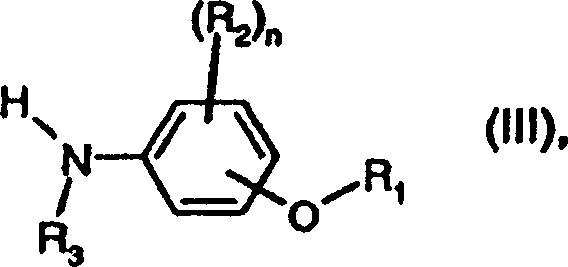
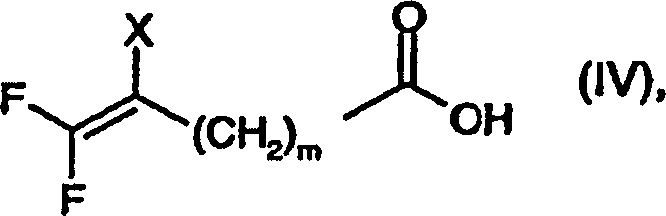
- b) die Umsetzung einer Verbindung der Formel worin X und m wie für Formel (I) definiert sind, geeignetenfalls in Anwesenheit eines Kondensationsmittels oder eines Wasser entfernenden Mittels mit einer Verbindung der Formel (III) oder mit einem Salz hiervon; oder
- c) die Umsetzung einer Verbindung der Formel worin X und m wie für Formel (I) definier sind, mit einer Verbindung der Formel (III) oder mit einem Salz hiervon;

- a) the reaction of a compound of the formula wherein X and m are as defined for formula (I) and Hal is halogen, preferably chlorine or bromine, suitably in an inert solvent and in the presence of an acid-binding agent with a compound of formulawherein R 1 , R 2 , R 3 and n are as defined for formula (I) or, optionally, with a salt thereof, or
- b) the reaction of a compound of the formula wherein X and m are as defined for formula (I), if appropriate in the presence of a condensing agent or a water removing agent with a compound of formula (III) or with a salt thereof; or
- c) the reaction of a compound of the formula wherein X and m are as defined for formula (I), with a compound of formula (III) or with a salt thereof;
Die Ausgangsmaterialien der Formeln (II), (III), (IV) und (V), die vorstehend erwähnt wurden und nachfolgend zur Herstellung der Verbindungen der Formel (I) in freier Form oder in Salzform eingesetzt werden, sind bekannt oder können nach per se bekannten Methoden hergestellt werden.The Starting materials of formulas (II), (III), (IV) and (V), above mentioned were and subsequently for the preparation of the compounds of formula (I) are used in free form or in salt form, are known or can be prepared by methods known per se.
Die vorstehend und nachfolgend beschriebenen Reaktionen werden in per se bekannter Weise, zum Beispiel in Abwesenheit oder, sofern geeignet, in Gegenwart eines geeigneten Lösungsmittels oder Verdünnungsmittels oder einer Mischung hiervon durchgeführt, wobei die Umsetzung erforderlichenfalls unter Kühlung bei Raumtemperatur oder unter Erhitzen, zum Beispiel in einem Temperaturbereich von etwa –80°C bis zur Siedetemperatur der Reaktionsmischung, vorzugsweise von etwa –20°C bis etwa +150°C, und, erforderlichenfalls, in einem geschlossenen Gefäß unter Druck unter Inertgasatmosphäre und/oder unter wasserfreien Bedingungen erfolgt. Besonders vorteilhafte Reaktionsbedingungen finden sich in den Beispielen.The reactions described above and below are in per known manner, for example in the absence or, if appropriate, in the presence of a suitable solvent or diluent or a mixture thereof, the reaction being necessary under cooling at room temperature or under heating, for example in a temperature range from about -80 ° C to the Boiling temperature of the reaction mixture, preferably from about -20 ° C to about + 150 ° C, and, if necessary, in a closed container Pressure under inert gas atmosphere and / or under anhydrous conditions. Particularly advantageous Reaction conditions can be found in the examples.
Die Reaktion des Verfahrens a) wird vorzugsweise in einem inerten, Hydroxygruppenfreien Lösungsmittel in Gegenwart einer organischen Base, wie zum Beispiel Pyridin, 4-Dimethylaminopyridin, 4-Pyrrolidinopyridin, Lutidin, Collidin, Trialkylamin, N,N-Dialkylanilin, oder in Gegenwart einer bicyclischen, nicht-nucleophilen Base wie 1,4-Diazabicyclo-[2.2.2]-octan (DABCO), 1,5-Diazabicyclo-[4.3.0]-non-5-en (DBN) oder 1,8-Diazabicyclo-[5.4.0]-undec-7-en (DBU) durchgeführt. Im Allgemeinen wird die Reaktion bei Temperaturen von –30°C bis +70°C, vorzugsweise von –10°C bis +50°C, und vor teilhaft in Gegenwart von einem inerten Lösungsmittel oder Lösungsmittelmischung durchgeführt.The Reaction of process a) is preferably carried out in an inert, hydroxy group-free solvent in the presence of an organic base, such as pyridine, 4-dimethylaminopyridine, 4-pyrrolidinopyridine, lutidine, collidine, trialkylamine, N, N-dialkylaniline, or in the presence of a bicyclic, non-nucleophilic base such as 1,4-diazabicyclo [2.2.2] octane (DABCO), 1,5-diazabicyclo [4.3.0] non-5-ene (DBN) or 1,8-diazabicyclo [5.4.0] undec-7-ene (DBU). In general, the reaction at temperatures from -30 ° C to + 70 ° C, preferably from -10 ° C to + 50 ° C, and before geous in the presence of an inert solvent or solvent mixture carried out.
Geeignete Lösungsmittel sind zum Beispiel aliphatische und aromatische Kohlenwasserstoffe wie Benzol, Toluol, Xylole, Petrolether, Hexan; halogenierte Kohlenwasserstoffe wie Chlorbenzol, Methylenchlorid, Ethylenchlorid, Chloroform, Tetrachlorkohlenstoff, Tetrachlorethylen; Ether und etherische Verbindungen wie Dialkylether (Diethylether, Diisopropylether, tert-Butylmethylether, usw.), Anisol, Dioxan, Tetrahydrofuran; Nitrile wie Acetonitril, Propionitril; Ester wie Ethylacetat, Propylacetat oder Butylacetat; Ketone wie Aceton, Diethylketon, Methylethylketon oder Methylisobutylketon; und Mischungen derartiger Lösungsmittel miteinander. Die Reaktion kann jedoch auch in einem Überschuss einer der vorstehend erwähnten Basen, oder anstelle der Base kann ein zweites Äquivalent oder ein relativ großer Überschuss der Verbindung der Formel (III) verwendet werden. Die Reaktion erfolgt unter Umgebungsdruck, obgleich sie bei erhöhtem oder reduziertem Druck durchgeführt werden kann.Suitable solvents are, for example, aliphatic and aromatic hydrocarbons such as benzene, toluene, xylenes, petroleum ether, hexane; halogenated hydrocarbons such as chlorobenzene, methylene chloride, ethylene chloride, chloroform, carbon tetrachloride, tetrachlorethylene; Ethers and ethereal compounds such as dialkyl ethers (diethyl ether, diisopropyl ether, tert-butyl methyl ether, etc.), anisole, dioxane, tetrahydrofuran; Nitriles such as acetonitrile, propionitrile; Esters such as ethyl acetate, propyl acetate or butyl acetate; Ketones like acetone, diet hylketone, methyl ethyl ketone or methyl isobutyl ketone; and mixtures of such solvents with each other. However, the reaction may also be in excess of any of the above-mentioned bases, or instead of the base, a second equivalent or a relatively large excess of the compound of the formula (III) may be used. The reaction is carried out under ambient pressure, although it can be carried out at elevated or reduced pressure.
Bei der Verfahrensvariante b) erfolgt die Reaktion vorteilhaft in Gegenwart eines Kondensationsmittels, wie zum Beispiel Phosphorsäuredichloridphenylester, Benzolphosphonsäuredichlorid, 2,4,6-Trichlor-s-triazin, Kohlensäurediimidazolid, ein Carbodiimid wie Dicyclohexylcarbodiimid (DCC), Aluminiumoxid, Titantetrachlorid, 2,2,4,4,6,6-Hexachlor-1,3,5-triazatriphosphorin oder Chlorameisensäureniedrigalkylester wie Isobutylchlorformiat. Vorzugsweise erfolgt die Reaktion in Gegenwart eines inerten Lösungsmittels oder Lösungsmittelmischung bei Temperaturen von –30°C bis +70°C, vorzugsweise von –10 °C bis +50°C. Die Reaktion wird vorzugsweise ausgeführt in Gegenwart einer Base, wie zum Beispiel in Gegenwart eines organischen Amins wie Trialkylamin (Trimethylamin, Triethylamin, Triisopropylamin oder Diisopropylethylamin), eines Pyridins (Pyridin selbst, 4-Dimethylaminopyridin oder 4-Pyrrolidinoopyridin), eines Morpholins (N-Methylmorpholin) oder eines N,N-Dialkylanilins (N,N-Dimethylanilin oder N-Methyl-N-ethylanilin). Geeignete Lösungsmittel für die Reaktion sind zum Beispiel aliphatische und aromatische Kohlenwasserstoffe wie Benzol, Toluol, Xylole, Petrolether, Hexan; halogenierte Kohlenwasserstoffe wie Chlorbenzol, Methylenchlorid, Ethylenchlorid, Chloroform, Te trachlorkohlenstoff Tetrachlorethylen; Ether wie Dialkylether (Diethylether, Diisopropylether, tert-Butylmethylether, usw.), Anisol, Dioxan, Tetrahydrofuran; Nitrile wie Acetonitril, Propionitril; Ester wie Ethylacetat, Propylacetat oder Butylacetat; und Mischungen von derartigen Lösungsmitteln miteinander.at In process variant b), the reaction is advantageously carried out in the presence a condensing agent, such as phosphoric acid phenylchloride, Benzolphosphonsäuredichlorid, 2,4,6-trichloro-s-triazine, carbon dioxide diimidazolide, a carbodiimide such as dicyclohexylcarbodiimide (DCC), alumina, titanium tetrachloride, 2,2,4,4,6,6-hexachloro-1,3,5-triazatriphosphorin or lower alkyl chloroformate such as isobutyl chloroformate. The reaction preferably takes place in the presence an inert solvent or solvent mixture at temperatures from -30 ° C to + 70 ° C, preferably from -10 ° C to + 50 ° C. The reaction is preferably carried out in the presence of a base, such as in the presence of an organic Amines such as trialkylamine (trimethylamine, triethylamine, triisopropylamine or diisopropylethylamine), a pyridine (pyridine itself, 4-dimethylaminopyridine or 4-pyrrolidino-pyridine), a morpholine (N-methylmorpholine) or an N, N-dialkylaniline (N, N-dimethylaniline or N-methyl-N-ethylaniline). Suitable solvents for the Reaction are, for example, aliphatic and aromatic hydrocarbons such as benzene, toluene, xylenes, petroleum ether, hexane; halogenated hydrocarbons such as chlorobenzene, methylene chloride, ethylene chloride, chloroform, Te chondrocarbon Tetrachlorethylene; Ethers, such as dialkyl ethers (diethyl ether, diisopropyl ether, tert-butyl methyl ether, etc.), anisole, dioxane, tetrahydrofuran; nitrites such as acetonitrile, propionitrile; Esters such as ethyl acetate, propyl acetate or butyl acetate; and mixtures of such solvents together.
Bei der Verfahrensvariante c) werden die Reaktionen vorteilhaft in Gegenwart eines inerten Lösungsmittels oder Lösungsmittelmischung bei Temperaturen von 0°C bis +120°C, vorzugsweise von 50°C bis +100°C, durchgeführt. Geeignete Lösungsmittel sind die gleichen wie vorstehend bei Variante a) erwähnt.at the process variant c), the reactions are advantageous in the presence an inert solvent or solvent mixture at temperatures of 0 ° C up to + 120 ° C, preferably from 50 ° C up to + 100 ° C, carried out. Suitable solvents are the same as mentioned above in variant a).
Die nach dem Verfahren oder auf andere Weise erhältlichen Verbindungen der Formel (I) können in per se bekannter Weise in andere Verbindungen der Formel (I) übergeführt werden durch Ersetzen eines oder mehrerer Substituenten der Ausgangsverbindung der Formel (I) durch einen oder mehrere erfindungsgemäße Substituenten in üblicher Weise.The according to the method or otherwise obtainable compounds of the formula (I) can be converted in per se known manner into other compounds of formula (I) by replacing one or more substituents of the starting compound of the formula (I) by one or more substituents according to the invention in usual Wise.
In Abhängigkeit von der Wahl der Reaktionsbedingungen und Ausgangsmaterialien, die für den jeweiligen Fall geeignet sind, ist es möglich, dass in einer Reaktionsstufe lediglich ein Substituent durch andere Substituenten gemäß der Erfindung ersetzt werden, oder es ist möglich, dass mehrere Substituenten durch andere Substituenten gemäß der Erfindung in der gleichen Reaktionsstufe ersetzt werden.In dependence on the choice of reaction conditions and starting materials that for the appropriate case, it is possible that in a reaction stage only one substituent by other substituents according to the invention be replaced or it is possible that several substituents by other substituents according to the invention be replaced in the same reaction stage.
Die Salze der Verbindungen der Formel (I) können in per se bekannter Weise hergestellt werden. Zum Beispiel werden Salze der Verbindungen der Formel (I) mit Basen erhalten, indem man die freien Verbindungen mit einer geeigneten Base oder mit einem geeigneten Ionenaustauschreagens behandelt.The Salts of the compounds of the formula (I) can be prepared in a manner known per se getting produced. For example, salts of the compounds of Formula (I) with bases obtained by mixing the free compounds with a suitable base or with a suitable ion exchange reagent treated.
Die Salze der Verbindungen der Formel (I) können in die freien Verbindungen der Formel (I) auf übliche Weise, zum Beispiel durch Behandlung mit einer geeigneten Säure oder mit einem geeigneten Ionenaustauschreagens, übergeführt werden.The Salts of the compounds of the formula (I) can be converted into the free compounds of the formula (I) in the usual way, for example, by treatment with a suitable acid or with a suitable ion exchange reagent, transferred.
Die Salze der Verbindungen der Formel (I) können in andere Salze einer Verbindung der Formel (I) auf per se bekannte Weise übergeführt werden.The Salts of the compounds of the formula (I) can be converted into other salts of a Compound of formula (I) are converted in per se known manner.
In Abhängigkeit von dem Verfahren und den Reaktionsbedingungen können die Verbindungen der Formel (I) mit salzbildenden Eigenschaften in freier Form oder in Form der Salze erhalten werden.In dependence from the process and the reaction conditions, the compounds of formula (I) having salt-forming properties in free form or in the form the salts are obtained.
Die Verbindungen der Formel (I) in freier Form oder in Salzform können in Form eines der möglichen Isomeren oder in Form einer Mischung derselben vorliegen; zum Beispiel können sie in Abhängigkeit von der Anzahl der asymmetrischen Kohlenstoffatome, die in dem Molekül vorliegen und der absoluten und relativen Konfiguration hiervon und/oder in Abhängigkeit von der Konfiguration der nicht-aromatischen Doppelbindungen, die in dem Molekül vorliegen, in Form der freien Isomeren wie Antipoden und/oder Diastereoisomere, oder in Form von Mischungen der Isomeren wie Mischungen von Enantiomeren, zum Beispiel Racematen, Mischungen von Diastereoisomeren oder Mischungen von Racematen, vorliegen. Die Erfindung betrifft sowohl die reinen Isomeren wie auch sämtliche möglichen Mischungen von Isomeren und ist als solche vorstehend und nachfolgend zu interpretieren, selbst wenn stereochemische Details nicht in jedem Fall speziell erwähnt sind.The Compounds of the formula (I) in free form or in salt form can be described in Form of one of the possible isomers or in the form of a mixture thereof; for example, you can dependent on of the number of asymmetric carbon atoms present in the molecule and the absolute and relative configuration thereof and / or in dependence from the configuration of non-aromatic double bonds, the in the molecule in the form of free isomers such as antipodes and / or diastereoisomers, or in the form of mixtures of the isomers, such as mixtures of enantiomers, for example racemates, mixtures of diastereoisomers or mixtures from racemates. The invention relates both to the pure Isomers as well as all potential Mixtures of isomers and is as such above and below to interpret even if stereochemical details are not in specifically mentioned in each case.
Mischungen der Diastereoisomeren, Mischungen von Racematen und Mischungen von Doppelbindungsisomeren der Verbindungen der Formel (I) in freier Form oder in Salzform, die nach dem Verfahren – in Abhängigkeit von den Ausgangsmaterialien und den gewählten Verfahrensweisen – oder auf andere Weise erhältlich sind, können in bekannter Weise in die reinen Diastereoisomeren oder Racemate auf Basis der physikalisch-chemischen Unterschiede zwischen ihren Bestandteilen, zum Beispiel durch fraktionierte Kristallisation, Destillation und/oder Chromatographie, getrennt werden.mixtures the diastereoisomers, mixtures of racemates and mixtures of Double bond isomers of the compounds of the formula (I) in free Form or in salt form, following the procedure - depending on the starting materials and the chosen one Procedures - or available in other ways are, can in a known manner in the pure diastereoisomers or racemates based on the physicochemical Differences between their constituents, for example, by fractional Crystallization, distillation and / or chromatography, separated become.
Mischungen von Enantiomeren wie Racemate, die in entsprechender Weise erhältlich sind, können in die optischen Antipoden nach bekannten Methoden getrennt werden, zum Beispiel durch Umkristallisation aus einem optischen aktiven Lösungsmittel, durch Chromatographie an chiralen Adsorptionsmitteln, zum Beispiel Hochdruckflüssigkeitschromatogra phie (HPLC) an Acetylcellulose, mit Hilfe geeigneter Mikroorganismen, durch Spaltung mit spezifischen, immobilisierten Enzymen, über die Bildung von Einschlussverbindungen, zum Beispiel unter Verwendung von chiralen Kronenethern, in welchem Fall lediglich ein Enantiomeres komplexiert wird, oder durch Umwandlung in diastereomere Salze und Trennen der Mischung der so erhaltenen Diastereomeren, zum Beispiel auf Basis ihrer verschiedenen Löslichkeiten mit Hilfe der fraktionierten Kristallisation, in die Diastereomeren, aus denen das gewünschte Enantiomere durch Einwirken geeigneter Mittel freigesetzt werden kann.mixtures enantiomers, such as racemates, which are similarly available can be separated into the optical antipodes by known methods, for example, by recrystallization from an optical active Solvent, by chromatography on chiral adsorbents, for example Hochdruckflüssigkeitschromatogra phie (HPLC) of acetyl cellulose, by means of suitable microorganisms Cleavage with specific, immobilized enzymes, via the Formation of inclusion compounds, for example using of chiral crown ethers, in which case only one enantiomer complexed, or by conversion into diastereomeric salts and Separating the mixture of diastereomers thus obtained, for example based on their different solubilities with the help of fractionated crystallization, into the diastereomers, from which the desired Enantiomers are released by the action of suitable agents can.
Außer ihrer Erzielung durch Trennen der entsprechenden Mischungen der Isomeren ist es auch möglich, dass die reinen Diastereomeren und Enantiomeren erfindungsgemäß erhalten werden mit Hilfe allgemein bekannter Methoden der diastereo-selektiven oder enantio-selektiven Synthese, zum Beispiel indem man das erfindungsgemäße Verfahren unter Verwendung von Ausgangsmaterialien durchführt, die die entsprechend geeignete Stereochemie besitzen.Except her Obtained by separation of the corresponding mixtures of isomers it is also possible that the pure diastereomers and enantiomers are obtained according to the invention become by means of well-known methods of the diastereo-selective or enantio-selective Synthesis, for example by the inventive method carried out using starting materials which are the appropriate Possess stereochemistry.
Weisen die individuellen Komponenten unterschiedliche biologische Aktivitäten auf, ist es in jedem Fall vorteilhaft, das biologisch aktivere Isomere, z.B. Enantiomere oder Diastereomere, oder eine Mischung der Isomeren, z.B. eine Mischung der Enantiomeren oder eine Mischung der Diastereomeren, zu isolieren oder zu synthetisieren.Point the individual components have different biological activities, it is in any case advantageous to use the more biologically active isomer, e.g. Enantiomers or diastereomers, or a mixture of isomers, e.g. a mixture of the enantiomers or a mixture of the diastereomers, to isolate or synthesize.
Die Verbindungen der Formel (I) in freier Form oder in Salzform können auch erhalten werden in Form ihrer Hydrate und/oder können andere Lösungsmittel einschließen, zum Beispiel Lösungsmittel, die für die Kristallisation der Verbindungen, die in fester Form vorliegen, verwendet wurden.The Compounds of formula (I) in free or salt form may also be used can be obtained in the form of their hydrates and / or other solvents lock in, for example, solvents, the for the crystallization of the compounds, which are in solid form, were used.
Die Erfindung betrifft auch sämtliche Ausführungsformen des Verfahrens, dem gemäß eine Verbindung, die als Ausgangsmaterial oder Zwischenprodukt in irgendeiner Stufe des Verfahrens erhältlich ist, als Ausgangspunkt eingesetzt wird und alle oder einige der verbliebenen Stufen durchgeführt werden, oder bei denen ein Ausgangsmaterial in Form eines Derivats oder Salzes und/oder eines Racemats oder einer Antipode verwendet wird, oder insbesondere unter den Reaktionsbedingungen gebildet wird.The The invention also relates to all embodiments the method according to which a compound, as starting material or intermediate in any stage of the method available is used as a starting point and all or some of the remaining stages performed or in which a starting material in the form of a derivative or salt and / or a racemate or an antipode is formed, or in particular under the reaction conditions becomes.
Bei dem erfindungsgemäßen Verfahren sind die Ausgangsmaterialien und Zwischenprodukte, die jeweils in freier Form oder in Salzform verwendet werden, vorzugsweise solche, die zu Verbindungen der Formel (I), welche zu Beginn als besonders wertvoll beschrieben wurden oder zu deren Salzen führen.at the method according to the invention are the starting materials and intermediates, each in free form or in salt form, preferably those those to compounds of formula (I), which at the beginning as particularly have been described valuable or lead to their salts.
Die Erfindung betrifft insbesondere das in Beispiel P1 beschriebene Herstellungsverfahren.The Invention particularly relates to that described in Example P1 Production method.
Im Bereich der Schädlingskontrolle sind die erfindungsgemäßen Verbindungen der Formel (I), während sie von warmblütigen Tieren, Fischen und Pflanzen gut toleriert werden, selbst bei niedrigen Konzentrationsraten wertvolle präventive und/oder heilende aktive Bestandteile mit einem sehr vorteilhaften bioziden Spektrum. Die erfindungsgemäßen Verbindungen sind auch gegenüber sämtlichen oder individuellen Entwicklungsstadien von normalerweise empfindlichen tierischen Schädlingen und auch resistenten tierischen Schädlingen, wie Insekten oder Vertretern der Ordnung Acarina, wirksam. Die Insektizide oder akarizide Wirkung der erfindungsgemäßen Verbindungen kann sich direkt äußern, das heißt im Tod der Schädlinge, der unmittelbar oder lediglich nach einiger Zeit, zum Beispiel während der Verpuppung, erfolgt, oder indirekt, zum Beispiel bei reduzierter Eiablage und/oder Ausschlüpfrate, wobei eine gute Aktivität einer Mortalitätsrate von zumindest 50 bis 60 % entspricht.in the Area of pest control are the compounds of the invention of the formula (I) while her from warm-blooded Animals, fish and plants are well tolerated, even at low levels Concentration rates valuable preventive and / or healing active ingredients with a very beneficial biocidal spectrum. The compounds of the invention are also across from all or individual stages of development of normally sensitive ones animal pests and also resistant animal pests, such as insects or Representatives of the order Acarina, effective. The insecticides or acaricides Effect of the compounds of the invention can comment directly, that is called in the death of the pests, directly or only after some time, for example during the Pupation occurs, or indirectly, for example, at reduced Oviposition and / or hatching rate, being a good activity a mortality rate of at least 50 to 60%.
Die vorstehend genannten tierischen Schädlinge umfassen diejenigen, die in der europäischen Patentanmeldung EP-A-736 252 erwähnt werden. Die dort erwähnten Schädlinge sind dem gemäß vom Gegenstand der vorliegenden Erfindung durch Bezugnahme umfasst. Die erfindungsgemäßen Verbindungen sind insbesondere geeignet bei der Kontrolle von Boophilus microplus, Nilaparvata lugens und Tetranychus urticase, und vorzugsweise bei der Kontrolle derartiger Schädlinge in Pflanzen, Früchten und Reiskulturen.The aforementioned animal pests include those mentioned in European Patent Application EP-A-736 252. The pests mentioned therein are according to the subject matter of the present invention by reference. The compounds of the invention are particularly useful in the control of Boophilus microplus, Nilaparvata lugens and Tetranychus urticase, and preferably in the control of such pests in plants, fruits and rice crops.
Mit den erfindungsgemäßen Verbindungen ist es möglich, Schädlinge des vorstehend erwähnten Typs zu kontrollieren, das heißt zu inhibieren oder zu zerstören, die insbesondere auf Pflanzen, vor allem auf verwertbaren Pflanzen und Zierpflanzen, in Landwirtschaft, Gartenbau, Forstwirtschaft, oder auf Teilen von Pflanzen wie Früchten, Blüten, Blättern, Stengeln, Knollen oder Wurzeln, auftreten, während die Pflanzenteile, die später wachsen, ebenfalls gegen solche Schädlinge in gewissem Ausmaß geschützt werden.With the compounds of the invention Is it possible, pests of the aforementioned Type to control, that is to inhibit or destroy especially on plants, especially on usable plants and ornamentals, in agriculture, horticulture, forestry, or on parts of plants such as fruits, flowers, leaves, stems, tubers or Roots, occur while the plant parts that later also be protected against such pests to some extent.
Zielkulturen sind insbesondere Getreide wie Weizen, Gerste, Roggen, Hafer, Reis, Mais und Hirse; Rüben wie Zuckerrübe und Futterrübe; Früchte wie Kernobst, Steinobst und Weichobst wie Äpfel, Birnen, Pflaumen, Pfirsiche, Mandeln, Kirschen oder Beeren, z.B. Erdbeeren, Himbeeren oder Brombeeren; Leguminosenfrüchte wie Bohnen, Linsen, Erbsen und Sojabohnen; Ölfrüchte wie Raps, Senf, Mohn, Oliven, Sonnenblumen, Kokosnuß, Rizinuspflanzen, Kakaobohnen und Erdnüsse; Cucurbitaceen wie Kürbisse, Gurken und Melonen; Faserpflanzen wie Baumwolle, Flachs, Hanf und Jute; Zitrusfrüchte wie Orangen, Zitronen, Grapefruit und Mandarinen; Gemüse wie Spinat, Kopfsalat, Spargel, Kohl, Möhren, Zwiebeln, Tomaten, Kartoffeln und Paprika; Lauraceen wie Avocados, Zimt und Kampfer; und Tabak, Nüsse, Kaffee, Auberginen, Zuckerrohr, Tee, Pfeffer, Wein, Hopfen, Bananen und Naturkautschuk sowie auch Zierpflanzen.target crops especially cereals such as wheat, barley, rye, oats, rice, Corn and millet; beets like sugar beet and fodder beet; fruit such as pome fruit, stone fruit and soft fruit such as apples, pears, plums, peaches, Almonds, cherries or berries, e.g. Strawberries, raspberries or blackberries; leguminous such as beans, lentils, peas and soybeans; Oil crops such as rapeseed, mustard, poppy, Olives, sunflowers, coconut, Castor beans, cocoa beans and peanuts; Cucurbitaceans like pumpkins, Cucumbers and melons; Fiber plants such as cotton, flax, hemp and Jute; citrus fruits such as oranges, lemons, grapefruit and tangerines; Vegetables like spinach, Lettuce, asparagus, cabbage, carrots, Onions, tomatoes, potatoes and peppers; Lauraceas like avocados, Cinnamon and camphor; and tobacco, nuts, Coffee, eggplant, sugarcane, tea, pepper, wine, hops, bananas and natural rubber as well as ornamental plants.
Weitere Anwendungsgebiete der Verbindungen gemäß der Erfindung sind der Schutz von gelagerten Waren und Vorräten und Materialien und auch der Schutz auf dem Hygienesektor, insbesondere der Schutz von Haustieren und produktivem Viehbestand gegen Schädlinge der erwähnten Art.Further Areas of application of the compounds according to the invention are the protection of stored goods and supplies and materials and also the protection in the hygiene sector, in particular the protection of pets and productive livestock against pests mentioned Art.
Die Erfindung betrifft auch pestizide Zusammensetzungen wie emulgierbare Konzentrate, Suspensionskonzentrate, direkt sprühbare oder verdünnbare Lösungen, auftragbare Pasten, verdünnte Emulsionen, benetzbare Pulver, lösliche Pulver, dispergierbare Pulver, benetzbare Pulver, Stäube, Granulate oder Verkapselungen in polymeren Substanzen, die zumindest eine der erfindungsgemäßen Verbindungen umfassen, wobei der Formulierungstyp entsprechend den beabsichtigten Zwecken und den vorherrschenden Umständen gewählt wird.The The invention also relates to pesticidal compositions such as emulsifiable Concentrates, suspension concentrates, directly sprayable or dilutable solutions, Applicable pastes, diluted Emulsions, wettable powders, soluble Powders, dispersible powders, wettable powders, dusts, granules or encapsulations in polymeric substances containing at least one the compounds of the invention comprising the type of formulation according to the intended Purposes and prevailing circumstances.
Der aktive Bestandteil wird in derartigen Zusammensetzungen in reiner Form eingesetzt, wobei ein fester aktiver Bestandteil zum Beispiel in einer speziellen Teilchengröße oder vorzugsweise zusammen mit zumindest einem der in der Formulierungstechnologie üblichen Adjuvanzien wie Streckmittel, z.B. Lösungsmittel oder feste Träger, oder oberflächenaktive Verbindungen (Surfactants) verwendet wird.Of the active ingredient becomes more pure in such compositions Form used, wherein a solid active ingredient, for example in a specific particle size or preferably together with at least one of the usual in formulation technology Adjuvants such as diluents, e.g. Solvent or solid carriers, or surfactants Compounds (surfactants) is used.
Geeignete Formulierungsadjuvantien sind zum Beispiel feste Träger, Lösungsmittel, Stabilisatoren, Mittel für die langsame Abgabe, Farbstoffe und gegebenenfalls oberflächenaktive Substanzen (Surfactants). Geeignete Träger und Adjuvanzien umfassen in diesem Fall sämtliche Substanzen, die normalerweise bei Schutzprodukten für Kulturen eingesetzt werden, insbesondere in Produkten zur Kontrolle von Schnecken bzw. schneckenartigen Schädlingen. Geeignete Adjuvanzien wie Lösungsmittel, feste Träger, oberflächenaktive Verbindungen, nicht-ionische oberflächenaktive Mittel, kationische oberflächenaktive Mittel, anionische oberflächenaktive Mittel und weitere Adjuvanzien in den erfindungsgemäß verwendeten Zusammensetzungen sind zum Beispiel die in EP-A-736 252 beschriebenen; sie sind durch Bezugnahme vom Gegenstand der vorliegenden Erfindung umfasst.suitable Formulation adjuvants are, for example, solid carriers, solvents, Stabilizers, means for the slow release, dyes and possibly surface-active Substances (surfactants). Suitable carriers and adjuvants include in this case all Substances that are normally used in crop protection products be used, in particular in products for controlling screws or snail-like pests. Suitable adjuvants, such as solvents, solid carriers, surfactants Compounds, nonionic surfactants, cationic surfactants Medium, anionic surfactant Agents and other adjuvants used in the invention Compositions are for example those described in EP-A-736 252; they are the subject of the present invention by reference includes.
Die
Zusammensetzungen enthalten gewöhnlich
0,1 bis 99 %, insbesondere 0,1 bis 95 %, des Wirkstoffs, und 1 bis
99,9 %, insbesondere 5 bis 99,9 %, zumindest eines festen oder flüssigen Adjuvanz,
wobei es im Allgemeinen möglich
ist, dass 0 bis 25 %, insbesondere 0,1 bis 20 %, der Zusammensetzung
oberflächenaktive
Mittel sind (die Prozentangaben sind jeweils auf das Gewicht bezogen).
Während
im Handel erhältliche
Produkte bevorzugt als Konzentrate formuliert werden, wird der Endverbraucher
normalerweise verdünnte
Formulierungen verwenden, die beträchtlich geringere Konzentrationen
an aktivem Bestandteil aufweisen. Bevorzugte Formulierungen besitzen
insbesondere die folgende Zusammensetzung (% = Gewichtsprozent): Emulgierbare
Konzentrate:
Die Aktivität der erfindungsgemäßen Zusammensetzungen kann durch Zusatz von anderen Insektiziden aktiven Bestandteilen erheblich erweitert und den vorherrschenden Bedingungen angepasst werden. Beispiele für geeignete zusätzliche aktive Bestandteile umfassen zum Beispiel Vertreter der folgenden Wirkstoffklassen: Organophosphorverbindungen, Nitrophenole und Derivate, Formamidine, Acylharnstoffe, Carbamate, Pyrethroide, Nitroenamine und Derivate, Pyrrole, Thioharnstoffe und Derivate, chlorierte Kohlenwasserstoffe und Bacillus thuringiensis-Präparate. Die erfindungsgemäßen Zusammensetzungen können auch andere feste oder flüssige Adjuvanzien wie Stabilisatoren, zum Beispiel pflanzliche Öle oder epoxidierte pflanzliche Öle (z.B. epoxidiertes Kokosnussöl, Rapsöl oder Sojabohnenöl), Antischaummittel, z.B. Silikonöl, Konservierungsmittel, Viskositätsregulatoren, Bindemittel und/oder Klebemittel ebenso wie Düngemittel oder andere aktive Be standteile zur Erzielung spezieller Wirkungen, z.B. Akarizide, Bakterizide, Fungizide, Nematozide, Molluszizide oder selektive Herbizide, umfassen.The activity the compositions of the invention can by adding other insecticides active ingredients considerably expanded and adapted to the prevailing conditions become. examples for suitable additional Active ingredients include, for example, representatives of the following Active substance classes: organophosphorus compounds, nitrophenols and derivatives, Formamidines, acylureas, carbamates, pyrethroids, nitroenamines and derivatives, pyrroles, thioureas and derivatives, chlorinated hydrocarbons and Bacillus thuringiensis preparations. The compositions of the invention can also other solid or liquid Adjuvants such as stabilizers, for example vegetable oils or epoxidized vegetable oils (e.g., epoxidized coconut oil, rapeseed oil or soybean oil), Antifoam, e.g. Silicone oil, Preservatives, viscosity regulators, Binders and / or adhesives as well as fertilizers or other active Components for achieving special effects, e.g. acaricides, Bactericides, fungicides, nematocides, molluscicides or selective Herbicides.
Die erfindungsgemäßen Zusammensetzungen werden in an sich bekannter Weise hergestellt: In Abwesenheit von Adjuvanzien, zum Beispiel durch Vermahlen, Sieben und/oder Pressen eines festen Wirkstoffs oder Wirkstoffmischung, zum Beispiel auf eine spezifische Teilchengröße, und in Gegenwart von zumindest einem Adjuvanz, zum Beispiel durch inniges Mischen und/oder Vermahlen des Wirkstoffs oder Wirkstoffmischung mit dem oder den Adjuvanzien. Die Erfindung bezieht sich auch auf solche Verfahren zur Herstellung der erfindungsgemäßen Zusammensetzungen und auf die Verwendung der Verbindungen I bei der Herstellung von solchen Zusammensetzungen.The Compositions of the invention are prepared in a conventional manner: In the absence of Adjuvants, for example by grinding, sieving and / or pressing a solid drug or drug mixture, for example a specific particle size, and in the presence of at least one adjuvant, for example through intimate Mixing and / or grinding of the active ingredient or active ingredient mixture with the adjuvant (s). The invention also relates to such processes for the preparation of the compositions of the invention and to the use of the compounds I in the preparation of such compositions.
Die Erfindung betrifft auch Verfahren für die Anwendung der Zusammensetzungen, das heißt Verfahren zur Kontrolle von Schädlingen des vorstehend genannten Typs wie Sprühen, Atomisieren, Zerstäuben, Beschichten, Beizen, Streuen oder Gießen, die in Abhängigkeit von den beabsichtigten Zielen und den vorherrschenden Umständen gewählt werden, und auf die Verwendung der Zusammensetzungen bei der Kontrolle von Schädlingen des vorstehend genannten Typs. Typische Konzentrationsraten betragen von 0,1 bis 1000 ppm, vorzugsweise von 0,1 bis 500 ppm, an Wirkstoff. Die Aufbringungsraten je Hektar betragen im Allgemeinen von 1 bis 2000 g aktiver Bestandteil je Hektar, insbesondere 10 bis 1000 g/ha, vorzugsweise 20 bis 600 g/ha.The Invention also relates to methods for the use of the compositions, this means Method of controlling pests of the type mentioned above, such as spraying, atomizing, sputtering, coating, Pickling, spreading or pouring, the dependent be chosen from the intended objectives and the prevailing circumstances, and to the use of the compositions in the control of pests of the aforementioned type. Typical concentration rates amount from 0.1 to 1000 ppm, preferably from 0.1 to 500 ppm, of active ingredient. The application rates per hectare are generally from 1 to 2000 g of active ingredient per hectare, in particular 10 to 1000 g / ha, preferably 20 to 600 g / ha.
Ein bevorzugtes Verfahren für das Aufbringen auf den Bereich des Schutzes von Kulturen ist das Aufbringen auf die Blätter der Pflanzen (foliare Anwendung), wobei die Häufigkeit und die Aufbringungsrate von dem Befallsrisiko durch den jeweiligen Schädling abhängen. Der Wirkstoff kann jedoch auch in die Pflanzen über das Wurzelsystem (systemische Wirkung) als Ergebnis der Imprägnierung des Pflanzenstandorts mit einer flüssigen Formulierung oder durch Einbringen des Wirkstoffs in fester Form, zum Beispiel in Form von Granulaten, an den Pflanzenstandort, zum Beispiel in den Boden (Bodenanwendung) eindringen. Im Fall von Reisfeuchtkulturen können solche Granulate in abgemessenen Mengen auf das unter Wasser stehende Reisfeld aufgebracht werden.One preferred method for the application to the field of the protection of cultures is that Apply to the leaves the plants (foliar application), the frequency and the rate of application depend on the risk of infestation by the respective pest. The active ingredient, however, can also in the plants over the root system (systemic effect) as a result of impregnation plant location with a liquid formulation or by Introducing the active substance in solid form, for example in the form of Granules, to the plant site, for example in the soil (soil application) penetration. In the case of rice wet cultures, such granules can be measured in measured Quantities are applied to the submerged rice field.
Die erfindungsgemäßen Zusammensetzungen sind auch geeignet für den Schutz von Pflanzenvermehrungsgut einschließlich von genetisch modifiziertem Vermehrungsgut, z.B. Saatgut wie Früchte, Knollen oder Körner, oder pflanzliches Schnittmaterial gegen tierische Schädlinge. Das Vermehrungsgut kann mit der Zusammensetzung vor dem Pflanzen behandelt werden, zum Beispiel kann das Saatgut vor dem Aussäen gebeizt werden. Die erfindungsgemäßen Verbindungen können auch aufgebracht werden auf Saatgutkörner (Beschichten) entweder durch Imprägnieren der Körner mit einer flüssigen Formulierung oder durch deren Beschichtung mit einer festen Formulierung. Die Zusammensetzung kann auch auf den Bepflanzungsort aufgebracht werden, wenn das Vermehrungsmaterial gepflanzt wird, zum Beispiel kann es auf die Saatfurche während des Säens aufgebracht werden. Die Erfindung betrifft auch die Methode der Behandlung von Pflanzenvermehrungsgut und das so behandelte Pflanzenvermehrungsgut.The Compositions of the invention are also suitable for the protection of plant reproductive material including genetically modified Reproductive material, e.g. Seeds such as fruits, tubers or grains, or vegetable cutting material against animal pests. The propagation material can be treated with the composition before planting, For example, the seeds may be pickled before sowing. The compounds of the invention can also be applied to seed grains (coating) either by impregnation the grains with a liquid Formulation or by its coating with a solid formulation. The composition may also be applied to the planting site when the propagating material is planted, for example It may be on the seed furrow during of sowing be applied. The invention also relates to the method of Treatment of plant propagation material and the thus treated plant propagation material.
Die folgenden Beispiele erläutern die Erfindung, ohne sie zu beschränken. Die Temperaturen sind in Grad Celsius angegeben, und die Mischungsverhältnisse der Lösungsmittel in Volumenteile.The explain the following examples the invention without limiting it. The temperatures are in degrees Celsius, and the mixing ratios of the solvents in volume.
Herstellungsbeispiele Beispiel
P1: Herstellung von 6,6-Difluorhex-5-en-säure [4-(2-Chlor-1,1,2-trifluorethoxy)-2-methylphenyl)-amid der
Formel 
a)
[4-(2-Chlor-1,1,2-trifluorethoxy)-2-methyl-1-nitrobenzol der Formel 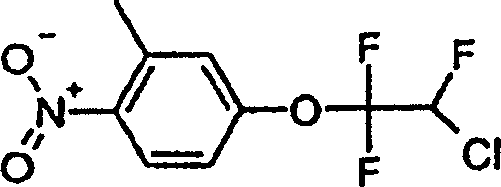
253,4 g Chlortrifluorethylen werden bei Raumtemperatur in 157,8 g 3-Methyl-4-nitrophenol und 76,6 g Kaliumhydroxidpulver in 750 ml Dimethylformamid eingebracht, wobei die Temperatur 60°C nicht überschreiten darf. Die Reaktionsmischung wird dann in 4 Liter Eiswasser gegossen und mit Toluol extrahiert. Nach dem Trocknen der Toluolphase mit Natriumsulfat wird das Lösungsmittel durch Verdampfen konzentriert, wobei man 266 g Titelverbindung (Öl) erzielt.253.4 g of chlorotrifluoroethylene are dissolved at room temperature in 157.8 g of 3-methyl-4-nitrophenol and 76.6 g of potassium hydroxide powder are introduced into 750 ml of dimethylformamide, the temperature being 60 ° C do not exceed may. The reaction mixture is then poured into 4 liters of ice water and extracted with toluene. After drying the toluene phase with Sodium sulfate becomes the solvent concentrated by evaporation to give 266 g of the title compound (oil).
b)
[4-(2-Chlor-1,1,2-trifluorethoxy)-2-methylphenyl]-amin der Formel 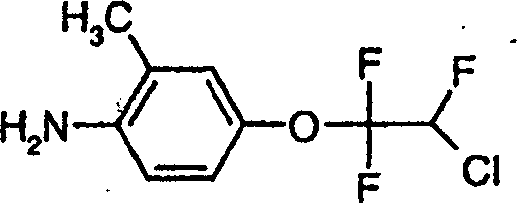
266,0 g 4-(2-Chlor-1,1,2-trifluorethoxy)-2-methyl-1-nitrobenzol in Dioxan werden mit Wasserstoff bei Raumtemperatur in Gegenwart von 20 g Raney-Nickel umgesetzt. Nach Entfernen des Katalysators wird das Lösungsmittel durch Verdampfen konzentriert und der Rückstand unter Hochvakuum destilliert, wobei man die Titelverbindung in Form eines Öls erhält.266.0 g 4- (2-Chloro-1,1,2-trifluoroethoxy) -2-methyl-1-nitrobenzene in dioxane are hydrogenated at room temperature in the presence of 20 g Raney nickel implemented. After removal of the catalyst, the solvent concentrated by evaporation and the residue is distilled under high vacuum, whereby the title compound is obtained in the form of an oil.
c) 6,6-Difluorhex-5-en-säure [4-(2-Chlor-1,1,2-trifluorethoxy)-2-methylphenyl]-amid:c) 6,6-Difluorohex-5-enoic acid [4- (2-chloro-1,1,2-trifluoroethoxy) -2-methylphenyl] -amide:
155,4 g 6,6-Difluorhex-5-en-säurechlorid werden zu 204,5 g [4-(2-Chlor-1,1,2-trifluorethoxy)-2-methylphenyl]-amin, 142,5 ml Triethylamin und 5 g N,N-Dimethylaminopyridin, gerührt bei Raumtemperatur in 2 Liter Toluol, zugetropft; im Verlauf der Zugabe wird die Temperatur bei etwa 20°C durch Kühlen mit Eis gehalten. Die Reaktionsmischung wird dann über Nacht bei Raumtemperatur gerührt und einmal mit Natriumhydrogencarbonatlösung und einmal mit Wasser gewaschen, und die organische Phase über Natriumsulfat getrocknet. Nach Einengen des Lösungsmittels durch Verdampfen wird das Reaktionsprodukt durch Zusatz von Hexan ausgefällt. Nach Saugfiltration wird der feste braune Filtrationsrückstand in Ethylacetat aufgenommen und an Silicagel gereinigt (Elutionsmittel: Ethylacetat/Hexan (1 : 1)). Die Titelverbindung mit einem Schmelzpunkt von 59–60°C (Verbindung 1.1) wird erhalten.155.4 g 6,6-Difluorohex-5-enoic acid chloride be 204.5 g of [4- (2-chloro-1,1,2-trifluoroethoxy) -2-methylphenyl] amine, 142.5 ml of triethylamine and 5 g of N, N-dimethylaminopyridine, stirred at Room temperature in 2 liters of toluene, added dropwise; in the course of the addition the temperature is about 20 ° C by cooling kept with ice. The reaction mixture is then overnight stirred at room temperature and once with sodium bicarbonate solution and once with water washed, and the organic phase dried over sodium sulfate. To Concentration of the solvent by evaporation, the reaction product is precipitated by the addition of hexane. To Suction filtration becomes the solid brown filtration residue taken up in ethyl acetate and purified on silica gel (eluent: Ethyl acetate / hexane (1: 1)). The title compound with a melting point from 59-60 ° C (compound 1.1) is obtained.
Beispiel P2: Die weiteren Verbindungen der Tabellen 1 und 2 können analog zu der vorstehend beschriebenen Weise erhalten werden.example P2: The further compounds of Tables 1 and 2 can be analogous are obtained in the manner described above.
Tabelle
1: Verbindungen der Formel 
Tabelle
2: Verbindungen der Formel 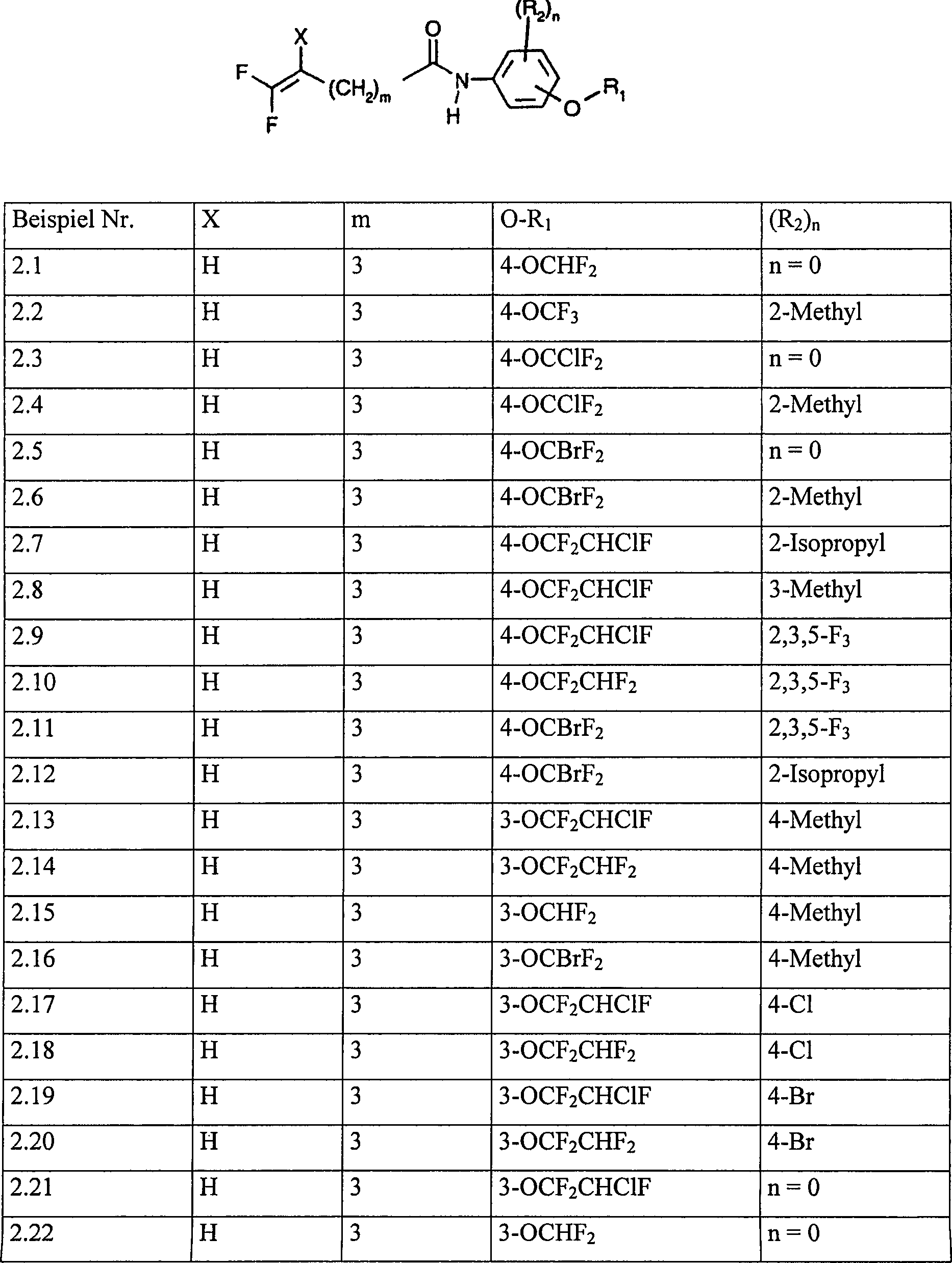


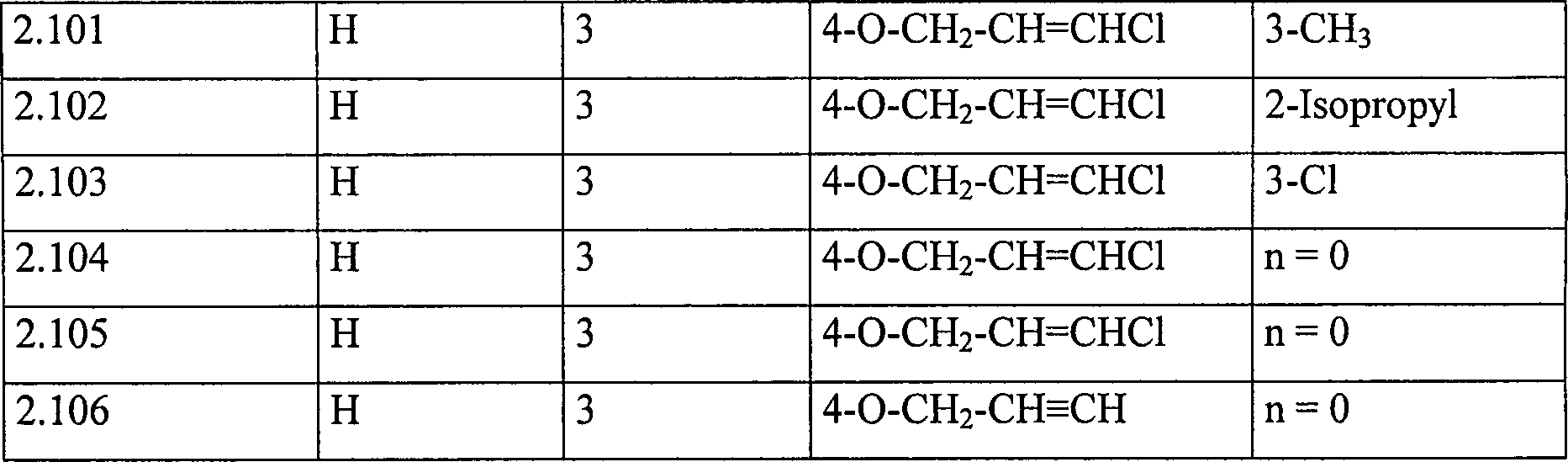
Formulierungsbeispiele
(% = Gewichtsprozent) Beispiel
F1: Emulgierbare Konzentrate 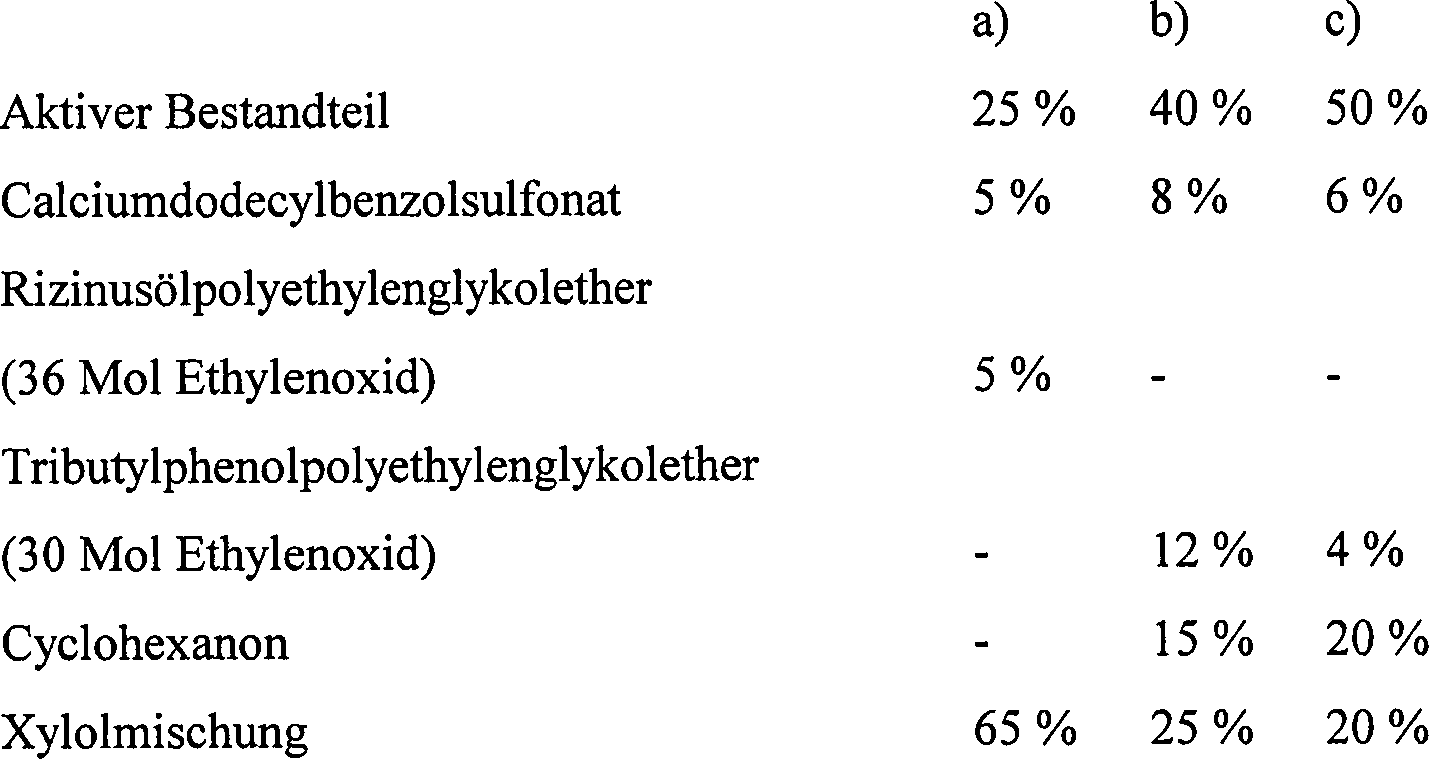
Das Vermischen von fein vermahlenem aktiven Bestandteil und Additiven ergibt ein emulgierbares Konzentrat, welches nach Verdünnen mit Wasser zu Emulsionen der gewünschten Konzentration führt.The Mixing finely ground active ingredient and additives gives an emulsifiable concentrate, which after dilution with Water to emulsions of the desired Concentration leads.
Beispiel
F2: Lösungen 

Das Vermischen von fein vermahlenem aktiven Bestandteil und Additiven führt zu einer Lösung, die für die Verwendung in Form von Mikrotröpfchen geeignet ist.The Mixing finely ground active ingredient and additives leads to a solution the for the use in the form of microdroplets is suitable.
Beispiel
F3: Granulate 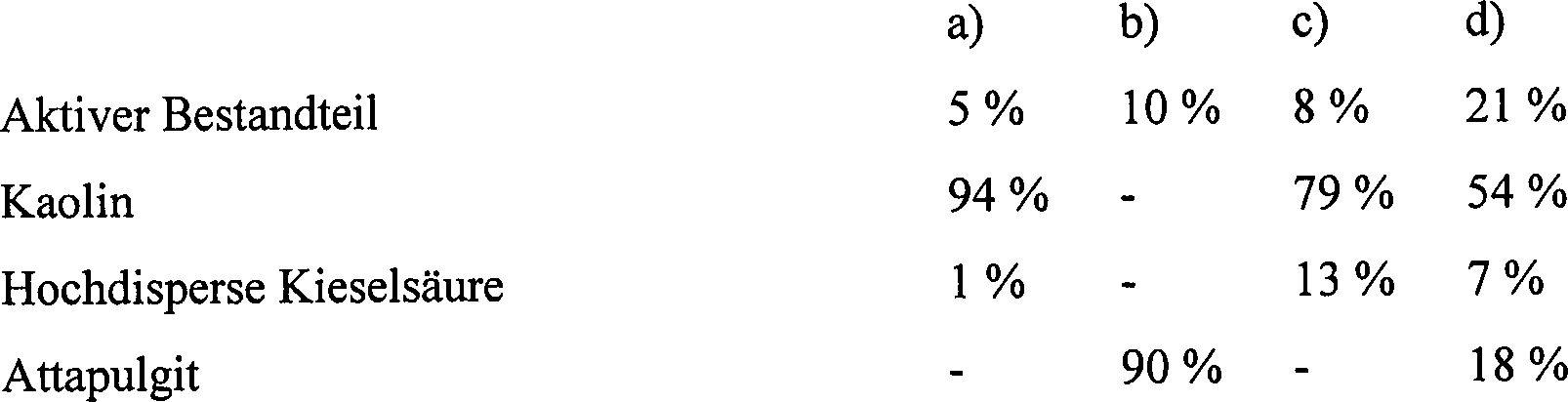
Der aktive Bestandteil wird in Methylenchlorid gelöst, die Lösung wird auf die Trägermischung durch Sprühen aufgebracht und das Lösungsmittel wird im Vakuum abgedampft.Of the active ingredient is dissolved in methylene chloride, the solution is applied to the carrier mixture by spraying applied and the solvent is evaporated in vacuo.
Biologische Beispielebiological Examples
Beispiel B1: Ovizide Wirkung gegenüber Heliothis virescensExample B1: Ovicidal action across from Heliothis virescens
Eiablagen von Heliothis virescens auf Filterpapier werden für kurze Zeit in eine wässrige Acetontestlösung eingetaucht, die 400 ppm der Testverbindung enthält. Nach dem Trocknen der Testlösung werden die Eier in Petrischalen inkubiert. 6 Tage später wird die Prozentzahl an Eiern, die zu einem Schlüpfen geführt haben, im Vergleich zu unbehandelten Kontrollen bewertet (% Reduktion der Ausschlüpfrate).oviposition by heliothis virescens on filter paper are made for short Time in a watery Acetone test solution dipped containing 400 ppm of the test compound. After drying, the test solution the eggs are incubated in petri dishes. 6 days later, the percentage becomes Eggs that hatch guided compared to untreated controls (% reduction the rate of hatching).
Die Verbindungen der Tabellen zeigen eine gute Aktivität gegenüber Heliothis virescens in diesem Test. Insbesondere sind die Verbindungen Nr. 1.1, 1.2, 1.3, 1.4, 1.5, 1.6, 1.7, 1.8, 1.9, 1.10, 1.16, 1.17 und 1.18 zu mehr als 80 % wirksam.The Compounds of the tables show good activity against Heliothis virescens in this test. In particular, the compounds no. 1.1, 1.2, 1.3, 1.4, 1.5, 1.6, 1.7, 1.8, 1.9, 1.10, 1.16, 1.17 and 1.18 is more than 80% effective.
Beispiel 2: Nilaparvata lugensExample 2: Nilaparvata lugens
Reispflanzen werden mit einer wässrigen Emulsionsspraymischung, umfassend 400 ppm der Testverbindung, behandelt. Nach dem Trocknen des Sprayüberzugs werden die Reispflanzen mit Nilaparvata lugens-Larven im zweiten und dritten Stadium besetzt. Die Bewertung erfolgt 21 Tage später. Die prozentuale Reduktion der Population (% Aktivität) wird durch Vergleich der Anzahl der überlebenden Zikaden auf den behandelten Pflanzen mit derjenigen der unbehandelten Pflanzen ermittelt.rice plants be with an aqueous Emulsion spray mixture comprising 400 ppm of the test compound. After drying the spray coating the rice plants with Nilaparvata lugens larvae in the second and third stage occupied. The rating is 21 days later. The percentage reduction of the population (% activity) is determined by comparing the Number of survivors Cicadas on the treated plants with those of the untreated Plants determined.
Die Verbindungen der Tabellen zeigen eine gute Wirksamkeit gegenüber Nilaparvata lugens bei diesem Test. Insbesondere sind die Verbindungen 1.2, 1.4, 1.5, 1.8, 1.9, 1.11, 1.12 und 1.17 zu mehr als 80 % wirksam.The Compounds of the tables show good activity against Nilaparvata lugens in this test. In particular, the compounds 1.2, 1.4, 1.5, 1.8, 1.9, 1.11, 1.12 and 1.17 are more than 80% effective.
Beispiel 3: Wirkung gegenüber Diabrotica balteata-LarveExample 3: Action against Diabrotica balteata larvae
Maissämlinge werden mit einer wässrigen Emulsionsspraymischung, umfassend 400 ppm der Testverbindung, besprüht. Nach dem Trocknen des Sprayüberzugs werden die Maissämlinge mit 10 Diabrotica balteata-Larven im zweiten Stadium besetzt und hiernach in einen Kunststoffbehälter gegeben. Die Bewertung erfolgt 6 Tage später. Die prozentuale Reduktion der Population (% Aktivität) wird durch Vergleich der Anzahl der toten Larven auf den behandelten Pflanzen mit derjenigen auf den unbehandelten Pflanzen ermittelt.Maize seedlings will be with an aqueous Emulsion spray mixture comprising 400 ppm of the test compound, sprayed. To drying the spray coating become the corn seedlings occupied with 10 Diabrotica balteata larvae in the second stage and thereafter in a plastic container given. The evaluation takes place 6 days later. The percentage reduction of the population (% activity) is by comparing the number of dead larvae on the treated Plants with those on the untreated plants.
Die Verbindungen der Tabellen zeigen eine gute Aktivität gegenüber Diabrotica balteata in diesem Test. Insbesondere sind die Verbindungen Nr. 1.1 bis 1.18 zu mehr als 80 % wirksam.The Compounds of the tables show good activity towards Diabrotica balteata in this test. In particular, the compounds no. 1.1 to 1.18 more than 80% effective.
Beispiel 4: Wirkung gegen Tetranychus urticaeExample 4: Action against Tetranychus urticae
Junge Bohnenpflanzen werden mit einer Mischpopulation von Tetranychus urticae besetzt und einen Tag später mit einer wässrigen Emulsionsspraymischung, umfassend 400 ppm der Testverbindung, besprüht. Hiernach werden die Pflanzen 6 Tage bei 25°C inkubiert und anschließend bewertet. Die prozentuale Reduktion der Population (% Aktivität) wird durch Vergleich der Anzahl der getöteten Eier, Larven und ausgewachsenen Individuen auf den behandelten Pflanzen mit derjenigen auf den unbehandelten Pflanzen ermittelt.Boy Bean plants are mixed with a population of Tetranychus urticae occupied and a day later with an aqueous Emulsion spray mixture comprising 400 ppm of the test compound, sprayed. hereafter the plants are kept at 25 ° C for 6 days incubated and then rated. The percentage reduction of the population (% activity) becomes by comparing the number of killed eggs, larvae and adults Individuals on the treated plants with those on the untreated Plants determined.
Die Verbindungen der Tabellen zeigen eine gute Aktivität gegenüber Tetranychus urticae bei diesem Test. Insbesondere sind die Verbindungen Nr. 1.1 bis 1.13 und 1.17 zu mehr als 80 % wirksam.The Compounds of the tables show good activity against Tetranychus urticae in this test. In particular, the compounds no. 1.1 to 1.13 and 1.17 to more than 80% effective.
Beispiel 5: Wirkung gegenüber Spodoptera littoralis L1Example 5: Action against Spodoptera littoral L1
Junge Sojabohnenpflanzen werden mit einer wässrigen Emulsionsspraymischung, umfassend 400 ppm der Testverbindung, besprüht. Nach dem Trocknen der Spraybeschichtung werden die Sojabohnenpflanzen mit 10 Raupen von Spodoptera littoralis im dritten Stadium besetzt und hiernach in einen Kunststoffbehälter gegeben. Die Bewertung erfolgt 3 Tage später. Die prozentuale Reduktion der Population und die prozentuale Reduktion in der Brutschädigung (% Aktivität) wird durch Vergleich der Anzahl der toten Raupen und der Fütterungsschädigung an den behandelten Pflanzen mit derjenigen an den unbehandelten Pflanzen ermittelt.Boy Soybean plants are treated with an aqueous emulsion spray mixture, comprising 400 ppm of the test compound, sprayed. After drying the spray coating are the soybean plants with 10 caterpillars of Spodoptera littoralis occupied in the third stage and thereafter placed in a plastic container. The evaluation takes place 3 days later. The percentage reduction of the population and the percentage reduction in the breeding damage (% Activity) is determined by comparing the number of dead caterpillars and the feeding damage the treated plants with those on the untreated plants determined.
Die Verbindungen der Tabellen zeigen eine gute Aktivität gegenüber Spodoptera littoralis bei diesem Test. Insbesondere sind die Verbindungen 1.1 bis 1.17 zu mehr als 80 % wirksam.The Compounds of the tables show good activity against Spodoptera littoralis in this test. In particular, the compounds are 1.1 to 1.17 more than 80% effective.
Beispiel 6: Wirkung gegenüber Aphis craccivoraExample 6: Action against Aphis craccivora
Erbsensämlinge werden einem Befall mit Aphis craccivora unterzogen und anschließend mit einer Spraymischung, umfassend 400 ppm der Testverbindung, besprüht und bei 20°C inkubiert. Die Bewertung erfolgt 3 und 6 Tage danach. Die prozentuale Reduktion in der Population (% Aktivität) wird durch Vergleich der Anzahl der toten Aphiden auf den behandelten Pflanzen mit derjenigen auf den unbehandelten Pflanzen ermittelt.Become pea seedlings subjected to an infestation with Aphis craccivora and subsequently with a spray mixture comprising 400 ppm of the test compound, sprayed and at Incubated at 20 ° C. The evaluation takes place 3 and 6 days after. The percentage reduction in the population (% activity) is by comparing the number of dead aphides on the treated Plants with those on the untreated plants.
Die Verbindungen der Tabelle 1 zeigen eine gute Aktivität gegenüber Aphis craccivora in diesem Test. Insbesondere sind die Verbindungen Nr. 1.1, 1.3, 1.4, 1.5, 1.8, 1.9 und 1.17 zu mehr als 80 % wirksam.The Compounds of Table 1 show good activity towards aphis craccivora in this test. In particular, the compounds no. 1.1, 1.3, 1.4, 1.5, 1.8, 1.9 and 1.17 are more than 80% effective.
Beispiel 7: Systemische Wirkung gegenüber Myzus persicaeExample 7: Systemic Effect over Myzus persicae
Erbsensämlinge werden einem Befall mit Myzus persicae unterzogen und dann mit ihren Wurzeln in eine 400 ppm der Testverbindung umfassende Spraymischung gegeben und bei 20°C inkubiert. Die Bewertung erfolgt 3 und 6 Tage danach. Die prozentuale Reduktion der Population (% Aktivität) wird durch Vergleich der Anzahl der toten Aphiden auf den behandelten Blättern mit derjenigen auf den unbehandelten Blättern ermittelt.Become pea seedlings subjected to an infestation with Myzus persicae and then with their roots into a spray mixture containing 400 ppm of the test compound and at 20 ° C incubated. The evaluation takes place 3 and 6 days after. The percentage Reduction of the population (% activity) is achieved by comparing the Number of dead aphids on the treated leaves with those on the untreated leaves determined.
Die Verbindungen der Tabellen zeigen eine gute Aktivität gegenüber Myzus persicae bei diesem Test. Insbesondere ist die Verbindung 1.3 zu mehr als 80 % wirksam.The Compounds of the tables show good activity towards Myzus persicae in this test. In particular, the compound is 1.3 too more than 80% effective.
Claims (8)

Applications Claiming Priority (3)
| Application Number | Priority Date | Filing Date | Title |
|---|---|---|---|
| CH119598 | 1998-06-02 | ||
| CH119598 | 1998-06-02 | ||
| PCT/EP1999/003790 WO1999062866A1 (en) | 1998-06-02 | 1999-05-31 | Difluoroalkencarboxanilides and pesticidal compositions |
Publications (2)
| Publication Number | Publication Date |
|---|---|
| DE69918693D1 DE69918693D1 (en) | 2004-08-19 |
| DE69918693T2 true DE69918693T2 (en) | 2005-08-25 |
Family
ID=4204736
Family Applications (1)
| Application Number | Title | Priority Date | Filing Date |
|---|---|---|---|
| DE69918693T Expired - Fee Related DE69918693T2 (en) | 1998-06-02 | 1999-05-31 | DIFLUORO ALKENCARBOXANILIDE AND PESTICIDES |
Country Status (9)
| Country | Link |
|---|---|
| US (1) | US6852888B2 (en) |
| EP (1) | EP1084100B1 (en) |
| JP (1) | JP2002516897A (en) |
| AT (1) | ATE271030T1 (en) |
| AU (1) | AU4372899A (en) |
| DE (1) | DE69918693T2 (en) |
| ES (1) | ES2226395T3 (en) |
| WO (1) | WO1999062866A1 (en) |
| ZA (1) | ZA200007063B (en) |
Families Citing this family (1)
| Publication number | Priority date | Publication date | Assignee | Title |
|---|---|---|---|---|
| CN111205202A (en) * | 2020-02-29 | 2020-05-29 | 华南理工大学 | Quaternary carbon center-containing symmetric gem-difluoroolefin derivative and synthesis method thereof |
Family Cites Families (6)
| Publication number | Priority date | Publication date | Assignee | Title |
|---|---|---|---|---|
| DE3941966A1 (en) | 1989-12-15 | 1991-06-20 | Schering Ag | HALOGENED OLEFINS, METHOD FOR THE PRODUCTION THEREOF AND THEIR USE AS A PEST CONTROL |
| JP2977291B2 (en) | 1991-01-16 | 1999-11-15 | コニカ株式会社 | Method for synthesizing acylamino compounds |
| EP0798285A3 (en) | 1991-03-01 | 1997-10-08 | Monsanto Company | 3,4,4-Trifluoro-3-butenoic acid or its methyl ester |
| EP0661289B1 (en) * | 1993-12-29 | 2004-03-03 | Syngenta Participations AG | Vinyl carboxamide derivatives as insecticides and acaricides |
| EP0742202B1 (en) | 1995-05-12 | 1999-12-01 | Nihon Bayer Agrochem K.K. | Benzophenone hydrazone derivatives as insecticides |
| DE19531300A1 (en) * | 1995-08-25 | 1997-02-27 | Bayer Ag | Fluorobutenic acid amides |
-
1999
- 1999-05-31 AU AU43728/99A patent/AU4372899A/en not_active Abandoned
- 1999-05-31 ES ES99926497T patent/ES2226395T3/en not_active Expired - Lifetime
- 1999-05-31 AT AT99926497T patent/ATE271030T1/en not_active IP Right Cessation
- 1999-05-31 DE DE69918693T patent/DE69918693T2/en not_active Expired - Fee Related
- 1999-05-31 WO PCT/EP1999/003790 patent/WO1999062866A1/en not_active Ceased
- 1999-05-31 EP EP99926497A patent/EP1084100B1/en not_active Expired - Lifetime
- 1999-05-31 JP JP2000552080A patent/JP2002516897A/en active Pending
-
2000
- 2000-11-30 ZA ZA200007063A patent/ZA200007063B/en unknown
- 2000-12-02 US US09/728,184 patent/US6852888B2/en not_active Expired - Fee Related
Also Published As
| Publication number | Publication date |
|---|---|
| EP1084100A1 (en) | 2001-03-21 |
| ZA200007063B (en) | 2002-01-16 |
| ES2226395T3 (en) | 2005-03-16 |
| AU4372899A (en) | 1999-12-20 |
| JP2002516897A (en) | 2002-06-11 |
| ATE271030T1 (en) | 2004-07-15 |
| WO1999062866A1 (en) | 1999-12-09 |
| US6852888B2 (en) | 2005-02-08 |
| DE69918693D1 (en) | 2004-08-19 |
| US20030216467A1 (en) | 2003-11-20 |
| EP1084100B1 (en) | 2004-07-14 |
Similar Documents
| Publication | Publication Date | Title |
|---|---|---|
| EP0172786B1 (en) | Pyrimidine derivatives active as parasiticides | |
| EP0276432A2 (en) | Pesticides | |
| EP0206999A2 (en) | Microbiocide compounds | |
| EP0139613A1 (en) | N-(2-nitrophenyl)-4-aminopyrimidine derivatives, their preparation and use | |
| EP0470600B1 (en) | Naphthylalkylaminopyrimidine derivatives, process for their preparation and pesticides containing them | |
| EP0332579A2 (en) | Method for protecting plants from diseases | |
| DE2434430B2 (en) | 2-METHYLBENZANILIDE COMPOUNDS, PROCESS FOR THE PREPARATION OF THE SAME AND PLANT PROTECTIVE PRODUCTS WITH THE SAME CONTENT | |
| EP0198797B1 (en) | Parasiticide | |
| EP0133247B1 (en) | N-aminomethyl-3-phenyl-4-cyanopyrrole derivatives, their preparation and their uses as microbicides | |
| EP0310558A2 (en) | Microbicidal agent | |
| DE60006544T2 (en) | TETRAHYDROPYRIDINE AND THEIR USE AS PESTICIDES | |
| DD222766A5 (en) | MICROBICIDE MEDIUM | |
| US20040102487A1 (en) | N-substituted tetrahydropyridines and their use as pesticides | |
| DE69608458T2 (en) | O-BENZYLOXIMETHER DERIVATIVES AND THEIR USE IN PLANT PROTECTION PRODUCTS | |
| DE19934952A1 (en) | New cyclopenta-benzofuran derivatives, used as pesticides, especially insecticides and acaricides for plant protection | |
| EP0144895B1 (en) | Thiolan-2,4-dion-3-carboxamides | |
| DE102004010086A1 (en) | Substituted piperidine derivatives | |
| DE19831803A1 (en) | N-aralkyl-hydrazino or -hydrazono derivatives of oxalic acid | |
| EP0065483A1 (en) | Acyl aniline and acylnaphthyl amine microbicides, processes for preparing them and their use | |
| EP0462931B1 (en) | Benzotriazole-1-sulfonyl derivatives with microbicidal properties | |
| DE19837620A1 (en) | New diphenylmethyl-substituted hydrazine derivatives useful | |
| EP1084100B1 (en) | Difluoroalkencarboxanilides and pesticidal compositions | |
| EP0207000B1 (en) | Microbicides | |
| EP0023539B1 (en) | Alkyl esters of 3-(n-1,3,4-thiadiazolyl-2)-amino-alkyl acrylic acid, process for their preparation and their use as plant bactericides | |
| EP0175651B1 (en) | Microbicides |
Legal Events
| Date | Code | Title | Description |
|---|---|---|---|
| 8364 | No opposition during term of opposition | ||
| 8328 | Change in the person/name/address of the agent |
Representative=s name: PFENNING MEINIG & PARTNER GBR, 80339 MUENCHEN |
|
| 8339 | Ceased/non-payment of the annual fee |