DE69918146T2 - METHOD FOR THERAPEUTIC VACCINATION - Google Patents
METHOD FOR THERAPEUTIC VACCINATION Download PDFInfo
- Publication number
- DE69918146T2 DE69918146T2 DE69918146T DE69918146T DE69918146T2 DE 69918146 T2 DE69918146 T2 DE 69918146T2 DE 69918146 T DE69918146 T DE 69918146T DE 69918146 T DE69918146 T DE 69918146T DE 69918146 T2 DE69918146 T2 DE 69918146T2
- Authority
- DE
- Germany
- Prior art keywords
- cell
- epitope
- use according
- polypeptide antigen
- antigen
- Prior art date
- Legal status (The legal status is an assumption and is not a legal conclusion. Google has not performed a legal analysis and makes no representation as to the accuracy of the status listed.)
- Expired - Lifetime
Links
- 0 C*1*C*C1 Chemical compound C*1*C*C1 0.000 description 1
Classifications
-
- C—CHEMISTRY; METALLURGY
- C07—ORGANIC CHEMISTRY
- C07K—PEPTIDES
- C07K16/00—Immunoglobulins [IG], e.g. monoclonal or polyclonal antibodies
- C07K16/18—Immunoglobulins [IG], e.g. monoclonal or polyclonal antibodies against material from animals or humans
- C07K16/28—Immunoglobulins [IG], e.g. monoclonal or polyclonal antibodies against material from animals or humans against receptors, cell surface antigens or cell surface determinants
- C07K16/30—Immunoglobulins [IG], e.g. monoclonal or polyclonal antibodies against material from animals or humans against receptors, cell surface antigens or cell surface determinants from tumour cells
- C07K16/3069—Reproductive system, e.g. ovaria, uterus, testes, prostate
-
- A—HUMAN NECESSITIES
- A61—MEDICAL OR VETERINARY SCIENCE; HYGIENE
- A61K—PREPARATIONS FOR MEDICAL, DENTAL OR TOILETRY PURPOSES
- A61K39/00—Medicinal preparations containing antigens or antibodies
-
- A—HUMAN NECESSITIES
- A61—MEDICAL OR VETERINARY SCIENCE; HYGIENE
- A61K—PREPARATIONS FOR MEDICAL, DENTAL OR TOILETRY PURPOSES
- A61K39/00—Medicinal preparations containing antigens or antibodies
- A61K39/0005—Vertebrate antigens
- A61K39/0011—Cancer antigens
-
- A—HUMAN NECESSITIES
- A61—MEDICAL OR VETERINARY SCIENCE; HYGIENE
- A61K—PREPARATIONS FOR MEDICAL, DENTAL OR TOILETRY PURPOSES
- A61K40/00—Cellular immunotherapy
- A61K40/10—Cellular immunotherapy characterised by the cell type used
- A61K40/19—Dendritic cells
-
- A—HUMAN NECESSITIES
- A61—MEDICAL OR VETERINARY SCIENCE; HYGIENE
- A61K—PREPARATIONS FOR MEDICAL, DENTAL OR TOILETRY PURPOSES
- A61K40/00—Cellular immunotherapy
- A61K40/20—Cellular immunotherapy characterised by the effect or the function of the cells
- A61K40/24—Antigen-presenting cells [APC]
-
- A—HUMAN NECESSITIES
- A61—MEDICAL OR VETERINARY SCIENCE; HYGIENE
- A61K—PREPARATIONS FOR MEDICAL, DENTAL OR TOILETRY PURPOSES
- A61K40/00—Cellular immunotherapy
- A61K40/40—Cellular immunotherapy characterised by antigens that are targeted or presented by cells of the immune system
- A61K40/41—Vertebrate antigens
- A61K40/42—Cancer antigens
- A61K40/4202—Receptors, cell surface antigens or cell surface determinants
- A61K40/4203—Receptors for growth factors
- A61K40/4205—Her-2/neu/ErbB2, Her-3/ErbB3 or Her 4/ ErbB4
-
- A—HUMAN NECESSITIES
- A61—MEDICAL OR VETERINARY SCIENCE; HYGIENE
- A61P—SPECIFIC THERAPEUTIC ACTIVITY OF CHEMICAL COMPOUNDS OR MEDICINAL PREPARATIONS
- A61P15/00—Drugs for genital or sexual disorders; Contraceptives
-
- A—HUMAN NECESSITIES
- A61—MEDICAL OR VETERINARY SCIENCE; HYGIENE
- A61P—SPECIFIC THERAPEUTIC ACTIVITY OF CHEMICAL COMPOUNDS OR MEDICINAL PREPARATIONS
- A61P35/00—Antineoplastic agents
-
- A—HUMAN NECESSITIES
- A61—MEDICAL OR VETERINARY SCIENCE; HYGIENE
- A61P—SPECIFIC THERAPEUTIC ACTIVITY OF CHEMICAL COMPOUNDS OR MEDICINAL PREPARATIONS
- A61P37/00—Drugs for immunological or allergic disorders
- A61P37/02—Immunomodulators
- A61P37/04—Immunostimulants
-
- C—CHEMISTRY; METALLURGY
- C07—ORGANIC CHEMISTRY
- C07K—PEPTIDES
- C07K14/00—Peptides having more than 20 amino acids; Gastrins; Somatostatins; Melanotropins; Derivatives thereof
- C07K14/435—Peptides having more than 20 amino acids; Gastrins; Somatostatins; Melanotropins; Derivatives thereof from animals; from humans
- C07K14/475—Growth factors; Growth regulators
- C07K14/50—Fibroblast growth factor [FGF]
-
- C—CHEMISTRY; METALLURGY
- C07—ORGANIC CHEMISTRY
- C07K—PEPTIDES
- C07K14/00—Peptides having more than 20 amino acids; Gastrins; Somatostatins; Melanotropins; Derivatives thereof
- C07K14/435—Peptides having more than 20 amino acids; Gastrins; Somatostatins; Melanotropins; Derivatives thereof from animals; from humans
- C07K14/705—Receptors; Cell surface antigens; Cell surface determinants
-
- C—CHEMISTRY; METALLURGY
- C07—ORGANIC CHEMISTRY
- C07K—PEPTIDES
- C07K14/00—Peptides having more than 20 amino acids; Gastrins; Somatostatins; Melanotropins; Derivatives thereof
- C07K14/435—Peptides having more than 20 amino acids; Gastrins; Somatostatins; Melanotropins; Derivatives thereof from animals; from humans
- C07K14/705—Receptors; Cell surface antigens; Cell surface determinants
- C07K14/70503—Immunoglobulin superfamily
- C07K14/70539—MHC-molecules, e.g. HLA-molecules
-
- C—CHEMISTRY; METALLURGY
- C07—ORGANIC CHEMISTRY
- C07K—PEPTIDES
- C07K14/00—Peptides having more than 20 amino acids; Gastrins; Somatostatins; Melanotropins; Derivatives thereof
- C07K14/435—Peptides having more than 20 amino acids; Gastrins; Somatostatins; Melanotropins; Derivatives thereof from animals; from humans
- C07K14/705—Receptors; Cell surface antigens; Cell surface determinants
- C07K14/71—Receptors; Cell surface antigens; Cell surface determinants for growth factors; for growth regulators
-
- C—CHEMISTRY; METALLURGY
- C07—ORGANIC CHEMISTRY
- C07K—PEPTIDES
- C07K2317/00—Immunoglobulins specific features
- C07K2317/30—Immunoglobulins specific features characterized by aspects of specificity or valency
- C07K2317/34—Identification of a linear epitope shorter than 20 amino acid residues or of a conformational epitope defined by amino acid residues
-
- C—CHEMISTRY; METALLURGY
- C12—BIOCHEMISTRY; BEER; SPIRITS; WINE; VINEGAR; MICROBIOLOGY; ENZYMOLOGY; MUTATION OR GENETIC ENGINEERING
- C12N—MICROORGANISMS OR ENZYMES; COMPOSITIONS THEREOF; PROPAGATING, PRESERVING, OR MAINTAINING MICROORGANISMS; MUTATION OR GENETIC ENGINEERING; CULTURE MEDIA
- C12N2799/00—Uses of viruses
- C12N2799/02—Uses of viruses as vector
- C12N2799/021—Uses of viruses as vector for the expression of a heterologous nucleic acid
-
- Y—GENERAL TAGGING OF NEW TECHNOLOGICAL DEVELOPMENTS; GENERAL TAGGING OF CROSS-SECTIONAL TECHNOLOGIES SPANNING OVER SEVERAL SECTIONS OF THE IPC; TECHNICAL SUBJECTS COVERED BY FORMER USPC CROSS-REFERENCE ART COLLECTIONS [XRACs] AND DIGESTS
- Y02—TECHNOLOGIES OR APPLICATIONS FOR MITIGATION OR ADAPTATION AGAINST CLIMATE CHANGE
- Y02A—TECHNOLOGIES FOR ADAPTATION TO CLIMATE CHANGE
- Y02A50/00—TECHNOLOGIES FOR ADAPTATION TO CLIMATE CHANGE in human health protection, e.g. against extreme weather
- Y02A50/30—Against vector-borne diseases, e.g. mosquito-borne, fly-borne, tick-borne or waterborne diseases whose impact is exacerbated by climate change
Landscapes
- Health & Medical Sciences (AREA)
- Life Sciences & Earth Sciences (AREA)
- Chemical & Material Sciences (AREA)
- General Health & Medical Sciences (AREA)
- Organic Chemistry (AREA)
- Immunology (AREA)
- Medicinal Chemistry (AREA)
- Animal Behavior & Ethology (AREA)
- Public Health (AREA)
- Veterinary Medicine (AREA)
- Epidemiology (AREA)
- Biophysics (AREA)
- Genetics & Genomics (AREA)
- Molecular Biology (AREA)
- Proteomics, Peptides & Aminoacids (AREA)
- Biochemistry (AREA)
- Pharmacology & Pharmacy (AREA)
- Toxicology (AREA)
- Cell Biology (AREA)
- Gastroenterology & Hepatology (AREA)
- Zoology (AREA)
- Mycology (AREA)
- Microbiology (AREA)
- General Chemical & Material Sciences (AREA)
- Oncology (AREA)
- Chemical Kinetics & Catalysis (AREA)
- Nuclear Medicine, Radiotherapy & Molecular Imaging (AREA)
- Reproductive Health (AREA)
- Pregnancy & Childbirth (AREA)
- Bioinformatics & Cheminformatics (AREA)
- Engineering & Computer Science (AREA)
- Gynecology & Obstetrics (AREA)
- Endocrinology (AREA)
- Medicines Containing Antibodies Or Antigens For Use As Internal Diagnostic Agents (AREA)
- Peptides Or Proteins (AREA)
- Micro-Organisms Or Cultivation Processes Thereof (AREA)
- Medicines Containing Material From Animals Or Micro-Organisms (AREA)
- Measuring Or Testing Involving Enzymes Or Micro-Organisms (AREA)
- Medicines That Contain Protein Lipid Enzymes And Other Medicines (AREA)
- Medicines Containing Plant Substances (AREA)
Abstract
Description
GEBIET DER ERFINDUNGAREA OF INVENTION
Die vorliegende Erfindung bezieht sich auf neue Verfahren zur Bekämpfung von Krankheiten, wie Krebs, welche durch das Vorhandensein von Zell-gebundenen Genexpressionsprodukten, welche nicht-immunogen oder schwach immunogen sind, gekennzeichnet sind. Insbesondere bezieht sich die vorliegende Erfindung auf Verfahren zum Induzieren einer Immunantwort, die durch cytotoxische T-Lymphozyten (CTLs) ausgeführt wird, wobei Zellen, die Epitope von den Genexpressionsprodukten tragen, von den CTLs angegriffen und getötet werden. Die Erfindung bezieht sich auch auf ein Verfahren zur Herstellung immunogener, modifizierter Polypeptid-Antigene, welche von schwach immunogenen Antigenen abgeleitet sind.The The present invention relates to novel methods of controlling Diseases, such as cancer, which are due to the presence of cell-bound Gene expression products which are non-immunogenic or poorly immunogenic are marked. In particular, the present invention relates Invention on methods of inducing an immune response by Cytotoxic T lymphocytes (CTLs) is carried out using cells which Carrying epitopes from gene expression products, attacked by the CTLs and killed become. The invention also relates to a process for the preparation immunogenic modified polypeptide antigens which are weak derived from immunogenic antigens.
Die Erfindung bezieht sich weiterhin auf eine Reihe von Anwendungen der AutoVac-Technologie der Anmelder (welche der Gegenstand der WO 95/05849 ist) auf dem Gebiet der therapeutischen Impfung gegen Krebs.The The invention further relates to a number of applications the AutoVac technology the applicant (which is the subject of WO 95/05849) on the Field of therapeutic vaccination against cancer.
HINTERGRUND DER ERFINDUNGBACKGROUND THE INVENTION
Die Idee der Impfung gegen Krebs existiert seit über 100 Jahren und hat wiederholte Ausbrüche der Aktivität erfahren, insbesondere seit der letzten Jahrhundertwende.The The idea of vaccination against cancer has existed for over 100 years and has been repeated outbreaks the activity experienced, especially since the last turn of the century.
Jedoch hat sich das Verständnis der grundlegenden molekularen Mechanismen der Immunantwort während der letzten 10 Jahre wesentlich verbessert. Unter den wichtigsten Meilensteinen, die während dieser Phase erreicht wurden, fanden sich auch die Entdeckung der noch immer wachsenden Liste der Cytokine und Wachstumsfaktoren, das Verstehen des Mechanismus der Interaktion zwischen T- und B-Zellen sowie die Feststellung der zellulären Antigen-Prozessierungswege, einschließlich der Rolle und Struktur der MHC-Klasse I- und II-Moleküle bei der Antigenpräsentation. Wichtige Entdeckungen in Bezug auf die Krebsimmunologie – obwohl diese noch immer nicht vollständig verstanden ist – betrafen auch die Erklärung der Mechanismen, die der Induktion der immunologischen Toleranz in einem Wirt zugrunde liegen. Alle diese Forschungsunternehmen haben zu einer großen Anzahl von Versuchen geführt, neue Behandlungen für humanen Krebs zu entwickeln.however has the understanding the basic molecular mechanisms of the immune response during the significantly improved in the last 10 years. Among the most important milestones, the while reached this stage, the discovery of the still growing list of cytokines and growth factors, understanding the mechanism of interaction between T and B cells and the identification of cellular antigen processing pathways, including Role and structure of MHC class I and II molecules in the Antigen presentation. Important discoveries in relation to cancer immunology - though these still not complete is understood - concerned also the explanation the mechanisms responsible for the induction of immunological tolerance underlying in a host. All these research companies have a big one Number of trials performed, new treatments for to develop human cancer.
Abhängig davon, wie Tumorimmunität beim Patienten erreicht wird, können Immuntherapiebehandlungen entweder als passive oder aktive Behandlungen kategorisiert werden. Bei passiven Immuntherapiebehandlungen erhält der Patient passiv Immunkomponenten, wie Cytokine, Antikörper, cytotoxische T-Zellen oder aktivierte Killer-Lymphozytenzellen (LAK). Im Gegensatz dazu umfassen aktive spezifische Immuntherapie-Protokolle das Induzieren der Tumorimmunität durch Vakzinieren/Impfung mit der Tumorzelle oder seinen antigenischen Komponenten. Letztere Form der Behandlung ist bevorzugt, da die Immunität länger anhaltend ist.Depending on like tumor immunity when the patient is reached Immunotherapy treatments either as passive or active treatments be categorized. In passive immunotherapy treatments, the patient receives passively immune components, such as cytokines, antibodies, cytotoxic T cells or activated killer lymphocyte cells (LAK). In contrast, include active specific immunotherapy protocols by inducing tumor immunity Vaccinate / vaccinate with the tumor cell or its antigenic Components. The latter form of treatment is preferred because the immunity longer is persistent.
Passive und aktive Krebs-Impfstoffe konzentrierten sich entweder auf das Induzieren von humoralen oder zellulären Immunantworten. In Bezug auf aktive Impfstoffe besteht die wohletablierte Meinung, dass die Induktion von CD4-positiven T-Helferzellen notwendig ist um sekundär entweder Antikörper oder cytotoxische CD8-positive T-Zellen zu induzieren.passive and active cancer vaccines were either focused on that Induce humoral or cellular immune responses. In relation on active vaccines there is the well-established opinion that induction Of CD4-positive helper T-cells is necessary to secondary either antibody or to induce cytotoxic CD8-positive T cells.
Passive Vakzinierung mit AntikörpernPassive vaccination with antibodies
Seit der Entdeckung der monoklonalen Antikörper-Technologie in der Mitte der siebziger Jahre ist eine große Anzahl therapeutischer monoklonaler Antikörper entwickelt worden, die gegen Tumor-spezifische oder Tumor-gebundene Antigene gerichtet sind. Die monoklonale Antikörpertherapie verursacht jedoch mehrere schwere Probleme:
- – Die Injektion dieser fremden Substanzen induziert eine Immunantwort in dem Patienten gegen die injizierten Antikörper, welche zu einer weniger effizienten Behandlung sowie zu schweren allergischen Nebenwirkungen bei den Patienten führen kann.
- – Monoklonale Antikörper müssen für gewöhnlich in großen Mengen verabreicht werden. Dies ist ein Problem, da die Produktionskosten für monoklonale Antikörper gewaltig sind.
- – Monoklonale Antikörper müssen über den parenteralen Weg verabreicht werden und aufgrund der relativ großen erforderlichen Mengen müssen die Patienten häufig während der Behandlung ins Krankenhaus eingewiesen werden.
- – Die Injektionen von monoklonalen Antikörpern müssen innerhalb relativ kurzer Intervalle (Wochen) wiederholt werden um eine therapeutische Wirkung aufrecht zu erhalten.
- – Monoklonale Antikörper sind für gewöhnlich nicht in der Lage, sekundäre Effektorsysteme, wie beispielsweise das Abtöten von Tumorzellen durch Komplement, NK-Zellen oder Makrophagen, zu aktivieren.
- The injection of these foreign substances induces an immune response in the patient against the injected antibodies, which may lead to a less efficient treatment as well as to severe allergic side effects in the patients.
- Monoclonal antibodies usually need to be administered in large quantities. This is a problem because the production cost of monoclonal antibodies is huge.
- - Monoclonal antibodies must be administered by the parenteral route and, due to the relatively large amounts required, patients often need to be hospitalized during treatment.
- - The injections of monoclonal antibodies must be within relatively short intervals (weeks) such as be revived to maintain a therapeutic effect.
- Monoclonal antibodies are usually unable to activate secondary effector systems, such as the killing of tumor cells by complement, NK cells or macrophages.
Der letztgenannte Nachteil ist bei der Krebstherapie von besonderer Wichtigkeit und kann ein wichtiger Grund sein, warum die monoklonale Antikörpertherapie von Krebs in zahlreichen Fällen nicht besonders erfolgreich war. Die sogenannten humanisierten monoklonalen Antikörper, die jetzt von vielen Unternehmen verwendet werden, sind weniger immunogen, aber leider sind sie noch weniger in der Lage, die sekundären Immuneffektorsysteme zu aktivieren. Außerdem wurden Beispiele für sekundäres Wachstum von Tumoren, denen das ursprüngliche Tumor-Antigen fehlt, beobachtet, da diese Antikörper keine Wirkungen auf "unschuldige Zuschauer" ("innocent bystander" effects) auf Tumorzellen, die das Tumor-Antigen nicht tragen, ausüben.Of the The latter disadvantage is of particular importance in cancer therapy Importance and may be an important reason why the monoclonal Antibody therapy of cancer in numerous cases was not very successful. The so-called humanized monoclonal Antibody, which are now used by many companies are less immunogenic, but unfortunately they are even less capable of secondary immune effector systems to activate. Furthermore were examples of secondary Growth of tumors lacking the original tumor antigen, observed as these antibodies no effects on "innocent bystander" effects on tumor cells, who do not carry the tumor antigen.
Die nur schwache Effektor-Befähigung der monoklonalen Antikörper hat zur Entwicklung monoklonaler Antikörper, die chemisch mit verschiedenen Toxinen und Radioisotopen verbunden sind, geführt. Z.B. Pharmacia Upjohn AB hat eine Verknüpfung von einem monoklonalen, Tumor-spezifischen Antikörper und dem Staphylococcus aureus-Toxin A mit dem Zweck entwickelt, T-Zellen im Tumor zu aktivieren. Medarex Inc. hat bispezifische monoklonale Antikörper entwickelt, die ein Tumor-spezifisches Fab-Fragment sowie ein spezifisches Fc-Rezeptor-Antikörperfragment enthalten, mit dem Zweck entwickelt, das Töten von Tumorzellen durch Makrophagen zu aktivieren. Beide Konstrukte sind effektiver als der monoklonale Antikörper alleine, aber sie sind auch teurer und stärker immunogen. Antikörper, die mit Radioisotopen verbunden sind, sind ebenfalls sowohl teuer als auch immunogen, und es werden andere allgemeine toxische Nebenwirkungen beobachtet.The only weak effector ability the monoclonal antibody has to develop monoclonal antibodies that are chemically different Toxins and radioisotopes are conducted. For example, Pharmacia Upjohn AB has a shortcut from a monoclonal, tumor-specific antibody and staphylococcus aureus toxin A designed with the purpose to activate T cells in the tumor. Medarex Inc. has developed bispecific monoclonal antibodies that are tumor-specific Fab fragment as well as a specific Fc receptor antibody fragment included, designed with the purpose of killing tumor cells by macrophages to activate. Both constructs are more effective than the monoclonal antibody alone, but they are also more expensive and stronger immunogenic. Antibody, which are associated with radioisotopes are also both expensive as well as immunogenic, and there will be other common toxic side effects observed.
Das Erscheinen der monoklonalen Antikörpertechnologie war ein großer Schritt vorwärts, welcher die Herstellung von wohldefinierten Bindemolekülen mit hoher Affinität ermöglichte. Da diese Antikörper jedoch monoklonal sind, reagieren sie nur mit einem einzelnen Epitop-Typus auf einem Tumor-Antigen. Dies ist der hauptsächliche Grund dafür, dass sie für gewöhnlich nicht in der Lage sind, das Komplementsystem zu aktivieren oder an die Fc-Rezeptoren von NK-Zellen und Makrophagen zu binden. Diese sehr wirkungsvollen Effektorsysteme erfordern für gewöhnlich die gleichzeitige Lokalisierung multipler Fc-Antikörperfragmente, die aus dem Antigen herausragen.The The appearance of monoclonal antibody technology was a big step forward, which involves the preparation of well-defined binding molecules high affinity allowed. Because these antibodies monoclonal, however, they only react with a single epitope type on a tumor antigen. This is the main reason that she for usually are unable to activate the complement system or to the Fc receptors of NK cells and macrophages. This very effective Effector systems require for usually the simultaneous localization of multiple Fc antibody fragments released from the Sticking out antigen.
Andere Forscher haben daher versucht, zwei monoklonale Antikörper in Kombination zu verwenden, und dies hat zu einer verbesserten Wirkung geführt. Statt dessen scheint es sehr sinnvoll zu sein, Tumorzellen mit hochspezifischen polyklonalen Antikörpern, die gegen ein Tumor-spezifisches oder gegen (überexprimierte) Tumor-assoziierte Antigene oder Wachstumsfaktorrezeptoren gerichtet sind, anzugreifen. Solche Antikörper wären vollständig in der Lage, die sekundären Effektorsysteme, die oben genannt sind, zu aktivieren. Außerdem ist es wahrscheinlich, dass die lokale Entzündungsreaktion, die von diesen Effektorsystemen induziert wird, zu sekundären Wirkungen auf Zellen, die sogenannte "unschuldige Zuschauer" sind und das fragliche Tumor-Antigen nicht exprimieren, führt, sowie zur Aktivierung von Tumor-spezifischen TILs (Tumor-infiltrierenden Lymphozyten) im Tumorgewebe. Solche Wirkungen wurden von Medarex Inc. bei der Verwendung ihrer bispezifischen monoklonalen Antikörperkonjugate beobachtet.Other Researchers have therefore tried two monoclonal antibodies in Combination use, and this has an improved effect guided. Instead, it seems to be very useful to have tumor cells with highly specific polyclonal antibodies, against a tumor-specific or against (overexpressed) tumor-associated Antigens or growth factor receptors are directed to attack. Such antibodies would be completely in able, the secondary Activate effector systems mentioned above. Besides that is It is likely that the local inflammatory response of these Effector systems induced secondary effects on cells that so-called "innocent Viewers "are and does not express the tumor antigen in question, as well as to activate tumor-specific TILs (tumor-infiltrating lymphocytes) in tumor tissue. Such Effects were reported by Medarex Inc. when using their bispecific monoclonal antibody conjugates observed.
Seit der Entdeckung der monoklonalen Antikörpertechnologie wurde die mögliche Verwendung von polyklonalen Antikörpern zur Krebstherapie nicht sehr stark untersucht (mit der Ausnahme der unten beschriebenen Antigene). Einer der Hauptgründe ist der, dass wohldefinierte Tumor-spezifische oder Tumor-assoziierte Oberflächenantigene erst in den letzten Jahren charakterisiert worden sind, wobei sich aber – was noch wichtiger ist – viele von diesen als Selbstantigene, und daher als nicht-immunogen entpuppt haben. Dementsprechend hätten xenogenische polyklonale Antikörper verwendet werden müssen um diese Wirkungen zu untersuchen. Solche Antikörper induzieren jedoch eine energische Immunantwort gegen die injizierten fremden polyklonalen Antikörper, welche die therapeutischen Wirkungen schnell zerstört.since The discovery of monoclonal antibody technology has been the potential use of polyclonal antibodies not very heavily studied for cancer treatment (except the antigens described below). One of the main reasons is that is well-defined tumor-specific or tumor-associated Surface antigens have been characterized in recent years, with but what even more important - many of these as self-antigens, and therefore turns out to be non-immunogenic to have. Accordingly xenogenic polyclonal antibodies must be used to study these effects. However, such antibodies induce a energetic immune response against the injected foreign polyclonal Antibody, which quickly destroys the therapeutic effects.
Aktive Impfung zur Induktion von AntikörpernActive vaccination for the induction of antibodies
Jüngste Versuche, therapeutische polyklonale Autoantikörper bei Krebspatienten durch aktive Impfung/Vakzinierung zu induzieren, waren erfolgreich. Es wurden Vakzine/Impfstoffe gegen Membran-gebundene Kohlenhydrat-Selbstantigene (wie die O-gebundenen, fehlexprimierten Tn- und sTn-Antigene und die Gangliosidliposaccharide GM2 und GD3) entwickelt. Diese kleinen Kohlenhydratstrukturen sind jedoch sehr schwache Antigene, so dass Konjugate dieser Moleküle mit Trägermolekülen, wie dem Napfschneckenhaemocyanin ("keyhole limpet haemocyanin, KLH) oder Schafmucinen (die Tn- und sTn enthalten) verwendet werden müssen. Bei Melanom-Patienten ging die Induktion von Anti-GM2-Antikörpern nach einer Mindestnachfolgetherapie von 51 Monaten mit einem längeren krankheitsfreien Zeitraum und längerer Gesamtüberlebensrate einher. Es wurden auch randomisierte Phase-II-Studien bei Brustkrebs-Patientinnen durchgeführt, bei denen ein Konjugat von sTn und KLH in DETOX-B-Adjuvans (BIOMIRA Inc.) verwendet wurde, die zeigten, dass sTn-immune Patienten eine signifikant längere mittlere Überlebensrate im Vergleich mit Kontrollen besaßen. Ein weiteres Beispiel der aktiven Induktion von polyklonalen Antikörpern bei Krebs ist die Verwendung von Idiotyp-spezifischer Impfung gegen B-Zell-Lymphome, welche – obwohl sie sehr vielversprechend war – auf diese Krebsart beschränkt ist.Recent attempts to induce therapeutic polyclonal autoantibodies in cancer patients by active vaccination / vaccination have been successful. Vaccines have been developed against membrane-bound carbohydrate self antigens (such as the O-linked, mispressed Tn and sTn antigens and the ganglioside liposaccharides GM2 and GD3). However, these small carbohydrate structures are very weak antigens, so that conjugates of these molecules with carrier molecules such as keyhole limpet haemocyanin (KLH) or sheep mucins (containing Tn and sTn) must be used. In melanoma patients, induction of Anti-GM2 antibodies following a minimum trac Therapy of 51 months with a longer disease-free period and a longer overall survival rate. Randomized Phase II studies were also conducted in breast cancer patients using a conjugate of sTn and KLH in DETOX-B adjuvant (BIOMIRA Inc.), demonstrating that sTn-immune patients had a significantly longer median survival in comparison with controls possessed. Another example of the active induction of polyclonal antibodies in cancer is the use of idiotype-specific vaccination against B-cell lymphomas, which, although very promising, is limited to this type of cancer.
Schließlich hat das US-Unternehmen Aphton Inc. aktive Konjugat-Impfstoffe gegen Gonadotropin-Freisetzungshormon (GnRH) und Gastrin entwickelt. Es wurde gezeigt, dass dieser Impfstoff in der Lage ist, die biologische Aktivität dieser Hormone zu kontrollieren, welche ebenfalls als autokrine Wachstumsfaktoren für gewisse Tumorzellen dienen können. Erfolgreiche klinische Phase-II-Studien wurden bei Magen-Darm-Krebs-Patienten durchgeführt, und klinische Phase-III-Studien laufen noch.Finally has the US company Aphton Inc. is active conjugate vaccines against Gonadotropin-releasing hormone (GnRH) and gastrin developed. It It has been shown that this vaccine is capable of producing the biological activity to control these hormones, which are also called autocrine Growth factors for certain tumor cells can serve. Successful phase II clinical trials have been in gastrointestinal cancer patients carried out, and Phase III clinical trials are ongoing.
Cytotoxische T-Zellencytotoxic T cells
Es wurde von mehreren Gruppen eindeutig gezeigt, dass Tumor-spezifische, cytotoxische T-Zellen (CTLs) bei vielen Tumoren vorhanden sind. Diese CTLs werden Tumor-infiltrierende Lymphozyten (TILs) genannt. Jedoch werden diese Zellen mittels mehrerer verschiedener möglicher Mechanismen, einschließlich der Sezernierung immunsuppressiver Cytokine durch die Tumorzellen, Mangel bzw. Fehlen von co-stimulatorischen Signalen, negative Regulation von MHC-Klasse I-Molekülen, etc., nicht-reaktiv oder anerg.It was clearly demonstrated by several groups that tumor-specific, cytotoxic T cells (CTLs) are present in many tumors. These CTLs become tumor-infiltrating Called lymphocytes (TILs). However, these cells are made by means of several various possible Mechanisms, including the secretion of immunosuppressive cytokines by the tumor cells, Lack or lack of co-stimulatory signals, negative regulation MHC class I molecules, etc., non-reactive or anerg.
Es wurden viele Versuche unternommen, die Tumor-spezifischen HLA-Klasse I-gebundenen Peptide, die von TILs erkannt werden, zu isolieren, und in einigen Fällen war dies auch erfolgreich (z.B. Peptide der Melanom-assoziierten Antigene). Solche Peptide wurden verwendet um eine Tumor-spezifische Immunantwort bei dem Wirt zu induzieren, aber die praktische Verwendung von Tumor-spezifischen Peptiden in Impfstoffen ist aufgrund der engen Spezifität der HLA-Klasse I-Bindung der Peptide auf einen eingeschränkten Teil der Bevölkerung beschränkt. Außerdem ist es für gewöhnlich relativ schwierig, eine CTL-Antwort in vivo unter Verwendung synthetischer Peptide hervorzurufen, und zwar aufgrund der niedrigen biologischen Halbwertszeit dieser Substanzen sowie aufgrund der Schwierigkeiten der exogenen Aktivierung bzw. des Primings von MHC-Klasse I-Molekülen.It Many attempts have been made to assess the tumor-specific HLA class I-linked peptides that recognized by TILs, isolate, and in some cases was this is also successful (e.g., peptides of melanoma-associated antigens). Such peptides were used for a tumor-specific immune response to induce in the host, but the practical use of tumor-specific Peptides in vaccines is due to the tight specificity of the HLA class I binding of the peptides to a restricted part of the population limited. Furthermore is it for usually relatively difficult to in vivo CTL response using synthetic Cause peptides, due to the low biological Half-life of these substances and because of the difficulties the exogenous activation or priming of MHC class I molecules.
Viele andere Ansätze wurden ausprobiert, mit dem Ziel, eine Tumor-spezifische CTL-Antwort hervorzurufen, einschließlich der Verwendung von Cytokinen (z.B. IL-2, IFN-γ, IL-6, IL-4, IL-10 oder GM-CSF) oder co-stimulatorischer Moleküle (B7), entweder in löslicher Form oder exprimiert von der transfizierten Tumorzelle. Außerdem wurden Immunisierungen mit allogenischen oder autologen vollständigen Zellen oder mit Tumor-Antigenen, die in spezialisierten Adjuvantien präpariert wurden, die so gestaltet waren, dass das Antigen über den MHC-Klasse I-Antigen-Präsentationsweg präsentiert wurde, oder mit Tumor-Antigenen, die z.B. in Vaccinia-Vektoren exprimiert wurden, etc., mit wechselndem Erfolg verwendet. Die allgemeine Meinung unter Tumorimmunologen ist daher noch immer, dass einer der besten Wege, Tumoren zu eliminieren, der ist, eine starke spezifische Antitumor-CTL-Antwort zu induzieren.Lots other approaches were tried with the aim of producing a tumor-specific CTL response, including the use of cytokines (e.g., IL-2, IFN-γ, IL-6, IL-4, IL-10 or GM-CSF) or co-stimulatory molecules (B7), either soluble Form or expressed from the transfected tumor cell. In addition, were Immunizations with allogenic or autologous whole cells or with tumor antigens prepared in specialized adjuvants were designed so that the antigen on the MHC class I antigen presentation route presents or with tumor antigens, e.g. expressed in vaccinia vectors were, etc., used with varying degrees of success. The general opinion Therefore, among tumor immunologists is still one of the best Ways to eliminate tumors that is, a strong specific antitumor CTL response to induce.
Ungeachtet der Tatsache, dass diese Behandlungen für gewöhnlich sehr teuer und schwierig zu wiederholen sind, hat es sich auch herausgestellt, dass es schwierig ist, eine gute Immunantwort gegen den Tumor hervorzurufen, da viele der Tumor-assoziierten Antigene echte Selbstproteine sind, gegenüber welchen die meistens T-Zellen tolerant zu sein scheinen. Daher scheint es notwendig, eine kontrollierte zelluläre Autoimmun-Situation im Patienten hervorzurufen.regardless The fact that these treatments are usually very expensive and difficult To repeat, it also turned out to be difficult is to elicit a good immune response to the tumor, as many the tumor-associated antigens are true self-proteins against which the mostly T-cells seem to be tolerant. Therefore, it seems necessary a controlled cellular Cause autoimmune situation in the patient.
AUFGABE DER ERFINDUNGTASK OF THE INVENTION
Es ist eine Aufgabe der vorliegenden Erfindung, verbesserte Verfahren und Mittel zum Induzieren von Immunantworten in Wirtsorganismen gegen unerwünschte Antigene, z.B. Tumor-Antigene, zu induzieren. Es ist eine weitere Aufgabe, ein Verfahren zum Herstellen von Polypeptid-Analoga solcher unerwünschter Antigene bereitzustellen, und zwar von Analoga, welche in der Lage sind, eine effektive Immunantwort gegen das unerwünschte Antigen hervorzurufen.It It is an object of the present invention to provide improved methods and means for inducing immune responses in host organisms against unwanted Antigens, e.g. To induce tumor antigens. It is another Task, a method for producing polypeptide analogs such undesirable To provide antigens of analogs that are capable are an effective immune response against the unwanted antigen cause.
ZUSAMMENFASSUNG DER ERFINDUNGSUMMARY THE INVENTION
Die Präsentation von Antigenen wurde dogmatisch in zwei unabhängigen Wegen betrachtet, einem exogenen Klasse II-Weg und einem endogenen Klasse I-Weg.The presentation of antigens was dogmatically considered in two independent ways, one exogenous Class II pathway and an endogenous class I pathway.
Kurz, ein fremdes Protein außerhalb der Zelle oder von der Zellmembran wird von der APC als Endosom aufgenommen, welches mit einem intrazellulären Kompartiment fusioniert, welches proteolytische Enzyme und MHC-Klasse II-Moleküle enthält. Einige der produzierten Peptide binden an Klasse II, welche dann zur Zellmembran verbracht werden.Short, a foreign protein outside the cell or from the cell membrane is called the endosome by the APC which fused with an intracellular compartment, which contains proteolytic enzymes and MHC class II molecules. Some The produced peptides bind to class II, which then to the cell membrane be spent.
Der endogene Klasse I-Weg ist durch die vorherrschende Präsentation cytosolischer Proteine gekennzeichnet. Es wird vermutet, dass diese über Proteasomen-vermittelten Verdau, gefolgt vom Transport der Peptide in das endoplasmatische Retikulum (ER) über TAP-Moleküle, die sich in der Membran des ER befinden, geschieht. Im ER binden die Peptide an Klasse I, gefolgt vom Transport zur Plasmamembran.Of the endogenous class I pathway is dominated by the presentation cytosolic proteins. It is thought that these are mediated by proteasomes Digestion, followed by transport of the peptides into the endoplasmic Reticulum (ER) over TAP molecules that are in the membrane of the ER, happens. In the ER, they bind Peptides at class I, followed by transport to the plasma membrane.
Diese
zwei Wege sind jedoch nicht vollständig unabhängig. Es ist z.B. bekannt,
dass dendritische Zellen, und in gewissem Ausmaß auch Makrophagen, in der
Lage sind, extrazelluläre
Proteine durch Endocytose (Pinocytose) aufzunehmen und anschließend in
Verbindung mit MHC-Klasse I zu präsentieren. Es wurde ebenfalls
zuvor gezeigt, dass exogene Antigene bei der Verwendung von spezialisierten
Verabreichungswegen, z.B. durch Koppeln an Eisenoxidkügelchen,
in der Lage sind, in den Klasse I-Weg einzutreten (Rock, 1996).
Aufgrund der Wichtigkeit einer gleichzeitigen Expression von sowohl
Klasse I als auch Klasse II auf dersel ben APC zum Hervorbringen
eines Clusters des Drei-Zell-Typs, scheint dieser Mechanismus zentral
zu sein. Dieser Wechselwirkungs-Cluster vom Drei-Zell-Typ wurde
von Mitchison (1987) und später
von anderen Autoren vorhergesagt. Sie zeigten die Wichtigkeit der
gleichzeitigen Präsentation
von Klasse I- und Klasse II-Epitopen auf derselben APC. Entsprechend
dem kürzlich
beschriebenen Mechanismus der CTL-Aktivierung (vgl. Lanzavecchia,
1998, Nature 393: 413, Matzinger, 1999, Nature Med. 5: 616, Ridge
et al., 1998, Nature 393: 474, Bennett et al., 1998, Nature 393:
478, Schoenberger et al., 1998, Nature 393: 480, Ossendrop et al., 1998,
J. Exp. Med 187: 693, und Mackey et al., 1998, J. Immunol 161: 2094)
werden professionelle APCs, die Antigen auf MHC-Klasse II präsentieren,
von T-Helferzellen erkannt. Dies führt zu einer Aktivierung der
APC (vermittelt durch Wechselwirkung von CD40L auf der T-Helferzelle
und CD40 auf der APC). Dies ermöglicht es
der APC, CTLs direkt zu stimulieren, welche dadurch aktiviert werden.
Vgl. auch
Es wurde zuvor gezeigt, dass die Insertion eines Fremd-MHC-Klasse II-restringierten T-Helferzell-Epitops in ein Selbst-Antigen zur Bereitstellung eines Antigens führt, das in der Lage ist, eine starke kreuzreaktive Antikörperreaktion zu induzieren, die gegen das nicht-modifizierte Selbst-Antigen gerichtet ist (vgl. WO 95/05849, ebenfalls vom Anmelder). Es wurde gezeigt, dass die Autoantikörperinduktion mittels spezifischer T-Zell-Hilfe verursacht wird, die durch das insertierte Fremdepitop induziert wird.It was previously shown to inhibit the insertion of a foreign MHC class II-restricted T helper cell epitope into a self-antigen to provide an antigen that is able to induce a strong cross-reactive antibody response, which is directed against the unmodified self-antigen (cf. WO 95/05849, also by the applicant). It was shown that the Autoantibody induction is caused by specific T-cell help, which is caused by the inserted foreign epitope is induced.
In Dalum et al., 1997, Molecular Immunology 34, 16-17, S. 1113-1120, wurde ebenfalls gezeigt, dass eine Autoantikörper-Induktion durch ein insertiertes Fremdepitop induziert werden konnte, und es wurde gezeigt, dass die Feinspezifität und möglicherweise der Isotyp der Antikörper als Folge der Position des insertierten Epitops manipuliert werden kann.In Dalum et al., 1997, Molecular Immunology 34, 16-17, pp. 1113-1120, was also shown to induce autoantibody induction Foreign epitope could be induced, and it was shown that the fine specificity and possibly the isotype of the antibodies as a result of the position of the inserted epitope can.
Wir sind jedoch zu der Schlussfolgerung gelangt, dass modifizierte Selbst-Antigene – mit der Hilfe geeigneter Adjuvantien – ebenfalls in der Lage sein sollten, starke CTL-Reaktionen gegen MHC-Klasse I-restringierte Selbst-Epitope hervorzurufen, und daher kann die in der WO 95/05849 beschriebene Technologie ebenfalls so angepasst werden, dass eine Vakzinierung gegen intrazelluläre und andere Zell-gebundene Antigene, welche Epitope aufweisen, die in Verbindung mit MHC-Klasse I präsentiert werden, bereitzustellen.We However, they have come to the conclusion that modified self-antigens - with the Help of suitable adjuvants - likewise should be able to strong CTL reactions against MHC class I-restricted Self-epitopes, and therefore may be described in WO 95/05849 also be adapted so that a Vaccination against intracellular and other cell-bound antigens that have epitopes that to be presented in conjunction with MHC class I.
Die
in der WO 95/05849 beschriebene Autovakzin-Technologie bewirkt,
dass spezifische T-Zell-Hilfe für
selbst-reaktive B-Zellen bereitgestellt wird, wenn ein modifiziertes
Selbst-Antigen zur
Aufnahme in den MHC-Klasse II-Antigen-Prozessierungsweg verabreicht
wird (vgl.
Wie oben erwähnt, benötigen auch CTLs spezifische T-Zell-Hilfe, obwohl der Mechanismus für diese noch nicht klar ist. Wir haben die vorliegende Erfindung auf unsere neue Theorie aufgebaut, dass die Selbst-Proteine, die fremde MHC-Klasse II-Epitope enthalten, nach exogener Aufnahme, Zugang zu dem Prozessierungsweg für das MHC-Klasse I-Antigen von z.B. Makrophagen und dendritischen Zellen erlangen können. Auf diese Weise könnte eine starke CTL-Antwort gegen subdominante Epitope in dem Selbst-Protein induziert werden. Alternativ dazu könnten Gene, die für modifizierte Tumor-Antigene codieren, als Nukleinsäurevakzine verabreicht werden, die gegebenenfalls auch sowohl zu MHC-Klasse II, als auch zu MHC-Klasse I-vermittelten Immunantworten führen.As mentioned above, need also CTL's specific T-cell help, although the mechanism for this is still it is not clear. We have the present invention on our new Theory built that self-proteins, the foreign MHC class II epitopes contain, after exogenous uptake, access to the processing pathway for the MHC class I antigen of e.g. Macrophages and dendritic cells can obtain. That way a strong CTL response against subdominant epitopes in the self-protein be induced. Alternatively, genes that were modified for Encode tumor antigens as nucleic acid vaccines are administered, which may also be MHC class II as well as MHC class I mediated Lead immune responses.
Tumorzellen
sind sehr schwache Antigen-präsentierende
Zellen, und zwar aufgrund ungenügender MHC-Klasse
I-Expression, Mangel an co-stimulatorischen Molekülen oder
der Sekretion von immunsuppressiven Cytokinen, etc. Unter Verwendung
der Autovakzin-Konstrukte
und der Vakzinierungsprotokolle, die oben erwähnt sind, könnte das modifizierte Tumor-Antigen
sowohl mittels MHC-Klasse I-, als auch durch MHC-Klasse II-Moleküle, auf
professionellen Antigen-präsentierenden
Zellen präsentiert
werden. Die Co-Präsentation subdominanter
Selbst-Epitope auf MHC-Klasse I-Molekülen und immundominanter Fremd-Epitope auf MHC-Klasse
II-Molekülen
würde eine
direkte Cytokin-Hilfe von aktivierten MHC-Klasse II-restringierten T-Helferzellen
für MHC-Klasse
I-restringierte CTLs vermitteln (
Im Ergebnis wird ein Vakzin, das unter Verwendung der oben dargestellten Technologie konstruiert wird, eine humorale Autoantikörper-Antwort mit sekundärer Aktivierung von Komplement und Antikörper-abhängiger zellulärer Cytotoxizitäts-Aktivität (ADCC) induzieren. Es wird außerdem erwartet, dass dies eine cytotoxische T-Zell-Antwort, die gegen z.B. ein Tumor-spezifisches Membran-Antigen gerichtet ist, induzieren wird.in the The result is a vaccine prepared using the above Technology, a humoral autoantibody response with secondary Activation of complement and antibody-dependent cellular cytotoxicity activity (ADCC) induce. It will as well This is expected to be a cytotoxic T cell response that is against e.g. a tumor-specific Directed membrane antigen is induced.
Daher
bezieht sich die vorliegende Erfindung in ihrem breitesten und allgemeinsten
Umfang auf die Verwendung von
1) mindestens einem CTL-Epitop,
das von einem Zell-gebundenen Polypeptid-Antigen abgeleitet ist, das in einem
Tier schwach immunogen oder nicht-immunogen ist, und 2) mindestens
einem ersten T-Helfer-Lymphozyten (TH)-Epitop,
welches für
das Tier fremd ist, oder von 1) mindestens einem Nukleinsäurefragment,
das für ein
CTL-Epitop, das von einem Zell-gebundenen Polypeptid-Antigen, das
in einem Tier schwach immunogen oder nicht-immunogen ist, abgeleitet ist, und 2)
mindestens einem ersten Nukleinsäurefragment,
das für
ein T-Helfer-Lymphozyten (TH)-Epitop codiert,
welches für
das Tier fremd ist, oder von einem nicht-pathogenen Mikroorganismus
oder Virus, welcher ein Nukleinsäurefragment
trägt,
welches für
1) mindestens ein CTL-Epitop, das von einem Zell-gebundenen Polypeptid-Antigen
abgeleitet ist, das in einem Tier schwach immunogen oder nicht-immunogen
ist, und 2) mindestens ein erstes T-Helfer-Lymphozyten (TH)-Epitop, welches für das Tier fremd ist, codiert
und diese exprimiert, zur Herstellung einer immunogenen Zusammensetzung
zur Behandlung eines pathologischen Prozesses, ausgewählt aus
einem Tumor, einer viralen Infektion und einer Infektion, die durch
einen intrazellulären
Parasiten oder ein Bakterium verursacht wird, indem in dem Tier
die simultane Präsentation
von dem mindestens einen CTL-Epitop und dem mindestens einen ersten
TH-Epitop auf einer geeigneten Antigen-präsentierenden
Zelle (APC) bewirkt wird und dabei eine spezifische cytotoxische
T-Lymphozyten (CTL)-Reaktion in dem Tier gegen Zellen induziert
wird, die das Zell-gebundene Polypeptid-Antigen auf ihrer Oberfläche tragen
oder das Zell-gebundene Antigen in ihrem intrazellulären Compartiment
beherbergen, wobei das Zell-gebundene Polypeptid-Antigen ausgewählt ist
aus einem Tumor-gebundenen Polypeptid-Antigen, einem Selbst-Protein,
einem viralen Polypeptid-Antigen und einem Polypeptid-Antigen, das von
einem intrazellulären
Parasiten oder Bakterium abgeleitet ist.Therefore, the present invention, in its broadest and most general scope, refers to the use of
1) at least one CTL epitope derived from a cell-bound polypeptide antigen that is poorly immunogenic or non-immunogenic in an animal, and 2) at least one first T helper lymphocyte (T H ) epitope, which is foreign to the animal, or 1) at least one nucleic acid fragment derived for a CTL epitope derived from a cell-bound polypeptide antigen that is poorly immunogenic or non-immunogenic in an animal, and 2) at least a first nucleic acid fragment encoding a T helper lymphocyte (T H ) epitope foreign to the animal or a non-pathogenic microorganism or virus carrying a nucleic acid fragment encoding 1) at least one CTL Epitope derived from a cell-bound polypeptide antigen that is poorly immunogenic or non-immunogenic in an animal; and 2) at least a first T helper lymphocyte (T H ) epitope foreign to the animal is, coded and this expr for the preparation of an immunogenic composition for the treatment of a pathological process selected from a tumor, a viral infection and an infection caused by an intracellular parasite or a bacterium, in which the simultaneous presentation of the at least one CTL epitope in the animal and causing at least a first T H epitope on a suitable antigen presenting cell (APC), thereby inducing a specific cytotoxic T lymphocyte (CTL) reaction in the animal against cells containing the cell-bound polypeptide antigen on its surface or harboring the cell-bound antigen in its intracellular compartment, wherein the cell-bound polypeptide antigen is selected from a tumor-bound polypeptide antigen, a self-protein, a viral polypeptide antigen and a polypeptide antigen that is derived from an intracellular parasite or bacterium.
Ebenso ist die neue Strategie zur Herstellung eines immunogenen Mittels Teil der Erfindung. Diese neue Strategie umfasst die Selektion und Produktion von Analoga von schwachen Zell-gebundenen Antigenen, wobei das Bewahren eines wesentlichen Teils der bekannten und vorhergesagten CTL-Epitope angestrebt wird, während gleichzeitig mindestens ein fremdes TH-Epitop eingefügt wird.Likewise, the new strategy for preparing an immunogenic agent is part of the invention. This novel strategy involves the selection and production of analogs of weak cell-linked antigens, preserving a substantial portion of the known and predicted CTL epitopes is aspired while at the same time inserting at least one foreign T H epitope.
Außerdem bezieht sich die Erfindung auf bestimmte spezifische immunogene Konstrukte, die auf bekannten Tumor-assoziierten Antigenen basieren, sowie auf Zusammensetzungen, die diese Konstrukte enthalten. Letztlich bezieht sich die Erfindung auf Nukleinsäurefragmente, Vektoren, transformierte Zellen und andere Werkzeuge, die bei molekularbiologischen Verfahren zur Herstellung der Analoga der Tumor-assoziierten Antigene nützlich sind.In addition, refers the invention relates to certain specific immunogenic constructs, based on known tumor-associated antigens, as well as on Compositions containing these constructs. Ultimately referring the invention relates to nucleic acid fragments, Vectors, transformed cells and other tools used in molecular biology Process for the preparation of analogs of tumor-associated antigens useful are.
ERKLÄRUNG DER FIGURENDECLARATION OF CHARACTERS
DETAILLIERTE OFFENBARUNG DER ERFINDUNGDETAILED DISCLOSURE OF THE INVENTION
Definitionendefinitions
Im Folgenden wird eine Reihe von Begriffen, die in der vorliegenden Beschreibung und den Ansprüchen verwendet werden, definiert und im Detail erläutert um Maß und Ziel der Erfindung klarzustellen.in the Following is a set of terms used in the present Description and claims are used, defined and explained in detail to clarify the scope and purpose of the invention.
Es ist beabsichtigt, dass ein "Zell-gebundenes Polypeptid-Antigen" in der vorliegenden Beschreibung und in den Ansprüchen ein Polypeptid bezeichnet, welches an eine Zelle gebunden ist, welche in irgendeiner Weise mit einem pathologischen Prozess in Verbindung steht. Des weiteren präsentiert die Zelle CTL-Epitope des Polypeptid-Antigens, gebunden an MHC-Klasse I-Moleküle auf ihrer Oberfläche. Zell-gebundene Polypeptid-Antigene können daher echte intrazelluläre Antigene sein (und damit für eine humorale Immunantwort unerreichbar), oder Antigene, die an die Oberfläche der Zellen gebunden sind. Das Zell-gebundene Antigen kann das Produkt der zelleigenen Genexpression sein, das eines intrazellulären Parasiten, eines Virus oder einer anderen Zelle. Im letzten Fall wird das Polypeptid-Antigen anschließend mit der Zelle, welche in den pathologischen Prozess involviert ist, in Verbindung gebracht bzw. daran gebunden.It is intended that a "cell-bound polypeptide antigen" in the present specification and claims means a polypeptide that is bound to a cell that is in some way related to a pathological process. Furthermore, the cell presents CTL epitopes of the polypeptide antigen bound to MHC class I molecules on its surface. Cell-bound polypeptide antigens can therefore be true intracellular antigens (and thus for a humoral immune response un achievable), or antigens bound to the surface of the cells. The cell-bound antigen may be the product of cellular gene expression, that of an intracellular parasite, a virus, or another cell. In the latter case, the polypeptide antigen is subsequently linked to the cell involved in the pathological process.
Die Begriffe "T-Lymphozyt" und "T-Zelle" werden austauschbar für Lymphozyten verwendet, deren Ursprung im Thymus liegt, welche für verschiedene Zell-vermittelte Immunantworten sowie für Effektorfurilctionen, wie Helfer-Aktivität in der humoralen Immunantwort, verantwortlich sind. Ebenso werden die Ausdrücke "B-Lymphozyten" und "B-Zelle" austauschbar für Antikörper-produzierende Lymphozyt verwendet.The Terms "T-lymphocyte" and "T-cell" become interchangeable for lymphocytes used, whose origin lies in the Thymus, which for different Cell-mediated immune responses as well as effector inflammatory responses, such as Helper activity in the humoral immune response, are responsible. Likewise the terms "B lymphocytes" and "B cell" are interchangeable for antibody-producing Lymphocyte used.
Eine "Antigen-präsentierende Zelle" (APC) ist eine Zelle, welche Epitope gegenüber T-Zellen präsentiert. Typische Antigen-präsentierende Zellen sind Makrophagen, dendritische Zellen und andere phagozytierende und pinozytierende Zellen. Es sollte erwähnt werden, dass B-Zellen ebenfalls als APCs fungieren, indem sie TH-Epitope gebunden an MHC-Klasse II-Moleküle gegenüber TH-Zellen präsentieren, aber wenn der Ausdruck APC im Allgemeinen in der vorliegenden Beschreibung und in den Ansprüchen verwendet wird, wird beabsichtigt, sich auf die oben erwähnten phagozytierenden und pinozytierenden Zellen zu beziehen.An "antigen-presenting cell" (APC) is a cell that presents epitopes to T cells. Typical antigen-presenting cells are macrophages, dendritic cells and other phagocytic and pinocytotic cells. It should be noted that B cells also function as APCs by presenting T H epitopes bound to MHC class II molecules to T H cells, but where the term APC is generally used in the present specification and claims is intended to refer to the phagocytic and pinocytic cells mentioned above.
"Helfer-T-Lymphozyten" oder "TH-Zellen" bezeichnen CD4-positive T-Zellen, welche B-Zellen und cytotoxischen T-Zellen über die Erkennung von TH-Epitopen, die an MHC-Klasse II-Moleküle auf Antigen-präsentierenden Zellen gebunden sind, Hilfe bereitstellen."Helper T lymphocytes" or "T H cells" refer to CD4-positive T cells expressing B cells and cytotoxic T cells via the recognition of T H epitopes attached to MHC class II molecules on antigen Dependent cells are bound to provide help.
Der Ausdruck "cytotoxischer T-Lymphozyt" (CTL) wird für CD8-positive T-Zellen verwendet, welche die Mithilfe von TH-Zellen benötigen um aktiviert zu werden.The term "cytotoxic T lymphocyte" (CTL) is used for CD8-positive T cells that require the assistance of T H cells to become activated.
Es ist beabsichtigt, dass eine "spezifische" Immunantwort im vorliegenden Zusammenhang eine polyklonale Immunantwort bezeichnet, die sich vornehmlich gegen ein Molekül oder eine Gruppe von quasi identischen Molekülen oder, alternativ dazu, gegen Zellen richtet, welche CTL-Epitope des Moleküls oder der Gruppe von quasi identischen Molekülen präsentieren.It is intended to have a "specific" immune response in the referred to a polyclonal immune response, which are primarily against a molecule or a group of quasi identical molecules or, alternatively, directed against cells which have CTL epitopes of the molecule or the group of quasi-identical molecules.
Es ist beabsichtigt, dass "schwaches oder nicht-immunogenes Polypeptid-Antigen" Polypeptide bezeichnet, die die Aminosäuresequenz des schwachen Zell-gebundenen Protein-Antigens, das sich von dem fraglichen Tier (z.B. einem Menschen) ableitet, aufweisen, aber ebenso sind Polypeptide von dem Ausdruck umfasst, die die Aminosäuresequenz aufweisen, die identisch zu Analoga solcher Proteine, die von anderen Arten isoliert worden sind, identisch sind. Ebenso sind Formen der Polypeptide, die aufgrund ihrer Herstellung in heterologen Systemen (z.B. Hefen oder anderen eukaryontischen Nicht-Säuger-Expressionssystemen oder sogar prokaryotischen Systemen) andere Glykosylierungsmuster aufweisen, von den Grenzen des Ausdrucks umfasst. Es sollte jedoch erwähnt werden, dass, wenn der Ausdruck verwendet wird, es beabsichtigt ist, dass das fragliche Polypeptid normalerweise nicht-immunogen oder nur schwach immunogen, jeweils in seiner natürlichen Umgebung in dem zu behandelnden Tier, ist.It is intended that "weak or non-immunogenic polypeptide antigen "refers to polypeptides having the amino acid sequence of the weak cell-bound protein antigen different from that in question Animal (e.g., a human), but are as well Polypeptides of the expression comprising the amino acid sequence which are identical to analogs of such proteins from other species have been isolated are identical. Likewise, forms of the polypeptides, due to their production in heterologous systems (e.g., yeasts or other eukaryotic non-mammalian expression systems or even prokaryotic systems) have other glycosylation patterns, encompassed by the boundaries of the term. However, it should be mentioned that when the phrase is used, it is intended that the questionable polypeptide normally non-immunogenic or only weak immunogenic, each in its natural state Environment in the animal to be treated, is.
Der Ausdruck "Polypeptid" soll im vorliegenden Zusammenhang sowohl kurze Peptide von 2 bis 10 Aminosäureresten Länge, Oligopeptide von 11 bis 100 Aminosäureresten Länge und Polypeptide von mehr als 100 Aminosäureresten Länge umfassen. Außerdem ist beabsichtigt, dass der Ausdruck Proteine umfasst, d.h. funktionelle Biomoleküle, die mindestens ein Polypeptid umfassen; wenn diese mindestens zwei Polypeptide umfassen, können sie Komplexe bilden, kovalent verbunden sein, oder nicht-kovalent verbunden sein. Das Polypeptid bzw. die Polypeptide in einem Protein kann/können glykosyliert und/oder an Lipide gebunden sein und/oder prosthetische Gruppen umfassen.Of the Expression "polypeptide" is intended in the present Related both short peptides of 2 to 10 amino acid residues Length, Oligopeptides of 11 to 100 amino acid residues in length and polypeptides of more as 100 amino acid residues Include length. Furthermore it is intended that the term encompasses proteins, i. functional biomolecules comprising at least one polypeptide; if these are at least two Polypeptides may include they form complexes, be covalently linked, or non-covalently be connected. The polypeptide or polypeptides in a protein can / can glycosylated and / or bound to lipids and / or prosthetic Include groups.
Der Ausdruck "Untersequenz" meint eine fortlaufende Kette von mindestens 3 Aminosäuren oder, wenn dies passend ist, von mindestens 3 Nukleotiden, die direkt von einer natürlich vorkommenden Aminosäuresequenz bzw. Nukleinsäuresequenz abgeleitet sind.Of the Expression "subsequence" means a continuous one Chain of at least 3 amino acids or, if appropriate, of at least 3 nucleotides directly of course occurring amino acid sequence or nucleic acid sequence are derived.
Der Ausdruck "Tier" soll in dem vorliegenden Zusammenhang im Allgemeinen eine Tierart (bevorzugt Säugerart) bezeichnen, wie beispielsweise Homo sapiens, Canis domesticus, etc., und nicht nur ein einzelnes Tier. Der Ausdruck bezeichnet jedoch auch eine Population von solch einer Tierart, da es wichtig ist, dass die Individuen, die erfindungsgemäß immunisiert werden, alle im Wesentlichen dasselbe schwache Zell-gebundene Polypeptid-Antigen beherbergen, was die Immunisierung der Tiere mit demselben Immunogen bzw. denselben Immunogenen erlaubt. Wenn z.B. genetische Varianten der Polypeptide in unterschiedlichen humanen Populationen existieren, kann es nötig sein, unterschiedliche Immunogene in diesen unterschiedlichen Poplulationen zu verwenden um in der Lage zu sein, die Autotoleranz gegen das schwache Zell-gebundene Polypeptid-Antigen in jeder Population zu durchbrechen.The term "animal" in the present context is intended to generally refer to an animal species (preferably mammalian species), such as Homo sapiens, Canis domesticus, etc., and not just a single animal. However, the term also refers to a population of such an animal species, since it is important that the individuals immunized according to the invention all harbor substantially the same weak cell-bound polypeptide antigen, thus immunizing the animals with the same immunogen or the same Immunogens allowed. For example, if genetic variants of the polypeptides exist in different human populations, it may be necessary to use different immunogens in these different populations to be able to increase autotolerance against the weak cell-bound poly to break peptide antigen in each population.
Mit dem Ausdruck "Herabregulierung eines Zell-gebundenen Polypeptid-Antigens" ist hierin eine Verminderung der Menge und/oder Aktivität des fraglichen Antigens im lebenden Organismus gemeint. Die Herabregulierung kann mittels verschiedener Mechanismen erreicht werden. Von diesen ist die einfache Störung der aktiven Stelle des Antigens durch Antikörper bindung die einfachste. Es liegt jedoch ebenso im Umfang der vorliegenden Erfindung, dass die Antikörperbindung zum Entfernen des Polypeptids durch Fresszellen (wie beispielsweise Makrophagen und andere phagozytierende Zellen) führt, und sogar noch wichtiger, dass Zellen, die das Antigen tragen oder beherbergen, von CTLs im Tier getötet werden.With the term "downregulation of a cell-bound polypeptide antigen "herein is a reduction in the amount and / or activity of the antigen in question in the living organism. Down regulation can be achieved by various mechanisms. Of these is the simple fault of active site of the antigen by antibody binding the simplest. However, it is also within the scope of the present invention that the antibody binding for removing the polypeptide by scavenger cells (such as Macrophages and other phagocytic cells), and even more importantly, that cells carrying or harboring the antigen from CTLs in the Animal killed become.
Der Ausdruck "Bewirken der simultanen Präsentation durch eine geeignete APC" soll ausdrücken, dass das Immunsystem des Tieres auf kontrollierte Weise einer immunogenen Herausforderung ausgesetzt wird, welche zur simultanen Präsentation der fraglichen Epitope durch APCs führt. Solch eine Herausforderung des Immunsystems kann, wie aus der untenstehenden Offenbarung hervorgehen wird, auf eine Vielzahl von Wegen bewirkt werden, von denen die wichtigsten die Vakzinierung mit Polypeptiden, die "Pharmaccine" enthalten (d.h. einem Vakzin, welches verabreicht wird um eine andauernde Krankheit zu behandeln oder zu verbessern), oder die Nukleinsäure-"Pharmaccin"-Vakzinierung sind. Die dabei wichtige zu erreichende Folge ist, dass immun-kompetente Zellen im Tier mit APCs konfrontiert werden, die die relevanten Epitope auf immunologisch wirksame Weise aufzeigen.Of the Expression "effect the simultaneous presentation by a suitable APC " express that the immune system of the animal in a controlled way an immunogenic Challenge is exposed, which for simultaneous presentation the epitope in question by APCs leads. Such a challenge of Immune system may, as shown in the disclosure below will be effected in a variety of ways, of which the most importantly, vaccination with polypeptides containing "Pharmaccine" (i.e. a vaccine administered to a persistent disease to treat or ameliorate) or the nucleic acid "vaccine" vaccination. The important result to be achieved is that immune-competent Cells in the animal are faced with APCs that have the relevant Show epitopes in an immunologically effective way.
Der Ausdruck "immunologisch wirksame Menge" hat dabei seine im Stand der Technik übliche Bedeutung, d.h. eine Menge an Immunogen, welche in der Lage ist, eine Immunantwort zu induzieren, welche pathogene Agentien, welche immunologische Eigenschaften mit dem Immunogen gemein haben, signifikant erfasst.Of the Expression "immunological effective amount "has while its meaning common in the art, i. a Amount of immunogen capable of providing an immune response induce which pathogenic agents have immunological properties in common with the immunogen, recorded significantly.
Bei der Verwendung des Ausdrucks, dass die schwachen Zell-gebundenen Polypeptid-Antigene einer "Modifikation" unterzogen wurden, ist hierin eine chemische Modifikation des Polypeptids gemeint, welches das Rückgrat des fraglichen Polypeptids darstellt. Solch eine Modifikation kann z.B. eine Derivatisierung (z.B. Alkylierung) der Aminosäurereste in der Aminosäuresequenz sein, aber die bevorzugten Modifikationen umfassen Veränderungen der Primärstruktur der Aminosäuresequenz, wie aufgrund der untenstehenden Offenbarung zugestanden werden wird.at the use of the expression that weak cell-bound Polypeptide antigens have undergone a "modification", herein is meant a chemical modification of the polypeptide, which is the backbone of the polypeptide in question. Such a modification can e.g. a derivatization (e.g., alkylation) of the amino acid residues in the amino acid sequence but the preferred modifications include changes the primary structure the amino acid sequence, as will be appreciated from the disclosure below.
Bei der Diskussion von "Toleranz" und "Autotoleranz" versteht es sich, dass normale Individuen in der Population keine Immunantwort gegen das Polypeptid aufbauen, da die Polypeptide, welche die Ziele des vorliegenden erfinderischen Verfahrens sind, Selbst-Proteine in der zu vakzinierenden Population oder Proteine, welche nicht zu Induktion einer effektiven Immunantwort führen, sind. Es kann dennoch nicht ausgeschlossen werden, dass gelegentlich Individuen in einer Tierpopulation in der Lage sein können, Antikörper gegen das native Polypeptid-Antigen herzustellen, z.B. als Teil einer Autoimmunerkrankung. In jedem Fall wird ein Tier normalerweise gegen seine eigenen Polypeptid-Antigene autotolerant sein, aber es kann nicht ausgeschlossen werden, dass Analoga, die von einer anderen Tierart oder von einer Population mit einem anderen Phenotyp abgeleitet sind, ebenfalls von diesem Tier toleriert werden würden.at the discussion of "tolerance" and "car tolerance" is understood that normal individuals in the population do not have an immune response construct the polypeptide because the polypeptides that fulfill the goals of the present inventive method are self-proteins in the population to be vaccinated or proteins which are not too Induction of an effective immune response are. It still can It can not be ruled out that occasionally individuals in one Animal population may be capable of producing antibodies to the native polypeptide antigen to produce, e.g. as part of an autoimmune disease. In each In the case of an animal, it is usually against its own polypeptide antigens be autotolerant, but it can not be ruled out that Analogs from another species or from a population derived from another phenotype, also from this one Animal would be tolerated.
Ein "fremdes T-Zell-Epitop" ist ein Peptid, welches in der Lage ist, an ein MHC-Molekül zu binden und T-Zellen in einer Tierart zu stimulieren. Bevorzugte Fremdepitope sind "gemischte" Epitope, d.h. Epitope, welche an einen wesentlichen Teil von MHC-Klasse II-Molekülen in einer Tierart oder -population binden. Nur eine sehr beschränkte Anzahl solcher gemischter 7-Zell-Epitope ist bekannt, und diese werden im Detail unten diskutiert. Es sollte erwähnt werden, dass es nötig sein kann, 1) mehrere fremde T-Zell-Epitope in dasselbe Analogon einzufügen, oder 2) verschiedene Analoga herzustellen, bei denen in jedes Analogon ein anderes gemischtes Epitop eingefügt wurde, damit die Immunogene, welche erfindungsgemäß verwendet werden, in einer möglichst großen Fraktion einer Tierpopulation wirksam sind. Es sollte erwähnt werden, dass das Konzept der fremden T-Zell-Epitope ebenfalls die Verwendung kryptischer T-Zell-Epitope umfasst, d.h. von Epitopen, welche von einem Selbst-Protein abgeleitet sind und welche nur ein immunogenes Verhalten entwickeln, wenn sie in isolierter Form vorliegen, ohne ein Teil des fraglichen Selbst-Proteins zu sein.A "foreign T-cell epitope" is a peptide, which is capable of binding to an MHC molecule and T cells in to stimulate an animal species. Preferred foreign epitopes are "mixed" epitopes, i. epitopes which corresponds to a substantial part of MHC class II molecules in one Tie animal species or population. Only a very limited number Such mixed 7-cell epitopes are known and will become discussed in detail below. It should be mentioned that it should be necessary can, 1) insert several foreign T-cell epitopes into the same analog, or 2) to produce various analogues in which each analog another mixed epitope has been inserted to allow the immunogens, which used according to the invention be, in one possible huge Fraction of an animal population are effective. It should be mentioned that the concept of foreign T-cell epitopes is also the use cryptic T-cell epitopes, i. of epitopes, which of are derived from a self-protein and which are only an immunogenic one Develop behavior when isolated, without to be part of the self-protein in question.
Ein "fremdes T-Helfer-Lymphozyten-Epitop" (ein fremdes TH-Epitop) ist ein fremdes T-Zell-Epitop, welches an ein MHC-Klasse II-Molekül bindet und auf der Oberfläche einer Antigen-präsentierenden Zelle (APC), gebunden an das MHC-Klasse II-Molekül, präsentiert werden kann.A "foreign T helper lymphocyte epitope" (a foreign T H epitope) is a foreign T cell epitope that binds to an MHC class II molecule and is present on the surface of an antigen presenting cell (APC). , linked to the MHC class II molecule, can be presented.
Ein "CTL"-Epitop ist ein Peptid, welches in der Lage ist, an ein MHC-Klasse I-Molekül zu binden.A "CTL" epitope is a peptide, which is capable of binding to an MHC class I molecule.
Ein "funktioneller Teil" eines (Bio-)Moleküls soll im vorliegenden Zusammenhang den Teil des Moleküls bezeichnen, welcher für mindestens eine der biochemischen oder physiologischen Wirkungen, die von dem Molekül bewirkt werden, verantwortlich ist. Es ist wohlbekannt im Stand der Technik, dass viele Enzyme und andere Effektormoleküle eine aktive Stelle aufweisen, welche für die Wirkungen, die von dem fraglichen Molekül ausgeübt werden, verantwortlich ist. Andere Teile des Moleküls können einem stabilisierenden oder Löslichkeitverstärkenden Zweck dienen und daher ausgelassen werden, wenn diese Zwecke im Zusammenhang mit einer bestimmten Ausführungsform der vorliegenden Erfindung nicht von Bedeutung sind. Z.B. ist es möglich, bestimmte Cytokine als eine modifizierende Gruppierung im Analogon zu verwenden (vgl. die detaillierte unterstehende Diskussion), und in einem solchen Fall kann der Punkt der Stabilität irrelevant sein, da die Kopplung an das Analogon die notwendige Stabilität bereitstellt.A "functional part" of a (bio-) molecule should in the present context denote the part of the molecule which is responsible for at least one of the biochemical or physiological effects produced by the molecule be responsible. It is well known in the art, that many enzymes and other effector molecules have an active site, which for the effects exerted by the molecule in question is responsible. Other parts of the molecule can a stabilizing or solubility enhancing agent Serve purpose and therefore be omitted if these purposes in the Related to a particular embodiment of the present invention Invention are not important. For example, is it possible to have certain To use cytokines as a modifying moiety in the analog (see the detailed discussion below), and in one such Fall can be the point of stability irrelevant, since the coupling to the analogue is the necessary stability provides.
Der Ausdruck "Adjuvans" besitzt seine übliche Bedeutung im Stand der Technik der Vakzinierungstechnologie, d.h. eine Substanz oder eine Zusammensetzung, welche 1) nicht selbst in der Lage ist, eine spezifische Immunantwort gegen das Immunogen des Vakzins hervorzurufen, aber welche 2) nichtsdestotrotz in der Lage ist, die Immunantwort gegen das Immunogen zu verstärken. Oder, in anderen Worten, die Vakzinierung mit dem Adjuvans alleine bewirkt keine Immunantwort gegen das Immunogen, die Vakzinierung mit dem Immunogen kann eine Immunantwort gegen das Immunogen hervorrufen oder nicht, aber die kombinierte Vakzinierung mit Immunogen und Adjuvans induziert eine Immunantwort gegen das Immunogen, welche stärker ist als die, die von dem Immunogen alleine induziert wird.Of the The term "adjuvant" has its usual meaning in the art of vaccination technology, i. a substance or a composition which 1) is not able to to cause a specific immune response against the immunogen of the vaccine, but which 2) nonetheless is capable of immune response to enhance against the immunogen. Or, in other words, vaccination with the adjuvant alone does not cause an immune response against the immunogen, the vaccination with the immunogen can elicit an immune response against the immunogen or not, but the combined vaccination with immunogen and Adjuvant induces an immune response against the immunogen, which stronger than that induced by the immunogen alone.
"Targeting" eines Moleküls soll im vorliegenden Zusammenhang die Situation bezeichnen, in der ein Molekül nach dem Einführen in das Tier bevorzugt in einem bestimmten Gewebe bzw. in bestimmten Geweben auftauchen wird oder bevorzugt mit bestimmten Zellen oder Zelltypen assoziiert sein wird. Die Wirkung kann auf einer Vielzahl von Wegen erreicht werden, einschließlich der Formulierung des Moleküls in einer Zusammensetzung, die das Targeting erleichtert, oder durch die Einführung von Gruppen in das Molekül, welche das Targeting erleichtern. Diese Punkte werden im Detail unten diskutiert."Targeting" a molecule should in the present context designate the situation in which one molecule after the Introduce into the animal preferably in a certain tissue or in certain Tissues will appear or preferred with certain cells or Cell types will be associated. The effect can be on a variety of ways, including the wording of the molecule in a composition that facilitates targeting, or through the introduction of groups in the molecule, which facilitate the targeting. These points are in detail discussed below.
"Stimulation des Immunsystems" bedeutet, dass eine Substanz oder eine Zusammensetzung eine allgemeine, nicht-spezifische immunstimulatorische Wirkung zeigt. Eine Vielzahl von Adjuvantien und vermutlichen Adjuvantien (wie beispielsweise bestimmte Cytokine) besitzen die Fähigkeit, das Immunsystem zu stimulieren. Das Ergebnis der Verwendung eines immunstimulatorischen Mittels ist ein erhöhter "Alarmzustand" des Immunsystems, was bedeutet, dass die simultane oder darauffolgende Immunisierung mit einem Immunogen eine signifikant effektivere Immunantwort im Vergleich zur isolierten Verwendung des Immunogens induziert."Stimulation of the immune system" means that one Substance or composition is a general, non-specific shows immunostimulatory effect. A variety of adjuvants and suspected adjuvants (such as certain cytokines) have the ability to stimulate the immune system. The result of using a immunostimulatory agent is an elevated "alert state" of the immune system, which means that simultaneous or subsequent immunization with an immunogen significantly more effective immune response compared to the isolated Use of the immunogen induced.
Bevorzugte AusführungsformenPreferred embodiments
Um eine CTL-Antwort gegen eine Zelle zu induzieren, welche auf ihrer Oberfläche Epitope präsentiert, die von dem Polypeptid-Antigen abgeleitet sind, ist es normalerweise notwendig, dass mindestens ein CTL-Epitop mit einem MHC-Klasse I-Molekül auf der Oberfläche der APC assoziiert ist, wenn es präsentiert wird. Weiterhin ist es bevorzugt, dass das mindestens eine erste fremde TH-Epitop mit einem MHC-Klasse II-Molekül auf der Oberfläche der APC gebunden ist, wenn es präsentiert wird.In order to induce a CTL response against a cell presenting on its surface epitopes derived from the polypeptide antigen, it is usually necessary for at least one CTL epitope to have an MHC class I molecule on the surface of the APC is associated when it is presented. Further, it is preferred that the at least one first foreign T H epitope is bound to an MHC class II molecule on the surface of the APC when presented.
Bevorzugte APCs, die die Epitope präsentieren, sind dendritische Zellen und Makrophagen, aber jede pino- oder phagozytierende APC, welche in der Lage ist, simultan 1) CTL-Epitope, gebunden an MHC-Klasse I-Moleküle, und 2) TH-Epitope, gebunden an MHC-Klasse II-Moleküle, zu präsentieren, ist eine bevorzugte APC entsprechend der Erfindung.Preferred APCs presenting the epitopes are dendritic cells and macrophages, but any pancreatic or phagocytic APC capable of simultaneously 1) CTL epitopes bound to MHC class I molecules, and 2) T H - Epitopes linked to MHC class II molecules is a preferred APC according to the invention.
Erfindungsgemäß wird das Zell-gebundene Polypeptid-Antigen aus Tumor-gebundenen Antigenen und anderen Selbst-Proteinen, welche mit pathologischen Prozessen in Verbindung stehen, ausgewählt, aber auch aus viralen Antigenen und Antigenen, die von einem intrazellulären Parasiten oder einem Bakterium abgeleitet sind. Es ist wohlbekannt im Stand der Technik, dass solche Pathogen-gebundenen Antigene oft relativ schwache Immunogene sind (z.B. Antigene von Mycobakterien, wie Mycobacterium tuberculosis und Mycobacterium leprae, aber auch von Protozoen, wie Plasmodium spp.). Es wird davon ausgegangen, dass die Erfindung, unabhängig davon, dass sie die Produktion von Antikörper- und CTL-Antworten gegen echte Selbst-Protein-Antigene ermöglicht, in der Lage ist, die oft unzureichende Immunantwort, die von dem Organismus gegen solche intrazellulären Antigene hervorgerufen wird, zu verstärken.According to the invention Cell-bound polypeptide antigen from tumor-linked antigens and other self-proteins involved with pathological processes in Connect, selected, but also from viral antigens and antigens from an intracellular parasite or a bacterium are derived. It is well known in the state In the art, such pathogen-linked antigens are often relatively weak Immunogens are (e.g., antigens of mycobacteria, such as mycobacterium tuberculosis and Mycobacterium leprae, but also of protozoa, like Plasmodium spp.). It is assumed that the invention, independently that they are against the production of antibody and CTL responses real self-protein antigens that is capable of, which often insufficient immune response by the organism against such intracellular Antigens is caused to amplify.
Normalerweise wird es vorteilhaft sein, das Immunsystem mit einer großen Fraktion der Aminosäuresequenz des Polypeptid-Antigens, welches das Vakzinierungsziel ist, zu konfrontieren. Daher wird die Präsentation des CTL-Epitops und des ersten fremden TH-Epitops durch die APC in einer bevorzugten Ausführungsform bewirkt, indem dem Immunsystem des Tieres mindestens ein erstes Analogon des Zell-gebundenen Polypeptid-Antigens präsentiert wird, wobei dieses erste Analogon eine Variation der Aminosäuresequenz des Zell-gebundenen Polypeptid-Antigens umfasst, wobei diese Variation mindestens das CTL-Epitop und das erste fremde TH-Epitop enthält. Dies ist ein Gegensatz z.B. zu einer DNA-Vakzinierungs-Strategie, bei der die CTL- und TH-Epitope von derselben Zelle exprimiert werden, aber als Teile von getrennten Polypeptiden; solch eine DNA-Vakzinierungs-Strategie ist ebenfalls eine Ausführungsform der Erfindung, aber es wird davon ausgegangen, dass das Vorliegen der zwei Epitope als Teil desselben Polypeptids normalerweise die Immunantwort verstärken wird, und in jedem Fall wird nur die Bereitstellung eines Expressionsproduktes notwendig sein.Normally it will be advantageous to confront the immune system with a large fraction of the amino acid sequence of the polypeptide antigen which is the vaccination target. Therefore, the presentation of the CTL epitope and the first foreign T H epitope by the APC in a preferred embodiment by presenting to the immune system of the animal at least a first analog of the cell-bound polypeptide antigen, said first analog comprising a variation of the amino acid sequence of the cell-bound polypeptide antigen, said at least the CTL epitope and the first foreign T H epitope contains. This is in contrast to, for example, a DNA vaccination strategy in which the CTL and T H epitopes are expressed by the same cell but as parts of separate polypeptides; such a DNA vaccination strategy is also an embodiment of the invention, but it is believed that the presence of the two epitopes as part of the same polypeptide will normally enhance the immune response, and in any case only the provision of an expression product will be necessary.
Um die Chancen des Auslösens einer effektiven Immunantwort zu maximieren, ist es bevorzugt, dass das oben erwähnte erste Analogon einen wesentlichen Teil von bekannten und vorhergesagten CTL-Epitopen des Zell-gebundenen Polypeptid-Antigens enthält, d.h., einen Teil der bekannten und vorhergesagten CTL-Epitope, welche an einen ausreichenden Teil von MHC-Klasse I-Molekülen in einer Population binden. Es ist z.B. bevorzugt, dass der wesentliche Teil von bekannten und vorhergesagten CTL-Epitopen in der Aminosäuresequenz des Analogons von mindestens 50% der MHC-I-Haplotypen erkannt wird, welche alle bekannten und vorhergesagten CTL-Epitope im Zell-gebundenen Polypeptid-Antigen erkennen, aber höhere Prozentzahlen sind bevorzugt, wie beispielsweise mindestens 60, mindestens 70, mindestens 80 und mindestens 90%. Besonders bevorzugt ist die Verwendung von Analoga, welche sicherstellt, dass im Wesentlichen alle bekannten CTL-Epitope des Zell-gebundenen Polypeptid-Antigens im Analogon vorhanden sind, d.h. nahezu 100% der bekannten CTL-Epitope. Dementsprechend ist es ebenfalls besonders bevorzugt, dass im Wesentlichen alle vorhergesagten CTL-Epitope des Zell-gebundenen Polypeptid-Antigens zumindest in dem ersten Analogon vorhanden sind.Around the chances of triggering To maximize an effective immune response, it is preferred that the mentioned above first analogue a substantial part of known and predicted Contains CTL epitopes of the cell-bound polypeptide antigen, i. a portion of the known and predicted CTL epitopes which to a sufficient part of MHC class I molecules in one Bind population. It is e.g. preferred that the essential part of known and predicted CTL epitopes in the amino acid sequence the analogue is recognized by at least 50% of the MHC-I haplotypes, Which all known and predicted CTL epitopes are cell-bound Recognize polypeptide antigen, but higher percentages are preferred such as at least 60, at least 70, at least 80 and at least 90%. Particularly preferred is the use of analogs, which ensures that essentially all known CTL epitopes of the cell-bound polypeptide antigen are present in the analogue, i. nearly 100% of the known CTL epitopes. Accordingly, it is also particularly preferred that substantially all predicted CTL epitopes of the cell-bound polypeptide antigen are present at least in the first analog.
Verfahren zur Vorhersage der Anwesenheit von CTL-Epitopen sind im Stand der Technik wohlbekannt, vgl. z.B. Rothbard et al., EMBO J. 7: 93-100 (1988).method for the prediction of the presence of CTL epitopes are in the state of Technique well known, cf. e.g. Rothbard et al., EMBO J. 7: 93-100 (1988).
Wie aus der vorliegenden Beschreibung und aus den Ansprüchen hervorgeht, wird erwartet, dass das hierin beschriebene erfinderische Verfahren die effektive Induzierung von CTL-Antworten gegen Zell-gebundene Polypeptid-Antigene möglich machen wird.As from the present description and from the claims, It is expected that the inventive method described herein the effective induction of CTL responses against cell-bound Polypeptide antigens possible will do.
In solchen Fällen, in denen das Zell-gebundene Polypeptid-Antigen ein echtes intrazelluläres Antigen ist, ist die Induzierung einer CTL-Antwort gegen Zellen, die das Antigen beherbergen, der einzige Weg, seine Herabregulierung durch spezifische immunologische Mittel zu erreichen. Im Falle von Membran-gebundenen Antigenen ist es jedoch vorteilhaft, eine Antikörper-Antwort gegen das schwache Zell-gebundene Polypeptid-Antigen zu induzieren. Wenn eine humorale Immunantwort gegen ein schwaches Zell-gebundenes Antigen hervorgerufen wird, ist es jedoch bevorzugt, die Antikörper-Antwort im Wesentlichen auf die Wechselwirkung mit den Teilen des Antigens zu beschränken, welche normalerweise zur möglichen Wechsel wirkung mit Antikörpern exponiert vorliegen. Ansonsten wäre das Ergebnis höchstwahrscheinlich die Induktion einer Antikörper-Antwort gegen Teile des Antigens, welche normalerweise nicht das humorale Immunsystem erfassen, und dieses wird umgekehrt das Risiko der Induzierung einer Kreuzreaktivität mit Antigenen erhöhen, die zu keiner pathologischen Situation eine Beziehung aufweisen. Ein eleganter Weg, diese Beschränkung zu erreichen, ist es, eine Nukleinsäure-Vakzinierung mit einem Analogon des schwachen Zell-gebundenen Antigens durchzuführen, wobei dessen extrazellulärer Teil entweder unverändert ist oder ein TH-Epitop umfasst, welches die 3D-Struktur des extrazellulären Teils des Antigens nicht wesentlich verändert. Als eine mögliche Alternative kann eine Immunisierung, sowohl mit einem CTL-gerichteten Immunogen als auch mit einem B-Zell-gerichteten Immunogen, durchgeführt werden, wobei das B-Zell-gerichtete Immunogen im Wesentlichen unfähig ist, eine Immunisierung gegen den intrazellulären Teil des Ziel-Antigens zu bewirken (das B-Zell-gerichtete Immunogen könnte z.B. keinerlei nicht-extrazelluläres Material des Antigens aufweisen).In those instances where the cell-bound polypeptide antigen is a true intracellular antigen, inducing a CTL response against cells harboring the antigen is the only way to achieve its down-regulation by specific immunological means. However, in the case of membrane-bound antigens, it is advantageous to induce an antibody response against the weak cell-bound polypeptide antigen. When a humoral immune response against a weak cell-bound antigen is elicited, however, it is preferred to confine the antibody response substantially to interaction with the portions of the antigen which are normally exposed to possible interaction with antibodies. Otherwise, the result would most likely be the induction of an antibody response against portions of the antigen which normally do not capture the humoral immune system and, conversely, this will increase the risk of inducing cross-reactivity with antigens that are not related to any pathological situation. An elegant way to achieve this limitation is to perform a nucleic acid vaccination with an analogue of the weak cell-bound antigen, with its extracellular part either unchanged or comprising a T H epitope containing the 3D structure of the extracellular part of the antigen is not changed significantly. As a possible alternative, immunization may be performed with both a CTL directed immunogen and a B cell directed immunogen, where the B cell directed immunogen is substantially incapable of immunizing against the intracellular portion of the target Antigen (the B cell directed immunogen, for example, could not contain any non-extracellular material of the antigen).
Die Induzierung von Antikörper-Antworten kann auf eine Vielzahl von Wegen erreicht werden, die dem Fachmann bekannt sind, z.B. kann das mindestens eine erste Analogon einen Teil umfassen, der aus einer Modifikation der Struktur des Zell-gebundenen Polypeptid-Antigen besteht, wobei die Modifikation zur Folge hat, dass die Immunisierung des Tieres mit dem ersten Analogon die Herstellung von Antikörpern in dem Tier gegen das Zell-gebundene Polypeptid-Antigen induziert – diese Variante eignet sich, wie oben erwähnt, insbesondere zur Nukleinsäure-Vakzinierung. Alternativ dazu kann das erfindungsgemäße Verfahren es umfassen, die Präsentation einer immunogenisch wirksamen Menge von mindestens einem zweiten Analogon des Zell-gebundenen Polypeptid-Antigens, welches solch eine Modifikation enthält, gegenüber dem Immunsystem des Tieres zu bewirken. Ein bequemer Weg zum Erreichen, dass die Modifikation den gewünschten Antikörper-induzierenden Effekt besitzt, ist es, mindestens ein zweites fremdes TH-Epitop in das zweite Analogon mit einzuschließen, d.h. eine Strategie, die der ähnlich ist, die für das erste Analogon verwendet wurde.The induction of antibody responses may be accomplished in a variety of ways known to those skilled in the art, eg, the at least one first analog may comprise a moiety consisting of a modification of the structure of the cell-bound polypeptide antigen, wherein the modification As a result, immunization of the animal with the first analog induces the production of antibodies in the animal against the cell-bound polypeptide antigen - this variant, as mentioned above, is particularly suitable for nucleic acid vaccination. Alternatively, the method of the invention may comprise causing the presentation of an immunogenically effective amount of at least one second analog of the cell-bound polypeptide antigen containing such modification to the animal's immune system. A convenient way to achieve that the modification has the desired antibody-inducing effect is to include at least one second foreign T H epitope in the second analogue, ie, a strategy similar to that used for the first analogue has been.
In den Fällen, in denen es erwünscht ist, auch eine wirksame humorale Immunantwort hervorzurufen, ist es vorteilhaft, dass das erste und/oder das zweite Analogon einen wesentlichen Teil der B-Zell-Epitope des Zell-gebundenen Polypeptid-Antigens umfasst bzw. umfassen, insbesondere einen wesentlichen Teil solcher B-Zell-Epitope, welche in der natürlich vorkommenden Form des Antigens in dem jeweiligen Tier extrazellulär vorliegen.In the cases in which it is desired is also to elicit an effective humoral immune response It is advantageous that the first and / or the second analogue one substantial part of the B-cell epitopes of the cell-bound polypeptide antigen include, in particular, a substantial portion of such B-cell epitopes, which in the course of course present form of the antigen in the respective animal extracellular.
Die oben diskutierten Variationen und Modifikationen des schwachen, Zell-gebundenen Polypeptid-Antigens können verschiedene Formen einnehmen. Es ist bevorzugt, dass die Variation und/oder Modifikation Aminosäuresubstitution und/oder -deletion und/oder -insertion und/oder -addition umfasst. Diese grundlegenden Operationen, die sich auf die Manipulation einer Aminosäuresequenz beziehen, sollen sowohl einzelne Aminosäureaustausche als auch Operationen abdecken, die Ketten von Aminosäuren umfassen (u.a. das Austauschen von Aminosäureketten innerhalb des Polypeptid-Antigens; dies ist besonders interessant, wenn das An tigen ein echtes intrazelluläres Antigen ist, da nur Erwägungen, die das Bewahren von CTL-Epitopen betreffen, relevant sind). Es versteht sich, dass die Einführung von z.B. einer einzelnen Aminosäureinsertion oder -deletion das Auftreten eines fremden TH-Epitops in der Sequenz des Analogons hervorrufen kann, d.h. das Auftreten einer MHC-Klasse II-Molekül-bindenden Sequenz. In den meisten Situationen ist es jedoch bevorzugt (und sogar notwendig), ein bekanntes fremdes TH-Epitop einzufügen, und solch eine Operation wird die Säuresubstitution und/oder -insertion (oder manchmal der Addition in Form einer Konjugation mit einem Trägerprotein oder der Bereitstellung eines Fusions-Polypeptids mittels molekularbiologischer Verfahren) erfordern wird. Es ist bevorzugt, dass die Anzahl der Aminosäureinsertionen, -deletionen, -substitutionen oder -additionen mindestens 2 ist, wie beispielsweise 3, 4, 5, 6, 7, 8, 9, 10, 11, 12, 13, 14, 15, 16, 17, 18, 19, 20 und 25 Insertionen, Substitutionen, Additionen oder Deletionen. Es ist außerdem bevorzugt, dass die Anzahl an Aminosäuresubstitutionen 150 nicht übersteigt, wie beispielsweise höchstens 100, höchstens 90, höchstens 80 und höchstens 70. Es ist besonders bevorzugt, dass die Anzahl der Substitutionen, Insertionen, Deletionen oder Additionen 60 nicht überschreitet, und insbesondere sollte die Anzahl 50 oder sogar 40 nicht überschreiten. Besonders bevorzugt ist eine Anzahl von nicht mehr als 30.The variations and modifications of the weak cell-bound polypeptide antigen discussed above may take various forms. It is preferred that the variation and / or modification comprise amino acid substitution and / or deletion and / or insertion and / or addition. These basic operations related to the manipulation of an amino acid sequence are intended to cover both single amino acid substitutions and surgeries involving chains of amino acids (inter alia, the replacement of amino acid chains within the polypeptide antigen, which is of particular interest if the antigen is genuine) intracellular antigen is relevant, as only considerations concerning the preservation of CTL epitopes are relevant). It is understood that the introduction of, for example, a single amino acid insertion or deletion can cause the appearance of a foreign T H epitope in the sequence of the analog, ie the appearance of an MHC class II molecule-binding sequence. In most situations, however, it is preferable (and even necessary) to introduce a known foreign T H epitope, and such surgery will be acid substitution and / or insertion (or sometimes addition in the form of conjugation with or delivery of a carrier protein a fusion polypeptide by molecular biological methods). It is preferred that the number of amino acid insertions, deletions, substitutions or additions is at least 2, such as 3, 4, 5, 6, 7, 8, 9, 10, 11, 12, 13, 14, 15, 16, 17, 18, 19, 20 and 25 insertions, substitutions, additions or deletions. It is also preferred that the number of amino acid substitutions does not exceed 150, such as at most 100, at most 90, at most 80 and at most 70. It is particularly preferred that the number of substitutions, insertions, deletions or additions does not exceed 60, and especially should not exceed 50 or even 40 Particularly preferred is a number of not more than 30.
Bevorzugte Ausführungsformen der Erfindung umfassen die Modifikationen durch Einführen von mindestens einem fremden immundominanten TH-Epitop. Es versteht sich, dass die Frage der Immundominanz eines T-Zell-Epitops von der fraglichen Tierart abhängt. Wie hier verwendet, bezieht sich der Ausdruck "Immundominanz" einfach auf Epitope, welche in dem vakzinierten Tier/der Population eine signifikante Immunantwort hervorrufen, aber es ist eine wohlbekannte Tatsache, dass ein T-Zell-Epitop, welches immundominant in einem Individuum ist, nicht notwendigerweise immundominant in anderen Individuen derselben Art ist, sogar obwohl es in der Lage sein könnte, MHC-II-Moleküle in letzterem Individuum zu binden. Echte immundominante TH-Epitope sind jene, welche unabhängig von dem Polypeptid, in dem sie eine Untersequenz bilden, die Aktivierung von TH-Zellen hervorrufen – in anderen Worten, einige TH-Epitope besitzen als intrinsische Eigenschaft den Charakter, im Wesentlichen niemals kryptisch zu sein, da sie im Wesentlichen immer von APCs prozessiert und in der Umgebung eines MHC-II-Moleküls auf der Oberfläche der APC präsentiert werden.Preferred embodiments of the invention include the modifications by introducing at least one foreign immunodominant T H epitope. It is understood that the question of the immunodominance of a T-cell epitope depends on the animal species in question. As used herein, the term "immunodominance" simply refers to epitopes which elicit a significant immune response in the vaccinated animal / population, but it is a well known fact that a T cell epitope which is immunodominant in an individual, not necessarily immunodominant in other individuals of the same species, even though it might be able to bind MHC-II molecules in the latter individual. True immunodominant T H epitopes are those which, regardless of the polypeptide in which they form a subsequence, elicit the activation of T H cells - in other words, some T H epitopes have intrinsic character, essentially never they are essentially always processed by APCs and presented in the environment of an MHC II molecule on the surface of the APC.
Ein weiterer wichtiger Punkt ist die Frage der MHC-Restriktion von T-Zell-Epitopen. Im Allgemeinen sind natürlich vorkommende T-Zell-Epitope MHC-restringiert, d.h., ein bestimmtes Peptid, das ein T-Zell-Epitop darstellt, wird lediglich an eine Untergruppe von MHC-Klasse II-Molekülen effektiv binden. Dies hat umgekehrt zur Folge, dass in den meisten Fällen die Verwendung von einem bestimmten spezifischen T-Zell-Epitop zu einer Vakzin-Komponente führt, welche lediglich in einem Teil der Population wirksam ist, und abhängig von der Größe dieses Teils kann es notwendig sein, mehr T-Zell-Epitope in dasselbe Molekül einzubauen, oder alternativ dazu ein Multi-Komponenten-Vakzin herzustellen, in dem die Komponenten Varianten des Antigens sind, welche sich von den anderen durch die Natur des eingefügten T-Zell-Epitops unterscheiden.One Another important issue is the question of MHC restriction of T-cell epitopes. In general, of course occurring T cell epitopes MHC-restricted, i.e., a particular Peptide, which is a T-cell epitope, is given to only one Subgroup of MHC class II molecules effectively bind. Conversely, this has the effect in most make the use of a specific T cell epitope to one Vaccine component leads, which is effective only in a part of the population, and depending on the Size of this In part, it may be necessary to incorporate more T-cell epitopes into the same molecule, or alternatively to prepare a multi-component vaccine, in which the components are variants of the antigen which are different from the others by the nature of the inserted T cell epitope.
Wenn
die MHC-Restriktion der verwendeten T-Zellen vollständig unbekannt
ist (z.B. in einer Situation, in der das vakzinierte Tier eine kaum
definierte MHC-Zusammensetzung aufweist), kann der Anteil der Population,
der von einer spezifischen Vakzin-Zusammensetzung abgedeckt wird,
mittels der folgenden Formel bestimmt werden 
- – wobei
pi die Häufigkeit
von reagierenden Individuen bzw. Respondern in der Population gegen
das i-te Fremd-T-Zell-Epitop, das in der Vakzinzusammensetzung vorhanden
ist, und n die Gesamtzahl fremder T-Zell-Epitope in der Vakzinzusammensetzung
ist. Somit würde
eine Vakzinzusammensetzung, die drei fremde T-Zell-Epitope mit Reaktionshäufigkeiten
in der Population von 0,8 bzw. 0,7 bzw. 0,6 enthält,
- – d.h. 97,6% der Population werden statistisch gesehen eine MHC-II-vermittelte Antwort auf das Vakzin entwickeln.
- Where p i is the frequency of responding individuals in the population against the ith foreign T cell epitope present in the vaccine composition, and n is the total number of foreign T cell epitopes in the vaccine composition. Thus, a vaccine composition would be the three contains foreign T-cell epitopes with response frequencies in the population of 0.8, 0.7 and 0.6, respectively,
- That is, 97.6% of the population will statistically develop an MHC-II-mediated response to the vaccine.
Die
obige Formel ist in Situationen nicht anwendbar, in denen ein mehr
oder weniger präzises MHC-Restriktionsmuster
der verwendeten Peptide bekannt ist. Wenn z.B. ein bestimmtes Peptid
nur an die humanen MHC-II-Moleküle
bindet, das von den HLA-DR-Allelen DR1, DR3, DR5 und DR7 codiert
wird, dann wird die Verwendung dieses Peptids zusammen mit anderen
Peptiden, welche an die übrigen
MHC-II-Moleküle,
die von HLA-DR-Allelen codiert werden, binden, 100% Abdeckung in
der fraglichen Population erreichen. Wenn das zweite Peptid gleichermaßen nur
DR3 und DR5 bindet, wird die Zugabe dieses Peptids die Abdeckung überhaupt
nicht erhöhen.
Wenn man die Berechnung der Populationsantwort lediglich auf die
MHC-Restriktion von T-Zell-Epitopen im Vakzin beschränkt, kann
der Anteil der Population, der von einer spezifischen Vakzinzusammensetzung
abgedeckt wird, mittels der folgenden Formel bestimmt werden 
Es
kann vorkommen, dass der Wert pi in der
Formel II den entsprechenden theoretischen Wert πi übersteigt: 

Wenn man daher T-Zell-Epitope auswählt, die in das Analogon eingefügt werden sollen, ist es wichtig, alles Wissen über die Epitope, welches verfügbar ist, mit einzubringen: 1) die Häufigkeit von Respondern in der Population gegenüber jedem Epitop, 2) die MHC-Restriktionsdaten, und 3) die Häufigkeit der relevanten Haplotypen in der Population.If one therefore selects T-cell epitopes, which are inserted into the analog it is important to have all the knowledge about the epitope that is available to bring in: 1) the frequency responders in the population to each epitope, 2) the MHC restriction data, and 3) the frequency of the relevant haplotypes in the population.
Es existiert eine Reihe von natürlich vorkommenden "gemischten" T-Zell-Epitopen, welche in einem großen Teil der Individuen einer Tierart oder einer Tierpopulation aktiv sind, und diese werden bevorzugt in das Vakzin eingefügt, wobei das Erfordernis einer großen Anzahl unterschiedlicher Analoga in demselben Vakzin verringert wird.It There are a number of natural ones occurring "mixed" T-cell epitopes, which in a big one Part of the individuals of a species or an animal population active are, and these are preferably inserted into the vaccine, wherein the requirement of a big one Reduced number of different analogues in the same vaccine becomes.
Das gemischte Epitop kann erfindungsgemäße ein natürlich vorkommendes humanes T-Zell-Epitop sein, wie beispielsweise Epitope von Tetanustoxoid (z.B. die P2- und P30-Epitope), Diphterietoxoid, Grippevirus-Hämagluttinin (HA) und P. falciparum CS-Antigen.The mixed epitope can according to the invention a naturally occurring human Be T-cell epitope, such as epitopes of tetanus toxoid (e.g., the P2 and P30 epitopes), Diphtheria toxoid, influenza hemagglutinin (HA) and P. falciparum CS antigen.
Über die Jahre wurde eine große Anzahl anderer gemischter T-Zell-Epitope identifiziert. Insbesondere Peptide, die in der Lage sind, eine große Anzahl von HLA-DR-Molekülen, die von den unterschiedlichen HLA-DR-Allelen codiert werden, wurde identifiziert, und diese sind alle mögliche T-Zell-Epitope, die in Analoga eingefügt werden können, die erfindungsgemäß verwendet werden. Vgl. ebenfalls die Epitope, die in den folgenden Zitatstellen diskutiert werden: WO 98/23635 (Frazer IH et al., The University of Queensland); Southwood S et al., 1998, J. Immunol. 160: 3363-3373; Sinigaglia F et al., 1988, Nature 336: 778-780; Rammensee HG et al., 1995, Immunogenetics 41: 4 178-228; Chicz RM et al., 1993, J. Exp. Med 178: 27-47; Hammer J et al., 1993, Cell 74: 197-203; und Falk K et al., 1994, Immunogenetics 39: 230-242. Die letzte Bezugsstelle beschäftigt sich auch mit HLA-DQ- und -DP-Liganden. Alle in diesen 5 Bezugsstellen aufgelisteten Epitope sind als Kandidaten für natürliche Epitope, die in der vorliegenden Erfindung zu verwenden sind, relevant, da sie Epitope sind, welche gemeinsame Motive aufweisen.Over the years, a large number of other mixed T-cell epitopes have been identified. Especially Peptides capable of detecting a large number of HLA-DR molecules encoded by the different HLA-DR alleles have been identified, and these are all possible T-cell epitopes that can be inserted into analogs which are used in the invention. See also the epitopes discussed in the following references: WO 98/23635 (Frazer IH et al., The University of Queensland); Southwood S et al., 1998, J. Immunol. 160: 3363-3373; Sinigaglia F et al., 1988, Nature 336: 778-780; Rammensee HG et al., 1995, Immunogenetics 41: 4178-228; Chicz RM et al., 1993, J. Exp. Med. 178: 27-47; Hammer J et al., 1993, Cell 74: 197-203; and Falk K et al., 1994, Immunogenetics 39: 230-242. The last reference also deals with HLA DQ and DP ligands. All epitopes listed in these 5 references are relevant as candidates for natural epitopes to be used in the present invention because they are epitopes having common motifs.
Alternativ dazu kann das Epitop jedes künstliche T-Zell-Epitop sein, welches in der Lage ist, einen großen Anteil von Haplotypen zu binden. In diesem Zusammenhang sind die pan-DR-Epitop-Peptide ("PADRE"), die in der WO 95/07707 und in dem dazugehörigen wissenschaftlichen Artikel Alexander J et al., 1994, Immunity 1: 751-761, beschrieben sind, interessante Kandidaten für Epitope, die erfindungsgemäß zu verwenden sind. Es sollte erwähnt werden, dass die effektivsten PADRE-Peptide, die in diesen Artikeln veröffentlicht sind, D-Aminosäuren an den C- und N-Termini tragen um die Stabilität zu erhöhen, wenn diese verabreicht werden. Die vorliegende Erfindung zielt jedoch in erster Linie darauf ab, die relevanten Epitope als Teil des modifizierten Antigens einzubauen, welches dann anschließend innerhalb des lysosomalen Kompartiments der APCs enzymatisch abgebaut wird um die anschließende Präsentation im Zusammenhang mit einem MHC-II-Molekül zu ermöglichen, und daher ist es nicht zwingend erforderlich, D-Aminosäuren in die Epitope einzubauen, die in der vorliegenden Erfindung verwendet werden.alternative In addition, the epitope can be any artificial one T-cell epitope, which is capable of a large proportion of haplotypes. In this context, the pan DR epitope peptides ("PADRE"), in the WO 95/07707 and in the corresponding scientific article Alexander J et al., 1994, Immunity 1: 751-761, are interesting candidates for epitopes, which are to be used according to the invention. It should be mentioned Be the most effective PADRE peptides in these articles released are, D-amino acids on Wear the C and N termini to increase stability when administered become. However, the present invention is primarily aimed at this to incorporate the relevant epitopes as part of the modified antigen, which then afterwards enzymatically degraded within the lysosomal compartment of the APCs will be around the subsequent presentation in connection with a MHC-II molecule, and therefore it is not mandatory, D-amino acids in the epitopes used in the present invention become.
Ein besonders bevorzugtes PADRE-Peptid ist das, das die Aminosäuresequenz AKFVAAWTLKAAA besitzt, oder eine immunologisch wirksame Untersequenz davon. Dieses, und andere Epitope, die ebenfalls keine MHC-Restriktion aufweisen, sind bevorzugte T-Zell-Epitope, welche in dem Analogon, das in dem erfinderischen Verfahren verwendet wird, vorhanden sein sollten. Solche super-gemischten Epitope werden die einfachsten Ausführungsformen der Erfindung ermöglichen, wobei nur ein einzelnes aller Analogon dem Immunsystem des vakzinierten Tiers präsentiert wird.One Particularly preferred PADRE peptide is that which is the amino acid sequence AKFVAAWTLKAAA, or an immunologically active subsequence from that. This, and other epitopes, also have no MHC restriction are preferred T-cell epitopes present in the analog, the used in the inventive method should be present. Such super-mixed epitopes become the simplest embodiments to enable the invention being only a single one of all the analog of the immune system of the vaccinated Tiers presents becomes.
Das Wesen der oben beschriebenen Variation/Modifikation umfasst im Wesentlichen, dass
- – mindestens eine erste Gruppierung in dem ersten und/oder zweiten Analogon umfasst ist, wobei die Gruppierung das Targeting des Analogons an eine Antigen-präsentierende Zelle (APC) bewirkt, und/oder
- – mindestens eine zweite Gruppierung in das erste und/oder das zweite Analogon eingefügt wird, wobei die zweite Gruppierung das Immunsystem stimuliert, und/oder
- – mindestens eine dritte Gruppierung in das erste und/oder das zweite Analogon eingefügt wird, wobei diese dritte Gruppierung die Präsentation des Analogons gegenüber dem Immunsystem optimiert.
- At least one first grouping is included in the first and / or second analogue, wherein the grouping effects the targeting of the analog to an antigen presenting cell (APC), and / or
- At least one second grouping is inserted into the first and / or the second analogue, the second grouping stimulating the immune system, and / or
- - At least a third grouping is inserted in the first and / or the second analog, this third grouping optimizes the presentation of the analogue to the immune system.
Die
funktionellen und strukturellen Eigenschaften, die zu diesen ersten,
zweiten und dritten Gruppierungen gehören, werden im Folgenden diskutiert:
Sie
können
in Form von Seitengruppen vorliegen, die kovalent oder nicht-kovalent
an geeignete chemische Gruppen in der Aminosäuresequenz des Zell-gebundenen
Polypeptid-Antigens
oder einer Untersequenz davon angehängt werden. Dies soll bedeuten,
dass Ketten von Aminosäureresten,
die sich von dem Polypeptid-Antigen ableiten, derivatisiert werden,
ohne die primäre
Aminosäuresequenz
zu verändern,
oder zumindest ohne Veränderungen
in den Peptidbindungen zwischen den einzelnen Aminosäuren in
der Kette einzuführen.The functional and structural properties associated with these first, second and third groupings are discussed below:
They may be in the form of side groups covalently or non-covalently attached to appropriate chemical groups in the amino acid sequence of the cell-bound polypeptide antigen or a subsequence thereof. This is to mean that chains of amino acid residues derived from the polypeptide antigen are derivatized without altering the primary amino acid sequence, or at least without introducing changes in the peptide bonds between the individual amino acids in the chain.
Die Gruppierungen können auch in Form von Fusionspartnern mit der Aminosäurese quenz, die von dem Zell-gebundenen Polypeptid-Antigen abgeleitet ist, vorliegen. In diesem Zusammenhang sollte erwähnt werden, dass beide Möglichkeiten die Option umfassen, die Aminosäuresequenz an einen Träger zu binden, vgl. die unterstehende Diskussion von diesen. In anderen Worten, in dem vorliegenden Zusammenhang ist der Ausdruck "Fusionsprotein" nicht nur auf ein Fusionskonstrukt beschränkt, das mittels der Expression eines DNA-Fragments hergestellt wird, welches das Konstrukt codiert, sondern er umfasst auch eine Verbindung von zwei Proteinen, welche mittels einer Peptidbindung in einer anschließenden chemischen Reaktion verbunden werden.The Groupings can also in the form of fusion partners with the amino acid sequence, that of the cell-bound Polypeptide antigen is present. In this context should be mentioned that both possibilities the option include the amino acid sequence to a carrier to bind, cf. the discussion below of these. In other Words, in the present context, the term "fusion protein" is not limited to one Limited fusion construct, which is produced by expression of a DNA fragment, which encodes the construct, but also includes a compound of two proteins, which by means of a peptide bond in one subsequent be linked to chemical reaction.
Wie oben erwähnt, kann das Analogon auch das Eizufügen einer ersten Gruppierung umfassen, welche das Analogon zielgerichtet zu einer APC oder zu einem B-Lymphozyten leitet. Zum Beispiel kann die erste Gruppierung ein spezifischer Bindungspartner für ein B-Lymphozyten-spezifisches Oberflächen-Antigen oder für ein APC-spezifisches Oberflächen-Antigen sein. Viele solcher spezifischen Oberflächen-Antigene sind im Stand der Technik bekannt. Z.B. kann die Gruppierung ein Kohlenhydrat sein, für das ein Rezeptor auf dem B-Lymphozyten oder der APC existiert (z.B. Mannan oder Mannose). Alternativ dazu kann die zweite Gruppierung ein Hapten sein. Auch ein Antikörperfragment, welches spezifisch ein Oberflächenmolekül auf APCs oder Lymphozyten erkennt, kann als erste Gruppierung verwendet werden (das Oberflächenmolekül kann z.B. ein FCγ-Rezeptor von Makrophagen und Monozyten sein, wie beispielsweise FCγRI oder, alternativ dazu, jeder andere spezifische Oberflächenmarker, wie beispielsweise CD40 oder CTLA-4). Es sollte erwähnt werden, dass alle diese beispielhaften Targeting-Moleküle als Teil eines Adjuvans verwendet werden können, vgl. unten. CD40-Ligand, Antikörper gegen CD40 oder Varianten davon, welche CD40 binden, werden das Analogon zielgerichtet zu dendritischen Zellen leiten. Gleichzeitig haben jüngste Ergebnisse gezeigt, dass die Wechselwirkung mit dem CD40-Molekül das essentielle Vorhandensein von TH-Zellen zum Erhalten einer CTL-Antwort beseitigt. Es wird somit vorgeschlagen, dass die allgemeine Verwendung von CD40-bindenden Molekülen als erste Gruppierung (oder als Adjuvantien, vgl. unten) die CTL-Antwort beachtlich erhöhen wird; tatsächlich wird die Verwendung solcher CD40-bindenden Moleküle als Adjuvantien und "erste Gruppierungen" im Sinne der vorliegenden Erfindung als eigenständig erfinderisch erachtet.As noted above, the analog may also comprise the elevation of a first moiety that targets the analog to an APC or to a B lymphocyte. For example, the first moiety may be a specific binding partner for a B-lymphocyte-specific surface antigen or for an APC-specific surface antigen. Many such surface specific antigens are known in the art. For example, the grouping may be a carbohydrate for which a receptor is on the B lymphocytes or the APC exists (eg mannan or mannose). Alternatively, the second grouping may be a hapten. Also, an antibody fragment that specifically recognizes a surface molecule on APCs or lymphocytes can be used as the first moiety (the surface molecule can be, for example, an FCγ receptor of macrophages and monocytes, such as FCγRI or, alternatively, any other specific surface marker, such as CD40 or CTLA-4). It should be noted that all of these exemplary targeting molecules can be used as part of an adjuvant, cf. below. CD40 ligand, antibodies to CD40 or variants thereof which bind CD40 will target the analog to dendritic cells. At the same time, recent results have shown that interaction with the CD40 molecule eliminates the essential presence of T H cells to obtain a CTL response. It is thus suggested that the general use of CD40-binding molecules as a first grouping (or as adjuvants, see below) will considerably increase the CTL response; indeed, the use of such CD40-binding molecules as adjuvants and "first groupings" within the meaning of the present invention is considered to be inherently inventive.
Als Alternative oder Ersatz zum Targeting der Analoga zu einem bestimmten Zelltypus zum Erzielen einer erhöhten Immunantwort ist es möglich, den Grad der Reaktivität des Immunsystems zu erhöhen, indem die oben beschriebene zweite Gruppierung eingefügt wird, welche das Immunsystem stimuliert. Typische Beispiele solcher zweiten Gruppierungen sind Cytokine, Hitzeschock-Proteine und Hormone, sowie deren wirksame Teile.When Alternative or substitute for targeting the analogues to a particular one Cell type to achieve an elevated Immune response is it possible the degree of reactivity to increase the immune system, by inserting the second grouping described above, which stimulates the immune system. Typical examples of such second Groups include cytokines, heat shock proteins and hormones, as well their effective parts.
Geeignete Cytokine, die erfindungsgemäß zu verwenden sind, sind jene, welche normalerweise auch als Adjuvantien in einer Vakzinzusammensetzung fungieren, z.B. Interferon γ (IFNγ), Flt3-Ligand (F1t3L), Interleukin 1 (IL-1), Interleukin 2 (IL-2), Interleukin 4 (IL-4), In terleukin 6 (IL-6), Interleukin 12 (IL-12), Interleukin 13 (IL-13), Interleukin 15 (IL-15), und Granulozyten-Makrophagen-Kolonie-stimulierender Faktor (GM-CSF); alternativ dazu kann der funktionelle Teil des Cytokinmoleküls als zweite Gruppierung ausreichend sein. Im Hinblick auf die Verwendung solcher Cytokine als Adjuvans-Substanzen vgl. die untenstehende Diskussion.suitable Cytokines to use according to the invention are those that are normally also used as adjuvants in one Vaccine composition, e.g. Interferon γ (IFNγ), Flt3 ligand (F1t3L), interleukin 1 (IL-1), interleukin 2 (IL-2), interleukin 4 (IL-4), interleukin 6 (IL-6), interleukin 12 (IL-12), interleukin 13 (IL-13), interleukin 15 (IL-15), and granulocyte-macrophage colony-stimulating Factor (GM-CSF); Alternatively, the functional part of the cytokine molecule be sufficient as a second grouping. In terms of use such cytokines as adjuvant substances cf. the below Discussion.
Alternativ dazu kann die zweite Gruppierung ein Toxin sein, wie beispielsweise Listeriolycin (LLO), Lipid A und Hitze-labiles Enterotoxin. Eine Reihe von mycobakteriellen Derivaten, wie MDP (Muramyldipeptid), CFA (vollständiges Freund'sches Adjuvans) und die Trehalose-Diester TDM und TDE, sind ebenfalls interessante Möglichkeiten.alternative For this, the second grouping may be a toxin, such as Listeriolycin (LLO), lipid A and heat-labile enterotoxin. A Series of mycobacterial derivatives, such as MDP (muramyl dipeptide), CFA (Full Freund's adjuvant) and the trehalose diesters TDM and TDE are also interesting Options.
Geeignete erfindungsgemäße Hitzeschock-Proteine, die als zweite Gruppierung verwendet werden können, können HSP70, HSP90, HSC70, GRP94 und Calreticulin (CRT) sein.suitable heat shock proteins according to the invention, which can be used as the second grouping can be HSP70, HSP90, HSC70, GRP94 and calreticulin (CRT).
Auch die Möglichkeit der Einführung einer dritten Gruppierung, welche die Präsentation des Analogons gegenüber dem Immunsystem verstärkt, ist eine wichtige Ausführungsform der Erfindung. Der Stand der Technik hat mehrere Beispiele dieses Prinzips aufgezeigt. Es ist z.B. bekannt, dass der Palmitoyl-Lipidanker in dem OspA-Protein von Borrelia burgdorferi verwendet werden kann um Polypeptide bereitzustellen, die sich selbst als Adjuvans dienen (vgl. z.B. WO 96/40718). Es scheint, dass die Lipidproteine Micellen-ähnliche Strukturen ausbilden, mit einem Kern, der aus den Lipidankerteilen der Polypeptide besteht, wobei die übrigen Teile des Moleküls daraus hervorragen, was zu multiplen Präsentationen der antigenischen Determinanten führt. Die Anwendung von diesem und von verwandten Ansätzen unter Verwendung unterschiedlicher Lipidanker (z.B. einer Myristylgruppe, einer Farnesylgruppe, einer Geranyl-Geranyl-Gruppe, eines GPI-Ankers und einer N-Acyldiglyceridgruppe) stellt daher bevorzugte Ausführungsformen der Erfindung dar, insbesondere da die Bereitstellung eines solchen Lipidankers in einem rekombinant hergestellten Protein sehr einfach ist und lediglich die Verwendung z.B. einer natürlich vorkommenden Signalsequenz als Fusionspartner für das Analogon erfordert. Eine andere Möglichkeit ist die Verwendung des C3d-Fragmentes des Komplementfaktors C3 oder von C3 selbst (vgl. Dempsey et al., 1996, Science 271, 348-350, und Lou & Kohler, 1998, Nature Biotechnology 16, 458-462).Also the possibility the introduction a third grouping, which is the presentation of the analogue over the Immune system reinforced, is an important embodiment the invention. The prior art has several examples of this Principle shown. It is e.g. known that the palmitoyl lipid anchor in the OspA protein from Borrelia burgdorferi can be used to provide polypeptides that self-adjuvant (See, for example, WO 96/40718). It seems that the lipid proteins are micelle-like Form structures with a nucleus that partitions from the lipid the polypeptides is composed, with the remaining parts of the molecule thereof stand out, resulting in multiple presentations the antigenic determinant leads. The application of this and related approaches using different lipid anchors (e.g., a myristyl group, a farnesyl group, a geranylgeranyl group, a GPI anchor and an N-acyl diglyceride group) is therefore preferred embodiments of the invention, in particular because the provision of such Lipid anchors in a recombinant protein very simple is and only the use of e.g. a naturally occurring signal sequence as a fusion partner for the analogue requires. Another possibility is the use the C3d fragment of the complement factor C3 or of C3 itself (cf. Dempsey et al., 1996, Science 271, 348-350, and Lou & Kohler, 1998, Nature Biotechnology 16, 458-462).
Es ist wichtig zu erwähnen, dass es insbesondere bevorzugt ist, dass das erste und/oder zweite Analogon im Wesentlichen die vollständige Tertiärstruktur des Zell-gebundenen Polypeptid-Antigens aufweist bzw. aufweisen, wenn versucht wird, das erfindungsgemäße Verfahren z.B. gegen Membran-gebundene Polypeptid-Antigene zu verwenden, welche dem extrazellulären Kompartiment ausgesetzt sind. In der vorliegenden Beschreibung und in den Ansprüchen soll dies bedeuten, dass die Gesamttertiärstruktur des Polypeptid-Antigens, welches extrazellulär exponiert ist, bewahrt bleibt, da, wie oben erwähnt, die Tertiärstruktur der obligat intrazellulären Polypeptide das humorale Immunsystem nicht mit einbezieht. Tatsächlich ist es als Teil der Vakzinierungsstrategie oft erwünscht, das Aussetzen von putativen B-Zell-Epitopen, die von dem intrazellulären Teil des Polypeptid-Antigens abgeleitet sind, gegenüber dem extra zellulären Kompartiment zu vermeiden; auf diese Weise können potentiell nachteilige Wirkungen, die durch eine Kreuzreaktivität mit anderen Antigenen verursacht werden, minimiert werden.It is important to mention that it is particularly preferred that the first and / or second analogue have substantially the complete tertiary structure of the cell-bound polypeptide antigen when attempting the inventive method, eg, against membrane-bound polypeptide Antigens exposed to the extracellular compartment. In the present specification and claims, this is meant to preserve the overall tertiary structure of the polypeptide antigen which is exposed extracellularly, since, as mentioned above, the tertiary structure of the obligate intracellular polypeptides does not include the humoral immune system. In fact, as part of the vaccination strategy, it is often desirable to avoid exposing putative B-cell epitopes derived from the intracellular portion of the polypeptide antigen to the extracellular compartment; on In this way, potentially adverse effects caused by cross-reactivity with other antigens can be minimized.
Zum Zwecke der vorliegenden Erfindung reicht es jedoch aus, wenn die Variation/Modifikation (sei es eine Insertion, Addition, Deletion oder Substitution) ein fremdes T-Zell-Epitop hervorbringt und gleichzeitig eine wesentliche Anzahl der CTL-Epitope in dem Polypeptid-Antigen bewahrt (und manchmal ebenfalls eine wesentliche Anzahl von B-Zell-Epitopen).To the However, purposes of the present invention, it is sufficient if the Variation / modification (be it an insertion, addition, deletion or substitution) a foreign T-cell epitope and, at the same time, a substantial number of CTL epitopes in the polypeptide antigen (and sometimes also an essential one Number of B-cell epitopes).
Die
folgende Formel beschreibt die Konstrukte, die im Allgemeinen von
der Erfindung umfasst sind:
Eine weitere Ausarbeitung der obigen Prinzipien umfasst die Verwendung von CTL- und/oder B-Zell-Epitopen von mehr als einem Antigen mit pathologischem Bezug. Z.B. gibt es mehrere Krebs-bezogene Antigene, die ihre onkogenen Wirkungen nur ausüben, wenn sie in mutierter Form vorliegen – Beispiele sind mutiertes k-ras und P53, welche beide bei der normalen Zellzyklusregulation notwendige Proteine sind und welche beide in den meisten normalen Zellen Expressionsprodukte sind. In einigen Fällen wurde gezeigt, dass CTLs mutierte Peptide von diesen Antigenen erkennen. Es ist daher wichtig, dass das Immunsystem nur auf die mutierten Peptide reagiert und nicht auf die unmutierten Teile, wenn eine Antigen-spezifische Immuntherapie in Gang gesetzt wird.A Further elaboration of the above principles includes use CTL and / or B cell epitopes of more than one antigen with pathological reference. For example, is there several cancer-related antigens that have their oncogenic effects only exercise, if they are in mutated form - examples are mutated k-ras and P53, both in normal cell cycle regulation necessary proteins are and which are both in the most normal Cells are expression products. In some cases it has been shown that CTLs recognize mutated peptides from these antigens. It is therefore important that the immune system responds only to the mutated peptides and not on the unmutated parts, if an antigen-specific immunotherapy is set in motion.
Wir haben eine Strategie entworfen, bei der Sequenzen von 8-25 Aminosäuren solcher Krankheits-bezogenen Proteine als weitere Epitope in einem AutoVac-Konstrukt verwendet werden können – in bevorzugten Ausführungsformen würden die eingefügten Epitope gleichzeitig für das Auftreten von TH-Epitopen im Endkonstrukt sorgen, vgl. die obige Diskussion. Die Epitope, die für diesen Zweck verwendet werden, würden jene sein, welche die mutierte Region des Krankheits-bezogenen Proteins umfassen. Indem solch ein Ansatz angewandt wird, wäre es möglich, CTLs (und wo dies möglich ist möglicherweise Antikörper) zu erzeugen, und zwar nur gegen die mutierte Form des Krankheits-bezogenen Antigens. In den Fällen, in denen das Krankheits-bezogene Antigen für das Auftreten eines TH-Epitops sorgt, könnte die Verwendung eines echten fremden TH-Epitops vollständig ausgelassen werden. Eine Ausführungsform dieses Prinzips könnte z.B. die Vakzinierung mit einem Nukleinsäure-Vakzin sein, welches für ein Analogon eines Polypeptid-Antigens (z.B. Her2 oder PSM) codiert, in das mindestens ein TH-Epitop und mindestens ein Peptid, das von einem anderen Krankheits-bezogenen Antigen (z.B. einem Peptid von dem mutierten Teil eines onkogenischen Proteins eingefügt wurden). In einer bevorzugten Ausführungsform wird das mindestens eine TH-Epitop als Folge des Einfügens des Peptids eingefügt.We have devised a strategy in which sequences of 8-25 amino acids of such disease-related proteins can be used as further epitopes in an AutoVac construct - in preferred embodiments, the inserted epitopes would simultaneously provide for the appearance of T H epitopes in the final construct , see. the above discussion. The epitopes used for this purpose would be those which comprise the mutant region of the disease-related protein. By using such an approach, it would be possible to generate CTLs (and possibly antibody where possible) only against the mutated form of the disease-related antigen. In cases where the disease-related antigen causes the occurrence of a T H epitope, the use of a true foreign T H epitope could be completely eliminated. An embodiment of this principle could be, for example, vaccination with a nucleic acid vaccine encoding an analogue of a polypeptide antigen (eg, Her2 or PSM) into which at least one T H epitope and at least one peptide derived from another disease related antigen (eg a peptide from the mutated part of an oncogenic protein). In a preferred embodiment, the at least one T H epitope is inserted as a result of the insertion of the peptide.
Es ist außerdem bevorzugt, dass die Variation und/oder Modifikation, wenn dies anwendbar ist, eine Duplikation des mindestens einen B-Zell-Epitops, oder des mindestens einen CTL-Epitops des Zell-gebundenen Polypeptid-Antigens umfasst. Diese Strategie führt zu dem Ergebnis, dass multiple Kopien bevorzugter Epitop-Regionen dem Immunsystem präsentiert werden und daher die Wahrscheinlichkeit einer effektiven Immunantwort maximieren. Daher macht sich diese Ausführungsform der Erfindung multiple Präsentationen der Epitope, die von dem Polypeptid-Antigen abgeleitet sind, zunutze (d.h. Formel I, bei der mindestens ein B-Zell-Epitop an zwei Positionen vorhanden ist).It is also preferred that the variation and / or modification, if applicable is a duplication of the at least one B-cell epitope, or the at least one CTL epitope of the cell-bound polypeptide antigen includes. This strategy leads to the conclusion that multiple copies of preferred epitope regions presented to the immune system and therefore the likelihood of an effective immune response maximize. Therefore, this embodiment of the invention makes itself multiple presentations the epitopes derived from the polypeptide antigen (i.e., Formula I wherein at least one B-cell epitope is present at two positions is).
Diese Wirkung kann auf verschiedene Weisen erreicht werden, z.B. indem einfach Fusions-Polypeptide präpariert werden, die die Struktur (PAG)m umfassen, wobei m eine ganze Zahl ≥ 2 ist, und dann die hierin diskutierten Modifikationen in mindestens einer der Polypeptid-Antigen-Sequenzen eingefügt werden.This effect can be achieved in various ways, for example by simply preparing fusion polypeptides comprising the structure (PAG) m , where m is an integer ≥ 2, and then modifying the modifications discussed herein in at least one of the polypeptide antigens. Sequences are inserted.
Eine alternative Ausführungsform der Erfindung, welche ebenfalls zu der bevorzugten Präsentation von multiplen (z.B. mindestens zwei) Kopien der wichtigen Epitop-Regionen des Antigens gegenüber dem Immunsystem führt, ist das kovalente Koppeln des Antigens, einer Untersequenz oder Varianten davon mit bestimmten Molekülen. Es können z.B. Polymere verwendet werden, z.B. Kohlenhydrate, wie Dextran, vgl. z.B. Lees A et al., 1994, Vaccine 12: 1160-1166; Lees A et al., 1990, J Immunol. 145: 3594-3600, aber ebenso sind Mannose und Mannan nützliche Alternativen. Integrale Membranproteine, z.B. von E. coli und anderen Bakterien, sind ebenfalls nützliche Konjugationspartner. Die traditionellen Trägermoleküle wie Napfschnecken-Hämocyanin (KLH, "keyhole limpet haemocyanin"), Tetanustoxoid, Diphterietoxoid und Rinderserumalbumin (BSA) sind ebenfalls bevorzugte und nützliche Konjugationspartner.A alternative embodiment of the invention, which is also to the preferred presentation of multiple (e.g., at least two) copies of the major epitope regions of the antigen leads the immune system, is the covalent coupling of the antigen, a subsequence or Variants of it with certain molecules. It can e.g. Polymers used be, e.g. Carbohydrates, such as dextran, cf. e.g. Lees A et al., 1994, Vaccine 12: 1160-1166; Lees A et al., 1990, J. Immunol. 145: 3594-3600, but likewise mannose and mannan are useful alternatives. integral Membrane proteins, e.g. E. coli and other bacteria are also useful Conjugation. The traditional carrier molecules such as limpet hemocyanin (KLH, "keyhole limpet hemocyanin "), tetanus toxoid, Diphtheria toxoid and bovine serum albumin (BSA) are also preferred and useful Conjugation.
Die Aufrechterhaltung der manchmal vorteilhaften wesentlichen Fraktion der B-Zell-Epitope oder sogar der gesamten Tertiärstruktur eines Proteins, welches einer wie hierin beschriebenen Modifikation unterworfen wurde, kann auf verschiedene Weise erreicht werden. Eine ist es, einfach ein polyklonales Antiserum, das gegen das Polypeptid-Antigen gerichtet ist (z.B. ein Antiserum, das in einem Kaninchen präpariert wurde) zu präparieren, und danach dieses Antiserum als Testreagens (z.B. in einem kompetitiven ELISA) gegen die modifizierten Proteine, welche produziert werden, zu verwenden. Modifizierte Versionen (Analoga), welche in demselben Ausmaß mit dem Antiserum reagieren, wie das Polypeptid-Antigen, müssen als solche angesehen werden, die dieselbe Gesamttertiärstruktur, wie das Polypeptid-Antigen aufweisen, während Analoga, die eine begrenzte (aber noch immer signifikante und spezifische) Reaktivität mit solch einem Antiserum zeigen, als solche angesehen werden, die einen wesentlichen Teil der Original-B-Zell-Epitope behalten haben.The Maintaining the sometimes advantageous essential fraction the B-cell epitopes or even the entire tertiary structure a protein which has a modification as described herein can be achieved in various ways. One is it, simply a polyclonal antiserum raised against the polypeptide antigen (e.g., an antiserum prepared in a rabbit was) to prepare and then this antiserum as a test reagent (e.g., in a competitive ELISA) against the modified proteins that are produced to use. Modified versions (analogues) which are in the same Extent with the antiserum, such as the polypeptide antigen, must be considered as be considered as having the same overall tertiary structure, as the polypeptide antigen, while analogs having a limited (but still significant and specific) reactivity with such an antiserum, are considered to be those which are essential Have retained part of the original B-cell epitopes.
Alternativ dazu kann eine Auswahl monoklonaler Antikörper, die mit unterschiedlichen Epitopen auf dem Polypeptid-Antigen reagieren, präpariert werden und als Testreihe verwendet werden. Dieser Ansatz hat den Vorteil, dass er 1) eine Epitop-Kartierung des fraglichen Polypeptid-Antigens erlaubt, und 2) eine Kartierung der Epitope, welche in den präparierten Analoga aufrecht erhalten werden, erlaubt.alternative This may include a selection of monoclonal antibodies that come with different Epitopes on the polypeptide antigen react, prepared be used as a test series. This approach has the Advantage that it 1) an epitope mapping of the polypeptide antigen in question allowed, and 2) a mapping of the epitopes which are prepared in the Analogs are allowed to be maintained.
Natürlich wäre ein dritter Ansatz, die 3-dimensionale Struktur des Polypeptid-Antigens oder eines biologisch aktiven Teils davon (vgl. oben) aufzulösen, und diese mit der aufgelösten 3-dimensionalen Struktur der präparierten Analoga zu vergleichen. Eine dreidimensionale Struktur kann mit der Hilfe von Röntgenbeugungsuntersuchungen und der NMR-Spektroskopie aufgelöst werden. Weitere Informationen, die sich auf die Tertiärstruktur beziehen, können zu einem gewissen Ausmaß aus Zirkulardichroismus-Studien erhalten werden, welche den Vorteil haben, dass sie lediglich die Polypeptide in reiner Form erfordern (während die Röntgenbeugung die Bereitstellung von kristallisierten Polypeptiden erfordert und NMR die Bereitstellung von Isotopvarianten des Polypeptids erfordert) um nützliche Informationen über die Tertiärstruktur eines gegebenen Moleküls bereitzustellen. Letztlich sind jedoch Röntgenbeugung und/oder NMR erforderlich um abschließende Daten zu erhalten, da der Zirkulardichroismus lediglich einen indirekten Beweis für eine korrekte 3-dimensionale Struktur ermöglicht, und zwar über Informationen über Sekundärstrukturelemente.Of course, a third would be Approach, the 3-dimensional structure of the polypeptide antigen or a biologically active part thereof (see above), and this with the resolved 3-dimensional structure of the prepared Compare analogues. A three-dimensional structure can with the help of X-ray diffraction investigations and NMR spectroscopy become. Further information that relates to the tertiary structure can relate to a certain extent Circular dichroism studies are obtained giving the advantage have that they only require the polypeptides in pure form (while the X-ray diffraction requires the provision of crystallized polypeptides and NMR requires the provision of isotopic variants of the polypeptide) useful information about the tertiary structure of a given molecule provide. Ultimately, however, X-ray diffraction and / or NMR are required for final data since circular dichroism is merely an indirect one proof for enables a correct 3-dimensional structure, via information about secondary structure elements.
Im Wesentlichen gibt es zur Zeit drei ausführbare Wege, die Präsentation der relevanten Epitope gegenüber dem Immunsystem zu erreichen: Traditionelle Untereinheiten-Vakzinierung mit Polypeptid-Antigenen, die Verabreichung von genetisch modifizierten Lebendvakzinen und die Nukleinsäure-Vakzinierung. Diese drei Möglichkeiten werden getrennt im Folgenden diskutiert:in the Essentially, there are currently three executable paths, the presentation the relevant epitopes to achieve the immune system: Traditional subunit vaccination with polypeptide antigens, the administration of genetically modified Live vaccines and nucleic acid vaccination. These three possibilities are discussed separately below:
Polypeptid-VakzinierungPolypeptide vaccination
Diese bringt die Verabreichung einer immunogen wirksamen Menge des mindestens einen ersten Analogons, und, wenn dies relevant ist, die Verabreichung einer immunologisch wirksamen Menge des mindestens einen zweiten Analogons, an das fragliche Tier mit sich. Bevorzugt wird/werden das mindestens eine erste und/oder zweite Analogon mit einem pharmazeutisch und immunologisch annehmbaren Träger und/oder Vehikel und wahlweise mit einem Adjuvans formuliert.These brings the administration of an immunogenically effective amount of at least a first analog, and, if relevant, administration an immunologically effective amount of the at least one second Analogous to the animal in question. Preference is / will be the at least one first and / or second analog with a pharmaceutical and immunologically acceptable carriers and / or vehicle and optionally formulated with an adjuvant.
Wenn die Präsentation des Analogons gegenüber dem Immunsystem eines Tieres mittels dessen Verabreichung an das Tier bewirkt wird, folgt die Formulierung des Polypeptids den im Stand der Technik allgemein anerkannten Prinzipien.If the presentation of the analogue opposite the immune system of an animal by its administration to the Animal is effected, the formulation of the polypeptide follows in the State of the art generally accepted principles.
Die Herstellung von Vakzinen, welche Peptidsequenzen als aktive Inhaltsstoffe enthalten, ist im Stand der Technik wohlbekannt, wie in den US-Patenten 4 608 251; 4 601 903; 4 599 231; 4 599 230; 4 596 792; und 4 578 770 beispielhaft dargestellt. Typischerweise werden solche Vakzine entweder als Injektionen, entweder als flüssige Lösungen oder Suspensionen, hergestellt; feste Formen, die sich zur Lösung in oder zur Suspension in Flüssigkeit vor der Injektion eigenen, können ebenfalls hergestellt werden. Die Präparation kann außerdem emulgiert werden. Der aktive immunogene Inhaltsstoff wird oft mit Exzipientien gemischt, welche pharmazeutisch annehmbar sind, und mit dem aktiven Inhaltsstoff kompatibel. Solche Exzipientien sind z.B. Wasser, Kochsalzlösung, Dextrose, Glycerin, Ethanol oder ähnliches, und Kombinationen davon. Zusätzlich kann das Vakzin, wenn dies erwünscht ist, geringe Mengen von Hilfssubstanzen, wie Benetzungsmittel oder Emulgatoren, pH-Puffer oder Adjuvantien, welche die Wirksamkeit der Vakzine erhöhen, enthalten; vgl. die detaillierte Diskussion von Adjuvantien unten.The preparation of vaccines containing peptide sequences as active ingredients is well known in the art, as disclosed in U.S. Patents 4,608,251; 4,601,903; 4,599,231; 4,599,230; 4,596,792; and 4 578 770 exemplified. Typically, such vaccines are prepared either as injections, either as liquid solutions or as suspensions; Solid forms suitable for solution in or suspension in liquid prior to injection may also be prepared. The preparation can except to be emulsified. The active immunogenic ingredient is often mixed with excipients which are pharmaceutically acceptable and compatible with the active ingredient. Such excipients are, for example, water, saline, dextrose, glycerol, ethanol or the like, and combinations thereof. In addition, if desired, the vaccine may contain minor amounts of auxiliary substances such as wetting or emulsifying agents, pH buffers or adjuvants which increase the effectiveness of the vaccine; see. the detailed discussion of adjuvants below.
Die Vakzine werden konventionell parenteral verabreicht, beispielsweise durch Injektion, entweder subkutan, intradermal, subdermal oder intramuskulär. Zusätzliche Formulierungen, welche für andere Arten der Verabreichung geeignet sind, umfassen Zäpfchen und in einigen Fallen orale, bukkale, sublinguale, intraperitoneale, intravaginale, anale und intrakraniale Formulierungen. Für Zäpfchen können traditionelle Bindemittel und Trägerstoffe, z.B. Polyalkalenglykole oder Triglyceride, umfassen; solche Zäpfchen können aus Gemischen gebildet sein, die den Inhaltsstoff im Bereich von 0,5% bis 10%, bevorzugt 1-2%, enthalten. Orale Formulierungen umfassen solche normalerweise verwendeten Exzipientien, wie beispielsweise pharmazeutische Grade Mannit, Lactose, Stärke, Magnesiumstearat, Natriumsaccharin, Cellulose, Magnesiumcarbonat und ähnliche. Diese Zusammensetzungen haben die Form von Lösungen, Suspensionen, Tabletten, Pillen, Kapseln, Retardpräparaten oder Pudern, und enthalten 10-95% des aktiven Inhaltsstoffes, bevorzugt 25-70%. Für orale Formulierungen ist Choleratoxin ein interessanter Formulierungspartner (und ebenso ein möglicher Konjugationspartner).The Vaccines are conventionally administered parenterally, for example by injection, either subcutaneously, intradermally, subdermally or intramuscularly. additional Formulations for other types of administration include suppositories and in some cases oral, buccal, sublingual, intraperitoneal, intravaginal, anal and intracranial formulations. For suppositories can be traditional Binders and carriers, e.g. Polyalkylene glycols or triglycerides; such suppositories can Be formed mixtures containing the ingredient in the range of 0.5% to 10%, preferably 1-2%. Oral formulations include such normally used excipients as e.g. pharmaceutical grade mannitol, lactose, starch, magnesium stearate, sodium saccharin, Cellulose, magnesium carbonate and the like. These compositions have the form of solutions, Suspensions, tablets, pills, capsules, sustained-release preparations or powdering, and contain 10-95% of the active ingredient, preferably 25-70%. For oral formulations is Cholera toxin an interesting formulation partner (and as well a possible one Conjugation).
Die Polypeptide können neutral oder in den Salzformen in dem Vakzin formuliert werden. Pharmazeutisch annehmbare Salze umfassen Säureadditionssalze (gebildet mit den freien Aminogruppen des Peptids), welche mit anorganischen Säuren gebildet werden, wie beispielsweise Salz- oder Phosphorsäuren, oder beispielsweise organischen Säuren, wie Essigsäure, Oxalsäure, Weinsäure, Mandelsäure und ähnlichen. Salze, die mit den freien Carboxylgruppen gebildet werden, können ebenso von anorganischen Basen, wie beispielsweise Natrium-, Kalium-, Ammonium-, Calcium- oder Eisenhydroxiden, abgeleitet werden, und von solchen organischen Basen, wie Isopropylamin, Trimethylamin, 2-Ethylaminoethanol, Histidin, Procain und ähnlichen.The Polypeptides can neutral or formulated in the salt forms in the vaccine. Pharmaceutically acceptable salts include acid addition salts (formed with the free amino groups of the peptide), which with inorganic acids be formed, such as hydrochloric or phosphoric acids, or for example organic acids, like acetic acid, oxalic acid, Tartaric acid, mandelic and similar. Salts formed with the free carboxyl groups may as well of inorganic bases, such as, for example, sodium, potassium, ammonium, Calcium or iron hydroxides are derived, and of such organic bases, such as isopropylamine, trimethylamine, 2-ethylaminoethanol, Histidine, procaine and the like.
Die Vakzine werden auf eine Weise verabreicht, welche mit der Dosisformulierung kompatibel ist, und in einer solchen Menge, wie sie therapeutisch wirksam und immunogen sein wird. Die zu verabreichende Menge hängt von dem zu behandelnden Patienten ab, einschließlich z.B. des Zustandes des Immunsystems des Individuums, das eine Immunantwort hervorbringen soll, und des Grades an Schutz, der erwünscht ist. Geeignete Dosierungsbereiche liegen im Bereich von mehreren hundert Mikrogramm aktiver Inhaltsstoff pro Vakzinierung, mit einem bevorzugten Bereich von ungefähr 0,1 μg bis 2000 μg (obwohl sogar höhere Mengen im Bereich von 1 bis 10 mg vorgeschlagen werden), beispielsweise im Bereich von ungefähr 0,5 μg bis 1000 μg, bevorzugt im Bereich von 1 μg bis 500 μg, und insbesondere im Bereich von ungefähr 10 μg bis 100 μg. Geeignete Dosierungskurven zur anfänglichen Verabreichung und Booster sind ebenfalls variabel, aber sie werden beispielhaft durch eine anfängliche Verabreichung, gefolgt von nachfolgenden Impfungen oder anderen Verabreichungen, vertreten.The Vaccines are administered in a manner consistent with the dosage formulation is compatible, and in as much as it is therapeutic be effective and immunogenic. The amount to be administered depends on the patient to be treated, including e.g. of the state of Immune system of the individual that produce an immune response should, and the degree of protection that is desired. Suitable dosage ranges are in the range of several hundred micrograms of active ingredient per vaccination, with a preferred range of about 0.1 μg to 2000 μg (although even higher Amounts ranging from 1 to 10 mg are suggested), for example in the range of about 0.5 μg to 1000 μg, preferred in the range of 1 μg up to 500 μg, and especially in the range of about 10 μg to 100 μg. Suitable dosage curves to the initial Administration and boosters are also variable, but they will exemplified by an initial one Administration, followed by subsequent vaccinations or other administrations, represented.
Die Art der Anwendung kann in weiten Grenzen variieren. Jede der konventionellen Verfahren zur Verabreichung eines Vakzins ist anwendbar. Diese umfassen die orale Anwendung auf einer festen, physiologisch annehmbaren Basis oder in einer physiologisch annehmbaren Dispersion, parenteral, durch Injektion oder ähnlich. Die Dosierung des Vakzins hängt vom Wege der Verabreichung ab und variiert je nach Alter der zu vakzinierenden Person und der Formulierung des Antigens.The Type of application can vary within wide limits. Each of the conventional Method of administering a vaccine is applicable. These include oral application on a solid, physiologically acceptable Base or in a physiologically acceptable dispersion, parenteral, by injection or similar. The dosage of the vaccine depends depends on the route of administration and varies according to the age of the vaccinating Person and the formulation of the antigen.
Einige der Polypeptide des Vakzins sind in einem Vakzin ausreichend immunogen, aber für einige der anderen wird die Immunantwort erhöht, wenn das Vakzin außerdem eine Adjuvanssubstanz umfasst. Es ist besonders bevorzugt, ein Adjuvans zu verwenden, von dem gezeigt werden kann, dass es die Durchbrechung der Autotoleranz gegen Autoantigene erleichtert.Some the polypeptides of the vaccine are sufficiently immunogenic in a vaccine, but for some of the others will increase the immune response if the vaccine is also a Adjuvant substance. It is particularly preferred to use an adjuvant to use, which can be shown that it is the breakthrough of Car tolerance against autoantigens relieved.
Verschiedene Verfahren zum Erreichen einer Adjuvanswirkung für das Vakzin sind bekannt. Allgemeine Prinzipien und Verfahren sind in "The Theory and Practical Application of Adjuvants", 1995, Duncan E.S. Stewart-Tull (Hrsg.), John Wiley & Sons Ltd, ISBN 0-471-95170-6, und ebenso in "Vaccines: New Generation Immunological Adjuvants", 1995, Gregoriadis G et al. (Hrsg.), Plenum Press, New York, ISBN 0-306-45283-9, beispielhaft dargestellt.Various Methods for achieving adjuvant effect on the vaccine are known. General principles and procedures are described in "The Theory and Practical Application of Adjuvants ", 1995, Duncan E.S. Stewart-Tull (ed.), John Wiley & Sons Ltd, ISBN 0-471-95170-6, and the like in "Vaccines: New Generation Immunological Adjuvants ", 1995, Gregoriadis G et al (ed.), Plenum Press, New York, ISBN 0-306-45283-9, exemplified.
Bevorzugte Adjuvantien erleichtern die Aufnahme der Vakzinmoleküle durch APCs, wie beispielsweise dendritische Zellen, und aktivieren diese. Nicht-beschränkende Beispiele werden ausgewählt aus der Gruppe, bestehend aus einem Immuntargeting-Adjuvans, einem immunmodulierenden Adjuvans, wie beispielsweise einem Toxin, einem Cytokin und einem mycobakteriellen Derivat; einer Ölformulierung; einem Polymer; einem Micellen-bildenden Adjuvans; einem Saponin; einer immunstimulierenden Komplexmatrix (ISCOM-Matrix); einem Partikel; DDA; Aluminium-Adjuvantien; DNA-Adjuvantien; γ-Inulin; und einem einkapselnden Adjuvans. Im Allgemeinen sollte erwähnt werden, dass die obigen Offenbarungen, welche sich auf Verbindungen und Agentien beziehen, welche als erste, zweite und dritte Gruppierung in den Analoga nützlich sind, sich ebenso mutatis mutandis auf deren Verwendung im Adjuvans eines Vakzins der Erfindung beziehen.Preferred adjuvants facilitate the uptake of vaccine molecules by APCs, such as dendritic cells, and activate them. Non-limiting examples are selected from the group consisting of an immuno-targeting adjuvant, an immunomodulating adjuvant, such as a toxin, a cytokine and a mycobacterial derivative; an oil formulation; a polymer; a micelle-forming adjuvant; a saponin; an immunostimulatory complex matrix (ISCOM matrix); a particle; DDA; Aluminum adjuvants; DNA adjuvants; γ-inulin; and an encapsulating adjuvant. In general, it should be noted that the above disclosures pertaining to compounds and agents useful as first, second and third grouping in the analogs also apply mutatis mutandis to their use in the adjuvant of a vaccine of the invention.
Die Anwendung von Adjuvantien umfasst die Verwendung von Agentien, wie beispielseweise Aluminiumhydroxid oder -phosphat (Alum), welches für gewöhnlich als 0,05 bis 0,1%ige Lösung in gepufferter Kochsalzlösung verwendet wird, als Gemisch mit synthetischen Polymeren von Zuckern (z.B. Carbopol®, das als 0,25%ige Lösung verwendet wird, die Verwendung einer Aggregation des Proteins in dem Vakzin durch Hitzebehandlung mit Temperaturen im Bereich zwischen 70° und 101°C für 30 Sekunden bis zu 2 Minuten, und auch die Aggregation mittels verknüpfender Agentien ist möglich. Die Aggregation durch Reaktivierung mit Pepsin-behandelten Antikörpern (Fab-Fragmente) mit Albumin, das Mischen mit bakteriellen Zellen, wie C. parvum oder Endotoxinen oder Lipopolysaccharid-Komponenten von gramnegativen Bakterien, eine Emulsion in physiologisch annehmbaren Öl-Vehikeln, wie Mannit-Mono-Oleat (Aracel A) oder die Emulsion mit einer 20%igen Lösung Perfluorcarbon (Fluosol-DA), welche als Blocksubstitut verwendet wird, kann ebenso verwendet werden. Die Mischung mit Ölen, wie Squalen und IFA ist ebenso bevorzugt.The use of adjuvants involves the use of agents, such as aluminum hydroxide or phosphate (Alum), which is commonly used as a 0.05 to 0.1% solution in buffered saline, as a mixture with synthetic polymers of sugars (eg, Carbopol ® , which is used as a 0.25% solution, the use of aggregation of the protein in the vaccine by heat treatment at temperatures ranging between 70 ° and 101 ° C for 30 seconds to 2 minutes, and also aggregation by means of linking agents aggregation by reactivation with pepsin-treated antibodies (Fab fragments) with albumin, mixing with bacterial cells such as C. parvum or endotoxins or lipopolysaccharide components of Gram-negative bacteria, an emulsion in physiologically acceptable oil vehicles such as Mannitol mono-oleate (Aracel A) or the emulsion with a 20% solution perfluorocarbon (Fluosol-DA), which as a block substitute ut can be used as well. Blending with oils such as squalene and IFA is also preferred.
Entsprechend der Erfindung ist DDA (Dimethyldioctadecylammoniumbromid) ein interessanter Kandidat für ein Adjuvans, genauso wie DNA und γ-Inulin, aber auch Freund'sches vollständiges und unvollständiges Adjuvans, sowie Quillajasaponine, wie QuilA und QS21, sind interessant. Weitere Möglichkeiten sind Monophosphoryl-Lipid A (MPL) und die oben erwähnten C3 und C3d.Corresponding of the invention, DDA (dimethyldioctadecylammonium bromide) is an interesting one Candidate for an adjuvant, as well as DNA and γ-inulin, but also Freund's complete and incomplete Adjuvans, as well as Quillaja saponins, such as QuilA and QS21, are interesting. More options are monophosphoryl lipid A (MPL) and the above-mentioned C3 and C3d.
Von Liposom-Formulierungen ist ebenfalls bekannt, dass sie Adjuvans-Wirkungen ausüben, und daher sind erfindungsgemäße Liposom-Adjuvantien bevorzugt.From Liposome formulations are also known to have adjuvant effects exercise, and therefore are liposome adjuvants of the invention prefers.
Ebenso sind Adjuvantien vom immunstimulatorischen Komplexmatrix-Typ (ISCOM®-Matrix) bevorzugte Auswahlen entsprechend der Erfindung, insbesondere da es gezeigt wurde, dass dieser Typ von Adjuvantien in der Lage ist, die MHC-Klasse II-Expression bei APCs hochzuregulieren. Eine ISCOM®-Matrix besteht aus (wahlweise fraktionierten) Saponinen (Triterpenoiden) von Quillaja saponaria, Cholesterin und Phospholipid. Gemischt mit dem immunogenen Protein ist die daraus hervorgehende partikuläre Formulierung das, was als ISCOM-Partikel bekannt ist, wobei das Saponin 60-70% Gew./Gew., das Cholesterin und Phospholipid 10-15% Gew./Gew., und das Protein 10-15% Gew./Gew. ausmacht. Details, die sich auf die Zusammensetzung und die Verwendung von immunstimulatorischen Komplexen beziehen, findet man z.B. in den oben erwähnten Lehrbüchern, die Adjuvantien behandeln, aber auch bei Marein B et al., 1995, Clin. Immunother. 3: 461-475, sowie bei Barr IG und Mitchell GF, 1995, Immunol. and Cell Biol. 74: 8-25, welche nützliche Anleitungen für die Herstellung von vollständigen immunstimulatorischen Komplexen bereitstellen.Similarly, adjuvants are from immunostimulatory complex matrix type (ISCOM matrix ®) are preferred choices according to the invention, especially since it has been shown that this type of adjuvants able to upregulate MHC class II expression in APCs. An ISCOM ® matrix consists of (optionally fractionated) saponins (triterpenoids) of Quillaja saponaria, cholesterol and phospholipid. Blended with the immunogenic protein, the resulting particulate formulation is what is known as ISCOM particles wherein the saponin is 60-70% w / w, the cholesterol and phospholipid 10-15% w / w, and the Protein 10-15% w / w accounts. Details relating to the composition and use of immunostimulatory complexes can be found, for example, in the above-mentioned textbooks which deal with adjuvants, but also in Marein B et al., 1995, Clin. Immunother. 3: 461-475, and Barr IG and Mitchell GF, 1995, Immunol. and Cell Biol. 74: 8-25, which provide useful guidance for the preparation of complete immunostimulatory complexes.
Eine andere hochinteressante (und daher bevorzugte) Möglichkeit zum Erreichen einer Adjuvanswirkung ist es, die Technik zu verwenden, die in Gosselin et al., 1992, beschrieben ist. Kurz, die Präsentation von relevanten Antigenen, wie einem erfindungsgemäßen Antigen kann verstärkt werden, indem das Antigen an Antikörper konjugiert wird (oder an Antigen-bindende Antikörperfragmente), und zwar gegen die Fcγ-Rezeptoren auf Monozyten/Makrophagen. Ins besondere Konjugate von Antigen und anti-FcγRI zeigten, dass sie die Immunogenität zum Zwecke der Vakzinierung erhöhen.A another highly interesting (and therefore preferred) way to achieve one Adjuvanswirkung is to use the technique in Gosselin et al., 1992. In short, the presentation of relevant antigens, as an antigen of the invention can be strengthened be conjugated by the antigen to antibodies (or to antigen-binding antibody fragments), against the Fcγ receptors on monocytes / macrophages. In particular, conjugates of antigen and anti-FcγRI showed that they immunogenicity for the purpose of vaccination increase.
Andere Möglichkeiten umfassen die Verwendung von Targeting- und immunmodulierenden Substanzen (unter anderem Cytokinen), die oben als Kandidaten für die ersten und zweiten Gruppierungen in den modifizierten Analoga erwähnt sind. In diesem Zusammenhang sind auch synthetische Induktoren von Cytokinen, wie Poly-I:C eine Möglichkeit.Other options include the use of targeting and immunomodulating substances (including cytokines), the top candidates for the first and second groupings in the modified analogs. In this context, synthetic inducers of cytokines, such as Poly-I: C one way.
Geeignete mycobakterielle Derivate werden aus der Gruppe ausgewählt, bestehend aus Muramyldipeptid, vollständigem Freund'schem Adjuvans, RIBI und einem Diester aus Trehalose, wie TDM und TDE.suitable mycobacterial derivatives are selected from the group consisting from Muramyl dipeptide, whole Freund's adjuvant, RIBI and a trehalose diester such as TDM and TDE.
Geeignete Immuntargeting-Adjuvantien werden aus der Gruppe ausgewählt, bestehend aus CD40-Ligand und CD40-Antikörpern oder deren spezifisch bindenden Fragmenten (vgl. die obige Diskussion), Mannose, einem Fab-Fragment und CTLA-4.suitable Immuno-targeting adjuvants are selected from the group consisting from CD40 ligand and CD40 antibodies or their specific binding fragments (see the discussion above), Mannose, a Fab fragment and CTLA-4.
Geeigeete Polymer-Adjuvantien werden aus der Gruppe ausgewählt, bestehend aus Kohlenhydraten, wie Dextran, PEG, Stärke, Mannan und Mannose; einem Kunststoffpolymer; und Latex, wie beispielsweise Latexkügelchen.Appropriate polymer adjuvants are selected from the group consisting of carbohydrates such as dextran, PEG, starch, mannan and mannose; a plastic polymer; and latex, such as La texkügelchen.
Noch ein weiterer interessanter Weg zum Modulieren einer Immunantwort ist es, das Immunogen (wahlweise zusammen mit den Adjuvantien und pharmazeutisch annehmbaren Trägern und Vehikeln) in einen "virtuellen Lymphknoten" ("virtual lymph node", VLN) einzuschließen (ein geschütztes medizinisches Gerät, das von ImmunoTherapy, Inc., 360 Lexington Avenue, New York, NY 10017-6501, entwickelt wurde). Der VLN (ein dünnes röhrenartiges Gerät) ahmt die Struktur und Funktion eines Lymphknotens nach. Das Einbringen eines VLN unter die Haut ruft eine Stelle einer sterilen Entzündung mit einem Anstieg von Cytokinen und Chemokinen hervor. T- und B-Zellen sowie APCs reagieren sehr schnell auf die Gefahrensignale, wandern in die entzündete Stelle ein und reichern sich innerhalb der porösen Matrix des VLN an. Es wurde gezeigt, dass die Antigendosis, die notwendig ist um eine Immunantwort gegen ein Antigen hervorzurufen, vermindert ist, wenn der VLN verwendet wird, und dass der Immunschutz, der durch Vakzinierung unter Verwendung eines VLN verliehen wird, konventionelle Immunisierung unter Verwendung von RIBI als Adjuvans übertrifft. Die Technologie ist unter anderem kurz in Gelber C et al., 1998, "Elicitation of Robust Cellular and Humoral Immune Responses to Small Amounts of Immunogens Using a Novel Medical Device Designated the Virtual Lymph Node", in: "From the Laboratory to the Clinic, Book of Abstracts, 12.-15. Oktober 1998, Seascape Resort, Aptos, California" beschreiben.Yet another interesting way to modulate an immune response it is the immunogen (optionally together with the adjuvants and pharmaceutically acceptable carriers and vehicles) into a "virtual Lymph node "(" virtual lymph node ", VLN) include (a protected medical device that from ImmunoTherapy, Inc., 360 Lexington Avenue, New York, NY 10017-6501, was developed). The VLN (a thin tube-like device) mimics the structure and function of a lymph node. The introduction of a VLN under the skin calls for a site of sterile inflammation an increase of cytokines and chemokines. T and B cells as well as APCs respond very quickly to the danger signals, migrate in the inflamed Position and accumulate within the porous matrix of the VLN. It was shown that the antigen dose that is necessary to an immune response against an antigen is diminished when the VLN is used and that the immune protection, by vaccination using a VLN, conventional immunization using of RIBI as an adjuvant. The technology is briefly described in Gelber C et al., 1998, "Elicitation of Robust Cellular and Humoral Immune Responses to Small Amounts of Immunogens Using a Novel Medical Device Designated the Virtual Lymph Node ", in:" From the Laboratory to the Clinic, Book of Abstracts, 12.-15. October 1998, Seascape Resort, Aptos, California ".
Jüngste Ergebnisse haben gezeigt, dass die gleichzeitige Verabreichung von H2-Agonisten das Überleben von natürlichen Killerzellen und CTLs innerhalb des Tumors erhöht. Daher wird auch vorgeschlagen, H2-Agonisten als Adjuvantien in die erfindungsgemäßen Verfahren einzuführen.Recent results have shown that concomitant administration of H2 agonists survival of natural Killer cells and CTLs within the tumor increased. Therefore, it is also suggested H2-agonists as adjuvants in the methods of the invention.
Es wird erwartet, dass das Vakzin mindestens einmal pro Jahr verabreicht werden sollte, wie beispielsweise mindestens 1, 2, 3, 4, 5, 6 und 12 Mal pro Jahr. Insbesondere 1-12 Mal pro Jahr wird erwartet, wie beispielsweise 1, 2, 3, 4, 5, 6, 7, 8, 9, 10, 11 oder 12 Mal pro Jahr, an ein Individuum, das dies benötigt. Es wurde zuvor gezeigt, dass die Gedächtnisimmunität, die durch Verwendung der bevorzugten erfindungsgemäßen Autovakzine induziert wird, nicht bleibend ist, und daher muss das Immunsystem periodisch mit den Analoga konfrontiert werden.It It is expected that the vaccine will be administered at least once a year should be, such as at least 1, 2, 3, 4, 5, 6 and 12 times a year. In particular, 1-12 times a year is expected as for example, 1, 2, 3, 4, 5, 6, 7, 8, 9, 10, 11 or 12 times per Year, to an individual who needs it. It was previously shown that memory immunity that is through Use of the preferred autovaccine of the invention is induced, is not permanent, and therefore the immune system must periodically confronted with the analogues.
Aufgrund der genetischen Variation können Individuen mit Immunantworten unterschiedlicher Stärke auf dasselbe Polypeptid reagieren. Daher kann das erfindungsgemäße Vakzin mehrere unterschiedliche Polypeptide umfassen um die Immunantwort zu erhöhen, vgl. ebenso die obige Diskussion, die die Auswahl der Einführungen fremder T-Zell-Epitope betrifft. Das Vakzin kann zwei oder mehr Polypeptide umfassen, wobei alle dieser Polypeptide solche sind, wie sie oben beschrieben sind.by virtue of of genetic variation Individuals with immune responses of different strengths react the same polypeptide. Therefore, the vaccine according to the invention several different polypeptides comprise the immune response to increase, see. as well the above discussion, the selection of introductions foreign T-cell epitopes. The vaccine can be two or more Polypeptides, all of these polypeptides being as described above.
Das Vakzin kann dementsprechend 3-20 unterschiedliche modifizierte oder unmodifizierte Polypeptide umfassen, wie 3-10 unterschiedliche Polypeptide. Jedoch wird normalerweise versucht, die Anzahl der Peptide auf einem Minimum zu halten, wie 1 oder 2 Peptide.The Vaccine can be modified or modified accordingly unmodified polypeptides, such as 3-10 different polypeptides. However, the number of peptides is usually tried on one Minimum, like 1 or 2 peptides.
Lebend-VakzineLive vaccines
Die zweite Alternative zum Bewirken der Präsentation gegenüber dem Immunsystem ist die Anwendung der Lebend-Vakzintechnologie. Bei der Lebend-Vakzinierung wird die Präsentation gegenüber dem Immunsystem bewirkt, indem dem Tier ein nicht-pathogener Mikroorganismus verabreicht wird, welcher mit einem Nukleinsäurefragment transformiert wurde, das die notwendigen Epitop-Regionen oder ein vollständiges erstes und/oder zweites Analogon codiert. Alternativ dazu wird der Mikroorganismus mit einem Vektor transformiert, der ein solches Nukleinsäurefragment umfasst. Der nicht-pathogene Mikroorganismus kann jeder geeignete attenuierte Bakterienstamm sein (attenuiert mittels der Passagierung oder mittels des Entfernens pathogener Expressionsprodukte durch rekombinante DNA-Technologie), z.B. Mycobacterium bovis BCG., nicht-pathogene Streptococcus spp., E. coli, Salmonella spp., Vibrio cholerae, Shigella, etc. Übersichtsartikel, die die Herstellung von Lebend-Vakzinen des Standes der Technik behandeln, findet man z.B. in Saliou P, 1995, Rev. Prat. 45: 1492-1496, und Walker PD, 1992, Vaccine 10: 977-990. Für Details über die Nukleinsäurefragmente und Vektoren, die in solchen Lebend-Vakzinen verwendet werden, vgl. die entenstehende Diskussion.The second alternative to effecting the presentation over the Immune system is the application of live vaccine technology. at The live vaccination will be the presentation opposite the Immune system causes by the animal a non-pathogenic microorganism administered, which has been transformed with a nucleic acid fragment, the necessary epitope regions or a complete first and / or second analog coded. Alternatively, the microorganism becomes transformed with a vector containing such a nucleic acid fragment includes. The non-pathogenic microorganism may be any suitable attenuated bacterial strain (attenuated by means of passenger or by removing pathogenic expression products recombinant DNA technology), e.g. Mycobacterium bovis BCG., Non-pathogenic Streptococcus spp., E. coli, Salmonella spp., Vibrio cholerae, Shigella, etc. review articles that deal with the production of living vaccines of the prior art, can be found e.g. in Saliou P, 1995, Rev. Prat. 45: 1492-1496, and Walker PD, 1992, Vaccine 10: 977-990. For details about the nucleic acid fragments and vectors used in such live vaccines, cf. the missing discussion.
Wie bei dem Polypeptid-Vakzin kann das TH-Epitop und/oder das erste und/oder die erste und/oder zweite und/oder dritte Gruppierungen, wenn sie vorhanden sind, in Form von Fusionspartnern an die Aminosäuresequenz, die sich von dem Zell-gebundenen Polypeptid-Antigen ableitet, vorliegen.As with the polypeptide vaccine, the T H epitope and / or the first and / or the first and / or second and / or third moieties, if present, may be in the form of fusion partners to the amino acid sequence different from the cell derived polypeptide antigen.
Als Alternative zu bakteriellen Lebend-Vakzinen kann das unten diskutierte erfindungsgemäße Nukleinsäurefragment in einen nicht-virulenten viralen Vakzinvektor eingebaut sein. Eine Möglichkeit ist ein Pockenvirus, wie beispielsweise ein Vaccinia-Virus, MVA (modifizierter Vaccinia-Virus), Kanarienpockenvirus, Vogelpockenvirus und Hühnerpockenvirus, etc. Alternativ dazu kann eine Herpes simplex-Virus-Variante verwendet werden.As an alternative to live bacterial vaccines, the nucleus of the invention discussed below may be used insulin fragment may be incorporated into a non-virulent viral vaccine vector. One possibility is a poxvirus such as a vaccinia virus, MVA (modified vaccinia virus), canarypox virus, avipoxvirus and chickenpox virus, etc. Alternatively, a variant herpes simplex virus can be used.
Normalerweise wird der nicht-pathogene Mikroorganismus oder Virus lediglich einmal an das Tier verabreicht, aber in einigen Fällen kann es notwendig sein, den Mikroorganismus mehr als einmal in einer Lebensdauer zu verabreichen.Usually the non-pathogenic microorganism or virus becomes only once administered to the animal, but in some cases it may be necessary to administer the microorganism more than once in one lifetime.
Der Mikroorganismus kann auch mit einer Nukleinsäure bzw. mit Nukleinsäuren transformiert sein, die Regionen enthält bzw. enthalten, die für die 1., 2. und/oder 3. Gruppierungen) codiert/codieren, z.B. in Form der oben beschriebenen immunmodulierenden Substanzen, wie den Cytokinen, die als nützliche Adjuvantien diskutiert wurden. Eine bevorzugte Version dieser Ausführungsform umfasst das Vorhandensein der codierenden Region für das Analogon und der codierenden Region für den Immunmodulator in unterschiedlichen offenen Leserahmen oder zumindest unter der Kontrolle unteschiedlicher Promotoren. Dadurch wird es vermieden, dass das Analogon oder die Epitope als Fusionspartner mit dem Immunmodulator hergestellt werden. Alternativ dazu können zwei unterschiedliche Nukleotidfragmente als transformierende Agentien verwendet werden.Of the Microorganism can also be transformed with a nucleic acid or with nucleic acids that contains regions or included for the 1st, 2nd and / or 3rd groups) encode / encode, e.g. in Form of the immunomodulating substances described above, such as Cytokines that are useful Adjuvants have been discussed. A preferred version of this embodiment includes the presence of the coding region for the analog and the coding region for the immunomodulator in different open reading frames or at least under the control of different promoters. Thereby It avoids that analog or epitope as a fusion partner be prepared with the immunomodulator. Alternatively, two different nucleotide fragments as transforming agents be used.
Nukleinsäure-VakzinierungNucleic acid vaccination
Als Alternative zur klassischen Verabreichung eines Peptid-basierten Vakzins bietet die Technologie der Nukleinsäure-Vakzinierung (auch als "Nukleinsäure-Immunisierung", "genetische Immunisierung", "Gen-Immunisierung" und "DNA-Vakzinierung" bekannt) eine Vielzahl attraktiver Eigenschaften.When Alternative to the classic administration of a peptide-based Vaccines offers a variety of nucleic acid vaccination technology (also known as "nucleic acid immunization", "genetic immunization", "gene immunization" and "DNA vaccination") attractive features.
Als erstes erfordert die Nukleinsäure-Vakzinierung, im Gegensatz zum traditionellen Vakzinierungsansatz, keine Rohstoff verbrauchende Produktion des immunogenen Mittels im großen Maßstab (z.B. in Form der industriellen Fermentation von Mikroorganismen, die die Analoga produzieren, was bei der Polypeptid-Vakzinierung erforderlich ist). Außerdem besteht kein Erfordernis, Reinigungs- und Faltungs-Schemata für das Immunogen zu entwickeln. Und da schließlich die Nukleinsäure-Vakzinierung auf dem biochemischen Apparat des vakzinierten Individuums beruht um das Expressionsprodukt der eingeführten Nukleinsäure zu produzieren, wird erwartet, dass eine optimale posttranslationale Prozessierung des Expressionsprodukts geschieht; dies ist besonders wichtig im Falle der Autovakzinierung, da, wie oben erwähnt, ein signifikanter Teil der Original-B-Zell-Epitope in den Analoga bewahrt werden soll, die sich von extrazellulär ausgesetzten Polypeptidsequenzen ableiten, und da B-Zell-Epitope sich im Prinzip aus Teilen von irgendwelchen (Bio-)Molekülen (z.B. Kohlenhydraten, Lipid, Protein, etc.) zusammensetzen können. Daher können native Glykosylierungs- und Lipidmuster des Immunogens sehr wohl für die Gesamtimmunogenität von Bedeutung sein, und diese werden am besten sichergestellt, indem man den Wirt dazu veranlasst, das Immunogen herzustellen.When first requires nucleic acid vaccination, unlike the traditional vaccination approach, no commodity consuming production of the immunogenic agent on a large scale (e.g. in the form of industrial fermentation of microorganisms that the analogs produce what is required in polypeptide vaccination is). Furthermore there is no requirement for purification and folding schemes for the immunogen to develop. And finally the nucleic acid vaccination based on the biochemical apparatus of the vaccinated individual to produce the expression product of the introduced nucleic acid, is expected to have optimal post-translational processing the expression product happens; This is especially important in Case of autovaccination, since, as mentioned above, a significant part the original B-cell epitopes should be preserved in the analogues, which is extracellular derived polypeptide sequences, and there B-cell epitopes consist in principle of parts of any (bio) molecules (e.g., carbohydrates, Lipid, protein, etc.). Therefore, native Glycosylation and lipid patterns of the immunogen are very important for the overall immunogenicity and these are best ensured by taking the host caused to produce the immunogen.
Daher umfasst es eine wichtige Ausführungsform des erfindungsgemäßen Verfahrens, dass die Präsentation bewirkt wird, indem in vivo mindestens ein Nukleinsäurefragment, welches für das mindestens eine CTL-Epitop und/oder das mindestens eine B-Zell-Epitop und das mindestens eine erste fremde TH-Epitop codiert und diese exprimiert, in die APC eingeführt wird (eine Alternative umfasst die Verabreichung von mindestens zwei unterschiedlichen Nuk leinsäurefragmenten, wobei eine für das mindestens eine CTL-Epitop und das andere für das mindestens eine fremde TH-Epitop codiert). Bevorzugt wird dies unternommen, indem ein Nukleinsäurefragment verwendet wird, welches das oben diskutierte erste Analogon codiert. Wenn das erste Analogon mit den oben detailliert ausgeführten TH-Epitopen und/oder ersten und/oder zweiten und/oder dritten Gruppierungen ausgestattet ist, dann liegen diese in Form von Fusionspartnern mit der Aminosäuresequenz vor, die sich von dem Zell-gebundenen Polypeptid-Antigen ableitet, wobei das Fusionskonstrukt von dem Nukleinsäurefragment codiert wird.Therefore, an important embodiment of the method according to the invention comprises that the presentation is effected by in vivo generating at least one nucleic acid fragment encoding the at least one CTL epitope and / or the at least one B cell epitope and the at least one first foreign T H Epitope and expresses it into which APC is introduced (an alternative involves the administration of at least two different nucleic acid fragments, one coding for the at least one CTL epitope and the other for the at least one foreign T H epitope). Preferably, this is done by using a nucleic acid fragment encoding the first analog discussed above. When the first analog is endowed with the T H epitopes and / or first and / or second and / or third moieties detailed above, these are in the form of fusion partners with the amino acid sequence different from the cell-bound polypeptide. Derived antigen, wherein the fusion construct is encoded by the nucleic acid fragment.
Wie bei dem traditionellen Vakzinierungsansatz kann die Nukleinsäure-Vakzinierung mit der Einführung in vivo von mindestens einem Nukleinsäurefragment, das das zweite Analogon codiert und exprimiert in die APC, kombiniert werden. Die Überlegungen, die die ersten, zweiten und dritten Gruppierungen und TH-Epitope betreffen, treffen hier ebenfalls zu.As with the traditional vaccination approach, nucleic acid vaccination can be combined with the introduction in vivo of at least one nucleic acid fragment encoding the second analog and expressed in the APC. The considerations concerning the first, second and third groupings and T H epitopes also apply here.
In dieser Ausführungsform ist die eingeführte Nukleinsäure bevorzugt DNA, welche in Form von nackter DNA, DNA formuliert mit geladenen oder ungeladenen Lipiden, DNA formuliert in Liposomen, DNA umfasst von einem viralen Vektor, DNA formuliert mit einem Transfektions-erleichternden Protein oder Polypeptid, DNA formuliert mit einem Targeting-Protein oder -Polypeptid, DNA formuliert mit Calcium-präzipitierenden Agentien, DNA gekoppelt an ein inertes Trägermolekül und DNA formuliert mit einem Adjuvans vorliegen kann. In diesem Zusammenhang wird festgestellt, dass praktisch alle Überlegungen, die die Verwendung von Adjuvantien in traditionellen Vakzinformulierungen betreffen, für die Formulierung von DNA-Vakzinen zutreffen. Daher treffen alle hierin vorhandenen Offenbarungen, welche die Verwendung von Adjuvantien im Zusammenhang mit Polypeptid-basierten Vakzinen betreffen, mutatis mutandis auf deren Verwendung bei der Nukleinsäure-Vakzinierungstechnologie zu. Gleiches gilt für andere Überlegungen, die sich auf die Formulierung und die Art und den Weg der Verabreichung beziehen, und daher treffen auch diese Überlegungen, die im Zusammenhang mit einem traditionellen Vakzin oben diskutiert werden, mutatis mutandis auf deren Verwendung bei der Nukleinsäure-Vakzinierungstechnologie zu.In this embodiment, the introduced nucleic acid is preferably DNA formulated in the form of naked DNA, DNA formulated with charged or uncharged lipids, DNA formulated in liposomes, DNA comprised of a viral vector, DNA formulated with a transfection facilitating protein or polypeptide, DNA with a targeting protein or polypeptide, DNA formulated with calcium precipitating agents, DNA coupled to an inert carrier molecule and DNA formulated with an adjuvant. In this regard, it is noted that virtually all considerations concerning the use of adjuvants in traditional vaccine formulations apply to the formulation of DNA vaccines. Therefore, all disclosures herein relating to the use of adjuvants in the context of polypeptide-based vaccines mutatis mutandis apply to their use in nucleic acid vaccination technology. The same applies to other considerations relating to the formulation and the mode and route of administration, and therefore these considerations, discussed in the context of a traditional vaccine above, also apply mutatis mutandis to their use in nucleic acid vaccination technology ,
Eine besonders bevorzugte Art der Formulierung von Nukleinsäure-Vakzinen sind Mikropartikel, die die DNA enthalten. Geeignete Mikropartikel sind z.B. in der WO 98/31398 beschrieben.A particularly preferred type of formulation of nucleic acid vaccines are microparticles containing the DNA. Suitable microparticles are e.g. described in WO 98/31398.
Außerdem kann bzw. können die Nukleinsäure(n), die als Immunisierungsmittel verwendet wird/werden, Regionen enthalten, die für die ersten, zweiten und/oder dritten Gruppierungen codieren, z.B. in Form der immunmodulierenden Substanzen, die oben beschrieben sind, wie die Cytokine, die als nützliche Adjuvantien diskutiert werden. Eine bevorzugte Version dieser Ausführungsform umfasst es, dass die codierende Region für das Analogon und die codierende Region für den Immunmodulator in unterschiedlichen offenen Leserahmen oder zumindest unter der Kontrolle unterschiedlicher Promotoren enthalten sind. Dabei wird es vermieden, dass das Analogon oder Epitop als Fusionspartner des Immunmodulators hergestellt wird. Alternativ dazu können zwei unterschiedliche Nukleotidfragmente verwendet werden, aber dieses ist aufgrund des Vorteils der sicheren Co-Expression, wenn beide codierenden Regionen umfasst von demselben Molekül vorliegen, weniger bevorzugt.In addition, can or can the nucleic acid (s), used as immunizing agents, containing regions, the for the first, second and / or third groupings encode, e.g. in the form of the immunomodulatory substances described above are, like the cytokines, which are discussed as useful adjuvants become. A preferred version of this embodiment includes that the coding region for the analog and the coding region for the immunomodulator in different open reading frame or at least under the control of different Promoters are included. It avoids that analog or epitope is produced as a fusion partner of the immunomodulator. Alternatively, you can two different nucleotide fragments are used, but This is due to the benefit of safe co-expression when both coding regions comprise of the same molecule, less preferred.
Unter normalen Umständen wird die Nukleinsäure des Vakzins in Form eines Vektors eingeführt, wobei die Expression unter der Kontrolle eines viralen Promotors steht. Für eine detailliertere Diskussion der erfindungsgemäßen Vektoren vgl. die entenstehende Diskussion. Ebenso sind detaillierte Offenbarungen in Bezug auf die Formulierung und Verwendung von Nukleinsäure-Vakzinen verfügbar, vgl. Donnelly JJ et al., 1997, Annu. Rev. Immunol. 15: 617-648, und Donnelly JJ et al., 1997, Life Sciences 60: 163-172. Auf diese beiden Bezugsstellen wird expressis verbis Bezug genommen.Under normal circumstances becomes the nucleic acid the vaccine introduced in the form of a vector, wherein the expression under is the control of a viral promoter. For a more detailed discussion the vectors of the invention see. the missing discussion. Likewise, detailed disclosures with respect to the formulation and use of nucleic acid vaccines available, see. Donnelly JJ et al., 1997, Annu. Rev. Immunol. 15: 617-648, and Donnelly JJ et al., 1997, Life Sciences 60: 163-172. On these two reference points is expressly verbis reference.
Ein wichtiger Teil der Erfindung betrifft ein neues Verfahren zum Selektieren eines geeigneten immunogenen Analogons eines Zell-gebundenen Polypeptid-Antigens, welches in einem Tier schwach immunogen oder nicht-immunogen ist, wobei dieses immunogene Analogon in der Lage ist, eine CTL-Antwort in dem Tier gegen Zellen zu induzieren, die ein Epitop, das von dem Zell-gebundenen Polypeptid-Antigen abgeleitet ist, gebunden an ein MHC-Klasse I-Molekül aufweisen. Dieses Verfahren umfasst die Schritte
- a) Identifizieren von mindestens einer Untersequenz der Aminosäuresequenz des Zell-gebundenen Polypeptid-Antigens, welches keine bekannten oder vorhergesagten CTL-Epitope enthält,
- b) Herstellen von mindestens einem mutmaßlich immunogenen Analogon des Zell-gebundenen Polypeptid-Antigens, indem in die Aminosäuresequenz des Zell-gebundenen Polypeptid-Antigens mindestens ein TH-Epitop, das für das Tier fremd ist, an einer Position innerhalb der mindestens einen in Schritt a) identifizierten Untersequenz eingefügt wird, und
- c) Auswahl des Analogons/der Analoga, die in Schritt b) hergestellt wurden, welche verifizierbar in der Lage sind, eine CTL-Reaktion in dem Tier zu induzieren.
- a) identifying at least one subsequence of the amino acid sequence of the cell-bound polypeptide antigen which contains no known or predicted CTL epitopes,
- b) preparing at least one putatively immunogenic analogue of the cell-bound polypeptide antigen by inserting into the amino acid sequence of the cell-bound polypeptide antigen at least one T H epitope foreign to the animal at a position within the at least one in Step a) is inserted inserted subsequence, and
- c) selecting the analog (s) prepared in step b) which are verifiably capable of inducing a CTL response in the animal.
Alternativ dazu umfasst das Auswahlverfahren die Herstellung eines Nukleinsäurefragments zum Zwecke der Nukleinsäurevakzinierung. In dieser Situation ist es erforderlich, dass das codierte Peptid mindestens ein TH-Epitop umfasst.Alternatively, the selection method comprises the preparation of a nucleic acid fragment for the purpose of nucleic acid vaccination. In this situation, it is necessary for the encoded peptide to comprise at least one T H epitope.
Wenn das Analogon von einem Antigen abgeleitet ist, welches dem Extrazellulärraum ausgesetzt ist, ist es bevorzugt, dass die in Schritt a) identifizierte Untersequenz außerdem keine Cystein-Reste enthält, oder, alternativ dazu, dass das TH-Epitop, das in Schritt b) eingefügt wird, das Muster der Cystein-Reste nicht wesentlich verändert. Dieser Ansatz erleichtert das Bewahren von Teil-B-Zell-Epitopen in dem daraus hervorgehenden Konstrukt, welche den B-Zell-Epitopen in dem schwachen, Zell-gebundenen Polypeptid-Antigen ähnlich sind.In addition, when the analogue is derived from an antigen exposed to the extracellular space, it is preferred that the subsequence identified in step a) also contains no cysteine residues or, alternatively, that the T H epitope found in step b ), does not substantially alter the pattern of cysteine residues. This approach facilitates the preservation of partial B-cell epitopes in the resulting construct, which are similar to the B-cell epitopes in the weak, cell-bound polypeptide antigen.
Aus denselben Gründen ist es bevorzugt, dass die in Schritt a) identifizierte Untersequenz außerdem keine bekannten oder vorhergesagten Glykosylierungsstellen enthält, oder, alternativ dazu, eine Ausführungsform, in der das TH-Epitop, das in Schritt b) eingefügt wird, im Wesentlichen das Glykosylierungsmuster nicht verändert.For the same reasons, it is preferred that the subsequence identified in step a) also contains no known or predicted glycosylation sites, or, alternatively, an embodiment in which the T H epitope introduced in step b) is substantially the same Glycosylation pattern not changed.
Einige der schwachen, Zell-gebundenen Polypeptid-Antigene üben ungewünschte Wirkungen aus, indem sie eine pathophysiologische Rolle spielen. Es ist wünschenswert, dass diese Wirkungen von den Vakzinierungskonstrukten nicht ausgeübt werden, und daher ist es bevorzugt, dass die in Schritt a) identifizierte Untersequenz signifikant zu einer pathophysiologischen Wirkung beiträgt, die von dem Zell-gebundenen Polypeptid-Antigen ausgeübt wird, und dass die Einführung des fremden TH-Epitops in Schritt b) diese pathophysiologische Wirkung reduziert oder ausschaltet. Ein Beispiel für diesen Ansatz ist es, die aktive Stelle in einem Enzym, Hormon oder Cytokin zu entfernen und diese gegen das fremde TH-Epitop auszutauschen.Some of the weak, cell-bound polypeptide antigens exert undesirable effects by playing a pathophysiological role. It is desirable that these effects are not exerted by the vaccine constructs, and therefore it is preferred that the subsequence identified in step a) contribute significantly to a pathophysiological effect exerted by the cell-bound polypeptide antigen, and that the Introduction of the foreign T H epitope in step b) reduces or eliminates this pathophysiological effect. An example of this approach is to remove the active site in an enzyme, hormone or cytokine and exchange them for the foreign T H epitope.
Eine andere wichtige Überlegung betrifft die Frage der immunologischen Kreuzreaktivität des Polypeptidprodukts des Vakzins mit anderen Selbst-Proteinen, welche mit pathologischen Prozessen nicht in Verbindung stehen. Solch eine Kreuzreaktivität sollte bevorzugt vermieden werden, und daher ist eine wichtige Ausführungsform des erfindungsgemäßen Verfahrens eine solche, bei der die Untersequenz, die in Schritt a) identifiziert wird, zu einer Aminosäuresequenz eines anderen Protein-Antigens des Tieres homolog ist, und bei der die Einführung des TH-Epitops in Schritt b) im Wesentlichen die Homologie entfernt.Another important consideration concerns the issue of immunological cross-reactivity of the polypeptide product of the vaccine with other self-proteins that are not associated with pathological processes. Such cross-reactivity should preferably be avoided, and therefore, an important embodiment of the method of the invention is one in which the subsequence identified in step a) is homologous to an amino acid sequence of another protein antigen of the animal, and wherein the Introduction of the T H epitope in step b) essentially removes the homology.
Diese Ausführungsform ist einer Ausführungsform ähnlich, bei der jedwede Aminosäuresequenzen, welche 1) der extrazellulären Phase nicht ausgesetzt sind, und 2) welche B-Zell-Epitope des schwachen, Zell-assoziierten Polypeptid-Antigens darstellen könnten, nicht bewahrt werden. Dies kann erreicht werden, indem solche Aminosäuresequenzen mit TH-Epitopen, welche keine B-Zell-Epitope darstellen, ausgetauscht werden, indem man sie vollständig entfernt, oder indem man sie teilweise entfernt.This embodiment is similar to an embodiment in which any amino acid sequences which 1) are not exposed to the extracellular phase and 2) which may represent B-cell epitopes of the weak, cell-associated polypeptide antigen are not preserved. This can be achieved by replacing such amino acid sequences with T H epitopes, which are not B-cell epitopes, by completely removing them or by partially removing them.
Andererseits ist es bevorzugt, dass alle "echten" B-Zell-Epitope des schwachen Zell-gebundenen Polypeptid-Antigens zu einem hohen Grad bewahrt werden, und daher umfasst eine wichtige Ausführungsform des erfindungsgemäßen Auswahlverfahrens, das das Einführen des fremden TH-Epitops in Schritt B zu dem Erhalt eines wesentlichen Teils der B-Zell-Epitope des Zell-gebundenen Polypeptid-Antigens führt. Es ist insbesondere bevorzugt, dass das Analogon die Gesamttertiärstruktur des Zell-gebundenen Polypeptid-Antigens behält.On the other hand, it is preferred that all "true" B-cell epitopes of the weak cell-bound polypeptide antigen be preserved to a high degree, and therefore, an important embodiment of the inventive selection method involves introducing the foreign T H epitope into Step B results in obtaining a substantial portion of the B-cell epitopes of the cell-bound polypeptide antigen. It is particularly preferred that the analog retains the overall tertiary structure of the cell-bound polypeptide antigen.
Die Präparation in Schritt b) wird bevorzugt durch molekularbiologische Methoden oder mittels Festphasen- oder Flüssigphasen-Peptidsynthese erreicht. Kurze Peptide werden bevorzugt mittels der wohlbekannten Techniken der Festphasen- oder Flüssigphasen-Peptidsynthese präpariert. Jüngste Fortschritte in dieser Technologie haben jedoch die Herstellung von Volllängen-Polypeptiden und Proteinen mittels dieser Verfahren möglich gemacht, und daher liegt es ebenso im Umfang der vorliegenden Erfindung, die langen Konstrukte durch synthetische Verfahren herzustellen.The preparation in step b) is preferably by molecular biological methods or by solid-phase or liquid-phase peptide synthesis reached. Short peptides are preferred by means of the well-known Prepared techniques of solid-phase or liquid-phase peptide synthesis. recent Advances in this technology, however, have the production full-length polypeptides and proteins made possible by these methods, and therefore lies it is also within the scope of the present invention, the long constructs to produce by synthetic methods.
Nachdem die nützlichen Analoga entsprechend dem oben diskutierten Verfahren identifiziert wurden, ist es notwendig, die Analoga in größerem Maßstab herzustellen. Die Polypeptide werden nach Verfahren hergestellt, die im Stand der Technik wohlbekannt sind.After this the useful ones Analogs identified according to the method discussed above it is necessary to make the analogues on a larger scale. The polypeptides are prepared by methods well known in the art are.
Dies kann durch molekularbiologische Verfahren erreicht werden, die es in einem ersten Schritt umfassen, eine transformierte Zelle zu präparieren, indem eine Nukleinsäuresequenz, die für ein Analogon codiert, welches entsprechend dem Verfahren ausgewählt wurde, in einen Vektor eingefügt wird, und indem ein geeigneter Wirt mit dem Vektor transformiert wird. Der nächste Schritt ist es, die transformierte Zelle unter Bedingungen zu kultivieren, welche die Expression des Nukleinsäurefragments, das für das Analogon des Zell-gebundenen Antigens codiert, erleichtern, und anschließend das Analogon aus dem Kulturüberstand oder direkt aus den Zellen wiederzugewinnen, z.B. in Form eines Lysats. Alternativ dazu kann das Analogon im großen Maßstab mittels Festphasen- oder Flüssigphasen-Peptidsynthese hergestellt werden, vgl. oben.This can be achieved by molecular biological methods that it in a first step, to prepare a transformed cell, by a nucleic acid sequence, the for encoded an analog selected according to the method inserted into a vector and transforming a suitable host with the vector becomes. The next Step is to cultivate the transformed cell under conditions which expresses the nucleic acid fragment responsible for the analog encoded the cell-bound antigen, and then the Analog from the culture supernatant or recover directly from the cells, e.g. in form of Lysate. Alternatively, the analog on a large scale by means of solid phase or Liquid phase peptide synthesis are produced, see. above.
Letztlich kann das Produkt, abhängig von der als Wirt ausgesuchten Zelle oder dem verwendeten Syntheseverfahren, künstlichen posttranslationalen Modifikationen unterzogen werden. Diese können Rückfaltungsschemata sein, die im Stand der Technik bekannt sind, Behandlung mit Enzymen (um die Glykosylierung zu erreichen oder ungewünschte Fusionspartner zu entfernen), chemische Modifikationen (wiederum ist Glykosylierung eine Möglichkeit) und Konjugation, z.B. an traditionelle Trägermoleküle.Ultimately can the product, depending from the host cell or synthesis method used, artificial undergo post-translational modifications. These can be refolding schemes which are known in the art, treatment with enzymes (to achieve glycosylation or to remove unwanted fusion partners), chemical modifications (again, glycosylation is a possibility) and conjugation, e.g. to traditional carrier molecules.
Es sollte erwähnt werden, dass erfindungsgemäß bevorzugte Analoga (und auch die relevanten Analoga, die in den erfindungsgemäßen Verfahren verwendet werden), Modifikationen umfassen, welche zu einem Polypeptid führen, das eine Sequenzidentität von mindestens 70% mit dem Polypeptid-Antigen oder mit einer Teilsequenz davon von mindestens 10 Aminosäuren Länge aufweist. Höhere Sequenzidentitäten sind bevorzugt, z.B. mindestens 75% oder sogar mindestens 80% oder 85%. Die Sequenzidentität für Proteine und Nukleinsäuren können errechnet werden als (Nref-(Ndif)·100/Nref, wobei Ndif die Gesamtanzahl der nicht-identischen Reste in den zwei Sequenzen ist, wenn sie aneinander angelagert werden, und wobei Nref die Anzahl der Reste in einer der Sequenzen ist. Somit wird die DNA-Sequenz AGTCAGTC eine Sequenzidentität von 75% mit der Sequenz AATCAATC aufweisen (Ndif = 2 und Nref = 8).It should be noted that preferred analogs (and also the relevant analogs used in the methods of the invention) comprise modifications resulting in a polypeptide having a sequence identity of at least 70% with the polypeptide antigen or with a partial sequence of which has at least 10 amino acids in length. Higher sequence identities are preferred, eg at least 75% or even at least 80% or 85%. Sequence identity for proteins and nucleic acids can be calculated as (N ref - (N dif ) x 100 / N ref , where N dif is the total number of non-identical ones Residues in the two sequences are when attached to each other and where N ref is the number of residues in one of the sequences. Thus, the DNA sequence AGTCAGTC will have a sequence identity of 75% with the sequence AATCAATC (N dif = 2 and N ref = 8).
Spezifische beispielhafte Zielobjekte für die Erfindungspecific exemplary target objects for The invention
Wie
oben diskutiert, sind bevorzugte schwache, Zell-gebundene Polypeptid-Antigene
Tumor-assoziierte Antigene. Eine nicht-einschränkende Liste von diesen ist
in der folgenden Tabelle angegeben.
Im Folgenden wird eine Reihe von spezifischen Tumor-assoziierten Antigenen im Detail diskutiert.in the Following is a series of specific tumor-associated antigens discussed in detail.
Prostata-spezifisches Membran Antigen (PSM)Prostate-Specific Membrane antigen (PSM)
In den USA ist Prostata-Krebs die zweithäufigste Ursache für Krebstod (ungefähr 40.000 pro Jahr), und 200.000 Patienten pro Jahr werden untersucht (Boring 1993). Ungefähr 1 von 11 Männern wird eventuell einen Prostata-Krebs entwickeln. Außerdem entwickeln ungefähr 40-60% der Prostata-Krebs-Patienten Ausweitungen von dieser Erkrankung außerhalb der Prostata (Babaian 1994). Die Hauptstrategie der vorliegenden Erfindung ist es, ein therapeutisches Vakzin als zusätzliche Therapie zur Prostatektomie zu verwenden um restliches Tumorgewebe und Metastasen auszumerzen.In In the US, prostate cancer is the second most common cause of cancer death (approximately 40,000 per year), and 200,000 patients per year are being investigated (Boring 1993). Approximately 1 of 11 men will eventually develop a prostate cancer. In addition, develop approximately 40-60% of prostate cancer patients are widening from this condition outside the prostate (Babaian 1994). The main strategy of the present invention It is a therapeutic vaccine as an additional therapy for prostatectomy to use to eradicate residual tumor tissue and metastases.
Mehrere pathologische Zustände werden der Prostatadrüse zugeordnet, einschließlich des gutartigen Wachstums (BPH), der Infektion (Prostatitis) und der Neoplasie (Prostata-Krebs).Several pathological conditions become the prostate gland assigned, including of benign growth (BPH), infection (prostatitis) and of neoplasia (prostate cancer).
Die biologische Aggressivität von Prostata-Krebs ist unterschiedlich. In einigen Patienten bleibt der aufgespürte Tumor ein latenter histologischer Tumor und wird niemals klinisch signifikant. In anderen Patienten schreitet das Tumorwachstum schnell vorwärts, der Tumor metastasiert und tötet den Patienten in einer relativ kurzen Zeitspanne (2–5 Jahren).The biological aggressiveness of prostate cancer is different. In some patients remains the tracked Tumor is a latent histological tumor and never becomes clinical significant. In other patients, tumor growth progresses rapidly forward, the tumor metastasizes and kills the patient in a relatively short period of time (2-5 years).
Die gängige primäre Behandlung von Prostata-Krebs ist die Prostatektomie. Aufgrund der starken Ausbreitung von Prostata-Krebszellen werden die meisten Patienten durch lokale chirurgische Behandlung jedoch nicht geheilt. Patienten mit nicht beendeter Erkrankung erhalten gegebenenfalls eine systemische Androgen-Herabsetzungstherapie, aber die jährliche Todesrate von Prostata-Krebs wurde über die letzten 50 Jahre, seit Androgen-Herabsetzungstherapie eine Standardtherapie für metastasierende Erkrankungen wurde, überhaupt nicht herabgesetzt.The common primary Treatment for prostate cancer is prostatectomy. Due to the Strong spread of prostate cancer cells will be the most However, patients not cured by local surgical treatment. If necessary, patients with unresolved disease will receive a systemic androgen-lowering therapy, but the annual Death rate of prostate cancer has been increasing over the past 50 years Androgen-lowering therapy is a standard treatment for metastatic Diseases became, at all not lowered.
PSM ist ein Membranprotein, welches für Prostatagewebe hochspezifisch ist, sowohl für gutartige als auch bösartige, obwohl auch die Expression von PSM in anderen Geweben, wie Nierengewebe und Nierentumor, Dünndarm, Gehirn und Tumor-Gefäßneuwachstum, beobachtet wurde. Wenn eine Operation erfolgreich war, sollten daher Krebs-Patienten, die eine Prostatektomie durchgemacht haben, theoretisch PSM auf zurückbleibenden bösartigen Prostatatumorgeweben oder Metastasen, die von dem Tumor herrühren, exprimieren. Indem eine starke CTL-Reaktion und/oder eine starke polyklonale Antikörperantwort gegen PSM induziert wird, wird erwartet, dass das restliche Tumorgewebe entfernt werden kann.PSM is a membrane protein which is highly specific for prostate tissue is, for both benign as well as malignant, although the expression of PSM in other tissues, such as kidney tissues and renal tumor, small intestine, Brain and tumor vascular regrowth, was observed. Therefore, if an operation was successful Cancer patients who have undergone a prostatectomy, theoretically PSM on lagging malicious Prostate tumor tissues or metastases originating from the tumor. By a strong CTL reaction and / or a strong polyclonal Antibody response is induced against PSM, it is expected that the residual tumor tissue can be removed.
Interessanterweise wird eine Hochregulierung der PSM-Expression infolge der Androgen-Mangel-Therapie von Prostata-Krebs-Patienten beobachtet (Wright 1996). Dieses würde eine PSM-gerichtete Behandlung als Folgebehandlung für die traditionelle Androgen-Mangel-Therapie äußerst geeignet machen.Interestingly, will upregulate PSM expression as a result of androgen deficiency therapy of prostate cancer patients (Wright 1996). This would be one PSM-directed treatment as a follow-up treatment for traditional androgen deficiency therapy extremely suitable do.
PSM wurde zuerst 1987 identifiziert, und zwar als Ergebnis der Erzeugung eines monoklonalen Antikörpers, 7E11-C5.3, der gegen eine isolierte humane Prostata-Krebszelle, LNCaP (Horoszewicz 1987) gezogen wurde. Der Antikörper erkennt sowohl normales als auch bösartiges Prostataepithel, und er wurde 1993 verwendet um das PSM-Protein zu reinigen und dessen Aminosäuresequenz zu bestimmen und schließlich das Gen zu klonen (Israeli 1993).PSM was first identified in 1987 as a result of the generation a monoclonal antibody, 7E11-C5.3 targeted against an isolated human prostate cancer cell, LNCaP (Horoszewicz 1987). The antibody recognizes both normal and malicious Prostate epithelium, and he was using the PSM protein in 1993 to purify and its amino acid sequence to determine and finally that Clone gene (Israeli 1993).
PSM ist ein Typ II-Transmembran-Glykoprotein mit einem Molekulargewicht von 84 kD, vorhergesagt aus der Nukleinsäuresequenz, wobei die glykosylierte Version ein beobachtetes Molekulargewicht von 100-120 kD aufweist. Die Sequenzierung des Gens, das für PSM codiert, deckte eine mutmaßliche Membran-überspannende Region in Verbindung mit drei cytosolischen Argenin-Ankerresten auf. Der extrazelluläre Teil von PSM macht 707 der insgesamt 750 Aminosäuren des Proteins aus, während für die cytoplasmatische Domäne vorhergesagt wird, dass sie 19 Aminosäuren lang ist (Israeli 1993). PSM-spezifische mRNA wurde in Prostatatumorgewebe detektiert (Israeli 1994), was anzeigt, dass das Tumorantigen kein falsch glykosyliertes Protein ist, was z.B. bei den Tn- oder sTn-Tumor-Antigenen der Fall ist.PSM is a type II transmembrane glycoprotein of molecular weight of 84 kD, predicted from the nucleic acid sequence, wherein the glycosylated Version has an observed molecular weight of 100-120 kD. Sequencing of the gene encoding PSM revealed one suspected Membrane-spanning Region in association with three cytosolic argenin anchor residues on. The extracellular part of PSM makes up 707 of the total 750 amino acids of the protein, while predicted for the cytoplasmic domain that will be 19 amino acids is long (Israeli 1993). PSM-specific mRNA was detected in prostate tumor tissue detected (Israeli 1994), indicating that the tumor antigen is not incorrectly glycosylated protein, e.g. at the Tn or sTn tumor antigens the case is.
Die Volllängen-PSM-cDNA wurde in eine PSM-negative humane Prostata-Krebs-Zelllinie transfiziert und darin exprimiert, und zwar in PC-3 (Kahn 1994). Außerdem wurde die Volllängen-cDNA (2,65 Kilobasen) in vitro transkribiert und translatiert (Kahn 1994).The Full-length PSM cDNA was transfected into and expressed in a PSM-negative human prostate cancer cell line in PC-3 (Kahn 1994). In addition, the full length cDNA was used (2.65 kilobases) in vitro transcribed and translated (Kahn 1994).
Es wurde kürzlich gezeigt, dass PSM hydrolytische Aktivität besitzt, die der N-acetylierten α-gebundenen sauren Dipeptidase (NAALADase) ähnelt – tatsächlich wurde gezeigt, dass die zwei Proteine identisch sind. NAALADase ist eine Membran-gebundene Hydrolase des Nervensystems, welche das Neuropeptid N-Acetylaspartylglutamat (NAAG) verstoff wechselt um glutamatergische Signalprozesse zu beeinflussen. Es ist noch immer nicht bekannt, ob diese Aktivität von PSM irgendeine relevante biologische Funktion hat.It was recently demonstrated that PSM possesses hydrolytic activity that is that of N-acetylated α-linked was similar to acid dipeptidase (NAALADase) - actually became demonstrated that the two proteins are identical. NAALADase is one Membrane-bound hydrolase of the nervous system containing the neuropeptide N-acetylaspartylglutamate (NAAG) metabolism changes to influence glutamatergic signaling processes. It is still unknown if this activity of PSM has any relevant biological function.
Es ist von gewisser Wichtigkeit, vorherzusagen, ob ungewünschte Kreuzreaktivität mit anderen Proteinen, die für CTLs oder Antikörper zugänglich sind, infolge der Behandlung mit einem Autovakzin, das eine PSM-spezifische Immunantwort hervorruft, zu erwarten wäre. Es wurde gezeigt, dass ein Teil der codierenden Region des PSM-Gens (Aminosäure-Positionen 418–567) 54% Homologie zum humanen Transferinrezeptor aufweist (Israeli 1993). Ebenso wurde die vollständige Sequenzidentität mit dem NAALADase-Enzym aufgefunden, vgl. oben. Keine Identifizierung von funktionell relevanten Ähnlichkeiten mit anderen bekannten Peptidasen konnte erfolgen.It It is of some importance to predict whether unwanted cross-reactivity with others Proteins for CTLs or antibodies accessible are, as a result of treatment with a car vaccine, a PSM-specific Immune response causes, would be expected. It was shown that a part of the coding region of the PSM gene (amino acid positions 418-567) 54% homology to the human transferin receptor (Israeli 1993). Likewise, the full sequence identity found with the NAALADase enzyme, cf. above. No identification of functionally relevant similarities could be done with other known peptidases.
Die Homologie mit dem Transferinrezeptor ist sehr niedrig und wird bevorzugt in einigen der erfindungsgemäßen Konstrukte zerstört. Von der beobachteten Sequenzidentität mit der humanen NAALADase wird nicht erwartet, dass sie ein Hindernis für ein PSM-Vakzin ist, teilweise aufgrund der geringen Eignung von Antikörpern und CTLs zum Durchdringen der Blut-Hirn-Schranke.The Homology with the transferin receptor is very low and is preferred in some of the constructs of the invention destroyed. From the observed sequence identity with human NAALADase is not expected to be an obstacle to a PSM vaccine, in part due to the low suitability of antibodies and CTLs for penetration the blood-brain barrier.
Insgesamt wird auch mit dem PSM-ähnlichen Konstrukt nicht erwartet, dass hinderliche Kreuzreaktivität mit anderen Proteinen in den Patienten auftritt.All in all is also using the PSM-like Construct does not expect covert cross-reactivity with others Proteins occur in the patient.
Aus früheren Studien ist klar, dass PSM in den meisten Prostatakrebs-Zellen und aus der Prostata herrührenden Metastasen, die getestet wurden, exprimiert wird. Außerdem wurde nachgewiesen, dass die meisten anderen Krebsarten, wie Karzinome, Sarkome und Melanome unterschiedlicher Gewebe, sowie eine ganze Reihe von humanen Nicht-Prostatakrebszelllinien PSM-negativ sind.Out earlier It is clear that PSM in most prostate cancer cells and originating from the prostate Metastases that have been tested is expressed. It was also demonstrated that most other cancers, such as carcinomas, Sarcomas and melanomas of different tissues, as well as a whole Series of human non-prostate cancer cell lines are PSM-negative.
Zusätzlich dazu hat man herausgefunden, dass eine große Anzahl anderer Gewebe PSM-negativ ist. Diese umfassen den Darm, die Brust, die Lunge, die Eierstöcke, die Leber, die Blase, den Uterus, die Bronchien, die Milz, den Pankreas, die Zunge, die Speiseröhre, den Magen, den Thymus, den Parathymus, Nieren, Lymphknoten, die Aorta, die Vena cava, die Haut, Milchdrüsen und die Placenta. RT-PCR hat jedoch die Existenz von PSM-mRNA in einigen dieser Gewebe aufgedeckt.Additionally It has been found that a large number of other tissues are PSM negative. These include the intestine, the chest, the lungs, the ovaries, the Liver, bladder, uterus, bronchi, spleen, pancreas, the tongue, the esophagus, the stomach, the thymus, the parathyroid, kidneys, lymph nodes, the Aorta, the vena cava, the skin, mammary glands and the placenta. RT-PCR however, has revealed the existence of PSM mRNA in some of these tissues.
Obwohl PSM vornehmlich als Membran-gebundenes Molekül auf Prostatagewebe gefunden wird, können geringe Mengen PSM auch im Serum von normalen Individuen und mit erhöhten Spiegeln bei Prostatakrebs-Patienten aufgefunden werden (Rochon 1994, Murphy 1995). Der Spiegel an zirkulierendem PSM in diesen Patienten erlaubt daher eine serologische Beobachtung der Wirksamkeit eines PSM-Vakzins.Even though PSM found primarily as a membrane-bound molecule on prostate tissue will, can small amounts of PSM also in the serum of normal individuals and with increased Mirrors can be found in prostate cancer patients (Rochon 1994, Murphy 1995). The level of circulating PSM in these Patients therefore allow serological observation of efficacy a PSM vaccine.
Im Ergebnis, basierend auf dem vollständigen Umfang der zur Zeit verfügbaren Daten, ist PSM ein Antigen mit einer hohen Spezifität für humane Prostatagewebe und Tumore, die aus diesen herrühren. Dies bedeutet, dass bei Patienten, die eine Prostatektomie durchgemacht haben, PSM ein für den Tumor quasi-spezifisches Selbst-Antigen ist. Es ist daher wahrschein lich, dass ein effektives PSM-Vakzin hauptsächlich auf Prostatagewebe oder von der Prostata herrührendes Metastasengewebe abzielen wird.As a result, based on the full extent of currently available data, PSM is an antigen with a high specificity for human prostate tissue and tumors resulting therefrom. This means that in patients who have undergone a prostatectomy, PSM is quasi-specific for the tumor cifical self-antigen is. It is therefore likely that an effective PSM vaccine will target mainly prostate tissue or prostate-derived metastatic tissue.
Wie aus Beispiel 1 deutlich werden wird, umfasst die Erfindung bevorzugt, dass ein fremdes TH-Zell-Epitop in einen Teil der PSM-Aminosäuresequenz eingefügt wird, der in der SEQ ID NO:2 durch Positionen 16-52 und/oder 87-108 und/oder 210-230 und/oder 269-289 und/oder 298-324 und/oder 442-465 und/oder 488-514 und/oder 598-630 und/oder 643-662 und/oder 672-699 definiert ist. Außerdem ist ein modifiziertes PSM-Molekül, in das an diesen Positionen ein fremdes TH-Epitop eingefügt wurde, ebenso ein Teil der Erfindung.As will be apparent from Example 1, the invention preferably comprises inserting a foreign T H cell epitope into a part of the PSM amino acid sequence shown in SEQ ID NO: 2 by positions 16-52 and / or 87- 108 and / or 210-230 and / or 269-289 and / or 298-324 and / or 442-465 and / or 488-514 and / or 598-630 and / or 643-662 and / or 672-699 is. In addition, a modified PSM molecule into which a foreign T H epitope has been inserted at these positions is also part of the invention.
Dementsprechend betrifft die Erfindung auch ein Analogon von humanem PSM, welches in Menschen immunogen ist, wobei das Analogon einen wesentlichen Teil aller bekannten und vorhergesagten CTL- und B-Zell-Epitope von PSM umfasst, und mindestens ein fremdes TH-Epitop umfasst, wie hierin diskutiert. Bevorzugte PSM-Analoga sind jene, bei denen das mindestens eine fremde TH-Epitop als Insertion in die PSM-Aminosäuresequenz oder als Substitution eines Teils der PSM-Aminosäuresequenz oder als Ergebnis der Deletion eines Teils der PSM-Aminosäuresequenz vorliegt, und die am meisten bevorzugten Analoga sind jene, in denen ein fremdes TH-Zell-Epitop in einen Teil der PSM-Aminosäuresequenz eingefügt ist, der durch SEQ ID NO:2 an den Positionen 16-52 und/oder 87-108 und/oder 210-230 und/oder 269-289 und/oder 298-324 und/oder 442-465 und/oder 488-514 und/oder 598-630 und/oder 643-662 und/oder 672-699 definiert wird.Accordingly, the invention also relates to an analogue of human PSM which is immunogenic in humans, the analog comprising a substantial portion of all known and predicted PSM CTL and B cell epitopes, and comprising at least one foreign T H epitope, such as discussed herein. Preferred PSM analogs are those in which the at least one foreign T H epitope is present as an insertion into the PSM amino acid sequence or as a substitution of a portion of the PSM amino acid sequence or as a result of deletion of a portion of the PSM amino acid sequence, and most preferred analogs are those in which a foreign T H cell epitope is inserted into a portion of the PSM amino acid sequence represented by SEQ ID NO: 2 at positions 16-52 and / or 87-108 and / or 210-230 and / or 269-289 and / or 298-324 and / or 442-465 and / or 488-514 and / or 598-630 and / or 643-662 and / or 672-699.
Humanes Chorion-Gonadotropin (HCG)Human chorionic gonadotropin (HCG)
Der Zusammenhang zwischen embryonalen Markern und bösartigen Phenotypen wird schon über viele Jahrzehnte diskutiert. Eine wachsende Menge an Daten legt nahe, dass mindestens ein solcher Marker, humanes Chorion-Gonadotropin Beta (HCGβ) regelmäßig auf Krebszellen vieler unterschiedlicher histologischer Herkunft detektiert wird, und dass die Expression dieses Proteins oft mit erhöhten metastasierenden Eigenschaften korreliert. Eine humorale Immunantwort, die gegen dieses lösliche Protein gerichtet ist, könnte die Chancen eines Tumors, sich auszubreiten, reduzieren und/oder das Wiederauftreten von neuen primären Wachstumsschüben nach der chirurgischen Behandlung hemmen.Of the The connection between embryonic markers and malignant phenotypes is already evident in many Discussed for decades. An increasing amount of data suggests that at least one such marker, human chorionic gonadotropin Beta (HCGβ) regularly on Cancer cells of many different histological origin detected is, and that the expression of this protein is often elevated with metastatic Properties correlated. A humoral immune response against this soluble Protein is directed Reduce and / or reduce the chances of a tumor spreading the reappearance of new primary growth spurts inhibit the surgical treatment.
Humanes Chorion-Gonadotropin gehört zu einer Familien von Glykoproteinhormonen, die das Follikel-stimulierende Hormon (FSH), Thymus-stimulierende Hormon (TSH) und luteinisierendes Hormon (LH) umfasst, wobei alle diese wichtige Regulatoren der reproduktiven Expression und des fötalen Überlebens sind. Die Mitglieder dieser Familie von Hormonen sind Heterodimere, welche eine gemeinsame α-Kette gemein haben. Die β-Kette ist für jedes Hormon einzigartig und stellt die Spezifität zur Verfügung, wobei die β-Kette von LH die stärkste Sequenzhomologie mit hCGβ aufweist (ungefähr 80%). Das apparente Molekulargewicht von hCG-Holo ist 37 kD, zu dem ein Drittel durch Kohlenhydrate beigetragen wird. Die posttranslationalen Zuckermodifikationen umfassen sowohl N-gebundene als auch O-gebundene Kohlen hydrate. Sialylsäurereste sind zahlreich vorhanden und verleihen dem Protein eine große negative Ladung. Die Kristallstruktur von hCG-Holo wurde aufgelöst (Lapthorn et al., 1994).human Chorionic gonadotropin belongs to a family of glycoprotein hormones that stimulate the follicle Hormone (FSH), thymus-stimulating hormone (TSH) and luteinizing Hormone (LH) includes all of these important regulators of reproductive Expression and fetal survival are. The members of this family of hormones are heterodimers, which is a common α-chain have in common. The β chain is for each hormone is unique and provides specificity, with the β-chain of LH the strongest Sequence homology with hCGβ has (approximately 80%). The apparent molecular weight of hCG holo is 37 kD, too a third is contributed by carbohydrates. The post-translational Sugar modifications include both N-linked and O-linked Carbohydrates. sialic acid residues are numerous and give the protein a great negative Charge. The crystal structure of hCG holo has been resolved (Lapthorn et al., 1994).
Ausgehend von der Kristallstruktur hat man herausgefunden, dass hCG eine Homologie mit einer Familie von Wachstumsfaktoren aufweist, einschließlich PDGF und TGFβ (Lapthorn et al., 1994). Dies legt nahe, dass hCG-Expression bei der Regulation des Krebszellwachstums helfen könnte.outgoing From the crystal structure, it has been found that hCG has a homology with a family of growth factors, including PDGF and TGFβ (Lapthorn et al., 1994). This suggests that hCG expression is important in regulation of cancer cell growth.
Humanes Chorion-Gonadotropin ist ein Glykoproteinhormon, welches von den placentalen Syncytiotrophoblasten kurz nach der Empfängnis hergestellt wird, und es ist für die erfolgeiche Schwangerschaft der schwangeren Frau essentiell.human Chorionic gonadotropin is a glycoprotein hormone derived from the placental syncytiotrophoblast produced shortly after conception is, and it is for the successful pregnancy of the pregnant woman is essential.
Die pathophysiologische Rolle von embryonalen Markern für die Entwicklung oder die Aufrechterhaltung einer Krebsmasse ist nicht bekannt. Es ist jedoch von Interesse; zu bemerken, dass Trophoblasten (in denen diese Proteine normalerweise hergestellt werden) sowohl angiogenische als auch invasive Eigenschaften aufweisen, welche beide ebenso notwendige Eigenschaften einer Krebszelle sind. Außerdem wurde vorgeschlagen, dass hCG (oder seine Untereinheiten) die maternale zelluläre Immunantwort gegen das fötale Gewebe inhibieren. Studien haben z.B. gezeigt, dass hCG direkt T-Zell-Antworten supprimiert (Jacoby et al., 1984), und es wurde vorgeschlagen, dass eine geeignetere Umgebung zum Etablieren von metastasierenden Tumoren resultieren könnte, weil die Lyrnphknoten, die (in diesem Fall) einen primären Melanomtumor herausfiltern (sollten), immunsupprimiert sind. Im Ergebnis kann die Expression von hCGβ Krebszellen helfen, sich in die sekundären Lymphorgane auszubreiten. Schließlich wurde, wie oben erwähnt, eine Strukturhomologie zwischen hCG und einer Reihe von Wachstumsfaktoren gezeigt. Eine andere Möglichkeit ist es daher, dass das Sezernieren von hCG durch Krebszellen dem Tumor einen Wachstumsvorteil geben könnte.The pathophysiological role of embryonic markers for the development or maintenance of cancer mass is unknown. It is of interest, however; note that trophoblasts (in which these proteins are normally produced) have both angiogenic and invasive properties, which are both equally necessary properties of a cancer cell. In addition, it has been suggested that hCG (or its subunits) inhibit the maternal cellular immune response against the fetal tissue. For example, studies have shown that hCG directly suppresses T cell responses (Jacoby et al., 1984), and it has been suggested that a more suitable environment for establishing metastatic tumors could result because the lymph nodes that (in this case) to filter out a primary melanoma tumor (should) be immunosuppressed. As a result, expression of hCGβ can help cancer cells spread to the secondary lymphoid organs. Finally, as mentioned above, a structural homology between hCG and a number of growth factors has been demonstrated. Another possibility is therefore that the secreting of hCG by cancer cells could give the tumor a growth advantage.
Die Expression von hCGβ wurde in vielen unterschiedlichen Arten von Krebs gezeigt, beispielsweise: a) Prostata-Adenokarzinom: ein positiver Nachweis für hCGβ in Gewebesektionen wurde bei Patienten mit schwacher Prognose beobachtet, unabhängig von dem histologischen Grad des Tumors (Sheaff et al., 1996), b) unterschiedliche Arten von Lungen-Karzinomen; Plattenepithel (SQCC), Adenokarzinom (AC) und goßzelliges Karzinom (LCC) zeigten alle einen hohen Prozentsatz an Reaktivität für hCGβ an (Boucher et al., 1995), c) Pankreas-Adenokarzinom (Syrigos et al., 1998), d) Neuroblastome, Hirnkrebsarten und Retinoblastome (Acevedo et al., 1997), e) malignes Melanom (Doi et al., 1996), f) Blasen-Karzinome (Lazar et al., 1995). Eine neuere Veröffentlichung beschreibt einen DNA-Ansatz, bei dem Mäuse mit einem hCGβ-Expressionskonstrukt immunisiert wurden (Geissler et al., 1997). Bei diesem in vivo-Modell stand die Inhibierung des Tumorwachstums in starker Beziehung zu der CTL-Aktivität, es wurden jedoch auch höhere Titer von Antikörpern (welche die biologische Wirkung von intaktem hCG auf seinem zellulären Rezeptor neutralisieren) detektiert.The Expression of hCGβ was shown in many different types of cancer, for example: a) Prostate adenocarcinoma: positive evidence for hCGβ in tissue sections was included Patients with weak prognosis observed regardless of the histological grade of the tumor (Sheaff et al., 1996), b) different Types of lung carcinomas; Squamous epithelium (SQCC), adenocarcinoma (AC) and goat cell carcinoma (LCC) all a high percentage of reactivity for hCGβ (Boucher et al., 1995), c) Pancreatic adenocarcinoma (Syrigos et al., 1998), d) neuroblastomas, Brain cancers and retinoblastomas (Acevedo et al., 1997), e) malignant Melanoma (Doi et al., 1996), f) bladder carcinomas (Lazar et al., 1995). A newer one publication describes a DNA approach in which mice immunize with a hCGβ expression construct were (Geissler et al., 1997). Stood by this in vivo model the inhibition of tumor growth in strong relation to CTL activity but also higher Titers of antibodies (which the biological effect of intact hCG on its cellular receptor neutralize) detected.
Die Verwendung von hCG als Immunogen wurde in mehreren Veröffentlichungen beschrieben, welche sich auf ihre Verwendung als Empfängnis-verhütendes Vakzin konzentrieren (Talwar et al., 1976, und Talwar et al., 1994). Ein hoher Grad der Wirksamkeit und Sicherheit wurde beobachtet bei einer klinischen Studie zur Antifertilität, die ein Vakzin gegen hCG-Holo verwendete (Talwar et al., 1994). Klinische Studien der Phase I bei Krebs-Patienten mit einem Vakzin gegen ein synthetisches C-terminales Peptid von hCGβ, das mit Diphterietoxoid konjugiert war, wurden ebenfalls durchgeführt (Triozzi et al., 1994), und klinische Studien der Phase II dauern noch an. Ungeachtet der Tatsache, dass die Idee, hCGβ als Krebs-Vakzin-Zielobjekt zu verwenden, für einige Zeit die Runde macht, wurde es nicht in Verbindung mit der AutoVac-Technologie untersucht.The Use of hCG as an immunogen has been reported in several publications which refers to their use as a conception-preventing vaccine concentrate (Talwar et al., 1976, and Talwar et al., 1994). One high degree of effectiveness and safety was observed at one clinical study on antifertility, which is a vaccine against hCG holo used (Talwar et al., 1994). Phase I clinical trials Cancer patients with a vaccine against a synthetic C-terminal Peptide of hCGβ, which was conjugated with diphtheria toxoid were also performed (Triozzi et al., 1994), and Phase II clinical trials are still ongoing. Notwithstanding the fact that the idea, hCGβ as a cancer vaccine target to use for some time round, it was not in connection with the AutoVac technology examined.
Es ist bekannt, dass Zellen nicht-embryonischer Gewebe oder gutartige Neoplasmen kein hCGβ exprimieren. Daher sollten keine möglichen Nebenwirkungen aus der Vakzinierung gegen dieses Molekül (neben der Wirkung auf die Schwangerschaft) entstehen. Da es auf so vielen unterschiedlichen Arten von Krebs exprimiert wird, wurde dieses Molekül als "definitiver Krebs-Biomarker" vorgeschlagen (Acevedo et al., 1995, und Regelson W., 1995) und wäre als solches ein attraktives Zielobjekt, dem man nachgehen sollte.It It is known that cells are non-embryonic tissue or benign Neoplasms do not express hCGβ. Therefore, no possible Side effects from vaccination against this molecule (in addition to the Effect on the pregnancy). Because it's on so many different types of cancer has been expressed this molecule as "more definite Cancer biomarker "proposed (Acevedo et al., 1995, and Regelson W., 1995) and would be as such an attractive target object to pursue.
Geeignete Tiermodelle für weitere Studien der Wirksamkeit eines hCG-basierten Vakzins findet man bei Acevedo et al., Cancer Det. and Prev. Suppl. (1987) 1: 477-486, und in Kellen et al., Cancer Immunol. Immun. Ther. (1982) 13: 2-4.suitable Animal models for Further studies on the efficacy of an hCG-based vaccine find Acevedo et al., Cancer Det. and Prev. Suppl. (1987) 1: 477-486, and in Kellen et al., Cancer Immunol. Immune. Ther. (1982) 13: 2-4.
Her2Her2
Man glaubt, dass die Tyrosinkinase-Rezeptoren Her2 und EGFr eine wesentliche Rolle bei der malignen Transformation von normalen Zellen und bei dem andauernden Wachstum von Krebszellen spielen. Eine Überexpression ist für gewöhnlich mit einer sehr schwachen Prognose verknüpft. Während der letzten Jahre gab es viele Berichte, die die Verwendung von Antikörpern gegen diese Rezeptoren als Therapie gegen Krebsarten, die entweder einen oder beide Rezeptoren überexprimieren, betrafen. Genentech Inc. hat mehrere erfolgreiche klinische Studien bei Brustkrebs-Patientinnen unter Verwendung eines monoklonalen Antikörpers gegen Her2 beendet und hat vor kurzem eine FDA-Zulassung für die Vermarktung der Präparation des monoklonalen Antikörpers anti-Her2, Herceptin®, erhalten.It is believed that the tyrosine kinase receptors Her2 and EGFr play an essential role in the malignant transformation of normal cells and in the ongoing growth of cancer cells. Overexpression is usually associated with a very weak prognosis. There have been many reports in recent years relating to the use of antibodies to these receptors as therapy for cancers overexpressing either or both receptors. Genentech Inc. has finished several successful clinical trials in breast cancer patients using a monoclonal antibody against Her2 and has recently FDA approval for marketing the preparation of the monoclonal antibody anti-HER2, Herceptin ®, was obtained.
Die Autovakzinierungs-Technologie, die hierin offenbart wird, würde angewandt auf das Her2-Molekül polyklonale Antikörper bewirken, die vornehmlich mit Her2 reagieren würden. Man erwartet, dass solche Antikörper Tumorzellen angreifen und eliminieren, sowie dass sie Metastasenzellen daran hindern, sich zu Metastasen zu entwickeln. Der Wirkmechanismus dieser Anti-Tumor-Wirkung würde über Komplement und Antikörper-abhängige zelluläre Cytotoxizität vermittelt.The Auto-concealment technology disclosed herein would be used on the Her2 molecule polyclonal antibody that would primarily react with Her2. It is expected that such antibody Tumor cells attack and eliminate, as well as metastatic cells prevent it from developing into metastases. The mechanism of action This anti-tumor effect would be via complement and antibody-dependent cellular cytotoxicity.
Abhängig von der Auswahl der Konstrukte könnten die induzierten Autoantikörper auch Krebszellwachstum inhibieren, und zwar über die Inhibierung der Wachstumsfaktor-abhängigen Oligo-Dimerisierung und Internalisierung der Rezeptoren. Und, was am wichtigsten ist, man erwartet, dass die Her2-Analoga in der Lage sind, CTL-Antworten direkt gegen bekannte und/oder vorhergesagte Her2-Epitope, die von den Tumorzellen angezeigt werden, zu induzieren.Depending on the selection of constructs could the induced autoantibodies also inhibit cancer cell growth via inhibition of growth factor-dependent oligo dimerization and Internalization of the receptors. And, most importantly, you expect that the Her2 analogs are able to directly target CTL responses known and / or predicted Her2 epitopes derived from the tumor cells be displayed to induce.
Her2 ist ein Mitglied der Familie der Epidermis-Wachstumsfaktor-Rezeptoren (c-erbB), welche derzeit aus vier unterschiedlichen Rezeptoren besteht: c-erbB-1 (EGFr), c-erbB-2 (Her2, c-Neu), c-erbB-3 und c-erbB-4 (Salomon et al., 1995). C-erbB-3 und c-erbB-4 sind weniger gut charakterisiert als EGFr und Her2. Her2 ist ein integrales Glykoprotein. Das reife Protein besitzt ein Molekulargewicht von 185 kD mit strukturellen Eigenschaften, die sehr stark dem EGFr-Rezeptor ähneln (Prigent et al., 1992). EGFr ist auch ein integraler Membranrezeptor, der aus einer Untereinheit besteht. Er besitzt ein apparentes Molekulargewicht von 170 kD, und er besteht aus einer Liganden-bindenden Oberflächendomäne von 621 Aminosäuren, einer einzelnen hydrophoben Transmembrandomäne aus 23 Aminosäuren und einer hoch-konservierten cytoplasmatischen Tyrosinkinase-Domäne aus 542 Aminosäuren. Das Protein ist N-glykosyliert (Prigent et al., 1994).Her2 is a member of the family of epidermal growth factor receptors (c-erbB), which currently consists of four different receptors: c-erbB-1 (EGFr), c-erbB-2 (Her2, c-Neu), c- erbB-3 and c-erbB-4 (Salomon et al., 1995). C-erbB-3 and c-erbB-4 are less well characterized than EGFr and Her2. Her2 is an integral glycoprotein. The mature protein has a molecular weight of 185 kD with structural Properties that closely resemble the EGFr receptor (Prigent et al., 1992). EGFr is also an integral membrane receptor consisting of a subunit. It has an apparent molecular weight of 170 kD and consists of a ligand-binding surface domain of 621 amino acids, a single hydrophobic transmembrane domain of 23 amino acids and a highly conserved 544 amino acid cytoplasmic tyrosine kinase domain. The protein is N-glycosylated (Prigent et al., 1994).
Alle Proteine in dieser Familie sind Tyrosinkinasen. Die Interaktion mit dem Liganden führt zur Rezeptordimerisierung, welche die katalytische Wirkung der Tyrosinkinase erhöht (Bernard 1995, Chantry 1995). Die Proteine innerhalb der Familie sind in der Lage, zu homo- und zu heterodimerisieren, was für ihre Aktivität wichtig ist. Der EGFr vermittelt Wachstumsverstärkende Wirkungen und stimuliert die Aufnahme von Glucose und Aminosäuren durch Zellen (Prigent et al., 1992). Her2 vermittelt ebenso Wachstums-verstärkende Signale. Nur EGFr bindet EGF und TGF-α. Diese Liganden binden nicht an die anderen Rezeptoren in der Familie (Prigent et al., 1992). Die Liganden für Her2 sind nicht vollständig bestimmt. Es wurde jedoch gezeigt, dass Heregulin die Phosphorylierung durch Aktivierung von Her2 induziert. Dies scheint nicht in einer direkten Bindung an den Rezeptor begründet zu sein, aber man glaubt, dass Heregulin ein Ligand für erbB-3 und erbB-4 ist, welches dann Her2 durch Oligo-Dimerisierung aktiviert (Solomon et al., 1995).All Proteins in this family are tyrosine kinases. The interaction with the ligand leads receptor dimerization, which is the catalytic effect of tyrosine kinase elevated (Bernard 1995, Chantry 1995). The proteins within the family are able to homo and to heterodimerize what for their activity important is. The EGFr mediates growth-enhancing effects and stimulates the uptake of glucose and amino acids by cells (Prigent et al., 1992). Her2 also mediates growth-enhancing signals. Just EGFr binds EGF and TGF-α. These ligands do not bind to the other receptors in the family (Prigent et al., 1992). The ligands for Her2 are not completely determined. However, heregulin was shown to phosphorylate through Activation of Her2 induced. This does not seem in a direct Binding to the receptor justified but heregulin is believed to be a ligand for erbB-3 and erbB-4, which then activates Her2 by oligo-dimerization (Solomon et al., 1995).
Die Homologie zwischen den Proteinen der EGF-Rezeptor-Familie ist in der Tyrosinkinase-Domäne am cytoplasmatischen Teil des Moleküls am deutlichsten (82% zwischen EGFr und Her2). Die Homologie ist im extrazellulären Teil geringer – von 41% bis 46% in unterschiedlichen Domänen (Prigent et al., 1992).The Homology between the proteins of the EGF receptor family is in the tyrosine kinase domain at cytoplasmic part of the molecule most clearly (82% between EGFr and Her2). Homology is in extracellular Part lower - from 41% to 46% in different domains (Prigent et al., 1992).
Der epidermale Wachstumsfaktor-Rezeptor wird auf normalen Geweben in geringen Mengen exprimiert, aber er ist in vielen Krebsarten überexprimiert. EGFr ist in Brustkrebs-Arten überexprimiert (Earp et al., 1993, Eppenberger 1994), in Glioma (Schlegel et al., 1994), in Magen-Krebs (Tkunaga et al., 1995), in Plattenepithel-Karzinom (Fujii 1995), in Eierstock-Krebs (van Dam et al., 1994), und anderen. Her2 ist ebenfalls auf wenigen normalen humanen Geweben in geringen Mengen exprimiert, am charakteristischsten auf sekretorischen Epithelien. Die Überexpression von Her2 tritt bei ungefähr 30% der Brustkrebs-, Magenkrebs-, Pankreaskrebs-, Blasenkrebs- und Eierstockkrebs-Arten auf.Of the epidermal growth factor receptor is expressed on normal tissues low levels, but it is overexpressed in many cancers. EGFr is overexpressed in breast cancers (Earp et al., 1993, Eppenberger 1994), in Glioma (Schlegel et al. 1994), in gastric cancer (Tkunaga et al., 1995), in squamous cell carcinoma (Fujii 1995), in ovarian cancer (van Dam et al., 1994), and others. Her2 is also on a few normal human tissues expressed in small amounts, the most characteristic on secretory epithelia. Overexpression of Her2 occurs at about 30% of breast cancer, stomach cancer, pancreatic cancer, bladder cancer and Ovarian cancer types on.
Die Expression dieser Rezeptoren variiert in Abhängigkeit von dem Grad der Differenzierung des Tumors und des Krebstyps, z.B. bei Brustkrebs überexprimieren primäre Tumoren beide Rezeptoren, während bei Magenkrebs die Überexpression zu einem späteren Stadium in metastasierenden Tumoren auftritt (Salomon et al., 1995). Die Anzahl an überexprimierten Rezeptoren auf Karzinomzellen ist größer als 106/Zelle bei verschiedenen Kopf- und Nacken-Krebsarten, bei Vulva-, Brust- und Eierstock-Krebslinien, die von Patientinnen isoliert wurden (Dean et al., 1994).The expression of these receptors varies depending on the degree of differentiation of the tumor and the type of cancer, eg in breast cancer primary tumors overexpress both receptors, while in gastric cancer overexpression occurs at a later stage in metastatic tumors (Salomon et al., 1995). The number of overexpressed receptors on carcinoma cells is greater than 10 6 / cell in various head and neck cancers, in vulvar, breast and ovarian cancers isolated from patients (Dean et al., 1994).
Es gibt mehrere Gründe, warum die EGFr-Familie von Rezeptoren geeignete Zielobjekte für die Tumor-Immuntherapie darstellt. Zuerst sind sie in vielen Arten von Krebs überexprimiert, was die Immunantwort auf den Tumor ausrichten sollte: Zweitens exprimieren oder überexprimieren die Tumoren häufig die Liganden für diese Familie von Rezeptoren, und einige sind hypersensitiv gegenüber der proliferativen Wirkung, die von den Liganden vermittelt wird, drittens haben Patienten mit Tumoren, die Wachstumsfaktor-Rezeptoren überexprimieren, oft schlechte Aussichten. Die Überexpression wurde insbesondere bei Brustkrebs, Lungenkrebs und Blasenkrebs (2) stark mit der schlechten Prognose in Verbindung gebracht und geht anscheinend mit invasiven/metastasierenden Phenotypen einher, welche gegenüber konventionellen Therapien recht unsensitiv sind (Eccles et al., 1994).It There are several reasons why the EGFr family of receptors are suitable targets for tumor immunotherapy represents. First, they are overexpressed in many types of cancer, which should align the immune response to the tumor: Second, express or overexpress the tumors frequently the ligands for this family of receptors, and some are hypersensitive to the third, the proliferative effect mediated by the ligands have patients with tumors overexpressing growth factor receptors, often bad prospects. Overexpression was particularly used in breast cancer, lung cancer and bladder cancer (2) strongly associated with the poor prognosis and goes apparently associated with invasive / metastatic phenotypes which across from conventional therapies are quite insensitive (Eccles et al., 1994).
Die Überexpression von Her2 ist in einigen Fällen ein Ergebnis der Amplifikation des Gens, und in anderen Fällen ein Ergebnis erhöhter Transkription und Translation. Die Überexpression von Her2 geht mit einer schlechten Prognose bei Brustkrebs, Eierstockkrebs, Magenkrebs, Blasenkrebs und möglicherweise Lungenkrebs-Arten mit nicht-kleinen Zellen einher (Solomon et al., 1995).Overexpression by Her2 is in some cases a result of the amplification of the gene, and in other cases Result of increased Transcription and translation. The overexpression of Her2 goes with a poor prognosis for breast cancer, ovarian cancer, stomach cancer, Bladder cancer and possibly Lung cancer species are associated with non-small cells (Solomon et al., 1995).
Klinische Phase I-Studien wurden mit einem bispezifischen Antikörper bei Patientinnen mit fortgeschrittenem Brust- und Eierstockkrebs durchgeführt. Der Antikörper war bispezifisch für Her2 und FcγRI (Weiner et al., 1995). Eine effiziente Lysis von Her2-überexprimierenden Tumorzellen wurde bei einem bispezifischen Antikörper gegen Her2 und CD3 beobachtet (Zhu et al., 1995).clinical Phase I studies were accompanied by a bispecific antibody Patients with advanced breast and ovarian cancer performed. Of the antibody was bispecific for Her2 and FcγRI (Weiner et al., 1995). Efficient lysis of Her2-overexpressing Tumor cells were observed in a bispecific antibody to Her2 and CD3 (Zhu et al., 1995).
Die Behandlung von SCID-Mäusen, auf die ein humaner Magenkrebs durch Xenotransplantation übertragen wurde mit einem monoklonalen anti-Her2-Antikörper, verlängerte die Überlebensrate der Mäuse (Ohniski et al., 1995). Die Anti-Tumor-Aktivitäten von monoklonalen Antikörpern gegen Her2, in vitro und in vivo, beruhen nicht auf einem identischen Mechanismus; diese können als unvollständige Liganden-Agonisten wirken, Her2-Rezeptor-Umsetzung und deren Phosphorylierung verändern oder die Dimerisierung beeinflussen (Lupu et al., 1995).Treatment of SCID mice, to which human gastric cancer was transferred by xenotransplantation with an anti-Her2 monoclonal antibody, prolonged the survival of the mice (Ohniski et al., 1995). The anti-tumor activities of monoclonal antibodies to Her2, in vitro and in vivo, are not based on an identical mechanism; These may be considered incomplete ligand agonists ken, Her2 receptor conversion and their phosphorylation or influence the dimerization (Lupu et al., 1995).
Ganz ähnlich wurde gezeigt, dass Antikörper gegen EGFr auch Wachstumsfaktor-Wechselwirkungen stören können (Baselga et al., 1994, Modjahedi et al., 1993a, Wu et al., 1995, Modjahedi et al., 1993b, Tosi et al., 1995, Dean et al., 1994, Bier et al., 1995, Modjahedi et al., 1996, Valone 1995).It was very similar shown that antibodies against EGFr may also interfere with growth factor interactions (Baselga et al., 1994, Modjahedi et al., 1993a, Wu et al., 1995, Modjahedi et al., 1993b, Tosi et al., 1995, Dean et al., 1994, Bier et al., 1995, Modjahedi et al., 1996, Valone 1995).
Daher ist eine wichtige Ausführungsform der erfindungsgemäßen Verfahren eine solche, bei der das fremde T-Zell-Epitop in einen Teil der Her2-Aminosäuresequenz eingefügt wird, der durch die Aminosäure-Nummerierung in SEQ ID NO:3 durch die Positionen 5-25 und/oder 59-73 und/oder 103-117 und/oder 149-163 und/oder 210-224 und/oder 250-264 und/oder 325-339 und/oder 369-383 und/oder 465-479 und/oder 579-593 und/oder 632-652 und/oder 653–667 und/oder 661-675 und/oder 695-709 und/oder 710-730 definiert wird, vgl. die Beispiele.Therefore is an important embodiment the inventive method one in which the foreign T cell epitope forms part of the Her2 amino acid sequence added is going through the amino acid numbering in SEQ ID NO: 3 through positions 5-25 and / or 59-73 and / or 103-117 and / or 149-163 and / or 210-224 and / or 250-264 and / or 325-339 and / or 369-383 and / or 465-479 and / or 579-593 and / or 632-652 and / or 653-667 and / or 661-675 and / or 695-709 and / or 710-730, see. the examples.
Dementsprechend bezieht sich die Erfindung auch auf ein Analogon von humanem Her2, welches in Menschen immunogen ist, wobei das Analogon einen wesentlichen Teil aller bekannten und vorhergesagten CTL- und B-Zell-Epitope von Her2 umfasst, und mindestens ein fremdes TH-Epitop umfasst, wie hierin diskutiert ist. Es ist bevorzugt, dass das mindestens eine fremde TH-Epitop als Insertion in der Her2-Aminosäuresequenz oder als Substitution eines Teils der Her2-Aminosäuresequenz oder als Ergebnis einer Deletion eines Teils der Her2-Aminosäuresequenz vorliegt. Insbesondere bevorzugte Analoga sind jene oben definierten, d.h. jene, in denen das fremde T-Zell-Epitop in einem Teil der Her2-Aminosäuresequenz eingefügt ist, der durch die Positionen in SEQ ID NO:3 5-25 und/oder 59-73 und/oder 103-117 und/oder 149-163 und/oder 210-224 und/oder 250-264 und/oder 325-339 und/oder 369-383 und/oder 465-479 und/oder 579-593 und/oder 632-652 und/oder 653-667 und/oder 661-675 und/oder 695-709 und/oder 710-730 definiert wird.Accordingly, the invention also relates to an analog of human Her2 which is immunogenic in humans, the analog comprising a substantial portion of all known and predicted CTL and B cell epitopes of Her2, and comprising at least one foreign T H epitope as discussed herein. It is preferred that the at least one foreign T H epitope is present as an insertion in the Her2 amino acid sequence or as a substitution of a portion of the Her2 amino acid sequence or as a result of a deletion of a portion of the Her2 amino acid sequence. Particularly preferred analogs are those defined above, ie, those in which the foreign T-cell epitope is inserted in a portion of the Her2 amino acid sequence represented by the positions in SEQ ID NOS: 5-25 and / or 59-73 and / or 103-117 and / or 149-163 and / or 210-224 and / or 250-264 and / or 325-339 and / or 369-383 and / or 465-479 and / or 579-593 and / or 632-652 and / or 653-667 and / or 661-675 and / or 695-709 and / or 710-730.
FGF8bFGF8b
Es wurde von mehreren Forschern gezeigt, dass FGF8b die Proliferation, Transformation, Differenzierung von Säugerzellen und -geweben induziert, und in einigen Fällen die Tumorigenizität derselben stark erhöht (Tanaka 1992, Kouhara 1994, Lorenzi 1995, MacArthur 1995a, Crossley 1996a, 1996b, Ghosh 1996, Ohuchi 1997a, Rudra-Ganguly 1998). Diese Wirkungen werden vornehmlich durch die Bindung von FGF8b an Mitglieder der Fibroblasten-Wachstumsfaktor-Rezeptoren FGFR2, FGFR3 und FGFR4 vermittelt (MacArthur 1995b, Blunt 1997, Tanaka 1998). Daher wurde gezeigt, dass Zellen, die einen dieser Rezeptoren und FGF8(b) exprimieren, eine autokrine Wachstums-Signallcaskade bereitstellen, die zur Proliferation führt.It Several researchers have shown that FGF8b proliferation, Inducing transformation, differentiation of mammalian cells and tissues, and in some cases the tumorigenicity the same greatly increased (Tanaka 1992, Kouhara 1994, Lorenzi 1995, MacArthur 1995a, Crossley 1996a, 1996b, Ghosh 1996, Ohuchi 1997a, Rudra-Ganguly 1998). These The effects are mainly due to the binding of FGF8b to members fibroblast growth factor receptors FGFR2, FGFR3 and FGFR4 (MacArthur 1995b, Blunt 1997, Tanaka 1998). Therefore, it has been shown that cells that have one of these Receptors and FGF8 (b) express an autocrine growth signaling cascade provide that leads to proliferation.
Die biologische Wirkung von FGF8b wird höchstwahrscheinlich zum Teil über den JAK/STAT3-Weg vermittelt, da wir und andere beobachtet haben, dass die Zugabe von FGF8b zum Wachstumsmedium bestimmter Zellen die Phosphorylierung von STAT3 fördert, ein Merkmal, von dem man vermutet, dass es Zellen resistent gegenüber der Apoptose macht (Catlett-Falcone 1999).The Biological effect of FGF8b will most likely be partly due to the JAK / STAT3 way mediates since we and others have observed that the addition of FGF8b to the growth medium of certain cells phosphorylation of STAT3 promotes a trait that is thought to be resistant to the cells Apoptosis does (Catlett-Falcone 1999).
Zusätzlich zu den Beobachtungen in vitro, die oben erwähnt sind, wurde kürzlich gezeigt, dass die Expression von FGF8(b) in sowohl Prostata- als auch Brustkrebs-Arten hochreguliert ist (Marsh 1999, Dorkin 1999). Wir glauben daher, dass ein Autovakzin gegen FGF8(b) eine sehr effiziente Methode der Behandlung einer Reihe von FGF8-exprimierenden Tumoren ist, oder vielleicht deren Sensitivität gegenüber Apoptose-induzierenden Mitteln erhöht.In addition to the observations in vitro mentioned above have recently been shown that expression of FGF8 (b) in both prostate and breast cancers is upregulated (Marsh 1999, Dorkin 1999). We therefore believe that a car vaccine against FGF8 (b) is a very efficient method of Treatment of a number of FGF8-expressing tumors is, or maybe their sensitivity across from Increased apoptosis-inducing agents.
ProstatakrebsProstate Cancer
Die biologische Aggressivität von Prostatakrebs variiert. In einigen Patienten bleibt der Tumor ein latenter histologischer Tumor und wird klinisch niemals signifikant. In anderen Patienten schreitet das Tumorwachstum schnell fort, der Tumor metastasiert und tötet den Patienten in einer relativ kurzen Zeit (2-5 Jahre).The biological aggressiveness varies from prostate cancer. In some patients, the tumor remains a latent histological tumor and never becomes clinically significant. In other patients, tumor growth progresses rapidly Tumor metastasizes and kills the patient in a relatively short time (2-5 years).
Zum Zwecke der Diagnose und um die Reaktion auf eine Prostatakrebs-Therapie zu verfolgen, wurde vornehmlich die Bestimmung des Spiegels im Blutkreislauf von zwei Proteinen verwendet: PAP ("prostatic acid phosphatase") und PSA ("prostate specific antigen") (Nguyen, 1990, Henttu 1989). Aufgrund der Zerstörung der normalen Architektur der Prostatadrüse in Reaktion auf die Krebsentwicklung werden diese Proteine in den Blutkreislauf freigesetzt, wo sie als Marker, z.B. für metastatische Ausbreitung, detektiert werden können.To the Purposes of diagnosis and to the response to a prostate cancer therapy It was primarily the determination of the blood level in the bloodstream of two proteins used: PAP ("prostatic acid phosphatase") and PSA ("prostate specific antigen ") (Nguyen, 1990, Henttu 1989). Due to the destruction of the normal architecture the prostate gland In response to cancer development, these proteins enter the bloodstream released where they serve as markers, e.g. for metastatic spread, can be detected.
Die derzeitige primäre Behandlung von Prostatakrebs ist die Prostatektomie. Aufgrund der starken Ausbreitung von Prostatakrebszellen wird die Mehrheit der Prostatakrebs-Patienten durch die lokale chirurgische Behandlung nicht geheilt. Patienten mit einer nicht-beendeten Erkrankung erhalten eine systemische Androgen-Herabsetzungstherapie, aber die jährliche Todesrate von Prostatakrebs hat sich über die 50 Jahre, seit die Androgen-Herabsetzung die Standardtherapie für metastatische Erkrankungen wurde, überhaupt nicht verringert.The current primary treatment for prostate cancer is prostatectomy. Due to the proliferation of prostate cancer cells, the majority of prostate cancer patients are affected by the local chirurgi The treatment was not cured. Patients with uncompleted disease receive systemic androgen-lowering therapy, but the annual death toll from prostate cancer has not diminished at all over the 50 years since androgen reduction became the standard treatment for metastatic disease.
RT-PCR-Analyse hat gezeigt, dass FGF8-mRNA von den humanen Prostataepithel-Tumorzelllinien LNCaP, PC-3, ALVA-31 und DU145 produziert wird, wobei FGF8b die am meisten vorherrschende Isoform ist (Tanaka 1995, Ghosh 1996). Das Wachstum der Androgenreaktiven LNCaP-Zellen wird durch Zugabe von rekombinantem FGF8b stimuliert (Tanaka 1995), während DU145-Zellen durch die Transfektion mit Viren, die Anti-Sense FGF8b exprimieren, im Wachstum inhibiert werden konnten (Rudra-Ganguly 1998). Dieses, zusammen mit den unten diskutierten Hinweisen aus Entwicklungsstudien, deutet auf eine Rolle für FGF8b bei der Aufrechterhaltung des Krebsstatus dieser Zelllinien.RT-PCR analysis has shown that FGF8 mRNA from the human prostatic epithelial tumor cell lines LNCaP, PC-3, ALVA-31 and DU145 is produced, with FGF8b the most predominant isoform (Tanaka 1995, Ghosh 1996). The growth The androgen-reactive LNCaP cells are produced by adding recombinant FGF8b stimulates (Tanaka 1995) while DU145 cells through the Transfection with viruses expressing anti-sense FGF8b in growth could be inhibited (Rudra-Ganguly 1998). This, together with the guidance from developmental studies discussed below, suggests on a roll for FGF8b in the maintenance of the cancer status of these cell lines.
Unter Verwendung von FGF8a-cDNA für in situ-Hybridisierungs-Experimente haben Leung und Mitarbeiter gezeigt, dass ein hoher Anteil (80% (n = 106) und 71% (n = 31)) an Prostatakrebs FGF8-mRNA produziert und dass die Menge von FGF8-mRNA mit der Schwere der Tumoren korreliert (P < 0,0016 bzw. P < 0,05) (Leung 1996, Dorkin 1999). Unter Verwendung eines monoklonalen anti-FGF8b-Antikörpers konnte gezeigt werden, dass diese Isoform für die Überexpression von FGF8b verantwortlich ist (Dorkin 1999). Zusätzlich zeigen Männer mit Tumoren, welche hohe Spiegel an FGF8 exprimieren, eine schlechtere Überlebensrate (P = 0,034), und die FGF8-Expression dauert in Androgen-unabhängigen Prostatakrebsarten an (Dorkin 1999). Entsprechend der Daten, die von Dorkin und Mitarbeitern dargestellt werden, kann die Expression von FGF8b bei Prostatakrebs das Überleben des Patienten vorhersagen.Under Use of FGF8a cDNA for In situ hybridization experiments have Leung and coworkers shown that a high proportion (80% (n = 106) and 71% (n = 31)) produced prostate cancer FGF8 mRNA and that the amount of FGF8 mRNA correlated with the severity of the tumors (P <0.0016 and P <0.05, respectively) (Leung 1996, Dorkin 1999). Under Using a monoclonal anti-FGF8b antibody could be shown that this isoform for overexpression responsible for FGF8b (Dorkin 1999). In addition, men show with Tumors expressing high levels of FGF8 have a worse survival rate (P = 0.034), and FGF8 expression continues in androgen-independent prostate cancers (Dorkin 1999). According to the data provided by Dorkin and co-workers can be shown, the expression of FGF8b in prostate cancer the survival predict the patient.
Immunhistochemische Analyse unter Verwendung eines monoklonalen Antikörpers gegen FGF8 hat das Protein in 93% (n = 43) von humanen Prostatakrebsarten detektiert (Tanaka 1998). Normales Prostatagewebe oder gutartige Prostatahyperplasie bringt niedrige Spiegel an FGF8-mRNA hervor und enthält keine detektierbaren Mengen von FGF8-Protein (Leung 1996, Yoshimura 1996, Ghosh 1996, Tanaka 1998, Dorkin 1999).immunohistochemical Analysis using a monoclonal antibody against FGF8 has the protein in 93% (n = 43) of human prostate cancers detected (Tanaka 1998). Normal prostate tissue or benign Prostatic hyperplasia produces low levels of FGF8 mRNA and contains no detectable levels of FGF8 protein (Leung 1996, Yoshimura 1996, Ghosh 1996, Tanaka 1998, Dorkin 1999).
Diese Ergebnisse deuten darauf hin, dass ein Autovakzin gegen FGF8(b) gegen Prostatakrebsgewebe reagieren würde und daher äußerst wertvoll bei der Behandlung von Prostatakrebs wäre.These Results indicate that an autovaccine against FGF8 (b) would respond to prostate cancer tissue and therefore extremely valuable would be in the treatment of prostate cancer.
Brustkrebsbreast cancer
Die derzeitige Behandlung von Brustkrebs ist die chirurgische Operation. Aufgrund der starken Ausbreitung von Brustkrebszellen wird ein großer Teil der Brustkrebs-Patientinnen durch die lokale chirurgische Behandlung nicht geheilt. Patientinnen mit nicht-beendeter Krankheit erhalten gegebenenfalls eine Androgen-Herabsetzungstherapie, eine Chemotherapie oder eine Strahlungstherapie. Die jährliche Todesrate von Brustkrebs ist jedoch immer noch relativ hoch.The Current treatment for breast cancer is the surgical operation. Due to the proliferation of breast cancer cells will be a big part breast cancer patients through local surgical treatment not healed. Patients with non-terminated illness received if necessary, androgen-lowering therapy, chemotherapy or radiation therapy. The annual death rate of breast cancer However, it is still relatively high.
FGF8 wurde ursprünglich aus einer Maus-Mammakarzinom-Zelllinie (SC-3) isoliert, bei der die Expression durch Zugabe von Androgen zum Medium induziert werden konnte (Nonomura 1990). Von dem Protein ist auch bekannt, dass es die Proliferation von diesen sowie von anderen Säugerzellen induziert. Jüngst wurde gezeigt, dass FGF8b-mRNA in acht (n = 8) humanen Brustkrebs-Zelllinien vorhanden ist (MDA-MB-231, MDA-MB-415, ZR 75-1, T-47-D, SK-BR-III, PMC-42, HBL-100 und MCF-7) (Tanaka 1995, Payson 1996, Wu 1997, Marsh 1998).FGF8 was originally isolated from a mouse mammary carcinoma cell line (SC-3), in which Expression induced by the addition of androgen to the medium could (Nonomura 1990). The protein is also known to be induces the proliferation of these as well as other mammalian cells. Has been the youngest demonstrated that FGF8b mRNA is present in eight (n = 8) human breast cancer cell lines (MDA-MB-231, MDA-MB-415, ZR 75-1, T-47-D, SK-BR-III, PMC-42, HBL-100 and MCF-7) (Tanaka 1995, Payson 1996, Wu 1997, Marsh 1998).
Wnt-1-transgenische Mäuse, die mit einem Maus-Mammatumor-Virus (MMTV) infiziert wurden, entwickeln Mammatumoren. FGF8-Transkription wird in 50% dieser Tumoren aktiviert (MacArthur 1995c, Kapoun 1997).Wnt-1 transgenic mice who have been infected with a mouse mammary tumor virus (MMTV) Mammary tumors. FGF8 transcription is activated in 50% of these tumors (MacArthur 1995c, Kapoun 1997).
Transgenische Mäuse, die die FGF8b-cDNA unter Kontrolle des sehr spezifischen MMTV-Promotors tragen, entwickeln spontan FGF8b-exprimierende Mammatumoren (Coombes, persönliche Mitteilung).transgenic mice carrying the FGF8b cDNA under the control of the very specific MMTV promoter, spontaneously develop FGF8b-expressing mammary tumors (Coombes, personal communication).
Jüngste Daten zeigen, dass FGF8(b)-Expression in Brustkrebs hochreguliert ist (Tanaka 1998, Marsh 1999). Tanaka und Mitarbeiter verwendeten einen neuen monoklonalen FGF8-Antikörper in immunhistochemischen Untersuchungen. Sie zeigten, dass FGF8 in 67% (n = 12) der Brustkrebs-Arten vorhanden war, und dass Androgen-Rezeptoren in 89% von FGF8-positiven Brustkrebserkrankungen vorhanden waren (Hyperplasie, Fibroadenom, intraduktale Papillome und Krebsarten), was es ermöglichen würde, dass die autokrine Wachstumsfördernde Schleife in das Fortschreiten von Brustkrebs-Arten verwickelt wäre (Tanaka 1998). Unter Verwendung eines semi-quantitativen RT-PCR-Verfahrens wurde gezeigt, dass erhöhte Spiegel an FGF8-mRNA in malignen Brustgeweben aufgefunden wurden, verglichen mit nicht-malignen Brustgeweben. Signifikant mehr maligne Gewebe exprimierten FGF8 (p = 0,019) mit signifikant höheren Spiegeln (p = 0,031) (68 Brustkrebs-Arten und 24 nicht-maligne Brustgewebe) (Marsh 1999).Recent data show that FGF8 (b) expression is up-regulated in breast cancer (Tanaka 1998, Marsh 1999). Tanaka and co-workers used a new monoclonal FGF8 antibody in immunohistochemistry. They showed that FGF8 was present in 67% (n = 12) of breast cancers, and that androgen receptors were present in 89% of FGF8-positive breast cancers (hyperplasia, fibroadenoma, intraductal papillomas and cancers), which would allow it that the autocrine growth-promoting loop would be involved in the progression of breast cancers (Tanaka 1998). Under Using a semi-quantitative RT-PCR method, it was shown that elevated levels of FGF8 mRNA were found in malignant breast tissues compared to non-malignant breast tissues. Significantly more malignant tissues expressed FGF8 (p = 0.019) with significantly higher levels (p = 0.031) (68 breast cancers and 24 non-malignant breast tissues) (Marsh 1999).
Es wurde noch nicht vollständig dargelegt, dass FGF8(b) als autokriner Wachstumsfaktor fungiert. Die Tatsache, dass eine große Anzahl von Tumoren FGF8b überexprimiert, spricht jedoch stark dafür, dass ein Autovakzin gegen FGF8b wirksam gegen eine große Prozentzahl von Brust- und Prostatakrebs-Arten sein könnte. Die Daten, über die Marsh, Dorkin und Tanaka berichten, deuten darauf hin, dass ein Autovakzin gegen FGF8(b) für die Behandlung von sowohl Brust- als auch Prostatakrebs-Arten nützlich sein könnte, und die recht ungenauen Daten, die von Dorkin et al. dargestellt werden, sind eine weitere Stütze für die Ansicht, dass FGF8 in die Proliferation von humanen Krebszellen verwickelt ist.It has not been completed yet demonstrated that FGF8 (b) acts as an autocrine growth factor. The fact that a big one Number of tumors overexpressed FGF8b, strongly advocates that a car vaccine against FGF8b effective against a large percentage of breast and prostate cancer types. The data about Marsh, Dorkin and Tanaka report that suggest a Autovaccine against FGF8 (b) for the treatment of both breast and prostate cancers will be useful could, and the rather inaccurate data reported by Dorkin et al. shown be, are another prop for the View that FGF8 in the proliferation of human cancer cells is involved.
Beschreibung von FGF8bDescription of FGF8b
FGF8 gehört zu der Familie der Fibroblasten-Wachstumsfaktoren (FGFs). Diese Wachstumsregulierenden Proteine sind kleine 200 Aminosäurereste lange Proteine, die alle in die Induktion der Proliferation und der Differenzierung einer großen Spanne von Zellen involviert sind. Für einen jüngeren Übersichtsartikel über die Verstrickung der Fibroblasten-Wachstumsfaktoren in die Entwicklung von Gliedern bei Vertebraten siehe Johnson 1997. Die FGF-Familienmitglieder sind evolutionär verwandt und weisen eine Aminosäure-Sequenzidentität von 20-50% auf.FGF8 belongs to the family of fibroblast growth factors (FGFs). These Growth regulating proteins are small 200 amino acid residues long proteins, all in the induction of proliferation and the Differentiation of a big one Span of cells are involved. For a recent review on the Entanglement of fibroblast growth factors in development of members of vertebrates see Johnson 1997. The FGF Family Members are evolutionary related and have an amino acid sequence identity of 20-50% on.
FGF8b
ist eine Splice-Variante von FGF8, die ursprünglich als Androgen-induzierender
Wachstumsfaktor (AIGF) bezeichnet wurde. AIGF wurde als erstes als
ein Protein identifiziert, das von einer Zelllinie, die von einem
Maus-Mamma-Karzinom abgeleitet ist (SC-3), nach Stimulation mit
Androgen sezerniert wird (Nonomura 1990). Das Maus-FGF8-Gen enthält 6 Exons,
die potentiell für
8 unterschiedliche FGF8-Isoformen (FGF8a-h) codieren, welche sich
nur im N-terminalen Teil der Moleküle unterscheiden (Crossley
1995, MacArthur 1995b). Humanes FGF8 besitzt dieselbe Genstruktur
wie das Maus-Gen. Aufgrund eines Stop-Kodons im Exon 1B kann humanes
FGF8 nur in vier unterschiedlichen Isoformen vorliegen, nämlich FGF8a,
FGF8b, FGF8e und FGF8f (Gemel 1996). Die Genstrukturen und die Aminosäuresequenzen
der vier humanen Isoformen sind in
Reifes FGF8b enthält 193 Aminosäure-Reste und hat ein errechnetes Molekulargewicht von 22,5 kDa. Das stark basische Protein enthält 21 Arginin- und 14 Lysin-Reste, was zu einem errechneten isoelektrischen Punkt von 10,84 und einer errechneten positiven Ladung von 19,8 bei pH 7,0 führt. Es enthält zwei Cystein-Reste und zwei potentielle N-Glykosylierungsstellen. Aufgrund der Eigenheiten der durchgeführten Untersuchungen, die FGF8b einbeziehen, ist sehr wenig über die FGF8b-Proteingruppierung bekannt. Es wurde jedoch heterolog in Bakterien exprimiert, unter Verwendung eines C-terminalen Hexa-Histidin-Tags gereinigt und in vitro bis zu einem löslichen und biologisch aktiven Stadium rückgefaltet (MacArthur 1995a, Blunt 1997).seasoned Contains FGF8b 193 amino acid residues and has a calculated molecular weight of 22.5 kDa. That strong contains basic protein 21 arginine and 14 lysine residues, resulting in a calculated isoelectric point of 10.84 and a calculated positive charge of 19.8 at pH 7.0 leads. It contains two cysteine residues and two potential N-glycosylation sites. Due to the peculiarities of the investigations carried out, the FGF8b to involve is very little over the FGF8b protein moiety known. However, it became heterologous expressed in bacteria using a C-terminal hexa-histidine tag purified and in vitro to a soluble and biologically active Stage refolded (MacArthur 1995a, Blunt 1997).
Biologische Aktivität von FGF8bBiological activity of FGF8b
Wie oben erwähnt, wurde FGF8(b) zuerst als ein Faktor isoliert, der von einer Androgen-abhängigen Maus-Mammatumor-Zelllinie ausgeschüttet wurde, und es wurde gezeigt, dass dieses Protein die Proliferation dieser Zellen induzieren kann. Die morphologischen Veränderungen ähneln jenen, die durch Testosteron induziert werden, von dem auch bekannt ist, dass es die Synthese von FGF8(b)-mRNA induziert (Tanaka 1992). Die Proliferation kann durch FGF8(b)-Antisense-Oligos inhibiert werden (Nonomura 1990, Tanaka 1992 und Yamanishi 1994). Tatsächlich konnte eine humane Prostatakrebs-Zelllinie DU145 durch Transfektion mit Viren, die Anti-Sense-FGF8b exprimieren, im Wachstum behindert werden (Rudra-Ganguly 1998). Jüngste Daten zeigen, dass FGF8b die Phosphorylierung von STAT3 induziert – einem Protein, von dem man vermutet, dass es in die Resistenz gegen Apoptose verwickelt ist (Catlett-Falcone 1999, Johnston, C.L., unveröffentlichte Ergebnisse).As mentioned above, For example, FGF8 (b) was first isolated as a factor derived from an androgen-dependent mouse mammary tumor cell line distributed and it was shown that this protein proliferation of these Cells can induce. The morphological changes are similar to those caused by testosterone which is also known to be the synthesis of FGF8 (b) mRNA (Tanaka 1992). The proliferation can inhibited by FGF8 (b) antisense oligos (Nonomura 1990, Tanaka 1992 and Yamanishi 1994). Indeed, a human prostate cancer cell line could DU145 by transfection with viruses expressing anti-sense FGF8b, are hampered in growth (Rudra-Ganguly 1998). Recent data show that FGF8b induces phosphorylation of STAT3 - a Protein, which is thought to be involved in resistance to apoptosis entangled (Catlett-Falcone 1999, Johnston, C.L., unpublished Results).
Es wurde von mehreren Forschern gezeigt, dass FGF8b sehr effizient beim Induzieren der Transformation von NIH3T3- oder SC115-Zellen ist (Miyashita 1994, Kouhara 1994, Lorenzi 1995, MacArthur 1995a). Indem rekombinant exprimierte Proteine verwendet wurden, wurde auch gezeigt, dass diese Induktion von morphologischen Veränderungen sehr viel effizienter mit FGF8b ist, im Gegensatz zur Verwendung von FGF8a oder FGF8c (MacArthur 1995a, Ghosh 1996). Interessanterweise wurde gezeigt, dass die N-terminale Hälfte des FGF8b-Moleküls alleine zur Transformation von NIH3T3-Zellen ausreicht, und sogar das kleine FGF8b-spezifische Peptid (QVTVQSSPNFT) konnte es den Zellen ermöglichen, 2-3 Mal länger als normal in 0,1% Serum zu wachsen (Rudra-Ganguly 1998). Außerdem wurde berichtet, dass NIH3T3-Zellen, die stabil mit einem Expressionsvektor, der für FGF8b codiert, transfiziert waren, sehr tumorigen waren, wenn sie intraokular in Nacktmäuse injiziert wurden (Kouhara 1994, Ghosh 1996).Several researchers have shown that FGF8b is very efficient in inducing the transformation of NIH3T3 or SC115 cells (Miyashita 1994, Kouhara 1994, Lorenzi 1995, MacArthur 1995a). Using recombinantly expressed proteins, it has also been shown that this induction of morphological changes is much more efficient with FGF8b as opposed to using FGF8a or FGF8c (MacArthur 1995a, Ghosh 1996). Interestingly, it was shown that the N-terminal half of the FGF8b molecule alone is sufficient to transform NIH3T3 cells, and even the small FGF8b-specific peptide (QVTVQSSPNFT) could allow the cells 2-3 times longer than normal in 0.1% serum to grow (Rudra-Ganguly 1998). In addition, it was reported that NIH3T3 cells stably transfected with an expression vector coding for FGF8b were very tumorigenic when injected intraocularly into nude mice (Kouhara 1994, Ghosh 1996).
Es
ist bekannt, dass FGF8b in vivo in bestimmen Stadien der Entwicklung
in Vertebraten exprimiert wird. Eine Zusammenfassung der biologischen
Rollen, die FGF8(b) zugeschrieben werden, ist in Tabelle 1 gezeigt.
Für Übersichtsartikel über die
Beteiligung von FGFB bei der Vertebraten-Entwicklung siehe Goldfarb 1999,
Johnson 1997. Tabelle:
Verschiedene Stellen/Gewebe, die bekannt sind, FGF8 herzustellen,
und die vorgeschlagene biologische Rolle(n).
Man glaubt, dass FGF8(b) seine Wirkung über die Bindung an die Fibroblasten-Wachstumsfaktor-Rezeptoren (FGFRs) vermittelt. Es ist bekannt, dass FGF8b in der Lage ist, spezifisch FGFR2c, FGFR3c, FGFR4c und in gewissem Ausmaß auch FGFR1c zu aktivieren, aber nicht FGFR1b, -2b oder -3b (MacArthur 1995b, Blunt 1997). Im Falle der Induktion des Wachstums von ektopischen Huhn-Gliedmaßen ist impliziert, dass FGF10, FGFR2 und FGF8 interagieren, und dass dies für das Auswachsen ausreichend sein könnte (Kuwana 1997, Xu 1998).you believes that FGF8 (b) exerts its effect via binding to the fibroblast growth factor receptors (FGFRs). It is known that FGF8b is able to specifically FGFR2c, FGFR3c, FGFR4c and to some extent FGFR1c but not FGFR1b, -2b or -3b (MacArthur 1995b, Blunt 1997). In the case of induction of ectopic growth Chicken limbs implies that FGF10, FGFR2 and FGF8 interact and that this for the outgrowth could be sufficient (Kuwana 1997, Xu 1998).
Diese Ergebnisse stützen die Hypothese, dass FGF8(b) auf auto- und parakrine Weise wirken kann, was zum normalen Wachsen und der normalen Musterbildung bei mehreren anatomischen Strukturen während der Vertebraten-Entwicklung führt. Es ist wichtig, dass FGF8 "total-knock-out"-Mäuse nicht überleben, höchstwahrscheinlich aufgrund der umfangreichen Beteiligung des Proteins bei der Entwicklung des Embryos.These Support results the hypothesis that FGF8 (b) act in an auto- and paracrine manner may contribute to normal growth and patterning several anatomical structures during vertebrate development leads. It is important that FGF8 "total knock out" mice do not survive, most likely due to the extensive involvement of the protein in development of the embryo.
Homologie zu anderen Proteinenhomology to other proteins
Es ist von erhöhter Wichtigkeit vorherzusagen, ob unerwünschte Kreuzreaktivität mit anderen Proteinen, die für Antikörper zugänglich sind, nach der Behandlung mit einem Autovakzin, das spezifische Autoantikörper gegen FGF8b induziert, zu erwarten wäre. Aufgrund des hohen Grades der Sequenzidentität zwischen FGF8b und den anderen FGF8-Molekülen wird erwartet, dass ein Autovakzin mit diesen Proteinen kreuzreagieren würde. Dies wird jedoch vermutlich vorteilhaft sein, da von keinem dieser Proteine berichtet wird, dass sie in Geweben oder von Zelllinien exprimiert werden, die nicht schon FGF8b exprimieren.It is of increased Importance to predict whether unwanted cross-reactivity with others Proteins for antibody accessible are, after treatment with a car vaccine, the specific one Autoantibodies induced against FGF8b would be expected. Due to the high degree the sequence identity between FGF8b and the other FGF8 molecules is expected to be one Autovaccine would cross-react with these proteins. This will probably happen be advantageous because none of these proteins are reported that they are expressed in tissues or by cell lines that are not already express FGF8b.
Die Aminosäure-Reste 55-175 von FGF8b zeigen ein relativ niedriges Ausmaß, aber signifikantes Ausmaß an Sequenzidentität mit den anderen FGFs. Es ist allgemein anerkannt (und mehrere Male bewiesen), dass ein signifikanter Grad der Sequenzidentität zwischen zwei Proteindomänen sich ebenfalls in einem hohen Ausmaß an Tertiärstruktur-Ähnlichkeit niederschlägt. Daher wird erwartet, dass die FGF-Familienmitglieder im Allgemeinen strukturell ähnlich sind. Die 3-dimensionale Struktur von FGF2 wurde von Kristallen sowie in Lösung aufgelöst (Ago 1991, Zhang 1991, Zhu 1991, Eriksson 1993, Blaber 1996, Moy 1996). FGF2 setzt sich insgesamt aus einer Beta-Faltblatt-Struktur zusammen, die eine dreifache Wiederholung eines viersträngigen, antiparallelen Beta-Meanders umfasst. Diese beta-Fass-Struktur ist vollständig konserviert bei Interleukin 1, FGF2 (oder basischem FGF), und FGF1 (oder saurem FGF). Kernspinresonanzanalysen von FGF2 in Lösung haben gezeigt, dass der N-terminale Teil des Moleküls eine relativ flexible Struktur bildet. Der übrige Teil von FGF8b (Aminosäure-Reste 1-54 und 176-215) zeigt nur ein geringes Ausmaß an Sequenzidentität mit bekannten Proteinen.Amino acid residues 55-175 of FGF8b show a relatively low level but significant level of sequence identity with the other FGFs. It is generally recognized (and proven several times) that a significant degree of sequence identity between two protein domains is also reflected in a high degree of tertiary structure similarity. Therefore, FGF family members are generally expected to be structurally similar. The 3-dimensional structure of FGF2 was resolved by crystals as well as in solution (Ago 1991, Zhang 1991, Zhu 1991, Eriksson 1993, Blaber 1996, Moy 1996). Overall, FGF2 consists of a beta-sheet structure comprising a triple repeat of a four-stranded, antiparallel beta-meander. This beta-barrel structure is fully conserved at In terleukin 1, FGF2 (or basic FGF), and FGF1 (or acid FGF). Nuclear magnetic resonance analysis of FGF2 in solution has shown that the N-terminal part of the molecule forms a relatively flexible structure. The remainder of FGF8b (amino acid residues 1-54 and 176-215) shows only a small degree of sequence identity with known proteins.
Ausgehend von den strukturellen und Anlagerungsdaten wird allgemein angenommen, dass der dreidimensionale strukturelle Kern der anderen Fibroblasten-Wachstumsfaktoren jenem von FGF1 und FGF2 sehr stark ähnelt. Diese strukturellen Abwägungen sind wichtige Faktoren bei unserer Gestaltung der mutierten FGF8b-Autovakzin-Moleküle.outgoing structural and appendage data are generally accepted that the three-dimensional structural core of other fibroblast growth factors very similar to that of FGF1 and FGF2. This structural Considerations are important factors in our design of mutant FGF8b autovaccine molecules.
Es ist äußerst wichtig, dass aufgrund des relativ niedrigen Grads der Sequenzidentität zwischen FGF8 und irgendwelchen anderen Mitgliedern der FGF-Familie die Oberfläche von FGF8 sich von der anderer FGFs sehr stark unterscheidet, was die Kreuzreaktivität von Antikörpern, die durch ein FGF8b-Autovakzin hervorgerufen werden, mit anderen FGF-Familienmitgliedern minimiert. Aufgrund des sehr niedrigen Grads der Homologie zu anderen Proteinen als den Fibroblasten-Wachstumsfaktoren erwarten wir nicht, dass ein Autovakzin gegen FGF8b mit irgendwelchen anderen Proteinen kreuzreagiert.It is extremely important that due to the relatively low degree of sequence identity between FGF8 and any other members of the FGF family the surface of FGF8 is very different from other FGFs, which is the Cross-reactivity of antibodies, which are caused by one FGF8b auto-vaccine, with others Minimized FGF family members. Due to the very low degree homology to other proteins than the fibroblast growth factors we do not expect a car vaccine against FGF8b with any cross-reacts with other proteins.
Es sollte jedoch betont werden, dass ein Autovakzin gegen FGF8b vermutlich mit allen Isoformen von FGF8 kreuzreagieren würde. Dies wird jedoch vermutlich kein Problem sein, da man von keiner der FGF8-Isoformen erwartet, dass sie in signifikantem Ausmaß in dem Erwachsenen exprimiert wird. Es ist sogar möglich, dass diese Kreuzreaktivität bei der Behandlung von Krebs vorteilhaft ist, da gezeigt wurde, dass mindestens einige Krebs-Zelllinien andere Isoformen zusätzlich zu FGF8b exprimieren.It However, it should be stressed that an auto-vaccine against FGF8b presumably would react with all isoforms of FGF8. This will probably happen not a problem, because you do not expect any of the FGF8 isoforms that they are significant in is expressed to the adult. It is even possible that this cross-reactivity in the Treatment of cancer is beneficial since it has been shown that at least some Cancer cell lines express other isoforms in addition to FGF8b.
Gewebeverteilung von FGF8bTissue distribution of FGF8b
Idealerweise
sollten die induzierten Autoantikörper und die nachfolgenden
Wirkmechanismen sowie die erwartete CTL-Reaktion, die durch die
Autovakzinierung hervorgerufen wird, nur gegen Gewebe gerichtet sein,
die aus dem Patienten zu eliminieren sind. Daher ist die Gewebeverteilung
des Antigens, welches von einem Autovakzin anvisiert wird, eine
Frage von sehr hoher Wichtigkeit in Bezug auf die Sicherheit des
Vakzins. Tabelle:
Expression von FGF8b in verschiedenen Geweben und Zellen Mensch
Die obige Tabelle zeigt eine breite Auswahl der Gewebeverteilung und Zelllinien-Daten der FGF8b-Expression. Wie aus der Tabelle ersichtlich, wurden die meisten Daten, die die Gewebeverteilung betreffen, unter Verwendung der sensitiven RT-PCR-Methode erzeugt. Dies liegt daran, dass Northern-Blot-Analyse nicht jede FGF8b-mRNA in allen normalen Geweben detektiert, mit der Ausnahme von der fötalen Niere. Aus diesen Daten wird im Allgemeinen angenommen, dass die Expression von FGF8b-mRNA im Erwachsenen sehr beschränkt ist und daher ein Autovakzin gegen FGF8b vermutlich nicht gegen normale Gewebe reagieren würde. Aufgrund der Tatsache, dass geringe Mengen von FGF8b mit unbekannten Systemen im Erwachsenen Wechselwirken könnten, erfordert die Gewebeverteilung des Proteins eine weitere Analyse. Es gibt jedoch unserer Meinung nach keine Anzeichen dafür, dass ein Autovakzin gegen FGF8b zu ernsthaften ungewollten Wirkungen bei den Patienten führen würde.The The above table shows a wide selection of tissue distribution and Cell line data of FGF8b expression. As can be seen from the table, Most data concerning tissue distribution were used produced the sensitive RT-PCR method. This is because Northern blot analysis not all FGF8b mRNA detected in all normal tissues, with the exception of the fetal Kidney. From these data it is generally assumed that the Expression of FGF8b mRNA is very limited in adults and therefore an auto-vaccine against FGF8b probably not against normal Tissue would react. by virtue of the fact that low levels of FGF8b with unknown systems could interact in the adult, the tissue distribution of the protein requires further analysis. However, in our opinion, there is no indication that an auto-vaccine against FGF8b to serious unwanted effects lead to the patient would.
Wirkungen von Antikörpern gegen FGF8bEffects of antibodies against FGF8b
Bisher wurden keine Versuche publiziert, Prostatakrebs unter Verwendung von monoklonalen Antikörpern zu behandeln. Klinische Untersuchungen mit monoklonalen Antikör pern in Brustkrebs-Therapie-Studien dauern jedoch an. Antikörper gegen FGF8b werden vermutlich die Wechselwirkung zwischen FGF8b und seinen Rezeptoren blockieren, was das Ausdehnen der Zellmembran und die Zellproliferation inhibieren wird, und sehr wahrscheinlich die Beweglichkeit und die invasiven Eigenschaften der Krebszellen herabsetzen wird.So far No trials were published using prostate cancer of monoclonal antibodies to treat. Clinical studies with monoclonal antibodies in Breast cancer therapy studies, however, continue. Antibodies against FGF8b will probably be the interaction between FGF8b and its Receptors block what the expansion of the cell membrane and the Cell proliferation will inhibit, and most likely the mobility and reduce the invasive properties of cancer cells.
Daher bezieht sich die Erfindung auch auf Ausführungsformen der hierin beschriebenen Verfahren, in denen das fremde T-Zell-Epitop in einen Teil der FGF8b-Aminosäuresequenz der in SEQ ID NO:6, der durch die Positionen 1-54 und/oder 178-215 und/oder 55-58 und/oder 63-68 und/oder 72-76 und/oder 85-91 und/oder 95-102 und/oder 106-111 und/oder 115-120 und/oder 128-134 und/oder 138-144 und/oder 149-154 und/oder 158-162 und/oder 173-177 definiert wird, eingefügt wird. Es sollte erwähnt werden, dass es insbesondere bevorzugt ist, keine Variationen oder Modifikationen an den Positionen 26-45 und im C-Terminus beginnend von Aminosäuren 186-215 einzufügen, da diese Bereiche zumindest eine Homologie mit einem jüngst entdeckten Protein, FGF18, welches in einer Vielzahl von Nicht-Tumorgeweben zu exprimiert sein scheint, aufweisen.Therefore The invention also relates to embodiments of those described herein Procedures in which the foreign T-cell epitope forms part of the FGF8b amino acid sequence in SEQ ID NO: 6, through positions 1-54 and / or 178-215 and / or 55-58 and / or 63-68 and / or 72-76 and / or 85-91 and / or 95-102 and / or 106-111 and / or 115-120 and / or 128-134 and / or 138-144 and / or 149-154 and / or 158-162 and / or 173-177 is inserted becomes. It should be mentioned be that it is particularly preferred, no variations or Modifications starting at positions 26-45 and in the C-terminus of amino acids Insert 186-215, as these areas have at least one homology with a recently discovered one Protein, FGF18, present in a variety of non-tumor tissues to be expressed.
Dementsprechend betrifft die Erfindung auch ein Analogon von humanem/Maus-FGF8b, welches in Menschen immunogen ist, wobei das Analogon einen wesentlichen Teil aller bekannten und vorhergesagten CTL- und B-Zell-Epitope von FGF8b umfasst und mindestens ein fremdes TH-Epitop umfasst, wie hierin diskutiert. Es ist bevorzugt, dass das mindestens eine fremde TH-Epitop als Insertion in die FGF8b-Aminosäuresequenz oder als Substitution eines Teils der FGF8b-Aminosäuresequenz oder als Ergebnis der Deletion eines Teils der FGF8b-Aminosäuresequenz vorliegt. Die insbesondere bevorzugten Analoga dieser Ausführungsform sind jene, bei denen das fremde T-Zell-Epitop in einem Teil der FGF8b-Aminosäuresequenz eingefügt ist, der durch die SEQ ID NO:6-Positionen 1-54 und/oder 178-215 und/oder 55-58 und/oder 63-68 und/oder 72-76 und/oder 85-91 und/oder 95-102 und/oder 106-111 und/oder 115-120 und/oder 128-134 und/oder 138-144 und/oder 149-154 und/oder 158-162 und/oder 173-177 definiert ist.Accordingly, the invention also relates to an analogue of human / mouse FGF8b which is immunogenic in humans, the analog comprising a substantial portion of all known and predicted CTL and B cell epitopes of FGF8b and comprising at least one foreign T H epitope as discussed herein. It is preferred that the at least one foreign T H epitope is present as an insertion into the FGF8b amino acid sequence or as a substitution of a portion of the FGF8b amino acid sequence or as a result of deletion of a portion of the FGF8b amino acid sequence. The particularly preferred analogs of this embodiment are those in which the foreign T cell epitope is inserted in a portion of the FGF8b amino acid sequence represented by SEQ ID NO: 6 positions 1-54 and / or 178-215 and / or 55-58 and / or 63-68 and / or 72-76 and / or 85-91 and / or 95-102 and / or 106-111 and / or 115-120 and / or 128-134 and / or 138- 144 and / or 149-154 and / or 158-162 and / or 173-177.
Mucinemucins
Die
Erfindung betrifft auch erfindungsgemäße Verfahren, die spezifisch
modifizierte Versionen der humanen Mucine verwenden, insbesondere
irgendeines der Mucine MUC-1 bis MUC-4, bevorzugt MUC-1. Die Analoga
umfassen die folgende Struktur
Wenn solch ein Mucin-Analogon z.B. in einer humanen Zelllinie oder durch Aufreinigung aus einem Gewebe produziert wird, wird das direkte Ergebnis normalerweise nicht das gewünschte Glykosylierungsmuster aufweisen, d.h. ein falsches Glykosylierungsmuster, das jenes eines Tumor-abgeleiteten Mucins widerspiegelt. Es ist jedoch möglich, das Analogon rekombinant, z.B. in E. coli, oder mittels synthetischer Verfahren herzustellen und anschließend das Produkt enzymatisch zu glykosylieren, so dass ein Tn- oder S-Tn-Glykosylierungsmuster erreicht wird, das spezifisch für MUC-1 ist, welches in Tumoren exprimiert wird. Alternativ dazu kann das Polypeptid in einer Säuger-Zelllinie oder in einer Insekten-Zelllinie präpariert werden, z.B. in Drosophila-Zellen, welchen das relevante Enzym fehlt, oder indem das Protein intrazellulär exprimiert wird (indem ein Sezernierungs-Signalpeptid ausgelassen wird), wobei eine Glykosylierung nicht auftritt.If such a mucin analogue e.g. in a human cell line or through Purification is produced from a tissue that becomes direct Usually does not yield the desired glycosylation pattern have, i. a wrong glycosylation pattern, that of one Tumor-derived mucins are reflected. It is possible, however Analog recombinant, e.g. in E. coli, or by means of synthetic Produce process and then the product enzymatically to glycosylate, leaving a Tn or S-Tn glycosylation pattern is achieved, which is specific to MUC-1 is that expressed in tumors. Alternatively, it can the polypeptide in a mammalian cell line or in an insect cell line, e.g. in Drosophila cells, which lacks the relevant enzyme, or by the protein being expressed intracellularly is omitted (by omitting a secretion signal peptide), wherein Glycosylation does not occur.
Erfindungsgemäße Nukleinsäurefragmente und VektorenNucleic acid fragments according to the invention and vectors
Es ist aus der obigen Offenbarung anzunehmen, dass die Analoga mittels rekombinanter Gentechnologie, aber auch mittels chemischer Synthese oder Semisynthese, präpariert werden können; die letzten zwei Optionen sind besonders relevant, wenn die Modifikation aus der Kopplung an Protein-Trägerstoffe besteht (wie beispielsweise KLH, Diphterietoxoid, Tetanustoxoid und BSA), und nicht-proteinöse Moleküle, wie Kohlenhydratpolymere, und natürlich auch, wenn die Modifikation die Addition von Seitenketten oder Seitengruppen an eine Polypeptid-abgeleitete Peptidkette umfasst.It is to be assumed from the above disclosure that the analogs recombinant gene technology, but also by means of chemical synthesis or semisynthesis, prepared can be; The last two options are especially relevant if the modification from the coupling to protein carriers (such as KLH, diphtheria toxoid, tetanus toxoid and BSA), and non-proteinaceous molecules like carbohydrate polymers, and of course, if the modification the addition of side chains or side groups to a polypeptide-derived Peptide chain comprises.
Zum Zwecke der rekombinanten Gentechnologie, und natürlich auch zum Zwecke der Nukleinsäure-Immunisierung, sind Nukleinsäurefragmente, die die notwendigen Epitop-Regionen und Analoga codieren, wichtige chemische Produkte. Ein wichtiger Teil der Erfindung betrifft daher ein Nukleinsäurefragment, welches ein oben beschriebenes Analogon von irgendeinem der relevanten Tumor-spezifischen Polypeptide codiert, bevorzugt ein Polypeptid, in das ein fremdes TH-Zell-Epitop mittels der Insertion und/oder Addition, bevorzugt mittels einer Substitution und/oder Deletion, eingefügt wurde. Die Nukleinsäurefragmente der vorliegenden Erfindung sind entweder DNA- oder RNA-Fragmente.For the purposes of recombinant gene technology, and of course also for the purpose of nucleic acid immunization, nucleic acid fragments encoding the necessary epitope regions and analogs are important chemical products. An important part of the invention therefore relates to a nucleic acid fragment which encodes an above-described analogue of any of the relevant tumor-specific polypeptides, preferably a polypeptide into which a foreign T H cell epitope by means of insertion and / or addition, preferably by means of a Substitution and / or deletion. The nucleic acid fragments of the present invention are either DNA or RNA fragments.
Die erfindungsgemäßen Nukleinsäurefragmente werden normalerweise in geeignete Vektoren eingefügt um Klonierungs- oder Expressions-Vektoren zu bilden, die die erfindungsgemäßen Nukleinsäurefragmente tragen; solche neuen Vektoren sind ebenfalls Teil der Erfindung. Details, die die Konstruktion dieser erfindungsgemäßen Vektoren betreffen, werden im Zusammenhang mit transformierten Zellen und Mikroorganismen unten diskutiert. Die Vektoren können, abhängig von Zweck und Art der Anwendung, in Form von Plasmiden, Phagen, Cosmiden, Minichromosomen oder Viren vorliegen, aber auch nackte DNA, welche nur transient in bestimmten Zellen exprimiert wird, ist ein wichtiger Vektor. Bevorzugte erfindungsgemäße Klonierungs- und Expressions-Vektoren sind in der Lage, autonom zu replizieren, dabei hohe Kopienzahlen zum Zwecke der Expression im großen Umfang oder Replikation im großen Umfang für anschließende Klonierung zu ermöglichen.The Nucleic acid fragments according to the invention are usually inserted into suitable vectors to make cloning or to form expression vectors containing the nucleic acid fragments of the invention wear; such new vectors are also part of the invention. Details of the construction of these vectors of the invention are related to transformed cells and Microorganisms discussed below. The vectors can, depending on the purpose and type of Application, in the form of plasmids, phages, cosmids, minichromosomes or viruses, but also naked DNA, which is only transient is expressed in certain cells is an important vector. Preferred inventive cloning and Expression vectors are able to replicate autonomously high copy numbers for the purpose of expression on a large scale or replication in the big one Scope for subsequent To enable cloning.
Die allgemeine Beschreibung eines erfindungsgemäßen Vektors umfasst die folgenden Eigenschaften in 5'→3'-Richtung und funktionell verknüpft: einen Promotor zum Betreiben der Expression des erfindungsgemäßen Nukleinsäurefragments, wahlweise eine Nukleinsäurese quenz, die für ein Leitpeptid codiert, was die Sekretion des Polypeptidfragments oder dessen Integration in die Membran ermöglicht, das erfindungsgemäße Nukleinsäurefragment und eine Nukleinsäuresequenz, die für einen Terminator codiert. Wenn mit Expressions-Vektoren in Produktionsstämmen oder -Zelllinien gearbeitet wird, ist es zum Zwecke der genetischen Stabilität der transformierten Zellen bevorzugt, dass der Vektor, wenn er in eine Wirtszelle eingebracht wird, in das Wirtszellgenom integriert wird. Im Gegensatz dazu, wenn mit Vektoren gearbeitet wird, die verwendet werden um die Expression in vivo in einem Tier zu bewirken, ist es (d.h., wenn der Vektor bei der DNA-Vakzinierung verwendet wird) aus Gründen der Sicherheit bevorzugt, dass der Vektor nicht in der Lage ist, in ein Wirtszellgenom integriert zu werden; typischerweise werden nackte DNA oder nicht-integrierende virale Vektoren verwendet, deren Auswahl dem Fachmann wohlbekannt ist.The general description of a vector according to the invention comprises the following properties in the 5 '→ 3' direction and functionally linked: a promoter for operating the expression of the nucleic acid fragment according to the invention, optionally a nucleic acid sequence which codes for a lead peptide, which means the secretion of the polypeptide fragment or its Integration into the membrane allows the nucleic acid fragment according to the invention and a nucleic acid sequence coding for a terminator. When working with expression vectors in production strains or cell lines, for purposes of genetic stability of the transformed cells, it is preferred that the vector be introduced into a host cell in the host cell genome is integrated. In contrast, when working with vectors used to effect expression in vivo in an animal, it is preferred (ie, when the vector is used in DNA vaccination) for safety reasons that the vector does not is able to be integrated into a host cell genome; typically, naked DNA or non-integrating viral vectors are used, the choice of which is well known to those skilled in the art.
Die erfindungsgemäßen Vektoren werden verwendet um Wirtszellen zu transformieren um das erfindungsgemäße Analogon zu produzieren. Solche transformierten Zellen, welche ebenfalls Teil der Erfindung sind, können kultivierte Zellen oder Zelllinien sein, die für die Vermehrung der Nukleinsäurefragmente und -Vektoren der vorliegenden Erfindung verwendet werden, oder sie können zur rekombinanten Produktion des erfindungsgemäßen Analogous verwendet werden. Alternativ dazu können die transformierten Zellen geeignete Lebend-Vakzin-Stämme sein, bei denen das Nukleinsäurefragrnent (eine einzelne oder multiple Kopien) so eingefügt wurden, dass sie die Sezernierung des Analogons oder dessen Integration in die bakterielle Membran oder Zellwand bewirken.The vectors of the invention are used to transform host cells around the analogue of the invention to produce. Such transformed cells, which also Part of the invention are, can cultured cells or cell lines that are responsible for the proliferation of nucleic acid fragments and vectors of the present invention are used, or you can be used for recombinant production of the analogous invention. Alternatively, you can the transformed cells are suitable live vaccine strains, in which the nucleic acid fragment (a single or multiple copies) were inserted so that they were secreted of the analog or its integration into the bacterial membrane or cell wall effect.
Bevorzugte transformierte erfindungsgemäße Zellen sind Mikroorganismen, wie Bakterien (wie die Arten Escherichia [z.B. E. coli], Bacillus [z.B. Bacillus subtillis], Salmonella oder Mycobakterium [bevorzugt nicht-pathogene, z.B. M. bovis BCG]), Hefen (wie Saccharomyces cerevisiae), und Protozoen. Alternativ dazu sind die transformierten Zellen von einem multizellulären Organismus, wie einem Pilz, einer Insektenzelle, einer Pflanzenzelle oder einer Säugerzelle abgeleitet. Besonders bevorzugt sind Zellen, die von einem Menschen abgeleitet sind, vgl. die Diskussion von Zelllinien und Vektoren unten.preferred transformed cells of the invention are microorganisms such as bacteria (such as the species Escherichia [e.g. E. coli], Bacillus [e.g. Bacillus subtillis], Salmonella or Mycobacterium [preferred non-pathogenic, e.g. M. bovis BCG]), yeasts (such as Saccharomyces cerevisiae), and protozoa. Alternatively, the transformed Cells of a multicellular Organism, such as a fungus, an insect cell, a plant cell or a mammalian cell derived. Particularly preferred are cells derived from a human are derived, cf. the discussion of cell lines and vectors below.
Zum Zwecke der Klonierung und/oder optimierten Expression ist es bevorzugt, dass die transformierte Zelle in der Lage ist, das erfindungsgemäße Nukleinsäurefragment zu replizieren. Zellen, die das Nukleinsäurefragment exprimieren, sind bevorzugte nützliche Ausführungsformen der Erfindung; sie können zur Präparation des Analogous in kleinem oder großem Maßstab verwendet werden, oder, im Falle nicht-pathogener Bakterien, als Vakzin-Bestandteile in einem Lebend-Vakzin.To the For purposes of cloning and / or optimized expression, it is preferred in that the transformed cell is capable of producing the nucleic acid fragment according to the invention to replicate. Cells expressing the nucleic acid fragment are preferred useful embodiments the invention; you can for preparation Analogous be used on a small or large scale, or, in the case of non-pathogenic bacteria, as vaccine components in a live vaccine.
Bei der Herstellung des erfindungsgemäßen Analogons mittels transformierter Zellen ist es üblich, wenn auch in keinem Fall wesentlich, dass das Expressionsprodukt entweder in das Kulturmedium hinausexportiert wird oder auf der Oberfläche der transformierten Zellen getragen wird.at the production of the analog according to the invention by means of transformed Cells it is common, though also in no case essential that the expression product either is exported back into the culture medium or on the surface of the is carried transformed cells.
Wenn eine effektive Produktionszelle identifiziert wurde, ist es bevorzugt, auf dieser Basis eine stabile Zelllinie zu etablieren, welche den erfindungsgemäßen Vektor trägt und welche das Nukleinsäurefragment, das für das Analogon codiert, exprimiert. Bevorzugt sezerniert diese stabile Zelllinie das erfindungsgemäße Analogon oder trägt dieses Analogon, was dessen Reinigung erleichtert.If an effective production cell has been identified, it is preferable on this basis to establish a stable cell line, which the vector of the invention wears and which the nucleic acid fragment, that for the analog coded, expressed. Preferably secretes this stable Cell line the analog of the invention or carries this analog, which facilitates its purification.
Im Allgemeinen werden Plasmid-Vektoren, die ein Replikon und Kontrollsequenzen enthalten, welche von Arten abgeleitet sind, die mit der Wirtszelle kompatibel sind, in Zusammenhang mit den Wirten verwendet. Der Vektor besitzt für gewöhnlich eine Replikationsstelle sowie Markersequenzen, welche in der Lage sind, eine phenotypische Selektion in transformierten Zellen zu ermöglichen. Z.B. wird E. coli typischerweise unter Verwendung von pBR322 transformiert, einem Plasmid, das von einer E. coli-Art abgeleitet ist (siehe z.B. Bolivar et al., 1977). Das pBR322-Plasmid enthält Gene für Ampicillin- und Tetrazyklin-Resistenz und stellt daher einfache Mittel zur Identifikation von transformierten Zellen bereit. Das pBR-Plasmid, oder ein anderes mikrobielles Plasmid oder ein Phage, muss auch Promotoren enthalten oder so modifiziert sein, dass es Promotoren enthält, welche von dem prokaryotischen Mikroorganismus zur Expression verwendet werden können.in the Generally, plasmid vectors are a replicon and control sequences which are derived from species associated with the host cell are compatible, used in conjunction with the hosts. The vector owns for usually a replication site as well as marker sequences which are capable are, a phenotypic selection in transformed cells too enable. For example, E. coli is typically transformed using pBR322, a plasmid derived from an E. coli species (see, e.g. Bolivar et al., 1977). The pBR322 plasmid contains genes for ampicillin and tetracycline resistance and therefore provides simple means for identifying transformed Cells ready. The pBR plasmid, or other microbial plasmid or a phage, must also contain promoters or so modified be that it contains promoters, which of the prokaryotic microorganism used for expression can be.
Jene
Promotoren, die für
gewöhnlich
bei der Konstruktion rekombinanter DNA verwendet werden, umfassen
die B-Lactamase (Penicillinase)- und Lactose-Promotorsysteme (Chang
et al., 1978; Itakura et al., 1977; Goeddel et al., 1979) und ein
Tryptophan (trp)-Promotorsystem
(Goeddel et al., 1979;
Zusätzlich zu Prokaryonten können auch eukaryontische Mikroben, wie Hefekulturen, verwendet werden, und hier sollte der Promotor in der Lage sein, die Expression anzutreiben. Saccharomyces cerevisiae, oder die gewöhnliche Bäckerhefe, ist unter den eukaryontischen Mikroorganismen der am allgemeinsten verwendete, obwohl eine Vielzahl anderer Stämme allgemein verfügbar ist, wie beispielsweise Pichia pastoris. Zur Expression in Saccharomyces wird für gewöhnlich z.B. das Plasmid YRp7 verwendet (Stinchcomb et al., 1979; Kingsman et al., 1979; Tschemper et al., 1980). Dieses Plasmid enthält schon das trp1-Gen, welches einen Selektionsmarker für einen mutierten Hefestamm bereitstellt, dem die Fähigkeit, auf Tryptophan zu wachsen, fehlt, beispielsweise ATCC No. 44076 oder PEP4-1 (Jones, 1977). Das Vorhandensein der trp1-Läsion als Charakteristikum des Hefezell-Genoms bietet dann eine wirksame Umgebung zum Detektieren der Transformation durch Wachstum in Abwesenheit von Tryptophan.In addition to prokaryotes, eukaryotic microbes, such as yeast cultures, may also be used, and here the promoter should be able to drive expression. Saccharomyces cerevisiae, or the common baker's yeast, is the most commonly used among eukaryotic microorganisms, although a variety of other strains are commonly available, such as Pichia pastoris. to Expression in Saccharomyces is commonly used, for example, the plasmid YRp7 (Stinchcomb et al., 1979, Kingsman et al., 1979, Chemper et al., 1980). This plasmid already contains the trp1 gene, which provides a selection marker for a mutated yeast strain lacking the ability to grow on tryptophan, for example ATCC no. 44076 or PEP4-1 (Jones, 1977). The presence of the trp1 lesion as a characteristic of the yeast cell genome then provides an effective environment for detecting transformation by growth in the absence of tryptophan.
Geeignete Promotorsequenzen in Hefe-Vektoren umfassen die Promotoren für 3-Phosphoglyceratkinase (Hitzman et al., 1980) oder andere glykolytische Enzyme (Hess et al., 1968; Holland et al., 1978), wie beispielsweise Enolase, Glycerinaldehyd-3-phosphat-Dehydrogenase, Hexokinase, Pyruvatdecarboxylase, Phosphofructokinase, Glucose-6-phosphat-Isomerase, 3-Phosphoglycerat-Mutase, Pyruvatkinase, Triosephosphat-Isomerase, Phosphoglucose-Isomerase und Glucokinase. Bei der Konstruktion geeigneter Expressionsplasmide werden die Terminationssequenzen, die diesen Genen zugeordnet sind, ebenfalls 3' von der gewünschten Sequenz gelegen, die exprimiert werden soll, in den Expressions-Vektor ligiert um die Polyadenylierung der mRNA und dessen Termination sicherzustellen.suitable Promoter sequences in yeast vectors include the promoters for 3-phosphoglycerate kinase (Hitzman et al., 1980) or other glycolytic enzymes (Hess et al., 1968; Holland et al., 1978), such as enolase, glyceraldehyde-3-phosphate dehydrogenase, hexokinase, Pyruvate decarboxylase, phosphofructokinase, glucose-6-phosphate isomerase, 3-phosphoglycerate mutase, Pyruvate kinase, triosephosphate isomerase, phosphoglucose isomerase and glucokinase. In the construction of suitable expression plasmids become the termination sequences that are assigned to these genes, also 3 'from the desired Sequence to be expressed, in the expression vector ligated to the polyadenylation of the mRNA and its termination sure.
Andere Promotoren, welche den zusätzlichen Vorteil der kontrollierten Transkription durch Wachstumsbedingungen aufweisen, sind die Promotorregion für Alkohol-Dehydrogenase 2, Isocytochrom C, saure Phosphatase, degradierende Enzyme, die mit dem Stickstoffstoffwechsel in Verbindung stehen, und die zuvor genannte Glycerinaldehyd-3-phosphat-Dehydrogenase, und Enzyme, die für Maltose- und Galactose-Nutzung verantwortlich sind. Jeder Plasmid-Vektor, der einen Hefe-kompatiblen Promotor, einen Replikationsursprung und Terminationssequenzen enthält, ist geeignet.Other Promoters which the additional Advantage of controlled transcription by growth conditions are the promoter region for alcohol dehydrogenase 2, Isocytochrome C, acid phosphatase, degrading enzymes with the nitrogen metabolism, and the aforementioned Glyceraldehyde-3-phosphate dehydrogenase, and enzymes for Maltose and galactose use are responsible. Each plasmid vector, a yeast-compatible promoter, an origin of replication and Contains termination sequences, is suitable.
Zusätzlich zu Mikroorganismen können auch Kulturen von Zellen als Wirte verwendet werden, die von multizellulären Organismen abgeleitet sind. Im Prinzip kann jede solche Zellkultur verwendet werden, ob sie nun von Vertebraten- oder Invertebraten-Kultur stammt. Das Interesse war jedoch am größten bei Vertebratenzellen, und die Vermehrung von Vertebratenzellen in Kultur (Gewebekultur) wurde ein Routineverfahren in den jüngsten Jahren (Gewebekultur, 1973). Beispiele solcher nützlichen Wirtszelllinien sind VERO und HeLa-Zellen, CHO ("Chinese hamster ovary")-Zelllinien und W138-, BHK-, COS-7-, 293- und MDCK-Zelllinien.In addition to Microorganisms can Also, cultures of cells used as hosts by multicellular organisms are derived. In principle, any such cell culture can be used whether it comes from vertebrate or invertebrate culture. However, the interest was greatest Vertebrate cells, and the proliferation of vertebrate cells in culture (Tissue culture) has become a routine procedure in recent years (Tissue Culture, 1973). Examples of such useful host cell lines are VERO and HeLa cells, CHO ("Chinese hamster ovary ") - cell lines and W138, BHK, COS-7, 293 and MDCK cell lines.
Expressions-Vektoren für solche Zellen umfassen für gewöhnlich (wenn dies notwendig ist) einen Replikationsursprung, einen Promotor, der sich vor dem zu exprimierenden Gen befindet, zusammen mit irgendwelchen notwendigen Ribosomen-Bindestellen, RNA-Splicestellen, Polyadenylierungsstelle und transkriptionelle Terminatorsequenzen.Expression vectors for such Cells include for usually (if necessary) an origin of replication, a promoter, which is in front of the gene to be expressed, together with any necessary ribosome binding sites, RNA splice sites, polyadenylation site and transcriptional terminator sequences.
Zur Verwendung in Säugerzellen werden die Kontrollfunktionen auf den Expressions-Vektoren oft von viralem Material bereitgestellt. Allgemein verwendete Promotoren sind z.B. von Polyoma-, Adenovirus 2 und am häufigsten Affenvirus 40 ("Simian Virus 40", SV40) abgeleitet. Die frühen und späten Promotoren des SV40-Virus sind besonders nützlich, da beide recht einfach als Fragment aus dem Virus gewonnen werden können, welches auch den viralen Replikationsursprung von SV40 enthält (Fiers et al., 1978). Kleinere oder größere SV40-Fragmente können ebenfalls verwendet werden, vorausgesetzt, die ungefähr 250 by lange Sequenz, die sich von der HindIII-Schnittstelle bis zur BglI-Schnittstelle erstreckt, die im viralen Replikationsursprung liegt, ist davon umfasst. Weiterhin ist es auch möglich, und oft wünschenswert, Promotor- oder Kontrollsequenzen zu verwenden, die normalerweise der ge wünschten Gensequenz zugeordnet sind, vorausgesetzt solche Kontrollsequenzen sind mit den Wirtszellsystemen kompatibel.to Use in mammalian cells The control functions on the expression vectors are often viral Material provided. Commonly used promoters are e.g. derived from Polyoma, Adenovirus 2 and most commonly Monkey Virus 40 ("Simian Virus 40", SV40). The early ones and late Promoters of the SV40 virus are particularly useful as both are quite simple as a fragment can be obtained from the virus, which includes the viral Replication origin of SV40 (Fiers et al., 1978). smaller or larger SV40 fragments can also used, assuming the approximately 250 by long sequence, the extending from the HindIII interface to the BglI interface, which is in the viral origin of replication is included. Farther it is also possible and often desirable To use promoter or control sequences that normally the desired Assigned gene sequence, provided such control sequences are compatible with the host cell systems.
Ein Replikationsursprung kann bereitgestellt werden entweder, indem der Vektor so konstruiert ist, dass er einen exogenen Replikationsursprung enthält, wie er von SV40 oder anderen Viren abgeleitet sein kann (z.B. Polyoma, Adeno, VSV, BPV), oder er kann von dem chromosomalen Replikationsmechanismus der Wirtszelle bereitgestellt werden. Wenn der Vektor in das Wirtszellchromosom integriert wird, ist Letzteres oft ausreichend.One Replication origin can be provided by either the vector is constructed to have an exogenous origin of replication contains how it can be derived from SV40 or other viruses (e.g., Polyoma, Adeno, VSV, BPV), or he may be from the chromosomal replication mechanism be provided to the host cell. When the vector enters the host cell chromosome is integrated, the latter is often sufficient.
Zusammensetzungen der Erfindungcompositions the invention
Die Erfindung bezieht sich auch auf eine immunogene Zusammensetzung, welche als wirksames immunogenes Mittel mindestens eines der hierin beschriebenen Analoga umfasst, im Gemisch mit einem pharmazeutisch und immunologisch annehmbaren Träger, Vehikel, Lösungsmittel oder Exzipiens, und wahlweise einem Adjuvans, vgl. auch die Diskussion dieser Dinge in der obigen Beschreibung der Erfindung.The Invention also relates to an immunogenic composition, which as an effective immunogenic agent at least one of the herein comprises analogs described in admixture with a pharmaceutical and immunologically acceptable carrier, Vehicle, solvent or excipient, and optionally an adjuvant, cf. also the discussion of these things in the above description of the invention.
Außerdem bezieht sich die Erfindung auch auf eine Zusammensetzung zum Induzieren der Produktion von Antikörpern gegen irgendeines der oben diskutierten Tumorantigene, wobei die Zusammensetzung
- – ein erfindungsgemäßes Nukleinsäurefragment oder einen erfindungsgemäßen Vektor und
- – ein pharmazeutisch und immunologisch annehmbares Lösungsmittel und/oder Vehikle und/oder Trägerstoff und/oder Exzipiens und/oder Adjuvans
- A nucleic acid fragment according to the invention or a vector according to the invention and
- A pharmaceutically and immunologically acceptable solvent and / or vehicle and / or carrier and / or excipient and / or adjuvant
Die Formulierung und andere spezifische Einzelheiten, die solche Zusammensetzungen betreffen, sind in dem relevanten Teil oben diskutiert, der die Nukleinsäure-Immunisierung betrifft.The Formulation and other specific details that such compositions are discussed in the relevant part above, which the Nucleic acid immunization concerns.
BEISPIEL 1EXAMPLE 1
Vakzinierung gegen PSMVaccination against PSM
Im Folgenden wird beschrieben, wie ein humanes Autovakzin gegen PSM durch Modifikation des Moleküls durch Insertion von einer oder mehreren gemischten fremden T-Zell-Epitopen entwickelt werden kann um eine Reihe von immununogenisierten PSM-Molekülen hervorzubringen.in the The following describes how a human autova vaccine against PSM by modification of the molecule by insertion of one or more mixed foreign T-cell epitopes can be used to produce a range of immuno-immunogenic PSM molecules.
Die Konstrukte werden auf ihre Fähigkeit getestet, spezifische CTL-Antworten gegen PSM-enthaltende Tumorzellen zu induzieren. Außerdem werden die Konstrukte auf ihre Fähigkeit getestet, Antikörper zu induzieren, welche mit den nativen Teilen des PSM-Moleküls kreuzreagieren. Anschließend wird in mehreren in vitro-Assays und in vivo-Tiermodellen die Wirksamkeit der unterschiedlichen Konstrukte ermittelt. Die induzierten Antikörper werden auf ihre Fähigkeit getestet, Komplement über den klassischen Weg zu induzieren und ADCC über Fc-Rezeptoren zu initiieren. Schließlich werden die unterschiedlichen Moleküle in Tiermodellen für humanen Prostatakrebs getestet.The Constructs are based on their ability tested specific CTL responses against PSM-containing tumor cells to induce. Furthermore the constructs are based on their ability tested, antibodies which cross-react with the native parts of the PSM molecule. Subsequently is effective in several in vitro assays and in vivo animal models determined the different constructs. The induced antibodies become on her ability tested, complement over to induce the classical pathway and to initiate ADCC via Fc receptors. After all The different molecules in animal models for human Prostate cancer tested.
Strategie beim Gestalten eines PSM-Autovakzinsstrategy when designing a PSM car discount
Kurz, der PSM-Vakzinierungsplan umfasst die folgenden experimentellen AufgabenShort, The PSM vaccination plan includes the following experimental tasks
Gestaltung und Herstellung einer Reihe von humanen PSM-MutantenDesign and production a series of human PSM mutants
- – Klonierung der PSM-Sequenzen aus Menschen und Ratten/Mäusen.- Cloning PSM sequences from humans and rats / mice.
- – Mutationsarbeit zum Erzeugen immunogenisierter hPSM-Moleküle.- mutation work for generating immunogenized hPSM molecules.
- – Expression von Wildtyp- und immunogenisierten hPSM-Molekülen in E. coli und/oder Pichia pastoris und/oder Säugerzellen und/oder Insektenzellen (wie der S2-Zelllinie).Expression of wild-type and immunogenized hPSM molecules in E. coli and / or Pichia pastoris and / or mammalian cells and / or insect cells (such as the S 2 cell line).
- – Reinigung, Rückfaltung und Charakterisierung der immunogenisierten hPSM-Moleküle.- cleaning, refolding and characterization of the immunogenized hPSM molecules.
DNA-Vakzinierung gegen PSMDNA vaccination against PSM
- – Erzeugung von hPSM-DNA-Vakzinierungs-Vektoren, die für immunogenisierte hPSM-Moleküle codieren.- Generation of hPSM DNA Vaccination Vectors Encoding Immunogenized hPSM Molecules.
- – Testen der hPSM-Vakzinierungs-Vektoren in in vitro- und in vivo-Experimenten.- Testing hPSM vaccine vectors in in vitro and in vivo experiments.
Auswahl von hPSM-KandidatenSelection of hPSM candidates
- – Immunisierung von Mäusen/Kaninchen.- Immunization of mice / rabbits.
- – ELISA.- ELISA.
- – FACS-Analyse.- FACS analysis.
- – Im Falle einer Antikörper-Antwort: Tumorzell-Proliferations-Assay.- In the Case of an antibody response: Tumor cell proliferation assay.
- – T-Zell-Assays.- T cell assays.
Testen der hPSM-Mutanten in vivoTesting the hPSM mutants in vivo
- – Tumor/Metastasen-Modell in Mäusen- Tumor / metastasis model in mice
Konzeptstudie: CTL-Induktion durch AutovakzinierungConcept study: CTL induction through auto-vaccination
- – Konstruktion von immunogenisierten Mäusen-/Ratten-PSM, entsprechend den ausgewählten hPSM-Kandidaten (z.B. in Form von DNA-Vakzinen).- Construction of immunogenized mouse / rat PSM, according to the selected hPSM candidates (e.g., in the form of DNA vaccines).
- – Testen der Immunantwort, die bei Mäusen/Ratten-PSM-Mutanten in in vitro-Assays hervorgerufen wird: Immunchemische Assays, ELISA, FACS-Analyse, zelluläre Assays, Komplementlyse von PSM-tragenden Zellen, ADCC-Assay, CTL-Aktivitäts-Assay, Tumorzell-Proliferations-Assay, T-Zell-Präsentations-Assays.Testing the immune response elicited in mouse / rat PSM mutants in in vitro assays: Immunochemical assays, ELISA, FACS analysis, cellular assays, PSL-bearing cell complement lysis, ADCC assay, CTL activity assay, tumor cell proliferation assay, T-cell presentation assays.
- – Testen der mPSM-Mutanten in vivo in einem Tumor/Metastase-Modell in Mäusen.- Testing of the mPSM mutants in vivo in a tumor / metastasis model in mice.
Nomenklatur der hPSM-KonstrukteNomenclature of hPSM constructs
PSM ist ein Typ II-Membranprotein von 750 Aminosäuren Länge, vgl. SEQ ID NO:2, welches die Wildtyp-Sequenz widergibt, mit der Ausnahme, dass Trp an Position 2 aufgrund der Einführung einer NcoI-Schnittstelle und einer Kozak-Sequenz in SEQ ID NO:1 durch Gly ersetzt ist, wobei tgg an Positionen 4-6 durch ggt ersetzt ist. Natives PSM (d.h. PSM mit einem Trp an Position 2) wurde jedoch ebenfalls für einige humane PSM-basierte Autovakzin-Konstrukte verwendet.PSM is a type II membrane protein of 750 amino acids in length, cf. SEQ ID NO: 2, which the wild-type sequence reflects, except that trp is in position 2 due to the introduction an NcoI site and a Kozak sequence in SEQ ID NO: 1 is replaced by Gly, replacing tgg at positions 4-6 with ggt is. However, native PSM (i.e., PSM with a trp at position 2) has become also for used some humane PSM-based autovaccine constructs.
In PSM macht der extrazelluläre Teil die 707 C-terminalen Aminosäuren aus, während vorausgesagt ist, dass die cytoplasmatische Domäne 19 Aminosäuren lang ist und der Transmembranteil des Proteins aus 24 Aminosäuren besteht (As 20-43).In PSM makes the extracellular Part of the 707 C-terminal amino acids out while It is predicted that the cytoplasmic domain is 19 amino acids long and the transmembrane part of the protein is 24 amino acids (As 20-43).
Als Ausgangspunkt für die Konstrukte wurde die Splicevariante PSM' verwendet. Unsere Version dieser Splicevariante besitzt die Aminosäuresequenz, die den Resten 58-750 in SEQ ID NO:2 entspricht. Zur Erleichterung der Nomenklatur wurden die Regionen in PSM' entsprechend der Nummerierung in PSM nummeriert (was bedeutet, das z.B. Region 2 aus Aminosäuren 87-108 in PSM und Aminosäuren 30-51 in PSM' besteht), vgl. auch die untenstehende Diskussion der Regionen.When Starting point for the constructs used the splice variant PSM '. Our version of this splice variant has the amino acid sequence, which corresponds to residues 58-750 in SEQ ID NO: 2. To make things easier in the nomenclature, the regions became PSM 'according to the numbering in PSM numbered (meaning, for example, region 2 from amino acids 87-108 in PSM and amino acids 30-51 in PSM 'exists), see. also the discussion of the regions below.
Alle genetischen Konstrukte von humanem PSM sind als hPSM_._ bezeichnet (oder hPSM'_._, wenn PSM' als Ausgangspunkt verwendet wurde), wobei der erste _ die Insertionsregion ist, die zur Insertion von P2 verwendet wurde, und der zweite _ die Insertionsregion ist, die für P30 verwendet wurde. Wenn P2 oder P30 nicht im Protein vorhanden sind, ist die Zahl 0 (null) angegeben. Der Volllängen-Wildtyp von hPSM wird als hPSM0.0 bezeichnet, und das Wildtyp-hPSM, dem die cytoplasmatischen und Transmembran-Teile fehlen, wird hPSM÷0.0 bezeichnet. Die 13 geplanten immunogenisierten hPSM-Gene, welche alle ein P2-Epitop und ein P30-Epitop enthalten, werden hPSM1.1, hPSM6.1, hPSM8.1, hPSM10.1, hPSM1.6, hPSM1.8, hPSM1.10, hPSMl.2, hPSM1.3, hPSM1.5, hPSM2.1, hPSM3.1, hPSM10.3, hPSM6.3, hPSM'10.3, hPSM'6.3, hPSM8.3, hPSM'8.3 und hPSM5.1 genannt, vgl. die untenstehenden Details.All Genetic constructs of human PSM are designated hPSM _._ (or hPSM '_._, if PSM 'as a starting point used), wherein the first _ is the insertion region, the for the insertion of P2, and the second _ the insertion region is that for P30 was used. If P2 or P30 are not present in the protein are, the number 0 (zero) is indicated. The full-length wild type of hPSM becomes referred to as hPSM0.0, and the wild-type hPSM containing the cytoplasmic and transmembrane parts are missing, hPSM ÷ 0.0 is referred to. The 13 planned immunogenized hPSM genes, all of which have a P2 epitope and a P30 epitope hPSM1.1, hPSM6.1, hPSM8.1, hPSM10.1, hPSM1.6, hPSM1.8, hPSM1.10, hPSM1.2, hPSM1.3, hPSM1.5, hPSM2.1, hPSM3.1, hPSM10.3, hPSM6.3, hPSM'10.3, hPSM'6.3, hPSM8.3, hPSM'8.3 and hPSM5.1, see. the details below.
In hPSM1.1 sind beide Epitope, P2 und P30, aufeinanderfolgend in der Insertionsregion No. 1 (der Membran-überspannenden Region) eingefügt. Theoretisch kann diese Mutante, hPSM1.1, als ein sehr attraktiver Vakzin-Kandidat zur Induktion der Antikörperproduktion angesehen werden, da die vollständige extrazelluläre Domäne dieses Moleküls intakt ist. Zur Induktion von CTL-Antworten unter Verwendung der Nukleinsäure-Immunisierung werden Konstrukte, wie hPSM10.3 und hPSM6.3 für nützlich gehalten.In hPSM1.1 are both epitopes, P2 and P30, consecutive in the Insertion region no. 1 (the membrane spanning region) inserted. Theoretically This mutant, hPSM1.1, can be considered a very attractive vaccine candidate for the induction of antibody production be regarded as the complete extracellular domain of this molecule is intact. For the induction of CTL responses using the Nucleic acid immunization For example, constructs such as hPSM10.3 and hPSM6.3 are considered useful.
Um die Klonierungs- und Mutagenese-Verfahren zu erleichtern, wird viel von der molekularen Konstruktionsarbeit durchgeführt, indem entweder der N-terminale (Aminosäuren 1-436) oder der C-terminale (Aminosäuren 437-750) Teil des hPSM-Gens als Ausgangsmaterial verwendet wird. Diese zwei Teile des hPSM-Gens werden hPSMI_._ und hPSMII_._ genannt, wobei der erste _ die Insertionsregion ist, die für P2 verwendet wurde, und der zweite _ die Insertionsregion ist, die für P30 verwendet wurde. Wiederum ist, wenn P2 oder P30 nicht im Protein vorhanden sind, die Nummer 0 (null) angegeben, und die Wildtypen werden hPSMI0.0 und hPSMII0.0 genannt. Eine besondere Variante von hPSMI0.0 ohne den cytoplasmatischen Teil von hPSM wird hPSMI÷0.0 genannt.Around To facilitate the cloning and mutagenesis procedures becomes much performed by the molecular design work by either the N-terminal (Amino acids 1-436) or the C-terminal (amino acids 437-750) portion of the hPSM gene is used as starting material. These two parts of the hPSM gene are called hPSMI _._ and hPSMII _._, wherein the first _ is the insertion region used for P2 and the second is the insertion region used for P30 has been. Again, if P2 or P30 is not present in the protein are numbered zero, and the wild types will be hPSMI0.0 and called hPSMII0.0. A special variant of hPSMI0.0 without the cytoplasmic part of hPSM is called hPSMI ÷ 0.0.
In der Praxis wird die meiste Mutagenesearbeit durchgeführt, indem hPSMI0.0 und hPSMII0.0 als Ausgangsmaterial verwendet werden.In In practice, most mutagenesis is done by: hPSMI0.0 and hPSMII0.0 are used as source material.
Die exprimierten mutierten hPSM-Proteine werden PROS_._ genannt, wobei der erste _ die Insertionsregion ist, die für die Insertion von P2 verwendet wurde, und der zweite _ die Insertionsregion ist, die für P30 verwendet wurde. Wenn P2 oder P30 nicht in dem Protein vorkommen, ist die Nummer 0 (null) angegeben. Das Wildtyp-hPSM wird PROS0.0 genannt.The expressed mutant hPSM proteins are called PROS _._, where the first _ is the insertion region used for the insertion of P2 and the second is the insertion region used for P30 has been. If P2 or P30 are not present in the protein, the Number 0 (zero) indicated. The wild-type hPSM is called PROS0.0.
PROSII0.0 ist das Proteinprodukt mit den hPSM-Aminosäuren 437-750. HIS-getaggte Proteine werden HIS-PROS_._ genannt. Als HIS-tags wurden SEQ ID NO:21 zur Expression in Hefen und Bakterien verwendet, während SEQ ID NO:23 zur Expression in Säugerzellen verwendet wurde.PROSII0.0 is the protein product with hPSM amino acids 437-750. HIS-tagged Proteins are called HIS-PROS _._. As HIS tags were SEQ ID NO: 21 is used for expression in yeasts and bacteria while SEQ ID NO: 23 for expression in mammalian cells has been used.
Klonierung der humanen PSM-Sequenzcloning the human PSM sequence
Die LNCaP-Zelllinie, welche von einer metastatischen Läsion eines humanen Prostata-Adenokarzinoms stammt, wurde von der American Type Culture Collection (ATCC) bezogen. mRNA wurde von dieser Zelllinie isoliert und unter Verwendung eines Standard-Kits revers transkribiert um eine cDNA zu erhalten, die die humane PSM-Sequenz codiert. Unter Verwendung von unterschiedlichen Sätzen von hPSM-spezifischen Primern wurden PCR-Produkte, die für PSM (437-750) codieren, erhalten, und weiter in pUC19 kloniert (Plasmid Nummer pMR300), und durch DNA-Sequenzierung verifiziert. Dieser C-terminale Teil des Wildtyps-PSM wird hPSM Teil II (hPSMII0.0) genannt. Ganz ähnlich wurde der Wildtyp-hPSM-Teil I (hPSMI0.0) in pUC19 kloniert, und zwar unter Verwendung von Primern zur Amplifikation von Teil I, sowohl mit (hPSMI0.0) und ohne (hPSMI÷0.0), die Transmembran und cytoplasmatische Domänen. Die Klone wurden zur Kontrolle sequenziert und hPSMI0.0 und hPSMII0.0 wurden unter Verwendung der Ligation an der EcoRI-Schnittstelle fusioniert. Die daraus hervorgehenden Klone von hPSM0.0 (SEQ ID NO:2) und hPSM÷0.0 wurden in eine Reihe von pro- und eukaryontischen Expressions-Vektoren subkloniert und wiederum die Sequenz verifiziert. Die intrazellulär exprimierte Form von humanem PSM (als hPSM' bezeichnet – Aminosäuren 58-750 von SEQ ID NO:2) wurde ebenfalls konstruiert, indem die cDNA als Ausgangsmaterial verwendet wurde. Diese Sequenz wurde ebenfalls in Säuger-Expressions-Vektoren subkloniert und wurde als Ausgangsmaterial für einige hPSM-Autovakzin-Konstrukte verwendet, z.B. hPSM'10.3 und hPSM'6.3.The LNCaP cell line, which is characterized by a metastatic lesion of a human prostate adenocarcinoma was obtained from the American Type Culture Collection (ATCC). mRNA was isolated from this cell line and using a Standard kits reverse transcribed to obtain a cDNA containing the human PSM sequence encoded. Using different records of hPSM-specific primers were PCR products suitable for PSM (437-750) encoded, and further cloned into pUC19 (plasmid number pMR300), and verified by DNA sequencing. This C-terminal Becomes part of the wild-type PSM hPSM Part II (hPSMII0.0) called. The wild-type hPSM part was very similar I (hPSMI0.0) cloned into pUC19 using primers for the amplification of Part I, both with (hPSMI0.0) and without (hPSMI ÷ 0.0), the transmembrane and cytoplasmic domains. The clones became control and hPSMI0.0 and hPSMII0.0 were sequenced using the Ligation fused to the EcoRI site. The resulting Clones of hPSM0.0 (SEQ ID NO: 2) and hPSM ÷ 0.0 were in a row subcloned from pro- and eukaryotic expression vectors and again verified the sequence. The intracellular expressed Form of human PSM (referred to as hPSM '- amino acids 58-750 of SEQ ID NO: 2) was also constructed by using the cDNA as Starting material was used. This sequence was also in mammalian expression vectors was subcloned and used as starting material for some hPSM autovaccine constructs used, e.g. hPSM'10.3 and hPSM'6.3.
Klonierung der Ratten- und Maus-PSM-Sequenzencloning rat and mouse PSM sequences
Zwei EST ("expressed sequence tag")-Klone, die Maus-PSM-cDNA-Sequenzen (aus fötaler Mäuseniere bzw. Maus-Makrophagen) enthielten, wurden von der American Type Culture Collection (ATCC) bezogen. Zusammen deckten diese ESTs die Maus-PSM-cDNA-Sequenz ab, und daher wurden sowohl Volllängen-Maus-PSM (SEQ ID NO:7 und 8) als auch Maus-PSM' (SEQ ID NO:9 und 10) in bakterielle Vektoren und Säuger-Expressions-Vektoren subkloniert. Maus-PSM-AutoVac-Konstrukte wurden ebenfalls durch Insertion von P30 in die Maus-PSM-cDNA erzeugt.Two EST ("expressed sequence tag ") - clones, the mouse PSM cDNA sequences (from fetal mouse kidney or mouse macrophages) were obtained from the American Type Culture Collection (ATCC) based. Together, these ESTs covered the mouse PSM cDNA sequence, and therefore were both full-length mouse PSM (SEQ ID NO: 7 and 8) as well as mouse PSM '(SEQ ID NO: 9 and 10) in bacterial Vectors and mammalian expression vectors subcloned. Mouse PSM-AutoVac constructs were also reviewed Insertion of P30 into the mouse PSM cDNA was generated.
Expression von Wildtyp-hPSM in E. coliExpression of wild-type hPSM in E. coli
Der C-terminale Teil (Aminosäuren 437-750) von hPSM, hPSMII0.0, wurde in den bakteriellen Expressions-Vektor pET28b kloniert um ein Produkt mit einem N-terminalen Poly-Histidin (HIS)-Schwanz zu erhalten, welcher eine einfache Reinigung in großem Maßstab und die Identifikation mit anti-Poly-HIS-Antikörpern erleichtert. Das Proteinprodukt von Poly-HIS getaggtem hPSMII0.0 (das Proteinprodukt wurde als HIS-PROSII0.0 bezeichnet) wurde in E. coli exprimiert.Of the C-terminal part (amino acids 437-750) of hPSM, hPSMII0.0, was inserted into the bacterial expression vector pET28b clones a product with an N-terminal poly-histidine (HIS) tail to obtain a simple cleaning on a large scale and facilitates identification with anti-poly HIS antibodies. The protein product poly-HIS tagged hPSMII0.0 (the protein product was named HIS-PROSII0.0 designated) was expressed in E. coli.
Die DNA, die für das verkürzte humane Wildtyp-PSM hPSM÷cyt0.0 codiert, wurde ebenfalls von pET28b im E. coli-Stamm BL21 (DE3) exprimiert, wobei das Expressionsprodukt sich in Einschlusskörperchen befindet. Die SDS-PAGE-Analyse von bakteriellem Lysat zeigte ein Produkt mit der erwarteten Wanderung und die Western-Blot-Analyse mit Kaninchen-anti-HIS-PROSII0.0 ergab ebenfalls die erwartete Bande. Außerdem ergab die N-terminale Sequenzierung von fünf Aminosäuren dieses Produktes, welches aus einem SDS-PAGE-Gel eluiert wurde, die erwartete Aminosäuresequenz.The DNA for the shortened human wild-type PSM hPSM ö cyt0.0 was also encoded by pET28b in E. coli strain BL21 (DE3). expressed, wherein the expression product is located in inclusion bodies. The SDS-PAGE analysis of bacterial lysate showed a product expected migration and Western blot analysis with rabbit anti-HIS-PROSII0.0 also gave the expected gang. In addition, N-terminal sequencing revealed of five amino acids of this product eluted from an SDS-PAGE gel as expected Amino acid sequence.
Die
Wildtyp-hPSM-Konstrukte hPSM0.0, hPSM÷0.0 (sowie zwei hPSM-Mutanten,
hPSM1.1 und hPSM6.1, siehe unten) wurden in verschiedene E. coli-Expressions-Vektoren
kloniert um eine möglichst
effiziente Expression und zu gewissem Ausmaß die Faltung der rekombinanten
Proteine in E. coli zu ermöglichen. Die
ausgewählten
Expressionssysteme sind:
pMCT6, welches N-terminal His-getaggte
Versionen der exprimierten rekombinanten Proteine erzeugt,
pGH433,
welches die rekombinanten Proteine in Verbindung mit einer 22 Aminosäuren langen
pe1B-Leitsequenz exprimiert, welche das Protein in den periplasmatischen
Raum der E. coli-Bakterien leiten soll, und
pMa1-p2, in dem
rekombinante Proteine als C-terminale Fusionen mit Maltosebindendem
Protein (MBP) exprimiert werden, die die natürliche periplasmatische MBP-Leitsequenz enthalten.
Antikörper
gegen MBP können
zur Detektion der Fusionsproteine verwendet werden, und eine Kohlenhydrat-gekoppelte
Säule kann
zur Affinitätsaufreinigung
des Produkts verwendet werden.The wild type hPSM constructs hPSM0.0, hPSM ÷ 0.0 (as well as two hPSM mutants, hPSM1.1 and hPSM6.1, see below) were cloned into different E. coli expression vectors for expression and expression as efficiently as possible Extent to allow the folding of the recombinant proteins in E. coli. The selected expression systems are:
pMCT6, which produces N-terminal His-tagged versions of the expressed recombinant proteins,
pGH433, which expresses the recombinant proteins in conjunction with a 22 amino acid pe1B leader sequence designed to direct the protein into the periplasmic space of the E. coli bacteria, and
pMa1-p2, in which recombinant proteins are expressed as C-terminal fusions with maltose binding protein (MBP) containing the natural periplasmic MBP leader. Antibodies to MBP can be used to detect the fusion proteins, and a carbohydrate-coupled column can be used to purify the affinity of the product.
Die E. coli-Expressionsexperimente der Wildtyp-hPSM-Proteine von diesen Vektoren zeigten jedoch nur einen geeigneten Expressionslevel bei pMCT6. Die Probleme bei dem Erhalten einer periplasmatischen Expression der Wildtyp-hPSM-Proteine sind derzeit noch immer nicht gelöst.The E. coli expression experiments of the wild-type hPSM proteins of these However, vectors only indicated a suitable level of expression pMCT6. The problems in obtaining periplasmic expression the wild-type hPSM proteins are still unresolved.
Expression von Wildtyp-hPSM in Pichia pastorisexpression of wild-type hPSM in Pichia pastoris
Aufgrund des relativ hohen Molekulargewichts des PSM-Proteins und seinem relativ hohen Grad der Glykosylierung (ungefähr 16% des Molekulargewichts), und um die Reinigung durch Auslassen des Rückfaltungsschritts zu erleichtern, wurde entschieden, eine alternative Technologie zur eukaryontischen Expression der rekombinanten Proteine zu entwickeln. Mehrere gut charakterisierte eurkaryontische Expressionssysteme wurden untersucht, und für das anfängliche Screening von hPSM-Mutanten wurde die Hefe Pichia pastoris als Alternative zur E. coli-Expression ausgewählt.by virtue of the relatively high molecular weight of the PSM protein and its relatively high degree of glycosylation (about 16% of the molecular weight), and to facilitate cleaning by omitting the refolding step, was decided to use an alternative eukaryotic technology To develop expression of the recombinant proteins. Several good characterized eukaryotic expression systems were investigated and for the initial one Screening of hPSM mutants was the yeast Pichia pastoris as an alternative selected for E. coli expression.
Ein Expressionssystem, das auf der Hefe Pichia pastoris basiert, wurde an die PSM-Konstrukte angepasst. Das Glykosylierungsmuster von rekombinanten Proteinen, die in diesem Organismus exprimiert werden, spiegelt der Erwartung nach das Säuger-Glykosylierungsmuster besser als z.B. in Saccharomyces cerevisiae wider, und zwar aufgrund einer geringeren verzweigten Mannosylierung des rekombinanten Proteins. Es wurde gezeigt, dass die Mannose-Rezeptor-vermittelte Aufnahme von Antigenen durch dendritische Zellen zu einer ungefähr 100fach effizienteren Präsentation gegenüber T-Zellen führt, verglichen mit der Endozytose-Aufnahme aus der Flüssigphase. Daher kann die Mannosylierung eine Rolle bei der Antigenizität der hPSM-Mutanten und anderer Antigene, gegen welche eine CTL-Antwort erwünscht ist (und insbesondere in Bezug auf die Fähigkeit, eine CTL-Antwort zu induzieren) spielen.One Expression system based on the yeast Pichia pastoris was to the PSM constructs customized. The Glycosylation Pattern of Recombinant Proteins, which are expressed in this organism, reflects the expectation better after the mammalian glycosylation pattern as e.g. in Saccharomyces cerevisiae, due to a less branched mannosylation of the recombinant protein. It has been shown to mediate the mannose receptor Uptake of antigens by dendritic cells about 100 times more efficient presentation across from T cells leads, compared with endocytosis uptake from the liquid phase. Therefore, mannosylation may play a role in the antigenicity of hPSM mutants and other antigens against which a CTL response is desired (And especially regarding the ability to provide a CTL response induce) play.
Ein Stamm von Pichia pastoris sowie zwei unterschiedliche Expressions-Vektoren wurden von Invitrogen bezogen. Der Vektor pPICZαA trägt einen Methanol-induzierbaren Promotor stromaufwärts der Polyklonierungsstelle, während der pGAPZααA-Vektor Proteine konstitutiv exprimiert. Beide Vektoren codieren für das Sekretionssignal des α-Faktors um die rekombinanten Proteine in das Medium zu exportieren. Das Selektionssystem dieser Vektoren ist Zeozin-Resistenz. Die Sequenzen, die für hPSM0.0 und hPSM÷0.0 (sowie eine hPSM-Mutante, hPSM1.1, vgl. unten) codieren, wurden in diese Vektoren subkloniert (im Leserahmen mit einem C-terminalen c-myc-Epitop zur Identifikation, SEQ ID NO:27).One Strain of Pichia pastoris as well as two different expression vectors were purchased from Invitrogen. The vector pPICZαA carries a methanol-inducible Upstream promoter the polycloning site while the pGAPZααA vector Proteins constitutively expressed. Both vectors encode the secretion signal of the α-factor to export the recombinant proteins into the medium. The Selection system of these vectors is Zeozin resistance. The sequences, the for hPSM0.0 and hPSM ÷ 0.0 (as well as a hPSM mutant, hPSM1.1, see below) subcloned into these vectors (in frame with a C-terminal c-myc epitope for identification, SEQ ID NO: 27).
Vier Pichia pastoris-Stämme (X-33, SMD1168, GS115 und KM71), die z.B. im Hinblick auf ihre Wachstumserfordernisse unterschiedlich sind, wurden mit jedem von diesen (linearisierten) Plasmiden unter Verwendung der Elektroporation transformiert. Das Transformationsverfahren wurde mehrere Male wiederholt mit geringen Veränderungen um eine große Anzahl von Zeozin-resistenten Klonen zu erhalten. Es wurde die Expression von WildtyphPSM÷0.0 (sowie von hPSM1.1, siehe unten) in dem Pichia pastoris-System erreicht. Die exprimierten Produkte konnten in Western-Blots von Lysaten von Pichia pastoris-Transformanden detektiert werden, sowohl unter Verwendung eines monoklonalen anti-hPSM-Antikörpers als auch eines monoklonalen anti-c-myc-Antikörpers als primärem Antikörper. Die rekombinanten Produkte wurden jedoch intrazellulär detektiert.Four Pichia pastoris strains (X-33, SMD1168, GS115 and KM71), e.g. in terms of their growth needs were different, were with each of these (linearized) Transformed plasmids using electroporation. The Transformation procedure was repeated several times with low changes a big one To obtain number of Zeocin-resistant clones. It became the expression from WildtyPSM ÷ 0.0 (as well as from hPSM1.1, see below) in the Pichia pastoris system. The expressed products could be detected in Western blots of lysates of Pichia pastoris transformants be detected, both using a monoclonal anti-hPSM antibody as also a monoclonal anti-c-myc antibody as a primary antibody. The However, recombinant products were detected intracellularly.
Expression von Wildtyp-hPSM in Säugerzellenexpression of wild-type hPSM in mammalian cells
Ein Expressionssystem unter Verwendung von CHO ("chinese hamster ovary")-Zellen wird ebenfalls für das finale Testen und die Produktion ausgewählter Moleküle implementiert.One Expression system using CHO ("Chinese hamster ovary") cells is also available for the final Testing and production of selected ones molecules implemented.
Bisher wurden CHO-Zellen mit Wildtyp-hPSM und hPSM1.1 mit/ohne im Leserahmen gelegene Leitsequenz im Säuger-Expressions-Vektor pcDNA3.1 transfiziert. Geneticin-resistente Zellen wurden erhalten. In COS-Zellen, die transient mit denselben Konstrukten transfiziert wurden, wurde sowohl hPSM0.0 als auch hPSM1.I im Western-Blot von Zellpellets detektiert, und zwar unter Verwendung von monoklonalem anti-hPSM-Antikörper.So far were CHO cells with wild-type hPSM and hPSM1.1 with / without in-frame located leader in the mammalian expression vector pcDNA3.1 transfected. Geneticin-resistant cells were obtained. In COS cells transiently transfected with the same constructs Both hPSM0.0 and hPSM1.I were used in the western blot of Cell pellets detected, using monoclonal anti-hPSM antibodies.
Gewebeverteilung von hPSMtissue distribution from hPSM
Ein kommerzieller Kit wurde bezogen um zu bestimmen, ob die hPSM-Expression in verschiedenen humanen Geweben detektiert werden kann, einschließlich Prostata, Blut und Gehirn. Dieses Verfahren basiert auf einer dot-blot-Detektion von polyA-enthaltender mRNA, die aus 50 unterschiedlichen humanen Geweben extrahiert wurde. Vorläufige Ergebnisse zeigen keine Hyperexpression von hPSM in Geweben, wie Blut oder Gehirn, an. Nach dem Prioritätstag der vorliegenden Anmeldung haben andere jedoch die Anwesenheit von PSM in anderen Geweben nachgewiesen, vgl. oben.One commercial kit was obtained to determine if hPSM expression can be detected in various human tissues, including the prostate, Blood and brain. This method is based on a dot-blot detection of polyA-containing mRNA consisting of 50 different human Tissues was extracted. preliminary Results show no hyperexpression of hPSM in tissues, such as Blood or brain, on. After the priority date of the present application however, others have demonstrated the presence of PSM in other tissues, see. above.
Gestaltung der hPSM-Mutantenlayout the hPSM mutant
Beim Gestalten der Mutationsarbeit von PSM ist es wichtig, einige Regionen des Proteins in den modifizierten Konstrukten zu erhalten, z.B. potentielle und identifizierte T-Zell-Epitope, B-Zell-Epitope und Disulfidbrücken-Cystein-Reste. Daher wurden solche "verbotenen" Regionen innerhalb der PSM-Sequenz identifiziert, was eine begrenzte Anzahl von "offenen" Regionen von 20 Aminosäuren oder mehr übriglässt, die zum Austausch mit den fremden T-Helfer-Epitopen P2 und/oder P30 zur Verfügung stellen. Per definitionem wird die Transmembranregion ebenfalls als "offene" Region angesehen, da Autoantikörper, die gegen diese Region gerichtet sind, irrelevant sind, und man glaubt, dass das Entfernen dieser Sequenz die Löslichkeit der mutierten PSM-Proteine erhöht, aber es kann nicht ausgeschlossen werden, dass diese Region wichtige CTL-Epitope enthält, daher das Bewahren der Transmembranregion, z.B. in hPSM10.3.When designing the mutational work of PSM it is important to include some regions of the protein in the mo to obtain modified constructs, eg potential and identified T cell epitopes, B cell epitopes and disulfide bridge cysteine residues. Therefore, such "forbidden" regions within the PSM sequence have been identified, leaving a limited number of "open" regions of 20 amino acids or more, which provide for exchange with the foreign T helper epitopes P2 and / or P30. By definition, the transmembrane region is also considered an "open" region because autoantibodies directed against this region are irrelevant, and it is believed that removal of this sequence increases the solubility of the mutant PSM proteins, but it can not be ruled out in that this region contains important CTL epitopes, therefore preserving the transmembrane region, eg in hPSM10.3.
Entsprechend unserer Erwartung, dass das Autovakzin eine CTL-Antwort hervorrufen wird, wäre es wichtig, möglicherweise subdominante CTL-Epitope in den Konstrukten zu identifizieren und zu bewahren. Zwei solcher Epitope sind schon aus der Literatur bekannt: 1) das Peptid, das die PSM-Aminosäuren 4-12 (LLHETDSAV) umfasst, kann auf dem humanen MHC-Klasse I-Molekül HLA-A2.1 präsentiert werden (Tjoa 1996) und 2) das PSM (711719) (ALFDIESKV) bindet ebenfalls an HLA-A2.1 (Ref. 25). Wir haben auch die PSM-Aminosäuresequenz durchgesucht um primäre Ankersequenzen von HLA-Klasse I-Bindemotiven zu identifizieren, wie von Rammensee et al. (Rammensee, 1995) für die häufigsten HLA-Klasse I-Typen beschrieben (HLA-A1, HLA-A2, HLA-A3, HLA-A23, HLA-A24 und HLA-A28), die zusammen 80% der HLA-A-Typen der humanen Population ausmachen. Gleichermaßen wurden potentielle HLA-B- und HLA-C-Epitope identifiziert und als "verbotene" Bereiche ausgezeichnet.In line with our expectation that autovaccine will elicit a CTL response, it would be important to identify and preserve possibly subdominant CTL epitopes in the constructs. Two such epitopes are already known from the literature: 1) the peptide comprising the PSM amino acids 4-12 (L L HETDSA V ) can be presented on the human MHC class I molecule HLA-A2.1 (Tjoa 1996) and 2) the PSM (711719) (ALFDIESKV) also binds to HLA-A2.1 (ref 25). We also screened the PSM amino acid sequence to identify primary anchor sequences of HLA class I binding motifs as described by Rammensee et al. (Rammensee, 1995) for the most common HLA class I types (HLA-A1, HLA-A2, HLA-A3, HLA-A23, HLA-A24 and HLA-A28), which together account for 80% of the HLA-A Make up the types of human population. Likewise, potential HLA-B and HLA-C epitopes have been identified and labeled as "forbidden" regions.
Die anfängliche Intention war es, C57/black x SJL F1-Hybridmäuse in dem Falle zu benutzen, dass entschieden wurde, transgenische Mäuse zum Testen der PSM-Autovakzin-Konstrukte zu benutzen. Aufgrund dieser Intention wurden bestimmte potentielle Maus-H-2b- und H-2s-T-Helfer-Epitope identifiziert und als "verbotene" Regionen angesehen (Rammensee 1995). Es ist auch wichtig, bestimmte Antikörper-Binde-Regionen in dem PSM-Molekül zu bewahren, da sie bei der Induktion spezifischer Anti-PSM-Autoantikörper wichtig sein könnten. Fünf solcher Regionen wurden schon beschrieben: PSM(63-68), PSM(132-137), PSM(482-487) (WO 94/09820), PSM(716-723) und PSM(1-7) (Murphy, 1996). Unter Verwendung des Computer-basierten Verfahrens von Hopp und Woods für die Vorhersage von Antigen-Determinanten wurden fünf Regionen vorhergesagt: PSM(63-69), PSM(183-191), PSM(404-414), PSM(479-486) und PSM(716-723) (Hopp 1983), wobei einige von diesen mit den expe rimentell gefundenen B-Zell-Epitopen überlappen. Diese Regionen werden ebenfalls in den PSM-Vakzin-Kandidatenmolekülen bewahrt.The initial intention was to use C57 / black x SJL F1 hybrid mice in the event that it was decided to use transgenic mice to test the PSM autovaccine constructs. Because of this intention certain potential mouse H-2 were b - and H-2 s T helper epitopes identified and "forbidden" as regions considered (Rammensee 1995). It is also important to preserve certain antibody-binding regions in the PSM molecule, as they may be important in the induction of specific anti-PSM autoantibodies. Five such regions have already been described: PSM (63-68), PSM (132-137), PSM (482-487) (WO 94/09820), PSM (716-723) and PSM (1-7) (Murphy, 1996). Using the computer-based method of Hopp and Woods for the prediction of antigenic determinants, five regions were predicted: PSM (63-69), PSM (183-191), PSM (404-414), PSM (479-486) and PSM (716-723) (Hopp 1983), some of which overlap with the experimentally found B cell epitopes. These regions are also conserved in the PSM vaccine candidate molecules.
Das PSM-Protein enthält 4 Cystein-Reste (Aminosäure-Positionen 22, 196, 466 und 597), welche in den immunogenisierten Konstrukten aufgrund ihrer potentiellen Wichtigkeit bei der Bildung von Disulfidbrücken bewahrt werden.The Contains PSM protein 4 cysteine residues (amino acid positions 22, 196, 466 and 597) used in the immunogenized constructs due to their potential importance in the formation of disulfide bridges become.
Basierend
auf den oben erwähnten "verbotenen" und "offenen" Regionen in dem
hPSM-Protein wurden
10 Regionen identifiziert, die sich zur Insertion fremder T-Helfer-Epitope
eignen:
Insertionsregionen in hPSMI (von der Initiationsstelle
bis zur EcoRI-Schnittstelle, As. 1-437):
Region 1: As. 16-52
in PSM (4 As. vor TM, TM (24 As.) und 9 As. nach TM = 37 As.)
Region
2: As. 87-108 in PSM, As. 30-51 in PSM' (22 As.)
Region 3: As. 210-230
in PSM, As. 153-173 in PSM' (21
As.)
Region 4: As. 269-289 in PSM, As. 212-232 in PSM' (21 As.)
Region
5: As. 298-324 in PSM, As. 241-267 in PSM' (27 As.)Based on the above-mentioned "forbidden" and "open" regions in the hPSM protein, 10 regions were identified that are suitable for the insertion of foreign T helper epitopes:
Insertion regions in hPSMI (from the initiation site to the EcoRI site, As. 1-437):
Region 1: As. 16-52 in PSM (4 as. Before TM, TM (24 as.) And 9 as. After TM = 37 as.)
Region 2: As. 87-108 in PSM, As. 30-51 in PSM '(22 As.)
Region 3: As. 210-230 in PSM, As. 153-173 in PSM '(21 as.)
Region 4: As. 269-289 in PSM, As. 212-232 in PSM '(21 As.)
Region 5: As. 298-324 in PSM, As. 241-267 in PSM '(27 As.)
Insertionsregionen
in hPSMII (von der EcoRI-Schnittstelle bis zur Terminationsstelle,
As. 437-750):
Region 6: As. 442-465 in PSM, As. 385-408 in
PSM' (24 As.)
Region
7: As. 488-514 in PSM, As. 431-457 in PSM' (27 As.)
Region 8: As. 598-630
in PSM, As. 541-573 in PSM' (33
As.)
Region 9: As. 643-662 in PSM, As. 586-605 in PSM' (20 As.)
Region
10: As. 672-699 in PSM, As. 615-642 in PSM' (28 As.)Insertion regions in hPSMII (from the EcoRI site to the termination site, As. 437-750):
Region 6: As. 442-465 in PSM, As. 385-408 in PSM '(24 As.)
Region 7: As. 488-514 in PSM, As. 431-457 in PSM '(27 As.)
Region 8: As. 598-630 in PSM, As. 541-573 in PSM '(33 As.)
Region 9: As. 643-662 in PSM, As. 586-605 in PSM '(20 As.)
Region 10: As. 672-699 in PSM, As. 615-642 in PSM '(28 ace.)
Die
Insertionsregionen sowie die "verbotenen" Regionen sind graphisch
in
Eine Reihe unterschiedlicher immunogenisierter PSM-Konstrukte wird durch Substitution eines Segmentes von Aminosäuren aus zwei der oben augeführten Insertionsregionen durch P2 oder P30 hergestellt. Jedes mutierte Protein wird daher sowohl P2 als auch P30 enthalten, obwohl solche Konstruktionen nur beispielhaft wiedergegeben sind – einzelne Mutanten liegen ebenso im Umfang der vorliegenden Erfindung. Experimentell werden die Mutationen in Klonen von hPSMI- bzw. hPSMII-cDNA vorgenommen, und die zwei mutierten Teile werden anschließend durch Ligation kombiniert (an der EcoRI-Schnittstelle). Die P2- und P30-Epitope wurden zuvor in die Insertionsregionen 1, 2, 3, 5, 6, 8 und 10 insertiert um diese Mutanten zu kreieren.A number of different immunogenized PSM constructs are prepared by substitution of P2 or P30 for a segment of amino acids from two of the above-indicated insertion regions. Each mutated protein will therefore contain both P2 and P30, although such constructions are given by way of example only - single mutants are also within the scope of the present invention. Experimentally, the mutations are made in clones of hPSMI and hPSMII cDNA, respectively, and the two mutated parts are then combined by ligation (at the EcoRI site). The P2 and P30 Epi Tope were previously inserted into the insertion regions 1, 2, 3, 5, 6, 8 and 10 to create these mutants.
Die
Sequenzen von P2 und P30 sind:
P2: QYIKANSKFIGITEL (SEQ ID
NO:12, 15 As.), in diesem Fall codiert von der Nukleotidsequenz
P30:
FNNFTVSFWLRVPKVSASHLE (SEQ ID NO:14, 21 As.), in diesem Fall codiert
von der Nukleotidsequenz
P2: QYIKANSKFIGITEL (SEQ ID NO: 12, 15 As.), In this case encoded by the nucleotide sequence
P30: FNNFTVSFWLRVPKVSASHLE (SEQ ID NO: 14, 21 As.), In this case encoded by the nucleotide sequence
Die
folgende Tabelle fasst die humanen PSM-Konstrukte, die hierin verwendet
wurden, zusammen: 
Molekulare Konstruktionen der hPSM-Mutantenmolecular Constructions of hPSM mutants
Mutationen zum Einfügen der codierenden Sequenzen von P2 und P30 wurden vorgenommen, indem sowohl hPSMI0.0 als auch hPSMII0.0 als Ausgangsmaterial verwendet wurden.mutations to paste The coding sequences of P2 and P30 were made by both hPSMI0.0 and hPSMII0.0 were used as source material.
Um die Mehrheit der hPSM-Mutanten zu erzeugen, wurden P2 und P30 anfänglich in hPSMI0.0 an der Insertionsposition 1 eingefügt. Das daraus hervorgehende Material (hPSMI1.0 und hPSMI0.1) wurde anschließend als Ausgangsmaterial für die Mutagenese zum Einfügen von P2 und P30 an Positionen 2, 3 und 5 und zur Ligation mit dem Epitop-mutierten hPSMII verwendet. hPSMI1.0 wurde konstruiert, indem SOE ("single overlap extension")-PCR verwendet wurde und anschließend die Sequenz verifiziert wurde. hPSMI0.1 wurde konstruiert, indem die "Quick Change"-Technik verwendet wurde, und die Sequenz anschließend verifiziert wurde.Around The majority of hPSM mutants were generated by P2 and P30 initially in hPSMI0.0 inserted at insertion position 1. The resulting Material (hPSMI1.0 and hPSMI0.1) was subsequently used as starting material for the mutagenesis to paste of P2 and P30 at positions 2, 3 and 5 and for ligation with the Epitope-mutant hPSMII used. hPSMI1.0 was constructed by SOE ("single overlap extension ") - PCR was used and then the sequence has been verified. hPSMI0.1 was constructed by used the "quick change" technique and then the sequence was verified.
Das P2-Epitop wurde an Positionen 2, 3 und 5 von hPSMI1.0 unter Verwendung von SOE-PCR zum Kreieren von hPSMI1.2, hPSMI1.3 und hPSMI1.5 insertiert. Diese Konstruktionen wurden mit hPSMII0.0 zum Kreieren von hPSM1.2, hPSM1.3 und hPSM1.5 kombiniert.The P2 epitope was used at positions 2, 3, and 5 of hPSMI1.0 of SOE-PCR to create hPSMI1.2, hPSMI1.3 and hPSMI1.5. These constructions were used with hPSMII0.0 to create hPSM1.2, hPSM1.3 and hPSM1.5 combined.
hPSMI2.1, hPSMI3.1 und hPSMI5.1 wurden durch SOE-PCR unter Verwendung von hPSMI0.1 als Ausgangsmaterial konstruiert. Dieses Material wurde durch Ligation an der Eco-RI-Schnittstelle mit hPSMII0.0 zusammengesetzt um die Volllängen-Mutanten hPSM2.1, hPSM3.1 und hPSM5.1 zu kreieren.hPSMI2.1, hPSMI3.1 and hPSMI5.1 were synthesized by SOE-PCR using hPSMI0.1 designed as starting material. This material was by ligation at the Eco RI site with hPSMII0.0 assembled around the full-length mutants hPSM2.1, hPSM3.1 and to create hPSM5.1.
Das P2-Epitop wurde an drei unterschiedlichen Positionen von hPSMII0.0 insertiert um hPSMII6.0, hPSMII8.0 und hPSMII10.0 zu kreieren, und zwar unter Verwendung der "Quick Change"-Technik, und die Sequenz dieser Klone wurde anschließend verifiziert.The P2 epitope was detected at three different positions of hPSMII0.0 inserted to create hPSMII6.0, hPSMII8.0 and hPSMII10.0, and though using the "Quick Change "technique, and the sequence of these clones was subsequently verified.
Anschließend wurde hPSMI0.l mit hPSMII6.0, hPSMII8.0, hPSMII10.0 unter Erhalt von hPSM6.1, hPSM8.1 und hPSM10.1 ligiert, und die Sequenz der Klone wurde verifziert.Subsequently was hPSMI0.l with hPSMII6.0, hPSMII8.0, hPSMII10.0 to obtain hPSM6.1, hPSM8.1 and hPSM10.1 were ligated and the sequence of the clones was verified.
Die Insertion des P30-Epitops in hPSMII wird derzeit vorgenommen um hPSMII0.6, hPSMII0.8 und hPSMII0.10 unter Verwendung der SOE-PCR zu erzeugen.The Insertion of the P30 epitope into hPSMII is currently underway hPSMII0.6, hPSMII0.8 and hPSMII0.10 using SOE-PCR to create.
hPSM1.1 wurde konstruiert, indem zwei Zwei-Schritt-PCR-Mutationen verwendet wurden, gefolgt von der Ligation an einer HindIII-Schnittstelle innerhalb der Epitopsequenz. Die Sequenz des Volllängenkonstrukts wurde verifiziert.hPSM1.1 was constructed using two two-step PCR mutations followed by ligation at a HindIII site within the epitope sequence. The sequence of the full length construct was Verified.
hPSM10.3, hPSM'10.3 und hPSM6.3 wurden konstruiert unter Verwendung der SOE-PCR. Mehrere andere hPSM-Varianten mit sowohl P2 als auch P30, die im extrazellulären Teil von hPSM eingefügt wurden, werden derzeit konstruiert (hPSM'6.3, hPSM8.3, hPSM'8.3).hPSM10.3, hPSM'10.3 and hPSM6.3 were constructed using SOE-PCR. Several others hPSM variants with both P2 and P30 present in the extracellular part inserted by hPSM are currently being constructed (hPSM'6.3, hPSM8.3, hPSM'8.3).
Zusätzlich zu den ursprünglich angedachten Mutanten, von denen jede sowohl P2 als auch P30 enthält, wurden vier Mutanten konstruiert, welche lediglich ein einzelnes fremdes Epitop enthalten, und deren Sequenz wurde verifiziert: hPSM1.0, hPSM8.0, hPSM10.0 und hPSM0.1.In addition to the original one contemplated mutants, each of which contains both P2 and P30 constructed four mutants, which only a single foreign Contain epitope and whose sequence has been verified: hPSM1.0, hPSM8.0, hPSM10.0 and hPSM0.1.
Expression von hPSM-Mutanten in E. coliExpression of hPSM mutants in E. coli
In Experimenten im kleinen Maßstab wurden sieben hPSM-Mutanten, hPSM1.1, hPSM6.1, hPSM8.1, hPSM10.1, hPSM2.1, hPSM3.1 und hPSM5.1 von pET28b in dem E. coli-Stamm BL21(DE3) exprimiert, und IPTG-induzierbare Produkte der erwarteten Größe wurden in Coomassie Blau-gefärbten SDS-PAGE-Gelen identifiziert. Ein Produkt von hPSM1.1 war jedoch nicht detektierbar. Die Expressionsspiegel dieser hPSM-Mutanten waren, verglichen mit dem Produkt des Wildtyp-Konstruktes hPSM÷0.0, sehr gering. An dieser Stelle scheint ein vernünftiger Grad an Expression der hPSM-Mutanten unter Verwendung des pET-Systems in E. coli unmöglich zu sein, und die Verwendung von anderen E. coli-Expressionssystemen und/oder anderen Wirtsorganismen ist daher notwendig.In Small Scale Experiments were seven hPSM mutants, hPSM1.1, hPSM6.1, hPSM8.1, hPSM10.1, hPSM2.1, hPSM3.1 and hPSM5.1 of pET28b expressed in E. coli strain BL21 (DE3), and IPTG-inducible products of the expected size were identified in Coomassie blue-stained SDS-PAGE gels. However, a product of hPSM1.1 was undetectable. The expression levels of these hPSM mutants were compared to the product of the wild type construct hPSM ÷ 0.0, very low. At this point, a reasonable level of expression seems impossible to hPSM mutants using the pET system in E. coli and the use of other E. coli expression systems and / or other host organisms is therefore necessary.
Wie oben erwähnt, wurden hPSM6.1 und hPSM1.1 in unterschiedliche E. coli-Expressions-Vektoren subkloniert um Folgendes zu erzeugen:
- – N-terminal His-getaggte Versionen der exprimierten rekombinanten Proteine unter Verwendung des Vektors pMCT6,
- – Versionen der Proteine, die mit der pelB-Leitsequenz zusammen exprimiert werden, welche das Protein in den periplasmatischen Raum der E. coli-Bakterien leitet, und zwar unter Verwendung des Vektors pGH433, und
- – Versionen der rekombinanten Proteine, die als C-terminales Fusionsprotein mit Maltose-Bindungsprotein (MBP) exprimiert werden, und zwar unter Verwendung des Vektors pMal-p2.
- N-terminal His-tagged versions of the expressed recombinant proteins using the pMCT6 vector,
- Versions of the proteins co-expressed with the pelB leader which directs the protein into the periplasmic space of E. coli bacteria using the vector pGH433, and
- - Versions of the recombinant proteins expressed as C-terminal fusion protein with maltose binding protein (MBP), using the vector pMal-p2.
Bisher wurde kein ausreichender Expressionsspiegel von irgendeinem dieser Konstrukte erreicht.So far was not a sufficient expression level of any of these Constructs achieved.
Da hPSM0.0 einigermaßen in E. coli exprimiert wird, während ein ähnlicher Expressionsspiegel des Volllängen-hPSM0.0 oder der hPSM-Mutanten nicht beobachtet wurden, ist es möglich, dass die Anwesenheit des cytoplasmatischen Teils des hPSM-Moleküls die Expression der Volllängen-hPSM-Konstrukte in E. coli irgendwie "inhibiert". Um diese Hypothese zu testen, haben wir zunächst zwei genetische Konstrukte von hPSM1.1 und hPSM6.1 ohne cytoplasmatische Domänen erstellt. In E. coli-Expressionsexperimenten ergab sich jedoch lediglich eine schwache Expression dieser ÷cyt-Genprodukte.There hPSM0.0 reasonably in E. coli, while a similar one Full-length hPSM0.0 expression mirror or the hPSM mutants have not been observed, it is possible that the presence of the cytoplasmic portion of the hPSM molecule expression full-length hPSM constructs somehow "inhibited" in E. coli. To this hypothesis to test, we first two genetic constructs of hPSM1.1 and hPSM6.1 without cytoplasmic domains created. In E. coli expression experiments, however, only results a weak expression of these ÷ cyt gene products.
Expression von hPSM-Mutanten in Pichia pastorisexpression of hPSM mutants in Pichia pastoris
Um das mutierte hPSM1.1-Protein in der Hefe Pichia pastoris zu exprimieren, wurde die hPSM1.1-Sequenz (im Leserahmen mit einem C-terminalen c-myc-Indentifikations-Epitop, SEQ ID NO:27) in die zwei unterschiedlichen Expressionsvektoren pPICZαA und pGAPZαA subkloniert, und deren Sequenzen wurden verifiziert. hPSM1.1-Expression (sowie die von hPSM÷0.0, siehe oben) wurde intrazellulär in den Pichia pastoris-Transformanden detektiert.Around to express the mutated hPSM1.1 protein in the yeast Pichia pastoris, was the hPSM1.1 sequence (in frame with a C-terminal c-myc-indentification epitope, SEQ ID NO: 27) into the two different ones Expression vectors pPICZαA and pGAPZαA subcloned, and their sequences were verified. hPSM1.1 expression (as well as those of hPSM ÷ 0.0, see above) became intracellular detected in the Pichia pastoris transformants.
Expression von hPSM-Mutanten in Säugerzellenexpression of hPSM mutants in mammalian cells
Wie oben erwähnt, wurde hPSM1.1 in die Säuger-Expressions-Vektoren pcDNA3.1(+) und pZeoSV2 subkloniert, und diese Konstrukte (und andere) können für die Expression in z.B. CHO-Zellen verwendet werden. Die transiente Expression von hPSM1.1 sowie hPSM0.0 wurde in COS-Zellen erreicht, verifiziert durch Western-Blot.As mentioned above, hPSM1.1 was transformed into mammalian expression vectors pcDNA3.1 (+) and pZeoSV2 subcloned, and these constructs (and others) can for the Expression in e.g. CHO cells are used. Transient expression hPSM1.1 and hPSM0.0 were reached in COS cells, verified by Western blot.
DNA-VakzinierungDNA vaccination
Die DNA-Vakzinierung wäre, wenn sie wirksam ist, für das PSM-Autovakzin sehr geeignet – insbesondere, da gezeigt wurde, dass diese Verabreichungsform sowohl CTL-vermittelte Immunantwort als auch Antikörperproduktion fördert. Daher bestand die Absicht, eine Parallelstudie mit dem Ziel durchzuführen, die Auswirkung der DNA-Vakzinierung von Mäusen mit geeigneten Vektoren, die für immunogenisiertes Maus-Ubiquitin und/oder Maus-TNFα codieren, zu untersuchen. Die DNA-Vakzinierung mit nackter DNA, die hPSM (und/oder Mutanten) codiert, wird ebenfalls durchgeführt.The DNA vaccination would be if it is effective for the PSM auto-vaccine very suitable - in particular, as shown It was found that this mode of administration is both CTL-mediated immune response and antibody production promotes. Therefore, the intention was to conduct a parallel study with the aim of Effect of DNA vaccination of mice with suitable vectors, the for encode immunogenized mouse ubiquitin and / or mouse TNFα, to investigate. DNA vaccination with naked DNA containing hPSM (and / or Mutants) is also performed.
Machbarkeits-Studie unter Verwendung von immunogenisiertem Ubiquitin zur DNA-VakzinierungFeasibility study using immunogenized ubiquitin for DNA vaccination
Eine Machbarkeits-Studie, die die Auswirkung der DNA-Vakzinierung mit einem immunogenisierten Selbst-Protein feststellt, wurde unter Verwendung von Ubiquitin mit einem eingefügten T-Helfer-Epitop von Ovalbumin (UbiOVA) als Modellprotein durchgeführt. Die Sequenzen, die für UbiOVA sowie für Wildtyp-Ubiquitin codieren, wurden in den Mäuse-Expressions-Vektor pcDNA3.1(-) subkloniert.A Feasibility study showing the impact of DNA vaccination with an immunogenic self-protein was detected using of ubiquitin with one inserted T helper epitope of ovalbumin (UbiOVA) performed as a model protein. The Sequences for UbiOVA as well as for Wild-type ubiquitin were subcloned into the mouse expression vector pcDNA3.1 (-).
Gruppen von 5 BALB/c-Mäusen wurden mit 40 μg pcDNA-UbiOVA oder pcDNA-Ubiquitin-Konstrukten, entweder intramuskulär in den Quadrizepsmuskel oder intradermal, immunisiert. Eine Kontrollgruppe erhielt UbiOVA-Protein in vollständigem Freund'schem Adjuvans. Drei und sechs Wochen später wurden die Immunisierungen wiederholt, mit dem einzigen Unterschied, dass das UbiOVA-Protein in unvollständigem Freund'schem Adjuvans emulgiert war.groups of 5 BALB / c mice were given with 40 μg pcDNA-UbiOVA or pcDNA-ubiquitin constructs, either intramuscularly in the quadriceps muscle or intradermally, immunized. A control group received UbiOVA protein in complete Freund's adjuvant. Three and six weeks later the immunizations were repeated, with the only difference that the UbiOVA protein emulsifies in incomplete Freund's adjuvant was.
Den Mäusen wurde gewöhnlich Blut entnommen und die Titer von Anti-Ubiquitin-Antikörper wurden bestimmt. In den DNA-vakzinierten UbiOVA-Gruppen wurden nur sehr schwache Anti-Ubiqutin-Antikörpertiter erzielt. Anschließend wurden allen Gruppen Booster-Impfungen mit UbiOVA-Protein in unvollständigem Freund'schem Adjuvans verabreicht, und es wurde Blut entnommen um zu bestimmen, ob die DNA-Vakzinierung mit UbiOVA (und nicht Ubiquitin) die Antikörperantwort gegen das UbiOVA-Protein verstärken konnte. Die Ergebnisse dieses Experiments zeigten, dass es keinen signifikanten Unterschied zwischen den UbiOVA-Gruppen und den Kontrollgruppen gab, alle Mäuse entwickelten nach diesem einzelnen UbiOVA/FIA-Boost starke Anti-Ubiquitin-Antikörper.The mice became ordinary Blood was drawn and titers of anti-ubiquitin antibody were determined. In the DNA-vaccinated UbiOVA groups achieved very low anti-Ubiqutin antibody titers. Subsequently All groups received booster vaccinations administered with UbiOVA protein in incomplete Freund's adjuvant, and blood was taken to determine if the DNA was vaccinated with UbiOVA (and not ubiquitin) the antibody response against the UbiOVA protein strengthen could. The results of this experiment showed that there is no significant difference between the UbiOVA groups and the control groups gave, all the mice developed strong anti-ubiquitin antibodies after this single UbiOVA / FIA boost.
DNA-Vakzinierung unter Verwendung von hPSM-KonstruktenDNA vaccination using hPSM constructs
Derzeit laufen verschiedene DNA-Vakzinierungsexperimente unter Verwendung von hPSM-Konstrukten. Verschiedene humane PSM-Wildtyp- und -AutoVac-Konstrukte (wie beispielsweise hPSM0.0, hPSM÷0.0, hPSM'0.0, hPSM1.1, hPSM10.3) wurden in DNA-Vakzinierungsvektoren subkloniert (wie beispielsweise pcDNA3.1(+), pcDNA3.1(-), pVAX und pZeoSV2). Bei einigen dieser Konstrukte wurden andere Leitsequenzen (wie die CD11a-, tPA- und IL-5-Leitsequenzen; SEQ ID NO:29, 25 bzw. 31) direkt N-terminal gelegen und innerhalb des Leserahmens eingefügt um die Sezernierung der exprimierten hPSM-Proteine in vivo zu ermöglichen. Alle Konstruktionen in DNA-Vakzinierungs-Vektoren wurden mittels DNA-Sequenzierung und in vitro-Translation verifiziert.Currently Various DNA vaccination experiments are being used of hPSM constructs. Various human PSM wild-type and autovac constructs (such as hPSM0.0, hPSM 0.0, hPSM'0.0, hPSM1.1, hPSM10.3) were amplified in DNA vaccination vectors subcloned (such as pcDNA3.1 (+), pcDNA3.1 (-), pVAX and pZeoSV2). For some of these constructs, other leader sequences (such as the CD11a, tPA and IL-5 leader sequences; SEQ ID NO: 29, 25 and 31, respectively) directly N-terminal and inserted within the reading frame at the Allow secretion of the expressed hPSM proteins in vivo. All constructions in DNA vaccination vectors were performed using DNA sequencing and verified in vitro translation.
Mäusen unterschiedlicher Stämme (wie Balb/cA, Balb/cJ, DBA/2 und A/J) wurden die oben beschriebenen hPSM-DNA-Vakzine entweder intradermal oder intramuskulär injiziert, und ihnen wurden mehrere Male unter Verwendung derselben Konstrukte Booster-Impfungen verabreicht.Mice different strains (like Balb / cA, Balb / cJ, DBA / 2 and A / J) were those described above hPSM DNA vaccine injected either intradermally or intramuscularly, and they were used several times using the same constructs Booster vaccinations administered.
Es wurden Serumproben während der Immunisierungsphase entnommen und bei –20°C gelagert. Diese Proben werden auf Anwesenheit von Antikörpern, die mit dem Wildtyp-hPSM reagieren, analysiert.It were serum samples during taken from the immunization phase and stored at -20 ° C. These samples will be for the presence of antibodies, which react with the wild-type hPSM analyzed.
Ebenso werden Assays etabliert um bei diesen Mäusen proliferative CTL- und T-Helfer-Reaktionen zu beobachten.As well Assays are established to proliferate CTL and in these mice T-helper responses to observe.
Vorläufige Ergebnisse deuten darauf hin, dass die Induktion von sowohl CTL- als auch Antikörper-Antworten gegen PSM erreicht werden kann.Preliminary results suggest that the induction of both CTL and antibody responses can be achieved against PSM.
Reinigung/Charakterisierung von HIS-getaggtem hPSM(437-750) (HIS--PROSII0.0)Cleaning / Characterization HIS-tagged hPSM (437-750) (HIS - PROSII.0.0)
HIS-getaggtes Wildtyp-hPSMII (HIS-PROSII0.0) wurde von pET28b exprimiert, und löslich gemachte Einschlusskörperchen wurden auf eine Gelfiltrations-FPLC-Säule aufgebracht und in einem Puffer eluiert, der 8 M Harnstoff enthielt. Die Fraktionen, die vornehmlich hPSMII enthielten, wurden verschiedenen Rückfaltungs-Bedingungen unterworfen um das Verfahren zu optimieren. Das löslich gemachte Produkt, das gegen Tris-Puffer dialysiert wurde, schätzte man auf mehr als 90% rein, und zwar unter Verwendung von Silber-gefärbtem SDS-PAGE.HIS-tagged Wild-type hPSMII (HIS-PROSII0.0) was expressed by pET28b, and soluble inclusion bodies made were applied to a gel filtration FPLC column and in a Buffer eluted containing 8 M urea. The fractions that Mainly hPSMII contained different refolding conditions subjected to optimize the process. The solubilized Product dialyzed against Tris buffer was estimated to more than 90% pure, using silver-stained SDS-PAGE.
Kaninchen wurden mit dem gereinigten HIS-PROSII0.0 immunisiert um das daraus hervorgehende Antiserum zur späteren Detektion und möglicherweise Affinitätsaufreinigung der hPSM-Mutanten zu verwenden.Rabbits were immunized with the purified HIS-PROSII.0.0 prominent antiserum to the later Detection and possibly affinity purification to use the hPSM mutant.
Reinigung/Charakterisierung von löslichem hPSM (PROS÷0.0)Cleaning / Characterization of soluble hPSM (PROS ÷ 0.0)
Wildtyp-hPSM, dem die cytoplasmatischen und Transmembran-Teile fehlen, PROS÷0.0, wurde in dem E. coli-Stamm BL21(DE3) nach der Induktion mit IPTG exprimiert und konnte in Einschlusskörperchen detektiert werden. SDS-PAGE dieses bakteriellen Lysats, gefolgt von Western-Blot mit einem Kaninchen-anti-HIS-PROSII0.0-Antikörper, zeigte ein Produkt mit den erwarteten Wanderungseigenschaften. Die N-terminale Sequenzierung der ersten fünf Aminosäuren dieses Produkts, das aus einem SDS-PAGE-Gel eluiert wurde, zeigte die erwartete Sequenz, die humanem PSM entspricht. Das Produkt wurde einer großen Reihe von Lösungs- und Rückfaltungs-Experimenten unterworfen. Ein Produkt, das in Lösung bleibt, kann in einem Tris-Puffer ohne denaturierende oder reduzierende Mittel erhalten werden, aber eine SDS-PAGE-Analyse zeigt, dass das Material vermutlich große Aggregate bildet. Mäuse und Kaninchen wurden mit diesem Material immunisiert um Antikörper gegen hPSM, z.B. zu analytischen Zwecken, zu erhalten – die Antiseren reagierten nicht mit LNCap-hPSM.Wild type hPSM, which lacks the cytoplasmic and transmembrane parts, PROS ÷ 0.0 in the E. coli strain BL21 (DE3) after induction with IPTG and could in inclusion bodies be detected. SDS-PAGE of this bacterial lysate followed from Western blot with a rabbit anti-HIS PROSII0.0 antibody a product with the expected migration characteristics. The N-terminal Sequencing the first five amino acids of this product eluted from an SDS-PAGE gel the expected sequence corresponding to human PSM. The product was a big one Series of solution and refolding experiments subjected. A product that stays in solution can in one Tris buffer without denaturing or reducing agents but an SDS-PAGE analysis shows that the material is probably size Aggregates forms. mice and rabbits were immunized with this material for antibodies against hPSM, e.g. for analytical purposes, to obtain - the antisera reacted not with LNCap-hPSM.
Eine Charge gewaschener E. coli-Einschlusskörperchen von PROS÷0.0 wurde zur Immunisierung von Kaninchen zum Erzeugen eines polyklonalen Antiserums gegen PSM präpariert. Ungefähr 50% des Proteingehalts im nassen, pelletierten Material war PROS÷0.0. Die Antiseren reagierten nicht mit LNCap-hPSM im Western-Blot.A Batch of washed E. coli inclusion bodies from PROS ÷ 0.0 for immunizing rabbits to produce a polyclonal Antiserum prepared against PSM. Approximately 50% of the protein content in the wet, pelleted material was PROS ÷ 0.0. The Antisera did not react with LNCap-hPSM in Western blot.
Präparation von KLH-konjugierten hPSM-Peptiden zur Immunisierungpreparation of KLH-conjugated hPSM peptides for immunization
Drei 15mer-Peptide wurden synthetisiert um ein immunogenes Konjugat bekannter hPSM-B-Zell-Epitope mit einem Trägermolekül herzustellen um ein polyklonales Antiserum zu erhalten, welches in der Lage ist, hPSM zu erkennen. Diese Peptide enthalten das PSM-B-Zell-Epitop plus 5-6 flankierende PSM-Aminosäuren an jedem Ende.Three 15mer peptides were synthesized to produce an immunogenic conjugate of known hPSM B cell epitopes with a carrier molecule to obtain a polyclonal antiserum capable of recognize hPSM. These peptides contain the PSM B cell epitope plus 5-6 flanking PSM amino acids at each end.
Die Peptide wurden mittels automatischer Synthese hergestellt, HPLC-gereinigt und unter Verwendung des Edman-Abbaus zur Kontrolle sequenziert.The Peptides were prepared by automated synthesis, HPLC purified and sequenced using Edman degradation for control.
Ein chemisch verknüpftes Konjugat wurde durch Kreuzvernetzen des B-Zell-Epitops, das hPSM-Peptide enthält, mit dem KLH präpariert, und zwar unter Verwendung eines standardmäßigen Ein-Schritt-Verfahrens mit Glutaraldehyd als Kreuzvernetzungsmittel.One chemically linked Conjugate was prepared by cross-linking the B cell epitope, the hPSM peptides contains prepared with KLH, using a standard one-step method with glutaraldehyde as cross-linking agent.
Synthese von P2- und P30-Peptiden mit flankierenden hPSM-SequenzenSynthesis of P2 and P30 peptides with flanking hPSM sequences
Es
wurden sechs Peptide gestaltet, welche den P2- und P30-Epitopen
mit 5 flankierenden hPSM-Aminosäuren
an jedem Ende entsprachen. Die flankierenden Aminosäuren entsprachen
den Epitop-Insertionsstellen 6, 8 und 10. Die Peptide werden z.B.
in T-Zell-Proliferations-Assays
verwendet, aber auch für
andere Zwecke, wie ELISA oder andere in vitro-Assays. Die Peptidsequenzen
sind: 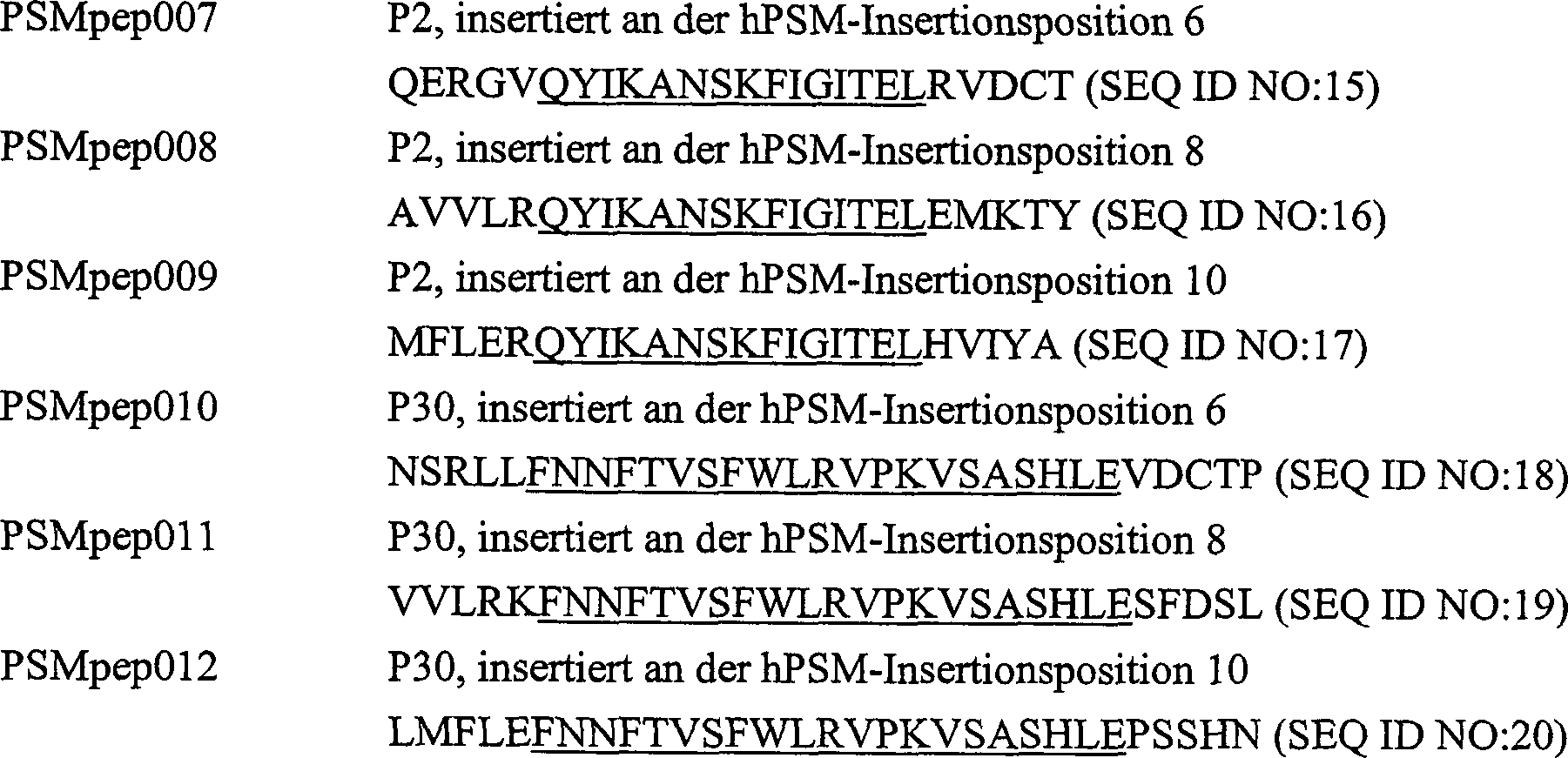
Die P2- und P30-Epitope sind unterstrichen. Die Peptide wurden durch automatische Synthese hergestellt und dem Verfahren der HPLC-Reinigung, gefolgt von einer Kontrollsequenzierung unter Verwendung des Edman-Abbaus, unterzogen.The P2 and P30 epitopes are underlined. The peptides were through automated synthesis and the method of HPLC purification, followed by control sequencing using Edman degradation, subjected.
Immunogenizitäts-AssaysImmunogenicity assays
Unterschiedliche Experimentelle Aufbauten wurden begonnen um Material herzustellen und die Immunogenizitäts-Assays für zukünftige Tests und Auswahl der mutierten PSM-Konstrukte zu etablieren.different Experimental constructions were started to produce material and the immunogenicity assays for future tests and selection of mutant PSM constructs to establish.
Erzeugung polyklonaler Anti-HIS-PRO5II0.0- und Anti-KLH-PSM-Peptid-Konjugat-AntiseraGeneration of polyclonal Anti-HIS-PRO5II0.0 and anti-KLH-PSM-peptide conjugate antisera
Zwei Kaninchen wurden mit gereinigtem HIS-PROSII0.0, dem HIS-getaggten C-terminalen Teil des hPSM-Proteins (Aminosäuren 437-750), emulgiert 1:1 in vollständigem Freund'schem Adjuvans, immunisiert und mit demselben Antigen, emulgiert in unvollständigem Freund'schem Adjuvans, zweimal eine Booster-Impfung (an Tagen 28 und 55) vorgenommen.Two Rabbits were tagged with purified HIS-PROSII0.0, the HIS-tagged C-terminal part of the hPSM protein (amino acids 437-750), emulsified 1: 1 in complete Freund's adjuvant, immunized and with the same antigen, emulsified in incomplete Freund's adjuvant, twice a booster vaccination (on days 28 and 55).
Zwei Kaninchen wurden mit einem Cocktail, der aus dem KLH-PSM-Peptid-Konjugat plus jedes der drei freien Peptide bestand, immunisiert. Diese drei Peptide enthalten jeweils ein zuvor definiertes B-Zell-Epitop von hPSM. Der Cocktail wurde in vollständigem Freund'schem Adjuvans 1:1 emulgiert. Den Kaninchen wurde zweimal (an Tagen 28 und 55) mit demselben Antigen, emulgiert in unvollständigem Freund'schem Adjuvans, Booster-Impfungen verabreicht.Two Rabbits were treated with a cocktail consisting of the KLH-PSM-peptide conjugate plus each of the three free peptides was immunized. These three Peptides each contain a previously defined B cell epitope of hPSM. The cocktail was in complete Freund's adjuvant 1: 1 emulsified. The rabbits were twice (on days 28 and 55) with same antigen, emulsified in incomplete Freund's adjuvant, booster vaccinations administered.
Die Kreuzreaktivität zwischen Anti-HIS-PROSII0.0 und PSMpep005 einerseits und die Kreuzreaktivität zwischen Anti-KLH-PSM-Peptid-Konjugat plus Peptide und HIS-PROSII0.0 andererseits wurden in ELISA-Assays gezeigt.The Cross-reactivity between anti-HIS-PROSII0.0 and PSMpep005 on the one hand and the cross-reactivity between Anti-KLH-PSM-peptide conjugate plus peptides and HIS-PROSII0.0 on the other hand were shown in ELISA assays.
Der Anti-HIS-PROSII0.0-Antikörper hat die Fähigkeit, natives hPSM in Lysaten von LNCaP-Zellen in Western-Blots zu erkennen.Of the Anti-HIS antibody PROSII0.0 has the ability to detect native hPSM in lysates of LNCaP cells in Western blots.
Immunisierung von Mäusen mit retroviral exprimiertem hPSM0.0Immunization of mice with retrovirally expressed hPSM0.0
In diesem Stadium des PSM-Projekts ist ein großes Hindernis noch immer der Mangel an Antikörpern, welche in der Lage sind, korrekt gefaltetes natives hPSM zu erkennen. Daher wurde ein Immunisierungsexperiment unter Verwendung von retroviral exprimiertem hPSM0.0 durchgeführt.In At this stage of the PSM project, a major obstacle is still the Lack of antibodies, which are able to recognize correctly folded native hPSM. Therefore was an immunization experiment using retroviral expressed hPSM0.0 performed.
Sechs Gruppen von Balb/c-Mäusen wurden jeweils immunisiert mit: 1) Mitomycin-C-behandelten BALB/c-Fibrosarkomzellen (79.24.H8), transduziert mit hPSM0.0-cDNA (CMV-Koz-hPSM), 2) Mitomycin-C-behandelten BALB/c-Fibrosarkomzellen (79.24.H8), transduziert mit leerem Vektor (CMVBipep), 3) Verpackungszellen (BOSC), transfiziert mit hPSM0.0-cDNA (CMV-Koz-hPSM), 4) Verpackungszellen (BOSC), transfiziert mit leerem Vektor (CMVBipep), 5) Retrovirenstamm, der hPSM0.0-cDNA exprimiert (CMV-Koz-hPSM), oder 6) Retrovirenstamm, leerer Vektor (CMVBipep).six Groups of Balb / c mice were each immunized with: 1) mitomycin C-treated BALB / c fibrosarcoma cells (79.24.H8), transduced with hPSM0.0 cDNA (CMV-Koz-hPSM), 2) mitomycin C-treated BALB / c fibrosarcoma cells (79.24.H8) transduced with empty vector (CMVBipep), 3) packaging cells (BOSC) transfected with hPSM0.0 cDNA (CMV-Koz-hPSM), 4) packaging cells (BOSC) transfected with empty vector (CMVBipep), 5) Retrovirus strain expressing hPSM0.0 cDNA (CMV-Koz-hPSM), or 6) retrovirus strain, empty vector (CMVBipep).
Zu verschiedenen Zeitpunkten wurde den Mäusen Blut entnommen, und die erhaltenen Seren wurden im Hinblick auf die Reaktivität im ELISA auf Reaktivität gegen HIS-PROSII0.0 getestet. Leider entwickelte keine der Mäuse Antikörper, die spezifisch die HIS-PROSII0.0-Präparation erkennen.To At various times the mice were bled and the were obtained in terms of reactivity in the ELISA on reactivity tested against HIS-PROSII.0.0. Unfortunately, none of the mice developed antibodies that specifically the HIS-PROSII0.0 preparation detect.
Etablieren eines Anti-hPSM-ELISAEstablish an anti-hPSM ELISA
Gereinigtes HIS-PROSII0.0 wurde zum Beschichten von Polystyrol-Mikrotiterplatten (Maxisorp) zum Zwecke des Etablierens eines ELISA-Assays verwendet, und zwar zum Testen von z.B. Hybridom-Überständen oder Maus- und Kaninchen-Antiseren. Seren von BALB/c-Mäusen, die mit derselben Präparation von HIS-PROSII0.0 immunisiert worden waren, zeigten Reaktivität gegen das immobilisierte HIS-PROSII0.0 bei 0,5 μg pro Vertiefung, unter Verwendung eines mit Meerrettich-Peroxidase markierten Kaninchen-anti-Maus-Ig als sekundärem Antikörper.purified HIS-PROSII.0.0 was used to coat polystyrene microtiter plates (Maxisorp) used for the purpose of establishing an ELISA assay, for testing e.g. Hybridoma supernatants or mouse and rabbit antisera. Sera from BALB / c mice that with the same preparation of HIS-PROSII.0.0 showed reactivity against the immobilized HIS-PROSII0.0 at 0.5 μg per well, using a horseradish peroxidase labeled rabbit anti-mouse Ig as secondary Antibody.
Wie oben erwähnt, wurde die Fähigkeit eines Antiserums, das in Kaninchen gegen KLH-PSMpep004-PSMpep005-PSMpep006-Konjugats, gemischt mit den freien Peptiden, gezogen wurde, mit immobilisierten HIS-PROSII0.0 zu reagieren, unter Verwendung dieses ELISA-Assays gezeigt.As mentioned above, became the ability of an antiserum raised in rabbits against KLH-PSMpep004-PSMpep005-PSMpep006 conjugate, mixed with the free peptides, was drawn, with immobilized HIS-PROSII0.0 using this ELISA assay shown.
Unter Verwendung von AquaBind®-Mikrotiterplatten (vgl. die Offenbarung in WO 94/03530, die unter anderem Mikrotiteroberflächen beschreibt, die mit Tresyl-aktiviertem Dextran beschichtet sind, welche nun unter der registrierten Marke AquaBind vermarktet werden) wurde ein ELISA entwickelt, der immobilisierte PSM-Peptide (PSMpep004, PSMpep005, PSMpep006) verwendet.(Cf. are coated., The disclosure in WO 94/03530, which describes, among other things Mikrotiteroberflächen, the activated tresyl with dextran which are now marketed under the registered trademark AquaBind) Using AquaBind microtiter ® has been developed an ELISA immobilized PSM peptides (PSMpep004, PSMpep005, PSMpep006).
AquaBind®-Platten, die mit diesen Peptiden beschichtet sind, können ein Kaninchen-Antiserum, das gegen dieselbe Präparation von Antigen gezogen wurde, erkennen. Wie oben erwähnt, konnte Kaninchen-anti-HIS-PROSII0.0 auf AquaBind®-Platten, die mit PSMpep005 beschichtet waren, detektiert werden.AquaBind ® boards that are coated with these peptides can, a rabbit antiserum raised against the same preparation of antigen recognize. As mentioned above, could rabbit anti-HIS-PROSII0.0 on AquaBind ® boards, which were coated with PSMpep005 be detected.
Etablieren eines Anti-hPSM-Western-Blots unter Verwendung von LNCaP-Zellen und dem monoklonalen Antikörper 7E11C5Establish an anti-hPSM western blot using LNCaP cells and the monoclonal antibody 7E11C5
7E11C5-B-Zell-Hybridome, welche monoklonalen Maus-IgG2a-Antikörper gegen ein intrazelluläres Epitop von humanem PSM sezernieren, wurden von ATCC bezogen. Kulturüberstände von zu ungefähr 90% toten Zellen wurden gesammelt und im Western-Blot zur Detektion von humanem PSM in sowohl Membran-angereicherten Präparationen von LNCaP-Zellen als auch in LNCaP-Zelllysaten verwendet. Dieser Antikörper wurde unter Verwendung von Protein-G-Säulen gereinigt, und seine Reaktivität mit LNCaP in Western-Blots verifiziert.7E11C5 B cell hybridomas, which monoclonal mouse IgG2a antibodies to an intracellular epitope of human PSM were purchased from ATCC. Culture supernatants of to about 90% dead cells were collected and detected in Western blot of human PSM in both membrane-enriched preparations of LNCaP cells as well as in LNCaP cell lysates. This antibody was using protein G columns purified, and its reactivity verified with LNCaP in Western blots.
Etablieren einer FACS-Methode zum Detektieren von hPSM auf LNCaP-ZellenEstablish a FACS method for detecting hPSM on LNCaP cells
Wir haben zwei voneinander unabhängige FACS-Methoden zum Detektieren von hPSM auf LNCaP-Zellen etabliert. Mehrere Probleme werden angesprochen: Die LNCaP-Zellen wachsen sehr langsam und in unregelmäßigen Klumpen, und daher sollte das Verfahren, Einzelzellsuspensionen herzustellen, optimiert werden. Zweitens wurde in der Literatur definiert, dass das Epitop, das von dem mAb 7E11C5 erkannt wird, sich in der eytoplasmatischen Domäne von hPSM befindet. Daher wurde das Verfahren entwickelt um die Zellen zu fixieren und zu permeabilisieren. Zu diesem Zweck wurde Protein-G-gereinigter 7E11C5-Antikörper FITC- konjugiert, und dieser konnte daher ohne sekundären Antikörper in der FACS-Analyse verwendet werden.We have established two independent FACS methods for detecting hPSM on LNCaP cells. Several problems are addressed: The LNCaP cells grow very slowly and in irregular clots, and therefore the process of making single cell suspensions should be optimized. Second, it has been defined in the literature that the epitope recognized by mAb 7E11C5 is located in the eytoplasmic domain of hPSM. Therefore, the method was developed to fix and permeabilize the cells. For this purpose, protein G-purified 7E11C5 antibody was used FITC conjugated, and this could therefore be used without secondary antibody in the FACS analysis.
Ebenso wurde ein FACS-Verfahren etabliert, das den monoklonalen Anti-hPSM-Antikörper J591 verwendet, welcher ein Epitop auf dem extrazellulären Teil von hPSM erkennt. Der Antikörper wurde von BZL Biologicals bezogen und mit FITC konjugiert und anschließend zur FACS-Analyse und -Sortierung von z.B. LNCaP-Zellen und hPSM-Transfektanden verwendet (siehe unten).As well For example, a FACS procedure was established using the monoclonal anti-hPSM antibody J591 which has an epitope on the extracellular part detected by hPSM. The antibody was purchased from BZL Biologicals and conjugated with FITC and subsequently added to the FACS analysis and sorting of e.g. LNCaP cells and hPSM transfectants used (see below).
Etablieren eines Cytotoxizitäts-AssaysEstablish a cytotoxicity assay
Ein Verfahren zum Reinigen von dendritischen Zellen aus Maus-Knochenmark wurde implementiert. Unter Verwendung von Modellproteinen wurde die Immunisierung von Mäusen mit dendritischen Zellen optimiert, welche in einem Pulsverfahren mit Modell Klasse-I-Peptiden und -Protein konfrontiert wurden. Mäuse wurden auch mit einem Modell-Protein (β-Galactosidase), das in der Form von ISCOMS formuliert war, immunisiert. T-Zellen, die aus immunisierten Mäusen gereinigt wurden, wurden in vitro mit unterschiedlichen Formen des entsprechenden Antigens restimuliert. Die Fähigkeit dieser restimulierten CTLs zum Lysieren unterschiedlicher Arten von Zielzellen (einschließlich der Puls-markierten dendritischen Zellen, sowie Transfektanden, die retroviral-exprimiertes, cytosolisches Klasse-I-Peptid exprimierten) wurde anschließend gemessen. Zwei unterschidliche in vitro-Assays, die CTL-Aktivität messen, wurden etabliert, entweder unter Verwendung der Chrom-Ausschüttung oder/und der DNA-Fragmentierung (JAM-Verfahren) als Maßstab der Cytotoxizität. Sehr schöne Ergebnisse erhielt man mit dem β-Galactosidase-Modellprotein und mit verschiedenen Kombinationen von MHC-Klasse I und -Klasse II-bindenden Modellpeptiden.One Method for purifying mouse bone marrow dendritic cells was implemented. Using model proteins was the immunization of mice optimized with dendritic cells, which in a pulse method with model class I peptides and protein were confronted. Mice were also given a model protein (β-galactosidase), the immunized in the form of ISCOMS. T cells that from immunized mice were purified in vitro with different forms of restimulated corresponding antigen. The ability of this restimulated CTLs for lysing different types of target cells (including the Pulse-labeled dendritic cells, as well as transfectants, retrovirally-expressed, cytosolic class I peptide expressed) was subsequently measured. Two distinct in vitro assays that measure CTL activity were established using either the chromium-release or / and DNA fragmentation (JAM method) as a benchmark the cytotoxicity. Really nice Results were obtained with the β-galactosidase model protein and with various combinations of MHC class I and class II binding model peptides.
Etablierung von Werkzeugen zum Studieren des Durchbrechens der Autotoleranz gegen Maus-PSM in MäusenEstablishment of tools to study breaking the car tolerance against mouse PSM in mice
Es besteht die Absicht, zu untersuchen, ob die Autotoleranz gegen Maus-PSM in Mäusen durch Immunisierung und/oder DNA-Vakzinierung gegen Maus-PSM unter Verwendung von Maus-PSM-AutoVac-Molekülen durchbrochen werden kann.It there is an intention to investigate whether auto-tolerance against mouse PSM in mice by immunization and / or DNA vaccination against mouse PSM Use of mouse PSM-AutoVac molecules can be broken.
Wie
oben erwähnt,
wurde eine cDNA, die für
Maus-PSM (mPSM) codiert, erhalten und dessen DNA sequenziert. Es
werden vier mPSM-Varianten-Moleküle
durch Insertion von P30 an wohldefinierten Stellen, entweder im
Volllängen-mPSM
oder mPSM', erzeugt.
Die Konstrukte sind die folgenden: 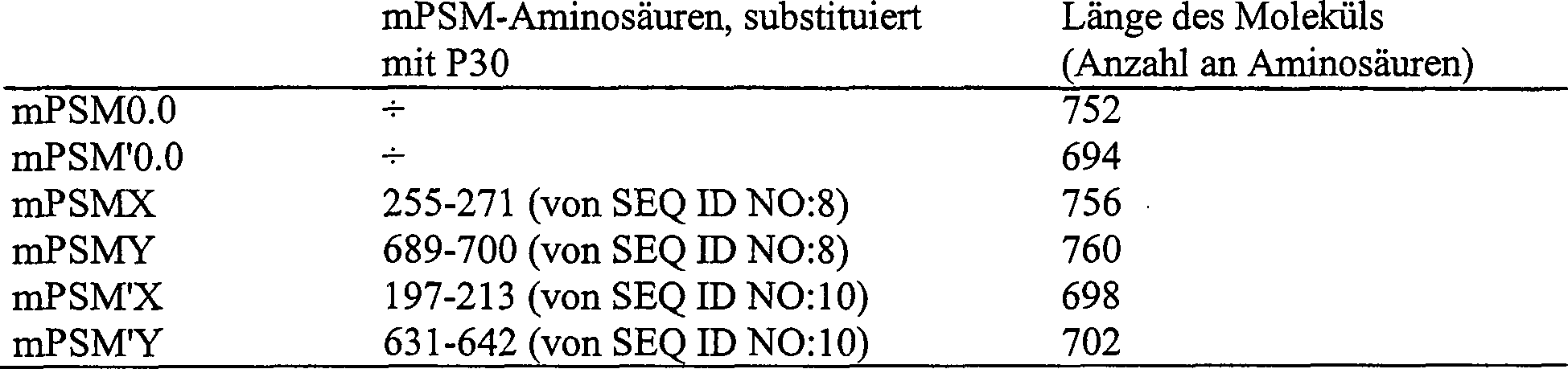
Zunächst werden die mPSM-Wildtyp- und -Analogon-Moleküle in DNA-Vakzinierungs-Vektoren subkloniert und zur DNA-Vakzinierung von Mäusen verwendet.First, be subcloning the mPSM wild-type and analogue molecules in DNA vaccination vectors and for DNA vaccination of mice used.
Es ist beabsichtigt, die Immunantworten, wie CTL-Reaktionen und Tumorelimination, in den Mäusen zu untersuchen. Dazu werden Maus-Tumorzelllinien mit Wildtyp-Maus-PSM (im Leserahmen fusioniert mit einem Identifikations-tag, z.B. dem c-myc-Epitop, SEQ ID NO:27, zu Detektionszwecken) transfiziert.It It is intended that the immune responses, such as CTL responses and tumor elimination, in the mice too investigate. These are mouse tumor cell lines with wild-type mouse PSM (fused in frame with an identification tag, e.g. c-myc epitope, SEQ ID NO: 27, for detection purposes).
in vivo-PSM-Tumormodellein vivo PSM tumor models
Maus-T-Zell-Proliferations-Assay mit P2 und P30Mouse T-cell proliferation assay with P2 and P30
Eine Reihe von T-Zell-Proliferationsexperimenten wurde durchgeführt um die T-Zell-Immunogenität von P2- und P30-Peptiden in verschiedenen Maus-Stämmen (BALB/cA (H-2d), C3H/Hen (H-2k, DBA/1 (H-2q) und C57BL/6 (H-2b)) festzustellen. Es ist wohlbekannt, dass diese Epitope in Menschen gemischte Epitope sind, aber der gemischte Charakter der T-Zelle musste auch in Mäusen unter Verwendung von einem experimentellen Aufbau von M&Es bestätigt werden. Es wurde daher gezeigt, dass P30 T-Zell-immunogen in den BALB/cA- und C57BL/6-Stämmen ist, während weder P2 noch P30 T-Zell-immunogen in dem C3H/Hen-Stamm ist. In DBA/1 konnten T-Zellen gegen P2 vermehrt werden.A series of T cell proliferation experiments has been conducted to the T-cell immunogenicity of P2 and P30 peptides in various mouse strains (BALB / cA (H-2 d), C3H / Hen (H-2 k, DBA / 1 (H-2 q ) and C57BL / 6 (H-2 b ).) It is well known that these epitopes are mixed epitopes in humans, but the mixed character of the T cell also had to be induced in mice using a Therefore, it has been shown that P30 is T-cell immunogenic in the BALB / cA and C57BL / 6 strains, whereas neither P2 nor P30 is T cell immunogenic in the C3H / Hen strain is. In DBA / 1, T cells could be propagated against P2.
Erzeugung von hPSM-exprimierenden Maus-Tumorzellengeneration of hPSM-expressing mouse tumor cells
Zur Anwendung in einem hPSM-spezifischen Tumormodell in Mäusen sowie zur Anwendung in Tumorzell-Proliferations-Assays wurde eine Reihe von hPSM-exprimierenden Maus-Tumorzellen etabliert. Ein Ansatz ist es, diese Zelllinien zu erzeugen, indem die Maus-Tumorzelllinien mit retroviralen Vektoren transduziert werden, die die Volllängen-WildtyphPSM0.0-cDNA codieren.to Application in a hPSM-specific tumor model in mice as well For use in tumor cell proliferation assays has been a number of hPSM-expressing mouse tumor cells. One approach is it to generate these cell lines by using the mouse tumor cell lines with retroviral vectors which encode the full-length wild-type PSM0.0 cDNA.
Drei unterschiedliche Konstrukte wurden konstruiert, die die Volllängen-Wildtyp-cDNA, die humanes PSM eingefügt in die Polyklonierungsstelle des retroviralen Vektors CMVBipep codieren, wobei zwei von diesen eine kurze Kozak-Sequenz, stromaufwärts vom Startkodon gelegen, enthalten.Three different constructs were constructed, the full-length wild-type cDNA, the human PSM added encode into the polycloning site of the retroviral vector CMVBipep, two of these being a short Kozak sequence, upstream of Launch codon located, included.
Diese Konstrukte wurden in drei unterschiedliche Maus-Tumorzelllinien transduziert: P815 (Mastocytom, H-2d), B16-F10 (Melanom, H-2b) und 79.24.H8 (Fibrosarkom, H-2d), und zwar unter Verwendung der BOSC-Verpackungs-Zelllinie. Man erhielt Geneticin-resistente Klone bei allen drei Zelltypen, und es wurde in einer PCR-Analyse auf genomischer DNA bes tätigt, dass die retroviralen Konstrukte in die Wirtszellen integriert waren. Es war noch nicht möglich, ein exprimiertes PSM-Genprodukt im Western-Blot oder in der FACS-Analyse unter der Verwendung des monoklonalen 7E11C5-Antikörpers zu detektieren.These constructs were transduced into three different mouse tumor cell lines: P815 (mastocytoma, H-2 d), B16-F10 (melanoma, H-2 b) and 79.24.H8 (fibrosarcoma, H-2 d), and using the BOSC packaging cell line. Geneticin-resistant clones were obtained in all three cell types, and it was confirmed in a PCR analysis on genomic DNA that the retroviral constructs were integrated into the host cells. It was not yet possible to detect an expressed PSM gene product by Western blot or FACS analysis using the monoclonal 7E11C5 antibody.
Zwei stabile Maus-Tumorzelllinien, die Membran-gebundenes humanes Wildtyp-PSM enthalten, wurden durch Transfektion etabliert. Dies wurde erreicht, indem hPSM0.0-cDNA in den Säuger-Expressionsvektor pcDNA3.1(÷) unter der Kontrolle des CMV-Promotors und mit einer Kozak-Sequenz stromaufwärts des Startkodons gelegen subkloniert wurde.Two stable mouse tumor cell lines, the membrane-bound human wild-type PSM were established by transfection. This was achieved by inserting hPSM0.0 cDNA into the mammalian expression vector pcDNA3.1 (÷) under the control of the CMV promoter and with a Kozak sequence upstream of the Starting codon was subcloned.
Das daraus hervorgehende Plasmid wurde in zwei unterschiedliche Maus-Tumorzelllinien transfiziert: 79.24.H8 (Fibrosarkom, Balb/c-abgeleitet) und Sa1N (Fibrosarkom, A/J-abgeleitet). Geneticin-resistente Kulturen wurden erhalten und einer Western-Blot- und FACS-Analyse unterzogen, und zwar unter Verwendung der monoklonalen J591- und 7E11C5-anti-hPSM-Antikörper. Unter Verwendung des J591-Antikörpers wurden die Zellen über mehrere Runden FACS-sortiert, bis eine hPSM-positive Population erhalten wurde. Die hPSM-Expression wurde wiederum mittels intrazellulärer FACS-Färbung unter Verwendung des 7E11C5-Antikörpers verifiziert. Es wurde auch mittels FACS-Analyse überprüft, dass die MHC-Klasse I-Expressionsspiegel dieselben Spiegel waren wie die Spiegel der parentalen Zelllinien.The resulting plasmid was transfected into two different murine tumor cell lines: 79.24.H8 (Fibrosarcoma, Balb / c-derived) and Sa1N (fibrosarcoma, A / J-derived). Geneticin-resistant cultures were obtained and Western blot and FACS analysis using the monoclonal J591- and 7E11C5 anti-hPSM antibodies. Using the J591 antibody the cells were over several rounds of FACS-sorted until an hPSM-positive population was obtained. In turn, hPSM expression was suppressed by intracellular FACS staining Use of the 7E11C5 antibody Verified. It was also verified by FACS analysis that the MHC class I expression levels the same levels were like the levels of the parental cell lines.
Kulturen von 79.24.H8 und SalN-Zelllinien, die hPSM exprimieren, wurden durch limitierende Verdünnung kloniert. Mehrere Klone wurden erhalten und mittels FACS-Analyse unter Verwendung des monoklonalen Anti-hPSM-Antikörpers J591 auf unterschiedliche Expressionslevel von hPSM getestet.cultures of 79.24.H8 and SalN cell lines expressing hPSM were performed limiting dilution cloned. Several clones were obtained and analyzed by FACS analysis using the monoclonal anti-hPSM antibody J591 tested for different expression levels of hPSM.
79.24.H8-Zellen, die hPSM exprimieren, wurden mit dem Gen, das für B7.1 codiert, zur Verwendung z.B. in in vitro-Assays zum Beobachten der hPSM-spezifischen CTL-Antworten und/oder der Interferon-gamma-Ausschüttung transfiziert. Die Zellen wurden einmal unter Verwendung eines Anti-B7.1-Antiserums mittels FACS sortiert.79.24.H8 cells expressing hPSM were cloned with the gene encoding B7.1 for use e.g. in in vitro assays to monitor hPSM-specific CTL responses and / or the interferon-gamma-releasing transfected. The cells were once using an anti-B7.1 antiserum by means of FACS sorted.
Etablieren eines hP5M-spezifischen Tumormodells in MäusenEstablish a hP5M-specific Tumor model in mice
Es wurde der Entschluss gefasst, mindestens zwei in vivo-Tumormodelle in immunkompetenten Mäusen zu etablieren um die Anti-Tumor-Wirkung von Antikörpern zu bestimmen, die in Mäusen gegen die immunogenisierten hPSM-Moleküle gezogen wurden. Dies wird hoffentlich durch Injizieren in syngenische Maus-Tumorzelllinien geschehen, die so modifiziert wurden, dass Wildtyp-hPSM auf der Oberflächenmembran exprimiert wird. Es werden Zellen verwendet werden, welche feste Tumoren bilden, und/oder Zellen, von denen bekannt ist, dass sie metastasieren. Es werden Zelllinien in diesem Modell verwendet, welche in syngenische Mäuse implantiert werden können, ohne aufgrund der Anwesenheit des fremden hPSM-Moleküls abgestoßen zu werden. Die Fähigkeit der hPSM-Vakzine, solche Tumorzellen zu eliminieren, wird für die Auswahl der hPSM-Vakzin-Kandidaten verwendet werden.It it was decided to have at least two in vivo tumor models in immunocompetent mice to establish the anti-tumor effects of antibodies determine that in mice were pulled against the immunogenized hPSM molecules. this will hopefully by injecting into syngenic mouse tumor cell lines done so modified that wild-type hPSM on the surface membrane is expressed. Cells will be used which are solid Tumors form, and / or cells known to be metastasize. Cell lines are used in this model which in syngenic mice can be implanted, without being repelled due to the presence of the foreign hPSM molecule. The ability The hPSM vaccine to eliminate such tumor cells will be available for selection hPSM vaccine candidate.
Um das Wachstum von SalN-Zellen, die mit dem humanen Volllängen-PSM transfiziert waren, zu ermitteln, wurden unterschiedliche Dosen (2 × 10⁶ und 5 × 10⁶) der mit hPSM transfi zierten Sa1N-Zellen (S-PSM, 5 Mal sortiert) subkutan an der rechten unteren Flanke von Gruppen von A/J-Mäusen injiziert. Es entwickelten sich jedoch keine festen Tumoren. Anschließend wurden drei Klone von S-PSM-Zellen mit unterschiedlichen Expressionsleveln von hPSM subkutan in drei Gruppen von A/J-Mäusen mit einer Dosis von 107 Zellen/Maus injiziert. Die Größen der etablierten Tumore wurden mittels einer Kaliberlehre gemessen, wobei zwei unterschiedliche Durchmesser gemessen wurden, die multipliziert wurden um die Tumorgröße in mm2 zu ergeben. Diese Werte wurden bei den drei Gruppen verglichen. Innerhalb von 3-6 Tagen entwickelten alle Mäuse eine feste Tumor-ähnliche Struktur, welche ungefähr am Tag 15 wieder verschwand. Dies liegt wahrscheinlich in der Anwesenheit von humanem hPSM auf den Tumorzell-Oberflächen begründet, obwohl es nicht verifiziert wurde. SalN-Zellen, die nur mit dem pcDNA3.1-Vektor transfiziert waren, setzten ihr Wachstum als fester Tumor in Mäusen fort.To determine the growth of SalN cells transfected with the full-length human PSM, different doses (2 x 10 6 and 5 x 10 6 ) of hPSM-transfected Sa1N cells (S-PSM, 5 times subcutaneously injected at the lower right flank of groups of A / J mice. However, no solid tumors developed. Subsequently, three clones of S-PSM cells with different expression levels of hPSM were subcutaneously subdivided into three groups of A / J mice at a dose of 10 7 cells / mouse injected. The sizes of the established tumors were measured using a caliber gauge, measuring two different diameters multiplied to give the tumor size in mm 2 . These values were compared among the three groups. Within 3-6 days, all mice developed a solid tumor-like structure, which disappeared at about day 15. This is probably due to the presence of human hPSM on the tumor cell surfaces, although it has not been verified. SalN cells transfected with the pcDNA3.1 vector only continued to grow as a solid tumor in mice.
Ein ähnliches Bild wurde bei Mäusen beobachtet, denen 106, 5 × 10⁶ oder 107 79.24.H8-Zellen injiziert wurden, welche mit hPSM transfiziert und über mehrere Runden im Hinblick auf hPSM-Expression sortiert worden waren. Diese Zellen (79-PSM genannt) etablierten sich ebenfalls nicht als Tumore in Balb/c- oder DBA/2-Mäusen. Wenn jedoch ein Klon hPSM-transfizierte 79.24.H8-Zellen, 79-PSM.3, in Balb/c- oder DBA/2-Mäuse injiziert wurde, entwickelten die Mäuse feste Tumor-ähnliche Strukturen, welche wiederum um Tag 10-20 herum verschwanden. Lediglich mit Vektor transfizierte 79.24.H8 setzten ihr Wachstum in Balb/c-Mäusen fort.A similar picture was observed in mice injected with 10 6 , 5 x 10 6 or 10 7 79.24.H8 cells transfected with hPSM and sorted for several rounds for hPSM expression. These cells (called 79-PSM) also did not establish as tumors in Balb / c or DBA / 2 mice. However, when one clone was injected with hPSM-transfected 79.24.H8 cells, 79-PSM.3, into Balb / c or DBA / 2 mice, the mice developed solid tumor-like structures, which in turn around day 10-20 disappeared. Only vector-transfected 79.24.H8 continued to grow in Balb / c mice.
Es muss noch immer bestimmt werden, ob diese "Tumore" behandelbar sind, oder ob ein besseres Tumormodell, basierend auf den beschriebenen S-PSM- und 79-PSM-Zelllinien und -Klonen etabliert werden kann.It it still has to be determined whether these "tumors" are treatable or whether a better tumor model, based on the described S-PSM and 79-PSM cell lines and Clones can be established.
SchlussfolgerungenConclusions
Bei der molekularen Konstruktionsarbeit waren wir erfolgreich bei der Klonierung des humanen PSM-Gens und beim Erhalten der Maus-PSM-cDNA. Eine Reihe von vollständig sequenzierten, immunogenisierten hPSM-Autovakzin-Konstrukten wurde hervorgebracht. Die hPSM-Mutanten sowie unterschiedliche Wildtyp-hPSM-Moleküle wurden in E. coli exprimiert, und man fand heraus und verifizierte, dass die Expressionslevel in E. coli sehr niedrig sind. Polyklonale Antikörper gegen die C-terminale Hälfte von hPSM wurden in Kaninchen induziert. Es wurden Anstrengungen unternommen, unterschiedliche Expressions-tags (HIS-tag und Maltose-Bindeprotein-Fusion) sowie Expressionssysteme alternativ zu E. coli-Einschlusskörperchen zu implementieren. Rekombinantes Wildtyp- und/oder Autovakzin-hPSM wurde in transfiziertem Pichia pastoris und in Säugerzellen detektiert. Nützliche Erwägungen, die die DNA-Vakzintechnologie betreffen, wurden vorgenommen, und eine vorläufige Machbarkeitsstudie wurde durchgeführt. DNA-Vakzinierungsexperimente mit hPSM-Autovakzin-Molekülen dauern an und zeigen vielversprechende vorläufige Ergebnisse. Unterschiedliche in vitro-Assays, die zum Testen und zur Auswahl der mutierten PSM-Konstrukte nützlich sind, sind etabliert, einschließlich immunchemischer Assays und der FACS-Analyse. Maus-Tumorzellen wurden stabil mit Volllängen-Wildtyp-hPSM transfiziert und mittels FACS im Hinblick auf hPSM-Oberflächenexpression sortiert. Man hat Klone dieser Zelllinien erhalten. Xenogenische in vivo-Tumor-Modelle in Mäusen werden derzeit untersucht unter Verwendung dieser hPSM-enthaltenden syngenischen Maus-Tumorzellen. Eine Reihe von T-Zell-Proliferations-Assays wurde durchgeführt um die Maus-Stämme für die Tumormodelle zu selektieren. CTL-Assays werden optimiert, und überzeugende Ergebnisse mit Modell-Antigenen wurden erhalten, indem unterschiedliche Immunisierungsmethoden und Assay-Bedingungen verwendet wurden. Außerdem werden Werkzeuge etabliert, die notwendig sind um das Durchbrechen der Toleranz gegen Maus-PSM durch Immunisierung gegen Maus-PSM-Autovakzine zu untersuchen.at We were successful in the molecular construction work at the Cloning the human PSM gene and obtaining the mouse PSM cDNA. A series of complete sequenced, immunogenized hPSM autovaccine constructs produced. The hPSM mutants as well as different wild-type hPSM molecules were expressed in E. coli, and it was found out and verified that the expression levels in E. coli are very low. Polyclonal antibodies against the C-terminal half of hPSM were induced in rabbits. There have been efforts made different expression tags (HIS tag and maltose-binding protein fusion) and expression systems as an alternative to E. coli inclusion bodies to implement. Recombinant wild-type and / or autovaccine hPSM was detected in transfected Pichia pastoris and in mammalian cells. helpful Considerations, the DNA vaccine technology were made and a preliminary feasibility study was carried out. DNA vaccination experiments with hPSM autovaccine molecules take longer and show promising preliminary results. different in vitro assays useful for testing and selecting mutant PSM constructs useful are, are established, including immunochemical assays and FACS analysis. Mouse tumor cells were stable with full-length wild-type hPSM transfected and by FACS for hPSM surface expression sorted. Clones of these cell lines have been obtained. xenogeneic in vivo tumor models in mice are currently being studied using this hPSM-containing syngeneic Mouse tumor cells. A number of T-cell proliferation assays were carried out around the mouse strains for the To select tumor models. CTL assays are optimized, and compelling Results with model antigens were obtained by using different Immunization methods and assay conditions were used. There are also tools established, which are necessary to break the tolerance against To study mouse PSM by immunization against mouse PSM autovaccine.
BEISPIEL 2EXAMPLE 2
Herstellung eines Her2 AutovakzinsMaking a Her2 autovaccine
Ein humanes Autovakzin gegen Her2 kann durch Modifikation des Moleküls durch Insertion von einem oder mehreren gemischten, fremden T-Zell-Epitopen unter Hervorbringen einer Reihe von immunogenisierten Her2-Molekülen entwickelt werden. Diese modifizierten Proteine werden auf ihre Fähigkeit hin getestet, Antikörper zu induzieren, welche mit den nativen Teilen des Her2-Moleküls kreuzreagieren. Anschließend wird in mehreren in vitro-Assays und in vivo-Tiermodellen die Wirksamkeit der unterschiedlichen Konstrukte (wie das im Falle der DNA-Vakzinierung der Fall sein kann) und der modifizierten Proteine ermittelt. Die Induktion von spezifischen CTL-Antworten gegen Her2-enthaltende Tumorzellen wird analysiert. Die induzierten Antikörper werden auch auf ihre Fähigkeit hin getestet, Komplement über den klassischen Weg zu aktivieren und eine ADCC über Fc-Rezeptoren zu initiieren. Schließlich werden die unterschiedlichen modifizierten Moleküle in Tiermodellen von humanem Brustkrebs getestet um ihre Wirkungen bei der Behandlung von Tumoren zu untersuchen.One human autovaccine against Her2 can be modified by modification of the molecule Insertion of one or more mixed foreign T-cell epitopes developing a series of immunogenized Her2 molecules become. These modified proteins are based on their ability tested, antibodies which cross-react with the native parts of the Her2 molecule. Subsequently is effective in several in vitro assays and in vivo animal models of the different constructs (as in the case of DNA vaccination may be the case) and the modified proteins. The Induction of specific CTL responses against Her2-containing Tumor cells are analyzed. The induced antibodies become also on their ability tested out, complement over to activate the classical pathway and initiate ADCC via Fc receptors. After all The different modified molecules in animal models of human Breast cancer tested for its effects in the treatment of tumors to investigate.
Immunogenische Ratten und humane Moleküle werden mit gemischten T-Zell-Epitopen an unterschiedlichen Positionen in dem Molekül konstruiert.immunogenic Rats and human molecules be mixed with mixed T-cell epitopes at different positions in the molecule constructed.
Während der Vakzinierung gegen die gesamte extrazelluläre Domäne von Her2 besteht eine Möglichkeit eines gewissen Grades an Kreuzreaktion der Antikörper mit anderen EGFr-Rezeptoren, da einige dieser Rezeptoren mit bis zu 40-46% in den extrazellulären Domänen homolog sind. Daher ist es geplant, dass die konservierten Regionen von Her2 durch Einfügen von fremden T-Zell-Epitopen mindestens in einigen der modifizierten Proteine zerstört sind (siehe unten für Details).During the Vaccination against the entire extracellular domain of Her2 is one possibility some degree of cross-reaction of the antibodies with other EGFr receptors, as some of these receptors with up to 40-46% homologous in the extracellular domains are. Therefore, it is planned that the conserved regions of Insert Her2 from foreign T cell epitopes at least in some of the modified Proteins destroyed are (see below for Details).
Regionen
von Her2, die möglicherweise
CTL- oder B-Zell-Epitope sein können,
werden beim Gestalten von Konstrukten vermieden, wie in
Die
humane Her2-Sequenz kann in eine Reihe von Domänen geteilt werden, was vollständig auf
der Primärstruktur
des Proteins basiert.Regions of Her2 that may be CTL or B-cell epitopes are avoided when designing constructs, as in
The human Her2 sequence can be divided into a number of domains based entirely on the primary structure of the protein.
Extrazellulärer (Rezeptor-) Teil:Extracellular (receptor) Part:
- 1-173: Domäne I (N-terminale Domäne des reifen Polypeptids).1-173: domain I (N-terminal domain the mature polypeptide).
- 174-323: Domäne II (Cystein-reiche Domäne, 24 Cystein-Reste).174-323: domain II (cysteine-rich domain, 24 cysteine residues).
- 324-483: Domäne III (Liganden-bindende Domäne i des homologen EGF-Rezeptors).324-483: domain III (ligand-binding domain i of the homologous EGF receptor).
- 484-623: Domäne IV (Cystein-reiche Domäne, 20 Cystein-Reste).484-623: domain IV (cysteine-rich domain, 20 cysteine residues).
- 624-654: Transmembran-Domäne (TM-Reste von 654-675).624-654: transmembrane domain (TM residues from 654-675).
Intrazellulärer (Kinase-Teil:Intracellular (kinase part:
- 655-1010: Tyrosinkinase-Domäne (Kern-TK-Domäne von 725-992).655-1010: tyrosine kinase domain (core TK domain from 725-992).
- 1011-1235: C-terminale Domäne.1011-1235: C-terminal domain.
Die Selektion der zu ersetzenden Stellen in der Aminosäuresequenz von Her2 durch entweder die humane P2- oder die P30-T-Helfer-Epitope wurde unter Beachtung der folgenden Parameter vorgenommen (schwach priorisiert):
- 1. Bekannt und vorhergesagte CTL-Epitope
- 2. Homologie gegenüber verwandten Rezeptoren (EGFR insbesondere)
- 3. Konservierung von Cystein-Resten.
- 4. Vorhergesagte Haarnadel, α-Helix- und β-Faltblatt-Strukturen
- 5. Potentielle N-Glykosylierungsstellen
- 6. Vorhersage exponierter und verborgener Aminosäurereste
- 7. Domänenorganisation
- 1. Known and predicted CTL epitopes
- 2. homology to related receptors (EGFR in particular)
- 3. Preservation of cysteine residues.
- 4. Predicted hairpin, α-helix and β-sheet structures
- 5. Potential N-glycosylation sites
- 6. Prediction of exposed and hidden amino acid residues
- 7. Domain Organization
Die CTL-Epitope scheinen in Domäne I, Domäne III, der TM-Domäne und in zwei oder drei "hot spots" in der TK-Domäne im Cluster vorzuliegen. Entsprechend der Erfindung sollten diese weitestgehend konserviert werden.The CTL epitopes appear in domain I, domain III, the TM domain and in two or three "hot spots "in the TK domain in the cluster be present. According to the invention, these should be as far as possible to be preserved.
Regionen mit einem hohen Grad an Homologie mit anderen Rezeptoren sind sehr wahrscheinlich strukturell wichtig für die "Gesamt"tertiärstruktur von Her2, und daher für die Antikörpererkennung, während Regionen mit niedriger Homologie möglicherweise ausgetauscht werden können, mit der Folge von lediglich lokalen Änderungen der Struktur.regions with a high degree of homology with other receptors are very probably structurally important for the "total" tertiary structure of Her2, and therefore for the Antibody recognition, while regions possibly with low homology can be exchanged, with the consequence of only local changes of the structure.
Cystein-Reste sind häufig in intramolekulare Disulfidbrücken-Bildung involviert und daher kritisch für die Tertiärstruktur, und sie sollten nicht verändert werden.Cysteine residues are common in intramolecular disulfide bonds formation involved and therefore critical for the Tertiary structure, and they should not be changed become.
Regionen, von denen vorhergesagt wurde, dass sie α-Helix- oder β-Faltblatt-Strukturen bilden, sollten bevorzugt als Insertionspunkte fremder Epitope vermieden werden, da diese Regionen vermutlich für die Faltung des Proteins wichtig sind.regions which were predicted to have α-helical or β-sheet structures should preferably be avoided as insertion points of foreign epitopes These regions are believed to be responsible for the folding of the protein are important.
Potentielle N-Glykosylierungsstellen sollten bevorzugt auch konserviert werden, weil eine Mannosylierung des Proteins (beispielsweise durch Expression in Hefe) erwünscht ist, vgl. die Anwesenheit von Mannose-Rezeptoren auf APCs.potential N-glycosylation sites should preferably also be preserved, because a mannosylation of the protein (for example by expression in yeast) is, cf. the presence of mannose receptors on APCs.
Regionen, von denen vorhergesagt ist (aufgrund ihrer hydrophoben Eigenschaften), dass sie im Inneren des Moleküls vorliegen, sollten konserviert werden, da diese in die Faltung involviert sein könnten. Im Gegensatz dazu können Regionen, die dem Lösungsmittel ausgesetzt sind, als Kandidaten-Positionen zur Insertion der Modell-TH-Epitope P2 und P30 dienen.Regions that are predicted (due to their hydrophobic properties) to be in the home present in the molecule should be conserved as they might be involved in the folding. In contrast, regions exposed to the solvent may serve as candidate positions for insertion of the model T H epitopes P2 and P30.
Schließlich wurde auch die Domänenorganisation des Proteins aufgrund ihrer Relevanz für Protein-Struktur und -Funktion in Erwägung gezogen.Finally became also the domain organization of the protein because of its relevance to protein structure and function considering drawn.
Der Hauptpunkt der Strategie war es, die Struktur des extrazellulären Teils von Her2 soviel wie möglich zu konservieren, weil dies der Teil des Proteins ist, welcher als Zielobjekt für neutralisierende Antikörper relevant ist. Im Gegensatz dazu ist der intrazelluläre Teil von nativem Membran-gebundenen Her2 auf der Oberfläche von Krebszellen für das humorale Immunsystem unzugänglich.Of the The main point of the strategy was the structure of the extracellular part from Her2 as much as possible conserve, because this is the part of the protein, which as the target object for neutralizing antibody is relevant. In contrast, the intracellular part of native membrane-bound Her2 on the surface of Cancer cells for the humoral immune system inaccessible.
Daher gibt lediglich das Vorhandensein von CTL-Epitopen Grund dazu, diesen Teil in ein Vakzin mit einzubeziehen. Es ist daher offensichtlich, hier ein oder mehrere Epitope zu plazieren. Wenn sich herausstellt, dass es unmöglich ist, das Volllängen-Her22-Molekül in E. coli oder in Hefe zu exprimieren, könnte der intrazelluläre Teil nach dem ersten CTL-Epitop-"hot spot" (um Position 800 herum) verkürzt werden. Zusätzliche CTL-Epitope können danach an das C-terminale Ende des verkürzten Moleküls angefügt werden.Therefore Only the presence of CTL epitopes gives reason to this To include part in a vaccine. It is therefore obvious to place one or more epitopes here. If it turns out that impossible is the full-length Her22 molecule in E. coli or in yeast could express the intracellular part after the first CTL epitope "hot spot "(to position 800 around) become. Additional CTL epitopes can then added to the C-terminal end of the truncated molecule.
Die Transmembran-Region ist vermutlich eine unabhängige Faltungseinheit, und das Ersetzen von dieser durch TH-Epitope, wie P2 oder P30, wird vermutlich die HER2-Struktur und -Faltung nicht beeinflussen. Zusätzlich könnte die TM-Domäne größere Probleme für die Expression in Hefe und E. coli verursachen und sollte in jedem Fall ersetzt werden. Daher sollte ein Epitop in allen Konstruktionen bevorzugt in dieser Domäne plaziert werden (wobei sie vielleicht in einer Konstruktion intakt belassen wird, da sie mehrere CTL-Epitope enthält und weil sie manchmal irgendwie bei der Transmission von Signalen nach Liganden-Bindung involviert ist).The transmembrane region is believed to be an independent folding unit, and replacing it with T H epitopes such as P2 or P30 will probably not affect HER2 structure and folding. In addition, the TM domain could cause major problems for expression in yeast and E. coli and should in any case be replaced. Therefore, an epitope in all constructions should be placed preferentially in this domain (perhaps remaining intact in one construction, as it contains multiple CTL epitopes, and sometimes somehow involved in the transmission of signals upon ligand binding).
Die extrazelluläre Domäne könnte im Prinzip intakt belassen werden, indem man P2 und P30 in der intrazellulären und der Transmembran-Domäne plaziert, wodurch die Anzahl möglicher B-Zell-Epitope maximiert wird und die Struktur so wenig wie möglich gestört wird. Der hohe Grad an Homologie mit EGFR und Her-3 und Her-4 erzeugt ein Risiko der Kreuzreaktivität mit diesen Rezeptoren, welches unerwünscht sein kann (oder auch nicht). Zusätzlich wurden einige monoklonale Antikörper beschrieben, welche als Agonisten für den Rezeptor fungieren (vielleicht durch Stimulieren der Heterodimerisierung oder der Liganden-Bindung) und welche die Tumorgröße, in vivo, erhöhen. Positionen in der extrazellulären Domäne wurden daher ausgewählt, welche diese Risiken hoffentlich dadurch reduzieren werden.The extracellular domain could in principle be left intact by taking P2 and P30 in the intracellular and the transmembrane domain placed, reducing the number of possible B-cell epitopes is maximized and the structure is disturbed as little as possible. The high degree of homology generated with EGFR and Her-3 and Her-4 a risk of cross-reactivity with these receptors, which may be undesirable (or too Not). additionally were some monoclonal antibodies which act as agonists for the receptor (perhaps by stimulating heterodimerization or ligand binding) and which the tumor size, in vivo, increase. Positions in the extracellular domain were therefore chosen which will hopefully reduce those risks.
Diese Auswahl hat alle der zuvor genannten Parameter mit einbezogen, und sie wurde auf zwei unterschiedlichen Annahmen gefußt: (i) Eine Insertion in nicht-konservierte (im Hinblick auf verwandte Rezeptoren) Regionen hilft dabei, die Tertiärstruktur aufrecht zu erhalten und könnte ungewollte Aktivierung durch Antikörper reduzieren. (ii) Die Insertion in die wohl-konservierten Regionen könnte die Struktur ändern, aber könnte gleichzeitig das Risiko der Kreuzreaktivität verringern, indem die am stärksten verwandten Sequenzen zerstört werden. Beide Annahmen sind spekulativ, aber da es sehr schwierig ist, die Wirkung der Platzierung eines Epitops in jeder Position des Proteins vorherzusagen, wurden einige dieser Positionen in die Konstruktionen mit einbezogen.These Selection has included all of the aforementioned parameters, and it was based on two different assumptions: (i) An insertion in non-conserved (with regard to related Receptors) regions helps to maintain the tertiary structure and could reduce unwanted activation by antibodies. (ii) The insertion in the well-preserved Regions could change the structure, but could be simultaneously the risk of cross-reactivity decrease by the strongest related sequences are destroyed. Both assumptions are speculative, but since it is very difficult Effect of placing an epitope in each position of the protein To predict some of these positions have been in the constructions included.
Es wurde spekuliert, dass es ein Vorteil sein könnte, die zwei Cystein-reichen Domänen vollständig zu entfernen. Von diesen ist vorhergesagt, dass sie lösliche, exponierte Schleifenstrukturen bilden und unabhängige Faltungseinheiten bilden können, die vielleicht in die Dimerisierung involviert sind (angedeutet durch die vielen Cysteine, die dazu dienen könnten, eine feste Struktur aufrecht zu erhalten, die für eine Dimerisierungs-Domäne notwendig ist). Das Zerstören dieser Strukturen könnte daher das Risiko der Aktivierung durch Antikörper ausschalten sowie die Anzahl kreuzreagierender Antikörper reduzieren, da diese Domänen die am besten konservierten Domänen des extrazellulären Teils des Proteins sind. Zusätzlich könnte es problematisch sein, solche Cystein-reichen Domänen in E. coli oder Hefezellen herzustellen.It it was speculated that it could be an advantage to pass the two cysteine-rich ones domains Completely to remove. These are predicted to be soluble, form exposed loop structures and form independent folding units can, which may be involved in the dimerization (indicated through the many cysteines that could serve a solid structure to uphold that for a dimerization domain necessary is). The destruction of these structures could Therefore, the risk of activation by antibodies off and the Number of cross-reacting antibodies reduce, as these domains the best conserved domains of the extracellular Are part of the protein. additionally could it would be problematic to have such cysteine-rich domains in E. coli or yeast cells.
Die
Details der Konstrukte sind die folgenden, unter Verwendung der
P2- und P30-Epitope
als nicht-einschränkende
Beispiele: das P2-Epitop wird in erster Linie in der extrazellulären Domäne von Her2
plaziert, in Kombination mit dem P30-Epitop, das einen Teil von
der oder die gesamte Membran-überspannende Region
ersetzt. Das P2-Epitop wird, basierend auf den oben diskutierten
Kriterien, in den Regionen plaziert. Die bevorzugten Konstrukte
besitzen die folgenden Strukturen: 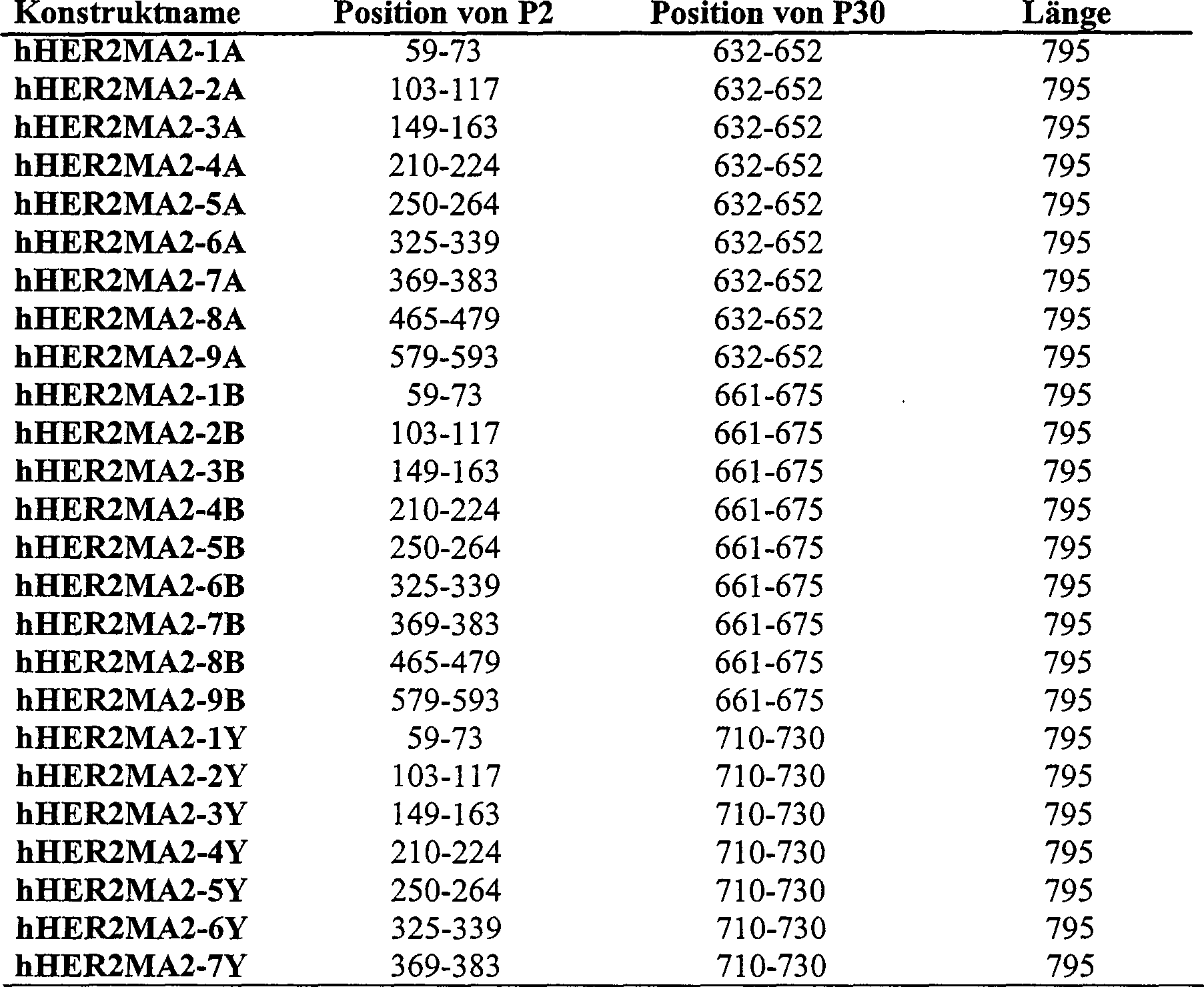

Die Position des Epitops zeigt die erste und die letzte Aminosäure-Position des Epitops in Bezug auf den Startpunkt des reifen Her2 an. Die Länge ist die Länge in Aminosäuren von dem vollständigen Konstrukt. In allen Konstrukten, mit Ausnahme jener, in denen die Position mit einem * angegeben ist, ersetzt das Epitop einen Aminosäurestrang derselben Länge. "*" deutet darauf hin, dass das Epitop in Her2 eingefügt wird und nicht substituiert. Alle oben aufgelisteten Konstrukte sind daher Verkürzungen des reifen Her2, wobei der ausgelassene Teil vom C-Terminus stammt.The Position of the epitope shows the first and the last amino acid position of the epitope with respect to the starting point of the mature Her2. The Length is the length in amino acids from the complete Construct. In all constructs, except those in which the Position is indicated with a *, the epitope replaces an amino acid strand of the same length. "*" indicates that the epitope inserted in Her2 is substituted and not substituted. All the constructs listed above are therefore shortenings of the mature Her2, with the omitted part coming from the C-terminus.
Die meisten Konstruktionen liegen in unterschiedlichen Versionen vor, z.B. in einem pcDNA3.1+-Vektor, in Fusion mit der natürlichen HER2-Signal-Peptidsequenz, in dem Vektor pMT/BiP/VS-His-A als Fusion mit dem BiP-Leitpeptid zur Expression in Drosophilazellen, und ohne Leitsequenz in dem pET28b-Vektor zur Expression in E. coli-Zellen.The Most constructions are available in different versions, e.g. in a pcDNA3.1 + vector, in fusion with the natural one HER2 signal peptide sequence, in the vector pMT / BiP / VS-His-A as a fusion with the BiP leader peptide for expression in Drosophila cells, and without Guidance sequence in the pET28b vector for expression in E. coli cells.
Unten sind die Modelle beschrieben, die zur Verwendung beim Screening und der Selektion modifizierter Her2-Proteine vorgesehen sind.
- 1. Die Induktion von Antikörpern gegen Maus-Her2 in transgenischen Ratten, und in Kaninchen gegen Ratten- und humanes Her2 wird mittels konventioneller ELISA-Technologie nach mindestens drei Immunisierungen untersucht. Kommerziell erhältliche Antikörper gegen menschliches und Ratten-Her2 werden als Positivkontrollen verwendet.
- 2. Diese Kaninchen-Antikörper werden verwendet um die vermutete Inhibierung des Wachstums von humanen und transgenischen Maus-Tumorzellen, die Her2 überexprimieren, in einem in vitro-Modell zu untersuchen.
- 3. Die T-Zell-Proliferation von PBL von Tetanus-immunisierten Patienten gegen ausgewählte humane Her2-Moleküle wird mittels herkömmlicher Verfahren untersucht.
- 4. Die Fähigkeit von modifizierten Ratten-Her2-Molekülen, CTL-Antworten in Ratten-Her2-transgenischen Mäusen zu induzieren, wird unter Verwendung von Tumoren aus diesen Mäusen als Zielobjekten untersucht.
- 5. Es ist beabsichtigt, eine ausgewählte Reihe von Peptiden in der Transmembranregion von humanem Her2 zu synthetisieren, die P2- und P30-Epitope umfassen. Diese Peptide werden auf Proliferation von PBL von Menschen, die zuvor mit Tetanus-Toxoid immunisiert wurden, getestet um zu bestimmen, ob P2- und P30-Epitope aus den Her2-Sequenzen effizient herausprozessiert werden können und gegenüber T-Zellen präsentiert werden können.
- 6. Es ist recht gut möglich, dass ausgewählte humane, modifizierte Her2-Proteine auf die Bildung neutralisierender Antikörper in einer Maus getestet werden, welche genetisch so konstruiert wurde, dass sie nur humane VDJ-Gene exprimiert. Solch eine Maus ist von Abgenix, Fremont, CA, USA, in Zusammenarbeit erhältlich.
- 1. The induction of antibodies against mouse Her2 in transgenic rats, and in rabbits against rat and human Her2 is examined by conventional ELISA technology after at least three immunizations. Commercially available antibodies against human and rat Her2 are used as positive controls.
- 2. These rabbit antibodies are used to investigate the suspected inhibition of the growth of human and transgenic mouse tumor cells overexpressing Her2 in an in vitro model.
- 3. T cell proliferation of PBL from tetanus immunized patients against selected human Her2 molecules is examined by conventional methods.
- 4. The ability of modified rat Her2 molecules to induce CTL responses in rat Her2 transgenic mice is assayed using tumors from these mice as target subjects.
- 5. It is intended to synthesize a select series of peptides in the transmembrane region of human Her2 comprising P2 and P30 epitopes. These peptides are tested for proliferation of PBL from humans previously immunized with tetanus toxoid to determine whether P2 and P30 epitopes from the Her2 sequences can be efficiently out-processed and presented to T cells.
- 6. It is quite possible that selected human modified Her2 proteins will be tested for the formation of neutralizing antibodies in a mouse genetically engineered to express only human VDJ genes. Such a mouse is available from Abgenix, Fremont, CA, USA, in collaboration.
Vier gut charakterisierte transgenische Maus-Modelle für Brustkrebs wurden beschrieben, die ein Ratten-Her2-Onkogen enthalten. Die ersten drei transgenischen Mäuse exprimierert aktiviertes Her2-Onkogen, während das vierte Modell ein inaktiviertes Her2 verwendet. Alle Modelle verwenden einen MMTV-Promotor um die Expression in Milchdrüsen anzutreiben.Four well-characterized transgenic mouse models for breast cancer have been described which contain a rat Her2 oncogene. The first three transgenic mice expresses activated Her2 oncogene while the fourth model inserts inactivated Her2 used. All models use an MMTV promoter the expression in mammary glands drive.
Wir haben entschieden, zwei transgenische Maus-Modelle zu verwenden: 1) ein aggressiveres Tumormodell, das von Muller et al. beschrieben wurde, das aktiviertes Her2-Onkogen verwendet (Muller et al., 1989), und 2) ein weniger aggressives Tumormodell, bei dem inaktiviertes Her2 verwendet wird um fokale Mammatumoren mit einer langen Latenzzeit zu bilden (Guy et al., 1992). Beide transgenischen Mäuse werden von Jackson und/oder Charles Rivers Laboratories bezogen.We have decided to use two transgenic mouse models: 1) a more aggressive tumor model described by Muller et al. described using activated Her2 oncogene (Muller et al., 1989), and 2) a less aggressive tumor model in which inactivated Her2 is used around focal mammary tumors with a long latency period to form (Guy et al., 1992). Both transgenic mice will be sourced from Jackson and / or Charles Rivers Laboratories.
In den anfänglichen Experimenten wird es diesen Mäusen ermöglicht, Antikörper und CTL-Antworten hervorzubringen, und zwar indem mit modifizierten Ratten-Her2-Proteinen immunisiert wird und Booster-Immunisierungen verabreicht werden. Das Auftreten von Tumoren wird dann, wie von anderen beschrieben, untersucht (Muller et al., 1998; Guy et al., 1992; Katsumata et al., 1995). Die Antikörper-Spiegel werden mittels eines ELISA-Assays gemessen. Die CTL-Aktivität wurde bestimmt, indem Zielzellen erzeugt werden, die Ratten-Her2 exprimieren, wie oben erwähnt.In the initial one There will be experiments with these mice allows antibody and CTL responses by using modified Rat Her2 proteins is immunized and booster immunizations be administered. The occurrence of tumors will then, as of others (Muller et al., 1998, Guy et al. 1992; Katsumata et al., 1995). The antibody levels are determined by means of a Measured ELISA assays. CTL activity was determined by targeting cells which express rat Her2, as mentioned above.
Alternativ dazu kann das Nacktmäuse-Xenotransplantation-Karzinom-Modell für passive Vakzinierungsexperimente verwendet werden. Nacktmäuse können mit humanen Tumoren transplantiert werden, und die Inhibierung von Tumoren könnte durch passiven Transfer von Serum von normalen oder humanisierten Mäusen, die mit modifzierten Her2-Proteinen immunisiert werden, erreicht werden. Während dies nützlich wäre um die Rolle von Antikörpern bei der Unterdrückung von Tumoren zu untersuchen, kann die CTL-Aktivität nicht direkt in diesem System gemessen werden.alternative this may be the nude mouse xenograft carcinoma model for passive Vaccination experiments are used. Nude mice can with human tumors are transplanted, and the inhibition of tumors could by passive transfer of serum from normal or humanized mice be immunized with modified Her2 proteins. While this would be useful to the Role of antibodies in the suppression Of tumors to study, CTL activity can not be directly in this system be measured.
In dem zweiten in vivo-Modell würden auch Tumoren in Mäusen erzeugt, indem Zelllinien von Tumoren transgenischer Mäuse, die oben beschrieben sind, transplantiert würden. Zelllinien, die aus diesen Mäusen erzeugt würden, würden in relevante Maus-Stämme übertragen, und deren Lokalisation würde unter Verwendung von Standardprotokollen festgestellt.In the second in vivo model also tumors in mice generated by cell lines of tumors of transgenic mice, the described above, would be transplanted. Cell lines derived from these mice would be produced would transferred into relevant mouse strains, and their localization would detected using standard protocols.
Die Übertragung von Maus-Tumorzellen, die Ratten-Her2 überexprimieren: In diesem System werden Zellen mit Rattengenen transfiziert und in MHC-kompatible Mäuse übertragen. Die Inhibition des Tumorwachstums würde erreicht, indem Anti-Her2-Antworten erzeugt würden.The transfer of Murine Tumor Cells Overexpressing Rat Her2: In This System Cells are transfected with rat genes and transformed into MHC-compatible Transmit mice. Inhibition of tumor growth would be achieved by generating anti-Her2 responses would.
In diesen Systemen würden modifizierte Her2-Proteine als Vakzin in Adjuvantien zum Erzeugen von Antikörpern und CTL-Reaktionen verwendet.In these systems would modified Her2 proteins as a vaccine in adjuvants for production of antibodies and CTL reactions used.
Die DNA-Vakzinierung wurde erfolgreich in mehreren Systemen zum Hervorrufen einer wirksamen Immunantwort verwendet. Wir untersuchen derzeit Mittel der DNA-Übertragung unter Verwendung von modifizierten Selbst-Proteinen. Es ist unsere Absicht, den DNA-Vakzinierungs-Ansatz zu benutzen um die Wirkungen von modifizierten Her2-Konstrukten bei der Inhibierung von Tumoren in transgenischen Maus-Modellen für Brustkrebs zu bestimmen. Ein ähnlicher Ansatz kann dann möglicherweise in Menschen für die Behandlung dieser Krankheit angewandt werden.DNA vaccination has been successfully used in several systems to produce an effective Im used. We are currently investigating means of DNA transfer using modified self-proteins. It is our intention to use the DNA vaccination approach to determine the effects of modified Her2 constructs in the inhibition of tumors in transgenic mouse models of breast cancer. A similar approach may then be applied in humans for the treatment of this disease.
BEISPIEL 3EXAMPLE 3
Herstellung eines Anti-FGF8b-VakzinsPreparation of an anti-FGF8b vaccine
Im Folgenden wird beschrieben, wie ein humanes Autovakzin gegen FGF8b über die Modifikation des Moleküls durch Insertion von einem oder mehreren gemischten fremden T-Zell-Epitopen entwickelt werden könnte um eine Reihe immunogenisierter "FGF8b"-Moleküle hervorzubringen. Die Konstrukte werden auf ihre Fähigkeit getestet, Antikörper zu induzieren, die mit den authentischen Teilen des FGF8b-Moleküls kreuzreagieren. Anschließend wird in mehreren in vitro-Assays und in vivo-Tiermodellen die Wirksamkeit der unterschiedlichen Konstrukte ermittelt. Die induzierten Antikörper werden auf ihre Fähigkeit getestet, Komplement über den klassischen Weg zu aktivieren und ADCC über Fc-Rezeptoren zu initiieren. Schließlich werden die unterschiedlichen Moleküle in Tiermodellen für humanen Prostata- und Brustkrebs getestet.in the The following describes how a human autova vaccine is used against FGF8b via the Modification of the molecule by insertion of one or more mixed foreign T-cell epitopes could be to produce a series of immunogenized "FGF8b" molecules. The constructs are based on their ability tested, antibodies induce cross-react with the authentic parts of the FGF8b molecule. Subsequently is effective in several in vitro assays and in vivo animal models determined the different constructs. The induced antibodies become on her ability tested, complement over to activate the classical pathway and to initiate ADCC via Fc receptors. After all The different molecules in animal models for human Prostate and breast cancer tested.
Konstruktion eines Autovakzins gegen FGF8bConstruction of a car discount against FGF8b
Aufgrund der vollständigen Identität der Maus- und Mensch-FGF8b-Polypeptide können alle Konstrukte für Experimente in sowohl Menschen als auch Mäusen verwendet werden.by virtue of the complete identity The mouse and human FGF8b polypeptides can all be constructs for experiments in both humans and mice be used.
Die gemischten Tetanus-Toxoid-T-Helfer-Zell-Epitope P2 und P30, die erfolgreich in dem humanen TNFa-Vakzin verwendet wurden, werden in das FGF8b-Polypeptid eingefügt. Aufgrund der geringen Größe von FGF8b werden Konstrukte hergestellt mit einem Epitop pro Molekül. Andere gemischte T-Helfer-Zell-Epitope, wie das Influenza-Haemagglutinin-Epitop HA(307-319) und andere T-Zell-Epitope, die hierin diskutiert werden, könnten ebenfalls in Erwägung gezogen werden (O'Sullivan 1991).The mixed tetanus toxoid T helper cell epitopes P2 and P30, the have been successfully used in the human TNFa vaccine inserted into the FGF8b polypeptide. Due to the small size of FGF8b Constructs are made with one epitope per molecule. Other mixed T helper cell epitopes, such as the influenza haemagglutinin epitope HA (307-319) and other T-cell epitopes discussed herein could also contemplated be pulled (O'Sullivan 1991).
4 unterschiedliche immunogenisierte FGF8b-Konstrukte wurden hergestellt, wobei die Epitope über das Molekül verteilt waren. Diese vier Konstrukte werden auf der Basis multipler und paarweiser Aneinanderanlagerungen der FGF-Familie von Proteinen erstellt. Eine paarweise Gegenüberstellung von FGF2 und FGF8b wird als Grundlage zur Analyse der vermuteten Sekundärstruktur entlang des FGF8b-Moleküls (d.h. der beta-Faltblatt-Verteilung) verwendet. Die Reste, die bei FGF2 und FGF8b konserviert sind, bilden nirgendwo auf der dreidimensionalen Struktur Cluster, was anzeigt, dass es keine bestimmten Regionen des Moleküls gibt, die nicht ersetzt werden könnten, ohne zerstörerische Wirkungen auf die Faltungsfähigkeiten zu haben. Die Aminosäure-Reste in FGF2, die den Cystein-Resten in FGF8b gegenüberstehen, liegen dreidimensional sehr nah beieinander, was anzeigt, dass sie in FGF8b eine Disulfidbrücke bilden, und dass die Gegenüberstellung korrekt ist. Die Flexibilität des N-terminalen Teils von FGF2 wurde ebenfalls beachtet.4 different immunogenized FGF8b constructs were prepared, wherein the epitopes on the molecule were distributed. These four constructs are based on multiple and pairwise anneals of the FGF family of proteins created. A pairwise comparison of FGF2 and FGF8b is used as a basis to analyze the suspected secondary structure along the FGF8b molecule (i.e., the beta-sheet distribution). The leftovers at FGF2 and FGF8b are conserved, forming nowhere on the three-dimensional Structure cluster, indicating that there are no specific regions of the molecule, that could not be replaced, without destructive Effects on the folding abilities to have. The amino acid residues in FGF2, which are opposite to the cysteine residues in FGF8b, are three-dimensional close to each other, indicating that they form a disulfide bond in FGF8b, and that the juxtaposition correct is. The flexibility The N-terminal part of FGF2 was also noted.
Die
Variante von FGF8b mit dem P30-Epitop am N-Terminus (F30N) wurde
auf Grundlage einer lückenlosen
Gegenüberstellung
der Aminosäure-Reste
des FGF8b-Proteins und des P30-Epitops (SEQ ID NO:14) gestaltet,
und indem den unterschiedlichen Positionen im Hinblick auf ihre
chemischen Eigenschaften jedes Aminosäure-Restes Werte zugewiesen
wurden. Nur die N-terminal der vorhergesagten beta-Fass-Struktur
gelegene Region wurde in Erwägung
gezogen. Im Falle von F30N gibt es 9 ähnliche von 21 Resten. Unter Verwendung
dieses Pseudo-Algorithmus erwartet man, dass die Substitutionen
zu minimalen Gesamt-Strukturveränderungen
führen.
Die Sequenzen der vier unterschiedlichen Konstrukte, sowie dreidimensionale
Darstellungen der ersetzten Aminosäuren, sind in
Die Variante von FGF8b mit dem P2-Epitop (SEQ ID NO:12) am C-Terminus (F2C) wurde ursprünglich wie F30N gestaltet. Es wird jedoch ein gutes Kd-Epitop an Positionen 195-203 vorhergesagt. Daher ist das P2-Epitop genau C-terminal von diesem Epitop eingefügt. Wiederum wurde die Region C-terminal vom vorhergesagten Beta-Fass betrachtet.The Variant of FGF8b with the P2 epitope (SEQ ID NO: 12) at the C-terminus (F2C) was originally like F30N designed. However, there will be a good Kd epitope on positions 195-203 predicted. Therefore, the P2 epitope is inserted exactly C-terminal from this epitope. In turn the region was considered C-terminal of the predicted beta-barrel.
Die internen Varianten von FGF8b (F30I und F2I) wurden konstruiert, indem externe Schleifen in der FGF2-Struktur mit den Epitopen P2 bzw. P30 ersetzt wurden, wobei das Rückgrat der Beta-Fass-Struktur der FGF-Struktur wahrscheinlich unverändert bleibt. Die immunogenisierten FGF8b-Moleküle wurden in Escherichia coli exprimiert, was die Herstellung dieser Proteine bei minimalen Kosten im großen Maßstab erleichtert. Obwohl FGF8b zwei potentielle N-Glykosylierungsstellen (Asn31 und Asn177) enthält, wurde gezeigt, dass bakteriell exprimiertes, rekombinantes FGF8b biologisch aktiv ist (MacArthur 1995a, Blunt 1997). Um die Reinigung und Rückfaltung zu erleichtern, wurden die FGF8b-Varianten in einer His-getaggten Version hergestellt, was gleichzeitig das Koppeln an Nickel-beladene Säulen ermöglicht.The internal variants of FGF8b (F30I and F2I) were constructed by replacing external loops in the FGF2 structure with the epitopes P2 and P30, respectively, leaving the backbone of the beta-barrel structure of the FGF structure probably unchanged. The immunogenized FGF8b molecules were expressed in Escherichia coli, which facilitates the production of these proteins at minimal cost on a large scale. Although FGF8b contains two potential N-glycosylation sites (Asn31 and Asn177), it has been shown that bacterially expressed, recombinant FGF8b is biologically active (MacArthur 1995a, Blunt 1997). To facilitate purification and refolding, the FGF8b variants were prepared in a His-tagged version, allowing simultaneous coupling to nickel-loaded columns.
Die Reinigung der Moleküle wurde unter Ausnutzung der hohen positiven Ladung der Proteinmoleküle oder des His-tags durchgeführt, und die Rückfaltung wird unter Anwendung von Standardverfahren durchgeführt, wobei die Bildung der Disulfidbrücke beachtet wird.The Purification of the molecules was taking advantage of the high positive charge of the protein molecules or His-day performed, and the refolding is carried out using standard methods, wherein the formation of the disulfide bridge is observed.
Die vier immunogenisierten Moleküle wurden auch zusammen mit der Wildtyp-FGF8b-cDNA in DNA-Vakzinierungsvektoren insertiert.The four immunogenized molecules were also inserted together with the wild-type FGF8b cDNA into DNA vaccination vectors.
Screening und Auswahl der modifizierten FGF8b-MoleküleScreening and selection the modified FGF8b molecules
Die vier immunogenisierten FGF8b-Moleküle wurden in Bakterien exprimiert und anschließend aus Einschlusskörperchen aufgereinigt. Parallel werden die Konstrukte als DNA- Vakzine verwendet. Die unterschiedlichen Konstrukte werden dann im Hinblick auf ihre Fähigkeit, verschiedene Wirkungen zu induzieren, verglichen, welche bei der Behandlung von Prostata- und Brustkrebs-Patienten erwünscht sind. Solche Untersuchungen werden unter Verwendung von mehreren verschiedenen in vitro- und in vivo-Assays durchgeführt. Schließlich bilden die Ergebnisse der Experimente die Basis für die Endauswahl von ein oder zwei Kandidaten für ein FGF8b-Vakzin in Menschen.The four immunogenized FGF8b molecules were expressed in bacteria and subsequently from inclusion bodies purified. In parallel, the constructs are used as DNA vaccines. The different constructs will then be in terms of their Ability, to induce various effects, which in the Treatment of prostate and breast cancer patients. Such investigations are made using several different ones performed in vitro and in vivo assays. Finally, the results form the experiments are the basis for the final selection of one or two candidates for an FGF8b vaccine in humans.
in vitro-ModeUe Analysen im Maussystemin vitro mode Analyzes in the mouse system
Mäuse unterschiedlicher Haplo-Typen sowie Kaninchen werden mit den unterschiedlichen FGF8b-Konstrukten in vollständigem Freund'schem Adjuvans immunisiert und anschließend eine Boost-Immunisierung mindestens zweimal mit denselben Antigenen, emulgiert in unvollständigem Freund'schem Adjuvans, durchgeführt. So kann die Fähigkeit unterschiedlicher Konstrukte, die B-Zell-Toleranz zu durchbrechen, verglichen werden. Die DNA-Vakzinierung wird bei anderen Tieren durchgeführt, indem gereinigte DNA in vollständigem Freund'schem Adjuvans/unvollständigem Freund'schem Adjuvans intramuskulär innerhalb von 14-tägigen Intervallen injiziert wird.Mice different Haplo types as well as rabbits are using the different FGF8b constructs in complete Freund's adjuvant immunized and subsequently a boost immunization at least twice with the same antigens, emulsified in incomplete Freund's adjuvant, carried out. That's the ability different constructs that break B cell tolerance compared become. DNA vaccination is performed on other animals, by purified DNA in complete Freund's adjuvant / incomplete Freund's adjuvant intramuscularly within from 14 days Intervals is injected.
Serumproben erhält man zu unterschiedlichen Zeitpunkten während des Immunisierungsplans, und die Fähigkeit der verschiedenen Konstrukte, FGF8b-spezifische Antikörper zu induzieren, wird unter Verwendung eines konventionellen ELISA-Verfahrens bestimmt (Rochon 1994). Ein kommerzielles polyklonales Antiserum, sowie ein kommerzieller monoklonaler Antikörper, der gegen FGF8b gezogen wurde (R&D), werden für Positivkontrollen verwendet. Das FGF8b-Protein ist kommerziell erhältlich (R&D), aber er wird auch produziert werden zusammen mit den anderen FGF8b-Konstrukten, und anschließend gereinigt/rückgefaltet. Dieses Produkt kann dann zur Beschichtung von Platten in einem direkten ELISA zum Testen der Seren von Mäusen/Kaninchen verwendet werden, die mit FGF8b-Varianten-Proteinen immunisiert wurden.serum samples receives at different times during the immunization schedule, and the ability of the various constructs, FGF8b-specific antibodies too is induced using a conventional ELISA method determined (Rochon 1994). A commercial polyclonal antiserum, and a commercial monoclonal antibody raised against FGF8b was (R & D), be for Positive controls used. The FGF8b protein is commercially available (R & D), but it will also be produced together with the other FGF8b constructs, and subsequently purified / refolded. This product can then be used to coat panels in a direct ELISA for testing the sera of mice / rabbits which immunizes with FGF8b variant proteins were.
Ein wertvolles Werkzeug zum Untersuchen der Auswirkungen der Vakzinierung gegen FGF8b wird eine FGF8b-abhängige Krebszelllinie sein. Mehrere FGF8b-positive Krebszelllinien, z.B. MCF-7 oder SC-3, sind in der Literatur beschrieben. Solch eine FGF8b-abhängige Maus-Krebszelllinie wird identifiziert, indem eine quantitative RT-PCR, Zellproliferationsexperimente und STAT-3-Phosphorylierungs-Assays verwendet werden.One valuable tool to study the effects of vaccination against FGF8b becomes an FGF8b-dependent Be cancer cell line. Several FGF8b-positive cancer cell lines, e.g. MCF-7 or SC-3 are described in the literature. Such a FGF8b-dependent mouse cancer cell line is identified by quantitative RT-PCR, cell proliferation experiments and STAT-3 phosphorylation assays.
Die Anwesenheit von FGF8b, ligiert an einen FGF-Rezeptor auf der Zelloberfläche, wird mit FGF8b-spezifischen Antikörpern in einer FACS- oder ELISA-Analyse detektiert. Antikörper, die gegen mehrere der unterschiedlichen FGF-Rezeptoren gerichtet sind, sind kommerziell erhältlich (R&D).The Presence of FGF8b ligated to an FGF receptor on the cell surface becomes with FGF8b-specific antibodies detected in a FACS or ELISA analysis. Antibodies that directed against several of the different FGF receptors, are commercially available (R & D).
Die Konstrukte werden im Hinblick auf ihre Fähigkeit, Antikörper zu induzieren, die in der Lage sind, die Komplement-Lyse von FGF8b-produzierenden/-enthaltenden Zellen zu induzieren, verglichen. Dies kann mit einer der Maus-Tumorzelllinien, die FGF8b exprimieren, die zuvor beschrieben wurden, oder alternativ dazu unter Verwendung osmotischer FGF8b-beladener Zellen bestimmt werden. Seren von normalen oder transgenischen Mäusen (siehe unten), die mit den humanen FGF8b-Konstrukten immunisiert wurden, werden mit der Zelllinie inkubiert und anschließend mit frischem Meerschweinchen-Komplement inkubiert. Die Antikörpervermittelte Komplement-Lyse der Zellen kann durch Standardverfahren bestimmt werden.The Constructs are being used in terms of their ability to convert antibodies which are capable of complementing lysis of FGF8b producing / containing To induce cells. This can be done with one of the mouse tumor cell lines, express the FGF8b previously described, or alternatively using osmotic FGF8b-loaded cells. sera from normal or transgenic mice (see below) that with were immunized with the human FGF8b constructs are mixed with the Cell line incubated and then with fresh guinea pig complement incubated. The antibody-mediated Complement lysis of cells can be determined by standard methods become.
Die Fähigkeit der induzierten Antikörper, eine ADCC zu vermitteln, kann untersucht werden, indem die 51 Cr-Ausschüttung aus markierten FGF8b-exprimierenden Zellen gemessen wird. Die Effektorzellen werden PBMC von syngenischen Mäusen sein. Zum Etablieren des Assays kann es geeignet sein, eine Maus-Zelllinie zu verwenden, die in der Lage ist, ADCC zu vermitteln (positiv für Fc(-Rezeptoren) als Effektorzelle mit einem Antikörper gegen humanes FGF8b.The ability of the induced antibodies to mediate ADCC can be assessed by measuring 51 Cr release from labeled FGF8b-expressing cells. The effector cells become PBMC of syngeneic mice. To establish the assay, it may be appropriate to use a mouse cell line capable of mediating ADCC (positive for Fc (receptors) as an effector cell with an antibody to human FGF8b.
Um zu zeigen, dass die FGF8b-Kandidaten-Vakzine nicht irgendwie Autoantikörperinduziertes Tumorwachstum fördern, werden wir auch einen Tumor-Proliferations-Assay durchgeführen. Serumproben von immunisierten Mäusen werden mit FGF8b-exprimierenden Tumorzellen inkubiert. Die Proliferation der Tumorzellen kann dann aufgrund ihrer Fähigkeit, 3H-Thymidin einzubauen, welches anschließend zu den Zellen gegeben wird, detektiert werden.Around to show that the FGF8b candidate vaccine is not somehow autoantibody-induced Promote tumor growth, we will also carry out a tumor proliferation assay. serum samples of immunized mice are incubated with FGF8b-expressing tumor cells. The proliferation of the tumor cells may then be incorporated by virtue of their ability to incorporate 3H-thymidine, which subsequently increases given to the cells are detected.
Da von FGF8b bekannt ist, dass es die Proliferation einer Reihe von Säugerzellen induziert, wird es auch notwendig sein, die Wachstums-fördernden Wirkungen der Varianten-Proteine zu untersuchen. Dies kann vorgenommen werden, indem Zellproliferations-Assays verwendet werden, wie der von Marsh 1999 verwendete.There It is known from FGF8b that it is the proliferation of a number of mammalian cells It will also be necessary to promote growth Effects of variant proteins to investigate. This can be done by using cell proliferation assays used, as used by Marsh 1999.
Die biologische Wirkung von FGF8b auf Säugerzellen sollte durch die Autoantikörper neutralisiert werden. Dies kann gezeigt werden, indem rekombinantes FGF8b und z.B. NIH3T3 in Zellproliferations- (und Morphologieveränderungs-) Studien verwendet werden. Die Zugabe der Autoantikörper sollte die transformierende Aktivität von FGF8b aufheben.The Biological effect of FGF8b on mammalian cells should be ensured by the Autoantibodies be neutralized. This can be demonstrated by using recombinant FGF8b and e.g. NIH3T3 in cell proliferation (and morphology alteration) Studies are used. The addition of autoantibodies should be the transforming activity of FGF8b cancel.
Immunisierungsprotokollimmunization protocol
Die Anzahl von Tieren, die in ein FGF8b-AutoVac-Immunisierungsexperiment eingehen müssen, hängt von der erwarteten Penetranz der Erkrankung in dem Modell ab, und daher von den Anzahlen, die notwendig sind um statistisch signifikante Informationen zu erhalten. Das Immunisierungsprotokoll muss auf der Erfahrung beruhen, die wir aus dem TNFa-AutoVac-Projekt gezogen haben. Verschiedene Immunisierungsprotokolle wurden zur Immunisierung von Mäusen mit den unterschiedlichen TNFa-Analoga für spezifische Zwecke verwendet, aber die meisten Experimente wurden unter Verwendung des folgenden Protokolls durchgeführt:
- 1. Die Mäuse sollten entweder mittels Ohrmarken oder Transpondern individuell markiert werden, 10 Tiere in jedem Käfig. Vermutlich müssen Männchen und Weibchen getrennt untersucht werden, aber in jedem Fall sollten nicht beide Geschlechter in demselben Käfig vorkommen. Den Tieren sollten mindestens 3 Tage nach Transport und Markierung Ruhe zukommen.
- 2. Antigen (1 mg/ml in PBS-Puffer) wurde mit einem entsprechenden Volumen Freundschem vollständigen Antigen (CFA) (Difco oder Sigma) emulgiert. Die Emulsion wird überprüft, indem ein Tropfen der Emulsion auf einer Wasseroberfläche plaziert wird und beobachtet wird, ob der Tropfen zusammenhält oder dispergiert. Die Mischung wird fortgesetzt, bis der Tropfen nicht mehr dispergiert.
- 3. Die Standard-Immunisierungsdosis ist 100 μg Antigen in 100 μl Volumen + 100 μl Adjuvans. Daher beträgt das Gesamt-Immunisierungsvolumen 200 μl, verabreicht s.c. (subcutan) über den Rücken des Tieres.
- 4. Booster-Immunisierungen werden 2-3 Wochen nach der primären Immunisierung vorgenommen und anschließend mit 2-3-wöchigen Intervallen. Das Booster-/Immunisierungsmaterial wird genauso präpariert und verabreicht wie das Immunisierungsmaterial, aber es wird Freund'sches unvollständiges Adjuvans verwendet. Drei Booster-Immunisierungen werden vermutlich den maximalen Titer induzieren. Daher werden die höchsten Titer 6-9 Wochen nach der ersten Immunisierung erzielt.
- 5. Die Blutentnahme ist eine orbitale Blutentnahme von 50-100 μl, die gewöhnlich vor der ersten Immunisierung und eine Woche nach der Booster-Immunisierung entnommen wird. Es können auch Schwanzblutungen verwendet werden, und 10-20 μl können zur Bestimmung des Titers ausreichend sein.
- 1. The mice should be individually labeled with either ear tags or transponders, 10 animals in each cage. Presumably males and females must be examined separately, but in any case both sexes should not be in the same cage. Animals should be allowed to rest for at least 3 days after transport and marking.
- 2. Antigen (1 mg / ml in PBS buffer) was emulsified with an appropriate volume of Freund's complete antigen (CFA) (Difco or Sigma). The emulsion is checked by placing a drop of the emulsion on a water surface and observing whether the drop holds together or disperses. The mixture is continued until the drop no longer disperses.
- 3. The standard immunization dose is 100 μg of antigen in 100 μl volume + 100 μl of adjuvant. Therefore, the total immunization volume is 200 μl, administered sc (subcutaneously) across the back of the animal.
- 4. Booster immunizations are given 2-3 weeks after the primary immunization and subsequently at 2-3 week intervals. The booster / immunization material is prepared and administered as well as the immunization material, but Freund's incomplete adjuvant is used. Three booster immunizations are believed to induce the maximum titer. Therefore, the highest titers are achieved 6-9 weeks after the first immunization.
- 5. The blood collection is an orbital blood collection of 50-100 μl, usually taken before the first immunization and one week after booster immunization. Cock bleeds may also be used and 10-20 μl may be sufficient to determine titer.
Der Initiationspunkt des Immunisierungsprogramms hängt von der Entwicklung der Krankheit ab und der Strategie, der wir folgen wollen. Wir schlagen vor, dass anfänglich versucht wird, die maximale Immunität so bald wie möglich zu erzeugen, aber es ist schwierig, die Immunisierungen eher als bei einem Alter von 5 Wochen zu beginnen. Danach sollten hohe Titer aufrecht erhalten werden, indem in 6-8-wöchigen Intervallen nach den drei anfänglichen Booster-Impfungen Booster-Impfungen verabreicht werden. Es gibt ein potentielles Problem, wenn FGF8b für die normale Entwicklung der jungen Mäuse notwendig ist, und man könnte daher dafürsprechen, die Immunisierung später in der adulten Maus zu beginnen.Of the Initiation point of the immunization program depends on the development of the Illness and the strategy we want to follow. We strike before that, initially trying to get maximum immunity as soon as possible produce, but it is difficult to immunizations rather than at to start at the age of 5 weeks. After that should be high titers maintained at intervals of 6-8 weeks after the three initial ones Booster vaccinations are administered booster vaccinations. There is a potential problem when using FGF8b for the normal development of young mice is necessary, and you could therefore, speak in favor the immunization later to start in the adult mouse.
Analysen im humanen SystemAnalyzes in the humane system
Bei der Selektion der unterschiedlichen FGF8b-Konstrukte wird die Fähigkeit von humanen Antigen-präsentierenden Zellen untersucht, die eingefügten immunogenen T-Zell-Epitope humanen T-Zellen zu präsentieren. Dies wird vorgenommen, indem dieselben in vitro-Prozessierungs-Assays für die P2- und P30-Präsentation verwendet werden, die für die TNFa-Vakzine verwendet wurden. Humane T-Zelllinien, welche für P2 und P30 spezifisch sind, werden von Donoren etabliert, die gegen Tetanus geimpft sind. Antigen-präsentierende Zellen (PBMCs) von denselben Donoren werden mit den unterschiedlichen Konstrukten inkubiert, und T-Zelllinien werden hinzugefügt. Der Spiegel der Präsentation der eingefügten T-Zell-Epitope kann dann verglichen werden, indem die Stimulation der T-Zelllinien gemessen wird.In the selection of the different FGF8b constructs, the ability of human antigen-presenting cells to examine the inserted immunogenic T cell epitopes to human T cells is examined present. This is done using the same in vitro processing assays for the P2 and P30 presentation used for the TNFα vaccine. Human T-cell lines specific for P2 and P30 are established by donors vaccinated against tetanus. Antigen presenting cells (PBMCs) from the same donors are incubated with the different constructs and T cell lines are added. The level of presentation of the inserted T cell epitopes can then be compared by measuring the stimulation of the T cell lines.
in vivo-Tiermodellein vivo animal models
Mindestens drei unterschiedliche Systeme können verwendet werden um zu überwachen, ob die induzierten FGF8b-Antikörper in der Lage sind, eine FGF8b-abhängige in vivo-Wirkung zu kontrollieren.At least three different systems can used to monitor whether the induced FGF8b antibodies are capable of being an FGF8b-dependent in vivo effect to control.
Mäuse werden mit Maus-Tumorzellen, die FGF8 exprimieren, transplantiert, und die Inhibition des Fortschreitens des Tumors wird mit der Autovakzinierung zusammen untersucht, indem die modifizierten FGF8b-Proteine oder FGF8b-DNA-Vakzine verwendet werden. Das ideale System umfasst die Verwendung von Zellen, die von Maus-Tumoren isoliert wurden. Alternativ dazu werden wir andere Maus-Zelllinien (z.B. Balb/3T3) verwenden, die stabil mit der FGF8b-cDNA in einem Expressions-Vektor transfiziert sind.Become mice transplanted with mouse tumor cells expressing FGF8, and The inhibition of the progression of the tumor is accompanied by autovaccination examined together by using the modified FGF8b proteins or FGF8b DNA vaccine can be used. The ideal system includes the Use of cells isolated from mouse tumors. alternative to do this we will use other mouse cell lines (e.g., Balb / 3T3), stably transfected with the FGF8b cDNA in an expression vector are.
Das Maus-Xenotransplantations-Karzinom-Modell wird für passive Vakzinierungsexperimente verwendet. Nacktmäuse werden mit humanen Tumoren transplantiert, und die Inhibierung der Tumoren würde mit der Übertragung von Serum von normalen oder humanisierten Mäusen, die mit modifizierten FGF8b-Proteinen oder FGF8b-DNA-Vakzinen immunisiert wurden, versucht. Dies wäre sehr nützlich zum Untersuchen der Fähigkeit der gebildeten Antikörper, Tumoren zu unterdrücken.The Mouse xenograft carcinoma model is used for passive vaccination experiments used. nude mice are transplanted with human tumors, and the inhibition of Tumors would with the transmission of serum from normal or humanized mice with modified Tried to immunize FGF8b proteins or FGF8b DNA vaccines. This would be very helpful to examine the ability the antibodies formed, Suppress tumors.
Ein weiterer Ansatz um einen Beweis für das Konzept zu erhalten, umfasst die Verwendung von Mäusen, die für FGF8b transgen sind. Diese Mäuse, die die FGF8b-cDNA unter der Kontrolle des sehr spezifischen Mäuse-Mammatumor-Virus (MMTV)-Promotors tragen, entwickeln nachgewiesenerweise spontan FGF8b-exprimierende Mammatumoren (Coombes, persönliche Mitteilung). Die Autovakzinierung dieser Mäuse mit den FGF8b-Varianten-Proteinen oder FGF8b-DNA-Vakzinen würde uns in die Lage versetzen, zu zeigen, ob die Autovakzine es den Mäusen ermöglichen, die Tumoren zu unterdrücken oder abzustoßen.One another approach to get proof of the concept includes the use of mice, the for FGF8b are transgenic. These mice, the FGF8b cDNA under the control of the very specific mouse mammary tumor virus (MMTV) promoter, evidently develop spontaneously FGF8b-expressing mammary tumors (Coombes, personal communication). The autovaccination of these mice with the FGF8b variant proteins or FGF8b DNA vaccine would enable us to show if the car batteries are doing it mice enable, to suppress the tumors or repel.
Ein möglicher Ansatz um einen Beweis des Konzepts zu erhalten, wäre die Verwendung der transgenischen Wnt-1-Mäuse (MacArthur 1995c). Von der Induktion von Brustkrebs-Arten durch MMTV-Virus wird berichtet, dass sie die FGF8-Expression in mehr als der Hälfte der Mäuse aktivieren, die Tumoren entwickeln. Die FGF8b-Abhängigkeit der Tumoren könnte bestätigt werden, wenn unser Autovakzin/unsere Autovakzine das Auftreten oder die Wachstumsrate der Tumoren unterdrücken könnten.One potential Approach to obtain proof of the concept would be the use the transgenic Wnt-1 mice (MacArthur 1995c). From the induction of breast cancer types MMTV virus is reported to increase FGF8 expression in more than half of the mice activate the tumors develop. The FGF8b dependence the tumors could approved if our auto-vaccine / auto-carcinogen is occurring or could suppress the growth rate of the tumors.
Die Tatsache, dass transgenische Mäuse oft nicht-physiologische immunologische Toleranz-Muster zeigen, wird dieses Projekt sehr wahrscheinlich nicht beeinflussen, da die FGF8b-Polypeptide bei Mensch und Maus identisch sind.The Fact that transgenic mice often show non-physiological immunological tolerance patterns will most likely not affect this project because the FGF8b polypeptides are identical in humans and mice.
Wenn eine hilfreiche Wirkung der FGF8b-Immunisierungen tatsächlich im Maus-Modell gezeigt wurde und geeignete humane Vakzin-Kandidaten ausgewählt wurden, wird es möglich sein, eine begrenzte Anzahl toxikologischer Studien durchzuführen. Anschließend können Vakzin-Studien bei Brust- und Prostatakrebs-Patienten durchgeführt werden um einen endgültigen Beweis des Konzepts zu erhalten.If a helpful effect of FGF8b immunizations actually in Mouse model shown and suitable human vaccine candidates have been selected, it becomes possible to carry out a limited number of toxicological studies. Subsequently, vaccine studies performed in breast and prostate cancer patients for definitive proof of the concept.
Es ist wichtig, dass mehr Mutanten auf der Basis der verfügbaren Daten konstruiert werden, wenn die Experimente unter Verwendung von in vivo-Modellen ein positives Ergebnis haben.It It is important to have more mutants based on the available data be constructed when the experiments using in vivo models have a positive result.
BEISPIEL 4EXAMPLE 4
Herstellung eines MUC-1-AnalogonsPreparation of a MUC-1 analog
Es wurde nur ein MUC-1-AutoVac-Molekül hergestellt. Dieses umfasst insgesamt neun Mucin-Repeats, von denen jedes die Sequenz SEQ ID NO:33 besitzt. Die Konstruktion beginnt mit drei solcher Sequenzen, gefolgt von einem P2-Epitop, gefolgt von drei weiteren Mucin-Sequenzen, gefolgt von einem P30-Epitop, und schließlich von drei Mucin-Sequenzen.It only one MUC-1-AutoVac molecule was produced. This includes a total of nine mucin repeats, each of which has the sequence SEQ ID NO: 33 owns. The construction starts with three such sequences, followed by a P2 epitope followed by three other mucin sequences from a P30 epitope, and finally from three mucin sequences.
Die Konstruktion wurde mit und ohne ein N-terminales UNI-his-tag erstellt (SEQ ID NO:23). Beide Varianten wurden in E. coli exprimiert. Die Identität des exprimierten Proteins wurde sowohl durch Western-Blot als auch N-terminale Sequenzierung bestätigt. Das Protein wird in löslicher Form exprimiert, aber als Dimer, was einigermaßen überraschend ist.The construction was done with and without an N-terminal UNI-his-tag (SEQ ID NO: 23). Both variants were expressed in E. coli. The identity of the expressed protein was determined by both Western blot as well as N-terminal sequencing. The protein is expressed in soluble form, but as a dimer, which is somewhat surprising.
Die HIS-getaggten MUC-1-Moleküle wurden mittels Metall-Affinitäts-Chromatographie gereinigt. Die Menge an reinem Protein und die Reinheit ist derzeit unbekannt.The HIS-tagged MUC-1 molecules were by metal affinity chromatography cleaned. The amount of pure protein and purity is currently unknown.
BEISPIEL 5EXAMPLE 5
Durchbrechen der Autotoleranz in einem Maus-Modellsystempenetration car tolerance in a mouse model system
CTL-Experimente, in denen Mäuse mit dendritischen Zellen immunisiert wurden, die sowohl mit einem Klasse I- als auch einem Klasse II-Epitop pulsmarkiert wurden, haben zuvor eine verstärkte CTL-Induktion aufgezeigt, wenn sowohl die Immunisierung als auch die Restimulierung in vitro mit sowohl einem Klasse I- als auch einem Klasse II-Peptid durchgeführt wurden, im Gegensatz zu einer Immunisierung und Restimulierung lediglich mit einem Klasse I-Epitop. Diese Situation ist vergleichbar mit der Immunisierung mit einem Autovakzin, bei der ein fremdes Klasse II-Epitop in einem Selbst-Protein eingefügt ist. Die Aufnahme und Prozessierung dieser Moleküle mittels professioneller Antigen-präsentierender Zellen, wie dendritischen Zellen, führt zur Präsentation des fremden Klasse II-Epitops zusammen mit einigen Selbst-Klasse I-Epitopen. Es ist bekannt, dass es möglich ist, autoreaktive CTLs hervorzubringen, aber die Anwesenheit eines fremden Klasse II-Helfer-Epitops sollte diese CTL-Induktion sehr wahrscheinlich verstärken.CTL experiments in which mice were immunized with dendritic cells, both with a class I- as well as a class II epitope were previously pulse-labeled a reinforced one CTL induction demonstrated when both the immunization as well restimulation in vitro with both class I and II a class II peptide as opposed to immunization and restimulation only with a class I epitope. This situation is comparable to immunization with an auto-vaccine, involving a foreign class II epitope is inserted in a self-protein. The recording and processing of these molecules using professional antigen-presenting cells, such as dendritic Cells, leads for presentation of the alien Class II epitope along with some self-class I epitopes. It is known that it is possible to have autoreactive CTLs but the presence of a foreign class II helper epitope should most likely amplify this CTL induction.
Der potentielle Vorteil der vorliegenden Erfindung zur Induktion von selbstreaktiven CTLs wird derzeit in Ovalbumin-transgenen Mäusen untersucht. Es existieren vier unterschiedliche transgenische Linien mit unterschiedlichen Ovalbumin-Expressionsleveln und Toleranzzuständen, vgl. Kurts C et al., 1997, J. Exp. Med. 186: 239-245, die die RIP-mOVA-transgenischen Mäuse offenbaren (die Ovalbumin in Pankreas, Niere und Thymus exprimieren und einen hohen Grad der Toleranz aufweisen), und Kurts C et al., 1998, J. Exp. Med. 188: 409-414, welche die RIP-OVAlow- und RIP-OVAhigh-transgenischen Mäuse offenbaren, welche niedrige und hohe Expressionsspiegel von Ovalbumin aufweisen. Die letzte Linie, RIP-OVAint, welche Ovalbumin mit einem mittleren Spiegel exprimiert, wurde von Dr. William R. Heath erhalten, einem Co-Autor der zwei oben erwähnten Literaturstellen.The potential advantage of the present invention for inducing self-reactive CTLs is currently being investigated in ovalbumin transgenic mice. There are four different transgenic lines with different ovalbumin expression levels and tolerance states, cf. Kurts C et al., 1997, J. Exp. Med. 186: 239-245, which disclose the RIP-mOVA transgenic mice (which express ovalbumin in the pancreas, kidney and thymus and have a high degree of tolerance), and Kurt's C et al., 1998, J. Exp. Med. 188: 409-414, which disclose the RIP-OVA low and RIP-OVA high transgenic mice having low and high levels of ovalbumin expression. The last line, RIP-OVA int , which expresses ovalbumin at a median level, was prepared by Dr. med. William R. Heath, a co-author of the two references cited above.
Im Körper gibt es verschiedene Stufen der Toleranz gegen unterschiedliche Antigene. Die mindeste Toleranzstufe findet man bei zirkulierenden Antigenen in großen Mengen. Diese Antigene treten alle in den Thymus ein, wo selbst-reaktive T-Zellen zerstört werden. Diese Antigene stehen unter "zentraler Toleranz". Gewebe-spezifische Antigene treten andererseits nicht direkt in den Thymus ein, und sie stehen im Allgemeinen unter "peripherer Tol1eranz", die z.B. durch T-Zell-Anergie ausgeübt wird.in the body There are different levels of tolerance against different ones Antigens. The minimum tolerance level can be found in circulating Antigens in large Amounts. These antigens all enter the thymus, where self-reactive T cells destroyed become. These antigens are under "central tolerance". Tissue-specific antigens occur on the other hand, are not directly involved in the thymus, and they are generally under "peripheral tolerance", e.g. by T cell anergy exerted becomes.
Es wurden zwei Ovalbumin-AutoVac-Konstrukte produziert. Beide beziehen sich auf die Sequenz mit der Zugangs-Nr.: J00845 bei EMBL, in die die Sequenz von P30 (SEQ ID NO:14) an zwei verschiedenen Stellen eingefügt wurde.It Two ovalbumin-AutoVac constructs were produced. Both relate to the sequence with the accession number: J00845 at EMBL, in the the sequence of P30 (SEQ ID NO: 14) at two different sites added has been.
In dem Konstrukt "OVA 3.1" ist P30 an der Position eingefügt, die Aminosäuren 272-292 im Ovalbumin entspricht. In dem Konstrukt "OVA 3.2" ist P30 an der Position eingefügt, die Aminosäuren 321-341 im Ovalbumin entspricht. Diese Konstrukte wurden in den Vektor pVax1 eingefügt und zur DNA-Immunisierung verwendet.In the construct "OVA 3.1 "is P30 on inserted in the position, the amino acids 272-292 in ovalbumin. In the construct "OVA 3.2 "is P30 on inserted in the position, the amino acids 321-341 in ovalbumin. These constructs were in the Vector pVax1 inserted and used for DNA immunization.
Die Mäuse wurden intradermal einmal mit 100 μg von jeder DNA immunisiert. Drei Wochen nach dieser Immunisierung wurden die Milzen entfernt und ein CTL-Assay unter Verwendung von Zielzellen, die das dominante Ovalbumin-Epitop SIINFEKL und das zusammengewürfelte FILKSINE-Peptid als Kontrolle exprimierten. Die Immunisierung führte zu einer klaren CTL-Induktion in Wildtyp-C57BL/6-Mäusen – wie erwartet, da sowohl Ovalbumin als auch P30 in diesen Mäusen fremd ist.The Mice were once with 100 μg intradermally immunized from each DNA. Three weeks after this immunization the spleens were removed and a CTL assay using Target cells containing the dominant ovalbumin epitope SIINFEKL and the ragtag FILKSINE peptide expressed as a control. Immunization resulted clear CTL induction in wild-type C57BL / 6 mice - as expected, as both ovalbumin as well as P30 in these mice is foreign.
Wir beabsichtigen nun, die 4 Linien der Ovalbumin-transgenen Mäuse mit diesen AutoVac-Konstrukten zu immunisieren. RIP-OVAlow, RIP-OVAint und RIP-OVAhigh exprimieren ansteigende Mengen von Ovalbumin und besitzen unterschiedliche Stufen der Toleranz, und, wie oben erwähnt, auch RIP-mOVA besitzt einen hohen Grad an Toleranz.We now intend to immunize the 4 lines of ovalbumin transgenic mice with these AutoVac constructs. RIP-OVA low , RIP-OVA int and RIP-OVA high express increasing levels of ovalbumin and have different levels of tolerance and, as noted above, RIP-mOVA also has a high degree of tolerance.
In diesen 4 Linien der transgenen Mäuse wird nur das P30 fremd sein. Ovalbumin ist ein Selbst-Antigen in diesen Mäusen, und diese Situation stellt daher eine echte Autovakzinierung für die CTL-Induktion gegen Ovalbumin dar.In these 4 lines of transgenic mice only the P30 will be alien. Ovalbumin is a self-antigen in these mice, and this situation therefore represents a true auto-vaccination for CTL induction against ovalbumin
Vorläufige Ergebnisse, die in RIP-OVAlow-Mäusen erhalten wurden, welche den niedrigsten Grad an "peripherer Toleranz" gegen Ovalbumin besitzen, zeigten, dass sowohl das Ovalbumin mit dem eingefügten P30 als auch die natürlich vorkommenden Ovalbumin-Moleküle in der Lage waren, CTL-Antworten hervorzurufen – es wird erwartet, dass transgenische Mäuse mit einem höheren Grad der Toleranz lediglich in der Lage sein werden, eine CTL-Antwort gegen die modifizierten Ovalbumin-Moleküle hervorzurufen, und nicht gegen die natürlich vorkommende Form.Preliminary results obtained in RIP-OVA low mice, which have the lowest level of "peripheral tolerance" to ovalbumin, demonstrated that both the ovalbumin with the inserted P30 and the naturally occurring ovalbumin molecules were able to To elicit CTL responses - it is expected that transgenic mice with a higher level of tolerance will only be able to elicit a CTL response against the modified ovalbumin molecules and not against the naturally occurring form.
Liste der Literaturstellenlist of references
- Ago H et al.,(1991). J Biochem (Tokyo), 110, 360-3.Ago H et al., (1991). J Biochem (Tokyo), 110, 360-3.
- Abdel-Nabi H et al. (1992). Sem. Urol. 10, 45-54.Abdel-Nabi H et al. (1992). Sem. Urol. 10, 45-54.
- Acevedo et al. (1995), Cancer 76; 1467-1475.Acevedo et al. (1995), Cancer 76; 1467-1475.
- Acevedo et al. (1997), Cancer Detect. Prev. 21; 295-303.Acevedo et al. (1997), Cancer Detect. Prev. 21; 295-303.
- Adelstein S et al. (1991), Science 251: 1223-1225.Adelstein S et al. (1991), Science 251: 1223-1225.
- Babaian RJ et al. (1999), J. Urol 152, 1952-1955.Babaian RJ et al. (1999), J. Urol 152, 1952-1955.
- Barnard JA et al. (1995) Gastroenterol. 108(2): 564-580.Barnard JA et al. (1995) Gastroenterol. 108 (2): 564-580.
- Bier H et al. (1995), Eur. Arch. Otorhinolaryngol. 252(7): 433-9.Beer H et al. (1995), Eur. Arch. Otorhinolaryngol. 252 (7): 433-9.
- Bouchard L et al. (1989), Cell 57(6): 931-36.Bouchard L et al. (1989), Cell 57 (6): 931-36.
- Blaber M et al. (1996), Biochemistry 35, 2086-94.Blaber M et al. (1996), Biochemistry 35, 2086-94.
- Blunt AG et al. (1997), J Biol Chem 272, 3733-8.Blunt AG et al. (1997), J Biol Chem 272, 3733-8.
- Boring CC et al. (1993), CA Cancer J. Clin. 43: 7-26.Boring CC et al. (1993), CA Cancer J. Clin. 43: 7-26.
- Boucher et al. (1995), Hum. Pathol. 26; 1201-1206.Boucher et al. (1995) Hum. Pathol. 26; From 1201 to 1206.
- Callahan R (1996), Breast Cancer Res Treat, 39, 33-44.Callahan R (1996), Breast Cancer Res Treat, 39, 33-44.
- Carter RE (1996), Proc. Natl. Acad. Sci. U.S.A., 93, 749-753.Carter RE (1996), Proc. Natl. Acad. Sci. U.S.A., 93, 749-753.
- Chang et al., (1981), Fertil. Steril. 36; 659-663.Chang et al., (1981) Fertil. Sterile. 36; 659-663.
- Chantry A, 1995, J.Biol. Chem. 270(7): 3068-73.Chantry A, 1995, J. Biol. Chem. 270 (7): 3068-73.
- Crossley PH et al. (1996b), Cell, 84, 127-36.Crossley PH et al. (1996b), Cell, 84, 127-36.
- Crossley PH et al. (1995), Development, 121, 439-51.Crossley PH et al. (1995), Development, 121, 439-51.
- Crossley PH, Martinez, S. and Martin, G.R. (1996a) Midbrain development induced by FGF8 in the chick embryo. Nature, 380, 66-8.Crossley PH, Martinez, S. and Martin, G.R. (1996a) Midbrain development induced by FGF8 in the chick embryo. Nature, 380, 66-8.
- Dean C et al. (1994), Int. J. Cancer, suppl 8: 103-107.Dean C et al. (1994), Int. J. Cancer, Suppl 8: 103-107.
- Dillioglugil Ö et al. (1995), Eur. Urol. 28, 85-101.Dillioglugil Ö et al. (1995), Eur. Urol. 28, 85-101.
- Doi et al. (1996), Int. J. Cancer 65; 459-459.Doi et al. (1996), Int. J. Cancer 65; 459-459.
- Douglas TH et al. (1995), J. Surg. Oncol. 59(4), 246-250.Douglas TH et al. (1995) J. Surg. Oncol. 59 (4), 246-250.
- Earp HS et al. (1995), Breast Cancer Res. Treat. 35(1):115-32.Earp HS et al. (1995), Breast Cancer Res. Treat. 35 (1): 115-32.
- Eccles SA (1994), Invasion Metastasis 14 (1-6): 337-48.Eccles SA (1994), Invasion of Metastasis 14 (1-6): 337-48.
- Eppenberger U et al. (1994),. J. Neurooncol. 22(3): 299-54.Eppenberger U et al. (1994) ,. J. Neurooncol. 22 (3): 299-54.
- Dorkin TJ et al. (1999), Oncogene 18: 2755-2761.Dorkin TJ et al. (1999), Oncogene 18: 2755-2761.
- Eriksson AE et al. (1993), Protein. Sci. 2: 1274-84.Eriksson AE et al. (1993), Protein. Sci. 2: 1274-84.
- Fernandez-Teran M. et al. (1997), Dev. Biol. 189, 246-55.Fernandez-Teran M. et al. (1997), Dev. Biol. 189, 246-55.
- Fujii K et al. (1995), Fxp. Cell. Res. 216(1): 261-72.Fujii K et al. (1995), Fxp. Cell. Res. 216 (1): 261-72.
- Furst J et al. (1994), Urol. Res. 22, 107-113.Furst J et al. (1994), Urol. Res. 22, 107-113.
- Furthauer M et al. (1997), Development 129: 9253-64.Furthauer M et al. (1997), Development 129: 9253-64.
- Geissler et al. (1997), Lab. Invest. 76: 859-871.Geissler et al. (1997), Lab. Invest. 76: 859-871.
- Gemel J et al. (1996), Genomics 35: 253-7.Gemel J et al. (1996), Genomics 35: 253-7.
- Ghosh AK et al. (1996), Cell Growth Differ 7: 1925-34.Ghosh AK et al. (1996), Cell Growth Differ 7: 1925-34.
- Goldfarb M et al. (1996), Cytokine Growth Factor Rev 7: 311-25.Goldfarb M et al. (1996), Cytokine Growth Factor Rev 7: 311-25.
- Goodnow CC et al. (1988), Nature 334: 676-682.Goodnow CC et al. (1988), Nature 334: 676-682.
- Goodnow CC et al. (1991), Nature 352: 532-536.Goodnow CC et al. (1991) Nature 352: 532-536.
- Greenberg NM et al. (1995), Proc. Natl. Acad. Sci. USA 92: 3439-3443.Greenberg NM et al. (1995), Proc. Natl. Acad. Sci. USA 92: 3439-3443.
- Guy CT et al. (1992), Proc. Natl. Acad. Sci, USA 89: 10578-10582.Guy CT et al. (1992) Proc. Natl. Acad. Sci, USA 89: 10578-10582.
- Heikinheimo M et al. (1994),. Mech Dev, 48: 129-38.Heikinheimo M et al. (1994) ,. Mech Dev, 48: 129-38.
- Henttu P and Vihko P (1989), Bioch. Biophys. Res. Comm. 160: 903-910.Henttu P and Vihko P (1989), Bioch. Biophys. Res. Comm. 160: 903-910.
- Hopp TP and Woods KR (1983), Mol. Immunol. 20: 483-9.Hopp TP and Woods KR (1983), Mol. Immunol. 20: 483-9.
- Horoszewicz JSH et al. (1983), Cancer Res. 43: 1803-1818.Horoszewicz JSH et al. (1983), Cancer Res. 43: 1803-1818.
- Horoszewicz JSH et al. (1987), Anticancer Res. 7: 927-936.Horoszewicz JSH et al. (1987), Anticancer Res. 7: 927-936.
- Hoshikawa M et al. (1998), Biochem Biophys Res Commun 299: 187-91.Hoshikawa M et al. (1998), Biochem Biophys Res Commun 299: 187-91.
- Husmann I et al. (1996), Cytokine Growth Factor Rev 7: 249-58.Husmann I et al. (1996), Cytokine Growth Factor Rev 7: 249-58.
- Israeli RS et al. (1999), Cancer Res. 59: 1807-1811.Israeli RS et al. (1999) Cancer Res. 59: 1807-1811.
- Israeli RS et al. (1993), Cancer Res. 53: 227-230.Israeli RS et al. (1993), Cancer Res. 53: 227-230.
- Israeli RS et al. (1994), Cancer Res. 59: 6306-6310.Israeli RS et al. (1994), Cancer Res. 59: 6306-6310.
- Jacoby et al. (1984), Adv. Immunol. 35: 157-208.Jacoby et al. (1984) Adv. Immunol. 35: 157-208.
- Johnson RL and Tabin CJ (1997), Cell 90: 979-90.Johnson RL and Tabin CJ (1997), Cell 90: 979-90.
- Kahn D et al. (1999), J. Urol. 152: 1490-1995.Kahn D et al. (1999) J. Urol. 152: 1490-1995.
- Kapoun AM and Shackleford GM (1997), Oncogene 14: 2985-9.Kapoun AM and Shackleford GM (1997), Oncogene 14: 2985-9.
- Kettunen P and Thesleff 2 (1998), Dev Dyn 211: 256-68.Kettunen P and Thesleff 2 (1998), Dev Dyn 211: 256-68.
- Koga M et al. (1995), J Steroid Biochem Mol Biol 54: 1-6.Koga M et al. (1995), J Steroid Biochem Mol Biol 54: 1-6.
- Kouhara H et al., (1994), Oncogene 9: 455-62.Kouhara H et al., (1994), Oncogene 9: 455-62.
- Kozak M (1991), J Cell Biol 115: 887-903.Kozak M (1991), J. Cell Biol. 115: 887-903.
- Lapthorn et al. (1994), Nature 369: 455-461.Lapthorn et al. (1994), Nature 369: 455-461.
- Lazar et al. (1995), Cancer Res. 55: 3735-3738.Lazar et al. (1995), Cancer Res. 55: 3735-3738.
- Leek J et al. (1995), British Journal of Cancer 72: 583-588.Leek J et al. (1995), British Journal of Cancer 72: 583-588.
- Leung HY et al. (1996), Oncogene 12: 1833-5.Leung HY et al. (1996), Oncogene 12: 1833-5.
- Lopes AD (1990), Cancer Res. 50: 6423-6429.Lopes AD (1990), Cancer Res. 50: 6423-6429.
- Loric S et al. (1995), C1in. Chem. 41(12): 1698-1704.Loric S et al. (1995), C1in. Chem. 41 (12): 1698-1704.
- Lupu R et al. (1995), Semin. Cancer. Biol. 6: 135-145.Lupu R et al. (1995), Semin. Cancer. Biol. 6: 135-145.
- MacArthur CA et al. (1995a), Cell Growth Differ 6: 817-25.MacArthur CA et al. (1995a), Cell Growth Differ 6: 817-25.
- MacArthur CA et al. (1995b), Development 121: 3603-13.MacArthur CA et al. (1995b), Development 121: 3603-13.
- MacArthur CA et al. (1995c), J Virol 69: 2501-7.MacArthur CA et al. (1995c), J Virol 69: 2501-7.
- Manabe et al. (1985), Gastroenterology 89: 1319-1325.Manabe et al. (1985), Gastroenterology 89: 1319-1325.
- Marsh SK et al. (1999), Oncogene 18, 1053-1060.Marsh SK et al. (1999), Oncogene 18, 1053-1060.
- Martin L et al. (1993), J. Immunol. 150(49): 1234-43.Martin L et al. (1993), J. Immunol. 150 (49): 1234-43.
- Mattei MG et al. (1995), Mamm Genome 6: 196-7.Mattei MG et al. (1995), Mamm Genome 6: 196-7.
- McDonnell WM and Askari FD (1996), New Engl. J. Med 334: 42-45.McDonnell WM and Askari FD (1996), New Engl. J. Med. 334: 42-45.
- Meyers EN et al. (1998), Nat Genet 18: 136-41.Meyers EN et al. (1998) Nat Nat. 18: 136-41.
- Milich DR et al. (1994), J. Immunol. 153(1): 429-935.Milich DR et al. (1994), J. Immunol. 153 (1): 429-935.
- Milner PG et al. (1989), Biochem Biophys Res Commun 165: 1096-103.Milner PG et al. (1989), Biochem Biophys Res Commun 165: 1096-103.
- Miyashita Y et al. (1994), Jpn J Cancer Res 85: 1117-23.Miyashita Y et al. (1994), Jpn J Cancer Res. 85: 1117-23.
- Modjtahedi H et al. (1993a), Br. J. Cancer 67(2): 254-261.Modjtahedi H et al. (1993a), Br. J. Cancer 67 (2): 254-261.
- Modjtahedi H et al. (1993b), Cell. Biophys. 22(1-3): 129-46.Modjtahedi H et al. (1993b), Cell. Biophys. 22 (1-3): 129-46.
- Modjtahedi H et al. (1996), Br. J. Cancer 73(2): 228-35.Modjtahedi H et al. (1996), Br. J. Cancer 73 (2): 228-35.
- Moy FJ et al. (1996), Biochemistry, 35: 13552-13561.Moy FJ et al. (1996), Biochemistry, 35: 13552-13561.
- Muller WJ et al. (1988), Cell 54(1): 105-115.Muller WJ et al. (1988), Cell 54 (1): 105-115.
- Murphy GP et al. (1996), Prostate 28: 266-271.Murphy GP et al. (1996), Prostate 28: 266-271.
- Murphy GP et al. (1995), Prostate 26: 164-168.Murphy GP et al. (1995), Prostate 26: 164-168.
- Murphy GP et al. (1995), Anticancer Research 15(4): 1473-1379.Murphy GP et al. (1995), Anticancer Research 15 (4): 1473-1379.
- Nguyen L et al. (1990), Clin. Chem. 35: 1450-1955.Nguyen L et al. (1990) Clin. Chem. 35: 1450-1955.
- Nonomura N et al. (1990), Cancer Res 50: 2316-21.Nonomura N et al. (1990) Cancer Res 50: 2316-21.
- O'Sullivan D et al. (1991), J. Immunology 147: 2663-9.O'Sullivan D et al. (1991) J. Immunology 147: 2663-9.
- Ohnishi Y et al. (1995), Br. J. Cancer 71(5): 969-73.Ohnishi Y et al. (1995), Br. J. Cancer 71 (5): 969-73.
- Ohuchi N et al. (1997a), Development 124: 2235-44.Ohuchi N et al. (1997a), Development 124: 2235-44.
- Ohuchi H et al. (1997b), Mech Dev 62: 3-13.Ohuchi H et al. (1997b), Mech Dev 62: 3-13.
- Ohuchi N et al. (1994), Biochem Biophys Res Commun 204: 882-8.Ohuchi N et al. (1994), Biochem Biophys Res Commun 204: 882-8.
- Payson RA et al. (1996), Oncogene 13: 47-53.Payson RA et al. (1996), Oncogene 13: 47-53.
- Pillai et al. (1996), FEBS Lett. 387: 23-26.Pillai et al. (1996), FEBS Lett. 387: 23-26.
- Pollard M and Luckert PH (1994), Anticancer Res. 14: 901-903.Pollard M and Luckert PH (1994), Anticancer Res. 14: 901-903.
- Prigent SA and Lemoine NR (1992), Progress in Growth Factor Research 4: 1-24.Prigent SA and Lemoine NR (1992), Progress in Growth Factor Research 4: 1-24.
- R&D focus, Drug News, (1996) 5, 21, 9.R & D focus, Drug News, (1996) 5, 21, 9.
- Rammensee H-G. et al. (1995), Immunogenetics 41: 178-228.Rammensee H-G. et al. (1995), Immunogenetics 41: 178-228.
- Regelson W (1995), Cancer 76: 1299-1301.Regelson W (1995), Cancer 76: 1299-1301.
- Ries LAG et al. (1996), SEER Cancer Statistics Review, 1973-1993: Tables and Graphs, National Cancer Institute, Bethesda, MD.Ries LAG et al. (1996), SEER Cancer Statistics Review, 1973-1993: Tables and Graphs, National Cancer Institute, Bethesda, MD.
- Rinker-Schaeffer CW et al. (1995), Genomics, 30(1): 105-108.Rinker-Schaeffer CW et al. (1995), Genomics, 30 (1): 105-108.
- Rochon YP et al. (1994), Prostate 25: 219-223.Rochon YP et al. (1994), Prostate 25: 219-223.
- Rock KL et al. (1996), Vaccine 19: 1560-1568.Rock KL et al. (1996), Vaccine 19: 1560-1568.
- Rock KL and Clark K (1996), J. Immunol. 156: 3721-3726.Rock KL and Clark K (1996) J. Immunol. 156: 3721-3726.
- Rudra-Ganguly N et al. (1998), Oncogene 16: 1487-92.Rudra-Ganguly N et al. (1998), Oncogene 16: 1487-92.
- Salomon DS et al. (1995), Critical reviews in Oncology/Hematology 19: 183-232.Salomon DS et al. (1995), Critical reviews in oncology / hematology 19: 183-232.
- Sato B et al. (1993), J Steroid Biochem Mol Biol 97: 91-8.Sato B et al. (1993), J. Steroid Biochem Mol. Biol. 97: 91-8.
- Schlegel J et al. (1994), J. Neurooncol. 22(3): 249-54.Schlegel J et al. (1994), J. Neurooncol. 22 (3): 249-54.
- Schmitt JF et al. (1996), J Steroid Biochem Mol Biol 57: 173-8.Schmitt JF et al. (1996) J. Steroid Biochem Mol. Biol. 57: 173-8.
- Sheaff et al. (1996), J. C1in. Pathol. 49: 329-332.Sheaff et al. (1996), J. C1in. Pathol. 49: 329-332.
- Sherman L et al. (199B), Genes Dev 12: 1058-71.Sherman L et al. (199B), Genes Dev 12: 1058-71.
- Shimamura K and Rubenstein JL (1997), Development 129: 2709-18.Shimamura K and Rubenstein JL (1997), Development 129: 2709-18.
- Shirai A and Klinman DM (1993), AIDS Res. Hum. Retroviruses 9, 979-983.Shirai A and Clinman DM (1993), AIDS Res. Hum. Retroviruses 9, 979-983.
- Sokoloff M et al. (1996), Cancer 77(9): 1862-1872.Sokoloff M et al. (1996), Cancer 77 (9): 1862-1872.
- Steinhoff U et al. (1994), Eur. J. Immunol. 24(3): 773-76.Steinhoff U et al. (1994), Eur. J. Immunol. 24 (3): 773-76.
- Stevens VC (1986), Ciba Found. Symp. 119: 200-225.Stevens VC (1986), Ciba Found. Symp. 119: 200-225.
- Su SL et al. (1995), Cancer Res. 55: 1441-1443.Su SL et al. (1995), Cancer Res. 55: 1441-1443.
- Syrigos et al. (1998), Gut 42: 88-91.Syrigos et al. (1998), Good 42: 88-91.
- Talwar et al. (1976), PNAS 73: 218-222.Talwar et al. (1976), PNAS 73: 218-222.
- Talwar et al. (1994), PNAS 91; 8532-8536.Talwar et al. (1994), PNAS 91; 8,532 to 8,536.
- Tanaka A et al. (1992), Proc Natl Acad Sci USA 89: 8928-32.Tanaka A et al. (1992) Proc Natl Acad Sci USA 89: 8928-32.
- Tanaka A et al. (1998), Cancer Research 58: 2053-56.Tanaka A et al. (1998), Cancer Research 58: 2053-56.
- Tanaka A et al. (1995), FEBS Lett 363: 226-30.Tanaka A et al. (1995), FEBS Lett 363: 226-30.
- Thomas H et al. (1996), Br. J. Cancer, 73(1): 65-72.Thomas H et al. (1996), Br. J. Cancer, 73 (1): 65-72.
- Tjoa B et al. (1996), Prostate 28: 65-69.Tjoa B et al. (1996), Prostate 28: 65-69.
- Tjoa B et al. (1995), Prostate 27: 63-69.Tjoa B et al. (1995), Prostate 27: 63-69.
- Tokunaga A et al., (1995), Cancer 75(6 suppl.): 1918-25.Tokunaga A et al., (1995), Cancer 75 (6 suppl.): 1918-25.
- Tosi E et al. (1995), Int. J. Cancer 62(5): 643-50.Tosi E et al. (1995), Int. J. Cancer 62 (5): 643-50.
- Triozzi et al. (1994), Int. J. Onc. 5: 1997-1453.Triozzi et al. (1994), Int. J. Onc. 5: 1997-1453.
- Troyer JK et al. (1995), Int. J. Cancer 62: 552-558.Troyer JK et al. (1995), Int. J. Cancer 62: 552-558.
- Valone FH et al. (1995), J. Clin. Oncol. 13(9): 2281-92.Valone FH et al. (1995) J. Clin. Oncol. 13 (9): 2281-92.
- Valve E et al. (1997), Biochem Biophys Res Commun 232: 173-7.Valve E et al. (1997), Biochem Biophys Res Commun 232: 173-7.
- van Dam PA et al. J. Clin. Pathol. 1994 47(10): 919-19.van Dam PA et al. J. Clin. Pathol. 1994 47 (10): 919-19.
- Weiner LM et al. (1995), Cancer Res. 55(20): 4586-4593.Weiner LM et al. (1995), Cancer Res. 55 (20): 4586-4593.
- Wright GL Jr et al. (1996), Urology 98: 326-334.Wright GL Jr et al. (1996), Urology 98: 326-334.
- Wu J et al. (1997), J Steroid Biochem Mol Biol 62: 1-10.Wu J et al. (1997), J Steroid Biochem Mol Biol 62: 1-10.
- Wu X et al., Fan, Z., Masui, H., Rosen, N., Mendelsohn, J. Apoptosis induced by an anti-epidermal growth factor receptor monoclonal antibody in a human colorectal carcinoma cell line and its delay by insulin.Wu X et al., Fan, Z., Masui, H., Rosen, N., Mendelsohn, J. Apoptosis induced by an anti-epidermal growth factor receptor monoclonal antibody in a human colorectal carcinoma cell line and its delay by insulin.
- Wynant GE et al. (1991), Prostate 18: 229-291.Wynant GE et al. (1991), Prostate 18: 229-291.
- Xu X et al. (1998), Development 125: 753-65.Xu X et al. (1998), Development 125: 753-65.
- Yamanishi H et al. (1995), J Steroid Biochem Mol Biol 52: 99-53.Yamanishi H et al. (1995) J. Steroid Biochem Mol Biol 52: 99-53.
- Yogeeswaran and Salk (1981), Science 212: 1514-1516.Yogeeswaran and Salk (1981), Science 212: 1514-1516.
- Yokoyama N et al. (1998), Dev Biol 196: 1-10.Yokoyama N et al. (1998), Dev Biol 196: 1-10.
- Yoshimura K et al. (1996), Cancer Lett 103: 91-7.Yoshimura K et al. (1996), Cancer Lett 103: 91-7.
- Yoshiura K et al. (1997), Am J Med Genet 72: 354-62.Yoshiura K et al. (1997), Am J Med Genet 72: 354-62.
- Young RA and Davis RW (1983), Proc. Natl. Acad. Sci. U.S.A. 80: 1194-1198.Young RA and Davis RW (1983), Proc. Natl. Acad. Sci. USA. 80: 1194-1198.
- Yule TD (1993), J. Immunol. 151(6): 3057-3069.Yule TD (1993) J. Immunol. 151 (6): 3057-3069.
- Zhang JD et al. (1991), [published erratum appears in Proc Natl Acad Sci USA 88(12): 5477], Proc Natl Acad Sci USA 88, 3446-50.Zhang JD et al. (1991), [published erratum appears in Proc Natl Acad Sci USA 88 (12): 5477], Proc Natl Acad Sci USA 88, 3446-50.
- Zhu Z et al. (1995), Int. J. Cancer 62(3): 319-324.Zhu Z et al. (1995), Int. J. Cancer 62 (3): 319-324.
- Zhu X et al. (1991), Science 251: 90-3.Zhu X et al. (1991) Science 251: 90-3.
SEQUENZPROTOKOLL 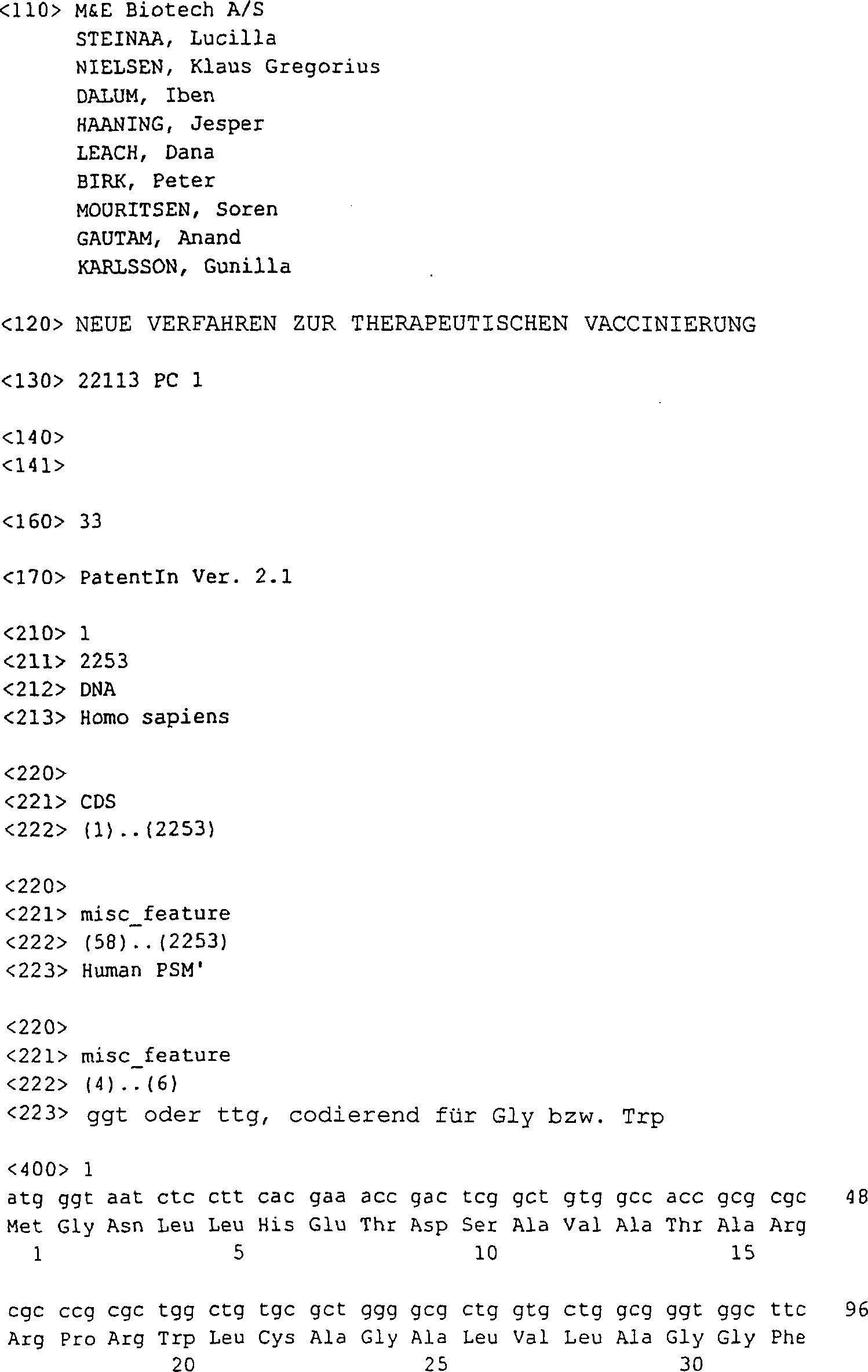
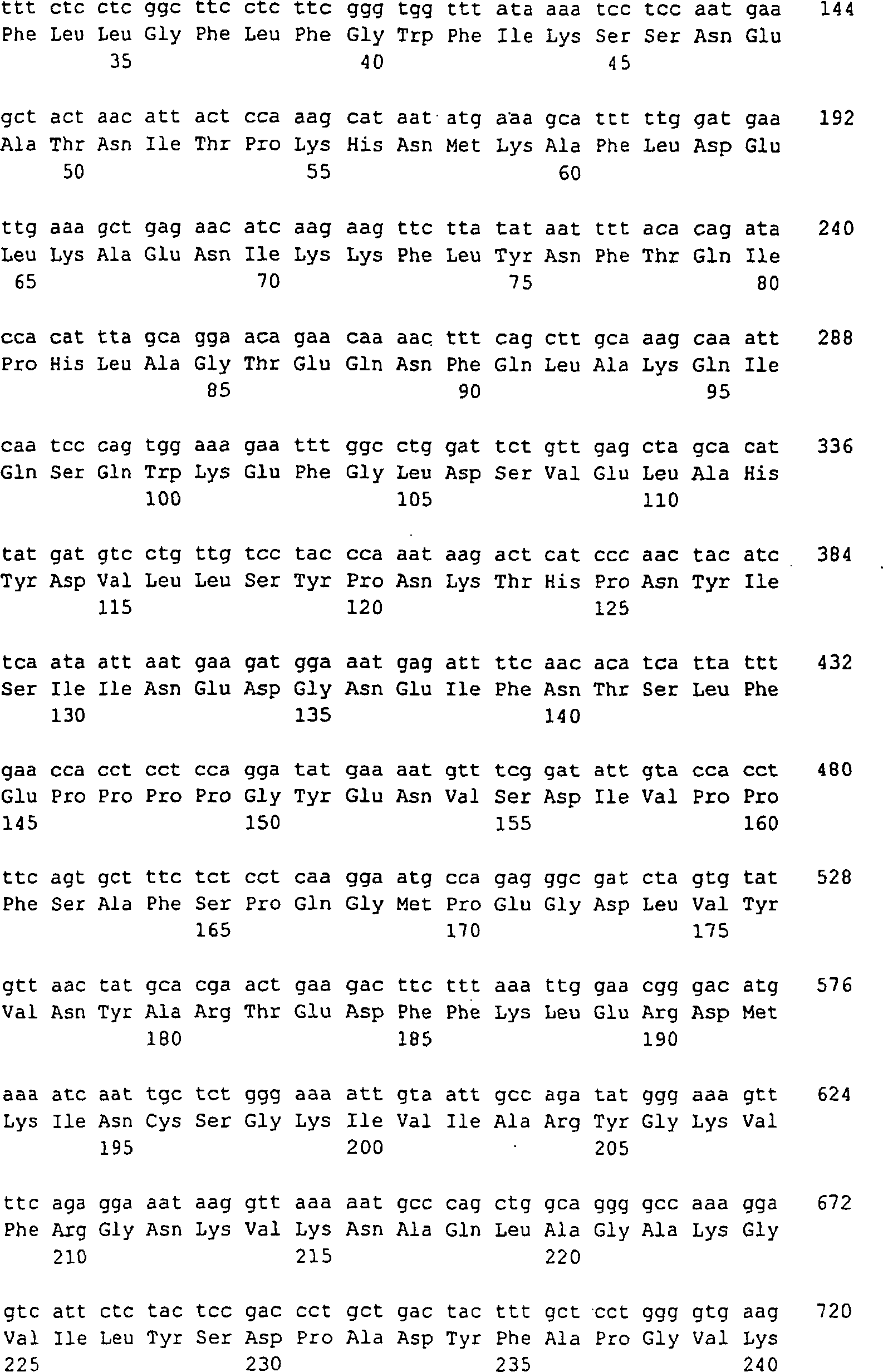


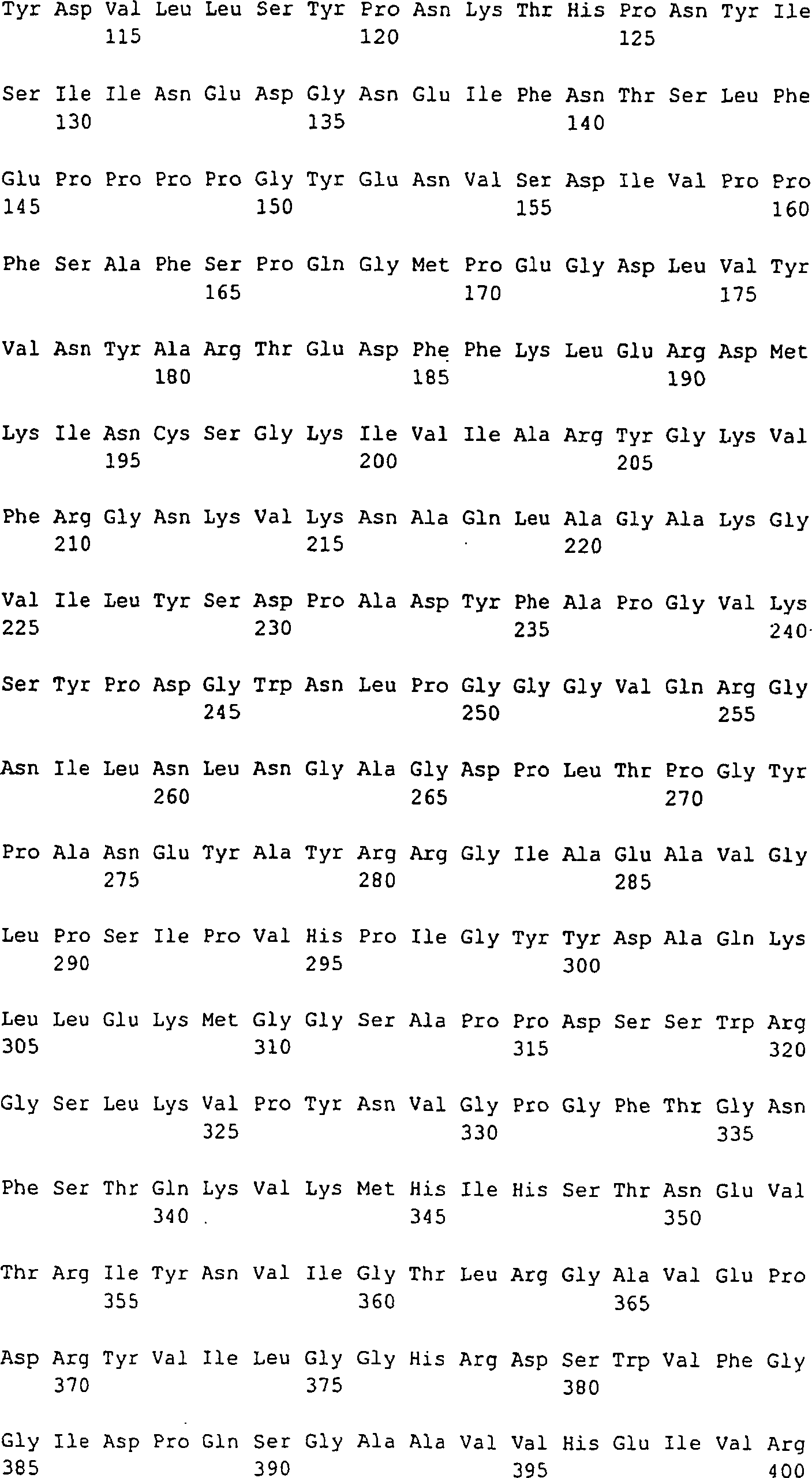

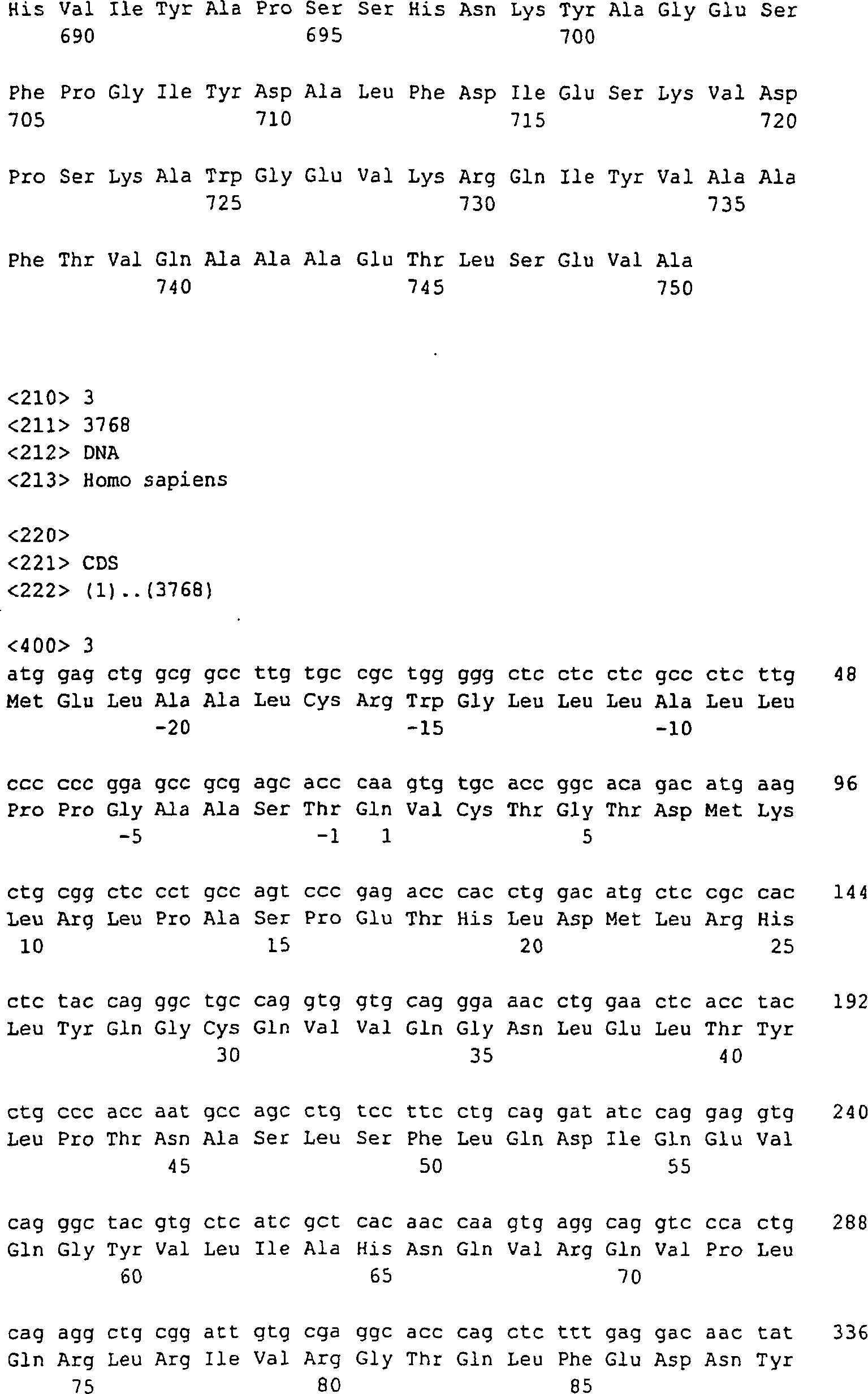
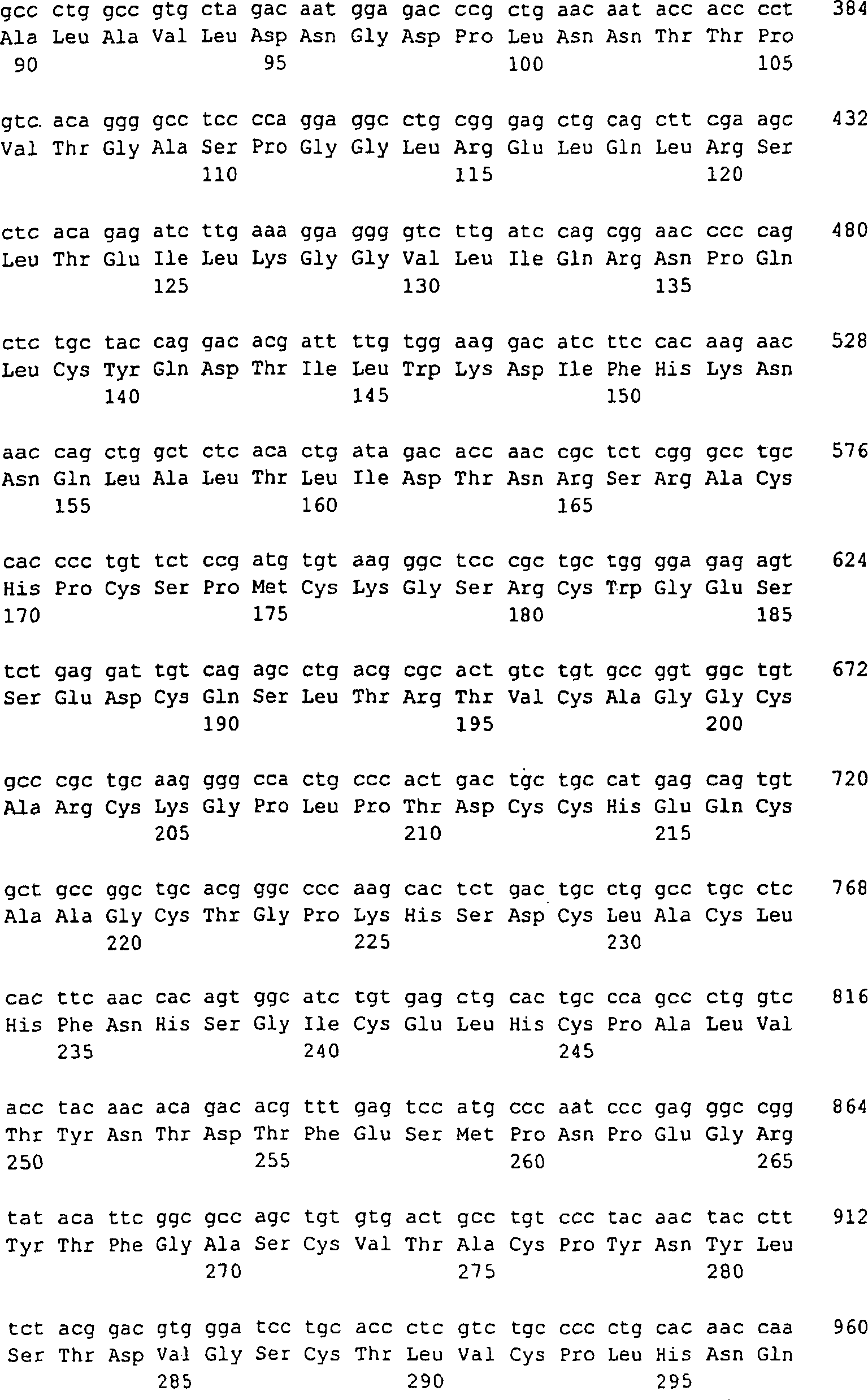

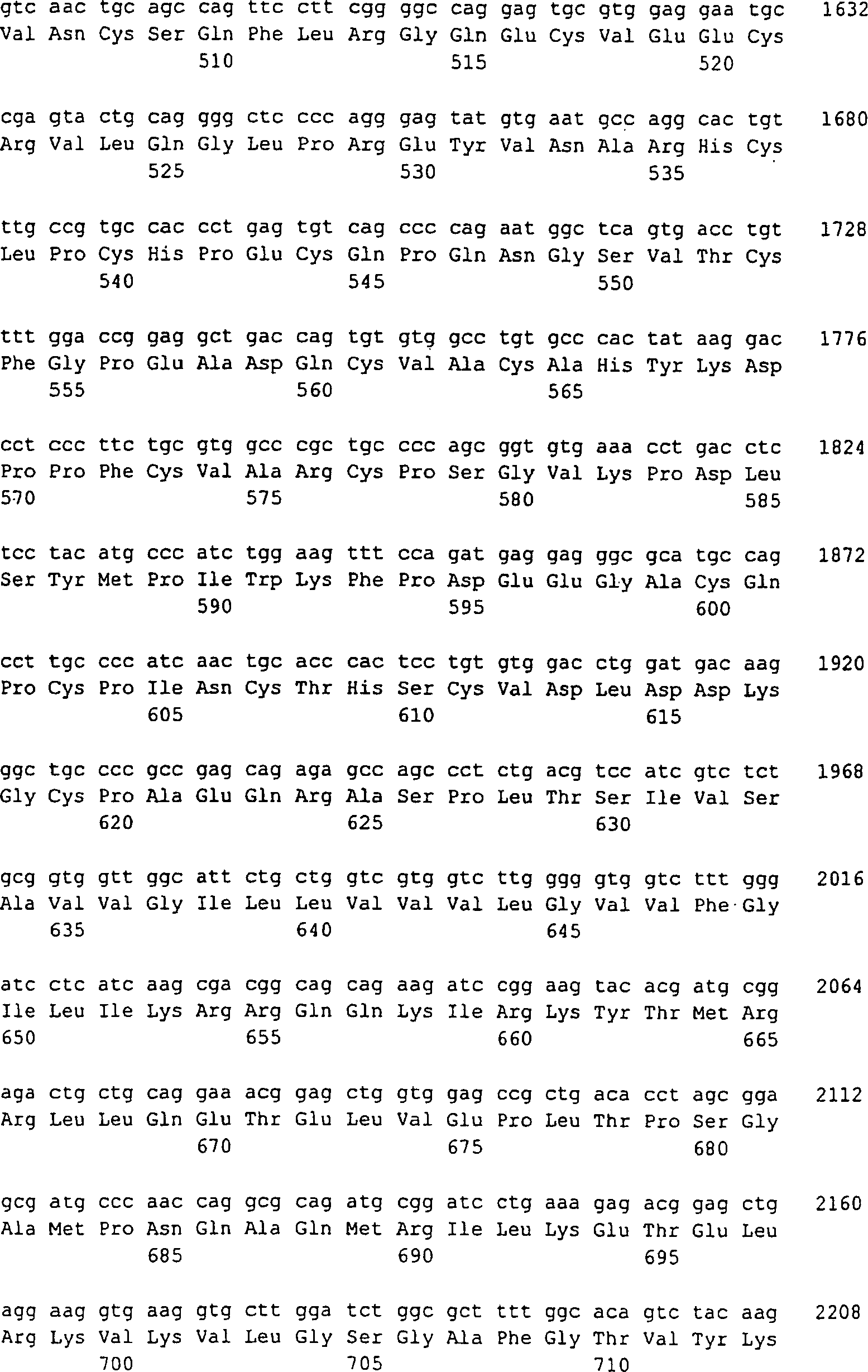
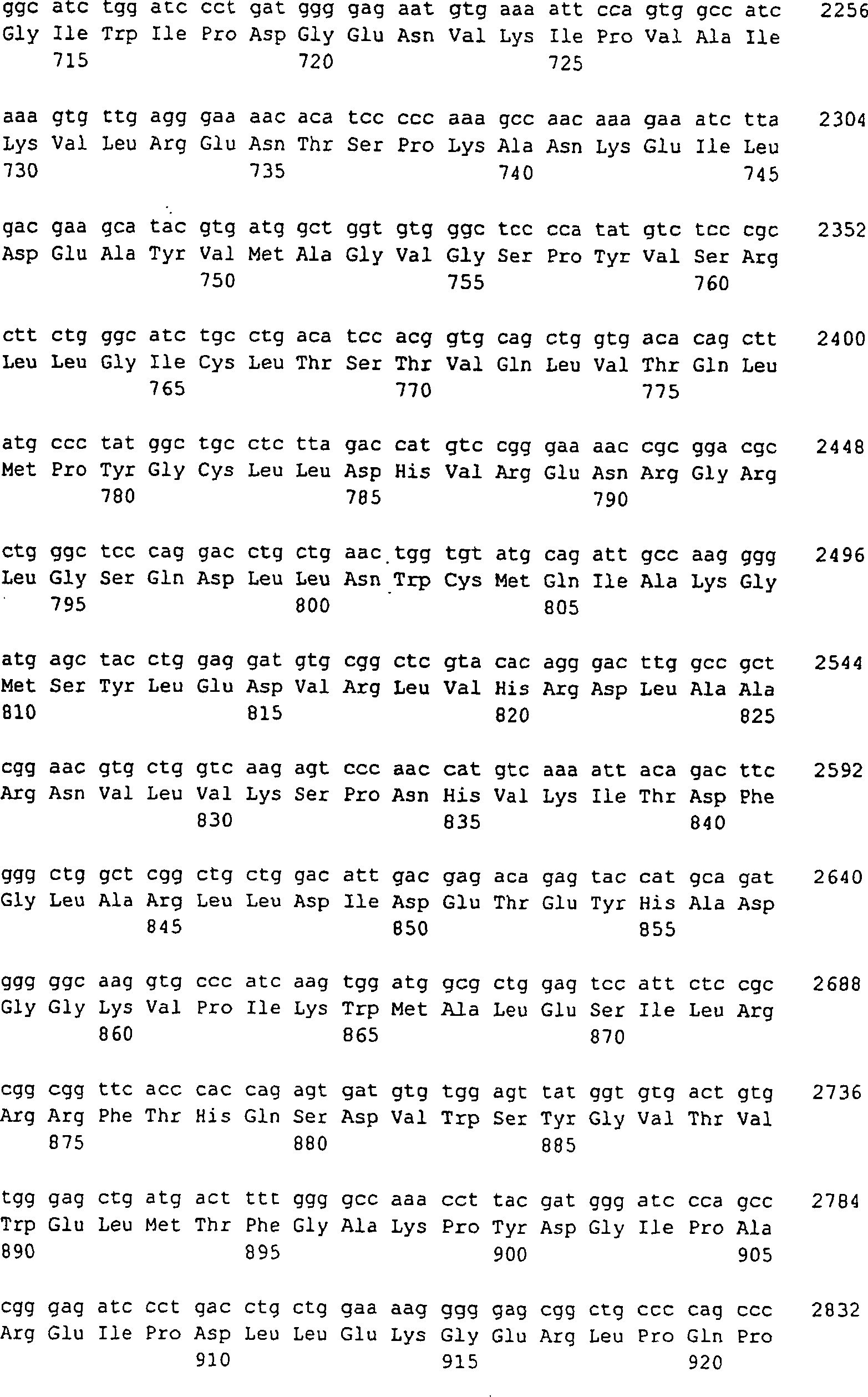
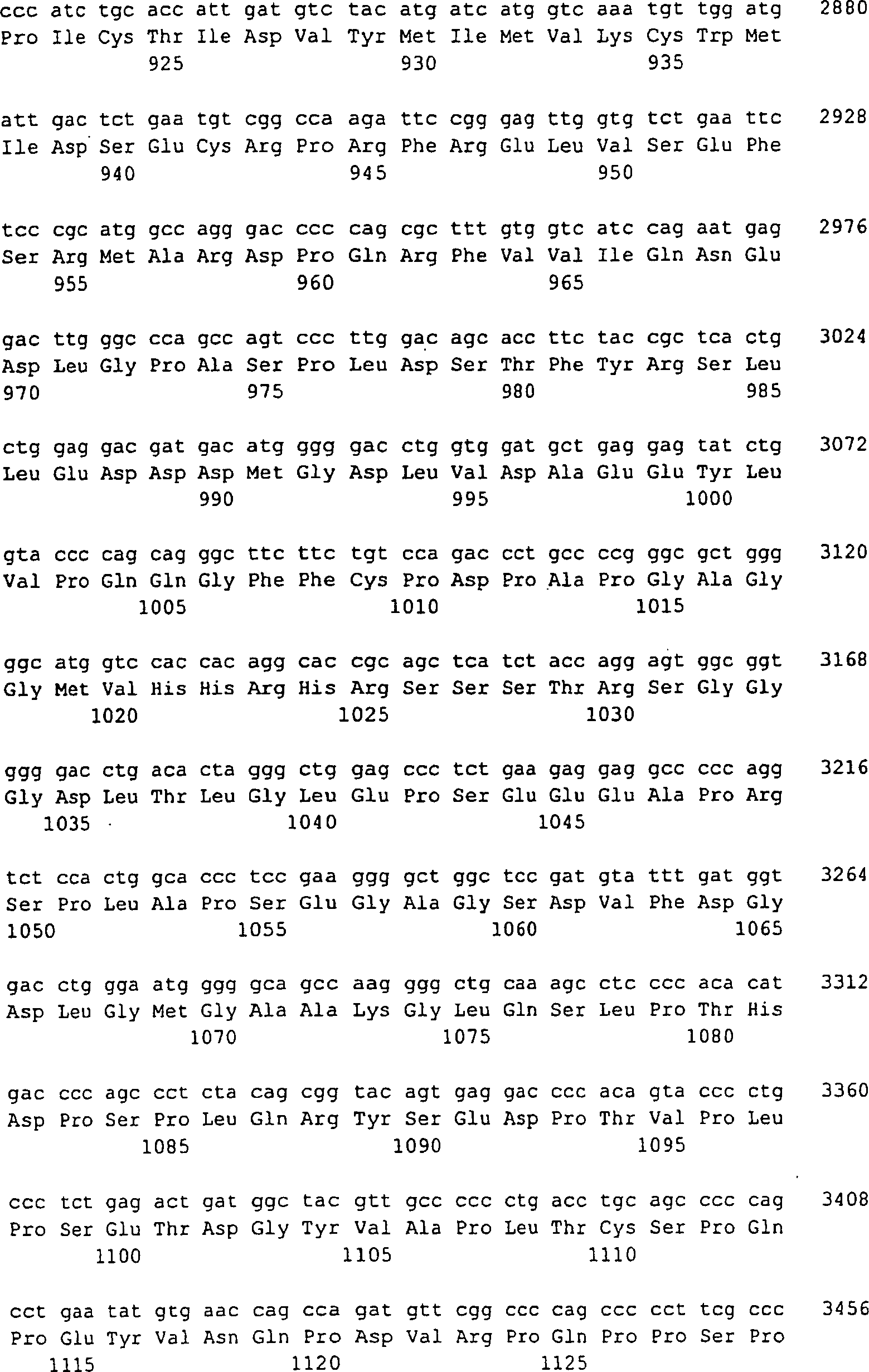


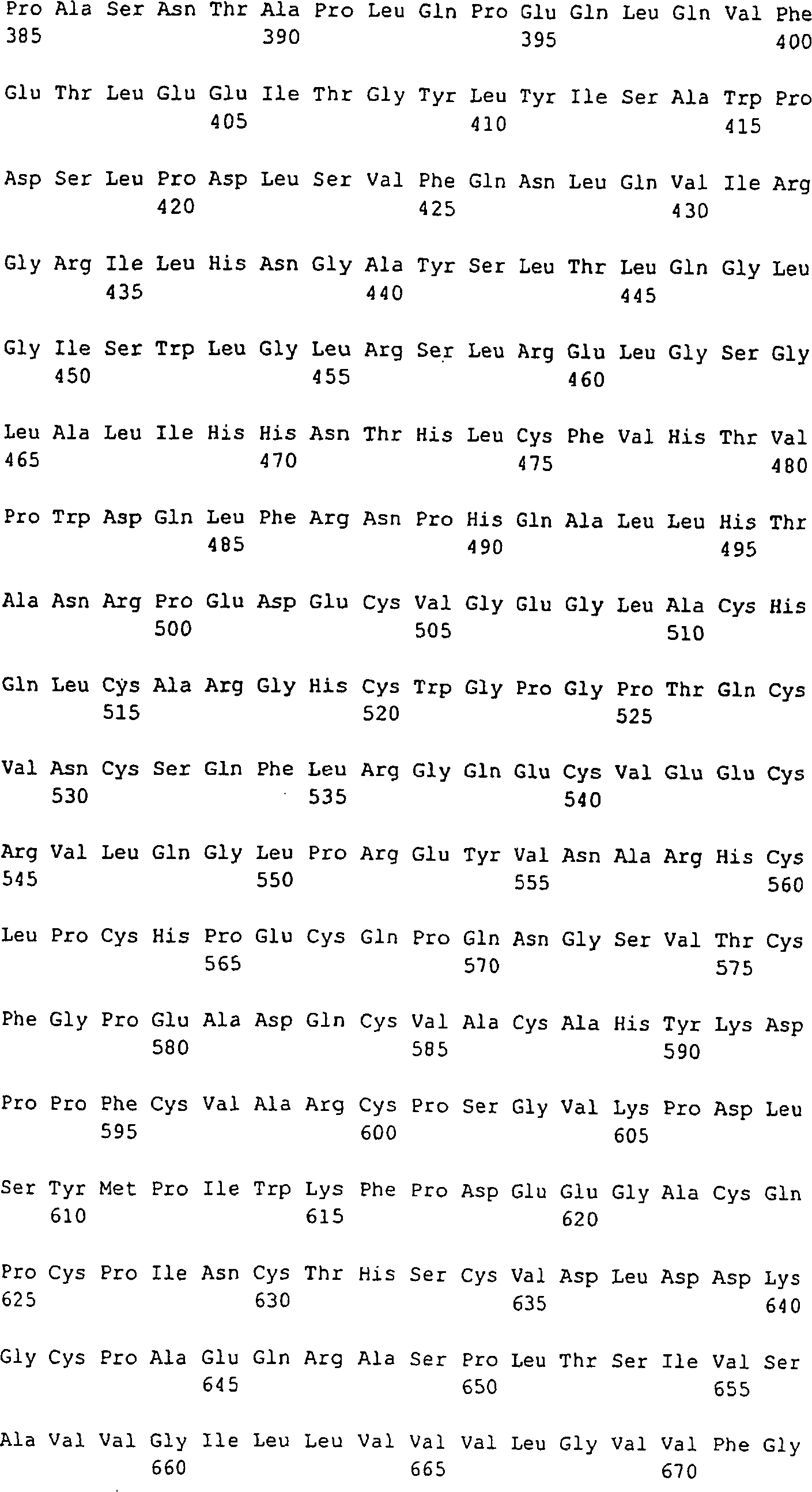
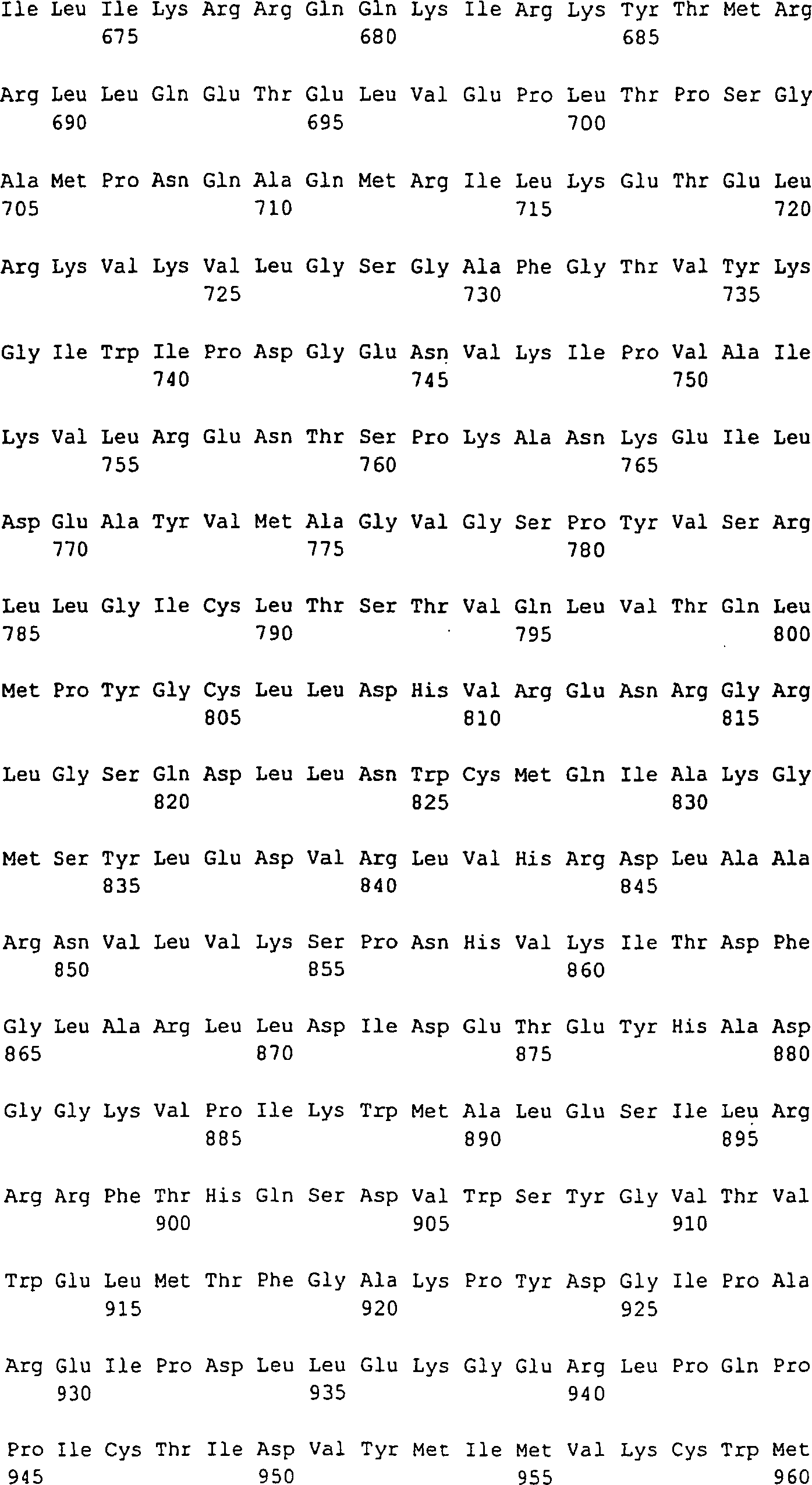
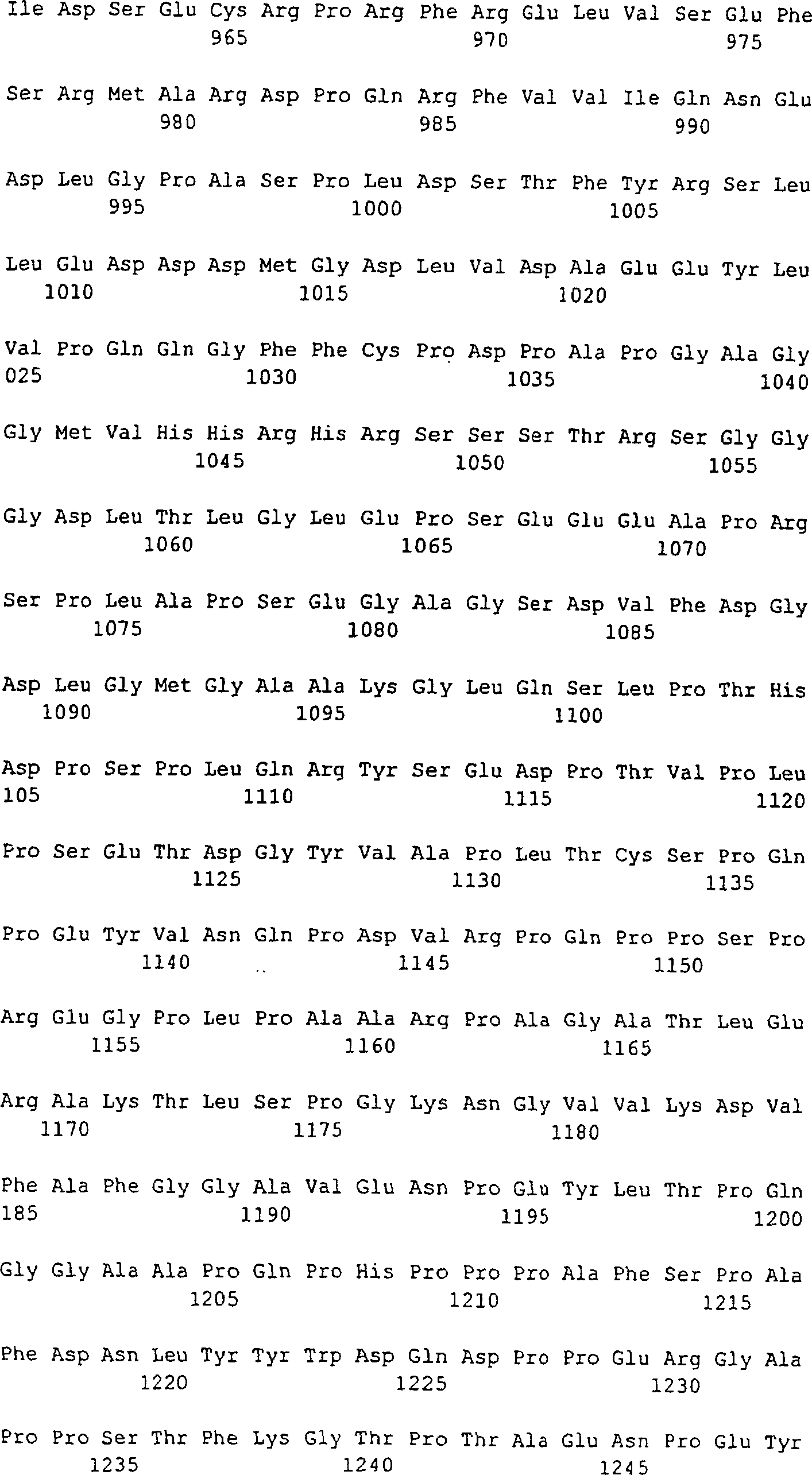
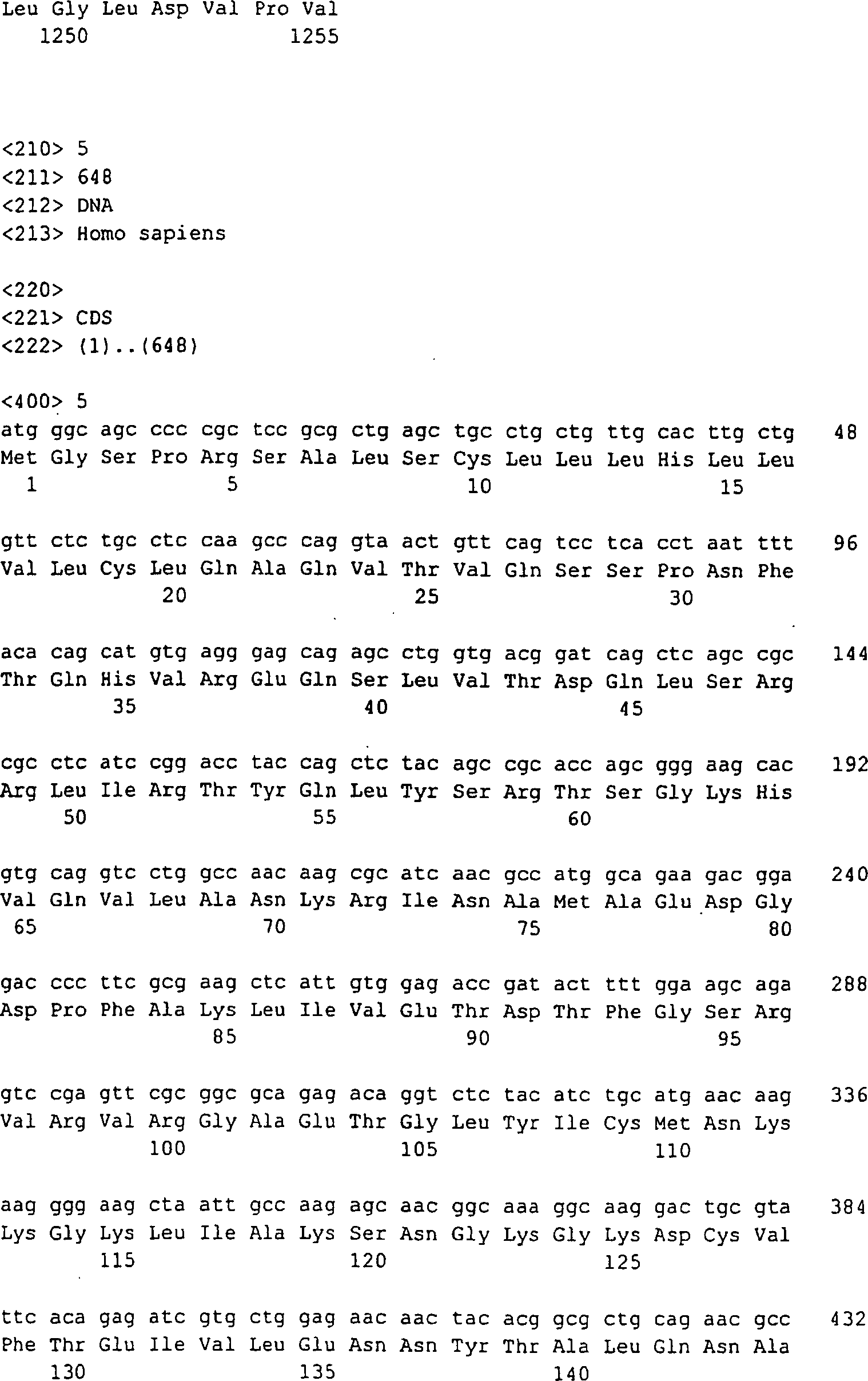

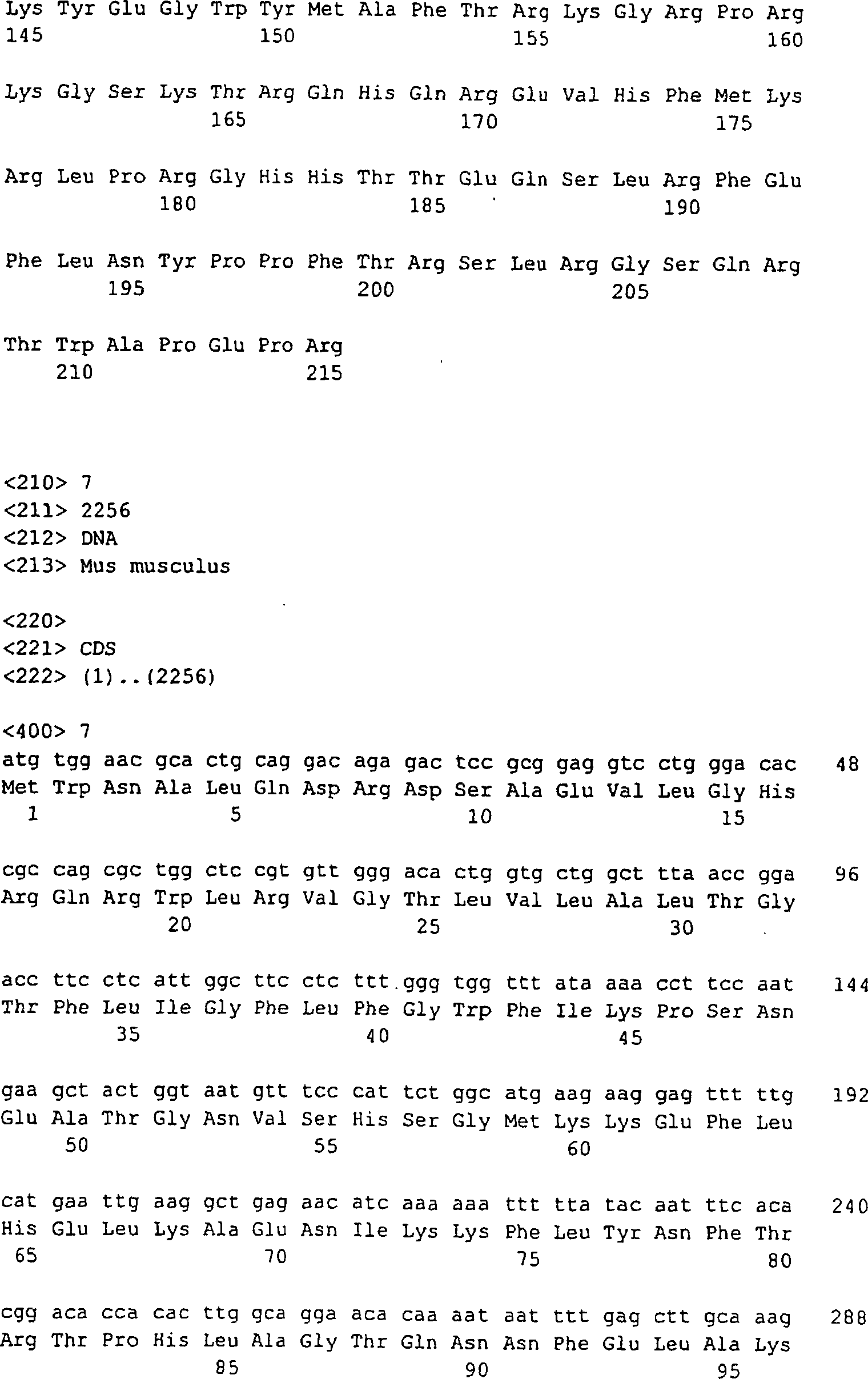
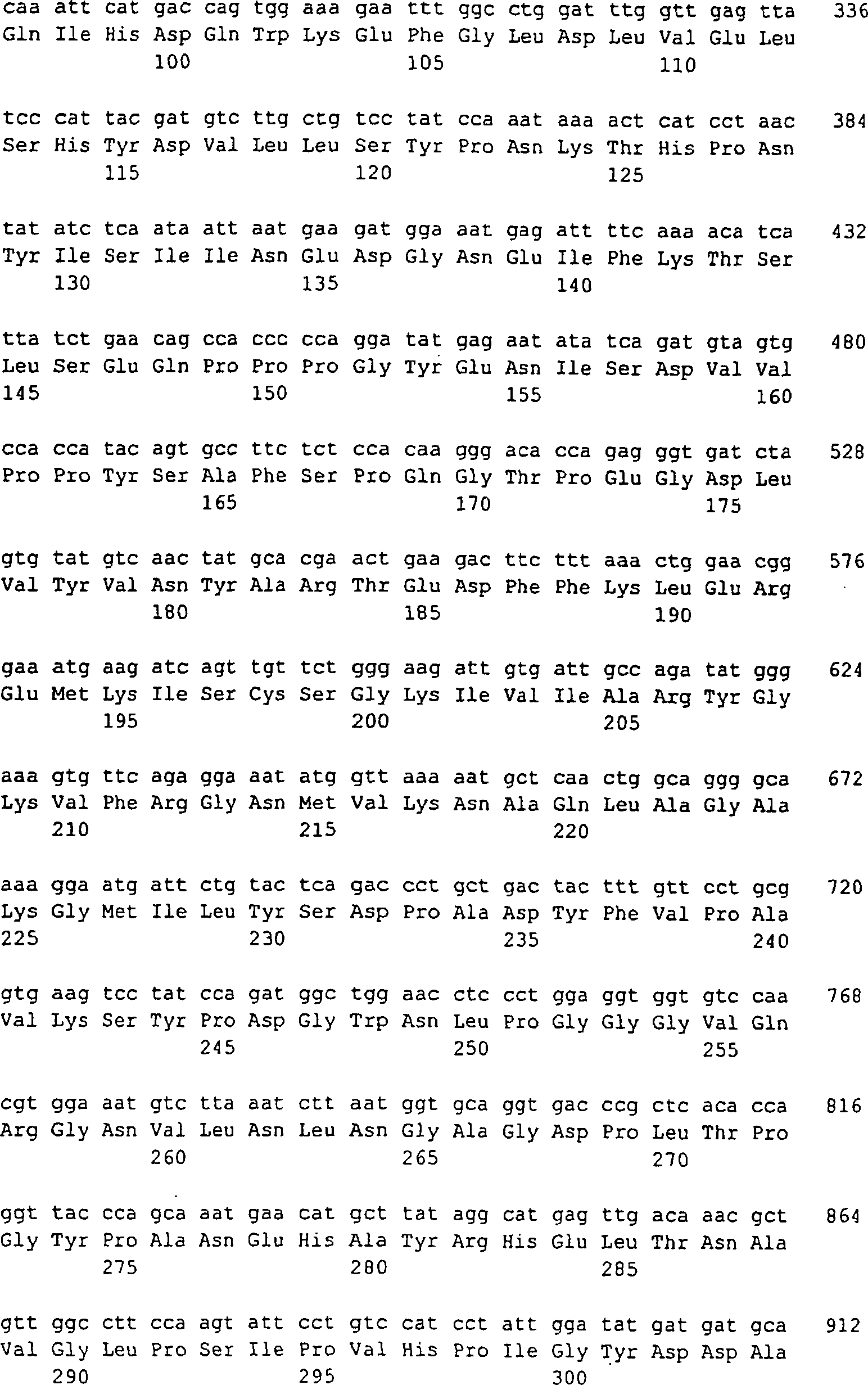


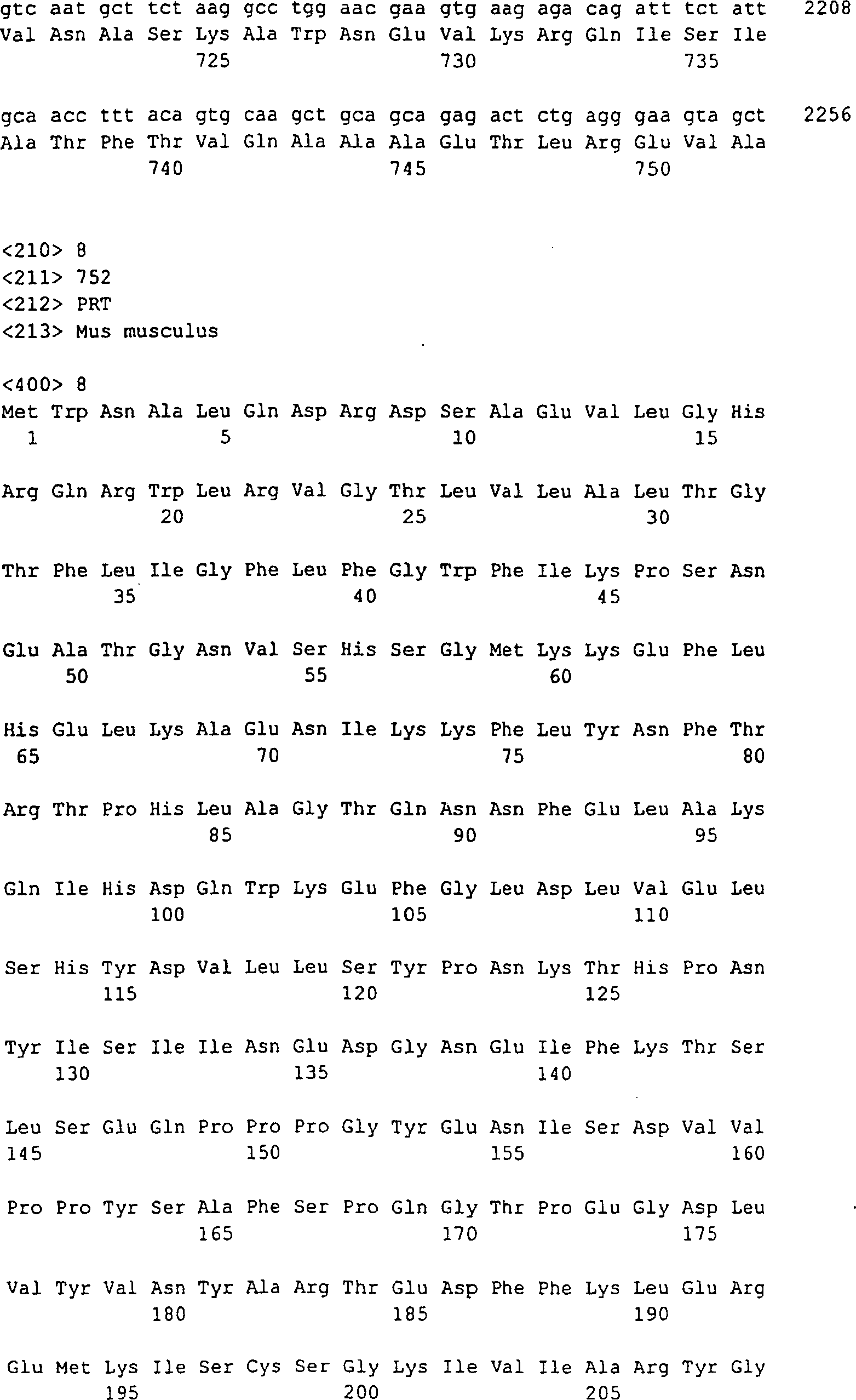
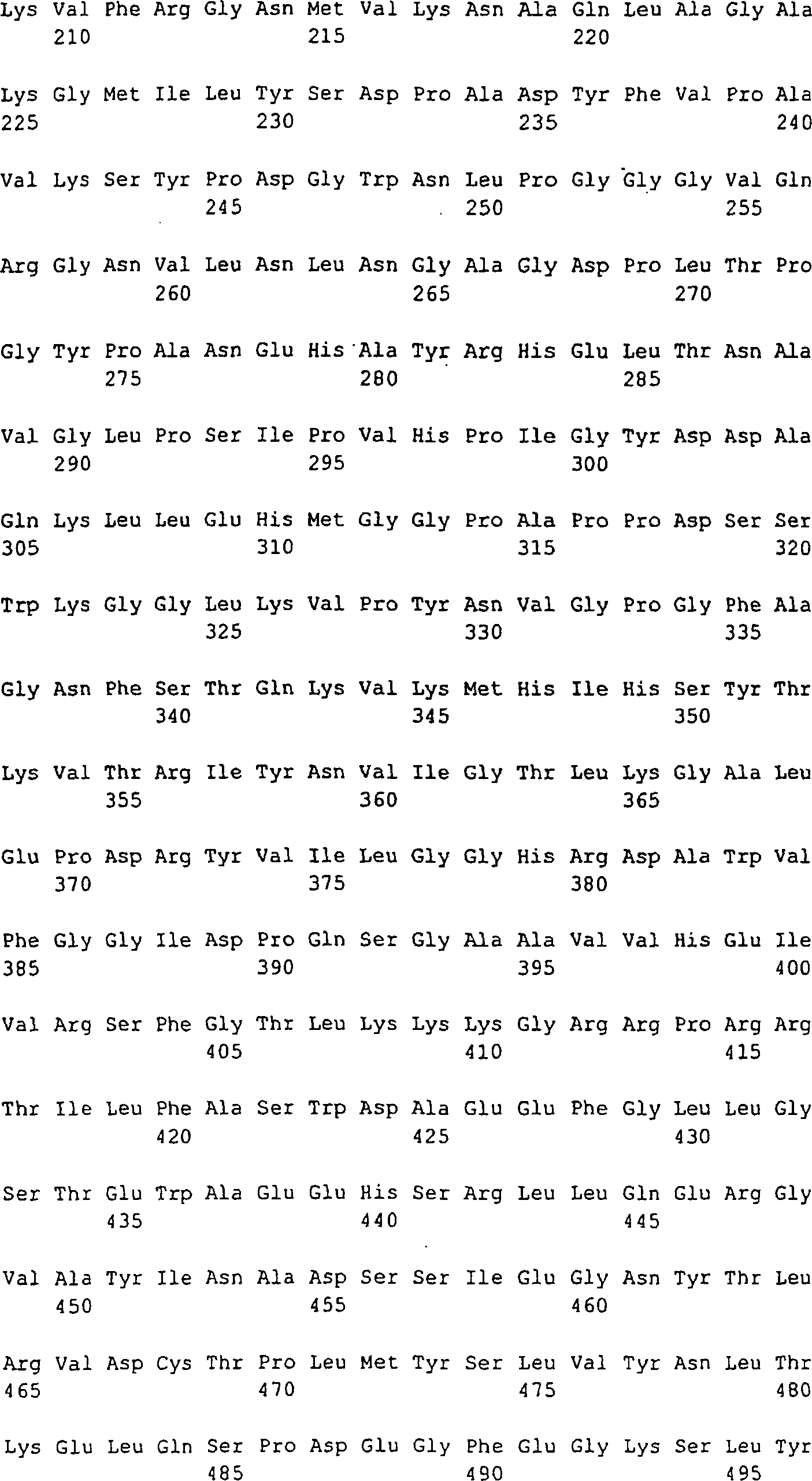
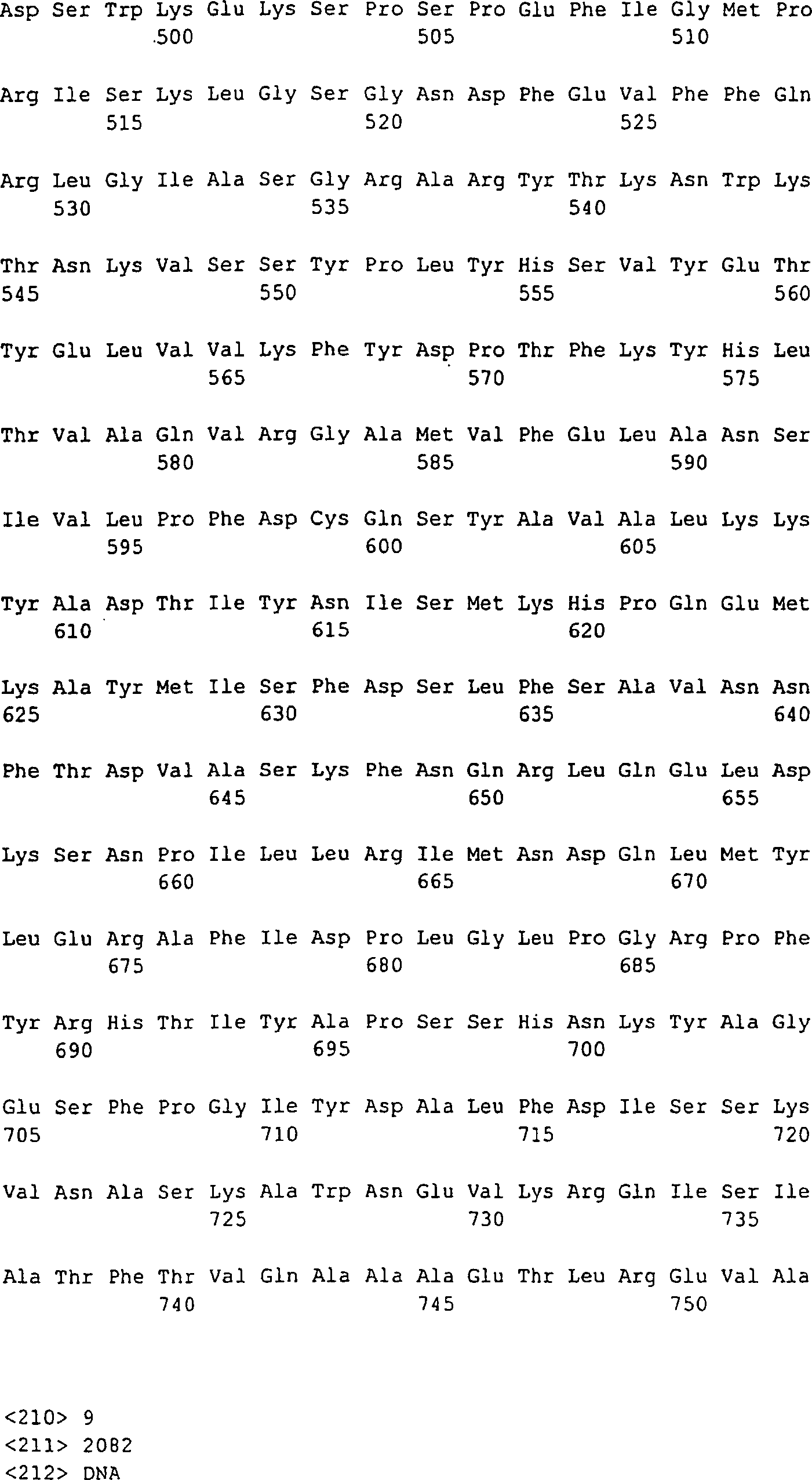


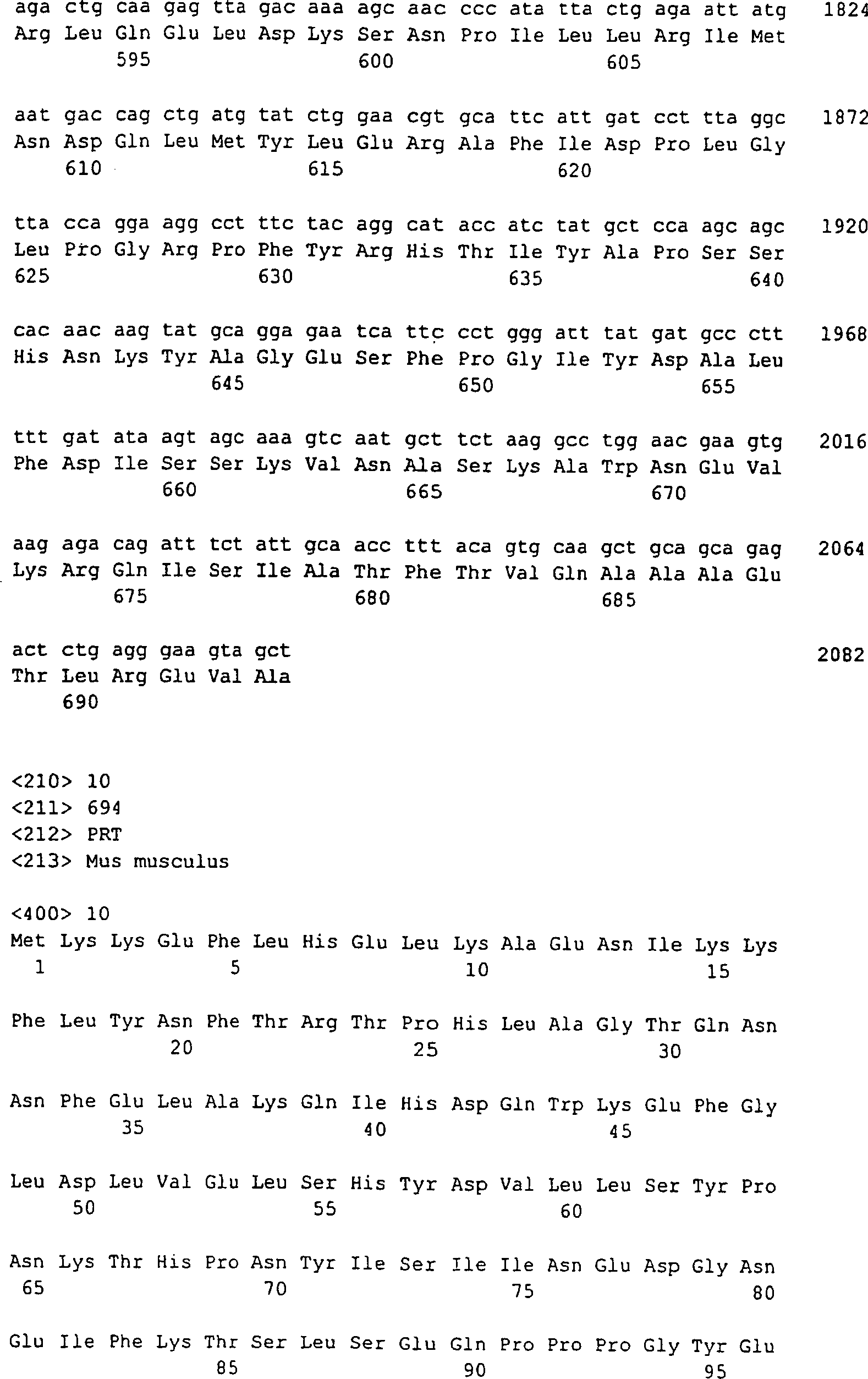
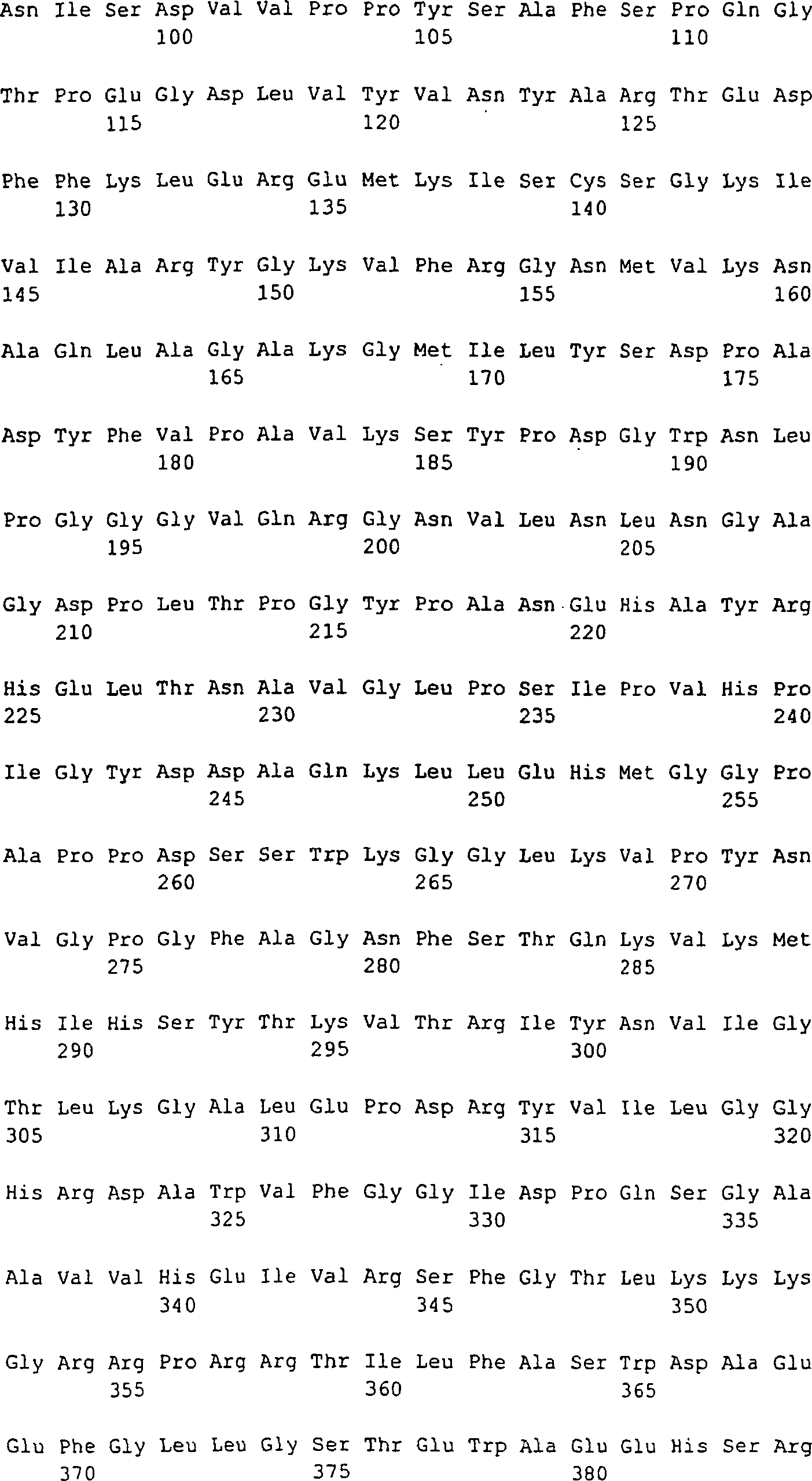
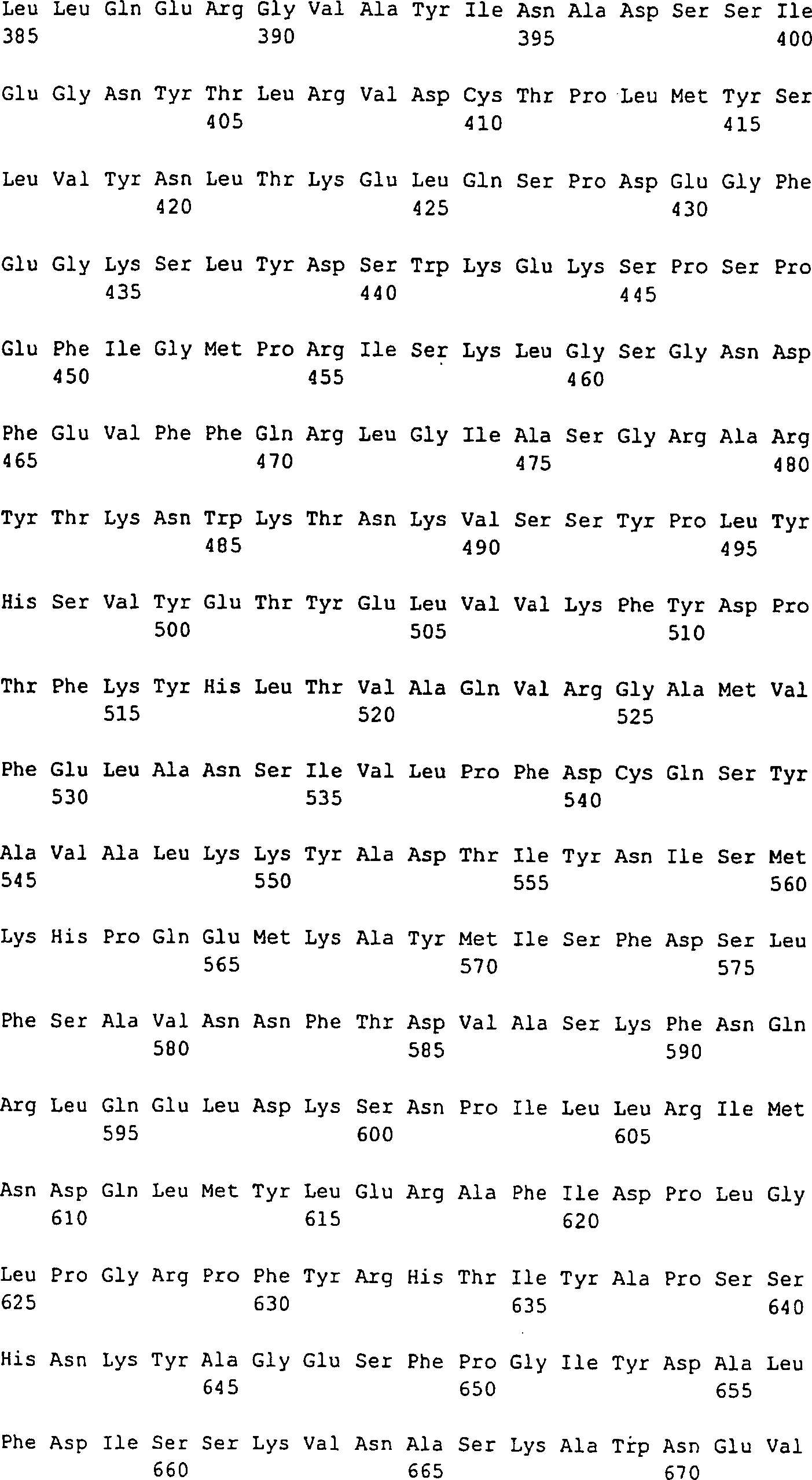
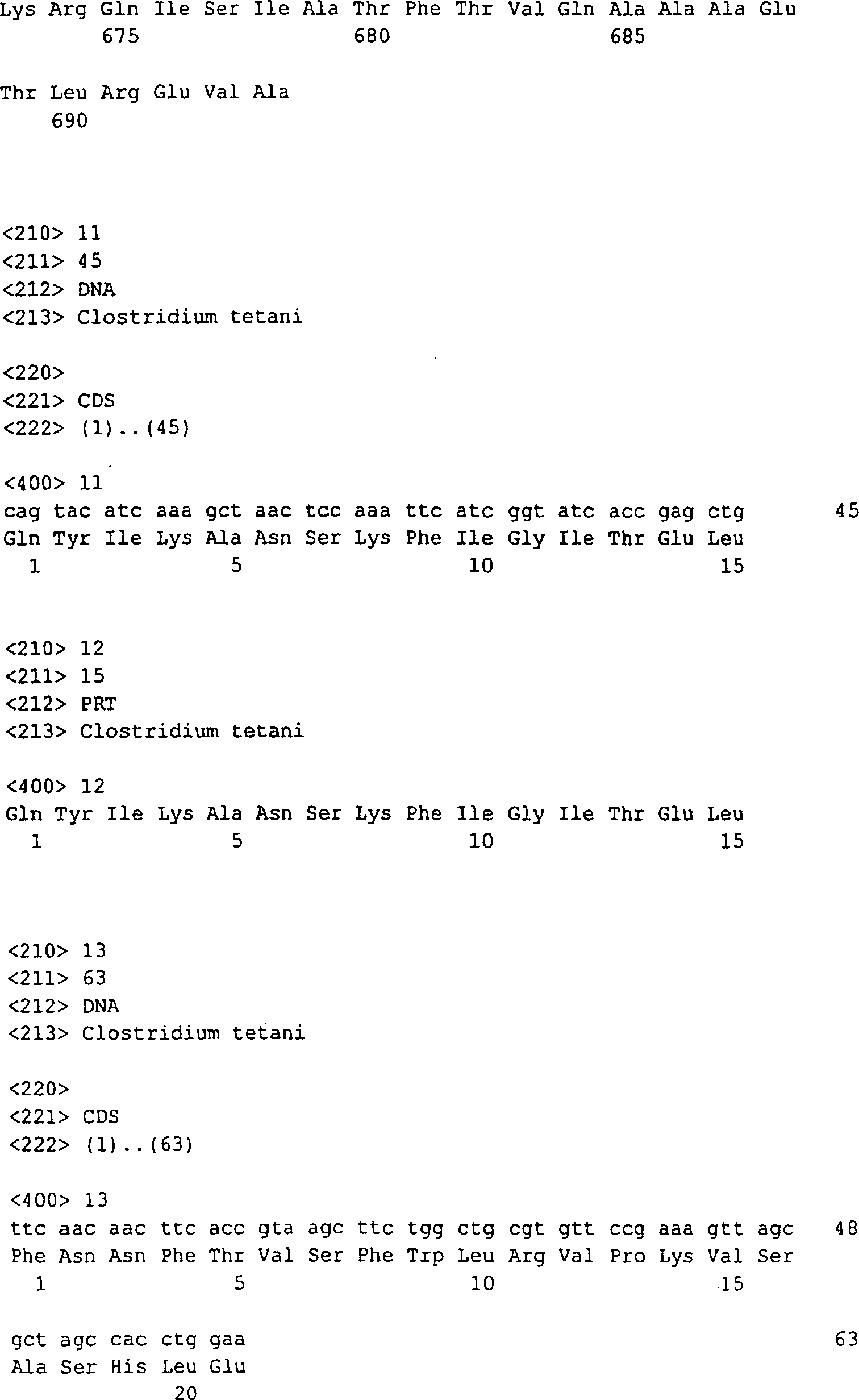
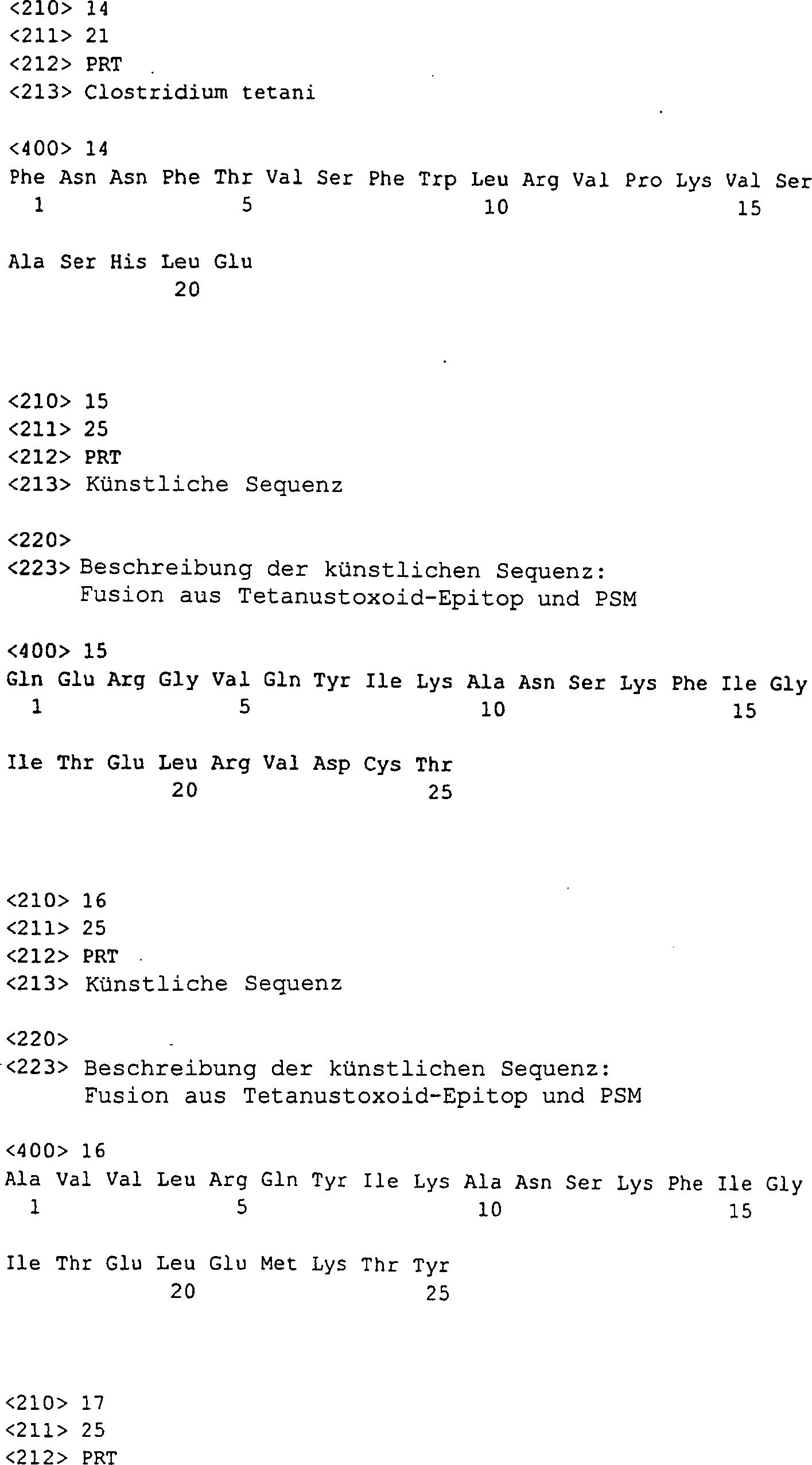
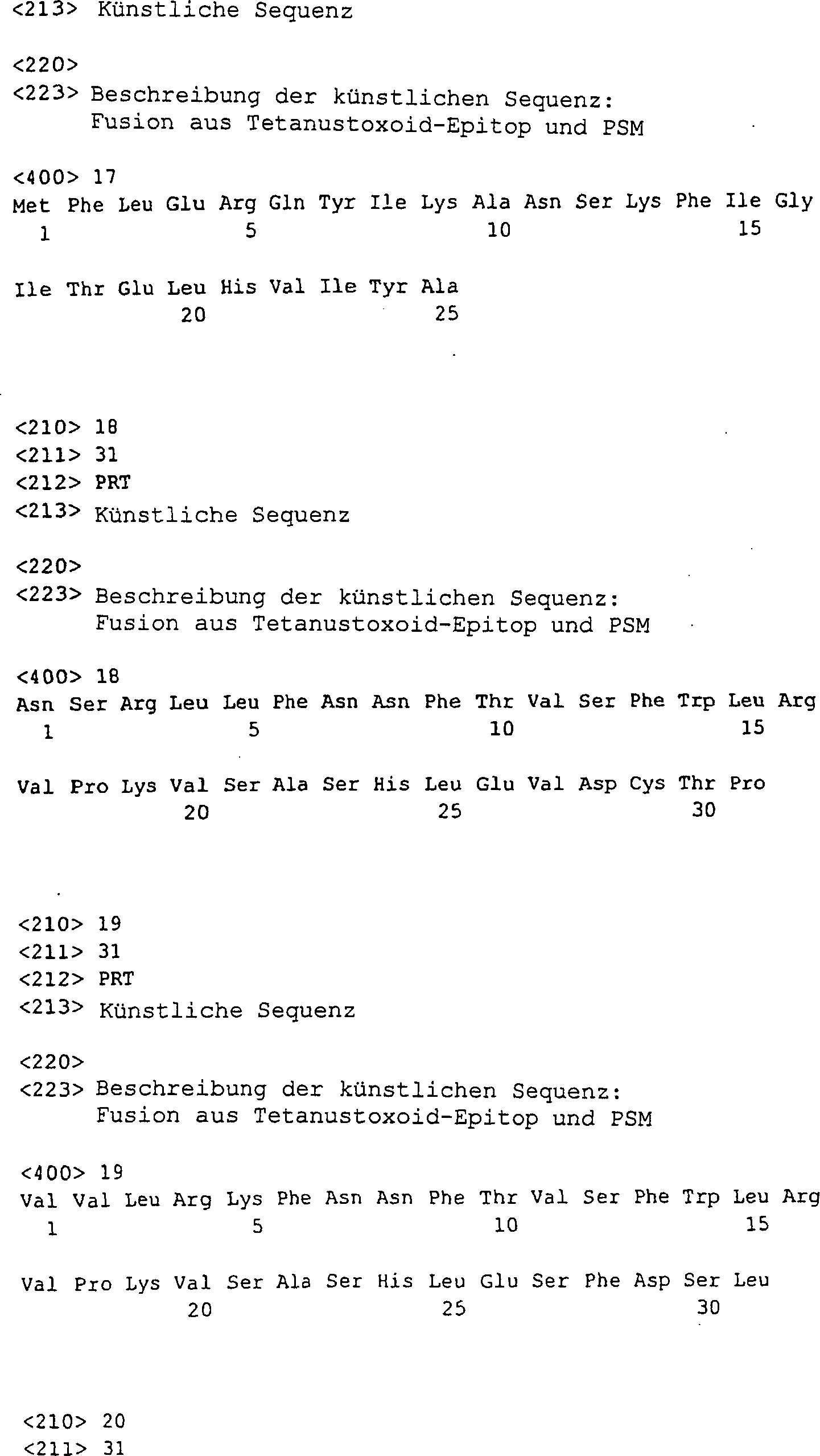
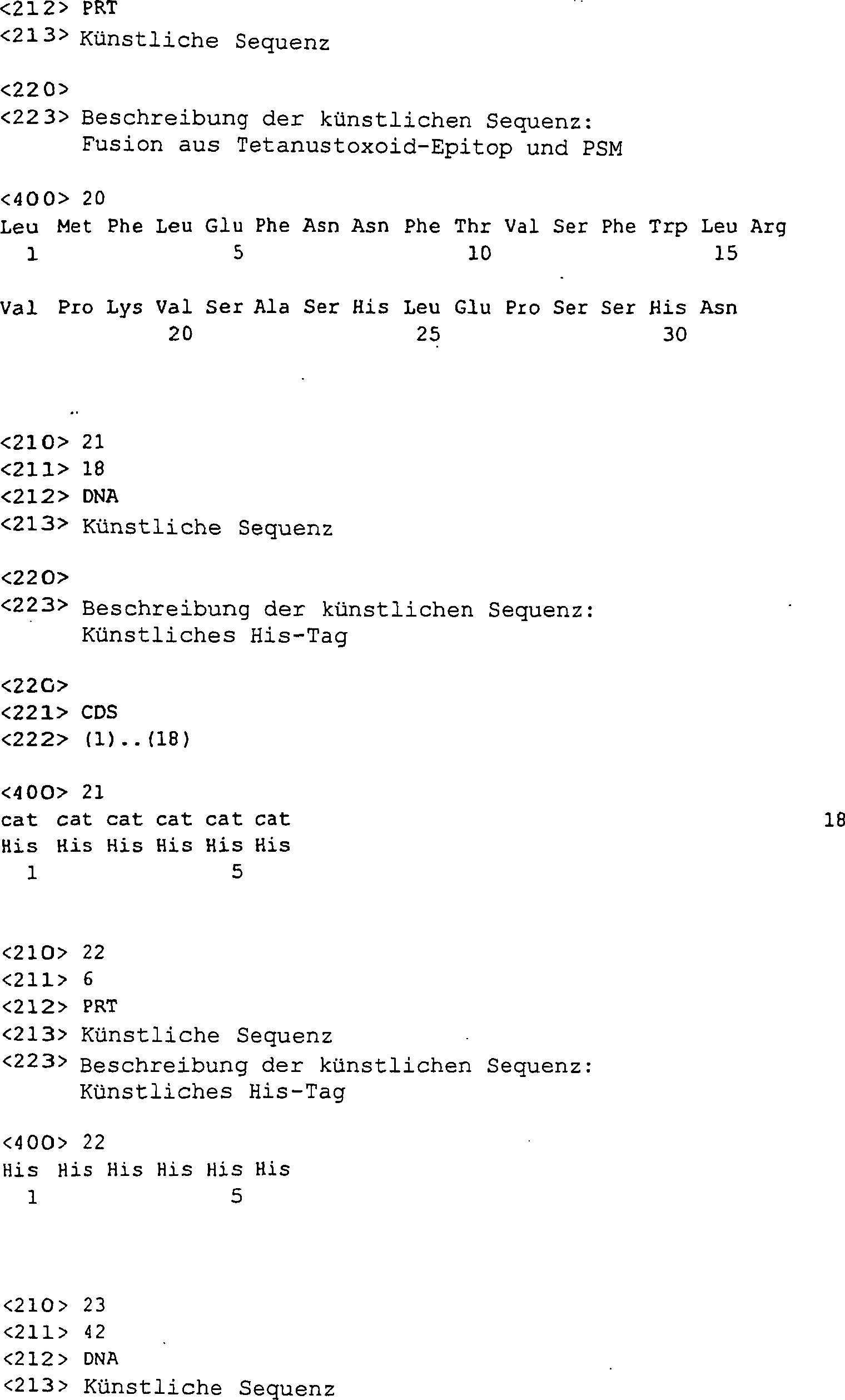
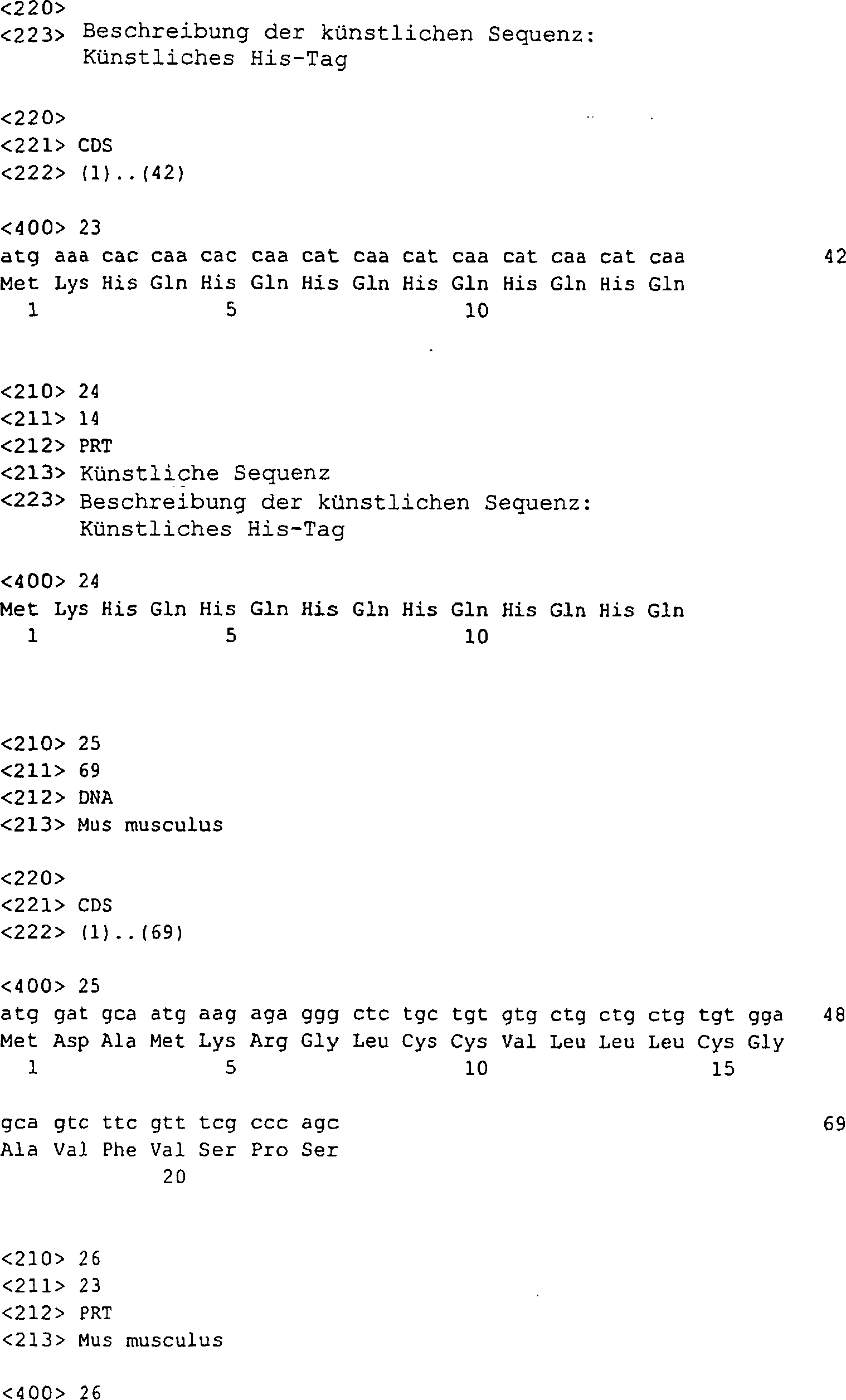
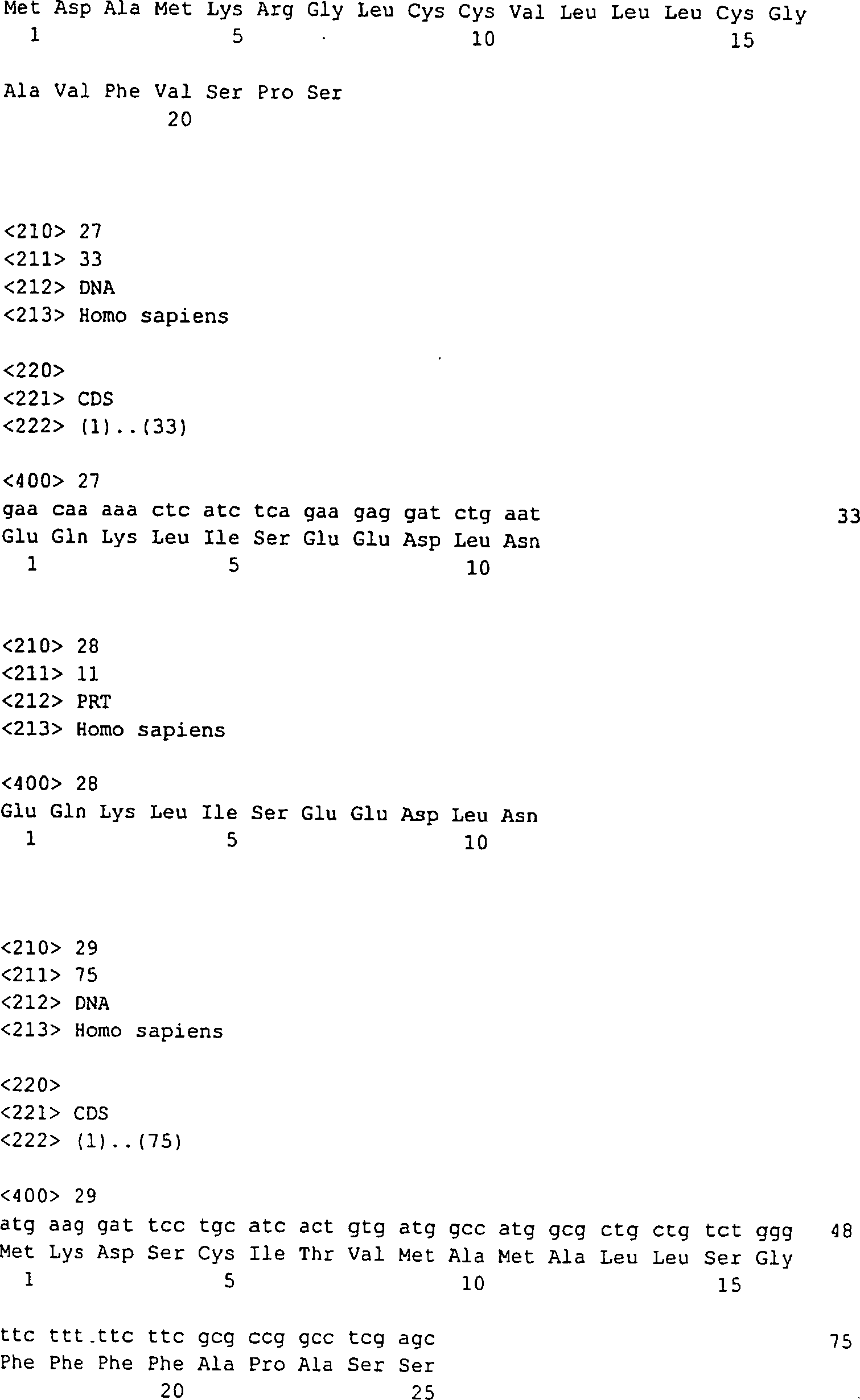
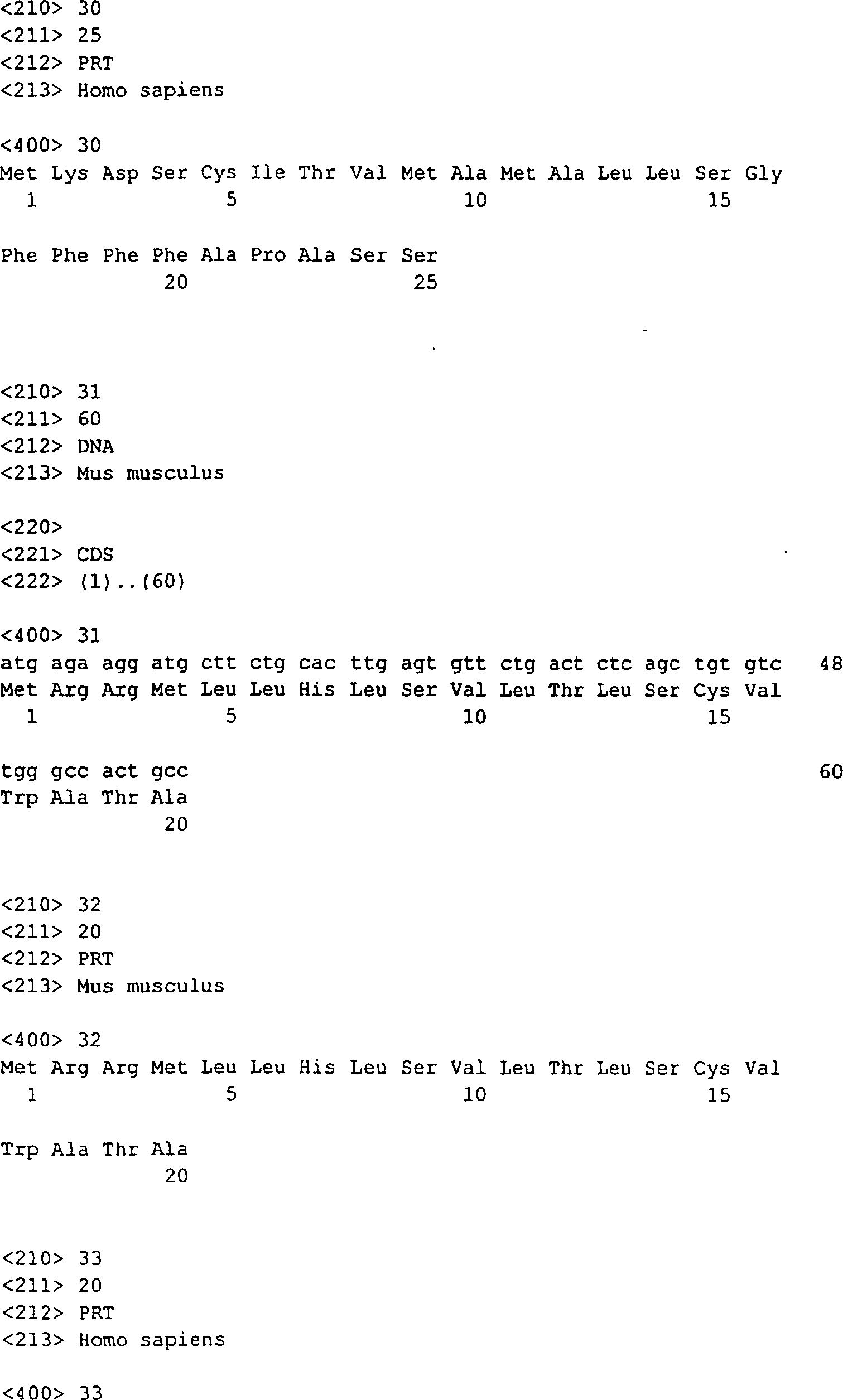

Claims (88)
Applications Claiming Priority (5)
| Application Number | Priority Date | Filing Date | Title |
|---|---|---|---|
| DK126198 | 1998-10-05 | ||
| DKPA199801261 | 1998-10-05 | ||
| US10501198P | 1998-10-20 | 1998-10-20 | |
| US105011P | 1998-10-20 | ||
| PCT/DK1999/000525 WO2000020027A2 (en) | 1998-10-05 | 1999-10-05 | Methods for therapeutic vaccination |
Publications (2)
| Publication Number | Publication Date |
|---|---|
| DE69918146D1 DE69918146D1 (en) | 2004-07-22 |
| DE69918146T2 true DE69918146T2 (en) | 2005-07-07 |
Family
ID=26065489
Family Applications (1)
| Application Number | Title | Priority Date | Filing Date |
|---|---|---|---|
| DE69918146T Expired - Lifetime DE69918146T2 (en) | 1998-10-05 | 1999-10-05 | METHOD FOR THERAPEUTIC VACCINATION |
Country Status (25)
| Country | Link |
|---|---|
| US (3) | US7005498B1 (en) |
| EP (1) | EP1117421B2 (en) |
| JP (1) | JP2002526419A (en) |
| KR (1) | KR100731820B1 (en) |
| CN (1) | CN1325115C (en) |
| AT (1) | ATE269100T1 (en) |
| AU (1) | AU751709B2 (en) |
| CA (1) | CA2345817C (en) |
| CZ (1) | CZ20011049A3 (en) |
| DE (1) | DE69918146T2 (en) |
| EA (1) | EA003634B1 (en) |
| EE (1) | EE200100203A (en) |
| ES (1) | ES2222728T3 (en) |
| HK (1) | HK1039749B (en) |
| HR (1) | HRP20010319A2 (en) |
| HU (1) | HUP0103976A3 (en) |
| IL (1) | IL141868A0 (en) |
| MX (1) | MXPA01003503A (en) |
| NO (1) | NO20011586L (en) |
| NZ (1) | NZ511055A (en) |
| PL (1) | PL202399B1 (en) |
| PT (1) | PT1117421E (en) |
| SK (1) | SK4272001A3 (en) |
| TR (1) | TR200100936T2 (en) |
| WO (1) | WO2000020027A2 (en) |
Families Citing this family (161)
| Publication number | Priority date | Publication date | Assignee | Title |
|---|---|---|---|---|
| EP0866805A1 (en) | 1995-12-12 | 1998-09-30 | Karolinska Innovations AB | PEPTIDE BINDING THE KLVFF-SEQUENCE OF AMYLOID $g(b) |
| US7964192B1 (en) | 1997-12-02 | 2011-06-21 | Janssen Alzheimer Immunotherapy | Prevention and treatment of amyloidgenic disease |
| US7790856B2 (en) | 1998-04-07 | 2010-09-07 | Janssen Alzheimer Immunotherapy | Humanized antibodies that recognize beta amyloid peptide |
| US6913745B1 (en) | 1997-12-02 | 2005-07-05 | Neuralab Limited | Passive immunization of Alzheimer's disease |
| US6905686B1 (en) | 1997-12-02 | 2005-06-14 | Neuralab Limited | Active immunization for treatment of alzheimer's disease |
| TWI239847B (en) | 1997-12-02 | 2005-09-21 | Elan Pharm Inc | N-terminal fragment of Abeta peptide and an adjuvant for preventing and treating amyloidogenic disease |
| US20080050367A1 (en) | 1998-04-07 | 2008-02-28 | Guriq Basi | Humanized antibodies that recognize beta amyloid peptide |
| US7588766B1 (en) | 2000-05-26 | 2009-09-15 | Elan Pharma International Limited | Treatment of amyloidogenic disease |
| US7179892B2 (en) | 2000-12-06 | 2007-02-20 | Neuralab Limited | Humanized antibodies that recognize beta amyloid peptide |
| US6761888B1 (en) | 2000-05-26 | 2004-07-13 | Neuralab Limited | Passive immunization treatment of Alzheimer's disease |
| CA2345817C (en) * | 1998-10-05 | 2013-02-12 | M&E Biotech A/S | Novel methods for therapeutic vaccination |
| US6913749B2 (en) | 1998-11-02 | 2005-07-05 | Resistentia Pharmaceuticals Ab | Immunogenic polypeptides for inducing anti-self IgE responses |
| US7198920B1 (en) * | 1999-01-29 | 2007-04-03 | Corika Corporation | HER-2/neu fusion proteins |
| AU777952B2 (en) * | 1999-04-23 | 2004-11-04 | Pharmexa A/S | Method for down-regulating IL5 activity |
| US7060670B1 (en) | 1999-05-05 | 2006-06-13 | Neurochem (International) Limited | Stereoselective antifibrillogenic peptides and peptidomimetics thereof |
| WO2000067761A1 (en) * | 1999-05-06 | 2000-11-16 | Wake Forest University | Compositions and methods for identifying antigens which elicit an immune response |
| MXPA02007796A (en) * | 2000-02-21 | 2003-12-08 | Pharmexa As | Novel method for down regulation of amyloid. |
| US20030086938A1 (en) * | 2000-02-21 | 2003-05-08 | Jensen Martin Roland | Novel methods for down-regulation of amyloid |
| US7229623B1 (en) | 2000-08-03 | 2007-06-12 | Corixa Corporation | Her-2/neu fusion proteins |
| DE10042598A1 (en) * | 2000-08-30 | 2002-03-28 | Gsf Forschungszentrum Umwelt | Recombinant MVA with the ability to express the HER-2 / Neu gene |
| US8435939B2 (en) | 2000-09-05 | 2013-05-07 | Biokine Therapeutics Ltd. | Polypeptide anti-HIV agent containing the same |
| AU2001285721A1 (en) * | 2000-09-06 | 2002-03-22 | Pharmexa A/S | Method for down-regulating IgE |
| AU2002210407A1 (en) * | 2000-10-27 | 2002-05-06 | Pharmexa A/S | Therapeutic vaccine formulations containing chitosan |
| US7700751B2 (en) | 2000-12-06 | 2010-04-20 | Janssen Alzheimer Immunotherapy | Humanized antibodies that recognize β-amyloid peptide |
| TWI255272B (en) | 2000-12-06 | 2006-05-21 | Guriq Basi | Humanized antibodies that recognize beta amyloid peptide |
| WO2002066056A2 (en) * | 2001-02-19 | 2002-08-29 | Pharmexa A/S | Synthetic vaccines comprising polyhydroxypolymer carriers |
| US7097837B2 (en) | 2001-02-19 | 2006-08-29 | Pharmexa A/S | Synthetic vaccine agents |
| AU2002326751A1 (en) | 2001-08-13 | 2003-03-03 | Ige Therapeutics, Inc. | Immunoglobulin e vaccines and methods of use thereof |
| MY144532A (en) * | 2001-08-20 | 2011-09-30 | Lundbeck & Co As H | Novel method for down-regulation of amyloid |
| AU2003203140A1 (en) * | 2002-01-17 | 2003-07-30 | Pharmexa A/S | Immunogenic carcinoembryonic antigen (cea) |
| EP1587944A4 (en) | 2002-03-01 | 2007-03-21 | Dyax Corp | Kdr and vegf/kdr binding peptides and their use in diagnosis and therapy |
| US8623822B2 (en) | 2002-03-01 | 2014-01-07 | Bracco Suisse Sa | KDR and VEGF/KDR binding peptides and their use in diagnosis and therapy |
| US7261876B2 (en) | 2002-03-01 | 2007-08-28 | Bracco International Bv | Multivalent constructs for therapeutic and diagnostic applications |
| US7794693B2 (en) | 2002-03-01 | 2010-09-14 | Bracco International B.V. | Targeting vector-phospholipid conjugates |
| MY139983A (en) | 2002-03-12 | 2009-11-30 | Janssen Alzheimer Immunotherap | Humanized antibodies that recognize beta amyloid peptide |
| JP2005528373A (en) * | 2002-03-26 | 2005-09-22 | イミュネックス・コーポレーション | Method using Flt3 ligand in immunization protocol |
| US20090110702A1 (en) | 2002-07-12 | 2009-04-30 | The Johns Hopkins University | Mesothelin Vaccines and Model Systems and Control of Tumors |
| AU2003259109A1 (en) * | 2002-07-12 | 2004-02-02 | The Johns Hopkins University | Mesothelin vaccines and model systems |
| US9200036B2 (en) | 2002-07-12 | 2015-12-01 | The Johns Hopkins University | Mesothelin vaccines and model systems |
| KR100555211B1 (en) * | 2002-07-16 | 2006-03-03 | 주식회사 팬제노믹스 | Anti-cancer HHR--2 / neu DNA vaccine |
| ES2403932T3 (en) | 2002-08-27 | 2013-05-22 | Biokine Therapeutics Ltd. | CXCR4 antagonist and use of it |
| GB0228796D0 (en) * | 2002-12-11 | 2003-01-15 | Adjuvantix Ltd | Valency |
| SE0301109D0 (en) * | 2003-04-14 | 2003-04-14 | Mallen Huang | Nucleotide vaccine composition |
| CA2524305C (en) * | 2003-05-01 | 2015-12-08 | Imclone Systems Incorporated | Fully human antibodies directed against the human insulin-like growth factor-1 receptor |
| PE20050627A1 (en) | 2003-05-30 | 2005-08-10 | Wyeth Corp | HUMANIZED ANTIBODIES THAT RECOGNIZE THE BETA AMYLOID PEPTIDE |
| EA008827B1 (en) * | 2003-06-25 | 2007-08-31 | Фармекса А/С | Purification of her-2 variants |
| EP2090586A1 (en) | 2003-06-25 | 2009-08-19 | BN ImmunoTherapeutics, Inc. | Purification of her-2 variants |
| EP1670509A4 (en) * | 2003-09-03 | 2007-10-31 | Dendritherapeutics Inc | Multiplex vaccines |
| WO2005033278A2 (en) * | 2003-09-30 | 2005-04-14 | Ludwig Institute For Cancer Research | In vivo efficacy of ny-eso-1 plus iscom |
| US20070184023A1 (en) * | 2003-10-30 | 2007-08-09 | Pharmexa A/S | Method for down-regulation of vegf |
| US20090028874A1 (en) * | 2003-12-24 | 2009-01-29 | Leiden University Medical Center | Synthetic Protein as Tumor-Specific Vaccine |
| US7674456B2 (en) * | 2004-06-14 | 2010-03-09 | Charles Wiseman | Breast cancer cell lines and uses thereof |
| US20070190072A1 (en) * | 2004-09-30 | 2007-08-16 | Csl Limited Ludwig Institute For Cancer Research | In vivo efficacy of ny-eso-1 plus adjuvant |
| US9492400B2 (en) | 2004-11-04 | 2016-11-15 | Massachusetts Institute Of Technology | Coated controlled release polymer particles as efficient oral delivery vehicles for biopharmaceuticals |
| PE20061329A1 (en) | 2004-12-15 | 2006-12-08 | Neuralab Ltd | HUMANIZED AB ANTIBODIES TO IMPROVE COGNITION |
| ES2396555T3 (en) | 2004-12-15 | 2013-02-22 | Janssen Alzheimer Immunotherapy | Antibodies that recognize beta amyloid peptide |
| AU2006228872A1 (en) * | 2005-03-31 | 2006-10-05 | Pharmexa A/S | Immunogenic EGFR peptides comprising foreign Tcell stimulating epitope |
| CN100354002C (en) * | 2005-05-31 | 2007-12-12 | 中国人民解放军第三军医大学第一附属医院 | New type of cell vaccine with heteroimmune cell as cell vector and its prepn process |
| KR101246504B1 (en) * | 2005-06-17 | 2013-03-26 | 임클론 엘엘씨 | Anti-PDGFRalpha Antibodies |
| ES2413079T3 (en) * | 2005-06-17 | 2013-07-15 | Mannkind Corporation | Methods and compositions for triggering multivalent immune responses against dominant and subdominant epitopes expressed in cancer cells and tumor stroma |
| WO2007070682A2 (en) | 2005-12-15 | 2007-06-21 | Massachusetts Institute Of Technology | System for screening particles |
| WO2007085266A1 (en) * | 2006-01-30 | 2007-08-02 | Dako Denmark A/S | High-speed quantification of antigen specific t-cells in whole blood by flow cytometry |
| KR101353706B1 (en) * | 2006-02-03 | 2014-02-18 | 유니버시티 오브 워싱톤 | Igf-ir antagonists as adjuvants for treatment of prostate cancer |
| CN101410411A (en) * | 2006-02-09 | 2009-04-15 | 转化技术制药公司 | RAGE fusion proteins and methods of use |
| CA2648099C (en) | 2006-03-31 | 2012-05-29 | The Brigham And Women's Hospital, Inc | System for targeted delivery of therapeutic agents |
| US8784810B2 (en) | 2006-04-18 | 2014-07-22 | Janssen Alzheimer Immunotherapy | Treatment of amyloidogenic diseases |
| BRPI0711193A2 (en) * | 2006-05-05 | 2013-06-18 | Transtech Pharma Inc | rage fusion proteins, formulations and methods of use thereof |
| EP2019691B1 (en) | 2006-05-15 | 2020-08-12 | Massachusetts Institute of Technology | Polymers for functional particles |
| WO2007137586A2 (en) * | 2006-05-31 | 2007-12-06 | Pharmexa A/S | Random insertion of peptides |
| US9381477B2 (en) * | 2006-06-23 | 2016-07-05 | Massachusetts Institute Of Technology | Microfluidic synthesis of organic nanoparticles |
| EP2073837B1 (en) * | 2006-10-06 | 2014-06-25 | Bavarian Nordic Inc. | Recombinant modified vaccinia ankara virus encoding a her-2 antigen in combination with a taxane for use in treating cancer |
| WO2008075370A2 (en) * | 2006-12-21 | 2008-06-26 | Biokine Therapeutics Ltd. | T-140 peptide analogs having cxcr4 super-agonist activity for cancer therapy |
| EP2134830A2 (en) | 2007-02-09 | 2009-12-23 | Massachusetts Institute of Technology | Oscillating cell culture bioreactor |
| US20080199467A1 (en) * | 2007-02-15 | 2008-08-21 | Mjalli Adnan M M | Immunoglobulin fusion proteins and methods of making |
| EP2155782A2 (en) | 2007-03-26 | 2010-02-24 | Dako Denmark A/S | Mhc peptide complexes and uses thereof in infectious diseases |
| WO2008124632A1 (en) * | 2007-04-04 | 2008-10-16 | Massachusetts Institute Of Technology | Amphiphilic compound assisted nanoparticles for targeted delivery |
| US8003097B2 (en) | 2007-04-18 | 2011-08-23 | Janssen Alzheimer Immunotherapy | Treatment of cerebral amyloid angiopathy |
| EP2167537A2 (en) | 2007-07-03 | 2010-03-31 | Dako Denmark A/S | Compiled methods for analysing and sorting samples |
| SI2182983T1 (en) | 2007-07-27 | 2014-09-30 | Janssen Alzheimer Immunotherapy | Treatment of amyloidogenic diseases with humanised anti-abeta antibodies |
| WO2009023266A1 (en) * | 2007-08-14 | 2009-02-19 | Ludwig Institute For Cancer Research | Generation of antibodies to cell-surface receptors and cancer-associated proteins including egfr family members |
| CN101868246A (en) * | 2007-09-21 | 2010-10-20 | 加利福尼亚大学董事会 | Targeted interferons exhibit potent apoptotic and antitumor activity |
| US10611818B2 (en) | 2007-09-27 | 2020-04-07 | Agilent Technologies, Inc. | MHC multimers in tuberculosis diagnostics, vaccine and therapeutics |
| CA2917512C (en) | 2007-10-12 | 2025-08-05 | President And Fellows Of Harvard College | Vaccine nanotechnology |
| JO3076B1 (en) | 2007-10-17 | 2017-03-15 | Janssen Alzheimer Immunotherap | Immunotherapy regimes dependent on apoe status |
| US7867483B2 (en) * | 2007-10-18 | 2011-01-11 | Bn Immunotherapeutics, Inc. | Use of MVA to treat prostate cancer |
| DK2254592T3 (en) | 2008-02-28 | 2019-09-09 | Dako Denmark As | MHC multimers for Borrelia diagnostics and disease |
| US20110250173A1 (en) * | 2010-04-13 | 2011-10-13 | Immunovative Therapies Ltd. | Methods and compositions for inhibition of Treg cells |
| WO2010009735A2 (en) * | 2008-07-23 | 2010-01-28 | Dako Denmark A/S | Combinatorial analysis and repair |
| EP2367567A4 (en) * | 2008-08-05 | 2014-12-03 | Univ Queensland | SKELETONS HAVING ANTIGEN |
| GB0817244D0 (en) * | 2008-09-20 | 2008-10-29 | Univ Cardiff | Use of a protein kinase inhibitor to detect immune cells, such as T cells |
| WO2010037402A1 (en) | 2008-10-02 | 2010-04-08 | Dako Denmark A/S | Molecular vaccines for infectious disease |
| US11992518B2 (en) | 2008-10-02 | 2024-05-28 | Agilent Technologies, Inc. | Molecular vaccines for infectious disease |
| US8591905B2 (en) | 2008-10-12 | 2013-11-26 | The Brigham And Women's Hospital, Inc. | Nicotine immunonanotherapeutics |
| US8343498B2 (en) | 2008-10-12 | 2013-01-01 | Massachusetts Institute Of Technology | Adjuvant incorporation in immunonanotherapeutics |
| US8343497B2 (en) * | 2008-10-12 | 2013-01-01 | The Brigham And Women's Hospital, Inc. | Targeting of antigen presenting cells with immunonanotherapeutics |
| US8277812B2 (en) | 2008-10-12 | 2012-10-02 | Massachusetts Institute Of Technology | Immunonanotherapeutics that provide IgG humoral response without T-cell antigen |
| US9067981B1 (en) | 2008-10-30 | 2015-06-30 | Janssen Sciences Ireland Uc | Hybrid amyloid-beta antibodies |
| US7998488B2 (en) | 2008-11-14 | 2011-08-16 | Baxter International Inc. | Vaccine formulations and uses thereof |
| WO2010086294A2 (en) | 2009-01-28 | 2010-08-05 | Epimmune Inc. | Pan-dr binding polypeptides and uses thereof |
| RU2016137258A (en) | 2009-04-01 | 2018-12-13 | Юниверсити Оф Майами | VACCINE COMPOSITIONS AND WAYS OF THEIR APPLICATION |
| ES2731343T3 (en) * | 2009-05-19 | 2019-11-15 | Univ Miami | Compositions, kits and methods for in vitro antigen presentation, evaluation of vaccine efficacy and evaluation of the immunotoxicity of biological products and drugs |
| US9427456B2 (en) | 2009-06-14 | 2016-08-30 | Biokine Therapeutics Ltd. | Peptide therapy for increasing platelet levels |
| JP5946766B2 (en) | 2009-07-03 | 2016-07-06 | ビオノール イミュノ エーエスBionor Immuno As | Combinations or fusions of HIV-related peptides for use in HIV vaccine compositions or as diagnostic tools |
| EA023897B1 (en) * | 2009-08-26 | 2016-07-29 | Селекта Байосайенсиз, Инк. | Compositions that induce t cell help |
| CN102821790A (en) * | 2009-09-14 | 2012-12-12 | 宾夕法尼亚大学托管会 | Vaccines and immunotherapeutics comprising IL-15 receptor alpha and/or nucleic acid molecules encoding IL-15 receptor alpha, and methods of use thereof |
| WO2011119484A1 (en) * | 2010-03-23 | 2011-09-29 | Iogenetics, Llc | Bioinformatic processes for determination of peptide binding |
| CN102905728B (en) | 2010-05-26 | 2015-11-25 | 西莱克塔生物科技公司 | Nanocarrier compositions with uncoupled adjuvants |
| EP2640190A4 (en) | 2010-11-05 | 2016-05-11 | Selecta Biosciences Inc | Modified nicotinic compounds and related methods |
| MX346784B (en) * | 2010-11-12 | 2017-03-31 | Inovio Pharmaceuticals Inc | PROSTATIC ANTIGENS OF CONSENSUS, NUCLEIC ACID MOLECULA THAT CODIFIES AND VACCINES AND USES THAT UNDERSTAND THEM. |
| AU2012204955B2 (en) | 2011-01-06 | 2016-10-06 | Bionor Immuno As | Monomeric and multimeric immunogenic peptides |
| CN102716472A (en) * | 2011-03-31 | 2012-10-10 | 李光辉 | Tumor vaccine and synthetic method thereof |
| KR20140041505A (en) | 2011-04-29 | 2014-04-04 | 셀렉타 바이오사이언시즈, 인크. | Tolerogenic Synthetic Nanocarriers for Regulatory B Cell Induction |
| RU2013157923A (en) * | 2011-05-26 | 2015-07-10 | ДЖИНЕИУС БАЙОТЕКНОЛОДЖИ ИНВЕСТМЕНТС, ЭлЭлСи | THERAPY BASED ON MODULATION OF IMMUNODOMINANCE |
| US20130028857A1 (en) | 2011-07-29 | 2013-01-31 | Selecta Biosciences, Inc. | Synthetic nanocarriers comprising polymers comprising multiple immunomodulatory agents |
| EP2755679B1 (en) * | 2011-09-13 | 2017-08-02 | Immunotope, Inc. | Cytotoxic t-lymphocyte-inducing immunogens for prevention, treatment, and diagnosis of cancer |
| CN103063836B (en) * | 2011-10-18 | 2016-03-30 | 复旦大学附属华山医院 | Detect the reagent of mycobacterial infections, method and kit |
| CA2864841C (en) | 2012-02-17 | 2020-07-07 | Mayo Foundation For Medical Education And Research | Methods and materials for generating cd8+ t cells having the ability to recognize cancer cells expressing a her2/neu polypeptide |
| WO2013160895A1 (en) | 2012-04-24 | 2013-10-31 | Biokine Therapeutics Ltd. | Peptides and use thereof in the treatment of large cell lung cancer |
| RU2737765C2 (en) | 2012-05-04 | 2020-12-02 | Пфайзер Инк. | Prostate-associated antigens and immunotherapeutic regimens based on vaccines |
| CA2875624A1 (en) | 2012-06-06 | 2013-12-12 | Bionor Immuno As | Hiv vaccine |
| MX2014014683A (en) | 2012-06-06 | 2015-02-24 | Bionor Immuno As | Peptides derived from viral proteins for use as immunogens and dosage reactants. |
| JP6283861B2 (en) * | 2012-09-11 | 2018-02-28 | オンコセラピー・サイエンス株式会社 | UBE2T peptide and vaccine containing the same |
| US20150283220A1 (en) | 2012-10-19 | 2015-10-08 | Bavarian Nordic, Inc. | Methods and compositions for the treatment of cancer |
| WO2014089354A1 (en) | 2012-12-07 | 2014-06-12 | The Regents Of The University Of California | Cd138-targeted interferon demonstrates potent apoptotic and anti-tumor activities |
| CN110118871A (en) * | 2012-12-28 | 2019-08-13 | 塞尔雷斯蒂斯有限公司 | Cell-mediated immune response test |
| BR112015027291A8 (en) | 2013-05-03 | 2019-12-24 | Selecta Biosciences Inc | use of an immunosuppressant having a specified pharmacodynamic effective life and composition comprising said immunosuppressant |
| US10093745B2 (en) | 2013-05-29 | 2018-10-09 | The Regents Of The University Of California | Anti-CSPG4 fusions with interferon for the treatment of malignancy |
| WO2015007337A1 (en) | 2013-07-19 | 2015-01-22 | Bionor Immuno As | Method for the vaccination against hiv |
| CA2946606C (en) | 2014-05-13 | 2023-06-06 | Bavarian Nordic A/S | Combination therapy for treating cancer with a poxvirus expressing a tumor antigen and an antagonist of tim-3 |
| WO2016005508A1 (en) | 2014-07-11 | 2016-01-14 | Bionor Immuno As | Method for reducing and/or delaying pathological effects of human immunodeficiency virus i (hiv) or for reducing the risk of developing acquired immunodeficiency syndrome (aids) |
| US20210260181A1 (en) * | 2014-09-16 | 2021-08-26 | Altimmune, Inc | Coronavirus immunogenic compositions and uses thereof |
| US9616114B1 (en) | 2014-09-18 | 2017-04-11 | David Gordon Bermudes | Modified bacteria having improved pharmacokinetics and tumor colonization enhancing antitumor activity |
| BR112017019241A2 (en) * | 2015-03-11 | 2018-05-08 | Univ Nebraska | peptide analog, composition, method for inducing an immune response against an infection, kit, compound and use of a peptide analog |
| WO2016154112A1 (en) * | 2015-03-20 | 2016-09-29 | Children's National Medical Center | Generating virus or other antigen-specific t cells from a naive t cell population |
| US20180140694A1 (en) | 2015-05-04 | 2018-05-24 | Bionor Immuno As | Dosage regimen for hiv vaccine |
| US10676723B2 (en) | 2015-05-11 | 2020-06-09 | David Gordon Bermudes | Chimeric protein toxins for expression by therapeutic bacteria |
| EP3294324A1 (en) | 2015-05-13 | 2018-03-21 | Agenus Inc. | Vaccines for treatment and prevention of cancer |
| EP3744340A3 (en) | 2015-07-16 | 2021-03-03 | Biokine Therapeutics Ltd. | Compositions and methods for treating cancer |
| EP3359183B1 (en) * | 2015-10-06 | 2020-06-17 | Invectys | Polyepitope constructs for use in immunotherapy |
| US10993985B2 (en) | 2016-02-23 | 2021-05-04 | BioLmeRx Ltd. | Methods of treating acute myeloid leukemia |
| CN105879058B (en) * | 2016-05-10 | 2017-11-14 | 华中科技大学 | A kind of tuberculosis genomic medicine and preparation method thereof |
| US11129906B1 (en) | 2016-12-07 | 2021-09-28 | David Gordon Bermudes | Chimeric protein toxins for expression by therapeutic bacteria |
| US11180535B1 (en) | 2016-12-07 | 2021-11-23 | David Gordon Bermudes | Saccharide binding, tumor penetration, and cytotoxic antitumor chimeric peptides from therapeutic bacteria |
| KR102753928B1 (en) | 2017-03-11 | 2025-01-14 | 셀렉타 바이오사이언시즈, 인크. | Methods and compositions relating to combination therapy using synthetic nanocarriers comprising anti-inflammatory agents and immunosuppressants |
| WO2019061297A1 (en) * | 2017-09-29 | 2019-04-04 | 苏州工业园区唯可达生物科技有限公司 | Cd4 helper t-cell epitope fusion peptide and vaccine thereof |
| KR20210005646A (en) | 2018-04-26 | 2021-01-14 | 아게누스 인코포레이티드 | Heat shock protein-binding peptide composition and method for use thereof |
| EP3860641A1 (en) | 2018-10-05 | 2021-08-11 | Bavarian Nordic A/S | Combination therapy for treating cancer with an intravenous administration of a recombinant mva and an immune checkpoint antagonist or agonist |
| CN111068069B (en) * | 2018-10-18 | 2022-05-20 | 中国医学科学院药物研究所 | Immune targeting functional liposome and preparation method and application thereof |
| CN113056284A (en) | 2018-11-20 | 2021-06-29 | 巴法里安诺迪克有限公司 | Therapy for treating cancer by intratumoral and/or intravenous administration of recombinant MVA encoding 4-1BBL (CD137L) and/or CD40L |
| WO2020127222A2 (en) | 2018-12-17 | 2020-06-25 | Immudex Aps | Panel comprising borrelia mhc multimers |
| GB201907413D0 (en) * | 2019-05-24 | 2019-07-10 | Univ Helsinki | Viral vector |
| EP3980784A1 (en) | 2019-06-04 | 2022-04-13 | Selecta Biosciences, Inc. | Formulations and doses of pegylated uricase |
| CN114867491B (en) | 2019-11-20 | 2025-08-15 | 巴法里安诺迪克有限公司 | Recombinant MVA virus for intratumoral and/or intravenous administration for the treatment of cancer |
| US20210260180A1 (en) * | 2020-02-14 | 2021-08-26 | Altimmune, Inc | Coronavirus immunogenic compositions and uses thereof |
| EP4103587A1 (en) | 2020-02-14 | 2022-12-21 | Immunor AS | Corona virus vaccine |
| CN112980857A (en) * | 2021-04-26 | 2021-06-18 | 重庆医科大学附属儿童医院 | Nucleotide composition for coding secretory wild type GAA protein, adeno-associated virus vector, and medicine and application thereof |
| EP4452305A1 (en) | 2021-12-23 | 2024-10-30 | Bavarian Nordic A/S | Recombinant mva viruses for intraperitoneal administration for treating cancer |
| EP4452306A1 (en) | 2021-12-23 | 2024-10-30 | Bavarian Nordic A/S | Therapy for modulating immune response with recombinant mva encoding il-12 |
| CN115746149B (en) * | 2022-11-09 | 2026-04-03 | 和携科技有限公司 | CARs targeting human HER2, CAR genes and their recombinant vectors, CAR-M cells and their preparation methods and applications |
| JP2026502732A (en) * | 2022-12-09 | 2026-01-26 | ストライク ファーマ アクティエボラーグ | Optimized tag part |
| JP2026502453A (en) | 2023-01-12 | 2026-01-23 | バヴァリアン・ノルディック・アクティーゼルスカブ | Recombinant modified saRNA (VRP) for cancer vaccines |
Family Cites Families (21)
| Publication number | Priority date | Publication date | Assignee | Title |
|---|---|---|---|---|
| WO1986007383A1 (en) | 1985-06-04 | 1986-12-18 | Biotechnology Research Partners, Ltd. | Autoantigen vaccines |
| US4772685A (en) * | 1985-10-02 | 1988-09-20 | Merck & Co., Inc. | Immunogenic peptides of human interleukin-1 and the corresponding anti-peptide antibodies |
| US5126399A (en) * | 1986-04-30 | 1992-06-30 | Board Of Regents, The University Of Texas System | Methods and compositions for the preparation and use of site-directed immunologic reagents |
| JPH03504975A (en) * | 1988-06-14 | 1991-10-31 | セル―エスシーアイ コーポレイション | Heterofunctional cell immunizing agent, vaccine containing the same, and method for using the same |
| DE68907045T2 (en) * | 1989-01-17 | 1993-12-02 | Eniricerche Spa | Synthetic peptides and their use as general carriers for the preparation of immunogenic conjugates suitable for the development of synthetic vaccines. |
| IT1237764B (en) * | 1989-11-10 | 1993-06-17 | Eniricerche Spa | SYNTHETIC PEPTIDES USEFUL AS UNIVERSAL CARRIERS FOR THE PREPARATION OF IMMUNOGENIC CONJUGATES AND THEIR USE FOR THE DEVELOPMENT OF SYNTHETIC VACCINES. |
| DK96493D0 (en) | 1993-08-26 | 1993-08-26 | Mouritsen Og Elsner Aps | PROCEDURE FOR INDUCING ANTIBODY RESPONSE TO SELF-PROTEINS AND AUTOVACCINE PROCESSED BY THE PROCEDURE |
| JP3926839B2 (en) | 1993-09-14 | 2007-06-06 | エピミューン,インコーポレイティド | Modification of immune response using universal DR-binding peptides |
| US5501063A (en) | 1994-09-06 | 1996-03-26 | Kimberly-Clark Corporation | Apparatus and method of reducing the force to expel a tampon from a tampon applicator and the applicator itself |
| AUPN015794A0 (en) | 1994-12-20 | 1995-01-19 | Csl Limited | Variants of human papilloma virus antigens |
| US6410690B1 (en) * | 1995-06-07 | 2002-06-25 | Medarex, Inc. | Therapeutic compounds comprised of anti-Fc receptor antibodies |
| AU721729B2 (en) | 1996-05-01 | 2000-07-13 | Avant Immunotherapeutics, Inc. | Plasmid-based vaccine for treating atherosclerosis |
| AU718945B2 (en) * | 1996-07-25 | 2000-05-04 | Therion Biologics Corporation | Recombinant pox virus for immunization against tumor-associated antigens |
| AUPO390396A0 (en) | 1996-11-29 | 1996-12-19 | Csl Limited | Novel promiscuous T helper cell epitopes |
| EP0959893A4 (en) * | 1996-12-10 | 2004-11-10 | Sloan Kettering Institutefor C | METHOD AND COMPOSITIONS FOR STIMULATING AN IMMUNE RESPONSE TO A DIFFERENTIATED ANTIGEN STIMULATED BY A MODIFIED ANTIGEN |
| DK1005374T3 (en) | 1997-01-22 | 2007-08-20 | Mgi Pharma Biolog Inc | Microparticles for feeding nucleic acid |
| GB9711957D0 (en) | 1997-06-09 | 1997-08-06 | Isis Innovation | Methods and reagents for vaccination |
| GB9717953D0 (en) | 1997-08-22 | 1997-10-29 | Smithkline Beecham Biolog | Vaccine |
| ATE513042T1 (en) | 1998-02-05 | 2011-07-15 | Glaxosmithkline Biolog Sa | TUMOR-ASSOCIATED ANTIGEN DERIVATIVES OF THE MAGE FAMILY,NUCLIC ACID SEQUENCES ENCODING SAME FOR PRODUCING FUSION PROTEINS AND VACCINATION COMPOSITIONS |
| DE19980777D2 (en) | 1998-04-30 | 2001-04-12 | Manfred Schneider | Machine tool with tool change |
| CA2345817C (en) * | 1998-10-05 | 2013-02-12 | M&E Biotech A/S | Novel methods for therapeutic vaccination |
-
1999
- 1999-10-05 CA CA2345817A patent/CA2345817C/en not_active Expired - Lifetime
- 1999-10-05 DE DE69918146T patent/DE69918146T2/en not_active Expired - Lifetime
- 1999-10-05 PL PL347977A patent/PL202399B1/en not_active IP Right Cessation
- 1999-10-05 PT PT99945967T patent/PT1117421E/en unknown
- 1999-10-05 EE EEP200100203A patent/EE200100203A/en unknown
- 1999-10-05 AT AT99945967T patent/ATE269100T1/en active
- 1999-10-05 HU HU0103976A patent/HUP0103976A3/en unknown
- 1999-10-05 TR TR2001/00936T patent/TR200100936T2/en unknown
- 1999-10-05 JP JP2000573386A patent/JP2002526419A/en active Pending
- 1999-10-05 CN CNB998117609A patent/CN1325115C/en not_active Expired - Fee Related
- 1999-10-05 WO PCT/DK1999/000525 patent/WO2000020027A2/en not_active Ceased
- 1999-10-05 EA EA200100425A patent/EA003634B1/en not_active IP Right Cessation
- 1999-10-05 ES ES99945967T patent/ES2222728T3/en not_active Expired - Lifetime
- 1999-10-05 KR KR1020017004399A patent/KR100731820B1/en not_active Expired - Fee Related
- 1999-10-05 HK HK02101047.9A patent/HK1039749B/en not_active IP Right Cessation
- 1999-10-05 HR HR20010319A patent/HRP20010319A2/en not_active Application Discontinuation
- 1999-10-05 IL IL14186899A patent/IL141868A0/en not_active IP Right Cessation
- 1999-10-05 AU AU58510/99A patent/AU751709B2/en not_active Expired
- 1999-10-05 CZ CZ20011049A patent/CZ20011049A3/en unknown
- 1999-10-05 EP EP99945967.0A patent/EP1117421B2/en not_active Expired - Lifetime
- 1999-10-05 NZ NZ511055A patent/NZ511055A/en not_active IP Right Cessation
- 1999-10-05 SK SK427-2001A patent/SK4272001A3/en unknown
- 1999-10-05 MX MXPA01003503A patent/MXPA01003503A/en not_active Application Discontinuation
- 1999-10-05 US US09/806,703 patent/US7005498B1/en not_active Expired - Lifetime
-
2001
- 2001-03-28 NO NO20011586A patent/NO20011586L/en not_active Application Discontinuation
-
2003
- 2003-05-19 US US10/441,779 patent/US7820633B2/en not_active Expired - Fee Related
-
2005
- 2005-08-11 US US11/202,516 patent/US7807441B2/en not_active Expired - Fee Related
Also Published As
Similar Documents
| Publication | Publication Date | Title |
|---|---|---|
| CA2345817C (en) | Novel methods for therapeutic vaccination | |
| US10251912B2 (en) | MHC class II restricted T cell epitopes from the cancer antigen, NY ESO-1 | |
| EP1502602A2 (en) | Methods for therapeutic vaccination | |
| US12084511B2 (en) | Peptide-based compounds for use in the prevention, treatment and/or detection of cancer | |
| ITMI950676A1 (en) | POLYNUCLEOTIDIC VACCINES |
Legal Events
| Date | Code | Title | Description |
|---|---|---|---|
| 8363 | Opposition against the patent | ||
| 8327 | Change in the person/name/address of the patent owner |
Owner name: BN IMMUNOTHERAPEUTICS, INC., MOUNTAIN VIEW, CA, US |