DE69918017T2 - Process for the preparation of a blowing agent component - Google Patents
Process for the preparation of a blowing agent component Download PDFInfo
- Publication number
- DE69918017T2 DE69918017T2 DE69918017T DE69918017T DE69918017T2 DE 69918017 T2 DE69918017 T2 DE 69918017T2 DE 69918017 T DE69918017 T DE 69918017T DE 69918017 T DE69918017 T DE 69918017T DE 69918017 T2 DE69918017 T2 DE 69918017T2
- Authority
- DE
- Germany
- Prior art keywords
- reaction
- olefin
- alcohol
- olefins
- butene
- Prior art date
- Legal status (The legal status is an assumption and is not a legal conclusion. Google has not performed a legal analysis and makes no representation as to the accuracy of the status listed.)
- Revoked
Links
Classifications
-
- C—CHEMISTRY; METALLURGY
- C07—ORGANIC CHEMISTRY
- C07C—ACYCLIC OR CARBOCYCLIC COMPOUNDS
- C07C11/00—Aliphatic unsaturated hydrocarbons
- C07C11/02—Alkenes
-
- C—CHEMISTRY; METALLURGY
- C07—ORGANIC CHEMISTRY
- C07C—ACYCLIC OR CARBOCYCLIC COMPOUNDS
- C07C2/00—Preparation of hydrocarbons from hydrocarbons containing a smaller number of carbon atoms
- C07C2/02—Preparation of hydrocarbons from hydrocarbons containing a smaller number of carbon atoms by addition between unsaturated hydrocarbons
- C07C2/04—Preparation of hydrocarbons from hydrocarbons containing a smaller number of carbon atoms by addition between unsaturated hydrocarbons by oligomerisation of well-defined unsaturated hydrocarbons without ring formation
- C07C2/06—Preparation of hydrocarbons from hydrocarbons containing a smaller number of carbon atoms by addition between unsaturated hydrocarbons by oligomerisation of well-defined unsaturated hydrocarbons without ring formation of alkenes, i.e. acyclic hydrocarbons having only one carbon-to-carbon double bond
- C07C2/08—Catalytic processes
-
- C—CHEMISTRY; METALLURGY
- C07—ORGANIC CHEMISTRY
- C07C—ACYCLIC OR CARBOCYCLIC COMPOUNDS
- C07C9/00—Aliphatic saturated hydrocarbons
- C07C9/14—Aliphatic saturated hydrocarbons with five to fifteen carbon atoms
- C07C9/16—Branched-chain hydrocarbons
- C07C9/21—2, 2, 4-Trimethylpentane
-
- C—CHEMISTRY; METALLURGY
- C10—PETROLEUM, GAS OR COKE INDUSTRIES; TECHNICAL GASES CONTAINING CARBON MONOXIDE; FUELS; LUBRICANTS; PEAT
- C10L—FUELS NOT OTHERWISE PROVIDED FOR; NATURAL GAS; SYNTHETIC NATURAL GAS OBTAINED BY PROCESSES NOT COVERED BY SUBCLASSES C10G OR C10K; LIQUIFIED PETROLEUM GAS; USE OF ADDITIVES TO FUELS OR FIRES; FIRE-LIGHTERS
- C10L1/00—Liquid carbonaceous fuels
- C10L1/04—Liquid carbonaceous fuels essentially based on blends of hydrocarbons
- C10L1/06—Liquid carbonaceous fuels essentially based on blends of hydrocarbons for spark ignition
Landscapes
- Chemical & Material Sciences (AREA)
- Organic Chemistry (AREA)
- Oil, Petroleum & Natural Gas (AREA)
- Engineering & Computer Science (AREA)
- Chemical Kinetics & Catalysis (AREA)
- General Chemical & Material Sciences (AREA)
- Organic Low-Molecular-Weight Compounds And Preparation Thereof (AREA)
- Low-Molecular Organic Synthesis Reactions Using Catalysts (AREA)
- Production Of Liquid Hydrocarbon Mixture For Refining Petroleum (AREA)
- Medicinal Preparation (AREA)
- Cosmetics (AREA)
Abstract
Description
Hintergrund der Erfindung Gebiet der Erfindungbackground the invention field of the invention
Die vorliegende Erfindung betrifft ein Verfahren zum Dimerisieren von Olefinen. Insbesondere betrifft die vorliegende Erfindung ein Verfahren zum Dimerisieren von C4- und C5-Olefinen.The present invention relates to a process for dimerizing olefins. In particular, the present invention relates to a process for dimerizing C 4 and C 5 olefins.
Beschreibung verwandten Stands der Technikdescription related art
Die Oktanzahl von Automobilkraftstoffen wird durch Hinzufügen von Komponenten mit einer hohen Oktanzahl, wie etwa Methyl-tert-butylether, MTBE, gesteigert. Alternativ können C4-Alkylate oder -Isomerate verwendet werden. Das Alkylat wird typischerweise durch Alkylieren von Isobutan und Isobuten hergestellt, wodurch Trimethylpentane und Dimethylhexane erhalten werden. Durch Dimerisieren von Isobuten zu Isoocten und weiterem Hydrogenieren zu Isooctan ist die Herstellung einer Verbindung möglich, die gleich oder besser als Alkylat ist.The octane rating of automotive fuels is enhanced by the addition of high octane components such as methyl tert-butyl ether, MTBE. Alternatively, C 4 alkylates or isomerates can be used. The alkylate is typically prepared by alkylating isobutane and isobutene to yield trimethylpentanes and dimethylhexanes. By dimerizing isobutene to isooctene and further hydrogenating to isooctane, it is possible to produce a compound equal to or better than alkylate.
Bislang ist die C5-Fraktion zum Herstellen von Ethern, wie etwa tert-Amylmethylether, TAME, oder tert-Amylethylether, TAEE, verwendet worden. Beide Ether sind zusammen mit oder anstelle von MTBE verwendet worden, um die Oktanzahl von Automobilkraftstoffen zu steigern.Heretofore, the C 5 fraction has been used to prepare ethers, such as tert-amyl methyl ether, TAME, or tert-amyl ethyl ether, TAEE. Both ethers have been used with or instead of MTBE to increase the octane rating of automotive fuels.
Die Oktanzahlen (Forschungs-Oktanzahl, RON oder Motor-Oktanzahl, MON) von Isooctan sind definitionsgemäß 100.The Octane numbers (research octane number, RON or engine octane number, MON) of Isooctane is by definition 100.
Das vorliegende Verfahren kann auch verwendet werden, um lineare Butene oder eine Mischung von Isobuten und linearen Butenen zu dimerisieren. Die Oktanzahlen der gebildeten Produkte sind nicht so hoch wie die Oktanzahlen von Isooctan, jedoch können auch diese Reaktionsprodukte als Kraftstoffkomponenten verwendet werden.The present methods can also be used to prepare linear butenes or to dimerize a mixture of isobutene and linear butenes. The octane numbers of the products formed are not as high as those Octane numbers of isooctane, however, may also include these reaction products be used as fuel components.
Im Stand der Technik ist ein Verfahren bekannt, bei dem MTBE und Isoocten gleichzeitig hergestellt werden (EP-A-0 745 576) Gemäß der Veröffentlichung hat das molare Verhältnis von Alkohol und Isoolefin unter dem stöchiometrischen Verhältnis oder im Bereich von 0,2 bis 0,7 zu sein. Falls das Verhältnis größer als 0,7 ist, werden nur weniger als 10 Gew.-% an Dimer gebildet. Das bevorzugte untere Limit hängt von der Zusammensetzung der Zufuhr und vom verwendeten Alkohol (Methanol oder Ethanol) ab. Es wird in der Veröffentlichung ausgesagt, dass die Selektivität der Dimere steigt, wenn das molare Verhältnis steigt, aber dass der Prozentsatz der Dimere im Produkt sinkt. Anders ausgedrückt, kann die Ausbeute an Dimeren nicht gesteigert werden, weil die Menge an MTBE steigen würde. Außerdem wird in der Veröffentlichung die Verwendung anderer Sauerstoff-enthaltender Komponenten zum Inhibieren von Nebenreaktionen nicht erwähnt.in the The prior art discloses a method in which MTBE and isooctene be prepared simultaneously (EP-A-0 745 576) According to the publication has the molar ratio of alcohol and isoolefin under the stoichiometric ratio or ranging from 0.2 to 0.7. If the ratio is greater than 0.7 is less than 10 wt .-% of dimer are formed. The preferred one lower limit depends from the composition of the feed and the alcohol used (methanol or ethanol). It is stated in the publication that the selectivity the dimer increases when the molar ratio increases, but that the Percentage of dimers in the product decreases. In other words, can the yield of dimers can not be increased because of the amount would rise to MTBE. Furthermore will be in the publication the use of other oxygen-containing components to inhibit not mentioned by side reactions.
Ein anderes Verfahren zum Herstellen sowohl von C4-Oligomeren als auch Alkyl-t-butylether ist aus der EP-0 048 893 bekannt. Bei dieser Veröffentlichung wird ein hohes Ausgangsverhältnis von Alkohol und Isobuten verwendet. In der Veröffentlichung wird Bezug genommen auf die Möglichkeit des Umwälzens des Produkts, um längere Oligomere zu erzeugen.Another method for producing both C 4 oligomers and alkyl t-butyl ethers is known from EP-0 048 893. This publication uses a high starting ratio of alcohol and isobutene. The publication refers to the possibility of circulating the product to produce longer oligomers.
Die EP-Publikation 0 082 316 offenbart ein MTBE-Verfahren, welches eine Destillationssäule (Destillierkolonne) mit einem Nebenreaktor umfasst. Der Strom vom Nebenreaktor kann entweder Vor-Reaktoren oder zurück zur Destillationssäule geführt werden. Auch in diesem Fall ist das Verhältnis von Methanol und Isobuten fast stöchiometrisch und der Zweck des Nebenreaktors besteht darin, die Umwandlung in MTBE zu steigern.The EP publication 0 082 316 discloses an MTBE method which comprises a distillation column (Distillation) with a secondary reactor comprises. The stream of Secondary reactor can be fed either pre-reactors or back to the distillation column. Also in this case is the ratio of methanol and isobutene almost stoichiometric and the purpose the secondary reactor is to increase the conversion to MTBE.
Es ist im Stand der Technik bekannt, dass Sauerstoffenthaltende Moleküle, wie etwa Methanol, MTBE, tert-Butylalkohol (TBA) und Wasser, die Dimerselektivität steigern und damit die Selektivität der Trimerisierungs- und Tetramerisierungsreaktionen senken, wenn Olefine in Anwesenheit eines Ionenaustauscherharzkatalysators dimerisiert werden. In diesem Zusammenhang beziehen wir uns auf das, was in den US-Patenten 4,375,576 und 4,100,220 ausgesagt wird.It It is known in the art that oxygen-containing molecules, such as such as methanol, MTBE, tert-butyl alcohol (TBA) and water, which increase the dimer selectivity and thus the selectivity of the trimerization and lower tetramerization reactions when olefins in the presence of an ion exchange resin catalyst are dimerized. In this In connection, we refer to what is disclosed in U.S. Patents 4,375,576 and 4,100,220 is said.
Die britische Anmeldung 2 325 237 offenbart ein Verfahren zum selektiven Dimerisieren von Isobuten, bei dem primärer Alkohol und Alkylether dem Verfahren gemeinsam mit Isobuten enthaltender Kohlenwasserstoffzufuhr zugeführt werden. Das molare Verhältnis von Alkohol zu Isobuten in den Ausgangsstoffen ist kleiner als 0,2. Das molare Verhältnis von Alkohol und Alkylether zusammen zu Isobuten ist in der Zufuhr größer als 0,1. Es wird jedoch in der Veröffentlichung ausgesagt, dass der beste Bereich des letzteren molaren Verhältnisses tatsächlich von zwischen 0,2 und 0,6 bis zu zwischen 0,3 und 0,6 und zwischen 0,5 und 0,7 variiert, abhängig von der Zusammensetzung der Kohlenwasserstoffzufuhr. Daher wird das molare Verhältnis in der Zufuhr relativ klein gehalten.British Application 2 325 237 discloses a process for the selective dimerization of isobutene, in which primary alcohol and alkyl ethers are fed to the process together with isobutene-containing hydrocarbon feed. The molar ratio of alcohol to isobutene in the starting materials is less than 0.2. The molar ratio of alcohol and alkyl ether together to isobutene is greater than 0.1 in the feed. However, it is stated in the publication that the best range of the latter is molar behavior actually varies from between 0.2 and 0.6 to between 0.3 and 0.6 and between 0.5 and 0.7, depending on the composition of the hydrocarbon feed. Therefore, the molar ratio in the feed is kept relatively small.
Im Stand der Technik ist ein solches Verfahren bekannt, das eine freie Auswahl der Produktzusammensetzung der dimerisierenden Einheit gestatten würde und die Herstellung entweder reinen Dimers oder eine Mischung von Dimer und Ether in derselben Einheit ermöglichen würde.in the The prior art discloses such a method, which is a free Allow selection of the product composition of the dimerizing unit would and the preparation of either pure dimer or a mixture of dimer and ether in the same unit.
Zusammenfassung der ErfindungSummary the invention
Die Aufgabe der vorliegenden Erfindung besteht darin, die Probleme des Stands der Technik zu elimieren und ein neues Verfahren zum Dimerisieren von olefinen Einsatzmaterialien bereitzustellen.The The object of the present invention is to solve the problems of To eliminate the prior art and a new method for dimerization of olefin feedstocks.
Die Erfindung basiert auf der Idee, dass die C4- und C5-Olefine in Anwesenheit von Alkohol oder einem anderen Sauerstoffanreicherer (Oxygenat) in einer Reaktionsabfolge dimerisiert werden, die zumindest eine Destillationszone und zumindest eine Reaktionszone umfasst. Die Reaktion wird unter Bedingungen ausgeführt, bei denen zumindest ein Teil der Olefine dimerisiert. Die Destillationszone wird nach der Reaktionszone angeordnet und ein Sauerstoffanreicherer, wie beispielsweise Alkohol, Wasser oder das/die Erzeugnisse) der Reaktion(en) zwischen Alkohol und Wasser und dem/den Olefin(en), die in der Zufuhr vorhanden sind, oder einer Mischung irgendwelcher derselben wird von der Destillationszone zurück zur Dimerisierung zirkuliert. Der Zirkulationsfluss wird oder die Zirkulatonsflüsse werden von der Seite zumindest einer Destillationssäule abgezogen. Das molare Verhältnis von Alkohol oder anderen Sauerstoffanreicherern und Isobuten wird während der Reaktion darauf eingestellt, klein zu sein, wodurch die Dimerisationsrate hoch gehalten wird.The invention is based on the idea that the C 4 and C 5 olefins are dimerized in the presence of alcohol or another oxygenating agent (oxygenate) in a reaction sequence comprising at least one distillation zone and at least one reaction zone. The reaction is carried out under conditions in which at least a portion of the olefins dimerizes. The distillation zone is placed after the reaction zone and an oxygenator such as alcohol, water or the product (s) of the reaction (s) between alcohol and water and the olefin (s) present in the feed or a mixture any of these is circulated from the distillation zone back to dimerization. The circulation flow or circulatory flows are withdrawn from the side of at least one distillation column. The molar ratio of alcohol or other oxygenators and isobutene is set to be small during the reaction, thereby keeping the rate of dimerization high.
Genauer gesagt, ist die Erfindung durch das gekennzeichnet, was im kennzeichnenden Teil von Anspruch 1 ausgesagt ist.More accurate said, the invention is characterized by what is in the characterizing Part of claim 1 is predicated.
Gemäß einem anderen erfindungsgemäßen Verfahren wird der Nebenzug einer anderen Reaktionszone zugeleitet und das Kopfprodukt wird zur Dimerisierung zurück zirkuliert.According to one other methods of the invention the Nebenzug is fed to another reaction zone and the Top product is circulated back to dimerization.
Das Verfahren gemäß der vorliegenden Erfindung kann verwendet werden, um dimerisierte Produkte aus Zufuhren zu erzeugen, die olefinische Kohlenwasserstoffe enthalten, die ausgewählt sind aus der Gruppe linearer Butene, Isobuten und linearer und verzweigter C5-Olefine. Alternativ kann das Ausgangsmaterial eine Mischung jeglicher oder aller der oben aufgelisteten Olefine umfassen.The process according to the present invention can be used to produce dimerized products from feeds containing olefinic hydrocarbons selected from the group of linear butenes, isobutene and linear and branched C 5 olefins. Alternatively, the starting material may comprise a mixture of any or all of the above-listed olefins.
Gemäß einer ersten bevorzugten Ausführungsform der Erfindung wird die, Isobuten oder lineare Butene oder eine Mischung derselben enthaltende, Kohlenwasserstoff-Zufuhr in Kontakt mit einem Säurekatalysator zusammen mit Alkohol oder einem anderem Sauerstoffanreicherer in einem Reaktionssystem kontaktiert, das zumindest eine Reaktionszone und zumindest eine Destillationszone umfasst. Die Bedingungen in der Reaktionszone sind so, dass zumindest ein Teil des Isobutens zu Isoocten dimerisiert wird. Der Strom von der Reaktionszone wird in eine Destillationszone eingeleitet, wo der Hauptteil des dimerisierten Reaktionsproduktes abgetrennt wird. Ein Alkohol, einen anderen Sauerstoffanreicherer oder das Reaktionsprodukt oder eine Mischung derselben umfassender Nebenstrom wird aus der Destillationszone zur Dimerisation zurück zirkuliert. Mit Hilfe des Nebenstroms wird die Umwandlung von Isobuten und die Herstellung von dimerisiertem Produkt gesteigert.According to one first preferred embodiment the invention is the, isobutene or linear butenes or a mixture the same containing hydrocarbon feed in contact with a acid catalyst together with alcohol or another oxygenating agent in a reaction system contacted, the at least one reaction zone and at least one distillation zone. The conditions in the Reaction zone are such that at least part of the isobutene too Isooctene is dimerized. The flow from the reaction zone is introduced into a distillation zone where the bulk of the dimerized Reaction product is separated. An alcohol, another oxygenator or the reaction product or a mixture thereof more broadly Side stream is recirculated from the distillation zone for dimerization. With the help of the sidestream is the conversion of isobutene and the Production of dimerized product increased.
Gemäß der ersten bevorzugten Ausführungsform umfasst die durch das Verfahren der vorliegenden Erfindung hergestellte Kohlenwasserstoffzusammensetzung zumindest 85 Gew.-%, vorzugsweise 90 Gew.-% Isoocten, 10 bis 4 Gew.-%, insbesondere 10 bis 6 Gew.-% Isobutentrimere, weniger als 1 Gew.-% Isobutentetramere, 0,02 bis 2 Gew.-%, typischerweise 0,5 bis 1,5 Gew.-% MTBE und 1 Gew.-% oder weniger anderer Kohlenwasserstoffe. Wenn die Zusammensetzung hydrogeniert wird, wird eine als Kraftstoffkomponente nützliche Isooctan-Zusammensetzung erhalten.According to the first preferred embodiment includes those made by the process of the present invention Hydrocarbon composition at least 85 wt .-%, preferably 90% by weight of isooctene, 10 to 4% by weight, in particular 10 to 6% by weight Isobutene trimers, less than 1 wt% isobutene tetramers, 0.02 to 2 wt .-%, typically 0.5 to 1.5 wt .-% MTBE and 1 wt .-% or less other hydrocarbons. When the composition hydrogenates when an isooctane composition useful as a fuel component is obtained.
Gemäß einer zweiten bevorzugten Ausführungsform der Erfindung enthält die Kohlenwasserstoffzufuhr Olefine, die ausgewählt sind aus der Gruppe der linearen und verzweigten C5-Olefine oder einer Mischung derselben. Somit umfassen die typischerweise in der Zufuhr vorhandenen Olefine 1-, 2- oder 3-Penten, 2-Methyl-1-buten, 2-Methyl-2-buten und 3-Methyl-1-buten.According to a second preferred embodiment of the invention, the hydrocarbon feedstock comprises olefins selected from the group of linear and branched C 5 olefins or a mixture thereof. Thus, the olefins typically present in the feed include 1-, 2- or 3-pentene, 2-methyl-1-butene, 2-methyl-2-butene and 3-methyl-1-butene.
Gemäß der zweiten bevorzugten Ausführungsform umfasst die durch das Verfahren der vorliegenden Erfindung hergestellte Kohlenwasserstoffzusammensetzung zumindest 65 Gew.-%, vorzugsweise zumindest 75 Gew.-% C5-Dimere, 5 bis 32 Gew.-%, vorzugsweise 5 bis 28,5 Gew.-% Olefintrimere, weniger als 1 Gew.-%, vorzugsweise weniger als 0,5 Gew.-% Olefintetramere und 0,001 bis 2 Gew.-%, vorzugsweise 0,001 bis 1 Gew.-% Sauerstoffanreicherer. Ein Sauerstoffanreicherer kann beispielsweise MTBE oder TBA sein, abhängig von im Verfahren verwendetem Sauerstoffanreicherer. Wenn die Zusammensetzung hydrogeniert wird, wird eine als Kraftstoffkomponente nützliche Zusammensetzung erhalten.According to the second preferred embodiment, the hydrocarbon composition prepared by the process of the present invention comprises at least 65% by weight, preferably at least 75 wt .-% C 5 dimers, 5 to 32 wt .-%, preferably 5 to 28.5 wt .-% olefin trimers, less than 1 wt .-%, preferably less than 0.5 wt .-% olefin tetramers and 0.001 to 2 wt .-%, preferably 0.001 to 1 wt .-% oxygenating agent. An oxygenator may be, for example, MTBE or TBA, depending on the oxygenator used in the process. When the composition is hydrogenated, a composition useful as a fuel component is obtained.
Gemäß einer dritten bevorzugten Ausführungsform der Erfindung enthält die Kohlenwasserstoffzufuhr Olefine, die ausgewählt sind aus der Gruppe Isobuten, lineares Buten, lineare und verzweigte C5-Olefine oder eine Mischung derselben. Somit umfassen die in der Zufuhr vorhandenen Olefine möglicherweise irgendeines oder jedes oder oben beschriebenen.According to a third preferred embodiment of the invention, the hydrocarbon feedstock comprises olefins selected from the group consisting of isobutene, linear butene, linear and branched C 5 olefins, or a mixture thereof. Thus, the olefins present in the feed may include any or all or those described above.
Gemäß der dritten bevorzugten Ausführungsform umfasst die durch das Verfahren der vorliegenden Erfindung hergestellte Kohlenwasserstoffzusammensetzung zumindest 65 Gew.-%, vorzugsweise zumindest 70 Gew.-% Dimere oder C9-Olefine, 5 bis 32 Gew.-%, vorzugsweise 5 bis 28,5 Gew.-% Trimere, weniger als 1 Gew.-%, vorzugsweise weniger als 0,5 Gew.-% Tetramere, 0,001 bis 2 Gew.-%, typischerweise 0,001 bis 1 Gew.-% Sauerstoffanreicherer. Wenn die Zusammensetzung hydrogeniert wird, wird eine als Kraftstoffkomponente nützliche Zusammensetzung erhalten.According to the third preferred embodiment, the hydrocarbon composition prepared by the process of the present invention comprises at least 65% by weight, preferably at least 70% by weight of dimers or C 9 olefins, 5 to 32% by weight, preferably 5 to 28.5 Wt% trimers, less than 1 wt%, preferably less than 0.5 wt% tetramers, 0.001 to 2 wt%, typically 0.001 to 1 wt% oxygenating agent. When the composition is hydrogenated, a composition useful as a fuel component is obtained.
Vermittels der vorliegenden Erfindung werden beachtliche Vorteile erzielt. Wenn das Verfahren der vorliegenden Erfindung verwendet wird, können Isoolefine fast vollständig zu ihren Dimeren oder zu tertiären Ethern umgewandelt werden. Zusätzlich kann ein Dimer-selektives Verfahren mit einer kleineren Alkoholzufuhr als im Stand der Technik bekannt erreicht werden, was die Herstellung im Vergleich zu zuvor verwendeten Verfahren effizienter macht.means The present invention achieves considerable advantages. When the process of the present invention is used, isoolefins almost complete to their dimers or to tertiary ethers being transformed. additionally may be a dimer-selective process with a lower alcohol intake than achieved in the prior art, what the production makes it more efficient compared to previously used methods.
Mit Hilfe der Erfindung kann eine Isobutenverarbeitungsanlage, wie etwa eine MTBE-Einheit, ohne hohe Ausgaben zu einer Dimerisierungseinheit modifiziert werden. Ähnlich kann eine C5-Olefin- (z.B. Isoamylen)-Verarbeitungsanlage, wie eine TAME-Einheit, zu einer Dimerisierungseinheit modifiziert werden. Unter den Bedingungen, unter denen Dimer gebildet wird, wird die Fraktion, die Ether oder Alkohole oder eine Mischung derselben enthält, als Nebenstrom aus der Destillationssäule entnommen und zur Reaktionszone zurück zirkuliert. Der Ether oder Alkohol dient als Sauerstoff-enthaltende Komponenten und zersetzt sich in der Reaktionszone zumindest teilweise zu Alkohol und Olefin. Wenn der gesamte Ether zurückzirkuliert wird, werden Dimere und geringe Mengen an Trimeren und schwereren Kohlenwasserstoffen erzeugt, während, falls ein Teil des Ethers zurückgewonnen wird, Alkohol vorzugsweise zugefügt wird, um die für eine Dimerselektivität günstigen Bedingungen aufrechtzuerhalten.With the aid of the invention, an isobutene processing plant, such as an MTBE unit, can be modified to a dimerization unit without high expenditure. Similarly, a C 5 olefin (eg, isoamylene) processing equipment, such as a TAME unit, can be modified to a dimerization unit. Under the conditions in which dimer is formed, the fraction containing ethers or alcohols or a mixture thereof is withdrawn as a side stream from the distillation column and circulated back to the reaction zone. The ether or alcohol serves as oxygen-containing components and decomposes in the reaction zone at least partially to alcohol and olefin. When all of the ether is recirculated, dimers and minor amounts of trimers and heavier hydrocarbons are produced, while if part of the ether is recovered, alcohol is preferably added to maintain the conditions favorable for dimer selectivity.
Die Bedingungen in der Reaktionszone können optimiert werden, um verschiedene Herstellanforderungen zu erfüllen. Das Verfahren gemäß der vorliegenden Erfindung ist zum Dimerisieren von C4-Olefinen, C5-Olefinen und Mischungen derselben geeignet. Das Umschalten von einem Produkt auf das andere ist einfach, was eine perfekte Flexibilität zum Reagieren auf die Anforderungen eines sich ändernden Marktes schafft.The conditions in the reaction zone can be optimized to meet different manufacturing requirements. The process according to the present invention is suitable for dimerizing C 4 olefins, C 5 olefins and mixtures thereof. Switching from one product to another is easy, which creates the perfect flexibility to respond to the demands of a changing market.
Mit Hilfe des Umwälzstroms kann die Temperatur im Reaktor im Vergleich zu konventionellen Veretherungsverfahren etwas abgesenkt werden. Dies liegt an der Tatsache, dass die Veretherung eine exotherme Reaktion ist und weniger Ether, einschließlich des unerwünschten Dimethylethers, gebildet wird, da gemäß der vorliegenden Erfindung die Methanolzufuhr von vornherein weniger ist. Die Verwendung von Ethern als Sauerstoffanreicherer wird in einigen Fällen bevorzugt, da die relativ hohe Menge an Alkohol in der ersten Reaktionszone leicht mit den Olefinen reagiert, um den entsprechenden Ether zu bilden, und daher wird mehr Wärme erzeugt, als wenn Ether der ursprünglich der Reaktionszone zugeführte Sauerstoffanreicherer ist.With Help of the circulation flow The temperature in the reactor can be compared to conventional etherification processes be lowered slightly. This is due to the fact that the etherification is an exothermic reaction and less ether, including the undesirable Dimethyl ether, since according to the present invention the supply of methanol is less from the outset. The usage of Ethhers as oxygenators are preferred in some cases, because the relatively high amount of alcohol in the first reaction zone readily reacts with the olefins to add the corresponding ether form, and therefore more heat is generated, as if ether originally fed to the reaction zone Is oxygenator.
Die Reaktionsrate kann durch Anheben der Temperatur im Verfahren gesteigert werden. Dies wird speziell bevorzugt, wenn TBA als der Sauerstoffanreicherer verwendet wird.The Reaction rate can be increased by raising the temperature in the process become. This is especially preferred when using TBA as the oxygenating agent is used.
Die Verwendung von Wasser als Sauerstoffanreicherer erleichtert die Trennung, da die Alkoholrückgewinnungseinheit nicht benötigt wird. Weiterhin sinkt die Menge des Umwälzstroms signifikant im Vergleich zur Verwendung von primären Alkoholen. Noch weiterhin werden sich keine Diether oder primären Alkohole bilden, was ein beachtlicher Vorteil ist, da Dialkylether leichte Komponenten sind, für die nur schwer eine weitere Verwendung gefunden wird. All das wird mit einer sehr kleinen Wassermenge erreicht.The Use of water as an oxygenator facilitates the Separation, since the alcohol recovery unit not required becomes. Furthermore, the amount of recirculation flow decreases significantly compared to Use of primary Alcohols. Still, no diethers or primary alcohols will form, which is a considerable advantage since dialkyl ethers are light components are for which is difficult to find another use. All this will happen achieved with a very small amount of water.
Die Investitionskosten und die Verwendung von zwei getrennten Destillationssäulen sind wesentlicher teurer im Vergleich zu einem Fall, bei dem ein Nebenzug aus einer Destillationssäule abgenommen wird. Wenn nur eine Säule verwendet wird, muss die Säule größer sein, jedoch werden Einsparungen realisiert, da die teuren Teile, wie etwa ein Rückverdampfer, ein Kondensator und die Instrumentierung nicht zweifach benötigt werden.The investment cost and the use of two separate distillation columns are significantly more expensive compared to a case in which a minor draw is removed from a distillation column. If only one column is used, the column must be larger, but savings are realized because the expensive parts, such as a reboiler, a condenser and the instrumentation are not needed twice.
Wenn die Umrüstung von Anlagen erwogen wird, ist es darüber hinaus wesentlich einfacher, nur eine Säule einzupassen, möglicherweise nur eine bestehende Säule zu modifizieren, als stattdessen Raum zu schaffen, der für zwei Säulen ausreicht.If the conversion It is also much easier to only one pillar to fit in, possibly only one existing pillar rather than creating enough space for two pillars.
Die Kohlenwasserstoffzusammensetzung, die nach Hydrogenierung des Reaktionsproduktes der Isobutendimerisierung erhalten wird, ist besser als das durch konventionellerweise durch Alkylierung erzeugte Isooctan, da über 65 Gew.-%, typischerweise über 85 Gew.-% 2,2,4-Trimethylpentan ist, was einen günstigen Einfluss auf die Oktanzahl von Benzin hat.The Hydrocarbon composition, after hydrogenation of the reaction product Isobutene dimerization is better than that by isooctane conventionally produced by alkylation, since over 65% by weight, typically over 85% by weight of 2,2,4-trimethylpentane, which has a favorable influence on the octane number of gas.
Die nach Hydrogenisierung der dimerisierten C5-Fraktion erhaltene Kohlenwasserstoffverbindung enthält hauptsächlich Tetramethylhexan, das von allen C10-Isomeren den günstigsten Einfluss auf die Oktanzahl von Benzin hat.The hydrocarbon compound obtained after hydrogenation of the C 5 dimerized fraction contains mainly tetramethylhexane, which has the most favorable influence on the octane rating of all C 10 isomers.
Beim konventionellen Alkylierungsverfahren werden extrem saure Katalysatoren verwendet. Olefine reagieren mit Säure unter Bildung von Rotöl. Rotöl wird auch als säurelösliches Öl, ASO (acid soluble oil) bezeichnet. Bei Alkylierungsverfahren wird ein flüssiger Säurekatalysator, wie etwa H2SO4 oder HF verwendet. Bei der vorliegenden Erfindung wird ein Festkatalysator verwendet, und die Sauerstoff-enthaltende Verbindung schützt den Katalysator.The conventional alkylation process uses extremely acidic catalysts. Olefins react with acid to form red oil. Red oil is also referred to as acid soluble oil, ASO (acid soluble oil). In alkylation processes, a liquid acid catalyst such as H 2 SO 4 or HF is used. In the present invention, a solid catalyst is used, and the oxygen-containing compound protects the catalyst.
Kurze Beschreibung der ZeichnungenShort description the drawings
Detaillierte Beschreibung der Erfindung Definitionendetailed Description of the Invention Definitions
Für die Zwecke der vorliegenden Erfindung bezeichnet "Destillationszone" ein Destillationssystem, welches ein oder mehrere Destillationssäulen (Destillierkolonnen) umfasst. Die Säulen sind vorzugsweise in Reihe verbunden. Der Zufuhrboden kann für jede Säule so ausgewählt werden, dass er im Hinblick auf das Gesamtverfahren der vorteilhafteste ist. Gleichermaßen können die Böden für den nächsten Zug oder die rückzugewinnenden oder zu zirkulierenden Ströme individuell für jede Säule ausgewählt werden. Die Destillationssäule kann jegliche für Destillationen geeignete Säule sein, wie eine Füllkörperkolonne oder eine mit Ventil, Sieb oder Glockenböden versehene.For the purposes of the present invention, "distillation zone" refers to a distillation system comprising one or more distillation columns (distillation columns). The columns are preferably connected in series. The feed tray can be selected for each column to be the most advantageous in terms of the overall process. Similarly, the trays for the next train or the streams to be recovered or recirculated can be individually selected for each column. The distillations column may be any column suitable for distillation, such as a packed column or a valve, sieve or bubble-capped.
Eine "Reaktionszone" umfasst zumindest einen, typischerweise zwei oder drei Reaktoren. Der Reaktor kann beispielsweise ein Röhrenreaktor mit mehreren Rohren sein, wobei die Rohre mit Katalysator gefüllt sind. Andere Möglichkeiten beinhalten einen einfachen Röhrenreaktor, einen Boilerreaktor, einen Füllkörperreaktor und einen Fließbettreaktor. Der verwendete Reaktor ist bevorzugterweise so, dass der Katalysator in einer oder mehreren Schichten platziert wird und eine Kühlung zwischen den Schichten eingeführt wird. Vorzugsweise weist zumindest einer der Reaktoren ein Kühlsystem auf. Beispielsweise können die Rohre des Röhrenreaktors mit mehreren Rohren gekühlt werden. Ein anderes Beispiel eines geeigneten Reaktors ist eine Kombination eines Festbettreaktors und eines Kühlers, bei dem ein Teil des Reaktorauslaufs über den Kühler zum Reaktor zurück zirkuliert werden kann. Der Betriebsdruck der Reaktoren hängt von der Art des Reaktors und von der Zusammensetzung der Ausgangsmaterialien ab, typischerweise wird es gewünscht, die Reaktionsmischung in Flüssigphase zu halten.A "reaction zone" comprises at least one, typically two or three reactors. The reactor can for example, a tubular reactor with several tubes, the tubes being filled with catalyst. Other options include a simple tube reactor, a boiler reactor, a packed reactor and a fluidized bed reactor. The reactor used is preferably such that the catalyst is placed in one or more layers and a cooling between introduced to the layers becomes. Preferably, at least one of the reactors has a cooling system on. For example, you can the tubes of the tubular reactor cooled with several tubes become. Another example of a suitable reactor is a combination a fixed bed reactor and a cooler in which a part of the Reactor outlet over the cooler to Reactor back can be circulated. The operating pressure of the reactors depends on the nature of the reactor and the composition of the starting materials off, typically it is desired the reaction mixture in liquid phase to keep.
"Sauerstoffanreicherer" (Oxygenator) bezeichnet eine Sauerstoff enthaltende Verbindung. Typischerweise sind die in der vorliegenden Erfindung verwendeten Sauerstoffanreicherer primäre, sekundäre oder tertiäre Alkohole oder Ether, oder Wasser.Called "oxygenator" (oxygenator) an oxygen-containing compound. Typically, the oxygenators used in the present invention primary, secondary or tertiary Alcohols or ethers, or water.
"Isoocten" und "Diisobuten" sind beides Produkte der Isobutendimerisierung. Daher können sie austauschbar verwendet werden, um 2,4,4-Trimethyl-1-penten und 2,4,4-Trimethyl-2-penten oder eine Mischung derselben zu bezeichnen."Isoocten" and "Diisobutene" are both products the isobutene dimerization. Therefore, they can be used interchangeably to 2,4,4-trimethyl-1-pentene and 2,4,4-trimethyl-2-pentene or a mixture thereof to call.
Die "Reaktionsmischung" enthält das gewünschte Produkt der Dimerisierungsreaktion in der Reaktionszone. Wenn dem Verfahren nur C4-Olefine oder nur C5-Olefine zugeführt werden, ist es klar, dass das sich ergebende Produkt der wechselseitigen Reaktionen der Olefine Dimere ergibt. Wenn jedoch sowohl C4- als auch C5-Olefine in der Zufuhr vorhanden sind (die dritte Ausführungsform), können zusätzlich zur Dimerisierung auch Reaktionen zwischen C4-Olefinen und C5-Olefinen auftreten, die C9-Olefine ergeben. Das Wort "Dimer" wird auch aus Gründen der Einfachheit in der Beschreibung für die Reaktionsprodukte verwendet, aber es versteht sich, dass, wenn sowohl C4- als auch C5-Olefine in der Zufuhr vorhanden sind, die Reaktionsmischung typischerweise auch eine gewisse Menge an C9-Olefinen enthält.The "reaction mixture" contains the desired product of the dimerization reaction in the reaction zone. When only C 4 olefins or C 5 olefins are added to the process, it is clear that the resulting product of the mutual reactions of the olefins yields dimers. However, when both C 4 and C 5 olefins are present in the feed (the third embodiment), reactions between C 4 olefins and C 5 olefins that yield C 9 olefins may occur in addition to dimerization. The word "dimer" is also used in the description for the reaction products for the sake of simplicity, but it is understood that when both C 4 and C 5 olefins are present in the feed, the reaction mixture will typically also contain some amount at C 9 olefins.
Das GesamtverfahrenThe overall procedure
Gemäß der Erfindung wird die Olefin enthaltende Kohlenwasserstoffzufuhr zusammen mit Alkohol oder einem anderen Sauerstoffanreicherer in der Reaktionszone unter Bedingungen mit einem Katalysator kontaktiert, bei denen zumindest ein Teil der Olefine dimerisiert wird. Falls die Olefinzufuhr sowohl C4- als auch C5-Olefine umfasst, treten auch Reaktionen zwischen verschiedenen Olefinen auf, die daher C9-Olefine bilden. Zusätzlich werden auch kleine Mengen anderer Oligomere, wie etwa Trimere und Tetramere in der Reaktion gebildet. Der Strom von der Reaktionszone wird einer Destillationszone zugeführt, wo der Hauptteil des dimerisierten Reaktionsproduktes abgetrennt wird.In accordance with the invention, the hydrocarbon feed containing olefin is contacted with alcohol or another oxygenator in the reaction zone under conditions with a catalyst in which at least a portion of the olefins are dimerized. If the olefin feed comprises both C 4 and C 5 olefins, reactions also occur between different olefins, which therefore form C 9 olefins. In addition, small amounts of other oligomers, such as trimers and tetramers, are also formed in the reaction. The stream from the reaction zone is fed to a distillation zone where the majority of the dimerized reaction product is separated.
Ein Alkohol, andere Sauerstoffanreicherer und/oder das Reaktionsprodukt umfassender Nebenstrom wird aus der Destillationszone zurück zur Reaktionszone zirkuliert. Mit Hilfe des Nebenstroms werden die Umwandlung des Olefins und die Herstellung des dimerisierten Produkts gesteigert. Es versteht sich, dass, obwohl die folgende Beschreibung sich auf einen Nebenstrom im Singular bezieht, was die typische Konfiguration ist, es auch möglich ist, zwei oder mehr Nebenströme abzuziehen, die Sauerstoffanreicherer enthalten, und alle diese Ströme zur Dimerisierung zurück zu zirkulieren.One Alcohol, other oxygenators and / or the reaction product extensive by-pass is from the distillation zone back to the reaction zone circulated. With the help of the sidestream, the conversion of the Olefins and the production of the dimerized product increased. It is understood that, although the following description is based on refers to a side stream in the singular, which is the typical configuration is possible, too is, two or more tributaries deduct that contain oxygenators, and all of these streams back to the dimerization to circulate.
Die Erfindung wird beispielsweise in einer MTBE- oder TAME-Einheit ausgeführt. Solch eine Einheit umfasst eine Reaktionszone, bei der die Zufuhr mit einem Katalysator kontaktiert wird, der in einem Festbett angeordnet ist. Der Strom von der Reaktionszone wird zu einer Destillationszone geleitet, wo Komponenten getrennt werden.The Invention is carried out, for example, in an MTBE or TAME unit. Such One unit comprises a reaction zone in which the feed with a catalyst is contacted, which is arranged in a fixed bed is. The stream from the reaction zone becomes a distillation zone directed where components are separated.
Die Zufuhr des Verfahrens gemäß der vorliegenden Erfindung ist eine Kohlenwasserstoffmischung, die Olefine enthält. Die Zufuhr umfasst zumindest 10 Gew.-%, vorzugsweise zumindest ungefähr 20 Gew.-% zu dimerisierende Olefine. Wie bereits beschrieben, werden die Olefine ausgewählt aus der Gruppe linearen 1- oder 2-Buten, Isobuten oder linearer oder verzweigter C5-Olefine. Alternativ kann die Zufuhr eine Mischung jeglicher oder jeder der oben aufgelisteten Olefine umfassen. Typischerweise umfasst die Zufuhr dimerisierbare Komponenten; entweder C4-Olefine, vorzugsweise Isobuten, wodurch Isoocten erzeugt wird, oder C5-Olefine, wodurch substituierte C10-Olefine erzeugt werden. Es ist klar, dass sowohl C4- als auch C5-Olefine in der Zufuhr vorhanden sein können, wodurch eine große Vielzahl von Erzeugnissen hergestellt wird. Die Zusammensetzung des Produktstroms wird später diskutiert.The feed of the process according to the present invention is a hydrocarbon mixture containing olefins. The feed comprises at least 10% by weight, preferably at least about 20% by weight, of olefins to be dimerized. As already described, the olefins are selected from the group of linear 1- or 2-butene, isobutene or linear or branched C 5 -olefins. Alternatively, the feed may comprise a mixture of any or all of the olefins listed above. Typically, the feed comprises dimerisable components; either C 4 olefins, preferably isobutene, to produce isooctene, or C 5 olefins ne, which produces substituted C 10 olefins. It will be understood that both C 4 and C 5 olefins may be present in the feed, thereby producing a wide variety of products. The composition of the product stream will be discussed later.
Gemäß der ersten bevorzugten Ausführungsform, bei der C4-Kohlenwasserstoffe dimerisiert werden, umfasst die Kohlenwasserstoffmischung in der Zufuhr zumindest 10 Gew.-%, vorzugsweise zumindest ungefähr 20 Gew.-% Isobuten. Die Zufuhr kann aus reinem Isobuten bestehen, aber in der Praxis umfasst das leicht erhältliche Ausgangsmaterial C4-basierte Kohlenwasserstofffraktionen aus der Öl-Raffinerie. Vorzugsweise umfasst die Zufuhr eine Fraktion, die aus der Isobutanhydrogenierung erhalten wird, wenn die Zufuhr hauptsächlich Isobuten und Isobutan und möglicherweise kleine Mengen von C3- und C5-Kohlenwasserstoffen umfasst. Typischerweise umfasst die Zufuhr dann 40 bis 60 Gew.-% Isobuten und 60 bis 40 Gew.-% Isobutan, üblicherweise ist 5 bis 20 % weniger Isobuten als Isobutan vorhanden. Somit ist das Verhältnis von Isobuten zu Isobutan ungefähr 4:6...5:5,5. Als Beispiel einer Isobutandihydrogenierungsfraktion kann das Folgende präsentiert werden: 45 Gew.-% Isobuten, 50 Gew.-% Isobutan und andere inerte C4-Kohlenwasserstoffe und insgesamt ungefähr 5 Gew.-% C3-, C5- und schwerere Kohlenwasserstoffe.According to the first preferred embodiment, in which C 4 hydrocarbons are dimerized, the hydrocarbon mixture in the feed comprises at least 10% by weight, preferably at least about 20% by weight, of isobutene. The feed may be pure isobutene, but in practice the readily available feedstock comprises C 4 -based hydrocarbon fractions from the oil refinery. Preferably, the feed comprises a fraction obtained from isobutane hydrogenation when the feed comprises mainly isobutene and isobutane and possibly small amounts of C 3 and C 5 hydrocarbons. Typically, the feed will then comprise 40 to 60 weight percent isobutene and 60 to 40 weight percent isobutane, usually 5 to 20 percent less isobutene than isobutane. Thus, the ratio of isobutene to isobutane is about 4: 6 ... 5: 5.5. As an example of an isobutane dihydrogenation fraction, the following may be presented: 45% by weight of isobutene, 50% by weight of isobutane and other inert C 4 hydrocarbons and a total of about 5% by weight C 3 , C 5 and heavier hydrocarbons.
Aufgrund des hohen Isobutengehalts im Strom von der Isobutandehydrogenierung bleiben die Mengen inerter Kohlenwasserstoffe in den Umwälzströmen relativ klein. Die Dehydrierungsfraktion ist zum Herstellen eines Produktes mit einem sehr hohen Gehalt an dimerisiertem Isobuten sehr geeignet.by virtue of of high isobutene content in stream from isobutane dehydrogenation The quantities of inert hydrocarbons in the recirculation streams remain relative small. The dehydrogenation fraction is for producing a product with a very high content of dimerized isobutene very suitable.
Die
Zufuhr zur Herstellung von Isoocten kann auch als aus der Gruppe
ausgewählt
werden, die C4-Fraktionen von FCC, TCC,
DCC und RCC enthält,
oder aus C4-Fraktionen nach der Entfernung
von Butadien, was auch Raffinat
Auch aus Chemikalien hergestelltes Isobuten kann als Zufuhr verwendet werden.Also Isobutene made from chemicals can be used as a feed become.
Falls die vorliegende Erfindung zum Umwandeln linearer Butene verwendet wird, werden die linearen Butene vorzugsweise so vollständig wie möglich selektiv zu 2-Buten isomerisiert. In diesem Fall wird es bevorzugt, der Prozesskonfiguration eine getrennte Nebenreaktor-Umwälzung hinzuzufügen. Die Temperatur in diesem Reaktor ist vorzugsweise höher als im Vorreaktor oder dem Zirkulationsreaktor, um die Umwandlung der Dimerisierung zu steigern.If the present invention is used to convert linear butenes The linear butenes are preferably as complete as possible isomerized selectively to 2-butene. In this case it is preferred add a separate secondary reactor recirculation to the process configuration. The Temperature in this reactor is preferably higher than in the pre-reactor or the circulation reactor to the conversion of dimerization increase.
FCC und entsprechende Kohlenwasserstoffströme sind z.B. in Fällen zur Verwendung geeignet, wo die konventionelle MTBE-Einheit verwendet wird, um eine Produktmischung herzustellen, die Isoocten und MTBE umfasst.FCC and corresponding hydrocarbon streams are e.g. in cases to Use suitable where the conventional MTBE unit is used to a product mixture which comprises isooctene and MTBE.
Gemäß der zweiten bevorzugten Ausführungsform der Erfindung, bei der C5-Olefine dimerisiert werden, umfasst die Zufuhr Olefine, die ausgewählt sind aus der Gruppe linearer und verzweigter C5-Olefine oder einer Mischung derselben. Somit umfassen die typischerweise in der Zufuhr vorhandenen Olefine lineares Penten, 2-Methyl-1-buten, 2-Methyl-2-buten, 3-Methyl-1-buten oder 2-Ethylpropen. Auch gewisse Mengen an C6-Olefinen, typischerweise zumindest 5 Gew.-%, können in der Zufuhr vorhanden sein.According to the second preferred embodiment of the invention in which C 5 -olefins are dimerized, the feed comprises olefins selected from the group of linear and branched C 5 -olefins or a mixture thereof. Thus, the olefins typically present in the feed include linear pentene, 2-methyl-1-butene, 2-methyl-2-butene, 3-methyl-1-butene or 2-ethyl-propene. Also, certain amounts of C 6 olefins, typically at least 5 wt%, may be present in the feed.
Typischerweise ist die Zufuhr in der zweiten bevorzugten Ausführungsform FCC-Benzin, FCC-Leichtbenzin, Pyrolyse-C5-Benzin, TCC-Benzin, RCC-Benzin und Kokerei-Benzin, typischerweise die C5-Fraktion von FCC-Benzin, und kann daher auch etwas C6-Olefine umfassen. Vorteilhafterweise wird die FCC-Fraktion fraktioniert, um eine möglichst reine C5-Olefinfraktion zu erhalten, bei der andere C5-Kohlenwasserstoffe mit weniger als 15 Gew.-%, vorzugsweise weniger als 5 Gew.-%, vorhanden sind. Es ist möglich, eine Fraktion zu verwenden, die C6-Olefine umfasst. Typischerweise umfasst die Zufuhr dann 20 bis 60 Gew.-%, insbesondere 30 bis 50 Gew.-% C5-Olefine, 10 bis 30 Gew.-%, insbesondere 15 bis 25 Gew.-% C6-Olefine und 15 Gew.-% oder weniger paraffinische Kohlenwasserstoffpentane.Typically, the feed in the second preferred embodiment of FCC gasoline, FCC light gasoline, Pyrolysis C 5 gasoline, TCC gasoline, RCC gasoline and coker gasoline, typically the C 5 fraction of FCC gasoline, and can therefore also include some C 6 olefins. Advantageously, the FCC fraction is fractionated to obtain as pure as possible C 5 olefin fraction in which other C 5 hydrocarbons are present at less than 15% by weight, preferably less than 5% by weight. It is possible to use a fraction comprising C 6 olefins. Typically, the feed then comprises 20 to 60 wt .-%, in particular 30 to 50 wt .-% C 5 olefins, 10 to 30 wt .-%, in particular 15 to 25 wt .-% C 6 olefins and 15 wt. -% or less paraffinic hydrocarbon pentanes.
Gemäß der dritten
bevorzugten Ausführungsform
umfasst die Zufuhr sowohl C4- als auch C5-Olefine. In diesem Fall ist die Zufuhr
typischerweise aus der Gruppe ausgewählt, die FCC, TCC, DCC und
RCC umfasst, oder aus der C4-Fraktion nach
Entfernen von Butadien, was auch als Raffinat
Zusätzlich zum Kohlenwasserstoff wird eine Sauerstoff enthaltende Verbindung (ein Sauerstoffanreicherer), wie ein Alkohol, dem Verfahren zugeführt, um die Oligomerisierungsreaktionen des Olefins zu verlangsamen und die Katalysatorvergiftung zu senken. Anstelle von Alkohol ist eine andere Möglichkeit, dem Prozess eine Verbindung zuzuführen, die Alkohol bildet. Die Verwendung von Sauerstoffanreicherer steigert die Dimerselektivität, wodurch der Anteil der Trimeren und Tetrameren der Olefinoligomere sinkt. Somit beträgt die Fraktion von Dimeren der ausgebildeten Olefinoligomere typischerweise zumindest 80 Gew.-%. Die Sauerstoff enthaltende (und Alkohol bildende) Verbindung kann zusammen mit der frischen Olefinzufuhr zugeführt werden oder kann mit dem Zirkulationsfluss, oder direkt einer Reaktionszone zugeführt werden.In addition to Hydrocarbon will be an oxygen-containing compound (a Oxygenator), such as an alcohol, fed to the process to slow down the oligomerization reactions of the olefin and to reduce catalyst poisoning. Instead of alcohol is one different possibility, to add a compound to the process that forms alcohol. The Use of oxygenating agent enhances dimer selectivity, thereby the proportion of trimers and tetramers of the olefin oligomers decreases. Thus, amounts the fraction of dimers of the formed olefin oligomers typically at least 80% by weight. The oxygen-containing (and alcohol-forming) Compound can be fed together with the fresh olefin feed or can with the circulation flow, or directly a reaction zone supplied become.
Die aus einer der Ölraffiniereinheitenbetriebe erhaltenen Kohlenwasserstoff-Ausgangsmaterialien, die oben beschrieben wurden, enthalten üblicherweise 50 bis 500 ppm, insbesondere 100 bis 300 ppm, Wasser. In einigen Fällen reicht das im Kohlenwasserstoff-Ausgangsmaterial vorhandene Wasser, um den Katalysator zu schützen, und es gibt daher es keinen Bedarf, dem Prozess zusätzlichen Sauerstoffanreicherer zuzugeben. Dies gilt besonders, wenn die Zufuhr nur C5-Olefine enthält oder wenn der C4-Olefingehalt in der Zufuhr weniger als 10 Gew.-%, insbesondere weniger als 5 Gew.-%, beträgt. Die Anwesenheit des Sauerstoffanreicherers in der Reaktionszone bei C5-Dimerisierung ist notwendig, um den Katalysator langfristig zu schützen, während die Selektivität der Reaktion auch ohne den Sauerstoffanreicherer relativ gut ist.The hydrocarbon feedstocks obtained from one of the oil refining unit operations described above typically contain 50 to 500 ppm, especially 100 to 300 ppm, of water. In some cases, the water present in the hydrocarbon feedstock will be sufficient to protect the catalyst, and therefore there is no need to add additional oxygenating agent to the process. This is especially true if the feed contains only C 5 olefins or if the C 4 olefin content in the feed is less than 10% by weight, in particular less than 5% by weight. The presence of the oxygen scavenger in the reaction zone in C 5 dimerization is necessary to protect the catalyst in the long run, while the selectivity of the reaction is relatively good even without the oxygen scavenger.
Gemäß der vorliegenden Erfindung wird Wasser, Ether oder Alkohol, vorzugsweise C1-C6-Alkohol (z.B. Methanol, Ethanol, Isopropanol oder t-Butanol) als Sauerstoffanreicherer verwendet. Wie aus der Liste offensichtlich, kann der Alkohol ein primärer, sekundärer oder tertiärer Alkohol sein. Weitere Beispiele beinhalten tert-Rmylmethylether, 2-Butanol und 2-Pentanol.According to the present invention, water, ether or alcohol, preferably C 1 -C 6 -alcohol (eg methanol, ethanol, isopropanol or t-butanol) is used as the oxygenating agent. As is obvious from the list, the alcohol may be a primary, secondary or tertiary alcohol. Other examples include tert-methylmethyl ether, 2-butanol and 2-pentanol.
Sauerstoffanreicherer, wie etwa Alkohol, schützen den Katalysator durch Verhindern der Vergiftung und Ausbildung von großen Molekülen, da die schweren Komponenten, die sich aus Trimeren und Tetrameren bilden, den Katalysator blockieren. Das molare Verhältnis von Sauerstoffanreicherer und Olefin, z.B. Alkohol und Isobuten, ist in der Zufuhr kleiner als das stöchiometrische Verhältnis, vorzugsweise wird das Verhältnis unter 0,2 gehalten.oxygenate, such as alcohol, protect the catalyst by preventing the poisoning and formation of huge molecules because the heavy components, which are formed from trimers and tetramers, block the catalyst. The molar ratio of oxygenator and olefin, e.g. Alcohol and isobutene, is smaller in the feed as the stoichiometric Relationship, Preferably, the ratio is below 0.2 held.
Es ist wichtig, die Menge an Sauerstoffanreicherer dem verwendeten Einsatzmaterial anzupassen. Wie bereits erläutert, wird eine Verbesserung der Selektivität für die Reaktionen von C4-Olefinen benötigt, während die Wichtigkeit des Sauerstoffanreicherers bei den Reaktionen von C5-Olefinen im Schutz des Katalysators liegt. Der Katalysator bedarf jedoch auch bei den Reaktionen von C4-Olefinen des Schutzes. Basierend auf dem Obigen, ist leicht verständlich, dass die Menge des in Reaktionen von C5-Olefinen benötigten Sauerstoffanreicherers klein ist, typischerweise liegt sein Gehalt in der Reaktionszone im Bereich von 50 bis 500 ppm, insbesondere 100 bis 300 ppm. Es ist somit möglich, dass die gewünschte Menge von Sauerstoffanreicherer in der Kohlenwasserstoffzufuhr selbst vorhanden ist und daher dem Verfahren kein zusätzlicher Sauerstoffanreicherer zugeführt werden muss. Wenn die Zufuhr sowohl C4- als auch C5-Olefine enthält, steigt typischerweise die Menge an benötigtem Sauerstoffanreicherer mit Ansteigen der Fraktion der C4-Olefine.It is important to adjust the amount of oxygenating agent to the feedstock used. As already explained, an improvement in the selectivity for the reactions of C 4 olefins is required, while the importance of the oxygen enricher in the reactions of C 5 olefins is in the protection of the catalyst. However, the catalyst also requires protection in the reactions of C 4 olefins. Based on the above, it is readily understood that the amount of oxygen scavenger required in reactions of C 5 olefins is small, typically its content in the reaction zone ranges from 50 to 500 ppm, especially 100 to 300 ppm. It is thus possible that the desired amount of oxygenating agent is present in the hydrocarbon feed itself and therefore no additional oxygenating agent has to be added to the process. Typically, when the feed contains both C 4 and C 5 olefins, the amount of oxygen scavenger required increases as the fraction of C 4 olefins increases.
Gemäß einer bevorzugten Ausführungsform wird dem Verfahren Wasser zugeführt. Es versteht sich, dass das Wasser dem Verfahren bei jeder der oben und unten beschriebenen Ausführungsformen zugeführt werden kann. Wasser reagiert mit Isoolefin(en) und bildet tertiären Alkohol, beispielsweise tert-Butylalkohol, TBA, bei der Reaktion zwischen Wasser und Isobuten oder tert-Amylalkohol bei der Reaktion zwischen Wasser und 2-Methyl-1-buten oder 2-Methyl-2-buten. Die Reaktion zwischen Wasser und linearem (linearen) Olefin(en) erzeugt sekundäre Alkohole. Daher führt beispielsweise die Reaktion zwischen Wasser und 2-Buten zu sek-Butylalkohol. Wenn die Zufuhr verschiedene Olefine umfasst, werden auch Mischungen der oben beschriebenen Alkohole erhalten.According to one preferred embodiment the process is fed water. It is understood that the water is the procedure at each of the above and embodiments described below be supplied can. Water reacts with isoolefin (s) to form tertiary alcohol, For example, tert-butyl alcohol, TBA, in the reaction between Water and isobutene or tert-amyl alcohol in the reaction between Water and 2-methyl-1-butene or 2-methyl-2-butene. The reaction between water and linear (linear) olefin (s) produces secondary alcohols. Therefore leads for example, the reaction between water and 2-butene to sec-butyl alcohol. If the feed comprises various olefins, blends will also be made obtained the above-described alcohols.
Gemäß einer Alternative wird ein Alkohol, der mit einem oder mehreren der in der Zufuhr vorhandenen Olefine reagiert, verwendet. Diese Alkohole sind beispielsweise Methanol und Ethanol. Mischungen von Ethern und Dimeren werden aus den Reaktionen zwischen Methanol oder Ethanol und Isoolefinen erhalten. Alternativ wird ein Alkohol, der nicht signifikant mit den Olefinen reagiert, wie etwa TBA, dem Prozess zugeführt.In an alternative, an alcohol that reacts with one or more of the olefins present in the feed is used. These alcohols are, for example, methanol and ethanol. Mixtures of ethers and dimers are obtained from the reactions between methanol or ethanol and isoolefins. Alternatively, an alcohol that does not react significantly with the olefins, such as TBA, is fed to the process.
Erfindungsgemäß wird ein saures Ionenaustauschharz verwendet, beispielsweise wie für die Veretherung verwendet. Somit kann das Harz Sulfonsäuregruppen umfassen und kann durch Polymerisieren oder Copolymerisieren von aromatischen Vinylverbindungen und danach Sulfonieren hergestellt werden. Als Beispiele aromatischer Vinylverbindungen können die folgenden erwähnt werden: Styrol, Vinyltoluol, Vinylnaphthalin, Vinylethylbenzol, Methylstyrol, Vinylchlorbenzol und Vinylxylol. Ein saures Ionenaustauscherharz enthält typischerweise ungefähr 1,3...1,9, sogar bis zu 2 Sulfonsäuregruppen pro aromatischer Gruppe. Bevorzugte Harze sind solche, die auf Copolymeren von aromatischen Monovinylverbindungen und aromatischen Polyvinyl-, insbesondere Divinylverbindungen basieren, bei denen die Konzentration von Polyvinylbenzol ungefähr 1 bis 20 Gew.-% des Copolymers ist. Die Partikelgröße des Ionenaustauscherharzes ist vorzugsweise ungefähr 0,15...1 mm.According to the invention is a used acidic ion exchange resin, for example, as for the etherification used. Thus, the resin may include sulfonic acid groups and may by polymerizing or copolymerizing aromatic vinyl compounds and then sulfonated. As examples, aromatic Vinyl compounds can the following mentioned styrene, vinyltoluene, vinylnaphthalene, vinylethylbenzene, Methylstyrene, vinylchlorobenzene and vinylxylene. An acidic ion exchange resin contains typically about 1.3 ... 1.9, even up to 2 sulfonic acid groups per aromatic Group. Preferred resins are those based on copolymers of aromatic Monovinyl compounds and aromatic polyvinyl, in particular Divinyl compounds based on which the concentration of polyvinylbenzene approximately 1 to 20 wt .-% of the copolymer is. The particle size of the ion exchange resin is preferably about 0.15 ... 1 mm.
Zusätzlich zu den bereits beschriebenen Harzen können auch Perfluorsulfonsäureharze, die aus Copolymeren von Sulfonylfluorvinylethyl- und Fluorkohlenwasserstoffverbindungen bestehen, verwendet werden.In addition to The resins already described may also include perfluorosulfonic acid resins, from copolymers of sulfonylfluorovinylethyl and fluorohydrocarbon compounds exist, be used.
Verschiedene geeignete Ionenaustauscherharze sind kommerziell erhältlich, ein Beispiel dafür ist Amberlyst 15.Various suitable ion exchange resins are commercially available, an example for is Amberlyst 15.
Die Konzentration des Katalysators beträgt typischerweise 0,01 bis 20 %, vorzugsweise ungefähr 0,1 bis 10 % des Gewichts der zu handhabenden Flüssigkeitsmischung.The Concentration of the catalyst is typically 0.01 to 20%, preferably about 0.1 to 10% of the weight of the liquid mixture to be handled.
Die Temperatur der Reaktionszone ist typischerweise 50 bis 120°C. Der obere Pegel des Temperaturbereichs wird durch die Hitzeresistenzeigenschaften des Katalysators gegeben. Die Reaktion kann sehr wohl bei Temperaturen über 120°C ausgeführt werden, beispielsweise bis zu 160°C oder sogar höher. Die Bildung der Dimere kann durch Erhöhen der Temperatur während der Reaktion verstärkt werden. Andererseits favorisiert eine niedrigere Temperatur die Bildung von Ether.The Temperature of the reaction zone is typically 50 to 120 ° C. The upper Level of the temperature range is determined by the heat resist properties of the catalyst. The reaction can very well be carried out at temperatures above 120 ° C, for example up to 160 ° C or even higher. The formation of the dimers can be achieved by raising the temperature during the Reaction intensified become. On the other hand, a lower temperature favors the Formation of ethers.
Der Strom aus der Reaktionszone wird einer Destillationszone zugeleitet, wo die Komponenten voneinander getrennt werden. Aus der Destillationszone wird ein Nebenzug, der Alkohol oder Ether oder eine Mischung derselben umfasst, abgezogen. Wenn Alkohol verwendet wird, der nicht signifikant mit dem Olefin reagiert (wie etwa TBA), umfasst der Nebenzug einen Hauptanteil des im Reaktorausfluss vorhandenen Alkohols. Wenn Alkohol verwendet wird, der mit dem Olefin reagiert (wie etwa Methanol und Isobuten), kann der Nebenzug sowohl Alkohol als auch Ether umfassen. Typischerweise umfasst der Nebenzug Ether mit bis zu 80 Gew.-%.Of the Stream from the reaction zone is fed to a distillation zone, where the components are separated. From the distillation zone is a side-pass that is alcohol or ether or a mixture of them includes, deducted. If alcohol is used that is not significant reacts with the olefin (such as TBA), the Nebenzug includes a Main part of the alcohol present in the reactor effluent. If alcohol is used, which reacts with the olefin (such as methanol and Isobutene), the minor addition may comprise both alcohol and ether. Typically, the minor draw comprises ether at up to 80% by weight.
In dem Fall, wo dem Verfahren Wasser zugeführt wird oder wenn Wasser im Kohlenwasserstoffeinsatzmaterial vorhanden ist, reagiert das Wasser mit Olefin(en), die dem Verfahren wie oben beschrieben zugeführt werden, und umfasst der Nebenzug, abhängig von der Zufuhr, Mischungen von Wasser und Alkoholen, die bei der Reaktion zwischen Wasser und den in der Zufuhr vorhandenen Olefinen gebildet werden. Mögliche Zusammensetzungen des Nebenzugs umfassen daher beispielsweise Wasser, tert-Butylalkohol oder tert-Amylalkohol, sekundäre Alkohole oder eine Mischung von jeglichen derselben.In in the case where water is supplied to the process or if water is in the process Hydrocarbon feed is present, the water reacts with olefin (s) fed to the process as described above, and includes the side-train, depending from the feed, mixtures of water and alcohols, at the Reaction between water and the olefins present in the feed be formed. Possible compositions of the Nebenzugs therefore include, for example, water, tert-butyl alcohol or tert-amyl alcohol, secondary Alcohols or a mixture of any of them.
Der Nebenzug wird typischerweise von einem höheren Boden als dem Zufuhrboden abgezogen. Der Nebenzug wird zur Dimerisierung zurück zirkuliert. Die Menge des zirkulierten Stroms kann genauso geändert werden wie der Punkt, zu dem er geleitet wird (beispielsweise entweder zur Reaktionszone oder zur Frischzufuhr). Der Massenstrom des umgewälzten Stroms beträgt typischerweise das 0,01- bis 10-Fache, vorzugsweise das 1- bis 5-Fache des Massenstroms der frischen Kohlenwasserstoffzufuhr.Of the Nebenzug is typically from a higher ground than the feed floor deducted. The Nebenzug is circulated back to dimerization. The amount of circulating current can be changed as well like the point to which it is directed (for example, either to the reaction zone or to the fresh feed). The mass flow of the circulated stream is typically 0.01 to 10 times, preferably 1 to 5 times the mass flow of the fresh hydrocarbon feed.
Die Sauerstoffanreicherer bilden leicht Azeotrope mit den in der Zufuhr vorhandenen Olefinen. Beispielsweise bildet TBA ein Azeotrop mit Isoocten. Die Azeotrope können sich durch Zufügen einer anderen Verbindung zersetzen, die mit dem Sauerstoffanreicherer leichter als das Olefin ein Azeotrop bildet. Die Azeotrop-brechende Verbindung kann auch ursprünglich in der Zufuhr vorhanden sein und dann wird keine spezielle Zufuhr erforderlich. In diesem Fall muss die Azeotrop-brechende Verbindung nur im Kreislauf gehalten werden und nicht aus dem Reaktionssystem genommen werden. Ein gutes Beispiel dieser Art von Verbindungen sind C6-Kohlenwasserstoffe, die das oben beschriebene TBS-Isoocten aufbrechen, was die Rückgewinnung des gewünschten Produkte s Isoocten ermöglicht. Wie erörtert, sind C6-Olefine typischerweise in der C5-Fraktion von FCC enthalten.The oxygenators readily form azeotropes with the olefins present in the feed. For example, TBA forms an azeotrope with isooctene. The azeotropes can decompose by adding another compound that is more azeotropic with the oxygen scavenger than the olefin. The azeotrope-breaking compound may also be originally present in the feed and then no special feed will be required. In this case, the azeotrope-breaking compound must only be kept in circulation and not be taken out of the reaction system. A good example of this type of compounds are C 6 hydrocarbons which break up the TBS isooctene described above, allowing the recovery of the desired product isooctene. As discussed, C 6 olefins are typically included in the C 5 FCC fraction.
Das dimerisierte Reaktionsprodukt wird als das Bodenprodukt aus der Destillationszone erhalten. Der Produktstrom enthält typischerweise Olefinoligomere (Dimere und Trimere). Wenn Isobuten als dimerisiertes Olefin verwendet wird, ist das Gewichtsverhältnis Dimere zu Trimere im Bodenprodukt z.B. 99:1 bis 80:20.The dimerized reaction product is called the bottom product from the Obtained distillation zone. The product stream typically contains Olefin oligomers (dimers and trimers). When isobutene is the dimerized olefin is used, the weight ratio is dimers to trimers in Bottom product e.g. 99: 1 to 80:20.
Die Zusammensetzung des Produktstroms hängt von den Prozessparametern und der Zusammensetzung der Zufuhr ab. Wie bereits diskutiert, kann das Verfahren der vorliegenden Erfindung zum Herstellen von dimerisiertem Produkt aus Olefineinsatzmaterial verwendet werden. Die in der Zufuhr vorhandenen Olefine können entweder C4-Olefine, C5-Olefine oder eine Mischung der beiden sein. Somit ist klar, dass die Zusammensetzung des Produktstroms im wesentlichen von der als Einsatzmaterial verwendeten Fraktion abhängt.The composition of the product stream depends on the process parameters and the composition of the feed. As already discussed, the process of the present invention can be used to prepare dimerized product from olefin feed. The olefins present in the feed can be either C 4 olefins, C 5 olefins or a mixture of the two. Thus, it is clear that the composition of the product stream depends essentially on the fraction used as the feedstock.
Gemäß der ersten
bevorzugten Ausführungsform
werden C4-Olefine dimerisiert. Die Zusammensetzungen
der Zufuhr sind bereits erörtert
worden und die Produktzusammensetzungen sind dann wie folgt:
Wenn
hauptsächlich
Dimere von Isobuten erzeugt werden, liegen sie typischerweise im
Produktstrom mit zumindest 85 Gew.-%, vorzugsweise zumindest 90
Gew.-% vor. Andere Komponenten, die typischerweise im Produktstrom
enthalten sind, sind MTBE mit weniger als 2 Gew.-%, vorzugsweise
weniger als 1 Gew.-%, Trimere von Isobuten mit 10 Gew.-% oder weniger,
vorzugsweise 8 Gew.-% oder weniger, Tetramere von Isobuten mit weniger
als 0,2 Gew.-% und andere Kohlenwasserstoffe mit weniger als 1 Gew.-%,
vorzugsweise weniger als 0,1 Gew.-%.According to the first preferred embodiment, C 4 -olefins are dimerized. The compositions of the feed have already been discussed and the product compositions are then as follows:
When dimers of isobutene are predominantly produced, they are typically present in the product stream with at least 85% by weight, preferably at least 90% by weight. Other components typically included in the product stream are MTBE at less than 2 weight percent, preferably less than 1 weight percent, trimer of isobutene at 10 weight percent or less, preferably 8 weight percent or less , Tetramers of isobutene with less than 0.2 wt .-% and other hydrocarbons with less than 1 wt .-%, preferably less than 0.1 wt .-%.
Unabhängig von der angepeilten Produktzusammensetzung sind der Hauptteil (65 bis 100 Gew.-%, typischerweise 85 bis 100 Gew.-%, bevorzugterweise 95 bis 100 Gew.-%) der vom Verfahren erzeugten Dimere 2,4,4-Trimethylpentene. Wenn der erzeugte Strom hydrogeniert wird, wird eine Isooctan enthaltende Mischung erhalten. Die Fraktion anderer Trimethylpentane (z.B. 2,3,4-Trimethylpentan) wie auch die Fraktion der Dimethylhexane in der Mischung bleibt extrem klein. Somit ist die Oktanzahl (RON) der Kraftstoffkomponente hoch, typischerweise zumindest 95, vorzugsweise ungefähr 98 bis 100.Independent of of the intended product composition are the main part (65 bis 100% by weight, typically 85 to 100% by weight, preferably 95% to 100% by weight) of the dimers 2,4,4-trimethylpentenes produced by the process. When the generated stream is hydrogenated, an isooctane-containing Obtained mixture. The fraction of other trimethylpentanes (e.g., 2,3,4-trimethylpentane) as well as the fraction of dimethylhexane remains in the mixture extremely small. Thus, the octane number (RON) of the fuel component is high, typically at least 95, preferably about 98 to 100.
Gemäß der zweiten
bevorzugten Ausführungsform
werden Dimere von C5-Olefinen hergestellt.
Das Produkt ist typischerweise folgt:
Zumindest 65 Gew.-%,
vorzugsweise zumindest 70 Gew.-% C5-Dimere, 5 bis 32
Gew.-%, vorzugsweise 5 bis 28,5 Gew.-% Olefintrimere, weniger als
1 Gew.-%, vorzugsweise weniger als 0,5 Gew.-% Olefintetramere und 0,001
bis 2 Gew.-%, vorzugsweise 0,001 bis 1 Gew.-% Sauerstoffanreicherer.
Der Sauerstoffanreicherer kann beispielsweise MTBE oder TBA sein,
abhängig
von im Verfahren verwendetem Sauerstoffanreicherer. Wenn die Zusammensetzung
hydrogeniert wird, erhält
man eine als Kraftstoffkomponente nützliche Zusammensetzung.According to the second preferred embodiment, dimers of C 5 olefins are produced. The product is typically follows:
At least 65% by weight, preferably at least 70% by weight of C 5 dimers, from 5 to 32% by weight, preferably from 5 to 28.5% by weight, of olefin trimers, less than 1% by weight, preferably less than 0.5 wt .-% olefin tetramers and 0.001 to 2 wt .-%, preferably 0.001 to 1 wt .-% oxygenating agent. The oxygenating agent may be, for example, MTBE or TBA, depending on the oxygenating agent used in the process. When the composition is hydrogenated, a composition useful as a fuel component is obtained.
Unabhängig von dem angestrebten Produkt sind der Hauptteil (65 bis 100 Gew.-%, typischerweise 85 bis 100 Gew.-%, vorzugsweise 95 bis 100 Gew.-%) der durch das Verfahren hergestellten Dimere 3,3,4,4-Tetramethylhexene. Wenn der Produktstrom hydrogeniert wird, wird eine 3,3,4,4-Tetramethylhexane umfassende Mischung erhalten. Die Fraktion anderer C10-Isomere in der Mischung bleibt extrem klein.Regardless of the intended product, the majority (65 to 100%, typically 85 to 100%, preferably 95 to 100%) of the dimers produced by the process are 3,3,4,4-tetramethylhexenes , When the product stream is hydrogenated, a mixture comprising 3,3,4,4-tetramethylhexane is obtained. The fraction of other C 10 isomers in the mixture remains extremely small.
Gemäß der dritten Ausführungsform werden Dimere sowohl von C4- als auch von C5-Olefinen hergestellt. Zusätzlich reagieren auch C4- und C5-Olefine und bilden C9-Olefine. Die Produktzusammensetzung umfasst dann zumindest 65 Gew.-%, vorzugsweise zumindest 70 Gew.-%, C5-Dimere, C4-Dimere und C9-Olefine, 5 bis 32 Gew.-%, vorzugsweise 5 bis 28,5 Gew.-% Olefintrimere, weniger als 1 Gew.-%, vorzugsweise weniger als 0,5 Gew.-% Olefintetramere, und 0,001 bis 2 Gew.-%, vorzugsweise 0,001 bis 1 Gew.-% Sauerstoffanreicherer. Der Sauerstoffanreicherer kann beispielsweise MTBE oder TBA sein, abhängig vom im Verfahren verwendeten Sauerstoffanreicherer. Wenn die Zusammensetzung hydrogeniert wird, erhält man eine als Kraftstoffkomponente nützliche Zusammensetzung.According to the third embodiment, dimers of both C 4 and C 5 olefins are prepared. In addition, C 4 and C 5 olefins also react and form C 9 olefins. The product composition then comprises at least 65 wt%, preferably at least 70 wt%, C 5 dimers, C 4 dimers and C 9 olefins, 5 to 32 wt%, preferably 5 to 28.5 wt. % Olefin trimers, less than 1% by weight, preferably less than 0.5% by weight, of olefin tetramers, and from 0.001% to 2%, preferably from 0.001% to 1%, by weight of oxygenating agent. The oxygenating agent may be, for example, MTBE or TBA, depending on the oxygenating agent used in the process. When the composition is hydrogenated, a composition useful as a fuel component is obtained.
Unabhängig von der angepeilten Produktzusammensetzung sind der Hauptteil (50 bis 100 Gew.-%, typischerweise 60 bis 100 Gew.-%, vorzugsweise 90 bis 100 Gew.-%, der im Verfahren erzeugten Dimere und C9-Olefine Isoocten, Tetramethylpentene und Trimethylhexene. Wenn der Produktstrom hydrogeniert wird, wird eine, entsprechende hydrogenierte Kohlenwasserstoffe umfassende, Mischung erhalten. Die relative Häufigkeit individueller Komponenten variiert abhängig vom Verhältnis der reaktiven C4- und C5-Komponenten in der Zufuhr und der Sauerstoffanreicherer-Konzentration, die in der Zufuhr vorhanden ist. Wenn der Produktstrom hydrogeniert wird, wird eine Isooctan, Tetramethylpentane und Trimethylhexane umfassende Mischung erhalten. Daher ist die Oktanzahl (RON) der Kraftstoffkomponente hoch, typischerweise zumindest 95, vorzugsweise ungefähr 98 bis 100.Regardless of the intended product composition, the majority (50 to 100 wt.%, Typically 60 to 100 wt.%, Preferably 90 to 100 wt.% Of the dimers and C 9 olefins produced in the process are isooctene, tetramethylpentenes and trimethylhexenes When the product stream is hydrogenated, a mixture comprising corresponding hydrogenated hydrocarbons is obtained The relative abundance of individual components will vary depending on the ratio of the reactive C 4 and C 5 components in the feed and the oxygenator concentration in the feed When the product stream is hydrogenated, a mixture comprising isooctane, tetramethylpentane and trimethylhexanes is obtained Therefore, the octane number (RON) of the fuel component is high, typically at least 95, preferably about 98 to 100.
Die Dimerfraktion des Reaktionsprodukts für eine Zufuhr, welche (neben anderen, weniger reaktiven Komponenten) sowohl C4- als auch C5-Isoolefine umfasst (in einem Verhältnis von 45:55) beinhaltet Trimethylpentene von 20 bis 30 Gew.-%, insbesondere 25 bis 28 Gew.-%, Tetramethylpentene und Trimethylhexane von 20 bis 30 Gew.-%, insbesondere von 20 bis 25 Gew.-%, Tetramethylhexene von 4 bis 8 Gew.-%, insbesondere 5 bis 6 Gew.-%, und Trimethylheptene von 2 bis 5 Gew.-%, insbesondere 3 bis 4 Gew.-%. Der Rest des Dimerproduktes stellt weniger verzweigte Olefine dar.The dimer fraction of the reaction product for a feed, which (among other less reactive Components) comprises both C 4 and C 5 isoolefins (in a ratio of 45:55) includes trimethylpentenes from 20 to 30% by weight, especially 25 to 28% by weight, tetramethylpentenes and trimethylhexanes from 20 to 30% by weight .-%, in particular from 20 to 25 Gew. -%, Tetramethylhexene of 4 to 8 Gew. -%, in particular 5 to 6 Gew. -%, and Trimethylheptene of 2 to 5 Gew. -%, in particular 3 to 4 Gew. -%. The remainder of the dimer product is less branched olefins.
Bevorzugte Verfahrenskonfigurationen werden im Folgenden präsentiert.preferred Process configurations are presented below.
Gemäß einer
bevorzugten Ausführungsform
der Erfindung (
Gemäß einer
anderen bevorzugten Ausführungsform
(
Gemäß noch einer
anderen bevorzugten Ausführungsform
werden Ethanol oder Methanol als Alkohol verwendet und zusätzlich zur
Dimerisierung von Isobuten reagieren diese Alkohole mit den Olefinen
unter Bildung von Alkylether. Die Bildung von Dimeren kann durch
Erhöhen
der Temperatur während
der Reaktion verstärkt
werden. Die Fraktion mit großen
Mengen an Ether wird als Nebenzug aus der Destillationssäule genommen
und zur Reaktionszone zurück
zirkuliert. Ether dient als Sauerstoff-enthaltende Verbindung und
zersetzt sich im Reaktor teilweise zu Alkohol und Olefin. Falls
der gesamte Ether zur Reaktionszone zurück zirkuliert wird, umfasst
das Bodenprodukt der Destillationszone Isoocten (
Gemäß noch einer bevorzugten Ausführungsform werden im Verfahren sowohl dimerisiertes Olefin als auch Alkylether erzeugt. In diesem Fall müssen das Olefin und der Alkohol miteinander reagieren. Daher werden beispielsweise Isobuten und Methanol oder Ethanol dem Verfahren zugeführt. Das Absenken der Reaktionstemperatur während der Reaktion verstärkt die Bildung von tertiärem Ether. Eine Isooctan und tertiäre Ether umfassende Mischung, bei der der Gewichtsteil von Isoocten der Isobutenreaktionsprodukte 20 bis 95 Gew.-% beträgt, wird als Bodenprodukt der Destillationszone rückgewonnen. Falls der tertiäre Ether aus dem Verfahren entfernt wird, ist es notwendig, mehr Alkohol zuzuführen, um die Reaktionsbedingungen für die Dimerisierungsreaktion geeignet zu erhalten. Alkohol kann entweder direkt der Reaktionszone zugeführt werden oder gemeinsam mit der frischen Zufuhr.According to one more preferred embodiment Both dimerized olefin and alkyl ether are used in the process generated. In this case, need the olefin and the alcohol react with each other. Therefore, for example Isobutene and methanol or ethanol fed to the process. The Lowering the reaction temperature during the reaction enhances the Formation of tertiary Ether. An isooctane and tertiary ether comprehensive mixture in which the weight of isooctene of the isobutene reaction products 20 to 95% by weight, is recovered as bottoms product of the distillation zone. If the tertiary ether removed from the process, it is necessary to use more alcohol supply, to the reaction conditions for to obtain the dimerization reaction suitable. Alcohol can either fed directly to the reaction zone or together with the fresh feed.
Gemäß noch einer anderen bevorzugten Ausführungsform können die Bedingungen in den Reaktoren in jeder Situation optimiert werden. Bei der Herstellung nur von Dimer und Trimer wird es bevorzugt, eine höhere Temperatur (80 bis 120°C) zu verwenden, als wenn auch tertiärer Ether hergestellt wird (50 bis 70°C).According to one more another preferred embodiment can the conditions in the reactors are optimized in every situation. In the production of only dimer and trimer, it is preferred a higher one Temperature (80 to 120 ° C) to use, as if also tertiary ether is produced (50 to 70 ° C).
In
den beigefügten
Zeichnungen sind die alternativen Ausführungsformen der Erfindung
im Detail illustriert. Von den Bezugszeichen bezeichnen
Die
grundlegende Idee des Verfahrens wird in
Die Menge an Zirkulationsstrom ist vorzugsweise das 1- bis 5-Fache der Menge an Frischzufuhr. Das Ziel ist hierbei, den Ether so vollständig wie möglich in die Zirkulation zu bringen, wodurch das Bodenprodukt B1 fast nur Olefinoligomere umfassen würde.The Amount of circulation flow is preferably 1 to 5 times the Amount of fresh feed. The goal here is to complete the ether as completely as possible possible into the circulation, causing the bottom product B1 almost only olefin oligomers would include.
Gemäß einer
anderen bevorzugten Ausführungsform
wird eine Rückgewinnungseinheit
für Alkohol dem
Basisverfahren hinzugefügt.
Diese Art eines Verfahrens wird in
Die
Verfahrenskonfiguration noch einer anderen bevorzugten Ausführungsform
wird in
Das
Verfahren kann auch mit der in
Gemäß einer
anderen alternativen Ausführungsform
wird die Trennzone in zwei Teile geteilt, von denen der erste die
schwereren Komponenten (Ether und Oligomere) von leichten Kohlenwasserstoffen
trennt und der letztere Teil Alkohol und C3-Kohlenwasserstoffe
voneinander trennt. Das Verfahren gemäß dieser Ausführungsform
wird in
Eine
Variation der oben beschriebenen Ausführungsform wird in
Gemäß einer
weiteren Variation der oben beschriebenen Ausführungsform umfasst das Verfahren eine
zusätzliche
Destillationssäule,
in der die Mischung von Ethern und Olefinoligomeren fraktioniert.
Diese Art eines Verfahrens wird in
Gemäß noch einer anderen bevorzugten Ausführungsform der Erfindung ist die Sauerstoffanreicherer-Konzentration niedriger, wenn der Olefingehalt der Reaktionszone niedriger ist. Somit wird das Verfahren in zwei Schleifen geteilt und vorteilhafterweise ist, wenn der Sauerstoffanreicherer-Gehalt im Reaktor relativ hoch ist (wie es am Anfang des Verfahrens der Fall ist), die Verweilzeit im Reaktor vernachlässigbar und wenn die Sauerstoffanreicherer-Konzentration niedriger ist, ist die Verweilzeit im Reaktor länger.According to yet another preferred embodiment of the invention, the oxygenating agent concentration is lower when the olefin content of the reaction zone is lower. Thus, the process is divided into two loops and, advantageously, when the oxygenator content in the reactor is relative is high (as is the case at the beginning of the process), the residence time in the reactor negligible and when the oxygenating agent concentration is lower, the residence time in the reactor is longer.
Die Verweilzeit in jedem Reaktor kann mittels des Pegels der Umwandlung definiert werden, von der gewünscht wird, dass sie in jedem der Reaktoren erreicht wird. Daher werden 5 bis 95 %, vorzugsweise 60 bis 90 %, der Gesamtolefinumwandlung in der ersten Reaktionsstufe erhalten und 95 bis 5 %, vorzugsweise 40 bis 10 % der Olefinumwandlung werden in der zweiten Reaktionszone erhalten. Typischerweise würde LHSV dann 0, 1 bis 20 h–1, vorzugsweise 0, 3 bis 5 h–1 sein.The residence time in each reactor can be defined by the level of conversion that is desired to be achieved in each of the reactors. Therefore, 5 to 95%, preferably 60 to 90%, of the total olefin conversion is obtained in the first reaction stage, and 95 to 5%, preferably 40 to 10% of the olefin conversion is obtained in the second reaction zone. Typically, LHSV would then be 0, 1 to 20 h -1 , preferably 0, 3 to 5 h -1 .
Im allgemeinen liegt das Verhältnis des Sauerstoffanreicherers zu Olefin zwischen 0,005 und 0,7, vorzugsweise zwischen 0,005 und 0,15 in der ersten Reaktionsstufe und zwischen 0,001 und 0,7, vorzugsweise zwischen 0,001 und 0,1 in der zweiten Reaktionsstufe. Wenn Isobuten als Olefin dem Verfahren zugeführt wird und Wasser als der Sauerstoffanreicherer dem Verfahren zugeführt wird, ist das Verhältnis von TBA (bei der Reaktion zwischen Wasser und Isobuten gebildet) zu Isobuten in der ersten Reaktionsstufe zwischen 0,01 und 0,5, vorzugsweise zwischen 0,01 und 0,15, und in der zweiten Reaktionsstufe zwischen 0,001 und 0,5, vorzugsweise zwischen 0,001 und 0,1. In der zweiten Reaktionsstufe ist es vorteilhaft, unter Bedingungen zu arbeiten, bei denen das Verhältnis sich Null annähert.in the Generally, the ratio is of the oxygen scavenger to olefin between 0.005 and 0.7, preferably between 0.005 and 0.15 in the first reaction stage and between 0.001 and 0.7, preferably between 0.001 and 0.1 in the second Reaction stage. When isobutene is fed to the process as an olefin and Water as the oxygenator is fed to the process, is the relationship from TBA (formed in the reaction between water and isobutene) to isobutene in the first reaction stage between 0.01 and 0.5, preferably between 0.01 and 0.15, and in the second reaction stage between 0.001 and 0.5, preferably between 0.001 and 0.1. In the second reaction stage, it is advantageous under conditions to work where the ratio approaching zero.
Eine
Verfahrenskonfiguration gemäß der Ausführungsform
ist in
Optional
wird das Kopfprodukt D2 der zweiten Destillationssäule
In dem Fall, wo die Zufuhr sowohl C4- als auch C5-Kohlenwasserstoffe umfasst, können die inerten Fraktionen in der zweiten Destillationssäule voneinander getrennt werden, indem ein Seitenstrom aus der Säule entzogen wird, der C5- und schwerere Kohlenwasserstoffe enthält, während C4- und leichtere Kohlenwasserstoffe im Kopf der Säule sind, wie zuvor beschrieben. Die oben präsentierte Sauerstoffanreicherer-Trennung kann in einer oder beiden Kohlenwasserstoffströmen ausgeführt werden.In the case where the feed comprises both C 4 and C 5 hydrocarbons, the inert fractions in the second distillation column can be separated by removing a side stream from the column containing C 5 and heavier hydrocarbons while C 4 and lighter hydrocarbons in the top of the column are as previously described. The oxygen enricher separation presented above can be carried out in one or both hydrocarbon streams.
BeispieleExamples
Es werden sieben Beispiele vorgestellt, um die Erfindung weiter zu illustrieren. Experimentelle Kinetikstudien bilden die Basis für die ersten sechs Beispiele. Unterschiedliche Verfahrenskonfigurationen sind auf Basis der aus den experimentellen Ergebnissen erhaltenen Modelle simuliert worden. Die Rechenergebnisse sind in einer Pilotanlage verifiziert worden.It Seven examples are presented to further extend the invention illustrate. Experimental kinetic studies form the basis for the first six examples. Different process configurations are based on the models obtained from the experimental results been simulated. The calculation results are in a pilot plant been verified.
Die Kriterien für die Beispiele sind so eingestellt worden, dass die Zufuhr in den ersten vier Beispielen eine Mischung ist, die dem Produkt der Dehydrogenierung entspricht. Die Zufuhr umfasst 45 Gew.-% Isobuten, 50 Gew.-% Isobutan und andere inerte C4-Kohlenwasserstoffe, 4 Gew.-% C3- und niedere Kohlenwasserstoffe und 1 Gew.-% C5- und schwerere Kohlenwasserstoffe.The criteria for the examples have been adjusted so that the feed in the first four examples is a mixture corresponding to the product of dehydrogenation. The feed comprises 45% by weight of isobutene, 50% by weight of isobutane and other inert C 4 hydrocarbons, 4% by weight of C 3 and lower hydrocarbons and 1% by weight of C 5 and heavier hydrocarbons.
Die Gesamtkohlenwasserstoffzufuhr (ohne Methanol) wird auf 100.000 kg/h eingestellt. Eine 95%ige Umwandlung von Isobuten ist ebenfalls als Kriterium eingestellt worden.The Total hydrocarbon feed (without methanol) is 100,000 kg / h set. A 95% conversion of isobutene is also known as Criterion has been set.
Das siebte Beispiel ist ein experimentelles Beispiel ohne Simulation.The Seventh example is an experimental example without simulation.
Vergleichsbeispiel 1Comparative Example 1
Die
Verfahrenskonfiguration gemäß
Das molare Verhältnis von Methanol und Isobuten wurde dafür ausgewählt, der in EP-A-0 745 576 gegebene Minimalwert zu sein, nämlich 0,45.The molar ratio of methanol and isobutene was selected for this in EP-A-0 745 576 given minimum value, namely 0.45.
Somit wird Methanol in das Verfahren mit einer Zufuhrrate von 11751 kg/h eingeführt. Da eine hohe Isobutenumwandlung und eine hohe Isooctenausbeute angepeilt werden, ist es notwendig, eine sehr große Menge an Katalysator zu verwenden. Die Massenströme und Gewichtsfraktionen jeder Komponente in der Gesamtzufuhr F1 und in dem Produktstrom B1 werden in Tabelle 1 präsentiert.Consequently methanol is introduced into the process at a feed rate of 11751 kg / hr introduced. As a high isobutene conversion and a high Isooctenausbeute targeted It is necessary to use a very large amount of catalyst use. The mass flows and weight fractions of each component in the total feed F1 and in the product stream B1 are presented in Table 1.
Tabelle
1 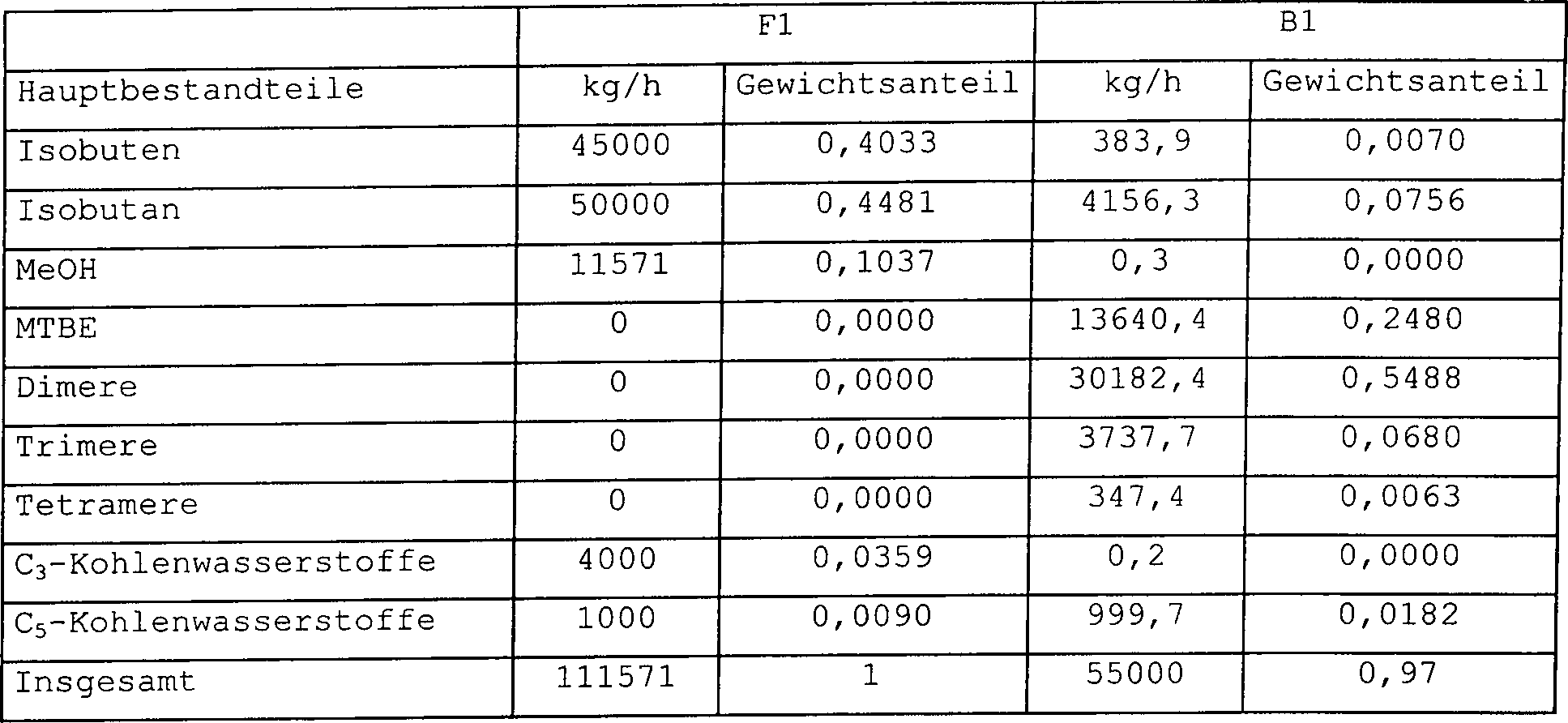
Die Ergebnisse zeigen, dass große Mengen an Trimeren und MTBE im Produkt vorliegen. Falls MTBE vollständig zersetzt werden sollte, würde auch ein Hauptteil des Isooctens sich in Triisobuten und schwerere Oligomere umwandeln.The Results show that big Amounts of trimers and MTBE in the product. If MTBE completely decomposes should be, would also a major part of isooctene turns into triisobutene and heavier oligomers convert.
Somit ist die im Stand der Technik verwendete Technologie nicht zum Herstellen von reinem Isoocten einsetzbar.Consequently The technology used in the prior art is not for manufacturing can be used by pure isooctene.
Beispiel 2Example 2
Das
Verfahren zum Herstellen von Isooctan aus einem Isobuten enthaltenden
Kohlenwasserstoffstrom wurde unter Verwendung der Verfahrenskonfiguration
gemäß
Das Beispiel zeigt, wie die Isooctenausbeute durch Zirkulieren eines MTBE und Methanol und unreagiertes Isobuten enthaltenden Stroms zurück zum Anfang des Verfahrens gesteigert wird. Gleichzeitig ist der Produktstrom von ordentlicher Qualität und der Hauptteil des Produktstroms ist Isoocten.The Example shows how the isooctene yield is obtained by circulating a MTBE and methanol and unreacted isobutene-containing stream back is increased to the beginning of the process. At the same time is the product flow of decent quality and the major part of the product stream is isooctene.
Die Massenströme und Gewichtsteile jeder Komponente in jedem Strom werden in Tabelle 2 präsentiert.The mass flows and parts by weight of each component in each stream are tabulated 2 presented.
Tabelle
2 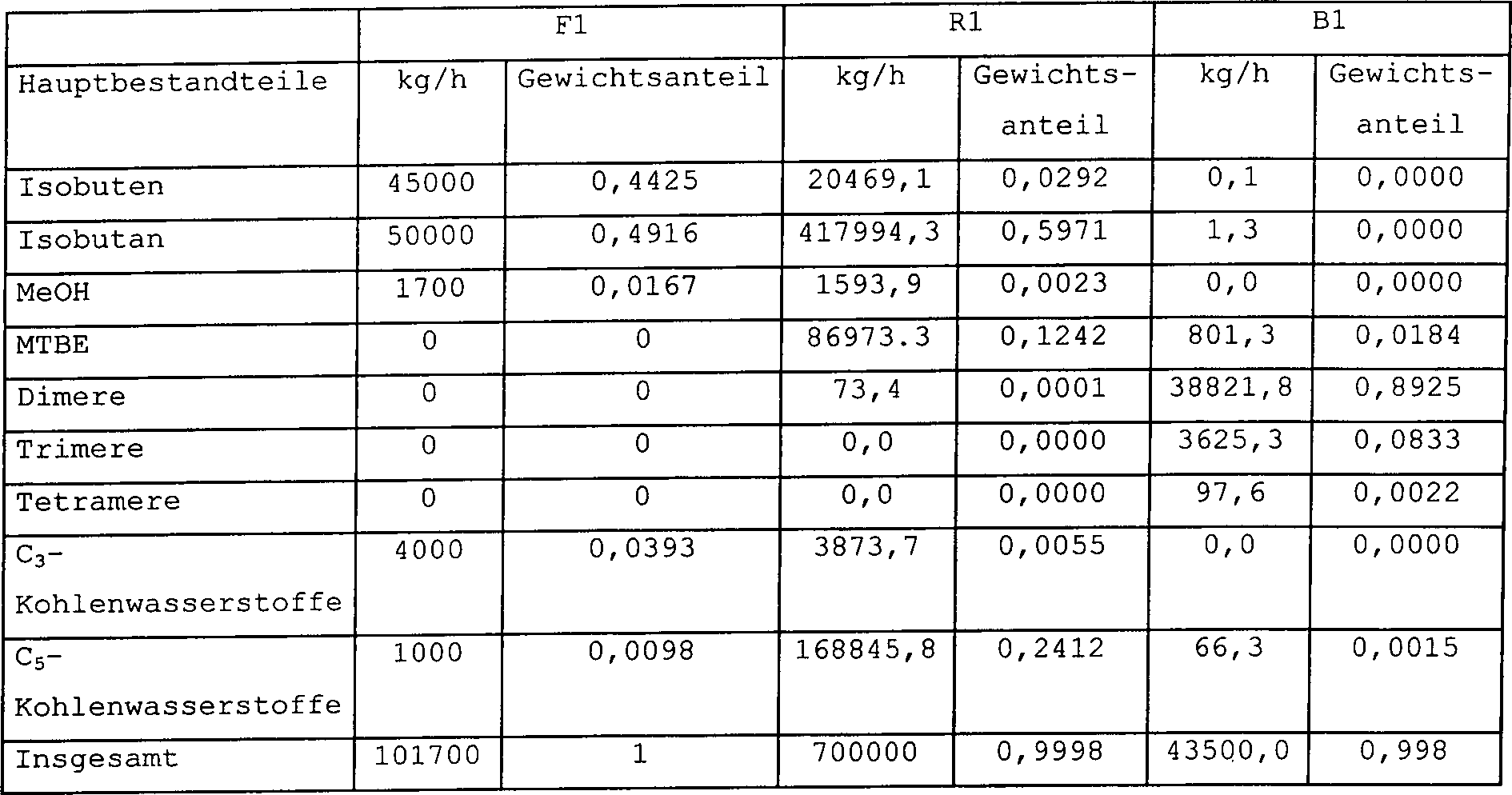
Beispiel 3Example 3
Das
Verfahren zum Herstellen von Isooctan aus einem, Isobuten enthaltenden,
Kohlenwasserstoffstrom wurde unter Verwendung der Verfahrenskonfiguration
gemäß
Bei dieser Ausführungsform werden die Dimere aus dem die Reaktoren relativ nahe am Anfang der Reaktorabfolge passierenden Strom getrennt. Der Hauptteil der Reaktion tritt am Anfang des Reaktorsystems auf und daher ist es möglich, den Hauptteil der Dimere nach einer relativ kurzen Verweilzeit zu entfernen. Auf diese Weise haben die Dimere nicht die Zeit, weiter zu Trimeren und schwereren Komponenten zu reagieren. Der MTBE enthaltende Strom wird von den zwei letzteren Destillationssäulen auch in dieser Ausführungsform zurück zirkuliert.at this embodiment The dimers from which the reactors are relatively close to the beginning of the reactor sequence passing current separated. The main part of the reaction occurs on Beginning of the reactor system and therefore it is possible, the bulk of the dimers after a relatively short residence time to remove. In this way the dimers do not have the time to move on to trimers and heavier ones React to components. The MTBE-containing stream is from the two latter distillation columns also circulated back in this embodiment.
Die Massenströme und Gewichtsfraktionen jeder Komponente im Gesamtzufuhrstrom und in den Zirkulationsströmen werden in Tabelle 3 präsentiert.The mass flows and weight fractions of each component in the total feed stream and in the circulation streams are presented in Table 3.
Tabelle
3 
Die Zusammensetzungen der Produktströme B1 und B2 werden in Tabelle 4 präsentiert.The Compositions of product streams B1 and B2 are presented in Table 4.
Tabelle
4 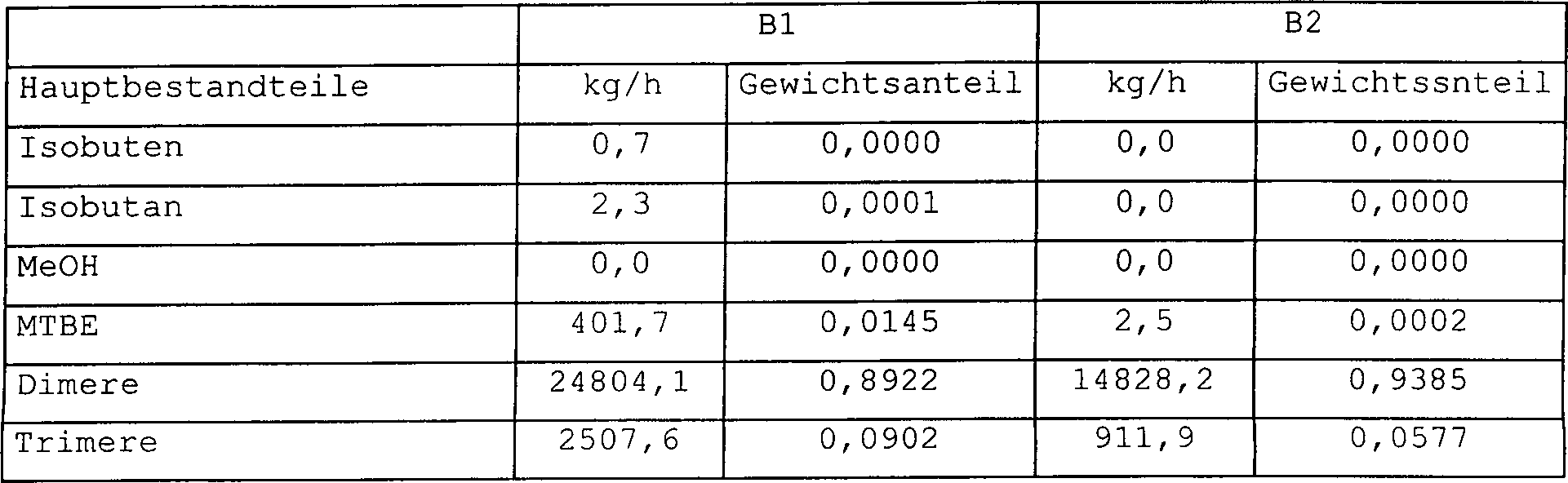

Beispiel 4Example 4
Das
Verfahren zum Herstellen von Isooctan aus einem Isobuten enthaltenden
Kohlenwasserstrom wurde unter Verwendung einer Verfahrenskonfiguration
gemäß
Bei dieser Ausführungsform wird Wasser als Sauerstoffanreicherer verwendet und damit enthalten die Produktströme überhaupt keinen Ether. Stattdessen umfassen die Reaktionsausflüsse TBA und Wasser, die zu einem der Reaktoren zurück zirkuliert werden.at this embodiment Water is used as an oxygen enricher and thus included the product streams at all no ether. Instead, the reaction effluents comprise TBA and water circulating back to one of the reactors.
Die Massenströme und Gewichtsfraktionen jeder Komponente im Gesamtzufuhrstrom und in den Umwälzströmen werden in Tabelle 5 präsentiert.The mass flows and weight fractions of each component in the total feed stream and in the recirculation streams presented in Table 5.
Tabelle
5 

Der dritte Zirkulationsstrom umfasst Wasser, und der Massenstrom wird als 0,08 kg/h berechnet. Die Zusammensetzung des Gesamtproduktstroms wird in Tabelle 6 präsentiert.Of the third circulation stream includes water, and the mass flow becomes calculated as 0.08 kg / h. The composition of the total product stream is presented in Table 6.
Tabelle
6 
Beispiel 5Example 5
Das Verhalten von Methanol und MTBE beim Behindern der Nebenreaktionen wurde durch Durchführen von zwei Experimenten mit ähnlichen experimentellen Einstellungen untersucht. Eine Mischung von Isobuten (45%) und Isobutan (55%) wurde als Einsatzmaterial verwendet.The Behavior of methanol and MTBE in hindering side reactions was done by performing from two experiments with similar ones studied experimental settings. A mixture of isobutene (45%) and isobutane (55%) was used as feedstock.
Wenn Methanol in einem Verhältnis von 0,1 mol Methanol pro mol Isobuten der Ausgangsmaterialmischung zugegeben wurde, wurde eine Produktmischung mit u.a. 26,3% Isoocten und 10,8 % am Ende des Experiments erhalten.If Methanol in a ratio of 0.1 mol of methanol per mole of isobutene of the starting material mixture was added, a product mixture containing i.a. 26.3% isooctene and 10.8% at the end of the experiment.
Wenn der Ausgangsmaterialmischung anstelle von Methanol MTBE in einem ähnlichen Verhältnis zugegeben wurde, enthielt die Mischung am Ende des Experiments ungefähr 28,8 % Isoocten und 11,2 % Triisobuten. Aufgrund der relativ niedrigen Konzentration der Sauerstoff-enthaltenden Verbindung im Einsatzmaterial kann die Produktzusammensetzung nicht als gut angesehen werden. Nichtsdestoweniger zeigt das Experiment, dass nicht nur Alkohol, sondern auch andere Sauerstoffanreicherer die Oligomerisierung von Isoocten behindern, teils sogar besser als Alkohol.If the starting material mixture instead of methanol MTBE in a similar relationship was added, the mixture contained about 28.8 at the end of the experiment % Isooctene and 11.2% triisobutene. Due to the relatively low Concentration of the oxygen-containing compound in the feed the product composition can not be considered good. Nonetheless, the experiment shows that not only alcohol, but also other oxygenators the oligomerization of Isooctene hindering, sometimes even better than alcohol.
Beispiel 6Example 6
Das
Verfahren zum Dimerisieren von Kohlenwasserstoff-Einsatzmaterial, das hauptsächlich C5-Kohlenwasserstoffe enthält, wurde unter Verwendung
einer Verfahrenskonfiguration gemäß
Das Beispiel demonstriert, wie olefines Kohlenwasserstoff-Einsatzmaterial dimerisiert wird und aus der nachfolgenden Destillationssäule ein Umwälzstrom aus der Seite der Säule abgezogen wird. Das dimerisierte Reaktionsprodukt wird als das Bodenprodukt der Säule wiedergewonnen. Da C5-Olefine den Hauptteil des Kohlenwasserstoff-Einsatzmaterials bilden, ist sowohl in der Reaktionszone als auch im Umwälzstrom R1 nur eine kleine Menge an Sauerstoffanreicherer vorhanden.The example demonstrates how to dimerize olefinic hydrocarbon feedstock and withdraw a recycle stream from the side of the column from the subsequent distillation column. The dimerized reaction product is recovered as the bottom product of the column. Since C 5 olefins form the major part of the hydrocarbon feedstock, only a small amount of oxygen scavenger is present in both the reaction zone and the recycle stream R 1.
Die Menge des Umwälzstroms R1 ist ziemlich groß, was im Hinblick auf die Temperatursteuerung des Reaktors vorteilhaft ist.The Amount of recirculation flow R1 is pretty big which is advantageous with regard to the temperature control of the reactor is.
Die Massenströme jeder Komponenten in jedem Strom werden in Tabelle 7 präsentiert.The mass flows Each component in each stream is presented in Table 7.
Tabelle
7 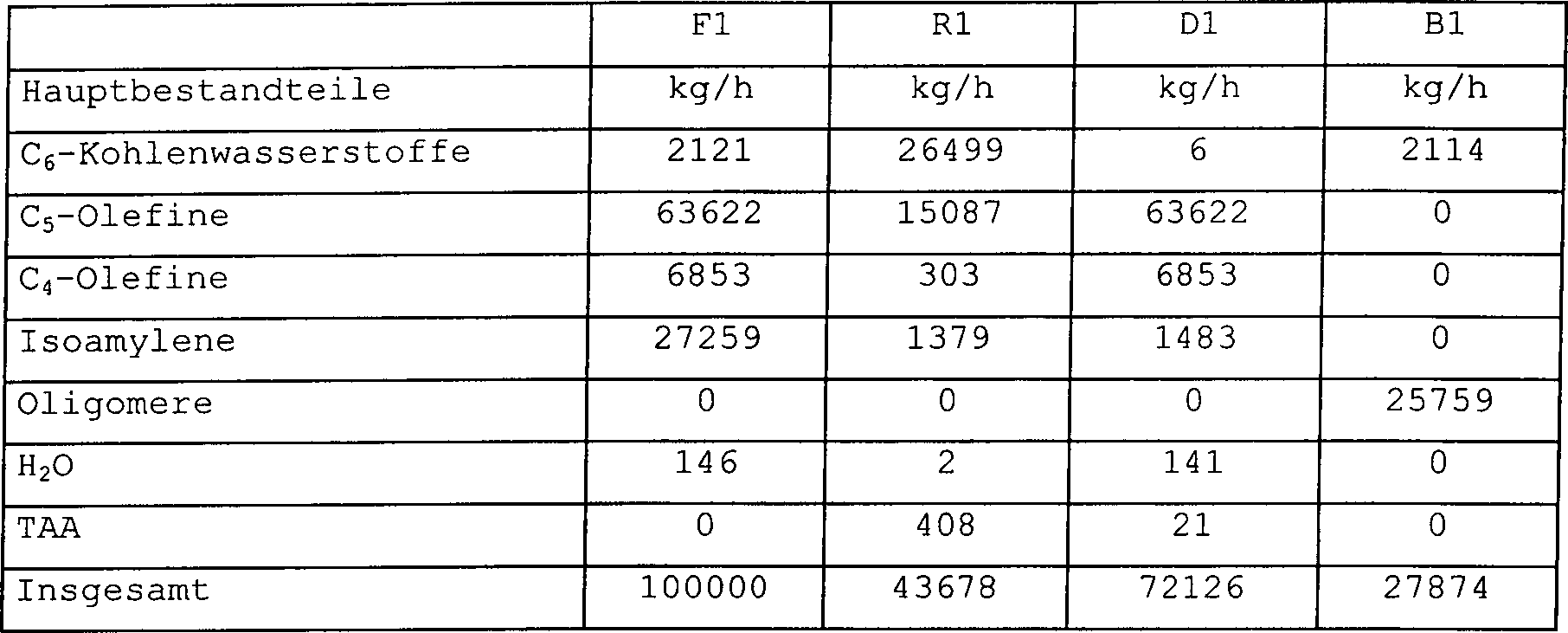
Der Ausdruck Oligomere umfasst das Reaktionsprodukt, von dem Dimere über 90 % bilden.Of the Expression of oligomers includes the reaction product, of which dimers over 90% form.
Die Behandlung des Destillats D1 aus der Destillationssäule wird nicht dargestellt. Typischerweise werden Sauerstoffanreicherer, d.h. Wasser und Alkohol, aus dem Destillat D1 abgetrennt und zur Zufuhr des Reaktors zurück umgewälzt werden.The Treatment of the distillate D1 from the distillation column is not shown. Typically, oxygenators, i.e. Water and alcohol, separated from the distillate D1 and to Feed the reactor back circulated become.
Beispiel 7Example 7
Die Reaktion einer, C4- und C5-Olefin enthaltenden, Zufuhr wurde in einem Röhrenreaktor bei ungefähr 85°C mit einer VHSV von ungefähr 1 h–1 ausgeführt. Die Analyse des Reaktorausflusses wie auch eine detaillierte Beschreibung der Zufuhr wird in Tabelle 8 präsentiert.The reaction of a feed containing C 4 and C 5 olefin was carried out in a tubular reactor at about 85 ° C with a VHSV of about 1 h -1 . The analysis of reactor effluent as well as a detailed description of the feed is presented in Table 8.
Tabelle
8 
Tabelle 8 zeigt, dass der Hauptteil der gebildeten Oligomere C4/CS-Co-Dimere sind, d.h. C9-Olefine, wie etwa Tetramethylpenten und Trimethylhexen. Hydrogenierte verzweigte C9-Olefine haben einen sehr nützlichen Einfluss auf die Oktanzahl von Treibstoffen.Table 8 shows that the main part of the oligomers C 4 / C S -Co-dimers are formed, ie, C 9 olefins, such as Tetramethylpenten and trimethylhexene. Hydrogenated branched C 9 olefins have a very useful influence on the octane number of fuels.
Die
Zusammensetzung der Dimerfraktion des Produkts ist wie folgt:
25,6
Gew.-% Trimethylpentene, 22,3 Gew.-% Tetramethylpentene und Trimethylhexene,
5,4 Gew.-% Tetramethylhexene und 3,9 Gew.-% Trimethylheptene. Der
Rest (42,4 Gew.-%) des Dimerprodukts umfasst andere, weniger verzweigte
Dimere.The composition of the dimer fraction of the product is as follows:
25.6% by weight of trimethylpentenes, 22.3% by weight of tetramethylpentenes and trimethylhexenes, 5.4% by weight of tetramethylhexenes and 3.9% by weight of trimethylheptene. The remainder (42.4% by weight) of the dimer product comprises other less branched dimers.
Mit einer Verfahrenskonfiguration gemäß der vorliegenden Erfindung könnte die Produktzusammensetzung optimiert werden.With a method configuration according to the present invention could the product composition can be optimized.
Claims (50)
Applications Claiming Priority (4)
| Application Number | Priority Date | Filing Date | Title |
|---|---|---|---|
| FI982250 | 1998-10-16 | ||
| FI982250A FI106955B (en) | 1998-10-16 | 1998-10-16 | Process for producing isooctane from an isobutylene hydrocarbon feed |
| US09/343,559 US6613108B1 (en) | 1998-10-16 | 1999-06-30 | Process for producing a fuel component |
| US343559 | 1999-06-30 |
Publications (2)
| Publication Number | Publication Date |
|---|---|
| DE69918017D1 DE69918017D1 (en) | 2004-07-22 |
| DE69918017T2 true DE69918017T2 (en) | 2005-07-07 |
Family
ID=26160656
Family Applications (1)
| Application Number | Title | Priority Date | Filing Date |
|---|---|---|---|
| DE69918017T Revoked DE69918017T2 (en) | 1998-10-16 | 1999-10-18 | Process for the preparation of a blowing agent component |
Country Status (8)
| Country | Link |
|---|---|
| EP (1) | EP0994088B1 (en) |
| CN (1) | CN1203031C (en) |
| AT (1) | ATE269284T1 (en) |
| AU (1) | AU6344099A (en) |
| CA (1) | CA2346902C (en) |
| DE (1) | DE69918017T2 (en) |
| ES (1) | ES2222678T3 (en) |
| WO (1) | WO2000023402A1 (en) |
Families Citing this family (44)
| Publication number | Priority date | Publication date | Assignee | Title |
|---|---|---|---|---|
| GB9922553D0 (en) * | 1999-09-23 | 1999-11-24 | Bp Oil Int | Fuel compositions |
| US8232437B2 (en) | 1996-11-18 | 2012-07-31 | Bp Oil International Limited | Fuel composition |
| US7462207B2 (en) | 1996-11-18 | 2008-12-09 | Bp Oil International Limited | Fuel composition |
| WO2000077130A1 (en) * | 1999-06-11 | 2000-12-21 | Bp Oil International Limited | Fuel composition |
| IT1313600B1 (en) | 1999-08-05 | 2002-09-09 | Snam Progetti | PROCEDURE FOR PRODUCING HIGH-OCTANIC HYDROCARBONS BY SELECTIVE ISOBUTENE DIMERIZATION |
| GB9930402D0 (en) * | 1999-12-23 | 2000-02-16 | Exxon Chemical Patents Inc | Selective removal of isobutene from C4 olefinic feedstocks |
| RU2177930C1 (en) * | 2000-05-10 | 2002-01-10 | Общество с ограниченной ответственностью "НТЦ ХТ" | Alkene oligomers production process |
| ATE247612T1 (en) † | 2000-06-26 | 2003-09-15 | Saudi Basic Ind Corp | DIMERIZATION OF OLEFINS |
| RU2180652C1 (en) * | 2000-06-29 | 2002-03-20 | Общество с ограниченной ответственностью "НТЦ ХТ" | Method for production of high-antiknock blends |
| US6565617B2 (en) * | 2000-08-24 | 2003-05-20 | Shell Oil Company | Gasoline composition |
| US6875900B2 (en) | 2000-10-12 | 2005-04-05 | Uop Llc | Upflow oligomerization reaction process |
| US6660898B1 (en) * | 2000-11-03 | 2003-12-09 | Fortum Oil & Gas Oy | Process for dimerizing light olefins to produce a fuel component |
| US6914166B2 (en) | 2000-12-20 | 2005-07-05 | Exxonmobil Chemical Patents Inc. | Process for the selective dimerization of isobutene |
| US6875899B2 (en) | 2001-02-01 | 2005-04-05 | Exxonmobil Chemical Patents Inc. | Production of higher olefins |
| US6590132B1 (en) | 2001-04-27 | 2003-07-08 | Uop Llc | Separation of monomer from oligomer with lower bottoms temperature |
| US6548721B1 (en) | 2001-05-22 | 2003-04-15 | Uop Llc | Hydrotreating olefin stream with complete destruction of oxygenates |
| EP1423349B1 (en) | 2001-09-05 | 2013-02-20 | Neste Oil Oyj | Method and system for improving the efficiency of a dimerization reactor |
| DE10150556A1 (en) | 2001-10-15 | 2003-04-17 | Basf Ag | Process for catalytic hydrogenation |
| ITMI20012167A1 (en) | 2001-10-18 | 2003-04-18 | Snam Progetti | PROCEDURE FOR HYDROGENATION OF BRANCHED OLEFINS COMING FROM THE DIMERIZATION OF ISOTENE |
| US7244873B1 (en) | 2002-04-18 | 2007-07-17 | Uop Llc | Process and apparatus for separating oxygenate modifier from oligomerization effluent by water wash |
| FI20021806A0 (en) | 2002-10-10 | 2002-10-10 | Fortum Oyj | A process for the preparation of a gasoline blend component |
| US7196238B2 (en) | 2003-03-10 | 2007-03-27 | Fortum Oyj | Process for dimerizing light olefins |
| US7442739B1 (en) | 2003-11-12 | 2008-10-28 | Henkel Corporation | Hot melt pressure sensitive adhesives |
| US7329788B2 (en) | 2003-12-22 | 2008-02-12 | Neste Oil Oyj | Process for producing gasoline components |
| EP1640437A1 (en) * | 2004-09-28 | 2006-03-29 | Neste Oil Oyj | Production of fuel components |
| US7344632B2 (en) | 2004-09-28 | 2008-03-18 | Neste Oil Oyj | Production of fuel components |
| EP1905812B1 (en) * | 2004-09-28 | 2018-09-05 | Neste Oyj | Process for etherifying iso-olefins |
| US7803978B2 (en) | 2004-12-16 | 2010-09-28 | Uop Llc | Process and apparatus for oligomerization in multiple stages with single fractionation column |
| KR101307686B1 (en) | 2007-07-20 | 2013-09-12 | 아미리스 인코퍼레이티드 | Fuel compositions comprising tetramethylcyclohexane |
| EP2098498A1 (en) | 2008-03-04 | 2009-09-09 | ExxonMobil Chemical Patents Inc. | Selective oligomerization of isobutene |
| CN102177110A (en) | 2008-10-10 | 2011-09-07 | 埃克森美孚化学专利公司 | Process for producing sec-butylbenzene |
| EP2522424B1 (en) | 2011-05-09 | 2020-01-08 | King Abdulaziz City for Science and Technology | Supported nanocatalyst for conversion of monoolefins, process for conversion of monoolefins and process for preparing the nanocatalyst |
| US20150148572A1 (en) * | 2013-11-27 | 2015-05-28 | Saudi Arabian Oil Company | Process for the Dimerization/Oligomerization of Mixed Butenes Over an Ion-Exchange Resin Catalyst |
| US9447346B2 (en) * | 2013-12-11 | 2016-09-20 | Saudi Arabian Oil Company | Two-step process for production of RON-enhanced mixed butanols and diisobutenes |
| US9732018B2 (en) * | 2014-02-11 | 2017-08-15 | Saudi Arabian Oil Company | Process for production of mixed butanols and diisobutenes as fuel blending components |
| CN108409519A (en) * | 2018-02-12 | 2018-08-17 | 安徽海德化工科技有限公司 | A kind of preparation method of isooctane |
| CN112334438B (en) * | 2018-06-29 | 2022-10-11 | 利安德化学技术有限公司 | Process and catalyst for producing diesel and gasoline additives from glycerol |
| CN109293466A (en) * | 2018-09-25 | 2019-02-01 | 安徽海德化工科技有限公司 | The method for preparing isooctane using isobutene |
| SG11202104213YA (en) * | 2018-10-31 | 2021-05-28 | Lummus Technology Inc | Selective dimerization and etherification of isobutylene via catalytic distillation |
| CN110526796B (en) * | 2019-08-30 | 2024-02-06 | 凯瑞环保科技股份有限公司 | Device and method capable of providing four-carbon raw materials for MTBE downstream device |
| TWI801918B (en) * | 2020-06-29 | 2023-05-11 | 美商魯瑪斯科技有限責任公司 | Process for the controlled oligomerization of butenes |
| EP4237394A4 (en) * | 2020-10-28 | 2024-10-09 | Lummus Technology LLC | DIMERIZATION AND TRIMERIZATION OF C5 OLEFINS BY CATALYTIC DISTILLATION |
| CN116143577B (en) * | 2021-11-19 | 2025-11-21 | 中国石油天然气集团有限公司 | Diisobutylene preparation method and diisobutylene preparation system |
| CN115608276B (en) * | 2022-11-15 | 2025-11-21 | 国家能源集团宁夏煤业有限责任公司 | System and method for continuous production of poly alpha-olefins |
Family Cites Families (6)
| Publication number | Priority date | Publication date | Assignee | Title |
|---|---|---|---|---|
| US2363300A (en) * | 1936-07-29 | 1944-11-21 | Anglo Iranian Oil Co Ltd | Production of motor fuel |
| GB522818A (en) * | 1937-12-23 | 1940-06-27 | Melle Usines Sa | Improvements in or relating to olefine polymerisation |
| US4447668A (en) * | 1982-03-29 | 1984-05-08 | Chemical Research & Licensing Company | Process for producing high purity isoolefins and dimers thereof by dissociation of ethers |
| US5091590A (en) * | 1990-08-22 | 1992-02-25 | Mobil Oil Corporation | Ether production with staged reaction of olefins |
| FI101221B1 (en) * | 1996-02-22 | 1998-05-15 | Neste Oy | Process for the preparation of alkyl ethers and mixtures thereof |
| IT1291729B1 (en) * | 1997-05-15 | 1999-01-21 | Snam Progetti | PROCEDURE FOR THE PRODUCTION OF HIGH-OCTANE HYDROCARBONS BY MEANS OF SELECTIVE DIMERIZATION OF ISOBUTENE |
-
1999
- 1999-10-18 WO PCT/FI1999/000859 patent/WO2000023402A1/en not_active Ceased
- 1999-10-18 CA CA2346902A patent/CA2346902C/en not_active Expired - Lifetime
- 1999-10-18 AU AU63440/99A patent/AU6344099A/en not_active Abandoned
- 1999-10-18 AT AT99660161T patent/ATE269284T1/en not_active IP Right Cessation
- 1999-10-18 DE DE69918017T patent/DE69918017T2/en not_active Revoked
- 1999-10-18 ES ES99660161T patent/ES2222678T3/en not_active Expired - Lifetime
- 1999-10-18 CN CN99814612.9A patent/CN1203031C/en not_active Expired - Lifetime
- 1999-10-18 EP EP99660161A patent/EP0994088B1/en not_active Revoked
Also Published As
| Publication number | Publication date |
|---|---|
| WO2000023402A1 (en) | 2000-04-27 |
| AU6344099A (en) | 2000-05-08 |
| CN1203031C (en) | 2005-05-25 |
| DE69918017D1 (en) | 2004-07-22 |
| ATE269284T1 (en) | 2004-07-15 |
| ES2222678T3 (en) | 2005-02-01 |
| CA2346902C (en) | 2010-02-09 |
| EP0994088A1 (en) | 2000-04-19 |
| CA2346902A1 (en) | 2000-04-27 |
| EP0994088B1 (en) | 2004-06-16 |
| CN1330619A (en) | 2002-01-09 |
Similar Documents
| Publication | Publication Date | Title |
|---|---|---|
| DE69812693T2 (en) | METHOD FOR OLIGOMERIZING ISOBUTEN | |
| EP0028377B1 (en) | Process for the preparation of a mixture essentially consisting of iso-butene oligomers and methyl-t-butyl ether, its use and fuels containing such a mixture | |
| DE69816821T2 (en) | Improved process for the production of saturated oligomers | |
| EP1585712B1 (en) | Method for producing butene oligomers and tert-butyl ethers from c4 flows containing isobutene | |
| EP1388528B1 (en) | Process for the oligomerisation of isobutene contained in hydrocarbon streams containing n-butene | |
| CA2346902C (en) | Process for dimerizing olefinic hydrocarbon feedstock and producing a fuel component | |
| DE3702630C2 (en) | Process for the production of gasoline | |
| EP1199296B1 (en) | Process for the preparation of highly pure raffinate II and methyl tert-butyl ether | |
| DE60109479T2 (en) | METHOD FOR PRODUCING A FUEL COMPONENT | |
| DE3235507C2 (en) | ||
| US6613108B1 (en) | Process for producing a fuel component | |
| DE3604636C2 (en) | Process for the preparation of olefins having 2 to 5 carbon atoms per molecule | |
| DE19629906A1 (en) | Flexible production of butene oligomers and alkyl tertiary butyl ether(s) from Fischer-Tropsch olefin(s) | |
| EP0068218B1 (en) | Process for the preparation of pure alkyl-tert.-alkyl ethers and hydrocarbonaceous raffinates freed for the major part from isoolefines and alkanols | |
| EP0820973B1 (en) | Process for the preparation of butene oligomers from natural butanes | |
| EP0068194B1 (en) | Process for the separation of pure tert. olefines from hydrocarbon mixtures | |
| DE69721237T2 (en) | METHOD FOR PRODUCING ALKYL ETHERS AND THEIR MIXTURES | |
| DE3031256A1 (en) | METHOD FOR REFINING C (DOWN ARROW) 4 (DOWN ARROW) OLEFIN FRACTIONS. | |
| DE69324600T2 (en) | METHOD AND SYSTEM FOR OLIGOMERIZING OLEFINS | |
| EP0455029B1 (en) | Process for the preparation of fuels and fuel components with a high-octane, low-olefin content | |
| DE2706465C3 (en) | Process for the production of butadiene or n-butenes from hydrocarbon mixtures containing them with separation of isobutene | |
| EP1431264A1 (en) | Process for the preparation of tert.-butanol | |
| EP2454218B1 (en) | Method and apparatus for producing synthetic fuels | |
| EP1911736B1 (en) | Method for manufacturing alkyl tert. butyl ethers with optimised temperature control in the reactors | |
| EP0820975A1 (en) | Process for the preparation of alkyl tert-butyl ethers and di-n-butene from field butanes |
Legal Events
| Date | Code | Title | Description |
|---|---|---|---|
| 8363 | Opposition against the patent | ||
| 8331 | Complete revocation |