DE69721237T2 - METHOD FOR PRODUCING ALKYL ETHERS AND THEIR MIXTURES - Google Patents
METHOD FOR PRODUCING ALKYL ETHERS AND THEIR MIXTURES Download PDFInfo
- Publication number
- DE69721237T2 DE69721237T2 DE69721237T DE69721237T DE69721237T2 DE 69721237 T2 DE69721237 T2 DE 69721237T2 DE 69721237 T DE69721237 T DE 69721237T DE 69721237 T DE69721237 T DE 69721237T DE 69721237 T2 DE69721237 T2 DE 69721237T2
- Authority
- DE
- Germany
- Prior art keywords
- distillation
- stream
- distillation zone
- zone
- alkanol
- Prior art date
- Legal status (The legal status is an assumption and is not a legal conclusion. Google has not performed a legal analysis and makes no representation as to the accuracy of the status listed.)
- Expired - Lifetime
Links
- 239000000203 mixture Substances 0.000 title claims description 42
- 150000005215 alkyl ethers Chemical class 0.000 title claims description 13
- 238000004519 manufacturing process Methods 0.000 title description 17
- 238000004821 distillation Methods 0.000 claims description 150
- 229930195733 hydrocarbon Natural products 0.000 claims description 122
- 150000002430 hydrocarbons Chemical class 0.000 claims description 119
- 238000000034 method Methods 0.000 claims description 77
- 238000006243 chemical reaction Methods 0.000 claims description 65
- RTZKZFJDLAIYFH-UHFFFAOYSA-N ether Substances CCOCC RTZKZFJDLAIYFH-UHFFFAOYSA-N 0.000 claims description 51
- 239000004215 Carbon black (E152) Substances 0.000 claims description 46
- OKKJLVBELUTLKV-UHFFFAOYSA-N Methanol Chemical compound OC OKKJLVBELUTLKV-UHFFFAOYSA-N 0.000 claims description 45
- 238000006266 etherification reaction Methods 0.000 claims description 37
- LFQSCWFLJHTTHZ-UHFFFAOYSA-N Ethanol Chemical compound CCO LFQSCWFLJHTTHZ-UHFFFAOYSA-N 0.000 claims description 25
- 239000003502 gasoline Substances 0.000 claims description 22
- -1 amyl alkyl ethers Chemical group 0.000 claims description 21
- LCGLNKUTAGEVQW-UHFFFAOYSA-N Dimethyl ether Chemical compound COC LCGLNKUTAGEVQW-UHFFFAOYSA-N 0.000 claims description 11
- 239000011541 reaction mixture Substances 0.000 claims description 11
- 230000003197 catalytic effect Effects 0.000 claims description 10
- XLYOFNOQVPJJNP-UHFFFAOYSA-N water Substances O XLYOFNOQVPJJNP-UHFFFAOYSA-N 0.000 claims description 10
- 230000029936 alkylation Effects 0.000 claims description 7
- 238000005804 alkylation reaction Methods 0.000 claims description 7
- 238000002360 preparation method Methods 0.000 claims description 7
- VQTUBCCKSQIDNK-UHFFFAOYSA-N Isobutene Chemical group CC(C)=C VQTUBCCKSQIDNK-UHFFFAOYSA-N 0.000 claims description 6
- 238000006356 dehydrogenation reaction Methods 0.000 claims description 6
- IJDNQMDRQITEOD-UHFFFAOYSA-N n-butane Chemical compound CCCC IJDNQMDRQITEOD-UHFFFAOYSA-N 0.000 claims description 5
- OFBQJSOFQDEBGM-UHFFFAOYSA-N n-pentane Natural products CCCCC OFBQJSOFQDEBGM-UHFFFAOYSA-N 0.000 claims description 5
- 238000004230 steam cracking Methods 0.000 claims description 5
- 239000001273 butane Substances 0.000 claims description 4
- 239000000571 coke Substances 0.000 claims description 4
- 238000004939 coking Methods 0.000 claims description 4
- 239000003209 petroleum derivative Substances 0.000 claims description 4
- 238000000197 pyrolysis Methods 0.000 claims description 4
- 238000000066 reactive distillation Methods 0.000 claims description 4
- BKOOMYPCSUNDGP-UHFFFAOYSA-N 2-methylbut-2-ene Chemical group CC=C(C)C BKOOMYPCSUNDGP-UHFFFAOYSA-N 0.000 claims description 3
- OKTJSMMVPCPJKN-UHFFFAOYSA-N Carbon Chemical compound [C] OKTJSMMVPCPJKN-UHFFFAOYSA-N 0.000 claims description 3
- 229910052799 carbon Inorganic materials 0.000 claims description 3
- 238000006384 oligomerization reaction Methods 0.000 claims description 3
- 238000006116 polymerization reaction Methods 0.000 claims description 3
- 150000005217 methyl ethers Chemical class 0.000 claims description 2
- HIXDQWDOVZUNNA-UHFFFAOYSA-N 2-(3,4-dimethoxyphenyl)-5-hydroxy-7-methoxychromen-4-one Chemical compound C=1C(OC)=CC(O)=C(C(C=2)=O)C=1OC=2C1=CC=C(OC)C(OC)=C1 HIXDQWDOVZUNNA-UHFFFAOYSA-N 0.000 claims 7
- 125000001495 ethyl group Chemical group [H]C([H])([H])C([H])([H])* 0.000 claims 1
- 239000000047 product Substances 0.000 description 59
- 239000003054 catalyst Substances 0.000 description 15
- 150000002170 ethers Chemical class 0.000 description 11
- 238000005194 fractionation Methods 0.000 description 9
- 238000012856 packing Methods 0.000 description 9
- HVZJRWJGKQPSFL-UHFFFAOYSA-N tert-Amyl methyl ether Chemical compound CCC(C)(C)OC HVZJRWJGKQPSFL-UHFFFAOYSA-N 0.000 description 9
- 238000012545 processing Methods 0.000 description 8
- 238000010992 reflux Methods 0.000 description 8
- 238000000926 separation method Methods 0.000 description 8
- 150000001336 alkenes Chemical class 0.000 description 7
- 150000001875 compounds Chemical class 0.000 description 7
- 239000000463 material Substances 0.000 description 6
- BQMLWEKOSHSOFT-UHFFFAOYSA-N 1-ethoxy-2,2-dimethylpropane Chemical compound CCOCC(C)(C)C BQMLWEKOSHSOFT-UHFFFAOYSA-N 0.000 description 5
- BZLVMXJERCGZMT-UHFFFAOYSA-N Methyl tert-butyl ether Chemical compound COC(C)(C)C BZLVMXJERCGZMT-UHFFFAOYSA-N 0.000 description 5
- NUMQCACRALPSHD-UHFFFAOYSA-N tert-butyl ethyl ether Chemical compound CCOC(C)(C)C NUMQCACRALPSHD-UHFFFAOYSA-N 0.000 description 5
- 229920001577 copolymer Polymers 0.000 description 4
- 150000001983 dialkylethers Chemical class 0.000 description 4
- 238000000605 extraction Methods 0.000 description 4
- 239000000446 fuel Substances 0.000 description 4
- 239000007788 liquid Substances 0.000 description 4
- NWUYHJFMYQTDRP-UHFFFAOYSA-N 1,2-bis(ethenyl)benzene;1-ethenyl-2-ethylbenzene;styrene Chemical compound C=CC1=CC=CC=C1.CCC1=CC=CC=C1C=C.C=CC1=CC=CC=C1C=C NWUYHJFMYQTDRP-UHFFFAOYSA-N 0.000 description 3
- 125000003118 aryl group Chemical group 0.000 description 3
- 239000003729 cation exchange resin Substances 0.000 description 3
- 239000003456 ion exchange resin Substances 0.000 description 3
- 229920003303 ion-exchange polymer Polymers 0.000 description 3
- 238000011068 loading method Methods 0.000 description 3
- 239000011347 resin Substances 0.000 description 3
- 229920005989 resin Polymers 0.000 description 3
- WGLLSSPDPJPLOR-UHFFFAOYSA-N 2,3-dimethylbut-2-ene Chemical compound CC(C)=C(C)C WGLLSSPDPJPLOR-UHFFFAOYSA-N 0.000 description 2
- WYLQOLGJMFRRLX-UHFFFAOYSA-N 2-methoxy-2-methylpentane Chemical compound CCCC(C)(C)OC WYLQOLGJMFRRLX-UHFFFAOYSA-N 0.000 description 2
- WWUVJRULCWHUSA-UHFFFAOYSA-N 2-methyl-1-pentene Chemical compound CCCC(C)=C WWUVJRULCWHUSA-UHFFFAOYSA-N 0.000 description 2
- JMMZCWZIJXAGKW-UHFFFAOYSA-N 2-methylpent-2-ene Chemical compound CCC=C(C)C JMMZCWZIJXAGKW-UHFFFAOYSA-N 0.000 description 2
- LRHPLDYGYMQRHN-UHFFFAOYSA-N N-Butanol Chemical compound CCCCO LRHPLDYGYMQRHN-UHFFFAOYSA-N 0.000 description 2
- PPBRXRYQALVLMV-UHFFFAOYSA-N Styrene Chemical compound C=CC1=CC=CC=C1 PPBRXRYQALVLMV-UHFFFAOYSA-N 0.000 description 2
- DKGAVHZHDRPRBM-UHFFFAOYSA-N Tert-Butanol Chemical compound CC(C)(C)O DKGAVHZHDRPRBM-UHFFFAOYSA-N 0.000 description 2
- 230000002378 acidificating effect Effects 0.000 description 2
- 230000009286 beneficial effect Effects 0.000 description 2
- 238000009835 boiling Methods 0.000 description 2
- 235000013844 butane Nutrition 0.000 description 2
- 239000006227 byproduct Substances 0.000 description 2
- 125000004432 carbon atom Chemical group C* 0.000 description 2
- 229940023913 cation exchange resins Drugs 0.000 description 2
- 239000000356 contaminant Substances 0.000 description 2
- 238000001816 cooling Methods 0.000 description 2
- 238000005516 engineering process Methods 0.000 description 2
- 239000012535 impurity Substances 0.000 description 2
- 239000003208 petroleum Substances 0.000 description 2
- 229920001467 poly(styrenesulfonates) Polymers 0.000 description 2
- BDERNNFJNOPAEC-UHFFFAOYSA-N propan-1-ol Chemical compound CCCO BDERNNFJNOPAEC-UHFFFAOYSA-N 0.000 description 2
- 238000011084 recovery Methods 0.000 description 2
- 238000004064 recycling Methods 0.000 description 2
- 238000011144 upstream manufacturing Methods 0.000 description 2
- DNIAPMSPPWPWGF-GSVOUGTGSA-N (R)-(-)-Propylene glycol Chemical compound C[C@@H](O)CO DNIAPMSPPWPWGF-GSVOUGTGSA-N 0.000 description 1
- VXNZUUAINFGPBY-UHFFFAOYSA-N 1-Butene Chemical compound CCC=C VXNZUUAINFGPBY-UHFFFAOYSA-N 0.000 description 1
- VTPNYMSKBPZSTF-UHFFFAOYSA-N 1-ethenyl-2-ethylbenzene Chemical compound CCC1=CC=CC=C1C=C VTPNYMSKBPZSTF-UHFFFAOYSA-N 0.000 description 1
- WAEOXIOXMKNFLQ-UHFFFAOYSA-N 1-methyl-4-prop-2-enylbenzene Chemical group CC1=CC=C(CC=C)C=C1 WAEOXIOXMKNFLQ-UHFFFAOYSA-N 0.000 description 1
- IGGDKDTUCAWDAN-UHFFFAOYSA-N 1-vinylnaphthalene Chemical compound C1=CC=C2C(C=C)=CC=CC2=C1 IGGDKDTUCAWDAN-UHFFFAOYSA-N 0.000 description 1
- OWWIWYDDISJUMY-UHFFFAOYSA-N 2,3-dimethylbut-1-ene Chemical compound CC(C)C(C)=C OWWIWYDDISJUMY-UHFFFAOYSA-N 0.000 description 1
- LIMAEKMEXJTSNI-UHFFFAOYSA-N 2,3-dimethylpent-1-ene Chemical compound CCC(C)C(C)=C LIMAEKMEXJTSNI-UHFFFAOYSA-N 0.000 description 1
- WFHALSLYRWWUGH-UHFFFAOYSA-N 2,3-dimethylpent-2-ene Chemical compound CCC(C)=C(C)C WFHALSLYRWWUGH-UHFFFAOYSA-N 0.000 description 1
- LXQPBCHJNIOMQU-UHFFFAOYSA-N 2,4-dimethylpent-1-ene Chemical compound CC(C)CC(C)=C LXQPBCHJNIOMQU-UHFFFAOYSA-N 0.000 description 1
- ISRGONDNXBCDBM-UHFFFAOYSA-N 2-chlorostyrene Chemical compound ClC1=CC=CC=C1C=C ISRGONDNXBCDBM-UHFFFAOYSA-N 0.000 description 1
- MHNNAWXXUZQSNM-UHFFFAOYSA-N 2-methylbut-1-ene Chemical compound CCC(C)=C MHNNAWXXUZQSNM-UHFFFAOYSA-N 0.000 description 1
- BWEKDYGHDCHWEN-UHFFFAOYSA-N 2-methylhex-2-ene Chemical compound CCCC=C(C)C BWEKDYGHDCHWEN-UHFFFAOYSA-N 0.000 description 1
- FHHSSXNRVNXTBG-UHFFFAOYSA-N 3-methylhex-3-ene Chemical compound CCC=C(C)CC FHHSSXNRVNXTBG-UHFFFAOYSA-N 0.000 description 1
- TWCRBBJSQAZZQB-UHFFFAOYSA-N 3-methylidenehexane Chemical compound CCCC(=C)CC TWCRBBJSQAZZQB-UHFFFAOYSA-N 0.000 description 1
- RYKZRKKEYSRDNF-UHFFFAOYSA-N 3-methylidenepentane Chemical compound CCC(=C)CC RYKZRKKEYSRDNF-UHFFFAOYSA-N 0.000 description 1
- JLBJTVDPSNHSKJ-UHFFFAOYSA-N 4-Methylstyrene Chemical compound CC1=CC=C(C=C)C=C1 JLBJTVDPSNHSKJ-UHFFFAOYSA-N 0.000 description 1
- KAKZBPTYRLMSJV-UHFFFAOYSA-N Butadiene Chemical group C=CC=C KAKZBPTYRLMSJV-UHFFFAOYSA-N 0.000 description 1
- UFHFLCQGNIYNRP-UHFFFAOYSA-N Hydrogen Chemical compound [H][H] UFHFLCQGNIYNRP-UHFFFAOYSA-N 0.000 description 1
- KFZMGEQAYNKOFK-UHFFFAOYSA-N Isopropanol Chemical compound CC(C)O KFZMGEQAYNKOFK-UHFFFAOYSA-N 0.000 description 1
- 238000009825 accumulation Methods 0.000 description 1
- 239000002253 acid Substances 0.000 description 1
- 125000000217 alkyl group Chemical group 0.000 description 1
- 125000005233 alkylalcohol group Chemical group 0.000 description 1
- IAQRGUVFOMOMEM-UHFFFAOYSA-N butene Natural products CC=CC IAQRGUVFOMOMEM-UHFFFAOYSA-N 0.000 description 1
- 238000004523 catalytic cracking Methods 0.000 description 1
- 238000006555 catalytic reaction Methods 0.000 description 1
- 238000012993 chemical processing Methods 0.000 description 1
- 239000007795 chemical reaction product Substances 0.000 description 1
- 238000004140 cleaning Methods 0.000 description 1
- 239000012141 concentrate Substances 0.000 description 1
- 238000009833 condensation Methods 0.000 description 1
- 230000005494 condensation Effects 0.000 description 1
- 238000010411 cooking Methods 0.000 description 1
- 238000005202 decontamination Methods 0.000 description 1
- 230000003588 decontaminative effect Effects 0.000 description 1
- 230000003247 decreasing effect Effects 0.000 description 1
- 238000001704 evaporation Methods 0.000 description 1
- 239000012530 fluid Substances 0.000 description 1
- NBVXSUQYWXRMNV-UHFFFAOYSA-N fluoromethane Chemical compound FC NBVXSUQYWXRMNV-UHFFFAOYSA-N 0.000 description 1
- UQSQSQZYBQSBJZ-UHFFFAOYSA-N fluorosulfonic acid Chemical compound OS(F)(=O)=O UQSQSQZYBQSBJZ-UHFFFAOYSA-N 0.000 description 1
- 239000007789 gas Substances 0.000 description 1
- 238000010438 heat treatment Methods 0.000 description 1
- 239000002638 heterogeneous catalyst Substances 0.000 description 1
- 239000002815 homogeneous catalyst Substances 0.000 description 1
- 239000001257 hydrogen Substances 0.000 description 1
- 229910052739 hydrogen Inorganic materials 0.000 description 1
- 238000009413 insulation Methods 0.000 description 1
- ZXEKIIBDNHEJCQ-UHFFFAOYSA-N isobutanol Chemical compound CC(C)CO ZXEKIIBDNHEJCQ-UHFFFAOYSA-N 0.000 description 1
- RXGVAJKEQOIIRM-UHFFFAOYSA-N methanol 2-methylpropane Chemical compound OC.CC(C)C RXGVAJKEQOIIRM-UHFFFAOYSA-N 0.000 description 1
- GBMDVOWEEQVZKZ-UHFFFAOYSA-N methanol;hydrate Chemical compound O.OC GBMDVOWEEQVZKZ-UHFFFAOYSA-N 0.000 description 1
- 239000002808 molecular sieve Substances 0.000 description 1
- JRZJOMJEPLMPRA-UHFFFAOYSA-N olefin Natural products CCCCCCCC=C JRZJOMJEPLMPRA-UHFFFAOYSA-N 0.000 description 1
- 150000002894 organic compounds Chemical class 0.000 description 1
- 125000004817 pentamethylene group Chemical class [H]C([H])([*:2])C([H])([H])C([H])([H])C([H])([H])C([H])([H])[*:1] 0.000 description 1
- 239000002574 poison Substances 0.000 description 1
- 231100000614 poison Toxicity 0.000 description 1
- 229920000642 polymer Polymers 0.000 description 1
- 230000000379 polymerizing effect Effects 0.000 description 1
- 229920001447 polyvinyl benzene Polymers 0.000 description 1
- HJWLCRVIBGQPNF-UHFFFAOYSA-N prop-2-enylbenzene Chemical compound C=CCC1=CC=CC=C1 HJWLCRVIBGQPNF-UHFFFAOYSA-N 0.000 description 1
- 108090000623 proteins and genes Proteins 0.000 description 1
- 238000000746 purification Methods 0.000 description 1
- 238000005057 refrigeration Methods 0.000 description 1
- 238000012958 reprocessing Methods 0.000 description 1
- 238000005070 sampling Methods 0.000 description 1
- 229920006395 saturated elastomer Polymers 0.000 description 1
- 229930195734 saturated hydrocarbon Natural products 0.000 description 1
- URGAHOPLAPQHLN-UHFFFAOYSA-N sodium aluminosilicate Chemical compound [Na+].[Al+3].[O-][Si]([O-])=O.[O-][Si]([O-])=O URGAHOPLAPQHLN-UHFFFAOYSA-N 0.000 description 1
- 238000006277 sulfonation reaction Methods 0.000 description 1
- 125000000542 sulfonic acid group Chemical group 0.000 description 1
- 125000000383 tetramethylene group Chemical group [H]C([H])([*:1])C([H])([H])C([H])([H])C([H])([H])[*:2] 0.000 description 1
- 229930195735 unsaturated hydrocarbon Natural products 0.000 description 1
- 229920002554 vinyl polymer Polymers 0.000 description 1
Classifications
-
- C—CHEMISTRY; METALLURGY
- C07—ORGANIC CHEMISTRY
- C07C—ACYCLIC OR CARBOCYCLIC COMPOUNDS
- C07C41/00—Preparation of ethers; Preparation of compounds having groups, groups or groups
- C07C41/01—Preparation of ethers
- C07C41/34—Separation; Purification; Stabilisation; Use of additives
- C07C41/40—Separation; Purification; Stabilisation; Use of additives by change of physical state, e.g. by crystallisation
- C07C41/42—Separation; Purification; Stabilisation; Use of additives by change of physical state, e.g. by crystallisation by distillation
-
- C—CHEMISTRY; METALLURGY
- C07—ORGANIC CHEMISTRY
- C07C—ACYCLIC OR CARBOCYCLIC COMPOUNDS
- C07C41/00—Preparation of ethers; Preparation of compounds having groups, groups or groups
- C07C41/01—Preparation of ethers
- C07C41/05—Preparation of ethers by addition of compounds to unsaturated compounds
- C07C41/06—Preparation of ethers by addition of compounds to unsaturated compounds by addition of organic compounds only
Landscapes
- Chemical & Material Sciences (AREA)
- Organic Chemistry (AREA)
- Crystallography & Structural Chemistry (AREA)
- Organic Low-Molecular-Weight Compounds And Preparation Thereof (AREA)
Description
Die vorliegende Erfindung betrifft die Herstellung tertiärer Alkylether. Insbesondere betrifft die Erfindung ein neues Verfahren zur Herstellung solcher Ether, worin Isoolefine, insbesondere C4-C7-Isoolefine aus einer olefinischen Kohlenwasserstoffbeschickung mit einem geeigneten Alkanol umgesetzt werden, um die entsprechenden Ether herzustellen. Diese Ether werden gewonnen und, falls nötig, weiterverarbeitet, um beispielsweise eine Motorkraftstoffkomponente oder eine petrochemische Beschickung herzustellen. Ein Kohlenwasserstoffstrom aus nicht-umgesetzten Kohlenwasserstoffen, der aus der Etherifizierungsreaktion ausfließt, wird einer Alkanol-Rückgewinnung und einer Oxygenat-Entfernung unterworfen, so dass der Kohlenwasserstoffausfluss direkt in einem weiteren Verfahren, wie einer Alkylierung, eingesetzt werden kann.The present invention relates to the production of tertiary alkyl ethers. In particular, the invention relates to a new process for the preparation of such ethers, in which isoolefins, in particular C 4 -C 7 isoolefins, from an olefinic hydrocarbon feed are reacted with a suitable alkanol to produce the corresponding ethers. These ethers are recovered and, if necessary, further processed to produce, for example, an engine fuel component or a petrochemical feed. A hydrocarbon stream of unreacted hydrocarbons flowing out of the etherification reaction is subjected to alkanol recovery and oxygenate removal so that the hydrocarbon outflow can be used directly in another process such as alkylation.
Beschreibung des Stands der TechnikDescription of the stand of the technique
Tertiäre Alkylether verbessern die Antiklopfeigenschaften von Motorkraftstoffen und verringern die Konzentration schädlicher Bestandteile in Abgasen. Von den Alkyl-tertalkylethern, die als Komponenten für Motorkraftstoffe verwendet werden, seien Folgende erwähnt: Methyl-t-butylether (MTBE), Ethyl-t-butylether (ETBE), t-Amylmethylether (TAME), t-Amylethylether (TAEE) und t-Hexylmethylether (THME). Diese Ether werden durch die Etherifizierung eines Isoolefins mit einem einwertigen aliphatischen Alkohol (nachstehend auch als "Alkanol" bezeichnet) hergestellt. Die Isoolefinbeschickung kann reine C4- oder C5-Komponenten oder eine gemischte Kohlenwasserstoffbeschickung mit einer Bandbreite C3-C7- und schwereren Kohlenwasserstoffen enthalten. Übliche Ionenaustauscherharze werden als Etherifizierungskatalysatoren eingesetzt.Tertiary alkyl ethers improve the anti-knock properties of motor fuels and reduce the concentration of harmful components in exhaust gases. Of the alkyl tert-alkyl ethers used as components for motor fuels, the following may be mentioned: methyl t-butyl ether (MTBE), ethyl t-butyl ether (ETBE), t-amyl methyl ether (TAME), t-amyl ethyl ether (TAEE) and t-hexyl methyl ether (THME). These ethers are made by etherifying an isoolefin with a monohydric aliphatic alcohol (hereinafter also referred to as "alkanol"). The isoolefin feed may contain pure C 4 or C 5 components or a mixed hydrocarbon feed with a range of C 3 -C 7 and heavier hydrocarbons. Conventional ion exchange resins are used as etherification catalysts.
Bei den herkömmlichen Etherifizierungsverfahren werden Ether in einer Reihe Reaktoren hergestellt, in die ein Gemisch aus Isoolefinen und einem Alkanol eingespeist wird. Das Etherprodukt wird durch gewöhnliche Destillation von dem Reaktionsgemisch abgetrennt. Das Bodenprodukt des Destillationsverfahrens umfasst den (die) Ether und, je nach Verfahren, auch einige nicht-umgesetzte schwerere Kohlenwasserstoffe. Der Kopfstrom besteht aus nicht-umgesetztem Alkanol zusammen mit einigen leichteren Kohlenwasserstoffen, Dialkylethern und gegebenenfalls Wasser.With conventional etherification processes are produced in a series of reactors in which a mixture of ethers Isoolefins and an alkanol is fed. The ether product is through ordinary Distillation separated from the reaction mixture. The bottom product the distillation process includes the ether (s) and, depending on Process, including some unreacted heavier hydrocarbons. The top stream consists of unreacted alkanol together with some lighter hydrocarbons, dialkyl ethers and optionally Water.
Bevor man die nicht-umgesetzten Kohlenwasserstoffe aus dem Kopfstrom zur chemischen Weiterverarbeitung, beispielsweise zur Alkylierung, verwenden kann, müssen sie von Oxygenaten und anderen Verunreinigungen befreit werden. Die Konzentration an Alkanolen und anderen oxygenierten Kohlenwasserstoffen, wie Dialkylethern, muss daher auf unter 100 ppm, vorzugsweise unter 50 ppm gesenkt werden. Nach der herkömmlichen Technologie werden für dieses Abtrennen und Entkontaminieren recht komplexe Verfahrensschritte benötigt. Als Beispiel sei die MTBE-Produktion erwähnt, bei der das Kopfprodukt aus der Reaktionsproduktdestillation, das methanolreiche C4-Verbindungen enthält, zunächst in einer Flüssigkeits-Flüssigkeits-Gegenstromextraktionskolonne mit Wasser gewaschen wird, um eine Methanol-Wasser-Lösung zu bilden. Diese Lösung wird vom Boden der Extraktionssäule zurückgewonnen und in eine Fraktionierkolonne eingespeist, wo das Methanol zurückgewonnen wird. Das C4-Raffinat aus der Extraktionssäule wird dann in eine weitere Fraktionierkolonne gespeist, der sogenannten Oxygenat-Entfernungseinheit, um leichtere Oxygenate, wie Dialkylether, Spuren von Alkanol und Wasser, aus dem C4-Raffinat abzutrennen. Daher werden eine Extraktionssäule und zwei Destilliersäulen benötigt, um das Methanol zurückzugewinnen und im wesentlichen Oxygenat-freies C4-Raffinat herzustellen. Ferner muss man zur Reinigung der nicht-umgesetzten Kohlenwasserstoffe im Kopfstrom üblicherweise eine oxygenierte Verbindung, Wasser, einsetzen, welches direkt nach dem Einführen sorgfältig aus dem Raffinat entfernt werden muss.Before the unreacted hydrocarbons from the overhead stream can be used for further chemical processing, for example for alkylation, they must be freed from oxygenates and other impurities. The concentration of alkanols and other oxygenated hydrocarbons, such as dialkyl ethers, must therefore be reduced to below 100 ppm, preferably below 50 ppm. According to conventional technology, quite complex process steps are required for this separation and decontamination. One example is MTBE production, in which the overhead product from the reaction product distillation, which contains methanol-rich C 4 compounds, is first washed with water in a liquid-liquid countercurrent extraction column to form a methanol-water solution. This solution is recovered from the bottom of the extraction column and fed into a fractionation column where the methanol is recovered. The C 4 raffinate from the extraction column is then fed into another fractionation column, the so-called oxygenate removal unit, in order to separate lighter oxygenates, such as dialkyl ether, traces of alkanol and water, from the C 4 raffinate. An extraction column and two distillation columns are therefore required to recover the methanol and produce substantially oxygenate-free C 4 raffinate. Furthermore, to purify the unreacted hydrocarbons in the overhead stream, an oxygenated compound, water, must usually be used, which must be carefully removed from the raffinate immediately after the introduction.
Alternativ kann man ein spezifisches Molekularsiebsystem zur Entfernung von Oxygenaten verwenden.Alternatively, you can use a specific one Use molecular sieve system to remove oxygenates.
Auf dem Gebiet der TAME-Herstellung (PCT Patentanmeldung Nr. WO 93/19032) ist bekannt, dass sich die Alkanolmenge im Kopfstrom minimieren lässt, indem man die Fraktionierung auf eine solche Weise durchführt, dass das meiste und vorzugsweise und praktisch (fast) alles Alkanol im Destillat an C4-Kohlenwasserstoffe bindet und mit diesen ein Azeotrop bildet. Ein derartiges Produkt lässt sich häufig ohne zusätzliche Reinigungsschritte mit Kraftstoffen mischen. Da die Alkanolmenge im Kopfstrom jedoch von der Menge nicht-umgesetzter C4-Verbindungen im Reaktionsgemisch abhängt, wird der gemäß obigen Stand der Technik aus der Etherifizierung einer Isobutylenbeschickung gewonnene Kopfstrom für die meisten Nachfolgeverfahren, insbesondere die Alkylierung, zuviel Alkanol enthalten.In the field of TAME production (PCT Patent Application No. WO 93/19032) it is known that the amount of alkanol in the overhead stream can be minimized by carrying out the fractionation in such a way that most and preferably and practically (almost) everything Alkanol binds to C 4 hydrocarbons in the distillate and forms an azeotrope with them. Such a product can often be mixed with fuels without additional cleaning steps. However, since the amount of alkanol in the top stream depends on the amount of unreacted C 4 compounds in the reaction mixture, the top stream obtained according to the above prior art from etherification of an isobutylene feed will contain too much alkanol for most of the subsequent processes, in particular the alkylation.
Die PCT/US93/07884 beschreibt einen Destilliersäulenreaktor zur selektiven Etherifizierung von Isobuten. Der Reaktor umfasst eine erste Destillationszone, welche ein inertes Destillationspackmaterial umfasst, das in einem vertikalen zylindrischen Gefäß in der Nähe des oberen Endes angeordnet ist, eine Destillationsreaktionszone, welche ein saures Ionenaustauscherharz enthält, das in dem gleichen Gefäß unter der Destillationszone angeordnet ist, und eine zweite Destillationszone, welche sich unter der Destillationsreaktionszone befindet. Die Druckschrift sagt nichts zur Herstellung eines im wesentlichen Oxygenat-freien C4-Raffinats.PCT / US93 / 07884 describes a distillation column reactor for the selective etherification of isobutene. The reactor comprises a first distillation zone comprising an inert distillation packing material disposed in a vertical cylindrical vessel near the top, a distillation reaction zone containing an acidic ion exchange resin located in the same vessel under the distillation zone, and one second distillation zone, which is located under the distillation reaction zone. The publication says nothing about the production of an essentially oxygenate-free C 4 raffinate.
Zusammenfassung der ErfindungSummary of the invention
Die vorliegende Erfindung ist auf die Behebung der Probleme aus dem Stand der Technik gerichtet und stellt ein völlig neues Verfahren zur Herstellung tertiärer Alkylether bereit.The present invention is based on addressing the problems of the prior art and represents a completely new process for the preparation of tertiary alkyl ethers.
Die Erfindung beruht auf dem Konzept, dass man die Trenn-Destillation in einem Etherifizierungsverfahren auf eine solche Weise betreibt, dass das Kopfprodukt nichtumgesetzte Kohlenwasserstoffe und nicht-umgesetztes Alkanol enthält. Um die Oxygenatmenge im Kopfstrom zu verringern, wird dieser Strom einer zweiten Destillation unterworfen. Um die Umwandlung zu erhöhen, wird aus der zweiten Destillation seitlich eine Entnahme vorgenommen und diese in die Etherifizierung zurückgeführt.The invention is based on the concept that the separation distillation in an etherification process operates in such a way that the header product is unreacted Contains hydrocarbons and unreacted alkanol. To the To decrease the amount of oxygenate in the overhead stream, this stream becomes one subjected to second distillation. To increase the conversion, a withdrawal is made laterally from the second distillation and returned it to etherification.
Insbesondere umfasst das vorliegende Verfahren die Schritte:In particular, the present includes Follow the steps:
- – Umsetzen von Isoolefinen aus einer Isoolefin-Kohlenwasserstoffbeschickung, welche wenigstens zwei Gruppen C3-7-Kohlenwasserstoffe mit unterschiedlicher Kohlenstoffzahl enthält, in einer Reaktionszone mit wenigstens einem Alkanol zu einem Ether-haltigen Reaktionsgemisch,Converting isoolefins from an isoolefin hydrocarbon feed containing at least two groups of C 3-7 hydrocarbons with different carbon numbers in a reaction zone with at least one alkanol to give an ether-containing reaction mixture,
- – Unterwerfen des Ether-haltigen Reaktionsgemischs einer Destillation in einer ersten Destillationszone,- Submit of the ether-containing reaction mixture from a distillation in one first distillation zone,
- – Gewinnen eines Etherprodukts aus dem Bodenprodukt der ersten Destillationszone,- Win an ether product from the bottom product of the first distillation zone,
- – Abziehen des Kopfstroms aus der ersten Destillationszone, enthaltend nichtumgesetztes Alkanol und ein Gemisch aus Kohlenwasserstoffen, das wenigstens die zwei leichtesten in der Beschickung vorkommenden Kohlenwasserstoffgruppen umfasst, dadurch gekennzeichnet, dass- Pull it off of the top stream from the first distillation zone containing unreacted Alkanol and a mixture of hydrocarbons, at least the two lightest hydrocarbon groups in the feed comprises, characterized in that
- – der Kopfstrom in eine zweite Destillationszone geleitet und der Destillation unterworfen wird,- the Head stream passed into a second distillation zone and the distillation is subjected
- – ein Kopfprodukt, welches die leichtesten Kohlenwasserstoffe aus dem Kopfstrom der ersten Destillationszone und die Mindestmenge Alkanol, die typischerweise dem azeotropen Verhalten des Gemischs entspricht, enthält, aus der zweiten Destillationszone abgezogen wird;- on Top product which contains the lightest hydrocarbons from the Top stream of the first distillation zone and the minimum amount of alkanol, which typically corresponds to the azeotropic behavior of the mixture withdrawn from the second distillation zone;
- – eine seitliche Entnahme aus der zweiten Destillationszone abgezogen und in die Reaktionszone zurückgeführt wird, und- one withdrawn from the side of the second distillation zone and is returned to the reaction zone, and
- – ein Bodenprodukt aus der zweiten Destillationszone zurückgewonnen wird.- on Bottom product recovered from the second distillation zone becomes.
Diese Erfindung bietet wesentliche Vorteile gegenüber der derzeitigen Technologie. Die Erfindung bietet eine wesentliche Vereinfachung der Oxygenat-Entfernung bei der Herstellung tertiärer Alkylether. Für Ether auf Methanolbasis erzeugt das Verfahren ein C4 reiches Produkt, welches so wenig Oxygenate (üblicherweise unter 20 ppm) enthält, dass es direkt ohne eine Oxygenat-Entfernungseinheit in weiteren Verfahren, wie der Alkylierung, eingesetzt werden kann. Bei Ethanolethern ist die Oxygenatkonzentration normalerweise unter dem Grenzwert einer Alkylierungseinheit. Das neue Verfahren verwendet üblicherweise herkömmliche Geräte und Katalysatoren. Indem man die Oxygenat-Entfernung wie hierin beschrieben, in das Etherifizierungsverfahren einbaut, fördert man die Gesamtumwandlungsrate der Etherifizierungseinheit. Insbesondere bei der Herstellung olefinischer C4+-Kohlenwasserstoffströme werden extrem hohe Umwandlungsraten erhalten (über 99%), was entscheidende Vorteile gegenüber herkömmlichen Etherifizierungsverfahren (Umwandlungsraten im Bereich von 91 bis 96%) bietet. Die Verluste wertvoller C4-Olefine sind praktisch vernachlässigbar. Ein wichtiger Vorteil wird durch oben genanntes alternatives Verfahren gezeigt: die vorliegende Erfindung ermöglicht es gleichzeitig in ein und derselben Verfahrenseinheit eine voll-ständige Beschickung, welche alle leichten Isoolefine aus einer FCC-Einheit enthält, zu verarbeiten. Das neue Verfahren kann auch zur Herstellung reiner Etherprodukte verwendet werden. Schließlich verringert die vorliegende Erfindung die Ansammlung schädlicher Katalysatorgifte.This invention offers significant advantages over current technology. The invention provides a significant simplification of oxygenate removal in the manufacture of tertiary alkyl ethers. For methanol-based ethers, the process produces a product rich in C 4 , which contains so little oxygenate (usually below 20 ppm) that it can be used directly in further processes, such as alkylation, without an oxygenate removal unit. For ethanol ethers, the oxygenate concentration is usually below the limit of an alkylation unit. The new process usually uses conventional devices and catalysts. By incorporating oxygenate removal into the etherification process as described herein, one promotes the overall conversion rate of the etherification unit. Extremely high conversion rates (over 99%) are obtained in particular in the production of C 4+ olefinic hydrocarbon streams, which offers decisive advantages over conventional etherification processes (conversion rates in the range from 91 to 96%). The losses of valuable C 4 olefins are practically negligible. An important advantage is shown by the alternative method mentioned above: the present invention makes it possible simultaneously to process a complete feed, which contains all light isoolefins from an FCC unit, in one and the same process unit. The new process can also be used to produce pure ether products. Finally, the present invention reduces the accumulation of harmful catalyst poisons.
Kurzbeschreibung der ZeichnungenBrief description of the drawings
Nachstehend wird die Erfindung ausführlicher mit Bezug auf die angefügten Zeichnungen beschrieben, wobei:The invention will be described in greater detail below with reference to the attached Described drawings, wherein:
Ausführliche Beschreibung der ErfindungDetailed description of the invention
Erfindungsgemäß kann die Herstellung tertiärer Alkylether in einem herkömmlichen Etherifizierungssystem erfolgen, welches ein oder mehrere Reaktoren enthält, die mit einer Verfahrensausrüstung zur Produkttrennung verbunden sind. Diese Ausführungsform wird durch die angefügten Zeichnungen dargestellt.According to the invention, the preparation of tertiary alkyl ethers in a conventional Etherification system take place, which one or more reactors contains those with procedural equipment are connected for product separation. This embodiment is illustrated by the attached drawings shown.
Die Erfindung kann jedoch auch in einem "katalytischen Destillations-Reaktorsystem" erfolgen, worin die Etherifizierungsreaktion und die Trennung der Produkte zumindest teilweise gleichzeitig erfolgt. Eine solche Vorrichtung umfasst üblicherweise entweder eine herkömmliche "reaktive Destilliersäule" oder eine Destilliersäule, die mit wenigstens einem Nebenreaktor kombiniert ist. Die reaktive Destillation zur Etherherstellung ist auf dem Gebiet wohlbekannt und beispielsweise beschrieben in den US-Patenten Nr. 4,307,254, 4,336,407, 4,443,559, 4,504,687, 4,978,807, 3,629,478, 4,487,430, 4,847,431, 5,013,407, 5,026,459, 4,925,989 und 4,918,244, deren Inhalt hierin durch die Bezugnahme enthalten ist.However, the invention can also be carried out in a "catalytic distillation reactor system" in which the etherification reaction and the separation of the products take place at least partially simultaneously. Such a device usually comprises either a conventional "reactive distillation column" or a Des tillier column, which is combined with at least one secondary reactor. Reactive distillation for ether production is well known in the art and is described, for example, in U.S. Patent Nos. 4,307,254, 4,336,407, 4,443,559, 4,504,687, 4,978,807, 3,629,478, 4,487,430, 4,847,431, 5,013,407, 5,026,459, 4,925,989 and 4,918,244, the contents of which are incorporated herein by reference is included.
In der "Nebenreaktor"-Verfahrensanordnung werden die Kohlenwasserstoffe und das Alkanol in eine seitliche Entnahme einer Destilliersäule, welche zur Produkttrennung verwendet wird, eingeleitet. Diese seitliche Entnahme wird in wenigstens einen Nebenreaktor geleitet, der mit der Destilliersäule verbunden ist. Nach Durchlauf des oder der Nebenreaktoren wird das Reaktionsgemisch in die Destilliersäule zurückgeführt, vorzugsweise an einem Punkt unterhalb des Beschickungspunkts. Ausführungsformen zum Nebenreaktor sind ausführlicher beschrieben in den Internationalen Patentanmeldungen WO 93/19031 und WO 93/19032.In the "secondary reactor" process arrangement the hydrocarbons and the alkanol are turned into a side Removal of a distillation column, which is used for product separation. This side Withdrawal is passed into at least one secondary reactor, which the distillation column connected is. After passing through the secondary reactor or reactors, this will be Reaction mixture returned to the distillation column, preferably on one Point below the loading point. Embodiments of the secondary reactor are more detailed described in international patent applications WO 93/19031 and WO 93/19032.
Wie aus nachstehender Beschreibung hervorgeht, können alle Destilliersäulen ganz oder teilweise durch eine katalytische Destilliersäule ersetzt werden. Der Begriff "Reaktionszone" steht für jede Zone, in der Isoolefine und das oder die Alkanole zu Ethern umgesetzt werden. In der in den Figuren gezeigten Ausführungsform umfasst "die Reaktionszone" die Katalysatorbetten der drei Reaktoren. Ist in ein oder mehreren Destillationskolonnen ein Katalysatorbett angeordnet, ist dieses Bett auch in dem "Reaktionszonen"-Konzept enthalten.As from the description below emerges, can all stills partially or completely replaced by a catalytic distillation column become. The term "reaction zone" means any zone in which isoolefins and the alkanol (s) are converted to ethers. In the in the embodiment shown "the reaction zone" includes the catalyst beds of the three reactors. Is a catalyst bed in one or more distillation columns arranged, this bed is also in the "reaction zone" concept contain.
Geeignete Kohlenwasserstoff-Beschickungen
zur Herstellung tertiärer
Alkylether sind beispielsweise folgende: FCC-Benzin, FCC-Leichtbenzin,
verflüssigtes
FCC-Petroleumgas,
C5-Pyrolysebenzin, der C4-Strom (Raffinat
Vor der Etherifizierungsreaktion kann die Kohlenwasserstoff-Beschickung einer Vorbehandlung ausgesetzt werden, um Verunreinigungen zu entfernen und die Menge reaktiver Isoolefine zu erhöhen. Saure Rückstände können durch Waschen der Beschickung mit Wasser entfernt werden und mehrfach-ungesättigte Olefine können selektiv in Gegenwart eines Katalysators hydriert werden, so dass einfach-ungesättigte Verbindungen entstehen.Before the etherification reaction the hydrocarbon feed can be pretreated to remove impurities and make the amount more reactive To increase isoolefins. Acid residues can get through Wash the feed with water and remove polyunsaturated olefins can be selectively hydrogenated in the presence of a catalyst so that mono-unsaturated Connections are created.
Die vorstehend genannten Kohlenwasserstoffzusammensetzungen enthalten leichte, flüchtige C2-4-Kohlenwasserstoffe. Diese Kohlenwasserstoffe verringern die relative Flüchtigkeit des Alkanols in der zweiten Destillationszone. Enthält die Kohlenwasserstoffzusammensetzungen nicht ausreichend (>0,1 Gew.-%) solcher leichten Verbindungen, um die zweite Destillationszone, wie durch vorliegende Erfindung erfordert, praktikabel zu betreiben, können diese Kohlenwasserstoffe gesondert zugegeben und in das Verfahren eingeleitet werden. Diese Beschickung kann zusammen mit dem Rest der Kohlenwasserstoff-Beschickung direkt in die Reaktionszone geleitet werden oder die leichten Kohlenwasserstoffe können in die erste Destillationszone oder an jeder anderen geeigneten Stelle in das Verfahren eingeleitet werden.The above hydrocarbon compositions contain light, volatile C 2-4 hydrocarbons. These hydrocarbons reduce the relative volatility of the alkanol in the second distillation zone. If the hydrocarbon compositions do not contain sufficient (> 0.1% by weight) of such light compounds to practically operate the second distillation zone as required by the present invention, these hydrocarbons can be added separately and introduced into the process. This feed can be fed directly into the reaction zone along with the rest of the hydrocarbon feed, or the light hydrocarbons can be introduced into the first distillation zone or at any other suitable location in the process.
Die "reaktiven Isoolefine", die an der Etherifizierungsreaktion teilnehmen, umfassen beispielsweise nachstehende Verbindungen: Isobutylen, 2-Methyl-1-buten, 2-Methyl-2-buten, 2-Methyl-1-penten, 2-Methyl-2-penten, 2,3-Dimethyl-1-buten, 2,3-Dimethyl-2-buten, 2-Ethyl-1-buten, 2-Methyl-2-hexen, 2,3-Dimethyl-1-penten, 2,3-Dimethyl-2-penten, 2,4-Dimethyl-1-penten, 2-Ethyl-1-penten und 2-Ethyl-2-penten.The "reactive isoolefins" that participate participating in the etherification reaction include, for example, the following Compounds: isobutylene, 2-methyl-1-butene, 2-methyl-2-butene, 2-methyl-1-pentene, 2-methyl-2-pentene, 2,3-dimethyl-1-butene, 2,3-dimethyl-2-butene, 2-ethyl-1-butene, 2-methyl-2-hexene, 2,3-dimethyl-1-pentene, 2,3-dimethyl-2-pentene, 2,4-dimethyl-1-pentene, 2-ethyl-1-pentene and 2-ethyl-2-pentene.
Der Begriff "Kohlenwasserstoffgruppe", wie hier verwendet, betrifft alle Kohlenwasserstoffe mit der gleichen Anzahl Kohlenstoffatome. Somit gehören beispielsweise Butane und Butene und andere Kohlenwasserstoffe mit vier Kohlenstoffatomen zu der gleichen Gruppe, den sogenannten C4-Kohlenwasserstoffen, wohingegen Pentane und Pentene zu einer anderen Gruppe gehören, die als C5-Kohlenwasserstoffe bezeichnet wird.The term "hydrocarbon group" as used herein refers to all hydrocarbons with the same number of carbon atoms. Thus, for example, butanes and butenes and other hydrocarbons with four carbon atoms belong to the same group, the so-called C 4 hydrocarbons, whereas pentanes and pentenes belong to another group, which is referred to as C 5 hydrocarbons.
Das zur Etherifizierung der Isoolefine verwendete "Alkanol" umfasst niedere Alkylalkohole mit 1 bis 6 Kohlenwasserstoffatomen. Sie sollten auch fähig sein mit gesättigten und ungesättigten Kohlenwasserstoffen, insbesondere den C2-7-Kohlenwasserstoffen der Kohlenwasserstoffbeschickung Azeotrope zu bilden. Als spezifische Beispiele der Alkanole seien folgende genannt: Methanol, Ethanol, n-Propanol, i-Propanol, n-Butanol, i-Butanol und t-Butanol. Methanol und Ethanol sind besonders bevorzugt. In der Etherifizierungsreaktion können neben den reinen Alkanolen Gemische aus zwei oder mehreren Alkanolen verwendet werden.The "alkanol" used to etherify the isoolefins includes lower alkyl alcohols with 1 to 6 hydrocarbon atoms. They should also be able to form azeotropes with saturated and unsaturated hydrocarbons, especially the C 2-7 hydrocarbons in the hydrocarbon feed. The following may be mentioned as specific examples of the alkanols: methanol, ethanol, n-propanol, i-propanol, n-butanol, i-butanol and t-butanol. Methanol and ethanol are particularly preferred. In addition to the pure alkanols, mixtures of two or more alkanols can be used in the etherification reaction.
In vorliegendem Zusammenhang und mit Bezug auf Gemische aus einem Alkanol und Kohlenwasserstoffen steht "azeotropes Gemisch" für ein Gemisch, worin die Alkanolkonzentration einer Lösung aus zwei oder mehreren Flüssigkeiten entspricht, deren Zusammensetzung sich bei der Destillation nicht wesentlich verändert. Das Alkanol wird in einer Menge entfernt, die sich üblicherweise aus dem azeotropen Verhalten des Gemischs ergibt. Diese Menge ist 0,05 bis 30, vorzugsweise etwa 0,1 bis 15 und insbesondere etwa 0,5 bis 5 Gew.-%, bezogen auf das Gewicht des Gemischs.In the present context and with respect to mixtures of an alkanol and hydrocarbons "azeotropic mixture" stands for a mixture in which the alkanol concentration of a solution two or more liquids corresponds, whose composition does not change during distillation changed significantly. The alkanol is removed in an amount that is customary results from the azeotropic behavior of the mixture. That amount is 0.05 to 30, preferably about 0.1 to 15 and in particular about 0.5 to 5 wt .-%, based on the weight of the mixture.
Das Kopfprodukt der zweiten Destillationszone umfasst "hauptsächlich" die leichtesten Kohlenwasserstoffe aus dem Kopfstrom der ersten Destillationszone, was bedeutet, dass etwa 60 bis 99, vorzugsweise 80 bis 98, insbesondere 85 bis 95 Gew.-% des Stroms aus leichten Kohlenwasserstoffen besteht. Das Kopfprodukt kann nicht nur die leichtesten Kohlenwasserstoffe des Azeotrops enthalten, sondern auch einige Kohlenwasserstoffe aus der zweitleichtesten Kohlenwasserstoffgruppe.The top product of the second distillation zone comprises "mainly" the lightest hydrocarbons from the top stream of the first distillation zone, which means that about 60 to 99, preferably 80 to 98, in particular 85 to 95 wt .-% of the stream consists of light hydrocarbons. The top product can contain not only the lightest hydrocarbons of the azeotrope, but also some hydrocarbons from the second lightest hydrocarbon group.
Neben den tertiäre Alkylethern können auch andere oxogene Verbindungen, wie Dialkylether, während der Etherifizierungsreaktion gebildet werden. Ferner können solche Verbindungen in der Beschickung vorliegen. Der Begriff "Oxygenate" wird verwendet, um sauerstoffhaltige Verbindungen im Reaktionsgemisch zu bezeichnen. Neben den Ethern und entsprechenden organischen Verbindungen gilt auch Wasser als Oxygenat im Sinne dieser Erfindung.In addition to the tertiary alkyl ethers other oxogenic compounds, such as dialkyl ether, during the etherification reaction be formed. Can also such connections are present in the feed. The term "oxygenate" is used to oxygenate compounds in the reaction mixture to call. In addition to the ethers and corresponding organic compounds Water is also considered oxygenate in the sense of this invention.
In vielen Ausführungsformen ist das Bodenprodukt der zweiten Säule als "im wesentlichen" Oxygenat-frei gekennzeichnet, was bedeutet, dass es weniger als 1000 ppm, vorzugsweise weniger als 50 ppm und insbesondere weniger als 30 ppm Oxygenate enthält.In many embodiments, the bottom product is the second pillar marked as "essentially" oxygenate-free, which means that it is less than 1000 ppm, preferably less than 50 ppm and in particular contains less than 30 ppm oxygenates.
Erfindungsgemäß kann jeder üblicherweise in Etherifizierungsverfahren verwendete Katalysator eingesetzt werden. Herkömmliche Kationenaustauscherharze sind üblicherweise die bevorzugten Katalysatoren, jedoch können auch andere homogene oder heterogene Katalysatoren, z. B. Zeolite, verwendet werden.According to the invention, everyone can usually catalyst used in etherification processes. conventional Cation exchange resins are common the preferred catalysts, but other homogeneous or heterogeneous catalysts, e.g. B. Zeolite can be used.
Die Kationenaustauscherharze können Sulfonsäuregruppen enthalten und sie können durch Polymerisation oder Copolymerisation aromatischer Vinylverbindungen und anschließender Sulfonierung gewonnen werden. Beispiele aromatischer Vinylverbindungen, die zur Herstellung von Polymeren oder Copolymeren geeignet sind, sind: Styrol, Vinyltoluol, Vinylnaphthalen, Vinylethylbenzol, Methylstyrol, Vinylchlorbenzol und Vinylxylol. Der saure Kationenaustauscherharz enthält üblicherweise 1,3- bis 1,9-Sulfonsäuregruppen pro Aromatenkern. Bevorzugte Harze beruhen auf Copolymeren aus aromatischen Monovinylverbindungen mit aromatischen Polyvinylverbindungen, insbesondere Divinylverbindungen, in denen der Polyvinylbenzolgehalt von etwa 1 bis 20 Gew.-% des Copolymers ausmacht. Der Ionenaustauscherharz hat vorzugsweise eine Korngröße von etwa 0,15 bis 1 mm. Neben den oben genannten Harzen können Perfluorsulfonsäureharze, welches Copolymere aus Sulfonylfluorvinylethyl und Fluorkohlenstoff sind, verwendet werden.The cation exchange resins can have sulfonic acid groups included and they can by polymerizing or copolymerizing aromatic vinyl compounds and then Sulfonation can be obtained. Examples of aromatic vinyl compounds which are suitable for the production of polymers or copolymers, are: styrene, vinyl toluene, vinyl naphthalene, vinyl ethylbenzene, methyl styrene, Vinyl chlorobenzene and vinyl xylene. The acidic cation exchange resin usually contains 1,3- to 1,9-sulfonic acid groups per aromatic core. Preferred resins are based on copolymers of aromatic Monovinyl compounds with aromatic polyvinyl compounds, in particular Divinyl compounds in which the polyvinylbenzene content of about 1 to 20% by weight of the copolymer. The ion exchange resin preferably has a grain size of about 0.15 to 1 mm. In addition to the above-mentioned resins, perfluorosulfonic acid resins, which is a copolymer of sulfonyl fluorovinylethyl and fluorocarbon are used.
Mit Bezug auf die in der angefügten Zeichnung
gezeigten Ausführungsformen
wird die Erfindung jetzt ausführlicher
beschrieben. Die nachstehende Beschreibung betrifft hauptsächlich die
Ausführungsform
aus
Die Bezugsziffern
Erfindungsgemäß können Produkte mit Gemischen
aus C4- und C5-
sowie gegebenenfalls schwereren Ethern in einem System hergestellt
werden, das einen Reaktionsbereich mit ein oder mehreren Reaktoren
In dieser Anordnung wird der Kohlenwasserstoffsbeschickungsstrom,
der reaktive Olefine, den Alkanol-(vorzugsweise Methanol- oder Ethanol-)Beschickungsstrom
und wenigstens einen zurückgeführten Strom aus
dem Fraktionierungsbereich enthält, üblicherweise
in den Reaktionsbereich
Die Etherifizierungsreaktion kann in vielen verschiedenen Reaktortypen durchgeführt werden, die so ausgestaltet sind, dass sie die richtige Menge eines geeigneten Katalysators für die Reaktion zwischen dem oder den reaktiven Olefinen und dem oder den Alkanolen enthalten. Die Reaktoranordnung kann vom herkömmlichen Festbetttyp sein, worin der Reaktor in ein oder mehrere Katalysatorbetten oder in Rohre mit oder ohne Wärmeaustauscherausrüstung gegeben wird. Andere Anordnungen, wie Fließbetten, kochende Betten oder Kombinationen aus Reaktoren, welche die erforderlichen Katalysatoren enthalten, sind möglich. Die Reaktion kann auch im Inneren einer katalytischen Destillationskolonne (katalytischer Destillationsreaktor), wie oben erwähnt, durchgeführt werden.The etherification reaction can can be carried out in many different types of reactors designed in this way are that they have the right amount of a suitable catalyst for the Reaction between the reactive olefins and the or Contain alkanols. The reactor arrangement can be conventional Fixed bed type, wherein the reactor is in one or more catalyst beds or placed in pipes with or without heat exchanger equipment becomes. Other arrangements, such as fluid beds, cooking beds or Combinations of reactors that have the required catalysts included are possible. The reaction can also take place inside a catalytic distillation column (catalytic distillation reactor) as mentioned above.
Die Reaktionstemperatur kann durch
Anpassen der Beschickungstemperatur an einen oder alle Reaktoren
auf einen passenden Wert geregelt werden, indem man Kühl-/Heiz-Vorrichtungen im
Inneren des Reaktors anbringt, oder indem man die Konzentration
der reaktiven Olefine im Beschickungsstrom einstellt, indem man
entweder in einen oder beide Rücklaufströme, die
von dem Fraktionierungsbereich kommen, eingreift. Der Abfluss aus
der ersten Reaktionsstufe wird häufig
in einem Wärmetauscher
Die Temperatur kann auch durch Anpassen des Drucks und Entfernen von Wärme durch Verdampfen eines Teils des Reaktorinhalts geregelt werden.The temperature can also be adjusted of pressure and removal of heat be controlled by evaporating part of the reactor contents.
Bei der Verarbeitung eines zusammengeführten Kohlenwasserstoffstroms,
der C3-7-Olefinbeschickungen
enthält,
wird die frische Kohlenwasserstoff-Beschickung üblicherweise mit allen zurückgeführten Kohlenwasserstoff-Alkanol-Strömen und
dem Alkanol gemischt und bei einer geeigneten Temperatur in die
erste Reaktionszone
Das Fraktionieren in der ersten Destillationszone erfolgt derart, dass nur die zwei leichtesten Kohlenwasserstoffgruppen, die in dem ursprünglichen Beschickungsgemisch in erheblicher Menge vorliegen, zusammen mit nicht-umgesetztem Alkanol, üblicherweise in azeotroper Konzentration mit den Kohlenwasserstoffen, als Destillation abgezogen werden. In vorliegendem Beispiel bedeutet dies, dass das Kopfprodukt aus der ersten Destillationszone ein azeotropes oder fast-azeotropes Gemisch aus C3-4- Kohlenwasserstoffen und dem Ausgangs-Alkanol enthält. Um die Alkanolmenge in dem Kohlenwasserstoff-Alkanol-Azeotrop zu verringern, werden nur die C3-4-Kohlenwasserstoff-Alkanol-Azeotrope in vorliegendem Beispiel als Kopfprodukt entnommen, der Rest des Alkanols wird als Seitenstrom abgenommen und in einer chemischen Reaktion in der Kolonne verbraucht. Dieser Seitenstrom enthält den Großteil des in der Säulenbeschickung vorliegenden Alkanols und auch einen wesentlichen Anteil Kohlenwasserstoffe. Üblicherweise enthält dieser Seitenstrom wenigstens 30 Gew.-%, vorzugsweise wenigstens 70 Gew.-% und besonders bevorzugt über 90% der Gesamtalkanolbeschickung für die zweite Destillationszone. Manche schwerere Kohlenwasserstoffe können im Destillat als Verunreinigungen zurückbleiben, üblicherweise in Konzentrationen unter 20%.The fractionation in the first distillation zone is carried out in such a way that only the two lightest hydrocarbon groups, which are present in considerable amounts in the original feed mixture, are taken off as distillation together with unreacted alkanol, usually in azeotropic concentration with the hydrocarbons. In the present example, this means that the top product from the first distillation zone contains an azeotropic or almost azeotropic mixture of C 3-4 hydrocarbons and the starting alkanol. In order to reduce the amount of alkanol in the hydrocarbon-alkanol azeotrope, only the C 3-4 hydrocarbon-alkanol azeotropes in the present example are taken off as top product, the rest of the alkanol is taken off as a side stream and used in a chemical reaction in the column , This side stream contains the majority of the alkanol present in the column feed and also a significant proportion of hydrocarbons. This side stream usually contains at least 30% by weight, preferably at least 70% by weight and particularly preferably more than 90% of the total alkanol feed for the second distillation zone. Some heavier hydrocarbons can remain in the distillate as contaminants, usually in concentrations below 20%.
Das Azeotrop des Kopfprodukts ist vorteilhaft für das Verfahren. Falls eine leichte Komponente in dem Ausgangsbeschickungsstrom nicht in der für das Azeotrop benötigten geeigneten Menge vorliegt, kann eine solche Komponente zu der Beschickung der Destilliersäule oder an jeder anderen geeigneten Stelle in das Verfahren zugegeben werden.The azeotrope of the head product is beneficial for the procedure. If a light component in the output feed stream not in the for needed the azeotrope suitable amount, such a component can be added to the feed the distillation column or added at any other suitable location in the process become.
Der Druck in der Kolonne
Von der gleichen Destilliersäule wird
ein Seitenstrom abgezweigt und in die Reaktionszone geleitet. Üblicherweise
wird er mit den oben genannten frischen Kohlenwasserstoff- und Alkanol-Beschickungen
gemischt sowie mit jeder weiteren zurückgeführten Beschickung, die aus
den anderen Fraktionierkolonnen innerhalb der Einheit stammt. Die
seitliche Entnahme aus der Destillationskolonne
Gemäß einer bevorzugten Ausführungsform
des vorliegenden Verfahrens wird die Destillationskolonne
Das Bodenprodukt der Destillationskolonne
Auf den ersten Destillationsschritt
folgt eine weitere Destillation, die in angefügten Zeichnungen mit der Bezugsziffer
Nach dem vorliegenden Verfahren wird
die Destillationskolonne
Falls die für das Kopfprodukt benötigte leichte
Komponente im Ausgangs-Beschickungsstrom nicht in geeigneter Menge
vorliegt, kann eine solche Komponente zu der Beschickung der Destillationskolonne
oder an jeder geeigneten Stelle in die Kolonne selbst oder in das
Kopfprodukt oder die Siedeausrüstung
der Kolonne oder an jeder geeigneten Stelle in das Verfahrens zugegeben
werden. Die Hauptmenge Alkanol in der Kolonne
Der Druck in der Säule wird üblicherweise auf einen geeigneten Wert zum Kondensieren des Destillats eingestellt. Ein üblicher Druck zur Verarbeitung von C3-7-Fraktionen in einer Petroleumraffiniere oder einer petrochemischen Anlage ist über 10 bar ohne Kühlausstattung, je nach relativer Menge leichter Kohlenwasserstoffe, die in dem Beschickungsstrom vorliegen. In vorliegendem Beispiel wird der Druck in der zweiten Destilliersäule auf einem höheren Wert gehalten als in der ersten. Vorzugsweise beträgt der Druckunterschied wenigstens 1 bar, insbesondere wenigstens 4 bar. Dies hat eine wichtige Folge für das Verfahren: das Kohlenwasserstoff-Alkanol-Gemisch, das als Destillat in einer azeotropen Konzentration aus der ersten Einheit zurückgewonnen wird, kann in der zweiten Einheit auf solche Weise getrennt werden, dass ein praktisch Alkanol-freier Produktstrom als Bodenprodukt entnommen werden kann. Dies ist darauf zurückzuführen, dass der höhere Druck in der zweiten Kolonne den Azeotroppunkt wirksam zu einer höheren Alkoholkonzentration verschiebt, wie in nachstehender Tabelle gezeigt.The pressure in the column is usually adjusted to a suitable value for condensing the distillate. A common pressure for processing C 3-7 fractions in a petroleum refinery or petrochemical plant is over 10 bar without refrigeration equipment, depending on the relative amount of light hydrocarbons present in the feed stream. In the present example, the pressure in the second distillation column is kept at a higher value than in the first. The pressure difference is preferably at least 1 bar, in particular at least 4 bar. This has an important consequence for the process: the hydrocarbon-alkanol mixture, which is recovered as a distillate in an azeotropic concentration from the first unit, can be separated in the second unit in such a way that a practically alkanol-free product stream as bottom product can be removed. This is because the higher pressure in the second column effectively shifts the azeotrope to a higher alcohol concentration, as shown in the table below.
Tabelle
1: Ethanol/Methanol-Isobutan-Azeotrop (Ref. Leu and Robinson J.
Chem. Eng. Data 37, 10 (1992) und Zabaloy et al. J. Chem. Eng. Data
39, (1994 
Die Druckabhängigkeit des leichten Kohlenwasserstoff-Alkanol-Azeotrops
stellt sicher, dass die Trennung zwischen den Komponenten in einer
solchen Weise erfolgt, dass ein fast vollständig reiner Kohlenwasserstoffstrom
vom Boden der Säule
gewonnen werden kann. In vorliegendem Beispiel enthält dieser
Strom letztlich fast alle nicht-umgesetzten C4-Kohlenwasserstoffe,
die ursprünglich
in das Verfahren gegeben wurden; nur geringe Mengen dieser Komponenten
werden in das Bodenprodukt der ersten Kolonne
Gleichzeitig werden die meisten der
weiteren Oxygenate, die in dem Beschickungsstrom der zweiten Destillationskolonne
Obwohl die zweite Destillationszone vorzugsweise bei einem höheren Druck betrieben wird als die erste, ist es auch möglich, zwei Destillationsverfahren bei dem gleichen Druck durchzuführen oder sogar die zweite Destillationszone bei einem geringeren Druck als die erste zu betreiben, vorausgesetzt die Kühlwirkung des Kondensors ist höher.Although the second distillation zone preferably at a higher one Pressure is operated as the first, it is also possible to use two To carry out distillation processes at the same pressure or even the second distillation zone at a pressure lower than to operate the first one, provided the condenser is cooling higher.
Neben dem Trennen der Kohlenwasserstoffgruppen
und dem Zurückgewinnen
des vorhandenen Alkanols im Nebenstrom der Einheit dient die zweite
Destilliersäule
Eine weitere Möglichkeit, die Schlüsselmerkmale
der vorliegenden Erfindung einzusetzen, ist das Einbringen der Destillationseinheiten
Die vorliegende Erfindung eignet sich zur Verarbeitung anderer Typen Kohlenwasserstoffbeschickungen als die im vorstehenden Beispiel verwendeten C3-7-Fraktionen. Jede Kombination daraus kann nach dem vorgestellten Verfahrensschema verarbeitet werden. Das wesentliche Merkmal besteht darin, neben den Hauptbeschickungskomponenten oder Gruppen aus Komponenten, die der Etherifizierung unterworfen werden, wenigstens eine geringste Menge (in der Praxis >0,1 Mol-%) einer leichteren Komponente zu verwenden, welche fähig ist, mit dem verwendeten Alkanol ein Azeotrop zu bilden. Die resultierenden azeotropen Gemische werden unterschiedliche Zusammensetzungen aufweisen, je nach verwendetem Druck in den Fraktionierungsverfahren und den Kohlenwasserstoffgruppen sowie der Zusammensetzung jeder dieser Gruppen.The present invention is suitable for processing other types of hydrocarbon feeds than the C 3-7 fractions used in the previous example. Any combination of these can be processed according to the process scheme presented. The essential feature is to use, in addition to the main feed components or groups of components that are subject to etherification, at least the smallest amount (in practice> 0.1 mol%) of a lighter component that is capable of using the alkanol used to form an azeotrope. The resulting azeotropic mixtures will have different compositions depending on the pressure used in the fractionation process and the hydrocarbon groups as well as the composition of each of these groups.
Die vorstehenden Aufgaben können durch
Einrichten einer Vor-Destilliersäule
vor den Kolonnen
Eine wichtige Verwendung der vorliegenden
Erfindung ist die Herstellung reiner Ether.
Die Bezugsziffern
Nach Durchführen der Etherifizierung in
den Reaktionsbereichen
Das Destillat aus der ersten Säule wird
in eine zweite Destillationszone
Analog zu dem vorstehend beschriebenen
Beispiel wird ein Seitenstrom an einer geeigneten Stelle aus der
Säule
Eine weitere wichtige Verwendung der vorliegenden Erfindung ist die Herstellung von reinem TAME oder TAEE.Another important use The present invention is the production of pure TAME or TAEE.
Im Fall von TAME und/oder TAEE wird
ein Strom, welcher reaktive C5-Olefine (Isoamylene)
und wenigstens geringste Mengen Kohlenwasserstoffe aus den angrenzenden
Gruppen (d. h. C4- und C6-Kohlenwasserstoffe
oder wenigstens einige C4-Kohlenwasserstoffe)
enthält,
zusammen mit einem geeigneten Alkanol und jedem zur weiteren Etherifizierung
bestimmten Kohlenwasserstoff-Wiederaufbereitungsstrom in die Etherifizierungszone
geleitet. Nachdem die Etherifizierung gemäß den Grundsätzen aus
den vorstehenden Beispielen in den Reaktionsbereichen 21-21 erfolgt
ist, wird der resultierende Ausfluss aus einer ersten Destillationskolonne
Das Destillat wird in eine zweite
Destillationseinheit
Die nachstehend berechneten Beispiele verdeutlichen die Erfindung:The examples calculated below illustrate the invention:
Beispiel 1example 1
Herstellung tertiärer Methylethermanufacturing tertiary methyl ether
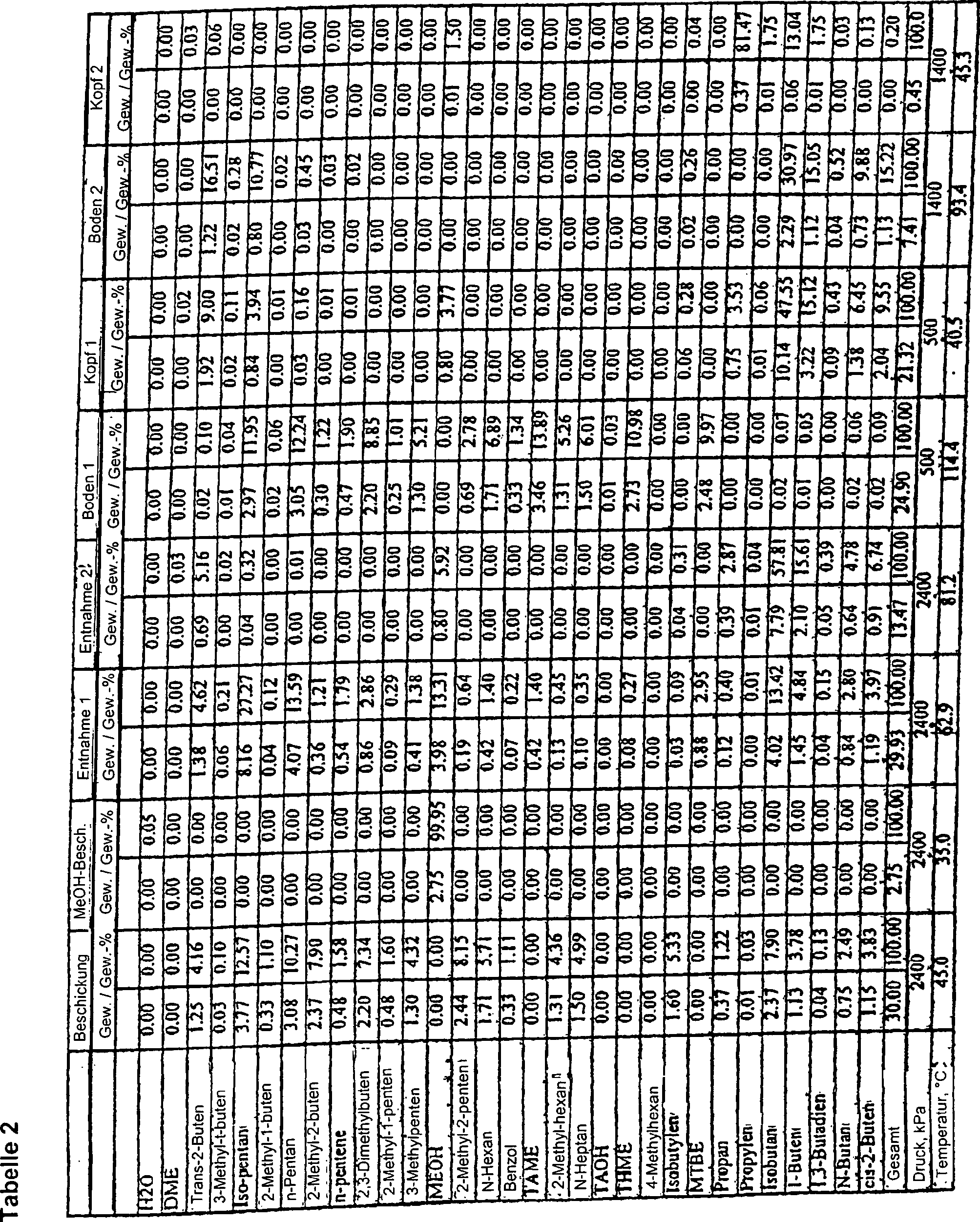
Mit der Verfahrensanordnung aus
FCC-C4-7-Fraktionen, enthalten 30 kg Kohlenwasserstoffe pro Stunde (Zusammensetzung wie in Tabelle 2 gezeigt) und Methanol (Menge wie in Tabelle 2 gezeigt), wurden miteinander vermischt und erwärmt. Dann wurden seitliche Abzweigungsströme aus den Destilliersäulen miteinander vereint, und der so gewonnene modifizierte Beschickungsstrom wurde durch die Reaktoren geleitet. Als Ergebnis der exothermen Etherifizierungsreaktion stieg die Temperatur in den Reaktoren um 1 bis 20°C an. Das erhaltene Gemisch wurde in die erste Destilliersäule geleitet und einer Destillation unterzogen. Das Kopfprodukt wurde in die zweiten Destilliersäule geleitet und einer weiteren Destillation unterzogen. Seitenströme wurden aus beiden Säulen entnommen.FCC-C 4-7 fractions containing 30 kg of hydrocarbons per hour (composition as shown in Table 2) and methanol (amount as shown in Table 2) were mixed together and heated. Lateral branch streams from the distillation columns were then combined and the modified feed stream thus obtained was passed through the reactors. As a result of the exothermic etherification reaction, the temperature in the reactors rose by 1 to 20 ° C. The resulting mixture was passed into the first distillation column and subjected to distillation. The top product was passed into the second distillation column and subjected to a further distillation. Side streams were taken from both pillars.
Die Beschickungstemperatur in jedem Reaktor betrug 40°C und die Temperaturen der Reaktorabflüsse waren 55, 45 bzw. 42°C.The loading temperature in each Reactor was 40 ° C and the temperatures of the reactor effluents were 55, 45 and 42 ° C, respectively.
Der Druck der seitlichen Entnahmeströme wurde mit Hilfe von Pumpen erhöht, bevor sie in die Reaktoren geleitet wurden.The pressure of the side withdrawal streams was increased with the help of pumps, before they were sent to the reactors.
Das Rückfluss-Verhältnis aus der ersten Destillationszone betrug 1,8 und der Druck 5 bar, wohingegen das Rückfluss-Verhältnis aus der zweiten Destillationszone 60 betrug und der Druck 14 bar.The reflux ratio the first distillation zone was 1.8 and the pressure 5 bar, whereas that Reflux ratio the second distillation zone was 60 and the pressure was 14 bar.
Die Zusammensetzungen und verschiedenen Ströme und Produkte sind in Tabelle 2 gezeigt.The compositions and various streams and products are shown in Table 2.
Beispiel 2Example 2
Herstellung von ETBEmanufacturing from ETBE
Mit der Verfahrensanordnung aus
FCC-C4-7Fraktionen, enthalten 30 kg Kohlenwasserstoffe pro Stunde (Zusammensetzung wie in Tabelle 3 gezeigt) und Ethanol (in einer Menge wie in Tabelle 3 gezeigt), wurden miteinander vermischt und erwärmt. Dann wurden seitliche Abzweigungsströme aus den Destilliersäulen miteinander vereint, und der so gewonnene modifizierte Beschickungsstrom wurde durch die Reaktoren geleitet. Als Ergebnis der exothermen Etherifizierungsreaktion stieg die Temperatur in den Reaktoren je nach Wirksamkeit der Wärmeisolierung, um 1 bis 20°C an. Das erhaltene Gemisch wurde in die erste Destilliersäule geleitet und einer Destillation unterzogen. Das Kopfprodukt wurde in die zweiten Destilliersäule geleitet und einer weiteren Destillation unterzogen. Seitenströme wurden aus beiden Säulen entnommen.FCC-C 4-7 fractions containing 30 kg of hydrocarbons per hour (composition as shown in Table 3) and ethanol (in an amount as shown in Table 3) were mixed together and heated. Lateral branch streams from the distillation columns were then combined and the modified feed stream thus obtained was passed through the reactors. As a result of the exothermic etherification reaction, the temperature in the reactors rose by 1 to 20 ° C depending on the effectiveness of the thermal insulation. The resulting mixture was passed into the first distillation column and subjected to distillation. The top product was passed into the second distillation column and subjected to a further distillation. Side streams were taken from both pillars.
Die Beschickungstemperatur der . Reaktoren betrug 40°C und die Temperatur der Reaktorabflüsse war 52, 45 bzw. 41°C.The loading temperature of the. Reactors was 40 ° C and the temperature of the reactor effluents were 52, 45 and 41 ° C, respectively.
Der Druck der seitlichen Entnahmeströme wurde, bevor diese in die Reaktoren geleitet wurden, mit Hilfe von Pumpen erhöht.The pressure of the side sampling flows was before they were fed into the reactors, using pumps elevated.
Das Rückfluss-Verhältnis aus der ersten Destillationszone betrug 1,8 und der Druck 5 bar, wohingegen das Rückfluss-Verhältnis aus der zweiten Destillationszone 60 und der Druck 16 bar betrug.The reflux ratio the first distillation zone was 1.8 and the pressure 5 bar, whereas that Reflux ratio the second distillation zone 60 and the pressure was 16 bar.
Die Zusammensetzungen und verschiedenen Ströme und Produkte sind in Tabelle 3 gezeigt.The compositions and various streams and products are shown in Table 3.

Beispiel 3Example 3
Herstellung von TAMEmanufacturing by TAME
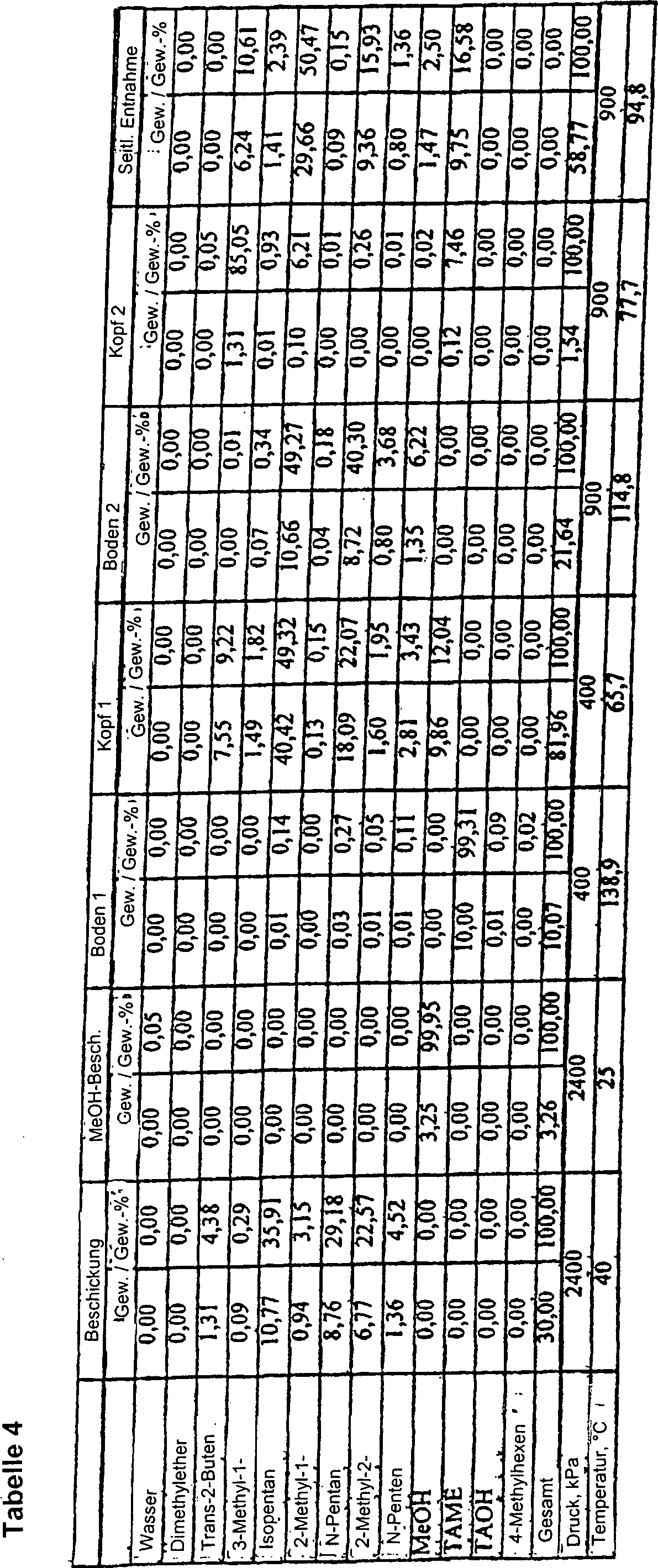
Bis auf folgende Änderungen wurde TAME aus einer FCC-C5-Fraktion durch Nacharbeiten von Beispiel 2 hergestellt.Except for the following changes, TAME became a FCC-C5 fraction prepared by reworking example 2.
Die Beschickungstemperatur der Reaktoren betrug 40°C und die Temperatur der Reaktorabflüsse war 58, 42 bzw. 40,5°C. Das Rückfluss-Verhältnis aus der ersten Destillationszone betrug 0,6 und der Druck 4 bar, wohingegen das Rückfluss-Verhältnis aus der zweiten Destillationszone 60 und der Druck 9 bar betrug.The reactor feed temperature was 40 ° C and the temperature of the reactor effluents were 58, 42 and 40.5 ° C, respectively. The reflux ratio the first distillation zone was 0.6 and the pressure was 4 bar, whereas the reflux ratio the second distillation zone 60 and the pressure was 9 bar.
Die Zusammensetzungen und verschiedenen Ströme und Produkte sind in Tabelle 4 gezeigt.The compositions and various streams and products are shown in Table 4.
Claims (33)
Applications Claiming Priority (3)
| Application Number | Priority Date | Filing Date | Title |
|---|---|---|---|
| FI960813 | 1996-02-22 | ||
| FI960813A FI101221B1 (en) | 1996-02-22 | 1996-02-22 | Process for the preparation of alkyl ethers and mixtures thereof |
| PCT/FI1997/000120 WO1997030960A1 (en) | 1996-02-22 | 1997-02-21 | Process for preparing alkyl ethers and mixtures thereof |
Publications (2)
| Publication Number | Publication Date |
|---|---|
| DE69721237D1 DE69721237D1 (en) | 2003-05-28 |
| DE69721237T2 true DE69721237T2 (en) | 2004-03-11 |
Family
ID=8545510
Family Applications (1)
| Application Number | Title | Priority Date | Filing Date |
|---|---|---|---|
| DE69721237T Expired - Lifetime DE69721237T2 (en) | 1996-02-22 | 1997-02-21 | METHOD FOR PRODUCING ALKYL ETHERS AND THEIR MIXTURES |
Country Status (17)
| Country | Link |
|---|---|
| US (1) | US5908964A (en) |
| EP (1) | EP0882006B1 (en) |
| JP (1) | JP2000504695A (en) |
| KR (1) | KR19990087117A (en) |
| CN (1) | CN1122011C (en) |
| AR (1) | AR005942A1 (en) |
| AU (1) | AU704729B2 (en) |
| BR (1) | BR9707603A (en) |
| CA (1) | CA2197947A1 (en) |
| DE (1) | DE69721237T2 (en) |
| ES (1) | ES2195115T3 (en) |
| FI (1) | FI101221B1 (en) |
| IN (1) | IN190207B (en) |
| MY (1) | MY121662A (en) |
| RU (1) | RU2167848C2 (en) |
| WO (1) | WO1997030960A1 (en) |
| ZA (1) | ZA971508B (en) |
Families Citing this family (16)
| Publication number | Priority date | Publication date | Assignee | Title |
|---|---|---|---|---|
| ES2222678T3 (en) * | 1998-10-16 | 2005-02-01 | Fortum Oil And Gas Oy | PROCESS FOR THE PRODUCTION OF A FUEL COMPONENT. |
| FI106955B (en) * | 1998-10-16 | 2001-05-15 | Fortum Oil & Gas Oy | Process for producing isooctane from an isobutylene hydrocarbon feed |
| RU2173312C2 (en) * | 1999-12-08 | 2001-09-10 | Общество с ограниченной ответственностью "Нефтехимстарт" | Method of preparing high-octane mixtures containing ethyl-tert-butyl ester |
| FI110262B (en) * | 2000-04-14 | 2002-12-31 | Fortum Oyj | Process for the preparation of ether |
| US6660898B1 (en) | 2000-11-03 | 2003-12-09 | Fortum Oil & Gas Oy | Process for dimerizing light olefins to produce a fuel component |
| US7074971B2 (en) * | 2003-03-06 | 2006-07-11 | Exxonmobil Chemical Patents Inc. | Recovery of ethylene and propylene from a methanol to olefin reaction system |
| US7102049B2 (en) * | 2003-06-25 | 2006-09-05 | Exxonmobil Chemical Patens Inc. | Process for operating a quench device in an oxygenate-to-olefin production unit |
| US7214846B2 (en) * | 2003-08-06 | 2007-05-08 | Exxonmobil Chemical Patents Inc. | Recovery of ethylene and propylene from a methanol to olefin reaction system |
| US7732648B2 (en) * | 2005-11-04 | 2010-06-08 | Amarjit Singh Bakshi | Multistage catalytic process for olefin etherification |
| ITMI20052198A1 (en) | 2005-11-17 | 2007-05-18 | Snam Progetti | PROCEDURE FOR THE SEPARATION OF C5 HYDROCARBONS PRESENT IN THE CURRENTS CONTAINING PREVIOUSLY C4 TO BE USED FOR THE PRODUCTION OF ALTO-OTHANIC HYDROCARBURIC COMPOUNDS BY SELECTIVE DIMERIZATION OF ISOBUTENE |
| ITMI20061390A1 (en) * | 2006-07-18 | 2008-01-19 | Snam Progetti | PROCEDURE FOR THE PRODUCTION OF ALCHYL ETHER BY ETERIFICATION OF ISOBUTENE |
| EP2022774B1 (en) | 2007-08-07 | 2010-03-10 | Research Institute of Petroleum Industry (RIPI) | A method for the production of dimethyl ehter |
| JP5614618B2 (en) * | 2010-02-09 | 2014-10-29 | 独立行政法人産業技術総合研究所 | Manufacturing method of ETBE |
| US8440871B2 (en) * | 2010-03-30 | 2013-05-14 | Uop Llc | Tetramer production apparatus and process relating thereto |
| EP2522424B1 (en) | 2011-05-09 | 2020-01-08 | King Abdulaziz City for Science and Technology | Supported nanocatalyst for conversion of monoolefins, process for conversion of monoolefins and process for preparing the nanocatalyst |
| FI130918B1 (en) * | 2022-08-26 | 2024-05-28 | Neste Oyj | Method and system for the production of ether |
Family Cites Families (5)
| Publication number | Priority date | Publication date | Assignee | Title |
|---|---|---|---|---|
| US4820877A (en) * | 1987-12-28 | 1989-04-11 | Mobil Oil Corporation | Etherification process improvement |
| RU2030383C1 (en) * | 1991-05-24 | 1995-03-10 | Акционерное общество - Научно-производственное предприятие "Ярсинтез" | Method for production of methyl-tert-butyl ether |
| FI92319C (en) * | 1992-03-18 | 1994-10-25 | Neste Oy | Process for the preparation of methyl ethers |
| FI92318C (en) * | 1992-03-18 | 1994-10-25 | Neste Oy | Method and apparatus for the preparation of tertiary ethers |
| US5248836A (en) * | 1992-10-16 | 1993-09-28 | Chemical Research & Licensing Company | Process for the preparation of ETBE |
-
1996
- 1996-02-22 FI FI960813A patent/FI101221B1/en active
-
1997
- 1997-02-17 IN IN285CA1997 patent/IN190207B/en unknown
- 1997-02-18 MY MYPI97000586A patent/MY121662A/en unknown
- 1997-02-19 CA CA002197947A patent/CA2197947A1/en not_active Abandoned
- 1997-02-19 US US08/803,177 patent/US5908964A/en not_active Expired - Lifetime
- 1997-02-21 ZA ZA9701508A patent/ZA971508B/en unknown
- 1997-02-21 EP EP97903419A patent/EP0882006B1/en not_active Expired - Lifetime
- 1997-02-21 KR KR1019980706507A patent/KR19990087117A/en not_active Withdrawn
- 1997-02-21 AR ARP970100697A patent/AR005942A1/en unknown
- 1997-02-21 DE DE69721237T patent/DE69721237T2/en not_active Expired - Lifetime
- 1997-02-21 ES ES97903419T patent/ES2195115T3/en not_active Expired - Lifetime
- 1997-02-21 CN CN97193993A patent/CN1122011C/en not_active Expired - Lifetime
- 1997-02-21 RU RU98117406/04A patent/RU2167848C2/en active
- 1997-02-21 AU AU17984/97A patent/AU704729B2/en not_active Ceased
- 1997-02-21 WO PCT/FI1997/000120 patent/WO1997030960A1/en not_active Ceased
- 1997-02-21 JP JP9528778A patent/JP2000504695A/en active Pending
- 1997-02-21 BR BR9707603A patent/BR9707603A/en not_active Application Discontinuation
Also Published As
| Publication number | Publication date |
|---|---|
| JP2000504695A (en) | 2000-04-18 |
| FI101221B (en) | 1998-05-15 |
| MY121662A (en) | 2006-02-28 |
| CN1220651A (en) | 1999-06-23 |
| ES2195115T3 (en) | 2003-12-01 |
| CN1122011C (en) | 2003-09-24 |
| FI960813A0 (en) | 1996-02-22 |
| CA2197947A1 (en) | 1997-08-22 |
| IN190207B (en) | 2003-06-28 |
| WO1997030960A1 (en) | 1997-08-28 |
| AU1798497A (en) | 1997-09-10 |
| DE69721237D1 (en) | 2003-05-28 |
| FI101221B1 (en) | 1998-05-15 |
| RU2167848C2 (en) | 2001-05-27 |
| ZA971508B (en) | 1997-09-03 |
| FI960813A7 (en) | 1997-08-23 |
| KR19990087117A (en) | 1999-12-15 |
| AU704729B2 (en) | 1999-04-29 |
| BR9707603A (en) | 1999-07-27 |
| EP0882006A1 (en) | 1998-12-09 |
| EP0882006B1 (en) | 2003-04-23 |
| US5908964A (en) | 1999-06-01 |
| AR005942A1 (en) | 1999-07-21 |
Similar Documents
| Publication | Publication Date | Title |
|---|---|---|
| DE69918017T2 (en) | Process for the preparation of a blowing agent component | |
| DE3880103T2 (en) | INTEGRATED METHOD FOR AETHERIFYING AND PRODUCING FUEL FROM OXYGEN-COMPOUNDS. | |
| DE69324580T2 (en) | METHOD FOR PRODUCING METHYL AND ETHYL ETHERS | |
| DE102005048931B4 (en) | Process and plant for the production of C 2 -C 4 olefins from methanol and / or dimethyl ether | |
| EP0082316B1 (en) | Process for the production of methyl tert-butyl ether (mtbe) and of hydrocarbon raffinates extensively delivered from i-butene and methanol and apparatus thereto | |
| EP1519906A1 (en) | Method for producing high-purity methyl tert-butyl ether | |
| WO2008138479A1 (en) | Method and system for producing synthetic fuels | |
| EP0882006B1 (en) | Process for preparing alkyl ethers and mixtures thereof | |
| EP0068218B1 (en) | Process for the preparation of pure alkyl-tert.-alkyl ethers and hydrocarbonaceous raffinates freed for the major part from isoolefines and alkanols | |
| DE1934422C3 (en) | Process for the separation of one or more tertiary monoolefins with four to seven carbon atoms in the molecule from hydrocarbon mixtures | |
| DE69622602T2 (en) | METHOD FOR PRODUCING ALKYL ETHERS AND THEIR MIXTURES | |
| DE69213163T2 (en) | Process for the separation of ethyl tert-butyl ether and ethanol | |
| DE69501640T2 (en) | Ether purification process containing two distillation steps | |
| DE69103312T2 (en) | Etherification of gasoline. | |
| DE2854250C2 (en) | Process for the production of petrol containing t-amyl methyl ether | |
| US5998675A (en) | Process for preparing tertiary alkyl ethers | |
| DE69415460T2 (en) | Process for the production of tertiary ethers from C4 or C5 raw materials, which contains extractive distillation | |
| EP1911736B1 (en) | Method for manufacturing alkyl tert. butyl ethers with optimised temperature control in the reactors | |
| DE69109910T2 (en) | Production of ethyl tertiary alkyl ethers. | |
| DE69602252T2 (en) | METHOD FOR PRODUCING ALKYL-TERTIARY ALKYL ETHERS | |
| DE3435936A1 (en) | METHOD AND DEVICE FOR PRODUCING AETHER | |
| DE69527131T2 (en) | Process for the preparation of diisopropyl ether | |
| DE3112277A1 (en) | METHOD FOR PRODUCING C (DOWN ARROW) 2 (DOWN ARROW) TO C (DOWN ARROW) 4 (DOWN ARROW) ALCOHOLS FROM THEIR AQUEOUS MIXTURES | |
| DE3223261A1 (en) | Process for the preparation of isopropanol | |
| MXPA98005076A (en) | Procedure for preparing eteres tertiary alkyl |
Legal Events
| Date | Code | Title | Description |
|---|---|---|---|
| 8364 | No opposition during term of opposition |