DE69822940T2 - Antistatic thermoplastic blend - Google Patents
Antistatic thermoplastic blend Download PDFInfo
- Publication number
- DE69822940T2 DE69822940T2 DE69822940T DE69822940T DE69822940T2 DE 69822940 T2 DE69822940 T2 DE 69822940T2 DE 69822940 T DE69822940 T DE 69822940T DE 69822940 T DE69822940 T DE 69822940T DE 69822940 T2 DE69822940 T2 DE 69822940T2
- Authority
- DE
- Germany
- Prior art keywords
- composition
- antistatic agent
- antistatic
- formula
- thermoplastic resin
- Prior art date
- Legal status (The legal status is an assumption and is not a legal conclusion. Google has not performed a legal analysis and makes no representation as to the accuracy of the status listed.)
- Expired - Lifetime
Links
Classifications
-
- C—CHEMISTRY; METALLURGY
- C08—ORGANIC MACROMOLECULAR COMPOUNDS; THEIR PREPARATION OR CHEMICAL WORKING-UP; COMPOSITIONS BASED THEREON
- C08K—Use of inorganic or non-macromolecular organic substances as compounding ingredients
- C08K5/00—Use of organic ingredients
- C08K5/49—Phosphorus-containing compounds
- C08K5/50—Phosphorus bound to carbon only
-
- Y—GENERAL TAGGING OF NEW TECHNOLOGICAL DEVELOPMENTS; GENERAL TAGGING OF CROSS-SECTIONAL TECHNOLOGIES SPANNING OVER SEVERAL SECTIONS OF THE IPC; TECHNICAL SUBJECTS COVERED BY FORMER USPC CROSS-REFERENCE ART COLLECTIONS [XRACs] AND DIGESTS
- Y10—TECHNICAL SUBJECTS COVERED BY FORMER USPC
- Y10S—TECHNICAL SUBJECTS COVERED BY FORMER USPC CROSS-REFERENCE ART COLLECTIONS [XRACs] AND DIGESTS
- Y10S524/00—Synthetic resins or natural rubbers -- part of the class 520 series
- Y10S524/91—Antistatic compositions
- Y10S524/912—Contains metal, boron, phosphorus, or silicon
Landscapes
- Chemical & Material Sciences (AREA)
- Health & Medical Sciences (AREA)
- Chemical Kinetics & Catalysis (AREA)
- Medicinal Chemistry (AREA)
- Polymers & Plastics (AREA)
- Organic Chemistry (AREA)
- Compositions Of Macromolecular Compounds (AREA)
- Optical Record Carriers And Manufacture Thereof (AREA)
Description
Diese Erfindung betrifft eine antistatische Harzzusammensetzung, insbesondere transparente Harzzusammensetzungen, die ein thermoplastisches Polymer und ein halogeniertes Kohlenstoffsulfonsäuresalz einer mehrfach substituierten Phosphoniumverbindung umfassen, und ein halogeniertes Kohlenstoffsulfonsäuresalz einer mehrfach substituierten Phosphoniumverbindung.These The invention relates to an antistatic resin composition, in particular transparent resin compositions that are a thermoplastic polymer and a halogenated carbon sulfonic acid salt of a polysubstituted Include phosphonium compound, and a halogenated carbon sulfonic acid salt a multiply substituted phosphonium compound.
Viele Polymere und Polymerblends sind relativ nichtleitend. Dies kann, als solches, zum Aufbau einer statischen Ladung während der Verarbeitung und der Verwendung des Polymers führen. Die geladenen Polymerformteile können Staub anziehen, welches kleine Partikel sind, und so die glatte Oberflächenerscheinung beinträchtigen. Die an die Oberfläche eines Formartikels angezogenen Partikel können auch eine Abnahme der Transparenz des Artikels bewirken. Weiterhin kann die elektrostatische Ladung ein ernsthaftes Hindernis bei dem Herstellungsprozess solcher Polymere sein. In der Vergangenheit wurden elektrisch leitfähige Mittel, wie beispielsweise Kohlenstoff- und metallische Partikel oder Tenside, in vielen, verschiedenen Versuchen verwendet, um die elektrostatische Aufladung der synthetischen, makromolekularen Materialien durch ihr inneres Vermischen oder durch Beschichtung des Materials mit einem Mittel zu verringern. Diese Verfahren, welche elektrisch leitfähige Mittel verwenden, sind aus vielen Gründen, wie beispielsweise den großen Mittelmengen, die üblicherweise verwendet werden müssen, den Schwierigkeiten bei ihrer Zugabe zu dem Material, den Schwierigkeiten beim Erhalten eines transparenten Produktes oder der Abnahme mechanischer oder rheologischer Eigenschaften, falls dies der Fall ist, und den hohen Kosten solcher leitfähiger Mittel. Daher können diese Mittel nur in begrenzten Situationen verwendet werden.Lots Polymers and polymer blends are relatively non-conductive. This can, as such, to build up a static charge during the Processing and use of the polymer. The charged polymer moldings can Attract dust, which are small particles, and so the smooth Interfere with surface appearance. The to the surface of a molded article can also cause a decrease in the Transparency of the article effect. Furthermore, the electrostatic Charging a serious obstacle in the manufacturing process such Be polymers. In the past, electrically conductive means, such as for example carbon and metallic particles or surfactants, used in many, different experiments to the electrostatic Charging of synthetic, macromolecular materials their internal mixing or by coating the material with to reduce an agent. These methods, which are electrically conductive means use, are for many reasons like the big one Medium quantities, usually must be used the difficulties in their addition to the material, the difficulties while getting a transparent product or taking off mechanical or rheological properties, if that is the case, and the high cost of such conductive Medium. Therefore, these can Means be used only in limited situations.
Antistatikmittel sind Materialien, welche den Polymeren zugegeben werden, um ihre Neigung zu vermindern, sich elektrisch aufzuladen, oder, wenn eine Ladung vorliegt, fördern diese Antistatikmittel die Dissipation dieser Ladung. Die Antistatikmittel sind ihrer Natur nach üblicherweise hydrophil oder ionisch. Wenn sie auf der Oberfläche der polymeren Materialien vorliegen, erleichtern sie den Elektronentransfer und eliminieren so den Aufbau einer statischen Ladung. Antistatikmittel wurden auf zweierlei Weise angewendet. Ein Verfahren verwendet externe Antistatikmittel, die durch Besprühen der Oberfläche oder durch Eintauchen des polymeren Materials aufgebracht werden. Das zweite Verfahren verwendet interne Antistatikmittel, welche dem Polymer vor der Verarbeitung zugegeben werden. Für Antistatikmittel, welche auf diese Weise aufgebracht werden, ist es notwendig, dass sie thermisch stabil und in der Lage sind, während der Verarbeitung an die Oberfläche zu migrieren.Antistatic agents are materials which are added to the polymers to their To reduce the tendency to charge electrically or, if one Charge present, promote this antistatic agent is the dissipation of this charge. The antistatic agent are by their nature common hydrophilic or ionic. When they are on the surface of the polymeric materials present, they facilitate the electron transfer and eliminate so the construction of a static charge. Antistatic agents were on applied in two ways. One method uses external antistatic agents, by spraying the surface or by dipping the polymeric material. The second method uses internal antistatic agents which be added to the polymer before processing. For antistatic agents, which are applied in this way, it is necessary that they are thermally stable and capable of being applied to the surface to migrate.
Da es viele Antistatikmittel gibt, welche Tenside als ihren Hauptbestandteil aufweisen, können gemäß der Situation geeignete gewählt werden. In der Tat wurden viele der intern zugegebenen Typen berücksichtigt und ausprobiert. Anionische Tenside sind jedoch schwierig zu handhaben, wenn sie als intern eingebrachte Antistatikmittel verwendet werden, weil sie bzgl. der Verträglichkeit und der einheitlichen Dispersibilität unterlegen sind und zur Zersetzung oder zur Veränderung beim Erwärmen neigen. Kationische Tenside, die quartären Stickstoff in ihren Molekülen enthalten, und amphotere Tenside können demgegenüber nur in begrenzten Situationen verwendet werden, weil sie eine extrem schlechte Wärmebeständigkeit aufweisen, obwohl ihre Antistatikeigenschaften gut sind. Die nicht-ionischen Tenside sind den zuvor genannten ionischen Tensiden bezüglich der Kompatibilität mit synthetischen makromolekularen Materialien überlegen, neigen jedoch dazu, bei den Antistatikeigenschaften schwach zu sein, und ihre Effekte verschwinden mit der Zeit bei normalen und hohen Temperaturen. Darüber hinaus ist wegen der begrenzten thermischen Stabilität dieser nicht-ionischen Tensid-Antistatikmittel ihre Verwendung mit technischen, thermoplastischen Harzen, wie beispielsweise aromatischen Polycarbonaten, ebenfalls wegen den Temperaturen begrenzt, bei welchen derartige Harze verarbeitet werden. So beeinflussen diese Tensidtypen die optischen Eigenschaften der aromatischen Polycarbonate nachteilig. Obwohl Metallsalze organischer Sulfonsäuren als intern eingebrachte Antistatikmittel für Polycarbonat- und Polyesterharze beschrieben wurden, welche bei hohen Temperaturen geformt werden, sind sie nicht hinreichend bezüglich der Kompatibilität mit den Harzen oder der Wärmebeständigkeit. Eine nachteilige Konsequenz der unzureichenden Kompatibilität ist die, dass die Transparenzeigenschaften gewisser makromolekularer Materialien, wie beispielsweise von Polycarbonaten, mit derartigen Antistatikmittel verloren werden. Es wurde auch die Verwendung von Phosphoniumsalzen oder organischen Sulfonsäuren mit Halogensubstituenten als Flammhemmer berichtet (U.S. Patent Nr. 4 093 589), aber es wird davon ausgegangen, dass sie auch als Antistatikmittel dienen.There There are many antistatic agents which surfactants as their main ingredient may have according to the situation suitable chosen become. In fact, many of the internally added types were considered and tried out. However, anionic surfactants are difficult to handle, when used as internally applied antistatic agents, because they respect the compatibility and the uniform dispersibility are inferior and decomposition or to change when heating tend. Cationic surfactants containing quaternary nitrogen in their molecules and amphoteric surfactants In contrast, only be used in limited situations because they are an extreme poor heat resistance although their antistatic properties are good. The non-ionic Surfactants are the aforementioned ionic surfactants with respect to compatibility superior to synthetic macromolecular materials, however, tend to to be weak in antistatic properties, and their effects disappear over time at normal and high temperatures. Furthermore is because of the limited thermal stability of these nonionic surfactant antistatic agents their use with engineering thermoplastic resins such as aromatic polycarbonates, also limited by temperatures, in which such resins are processed. So influence These types of surfactants are detrimental to the optical properties of the aromatic polycarbonates. Although metal salts of organic sulfonic acids are introduced as internally Antistatic agent for Polycarbonate and polyester resins have been described which at are formed at high temperatures, they are not sufficient in terms of compatibility with the resins or the heat resistance. A disadvantageous consequence of the insufficient compatibility is the that the transparency properties of certain macromolecular materials, such as polycarbonates, with such antistatic agents to be lost. It has also been the use of phosphonium salts or organic sulfonic acids with halogen substituents reported as flame retardants (U.S. No. 4 093 589), but it is assumed that they are also called Antistatic agents serve.
Ein
weiteres Patent offenbart die Verminderung der statischen Ladung
auf Polycarbonatharzen. Dies ist U.S. Patent Nr. 4 943 380, welches
eine Antistatikzusammensetzung offenbart, die 90–99,9 Gew.-% (Gewichtsprozent)
Polycarbonat und 0.1–10
Gew.-% eines wärmebeständigen Phosphoniumsulfonats
der allgemeinen Formel: 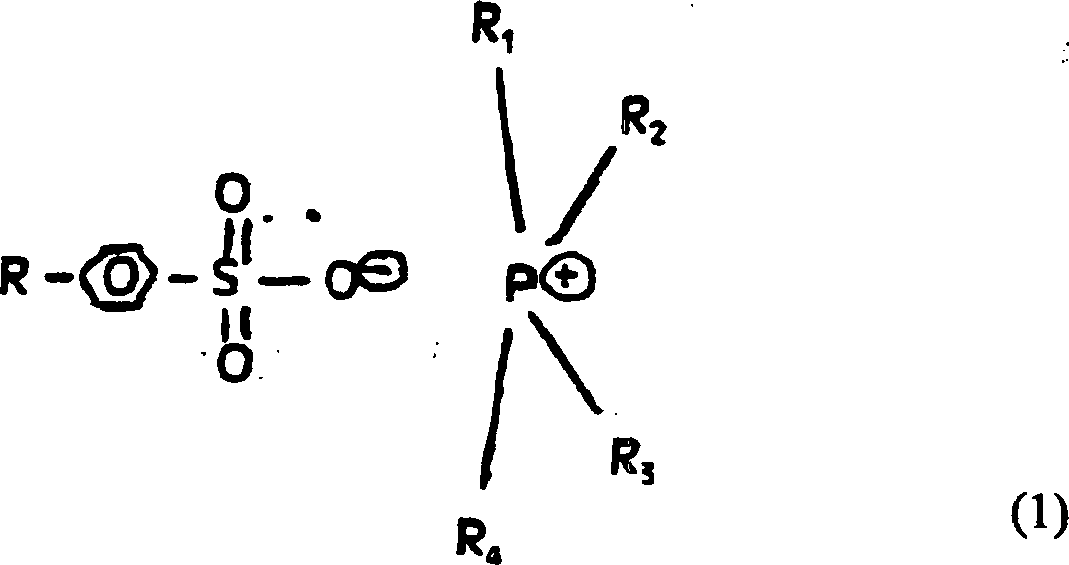
Es ist daher ein Ziel der vorliegenden Erfindung, eine Antistatik- Harzzusammensetzung bereitzustellen, die solche Polymere, wie beispielsweise Polycarbonat, Polyetherimid, Polyester, Polyphenylenether/Polystyrolblends, Polyamide, Polyketone, Acrylnitril-Butadien-Styrol (ABS) oder Blends dieser Polymere oder Blends davon mit anderen Materialien oder Polymeren und ein wärmebeständiges Antistatikmaterial enthält, mit dem die zuvor genannten Probleme konventioneller Mittel eliminiert werden können.It It is therefore an object of the present invention to provide an antistatic resin composition provide such polymers, such as polycarbonate, Polyetherimide, polyesters, polyphenylene ethers / polystyrene blends, polyamides, Polyketones, acrylonitrile-butadiene-styrene (ABS) or blends of these Polymers or blends thereof with other materials or polymers and a heat-resistant antistatic material contains, with which eliminates the aforementioned problems of conventional means can be.
Es ist ein weiteres Ziel dieser Erfindung, ein neues Antistatikmittel zur Verfügung zu stellen, welches einem synthetischen Harz intern zugegeben werden kann und welches vorzugsweise im verformten Zustand transparente Eigenschaften besitzt ohne die Transparenz- und die mechanischen Eigenschaften des verformten Artikels nachteilig zu beeinflussen. Jedoch ist diese Erfindung nicht auf transparente Thermoplasten beschränkt, da die antistatischen Anforderungen auch auf pigmentierte oder transluzente, verformte, thermoplastische Polymerartikel anwendbar sind.It Another object of this invention is a new antistatic agent to disposal which are internally added to a synthetic resin can and which preferably transparent in the deformed state Features without the transparency and the mechanical properties Properties of the deformed article adversely affect. However, this invention is not limited to transparent thermoplastics limited, because the antistatic requirements also apply to pigmented or translucent, deformed, thermoplastic polymer articles are applicable.
Detaillierte Beschreibung der Erfindungdetailed Description of the invention
Kurz
gesagt wurde gefunden, dass gemäß der vorliegenden
Erfindung relativ geringe Mengen gewisser wärmebeständiger, substituierter Phosphoniumsalze
von mittelkettigen und kurzkettigen halogenierten Fluorocarbonsulfonsäuren (ungefähr 0,05–10 Gew.-%,
vorzugsweise ungefähr
0,2–1,5
Gew.-% und besonders bevorzugt ungefähr 0,5 – 1,5 Gew.-%) als interne Antistatikmittel
in Polycarbonat, Polyetherimid, Polyester, Polyphenylenether/Polystyrolblend,
Polyamide, Polyketone, ABS oder Blends dieser Polymerharze (ungefähr 90–99,95 Gew.-%,
vorzugsweise ungefähr
98,5–99,8
Gew.-% und besonders bevorzugt ungefähr 98,5–99,5 Gew.-%) verwendet werden
können,
wobei sich die Gewichtsprozente auf das Gesamtgewicht des Polymers
und des Additivs beziehen. Im allgemeinen haben die substituierten
Phosphoniumsalze der mittelkettigen und kurzkettigen Sulfonsäure die
allgemeine Formel: 
Das Phosphoniumsulfonat ist vorzugsweise ein fluoriertes Phosphoniumsulfonat und setzt sich aus einem Fluorkohlenstoff zusammen, welcher ein organisches Sulfonatanion und ein organisches Phosphoniumkation enthält. Beispiele derartiger organischer Sulfonatanionen beinhalten Perfluoromethansulfonat, Perfluorobutansulfonat, Perfluorohexansulfonat, Perfluoroheptansulfonat und Perfluorooktansulfonat. Beispiele der zuvor genannten Phosphoniumkationen beinhalten aliphatisches Phosphonium, wie beispielsweise Tetramethylphosphonium, Tetraethylphosphonium, Tetrabutylphosphonium, Triethylmethylphosphonium, Tributylmethylphosphonium, Tributylethylphosphonium, Trioctylmethylphosphonium, Trimethylbutylphosphonium, Trimethyloctylphosphonium, Trimethyllaurylphosphonium, Trimethylstearylphosphonium, Triethyloctylphosphonium, und aromatische Phosphoniums, wie beispielsweise Tetraphenylphosphonium, Triphenylmethylphosphonium, Triphenylbenzylphosphonium, Tributylbenzylphosphonium.The Phosphonium sulfonate is preferably a fluorinated phosphonium sulfonate and is composed of a fluorocarbon, which is a organic sulfonate anion and an organic phosphonium cation contains. Examples of such organic sulfonate anions include perfluoromethanesulfonate, Perfluorobutanesulfonate, Perfluorohexansulfonat, Perfluoroheptansulfonat and perfluorooctane sulfonate. Examples of the aforementioned phosphonium cations include aliphatic phosphonium, such as tetramethyl phosphonium, Tetraethylphosphonium, tetrabutylphosphonium, triethylmethylphosphonium, Tributylmethylphosphonium, tributylethylphosphonium, trioctylmethylphosphonium, Trimethylbutylphosphonium, trimethyloctylphosphonium, trimethyllaurylphosphonium, Trimethylstearylphosphonium, triethyloctylphosphonium, and aromatic Phosphonium, such as tetraphenylphosphonium, triphenylmethylphosphonium, triphenylbenzylphosphonium, Tributylbenzyl.
Die fluorierten Phosphoniumsulfonate der vorliegenden Erfindung können durch irgendeine Kombination irgendwelcher dieser organischen Sulfonatanionen und organischen Kationen erhalten werden, aber diese Erfindung ist nicht durch die zuvor gegebenen Beispiele begrenzt. Fluorierte Phosphoniumsulfonate können in einer sehr reinen Form durch Mischen der entsprechenden Sulfonsäure und des quartären Phosphoniumhydroxids in einer Lösungsmittelmischung, gefolgt von der Verdampfung der Lösungsmittelmischung hergestellt werden. Tetrabutylphosphoniumperfluorobutansulfonat kann beispielsweise mit einer Ausbeute von ungefähr 95% durch Einbringen von 98,6 g Perfluorobutansulfonsäure, 200 ml einer 40 Gew.-%igen Lösung von Tetrabutylphosphoniumhydroxid und 500 ml einer Lösungsmittelmischung in einen Kolben, Rühren der Mischung für eine Stunde bei Raumtemperatur, Isolieren des Phosphoniumsulfonates, welches sich als eine ölige Schicht abtrennt, sein Waschen mit 100 ml Wasser, gefolgt von dem Verdampfen der Lösungsmittel unter Verwendung einer Vakuumpumpe hergestellt werden.The Fluorinated phosphonium sulfonates of the present invention may be obtained by any combination of any of these organic sulfonate anions and organic cations, but this invention is not limited by the examples given above. Fluorinated phosphonium sulfonates can in a very pure form by mixing the corresponding sulfonic acid and of the quaternary Phosphonium hydroxide in a solvent mixture, be made followed by evaporation of the solvent mixture. For example, tetrabutylphosphonium perfluorobutanesulfonate with a yield of approximately 95% by introducing 98.6 g of perfluorobutanesulfonic acid, 200 ml of a 40% by weight solution of tetrabutylphosphonium hydroxide and 500 ml of a solvent mixture in a flask, stirring the mix for one hour at room temperature, isolating the phosphonium sulfonate, which turns out to be an oily layer separating, washing with 100 ml of water, followed by evaporation the solvent be made using a vacuum pump.
Wie
gesagt, ist das hierin bevorzugt verwendete Phosphoniumsulfonat
ein fluoriertes Phosphoniumsulfonat der allgemeinen Formel: 
Ein gebräuchlicher Weg, um dieses Verfahren auszuführen, besteht in der direkten Zugabe des Mittels und seinem Vermischen während der Polymerherstellung oder Fabrikation. Es kann auf konventionelle Art und Weise verarbeitet werden, welches die Extrusion, das Einspritzen, das Verformen, das Pressformen oder das Gießen beinhaltet. Die Menge des Phosphoniumfluorocarbonsulfonatsalzes, welches dem Polycarbonat, Polyetherimid, Polyester, Polyphenylenether/Polystyrolblends, Polyamiden, Polyketonen, ABS oder den Blends dieser Polymere zugegeben wird, ist eine Menge, die in der Lage ist, die statische Ladung zu reduzieren oder zu eliminieren und die über einen weiten Bereich variiert werden kann. Es wurde gefunden, dass, falls zu wenig des antistatischen, substituierten Phosphoniumfluorocarbonsulfonatsalzes dem Harz zugegeben wird, es weiterhin eine Tendenz geben kann, das sich statische Ladung auf dem aus dem Harz hergestellten Artikel bilden kann. Falls die Beladung des antistatischen Additivs zu groß wird, ist die Zugabe dieser Mengen unökonomisch und kann bei einem bestimmten Niveau anfangen, andere Eigenschaften des Harzes nachteilig zu beeinflussen. Beispielsweise ist es, um ein vorteilhaftes Ergebnis durch ein solches internes Anwendungsverfahren bei transparenten Polycarbonattypen zu erhalten, bevorzugt, ein Mittel der vorliegenden Erfindung in einer Menge von 0,1 bis 1,5 Gew.-%, bezogen auf die Formkörperzusammensetzung, zuzugeben, und es ist besonders bevorzugt, dies in einer Menge von 0,4 bis 0,8 Gew.-% zu tun. Die Antistatikmittel der vorliegenden Erfindung sind wärmebeständiger und können in geringeren Mengen als konventionelle ionische Tenside, beispielsweise Phosphoniumalkylsulfonate, zugegeben werden und die Harzzusammensetzungen haben eine gute Transparenz und gute mechanische Eigenschaften.A common way to carry out this process is to add the agent directly and mix it during polymer preparation or fabrication. It can be processed in a conventional manner involving extrusion, injection, molding, compression molding or casting. The amount of the phosphonium fluorocarbon sulfonate salt which is the polycarbonate, polyetherimide, polyester, polyphenylene ether / polystyrene blends, polyamides, polyketones, ABS or the blends added to these polymers is an amount capable of reducing or eliminating the static charge and which can be varied over a wide range. It has been found that if too little of the antistatic, substituted phosphonium fluorocarbon sulfonate salt is added to the resin, there can still be a tendency for static charge to form on the article made from the resin. If the loading of the antistatic additive becomes too great, the addition of these amounts is uneconomical and may, at some level, begin to adversely affect other properties of the resin. For example, in order to obtain a favorable result by such an internal application method in transparent polycarbonate types, it is preferable to add an agent of the present invention in an amount of 0.1 to 1.5% by weight based on the molded article composition, and it is particularly preferable to do so in an amount of 0.4 to 0.8% by weight. The antistatic agents of the present invention are more heat resistant and can be added in smaller amounts than conventional ionic surfactants, for example, phosphonium alkyl sulfonates, and the resin compositions have good transparency and good mechanical properties.
Detaillierte Beschreibung der Erfindungdetailed Description of the invention
Diese Erfindung kann durch die folgenden Beispiele weiter beschrieben werden. Es sollte jedoch verstanden werden, dass diese Erfindung in keiner Weise durch diese Beispiele beschränkt werden soll. In den Beispielen sind Angaben in Prozent, Angaben in Gew.-%.These Invention may be further described by the following examples become. It should be understood, however, that this invention should not be limited in any way by these examples. In the examples are figures in percent, data in wt .-%.
Die folgenden zwei Testverfahren wurden verwendet, um die Proben hinsichtlich des antistatischen Verhaltens zu untersuchen. Dies waren der Staubanziehungstest, statische Ladungsmessungen und der spezifische Oberflächenwiderstand durch statische Ladungsmessungen.The Following two test procedures were used to test the samples of antistatic behavior. These were the dust attraction test, static charge measurements and surface resistivity by static charge measurements.
StaubanziehungstestDust attraction test
Bei transparenten Polycarbonartikeln wurde eine Staubanziehung erzeugt. Bei diesem Verfahren werden mehrere farbige Platten in einen Exikator für 60 Minuten getan, welcher mit einem in situ hergestellten NH4Cl-Staub gesättigt wurde. Die Staubkammer wurde für eine Stunde equilibriert, bevor die Proben eingebracht wurden. Nach einer Stunde wurden die Proben entfernt und Bilder der farbigen Platten zusammen mit einem Referenzmaterial unter Verwendung einer Projektionslampe als Lichtquelle gemacht. Die Platten wurden visuell hinsichtlich der Erscheinung gegenüber einer Polycarbonatreferenzplatte untersucht, welche kein Antistatikmittel enthielt.With transparent polycarbonate articles, a dust attraction was produced. In this procedure, several colored plates are placed in a desiccator for 60 minutes, which was saturated with an NH 4 Cl dust prepared in situ. The dust chamber was equilibrated for one hour before the samples were introduced. After one hour, the samples were removed and images of the colored plates were made along with a reference material using a projection lamp as the light source. The plates were visually inspected for appearance against a polycarbonate reference plate containing no antistatic agent.
Spezifischer OberflächenwiderstandSpecific surface resistance
Die Messungen zum spezifischen Oberflächenwiderstand wurden bei 55°C gemacht, weil bei Raumtemperatur die spezifische Widerstandswerte Werte im Bereich von 1017–1018 Ohm haben, in welchem Bereich exakte Ergebnisse schwierig zu erhalten sind. Daher haben die spezifischen Widerstandswerte bei einer Temperatur von 55°C Werte im Bereich von 1013–1014 Ohm.The surface resistivity measurements were made at 55 ° C because at room temperature the resistivity values are in the range of 10 17 -10 18 ohms, in which range exact results are difficult to obtain. Therefore, the resistivity values at a temperature of 55 ° C have values in the range of 10 13 -10 14 ohms.
Zusätzlich zu
den obigen Tests wurden die folgenden Tests auch durchgeführt:
Beispiel 1example 1
Dieses Beispiel beschreibt die Herstellung eines fluorierten Phosphoniumsulfonates dieser Erfindung.This Example describes the preparation of a fluorinated phosphonium sulfonate this invention.
Kaliumperfluorobutylsulfonat wurde als Ausgangsmaterial verwendet. Das Kalium (K+-Ion) wurde zunächst durch ein H+-Ion unter Verwendung einer Ionenaustauschersäule (Rohm & Haas, Amberjet 1200H) ausgetauscht. Ein zweiter, bei diesem Verfahren verwendeter Schritt war eine Säurebasereaktion unter Verwendung einer Fluorocarbonschwanz-Sulfonsäure und Tetrabutylphosphoniumhydroxid, welche mit hoher Ausbeute und hoher Reinheit fluoriertes Phosphoniumsulfonat lieferte. Die Reaktion ist wie folgt:Potassium perfluorobutylsulfonate was used as starting material. The potassium (K + ion) was first exchanged for an H + ion using an ion exchange column (Rohm & Haas, Amberjet 1200H). A second step used in this process was an acid-bahase reaction using a fluorocarbon tartaric acid and tetrabutylphosphonium hydroxide which yielded fluorinated phosphonium sulfonate in high yield and high purity. The reaction is as follows:

Beispiel 1example 1
Dieses Beispiel beschreibt die Herstellung eines fluorierten Phosphoniumsulfonates dieser Erfindung.This Example describes the preparation of a fluorinated phosphonium sulfonate this invention.
Kalium-nona-fluoro-ethoxyethylsulfonat wurde als Ausgangsmaterial verwendet. Das Kalium (K+-Ion) wurde zunächst durch ein H+-Ion unter Verwendung einer Ionenaustauschersäule (Rohm & Haas, Amberjet 1200H) ausgetauscht. Ein zweiter, bei diesem Verfahren verwendeter Schritt, war eine Säure-Base-Reaktion unter Verwendung einer Fluorocarbonschwanz-Sulfonsäure und Tetrabutylphosphoniumhydroxid, welche fluoriertes Phosphoniumsulfat in hoher Ausbeute und hoher Reinheit lieferte.Potassium nona-fluoroethoxyethyl sulfonate was used as the starting material. The potassium (K + ion) was first exchanged for an H + ion using an ion exchange column (Rohm & Haas, Amberjet 1200H). A second step used in this process was an acid-base reaction using a fluorocarbon tartaric acid and tetrabutylphosphonium hydroxide which yielded fluorinated phosphonium sulfate in high yield and high purity.
Die erhaltene Verbindung hatte die folgende Formel:The obtained compound had the following formula:

Beispiel 3Example 3
Dieses Beispiel beschreibt die Herstellung eines fluorierten Phosphoniumsulfonates dieser Erfindung.This Example describes the preparation of a fluorinated phosphonium sulfonate this invention.
Zonyl-TBS (DuPont), welches eine Mischung aus verschiedenen Fluorkohlenstoffen, die Sulfonsäuren enthalten, und Fluorkohlenstoffen ist, die Ammoniumsulfonate enthalten, wurde als das Ausgangsmaterial verwendet. Das Ammonium (NH+ 4 wurde zunächst durch ein H+-Ion unter Verwendung einer Ionenaustauschersäule (Rohm & Haas, Amberjet 1200H) ausgetauscht. Ein zweiter, bei diesem Verfahren verwendeter Schritt war eine Säure-Base-Reaktion unter Verwendung der Mischung aus Fluorocarbonschwanz enthaltenden Sulfonsäuren und Tetrabutylphosphoniumhydroxid. Die erhaltene Verbindungsmischung bestand aus den folgenden Komponenten, wobei y eine ganze Zahl von 1 bis 9 ist.Zonyl-TBS (DuPont), which is a mixture of various fluorocarbons containing sulfonic acids and fluorocarbons containing ammonium sulfonates, was used as the starting material. The ammonium (NH + 4 was first exchanged for an H + ion using an ion exchange column (Rohm & Haas, Amberjet 1200H) A second step used in this process was an acid-base reaction using the fluorocarbon tail-containing mixture Sulfonic acids and tetrabutyl phosphonium hydroxide The compound mixture obtained consisted of the following components, wherein y is an integer of 1 to 9.

Beispiel 4Example 4
Die antistatischen Eigenschaften des fluorierten Phosphoniumsulfonates des obigen Beispiels 1 wurden bestimmt, indem man ein transparentes aromatisches Polycarbonatharz mit einer intrinsischen Viskosität von ungefähr 0,46 Deziliter pro Gramm (dl/g), gemessen in Methylenchlorid bei 20°C in einem Doppelschneckenextruder bei einer Temperatur von ungefähr 285°C mit dem Antistatikmittel in der Schmelze blendet, durch eine Düsenöffnung zu Strängen extrudiert, welche in Wasser abgeschreckt und dann pelletisiert werden. Die Pellets werden bei ungefähr 125°C für ungefähr 2 Stunden getrocknet. Die getrockneten Pellets werden zu Platten von ungefähr 10 cm im Quadrat und einer Dicke von ungefähr 2,5 mm bei einer Spritzgusstemperatur von ungefähr 285°C unter Verwendung einer Einschneckenspritzgussmaschine spritzgegossen. Offensichtlich wurde das Temperaturprofil über das Spritzgussgehäuse (injection molding barrel) auf einen ultimativen Wert von ungefähr 285°C variiert. Bei diesem Beispiel variierte die Gehäusetemperatur (barrel temperature) von ungefähr 20°C bis ungefähr 285°C. Jede in der untigen Tabelle 1 dargestellte Zusammensetzung wurde unter den gleichen Bedingungen, wie zuvor beschrieben, hergestellt, wobei der Polycarbonatgehalt in Bezug auf die Konzentration des Antistatikmittels, welches in jeder Formulierung vorlag, variierte. Jede Formulierung enthielt auch die gleiche Menge an Entformungsmittel, UV-Absorber, Stabilisatoren, Antioxidanz und Farbstoff, deren Gesamtmenge war ungefähr 0,8 Gew.-% des verwendeten Polycarbonates war. Die erhaltenen Ergebnisse waren wie folgt:The antistatic properties of the fluorinated phosphonium sulfonate of Example 1 above were determined by taking a transparent aromatic polycarbonate resin having an intrinsic viscosity of about 0.46 Deciliters per gram (dl / g), measured in methylene chloride at 20 ° C in one Twin-screw extruder at a temperature of about 285 ° C with the Antistatic agent in the melt fades through a nozzle opening strands extruded, which quenched in water and then pelletized become. The pellets are dried at about 125 ° C for about 2 hours. The dried pellets become plates about 10 cm square and one Thickness of about 2.5 mm at an injection molding temperature of about 285 ° C using a single screw injection molding machine injection molded. Obviously, the temperature profile over the Molded case (injection molding barrel) varies to an ultimate value of about 285 ° C. In this example, the barrel temperature varied of about 20 ° C to approximately 285 ° C. each Composition shown in Table 1 below was included among same conditions as described above, wherein the polycarbonate content with respect to the concentration of the antistatic agent, which was present in each formulation varied. Every formulation also contained the same amount of release agent, UV absorber, Stabilizers, antioxidant and dye whose total amount was approximately 0.8 wt .-% of the polycarbonate used. The results obtained were as follows:
Tabelle
1 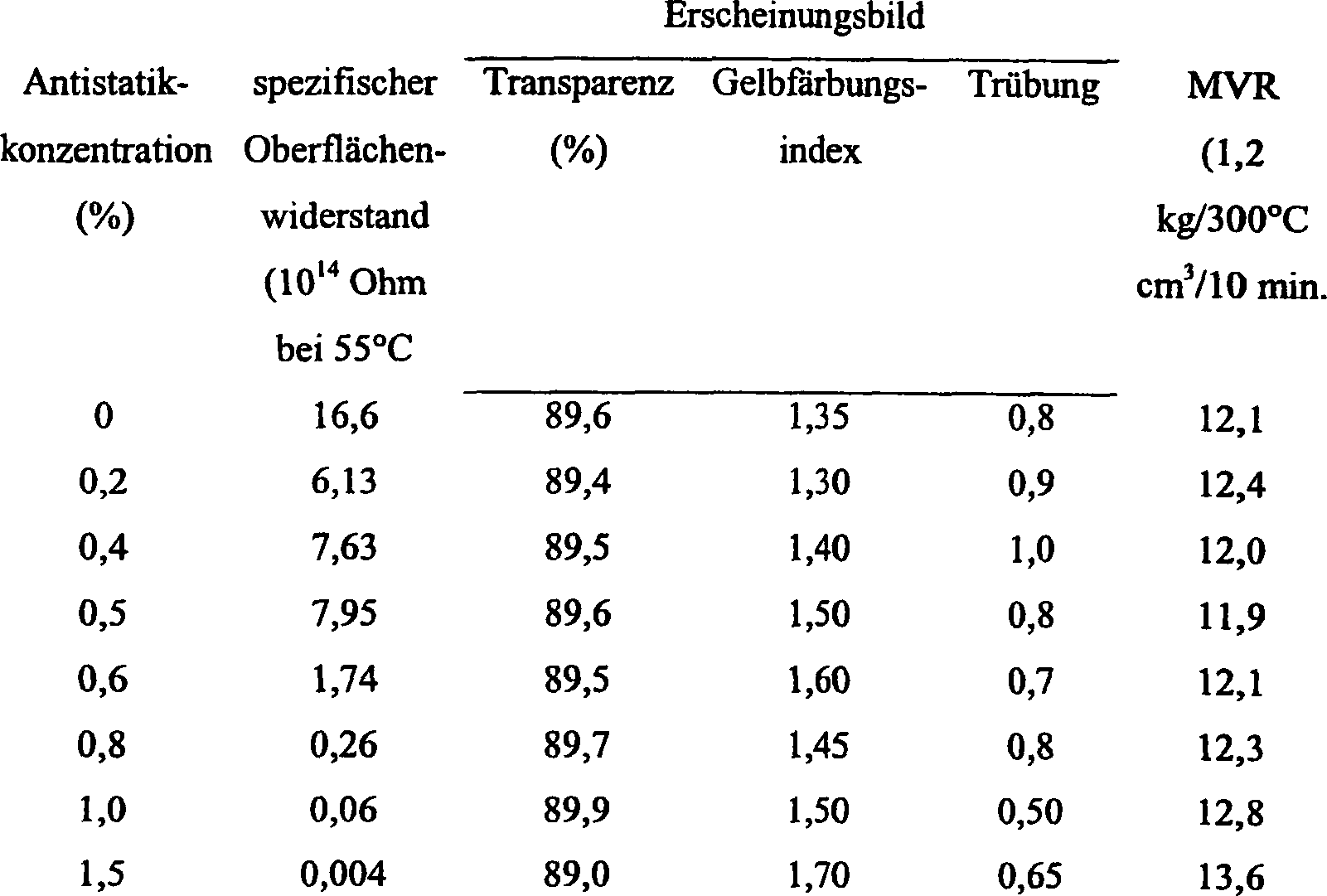
Die Ergebnisse zeigen klar die exzellenten antistatischen Eigenschaften der Zusammensetzung dieser Erfindung, wie beispielsweise durch die Ergebnisse des spezifischen Oberflächenwiderstandes und der Transparenz ohne Beeinflussung der Transparenz oder Farbe gezeigt wird.The Results clearly show the excellent antistatic properties the composition of this invention, such as by the Results of surface resistivity and transparency without affecting transparency or color.
Beispiel 5Example 5
Die
Formulierungen von Beispiel 4 wurden unter falschen (missbräuchlichen;
abusive) Verformungsbedingungen verformt, d. h. die Verformungstemperatur
des Beispiels 4 + 20°C
und eine Abkühlzeit
von 120 Sekunden, verglichen zur normalen Abkühlzeit in Beispiel 4 von 20
Sekunden. Die erhaltenen Ergebnisse waren wie folgt: Tabelle
2 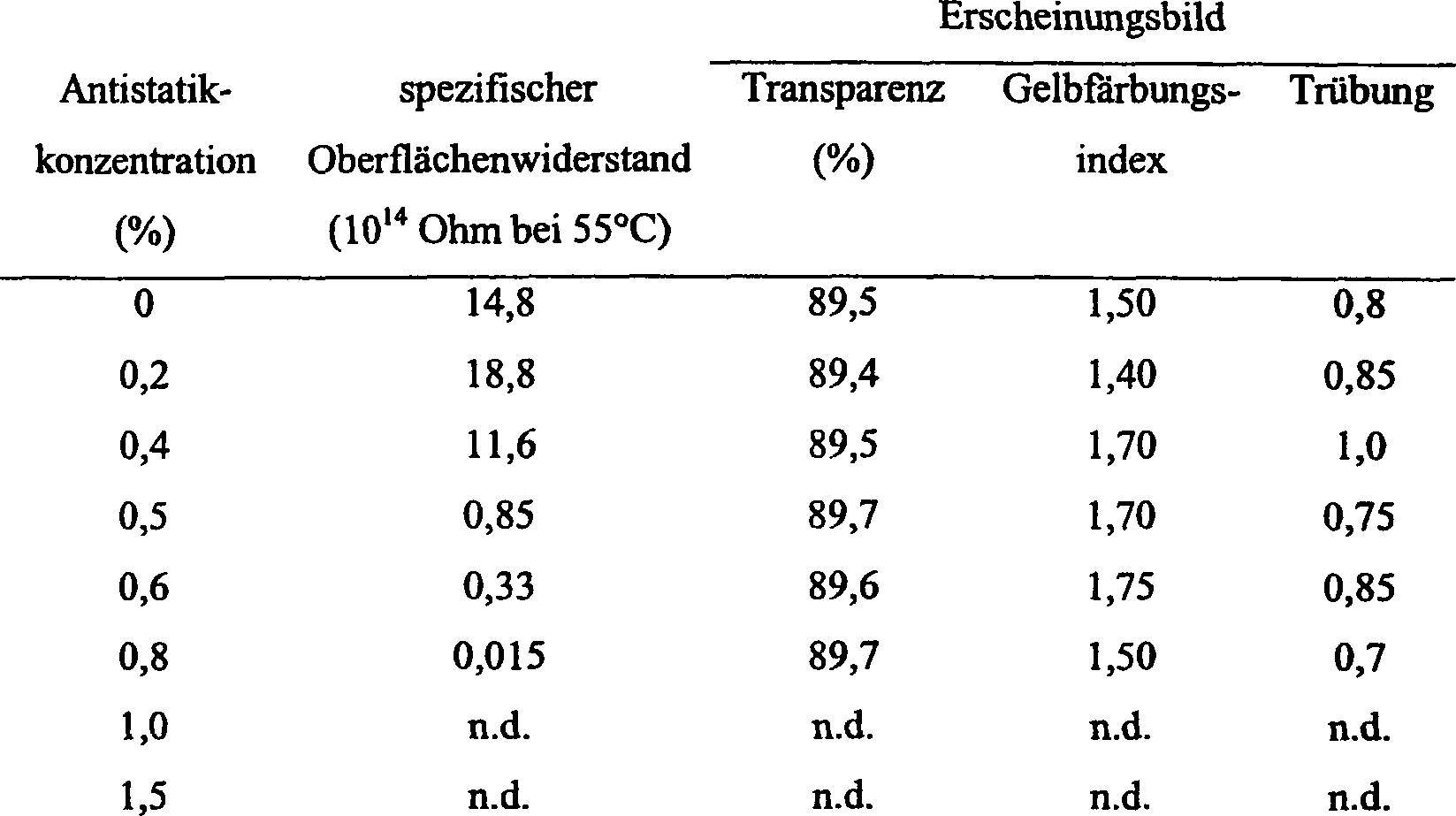
- n. d.
- nicht bestimmt
- nd
- not determined
Die Ergebnisse des Spritzgießens der gleichen Proben bei verschiedenen Mengen unter Verwendung der falschen (missbräuchlichen) Bedingungen (Temperatur + 20°C und Abkühlzeit = 120 Sekunden anstatt 20 Sekunden) werden in Tabelle 2 dargestellt. Ein Vergleich der Ergebnisse von Tabelle 1 und 2 zeigt, dass, falls die falschen (missbräuchlichen) Verformungsbedingungen verwendet werden, die Antistatikadditivkonzentration, um antistatisches Polycarbonat zu erhalten, bei Beladungen höher als 0,5% geringfügig reduziert sind. Dies ist ein weiteres Anzeichen der verbesserten oberflächensuchenden Fähigkeiten des Antistatikadditivs dieser Erfindung bei noch höheren Verarbeitungstemperaturen. Dies wurde auch für Teile bestätigt, welche bei den falschen (missbräuchlichen) Temperaturen (+20°C) mit der normalen Zyklenzeit (t = 20 Sekunden) geformt wurden. Bei Proben, welche unter Verwendung des normalen und falschen (missbräuchlichen) Formens mit einer Zyklenzeit von 20 Sekunden unter Verwendung von Beladungen von 0,6% Antistatikkonzentration geformt wurden, nahm der spezifische Oberflächenwiderstand von 1,74 (Tabelle 1) auf 0,33 (Tabelle 2) ab. Diese Ergebnisse zeigen klar den Effekt der Verformungsbedingungen des spezifischen Oberflächenwiderstandsverhaltens und dass die Fähigkeit des Antistatikadditivs, die Oberfläche zu suchen, Temperatur- und Zyklenzeit-abhängig ist.The Results of injection molding the same samples at different amounts using the wrong (abusive) Conditions (temperature + 20 ° C and cooling time = 120 seconds instead of 20 seconds) are shown in Table 2. A comparison of the results of Tables 1 and 2 shows that if the wrong (abusive) Deformation conditions are used, the antistatic additive concentration, to obtain antistatic polycarbonate, higher than at loadings 0.5% slightly are reduced. This is another indication of the improved surface-seeking Skills of the antistatic additive of this invention at even higher processing temperatures. This was also for Parts confirmed, which in the wrong (abusive) Temperatures (+ 20 ° C) were formed with the normal cycle time (t = 20 seconds). at Samples using the normal and wrong (abusive) Forming with a cycle time of 20 seconds using Loads of 0.6% antistatic concentration were formed the specific surface resistance from 1.74 (Table 1) to 0.33 (Table 2). These results show clearly the effect of the deformation conditions of the surface resistivity behavior and that ability antistatic additive to search the surface, temperature and cycle time-dependent is.
Beispiel 6Example 6
Beispiel 4 wurde wiederholt, außer dass das verwendete Antistatikmaterial EPA-202, ein Phosphoniumsulfonat des Standes der Technik, erhalten von Takemoto Oil and Fat Co., LTD., war. Die Zusammensetzung des EPA-202 hat die folgende Formel und ist eine Antistatikzusammensetzung des U.S. 4 943 380:example 4 was repeated, except that the antistatic material used is EPA-202, a phosphonium sulfonate of the prior art, obtained from Takemoto Oil and Fat Co., LTD., Was. The composition of EPA-202 has the following formula and is an antistatic composition of U.S. Pat. 4,943,380:

Die Ergebnisse waren wie folgt:The Results were as follows:
Tabelle
3 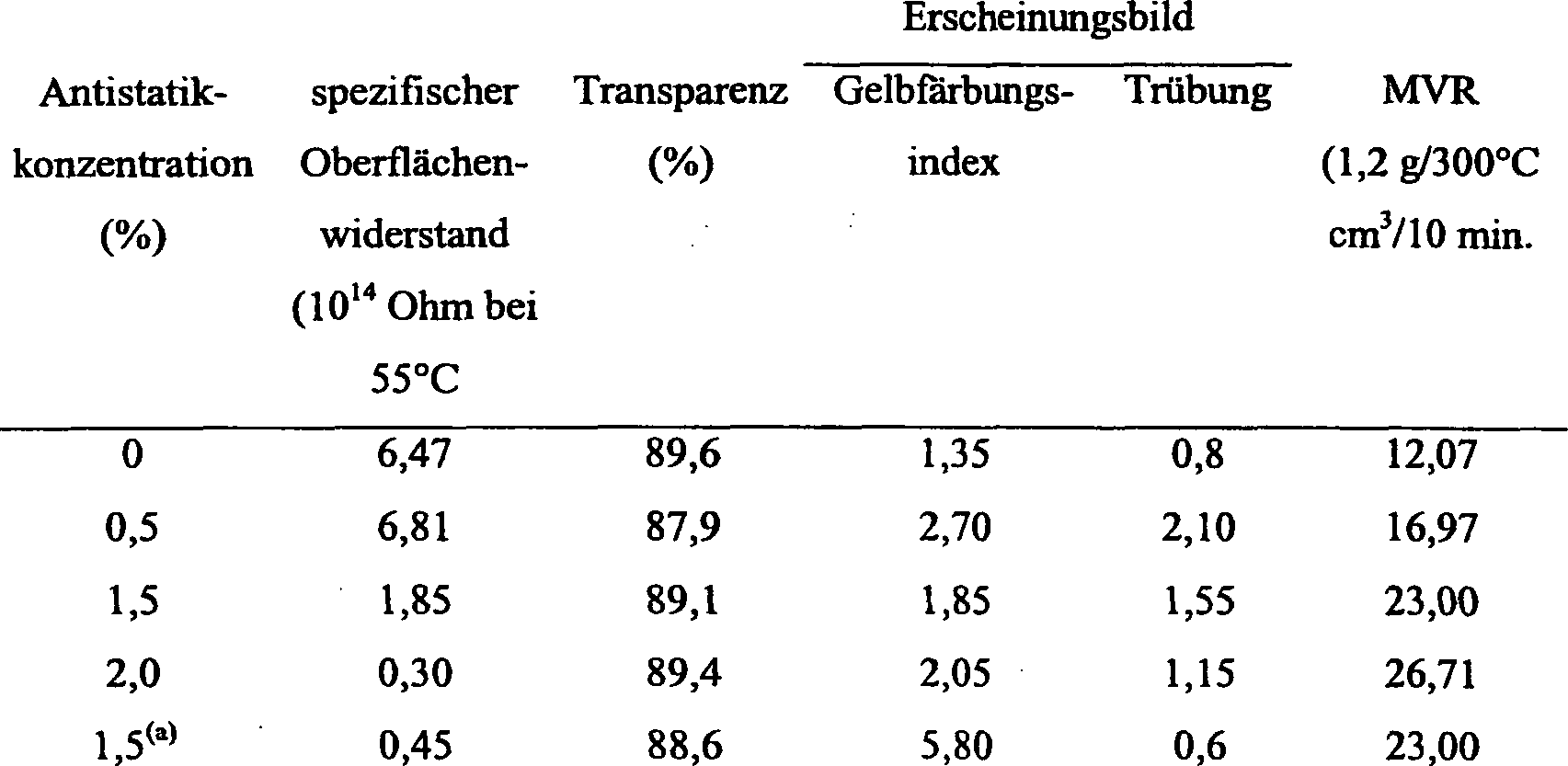
Es sollte bedacht werden, dass die Antistatikeigenschaften des Antistatikmittels dieser Erfindung (Tetrabutylphosphonium-nonafluoro-1-butansulfonat Beispiel 1) bessere Antistatikeigenschaften bei signifikant niedrigerer Konzentration als die Antistatikeigenschaft des Phosphoniumsulfonates EPA-202 aus dem Stand der Technik besitzt. Je niedriger der spezifische Oberflächenwiderstand, desto besser ist die Antistatikeigenschaft des Additivs. Bei einer Konzentration von 2,0% des Additivs aus dem Stand der Technik entspricht der spezifische Widerstand gerade einer Konzentration von 0,8% des erfinderischen antistatischen Additivs. Auch ist zu beachten, dass das EPA-202 ein viskoses, gelbes Öl ist, welche den Gelbfärbungs-Index erhöht, während das Antistatikadditiv, Beispiel 1, ein weißer Feststoff ist, und so eine bessere Dispersion eines Pulvers als eines viskosen Öls erleichtert.It should be kept in mind that the antistatic properties of the antistatic agent of this invention (tetrabutylphosphonium nonafluoro-1-butanesulfonate Example 1) better antistatic properties at significantly lower Concentration as the antistatic property of phosphonium sulfonate EPA-202 of the prior art has. The lower the specific Surface resistance, the better the antistatic property of the additive. At a Concentration of 2.0% of the additive from the prior art corresponds the resistivity just a concentration of 0.8% of inventive antistatic additive. Also note that the EPA-202 is a viscous, yellow oil which has the yellowing index elevated, while the antistatic additive, Example 1, is a white solid, and so on facilitates better dispersion of a powder than a viscous oil.
Weiterhin ist zu berücksichtigen, dass der Schmelzfluss der Zusammensetzung der Erfindung im wesentlichen nicht beeinflusst wird, wie dies mittels MVR bestimmt wird. Selbst bei einer Konzentration von 1,5% (Tabelle 1) ist der MVR nur geringfügig größer als bei einer Zusammensetzung ohne Additiv. In Tabelle 3 ist der MVR bei einer Konzentration von 1,5% des Antistatikmittels aus dem Stand der Technik nahezu verdoppelt, verglichen zu dem Wert ohne Additiv. Dies zeigt, dass das Additiv aus dem Stand der Technik als Weichmacher fungiert, welches einen signifikanten, negativen Effekt auf die mechanischen Eigenschaften, insbesondere auf aromatische Polycarbonatharze, hat.Farther is taken into account, that the melt flow of the composition of the invention substantially is not affected, as determined by MVR. Even at a concentration of 1.5% (Table 1), the MVR is only slightly larger than in a composition without additive. In Table 3 is the MVR at a concentration of 1.5% of the antistatic agent of the state technology almost doubled compared to the value without additive. This shows that the prior art additive acts as a plasticizer, which has a significant, negative effect on the mechanical Properties, in particular on aromatic polycarbonate resins, has.
Beispiel 7Example 7
Ein stark fließendes, aromatisches Polycarbonatharz mit einer intrinsischen Viskosität von ungefähr 0,42 Deziliter pro Gramm, gemessen in Methylenchlorid bei 20°C, wurde in der Schmelze geblendet und unter den gleichen Bedingungen, die in Beispiel 4 verwendet wurden, spritzgegossen, außer dass CD-Formlinge geformt wurden.One strongly flowing, aromatic polycarbonate resin having an intrinsic viscosity of about 0.42 Deciliters per gram, measured in methylene chloride at 20 ° C dazzled in the melt and under the same conditions, the used in Example 4, injection-molded, except that CD moldings were molded.
Drei Zusammensetzungen und CD-Sets (10 pro Zusammensetzung) wurden, wie zuvor beschrieben, hergestellt, wobei der Polycarbonatgehalt im Bezug auf die Konzentration des Antistatikmittels, welches in der Formulierung vorlag, variiert wurde. Jede Formulierung enthielt die gleiche Menge an Formungsmittel und Stabilisator.Three compositions and CD sets (10 per composition) were prepared as previously described with the polycarbonate content varied with respect to the concentration of antistatic agent present in the formulation. Each formulation contained the same amount of styling agent and Sta bilisator.
Die Beispiel CD-Formlinge wurden dann hinsichtlich der Transparenz, Farbe und der statischen Ladung ausgewertet. Die statische Ladung wurde direkt nach dem Verformen auf jedem CD-Formling mittels eines kalibrierten Feldhandmesser von SIMCO® gemessen. Die erhaltenen Ergebnisse waren wie folgt:The example CD moldings were then evaluated for transparency, color and static charge. The static charge was measured directly after molding on each CD blank by means of a calibrated field hand diameter of SIMCO ®. The results obtained were as follows:
Tabelle
4 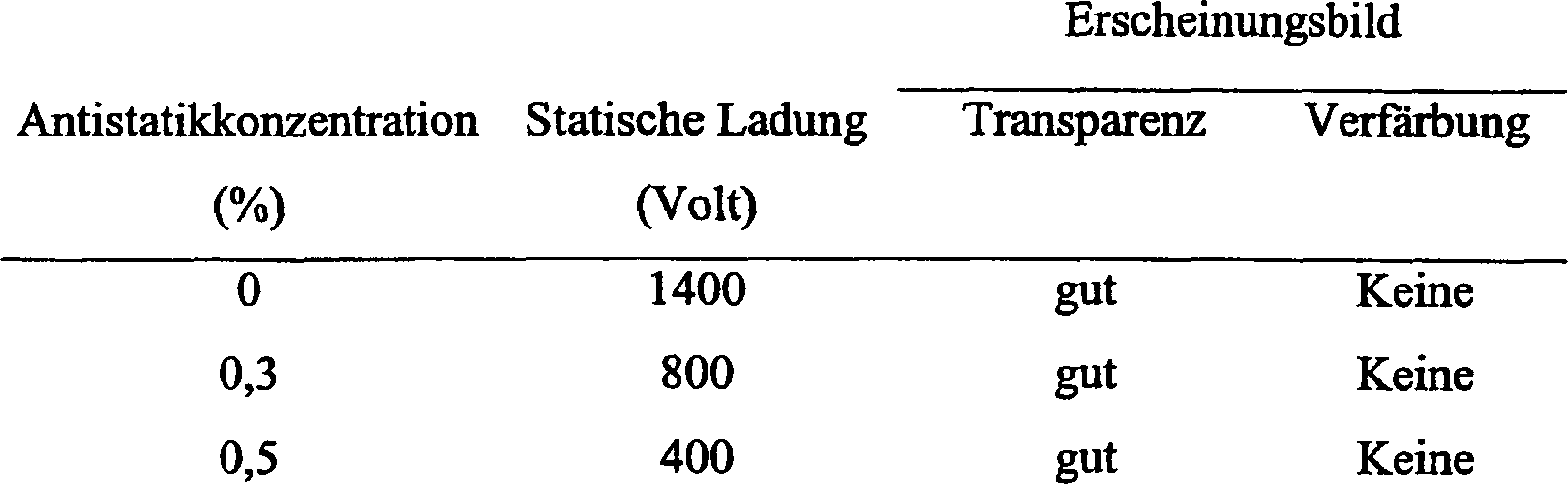
Die Ergebnisse zeigen klar, dass bei sehr hochfließenden Typen exzellente Antistatikeigenschaften ohne Beeinträchtigung der Transparenz oder der Farbe erhalten werden.The Results clearly show that for very high flow types excellent antistatic properties without impairment of transparency or color.
Die Formulierung, welche 0,5% Antistatikadditiv enthielt, zeigte keine Staubanziehung bei dem Staubanziehungstest. Die Zugabe von 0,3% Antistatikmittel zeigte eine große Verbesserung, verglichen mit der Referenz ohne Antistatikadditiv.The Formulation containing 0.5% antistatic additive did not show any Dust attraction in the dust attraction test. The addition of 0.3% Antistatic agent showed a big improvement compared with the reference without antistatic additive.
Beispiel 8Example 8
Die Antistatikeigenschaften des fluorierten Phosphoniumsulfonates der obigen Beispiele 2 und 3 (Formel 5 und 6) wurden bestimmt, indem man ein transparentes, aromatisches Polycarbonatharz mit einer intrinsischen Viskosität von ungefähr 0,46 Deziliter pro Gramm (dl/gm), gemessen in Methylenchlorid bei 20°C, in einem Doppelschneckenextruder bei einer Temperatur von ungefähr 285°C, in der Schmelze mit einem Antistatikmittel blendete, durch eine Düsenöffnung zu Strängen extrudierte, welche in Wasser abgeschreckt und dann pelletisiert wurden. Die Pellets wurden bei ungefähr 125°C für ungefähr 2 Stunden getrocknet. Die getrockneten Pellets wurden zu Platten von ungefähr 10 cm im Quadrat bei einer Dicke von ungefähr 2,5 mm bei einer Spritzgusstemperatur von ungefähr 285°C unter Verwendung einer Einschneckenspritzgussmaschine spritzgegossen. Offensichtlich wurde das Temperaturprofil über das Spritzgussgehäuse auf einen ultimativen Wert von ungefähr 285°C variiert. Bei diesem Beispiel variierte die Gehäusetemperatur von ungefähr 20°C bis ungefähr 285°C. Jede in der untigen Tabelle 5 dargestellte Zusammensetzung wurde unter den gleichen Bedingungen, wie zuvor beschrieben, hergestellt, wobei der Polycarbonatgehalt in Bezug auf die Konzentration des Antistatikmittels, welches in jeder Formulierung vorlag, variiert wurde. Jede Formulierung enthielt auch die gleiche Menge an Entformungsmittel, UV-Absorber, Stabilisatoren, Antioxidanz und Farbstoff, deren Gesamtmenge ungefähr 0,8 Gew.-% des verwendeten Polycarbonats war. Die erhaltenen Ergebnisse waren, wie folgt:The Antistatic properties of fluorinated phosphonium sulfonate Examples 2 and 3 above (formulas 5 and 6) were determined by a transparent, aromatic polycarbonate resin having an intrinsic viscosity of about 0.46 deciliters per gram (dl / gm) as measured in methylene chloride 20 ° C, in one Twin-screw extruder at a temperature of about 285 ° C, in the Melt with an antistatic agent blazed through a nozzle opening strands extruded, which quenched in water and then pelletized were. The pellets were dried at about 125 ° C for about 2 hours. The dried pellets became plates about 10 cm square at one Thickness of about 2.5 mm injection molded at an injection molding temperature of about 285 ° C using a single screw injection molding machine. Obviously, the temperature profile on the injection molded housing on an ultimate value of about 285 ° C varies. In this example, the housing temperature varied from about 20 ° C to about 285 ° C. Each in the composition shown below Table 5 was among same conditions as described above, wherein the polycarbonate content with respect to the concentration of the antistatic agent, which was present in each formulation was varied. Every formulation also contained the same amount of release agent, UV absorber, Stabilizers, antioxidant and dye, the total amount about 0.8 wt .-% of the polycarbonate used. The results obtained were, as follows:
Tabelle
5 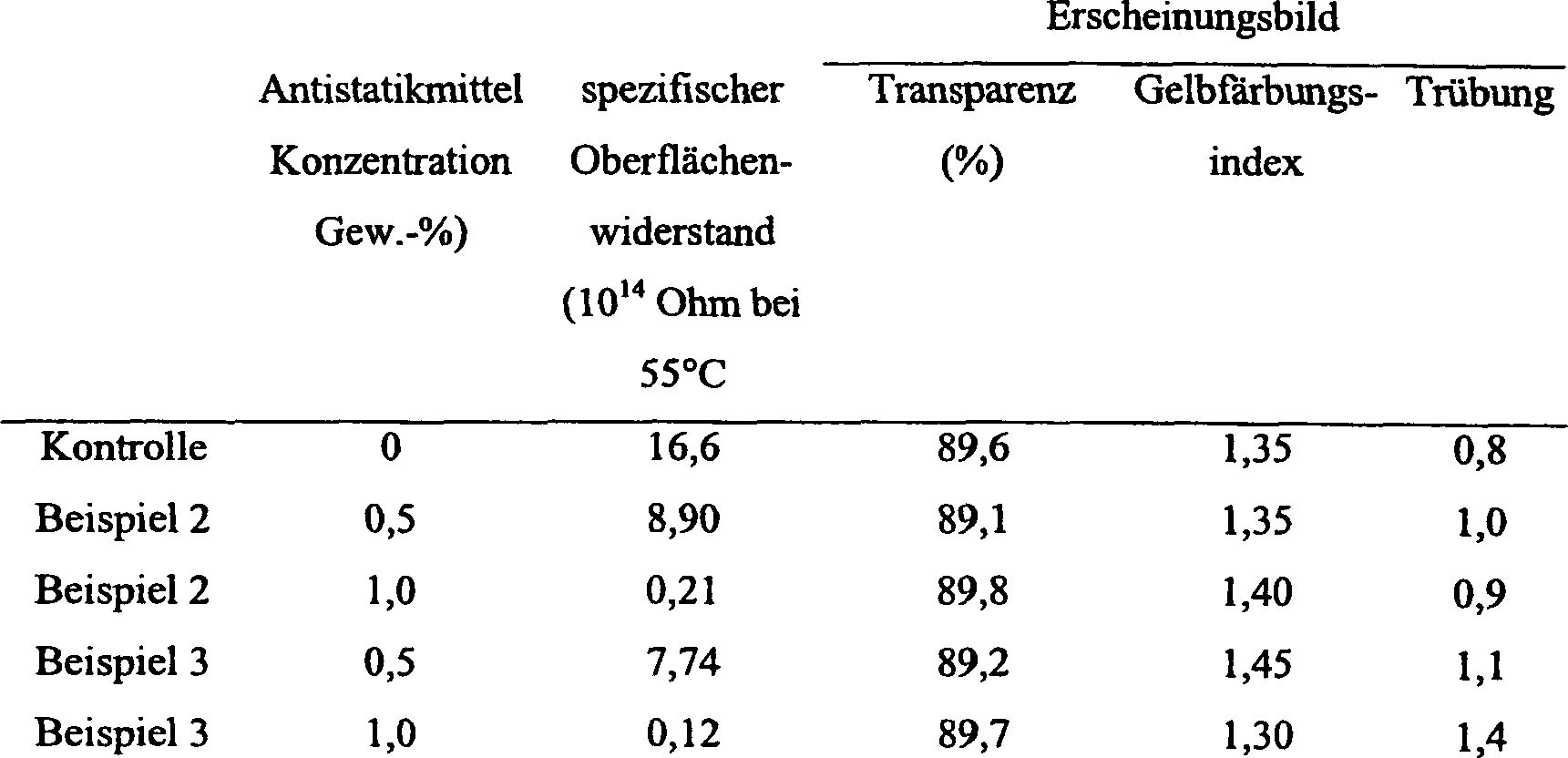
Wie man von den Beispielen sehen kann, zeigen die Ergebnisse klar einen niedrigeren spezifischen Oberflächenwiderstand der geformten Platten mit der Antistatikzusammensetzung dieser Erfindung bei niedrigeren Additivbeladungen, verglichen mit EPA-202 aus dem Stand der Technik, beschrieben in Beispiel 6. Weiterhin trat mit EPA-202 unter Verwendung der falschen (missbräuchlichen) Verformungsbedingungen eine heftige Gelbfärbung auf und dies wird für die neu synthetisierten Antistatikzusammensetzungen dieser Erfindung nicht beobachtet. Es ist auch zu bemerken, dass EPA-202 scheinbar ein Weichmacher für Polycarbonat ist, wie dies durch die Erhöhung der MVR-Werte gezeigt wird, während im wesentlichen kein Unterschied beim Fluss für die fluorierten Phosphoniumsulfonate dieser Erfindung beobachtet werden.As As you can see from the examples, the results clearly show one lower surface resistivity the molded plates with the antistatic composition of this invention at lower additive loadings compared to EPA-202 from the Prior art, described in Example 6. Furthermore, joined EPA-202 using the wrong (abusive) deformation conditions a violent yellowing and this will be for the newly synthesized antistatic compositions of this invention are not observed. It should also be noted that EPA-202 seems to be a Plasticizer for Polycarbonate is as shown by the increase in MVR values will, while essentially no difference in flux for the fluorinated phosphonium sulfonates of this invention.
Bei der vorliegenden Erfindung muss der Fachmann verstehen, dass viele, verschiedene Änderungen bei den besonderen, oben beschriebenen Ausführungsformen gemacht werden können, ohne dass von dem Geist und von dem Rahmen der Erfindung, wie er in den anhängenden Ansprüchen definiert wird, abgewichen wird.at the skilled person has understood that many, various changes in the particular embodiments described above are made can, without that of the spirit and the scope of the invention, as he in the attached claims is deviated.
Claims (13)
Applications Claiming Priority (2)
| Application Number | Priority Date | Filing Date | Title |
|---|---|---|---|
| US899025 | 1997-07-23 | ||
| US08/899,025 US6194497B1 (en) | 1997-07-23 | 1997-07-23 | Anti-static resin composition containing fluorinated phosphonium sulfonates |
Publications (2)
| Publication Number | Publication Date |
|---|---|
| DE69822940D1 DE69822940D1 (en) | 2004-05-13 |
| DE69822940T2 true DE69822940T2 (en) | 2005-03-10 |
Family
ID=25410394
Family Applications (1)
| Application Number | Title | Priority Date | Filing Date |
|---|---|---|---|
| DE69822940T Expired - Lifetime DE69822940T2 (en) | 1997-07-23 | 1998-07-21 | Antistatic thermoplastic blend |
Country Status (8)
| Country | Link |
|---|---|
| US (1) | US6194497B1 (en) |
| EP (1) | EP0897950B1 (en) |
| JP (1) | JP3962837B2 (en) |
| CN (1) | CN1208748A (en) |
| AU (1) | AU750137B2 (en) |
| BR (1) | BR9802551A (en) |
| DE (1) | DE69822940T2 (en) |
| ES (1) | ES2218771T3 (en) |
Families Citing this family (59)
| Publication number | Priority date | Publication date | Assignee | Title |
|---|---|---|---|---|
| CA2388621A1 (en) * | 1999-08-16 | 2001-02-22 | Bayer Aktiengesellschaft | Antistatic agent |
| DE19943637A1 (en) * | 1999-08-16 | 2001-02-22 | Bayer Ag | Antistatic |
| US6372829B1 (en) | 1999-10-06 | 2002-04-16 | 3M Innovative Properties Company | Antistatic composition |
| US6592988B1 (en) * | 1999-12-29 | 2003-07-15 | 3M Innovative Properties Company | Water-and oil-repellent, antistatic composition |
| DE10027333A1 (en) * | 2000-06-02 | 2001-12-06 | Bayer Ag | Flame retardant and anti-electrostatic polycarbonate molding compounds |
| JP2002124108A (en) * | 2000-10-17 | 2002-04-26 | Koito Mfg Co Ltd | Vehicle lighting |
| US20020123566A1 (en) * | 2000-12-20 | 2002-09-05 | Georgiev Emil M. | Flame retardant carbonate polymer composition |
| US6703329B2 (en) | 2000-12-28 | 2004-03-09 | Graph To Graphics, Inc. | Multiple layer cloth for casino, gaming and billiard tables and method therefor |
| US6723668B2 (en) | 2000-12-28 | 2004-04-20 | Graph To Graphics, Inc. | Multiple layer cloth for casino, gaming and billiard tables and method therefor |
| DE10119416A1 (en) * | 2001-04-20 | 2002-10-24 | Bayer Ag | Layer system comprising at least two layers of thermoplastics, useful for the production of molded articles and extrudate, has at least one layer that contains a sulfonate antistatic compound. |
| CN1643053A (en) * | 2002-02-08 | 2005-07-20 | 通用电气公司 | Thermoplastic resin composition and method for improving appearance |
| JP2003231815A (en) * | 2002-02-08 | 2003-08-19 | Ge Plastics Japan Ltd | Thermoplastic resin composition and method for ameliorating soil pattern |
| US6900257B2 (en) | 2002-08-06 | 2005-05-31 | General Electric Company | Antistatic agents and polymer compositions derived therefrom |
| US6841598B2 (en) | 2002-08-16 | 2005-01-11 | General Electric Company | Antistatic and antidust agents, compositions thereof, and methods of manufacture |
| JP2004083750A (en) * | 2002-08-27 | 2004-03-18 | Fuji Photo Film Co Ltd | Polyester resin composition |
| TWI319412B (en) * | 2003-01-15 | 2010-01-11 | Sumitomo Rubber Ind | Polymeric-type antistatic agent and antistatic polymer composition and fabricating method thereof |
| US7314652B2 (en) * | 2003-02-28 | 2008-01-01 | General Electric Company | Diffuser for flat panel display |
| US20060056031A1 (en) * | 2004-09-10 | 2006-03-16 | Capaldo Kevin P | Brightness enhancement film, and methods of making and using the same |
| US6765112B1 (en) * | 2003-03-25 | 2004-07-20 | E. I. Du Pont De Nemours And Company | Fluorinated onium salts |
| US7731881B2 (en) | 2003-12-30 | 2010-06-08 | Sabic Innovative Plastics Ip B.V. | Method for making fog resistant thermoplastic articles and articles made therefrom |
| CN100412120C (en) * | 2003-12-30 | 2008-08-20 | 通用电气公司 | Thermoplastic composition containing polymeric antistatic salt, process for its manufacture and use |
| US7094861B2 (en) * | 2003-12-30 | 2006-08-22 | General Electric Company | Thermoplastic composition containing polymeric anti-static salt, method of making, and use thereof |
| US7220792B2 (en) * | 2003-12-30 | 2007-05-22 | General Electric Company | Water resistant permanent antistatic thermoplastic composition |
| US7211690B2 (en) * | 2004-04-13 | 2007-05-01 | General Electric Company | Methods of making an antistatic agent |
| CN101456830B (en) * | 2004-04-13 | 2012-06-13 | 沙伯基础创新塑料知识产权有限公司 | Methods of making an antistatic agent |
| US7280170B2 (en) * | 2004-05-25 | 2007-10-09 | General Electric Company | Optical film, light-diffusing film, and methods of making and using the same |
| US20080166523A1 (en) * | 2007-01-04 | 2008-07-10 | Asahi Kasei Chemicals Corporation | Tab leader tape made of polyphenylene ether-based resin |
| JP2006028389A (en) * | 2004-07-20 | 2006-02-02 | Teijin Chem Ltd | Aromatic polycarbonate resin composition |
| US7341784B2 (en) * | 2004-09-10 | 2008-03-11 | General Electric Company | Light management film and its preparation and use |
| US20060100327A1 (en) * | 2004-11-08 | 2006-05-11 | Hoeks Theodorus L | Methods of making an antistatic agent |
| DE102005040313A1 (en) | 2005-08-24 | 2007-03-01 | Bayer Materialscience Ag | Light-diffusing moldings with high light transmission and improved antistatic properties |
| US7544813B2 (en) * | 2005-09-22 | 2009-06-09 | E.I. Du Pont De Nemours And Company | Ionic liquids |
| US20080187728A1 (en) * | 2005-09-30 | 2008-08-07 | General Electric Company | Anti-frost film assemblies, method of manufacture, and articles made thereof |
| US20070125654A1 (en) * | 2005-12-02 | 2007-06-07 | Buckley Paul W | Electroform, methods of making electroforms, and products made from electroforms |
| US20070125651A1 (en) * | 2005-12-02 | 2007-06-07 | Buckley Paul W | Electroform, methods of making electroforms, and products made from electroforms |
| US20070125248A1 (en) * | 2005-12-02 | 2007-06-07 | Coyle Dennis J | Embossing drum system with removable outer sleeve and methods of use |
| US20070125652A1 (en) * | 2005-12-02 | 2007-06-07 | Buckley Paul W | Electroform, methods of making electroforms, and products made from electroforms |
| US20070126144A1 (en) * | 2005-12-02 | 2007-06-07 | Yadong Jin | Polish/texture thermoplastic film and method for making the same |
| US20070125655A1 (en) * | 2005-12-02 | 2007-06-07 | Buckley Paul W | Electroform, methods of making electroforms, and products made from electroforms |
| US20070125653A1 (en) * | 2005-12-02 | 2007-06-07 | Coyle Dennis J | Multilayer electroform, methods of making multilayer electroforms, and products made therefrom |
| US20070126148A1 (en) * | 2005-12-02 | 2007-06-07 | General Electric Company | Microstructured embossing drum and articles made therefrom |
| US20070203271A1 (en) * | 2006-01-27 | 2007-08-30 | Alms Gregory R | Coating process for thermoplastics |
| WO2007119631A1 (en) * | 2006-03-31 | 2007-10-25 | Koei Chemical Company, Limited | Antistatic agent, and antistatic resin composition comprising the same |
| US20070281129A1 (en) * | 2006-06-06 | 2007-12-06 | Chi Kwong Chan | Diffuser films and methods for making and using the same |
| US20080114103A1 (en) * | 2006-11-13 | 2008-05-15 | General Electric Company | Thermoplastic Polycarbonate Compositions With Improved Static Resistance |
| US7999041B2 (en) * | 2007-05-07 | 2011-08-16 | Sabic Innovative Plastics Ip B.V. | Neutral static polycarbonates, methods of making, and articles formed therefrom |
| KR100989907B1 (en) | 2007-12-28 | 2010-10-26 | 주식회사 삼양사 | Thermoplastic resin composition and molded article manufactured using the same |
| US8623948B2 (en) * | 2008-06-26 | 2014-01-07 | Sabic Innovative Plastics Ip B.V. | Polycarbonate compositions having antistatic enhancers, method of preparing, and articles comprising the same |
| KR101027763B1 (en) | 2008-09-05 | 2011-04-07 | 광 석 서 | Antistatic high heat resistant polymer composition containing metal salt |
| EP2172336A1 (en) | 2008-09-24 | 2010-04-07 | Bayer MaterialScience AG | Forgery-proof security characteristics in confidential or valuable documents |
| EP2168783A1 (en) | 2008-09-24 | 2010-03-31 | Bayer MaterialScience AG | Use of a plastic foil in colour laser printing |
| WO2013144102A1 (en) * | 2012-03-30 | 2013-10-03 | Bayer Intellectual Property Gmbh | Polycarbonate composition with improved optical properties |
| CN102659642A (en) * | 2012-04-20 | 2012-09-12 | 湖南鸿跃化工制造有限公司 | Preparation method of antistatic agent onium salt fluoride |
| US8691915B2 (en) | 2012-04-23 | 2014-04-08 | Sabic Innovative Plastics Ip B.V. | Copolymers and polymer blends having improved refractive indices |
| CN104395092A (en) | 2012-06-21 | 2015-03-04 | 3M创新有限公司 | Static Dissipative Laser Engravable Film |
| CN108047682A (en) * | 2017-12-24 | 2018-05-18 | 洛阳名力科技开发有限公司 | A kind of toughness is strong and the engineering plastics of high abrasion |
| CN114450349B (en) * | 2019-07-31 | 2023-05-23 | 高新特殊工程塑料全球技术有限公司 | Powder bed fusion material and method |
| EP4004112B1 (en) | 2019-07-31 | 2023-08-30 | SHPP Global Technologies B.V. | Material and method for powder bed fusion |
| EP4073151A1 (en) | 2019-12-12 | 2022-10-19 | Covestro Intellectual Property GmbH & Co. KG | Films having special properties |
Family Cites Families (21)
| Publication number | Priority date | Publication date | Assignee | Title |
|---|---|---|---|---|
| DE1274578B (en) * | 1965-01-21 | 1968-08-08 | Bayer Ag | Process for the preparation of cycloalkylamine compounds |
| US4005057A (en) * | 1973-10-09 | 1977-01-25 | E. I. Du Pont De Nemours And Company | Antistatic composition containing an N-alkyl polycarbonamide and a phosphonium salt |
| US4038258A (en) * | 1975-09-17 | 1977-07-26 | E. I. Du Pont De Nemours And Company | Antistatic composition containing an aliphatic polyester or polyether ester and a phosphonium salt |
| US4093589A (en) | 1977-02-03 | 1978-06-06 | General Electric Company | Non-opaque flame retardant polycarbonate composition |
| US4582781A (en) | 1984-08-01 | 1986-04-15 | Eastman Kodak Company | Antistatic compositions comprising polymerized oxyalkylene monomers and an inorganic tetrafluoroborate, perfluoroalkyl carboxylate, hexafluorophosphate or perfluoroalkylsulfonate salt |
| EP0230907A3 (en) | 1986-01-17 | 1989-05-31 | Asahi Glass Company Ltd. | Electric double layer capacitor having high capacity |
| EP0246825B1 (en) | 1986-05-20 | 1991-02-27 | Mitsubishi Petrochemical Co., Ltd. | Quaternary salt solution electrolyte for electrolytic capacitors |
| US4943380A (en) | 1987-09-18 | 1990-07-24 | Takemoto Yushi Kabushiki Kaisha | Antistatic resin composition with transparency containing phosphonium sulphonate |
| EP0309622B1 (en) | 1987-09-28 | 1997-03-05 | Takemoto Yushi Kabushiki Kaisha | Method for reducing build up of electrostatic charges on transparent synthetic macromolecular materials selected from polymethyl methycrylate or polycarbonate |
| DE3737496A1 (en) * | 1987-11-05 | 1989-05-18 | Hoechst Ag | METHOD FOR INCREASING THE ELECTROSTATIC RECHARGEABILITY OF POWDER VARNISHES AND POWDERS AND THEIR USE FOR SURFACE COATING OF FIXED OBJECTS |
| JPH01178554A (en) | 1988-01-07 | 1989-07-14 | Kanegafuchi Chem Ind Co Ltd | Thermoplastic resin composition |
| US5112558A (en) * | 1988-01-29 | 1992-05-12 | Husky Injection Molding Systems Ltd. | Injection molding process |
| US5187214A (en) * | 1988-11-08 | 1993-02-16 | Ppg Industries, Inc. | Quaternary ammonium antistatic polymer compositions |
| US5051330A (en) | 1989-12-15 | 1991-09-24 | Eastman Kodak Company | Fluorinated onium salts as toner electrostatic transfer agents and charge control agents |
| JPH03259576A (en) | 1990-03-09 | 1991-11-19 | Sumitomo Electric Ind Ltd | josephson junction |
| JP3427848B2 (en) * | 1993-07-02 | 2003-07-22 | 三菱瓦斯化学株式会社 | Antistatic resin composition |
| DE69431642T2 (en) * | 1993-08-26 | 2003-07-10 | Teijin Ltd., Osaka | Process for production of stabilized polycarbonates |
| JPH07188539A (en) | 1993-12-27 | 1995-07-25 | Nippon G Ii Plast Kk | Copolymerized polycarbonate resin composition |
| US5468793A (en) | 1994-07-25 | 1995-11-21 | Wico Corporation | Plastic compositions with antistatic properties |
| JPH08302165A (en) | 1995-05-12 | 1996-11-19 | Mitsubishi Rayon Co Ltd | Antistatic polyester film |
| JPH11106635A (en) * | 1997-09-30 | 1999-04-20 | Ge Plastics Japan Ltd | Polycarbonate resin composition and method product thereof |
-
1997
- 1997-07-23 US US08/899,025 patent/US6194497B1/en not_active Ceased
-
1998
- 1998-07-17 AU AU77300/98A patent/AU750137B2/en not_active Ceased
- 1998-07-21 DE DE69822940T patent/DE69822940T2/en not_active Expired - Lifetime
- 1998-07-21 ES ES98305803T patent/ES2218771T3/en not_active Expired - Lifetime
- 1998-07-21 EP EP98305803A patent/EP0897950B1/en not_active Expired - Lifetime
- 1998-07-22 JP JP20572698A patent/JP3962837B2/en not_active Expired - Fee Related
- 1998-07-22 CN CN98116155.3A patent/CN1208748A/en active Pending
- 1998-07-22 BR BR9802551-1A patent/BR9802551A/en not_active Application Discontinuation
Also Published As
| Publication number | Publication date |
|---|---|
| DE69822940D1 (en) | 2004-05-13 |
| JPH11124465A (en) | 1999-05-11 |
| EP0897950B1 (en) | 2004-04-07 |
| ES2218771T3 (en) | 2004-11-16 |
| EP0897950A2 (en) | 1999-02-24 |
| CN1208748A (en) | 1999-02-24 |
| AU7730098A (en) | 1999-02-04 |
| AU750137B2 (en) | 2002-07-11 |
| EP0897950A3 (en) | 2000-05-10 |
| US6194497B1 (en) | 2001-02-27 |
| JP3962837B2 (en) | 2007-08-22 |
| BR9802551A (en) | 2000-01-11 |
Similar Documents
| Publication | Publication Date | Title |
|---|---|---|
| DE69822940T2 (en) | Antistatic thermoplastic blend | |
| EP0953007B1 (en) | Process for producing polymethylmethacrylate moulding materials with a neutral colour | |
| DE19544562B4 (en) | Process for the preparation of poly (meth) acrylimides with improved color stability under thermal stress and moldings obtainable therefrom | |
| EP0776931A1 (en) | Colour and weatherproof impact moulding compositions based on polymethylmethacrylate and process for their preparation | |
| DE1769823B2 (en) | Color stabilized polycarbonate compositions | |
| DE4202618A1 (en) | CLEANING COMPOSITION | |
| DE1569374A1 (en) | Polyvinyl resin stabilizer systems and resin compositions stabilized with them | |
| DE19547013A1 (en) | Refractory thermoplastic resin compositions | |
| DE1719223B2 (en) | STABILIZED VINYL HALOGENIDE POLYMERIZED MOLDING COMPOUND | |
| DE4015184A1 (en) | ANTISTATICALLY EQUIPPED PLASTIC MOLDING | |
| DE2605794C3 (en) | Polyamide compounds with improved thermal stability | |
| DE1454804B2 (en) | PROCESS FOR DISPERSING SOLID ADDITIVES IN SYNTHETIC THERMOPLASTIC SUBSTANCES | |
| DE69425089T2 (en) | A combination of heat stabilizer / lubricant for PVC processing and method for its production | |
| DE3208842A1 (en) | FORMING MIXTURES | |
| DE1811076A1 (en) | Antistatic agents and polymer preparations containing them | |
| DE60125787T2 (en) | PVC RESINS AND MANUFACTURING METHOD AND USE IN MANUFACTURING THE MOST KNOWN PVC FOAM | |
| DE69700677T2 (en) | Thermostabilized compositions of vinylidene fluoride polymers | |
| WO1999031165A2 (en) | Method for producing low-dust stabiliser systems for thermal stabilisation of pvc | |
| DE3024811A1 (en) | SHAPED DIMENSIONS BASED ON VINYL CHLORIDE POLYMERISATS WITH REINFORCED WHITE BREAKING EFFECT | |
| DE69007544T2 (en) | Hard compositions based on polyvinyl chloride, which contain an aliphatic polyol as viscosity-reducing agent, and the use of these compositions for the production of rigid articles by injection molding. | |
| USRE38530E1 (en) | Anti-static resin composition containing fluorinated phosphonium sulfonates | |
| DE1182810B (en) | Process for making styrene polymers flame retardant | |
| DE3631292A1 (en) | FLAME-RESISTANT POLYMER COMPOSITION | |
| DE2619836A1 (en) | NEW LUBRICANTS FOR THERMOPLASTIC MATERIALS AND A METHOD OF MANUFACTURING THE SAME | |
| DE4412366A1 (en) | Antistatic plastic molding compound |
Legal Events
| Date | Code | Title | Description |
|---|---|---|---|
| 8364 | No opposition during term of opposition | ||
| 8327 | Change in the person/name/address of the patent owner |
Owner name: SABIC INNOVATIVE PLASTICS IP B.V., BERGEN OP Z, NL |
|
| 8328 | Change in the person/name/address of the agent |
Representative=s name: PATENT- UND RECHTSANWAELTE BARDEHLE, PAGENBERG, DO |