DE69617543T3 - METALOCO COMPOUNDS, METHOD FOR THE PRODUCTION THEREOF AND THEIR USE IN CATALYSTS FOR OLEFIN POLYMERIZATION - Google Patents
METALOCO COMPOUNDS, METHOD FOR THE PRODUCTION THEREOF AND THEIR USE IN CATALYSTS FOR OLEFIN POLYMERIZATION Download PDFInfo
- Publication number
- DE69617543T3 DE69617543T3 DE69617543T DE69617543T DE69617543T3 DE 69617543 T3 DE69617543 T3 DE 69617543T3 DE 69617543 T DE69617543 T DE 69617543T DE 69617543 T DE69617543 T DE 69617543T DE 69617543 T3 DE69617543 T3 DE 69617543T3
- Authority
- DE
- Germany
- Prior art keywords
- substituents
- atoms
- metallocene compound
- bis
- polymerization
- Prior art date
- Legal status (The legal status is an assumption and is not a legal conclusion. Google has not performed a legal analysis and makes no representation as to the accuracy of the status listed.)
- Expired - Lifetime
Links
Classifications
-
- C—CHEMISTRY; METALLURGY
- C08—ORGANIC MACROMOLECULAR COMPOUNDS; THEIR PREPARATION OR CHEMICAL WORKING-UP; COMPOSITIONS BASED THEREON
- C08F—MACROMOLECULAR COMPOUNDS OBTAINED BY REACTIONS ONLY INVOLVING CARBON-TO-CARBON UNSATURATED BONDS
- C08F10/00—Homopolymers and copolymers of unsaturated aliphatic hydrocarbons having only one carbon-to-carbon double bond
- C08F10/04—Monomers containing three or four carbon atoms
- C08F10/06—Propene
-
- C—CHEMISTRY; METALLURGY
- C07—ORGANIC CHEMISTRY
- C07F—ACYCLIC, CARBOCYCLIC OR HETEROCYCLIC COMPOUNDS CONTAINING ELEMENTS OTHER THAN CARBON, HYDROGEN, HALOGEN, OXYGEN, NITROGEN, SULFUR, SELENIUM OR TELLURIUM
- C07F17/00—Metallocenes
-
- C—CHEMISTRY; METALLURGY
- C08—ORGANIC MACROMOLECULAR COMPOUNDS; THEIR PREPARATION OR CHEMICAL WORKING-UP; COMPOSITIONS BASED THEREON
- C08F—MACROMOLECULAR COMPOUNDS OBTAINED BY REACTIONS ONLY INVOLVING CARBON-TO-CARBON UNSATURATED BONDS
- C08F10/00—Homopolymers and copolymers of unsaturated aliphatic hydrocarbons having only one carbon-to-carbon double bond
-
- C—CHEMISTRY; METALLURGY
- C08—ORGANIC MACROMOLECULAR COMPOUNDS; THEIR PREPARATION OR CHEMICAL WORKING-UP; COMPOSITIONS BASED THEREON
- C08F—MACROMOLECULAR COMPOUNDS OBTAINED BY REACTIONS ONLY INVOLVING CARBON-TO-CARBON UNSATURATED BONDS
- C08F110/00—Homopolymers of unsaturated aliphatic hydrocarbons having only one carbon-to-carbon double bond
- C08F110/04—Monomers containing three or four carbon atoms
- C08F110/06—Propene
-
- C—CHEMISTRY; METALLURGY
- C08—ORGANIC MACROMOLECULAR COMPOUNDS; THEIR PREPARATION OR CHEMICAL WORKING-UP; COMPOSITIONS BASED THEREON
- C08F—MACROMOLECULAR COMPOUNDS OBTAINED BY REACTIONS ONLY INVOLVING CARBON-TO-CARBON UNSATURATED BONDS
- C08F210/00—Copolymers of unsaturated aliphatic hydrocarbons having only one carbon-to-carbon double bond
- C08F210/04—Monomers containing three or four carbon atoms
- C08F210/06—Propene
-
- C—CHEMISTRY; METALLURGY
- C08—ORGANIC MACROMOLECULAR COMPOUNDS; THEIR PREPARATION OR CHEMICAL WORKING-UP; COMPOSITIONS BASED THEREON
- C08F—MACROMOLECULAR COMPOUNDS OBTAINED BY REACTIONS ONLY INVOLVING CARBON-TO-CARBON UNSATURATED BONDS
- C08F4/00—Polymerisation catalysts
- C08F4/42—Metals; Metal hydrides; Metallo-organic compounds; Use thereof as catalyst precursors
- C08F4/44—Metals; Metal hydrides; Metallo-organic compounds; Use thereof as catalyst precursors selected from light metals, zinc, cadmium, mercury, copper, silver, gold, boron, gallium, indium, thallium, rare earths or actinides
- C08F4/60—Metals; Metal hydrides; Metallo-organic compounds; Use thereof as catalyst precursors selected from light metals, zinc, cadmium, mercury, copper, silver, gold, boron, gallium, indium, thallium, rare earths or actinides together with refractory metals, iron group metals, platinum group metals, manganese, rhenium technetium or compounds thereof
- C08F4/62—Refractory metals or compounds thereof
- C08F4/64—Titanium, zirconium, hafnium or compounds thereof
- C08F4/659—Component covered by group C08F4/64 containing a transition metal-carbon bond
- C08F4/65912—Component covered by group C08F4/64 containing a transition metal-carbon bond in combination with an organoaluminium compound
-
- C—CHEMISTRY; METALLURGY
- C08—ORGANIC MACROMOLECULAR COMPOUNDS; THEIR PREPARATION OR CHEMICAL WORKING-UP; COMPOSITIONS BASED THEREON
- C08F—MACROMOLECULAR COMPOUNDS OBTAINED BY REACTIONS ONLY INVOLVING CARBON-TO-CARBON UNSATURATED BONDS
- C08F4/00—Polymerisation catalysts
- C08F4/42—Metals; Metal hydrides; Metallo-organic compounds; Use thereof as catalyst precursors
- C08F4/44—Metals; Metal hydrides; Metallo-organic compounds; Use thereof as catalyst precursors selected from light metals, zinc, cadmium, mercury, copper, silver, gold, boron, gallium, indium, thallium, rare earths or actinides
- C08F4/60—Metals; Metal hydrides; Metallo-organic compounds; Use thereof as catalyst precursors selected from light metals, zinc, cadmium, mercury, copper, silver, gold, boron, gallium, indium, thallium, rare earths or actinides together with refractory metals, iron group metals, platinum group metals, manganese, rhenium technetium or compounds thereof
- C08F4/62—Refractory metals or compounds thereof
- C08F4/64—Titanium, zirconium, hafnium or compounds thereof
- C08F4/659—Component covered by group C08F4/64 containing a transition metal-carbon bond
- C08F4/6592—Component covered by group C08F4/64 containing a transition metal-carbon bond containing at least one cyclopentadienyl ring, condensed or not, e.g. an indenyl or a fluorenyl ring
- C08F4/65922—Component covered by group C08F4/64 containing a transition metal-carbon bond containing at least one cyclopentadienyl ring, condensed or not, e.g. an indenyl or a fluorenyl ring containing at least two cyclopentadienyl rings, fused or not
- C08F4/65927—Component covered by group C08F4/64 containing a transition metal-carbon bond containing at least one cyclopentadienyl ring, condensed or not, e.g. an indenyl or a fluorenyl ring containing at least two cyclopentadienyl rings, fused or not two cyclopentadienyl rings being mutually bridged
-
- Y—GENERAL TAGGING OF NEW TECHNOLOGICAL DEVELOPMENTS; GENERAL TAGGING OF CROSS-SECTIONAL TECHNOLOGIES SPANNING OVER SEVERAL SECTIONS OF THE IPC; TECHNICAL SUBJECTS COVERED BY FORMER USPC CROSS-REFERENCE ART COLLECTIONS [XRACs] AND DIGESTS
- Y10—TECHNICAL SUBJECTS COVERED BY FORMER USPC
- Y10S—TECHNICAL SUBJECTS COVERED BY FORMER USPC CROSS-REFERENCE ART COLLECTIONS [XRACs] AND DIGESTS
- Y10S526/00—Synthetic resins or natural rubbers -- part of the class 520 series
- Y10S526/943—Polymerization with metallocene catalysts
Landscapes
- Chemical & Material Sciences (AREA)
- Organic Chemistry (AREA)
- Health & Medical Sciences (AREA)
- Chemical Kinetics & Catalysis (AREA)
- Medicinal Chemistry (AREA)
- Polymers & Plastics (AREA)
- Transition And Organic Metals Composition Catalysts For Addition Polymerization (AREA)
- Addition Polymer Or Copolymer, Post-Treatments, Or Chemical Modifications (AREA)
Description
Die vorliegende Erfindung betrifft eine Klasse von mit einer Brücke versehenen Metallocenverbindungen, Verfahren zu ihrer Herstellung und die Verwendung dieser Metallocene als Katalysatorkomponenten für die Polymerisation von Olefinen.The The present invention relates to a class of bridged Metallocene compounds, process for their preparation and use of these metallocenes as catalyst components for the polymerization of olefins.
Metallocenverbindungen mit zwei, mit einer Brücke versehenen Cyclopentadienylgruppen sind als Katalysatorkomponenten für die Polymerisation von Olefinen bekannt.metallocene with two, with a bridge provided cyclopentadienyl groups are as catalyst components for the Polymerization of olefins known.
Beispielsweise beschreibt EP-A-129 368 ein Katalysatorsystem für die Polymerisation von Olefinen, das einen Biscyclopentadienyl-Koordinationskomplex mit einem Übergangsmetall umfasst, wobei die beiden Cyclopentadienylgruppen mit einer Brückengruppe verbunden sein können.For example EP-A-129 368 describes a catalyst system for the polymerization of olefins, the a biscyclopentadienyl coordination complex with a transition metal wherein the two cyclopentadienyl groups having a bridging group can be connected.
Bei diesem Typ von Metallocenverbindungen sind die zwei Cyclopentadienylgruppen im allgemeinen durch zweiwertige Reste mit zwei oder mehr Kohlenstoffatomen, wie eine Ethylidengruppe, oder mit von Kohlenstoff abweichenden Atomen, wie eine Dimethylsilandiylgruppe, als Brückengruppe verbunden.at This type of metallocene compounds are the two cyclopentadienyl groups generally by divalent radicals having two or more carbon atoms, such as an ethylidene group, or with other than carbon Atoms, such as a dimethylsilanediyl group, connected as a bridging group.
Es sind Metallocenverbindungen bekannt, bei denen zwei Cyclopentadienylgruppen mit einem einzigen Kohlenstoffatom als Brückengruppe verbunden sind. Insbesondere sind Metallocenverbindungen dieses Typs mit zwei unterschiedlichen Cyclopentadienylgruppen bekannt.It are known metallocene compounds in which two cyclopentadienyl groups are connected to a single carbon atom as a bridging group. In particular, metallocene compounds of this type are two different Cyclopentadienyl known.
Beispielsweise beschreibt EP-A-351 392 einen Katalysator, der für die Herstellung von syndiotaktischen Polyolefinen verwendet werden kann und eine Metallocenverbindung mit zwei Cyclopentadienylgruppen enthält, die durch eine zwischenliegende Brücke verbunden sind, wobei eine der beiden Cyclopentadienylgruppen anders substituiert ist als die andere Gruppe. Als bevorzugte Verbindung wird Isopropyliden-(fluorenyl)-(cyclopentadienyl)-hafniumdichlorid angegeben.For example EP-A-351 392 describes a catalyst useful for the preparation of syndiotactic Polyolefins can be used and a metallocene compound containing two cyclopentadienyl groups, interposed by an intermediate bridge are connected, wherein one of the two Cyclopentadienylgruppen different is substituted as the other group. As a preferred compound becomes isopropylidene (fluorenyl) (cyclopentadienyl) hafnium dichloride specified.
Was Metallocenverbindungen mit zwei gleichartig substituierten Cyclopentadienylgruppen, die mit einem einzigen Kohlenstoffatom als Brücke verbunden sind, betrifft, wird in EP-A-416 566 die Polymerisation von Propylen beschrieben, die in einem flüssigen Monomeren in Gegenwart eines Katalysators durchgeführt wird, wobei der Katalysator aus (A) einem Alumoxan und (B) einer Metallocenverbindung besteht, bei der Cyclopentadienylringe, die gleich oder verschieden sein können, über eine Brücke der Formel -R5CR6- verbunden sind, wobei R5 und R6 unterschiedliche Bedeutungen haben können. Die einzige Verbindung, die als Beispiel angegeben wird, ist Isopropyliden-bis-(indenyl)-zirconiumdichlorid. Jedoch weisen die auf diese Weise erhältlichen Propylen-Polymeren ein sehr niedriges Molekulargewicht auf.As regards metallocene compounds having two identically substituted cyclopentadienyl groups connected to a single carbon atom as a bridge, EP-A-416 566 describes the polymerization of propylene which is carried out in a liquid monomer in the presence of a catalyst, the catalyst consisting of (A) an alumoxane and (B) a metallocene compound in which cyclopentadienyl rings, which may be identical or different, are linked via a bridge of the formula -R 5 CR 6 -, where R 5 and R 6 may have different meanings. The only compound exemplified is isopropylidene bis (indenyl) zirconium dichloride. However, the propylene polymers obtainable in this way have a very low molecular weight.
I. F. Urazowski et al. stellte bei der am 5. bis 10. September 1993 in Agia Pelagia, Kreta, Griechenland, gehaltenen X. Fechem Conference on Organometallic Chemistry Metallocen-Komplexe von Ti und Zr vor, die aus zwei Dicyclopentadienyl-dimethyl-methanen erhalten wurden, nämlich Produkte mit einem Isopropyl- oder tert.-Butylsubstituenten in der 3-Stellung der einzelnen Cyclopentadienylringe. Jedoch wurden dabei lediglich Mechanismen über die Bildung dieser Komplexe und ihre strukturellen Merkmale auf der Basis einer Röntgenanalyse erörtert.I. F. Urazowski et al. presented at the September 5-10, 1993 in Agia Pelagia, Crete, Greece, held X. Fechem Conference on Organometallic Chemistry Metallocene Complexes of Ti and Zr obtained from two dicyclopentadienyl-dimethyl-methanes, namely Products having an isopropyl or tert-butyl substituent in the 3-position of the individual Cyclopentadienyl rings. However, only mechanisms on the Formation of these complexes and their structural features on the Basis of an X-ray analysis discussed.
Bei einer weiteren, für die vorliegende Anmeldung einschlägigen Druckschrift handelt es sich um EP-516 018.at another, for the present application pertinent publication it is EP-516 018.
Es wurde nunmehr eine neue Klasse von Metallocenverbindungen aufgefunden, die zwei identische Cyclopentadienyl-Liganden aufweisen, die über eine Alkylidenbrücke miteinander verbunden sind und die in vorteilhafter Weise als Katalysatorkomponenten für die Polymerisation von Olefinen eingesetzt werden können.It a new class of metallocene compounds has now been discovered, which have two identical cyclopentadienyl ligands, which via a alkylidene are interconnected and in an advantageous manner as catalyst components for the Polymerization of olefins can be used.
Ein
Gegenstand der vorliegenden Erfindung ist somit eine Metallocenverbindung
der Formel (I): 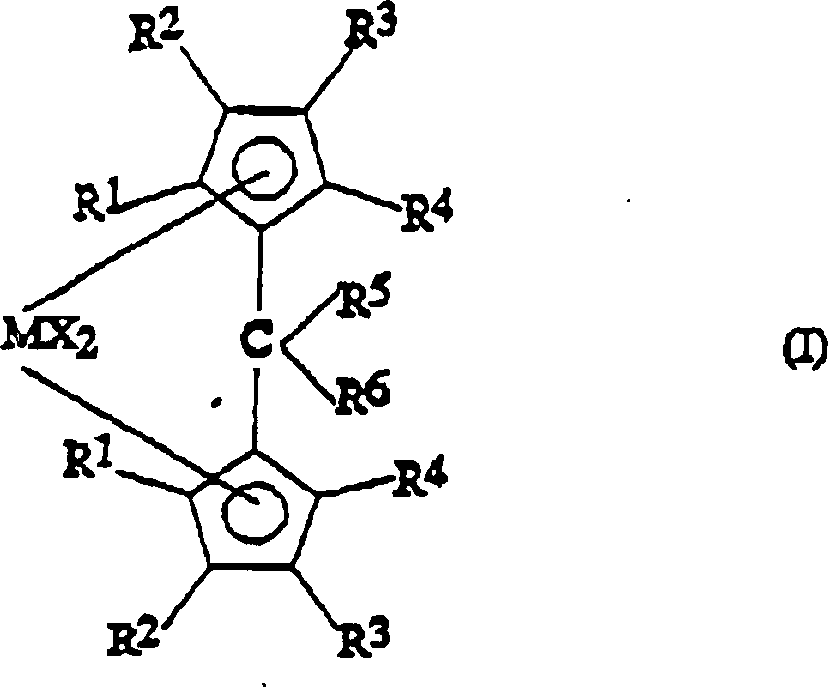
R5 ein
Wasserstoffatom oder einen -CHR7R8-Rest bedeutet;
R6 einen
C6-C20-Arylrest
oder einen -CHR9R10-Rest
bedeutet;
R5 und R6 einen
Ring mit 3 bis 8 Kohlenstoffatomen, der Heteroatome enthalten kann,
bilden können;
R7, R8, R9 und
R10, die gleich oder verschieden sein können, Wasserstoffatome
oder C1-C20-Alkyl-,
C3-C20-Cycloalkyl-,
C2-C20-Alkenyl-,
C6-C20-Aryl-, C7-C20-Alkylaryl-
oder C7-C20-Arylalkylreste
bedeuten, die Heteroatome, wie Stickstoff, Phosphor, Sauerstoff
oder Schwefel, enthalten können,
und zwei der Substituenten R7, R8, R9 und R10 einen Ring mit 3 bis 8 Kohlenstoffatomen,
der Heteroatome enthalten kann, bilden können;
M ein Übergangsmetallatom,
das aus den Gruppen 3, 4, 5 und 6 des Periodensystems der Elemente
(neue IUPAC-Version) ausgewählt
ist, bedeutet;
die Substituenten X, die gleich oder verschieden
sein können,
Wasserstoffatome, Halogenatome oder R-, OR-, SR-, NR2-
oder PR2-Reste bedeuten, wobei es sich bei
den Substituenten R um C1-C20-Alkyl-,
C3-C20-Cycloalkyl-,
C2-C20-Alkenyl-,
C6-C20-Aryl-, C7-C20-Alkylaryl-
oder C7-C20-Arylalkylreste
handelt, die Siliciumatome oder Germaniumatome enthalten können;
mit
der Maßgabe,
dass dann, wenn die Substituenten R1, R2 und R4 Wasserstoffatome
bedeuten und die Substituenten R5 und R6 Methylgruppen bedeuten, die R3-Substituenten
keinen Isopropyl- oder tert.-Butylrest bedeuten.An object of the present invention is thus a metallocene compound of the formula (I):
R 5 represents a hydrogen atom or a -CHR 7 R 8 radical;
R 6 is a C 6 -C 20 aryl radical or a -CHR 9 R 10 radical;
R 5 and R 6 may form a ring of 3 to 8 carbon atoms which may contain heteroatoms;
R 7 , R 8 , R 9 and R 10 , which may be the same or different, are hydrogen or C 1 -C 20 alkyl, C 3 -C 20 cycloalkyl, C 2 -C 20 alkenyl, C 6 C 20 -aryl, C 7 -C 20 -alkylaryl or C 7 -C 20 -arylalkyl radicals which may contain heteroatoms, such as nitrogen, phosphorus, oxygen or sulfur, and two of the substituents R 7 , R 8 , R 9 and R 10 may form a ring of 3 to 8 carbon atoms which may contain heteroatoms;
M is a transition metal atom selected from Groups 3, 4, 5 and 6 of the Periodic Table of the Elements (new IUPAC version);
the substituents X, which may be identical or different, denote hydrogen atoms, halogen atoms or R, OR, SR, NR 2 or PR 2 radicals, where the substituents R are C 1 -C 20 -alkyl radicals , C 3 -C 20 -cycloalkyl, C 2 -C 20 -alkenyl, C 6 -C 20 -aryl, C 7 -C 20 -alkylaryl or C 7 -C 20 -arylalkyl radicals which are silicon atoms or germanium atoms can contain;
with the proviso that when the substituents R 1 , R 2 and R 4 are hydrogen and the substituents R 5 and R 6 are methyl, the R 3 substituents are not isopropyl or tert-butyl.
Das Übergangsmetall M wird vorzugsweise unter Titan, Zirconium und Hafnium ausgewählt. Insbesondere handelt es sich um Zirconium.The transition metal M is preferably selected from titanium, zirconium and hafnium. Especially it is zirconium.
Die Substituenten X bedeuten vorzugsweise Chloratome oder Methylreste.The Substituents X are preferably chlorine atoms or methyl radicals.
Eine
besonders interessante Klasse von erfindungsgemäßen Metallocenen besteht in
Verbindungen der Formel (I), in der die Substituenten R2 Wasserstoffatome
bedeuten. Die Substituenten R1 unterscheiden sich
vorzugsweise von Wasserstoffatomen. Die Substituenten R3 bedeuten
vorzugsweise Kohlenstoff-, Silicium- oder Germaniumatome, die mit
3 Alkyl-, Cycloalkyl-, Aryl-, Alklyaryl- oder Arylalkylgruppen mit
1 bis 10 Kohlenstoffatomen substituiert sind. Bei den Substituenten
R4 handelt es sich vorzugsweise um Wasserstoffatome.
Nachstehend sind nicht beschränkende
Beispiele für
Metallocenverbindungen dieser Klasse aufgeführt:
Isopropyliden-bis-(3-methylcyclopentadienyl)-zirconiumdichlorid
Isopropyliden-bis-(3-isopropylcyclopentadienyl)-zirconiumdichlorid
Isopropyliden-bis-(3-tert.-butylcyclopentadienyl)-zirconiumdichlorid
Isopropyliden-bis-(2,4-dimethylcyclopentadienyl)-zirconiumdichlorid
Isopropyliden-bis-(2-methyl-4-tert.-butylcyclopentadienyl)-irconiumdichlorid
und
Isopropyliden-bis-(2-methyl-4-phenyl-cyclopentadienyl)-zirconiumdichlorid.A particularly interesting class of metallocenes according to the invention consists of compounds of the formula (I) in which the substituents R 2 are hydrogen atoms. The substituents R 1 are preferably different from hydrogen atoms. The substituents R 3 are preferably carbon, silicon or germanium atoms which are substituted by 3 alkyl, cycloalkyl, aryl, alklyaryl or arylalkyl groups having 1 to 10 carbon atoms. The substituents R 4 are preferably hydrogen atoms. Non-limiting examples of metallocene compounds of this class are listed below:
Isopropylidene-bis (3-methylcyclopentadienyl) zirconium dichloride
Isopropylidene-bis (3-isopropyl-cyclopentadienyl) zirconium dichloride
Isopropylidene-bis (3-tert-butylcyclopentadienyl) zirconium dichloride
Isopropylidene-bis (2,4-dimethylcyclopentadienyl) zirconium dichloride
Isopropylidene bis (2-methyl-4-tert-butylcyclopentadienyl) -irconium dichloride and
Isopropylidene-bis (2-methyl-4-phenyl-cyclopentadienyl) zirconium dichloride.
Eine
weitere besonders interessante Klasse von erfindungsgemäßen Metallocenen
sind Verbindungen der Formel (II): 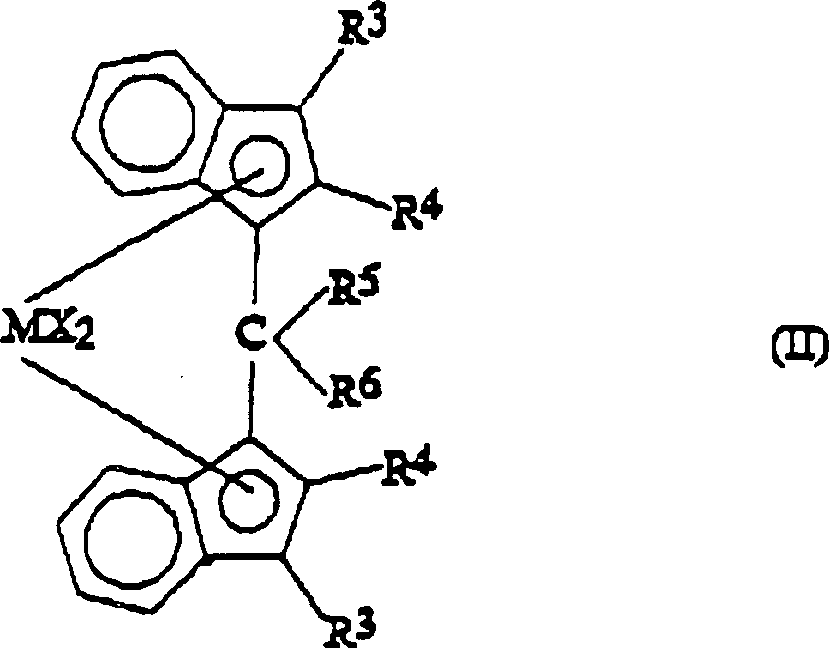
Die
Substituenten R3 bedeuten vorzugsweise Kohlenstoff-,
Silicium- oder Germaniumatome,
die mit 3 Alkyl-, Cycloalkyl-, Aryl-, Alklyaryl- oder Arylalkylgruppen mit 1 bis 10
Kohlenstoffatomen substituiert sind. Die Substituenten R4 bedeuten vorzugsweise Wasserstoffatome.
Nichtbeschränkende
Beispiele für
Metallocenverbindungen dieser Klasse sind nachstehend aufgeführt:
Isopropyliden-bis-(3-methylindenyl)-zirconiumdichlorid
Isopropyliden-bis-(3-ethylindenyl)-zirconiumdichlorid
Isopropyliden-bis-(3-isopropylindenyl)-zirconiumdichlorid
Isopropyliden-bis-(3-tert.-butylindenyl)-zirconiumdichlorid
Isopropyliden-bis-(3-trimethylsilylindenyl)-zirconiumdichlorid
Isopropyliden-bis-(3-trimethylgermylindenyl)-zirconiumdichlorid
und
Isopropyliden-bis-(3-tert.-butyl-4,5,6,7-tetrahydroindenyl)-zirconiumdichlorid.The substituents R 3 are preferably carbon, silicon or germanium atoms which are substituted by 3 alkyl, cycloalkyl, aryl, alklyaryl or arylalkyl groups having 1 to 10 carbon atoms. The substituents R 4 are preferably hydrogen atoms. Non-limiting examples of metallocene compounds of this class are listed below:
Isopropylidene-bis (3-methylindenyl) zirconium dichloride
Isopropylidene-bis (3-ethylindenyl) zirconium dichloride
Isopropylidene-bis (3-isopropylindenyl) zirconium dichloride
Isopropylidene-bis (3-tert-butylindenyl) zirconium dichloride
Isopropylidene-bis (3-trimethylsilylindenyl) zirconium dichloride
Isopropylidene bis (3-trimethylgermylindenyl) zirconium dichloride and
Isopropylidene-bis (3-tert-butyl-4,5,6,7-tetrahydroindenyl) zirconium dichloride.
Die
Metallocenverbindungen der Formel (I) lassen sich nach einem Verfahren
herstellen, das einen weiteren Gegenstand der vorliegenden Erfindung
darstellt und das die Umsetzung der entsprechenden Bis-Cyclopentadienylliganden
der Formel (III) umfasst: 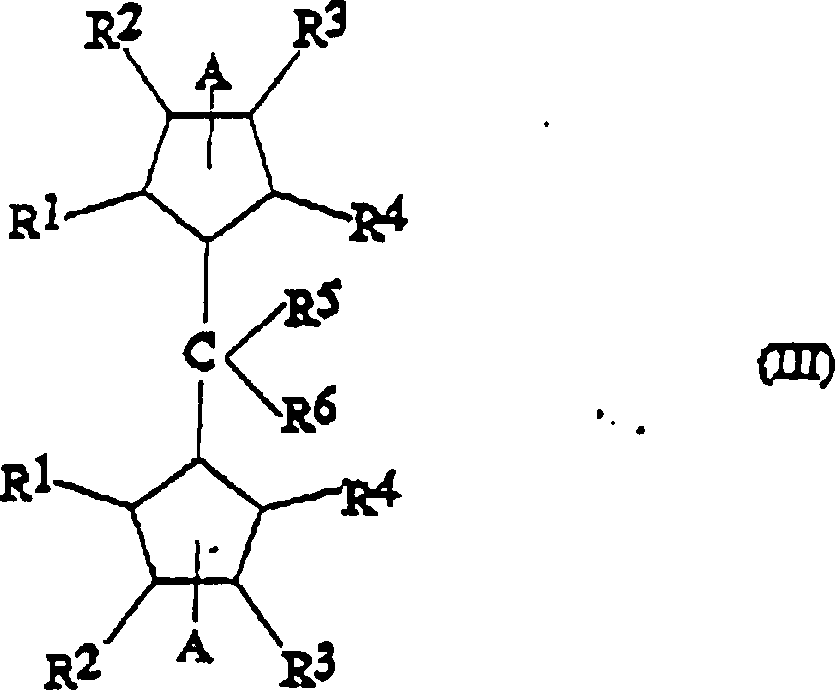
Die Doppelbindungen der Cyclopentadienylringe in den Liganden der Formel (III) können in beliebigen erlaubten Stellungen vorliegen. Die Liganden der Formel (III) lassen sich beispielsweise gemäß dem Verfahren der gleichzeitig anhängigen italienischen Patentanmeldung MI/95A/100 der gleichen Anmelderin herstellen.The Double bonds of the cyclopentadienyl rings in the ligands of the formula (III) exist in any permitted positions. The ligands of the formula (III) can be, for example, according to the method of simultaneously pending Italian patent application MI / 95A / 100 of the same Applicant produce.
Für den Fall, das es sich bei mindestens einem Substituenten X in der herzustellenden Metallocenverbindung der Formel (I) nicht um ein Halogenatom handelt, ist es erforderlich, mindestens einen Substituenten X im erhaltenen Metallocen durch mindestens einen von Halogen abweichenden Substituenten X zu ersetzen.In the case, which is at least one substituent X in the produced Metallocene compound of the formula (I) is not a halogen atom, it is necessary to have at least one substituent X in the obtained Metallocene by at least one non-halogen substituent Replace X.
Die Umsetzung von X-Substituenten durch von Halogen abweichenden Substituenten X lässt sich unter Heranziehung allgemein angewendeter Verfahren durchführen. Wenn es sich beispielsweise bei den gewünschten Substituenten X um Alkylgruppen handelt, lassen sich die Metallocene durch Umsetzung mit Alkylmagnesiumhalogeniden (Grignard-Reagenzien) oder mit Alkyllithiumverbindungen herstellen.The Reaction of X substituents by halogen-deviating substituents X lets using commonly used procedures. If it is, for example, the desired substituents X um Alkyl groups, the metallocenes can be by reaction with alkylmagnesium halides (Grignard reagents) or with alkyl lithium compounds produce.
Die erfindungsgemäßen Metallocenverbindungen lassen sich zweckmäßigerweise als Katalysatorkomponenten für die Polymerisation von Olefinen verwenden.The Metallocene compounds according to the invention can be expediently as catalyst components for use the polymerization of olefins.
Ein weiterer Gegenstand der Erfindung besteht somit in einem Katalysator für die Polymerisation von Olefinen, der aus dem Reaktionsprodukt aus
- (a) einer erfindungsgemäßen Metallocenverbindung und
- (b) einem Alumoxan oder einer Verbindung, die zur Bildung eines Alkylmetallocenkations befähigt ist, besteht.
- (a) a metallocene compound of the invention and
- (b) an alumoxane or a compound capable of forming an alkyl metallocene cation.
Im Katalysator, der im erfindungsgemäßen Verfahren eingesetzt wird, können sowohl die Metallocenverbindung der Formel (I) als auch das Alumoxan in Form eines Reaktionsprodukts mit einer organometallischen Aluminiumverbindung der Formel AlR11 3 oder Al2R11 6 vorliegen, wobei die Substituenten R11, die gleich oder verschieden sein können, den Definitionen für die Substituenten R entsprechen oder Halogenatome sind.In the catalyst used in the process according to the invention, both the metallocene compound of the formula (I) and the alumoxane can be present in the form of a reaction product with an organometallic aluminum compound of the formula AlR 11 3 or Al 2 R 11 6 , where the substituents R 11 , which may be the same or different, correspond to the definitions for the substituents R or are halogen atoms.
Bei
dem im erfindungsgemäßen Katalysator
verwendeten Alumoxan handelt es sich um eine lineare, verzweigte,
oder cyclische Verbindung, die mindestens eine Gruppe des Typs 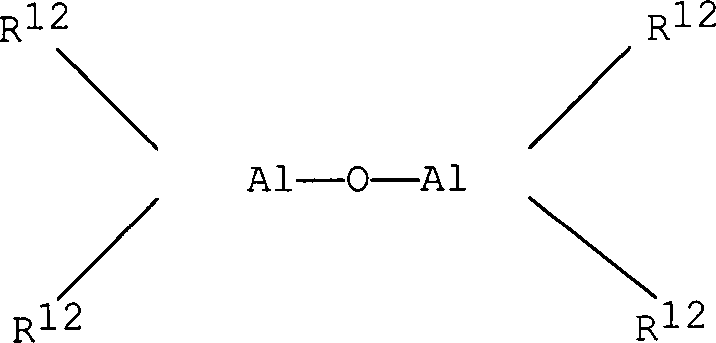
Insbesondere
können
Alumoxane der Formel 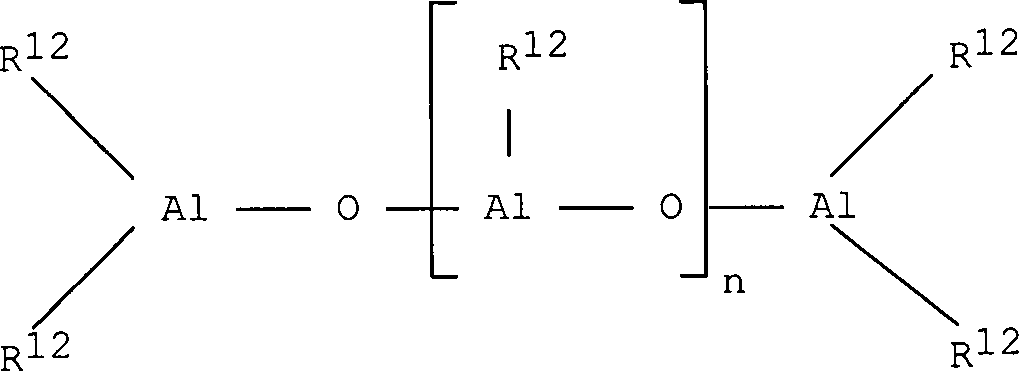
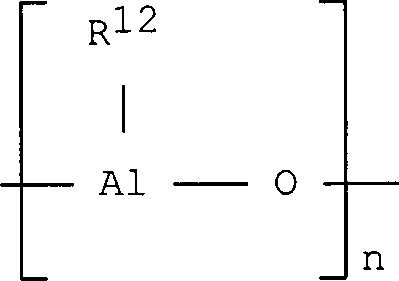
Bei den Substituenten R12 handelt es sich vorzugsweise um Methyl, Ethyl, Isobutyl oder 2,4,4-Trimethylpentyl.The substituents R 12 are preferably methyl, ethyl, isobutyl or 2,4,4-trimethylpentyl.
Beispiele
für erfindungsgemäß geeignete
Alumoxane sind Methylalumoxan (MAO), Isobutylalumoxan (TIBAO) und
2,4,4-Trimethylpentylalumoxan
(TIOAO). Nicht-beschränkende
Beispiele für
Aluminiumverbindungen der Formeln AlR11 3 oder Al2R11 6 sind:
Al(Me)3, Al(Et)3, AlH(Et)2, Al(iBu)3, AlH(iBu)2, Al(iHex)3, Al(iOct)3, Al(C6H5)3, Al(CH2C6H5)3, Al(CH2CMe3)3, Al(CH2SiMe3)3,
Al(Me)2iBu, Al(Me)2Et,
AlMe(Et)2, AlMe(iBu)2,
Al(Me)2iBu, Al(Me)2Cl,
Al(Et)2Cl, und Al(Et)3Cl3, wobei Me = Methyl, Et = Ethyl, iBu = Isobutyl,
iHex = Isohexyl und iOct = 2,4,4-Trimethylpentyl.Examples of alumoxanes which are suitable according to the invention are methylalumoxane (MAO), isobutylalumoxane (TIBAO) and 2,4,4-trimethylpentylalumoxane (TIOAO). Non-limiting examples of aluminum compounds of the formulas AlR 11 3 or Al 2 R 11 6 are:
Al (Me) 3 , Al (Et) 3 , AlH (Et) 2 , Al (iBu) 3 , AlH (iBu) 2 , Al (iHex) 3 , Al (iOct) 3 , Al (C 6 H 5 ) 3 , Al (CH 2 C 6 H 5 ) 3 , Al (CH 2 CMe 3 ) 3 , Al (CH 2 SiMe 3 ) 3 , Al (Me) 2 iBu, Al (Me) 2 Et, AlMe (Et) 2 , AlMe (iBu) 2 , Al (Me) 2 iBu, Al (Me) 2 Cl, Al (Et) 2 Cl, and Al (Et) 3 Cl 3 , where Me = methyl, Et = ethyl, iBu = isobutyl, iHex = Isohexyl and iOct = 2,4,4-trimethylpentyl.
Unter den vorstehenden Aluminiumverbindungen werden Trimethylaluminium (TMA) und Triisobutylaluminium (TIBAL) bevorzugt.Under the above aluminum compounds become trimethylaluminum (TMA) and triisobutylaluminum (TIBAL) are preferred.
Nicht-beschränkende Beispiele für Verbindungen, die zur Bildung eines Alkylmetallocenkations geeignet sind, sind Verbindungen der Formel Y+Z-, worin Y+ eine Brönsted-Säure bedeutet, die zum Spenden eines Protons und zur irreversiblen Umsetzung mit einem Substituenten X der Verbindung der Formel (I) befähigt ist und Z- ein verträgliches Anion bedeutet, das keine Koordination eingeht und das zur Stabilisierung der aktiven katalytischen Spezies, die sich aus der Umsetzung der beiden Verbindungen ergibt, befähigt ist und die ausreichend labil ist, dass sie durch ein Olefinsubstrat verdrängbar ist. Vorzugsweise besteht das Anion Z- aus einem oder mehreren Boratomen. Insbesondere bedeutet das Anion Z ein Anion der Formel Br4(-), wobei die Substituenten Ar, die gleich oder verschieden sein können, Arylreste, wie Phenyl, Pentafluorphenyl oder Bis-(trifluormethyl)-phenyl bedeuten. Tetrakis-pentafluorphenylborat wird besonders bevorzugt. Außerdem können zweckmäßigerweise Verbindungen der Formel Br3 eingesetzt werden.Non-limiting examples of compounds useful in forming an alkyl metallocene cation are compounds of the formula Y + Z - wherein Y + is a Bronsted acid which is capable of donating a proton and irreversibly reacting with a substituent X of the compound of the formula (I) and Z - means a compatible anion which does not undergo coordination and which is capable of stabilizing the active catalytic species resulting from the reaction of the two compounds and which is sufficiently labile to be displaceable by an olefin substrate is. Preferably, the anion Z - consists of one or more boron atoms. In particular, the anion Z represents an anion of the formula Br 4 (-) , where the substituents Ar, which may be identical or different, are aryl radicals, such as phenyl, pentafluorophenyl or bis (trifluoromethyl) phenyl. Tetrakis-pentafluorophenyl borate is particularly preferred. In addition, it is expedient to use compounds of the formula Br 3 .
Die erfindungsgemäßen Katalysatoren können auch auf inerten Trägern verwendet werden. Dies wird erreicht in dem man die Metallocenverbindungen (A) oder deren Reaktionsprodukt mit der Komponente (B) oder die Komponente (B) und anschließend die Metallocenverbindung (A) auf inerten Trägern, wie Siliciumdioxid, Aluminiumoxid, Styrol/Divinylbenzol-copolymeren oder Polyethylen, abscheidet.The catalysts of the invention can also on inert carriers be used. This is achieved by using the metallocene compounds (A) or its reaction product with the component (B) or the Component (B) and then the metallocene compound (A) on inert supports, such as silica, alumina, Styrene / divinylbenzene copolymers or polyethylene, deposits.
Die auf diese Weise erhaltene feste Verbindung wird gegebenenfalls unter weiterer Zugabe der Alkylaluminiumverbindung entweder als solcher oder nach vorheriger Umsetzung mit Wasser in zweckmäßiger Weise bei der Gasphasenpolymerisation eingesetzt.The optionally obtained in this way solid compound is optionally further addition of the alkylaluminum compound either as such or after previous reaction with water in an appropriate manner used in gas phase polymerization.
Ein weiterer Gegenstand der Erfindung ist ein Verfahren zur Polymerisation von Olefinen, das die Polymerisationsreaktion von einem oder mehreren Olefin-Monomeren in Gegenwart eines vorstehend beschriebenen Katalysators umfasst.One Another object of the invention is a method for polymerization of olefins, which is the polymerization reaction of one or more Olefin monomers in the presence of a catalyst described above includes.
Bevorzugte Olefin-Monomere sind Ethylen, die α-Olefine und die Cycloolefine. Die erfindungsgemäßen Katalysatoren können zweckmäßigerweise z.B. bei Homopolymerisationsreaktionen von Ethylen oder von α-Olefinen, wie Propylen und 1-Buten, bei Copolymerisationsreaktionen von Ethylen mit α-Olefinen, wie Propylen und 1-Buten, und auch bei Copolymerisationsreaktionen von Propylen mit C4-C10-α-Olefinen, wie 1-Buten, verwendet werden. Besonders interessante Ergebnisse werden erzielt, wenn die erfindungsgemäßen Katalysatoren für die Polymerisation von Propylen verwendet werden.Preferred olefin monomers are ethylene, the alpha olefins and the cycloolefins. The catalysts of the invention may conveniently be used, for example, in homopolymerization reactions of ethylene or of α-olefins, such as propylene and 1-butene, in copolymerization reactions of ethylene with α-olefins, such as propylene and 1-butene, and also in copolymerization reactions of propylene with C 4 -C 10 -α-olefins, such as 1-butene can be used. Particularly interesting results are achieved when the catalysts of the invention are used for the polymerization of propylene.
Somit
wird gemäß einer
Ausführungsform
des erfindungsgemäßen Verfahrens
zur Polymerisation von Olefinen Propylen in Gegenwart einer Metallocenverbindung
der Formel (II) polymerisiert, wobei es sich bei den Substituenten
R3 um Kohlenstoff-, Silicium- oder Germaniumatome
handelt, die mit 3 Alkyl-, Cycloalkyl-, Aryl-, Alkylaryl- oder Arylalkylgruppen
mit 1 bis 10 Kohlenstoffatomen substituiert sind und wobei R4, R5, R6,
M und X die vorstehend definierten Bedeutungen haben. Bei den Substituenten
R4 handelt es sich vorzugsweise um Wasserstoffatome.
Nachstehend sind Beispiele für
derartige Metallocenverbindungen aufgeführt:
Isopropyliden-bis-(3-tert.-butylindenyl)-zirconiumdichlorid,
Isopropyliden-bis-(3-trimethylsilylindenyl)-zirconiumdichlorid
und
Isopropyliden-bis-(3-trimethylgermylindenyl)-zirconiumdichlorid.Thus, according to one embodiment of the process according to the invention for the polymerization of olefins, propylene is polymerized in the presence of a metallocene compound of the formula (II), wherein the substituents R 3 are carbon, silicon or germanium atoms which are substituted by 3-alkyl, cycloalkyl , Aryl, alkylaryl or arylalkyl groups having 1 to 10 carbon atoms and wherein R 4 , R 5 , R 6 , M and X have the meanings defined above. The substituents R 4 are preferably hydrogen atoms. The following are examples of such metallocene compounds:
Isopropylidene-bis (3-tert-butylindenyl) zirconium dichloride,
Isopropylidene bis (3-trimethylsilylindenyl) zirconium dichloride and
Isopropylidene-bis (3-trimethylgermyl) zirconium dichloride.
Die auf diese Weise erhältlichen Propylen-Polymeren weisen enge Molekulargewichtsverteilungen in Verbindung mit hohen isotaktischen Indices und sehr hohen Graden der Regioregularität auf. Tatsächlich zeigen an diesen Polymeren durchgeführte 13C-NMR-Analysen keine Struktureinheiten aufgrund von regioirregulären Einschüben. Diesbezüglich wird Bezug genommen auf Macromolecules, Bd. 28 (1995), S. 6667–6676.The propylene polymers obtainable in this way have narrow molecular weight distributions combined with high isotactic indices and very high levels of regioregularity. In fact, 13 C NMR analyzes carried out on these polymers show no structural units due to regioirregular feeds. For reference, reference is made to Macromolecules, Vol. 28 (1995), pp. 6667-6676.
Wenn die Polymerisation von Propylen in Gegenwart einer Bis-4,5,6,7-tetrahydroindenylmetallocenverbindung, die den vorstehenden Verbindungen der Formel (II) entspricht, durchgeführt wird, wird ein sehr niedermolekulares Polypropylenwachs erhalten. Trotz des niedrigen Molekulargewichts weisen diese Wachse recht hohe isotaktische Indices auf, wie das Vorliegen eines Schmelzpunktes und die Werte von isotaktischen (m) Diaden, bestimmt durch 13C-NMR-Analyse, zeigt, die im allgemeinen über 90 % liegen.When the polymerization of propylene is carried out in the presence of a bis-4,5,6,7-tetrahydroindenyl metallocene compound corresponding to the above compounds of the formula (II), a very low molecular weight polypropylene wax is obtained. Despite the low molecular weight, these waxes have quite high isotactic indices, as evidenced by the presence of a melting point and the values of isotactic (m) diads as determined by 13 C NMR analysis, which are generally over 90%.
Gemäß einer
weiteren Ausführungsform
des erfindungsgemäßen Verfahrens
zur Polymerisation von Olefinen wird Propylen in Gegenwart einer
Metallocenverbindung der Formel (I) polymerisiert, wobei es sich bei
den Substituenten R2 um Wasserstoffatome
handelt und die R3-Substituenten Kohlenstoff-,
Silicium- oder Germaniumatome bedeuten, die mit 3 Alkyl-, Cycloalkyl-,
Aryl-, Alklyaryl- oder Arylalkylgruppen mit 1 bis 10 Kohlenstoffatomen
substituiert sind. Bei den Substituenten R4 handelt
es sich vorzugsweise um Wasserstoffatome. Nachstehend sind Beispiele
für derartige
Metallocenverbindungen aufgeführt:
Isopropyliden-bis-(3-tert.-butylcyclopentadienyl)-zirconiumdichlorid
und
Isopropyliden-bis-(2-methyl-4-tert.-butylcyclopentadienyl)-zirconiumdichlorid.According to a further embodiment of the process according to the invention for the polymerization of olefins, propylene is polymerized in the presence of a metallocene compound of the formula (I), where the substituents R 2 are hydrogen atoms and the R 3 substituents are carbon, silicon or germanium atoms, which are substituted with 3 alkyl, cycloalkyl, aryl, Alklyaryl or arylalkyl groups having 1 to 10 carbon atoms. The substituents R 4 are preferably hydrogen atoms. The following are examples of such metallocene compounds:
Isopropylidene bis (3-tert-butylcyclopentadienyl) zirconium dichloride and
Isopropylidene-bis (2-methyl-4-tert-butylcyclopentadienyl) zirconium dichloride.
Die auf diese Weise erhältlichen Propylen-Polymeren zeigen neben ihrer engen Molekulargewichtsverteilung sehr hohe isotaktische Indices, wie sich aus ihren hohen Schmelzpunkten ergibt, die üblicherweise über 155°C und sogar über 160°C liegen.The available in this way Propylene polymers show in addition to their narrow molecular weight distribution very high isotactic indices, as evidenced by their high melting points which are usually above 155 ° C and even above 160 ° C.
Die Werte der isotaktischen (mmmm) Pentaden für diese Polymeren können sogar 99 % und darüber betragen.The Values of the isotactic (mmmm) pentads for these polymers may even be 99% and above.
Diese Polymeren zeigen einen sehr hohen Grad der Regioregularität. Die mit einem 300 MHz-Instrument an diesen Polymeren durchgeführte 13C-NMR-Analyse zeigt im allgemeinen das Vorliegen einer geringen Menge an Struktureinheiten, die auf regioirreguläre Einschübe, wie 1,3-Einschübe, zurückzuführen sind.These polymers show a very high degree of regioregularity. The 13 C-NMR analysis performed on these polymers with a 300 MHz instrument generally indicates the presence of a small amount of structural units due to regioirregular inserts such as 1,3-insertions.
Besonders interessante Ergebnisse werden erzielt, wenn sich in den vorstehenden speziellen Metallocenverbindungen der Formel (I) die Substituenten von R1 von Wasserstoffatomen unterscheiden, z.B. bei Isopropyliden-bis-(2-methyl-4-tert.-butylcyclopentadienyl)-zirconiumdichlorid. Somit ist es möglich, Propylen-Polymere mit sehr hohen isotaktischen Indices zu erhalten, wie sich aus deren Schmelzpunkten ergibt, die auch bei Polymerisationstemperaturen von industriellem Interesse, z.B. 50°C und darüber, höher als 160°C liegen können.Particularly interesting results are achieved when in the above specific metallocene compounds of formula (I), the substituents of R 1 are different from hydrogen atoms, for example in isopropylidene bis (2-methyl-4-tert-butylcyclopentadienyl) zirconium dichloride. Thus, it is possible to obtain propylene polymers with very high isotactic indices, as shown by their melting points, which may be higher than 160 ° C even at polymerization temperatures of industrial interest, eg 50 ° C and above.
Die durch das erfindungsgemäße Verfahren erhältlichen Propylen-Polymeren weisen geringe, in Xylol lösliche Fraktionen auf, im allgemeinen unter 5 Gew.-%, vorzugsweise unter 3 Gew.-% und insbesondere unter 1 Gew.-%.The by the method according to the invention available Propylene polymers have low, xylene-soluble Fractions, generally less than 5 wt .-%, preferably less than 3 wt .-% and in particular less than 1 wt .-%.
Die erfindungsgemäße Polymerisationsreaktion von Propylen kann in Gegenwart eines C4-C10-α-Olefin-Comonomeren, wie 1-Buten, durchgeführt werden. Dabei ist es möglich, Propylen-Copolymere mit 0,1–10 Mol-% eines C4-C10-α-Olefin-Comonomeren zu erhalten, deren Eigenschaften ähnlich den Eigenschaften des entsprechenden Homopolymeren sind, die aber einen niedrigeren Schmelzpunkt aufweisen. Trotz des Vorliegens eines Comonomeren weisen diese Copolymeren immer noch äußerst geringe, in Xylol lösliche Fraktionen auf, im allgemeinen unter 3 Gew.-%, vorzugsweise unter 2 Gew.-% und insbesondere unter 1 Gew.-%.The polymerization reaction of propylene according to the invention can be carried out in the presence of a C 4 -C 10 α-olefin comonomer, such as 1-butene. It is possible to obtain propylene copolymers with 0.1-10 mol% of a C 4 -C 10 α-olefin comonomer whose properties are similar to the properties of the corresponding homopolymer, but which have a lower melting point. In spite of the presence of a comonomer, these copolymers still have extremely low xylene-soluble fractions, generally below 3% by weight, preferably below 2% by weight and most preferably below 1% by weight.
Das erfindungsgemäße Verfahren zur Polymerisation von Olefinen kann in flüssiger Phase in Gegenwart oder Abwesenheit eines inerten Kohlenwasserstofflösungsmittels oder in der Gasphase durchgeführt werden. Das Kohlenwasserstofflösungsmittel kann entweder aromatisch sein, wie Toluol, oder aliphatisch, wie Propan, Hexan, Heptan, Isobutan oder Cyclohexan.The inventive method for the polymerization of olefins may be in the liquid phase in the presence or Absence of an inert hydrocarbon solvent or in the gas phase carried out become. The hydrocarbon solvent may be either aromatic, such as toluene, or aliphatic, such as propane, Hexane, heptane, isobutane or cyclohexane.
Die Polymerisationstemperatur liegt im allgemeinen zwischen –100°C und +80°C und insbesondere zwischen –50°C und +50°C. Je niedriger die Polymerisationstemperatur ist, desto höhere Molekulargewichte der Polymeren werden erzielt.The Polymerization temperature is generally between -100 ° C and + 80 ° C and in particular between -50 ° C and + 50 ° C. The lower the polymerization temperature is, the higher the molecular weights of the Polymers are achieved.
Das Molekulargewicht der Polymeren kann auch variiert werden, indem man den Typ oder die Konzentration der Katalysatorkomponenten variiert oder indem man Molekulargewichtsregler, wie Wasserstoff, einsetzt.The Molecular weight of the polymers can also be varied by one varies the type or concentration of the catalyst components or by using molecular weight regulators, such as hydrogen.
Die Molekulargewichtsverteilung kann. variiert werden, indem man Gemische von unterschiedlichen Metallocenverbindungen verwendet, oder indem man die Polymerisation in mehreren Stufen bei verschiedenen Polymerisationstemperaturen und/oder verschiedenen Konzentrationen der Molekulargewichtsregler durchführt.The Molecular weight distribution can. be varied by mixing used by different metallocene compounds, or by the polymerization in several stages at different polymerization temperatures and / or various concentrations of molecular weight regulators.
Die Polymerisationsausbeuten hängen von der Reinheit der Metallocenverbindung des Katalysators ab. Die nach dem erfindungsgemäßen Verfahren erhaltenen Metallocenverbindungen können somit direkt als solche verwendet werden oder sie können Reinigungsbehandlungen unterworfen werden.The Hang polymerization from the purity of the metallocene compound of the catalyst. The according to the inventive method thus obtained metallocene compounds can be used directly as such can be used or they can Be subjected to cleaning treatments.
Die Komponenten des Katalysators können vor der Polymerisation miteinander in Kontakt gebracht werden. Die Kontaktzeit beträgt im allgemeinen 1 bis 60 Minuten und vorzugsweise 5 bis 20 Minuten. Die Konzentrationen vor der Kontaktherstellung betragen 10-2 bis 10-8 mol/l für die Metallocenkomponente (A), während sie für die Komponente (B) zwischen 10 und 10-3 mol/l liegt. Der vorherige Kontakt wird im allgemeinen in Gegenwart eines Kohlenwasserstofflösungsmittels und gegebenenfalls in Gegenwart von geringen Mengen an Monomerem vorgenommen.The components of the catalyst may be contacted before polymerization. The contact time is generally 1 to 60 minutes, and preferably 5 to 20 minutes. The pre-contact concentrations are from 10 -2 to 10 -8 mol / l for the metallocene component (A), while for component (B) it is between 10 and 10 -3 mol / l. The prior contact is generally made in the presence of a hydrocarbon solvent and optionally in the presence of small amounts of monomer.
Die folgenden Beispiele dienen Erläuterungszwecken, ohne die Erfindung zu beschränken.The The following examples are for explanatory purposes. without limiting the invention.
Charakterisierungcharacterization
Die 1H-NMR-Analysen wurden an einem Bruker-200 MHz-Instrument mit einer Pulsamplitude von 40° und einem Abstand von 1 Sekunde zwischen den Pulsen durchgeführt. 128 bis 512 Datenpunkte wurden je nach der Löslichkeit der verschiedenen Verbindungen für jede Probe gesammelt. Die 13C-NMR-Analysen wurden an einem Varian UNITY-300-Instrument bei 75,4 MHz durchgeführt. Die Proben wurden in einer 15 prozentigen Lösung in Deuteroethantetrachlorid bei 130°C analysiert. Für jede Probe wurden 6000 Datenpunkte mit einem Abstand von 12 Sekunden zwischen den einzelnen Pulsen gesammelt.The 1 H NMR analyzes were performed on a Bruker 200 MHz instrument with a pulse amplitude of 40 ° and a 1 second interval between pulses. 128 to 512 data points were collected depending on the solubility of the various compounds for each sample. 13 C NMR analyzes were performed on a Varian UNITY-300 instrument at 75.4 MHz. The samples were analyzed in a 15 percent solution in deuteroethane tetrachloride at 130 ° C. For each sample, 6000 data points were collected with a space of 12 seconds between each pulse.
Die innere Viskosität (n) wurde in Tetralin bei 135°C gemessen.The intrinsic viscosity (n) was in tetralin at 135 ° C measured.
Die Differentialscanning-Kalorimetrie-Messungen (DSC) wurden mit einem DSC 7-Instrument der Firma Perkin Elmer Co. Ltd. nach folgendem Verfahren durchgeführt. Etwa 10 mg einer Probe, die bei der Polymerisation erhalten worden war, wurden auf –25°C gekühlt und anschließend mit einer Abtastgeschwindigkeit von 10°C pro Minute auf 200°C erwärmt. Die Probe wurde 5 Minuten bei 200°C belassen und sodann mit einer Abtastgeschwindigkeit von 10°C pro Minute abgekühlt. Sodann wurde ein zweiter Abtastvorgang unter den gleichen Modalitäten wie beim ersten Vorgang durchgeführt. Die aufgeführten Werte sind die beim ersten Abtastvorgang ermittelten Werte.The Differential scanning calorimetry measurements (DSC) were performed with a DSC 7 instrument from Perkin Elmer Co. Ltd. after the following Procedure performed. About 10 mg of a sample obtained during the polymerization was cooled to -25 ° C and subsequently heated to 200 ° C at a scanning rate of 10 ° C per minute. The Sample was at 200 ° C for 5 minutes and then at a scanning rate of 10 ° C per minute cooled. Then a second scan under the same modalities as performed on the first operation. The listed Values are the values determined during the first scan.
Die Molekulargewichtsverteilung wurde durch Gelpermeationschromatographie an einem WATERS 150-Instrument in Orthodichlorbenzol bei 135°C durchgeführt.The Molecular weight distribution was determined by gel permeation chromatography on a WATERS 150 instrument in orthodichlorobenzene at 135 ° C.
Die Löslichkeit der Propylen-Polymeren in Xylol wurde bestimmt, indem man 2 g Polymeres in 250 ml Xylol bei 135°C löste und das System rührte. Nach 20 Minuten wurde die Lösung auf 25°C abgekühlt. Nach 30 Minuten wurde das ausgefällte Material abfiltriert. Die Lösung wurde unter einem Stickstoffstrom eingedampft. Der Rückstand wurde bei 80°C getrocknet. Auf diese Weise wurden der prozentuale Anteil des in Xylol bei Raumtemperatur löslichen Polymeren (XSRT) sowie der prozentuale Anteil an unlöslichem Polymeren berechnet.The solubility The propylene polymer in xylene was determined by adding 2 g of polymer in 250 ml of xylene at 135 ° C solved and the system stirred. After 20 minutes, the solution became at 25 ° C cooled. After 30 minutes, the precipitated Material filtered off. The solution was evaporated under a stream of nitrogen. The residue was at 80 ° C dried. In this way, the percentage of in Xylene at room temperature soluble Polymers (XSRT) and the percentage of insoluble Calculated polymers.
Herstellung der Metallocenemanufacturing the metallocenes
Sämtliche
Vorgänge
wurden in einer Atmosphäre
von trockenem Stickstoff unter Anwendung herkömmlicher Techniken für die Handhabung
von Verbindungen, die gegenüber
Luft empfindlich sind, durchgeführt.
THF
= Tetrahydrofuran
Et2O = Ethylether
DME
= DimethoxyethanAll operations were conducted in an atmosphere of dry nitrogen using conventional techniques for handling compounds that are sensitive to air.
THF = tetrahydrofuran
Et 2 O = ethyl ether
DME = dimethoxyethane
Beispiel 1example 1
rac-Isopropyliden-bis-(3-trimethylsilylindenyl)-zirconiumdichloridrac-isopropylidene-bis (3-trimethylsilylindenyl) zirconium dichloride
a) Herstellung von 2,2-Bis-(indenyl)-propana) Preparation of 2,2-bis (indenyl) -propane
23,5 ml (200 mmol) Indol wurden innerhalb von 0,5 h zu einer Suspension von 15 g gemahlenem KOH in 150 ml DME gegeben. Das Gemisch wurde unter Rückfluss erwärmt. Sodann wurden innerhalb von 0,5 h 7,5 ml (100 mmol) Aceton zugetropft. Das Gemisch wurde weitere 2 h unter Rückfluss erwärmt. Das erhaltene Gemisch wurde abgekühlt, bis zur Neutralisation mit 200 ml verdünnter Phosphorsäure und sodann mit 100 ml Diethylether behandelt. Die organische Phase wurde abgetrennt, mit Wasser gewaschen und über Na2SO4 getrocknet. Sodann wurde das Lösungsmittel unter Vakuum entfernt. Der Rückstand wurde bei 130–160°C und 1,333 Pa (0,01 Torr) destilliert. Die breite Fraktion wurde gewonnen und aus einem Ether/Hexan-Gemisch (1:1) umkristallisiert. Man erhielt 20,4 g Produkt (Ausbeute 72 %). 1H-NMR (Aceton-d8, 30°C) δ: 7,37 (d, 2H); 7,32 (d, 2H); 6,98 (m, 4H); 6,60 (t, 2H) {=CH-}; 3,38 (d, 4H, -CH2-); 1,74 (s, 6H, -CH3).23.5 ml (200 mmol) of indole were added over 0.5 h to a suspension of 15 g of ground KOH in 150 ml of DME. The mixture was heated to reflux. Then 7.5 ml (100 mmol) of acetone were added dropwise within 0.5 h. The mixture was refluxed for an additional 2 hours. The resulting mixture was cooled, treated with 200 ml of dilute phosphoric acid until neutralization and then with 100 ml of diethyl ether. The organic phase was separated, washed with water and dried over Na 2 SO 4 . The solvent was then removed under vacuum. The residue was distilled at 130-160 ° C and 1.333 Pa (0.01 Torr). The broad fraction was recovered and from an ether / hexane mixture (1: 1) recrystallized. This gave 20.4 g of product (yield 72%). 1 H-NMR (acetone-d 8 , 30 ° C) δ: 7.37 (d, 2H); 7.32 (d, 2H); 6.98 (m, 4H); 6.60 (t, 2H) {= CH-}; 3.38 (d, 4H, -CH 2 -); 1.74 (s, 6H, -CH3).
b) Herstellung von 2,2-Bis-(3-trimethylsilylindenyl)-propanb) Preparation of 2,2-bis- (3-trimethylsilyl-indenyl) -propane
5,45 g (20 mmol) 2,2-Bis-(indenyl)-propan wurden in 100 ml Ether gelöst. Die erhaltene Lösung wurde auf –20°C gebracht und mit 22 ml einer 2,0 M Lösung von n-Butyllithium in Pentan versetzt. Man erhielt eine Suspension von Dilithium-2,2-bis-(indenyl)-propan. 8,77 g (30,85 mmol) Dilithium-2,2-bis-(indenyl)-propan wurden in 100 ml Ether gelöst und bei einer Temperatur von –40°C mit 10 ml Me3SiCl (Überschuss) versetzt. Sodann ließ man das erhaltene Gemisch auf Raumtemperatur erwärmen. Die organische Phase wurde abgetrennt, das Lösungsmittel entfernt und das Produkt unter Vakuum getrocknet.5.45 g (20 mmol) of 2,2-bis (indenyl) -propane were dissolved in 100 ml of ether. The resulting solution was brought to -20 ° C and treated with 22 ml of a 2.0 M solution of n-butyllithium in pentane. A suspension of dilithium-2,2-bis (indenyl) -propane was obtained. 8.77 g (30.85 mmol) of dilithium-2,2-bis (indenyl) -propane were dissolved in 100 ml of ether and treated at a temperature of -40 ° C with 10 ml of Me 3 SiCl (excess). Then, the resulting mixture was allowed to warm to room temperature. The organic phase was separated, the solvent removed and the product dried under vacuum.
c) Herstellung von rac-Isopropyliden-bis-(3-trimethylsilylindenyl)-zirconiumdichloridc) Preparation of rac-isopropylidene-bis (3-trimethylsilylindenyl) zirconium dichloride
8,34 g (20 mmol) 2,2-Bis-(3-trimethylsilylindenyl)-propan wurden in 100 ml Ether gelöst. Die erhaltene Lösung wurde auf –20°C gebracht und mit 22 ml einer 2,0 M Lösung von n-Butyllithium in Pentan versetzt. Man erhielt eine Suspension von Dilithium-2,2-bis-(3-trimethylsilylindenyl)-propan. Diese Suspension wurde zunächst auf Raumtemperatur erwärmt und sodann auf –40°C abgekühlt und mit 12,06 g (50 mmol) Triethylstannylchlorid versetzt. Die organische Phase wurde abgetrennt, eingedampft und mit 50 ml Toluol versetzt. Sodann wurden 4,66 g (20 mmol) ZrCl4 zugegeben. Das erhaltene Gemisch wurde auf 80°C gebracht und weitere 6 h gerührt. Sodann wurde das Toluol entfernt. Das Produkt wurde mit DME (5 × 50 ml) gewaschen und aus DME umkristallisiert. Man erhielt 3,69 g reines rac-Isopropyliden-bis-(3-trimethylsilylindenyl)-zirconiumdichlorid (Ausbeute 32 %). 1H-NMR (CD2Cl2, 30°C) δ: 7,80 (d, 2H); 7,55 (d, 2H); 7,30 (t, 2H); 7,06 (t, 2H); 6,06 (s, 2H); 2,38 (s, 6H); 0,23 (s, 18H).8.34 g (20 mmol) of 2,2-bis- (3-trimethylsilylindenyl) -propane were dissolved in 100 ml of ether. The resulting solution was brought to -20 ° C and treated with 22 ml of a 2.0 M solution of n-butyllithium in pentane. A suspension of dilithium-2,2-bis- (3-trimethylsilylindenyl) -propane was obtained. This suspension was first warmed to room temperature and then cooled to -40 ° C and treated with 12.06 g (50 mmol) of triethylstannyl chloride. The organic phase was separated, evaporated and treated with 50 ml of toluene. Then, 4.66 g (20 mmol) of ZrCl 4 was added. The resulting mixture was brought to 80 ° C and stirred for a further 6 h. Then the toluene was removed. The product was washed with DME (5 x 50 ml) and recrystallized from DME. This gave 3.69 g of pure rac-isopropylidene-bis (3-trimethylsilylindenyl) zirconium dichloride (yield 32%). 1 H-NMR (CD 2 Cl 2 , 30 ° C) δ: 7.80 (d, 2H); 7.55 (d, 2H); 7.30 (t, 2H); 7.06 (t, 2H); 6.06 (s, 2H); 2.38 (s, 6H); 0.23 (s, 18H).
Beispiel 2Example 2
rac-Isopropyliden-bis-(3-methylindenyl)-zirconiumdichloridrac-isopropylidene-bis (3-methylindenyl) zirconium dichloride
a) Herstellung von 2,2-Bis-(3-methylindenyl)-propana) Preparation of 2,2-bis (3-methylindenyl) propane
Das Verfahren von Abschnitt (a) von Beispiel 1 wurde wiederholt, mit der Ausnahme, das anstelle von Inden 200 mmol 3-Methylinden verwendet wurden und nach der Zugabe von Aceton 3 h unter Rückfluss gerührt wurde. Die Destillationstemperatur betrug 135–165°C. Das Produkt wurde als Dilithiumsalz isoliert (Ausbeute 65 %) 1H-NMR (THF-d8, 30°C) δ: 7,42 ("d", 2H); 7,10 ("d", 2H); 6,26 ("t", 2H); 6,18 ("t", 2H) {ABCD, J=9Hz}; 6,47 (s, 2H); 2,33 (s, 6H, Ind-CH3); 1,90 (s, 6H,>CMe2).The procedure of section (a) of Example 1 was repeated, except that 200 mmol of 3-methylindene was used instead of indene and stirred under reflux for 3 hours after the addition of acetone. The distillation temperature was 135-165 ° C. The product was isolated as a dilithium salt (yield 65%). 1 H-NMR (THF-d 8 , 30 ° C) δ: 7.42 ("d", 2H); 7,10 ("d", 2H); 6.26 ("t", 2H); 6.18 ("t", 2H) {ABCD, J = 9Hz}; 6.47 (s, 2H); 2.33 (s, 6H, Ind-CH 3); 1.90 (s, 6H,> CMe 2 ).
b) Herstellung von rac-Isopropyliden-bis-(3-methylindenyl)-zirconiumdichloridb) Preparation of rac-isopropylidene-bis (3-methylindenyl) zirconium dichloride
Das Verfahren von Abschnitt (c) von Beispiel 1 wurde wiederholt, mit der Ausnahme, das anstelle von 2,2-Bis-(3-trimethylsilylindenyl)-propan 20 mmol des Dilithiumsalzes von 2,2-Bis-(3-methylindenyl)-propan verwendet wurden und dass das Produkt aus Toluol umkristallisiert wurde. Man erhielt reines rac-Isopropyliden-bis-(3-methylindenyl)-zirconiumdichlorid. 1H-NMR (CD2Cl2, 30°C) δ: 7,64 (d, 2H); 7,42 (d, 2H); 7, 22 (m, 2H); 6,96 (m, 2H); 5,83 (s, 2H); 2,30 (s, 6H); 2,28 (s, 6H).The procedure of section (c) of Example 1 was repeated, except that instead of 2,2-bis (3-trimethylsilylindenyl) -propane, 20 mmol of the dilithium salt of 2,2-bis (3-methylindenyl) - propane were used and that the product was recrystallized from toluene. Pure rac isopropylidene bis (3-methylindenyl) zirconium dichloride was obtained. 1 H-NMR (CD 2 Cl 2 , 30 ° C) δ: 7.64 (d, 2H); 7.42 (d, 2H); 7, 22 (m, 2H); 6.96 (m, 2H); 5.83 (s, 2H); 2.30 (s, 6H); 2.28 (s, 6H).
Beispiel 3Example 3
rac-Isopropyliden-bis-(3-isopropylindenyl)-zirconiumdichloridrac-isopropylidene-bis (3-isopropylindenyl) zirconium dichloride
a) Herstellung von 2,2-Bis-(3-isopropylindenyl)-propana) Preparation of 2,2-bis (3-isopropylindenyl) -propane
Das Verfahren von Abschnitt (a) von Beispiel 1 wurde wiederholt, mit der Ausnahme, das anstelle von Inden 200 mmol 3-Isopropylinden verwendet wurden und dass nach der Zugabe von Aceton das Gemisch 4 h unter Rückfluss erwärmt wurde. Die Destillationstemperatur betrug 140–175°C. Das Produkt wurde als Dilithiumsalz isoliert (Ausbeute 63 %). 1H-NMR (THF-d8, 30°C) δ: 7,45 ("d", 2H); 7,27 ("d", 2H); 6,30 ("t", 2H); 6,23 ("t", 2H) {ABCD, J=8,0Hz}; 6,63 (s, 2H); 3,30 (sept, J=7,0Hz, 2H, -CH(CH3)2); 1,98 (s, 6H, >CMe2) 1,35 (d, J=7,0Hz, 12H, -CH(CH3)2).The procedure of section (a) of Example 1 was repeated, except that 200 mmol of 3-isopropylindene was used in place of indene and that after the addition of acetone, the mixture was refluxed for 4 hours. The distillation temperature was 140-175 ° C. The product was isolated as a dilithium salt (yield 63%). 1 H-NMR (THF-d 8 , 30 ° C) δ: 7.45 ("d", 2H); 7.27 ("d", 2H); 6.30 ("t", 2H); 6.23 ("t", 2H) {ABCD, J = 8.0Hz}; 6.63 (s, 2H); 3.30 (sept, J = 7.0 Hz, 2H, -C H (CH 3) 2); 1.98 (s, 6H,> CMe 2) 1.35 (d, J = 7.0 Hz, 12H, -C H (CH 3) 2).
b) Herstellung von rac-Isopropyliden-bis-(3-isopropylindenyl)-zirconiumdichloridb) Preparation of rac-isopropylidene-bis (3-isopropylindenyl) zirconium dichloride
Das Verfahren von Abschnitt (c) von Beispiel 1 wurde wiederholt, mit der Ausnahme, das anstelle von 2,2-Bis-(3-trimethylsilylindenyl)-propan 20 mmol des Dilithiumsalzes von 2,2-Bis-(3-isopropylindenyl)-propan verwendet wurden und dass das Produkt aus DME umkristallisiert wurde. Man erhielt reines rac-Isopropyliden-bis-(3-isopropylindenyl)-zirconiumdichlorid. 1H-NMR (Toluol-d8, 30°C) δ: 7,34 (m, 4H); 6,98 (m, 2H); 6,69 (m, 2H); 5,78 (s, 2H); 3,14 (sept, 2H); 1,81 (s, 6H); 1,20 (d, 12H).The procedure of section (c) of Example 1 was repeated except that instead of 2,2-bis- (3-trimethylsilyl-indenyl) -propane, 20 mmol of the dilithium salt of 2,2-bis- (3-isopropyl-indenyl) - propane were used and that the product was recrystallized from DME. Pure rac isopropylidene bis (3-isopropylindenyl) zirconium dichloride was obtained. 1 H-NMR (toluene-d 8 , 30 ° C) δ: 7.34 (m, 4H); 6.98 (m, 2H); 6.69 (m, 2H); 5.78 (s, 2H); 3.14 (sept, 2H); 1.81 (s, 6H); 1.20 (d, 12H).
Beispiel 4Example 4
rac-Isopropyliden-bis-(3-tert.-butylindenyl)-zirconiumdichloridrac-isopropylidene-bis (3-tert-butylindenyl) zirconium dichloride
a) Herstellung von 2,2-Bis-(3-tert.-butylindenyl)-propana) Preparation of 2,2-bis- (3-tert-butylindenyl) -propane
Das Verfahren von Abschnitt (a) von Beispiel 1 wurde wiederholt, mit der Ausnahme, das anstelle von Inden 200 mmol 3-tert.-Butylinden verwendet wurden und dass nach der Zugabe von Aceton das Gemisch 4 h unter Rückfluss gerührt wurde. Die Destillationstemperatur betrug 145–185°C. Das Produkt wurde als Dilithiumsalz isoliert (Ausbeute 48 %). 1H-NMR (THF-d8, 30°C) δ: 8,17 ("t", 4H); 6,95 (mm, 4K) {ABCD}; 7,36 (s, 2H); 2,70 (s, 6H, >CMe2); 2,19 (s, 18H, -CMe3).The procedure of section (a) of Example 1 was repeated, except that 200 mmol of 3-tert-butyl indene was used in place of indene and that after addition of acetone, the mixture was stirred at reflux for 4 hours. The distillation temperature was 145-185 ° C. The product was isolated as a dilithium salt (48% yield). 1 H-NMR (THF-d 8 , 30 ° C) δ: 8.17 ("t", 4H); 6.95 (mm, 4K) {ABCD}; 7.36 (s, 2H); 2.70 (s, 6H,> CMe 2 ); 2.19 (s, 18H, -CMe 3 ).
b) Herstellung von rac-Isopropyliden-bis-(3-tert.-butylindenyl)-zirconiumdichloridb) Preparation of rac-isopropylidene-bis (3-tert-butylindenyl) zirconium dichloride
Das Verfahren von Abschnitt (c) von Beispiel 1 wurde wiederholt, mit der Ausnahme, das anstelle von 2,2-Bis-(3-trimethylsilylindenyl)-propan 20 mmol des Dilithiumsalzes von 2,2-Bis-(3-tert.-butylindenyl)-propan verwendet wurden und dass das Produkt aus DME umkristallisiert wurde. Man erhielt reines rac-Isopropyliden-bis-(3-tert.-butylindenyl)-zirconiumdichlorid. 1H-NMR (CD2Cl2, 30°C) δ: 7,75 (m, 4H); 7,25 (dd, 2H); 6,97 (dd, 2H); 5,97 (s, 2H); 2,33 (s, 6H); 1,37 (s, 18H).The procedure of section (c) of Example 1 was repeated, except that instead of 2,2-bis- (3-trimethylsilyl-indenyl) -propane, 20 mmol of the dilithium salt of 2,2-bis (3-tert. butylindenyl) -propane were used and that the product was recrystallized from DME. Pure rac isopropylidene bis (3-tert-butylindenyl) zirconium dichloride was obtained. 1 H-NMR (CD 2 Cl 2 , 30 ° C) δ: 7.75 (m, 4H); 7.25 (dd, 2H); 6.97 (dd, 2H); 5.97 (s, 2H); 2.33 (s, 6H); 1.37 (s, 18H).
Beispiel 5Example 5
rac-Isopropyliden-bis-(3-tert.-butyl-4,5,6,7-tetrahydroindenyl)-zirconiumdichloridrac-isopropylidene-bis (3-tert-butyl-4,5,6,7-tetrahydroindenyl) zirconium dichloride
In einen 100 ml fassenden Glasautoklaven wurden 0,66 g rac-Isopropyliden-bis-(3-tert.-butylindenyl)-zirconiumdichlorid, 40 mg PtO2 und 50 ml CH2Cl2 gegeben. Das Gemisch wurde mit H2 auf einen Druck von 5 at gebracht und 4 h bei Raumtemperatur gerührt. Sodann wurde das Gemisch filtriert. Das Filtrat wurde zur Trockne eingedampft. 0,56 g eines gelben Feststoffes wurden isoliert, der durch Waschen mit Hexan und Et2O weiter gereinigt wurde. Auf diese Weise erhielt man 0,22 g eines gelben Pulvers. 1H-NMR (CDCl3): 5,3 (s), 2,6–2,9 (m), 2,2–2,4 (m), 1,85 (s), 1,4–1,8 (m), 1,3 (s).In a 100 ml glass autoclave were added 0.66 g of rac-isopropylidene-bis (3-tert-butylindenyl) zirconium dichloride, 40 mg of PtO 2 and 50 ml of CH 2 Cl 2 . The mixture was brought to a pressure of 5 atm with H 2 and stirred for 4 h at room temperature. The mixture was filtered. The filtrate was evaporated to dryness. 0.56 g of a yellow solid was isolated, which was further purified by washing with hexane and Et 2 O. In this way, 0.22 g of a yellow powder was obtained. 1 H-NMR (CDCl3): 5.3 (s), 2.6-2.9 (m), 2.2-2.4 (m), 1.85 (s), 1.4 to 1 , 8 (m), 1.3 (s).
Beispiel 6Example 6
rac-Isopropyliden-bis-(3-tert.-butylcyclopentadienyl)-zirconiumdichloridrac-isopropylidene-bis (3-tert-butylcyclopentadienyl) zirconium dichloride
a) Herstellung von 2,2-bis-(3-tert.-butylcyclopentadienyl)-propana) Preparation of 2,2-bis (3-tert-butylcyclopentadienyl) -propane
10 g KOH, 150 mmol tert.-Butylcyclopentadien und 4,35 g Aceton wurden in 100 ml DME suspendiert. Das erhaltene Gemisch wurde unter Rückfluss erwärmt und 2 h gerührt. Sodann wurde das Gemisch abgekühlt und mit 200 ml Wasser und 100 ml Diethylether behandelt. Die organische Phase wurde abgetrennt, mit Wasser gewaschen und über CaCl2 getrocknet. Anschließend wurde das Lösungsmittel unter Vakuum abgedampft. Der Rückstand wurde bei einer Temperatur von 145–165°C destilliert. Die breite Fraktion wurde gewonnen und umkristallisiert (Ausbeute 81 %). 1H-NMR (CDCl3) δ: 6,3–5,7 (m, 4H), 3,0–2,8 (m, 4H), 1,5–1,4 (m, 6H), 1,3–1,2 (m, 18H).10 g of KOH, 150 mmol of tert-butylcyclopentadiene and 4.35 g of acetone were suspended in 100 ml of DME. The resulting mixture was heated to reflux and stirred for 2 h. The mixture was cooled and treated with 200 ml of water and 100 ml of diethyl ether. The organic phase was separated, washed with water and dried over CaCl 2 . Then the solvent was evaporated under vacuum. The residue was distilled at a temperature of 145-165 ° C. The broad fraction was recovered and recrystallized (yield 81%). 1 H-NMR (CDCl3) δ: 6.3 to 5.7 (m, 4H), 3.0-2.8 (m, 4H), 1.5-1.4 (m, 6H), 1 , 3-1,2 (m, 18H).
b) Herstellung von rac-Isopropyliden-bis-(3-tert.-butylcyclopentadienyl)-zirconiumdichloridb) Preparation of rac-isopropylidene bis (3-tert-butylcyclopentadienyl) zirconium dichloride
Das Verfahren von Abschnitt (c) von Beispiel 1 wurde wiederholt, mit der Ausnahme, das anstelle von 2,2-Bis-(3-trimethylsilylindenyl)-propan 6,01 g (20 mmol) 2,2-Bis-(3-tert.-butylcyclopentadienyl)-propan verwendet wurden und dass das Produkt mit 50 ml Pentan gewaschen und anschließend aus Ether umkristallisiert wurde. Man erhielt 1,97 g reines rac-Isopropyliden-bis-(3-tert.-butylcyclopentadienyl)-zirconiumdichlorid (Ausbeute 22 %). 1H-NMR (THF-d8, 30°C) δ: 5,65 (t, 2H); 5,53 (t, 2H); 1,60 (s, 6H); 1,23 (s, 8H).The procedure of section (c) of Example 1 was repeated, except that instead of 2,2-bis (3-trimethylsilylindenyl) propane, 6.01 g (20 mmol) of 2,2-bis (3-trimethyl) tert-butylcyclopentadienyl) -propane were used and that the product was washed with 50 ml of pentane and then recrystallized from ether. This gave 1.97 g of pure rac-isopropylidene-bis (3-tert-butylcyclopentadienyl) zirconium dichloride (yield 22%). 1 H-NMR (THF-d 8 , 30 ° C) δ: 5.65 (t, 2H); 5.53 (t, 2H); 1.60 (s, 6H); 1.23 (s, 8H).
Beispiel 7Example 7
Isopropyliden-bis-(2-methyl-4-tert.-butylcyclopentadienyl)-zirconiumdichloridIsopropylidene-bis (2-methyl-4-tert-butylcyclopentadienyl) zirconium dichloride
a) Herstellung von 2,2-Bis-(2-methyl-4-tert.-butylcyclopentadienyl)-propana) Preparation of 2,2-bis (2-methyl-4-tert-butylcyclopentadienyl) -propane
17,8 g (131 mmol) 2-Methyl-4-tert.-butylcyclopentadien wurden innerhalb von 0,5 h unter heftigem Rühren zu einer Suspension von 10 g KOH-Pulver in 100 ml DME gegeben. Das erhaltene Gemisch wurde unter Rückfluss erwärmt. Sodann wurden innerhalb von 0,5 h tropfenweise 4,8 ml (66 mmol) Aceton zugegeben. Das Gemisch wurde weitere 6 h unter Rückfluss erwärmt. Sodann wurde das erhaltene Gemisch abgekühlt und zur Neutralisation mit 200 ml verdünnter Phosphorsäure und anschließend mit 100 ml Diethylether behandelt. Die organische Phase wurde abgetrennt, mit Wasser gewaschen und über Na2SO4 getrocknet. Sodann wurde das Lösungsmittel unter Vakuum entfernt. Der Rückstand wurde bei 1,333 Pa (0,01 Torr) destilliert. Die breite Fraktion von 130–160°C wurde gesammelt, mit 30 ml Et2O verdünnt und mit 60 ml einer 2,0 M Lösung von n-Butyllithium in Hexan behandelt. Das Produkt wurde in Form eines weißen kristallinen Niederschlags isoliert, zweimal mit 20 ml Et2O gewaschen und unter Vakuum getrocknet (Ausbeute 60 %). 1H-NMR (THF-d8, 30°C) δ: 5,52 ("d", 2H); 5,22 ("d", 2H); 3,58 (s, 6H); 1,58 (s, 6H); 1,18 (s, 18H).17.8 g (131 mmol) of 2-methyl-4-tert-butylcyclopentadiene were added over 0.5 h under vigorous stirring to a suspension of 10 g of KOH powder in 100 ml of DME. The resulting mixture was heated to reflux. Then 4.8 ml (66 mmol) of acetone were added dropwise within 0.5 h. The mixture was heated at reflux for a further 6 h. The resulting mixture was cooled and treated with 200 ml of dilute phosphoric acid for neutralization and then with 100 ml of diethyl ether. The organic phase was separated, washed with water and dried over Na 2 SO 4 . The solvent was then removed under vacuum. The residue was distilled at 1.333 Pa (0.01 Torr). The wide fraction of 130-160 ° C was collected, diluted with 30 mL of Et 2 O and treated with 60 mL of a 2.0 M solution of n-butyllithium in hexane. The product was isolated as a white crystalline precipitate, washed twice with 20 ml of Et 2 O and dried under vacuum (yield 60%). 1 H-NMR (THF-d 8 , 30 ° C) δ: 5.52 ("d", 2H); 5.22 ("d", 2H); 3.58 (s, 6H); 1.58 (s, 6H); 1.18 (s, 18H).
b) Herstellung von Isopropyliden-bis-(2-methyl-4-tert.-butylcyclopentadienyl)-zirconiumdichloridb) Preparation of isopropylidene bis (2-methyl-4-tert-butylcyclopentadienyl) zirconium dichloride
3,24 g (10 mmol) des in Stufe (a) erhaltenen Produkts wurden mit 3,98 g (20 mmol) Trimethylstannylchlorid, das in 50 ml Et2O verdünnt war, behandelt. Die Lösung wurde vom LiCl-Niederschlag dekantiert. Das Lösungsmittel wurde entfernt und der Rückstand mit 40 ml Toluol verdünnt. Die erhaltene Lösung wurde mit 2,33 g (10 mmol) ZrCl4 behandelt. Das Gemisch wurde gerührt, bis das ZrCl4 gelöst war. Sodann wurde das Lösungsmittel entfernt und der verbleibende Feststoff aus Heptan umkristallisiert. Man erhielt ein rac/meso-Gemisch (1:1) von Isopropyliden-bis-(2-methyl-4-tert.-butylcyclopentadienyl)-zirkoniumdichlorid (Ausbeute 87 %). Die Umkristallisation aus DME ergab ein rac/meso-Gemisch (2:1). 1H-NMR (CD2Cl2; 30°C) rac-Form δ: 6,29 (d, J=3,0Hz, 2H); 5,51 (d, J=3,0Hz, 2H) [Cyclopentadienylring]; 2,16 (s, 6H, >C(-CH3)2); 1,28 (s, 18 H -C(CH3)3). meso-Form δ: 6,08 (d, J=3,0Hz, 2H); 5,65 (d, 2H) [Cyclopentadienylring]; 2,29 (s, 6H, -CH3 im Ring); 2,01, 1,88 (s, 2×3H, >C(-CH3)2); 1,23 (s, 18H, -C(CH3)3). 13C-NMR (-"-) δ: 145,5; 118,2 [quat. C im Ring]; 120,7; 106,2; 100,2 [tert. C im Ring]; 37,0; 33,0; [>C<]; 30,1 [C(CH3)3]; 24,2 [>C(CH3)2].3.24 g (10 mmol) of the product obtained in step (a) were treated with 3.98 g (20 mmol) of trimethylstannyl chloride diluted in 50 ml of Et 2 O. The solution was decanted from the LiCl precipitate. The solvent was removed and the residue was diluted with 40 ml of toluene. The resulting solution was treated with 2.33 g (10 mmol) of ZrCl 4 . The mixture was stirred until the ZrCl 4 was dissolved. The solvent was then removed and the remaining solid recrystallized from heptane. A rac / meso mixture (1: 1) of isopropylidene bis (2-methyl-4-tert-butylcyclopentadienyl) zirconium dichloride was obtained (yield 87%). Recrystallization from DME gave a rac / meso mixture (2: 1). 1 H NMR (CD 2 Cl 2 , 30 ° C) rac form δ: 6.29 (d, J = 3.0Hz, 2H); 5.51 (d, J = 3.0Hz, 2H) [cyclopentadienyl ring]; 2.16 (s, 6H,> C (-CH 3 ) 2 ); 1.28 (s, 18 H -C (CH 3 ) 3 ). meso form δ: 6.08 (d, J = 3.0Hz, 2H); 5.65 (d, 2H) [cyclopentadienyl ring]; 2.29 (s, 6H, -CH 3 in the ring); 2.01, 1.88 (s, 2 x 3H,> C (-CH 3 ) 2 ); 1.23 (s, 18H, -C (CH 3 ) 3 ). 13 C NMR (- "-) δ: 145.5; 118.2 [quat. C in the ring]; 120.7; 106.2; 100.2 [tert. C in the ring]; 37.0; 33 , 0; [> C <], 30.1 [C (CH 3 ) 3 ], 24.2 [> C (CH 3 ) 2 ].
Beispiel 8Example 8
pseudorac-Benzyliden-bis-(indenyl)-zirconiumdichloridpseudorac-benzylidene-bis- (indenyl) zirconium dichloride
a) Herstellung von Bis-(indenyl)-phenylmethana) Preparation of bis (indenyl) -phenylmethane
Das Verfahren von Abschnitt (a) von Beispiel 1 wurde wiederholt, mit der Ausnahme, das anstelle von Aceton 100 mmol Benzaldehyd verwendet wurden und dass nach Zugabe des Benzaldehyds das Gemisch 5 h gerührt wurde. Die Destillationstemperatur betrug 140–170 °C. Die gewonnene Fraktion wurde aus Heptan umkristallisiert (Ausbeute 60 %) 1H-NMR (Aceton-d6, 30°C) δ: 7,52–7,18 (mm, 13H,) 6,05 (q, 2H, =CH-); 5,39 (m, 1H, >CH-); 3,40 (br s, 4H, -CH2-). 13C-NMR (CD2Cl2, 30°C) δ: 145,6; 145,1; 141,5 (=C<); 131,8; 129,3; 128,7; 127,0; 126,2; 124,1; 120,2 (=CH-); 44,5 (>CH-); 38,1 (-CH2-).The procedure of section (a) of Example 1 was repeated, except that 100 mmol of benzaldehyde was used in place of acetone, and that after addition of the benzaldehyde, the mixture was stirred for 5 h. The distillation temperature was 140-170 ° C. The recovered fraction was recrystallized from heptane (yield 60%). 1 H-NMR (acetone-d 6 , 30 ° C) δ: 7.52-7.18 (mm, 13H,) 6.05 (q, 2H, = CH-); 5.39 (m, 1H,>CH-); 3.40 (br s, 4H, -CH 2 -). 13 C NMR (CD 2 Cl 2 , 30 ° C) δ: 145.6; 145.1; 141.5 (= C <);131.8;129.3;128.7;127.0;126.2;124.1; 120.2 (= CH-); 44.5 (>CH-); 38.1 (-CH 2 -).
b) Herstellung von pseudorac-Benzyliden-bis-(indenyl)-zirconiumdichloridb) Preparation of pseudorac benzylidene bis (indenyl) zirconium dichloride
Das Verfahren von Abschnitt (c) von Beispiel 1 wurde wiederholt, mit der Ausnahme, das anstelle von 2,2-Bis-(3-trimethylsilylindenyl)-propan 20 mmol des Dilithiumsalzes von Bis-(indenyl)-phenylmethan verwendet wurden und dass das Produkt aus DME umkristallisiert wurde. Man erhielt pseudorac-Benzyliden-bis-(indenyl)-zirconiumdichlorid (aufgrund der unsymmetrischen Brücke kann das anti-Isomere nicht das genaue rac-Isomere darstellen). 1H-NMR (CD2Cl2, 30°C) δ: 7,84–7,12 (Gruppen von Multipletts, 12 H); 6,76 (t, 1H); 6,70 (d, 1H); 6,60 (d,1H); 6,11 (zwei Dubletts, 1H+1H); 6,51 (br s, 1H).The procedure of section (c) of Example 1 was repeated, except that instead of 2,2-bis- (3-trimethylsilyl-indenyl) -propane, 20 mmol of the dilithium salt of bis (indenyl) -phenylmethane was used and that the Product was recrystallized from DME. Pseudorac benzylidene bis (indenyl) zirconium dichloride was obtained (due to the asymmetric bridge, the anti-isomer can not be the exact rac isomer). 1 H-NMR (CD 2 Cl 2 , 30 ° C) δ: 7.84-7.12 (groups of multiplets, 12 H); 6.76 (t, 1H); 6.70 (d, 1H); 6.60 (d, 1H); 6.11 (two doublets, 1H + 1H); 6.51 (brs, 1H).
Polymerisation von PropylenPolymerization of propylene
Modifiziertes Methylalumoxan (M-MAO)Modified methylalumoxane (M-MAO)
Ein handelsübliches Produkt (ALBEMARLE) wurde direkt in einer Isopar C-Lösung verwendet (62 g Al/Liter).One commercial Product (ALBEMARLE) was used directly in an Isopar C solution (62 g Al / liter).
Beispiele 9–10Examples 9-10
Ein 1 Liter fassender Stahlautoklav, der mit einem Mantel, einem Rührsystem und einer Widerstandsheizvorrichtung, die zur Temperatursteuerung mit einem Thermostaten verbunden war, ausgerüstet war und vorher mit einer Lösung von AliBu3 in Hexan gereinigt und anschließend bei 60°C unter einem Stickstoffstrom getrocknet worden war, wurde mit 0,4 Liter Propylen beschickt. Anschließend wurde der Autoklav auf die gewünschte Temperatur gebracht und mit 2,25 ml einer Lösung von M-MAO in Isopar C und 0,5 ml Toluol mit einem Gehalt an 1 mg des Metallocens von Beispiel 1, die 10 Minuten gealtert worden war, versetzt. Die Polymerisation wurde 1 h durchgeführt. Die Polymerisationsbedingungen und die Daten bezüglich der Charakterisierung der erhaltenen Polymeren sind in Tabelle 1 aufgeführt.A 1 liter steel autoclave equipped with a jacket, stirring system and resistance heater connected to a thermostat for temperature control and previously cleaned with a solution of AliBu 3 in hexane and then dried at 60 ° C under a stream of nitrogen was, was charged with 0.4 liters of propylene. Subsequently, the autoclave was brought to the desired temperature and treated with 2.25 ml of a solution of M-MAO in Isopar C and 0.5 ml of toluene containing 1 mg of the metallocene of Example 1, which had been aged for 10 minutes , The polymerization was carried out for 1 h. The polymerization conditions and the characterization data of the obtained polymers are shown in Table 1.
Beispiele 11–17Examples 11-17
Das Verfahren der Beispiele 9–10 wurde unter Verwendung eines 2,3 Liter fassenden Stahlautoklaven, der mit einem Mantel, einem Rührer und einer Widerstandsheizung ausgerüstet und zur Temperatursteuerung mit einem Thermostaten verbunden war, wiederholt. Die Polymerisationsbedingungen und die Daten bezüglich der Charakterisierung der erhaltenen Polymeren sind in Tabelle 1 aufgeführt.The Method of Examples 9-10 was made using a 2.3 liter steel autoclave with a coat, a stirrer and a resistance heater equipped and with temperature control a thermostat was connected, repeated. The polymerization conditions and the data regarding the Characterization of the resulting polymers are listed in Table 1.
Beispiele 18–22Examples 18-22
Das Verfahren der Beispiele 9–10 wurde wiederholt, mit der Ausnahme, dass das Metallocen von Beispiel 4 verwendet wurde. Die Polymerisationsbedingungen und die Daten bezüglich der Charakterisierung der erhaltenen Polymeren sind in Tabelle 1 aufgeführt.The Method of Examples 9-10 was repeated except that the metallocene of example 4 was used. The polymerization conditions and the data in terms of The characterization of the polymers obtained are shown in Table 1 listed.
Beispiele 23–25Examples 23-25
Das in den Beispielen 18–22 beschriebene Verfahren wurde wiederholt, mit der Ausnahme, dass das Metallocen von Beispiel 4 in Form eines rac/meso-Gemisches (7:3), das vor der Umkristallisation erhalten worden war, verwendet wurde. Die Polymerisationsbedingungen und die Daten bezüglich der Charakterisierung der erhaltenen Polymeren sind in Tabelle 1 aufgeführt.The in Examples 18-22 The procedure described was repeated with the exception that the metallocene of Example 4 in the form of a rac / meso mixture (7: 3), which was obtained before recrystallization was used. The polymerization conditions and the characterization data of the obtained polymers are listed in Table 1.
Beispiele 26–27Examples 26-27
Das in den Beispielen 9–10 beschriebene Verfahren wurde wiederholt, mit der Ausnahme, dass das Metallocen von Beispiel 5 verwendet wurde. Die Polymerisationsbedingungen und die Daten bezüglich der Charakterisierung der erhaltenen Polymeren sind in Tabelle 1 aufgeführt.The in Examples 9-10 The procedure described was repeated with the exception that the metallocene of Example 5 was used. The polymerization conditions and the data regarding The characterization of the polymers obtained are shown in Table 1 listed.
Beispiel 28Example 28
Das in den Beispielen 9–10 beschriebene Verfahren wurde unter Verwendung von 1 mg des Metallocens von Beispiel 6 wiederholt. Die Polymerisationsbedingungen und die Daten bezüglich der Charakterisierung der erhaltenen Polymeren sind in Tabelle 1 aufgeführt.The in Examples 9-10 described method was using 1 mg of the metallocene of Example 6 is repeated. The polymerization conditions and the Data regarding The characterization of the polymers obtained are shown in Table 1 listed.
Beispiel 29Example 29
Das in den Beispielen 11–17 beschriebene Verfahren wurde unter Verwendung von 1 mg des Metallocens von Beispiel 6 wiederholt. Die Polymerisationsbedingungen und die Daten bezüglich der Charakterisierung der erhaltenen Polymeren sind in Tabelle 1 aufgeführt.The in Examples 11-17 described method was using 1 mg of the metallocene of Example 6 is repeated. The polymerization conditions and the Data regarding The characterization of the polymers obtained are shown in Table 1 listed.
Beispiele 30–34Examples 30-34
Das in den Beispielen 9–10 beschriebene Verfahren wurde wiederholt, mit der Ausnahme, dass das Metallocen von Beispiel 7 verwendet wurde. Die Polymerisationsbedingungen und die Daten bezüglich der Charakterisierung der erhaltenen Polymeren sind in Tabelle 1 aufgeführt.The in Examples 9-10 The procedure described was repeated with the exception that the metallocene of Example 7 was used. The polymerization conditions and the data regarding The characterization of the polymers obtained are shown in Table 1 listed.
Beispiele 35–36Examples 35-36
Das in den Beispielen 30–34 beschriebene Verfahren wurde wiederholt, mit der Ausnahme, dass ein 100 Liter fassender Autoklav verwendet wurde. Die Polymerisationsbedingungen und die Daten bezüglich der Charakterisierung der erhaltenen Polymeren sind in Tabelle 1 aufgeführt.The in Examples 30-34 The procedure described was repeated with the exception that a 100 liter autoclave was used. The polymerization conditions and the data regarding The characterization of the polymers obtained are shown in Table 1 listed.
Beispiele 37–38Examples 37-38
Das in den Beispielen 9–10 beschriebene Verfahren wurde wiederholt, mit der Ausnahme, dass 235 g (0,45 Liter) Propylen und 28 g 1-Buten in den Autoklaven gegeben wurden.The in Examples 9-10 The procedure described was repeated with the exception that Put 235 g (0.45 liter) of propylene and 28 g of 1-butene in the autoclave were.
Das verwendete Metallocen, die Polymerisationsbedingungen und die Daten bezüglich der Charakterisierung der erhaltenen Copolymeren sind in Tabelle 2 aufgeführt.The used metallocene, the polymerization conditions and the data in terms of The characterization of the copolymers obtained are shown in Table 2 listed.
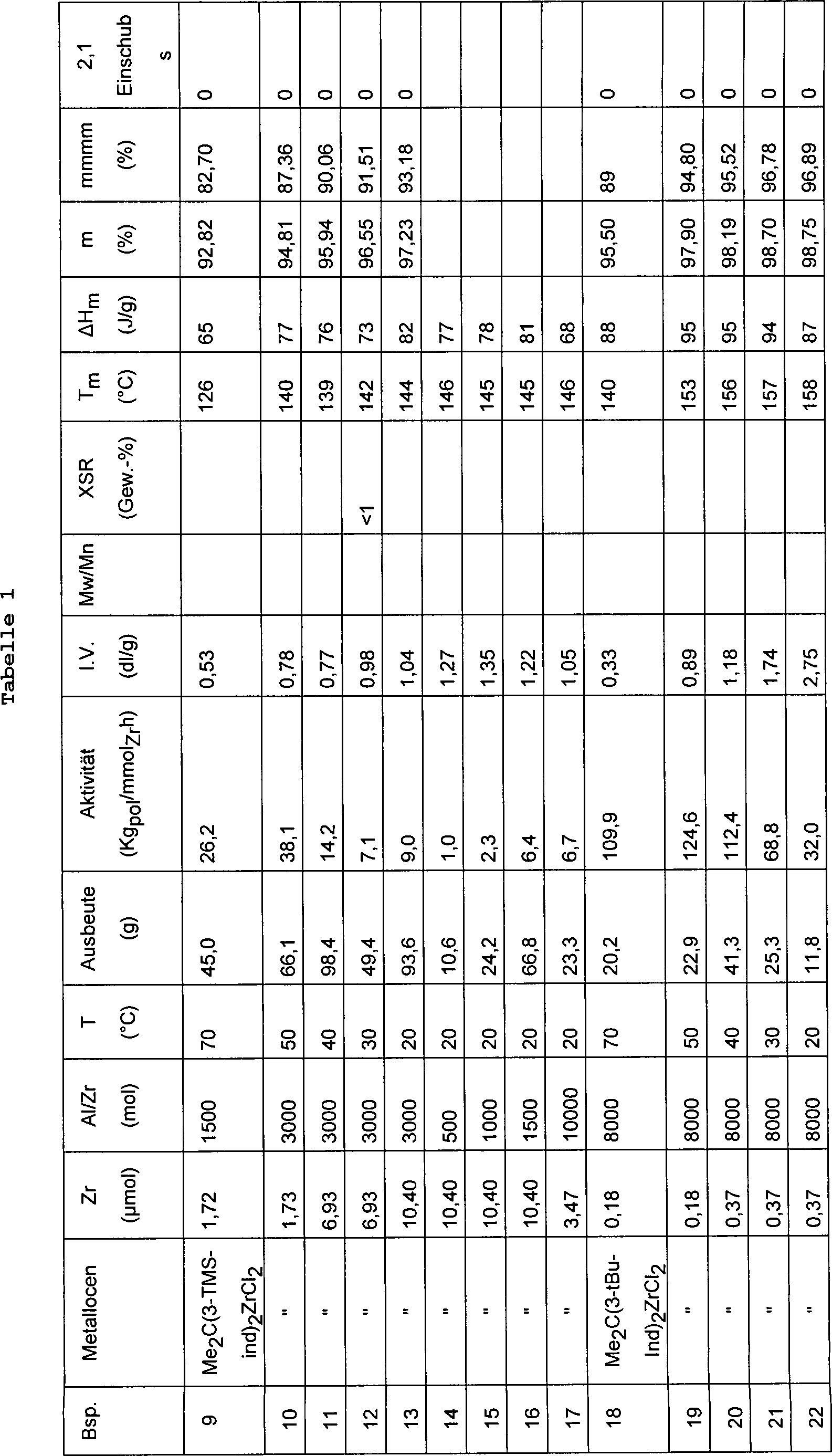
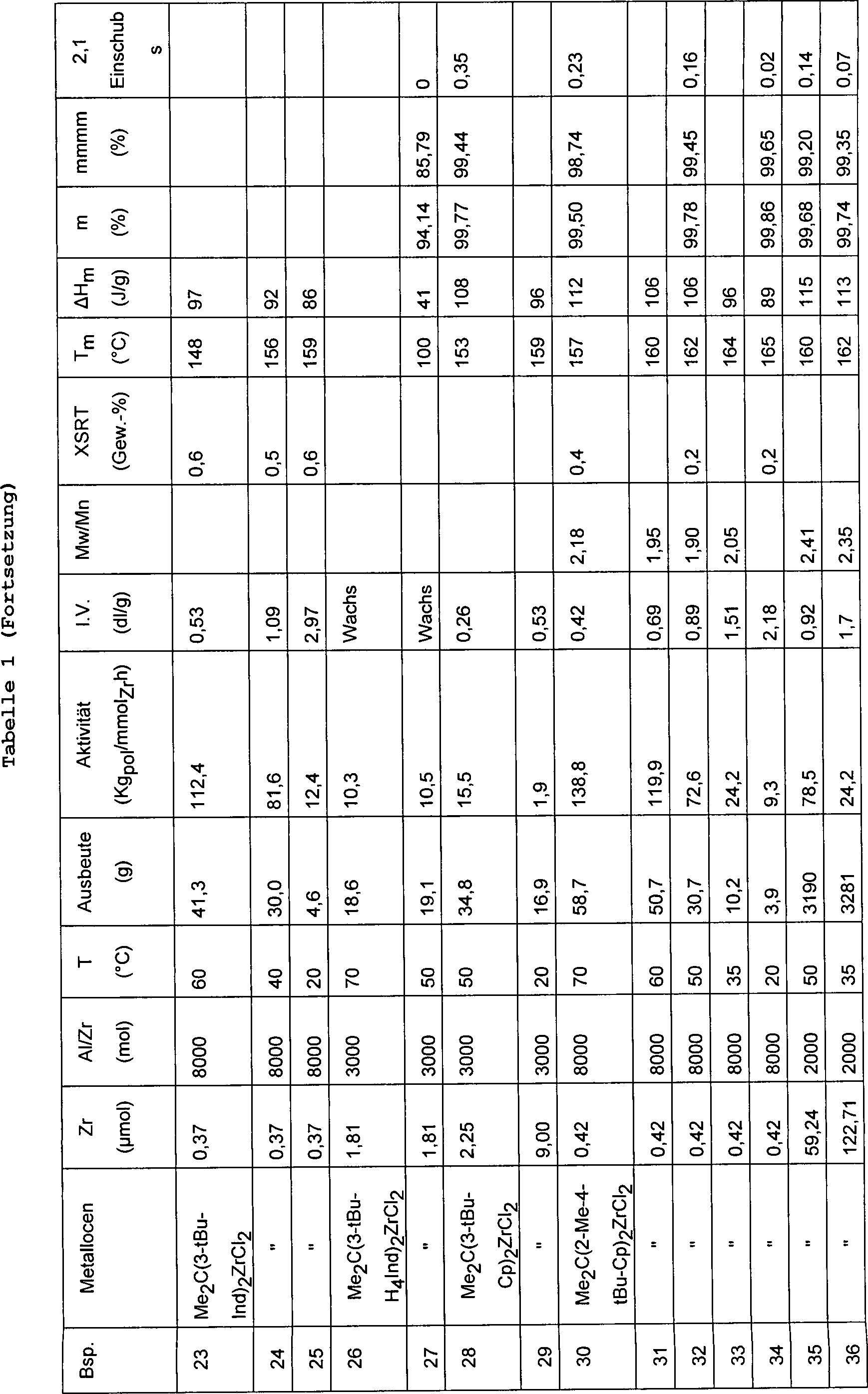
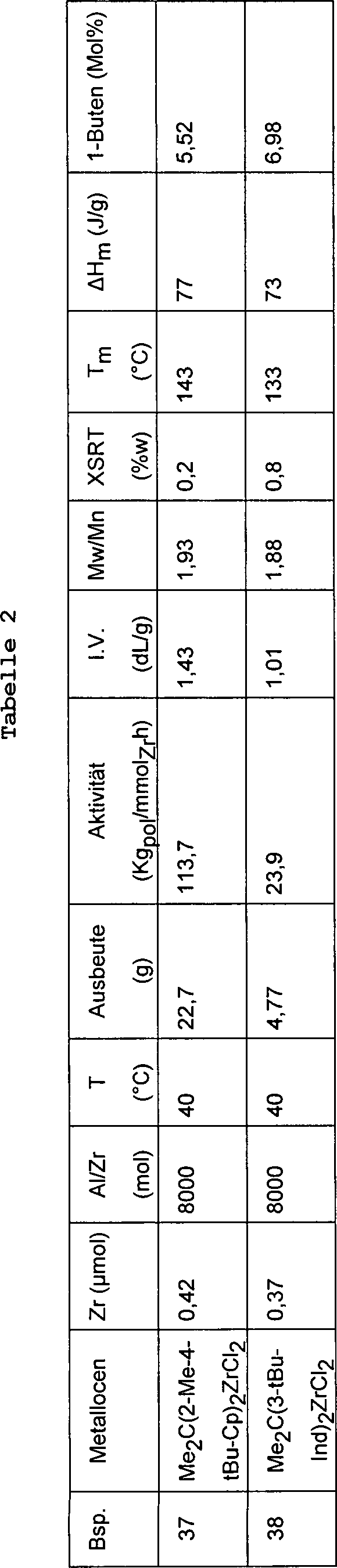
Claims (20)
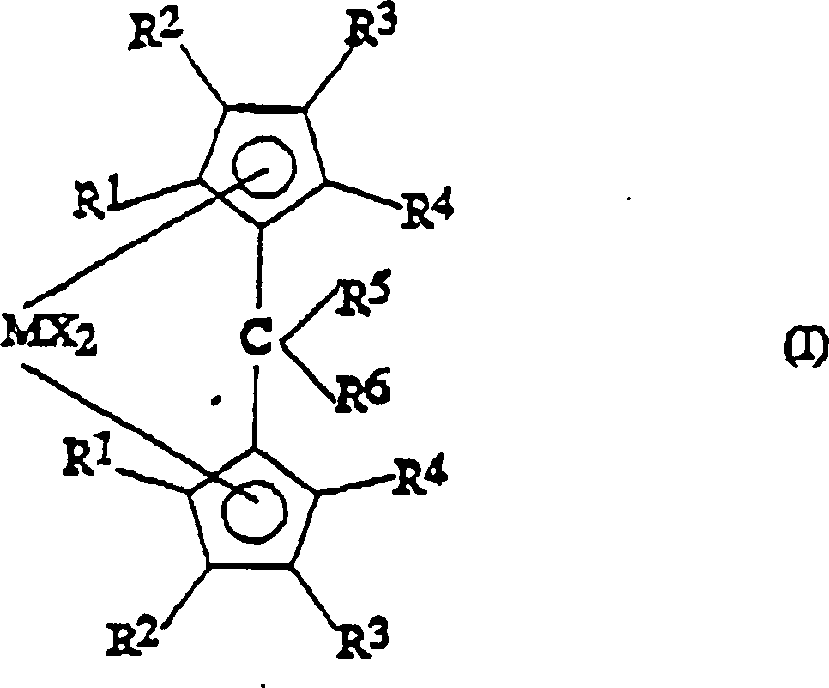


Applications Claiming Priority (3)
| Application Number | Priority Date | Filing Date | Title |
|---|---|---|---|
| ITMI950099A IT1272923B (en) | 1995-01-23 | 1995-01-23 | METALLOCENIC COMPOUNDS, PROCEDURE FOR THEIR PREPARATION, AND THEIR USE IN CATALYSTS FOR THE POLYMERIZATION OF OLEFINS |
| ITMI950099 | 1995-01-23 | ||
| PCT/EP1996/000171 WO1996022995A1 (en) | 1995-01-23 | 1996-01-17 | Metallocene compounds, process for their prepration, and their use in catalysts for the polymerization of olefins |
Publications (3)
| Publication Number | Publication Date |
|---|---|
| DE69617543D1 DE69617543D1 (en) | 2002-01-17 |
| DE69617543T2 DE69617543T2 (en) | 2002-08-01 |
| DE69617543T3 true DE69617543T3 (en) | 2007-01-18 |
Family
ID=11370281
Family Applications (1)
| Application Number | Title | Priority Date | Filing Date |
|---|---|---|---|
| DE69617543T Expired - Lifetime DE69617543T3 (en) | 1995-01-23 | 1996-01-17 | METALOCO COMPOUNDS, METHOD FOR THE PRODUCTION THEREOF AND THEIR USE IN CATALYSTS FOR OLEFIN POLYMERIZATION |
Country Status (24)
| Country | Link |
|---|---|
| US (3) | US6051728A (en) |
| EP (1) | EP0751946B2 (en) |
| JP (1) | JP3838662B2 (en) |
| KR (2) | KR100414759B1 (en) |
| CN (2) | CN1075076C (en) |
| AR (1) | AR000776A1 (en) |
| AU (1) | AU700256B2 (en) |
| BG (1) | BG100904A (en) |
| BR (1) | BR9606373A (en) |
| CA (1) | CA2186232A1 (en) |
| CZ (1) | CZ309596A3 (en) |
| DE (1) | DE69617543T3 (en) |
| ES (1) | ES2167539T5 (en) |
| FI (1) | FI963759L (en) |
| HU (1) | HUP9602907A3 (en) |
| IL (1) | IL116853A (en) |
| IT (1) | IT1272923B (en) |
| MX (1) | MX9604229A (en) |
| PL (1) | PL185055B1 (en) |
| RU (1) | RU2177948C2 (en) |
| TR (1) | TR199600720T1 (en) |
| TW (1) | TW319777B (en) |
| WO (1) | WO1996022995A1 (en) |
| ZA (1) | ZA96485B (en) |
Families Citing this family (61)
| Publication number | Priority date | Publication date | Assignee | Title |
|---|---|---|---|---|
| DE19533336A1 (en) * | 1995-09-11 | 1997-03-13 | Basf Ag | Process for the preparation of propene / but-1-ene copolymers |
| DE19533337A1 (en) * | 1995-09-11 | 1997-03-13 | Basf Ag | Propene / but-1-ene copolymers |
| JP3566819B2 (en) * | 1996-10-04 | 2004-09-15 | 関東化学株式会社 | New organic transition metal compounds |
| DE19644039A1 (en) * | 1996-10-31 | 1998-05-07 | Hoechst Ag | Metallocenes |
| AU733813B2 (en) * | 1996-11-15 | 2001-05-24 | Montell Technology Company B.V. | Heterocyclic metallocenes and polymerization catalysts |
| US5900497A (en) * | 1996-12-20 | 1999-05-04 | Union Carbide Chemicals & Plsatics Technology Corporation | Process for preparing metallocene procatalysts |
| ES2203965T3 (en) * | 1997-03-29 | 2004-04-16 | Basell Polyolefine Gmbh | METALOCENES AND CATALYSTS FOR POLYMERIZATION OF OLEFINS. |
| AT405834B (en) | 1997-10-09 | 1999-11-25 | Borealis Ag | METALLOCENES WITH FERROCENYL-SUBSTITUTED BRIDGES AND THEIR USE FOR OLEFIN POLYMERIZATION |
| DE19748388A1 (en) * | 1997-11-03 | 1999-05-06 | Borealis Polymere Holding Gmbh | Metallocene with ferrocenyl substituted bridges |
| KR20010014072A (en) | 1998-04-21 | 2001-02-26 | 간디 지오프레이 에이치. | Process for the preparation of copolymers of ethylene with alpha-olefins |
| MXPA00002181A (en) * | 1998-07-02 | 2003-04-22 | Montell Technology Company Bv | Process for the preparation of substantially amorphous alpha-olefin polymers and compositions containing them and process for the preparation of bridged ligand. |
| DE19922020A1 (en) * | 1999-05-12 | 2000-11-16 | Targor Gmbh | Transition metal compound, catalyst system, process for its preparation and its use for the polymerization of olefins |
| CA2370799A1 (en) | 2000-02-24 | 2001-08-30 | Basell Technology Company Bv | Organometallic compound useful as cocatalyst for polymerizing olefins |
| ES2223832T3 (en) | 2000-03-22 | 2005-03-01 | Basell Polyolefine Gmbh | PROCEDURE FOR THE PREPARATION OF THERMOPLASTIC COMPOSITIONS OF ISOTACTIC PROPYLENE AND FLEXIBLE POLYPROPYLENE OF LOWER ISOTACTICITY. |
| EP1222216B1 (en) * | 2000-05-24 | 2004-12-29 | Basell Polyolefine GmbH | Propylene polymers and process for the preparation thereof |
| US6673869B2 (en) | 2000-07-27 | 2004-01-06 | Basell Poliolefine Italia S.P.A. | Transparent elastomeric thermoplastic polyolefin compositions |
| JP2004516363A (en) | 2000-12-22 | 2004-06-03 | バセル ポリオレフィン ジーエムビーエイチ | Catalyst component for olefin polymerization |
| US7183332B2 (en) | 2000-12-22 | 2007-02-27 | Basell Poliolefine Italia S.P.A. | Process for the preparation of porous polymers and polymers obtainable thereof |
| WO2002102811A1 (en) | 2001-05-21 | 2002-12-27 | Basell Polyolefine Gmbh | Catalyst system for the polymerization of olefins |
| US7060765B2 (en) | 2001-07-19 | 2006-06-13 | Univation Technologies, Llc | Low comonomer incorporating metallocene catalyst compounds |
| US6936675B2 (en) | 2001-07-19 | 2005-08-30 | Univation Technologies, Llc | High tear films from hafnocene catalyzed polyethylenes |
| ES2361734T3 (en) * | 2001-07-19 | 2011-06-21 | Univation Technologies Llc | POLYETHYLENE FILMS WITH IMPROVED PHYSICAL PROPERTIES. |
| JP4020862B2 (en) * | 2001-07-19 | 2007-12-12 | ユニベーション・テクノロジーズ・エルエルシー | Mixed metallocene catalyst system containing comonomer minor incorporation catalyst and comonomer major incorporation catalyst |
| WO2003046022A1 (en) | 2001-11-27 | 2003-06-05 | Basell Polyolefine Gmbh | Process for the treatment of polymer compositions |
| RU2214415C1 (en) * | 2002-05-13 | 2003-10-20 | Общество с ограниченной ответственностью "Научно-исследовательская лаборатория "Синор" | Metallocene halide preparation method (options) |
| KR100921365B1 (en) | 2002-06-26 | 2009-10-15 | 바셀 폴리올레핀 이탈리아 에스.알.엘 | Impact Resistant Polyolefin Composition |
| MXPA04012699A (en) * | 2002-06-26 | 2005-03-23 | Basell Poliolefine Spa | Impact-resistant polyolefin compositions. |
| US7449246B2 (en) * | 2004-06-30 | 2008-11-11 | General Electric Company | Barrier coatings |
| US7569647B2 (en) * | 2002-10-10 | 2009-08-04 | Basell Polyolefine Gmbh | Process for the copolymerization of ethylene |
| US7541402B2 (en) | 2002-10-15 | 2009-06-02 | Exxonmobil Chemical Patents Inc. | Blend functionalized polyolefin adhesive |
| US7550528B2 (en) | 2002-10-15 | 2009-06-23 | Exxonmobil Chemical Patents Inc. | Functionalized olefin polymers |
| US7700707B2 (en) | 2002-10-15 | 2010-04-20 | Exxonmobil Chemical Patents Inc. | Polyolefin adhesive compositions and articles made therefrom |
| BR0315341B1 (en) | 2002-10-15 | 2014-02-18 | Adhesives comprising polyolefin. | |
| CN100362025C (en) | 2003-04-17 | 2008-01-16 | 巴塞尔聚烯烃意大利有限责任公司 | Gas Phase Olefin Polymerization Process |
| US7122606B2 (en) | 2003-07-04 | 2006-10-17 | Basell Polyolefine Gmbh | Olefin polymerization process |
| EP1564226A1 (en) | 2004-02-16 | 2005-08-17 | Stichting Dutch Polymer Institute | Titanocene-based catalyst system |
| CN101001892A (en) | 2004-03-12 | 2007-07-18 | 巴塞尔聚烯烃股份有限公司 | Catalyst system for the polymerization of olefin |
| EP1723184A1 (en) | 2004-03-12 | 2006-11-22 | Basell Polyolefine GmbH | Process for polymerizing 1-hexene or higher alpha-olefins |
| JP2007528925A (en) | 2004-03-12 | 2007-10-18 | バセル ポリオレフィン ジーエムビーエイチ | Method for polymerizing 1-hexene or higher α-olefin |
| EP1655314A1 (en) | 2004-11-09 | 2006-05-10 | Basell Polyolefine GmbH | Process for the preparation of 1-butene/propylene copolymers |
| US7300994B2 (en) * | 2004-11-22 | 2007-11-27 | Cornell Research Foundation, Inc. | Isotactic polypropylene containing polymers |
| CN101061142B (en) | 2004-11-22 | 2012-04-18 | 巴塞尔聚烯烃股份有限公司 | Propylene-based terpolymers |
| US20080160862A1 (en) * | 2004-12-13 | 2008-07-03 | Basell Poliolefine Italia S.R.L. | Polyolefin Composition, Fibres and Nonwoven Fabrics |
| CN101087905B (en) * | 2004-12-23 | 2010-12-15 | 巴塞尔聚烯烃意大利有限责任公司 | Elastic fiber |
| US7026494B1 (en) | 2005-01-10 | 2006-04-11 | Chevron Phillips Chemical Company, Lp | Polymerization catalysts for producing high melt index polymers without the use of hydrogen |
| WO2009077185A1 (en) | 2007-12-18 | 2009-06-25 | Basell Polyolefine Gmbh | Gas-phase process for the polymerization of alpha-olefins |
| CN101910225B (en) * | 2008-01-11 | 2014-06-04 | 三井化学株式会社 | Modified propylene resin |
| JP5263845B2 (en) * | 2008-02-29 | 2013-08-14 | サンアロマー株式会社 | Polyolefin composition |
| US8637625B2 (en) | 2008-11-18 | 2014-01-28 | Borealis Ag | Propylene-butene random copolymer produced in the presence of a metallocene catalyst |
| EP2341086A1 (en) † | 2009-12-30 | 2011-07-06 | Borealis AG | Bopp-film |
| EP3022236B1 (en) | 2013-07-17 | 2017-11-15 | ExxonMobil Chemical Patents Inc. | Process using substituted metallocene catalysts and products therefrom |
| US9938364B2 (en) | 2013-07-17 | 2018-04-10 | Exxonmobil Chemical Patents Inc. | Substituted metallocene catalysts |
| EP3022233B1 (en) | 2013-07-17 | 2019-05-01 | ExxonMobil Chemical Patents Inc. | Cyclopropyl substituted metallocene catalysts |
| WO2015009472A1 (en) | 2013-07-17 | 2015-01-22 | Exxonmobil Chemcal Patents Inc. | Metallocenes and catalyst compositions derived therefrom |
| JP2016531978A (en) | 2013-07-17 | 2016-10-13 | エクソンモービル ケミカル パテンツ インコーポレイテッド | Substituted metallocene catalyst |
| EP3022235B1 (en) | 2013-07-17 | 2020-04-08 | ExxonMobil Chemical Patents Inc. | Metallocenes and catalyst compositions derived therefrom |
| CN105555813B (en) * | 2013-09-30 | 2018-01-05 | 株式会社Lg化学 | Process for the preparation of propylene-1-butene copolymer and propylene-1-butene copolymer obtained therefrom |
| US10450390B2 (en) | 2014-12-15 | 2019-10-22 | Lg Chem, Ltd. | Metallocene compound, metallocene-supported catalyst, and method of preparing polyolefin using the same |
| KR101826253B1 (en) * | 2015-07-15 | 2018-02-06 | 한화케미칼 주식회사 | Metallocene compound and method of manufacturing the same |
| BR112019011558B1 (en) * | 2016-12-05 | 2023-01-17 | Exxonmobil Chemical Patents Inc | METALLOCENE POLYETHYLENES, COMPRISING ETHYLENE DERIVATIVE UNITS, THEIR FORMATION PROCESS AND FILMS |
| WO2019072695A1 (en) | 2017-10-11 | 2019-04-18 | Basell Polyolefine Gmbh | Supported catalyst system |
Family Cites Families (27)
| Publication number | Priority date | Publication date | Assignee | Title |
|---|---|---|---|---|
| ZA844157B (en) * | 1983-06-06 | 1986-01-29 | Exxon Research Engineering Co | Process and catalyst for polyolefin density and molecular weight control |
| DE3443087A1 (en) * | 1984-11-27 | 1986-05-28 | Hoechst Ag, 6230 Frankfurt | METHOD FOR PRODUCING POLYOLEFINES |
| US4668773A (en) * | 1985-03-25 | 1987-05-26 | Northwestern University | Organolanthanide catalysts |
| DE3751694T2 (en) * | 1987-04-03 | 1996-08-01 | Fina Technology | Metallocene catalyst systems for the polymerization of olefins, with a silicon-hydrocarbyl bridge. |
| US4892851A (en) * | 1988-07-15 | 1990-01-09 | Fina Technology, Inc. | Process and catalyst for producing syndiotactic polyolefins |
| ATE166890T1 (en) * | 1988-12-26 | 1998-06-15 | Mitsui Chemicals Inc | OLEFIN COPOLYMER AND METHOD FOR PRODUCING |
| DE3929693A1 (en) * | 1989-09-07 | 1991-03-14 | Hoechst Ag | METHOD FOR PRODUCING A POLYOLEFIN WAX |
| US5026798A (en) * | 1989-09-13 | 1991-06-25 | Exxon Chemical Patents Inc. | Process for producing crystalline poly-α-olefins with a monocyclopentadienyl transition metal catalyst system |
| IT1249008B (en) * | 1990-06-27 | 1995-02-11 | Himont Inc | SYNDIOTACTIC CRYSTALLINE PROPYLENE COPOLYMERS |
| DE59107926D1 (en) * | 1990-11-12 | 1996-07-18 | Hoechst Ag | Metallocenes with ligands from 2-substituted indenyl derivatives, processes for their preparation and their use as catalysts |
| ES2071888T3 (en) * | 1990-11-12 | 1995-07-01 | Hoechst Ag | BISINDENILMETALOCENOS SUBSTITUTED IN POSITION 2, PROCEDURE FOR ITS PREPARATION AND USE AS CATALYSTS IN THE POLYMERIZATION OF OLEFINS. |
| WO1992012184A1 (en) * | 1990-12-28 | 1992-07-23 | Exxon Chemical Patents Inc. | Syndiotactic polypropylene |
| ES2155492T3 (en) * | 1991-05-27 | 2001-05-16 | Basell Polyolefine Gmbh | PROCEDURE FOR OBTAINING POLYOLEFINS WITH A LARGE DISTRIBUTION OF MOLECULAR WEIGHTS. |
| JPH04351638A (en) * | 1991-05-29 | 1992-12-07 | Toray Dow Corning Silicone Co Ltd | Hexenylated silicone resin and production thereof |
| TW300901B (en) * | 1991-08-26 | 1997-03-21 | Hoechst Ag | |
| US5330948A (en) * | 1992-03-31 | 1994-07-19 | Northwestern University | Homogeneous catalysts for stereoregular olefin polymerization |
| FI112233B (en) * | 1992-04-01 | 2003-11-14 | Basell Polyolefine Gmbh | Catalyst for olefin polymerization, process for its preparation and its use |
| ES2128371T3 (en) * | 1992-08-15 | 1999-05-16 | Targor Gmbh | PROCEDURE FOR OBTAINING POLYOLEFINS. |
| TW272985B (en) * | 1992-09-11 | 1996-03-21 | Hoechst Ag | |
| EP0588208A3 (en) * | 1992-09-12 | 1994-07-06 | Hoechst Ag | Polyolefin moulding composition with broad melt range, process and use therefore |
| JP3307704B2 (en) * | 1993-02-19 | 2002-07-24 | 三菱化学株式会社 | Production method of .ALPHA.-olefin polymer |
| CA2125247C (en) * | 1993-06-07 | 2001-02-20 | Daisuke Fukuoka | Transition metal compound, olefin polymerization catalyst component comprising said compound, olefin polymerization catalyst containing said catalyst component, process for olefinpolymerization using said catalyst , propylene homopolymer, propylene copolymer and propylene elastomer |
| DE69431222T2 (en) * | 1993-06-07 | 2003-04-17 | Mitsui Chemicals, Inc. | Transition metal compound, and polymerization catalyst containing the same |
| US5459117A (en) * | 1993-08-27 | 1995-10-17 | Ewen; John A. | Doubly-conformationally locked, stereorigid catalysts for the preparation of tactiospecific polymers |
| DE4333128A1 (en) * | 1993-09-29 | 1995-03-30 | Hoechst Ag | Process for the preparation of polyolefins |
| DE4344689A1 (en) * | 1993-12-27 | 1995-06-29 | Hoechst Ag | Metallocene compound |
| US5504223A (en) * | 1994-01-25 | 1996-04-02 | The Dow Chemical Company | Synthesis of cyclopentadienyl metal coordination complexes from metal hydrocarbyloxides |
-
1995
- 1995-01-23 IT ITMI950099A patent/IT1272923B/en active IP Right Grant
-
1996
- 1996-01-17 PL PL96316387A patent/PL185055B1/en not_active IP Right Cessation
- 1996-01-17 KR KR10-2003-7010028A patent/KR100414759B1/en not_active Expired - Fee Related
- 1996-01-17 FI FI963759A patent/FI963759L/en unknown
- 1996-01-17 CA CA002186232A patent/CA2186232A1/en not_active Abandoned
- 1996-01-17 KR KR1019960705230A patent/KR100418106B1/en not_active Expired - Fee Related
- 1996-01-17 JP JP52259496A patent/JP3838662B2/en not_active Expired - Lifetime
- 1996-01-17 TR TR96/00720T patent/TR199600720T1/en unknown
- 1996-01-17 MX MX9604229A patent/MX9604229A/en unknown
- 1996-01-17 DE DE69617543T patent/DE69617543T3/en not_active Expired - Lifetime
- 1996-01-17 WO PCT/EP1996/000171 patent/WO1996022995A1/en not_active Ceased
- 1996-01-17 BR BR9606373-4A patent/BR9606373A/en not_active IP Right Cessation
- 1996-01-17 HU HU9602907A patent/HUP9602907A3/en unknown
- 1996-01-17 CN CN96190226A patent/CN1075076C/en not_active Expired - Fee Related
- 1996-01-17 EP EP96901285A patent/EP0751946B2/en not_active Expired - Lifetime
- 1996-01-17 ES ES96901285T patent/ES2167539T5/en not_active Expired - Lifetime
- 1996-01-17 AU AU45366/96A patent/AU700256B2/en not_active Ceased
- 1996-01-17 RU RU96121252/04A patent/RU2177948C2/en not_active IP Right Cessation
- 1996-01-17 CZ CZ963095A patent/CZ309596A3/en unknown
- 1996-01-22 IL IL11685396A patent/IL116853A/en not_active IP Right Cessation
- 1996-01-22 ZA ZA96485A patent/ZA96485B/en unknown
- 1996-01-23 AR ARP960101110A patent/AR000776A1/en active IP Right Grant
- 1996-01-23 US US08/599,483 patent/US6051728A/en not_active Expired - Lifetime
- 1996-02-26 TW TW085102169A patent/TW319777B/zh active
- 1996-10-11 BG BG100904A patent/BG100904A/en unknown
-
2000
- 2000-01-11 US US09/481,047 patent/US6518386B1/en not_active Expired - Lifetime
-
2001
- 2001-06-07 CN CNB011208953A patent/CN1196721C/en not_active Expired - Fee Related
-
2002
- 2002-10-11 US US10/269,699 patent/US20030120015A1/en not_active Abandoned
Also Published As
Similar Documents
| Publication | Publication Date | Title |
|---|---|---|
| DE69617543T2 (en) | METALLOCENE COMPOUNDS, METHOD FOR THEIR PRODUCTION AND THEIR USE IN CATALYSTS FOR OLEFIN POLYMERIZATION | |
| DE69518830T2 (en) | POLYPROPYLENE REACTION MIXTURE AND METHOD FOR THE PRODUCTION THEREOF | |
| DE69416721T2 (en) | Silyl-bridged metallocenes and their use | |
| DE69033435T2 (en) | Catalyst for the production of hemi-isotactic polypropylene | |
| DE69816936T2 (en) | METALLOCENES AND CATALYSTS FOR THE POLYMERIZATION OF OLEFINS | |
| DE69631902T2 (en) | METALOCENE WITH OPEN PENTODY YL, THE PRECURSOR AND POLYMERIZATION CATALYSIS THEREOF | |
| DE69612331T2 (en) | Metallocene catalyst for the homo- or copolymerization of alpha olefins | |
| DE69629227T2 (en) | Process for the preparation of atactic copolymers from propylene with ethylene | |
| DE69409690T2 (en) | Catalyst component for alpha-olefin polymerization and process for producing alpha-olefin polymers using the same | |
| DE69810894T2 (en) | METALLOCENES AND CATALYSTS FOR OLEFIN POLYMERIZATION | |
| DE69333114T2 (en) | INDENYL COMPOUNDS AND CATALYST COMPONENTS FOR OLEFIN POLYMERIZATION | |
| EP0776913B1 (en) | High molecular weight copolymers | |
| DE69019535T2 (en) | IONIC METALLOCENE CATALYSTS ON SUPPORT FOR OLEFIN POLYMERIZATION. | |
| DE69420975T2 (en) | AMIDO-SILADIYL BRIDGED CATALYST COMPONENT, METHOD FOR PRODUCTION AND USE | |
| DE69033719T2 (en) | Process for the production of syndiotactic polymers | |
| DE69330780T2 (en) | Process for the polymerization of alpha-olefins using metallocene compounds with ligands of the fluorenyl type | |
| DE69232608T2 (en) | Use of fluorenyl organometallic compounds. | |
| DE69522393T2 (en) | Process for the preparation of amorphous propylene polymers | |
| DE60102156T2 (en) | Bridged Bisindenyl Substituted Metallogen Compounds | |
| DE69210276T2 (en) | Manufacture of alpha olefin polymers | |
| DE69704356T2 (en) | SYNDIOTACTIC / ISOTACTIC BLOCK POLYOLEFINES, CATALYSTS AND METHOD FOR THEIR PRODUCTION | |
| DE69623833T2 (en) | Bridged bis-fluorenylmetallocenes, processes for their preparation and their use in catalysts for the polymerization of olefins | |
| DE10158656A1 (en) | Organo transition metal compound, biscyclopentadienyl ligand system, catalyst system and process for making polyolefins | |
| DE10358082A1 (en) | Organometallic transition metal compound used in catalyst system for preparation of polyolefins, uses biscyclopentadienyl ligand systems in its preparation | |
| DE69721465T2 (en) | Metallocenes, their production and their use in the production of alpha olefins |
Legal Events
| Date | Code | Title | Description |
|---|---|---|---|
| 8363 | Opposition against the patent | ||
| 8366 | Restricted maintained after opposition proceedings | ||
| 8328 | Change in the person/name/address of the agent |
Representative=s name: PFENNING MEINIG & PARTNER GBR, 80339 MUENCHEN |
|
| 8327 | Change in the person/name/address of the patent owner |
Owner name: BASELL POLYOLEFINE GMBH, 50389 WESSELING, DE |