CN116324318A - Drying equipment for producing electrodes and method for producing electrodes using the drying equipment - Google Patents
Drying equipment for producing electrodes and method for producing electrodes using the drying equipment Download PDFInfo
- Publication number
- CN116324318A CN116324318A CN202280006554.5A CN202280006554A CN116324318A CN 116324318 A CN116324318 A CN 116324318A CN 202280006554 A CN202280006554 A CN 202280006554A CN 116324318 A CN116324318 A CN 116324318A
- Authority
- CN
- China
- Prior art keywords
- base material
- electrode base
- air
- electrode
- discharge port
- Prior art date
- Legal status (The legal status is an assumption and is not a legal conclusion. Google has not performed a legal analysis and makes no representation as to the accuracy of the status listed.)
- Pending
Links
Images


Classifications
-
- F—MECHANICAL ENGINEERING; LIGHTING; HEATING; WEAPONS; BLASTING
- F26—DRYING
- F26B—DRYING SOLID MATERIALS OR OBJECTS BY REMOVING LIQUID THEREFROM
- F26B13/00—Machines and apparatus for drying fabrics, fibres, yarns, or other materials in long lengths, with progressive movement
- F26B13/001—Drying and oxidising yarns, ribbons or the like
- F26B13/002—Drying coated, e.g. enamelled, varnished, wires
-
- F—MECHANICAL ENGINEERING; LIGHTING; HEATING; WEAPONS; BLASTING
- F26—DRYING
- F26B—DRYING SOLID MATERIALS OR OBJECTS BY REMOVING LIQUID THEREFROM
- F26B13/00—Machines and apparatus for drying fabrics, fibres, yarns, or other materials in long lengths, with progressive movement
- F26B13/10—Arrangements for feeding, heating or supporting materials; Controlling movement, tension or position of materials
- F26B13/101—Supporting materials without tension, e.g. on or between foraminous belts
- F26B13/104—Supporting materials without tension, e.g. on or between foraminous belts supported by fluid jets only; Fluid blowing arrangements for flotation dryers, e.g. coanda nozzles
-
- F—MECHANICAL ENGINEERING; LIGHTING; HEATING; WEAPONS; BLASTING
- F26—DRYING
- F26B—DRYING SOLID MATERIALS OR OBJECTS BY REMOVING LIQUID THEREFROM
- F26B3/00—Drying solid materials or objects by processes involving the application of heat
- F26B3/28—Drying solid materials or objects by processes involving the application of heat by radiation, e.g. from the sun
- F26B3/283—Drying solid materials or objects by processes involving the application of heat by radiation, e.g. from the sun in combination with convection
-
- H—ELECTRICITY
- H01—ELECTRIC ELEMENTS
- H01M—PROCESSES OR MEANS, e.g. BATTERIES, FOR THE DIRECT CONVERSION OF CHEMICAL ENERGY INTO ELECTRICAL ENERGY
- H01M4/00—Electrodes
- H01M4/02—Electrodes composed of, or comprising, active material
- H01M4/04—Processes of manufacture in general
-
- H—ELECTRICITY
- H01—ELECTRIC ELEMENTS
- H01M—PROCESSES OR MEANS, e.g. BATTERIES, FOR THE DIRECT CONVERSION OF CHEMICAL ENERGY INTO ELECTRICAL ENERGY
- H01M4/00—Electrodes
- H01M4/02—Electrodes composed of, or comprising, active material
- H01M4/04—Processes of manufacture in general
- H01M4/0402—Methods of deposition of the material
- H01M4/0404—Methods of deposition of the material by coating on electrode collectors
-
- H—ELECTRICITY
- H01—ELECTRIC ELEMENTS
- H01M—PROCESSES OR MEANS, e.g. BATTERIES, FOR THE DIRECT CONVERSION OF CHEMICAL ENERGY INTO ELECTRICAL ENERGY
- H01M4/00—Electrodes
- H01M4/02—Electrodes composed of, or comprising, active material
- H01M4/04—Processes of manufacture in general
- H01M4/0471—Processes of manufacture in general involving thermal treatment, e.g. firing, sintering, backing particulate active material, thermal decomposition, pyrolysis
-
- H—ELECTRICITY
- H01—ELECTRIC ELEMENTS
- H01M—PROCESSES OR MEANS, e.g. BATTERIES, FOR THE DIRECT CONVERSION OF CHEMICAL ENERGY INTO ELECTRICAL ENERGY
- H01M4/00—Electrodes
- H01M4/02—Electrodes composed of, or comprising, active material
- H01M4/13—Electrodes for accumulators with non-aqueous electrolyte, e.g. for lithium-accumulators; Processes of manufacture thereof
- H01M4/139—Processes of manufacture
-
- Y—GENERAL TAGGING OF NEW TECHNOLOGICAL DEVELOPMENTS; GENERAL TAGGING OF CROSS-SECTIONAL TECHNOLOGIES SPANNING OVER SEVERAL SECTIONS OF THE IPC; TECHNICAL SUBJECTS COVERED BY FORMER USPC CROSS-REFERENCE ART COLLECTIONS [XRACs] AND DIGESTS
- Y02—TECHNOLOGIES OR APPLICATIONS FOR MITIGATION OR ADAPTATION AGAINST CLIMATE CHANGE
- Y02E—REDUCTION OF GREENHOUSE GAS [GHG] EMISSIONS, RELATED TO ENERGY GENERATION, TRANSMISSION OR DISTRIBUTION
- Y02E60/00—Enabling technologies; Technologies with a potential or indirect contribution to GHG emissions mitigation
- Y02E60/10—Energy storage using batteries
Landscapes
- Engineering & Computer Science (AREA)
- Chemical & Material Sciences (AREA)
- Textile Engineering (AREA)
- Electrochemistry (AREA)
- Manufacturing & Machinery (AREA)
- Chemical Kinetics & Catalysis (AREA)
- General Chemical & Material Sciences (AREA)
- General Engineering & Computer Science (AREA)
- Mechanical Engineering (AREA)
- Life Sciences & Earth Sciences (AREA)
- Microbiology (AREA)
- Materials Engineering (AREA)
- Battery Electrode And Active Subsutance (AREA)
Abstract
本文公开一种制造电极的干燥装置和使用该干燥装置制造电极的方法。用于制造电极的干燥装置包括悬浮部,该悬浮部被配置为使电极基底材料悬浮并且使该电极基底材料移动到传送部,该传送部使用空气传送干燥的电极基底材料并且冷却电极浆料施加在其上的涂布部分和未施加电极浆料的未涂布部分,由此改善干燥的电极基底材料的热膨胀偏差,使得可以防止在电极基底材料的未涂布部分中引起的褶皱和/或折叠问题。另外,在悬浮部中,由于可以更换空气悬浮板,其中根据要制造的电极的规格,在空气悬浮板中形成排出口,存在加工性优异的优点。
Disclosed herein is a drying device for manufacturing electrodes and a method for manufacturing electrodes using the drying device. The drying apparatus for manufacturing an electrode includes a suspending section configured to suspend and move an electrode base material to a conveying section that conveys the dried electrode base material using air and cools the electrode slurry for application. on the coated portion and the uncoated portion to which the electrode slurry is not applied, thereby improving the thermal expansion deviation of the dried electrode base material, so that wrinkles and/or caused in the uncoated portion of the electrode base material can be prevented Folding problem. In addition, in the levitation part, since the air levitation plate in which the discharge port is formed according to the specifications of the electrode to be manufactured can be replaced, there is an advantage of excellent workability.
Description
技术领域technical field
本发明涉及一种制造电极的干燥装置和使用该干燥装置制造电极的方法。The invention relates to a drying device for manufacturing electrodes and a method for manufacturing electrodes using the drying device.
本申请要求基于在2021年8月5日提交的韩国专利申请第10-2021-0103377号和在2022年7月7日提交的韩国专利申请第10-2022-0083725号的优先权的权益,通过引用将上述韩国专利申请的全部内容并入本文。This application claims the benefit of priority based on Korean Patent Application No. 10-2021-0103377 filed on August 5, 2021 and Korean Patent Application No. 10-2022-0083725 filed on July 7, 2022, by The entire contents of the aforementioned Korean patent application are hereby incorporated by reference.
背景技术Background technique
锂二次电池包括电极,电极包括呈现电活性的活性材料,并且这些电极是通过在电极基底材料上施加活性材料浆料以形成混合物层并且使该混合物层干燥而制造的。对于电极的制造工艺,在制造电极时一般使用浆料涂布装置和干燥装置,并且干燥装置包括干燥器和行进辊,干燥器用于对电极基底材料的混合物层进行干燥,行进辊被提供在干燥器的出口外部并且被配置为移动上面的混合物层被干燥了的干燥的电极基底材料。A lithium secondary battery includes electrodes including an active material exhibiting electroactivity, and these electrodes are manufactured by applying an active material slurry on an electrode base material to form a mixture layer and drying the mixture layer. For the manufacturing process of the electrode, a slurry coating device and a drying device are generally used when manufacturing the electrode, and the drying device includes a drier and a traveling roll, the drier is used to dry the mixture layer of the electrode base material, and the traveling roll is provided in the drying process. The outlet of the device is external and configured to move the dried electrode base material over which the mixture layer is dried.
在此,由于干燥器使用高的热量去除浆料中的溶剂,离开干燥器出口的电极基底材料在涂布部分(在涂布部分中形成混合物层)与未涂布部分(在未涂布部分中不形成混合物层)之间具有热膨胀偏差。热膨胀偏差引起电极基底材料行进时在未涂布部分中在工艺方向起皱或折叠的问题。Here, since the dryer uses high heat to remove the solvent in the slurry, the electrode base material leaving the outlet of the dryer is divided between the coated part (where the mixture layer is formed) and the uncoated part (where the uncoated part is formed). There is a thermal expansion deviation between them without forming a mixture layer. The thermal expansion deviation causes a problem of wrinkling or folding in the process direction in the uncoated portion as the electrode base material travels.
根据相关技术,为了解决上述问题,使用用于冷却电极基底材料的冷却装置,或者已经开发了用于使褶皱或折叠平滑的折痕辊所应用到的涂布/干燥装置。然而,上述装置需要单独的空间来引入冷却装置或辊,并且一旦安装上述装置,就难以改变诸如电极宽度之类的规格,使得存在加工性下降的问题。另外,当在多个涂布部分之间形成未涂布部分时,可能存在改善在未涂布部分中形成的褶皱或折叠的效果不显著或损坏涂布部分的限制。According to the related art, in order to solve the above-mentioned problems, a cooling device for cooling the electrode base material is used, or a coating/drying device to which a crease roll is applied for smoothing wrinkles or folds has been developed. However, the above device requires a separate space for introducing a cooling device or a roll, and once the above device is installed, it is difficult to change specifications such as electrode width, so that there is a problem of decreased processability. In addition, when an uncoated portion is formed between a plurality of coated portions, there may be a limitation that the effect of improving wrinkles or folds formed in the uncoated portion is not significant or that the coated portion is damaged.
[相关技术文献][Related technical literature]
[专利文献][Patent Document]
公开内容public content
技术问题technical problem
本发明的一个目的是提供一种制造电极的干燥装置和一种使用该干燥装置制造电极的方法,上述干燥装置和方法能够改善在涂布部分与未涂布部分之间出现的电极基底材料的热膨胀偏差,而不论电极浆料所施加到的涂布部分的形状或数量,并且防止在未涂布部分中引入的褶皱和/或折叠现象。An object of the present invention is to provide a drying device for manufacturing an electrode and a method for manufacturing an electrode using the drying device, which can improve the drying of the electrode base material occurring between the coated part and the uncoated part. Thermal expansion is deviated regardless of the shape or number of coated portions to which the electrode paste is applied, and wrinkling and/or folding phenomena introduced in uncoated portions are prevented.
技术方案Technical solutions
在本发明的一个实施方式中,In one embodiment of the invention,
提供一种用于制造电极的干燥装置,Provides a drying device for manufacturing electrodes,
该干燥装置包括:干燥器,干燥器被配置为干燥电极基底材料的涂布部分和未涂布部分,其中在至少一个表面上形成涂布部分,电极浆料被施加到涂布部分,电极浆料未施加到未涂布部分;和传送部,传送部耦接到干燥器的出口并且被配置为在工艺方向移动干燥的电极基底材料,其中传送部包括:悬浮部,悬浮部被配置为使用空气使电极基底材料悬浮并且设有空气悬浮板;和行进部,行进部被配置为使悬浮的电极基底材料在工艺方向中移动。The drying device includes: a dryer configured to dry the coated portion and the uncoated portion of the electrode base material, wherein the coated portion is formed on at least one surface, the electrode slurry is applied to the coated portion, the electrode slurry The material is not applied to the uncoated part; and a conveying part, the conveying part is coupled to the outlet of the dryer and configured to move the dried electrode base material in the process direction, wherein the conveying part comprises: a suspension part, the suspension part is configured to use Air suspends the electrode base material and is provided with an air levitation plate; and a running portion configured to move the suspended electrode base material in a process direction.
空气悬浮板可包括排出口,排出口被配置为将空气排出到电极基底材料在其上行进的表面,并且可在所述空气悬浮板的整个表面中包括排出口,或仅在电极基底材料的涂布部分行进的区域中包括所述排出口。The air levitation plate may include exhaust ports configured to exhaust air to the surface on which the electrode base material travels, and may include exhaust ports in the entire surface of the air levitation plate, or only at the surface of the electrode base material. The discharge port is included in the area where the coating part travels.
电极基底材料的涂布部分行进的区域的排出口的平均直径可在0.005mm至10mm的范围内。The average diameter of the discharge ports of the region where the coated portion of the electrode base material travels may be in the range of 0.005 mm to 10 mm.
当在空气悬浮板的整个表面中包括排出口时,为了控制在电极基底材料的涂布部分和未涂布部分行进的每个区域中排放的空气的压力,可以恒定地控制排出口的直径和/或频率。When the discharge port is included in the entire surface of the air suspension plate, in order to control the pressure of the air discharged in each area where the coated part and the uncoated part of the electrode base material travel, the diameter and the diameter of the discharge port can be constantly controlled. and/or frequency.
电极基底材料的涂布部分行进的区域中的排出口的平均直径可在电极基底材料的未施加电极浆料的未涂布部分行进的区域中的排出口的平均直径的50%至99%的范围内。The average diameter of the discharge port in the region where the coated portion of the electrode base material travels may be 50% to 99% of the average diameter of the discharge port in the region where the uncoated portion of the electrode base material to which the electrode slurry is not applied travels. within range.
电极基底材料的涂布部分行进的区域的每单位面积排出口数量可在电极基底材料的未涂布部分行进的区域的每单位面积排出口数量的50%至99%的范围内。The number of discharge ports per unit area of the area where the coated portion of the electrode base material travels may range from 50% to 99% of the number of discharge ports per unit area of the area where the uncoated portion of the electrode base material travels.
可将排出口提供为在电极基底材料的工艺方向中与空气悬浮板的表面形成30°至80°的倾斜角。The discharge port may be provided to form an inclination angle of 30° to 80° with the surface of the air suspension plate in the process direction of the electrode base material.
空气悬浮板可包括排出口和真空抽吸孔,排出口被配置为将空气排出到电极基底材料在其上行进的表面,真空抽吸孔被配置为在与排出口相邻的位置处抽吸排出的空气。The air levitation plate may include a discharge port configured to discharge air to the surface on which the electrode base material travels, and a vacuum suction port configured to suck air at a location adjacent to the discharge port. exhausted air.
行进部可包括:倾斜机,倾斜机被配置为使空气悬浮板倾斜;或运输器,运输器设置在悬浮部的前端和后端处并且被配置为在工艺方向中使电极基底材料滑动。The traveling part may include: a tilting machine configured to tilt the air floating plate; or a conveyor provided at front and rear ends of the floating part and configured to slide the electrode base material in a process direction.
在本发明的另一实施方式中,提供一种制造电极的方法,该方法包括:在高温下对电极基底材料进行干燥,其中将电极浆料施加在电极基底材料的至少一个表面上;和使用空气使高温干燥的电极基底材料悬浮和传送该电极基底材料。In another embodiment of the present invention, there is provided a method of manufacturing an electrode, the method comprising: drying an electrode base material at a high temperature, wherein an electrode slurry is applied on at least one surface of the electrode base material; and using The air suspends and transports the high temperature dried electrode base material.
在电极基底材料的传送中,电极基底材料的悬浮可通过从提供在空气悬浮板中的排出口排出的空气来进行。In the transfer of the electrode base material, the levitation of the electrode base material may be performed by air discharged from a discharge port provided in the air levitation plate.
从排出口排出的空气的压力可在0.01MPa至0.5MPa的范围内。The pressure of the air discharged from the discharge port may be in the range of 0.01MPa to 0.5MPa.
当在空气悬浮板的整个表面中包括排出口时,在电极基底材料的涂布部分行进的区域中排出的空气的压力可在0.05MPa至0.4MPa的范围内,并且在电极基底材料的未涂布部行进的区域中排出的空气的压力可在0.01MPa至0.2MPa的范围内。When the discharge port is included in the entire surface of the air suspension plate, the pressure of the air discharged in the area where the coated part of the electrode base material travels may be in the range of 0.05MPa to 0.4MPa, and in the area where the electrode base material is not coated The pressure of the exhausted air in the region where the cloth runs may be in the range of 0.01 MPa to 0.2 MPa.
在电极基底材料的传送中使用的空气的温度可在-10℃至30℃的范围内。The temperature of the air used in the transfer of the electrode base material may be in the range of -10°C to 30°C.
电极基底材料的传送可以在1mm/s至20mm/s范围内的传送速度进行。The transfer of the electrode base material can be performed at a transfer speed in the range of 1 mm/s to 20 mm/s.
有益效果Beneficial effect
根据本发明的用于制造电极的干燥装置包括能够使电极基底材料悬浮和移动到传送部的悬浮部,传送部传送干燥的电极基底材料,使用空气且冷却电极基底材料,由此防止在电极基底材料的未涂布部分中引起的褶皱和/或折叠问题。另外,在悬浮部中,由于可以更换空气悬浮板,根据要制造的电极的规格,控制空气悬浮板中的排出口的平均直径和/或每单位面积的排出口数量,存在加工性优异的优点。The drying apparatus for manufacturing an electrode according to the present invention includes a levitation section capable of suspending and moving an electrode base material to a conveying section that conveys the dried electrode base material, uses air and cools the electrode base material, thereby preventing Wrinkling and/or folding problems caused in the uncoated portion of the material. In addition, in the levitation part, since the air levitation plate can be replaced, the average diameter of the discharge ports in the air levitation plate and/or the number of discharge ports per unit area are controlled according to the specifications of the electrode to be manufactured, and there is an advantage of excellent processability .
附图说明Description of drawings
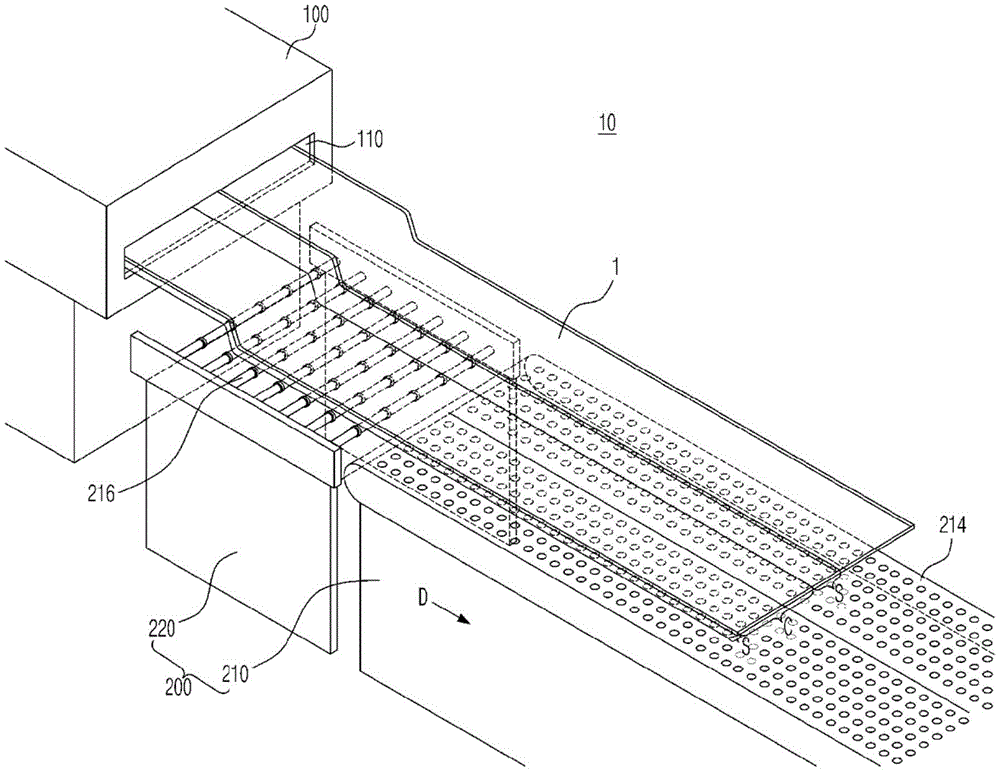
图1是图示根据本发明的用于制造电极的干燥装置的示意图。FIG. 1 is a schematic diagram illustrating a drying apparatus for manufacturing an electrode according to the present invention.
图2是图示根据本发明的在用于制造电极的干燥装置中提供的传送部的悬浮部的截面结构图。2 is a cross-sectional structure diagram illustrating a floating portion of a transfer portion provided in a drying apparatus for manufacturing an electrode according to the present invention.
图3至图5是图示根据本发明的示出具有单一板形结构的空气悬浮板的表面结构的一个示例的图。3 to 5 are diagrams illustrating one example of a surface structure of an air suspension board having a single plate-shaped structure according to the present invention.
图6至图7是图示根据本发明的示出空气悬浮板的结构的一个示例的图,该空气悬浮板具有其中组装多个杆形的结构。6 to 7 are diagrams illustrating one example of a structure showing an air levitation board having a structure in which a plurality of rod shapes are assembled according to the present invention.
图8是图示根据本发明的在用于制造电极的干燥装置中提供的传送部的一个示例的立体图。FIG. 8 is a perspective view illustrating one example of a transfer part provided in a drying device for manufacturing an electrode according to the present invention.
最佳模式best mode
本发明可以修改为各种形式并且可以具有各种实施方式,因此,将详细描述具体实施方式。The present invention can be modified into various forms and have various embodiments, and therefore, the specific embodiments will be described in detail.
然而,实施方式不应理解为将本发明限制于具体实施方式,而应解释为包括落入本发明的精神和技术范围内的所有修改、等同物或替代物。However, the embodiments should not be construed as limiting the present invention to the specific embodiments, but should be construed as including all modifications, equivalents, or substitutes falling within the spirit and technical scope of the present invention.
在本发明中,术语“包含”、“具有”和类似术语用于指定本文中描述的特征、数量、步骤、操作、部件、元件或上述项的组合的存在,并且这些术语不排除存在或添加一个或多个其他特征、数量、步骤、操作、部件、元件或上述项的组合。In the present invention, the terms "comprising", "having" and similar terms are used to designate the presence of features, quantities, steps, operations, parts, elements or combinations thereof described herein, and these terms do not exclude the presence or addition of One or more other features, quantities, steps, operations, components, elements, or combinations thereof.
另外,在本发明中,当层、膜、区域、板或类似物的一部分被描述为“在另一部分上”时,这不仅包括该部分“直接地在另一部分上”的情况,而且包括在该部分与其他部分之间还存在又一部分的情况。相反地,当层、膜、区域、板或类似物的一部分被描述为“在另一部分下”时,这不仅包括该部分“直接地在另一部分下”的情况,而且包括在该部分与其他部分之间还存在又一部分的情况。另外,在本申请中,设置“在……上”可以不仅包括设置在上部上的情况,而且包括设置在下部上的情况。In addition, in the present invention, when a part of a layer, film, region, plate or the like is described as "on another part", this includes not only the case where the part is "directly on another part", but also the case where the part is "on another part". There is still another part of the situation between this part and other parts. Conversely, when a part of a layer, film, region, panel, or the like is described as being "under" another part, this includes not only the case where the part is "directly under" the other part, but also the case where the part is in contact with other parts. There is still another part between the parts. In addition, in the present application, setting "on" may include not only the case of being set on the upper part but also the case of being set on the lower part.
在下文中,将更详细地描述本发明。Hereinafter, the present invention will be described in more detail.
用于制造电极的干燥装置Drying device for the manufacture of electrodes
在本发明的一个实施方式中,提供一种用于制造电极的干燥装置,该干燥装置包括:In one embodiment of the present invention, provide a kind of drying device for manufacturing electrode, this drying device comprises:
干燥器,该干燥器被配置为对电极基底材料的涂布部分和未涂布部分进行干燥,其中电极浆料所施加到的涂布部分形成在至少一个表面上,电极浆料未施加到未涂布部分;和传送部,该传送部耦接到干燥器的出口并且被配置为在工艺方向中移动干燥的电极基底材料,其中传送部包括悬浮部和行进部,悬浮部被配置为使用空气使电极基底材料悬浮并且设有空气悬浮板,并且所述行进部被配置为使悬浮的电极基底材料在工艺方向移动。A drier configured to dry a coated portion of the electrode base material and an uncoated portion, wherein the coated portion to which the electrode slurry is applied is formed on at least one surface, and the electrode slurry is not applied to the uncoated portion. a coating part; and a conveying part, which is coupled to the outlet of the dryer and configured to move the dried electrode base material in a process direction, wherein the conveying part includes a levitating part and a traveling part, and the levitating part is configured to use air to make The electrode base material is suspended and provided with an air suspension plate, and the running part is configured to move the suspended electrode base material in a process direction.
图1是图示根据本发明的用于制造电极的干燥装置的立体图。参照图1,根据本发明的用于制造电极的干燥装置10包括干燥器100和传送部200,干燥器100被配置为在将用于形成电极混合物层的电极浆料施加到电极基底材料之后对所施加的电极浆料进行干燥,并且传送部200被配置为当其上所施加的电极浆料被干燥的电极基底材料1离开干燥器100时,使电极基底材料1在工艺方向D移动。FIG. 1 is a perspective view illustrating a drying device for manufacturing an electrode according to the present invention. Referring to FIG. 1 , a drying
在此,干燥器100可包括外壳和被提供在外壳中的多个加热元件。在外壳的一侧上提供入口(未示出),已经穿过涂布机的电极基底材料(即电极集流体)1通过入口,在涂布机处将含有一种或多种电极活性材料的电极浆料施加在电极基底材料的表面上,并且在外壳的另一侧提供出口110,电极基底材料(即电极集流体)通过出口110离开。穿过外壳内部并且通过出口排出到外壳外部的电极基底材料1沿着耦接到出口110的后侧的传送部200行进并且围绕电极回收辊卷绕。Here, the
多个加热元件由于电能的供应而产生热,并且安装在外壳内部。具体地,多个加热元件在电极基底材料1的工艺方向D中设置在电极基底材料1上方。当多个加热元件产生热时,由于辐射热,施加到电极基底材料的上表面(即涂布部分)的电极浆料被干燥和固化。具体地,可以通过用加热元件的辐射热加热涂布部分以去除电极浆料内部的溶剂来进行涂布部分的干固化。为此,在外壳的内部,可以将其中设置多个加热元件的空间的内部温度控制为能够使溶剂挥发的温度,具体地,可以控制为在120℃至150℃范围内的温度。另外,加热元件可以是例如卤素灯。可以将热反射板安装在外壳内部,该热反射板用于最小化在多个加热元件中实现的辐射热的损失并且围绕每个加热元件的上表面以将辐射热传输到电极基底材料。A plurality of heating elements generate heat due to the supply of electric power, and are installed inside the housing. Specifically, a plurality of heating elements are arranged above the electrode base material 1 in the process direction D of the electrode base material 1 . When heat is generated by a plurality of heating elements, the electrode paste applied to the upper surface of the electrode base material (ie, the coated portion) is dried and cured due to radiant heat. Specifically, dry curing of the coated portion may be performed by heating the coated portion with radiant heat from a heating element to remove the solvent inside the electrode paste. For this reason, inside the housing, the internal temperature of the space in which the plurality of heating elements are disposed can be controlled to a temperature capable of volatilizing the solvent, specifically, can be controlled to a temperature in the range of 120°C to 150°C. Additionally, the heating element may be, for example, a halogen lamp. A heat reflection plate for minimizing loss of radiant heat achieved in the plurality of heating elements and surrounding an upper surface of each heating element to transmit radiant heat to the electrode base material may be installed inside the housing.
另外,根据本发明的用于制造电极的干燥装置10具有这样的结构:其中用于在工艺方向D移动干燥的电极基底材料1的传送部200连续地耦接到干燥器的出口110。传送部200包括悬浮部210和行进部220,悬浮部210被配置为使用空气使电极基底材料1悬浮,并且行进部220被配置为沿工艺方向D移动悬浮的电极基底材料1。In addition, the drying
在此,悬浮部210包括空气悬浮板214,空气悬浮板214安装成垂直于电极基底材料的工艺方向D,并且在空气悬浮板214中沿工艺方向D提供用于将空气吹向电极基底材料1的表面的多个排出口。Here, the
空气悬浮板214可以通过所提供的排出口将空气排出到电极基底材料1的表面,由此使干燥的电极基底材料1悬浮并且防止在未施加电极浆料的未涂布部分中出现褶皱和/或折叠现象。The
具体地,当电极浆料所施加到的电极基底材料1在高温下干燥时,由于电极浆料所施加到的涂布部分与未施加电极浆料的未涂布部分之间的热膨胀偏差,在未涂布部分中可能出现褶皱和/或折叠现象。特别地,在诸如卷对卷方法之类的表面接触传送方法中,在电极基底材料1的工艺方向中产生张力。当张力施加到通过在高温下干燥而具有高温的电极基底材料1时,在电极基底材料1的涂布部分与未涂布部分之间可能强烈地出现褶皱和/或折叠。然而,根据本发明,在高温下干燥的电极基底材料1的表面上排出空气,使得可以促进电极基底材料的冷却。另外,连同电极基底材料1的冷却,电极基底材料1可以悬浮和移动,因此可以最小化施加到电极基底材料的张力,使得可以抑制在电极浆料所施加到的涂布部分与未施加电极浆料的未涂布部分之间褶皱和/或折叠的发生。Specifically, when the electrode base material 1 to which the electrode paste is applied is dried at a high temperature, due to the thermal expansion deviation between the coated portion to which the electrode paste is applied and the uncoated portion to which the electrode paste is not applied, the Wrinkling and/or folding may occur in the uncoated portion. In particular, in a surface contact transfer method such as a roll-to-roll method, tension is generated in the process direction of the electrode base material 1 . When tension is applied to the electrode base material 1 having a high temperature by drying at a high temperature, wrinkles and/or folds may strongly occur between the coated portion and the uncoated portion of the electrode base material 1 . However, according to the present invention, air is exhausted on the surface of the electrode base material 1 dried at a high temperature, so that cooling of the electrode base material can be promoted. In addition, together with the cooling of the electrode base material 1, the electrode base material 1 can be suspended and moved, and thus the tension applied to the electrode base material can be minimized, so that it is possible to suppress the difference between the coated portion to which the electrode slurry is applied and the portion to which the electrode slurry is not applied. The occurrence of wrinkles and/or folds between uncoated parts of the material.
另外,由于空气悬浮板214具有板形状,可以防止电极基底材料由于空气悬浮系统(空气悬浮系统是组合多个辊或多个轴承的形式)中发生的旋转引起的辊或轴承之间的扭曲而振动,并且存在能够在工艺期间最小化粉尘产生的优点和设备操作安全且容易维护的优点。In addition, since the
另外,空气悬浮板214的下端连接到空气供应部216,空气供应部216用于将空气供应到排出口,并且空气供应部216可以包括用于产生空气的鼓风机(未示出)。在此情况下,鼓风机可以包括用于提供驱动力的电机和由于电机的驱动而旋转的叶轮,并且除了鼓风机之外,还可以进一步提供空气压缩机和用于控制空气的流率和压力的空气控制单元。In addition, the lower end of the
另外,图2是图示悬浮部210的结构的示意性截面图。参照图2,在悬浮部210中,空气悬浮过滤器213定位在空气供应部216与空气悬浮板214之间并且可以减少通过空气悬浮板214的排出口215排出的空气的供应量偏差和去除空气中的异物。为此,空气悬浮过滤器213可具有网眼大小的网状结构并且包括微通道结构,在该微通道结构中,开孔部分引导和排出空气。另外,为了维持绝缘性,空气悬浮过滤器213可以由绝缘材料制成。具体地,空气悬浮过滤器213可以采用耐热多孔工程塑料材料或多孔陶瓷材料。In addition, FIG. 2 is a schematic cross-sectional view illustrating the structure of the floating
另外,在空气供应部216与空气悬浮过滤器213之间可以进一步包括衬垫212,以防止空气泄漏到外部,以此方式,可以将供应到空气悬浮板214的空气的压力实现为恒定维持的。In addition, a
另外,空气悬浮板214设有用于将空气排出到侧表面的排出口215,电极基底材料1在该侧表面上行进,并且排出口215可以形成在空气悬浮板214的整个表面上,也就是在空气悬浮板214的整个表面上或仅在电极基底材料1的涂布部分行进的区域中。In addition, the
具体地,图3至图5是图示根据本发明的空气悬浮板214的表面的图。空气悬浮板214a、214b和214c仅在电极基底材料的涂布部分C行进的区域中包括排出口215a(如图3中所示),或者在整个表面上包括排出口215b、215b’、215c和215c’(如图4和图5中所示)。Specifically, FIGS. 3 to 5 are diagrams illustrating the surface of the
如图3中所示,当仅在电极基底材料的涂布部分C行进的区域中包括排出口215a时,空气悬浮板214可以最小化排出到电极基底材料1的表面的空气的损失,以增加电极基底材料1的悬浮效率。另外,由于空气悬浮板214可引起涂布部分的快速冷却,电极集流体与定位于涂布部分中的活性材料层(也就是干燥的电极浆料层)之间的温度偏差可以最小化,以防止电极集流体与活性材料层之间的粘合强度降低。As shown in FIG. 3, when the
另外,如图4和图5中所示,当在电极基底材料1的整个表面上包括排出口215b、215b’、215c和215c’时,空气悬浮板214可以使在与电极基底材料1行进的方向垂直的方向中的冷却速率(也就是电极基底材料1的宽度方向中冷却速率的偏差)最小化,使得可以防止电极基底材料1发生弯曲。In addition, as shown in FIG. 4 and FIG. 5, when the
在此,在空气悬浮板214中,当在空气悬浮板214b和214c的整个表面中包括排出口215b、215b’、215c和215c’时,区域C(电极基底材料的涂布部分在区域C中行进)中排出口的平均直径或每单位面积的排出口数量可以小于区域S(电极基底材料的未施加电极浆料的未涂布部分在区域S中行进)中排出口的平均直径或每单位面积的排出口数量。Here, in the
作为一个示例,当空气悬浮板214b和214c在整个表面上包括排出口215a、215b、215b’、215c和215c’时,区域C(电极基底材料的涂布部分在区域C中行进)的排出口的平均直径可以在区域S(电极基底材料的未施加电极浆料的未涂布部分在区域S中行进)中排出口的平均直径的50%至99%范围内。具体地,空气悬浮板214b和214c的每个排出口的平均直径可以在区域S(电极基底材料的未涂布部分在区域S中行进)的平均直径的50%至95%、50%至90%、50%至85%、50%至80%、50%至75%、50%至70%、60%至90%、70%至95%、80%至99%或75%至90%的范围内。As an example, when the
在此,区域C(电极基底材料的涂布部分在区域C中行进)的排出口不受特别限制,只要其平均直径适于排出足以使包括涂布部分的电极基底材料悬浮的空气即可。具体地,排出口可具有在0.005mm至10mm范围内的平均直径,更具体地,可具有0.005mm至5mm、0.005mm至3mm、0.005mm至2mm、0.005mm至1mm、0.005mm至0.9mm、0.005mm至0.5mm、0.005mm至0.1mm、0.005mm至0.05mm、0.005mm至0.01mm、0.01mm至0.03mm、0.025mm至0.05mm、0.06mm至0.09mm、0.01mm至3mm、0.05mm至2mm、0.05mm至1mm、0.1mm至1mm、0.5mm至2mm、0.5mm至0.9mm、或0.01mm至0.1mm范围内的平均直径。Here, the discharge port of the region C (in which the coated portion of the electrode base material travels) is not particularly limited as long as its average diameter is suitable for discharging air sufficient to suspend the electrode base material including the coated portion. Specifically, the discharge port may have an average diameter in the range of 0.005mm to 10mm, more specifically, 0.005mm to 5mm, 0.005mm to 3mm, 0.005mm to 2mm, 0.005mm to 1mm, 0.005mm to 0.9mm, 0.005mm to 0.5mm, 0.005mm to 0.1mm, 0.005mm to 0.05mm, 0.005mm to 0.01mm, 0.01mm to 0.03mm, 0.025mm to 0.05mm, 0.06mm to 0.09mm, 0.01mm to 3mm, 0.05mm to Average diameter in the range of 2mm, 0.05mm to 1mm, 0.1mm to 1mm, 0.5mm to 2mm, 0.5mm to 0.9mm, or 0.01mm to 0.1mm.
作为另一示例,当空气悬浮板214b和214c在整个表面上包括排出口215b、215b’、215c和215c’时,区域C(电极基底材料的涂布部分在区域C中行进)的每单位面积的排出口数量可以在区域S(电极基底材料的未涂布部分在区域S中行进)的每单位面积的排出口数量的50%至99%范围内,具体地,可以在区域S(电极基底材料的未涂布部分在区域S中行进)的每单位面积排出口数量的50%至90%、60%至90%、70%至90%、60%至80%、50%至70%、或65%至85%的范围内。As another example, when the
根据本发明,将引入到空气悬浮板214b和214c中的排出口215b、215b’、215c和215c’的根据位置的平均直径和每单位面积数量控制在上述范围内,并且因此,可以使电极浆料所施加到的电极基底材料1稳定地悬浮,并且可以将未施加电极浆料的未涂布部分加热至高温,然后快速冷却至低于室温的温度以快速固化未涂布部分的基底材料。以此方式,可以改善电极基底材料1的热膨胀偏差。According to the present invention, the average diameter and the number per unit area according to positions of the
另外,引入到空气悬浮板214a、214b和214c的表面中的排出口215a、215b、215b’、215c和215c’可以各自具有在20%到80%的范围内的孔隙率(开口率),具体地,在30%到70%的范围内。根据本发明,将引入到空气悬浮板214a、214b和214c中的每个排出口的孔隙率(开口率)控制在上述范围内,使得排出到空气悬浮板214a、214b和214c的表面的空气流可以是流畅的,并且可以阻挡空气中存在的细小颗粒的流入。In addition, the
另外,应用于本发明的空气悬浮板的排出口215a、215b、215b’、215c、和215c’可以垂直于电极基底材料1行进的方向D形成,或者如图5中所示,这些排出口215a、215b、215b’、215c、和215c’可以被提供为在电极基底材料1行进的工艺方向D中与空气悬浮板214a、214b和214c的表面形成在30°至80°范围内的倾斜角α。具体地,排出口215a、215b、215b’、215c、215c’可以垂直于电极基底材料1行进的方向D形成,或者可以被提供为与空气悬浮板214a、214b和214c的表面形成倾斜角α,倾斜角α在30°至70°、30°至60°、30°至50°、45°至70°、60°至80°、30°至45°、或40°至60°的范围内。In addition, the
根据本发明,通过将排出口215a、215b、215b’、215c和215c’的角度控制为满足上述范围,由于排出的空气,可以用很少的能量使电极基底材料移动。According to the present invention, by controlling the angles of the
另外,空气悬浮板214a、214b和214c包括排出口215a、215b、215b’、215c和215c’,用于将空气排出到电极基底材料在其上行进的表面,并且可以包括用于抽吸空气的真空抽吸孔217,所述空气在与排出口215a、215b、215b’、215c和215c’相邻的位置处再次通过排出口215a、215b、215b’、215c和215c’排放。In addition, the
空气悬浮板214a、214b和214c不受特别限制,只要它们定位成与被提供在表面上的排出口相邻即可,并且可以包括用于再次抽吸排出的空气的真空抽吸孔217。具体地,如图5中所示,真空抽吸孔217可以被提供在区域C(电极基底材料1的涂布部分在区域C中行进)与区域S(电极基底材料的未涂布部分在区域S中行进)之间,或者可以在电极基底材料1行进的方向D中交替地提供一列排出口和一列真空抽吸孔217。The
真空抽吸孔217用于稳定地输送干燥的电极基底材料1并且可以设置在与排出口215a、215b、215b’、215c和215c’相邻的位置处以有助于气体排放。以此方式,可以最小化电极基底材料1的弯曲现象,并且可以容易地控制波动、悬浮平面度和高度。Vacuum suction holes 217 are used to stably convey the dried electrode base material 1 and may be provided at positions adjacent to the
另外,在悬浮部210中,由于空气悬浮板214a、214b和214c可以分离和更换,可以应用其中排出口的平均直径和数量根据要制造的电极的规格受到控制的空气悬浮板。Also, in the
在此情况下,如图3至图5中所示,空气悬浮板214a、214b和214c可以各自具有这样的结构:其中在一个板形的基底材料上提供排出口,根据电极基底材料的涂布部分和未涂布部分而控制排出口的平均直径、每单位面积的数量和/或孔隙率。In this case, as shown in FIGS. 3 to 5, the
或者,如图6和图7中所示,空气悬浮板214a、214b和214c可以各自具有这样的结构:根据电极基底材料1的涂布部分和未涂布部分的位置而组装多个杆形基底材料。在此情况下,空气悬浮板的加工性和组装性高,使得存在改善在电极基底材料设计方面的自由度和响应性的优点。Alternatively, as shown in FIGS. 6 and 7 , the
同时,传送部200包括行进部220,行进部220作为用于使通过悬浮部210悬浮的电极基底材料1移动的部分。行进部220不受特别限制,只要它能够使悬浮的电极基底材料1移动,并且具体地,行进部220可以包括倾斜机和运输器,倾斜机用于使空气悬浮板214a、214b、214c倾斜和直立,运输器设置在悬浮部210的前端和后端处并且被配置为在工艺方向中使电极基底材料1滑动。Meanwhile, the
在此,倾斜机是用于使要倾斜的空气悬浮板214a、214b和214c倾斜而使得悬浮的电极基底材料1在倾斜方向中移动的装置。倾斜架定位在与每个空气悬浮板214a、214b和214c的电极基底材料1在其上行进的表面相对的一侧上,使得空气悬浮板214a、214b和214c可以直立以得到倾斜。Here, the tilting machine is a device for tilting the
倾斜机是用于施加外力而使得通过每个空气悬浮板214a、214b和214c悬浮的电极基底材料1由于重力和倾斜角以适当速度移动的装置,通过倾斜机实现的倾斜角可以在1°至20°的范围内,并且更具体地,在1°至15°、1°至10°、5°至15°、8°至12°、或3°至8°的范围内。The tilting machine is a device for applying external force so that the electrode base material 1 suspended by each
另外,运输器可以设置在悬浮部210的前端和后端中的每一个处,以移动电极基底材料1。在此情况下,运输器可以包括带型运输器和/或辊型运输器中的一种或多种。In addition, a transporter may be provided at each of the front and rear ends of the floating
具体地,图8是图示传送部200设有作为行进部220的运输器的情况的立体图。参照图8,运输器可包括定位在悬浮部210的前端处的第一运输器221和定位在悬浮部的后端处的第二运输器222。第一运输器221和第二运输器222可以形成为与悬浮部210的空气悬浮板214共面,以防止在移动电极基底材料1时卡住。Specifically, FIG. 8 is a perspective view illustrating a case where the
在一些情况下,传送部200可以进一步包括用于将电极基底材料1供应到干燥器100的展开机(未示出)和用于卷绕已经通过干燥器的电极基底材料的卷绕机(未示出)。展开机可将电极基底材料1供应至干燥器,由此对电极基底材料1施加推力并且使电极基底材料1在工艺方向D中移动,而卷绕机可在工艺方向D中对干燥的电极基底材料施加拉力,由此移动干燥的电极基底材料1。为此,展开机可位于干燥器100的前端处,并且卷绕机可位于悬浮部210的后端处。In some cases, the
由于根据本发明的用于制造电极的干燥装置10包括上述部件,可以改善在高温下干燥的电极基底材料1的热膨胀偏差,使得可以防止在电极基底材料的未涂布部分中引起褶皱和/或折叠问题。另外,在悬浮部210中,可以更换空气悬浮板214,在该空气悬浮板中根据要制造的电极的规格控制排出口215的平均直径和/或每单位面积的排出口215的数量,使得存在加工性优异的优点。Since the drying
制造电极的方法Method of making electrodes
在本发明的一个实施方式中,提供一种制造电极的方法,该方法包括:在高温下干燥电极基底材料,其中在电极基底材料的至少一个表面上施加电极浆料;和使用空气使高温干燥的电极基底材料悬浮并且传送该高温干燥的电极基底材料。In one embodiment of the present invention, there is provided a method of manufacturing an electrode, the method comprising: drying an electrode base material at a high temperature, wherein an electrode slurry is applied on at least one surface of the electrode base material; and drying the electrode base material at a high temperature using air The electrode base material is suspended and the high temperature dried electrode base material is transported.
根据本发明的制造电极的方法可以包括:在电极基底材料的至少一个表面上施加电极浆料以形成电极混合物层;和在高温下对电极浆料施加在其上的电极基底材料进行干燥;和使用空气使干燥的电极基底材料悬浮并且传送该干燥的电极基底材料,并且该方法可以使用本发明的上述用于制造电极的干燥装置来进行。The method of manufacturing an electrode according to the present invention may include: applying an electrode slurry on at least one surface of an electrode base material to form an electrode mixture layer; and drying the electrode base material on which the electrode slurry is applied at a high temperature; and Air is used to suspend and convey the dried electrode base material, and this method can be performed using the above-mentioned drying apparatus for manufacturing an electrode of the present invention.
具体地,在电极基底材料的干燥中,当已经穿过涂布机并且在其上含有一种或多种电极活性材料的电极浆料施加到表面的电极基底材料(或电极集流体)被引入到干燥装置的干燥器中时,在施加到电极基底材料的电极浆料中的溶剂可以通过提供在干燥器中的多个加热元件去除,因此所施加的电极浆料可以固化以形成电极混合物层。在此情况下,由于加热元件的辐射热,干燥器中的温度可以具体控制在120℃至150℃的范围内。Specifically, in the drying of the electrode base material, when the electrode base material (or electrode collector) that has passed through the coating machine and the electrode slurry containing one or more electrode active materials is applied to the surface is introduced When entering the drier of the drying device, the solvent in the electrode paste applied to the electrode base material can be removed by a plurality of heating elements provided in the drier, so that the applied electrode paste can be cured to form an electrode mixture layer . In this case, the temperature in the dryer can be specifically controlled within the range of 120°C to 150°C due to the radiant heat of the heating element.
另外,可以通过传送部来进行干燥的电极基底材料的传送,该传送部连续地耦接到干燥器的出口。具体地,当干燥的电极基底材料通过干燥器的出口离开时,干燥的电极基底材料进入耦接到出口的传送部。进入的电极基底材料通过传送部的空气悬浮板而悬浮,并且在悬浮状态下在工艺方向中移动。在此,空气悬浮板包括用于在电极基底材料行进的方向中将空气排出到电极基底材料的表面的排出口,并且通过排出口排出的空气可以使干燥的电极基底材料悬浮且可以满足压力和/或温度的预定范围,以改善由于电极浆料被加热到高温而在电极基底材料的未涂布部分中出现的褶皱和/或折叠现象。In addition, the conveyance of the dried electrode base material may be performed by a conveyance part continuously coupled to the outlet of the dryer. Specifically, when the dried electrode base material exits through the outlet of the drier, the dried electrode base material enters a transfer section coupled to the outlet. The incoming electrode base material is suspended by the air suspension plate of the transfer section, and moves in the process direction in a suspended state. Here, the air suspension plate includes a discharge port for discharging air to the surface of the electrode base material in the direction in which the electrode base material travels, and the air discharged through the discharge port can suspend the dry electrode base material and can satisfy pressure and and/or a predetermined range of temperature to improve the wrinkling and/or folding phenomenon that occurs in the uncoated portion of the electrode base material due to the electrode paste being heated to a high temperature.
具体地,通过排出口排出的空气的压力可以控制在0.01MPa至0.5MPa的范围内,更具体地,可以控制在0.01MPa至0.4MPa、0.01MPa至0.3MPa、0.01MPa至0.2MPa、0.01MPa至0.1MPa、0.05MPa至0.2MPa、0.1MPa至0.5MPa、0.2MPa至0.4MPa、0.01MPa至0.09MPa、或0.05MPa至0.09MPa的范围内。Specifically, the pressure of the air discharged through the outlet can be controlled in the range of 0.01MPa to 0.5MPa, more specifically, can be controlled in the range of 0.01MPa to 0.4MPa, 0.01MPa to 0.3MPa, 0.01MPa to 0.2MPa, 0.01MPa to 0.1MPa, 0.05MPa to 0.2MPa, 0.1MPa to 0.5MPa, 0.2MPa to 0.4MPa, 0.01MPa to 0.09MPa, or 0.05MPa to 0.09MPa.
作为一个示例,当在空气悬浮板的整个表面中包括排出口时,从电极基底材料的涂布部分行进的区域排出的空气的压力可以在0.05MPa至0.4MPa或0.1MPa至0.15MPa的范围内,并且从电极基底材料的未涂布部分行进的区域排出的空气的压力可以在0.01MPa至0.2MPa或0.04MPa至0.07MPa的范围内。As an example, when the discharge port is included in the entire surface of the air suspension plate, the pressure of the air discharged from the area where the coated part of the electrode base material travels may be in the range of 0.05MPa to 0.4MPa or 0.1MPa to 0.15MPa , and the pressure of the air exhausted from the region where the uncoated portion of the electrode base material travels may be in the range of 0.01MPa to 0.2MPa or 0.04MPa to 0.07MPa.
另外,通过排出口排出的空气温度可以控制在-10℃至30℃的范围内,具体地,控制在-10℃至20℃、-10℃至10℃、-10℃至5℃、0℃至30℃、5℃至20℃或10℃至20℃的范围内。In addition, the temperature of the air discharged through the outlet can be controlled within the range of -10°C to 30°C, specifically, -10°C to 20°C, -10°C to 10°C, -10°C to 5°C, 0°C to 30°C, 5°C to 20°C or 10°C to 20°C.
作为一个示例,当在空气悬浮板的整个表面中包括排出口时,从电极基底材料的涂布部分行进的区域排出的空气的温度可以在10℃至20℃的范围内,并且从电极基底材料的未涂布部分行进的区域排出的空气的温度可以在-5℃至5℃的范围内。As an example, when the discharge port is included in the entire surface of the air suspension plate, the temperature of the air discharged from the area where the coated part of the electrode base material travels may be in the range of 10°C to 20°C, and the temperature of the air discharged from the electrode base material The temperature of the exhaust air in the area where the uncoated part travels can be in the range of -5°C to 5°C.
根据本发明,通过将从空气悬浮板的排出口排出的空气的压力和温度控制在上述范围内,可以稳定地使干燥的电极基底材料悬浮,并且电极基底材料的未涂布部分(其中未施加高温电极浆料)快速固化,使得可以减小涂布部分与未涂布部分之间的热膨胀偏差。According to the present invention, by controlling the pressure and temperature of the air discharged from the discharge port of the air levitation plate within the above range, the dried electrode base material can be stably suspended, and the uncoated portion of the electrode base material (where no High-temperature electrode paste) cures quickly, making it possible to reduce the thermal expansion deviation between the coated part and the uncoated part.
另外,在干燥的电极基底材料的传送中,可以适当地控制电极基底材料的传送速度以使电极基底材料在悬浮状态下稳定地移动。为此,电极基底材料的传送速度可以控制在1mm/s至20mm/s的范围内,具体地控制在5mm/s至15mm/s或8mm/s至12mm/s的范围内。In addition, in conveyance of the dried electrode base material, the conveyance speed of the electrode base material can be appropriately controlled so that the electrode base material moves stably in a suspended state. For this reason, the conveying speed of the electrode base material can be controlled within the range of 1 mm/s to 20 mm/s, specifically controlled within the range of 5 mm/s to 15 mm/s or 8 mm/s to 12 mm/s.
由于根据本发明的制造电极的方法包括上述部件,可以改善在高温下干燥的电极基底材料的热膨胀偏差,使得可以防止在电极基底材料的未涂布部分中引起的褶皱和/或折叠问题。Since the method of manufacturing an electrode according to the present invention includes the above-mentioned components, the thermal expansion deviation of the electrode base material dried at high temperature can be improved so that the problem of wrinkling and/or folding caused in the uncoated portion of the electrode base material can be prevented.
[优选实施方式的详细说明][Detailed Description of Preferred Embodiments]
在下文中,参照示例和实验例来更详细地描述本发明。Hereinafter, the present invention is described in more detail with reference to Examples and Experimental Examples.
然而,以下示例和实验例仅是本发明的例示,本发明的内容不限于以下示例和实验例。However, the following examples and experimental examples are merely illustrations of the present invention, and the content of the present invention is not limited to the following examples and experimental examples.
实验例Experimental example
为了评价根据本发明的用于制造电极的干燥装置的性能,进行以下实验。In order to evaluate the performance of the drying apparatus for manufacturing electrodes according to the present invention, the following experiments were conducted.
具体地,准备宽1500cm×长600cm×厚0.6cm的钢板,在该钢板表面形成如表1中所示的具有平均直径和每单位面积数量排出口,以制造空气悬浮板。Specifically, a steel plate with a width of 1500 cm x a length of 600 cm x a thickness of 0.6 cm was prepared, and the surface of the steel plate was formed with discharge ports having an average diameter and a number per unit area as shown in Table 1 to manufacture an air suspension board.
然后,将辊形式的第一运输器、悬浮部和辊形式的第二运输器耦接到通过卤素灯而具有约130℃的内部温度的干燥器的出口,并且将预先生产的空气悬浮板安装在悬浮部的前部上以准备用于制造电极的干燥装置。在此情况下,如图2中所示,悬浮部具有这样的结构:其中衬垫212、空气悬浮过滤器213和空气悬浮板214依次堆叠在设有空气供应孔211a的下工作台211上,并且空气供应部216耦接到下工作台211的空气供应孔211a,使得悬浮部具有其中将空气供应到空气悬浮板214的结构。Then, the first conveyor in the form of a roller, the suspension part, and the second conveyor in the form of a roller were coupled to the outlet of the dryer having an internal temperature of about 130° C. by a halogen lamp, and the pre-produced air suspension board was installed On the front of the suspension part to prepare the drying device for making the electrodes. In this case, as shown in FIG. 2, the suspension part has a structure in which a
[表1][Table 1]


使用所准备的用于制造电极的干燥装置,使电极浆料施加在其上的电极基底材料干燥并且传送该电极基底材料(传送速度约11mm/s)。在此情况下,从空气悬浮板排出的空气的温度在电极基底材料的涂布部分行进的区域中被控制为20℃的温度,并且在电极基底材料的未涂布部分行进的区域中被控制为10℃的温度。另外,检查每个电极的悬浮程度和在电极基底材料的未涂布部分中是否出现褶皱和/或折叠。评价标准如下,并且在下方的表2中示出结果。The electrode base material on which the electrode slurry was applied was dried and conveyed (conveyance speed of about 11 mm/s) using a drying apparatus prepared for electrode manufacture. In this case, the temperature of the air discharged from the air suspension plate was controlled to a temperature of 20° C. in the region where the coated portion of the electrode base material travels, and was controlled in the region where the uncoated portion of the electrode base material traveled for a temperature of 10°C. In addition, each electrode was checked for the degree of suspension and the occurrence of wrinkles and/or folds in the uncoated portion of the electrode base material. The evaluation criteria are as follows, and the results are shown in Table 2 below.
①评价电极基底材料是否悬浮:①Evaluate whether the electrode base material is suspended:
-○:电极基底材料稳定地悬浮-○: The electrode base material is stably suspended
-△:电极基底材料悬浮,但是由于严重的振动而不适于工艺。-Δ: The electrode base material is suspended, but not suitable for the process due to severe vibration.
-×:电极基底材料完全没有悬浮。-x: The electrode base material is not suspended at all.
②电极基底材料的未涂布部分中是否出现皱折/折叠②Whether there are wrinkles/folds in the uncoated part of the electrode base material
-○:在未涂布部分区域中出现褶皱/折叠的面积小于总面积的5%。- ○: The area where wrinkles/folds occurred in the uncoated portion area was less than 5% of the total area.
-△:在未涂布部分区域中出现褶皱/折叠的面积为总面积的5%或更多且小于50%。- Δ: The area where wrinkles/folds occurred in the uncoated portion area was 5% or more and less than 50% of the total area.
-×:在未涂布部分区域中出现褶皱/折叠的面积为总面积的50%或更多。-x: The area where wrinkles/folds occurred in the uncoated portion area was 50% or more of the total area.
[表2][Table 2]

如上方的表2中所示,根据本发明的用于制造电极的干燥装置可以使在高温下干燥的电极基底材料悬浮,以使用空气安全地移动电极基底材料并且减少由于高温干燥引起的电极基底材料的涂布部分与未涂布部分之间的热膨胀偏差,使得可见未涂布部分的褶皱和/或折叠现象的改善效果优异。As shown in Table 2 above, the drying apparatus for manufacturing electrodes according to the present invention can suspend electrode base materials dried at high temperature to safely move electrode base materials using air and reduce electrode base material damage due to high-temperature drying. The deviation in thermal expansion between the coated portion and the uncoated portion of the material makes the effect of improving the wrinkle and/or folding phenomenon of the visible uncoated portion excellent.
根据上方的结果,根据本发明的用于制造电极的干燥装置可在高温下干燥电极浆料施加在其上的电极基底材料,然后使电极基底材料悬浮和移动,并且能够防止由于电极基底材料的涂布部分与未涂布部分之间的热膨胀偏差引起的褶皱和/或折叠现象,而不损伤涂布部分,使得可见加工性是优异的。According to the above results, the drying apparatus for manufacturing electrodes according to the present invention can dry the electrode base material on which the electrode slurry is applied at high temperature, then suspend and move the electrode base material, and can prevent Wrinkling and/or folding phenomenon caused by thermal expansion deviation between the coated part and the uncoated part without damaging the coated part makes it possible to see that workability is excellent.
尽管已经参照本发明的示例性实施方式进行上述说明,但是应当理解,在不脱离本发明的精神和范围的情况下,本发明所属领域的技术人员可以设计本发明的各种更改和修改,本发明的精神和范围由所附权利要求限定。Although the above description has been made with reference to the exemplary embodiments of the present invention, it should be understood that those skilled in the art can design various changes and modifications of the present invention without departing from the spirit and scope of the present invention. The spirit and scope of the invention are defined by the appended claims.
因此,本发明的技术范围不应限于本说明书的详细说明中描述的内容,而应由所附权利要求的范围确定。Therefore, the technical scope of the present invention should not be limited to what is described in the detailed description of this specification, but should be determined by the scope of the appended claims.
[参考数字的说明][explanation of reference number]
1:电极基底材料10:用于制造电极的干燥装置1: Electrode base material 10: Drying device for manufacturing electrodes
100:干燥器 110:干燥器出口100: Dryer 110: Dryer outlet
200:传送部 210:悬浮部200: Transmission Department 210: Suspension Department
211:下工作台 211a:气体供应孔211: Lower table 211a: Gas supply hole
212:衬垫 213:空气悬浮过滤器212: Liner 213: Air Suspension Filter
213a:细孔213a: pores
214、214a、214b和214c:空气悬浮板214, 214a, 214b and 214c: Air levitation boards
215、215a、215b、215b’和215c:空气悬浮板的排出口215, 215a, 215b, 215b' and 215c: Exhaust ports for the air levitation plate
216:气体供应部217:空气抽吸孔216: Gas supply part 217: Air suction hole
220:行进部221:第一运输器220: traveling part 221: first transporter
222:第二运输器D:电极的工艺方向222: Second transporter D: Process direction of electrodes
S:电极基底材料的涂布部分行进的行进区域S: Travel area where the coated part of the electrode base material travels
C:电极基底材料的未涂布部分行进的行进区域C: Travel area where the uncoated part of the electrode base material travels
Claims (14)
Applications Claiming Priority (5)
| Application Number | Priority Date | Filing Date | Title |
|---|---|---|---|
| KR20210103377 | 2021-08-05 | ||
| KR10-2021-0103377 | 2021-08-05 | ||
| KR10-2022-0083725 | 2022-07-07 | ||
| KR1020220083725A KR102848076B1 (en) | 2021-08-05 | 2022-07-07 | Slurry drying apparatus for manufacturing electrode and manafacturing method for electrode using the same |
| PCT/KR2022/011173 WO2023013984A1 (en) | 2021-08-05 | 2022-07-29 | Drying apparatus for manufacturing electrode and method for manufacturing electrode using same |
Publications (1)
| Publication Number | Publication Date |
|---|---|
| CN116324318A true CN116324318A (en) | 2023-06-23 |
Family
ID=85154603
Family Applications (1)
| Application Number | Title | Priority Date | Filing Date |
|---|---|---|---|
| CN202280006554.5A Pending CN116324318A (en) | 2021-08-05 | 2022-07-29 | Drying equipment for producing electrodes and method for producing electrodes using the drying equipment |
Country Status (8)
| Country | Link |
|---|---|
| US (1) | US20230375269A1 (en) |
| EP (1) | EP4203088B1 (en) |
| JP (1) | JP7670421B2 (en) |
| CN (1) | CN116324318A (en) |
| ES (1) | ES3034603T3 (en) |
| HU (1) | HUE072233T2 (en) |
| PL (1) | PL4203088T3 (en) |
| WO (1) | WO2023013984A1 (en) |
Families Citing this family (1)
| Publication number | Priority date | Publication date | Assignee | Title |
|---|---|---|---|---|
| KR20250024402A (en) * | 2023-08-11 | 2025-02-18 | 주식회사 엘지에너지솔루션 | Electrode production apparatus and battery cell comprising electrodes produced thereby, and battery pack and vehicle comprising battery cells |
Citations (8)
| Publication number | Priority date | Publication date | Assignee | Title |
|---|---|---|---|---|
| JPH10228898A (en) * | 1997-02-14 | 1998-08-25 | Fuji Film Selltec Kk | Apparatus and method for manufacturing electrode sheet |
| JP2003272612A (en) * | 2002-03-18 | 2003-09-26 | Tdk Corp | Drying apparatus for manufacturing battery electrode and method for manufacturing battery electrode |
| TW201039928A (en) * | 2009-03-27 | 2010-11-16 | Dainippon Screen Mfg | Substrate coating apparatus and substrate coating method |
| KR20110019902A (en) * | 2009-08-21 | 2011-03-02 | 주식회사 케이씨텍 | Floating Board Coater Device |
| KR20140042661A (en) * | 2012-09-28 | 2014-04-07 | 가부시키가이샤 히다치 하이테크놀로지즈 | Process for preparing a lithium-ion battery and apparatus for preparing a lithium-ion battery |
| JP2015219983A (en) * | 2014-05-14 | 2015-12-07 | 富士機械工業株式会社 | Electrode material coating system with shutdown function layer |
| KR20170094913A (en) * | 2016-02-12 | 2017-08-22 | 주식회사 엘지화학 | Electrode Drying Oven For Manufacturing Secondary Battery |
| JP2018088327A (en) * | 2016-11-28 | 2018-06-07 | 株式会社豊田自動織機 | Drying device |
Family Cites Families (12)
| Publication number | Priority date | Publication date | Assignee | Title |
|---|---|---|---|---|
| DE4117388C2 (en) * | 1991-05-28 | 1994-04-28 | Koenig & Bauer Ag | Roller for guiding a web |
| JP3956264B2 (en) * | 1999-10-08 | 2007-08-08 | 富士フイルム株式会社 | Web conveying method and apparatus |
| JP2010225467A (en) | 2009-03-24 | 2010-10-07 | Toyota Motor Corp | Strip drying device |
| TWI446974B (en) | 2009-06-30 | 2014-08-01 | 東麗工程股份有限公司 | And a conveyor device for coating the substrate on both sides |
| JP2011143388A (en) * | 2010-01-18 | 2011-07-28 | Clean Technology Kk | Thin film coating apparatus and double-sided thin film coating apparatus |
| JP5897808B2 (en) * | 2011-03-29 | 2016-03-30 | 東レエンジニアリング株式会社 | Electrode plate manufacturing equipment |
| JP5780226B2 (en) * | 2012-10-19 | 2015-09-16 | トヨタ自動車株式会社 | Secondary battery electrode manufacturing method and electrode manufacturing apparatus |
| JP2014184364A (en) * | 2013-03-22 | 2014-10-02 | Dainippon Screen Mfg Co Ltd | Drying unit, drying device, and film forming system |
| KR101810146B1 (en) | 2016-07-21 | 2017-12-19 | (주)피엔티 | Dryer used in manufacturing electrode of secondary battery |
| JP6906194B2 (en) * | 2018-02-23 | 2021-07-21 | パナソニックIpマネジメント株式会社 | Battery plate manufacturing method and coating equipment |
| DE102019216314A1 (en) | 2019-10-23 | 2021-04-29 | Robert Bosch Gmbh | High pressure fuel pump |
| US11167770B2 (en) | 2020-02-13 | 2021-11-09 | Baidu Usa Llc | Autonomous vehicle actuation dynamics and latency identification |
-
2022
- 2022-07-29 ES ES22853362T patent/ES3034603T3/en active Active
- 2022-07-29 EP EP22853362.6A patent/EP4203088B1/en active Active
- 2022-07-29 JP JP2023518862A patent/JP7670421B2/en active Active
- 2022-07-29 CN CN202280006554.5A patent/CN116324318A/en active Pending
- 2022-07-29 US US18/027,668 patent/US20230375269A1/en active Pending
- 2022-07-29 WO PCT/KR2022/011173 patent/WO2023013984A1/en not_active Ceased
- 2022-07-29 HU HUE22853362A patent/HUE072233T2/en unknown
- 2022-07-29 PL PL22853362.6T patent/PL4203088T3/en unknown
Patent Citations (8)
| Publication number | Priority date | Publication date | Assignee | Title |
|---|---|---|---|---|
| JPH10228898A (en) * | 1997-02-14 | 1998-08-25 | Fuji Film Selltec Kk | Apparatus and method for manufacturing electrode sheet |
| JP2003272612A (en) * | 2002-03-18 | 2003-09-26 | Tdk Corp | Drying apparatus for manufacturing battery electrode and method for manufacturing battery electrode |
| TW201039928A (en) * | 2009-03-27 | 2010-11-16 | Dainippon Screen Mfg | Substrate coating apparatus and substrate coating method |
| KR20110019902A (en) * | 2009-08-21 | 2011-03-02 | 주식회사 케이씨텍 | Floating Board Coater Device |
| KR20140042661A (en) * | 2012-09-28 | 2014-04-07 | 가부시키가이샤 히다치 하이테크놀로지즈 | Process for preparing a lithium-ion battery and apparatus for preparing a lithium-ion battery |
| JP2015219983A (en) * | 2014-05-14 | 2015-12-07 | 富士機械工業株式会社 | Electrode material coating system with shutdown function layer |
| KR20170094913A (en) * | 2016-02-12 | 2017-08-22 | 주식회사 엘지화학 | Electrode Drying Oven For Manufacturing Secondary Battery |
| JP2018088327A (en) * | 2016-11-28 | 2018-06-07 | 株式会社豊田自動織機 | Drying device |
Also Published As
| Publication number | Publication date |
|---|---|
| EP4203088B1 (en) | 2025-06-11 |
| EP4203088A1 (en) | 2023-06-28 |
| US20230375269A1 (en) | 2023-11-23 |
| JP7670421B2 (en) | 2025-04-30 |
| EP4203088A4 (en) | 2024-04-03 |
| HUE072233T2 (en) | 2025-11-28 |
| PL4203088T3 (en) | 2025-08-11 |
| JP2023543221A (en) | 2023-10-13 |
| ES3034603T3 (en) | 2025-08-20 |
| WO2023013984A1 (en) | 2023-02-09 |
Similar Documents
| Publication | Publication Date | Title |
|---|---|---|
| CN103165858B (en) | The manufacture method of electrode | |
| CN102770359B (en) | Carousel apparatus with air mounts and air curtains and method of use | |
| WO2007094075A1 (en) | Drying jig assembling unit, drying jig disassembling unit, drying jig circulating apparatus, method of drying ceramic molding, and process for producing honeycomb structure | |
| CN115672692A (en) | Drying device and coating equipment | |
| CN110542303B (en) | Physical dryer for preparing composite aerogel self-insulation template | |
| JP2019184222A (en) | Drying apparatus for coating apparatus | |
| JP2012037163A (en) | Drying device provided in thin film coating device | |
| JP2012037163A5 (en) | ||
| CN116273723A (en) | Diaphragm double-sided coating machine | |
| JP7670421B2 (en) | Drying device for electrode manufacturing and method for manufacturing electrodes using the same | |
| JP2013123671A (en) | Film coating machine | |
| US20240024913A1 (en) | Double-sided coating apparatus | |
| CN120228027A (en) | Oven and coating drying equipment | |
| KR102848076B1 (en) | Slurry drying apparatus for manufacturing electrode and manafacturing method for electrode using the same | |
| JP2020118363A (en) | Dryer for coating equipment | |
| CN110530125B (en) | A drying system for preparing compound aerogel self preservation temperature template | |
| WO2023169150A1 (en) | Drying device | |
| CN220804180U (en) | Drying system and coating system | |
| JP2015219983A (en) | Electrode material coating system with shutdown function layer | |
| JP5121237B2 (en) | Drying jig assembling apparatus, drying jig disassembling apparatus, drying jig circulating apparatus, ceramic molded body drying method, and honeycomb structure manufacturing method | |
| CN118463549A (en) | Strip baking equipment | |
| CN211515068U (en) | Drying device is used in sticky tape production | |
| CN115997095A (en) | Electrode drying device | |
| JP7769947B2 (en) | Double-sided coating device | |
| CN206037628U (en) | Drying device opens a book |
Legal Events
| Date | Code | Title | Description |
|---|---|---|---|
| PB01 | Publication | ||
| PB01 | Publication | ||
| SE01 | Entry into force of request for substantive examination | ||
| SE01 | Entry into force of request for substantive examination |