Detailed Description
The terms as used herein:
"prepared from … …" is synonymous with "comprising". The terms "comprises," "comprising," "includes," "including," "has," "having," "contains," "containing," or any other variation thereof, as used herein, are intended to cover a non-exclusive inclusion. For example, a composition, process, method, article, or apparatus that comprises a list of elements is not necessarily limited to only those elements but may include other elements not expressly listed or inherent to such composition, process, method, article, or apparatus.
The conjunction "consisting of … …" excludes any unspecified elements, steps or components. If used in a claim, the phrase is intended to claim as closed, meaning that it does not contain materials other than those described, except for the conventional impurities associated therewith. When the phrase "consisting of … …" appears in a clause of the subject matter of the claims rather than immediately after the subject matter, it defines only the elements described in the clause; other elements are not excluded from the claims as a whole.
When an amount, concentration, or other value or parameter is expressed as a range, preferred range, or as a range of upper preferable values and lower preferable values, this is to be understood as specifically disclosing all ranges formed from any pair of any upper range limit or preferred value and any lower range limit or preferred value, regardless of whether ranges are separately disclosed. For example, when the range "1 ~ 5" is disclosed, the ranges described should be construed to include the ranges "1 ~ 4", "1 ~ 3", "1 ~ 2 and 4 ~ 5", "1 ~ 3 and 5", and the like. When a range of values is described herein, unless otherwise stated, the range is intended to include the endpoints thereof and all integers and fractions within the range.
In these examples, the parts and percentages are by mass unless otherwise indicated.
"part by mass" means a basic unit of measure indicating a mass ratio of a plurality of components, and 1 part may represent any unit mass, for example, 1g or 2.689 g. If we say that the part by mass of the component A is a part by mass and the part by mass of the component B is B part by mass, the ratio of the part by mass of the component A to the part by mass of the component B is a: b. alternatively, the mass of the A component is aK and the mass of the B component is bK (K is an arbitrary number, and represents a multiple factor). It is unmistakable that, unlike the parts by mass, the sum of the parts by mass of all the components is not limited to 100 parts.
"and/or" is used to indicate that one or both of the illustrated conditions may occur, e.g., a and/or B includes (a and B) and (a or B).
A launder for metal casting comprises a launder body, wherein the launder body is provided with a liquid inlet end and a liquid outlet end, a cavity for containing metal liquid is arranged between the liquid inlet end and the liquid outlet end, and at least one group of first blocking part and second blocking part for inhibiting turbulent motion of the metal liquid is arranged in the cavity;
the first blocking part is arranged at the bottom of the cavity, the second blocking part is arranged at the upper part of the cavity, and the first blocking part and the second blocking part are arranged in a staggered mode along the direction from the liquid inlet end to the liquid outlet end.
In an alternative embodiment, a boss is disposed in the cavity and is used for limiting the width of the liquid flow of the metal liquid in the cavity.
The arrangement of the bosses limits the liquid flow width of the metal liquid in the cavity, a narrow flow channel is formed between the two bosses, so that the upper surface of the metal liquid can exceed the upper surface of the bosses more easily, and further, the slag has enough space to float on the upper surface of the flow channel and be blocked by a retaining wall, so that the slag is prevented from being flushed into the alloy liquid, and the purity of the metal ingot is guaranteed.
A method for smelting GH4169 alloy by using return materials comprises the following steps:
pretreating a return material of GH4169 alloy, and smelting, refining and alloying the pretreated return material and a new material of the GH4169 alloy, wherein premelting slag is added in the alloying treatment process;
the GH4169 alloy is obtained by casting into a casting mold through the launder for metal casting.
The new materials are prepared according to the formula proportion of GH4169 alloy, and comprise Ni, Fe, C, Cr, Mo, Co, Ti, Nb, Al, B and Mg.
In an alternative embodiment, the pre-treatment comprises at least one of mechanical treatment, acid washing and ethanol ultrasonication.
In an alternative embodiment, the mechanical treatment comprises: performing shot blasting treatment on large return materials with the size larger than a preset value, and performing roller grinding treatment on small return materials with the size smaller than or equal to the preset value or return materials with complex structures;
the preset value is 15cm-25 cm;
the pickling comprises the following steps: pickling the returned material with hydrochloric acid for 30-50 min;
the ethanol ultrasonic treatment comprises the following steps: and putting the return material into ethanol for ultrasonic treatment for 20-30 min.
The purpose of mechanical treatment, acid washing and ethanol ultrasonication is to remove impurities from the surface of the returns.
Optionally, the preset value may be any value between 15cm, 20cm, 25cm and 15cm-25 cm; the pickling time can be any value between 30min, 40min, 50min and 30-50 min; the time of the ultrasonic treatment may be any of 20min, 25min, 30min, and 20min to 30 min.
In an alternative embodiment, the smelting comprises: mixing Ni and Fe in the new material with part of the return materials, adding the rest return materials after melting down, and adding C, Cr, Mo and Co in the new material after continuously melting down;
the partial return material accounts for 25-35% of the total mass of the return material.
The part of the return material is preferably selected to be a large return material (the length of the short side is more than 20 cm); the addition of the large returning charge can ensure that the alloy material can be completely melted down.
The first batch of Ni and Fe can be used as a solvent, so that the melting point of the melt is reduced, and the alloy is promoted to be rapidly melted; the preferential feeding of the return materials can increase the in-furnace time of the return materials, so that the return materials can remove impurity elements as much as possible in the material melting stage.
In an alternative embodiment, the refining comprises: adding Ti and Nb in the new material into the system after smelting, controlling the refining temperature to 1400-1420 ℃, controlling the vacuum degree to be less than or equal to 0.1Pa, and refining for 20-30 min.
Ti and Nb belong to nitrogen fixing elements, and the raw materials are added in the refining period, so that on one hand, N in the rest raw materials can be removed as much as possible in the material melting stage, and on the other hand, N in the raw materials can be removed in the refining period, so that the maximum nitrogen removal is achieved.
Lower refining temperatures increase the activity of N in the alloy melt for removal by low vacuum.
Optionally, the refining temperature can be 1400 ℃, 1410 ℃, 1420 ℃ and 1400 ℃ to 1420 ℃, and the refining time can be 20min, 25min, 30min and 20min to 30 min.
In an alternative embodiment, the alloying process comprises: and adding Al, B and Mg in the new material into the system after refining, then adding the premelting slag, stirring for 5-10 min, and standing for 5-10 min.
Al, B and Mg belong to elements which are easy to oxidize and burn, and the raw materials are added after refining, so that the yield of the elements can be improved.
Optionally, the stirring time may be any value between 5min, 6min, 7min, 8min, 9min, 10min and 5min to 10min, and the standing time may be any value between 5min to 10 min.
In an alternative embodiment, the pre-melted slag meets at least one of the following conditions:
a. the pre-melted slag comprises the following components in percentage by mass:
CaF2 35%-44%、CaO 25%-30%、Al2O318% -21%, MgO 10% -13% and TiO 2 3%-5%;
b. The granularity of the pre-melted slag is 15mm-25 mm.
The alkaline pre-melted slag has extremely strong desulfurization capability; TiO with a certain proportion2Can ensure that Al, Ti and other elements in the alloy are not burnt; the MgO with a certain proportion can reduce the erosion of the crucible.
The certain granularity can ensure that the slag effectively floats upwards in the melt, avoid slag entrapment and can be quickly melted to achieve the effect of desulfurization; the pre-melted slag covers the upper surface of the melt and can effectively adsorb the inclusions.
Optionally, the pre-melted slag is calculated by mass percent, CaF2Can be 35%, 36%, 37%, 38%, 39%, 40%, 41%, 42%, 43%, 44% and any value between 35% and 44%, CaO can be 25%, 26%, 27%, 28%, 29%, 30% and any value between 25% and 30%, Al2O3Can be any value between 18%, 19%, 20%, 21% and 18% -21%, the content of MgO can be any value between 10%, 11%, 12%, 13% and 10% -13%, TiO2The amount of (c) may be any of 3%, 4%, 5% and between 3% and 5%.
In an alternative embodiment, the casting speed is from 130kg/min to 150 kg/min;
after the casting, the alloy is cooled in the casting mold for a time ranging from 10h to 15 h.
The casting speed is controlled to ensure that the launder can prevent premelting slag from entering a casting mold to the maximum extent and ensure the purity of the alloy; the cooling time is controlled to ensure the quality of the alloy.
Optionally, the casting speed is any value of 130kg/min, 140kg/min, 150kg/min and 130kg/min-150 kg/min; the time for the alloy to cool in the casting mold is any value between 10h, 11h, 12h, 13h, 14h, 15h and 10h-15 h.
Embodiments of the present application will be described in detail below with reference to specific examples, but those skilled in the art will appreciate that the following examples are only illustrative of the present application and should not be construed as limiting the scope of the present application. The examples, in which specific conditions are not specified, were conducted under conventional conditions or conditions recommended by the manufacturer. The reagents or instruments used are not indicated by the manufacturer, and are all conventional products available commercially.
Example 1
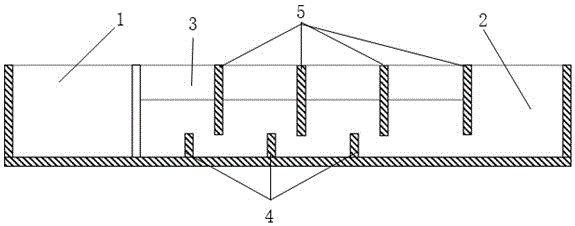
As shown in fig. 1, the present embodiment provides a launder for metal casting, which is a rectangular parallelepiped and includes a liquid inlet end 1, a liquid outlet end 2 and a cavity 3 disposed therebetween.
The bottom of the cavity 3 is provided with a first blocking part which is a blocking dam 4, the single blocking dam 4 extends along the width direction of the cavity 3, and the 3 blocking dams 4 are distributed along the length direction (from the liquid inlet end 1 to the liquid outlet end 2) of the cavity 3. In other embodiments, the number of dams 4 may vary, such as 1, 2, 4, 5, etc.; the number of dams 4 is mainly determined by the length of the chamber 3 and the number of walls 5.
The upper part of the cavity 3 is provided with a second blocking part which is a retaining wall 5, the single retaining wall 5 extends along the width direction of the cavity 3, and the 4 retaining walls 5 are distributed along the length direction (the direction from the liquid inlet end 1 to the liquid outlet end 2) of the cavity 3. In other embodiments, the number of retaining walls 5 can vary, such as 1, 2, 3, 5, etc.; the number of the retaining walls 5 is mainly determined in consideration of the length of the chamber 3 and the number of the dams 4.
The dam 4 and the retaining wall 5 are arranged in a staggered manner along the direction from the liquid inlet end 1 to the liquid outlet end 2.
It should be noted that, in addition to the first dam member and the second dam member being provided in the form of the dam 4 and the retaining wall 5, the first dam member and the second dam member may be deformed in shape, for example, in a curved shape, and may be provided with a duct, etc.; as long as the functions of suppressing the turbulent motion of the metal liquid and blocking the inclusions and the pre-melted slag can be achieved.
When the casting mold is used, metal liquid enters from the liquid inlet end 1 and then flows through the cavity 3, the turbulent flow of the metal liquid is inhibited under the action of the dam 4 and the retaining wall 5, impurities such as pre-melted slag and inclusion which enter the launder along with the metal liquid are intercepted at the upper part of the cavity 3 under the combined action of the dam 4 and the retaining wall 5, the metal liquid with high purity flows through the lower part, enters the casting mold through the liquid outlet end 2, and is cooled to obtain a cast ingot with high quality and high purity.
As shown in fig. 2 (fig. 1 is a view from a direction of fig. 2) and fig. 3 (fig. 3 is a view from B direction of fig. 2), in order to further ensure that impurities such as pre-melted slag and inclusions are always floating on the upper portion of the cavity 3 and are always intercepted by the retaining wall 5 (especially in the case of reduction of the amount of molten metal in the later casting stage), in a preferred embodiment, bosses 6 are provided on the inner sides of both side walls in the longitudinal direction of the cavity 3, so that the cavity 3 forms a narrow runner at the bottom for flowing the molten metal, and impurities such as pre-melted slag and inclusions are always floating on the upper portion of the cavity 3.
Example 2
The embodiment provides a method for smelting GH4169 alloy by using return materials, which comprises the following steps: pretreating the return material of the GH4169 alloy, smelting, refining and alloying the pretreated return material and the new material of the GH4169 alloy, and adding pre-melted slag in the alloying treatment process; the GH4169 alloy was obtained by casting into a casting mold via the launder for metal casting provided in example 1.
In this embodiment, the preprocessing includes: carrying out shot blasting treatment on large return materials with short sides larger than 20cm and smooth surfaces, and carrying out roller self-tumbling treatment on return materials with short sides smaller than or equal to 20 cm. After mechanical treatment, the returning material is uniformly pickled by adopting hydrochloric acid with the weight percentage of 5 percent, and the pickling time is 30 min. And then putting the return material into absolute ethyl alcohol for ultrasonic treatment for 30min to remove surface impurities of the return material.
In other embodiments, the pretreatment may be performed by screening, water washing, organic solvent washing, etc. to remove impurities on the surface of the returned material, and the method is not limited to the above-mentioned treatment.
The separation limit of the size of the return materials can be changed within the range of 15cm-25cm, and can also be adjusted according to the actual situation; the weight concentration of hydrochloric acid may vary, such as 8%, 10%, etc.
And weighing and distributing the new materials according to the proportion of the GH4169 alloy formula for later use.
In an alternative embodiment, smelting (charging and melting) may employ the following process: all Ni and Fe in the new materials and part of large-block return materials are added in the first batch, the weight of the part of the return materials is 30 percent of the total weight of the return materials, and the electric smelting is started. And after melting down, adding all the rest return materials in the second batch, and after melting down, adding C, Cr, Mo and Co in the new materials in the third batch.
In other embodiments, the amount of the first charge of return material can be varied, and the order of charging can be adjusted to suit the application.
In an alternative embodiment, the refining may be by the following method: after full melting, adding Ti and Nb in the new material, controlling the temperature at 1400 ℃ in the refining period, controlling the vacuum degree to be less than or equal to 0.1Pa, and refining for 30 min.
In other embodiments, the temperature of refining may vary from 1400 ℃ to 1420 ℃, and the refining time may range from 20min to 30 min.
In alternative embodiments, the alloying process may employ the following methods: and after refining, adding Al, B and Mg in the new materials, then adding premelted slag, stirring for 8min at high power (170-190 kw), and standing for 7 min.
In other embodiments, the time of stirring and the time of standing can each independently vary from 5min to 10 min.
The pre-melted slag comprises CaF in percentage by weight2:CaO:Al2O3:MgO:TiO2= 35%: 30%: 21%: 10%: 4 percent. The granularity of the pre-melted slag is 15mm-25 mm.
In this embodiment, the casting and demolding comprises the following operations: and (3) conveying the launder to a casting platform, and carrying out charged casting at a casting speed of 130 kg/min. And (4) cooling the alloy melt in an ingot mold for 15 hours, and then demolding and taking an ingot.
The SEM image of the oxide inclusions of the obtained ingot is shown in FIG. 4.
Example 3
The launder used in this example is the same as in example 1.
The embodiment also provides a method for smelting GH4169 alloy by using the return material, which specifically comprises the following steps:
1) pretreatment of raw materials
Carrying out shot blasting treatment on large return materials with short sides larger than 20cm and smooth surfaces, and carrying out roller self-tumbling treatment on return materials such as parts with short sides smaller than or equal to 20cm or complex structures. After mechanical treatment, the returning material is uniformly pickled by adopting hydrochloric acid with the weight percentage of 5 percent, and the pickling time is 50 min. And then putting the return material into absolute ethyl alcohol for ultrasonic treatment for 20min to remove surface impurities of the return material.
And weighing and distributing the new materials according to the proportion of the GH4169 alloy formula for later use.
2) Charging and melting
All Ni and Fe in the new materials and part of large-block return materials are added in the first batch, the weight of the part of the return materials is 35 percent of the total weight of the return materials, and the electric smelting is started. And after melting down, adding all the rest return materials in the second batch, and after melting down, adding C, Cr, Mo and Co in the new materials in the third batch.
3) Refining
After full melting, adding Ti and Nb in the new material, controlling the temperature in the refining period within 1420 ℃, the vacuum degree less than or equal to 0.1Pa and the refining time of 20 min.
4) Alloying treatment
And after refining, adding Al, B and Mg in the new material, then adding premelted slag, stirring for 5min at high power, and standing for 10 min.
The proportion of the premelting slag is determined by weightThe quantity percentage is CaF2:CaO:Al2O3:MgO:TiO2= 36%: 28%: 20%: 11%: 5 percent. The granularity of the pre-melted slag is 15mm-25 mm.
5) Casting and demolding
And (3) conveying the launder to a casting platform, and carrying out charged casting at the casting speed of 150 kg/min. And (4) cooling the alloy melt in an ingot mold for 10 hours, and then demolding and taking an ingot.
Example 4
The launder used in this example is the same as in example 1.
The embodiment also provides a method for smelting GH4169 alloy by using the return material, which specifically comprises the following steps:
1) pretreatment of raw materials
Carrying out shot blasting treatment on large return materials with short sides larger than 20cm and smooth surfaces, and carrying out roller self-tumbling treatment on return materials such as parts with short sides smaller than or equal to 20cm or complex structures. After mechanical treatment, the returning material is uniformly pickled by adopting hydrochloric acid with the weight percentage of 5 percent, and the pickling time is 40 min. And then putting the return material into absolute ethyl alcohol for ultrasonic treatment for 25min to remove surface impurities of the return material.
And weighing and distributing the new materials according to the proportion of the GH4169 alloy formula for later use.
2) Charging and melting
And adding all Ni and Fe in the new materials and part of the large-block return materials in the first batch, wherein the weight of the part of the return materials is 25% of the total weight of the return materials, and starting power transmission smelting. And after melting down, adding all the rest return materials in the second batch, and after melting down, adding C, Cr, Mo and Co in the new materials in the third batch.
3) Refining
After full melting, adding Ti and Nb in the new material, controlling the temperature in the refining period within 1410 ℃, controlling the vacuum degree to be less than or equal to 0.1Pa, and refining for 25 min.
4) Alloying treatment
And after refining, adding Al, B and Mg in the new material, then adding premelted slag, stirring for 10min at high power, and standing for 5 min.
The pre-melted slag comprises CaF in percentage by weight2:CaO:Al2O3:MgO:TiO2= 44%: 25%: 18%: 10%: 3 percent. The granularity of the pre-melted slag is 15mm-25 mm.
5) Casting and demolding
And (3) conveying the launder to a casting platform, and carrying out charged casting at the casting speed of 140 kg/min. And (3) cooling the alloy melt in an ingot mold for 12 hours, and then demolding and taking an ingot.
The O, N, S content in the ingots obtained in examples 2-4, as well as the number density of inclusions and the maximum inclusion size in the ingots, are shown in Table 1.
Comparative example 1
Unlike example 2, the launder used does not have the boss 3, retaining wall 5 and dam 4.
The O, N, S content in the obtained ingot was measured, and the number density of inclusions and the maximum inclusion size in the ingot were counted, as shown in table 1, and typical inclusions are shown in fig. 5.
As can be seen from fig. 5, the size of inclusions in the ingot obtained in comparative example 1 was large.
Comparative example 2
Different from the embodiment 2, in the alloying stage of alloy smelting, no premelting slag is added, and after raw material pretreatment, charging and material melting, refining, alloying, casting and demolding, the O, N, S content in the ingot is detected, and the number density and the maximum size of the inclusions in the ingot are counted, which is shown in table 1.
TABLE 1 test results
| Numbering
|
O(ppm)
|
N(ppm)
|
S(ppm)
|
Number density of inclusions (pieces/mm)2)
|
Maximum inclusion size (μm)
|
| Example 2
|
9
|
32
|
11
|
83.3
|
4.6
|
| Example 3
|
10
|
35
|
9
|
89.6
|
5.1
|
| Example 4
|
10
|
33
|
8
|
85.3
|
4.5
|
| Comparative example 1
|
23
|
89
|
47
|
273.9
|
33.8
|
| Comparative example 2
|
21
|
67
|
45
|
192.8
|
20.7 |
As can be seen from Table 1, by using the launder and the smelting method provided by the application, the contents of oxygen, nitrogen and sulfur in the ingot and the number of inclusions can be effectively reduced, and the size of the largest inclusion can be reduced, so that the GH4169 alloy return material can be utilized to the maximum extent, and qualified alloy can be obtained.
Finally, it should be noted that: the above embodiments are only used for illustrating the technical solutions of the present application, and not for limiting the same; although the present application has been described in detail with reference to the foregoing embodiments, it should be understood by those of ordinary skill in the art that: the technical solutions described in the foregoing embodiments may still be modified, or some or all of the technical features may be equivalently replaced; and the modifications or the substitutions do not make the essence of the corresponding technical solutions depart from the scope of the technical solutions of the embodiments of the present application.
Moreover, those skilled in the art will appreciate that while some embodiments herein include some features included in other embodiments, rather than other features, combinations of features of different embodiments are meant to be within the scope of the application and form different embodiments. For example, in the claims above, any of the claimed embodiments may be used in any combination. The information disclosed in this background section is only for enhancement of understanding of the general background of the application and should not be taken as an acknowledgement or any form of suggestion that this information forms the prior art already known to a person skilled in the art.