Energy-saving autoclaved fly ash hollow building wall material
Technical Field
The invention relates to the field of building wall materials, in particular to a light, heat-preservation, heat-insulation and energy-saving building wall material.
Background
In China, fly ash bricks have been produced for years, and fly ash bricks have been produced by steam curing process for more than forty years. The fly ash brick can replace clay brick, is used as a bearing wall material for industrial and civil buildings, can save clay consumption, thereby avoiding farmland reduction and vegetation damage, and can effectively treat waste fly ash of power plants. At present, due to the change of building structures and types, enterprises which originally produce autoclaved fly ash bricks face the problems of market shrinkage and transformation upgrading in China. As a load-bearing material for building interior walls, a novel wall material with excellent properties such as light weight, energy conservation, heat preservation, heat insulation and the like is required on the premise of ensuring the strength. The appearance of autoclaved fly ash hollow bricks and hollow blocks brings new vitality to the enterprises. However, the existing autoclaved fly ash hollow brick has the following defects: high production cost, large product size error, single specification, high construction cost and low efficiency.
Disclosure of Invention
In view of the development of internal wall bearing wall materials and the application of fly ash materials in walls in China, the invention provides an autoclaved fly ash hollow building wall material which is energy-saving, convenient to construct and good in performance.
In order to achieve the purpose, the invention adopts the technical scheme that:
the energy-saving steam-pressing type fly ash hollow building wall material is prepared from the following raw materials in parts by weight:
55-75 parts of dry fly ash, 10-20 parts of carbide slag, 1-2 parts of gypsum, 5-25 parts of aggregate and 0.5-1 part of sodium metasilicate; the forming water content is controlled to be 6-8% according to the condition of the mixture.
Furthermore, the aggregate is composed of furnace bottom slag and weathered quartzite in a weight ratio of 1: 1, particles of 1mm and below are not more than 20%, and particles of 5mm-10mmm are not more than 15%. The gypsum is preferably power plant desulfurization gypsum.
Preferably, the feed additive is prepared from the following raw materials in parts by weight:
60-70 parts of fly ash, 15-20 parts of carbide slag, 1-2 parts of gypsum, 15-25 parts of aggregate and 0.5-1 part of sodium metasilicate; the forming water content is controlled to be 6-7% according to the condition of the mixture.
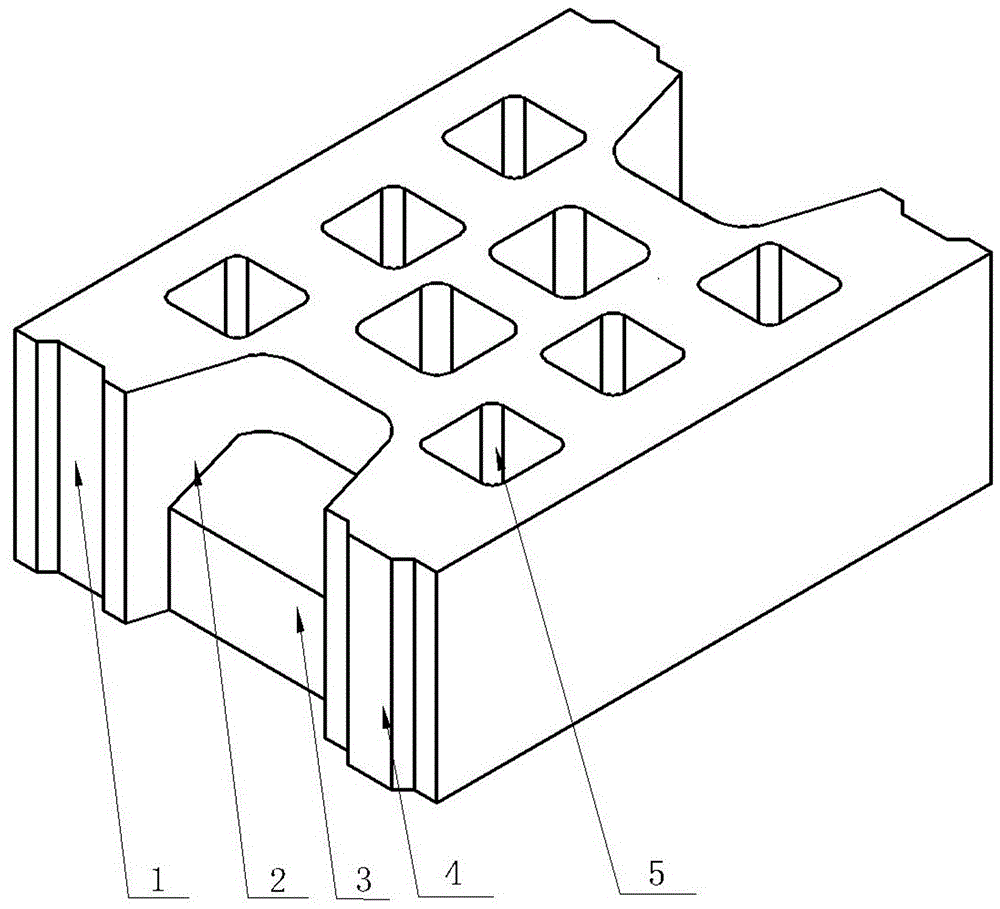
The prepared energy-saving steam-pressing type fly ash hollow brick has the following structure: the front surface of the cuboid is distributed with blind holes which are communicated with the bottom surface; wherein two sides have and build the location tongue-and-groove by laying bricks or stones, and two side middle parts are fluted type hand respectively and grab the hole, and the rib setting is in the middle of the fluted type hand is grabbed the hole, will grab the hole and divide into two from top to bottom, the construction of being convenient for.
The blind holes are staggered rectangular blind holes with chamfers; the positioning mortises are convex-concave grooves which are vertically arranged along the end surface. The ribs are integral with the brick body.
The prepared energy-saving steam-pressing type fly ash hollow brick has the following characteristics: 1) the length of the appearance nominal size is 250mm, the width is 200mm, the height is 120mm, 150mm or 190mm, and the hole rate is 46-50%. 2) The design of blind holes is adopted, the requirement of the plumpness of the masonry and mortar spreading is ensured, the heat preservation and insulation effect is improved, and the bending strength is improved. After the block is built, the hand grasping hole forms a closed hole, and the heat preservation and energy saving effects of the wall body are enhanced. 3) The positioning tongue-and-groove on the end surface not only can ensure the surface flatness of the masonry wall, but also is beneficial to improving the mechanical property of the masonry; in addition, the accurate size and appearance control of the block type is combined, and a thin mortar joint masonry construction process can be adopted. The construction process of building the thin mortar joint is determined, and the wall can be directly finished by putty coating, so that the plastering process is omitted.
The invention has the following beneficial effects: firstly, block type innovation is carried out, the strength of a test block is ensured while the block type blind hole is fully paved, and after the building is finished, a closed hole is formed by grabbing the hole with hands, so that a good heat transfer coefficient is designed, and the heat-insulating and energy-saving effects of the wall are enhanced; the weight of the block type is reduced while the hole rate is improved. The concrete has the advantages of high compressive strength, large hole rate (over 45 percent), small drying shrinkage rate, light density, small size deviation, high construction efficiency, excellent heat preservation and insulation and other performances; in addition, the raw materials are wide in source and low in price, industrial wastes are fully utilized, the production process is energy-saving and environment-friendly, the product can be repeatedly utilized, and secondary pollution to the environment is avoided; the semi-finished product and the finished product rate are more than 98 percent, and the requirement of the green building material evaluation standard is met. The economic benefit and the social benefit are remarkable: according to the calculation of 6000 million standard bricks produced in the productive capacity per year, the factory price of the hollow building block with the height of 120mm is 1.20 yuan/block, and 1500 ten thousand times (1.20 yuan/block-0.65 yuan/block) =825 yuan are sold per year. Deducting management fee and sales fee, and making pure profit about 530 ten thousand yuan.
The method is suitable for a thin mortar joint construction process, and after the masonry is finished, the size deviation is small, so that the plastering process can be omitted on the surface of the wall, the construction cost per square meter is saved by nearly 30 yuan, and if the construction area is 10 ten thousand square meters of construction according to the calculation, the cost is saved by nearly 300 ten thousand yuan, and the economic benefit is considerable.
Reduces the energy consumption and the greenhouse gas emission during the production of the quicklime. According to the proportion of 20 percent of quicklime, the quicklime of the autoclaved fly ash hollow brick is completely replaced by carbide slag, and an enterprise which produces 6000 million standard blocks annually replaces the quantity of the raw lime: 6000 million blocks × 2.5 kg/block × 20%, which is 3 ten thousand tons. According to the standard coal with 150 kg of energy consumption per ton of quicklime, the energy consumption in quicklime production is reduced: 3 ten thousand tons multiplied by 150 kg/ton which is 0.45 ten thousand tons standard coal and reduces the emission of carbon dioxide by 1.16 ten thousand tons. In addition, all the used industrial wastes are coal ash, carbide slag, desulfurized gypsum and the like, so that the problem of waste residue treatment of enterprises is solved, and the environmental benefit is remarkable.
Drawings
FIG. 1 is a schematic structural view of an autoclaved fly ash hollow brick of the invention; in the figure, 1-positioning tongue groove, 2-hand grasping hole, 3-rib, 4-positioning tenon and 5-blind hole.
FIG. 2 is a schematic structural view and a cross-sectional view of a chamfered rectangular blind hole.
Detailed Description
To better illustrate the invention, the following examples are given:
the energy-saving autoclaved fly ash hollow building wall material in the embodiment 1 is prepared from the following raw materials in parts by weight by adopting a steam curing process and combining a grinding tool:
55 parts of dry fly ash, 20 parts of carbide slag, 2 parts of gypsum, 25 parts of aggregate and 0.5 part of sodium metasilicate; the forming water content is controlled at 6% according to the condition of the mixture.
The gypsum is desulfurized gypsum from power plants.
The aggregate is composed of furnace bottom slag and weathered quartzite in a weight ratio of 1: 1, particles of 1mm and below are not more than 20%, and particles of 5mm-10mmm are not more than 15%.
Example 2
The energy-saving steam-pressing type fly ash hollow building wall material is prepared from the following raw materials in parts by weight by adopting a steam curing process and combining a grinding tool:
60 parts of dry fly ash, 18 parts of carbide slag, 2 parts of gypsum, 22 parts of aggregate and 0.5 part of sodium metasilicate, and the forming water content is controlled to be 7% according to the condition of the mixture. The porosity is 46-50%.
The gypsum is desulfurized gypsum from power plants.
The aggregate is composed of furnace bottom slag and weathered quartzite in a weight ratio of 1: 1, particles of 1mm and below are not more than 20%, and particles of 5mm-10mmm are not more than 15%.
Example 3
The energy-saving steam-pressing type fly ash hollow building wall material is prepared from the following raw materials in parts by weight by adopting a steam curing process and combining a grinding tool:
60 parts of dry fly ash, 16 parts of carbide slag, 1 part of gypsum, 14 parts of aggregate and 1 part of sodium metasilicate, and the forming water content is controlled to be 8% according to the condition of the mixture. The porosity is 46-50%.
The gypsum is desulfurized gypsum from power plants.
The aggregate is composed of furnace bottom slag and weathered quartzite in a weight ratio of 1: 1, particles of 1mm and below are not more than 20%, and particles of 5mm-10mmm are not more than 15%.
Example 4
The energy-saving steam-pressing type fly ash hollow building wall material is prepared from the following raw materials in parts by weight by adopting a steam curing process and combining a grinding tool:
65 parts of fly ash, 20 parts of carbide slag, 2 parts of gypsum, 15 parts of aggregate and 0.5 part of sodium metasilicate, wherein the forming water content is controlled at 6% according to the condition of the mixture. The porosity is 46-50%.
The gypsum is desulfurized gypsum from power plants.
The aggregate is composed of furnace bottom slag and weathered quartzite in a weight ratio of 1: 1, particles of 1mm and below are not more than 20%, and particles of 5mm-10mmm are not more than 15%.
The energy-saving steaming type fly ash hollow brick prepared by the embodiment has the following structure: the front surface of the cuboid is distributed with blind holes 5 which are communicated with the bottom surface; two sides of the cuboid are provided with a masonry positioning mortise 1 and a positioning tenon 4, the middle parts of the two sides are respectively provided with groove-shaped hand-holding holes 2, and the ribs 3 are arranged in the middle of the groove-shaped hand-holding holes 2 to divide the hand-holding holes 2 into an upper part and a lower part.
The blind holes 5 are rectangular blind holes with chamfers and are arranged on the plane in a staggered manner; the positioning mortises 1 and the positioning tenons 4 are convex-concave grooves which are vertically arranged along the end surface. The thickness of the rib 3 is not more than 25mm, which is beneficial to the mechanical property and the yield improvement.
The performance of the energy-saving autoclaved fly ash hollow brick prepared by the embodiment is tested and shown in the following table: