BR112018009890B1 - RESIN COMPOSITION FOR ENCAPSULATION, AND SEMICONDUCTOR DEVICE - Google Patents
RESIN COMPOSITION FOR ENCAPSULATION, AND SEMICONDUCTOR DEVICE Download PDFInfo
- Publication number
- BR112018009890B1 BR112018009890B1 BR112018009890-6A BR112018009890A BR112018009890B1 BR 112018009890 B1 BR112018009890 B1 BR 112018009890B1 BR 112018009890 A BR112018009890 A BR 112018009890A BR 112018009890 B1 BR112018009890 B1 BR 112018009890B1
- Authority
- BR
- Brazil
- Prior art keywords
- resin composition
- encapsulation
- silica
- equal
- resin
- Prior art date
Links
Images

Classifications
-
- C—CHEMISTRY; METALLURGY
- C08—ORGANIC MACROMOLECULAR COMPOUNDS; THEIR PREPARATION OR CHEMICAL WORKING-UP; COMPOSITIONS BASED THEREON
- C08K—Use of inorganic or non-macromolecular organic substances as compounding ingredients
- C08K3/00—Use of inorganic substances as compounding ingredients
- C08K3/34—Silicon-containing compounds
- C08K3/36—Silica
-
- H—ELECTRICITY
- H10—SEMICONDUCTOR DEVICES; ELECTRIC SOLID-STATE DEVICES NOT OTHERWISE PROVIDED FOR
- H10W—GENERIC PACKAGES, INTERCONNECTIONS, CONNECTORS OR OTHER CONSTRUCTIONAL DETAILS OF DEVICES COVERED BY CLASS H10
- H10W74/00—Encapsulations, e.g. protective coatings
- H10W74/40—Encapsulations, e.g. protective coatings characterised by their materials
- H10W74/47—Encapsulations, e.g. protective coatings characterised by their materials comprising organic materials, e.g. plastics or resins
- H10W74/473—Encapsulations, e.g. protective coatings characterised by their materials comprising organic materials, e.g. plastics or resins containing a filler
-
- C—CHEMISTRY; METALLURGY
- C08—ORGANIC MACROMOLECULAR COMPOUNDS; THEIR PREPARATION OR CHEMICAL WORKING-UP; COMPOSITIONS BASED THEREON
- C08K—Use of inorganic or non-macromolecular organic substances as compounding ingredients
- C08K3/00—Use of inorganic substances as compounding ingredients
- C08K3/02—Elements
- C08K3/08—Metals
-
- C—CHEMISTRY; METALLURGY
- C08—ORGANIC MACROMOLECULAR COMPOUNDS; THEIR PREPARATION OR CHEMICAL WORKING-UP; COMPOSITIONS BASED THEREON
- C08L—COMPOSITIONS OF MACROMOLECULAR COMPOUNDS
- C08L101/00—Compositions of unspecified macromolecular compounds
-
- C—CHEMISTRY; METALLURGY
- C08—ORGANIC MACROMOLECULAR COMPOUNDS; THEIR PREPARATION OR CHEMICAL WORKING-UP; COMPOSITIONS BASED THEREON
- C08L—COMPOSITIONS OF MACROMOLECULAR COMPOUNDS
- C08L101/00—Compositions of unspecified macromolecular compounds
- C08L101/02—Compositions of unspecified macromolecular compounds characterised by the presence of specified groups, e.g. terminal or pendant functional groups
- C08L101/025—Compositions of unspecified macromolecular compounds characterised by the presence of specified groups, e.g. terminal or pendant functional groups containing nitrogen atoms
-
- C—CHEMISTRY; METALLURGY
- C08—ORGANIC MACROMOLECULAR COMPOUNDS; THEIR PREPARATION OR CHEMICAL WORKING-UP; COMPOSITIONS BASED THEREON
- C08L—COMPOSITIONS OF MACROMOLECULAR COMPOUNDS
- C08L79/00—Compositions of macromolecular compounds obtained by reactions forming in the main chain of the macromolecule a linkage containing nitrogen with or without oxygen or carbon only, not provided for in groups C08L61/00 - C08L77/00
-
- C—CHEMISTRY; METALLURGY
- C08—ORGANIC MACROMOLECULAR COMPOUNDS; THEIR PREPARATION OR CHEMICAL WORKING-UP; COMPOSITIONS BASED THEREON
- C08L—COMPOSITIONS OF MACROMOLECULAR COMPOUNDS
- C08L79/00—Compositions of macromolecular compounds obtained by reactions forming in the main chain of the macromolecule a linkage containing nitrogen with or without oxygen or carbon only, not provided for in groups C08L61/00 - C08L77/00
- C08L79/04—Polycondensates having nitrogen-containing heterocyclic rings in the main chain; Polyhydrazides; Polyamide acids or similar polyimide precursors
- C08L79/08—Polyimides; Polyester-imides; Polyamide-imides; Polyamide acids or similar polyimide precursors
- C08L79/085—Unsaturated polyimide precursors
-
- H—ELECTRICITY
- H10—SEMICONDUCTOR DEVICES; ELECTRIC SOLID-STATE DEVICES NOT OTHERWISE PROVIDED FOR
- H10W—GENERIC PACKAGES, INTERCONNECTIONS, CONNECTORS OR OTHER CONSTRUCTIONAL DETAILS OF DEVICES COVERED BY CLASS H10
- H10W74/00—Encapsulations, e.g. protective coatings
- H10W74/10—Encapsulations, e.g. protective coatings characterised by their shape or disposition
-
- H—ELECTRICITY
- H10—SEMICONDUCTOR DEVICES; ELECTRIC SOLID-STATE DEVICES NOT OTHERWISE PROVIDED FOR
- H10W—GENERIC PACKAGES, INTERCONNECTIONS, CONNECTORS OR OTHER CONSTRUCTIONAL DETAILS OF DEVICES COVERED BY CLASS H10
- H10W74/00—Encapsulations, e.g. protective coatings
- H10W74/10—Encapsulations, e.g. protective coatings characterised by their shape or disposition
- H10W74/111—Encapsulations, e.g. protective coatings characterised by their shape or disposition the semiconductor body being completely enclosed
-
- H—ELECTRICITY
- H10—SEMICONDUCTOR DEVICES; ELECTRIC SOLID-STATE DEVICES NOT OTHERWISE PROVIDED FOR
- H10W—GENERIC PACKAGES, INTERCONNECTIONS, CONNECTORS OR OTHER CONSTRUCTIONAL DETAILS OF DEVICES COVERED BY CLASS H10
- H10W74/00—Encapsulations, e.g. protective coatings
- H10W74/10—Encapsulations, e.g. protective coatings characterised by their shape or disposition
- H10W74/111—Encapsulations, e.g. protective coatings characterised by their shape or disposition the semiconductor body being completely enclosed
- H10W74/114—Encapsulations, e.g. protective coatings characterised by their shape or disposition the semiconductor body being completely enclosed by a substrate and the encapsulations
- H10W74/117—Encapsulations, e.g. protective coatings characterised by their shape or disposition the semiconductor body being completely enclosed by a substrate and the encapsulations the substrate having spherical bumps for external connection
-
- H—ELECTRICITY
- H10—SEMICONDUCTOR DEVICES; ELECTRIC SOLID-STATE DEVICES NOT OTHERWISE PROVIDED FOR
- H10W—GENERIC PACKAGES, INTERCONNECTIONS, CONNECTORS OR OTHER CONSTRUCTIONAL DETAILS OF DEVICES COVERED BY CLASS H10
- H10W74/00—Encapsulations, e.g. protective coatings
- H10W74/40—Encapsulations, e.g. protective coatings characterised by their materials
-
- C—CHEMISTRY; METALLURGY
- C08—ORGANIC MACROMOLECULAR COMPOUNDS; THEIR PREPARATION OR CHEMICAL WORKING-UP; COMPOSITIONS BASED THEREON
- C08K—Use of inorganic or non-macromolecular organic substances as compounding ingredients
- C08K3/00—Use of inorganic substances as compounding ingredients
- C08K3/02—Elements
- C08K3/08—Metals
- C08K2003/0856—Iron
-
- C—CHEMISTRY; METALLURGY
- C08—ORGANIC MACROMOLECULAR COMPOUNDS; THEIR PREPARATION OR CHEMICAL WORKING-UP; COMPOSITIONS BASED THEREON
- C08K—Use of inorganic or non-macromolecular organic substances as compounding ingredients
- C08K3/00—Use of inorganic substances as compounding ingredients
- C08K3/02—Elements
- C08K3/08—Metals
- C08K2003/0862—Nickel
-
- C—CHEMISTRY; METALLURGY
- C08—ORGANIC MACROMOLECULAR COMPOUNDS; THEIR PREPARATION OR CHEMICAL WORKING-UP; COMPOSITIONS BASED THEREON
- C08K—Use of inorganic or non-macromolecular organic substances as compounding ingredients
- C08K3/00—Use of inorganic substances as compounding ingredients
- C08K3/02—Elements
- C08K3/08—Metals
- C08K2003/0881—Titanium
-
- C—CHEMISTRY; METALLURGY
- C08—ORGANIC MACROMOLECULAR COMPOUNDS; THEIR PREPARATION OR CHEMICAL WORKING-UP; COMPOSITIONS BASED THEREON
- C08K—Use of inorganic or non-macromolecular organic substances as compounding ingredients
- C08K2201/00—Specific properties of additives
- C08K2201/002—Physical properties
- C08K2201/005—Additives being defined by their particle size in general
-
- C—CHEMISTRY; METALLURGY
- C08—ORGANIC MACROMOLECULAR COMPOUNDS; THEIR PREPARATION OR CHEMICAL WORKING-UP; COMPOSITIONS BASED THEREON
- C08L—COMPOSITIONS OF MACROMOLECULAR COMPOUNDS
- C08L2203/00—Applications
- C08L2203/20—Applications use in electrical or conductive gadgets
- C08L2203/206—Applications use in electrical or conductive gadgets use in coating or encapsulating of electronic parts
-
- C—CHEMISTRY; METALLURGY
- C08—ORGANIC MACROMOLECULAR COMPOUNDS; THEIR PREPARATION OR CHEMICAL WORKING-UP; COMPOSITIONS BASED THEREON
- C08L—COMPOSITIONS OF MACROMOLECULAR COMPOUNDS
- C08L2205/00—Polymer mixtures characterised by other features
- C08L2205/02—Polymer mixtures characterised by other features containing two or more polymers of the same C08L -group
- C08L2205/025—Polymer mixtures characterised by other features containing two or more polymers of the same C08L -group containing two or more polymers of the same hierarchy C08L, and differing only in parameters such as density, comonomer content, molecular weight, structure
-
- H—ELECTRICITY
- H10—SEMICONDUCTOR DEVICES; ELECTRIC SOLID-STATE DEVICES NOT OTHERWISE PROVIDED FOR
- H10W—GENERIC PACKAGES, INTERCONNECTIONS, CONNECTORS OR OTHER CONSTRUCTIONAL DETAILS OF DEVICES COVERED BY CLASS H10
- H10W74/00—Encapsulations, e.g. protective coatings
-
- H—ELECTRICITY
- H10—SEMICONDUCTOR DEVICES; ELECTRIC SOLID-STATE DEVICES NOT OTHERWISE PROVIDED FOR
- H10W—GENERIC PACKAGES, INTERCONNECTIONS, CONNECTORS OR OTHER CONSTRUCTIONAL DETAILS OF DEVICES COVERED BY CLASS H10
- H10W90/00—Package configurations
- H10W90/701—Package configurations characterised by the relative positions of pads or connectors relative to package parts
- H10W90/751—Package configurations characterised by the relative positions of pads or connectors relative to package parts of bond wires
- H10W90/754—Package configurations characterised by the relative positions of pads or connectors relative to package parts of bond wires between a chip and a stacked insulating package substrate, interposer or RDL
-
- H—ELECTRICITY
- H10—SEMICONDUCTOR DEVICES; ELECTRIC SOLID-STATE DEVICES NOT OTHERWISE PROVIDED FOR
- H10W—GENERIC PACKAGES, INTERCONNECTIONS, CONNECTORS OR OTHER CONSTRUCTIONAL DETAILS OF DEVICES COVERED BY CLASS H10
- H10W90/00—Package configurations
- H10W90/701—Package configurations characterised by the relative positions of pads or connectors relative to package parts
- H10W90/751—Package configurations characterised by the relative positions of pads or connectors relative to package parts of bond wires
- H10W90/756—Package configurations characterised by the relative positions of pads or connectors relative to package parts of bond wires between a chip and a stacked lead frame, conducting package substrate or heat sink
Landscapes
- Chemical & Material Sciences (AREA)
- Health & Medical Sciences (AREA)
- Chemical Kinetics & Catalysis (AREA)
- Medicinal Chemistry (AREA)
- Polymers & Plastics (AREA)
- Organic Chemistry (AREA)
- Structures Or Materials For Encapsulating Or Coating Semiconductor Devices Or Solid State Devices (AREA)
- Compositions Of Macromolecular Compounds (AREA)
Abstract
composição de resina para encapsulação, e dispositivo semicondutor. a composição de resina de vedação é usada para vedar um elemento semicondutor de potência formado de sic, gan, ga2o3, ou diamante, e contém a resina termocurável (a) e sílica (b) em que a sílica (b) contém fe, a quantidade contida de fe é não mais do que 220 ppm com respeito à quantidade total da sílica (b), e a sílica (b) é granular, semelhante a comprimido, ou semelhante à folha.resin composition for encapsulation, and semiconductor device. The sealing resin composition is used to seal a power semiconductor element formed from sic, gan, ga2o3, or diamond, and contains the thermosetting resin (a) and silica (b) wherein the silica (b) contains Fe, a contained amount of Fe is no more than 220 ppm with respect to the total amount of silica (b), and silica (b) is granular, tablet-like, or sheet-like.
Description
[001] A presente invenção refere-se a uma composição de resina para encapsulação, e um dispositivo semicondutor.[001] The present invention relates to a resin composition for encapsulation, and a semiconductor device.
[002] Em relação às composições de resina que são usadas para dispositivos semicondutores, várias investigações foram conduzidas tendo em vista suprimir o empenamento de lascas. Relativo a tais tecnologias, por exemplo, a tecnologia descrita em Documento de Patente 1 pode ser mencionada. Documento de Patente 1 descreve uma composição de pasta de resina incluindo uma resina de epóxi e uma resina de maleimida. De acordo com o mesmo documento, é descrito que quando uma tal composição de pasta de resina for usada como um material de ligação de matriz para um dispositivo semicondutor, empenamento em uma lasca de silício que foi formado em uma estrutura de chumbo de cobre dispondo um material de ligação de matriz entre as mesmas pode ser suprimido.[002] Regarding resin compositions that are used for semiconductor devices, several investigations have been conducted with a view to suppressing chip warping. With respect to such technologies, for example, the technology described in
[003] [Documento de Patente 1] Publicação de Patente aberta à inspeção pública japonesa No. H11-322816[003] [Patent Document 1] Japanese Patent Publication Open to Public Inspection No. H11-322816
[004] A pasta de resina descrita no documento de patente mencionado acima é um material de ligação de matriz que adere uma lasca de silício a uma armação de leitura, e este é um produto diferente de um material encapsulante geral que encapsula elementos semicondutores.[004] The resin paste described in the patent document mentioned above is a matrix bonding material that adheres a silicon chip to a reading frame, and this is a different product from a general encapsulating material that encapsulates semiconductor elements.
[005] Os inventores da presente invenção conduziram uma investigação, e como um resultado, foi constatado que em um caso em que a pasta de resina descrita no documento é aplicada a um material encapsulante que encapsula elementos semicondutores de potência descritos abaixo, há espaço para melhorias do ponto de vista de durabilidade para uso a longo prazo em um ambiente de alta temperatura.[005] The inventors of the present invention conducted an investigation, and as a result, it was found that in a case where the resin paste described in the document is applied to an encapsulating material that encapsulates the power semiconductor elements described below, there is room for improvements from a durability standpoint for long term use in a high temperature environment.
[006] Aqui, visto que elementos semicondutores de potência que usam materiais de banda larga tal como SiC, GaN, Ga2O3, ou diamante são designados para ser usados sob as condições de voltagem alta e corrente grande, a quantidade de geração de calor é maior comparada a lascas de silício convencionais. Portanto, os elementos semicondutores de potência podem ser operados em um ambiente de temperatura mais alta.[006] Here, since power semiconductor elements that use broadband materials such as SiC, GaN, Ga2O3, or diamond are designed to be used under the conditions of high voltage and large current, the amount of heat generation is greater. compared to conventional silicon chips. Therefore, power semiconductor elements can be operated in a higher temperature environment.
[007] Os inventores da presente invenção tomaram nota da durabilidade para uso a longo prazo em um ambiente de alta temperatura e as impurezas de sílica em relação a uma composição de resina para encapsulação que é usado para encapsular elementos semicondutores de potência, e conduzida uma investigação completa. Como um resultado, os inventores constataram que tal durabilidade pode ser aumentada controlando-se o tipo e conteúdo das impurezas de sílica quando apropriado, e desse modo os inventores completaram a presente invenção.[007] The inventors of the present invention took note of the durability for long-term use in a high temperature environment and the silica impurities in relation to an encapsulation resin composition that is used to encapsulate power semiconductor elements, and conducted a full investigation. As a result, the inventors have found that such durability can be increased by controlling the type and content of the silica impurities where appropriate, and thus the inventors have completed the present invention.
[008] De acordo com a presente invenção, é fornecida[008] According to the present invention, there is provided
[009] uma composição de resina para encapsulação usada para encapsular um elemento semicondutor de potência formado de SiC, GaN, Ga2O3, ou diamante,[009] an encapsulation resin composition used to encapsulate a power semiconductor element formed from SiC, GaN, Ga2O3, or diamond,
[0010] a composição de resina por encapsulação incluindo:[0010] the encapsulation resin composition including:
[0011] uma resina termocurável (A); e[0011] a thermosetting resin (A); and
[0012] sílica (B),[0012] silica (B),
[0013] em que a sílica (B) inclui Fe, o teor de Fe é igual a ou menor do que 220 ppm em relação à quantidade total da sílica (B), e a composição de resina está em uma forma granular, uma forma de comprimido, ou uma forma de folha.[0013] wherein the silica (B) includes Fe, the Fe content is equal to or less than 220 ppm with respect to the total amount of silica (B), and the resin composition is in a granular form, a form tablet, or a sheet form.
[0014] De acordo com a presente invenção, é fornecido um dispositivo semicondutor incluindo:[0014] In accordance with the present invention, a semiconductor device is provided including:
[0015] um elemento semicondutor de potência montado sobre um substrato e formado de SiC, GaN, Ga2O3, ou diamante; e[0015] a power semiconductor element mounted on a substrate and formed of SiC, GaN, Ga2O3, or diamond; and
[0016] um material encapsulante composto de um produto curado obtenível curando-se a composição de resina para encapsulação descrita acima e pretendido para encapsular o elemento semicondutor de potência.[0016] an encapsulating material composed of a cured product obtainable by curing the encapsulation resin composition described above and intended to encapsulate the power semiconductor element.
[0017] De acordo com a presente invenção, uma composição de resina para encapsulação que pode aumentar a durabilidade de um material encapsulante por uso a longo prazo em um ambiente de alta temperatura, e um dispositivo semicondutor que usa a composição de resina podem ser fornecidos.[0017] In accordance with the present invention, a resin composition for encapsulation that can increase the durability of an encapsulating material by long-term use in a high temperature environment, and a semiconductor device that uses the resin composition can be provided. .
[0018] Os objetivos descritos acima, e outros objetivos, características, e vantagens serão ainda esclarecidos pelas modalidades adequadas descritas abaixo e os seguintes desenhos que lhes dizem respeito.[0018] The objectives described above, and other objectives, features, and advantages will be further clarified by the appropriate modalities described below and the following drawings relating thereto.
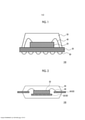
[0019] A Figura 1 é uma vista em corte que ilustra um exemplo de um dispositivo semicondutor de acordo com a presente modalidade.[0019] Figure 1 is a sectional view illustrating an example of a semiconductor device according to the present embodiment.
[0020] A Figura 2 é uma vista em corte que ilustra um exemplo de um dispositivo semicondutor de acordo com a presente modalidade.[0020] Figure 2 is a sectional view illustrating an example of a semiconductor device according to the present embodiment.
[0021] A Figura 3 é uma fotografia de SEM mostrando uma estrutura em corte de um material encapsulante depois de um teste em características de armazenamento a longo prazo em alta temperatura.[0021] Figure 3 is a SEM photograph showing a sectional structure of an encapsulating material after a test on long-term storage characteristics at high temperature.
[0022] Em seguida, modalidades serão descritas usando os desenhos. Em todos os desenhos, o mesmo numeral de referência será nomeado ao mesmo elemento constituinte, e outra explicação não será repetida.[0022] Next, modalities will be described using the drawings. In all drawings, the same reference numeral will be assigned to the same constituent element, and no other explanation will be repeated.
[0023] Um esboço da composição de resina para encapsulação da presente modalidade será descrito.[0023] An outline of the resin composition for encapsulation of the present embodiment will be described.
[0024] A composição de resina para encapsulação de acordo com a presente modalidade é uma composição de resina para encapsulação que é usada para encapsular elementos semicondutores de potência formado de SiC, GaN, Ga2O3, ou diamante, e inclui uma resina termocurável (A) e sílica (B). Sílica (B) inclui Fe, e o teor de tal Fe é igual a ou menor do que 220 ppm em relação à quantidade total de sílica (B).[0024] The encapsulation resin composition according to the present embodiment is an encapsulation resin composition that is used to encapsulate power semiconductor elements formed from SiC, GaN, Ga2O3, or diamond, and includes a thermosetting resin (A) and silica (B). Silica (B) includes Fe, and the content of such Fe is equal to or less than 220 ppm with respect to the total amount of silica (B).
[0025] A composição de resina para encapsulação da presente modalidade pode ser produzida em uma forma granular, uma forma de comprimido, ou uma forma de folha.[0025] The encapsulation resin composition of the present embodiment can be produced in a granular form, a tablet form, or a sheet form.
[0026] Em relação a dispositivos de silicone convencionais, é importante que os dispositivos de silicone possam ser usados em um ambiente em uma temperatura de, por exemplo, cerca de 175°C. Sob tais circunstâncias, investigações nas características de armazenamento de materiais encapsulantes em um ambiente a cerca de 175°C foram conduzidas antes.[0026] Regarding conventional silicone devices, it is important that silicone devices can be used in an environment at a temperature of, for example, about 175°C. Under such circumstances, investigations into the storage characteristics of encapsulating materials in an environment at about 175°C have been conducted before.
[0027] Entretanto, as características de armazenamento a longo prazo de materiais encapsulantes em um ambiente de alta temperatura acima de 200°C não foram suficientemente conduzidas. Aqui, um material encapsulante que encapsula um elemento semicondutor de potência que usa um material de banda larga tal como SiC, GaN, Ga2O3, ou diamante, é requerido ter características permitindo uso a longo prazo em um ambiente de alta temperatura acima de 200°C. Tais características de armazenamento a longo prazo em alta temperatura podem ser avaliadas com base na relação de redução de massa obtenível em um caso em que um material encapsulante em um ambiente de alta temperatura em uma temperatura de, por exemplo, 250°C.[0027] However, the long-term storage characteristics of encapsulating materials in a high temperature environment above 200°C have not been sufficiently conducted. Here, an encapsulating material that encapsulates a power semiconductor element that uses a broadband material such as SiC, GaN, Ga2O3, or diamond, is required to have characteristics allowing long-term use in a high temperature environment above 200°C. . Such long-term high temperature storage characteristics can be evaluated on the basis of the mass reduction ratio obtainable in a case where an encapsulating material is in a high temperature environment at a temperature of, for example, 250°C.
[0028] Os inventores da presente invenção tomaram nota da durabilidade para uso a longo prazo em um ambiente de alta temperatura e as impurezas de sílica em relação a uma composição de resina para encapsulação que é usada para encapsular um elemento semicondutor de potência, e desse modo conduziram uma investigação completa. Como um resultado, os inventores constataram que tal durabilidade pode ser realçada controlando-se o tipo e conteúdo das impurezas de sílica.[0028] The inventors of the present invention have taken note of the durability for long-term use in a high temperature environment and the silica impurities in relation to an encapsulation resin composition that is used to encapsulate a power semiconductor element, and hence thus conducted a thorough investigation. As a result, the inventors have found that such durability can be enhanced by controlling the type and content of the silica impurities.
[0029] Os inventores também conduziram uma investigação com base nestes resultados, e como um resultado, os inventores recentemente constataram que quando o teor de Fe ou outras impurezas tal como Mn em sílica (B) que é incluído em uma composição de resina para encapsulação é controlado para ser igual a ou menor do que um valor pré-determinado, as características de armazenamento em um ambiente de alta temperatura acima de 200°C do material encapsulante formado usando a composição de resina para encapsulação podem ser realçadas. Portanto, de acordo com a presente modalidade, a durabilidade do material encapsulante para uso a longo prazo em um ambiente de alta temperatura pode ser aumentada. Desse modo, a composição de resina para encapsulação pode da mesma forma contribuir a um aumento na confiança de dispositivos semicondutores.[0029] The inventors also conducted an investigation based on these results, and as a result, the inventors recently found that when the content of Fe or other impurities such as Mn in silica (B) that is included in a resin composition for encapsulation is controlled to be equal to or less than a predetermined value, the storage characteristics in a high temperature environment above 200°C of the encapsulating material formed using the encapsulation resin composition can be enhanced. Therefore, according to the present embodiment, the durability of the encapsulating material for long-term use in a high temperature environment can be increased. In this way, the resin composition for encapsulation can likewise contribute to an increase in the reliability of semiconductor devices.
[0030] Na seguinte descrição, a composição de resina para encapsulação de acordo com a presente modalidade, e um dispositivo semicondutor produzido usando a composição de resina para encapsulação serão explicados em detalhes.[0030] In the following description, the resin composition for encapsulation according to the present embodiment, and a semiconductor device produced using the resin composition for encapsulation will be explained in detail.
[0031] A composição de resina para encapsulação da presente modalidade é usada para encapsular um elemento semicondutor de potência formado usando SiC (carboneto de silicone), GaN (nitreto de gálio), Ga2O3 (óxido de gálio), ou diamante como um material semicondutor. O elemento semicondutor de potência é, por exemplo, um elemento semicondutor realiza controle e fornecimento da alimentação ou da energia elétrica. De acordo com a presente modalidade, por exemplo, um elemento semicondutor tendo uma potência de entrada de 1,7 W ou mais alta pode ser usado como o elemento semicondutor de potência mencionado acima.[0031] The encapsulation resin composition of the present embodiment is used to encapsulate a power semiconductor element formed using SiC (silicon carbide), GaN (gallium nitride), Ga2O3 (gallium oxide), or diamond as a semiconductor material. . The power semiconductor element is, for example, a semiconductor element that performs control and supply of power or electrical energy. According to the present embodiment, for example, a semiconductor element having an input power of 1.7 W or higher can be used as the power semiconductor element mentioned above.
[0032] De acordo com a presente modalidade, um material encapsulante que encapsula um elemento semicondutor de potência montado em um substrato, é construído de, por exemplo, um produto curado obtenível curando-se uma composição de resina para encapsulação. Desse modo, um dispositivo semicondutor incluindo um substrato, um elemento semicondutor de potência montado no substrato, e um material encapsulante encapsulando o elemento semicondutor de potência é formado. Neste caso, o material encapsulante pode encapsular um elemento semicondutor de potência para revestir, por exemplo, pelo menos a superfície superior do elemento semicondutor de potência. A superfície superior de um elemento semicondutor de potência é uma superfície do elemento semicondutor de potência, a superfície que está no lado oposto da superfície voltada ao substrato.[0032] In accordance with the present embodiment, an encapsulating material that encapsulates a power semiconductor element mounted on a substrate is constructed of, for example, a cured product obtainable by curing an encapsulation resin composition. Thereby, a semiconductor device including a substrate, a power semiconductor element mounted on the substrate, and an encapsulating material encapsulating the power semiconductor element is formed. In this case, the encapsulating material may encapsulate a power semiconductor element to coat, for example, at least the upper surface of the power semiconductor element. The top surface of a power semiconductor element is a surface of the power semiconductor element, the surface that is on the opposite side of the surface facing the substrate.
[0033] A composição de resina para encapsulação pode ter uma forma predeterminada tal como, por exemplo, uma forma granular, uma forma de comprimido, ou uma forma de folha. Desse modo, torna- se fácil de realizar moldagem por encapsulação de um elemento semicondutor usando um método de moldagem conhecido tal como moldagem por transferência, moldagem por injeção, ou moldagem por compressão. De acordo com a presente modalidade, a forma granular significa um agregado obtido consolidando-se um pó de uma composição de resina para encapsulação, a forma de comprimido significa um objeto formado que foi formado para ter uma forma predeterminada comprimindo-se uma composição de resina para encapsulação em uma pressão alta. Uma forma de folha significa uma película de resina formada de uma composição de resina para encapsulação, a película de resina estando na forma de folhas individuais ou um rolo enrolável. A composição de resina para encapsulação em uma forma granular, uma forma de comprimido ou uma forma de folha pode da mesma forma estar em um estado semicurado (estado do estágio B).[0033] The resin composition for encapsulation may have a predetermined form such as, for example, a granular form, a tablet form, or a sheet form. Thereby, it becomes easy to carry out encapsulation molding of a semiconductor element using a known molding method such as transfer molding, injection molding, or compression molding. In accordance with the present embodiment, the granular form means an aggregate obtained by consolidating a powder of a resin composition for encapsulation, the tablet form means a formed object that has been formed to a predetermined shape by compressing a resin composition for encapsulation at a high pressure. A sheet form means a resin film formed from a resin composition for encapsulation, the resin film being in the form of individual sheets or a roll-up roll. The resin composition for encapsulation in a granular form, a tablet form or a sheet form may likewise be in a semi-cured state (stage B state).
[0034] Na seguinte descrição, os vários componentes da composição de resina para encapsulação da presente modalidade serão explicados.[0034] In the following description, the various components of the resin composition for encapsulation of the present embodiment will be explained.
[0035] A composição de resina para encapsulação da presente modalidade inclui uma resina termocurável (A) e sílica (B), como descrito acima.[0035] The encapsulation resin composition of the present embodiment includes a thermosetting resin (A) and silica (B), as described above.
[0036] A resina termocurável (A) pode incluir um tipo ou dois ou mais tipos selecionados a partir de, por exemplo, um composto tendo dois ou mais grupos maleimida, um composto tendo dois ou mais anéis de benzoxazina, uma resina de epóxi, uma resina fenólica, uma resina de ureia, uma resina tendo um anel de triazina, tal como uma resina de melamina, uma resina de poliéster insaturada, uma resina de poliuretano, uma resina de ftalato de dialila, uma resina de silicone, resina de cianato, uma resina de poli-imida, uma resina de poliamidaimida, e uma resina de benzociclobuteno.[0036] The thermosetting resin (A) may include one type or two or more types selected from, for example, a compound having two or more maleimide groups, a compound having two or more benzoxazine rings, an epoxy resin, a phenolic resin, a urea resin, a resin having a triazine ring, such as a melamine resin, an unsaturated polyester resin, a polyurethane resin, a diallyl phthalate resin, a silicone resin, cyanate resin , a polyimide resin, a polyamideimide resin, and a benzocyclobutene resin.
[0037] Do ponto de vista de aumentar as características de armazenamento a longo prazo do material encapsulante em um ambiente de alta temperatura em uma temperatura de 200°C ou mais alta, ou as características mecânicas do material encapsulante, é preferível que a composição de resina para encapsulação inclua, como resina termocurável (A), um tipo ou dois ou mais tipos selecionados a partir de, por exemplo, um composto tendo dois ou mais grupos maleimida, um composto tendo dois ou mais anéis de benzoxazina, e uma resina de epóxi, e é mais preferível que a composição de resina inclua um composto tendo pelo menos dois ou mais grupos maleimida. Visto que a temperatura de transição de vidro (Tg) do produto curado da composição de resina para encapsulação pode ser elevada desse modo, consequentemente, é possível aumentar a resistência ao calor de um dispositivo semicondutor que usa este produto curado.[0037] From the point of view of increasing the long-term storage characteristics of the encapsulating material in a high temperature environment at a temperature of 200°C or higher, or the mechanical characteristics of the encapsulating material, it is preferable that the composition of resin for encapsulation includes, as a thermosetting resin (A), one type or two or more types selected from, for example, a compound having two or more maleimide groups, a compound having two or more benzoxazine rings, and a resin of epoxy, and it is more preferred that the resin composition includes a compound having at least two or more maleimide groups. Since the glass transition temperature (Tg) of the cured product of the resin composition for encapsulation can be elevated in this way, therefore, it is possible to increase the heat resistance of a semiconductor device using this cured product.
[0038] Particularmente, do ponto de vista de alcançar um equilíbrio entre dureza e resistência mecânica, é uma modalidade exemplar preferida usar um composto tendo dois ou mais grupos maleimida e um composto tendo dois ou mais anéis de benzoxazina em combinação. Além disso, do ponto de vista de melhorar o equilíbrio entre dureza e resistência mecânica, é outra modalidade exemplar preferida usar um composto tendo dois ou mais grupos maleimida e uma resina de epóxi em combinação. Enquanto isso, de acordo com a presente modalidade, por exemplo, é da mesma forma possível adotar uma modalidade em que a resina termocurável (A) inclui uma resina de epóxi, porém não inclui um composto tendo dois ou mais grupos maleimida. Quando é referido que a resina termocurável (A) não inclua um composto tendo dois ou mais grupos maleimida, está implícito que, por exemplo, o conteúdo de um composto tendo dois ou mais grupos maleimida é menor do que 1% em massa em relação à quantidade total da composição de resina para encapsulação.[0038] Particularly, from the point of view of achieving a balance between hardness and mechanical strength, it is a preferred exemplary embodiment to use a compound having two or more maleimide groups and a compound having two or more benzoxazine rings in combination. Furthermore, from the point of view of improving the balance between hardness and mechanical strength, it is another exemplary preferred embodiment to use a compound having two or more maleimide groups and an epoxy resin in combination. Meanwhile, according to the present embodiment, for example, it is likewise possible to adopt an embodiment wherein the thermosetting resin (A) includes an epoxy resin, but does not include a compound having two or more maleimide groups. When it is stated that the thermosetting resin (A) does not include a compound having two or more maleimide groups, it is implied that, for example, the content of a compound having two or more maleimide groups is less than 1% by mass with respect to the total amount of the resin composition for encapsulation.
[0039] O composto tendo dois ou mais grupos maleimida pode incluir, por exemplo, pelo menos um de um composto representado pela seguinte Fórmula (1) e um composto representado pela seguinte Fórmula (2). Desse modo, a Tg do produto curado da composição de resina para encapsulação pode ser aumentada, e as características de armazenamento a longo prazo em alta temperatura do material encapsulante podem ser aumentadas mais eficazmente.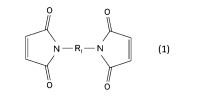
[0040] Na Fórmula (1) descrita acima, R1 representa um grupo orgânico divalente tendo 1 a 30 átomos de carbono, que podem conter um ou mais de um átomo de oxigênio e um átomo de nitrogênio. Do ponto de vista de aumentar as características de armazenamento de alta temperatura do material encapsulante, é mais preferível que R1 seja um grupo orgânico contendo um anel aromático. De acordo com a presente modalidade, exemplos de R1 incluem uma estrutura representada pela seguinte Fórmula (1a):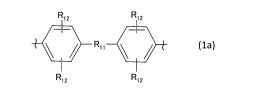
[0041] Em relação a Fórmula (1a) descrita acima, R11 representa um grupo orgânico divalente tendo 1 a 18 átomos de carbono que podem da mesma forma conter um ou mais de um átomo de oxigênio e um átomo de nitrogênio. Uma pluralidade de R12 cada qual independentemente representa um átomo de hidrogênio, ou um grupo hidrocarboneto substituído ou não substituído tendo 1 a 4 átomos de carbono.[0041] With respect to Formula (1a) described above, R11 represents a divalent organic group having 1 to 18 carbon atoms which may likewise contain one or more of an oxygen atom and a nitrogen atom. A plurality of R12 each independently represents a hydrogen atom, or a substituted or unsubstituted hydrocarbon group having 1 to 4 carbon atoms.
[0042] Exemplos do composto representado pela Fórmula (1) que podem ser aplicados à presente modalidade incluem compostos representados pelas seguintes Fórmulas (1-1) a (1-3):
[0043] Em relação a Fórmula (2), uma pluralidade de R2 cada qual independentemente representa um átomo de hidrogênio, ou um grupo hidrocarboneto substituído ou não substituído tendo 1 a 4 átomos de carbono.[0043] With respect to Formula (2), a plurality of R2 each independently represents a hydrogen atom, or a substituted or unsubstituted hydrocarbon group having 1 to 4 carbon atoms.
[0044] O composto tendo dois ou mais anéis de benzoxazina pode incluir, por exemplo, pelo menos um de um composto representado pela Fórmula seguinte (3) e um composto representado pela seguinte Fórmula (4), e é mais preferível que o composto tendo dois ou mais anéis de benzoxazina inclui pelo menos um composto representado pela seguinte Fórmula (3). Desse modo, as características de armazenamento a longo prazo em alta temperatura do material encapsulante podem ser aumentadas mais eficazmente. Além disso, o composto pode da mesma forma contribuir a um aprimoramento das características mecânicas do material encapsulante.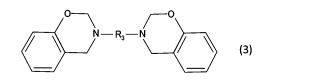
[0045] Em relação à Fórmula (3) descrita acima, R3 representa um grupo orgânico divalente tendo 1 a 30 átomos de carbono que podem conter um ou mais de um átomo de oxigênio e um átomo de nitrogênio. Do ponto de vista de aumentar as características de armazenamento de alta temperatura do material encapsulante, é mais preferível que R3 seja um grupo orgânico contendo um anel aromático. De acordo com a presente modalidade, por exemplo, um composto representado pela seguinte Fórmula (3a) pode ser usado como o composto representado pela Fórmula (3).
[0046] Em relação à Fórmula (4), R4 representa um grupo orgânico divalente tendo 1 a 30 átomos de carbono que podem conter um ou mais de um átomo de oxigênio, um átomo de nitrogênio, e um átomo de enxofre. Dois R5 são cada qual independentemente um grupo de hidrocarboneto aromático tendo 1 a 12 átomos de carbono.[0046] With respect to Formula (4), R4 represents a divalent organic group having 1 to 30 carbon atoms that may contain one or more than one oxygen atom, one nitrogen atom, and one sulfur atom. Two R5 are each independently an aromatic hydrocarbon group having 1 to 12 carbon atoms.
[0047] Por exemplo, a resina de epóxi pode incluir um tipo ou dois ou mais tipos selecionados de uma resina de epóxi tipo bifenila; uma resina de epóxi tipo bisfenol tal como uma resina de epóxi tipo bisfenol A, uma resina de epóxi tipo bisfenol F, ou uma resina de epóxi tipo tetrametil bisfenol F; uma resina de epóxi tipo estilbeno; uma resina de epóxi tipo novolac tal como uma resina de epóxi tipo fenol-novolac ou uma resina de epóxi tipo cresol-novolac; uma resina de epóxi polifuncional tal como uma resina de epóxi tipo trifenilmetano ou uma resina de epóxi tipo trifenolmetano modificada por alquila; uma resina de epóxi tipo aralquila tal como uma resina de epóxi tipo fenol aralquila tendo um esqueleto de fenileno, ou uma resina de epóxi tipo fenol aralquila tendo um esqueleto de bifenileno; uma resina de epóxi tipo naftol tal como uma resina de epóxi tipo di-hidroxinaftaleno, ou uma resina de epóxi obtenível submetendo-se um dímero de di- hidroxinaftaleno a eterificação de glicidila; uma resina de epóxi contendo núcleo de triazina tal como isocianurato de triglicidila ou isocianurato de diglicidila de monoalila; e uma resina de epóxi tipo fenol modificada por composto de hidrocarboneto cíclico em ponte tal como uma resina de epóxi tipo fenol modificada por diciclopentadieno.[0047] For example, the epoxy resin may include one type or two or more selected types of a biphenyl type epoxy resin; a bisphenol type epoxy resin such as a bisphenol A type epoxy resin, a bisphenol F type epoxy resin, or a tetramethyl bisphenol F type epoxy resin; a stilbene-type epoxy resin; a novolac-type epoxy resin such as a phenol-novolac-type epoxy resin or a cresol-novolac-type epoxy resin; a polyfunctional epoxy resin such as a triphenylmethane-type epoxy resin or an alkyl-modified triphenolmethane-type epoxy resin; an aralkyl type epoxy resin such as an aralkyl phenol type epoxy resin having a phenylene skeleton, or an aralkyl phenol type epoxy resin having a biphenylene skeleton; a naphthol-type epoxy resin such as a dihydroxynaphthalene-type epoxy resin, or an epoxy resin obtainable by subjecting a dihydroxynaphthalene dimer to glycidyl etherification; a triazine core containing epoxy resin such as triglycidyl isocyanurate or monoallyl diglycidyl isocyanurate; and a bridged cyclic hydrocarbon compound-modified phenol-type epoxy resin such as a dicyclopentadiene-modified phenol-type epoxy resin.
[0048] O teor da resina termocurável (A) na composição de resina para encapsulação é, por exemplo, preferivelmente igual a ou maior do que 7% em massa, mais preferivelmente igual a ou menor do que 12% em massa, e particularmente preferivelmente igual a ou maior do que 16% em massa, em relação à quantidade total da composição de resina para encapsulação. Quando o conteúdo da resina termocurável (A) é ajustado para ser igual a ou maior do que o limite inferior mencionado acima, fluidez da composição de resina para encapsulação pode ser aumentada, e formação de um material encapsulante mais estável é habilitada. Além disso, o conteúdo da resina termocurável (A) na composição de resina para encapsulação é, por exemplo, preferivelmente igual a ou menor do que 40% em massa, mais preferivelmente igual a ou menor do que 35% em massa, e particularmente preferivelmente igual a ou menor do que 30% em massa, em relação à quantidade total da composição de resina para encapsulação. Quando o conteúdo da resina termocurável (A) é ajustado para ser igual a ou menor do que o limite superior mencionado acima, confiabilidade resistente à umidade ou resistência de refluxo de dispositivos semicondutores pode ser melhorada.[0048] The content of the thermosetting resin (A) in the encapsulation resin composition is, for example, preferably equal to or greater than 7% by mass, more preferably equal to or less than 12% by mass, and particularly preferably equal to or greater than 16% by mass, in relation to the total amount of the resin composition for encapsulation. When the content of the thermosetting resin (A) is adjusted to be equal to or greater than the lower limit mentioned above, flowability of the resin composition for encapsulation can be increased, and formation of a more stable encapsulating material is enabled. Furthermore, the content of the thermosetting resin (A) in the resin composition for encapsulation is, for example, preferably equal to or less than 40% by mass, more preferably equal to or less than 35% by mass, and particularly preferably equal to or less than 30% by mass, in relation to the total amount of the resin composition for encapsulation. When the content of the thermosetting resin (A) is adjusted to be equal to or less than the upper limit mentioned above, moisture resistant reliability or reflow resistance of semiconductor devices can be improved.
[0049] Sílica (B) pode incluir um tipo ou dois ou mais tipos selecionados a partir de, por exemplo, sílica fundida esférica, sílica fundida triturada, e sílica cristalina. Entre estes, do ponto de vista de aumentar as propriedades de empacotamento da composição de resina para encapsulação, as características de armazenamento a longo prazo em alta temperatura do material encapsulante, e similar, é mais preferível que a composição de resina para encapsulação inclua sílica fundida esférica. Além disso, é da mesma forma aceitável que a sílica (B) seja amorfa.[0049] Silica (B) may include one type or two or more types selected from, for example, spherical fused silica, ground fused silica, and crystalline silica. Among these, from the point of view of enhancing the packaging properties of the encapsulating resin composition, the long-term high temperature storage characteristics of the encapsulating material, and the like, it is more preferable that the encapsulating resin composition includes fused silica. spherical. Furthermore, it is likewise acceptable for silica (B) to be amorphous.
[0050] Sílica (B) pode incluir Fe (ferro) como uma impureza.[0050] Silica (B) may include Fe (iron) as an impurity.
[0051] Sílica (B) pode da mesma forma incluir, além de Fe, um ou mais componentes selecionados a partir do grupo consistindo em Mn (manganês), Ni (níquel), Ti (titânio), Ca (cálcio), e P (fósforo), como impurezas.[0051] Silica (B) may likewise include, in addition to Fe, one or more components selected from the group consisting of Mn (manganese), Ni (nickel), Ti (titanium), Ca (calcium), and P (phosphorus) as impurities.
[0052] Os inventores da presente invenção conduziram uma investigação, e como um resultado, eles constataram que quando uma camada de resina formada a partir de uma composição de resina para encapsulação incluindo tal sílica (B) é usado como um material encapsulante para um elemento semicondutor de potência, deterioração da camada de resina ocorre, tal como que descamação ou craqueamento ocorre na interface entre a resina e uma carga tal como sílica, ou deterioração da própria resina ocorre como um resultado de decomposição oxidativa.[0052] The inventors of the present invention conducted an investigation, and as a result, they found that when a resin layer formed from a resin encapsulation composition including such silica (B) is used as an encapsulating material for an power semiconductor, deterioration of the resin layer occurs, such that flaking or cracking occurs at the interface between the resin and a filler such as silica, or deterioration of the resin itself occurs as a result of oxidative decomposition.
[0053] O mecanismo detalhado não é claramente entendido; entretanto, é especulado que quando Fe ou outras impurezas tais como Mn, Ni e Ti trabalham como catalisadores no ambiente de uso para um elemento semicondutor de potência (por exemplo, condições de alta temperatura tal como 200°C ou mais alta ou 250°C ou mais alta), descamando e craqueando, ou deterioração da camada de resina tal como decomposição oxidativa da própria resina ocorre como descrito acima.[0053] Detailed mechanism is not clearly understood; however, it is speculated that when Fe or other impurities such as Mn, Ni and Ti work as catalysts in the use environment for a power semiconductor element (e.g. high temperature conditions such as 200°C or higher or 250°C or higher), peeling and cracking, or deterioration of the resin layer such as oxidative decomposition of the resin itself occurs as described above.
[0054] Com base nestes resultados, os inventores da presente invenção conduziram uma investigação completa, e como um resultado, os inventores constataram que durabilidade para uso a longo prazo em um ambiente de alta temperatura pode ser aumentada controlando-se o tipo e teor de impurezas como apropriado, desse modo completando a presente invenção.[0054] Based on these results, the inventors of the present invention conducted a thorough investigation, and as a result, the inventors found that durability for long-term use in a high temperature environment can be increased by controlling the type and content of impurities as appropriate, thereby completing the present invention.
[0055] Além disso, quando a composição de resina para encapsulação da presente modalidade for usada, deterioração causada por decomposição oxidativa da própria resina tal como descrito acima pode ser suprimida.[0055] Furthermore, when the resin encapsulation composition of the present embodiment is used, deterioration caused by oxidative decomposition of the resin itself as described above can be suppressed.
[0056] Aqui, em relação à composição de resina para encapsulação de acordo com a presente modalidade, o teor de Fe em relação à quantidade total de sílica (B) é, por exemplo, igual a ou menor do que 220 ppm; entretanto, o conteúdo é preferivelmente igual a ou menor do que 200 ppm, e mais preferivelmente igual a ou menor do que 180 ppm. Ajustando-se o conteúdo como tal, as características de armazenamento a longo prazo sob condições de alta temperatura ou as características mecânicas do material encapsulante podem ser mais eficazmente aumentadas.[0056] Here, in relation to the resin composition for encapsulation according to the present embodiment, the content of Fe in relation to the total amount of silica (B) is, for example, equal to or less than 220 ppm; however, the content is preferably equal to or less than 200 ppm, and more preferably equal to or less than 180 ppm. By adjusting the content as such, the long-term storage characteristics under high temperature conditions or the mechanical characteristics of the encapsulating material can be more effectively enhanced.
[0057] De acordo com os presentes inventores, é assumido que sob condições de alta temperatura a 200°C ou mais alta, a ação de ferro para promover decomposição oxidativa da resina serve como um dos fatores para deterioração.[0057] According to the present inventors, it is assumed that under high temperature conditions at 200°C or higher, the action of iron to promote oxidative decomposition of the resin serves as one of the factors for deterioration.
[0058] Os presentes inventores consideram que em um caso em que o teor de Fe em relação à quantidade total de sílica (B) é controlado para estar dentro da faixa de valor descrita acima, o nível da oxidação da resina ocorrendo dentro do material encapsulante pode ser consequentemente reduzido, e portanto, deterioração atribuída a oxidação dentro do material encapsulante pode ser suprimida. Enquanto isso, o limite inferior do teor de Fe na sílica (B) não é particularmente limitado, e o limite inferior pode ser igual a ou maior do que 0 ppm, ou pode ser igual a ou maior do que 1 ppm.[0058] The present inventors consider that in a case where the Fe content relative to the total amount of silica (B) is controlled to be within the value range described above, the level of resin oxidation occurring within the encapsulating material can be consequently reduced, and therefore, deterioration attributed to oxidation within the encapsulating material can be suppressed. Meanwhile, the lower limit of the Fe content in silica (B) is not particularly limited, and the lower limit can be equal to or greater than 0 ppm, or it can be equal to or greater than 1 ppm.
[0059] De acordo com a presente modalidade, o teor de Fe na sílica (B) pode ser medido por, por exemplo, espectroscopia de emissão de ICP.[0059] According to the present embodiment, the Fe content in silica (B) can be measured by, for example, ICP emission spectroscopy.
[0060] Além disso, sílica (B) pode da mesma forma incluir Mn (manganês) como uma impureza.[0060] In addition, silica (B) may likewise include Mn (manganese) as an impurity.
[0061] Aqui, é preferível que o teor de Mn (manganês) em relação à quantidade total de sílica (B) seja tão pequeno quanto possível. Desse modo, as características de armazenamento a longo prazo do material encapsulante formado usando a composição de resina para encapsulação sob condições de alta temperatura a 200°C ou mais alta podem ser aumentadas.[0061] Here, it is preferable that the content of Mn (manganese) in relation to the total amount of silica (B) is as small as possible. In this way, the long-term storage characteristics of the encapsulating material formed using the resin composition for encapsulation under high temperature conditions at 200°C or higher can be increased.
[0062] A razão pela qual as características de armazenamento a longo prazo em alta temperatura de um material encapsulante podem ser aumentadas quando os materiais encapsulantes incluem uma sílica (B) tendo o teor de Mn reduzido em um nível tão baixo quanto possível, não é claramente entendido; entretanto, é assumido, como um dos fatores, que deterioração causada por oxidação do interior do material encapsulante sob condições de alta temperatura a 200°C ou mais alta pode ser suprimida. Especificamente, os presentes inventores especulam que em um caso em que sílica (B) tendo um teor de Mn que seja tão pequeno quanto possível é usado, no interior de um material encapsulante sob condições de alta temperatura a 200°C ou mais alta, oxidação de um componente de resina existindo no interior do material encapsulante por Mn, que é um dos agentes de oxidação é suprimida. Além disso, em relação à tal supressão de deterioração, é possível avaliar a supressão com base em, por exemplo, a relação de redução de massa obtenível no caso de armazenar um material encapsulante durante 1,000 horas em um ambiente de alta temperatura a 250°C. O limite inferior do teor de Mn na sílica (B) não é particularmente limitado, e o limite inferior pode ser igual a ou maior do que 0 ppm, ou pode ser igual a ou maior do que 1 ppm.[0062] The reason why the long term high temperature storage characteristics of an encapsulating material can be increased when the encapsulating materials include a silica (B) having the Mn content reduced to as low a level as possible is not clearly understood; however, it is assumed, as one of the factors, that deterioration caused by oxidation of the interior of the encapsulating material under high temperature conditions at 200°C or higher can be suppressed. Specifically, the present inventors speculate that in a case where silica (B) having a Mn content that is as small as possible is used, within an encapsulating material under high temperature conditions at 200°C or higher, oxidation of a resin component existing within the encapsulating material by Mn, which is one of the oxidizing agents, is suppressed. Furthermore, in relation to such spoilage suppression, it is possible to assess suppression based on, for example, the mass reduction ratio obtainable in the case of storing an encapsulating material for 1,000 hours in a high temperature environment at 250°C . The lower limit of the Mn content in silica (B) is not particularly limited, and the lower limit may be equal to or greater than 0 ppm, or it may be equal to or greater than 1 ppm.
[0063] De acordo com a presente modalidade, está o limite superior do valor de soma dos teores de Fe e Mn, por exemplo, igual a ou menor do que 220 ppm, preferivelmente igual a ou menor do que 215 ppm, e mais preferivelmente igual a ou menor do que 210 ppm, em relação à quantidade total de sílica (B). Desse modo, as características de armazenamento a longo prazo em alta temperatura do material encapsulante podem ser aumentadas. Enquanto isso, o limite inferior do valor de soma dos teores de Fe e Mn não é particularmente limitado; entretanto, o limite inferior pode ser, por exemplo, igual a ou maior do que 0 ppm, ou pode ser igual a ou maior do que 1 ppm.[0063] According to the present embodiment, the upper limit of the value of the sum of the Fe and Mn contents is, for example, equal to or less than 220 ppm, preferably equal to or less than 215 ppm, and more preferably equal to or less than 210 ppm, in relation to the total amount of silica (B). In this way, the long-term high-temperature storage characteristics of the encapsulating material can be increased. Meanwhile, the lower bound of the sum value of Fe and Mn contents is not particularly limited; however, the lower limit may be, for example, equal to or greater than 0 ppm, or it may be equal to or greater than 1 ppm.
[0064] De acordo com a presente modalidade, o teor de Mn na sílica (B) pode ser medido por, por exemplo, espectroscopia de emissão de ICP.[0064] According to the present embodiment, the Mn content in silica (B) can be measured by, for example, ICP emission spectroscopy.
[0065] De acordo com a presente modalidade, dois ou mais tipos de sílica tendo teores diferentes de várias impurezas podem ser incluídos na sílica (B). Desse modo, redução do custo de produção pode ser promovido enquanto a resistência ao calor ou características mecânicas do material encapsulante são aumentadas.[0065] According to the present embodiment, two or more types of silica having different contents of various impurities can be included in the silica (B). In this way, production cost reduction can be promoted while the heat resistance or mechanical characteristics of the encapsulating material are increased.
[0066] Sílica (B) pode da mesma forma incluir Ni (níquel) como uma impureza.[0066] Silica (B) may likewise include Ni (nickel) as an impurity.
[0067] Aqui, é preferível que o teor de Ni (níquel) em relação à quantidade total da sílica (B) seja tão pequeno quanto possível.[0067] Here, it is preferable that the content of Ni (nickel) in relation to the total amount of silica (B) is as small as possible.
[0068] Desse modo, as características de armazenamento a longo prazo em alta temperatura ou as características mecânicas do material encapsulante podem ser mais eficazmente aumentadas. A razão para isto não ser claramente entendido; entretanto, os presentes inventores especulam que no caso de usar uma sílica (B) tendo o teor de Ni (níquel) reduzido em um nível tão baixo quanto possível, a quantidade do componente de resina que é oxidado no interior do material encapsulante sob condições de alta temperatura a 200°C ou mais alta pode ser reduzida, e portanto, deterioração causada por oxidação no interior do material encapsulante pode ser suprimida. Enquanto isso, o limite inferior do teor de Ni na sílica (B) não é particularmente limitado, e o limite inferior pode ser igual a ou maior do que 0 ppm, ou pode ser igual a ou maior do que 1 ppm.[0068] Thereby, the long-term storage characteristics at high temperature or the mechanical characteristics of the encapsulating material can be more effectively enhanced. The reason for this is not clearly understood; however, the present inventors speculate that in the case of using a silica (B) having the Ni (nickel) content reduced to as low a level as possible, the amount of the resin component that is oxidized within the encapsulating material under high temperature at 200°C or higher can be reduced, and therefore, deterioration caused by oxidation within the encapsulating material can be suppressed. Meanwhile, the lower limit of the Ni content in silica (B) is not particularly limited, and the lower limit can be equal to or greater than 0 ppm, or it can be equal to or greater than 1 ppm.
[0069] Sílica (B) pode da mesma forma incluir Ti (titânio) como uma impureza.[0069] Silica (B) may likewise include Ti (titanium) as an impurity.
[0070] Aqui, é preferível que o teor de Ti (titânio) em relação à quantidade total da sílica (B) seja tão pequeno quanto possível. Desse modo, as características de armazenamento a longo prazo em alta temperatura ou as características mecânicas do material encapsulante podem ser mais eficazmente aumentadas. A razão para isto não ser claramente entendido; entretanto, os presentes inventores especulam que no caso de usar uma sílica (B) tendo o teor de Ti (níquel) reduzido em um nível tão baixo quanto possível, a quantidade do componente de resina que é oxidado no interior do material encapsulante sob condições de alta temperatura a 200°C ou mais alta pode ser reduzido, e portanto, deterioração causada por oxidação no interior do material encapsulante pode ser suprimida. Enquanto isso, o limite inferior do teor de Ti na sílica (B) não é particularmente limitado, e o limite inferior pode ser igual a ou maior do que 0 ppm, ou pode ser igual a ou maior do que 1 ppm.[0070] Here, it is preferable that the content of Ti (titanium) in relation to the total amount of silica (B) is as small as possible. In this way, the long-term storage characteristics at high temperature or the mechanical characteristics of the encapsulating material can be more effectively enhanced. The reason for this is not clearly understood; however, the present inventors speculate that in the case of using a silica (B) having the Ti (nickel) content reduced to as low a level as possible, the amount of the resin component that is oxidized within the encapsulating material under high temperature at 200°C or higher can be reduced, and therefore, deterioration caused by oxidation within the encapsulating material can be suppressed. Meanwhile, the lower limit of the Ti content in silica (B) is not particularly limited, and the lower limit can be equal to or greater than 0 ppm, or it can be equal to or greater than 1 ppm.
[0071] De acordo com a presente modalidade, em um caso em que sílica (B) inclui Fe, Mn, Ni, e Ti, o limite superior do valor de soma dos teores de Fe, Ni e Ti é, por exemplo, igual a ou menor do que 260 ppm, preferivelmente igual a ou menor do que 250 ppm, e mais preferivelmente igual a ou menor do que 240 ppm, em relação à quantidade total da sílica (B). Desse modo, as características de armazenamento a longo prazo em alta temperatura do material encapsulante podem ser aumentadas. Enquanto isso, o limite inferior do valor de soma dos teores de Fe, Mn, Ni e Ti não é particularmente limitado; entretanto, o limite inferior pode ser, por exemplo, igual a ou maior do que 0 ppm, ou pode ser igual a ou maior do que 1 ppm.[0071] According to the present embodiment, in a case where silica (B) includes Fe, Mn, Ni, and Ti, the upper limit of the sum value of the Fe, Ni and Ti contents is, for example, equal at or less than 260 ppm, preferably equal to or less than 250 ppm, and more preferably equal to or less than 240 ppm, with respect to the total amount of silica (B). In this way, the long-term high-temperature storage characteristics of the encapsulating material can be increased. Meanwhile, the lower bound of the sum value of Fe, Mn, Ni and Ti contents is not particularly limited; however, the lower limit may be, for example, equal to or greater than 0 ppm, or it may be equal to or greater than 1 ppm.
[0072] Além disso, de acordo com a presente modalidade, em um caso em que sílica (B) inclui Fe, Mn, Ni, e Ti, o limite superior da proporção do teor de Fe em relação ao valor de soma dos teores de Fe, Ni e Ti é, por exemplo, igual a ou menor do que 86,0%, preferivelmente igual a ou menor do que 85,9%, e mais preferivelmente igual a ou menor do que 85,8%. Desse modo, as características de armazenamento a longo prazo em alta temperatura do material encapsulante podem ser aumentadas. Enquanto isso, o limite inferior do valor de soma dos teores de Fe, Mn, Ni, e Ti não é particularmente limitado; entretanto, o limite inferior pode ser, por exemplo, igual a ou menor do que 50,0%, ou pode ser igual a ou maior do que 60,0%. Desse modo, uma composição de resina para encapsulação tendo características de armazenamento a longo prazo em alta temperatura excelentes pode ser produzida estavelmente.[0072] Furthermore, in accordance with the present embodiment, in a case where silica (B) includes Fe, Mn, Ni, and Ti, the upper limit of the proportion of the Fe content in relation to the sum value of the contents of Fe, Ni and Ti is, for example, equal to or less than 86.0%, preferably equal to or less than 85.9%, and more preferably equal to or less than 85.8%. In this way, the long-term high-temperature storage characteristics of the encapsulating material can be increased. Meanwhile, the lower bound of the sum value of Fe, Mn, Ni, and Ti contents is not particularly limited; however, the lower limit can be, for example, equal to or less than 50.0%, or it can be equal to or greater than 60.0%. In this way, an encapsulation resin composition having excellent long-term high-temperature storage characteristics can be stably produced.
[0073] De acordo com a presente modalidade, os teores de Ni e Ti na sílica (B) podem ser medidos por, por exemplo, espectroscopia de emissão de ICP.[0073] According to the present embodiment, the Ni and Ti contents in the silica (B) can be measured by, for example, ICP emission spectroscopy.
[0074] De acordo com a presente modalidade, sílica (B) pode da mesma forma incluir Ca como uma impureza. Em um caso em que sílica (B) inclui Ca, o limite superior do teor de Ca pode ser igual a ou menor do que 50 ppm, ou pode ser igual a ou menor do que 45 ppm, em relação à quantidade total da sílica (B). Desse modo, a confiabilidade de isolamento do elemento semicondutor de potência pode ser aumentada. Enquanto isso, o limite inferior do teor de Ca não é particularmente limitado; entretanto, o limite inferior pode ser, por exemplo, igual a ou maior do que 0 ppm, ou pode ser igual a ou maior do que 1 ppm.[0074] In accordance with the present embodiment, silica (B) may likewise include Ca as an impurity. In a case where silica (B) includes Ca, the upper limit of the Ca content can be equal to or less than 50 ppm, or it can be equal to or less than 45 ppm, with respect to the total amount of silica ( B). In this way, the insulation reliability of the power semiconductor element can be increased. Meanwhile, the lower limit of Ca content is not particularly limited; however, the lower limit may be, for example, equal to or greater than 0 ppm, or it may be equal to or greater than 1 ppm.
[0075] De acordo com a presente modalidade, sílica (B) pode da mesma forma incluir P como uma impureza. Em um caso em que sílica (B) inclui P, o limite superior do teor de P pode ser igual a ou menor do que 9 ppm, ou pode ser igual a ou menor do que 8 ppm, em relação à quantidade total de sílica (B). Desse modo, a confiança de isolamento do elemento semicondutor de potência pode ser aumentada. Enquanto isso, o limite inferior do teor de P não é particularmente limitado; entretanto, o limite inferior pode ser, por exemplo, igual a ou maior do que 0 ppm, ou pode ser igual a ou maior do que 1 ppm.[0075] In accordance with the present embodiment, silica (B) may likewise include P as an impurity. In a case where silica (B) includes P, the upper limit of the P content can be equal to or less than 9 ppm, or it can be equal to or less than 8 ppm, with respect to the total amount of silica ( B). In this way, the insulation confidence of the power semiconductor element can be increased. Meanwhile, the lower limit of P content is not particularly limited; however, the lower limit may be, for example, equal to or greater than 0 ppm, or it may be equal to or greater than 1 ppm.
[0076] Sílica (B) é tal que, por exemplo, o teor de SiO2 é igual a ou maior do que 99,8% em massa. Quando uma tal sílica tendo pureza alta for usada, um material encapsulante tendo resistência ao calor satisfatória e características mecânicas pode ser facilmente realizado, enquanto a quantidade de impurezas iônicas tal como as impurezas de metal descritas acima é reduzida. Do ponto de vista de mais eficazmente aumentar as características de armazenamento a longo prazo em alta temperatura do material encapsulante, é preferível que o teor de SiO2 em sílica (B) seja igual a ou maior do que 99,9% em massa.[0076] Silica (B) is such that, for example, the SiO2 content is equal to or greater than 99.8% by mass. When such a silica having high purity is used, an encapsulating material having satisfactory heat resistance and mechanical characteristics can be easily realized, while the amount of ionic impurities such as the metal impurities described above is reduced. From the point of view of most effectively enhancing the high temperature long-term storage characteristics of the encapsulating material, it is preferable that the SiO 2 content in silica (B) is equal to or greater than 99.9% by mass.
[0077] O teor de sílica (B) na composição de resina para encapsulação é, por exemplo, preferivelmente igual a ou menor do que 55% em massa, mais preferivelmente igual a ou menor do que 60% em massa, e particularmente preferivelmente igual a ou maior do que 65% em massa, em relação à quantidade total da composição de resina para encapsulação. Desse modo, as características de armazenamento a longo prazo sob condições de alta temperatura a 200°C ou mais alta do material encapsulante formado usando a composição de resina para encapsulação podem ser mais eficazmente aumentadas. A sílica (B) pode da mesma forma contribuir a um aumento das características mecânicas do material encapsulante. Enquanto isso, o teor de sílica (B) na composição de resina para encapsulação é, por exemplo, preferivelmente igual a ou menor do que 90% em massa, mais preferivelmente igual a ou menor do que 87% em massa, e particularmente preferivelmente igual a ou menor do que 85% em massa, em relação à quantidade total da composição de resina para encapsulação. Desse modo, deterioração de moldabilidade resultando em uma diminuição na fluidez da composição de resina para encapsulação, uma varredura de fio de ligação causada por aumento de viscosidade, e similar pode ser suprimida.[0077] The content of silica (B) in the resin composition for encapsulation is, for example, preferably equal to or less than 55% by mass, more preferably equal to or less than 60% by mass, and particularly preferably equal to at or greater than 65% by mass, based on the total amount of the resin composition for encapsulation. In this way, the long-term storage characteristics under high temperature conditions at 200°C or higher of the encapsulating material formed using the resin encapsulation composition can be more effectively enhanced. Silica (B) can likewise contribute to an increase in the mechanical characteristics of the encapsulating material. Meanwhile, the silica content (B) in the resin composition for encapsulation is, for example, preferably equal to or less than 90% by mass, more preferably equal to or less than 87% by mass, and particularly preferably equal to a or less than 85% by mass, with respect to the total amount of the resin composition for encapsulation. In this way, moldability deterioration resulting in a decrease in the fluidity of the encapsulation resin composition, a binding wire sweep caused by increased viscosity, and the like can be suppressed.
[0078] O tamanho de partícula médio d50 de sílica (B) pode ser, por exemplo, igual a ou maior do que 0,1 μm ou pode ser igual a ou maior do que 0,5 μm, e o tamanho de partícula médio d50 pode ser igual a ou menor do que 50 μm ou pode ser igual a ou menor do que 40 μm. Além disso, dois ou mais tipos de sílica (B) tendo tamanhos de partícula médio diferentes podem ser usados em combinação.[0078] The average particle size d50 of silica (B) can be, for example, equal to or greater than 0.1 μm or can be equal to or greater than 0.5 μm, and the average particle size d50 can be equal to or less than 50 μm or can be equal to or less than 40 μm. Furthermore, two or more types of silica (B) having different average particle sizes can be used in combination.
[0079] A composição de resina para encapsulação pode incluir um agente de cura (C) como necessário, juntamente com a resina termocurável (A).[0079] The resin composition for encapsulation may include a curing agent (C) as needed, along with the thermosetting resin (A).
[0080] A composição de resina para encapsulação pode incluir, por exemplo, um acelerador de cura (D). O acelerador de cura (D) pode ser qualquer composto que acelera uma reação de reticulação da resina termocurável (A). A composição de resina para encapsulação pode incluir, por exemplo, um tipo ou dois ou mais tipos selecionados de compostos contendo átomo de fósforo tal como uma fosfina orgânica, um composto de fosfônio tetra substituído, um composto de fosfobetaína, um produto de adição entre um composto de fosfina e um composto de quinona, e um produto de adição entre um composto de fosfônio e um composto de silano; imidazóis tal como 2-metilimidazol; e compostos contendo átomo de nitrogênio, incluindo amidinas ou aminas terciárias tal como 1,8-diazabiciclo[5.4.0]undeceno-7 e benzildimetilamina, e sais quaternários das amidinas ou aminas descritas acima.[0080] The resin composition for encapsulation may include, for example, a curing accelerator (D). The curing accelerator (D) can be any compound that accelerates a crosslinking reaction of the thermosetting resin (A). The resin composition for encapsulation may include, for example, one type or two or more selected types of phosphorus atom-containing compounds such as an organic phosphine, a tetra substituted phosphonium compound, a phosphobetaine compound, an addition product between a phosphine compound and a quinone compound, and an addition product between a phosphonium compound and a silane compound; imidazoles such as 2-methylimidazole; and nitrogen atom-containing compounds, including amidines or tertiary amines such as 1,8-diazabicyclo[5.4.0]undecene-7 and benzyldimethylamine, and quaternary salts of the amidines or amines described above.
[0081] O conteúdo do acelerador de cura (D) na composição de resina para encapsulação é, por exemplo, preferivelmente igual a ou menor do que 0,01% em massa, e mais preferivelmente igual a ou maior do que 0,03% em massa, em relação à quantidade total da composição de resina para encapsulação. Quando o conteúdo do acelerador de cura (D) é ajustado para ser igual a ou maior do que o limite inferior, capacidade de cura da composição de resina pode ser eficazmente aumentada. Enquanto isso, o conteúdo do acelerador de cura (D) na composição de resina para encapsulação é, por exemplo, preferivelmente igual a ou menor do que 5% em massa, e mais preferivelmente igual a ou menor do que 3% em massa, em relação à quantidade total da composição de resina para encapsulação. Quando o conteúdo do acelerador de cura (D) é ajustado para ser igual a ou menor do que o limite superior, o desempenho de manipulação da composição de resina para encapsulação pode ser aumentado.[0081] The content of curing accelerator (D) in the resin composition for encapsulation is, for example, preferably equal to or less than 0.01% by mass, and more preferably equal to or greater than 0.03% by mass, in relation to the total amount of the resin composition for encapsulation. When the content of the curing accelerator (D) is adjusted to be equal to or greater than the lower limit, the curing capacity of the resin composition can be effectively increased. Meanwhile, the content of the curing accelerator (D) in the resin composition for encapsulation is, for example, preferably equal to or less than 5% by mass, and more preferably equal to or less than 3% by mass, by mass. in relation to the total amount of the resin composition for encapsulation. When the content of the curing accelerator (D) is adjusted to be equal to or less than the upper limit, the handling performance of the encapsulation resin composition can be increased.
[0082] A composição de resina para encapsulação pode incluir, por exemplo, agente de acoplamento (E). O agente de acoplamento (E) pode ser incorporado na composição de resina para encapsulação por, por exemplo, misturando-se uma sílica (B) que foi tratada por superfície com um agente de acoplamento (E), com uma resina termocurável (A) e similar. Por outro lado, agente de acoplamento (E) pode da mesma forma ser incorporado na composição de resina para encapsulação introduzindo-se, sem submeter sílica (B) ao tratamento de superfície mencionado acima, um agente de acoplamento (E) juntamente com vários componentes tal como a resina termocurável (A) e a sílica (B), e misturando estes componentes.[0082] The resin composition for encapsulation may include, for example, coupling agent (E). The coupling agent (E) can be incorporated into the resin composition for encapsulation by, for example, mixing a silica (B) that has been surface treated with a coupling agent (E) with a thermosetting resin (A) It's similar. On the other hand, coupling agent (E) can likewise be incorporated into the resin composition for encapsulation by introducing, without subjecting silica (B) to the above-mentioned surface treatment, a coupling agent (E) together with various components such as thermosetting resin (A) and silica (B), and mixing these components.
[0083] Relativo ao agente de acoplamento (E), os agentes de acoplamento conhecidos tal como, por exemplo, vários compostos com base em silano tal como um epoxissilano, um mercaptossilano, um aminossilano, um alquilsilano, um ureidossilano, um vinilsilano, e um metacrilsilano; compostos com base em titânio; quelatos de alumínio; e compostos com base em alumínio/zircônio podem ser usados. Exemplos destes agentes incluem agentes de acoplamento com base em silano tais como viniltriclorossilano, viniltrimetoxissilano, viniltrietoxissilano, viniltris(β-metoxietoxi)silano, y-metacriloxipropiltrimetoxissilano, β-(3,4-epoxicicloexil)etiltrimetoxissilano, y-glicidoxipropiltrimetoxissilano, y- glicidoxipropiltrietoxissilano, y-glicidoxipropilmetildimetoxissilano, y- metacriloxipropilmetildietoxissilano, y-metacriloxipropiltrietoxissilano, viniltriacetoxissilano, y-mercaptopropiltrimetoxissilano, y-aminopropiltrietoxissilano, y-anilinopropiltrimetoxissilano, y- anilinopropilmetildimetoxissilano, y-[bis(β-hidroxietil)]aminopropiltrietoxissilano, N-β-(aminoetil)-y- aminopropiltrimetoxissilano, N-β-(aminoetil)-y- aminopropiltrietoxissilano, N-β-(aminoetil)-y- (aminopropilmetildimetoxissilano, N-fenil-y-aminopropiltrimetoxissilano, y-(β-aminoetil)aminopropildimetoximetilsilano, N- (trimetoxisililpropil)etilenodiamina, N- (dimetoximetilsililisopropil)etilenodiamina, metiltrimetoxissilano,dimetildimetoxissilano, metiltrietoxissilano, N-β-(N-vinilbenzilaminoetil)- y-(aminopropiltrimetoxissilano, y-cloropropiltrimetoxissilano, hexametildissilano, viniltrimetoxissilano, y- mercaptopropilmetildimetoxissilano, 3-isocianatopropiltrietoxissilano, 3- acriloxipropiltrimetoxissilano, e um hidrolisado de 3-trietoxisilil-N-(1,3- dimetilbutilideno)propilamina; e agentes de acoplamento com base em titanato tais como titanato de isopropiltri-isostearoíla, tris(dioctil pirofosfato) titanato de isopropila, tri(N-aminoetil-aminoetil) titanato de isopropila, bis(ditridecil fosfito) titanato de tetraoctila, tetra(2,2- dialiloximetil-1-butil)bis(ditridecil)fosfito titanato, bis(dioctil pirofosfato) oxiacetato titanato, bis(dioctil pirofosfato) etileno titanato, isopropil trioctanoil titanato, isopropil dimetacrilisostearoil titanato, isopropil tridodecil benzenossulfonil titanato, isopropil isostearoildiacril titanato, isopropil tri(dioctil fosfato) titanato, isopropil tricumilfenil titanato, e tetraisopropil bis(dioctil fosfito) titanato. Estes podem ser usados isoladamente, ou podem ser usados dois ou mais tipos dos mesmos em combinação. Entre estes, um composto com base em silano tal como um epoxissilano, um mercaptossilano, um aminossilano, um alquilsilano, um ureidossilano, ou um vinilsilano é mais preferido.[0083] Regarding the coupling agent (E), the known coupling agents such as, for example, various silane-based compounds such as an epoxysilane, a mercaptosilane, an aminosilane, an alkylsilane, an ureidosilane, a vinylsilane, and a methacrylsilane; titanium-based compounds; aluminum chelates; and aluminum/zirconium based compounds can be used. Examples of such agents include silane-based coupling agents such as vinyltrichlorosilane, vinyltrimethoxysilane, vinyltriethoxysilane, vinyltris(β-methoxyethoxy)silane, β-methacryloxypropyltrimethoxysilane, β-(3,4-epoxycyclohexyl)ethyltrimethoxysilane, β-glycidoxypropyltrimethoxysilane, β-glycidoxypropyltriethoxysilane, y-glycidoxypropylmethyldimethoxysilane, y-methacryloxypropylmethyldiethoxysilane, y-methacryloxypropyltriethoxysilane, vinyltriacetoxysilane, y-mercaptopropyltrimethoxysilane, y-aminopropyltriethoxysilane, y-anilinopropyltrimethoxysilane, y-anilinopropylmethyldimethoxysilane, y-[bis(β-hydroxyethyl)]aminoethyl]aminopropyl y-aminopropyltrimethoxysilane, N-β-(aminoethyl)-y-aminopropyltriethoxysilane, N-β-(aminoethyl)-y-(aminopropylmethyldimethoxysilane, N-phenyl-y-aminopropyltrimethoxysilane, y-(β-aminoethyl)aminopropyldimethoxymethylsilane, N-(trimethoxysilylpropyl )ethylenediamine, N-(dimethoxymethylsilylisopropyl)ethylenediamine, methyltrimethoxysil ane,dimethyldimethoxysilane, methyltriethoxysilane, N-β-(N-vinylbenzylaminoethyl)-y-(aminopropyltrimethoxysilane, y-chloropropyltrimethoxysilane, hexamethyldisilane, vinyltrimethoxysilane, y-mercaptopropylmethyldimethoxysilane, 3-isocyanatopropyltriethoxysilane, 3-acryloxypropyltrimethoxysilane, and a 3-hydroxy N-hydroxyethyltrilysate -(1,3-dimethylbutylidene)propylamine; and titanate-based coupling agents such as isopropyltriisostearoyl titanate, isopropyl tris(dioctyl pyrophosphate) titanate, isopropyl tri(N-aminoethylaminoethyl) titanate, tetraoctyl bis(ditridecyl phosphite) titanate, tetra(2, 2-diallyloxymethyl-1-butyl)bis(ditridecyl)phosphite titanate, bis(dioctylpyrophosphate)oxyacetate titanate, bis(dioctylpyrophosphate)ethylene titanate, isopropyl trioctanoyl titanate, isopropyl dimethacrylysostearoyl titanate, isopropyl tridodecyl benzenesulfonyl titanate, isopropyl isostearoyldiacryl titanate, isopropyl tri (dioctyl phosphate) titanate, isopropyl tricumylphenyl titanate, and tetraisopropyl bis(dioctyl phosphite) titanate. These may be used singly, or two or more types thereof may be used in combination. Among these, a silane-based compound such as an epoxysilane, a mercaptosilane, an aminosilane, an alkylsilane, an ureidosilane, or a vinylsilane is more preferred.
[0084] O conteúdo do agente de acoplamento (E) na composição de resina para encapsulação é, por exemplo, preferivelmente igual a ou menor do que 0,01% em massa, e mais preferivelmente igual a ou maior do que 0,03% em massa, em relação à quantidade total da composição de resina para encapsulação. Desse modo, dispersibilidade da sílica (B) na composição de resina para encapsulação pode ser aumentada. Por esta razão, a confiabilidade resistente a umidade, resistência a refluxo, e similar pode ser mais eficazmente aumentada. Além disso, o conteúdo do agente de acoplamento (E) na composição de resina para encapsulação é, por exemplo, preferivelmente igual a ou menor do que 5% em massa, e mais preferivelmente igual a ou menor do que 3% em massa, em relação à quantidade total da composição de resina para encapsulação. Desse modo, fluidez satisfatória da composição de resina para encapsulação pode ser obtida, e aumento de moldabilidade pode ser promovido.[0084] The content of the coupling agent (E) in the resin composition for encapsulation is, for example, preferably equal to or less than 0.01% by mass, and more preferably equal to or greater than 0.03% by mass, in relation to the total amount of the resin composition for encapsulation. In this way, dispersibility of the silica (B) in the resin composition for encapsulation can be increased. For this reason, moisture resistant reliability, reflow resistance, and the like can be more effectively increased. Furthermore, the content of the coupling agent (E) in the resin composition for encapsulation is, for example, preferably equal to or less than 5% by mass, and more preferably equal to or less than 3% by mass, by mass. in relation to the total amount of the resin composition for encapsulation. In this way, satisfactory flowability of the resin composition for encapsulation can be obtained, and increased moldability can be promoted.
[0085] Na composição de resina para encapsulação, se necessário, vários aditivos tais como materiais de carga diferentes de sílica; recuperadores iônicos exemplificados por trocadores iônicos inorgânicos tais como hidrotalcitas e sais de ácido de metal polivalentes; materiais de baixa tensão tal como borracha de silicone; agentes de liberação de molde, incluindo ceras naturais tal como cera de carnaúba, ceras sintéticas, ácidos graxos superiores e sais de metal dos mesmos, tal como estearato de zinco, e parafinas; colorantes tal como negro de fumo e óxido de ferro vermelho; retardantes de chama tal como hidróxido de alumínio, hidróxido de magnésio, borato de zinco, molibdato de zinco, e fosfazeno; e inibidores de oxidação podem ser incorporados quando apropriado. Relativo ao material de carga diferente de sílica, um tipo ou dois ou mais tipos selecionados a partir de materiais de carga inorgânicos tal como talco, alumina, titânio branco, e nitreto de silicone; e materiais de carga orgânicos tal como um pó de organossilício e um pó de polietileno pode ser incorporado.[0085] In the resin composition for encapsulation, if necessary, various additives such as filler materials other than silica; ion scavengers exemplified by inorganic ion exchangers such as hydrotalcites and polyvalent metal acid salts; low voltage materials such as silicone rubber; mold release agents, including natural waxes such as carnauba wax, synthetic waxes, higher fatty acids and metal salts thereof, such as zinc stearate, and paraffins; colorants such as carbon black and red iron oxide; flame retardants such as aluminum hydroxide, magnesium hydroxide, zinc borate, zinc molybdate, and phosphazene; and oxidation inhibitors may be incorporated where appropriate. Regarding filler material other than silica, one type or two or more types selected from inorganic filler materials such as talc, alumina, white titanium, and silicon nitride; and organic filler materials such as an organosilicon powder and a polyethylene powder can be incorporated.
[0086] O método para produzir a composição de resina para encapsulação da presente modalidade não é particularmente limitado; entretanto, por exemplo, uma composição de resina granular obtida misturando-se os vários componentes mencionados acima usando meios conhecidos, misturar por fusão a mistura com uma máquina de mistura tal como um rolo, misturador, ou um extrusor, resfriar o produto misturado, e em seguida pulverizar o resultante; um produto obtido por por tabletagem do produto pulverizado em uma forma de comprimido; ou um produto granular produzido avaliando-se o produto pulverizado, ou submetendo o produto pulverizado a um método de granulação de apropriadamente ajustar a dispersidade, fluidez e similar por um método de moagem centrífugo, um método de corte a quente ou similar, pode ser usado como a composição de resina para encapsulação.[0086] The method for producing the encapsulation resin composition of the present embodiment is not particularly limited; however, for example, a granular resin composition obtained by mixing the various components mentioned above using known means, melt mixing the mixture with a mixing machine such as a roller, mixer, or an extruder, cooling the mixed product, and then spraying the resultant; a product obtained by tableting the powdered product into a tablet form; or a granular product produced by evaluating the pulverized product, or subjecting the pulverized product to a granulation method of appropriately adjusting dispersity, flowability and the like by a centrifugal milling method, a hot cutting method or the like, may be used as the resin composition for encapsulation.
[0087] Além disso, uma composição de resina semelhante à folha para encapsulação pode ser obtida fazendo uma composição de resina semelhante a verniz para encapsulação em uma película. Por exemplo, uma composição de resina semelhante à folha para encapsulação pode ser obtida por, por exemplo, removendo o solvente de uma película de revestimento obtida aplicando-se uma composição de resina para encapsulação. Em relação a uma tal composição de resina semelhante à folha para encapsulação, o teor de porcentagem do solvente pode ser ajustado para ser igual a ou menor do que 5% em massa em relação à quantidade total da composição de resina.[0087] In addition, a sheet-like resin composition for encapsulation can be obtained by making a varnish-like resin composition for encapsulation in a film. For example, a sheet-like resin composition for encapsulation can be obtained by, for example, removing solvent from a coating film obtained by applying an encapsulating resin composition. With respect to such a sheet-like resin composition for encapsulation, the percentage content of the solvent can be adjusted to be equal to or less than 5% by mass with respect to the total amount of the resin composition.
[0088] Na seguinte descrição, as propriedades físicas da composição de resina para encapsulação da presente modalidade serão explicadas.[0088] In the following description, the physical properties of the resin composition for encapsulation of the present embodiment will be explained.
[0089] O limite superior do módulo flexural em temperature ambiente de um produto curado obtenível aquecendo-se a composição de resina para encapsulação da presente modalidade, por exemplo, sob as condições de 200°C e 120 segundos, e em seguida aquecendo a composição de resina sob as condições de 250°C durante 240 minutos, pode ser, por exemplo, igual a ou menor do que 50 GPa, pode ser igual a ou menor do que 40 GPa, ou pode ser igual a ou menor do que 25 GPa. Desse modo, tensão externa pode ser eficazmente aliviada, e um aumento na confiabilidade de dispositivos semicondutores pode ser promovido. Por outro lado, o limite inferior do módulo flexural em temperatura ambiente do produto curado é, por exemplo, igual a ou maior do que 10 GPa, preferivelmente igual a ou maior do que 11 GPa, e mais preferivelmente igual a ou maior do que 12 GPa. Desse modo, a resistência mecânica pode ser aumentada até mesmo em um ambiente de alta temperatura.[0089] The upper limit of the ambient temperature flexural modulus of a cured product obtainable by heating the encapsulating resin composition of the present embodiment, for example, under the conditions of 200°C and 120 seconds, and then heating the composition of resin under the conditions of 250°C for 240 minutes, can be, for example, equal to or less than 50 GPa, can be equal to or less than 40 GPa, or can be equal to or less than 25 GPa In this way, external voltage can be effectively relieved, and an increase in the reliability of semiconductor devices can be promoted. On the other hand, the lower limit of the room temperature flexural modulus of the cured product is, for example, equal to or greater than 10 GPa, preferably equal to or greater than 11 GPa, and more preferably equal to or greater than 12 GPa. GPa. In this way, the mechanical strength can be increased even in a high temperature environment.
[0090] O limite superior do módulo flexural a 250°C de um produto curado obtenível aquecendo-se a composição de resina para encapsulação da presente modalidade, por exemplo, sob as condições de 200°C e 120 segundos, e em seguida aquecendo-se a composição de resina sob as condições de 250°C durante 240 minutos, pode ser, por exemplo, igual a ou menor do que 16 GPa, pode ser igual a ou menor do que 15 GPa, ou pode ser igual a ou menor do que 14 GPa. Desse modo, tensão externa pode ser eficazmente aliviada, e um aumento na confiabilidade de dispositivos semicondutores pode ser promovido. Por outro lado, o limite inferior do módulo flexural a 250°C do produto curado é, por exemplo, igual a ou maior do que 3 GPa, preferivelmente igual a ou maior do que 5 GPa, e mais preferivelmente igual a ou maior do que 7 GPa. Desse modo, a resistência mecânica pode ser aumentada até mesmo em um ambiente de alta temperatura.[0090] The upper limit of the flexural modulus at 250°C of a cured product obtainable by heating the encapsulation resin composition of the present embodiment, for example, under conditions of 200°C and 120 seconds, and then heating it if the resin composition under the conditions of 250°C for 240 minutes, can be, for example, equal to or less than 16 GPa, can be equal to or less than 15 GPa, or can be equal to or less than than 14 GPa. In this way, external voltage can be effectively relieved, and an increase in the reliability of semiconductor devices can be promoted. On the other hand, the lower limit of the flexural modulus at 250°C of the cured product is, for example, equal to or greater than 3 GPa, preferably equal to or greater than 5 GPa, and more preferably equal to or greater than 7 GPa. In this way, the mechanical strength can be increased even in a high temperature environment.
[0091] O módulo flexural pode ser medido de acordo com JIS K 6911, por exemplo, usando uma espécime produzida pelo seguinte método. Primeiro, a composição de resina para encapsulação é moldada por injeção usando um aparelho de moldagem de transferência em uma temperatura de molde de 200°C, uma pressão de injeção de 9,8 MPa, e um tempo de cura de 120 segundos, e desse modo um artigo moldado tendo um tamanho de 10 mm em largura x 4 mm em espessura x 80 mm em comprimento é obtido. O artigo moldado desse modo obtido é aquecido e curado sob as condições de 250°C e 240 minutos, e desse modo uma espécime para medida é produzida.[0091] Flexural modulus can be measured in accordance with JIS K 6911, for example using a specimen produced by the following method. First, the encapsulation resin composition is injection molded using a transfer molding apparatus at a mold temperature of 200°C, an injection pressure of 9.8 MPa, and a cure time of 120 seconds, and thereafter In this way a molded article having a size of 10 mm in width x 4 mm in thickness x 80 mm in length is obtained. The shaped article thus obtained is heated and cured under conditions of 250°C and 240 minutes, and thereby a measuring specimen is produced.
[0092] A temperatura de transição de vidro de um produto curado obtenível aquecendo-se a composição de resina para encapsulação da presente modalidade, por exemplo, sob as condições de 200°C e 120 segundos, e em seguida aquecendo-se a composição de resina sob as condições de 250°C durante 240 minutos, é preferivelmente igual a ou maior do que 250°C, e mais preferivelmente igual a ou maior do que 255°C. Desse modo, a resistência ao calor de dispositivos semicondutores pode ser eficazmente aumentada. O limite superior da temperatura de transição de vidro do produto curado não é particularmente limitado; entretanto, o limite superior pode ser fixo, por exemplo, uma temperatura igual a ou menor do que 350°C.[0092] The glass transition temperature of a cured product obtainable by heating the encapsulation resin composition of the present embodiment, for example, under conditions of 200°C and 120 seconds, and then heating the resin under the conditions of 250°C for 240 minutes, is preferably equal to or greater than 250°C, and more preferably equal to or greater than 255°C. In this way, the heat resistance of semiconductor devices can be effectively increased. The upper limit of the glass transition temperature of the cured product is not particularly limited; however, the upper limit can be fixed, for example, a temperature equal to or less than 350°C.
[0093] A temperatura de transição de vidro pode ser medida usando um analisador termomecânico, por exemplo, usando uma espécime produzida pelo seguinte método. Primeiro, a composição de resina para encapsulação é moldada por injeção usando um aparelho de moldagem de transferência em uma temperatura de molde de 200°C, uma pressão de injeção de 9,8 MPa, e um tempo de cura de 120 segundos, e desse modo um artigo moldado tendo um tamanho de 15 mm x 4 mm x 4 mm é obtido. O artigo moldado desse modo obtido é aquecido e curado sob as condições de 250°C e 240 minutos, e desse modo uma espécime para medida é produzida.[0093] The glass transition temperature can be measured using a thermomechanical analyzer, for example using a specimen produced by the following method. First, the encapsulation resin composition is injection molded using a transfer molding apparatus at a mold temperature of 200°C, an injection pressure of 9.8 MPa, and a cure time of 120 seconds, and thereafter In this way a molded article having a size of 15mm x 4mm x 4mm is obtained. The shaped article thus obtained is heated and cured under conditions of 250°C and 240 minutes, and thereby a measuring specimen is produced.
[0094] O módulo flexural e a temperatura de transição de vidro de um produto curado da composição de resina para encapsulação de acordo com a presente modalidade podem ser controlados, por exemplo, respectivamente preparando-se os tipos ou relações de mistura dos vários componentes incluídos na composição de resina para encapsulação.[0094] The flexural modulus and glass transition temperature of a cured product of the resin composition for encapsulation in accordance with the present embodiment can be controlled, for example, by respectively preparing the types or mixing ratios of the various components included. in the encapsulation resin composition.
[0095] Logo, um dispositivo semicondutor será explicado.[0095] Soon, a semiconductor device will be explained.
[0096] A Figura 1 é uma vista em corte ilustrando um exemplo de um dispositivo semicondutor 100 de acordo com a presente modalidade. O dispositivo semicondutor 100 de acordo com a presente modalidade inclui um elemento semicondutor 20 montado em um substrato 30, e um material encapsulante 50 que encapsula o elemento semicondutor 20. O elemento semicondutor 20 é um elemento semicondutor de potência formado de SiC, GaN, Ga2O3, ou diamante. Além disso, o material encapsulante 50 é construído de um produto curado obtenível curando-se a composição de resina para encapsulação de acordo com a presente modalidade.[0096] Figure 1 is a sectional view illustrating an example of a
[0097] Em relação ao dispositivo semicondutor 100 de acordo com a presente modalidade, o elemento semicondutor 20 é um elemento semicondutor de potência formado de SiC, GaN, Ga2O3, ou diamante como descrito acima, e pode ser operado em uma temperatura alta tal como 200°C ou mais alta. O material encapsulante 50 formado usando a composição de resina para encapsulação de acordo com a presente modalidade exibe resistência ao calor excelente como descrito acima, até mesmo durante uso durante um período de muito tempo em um tal ambiente de alta temperatura. Portanto, a confiabilidade do dispositivo semicondutor 100 pode ser aumentada. O elemento semicondutor 20 pode ser produzido, por exemplo, um elemento semicondutor de potência tendo uma potência de entrada de 1,7 W ou mais alta.[0097] With respect to the
[0098] Na Figura 1, um exemplo em que o substrato 30 é uma placa de circuito é ilustrado. Neste caso, como ilustrado na Figura 1, na outra superfície do substrato 30 no lado oposto da superfície onde o elemento semicondutor 20 é montado, por exemplo, uma pluralidade de esferas de solda 60 é formada. O elemento semicondutor 20 é montado no substrato 30 e é conectado eletricamente ao substrato 30 através de um fio 40. Enquanto isso, o elemento semicondutor 20 pode ser montado no substrato 30. Aqui, o fio 40 é formado de, por exemplo, cobre.[0098] In Figure 1, an example where the
[0099] O material encapsulante 50 encapsula o element semicondutor 20, por exemplo, para revestir uma superfície do elemento semicondutor 20, a superfície que está no lado oposto da outra superfície que fica em frente ao substrato 30. Isto é, a composição de resina para encapsulação da presente modalidade pode ser usada para encapsulação para revestir uma superfície entre as superfícies de um elemento semicondutor de potência (elemento semicondutor 20) montado no substrato 30, a superfície que está no lado oposto da outra superfície que fica em frente ao substrato 30. No exemplo ilustrado na Figura 1, o material encapsulante 50 é formado para revestir a superfície mencionada acima e superfícies laterais do elemento semicondutor 20. O material encapsulante 50 pode ser formado por, por exemplo, moldagem por encapsulação de uma composição de resina para encapsulação usando um método conhecido tal como um método de moldagem de transferência ou um método de moldagem por compressão.[0099] The encapsulating
[00100] A Figura 2 é uma vista em corte ilustrando um exemplo do dispositivo semicondutor 100 de acordo com a presente modalidade, e ilustra um exemplo que é diferente daquela da Figura 1. O dispositivo semicondutor 100 ilustrado na Figura 2 usa uma extrutura de chumbo como o substrato 30. Neste caso, o elemento semicondutor 20 é montado em, por exemplo, um determinado bloco 32 no substrato 30 e é conectado eletricamente a um chumbo exterior 34 por um fio 40. O elemento semicondutor 20 é um elemento semicondutor de potência formado de SiC, GaN, Ga2O3, ou diamante, similarmente ao exemplo ilustrado na Figura 1. Além disso, o material encapsulante 50 é formado usando a composição de resina para encapsulação de acordo com a presente modalidade, similarmente ao exemplo ilustrado na Figura 1.[00100] Figure 2 is a sectional view illustrating an example of the
[00101] Não é pretendido que a presente invenção seja limitada à modalidade descrita acima, e qualquer modificação, melhorias e similar feitas à extensão que o propósito da invenção pode ser obtido são interpretadas estar incluídas na presente invenção.[00101] It is not intended that the present invention be limited to the embodiment described above, and any modifications, improvements and the like made to the extent that the purpose of the invention can be achieved are understood to be included in the present invention.
[00102] Em seguida, Exemplos da presente invenção serão descritos.[00102] Next, Examples of the present invention will be described.
[00103] Em cada um de vários Exemplos e vários Exemplos Comparativos, uma composição de resina para encapsulação foi preparada como descrito abaixo. Primeiro, vários componentes foram misturados usando um misturador de acordo com a composição indicada na Tabela 2. Em seguida, a mistura desse modo obtida foi misturada por rolo, subsequentemente resfriada, pulverizada, e comprimida. Desse modo, uma composição de resina para encapsulação em uma forma de comprimido foi obtida.[00103] In each of several Examples and several Comparative Examples, a resin composition for encapsulation was prepared as described below. First, various components were mixed using a mixer according to the composition indicated in Table 2. Next, the mixture thus obtained was mixed by roller, subsequently cooled, pulverized, and compressed. In this way, a resin composition for encapsulation in a tablet form was obtained.
[00104] Os detalhes dos vários componentes na Tabela 2 são como segue. Além disso, as relações de mistura dos vários componentes indicados na Tabela 2 representam relações de mistura (% em massa) em relação à quantidade total da composição de resina para encapsulação.[00104] The details of the various components in Table 2 are as follows. In addition, the mixing ratios of the various components indicated in Table 2 represent mixing ratios (% by mass) with respect to the total amount of resin composition for encapsulation.
[00105] Resina termocurável 1: Composto representado pela seguinte Fórmula (5) tendo dois ou mais grupos maleimida[00105] Thermocurable Resin 1: A compound represented by the following Formula (5) having two or more maleimide groups
[00106] Resina termocurável 2: Composto representado pela seguinte Fórmula (6) tendo dois ou mais anéis de benzoxazina (fabricados por Shikoku Chemicals Corporation, benzoxazina tipo P-d)[00106] Thermocurable Resin 2: A compound represented by the following Formula (6) having two or more benzoxazine rings (manufactured by Shikoku Chemicals Corporation, P-d type benzoxazine)
[00107] Resina termocurável 3: Resina de epóxi tipo Bifenil novolac (fabricada por Nippon Kayaku Co., Ltd., NC-3000L)[00107] Thermosetting Resin 3: Biphenyl novolac type epoxy resin (manufactured by Nippon Kayaku Co., Ltd., NC-3000L)
[00108] Resina termocurável 4: Resina fenólica tipo trisfenilmetano (fabricada por Meiwa Co. Chemical, Ltd., MEH-7500)

[00109] Relativo a sílica (B1) a (B4) usada para preparar as composições de resina para encapsulação de vários Exemplos e vários Exemplos Comparativos como indicado na Tabela 2, os materiais descritos na Tabela 1 seguinte foram usados.[00109] Regarding silica (B1) to (B4) used to prepare the resin compositions for encapsulation of various Examples and various Comparative Examples as indicated in Table 2, the materials described in Table 1 below were used.
[00110] Além disso, o tamanho de partícula médio d50 de sílica (B1) foi 0,5 μm, o tamanho de partícula médio d50 de sílica (B2) foi 1 μm, o tamanho de partícula médio d50 de sílica (B3) foi 32 μm, e o tamanho de partícula médio d50 de sílica (B4) foi 12 μm.[00110] In addition, the average d50 particle size of silica (B1) was 0.5 μm, the average d50 particle size of silica (B2) was 1 μm, the average d50 particle size of silica (B3) was 32 μm, and the average d50 particle size of silica (B4) was 12 μm.
[00111] Para cada uma de sílica (B1) a sílica (B4), os teores de Fe, Mn, Al, Mg, Ca, Ni, Ti, P, e SiO2 em tal sílica foram como indicados na Tabela 1 seguinte. Os teores de Fe, Mn, Al, Mg, Ca, Ni, Ti, e P foram respectivamente medidos por espectroscopia de emissão de ICP. Além disso, os teores de Fe, Mn, Al, Mg, Ca, Ni, Ti, e P indicados na Tabela 1 seguinte referem-se às proporções dos elementos no total de sílicas individuais, e a unidade é ppm em todos os casos. Na Tabela 1 seguinte, a abreviação "n.d." significa não detectado.[TABELA 1]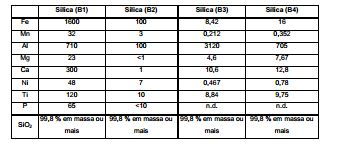
[00112] Acelerador de cura: 2-Metilimidazol (fabricado por Shikoku Chemicals Corporation, 2MZ-H)[00112] Cure Accelerator: 2-Methylimidazole (manufactured by Shikoku Chemicals Corporation, 2MZ-H)
[00113] Agente de acoplamento: Fenilaminopropiltrimetoxissilano (fabricado por Dow Corning Toray Co., Ltd., CF-4083)[00113] Coupling Agent: Phenylaminopropyltrimethoxysilane (manufactured by Dow Corning Toray Co., Ltd., CF-4083)
[00114] Agente de liberação de molde: Éster de ácido montânico (fabricado por Clariant Japan K.K., LICOLUB WEB-4)[00114] Mold Release Agent: Montanic Acid Ester (Manufactured by Clariant Japan K.K., LICOLUB WEB-4)
[00115] Colorante: Negro de fumo (fabricado por Mitsubishi Chemicals Corporation, #5)[00115] Colorant: Carbon Black (manufactured by Mitsubishi Chemicals Corporation, #5)
[00116] Para cada um dos vários Exemplos e vários Exemplos Comparativos, a temperatura de transição de vidro de um produto curado da composição de resina para encapsulação desse modo obtido foi medida como segue. Primeiro, a composição de resina para encapsulação foi moldada por injeção usando um aparelho de moldagem de transferência, fixando a temperatura de molde em uma temperatura predeterminada, em uma pressão de injeção de 9,8 MPa e durante um tempo de cura de 120 segundos, e um artigo moldado tendo um tamanho de 15 mm x 4 mm x 4 mm foi obtido. Especificamente, a temperatura de molde foi fixada a 200°C.[00116] For each of the various Examples and the various Comparative Examples, the glass transition temperature of a cured product of the encapsulation resin composition thus obtained was measured as follows. First, the encapsulation resin composition was injection molded using a transfer molding apparatus, setting the mold temperature to a predetermined temperature, at an injection pressure of 9.8 MPa and for a curing time of 120 seconds, and a molded article having a size of 15mm x 4mm x 4mm was obtained. Specifically, the mold temperature was set at 200°C.
[00117] Em seguida, o artigo moldado desse modo obtido foi pós- curado a 250°C durante 240 minutos, e desse modo uma espécime foi produzida. Subsequentemente, para a espécime desse modo obtida, a temperatura de transição de vidro foi medida usando um analisador termomecânico (fabricado por Seiko Instruments, Inc., TMA100) sob as condições de uma faixa de temperatura de medida de 0°C a 320°C e uma taxa de aumento de temperatura de 5°C/min. A unidade da temperatura de transição de vidro na Tabela 2 é °C.[00117] Thereafter, the shaped article thus obtained was post-cured at 250°C for 240 minutes, and thereby a specimen was produced. Subsequently, for the specimen thus obtained, the glass transition temperature was measured using a thermomechanical analyzer (manufactured by Seiko Instruments, Inc., TMA100) under the conditions of a measuring temperature range of 0°C to 320°C. and a temperature rise rate of 5°C/min. The unit of glass transition temperature in Table 2 is °C.
[00118] Para cada um dos vários Exemplos e vários Exemplos Comparativos, o módulo flexural de um produto curado da composição de resina para encapsulação foi medido como segue. Primeiro, a composição de resina para encapsulação foi moldada por injeção usando um aparelho de moldagem de transferência em uma temperatura de molde de 200°C e uma pressão de injeção de 9,8 MPa durante um tempo de cura de 120 segundos, e desse modo um artigo moldado tendo um tamanho de 10 mm em largura x 4 mm em espessura x 80 mm em comprimento foi obtido. Em seguida, o artigo moldado desse modo obtido foi pós-curado a 250°C durante 240 minutos, e desse modo uma espécime foi produzida. Em seguida, o módulo flexural da espécime em temperatura ambiente de 25°C e a 250°C foi medido de acordo com JIS K 6911. A unidade para o módulo flexural cedido na Tabela 2 é GPa.[00118] For each of several Examples and several Comparative Examples, the flexural modulus of a cured encapsulation resin composition product was measured as follows. First, the encapsulation resin composition was injection molded using a transfer molding apparatus at a mold temperature of 200°C and an injection pressure of 9.8 MPa for a cure time of 120 seconds, and thereby a molded article having a size of 10 mm in width x 4 mm in thickness x 80 mm in length was obtained. Thereafter, the thus obtained molded article was post-cured at 250°C for 240 minutes, and thereby a specimen was produced. Then, the flexural modulus of the specimen at room temperature of 25°C and at 250°C was measured according to JIS K 6911. The unit for the flexural modulus given in Table 2 is GPa.
[00119] Para cada um dos vários Exemplos e vários Exemplos Comparativos, as características de armazenamento de alta temperatura de um produto curado da composição de resina para encapsulação desse modo obtidas foram medidas como segue. Primeiro, a composição de resina para encapsulação foi moldada por injeção usando um aparelho de moldagem de transferência em uma temperatura de molde de 200°C e uma pressão de injeção de 9,8 MPa durante um tempo de cura de 120 segundos, e desse modo um artigo moldado tendo um diâmetro de 10 mmΦ x uma espessura de 4 mm foi obtido. Em seguida, o artigo moldado desse modo obtido foi pós- curado a 250°C durante 240 minutos, e em seguida foi secado durante 16 horas a 150°C. Desse modo, uma espécime foi obtida, e a massa inicial deste espécime foi medida. Em seguida, a espécime foi introduzida em um forno a 250°C e foi tirada depois de 100 horas, 250 horas, 500 horas, ou 1.000 horas, e a massa foi medida. A relação de redução de massa determinada na Tabela 2 foi um valor obtido calculando a quantidade de redução de massa depois de 1.000 horas em relação à massa inicial, e a unidade é porcentagem em massa (% em massa). [TABELA 2]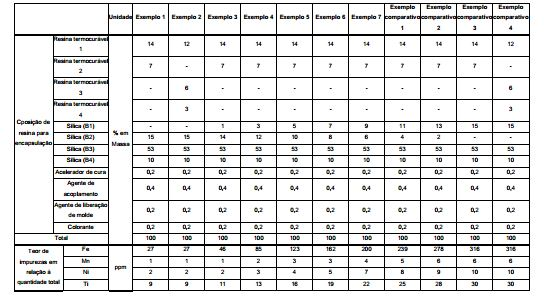
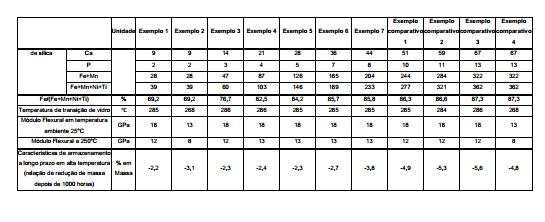
[00120] A Figura 3 mostra fotografias de SEM (Microscópio de Elétron de Varredura) mostrando a estrutura em corte de um material encapsulante depois de um teste paras características de armazenamento a longo prazo em alta temperatura. A Figura 3(a) mostra a estrutura em corte da superfície do material encapsulante de acordo com Exemplo Comparativo 1, e a Figura 3(b) mostra a estrutura em corte da superfície do material encapsulante de acordo com Exemplo 1. Quando uma comparação entre a Figura 3(a) e a Figura 3(b) é feita, é compreendido que as espessuras da camada de oxidação (camada em que descamação ou craqueamento que ocorrem na interface entre uma resina e sílica, ou decomposição oxidativa da própria resina ocorre) produzida no material encapsulante como um resultado do teste paras características de armazenamento a longo prazo em alta temperatura é menor no Exemplo 1 do que as densidades do Exemplo Comparativo 1. Isto é, no Exemplo 1, oxidação do interior do material encapsulante é suprimida mais eficazmente do que no Exemplo Comparativo 1. Como tal, pode ser visto a partir da Figura 3 que deterioração no caso de armazenamento a longo prazo sob condições de alta temperatura a 200°C ou mais alta pode ser suprimida pelas composições de resina para encapsulação de acordo com os Exemplos.[00120] Figure 3 shows SEM (Scanning Electron Microscope) photographs showing the cross-sectional structure of an encapsulating material after a test for long-term storage characteristics at high temperature. Figure 3(a) shows the sectional structure of the surface of the encapsulating material according to Comparative Example 1, and Figure 3(b) shows the sectional structure of the surface of the encapsulating material according to Example 1. When a comparison between Figure 3(a) and Figure 3(b) is made, it is understood that the thicknesses of the oxidation layer (layer in which peeling or cracking that occurs at the interface between a resin and silica, or oxidative decomposition of the resin itself occurs) produced in the encapsulating material as a result of testing for long-term storage characteristics at high temperature is lower in Example 1 than the densities of Comparative Example 1. That is, in Example 1, oxidation of the interior of the encapsulating material is suppressed more effectively than in Comparative Example 1. As such, it can be seen from Figure 3 that deterioration in the case of long-term storage under high temperature conditions at 200°C or higher can be suppressed. given by the resin compositions for encapsulation according to the Examples.
[00121] Este pedido de patente reivindica prioridade de Pedido de patente japonês No. 2015-254082 depositado em 25 de dezembro de 2015, a descrição da qual está incorporada aqui por referência.[00121] This patent application claims priority from Japanese Patent Application No. 2015-254082 filed December 25, 2015, the disclosure of which is incorporated herein by reference.
Claims (9)
Applications Claiming Priority (3)
| Application Number | Priority Date | Filing Date | Title |
|---|---|---|---|
| JP2015-254082 | 2015-12-25 | ||
| JP2015254082 | 2015-12-25 | ||
| PCT/JP2016/085165 WO2017110373A1 (en) | 2015-12-25 | 2016-11-28 | Sealing resin composition, and semiconductor device |
Publications (2)
| Publication Number | Publication Date |
|---|---|
| BR112018009890A2 BR112018009890A2 (en) | 2018-11-13 |
| BR112018009890B1 true BR112018009890B1 (en) | 2022-01-18 |
Family
ID=59089296
Family Applications (1)
| Application Number | Title | Priority Date | Filing Date |
|---|---|---|---|
| BR112018009890-6A BR112018009890B1 (en) | 2015-12-25 | 2016-11-28 | RESIN COMPOSITION FOR ENCAPSULATION, AND SEMICONDUCTOR DEVICE |
Country Status (9)
| Country | Link |
|---|---|
| US (1) | US10262914B2 (en) |
| EP (1) | EP3395907B1 (en) |
| JP (1) | JP6168259B1 (en) |
| KR (1) | KR101947334B1 (en) |
| CN (1) | CN108473777B (en) |
| BR (1) | BR112018009890B1 (en) |
| HU (1) | HUE052360T2 (en) |
| TW (1) | TW201731935A (en) |
| WO (1) | WO2017110373A1 (en) |
Families Citing this family (6)
| Publication number | Priority date | Publication date | Assignee | Title |
|---|---|---|---|---|
| KR102470719B1 (en) * | 2017-03-13 | 2022-11-24 | 린텍 가부시키가이샤 | Resin composition and resin sheet |
| TWI758489B (en) * | 2017-06-30 | 2022-03-21 | 日商琳得科股份有限公司 | Resin composition and resin sheet |
| TWI765028B (en) * | 2017-06-30 | 2022-05-21 | 日商琳得科股份有限公司 | Resin sheet, laminate, and method for producing resin sheet |
| JP2019116532A (en) * | 2017-12-26 | 2019-07-18 | 京セラ株式会社 | Composition for sealing molding material and electronic component device |
| FR3136889B1 (en) * | 2022-06-15 | 2025-04-25 | Safran | COMPOSITE DIELECTRIC MATERIAL AND POWER MODULE COMPRISING AN ENCAPSULATION LAYER FORMED FROM SUCH A MATERIAL |
| TWI876956B (en) * | 2024-04-16 | 2025-03-11 | 南亞塑膠工業股份有限公司 | Resin composition |
Family Cites Families (17)
| Publication number | Priority date | Publication date | Assignee | Title |
|---|---|---|---|---|
| JPH04175358A (en) * | 1990-11-08 | 1992-06-23 | Mitsubishi Kasei Corp | Resin composition for sealing semiconductor |
| JP2542797B2 (en) | 1994-09-29 | 1996-10-09 | 日本化学工業株式会社 | Method for producing high-purity silica |
| JPH11322816A (en) | 1998-03-11 | 1999-11-26 | Hitachi Chem Co Ltd | Resin paste composition and semiconductor device using the same |
| US6555602B1 (en) * | 1999-10-06 | 2003-04-29 | Nitto Denko Corporation | Composition of epoxy resin, anhydride and microcapsule accelerator |
| JP4614214B2 (en) * | 1999-12-02 | 2011-01-19 | 信越化学工業株式会社 | Hollow package for semiconductor device elements |
| JP4022640B2 (en) * | 2001-11-20 | 2007-12-19 | 東ソー株式会社 | Bulky high-purity silica and method for producing the same |
| JP5330644B2 (en) * | 2006-12-01 | 2013-10-30 | 株式会社日本触媒 | Surface-treated silica particles |
| US8235870B2 (en) * | 2008-08-15 | 2012-08-07 | Phresh, Llc | Method and apparatus for integrating physical exercise and interactive multimedia |
| US10173902B2 (en) * | 2009-10-20 | 2019-01-08 | Nippon Shokubai Co., Ltd. | Amorphous silica and process for producing same |
| JP2012089750A (en) * | 2010-10-21 | 2012-05-10 | Hitachi Chem Co Ltd | Thermosetting resin composition for sealing and filling semiconductor, and semiconductor device |
| JP5733743B2 (en) * | 2010-12-15 | 2015-06-10 | 日東電工株式会社 | Optical semiconductor device |
| JP6251575B2 (en) * | 2013-01-23 | 2017-12-20 | 日東電工株式会社 | Sheet-like thermosetting resin composition for encapsulating electronic components, resin-encapsulated semiconductor device, and method for producing resin-encapsulated semiconductor device |
| JP6315368B2 (en) * | 2013-09-11 | 2018-04-25 | パナソニックIpマネジメント株式会社 | Epoxy resin composition for semiconductor encapsulation and semiconductor device |
| WO2015037349A1 (en) | 2013-09-13 | 2015-03-19 | 富士電機株式会社 | Semiconductor device |
| JP2015101668A (en) * | 2013-11-26 | 2015-06-04 | 住友ベークライト株式会社 | Semiconductor sealing resin composition and semiconductor device |
| JP6311399B2 (en) * | 2014-03-28 | 2018-04-18 | 三菱ケミカル株式会社 | Thermosetting resin composition and molded body thereof |
| WO2016120953A1 (en) * | 2015-01-26 | 2016-08-04 | セントラル硝子株式会社 | Curable resin composition for semiconductor encapsulation, cured product of same and semiconductor device which uses said cured product |
-
2016
- 2016-11-28 EP EP16878267.0A patent/EP3395907B1/en active Active
- 2016-11-28 WO PCT/JP2016/085165 patent/WO2017110373A1/en not_active Ceased
- 2016-11-28 JP JP2017512398A patent/JP6168259B1/en not_active Expired - Fee Related
- 2016-11-28 HU HUE16878267A patent/HUE052360T2/en unknown
- 2016-11-28 CN CN201680076081.0A patent/CN108473777B/en not_active Expired - Fee Related
- 2016-11-28 BR BR112018009890-6A patent/BR112018009890B1/en not_active IP Right Cessation
- 2016-11-28 US US15/775,275 patent/US10262914B2/en active Active
- 2016-11-28 KR KR1020187017378A patent/KR101947334B1/en not_active Expired - Fee Related
- 2016-12-01 TW TW105139607A patent/TW201731935A/en unknown
Also Published As
| Publication number | Publication date |
|---|---|
| US10262914B2 (en) | 2019-04-16 |
| KR101947334B1 (en) | 2019-02-12 |
| CN108473777A (en) | 2018-08-31 |
| US20180337105A1 (en) | 2018-11-22 |
| TW201731935A (en) | 2017-09-16 |
| CN108473777B (en) | 2020-11-17 |
| HUE052360T2 (en) | 2021-04-28 |
| BR112018009890A2 (en) | 2018-11-13 |
| KR20180075690A (en) | 2018-07-04 |
| JP6168259B1 (en) | 2017-07-26 |
| EP3395907A1 (en) | 2018-10-31 |
| JPWO2017110373A1 (en) | 2017-12-28 |
| EP3395907B1 (en) | 2020-08-05 |
| EP3395907A4 (en) | 2019-08-14 |
| WO2017110373A1 (en) | 2017-06-29 |
Similar Documents
| Publication | Publication Date | Title |
|---|---|---|
| BR112018009890B1 (en) | RESIN COMPOSITION FOR ENCAPSULATION, AND SEMICONDUCTOR DEVICE | |
| JP7343096B2 (en) | Encapsulating resin composition, semiconductor device, and method for manufacturing semiconductor device | |
| BR112019006982B1 (en) | EPOXY RESIN COMPOSITION AND STRUCTURE | |
| JP3582576B2 (en) | Epoxy resin composition for semiconductor encapsulation and semiconductor device | |
| JP7255633B2 (en) | Power device sealing resin composition and power device | |
| JP7126186B2 (en) | Resin composition for encapsulation, cured product thereof, and semiconductor device | |
| CN107266857B (en) | Thermosetting resin composition | |
| JP2018135447A (en) | Resin composition and structure | |
| JP2004307545A (en) | Epoxy resin composition and sealed semiconductor device | |
| JP2003226796A (en) | Flame-retardant epoxy resin composition for semiconductor encapsulation and semiconductor device | |
| JP2021063146A (en) | Resin composition for sealing, semiconductor device and power device | |
| JP5943487B2 (en) | Semiconductor sealing resin composition and semiconductor device provided with cured product thereof | |
| JP6784226B2 (en) | Silicone modified epoxy resin composition and semiconductor device | |
| JP2021063145A (en) | Resin composition for sealing, semiconductor device and power device | |
| JP6885068B2 (en) | Encapsulating resin composition and semiconductor device | |
| KR100584069B1 (en) | Flame-Retardant Epoxy Resin Compositions for Sealing Semiconductor and Semiconductor Device | |
| JP3649540B2 (en) | Epoxy resin composition | |
| JP2003268208A (en) | Flame-retardant epoxy resin composition for semiconductor encapsulation and semiconductor device | |
| JP4748592B2 (en) | Flame retardant and epoxy resin composition for semiconductor encapsulation containing the same | |
| JPS5999748A (en) | Resin sealed type semiconductor device | |
| JP2672871B2 (en) | Method for manufacturing resin-encapsulated semiconductor device | |
| JP2013142136A (en) | Flame-retardant liquid epoxy resin composition for encapsulating semiconductor and semiconductor device | |
| JP2019056041A (en) | Thermosetting resin composition | |
| JP2024101667A (en) | Sealing resin composition, molded product and electronic apparatus | |
| TW201508022A (en) | Resin composition for semiconductor encapsulation, semiconductor device having cured product thereof, and method of manufacturing semiconductor device |
Legal Events
| Date | Code | Title | Description |
|---|---|---|---|
| B06U | Preliminary requirement: requests with searches performed by other patent offices: procedure suspended [chapter 6.21 patent gazette] | ||
| B09A | Decision: intention to grant [chapter 9.1 patent gazette] | ||
| B16A | Patent or certificate of addition of invention granted [chapter 16.1 patent gazette] |
Free format text: PRAZO DE VALIDADE: 20 (VINTE) ANOS CONTADOS A PARTIR DE 28/11/2016, OBSERVADAS AS CONDICOES LEGAIS. |
|
| B21F | Lapse acc. art. 78, item iv - on non-payment of the annual fees in time |
Free format text: REFERENTE A 9A ANUIDADE. |
|
| B24J | Lapse because of non-payment of annual fees (definitively: art 78 iv lpi, resolution 113/2013 art. 12) |
Free format text: EM VIRTUDE DA EXTINCAO PUBLICADA NA RPI 2856 DE 30-09-2025 E CONSIDERANDO AUSENCIA DE MANIFESTACAO DENTRO DOS PRAZOS LEGAIS, INFORMO QUE CABE SER MANTIDA A EXTINCAO DA PATENTE E SEUS CERTIFICADOS, CONFORME O DISPOSTO NO ARTIGO 12, DA RESOLUCAO 113/2013. |