WO2025126487A1 - 情報処理装置 - Google Patents
情報処理装置 Download PDFInfo
- Publication number
- WO2025126487A1 WO2025126487A1 PCT/JP2023/045127 JP2023045127W WO2025126487A1 WO 2025126487 A1 WO2025126487 A1 WO 2025126487A1 JP 2023045127 W JP2023045127 W JP 2023045127W WO 2025126487 A1 WO2025126487 A1 WO 2025126487A1
- Authority
- WO
- WIPO (PCT)
- Prior art keywords
- user
- mascot
- virtual space
- points
- avatar
- Prior art date
- Legal status (The legal status is an assumption and is not a legal conclusion. Google has not performed a legal analysis and makes no representation as to the accuracy of the status listed.)
- Pending
Links
Images








Classifications
-
- G—PHYSICS
- G06—COMPUTING OR CALCULATING; COUNTING
- G06Q—INFORMATION AND COMMUNICATION TECHNOLOGY [ICT] SPECIALLY ADAPTED FOR ADMINISTRATIVE, COMMERCIAL, FINANCIAL, MANAGERIAL OR SUPERVISORY PURPOSES; SYSTEMS OR METHODS SPECIALLY ADAPTED FOR ADMINISTRATIVE, COMMERCIAL, FINANCIAL, MANAGERIAL OR SUPERVISORY PURPOSES, NOT OTHERWISE PROVIDED FOR
- G06Q30/00—Commerce
- G06Q30/02—Marketing; Price estimation or determination; Fundraising
- G06Q30/0207—Discounts or incentives, e.g. coupons or rebates
Definitions
- the present invention relates to an information processing device that provides a virtual space.
- Patent Document 1 describes a service in which a three-dimensional virtual space constructed on a server is shared among multiple users, in which the acquisition of virtual currency that can be used within the three-dimensional virtual space is directly linked to commercial transactions in the real world, thereby reducing the gap between the real world and the virtual world.
- This Patent Document 1 describes that points can be earned by using a credit card, and that these points can be brought into the virtual space and used.
- Financial settlement businesses such as credit card businesses, and other businesses want to be able to let other users know about the existence of their credit cards in virtual space, and to promote their use.
- the present invention aims to provide a virtual space providing device that can encourage user behavior, such as the use of specific financial payment methods such as credit cards.
- the present invention comprises a providing unit that provides a virtual space including an attachment associated with a user's avatar, and a processing unit that changes the display form of the attachment in the virtual space according to action result information obtained based on the action of the user.
- the present invention can encourage user behavior such as the use of specific financial payment methods such as credit cards.
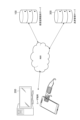
- FIG. 1 is a diagram showing a system configuration including a virtual space providing server 100 according to a first embodiment of the present disclosure.
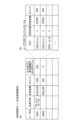
- 13 is a diagram showing a specific example of a payment management DB provided in the payment management server 300.
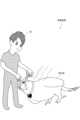
- FIG. 1 is a diagram showing a schematic diagram of a virtual space provided by a virtual space providing server 100.
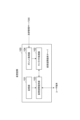
- FIG. FIG. 2 is a block diagram showing a functional configuration of a virtual space providing server 100 according to the present disclosure.
- FIG. 13 is a schematic diagram showing generation of a character according to points.
- 13A and 13B are schematic diagrams showing another example of generation of a character according to points.
- FIG. 13 is a diagram showing another example of the mascot M. A diagram showing that mascot M100 is attached to avatar A.
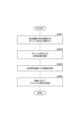
- FIG. 10 is a flowchart showing the operation of the virtual space providing server 100 when providing a virtual space.
- 13 is a flowchart showing the processing carried out in the virtual space providing server 100 of the present disclosure when the payment amount is large.
- 13 is a flowchart showing a process for causing the mascot M to perform another movement pattern.
- FIG. 11 is a diagram illustrating a virtual space provided by a virtual space providing server 100a in a second embodiment.
- FIG. 11 is a diagram showing the functional configuration of a virtual space providing server 100a according to a second embodiment.
- FIG. 2 is a diagram showing user action history information and facility information.
- 13 is a diagram illustrating a guidance pattern when a mascot M guides an avatar A.
- 13 is a diagram showing the notification to avatar A that points can be obtained.
- 13 is a flowchart showing the operation of a virtual space providing server 100a according to a second embodiment of the present disclosure.
- 13 is a flowchart showing a detailed process of a modified example of process S304.
- 1 is a diagram illustrating an example of a hardware configuration of a virtual space providing server 100 according to an embodiment of the present disclosure.
- FIG. 1 is a diagram showing a system configuration including a virtual space providing server 100, which is an information processing device in the first embodiment of the present disclosure. As shown in the figure, the virtual space providing server 100 communicates with a user terminal 200 and a payment management server 300 via a network NW.
- the virtual space providing server 100 provides a virtual space to the user terminal 200.
- the user terminal 200 displays the provided virtual space to the user, allowing the user to experience the virtual space.
- the payment management server 300 is a server that manages payment information in the virtual space of the user of the user terminal 200.
- the payment management server 300 stores payment information including information on the credit card used by the user in the virtual space and the payment amount.
- the payment information may be information on a payment method other than a credit card.
- it may be payment information based on a two-dimensional barcode.
- it may not be limited to payment information in the virtual space, but may also include payment information in the real world.
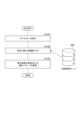
- FIG. 2 is a diagram showing a specific example of the payment management DB provided in the payment management server 300.
- this payment management DB stores, for each user, the payment method, the payment amount, the points obtained thereby, the expiration date of the points, and the points.
- the payment management DB further stores the details for each user.
- the payment management DB stores the payment date, the payment store, the payment amount, and the points obtained thereby.
- points are information having a monetary value that is a portion of the amount returned to the user through a credit card, other cashless payment, or cash payment. Points usually have an expiration date.
- points are information that are given monetary value to the user in the same way as cash, and the user can use the points to carry out economic activities.
- This payment management DB may contain information on payments made in virtual space, or in the real world.
- the virtual space providing server 100 generates a virtual space that reflects the payment information stored in the payment management server 300 and provides it to the user terminal 200.
- an avatar of the user is generated, and the avatar can act in the virtual space according to user operations.
- the avatar can carry out economic activities (such as shopping) in virtual stores in the virtual space, and can use payment methods used in the real world, such as credit cards, to do so.
- patterns, marks, letters, characters, etc. that identify the payment method used by the user are attached to avatars, stores, etc., making it possible to make the existence of that payment method known within the virtual space.
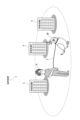
- FIG. 3 is a diagram showing a schematic diagram of a virtual space provided by the virtual space providing server 100.
- Avatar A is a character operated by the user and can visit virtual store X, etc.
- Avatar A can also carry around a mascot M.
- This mascot M is a character that represents a payment method used in the virtual space.
- the mascot M is a deformed bird character that moves together with avatar A.
- mascot M is not limited to animals such as birds. It may also be any other virtual object such as a mechanical object or a simple mark or code.
- NPC Non Player Character
- the NPC may also be an NPC that operates within a specified area separately from the avatar. It may also be a mascot-like display on avatar A itself to link with payment information.
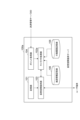
- FIG. 4 is a block diagram showing the functional configuration of the virtual space providing server 100 in this disclosure.
- the virtual space providing server 100 is configured to include a memory unit 101, a character processing unit 102, a virtual space providing unit 103, and a point acquisition unit 104.
- the storage unit 101 is a part that stores the virtual space to be provided and information for constructing the virtual space. In the present disclosure, it stores the streetscape, shops, and characters such as avatars and mascots that make up the virtual space. The storage unit 101 also stores information on the behavior patterns of the mascots according to points, etc.
- the character processing unit 102 is a part that generates the appearance, behavior, etc. of a character according to points that an avatar (user) has earned through economic activities (purchasing items, etc.) in the virtual space.
- the character processing unit 102 generates characters (avatars and mascots) by referencing information on characters, etc. stored in the memory unit 101, and causes them to move in the virtual space based on the behavior patterns defined therein.
- the virtual space providing unit 103 is a part that provides a virtual space to the user terminal 200.
- the virtual space providing unit 103 is a part that reflects the avatars and mascots generated by the character processing unit 102 in the virtual space and provides them to the user terminal 200.
- the point acquisition unit 104 is a part that acquires points acquired by a user through a purchase process and related information (such as expiration date) from the payment management server 300.
- the purchase process is a process that is performed on a server or the like when a user purchases something online or in real space.
- Figure 5 is a schematic diagram.
- FIG. 5(a) shows that one mascot M is attached to avatar A.
- the character processing unit 102 when the number of points obtained by the user in the virtual space is equal to or greater than x1 points, the character processing unit 102 generates a mascot M of a first size and controls the mascot M to move in association with avatar A.
- FIG. 5(b) shows a crown C being placed on mascot M.
- the character processing unit 102 When the user has gained x1 points or more in the virtual space, the character processing unit 102 generates a crown C, generates an image of the crown being placed on mascot M, and controls the mascot M to move in conjunction with avatar A.
- mascot M several modified examples of mascot M are shown. As shown in FIG. 6, the character processing unit 102 generates mascot M by changing its appearance or the number of mascots M according to the points the user has obtained in the virtual space.
- FIG. 6(a) shows that one mascot M is attached to avatar A.
- the character processing unit 102 when the number of points obtained by the user in the virtual space is equal to or greater than x1 points, the character processing unit 102 generates a mascot M of a first size and controls the mascot M to move in association with avatar A.
- FIG. 6(b) shows that a second-sized mascot M11 is attached to avatar A.
- the character processing unit 102 enlarges the mascot M to generate a second-sized mascot M11 that is larger than the first size, and controls the mascot M11 to move attached to avatar A.
- FIG. 6(c) shows that a third size mascot M12 is attached to avatar A.
- the character processing unit 102 further enlarges the mascot M11 to generate a third size mascot M12 that is larger than the second size, and controls the mascot M12 to move attached to avatar A.
- the mascots are enlarged, but this is not limiting, and the mascots may be replaced with mascots M11 and M12 that have been prepared in advance.
- FIG. 6(d) shows that avatar A is accompanied by one mascot M.
- This mascot M is the same size as the mascot in FIG. 6(a), but the size may of course be changed.
- FIG. 6(e) shows that two mascots, M1 and M2, are attached to avatar A.
- the character processing unit 102 when the points obtained by the user in the virtual space are equal to or greater than x2 points (x2>x1), the character processing unit 102 generates a new mascot M2 and controls the mascot M1 and mascot M2 to move in association with avatar A.
- FIG. 6(f) shows that two mascots M1 to M3 are attached to avatar A.
- the character processing unit 102 when the user has gained x3 points or more in the virtual space (x3>x2), the character processing unit 102 generates a new mascot M3 and controls the mascots M1 to M3 to move in association with avatar A.
- FIG. 6(g) shows that avatar A is accompanied by one mascot M.
- This mascot M is the same size as the mascot in FIG. 4(a), but the size may of course be changed.
- FIG. 6(h) shows that avatar A is accompanied by a mascot M0 whose appearance has been modified.
- the character processing unit 102 when the number of points obtained by the user in the virtual space is x2 points or more (x2>x1), the character processing unit 102 generates mascot M0 by modifying its appearance (e.g., color) from mascot M, and controls the mascot M0 to move accompanying avatar A.
- FIG. 7 is a diagram showing another modified example of the mascot M.
- the mascot M is holding a signboard K.
- This signboard K is information that is added when a predetermined condition is met in the user's economic activity in the virtual space. For example, this signboard K is added when the difference between the points acquired in the user's economic activity and the threshold points falls below a predetermined value.
- the signboard K indicates the privilege that can be obtained when the threshold points are reached.
- the privilege is, for example, information such as a discount that can be received when making a purchase at a store in the virtual space.
- an alert may be issued when a member rank increase is approaching. For example, the member may start holding a signboard indicating the privilege that comes with an increase in member rank.
- FIG. 8 shows that mascot M100 is attached to avatar A.
- This mascot M100 is a mascot that is displayed when the points that a user has earned through economic activities in the virtual space are about to expire. For example, when there is only one week left until the points expire, mascot M is replaced with mascot M100. That is, when the difference between the current date and time and the points' expiration date falls within a predetermined time (or number of days), the character processing unit 102 replaces mascot M with mascot M100 to alert the user that the points will disappear.
- mascot M100 is displayed in a dying or listless state.
- the mascot M100 may change its display mode depending on the number of expired points. Also, when all points have been lost, the mascot M may disappear.
- mascot M is generated in response to economic activity in the virtual space and is attached to avatar A.
- mascot M is variably set based on the points earned from the payment amount at a store in the virtual space using a pre-determined payment method, but this is not limiting.
- it may be the payment amount itself, or the user's membership rank in the virtual space determined based on the payment amount or points.
- the membership rank indicates a level classification, for example, one star for a payment amount of 10,000 yen or more, three stars for a payment amount of 10,000 yen or more, etc.
- the target points or payment amount may be points or amounts from a recent fixed period, such as points or amounts from the past three months.
- the points or payment amount may also be the cumulative total of payment amounts or points for each month.
- the display mode of mascots M may be set based on the sum of payment information of all users registered as a family, rather than on information on the payment of a single user.
- the size of the mascot may be reduced according to the number of points that have expired. For example, if 10% of the total number of points held has been lost, the size of the mascot may be reduced by 10%.
- the character processing unit 102a may control the deletion of the mascot corresponding to the points as the points disappear. For example, a mascot that was added when the points reached 100 or more is deleted when the points dropped below 100. This processing is performed by the character processing unit 102.
- points are obtained through the user's economic activity, but this is not limited to economic activity, and points may also be obtained through specific actions of the user in the virtual space. For example, points may be obtained when the user achieves a certain event in the virtual space. For example, an event could be visiting 10 or more virtual stores.
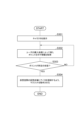
- FIG. 9 is a flowchart showing the operation of the virtual space providing server 100 when providing a virtual space.
- the virtual space providing server 100 receives a login request for the virtual space from the user terminal 200
- the virtual space providing unit 103 provides the virtual space to the user terminal 200 and displays the user's avatar in the virtual space (S101).
- payment information may be obtained from the payment management server 300 not only at the time of login, but also at predetermined time intervals, after each purchase action at a virtual store, etc.
- the character processing unit 102 acquires information related to the payment from the payment management server 300 (S102).
- the information related to the payment includes the payment amount, points, membership rank, and point expiration date in the virtual space of the user.
- the character processing unit 102 adds or changes the display mode of the mascot M or changes the movement pattern of the mascot in response to the payment information, and processes the mascot to move in that display mode or movement pattern (S103). For example, as shown in FIG. 6, multiple mascots M, mascots M of different sizes, etc. are attached to avatar A. Also, if necessary, the mascot M is made to perform a specified movement.
- FIG. 10 is a flowchart showing processing based on a payment amount in the virtual space providing server 100 of the present disclosure.
- this processing is performed when a user makes a purchase in a virtual store via an avatar, or whenever a predetermined time has elapsed, but it may also be performed at login.
- the character processing unit 102 accesses the payment management server 300 when the user purchases an item in a virtual store or at predetermined time intervals (S201).
- the character processing unit 102 determines that the difference between the payment amount in the user's virtual space stored in the payment management server 300 and the threshold amount (the value obtained by subtracting the payment amount from the threshold amount) is equal to or less than a predetermined amount (S202), it causes the mascot M associated with avatar A to perform a specified action (S203). For example, if the value obtained by subtracting the payment amount from the threshold amount is small, it can be determined that the payment amount is large, and that the user has overused a payment method such as a credit card. In that case, the character processing unit 102 causes the mascot M to perform an action that issues a message to the user saying, "Think about your usage plan.”
- FIG. 11 is a flowchart showing the process of causing mascot M to perform other movement patterns in the virtual space providing server 100 of this disclosure.
- the mascot M determines that a predetermined condition is met based on information previously obtained from the payment management server 300 (S302). The mascot then performs a specified action (S303). For example, when the user's payment-related information meets a predetermined condition, the mascot M enters a specific state. For example, a specific state is when the user's membership rank is high (e.g., three stars).
- the character processing unit 102 causes the mascot to perform an action to haggle in the virtual store.
- the action of haggling is an effect of the mascot, and indicates that the user will be given a special benefit, such as a 5% discount, depending on the payment-related information.
- FIG. 12 is a diagram showing a virtual space provided by the virtual space providing server 100a in the second embodiment of the present disclosure.
- virtual stores X to Z exist in the virtual space of the present disclosure.
- Avatar A is a character operated by a user and can visit virtual store X, etc.
- Avatar A can also carry around a mascot M.
- This mascot M is a character representing a payment method used in the virtual space.
- the mascot M is connected by a lead L.
- the lead L is extendable, and the mascot M can guide the avatar A to a predetermined position by pulling the avatar A.
- the predetermined position is an avoidance position that can avoid the point from the predetermined state.
- the predetermined state of the point refers to the state when the point is about to expire. For example, when there is one day left until the expiration date. The predetermined state will be described in detail later.
- An avoidance location is, for example, a location where points that are about to expire can be restored, a location where points can be prevented from disappearing, or a location where points will not be treated unfavorably.
- an avoidance location may be a virtual store, where a user can reset the expiration date of points or increase points by purchasing an item (purchasing action) there.
- locations where points can be restored may be defined within the virtual space.
- the storage unit 101 is a part that stores the virtual space to be provided and information for constructing the virtual space. In the present disclosure, it stores the streetscape, shops, and characters such as avatars and mascots that make up the virtual space. The storage unit 101 also stores information on the behavior patterns of the mascots according to points, etc.
- the character processing unit 102a is a unit that generates avatar A and mascot M according to points that an avatar (user) has earned in the virtual space through economic activities (purchasing products, etc.), and controls the behavior patterns of mascot M.
- the character processing unit 102a generates the character by referencing information on characters, etc. stored in the memory unit 101, and causes them to act in the virtual space based on the behavior patterns defined therein.
- the virtual space providing unit 103 is a part that provides a virtual space to the user terminal 200.
- the virtual space providing unit 103 is a part that reflects the avatars and mascots generated by the character processing unit 102a in the virtual space and provides them to the user terminal 200.
- the behavior history storage unit 105 is a part that stores behavior history information of an avatar in a virtual space.
- FIG. 14(a) is a diagram showing the behavior history information.
- the behavior history information stores, for each user, visited facilities (stores), payment information, purchased products, date and time, and amount in association with each other. Note that this is not limited to virtual stores where products were purchased, but may simply include stores and facilities visited.
- the facility information storage unit 106 is a section that stores facility information related to virtual stores in the virtual space.
- FIG. 14(b) is a diagram showing facility information.
- the facility information is information that associates a facility, available payment methods, point allocation rate, campaign flag, and benefits for using points.
- the payment method indicates, for example, a credit card or QR code payment method, and indicates the financial institution that provides that method.
- the point allocation rate indicates the ratio of points allocated to the purchase amount.
- the campaign flag is flag information that indicates whether a campaign is running. For example, it indicates that the point allocation rate is higher than usual, and is reflected in the point allocation rate column.
- Benefits for using points include limited items that can be equipped to a character. For example, if a user uses more points than a specified number within a certain period of time, the user can obtain the limited item and equip it on the character.
- the second embodiment of the present disclosure is generally the same as the first embodiment, but differs in that the character processing unit 102a controls the mascot M to guide the avatar A to a predetermined position (avoidance position for point disappearance). Specifically, when the points reach a predetermined state, the character processing unit 102a operates the mascot M to guide the avatar A to an avoidance position in the virtual space where the points can be avoided from the predetermined state.
- FIG. 15 is a diagram explaining the guidance pattern when mascot M guides avatar A.
- the character processing unit 102a changes the behavior of mascot M according to predetermined conditions.
- the character processing unit 102a changes the behavior of mascot M according to the distance to the avoidance position.
- the distance to the avoidance position is the travel distance of avatar A when it reaches the avoidance position in the virtual space.
- the distance to the avoidance position is, for example, the distance from the position of avatar A in the virtual space to the avoidance position.
- FIG. 15(a) is a schematic diagram showing avatar A holding mascot M with lead L.
- the character processing unit 102a operates mascot M so that the distance between avatar A and mascot M falls below a first predetermined distance.
- the first threshold may be set in advance by a service provider or the like.
- a state in which the distance between avatar A and mascot M is equal to or less than the first predetermined distance may be a state in which mascot M is not attracting the attention of avatar A (user).
- lead L is in a slack state because avatar A and mascot M are close to each other. Therefore, mascot M is not attracting the attention of avatar A (user).
- 15(b) is a schematic diagram showing the time when mascot M moves to guide avatar A to a predetermined position because a predetermined condition is satisfied.
- the character processing unit 102a operates mascot M so that the distance between avatar A and mascot M is equal to or greater than the first predetermined distance.
- the state in which the distance between avatar A and mascot M is equal to or greater than the first predetermined distance may be a state in which mascot M is attracting the attention of avatar A (user).
- the lead L is in a slightly pulled state.
- mascot M is trying to guide avatar A to the destination of mascot M.
- avatar A moves in conjunction with the movement of mascot M.
- avatar A (user) is aware that mascot M is trying to move, and mascot M is attracting avatar A's (user) attention.
- FIG. 15(c) is a schematic diagram showing mascot M pulling avatar A strongly.
- the character processing unit 102a operates mascot M so that the distance between avatar A and mascot M exceeds the second predetermined distance (second predetermined distance > first predetermined distance).
- the second threshold is set in advance by the service provider, etc.
- the state in which the distance between avatar A and mascot M exceeds the second predetermined distance may be a state in which mascot M is attracting the attention of avatar A (user) more strongly.
- the second threshold may be a numerical value greater than the first threshold.
- the lead L is in a taut state
- the mascot M is pulling the avatar A more strongly, in an attempt to more actively guide the avatar A to the destination of the mascot M.
- the avatar A moves in conjunction with the movement of the mascot M. That is, the character processing unit 102 performs control to automatically move the avatar A together with the mascot M, regardless of the operation of the avatar A by the user.
- the avatar A does not have to be moved automatically, and the user may operate the avatar A to follow behind the mascot M.
- the user may move the avatar A while checking the degree of slack or tension in the lead L, or may move the avatar A manually by performing an operation to instruct the avatar to "follow".
- FIGS. 15(d) to 15(f) are diagrams showing other guidance methods using mascot M.
- the character processing unit 102a changes the movement speed of mascot M depending on a predetermined state of points. Specifically, the character processing unit 102a may change the character speed depending on the points that are about to expire. For example, when there are many points that are about to expire (when there are a predetermined number of points), the character processing unit 102a may increase the movement speed of mascot M. The movement speed may also be changed based on the remaining points rather than on the expiration date.
- FIG. 15(d) shows that mascot M is near avatar A. If the points are not in a predetermined state, the character processing unit 102a sets the movement speed of mascot M to a first predetermined speed or less.
- FIG. 15(e) is a diagram showing that mascot M moves at a speed exceeding the first predetermined speed in accordance with a predetermined condition.
- the character processing unit 102a changes the moving speed of mascot M to exceed the first predetermined speed.
- the state in which mascot M's moving speed exceeds the first predetermined speed may be a state in which mascot M attracts avatar A's attention.
- avatar A user
- the user operates avatar A to move so as to follow mascot M.
- FIG. 15(f) is a diagram showing that the mascot M moves at a speed exceeding the second predetermined speed.
- the character processing unit 102a changes the moving speed of the mascot M so that it exceeds the second predetermined speed (second predetermined speed>first predetermined speed).
- second predetermined speed higher than the first predetermined speed.
- the state in which the moving speed of the mascot M exceeds the second predetermined speed may be a state in which the mascot M strongly attracts the attention of the avatar A.
- the first predetermined point may be set to be greater than the second predetermined point.
- the relationship between the points, their expiration date, and the moving speed of the mascot M is determined appropriately depending on the design of the virtual space.
- FIG. 15(g) is a diagram showing that mascot M has moved to its destination, virtual store Z.
- mascot M informs avatar A by voice, music, or the like that it has arrived near virtual store Z.
- the character processing unit 102a controls mascot M to guide avatar A to a location where points can be obtained, such as virtual store Z, on the condition that points are about to expire or that more points are needed.
- the character processing unit 102a controls mascot M to make a sound to inform avatar A of this.
- the user knows that they can earn points by shopping at virtual store Z.
- FIG. 16 is a diagram showing that mascot M informs avatar A (user) that points can be obtained by visiting virtual store Z.
- the character processing unit 102a indicates that, when a predetermined condition is satisfied, the user can obtain 100 points by visiting virtual store Z.
- FIG. 17 is a flowchart showing the operation of the virtual space providing server 100a according to the second embodiment of the present disclosure.
- the virtual space providing unit 103 displays a character in the virtual space and transmits it to the user terminal 200 (S301).
- the point acquiring unit 104 acquires information indicating the points acquired by the user through the purchase process from the payment management server 300 (S302).
- the character processing unit 102a determines that the acquired points are in a predetermined state (S303: YES), it operates the mascot M to guide the user's avatar A to an avoidance position in the virtual space (S304).
- guidance also includes the mascot M encouraging avatar A to visit a virtual store by presenting benefits such as a virtual store to the avatar A as shown in FIG. 16.
- the points reaching a specified state include the following:
- a predetermined threshold a period predefined by the system or set by the user, for example, within one month
- the membership rank of the payment method increases, or a benefit is obtained.
- a predetermined threshold a period predefined by the system or set by the user, for example, within one month
- a predetermined threshold a value predefined by the system or set by the user, for example, points equivalent to 1,000 yen
- the points are short of a threshold predefined by the user (a value predefined by the system or set by the user, for example, points equivalent to 1,000 yen).
- the avoidance location in process S304 is assumed to be a virtual store, but other locations include the following.
- Facilities where payment methods can be used (shops, museums, movie theaters, concert venues, etc.) (2) Facilities stipulated by the system. For example, facilities where you can efficiently accumulate and use points (facilities where you can receive more points than usual, facilities where you can receive special benefits when you use points).
- Facilities currently running campaigns (facilities that are running campaigns where points are awarded at special rates depending on the payment method for a certain period of time) (3) A facility where the payment method has been used based on the user's past behavior history (4) A facility where it is estimated that the payment required to avoid a certain state can be made based on the selling price of the product or service
- the facility is one that sells products that the user is likely to purchase for more than 2,000 yen based on the user's behavior history.
- the character processing unit 102a selects this facility and guides the user to the location of the facility. For example, in the example of Figure 14, the character processing unit 102a guides the user to Shop X as an avoidance location because the user's behavior history shows that the user has purchased sneakers for 20,000 yen.
- the guidance is shown by a display that strongly pulls the user. If points are advantageous, if a special benefit can be obtained, or if a campaign is running, the user (avatar A) may be notified of this. If the member rank is close to being upgraded, a message may be displayed saying "You will be upgraded if you purchase XX yen," along with the special benefit that will be obtained by upgrading.
- the timing of the guidance may be when the user is within a specified distance of the facility (for example, within 5 minutes at normal travel speed).
- FIG. 18 is a flow chart showing a detailed process showing a modified example based on process S304.
- process S304 mascot M guides avatar A to a specific virtual store, but in FIG. 18, mascot M is made to perform more detailed actions.
- the point acquisition unit 104 acquires information about the user's points (e.g., the number of points and their expiration date) from the payment management server 300.
- the character processing unit 102a determines whether there are any points whose expiration date is within a predetermined period.
- the character processing unit 102a determines that there are any points whose expiration date is within a predetermined period (S401).
- the character processing unit 102a selects several virtual stores in the virtual space where points can be obtained (S402) and obtains the distance thereto (S403).
- the distance is calculated from the current position of avatar A in the virtual space and the position of each virtual store in the virtual space.
- the character processing unit 102a changes the behavior of the mascot M according to that distance (S404). For example, as shown in Figures 15(a) to 15(c), the character processing unit 102a changes the behavior of the mascot M according to the distance to the avoidance position. Also, for example, if the distance is within a predetermined distance, the character processing unit 102a controls the mascot M to present the name of the virtual store and the number of points that can be obtained there (for example, the number of points for a purchase worth 1,000 yen) to avatar A.
- the character processing unit 102a also controls the mascot M to guide the user to a virtual store located within a predetermined distance. If there are multiple virtual stores within the predetermined distance, the user may be guided to the closest virtual store. The user may also be guided to a virtual store that sells products that interest the user.
- the products of interest are determined based on the user's behavioral history information. For example, the products of interest may be determined based on the products or genres sold by the most frequently visited virtual store in the behavioral history information.
- the virtual space providing unit 103 provides the user terminal 200 with a virtual space including an accessory associated with the user's avatar A.
- the accessory is, for example, a mascot M.
- the character processing unit 102 changes the display form of the mascot M in the virtual space according to the action result information obtained based on the user's actions.
- behavior result information is at least one of a payment amount obtained based on a user's behavior, points based on the payment amount, and a rank assigned according to the payment amount.
- This behavior result information is information obtained from the user's economic activity and other behavior.
- action could be the use of a payment method in the virtual space, more specifically, the use of a credit card, QR code payment, etc.
- the character processing unit 102 adds a crown C as a decoration to the mascot M, or changes (increases) the size of the mascot M or the number of mascots M, depending on the action result information. In this way, when a user uses (takes) a payment method or the like in the virtual space, the mascot M appears and stands out, making the use of the method known in the virtual space.
- the character processing unit 102 may change the behavior of the mascot M depending on action result information such as points. For example, the character processing unit 102 performs an action of supporting the mascot M in purchasing a product when the user purchases a product in the virtual space. For example, an action of supporting the purchase is an action of haggling over the price of a product or an action of issuing a message therefor.
- the character processing unit 102 also changes the display form of the mascot M according to the expiration date of the action result information such as points.
- Action result information such as points.
- Action result information especially points, generally has an expiration date.
- the display form of the mascot M can be changed to inform the user that some points are about to expire.
- the character processing unit 102 can gradually change the degree of deterioration of the attachment as the expiration date approaches, for example, by changing the color of the mascot M, aging the mascot M, or putting the mascot M in a tired form.
- Mascot M is an animal-like character that moves in tandem with the avatar, which makes it easy to empathize with it, but of course this is not the only option.
- Information on the results of actions may be limited to information obtained by taking action in the virtual space. This provides motivation for users to take action in the virtual space (use of a payment method).
- the behavior result information in this disclosure assumes the use of a payment method, and generally the points, payment amount, member rank, and point expiration date are stored in a payment management server 300 owned by a payment service provider.
- the virtual space providing server 100 in this disclosure is equipped with a point acquisition unit 104, which acquires at least one of the payment amount obtained based on the user's behavior, the points based on the payment amount, and the rank assigned according to the payment amount from the payment management server 300.
- the character processing unit 102a when the point reaches a predetermined state, operates the mascot M to guide the avatar A to an avoidance position in the virtual space where the point can be avoided from the predetermined state.
- the mascot M guides the user's avatar A based on the state of the points tied to the avatar A. This can encourage the user to use their points in the virtual space.
- the character processing unit 102a changes the behavior of the mascot M depending on the distance to the avoidance position.
- the character processing unit 102a also changes the movement speed of the mascot M depending on the specified state of the points.
- the avoidance location is a virtual store where the user can increase points by making purchases. In this way, for example, by guiding avatar A to the avoidance location, the points held by the user can be increased. As a result, it is possible to more effectively encourage the user to use their points.
- the specified state is the state when the points are about to expire. This makes it possible to reset or extend the expiration date of the points held by the user by guiding avatar A to an avoidance position that allows the user to avoid the specified state.
- the virtual space providing servers 100 and 100a of the present disclosure have the following configuration.
- An information processing device comprising:
- the processing unit changes the operation of the accessory in response to the action result information.
- the information processing device according to any one of [1] to [3].
- the processing unit performs an operation of supporting the purchase when the user purchases a product.
- the information processing device according to [4].
- the processing unit changes a display form of the accessory in accordance with an expiration date of the action result information.
- the information processing device according to any one of [1] to [5].
- the processing unit changes the display form to one that indicates a degree of deterioration of the accessory as the expiration date approaches.
- the information processing device according to [6].
- the accompanying object is an animal-like character that moves in conjunction with the avatar.
- the information processing device according to any one of [1] to [7].
- the action result information is information obtained by taking an action in the virtual space.
- the information processing device according to any one of [1] to [8].
- each functional block may be realized using one device that is physically or logically coupled, or may be realized using two or more devices that are physically or logically separated and directly or indirectly connected (for example, using wires, wirelessly, etc.).
- the functional block may be realized by combining the one device or the multiple devices with software.
- Functions include, but are not limited to, judgement, determination, judgment, calculation, computation, processing, derivation, investigation, search, confirmation, reception, transmission, output, access, resolution, selection, election, establishment, comparison, assumption, expectation, regarding, broadcasting, notifying, communicating, forwarding, configuring, reconfiguring, allocating, mapping, and assignment.
- a functional block (component) that performs the transmission function is called a transmitting unit or transmitter.
- the virtual space providing server 100 (including the virtual space providing server 100a) in one embodiment of the present disclosure may function as a computer that performs processing of the virtual space providing method of the present disclosure.
- FIG. 19 is a diagram showing an example of the hardware configuration of the virtual space providing server 100 according to one embodiment of the present disclosure.
- the above-mentioned virtual space providing server 100 may be physically configured as a computer device including a processor 1001, a memory 1002, a storage 1003, a communication device 1004, an input device 1005, an output device 1006, a bus 1007, etc.
- the hardware configuration of the virtual space providing server 100 may be configured to include one or more of the devices shown in the figure, or may be configured to exclude some of the devices.
- Each function of the virtual space providing server 100 is realized by loading a specific software (program) onto hardware such as the processor 1001 and memory 1002, causing the processor 1001 to perform calculations, control communications via the communication device 1004, and control at least one of the reading and writing of data in the memory 1002 and storage 1003.
- a specific software program
- the processor 1001 to perform calculations, control communications via the communication device 1004, and control at least one of the reading and writing of data in the memory 1002 and storage 1003.
- the processor 1001 for example, operates an operating system to control the entire computer.
- the processor 1001 may be configured as a central processing unit (CPU) including an interface with peripheral devices, a control device, an arithmetic unit, registers, etc.
- CPU central processing unit
- the character processing unit 102 described above may be realized by the processor 1001.
- the processor 1001 also reads out programs (program codes), software modules, data, etc. from at least one of the storage 1003 and the communication device 1004 into the memory 1002, and executes various processes according to these.
- the programs used are those that cause the computer to execute at least some of the operations described in the above-mentioned embodiments.
- the character processing unit 102 may be realized by a control program stored in the memory 1002 and running on the processor 1001, and similarly may be realized for other functional blocks.
- the above-mentioned various processes have been described as being executed by one processor 1001, they may be executed simultaneously or sequentially by two or more processors 1001.
- the processor 1001 may be implemented by one or more chips.
- the programs may be transmitted from a network via a telecommunications line.
- Memory 1002 is a computer-readable recording medium, and may be composed of at least one of, for example, ROM (Read Only Memory), EPROM (Erasable Programmable ROM), EEPROM (Electrically Erasable Programmable ROM), RAM (Random Access Memory), etc. Memory 1002 may also be called a register, cache, main memory (primary storage device), etc. Memory 1002 can store executable programs (program codes), software modules, etc. for implementing a virtual space providing method according to one embodiment of the present disclosure.
- ROM Read Only Memory
- EPROM Erasable Programmable ROM
- EEPROM Electrical Erasable Programmable ROM
- RAM Random Access Memory
- Memory 1002 may also be called a register, cache, main memory (primary storage device), etc.
- Memory 1002 can store executable programs (program codes), software modules, etc. for implementing a virtual space providing method according to one embodiment of the present disclosure.
- Storage 1003 is a computer-readable recording medium, and may be, for example, at least one of an optical disk such as a CD-ROM (Compact Disc ROM), a hard disk drive, a flexible disk, a magneto-optical disk (e.g., a compact disk, a digital versatile disk, a Blu-ray (registered trademark) disk), a smart card, a flash memory (e.g., a card, a stick, a key drive), a floppy (registered trademark) disk, a magnetic strip, etc.
- Storage 1003 may also be referred to as an auxiliary storage device.
- the above-mentioned storage medium may be, for example, a database, a server, or other suitable medium including at least one of memory 1002 and storage 1003.
- the communication device 1004 is hardware (transmitting/receiving device) for communicating between computers via at least one of a wired network and a wireless network, and is also called, for example, a network device, a network controller, a network card, or a communication module.
- the communication device 1004 may be configured to include a high-frequency switch, a duplexer, a filter, a frequency synthesizer, etc., to realize at least one of, for example, Frequency Division Duplex (FDD) and Time Division Duplex (TDD).
- FDD Frequency Division Duplex
- TDD Time Division Duplex
- the above-mentioned virtual space providing unit 103 may be realized by the communication device 1004.
- the communication device 1004 may be implemented with a transmitting unit and a receiving unit that are physically or logically separated.
- the input device 1005 is an input device (e.g., a keyboard, a mouse, a microphone, a switch, a button, a sensor, etc.) that accepts input from the outside.
- the output device 1006 is an output device (e.g., a display, a speaker, an LED lamp, etc.) that performs output to the outside. Note that the input device 1005 and the output device 1006 may be integrated into one structure (e.g., a touch panel).
- each device such as the processor 1001 and memory 1002 is connected by a bus 1007 for communicating information.
- the bus 1007 may be configured using a single bus, or may be configured using different buses between each device.
- the virtual space providing server 100 may also be configured to include hardware such as a microprocessor, a digital signal processor (DSP), an application specific integrated circuit (ASIC), a programmable logic device (PLD), or a field programmable gate array (FPGA), and some or all of the functional blocks may be realized by the hardware.
- the processor 1001 may be implemented using at least one of these pieces of hardware.
- the notification of information is not limited to the aspects/embodiments described in this disclosure, and may be performed using other methods.
- the notification of information may be performed by physical layer signaling (e.g., DCI (Downlink Control Information), UCI (Uplink Control Information)), higher layer signaling (e.g., RRC (Radio Resource Control) signaling, MAC (Medium Access Control) signaling, broadcast information (MIB (Master Information Block), SIB (System Information Block)), other signals, or a combination of these.
- RRC signaling may be referred to as an RRC message, and may be, for example, an RRC Connection Setup message, an RRC Connection Reconfiguration message, etc.
- the input and output information may be stored in a specific location (e.g., memory) or may be managed using a management table.
- the input and output information may be overwritten, updated, or added to.
- the output information may be deleted.
- the input information may be sent to another device.
- the determination may be based on a value represented by one bit (0 or 1), a Boolean value (true or false), or a numerical comparison (e.g., with a predetermined value).
- notification of specific information is not limited to being done explicitly, but may be done implicitly (e.g., not notifying the specific information).
- Software shall be construed broadly to mean instructions, instruction sets, code, code segments, program code, programs, subprograms, software modules, applications, software applications, software packages, routines, subroutines, objects, executable files, threads of execution, procedures, functions, etc., whether referred to as software, firmware, middleware, microcode, hardware description language, or otherwise.
- Software, instructions, information, etc. may also be transmitted and received via a transmission medium.
- a transmission medium For example, if the software is transmitted from a website, server, or other remote source using at least one of wired technologies (such as coaxial cable, fiber optic cable, twisted pair, Digital Subscriber Line (DSL)), and/or wireless technologies (such as infrared, microwave, etc.), then at least one of these wired and wireless technologies is included within the definition of a transmission medium.
- wired technologies such as coaxial cable, fiber optic cable, twisted pair, Digital Subscriber Line (DSL)
- wireless technologies such as infrared, microwave, etc.
- the information, signals, etc. described in this disclosure may be represented using any of a variety of different technologies.
- the data, instructions, commands, information, signals, bits, symbols, chips, etc. that may be referred to throughout the above description may be represented by voltages, currents, electromagnetic waves, magnetic fields or magnetic particles, optical fields or photons, or any combination thereof.
- the channel and the symbol may be a signal (signaling).
- the signal may be a message.
- the component carrier (CC) may be called a carrier frequency, a cell, a frequency carrier, etc.
- radio resources may be indicated by an index.
- the names used for the parameters described above are not intended to be limiting in any way. Furthermore, the formulas etc. using these parameters may differ from those explicitly disclosed in this disclosure.
- the various channels (e.g., PUCCH, PDCCH, etc.) and information elements may be identified by any suitable names, and the various names assigned to these various channels and information elements are not intended to be limiting in any way.
- MS Mobile Station
- UE User Equipment
- a mobile station may also be referred to by those skilled in the art as a subscriber station, mobile unit, subscriber unit, wireless unit, remote unit, mobile device, wireless device, wireless communication device, remote device, mobile subscriber station, access terminal, mobile terminal, wireless terminal, remote terminal, handset, user agent, mobile client, client, or some other suitable terminology.
- determining may encompass a wide variety of actions.
- Determining and “determining” may include, for example, judging, calculating, computing, processing, deriving, investigating, looking up, search, inquiry (e.g., searching in a table, database, or other data structure), ascertaining something as being “determined” or “judged”, and the like.
- Determining and “determining” may also include receiving (e.g., receiving information), transmitting (e.g., sending information), input, output, accessing (e.g., accessing data in memory), and the like as being “determined”.
- judgment and “decision” can include considering resolving, selecting, choosing, establishing, comparing, etc., to have been “judged” or “decided.” In other words, “judgment” and “decision” can include considering some action to have been “judged” or “decided.” Additionally, “judgment (decision)” can be interpreted as “assuming,” “expecting,” “considering,” etc.
- connection refers to any direct or indirect connection or coupling between two or more elements, and may include the presence of one or more intermediate elements between two elements that are “connected” or “coupled” to one another.
- the coupling or connection between elements may be physical, logical, or a combination thereof.
- “connected” may be read as "access.”
- two elements may be considered to be “connected” or “coupled” to one another using at least one of one or more wires, cables, and printed electrical connections, as well as electromagnetic energy having wavelengths in the radio frequency range, microwave range, and optical (both visible and invisible) range, as some non-limiting and non-exhaustive examples.
- the phrase “based on” does not mean “based only on,” unless expressly stated otherwise. In other words, the phrase “based on” means both “based only on” and “based at least on.”
- a and B are different may mean “A and B are different from each other.”
- the term may also mean “A and B are each different from C.”
- Terms such as “separate” and “combined” may also be interpreted in the same way as “different.”
Landscapes
- Business, Economics & Management (AREA)
- Engineering & Computer Science (AREA)
- Accounting & Taxation (AREA)
- Development Economics (AREA)
- Strategic Management (AREA)
- Finance (AREA)
- Game Theory and Decision Science (AREA)
- Entrepreneurship & Innovation (AREA)
- Economics (AREA)
- Marketing (AREA)
- Physics & Mathematics (AREA)
- General Business, Economics & Management (AREA)
- General Physics & Mathematics (AREA)
- Theoretical Computer Science (AREA)
- Management, Administration, Business Operations System, And Electronic Commerce (AREA)
Priority Applications (2)
| Application Number | Priority Date | Filing Date | Title |
|---|---|---|---|
| JP2025563234A JPWO2025126487A1 (https=) | 2023-12-15 | 2023-12-15 | |
| PCT/JP2023/045127 WO2025126487A1 (ja) | 2023-12-15 | 2023-12-15 | 情報処理装置 |
Applications Claiming Priority (1)
| Application Number | Priority Date | Filing Date | Title |
|---|---|---|---|
| PCT/JP2023/045127 WO2025126487A1 (ja) | 2023-12-15 | 2023-12-15 | 情報処理装置 |
Publications (1)
| Publication Number | Publication Date |
|---|---|
| WO2025126487A1 true WO2025126487A1 (ja) | 2025-06-19 |
Family
ID=96056919
Family Applications (1)
| Application Number | Title | Priority Date | Filing Date |
|---|---|---|---|
| PCT/JP2023/045127 Pending WO2025126487A1 (ja) | 2023-12-15 | 2023-12-15 | 情報処理装置 |
Country Status (2)
| Country | Link |
|---|---|
| JP (1) | JPWO2025126487A1 (https=) |
| WO (1) | WO2025126487A1 (https=) |
Citations (1)
| Publication number | Priority date | Publication date | Assignee | Title |
|---|---|---|---|---|
| JP2023081926A (ja) * | 2016-11-10 | 2023-06-13 | 株式会社バンダイナムコエンターテインメント | ゲームシステム、ゲーム提供方法及びプログラム |
-
2023
- 2023-12-15 JP JP2025563234A patent/JPWO2025126487A1/ja active Pending
- 2023-12-15 WO PCT/JP2023/045127 patent/WO2025126487A1/ja active Pending
Patent Citations (1)
| Publication number | Priority date | Publication date | Assignee | Title |
|---|---|---|---|---|
| JP2023081926A (ja) * | 2016-11-10 | 2023-06-13 | 株式会社バンダイナムコエンターテインメント | ゲームシステム、ゲーム提供方法及びプログラム |
Also Published As
| Publication number | Publication date |
|---|---|
| JPWO2025126487A1 (https=) | 2025-06-19 |
Similar Documents
| Publication | Publication Date | Title |
|---|---|---|
| KR101640336B1 (ko) | 광고 제공 시스템, 광고 제어 장치 및 광고 제어 프로그램 | |
| CN103679500A (zh) | 广告服务服务器和数字标牌装置 | |
| JP7129743B1 (ja) | 店舗アプリケーション制御装置、店舗アプリケーション制御方法及び店舗アプリケーション制御プログラム | |
| KR20240148784A (ko) | 할인 정보를 제공하는 방법 및 장치 | |
| WO2014116285A1 (en) | Card linked offers | |
| WO2025126487A1 (ja) | 情報処理装置 | |
| WO2025126488A1 (ja) | 情報処理装置 | |
| CN120278762A (zh) | 活动推荐方法、装置、设备及存储介质 | |
| JP7554595B2 (ja) | 行動特性決定装置 | |
| JP7572809B2 (ja) | 情報提供装置 | |
| JP7679483B2 (ja) | 領域価値評価システム | |
| JP7523276B2 (ja) | メッセージ生成装置 | |
| JP7536612B2 (ja) | 情報処理システム | |
| JP2022026687A (ja) | 情報提供装置 | |
| KR102893141B1 (ko) | 장바구니에 상품을 고정하는 방법, 장치 및 기록 매체 | |
| JP7554641B2 (ja) | 情報配信装置 | |
| JP7553639B1 (ja) | 情報処理装置 | |
| JP7678222B2 (ja) | 変更率探索システム | |
| WO2025037500A1 (ja) | 携帯端末 | |
| JP2021144647A (ja) | 情報処理装置 | |
| WO2025196970A1 (ja) | 装置および方法 | |
| JP7700026B2 (ja) | 情報処理装置 | |
| WO2025126492A1 (ja) | 情報処理装置 | |
| JP7489255B2 (ja) | 情報提供装置 | |
| WO2025126424A1 (ja) | 仮想空間制御装置及び仮想空間制御方法 |
Legal Events
| Date | Code | Title | Description |
|---|---|---|---|
| 121 | Ep: the epo has been informed by wipo that ep was designated in this application |
Ref document number: 23961549 Country of ref document: EP Kind code of ref document: A1 |
|
| ENP | Entry into the national phase |
Ref document number: 2025563234 Country of ref document: JP Kind code of ref document: A |