WO2025115642A1 - 離型フィルム及びその応用 - Google Patents
離型フィルム及びその応用 Download PDFInfo
- Publication number
- WO2025115642A1 WO2025115642A1 PCT/JP2024/040584 JP2024040584W WO2025115642A1 WO 2025115642 A1 WO2025115642 A1 WO 2025115642A1 JP 2024040584 W JP2024040584 W JP 2024040584W WO 2025115642 A1 WO2025115642 A1 WO 2025115642A1
- Authority
- WO
- WIPO (PCT)
- Prior art keywords
- release film
- polyester
- resin layer
- resin
- less
- Prior art date
- Legal status (The legal status is an assumption and is not a legal conclusion. Google has not performed a legal analysis and makes no representation as to the accuracy of the status listed.)
- Pending
Links
Classifications
-
- B—PERFORMING OPERATIONS; TRANSPORTING
- B28—WORKING CEMENT, CLAY, OR STONE
- B28B—SHAPING CLAY OR OTHER CERAMIC COMPOSITIONS; SHAPING SLAG; SHAPING MIXTURES CONTAINING CEMENTITIOUS MATERIAL, e.g. PLASTER
- B28B1/00—Producing shaped prefabricated articles from the material
- B28B1/30—Producing shaped prefabricated articles from the material by applying the material on to a core or other moulding surface to form a layer thereon
-
- B—PERFORMING OPERATIONS; TRANSPORTING
- B32—LAYERED PRODUCTS
- B32B—LAYERED PRODUCTS, i.e. PRODUCTS BUILT-UP OF STRATA OF FLAT OR NON-FLAT, e.g. CELLULAR OR HONEYCOMB, FORM
- B32B27/00—Layered products comprising a layer of synthetic resin
-
- B—PERFORMING OPERATIONS; TRANSPORTING
- B32—LAYERED PRODUCTS
- B32B—LAYERED PRODUCTS, i.e. PRODUCTS BUILT-UP OF STRATA OF FLAT OR NON-FLAT, e.g. CELLULAR OR HONEYCOMB, FORM
- B32B27/00—Layered products comprising a layer of synthetic resin
- B32B27/18—Layered products comprising a layer of synthetic resin characterised by the use of special additives
- B32B27/26—Layered products comprising a layer of synthetic resin characterised by the use of special additives using curing agents
-
- B—PERFORMING OPERATIONS; TRANSPORTING
- B32—LAYERED PRODUCTS
- B32B—LAYERED PRODUCTS, i.e. PRODUCTS BUILT-UP OF STRATA OF FLAT OR NON-FLAT, e.g. CELLULAR OR HONEYCOMB, FORM
- B32B27/00—Layered products comprising a layer of synthetic resin
- B32B27/36—Layered products comprising a layer of synthetic resin comprising polyesters
-
- H—ELECTRICITY
- H01—ELECTRIC ELEMENTS
- H01G—CAPACITORS; CAPACITORS, RECTIFIERS, DETECTORS, SWITCHING DEVICES, LIGHT-SENSITIVE OR TEMPERATURE-SENSITIVE DEVICES OF THE ELECTROLYTIC TYPE
- H01G4/00—Fixed capacitors; Processes of their manufacture
- H01G4/30—Stacked capacitors
Definitions
- the present invention relates to a release film, a release film with a ceramic green sheet, its use as a support for a ceramic green sheet, and a method for producing a ceramic green sheet.
- Polyester films such as polyethylene terephthalate film and polyethylene naphthalate film, have excellent mechanical properties, dimensional stability, flatness, heat resistance, chemical resistance, optical properties, etc., and are cost-effective, so they are used for a variety of purposes.
- polyester films are suitable for a variety of applications, such as release films for forming green sheets for multilayer ceramic capacitors, substrates for releasing interlayer insulating resins, and substrates for dry film resists, taking advantage of the smoothness of the film surface.
- Patent Document 1 Conventionally, for green sheet molding applications, release films with a release layer containing a silicone-based release agent on one side of a polyester film have been widely used (Patent Document 1). Also, to accommodate applications in which contamination with silicon (Si) is undesirable, such as in the semiconductor field, release films with release layers using non-silicone-based release agents have been proposed (Patent Documents 2 and 3). In both of these documents, the objective is to improve the peelability of the release layer from the ceramic green sheet at room temperature or after heat treatment.
- the inventors discovered that when a flexible thin ceramic green sheet is formed using a conventional release film, when the release film is wound into a roll while the thin ceramic green sheets are stacked, and then unwound again, the ceramic green sheets may stick to the film surface on the side opposite the release film.
- the present invention has been made in consideration of the above-mentioned circumstances, and the problem to be solved is to provide a release film that has excellent winding and unwinding properties, and in which the ceramic green sheets do not stick to the back surface (opposite the release surface) even when the film is wound up in a laminated state with thin ceramic green sheets.
- the resin layer A contains a release agent
- Resin layer B contains (A) a non-silicone release agent and (C) an antistatic agent
- a ceramic green sheet having a thickness of 1.0 ⁇ m is formed on resin layer A from a composition containing 39.84 parts by mass of toluene, 39.84 parts by mass of ethanol, 17.65 parts by mass of barium titanate, 1.77 parts by mass of polyvinyl butyral, and 0.90 parts by mass of dioctyl phthalate.
- the ceramic green sheet and resin layer B are treated at a press pressure (8.2 MPa) for 5 hours, and then the amount of static electricity is measured when peeling the ceramic green sheet from resin layer B; the peel angle when peeling the ceramic green sheet is 90 degrees and the peel speed is 4 cm/sec.
- the resin layer A contains a release agent,
- a ceramic green sheet having a thickness of 1.0 ⁇ m is formed on resin layer A from a composition containing 39.84 parts by mass of toluene, 39.84 parts by mass of ethanol, 17.65 parts by mass of barium titanate, 1.77 parts by mass of polyvinyl butyral, and 0.90 parts by mass of dioctyl phthalate.
- the ceramic green sheet and resin layer B are treated at a press pressure (8.2 MPa) for 5 hours, and then the amount of static electricity is measured when peeling the ceramic green sheet from resin layer B; the peel angle when peeling the ceramic green sheet is 90 degrees and the peel speed is 4 cm/sec.
- the non-silicone release agent (A) is at least one selected from the group consisting of waxes and compounds containing a long-chain alkyl group.
- [6] The release film according to any one of [1] to [5], wherein the antistatic agent (C) is an ion-conductive polymer compound.
- the antistatic agent (C) is an ammonium group-containing compound.
- the antistatic agent (C) is at least one selected from the group consisting of (a1) a polymer in which a compound made of thiophene or a thiophene derivative is doped with another anionic compound, and (a2) a polymer in which a compound made of thiophene or a thiophene derivative has an anionic group and is self-doped.
- the non-silicone release agent (A) is at least one selected from the group consisting of waxes and compounds containing a long-chain alkyl group.
- [30] The release film according to any one of [1] to [29], wherein the arithmetic average height (Sa) of the resin layer A side is 5 nm or less.
- the release film according to any one of [1] to [32] which is used as a support for a ceramic green sheet in a production process of a multilayer ceramic capacitor.
- a release film with a ceramic green sheet obtained by laminating a ceramic green sheet on the resin layer A of the release film according to any one of [1] to [33].
- the release film with a ceramic green sheet according to [34] wherein the ceramic green sheet has a thickness (after drying) of 2 ⁇ m or less.
- the release film with a ceramic green sheet according to [34] which is used in a manufacturing process of a multilayer ceramic capacitor.
- a method for producing a ceramic green sheet comprising a step of applying a ceramic slurry containing a ceramic component to at least one surface of the release film according to any one of [1] to [33].
- the antistatic agent (C) is an ion-conductive polymer compound.
- the antistatic agent (C) is at least one selected from the group consisting of (a1) a polymer in which a compound made of thiophene or a thiophene derivative is doped with another anionic compound, and (a2) a polymer in which a compound made of thiophene or a thiophene derivative has an anionic group and is self-doped.
- the binder resin (B) is at least one selected from a (meth)acrylic resin and a polyvinyl alcohol.
- the present invention provides a release film that has excellent winding and unwinding properties, without the ceramic green sheets sticking to the back surface (opposite the release surface) even when thin ceramic green sheets are laminated and wound up.
- FIG. 1 is a cross-sectional view illustrating the configuration of a release film according to the present embodiment.
- the first embodiment of the present invention relates to a release film (hereinafter also referred to as “the present release film”) comprising a resin layer A on one side of a polyester film (hereinafter also referred to as “the present polyester film”) and a resin layer B on the other side (hereinafter, resin layer A and/or resin layer B are also referred to as “the present resin layer”), in which resin layer A contains a release agent, resin layer B contains (A) a non-silicone release agent and (C) an antistatic agent, and the charge amount of resin layer B when peeled from a ceramic green sheet under the following measurement conditions is 10 kV or less (hereinafter also referred to as "the present release film”).
- a ceramic green sheet is formed on resin layer A of the release film under the following conditions, and the resin layer B of the release film is overlapped on the formed ceramic green sheet so as to be in contact with the ceramic green sheet, and a press process is performed, and the charge amount is measured.
- a ceramic green sheet having a thickness of 1.0 ⁇ m is formed on resin layer A from a composition containing 39.84 parts by mass of toluene, 39.84 parts by mass of ethanol, 17.65 parts by mass of barium titanate, 1.77 parts by mass of polyvinyl butyral, and 0.90 parts by mass of dioctyl phthalate.
- the ceramic green sheet and resin layer B are treated at a press pressure (8.2 MPa) for 5 hours, and then the amount of static electricity is measured when peeling the ceramic green sheet from resin layer B; the peel angle when peeling the ceramic green sheet is 90 degrees and the peel speed is 4 cm/sec.
- the charge amount measured under the above measurement conditions may be 10 kV or less, preferably 8 kV or less, more preferably 6 kV or less, even more preferably 5 kV or less, even more preferably 4 kV or less, even more preferably 3 kV or less, and particularly preferably 2 kV or less.
- the lower limit of the charge amount is not particularly limited, and may be 0 kV or 0.1 V.
- a second embodiment of the present invention relates to a release film (hereinafter also referred to as “the present release film”) comprising a resin layer A on one side of a polyester film (hereinafter also referred to as “the present polyester film”) and a resin layer B on the other side (hereinafter, resin layer A and/or resin layer B are also referred to as “the present resin layer”), in which the polyester film contains recycled polyester resin, the resin layer A contains a release agent, and the charge amount of the resin layer B when peeled from a ceramic green sheet under the following measurement conditions is 16 kV or less.
- a ceramic green sheet having a thickness of 1.0 ⁇ m is formed on resin layer A from a composition containing 39.84 parts by mass of toluene, 39.84 parts by mass of ethanol, 17.65 parts by mass of barium titanate, 1.77 parts by mass of polyvinyl butyral, and 0.90 parts by mass of dioctyl phthalate.
- the ceramic green sheet and resin layer B are treated at a press pressure (8.2 MPa) for 5 hours, and then the amount of static electricity is measured when peeling the ceramic green sheet from resin layer B; the peel angle when peeling the ceramic green sheet is 90 degrees and the peel speed is 4 cm/sec.
- the charge amount measured under the above measurement conditions may be 16 kV or less, preferably 14 kV or less, more preferably 12 kV or less, even more preferably 10 kV or less, even more preferably 8 kV or less, even more preferably 6 kV or less, even more preferably 4 kV or less, even more preferably 3 kV or less, particularly preferably 2 kV or less, and most preferably 1.5 kV or less.
- the lower limit of the charge amount is not particularly limited, and may be 0 kV or 0.1 V.
- the third embodiment of the present invention relates to a release film (hereinafter also referred to as “the present release film”) comprising a resin layer A on one side of a polyester film (hereinafter also referred to as “the present polyester film”) and a resin layer B on the other side (hereinafter, resin layer A and/or resin layer B are also referred to as "the present resin layer”), the polyester film containing recycled polyester resin, resin layer A containing a release agent, and resin layer B containing an antistatic agent (C).
- the present release film comprising a resin layer A on one side of a polyester film (hereinafter also referred to as “the present polyester film”) and a resin layer B on the other side (hereinafter, resin layer A and/or resin layer B are also referred to as "the present resin layer”)
- the polyester film containing recycled polyester resin resin layer A containing a release agent
- resin layer B containing an antistatic agent (C) an antistatic agent
- the release film 100 of this embodiment includes a resin layer (hereinafter also referred to as "this resin layer") formed using a resin composition on both sides of a polyester film 10.
- this release film is configured to include a resin layer A20 on one side of the polyester film 10 and a resin layer B30 on the opposite side.
- the polyester film 10 and each of the resin layers (20, 30) may be laminated so as to be in direct contact with each other, or other layers may be provided between the polyester film 10 and the resin layers (20, 30).
- this release film has the above-mentioned configuration, even when thin ceramic green sheets are laminated and rolled up, the ceramic green sheets do not stick to the back surface (opposite the release surface), and the film has excellent roll-up and unrolling properties. In other words, this release film has excellent anti-sticking properties to ceramic green sheets. In this way, this release film is suitable for use as a support for ceramic green sheets in the manufacturing process of multilayer ceramic capacitors.
- the polyester film serves as a substrate for the release film.
- the polyester film may be a single layer or a multilayer.
- the polyester film may have a two-layer structure, a three-layer structure, or a four-layer structure or more, as long as it does not deviate from the gist of the present invention, and the number of layers is not particularly limited.
- the polyester film has a multilayer structure of two or more layers, it is particularly preferable that the polyester film has a two-kind three-layer structure or a three-kind three-layer structure.
- the polyester film is preferably a three-layer structure, and in this case, the polyester film is preferably a three-layer structure having a surface layer, an intermediate layer, and a back layer.
- the polyester film may be either an unstretched film (sheet) or a stretched film. Of these, the polyester film is preferably a uniaxially or biaxially stretched film. Of these, a biaxially stretched film is more preferable in terms of excellent balance of mechanical properties and flatness.
- the total thickness of the polyester film is not particularly limited as long as it is within the range in which it can be formed into a film, but from the viewpoints of mechanical strength, handling properties, productivity, etc., it is preferably 9 ⁇ m or more, more preferably 10 ⁇ m or more, and even more preferably 12 ⁇ m or more.
- the total thickness of the polyester film is preferably 50 ⁇ m or less, more preferably 45 ⁇ m or less, and even more preferably 42 ⁇ m or less.
- the polyester film contains recycled polyester resin.
- the release film contains recycled polyester resin, and therefore the air leakage index of the release film can be reduced.
- the release film can exhibit appropriate slip properties, and handling properties are improved. For example, a release film with a reduced air leakage index can be easily wound into a roll.
- the content ratio of the recycled polyester resin to the total mass of the resin components in the polyester film is preferably 50% by mass or more, more preferably 60% by mass or more, even more preferably 70% by mass or more, even more preferably 80% by mass or more, even more preferably 90% by mass or more, and particularly preferably 95% by mass or more.
- the upper limit of the content ratio of the recycled polyester resin in the polyester film is not limited and may be 100% by mass.
- the polyester film can contain a very high proportion of recycled polyester resin, so it can also be called a recycled polyester film.
- CO2 emissions can be reduced, which can contribute to reducing the burden on the environment.
- the smoothness of the polyester film can be increased while providing the necessary roughness to the polyester film surface, which can more effectively improve the processability and handleability of the polyester film.
- the polyester film may contain a polyester resin (virgin polyester resin) other than recycled polyester resin.
- the content of the polyester resin other than recycled polyester resin is preferably 50 mass% or less, more preferably 40 mass% or more, even more preferably 30 mass% or more, even more preferably 20 mass% or more, still more preferably 10 mass% or more, and particularly preferably 5 mass% or more, based on the total mass of the resin components in the polyester film.
- the content of the polyester resin other than recycled polyester resin may be 0 mass%.
- the maximum peak height (Sp) of at least one surface of the polyester film is preferably 1000 nm or less, more preferably 800 nm or less, even more preferably 500 nm or less, even more preferably 300 nm or less, even more preferably 200 nm or less, even more preferably 150 nm or less, even more preferably 100 nm or less, and particularly preferably 60 nm or less.
- the maximum peak height (Sp) of at least one surface is preferably 5 nm or more, and more preferably 10 nm or more.
- the maximum peak height (Sp) of at least one surface is set within the above range, it is possible to obtain a polyester film with excellent surface smoothness while effectively suppressing the occurrence of protrusions of unintended size on the surface of the polyester film.
- the maximum peak height (Sp) of the surface on which the resin layer A is laminated is within the above range.
- the arithmetic mean height (Sa) of at least one surface of the polyester film is preferably 15 nm or less, more preferably 10 nm or less, even more preferably 8 nm or less, even more preferably 5 nm or less, and even more preferably 3 nm or less.
- the arithmetic mean height (Sa) of at least one surface is preferably 0.3 nm or more, more preferably 0.4 nm or more, even more preferably 0.5 nm or more, and particularly preferably 0.6 nm or more.
- the arithmetic mean height (Sa) of at least one surface is preferably equal to or more than the lower limit, and the surface of the polyester film is preferably provided with a predetermined amount of roughness or more.
- This provides a rough surface necessary for improving the handleability of the polyester film, and the air leakage index of the release film can be reduced.
- the release film can exhibit appropriate slipperiness, improving the handleability.
- a release film with appropriate surface roughness can be easily wound into a roll.
- the arithmetic mean height (Sa) of the surface on which the resin layer A is laminated is within the above range.
- the method for measuring the maximum peak height (Sp) and arithmetic mean height (Sa) of at least one surface of the polyester film is the same as the method for measuring the maximum peak height (Sp) and arithmetic mean height (Sa) of the surface layer, as described below.
- all of the surface layer, the intermediate layer, and the back layer may contain recycled polyester resin.
- all of the surface layer, the intermediate layer, and the back layer may contain chemically recycled polyester resin, or all of the surface layer, the intermediate layer, and the back layer may contain material recycled polyester resin.
- the intermediate layer contains material recycled polyester resin, it becomes easy to form fine irregularities in the intermediate layer, and by the unevenness propagating to the surface layer, it becomes easy to form irregularities that satisfy predetermined conditions in the surface layer while maintaining the smoothness of the surface layer.
- the air leakage index of the release film can be reduced, and the handleability of the release film can be more effectively improved.
- the intermediate layer contains material recycled polyester resin, for example, the degree of propagation of the unevenness of the intermediate layer may be controlled by appropriately adjusting the thickness of the surface layer.
- the polyester used as the raw material for the polyester film may be either a homopolyester or a copolymer polyester.
- the homopolyester is preferably one obtained by polycondensation of an aromatic dicarboxylic acid and an aliphatic glycol.
- the aromatic dicarboxylic acid include terephthalic acid and 2,6-naphthalenedicarboxylic acid
- examples of the aliphatic glycol include ethylene glycol, diethylene glycol, and 1,4-cyclohexanedimethanol.
- Representative examples of the homopolyester include polyethylene terephthalate (PET) and polyethylene-2,6-naphthalenedicarboxylate (PEN), with polyethylene terephthalate being preferred.
- the copolymer polyester is preferably a polycondensation polymer of a dicarboxylic acid component and a glycol component.
- the dicarboxylic acid component may be one or more of isophthalic acid, phthalic acid, terephthalic acid, 2,6-naphthalenedicarboxylic acid, adipic acid, sebacic acid, and oxycarboxylic acid (e.g., p-oxybenzoic acid, etc.).
- the glycol component may be one or more of ethylene glycol, diethylene glycol, propylene glycol, butanediol, 1,4-cyclohexanedimethanol, and neopentyl glycol.
- the copolymer polyester preferably contains terephthalic acid as the dicarboxylic acid component and ethylene glycol as the glycol component, and further contains at least one copolymer component of a dicarboxylic acid component and/or a glycol component.
- the content of the copolymer component is preferably 20 mol % or less, more preferably 10 mol % or less, based on the total moles of all the constituent units constituting the polyester.
- the copolymer polyester may contain structural units derived from bifunctional compounds other than the dicarboxylic acid components and glycol components described above.
- the structural units derived from bifunctional compounds other than the dicarboxylic acid components and glycol components described above are preferably 20 mol % or less, more preferably 10 mol % or less, based on the total moles of all structural units constituting the polyester.
- Examples of bifunctional compounds include various hydroxycarboxylic acids and aromatic diols.
- the content of terephthalic acid in all dicarboxylic acid components in the polyester constituting the present polyester film is preferably 50 mol % or more, more preferably 70 mol % or more, and further preferably 90 mol % or more.
- the content of ethylene glycol in the total glycol components in the polyester constituting the present polyester film is preferably 50 mol % or more, more preferably 70 mol % or more, and further preferably 90 mol % or more.
- the upper limit of the content of terephthalic acid and ethylene glycol is 100 mol %.
- the polymerization catalyst for polyester is not particularly limited, and a conventionally known compound can be used, such as a titanium compound, a germanium compound, an antimony compound, a manganese compound, an aluminum compound, a magnesium compound, and a calcium compound. Among these, at least one of a titanium compound and an antimony compound is preferred, and in particular, a titanium compound is preferred. Therefore, the polyester film preferably contains at least one of a titanium compound and an antimony compound, and more preferably contains a titanium compound.
- a particularly preferred embodiment is one in which, when the polyester film has a multi-layer structure, the polyester constituting at least one of the surface layers uses a titanium compound.
- the titanium element content derived from the titanium compound in the surface layer is preferably 3 ppm to 40 ppm, more preferably 4 ppm to 35 ppm.
- the antimony element content in the surface layer is preferably 0 ppm to 100 ppm. Within this range, it is possible to reduce the amount of foreign matter caused by the catalyst without reducing the production efficiency. From the viewpoint of productivity and cost, it is preferable that the polyester constituting the layers other than the surface layer does not use a titanium compound.
- a polyester film having excellent smoothness can be obtained. By laminating the present resin layer on such a polyester film to obtain a release film, the present release film can be suitably used for molding ceramic green sheets, etc.
- the intrinsic viscosity (IV) of the polyester constituting the present polyester film is preferably 0.50 dL/g or more, more preferably 0.55 dL/g or more, and even more preferably 0.60 dL/g or more. Within such a range, there is an advantage that the particles are highly dispersed due to an increase in shear stress during kneading. Note that, when two or more polyesters with different intrinsic viscosities (IV) are used, the "intrinsic viscosity (IV) of the polyester constituting the present polyester film” refers to the intrinsic viscosity (IV) of the mixed polyesters.
- the intrinsic viscosity (IV) of the polyester constituting the surface layer is within the above range.
- particles Particles may be incorporated into the polyester film for the main purposes of imparting slipperiness and preventing scratches during each process.
- the type of particles to be blended is not particularly limited as long as it is a particle capable of imparting lubricity, and specific examples include inorganic particles such as silica, calcium carbonate, magnesium carbonate, barium carbonate, calcium sulfate, calcium phosphate, magnesium phosphate, kaolin, aluminum oxide, and titanium oxide, as well as crosslinked polymers such as crosslinked silicone resin particles, crosslinked acrylic resin particles, crosslinked styrene-acrylic resin particles, and crosslinked polyester particles, and organic particles such as calcium oxalate and ion exchange resins. Of these, it is preferable to use organic particles, silica, aluminum oxide, and the like. Furthermore, precipitated particles obtained by precipitating and finely dispersing a part of a metal compound such as a catalyst during the polyester production process can also be used.
- any of spherical, blocky, rod-like, flat, etc. may be used.
- the average particle size of the particles used is preferably 5 ⁇ m or less, more preferably in the range of 0.01 to 3 ⁇ m. If it is 5 ⁇ m or less, the surface roughness of the film does not become too rough, and it is preferable that no problems occur when forming various surface functional layers in a later process. Furthermore, if the average particle size is in this range, the haze is kept low, and the transparency of the release film as a whole is easily ensured.
- the average particle size of the particles can be determined as the particle size (d50) at an accumulated volume fraction of 50% in the equivalent sphericity distribution measured using a centrifugal sedimentation particle size distribution measuring device (e.g., "SA-CP3" manufactured by Shimadzu Corporation).
- the average particle size of the particles in the film, layer or resin can be determined by observing 10 or more particles with a scanning electron microscope (SEM) to measure the diameters of the particles and calculating the average value.
- SEM scanning electron microscope
- the average value of the longest diameter and the shortest diameter can be measured as the diameter of each particle.
- the present polyester film When particles are incorporated into the present polyester film, it is preferred that, for example, a surface layer and an intermediate layer are provided and the particles are incorporated into the surface layer.
- the content of the particles depends on the average particle size, but is preferably about 5000 ppm or less in the layer containing the particles. By setting the content of the particles in the above range, slippage can be imparted.
- the present polyester film does not contain particles, the present resin layer described later can be laminated to improve slippage and improve the handling property when the film is wound into a roll.
- the content of the particles is 5000 ppm or less, the transparency of the polyester film is also good.
- the surface layer on the smooth side may contain particles, but need not substantially contain particles.
- substantially no particles means that it is not intentionally contained, and specifically refers to the particle content (particle concentration) being preferably 50 ppm or less, more preferably 40 ppm or less, and even more preferably 30 ppm or less.
- the method of adding particles to the polyester film is not particularly limited, and any conventionally known method can be used.
- the particles can be added at any stage in the production of the polyester that constitutes each layer, but it is preferable to add the particles after the esterification or transesterification reaction is completed.
- the polyester film may be produced using a polyester having a low content of oligomer components as a raw material.
- a method for producing a polyester having a low content of oligomer components various known methods can be used, such as a method of performing solid-phase polymerization after the production of a polyester.
- the amount of precipitation of oligomer components may be suppressed by forming the polyester film into a three or more layer structure and forming a surface layer of the polyester film using a polyester raw material having a low content of oligomer components.
- the polyester may also be obtained by carrying out the esterification or transesterification reaction, followed by melt polycondensation at a higher reaction temperature under reduced pressure.
- Diol components that make up the recycled polyester resin include, for example, ethylene glycol, 1,2-propanediol, 1,3-propanediol, neopentyl glycol, 1,3-butanediol, 1,4-butanediol, 1,5-pentanediol, 1,6-hexanediol, 1,2-cyclohexanedimethanol, 1,3-cyclohexanedimethanol, 1,4-hexanedimethanol, diethylene glycol, triethylene glycol, polyalkylene glycol, 2,2-bis(4-hydroxyethoxyphenyl)propane, isosorbate, and spiroglycol.
- the recycled polyester resin is a copolymer polyester
- the copolymer contains 30 mol% or less of a third component.
- the third component is a component other than the compound that is the main component of the dicarboxylic acid component constituting the polyester and the compound that is the main component of the diol component, for example, a component other than terephthalic acid and ethylene glycol in the case of polyethylene terephthalate.
- the content of isophthalic acid units relative to 100 mol% of all dicarboxylic acid units constituting the polyester resin contained in the polyester film is preferably 0.01 to 5 mol%, more preferably 0.1 to 4 mol%, even more preferably 0.5 to 3 mol%, and even more preferably 1 to 2.5 mol%.
- polyesters such as PET bottles recycled from the market or society contain a large amount of isophthalic acid components for the purpose of controlling crystallinity. When such recycled raw materials are used, the recycled polyester resin contains isophthalic acid units within the above range.
- the content of isophthalic acid units in the polyester film is equal to or greater than the above lower limit, the flexibility of the polyester film formed from the recycled polyester resin can be increased, making it easier to obtain a polyester film with excellent surface smoothness.
- the content of isophthalic acid units is equal to or less than the above upper limit, the gas density of the polyester film can be increased, and as a result, even when the thin-film ceramic green sheet is wound up in a state in which it is laminated on the release film, the ceramic green sheet can be prevented from sticking to the back surface (opposite release surface), and the winding and unwinding properties can be effectively improved.
- this polyester film is used as a support (substrate) for ceramic green sheets in the manufacturing process of multilayer ceramic capacitors, there is an advantage that burrs and chips are less likely to be generated when cutting with a cutting blade to peel off the ceramic green sheets laminated on the support if the crystallinity of this polyester film is suppressed.
- Recycled polyester resin is made by recycling (regenerating) polyester, which is a recycled raw material.
- the recycled raw material may be, for example, polyester derived from polyester containers (e.g., PET bottles, etc.) or polyester derived from polyester films (e.g., process films, etc.).
- polyester derived from polyester containers e.g., PET bottles, etc.
- polyester films e.g., process films, etc.
- As recycled raw materials polyester that is not used as a product in the process of manufacturing polyester films or PET bottles and is recovered can also be used.
- the recycled polyester resin used in this embodiment is preferably made by recycling PET bottles.
- polyester (recycled raw material) recovered in the process of manufacturing polyester film or PET bottles is referred to as self-recovered polyester or in-situ recycled polyester.
- polyester film recovered in the process of manufacturing polyester film used as a support (base material) for ceramic green sheets in the manufacturing process of multilayer ceramic capacitors can be used as recycled raw material.
- the self-recovery polyester or in-situ recycled polyester may contain particles. If particles are contained, the particle content is preferably 10 ppm or more by mass, more preferably 20 ppm or more, even more preferably 30 ppm or more, even more preferably 40 ppm or more, and particularly preferably 50 ppm or more. On the other hand, the particle content is preferably 500 ppm or less, more preferably 400 ppm or less, even more preferably 350 ppm or less, even more preferably 300 ppm or less, even more preferably 250 ppm or less, and particularly preferably 200 ppm or less.
- the recycled polyester resin may be a material recycled polyester, which is a recycled raw material, or may be a chemically recycled polyester.
- all of the layers, the surface layer, the intermediate layer, and the back layer may contain a chemically recycled polyester resin, or all of the layers, the surface layer, the intermediate layer, and the back layer, may contain a material recycled polyester resin.
- Chemically recycled polyester can be used as the recycled polyester resin.
- a method for producing chemically recycled polyester resin includes a method in which collected PET bottles and polyester films are sorted, crushed, and washed to remove foreign matter, and then depolymerized to decompose and purify them into raw materials or intermediate raw materials for polyester resin, and these raw materials are polymerized again.
- a feature of chemically recycled polyester resin is that foreign matter and different materials are removed during depolymerization/repolymerization, and it can be recycled into high-quality polyester resin.
- the depolymerization may be carried out by adding glycol (e.g., ethylene glycol (EG)) in the presence of a catalyst to return the resin to bishydroxyethyl terephthalate (BHET), an intermediate raw material used in resin production, which is then purified and repolymerized into PET, or by heating polyethylene terephthalate in a non-aqueous organic solvent in the presence of a catalyst containing oxidized iron as an essential component to produce terephthalic acid and ethylene glycol, which are then polymerized again.
- glycol e.g., ethylene glycol (EG)
- BHET bishydroxyethyl terephthalate
- chemically recycled polyester resin contains structural units derived from monomers obtained by depolymerization.
- the content of structural units derived from monomers obtained by depolymerization contained in the chemically recycled polyester is preferably 30 mol% or more, more preferably 40 mol% or more, even more preferably 50 mol% or more, even more preferably 60 mol% or more, even more preferably 70 mol% or more, even more preferably 80 mol% or more, and particularly preferably 90 mol% or more.
- All of the monomers constituting the chemically recycled polyester may be monomers obtained by depolymerization, and the content of structural units derived from monomers obtained by depolymerization contained in the chemically recycled polyester may be 100 mol%.
- polyester which is a recycled raw material
- BHET bishydroxyethyl terephthalate
- the process for obtaining a chemically recycled polyester resin includes, for example, the following steps.
- a process for pulverizing the recovered polyester (2) A process for removing polymer components other than polyester and foreign matter; (3) A process for obtaining bishydroxyethyl terephthalate (BHET) by introducing the pulverized polyester into glycol containing a depolymerization catalyst and carrying out depolymerization; (4) A process for solid-liquid separation, concentration and/or purification of bishydroxyethyl terephthalate (BHET); and (5) A process for polycondensing bishydroxyethyl terephthalate (BHET) in the presence of a polycondensation catalyst.
- BHET bishydroxyethyl terephthalate
- a process for obtaining a chemically recycled polyester resin includes, for example, the following steps. (1') A process for pulverizing the recovered polyester. (2') A process for removing polymer components other than polyester and foreign matter. (3') A process for obtaining bishydroxyethyl terephthalate (BHET) by introducing the pulverized polyester into glycol containing a depolymerization catalyst and carrying out depolymerization.
- the recovered polyester is washed as necessary and then pulverized into flakes.
- the pulverization may be performed in water, or the washing and pulverization steps may be performed simultaneously.
- alkaline washing or neutral washing may be performed.
- polymer components other than polyester e.g., nylon, polyethylene, polypropylene, polyvinyl chloride, etc.
- methods such as wind sorting, flotation separation, and centrifugation can be used.
- a foreign matter removal step using a physical or chemical separation method may be provided.
- a decolorization step may be provided.
- the ground polyester is put into glycol containing a depolymerization catalyst and depolymerized to obtain bishydroxyethyl terephthalate (BHET). Depolymerization is performed using an excess of glycol to obtain a two-type mixed solution of crude BHET and crude ethylene glycol.
- the glycol it is preferable to use ethylene glycol (EG), 1,3-propanediol, or 1,4-butanediol (BG), and among these, it is particularly preferable to use ethylene glycol (EG).
- the ground polyester may be melted and simultaneously hydrolyzed to obtain a polyethylene terephthalate melt with a low degree of polymerization, and then depolymerization may be performed.
- step (3) or (3') it is preferable to add 0.1 to 50 parts by mass of ethylene glycol (EG) based on the total mass of the ground polyester.
- EG ethylene glycol
- the reaction is preferably carried out at, for example, 150 to 260°C and under a pressure of 0.1 to 0.5 MPa.
- depolymerization catalysts examples include sodium carbonate, sodium carboxylate, manganese acetate, and zinc acetate.
- the amount of catalyst used for depolymerization is not particularly limited, but is preferably 0.01 to 10% by mass, based on the total mass of the recycled raw material.
- Depolymerization may be carried out in the presence of an alkaline compound.
- alkaline compounds include tetraethylammonium hydroxide (EAH), potassium hydroxide (KOH), calcium hydroxide, and sodium hydroxide. Of these, it is preferable to use tetraethylammonium hydroxide.
- a solid-liquid separation step, a concentration step and/or a purification step of bishydroxyethyl terephthalate (BHET) are performed.
- the concentration step and/or the purification step, ethylene glycol components and the like are removed from the crude BHET to obtain concentrated BHET.
- the temperature of the two-type mixed solution of crude BHET and crude ethylene glycol after the completion of the depolymerization reaction is lowered and filtered to remove solid foreign matter.
- colored matter and dissolved ions may be removed by performing an adsorption/ion exchange treatment.
- the two-type mixed solution may be cooled to 10°C or less to crystallize BHET, and then the ethylene glycol and BHET may be separated into solid and liquid to obtain concentrated BHET.
- This concentrated BHET is evaporated under vacuum under specified conditions to obtain purified bis- ⁇ -hydroxyethyl terephthalate. In this manner, purified BHET of high purity is obtained.
- the purified BHET may contain oligomers in addition to BHET.
- the purified BHET is charged into a melt polycondensation reactor to obtain a repolymerized polyester.
- the polymerization reaction of BHET is preferably carried out at, for example, 200 to 300°C and under a pressure of 0.01 to 0.5 MPa.
- a solid-phase polymerization step may be provided to adjust the degree of polymerization as necessary.
- the polycondensation catalyst used in the above step (5) includes antimony compounds, germanium compounds, aluminum compounds, titanium compounds, phosphorus compounds, magnesium compounds, etc. Among these, it is preferable to use at least one selected from antimony compounds, titanium compounds, magnesium compounds, and phosphorus compounds, it is more preferable to use antimony compounds or titanium compounds, and it is even more preferable to use titanium compounds.
- antimony compounds germanium compounds, aluminum compounds, titanium compounds, phosphorus compounds, etc.
- titanium compounds titanium compounds
- titanium compounds it is possible to reduce the amount of polycondensation catalyst added, which makes it easier to suppress the generation of foreign matter and protrusions derived from the polycondensation catalyst.
- BHET bishydroxyethyl terephthalate
- DMT dimethyl terephthalate
- the ester exchange reaction is preferably carried out at 100 to 250°C and under a pressure of 0.01 to 0.5 MPa.
- the ester exchange reaction catalyst include sodium carbonate, magnesium acetate, manganese acetate, and zinc acetate.
- the amount of the catalyst used for the ester exchange is not particularly limited, but is preferably 0.01 to 10% by mass, for example, relative to the total mass of bishydroxyethyl terephthalate (BHET).
- a solid-liquid separation step, a concentration step and/or a purification step are performed on the dimethyl terephthalate (DMT) obtained by the transesterification reaction. This preferably results in purified DMT being obtained from crude DMT.
- the concentration step and/or the purification step the same operations as in the above step (4) or (4') can be appropriately selected.
- dimethyl terephthalate (DMT) and a diol component are polycondensed in the presence of a polycondensation catalyst, and the purified DMT and the diol component are charged into a melt polycondensation reactor to obtain a repolymerized polyester.
- the diol component it is preferable to use ethylene glycol (EG), 1,3-propanediol, or 1,4-butanediol (BG), and among these, it is particularly preferable to use ethylene glycol (EG).
- the polycondensation catalyst used in the above step (7') includes antimony compounds, germanium compounds, aluminum compounds, titanium compounds, phosphorus compounds, magnesium compounds, etc. Among these, it is preferable to use at least one selected from antimony compounds, titanium compounds, magnesium compounds, and phosphorus compounds, it is more preferable to use antimony compounds or titanium compounds, and it is even more preferable to use titanium compounds.
- antimony compounds germanium compounds, aluminum compounds, titanium compounds, phosphorus compounds, magnesium compounds, etc.
- titanium compounds titanium compounds
- the polymerization reaction of dimethyl terephthalate (DMT) and the diol component is preferably carried out, for example, at 200 to 300°C and under a pressure of 0.01 to 0.5 MPa.
- a solid-phase polymerization process may be provided to adjust the degree of polymerization as necessary.
- the glycol used in the depolymerization process can be reused and may be circulated within the process or in the repolymerization process.
- material recycled polyester can be used. In material recycling, first, collected used PET bottles and polyester films are crushed into flakes. Since foreign matter is often attached to or mixed into these flakes, it is preferable to wash them, and more preferably to wash them with an alkali.
- an extruder In the process of pelletizing the flakes, an extruder is used to melt, extrude, cool, and granulate the flakes. In the melting process in the extruder, melt kneading is usually performed at 260 to 300°C. It is preferable to thoroughly dry the flakes in advance. In addition, it is preferable for the extruder to have at least one vacuum vent in the resin melting zone as a degassing means.
- a filtering means is provided downstream of the extruder.
- the filtering means preferably has a filter capable of filtering out and removing solid foreign matter contained in the molten resin.
- the molten resin that passes through the filter passes through a die and is cooled in water, after which it is cut into pellets of the desired shape and granulated. In this way, recycled polyester resin is obtained.
- the polyester may be hydrolyzed by the cleaning components or heat, which reduces the degree of polymerization of the recycled polyester resin.
- a reduced degree of polymerization may result in poor moldability, strength, transparency, heat resistance, etc., so a solid-phase polymerization process may be provided to restore the reduced degree of polymerization.
- the flakes may be melt-extruded and pelletized, and then continuously solid-phase polymerized in an inert gas such as nitrogen gas or rare gas at 180 to 245°C.
- recycled polyester resins with a low content of oligomer components may be used.
- various known methods can be used, such as a method of solid-phase polymerization after polyester production.
- the polyester may be obtained by melt polycondensation under reduced pressure at a higher reaction temperature after esterification or transesterification.
- the recycled polyester resin may further contain a metal component.
- the metal component may be one used as a polycondensation catalyst when producing polyester, which is the recycled raw material of the recycled polyester resin.
- the present polyester film may contain a polycondensation catalyst used when producing the polyester to be recycled (regenerated).
- metal components include antimony, phosphorus, manganese, calcium, magnesium, cobalt, tin, germanium, zinc, aluminum, titanium, etc. Among them, it is preferable that the metal component is at least one selected from the group consisting of antimony, germanium, aluminum, and titanium.
- the compounds contained in the polyester film may differ depending on the type of recycled raw material used.
- polyester containers such as PET bottles come into direct contact with food, the polycondensation catalysts used in the manufacturing process are limited, and cadmium, palladium, selenium, and other metal components that are considered harmful elements are generally not detected. For this reason, if cadmium, palladium, selenium, and the like are detected, it can be assumed that polyester food containers were not used as recycled raw materials.
- the intrinsic viscosity of the recycled polyester resin is preferably 0.45 dL/g or more, more preferably 0.5 dL/g or more, even more preferably 0.55 dL/g or more, and even more preferably 0.6 dL/g or more.
- the viscosity of the recycled polyester resin is preferably 1.2 dL/g or less, more preferably 1 dL/g or less, even more preferably 0.9 dL/g or less, even more preferably 0.8 dL/g or less, and particularly preferably 0.75 dL/g or less.
- the intrinsic viscosity of the polyester film may also be within the above range.
- the intrinsic viscosity (IV) of the recycled polyester resin is preferably 0.64 dL/g or more, more preferably 0.66 dL/g or more, even more preferably 0.67 dL/g or more, even more preferably 0.7 dL/g or more, and particularly preferably 0.72 dL/g or more.
- the intrinsic viscosity (IV) of the recycled polyester resin is preferably 1.2 dL/g or less, more preferably 1 dL/g or less, even more preferably 0.9 dL/g or less, even more preferably 0.85 dL/g or less, and particularly preferably 0.82 dL/g or less.
- the intrinsic viscosity (IV) of the recycled polyester resin is preferably 0.45 dL/g or more, more preferably 0.5 dL/g or more, even more preferably 0.52 dL/g or more, and particularly preferably 0.54 dL/g or more.
- the intrinsic viscosity (IV) of the recycled polyester resin is preferably 0.8 dL/g or less, more preferably 0.7 dL/g or less, even more preferably 0.67 dL/g or less, and particularly preferably 0.64 dL/g or less.
- the polyester film is preferably a laminated polyester film having a surface layer, an intermediate layer, and a back layer.
- the surface layer is a layer disposed on the side on which the ceramic green sheet is laminated.
- a resin layer A release layer
- the maximum peak height (Sp) of the surface layer is preferably 1000 nm or less, more preferably 800 nm or less, even more preferably 500 nm or less, even more preferably 300 nm or less, even more preferably 200 nm or less, even more preferably 150 nm or less, even more preferably 100 nm or less, and particularly preferably 60 nm or less.
- the lower limit of the maximum peak height (Sp) of the surface layer is not particularly limited, but the maximum peak height (Sp) of the surface layer is preferably, for example, 5 nm or more, and more preferably 10 nm or more.
- the arithmetic mean height (Sa) of the surface layer is preferably 15 nm or less, more preferably 10 nm or less, even more preferably 8 nm or less, even more preferably 5 nm or less, and even more preferably 3 nm or less.
- the arithmetic mean height (Sa) of the surface layer is preferably 0.3 nm or more, more preferably 0.4 nm or more, even more preferably 0.5 nm or more, and particularly preferably 0.6 nm or more.
- the arithmetic mean height (Sa) of the surface layer is preferably equal to or more than the lower limit, and it is preferable that a predetermined amount or more of roughness is imparted.
- This provides a rough surface necessary for improving the handleability of the polyester film, and the air leakage index of the release film can be reduced.
- the release film can exhibit appropriate slipperiness, improving the handleability.
- a release film with appropriate roughness can be easily wound into a roll.
- the arithmetic mean height (Sa) is one of the surface roughness parameters (ISO 25178), and is a three-dimensional extension of the two-dimensional Ra (arithmetic mean roughness of lines). It is calculated by dividing the volume of the area enclosed by the surface shape curve and the average surface by the measured area, and is calculated using the following formula (1).
- A is the defined area (the entire image)
- Z(x, y) is the height of the image point (x, y) from the surface at height 0, and it is expressed as in the following formula (1).
- the maximum peak height (Sp) is one of the surface roughness parameters (ISO 25178) and represents the maximum height from the average plane of the surface, and is expressed by the following formula (2).
- the arithmetic mean height (Sa) and the maximum peak height (Sp) can be easily adjusted by, for example, the type of recycled polyester resin contained in the surface layer and/or intermediate layer, such as the composition, viscosity, molecular weight, thermal properties, the presence or absence of copolymerization components, and the content of recycled polyester resin, and are useful for adjusting the surface properties. It is also possible to control by appropriately blending granular materials and additives into the surface layer and/or intermediate layer. For example, it can also be adjusted by appropriately containing particles. It can be adjusted by adjusting the content in consideration of the type, composition, average particle size, particle size distribution, hardness, affinity with the polyester to be contained, etc. of the particles used.
- the type and content of particles in consideration of the type of polyester to be contained, such as the composition, viscosity, molecular weight, thermal properties, the presence or absence of copolymerization components, etc., to adjust the type and content of particles.
- the content ratio in consideration of the type of particles and polyester to be used.
- the stretching ratio in the case of biaxial stretching, the longitudinal and transverse stretching ratios
- the stretching temperature in the case of biaxial stretching, the heat treatment temperature and treatment time, particularly after the transverse stretching
- the heat treatment temperature and treatment time in the case of biaxial stretching, the heat treatment temperature and treatment time, particularly after the transverse stretching
- the thickness of the surface layer is preferably more than 1 ⁇ m, more preferably 1.2 ⁇ m or more, even more preferably 1.5 ⁇ m or more, even more preferably 2 ⁇ m or more, even more preferably 2.5 ⁇ m or more, and particularly preferably 3 ⁇ m or more.
- the thickness of the surface layer is preferably 15 ⁇ m or less, more preferably 12 ⁇ m or less, even more preferably 10 ⁇ m or less, even more preferably 9 ⁇ m or less, even more preferably 8 ⁇ m or less, even more preferably 7 ⁇ m or less, and particularly preferably 6 ⁇ m or less.
- the thickness of the surface layer By making the thickness of the surface layer greater than or equal to the lower limit, it becomes easier to control the maximum peak height (Sp) of the polyester film to a desired range, and the surface smoothness can be improved.
- the intermediate layer contains a polyester resin that has been recycled, the degree of propagation of the unevenness of the intermediate layer can be controlled by appropriately adjusting the thickness of the surface layer.
- the surface layer may or may not contain particles.
- the particles are not particularly limited, but examples include inorganic particles such as metal oxides such as alumina, silica, calcium carbonate, titanium oxide, ceria, zirconium oxide, barium oxide, chromium oxide, iron oxide, and tungsten oxide, composite oxides such as silica-zirconium oxide, silica-titanium oxide, silica-titanium oxide-barium oxide, silica-titanium oxide-zirconium oxide, borosilicate glass, aluminosilicate glass, and fluoroaluminosilicate glass, and organic particles having carboxy groups and sulfonic acid groups.
- alumina, silica, calcium carbonate, and organic particles are preferred.
- the shape of the particles in the surface layer there is no particular limitation on the shape of the particles in the surface layer, and any of spherical, blocky, rod-like, flat, etc. may be used. There are also no particular limitations on the hardness, specific gravity, color, etc. of the particles. Two or more types of these particles may be used in combination as necessary.
- the average particle size of the particles contained is, for example, preferably 0.01 ⁇ m or more, more preferably 0.03 ⁇ m or more, and even more preferably 0.04 ⁇ m or more.
- the average particle size of the particles contained is preferably 1 ⁇ m or less, more preferably 0.8 ⁇ m or less, even more preferably 0.6 ⁇ m or less, even more preferably 0.4 ⁇ m or less, and particularly preferably 0.2 ⁇ m or less.
- the average particle size of the particles can be determined by measuring the powder using a centrifugal sedimentation particle size distribution analyzer (for example, the SA-CP3 model manufactured by Shimadzu Corporation) and determining the particle size at an accumulated volume fraction of 50% (d50) in the equivalent sphericity distribution.
- the average particle size of the particles in the film, layer, or resin can be determined by observing 10 or more particles with a scanning electron microscope (SEM) to measure the diameters of the particles and averaging the results. In this case, in the case of non-spherical particles, the average of the longest and shortest diameters can be measured as the diameter of each particle.
- the particle content is preferably more than 200 ppm by mass, more preferably 300 ppm or more, even more preferably 400 ppm or more, even more preferably 500 ppm or more, and particularly preferably 600 ppm or more.
- the particle content is preferably 2000 ppm or less, more preferably 1800 ppm or less, even more preferably 1600 ppm or less, even more preferably 1400 ppm or less, even more preferably 1200 ppm or less, and particularly preferably 1000 ppm or less.
- the surface layer does not substantially contain particles.
- the surface layer does not substantially contain particles, there is no risk of coarse protrusions due to particle aggregation or foreign matter or process contamination due to particle dropout.
- substantially does not contain particles means that particles are not intentionally contained, and specifically refers to the particle content (particle concentration) of the surface layer being 200 ppm or less, more preferably 150 ppm or less, even more preferably 100 ppm or less, and particularly preferably 50 ppm or less, by mass. Since this polyester film contains recycled polyester resin, it is possible to impart appropriate unevenness to the surface of the polyester film without adding particles to the surface layer.
- the content of recycled polyester resin in the surface layer is preferably 50% by mass or more, more preferably 60% by mass or more, even more preferably 70% by mass or more, even more preferably 80% by mass or more, even more preferably 90% by mass or more, and particularly preferably 95% by mass or more, based on the total mass of the resin components contained in the surface layer. It is most preferable that the content of recycled polyester resin in the surface layer is 100% by mass.
- the surface layer contains recycled polyester resin
- the recycled polyester resin may be a material recycled polyester, which is a recycled raw material, or may be a chemically recycled polyester, which is a recycled raw material.
- the recycled polyester resin that can be contained in the surface layer is preferably a chemically recycled polyester, which is a recycled raw material.
- the recycled (regenerated) polyester may be, for example, a polyester derived from a polyester container (e.g., PET bottles, etc.) or a polyester derived from a polyester film (e.g., process film, etc.).
- the polyester film is preferably a laminated polyester film having a surface layer, an intermediate layer, and a back layer, and in this case, the intermediate layer preferably functions as the thickest main layer in the polyester film.
- the intermediate layer is also preferably a layer containing recycled polyester resin.
- the thickness of the intermediate layer is preferably 8 ⁇ m or more, more preferably 10 ⁇ m or more, even more preferably 12 ⁇ m or more, even more preferably 14 ⁇ m or more, even more preferably 16 ⁇ m or more, and particularly preferably 18 ⁇ m or more.
- the thickness of the intermediate layer may be 40 ⁇ m or less, preferably 34 ⁇ m or less, more preferably 32 ⁇ m or less, even more preferably 30 ⁇ m or less, even more preferably 29 ⁇ m or less, and particularly preferably 28 ⁇ m or less.
- the thickness of the intermediate layer is preferably 50 to 93% of the total thickness of the polyester film, more preferably 60 to 91%, even more preferably 65 to 90%, even more preferably 70 to 88%, and particularly preferably 75 to 86%.
- the intermediate layer may or may not contain particles.
- the particles are not particularly limited, but examples include inorganic particles such as metal oxides such as alumina, silica, calcium carbonate, titanium oxide, ceria, zirconium oxide, barium oxide, chromium oxide, iron oxide, and tungsten oxide, composite oxides such as silica-zirconium oxide, silica-titanium oxide, silica-titanium oxide-barium oxide, silica-titanium oxide-zirconium oxide, borosilicate glass, aluminosilicate glass, and fluoroaluminosilicate glass, and organic particles having carboxy groups and sulfonic acid groups.
- inorganic particles such as metal oxides such as alumina, silica, calcium carbonate, titanium oxide, ceria, zirconium oxide, barium oxide, chromium oxide, iron oxide, and tungsten oxide
- composite oxides such as silica-zirconium oxide, silica-t
- the particle content is preferably 10 ppm or more by mass, more preferably 20 ppm or more, even more preferably 30 ppm or more, even more preferably 40 ppm or more, and particularly preferably 50 ppm or more.
- the particle content is preferably 500 ppm or less, more preferably 400 ppm or less, even more preferably 350 ppm or less, even more preferably 300 ppm or less, even more preferably 250 ppm or less, and particularly preferably 200 ppm or less.
- the content of recycled polyester resin in the intermediate layer is preferably 50% by mass or more, more preferably 60% by mass or more, even more preferably 70% by mass or more, even more preferably 80% by mass or more, even more preferably 90% by mass or more, and particularly preferably 95% by mass or more. It is most preferable that the content of recycled polyester resin in the intermediate layer is 100% by mass.
- the intermediate layer contains recycled polyester resin
- the recycled polyester resin may be a material recycled polyester, which is a recycled raw material, or may be a chemically recycled polyester, which is a recycled raw material.
- the recycled polyester resin that can be contained in the intermediate layer is preferably a material recycled polyester, which is a recycled raw material.
- the recycled (regenerated) polyester may be, for example, a polyester derived from a polyester container (e.g., a PET bottle, etc.) or a polyester derived from a polyester film (e.g., a process film, etc.).
- the polyester film is preferably a laminated polyester film having a surface layer, an intermediate layer, and a back layer, and in this case, the back layer is a layer disposed on the opposite side to the side on which the ceramic green sheet is laminated.
- the back layer is also preferably a layer containing recycled polyester resin.
- the maximum peak height (Sp) of the back layer is preferably 2500 nm or less, more preferably 2000 nm or less, even more preferably 1800 nm or less, even more preferably 1600 nm or less, even more preferably 1400 nm or less, and particularly preferably 1200 nm or less.
- the maximum peak height (Sp) of the back layer is preferably 10 nm or more, more preferably 20 nm or more, even more preferably 30 nm or more, even more preferably 40 nm or more, even more preferably 50 nm or more, and particularly preferably 60 nm or more.
- the maximum peak height (Sp) of the back layer By setting the maximum peak height (Sp) of the back layer to the above upper limit value or less, it is possible to suppress the uneven shape caused by the minute protrusions of the back layer from being transferred to the front layer when the polyester film is laminated or wound into a roll.
- the maximum peak height (Sp) of the back layer By setting the maximum peak height (Sp) of the back layer to the above lower limit value or more, the back surface of the polyester film is provided with the necessary roughness, and the handleability of the polyester film can be improved.
- the arithmetic mean height (Sa) of the back layer is preferably 100 nm or less, more preferably 80 nm or less, even more preferably 60 nm or less, even more preferably 40 nm or less, even more preferably 30 nm or less, and particularly preferably 25 nm or less.
- the arithmetic mean height (Sa) of the back layer is preferably 1 nm or more, more preferably 3 nm or more, and even more preferably 5 nm or more.
- the polyester film can exhibit moderate slipperiness, making it easy to wind it into a roll.
- the back layer does not have to contain particles, but may contain particles. Having particles in the back layer can provide slipperiness and prevent scratches in each process. Having particles in the back layer also makes it easier to control the arithmetic mean height (Sa) and maximum peak height (Sp) within a desired range.
- the arithmetic mean height (Sa) and maximum peak height (Sp) of the back layer may also be controlled within a desired range by subjecting the back layer to a surface treatment or coating.
- the type of particles in the back layer is not particularly limited as long as they are particles that can impart slipperiness.
- Specific examples include inorganic particles such as silica, calcium carbonate, magnesium carbonate, barium carbonate, calcium sulfate, calcium phosphate, magnesium phosphate, kaolin, aluminum oxide, titanium oxide, and barium sulfate, as well as organic particles obtained by polymerizing acrylic acid ester monomers, styrene monomers, silicone monomers, etc., or organic particles obtained by copolymerizing these monomers, acrylic resin particles, melamine resin particles, silicone resin particles, crosslinked polystyrene particles, etc.
- precipitated particles obtained by precipitating and finely dispersing a portion of a metal compound such as a catalyst during the polyester manufacturing process can also be used.
- the back surface layer uses a combination of organic particles and inorganic particles.
- a combination of organic particles and inorganic particles in the back surface layer it becomes easier to control the arithmetic mean height (Sa) and maximum peak height (Sp) of the back surface layer within the desired range.
- the shape of the particles in the back layer there is no particular limitation on the shape of the particles in the back layer, and any of spherical, lumpy, rod-like, flat, etc. may be used. There are also no particular limitations on the hardness, specific gravity, color, etc. of the particles. Two or more types of these particles may be used in combination as necessary.
- the average particle size of the particles in the back layer is preferably 5 ⁇ m or less, more preferably 4 ⁇ m or less, and even more preferably 3 ⁇ m or less.
- the average particle size of the particles is preferably 0.01 ⁇ m or more, more preferably 0.05 ⁇ m or more, and even more preferably 0.1 ⁇ m or more.
- the average particle size of the particles can be determined by measuring the powder using a centrifugal sedimentation particle size distribution analyzer (for example, the SA-CP3 model manufactured by Shimadzu Corporation) and determining the particle size at an accumulated volume fraction of 50% (d50) in the equivalent sphericity distribution.
- the average particle size of the particles in the film, layer, or resin can be determined by observing 10 or more particles with a scanning electron microscope (SEM) to measure the diameters of the particles and averaging the results. In this case, in the case of non-spherical particles, the average of the longest and shortest diameters can be measured as the diameter of each particle.
- the particle content in the back layer is preferably 200 ppm or more, more preferably 1000 ppm or more, and even more preferably 1500 ppm or more, based on the total mass of the back layer.
- the particle content is preferably 20,000 ppm or less, more preferably 15,000 ppm or less, even more preferably 10,000 ppm or less, and even more preferably 8,000 ppm or less, based on the total mass of the back layer.
- the total particle content is within the above range.
- the method of adding particles to the polyester film is not particularly limited, and any conventionally known method may be used.
- the particles may be added at any stage in the production of the polyester that constitutes the back layer, but it is preferable to add the particles after the esterification or transesterification reaction is completed.
- the thickness of the back layer is preferably 0.5 ⁇ m or more, more preferably 0.8 ⁇ m or more, even more preferably 1 ⁇ m or more, and particularly preferably 1.2 ⁇ m or more.
- the thickness of the back layer is preferably 10 ⁇ m or less, more preferably 8 ⁇ m or less, even more preferably 6 ⁇ m or less, and particularly preferably 4 ⁇ m or less.
- the thickness of the back layer is preferably 1 to 20% of the total thickness of the polyester film, more preferably 2 to 17%, even more preferably 2.5 to 15%, even more preferably 3 to 13%, and particularly preferably 3 to 10%.
- the content of recycled polyester resin in the back layer is preferably 50% by mass or more, more preferably 60% by mass or more, even more preferably 70% by mass or more, even more preferably 80% by mass or more, even more preferably 90% by mass or more, and particularly preferably 95% by mass or more, based on the total mass of the resin components contained in the back layer. It is most preferable that the content of recycled polyester resin in the back layer is 100% by mass.
- the back layer contains recycled polyester resin
- the recycled polyester resin may be a material recycled polyester, which is a recycled raw material, or may be a chemically recycled polyester, which is a recycled raw material.
- the recycled polyester resin that can be contained in the back layer is preferably a chemically recycled polyester, which is a recycled raw material.
- the recycled (regenerated) polyester may be, for example, a polyester derived from a polyester container (e.g., PET bottles, etc.) or a polyester derived from a polyester film (e.g., process film, etc.).
- a production example of the polyester film will be specifically described, but the production example is not limited to the following production example.
- a method is preferred in which the dried pellets of the polyester raw material described above are extruded as a molten sheet from a die using an extruder, and cooled and solidified with a cooling roll to obtain an unstretched sheet.
- the method for producing a polyester film includes a step of supplying a polyester resin containing recycled polyester resin to an extruder, melting the polyester resin, and then extruding the polyester resin.
- the polyester film of this embodiment is a laminated polyester film having a surface layer, an intermediate layer, and a back layer
- the method for producing a laminated polyester film includes a step of laminating a polyester layer A constituting the surface layer, a polyester layer B constituting the intermediate layer, and a polyester layer C constituting the back layer.
- at least one of the polyester layers A, B, and C contains recycled polyester resin.
- the method for producing a laminated polyester film of this embodiment includes a step of supplying the polyester resin A constituting the surface layer, the polyester resin B constituting the intermediate layer, and the polyester resin C constituting the back layer to each extruder, melting the polyester resin, and then co-extruding the polyester resin.
- at least one of the polyester resin A, B, and C contains recycled polyester resin.
- each polymer is heated to a melting point or higher to form a molten polymer.
- the molten polymer is then extruded from a die and cooled and solidified on a rotating cooling drum to a temperature below the glass transition point of the polymer, thereby obtaining an unstretched polyester film.
- a step of stretching the unstretched polyester film may be provided.
- the unstretched polyester film is first stretched in one direction by a roll or tenter type stretching machine.
- the stretching temperature is usually 25 to 120°C, preferably 35 to 100°C, and the stretching ratio is usually 2.5 to 7 times, preferably 2.8 to 6 times.
- the stretching temperature is usually 50 to 140°C, and the stretching ratio is usually 3.0 to 7 times, preferably 4.0 times or more, and more preferably 4.5 to 5.0 times.
- a method of performing unidirectional stretching in two or more stages may also be adopted.
- the heat setting process may be carried out in two or more steps with different temperatures.
- cooling may be carried out in a cooling zone after the heat setting process.
- the cooling temperature is preferably higher than the glass transition temperature (Tg) of the polyester resin that constitutes the polyester film, and more specifically, is preferably in the range of 100 to 160°C. This cooling may be carried out in two or more steps with different temperatures.
- the present release film comprises a polyester film and resin layers formed from a resin composition on both sides of the polyester film.
- the present resin layers are formed from the resin composition (hereinafter also referred to as "the present composition") as described above.
- the "resin” in the resin composition refers to the main component involved in film formation. More specifically, the “resin” also includes (A) the release agent, (B) the binder resin, and (C) the antistatic agent, which are described below.
- This release film is composed of a polyester film with resin layer A on one side and resin layer B on the other side.
- Resin layer A is composed of resin composition A
- resin layer B is composed of resin composition B.
- the thickness of resin layer A is preferably 1 nm or more, more preferably 3 nm or more, even more preferably 6 nm or more, and particularly preferably 10 nm or more.
- the thickness of resin layer A is preferably 100 nm or less, more preferably 80 nm or less, even more preferably 60 nm or less, and particularly preferably 40 nm or less.
- the thickness of resin layer B is preferably 1 nm or more, more preferably 3 nm or more, even more preferably 6 nm or more, and particularly preferably 10 nm or more.
- the thickness of resin layer B is preferably 100 nm or less, more preferably 80 nm or less, even more preferably 60 nm or less, and particularly preferably 40 nm or less.
- the resin layer B preferably contains an antistatic agent (C) and a release agent (A).
- the total content of the (A) release agent and (C) antistatic agent that can be contained in the resin layer B is preferably 20% by mass or more, more preferably 30% by mass or more, and even more preferably 40% by mass or more, based on the total mass of the resin layer B.
- the total content of the (A) release agent and (C) antistatic agent that can be contained in the resin layer B is preferably 90% by mass or less, more preferably 80% by mass or less, and may be 70% by mass or less, or may be 60% by mass or less.
- the total content is within this range, it becomes easy to control the amount of charge at the time of peeling the resin layer B and the ceramic green sheet to a predetermined value or less, and the ability to prevent the ceramic green sheet from sticking to the resin layer B is easily exerted.
- the resin layer B preferably contains a release agent (A), and in the first embodiment, the resin layer B preferably contains a non-silicone release agent (A).
- the release agent (A) is not particularly limited, and for example, a silicone release agent or a non-silicone release agent can be used. Among them, the resin layer B preferably contains a non-silicone release agent. By using a non-silicone release agent, it is preferably used in applications where contamination with silicon (Si) elements is undesirable, such as in the semiconductor field.
- silicone-based release agents include release agents whose main component is a curable silicone resin, silicone release agents modified by graft polymerization with organic resins such as urethane resins, epoxy resins, and alkyd resins, and fluorosilicone release agents. Of these, it is more preferable for the silicone-based release agent to contain a curable silicone resin.
- any of the existing curing reaction types can be used, such as heat curable types such as addition types and condensation types, and electron beam curable types such as ultraviolet curable types.
- heat curable types such as addition types and condensation types
- electron beam curable types such as ultraviolet curable types.
- multiple types of curable silicone resins can be used in combination.
- non-silicone release agents examples include wax, long-chain alkyl group-containing compounds, and fluorine compounds.
- the non-silicone release agent (A) is preferably at least one selected from wax and long-chain alkyl group-containing compounds, and from the viewpoint of preventing sticking of the ceramic green sheet, it is more preferably a long-chain alkyl group-containing compound.
- the waxes include natural waxes, synthetic waxes and modified waxes.
- Natural waxes include vegetable waxes, animal waxes, mineral waxes and petroleum waxes. Examples of vegetable waxes include candelilla wax, carnauba wax, rice wax, wood wax, and jojoba oil.
- Animal waxes include beeswax, lanolin, and spermaceti.
- mineral waxes include montan wax, ozokerite, and ceresin.
- Petroleum waxes include paraffin wax, microcrystalline wax, and petrolatum.
- Synthetic waxes include synthetic hydrocarbons, modified waxes, hydrogenated waxes, fatty acids, acid amides, amines, imides, ester waxes and ketones.
- Synthetic waxes include, for example, Fischer-Tropsch wax (also known as Sasol wax) and polyethylene wax.
- Other examples include the following low molecular weight polymers (specifically, polymers with a number average molecular weight of 500 to 20,000): polypropylene, ethylene-acrylic acid copolymer, polyethylene glycol, polypropylene glycol, and block or grafted combinations of polyethylene glycol and polypropylene glycol.
- modified waxes include montan wax derivatives, paraffin wax derivatives, and microcrystalline wax derivatives.
- the derivatives referred to here are compounds obtained by any of the following processes, or a combination of these: refining, oxidation, esterification, and saponification.
- hydrogenated waxes include hydrogenated castor oil and hydrogenated castor oil derivatives.
- synthetic waxes are preferred from the viewpoint of excellent release performance, with polyethylene wax being more preferred and oxidized polyethylene wax being even more preferred.
- the number average molecular weight of the synthetic wax is preferably in the range of 500 to 30,000, more preferably 1,000 to 15,000, and even more preferably 2,000 to 8,000, from the viewpoints of the ability to form irregularities through phase separation and ease of handling.
- the melting point or softening point of the wax is preferably 80°C or higher, and more preferably 110°C or higher.
- the melting point or softening point of the wax is preferably 200°C or lower, more preferably 170°C or lower, and even more preferably 150°C or lower.
- the long-chain alkyl group-containing compound is a compound having a straight-chain or branched alkyl group having 6 or more carbon atoms, preferably 8 or more carbon atoms, and more preferably 12 or more carbon atoms.
- alkyl group include a hexyl group, an octyl group, a decyl group, a lauryl group, an octadecyl group, and a behenyl group.
- a polymeric compound having a long-chain alkyl group on the side chain can be obtained by reacting a polymer having a reactive group with a compound having an alkyl group capable of reacting with the reactive group.
- the reactive group include hydroxyl groups, amino groups, carboxy groups, and acid anhydrides.
- compounds having these reactive groups include polyvinyl alcohol, polyethyleneimine, polyethyleneamine, reactive group-containing polyester resins, and reactive group-containing poly(meth)acrylic resins. Among these, polyvinyl alcohol is preferable in terms of ease of handling.
- Examples of compounds having an alkyl group capable of reacting with the above-mentioned reactive group include long-chain alkyl group-containing isocyanates such as hexyl isocyanate, octyl isocyanate, decyl isocyanate, lauryl isocyanate, octadecyl isocyanate, and behenyl isocyanate; long-chain alkyl group-containing acid chlorides such as hexanoyl chloride, octanoyl chloride, decanoyl chloride, lauroyl chloride, octadecanoyl chloride, and behenoyl chloride; long-chain alkyl group-containing amines; and long-chain alkyl group-containing alcohols.
- long-chain alkyl group-containing isocyanates are preferred, with octadecyl isocyanate being particularly preferred.
- polymeric compounds having long-chain alkyl groups in the side chains can also be obtained by polymerizing long-chain alkyl (meth)acrylates or copolymerizing long-chain alkyl (meth)acrylates with other vinyl group-containing monomers.
- long-chain alkyl (meth)acrylates include hexyl (meth)acrylate, octyl (meth)acrylate, decyl (meth)acrylate, lauryl (meth)acrylate, octadecyl (meth)acrylate, and behenyl (meth)acrylate.
- the fluorine compound is a compound containing fluorine atoms in the compound.
- an organic fluorine compound is preferably used in terms of the coating appearance by in-line coating, and examples thereof include perfluoroalkyl group-containing compounds, polymers of olefin compounds containing fluorine atoms, and aromatic fluorine compounds such as fluorobenzene. From the viewpoint that a small content can effectively obtain the unevenness forming performance by appropriate phase separation, a compound having a perfluoroalkyl group is preferable.
- a compound containing a long chain alkyl compound as described above can also be used.
- Examples of compounds having a perfluoroalkyl group include perfluoroalkyl group-containing (meth)acrylates such as perfluoroalkyl (meth)acrylate, perfluoroalkyl methyl (meth)acrylate, 2-perfluoroalkyl ethyl (meth)acrylate, 3-perfluoroalkyl propyl (meth)acrylate, 3-perfluoroalkyl-1-methylpropyl (meth)acrylate, and 3-perfluoroalkyl-2-propenyl (meth)acrylate, as well as polymers thereof; and perfluoroalkyl group-containing vinyl ethers such as perfluoroalkyl methyl vinyl ether, 2-perfluoroalkyl ethyl vinyl ether, 3-perfluoropropyl vinyl ether, 3-perfluoroalkyl-1-methylpropyl vinyl ether, and 3-perfluoroalkyl-2-propenyl vinyl ether, as well as polymers thereof.
- the polymer may be a polymer of a single compound or a polymer of multiple compounds.
- the perfluoroalkyl group has 3 to 11 carbon atoms.
- it may be a polymer with a compound containing a long-chain alkyl compound as described above, and from the viewpoint of adhesion to the polyester film substrate, a polymer with vinyl chloride is also preferably used.
- the release agent (A) in the resin layer B By containing the release agent (A) in the resin layer B, the water- and/or oil-repellent effect of the release agent can enhance the anti-sticking properties of the ceramic green sheet. Furthermore, in this embodiment, by using the antistatic agent (C) in combination, it is possible to more effectively prevent the ceramic green sheet from sticking to the resin layer B, which is thought to be caused by electrostatic charges when the ceramic green sheet is peeled off.
- the content of the (A) release agent in the resin layer B is preferably 5 mass% or more, more preferably 10 mass% or more, and even more preferably 15 mass% or more, based on the total mass of the resin layer B.
- the content of the (A) release agent in the resin layer B is preferably 90 mass% or less, more preferably 70 mass% or less, and even more preferably 50 mass% or less.
- the resin layer B further contains a binder resin (B).
- the binder resin (B) can improve the coatability of the resin composition B when it is used as a coating liquid.
- the binder resin selected as the (B) binder resin is preferably a polymer compound having a number average molecular weight (Mn) of 1000 or more as measured by gel permeation chromatography (GPC) in accordance with the "Flow Scheme for the Safety Evaluation of Polymer Compounds" (November 1985, sponsored by the Chemical Substances Council), and is also preferably a polymer compound having film-forming properties.
- Mn number average molecular weight
- GPC gel permeation chromatography
- the (B) binder resin is preferably at least one selected from (meth)acrylic resins and polyvinyl alcohol, and more preferably (meth)acrylic resin.
- the (B) binder resin may be used alone as one type, or in combination of two or more types.
- the (meth)acrylic resin is a polymer made of polymerizable monomers including acrylic and methacrylic monomers. These may be homopolymers or copolymers, or copolymers with polymerizable monomers other than acrylic and methacrylic monomers.
- (meth)acrylic when used, it means one or both of “acrylic” and “methacrylic".
- (meth)acrylic acid means one or both of “acrylic acid” and “methacrylic acid”
- (meth)acrylate means one or both of “acrylate” and “methacrylate”
- (meth)acryloyl means one or both of “acryloyl” and “methacryloyl”. The same applies to the others.
- the (meth)acrylic resin is a polymer having (meth)acrylic acid or a (meth)acrylic acid alkyl ester as a constituent unit, and may be a copolymer of styrene or a styrene derivative with (meth)acrylic acid or a (meth)acrylic acid alkyl ester.
- the (meth)acrylic resin may also be a copolymer of such a polymer with another polymer (e.g., polyester, polyurethane, etc.).
- the (meth)acrylic resin may be a block copolymer or a graft copolymer. That is, the (meth)acrylic resin may be a (meth)acrylic-modified polyester resin or a (meth)acrylic-modified polyurethane resin.
- the (meth)acrylic resin also includes a polymer (or a mixture of polymers in some cases) obtained by polymerizing a polymerizable monomer including an acrylic or methacrylic monomer in a polyester solution or polyester dispersion.
- the (meth)acrylic resin also includes a polymer (or a mixture of polymers in some cases) obtained by polymerizing the above-mentioned polymerizable monomer in a polyurethane solution or polyurethane dispersion.
- the (meth)acrylic resin also includes a polymer (or a mixture of polymers in some cases) obtained by polymerizing the above-mentioned polymerizable monomer in another polymer solution or dispersion, and these are also referred to as (meth)acrylic-modified polyester resin or (meth)acrylic-modified polyurethane resin in this specification.
- the above-mentioned polyester and polyurethane used in the (meth)acrylic resin can be appropriately selected from those exemplified as the polyester and polyurethane used in the binder resin described later.
- the (meth)acrylic resin may also contain a hydroxy group or an amino group in order to further improve adhesion to the polyester film.
- the above-mentioned polymerizable monomers are not particularly limited, but particularly representative compounds include, for example, various carboxyl group-containing monomers such as acrylic acid, methacrylic acid, crotonic acid, itaconic acid, fumaric acid, maleic acid, citraconic acid, and their salts; various hydroxyl group-containing monomers such as 2-hydroxyethyl (meth)acrylate, 2-hydroxypropyl (meth)acrylate, 4-hydroxybutyl (meth)acrylate, monobutylhydroxyfumarate, and monobutylhydroxyitaconate; and various hydroxyl group-containing monomers such as methyl (meth)acrylate, ethyl (meth)acrylate, propyl (meth)acrylate, butyl (meth)acrylate, and lauryl (meth)acrylate.
- various carboxyl group-containing monomers such as acrylic acid, methacrylic acid, crotonic acid, itaconic acid, fumaric acid, maleic acid,
- Examples of such compounds include various alkyl (meth)acrylic esters; various nitrogen-containing compounds such as (meth)acrylamide, diacetone acrylamide, or (meth)acrylonitrile; nitrogen-containing compounds containing hydroxyl groups such as N-methylol (meth)acrylamide; various styrene derivatives such as styrene, ⁇ -methylstyrene, divinylbenzene, and vinyltoluene; various vinyl esters such as vinyl propionate; various silicon-containing polymerizable monomers such as ⁇ -methacryloxypropyltrimethoxysilane and vinyltrimethoxysilane; phosphorus-containing vinyl monomers; various vinyl halides such as vinyl chloride and vinylidene chloride; and various conjugated dienes such as butadiene.
- nitrogen-containing compounds such as (meth)acrylamide, diacetone acrylamide, or (meth)acrylonitrile
- nitrogen-containing compounds containing hydroxyl groups such as N-methyl
- the polymerizable monomer includes an alkyl (meth)acrylic acid ester.
- the resin composition B is diluted with a solvent to prepare a coating liquid as described below, and in this case, the solvent is preferably water as the main solvent (50 mass% or more). That is, from the viewpoint of making it easy to dissolve or disperse when the coating liquid is made water-based, it is preferred that the polymerizable monomer has a hydrophilic group such as a hydroxyl group or a carboxyl group.
- the (meth)acrylic resin is a polymer obtained by polymerizing a polymerizable monomer including an alkyl (meth)acrylic acid ester and a hydrophilic group-containing monomer such as a hydroxyl group-containing monomer or a carboxyl group-containing monomer.
- the (meth)acrylic resin may also be, for example, an emulsion polymer obtained by polymerizing a polymerizable monomer in the presence of a surfactant.
- Polyvinyl alcohol is a compound having a polyvinyl alcohol moiety.
- conventionally known polyvinyl alcohols can be used, including modified compounds in which polyvinyl alcohol is partially acetalized or butyralized.
- the degree of polymerization of polyvinyl alcohol is not particularly limited, but is preferably 100 or more, more preferably in the range of 300 to 40,000. If the degree of polymerization is 100 or more, it is preferable because water resistance of the resin layer can be obtained.
- the degree of saponification of polyvinyl alcohol is not particularly limited, but is preferably 70 mol% or more, more preferably in the range of 70 to 99.9 mol%, even more preferably 80 to 97 mol%, and even more preferably 86 to 95 mol%, and a saponified polyvinyl acetate is practically used.
- the polyester resin may be composed of, as main components, for example, the following polyvalent carboxylic acids and polyvalent hydroxy compounds.
- the polyvalent carboxylic acid that can be used include terephthalic acid, isophthalic acid, orthophthalic acid, phthalic acid, 4,4'-diphenyldicarboxylic acid, 2,5-naphthalenedicarboxylic acid, 1,5-naphthalenedicarboxylic acid, 2,6-naphthalenedicarboxylic acid, 2,7-naphthalenedicarboxylic acid, 1,4-cyclohexanedicarboxylic acid, 2-potassium sulfoterephthalic acid, 5-sodium sulfoisophthalic acid, adipic acid, azelaic acid, sebacic acid, dodecanedicarboxylic acid, glutaric acid, succinic acid, trimellitic acid, trimesic acid, pyromellitic acid, trimellitic anhydride,
- polyhydric hydroxy compounds examples include ethylene glycol, 1,2-propanediol, 1,3-propanediol, 1,4-butanediol, 1,6-hexanediol, 2-methyl-1,5-pentanediol, neopentyl glycol, 1,4-cyclohexanedimethanol, p-xylylene glycol, bisphenol A-ethylene glycol adduct, diethylene glycol, triethylene glycol, polyethylene glycol, polypropylene glycol, polytetramethylene glycol, polytetramethylene oxide glycol, dimethylolpropionic acid, glycerin, trimethylolpropane, sodium dimethylolethylsulfonate, potassium dimethylolpropionate, etc.
- a polyester resin may be synthesized by a conventional polycondensation reaction.
- a polyester resin can be used in which sulfoisophthalic acid is copolymerized as part of the polycarboxylic acid, sulfonic acid groups are introduced into the polyester skeleton, and the polyester resin is neutralized to make it hydrophilic.
- the amount of copolymerization is preferably 1 to 13 mol % of the total polycarboxylic acid, more preferably 3 to 10 mol %, and even more preferably 5 to 9 mol %.
- the polyurethane resin is a polymeric compound having urethane bonds in the molecule, and is preferably water-dispersible or water-soluble.
- hydrophilic groups such as hydroxyl groups, carboxyl groups, sulfonic acid groups, sulfonyl groups, phosphate groups, and ether groups into the urethane resin.
- hydrophilic groups it is particularly preferable to introduce carboxyl groups or sulfonic acid groups from the viewpoint of adhesion between the resin layer B and the polyester film.
- One method for producing urethane resin is by reacting a hydroxyl group-containing compound with an isocyanate.
- a hydroxyl group-containing compound used as a raw material polyols are preferably used, such as polyether polyols, polyester polyols, polycarbonate polyols, polyolefin polyols, and acrylic polyols. These compounds may be used alone or in combination.
- polyether polyols examples include polyethylene glycol, polypropylene glycol, polyethylene propylene glycol, polytetramethylene ether glycol, polyhexamethylene ether glycol, etc.
- Polyester polyols include polycarboxylic acids (malonic acid, succinic acid, glutaric acid, adipic acid, pimelic acid, suberic acid, sebacic acid, fumaric acid, maleic acid, terephthalic acid, isophthalic acid, etc.) or their acid anhydrides and polyhydric alcohols (ethylene glycol, diethylene glycol, triethylene glycol, propylene glycol, dipropylene glycol, tripropylene glycol, butanediol, 1,3-butanediol, 1,4-butanediol, 2,3-butanediol, 2-methyl-1,3-propanediol, 1,5-pentanediol, neopentyl glycol, 1,6-hexanediol, 3-methyl-1,5-pentanediol, 2-methyl-1,3-propanediol, 1,5-pentanediol, 1,6-hexan
- 2-ethyl-2,4-pentanediol 2-methyl-2-propyl-1,3-propanediol, 1,8-octanediol, 2,2,4-trimethyl-1,3-pentanediol, 2-ethyl-1,3-hexanediol, 2,5-dimethyl-2,5-hexanediol, 1,9-nonanediol, 2-methyl-1,8-octanediol, 2-butyl-2-ethyl-1,3-propanediol, 2-butyl-2-hexyl-1,3-propanediol, cyclohexanediol, bishydroxymethylcyclohexane, dimethanolbenzene, bishydroxyethoxybenzene, alkyldialkanolamine, lactonediol, etc.) are examples of such products.
- Polycarbonate-based polyols include polycarbonate diols obtained by dealcoholization reaction of polyhydric alcohols with dimethyl carbonate, diethyl carbonate, diphenyl carbonate, ethylene carbonate, etc., such as poly(1,6-hexylene) carbonate and poly(3-methyl-1,5-pentylene) carbonate.
- polyester polyols are preferred.
- polyisocyanate compounds used to obtain urethane resins include aromatic diisocyanates such as tolylene diisocyanate, xylylene diisocyanate, methylene diphenyl diisocyanate, phenylene diisocyanate, naphthalene diisocyanate, and tolidine diisocyanate; aliphatic diisocyanates having an aromatic ring such as ⁇ , ⁇ , ⁇ ', ⁇ '-tetramethyl xylylene diisocyanate; aliphatic diisocyanates such as methylene diisocyanate, propylene diisocyanate, lysine diisocyanate, trimethylhexamethylene diisocyanate, and hexamethylene diisocyanate; and alicyclic diisocyanates such as cyclohexane diisocyanate, methylcyclohexane diisocyanate, isophorone diisocyanate, dicyclohexylmethane
- a chain extender may be used when synthesizing the urethane resin.
- the chain extender There are no particular limitations on the chain extender as long as it has two or more active groups that react with isocyanate groups, and generally, chain extenders with two hydroxyl groups or two amino groups can be mainly used.
- chain extenders having two hydroxyl groups include glycols such as aliphatic glycols, such as ethylene glycol, propylene glycol, and butanediol; aromatic glycols, such as xylylene glycol and bishydroxyethoxybenzene; and ester glycols, such as neopentyl glycol hydroxypivalate.
- glycols such as aliphatic glycols, such as ethylene glycol, propylene glycol, and butanediol
- aromatic glycols such as xylylene glycol and bishydroxyethoxybenzene
- ester glycols such as neopentyl glycol hydroxypivalate.
- Chain extenders having two amino groups include, for example, aromatic diamines such as tolylenediamine, xylylenediamine, and diphenylmethanediamine; aliphatic diamines such as ethylenediamine, propanediamine, hexanediamine, 2,2-dimethyl-1,3-propanediamine, 2-methyl-1,5-pentanediamine, trimethylhexanediamine, 2-butyl-2-ethyl-1,5-pentanediamine, 1,8-octanediamine, 1,9-nonanediamine, and 1,10-decanediamine; and alicyclic diamines such as 1-amino-3-aminomethyl-3,5,5-trimethylcyclohexane, dicyclohexylmethanediamine, 1,4-diaminocyclohexane, and 1,3-bisaminomethylcyclohexane.
- aromatic diamines such as tolylenediamine, xylylenediamine,
- the resin layer B preferably contains an antistatic agent (C).
- An example of the antistatic agent is an ion-conductive polymer compound.
- the content of the (C) antistatic agent contained in the resin layer B is preferably 5 mass% or more, more preferably 10 mass% or more, and even more preferably 15 mass% or more, based on the total mass of the resin layer B.
- the content of the (C) antistatic agent contained in the resin layer B is preferably 60 mass% or less, more preferably 55 mass% or less, even more preferably 50 mass% or less, and even more preferably 45 mass% or less.
- An ionically conductive polymer compound is a polymer compound that contains an ionically conductive functional group, and examples of such polymer compounds include ammonium group-containing compounds, polyether compounds, sulfonic acid compounds, and betaine compounds. Among these, ammonium group-containing compounds are preferred from the viewpoint of high polarity and prevention of peeling static electricity, and quaternary ammonium base-containing compounds are particularly preferred.
- An ammonium group-containing compound refers to a compound that has an ammonium group in the molecule, and is preferably a polymeric compound that has an ammonium group.
- a polymer that contains as a component a monomer that has an ammonium group and an unsaturated double bond can be used.
- polymers having a repeating unit represented by the following formula (1) include polymers having a repeating unit represented by the following formula (1).
- the ammonium group-containing polymer compound may be a homopolymer or copolymer of these, or may be a copolymer of multiple other components.
- R 1 and R 2 are each independently a hydrogen atom, an alkyl group, a phenyl group, or the like, and these alkyl groups and phenyl groups may be substituted with the groups shown below.
- substitutable groups include a hydroxy group, an amide group, an ester group, an alkoxy group, a phenoxy group, a naphthoxy group, a thioalkoxy group, a thiophenoxy group, a cycloalkyl group, a trialkylammonium alkyl group, a cyano group, and a halogen.
- X ⁇ in the above formula (1) can be appropriately selected within the scope of the present invention , for example, a halogen ion, a sulfonate, a phosphate, a nitrate, an alkylsulfonate, a carboxylate, etc.
- the polymer may contain other monomers as copolymerization components from the viewpoint of improving film-forming properties and obtaining a stable coating.
- examples of other monomers include alkyl acrylates such as methyl acrylate, ethyl acrylate, propyl acrylate, and butyl acrylate, alkyl methacrylates such as methyl methacrylate, ethyl methacrylate, propyl methacrylate, and butyl methacrylate, and acrylamides such as n-methylolacrylamide.
- the above polymer is a homopolymer having the repeating unit represented by the above formula (1).
- the number average molecular weight of the ammonium group-containing polymer compound is preferably 1,000 to 500,000, more preferably 2,000 to 350,000, and even more preferably 5,000 to 200,000.
- the number average molecular weight of the ammonium group-containing polymer compound 1,000 or more the strength of the coating film can be increased and the heat resistance stability can be improved.
- the viscosity of the coating liquid can be controlled within an appropriate range, and handling and application properties can be improved.
- the (C) antistatic agent is preferably at least one selected from (a1) a polymer in which a compound made of thiophene or a thiophene derivative is doped with another anionic compound, and (a2) a polymer in which a compound made of thiophene or a thiophene derivative has an anionic group and is self-doped.
- antistatic agents include those obtained by polymerizing a compound represented by the following formula (2) or (3) in the presence of a polyanion.
- R 1 and R 2 each independently represent a hydrogen atom, or an aliphatic hydrocarbon group, alicyclic hydrocarbon group, aromatic hydrocarbon group, or the like having 1 to 20 carbon atoms.
- n represents an integer from 1 to 4.
- polystyrene resin examples include polymers having a repeating unit represented by formula (4).
- the polymer may be a homopolymer or copolymer of these, or may be a copolymer of multiple other components. However, from the viewpoint of improving antistatic properties, the polymer is preferably a homopolymer.
- the substituent R 1 is preferably a hydrogen atom or an alkyl group having 1 to 3 carbon atoms
- R 2 is preferably -O- or -NH-
- R 3 is preferably an alkylene group having 1 to 6 carbon atoms or other linking group capable of forming the structure of formula (4)
- at least one of R 4 , R 5 and R 6 is preferably a hydrogen atom
- the other substituent is preferably an alkyl group having 1 to 3 carbon atoms or a hydroxyalkyl group in which the alkyl group has 2 to 3 carbon atoms
- X - is preferably an alkylsulfonate ion having an alkyl group having 1 to 4 carbon atoms.
- polyanions used during polymerization include poly(meth)acrylic acid, polymaleic acid, polystyrene sulfonic acid, and polyvinyl sulfonic acid. Methods for producing such polymers include the method shown in JP-A-7-90060.
- a compound represented by the above formula (3) in which n is 2 and polystyrene sulfonic acid is used as the polyanion is preferably used.
- the bases used for neutralization are preferably ammonia, organic amines, and alkali metal hydroxides.
- the resin composition B preferably further contains a crosslinking agent (D), and the resin layer B preferably further contains a crosslinking agent (D).
- the crosslinking agent is not particularly limited, and a conventionally known crosslinking agent can be used.
- a melamine compound, an oxazoline compound, an epoxy compound, a carbodiimide compound, an isocyanate compound, a silane coupling compound, etc. can be mentioned.
- the content of the (D) crosslinking agent in the resin composition B is preferably 5% by mass or more, more preferably 10% by mass or more, even more preferably 15% by mass or more, and even more preferably 20% by mass or more, based on the total mass of the non-volatile components of the resin composition B.
- the content of the (D) crosslinking agent in the resin composition B is preferably 50% by mass or less, more preferably 40% by mass or less, even more preferably 35% by mass or less, and even more preferably 30% by mass or less.
- the melamine compound refers to a compound having a melamine skeleton in the compound, and for example, alkylolated melamine derivatives, compounds obtained by reacting alkylolated melamine derivatives with alcohol to partially or completely etherify them, and mixtures thereof can be used.
- alkylolation include methylolation, ethylolation, isopropylolation, n-butylolation, isobutyrolation, etc. Among these, methylolation is preferred from the viewpoint of reactivity.
- the alcohol used in the etherification methanol, ethanol, isopropanol, n-butanol, isobutanol, etc.
- the melamine compound may be either a monomer or a dimer or higher polymer, or a mixture of these may be used. Furthermore, melamine may be partially co-condensed with urea or the like, and a catalyst may be further used in the resin composition to increase the reactivity of the melamine compound.
- the oxazoline compound is a compound having an oxazoline group in the molecule, and a polymer containing an oxazoline group is particularly preferred.
- the polymer containing an oxazoline group can be prepared by polymerization of an addition-polymerizable oxazoline group-containing monomer alone or with other monomers.
- Examples of the addition-polymerizable oxazoline group-containing monomer include 2-vinyl-2-oxazoline, 2-vinyl-4-methyl-2-oxazoline, 2-vinyl-5-methyl-2-oxazoline, 2-isopropenyl-2-oxazoline, 2-isopropenyl-4-methyl-2-oxazoline, and 2-isopropenyl-5-ethyl-2-oxazoline, and one or a mixture of two or more of these can be used.
- 2-isopropenyl-2-oxazoline is suitable because it is easily available industrially.
- the other monomer is not limited as long as it is a monomer copolymerizable with the addition-polymerizable oxazoline group-containing monomer, and examples thereof include (meth)acrylic acid esters such as alkyl(meth)acrylates (alkyl groups include methyl, ethyl, n-propyl, isopropyl, n-butyl, isobutyl, t-butyl, 2-ethylhexyl, and cyclohexyl groups); unsaturated carboxylic acids such as acrylic acid, methacrylic acid, itaconic acid, maleic acid, fumaric acid, crotonic acid, styrenesulfonic acid, and salts thereof (sodium salts, potassium salts, ammonium salts, tertiary amine salts, etc.); unsaturated nitriles such as acrylonitrile and methacrylonitrile; (meth)acrylamide, N-alkyl(
- the monomer examples include unsaturated amides such as (t)acrylamide and N,N-dialkyl(meth)acrylamide (the alkyl group can be, for example, a methyl group, an ethyl group, an n-propyl group, an isopropyl group, an n-butyl group, an isobutyl group, a t-butyl group, a 2-ethylhexyl group, a cyclohexyl group, etc.); vinyl esters such as vinyl acetate and vinyl propionate; vinyl ethers such as methyl vinyl ether and ethyl vinyl ether; ⁇ -olefins such as ethylene and propylene; halogen-containing ⁇ , ⁇ -unsaturated monomers such as vinyl chloride and vinylidene chloride; and ⁇ , ⁇ -unsaturated aromatic monomers such as styrene and ⁇ -methylstyrene.
- unsaturated amides such as (
- the oxazoline compound may have a polyalkylene oxide chain such as a polyethylene oxide chain, and for example, a (meth)acrylate having a polyalkylene oxide chain may be used as another monomer.
- the amount of oxazoline groups in the oxazoline compound is preferably in the range of 0.5 to 10 mmol/g, more preferably 1 to 9 mmol/g, and further preferably 3 to 8 mmol/g.
- the epoxy compound is a compound having an epoxy group in the molecule, and examples thereof include condensations of epichlorohydrin, ethylene glycol, polyethylene glycol, glycerin, polyglycerin, bisphenol A, etc. with a hydroxyl group or an amino group, polyepoxy compounds, diepoxy compounds, monoepoxy compounds, and glycidylamine compounds.
- polyepoxy compound examples include sorbitol polyglycidyl ether, polyglycidyl ether, pentaerythritol polyglycidyl ether, diglycerol polyglycidyl ether, triglycidyl tris(2-hydroxyethyl)isocyanate, glycerol polyglycidyl ether, and trimethylolpropane polyglycidyl ether.
- diepoxy compounds include neopentyl glycol diglycidyl ether, 1,6-hexanediol diglycidyl ether, resorcinol diglycidyl ether, ethylene glycol diglycidyl ether, polyethylene glycol diglycidyl ether, propylene glycol diglycidyl ether, polypropylene glycol diglycidyl ether, and polytetramethylene glycol diglycidyl ether.
- Examples of the monoepoxy compound include allyl glycidyl ether, 2-ethylhexyl glycidyl ether, and phenyl glycidyl ether, and examples of the glycidylamine compound include N,N,N',N'-tetraglycidyl-m-xylylenediamine, 1,3-bis(N,N-diglycidylamino)cyclohexane, etc.
- polyether-based epoxy compounds are preferred. In terms of the amount of epoxy groups, a polyepoxy compound having three or more functional groups is more preferable than a polyfunctional compound having two functional groups.
- the carbodiimide compound is a compound having a carbodiimide structure, and is a compound having one or more carbodiimide structures in the molecule.
- a polycarbodiimide compound having two or more carbodiimide structures in the molecule is more preferable.
- Carbodiimide compounds can be synthesized by conventionally known techniques, and generally, a condensation reaction of a diisocyanate compound is used. There are no particular limitations on the diisocyanate compound, and either aromatic or aliphatic diisocyanates can be used.
- tolylene diisocyanate xylylene diisocyanate, diphenylmethane diisocyanate, phenylene diisocyanate, naphthalene diisocyanate, hexamethylene diisocyanate, trimethylhexamethylene diisocyanate, cyclohexane diisocyanate, methylcyclohexane diisocyanate, isophorone diisocyanate, dicyclohexyl diisocyanate, and dicyclohexylmethane 4,4'-diisocyanate.
- the content of carbodiimide groups contained in the carbodiimide compound is preferably 100 to 1000, more preferably 250 to 800, and even more preferably 300 to 700, in carbodiimide equivalent (weight [g] of the carbodiimide compound required to give 1 mol of carbodiimide groups). Use within the above range improves the durability of resin layer B.
- a surfactant may be added, and hydrophilic monomers such as polyalkylene oxide, quaternary ammonium salts of dialkylamino alcohols, and hydroxyalkylsulfonates may be added and used.
- the isocyanate compound is a compound having an isocyanate or an isocyanate derivative structure, such as a blocked isocyanate.
- the isocyanate compound include aromatic isocyanates such as tolylene diisocyanate, xylylene diisocyanate, methylene diphenyl diisocyanate, phenylene diisocyanate, and naphthalene diisocyanate; aliphatic isocyanates having an aromatic ring, such as ⁇ , ⁇ , ⁇ ', ⁇ '-tetramethyl xylylene diisocyanate; aliphatic isocyanates such as methylene diisocyanate, propylene diisocyanate, lysine diisocyanate, trimethylhexamethylene diisocyanate, and hexamethylene diisocyanate; and alicyclic isocyanates such as cyclohexane diisocyanate, methylcyclohexane diisocyanate.
- polymers and derivatives such as biuretized products, isocyanurate products, uretdione products, and carbodiimide modified products of these isocyanates are also included. These may be used alone or in combination.
- isocyanate compounds aliphatic isocyanates or alicyclic isocyanates are more preferable than aromatic isocyanates in order to prevent yellowing due to ultraviolet rays.
- examples of the blocking agent include bisulfites; phenolic compounds such as phenol, cresol, and ethylphenol; alcohol compounds such as propylene glycol monomethyl ether, ethylene glycol, benzyl alcohol, methanol, and ethanol; active methylene compounds such as isobutanoylmethyl acetate, dimethyl malonate, diethyl malonate, methyl acetoacetate, ethyl acetoacetate, and acetylacetone; mercaptan compounds such as butyl mercaptan and dodecyl mercaptan; lactam compounds such as ⁇ -caprolactam and ⁇ -valerolactam; amine compounds such as diphenylaniline, aniline, and ethyleneimine; acid amide compounds such as acetanilide and acetic acid amide; and oxime compounds such as formaldehyde oxime, acetaldoxime, acetone
- the isocyanate compound may be used alone or as a mixture or bond with various polymers. In order to improve the dispersibility and crosslinking properties of the isocyanate compound, it is preferable to use a mixture or bond with a polyester resin or a urethane resin.
- silane coupling compound is an organosilicon compound having an organic functional group and a hydrolyzable group such as an alkoxy group in one molecule.
- epoxy group-containing compounds such as 3-glycidoxypropylmethyldimethoxysilane, 3-glycidoxypropyltrimethoxysilane, 3-glycidoxypropylmethyldiethoxysilane, 3-glycidoxypropyltriethoxysilane, and 2-(3,4-epoxycyclohexyl)ethyltrimethoxysilane; vinyl group-containing compounds such as vinyltrimethoxysilane and vinyltriethoxysilane; styryl group-containing compounds such as p-styryltrimethoxysilane and p-styryltriethoxysilane; (meth)acrylic group-containing compounds such as 3-(meth)acryloxypropyltrimethoxysilane, 3-(meth)acryloxypropyl
- the content of the crosslinking catalyst is preferably in the range of 0.01 to 5 mass%, more preferably 0.1 to 4 mass%, and even more preferably 1 to 3 mass%, based on the total mass of non-volatile components in resin composition B. By keeping the content of the crosslinking catalyst in this range, it is possible to suppress a decrease in pot life.
- the resin composition B may further contain fine particles.
- fine particles By using the fine particles in combination, a fine uneven structure is formed on the surface of the resin layer B, and the convex parts on the surface of the resin layer are less likely to deform even when the release film is rolled, and a good roll appearance can be obtained.
- fine particles include inorganic particles such as silica, calcium carbonate, magnesium carbonate, barium carbonate, calcium sulfate, calcium phosphate, magnesium phosphate, kaolin, aluminum oxide, and titanium oxide, as well as crosslinked polymers such as crosslinked silicone resin particles, crosslinked acrylic resin particles, crosslinked styrene-acrylic resin particles, and crosslinked polyester particles, and organic particles such as calcium oxalate and ion exchange resins.
- silica and aluminum oxide are preferred.
- the average particle size (average primary particle size) of the microparticles is preferably 1 to 100 nm, more preferably 2 to 60 nm, and even more preferably 3 to 30 nm. If the average particle size is within this range, it is possible to suppress the generation of coarse protrusions due to particle aggregation and process contamination due to particle dropout, making it easier to obtain the desired fine uneven structure.
- the content of the fine particles is preferably in the range of 1 to 50 mass%, more preferably 5 to 45 mass%, and even more preferably 10 to 40 mass%, based on the total mass of non-volatile components in resin composition B. By keeping the content of the fine particles within the above range, the desired fine uneven structure can be obtained.
- the combination of compounds contained in the resin composition B is preferably a combination of (B) binder resin and (C) antistatic agent, more preferably a combination of (B) binder resin, (C) antistatic agent and (D) crosslinking agent.
- the combination of (B) binder resin and (C) ion conductive polymer compound or the combination of (B) binder resin, (C) (a1) polymer in which a compound made of thiophene or a thiophene derivative is doped with another anionic compound, and (a2) polymer in which a compound made of thiophene or a thiophene derivative has an anionic group and is self-doped, and (D) crosslinking agent is good.
- the resin layer A contains a release agent (A).
- the coating property of the ceramic slurry can be improved, and further, the peelability of the ceramic green sheet from the resin layer A can be improved.
- the release agent (A) is not particularly limited, and for example, a silicone-based release agent or a non-silicone-based release agent can be used. However, it is preferable that the resin layer A contains a non-silicone-based release agent. By using a non-silicone-based release agent, it can be preferably used in applications where contamination with silicon (Si) elements is undesirable, such as in the semiconductor field.
- the non-silicone-based release agent is preferably at least one selected from wax and a compound containing a long-chain alkyl group, and more preferably a compound containing a long-chain alkyl group.
- the release agent (A) that may be contained in the resin layer B described above can be exemplified similarly.
- the resin layer A may further contain, as necessary, a (B) binder resin, a (D) crosslinking agent, fine particles, etc.
- a (B) binder resin, a (D) crosslinking agent, and fine particles include the (B) binder resin, (D) crosslinking agent, and fine particles that may be contained in the resin layer B described above.
- the content of the release agent (A) contained in the resin layer A is preferably 5 mass% or more, more preferably 10 mass% or more, and even more preferably 15 mass% or more, based on the total mass of the resin layer A.
- the content of the release agent (A) contained in the resin layer A is preferably 90 mass% or less, more preferably 80 mass% or less, and even more preferably 75 mass% or less. If the content of the release agent (A) is within the above range, the release property of the resulting ceramic green sheet is good after the ceramic slurry is applied and dried.
- the combination of compounds contained in the resin composition A is preferably a combination of a long-chain alkyl group-containing compound, melamine, and a binder resin, and more preferably a combination of a long-chain alkyl group-containing compound, melamine, and a polyester resin.
- resin layer A and resin layer B may further contain additives such as antifoaming agents, coatability improvers, surfactants, thickeners, organic lubricants, ultraviolet absorbers, antioxidants, foaming agents, dyes, and pigments, as appropriate, within the scope of the present invention.
- additives such as antifoaming agents, coatability improvers, surfactants, thickeners, organic lubricants, ultraviolet absorbers, antioxidants, foaming agents, dyes, and pigments, as appropriate, within the scope of the present invention.
- each of the resin compositions A and B may be diluted with a solvent to prepare a coating liquid, which may be applied to the polyester film as a liquid coating liquid, and then dried and cured as necessary to form the resin layer A and the resin layer B, respectively.
- a coating liquid which may be applied to the polyester film as a liquid coating liquid, and then dried and cured as necessary to form the resin layer A and the resin layer B, respectively.
- Each of the components constituting the resin composition A and the resin composition B e.g., (A) a release agent, (B) a binder resin, (C) an antistatic agent, (D) a crosslinking agent, and optionally added crosslinking catalysts and fine particles, other components, etc.
- A a release agent
- B a binder resin
- C an antistatic agent
- D a crosslinking agent
- optionally added crosslinking catalysts and fine particles, other components, etc. may be dissolved in a solvent or dispersed in a solvent.
- the concentration of all non-volatile components of the resin composition in the coating liquid is preferably 0.1 to 50% by mass. If the concentration of all non-volatile components is 0.1% by mass or more, a resin layer of the desired thickness can be efficiently formed. On the other hand, if the concentration of all non-volatile components is 50% by mass or less, the viscosity during coating can be suppressed, improving the appearance of the resin layer and increasing the stability in the coating liquid.
- the solvent used for dilution is not particularly limited, and either water or an organic solvent can be used. From the viewpoint of environmental protection, it is preferable to use water as the main solvent (50% by mass or more).
- the content of water is preferably 60% by mass or more, more preferably 70% by mass or more.
- the aqueous coating liquid may contain a small amount of organic solvent.
- the specific amount of organic solvent is preferably less than water on a mass basis, and is preferably, for example, less than 50% by mass in the solvent, more preferably less than 30% by mass, and even more preferably less than 20% by mass.
- organic solvents used in combination with water include alcohols such as ethanol, isopropanol, ethylene glycol, and glycerin; ethers such as ethyl cellosolve, t-butyl cellosolve, propylene glycol monomethyl ether, and tetrahydrofuran; ketones such as acetone and methyl ethyl ketone; esters such as ethyl acetate; and amines such as dimethylethanolamine. These can be used alone or in combination. By appropriately selecting and adding these organic solvents to the aqueous coating liquid as necessary, the stability and coatability of the coating liquid can be improved in some cases.
- alcohols such as ethanol, isopropanol, ethylene glycol, and glycerin
- ethers such as ethyl cellosolve, t-butyl cellosolve, propylene glycol monomethyl ether, and tetrahydrofuran
- ketones such as acetone and
- organic solvents include aromatic hydrocarbons such as toluene; aliphatic hydrocarbons such as hexane, heptane, isooctane, etc.; esters such as ethyl acetate, butyl acetate, etc.; ketones such as ethyl methyl ketone, isobutyl methyl ketone, etc.; alcohols such as ethanol, 2-propanol, etc.; ethers such as diisopropyl ether, dibutyl ether, etc. These may be used alone or in combination, taking into consideration solubility, coatability, boiling point, etc.
- each component in the resin layer e.g., (A) release agent, (B) binder resin, (C) antistatic agent, (D) crosslinking agent, optionally added crosslinking catalyst and fine particles, other components, unreacted substances, reacted compounds, or mixtures thereof
- release agent e.g., release agent, binder resin, antistatic agent, (D) crosslinking agent, optionally added crosslinking catalyst and fine particles, other components, unreacted substances, reacted compounds, or mixtures thereof
- crosslinking agent e.g., (A) release agent, (B) binder resin, (C) antistatic agent, (D) crosslinking agent, optionally added crosslinking catalyst and fine particles, other components, unreacted substances, reacted compounds, or mixtures thereof
- crosslinking agent e.g., crosslinking agent, optionally added crosslinking catalyst and fine particles, other components, unreacted substances, reacted compounds, or mixtures thereof
- the method for forming the resin layers A and B (hereinafter also simply referred to as "resin layers") is not particularly limited, and conventionally known coating methods such as reverse gravure coating, direct gravure coating, roll coating, die coating, bar coating, curtain coating, etc. can be used.
- the method for forming the resin layer includes in-line coating and off-line coating.
- the drying and curing conditions are not particularly limited, and for example, when the resin layer is provided by off-line coating, it is preferable to perform heat treatment at 80 to 200°C for 3 to 40 seconds, more preferably at 100 to 180°C for 3 to 40 seconds. On the other hand, when the resin layer is provided by in-line coating, it is preferable to perform heat treatment at 70 to 280°C for 3 to 200 seconds.
- the resin layer is preferably formed by in-line coating, which treats the film surface during the polyester film production process.
- In-line coating is a method of coating within the polyester film manufacturing process, specifically, a method of coating at any stage from melt extrusion of polyester to stretching, heat setting and winding up.
- coating is performed on either an unstretched sheet obtained by melting and quenching, a stretched uniaxially stretched film, a biaxially stretched film before heat setting, or a film after heat setting and before winding up.
- a method in which a uniaxially stretched film that has been stretched in the longitudinal direction (machine direction) is coated and then stretched in the transverse direction is particularly advantageous in sequential biaxial stretching.
- This method has the advantage of being able to simultaneously produce the film and form the resin layer, and is advantageous in terms of production costs.
- stretching is performed after coating, the thickness of the resin layer can be changed by changing the stretch ratio, and thin film coating can be performed more easily than with offline coating of films.
- the resin layer can be stretched together with the polyester film, thereby allowing the resin layer to be firmly adhered to the polyester film.
- the film in the production of biaxially oriented polyester film, the film can be restrained in both the vertical and horizontal directions by stretching while holding the ends of the film with clips or the like, and high temperatures can be applied in the heat setting process while maintaining flatness and without wrinkles.
- This allows the heat treatment performed after coating to be at a high temperature that cannot be achieved by other methods, improving the film-forming properties of the resin layer and enabling the resin layer and polyester film to adhere more firmly.
- a strong resin layer can be formed, improving performance such as migration resistance and moist heat resistance to various functional layers that can be formed on the resin layer.
- polyester film constituting this release film may be previously subjected to a surface treatment such as a corona treatment or plasma treatment.
- the coating amount of the nonvolatile component of the resin layer (after drying and stretching) is preferably 0.005 to 1.0 g/m 2 , more preferably 0.01 to 0.5 g/m 2 , and even more preferably 0.03 to 0.2 g/m 2 . If the coating amount is within this range, the desired performance (releasability or anti-sticking property of the ceramic green sheet) can be exhibited.
- the coating amount can be calculated from the concentration of the nonvolatile component of the coating liquid, the coating amount before drying derived from the consumption amount of the coating liquid, the transverse stretching ratio, etc.
- the average surface roughness (Sa) of the resin layer A side of the present release film is preferably 5 nm or less, more preferably 3 nm or less, from the viewpoint of improving scratch resistance and responding to the lengthening of the release film roll and the thinning of the ceramic green sheet.
- the lower limit is preferably 1 nm or more from the viewpoint of film handling.
- the average surface roughness (Sa) of the resin layer A side of the present release film By setting the average surface roughness (Sa) of the resin layer A side of the present release film within the above range, defects such as pinholes due to fine unevenness on the release film surface can be easily prevented, the deterioration of scratch resistance can be easily suppressed, and it is also possible to easily respond to the lengthening of the release film and the thinning of the ceramic green sheet.
- the average surface roughness (Sa) is 1 nm or more, it is possible to prevent the film surface from being extremely flattened, to easily suppress the deterioration of the slipperiness of the film, to easily suppress the deterioration of scratch resistance, and to easily respond to the lengthening of the release film.
- the average surface roughness (Sa) of the resin layer B side of the release film is preferably 15 nm or more, more preferably 20 nm or more, and even more preferably 25 nm or more, from the viewpoint of improving the film winding properties.
- the upper limit is preferably 40 nm or less, and more preferably 35 nm or less, from the viewpoint of reducing the transfer of roughness to the release surface.
- the arithmetic mean height (Sa) of the resin layer A side of the present release film is preferably 15 nm or less, more preferably 10 nm or less, even more preferably 8 nm or less, even more preferably 5 nm or less, and even more preferably 3 nm or less.
- the arithmetic mean height (Sa) of the resin layer A side of the present release film is preferably 0.3 nm or more, more preferably 0.4 nm or more, even more preferably 0.5 nm or more, and particularly preferably 0.6 nm or more.
- the arithmetic mean height (Sa) of the resin layer A side is preferably the above lower limit value or more, and it is preferable that the surface of the release film is provided with a predetermined amount of roughness or more. As a result, the release film is provided with a rough surface necessary for improving the handleability, and the air leakage index of the present release film can be reduced. As a result, the present release film can exhibit moderate slipperiness, and the handleability is improved.
- the arithmetic mean height (Sa) of the resin layer B side of the present release film is preferably 100 nm or less, more preferably 80 nm or less, even more preferably 60 nm or less, even more preferably 40 nm or less, even more preferably 30 nm or less, and particularly preferably 25 nm or less.
- the arithmetic mean height (Sa) of the resin layer B side of the present release film is preferably 1 nm or more, more preferably 3 nm or more, and even more preferably 5 nm or more.
- the arithmetic mean height (Sa) of the resin layer B side is preferably the above lower limit value or more, and the surface of the release film is preferably provided with a predetermined amount of roughness or more. This provides a rough surface necessary for improving the handleability of the release film, and the air leakage index of the present release film can be reduced. As a result, the present release film can exhibit appropriate slipperiness, and the handleability is improved.
- the maximum peak height (Sp) of the resin layer A side of the present release film is preferably 70 nm or less, more preferably 65 nm or less.
- the maximum peak height (Sp) of the resin layer A side of the present release film is preferably 70 nm or less, more preferably 65 nm or less.
- the lower limit of the maximum peak height (Sp) is not particularly limited, but from the viewpoint of improving the winding property of the release film, it is preferably 5 nm or more, more preferably 10 nm or more, and even more preferably 15 nm or more.
- the maximum peak height (Sp) of the resin layer B side of the release film is preferably 1300 nm or less, more preferably 1250 nm or less, and even more preferably 1200 nm or less.
- the lower limit of the maximum peak height (Sp) of the resin layer B side of the release film is preferably 100 nm or more, more preferably 200 nm or more, and even more preferably 400 nm or more.
- the release film By setting the maximum peak height (Sp) of the resin layer B side of the release film within the above range, the release film is provided with a rough surface necessary to improve the handleability of the release film, and the air leakage index of the release film can be reduced. As a result, the release film can exhibit appropriate slip properties, and the handleability is improved. For example, a release film having appropriate roughness can be easily wound into a roll. Furthermore, by setting the maximum peak height (Sp) on the resin layer B surface within the above range, it is possible to more effectively prevent the ceramic green sheet from sticking to the resin layer B.
- the ratio Sp/Sa of the maximum peak height (Sp) to the average surface roughness (Sa) of the resin layer A side of the release film is preferably 5 or more, more preferably 10 or more, even more preferably 20 or more, and even more preferably 25 or more. Furthermore, Sp/Sa is preferably 400 or less, more preferably 200 or less, even more preferably 100 or less, even more preferably 70 or less, even more preferably 50 or less, and particularly preferably 30 or less. By setting Sp/Sa of the resin layer A side within the above range, it becomes easier to form a thin ceramic green sheet.
- the ratio Sp/Sa of the maximum peak height (Sp) to the arithmetic mean height (Sa) of the resin layer B side of the release film is preferably 10 or more, more preferably 20 or more, and even more preferably 30 or more.
- Sp/Sa is preferably 150 or less, more preferably 110 or less, even more preferably 90 or less, and even more preferably 70 or less.
- the release film When measuring the water droplet contact angle of the resin layer B surface, the release film is humidified for 24 hours or more in an environment of 23°C and relative humidity 50%, and then the water droplet contact angle of the resin layer B surface (B side) of the release film after 60 seconds has elapsed is measured using an automatic contact angle meter (manufactured by Kyowa Interface Science Co., Ltd., model DMo-501).
- the release film When measuring the surface resistivity of the resin layer B surface, the release film is conditioned for 30 minutes in an environment of 23°C and relative humidity 50%, and then a high resistance resistivity meter: Hiresta UX MCP-HT800 and a measurement electrode: UR-100 manufactured by Nitto Seiko Analytec Co., Ltd. are used to apply an applied voltage of 500V to the surface (B side) of the resin layer B of the release film, and the value after 1 minute is taken as the surface resistivity.
- a high resistance resistivity meter Hiresta UX MCP-HT800 and a measurement electrode: UR-100 manufactured by Nitto Seiko Analytec Co., Ltd.
- the static friction coefficient between the resin layer A surface and the resin layer B surface is preferably 0.5 or less, more preferably 0.25 or less, even more preferably 0.23 or less, even more preferably 0.2 or less, and even more preferably 0.18 or less.
- the static friction coefficient between the resin layer A surface and the resin layer B surface is preferably 0.05 or more.
- the dynamic friction coefficient between the resin layer A surface and the resin layer B surface is preferably 0.4 or less, more preferably 0.25 or less, even more preferably 0.22 or less, even more preferably 0.19 or less, and even more preferably 0.17 or less.
- the dynamic friction coefficient between the resin layer A surface and the resin layer B surface is preferably 0.05 or more.
- a release film is attached to a smooth glass plate with a width of 10 mm and a length of 100 mm, and another release film cut to a width of 18 mm and a length of 120 mm is slid over it to measure the friction force between the resin layer A surface (side A) and the resin layer B surface (side B).
- another release film is pressed against a metal pin with a diameter of 8 mm, and the metal pin is slid in the longitudinal direction of the glass plate with a load of 30 g at 40 mm/min to measure the friction force.
- the maximum value immediately after the pin starts to slide is evaluated as the static friction coefficient, and the average value of the friction coefficient between 4 mm and 6 mm of sliding is evaluated as the kinetic friction coefficient.
- the total thickness of the release film is preferably 9 ⁇ m or more, more preferably 10 ⁇ m or more, and even more preferably 12 ⁇ m or more.
- the total thickness of the release film is preferably 50 ⁇ m or less, more preferably 45 ⁇ m or less, and even more preferably 42 ⁇ m or less.
- the air leakage index of the present release film is preferably 8500 seconds or less, more preferably 8000 seconds or less, even more preferably 7500 seconds or less, and particularly preferably 7000 seconds or less.
- the lower limit of the air leakage index is not particularly limited, but is preferably 100 seconds, may be 300 seconds, may be 500 seconds, or may be 700 seconds, for example.
- the air leakage index of the present release film is measured using a Digibec smoothness tester (manufactured by Toyo Seiki Co., Ltd., "DB-2") in accordance with JIS P8119 under an atmosphere of temperature 23 ° C. and relative humidity 50%.
- the pressure of the pressurizing device is 100 kPa
- the vacuum container is a container with a volume of 38 ml.
- the time for 1 mL of air to flow that is, the time (seconds) until the pressure in the container changes from 50.7 kPa to 48.0 kPa, is measured, and 10 times the obtained number of seconds is taken as the air leakage index.
- the sample size of this release film is 70 mm square, and 20 sheets are laminated so that the front and back of the film overlap to form a test laminate film, and a hole with a diameter of 5 mm is opened in the center of this test laminate film to measure the air leakage index.
- an air leakage index of less than the above upper limit value means that there is an appropriate gap between the films, which can increase the slipperiness when this release film is wound into a roll and reduce the risk of wrinkles when it is made into a roll film.
- the air leakage index reduction rate of the present release film calculated by the following formula is preferably 5% or more, more preferably 10% or more, even more preferably 13% or more, even more preferably 15% or more, and even more preferably 20% or more.
- the upper limit of the air leakage index reduction rate is not particularly limited, but may be, for example, 90%, 80%, or 70%.
- Air leakage index reduction rate (%) 100 - air leakage index of target release film / air leakage index of virgin polyester film x 100
- the virgin polyester film in the above formula is a film formed by replacing all the recycled polyester resin contained in the polyester film with virgin polyester resin (non-recycled polyester resin).
- the air leakage index reduction rate being equal to or greater than the above lower limit means that there is an appropriate gap between the films, which can increase the slipperiness when the release film is wound into a roll and reduce the risk of wrinkles occurring when the film is made into a roll.
- the melting peak temperature (Tm) of the present release film is preferably 230° C. or higher, more preferably 235° C. or higher, even more preferably 240° C. or higher, and even more preferably 245° C. or higher.
- the melting peak temperature (Tm) of the present release film is preferably 270° C. or lower, more preferably 260° C. or lower, even more preferably 256° C. or lower, and particularly preferably 254° C. or lower.
- the melting peak heat quantity ( ⁇ Hm) of the present release film is preferably 18 J/g or more, more preferably 22 J/g or more, even more preferably 25 J/g or more, and even more preferably 27 J/g or more.
- the melting peak heat quantity ( ⁇ Hm) of the present release film is preferably 50 J/g or less, more preferably 45 J/g or less, even more preferably 40 J/g or less, even more preferably 38 J/g or less, and particularly preferably 36 J/g or less.
- the melting peak temperature (Tm) and melting peak heat quantity ( ⁇ Hm) of the present release film can be measured, for example, using a differential scanning calorimeter (DSC60) manufactured by Shimadzu Corporation.
- the measurement conditions are as follows, and the melting peak temperature (Tm: peak top temperature of the endothermic curve of crystalline melting) and the melting peak heat quantity ( ⁇ Hm: peak heat quantity of the endothermic curve of crystalline melting) in (1) are determined.
- the gas density of the present release film is preferably 1.4000 g/cm 3 or more, more preferably 1.4015 g/cm 3 or more, and even more preferably 1.4020 g/cm 3 or more.
- the density of the present release film is preferably 1.4100 g/cm 3 or less, more preferably 1.4075 g/cm 3 or less, even more preferably 1.4060 or less, and even more preferably 1.4050 g/cm 3 or less.
- the sticking prevention of the ceramic green sheet to the resin layer B can be more effectively improved.
- the gas density of the present release film tends to be low, but by controlling the gas density so that it does not become too low, it becomes easier to suppress the deterioration of the anti-sticking property of the ceramic green sheet.
- a raw material containing a chemically recycled polyester resin as the raw material, it becomes easier to suppress the deterioration of the gas density of the present release film, which is preferable.
- the manufacturing process of a multilayer ceramic capacitor includes a process of performing heat treatment such as drying a resin composition coated on a polyester film and drying a ceramic slurry coated on a release film, a decrease in the heat deformation resistance of the polyester film can be a factor in inducing coating spots and wrinkles. That is, the heat deformation resistance of the release film is one of the important characteristics in ensuring the quality reliability of the intermediate work-in-progress to the final product in the manufacturing process of a multilayer ceramic capacitor, for example, the lamination characteristics of a ceramic green sheet.
- the heat shrinkage rate in the longitudinal direction (MD direction) of the present release film when heat-treated at 150°C for 5 minutes is preferably 5% or less, more preferably 4% or less, even more preferably 3% or less, even more preferably 2.5% or less, and particularly preferably 2% or less.
- the lower limit of the heat shrinkage rate in the longitudinal direction (MD direction) (150°C, 5 minutes) is preferably -0.5% or more, more preferably -0.3% or more.
- the thermal shrinkage rate in the transverse direction (TD) of this release film when heat-treated at 150°C for 5 minutes is preferably 3% or less, more preferably 2.5% or less, even more preferably 2% or less, even more preferably 1.5% or less, and particularly preferably 1% or less, from the viewpoint of suppressing coating irregularities and wrinkles.
- the lower limit of the thermal shrinkage rate in the transverse direction (TD) is preferably -0.5% or more, more preferably -0.3% or more.
- the film-forming conditions particularly the longitudinal stretching temperature, the transverse stretching ratio, the heat setting temperature, the peripheral speed of the roll, the relaxation rate, etc.
- the heat shrinkage rate (150°C, heat for 5 minutes) of the present release film is calculated by the following formula.
- Heat shrinkage rate (%) ⁇ (length of evaluation film before heat treatment) ⁇ (length of evaluation film after heat treatment) ⁇ /(length of evaluation film before heat treatment) ⁇ 100
- the value (%/(dL/g)) of the heat shrinkage rate in the MD direction when this release film is heated at 150°C for 5 minutes divided by the intrinsic viscosity of the polyester film is preferably 1%/(dL/g) or more, more preferably 2%/(dL/g) or more, and even more preferably 2.8%/(dL/g) or more.
- the value (%/(dL/g)) of the heat shrinkage rate in the MD direction divided by the intrinsic viscosity of the polyester film is preferably 8%/(dL/g) or less, more preferably 6%/(dL/g) or less, even more preferably 4%/(dL/g) or less, and even more preferably 3.5%/(dL/g) or less.
- the value (%/(dL/g)) of the heat shrinkage rate in the TD direction when the release film is heated at 150° C. for 5 minutes divided by the intrinsic viscosity of the polyester film is preferably 0.5%/(dL/g) or more, more preferably 1%/(dL/g) or more, and even more preferably 1.7%/(dL/g) or more.
- the value (%/(dL/g)) of the heat shrinkage rate in the TD direction divided by the intrinsic viscosity of the polyester film is preferably 6%/(dL/g) or less, more preferably 4%/(dL/g) or less, even more preferably 3%/(dL/g) or less, and even more preferably 2.5%/(dL/g) or less.
- the release film of this embodiment is suitable for molding ceramic green sheets.
- the release film of this embodiment is preferably used as a support for ceramic green sheets in the manufacturing process of multilayer ceramic capacitors.
- the release film of this embodiment is preferably used as a support for ceramic green sheets in the manufacturing process of automotive ceramic capacitors.
- the release film of this embodiment is particularly suitable for molding thin ceramic green sheets, and the thickness of the thin ceramic green sheets (after drying) may be 2 ⁇ m or less, 1 ⁇ m or less, or 0.5 ⁇ m or less.
- the release film of this embodiment is wound up with a thin ceramic green sheet having a thickness (after drying) of 2 ⁇ m or less laminated thereon, the ceramic green sheet does not stick to the back surface (opposite the release surface), and the release film has excellent winding and unwinding properties.
- the thin ceramic green sheet is laminated on resin layer A of the release film.
- the film is wound up in this state into a roll, the thin ceramic green sheet and resin layer B are laminated, but in this embodiment, the ceramic green sheet is prevented from sticking to resin layer B. Therefore, a release film with excellent winding and unwinding properties and handleability can be provided.
- the air leakage index of the release film is kept low, so that if it is used for molding ceramic green sheets, for example, the winding properties when wound into a roll can be improved.
- the release film exhibits good winding properties when wound into a roll, and wrinkles are less likely to occur.
- the release film of this embodiment is appropriately thin, it can also be used to make long release films, and can contribute to improving productivity by reducing the frequency of switching release film rolls during processing.
- This embodiment may relate to a release film with a ceramic green sheet, in which a ceramic green sheet is laminated on the resin layer A of the release film described above, or may relate to a release film with a ceramic green sheet used in the manufacturing process of an automotive ceramic capacitor.
- the release film with a ceramic green sheet is used in the manufacturing process of a multilayer ceramic capacitor.
- the thickness of the ceramic green sheet (after drying) may be 2 ⁇ m or less, 1 ⁇ m or less, or 0.5 ⁇ m or less.
- This embodiment may relate to the use of the polyester film described above as a support for a ceramic green sheet in the manufacturing process of a multilayer ceramic capacitor.
- This embodiment may also relate to a method for manufacturing a ceramic green sheet, which includes a step of applying a ceramic slurry containing a ceramic component to the surface layer side of the polyester film described above.
- Average particle size (average primary particle size) The average particle size of the particles was determined by observing and measuring the diameters of 10 or more particles with a scanning electron microscope (SEM) and taking the average value. In this case, in the case of non-spherical particles, the average value of the longest diameter and the shortest diameter was taken as the diameter of each particle.
- the release film was conditioned for 24 hours or more in an environment of 23° C. and 50% relative humidity. After that, the water drop contact angle of the resin layer B surface (B side) of the release film after 60 seconds was measured using an automatic contact angle meter (manufactured by Kyowa Interface Science Co., Ltd., Model DMo-501).
- the release film was conditioned for 30 minutes in an environment of 23°C and relative humidity of 50%. Thereafter, a high resistance resistivity meter: Hiresta UX MCP-HT800 and a measurement electrode: UR-100 manufactured by Nitto Seiko Analytech Co., Ltd. were used to apply a voltage of 500 V to the surface (side B) of the resin layer B of the release film, and measurements were performed, and the value after 1 minute was taken as the surface resistivity value. If the resistance value exceeded the upper limit of the measurable range, it was deemed impossible to measure.
- Arithmetic mean height (Sa), maximum peak height (Sp) The arithmetic mean height (Sa) and maximum peak height (Sp) of the measurement surface (resin layer A surface and resin layer B surface) were measured as follows. Using a non-contact surface/layer cross-sectional shape measurement system VertScan (registered trademark) R550GML manufactured by Ryoka Systems Co., Ltd., a CCD camera: SONY HR-50 1/3', objective lens: 20x, lens barrel: 1X Body, zoom lens: No Relay, wavelength filter: 530 white, measurement mode: Wave, the area of the measurement surface of 640 ⁇ m ⁇ 480 ⁇ m was measured. Using the output by fourth-order polynomial correction, the arithmetic mean height (Sa) and maximum peak height (Sp) of each surface were calculated as a 10-point average value.
- VertScan registered trademark
- R550GML manufactured by Ryoka Systems Co., Ltd.
- a CCD camera SONY HR-50
- the static friction coefficient between the resin layer A surface (A side) and the resin layer B surface (B side) of the release film was determined by the following method.
- a release film was attached to a smooth glass plate having a width of 10 mm and a length of 100 mm, and another release film cut to a width of 18 mm and a length of 120 mm was slid on the release film to measure the friction force between the resin layer A surface (A side) and the resin layer B surface (B side).
- Static friction coefficient ( ⁇ s) Fs/weight load (in the above formula, Fs and Fd are in g-force, and the weight load is in g-force)
- the exposed surface of the polyester film was used in place of the B surface for evaluation.
- Ceramic green sheet sticking prevention The ceramic slurry obtained in (9) was applied to the resin layer A surface (release surface) of the release film using an applicator so that the thickness after drying would be 1.0 ⁇ m, and then dried at 90° C. for 2 minutes to form a ceramic green sheet on the resin layer A surface.
- the ceramic slurry was applied to the exposed surface of the polyester film instead of the A surface.
- the sample size of the release film was 70 mm square, and 20 sheets of the release film were laminated so that the front and back of the release film overlapped to form a test laminate film. Then, a hole with a diameter of 5 mm was opened in the center of this test laminate film, and the air leakage index was measured as described above. The higher the air leakage index value, the longer it takes for air to leak through the gaps between the films, indicating that the films are in closer contact with each other and that wrinkles are more likely to occur when the film is rolled up. In addition, the air leakage index reduction rate was calculated using the following formula.
- Air leakage index reduction rate (%) 100 - air leakage index of target release film / air leakage index of virgin release film x 100
- the air leakage index of the virgin release film in the above formula is the air leakage index of the polyester film obtained in Comparative Example 105.
- Tm melting peak temperature
- ⁇ Hm melting peak heat quantity
- the gas density of the release film was measured using an Accupyc 1330 (dry-type automatic density meter) manufactured by Shimadzu Corporation. The measurement conditions were as follows, and each release film sample was vacuum-dried for 30 minutes or more before measurement. ⁇ Measurement temperature: 23°C ⁇ Cell used for measurement: 10 cm3 Gas used: Helium gas (purity > 99.99995% by volume)
- polyesters used in Examples 1 to 3 and Comparative Examples 1 to 4 are as follows.
- Polyester B was obtained by kneading 2.0% by mass of calcium carbonate particles having an average primary particle size of 0.7 ⁇ m into Polyester D, which is substantially free of particles and will be described later, using a vented twin-screw kneader.
- Polyester C having an intrinsic viscosity (IV) of 0.70 dl/g was obtained in the same manner as in the production of Polyester A, except that in the production of Polyester A, tetrabutyl titanate was added so that the titanium atom content in the resulting polyester was 210 ppm by mass, and solid-phase polymerization was carried out.
- Polyester D having an intrinsic viscosity (IV) of 0.63 dl/g was obtained in the same manner as in the production of Polyester A, except that in the production of Polyester A, tetrabutyl titanate was added so that the titanium atom content in the resulting polyester was 210 ppm by mass, and solid-phase polymerization was carried out.
- Polyester F 0.75% by mass of alumina particles having an average primary particle size of 0.06 ⁇ m was added to the above-mentioned Polyester D containing substantially no particles, and kneaded using a vented twin-screw kneader to obtain Polyester F.
- Polyester G 1.0% by mass of silica particles having an average primary particle size of 0.1 ⁇ m was added to the above-mentioned Polyester C containing substantially no particles, and kneaded using a vented twin-screw kneader to obtain Polyester G.
- the resin composition obtained by stirring and mixing the composition shown in Table 1 below was diluted with water to prepare coating solutions 1 to 9.
- the compounds used are as follows:
- (A1) Compound containing a long-chain alkyl group A compound containing a long-chain alkyl group obtained by adding octadecyl isocyanate to polyvinyl alcohol having an average degree of polymerization of 500 and a degree of saponification of 88 mol %.
- a wax emulsion obtained by the following method 300 g of oxidized polyethylene wax having a melting point of 105°C, an acid value of 16 mgKOH/g, a density of 0.93 g/mL and an average molecular weight of 5000, 650 g of ion-exchanged water, 50 g of decaglycerin monooleate surfactant and 10 g of a 48% aqueous potassium hydroxide solution were added to a 1.5 L emulsification facility equipped with a stirrer, a thermometer and a temperature controller, and the mixture was purged with nitrogen, sealed and stirred at high speed at 150°C for 1 hour. The mixture was then cooled to 130°C, passed through a high-pressure homogenizer under 400 atmospheres and cooled to 40°C to obtain a wax emulsion.
- Binder resin (polyester resin) A water dispersion of a polyester resin copolymerized in the following composition.
- a polyester polyol containing 282 parts by mass of terephthalic acid, 282 parts by mass of isophthalic acid, 62 parts by mass of ethylene glycol, and 250 parts by mass of neopentyl glycol is designated as (C1a)
- 244 parts by mass of tolylene diisocyanate 81 parts by mass of ethylene glycol
- 67 parts by mass of dimethylolpropionic acid was neutralized with ammonia and dispersed in water (concentration 20% by mass, viscosity at 25°C 50 mPa s).
- Binder resin (polyester resin) A water dispersion of a polyester resin copolymerized in the following composition.
- Binder resin (polyester resin) A water dispersion of a polyester resin copolymerized in the following composition.
- the film was stretched 3.5 times in the machine direction, i.e., in the MD direction, at a film temperature of 86°C, and then coating solution 1 and coating solution 2 described in Table 1 were applied to both sides of the film.
- the film was then introduced into a tenter and stretched 4.2 times in the transverse direction, i.e., in the TD direction, at 105°C, and heat-treated at 230°C.
- the film was then wound up into a roll around a core, and a release film with a thickness of approximately 31 ⁇ m was obtained.
- Example 4 A release film having a thickness of about 31 ⁇ m was obtained in the same manner as in Example 1, except that the surface layer C (resin layer B) was not provided.
- Comparative Examples 1 to 3 are examples of release film configurations in which a resin layer not using an antistatic agent is provided on the non-release side.
- polyesters used in Examples 101 to 108 and Comparative Examples 101 to 106 are as follows.
- Binder resin (polyester resin) A water dispersion of a polyester resin copolymerized in the following composition.
- a polyester polyol containing 282 parts by mass of terephthalic acid, 282 parts by mass of isophthalic acid, 62 parts by mass of ethylene glycol, and 250 parts by mass of neopentyl glycol is designated as (C1a)
- 244 parts by mass of tolylene diisocyanate 81 parts by mass of ethylene glycol
- 67 parts by mass of dimethylolpropionic acid was neutralized with ammonia and dispersed in water (concentration 20% by mass, viscosity at 25°C 50 mPa s).
- Binder resin (polyester resin) A water dispersion of a polyester resin copolymerized in the following composition.
- Binder resin (polyester resin) A water dispersion of a polyester resin copolymerized in the following composition.
- Binder resin PEO resin
- Example 101 Polyester film No. 1
- the raw material of the surface layer was 100% polyester A
- the raw material of the intermediate layer was 100% polyester B
- the raw material of the back layer was a blend of 80% polyester A and 20% polyester C in a mass ratio, which was fed to a vented extruder and melted at 280°C.
- the film was cooled and solidified on a cooling roll with a surface temperature set to 25°C using an electrostatic application adhesion method to obtain an amorphous film.
- the back layer was the side that contacted the cooling roll.
- the film was stretched 3.5 times in the longitudinal direction, i.e., in the MD direction, at a film temperature of 86°C, and coating solution 1 and coating solution 2 described in Table 1 were applied to both sides of the film.
- the longitudinally stretched film was then introduced into a tenter, preheated at 90°C in the tenter, and then stretched 4.2 times in the transverse direction, i.e., in the TD direction, at 105°C.
- each film was heat-treated at 230°C, and cooled at 140°C with a relaxation rate of 2%, resulting in a release film with an overall thickness of approximately 31 ⁇ m.
- Comparative Example 101 Polyester film No. 1
- a release film (polyester film) having a thickness of 31 ⁇ m was obtained in the same manner as in Example 101, except that Coating Solution 1 and Coating Solution 2 were not applied and Resin Layer A and Resin Layer B were not provided.
- Example 102 to 104 and Comparative Example 102 Polyester film No. 1
- a release film having a thickness of about 31 ⁇ m was obtained in the same manner as in Example 101, except that the coating liquid 2 used in Example 101 was changed to the coating liquid shown in Table 2.
- Example 105 Polyester film No. 2
- a release film having an overall thickness of approximately 31 ⁇ m was obtained in the same manner as in Example 101, except that a material containing 100% polyester B was used as the material for the surface layer, a material containing 100% polyester B was used as the material for the intermediate layer, and a material blended with 80% polyester B and 20% polyester C in a mass ratio was used as the material for the back layer.
- Example 105 Comparative Example 103: Polyester film No. 2
- the same production as in Example 105 was performed to obtain a release film (polyester film) having a thickness of 31 ⁇ m.
- Example 106 to 108 and Comparative Example 104 Polyester film No. 2
- a release film having a thickness of about 31 ⁇ m was obtained in the same manner as in Example 105, except that the coating liquid 2 used in Example 105 was changed to the coating liquid shown in Table 3.
- Comparative Example 105 Polyester film No. 3
- a release film having an overall thickness of 31 ⁇ m was obtained in the same manner as in Comparative Example 101, except that a material containing 100% Polyester D was used as the material for the surface layer, a material containing 100% Polyester D was used as the material for the intermediate layer, and a material blended with 80% Polyester D and 20% Polyester C in a mass ratio was used as the material for the back layer.
- Comparative Example 106 Polyester film No. 3
- a release film having an overall thickness of 31 ⁇ m was obtained in the same manner as in Comparative Example 102, except that a material containing 100% Polyester D was used as the material for the surface layer, a material containing 100% Polyester D was used as the material for the intermediate layer, and a material blended with 80% Polyester D and 20% Polyester C in a mass ratio was used as the material for the back layer.
- the present invention has discovered a new problem that had not been considered problematic in the past, namely, "sticking of a thin ceramic green sheet to the non-release surface (back side) of a release film” caused by the inherent flexibility of a thin ceramic green sheet, particularly one with a thickness (after drying) of, for example, 2 ⁇ m or less.
- the above problem has been solved by using the release film configuration of this embodiment, leading to the completion of the present invention.
- the polyester film contains recycled polyester resin, the air leakage index of the release film is small, demonstrating good handling properties of the release film.
- the present invention has discovered a new problem that had not been considered problematic in the past, namely, "sticking of a thin ceramic green sheet to the non-release surface (back side) of a release film” caused by the inherent flexibility of a thin ceramic green sheet, particularly one with a thickness (after drying) of 2 ⁇ m or less.
- the above problem has been solved by using the release film configuration of this embodiment, leading to the completion of the present invention.
Landscapes
- Engineering & Computer Science (AREA)
- Chemical & Material Sciences (AREA)
- Manufacturing & Machinery (AREA)
- Power Engineering (AREA)
- Ceramic Engineering (AREA)
- Mechanical Engineering (AREA)
- Microelectronics & Electronic Packaging (AREA)
- Organic Chemistry (AREA)
- Laminated Bodies (AREA)
- Materials Engineering (AREA)
- Structural Engineering (AREA)
- Inorganic Chemistry (AREA)
- Chemical Kinetics & Catalysis (AREA)
Abstract
薄膜のセラミックグリーンシートが積層された状態で巻き取られた場合であっても、裏面(反離型面)にセラミックグリーンシートが貼りつかず、巻き取り性や巻き出し性に優れる離型フィルムを提供することにある。ポリエステルフィルムの片面に樹脂層A、反対面に樹脂層Bを備え、樹脂層Aが非シリコーン系離型剤を含有し、樹脂層Bとセラミックグリーンシートとをプレス処理し、樹脂層Bのセラミックグリーンシートに対する、所定の測定条件における剥離時の帯電量が10kV以下である、離型フィルム。
Description
本発明は、離型フィルム、セラミックグリーンシート付き離型フィルム、セラミックグリーンシートの支持体としての使用、セラミックグリーンシートの製造方法に関する。
ポリエチレンテレフタレートフィルムやポリエチレンナフタレートフィルムに代表されるポリエステルフィルムは、機械的特性、寸法安定性、平坦性、耐熱性、耐薬品性、光学特性等に優れた特性を有し、コストパフォーマンスに優れるため、各種用途に使用されている。
また、ポリエステルフィルムは、フィルム表面の平滑性を利用して、積層セラミックコンデンサーのグリーンシートを成形するための離型フィルムや、層間絶縁樹脂離型用基材、ドライフィルムレジスト用基材など、各種用途に好適に用いられている。
従来、グリーンシート成形用途にはポリエステルフィルムの一方の面上にシリコーン系離型剤を含む離型層を備えた、離型フィルムが汎用的に使用されている(特許文献1)。また、半導体分野など、珪素(Si)元素の混入を嫌う用途に対応するために、非シリコーン系離型剤を用いた離型層を備えた離型フィルムの提案がなされている(特許文献2及び3)。これらの文献では、いずれも常温あるいは加熱処理後におけるセラミックグリーンシートからの離型層の剥離性を良好とすることを課題としている。
近年、積層セラミックコンデンサーの更なる高容量化に伴い、セラミックグリーンシートの厚みも益々、薄膜化する傾向にある。特に、厚み(乾燥後)が2μm以下のセラミックグリーンシートを成形する場合、単純にシート厚みを薄膜化するだけでは、セラミックグリーンシート自体が脆く、割れやすいため、ハンドリング性を確保するために、セラミックスラリーの組成を調整することで、セラミックグリーンシート自体に、適度に柔軟性を付与する対策が講じられている。
しかしながら、従来の離型フィルムを用いて、柔軟性を有する薄膜のセラミックグリーンシートを成形した場合、薄膜のセラミックグリーンシートが積層された状態で、離型フィルムをロール状に巻き取り、再度、離型フィルムを巻き出す際に、セラミックグリーンシートが反離型面側のフィルム表面に貼り付いたりする現象が発生することを本発明者らは知見した。
そこで、本発明は、上記実情に鑑みなされたものであって、その解決課題は、薄膜のセラミックグリーンシートが積層された状態で巻き取られた場合であっても、裏面(反離型面)にセラミックグリーンシートが貼りつかず、巻き取り性や巻き出し性に優れる離型フィルムを提供することにある。
本発明の具体的な態様の例を以下に示す。
[1] ポリエステルフィルムの片面に樹脂層A、反対面に樹脂層Bを備え、
樹脂層Aが離型剤を含有し、
樹脂層Bが(A)非シリコーン系離型剤および(C)帯電防止剤を含み、
樹脂層Bのセラミックグリーンシートに対する、以下の測定条件における剥離時の帯電量が10kV以下である、離型フィルム;
(測定条件)
樹脂層A上に、トルエン39.84質量部、エタノール39.84質量部、チタン酸バリウム17.65質量部、ポリビニルブチラール1.77質量部及びフタル酸ジオクチル0.90質量部を含む組成物から形成され、かつ厚みが1.0μmのセラミックグリーンシートを形成し、該セラミックグリーンシートと樹脂層Bとをプレス圧(8.2MPa)で5時間処理した後、樹脂層Bからセラミックグリーンシートを剥離させる際の静電気量を測定する;セラミックグリーンシートを剥離させる際の剥離角度は90度、剥離速度は4cm/秒とする。
[2] ポリエステルフィルムの片面に樹脂層A、反対面に樹脂層Bを備え、
ポリエステルフィルムが再生ポリエステル樹脂を含み、
樹脂層Aが離型剤を含有し、
樹脂層Bのセラミックグリーンシートに対する、以下の測定条件における剥離時の帯電量が16kV以下である、離型フィルム;
(測定条件)
樹脂層A上に、トルエン39.84質量部、エタノール39.84質量部、チタン酸バリウム17.65質量部、ポリビニルブチラール1.77質量部及びフタル酸ジオクチル0.90質量部を含む組成物から形成され、かつ厚みが1.0μmのセラミックグリーンシートを形成し、該セラミックグリーンシートと樹脂層Bとをプレス圧(8.2MPa)で5時間処理した後、樹脂層Bからセラミックグリーンシートを剥離させる際の静電気量を測定する;セラミックグリーンシートを剥離させる際の剥離角度は90度、剥離速度は4cm/秒とする。
[3] 樹脂層Aに含まれる離型剤が(A)非シリコーン系離型剤である、[1]又は[2]に記載の離型フィルム。
[4] (A)非シリコーン系離型剤が、ワックス及び長鎖アルキル基含有化合物から選択される少なくとも1種である、[3]に記載の離型フィルム。
[5] 樹脂層Bが(C)帯電防止剤を含む、[2]又は[3]に記載の離型フィルム。
[6] (C)帯電防止剤がイオン導電性高分子化合物である、[1]~[5]のいずれかに記載の離型フィルム。
[7] (C)帯電防止剤がアンモニウム基含有化合物である、[1]~[6]のいずれかに記載の離型フィルム。
[8] (C)帯電防止剤が、(a1)チオフェンまたはチオフェン誘導体からなる化合物が他の陰イオン化合物によりドーピングされた重合体、及び(a2)チオフェンまたはチオフェン誘導体からなる化合物が陰イオン基を持ち自己ドープされた重合体から選択される少なくとも1種である、[1]~[7]のいずれかに記載の離型フィルム。
[9] (C)帯電防止剤の含有量が、樹脂層Bの全質量に対して5質量%以上である、[1]~[8]のいずれかに記載の離型フィルム。
[10] 樹脂層Bが(A)非シリコーン系離型剤を含む、[1]~[9]のいずれかに記載の離型フィルム。
[11] (A)非シリコーン系離型剤が、ワックス及び長鎖アルキル基含有化合物から選択される少なくとも1種である、[10]に記載の離型フィルム。
[12]
(A)非シリコーン系離型剤の含有量が、樹脂層Bの全質量に対して5質量%以上である、[10]又は[11]に記載の離型フィルム。
[13] 樹脂層Bが(B)バインダー樹脂を含む、[1]~[12]のいずれかに記載の離型フィルム。
[14] (B)バインダー樹脂が、(メタ)アクリル樹脂及びポリビニルアルコールから選択される少なくとも1種である、[13]に記載の離型フィルム。
[15] 樹脂層Bが(D)架橋剤を含む、[1]~[14]のいずれかに記載の離型フィルム。
[16] (D)架橋剤が、メラミン化合物及びオキサゾリン化合物から選択される少なくとも1種である、[15]に記載の離型フィルム。
[17] ポリエステルフィルム中の樹脂成分の全質量に対する再生ポリエステル樹脂の含有割合が90質量%以上である、[2]~[16]のいずれかに記載の離型フィルム。
[18] ポリエステルフィルムが表面層、中間層及び裏面層を有する3層構成である、[1]~[17]のいずれかに記載の離型フィルム。
[19] 表面層がケミカルリサイクルされたポリエステル樹脂を含む、[18]に記載の離型フィルム。
[20] 裏面層がケミカルリサイクルされたポリエステル樹脂を含む、[18]又は[19]に記載の離型フィルム。
[21] 中間層がマテリアルリサイクルされたポリエステル樹脂を含む、[18]~[20]のいずれかに記載の離型フィルム。
[22] ポリエステルフィルムに含まれるポリエステル樹脂を構成する全ジカルボン酸単位100モル%に対する、イソフタル酸単位の含有量が0.01~5モル%である、[2]~[21]のいずれかに記載の離型フィルム。
[23] 融解ピーク温度(Tm)が254℃以下である、[2]~[22]のいずれかに記載の離型フィルム。
[24] 融解ピーク熱量(ΔHm)が40J/g以下である、[2]~[23]のいずれかに記載の離型フィルム。
[25] ガス密度が1.4050g/cm3以下である、[2]~[24]のいずれかに記載の離型フィルム。
[26] 再生ポリエステル樹脂がPETボトルをリサイクルしたものである、[2]~[25]のいずれかに記載の離型フィルム。
[27] 空気漏れ指数が8500秒以下である、[2]~[26]のいずれかに記載の離型フィルム。
[28] 下記式で算出される空気漏れ指数低減率が5%以上である、[2]~[27]のいずれかに記載の離型フィルム。
空気漏れ指数低減率(%)=100-対象離型フィルムの空気漏れ指数/バージン離型フィルムの空気漏れ指数×100
[29] 樹脂層A面の最大山高さ(Sp)が60nm以下である、[2]~[28]のいずれかに記載の離型フィルム。
[30] 樹脂層A面の算術平均高さ(Sa)が5nm以下である、[1]~[29]のいずれかに記載の離型フィルム。
[31] 離型フィルムの厚みが9~50μmである、[1]~[30]のいずれかに記載の離型フィルム。
[32] 離型フィルムにおける樹脂層B面と樹脂層A面との動摩擦係数が0.2以下である、[1]~[31]のいずれかに記載の離型フィルム。
[33] 積層セラミックコンデンサーの製造工程においてセラミックグリーンシートの支持体として用いられる、[1]~[32]のいずれかに記載の離型フィルム。
[34] [1]~[33]のいずれかに記載の離型フィルムの樹脂層A上にセラミックグリーンシートを積層した、セラミックグリーンシート付き離型フィルム。
[35] セラミックグリーンシートの厚み(乾燥後)が2μm以下である、[34]に記載のセラミックグリーンシート付き離型フィルム。
[36] 積層セラミックコンデンサーの製造工程において用いられる、[34]に記載のセラミックグリーンシート付き離型フィルム。
[37] [1]~[33]のいずれかに記載の離型フィルムの、積層セラミックコンデンサーの製造工程におけるセラミックグリーンシートの支持体としての使用。
[38] [1]~[33]のいずれかに記載の離型フィルムの少なくとも一方の面側に、セラミック成分を含むセラミックスラリーを塗工する工程を有する、セラミックグリーンシートの製造方法。
樹脂層Aが離型剤を含有し、
樹脂層Bが(A)非シリコーン系離型剤および(C)帯電防止剤を含み、
樹脂層Bのセラミックグリーンシートに対する、以下の測定条件における剥離時の帯電量が10kV以下である、離型フィルム;
(測定条件)
樹脂層A上に、トルエン39.84質量部、エタノール39.84質量部、チタン酸バリウム17.65質量部、ポリビニルブチラール1.77質量部及びフタル酸ジオクチル0.90質量部を含む組成物から形成され、かつ厚みが1.0μmのセラミックグリーンシートを形成し、該セラミックグリーンシートと樹脂層Bとをプレス圧(8.2MPa)で5時間処理した後、樹脂層Bからセラミックグリーンシートを剥離させる際の静電気量を測定する;セラミックグリーンシートを剥離させる際の剥離角度は90度、剥離速度は4cm/秒とする。
[2] ポリエステルフィルムの片面に樹脂層A、反対面に樹脂層Bを備え、
ポリエステルフィルムが再生ポリエステル樹脂を含み、
樹脂層Aが離型剤を含有し、
樹脂層Bのセラミックグリーンシートに対する、以下の測定条件における剥離時の帯電量が16kV以下である、離型フィルム;
(測定条件)
樹脂層A上に、トルエン39.84質量部、エタノール39.84質量部、チタン酸バリウム17.65質量部、ポリビニルブチラール1.77質量部及びフタル酸ジオクチル0.90質量部を含む組成物から形成され、かつ厚みが1.0μmのセラミックグリーンシートを形成し、該セラミックグリーンシートと樹脂層Bとをプレス圧(8.2MPa)で5時間処理した後、樹脂層Bからセラミックグリーンシートを剥離させる際の静電気量を測定する;セラミックグリーンシートを剥離させる際の剥離角度は90度、剥離速度は4cm/秒とする。
[3] 樹脂層Aに含まれる離型剤が(A)非シリコーン系離型剤である、[1]又は[2]に記載の離型フィルム。
[4] (A)非シリコーン系離型剤が、ワックス及び長鎖アルキル基含有化合物から選択される少なくとも1種である、[3]に記載の離型フィルム。
[5] 樹脂層Bが(C)帯電防止剤を含む、[2]又は[3]に記載の離型フィルム。
[6] (C)帯電防止剤がイオン導電性高分子化合物である、[1]~[5]のいずれかに記載の離型フィルム。
[7] (C)帯電防止剤がアンモニウム基含有化合物である、[1]~[6]のいずれかに記載の離型フィルム。
[8] (C)帯電防止剤が、(a1)チオフェンまたはチオフェン誘導体からなる化合物が他の陰イオン化合物によりドーピングされた重合体、及び(a2)チオフェンまたはチオフェン誘導体からなる化合物が陰イオン基を持ち自己ドープされた重合体から選択される少なくとも1種である、[1]~[7]のいずれかに記載の離型フィルム。
[9] (C)帯電防止剤の含有量が、樹脂層Bの全質量に対して5質量%以上である、[1]~[8]のいずれかに記載の離型フィルム。
[10] 樹脂層Bが(A)非シリコーン系離型剤を含む、[1]~[9]のいずれかに記載の離型フィルム。
[11] (A)非シリコーン系離型剤が、ワックス及び長鎖アルキル基含有化合物から選択される少なくとも1種である、[10]に記載の離型フィルム。
[12]
(A)非シリコーン系離型剤の含有量が、樹脂層Bの全質量に対して5質量%以上である、[10]又は[11]に記載の離型フィルム。
[13] 樹脂層Bが(B)バインダー樹脂を含む、[1]~[12]のいずれかに記載の離型フィルム。
[14] (B)バインダー樹脂が、(メタ)アクリル樹脂及びポリビニルアルコールから選択される少なくとも1種である、[13]に記載の離型フィルム。
[15] 樹脂層Bが(D)架橋剤を含む、[1]~[14]のいずれかに記載の離型フィルム。
[16] (D)架橋剤が、メラミン化合物及びオキサゾリン化合物から選択される少なくとも1種である、[15]に記載の離型フィルム。
[17] ポリエステルフィルム中の樹脂成分の全質量に対する再生ポリエステル樹脂の含有割合が90質量%以上である、[2]~[16]のいずれかに記載の離型フィルム。
[18] ポリエステルフィルムが表面層、中間層及び裏面層を有する3層構成である、[1]~[17]のいずれかに記載の離型フィルム。
[19] 表面層がケミカルリサイクルされたポリエステル樹脂を含む、[18]に記載の離型フィルム。
[20] 裏面層がケミカルリサイクルされたポリエステル樹脂を含む、[18]又は[19]に記載の離型フィルム。
[21] 中間層がマテリアルリサイクルされたポリエステル樹脂を含む、[18]~[20]のいずれかに記載の離型フィルム。
[22] ポリエステルフィルムに含まれるポリエステル樹脂を構成する全ジカルボン酸単位100モル%に対する、イソフタル酸単位の含有量が0.01~5モル%である、[2]~[21]のいずれかに記載の離型フィルム。
[23] 融解ピーク温度(Tm)が254℃以下である、[2]~[22]のいずれかに記載の離型フィルム。
[24] 融解ピーク熱量(ΔHm)が40J/g以下である、[2]~[23]のいずれかに記載の離型フィルム。
[25] ガス密度が1.4050g/cm3以下である、[2]~[24]のいずれかに記載の離型フィルム。
[26] 再生ポリエステル樹脂がPETボトルをリサイクルしたものである、[2]~[25]のいずれかに記載の離型フィルム。
[27] 空気漏れ指数が8500秒以下である、[2]~[26]のいずれかに記載の離型フィルム。
[28] 下記式で算出される空気漏れ指数低減率が5%以上である、[2]~[27]のいずれかに記載の離型フィルム。
空気漏れ指数低減率(%)=100-対象離型フィルムの空気漏れ指数/バージン離型フィルムの空気漏れ指数×100
[29] 樹脂層A面の最大山高さ(Sp)が60nm以下である、[2]~[28]のいずれかに記載の離型フィルム。
[30] 樹脂層A面の算術平均高さ(Sa)が5nm以下である、[1]~[29]のいずれかに記載の離型フィルム。
[31] 離型フィルムの厚みが9~50μmである、[1]~[30]のいずれかに記載の離型フィルム。
[32] 離型フィルムにおける樹脂層B面と樹脂層A面との動摩擦係数が0.2以下である、[1]~[31]のいずれかに記載の離型フィルム。
[33] 積層セラミックコンデンサーの製造工程においてセラミックグリーンシートの支持体として用いられる、[1]~[32]のいずれかに記載の離型フィルム。
[34] [1]~[33]のいずれかに記載の離型フィルムの樹脂層A上にセラミックグリーンシートを積層した、セラミックグリーンシート付き離型フィルム。
[35] セラミックグリーンシートの厚み(乾燥後)が2μm以下である、[34]に記載のセラミックグリーンシート付き離型フィルム。
[36] 積層セラミックコンデンサーの製造工程において用いられる、[34]に記載のセラミックグリーンシート付き離型フィルム。
[37] [1]~[33]のいずれかに記載の離型フィルムの、積層セラミックコンデンサーの製造工程におけるセラミックグリーンシートの支持体としての使用。
[38] [1]~[33]のいずれかに記載の離型フィルムの少なくとも一方の面側に、セラミック成分を含むセラミックスラリーを塗工する工程を有する、セラミックグリーンシートの製造方法。
[101] ポリエステルフィルムの片面に樹脂層A、反対面に樹脂層Bを備え、
ポリエステルフィルムが再生ポリエステル樹脂を含み、
樹脂層Aが離型剤を含み、
樹脂層Bが(C)帯電防止剤を含む、離型フィルム。
[102] (C)帯電防止剤がイオン導電性高分子化合物である、[101]に記載の離型フィルム。
[103] (C)帯電防止剤が、(a1)チオフェンまたはチオフェン誘導体からなる化合物が他の陰イオン化合物によりドーピングされた重合体、及び(a2)チオフェンまたはチオフェン誘導体からなる化合物が陰イオン基を持ち自己ドープされた重合体から選択される少なくとも1種である、[101]又は[102]に記載の離型フィルム。
[104] (C)帯電防止剤の含有量が、樹脂層Bの全質量に対して5質量%以上である、[101]~[103]のいずれかに記載の離型フィルム。
[105] 樹脂層Aが(A)非シリコーン系離型剤を含む、[101]~[104]のいずれかに記載の離型フィルム。
[106] (A)非シリコーン系離型剤が、ワックス及び長鎖アルキル基含有化合物から選択される少なくとも1種である、[105]に記載の離型フィルム。
[107] 樹脂層Bが(A)非シリコーン系離型剤を含む、[101]~[106]のいずれかに記載の離型フィルム。
[108] (A)非シリコーン系離型剤が、ワックス及び長鎖アルキル基含有化合物から選択される少なくとも1種である、[107]に記載の離型フィルム。
[109] (A)非シリコーン系離型剤の含有量が、樹脂層Bの全質量に対して5質量%以上である、[107]又は[108]に記載の離型フィルム。
[110] 樹脂層Bが(B)バインダー樹脂を含む、[101]~[109]のいずれかに記載の離型フィルム。
[111] (B)バインダー樹脂が、(メタ)アクリル樹脂及びポリビニルアルコールから選択される少なくとも1種である、[110]に記載の離型フィルム。
[112] 樹脂層Bが(D)架橋剤を含む、[101]~[111]のいずれかに記載の離型フィルム。
[113] (D)架橋剤が、メラミン化合物及びオキサゾリン化合物から選択される少なくとも1種である、[112]に記載の離型フィルム。
[114] ポリエステルフィルム中の樹脂成分の全質量に対する再生ポリエステル樹脂の含有割合が90質量%以上である、[101]~[113]のいずれかに記載の離型フィルム。
[115] ポリエステルフィルムが表面層、中間層及び裏面層を有する3層構成である、[101]~[114]のいずれかに記載の離型フィルム。
[116] 表面層がケミカルリサイクルされたポリエステル樹脂を含む、[115]に記載の離型フィルム。
[117] 裏面層がケミカルリサイクルされたポリエステル樹脂を含む、[115]又は[116]に記載の離型フィルム。
[118] 中間層がマテリアルリサイクルされたポリエステル樹脂を含む、[115]~[117]のいずれかに記載の離型フィルム。
[119] 樹脂層A面の最大山高さ(Sp)が60nm以下である、[101]~[118]のいずれかに記載の離型フィルム。
[120] 樹脂層A面の算術平均高さ(Sa)が5nm以下である、[101]~[119]のいずれかに記載の離型フィルム。
本発明によれば、薄膜のセラミックグリーンシートが積層された状態で巻き取られた場合であっても、裏面(反離型面)にセラミックグリーンシートが貼りつかず、巻き取り性や巻き出し性に優れる離型フィルムを提供できる。
次に、本発明の実施形態の一例について説明する。ただし、本発明は次に説明する実施形態に限定されるものではなく、本発明の要旨を逸脱しない範囲において、任意に変形して実施することができる。なお、本明細書において「X~Y」(X,Yは任意の数字)と表現する場合、特にことわらない限り「X以上Y以下」の意と共に、「好ましくはXより大きい」或いは「好ましくはYより小さい」の意も包含する。また、「X以上」(Xは任意の数字)或いは「Y以下」(Yは任意の数字)と表現した場合、「Xより大きいことが好ましい」或いは「Y未満であることが好ましい」旨の意図も包含する。なお、以下の説明において使用される「フィルム」と「シート」は明確に区別されるものではなく、「フィルム」と称する場合でも「シート」を含むものとし、「シート」と称する場合でも「フィルム」を含むものとする。
<離型フィルム>
本発明の第1の実施形態は、ポリエステルフィルム(以下、「本ポリエステルフィルム」とも称する)の片面に樹脂層A、反対面に樹脂層Bを備え(以下、樹脂層A及び/又は樹脂層Bを「本樹脂層」とも称する)、樹脂層Aが離型剤を含有し、樹脂層Bが(A)非シリコーン系離型剤および(C)帯電防止剤を含み、樹脂層Bのセラミックグリーンシートに対する、以下の測定条件における剥離時の帯電量が10kV以下である、離型フィルム(以下、「本離型フィルム」とも称する)に関する。帯電量の測定の際には、以下の条件で、離型フィルムの樹脂層A上にセラミックグリーンシートを形成し、形成したセラミックグリーンシート上に、離型フィルムの樹脂層Bが接するように重ねた状態でプレス処理を行った上で、帯電量を測定する。
(測定条件)
樹脂層A上に、トルエン39.84質量部、エタノール39.84質量部、チタン酸バリウム17.65質量部、ポリビニルブチラール1.77質量部及びフタル酸ジオクチル0.90質量部を含む組成物から形成され、かつ厚みが1.0μmのセラミックグリーンシートを形成し、該セラミックグリーンシートと樹脂層Bとをプレス圧(8.2MPa)で5時間処理した後、樹脂層Bからセラミックグリーンシートを剥離させる際の静電気量を測定する;セラミックグリーンシートを剥離させる際の剥離角度は90度、剥離速度は4cm/秒とする。
上記測定条件で測定された帯電量は、10kV以下であればよく、8kV以下であることが好ましく、6kV以下であることがより好ましく、5kV以下であることがさらに好ましく、4kV以下であることが一層好ましく、3kV以下であることがより一層好ましく、2kv以下であることが特に好ましい。帯電量の下限値は特に限定されるものではなく、0kVであってもよく、0.1Vであってもよい。
本発明の第2の実施形態は、ポリエステルフィルム(以下、「本ポリエステルフィルム」とも称する)の片面に樹脂層A、反対面に樹脂層Bを備え(以下、樹脂層A及び/又は樹脂層Bを「本樹脂層」とも称する)、ポリエステルフィルムが再生ポリエステル樹脂を含み、樹脂層Aが離型剤を含有し、樹脂層Bのセラミックグリーンシートに対する、以下の測定条件における剥離時の帯電量が16kV以下である、離型フィルム(以下、「本離型フィルム」とも称する)に関する。
(測定条件)
樹脂層A上に、トルエン39.84質量部、エタノール39.84質量部、チタン酸バリウム17.65質量部、ポリビニルブチラール1.77質量部及びフタル酸ジオクチル0.90質量部を含む組成物から形成され、かつ厚みが1.0μmのセラミックグリーンシートを形成し、該セラミックグリーンシートと樹脂層Bとをプレス圧(8.2MPa)で5時間処理した後、樹脂層Bからセラミックグリーンシートを剥離させる際の静電気量を測定する;セラミックグリーンシートを剥離させる際の剥離角度は90度、剥離速度は4cm/秒とする。
(測定条件)
樹脂層A上に、トルエン39.84質量部、エタノール39.84質量部、チタン酸バリウム17.65質量部、ポリビニルブチラール1.77質量部及びフタル酸ジオクチル0.90質量部を含む組成物から形成され、かつ厚みが1.0μmのセラミックグリーンシートを形成し、該セラミックグリーンシートと樹脂層Bとをプレス圧(8.2MPa)で5時間処理した後、樹脂層Bからセラミックグリーンシートを剥離させる際の静電気量を測定する;セラミックグリーンシートを剥離させる際の剥離角度は90度、剥離速度は4cm/秒とする。
上記測定条件で測定された帯電量は、16kV以下であればよく、14kV以下であることが好ましく、12kV以下であることがより好ましく、10kV以下であることがさらに好ましく、8kV以下であることがよりさらに好ましく、6kV以下であることが一層好ましく、4kV以下であることがより一層好ましく、3kV以下であることがさらに一層好ましく、2kV以下であることが特に好ましく、1.5kV以下であることが最も好ましい。帯電量の下限値は特に限定されるものではなく、0kVであってもよく、0.1Vであってもよい。
本発明の第3の実施形態は、ポリエステルフィルム(以下、「本ポリエステルフィルム」とも称する)の片面に樹脂層A、反対面に樹脂層Bを備え(以下、樹脂層A及び/又は樹脂層Bを「本樹脂層」とも称する)、ポリエステルフィルムが再生ポリエステル樹脂を含み、樹脂層Aが離型剤を含み、樹脂層Bが(C)帯電防止剤を含む、離型フィルム(以下、「本離型フィルム」とも称する)に関する。
図1に示されるように、本実施形態の離型フィルム100は、ポリエステルフィルム10の両面に、樹脂組成物を用いて形成された樹脂層(以下、「本樹脂層」とも称する)を備える。具体的には、本離型フィルムの構成は、ポリエステルフィルム10の片面に樹脂層A20、反対面に樹脂層B30を備えた構成である。本実施形態では、ポリエステルフィルム10とそれぞれの樹脂層(20、30)は直接接するように積層されていてもよく、また、ポリエステルフィルム10と樹脂層(20、30)との間に他の層が設けられていてもよい。
本離型フィルムは、上記構成を有するため、薄膜のセラミックグリーンシートが積層された状態で巻き取られた場合であっても、裏面(反離型面)にセラミックグリーンシートが貼りつかず、巻き取り性や巻き出し性に優れている。すなわち、本離型フィルムはセラミックグリーンシートに対する貼り付き防止性に優れている。このように、本離型フィルムは、積層セラミックコンデンサーの製造工程においてセラミックグリーンシートの支持体としての用途に適している。
<<ポリエステルフィルム>>
本ポリエステルフィルムは、本離型フィルムの基材としての役割を果たすものである。本ポリエステルフィルムは、単層構造であっても多層構造であってもよい。本ポリエステルフィルムが多層構造の場合、本ポリエステルフィルムは2層構造、3層構造などでもよいし、本発明の要旨を逸脱しない限り、4層又はそれ以上の多層であってもよく、層数は特に限定されない。なお、本ポリエステルフィルムが2層以上の多層構造である場合、2種3層、3種3層の構成であることが特に好ましい。特に、本ポリエステルフィルムは3層構成であることが好ましく、この場合、本ポリエステルフィルムは、表面層、中間層及び裏面層を有する3層構成であることが好ましい。
本ポリエステルフィルムは、本離型フィルムの基材としての役割を果たすものである。本ポリエステルフィルムは、単層構造であっても多層構造であってもよい。本ポリエステルフィルムが多層構造の場合、本ポリエステルフィルムは2層構造、3層構造などでもよいし、本発明の要旨を逸脱しない限り、4層又はそれ以上の多層であってもよく、層数は特に限定されない。なお、本ポリエステルフィルムが2層以上の多層構造である場合、2種3層、3種3層の構成であることが特に好ましい。特に、本ポリエステルフィルムは3層構成であることが好ましく、この場合、本ポリエステルフィルムは、表面層、中間層及び裏面層を有する3層構成であることが好ましい。
また、本ポリエステルフィルムは、無延伸フィルム(シート)であっても延伸フィルムであってもよい。中でも、本ポリエステルフィルムは、一軸方向又は二軸方向に延伸された延伸フィルムであることが好ましい。その中でも、力学特性のバランスや平面性に優れる点で、二軸延伸フィルムであることがより好ましい。
本ポリエステルフィルムの全体の厚みは、フィルムとして製膜可能な範囲であれば特に限定されるものではないが、機械的強度、ハンドリング性及び生産性などの観点から、9μm以上であることが好ましく、10μm以上であることがより好ましく、12μm以上であることがさらに好ましい。また、本ポリエステルフィルムの全体の厚みは、好ましくは50μm以下であることが好ましく、45μm以下であることがより好ましく、42μm以下であることがさらに好ましい。
第2の実施形態では、本ポリエステルフィルムは再生ポリエステル樹脂を含む。この場合、本離型フィルムは、ポリエステルフィルムが再生ポリエステル樹脂を含むことになるため、離型フィルムの空気漏れ指数を小さくすることができる。その結果、本離型フィルムは適度な滑り性を発揮することができ、ハンドリング性が向上する。例えば、空気漏れ指数が低減された離型フィルムは、ロール状に巻き取ることが容易となる。
本ポリエステルフィルム中の樹脂成分の全質量に対する再生ポリエステル樹脂の含有割合は、50質量%以上であることが好ましく、60質量%以上であることがより好ましく、70質量%以上であることがさらに好ましく、80質量%以上であることがよりさらに好ましく、90質量%以上であることが一層好ましく、95質量%以上であることが特に好ましい。なお、本ポリエステルフィルムにおける再生ポリエステル樹脂の含有割合の上限は制限されるものではなく、100質量%であってもよい。このように、本ポリエステルフィルムは、再生ポリエステル樹脂を非常に高い割合で含有することができるため、再生ポリエステルフィルムと呼ぶこともできる。このようなポリエステルフィルムを用いることで、例えばCO2排出量を削減することができ、環境への負荷低減に寄与することができる。また、再生ポリエステル樹脂の含有割合を上記範囲内とすることで、ポリエステルフィルムの平滑性を高めつつも、ポリエステルフィルム表面に必要な粗面を付与することができ、これにより、ポリエステルフィルムの加工性やハンドリング性をより効果的に高めることができる。
第2の実施形態では、本ポリエステルフィルムは再生ポリエステル樹脂以外のポリエステル樹脂(バージンポリエステル樹脂)を含んでいてもよい。再生ポリエステル樹脂以外のポリエステル樹脂の含有割合は、ポリエステルフィルム中の樹脂成分の全質量に対して50質量%以下であることが好ましく、40質量%以上であることがより好ましく、30質量%以上であることがさらに好ましく、20質量%以上であることがよりさらに好ましく、10質量%以上であることが一層好ましく、5質量%以上であることが特に好ましい。なお、再生ポリエステル樹脂以外のポリエステル樹脂の含有割合は、0質量%であってもよい。
第2の実施形態では、本ポリエステルフィルムの少なくとも一方の表面の最大山高さ(Sp)は、1000nm以下であることが好ましく、800nm以下であることがより好ましく、500nm以下であることがさらに好ましく、300nm以下であることが一層好ましく、200nm以下であることがより一層好ましく、150nm以下であることがさらに一層好ましく、100nm以下であることがよりさらに一層好ましく、60nm以下であることが特に好ましい。また、少なくとも一方の表面の最大山高さ(Sp)は、5nm以上であることが好ましく、10nm以上であることがより好ましい。少なくとも一方の表面の最大山高さ(Sp)を上記範囲内とすることにより、ポリエステルフィルムの表面に意図しない大きさの突起が発生することを効果的に抑制しつつ、表面平滑性に優れたポリエステルフィルムを得ることができる。本実施形態では、樹脂層Aが積層される側の面(セラミックグリーンシートが積層される側の面)の最大山高さ(Sp)が上記範囲内であることが特に好ましい。
第1の実施形態及び第2の実施形態では、本ポリエステルフィルムの少なくとも一方の表面の算術平均高さ(Sa)は、15nm以下であることが好ましく、10nm以下であることがより好ましく、8nm以下であることがさらに好ましく、5nm以下であることがよりさらに好ましく、3nm以下であることが一層好ましい。また、少なくとも一方の表面の算術平均高さ(Sa)は、0.3nm以上であることが好ましく、0.4nm以上であることがより好ましく、0.5nm以上であることがさらに好ましく、0.6nm以上であることが特に好ましい。少なくとも一方の表面の算術平均高さ(Sa)を上記上限値以下とすることにより、表面平滑性に優れたポリエステルフィルムを得ることができる。一方、少なくとも一方の表面の算術平均高さ(Sa)は上記下限値以上であることが好ましく、ポリエステルフィルムの表面には所定量以上の粗さが付与されていることが好ましい。これにより、ポリエステルフィルムの取り扱い性を向上させるために必要な粗面が具備され、本離型フィルムの空気漏れ指数を低減することができる。その結果、本離型フィルムは適度な滑り性を発揮することができ、ハンドリング性が向上する。例えば、適度な粗面性を有する離型フィルムは、ロール状に巻き取ることが容易となる。本実施形態では、樹脂層Aが積層される側の面(セラミックグリーンシートが積層される側の面)の算術平均高さ(Sa)が上記範囲内であることが特に好ましい。
なお、本ポリエステルフィルムの少なくとも一方の表面の最大山高さ(Sp)及び算術平均高さ(Sa)の測定方法は、後述するように表面層の最大山高さ(Sp)及び算術平均高さ(Sa)の測定方法と同様である。
本ポリエステルフィルムが表面層、中間層及び裏面層を有する積層ポリエステルフィルムである場合、表面層、中間層及び裏面層の全ての層が再生ポリエステル樹脂を含んでもよい。本実施形態では、表面層、中間層及び裏面層の全ての層がケミカルリサイクルされたポリエステル樹脂を含んでもよく、表面層、中間層及び裏面層の全ての層がマテリアルリサイクルされたポリエステル樹脂を含んでもよい。また、本実施形態では、表面層と裏面層がケミカルリサイクルされたポリエステル樹脂を含み、中間層のみがマテリアルリサイクルされたポリエステル樹脂を含むことも好ましい。例えば、中間層にマテリアルリサイクルされたポリエステル樹脂を含有させることで、中間層に微細な凹凸を形成することが容易となり、この凹凸が表面層に伝搬することにより、表面層の平滑性を維持しつつ、表面層に所定条件を満たす凹凸を形成することが容易となる。その結果、本離型フィルムの空気漏れ指数を小さくすることができ、離型フィルムのハンドリング性をより効果的に高めることができる。なお、中間層にマテリアルリサイクルされたポリエステル樹脂を含有させる場合には、例えば、表面層の厚みを適宜調整することで、中間層が有する凹凸の伝搬の程度をコントロールしてもよい。
(ポリエステル)
本ポリエステルフィルムの原料であるポリエステルは、ホモポリエステルであっても共重合ポリエステルであってもよい。
本ポリエステルフィルムがホモポリエステルからなる場合、ホモポリエステルは、芳香族ジカルボン酸と脂肪族グリコールとを重縮合させて得られるものが好ましい。芳香族ジカルボン酸としては、テレフタル酸、2,6-ナフタレンジカルボン酸などが挙げられ、脂肪族グリコールとしては、エチレングリコール、ジエチレングリコール及び1,4-シクロヘキサンジメタノール等が挙げられる。代表的なホモポリエステルとしては、ポリエチレンテレフタレート(PET)、ポリエチレン-2,6-ナフタレンジカルボキシレート(PEN)等を例示することができ、ポリエチレンテレフタレートが好ましい。
一方、共重合ポリエステルは、例えばジカルボン酸成分とグリコール成分の重縮合ポリマーであることが好ましい。ジカルボン酸成分としては、イソフタル酸、フタル酸、テレフタル酸、2,6-ナフタレンジカルボン酸、アジピン酸、セバシン酸及びオキシカルボン酸(例えば、p-オキシ安息香酸等)等の1種又は2種以上が挙げられる。また、グリコール成分として、エチレングリコール、ジエチレングリコール、プロピレングリコール、ブタンジオール、1,4-シクロヘキサンジメタノール及びネオペンチルグリコール等の1種又は2種以上が挙げられる。共重合ポリエステルは、ジカルボン酸成分としてテレフタル酸を含み、グリコール成分としてエチレングリコールを含むことが好ましく、さらに少なくとも1種のジカルボン酸成分及び/又はグリコール成分の共重合成分を含むことが好ましい。共重合成分の含有量は、ポリエステルを構成する全構成単位の総モルに対して、好ましくは20モル%以下、より好ましくは10モル%以下である。
共重合ポリエステルは、上述したジカルボン酸成分及びグリコール成分以外の二官能性化合物由来の構成単位を含んでもよい。上述したジカルボン酸成分及びグリコール成分以外の二官能性化合物由来の構成単位は、ポリエステルを構成する全構成単位の総モルに対して、好ましくは20モル%以下、より好ましくは10モル%以下である。二官能性化合物としては、各種のヒドロキシカルボン酸、芳香族ジオール等が挙げられる。
本ポリエステルフィルムを構成するポリエステルにおける全ジカルボン酸成分中のテレフタル酸の含有量は、50モル%以上が好ましく、より好ましくは70モル%以上、さらに好ましくは90モル%以上である。
また、本ポリエステルフィルムを構成するポリエステルにおける全グリコール成分中のエチレングリコールの含有量は、50モル%以上が好ましく、より好ましくは70モル%以上、さらに好ましくは90モル%以上である。
なお、テレフタル酸及びエチレングリコールの含有量の上限値は、100モル%である。
また、本ポリエステルフィルムを構成するポリエステルにおける全グリコール成分中のエチレングリコールの含有量は、50モル%以上が好ましく、より好ましくは70モル%以上、さらに好ましくは90モル%以上である。
なお、テレフタル酸及びエチレングリコールの含有量の上限値は、100モル%である。
(重合触媒)
ポリエステルの重合触媒としては、特に制限はなく、従来公知の化合物を使用することができ、例えばチタン化合物、ゲルマニウム化合物、アンチモン化合物、マンガン化合物、アルミニウム化合物、マグネシウム化合物及びカルシウム化合物等が挙げられる。これらの中では、チタン化合物及びアンチモン化合物の少なくともいずれかが好ましく、とりわけ、チタン化合物を使用することが好ましい。したがって、本ポリエステルフィルムは、チタン化合物及びアンチモン化合物の少なくともいずれかを含むことが好ましく、チタン化合物を含むことがより好ましい。
ポリエステルの重合触媒としては、特に制限はなく、従来公知の化合物を使用することができ、例えばチタン化合物、ゲルマニウム化合物、アンチモン化合物、マンガン化合物、アルミニウム化合物、マグネシウム化合物及びカルシウム化合物等が挙げられる。これらの中では、チタン化合物及びアンチモン化合物の少なくともいずれかが好ましく、とりわけ、チタン化合物を使用することが好ましい。したがって、本ポリエステルフィルムは、チタン化合物及びアンチモン化合物の少なくともいずれかを含むことが好ましく、チタン化合物を含むことがより好ましい。
チタン化合物を使用することで、結果的にアンチモン化合物の使用量を低減することができるため、アンチモン化合物がフィルム表面に析出することによる新たな突起形成リスクが小さくなり、高度な表面平滑性が維持できる。したがって、特に好ましい形態としては、本ポリエステルフィルムが多層構造の場合に、少なくとも一方の表面層を構成するポリエステルがチタン化合物を使用する形態が挙げられる。
表面層中のチタン化合物に由来するチタン元素含有量は、3ppm以上40ppm以下であることが好ましく、より好ましく4ppm以上35ppm以下である。また、表面層がアンチモン化合物及びチタン化合物の少なくともいずれかを含む場合、表面層におけるアンチモン元素含有量は0ppm以上100ppm以下であることが好ましい。かかる範囲内であれば、製造効率を低下させることなく、触媒起因の異物を低減化することができる。
なお、生産性及びコストの観点から、表面層以外の層を構成するポリエステルは、チタン化合物を使用しないことが好ましい。一方で、表面層がチタン化合物を含むことにより、優れた平滑性を有するポリエステルフィルムとすることができる。このようなポリエステルフィルム上に本樹脂層を積層して離型フィルムとすることにより、本離型フィルムをセラミックグリーンシート成形用等として好適に用いることができる。
なお、生産性及びコストの観点から、表面層以外の層を構成するポリエステルは、チタン化合物を使用しないことが好ましい。一方で、表面層がチタン化合物を含むことにより、優れた平滑性を有するポリエステルフィルムとすることができる。このようなポリエステルフィルム上に本樹脂層を積層して離型フィルムとすることにより、本離型フィルムをセラミックグリーンシート成形用等として好適に用いることができる。
(固有粘度)
本ポリエステルフィルムを構成するポリエステルの固有粘度(IV)は、0.50dL/g以上であることが好ましく、より好ましくは0.55dL/g以上、さらに好ましくは0.60dL/g以上である。かかる範囲であれば、混錬中のせん断応力が増大することによって粒子が高分散する等の利点がある。なお、「本ポリエステルフィルムを構成するポリエステルの固有粘度(IV)」とは、固有粘度(IV)が異なる2種以上のポリエステルを使用する場合には、これら混合ポリエステルの固有粘度(IV)を意味するものとする。
本ポリエステルフィルムを構成するポリエステルの固有粘度(IV)は、0.50dL/g以上であることが好ましく、より好ましくは0.55dL/g以上、さらに好ましくは0.60dL/g以上である。かかる範囲であれば、混錬中のせん断応力が増大することによって粒子が高分散する等の利点がある。なお、「本ポリエステルフィルムを構成するポリエステルの固有粘度(IV)」とは、固有粘度(IV)が異なる2種以上のポリエステルを使用する場合には、これら混合ポリエステルの固有粘度(IV)を意味するものとする。
本ポリエステルフィルムが多層構造の場合には、表面層を構成するポリエステルの固有粘度(IV)が上記範囲であることが好ましい。
(粒子)
本ポリエステルフィルム中には、易滑性の付与及び各工程での傷発生防止を主たる目的として、粒子を配合することも可能である。
配合する粒子の種類は、易滑性を付与可能な粒子であれば特に限定されるものではなく、具体例としては、例えばシリカ、炭酸カルシウム、炭酸マグネシウム、炭酸バリウム、硫酸カルシウム、リン酸カルシウム、リン酸マグネシウム、カオリン、酸化アルミニウム、酸化チタン等の無機粒子の他、架橋シリコーン樹脂粒子、架橋アクリル樹脂粒子、架橋スチレン-アクリル樹脂粒子、架橋ポリエステル粒子等の架橋高分子、シュウ酸カルシウム及びイオン交換樹脂等の有機粒子を挙げることができる。これらの中では、有機粒子、シリカ、酸化アルミニウムなどを用いることが好ましい。さらに、ポリエステル製造工程中、触媒等の金属化合物の一部を沈殿、微分散させた析出粒子を用いることもできる。
使用する粒子の形状に関しても特に限定されるわけではなく、球状、塊状、棒状、扁平状等のいずれを用いてもよい。また、その硬度、比重、色等についても特に制限はない。これら一連の粒子は、必要に応じて2種類以上を併用してもよい。
また、用いる粒子の平均粒径は、5μm以下であることが好ましく、より好ましくは0.01~3μmの範囲である。5μm以下であると、フィルムの表面粗度が粗くなりすぎず、後工程において各種の表面機能層を形成させる場合等に不具合が生じず好ましい。また、平均粒径がかかる範囲であれば、ヘーズが低く抑えられ、本離型フィルム全体として透明性を確保しやすい。
なお、粒子の平均粒径は、粒子が粉体の場合には、遠心沈降式粒度分布測定装置(例えば株式会社島津製作所製、「SA-CP3型」)を用いて粉体を測定した等価球形分布における積算体積分率50%の粒径(d50)を平均粒径とすることができる。フィルム、層又は樹脂中の粒子の平均粒径については、10個以上の粒子を走査型電子顕微鏡(SEM)で観察して粒子の直径を測定し、その平均値として求めることができる。その際、非球状粒子の場合は、最長径と最短径の平均値を各粒子の直径として測定することができる。
なお、粒子の平均粒径は、粒子が粉体の場合には、遠心沈降式粒度分布測定装置(例えば株式会社島津製作所製、「SA-CP3型」)を用いて粉体を測定した等価球形分布における積算体積分率50%の粒径(d50)を平均粒径とすることができる。フィルム、層又は樹脂中の粒子の平均粒径については、10個以上の粒子を走査型電子顕微鏡(SEM)で観察して粒子の直径を測定し、その平均値として求めることができる。その際、非球状粒子の場合は、最長径と最短径の平均値を各粒子の直径として測定することができる。
本ポリエステルフィルムに粒子を含有させる場合、例えば、表面層と中間層を設けて、表面層に粒子を含有させることが好ましい。
粒子の含有量は、平均粒径にも依存するが、粒子を含有する層において、5000ppm以下程度であることが好ましい。粒子の含有量を上記範囲とすることにより、滑り性を付与することができる。なお、本ポリエステルフィルムが粒子を含有しない場合には、後述する本樹脂層を積層させることにより、滑り性を向上させたり、フィルムをロール状に巻き取る際のハンドリング性を向上させることができる。また、粒子の含有量が5000ppm以下であれば、ポリエステルフィルムの透明性も良好である。
粒子の含有量は、平均粒径にも依存するが、粒子を含有する層において、5000ppm以下程度であることが好ましい。粒子の含有量を上記範囲とすることにより、滑り性を付与することができる。なお、本ポリエステルフィルムが粒子を含有しない場合には、後述する本樹脂層を積層させることにより、滑り性を向上させたり、フィルムをロール状に巻き取る際のハンドリング性を向上させることができる。また、粒子の含有量が5000ppm以下であれば、ポリエステルフィルムの透明性も良好である。
例えば、本ポリエステルフィルムの少なくとも一方の表面に優れた平滑性を付与する場合には、平滑面側の表面層には、粒子を含有してもよいが、粒子を実質的に含有しなくてもよい。極めて高平滑なフィルムとする場合には、実質的に粒子を含有しないことが好ましい。なお、「実質的に含有しない」とは、意図して含有しないという意味であり、具体的には、粒子の含有量(粒子濃度)が好ましくは50ppm以下、より好ましくは40ppm以下、さらに好ましくは30ppm以下のことを指す。
本ポリエステルフィルム中に粒子を添加する方法としては、特に限定されるものではなく、従来公知の方法を採用しうる。例えば、多層のポリエステルフィルムであれば、各層を構成するポリエステルを製造する任意の段階において添加することができるが、エステル化又はエステル交換反応終了後、添加するのが好ましい。
(その他)
オリゴマー成分の析出量を抑えるために、オリゴマー成分の含有量が少ないポリエステルを原料としてポリエステルフィルムを製造してもよい。オリゴマー成分の含有量が少ないポリエステルの製造方法としては、種々公知の方法を用いることができ、例えばポリエステル製造後に固相重合する方法等が挙げられる。
また、本ポリエステルフィルムを3層以上の構成とし、本ポリエステルフィルムの表面層を、オリゴマー成分の含有量が少ないポリエステル原料を用いた層とすることで、オリゴマー成分の析出量を抑えてもよい。
また、ポリエステルは、エステル化又はエステル交換反応をした後に、さらに反応温度を高くして減圧下で溶融重縮合して得てもよい。
なお、本ポリエステルフィルム中には、上述の粒子以外に必要に応じて従来公知の紫外線吸収剤、酸化防止剤、帯電防止剤、熱安定剤、潤滑剤、染料、顔料等を添加することができる。
(再生ポリエステル樹脂)
再生ポリエステル樹脂を構成するジカルボン酸成分としては、例えばテレフタル酸、イソフタル酸、フタル酸、1,4-ナフタレンジカルボン酸、1,5-ナフタレンジカルボン酸、2,6-ナフタレンジカルボン酸、4,4’-ジフェニルジカルボン酸、4,4’-ジフェニルエーテルジカルボン酸及び4,4’-ジフェニルスルホンジカルボン酸等の芳香族ジカルボン酸や、例えばアジピン酸、スベリン酸、セバシン酸、ダイマー酸、ドデカンジオン酸、シクロヘキサンジカルボン酸及びこれらのエステル誘導体等の脂肪族ジカルボン酸を挙げることができる。
再生ポリエステル樹脂を構成するジカルボン酸成分としては、例えばテレフタル酸、イソフタル酸、フタル酸、1,4-ナフタレンジカルボン酸、1,5-ナフタレンジカルボン酸、2,6-ナフタレンジカルボン酸、4,4’-ジフェニルジカルボン酸、4,4’-ジフェニルエーテルジカルボン酸及び4,4’-ジフェニルスルホンジカルボン酸等の芳香族ジカルボン酸や、例えばアジピン酸、スベリン酸、セバシン酸、ダイマー酸、ドデカンジオン酸、シクロヘキサンジカルボン酸及びこれらのエステル誘導体等の脂肪族ジカルボン酸を挙げることができる。
再生ポリエステル樹脂を構成するジオール成分としては、例えばエチレングリコール、1,2-プロパンジオール、1,3-プロパンジオール、ネオペンチルグリコール、1,3-ブタンジオール、1,4-ブタンジオール、1,5-ペンタンジオール、1,6-ヘキサンジオール、1,2-シクロヘキサンジメタノール、1,3-シクロヘキサンジメタノール、1,4-ヘキサンジメタノール、ジエチレングリコール、トリエチレングリコール、ポリアルキレングリコール、2,2-ビス(4-ヒドロキシエトキシフェニル)プロパン、イソソルベート及びスピログリコール等を挙げることができる。
再生ポリエステル樹脂がホモポリエステルからなる場合、再生ポリエステル樹脂は、芳香族ジカルボン酸成分に由来する構造単位と脂肪族グリコールに由来する構造単位を含むことが好ましい。この場合、芳香族ジカルボン酸としては、テレフタル酸、2,6-ナフタレンジカルボン酸等を挙げることができ、脂肪族グリコールとしては、エチレングリコール、ジエチレングリコール及び1,4-シクロヘキサンジメタノール等を挙げることができる。代表的なポリエステルとしては、ポリエチレンテレフタレート(PET)、ポリエチレン-2,6-ナフタレンジカルボキシレート(PEN)等を例示することができ、ポリエステルはPETであることが好ましい。また、再生ポリエステル樹脂としては、80モル%以上、好ましくは90モル%以上が、エチレンテレフタレート単位であるポリエチレンテレフタレートや、エチレン-2,6-ナフタレート単位であるポリエチレン-2,6-ナフタレート等を用いることもできる。
一方、再生ポリエステル樹脂が共重合ポリエステルの場合は、30モル%以下の第三成分を含有した共重合体であることが好ましい。第三成分とは、ポリエステルを構成するジカルボン酸成分の主成分となる化合物と、ジオール成分の主成分となる化合物以外の成分であり、例えば、ポリエチレンテレフタレートではテレフタル酸及びエチレングリコール以外の成分である。共重合ポリエステルのジカルボン酸成分としては、例えばイソフタル酸、フタル酸、テレフタル酸、2,6-ナフタレンジカルボン酸、アジピン酸、セバシン酸及びオキシカルボン酸よりなる群から選択される1種又は2種以上を挙げることができる。共重合ポリエステルのグリコール成分としては、例えばエチレングリコール、ジエチレングリコール、プロピレングリコール、ブタンジオール、1,4-シクロヘキサンジメタノール及びネオペンチルグリコールよりなる群から選択される1種又は2種以上を挙げることができる。
なお、通常、エチレングリコールを原料の1つとしてポリエステルを製造(重縮合)する場合、エチレングリコールからジエチレングリコールが副生する。本明細書においては、このジエチレングリコールを副生ジエチレングリコールと称する。エチレングリコールからのジエチレングリコールの副生量は、リサイクル原料の種類や重縮合の様式等によっても異なる。本明細書においては、5モル%以下のジエチレングリコールを副生ジエチレングリコールとした上で、副生ジエチレングリコールもエチレングリコールに包含されるものとし、共重合成分とは区別する。一方、ジエチレングリコールの含有量によっては、より具体的にはジエチレングリコールが5モル%を超えて含有されている場合には、ジエチレングリコールは副生ジエチレングリコールとしてではなく、共重合成分として扱う。
本ポリエステルフィルムに含まれるポリエステル樹脂を構成する全ジカルボン酸単位100モル%に対するイソフタル酸単位の含有量は、0.01~5モル%であることが好ましく、0.1~4モル%であることがより好ましく、0.5~3モル%であることがさらに好ましく、1~2.5モル%であることがよりさらに好ましい。例えば、市場や社会からリサイクルされたPETボトル等のポリエステルには、結晶性の制御等を目的としてイソフタル酸成分が多く含まれる。このようなリサイクル原料を用いた場合、再生ポリエステル樹脂には、上記範囲内のイソフタル酸単位が含まれることとなる。本ポリエステルフィルムにおけるイソフタル酸単位の含有量が上記下限値以上であれば、再生ポリエステル樹脂から形成されるポリエステルフィルムの柔軟性を高めることができ、これにより優れた表面平滑性を有するポリエステルフィルムが得られやすくなる。一方で、イソフタル酸単位の含有量が上記上限値以下であれば、ポリエステルフィルムのガス密度を高めることができ、その結果、離型フィルム上に薄膜セラミックグリーンシートを積層した状態で巻き取った場合であっても、裏面(反離型面)にセラミックグリーンシートが貼りつくことを抑制でき、巻き取り性や巻き出し性を効果的に高めることができる。また、本ポリエステルフィルムを積層セラミックコンデンサーの製造工程におけるセラミックグリーンシートの支持体(基材)として用いる場合には、支持体上に積層したセラミックグリーンシートを剥離するために裁断刃を用いて裁断する際、本ポリエステルフィルムの結晶性が抑えられていると、バリや切粉が発生しにくいという利点もある。
再生ポリエステル樹脂は、リサイクル原料であるポリエステルをリサイクル(再生)してなるものである。リサイクル原料は、例えば、ポリエステル容器(例えば、PETボトル等)由来のポリエステルであってもよく、ポリエステルフィルム(例えば、工程フィルム等)由来のポリエステルであってもよい。リサイクル原料としては、ポリエステルフィルムやPETボトルを製造する工程で製品とならずに回収されたポリエステルを用いることもできる。中でも、本実施形態で用いる再生ポリエステル樹脂はPETボトルをリサイクルしたものであることが好ましい。
なお、本明細書では、このようにポリエステルフィルムやPETボトルを製造する工程で回収されたポリエステル(リサイクル原料)を自己回収型ポリエステルや系内再生ポリエステルと呼ぶ。例えば、積層セラミックコンデンサーの製造工程においてセラミックグリーンシートの支持体(基材)として用いられるポリエステルフィルムを製造する工程で回収されたポリエステルフィルムをリサイクル原料として用いることができる。
自己回収型ポリエステルや系内再生ポリエステルは、粒子を含有していてもよい。粒子を含有する場合は、粒子の含有量としては、質量割合で、10ppm以上が好ましく、より好ましくは20ppm以上、さらに好ましくは30ppm以上、よりさらに好ましくは40ppm以上、特に好ましくは50ppm以上である。他方、粒子の含有量は、500ppm以下が好ましく、より好ましくは400ppm以下、さらに好ましくは350ppm以下、よりさらに好ましくは300ppm以下、一層好ましくは250ppm以下、特に好ましくは200ppm以下である。
自己回収型ポリエステルや系内再生ポリエステルは、自己の工場等で発生したフィルム端材やフィルムくず等を使用するため、ポリエステル原料の特性、例えば、ゲル等の粒状物の状態や粒子の含有量、固有粘度、原料触媒種等を正確に把握でき、得られるフィルムの品質をより安定したものとすることが容易となる。このような観点から、自己回収型ポリエステルや系内再生ポリエステルの使用も好ましい。
本実施形態では、再生ポリエステル樹脂のリサイクル原料であるポリエステルには、バイオマス由来原料が用いられていてもよい。この場合、ポリエステルのジオール成分がバイオマス由来原料であることが好ましい。バイオマス由来のエチレングリコールは、バイオマスを原料として製造されたエタノール(バイオマスエタノール)を原料としたものである。例えば、バイオマスエタノールを、従来公知の方法により、エチレンオキサイドを経由してエチレングリコールを生成する方法等により、バイオマス由来のエチレングリコールを得ることができる。また、市販のバイオマスエチレングリコールを使用してもよく、例えば、インディアグライコール社から市販されているバイオマスエチレングリコールを好適に使用することができる。
再生ポリエステル樹脂は、リサイクル原料であるポリエステルをマテリアルリサイクルしたものであってもよく、リサイクル原料であるポリエステルをケミカルリサイクルしたものであってもよい。本実施形態では、表面層、中間層及び裏面層の全ての層がケミカルリサイクルされたポリエステル樹脂を含んでもよく、表面層、中間層及び裏面層の全ての層がマテリアルリサイクルされたポリエステル樹脂を含んでもよい。中でも、本実施形態では、表面層と裏面層がケミカルリサイクルされたポリエステル樹脂を含むことが好ましい。表面層と裏面層にケミカルリサイクルされたポリエステル樹脂を含有させることで、離型フィルム上に薄膜セラミックグリーンシートを積層した状態で巻き取った場合であっても、裏面(反離型面)にセラミックグリーンシートが貼りつくことを抑制でき、巻き取り性や巻き出し性を効果的に高めることができる。
<<ケミカルリサイクルポリエステル>>
再生ポリエステル樹脂としては、ケミカルリサイクルポリエステルを用いることができる。ケミカルリサイクルポリエステル樹脂の製造方法としては、例えば、回収されたPETボトルやポリエステルフィルムを選別、粉砕、洗浄して異物を取り除いた後に、解重合を行うことでポリエステル樹脂の原料または中間原料まで分解、精製し、これらの原料を再度重合する方法が挙げられる。ケミカルリサイクルポリエステル樹脂の特徴は解重合/再重合の間に異物、異種材質が取り除かれ、品質の高いポリエステル樹脂に再生できる。
再生ポリエステル樹脂としては、ケミカルリサイクルポリエステルを用いることができる。ケミカルリサイクルポリエステル樹脂の製造方法としては、例えば、回収されたPETボトルやポリエステルフィルムを選別、粉砕、洗浄して異物を取り除いた後に、解重合を行うことでポリエステル樹脂の原料または中間原料まで分解、精製し、これらの原料を再度重合する方法が挙げられる。ケミカルリサイクルポリエステル樹脂の特徴は解重合/再重合の間に異物、異種材質が取り除かれ、品質の高いポリエステル樹脂に再生できる。
解重合にはグリコール(例えば、エチレングリコール(EG))を加えて触媒の存在下で、樹脂製造時の中間原料であるビスヒドロキシエチルテレフタレート(BHET)にまで戻し、これを精製した後、PETに再重合する方法や、ポリエチレンテレフタレートを酸化した鉄を必須成分とする触媒の存在下に非水系有機溶媒中で加熱処理してテレフタル酸とエチレングリコールを生成した後、再度重合する方法が挙げられる。中でも、本実施形態では、ビスヒドロキシエチルテレフタレート(BHET)にまで解重合した後にPETに再重合する方法を採用することが好ましい。また、本実施形態では、解重合で得られたビスヒドロキシエチルテレフタレート(BHET)とメタノールを用いてエステル交換反応を行うことでテレフタル酸ジメチル(DMT)を得て、DMTとジオール成分を重縮合することで、再重合ポリエステルを得ることも好ましい。
なお、本明細書におけるケミカルリサイクルしたポリエステル樹脂(ケミカルリサイクルポリエステル)とは、解重合により得られたモノマーに由来する構造単位を含むものである。ケミカルリサイクルポリエステル中に含まれる、解重合により得られたモノマーに由来する構造単位の含有量は、30モル%以上であることが好ましく、40モル%以上であることがより好ましく、50モル%以上であることがさらに好ましく、60モル%以上であることがよりさらに好ましく、70%モル以上であることが一層好ましく、80モル%以上であることがより一層好ましく、90モル%以上であることが特に好ましい。なお、ケミカルリサイクルポリエステルを構成するモノマーが全て解重合により得られたモノマーであってもよく、ケミカルリサイクルポリエステル中に含まれる、解重合により得られたモノマーに由来する構造単位の含有量は100モル%であってもよい。
リサイクル原料であるポリエステルをビスヒドロキシエチルテレフタレート(BHET)にまで解重合した後にPETに再重合する場合、ケミカルリサイクルしたポリエステル樹脂を得る工程は、例えば、以下の工程を含む。
(1)回収したポリエステルを粉砕する工程
(2)ポリエステルと異なるポリマー成分や異物を除去する工程
(3)粉砕ポリエステルを解重合触媒を含むグリコール中に投入して解重合を行うことでビスヒドロキシエチルテレフタレート(BHET)を得る工程
(4)ビスヒドロキシエチルテレフタレート(BHET)の固液分離工程、濃縮工程及び/又は精製工程
(5)重縮合触媒存在下でビスヒドロキシエチルテレフタレート(BHET)を重縮合させる工程
(1)回収したポリエステルを粉砕する工程
(2)ポリエステルと異なるポリマー成分や異物を除去する工程
(3)粉砕ポリエステルを解重合触媒を含むグリコール中に投入して解重合を行うことでビスヒドロキシエチルテレフタレート(BHET)を得る工程
(4)ビスヒドロキシエチルテレフタレート(BHET)の固液分離工程、濃縮工程及び/又は精製工程
(5)重縮合触媒存在下でビスヒドロキシエチルテレフタレート(BHET)を重縮合させる工程
ポリエステルをビスヒドロキシエチルテレフタレート(BHET)にまで解重合した後にテレフタル酸ジメチル(DMT)を得て、DMTとジオール成分を重縮合する場合、ケミカルリサイクルしたポリエステル樹脂を得る工程は、例えば、以下の工程を含む。
(1’)回収したポリエステルを粉砕する工程
(2’)ポリエステルと異なるポリマー成分や異物を除去する工程
(3’)粉砕ポリエステルを解重合触媒を含むグリコール中に投入して解重合を行うことでビスヒドロキシエチルテレフタレート(BHET)を得る工程
(4’)ビスヒドロキシエチルテレフタレート(BHET)の固液分離工程、濃縮工程及び/又は精製工程
(5’)ビスヒドロキシエチルテレフタレート(BHET)とメタノールを混合し、エステル交換反応を行う工程
(6’)テレフタル酸ジメチル(DMT)の固液分離工程、濃縮工程及び/又は精製工程
(7’)重縮合触媒存在下でテレフタル酸ジメチル(DMT)とジオール成分を重縮合させる工程
上記(1)もしくは(1’)工程では、回収されたポリエステルは、必要に応じて洗浄された後に、粉砕されフレークとなる。粉砕は水中粉砕であってもよく、洗浄工程と粉砕工程が同時に行われてもよい。洗浄工程では、アルカリ洗浄や中性洗浄を行ってもよい。
上記(2)もしくは(2’)工程では、粉砕物中に含まれる、ポリエステルとは異なるポリマー成分(例えば、ナイロン、ポリエチレン、ポリプロピレン、ポリ塩化ビニル等)を除去する。これらのポリマーを除去する際には、例えば、風力選別、浮選分離、遠心分離等の方法を採用することができる。また、これらの工程の前後には、物理的・化学的な分離方法による異物除去工程が設けられてもよい。さらに、これらの工程の前後には、脱色工程が設けられてもよい。
上記(3)もしくは(3’)工程では、粉砕ポリエステルを解重合触媒を含むグリコール中に投入して解重合を行うことでビスヒドロキシエチルテレフタレート(BHET)を得る。過剰のグリコールによって解重合し粗製BHETと粗製エチレングリコールの二種混合溶液が得られる。グリコールとしては、エチレングリコール(EG)、1,3-プロパンジオール、または1,4-ブタンジオール(BG)を用いることが好ましく、中でも、エチレングリコール(EG)を用いることが特に好ましい。上記(3)もしくは(3’)工程では、粉砕ポリエステルを溶融すると同時に加水分解させて重合度の低いポリエチレンテレフタレート溶融物を得た後に解重合を行ってもよい。
上記(3)もしくは(3’)工程では、粉砕ポリエステルの全質量に対して、0.1~50質量部のエチレングリコール(EG)を添加することが好ましい。反応は、例えば、150~260℃、0.1~0.5MPaの圧力下で行うことが好ましい。
解重合触媒としては、例えば、炭酸ナトリウム、カルボン酸ナトリウム塩、酢酸マンガン、酢酸亜鉛等を挙げることができる。解重合に用いられる触媒の添加量は、特に限定されるものではないが、例えば、リサイクル原料の全質量に対して、0.01~10質量%であることが好ましい。
解重合は、アルカリ化合物の存在下で行われてもよい。アルカリ化合物としては、例えば、水酸化テトラエチルアンモニウム(EAH)、水酸化カリウム(KOH)、水酸化カルシウム、および水酸化ナトリウムが挙げられる。なかでも、水酸化テトラエチルアンモニウムを用いることが好ましい。解重合工程において、グリコールと共にアルカリ化合物を添加することによって、解重合反応で副生するジエチレングリコール(DEG)などの生成を抑制することができる。これにより、解重合による低重合体を用いて重合したポリマー中のDEG含有量を減少させることができポリマー品質を向上できる。
上記(4)もしくは(4’)工程では、ビスヒドロキシエチルテレフタレート(BHET)の固液分離工程、濃縮工程及び/又は精製工程を行う。固液分離工程、濃縮工程及び/又は精製工程では粗BHETからエチレングリコール成分等を除去して、濃縮されたBHETを得る。解重合反応終了後の粗製BHETと粗製エチレングリコールの二種混合溶液を降温し、濾過を行うことで固形異物を除去することができる。さらに吸着・イオン交換処理を施すことで、着色物と溶存イオンを除去してもよい。固液分離工程の後には、粗製BHETと粗製エチレングリコールの二種混合溶液に蒸留・蒸発操作を施してエチレングリコールを分離・留出させて濃縮BHETを得ることが好ましい。もしくは二種混合溶液を10℃以下まで冷却してBHETを晶析させた後、エチレングリコールとBHETを固液分離することにより濃縮BHETを得てもよい。この濃縮BHETを所定条件で真空蒸発させることで精製ビス-β-ヒドロキシエチルテレフタレートが得られる。上記のようにして高純度の精製BHETが得られる。なお、精製BHET中には、BHETに加えてオリゴマーが含まれていてもよい。
上記(5)工程では、精製BHETを溶融重縮合反応器に仕込むことで、再度重合されたポリエステルを得ることができる。BHETの重合反応は、例えば、200~300℃、0.01~0.5MPaの圧力下で行うことが好ましい。重合工程の後には必要に応じて重合度を調節する固相重合工程が設けられていてもよい。
上記(5)工程で用いられる重縮合触媒としては、アンチモン化合物、ゲルマニウム化合物、アルミニウム化合物、チタン化合物、リン化合物、マグネシウム化合物等が挙げられる。これらの中では、アンチモン化合物、チタン化合物、マグネシウム化合物及びリン化合物から選択される少なくとも1種を用いることが好ましく、アンチモン化合物又はチタン化合物を用いることがより好ましく、チタン化合物を用いることがさらに好ましい。重縮合触媒として上記のような化合物、特にチタン化合物を用いることで、重縮合触媒の添加量の低減が可能となるため、重縮合触媒由来の異物や突起が生じることを抑制しやすくなる。
上記(5’)工程では、ビスヒドロキシエチルテレフタレート(BHET)とメタノールを混合し、エステル交換反応を行い、テレフタル酸ジメチル(DMT)を得る。エステル交換反応は100~250℃、0.01~0.5MPaの圧力下で行うことが好ましい。エステル交換反応触媒としては、例えば、炭酸ナトリウム、酢酸マグネシウム、酢酸マンガン、酢酸亜鉛等を挙げることができる。エステル交換に用いられる触媒の添加量は、特に限定されるものではないが、例えば、ビスヒドロキシエチルテレフタレート(BHET)の全質量に対して、0.01~10質量%であることが好ましい。
上記(6’)工程では、エステル交換反応で得られたテレフタル酸ジメチル(DMT)の固液分離工程、濃縮工程及び/又は精製工程を行う。これにより、粗DMTから精製DMTを得ることが好ましい。固液分離工程、濃縮工程及び/又は精製工程としては、上記(4)もしくは(4’)工程と同様の操作を適宜選択することができる。
上記(7’)では重縮合触媒存在下でテレフタル酸ジメチル(DMT)とジオール成分を重縮合させる精製DMTとジオール成分を溶融重縮合反応器に仕込むことで、再度重合されたポリエステルを得ることができる。ジオール成分としては、エチレングリコール(EG)、1,3-プロパンジオール、または1,4-ブタンジオール(BG)を用いることが好ましく、中でも、エチレングリコール(EG)を用いることが特に好ましい。
上記(7’)工程で用いられる重縮合触媒としては、アンチモン化合物、ゲルマニウム化合物、アルミニウム化合物、チタン化合物、リン化合物、マグネシウム化合物等が挙げられる。これらの中では、アンチモン化合物、チタン化合物、マグネシウム化合物及びリン化合物から選択される少なくとも1種を用いることが好ましく、アンチモン化合物又はチタン化合物を用いることがより好ましく、チタン化合物を用いることがさらに好ましい。重縮合触媒として上記のような化合物、特にチタン化合物を用いることで、重縮合触媒の添加量の低減が可能となるため、重縮合触媒由来の異物や突起が生じることを抑制しやすくなる。
テレフタル酸ジメチル(DMT)とジオール成分の重合反応は、例えば、200~300℃、0.01~0.5MPaの圧力下で行うことが好ましい。重合工程の後には必要に応じて重合度を調節する固相重合工程が設けられていてもよい。
なお、解重合工程で用いられる、グリコールは、再利用可能であり、プロセス内や再重合工程で循環させてもよい。
<<マテリアルリサイクルポリエステル>>
再生ポリエステル樹脂としては、マテリアルリサイクルポリエステルを用いることができる。マテリアルリサイクルでは、まず、回収された使用済のPETボトルやポリエステルフィルムが粉砕されフレークとなる。これらのフレークには、異物が付着、混入している場合が多くあるため、洗浄を行うことが好ましく、アルカリ洗浄を行うことがより好ましい。
再生ポリエステル樹脂としては、マテリアルリサイクルポリエステルを用いることができる。マテリアルリサイクルでは、まず、回収された使用済のPETボトルやポリエステルフィルムが粉砕されフレークとなる。これらのフレークには、異物が付着、混入している場合が多くあるため、洗浄を行うことが好ましく、アルカリ洗浄を行うことがより好ましい。
フレークをペレット化する工程では、押出機を用いて溶融、押出、冷却、造粒する。押出機における溶融工程では通常260~300℃で溶融混練することが好ましい。フレークは予め十分に乾燥しておくことが好ましい。また、押出機は、脱気手段として、樹脂の溶融帯域に少なくとも1箇所の真空ベントを有していることが好ましい。
また、押出機の下流は、濾過手段が設けられていることが好ましい。濾過手段は、として溶融樹脂に含まれる固形異物を濾過して除去できるフィルターを有していることが好ましい。
フィルターを通過した溶融樹脂はダイスを経由し、水中で冷却された後、所望の形状のペレットに切断され造粒される。このようにしてマテリアルリサイクルされた再生ポリエステル樹脂が得られる。
なお、回収されたPETボトルやポリエステルフィルムを洗浄する工程や、これらの原料を溶融する工程では、洗浄成分や熱によりポリエステルの一部が加水分解される場合があり、これにより再生されるポリエステル樹脂の重合度が低下する。使用する用途によっては重合度が低下した場合、成形性や強度、透明性や耐熱性などが劣る場合があるため、低下した重合度を回復させるため、固相重合工程を設けてもよい。固相重合工程では、フレークを溶融押出してペレット化したものを180~245℃の窒素ガス、希ガスなどの不活性気体中で連続固相重合してもよい。
(その他)
本実施形態では、オリゴマー成分の析出量を抑えるために、オリゴマー成分の含有量が少ない再生ポリエステル樹脂を用いてもよい。オリゴマー成分の含有量が少ない再生ポリエステル樹脂の製造方法としては、種々公知の方法を用いることができ、例えばポリエステル製造後に固相重合する方法等が挙げられる。また、ポリエステルは、エステル化又はエステル交換反応をした後に、さらに反応温度を高くして減圧下で溶融重縮合して得てもよい。
本実施形態では、オリゴマー成分の析出量を抑えるために、オリゴマー成分の含有量が少ない再生ポリエステル樹脂を用いてもよい。オリゴマー成分の含有量が少ない再生ポリエステル樹脂の製造方法としては、種々公知の方法を用いることができ、例えばポリエステル製造後に固相重合する方法等が挙げられる。また、ポリエステルは、エステル化又はエステル交換反応をした後に、さらに反応温度を高くして減圧下で溶融重縮合して得てもよい。
再生ポリエステル樹脂中には、上述の成分以外に必要に応じて従来公知の紫外線吸収剤、酸化防止剤、帯電防止剤、熱安定剤、潤滑剤、染料、顔料等を添加することができる。
なお、再生ポリエステル樹脂は、金属成分をさらに含むものであってもよい。金属成分は、再生ポリエステル樹脂のリサイクル原料であるポリエステルを製造する際の重縮合触媒として用いられるものであってもよい。すなわち、本ポリエステルフィルムには、リサイクル(再生)されるポリエステルを製造する際に用いられる重縮合触媒が含まれていてもよい。金属成分としては、例えば、アンチモン、リン、マンガン、カルシウム、マグネシウム、コバルト、スズ、ゲルマニウム、亜鉛、アルミニウム、チタン等が例示される。中でも、金属成分は、アンチモン、ゲルマニウム、アルミニウム及びチタンよりなる群から選択される少なくとも1種であることが好ましい。
例えば、用いるリサイクル原料の種類によって本ポリエステルフィルムに含まれる化合物が異なっていてもよい。例えば、PETボトル等のポリエステル容器は食品に直接接するものであるため、製造工程において用いられる重縮合触媒が限定されており、金属成分として有害元素とされているカドミウム、パラジウム、セレン等が検出されないことが一般的である。このため、カドミウム、パラジウム、セレン等が検出された場合には、リサイクル原料として、食品用のポリエステル容器がリサイクル原料として用いられていないことを推定することができる。
(再生ポリエステル樹脂の固有粘度)
再生ポリエステル樹脂の固有粘度は0.45dL/g以上であることが好ましく、0.5dL/g以上であることがより好ましく、0.55dL/g以上であることがさらに好ましく、0.6dL/g以上であることがよりさらに好ましい。また、再生ポリエステル樹脂の粘度は1.2dL/g以下であることが好ましく、1dL/g以下であることがより好ましく、0.9dL/g以下であることがさらに好ましく、0.8dL/g以下であることがよりさらに好ましく、0.75dL/g以下であることが特に好ましい。再生ポリエステル樹脂の固有粘度を上記下限値以上とすることにより、製膜時の安定性を高めることができる。一方、固有粘度を上記上限値以下とすることにより、製膜押出機内での過剰昇圧を抑えやすかったり、フィルムの熱収縮率を抑えやすかったりといった利点があり好ましい。なお、再生ポリエステル樹脂の固有粘度は、ポリエステル樹脂1gを精秤し、フェノール/テトラクロロエタン=50/50(質量比)の混合溶媒100mLを加えて溶解させ、粘度(IV)測定装置を用いて、30℃で測定した値である。また、ポリエステルフィルムの固有粘度も上記範囲内であってもよい。
再生ポリエステル樹脂の固有粘度は0.45dL/g以上であることが好ましく、0.5dL/g以上であることがより好ましく、0.55dL/g以上であることがさらに好ましく、0.6dL/g以上であることがよりさらに好ましい。また、再生ポリエステル樹脂の粘度は1.2dL/g以下であることが好ましく、1dL/g以下であることがより好ましく、0.9dL/g以下であることがさらに好ましく、0.8dL/g以下であることがよりさらに好ましく、0.75dL/g以下であることが特に好ましい。再生ポリエステル樹脂の固有粘度を上記下限値以上とすることにより、製膜時の安定性を高めることができる。一方、固有粘度を上記上限値以下とすることにより、製膜押出機内での過剰昇圧を抑えやすかったり、フィルムの熱収縮率を抑えやすかったりといった利点があり好ましい。なお、再生ポリエステル樹脂の固有粘度は、ポリエステル樹脂1gを精秤し、フェノール/テトラクロロエタン=50/50(質量比)の混合溶媒100mLを加えて溶解させ、粘度(IV)測定装置を用いて、30℃で測定した値である。また、ポリエステルフィルムの固有粘度も上記範囲内であってもよい。
再生ポリエステル樹脂がPETボトル由来のポリエステル樹脂である場合、再生ポリエステル樹脂の固有粘度(IV)は、0.64dL/g以上であることが好ましく、0.66dL/g以上であることがより好ましく、0.67dL/g以上であることがさらに好ましく、0.7dL/g以上であることがよりさらに好ましく、0.72dL/g以上であることが特に好ましい。また、再生ポリエステル樹脂の固有粘度(IV)は、1.2dL/g以下であることが好ましく、1dL/g以下であることがより好ましく、0.9dL/g以下であることがさらに好ましく、0.85dL/g以下であることがよりさらに好ましく、0.82dL/g以下であることが特に好ましい。
再生ポリエステル樹脂がポリエステルフィルム由来のポリエステル樹脂である場合、再生ポリエステル樹脂の固有粘度(IV)は、0.45dL/g以上であることが好ましく、0.5dL/g以上であることがより好ましく、0.52dL/g以上であることがさらに好ましく、0.54dL/g以上であることが特に好ましい。また、再生ポリエステル樹脂の固有粘度(IV)は、0.8dL/g以下であることが好ましく、0.7dL/g以下であることがより好ましく、0.67dL/g以下であることがさらに好ましく、0.64dL/g以下であることが特に好ましい。
<表面層>
本ポリエステルフィルムは表面層、中間層及び裏面層を有する積層ポリエステルフィルムであることが好ましい。本ポリエステルフィルムが積層セラミックコンデンサーの製造工程においてセラミックグリーンシートの支持体(基材)として用いられる場合、表面層は、セラミックグリーンシートが積層される側に配される層である。積層セラミックコンデンサーの製造工程では、表面層上に樹脂層A(離型層)が形成された後に、セラミックグリーンシートが積層される。
本ポリエステルフィルムは表面層、中間層及び裏面層を有する積層ポリエステルフィルムであることが好ましい。本ポリエステルフィルムが積層セラミックコンデンサーの製造工程においてセラミックグリーンシートの支持体(基材)として用いられる場合、表面層は、セラミックグリーンシートが積層される側に配される層である。積層セラミックコンデンサーの製造工程では、表面層上に樹脂層A(離型層)が形成された後に、セラミックグリーンシートが積層される。
表面層の最大山高さ(Sp)は、1000nm以下であることが好ましく、800nm以下であることがより好ましく、500nm以下であることがさらに好ましく、300nm以下であることが一層好ましく、200nm以下であることがより一層好ましく、150nm以下であることがさらに一層好ましく、100nm以下であることがよりさらに一層好ましく、60nm以下であることが特に好ましい。表面層の最大山高さ(Sp)の下限値は特に限定されるものではないが、表面層の最大山高さ(Sp)は、例えば、5nm以上であることが好ましく、10nm以上であることがより好ましい。表面層の最大山高さ(Sp)を上記範囲内とすることにより、ポリエステルフィルムの表面に意図しない大きさの突起が発生することを効果的に抑制することができ、表面平滑性に優れたポリエステルフィルムを得ることができる。
表面層の算術平均高さ(Sa)は、15nm以下であることが好ましく、10nm以下であることがより好ましく、8nm以下であることがさらに好ましく、5nm以下であることがよりさらに好ましく、3nm以下であることが一層好ましい。また、表面層の算術平均高さ(Sa)は、0.3nm以上であることが好ましく、0.4nm以上であることがより好ましく、0.5nm以上であることがさらに好ましく、0.6nm以上であることが特に好ましい。表面層の算術平均高さ(Sa)を上記上限値以下とすることにより、表面平滑性に優れたポリエステルフィルムを得ることができる。一方、表面層の算術平均高さ(Sa)は上記下限値以上であることが好ましく、所定量以上の粗さが付与されていることが好ましい。これにより、ポリエステルフィルムの取り扱い性を向上させるために必要な粗面が具備され、本離型フィルムの空気漏れ指数を低減することができる。その結果、本離型フィルムは適度な滑り性を発揮することができ、ハンドリング性が向上する。例えば、適度な粗面性を有する離型フィルムは、ロール状に巻き取ることが容易となる。
算術平均高さ(Sa)とは、面粗さパラメーター(ISO 25178)の一つであり、二次元のRa(線の算術平均粗さ)を三次元に拡張したもので、表面形状曲面と平均面で囲まれた部分の体積を測定面積で割ったものであり、以下の式(1)から求められる。表面をXY面、高さ方向をZ軸とした時、A:定義された領域(画像全体とする)、Z(x,y):画像点(x,y)の高さ0の面からの高さとすると、以下の式(1)のように表される。
最大山高さ(Sp)とは、面粗さパラメーター(ISO 25178)の一つであり、表面の平均面からの高さの最大値を表し、以下の式(2)のように表される。
算術平均高さ(Sa)、最大山高さ(Sp)は、例えば、表面層及び/又は中間層が有する再生ポリエステル樹脂の種類、例えば、組成、粘度、分子量、熱特性、共重合成分の有無等や再生ポリエステル樹脂の含有量等で調整することが容易であり、表面特性の調整に有用である。また、表面層及び/又は中間層に粒状物や添加剤を適宜配合することでコントロールすることも可能である。例えば、粒子を適宜含有させることによっても調整することができる。使用する粒子の種類、組成、平均粒径、粒度分布、硬度、含有させるポリエステルとの親和性等を鑑み含有量を調節すること等によって調整することができる。また、含有させるポリエステルの種類、例えば、組成、粘度、分子量、熱特性、共重合成分の有無等を鑑み、粒子の種類や含有量を調節することも、表面特性の調整に有用である。粒子を2種類以上併用する場合は、使用する粒子やポリエステルの種類を鑑み、含有割合を調整することが好ましい。
また、算術平均高さ(Sa)、最大山高さ(Sp)を調整する際には、ポリエステルフィルム製造時において、例えば、延伸倍率(二軸延伸の場合は縦横の延伸倍率)、延伸温度、熱処理温度と処理時間(二軸延伸の場合は特に横延伸後の熱処理温度と処理時間)等の制御も効果的である。
また、算術平均高さ(Sa)、最大山高さ(Sp)を調整する際には、ポリエステルフィルム製造時において、例えば、延伸倍率(二軸延伸の場合は縦横の延伸倍率)、延伸温度、熱処理温度と処理時間(二軸延伸の場合は特に横延伸後の熱処理温度と処理時間)等の制御も効果的である。
表面層の厚みは1μm超であることが好ましく、1.2μm以上であることがより好ましく、1.5μm以上であることがさらに好ましく、2μm以上であることがよりさらに好ましく、2.5μm以上であることが一層好ましく、3μm以上であることが特に好ましい。また、表面層の厚みは15μm以下であることが好ましく、12μm以下であることがより好ましく、10μm以下であることがさらに好ましく、9μm以下であることがよりさらに好ましく、8μm以下であることが一層好ましく、7μm以下であることがより一層好ましく、6μm以下であることが特に好ましい。表面層の厚みを上記下限値超もしくは上記下限値以上とすることにより、本ポリエステルフィルムの最大山高さ(Sp)を所望の範囲にコントロールすることが容易となり、表面平滑性を高めることができる。例えば、中間層にマテリアルリサイクルされたポリエステル樹脂を含有させる場合には、表面層の厚みを適宜調整することで、中間層が有する凹凸の伝搬の程度をコントロールすることができる。
表面層の最大山高さ(Sp)を所望の範囲にコントロールし、表面平滑性をより効果的に高めるためにも、表面層の厚みは、ポリエステルフィルムの全体厚みに対して、6~40%が好ましく、より好ましくは7~32%、さらに好ましくは8~28%、よりさらに好ましくは9~24%である。
表面層は、粒子を含有しなくてもよく、含有していてもよい。表面層が粒子を含む場合、粒子としては特に制限されないが、例えば、アルミナ、シリカ、炭酸カルシウム、酸化チタン、セリア、酸化ジルコニウム、酸化バリウム、酸化クロム、酸化鉄、酸化タングステン等の金属酸化物、シリカ-酸化ジルコニウム、シリカ-酸化チタン、シリカ-酸化チタン-酸化バリウム、シリカ-酸化チタン-酸化ジルコニウム、ホウ珪酸ガラス、アルミノシリケートガラス、フルオロアルミノシリケートガラス等の複合酸化物等の無機粒子、カルボキシ基、スルホン酸基を有する有機粒子等が挙げられる。中でも、アルミナ、シリカ、炭酸カルシウム、有機粒子が好ましい。
表面層が有する粒子の形状に関しても特に限定されるわけではなく、球状、塊状、棒状、扁平状等のいずれを用いてもよい。また、その硬度、比重、色等についても特に制限はない。これら一連の粒子は、必要に応じて2種類以上を併用してもよい。
表面層に粒子を含有させる場合、含有させる粒子の平均粒径は、例えば、0.01μm以上が好ましく、より好ましくは0.03μm以上、さらに好ましくは0.04μm以上である。他方、含有させる粒子の平均粒径は、1μm以下であることが好ましく、より好ましくは0.8μm以下、さらに好ましくは0.6μm以下であり、よりさらに好ましくは0.4μm以下であり、特に好ましくは0.2μm以下である。
なお、粒子の平均粒径は、粒子が粉体の場合には、遠心沈降式粒度分布測定装置(例えば株式会社島津製作所製、「SA-CP3型」)を用いて粉体を測定した等価球形分布における積算体積分率50%の粒径(d50)を平均粒径とすることができる。フィルム、層又は樹脂中の粒子の平均粒径については、10個以上の粒子を走査型電子顕微鏡(SEM)で観察して粒子の直径を測定し、その平均値として求めることができる。その際、非球状粒子の場合は、最長径と最短径の平均値を各粒子の直径として測定することができる。
表面層に粒子を含有させる場合、粒子の含有量としては、質量割合で、200ppm超が好ましく、より好ましくは300ppm以上、さらに好ましくは400ppm以上、よりさらに好ましくは500ppm以上、特に好ましくは600ppm以上である。他方、粒子の含有量は、2000ppm以下が好ましく、より好ましくは1800ppm以下、さらに好ましくは1600ppm以下、よりさらに好ましくは1400ppm以下、一層好ましくは1200ppm以下、特に好ましくは1000ppm以下である。
なお、本実施形態では、表面層に実質的に粒子を含有させない態様も好ましい。表面層が、実質的に粒子を含有しないことで、粒子の凝集による粗大突起の発生や粒子の脱落による異物化・工程汚染のおそれがなくなる。なお、「実質的に粒子を含有しない」とは、意図して含有しないという意味であり、具体的には、表面層に対して、粒子の含有量(粒子濃度)が、質量割合で、200ppm以下、より好ましくは150ppm以下、さらに好ましくは100ppm以下、特に好ましくは50ppm以下のことを指す。本ポリエステルフィルムは、再生ポリエステル樹脂を含有するため、表面層に粒子を添加しなくても、ポリエステルフィルムの表面に適切な凹凸を付与することができる。
表面層における再生ポリエステル樹脂の含有割合は、表面層に含まれる樹脂成分の全質量に対して、50質量%以上であることが好ましく、60質量%以上であることがより好ましく、70質量%以上であることがさらに好ましく、80質量%以上であることがよりさらに好ましく、90質量%以上であることが一層好ましく、95質量%以上であることが特に好ましい。なお、表面層における再生ポリエステル樹脂の含有割合は100質量%であることが最も好ましい。
表面層は再生ポリエステル樹脂を含有し、再生ポリエステル樹脂は、リサイクル原料であるポリエステルをマテリアルリサイクルしたものであってもよく、リサイクル原料であるポリエステルをケミカルリサイクルしたものであってもよい。中でも、表面層に含むことのできる再生ポリエステル樹脂は、リサイクル原料であるポリエステルをケミカルリサイクルしたものであることが好ましい。リサイクル(再生)されるポリエステルは、例えば、ポリエステル容器(例えば、PETボトル等)由来のポリエステルであってもよく、ポリエステルフィルム(例えば、工程フィルム等)由来のポリエステルであってもよい。表面層にケミカルリサイクルされたポリエステル樹脂を含有させることで、離型フィルム上に薄膜セラミックグリーンシートを積層した状態で巻き取った場合であっても、裏面(反離型面)にセラミックグリーンシートが貼りつくことを抑制でき、巻き取り性や巻き出し性を効果的に高めることができる。また、表面層にケミカルリサイクルされたポリエステル樹脂を含有させることで、ポリエステルフィルムの表面平滑性をより効果的に高めることができ、セラミックグリーンシートの薄膜化が容易となる。
<中間層>
本ポリエステルフィルムは表面層、中間層及び裏面層を有する積層ポリエステルフィルムであることが好ましく、この場合、中間層は、本ポリエステルフィルムにおいて、最も厚みの厚い主層として機能することが好ましい。表面層と同様、中間層も再生ポリエステル樹脂を含む層であることが好ましい。
本ポリエステルフィルムは表面層、中間層及び裏面層を有する積層ポリエステルフィルムであることが好ましく、この場合、中間層は、本ポリエステルフィルムにおいて、最も厚みの厚い主層として機能することが好ましい。表面層と同様、中間層も再生ポリエステル樹脂を含む層であることが好ましい。
中間層の厚みは、8μm以上であることが好ましく、10μm以上であることがより好ましく、12μm以上であることがさらに好ましく、14μm以上であることがよりさらに好ましく、16μm以上であることが一層好ましく、18μm以上であることが特に好ましい。また、中間層の厚みは、40μm以下であってもよく、34μm以下であることが好ましく、32μm以下であることがより好ましく、30μm以下であることがさらに好ましく、29μm以下であることがよりさらに好ましく、28μm以下であることが特に好ましい。
中間層の厚みは、ポリエステルフィルムの全体厚みに対して、50~93%が好ましく、より好ましくは60~91%、さらに好ましくは65~90%、よりさらに好ましくは70~88%、特に好ましくは75~86%である。
中間層は、粒子を含有しなくてもよく、含有していてもよい。中間層が粒子を含む場合、粒子としては特に制限されないが、例えば、アルミナ、シリカ、炭酸カルシウム、酸化チタン、セリア、酸化ジルコニウム、酸化バリウム、酸化クロム、酸化鉄、酸化タングステン等の金属酸化物、シリカ-酸化ジルコニウム、シリカ-酸化チタン、シリカ-酸化チタン-酸化バリウム、シリカ-酸化チタン-酸化ジルコニウム、ホウ珪酸ガラス、アルミノシリケートガラス、フルオロアルミノシリケートガラス等の複合酸化物等の無機粒子、カルボキシ基、スルホン酸基を有する有機粒子等が挙げられる。
中間層に粒子を含有させる場合、粒子の含有量としては、質量割合で、10ppm以上が好ましく、より好ましくは20ppm以上、さらに好ましくは30ppm以上、よりさらに好ましくは40ppm以上、特に好ましくは50ppm以上である。他方、粒子の含有量は、500ppm以下が好ましく、より好ましくは400ppm以下、さらに好ましくは350ppm以下、よりさらに好ましくは300ppm以下、一層好ましくは250ppm以下、特に好ましくは200ppm以下である。
中間層における再生ポリエステル樹脂の含有割合は、50質量%以上であることが好ましく、60質量%以上であることがより好ましく、70質量%以上であることがさらに好ましく、80質量%以上であることがよりさらに好ましく、90質量%以上であることが一層好ましく、95質量%以上であることが特に好ましい。なお、中間層における再生ポリエステル樹脂の含有割合は100質量%であることが最も好ましい。
中間層は再生ポリエステル樹脂を含有し、再生ポリエステル樹脂は、リサイクル原料であるポリエステルをマテリアルリサイクルしたものであってもよく、リサイクル原料であるポリエステルをケミカルリサイクルしたものであってもよい。中でも、中間層に含むことのできる再生ポリエステル樹脂は、リサイクル原料であるポリエステルをマテリアルリサイクルしたものであることが好ましい。リサイクル(再生)されるポリエステルは、例えば、ポリエステル容器(例えば、PETボトル等)由来のポリエステルであってもよく、ポリエステルフィルム(例えば、工程フィルム等)由来のポリエステルであってもよい。中間層にマテリアルリサイクルされたポリエステル樹脂を含有させることで、中間層に微細な凹凸を形成することが容易となり、この凹凸が表面層に伝搬することにより、表面層の平滑性を維持しつつ、表面層に所定条件を満たす凹凸を形成することが容易となる。その結果、本離型フィルムの空気漏れ指数を小さくすることができ、離型フィルムのハンドリング性をより効果的に高めることができる。
<裏面層>
本ポリエステルフィルムは表面層、中間層及び裏面層を有する積層ポリエステルフィルムであることが好ましく、この場合、裏面層は、セラミックグリーンシートが積層される側とは反対側に配される層である。表面層や中間層と同様、裏面層も再生ポリエステル樹脂を含む層であることが好ましい。
本ポリエステルフィルムは表面層、中間層及び裏面層を有する積層ポリエステルフィルムであることが好ましく、この場合、裏面層は、セラミックグリーンシートが積層される側とは反対側に配される層である。表面層や中間層と同様、裏面層も再生ポリエステル樹脂を含む層であることが好ましい。
本実施形態では、裏面層の最大山高さ(Sp)は、2500nm以下であることが好ましく、2000nm以下であることがより好ましく、1800nm以下であることがさらに好ましく、1600nm以下であることがよりさらに好ましく、1400nm以下であることが一層好ましく、1200nm以下であることが特に好ましい。また、裏面層の最大山高さ(Sp)は、10nm以上であることが好ましく、20nm以上であることがより好ましく、30nm以上であることがさらに好ましく、40nm以上であることがよりさらに好ましく、50nm以上であることが一層好ましく、60nm以上であることが特に好ましい。裏面層の最大山高さ(Sp)を上記上限値以下とすることにより、ポリエステルフィルムを積層したり、ロール状に巻き取ったりした際に、裏面層の微小な突起に起因する凹凸形状が表面層に転写されることを抑制することができる。一方、裏面層の最大山高さ(Sp)を上記下限値以上とすることにより、ポリエステルフィルムの裏面に必要な粗面が具備され、ポリエステルフィルムのハンドリング性を向上させることができる。
裏面層の算術平均高さ(Sa)は、100nm以下であることが好ましく、80nm以下であることがより好ましく、60nm以下であることがさらに好ましく、40nm以下であることがよりさらに好ましく、30nm以下であることが一層好ましく、25nm以下であることが特に好ましい。また、裏面層の算術平均高さ(Sa)は、1nm以上であることが好ましく、3nm以上であることがより好ましく、5nm以上であることがさらに好ましい。裏面層の算術平均高さ(Sa)を上記上限値以下とすることにより、裏面層の凹凸形状が表面層に転写されることを抑制することができる。一方、裏面層の算術平均高さ(Sa)を上記下限値以上とすることにより、ポリエステルフィルムの取り扱い性を向上させるために必要な粗面が具備され、ポリエステルフィルムのハンドリング性を向上させることができる。例えば、ポリエステルフィルムをロール状に巻き取る際には、ポリエステルフィルムは適度な滑り性を発揮することができるため、ロール状に巻き取ることが容易となる。
裏面層は粒子を含有しなくてもよいが、粒子を含有してもよい。裏面層が粒子を有することで、易滑性の付与及び各工程での傷発生防止を図ることができる。また、裏面層が粒子を有することで、算術平均高さ(Sa)、最大山高さ(Sp)を所望の範囲内にコントロールすることが容易となる。また、裏面層に表面処理やコーティングを施すことで裏面層の算術平均高さ(Sa)、最大山高さ(Sp)を所望の範囲内にコントロールしてもよい。
裏面層が有する粒子の種類は、易滑性を付与可能な粒子であれば特に限定されるものではなく、具体例としては、例えばシリカ、炭酸カルシウム、炭酸マグネシウム、炭酸バリウム、硫酸カルシウム、リン酸カルシウム、リン酸マグネシウム、カオリン、酸化アルミニウム、酸化チタン、硫酸バリウム等の無機粒子の他、アクリル酸エステルモノマー、スチレンモノマー、シリコーンモノマー等を重合して得られる有機粒子、またはそれらのモノマーを共重合して得られる有機粒子、アクリル系樹脂粒子、メラミン樹脂粒子、シリコーン樹脂粒子、架橋ポリスチレン粒子等の有機粒子を挙げることができる。これらの中では、有機粒子、炭酸カルシウム、シリカ、酸化アルミニウムなどを用いることが好ましい。さらに、ポリエステル製造工程中において触媒等の金属化合物の一部を沈殿、微分散させた析出粒子を用いることもできる。
本実施形態では、裏面層は、有機粒子と無機粒子を併用することも好ましい態様である。裏面層に有機粒子と無機粒子を組み合わせて用いることで、裏面層の算術平均高さ(Sa)、最大山高さ(Sp)を所望の範囲内にコントロールすることが容易となる。
裏面層が有する粒子の形状に関しても特に限定されるわけではなく、球状、塊状、棒状、扁平状等のいずれを用いてもよい。また、その硬度、比重、色等についても特に制限はない。これら一連の粒子は、必要に応じて2種類以上を併用してもよい。
また、裏面層が有する粒子の平均粒径は、5μm以下であることが好ましく、4μm以下であることがより好ましく、3μm以下であることがさらに好ましい。また、粒子の平均粒径は、0.01μm以上であることが好ましく、0.05μm以上であることがより好ましく、0.1μm以上であることがさらに好ましい。粒子の平均粒径を上記範囲内とすることにより、裏面層の表面粗度が粗くなりすぎず、算術平均高さ(Sa)、最大山高さ(Sp)を所望の範囲内にコントロールすることが容易となる。また、粒子の平均粒径を上記範囲内とすることにより、ヘーズが低く抑えられ、本ポリエステルフィルム全体として透明性を確保しやすい。
なお、粒子の平均粒径は、粒子が粉体の場合には、遠心沈降式粒度分布測定装置(例えば株式会社島津製作所製、「SA-CP3型」)を用いて粉体を測定した等価球形分布における積算体積分率50%の粒径(d50)を平均粒径とすることができる。フィルム、層又は樹脂中の粒子の平均粒径については、10個以上の粒子を走査型電子顕微鏡(SEM)で観察して粒子の直径を測定し、その平均値として求めることができる。その際、非球状粒子の場合は、最長径と最短径の平均値を各粒子の直径として測定することができる。
裏面層に含まれる粒子の含有量は、裏面層の全質量に対して、200ppm以上であることが好ましく、1000ppm以上であることがより好ましく、1500ppm以上であることがさらに好ましい。また、粒子の含有量は、裏面層の全質量に対して、20000ppm以下であることが好ましく、15000ppm以下であることがより好ましく、10000ppm以下であることがさらに好ましく、8000ppm以下であることがよりさらに好ましい。なお、裏面層に2種以上の粒子が配合されている場合には、粒子の合計含有量が上記範囲内であることが好ましい。
本ポリエステルフィルム中に粒子を添加する方法としては、特に限定されるものではなく、従来公知の方法を採用しうる。例えば、裏面層を構成するポリエステルを製造する任意の段階において添加することができるが、エステル化又はエステル交換反応終了後に添加することが好ましい。
裏面層の厚みは0.5μm以上であることが好ましく、0.8μm以上であることがより好ましく、1μm以上であることがさらに好ましく、1.2μm以上であることが特に好ましい。また、裏面層の厚みは、10μm以下であることが好ましく、8μm以下であることがより好ましく、6μm以下であることがさらに好ましく、4μm以下であることが特に好ましい。
裏面層の厚みは、ポリエステルフィルムの全体厚みに対して、1~20%が好ましく、より好ましくは2~17%、さらに好ましくは2.5~15%、よりさらに好ましくは3~13%、特に好ましくは3~10%である。
裏面層における再生ポリエステル樹脂の含有割合は、裏面層に含まれる樹脂成分の全質量に対して、50質量%以上であることが好ましく、60質量%以上であることがより好ましく、70質量%以上であることがさらに好ましく、80質量%以上であることがよりさらに好ましく、90質量%以上であることが一層好ましく、95質量%以上であることが特に好ましい。なお、裏面層における再生ポリエステル樹脂の含有割合は100質量%であることが最も好ましい。
裏面層は再生ポリエステル樹脂を含有し、再生ポリエステル樹脂は、リサイクル原料であるポリエステルをマテリアルリサイクルしたものであってもよく、リサイクル原料であるポリエステルをケミカルリサイクルしたものであってもよい。中でも、裏面層に含むことのできる再生ポリエステル樹脂は、リサイクル原料であるポリエステルをケミカルリサイクルしたものであることが好ましい。リサイクル(再生)されるポリエステルは、例えば、ポリエステル容器(例えば、PETボトル等)由来のポリエステルであってもよく、ポリエステルフィルム(例えば、工程フィルム等)由来のポリエステルであってもよい。裏面層にケミカルリサイクルされたポリエステル樹脂を含有させることで、離型フィルム上に薄膜セラミックグリーンシートを積層した状態で巻き取った場合であっても、裏面(反離型面)にセラミックグリーンシートが貼りつくことを抑制でき、巻き取り性や巻き出し性を効果的に高めることができる。また、裏面層にケミカルリサイクルされたポリエステル樹脂を含有させることで、ポリエステルフィルムの表面平滑性をより効果的に高めることができる。離型フィルムにリサイクル原料を用いた場合、フィルムの柔軟性が増し、通常の離型フィルムよりもさらに薄膜のグリーンシートが貼り付きやすくなる傾向が発揮されることが懸念される。しかし、本実施形態では、特定の層構成を採用した上で、各層に所定の再生ポリエステル樹脂を用いることで、ポリエステルフィルムの取り扱い性を向上させるために必要な粗面を付与することに成功している。これにより、薄膜のセラミックグリーンシートが積層された状態で巻き取られた場合であっても、裏面(反離型面)にセラミックグリーンシートが貼りつかず、巻き取り性や巻き出し性に優れる離型フィルムを提供することができる。
<ポリエステルフィルムの製造方法>
次に、本ポリエステルフィルムの製造例について具体的に説明するが、以下の製造例に何ら限定されるものではない。例えば二軸延伸フィルムを製造する場合、先に述べたポリエステル原料の乾燥したペレットを、押出機を用いてダイから溶融シートとして押し出し、冷却ロールで冷却固化して未延伸シートを得る方法が好ましい。この場合、シートの平面性を向上させるためシートと回転冷却ドラムとの密着性を高めることが好ましく、静電印加密着法及び/又は液体塗布密着法が好ましく採用される。
次に、本ポリエステルフィルムの製造例について具体的に説明するが、以下の製造例に何ら限定されるものではない。例えば二軸延伸フィルムを製造する場合、先に述べたポリエステル原料の乾燥したペレットを、押出機を用いてダイから溶融シートとして押し出し、冷却ロールで冷却固化して未延伸シートを得る方法が好ましい。この場合、シートの平面性を向上させるためシートと回転冷却ドラムとの密着性を高めることが好ましく、静電印加密着法及び/又は液体塗布密着法が好ましく採用される。
第2の実施形態では、ポリエステルフィルムの製造方法は、再生ポリエステル樹脂を含むポリエステル樹脂を押出機に供給し、溶融した後に押出しする工程を含む。本実施形態のポリエステルフィルムが、表面層、中間層及び裏面層を有する積層ポリエステルフィルムである場合、積層ポリエステルフィルムの製造方法は、表面層を構成するポリエステル層Aと、中間層を構成するポリエステル層Bと、裏面層を構成するポリエステル層Cとを積層する工程を含む。この場合、ポリエステル層A、ポリエステル層B及びポリエステル層Cのうち少なくとも1層が再生ポリエステル樹脂を含む。もしくは、本実施形態の積層ポリエステルフィルムの製造方法は、表面層を構成するポリエステル樹脂Aと、中間層を構成するポリエステル樹脂Bと、裏面層を構成するポリエステル樹脂Cをそれぞれの押出機に供給し、溶融した後に共押出しする工程を含む。この場合、ポリエステル樹脂A、ポリエステル樹脂B及びポリエステル樹脂Cのうち少なくとも1つが再生ポリエステル樹脂を含む。それぞれの押出機では、それぞれのポリマーが融点以上に加熱され、溶融ポリマーが形成される。そして、溶融ポリマーをダイから押し出し、回転冷却ドラム上でポリマーのガラス転移点以下の温度となるように冷却固化することで、未延伸のポリエステルフィルムが得られる。
本実施形態では、未延伸のポリエステルフィルムを延伸する工程が設けられてもよい。延伸工程では、未延伸のポリエステルフィルムを、まずは一方向にロール又はテンター方式の延伸機により延伸する。この際、延伸温度は、通常25~120℃、好ましくは35~100℃であり、延伸倍率は通常2.5~7倍、好ましくは2.8~6倍である。次いで、一段目の延伸方向と直交する方向に延伸することが好ましい。この際、延伸温度は通常50~140℃であり、延伸倍率は通常3.0~7倍、好ましくは4.0倍以上であり、より好ましくは4.5~5.0倍である。なお、延伸工程においては、一方向の延伸を2段階以上で行う方法を採用することもできる。
そして、引き続き180~220℃の温度で緊張下又は30%以内の弛緩下で熱固定処理を行うことが好ましい。このようにして、二軸延伸ポリエステルフィルムが得られる。熱固定処理は、温度の異なる2段以上の工程で行ってもよい。また、熱固定処理の後に冷却ゾーンにて冷却を行ってもよい。冷却温度は、ポリエステルフィルムを構成するポリエステル樹脂のガラス転移温度(Tg)より高い温度であることが好ましく、より具体的には、100~160℃の範囲であることが好ましい。この冷却は、温度の異なる2段以上の工程で行ってもよい。
<<樹脂層>>
本離型フィルムは、ポリエステルフィルムの両面に、樹脂組成物から形成されてなる樹脂層を備えるものである。本樹脂層は、上述のとおり、樹脂組成物(以下、「本組成物」とも称する)から形成される。
本離型フィルムは、ポリエステルフィルムの両面に、樹脂組成物から形成されてなる樹脂層を備えるものである。本樹脂層は、上述のとおり、樹脂組成物(以下、「本組成物」とも称する)から形成される。
ここで、樹脂組成物における「樹脂」とは、被膜形成に関与する主たる成分をさす。より具体的には、「樹脂」には、後述の(A)離型剤、(B)バインダー樹脂及び(C)帯電防止剤なども含まれる。
本離型フィルムは、ポリエステルフィルムの片面に樹脂層A、反対面に樹脂層Bを備えた構成である。樹脂層Aは、樹脂組成物Aから構成され、樹脂層Bは、樹脂組成物Bから構成される。
樹脂層Aの厚みは、1nm以上であることが好ましく、3nm以上であることがより好ましく、6nm以上であることがさらに好ましく、10nm以上であることが特に好ましい。また、樹脂層Aの厚みは、100nm以下であることが好ましく、80nm以下であることがより好ましく、60nm以下であることがさらに好ましく、40nm以下であることが特に好ましい。
樹脂層Bの厚みは、1nm以上であることが好ましく、3nm以上であることがより好ましく、6nm以上であることがさらに好ましく、10nm以上であることが特に好ましい。また、樹脂層Bの厚みは、100nm以下であることが好ましく、80nm以下であることがより好ましく、60nm以下であることがさらに好ましく、40nm以下であることが特に好ましい。
<<樹脂層B/樹脂組成物B>>
樹脂層Bは(C)帯電防止剤を含むことが好ましい。また、樹脂層Bは(A)離型剤をさらに含むことが好ましい。
樹脂層Bは(C)帯電防止剤を含むことが好ましい。また、樹脂層Bは(A)離型剤をさらに含むことが好ましい。
樹脂層Bに含まれ得る(A)離型剤及び(C)帯電防止剤の合計含有量は、樹脂層Bの全質量に対して20質量%以上であることが好ましく、より好ましくは30質量%以上、さらに好ましくは40質量%以上である。樹脂層Bに含まれ得る(A)離型剤及び(C)帯電防止剤の合計含有量は、90質量%以下であることが好ましく、80質量%以下であることがより好ましく、70質量%以下であってもよく、60質量%以下であってもよい。当該合計含有量がかかる範囲であれば、樹脂層Bとセラミックグリーンシートの剥離時の帯電量を所定値以下にコントロールすることが容易となり、樹脂層Bに対するセラミックグリーンシートの貼り付き防止性が十分に発揮されやすくなる。
((A)離型剤)
樹脂層Bは、(A)離型剤を含有することが好ましく、第1の実施形態では、樹脂層Bは(A)非シリコーン系離型剤を含有することが好ましい。(A)離型剤としては、特に制限はなく、例えばシリコーン系離型剤又は非シリコーン系離型剤を用いることができる。中でも、樹脂層Bは、非シリコーン系離型剤を含むことが好ましい。非シリコーン系離型剤を用いることで、半導体分野など、珪素(Si)元素の混入を嫌う用途にも好ましく用いられる。
樹脂層Bは、(A)離型剤を含有することが好ましく、第1の実施形態では、樹脂層Bは(A)非シリコーン系離型剤を含有することが好ましい。(A)離型剤としては、特に制限はなく、例えばシリコーン系離型剤又は非シリコーン系離型剤を用いることができる。中でも、樹脂層Bは、非シリコーン系離型剤を含むことが好ましい。非シリコーン系離型剤を用いることで、半導体分野など、珪素(Si)元素の混入を嫌う用途にも好ましく用いられる。
シリコーン系離型剤としては、例えば、硬化型シリコーン樹脂を主成分とする離型剤や、ウレタン樹脂、エポキシ樹脂、アルキッド樹脂等の有機樹脂とのグラフト重合等による変性シリコーン離型剤、或いはフルオロシリコーン離型剤を挙げることができる。中でも、シリコーン系離型剤は、硬化型シリコーン樹脂を含有することがより好ましい。
硬化型シリコーン樹脂としては、付加型、縮合型等の熱硬化型や紫外線硬化型等の電子線硬化型等、既存のいずれの硬化反応タイプでも用いることができ、また複数種類の硬化型シリコーン樹脂を併用して使用してもよい。
非シリコーン系離型剤としては、例えばワックス、長鎖アルキル基含有化合物、フッ素化合物等を挙げることができる。中でも、(A)非シリコーン系離型剤は、ワックス及び長鎖アルキル基含有化合物から選択される少なくとも1種であることが好ましく、セラミックグリーンシートの貼り付き防止性の観点から、長鎖アルキル基含有化合物であることがより好ましい。
(ワックス)
ワックスとしては、天然ワックス、合成ワックス及び変性ワックスなどが挙げられる。
天然ワックスとしては、植物系ワックス、動物系ワックス、鉱物系ワックス及び石油ワックスが挙げられる。
植物系ワックスとしては、キャンデリラワックス、カルナウバワックス、ライスワックス、木ロウ及びホホバ油等が挙げられる。
動物系ワックスとしては、みつろう、ラノリン及び鯨ロウ等が挙げられる。
鉱物系ワックスとしては、モンタンワックス、オゾケライト及びセレシン等が挙げられる。
石油ワックスとしては、パラフィンワックス、マイクロクリスタリンワックス及びペトロラタム等が挙げられる。
合成ワックスとしては、合成炭化水素、変性ワックス、水素化ワックス、脂肪酸、酸アミド、アミン類、イミド類、エステルワックス及びケトン類が挙げられる。
合成ワックスとしては、例えばフィッシャー・トロプシュワックス(別名サゾールワックス)、ポリエチレンワックスなどを挙げることができる。このほかに低分子量の高分子(具体的には数平均分子量500~20000の高分子)である以下のポリマー、すなわち、ポリプロピレン、エチレン・アクリル酸共重合体、ポリエチレングリコール、ポリプロピレングリコール及びポリエチレングリコールとポリプロピレングリコールのブロック又はグラフト結合体等を挙げることができる。
変性ワックスとしては、例えばモンタンワックス誘導体、パラフィンワックス誘導体及びマイクロクリスタリンワックス誘導体等を挙げることができる。ここでの誘導体とは、精製、酸化、エステル化、ケン化のいずれかの処理、又はそれらの組み合わせによって得られる化合物である。水素化ワックスとしては、硬化ひまし油及び硬化ひまし油誘導体を挙げることができる。
中でも、離型性能が優れるという観点において、合成ワックスが好ましく、その中でもポリエチレンワックスがより好ましく、酸化ポリエチレンワックスがさらに好ましい。
合成ワックスの数平均分子量は、相分離による凹凸形成性能や取扱い性の観点から、500~30000であることが好ましく、より好ましくは1000~15000、さらに好ましくは2000~8000の範囲である。
また、樹脂層Bを形成する際、架橋などのために加熱することを考慮すると、上記ワックスの融点又は軟化点は80℃以上が好ましく、より好ましくは110℃以上である。一方、熱処理を行った後に相分離性能をコントロールする観点で、上記ワックスの融点又は軟化点は200℃以下が好ましく、より好ましくは170℃以下、さらに好ましくは150℃以下である。
(長鎖アルキル基含有化合物)
長鎖アルキル基含有化合物とは、炭素数が6以上、好ましくは8以上、さらに好ましくは12以上の直鎖又は分岐のアルキル基を有する化合物である。アルキル基としては、例えばヘキシル基、オクチル基、デシル基、ラウリル基、オクタデシル基、ベヘニル基等が挙げられる。アルキル基を有する化合物としては、例えば、各種の長鎖アルキル基含有高分子化合物、長鎖アルキル基含有アミン化合物、長鎖アルキル基含有エーテル化合物、長鎖アルキル基含有四級アンモニウム塩等が挙げられる。耐熱性を考慮すると高分子化合物であることが好ましく、少ない含有量で効果的に適度な相分離による凹凸形成性能を得ることができるという観点から、長鎖アルキル基を側鎖に持つ高分子化合物であることがより好ましい。
長鎖アルキル基含有化合物とは、炭素数が6以上、好ましくは8以上、さらに好ましくは12以上の直鎖又は分岐のアルキル基を有する化合物である。アルキル基としては、例えばヘキシル基、オクチル基、デシル基、ラウリル基、オクタデシル基、ベヘニル基等が挙げられる。アルキル基を有する化合物としては、例えば、各種の長鎖アルキル基含有高分子化合物、長鎖アルキル基含有アミン化合物、長鎖アルキル基含有エーテル化合物、長鎖アルキル基含有四級アンモニウム塩等が挙げられる。耐熱性を考慮すると高分子化合物であることが好ましく、少ない含有量で効果的に適度な相分離による凹凸形成性能を得ることができるという観点から、長鎖アルキル基を側鎖に持つ高分子化合物であることがより好ましい。
長鎖アルキル基を側鎖に持つ高分子化合物は、反応性基を有する高分子と、当該反応性基と反応可能なアルキル基を有する化合物とを反応させて得ることができる。上記反応性基としては、例えば水酸基、アミノ基、カルボキシ基、酸無水物等が挙げられる。これらの反応性基を有する化合物としては、例えばポリビニルアルコール、ポリエチレンイミン、ポリエチレンアミン、反応性基含有ポリエステル樹脂、反応性基含有ポリ(メタ)アクリル樹脂等が挙げられる。これらの中でも取り扱いやすさを考慮するとポリビニルアルコールであることが好ましい。
上記の反応性基と反応可能なアルキル基を有する化合物としては、例えばヘキシルイソシアネート、オクチルイソシアネート、デシルイソシアネート、ラウリルイソシアネート、オクタデシルイソシアネート、ベヘニルイソシアネート等の長鎖アルキル基含有イソシアネート、ヘキサノイルクロライド、オクタノイルクロライド、デカノイルクロライド、ラウロイルクロライド、オクタデカノイルクロライド、ベヘノイルクロライド等の長鎖アルキル基含有酸クロライド、長鎖アルキル基含有アミン、長鎖アルキル基含有アルコール等が挙げられる。これらの中でも取り扱い易さを考慮すると長鎖アルキル基含有イソシアネートが好ましく、オクタデシルイソシアネートが特に好ましい。
また、長鎖アルキル基を側鎖に持つ高分子化合物は、長鎖アルキル(メタ)アクリレートの重合物や長鎖アルキル(メタ)アクリレートと他のビニル基含有モノマーとの共重合によって得ることもできる。長鎖アルキル(メタ)アクリレートとは、例えばヘキシル(メタ)アクリレート、オクチル(メタ)アクリレート、デシル(メタ)アクリレート、ラウリル(メタ)アクリレート、オクタデシル(メタ)アクリレート、ベヘニル(メタ)アクリレート等が挙げられる。
(フッ素化合物)
フッ素化合物とは、化合物中にフッ素原子を含有している化合物である。フッ素化合物としては、インラインコーティングによる塗布外観の点で有機系フッ素化合物が好適に用いられ、例えばパーフルオロアルキル基含有化合物、フッ素原子を含有するオレフィン化合物の重合体、フルオロベンゼン等の芳香族フッ素化合物等が挙げられる。少ない含有量で効果的に適度な相分離による凹凸形成性能を得ることができるという観点から、パーフルオロアルキル基を有する化合物であることが好ましい。さらに、フッ素化合物としては、上述するような長鎖アルキル化合物を含有している化合物も使用することができる。
フッ素化合物とは、化合物中にフッ素原子を含有している化合物である。フッ素化合物としては、インラインコーティングによる塗布外観の点で有機系フッ素化合物が好適に用いられ、例えばパーフルオロアルキル基含有化合物、フッ素原子を含有するオレフィン化合物の重合体、フルオロベンゼン等の芳香族フッ素化合物等が挙げられる。少ない含有量で効果的に適度な相分離による凹凸形成性能を得ることができるという観点から、パーフルオロアルキル基を有する化合物であることが好ましい。さらに、フッ素化合物としては、上述するような長鎖アルキル化合物を含有している化合物も使用することができる。
パーフルオロアルキル基を有する化合物としては、例えばパーフルオロアルキル(メタ)アクリレート、パーフルオロアルキルメチル(メタ)アクリレート、2-パーフルオロアルキルエチル(メタ)アクリレート、3-パーフルオロアルキルプロピル(メタ)アクリレート、3-パーフルオロアルキル-1-メチルプロピル(メタ)アクリレート、3-パーフルオロアルキル-2-プロペニル(メタ)アクリレート等のパーフルオロアルキル基含有(メタ)アクリレートやその重合物、パーフルオロアルキルメチルビニルエーテル、2-パーフルオロアルキルエチルビニルエーテル、3-パーフルオロプロピルビニルエーテル、3-パーフルオロアルキル-1-メチルプロピルビニルエーテル、3-パーフルオロアルキル-2-プロペニルビニルエーテル等のパーフルオロアルキル基含有ビニルエーテルやその重合物等が挙げられる。耐熱性を考慮すると重合物であることが好ましい。重合物は単一化合物の重合物でもよく、複数化合物の重合物でもよい。また、少ない含有量で効果的に適度な相分離による凹凸形成性能を得ることができるという観点から、パーフルオロアルキル基は炭素数が3~11であることが好ましい。さらに、上述するような長鎖アルキル化合物を含有している化合物との重合物であってもよく、基材であるポリエステルフィルムとの密着性の観点から、塩化ビニルとの重合物も好ましく用いられる。
樹脂層Bが(A)離型剤を含有することにより、離型剤の有する撥水及び/又は撥油効果によってセラミックグリーンシートの貼り付き防止性を高めることができる。さらに、本実施形態では、(C)帯電防止剤を併用することで、セラミックグリーンシート剥離時の剥離帯電に起因すると考えられる、樹脂層Bに対するセラミックグリーンシートの貼り付きをより効果的に防止することができる。
樹脂層B中の(A)離型剤の含有量は、樹脂層Bの全質量に対して5質量%以上であることが好ましく、より好ましくは10質量%以上、さらに好ましくは15質量%以上である。また、樹脂層Bに含まれる(A)離型剤の含有量は、90質量%以下であることが好ましく、より好ましくは70質量%以下、さらに好ましくは50質量%以下である。(A)離型剤の含有量を上記範囲内とすることにより、樹脂層Bに対するセラミックグリーンシートの貼り付き防止性をより効果的に高めることができる。
((B)バインダー樹脂)
樹脂層Bは、(B)バインダー樹脂をさらに含有することが好ましい。(B)バインダー樹脂は、樹脂組成物Bを塗布液とした際の塗布性を向上させることができる。
樹脂層Bは、(B)バインダー樹脂をさらに含有することが好ましい。(B)バインダー樹脂は、樹脂組成物Bを塗布液とした際の塗布性を向上させることができる。
(B)バインダー樹脂として選択されるバインダー樹脂は、「高分子化合物安全性評価フロースキーム」(昭和60年11月、化学物質審議会主催)に準じて、ゲルパーミエーションクロマトグラフィー(GPC)測定による数平均分子量(Mn)が1000以上の高分子化合物で、かつ、造膜性を有するものであることが好ましい。そのようなバインダー樹脂としては、特に制限はなく、従来公知のバインダー樹脂を使用することができる。例えば(メタ)アクリル樹脂、ポリビニルアルコール、ポリエステル樹脂、ポリウレタン樹脂等を挙げることができる。中でも、親水性が高く、被膜形成の観点から、(B)バインダー樹脂は、(メタ)アクリル樹脂及びポリビニルアルコールから選択される少なくとも1種であることが好ましく、(メタ)アクリル樹脂であることがより好ましい。なお、(B)バインダー樹脂としては、1種のみを単独で用いてもよく、2種以上を組み合わせて用いてもよい。
((メタ)アクリル樹脂)
(メタ)アクリル樹脂とは、アクリル系、メタクリル系のモノマーを含む重合性モノマーからなる重合体である。これらは、単独重合体あるいは共重合体、さらにはアクリル系、メタクリル系のモノマー以外の重合性モノマーとの共重合体のいずれでもよい。
(メタ)アクリル樹脂とは、アクリル系、メタクリル系のモノマーを含む重合性モノマーからなる重合体である。これらは、単独重合体あるいは共重合体、さらにはアクリル系、メタクリル系のモノマー以外の重合性モノマーとの共重合体のいずれでもよい。
本明細書において、「(メタ)アクリル」という表現を用いる場合、「(メタ)アクリル」は「アクリル」及び「メタクリル」の一方又は両方を意味するものとする。また、同様に「(メタ)アクリル酸」は「アクリル酸」及び「メタクリル酸」の一方又は両方、「(メタ)アクリレート」は「アクリレート」及び「メタクリレート」の一方又は両方、「(メタ)アクリロイル」は「アクリロイル」及び「メタクリロイル」の一方又は両方を意味するものとする。その他についても、上記同様である。
(メタ)アクリル樹脂は、(メタ)アクリル酸又は(メタ)アクリル酸アルキルエステルを構成単位とする重合体であり、スチレン又はスチレン誘導体と(メタ)アクリル酸又は(メタ)アクリル酸アルキルエステルとの共重合体であってもよい。
また、(メタ)アクリル樹脂は、それら重合体と他のポリマー(例えばポリエステル、ポリウレタン等)との共重合体であってもよい。例えば(メタ)アクリル樹脂は、ブロック共重合体、グラフト共重合体であってもよい。すなわち、(メタ)アクリル樹脂は、(メタ)アクリル変性ポリエステル樹脂や、(メタ)アクリル変性ポリウレタン樹脂であってもよい。
また、(メタ)アクリル樹脂は、それら重合体と他のポリマー(例えばポリエステル、ポリウレタン等)との共重合体であってもよい。例えば(メタ)アクリル樹脂は、ブロック共重合体、グラフト共重合体であってもよい。すなわち、(メタ)アクリル樹脂は、(メタ)アクリル変性ポリエステル樹脂や、(メタ)アクリル変性ポリウレタン樹脂であってもよい。
また、(メタ)アクリル樹脂には、ポリエステル溶液又はポリエステル分散液中で、アクリル系、メタクリル系のモノマーを含む重合性モノマーを重合して得られたポリマー(場合によってはポリマーの混合物)も含まれる。同様にポリウレタン溶液、ポリウレタン分散液中で上記重合性モノマーを重合して得られたポリマー(場合によってはポリマーの混合物)も含まれる。同様にして他のポリマー溶液、又は分散液中で上記重合性モノマーを重合して得られたポリマー(場合によってはポリマー混合物)も含まれ、これらも本明細書では、(メタ)アクリル変性ポリエステル樹脂や、(メタ)アクリル変性ポリウレタン樹脂とする。なお、(メタ)アクリル樹脂において使用される上記したポリエステル、ポリウレタンは、後述するバインダー樹脂に使用されるポリエステル、ポリウレタンとして例示されたものから適宜選択して使用できる。
また、(メタ)アクリル樹脂は、ポリエステルフィルムとの密着性をより向上させるために、ヒドロキシ基、アミノ基を含有することも可能である。
また、(メタ)アクリル樹脂は、ポリエステルフィルムとの密着性をより向上させるために、ヒドロキシ基、アミノ基を含有することも可能である。
上記重合性モノマーとしては、特に限定はしないが、特に代表的な化合物としては、例えばアクリル酸、メタクリル酸、クロトン酸、イタコン酸、フマル酸、マレイン酸、シトラコン酸等の各種カルボキシ基含有モノマー類、及びそれらの塩;2-ヒドロキシエチル(メタ)アクリレート、2-ヒドロキシプロピル(メタ)アクリレート、4-ヒドロキシブチル(メタ)アクリレート、モノブチルヒドロキシフマレート、モノブチルヒドロキシイタコネート等の各種の水酸基含有モノマー類;メチル(メタ)アクリレート、エチル(メタ)アクリレート、プロピル(メタ)アクリレート、ブチル(メタ)アクリレート、ラウリル(メタ)アクリレートのような各種のアルキル(メタ)アクリル酸エステル類;(メタ)アクリルアミド、ジアセトンアクリルアミド、又は(メタ)アクリロニトリル等の種々の窒素含有化合物;N-メチロール(メタ)アクリルアミドなどの水酸基含有の窒素含有化合物;スチレン、α-メチルスチレン、ジビニルベンゼン、ビニルトルエン等の各種スチレン誘導体;プロピオン酸ビニルのような各種のビニルエステル類;γ-メタクリロキシプロピルトリメトキシシラン、ビニルトリメトキシシラン等の種々の珪素含有重合性モノマー類;燐含有ビニル系モノマー類;塩化ビニル、塩化ビニリデン等の各種のハロゲン化ビニル類;ブタジエン等の各種共役ジエン類が挙げられる。
上記の(メタ)アクリル樹脂の中では、アクリル系、メタクリル系のモノマーを含む重合性モノマーを重合してなる重合体が好ましく、重合性モノマーがアルキル(メタ)アクリル酸エステル類を含むことがより好ましい。なお、樹脂組成物Bは、後述するように溶媒で希釈して塗布液とすることが好ましく、この場合、溶媒が水を主溶媒(50質量%以上)とすることが好ましい。すなわち、塗布液を水系とした場合に溶解又は分散しやすくする観点から、重合性モノマーは水酸基やカルボキシ基などの親水性基を有することが好ましい。したがって、(メタ)アクリル樹脂は、アルキル(メタ)アクリル酸エステル類と、水酸基含有モノマー、カルボキシ基含有モノマーなどの親水性基含有モノマーを含む重合性モノマーを重合してなる重合体であることも好ましい。また、(メタ)アクリル樹脂は、例えば界面活性剤の存在下に重合性モノマーを重合した乳化重合体でもよい。
(ポリビニルアルコール)
ポリビニルアルコールとは、ポリビニルアルコール部位を有する化合物であり、例えば、ポリビニルアルコールに対し、部分的にアセタール化やブチラール化等された変性化合物も含め、従来公知のポリビニルアルコールを使用することができる。ポリビニルアルコールの重合度は特に限定されるものではないが、100以上であることが好ましく、より好ましくは300~40000の範囲である。重合度が100以上であれば、樹脂層の耐水性が得られるため好ましい。また、ポリビニルアルコールのケン化度は特に限定されるものではないが、70モル%以上であることが好ましく、より好ましくは70~99.9モル%の範囲、さらに好ましくは80~97モル%、一層好ましくは86~95モル%であるポリ酢酸ビニルケン化物が実用上用いられる。
ポリビニルアルコールとは、ポリビニルアルコール部位を有する化合物であり、例えば、ポリビニルアルコールに対し、部分的にアセタール化やブチラール化等された変性化合物も含め、従来公知のポリビニルアルコールを使用することができる。ポリビニルアルコールの重合度は特に限定されるものではないが、100以上であることが好ましく、より好ましくは300~40000の範囲である。重合度が100以上であれば、樹脂層の耐水性が得られるため好ましい。また、ポリビニルアルコールのケン化度は特に限定されるものではないが、70モル%以上であることが好ましく、より好ましくは70~99.9モル%の範囲、さらに好ましくは80~97モル%、一層好ましくは86~95モル%であるポリ酢酸ビニルケン化物が実用上用いられる。
(ポリエステル樹脂)
ポリエステル樹脂としては、主な構成成分として例えば、下記のような多価カルボン酸及び多価ヒドロキシ化合物からなるものが挙げられる。
多価カルボン酸としては、テレフタル酸、イソフタル酸、オルトフタル酸、フタル酸、4,4’-ジフェニルジカルボン酸、2,5-ナフタレンジカルボン酸、1,5-ナフタレンジカルボン酸、2,6-ナフタレンジカルボン酸、2,7-ナフタレンジカルボン酸、1,4-シクロヘキサンジカルボン酸、2-カリウムスルホテレフタル酸、5-ソジウムスルホイソフタル酸、アジピン酸、アゼライン酸、セバシン酸、ドデカンジカルボン酸、グルタル酸、コハク酸、トリメリット酸、トリメシン酸、ピロメリット酸、無水トリメリット酸、無水フタル酸、p-ヒドロキシ安息香酸、トリメリット酸モノカリウム塩及びそれらのエステル形成性誘導体などを用いることができる。多価ヒドロキシ化合物としては、エチレングリコール、1,2-プロパンジオール、1,3-プロパンジオール、1,4-ブタンジオール、1,6-ヘキサンジオール、2-メチル-1,5-ペンタンジオール、ネオペンチルグリコール、1,4-シクロヘキサンジメタノール、p-キシリレングリコール、ビスフェノールA-エチレングリコール付加物、ジエチレングリコール、トリエチレングリコール、ポリエチレングリコール、ポリプロピレングリコール、ポリテトラメチレングリコール、ポリテトラメチレンオキサイドグリコール、ジメチロールプロピオン酸、グリセリン、トリメチロールプロパン、ジメチロールエチルスルホン酸ナトリウム、ジメチロールプロピオン酸カリウムなどを用いることができる。これらの化合物の中から、それぞれ適宜1つ以上を選択し、常法の重縮合反応によりポリエステル樹脂を合成すればよい。
また、上記多価カルボン酸の一部としてスルホイソフタル酸を共重合して、ポリエステル骨格にスルホン酸基を導入し、中和して親水化したポリエステル樹脂を用いることもできる。この場合、共重合する量は、多価カルボン酸全体に対し1~13モル%であることが好ましく、より好ましくは3~10モル%、さらに好ましくは5~9モル%である。スルホン酸基を適量導入することで、樹脂層の親水性を高め、凹凸構造を形成しやすくすることができる。さらに水分散安定性を向上させることができる。
(ポリウレタン樹脂)
ポリウレタン樹脂とは、ウレタン結合を分子内に有する高分子化合物で、水分散性又は水溶性のものが好ましい。
ポリウレタン樹脂とは、ウレタン結合を分子内に有する高分子化合物で、水分散性又は水溶性のものが好ましい。
水分散性又は水溶性を付与させるために、水酸基、カルボキシ基、スルホン酸基、スルホニル基、リン酸基、エーテル基等の親水性基をウレタン樹脂に導入することが好ましい。上記親水性基の中でも、樹脂層Bとポリエステルフィルムの密着性の点から、カルボキシ基又はスルホン酸基を導入することが特に好ましい。
ウレタン樹脂を作製する方法の一つに、水酸基含有化合物とイソシアネートとの反応によるものがある。原料として用いられる水酸基含有化合物としては、ポリオールが好適に用いられ、例えば、ポリエーテルポリオール類、ポリエステルポリオール類、ポリカーボネート系ポリオール類、ポリオレフィンポリオール類、アクリルポリオール類が挙げられる。これらの化合物は単独で用いても、複数種用いてもよい。
ポリエーテルポリオール類としては、ポリエチレングリコール、ポリプロピレングリコール、ポリエチレンプロピレングリコール、ポリテトラメチレンエーテルグリコール、ポリヘキサメチレンエーテルグリコール等が挙げられる。
ポリエステルポリオール類としては、多価カルボン酸(マロン酸、コハク酸、グルタル酸、アジピン酸、ピメリン酸、スベリン酸、セバシン酸、フマル酸、マレイン酸、テレフタル酸、イソフタル酸等)又はそれらの酸無水物と多価アルコール(エチレングリコール、ジエチレングリコール、トリエチレングリコール、プロピレングリコール、ジプロピレングリコール、トリプロピレングリコール、ブタンジオール、1,3-ブタンジオール、1,4-ブタンジオール、2,3-ブタンジオール、2-メチル-1,3-プロパンジオール、1,5-ペンタンジオール、ネオペンチルグリコール、1,6-ヘキサンジオール、3-メチル-1,5-ペンタンジオール、2-メチル-2,4-ペンタンジオール、2-メチル-2-プロピル-1,3-プロパンジオール、1,8-オクタンジオール、2,2,4-トリメチル-1,3-ペンタンジオール、2-エチル-1,3-ヘキサンジオール、2,5-ジメチル-2,5-ヘキサンジオール、1,9-ノナンジオール、2-メチル-1,8-オクタンジオール、2-ブチル-2-エチル-1,3-プロパンジオール、2-ブチル-2-ヘキシル-1,3-プロパンジオール、シクロヘキサンジオール、ビスヒドロキシメチルシクロヘキサン、ジメタノールベンゼン、ビスヒドロキシエトキシベンゼン、アルキルジアルカノールアミン、ラクトンジオール等)の反応から得られるものが挙げられる。
ポリカーボネート系ポリオール類としては、多価アルコール類とジメチルカーボネート、ジエチルカーボネート、ジフェニルカーボネート、エチレンカーボネート等とから、脱アルコール反応によって得られるポリカーボネートジオール、例えばポリ(1,6-ヘキシレン)カーボネート、ポリ(3-メチル-1,5-ペンチレン)カーボネート等が挙げられる。
これらの中でもポリエステルポリオールが好ましい。
ウレタン樹脂を得るために使用されるポリイソシアネート化合物としては、トリレンジイソシアネート、キシリレンジイソシアネート、メチレンジフェニルジイソシアネート、フェニレンジイソシアネート、ナフタレンジイソシアネート、トリジンジイソシアネート等の芳香族ジイソシアネート;α,α,α’,α’-テトラメチルキシリレンジイソシアネート等の芳香環を有する脂肪族ジイソシアネート;メチレンジイソシアネート、プロピレンジイソシアネート、リジンジイソシアネート、トリメチルヘキサメチレンジイソシアネート、ヘキサメチレンジイソシアネート等の脂肪族ジイソシアネート;シクロヘキサンジイソシアネート、メチルシクロヘキサンジイソシアネート、イソホロンジイソシアネート、ジシクロヘキシルメタンジイソシアネート、イソプロピリデンジシクロヘキシルジイソシアネート等の脂環式ジイソシアネート等が例示される。これらは単独で用いても、複数種併用してもよい。
ウレタン樹脂を合成する際には鎖延長剤を使用してもよい。鎖延長剤としては、イソシアネート基と反応する活性基を2個以上有するものであれば特に制限はなく、一般的には、水酸基又はアミノ基を2個有する鎖延長剤を主に用いることができる。
水酸基を2個有する鎖延長剤としては、例えばエチレングリコール、プロピレングリコール、ブタンジオール等の脂肪族グリコール;キシリレングリコール、ビスヒドロキシエトキシベンゼン等の芳香族グリコール;ネオペンチルグリコールヒドロキシピバレート等のエステルグリコールといったグリコール類を挙げることができる。
アミノ基を2個有する鎖延長剤としては、例えばトリレンジアミン、キシリレンジアミン、ジフェニルメタンジアミン等の芳香族ジアミン;エチレンジアミン、プロパンジアミン、ヘキサンジアミン、2,2-ジメチル-1,3-プロパンジアミン、2-メチル-1,5-ペンタンジアミン、トリメチルヘキサンジアミン、2-ブチル-2-エチル-1,5-ペンタンジアミン、1,8-オクタンジアミン、1,9-ノナンジアミン、1,10-デカンジアミン等の脂肪族ジアミン;1-アミノ-3-アミノメチル-3,5,5-トリメチルシクロヘキサン、ジシクロヘキシルメタンジアミン、1,4-ジアミノシクロヘキサン、1,3-ビスアミノメチルシクロヘキサン等の脂環式ジアミン等が挙げられる。
((C)帯電防止剤)
樹脂層Bは(C)帯電防止剤を含むことが好ましい。帯電防止剤の一例としては、イオン導電性高分子化合物が挙げられる。樹脂層Bが所定の帯電防止剤を含有することにより、樹脂層Bとセラミックグリーンシートの剥離時の帯電量を所定値以下にコントロールすることが容易となり、樹脂層Bに対するセラミックグリーンシートの貼り付き防止性が十分に発揮されやすくなる。
樹脂層Bは(C)帯電防止剤を含むことが好ましい。帯電防止剤の一例としては、イオン導電性高分子化合物が挙げられる。樹脂層Bが所定の帯電防止剤を含有することにより、樹脂層Bとセラミックグリーンシートの剥離時の帯電量を所定値以下にコントロールすることが容易となり、樹脂層Bに対するセラミックグリーンシートの貼り付き防止性が十分に発揮されやすくなる。
樹脂層Bに含まれる(C)帯電防止剤の含有量は、樹脂層Bの全質量に対して5質量%以上であることが好ましく、より好ましくは10質量%以上、さらに好ましくは15質量%以上である。また、樹脂層Bに含まれる(C)帯電防止剤の含有量は、60質量%以下であることが好ましく、55質量%以下であることがより好ましく、50質量%以下であることがさらに好ましく、45質量%以下であることがよりさらに好ましい。(C)帯電防止剤の含有量を上記範囲内とすることにより、樹脂層Bとセラミックグリーンシートの剥離時の帯電量を所定値以下にコントロールすることが容易となり、樹脂層Bに対するセラミックグリーンシートの貼り付き防止性が十分に発揮されやすくなる。
イオン導電性高分子化合物とは、イオン導電性の官能基を含む高分子化合物であり、例えば、アンモニウム基含有化合物、ポリエーテル化合物、スルホン酸化合物、ベタイン化合物等の高分子化合物が挙げられる。これらの中でも極性が高く、剥離帯電防止の観点から、アンモニウム基含有化合物が好ましく、四級アンモニウム塩基含有化合物が特に好ましい。
アンモニウム基含有化合物とは、分子内にアンモニウム基を有する化合物を指し、アンモニウム基を有する高分子化合物であることが好ましい。例えば、アンモニウム基と不飽和性二重結合を有する単量体を成分として含む重合体を用いることができる。
かかる重合体の具体的な例としては、例えば下記式(1)で示される繰返し単位を有する重合体を挙げることができる。アンモニウム基含有高分子化合物は、これらの単独重合体や共重合体、さらに、その他の複数の成分を共重合していても構わない。
上記式(1)中、R1、R2はそれぞれ独立して水素原子、アルキル基、フェニル基等であり、これらのアルキル基、フェニル基が以下に示す基で置換されていてもよい。置換可能な基は、例えば、ヒドロキシ基、アミド基、エステル基、アルコキシ基、フェノキシ基、ナフトキシ基、チオアルコキシ基、チオフェノキシ基、シクロアルキル基、トリアルキルアンモニウムアルキル基、シアノ基、ハロゲン等である。また、R1及びR2は化学的に結合していてもよく、連結したR1及びR2は、例えば、-(CH2)m-(m=2~5の整数)、-CH(CH3)CH(CH3)-、-CH=CH-CH=CH-、-CH=CH-CH=N-、-CH=CH-N=C-、-CH2OCH2-、-(CH2)2O(CH2)2-などであってもよい。
上記式(1)中のX-は、本発明の要旨を損なわない範囲で適宜選択することができる。例えば、X-としては、ハロゲンイオン、スルホナート、ホスファート、ニトラート、アルキルスルホナート、カルボキシラート等を挙げることができる。
アンモニウム基と不飽和性二重結合を有する単量体を成分として含む重合体の中でも、造膜性を高め、安定した被膜が得られるという観点から、重合体は、他のモノマーを共重合成分として有していてもよい。他のモノマーとしては、例えば、アクリル酸メチル、アクリル酸エチル、アクリル酸プロピル、アクリル酸ブチル等のアクリル酸アルキル、メタクリル酸メチル、メタクリル酸エチル、メタクリル酸プロピル、メタクリル酸ブチル等のメタクリル酸アルキル、n-メチロールアクリルアミド等のアクリルアミドを挙げることができる。
但し、上記重合体は、より極性を高め、剥離帯電防止の観点からは、上記式(1)で示される繰り返し単位とした単独重合体であることが好ましい。
また、アンモニウム基含有高分子化合物の数平均分子量は、1000~500000であるのが好ましく、より好ましくは2000~350000、さらに好ましくは5000~200000以下である。アンモニウム基含有高分子化合物の数平均分子量を1000以上とすることにより、塗膜の強度を高めることができ、耐熱安定性を高めることができる。また、アンモニウム基含有高分子化合物の数平均分子量を500000以下とすることにより、塗布液の粘度を適切な範囲にコントロールすることができ、取扱い性や塗布性を高めることができる。
また、(C)帯電防止剤は、(a1)チオフェンまたはチオフェン誘導体からなる化合物が他の陰イオン化合物によりドーピングされた重合体、及び(a2)チオフェンまたはチオフェン誘導体からなる化合物が陰イオン基を持ち自己ドープされた重合体から選択される少なくとも1種であることが好ましい。このような帯電防止剤としては、例えば、下記式(2)もしくは下記式(3)で表される化合物をポリ陰イオンの存在下で重合して得られるものが例示される。
上記式(2)中、R1及びR2は、それぞれ独立して、水素原子、または炭素数が1~20の脂肪族炭化水素基、脂環族炭化水素基、芳香族炭化水素基などを表す。
上記式(3)中、nは1~4の整数を表す。
上記重合体の具体的な例としては、例えば、式(4)で示される繰返し単位を有する重合体が挙げられる。上記重合体は、これらの単独重合体や共重合体、さらに、その他の複数の成分を共重合していても構わない。但し、帯電防止性を向上させる観点から、上記重合体は、単独重合体であることが好ましい。
上記式(4)中で置換基R1は水素原子または炭素数が1~3のアルキル基であることが好ましく、R2は-O-または-NH-であることが好ましく、R3は炭素数が1~6のアルキレン基または式(4)の構造を成立しうるその他の連結基であることが好ましく、R4、R5及びR6のうち少なくとも1つが水素原子であり、他の置換基は炭素数1~3のアルキル基、またはアルキル基の炭素数が2~3のヒドロキシアルキル基であることが好ましく、X-は炭素数1~4のアルキル基を有するアルキルスルホン酸イオンであることが好ましい。
重合時に使用するポリ陰イオンとしては、例えばポリ(メタ)アクリル酸、ポリマレイン酸、ポリスチレンスルホン酸、ポリビニルスルホン酸などが例示される。かかる重合体の製造方法としては、例えば特開平7-90060号公報に示されるような方法が採用できる。
本実施形態においては、上記式(3)で表される化合物においてnが2であり、ポリ陰イオンとしてポリスチレンスルホン酸を用いたものが好適に用いられる。
またこれらのポリ陰イオンが酸性である場合、一部または全てが中和されていてもよい。中和に用いる塩基としてはアンモニア、有機アミン類、アルカリ金属水酸化物が好ましい。
((D)架橋剤)
樹脂組成物Bは、(D)架橋剤をさらに含有することが好ましく、樹脂層Bも、(D)架橋剤をさらに含有することが好ましい。架橋剤としては、特に制限はなく、従来公知の架橋剤を使用することができる。例えばメラミン化合物、オキサゾリン化合物、エポキシ化合物、カルボジイミド化合物、イソシアネート化合物、シランカップリング化合物等を挙げることができる。中でも、樹脂層Bへの耐久性付与の観点から、メラミン化合物及びオキサゾリン化合物から選択される少なくとも1種を含むことが好ましい。
樹脂組成物Bは、(D)架橋剤をさらに含有することが好ましく、樹脂層Bも、(D)架橋剤をさらに含有することが好ましい。架橋剤としては、特に制限はなく、従来公知の架橋剤を使用することができる。例えばメラミン化合物、オキサゾリン化合物、エポキシ化合物、カルボジイミド化合物、イソシアネート化合物、シランカップリング化合物等を挙げることができる。中でも、樹脂層Bへの耐久性付与の観点から、メラミン化合物及びオキサゾリン化合物から選択される少なくとも1種を含むことが好ましい。
樹脂組成物B中の(D)架橋剤の含有量は、樹脂組成物Bの不揮発成分の全質量に対して5質量%以上であることが好ましく、10質量%以上であることがより好ましく、さらに好ましくは15質量%以上、よりさらに好ましくは20質量%以上である。また、樹脂組成物B中の(D)架橋剤の含有量は、50質量%以下であることが好ましく、より好ましくは40質量%以下、さらに好ましくは35質量%以下であり、よりさらに好ましくは30質量%以下である。(D)架橋剤の含有量を上記範囲内とすることにより、樹脂組成物Bを塗布液とした際の塗布性を向上できる。また、(D)架橋剤の含有量を上記範囲内とすることにより、樹脂層Bの耐久性をより効果的に高めることができる。
(メラミン化合物)
メラミン化合物とは、化合物中にメラミン骨格を有する化合物のことであり、例えばアルキロール化メラミン誘導体、アルキロール化メラミン誘導体にアルコールを反応させて部分的あるいは完全にエーテル化した化合物、及びこれらの混合物を用いることができる。
アルキロール化としては、メチロール化、エチロール化、イソプロピロール化、n-ブチロール化、イソブチロール化等が挙げられる。これらの中でも、反応性の観点から、メチロール化が好ましい。
エーテル化に用いるアルコールとしては、メタノール、エタノール、イソプロパノール、n-ブタノール及びイソブタノール等が好適に用いられ、これらの中では、メタノールがより好ましい。
また、メラミン化合物は、単量体、あるいは2量体以上の多量体のいずれであってもよく、あるいはこれらの混合物を用いてもよい。さらに、メラミンの一部に尿素等を共縮合したものも用いてもよく、メラミン化合物の反応性を上げるために、樹脂組成物にはさらに触媒を使用することも可能である。
(オキサゾリン化合物)
オキサゾリン化合物とは、分子内にオキサゾリン基を有する化合物であり、特にオキサゾリン基を含有する重合体が好ましい。オキサゾリン基を含有する重合体は、付加重合性オキサゾリン基含有モノマー単独もしくは他のモノマーとの重合によって作製できる。付加重合性オキサゾリン基含有モノマーとしては、2-ビニル-2-オキサゾリン、2-ビニル-4-メチル-2-オキサゾリン、2-ビニル-5-メチル-2-オキサゾリン、2-イソプロペニル-2-オキサゾリン、2-イソプロペニル-4-メチル-2-オキサゾリン及び2-イソプロペニル-5-エチル-2-オキサゾリン等を挙げることができ、これらの1種又は2種以上の混合物を使用することができる。これらの中でも2-イソプロペニル-2-オキサゾリンが工業的にも入手しやすく好適である。他のモノマーは、付加重合性オキサゾリン基含有モノマーと共重合可能なモノマーであれば制限はなく、例えばアルキル(メタ)アクリレート(アルキル基としては、メチル基、エチル基、n-プロピル基、イソプロピル基、n-ブチル基、イソブチル基、t-ブチル基、2-エチルヘキシル基及びシクロヘキシル基)等の(メタ)アクリル酸エステル類;アクリル酸、メタクリル酸、イタコン酸、マレイン酸、フマル酸、クロトン酸、スチレンスルホン酸及びその塩(ナトリウム塩、カリウム塩、アンモニウム塩、第三級アミン塩等)等の不飽和カルボン酸類;アクリロニトリル、メタクリロニトリル等の不飽和ニトリル類;(メタ)アクリルアミド、N-アルキル(メタ)アクリルアミド及びN,N-ジアルキル(メタ)アクリルアミド(アルキル基としては、メチル基、エチル基、n-プロピル基、イソプロピル基、n-ブチル基、イソブチル基、t-ブチル基、2-エチルヘキシル基、シクロヘキシル基等)等の不飽和アミド類;酢酸ビニル、プロピオン酸ビニル等のビニルエステル類;メチルビニルエーテル、エチルビニルエーテル等のビニルエーテル類;エチレン、プロピレン等のα-オレフィン類;塩化ビニル、塩化ビニリデン等の含ハロゲンα,β-不飽和モノマー類;スチレン、α-メチルスチレン等のα,β-不飽和芳香族モノマー等を挙げることができ、これらの1種又は2種以上のモノマーを使用することができる。
また、オキサゾリン化合物は、ポリエチレンオキサイド鎖などのポリアルキレンオキサイド鎖を有してもよく、例えばポリアルキレンオキサイド鎖を有する(メタ)アクリレートなどを他のモノマーとして使用してもよい。
樹脂層Bのポリエステルフィルムに対する密着性向上の観点から、オキサゾリン化合物のオキサゾリン基量は、好ましくは0.5~10mmol/g、より好ましくは1~9mmol/g、さらに好ましくは3~8mmol/gの範囲である。
(エポキシ化合物)
エポキシ化合物とは、分子内にエポキシ基を有する化合物であり、例えばエピクロロヒドリン、エチレングリコール、ポリエチレングリコール、グリセリン、ポリグリセリン及びビスフェノールA等の水酸基やアミノ基との縮合物や、ポリエポキシ化合物、ジエポキシ化合物、モノエポキシ化合物並びにグリシジルアミン化合物等が挙げられる。
ポリエポキシ化合物としては、例えばソルビトールポリグリシジルエーテル、ポリグリセロールポリグリシジルエーテル、ペンタエリスリトールポリグリシジルエーテル、ジグリセロールポリグリシジルエーテル、トリグリシジルトリス(2-ヒドロキシエチル)イソシアネート、グリセロールポリグリシジルエーテル及びトリメチロールプロパンポリグリシジルエーテル等が挙げられる。
ジエポキシ化合物としては、例えばネオペンチルグリコールジグリシジルエーテル、1,6-ヘキサンジオールジグリシジルエーテル、レゾルシンジグリシジルエーテル、エチレングリコールジグリシジルエーテル、ポリエチレングリコールジグリシジルエーテル、プロピレングリコールジグリシジルエーテル、ポリプロピレングリコールジグリシジルエーテル及びポリテトラメチレングリコールジグリシジルエーテル等が挙げられる。
モノエポキシ化合物としては、例えばアリルグリシジルエーテル、2-エチルヘキシルグリシジルエーテル及びフェニルグリシジルエーテル、グリシジルアミン化合物としてはN,N,N’,N’-テトラグリシジル-m-キシリレンジアミン、1,3-ビス(N,N-ジグリシジルアミノ)シクロヘキサン等が挙げられる。樹脂層Bのポリエステルフィルムに対する密着性向上の観点から、ポリエーテル系のエポキシ化合物が好ましい。
また、エポキシ基の量としては、2官能より、3官能以上の多官能であるポリエポキシ化合物が好ましい。
(カルボジイミド化合物)
カルボジイミド化合物とは、カルボジイミド構造を有する化合物のことであり、分子内にカルボジイミド構造を1つ以上有する化合物である。樹脂層Bとポリエステルフィルムのより良好な密着性等のために、分子内に2つ以上のカルボジイミド構造を有するポリカルボジイミド化合物がより好ましい。
カルボジイミド化合物とは、カルボジイミド構造を有する化合物のことであり、分子内にカルボジイミド構造を1つ以上有する化合物である。樹脂層Bとポリエステルフィルムのより良好な密着性等のために、分子内に2つ以上のカルボジイミド構造を有するポリカルボジイミド化合物がより好ましい。
カルボジイミド化合物は、従来公知の技術で合成することができ、一般的にはジイソシアネート化合物の縮合反応が用いられる。ジイソシアネート化合物としては、特に限定されるものではなく、芳香族系、脂肪族系のいずれも使用することができる。具体的には、トリレンジイソシアネート、キシリレンジイソシアネート、ジフェニルメタンジイソシアネート、フェニレンジイソシアネート、ナフタレンジイソシアネート、ヘキサメチレンジイソシアネート、トリメチルヘキサメチレンジイソシアネート、シクロヘキサンジイソシアネート、メチルシクロヘキサンジイソシアネート、イソホロンジイソシアネート、ジシクロヘキシルジイソシアネート及びジシクロヘキシルメタン4,4’-ジイソシアネートなどが挙げられる。
カルボジイミド化合物に含有されるカルボジイミド基の含有量は、カルボジイミド当量(カルボジイミド基1molを与えるためのカルボジイミド化合物の重さ[g])で、100~1000であることが好ましく、より好ましくは250~800、さらに好ましくは300~700の範囲である。上記範囲で使用することで、樹脂層Bの耐久性が向上する。
さらに、本発明の主旨を損なわない範囲において、ポリカルボジイミド化合物の水溶性や水分散性を向上するために、界面活性剤を添加してもよく、ポリアルキレンオキシド、ジアルキルアミノアルコールの四級アンモニウム塩及びヒドロキシアルキルスルホン酸塩などの親水性モノマーを添加して用いてもよい。
(イソシアネート化合物)
イソシアネート化合物とは、イソシアネート、あるいはブロックイソシアネートに代表されるイソシアネート誘導体構造を有する化合物のことである。イソシアネート化合物としては、例えばトリレンジイソシアネート、キシリレンジイソシアネート、メチレンジフェニルジイソシアネート、フェニレンジイソシアネート及びナフタレンジイソシアネート等の芳香族イソシアネート;α,α,α’,α’-テトラメチルキシリレンジイソシアネート等の芳香環を有する脂肪族イソシアネート;メチレンジイソシアネート、プロピレンジイソシアネート、リジンジイソシアネート、トリメチルヘキサメチレンジイソシアネート及びヘキサメチレンジイソシアネート等の脂肪族イソシアネート;シクロヘキサンジイソシアネート、メチルシクロヘキサンジイソシアネート、イソホロンジイソシアネート、メチレンビス(4-シクロヘキシルイソシアネート)及びイソプロピリデンジシクロヘキシルジイソシアネート等の脂環式イソシアネート等が例示される。
また、これらイソシアネートのビュレット化物、イソシアヌレート化物、ウレトジオン化物及びカルボジイミド変性体等の重合体や誘導体も挙げられる。これらは単独で用いても、複数種併用してもよい。上記イソシアネート化合物の中でも、紫外線による黄変を避けるために、芳香族イソシアネートよりも脂肪族イソシアネート又は脂環式イソシアネートがより好ましい。
ブロックイソシアネートの状態で使用する場合、そのブロック剤としては、例えば重亜硫酸塩類;フェノール、クレゾール及びエチルフェノールなどのフェノール系化合物;プロピレングリコールモノメチルエーテル、エチレングリコール、ベンジルアルコール、メタノール及びエタノールなどのアルコール系化合物;イソブタノイル酢酸メチル、マロン酸ジメチル、マロン酸ジエチル、アセト酢酸メチル、アセト酢酸エチル及びアセチルアセトンなどの活性メチレン系化合物;ブチルメルカプタン、ドデシルメルカプタンなどのメルカプタン系化合物;ε‐カプロラクタム、δ‐バレロラクタムなどのラクタム系化合物;ジフェニルアニリン、アニリン及びエチレンイミンなどのアミン系化合物;アセトアニリド、酢酸アミドの酸アミド化合物;ホルムアルデヒドオキシム、アセトアルドオキシム、アセトンオキシム、メチルエチルケトンオキシム及びシクロヘキサノンオキシムなどのオキシム系化合物が挙げられ、これらは単独でも2種以上の併用であってもよい。
また、イソシアネート化合物は単体で用いてもよいし、各種ポリマーとの混合物や結合物として用いてもよい。イソシアネート化合物の分散性や架橋性を向上させるという意味において、ポリエステル樹脂やウレタン樹脂との混合物や結合物を使用することが好ましい。
(シランカップリング化合物)
シランカップリング化合物は、1つの分子中に有機官能基とアルコキシ基などの加水分解基を有する有機ケイ素化合物である。例えば3-グリシドキシプロピルメチルジメトキシシラン、3-グリシドキシプロピルトリメトキシシラン、3-グリシドキシプロピルメチルジエトキシシラン、3-グリシドキシプロピルトリエトキシシラン、2-(3,4-エポキシシクロヘキシル)エチルトリメトキシシランなどのエポキシ基含有化合物;ビニルトリメトキシシラン、ビニルトリエトキシシランなどのビニル基含有化合物;p-スチリルトリメトキシシラン、p-スチリルトリエトキシシランなどのスチリル基含有化合物;3-(メタ)アクリロキシプロピルトリメトキシシラン、3-(メタ)アクリロキシプロピルトリエトキシシラン、3-(メタ)アクリロキシプロピルメチルジメトキシシラン、3-(メタ)アクリロキシプロピルメチルジエトキシシランなどの(メタ)アクリル基含有化合物;3-アミノプロピルトリメトキシシラン、3-アミノプロピルトリエトキシシラン、N-2-(アミノエチル)-3-アミノプロピルトリメトキシシラン、N-2-(アミノエチル)-3-アミノプロピルトリエトキシシラン、N-2-(アミノエチル)-3-アミノプロピルメチルジメトキシシラン、N-2-(アミノエチル)-3-アミノプロピルメチルジエトキシシラン、3-トリエトキシシリル-N-(1,3-ジメチルブチリデン)プロピルアミン、N-フェニル-3-アミノプロピルトリメトキシシラン、N-フェニル-3-アミノプロピルトリエトキシシランなどのアミノ基含有化合物;トリス(トリメトキシシリルプロピル)イソシアヌレート、トリス(トリエトキシシリルプロピル)イソシアヌレートなどのイソシアヌレート基含有化合物;3-メルカプトプロピルトリメトキシシラン、3-メルカプトプロピルトリエトキシシラン、3-メルカプトプロピルメチルジメトキシシラン、3-メルカプトプロピルメチルジエトキシシランなどのメルカプト基含有化合物などが挙げられる。
シランカップリング化合物は、1つの分子中に有機官能基とアルコキシ基などの加水分解基を有する有機ケイ素化合物である。例えば3-グリシドキシプロピルメチルジメトキシシラン、3-グリシドキシプロピルトリメトキシシラン、3-グリシドキシプロピルメチルジエトキシシラン、3-グリシドキシプロピルトリエトキシシラン、2-(3,4-エポキシシクロヘキシル)エチルトリメトキシシランなどのエポキシ基含有化合物;ビニルトリメトキシシラン、ビニルトリエトキシシランなどのビニル基含有化合物;p-スチリルトリメトキシシラン、p-スチリルトリエトキシシランなどのスチリル基含有化合物;3-(メタ)アクリロキシプロピルトリメトキシシラン、3-(メタ)アクリロキシプロピルトリエトキシシラン、3-(メタ)アクリロキシプロピルメチルジメトキシシラン、3-(メタ)アクリロキシプロピルメチルジエトキシシランなどの(メタ)アクリル基含有化合物;3-アミノプロピルトリメトキシシラン、3-アミノプロピルトリエトキシシラン、N-2-(アミノエチル)-3-アミノプロピルトリメトキシシラン、N-2-(アミノエチル)-3-アミノプロピルトリエトキシシラン、N-2-(アミノエチル)-3-アミノプロピルメチルジメトキシシラン、N-2-(アミノエチル)-3-アミノプロピルメチルジエトキシシラン、3-トリエトキシシリル-N-(1,3-ジメチルブチリデン)プロピルアミン、N-フェニル-3-アミノプロピルトリメトキシシラン、N-フェニル-3-アミノプロピルトリエトキシシランなどのアミノ基含有化合物;トリス(トリメトキシシリルプロピル)イソシアヌレート、トリス(トリエトキシシリルプロピル)イソシアヌレートなどのイソシアヌレート基含有化合物;3-メルカプトプロピルトリメトキシシラン、3-メルカプトプロピルトリエトキシシラン、3-メルカプトプロピルメチルジメトキシシラン、3-メルカプトプロピルメチルジエトキシシランなどのメルカプト基含有化合物などが挙げられる。
(架橋触媒)
樹脂層Bが(D)架橋剤を含む場合には、樹脂組成物Bは、さらに架橋触媒を含んでいてもよい。架橋触媒は、架橋剤の反応性を高めるために使用するものであって、種々公知の触媒を使用することができる。例えばアミン化合物、アミン化合物の塩類、p-トルエンスルホン酸などの芳香族スルホン酸化合物やリン酸化合物などの有機酸類及びそれらの塩、イミン化合物、アミジン化合物、グアニジン化合物、有機金属化合物、ステアリン酸亜鉛やミリスチン酸亜鉛やステアリン酸アルミニウムやステアリン酸カルシウムなどの金属塩類等が挙げられる。これらの中でもアミン化合物、アミン化合物の塩類やp-トルエンスルホン酸が好ましく、アミン化合物やアミン化合物の塩類がより好ましい。
樹脂層Bが(D)架橋剤を含む場合には、樹脂組成物Bは、さらに架橋触媒を含んでいてもよい。架橋触媒は、架橋剤の反応性を高めるために使用するものであって、種々公知の触媒を使用することができる。例えばアミン化合物、アミン化合物の塩類、p-トルエンスルホン酸などの芳香族スルホン酸化合物やリン酸化合物などの有機酸類及びそれらの塩、イミン化合物、アミジン化合物、グアニジン化合物、有機金属化合物、ステアリン酸亜鉛やミリスチン酸亜鉛やステアリン酸アルミニウムやステアリン酸カルシウムなどの金属塩類等が挙げられる。これらの中でもアミン化合物、アミン化合物の塩類やp-トルエンスルホン酸が好ましく、アミン化合物やアミン化合物の塩類がより好ましい。
樹脂組成物Bが架橋触媒を含む場合、架橋触媒の含有量は、樹脂組成物B中の不揮発成分の全質量に対して好ましくは0.01~5質量%、より好ましくは0.1~4質量%、さらに好ましくは1~3質量%の範囲である。架橋触媒の含有量をかかる範囲とすることで、ポットライフの低下を抑制することができる。
(微粒子)
樹脂組成物Bは、微粒子をさらに含んでいてもよい。微粒子を併用することによって、樹脂層B表面に微細な凹凸構造を形成することにより、離型フィルムをロール状にした際にも、樹脂層表面の凸部が変形しにくくなり、良好なロール外観を得ることができる。
樹脂組成物Bは、微粒子をさらに含んでいてもよい。微粒子を併用することによって、樹脂層B表面に微細な凹凸構造を形成することにより、離型フィルムをロール状にした際にも、樹脂層表面の凸部が変形しにくくなり、良好なロール外観を得ることができる。
微粒子としては、例えばシリカ、炭酸カルシウム、炭酸マグネシウム、炭酸バリウム、硫酸カルシウム、リン酸カルシウム、リン酸マグネシウム、カオリン、酸化アルミニウム及び酸化チタン等の無機粒子の他、架橋シリコーン樹脂粒子、架橋アクリル樹脂粒子、架橋スチレン-アクリル樹脂粒子、架橋ポリエステル粒子等の架橋高分子、シュウ酸カルシウム及びイオン交換樹脂等の有機粒子を挙げることができる。これらの中では、シリカ、酸化アルミニウムが好ましい。
微粒子の平均粒径(平均一次粒径)は、1~100nmであることが好ましく、より好ましくは2~60nm、さらに好ましくは3~30nmである。当該平均粒径がかかる範囲であれば、粒子の凝集による粗大突起の発生や、粒子の脱落による工程の汚染を抑制することができ、所望する微細な凹凸構造を得やすくなる。
樹脂組成物Bが微粒子を含む場合、微粒子の含有量は、樹脂組成物B中の不揮発成分の全質量に対して好ましくは1~50質量%、より好ましくは5~45質量%、さらに好ましくは10~40質量%の範囲である。微粒子の含有量を上記範囲内とすることにより、所望する微細な凹凸構造を得ることができる。
((特に好ましい形態))
樹脂組成物Bに含まれる化合物の組み合わせとしては、(B)バインダー樹脂及び(C)帯電防止剤の組み合わせが好ましく、さらに好ましくは、(B)バインダー樹脂、(C)帯電防止剤及び(D)架橋剤の組み合わせである。最も好ましくは(B)バインダー樹脂及び(C)イオン導電性高分子化合物の組み合わせ、もしくは、(B)バインダー樹脂、(C)(a1)チオフェンまたはチオフェン誘導体からなる化合物が他の陰イオン化合物によりドーピングされた重合体、及び(a2)チオフェンまたはチオフェン誘導体からなる化合物が陰イオン基を持ち自己ドープされた重合体から選択される少なくとも1種、及び(D)架橋剤の組み合わせがよい。その中でも特に、(A)離型剤、(B)バインダー樹脂及び(C)イオン導電性高分子化合物の組み合わせ、もしくは、(B)バインダー樹脂、(C)(a1)チオフェンまたはチオフェン誘導体からなる化合物が他の陰イオン化合物によりドーピングされた重合体、及び(a2)チオフェンまたはチオフェン誘導体からなる化合物が陰イオン基を持ち自己ドープされた重合体から選択される少なくとも1種、及び(D)架橋剤の組み合わせがよい。
樹脂組成物Bに含まれる化合物の組み合わせとしては、(B)バインダー樹脂及び(C)帯電防止剤の組み合わせが好ましく、さらに好ましくは、(B)バインダー樹脂、(C)帯電防止剤及び(D)架橋剤の組み合わせである。最も好ましくは(B)バインダー樹脂及び(C)イオン導電性高分子化合物の組み合わせ、もしくは、(B)バインダー樹脂、(C)(a1)チオフェンまたはチオフェン誘導体からなる化合物が他の陰イオン化合物によりドーピングされた重合体、及び(a2)チオフェンまたはチオフェン誘導体からなる化合物が陰イオン基を持ち自己ドープされた重合体から選択される少なくとも1種、及び(D)架橋剤の組み合わせがよい。その中でも特に、(A)離型剤、(B)バインダー樹脂及び(C)イオン導電性高分子化合物の組み合わせ、もしくは、(B)バインダー樹脂、(C)(a1)チオフェンまたはチオフェン誘導体からなる化合物が他の陰イオン化合物によりドーピングされた重合体、及び(a2)チオフェンまたはチオフェン誘導体からなる化合物が陰イオン基を持ち自己ドープされた重合体から選択される少なくとも1種、及び(D)架橋剤の組み合わせがよい。
<<樹脂層A/樹脂組成物A>>
樹脂層Aは、(A)離型剤を含有する。樹脂層Aが(A)離型剤を含むことにより、セラミックスラリーの塗布性を高めることができ、さらに、樹脂層Aからのセラミックグリーンシートの剥離性を高めることができる。
樹脂層Aは、(A)離型剤を含有する。樹脂層Aが(A)離型剤を含むことにより、セラミックスラリーの塗布性を高めることができ、さらに、樹脂層Aからのセラミックグリーンシートの剥離性を高めることができる。
(A)離型剤としては、特に制限はなく、例えばシリコーン系離型剤又は非シリコーン系離型剤を用いることができる。でも、樹脂層Aは、非シリコーン系離型剤を含むことが好ましい。非シリコーン系離型剤を用いることで、半導体分野など、珪素(Si)元素の混入を嫌う用途にも好ましく用いられる。非シリコーン系離型剤は、ワックス及び長鎖アルキル基含有化合物から選択される少なくとも1種であることが好ましく、さらに好ましくは長鎖アルキル基含有化合物である。非シリコーン系離型剤としては、上述した樹脂層Bが含み得る(A)剥離剤を同様に例示することができる。
樹脂層Aは、その他にも、必要に応じて、(B)バインダー樹脂、(D)架橋剤、微粒子などを含んでもよい。(B)バインダー樹脂、(D)架橋剤、微粒子としては、上述した樹脂層Bが含み得る(B)バインダー樹脂、(D)架橋剤、微粒子をそれぞれ同様に例示することができる。
樹脂層Aに含まれる(A)離型剤の含有量は、樹脂層Aの全質量に対して5質量%以上であることが好ましく、より好ましくは10質量%以上、さらに好ましくは15質量%以上である。また、樹脂層Aに含まれる(A)離型剤の含有量は、90質量%以下であることが好ましく、80質量%以下であることがより好ましく、75質量%以下であることがさらに好ましい。(A)離型剤の含有量が上記範囲内であれば、セラミックスラリーを塗布、乾燥した後、得られるセラミックグリーンシートに対する離型性が良好となる。
((特に好ましい形態))
樹脂組成物Aに含まれる化合物の組み合わせとしては、長鎖アルキル基含有化合物とメラミン及びバインダー樹脂の組み合わせが好ましい。さらに好ましくは、長鎖アルキル基含有化合物とメラミン及びポリエステル樹脂の組み合わせである。
樹脂組成物Aに含まれる化合物の組み合わせとしては、長鎖アルキル基含有化合物とメラミン及びバインダー樹脂の組み合わせが好ましい。さらに好ましくは、長鎖アルキル基含有化合物とメラミン及びポリエステル樹脂の組み合わせである。
(その他成分)
樹脂層A及び樹脂層Bには、本発明の主旨を損なわない範囲において、上記成分以外にも、消泡剤、塗布性改良剤、界面活性剤、増粘剤、有機系潤滑剤、紫外線吸収剤、酸化防止剤、発泡剤、染料、顔料等の添加剤をさらに適宜配合してもよい。
樹脂層A及び樹脂層Bには、本発明の主旨を損なわない範囲において、上記成分以外にも、消泡剤、塗布性改良剤、界面活性剤、増粘剤、有機系潤滑剤、紫外線吸収剤、酸化防止剤、発泡剤、染料、顔料等の添加剤をさらに適宜配合してもよい。
(溶媒)
樹脂組成物A及び樹脂組成物Bはそれぞれ、溶媒で希釈して塗布液としてもよい。すなわち、液状の塗布液として、本ポリエステルフィルムに塗布し、必要に応じて乾燥、かつ、硬化させて樹脂層A及び樹脂層Bをそれぞれ形成してもよい。
なお、樹脂組成物A及び樹脂組成物Bを構成する各成分(例えば、(A)離型剤、(B)バインダー樹脂、(C)帯電防止剤、(D)架橋剤及び、任意に添加される架橋触媒及び微粒子、その他成分等)は、溶媒に溶解させてもよいし、溶媒中に分散させてもよい。
樹脂組成物A及び樹脂組成物Bはそれぞれ、溶媒で希釈して塗布液としてもよい。すなわち、液状の塗布液として、本ポリエステルフィルムに塗布し、必要に応じて乾燥、かつ、硬化させて樹脂層A及び樹脂層Bをそれぞれ形成してもよい。
なお、樹脂組成物A及び樹脂組成物Bを構成する各成分(例えば、(A)離型剤、(B)バインダー樹脂、(C)帯電防止剤、(D)架橋剤及び、任意に添加される架橋触媒及び微粒子、その他成分等)は、溶媒に溶解させてもよいし、溶媒中に分散させてもよい。
樹脂組成物を塗布液とした場合、塗布液中における樹脂組成物の全不揮発成分の濃度は、0.1~50質量%であることが好ましい。全不揮発成分の濃度が0.1質量%以上であれば、効率的に所望の厚みの樹脂層を形成することができる。一方、全不揮発成分の濃度が50質量%以下であれば、塗工時の粘度を抑えることで樹脂層の外観を向上させることができ、また、塗布液中の安定性を高めることができる。
希釈に用いる溶媒としては、特に制限はなく、水及び有機溶剤のいずれも使用することができる。環境保護の観点から、水を主溶媒(50質量%以上)とすることが好ましい。水の含有量は、好ましくは60質量%以上、より好ましくは70質量%以上である。水性塗布液には、少量の有機溶剤が含まれていてもよい。有機溶剤の具体的な量は、質量基準で水より少なくするとよいが、例えば、溶媒中の50質量%未満であることが好ましく、より好ましくは30質量%未満、さらに好ましくは20質量%未満とするのがよい。
水と併用する有機溶剤としては、エタノール、イソプロパノール、エチレングリコール、グリセリン等のアルコール類;エチルセロソルブ、t-ブチルセロソルブ、プロピレングリコールモノメチルエーテル、テトラヒドロフラン等のエーテル類;アセトン、メチルエチルケトン等のケトン類;酢酸エチル等のエステル類;ジメチルエタノールアミン等のアミン類等を例示することができる。これらは単独、もしくは複数を組み合わせて用いることができる。水性塗布液に、必要に応じてこれらの有機溶剤を適宜選択し、含有させることで、塗布液の安定性、塗工性を良好にできる場合がある。
水と併用する有機溶剤としては、エタノール、イソプロパノール、エチレングリコール、グリセリン等のアルコール類;エチルセロソルブ、t-ブチルセロソルブ、プロピレングリコールモノメチルエーテル、テトラヒドロフラン等のエーテル類;アセトン、メチルエチルケトン等のケトン類;酢酸エチル等のエステル類;ジメチルエタノールアミン等のアミン類等を例示することができる。これらは単独、もしくは複数を組み合わせて用いることができる。水性塗布液に、必要に応じてこれらの有機溶剤を適宜選択し、含有させることで、塗布液の安定性、塗工性を良好にできる場合がある。
また、上記溶媒として有機溶剤のみを使用する場合、かかる有機溶剤としては、トルエン等の芳香族炭化水素類;ヘキサン、ヘプタン、イソオクタン等の脂肪族炭化水素類;酢酸エチル、酢酸ブチル等のエステル類;エチルメチルケトン、イソブチルメチルケトン等のケトン類;エタノール、2-プロパノール等のアルコール類;ジイソプロピルエーテル、ジブチルエーテル等のエーテル類などを挙げることができる。これらは、溶解性、塗工性や沸点等を考慮して単独で使用してもよいし、複数種を混合して使用してもよい。
なお、樹脂層中の各成分(例えば、(A)離型剤、(B)バインダー樹脂、(C)帯電防止剤、(D)架橋剤、任意に添加される架橋触媒及び微粒子、その他成分等の未反応物、反応後の化合物、あるいはそれらの混合物)の分析は、例えば、TOF-SIMS、ESCA、蛍光X線等によって行うことができる。
<樹脂層A及びBの形成方法>
樹脂層A及びB(以下、単に「樹脂層」とも称する)の形成方法は、特に限定されず、例えばリバースグラビアコート、ダイレクトグラビアコート、ロールコート、ダイコート、バーコート、カーテンコート等、従来公知の塗工方式を用いることができる。また、樹脂層の形成方法としては、インラインコーティング及びオフラインコーティングがある。乾燥及び硬化条件に関しては、特に限定されるわけではなく、例えばオフラインコーティングにより樹脂層を設ける場合、好ましくは80~200℃で3~40秒間、より好ましくは100~180℃で3~40秒間を目安として熱処理を行うのが良い。一方、インラインコーティングにより樹脂層を設ける場合、好ましくは70~280℃で3~200秒間を目安として熱処理を行うのがよい。
樹脂層A及びB(以下、単に「樹脂層」とも称する)の形成方法は、特に限定されず、例えばリバースグラビアコート、ダイレクトグラビアコート、ロールコート、ダイコート、バーコート、カーテンコート等、従来公知の塗工方式を用いることができる。また、樹脂層の形成方法としては、インラインコーティング及びオフラインコーティングがある。乾燥及び硬化条件に関しては、特に限定されるわけではなく、例えばオフラインコーティングにより樹脂層を設ける場合、好ましくは80~200℃で3~40秒間、より好ましくは100~180℃で3~40秒間を目安として熱処理を行うのが良い。一方、インラインコーティングにより樹脂層を設ける場合、好ましくは70~280℃で3~200秒間を目安として熱処理を行うのがよい。
中でも、樹脂層は、ポリエステルフィルムの製膜工程中にフィルム表面を処理する、インラインコーティングにより形成されるのが好ましい。インラインコーティングは、ポリエステルフィルム製造の工程内でコーティングを行う方法であり、具体的には、ポリエステルを溶融押し出ししてから延伸後、熱固定して巻き上げるまでの任意の段階でコーティングを行う方法である。通常は、溶融、急冷して得られる未延伸シート、延伸された一軸延伸フィルム、熱固定前の二軸延伸フィルム、熱固定後で巻き上げ前のフィルムのいずれかにコーティングする。樹脂層をインラインコーティングにより形成することにより、離型フィルムの生産効率を高めることができる。
例えば、樹脂層をインラインコーティングにより形成する場合、逐次二軸延伸においては、特に長手方向(縦方向)に延伸された一軸延伸フィルムにコーティングした後に横方向に延伸する方法が優れている。かかる方法によれば、製膜と樹脂層形成を同時に行うことができるため、製造コスト上のメリットがあり、また、コーティング後に延伸を行うために、樹脂層の厚みを延伸倍率により変化させることもでき、オフラインコーティングフィルムに比べ、薄膜コーティングをより容易に行うことができる。
また、延伸前にフィルム上に樹脂層を設けることにより、樹脂層をポリエステルフィルムと共に延伸することができ、それにより樹脂層をポリエステルフィルムに強固に密着させることができる。
さらに、二軸延伸ポリエステルフィルムの製造において、クリップ等によりフィルム端部を把持しつつ延伸することで、フィルムを縦及び横方向に拘束することができ、熱固定工程において、しわ等が入らず平面性を維持したまま高温をかけることができる。このため、塗布後に施される熱処理が他の方法では達成されない高温とすることができ、樹脂層の造膜性が向上し、樹脂層とポリエステルフィルムをより強固に密着させることができる。さらには、強固な樹脂層とすることができ、樹脂層上に形成され得る各種の機能層への耐移行性や耐湿熱性等の性能を向上させることができる。
また、オフラインコーティングあるいはインラインコーティングにかかわらず、必要に応じて熱処理と紫外線照射等の活性エネルギー線照射とを併用してもよい。本離型フィルムを構成するポリエステルフィルムにはあらかじめ、コロナ処理、プラズマ処理等の表面処理を施してもよい。
樹脂層の不揮発成分の塗布量(乾燥延伸後)は、好ましくは0.005~1.0g/m2、より好ましくは0.01~0.5g/m2、さらに好ましくは0.03~0.2g/m2である。当該塗布量がかかる範囲であれば、所望する性能(離型性あるいはセラミックグリーンシート貼り付き防止性)を発現することができる。なお、当該塗布量は、塗布液不揮発成分濃度、塗布液消費量から導かれる乾燥前塗布量、横延伸倍率等から計算で求めることができる。
<<<離型フィルムの物性>>>
〔算術平均高さ(Sa)〕
第1の実施形態では、本離型フィルムの樹脂層A面の平均表面粗さ(Sa)は、傷つき防止性の向上並びに離型フィルムロールの長尺化及びセラミックグリーンシートの薄膜化の対応の観点から、5nm以下が好ましく、さらに好ましくは3nm以下である。一方、下限値に関しては、フィルム取り扱い性の観点から、1nm以上が好ましい。本離型フィルムの樹脂層A面の平均表面粗さ(Sa)を上記範囲内とすることにより、離型フィルム表面の微細な凹凸によるピンホール等の欠陥を防ぎ易くでき、傷つき防止性の低下を抑制しやすくでき、また、離型フィルムの長尺化及びセラミックグリーンシートの薄膜化に対応し易くできる。一方で、平均表面粗さ(Sa)が1nm以上であると、フィルム表面が極端に平坦化することを防ぎ、フィルムの滑り性の低下を抑制して傷つき防止性が低下することを抑制し易くでき、また、離型フィルムの長尺化に対応し易くできる。
第1の実施形態では、本離型フィルムの樹脂層B面の平均表面粗さ(Sa)は、フィルム巻き取り性向上の観点から、15nm以上が好ましく、さらに好ましくは20nm以上、さらに好ましくは25nm以上である。一方、上限値に関しては、離型面への粗度転写低減の観点から、40nm以下であることが好ましく、好ましくは35nm以下である。樹脂層B面の平均表面粗さ(Sa)を上記範囲内とすることにより、樹脂層Bに対するセラミックグリーンシートの貼り付き防止性をより効果的に高めることができる。
第2の実施形態では、本離型フィルムの樹脂層A面の算術平均高さ(Sa)は、15nm以下であることが好ましく、10nm以下であることがより好ましく、8nm以下であることがさらに好ましく、5nm以下であることがよりさらに好ましく、3nm以下であることが一層好ましい。また、本離型フィルムの樹脂層A面の算術平均高さ(Sa)は、0.3nm以上であることが好ましく、0.4nm以上であることがより好ましく、0.5nm以上であることがさらに好ましく、0.6nm以上であることが特に好ましい。樹脂層A面の算術平均高さ(Sa)を上記上限値以下とすることにより、表面平滑性に優れたポリエステルフィルムを得ることができる。その結果、セラミックグリーンシートの薄膜化が容易となる。一方、樹脂層A面の算術平均高さ(Sa)は上記下限値以上であることが好ましく、離型フィルムの表面には所定量以上の粗さが付与されていることが好ましい。これにより、離型フィルムの取り扱い性を向上させるために必要な粗面が具備され、本離型フィルムの空気漏れ指数を低減することができる。その結果、本離型フィルムは適度な滑り性を発揮することができ、ハンドリング性が向上する。
第2の実施形態では、本離型フィルムの樹脂層B面の算術平均高さ(Sa)は、100nm以下であることが好ましく、80nm以下であることがより好ましく、60nm以下であることがさらに好ましく、40nm以下であることがよりさらに好ましく、30nm以下であることが一層好ましく、25nm以下であることが特に好ましい。また、本離型フィルムの樹脂層B面の算術平均高さ(Sa)は、1nm以上であることが好ましく、3nm以上であることがより好ましく、5nm以上であることがさらに好ましい。樹脂層B面の算術平均高さ(Sa)を上記範囲内とすることにより、表面平滑性を高めつつも、セラミックグリーンシートの貼り付き防止性をより効果的に高めることができる。また、樹脂層B面の算術平均高さ(Sa)は上記下限値以上であることが好ましく、離型フィルムの表面には所定量以上の粗さが付与されていることが好ましい。これにより、離型フィルムの取り扱い性を向上させるために必要な粗面が具備され、本離型フィルムの空気漏れ指数を低減することができる。その結果、本離型フィルムは適度な滑り性を発揮することができ、ハンドリング性が向上する。
〔最大山高さ(Sp)〕
第1の実施形態では、本離型フィルムの樹脂層A面の最大山高さ(Sp)は、70nm以下であることが好ましく、さらに好ましくは65nm以下である。本離型フィルムの樹脂層A面の最大山高さ(Sp)を上記範囲内とすることにより、離型フィルム表面の凹凸によるピンホール等の欠陥発生防止、あるいは、傷つき防止性の確保が可能となり、また、離型フィルムの長尺化及びセラミックグリーンシートの薄膜化に対応可能となる。また、最大山高さ(Sp)の下限については特に制限はされないが、離型フィルムの巻取り性を向上させる観点から、5nm以上が好ましく、10nm以上がより好ましく、15nm以上がさらに好ましい。
第1の実施形態では、本離型フィルムの樹脂層A面の最大山高さ(Sp)は、70nm以下であることが好ましく、さらに好ましくは65nm以下である。本離型フィルムの樹脂層A面の最大山高さ(Sp)を上記範囲内とすることにより、離型フィルム表面の凹凸によるピンホール等の欠陥発生防止、あるいは、傷つき防止性の確保が可能となり、また、離型フィルムの長尺化及びセラミックグリーンシートの薄膜化に対応可能となる。また、最大山高さ(Sp)の下限については特に制限はされないが、離型フィルムの巻取り性を向上させる観点から、5nm以上が好ましく、10nm以上がより好ましく、15nm以上がさらに好ましい。
第1の実施形態では、本離型フィルムの樹脂層B面の最大山高さ(Sp)は、1300nm以下であることが好ましく、より好ましくは1250nm以下、さらに好ましくは1200nm以下である。また、離型フィルムの樹脂層B面の最大山高さ(Sp)の下限値は、好ましくは100nm以上、より好ましくは200nm以上、さらに好ましくは400nm以上である。離型フィルムの樹脂層B面の最大山高さ(Sp)を上記範囲内とすることにより、フィルム巻き取り性を良好とすることができる。また、樹脂層B面の最大山高さ(Sp)を上記範囲内とすることにより、樹脂層Bに対するセラミックグリーンシートの貼り付き防止性をより効果的に高めることができる。
第2の実施形態では、本離型フィルムの樹脂層A面の最大山高さ(Sp)は、1000nm以下であることが好ましく、800nm以下であることがより好ましく、500nm以下であることがさらに好ましく、300nm以下であることが一層好ましく、200nm以下であることがより一層好ましく、150nm以下であることがさらに一層好ましく、100nm以下であることがよりさらに一層好ましく、60nm以下であることが特に好ましい。また、本離型フィルムの樹脂層A面の最大山高さ(Sp)は、例えば5nm以上であることが好ましく、10nm以上であることがより好ましい。本離型フィルムの樹脂層A面の最大山高さ(Sp)を上記範囲内とすることにより、離型フィルムの表面に意図しない大きさの突起が発生することを効果的に抑制しつつ、表面平滑性に優れた離型フィルムを得ることができる。その結果、セラミックグリーンシートの薄膜化が容易となる。
第2の実施形態では、本離型フィルムの樹脂層B面の最大山高さ(Sp)は、2500nm以下であることが好ましく、2000nm以下であることがより好ましく、1800nm以下であることがさらに好ましく、1600nm以下であることがよりさらに好ましく、1400nm以下であることが一層好ましく、1200nm以下であることが特に好ましい。また、本離型フィルムの樹脂層B面の最大山高さ(Sp)は、10nm以上であることが好ましく、20nm以上であることがより好ましく、30nm以上であることがさらに好ましく、40nm以上であることが一層好ましく、50nm以上であることが一層好ましく、60nm以上であることが特に好ましい。本離型フィルムの樹脂層B面の最大山高さ(Sp)を上記範囲内とすることにより、離型フィルムの取り扱い性を向上させるために必要な粗面が具備され、本離型フィルムの空気漏れ指数を低減することができる。その結果、本離型フィルムは適度な滑り性を発揮することができ、ハンドリング性が向上する。例えば、適度な粗面性を有する離型フィルムは、ロール状に巻き取ることが容易となる。また、樹脂層B面の最大山高さ(Sp)を上記範囲内とすることにより、樹脂層Bに対するセラミックグリーンシートの貼り付き防止性をより効果的に高めることができる。
また、離型フィルムの樹脂層A面の平均表面粗さ(Sa)に対する最大山高さ(Sp)の比Sp/Saは5以上であることが好ましく、10以上であることがより好ましく、20以上がさらに好ましく、25以上がよりさらに好ましい。また、Sp/Saは400以下が好ましく、200以下がより好ましく、100以下がさらに好ましく、70以下がよりさらに好ましく、50以下が一層好ましく、30以下が特に好ましい。樹脂層A面のSp/Saを上記範囲内とすることにより、薄膜のセラミックグリーンシートが成形し易くなる。
離型フィルムの樹脂層B面の算術平均高さ(Sa)に対する最大山高さ(Sp)の比Sp/Saは10以上であることが好ましく、20以上がより好ましく、30以上がさらに好ましい。また、Sp/Saは150以下が好ましく、110以下がより好ましく、90以下がさらに好ましく、70以下がよりさらに好ましい。樹脂層B面のSp/Saを上記範囲内とすることにより、樹脂層Bに対するセラミックグリーンシートの貼り付き防止性をより効果的に高めることができる。
〔水滴接触角〕
樹脂層B表面の水滴接触角は105°以下が好ましく、さらに好ましくは103°以下、その中でも特に100°以下がよい。樹脂層B表面の水滴接触角を上記範囲内とすることにより、樹脂層Bに対するセラミックグリーンシートの貼り付き防止性をより効果的に高めることができる。樹脂層B表面の水滴接触角の下限は特に限定されるものではないが、20°であることが好ましく、30°であることが好ましく、40°であってもよい。樹脂層B表面の水滴接触角を測定する際には、離型フィルムを23℃、相対湿度50%の環境下で24時間以上調湿した後、自動接触角計(協和界面科学株式会社製、型式DMo-501)を用いて、60秒経過後の離型フィルムの樹脂層B表面(B面)の水滴接触角を測定する。
樹脂層B表面の水滴接触角は105°以下が好ましく、さらに好ましくは103°以下、その中でも特に100°以下がよい。樹脂層B表面の水滴接触角を上記範囲内とすることにより、樹脂層Bに対するセラミックグリーンシートの貼り付き防止性をより効果的に高めることができる。樹脂層B表面の水滴接触角の下限は特に限定されるものではないが、20°であることが好ましく、30°であることが好ましく、40°であってもよい。樹脂層B表面の水滴接触角を測定する際には、離型フィルムを23℃、相対湿度50%の環境下で24時間以上調湿した後、自動接触角計(協和界面科学株式会社製、型式DMo-501)を用いて、60秒経過後の離型フィルムの樹脂層B表面(B面)の水滴接触角を測定する。
〔テープ剥離力〕
樹脂層B表面のアクリル粘着テープに対する剥離力は、2000mN/cm以下であることが好ましく、より好ましくは1500mN/cm以下、さらに好ましくは1300mN/cm以下、一層好ましくは1100mN/cm以下、特に好ましくは1000mN/cm以下である。剥離力を上記範囲内とすることにより、物理的な要因の側面から、樹脂層Bに対するセラミックグリーンシートの貼り付き防止性をより効果的に高めることができる。樹脂層B表面のアクリル粘着テープに対する剥離力を測定する際には、離型フィルムの樹脂層Bの表面(B面)に粘着テープ(日東電工株式会社製「No.31B」、厚み50μm)を2kgゴムローラーにて1往復圧着し、室温にて1時間放置後、株式会社島津製作所製「AGX-plus」を使用し、引張速度300mm/分の条件下、180°剥離を行うことで剥離力を測定する。
樹脂層B表面のアクリル粘着テープに対する剥離力は、2000mN/cm以下であることが好ましく、より好ましくは1500mN/cm以下、さらに好ましくは1300mN/cm以下、一層好ましくは1100mN/cm以下、特に好ましくは1000mN/cm以下である。剥離力を上記範囲内とすることにより、物理的な要因の側面から、樹脂層Bに対するセラミックグリーンシートの貼り付き防止性をより効果的に高めることができる。樹脂層B表面のアクリル粘着テープに対する剥離力を測定する際には、離型フィルムの樹脂層Bの表面(B面)に粘着テープ(日東電工株式会社製「No.31B」、厚み50μm)を2kgゴムローラーにて1往復圧着し、室温にて1時間放置後、株式会社島津製作所製「AGX-plus」を使用し、引張速度300mm/分の条件下、180°剥離を行うことで剥離力を測定する。
〔表面固有抵抗〕
樹脂層B表面の表面固有抵抗(23℃±2℃、相対湿度50±10%)は、1.0×10¹²Ω以下であることが好ましく、より好ましくは1.0×10¹¹Ω以下、さらに好ましくは、1.5×10¹⁰Ω以下である。樹脂層B表面の表面固有抵抗を上記範囲内とすることにより、帯電に起因するセラミックグリーンシートの樹脂層Bへの貼り付きをより効果的に防止することができる。樹脂層B表面の表面固有抵抗を測定する際には、離型フィルムを23℃、相対湿度50%の環境下で30分間調湿した後、日東精工アナリテック(株)製高抵抗抵抗率計:ハイレスタUX MCP-HT800及び測定電極:UR-100を使用し、離型フィルムの樹脂層Bの表面(B面)に印加電圧500Vを加えて測定を行い、1分後の値を表面抵抗率とする。
樹脂層B表面の表面固有抵抗(23℃±2℃、相対湿度50±10%)は、1.0×10¹²Ω以下であることが好ましく、より好ましくは1.0×10¹¹Ω以下、さらに好ましくは、1.5×10¹⁰Ω以下である。樹脂層B表面の表面固有抵抗を上記範囲内とすることにより、帯電に起因するセラミックグリーンシートの樹脂層Bへの貼り付きをより効果的に防止することができる。樹脂層B表面の表面固有抵抗を測定する際には、離型フィルムを23℃、相対湿度50%の環境下で30分間調湿した後、日東精工アナリテック(株)製高抵抗抵抗率計:ハイレスタUX MCP-HT800及び測定電極:UR-100を使用し、離型フィルムの樹脂層Bの表面(B面)に印加電圧500Vを加えて測定を行い、1分後の値を表面抵抗率とする。
〔静摩擦係数〕
樹脂層A表面と樹脂層B表面との静摩擦係数は、0.5以下であることが好ましく、より好ましくは0.25以下、さらに好ましくは0.23以下、よりさらに好ましくは0.2以下、一層好ましくは0.18以下である。また、樹脂層A表面と樹脂層B表面との静摩擦係数は0.05以上であることが好ましい。静摩擦係数を上記範囲内とすることにより、離型フィルムの取り扱い性(ハンドリング性)を高めることができる。
樹脂層A表面と樹脂層B表面との静摩擦係数は、0.5以下であることが好ましく、より好ましくは0.25以下、さらに好ましくは0.23以下、よりさらに好ましくは0.2以下、一層好ましくは0.18以下である。また、樹脂層A表面と樹脂層B表面との静摩擦係数は0.05以上であることが好ましい。静摩擦係数を上記範囲内とすることにより、離型フィルムの取り扱い性(ハンドリング性)を高めることができる。
樹脂層A表面と樹脂層B表面との動摩擦係数は、0.4以下であることが好ましく、より好ましくは0.25以下、さらに好ましくは0.22以下、よりさらに好ましくは0.19以下、一層好ましくは0.17以下である。また、樹脂層A表面と樹脂層B表面との動摩擦係数は0.05以上であることが好ましい。動摩擦係数を上記範囲内とすることにより、離型フィルムの取り扱い性(ハンドリング性)を高めることができる。樹脂層A表面と樹脂層B表面との静摩擦係数及び動摩擦係数を測定する際には、幅10mm、長さ100mmの平滑なガラス板上に離型フィルムを貼り付け、その上を幅18mm、長さ120mmに切り出したもう1枚の離型フィルムを滑らせることで樹脂層A表面(A面)と樹脂層B表面(B面)との摩擦力を測定する。具体的には、直径8mmの金属ピンにもう1枚の離型フィルムを押し当て、金属ピンをガラス板の長手方向に、加重30g、40mm/分で滑らせて摩擦力を測定し、滑り出し直後の最大値を静摩擦係数として、4mmから6mm滑らせた間での摩擦係数の平均値を動摩擦係数として評価する。
〔厚み〕
本離型フィルムの全体の厚みは、9μm以上であることが好ましく、より好ましくは10μm以上であり、さらに好ましくは12μm以上である。また、離型フィルムの全体の厚みは、50μm以下であることが好ましく、より好ましくは45μm以下であり、さらに好ましくは42μm以下である。離型フィルムの厚みを上記範囲内とすることにより、離型フィルムの取り扱い性(ハンドリング性)を高めることができる。また、離型フィルムの厚みを上記範囲内とすることにより、樹脂層Bに対するセラミックグリーンシートの貼り付き防止性をより効果的に高めることができる。
本離型フィルムの全体の厚みは、9μm以上であることが好ましく、より好ましくは10μm以上であり、さらに好ましくは12μm以上である。また、離型フィルムの全体の厚みは、50μm以下であることが好ましく、より好ましくは45μm以下であり、さらに好ましくは42μm以下である。離型フィルムの厚みを上記範囲内とすることにより、離型フィルムの取り扱い性(ハンドリング性)を高めることができる。また、離型フィルムの厚みを上記範囲内とすることにより、樹脂層Bに対するセラミックグリーンシートの貼り付き防止性をより効果的に高めることができる。
〔空気漏れ指数〕
本離型フィルムの空気漏れ指数は8500秒以下であることが好ましく、8000秒以下であることがより好ましく、7500秒以下であることがさらに好ましく、7000秒以下であることが特に好ましい。空気漏れ指数の下限値は特に限定されるものではないが、例えば100秒であることが好ましく、300秒であってもよく、500秒であってもよく、700秒であってもよい。本離型フィルムの空気漏れ指数はデジベック平滑度試験機(東洋精機株式会社製、「DB-2」)を使用し、JIS P8119に準拠して、温度23℃、相対湿度50%の雰囲気下で測定される。加圧装置の圧力は100kPa、真空容器は容積38mlの容器を使用し、1mLの空気が流れる時間、すなわち容器内の圧力が50.7kPaから48.0kPaに変化するまでの時間(秒)を計測し、得られた秒数の10倍を空気漏れ指数とする。本離型フィルムのサンプルサイズは70mm四方として、フィルムの表裏が重なるように20枚を積層し、試験用積層フィルムとし、この試験用積層フィルムの中央に直径5mmの穴を開けて、空気漏れ指数を測定する。本明細書では空気漏れ指数の値が大きいほど、フィルム同士の隙間から空気が漏れるのに時間を要すること示し、フィルム同士がより密に接していることを意味している。このため、空気漏れ指数が上記上限値以下であることは、フィルム間に適度な隙間があることを意味しており、本離型フィルムをロール状に巻き取る際の滑り性を高め、かつロール状フィルムにした時にシワ発生のリスクを低減することができる。
本離型フィルムの空気漏れ指数は8500秒以下であることが好ましく、8000秒以下であることがより好ましく、7500秒以下であることがさらに好ましく、7000秒以下であることが特に好ましい。空気漏れ指数の下限値は特に限定されるものではないが、例えば100秒であることが好ましく、300秒であってもよく、500秒であってもよく、700秒であってもよい。本離型フィルムの空気漏れ指数はデジベック平滑度試験機(東洋精機株式会社製、「DB-2」)を使用し、JIS P8119に準拠して、温度23℃、相対湿度50%の雰囲気下で測定される。加圧装置の圧力は100kPa、真空容器は容積38mlの容器を使用し、1mLの空気が流れる時間、すなわち容器内の圧力が50.7kPaから48.0kPaに変化するまでの時間(秒)を計測し、得られた秒数の10倍を空気漏れ指数とする。本離型フィルムのサンプルサイズは70mm四方として、フィルムの表裏が重なるように20枚を積層し、試験用積層フィルムとし、この試験用積層フィルムの中央に直径5mmの穴を開けて、空気漏れ指数を測定する。本明細書では空気漏れ指数の値が大きいほど、フィルム同士の隙間から空気が漏れるのに時間を要すること示し、フィルム同士がより密に接していることを意味している。このため、空気漏れ指数が上記上限値以下であることは、フィルム間に適度な隙間があることを意味しており、本離型フィルムをロール状に巻き取る際の滑り性を高め、かつロール状フィルムにした時にシワ発生のリスクを低減することができる。
〔空気漏れ指数低減率〕
本離型フィルムの下記式で算出される空気漏れ指数低減率は5%以上であることが好ましく、10%以上であることがより好ましく、13%以上であることがさらに好ましく、15%以上であることがよりさらに好ましく、20%以上であることが一層好ましい。空気漏れ指数低減率の上限値は特に限定されるものではないが、例えば90%であってもよく、80%であってもよく、70%であってもよい。
空気漏れ指数低減率(%)=100-対象離型フィルムの空気漏れ指数/バージンポリエステルフィルムの空気漏れ指数×100
上記式中のバージンポリエステルフィルムとは、ポリエステルフィルムに含まれる再生ポリエステル樹脂を全てバージンポリエステル樹脂(リサイクルされていないポリエステル樹脂)に置き換えて構成されたフィルムである。空気漏れ指数低減率が上記下限値以上であることは、フィルム間に適度な隙間があることを意味しており、本離型フィルムをロール状に巻き取る際の滑り性を高め、かつロール状フィルムにした時にシワ発生のリスクを低減することができる。
〔融解ピーク温度(Tm)〕
本離型フィルムの融解ピーク温度(Tm)は230℃以上であることが好ましく、235℃以上であることがより好ましく、240℃以上であることがさらに好ましく、245℃以上であることがよりさらに好ましい。また、本離型フィルムの融解ピーク温度(Tm)は270℃以下であることが好ましく、260℃以下であることがより好ましく、256℃以下であることがさらに好ましく、254℃以下であることが特に好ましい。本離型フィルムの融解ピーク温度(Tm)を上記範囲内とすることにより、樹脂層Bに対するセラミックグリーンシートの貼り付き防止性をより効果的に高めることができる。
本離型フィルムの融解ピーク温度(Tm)は230℃以上であることが好ましく、235℃以上であることがより好ましく、240℃以上であることがさらに好ましく、245℃以上であることがよりさらに好ましい。また、本離型フィルムの融解ピーク温度(Tm)は270℃以下であることが好ましく、260℃以下であることがより好ましく、256℃以下であることがさらに好ましく、254℃以下であることが特に好ましい。本離型フィルムの融解ピーク温度(Tm)を上記範囲内とすることにより、樹脂層Bに対するセラミックグリーンシートの貼り付き防止性をより効果的に高めることができる。
〔融解ピーク熱量(ΔHm)〕
本離型フィルムの融解ピーク熱量(ΔHm)は、18J/g以上であることが好ましく、22J/g以上であることがより好ましく、25J/g以上であることがさらに好ましく、27J/g以上であることがよりさらに好ましい。また、本離型フィルムの融解ピーク熱量(ΔHm)は、50J/g以下であることが好ましく、45J/g以下であることがより好ましく、40J/g以下であることがさらに好ましく、38J/g以下であることが一層好ましく、36J/g以下であることが特に好ましい。本離型フィルムの融解ピーク熱量(ΔHm)を上記範囲内とすることにより、樹脂層Bに対するセラミックグリーンシートの貼り付き防止性をより効果的に高めることができる。
本離型フィルムの融解ピーク熱量(ΔHm)は、18J/g以上であることが好ましく、22J/g以上であることがより好ましく、25J/g以上であることがさらに好ましく、27J/g以上であることがよりさらに好ましい。また、本離型フィルムの融解ピーク熱量(ΔHm)は、50J/g以下であることが好ましく、45J/g以下であることがより好ましく、40J/g以下であることがさらに好ましく、38J/g以下であることが一層好ましく、36J/g以下であることが特に好ましい。本離型フィルムの融解ピーク熱量(ΔHm)を上記範囲内とすることにより、樹脂層Bに対するセラミックグリーンシートの貼り付き防止性をより効果的に高めることができる。
本離型フィルムの融解ピーク温度(Tm)及び融解ピーク熱量(ΔHm)は、例えば、株式会社島津製作所製の示差走査熱量計(DSC60)を用いて測定することができる。測定条件は以下のとおりとし、(1)における融解ピーク温度(Tm:結晶融解の吸熱曲線のピークトップ温度)、融解ピーク熱量(ΔHm:結晶融解の吸熱曲線のピーク熱量)を求める。
(1)20℃から300℃に10℃/minで昇温
(2)300℃で5分間保持
(3)20℃に600℃/minで降温
(4)20℃で5分間保持
(5)20℃から300℃に10℃/minで昇温
(6)300℃で5分間保持
(7)20℃に600℃/minで降温
(1)20℃から300℃に10℃/minで昇温
(2)300℃で5分間保持
(3)20℃に600℃/minで降温
(4)20℃で5分間保持
(5)20℃から300℃に10℃/minで昇温
(6)300℃で5分間保持
(7)20℃に600℃/minで降温
〔ガス密度〕
本離型フィルムのガス密度は、1.4000g/cm3以上であることが好ましく、1.4015g/cm3以上であることがより好ましく、1.4020g/cm3以上であることがさらに好ましい。また、本離型フィルムの密度は、1.4100g/cm3以下であることが好ましく、1.4075g/cm3以下であることがより好ましく、1.4060以下であることがさらに好ましく、1.4050g/cm3以下であることがよりさらに好ましい。本離型フィルムの密度を上記範囲内とすることにより、ポリエステルフィルムの耐熱性や耐溶剤性、柔軟性を両立でき、加工性や表面性状に優れたポリエステルフィルムが得られやすくなる。その結果、樹脂層Bに対するセラミックグリーンシートの貼り付き防止性をより効果的に高めることができる。
また、リサイクル原料を用いると本離型フィルムのガス密度が低くなる傾向があるが、ガス密度を低くなりすぎないように制御することで、セラミックグリーンシートの貼り付き防止性の低下を抑制しやすくなる。具体的には、原料としてケミカルリサイクルされたポリエステル樹脂を含む原料を用いることで、本離型フィルムのガス密度の低下を抑制することが容易となり好ましい。
〔熱収縮率〕
積層セラミックコンデンサーの製造工程には、ポリエステルフィルムに塗工した樹脂組成物等を乾燥させる処理や、離型フィルムに塗工したセラミックスラリーを乾燥させる処理など、熱処理を施す工程が含まれるため、ポリエステルフィルムの耐熱変形性の低下は塗工斑や皺等を誘発する要因ともなり得る。すなわち、離型フィルムの耐熱変形性は積層セラミックコンデンサーの製造工程における中間仕掛品から最終製品の品質信頼性、例えばセラミックグリーンシートの積層特性などを担保する上で重要な特性の一つである。本離型フィルムは、かかる塗工斑や皺を抑制する観点から、150℃、5分間熱処理したときの縦方向(MD方向)の熱収縮率が、好ましくは5%以下であり、より好ましくは4%以下、さらに好ましくは3%以下、よりさらに好ましくは2.5%以下、特に好ましくは2%以下である。当該縦方向(MD方向)方向の熱収縮率(150℃、5分間)の下限値は、同様の観点から、好ましくは-0.5%以上、より好ましくは-0.3%以上である。
積層セラミックコンデンサーの製造工程には、ポリエステルフィルムに塗工した樹脂組成物等を乾燥させる処理や、離型フィルムに塗工したセラミックスラリーを乾燥させる処理など、熱処理を施す工程が含まれるため、ポリエステルフィルムの耐熱変形性の低下は塗工斑や皺等を誘発する要因ともなり得る。すなわち、離型フィルムの耐熱変形性は積層セラミックコンデンサーの製造工程における中間仕掛品から最終製品の品質信頼性、例えばセラミックグリーンシートの積層特性などを担保する上で重要な特性の一つである。本離型フィルムは、かかる塗工斑や皺を抑制する観点から、150℃、5分間熱処理したときの縦方向(MD方向)の熱収縮率が、好ましくは5%以下であり、より好ましくは4%以下、さらに好ましくは3%以下、よりさらに好ましくは2.5%以下、特に好ましくは2%以下である。当該縦方向(MD方向)方向の熱収縮率(150℃、5分間)の下限値は、同様の観点から、好ましくは-0.5%以上、より好ましくは-0.3%以上である。
また、本離型フィルムの150℃、5分間熱処理したときの横方向(TD)の熱収縮率は、塗工斑や皺を抑制する観点から、好ましくは3%以下であり、より好ましくは2.5%以下、さらにより好ましくは2%以下、よりさらに好ましくは1.5%以下、特に好ましくは1%以下である。当該横方向(TD)方向の熱収縮率の下限値は、同様の観点から、好ましくは-0.5%以上、より好ましくは-0.3%以上である。
なお、本離型フィルムの熱収縮率(150℃、5分間熱)を両立させるためには、例えば、製膜条件(特には縦延伸温度、横延伸倍率、熱固定温度、ロールの周速度、弛緩率等)、製膜原料等を適宜設定することなどが挙げられる。なお、本離型フィルムの熱収縮率(150℃、5分間熱)は、以下の式で算出される。
熱収縮率(%)={(熱処理前の評価用フィルムの長さ)-(熱処理後の評価用フィルムの長さ)}/(熱処理前の評価用フィルムの長さ)×100
熱収縮率(%)={(熱処理前の評価用フィルムの長さ)-(熱処理後の評価用フィルムの長さ)}/(熱処理前の評価用フィルムの長さ)×100
本離型フィルムの150℃で5分加熱した際のMD方向の熱収縮率を、ポリエステルフィルムの固有粘度で除した値(%/(dL/g))は1%/(dL/g)以上であることが好ましく、2%/(dL/g)以上であることがより好ましく、2.8%/(dL/g)以上であることがさらに好ましい。また、MD方向の熱収縮率を、ポリエステルフィルムの固有粘度で除した値(%/(dL/g))は8%/(dL/g)以下であることが好ましく、6%/(dL/g)以下であることがより好ましく、4%/(dL/g)以下であることがさらに好ましく、3.5%/(dL/g)以下であることがよりさらに好ましい。
本離型フィルムの150℃で5分加熱した際のTD方向の熱収縮率を、ポリエステルフィルムの固有粘度で除した値(%/(dL/g))は0.5%/(dL/g)以上であることが好ましく、1%/(dL/g)以上であることがより好ましく、1.7%/(dL/g)以上であることがさらに好ましい。また、TD方向の熱収縮率を、ポリエステルフィルムの固有粘度で除した値(%/(dL/g))は6%/(dL/g)以下であることが好ましく、4%/(dL/g)以下であることがより好ましく、3%/(dL/g)以下であることがさらに好ましく、2.5%/(dL/g)以下であることがよりさらに好ましい。
150℃で5分加熱した際の各方向の熱収縮率を、固有粘度で除した値を上記範囲内とすることにより、ポリエステルフィルムの耐熱変形性をより効果的に高めることができその結果、寸法安定性を高め、塗工斑や皺の発生等を抑制することができる。また、150℃で5分加熱した際の各方向の熱収縮率を、固有粘度で除した値を上記範囲内とすることにより、樹脂層Bに対するセラミックグリーンシートの貼り付き防止性をより効果的に高めることができる。
150℃で5分加熱した際の各方向の熱収縮率を、固有粘度で除した値を上記範囲内とすることにより、ポリエステルフィルムの耐熱変形性をより効果的に高めることができその結果、寸法安定性を高め、塗工斑や皺の発生等を抑制することができる。また、150℃で5分加熱した際の各方向の熱収縮率を、固有粘度で除した値を上記範囲内とすることにより、樹脂層Bに対するセラミックグリーンシートの貼り付き防止性をより効果的に高めることができる。
<<<用途>>>
本実施形態の離型フィルムは、セラミックグリーンシート成形用として好適である。本実施形態の離型フィルムは、積層セラミックコンデンサーの製造工程においてセラミックグリーンシートの支持体として好ましく用いられる。中でも、本実施形態の離型フィルムは、自動車用セラミックコンデンサーの製造工程においてセラミックグリーンシートの支持体として用いられることが好ましい。本実施形態の離型フィルムは、特に、薄膜セラミックグリーンシート成形用として好適であり、薄膜セラミックグリーンシートの厚み(乾燥後)は2μm以下であってもよく、1μm以下であってもよく、0.5μm以下であってもよい。
本実施形態の離型フィルムは、セラミックグリーンシート成形用として好適である。本実施形態の離型フィルムは、積層セラミックコンデンサーの製造工程においてセラミックグリーンシートの支持体として好ましく用いられる。中でも、本実施形態の離型フィルムは、自動車用セラミックコンデンサーの製造工程においてセラミックグリーンシートの支持体として用いられることが好ましい。本実施形態の離型フィルムは、特に、薄膜セラミックグリーンシート成形用として好適であり、薄膜セラミックグリーンシートの厚み(乾燥後)は2μm以下であってもよく、1μm以下であってもよく、0.5μm以下であってもよい。
とりわけ、本実施形態の離型フィルムは厚み(乾燥後)が2μm以下の薄膜セラミックグリーンシートが積層された状態で巻き取られた場合であっても、裏面(反離型面)にセラミックグリーンシートが貼りつかず、巻き取り性や巻き出し性に優れる離型フィルムである。本実施形態では離型フィルムの樹脂層A上に薄膜セラミックグリーンシートが積層される。この状態でロール状に巻き取られた場合、薄膜セラミックグリーンシートと樹脂層Bが積層されることになるが、本実施形態では、樹脂層Bへセラミックグリーンシートが貼り付くことが抑制されている。このため、巻き取り性や巻き出し性に優れ、取り扱い性に優れた離型フィルムを提供することができる。
また、第2の実施形態では、離型フィルムの空気漏れ指数が小さく抑えられているため、例えばセラミックグリーンシート成形用として用いれば、ロール状に巻き取る際の巻き取り性を良好にすることができる。また、離型フィルムの空気漏れ指数を小さくすることで、離型フィルムをロール状に巻き取る際にも、良好な巻取り性を発揮し、シワが発生しにくくなるという利点がある。
さらに、本実施形態の離型フィルムは、その厚みが適度に薄膜であることから、離型フィルムの長尺化にも対応可能であり、加工時における離型フィルムロールの切替頻度低減による生産性向上にも寄与できる。
本実施形態は、上述した離型フィルムの樹脂層A上にセラミックグリーンシートを積層した、セラミックグリーンシート付き離型フィルムに関するものであってもよく、自動車用セラミックコンデンサーの製造工程において用いられるセラミックグリーンシート付き離型フィルムに関するものであってもよい。セラミックグリーンシート付き離型フィルムは、積層セラミックコンデンサーの製造工程において用いられる。また、セラミックグリーンシートの厚み(乾燥後)は2μm以下であってもよく、1μm以下であってもよく、0.5μm以下であってもよい。
本実施形態は、上述したポリエステルフィルムの、積層セラミックコンデンサーの製造工程におけるセラミックグリーンシートの支持体としての使用に関するものであってもよい。また、本実施形態は、上述したポリエステルフィルムの表面層側に、セラミック成分を含むセラミックスラリーを塗工する工程を有する、セラミックグリーンシートの製造方法に関するものであってもよい。
以下、実施例により本発明をさらに詳細に説明する。
ただし、本発明は、その要旨を越えない限り、以下の実施例に限定されるものではない。
ただし、本発明は、その要旨を越えない限り、以下の実施例に限定されるものではない。
<評価方法>
(1)ポリエステルフィルムの固有粘度(IV)
ポリエステルに非相溶な成分を除去したポリエステルフィルム1gを精秤し、フェノール/テトラクロロエタン=50/50(質量比)の混合溶媒100mLを加えて溶解させ、粘度測定装置「VMS-022UPC・F10」(株式会社離合社製)を用いて、固有粘度(IV)を30℃で測定した。
(1)ポリエステルフィルムの固有粘度(IV)
ポリエステルに非相溶な成分を除去したポリエステルフィルム1gを精秤し、フェノール/テトラクロロエタン=50/50(質量比)の混合溶媒100mLを加えて溶解させ、粘度測定装置「VMS-022UPC・F10」(株式会社離合社製)を用いて、固有粘度(IV)を30℃で測定した。
(2)粒子の平均粒径(平均一次粒径)
粒子の平均粒径は、10個以上の粒子の直径を走査型電子顕微鏡(SEM)で観察して測定し、その平均値として求めた。その際、非球状粒子の場合は、最長径と最短径の平均値を各粒子の直径として測定した。
粒子の平均粒径は、10個以上の粒子の直径を走査型電子顕微鏡(SEM)で観察して測定し、その平均値として求めた。その際、非球状粒子の場合は、最長径と最短径の平均値を各粒子の直径として測定した。
(3)樹脂層の膜厚測定方法
樹脂層表面をRuO4で染色し、エポキシ樹脂中に包埋した。その後、超薄切片法により作製した切片をRuO4で染色し、樹脂層断面の厚みをTEM(株式会社日立ハイテクノロジーズ製 H-7650、加速電圧100V)を用いて測定した。
樹脂層表面をRuO4で染色し、エポキシ樹脂中に包埋した。その後、超薄切片法により作製した切片をRuO4で染色し、樹脂層断面の厚みをTEM(株式会社日立ハイテクノロジーズ製 H-7650、加速電圧100V)を用いて測定した。
(4)水滴接触角
離型フィルムを23℃、相対湿度50%の環境下で24時間以上調湿した。その後、自動接触角計(協和界面科学株式会社製、型式DMo-501)を用いて、60秒経過後の離型フィルムの樹脂層B表面(B面)の水滴接触角を測定した。
離型フィルムを23℃、相対湿度50%の環境下で24時間以上調湿した。その後、自動接触角計(協和界面科学株式会社製、型式DMo-501)を用いて、60秒経過後の離型フィルムの樹脂層B表面(B面)の水滴接触角を測定した。
(5)テープ剥離力
離型フィルムの樹脂層Bの表面(B面)に粘着テープ(日東電工株式会社製「No.31B」、厚み50μm)を2kgゴムローラーにて1往復圧着し、室温にて1時間放置後の剥離力を測定した。剥離力の測定の際には、株式会社島津製作所製「AGX-plus」を使用し、引張速度300mm/分の条件下、180°剥離を行った。
離型フィルムの樹脂層Bの表面(B面)に粘着テープ(日東電工株式会社製「No.31B」、厚み50μm)を2kgゴムローラーにて1往復圧着し、室温にて1時間放置後の剥離力を測定した。剥離力の測定の際には、株式会社島津製作所製「AGX-plus」を使用し、引張速度300mm/分の条件下、180°剥離を行った。
(6)表面固有抵抗
離型フィルムを23℃、相対湿度50%の環境下で30分間調湿した。その後、日東精工アナリテック(株)株式会社製高抵抗抵抗率計:ハイレスタUX MCP-HT800及び測定電極:UR-100を使用し、離型フィルムの樹脂層Bの表面(B面)に印加電圧500Vを加えて測定を行い、1分後の値を表面固有抵抗値とした。抵抗値が測定可能な範囲の上限を超えていた場合は測定不可とした。
離型フィルムを23℃、相対湿度50%の環境下で30分間調湿した。その後、日東精工アナリテック(株)株式会社製高抵抗抵抗率計:ハイレスタUX MCP-HT800及び測定電極:UR-100を使用し、離型フィルムの樹脂層Bの表面(B面)に印加電圧500Vを加えて測定を行い、1分後の値を表面固有抵抗値とした。抵抗値が測定可能な範囲の上限を超えていた場合は測定不可とした。
(7)算術平均高さ(Sa)、最大山高さ(Sp)
測定面(樹脂層A表面及び樹脂層B表面)の算術平均高さ(Sa)及び最大山高さ(Sp)を以下のようにして測定した。株式会社菱化システム製、非接触表面・層断面形状計測システムVertScan(登録商標)R550GMLを使用して、CCDカメラ:SONY HR- 50 1/3’、対物レンズ:20倍、鏡筒:1X Body、ズームレンズ:No Re lay、波長フィルター:530 white、測定モード:Waveにて、640μm ×480μmの測定面の領域を測定した。4次の多項式補正による出力を用い、各面の算術平均高さ(Sa)及び最大山高さ(Sp)について10点平均値を求めた。
測定面(樹脂層A表面及び樹脂層B表面)の算術平均高さ(Sa)及び最大山高さ(Sp)を以下のようにして測定した。株式会社菱化システム製、非接触表面・層断面形状計測システムVertScan(登録商標)R550GMLを使用して、CCDカメラ:SONY HR- 50 1/3’、対物レンズ:20倍、鏡筒:1X Body、ズームレンズ:No Re lay、波長フィルター:530 white、測定モード:Waveにて、640μm ×480μmの測定面の領域を測定した。4次の多項式補正による出力を用い、各面の算術平均高さ(Sa)及び最大山高さ(Sp)について10点平均値を求めた。
(8)静摩擦係数/動摩擦係数
離型フィルムの樹脂層A表面(A面)と樹脂層B表面(B面)との静摩擦係数を以下の方法で求めた。幅10mm、長さ100mmの平滑なガラス板上に離型フィルムを貼り付け、その上を幅18mm、長さ120mmに切り出したもう1枚の離型フィルムを滑らせることで樹脂層A表面(A面)と樹脂層B表面(B面)との摩擦力を測定した。具体的には、直径8mmの金属ピンにもう1枚の離型フィルムを押し当て、金属ピンをガラス板の長手方向に、加重30g、40mm/分で滑らせて摩擦力を測定し、滑り出し直後の最大値を静摩擦係数として、4mmから6mm滑らせた間での摩擦係数の平均値を動摩擦係数として評価した。なお、測定は、室温23±1℃、相対湿度50±0.5%の雰囲気下で行った。また、測定回数(N)は10回とし、その平均値を採用した。
静摩擦係数(μs)=Fs/おもり荷重
(上記式中、FsとFdの単位はg重、おもり荷重の単位はg重である)
なお、樹脂層Bを設けていない比較例は、B面の代わりに、ポリエステルフィルムの露出面を用いて評価した。
(9)セラミックスラリー塗布性
下記、材料からなる組成物を攪拌混合し、直径0.5mmのジルコニアビーズを分散質とするペイントシェーカーを用いて60分間分散し、セラミックスラリーを得た。
トルエン 39.84 質量部
エタノール 39.84質量部
チタン酸バリウム( 富士チタン社株式会社製 HPBT―1)17.65質量部
ポリビニルブチラール( 積水化学工業株式会社製 エスレックBM-S)1.77質量部
DOP(フタル酸ジオクチル)0.90質量部
次いで得られたセラミックスラリーを、離型フィルムの樹脂層A面(離型面)にアプリケーターを用いて乾燥後の厚みが1.0μmの厚みになるように塗布し、90℃で2分乾燥し、セラミックグリーンシートを樹脂層A面上に成形した。
セラミックスラリーの塗布性を下記判定基準により、判定を行った。
(判定基準)
A:塗布性良好
B:幅縮みがあるが塗布可能
C:塗布性不良(はじき発生)
(10)セラミックグリーンシート剥離性
(9)項で得られた樹脂層B/ポリエステルフィルム/樹脂層A/セラミックグリーンシートの構成からなる試料サンプルにおいて、セラミックグリーンシートを樹脂層A面から剥離させた。
その時の剥離状況を下記判定基準により、判定を行った。
(判定基準)
A:剥離性良好
B:剥離性不良(セラミックグリーンシートが一部、残留する)
(9)項で得られた樹脂層B/ポリエステルフィルム/樹脂層A/セラミックグリーンシートの構成からなる試料サンプルにおいて、セラミックグリーンシートを樹脂層A面から剥離させた。
その時の剥離状況を下記判定基準により、判定を行った。
(判定基準)
A:剥離性良好
B:剥離性不良(セラミックグリーンシートが一部、残留する)
(11)セラミックグリーンシート貼り付き防止性
(9)項で得られたセラミックスラリーを、離型フィルムの樹脂層A面(離型面)にアプリケーターを用いて乾燥後の厚みが1.0μmの厚みになるように塗布し、90℃で2分乾燥し、セラミックグリーンシートを樹脂層A面上に成形した。このようにして得られた樹脂層B/ポリエステルフィルム/樹脂層A/セラミックグリーンシートの構成からなる試料サンプルを同方向に2枚重ね、上下からプレス圧(8.2MPa)を5時間加えた。その後、2枚を剥離した際、セラミックグリーンシートと樹脂層Bとの間の剥離程度(貼り付き防止性)を下記判定基準により、官能評価した。なお、樹脂層Aを設けていない比較例は、A面の代わりに、ポリエステルフィルムの露出面上にセラミックスラリーを塗布した。
(判定基準)
A:セラミックグリーンシートが樹脂層Bから容易に剥離可能
B:セラミックグリーンシートが樹脂層Bから剥離可能であるがまれに剥がせない場合がある
C:セラミックグリーンシートが樹脂層Bから剥離困難(貼り付きが確認できる)
(12)セラミックグリーンシート剥離時の帯電量
(11)項で作製した2枚重ねのサンプルを用いて、樹脂層Bからセラミックグリーンシートを剥離させる際の静電気量を春日電機株式会社製KSD―1000の装置を用いて測定し、剥離させる際の静電気量の最大値をセラミックグリーンシート剥離時の帯電量とした。セラミックグリーンシートを剥離させる際の剥離角度は90度、剥離速度は4cm/秒とした。また、帯電量の測定は、20℃、相対湿度50%の環境下で行った。
セラミックグリーンシート剥離時の帯電量の測定は10回行い、その平均値を算出した。
(11)項で作製した2枚重ねのサンプルを用いて、樹脂層Bからセラミックグリーンシートを剥離させる際の静電気量を春日電機株式会社製KSD―1000の装置を用いて測定し、剥離させる際の静電気量の最大値をセラミックグリーンシート剥離時の帯電量とした。セラミックグリーンシートを剥離させる際の剥離角度は90度、剥離速度は4cm/秒とした。また、帯電量の測定は、20℃、相対湿度50%の環境下で行った。
セラミックグリーンシート剥離時の帯電量の測定は10回行い、その平均値を算出した。
(13)空気漏れ指数
デジベック平滑度試験機(東洋精機株式会社製、「DB-2」)を使用し、JIS P8119に準拠して、温度23℃、相対湿度50%の雰囲気下で離型フィルムの空気漏れ指数を測定した。加圧装置の圧力は100kPa、真空容器は容積38mlの容器を使用し、1mLの空気が流れる時間、すなわち容器内の圧力が50.7kPaから48.0kPaに変化するまでの時間(秒)を計測し、得られた秒数の10倍を空気漏れ指数とした。離型フィルムのサンプルサイズは70mm四方として、離型フィルムの表裏が重なるように20枚を積層し、試験用積層フィルムとした。そして、この試験用積層フィルムの中央に直径5mmの穴を開けて、前述の通り、空気漏れ指数を測定した。この空気漏れ指数の値が大きいほど、フィルム同士の隙間から空気が漏れるのに時間を要するので、フィルム同士がより密に接していることを示しており、ロール状フィルムにした時にシワが発生しやすくなること示す。
また、以下の式を用いて空気漏れ指数低減率を算出した。
空気漏れ指数低減率(%)=100-対象離型フィルムの空気漏れ指数/バージン離型フィルムの空気漏れ指数×100
上記式におけるバージン離型フィルムの空気漏れ指数は比較例105で得られたポリエステルフィルムの空気漏れ指数である。
(14)Tm(融解ピーク温度)、ΔHm(融解ピーク熱量)
離型フィルムから切り取った試料8mgについて、株式会社島津製作所製の示差走査熱量計(DSC8500)を用いて測定を行った。
試料温度は、
(1)20℃から300℃に10℃/minで昇温
(2)300℃で5分間保持
(3)20℃に600℃/minで降温
(4)20℃で5分間保持
(5)20℃から300℃に10℃/minで昇温
(6)300℃で5分間保持
(7)20℃に600℃/minで降温
の順で走査し、(1)における融解ピーク温度(Tm:結晶融解の吸熱曲線のピークトップ温度)、融解ピーク熱量(ΔHm:結晶融解の吸熱曲線のピーク熱量)を求めた。
離型フィルムから切り取った試料8mgについて、株式会社島津製作所製の示差走査熱量計(DSC8500)を用いて測定を行った。
試料温度は、
(1)20℃から300℃に10℃/minで昇温
(2)300℃で5分間保持
(3)20℃に600℃/minで降温
(4)20℃で5分間保持
(5)20℃から300℃に10℃/minで昇温
(6)300℃で5分間保持
(7)20℃に600℃/minで降温
の順で走査し、(1)における融解ピーク温度(Tm:結晶融解の吸熱曲線のピークトップ温度)、融解ピーク熱量(ΔHm:結晶融解の吸熱曲線のピーク熱量)を求めた。
(15)ガス密度
株式会社島津製作所製Accupyc1330(乾式自動密度計)を用いて離型フィルムのガス密度を測定した。以下の測定条件とし、測定サンプルの各離型フィルムは30分以上真空乾燥させたのち測定した。
・測定温度:23℃
・測定時使用セル:10cm3
・使用ガス:ヘリウムガス(純度>99.99995体積%)
株式会社島津製作所製Accupyc1330(乾式自動密度計)を用いて離型フィルムのガス密度を測定した。以下の測定条件とし、測定サンプルの各離型フィルムは30分以上真空乾燥させたのち測定した。
・測定温度:23℃
・測定時使用セル:10cm3
・使用ガス:ヘリウムガス(純度>99.99995体積%)
(16)熱収縮率
離型フィルム(幅1.5cm×長さ15cm)を評価用フィルムとして、無張力状態で所定の温度(150℃)に保った熱風式オーブン中、5分間熱処理を施し、その前後の評価用フィルムの長さ方向の長さを測定して下記式にて熱収縮率を算出した。なお、離型フィルムの縦方向(MD)と横方向(TD)のそれぞれについて熱収縮率を測定した。MDの熱収縮率は長さ方向がMDとなるように、TDの熱収縮率は長さ方向がTDとなるようにして測定した。
熱収縮率(%)={(熱処理前の評価用フィルムの長さ)-(熱処理後の評価用フィルムの長さ)}/(熱処理前の評価用フィルムの長さ)×100
離型フィルム(幅1.5cm×長さ15cm)を評価用フィルムとして、無張力状態で所定の温度(150℃)に保った熱風式オーブン中、5分間熱処理を施し、その前後の評価用フィルムの長さ方向の長さを測定して下記式にて熱収縮率を算出した。なお、離型フィルムの縦方向(MD)と横方向(TD)のそれぞれについて熱収縮率を測定した。MDの熱収縮率は長さ方向がMDとなるように、TDの熱収縮率は長さ方向がTDとなるようにして測定した。
熱収縮率(%)={(熱処理前の評価用フィルムの長さ)-(熱処理後の評価用フィルムの長さ)}/(熱処理前の評価用フィルムの長さ)×100
(17)ポリエステルフィルム中に含まれるテレフタル酸及びイソフタル酸成分の含有率
クロロホルムD(Eurisotop社製)とトリフルオロ酢酸D1(ユーリソップ社製)を10:1(体積比)で混合した溶媒に原料ポリエステルを溶解させて、試料溶液を調製し、NMR(「GEMINI-200」;Varian社製)を用いて、温度23℃、積算回数64回の測定条件で試料溶液のプロトンのNMRを測定した。NMR測定では、所定のプロトンのピーク強度を算出して、酸成分100モル%中のテレフタル酸成分およびイソフタル酸成分の含有率(モル%)を算出した。
クロロホルムD(Eurisotop社製)とトリフルオロ酢酸D1(ユーリソップ社製)を10:1(体積比)で混合した溶媒に原料ポリエステルを溶解させて、試料溶液を調製し、NMR(「GEMINI-200」;Varian社製)を用いて、温度23℃、積算回数64回の測定条件で試料溶液のプロトンのNMRを測定した。NMR測定では、所定のプロトンのピーク強度を算出して、酸成分100モル%中のテレフタル酸成分およびイソフタル酸成分の含有率(モル%)を算出した。
<使用した材料(第1の実施形態)>
実施例1~3及び比較例1~4において使用したポリエステルは、以下のとおりである。
実施例1~3及び比較例1~4において使用したポリエステルは、以下のとおりである。
(1)ポリエステルAの製造
ジメチルテレフタレート100質量部及びエチレングリコール65質量部を、攪拌装置、昇温装置及び留出液分離塔を備えたエステル交換反応槽に仕込み、150℃に加熱してジメチルテレフタレートを溶融させた。
ジメチルテレフタレート100質量部及びエチレングリコール65質量部を、攪拌装置、昇温装置及び留出液分離塔を備えたエステル交換反応槽に仕込み、150℃に加熱してジメチルテレフタレートを溶融させた。
次いで、得られるポリエステルに対して酢酸マグネシウムの添加量が0.09質量%となるように、酢酸マグネシウム四水塩のエチレングリコール溶液を添加した。
その後、常圧下で3時間かけて225℃まで昇温させ、更に225℃で1時間15分間攪拌保持すると共にメタノールを留去しながらエステル交換反応を行ない、実質的にエステル交換反応を終了してポリエステル低重合体(オリゴマー)を得た。
その後、常圧下で3時間かけて225℃まで昇温させ、更に225℃で1時間15分間攪拌保持すると共にメタノールを留去しながらエステル交換反応を行ない、実質的にエステル交換反応を終了してポリエステル低重合体(オリゴマー)を得た。
次いで、上記オリゴマーを留出管を備えた攪拌機付き重縮合反応槽へ移送した。得られるポリエステル樹脂分に対して酢酸マグネシウムの添加量が0.09質量%となるように、酢酸マグネシウム四水塩のエチレングリコール溶液を、移送後のオリゴマーに添加した。その後、得られるポリエステルに対してリン酸の添加量が0.017質量%となるように、熱安定剤としてリン酸のエチレングリコール溶液を添加した。
次いで、得られるポリエステルに対してチタン原子が4.5質量ppmとなるように、重縮合触媒としてテトラブチルチタネートのエチレングリコール溶液を、オリゴマーに添加した。その後、101.3kPaから0.4kPaまで85分間で減圧し0.4kPaに保持するとともに、225℃から280℃まで2時間かけて昇温させ280℃で1.5時間保持して溶融重縮合反応を行い、固有粘度(IV)が0.63dl/gのポリエステルAを得た。
(2)ポリエステルBの製造
後述する実質的に粒子を含有しないポリエステルD中に、平均一次粒径0.7μmの炭酸カルシウム粒子を2.0質量%し、ベント式二軸混練機を用いて練り込みポリエステルBを得た。
後述する実質的に粒子を含有しないポリエステルD中に、平均一次粒径0.7μmの炭酸カルシウム粒子を2.0質量%し、ベント式二軸混練機を用いて練り込みポリエステルBを得た。
(3)ポリエステルCの製造
上記ポリエステルAの製造において、得られるポリエステルに対してチタン原子が210質量ppmとなるようにテトラブチルチタネートを添加し、固相重合させた以外はポリエステルAの製造方法と同様にして、固有粘度(IV)が0.70dl/gのポリエステルCを得た。
上記ポリエステルAの製造において、得られるポリエステルに対してチタン原子が210質量ppmとなるようにテトラブチルチタネートを添加し、固相重合させた以外はポリエステルAの製造方法と同様にして、固有粘度(IV)が0.70dl/gのポリエステルCを得た。
(4)ポリエステルDの製造
上記ポリエステルAの製造において、得られるポリエステルに対してチタン原子が210質量ppmとなるようにテトラブチルチタネートを添加し、固相重合させた以外はポリエステルAと同様にして、固有粘度(IV)が0.63dl/gのポリエステルDを得た。
上記ポリエステルAの製造において、得られるポリエステルに対してチタン原子が210質量ppmとなるようにテトラブチルチタネートを添加し、固相重合させた以外はポリエステルAと同様にして、固有粘度(IV)が0.63dl/gのポリエステルDを得た。
(5)ポリエステルEの製造
上記の実質的に粒子を含有しないポリエステルD中に、平均一次粒径0.3μmの有機粒子((D90-D10)/D50=0.46:ジビニルベンゼン・エチルスチレン・メタクリル酸・スチレン共重合物)を1.0質量%添加し、ベント式二軸混練機を用いて練り込みポリエステルEを得た。
上記の実質的に粒子を含有しないポリエステルD中に、平均一次粒径0.3μmの有機粒子((D90-D10)/D50=0.46:ジビニルベンゼン・エチルスチレン・メタクリル酸・スチレン共重合物)を1.0質量%添加し、ベント式二軸混練機を用いて練り込みポリエステルEを得た。
(6)ポリエステルFの製造
上記の実質的に粒子を含有しないポリエステルD中に、平均一次粒径0.06μmのアルミナ粒子を0.75質量%添加し、ベント式二軸混練機を用いて練り込みポリエステルFを得た。
上記の実質的に粒子を含有しないポリエステルD中に、平均一次粒径0.06μmのアルミナ粒子を0.75質量%添加し、ベント式二軸混練機を用いて練り込みポリエステルFを得た。
(7)ポリエステルGの製造
上記の実質的に粒子を含有しないポリエステルC中に、平均一次粒径0.1μmのシリカ粒子を1.0質量%添加し、ベント式二軸混練機を用いて練り込みポリエステルGを得た。
上記の実質的に粒子を含有しないポリエステルC中に、平均一次粒径0.1μmのシリカ粒子を1.0質量%添加し、ベント式二軸混練機を用いて練り込みポリエステルGを得た。
下記表1に示す組成にて撹拌混合して得られる樹脂組成物を水で希釈して、塗布液1~9を調製した。使用した化合物は以下のとおりである。
(A1):長鎖アルキル基含有化合物
平均重合度500、ケン化度88モル%のポリビニルアルコールにオクタデシルイソシアネートを付加させた長鎖アルキル基含有化合物。
平均重合度500、ケン化度88モル%のポリビニルアルコールにオクタデシルイソシアネートを付加させた長鎖アルキル基含有化合物。
(A2):ワックス
下記方法で得たワックスエマルション。
攪拌機、温度計、温度コントローラーを備えた内容量1.5Lの乳化設備に融点105℃、酸価16mgKOH/g、密度0.93g/mL、平均分子量5000の酸化ポリエチレンワックス300g、イオン交換水650g、デカグリセリンモノオレエート界面活性剤50g及び48%水酸化カリウム水溶液10gを加え窒素で置換後、密封し150℃で1時間高速攪拌した後、130℃に冷却し、400気圧下の高圧ホモジナイザーに通過させ、40℃に冷却することでワックスエマルションを得た。
下記方法で得たワックスエマルション。
攪拌機、温度計、温度コントローラーを備えた内容量1.5Lの乳化設備に融点105℃、酸価16mgKOH/g、密度0.93g/mL、平均分子量5000の酸化ポリエチレンワックス300g、イオン交換水650g、デカグリセリンモノオレエート界面活性剤50g及び48%水酸化カリウム水溶液10gを加え窒素で置換後、密封し150℃で1時間高速攪拌した後、130℃に冷却し、400気圧下の高圧ホモジナイザーに通過させ、40℃に冷却することでワックスエマルションを得た。
(A3):フッ素化合物
下記組成で重合したフッ素化合物の水分散体。
オクタデシルアクリレート/パーフルオロヘキシルエチルメタクリレート/塩化ビニル=66/17/17(質量%)
下記組成で重合したフッ素化合物の水分散体。
オクタデシルアクリレート/パーフルオロヘキシルエチルメタクリレート/塩化ビニル=66/17/17(質量%)
(B1):バインダー樹脂(アクリル樹脂)
下記組成で重合したアクリル樹脂の水分散体。
エチルアクリレート/n-ブチルアクリレート/メチルメタクリレート/N-メチロールアクリルアミド/アクリル酸=65/21/10/2/2(質量%)の乳化重合体(乳化剤:アニオン系界面活性剤)
下記組成で重合したアクリル樹脂の水分散体。
エチルアクリレート/n-ブチルアクリレート/メチルメタクリレート/N-メチロールアクリルアミド/アクリル酸=65/21/10/2/2(質量%)の乳化重合体(乳化剤:アニオン系界面活性剤)
(B2):バインダー樹脂(アクリル樹脂)
下記組成で重合したアクリル樹脂とオキサゾリン化合物の混合物の水分散体。
メチルメタクリレート/エチルアクリレート=64/36(質量%)から形成されるアクリル樹脂が90質量部、オキサゾリン化合物が10質量部の割合で混合された混合物。
下記組成で重合したアクリル樹脂とオキサゾリン化合物の混合物の水分散体。
メチルメタクリレート/エチルアクリレート=64/36(質量%)から形成されるアクリル樹脂が90質量部、オキサゾリン化合物が10質量部の割合で混合された混合物。
(B3):バインダー樹脂(ポリエステル樹脂)
下記組成で共重合したポリエステル樹脂の水分散体。
モノマー組成:(酸成分)テレフタル酸/イソフタル酸/5-ソジウムスルホイソフタル酸//(ジオール成分)エチレングリコール/1,4-ブタンジオール/ジエチレングリコール=56/40/4//70/20/10(mol%)
下記組成で共重合したポリエステル樹脂の水分散体。
モノマー組成:(酸成分)テレフタル酸/イソフタル酸/5-ソジウムスルホイソフタル酸//(ジオール成分)エチレングリコール/1,4-ブタンジオール/ジエチレングリコール=56/40/4//70/20/10(mol%)
(B4):バインダー樹脂(ウレタン樹脂)
テレフタル酸282質量部、イソフタル酸282質量部、エチレングリコール62質量部、及びネオペンチルグリコール250質量部を成分とするポリエステルポリオールを(C1a)としたとき、(C1a)876質量部、トリレンジイソシアネート244質量部、エチレングリコール81質量部、及びジメチロールプロピオン酸67質量部を構成成分としたポリエステルポリウレタンをアンモニアで中和して水分散させたもの(濃度20質量%、25℃での粘度50mPa・s)
テレフタル酸282質量部、イソフタル酸282質量部、エチレングリコール62質量部、及びネオペンチルグリコール250質量部を成分とするポリエステルポリオールを(C1a)としたとき、(C1a)876質量部、トリレンジイソシアネート244質量部、エチレングリコール81質量部、及びジメチロールプロピオン酸67質量部を構成成分としたポリエステルポリウレタンをアンモニアで中和して水分散させたもの(濃度20質量%、25℃での粘度50mPa・s)
(B5):バインダー樹脂(PEO樹脂)
下記式でn=2であるポリグリセリン骨格へ、ポリエチレンオキサイドが平均40分子付加した化合物
下記式でn=2であるポリグリセリン骨格へ、ポリエチレンオキサイドが平均40分子付加した化合物
(B6):バインダー樹脂(ポリエステル樹脂)
下記組成で共重合したポリエステル樹脂の水分散体。
モノマー組成:(酸成分)テレフタル酸/イソフタル酸/スルホイソフタル酸//(ジオール成分)エチレングリコール/ネオペンチルグリコール=49/48/3//50/50(mol%)
下記組成で共重合したポリエステル樹脂の水分散体。
モノマー組成:(酸成分)テレフタル酸/イソフタル酸/スルホイソフタル酸//(ジオール成分)エチレングリコール/ネオペンチルグリコール=49/48/3//50/50(mol%)
(B7):バインダー樹脂(ポリエステル樹脂)
下記組成で共重合したポリエステル樹脂の水分散体。
モノマー組成:(酸成分)2,6-ナフタレンジカルボン酸/5-ソジウムスルホイソフタル酸//(ジオール成分)エチレングリコール/ジエチレングリコール=92/8//80/20(mol%)
下記組成で共重合したポリエステル樹脂の水分散体。
モノマー組成:(酸成分)2,6-ナフタレンジカルボン酸/5-ソジウムスルホイソフタル酸//(ジオール成分)エチレングリコール/ジエチレングリコール=92/8//80/20(mol%)
(C1):帯電防止剤
主鎖にピロリジニウム環を有する下記組成で重合したポリマー。
ジアリルジメチルアンモニウムクロライド/ジメチルアクリルアミド/N-メチロールアクリルアミド=90/5/5(mol%)。数平均分子量約30000。
主鎖にピロリジニウム環を有する下記組成で重合したポリマー。
ジアリルジメチルアンモニウムクロライド/ジメチルアクリルアミド/N-メチロールアクリルアミド=90/5/5(mol%)。数平均分子量約30000。
(C2):帯電防止剤 PEDOT/PSS
ポリエチレンジオキシチオフェンとポリスチレンスルホン酸からなる導電剤(アグファゲバルト社製 Orgacon ICP1010)を濃アンモニア水で中和してpH=9とした導電剤(不揮発成分;1.2質量%、溶媒;水)。
ポリエチレンジオキシチオフェンとポリスチレンスルホン酸からなる導電剤(アグファゲバルト社製 Orgacon ICP1010)を濃アンモニア水で中和してpH=9とした導電剤(不揮発成分;1.2質量%、溶媒;水)。
(D1):架橋剤
メラミン化合物:ヘキサメトキシメチロールメラミン
メラミン化合物:ヘキサメトキシメチロールメラミン
(D2):架橋剤
エポキシ化合物:ポリグリセロールポリグリシジルエーテル
エポキシ化合物:ポリグリセロールポリグリシジルエーテル
(E1):界面活性剤
下記式に示す、側鎖にポリエチレンオキサイドを有する構造のノニオン性界面活性剤
下記式に示す、側鎖にポリエチレンオキサイドを有する構造のノニオン性界面活性剤
(E2):界面活性剤
疎水性基に分岐パーフルオロアルケニル基、親水性基にポリエチレンオキサイド鎖(平均鎖長8単位)を有する構造のフッ素系ノニオン性界面活性剤
疎水性基に分岐パーフルオロアルケニル基、親水性基にポリエチレンオキサイド鎖(平均鎖長8単位)を有する構造のフッ素系ノニオン性界面活性剤
(F):粒子
平均粒径(一次平均粒子径)0.07μmのシリカ粒子
平均粒径(一次平均粒子径)0.07μmのシリカ粒子
(実施例1)
ポリエステルCを88%、ポリエステルGを8%、ポリエステルFを4%の質量割合でブレンドした原料を表面層Aの原料とし、ポリエステルDが100%の原料を中間層Bの原料とし、ポリエステルDを28%、ポリエステルBを22%、ポリエステルEを50%の質量割合でブレンドした原料を表面層Cの原料として、ベント付き押出機にそれぞれ供給し、290℃で溶融した。その後、表面層A、Cの原料を最外層(表面層)、中間層Bの原料を中間層とする3種三層(A/B/C)の層構成で、厚み構成比がA/B/C=4/25.5/1.5となるよう共押出した。静電印加密着法を用いて表面温度を40℃に設定した冷却ロール上で冷却固化して無定形フィルムを得た。この際、表面層Cが冷却ロールと接する側とした。
ポリエステルCを88%、ポリエステルGを8%、ポリエステルFを4%の質量割合でブレンドした原料を表面層Aの原料とし、ポリエステルDが100%の原料を中間層Bの原料とし、ポリエステルDを28%、ポリエステルBを22%、ポリエステルEを50%の質量割合でブレンドした原料を表面層Cの原料として、ベント付き押出機にそれぞれ供給し、290℃で溶融した。その後、表面層A、Cの原料を最外層(表面層)、中間層Bの原料を中間層とする3種三層(A/B/C)の層構成で、厚み構成比がA/B/C=4/25.5/1.5となるよう共押出した。静電印加密着法を用いて表面温度を40℃に設定した冷却ロール上で冷却固化して無定形フィルムを得た。この際、表面層Cが冷却ロールと接する側とした。
次いで、ロール周速差を利用してフィルム温度86℃で縦方向に、すなわちMD方向に3.5倍延伸した後、表1に記載の塗布液1及び塗布液2を各々、フィルム両面に塗布した。その後、テンターに導き、横方向、すなわちTD方向に105℃で4.2倍延伸し、230℃で熱処理を行った後、フィルムを芯にロール状に巻き上げ、厚さ約31μmの離型フィルムを得た。
(実施例2~実施例5)及び(比較例1~比較例3)
表2に記載の塗布液に変更し、表面層Cの厚みを表2に記載のとおりとした以外は、実施例1と同様に製造し、厚さ約31μmの離型フィルムを得た。
表2に記載の塗布液に変更し、表面層Cの厚みを表2に記載のとおりとした以外は、実施例1と同様に製造し、厚さ約31μmの離型フィルムを得た。
(比較例4)
実施例1において、表面層C(樹脂層B)を設けない以外は、実施例1と同様に製造し、厚さ約31μmの離型フィルムを得た。
実施例1において、表面層C(樹脂層B)を設けない以外は、実施例1と同様に製造し、厚さ約31μmの離型フィルムを得た。
表2に示される結果より、実施例では、薄膜のセラミックグリーンシートの裏面(反離型面)への貼り付き防止効果が良好であることがわかった。このため、本実施形態の離型フィルムをロール状に巻き取った場合であっても、セラミックグリーンシートが離型フィルムの裏面(反離型面)へ貼り付くことなく、巻き出し性が良好となる。
離型フィルムの裏面(反離型面)に、セラミックグリーンシートが貼りつく現象の要因を考察すると、1)物理的な要因の観点からは、フィルム裏面(反離型面)とセラミックグリーンシートの接着力と、2)静電気的な要因の観点からは、剥離帯電に起因するものとが考えられる。1)物理的な要因に対する対策としては、接着性の低減、より具体的には離型性付与が考えられる。また、2)静電気的な要因に対する対策としては、適度な帯電防止性付与が考えられる。セラミックグリーンシートの裏面(反離型面)への貼り付き防止としては、まず、帯電防止性付与が必要であり、より好ましくは、適度な離型性と帯電防止性との両立が必要であることがわかった。
一方、比較例1~3はいずれも帯電防止剤を使用しない樹脂層を反離型面に備えた離型フィルムの構成例であり、離型剤のみによる、単なる剥離性付与だけでは、粘着テープに対する剥離力評価結果からも読み取れるように、剥離力の大小に関わらず、裏面(反離型面)へのセラミックグリーンシートの貼り付きを防止するのが困難であった。
<使用した材料(第2の実施形態)>
実施例101~108及び比較例101~106において使用したポリエステルは、以下のとおりである。
実施例101~108及び比較例101~106において使用したポリエステルは、以下のとおりである。
(1)ポリエステルA:PETボトル由来のケミカルリサイクルポリエチレンテレフタレート(固有粘度0.62dL/g、全ジカルボン酸単位100モル%に対するイソフタル酸単位含有率1.8モル%、全ジオール単位100モル%に対するジエチレングリコール単位含有率1.3モル%)
(2)ポリエステルB:PETボトル由来のマテリアルリサイクルポリエチレンテレフタレート、ウツミリサイクルシステムズ社製「UK-31」(固有粘度0.711dl/g、全ジカルボン酸単位100モル%に対するイソフタル酸単位含有率1.4モル%、全グリコール単位100モル%に対するジエチレングリコール単位含有率2.29モル%)
(3)ポリエステルC:ホモポリエチレンテレフタレート(アンチモン系触媒)に0.7μm炭酸カルシウム粒子を2.0質量%配合したマスターバッチ(固有粘度0.61dL/g)
(4)ポリエステルD:ホモポリエチレンテレフタレート(チタン系触媒、固有粘度0.63dL/g)
(2)ポリエステルB:PETボトル由来のマテリアルリサイクルポリエチレンテレフタレート、ウツミリサイクルシステムズ社製「UK-31」(固有粘度0.711dl/g、全ジカルボン酸単位100モル%に対するイソフタル酸単位含有率1.4モル%、全グリコール単位100モル%に対するジエチレングリコール単位含有率2.29モル%)
(3)ポリエステルC:ホモポリエチレンテレフタレート(アンチモン系触媒)に0.7μm炭酸カルシウム粒子を2.0質量%配合したマスターバッチ(固有粘度0.61dL/g)
(4)ポリエステルD:ホモポリエチレンテレフタレート(チタン系触媒、固有粘度0.63dL/g)
次に、下記表1に示す組成にて撹拌混合して得られる樹脂組成物を水で希釈して、塗布液1~6を調製した。
(A1):長鎖アルキル基含有化合物
平均重合度500、ケン化度88モル%のポリビニルアルコールにオクタデシルイソシアネートを付加させた長鎖アルキル基含有化合物。
平均重合度500、ケン化度88モル%のポリビニルアルコールにオクタデシルイソシアネートを付加させた長鎖アルキル基含有化合物。
(A2):ワックス
下記方法で得たワックスエマルション。
撹拌機、温度計、温度コントローラーを備えた内容量1.5Lの乳化設備に融点105℃、酸価16mgKOH/g、密度0.93g/mL、平均分子量5000の酸化ポリエチレンワックス300g、イオン交換水650g、デカグリセリンモノオレエート界面活性剤50g及び48%水酸化カリウム水溶液10gを加え窒素で置換後、密封し150℃で1時間高速撹拌した後、130℃に冷却し、400気圧下の高圧ホモジナイザーに通過させ、40℃に冷却することでワックスエマルションを得た。
下記方法で得たワックスエマルション。
撹拌機、温度計、温度コントローラーを備えた内容量1.5Lの乳化設備に融点105℃、酸価16mgKOH/g、密度0.93g/mL、平均分子量5000の酸化ポリエチレンワックス300g、イオン交換水650g、デカグリセリンモノオレエート界面活性剤50g及び48%水酸化カリウム水溶液10gを加え窒素で置換後、密封し150℃で1時間高速撹拌した後、130℃に冷却し、400気圧下の高圧ホモジナイザーに通過させ、40℃に冷却することでワックスエマルションを得た。
(A3):フッ素化合物
下記組成で重合したフッ素化合物の水分散体。
オクタデシルアクリレート/パーフルオロヘキシルエチルメタクリレート/塩化ビニル=66/17/17(質量%)
下記組成で重合したフッ素化合物の水分散体。
オクタデシルアクリレート/パーフルオロヘキシルエチルメタクリレート/塩化ビニル=66/17/17(質量%)
(B1):バインダー樹脂(アクリル樹脂)
下記組成で重合したアクリル樹脂の水分散体。
エチルアクリレート/n-ブチルアクリレート/メチルメタクリレート/N-メチロールアクリルアミド/アクリル酸=65/21/10/2/2(質量%)の乳化重合体(乳化剤:アニオン系界面活性剤)
下記組成で重合したアクリル樹脂の水分散体。
エチルアクリレート/n-ブチルアクリレート/メチルメタクリレート/N-メチロールアクリルアミド/アクリル酸=65/21/10/2/2(質量%)の乳化重合体(乳化剤:アニオン系界面活性剤)
(B2):バインダー樹脂(アクリル樹脂)
下記組成で重合したアクリル樹脂とオキサゾリン化合物の混合物の水分散体。
メチルメタクリレート/エチルアクリレート=64/36(質量%)から形成されるアクリル樹脂が90質量部、オキサゾリン化合物が10質量部の割合で混合された混合物。
下記組成で重合したアクリル樹脂とオキサゾリン化合物の混合物の水分散体。
メチルメタクリレート/エチルアクリレート=64/36(質量%)から形成されるアクリル樹脂が90質量部、オキサゾリン化合物が10質量部の割合で混合された混合物。
(B3):バインダー樹脂(ポリエステル樹脂)
下記組成で共重合したポリエステル樹脂の水分散体。
モノマー組成:(酸成分)テレフタル酸/イソフタル酸/5-ソジウムスルホイソフタル酸//(ジオール成分)エチレングリコール/1,4-ブタンジオール/ジエチレングリコール=56/40/4//70/20/10(mol%)
下記組成で共重合したポリエステル樹脂の水分散体。
モノマー組成:(酸成分)テレフタル酸/イソフタル酸/5-ソジウムスルホイソフタル酸//(ジオール成分)エチレングリコール/1,4-ブタンジオール/ジエチレングリコール=56/40/4//70/20/10(mol%)
(B4):バインダー樹脂(ウレタン樹脂)
テレフタル酸282質量部、イソフタル酸282質量部、エチレングリコール62質量部、及びネオペンチルグリコール250質量部を成分とするポリエステルポリオールを(C1a)としたとき、(C1a)876質量部、トリレンジイソシアネート244質量部、エチレングリコール81質量部、及びジメチロールプロピオン酸67質量部を構成成分としたポリエステルポリウレタンをアンモニアで中和して水分散させたもの(濃度20質量%、25℃での粘度50mPa・s)
テレフタル酸282質量部、イソフタル酸282質量部、エチレングリコール62質量部、及びネオペンチルグリコール250質量部を成分とするポリエステルポリオールを(C1a)としたとき、(C1a)876質量部、トリレンジイソシアネート244質量部、エチレングリコール81質量部、及びジメチロールプロピオン酸67質量部を構成成分としたポリエステルポリウレタンをアンモニアで中和して水分散させたもの(濃度20質量%、25℃での粘度50mPa・s)
(B5):バインダー樹脂(PEO樹脂)
下記式でn=2であるポリグリセリン骨格へ、ポリエチレンオキサイドが平均40分子付加した化合物
下記式でn=2であるポリグリセリン骨格へ、ポリエチレンオキサイドが平均40分子付加した化合物
(B6):バインダー樹脂(ポリエステル樹脂)
下記組成で共重合したポリエステル樹脂の水分散体。
モノマー組成:(酸成分)テレフタル酸/イソフタル酸/スルホイソフタル酸//(ジオール成分)エチレングリコール/ネオペンチルグリコール=49/48/3//50/50(mol%)
下記組成で共重合したポリエステル樹脂の水分散体。
モノマー組成:(酸成分)テレフタル酸/イソフタル酸/スルホイソフタル酸//(ジオール成分)エチレングリコール/ネオペンチルグリコール=49/48/3//50/50(mol%)
(B7):バインダー樹脂(ポリエステル樹脂)
下記組成で共重合したポリエステル樹脂の水分散体。
モノマー組成:(酸成分)2,6-ナフタレンジカルボン酸/5-ソジウムスルホイソフタル酸//(ジオール成分)エチレングリコール/ジエチレングリコール=92/8//80/20(mol%)
下記組成で共重合したポリエステル樹脂の水分散体。
モノマー組成:(酸成分)2,6-ナフタレンジカルボン酸/5-ソジウムスルホイソフタル酸//(ジオール成分)エチレングリコール/ジエチレングリコール=92/8//80/20(mol%)
(B8):バインダー樹脂(PEO樹脂)
下記式でn=4であるポリグリセリン。
下記式でn=4であるポリグリセリン。
(C1):帯電防止剤
主鎖にピロリジニウム環を有する下記組成で重合したポリマー。
ジアリルジメチルアンモニウムクロライド/ジメチルアクリルアミド/N-メチロールアクリルアミド=90/5/5(mol%)。数平均分子量約30000。
主鎖にピロリジニウム環を有する下記組成で重合したポリマー。
ジアリルジメチルアンモニウムクロライド/ジメチルアクリルアミド/N-メチロールアクリルアミド=90/5/5(mol%)。数平均分子量約30000。
(C2):帯電防止剤 PEDOT/PSS
ポリエチレンジオキシチオフェンとポリスチレンスルホン酸からなる導電剤(アグファゲバルト社製 Orgacon ICP1010)を濃アンモニア水で中和してpH=9とした導電剤(不揮発成分;1.2質量%、溶媒;水)。
ポリエチレンジオキシチオフェンとポリスチレンスルホン酸からなる導電剤(アグファゲバルト社製 Orgacon ICP1010)を濃アンモニア水で中和してpH=9とした導電剤(不揮発成分;1.2質量%、溶媒;水)。
(D1):架橋剤
メラミン化合物:ヘキサメトキシメチロールメラミン
メラミン化合物:ヘキサメトキシメチロールメラミン
(D2):架橋剤
エポキシ化合物:ポリグリセロールポリグリシジルエーテル
エポキシ化合物:ポリグリセロールポリグリシジルエーテル
(E1):界面活性剤
下記式に示す、側鎖にポリエチレンオキサイドを有する構造のノニオン性界面活性剤
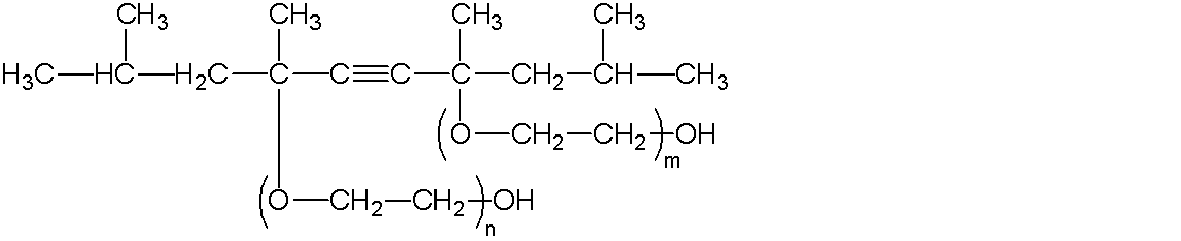
下記式に示す、側鎖にポリエチレンオキサイドを有する構造のノニオン性界面活性剤
(E2):界面活性剤
疎水性基に分岐パーフルオロアルケニル基、親水性基にポリエチレンオキサイド鎖(平均鎖長8単位)を有する構造のフッ素系ノニオン性界面活性剤
疎水性基に分岐パーフルオロアルケニル基、親水性基にポリエチレンオキサイド鎖(平均鎖長8単位)を有する構造のフッ素系ノニオン性界面活性剤
(F):粒子
平均粒径(一次平均粒子径)0.07μmのシリカ粒子
平均粒径(一次平均粒子径)0.07μmのシリカ粒子
(実施例101:ポリエステルフィルムNо.1)
ポリエステルAが100%の原料を表面層の原料とし、ポリエステルBが100%の原料を中間層の原料とし、ポリエステルAを80%とポリエステルCを20%の質量割合でブレンドした原料を裏面層の原料として、ベント付き押出機にそれぞれ供給し、280℃で溶融した。その後、表面層、中間層、裏面層の三種三層(A/B/C)の層構成で、厚み構成比がA/B/C=3.2/26.2/1.6となるよう共押出した。静電印加密着法を用いて表面温度を25℃に設定した冷却ロール上で冷却固化して無定形フィルムを得た。この際、裏面層が冷却ロールと接する側とした。
ポリエステルAが100%の原料を表面層の原料とし、ポリエステルBが100%の原料を中間層の原料とし、ポリエステルAを80%とポリエステルCを20%の質量割合でブレンドした原料を裏面層の原料として、ベント付き押出機にそれぞれ供給し、280℃で溶融した。その後、表面層、中間層、裏面層の三種三層(A/B/C)の層構成で、厚み構成比がA/B/C=3.2/26.2/1.6となるよう共押出した。静電印加密着法を用いて表面温度を25℃に設定した冷却ロール上で冷却固化して無定形フィルムを得た。この際、裏面層が冷却ロールと接する側とした。
次いで、ロール周速差を利用してフィルム温度86℃で縦方向に、すなわちMD方向に3.5倍延伸し、表1に記載の塗布液1及び塗布液2を各々、フィルム両面に塗布した。その後、縦延伸フィルムをテンターに導き、テンター内にて90℃で予熱した後、横方向、すなわちTD方向に105℃で4.2倍延伸し、テンター内の熱処理(固定)ゾーンにおいて、それぞれ230℃で熱処理を行い、弛緩率2%で140℃の冷却処理を行い、全体の厚みが約31μmの離型フィルムを得た。
(比較例101:ポリエステルフィルムNо.1)
実施例101において、塗布液1及び塗布液2を塗布せず、樹脂層A及び樹脂層Bを設けなかった以外は、実施例101と同様に製造し、厚さ31μmの離型フィルム(ポリエステルフィルム)を得た。
実施例101において、塗布液1及び塗布液2を塗布せず、樹脂層A及び樹脂層Bを設けなかった以外は、実施例101と同様に製造し、厚さ31μmの離型フィルム(ポリエステルフィルム)を得た。
(実施例102~104及び比較例102:ポリエステルフィルムNо.1)
実施例101で用いた塗布液2を、表2に記載の塗布液に変更した以外は、実施例101と同様に製造し、厚さ約31μmの離型フィルムを得た。
実施例101で用いた塗布液2を、表2に記載の塗布液に変更した以外は、実施例101と同様に製造し、厚さ約31μmの離型フィルムを得た。
(実施例105:ポリエステルフィルムNо.2)
ポリエステルBが100%の原料を表面層の原料とし、ポリエステルBが100%の原料を中間層の原料とし、ポリエステルBを80%とポリエステルCを20%の質量割合でブレンドした原料を裏面層の原料として用いた以外は、実施例101と同様にして全体の厚みが約31μmの離型フィルムを得た。
ポリエステルBが100%の原料を表面層の原料とし、ポリエステルBが100%の原料を中間層の原料とし、ポリエステルBを80%とポリエステルCを20%の質量割合でブレンドした原料を裏面層の原料として用いた以外は、実施例101と同様にして全体の厚みが約31μmの離型フィルムを得た。
(比較例103:ポリエステルフィルムNо.2)
実施例105において、塗布液1及び塗布液2を塗布せず、樹脂層A及び樹脂層Bを設けなかった以外は、実施例105と同様に製造し、厚さ31μmの離型フィルム(ポリエステルフィルム)を得た。
実施例105において、塗布液1及び塗布液2を塗布せず、樹脂層A及び樹脂層Bを設けなかった以外は、実施例105と同様に製造し、厚さ31μmの離型フィルム(ポリエステルフィルム)を得た。
(実施例106~108及び比較例104:ポリエステルフィルムNо.2)
実施例105で用いた塗布液2を、表3に記載の塗布液に変更した以外は、実施例105と同様に製造し、厚さ約31μmの離型フィルムを得た。
実施例105で用いた塗布液2を、表3に記載の塗布液に変更した以外は、実施例105と同様に製造し、厚さ約31μmの離型フィルムを得た。
(比較例105:ポリエステルフィルムNо.3)
ポリエステルDが100%の原料を表面層の原料とし、ポリエステルDが100%の原料を中間層の原料とし、ポリエステルDを80%とポリエステルCを20%の質量割合でブレンドした原料を裏面層の原料として用いた以外は、比較例101と同様にして全体の厚みが31μmの離型フィルムを得た。
ポリエステルDが100%の原料を表面層の原料とし、ポリエステルDが100%の原料を中間層の原料とし、ポリエステルDを80%とポリエステルCを20%の質量割合でブレンドした原料を裏面層の原料として用いた以外は、比較例101と同様にして全体の厚みが31μmの離型フィルムを得た。
(比較例106:ポリエステルフィルムNо.3)
ポリエステルDが100%の原料を表面層の原料とし、ポリエステルDが100%の原料を中間層の原料とし、ポリエステルDを80%とポリエステルCを20%の質量割合でブレンドした原料を裏面層の原料として用いた以外は、比較例102と同様にして全体の厚みが31μmの離型フィルムを得た。
ポリエステルDが100%の原料を表面層の原料とし、ポリエステルDが100%の原料を中間層の原料とし、ポリエステルDを80%とポリエステルCを20%の質量割合でブレンドした原料を裏面層の原料として用いた以外は、比較例102と同様にして全体の厚みが31μmの離型フィルムを得た。
表4~6に示される結果より、実施例では、薄膜のセラミックグリーンシートの裏面(反離型面)への貼り付き防止効果が良好であることがわかった。このため、本実施形態の離型フィルムをロール状に巻き取った場合であっても、セラミックグリーンシートが離型フィルムの裏面(反離型面)へ貼り付くことなく、巻き出し性が良好となる。
一方、比較例はいずれも、裏面(反離型面)へのセラミックグリーンシートの貼り付きを防止するのが困難であった。また、比較例101、103及び105ではセラミックグリーンシートの剥離性も劣っていた。
一方、比較例はいずれも、裏面(反離型面)へのセラミックグリーンシートの貼り付きを防止するのが困難であった。また、比較例101、103及び105ではセラミックグリーンシートの剥離性も劣っていた。
本発明は、従来は問題視されていなかった、特に厚み(乾燥後)が例えば2μm以下の薄膜のセラミックグリーンシートが有する、特有の柔軟性に起因する「離型フィルムの反離型面(裏面)への薄膜のセラミックグリーンシートの貼り付き」という、新たな課題を見出したものであり、本実施形態の離型フィルムの構成とすることで上記課題を解決し、本発明を完成させるに至ったものである。
また、本発明では、ポリエステルフィルムが再生ポリエステル樹脂を含むため、離型フィルムの空気漏れ指数が小さくなっており、離型フィルムのハンドリング性が良好であることが示されている。
本発明は、従来は問題視されていなかった、特に厚み(乾燥後)が2μm以下の薄膜のセラミックグリーンシートが有する、特有の柔軟性に起因する「離型フィルムの反離型面(裏面)への薄膜のセラミックグリーンシートの貼り付き」という、新たな課題を見出したものであり、本実施形態の離型フィルムの構成とすることで上記課題を解決し、本発明を完成させるに至ったものである。
本実施形態の離型フィルムは、薄膜のセラミックグリーンシート成形用として有用である。本実施形態では、セラミックグリーンシートを積層した状態で、ロール状にフィルムを巻き取ることができ、その際に、特に厚み(乾燥後)が2μm以下の薄膜のセラミックグリーンシートを用いた場合であっても、セラミックグリーンシートが裏面(反離型面)に貼りつかず、取り扱い性に優れる離型フィルムを提供する。
10 ポリエステルフィルム
20 樹脂層A
30 樹脂層B
100 離型フィルム
20 樹脂層A
30 樹脂層B
100 離型フィルム
Claims (38)
- ポリエステルフィルムの片面に樹脂層A、反対面に樹脂層Bを備え、
前記樹脂層Aが離型剤を含有し、
前記樹脂層Bが(A)非シリコーン系離型剤および(C)帯電防止剤を含み、
前記樹脂層Bのセラミックグリーンシートに対する、以下の測定条件における剥離時の帯電量が10kV以下である、離型フィルム;
(測定条件)
樹脂層A上に、トルエン39.84質量部、エタノール39.84質量部、チタン酸バリウム17.65質量部、ポリビニルブチラール1.77質量部及びフタル酸ジオクチル0.90質量部を含む組成物から形成され、かつ厚みが1.0μmのセラミックグリーンシートを形成し、該セラミックグリーンシートと樹脂層Bとをプレス圧(8.2MPa)で5時間処理した後、樹脂層Bからセラミックグリーンシートを剥離させる際の静電気量を測定する;セラミックグリーンシートを剥離させる際の剥離角度は90度、剥離速度は4cm/秒とする。 - ポリエステルフィルムの片面に樹脂層A、反対面に樹脂層Bを備え、
前記ポリエステルフィルムが再生ポリエステル樹脂を含み、
前記樹脂層Aが離型剤を含有し、
前記樹脂層Bのセラミックグリーンシートに対する、以下の測定条件における剥離時の帯電量が16kV以下である、離型フィルム;
(測定条件)
樹脂層A上に、トルエン39.84質量部、エタノール39.84質量部、チタン酸バリウム17.65質量部、ポリビニルブチラール1.77質量部及びフタル酸ジオクチル0.90質量部を含む組成物から形成され、かつ厚みが1.0μmのセラミックグリーンシートを形成し、該セラミックグリーンシートと樹脂層Bとをプレス圧(8.2MPa)で5時間処理した後、樹脂層Bからセラミックグリーンシートを剥離させる際の静電気量を測定する;セラミックグリーンシートを剥離させる際の剥離角度は90度、剥離速度は4cm/秒とする。 - 前記樹脂層Aに含まれる前記離型剤が(A)非シリコーン系離型剤である、請求項1又は2に記載の離型フィルム。
- 前記(A)非シリコーン系離型剤が、ワックス及び長鎖アルキル基含有化合物から選択される少なくとも1種である、請求項3に記載の離型フィルム。
- 前記樹脂層Bが(C)帯電防止剤を含む、請求項2に記載の離型フィルム。
- 前記(C)帯電防止剤がイオン導電性高分子化合物である、請求項1又は5に記載の離型フィルム。
- 前記(C)帯電防止剤がアンモニウム基含有化合物である、請求項1又は5に記載の離型フィルム。
- 前記(C)帯電防止剤が、(a1)チオフェンまたはチオフェン誘導体からなる化合物が他の陰イオン化合物によりドーピングされた重合体、及び(a2)チオフェンまたはチオフェン誘導体からなる化合物が陰イオン基を持ち自己ドープされた重合体から選択される少なくとも1種である、請求項1又は5に記載の離型フィルム。
- 前記(C)帯電防止剤の含有量が、樹脂層Bの全質量に対して5質量%以上である、請求項1又は5に記載の離型フィルム。
- 前記樹脂層Bが(A)非シリコーン系離型剤を含む、請求項1又は2に記載の離型フィルム。
- 前記(A)非シリコーン系離型剤が、ワックス及び長鎖アルキル基含有化合物から選択される少なくとも1種である、請求項10に記載の離型フィルム。
- 前記(A)非シリコーン系離型剤の含有量が、樹脂層Bの全質量に対して5質量%以上である、請求項10に記載の離型フィルム。
- 前記樹脂層Bが(B)バインダー樹脂を含む、請求項1又は2に記載の離型フィルム。
- 前記(B)バインダー樹脂が、(メタ)アクリル樹脂及びポリビニルアルコールから選択される少なくとも1種である、請求項13に記載の離型フィルム。
- 前記樹脂層Bが(D)架橋剤を含む、請求項1に記載の離型フィルム。
- 前記(D)架橋剤が、メラミン化合物及びオキサゾリン化合物から選択される少なくとも1種である、請求項15に記載の離型フィルム。
- 前記ポリエステルフィルム中の樹脂成分の全質量に対する前記再生ポリエステル樹脂の含有割合が90質量%以上である、請求項2に記載の離型フィルム。
- 前記ポリエステルフィルムが表面層、中間層及び裏面層を有する3層構成である、請求項1又は2に記載の離型フィルム。
- 前記表面層がケミカルリサイクルされたポリエステル樹脂を含む、請求項18に記載の離型フィルム。
- 前記裏面層がケミカルリサイクルされたポリエステル樹脂を含む、請求項18に記載の離型フィルム。
- 前記中間層がマテリアルリサイクルされたポリエステル樹脂を含む、請求項18に記載の離型フィルム。
- 前記ポリエステルフィルムに含まれるポリエステル樹脂を構成する全ジカルボン酸単位100モル%に対する、イソフタル酸単位の含有量が0.01~5モル%である、請求項2に記載の離型フィルム。
- 融解ピーク温度(Tm)が254℃以下である、請求項2に記載の離型フィルム。
- 融解ピーク熱量(ΔHm)が40J/g以下である、請求項2に記載の離型フィルム。
- ガス密度が1.4050g/cm3以下である、請求項2に記載の離型フィルム。
- 前記再生ポリエステル樹脂がPETボトルをリサイクルしたものである、請求項2に記載の離型フィルム。
- 空気漏れ指数が8500秒以下である、請求項2に記載の離型フィルム。
- 下記式で算出される空気漏れ指数低減率が5%以上である、請求項2に記載の離型フィルム。
空気漏れ指数低減率(%)=100-対象離型フィルムの空気漏れ指数/バージン離型フィルムの空気漏れ指数×100 - 前記樹脂層A面の最大山高さ(Sp)が60nm以下である、請求項2に記載の離型フィルム。
- 前記樹脂層A面の算術平均高さ(Sa)が5nm以下である、請求項1又は2に記載の離型フィルム。
- 前記離型フィルムの厚みが9~50μmである、請求項1又は2に記載の離型フィルム。
- 前記離型フィルムにおける前記樹脂層B面と前記樹脂層A面との動摩擦係数が0.2以下である、請求項1又は2に記載の離型フィルム。
- 積層セラミックコンデンサーの製造工程においてセラミックグリーンシートの支持体として用いられる、請求項1又は2に記載の離型フィルム。
- 請求項1又は2に記載の離型フィルムの前記樹脂層A上にセラミックグリーンシートを積層した、セラミックグリーンシート付き離型フィルム。
- セラミックグリーンシートの厚み(乾燥後)が2μm以下である、請求項34に記載のセラミックグリーンシート付き離型フィルム。
- 積層セラミックコンデンサーの製造工程において用いられる、請求項34に記載のセラミックグリーンシート付き離型フィルム。
- 請求項1又は2に記載の離型フィルムの、積層セラミックコンデンサーの製造工程におけるセラミックグリーンシートの支持体としての使用。
- 請求項1又は2に記載の離型フィルムの少なくとも一方の面側に、セラミック成分を含むセラミックスラリーを塗工する工程を有する、セラミックグリーンシートの製造方法。
Priority Applications (2)
| Application Number | Priority Date | Filing Date | Title |
|---|---|---|---|
| CN202480075361.4A CN122295202A (zh) | 2023-11-29 | 2024-11-15 | 脱模薄膜及其应用 |
| KR1020267020120A KR20260116215A (ko) | 2023-11-29 | 2024-11-15 | 이형 필름 및 그 응용 |
Applications Claiming Priority (6)
| Application Number | Priority Date | Filing Date | Title |
|---|---|---|---|
| JP2023202233 | 2023-11-29 | ||
| JP2023-202233 | 2023-11-29 | ||
| JP2024139190A JP2026036527A (ja) | 2024-08-20 | 2024-08-20 | 離型フィルム及びその応用 |
| JP2024-139190 | 2024-08-20 | ||
| JP2024-193563 | 2024-11-05 | ||
| JP2024193563A JP2025087597A (ja) | 2023-11-29 | 2024-11-05 | 離型フィルム及びその応用 |
Publications (1)
| Publication Number | Publication Date |
|---|---|
| WO2025115642A1 true WO2025115642A1 (ja) | 2025-06-05 |
Family
ID=95897692
Family Applications (1)
| Application Number | Title | Priority Date | Filing Date |
|---|---|---|---|
| PCT/JP2024/040584 Pending WO2025115642A1 (ja) | 2023-11-29 | 2024-11-15 | 離型フィルム及びその応用 |
Country Status (4)
| Country | Link |
|---|---|
| KR (1) | KR20260116215A (ja) |
| CN (1) | CN122295202A (ja) |
| TW (1) | TW202530012A (ja) |
| WO (1) | WO2025115642A1 (ja) |
Citations (8)
| Publication number | Priority date | Publication date | Assignee | Title |
|---|---|---|---|---|
| JP2003300283A (ja) * | 2002-04-09 | 2003-10-21 | Mitsubishi Polyester Film Copp | 離型フィルム |
| JP2009123903A (ja) * | 2007-11-14 | 2009-06-04 | Tdk Corp | 支持シートおよび積層セラミック電子部品の製造方法 |
| WO2012144366A1 (ja) * | 2011-04-21 | 2012-10-26 | リンテック株式会社 | セラミックグリーンシート製造工程用の剥離フィルム |
| JP2021115862A (ja) * | 2020-01-27 | 2021-08-10 | 東レ株式会社 | フィルムの再利用方法および再生フィルム |
| WO2022118755A1 (ja) * | 2020-12-04 | 2022-06-09 | 東洋紡株式会社 | 離型フィルム |
| WO2023095709A1 (ja) * | 2021-11-26 | 2023-06-01 | 東洋紡株式会社 | 2軸延伸ポリエステルフィルム |
| WO2023145952A1 (ja) * | 2022-01-31 | 2023-08-03 | 三菱ケミカル株式会社 | 積層ポリエステルフィルム |
| WO2023145938A1 (ja) * | 2022-01-31 | 2023-08-03 | 三菱ケミカル株式会社 | 積層ポリエステルフィルム |
-
2024
- 2024-11-15 KR KR1020267020120A patent/KR20260116215A/ko active Pending
- 2024-11-15 CN CN202480075361.4A patent/CN122295202A/zh active Pending
- 2024-11-15 WO PCT/JP2024/040584 patent/WO2025115642A1/ja active Pending
- 2024-11-19 TW TW113144422A patent/TW202530012A/zh unknown
Patent Citations (8)
| Publication number | Priority date | Publication date | Assignee | Title |
|---|---|---|---|---|
| JP2003300283A (ja) * | 2002-04-09 | 2003-10-21 | Mitsubishi Polyester Film Copp | 離型フィルム |
| JP2009123903A (ja) * | 2007-11-14 | 2009-06-04 | Tdk Corp | 支持シートおよび積層セラミック電子部品の製造方法 |
| WO2012144366A1 (ja) * | 2011-04-21 | 2012-10-26 | リンテック株式会社 | セラミックグリーンシート製造工程用の剥離フィルム |
| JP2021115862A (ja) * | 2020-01-27 | 2021-08-10 | 東レ株式会社 | フィルムの再利用方法および再生フィルム |
| WO2022118755A1 (ja) * | 2020-12-04 | 2022-06-09 | 東洋紡株式会社 | 離型フィルム |
| WO2023095709A1 (ja) * | 2021-11-26 | 2023-06-01 | 東洋紡株式会社 | 2軸延伸ポリエステルフィルム |
| WO2023145952A1 (ja) * | 2022-01-31 | 2023-08-03 | 三菱ケミカル株式会社 | 積層ポリエステルフィルム |
| WO2023145938A1 (ja) * | 2022-01-31 | 2023-08-03 | 三菱ケミカル株式会社 | 積層ポリエステルフィルム |
Also Published As
| Publication number | Publication date |
|---|---|
| KR20260116215A (ko) | 2026-07-28 |
| TW202530012A (zh) | 2025-08-01 |
| CN122295202A (zh) | 2026-06-26 |
Similar Documents
| Publication | Publication Date | Title |
|---|---|---|
| JP6365506B2 (ja) | 積層ポリエステルフィルム | |
| WO2017154226A1 (ja) | 粘着フィルム及びその製造方法 | |
| JP6455566B2 (ja) | 積層ポリエステルフィルム | |
| JP2024056102A (ja) | 積層ポリエステルフィルム | |
| JP2023111662A (ja) | ポリエステルフィルムロール | |
| WO2023145952A1 (ja) | 積層ポリエステルフィルム | |
| JP2024056103A (ja) | 積層ポリエステルフィルム | |
| JP5520274B2 (ja) | 積層ポリエステルフィルム | |
| JP6319331B2 (ja) | 積層ポリエステルフィルム | |
| JP5723509B2 (ja) | 積層ポリエステルフィルム | |
| JP2018184003A (ja) | 積層ポリエステルフィルムの製造方法 | |
| JP6583146B2 (ja) | 積層ポリエステルフィルムおよびその製造方法 | |
| JP6120936B1 (ja) | 粘着ポリエステルフィルム積層体 | |
| JP6418197B2 (ja) | 積層ポリエステルフィルム | |
| JP2023111663A (ja) | 積層ポリエステルフィルム | |
| JP2025017183A (ja) | 積層ポリエステルフィルム | |
| JP2026036527A (ja) | 離型フィルム及びその応用 | |
| CN118434795A (zh) | 聚酯薄膜及层叠聚酯薄膜 | |
| JP2018123325A (ja) | 積層ポリエステルフィルム | |
| JP2025087597A (ja) | 離型フィルム及びその応用 | |
| JP2025087521A (ja) | セラミックグリーンシート付き離型フィルム | |
| TW202530012A (zh) | 離型膜及其應用 | |
| JP2024044103A (ja) | 積層ポリエステルフィルム | |
| JP2024044104A (ja) | 積層ポリエステルフィルム | |
| JP7782241B2 (ja) | 積層ポリエステルフィルム |
Legal Events
| Date | Code | Title | Description |
|---|---|---|---|
| 121 | Ep: the epo has been informed by wipo that ep was designated in this application |
Ref document number: 24897329 Country of ref document: EP Kind code of ref document: A1 |
|
| ENP | Entry into the national phase |
Ref document number: 1020267020120 Country of ref document: KR Free format text: ST27 STATUS EVENT CODE: A-0-1-A10-A15-NAP-PA0105 (AS PROVIDED BY THE NATIONAL OFFICE) |
|
| NENP | Non-entry into the national phase |
Ref country code: DE |