WO2025100477A1 - 組成物、表面処理剤、物品、及び物品の製造方法 - Google Patents
組成物、表面処理剤、物品、及び物品の製造方法 Download PDFInfo
- Publication number
- WO2025100477A1 WO2025100477A1 PCT/JP2024/039593 JP2024039593W WO2025100477A1 WO 2025100477 A1 WO2025100477 A1 WO 2025100477A1 JP 2024039593 W JP2024039593 W JP 2024039593W WO 2025100477 A1 WO2025100477 A1 WO 2025100477A1
- Authority
- WO
- WIPO (PCT)
- Prior art keywords
- group
- compound
- independently
- carbon atoms
- integer
- Prior art date
- Legal status (The legal status is an assumption and is not a legal conclusion. Google has not performed a legal analysis and makes no representation as to the accuracy of the status listed.)
- Pending
Links
Classifications
-
- B—PERFORMING OPERATIONS; TRANSPORTING
- B05—SPRAYING OR ATOMISING IN GENERAL; APPLYING FLUENT MATERIALS TO SURFACES, IN GENERAL
- B05D—PROCESSES FOR APPLYING FLUENT MATERIALS TO SURFACES, IN GENERAL
- B05D7/00—Processes, other than flocking, specially adapted for applying liquids or other fluent materials to particular surfaces or for applying particular liquids or other fluent materials
- B05D7/24—Processes, other than flocking, specially adapted for applying liquids or other fluent materials to particular surfaces or for applying particular liquids or other fluent materials for applying particular liquids or other fluent materials
-
- C—CHEMISTRY; METALLURGY
- C07—ORGANIC CHEMISTRY
- C07B—GENERAL METHODS OF ORGANIC CHEMISTRY; APPARATUS THEREFOR
- C07B61/00—Other general methods
-
- C—CHEMISTRY; METALLURGY
- C07—ORGANIC CHEMISTRY
- C07F—ACYCLIC, CARBOCYCLIC OR HETEROCYCLIC COMPOUNDS CONTAINING ELEMENTS OTHER THAN CARBON, HYDROGEN, HALOGEN, OXYGEN, NITROGEN, SULFUR, SELENIUM OR TELLURIUM
- C07F7/00—Compounds containing elements of Groups 4 or 14 of the Periodic Table
- C07F7/02—Silicon compounds
- C07F7/08—Compounds having one or more C—Si linkages
- C07F7/18—Compounds having one or more C—Si linkages as well as one or more C—O—Si linkages
-
- C—CHEMISTRY; METALLURGY
- C08—ORGANIC MACROMOLECULAR COMPOUNDS; THEIR PREPARATION OR CHEMICAL WORKING-UP; COMPOSITIONS BASED THEREON
- C08G—MACROMOLECULAR COMPOUNDS OBTAINED OTHERWISE THAN BY REACTIONS ONLY INVOLVING UNSATURATED CARBON-TO-CARBON BONDS
- C08G77/00—Macromolecular compounds obtained by reactions forming a linkage containing silicon with or without sulfur, nitrogen, oxygen or carbon in the main chain of the macromolecule
- C08G77/48—Macromolecular compounds obtained by reactions forming a linkage containing silicon with or without sulfur, nitrogen, oxygen or carbon in the main chain of the macromolecule in which at least two but not all the silicon atoms are connected by linkages other than oxygen atoms
- C08G77/54—Nitrogen-containing linkages
-
- C—CHEMISTRY; METALLURGY
- C08—ORGANIC MACROMOLECULAR COMPOUNDS; THEIR PREPARATION OR CHEMICAL WORKING-UP; COMPOSITIONS BASED THEREON
- C08K—Use of inorganic or non-macromolecular organic substances as compounding ingredients
- C08K5/00—Use of organic ingredients
- C08K5/54—Silicon-containing compounds
- C08K5/541—Silicon-containing compounds containing oxygen
- C08K5/5415—Silicon-containing compounds containing oxygen containing at least one Si—O bond
- C08K5/5419—Silicon-containing compounds containing oxygen containing at least one Si—O bond containing at least one Si—C bond
-
- C—CHEMISTRY; METALLURGY
- C08—ORGANIC MACROMOLECULAR COMPOUNDS; THEIR PREPARATION OR CHEMICAL WORKING-UP; COMPOSITIONS BASED THEREON
- C08L—COMPOSITIONS OF MACROMOLECULAR COMPOUNDS
- C08L83/00—Compositions of macromolecular compounds obtained by reactions forming in the main chain of the macromolecule a linkage containing silicon with or without sulfur, nitrogen, oxygen or carbon only; Compositions of derivatives of such polymers
- C08L83/04—Polysiloxanes
- C08L83/06—Polysiloxanes containing silicon bound to oxygen-containing groups
-
- C—CHEMISTRY; METALLURGY
- C08—ORGANIC MACROMOLECULAR COMPOUNDS; THEIR PREPARATION OR CHEMICAL WORKING-UP; COMPOSITIONS BASED THEREON
- C08L—COMPOSITIONS OF MACROMOLECULAR COMPOUNDS
- C08L83/00—Compositions of macromolecular compounds obtained by reactions forming in the main chain of the macromolecule a linkage containing silicon with or without sulfur, nitrogen, oxygen or carbon only; Compositions of derivatives of such polymers
- C08L83/14—Compositions of macromolecular compounds obtained by reactions forming in the main chain of the macromolecule a linkage containing silicon with or without sulfur, nitrogen, oxygen or carbon only; Compositions of derivatives of such polymers in which at least two but not all the silicon atoms are connected by linkages other than oxygen atoms
-
- C—CHEMISTRY; METALLURGY
- C09—DYES; PAINTS; POLISHES; NATURAL RESINS; ADHESIVES; COMPOSITIONS NOT OTHERWISE PROVIDED FOR; APPLICATIONS OF MATERIALS NOT OTHERWISE PROVIDED FOR
- C09K—MATERIALS FOR MISCELLANEOUS APPLICATIONS, NOT PROVIDED FOR ELSEWHERE
- C09K3/00—Materials not provided for elsewhere
- C09K3/18—Materials not provided for elsewhere for application to surfaces to minimize adherence of ice, mist or water thereto; Thawing or antifreeze materials for application to surfaces
Definitions
- the present disclosure relates to a composition, a surface treatment agent, an article, and a method for manufacturing an article.
- a specific method known is to perform a surface treatment on the surface of the article using a surface treatment agent.
- Patent Document 1 describes a mixed composition comprising a compound (A1) represented by formula (a1), an organosilicon compound (B) represented by formula (b1), and an organosilicon compound (C) represented by formula (c1), wherein the mass ratio of compound (A1) to the total of organosilicon compound (B) and organosilicon compound (C) is 0.060 or more.
- Patent Document 2 describes a composition for forming a water-repellent layer, which contains a compound represented by formula (6) which may be partially hydrolyzed and condensed and/or co-condensed, and a compound represented by formula (3) in an amount of 0.5 to 50 mass % relative to 100 mass % of the content of the compound represented by formula (6).
- Patent Document 3 describes a composition containing (a) an organosilicon compound having at least one trialkylsilyl group and two or more hydrolyzable silicon groups, and (b) a metal compound having at least one hydrolyzable group bonded to a metal atom.
- the surface treatment layer formed by the surface treatment agent is required to have both water repellency and abrasion resistance.
- the surface treatment layers formed from the compositions described in Patent Documents 1 to 3 are unable to achieve both water repellency and abrasion resistance.
- the present disclosure has been made in consideration of the above circumstances, and an object of one embodiment of the present invention is to provide a composition and a surface treatment agent capable of forming a surface treatment layer having excellent water repellency and abrasion resistance on a substrate.
- An object of one embodiment of the present invention is to provide an article having a surface treatment layer that is excellent in water repellency and abrasion resistance, and a method for producing the article.
- Requirement (2) In the second compound, two or more reactive silyl groups b are linked to at least one end of the hydrocarbon group.
- Each R2 is independently a monovalent hydrocarbon group;
- Each L is independently a hydrolyzable group, a group having a hydrolyzable group, or a hydroxyl group;
- Each L2 independently represents a hydrolyzable group, a group having a hydrolyzable group, a hydroxyl group, or a hydrocarbon group;
- at least four L2 are a hydrolyzable group, a group having a hydrolyzable group, or a hydroxyl group;
- Each Q is independently an oxygen atom or an organic group having one carbon atom bonded to adjacent Si atoms on both sides, n is an integer from 0 to 2, n12 is an integer from 1 to 3.
- composition according to ⁇ 1> or ⁇ 2>, wherein the organo(poly)siloxane residue contained in the first compound is represented by the following formula (B1):
- Each R3 is independently a hydrocarbon group;
- k1 is a number equal to or greater than 1, * indicates a bonding site with an adjacent atom.
- T 11 is a monovalent group not containing a reactive silyl group
- Each r is independently 0 or 1
- Each R3 is independently a hydrocarbon group
- Each k1 is independently a number of 1 or more
- p1 is an integer of 1 or more
- a 11 is a (p1+q1)-valent linking group
- q1 is an integer of 1 or more
- R2 is independently a hydrocarbon group
- L each independently represents a hydrolyzable group, a group having a hydrolyzable group, or a hydroxyl group
- Each n is independently an integer of 0 to 2.
- k1 is 2 to 600.
- q1 is an integer of 1 to 4.
- ⁇ 7> ⁇ 6> The composition according to any one of ⁇ 1> to ⁇ 6>, wherein in the second compound, the reactive silyl group b is linked to only one end of the hydrocarbon group.
- each R Ak is independently an alkyl group;
- a d is a single bond or a (p2+q2)-valent linking group other than an oxygen atom, p2 and q2 each independently represent an integer of 1 or more;
- Each R2 is independently a hydrocarbon group;
- Each L is independently a hydrolyzable group, a group having a hydrolyzable group, or a hydroxyl group;
- n is an integer from 0 to 2.
- R Ak is an alkyl group having 4 to 50 carbon atoms.
- R 71 is a hydrogen atom or [(CH 3 ) 3 Q 71 -R 73 -] m7 Q 72 (CH 3 ) 3-m7 -;
- Q 71 and Q 72 each independently represent C or Si; However, at least one of Q 71 and Q 72 is Si;
- Each R 73 independently represents an alkylene group having 1 to 6 carbon atoms;
- m7 is an integer from 0 to 3
- ⁇ 12> The composition according to ⁇ 11>, wherein L 1 is an alkylene group having 13 to 36 carbon atoms. ⁇ 13> The composition according to ⁇ 11> or ⁇ 12>, wherein R 1 is (CH 3 ) 3 Si—. ⁇ 14> ⁇ 14> The composition according to any one of ⁇ 1> to ⁇ 13>, wherein a mass ratio of the second compound to the first compound is 0.01 to 0.9. ⁇ 15> The composition according to any one of ⁇ 1> to ⁇ 14>, further comprising a liquid medium. ⁇ 16> ⁇ 16> A surface treatment agent comprising the composition according to any one of ⁇ 1> to ⁇ 15>.
- a method for producing an article comprising: performing a surface treatment on a substrate using the surface treatment agent according to ⁇ 16>; and producing an article having a surface treatment layer formed on the substrate.
- An article comprising a substrate and a surface treatment layer disposed on the substrate and surface-treated with the surface treatment agent according to ⁇ 16>.
- the article according to ⁇ 18> which is an optical member.
- the article according to ⁇ 18> which is a display or a touch panel.
- a composition and a surface treatment agent capable of forming a surface treatment layer having excellent water repellency and abrasion resistance on a substrate.
- an article having a surface treatment layer with excellent water repellency and abrasion resistance and a method for manufacturing the article.
- the numerical ranges indicated using “to” include the numerical values before and after “to” as the minimum and maximum values, respectively.
- the upper or lower limit of one numerical range may be replaced with the upper or lower limit of another numerical range.
- the upper or lower limit of the numerical range may be replaced with a value shown in the examples.
- the term “surface treatment layer” refers to a layer formed on the surface of a substrate by surface treatment.
- “Me” may refer to a methyl group.
- organo(poly)siloxane residue means an organosiloxane residue or an organopolysiloxane residue.
- composition comprises a first compound having an organo(poly)siloxane residue and a reactive silyl group a, and a second compound having a hydrocarbon group having 4 or more carbon atoms that does not have an organo(poly)siloxane residue and is not directly bonded to an oxygen atom, and that may have a functional group or a substituent, and a reactive silyl group b, and satisfies at least one of the following requirements (1) and (2):
- Requirement (2) In the second compound, two or more reactive silyl groups b are linked to at least one end of the hydrocarbon group.
- a surface treatment layer having excellent water repellency and abrasion resistance can be formed.
- the reason why such an effect is obtained is not clear, but is presumed to be as follows.
- the first compound contained in the composition of the present disclosure has an organo(poly)siloxane residue, which results in excellent water repellency.
- the second compound contained in the composition of the present disclosure has an excellent abrasion resistance, which results in excellent water repellency. Satisfying at least one of requirements (1) and (2) means that at least one of the first compound and the second compound has two or more reactive silyl groups linked to at least one end. In particular, since two or more reactive silyl groups are linked to at least one end, two or more reactive silyl groups can be present in close proximity to each other in one compound. Therefore, it is believed that the composition has excellent adhesion to the substrate and can achieve both water repellency and abrasion resistance.
- Patent Documents 1 to 3 do not disclose a combination of a first compound and a second compound that satisfies at least one of the above requirements (1) and (2).
- the first compound has an organo(poly)siloxane residue and a reactive silyl group a.
- the composition of the present disclosure may contain only one type of the first compound, or may contain two or more types.
- the first compound contains an organo(poly)siloxane residue.
- the organo(poly)siloxane residue contained in the first compound may be one or more.
- the first compound contains two or more organo(poly)siloxane residues, the two or more organo(poly)siloxane residues may be the same or different.
- the organo(poly)siloxane residue may be a linear organo(poly)siloxane residue, a cyclic organo(poly)siloxane residue, or a cage-shaped organo(poly)siloxane residue.
- the organo(poly)siloxane residue is preferably a linear organo(poly)siloxane residue, and more preferably a divalent linear organo(poly)siloxane residue.
- the organo(poly)siloxane residue may be a linear organo(poly)siloxane residue represented by the following formula (B1) or (B2). Of these, the organo(poly)siloxane residue represented by formula (B1) is preferred.
- R 4 is independently a hydrocarbon group or T 11 -B r -(SiR 3 2 -O) k1 -;
- T 11 is independently a monovalent group;
- Each r is independently 0 or 1;
- Each R3 is independently a hydrocarbon group;
- Each k1 is independently a number of 1 or more, * indicates a bonding site with an adjacent atom.
- examples of the hydrocarbon group represented by R3 include aliphatic hydrocarbon groups and aromatic hydrocarbon groups.
- the hydrocarbon group is preferably an aliphatic hydrocarbon group, and more preferably an alkyl group.
- the alkyl group may be any of a linear alkyl group, a branched alkyl group, and a cyclic alkyl group, but is preferably a linear alkyl group, more preferably a methyl group, an ethyl group, an n-propyl group, or an n-butyl group, and even more preferably a methyl group.
- the aromatic hydrocarbon group is preferably a phenyl group.
- k1 is a number of 1 or more, preferably a number from 1 to 600, more preferably a number from 1 to 500, even more preferably a number from 3 to 500, particularly preferably a number from 9 to 50, extremely preferably a number from 11 to 30, and most preferably a number from 11 to 25.
- R 4 is each independently a hydrocarbon group or T 11 -B r -(SiR 3 2 -O) k1 -, preferably a hydrocarbon group. Details of the hydrocarbon group are the same as those of the hydrocarbon group represented by R 3 .
- T 11 is each independently a monovalent group, and specific embodiments are the same as T 11 in formula (C) described below. Specific embodiments of B and r are the same as those of B and r in formula (C) described later.
- the number of reactive silyl groups a contained in the first compound is 1 or more, and from the viewpoint of further improving the abrasion resistance of the surface treatment layer, it is preferably 2 to 18, more preferably 2 to 12, even more preferably 2 to 8, and particularly preferably 2 to 4.
- the number of reactive silyl groups may be 1.
- a reactive silyl group means a group in which a reactive group is bonded to a Si atom.
- the reactive group is preferably a hydrolyzable group, a group having a hydrolyzable group, or a hydroxyl group.
- a hydrolyzable group is a group that becomes a hydroxyl group through a hydrolysis reaction. That is, a hydrolyzable silyl group represented by Si- L1 becomes a silanol group represented by Si-OH through a hydrolysis reaction. The silanol groups further react with each other to form a Si-O-Si bond. In addition, the silanol groups can undergo a dehydration condensation reaction with silanol groups derived from oxides present on the surface of the substrate to form a Si-O-Si bond.
- the alkoxy group is preferably an alkoxy group having 1 to 4 carbon atoms.
- the aryloxy group is preferably an aryloxy group having 3 to 10 carbon atoms. However, the aryl group of the aryloxy group includes a heteroaryl group.
- the halogen atom is preferably a chlorine atom.
- the acyl group is preferably an acyl group having 1 to 6 carbon atoms.
- the acyloxy group is preferably an acyloxy group having 1 to 6 carbon atoms.
- Each of R r is independently an alkyl group having 1 to 10 carbon atoms.
- the group having a hydrolyzable group may be, for example, a group having a hydrolyzable group exemplified above.
- the group having a hydrolyzable group is preferably -OL A -L B.
- L A is a divalent linking group
- L B is a hydrolyzable group.
- the divalent linking group in L A is preferably an alkylene group, and the number of carbon atoms in the alkylene group is preferably 1 to 10, and may have an oxygen atom between carbon atoms.
- the hydrolyzable group represented by L B has the same meaning as the hydrolyzable group represented by R 1 described above, and the preferred embodiments are also the same. Specific examples of groups having a hydrolyzable group include -O-CH 2 CH 2 -OCH 3 .
- the reactive silyl group is preferably a group represented by the following formula (S1) or (S2). -Si(R 2 ) n L 3-n ...(S1) -[Si(L 2 ) 2 -Q] n12 -Si(L 2 ) 3 ...(S2) however,
- Each R2 is independently a monovalent hydrocarbon group;
- Each L is independently a hydrolyzable group, a group having a hydrolyzable group, or a hydroxyl group;
- Each L2 independently represents a hydrolyzable group, a group having a hydrolyzable group, a hydroxyl group, or a hydrocarbon group;
- at least four L2 are a hydrolyzable group, a group having a hydrolyzable group, or a hydroxyl group;
- Each Q is independently an oxygen atom or an organic group having one carbon atom bonded to adjacent Si atoms on both sides, n is an integer from 0 to 2, n12 is an integer from 1 to
- the multiple reactive silyl groups may be the same or different from each other. From the viewpoint of availability of raw materials and ease of manufacturing the compound, it is preferable that the multiple reactive silyl groups are the same.
- Each R 2 is independently a monovalent hydrocarbon group, preferably a monovalent saturated hydrocarbon group.
- the hydrocarbon group of R 2 include an alkyl group, a cycloalkyl group, an alkenyl group, and an allyl group. From the viewpoint of ease of synthesis, a saturated hydrocarbon group is preferable, and an alkyl group is more preferable.
- the number of carbon atoms in the hydrocarbon group is preferably 1 to 6, more preferably 1 to 3, and even more preferably 1 to 2.
- the number of carbon atoms in R 2 is preferably 1 to 6, more preferably 1 to 3, and even more preferably 1 to 2.
- Each L is independently a hydrolyzable group, a group having a hydrolyzable group, or a hydroxyl group.
- Each L2 is independently a hydrolyzable group, a group having a hydrolyzable group, a hydroxyl group, or a hydrocarbon group. Details of the hydrolyzable group in L and L2 are as described above.
- L and L2 are preferably an alkoxy group having 1 to 4 carbon atoms, an alkylene oxide-modified alkoxy group, or a halogen atom. From the viewpoint of less outgassing during coating and superior storage stability of the compound, L and L2 are preferably an alkoxy group having 1 to 4 carbon atoms, and more preferably an ethoxy group or a methoxy group.
- n is an integer from 0 to 2, preferably 0 or 1, and more preferably 0.
- Ls is an integer from 0 to 2, preferably 0 or 1, and more preferably 0.
- n12 is an integer from 1 to 3, and from the viewpoint of ease of synthesis, 1 or 2 is preferable, and 1 is more preferable.
- a plurality of L or L2 present in one molecule may be the same or different from each other. From the viewpoint of availability of raw materials and ease of production of the compound, it is preferable that a plurality of L are the same.
- a plurality of R2 present in one molecule may be the same or different from each other. From the viewpoint of availability of raw materials and ease of production of the compound, it is preferable that a plurality of R2 are the same.
- Each Q is independently an oxygen atom or an organic group having one carbon atom bonded to adjacent Si on both sides.
- an organic group having one carbon atom bonded to adjacent Si on both sides means that Si is linked to each other via one carbon atom.
- An example of the organic group in Q is a group represented by -CR 8 2 -.
- each R 8 is independently a hydrogen atom or a hydrocarbon group.
- the hydrocarbon group in R 8 is an alkyl group having 1 to 6 carbon atoms, and preferably an alkyl group having 1 to 3 carbon atoms.
- Q is preferably an oxygen atom, -CH 2 -, or -C(CH 3 ) 2 -, more preferably an oxygen atom or -CH 2 -, and even more preferably an oxygen atom.
- each R 18 is independently a hydrocarbon group.
- the hydrocarbon group include an alkyl group, a cycloalkyl group, an alkenyl group, and an allyl group. From the viewpoint of ease of synthesis, a saturated hydrocarbon group is preferred, and an alkyl group is more preferred.
- the number of carbon atoms in R 2 is preferably 1 to 6, more preferably 1 to 3, and even more preferably 1 to 2.
- group (S2) include -Si(OCH 3 ) 2 -O-Si(OCH 3 ) 3 , -Si(OCH 3 ) 2 -CH 2 -Si(OCH 3 ) 3 , -Si(OCH 3 ) 2 -C(CH 3 ) 2 -Si(OCH 3 ) 3 , -Si(OCH 2 CH 3 ) 2 -O-Si(OCH 3 ) 3 , -Si(OCH 3 ) 2 -O-Si(OCH 2 CH 3 ) 3 , -Si(OCH 2 CH 3 ) 2 -O-Si(OCH 2 CH 3 ) 3 , -Si(OCH 2 CH 3 ) 2 -O-Si(OCH 2 CH 3 ) 3 , -Si(OCH 2 CH 3 ) 2 -CH 2 -Si(OCH 3 ) 3 , -Si(OCH 3 ) 2 -CH 2
- the reactive silyl group is preferably an alkoxysilyl group or a trichlorosilyl group. From the viewpoint of ease of handling of by-products generated in the reaction with the substrate, the reactive silyl group is more preferably an alkoxysilyl group.
- the alkoxysilyl group a dialkoxysilyl group or a trialkoxysilyl group is preferred, and a trialkoxysilyl group is more preferred.
- the reactive silyl group may be a group represented by the following formula (S3). > SiL2 ...(S3) L is the same as L in formula (S1).
- the number average molecular weight (Mn) of the first compound is preferably from 500 to 20,000, more preferably from 600 to 18,000, and even more preferably from 700 to 15,000.
- Mn is 500 or more
- the abrasion resistance of the surface treatment layer is more excellent.
- Mn is 20,000 or less
- the viscosity can be easily adjusted within an appropriate range, and the solubility is improved, so that the handling property during film formation is excellent.
- composition of the present disclosure may contain impurities such as by-products produced during the manufacturing process of the first compound.
- the content of the first compound is preferably 0.001 to 50 mass%, more preferably 0.01 to 20 mass%, and even more preferably 0.1 to 10 mass%, based on the total amount of the composition of the present disclosure.
- the content of the first compound may be 0.01 to 10 mass%, 0.02 to 5 mass%, 0.03 to 3 mass%, or 0.05 to 2 mass%, based on the total amount of the composition of the present disclosure.
- first compound S examples include a compound having a linear organo(poly)siloxane residue and a reactive silyl group linked to only one end of the linear organo(poly)siloxane residue (hereinafter also referred to as "first compound S"), and a compound having a linear organo(poly)siloxane residue and reactive silyl groups linked to both ends of the linear organo(poly)siloxane residue (hereinafter also referred to as "first compound D").
- first compound D a compound having a linear organo(poly)siloxane residue and reactive silyl groups linked to both ends of the linear organo(poly)siloxane residue
- first compound D examples include a compound having a linear organo(poly)siloxane residue and a reactive silyl group linked to only one end of the linear organo(poly)siloxane residue (hereinafter also referred to as "first compound D").
- first compound D a compound having
- the first compound S has a linear organo(poly)siloxane residue and a reactive silyl group linked to only one end of the linear organo(poly)siloxane residue.
- the term "reactive silyl group linked to only one end of the linear organo(poly)siloxane residue” refers to a reactive silyl group linked directly or indirectly via another chemical structure to only one end of the linear organo(poly)siloxane residue.
- the first compound S contains a linear organo(poly)siloxane residue.
- the linear organo(poly)siloxane residue contained in the first compound S may be one or more than two.
- the two or more linear organo(poly)siloxane residues may be the same or different.
- the first compound S contains two or more linear organo(poly)siloxane residues, there is no linear organo(poly)siloxane residue having reactive silyl groups linked to both ends, and at least one linear organo(poly)siloxane residue may have a reactive silyl group linked to one end.
- linear organo(poly)siloxane residue Details of the linear organo(poly)siloxane residue are as described above in the section on the linear organo(poly)siloxane residue contained in the first compound.
- the linear organo(poly)siloxane residue is preferably represented by formula (B1) or (B2), and more preferably represented by formula (B1).
- the reactive silyl group Details of the reactive silyl group are as described above in the section on the reactive silyl group contained in the first compound.
- the number of reactive silyl groups contained in the first compound S is 1 or more per one end of the linear organo(poly)siloxane residue, and from the viewpoint of further improving the abrasion resistance of the surface treatment layer, it is preferably 1 to 18, more preferably 1 to 12, even more preferably 1 to 8, and particularly preferably 1 to 6 per one end of the linear organo(poly)siloxane residue.
- the number of reactive silyl groups contained in the first compound S is preferably 2 to 18, more preferably 2 to 12, even more preferably 2 to 8, and particularly preferably 2 to 6 per one end of the linear organo(poly)siloxane residue.
- the number of reactive silyl groups may be 1 per one end of the linear organo(poly)siloxane residue.
- the first compound S is preferably represented by the following formula (C):
- T 11 is a monovalent group not containing a reactive silyl group
- Each r is independently 0 or 1
- Each R3 is independently a hydrocarbon group
- Each k1 is independently a number of 1 or more
- p1 is an integer of 1 or more
- a 11 is a (p1+q1)-valent linking group
- q1 is an integer of 1 or more
- Each R2 is independently a hydrocarbon group
- Each L is independently a hydrolyzable group, a group having a hydrolyzable group, or a hydroxyl group
- Each n is independently an integer of 0 to 2.
- R3 and k1 are the same as R3 and k1 in formula (B1).
- R 2 , L, and n are the same as R 2 , L, and n in formula (S1).
- T 11 is a monovalent group.
- T 11 include an alkyl group, T 1 3 M 1 - (wherein M 1 is Si, Sn, or Ge, and each T 1 is independently a hydrocarbon group or a trialkylsilyloxy group), T 1 3 M 1 -R 1 - (wherein M 1 is Si, Sn, or Ge, and each T 1 is independently a hydrocarbon group or a trialkylsilyloxy group, and R 1 is an alkylene group), a monovalent cyclic polysiloxane residue or a monovalent cage polysiloxane residue, and a combination of a monovalent cyclic polysiloxane residue or a monovalent cage polysiloxane residue with a divalent hydrocarbon group.
- the alkyl group represented by T11 may be any of a linear alkyl group, a branched alkyl group, and a cyclic alkyl group, and is preferably a linear alkyl group or a branched alkyl group.
- the number of carbon atoms in the alkyl group may be 1 or 2 or more. When the number of carbon atoms in the alkyl group is 2 or more, the number of carbon atoms is preferably 2 to 30, more preferably 3 to 28, and even more preferably 4 to 22.
- Si is preferable.
- T 1 in T 1 3 M 1 - and T 1 3 M 1 -R 1 - is preferably an alkyl group or a trialkylsilyloxy group, and more preferably a methyl group, a butyldimethylsilyloxy group, a trimethylsilyloxy group, or a triethylsilyloxy group.
- R 1 is preferably an alkylene group having 1 to 20 carbon atoms, more preferably an alkylene group having 1 to 10 carbon atoms, still more preferably an alkylene group having 1 to 5 carbon atoms, and particularly preferably an ethylene group.
- T 11 is preferably an alkyl group or a trialkylsilyl group, more preferably a methyl group or a trimethylsilyl group.
- the monovalent cyclic polysiloxane residue is preferably a group represented by the following formula (T1).
- R and T each independently represent a hydrocarbon group or a hydrocarbon group having a substituent; s is an integer from 1 to 4.
- Examples of the hydrocarbon group represented by R 1 T include an aliphatic hydrocarbon group and an aromatic hydrocarbon group. Among them, the hydrocarbon group is preferably an aliphatic hydrocarbon group, and more preferably an alkyl group.
- the alkyl group may be any of a linear alkyl group, a branched alkyl group, and a cyclic alkyl group, but a linear alkyl group is preferred.
- the number of carbon atoms in the alkyl group is preferably 1 to 10, more preferably 1 to 8, and even more preferably 1 to 4.
- the alkyl group is preferably a methyl group, an ethyl group, an n-propyl group, or an n-butyl group, and more preferably a methyl group.
- Examples of the hydrocarbon group contained in the hydrocarbon group having a substituent represented by R T include an aliphatic hydrocarbon group and an aromatic hydrocarbon group.
- the hydrocarbon group is preferably an aliphatic hydrocarbon group, and more preferably an alkyl group.
- the alkyl group may be any of a linear alkyl group, a branched alkyl group, and a cyclic alkyl group, but a linear alkyl group is preferred.
- the number of carbon atoms in the alkyl group contained in the substituted alkyl group is preferably 1 to 10, more preferably 1 to 8, and even more preferably 2 to 4.
- the multiple R 1 T 's may be the same or different from one another, but from the viewpoint of ease of production, they are preferably the same.
- Examples of monovalent cyclic polysiloxane residues include the following groups:
- the monovalent cage-shaped polysiloxane residue is preferably a group represented by the following formula (T2).
- T2 Each R5 is independently a hydrocarbon group or a trialkylsilyloxy group.
- Examples of the hydrocarbon group represented by R5 include an aliphatic hydrocarbon group and an aromatic hydrocarbon group.
- the hydrocarbon group is preferably an aliphatic hydrocarbon group, and more preferably an alkyl group.
- the alkyl group may be any of a linear alkyl group, a branched alkyl group, and a cyclic alkyl group, but is preferably a linear alkyl group or a branched alkyl group, more preferably a methyl group, an ethyl group, an n-propyl group, an n-butyl group, or an isobutyl group, and even more preferably an isobutyl group.
- Examples of monovalent cage-shaped polysiloxane residues include the following groups:
- the divalent hydrocarbon group may be an alkylene group.
- the alkylene group preferably has 1 to 20 carbon atoms, more preferably 1 to 10 carbon atoms, and even more preferably 1 to 5 carbon atoms.
- r is 0 or 1, and when r is 0, T11 is directly bonded to Si.
- p1 is an integer of 1 or more, preferably an integer of 1 to 3, more preferably 1 or 2, and even more preferably 1.
- multiple T 11 -B r -[Si(R 3 ) 2 -O] k1 -Si(R 3 ) 2 - may be the same or different from each other.
- a 11 is a (p1+q1)-valent linking group.
- Examples of A 11 include an alkylene group, an organo(poly)siloxane residue, a polyalkylene oxide group, and combinations thereof; and combinations of these with a (p1+1)-valent group and/or a (q1+1)-valent group.
- the alkylene group may or may not have an etheric oxygen atom and may have 1 to 30 carbon atoms, preferably 1 to 20 carbon atoms.
- the organo(poly)siloxane residue may be the group represented by the above formula (B1).
- the polyalkylene oxide group may be a group represented by the formula (XO) m , where each X is independently an alkylene group having 1 to 5 carbon atoms, and m is an integer of 1 or more.
- the number of carbon atoms in X is preferably 1 to 4, and more preferably 2 or 3.
- m is preferably 1 to 200, more preferably 1 to 20, and even more preferably 1 to 10.
- Examples of A 11 include A in the formula A(Si(R 2 ) n L 3-n ) q1 described below.
- T 11 in formula (C) is preferably a trialkylsilyl group or an alkyl group, more preferably a trimethylsilyl group or a methyl group.
- B is preferably O and r is 0 or 1.
- R3 is preferably a methyl group.
- k1 is preferably from 2 to 600, more preferably from 3 to 500, further preferably from 6 to 50, particularly preferably from 6 to 30, and most preferably from 6 to 25.
- p1 is preferably an integer of 1 to 15, more preferably an integer of 1 to 6, even more preferably an integer of 1 to 4, and particularly preferably 1.
- a 11 is preferably an alkylene group having 1 to 30 carbon atoms or a group obtained by removing Si(R 2 ) n L 3-n from the below-described group (3-1A), and more preferably an alkylene group having 1 to 30 carbon atoms or a group obtained by removing Si(R 2 ) n L 3-n from the below-described group (3-1A-4).
- q1 is preferably an integer of 1 to 15, more preferably an integer of 1 to 6, even more preferably an integer of 1 to 4, and particularly preferably 2 or 3.
- the number average molecular weight (Mn) of the first compound S is preferably 500 to 20,000, more preferably 600 to 18,000, and further preferably 700 to 15,000. In one embodiment, the Mn of the first compound S may be 500 to 5,000 or 500 to 3,000. When Mn is 500 or more, the abrasion resistance of the surface treatment layer is more excellent. When Mn is 20,000 or less, the viscosity can be easily adjusted within an appropriate range, and the solubility is improved, so that the handling property during film formation is excellent.
- composition of the present disclosure may contain only one type of first compound S, or may contain two or more types.
- composition of the present disclosure may contain impurities such as by-products produced in the manufacturing process of the first compound S.
- the content of the first compound S is preferably 0.001 to 50 mass%, more preferably 0.01 to 20 mass%, and even more preferably 0.1 to 10 mass%, based on the total amount of the composition of the present disclosure.
- the content of the first compound may be 0.01 to 10 mass%, 0.02 to 5 mass%, 0.03 to 3 mass%, or 0.05 to 2 mass%, based on the total amount of the composition of the present disclosure.
- the content of the first compound S is preferably 5% by mass or more and less than 65% by mass, more preferably 10 to 64% by mass, may be 20 to 60% by mass, or may be 30 to 50% by mass, based on the total solid content of the composition of the present disclosure.
- the first compound D has a linear organo(poly)siloxane residue and reactive silyl groups linked to both ends of the linear organo(poly)siloxane residue.
- reactive silyl groups linked to both ends of the linear organo(poly)siloxane residue refers to reactive silyl groups linked to both ends of the linear organo(poly)siloxane residue directly or indirectly via another chemical structure.
- the first compound D contains a linear organo(poly)siloxane residue.
- the linear organo(poly)siloxane residue contained in the first compound D may be one or more.
- the two or more linear organo(poly)siloxane residues may be the same or different.
- the first compound D contains two or more linear organo(poly)siloxane residues, it is sufficient that reactive silyl groups are linked to both terminal sides of at least one linear organo(poly)siloxane residue.
- linear organo(poly)siloxane residue Details of the linear organo(poly)siloxane residue are as described above in the section on linear organo(poly)siloxane residues contained in the specific silane compound.
- the linear organo(poly)siloxane residue is preferably represented by formula (B1) or (B2), and more preferably represented by formula (B1).
- the reactive silyl group Details of the reactive silyl group are as described above in the section on the reactive silyl group contained in the specific silane compound.
- the number of reactive silyl groups contained in the first compound D is 1 or more per one end of the linear organo(poly)siloxane residue, and from the viewpoint of further improving the abrasion resistance of the surface treatment layer, it is preferably 1 to 18, more preferably 1 to 12, even more preferably 1 to 8, and particularly preferably 1 to 6 per one end of the linear organo(poly)siloxane residue.
- the number of reactive silyl groups contained in the first compound D is preferably 2 to 18, more preferably 2 to 12, even more preferably 2 to 8, and particularly preferably 2 to 6 per one end of the linear organo(poly)siloxane residue.
- the number of reactive silyl groups may be 1 per one end of the linear organo(poly)siloxane residue.
- the first compound D is preferably represented by the following formula (D).
- R4 and k1 are the same as R4 and k1 in formula (B2).
- R 2 , L, and n are the same as R 2 , L, and n in formula (S1).
- a 12 includes an alkylene group, an organo(poly)siloxane residue, a polyalkylene oxide group, and a combination thereof; and a combination of these with a (q1+1)-valent group.
- the alkylene group may or may not have an etheric oxygen atom and may have 1 to 30 carbon atoms, preferably 1 to 20 carbon atoms.
- Examples of the organo(poly)siloxane residue include the groups represented by the above formula (B1) or (B2).
- the polyalkylene oxide group may be a group represented by the formula (XO) m , where each X is independently an alkylene group having 1 to 5 carbon atoms, and m is an integer of 1 or more.
- the number of carbon atoms in X is preferably 1 to 4, and more preferably 2 or 3.
- m is preferably 1 to 100, more preferably 1 to 10, and even more preferably 1 to 5.
- Examples of A 12 include (q1+1)-valent groups of A in the formula A(Si(R 2 ) n L 3-n ) q1 described below.
- Each q1 is independently an integer of 1 or more, and each independently is preferably 1 to 18, more preferably 1 to 12, even more preferably 1 to 8, particularly preferably 1 to 6, and extremely preferably 1 to 4. In one embodiment, q1 is preferably 2 to 18, more preferably 2 to 12, even more preferably 2 to 8, particularly preferably 2 to 6, and extremely preferably 2 to 4. q1 may be 1. When q1 is an integer of 2 or more, multiple [Si(R 2 ) n L 3-n ] may be the same or different from each other.
- R4 is preferably a methyl group.
- k1 is preferably from 2 to 600, more preferably from 3 to 500, further preferably from 6 to 50, particularly preferably from 6 to 30, and most preferably from 6 to 25.
- a 12 is preferably an alkylene group having 1 to 30 carbon atoms or a group obtained by removing Si(R 2 ) n L 3-n from the group (3-1A) described below, and more preferably an alkylene group having 1 to 30 carbon atoms or a group obtained by removing Si(R 2 ) n L 3-n from the group (3-1A-4) described below.
- q1 is preferably an integer of 1 to 15, more preferably an integer of 1 to 6, even more preferably an integer of 1 to 4, and particularly preferably 2 or 3.
- the number average molecular weight (Mn) of the first compound D is preferably 500 to 20,000, more preferably 600 to 18,000, and even more preferably 700 to 15,000. In one embodiment, the Mn of the first compound D may be 500 to 5,000, or may be 500 to 3,000 or less.
- Mn 500 or more, the abrasion resistance of the surface treatment layer is superior. If Mn is 20,000 or less, the viscosity can be easily adjusted within an appropriate range, and the solubility is improved, resulting in excellent handling properties during film formation.
- composition of the present disclosure may contain only one type of first compound D, or may contain two or more types.
- composition of the present disclosure may contain impurities such as by-products produced in the manufacturing process of the first compound D.
- the content of the first compound D is preferably 0.001 to 50 mass%, more preferably 0.01 to 20 mass%, and even more preferably 0.1 to 10 mass%, based on the total amount of the composition of the present disclosure.
- the content of the first compound D may be 0.01 to 10 mass%, 0.02 to 5 mass%, 0.03 to 3 mass%, or 0.05 to 2 mass%, based on the total amount of the composition of the present disclosure.
- the content of the first compound D is preferably more than 35% by mass and not more than 95% by mass, more preferably 36 to 90% by mass, may be 40 to 80% by mass, or may be 50 to 70% by mass, based on the total solid content of the composition of the present disclosure.
- a 11 (Si(R 2 ) n L 3-n ) q1 in formula (C) and A 12 (Si(R 2 ) n L 3-n ) q1 in formula (D) are described in detail below.
- a 11 (Si(R 2 ) n L 3-n ) q1 in formula (C) and A 12 (Si(R 2 ) n L 3-n ) q1 in formula (D) are collectively referred to as A(Si(R 2 ) n L 3-n ) q1 .
- A is a (p1+q1)-valent group
- A is a (q1+1)-valent group.
- the group represented by A(Si(R 2 ) n L 3-n ) q1 is preferably the group (3-1A) or the group (3-1B), and more preferably the group (3-1A).
- Q a is a single bond or a divalent linking group.
- the divalent linking group include a divalent hydrocarbon group, a divalent heterocyclic group, -O-, -S-, -SO 2 -, -N(R d )-, -C(O)-, -Si(R a ) 2 -, and groups formed by combining two or more of these.
- the divalent hydrocarbon group may be a divalent saturated hydrocarbon group, a divalent aromatic hydrocarbon group, an alkenylene group, or an alkynylene group.
- the divalent saturated hydrocarbon group may be linear, branched, or cyclic, and may be, for example, an alkylene group.
- the number of carbon atoms in the alkylene group is preferably 1 to 30, more preferably 1 to 20, even more preferably 4 to 20, and particularly preferably 5 to 15.
- the divalent aromatic hydrocarbon group is preferably one having 5 to 20 carbon atoms, and may be, for example, a phenylene group.
- the divalent aromatic hydrocarbon group may be an alkenylene group having 2 to 20 carbon atoms, or an alkynylene group having 2 to 20 carbon atoms.
- the above R a is an alkyl group (preferably having 1 to 10 carbon atoms) or a phenyl group
- the above R d is a hydrogen atom or an alkyl group (preferably having 1 to 10 carbon atoms).
- groups combining two or more of these groups include -OC(O)-, -C(O)O-, -C(O)S-, -C(O)N(R d )-, -N(R d )C(O)-, -N(R d )C(O)N(R d )-, -N(R d )C( O )O-, -OC(O)N(R d )-, -SO 2 N(R d )-, -N(R d )SO 2 -, an alkylene group having -C(O)N(R d )-, an alkylene group having -N(R d )C(O)-, -OC(O)N(R d )-, an alkylene group having an etheric oxygen atom, an alkylene group having -S-, an alkylene group having -OC(O)-, an alkylene group having -C(O
- X 31 is a single bond, an alkylene group, a carbon atom, a nitrogen atom, a silicon atom, a divalent to octavalent organo(poly)siloxane residue, or a group having a (h+i+1)-valent ring.
- the alkylene group may have -O-, a silphenylene skeleton group, a divalent organo(poly)siloxane residue, or a dialkylsilylene group.
- the alkylene group may have a plurality of groups selected from the group consisting of -O-, a silphenylene skeleton group, a divalent organo(poly)siloxane residue, and a dialkylsilylene group.
- the alkylene group represented by X 31 preferably has 1 to 20 carbon atoms, and more preferably has 1 to 10 carbon atoms.
- Examples of the divalent to octavalent organo(poly)siloxane residue include a divalent organo(poly)siloxane residue and a (w2+1)-valent organo(poly)siloxane residue described below.
- the ring in X31 may be any of a monocycle, a condensed polycycle, a bridged ring, a spiro ring, and an aggregate polycycle, and the atoms constituting the ring may be a carbon ring consisting of only carbon atoms, or a heterocycle consisting of a heteroatom having a valence of 2 or more and a carbon atom.
- the bond between the atoms constituting the ring may be a single bond or a multiple bond.
- the ring may be an aromatic ring or a non-aromatic ring.
- a 4- to 8-membered ring is preferred, and a 5-membered ring and a 6-membered ring are more preferred.
- the condensed polycyclic ring a condensed polycyclic ring in which two or more 4- to 8-membered rings are condensed is preferred, and a condensed polycyclic ring in which two or three rings selected from a 5-membered ring and a 6-membered ring are bonded, and a condensed polycyclic ring in which one or two rings selected from a 5-membered ring and a 6-membered ring are bonded to one 4-membered ring are more preferred.
- bridged ring a bridged ring having a 5- or 6-membered ring as the maximum ring is preferred, and as the spiro ring, a spiro ring consisting of two 4- to 6-membered rings is preferred.
- assembled polycyclic ring an assembled polycyclic ring in which two or three rings selected from a 5-membered ring and a 6-membered ring are bonded via a single bond, 1 to 3 carbon atoms, or one heteroatom having a valence of 2 or 3 is preferred.
- each ring is bonded to any one of Q a , (-Q b -Si(R 2 ) n L 3-n ) and R 31 (when i is 1 or more).
- the heteroatoms constituting the ring are preferably nitrogen, oxygen and sulfur atoms, more preferably nitrogen and oxygen atoms.
- the number of heteroatoms constituting the ring is preferably 3 or less. In addition, when the number of heteroatoms constituting the ring is 2 or more, the heteroatoms may be different.
- the ring for X 31 from the viewpoints of ease of production of the compound and further superior abrasion resistance of the surface treatment layer, it is preferable to use one selected from the group consisting of a 3- to 8-membered aliphatic ring, a benzene ring, a 3- to 8-membered heterocycle, a condensed ring in which two or three of these rings are condensed, a bridged ring in which the maximum ring is a 5- or 6-membered ring, and an assembled polycycle having two or more of these rings and in which the linking group is a single bond, an alkylene group having 3 or less carbon atoms, an oxygen atom, or a sulfur atom.
- Preferred rings are a benzene ring, a 5- or 6-membered aliphatic ring, a 5- or 6-membered heterocycle having a nitrogen atom or an oxygen atom, and a condensed ring of a 5- or 6-membered carbocycle with a 4- to 6-membered heterocycle.
- the bond of an atom constituting a ring in X 31 that is not constituting a ring is a bond bonded to Q a , (-Q b -Si(R 2 ) n L 3-n ) or R 31.
- the remaining bond is bonded to a hydrogen atom or a substituent.
- the substituent include a halogen atom, an alkyl group (which may contain an etheric oxygen atom between the carbon-carbon atom), a cycloalkyl group, an alkenyl group, an allyl group, an alkoxy group, an oxo group ( ⁇ O), and the like.
- Q a and (-Q b -Si(R 2 ) n L 3-n ) may be bonded to that one carbon atom, or two (-Q b -Si(R 2 ) n L 3-n ) may be bonded to that one carbon atom. It is preferable that Q a is bonded to a ring-constituting atom other than (-Q b -Si(R 2 ) n L 3-n ) or R 31 .
- the h (-Q b -Si(R 2 ) n L 3-n ) may each be bonded to a different ring-constituting atom, two of which may be bonded to one ring-constituting carbon atom, and there may be two or more ring-constituting carbon atoms to which two (-Q b -Si(R 2 ) n L 3-n ) are bonded.
- the i R 31 may each be bonded to a different ring-constituting atom, two of which may be bonded to one ring-constituting carbon atom, and there may be two or more ring-constituting carbon atoms to which two R 31 are bonded.
- X 31 is preferably a carbon atom, a nitrogen atom, a silicon atom, a tetravalent to octavalent organo(poly)siloxane residue, or a group having a (h+i+1)-valent ring, and more preferably a carbon atom.
- Q b is a single bond or a divalent linking group.
- the divalent linking group is the same as that explained above in relation to Qa .
- Q b is preferably an alkylene group which may have an etheric oxygen atom.
- the number of carbon atoms in the alkylene group is preferably 1 to 30, more preferably 1 to 20, and even more preferably 2 to 20, and may be 2 to 10, 2 to 6, or 2 to 5. Examples include 2, 3, 8, 9, and 11. The number of carbon atoms may be 1 to 10.
- R 31 is a hydrogen atom, a hydroxyl group or an alkyl group.
- the alkyl group preferably has 1 to 5 carbon atoms, more preferably 1 to 3 carbon atoms, and even more preferably 1 carbon atom.
- X 31 is a group having a (h+i+1)-valent ring
- h is an integer of 1 to 7
- i is an integer of 0 to 6
- the two or more (-Q b -Si(R) n L 3-n ) may be the same or different.
- the two or more (-R 31 ) may be the same or different.
- i 0.
- Q c is a single bond or a divalent linking group.
- the divalent linking group is the same as that explained above in relation to Qa .
- R 32 is a hydrogen atom or an alkyl group having 1 to 10 carbon atoms, and is preferably a hydrogen atom in terms of ease of production of the compound.
- the alkyl group is preferably a methyl group.
- Q d is a single bond or an alkylene group.
- the number of carbon atoms in the alkylene group is preferably 1 to 10, and more preferably 1 to 6. From the viewpoint of ease of production of the compound, Q d is preferably a single bond or CH 2 —.
- R 33 is a hydrogen atom or a halogen atom, and is preferably a hydrogen atom in terms of ease of production of the compound.
- y is an integer of 1 to 10, and preferably an integer of 1 to 6.
- Two or more of [CH 2 C(R 32 )(-Q d -Si(R 2 ) n L 3-n )] may be the same or different.
- groups (3-1A-1) to (3-1A-7) are preferred.
- group (3-1A) is preferably group (3-1A-4).
- X 32 is —O—, —S—, —N(R d )—, —C(O)—, —C(O)O—, —C(O)S—, —SO 2 N(R d )—, —N(R d )SO 2 —, —N(R d )C(O)—, —N ( R d )C(O)N(R d )—, —OC(O)N(R d )—, or —C(O)N(R d )—; or a combination of these with a divalent linking group (wherein N in the formula is bonded to Q b1 ).
- the definition of Rd is as described above. s1 is 0 or 1.
- Divalent linking groups include alkylene groups, organo(poly)siloxane residues, polyalkylene oxide groups, and combinations thereof.
- Q b1 is a single bond or an alkylene group.
- the alkylene group may have -O-, a silphenylene skeleton group, or a dialkylsilylene group.
- the alkylene group may have a plurality of groups selected from the group consisting of -O-, a silphenylene skeleton group, a divalent organo(poly)siloxane residue, and a dialkylsilylene group.
- the alkylene group has --O--, a silphenylene skeleton group, a divalent organo(poly)siloxane residue or a dialkylsilylene group, it is preferable that such a group be present between carbon atoms.
- the alkylene group represented by Q b1 has preferably 1 to 30 carbon atoms, more preferably 1 to 20, still more preferably 2 to 20, and particularly preferably 2 to 6. The number of carbon atoms may be 1 to 10.
- X 33 is —O—, —S—, —N(R d )—, —C(O)—, —C(O)O—, —C(O)S—, —SO 2 N(R d )—, —N(R d )SO 2 —, —N(R d )C(O)—, —N(R d )C(O)N(R d )—, —OC(O)N(R d )—, or —C(O)N(R d )—; or a combination of these with a divalent linking group.
- Rd is as described above.
- s2 is 0 or 1.
- s2 is preferably 0 from the viewpoint of ease of production of the compound.
- Divalent linking groups include alkylene groups, organo(poly)siloxane residues, polyalkylene oxide groups, and combinations thereof.
- Q a2 is a single bond, an alkylene group, -C(O)-, or an alkylene group having 2 or more carbon atoms having an etheric oxygen atom between carbon atoms, -C(O)-, -C(O)O-, -OC(O)-, -C(O)N(R d )-, -N( R d )C(O)-, -N(R d )C(O)N(R d )-, -N(R d )C(O)O-, -OC(O)N(R d )-, -SO 2 N(R d )-, -N(R d )SO 2 -, -C(O)N(R d )-, or -NH-.
- the alkylene group represented by Q a2 preferably has 1 to 20 carbon atoms, more preferably 1 to 10 carbon atoms, further preferably 1 to 6 carbon atoms, and particularly preferably 1 to 3 carbon atoms.
- Q a2 is preferably a single bond from the viewpoint of ease of production of the compound.
- Q b2 is an alkylene group or an alkylene group having 2 or more carbon atoms which has a divalent organo(poly)siloxane residue, an ether oxygen atom, or an --NH-- group between carbon atoms.
- the number of carbon atoms in the alkylene group represented by Q b2 is preferably 1 to 30, more preferably 1 to 20, and still more preferably 2 to 20, and may be 2 to 10 or may be 2 to 6. Examples include 2, 3, 8, 9, and 11. The number of carbon atoms may be 1 to 10.
- the alkylene group having 2 or more carbon atoms represented by Q b2 preferably has 2 to 10 carbon atoms, and more preferably has 2 to 6 carbon atoms, in the divalent organo(poly)siloxane residue, the etheric oxygen atom, or the group having -NH- between carbon atoms.
- --CH 2 CH 2 CH 2 -- and --CH 2 CH 2 OCH 2 CH 2 CH 2 -- are preferred (wherein the right side bonds to Si).
- the two [-Q b2 -Si(R 2 ) n L 3-n ] may be the same or different.
- Q a3 is a single bond or an alkylene group which may have an etheric oxygen atom. From the viewpoint of ease of production of the compound, Q a3 is preferably a single bond.
- the alkylene group which may have an etheric oxygen atom preferably has 1 to 10 carbon atoms, and particularly preferably has 2 to 6 carbon atoms.
- Rg is a hydrogen atom, a hydroxyl group or an alkyl group. From the viewpoint of ease of production of the compound, Rg is preferably a hydrogen atom or an alkyl group.
- the alkyl group preferably has 1 to 10 carbon atoms, more preferably 1 to 4 carbon atoms, and further preferably is a methyl group.
- Q b3 is an alkylene group or a group having an ether oxygen atom or a divalent organo(poly)siloxane residue between carbon atoms in an alkylene group having 2 or more carbon atoms.
- the number of carbon atoms in the alkylene group represented by Q b3 is preferably 1 to 30, more preferably 1 to 20, and still more preferably 2 to 20, and may be 2 to 10 or may be 2 to 6. Examples include 2, 3, 8, 9, and 11. The number of carbon atoms may be 1 to 10.
- the number of carbon atoms in the group having an ether oxygen atom or a divalent organo(poly)siloxane residue between carbon atoms of the alkylene group having 2 or more carbon atoms, represented by Q b3 , is preferably 2 to 20, more preferably 2 to 10, and still more preferably 2 to 6.
- Q b3 is preferably -CH 2 CH 2 -, -CH 2 CH 2 CH 2 -, or -CH 2 CH 2 CH 2 CH 2 CH 2 CH 2 CH 2 CH 2 CH 2 - from the viewpoint of ease of production of the compound.
- the two [-Q b3 -Si(R 2 ) n L 3-n ] may be the same or different.
- Q e is —C(O)O—, —SO 2 N(R d )—, —N(R d )SO 2 —, —N(R d )C(O)—, or —C(O)N(R d )—; or a combination of these with a divalent linking group.
- Divalent linking groups include alkylene groups, organo(poly)siloxane residues, polyalkylene oxide groups, and combinations thereof.
- R 31 is as described above. When w1 is 1 or 2, R 31 is preferably a hydrogen atom. s4 is 0 or 1.
- Q a4 is a single bond or an alkylene group which may have an etheric oxygen atom.
- the alkylene group which may have an etheric oxygen atom preferably has 1 to 20 carbon atoms, more preferably 1 to 10 carbon atoms, further preferably 1 to 6 carbon atoms, and particularly preferably 1 to 3 carbon atoms.
- t4 is 0 or 1 (however, when Q a4 is a single bond, t4 is 0).
- s4 when s4 is 0, a single bond, -CH 2 O-, -CH 2 OCH 2 -, -CH 2 OCH 2 CH 2 OCH 2 -, or -CH 2 OCH 2 CH 2 CH 2 OCH 2 - is preferable from the viewpoint of ease of production of the compound , and when s4 is 1, a single bond, -CH 2 -, or -CH 2 CH 2 - is preferable.
- Q b4 is an alkylene group, and the alkylene group may have -O-, -C(O)N(R d )- (R d is as defined above), a silphenylene skeleton group, a divalent organo(poly)siloxane residue, or a dialkylsilylene group.
- R d is as defined above
- the alkylene group has -O- or a silphenylene skeleton group, it is preferable that the alkylene group has the -O- or silphenylene skeleton group between carbon atoms.
- the alkylene group has -C(O)N(R d )-, a dialkylsilylene group, or a divalent organo(poly)siloxane residue
- it is preferable that the alkylene group has the -C(O)N(R d )-, a dialkylsilylene group, or a divalent organo(poly)siloxane residue between carbon atoms or at the end of the side bonded to (O) u4 .
- the number of carbon atoms in the alkylene group represented by Q b4 is preferably 1 to 30, more preferably 1 to 20, and still more preferably 2 to 20, and may be 2 to 10 or may be 2 to 6. Examples include 2, 3, 8, 9, and 11. The number of carbon atoms may be 1 to 10.
- u4 is 0 or 1.
- -(O) u4 -Q b4 - -CH 2 CH 2 -, -CH 2 CH 2 CH 2 -, -CH 2 OCH 2 CH 2 CH 2 -, -CH 2 OCH 2 CH 2 CH 2 CH 2 CH 2 CH 2 -, -OCH 2 CH 2 CH 2 - , -OSi(CH 3 ) 2 CH 2 CH 2 CH 2 -, -OSi(CH 3 ) 2 OSi(CH 3 ) 2 CH 2 CH 2 CH 2 -, -CH 2 CH 2 CH 2 Si ( CH 3 ) 2 PhSi(CH 3 ) 2 CH 2 CH 2 - are preferred from the viewpoint of ease of production of the compound (wherein the right side is bonded to Si).
- w1 is an integer of 0 to 2, preferably 0 or 1, and more preferably 0.
- the two or more [--(O) u4 - Qb4 -Si( R2 ) nL3 -n ] may be the same or different.
- the two or more (-R 31 s ) may be the same or different.
- Q a5 is an alkylene group which may have an etheric oxygen atom.
- the alkylene group which may have an etheric oxygen atom preferably has 1 to 10 carbon atoms, and particularly preferably has 2 to 6 carbon atoms.
- Q a5 from the viewpoint of ease of production of the compound, -OCH 2 CH 2 CH 2 -, -OCH 2 CH 2 OCH 2 CH 2 CH 2 -, -CH 2 CH 2 - and -CH 2 CH 2 CH 2 - are preferred (wherein the right side is bonded to Si).
- Q b5 is an alkylene group or a group having an ether oxygen atom or a divalent organo(poly)siloxane residue between carbon atoms in an alkylene group having 2 or more carbon atoms.
- the number of carbon atoms in the alkylene group represented by Q b5 is preferably 1 to 30, more preferably 1 to 20, and still more preferably 2 to 20, and may be 2 to 10 or may be 2 to 6. Examples include 2, 3, 8, 9, and 11. The number of carbon atoms may also be 1 to 10.
- the number of carbon atoms in the group having an ether oxygen atom or a divalent organo(poly)siloxane residue between carbon atoms of the alkylene group having 2 or more carbon atoms represented by Q b5 is preferably 2 to 20, more preferably 2 to 10, and still more preferably 2 to 6.
- Q b5 from the viewpoint of ease of production of the compound, --CH 2 CH 2 CH 2 -- and --CH 2 CH 2 OCH 2 CH 2 CH 2 -- are preferred (wherein the right side is bonded to Si(R 2 ) n L 3-n ).
- the three [-Q b5 -Si(R 2 ) n L 3-n ] may be the same or different.
- Q a6 is an alkylene group which may have an etheric oxygen atom.
- the alkylene group which may have an etheric oxygen atom preferably has 1 to 10 carbon atoms, and particularly preferably has 2 to 6 carbon atoms.
- Q a6 —CH 2 OCH 2 CH 2 CH 2 —, —CH 2 OCH 2 CH 2 OCH 2 CH 2 CH 2 —, —CH 2 CH 2 — or —CH 2 CH 2 CH 2 — is preferred from the viewpoint of ease of production of the compound ( wherein the right side bonds to Z a ).
- Z a is a (w2+1)-valent organo(poly)siloxane residue, or a (w2+1)-valent group having an alkylene group between the organo(poly)siloxane residues.
- w2 is an integer from 2 to 7.
- Examples of the (w2+1)-valent organo(poly)siloxane residue and the (w2+1)-valent group having an alkylene group between the organo(poly)siloxane residues include the following groups, where R a in the formula below is as defined above. * indicates a bonding site.
- Q b6 is an alkylene group or a group having an ether oxygen atom or a divalent organo(poly)siloxane residue between carbon atoms in an alkylene group having 2 or more carbon atoms.
- the number of carbon atoms in the alkylene group represented by Q b6 is preferably 1 to 30, more preferably 1 to 20, and still more preferably 2 to 20, and may be 2 to 10 or may be 2 to 6. Examples include 2, 3, 8, 9, and 11. The number of carbon atoms may be 1 to 10.
- the number of carbon atoms in the group having an ether oxygen atom or a divalent organo(poly)siloxane residue between carbon atoms of the alkylene group having 2 or more carbon atoms, represented by Q b6 is preferably 2 to 20, more preferably 2 to 10, and still more preferably 2 to 6.
- Q b6 is preferably —CH 2 CH 2 — or —CH 2 CH 2 CH 2 — from the viewpoint of ease of production of the compound.
- the w2 groups of [-Q b6 -Si(R 2 ) n L 3-n ] may be the same or different.
- Zc may be composed of a hydrocarbon chain, and may have an ether oxygen atom between carbon atoms of the hydrocarbon chain, and is preferably composed of a hydrocarbon chain.
- the valence of Zc is preferably from 5 to 20, more preferably from 5 to 10, further preferably from 5 to 8, and particularly preferably from 5 to 6.
- Zc preferably has 3 to 50 carbon atoms, more preferably 4 to 40 carbon atoms, and even more preferably 5 to 30 carbon atoms.
- w3 is preferably 4 to 20, more preferably 4 to 16, still more preferably 4 to 8, and particularly preferably 4 or 5.
- w4 is preferably an integer of 0 to 10, more preferably an integer of 0 to 8, still more preferably an integer of 0 to 6, particularly preferably an integer of 0 to 3, and most preferably an integer of 0 to 1.
- the two or more [-(OQ b4 ) u4 -Si(R 2 ) n L 3-n ] may be the same or different.
- a in the formula A(Si(R 2 ) n L 3-n ) q1 may be any of the groups (g2-1) to (g2-7).
- A1 is bonded to Si(R 3 ) 2 or Si(R 4 ) 2 , and Q 22 , Q 23 , Q 24 , Q 25 or Q 26 is bonded to [—Si(R 2 ) n L 3-n ].
- a 1 is a single bond, —C(O)NR 6 —, —C(O)—, —OC(O)O—, —NHC(O)O—, —NHC(O)NR 6 —, —O— or SO 2 NR 6 —.
- Q 11 is a single bond, —O—, an alkylene group, or an alkylene group having 2 or more carbon atoms which has —C(O)NR 6 —, —C(O)—, —NR 6 — or O— between carbon atoms.
- Q12 is a single bond, an alkylene group, or a group having -C(O) NR6- , -C(O)-, -NR6- or O- between carbon-carbon atoms of an alkylene group having 2 or more carbon atoms, and when A has 2 or more Q12 , the 2 or more Q12 may be the same or different.
- Q13 is a single bond (with the proviso that A1 is -C(O)-), an alkylene group, an alkylene group having 2 or more carbon atoms having -C(O) NR6- , -C(O)-, -NR6- or O- between carbon atoms, or an alkylene group having -C(O)- at the N-terminal.
- Q14 is Q12 when the atom in Z4 to which Q14 is bonded is a carbon atom, and is Q13 when the atom in Z4 to which Q14 is bonded is a nitrogen atom.
- the two or more Q14s may be the same or different.
- Q 22 is an alkylene group, a group having -C(O)NR 6 -, -C(O)-, -NR 6 - or O- between carbon-carbon atoms of an alkylene group having 2 or more carbon atoms, a group having -C(O)NR 6 -, -C(O)-, -NR 6 - or O- at the end of the alkylene group not connected to Si, or a group having -C(O)NR 6 -, -C(O)-, -NR 6 - or O- between carbon-carbon atoms of an alkylene group having 2 or more carbon atoms and having -C(O)NR 6 -, -C(O)-, -NR 6 - or O- at the end of the side not connected to Si, and when A has 2 or more Q 22 , the 2 or more Q 22 may be the same or different.
- Q 23 is an alkylene group or a group having --C(O)NR 6 --, --C(O)--, --NR 6 -- or O-- between carbon atoms of an alkylene group having 2 or more carbon atoms, and two Q 23 's may be the same or different.
- Q24 is Q22 when the atom in Z4 to which Q24 is bonded is a carbon atom, and is Q23 when the atom in Z4 to which Q24 is bonded is a nitrogen atom.
- the two or more Q24s may be the same or different.
- Q25 is an alkylene group or a group having -C(O) NR6- , -C(O)-, -NR6- or O- between carbon atoms in an alkylene group having 2 or more carbon atoms, and when A has 2 or more Q25s , the 2 or more Q25s may be the same or different.
- Q 26 is an alkylene group or an alkylene group having 2 or more carbon atoms having --C(O)NR 6 --, --C(O)--, --NR 6 -- or O-- between carbon atoms.
- Q 22 , Q 23 , Q 24 , Q 25 and Q 26 are each an alkylene group, they preferably have 1 to 20 carbon atoms, more preferably 1 to 10 carbon atoms, and even more preferably 1 to 6 carbon atoms.
- Z 4 is a group having a (h1+h2)-valent ring structure having a carbon atom or nitrogen atom to which Q 14 is directly bonded and a carbon atom or nitrogen atom to which Q 24 is directly bonded.
- R e1 is a hydrogen atom or an alkyl group, and when A has two or more R e1 s , the two or more R e1 s may be the same or different.
- R e2 is a hydrogen atom, a hydroxyl group, an alkyl group or an acyloxy group.
- R e3 is an alkyl group.
- R 6 is a hydrogen atom, an alkyl group having 1 to 6 carbon atoms, or a phenyl group.
- d1 is an integer of 0 to 3, and is preferably 1 or 2.
- d2 is an integer of 0 to 3, and is preferably 1 or 2.
- d1+d2 is an integer from 1 to 3.
- d3 is an integer of 0 to 3, and is preferably 0 or 1.
- d4 is an integer of 0 to 3, and is preferably 2 or 3.
- d3+d4 is an integer from 1 to 3.
- d1+d3 is an integer of 1 to 5, and is preferably 1 or 2.
- d2+d4 is an integer of 1 to 5, and is preferably 4 or 5.
- e1+e2 is 3 or 4.
- e1 is an integer of 1 to 3, and is preferably 1 or 2.
- e2 is an integer of 1 to 3, and is preferably 2 or 3.
- h1 is an integer of 1 or more, and is preferably 1 or 2.
- h2 is an integer of 1 or more, and is preferably 2 or 3.
- i1+i2 is 3 or 4.
- i1 is an integer of 1 to 3, and is preferably 1 or 2.
- i2 is an integer of 1 to 3, and is preferably 2 or 3.
- i3 is 2 or 3.
- the number of carbon atoms of the alkylene group of Q 11 , Q 12 , Q 13 , Q 14 , Q 15 , Q 22 , Q 23 , Q 24 , Q 25 and Q 26 is preferably 1 to 30, more preferably 1 to 20, and even more preferably 2 to 20, from the viewpoint of ease of production of the compound and further superior wear resistance of the surface treatment layer, and may be 2 to 10 or 2 to 6. Examples include 2, 3, 8, 9 and 11.
- the number of carbon atoms may be 1 to 10, 1 to 6 or 1 to 4. However, the lower limit of the number of carbon atoms of the alkylene group in the case where a specific bond is present between the carbon-carbon atom is 2.
- Examples of the ring structure in Z4 include the ring structures described above, and the preferred embodiments are also the same. Since Q14 or Q24 is directly bonded to the ring structure in Z4 , for example, an alkylene group is not bonded to the ring structure and Q14 or Q24 is not bonded to the alkylene group.
- the number of carbon atoms in the alkyl group of R e1 , R e2 or R e3 is preferably 1 to 6, more preferably 1 to 3, and particularly preferably 1 or 2, from the viewpoint of ease of production of the compound.
- the number of carbon atoms in the alkyl group portion of the acyloxy group for R e2 is preferably 1 to 6, more preferably 1 to 3, and particularly preferably 1 or 2, from the viewpoint of ease of production of the compound.
- h1 is preferably 1 to 6, more preferably 1 to 4, still more preferably 1 or 2, and particularly preferably 1, from the viewpoints of ease of production of the compound and of further improving the abrasion resistance of the surface treatment layer.
- 2 to 6 are preferable, 2 to 4 are more preferable, and 2 or 3 is particularly preferable.
- A1 is bonded to Si(R 3 ) 2 or Si(R 4 ) 2
- G1 is bonded to [--Si(R 2 ) n L 3-n ].
- G 1 is the following group (g3), and two or more G 1s in A may be the same or different.
- the symbols other than G 1 are the same as the symbols in formulae (g2-1) to (g2-7).
- -Si(R 13 ) 3-k3 (-Q 3 -) k3 ...(g3)
- the Si side is connected to Q 22 , Q 23 , Q 24 , Q 25 and Q 26
- the Q 3 side is connected to [-Si(R 2 ) n L 3-n ].
- R 13 is an alkyl group.
- Q 3 is an alkylene group, a group having -C(O)NR 6 -, -C(O)-, -NR 6 - or -O- between the carbon-carbon atoms of an alkylene group having 2 or more carbon atoms, or (OSi(R 9 ) 2 ) p -O-, and two or more Q 3s may be the same or different.
- k3 is 2 or 3.
- R 6 is a hydrogen atom, an alkyl group having 1 to 6 carbon atoms or a phenyl group.
- R 9 is an alkyl group, a phenyl group or an alkoxy group, and two R 9 may be the same or different.
- p is an integer of 0 to 5, and when p is 2 or more, two or more (OSi(R 9 ) 2 ) may be the same or different.
- the number of carbon atoms in the alkylene group of Q3 is preferably 1 to 30, more preferably 1 to 20, and even more preferably 2 to 20, from the viewpoints of ease of production of the compound and further superior abrasion resistance of the surface treatment layer, and may be 2 to 10 or 2 to 6. Examples include 2, 3, 8, 9, and 11.
- the number of carbon atoms may be 1 to 10, 1 to 6, or 1 to 4.
- the lower limit of the number of carbon atoms in the alkylene group in the case where a specific bond is present between a carbon-carbon atom is 2.
- the number of carbon atoms in the alkyl group of R 13 is preferably 1 to 6, more preferably 1 to 3, and even more preferably 1 or 2, from the viewpoint of ease of production of the compound.
- the number of carbon atoms in the alkyl group of R 9 is preferably 1 to 6, more preferably 1 to 3, and even more preferably 1 or 2, from the viewpoint of ease of production of the compound.
- the number of carbon atoms in the alkoxy group of R 9 is preferably 1 to 6, more preferably 1 to 3, and particularly preferably 1 or 2, from the viewpoint of excellent storage stability of the compound.
- p is preferably 0 or 1.
- a compound comprising the following group 1a, a chain organo(poly)siloxane residue, a partial structure which is an alkylene chain or a polyalkylene oxide chain having 3 or more carbon atoms, and the following group 1b: Group 1a: -M 1 T 1 3 Group 1b: -Si(R 2 ) n L 3-n M1 is Si, Sn, or Ge; Each T1 is independently a hydrocarbon group or a trialkylsilyloxy group; Each R2 is independently a monovalent hydrocarbon group; Each L is independently a hydrolyzable group, a group having a hydrolyzable group, or a hydroxyl group; Each n is independently an integer of 0 to 2. R 2 , L, and n are the same as R 2 , L, and n in the above formula (S1). Details of group 1a are the same as those of T 1 3 M 1 - in the description of T 11 in formula (C).
- Compound (2) A compound containing an alkyl group having two or more carbon atoms, a linear organo(poly)siloxane residue, and a reactive silyl group.
- a compound comprising the following group 3a, a partial structure containing a divalent linear organo(poly)siloxane residue, and the following group 3b, wherein the partial structure is a divalent linear organo(poly)siloxane residue or a combination of a divalent linear organo(poly)siloxane residue and at least one of an alkylene chain and a polyalkylene oxide chain:
- Group 3a a monovalent cyclic polysiloxane residue or a monovalent cage-shaped polysiloxane residue
- Group 3b -Si(R 2 ) n L 3-n
- Each R2 is independently a monovalent hydrocarbon group;
- Each L is independently a hydrolyzable group, a group having a hydrolyzable group, or a hydroxyl group;
- Each n is independently an integer of 0 to 2.
- R 2 , L, and n are the same as R 2 , L, and n in the above formula (S1).
- R s are each independently a divalent linear organosiloxane group;
- Each R T1 is independently a hydrocarbon group;
- Each R T2 is independently a hydrocarbon group;
- p4 is 0 or 1;
- Each q4 independently represents 0 or 1;
- R H is a group represented by any one of the following formulas (W1) to (W4),
- W5 there are two or more Si atoms to which a hydroxyl group or a hydrolyzable group is bonded
- XA each independently represents a single bond or a group represented by the following formula (W5):
- ⁇ is an integer from 1 to 9
- ⁇ is an integer from 1 to 9
- Each ⁇ is independently an integer from 1 to 9.
- L each independently represents a hydrolyzable group, a group having a hydrolyzable group, or a hydroxyl group;
- R2 is independently a monovalent hydrocarbon group;
- n 81 is independently an integer of 0 to 3 for each (SiR 2 n81 L 3-n81 ) unit,
- Each X11 independently represents a single bond or a divalent organic group;
- Each R 10 is independently a hydrogen atom or a monovalent organic group;
- Each t is independently an integer of 2 or greater;
- Each R 14 independently represents
- R g1 and R h1 are each independently -Z 84 -SiL n81 R 2 3-n81 , -Z 84 -SiR a1 k81 L l81 R c1 m81 , or -Z 84 -CR d1 k82 R e1 l82 R f1 m82 ;
- Each Z 84 independently represents a single bond, an oxygen atom, or a divalent organic group; However, in formulae (W1), (W2), (W3), and (W4), there are at least two Si atoms to which a hydrolyzable group, a group having a hydrolyzable group, or a hydroxyl group is bonded.
- R2 and L are the same as R2 and L in the above formula (S1).
- R 50 is a single bond, —(CH 2 ) s5 — or an o-, m- or p-phenylene group; s5 is an integer from 1 to 20, X51 is -( X52 ) l5- , X 52 in each occurrence is independently a group selected from the group consisting of -O-, -S-, o-, m- or p-phenylene group, -CO-, -C(O)O-, -CONR 54 -, -O-CONR 54 -, -NR 54 - and -(CH 2 ) n5 -; R 54 is independently at each occurrence a hydrogen atom or a monovalent organic group; n5 in each occurrence is independently an integer from 1 to 20; l5 is an integer from 1 to 10, p5 is 0 or 1; q5
- each XA is independently a single bond, an alkylene group having 1 to 20 carbon atoms, -(CH 2 ) s5 -X 53 -, -X 53 -(CH 2 ) t5 - or -(CH 2 ) s5 -X 53 -(CH 2 ) t5 -.
- X 53 is a single bond, —O—, —CO—, —CONR 54 —, —O—CONR 54 —, —O—(CH 2 ) u5 —CONR 54 — or —O—(CH 2 ) u5 —CO—;
- R 54 is independently at each occurrence a hydrogen atom, a phenyl group, an alkyl group having 1 to 6 carbon atoms, or an oxyalkylene-containing group having 1 to 10 carbon atoms;
- s5 is an integer from 1 to 20, t5 is an integer from 1 to 20, It is preferable that u5 is an integer of 1 to 20.
- Y represents a single bond or *-Si(R s2 ) 2 -L s1 -, where * represents a bond to an oxygen atom.
- Z represents an oxygen atom or a divalent hydrocarbon group having 1 to 10 carbon atoms.
- Each R a9 independently represents a hydrocarbon group or a trialkylsilyloxy group, provided that when all of R a9 are hydrocarbon groups, the hydrocarbon group represented by R a9 is an alkyl group.
- R s1 and R s2 each independently represent an alkyl group having 1 to 10 carbon atoms.
- L s1 represents a divalent hydrocarbon group having 1 to 10 carbon atoms.
- X represents a group represented by any one of the following formulas (X-1) to (X-3).
- n9 represents a number from 1 to 150.
- L x1 and L x2 each independently represent a divalent hydrocarbon group having 1 to 20 carbon atoms, and a methylene group (-CH 2 -) contained in the divalent hydrocarbon group may be replaced by -O- or -O-Si(R x7 ) 2 -.
- R x1 to R x7 each independently represent a hydrogen atom or a hydrocarbon group having 1 to 10 carbon atoms.
- Each X a1 independently represents a hydrolyzable group, a group having a hydrolyzable group, or a trialkoxysilyloxy group.
- Each Xa2 independently represents a trialkylsilyl-containing group, a hydrocarbon chain-containing group, a siloxane skeleton-containing group, a hydrolyzable group, a group having a hydrolyzable group, or a trialkoxysilyloxy group, and when Xa2 is a hydrolyzable group, Xa2 and Xa1 may be the same or different.
- n2 represents an integer of 1 to 50.
- n3 represents a number from 2 to 5.
- n4 represents a number from 0 to 5.
- the compound (1) is preferably a compound represented by the following formula (1A). [T 1 3 M 1 -(O) r -Z 1 ] p1 A(Si(R 2 ) n L 3-n ) q1 ...
- M1 is Si, Sn, or Ge;
- T1 is independently a hydrocarbon group or a trialkylsilyloxy group;
- r is 0 or 1;
- Z1 's are each independently an alkylene chain or a polyalkylene oxide chain, or a combination of an alkylene chain and a divalent linear organo(poly)siloxane residue,
- A is a single bond or a (p1+q1)-valent linking group,
- Each R2 is independently a monovalent hydrocarbon group;
- L each independently represents a hydrolyzable group, a group having a hydrolyzable group, or a hydroxyl group;
- n is independently an integer from 0 to 2,
- p1 and q1 each independently represent an integer of 1 or more.
- A is a (p1+q1)-valent linking group containing a linear organo(poly)siloxane residue.
- Ak1 and Ak2 each independently represent an alkylene chain.
- R3 is the same as R3 in formula (B1).
- k11 is a number of 1 or more.
- k12 is 0 or 1.
- Ak3 represents an alkylene chain.
- R3 is the same as R3 in formula (B1).
- k21 and k22 each independently represent a number of 1 or more.
- Ak4 represents an alkylene chain.
- R3 is the same as R3 in formula (B1).
- k31 is a number of 1 or more.
- *1 is linked to the group 1a side
- *2 is linked to the group 1b side.
- A may be any group that does not impair the effects of the present disclosure, and examples thereof include an alkylene group which may have an ethereal oxygen atom or a divalent linear organo(poly)siloxane residue, a carbon atom, a nitrogen atom, a silicon atom, a divalent to octavalent organo(poly)siloxane residue, and groups obtained by excluding Si(R 2 ) n L 3-n from the above groups (3-1A), (3-1B), and (3-1A-1) to (3-1A-7).
- A may contain a triptycene structure.
- the triptycene structure refers to a partial structure in which two or more hydrogen atoms are removed from triptycene.
- A may also be any of the above groups (g2-1) to (g2-14).
- p1 is an integer of 1 or more. In order to provide a more excellent water repellency to the surface treatment layer, p1 is preferably 1 to 6, and more preferably 2 to 4. p1 may be 1.
- the multiple [T 1 3 M 1 -(O) r -Z 1 ] may be the same or different from each other.
- q1 is an integer of 1 or more. In order to provide a surface treatment layer with superior abrasion resistance, q1 is preferably 1 to 15, more preferably 1 to 6, even more preferably 2 to 6, particularly preferably 2 to 4, and extremely preferably 2 or 3. q1 may be 1.
- a preferred embodiment of the group A(Si(R 2 ) n L 3-n ) q1 in formula (1A) is the same as the preferred embodiment of the group A(Si(R 2 ) n L 3-n ) q1 in the section "Partial structure of first compound S and first compound D" described above.
- a in the group A(Si(R 2 ) n L 3-n ) q1 is linked to [T 1 3 M 1 -(O) r -Z 1 ] p1 in formula (1A).
- the end of Z 1 bonding to A is an alkylene chain
- the end of A bonding to Z 1 is not an alkylene chain.
- the end of Z 1 bonding to A is a polyalkylene oxide chain
- the end of A bonding to Z 1 is not a polyalkylene oxide chain.
- Compound (1) is preferably a compound represented by the following formula (1B):
- T 1 is the same as T 1 in group 1a.
- R3 is the same as R3 in formula (B1).
- k31 is the same as k31 in formula (D3).
- the group represented by A(Si(R 2 ) n L 3-n ) q1 is the same as the group represented by A(Si(R 2 ) n L 3-n ) q1 in formula (1A).
- Ak4 is the same as Ak4 in formula (D3).
- Compound (1) is preferably a compound represented by the following formula (1C), formula (1D), or formula (1E).
- R3 is the same as R3 in formula (B1).
- k31 is the same as k31 in formula (D3).
- the group represented by A(Si(R 2 ) n L 3-n ) q1 is the same as the group represented by A(Si(R 2 ) n L 3-n ) q1 in formula (1A).
- Ak4 is the same as Ak4 in formula (D3).
- n10 is a number equal to or greater than 1, and n10 is preferably a number from 1 to 60, may be a number from 3 to 50, may be a number from 5 to 30, or may be a number from 7 to 25.
- k is preferably an integer of 1 to 80, more preferably an integer of 3 to 50, and even more preferably an integer of 3 to 30.
- m is preferably an integer of 1 to 30, more preferably an integer of 3 to 20, and even more preferably an integer of 3 to 10.
- t is preferably 1 to 30, more preferably 3 to 20, and even more preferably 3 to 10.
- n10 is a number of 1 or more, and n10 is preferably a number from 1 to 60, may be a number from 3 to 50, may be a number from 5 to 30, or may be a number from 7 to 25.
- n10 is a number equal to or greater than 1, and n10 is preferably a number from 1 to 60, may be a number from 3 to 50, may be a number from 5 to 30, or may be a number from 7 to 25.
- the alkyl group means an unsubstituted alkyl group.
- the alkyl group may be any of a linear alkyl group, a branched alkyl group, and a cyclic alkyl group, but a linear alkyl group or a branched alkyl group is preferable.
- the number of carbon atoms in the alkyl group is preferably 2 to 30, more preferably 3 to 28, and further preferably 4 to 22.
- the compound may contain only one alkyl group, or may contain two or more alkyl groups. Since the alkyl group is a monovalent group, it is located at the terminal of the compound.
- the compound (2) is preferably a compound represented by the following formula (2A).
- T2 is an alkyl group having 2 or more carbon atoms;
- Z2 is a divalent linear organo(poly)siloxane residue;
- A is a single bond or a (p1+q1)-valent linking group,
- Each R2 is independently a monovalent hydrocarbon group;
- Each L is independently a hydrolyzable group, a group having a hydrolyzable group, or a hydroxyl group;
- n is an integer from 0 to 2, p1 and q1 each independently represent an integer of 1 or more.
- the divalent linear organo(poly)siloxane residue represented by Z2 is preferably a group represented by the above formula (B1).
- R 2 , L, and n are the same as R 2 , L, and n in the above formula (S1).
- the group represented by A(Si(R 2 ) n L 3-n ) q1 is the same as the group represented by A(Si(R 2 ) n L 3-n ) q1 in the above formula (1A), except for the contents shown below.
- p1 and q1 are the same as p1 and q1 in the above formula (1A).
- the group represented by A(Si(R 2 ) n L 3-n ) q1 is preferably the group (3-1A) or the group (3-1B), and more preferably the group (3-1A).
- Q a is a single bond or a divalent linking group.
- the end of Qa bonding to Z2 is not an oxysilyl group.
- X 31 is a single bond, an alkylene group, a carbon atom, a nitrogen atom, a silicon atom, a divalent to octavalent organo(poly)siloxane residue, or a group having a (h+i+1)-valent ring.
- Q a is a single bond
- the end of X 31 on the side bonding to Z 2 is not an oxysilyl group. In cases other than the above, the end of X 31 may be an oxysilyl group.
- Q b is a single bond or a divalent linking group.
- the terminal of Qb on the side bonding to Z2 is not an oxysilyl group.
- the terminal of Qb may be an oxysilyl group.
- the Q b side terminal of Q a -X 31 is not an alkylene group.
- Q c is a single bond or a divalent linking group. However, the end of Qc bonding to Z2 is not an oxysilyl group.
- the group (3-1A) is preferably the groups (3-1A-1) to (3-1A-7). However, the end of the groups (3-1A-1) to (3-1A-7) bonded to Z2 is not an oxysilyl group.
- X 32 is preferably —O—, —S—, —N(R d )—, —C(O)O—, —C(O)S—, —N(R d )C(O)N(R d )—, —OC(O)N(R d )— or —C(O)N(R d )—, and more preferably —C(O)O— or —C(O)N(R d )—.
- s1 is preferably 0, and Q b1 is preferably an alkylene group having 2 to 6 carbon atoms.
- X 33 is preferably —O—, —C(O)O—, or —C(O)N(R d )—.
- a in formula (2A) may be any of the groups (g2-1) to (g2-7).
- A1 is bonded to Z2
- Q22 , Q23 , Q24 , Q25 or Q26 is bonded to [--Si( R2 ) nL3 -n ].
- A Other forms of A include groups (g2-8) to (g2-14).
- the compound (2) is preferably a compound represented by the following formula (2B):
- R 51 is an alkyl group having 2 or more carbon atoms.
- R 52 and R 54 each independently represent an alkylene group.
- R 53 is -C(O)O-, -SO 2 N(R d )-, -N(R d )SO 2 -, -N(R d )C(O)- or -C(O)N(R d )-.
- R3 is the same as R3 in formula (B1).
- k1 is the same as k1 in formula (B1).
- t1 is 0 or 1.
- the alkylene group represented by R 52 may be linear, branched or cyclic.
- the alkylene group preferably has 1 to 30 carbon atoms, more preferably 1 to 20 carbon atoms, further preferably 4 to 20 carbon atoms, and particularly preferably 5 to 15 carbon atoms.
- the alkylene group represented by R 54 may be linear, branched or cyclic.
- the alkylene group preferably has 1 to 20 carbon atoms, more preferably 1 to 10 carbon atoms, still more preferably 1 to 6 carbon atoms, and particularly preferably 1 to 3 carbon atoms.
- n10 is a number of 1 or more, and is preferably a number from 1 to 60, but may also be a number from 3 to 50, a number from 5 to 30, or a number from 7 to 25.
- the compound (3) is preferably a compound represented by the following formula (3A). [T 3 -(O) r -Z 3 ] p1 A(Si(R 2 ) n L 3-n ) q1 ...(3A)
- T3 is a monovalent cyclic polysiloxane residue or a monovalent cage-shaped polysiloxane residue; r is 0 or 1; Z3 is a divalent linear organo(poly)siloxane residue or a combination of a divalent linear organo(poly)siloxane residue and at least one of an alkylene chain and a polyalkylene oxide chain;
- A is a single bond or a (p1+q1)-valent linking group,
- Each R2 is independently a monovalent hydrocarbon group;
- R 2 , L, and n are the same as R 2 , L, and n in the above formula (S1).
- the group represented by A(Si(R 2 ) n L 3-n ) q1 is the same as the group represented by A(Si(R 2 ) n L 3-n ) q1 in the above formula (1A), except for the contents shown below.
- p1 and q1 are the same as p1 and q1 in the above formula (1A).
- the group represented by A(Si(R 2 ) n L 3-n ) q1 is preferably the group (3-1A) or the group (3-1B), and more preferably the group (3-1A).
- Q a is a single bond or a divalent linking group.
- the end of Qa on the side bonding to Z3 is not an alkylene group, a polyalkylene oxide chain, or a divalent organo(poly)siloxane residue.
- Qa is a divalent hydrocarbon group other than an alkylene group, a divalent heterocyclic group, an alkylene group having -O-, -S-, -SO 2 -, -N(R d )-, -C(O)-, -Si(R a ) 2 -, -OC(O)-, -C(O)O-, -C(O)S-, -C(O)N(R d )-, -N(R d )C(O)-, -N(R d )C(O)-, -N(R d )C(O)N(R d )-, -N(R d )C(O)O-, -OC(O)N(R d )-, -SO 2 N(R d )-, -N(R d )SO 2 -, -C(O)N(R d )-, -N(R
- Qa is preferably a divalent hydrocarbon group other than an alkylene group, a divalent heterocyclic group, -SO 2 -, -C(O)-, -Si(R a ) 2 -, -C(O)O-, -C(O)S-, -C(O)N(R d )-, -SO 2 N(R d )-, an alkylene group having -C(O)N(R d )-, an alkylene group having -C(O)O-, or an alkylene group having -SO 2 N(R d )-, and more preferably -C(O)-.
- Qa is a divalent hydrocarbon group other than an alkylene group, a divalent heterocyclic group, -O-, -S-, -SO 2 -, -N(R d )-, -C(O)-, -Si(R a ) 2 -, -OC( O )-, -C(O)O-, -C(O)S-, -C(O)N(R d )-, -N(R d )C(O)-, -N(R d )C(O)N(R d )-, -N(R d )C( O)N-, -OC(O)N(R d )-, -SO 2 N(R d )-, -N(R d )SO 2 -, -C(O)N(R d )N(R d )-, -C(O)N(R d )-, -SO
- X 31 is a single bond, an alkylene group, a carbon atom, a nitrogen atom, a silicon atom, a divalent to octavalent organo(poly)siloxane residue, or a group having a (h+i+1)-valent ring.
- Qa is a single bond
- the end of X31 on the side bonding to Z3 is not any of an alkylene group, a polyalkylene oxide chain, and a divalent organo(poly)siloxane residue.
- the end of X31 may be any of an alkylene group, a polyalkylene oxide chain, and a divalent organo(poly)siloxane residue.
- Q b is a single bond or a divalent linking group.
- the end of Qb on the side bonding to Z3 is not any of an alkylene group, a polyalkylene oxide chain, and a divalent organo(poly)siloxane residue.
- the end of Qb may be any of an alkylene group, a polyalkylene oxide chain, and a divalent organo(poly)siloxane residue.
- Q c is a single bond or a divalent linking group.
- the end of Qc on the side bonding to Z3 is not an alkylene group, a polyalkylene oxide chain, or a divalent organo(poly)siloxane residue.
- the group (3-1A) is preferably the groups (3-1A-1) to (3-1A-7).
- the end of the groups (3-1A-1) to (3-1A-7) on the side bonding to Z3 is not an alkylene group, a polyalkylene oxide chain, or a divalent organo(poly)siloxane residue.
- X 32 is preferably —O—, —S—, —N(R d )—, —C(O)—, —C(O)O—, —C(O)S—, —SO 2 N(R d )—, —N(R d )SO 2 —, —N(R d )C(O)—, —N(R d )C(O)N(R d )—, —OC(O)N(R d )— or —C(O)N(R d )—, and more preferably —O—, —S—, —N(R d )—, —C(O)O—, —C(O)S—, —N(R d )C(O)—, —N(R d )C(O)N(R d ) )-, -
- X32 is preferably -C(O)-, -C(O)O-, -C(O)S-, -SO2N ( Rd )- or -C(O)N( Rd )-, and more preferably -C(O)-.
- X32 is preferably -O-, -S-, -N(R d )-, -C(O)-, -C(O)O-, -C(O)S-, -SO 2 N(R d )-, -N(R d )SO 2 -, -N(R d )C(O)-, -N(R d )C( O )N(R d )-, -OC(O)N(R d )- or -C(O)N(R d )-, and more preferably -O-.
- s1 is 0 and Qb1 is a single bond, or s1 is 1 and Qb1 is an alkylene group having 2 to 6 carbon atoms.
- s1 is 1 and Qb1 is an alkylene group having 2 to 6 carbon atoms.
- s1 is 1 and Qb1 is a single bond.
- X 33 is preferably -O-, -S-, -N( R d )-, -C(O)-, -C(O)O-, -C(O)S-, -SO 2 N(R d )-, -N(R d )SO 2 -, -N(R d )C(O)-, -N(R d )C(O)N(R d )-, -OC(O)N(R d )- or -C(O)N(R d )-.
- X33 is preferably -C(O)O-, -C(O)S-, -SO2N ( Rd )- or -C(O)N( Rd )-.
- a in formula (3A) may be any of groups (g2-1) to (g2-7).
- A1 is bonded to Z3 , and Q 22 , Q 23 , Q 24 , Q 25 or Q 26 is bonded to [—Si(R 2 ) n L 3-n ].
- A Other forms of A include groups (g2-8) to (g2-14).
- n10 is a number of 1 or more, and is preferably a number from 1 to 60, may be a number from 3 to 50, may be a number from 5 to 30, or may be a number from 7 to 25.
- Each XA is independently -(CH 2 ) s7 -O-(CH 2 ) t7 -, -(CH 2 ) s7 -CONR 54 -(CH 2 ) t7 -, -(CH 2 ) s7 -O-(CH 2 ) u7 -CO-, or -(CH 2 ) s7 -O-(CH 2 ) u7 -CONR 54 -(CH 2 ) t7 - It is more preferable that:
- R 54 is independently a hydrogen atom, a phenyl group, an alkyl group having 1 to 6 carbon atoms, or an oxyalkylene-containing group having 1 to 10 carbon atoms; s7 is an integer from 1 to 20, t7 is an integer from 1 to 20, u7 is an integer from 1 to 20.
- each XA is independently a group represented by the following formula (W6).
- each Xa independently represents a single bond or a divalent organic group.
- compound (4A) include the following compounds. ⁇ ( CH3 ) 3Si- ( OSi( CH3 ) 2 ) 19- ( CH2 ) 10- CONH- CH2C ⁇ CH2CH2CH2Si ( OCH3 ) 3 ⁇ 3
- the metal compound is preferably a compound represented by the following formula (M6a) or (M6b):
- R k1 represents a siloxane skeleton-containing group, a hydrocarbon chain-containing group, or a hydrolyzable group; Each of the multiple X k1s independently represents a hydrolyzable group.
- Xk2 represents a siloxane skeleton-containing group, a hydrocarbon chain-containing group, or a hydrolyzable group.
- the number of elements in the siloxane skeleton-containing group in R k1 and X k1 is less than the number of elements in the trialkylsilyl group-containing molecular chain represented by (R a9 ) 3 Si-Z-(Si(R s1 ) 2 -O-) n9 -Y- of compound (5), and the number of carbon atoms in the longest linear hydrocarbon chain contained in the hydrocarbon chain-containing group in R k1 and X k1 is less than the number of elements in the trialkylsilyl group-containing molecular chain represented by (R a9 ) 3 Si-Z-(Si(R s1 ) 2 -O-) n9 -Y- of compound (5).
- R k1 and X k2 are siloxane skeleton-containing groups or hydrocarbon chain-containing groups
- R k1 and X k2 may be the same or different.
- Xk2 is a hydrolyzable group
- Xk2 and Xk1 may be the same or different.
- Rk1 and Xk2 may be the same or different.
- M4 represents a trivalent or tetravalent metal atom capable of forming a metal alkoxide.
- m14 represents an integer of 0 or 1 depending on M4 .
- R k3 represents a hydrolyzable silane oligomer residue
- X k3 represents a hydrolyzable group, a fluorine-containing alkyl group having 1 to 4 carbon atoms, or an alkyl group having 1 to 4 carbon atoms.
- n10 is a number of 1 or more, and is preferably a number from 1 to 60, may be a number from 3 to 50, may be a number from 5 to 30, or may be a number from 7 to 25.
- the second compound has a hydrocarbon group having 4 or more carbon atoms which does not have an organo(poly)siloxane residue and is not directly bonded to an oxygen atom and which may have a functional group or a substituent, and a reactive silyl group b.
- organo(poly)siloxane residue not contained in the second compound include the organo(poly)siloxane residues represented by formulae (B1) and (B2) contained in the first compound.
- Examples of the second compound include a compound having a reactive silyl group b linked to only one end of the hydrocarbon group (hereinafter also referred to as "second compound S”), and a compound having reactive silyl groups b linked to both ends of the hydrocarbon group (hereinafter also referred to as "second compound D").
- the second compound S may be used alone, the second compound D may be used alone, or the second compound S and the second compound D may be used in combination.
- the reactive silyl group b is preferably linked to only one end of the hydrocarbon group.
- the second compound contains a reactive silyl group b.
- a preferred embodiment of the reactive silyl group b contained in the second compound is the same as the preferred embodiment of the reactive silyl group a contained in the first compound.
- the reactive silyl group a and the reactive silyl group b are each independently represented by the above formula (S1). Details of formula (S1) are as described above.
- the second compound contains a hydrocarbon group having 4 or more carbon atoms which is not directly bonded to an oxygen atom and which may have a functional group or a substituent.
- the "number of carbon atoms in the hydrocarbon group" does not include the number of carbon atoms in the functional group or substituent.
- hydrocarbon group M a hydrocarbon group having 4 or more carbon atoms which is not directly bonded to an oxygen atom and which may have a functional group or a substituent
- the second compound may contain, in addition to the hydrocarbon group M, a hydrocarbon group directly bonded to an oxygen atom. However, it is essential that the second compound contains a hydrocarbon group M. Therefore, a compound containing only a hydrocarbon group directly bonded to an oxygen atom and a reactive silyl group (e.g., Si(OCH 2 CH 3 ) 4 ) does not fall under the category of the second compound.
- the hydrocarbon group M may or may not have a functional group or a substituent.
- the hydrocarbon group include an aliphatic hydrocarbon group and an aromatic hydrocarbon group.
- the hydrocarbon group is preferably an aliphatic hydrocarbon group, and more preferably an alkyl group.
- the alkyl group may be any of a linear alkyl group, a branched alkyl group, and a cyclic alkyl group.
- the hydrocarbon group preferably has 4 to 50 carbon atoms, more preferably 8 to 40 carbon atoms, and particularly preferably 10 to 40 carbon atoms.
- hydrocarbon group M may have include, for example, amide groups and ester groups.
- the hydrocarbon group M is an unsubstituted hydrocarbon group that is not directly bonded to an oxygen atom.
- the hydrocarbon group and the reactive silyl group may be directly bonded to each other, or the hydrocarbon group and the reactive silyl group may be bonded to each other via another group.
- the second compound is preferably a compound represented by formula (G).
- R 71 is a hydrogen atom or [(CH 3 ) 3 Q 71 -R 73 -] m7 Q 72 (CH 3 ) 3-m7 -;
- Q 71 and Q 72 each independently represent C or Si;
- R 73 is independently an alkylene group having 1 to 6 carbon atoms;
- m7 is an integer from 0 to 3,
- R 71 -R 72 in formula (G) are each an alkyl group.
- alkyl group include the same as R Ak in formula (E) described below.
- R 71 is [(CH 3 ) 3 Q 71 -R 73 -] m7 Q 72 (CH 3 ) 3-m7 -
- R 71 -R 72 are alkyl groups containing a trimethylsilyl group (TMS) or a tert-butyl group (tBu) at the end.
- TMS trimethylsilyl group
- tBu tert-butyl group
- R 73 is an alkylene group having 1 to 6 carbon atoms. By having R 73 , even if two or more TMS and tBu are present at the end, steric hindrance is alleviated and the mobility of the molecule is increased. As a result, a surface treatment layer with excellent water repellency and oil repellency can be formed.
- the alkylene group for R 73 may be linear or branched.
- R 73 is -CH 2 -, -CH 2 CH 2 -, -CH 2 CH 2 CH 2 -, -CH 2 CH 2 CH 2 CH 2 -, -CH 2 CH 2 CH 2 CH 2 -, -CH 2 CH 2 CH 2 CH 2 CH 2 -, -CH(CH 3 )-, -CH(CH 3 )CH 2 -, -CH(CH 3 )CH 2 CH 2 -, -CH(CH 2 CH 3 )CH 2 CH 2 -, -CH 2 C(CH 2 ) 2 CH 2 -, -CH 2 CH (CH 3 ) CH 2 CH 2 CH 2 -, -CH 2 CH 2 CH (CH 3 ) CH 2 CH 2 CH 2 CH 2 -, -CH 2 CH 2 CH (CH 3 ) CH 2 CH 2 CH 2 CH 2
- R 73 is a branched alkylene group
- the branched chain preferably has 1 to 2 carbon atoms, more preferably 1 (i.e., a methyl group),
- the alkylene group in R 2 preferably has 1 to 5 carbon atoms, more preferably 1 to 4 carbon atoms.
- m7 is an integer of 0 to 3. In order to further improve the abrasion resistance, acid resistance, and hot water resistance, m7 is preferably an integer of 0 to 2, and more preferably an integer of 0 to 1.
- the second compound is preferably a compound represented by the following formula (E) or formula (F) among compounds (G).
- Each R Ak is independently an alkyl group;
- a d is a single bond or a (p2+q2)-valent linking group other than an oxygen atom, p2 and q2 each independently represent an integer of 1 or more;
- Each R2 is independently a hydrocarbon group;
- Each L is independently a hydrolyzable group, a group having a hydrolyzable group, or a hydroxyl group;
- n is an integer from 0 to 2.
- R 2 , L, and n in formula (E) are the same as R 2 , L, and n in formula (S1) above.
- p2 is preferably 1 to 15, more preferably 1 to 6, further preferably 2 to 4, and particularly preferably 2 or 3. p2 may be 1.
- q2 is preferably 1 to 15, more preferably 1 to 6, further preferably 2 to 4, and particularly preferably 2 or 3. q2 may be 1.
- Ad is the same as A in the above formula (1A) except that it is not an oxygen atom.
- the group represented by A d (Si(R 2 ) n L 3-n ) q2 is preferably the group (3-1A) or the group (3-1B), more preferably the group (3-1A), and even more preferably the group (3-1A-4).
- Each R Ak is independently an alkyl group, and may be any of a linear alkyl group, a branched alkyl group, and a cyclic alkyl group.
- R Ak preferably has 4 to 50 carbon atoms, more preferably 8 to 40 carbon atoms, and particularly preferably 10 to 40 carbon atoms.
- R Ak include the following groups. ⁇ CH 3 -(CH 2 ) n6 - ⁇ (CH 3 ) 3 C-(CH 2 ) n7 - ⁇ [(CH 3 ) 3 C-CH 2 -CH(CH 3 )-(CH 2 ) 2 -] [(CH 3 ) 3 C-CH 2 -CH(CH 3 )-] (CH 3 )C-(CH 2 ) n8 n6 is, for example, 11, 17, or 22. n7 is, for example, 20. n8 is, for example, 20.
- Compound (E) is preferably a compound represented by the following formula (E1) or (E2):
- R 2 , L, and n in formulae (E1) and (E2) are the same as R 2 , L, and n in the above formula (S1).
- R Ak in formula (E1) and formula (E2) is the same as R Ak in formula (E) above.
- u4, Q b4 and R 31 are the same as u4, Q b4 and R 31 in the above group (3-1A-4).
- R 71 is a hydrogen atom or [(CH 3 ) 3 Q 71 -R 73 -] m7 Q 72 (CH 3 ) 3-m7 -;
- Q 71 and Q 72 each independently represent C or Si; However, at least one of Q 71 and Q 72 is Si;
- Each R 73 independently represents an alkylene group having 1 to 6 carbon atoms;
- m7 is an integer from 0 to 3
- R 73 , Q 71 , Q 72 , m7, R 2 , L, n, and q2 are the same as those in compound (G), provided that at least one of Q 71 and Q 72 is Si.
- m7 is an integer of 0 to 3, preferably 0 to 2, and more preferably 0 or 1.
- Q 72 is Si and R 81 is (CH 3 ) 3 Si—.
- q2 is an integer of 1 or more, preferably 2 to 10, and more preferably 2 to 3.
- R 81 examples include the following groups:
- * indicates the bonding position with L 1 .
- L 1 being an alkylene group having 13 or more carbon atoms
- the number of carbon atoms in L 1 may be 13 or more, and from the viewpoint of further improving the acid resistance, hot water resistance and abrasion resistance of the surface treatment layer, it is preferably 15 or more, more preferably 19 or more.
- the alkylene group of L 1 may be linear or branched.
- the branched chain preferably has 1 to 2 carbon atoms, more preferably 1 (i.e., a methyl group).
- L 1 is preferably a linear alkylene group.
- the number of each of the above groups (bonds) in L1 is preferably 0 to 2, and more preferably 0 to 1.
- L1 has the above group, it is preferred that the group is present on the T1 side from the center of L1 , from the viewpoint of further improving the acid resistance, hot water resistance, and abrasion resistance of the surface treatment layer.
- L1 is preferably a group represented by the following formula (L). *-R 74 -L 71 -R 75 (-**) q2 ...(L)
- R 74 is a linear alkylene group having 6 or more carbon atoms
- R 75 is a single bond, a linear alkylene group having 1 to 6 carbon atoms, or a branched alkylene group
- L 71 is a single bond
- R 75 is a single bond
- the carbon number of R 74 is preferably 13 or more, more preferably 15 or more, and even more preferably 17 or more. From the viewpoint of ease of production, the carbon number of R 74 is preferably 36 or less.
- the carbon number of R 74 is preferably 12 or more, more preferably 14 or more, and even more preferably 16 or more, from the viewpoint of further improving the acid resistance, hot water resistance, and abrasion resistance of the surface treatment layer.
- the carbon number of R 75 is preferably 2 to 6, and more preferably 3 to 6, from the viewpoint of easy production of compound (F). From the viewpoint of further improving the acid resistance, hot water resistance, and abrasion resistance of the surface treatment layer, L 71 is preferably a single bond.
- L1 examples include the following groups.
- * is the bonding position with R81
- ** is the bonding position with Si( R2 ) nL3 -n .
- Each n1 is independently an integer of 5 or more, and preferably 32 or less.
- Examples of compound (F) include the following compounds. However, the compounds are not limited to these. In the formula below, the carbon atom at the end of R81 in L1 is given the number "1", and the carbon atom at the end of Si( R2 ) nL3 -n in L1 is given the number of carbon atoms constituting L1 (e.g., 13, 19, 21, etc.).
- composition of the present disclosure satisfies at least one of requirements (1) and (2).
- Satisfying at least one of requirements (1) and (2) means that at least one of the first compound and the second compound has two or more reactive silyl groups linked to at least one end.
- two or more reactive silyl groups are linked to at least one end, two or more reactive silyl groups can be present close to each other in one compound.
- the number of reactive silyl groups a in the first compound is 2 or more.
- the number of reactive silyl groups a is preferably 2 to 6.
- the first compound it is preferable that two or more reactive silyl groups a are linked to one end of the organo(poly)siloxane residue. That is, it is preferable that the first compound is the first compound S, and the number of reactive silyl groups a is 2 or more. It is preferable that the number of reactive silyl groups a linked to one end of the organo(poly)siloxane residue is 2 to 6.
- the reactive silyl group a linked to at least one end of the organo(poly)siloxane residue may be linked directly to the organo(poly)siloxane residue or may be linked via another group.
- q1 is an integer of 2 or more.
- h is an integer of 2 or more.
- the number of reactive silyl groups b in the second compound is 2 or more.
- the number of reactive silyl groups b is preferably 2 to 6.
- the number of reactive silyl groups b linked to one end of the hydrocarbon group is preferably 2 to 6.
- the reactive silyl group b linked to at least one end of the hydrocarbon group may be linked to the hydrocarbon group directly or via another group.
- q2 is an integer of 2 or more.
- the embodiments of the composition of the present disclosure include the following embodiments 1 to 3. Mode 1: Satisfying requirements (1) and (2). Mode 2: Requirement (1) is satisfied, and requirement (2) is not satisfied. Mode 3: Requirement (1) is not satisfied, but requirement (2) is satisfied. As an embodiment of the composition of the present disclosure, embodiment 1 is preferred.
- composition of the present disclosure may contain components other than the first compound and the second compound.
- the composition of the present disclosure may contain impurities such as by-products produced during the manufacturing process of the first compound and the second compound.
- compositions of the present disclosure may include a liquid medium.
- the liquid medium may be of only one type, or of two or more types.
- the liquid medium is preferably an organic solvent.
- organic solvents include compounds consisting only of hydrogen atoms and carbon atoms, and compounds consisting only of hydrogen atoms, carbon atoms, and oxygen atoms.
- Specific examples of organic solvents include hydrocarbon organic solvents, ketone organic solvents, ether organic solvents, ester organic solvents, glycol organic solvents, and alcohol organic solvents.
- hydrocarbon organic solvent examples include pentane, hexane, heptane, octane, hexadecane, isohexane, isooctane, isononane, cycloheptane, cyclohexane, bicyclohexyl, benzene, toluene, ethylbenzene, o-xylene, m-xylene, p-xylene, o-diethylbenzene, m-diethylbenzene, p-diethylbenzene, n-butylbenzene, sec-butylbenzene, and tert-butylbenzene.
- ketone organic solvent examples include acetone, methyl ethyl ketone, methyl isobutyl ketone, diisobutyl ketone, cyclohexanone, 2-heptanone, 4-heptanone, 3,5,5-trimethyl-2-cyclohexen-1-one, 3,3,5-trimethylcyclohexanone, and isophorone.
- ether-based organic solvent examples include diethyl ether, cyclopentyl methyl ether, tetrahydrofuran, and 1,4-dioxane.
- ester-based organic solvent examples include methyl acetate, ethyl acetate, propyl acetate, isopropyl acetate, butyl acetate, isobutyl acetate, tert-butyl acetate, amyl acetate, isoamyl acetate, ethyl 3-ethoxypropionate, ethyl lactate, ethylene glycol monobutyl ether acetate, diethylene glycol monobutyl ether acetate, propylene glycol monomethyl ether acetate, dipropylene glycol methyl ether acetate, 3-methoxy-3-methylbutyl acetate, 3-methoxybutyl acetate, propylene glycol monomethyl acetate, propylene glycol dimethyl acetate, ethylene glycol monoethyl ether acetate, ethylene glycol monomethyl ether acetate, diethylene glycol Cholesterol monoethyl ether acetate,
- glycol-based organic solvents include ethylene glycol, ethylene glycol monobutyl ether, diethylene glycol monobutyl ether, triethylene glycol monobutyl ether, tetraethylene glycol monobutyl ether, ethylene glycol monohexyl ether, diethylene glycol monohexyl ether, ethylene glycol mono-2-ethylhexyl ether, diethylene glycol mono-2-ethylhexyl ether, propylene glycol monomethyl ether, propylene glycol monoethyl ether, propylene glycol monobutyl ether, propylene glycol monopropyl ether, ethylene glycol monoisopropyl ether, ethylene glycol monoethyl ether, ethylene glycol mono-tert-butyl ether, ethylene glycol monopropyl ether, ethylene glycol monomethyl ether, diethylene glycol monoisopropyl ether, diethylene glycol monomethyl ether, dipropyl
- the alcohol-based organic solvent include methanol, ethanol, 1-propanol, isopropyl alcohol, n-butanol, diacetone alcohol, isobutanol, sec-butanol, tert-butanol, pentanol, 3-methyl-1,3-butanediol, 1,3-butanediol, 1,3-butylene glycol, octanediol, 2,4-diethylpentanediol, butylethylpropanediol, 2-methyl-1,3-propanediol, 4-hydroxy-4-methyl-2-pentanone, 2-ethyl-1-hexanol, 3,5,5-trimethyl-1-hexanol, isodecanol, isotridecanol, 3-methoxy-3-methyl-1-butanol, 2-methoxybutanol, 3-methoxybutanol, cyclohexanol,
- organic solvents include halogen-based organic solvents, nitrogen-containing compounds, sulfur-containing compounds, siloxane compounds, and fluorine-containing organic solvents.
- halogen-based organic solvents include dichloromethane, chloroform, carbon tetrachloride, dichloroethane, chlorobenzene, o-chlorotoluene, m-chlorotoluene, p-chlorotoluene, m-dichlorobenzene, and 1,2,3-trichloropropane.
- Nitrogen-containing compounds include nitrobenzene, acetonitrile, benzonitrile, N,N-dimethylformamide, N,N-dimethylacetamide, N-methylpyrrolidone, and 1,3-dimethyl-2-imidazolidinone.
- Sulfur-containing compounds include carbon disulfide and dimethyl sulfoxide.
- Siloxane compounds include hexamethyldisiloxane, hexaethyldisiloxane, octamethyltrisiloxane, octaethyltrisiloxane, hexamethylcyclotrisiloxane, hexaethylcyclotrisiloxane, octamethylcyclotetrasiloxane, octaethylcyclotetrasiloxane, and decamethyltetrasiloxane.
- fluorine-containing organic solvent examples include polyfluoroaromatic hydrocarbons (e.g., 1,3-bis(trifluoromethyl)benzene); polyfluoroaliphatic hydrocarbons (e.g., C 6 F 13 CH 2 CH 3 (e.g., Asahiklin (registered trademark) AC-6000 manufactured by AGC Corporation), 1,1,2,2,3,3,4-heptafluorocyclopentane (e.g., Zeorora (registered trademark) H manufactured by Zeon Corporation); hydrofluoroethers (HFEs) (e.g., perfluoropropyl methyl ether (C 3 F 7 OCH 3 ) (e.g., Novec (trademark) 7000 manufactured by Sumitomo 3M Limited), perfluorobutyl methyl ether (C 4 F 9 OCH 3 ) (e.g., Novec (trademark) 7100 manufactured by Sumitomo 3M Limited), perfluorobutyl ethyl
- HFOs hydrofluoroolefins
- HCFO-1233yd 1-chloro-2,3,3-trifluoro-1-propene
- Opteon registered trademark
- the content of the liquid medium is preferably 50 to 99.999% by mass, more preferably 80 to 99.99% by mass, and even more preferably 90 to 99.9% by mass, based on the total amount of the composition of the present disclosure.
- the content of the liquid medium may be 90 to 99.99% by mass, 95 to 99.98% by mass, 97 to 99.97% by mass, or 98 to 99.95% by mass, based on the total amount of the composition of the present disclosure.
- composition of the present disclosure may contain other components in addition to the first compound, the second compound, and the liquid medium, as long as the effects of the present disclosure are not impaired.
- other components include known additives such as acid catalysts and base catalysts that promote the hydrolysis and condensation reaction of reactive silyl groups.
- any appropriate acid or base e.g., a transition metal (e.g., Ti, Ni, Sn, Zr, Al, B, etc.), a sulfur-containing compound having an unshared electron pair in the molecular structure, a nitrogen-containing compound (e.g., a sulfoxide compound, an aliphatic amine compound, an aromatic amine compound, a phosphoric acid amide compound, an amide compound, a urea compound), etc.
- a transition metal e.g., Ti, Ni, Sn, Zr, Al, B, etc.
- a sulfur-containing compound having an unshared electron pair in the molecular structure e.g., a sulfur-containing compound having an unshared electron pair in the molecular structure
- a nitrogen-containing compound e.g., a sulfoxide compound, an aliphatic amine compound, an aromatic amine compound, a phosphoric acid amide compound, an amide compound, a urea compound
- Acid catalysts include, for example, acetic acid, formic acid, trifluoroacetic acid, hydrochloric acid, nitric acid, sulfuric acid, phosphoric acid, sulfonic acid, methanesulfonic acid, and p-toluenesulfonic acid.
- Examples of the base catalyst include ammonia, sodium hydroxide, potassium hydroxide, and organic amines such as triethylamine and diethylamine.
- metal compounds having hydrolyzable groups are also referred to as "specific metal compounds"
- specific metal compounds include those represented by the following formulas (M1) to (M3).
- M represents a trivalent or tetravalent metal atom.
- Each X b1 independently represents a hydrolyzable group.
- Each X b2 independently represents a siloxane skeleton-containing group.
- Each X b3 independently represents a hydrocarbon chain-containing group.
- m11 is an integer from 2 to 4
- m12 and m13 each independently represent an integer of 0 to 2
- When M is a trivalent metal atom, m11 + m12 + m13 is 3, and when M is a tetravalent metal atom, m11 + m12 + m13 is 4.
- X b4 represents a hydrolyzable silane oligomer residue.
- Each X b5 independently represents a hydrolyzable group or an alkyl group having 1 to 4 carbon atoms.
- X b6 and X b7 each independently represent a hydrolyzable group or a hydroxyl group.
- Y b1 represents a divalent organic group.
- the metal represented by M includes semimetals such as Si and Ge.
- M is preferably a trivalent metal or a tetravalent metal, more preferably Al, Fe, In, Hf, Si, Ti, Sn, and Zr, even more preferably Al, Si, Ti, and Zr, and particularly preferably Si.
- examples of the hydrolyzable group represented by X b1 include the same hydrolyzable groups as those represented by L in [—Si(R 2 ) n L 3-n ] in the reactive silyl group described above.
- the siloxane skeleton-containing group represented by X b2 has a siloxane unit (-Si-O-) and may be linear or branched.
- a dialkylsilyloxy group is preferable, and examples thereof include a dimethylsilyloxy group and a diethylsilyloxy group.
- the number of repetitions of the siloxane unit in the siloxane skeleton-containing group is 1 or more, preferably 1 to 5, more preferably 1 to 4, and even more preferably 1 to 3.
- the siloxane skeleton-containing group may contain a divalent hydrocarbon group in a part of the siloxane skeleton.
- some of the oxygen atoms in the siloxane skeleton may be replaced with a divalent hydrocarbon group.
- the divalent hydrocarbon group include alkylene groups such as methylene, ethylene, propylene, and butylene.
- the terminal silicon atom of the siloxane skeleton-containing group may have a hydrolyzable group, a hydrocarbon group (preferably an alkyl group) or the like bonded thereto.
- the number of elements in the siloxane skeleton-containing group is preferably 100 or less, more preferably 50 or less, and even more preferably 30 or less. The number of elements is preferably 10 or more.
- the siloxane skeleton-containing group is preferably a group represented by * -(O-Si(CH 3 ) 2 ) n CH 3 , where n is an integer of 1 to 5, and * represents a bonding site with an adjacent atom.
- the hydrocarbon chain-containing group represented by X b3 may be a group consisting of only a hydrocarbon chain, or may be a group having an etheric oxygen atom between carbon atoms in the hydrocarbon chain.
- the hydrocarbon chain may be a straight chain or a branched chain, and is preferably a straight chain.
- the hydrocarbon chain may be a saturated hydrocarbon chain or an unsaturated hydrocarbon chain, and is preferably a saturated hydrocarbon chain.
- the number of carbon atoms in the hydrocarbon chain-containing group is preferably 1 to 3, more preferably 1 to 2, and even more preferably 1.
- the hydrocarbon chain-containing group is preferably an alkyl group, and more preferably a methyl group, an ethyl group, or a propyl group.
- m1 is 3 or 4.
- compound represented by formula (M1) compounds represented by the following formulas (M1-1) to (M1-5) in which M is Si are preferred, and the compound represented by formula (M1-1) is more preferred.
- compound represented by formula (M1-1) tetraethoxysilane, tetramethoxysilane, and triethoxymethylsilane are preferred.
- the number of silicon atoms contained in the hydrolyzable silane oligomer residue represented by Xb4 is preferably 3 or more, more preferably 5 or more, and even more preferably 7 or more.
- the number of silicon atoms is preferably 15 or less, more preferably 13 or less, and even more preferably 10 or less.
- the hydrolyzable silane oligomer residue may have an alkoxy group bonded to a silicon atom. Examples of the alkoxy group include a methoxy group, an ethoxy group, a propoxy group, and a butoxy group, and the methoxy group and the ethoxy group are preferred.
- the hydrolyzable silane oligomer residue may have one or more of these alkoxy groups, and preferably has one.
- Examples of hydrolyzable silane oligomer residues include (C 2 H 5 O) 3 Si-(OSi(OC 2 H 5 ) 2 ) 4 O- * , where * represents a bond site with an adjacent atom.
- examples of the hydrolyzable group represented by X b5 include the same hydrolyzable group represented by L in [-Si(R 2 ) n L 3-n ] in the reactive silyl group, a cyano group, a hydrogen atom, and an allyl group, and an alkoxy group or an isocyanato group is preferable.
- the alkoxy group is preferably an alkoxy group having 1 to 4 carbon atoms.
- X b5 is preferably a hydrolyzable group.
- Examples of the compound represented by formula (M2) include (H 5 C 2 O) 3 —Si—(OSi(OC 2 H 5 ) 2 ) 4 OC 2 H 5 and the like.
- the compound represented by formula (M3) is a compound having reactive silyl groups at both ends of a divalent organic group, that is, a bissilane.
- examples of the hydrolyzable group represented by X b6 and X b7 include an alkoxy group, an acyloxy group, a ketoxime group, an alkenyloxy group, an amino group, an aminoxy group, an amide group, an isocyanato group, and a halogen atom, and an alkoxy group and an isocyanato group are preferred.
- As the alkoxy group an alkoxy group having 1 to 4 carbon atoms is preferred, and a methoxy group and an ethoxy group are more preferred.
- X b6 and X b7 may be the same group or different groups. From the viewpoint of availability, X b6 and X b7 are preferably the same group.
- Y b1 is a divalent organic group linking the reactive silyl groups at both ends.
- the divalent organic group Y b1 preferably has 1 to 8 carbon atoms, and more preferably has 1 to 3 carbon atoms.
- Examples of Y b1 include an alkylene group, a phenylene group, and an alkylene group having an ether oxygen atom between carbon atoms.
- Examples of the compound represented by formula (M3) include ( CH3O ) 3Si ( CH2 ) 2Si ( OCH3 ) 3 , (C2H5O) 3Si ( CH2 )2Si (OC2H5 ) 3 , ( OCN ) 3Si ( CH2 ) 2Si (NCO ) 3 , Cl3Si (CH2) 2SiCl3 , ( CH3O ) 3Si ( CH2 ) 6Si ( OCH3 ) 3 , and ( C2H5O ) 3Si ( CH2 ) 6Si ( OC2H5 ) 3 .
- the content of other components that may be included in the composition of the present disclosure is preferably 10% by mass or less, and more preferably 1% by mass or less, based on the total amount of the composition of the present disclosure.
- the content of the specific metal compound is preferably 0.01 to 30% by mass, more preferably 0.01 to 10% by mass, and even more preferably 0.05 to 5% by mass, based on the total amount of the composition of the present disclosure.
- the total content of the first compound, the second compound, and other components is preferably 0.001 to 40 mass%, more preferably 0.01 to 20 mass%, and even more preferably 0.1 to 10 mass%, relative to the total amount of the composition of the present disclosure.
- the solid content concentration of the composition of the present disclosure is a value calculated from the mass before heating and the mass after heating for 4 hours in a convection dryer under temperature conditions 50°C higher than the boiling point of the solvent contained in the composition.
- the surface treatment agent of the present disclosure is the above-mentioned composition.
- the surface treatment agent of the present disclosure may contain a liquid medium as necessary, and may contain other components other than the first compound, the second compound, and the liquid medium.
- the surface treatment agent of the present disclosure contains a first compound and a second compound and satisfies at least one of the above requirements (1) and (2), and therefore can form a surface treatment layer having excellent water repellency and abrasion resistance.
- the article of the present disclosure includes a substrate and a surface treatment layer disposed on the substrate and surface-treated with the surface treatment agent of the present disclosure.
- the surface treatment layer may be formed on a part of the surface of the substrate, or may be formed on the entire surface of the substrate.
- the surface treatment layer may be spread on the surface of the substrate in the form of a film, or may be scattered in the form of dots.
- the first compound and the second compound contained in the composition of the present disclosure are contained in a state in which hydrolysis of some or all of the reactive silyl groups has progressed and a dehydration condensation reaction of the silanol groups has progressed.
- the thickness of the surface treatment layer is preferably 1 to 100 nm, and more preferably 1 to 50 nm. If the thickness of the surface treatment layer is 1 nm or more, the effect of the surface treatment is likely to be sufficient. If the thickness of the surface treatment layer is 100 nm or less, the utilization efficiency is high.
- the thickness of the surface treatment layer can be calculated from the vibration period of the interference pattern obtained by obtaining an interference pattern of reflected X-rays by X-ray reflectivity method using a thin film analysis X-ray diffractometer (product name "ATX-G", manufactured by RIGAKU Corporation).
- the type of the substrate is not particularly limited, and may be, for example, a substrate that is required to be imparted with water repellency.
- the substrate include a substrate that may be used by contacting with other articles (e.g., a stylus) or human fingers; a substrate that may be held by human fingers during operation; and a substrate that may be placed on top of other articles (e.g., a mounting table).
- the material of the substrate include metal, resin, glass, sapphire, ceramic, semiconductor, stone, fiber, nonwoven fabric, paper, wood, fur, natural leather, artificial leather, ceramics, and composite materials thereof. Glass may be chemically strengthened.
- the substrate may be a building material, a decorative building material, an interior item, a transport device (e.g., an automobile), a sign, a bulletin board, a drinking vessel, a tableware, an aquarium, an ornamental device (e.g., a frame, a box), a laboratory device, a furniture, a textile product, a packaging container; a glass or a resin used in art, sports, a game, etc.; a glass or a resin used in the exterior part (excluding the display part) of a device such as a mobile phone (e.g., a smartphone), a personal digital assistant, a game machine, a remote control, etc.
- the shape of the substrate may be a plate or a film.
- a substrate for a touch panel As the substrate, a substrate for a touch panel, a substrate for a display, or a lens for glasses is suitable, and a substrate for a touch panel is particularly suitable.
- a substrate for a touch panel As the material for the substrate for a touch panel, glass or a transparent resin is preferred.
- the substrate may be a substrate having one or both surfaces subjected to a surface treatment such as corona discharge treatment, plasma treatment, or plasma graft polymerization treatment.
- a substrate having been subjected to a surface treatment has better adhesion to the surface treatment layer, and the abrasion resistance of the surface treatment layer is improved. For this reason, it is preferable to perform a surface treatment on the surface of the substrate that comes into contact with the surface treatment layer.
- a base layer which will be described later, is provided on the substrate having been subjected to a surface treatment, the adhesion to the base layer is better, and the abrasion resistance of the surface treatment layer is improved. For this reason, when a base layer is provided, it is preferable to perform a surface treatment on the surface of the substrate that comes into contact with the base layer.
- the surface treatment layer may be provided directly on the surface of the substrate, or a base layer may be provided between the substrate and the surface treatment layer. From the viewpoint of further improving the water repellency and abrasion resistance of the surface treatment layer, it is preferable that the article of the present disclosure includes a substrate, a base layer disposed on the substrate, and a surface treatment layer that is surface-treated with the surface treatment agent of the present disclosure and disposed on the base layer.
- the underlayer is preferably a layer containing an oxide containing silicon and at least one specific element selected from the group consisting of Group 1 elements, Group 2 elements, Group 4 elements, Group 5 elements, Group 13 elements, and Group 15 elements of the periodic table.
- Group 1 elements of the periodic table refer to lithium, sodium, potassium, rubidium, and cesium.
- Group 1 elements lithium, sodium, and potassium are preferred, and sodium and potassium are more preferred, from the viewpoint of being able to form a surface treatment layer on the underlayer more uniformly without defects, or of further suppressing variation in the composition of the underlayer between samples.
- the underlayer may contain two or more types of Group 1 elements.
- Group 2 elements of the periodic table refer to beryllium, magnesium, calcium, strontium, and barium.
- magnesium, calcium, and barium are preferred, and magnesium and calcium are more preferred, from the viewpoint of being able to form a surface treatment layer on the underlayer more uniformly without defects, or from the viewpoint of further suppressing variation in the composition of the underlayer between samples.
- the underlayer may contain two or more types of Group 2 elements.
- Group 4 elements of the periodic table refer to titanium, zirconium, and hafnium.
- Group 4 elements titanium and zirconium are preferred, and titanium is more preferred, from the viewpoint of being able to form a surface treatment layer on the underlayer more uniformly without defects, or from the viewpoint of further suppressing variation in the composition of the underlayer between samples.
- the underlayer may contain two or more types of Group 4 elements.
- Group 5 elements of the periodic table refer to vanadium, niobium, and tantalum.
- Group 5 element vanadium is particularly preferred from the viewpoint of providing a surface treatment layer with superior abrasion resistance.
- the undercoat layer may contain two or more Group 5 elements.
- Group 13 elements of the periodic table refer to boron, aluminum, gallium, and indium.
- Group 13 elements boron, aluminum, and gallium are preferred, and boron and aluminum are more preferred, from the viewpoint of being able to form a surface treatment layer on the underlayer more uniformly without defects, or of further suppressing variation in the composition of the underlayer between samples.
- the underlayer may contain two or more types of Group 13 elements.
- the Group 15 elements of the periodic table (hereinafter also referred to as "Group 15 elements") refer to nitrogen, phosphorus, arsenic, antimony, and bismuth.
- Group 15 elements from the viewpoint of being able to form a surface treatment layer on the underlayer more uniformly without defects, or from the viewpoint of further suppressing the variation in the composition of the underlayer between samples, phosphorus, antimony, and bismuth are preferred, and phosphorus and bismuth are more preferred.
- the underlayer may contain two or more types of Group 15 elements.
- Group 1 elements, Group 2 elements, and Group 13 elements are preferred because they provide a surface treatment layer with superior abrasion resistance, Group 1 elements and Group 2 elements are more preferred, and Group 1 elements are even more preferred.
- the specific element may be one type of element or two or more types of elements.
- the oxide contained in the underlayer may be a mixture of oxides of the above elements (silicon and the specific element) alone (for example, a mixture of silicon oxide and an oxide of the specific element), a composite oxide containing two or more of the above elements, or a mixture of an oxide of the above elements alone and a composite oxide.
- the ratio of the total molar concentration of the specific elements in the underlayer to the molar concentration of silicon in the underlayer (specific elements/silicon) is preferably 0.02 to 2.90, more preferably 0.10 to 2.00, and even more preferably 0.20 to 1.80, from the viewpoint of achieving better abrasion resistance of the surface treatment layer.
- the molar concentration (mol %) of each element in the underlayer can be measured, for example, by depth profile analysis using X-ray photoelectron spectroscopy (XPS) using ion sputtering.
- the underlayer may be a single layer or multiple layers.
- the underlayer may have an uneven surface.
- the thickness of the underlayer is preferably 1 to 100 nm, more preferably 1 to 50 nm, and even more preferably 2 to 20 nm. If the thickness of the underlayer is equal to or greater than the lower limit, the adhesion of the underlayer to the surface treatment layer is improved, and the surface treatment layer has better abrasion resistance. If the thickness of the underlayer is equal to or less than the upper limit, the underlayer itself has better abrasion resistance. The thickness of the underlayer is measured by observing a cross section of the underlayer with a transmission electron microscope (TEM).
- TEM transmission electron microscope
- the undercoat layer can be formed, for example, by a deposition method using a deposition material or a wet coating method.
- the deposition material used in the deposition method preferably contains an oxide containing silicon and a specific element.
- Specific examples of the form of the deposition material include powder, melt, sintered body, granulated body, and crushed body, and from the viewpoint of handleability, the melt, sintered body, and granulated body are preferred.
- the melt means a solid obtained by melting the powder of the deposition material at a high temperature and then cooling and solidifying it.
- the sintered body means a solid obtained by firing the powder of the deposition material, and if necessary, a molded body may be used by pressing the powder instead of the powder of the deposition material.
- the granulated body means a solid obtained by kneading the powder of the deposition material with a liquid medium (e.g., water, organic solvent) to obtain particles, and then drying the particles.
- a liquid medium e.g., water, organic solvent
- the deposition material can be produced, for example, by the following method.
- a method of mixing a powder containing silicon e.g., powder made of silicon oxide, silica sand, silica gel
- a powder containing a specific element e.g., powder of an oxide, carbonate, sulfate, nitrate, oxalate, hydroxide of a specific element
- water e.g., water, drying the mixture, and then firing the dried mixture or a compact obtained by pressing the mixture to obtain a sintered body.
- silicon e.g., powder made of silicon oxide, silica sand, silica gel
- a specific element e.g., powder of an oxide, carbonate, sulfate, nitrate, oxalate, hydroxide of a specific element
- a specific example of a deposition method using a deposition material is a vacuum deposition method, in which a deposition material is evaporated in a vacuum chamber and attached to the surface of a substrate.
- the temperature during deposition (for example, the temperature of a boat in which a deposition material is placed when a vacuum deposition apparatus is used) is preferably 100 to 3,000°C, and more preferably 500 to 3,000°C.
- the pressure during deposition (for example, the pressure inside a tank in which a deposition material is placed when a vacuum deposition apparatus is used) is preferably 1 Pa or less, and more preferably 0.1 Pa or less.
- one deposition material may be used, or two or more deposition materials containing different elements may be used.
- the evaporation method of the deposition material include a resistance heating method in which the deposition material is melted and evaporated on a resistance heating boat made of a high melting point metal, and an electron gun method in which the deposition material is irradiated with an electron beam to directly heat the deposition material to melt and evaporate the surface.
- the electron gun method is preferred as the evaporation method of the deposition material because it can evaporate high melting point substances because it can heat locally, and because the areas not hit by the electron beam are at low temperature, there is no risk of reaction with the container or contamination with impurities.
- the evaporation method of the deposition materials may use multiple boats, or may use a single boat containing all the deposition materials.
- the deposition method may be co-deposition or alternating deposition.
- examples include a case where silica and a specific source are mixed in the same boat and used, a case where silica and a specific element source are placed in separate boats and co-deposited, and a case where they are placed in separate boats and alternately deposited.
- the deposition conditions, order, etc. are appropriately selected depending on the configuration of the underlayer.
- a base layer on a substrate it is preferable to form a base layer on a substrate by a wet coating method using a coating liquid that contains a silicon-containing compound, a compound containing a specific element, and a liquid medium.
- silicon compounds include silicon oxide, silicic acid, partial condensates of silicic acid, alkoxysilanes, and partial hydrolysis condensates of alkoxysilanes.
- Specific examples of compounds containing a specific element include oxides of a specific element, alkoxides of a specific element, carbonates of a specific element, sulfates of a specific element, nitrates of a specific element, oxalates of a specific element, and hydroxides of a specific element.
- the liquid medium may be the same as the liquid medium that may be contained in the composition of the present disclosure.
- the content of the liquid medium is preferably 80 to 99.99% by mass, and more preferably 90 to 99.9% by mass, based on the total amount of the coating liquid used to form the undercoat layer.
- wet coating methods for forming the underlayer include spin coating, wipe coating, spray coating, squeegee coating, dip coating, die coating, inkjet coating, flow coating, roll coating, casting, the Langmuir-Blodgett method, and gravure coating.
- the drying temperature for the coating film is preferably 20 to 200°C, and more preferably 80 to 160°C.
- the article of the present disclosure may be an optical material having a surface treatment layer as the outermost layer.
- Preferred examples of the optical material include optical materials related to displays and the like, as well as a wide variety of other optical materials.
- optical materials include displays such as cathode ray tubes (CRTs; for example, personal computer monitors), liquid crystal displays, plasma displays, organic EL displays, inorganic thin-film EL dot matrix displays, rear projection displays, fluorescent display tubes (VFDs), and field emission displays (FEDs; Field Emission Displays), or protective plates for such displays, or displays whose surfaces have been treated with an anti-reflection film.
- the article of the present disclosure is preferably an optical member, such as a car navigation system, a mobile phone, a smartphone, a digital camera, a digital video camera, a PDA, a portable audio player, a car audio, a game machine, an eyeglass lens, a camera lens, a lens filter, sunglasses, a medical device such as a gastroscope, a copier, a PC, a display (e.g., a liquid crystal display, an organic electroluminescence display, a plasma display, a touch panel display), a touch panel, a protective film, and an anti-reflection film.
- optical members examples include front protective plates, antireflection plates, polarizing plates, and antiglare plates for displays such as PDPs and LCDs; disc surfaces of optical discs such as Blu-ray (registered trademark) discs, DVD discs, CD-Rs, and MOs; optical fibers; and display surfaces of clocks.
- the article of the present disclosure is preferably a display or a touch panel.
- the article of the present disclosure may be a medical device or medical material.
- the article of the present disclosure may also be an automobile interior or exterior component.
- exterior materials include windows, light covers, and exterior camera covers.
- interior materials include instrument panel covers, navigation system touch panels, and decorative interior materials.
- the material constituting the surface of the substrate is a material for optical members, for example, glass or transparent plastic.
- the surface (outermost layer) of the substrate may have a functional layer such as a hard coat layer or an antireflection layer formed thereon.
- the antireflection layer may be either a single-layer antireflection layer or a multi-layer antireflection layer.
- a transparent electrode for example, a thin film using indium tin oxide (ITO) or indium zinc oxide
- ITO indium tin oxide
- the substrate may have an insulating layer, an adhesive layer, a protective layer, a decorative frame layer (I-CON), an atomizing film layer, a hard coating film layer, a polarizing film, a phase difference film, a liquid crystal display module, etc., depending on the specific specifications, etc.
- the method for producing an article according to the present disclosure is, for example, a method for producing an article having a surface treatment layer formed on a substrate by performing a surface treatment on a substrate using the surface treatment agent according to the present disclosure.
- Examples of the surface treatment include a dry coating method and a wet coating method.
- Dry coating methods include vacuum deposition, CVD, sputtering, and the like.
- vacuum deposition is preferred from the viewpoint of suppressing decomposition of the compound and the simplicity of the device.
- a pellet-shaped material in which a metal porous body such as iron or steel is impregnated with the compound of the present disclosure may be used.
- a composition containing the compound of the present disclosure and a liquid medium may be impregnated into a metal porous body such as iron or steel, the liquid medium may be dried, and a pellet-shaped material impregnated with the compound of the present disclosure may be used.
- Wet coating methods include, for example, spin coating, wipe coating, spray coating, squeegee coating, dip coating, die coating, inkjet coating, flow coating, roll coating, casting, Langmuir-Blodgett coating, and gravure coating.
- an operation for promoting the reaction between the compound of the present disclosure and the substrate may be carried out.
- Such an operation may include heating, humidification, light irradiation, etc.
- by heating a substrate on which a surface treatment layer has been formed in an atmosphere containing moisture it is possible to promote reactions such as hydrolysis reaction of hydrolyzable groups, reaction between hydroxyl groups or the like on the substrate surface and silanol groups, and generation of siloxane bonds through condensation reaction of silanol groups.
- compounds in the surface treatment layer that are not chemically bonded to other compounds or the substrate may be removed as necessary. Examples of the method for removing the compounds include pouring a solvent onto the surface treatment layer and wiping the compounds off with a cloth soaked in the solvent.
- Examples 1 to 8 and Examples 12 to 15 are examples, and Examples 9 to 11 are comparative examples.
- Compound 11B was obtained according to the method described in JP 2017-119849 A.
- compound 11C (5.6 g), THF (5.0 mL), chlorodimethylsilane (2.3 g), and a xylene solution of platinum/1,3-divinyl-1,1,3,3-tetramethyldisiloxane complex (platinum content: 3 mass%, 0.10 mL) were added to a 200 mL flask, and the mixture was stirred at 25° C. for 2 hours. The solvent and low boiling point components were distilled off under reduced pressure, yielding 7.2 g of compound 11D. The structure of compound 11D was confirmed by the following NMR data.
- tris(trimethylsiloxy)silanol 1.3 g
- THF 20 mL
- the mixture was cooled to 0°C, and a hexane solution of n-BuLi (1.6 M, 2.4 mL) was added dropwise.
- a THF solution of hexamethylcyclotrisiloxane 1.1 M, 4.0 mL was added dropwise, and then a THF solution of hexamethylcyclotrisiloxane (1.1 M, 22 mL) was added dropwise and stirred for 7 hours.
- a THF solution (0.8 M) of compound 21 was obtained using the method described in International Publication No. 2021/054413.
- 1,18-Octadecanediol 25 g was dissolved in toluene (1,000 mL). 48% hydrobromic acid (22 g) was added and stirred under reflux for 24 hours. After the reaction was completed, the liquids were separated and the aqueous layer was extracted with dichloromethane. The organic layers were combined and washed with saturated aqueous sodium bicarbonate. The organic layers were dried over anhydrous magnesium sulfate and filtered. The filtrate was evaporated under reduced pressure and subjected to flash column chromatography using silica gel (eluent: hexane/methyl acetate) to obtain 22 g of compound 31. The structure of compound 31 was confirmed from the following NMR data.
- a THF solution (0.8 M) of compound 51 was obtained by the method described in WO 2021/054413.
- 1,18-Octadecanediol 25 g was dissolved in toluene (1,000 mL). 48% hydrobromic acid (22 g) was added and stirred under reflux conditions for 24 hours. After the reaction was completed, the liquids were separated and the aqueous layer was extracted with dichloromethane. The organic layers were combined and washed with saturated aqueous sodium bicarbonate. The organic layers were dried over anhydrous magnesium sulfate and filtered. The filtrate was evaporated under reduced pressure and purified by silica gel column chromatography to obtain 22 g of compound 52. The structure of compound 52 was confirmed by the following NMR data.
- the hearth was heated to about 2,000° C., and silicon oxide was vacuum-deposited on the surface of the substrate, producing a substrate with a silicon oxide layer having a thickness of about 20 nm.
- a molybdenum boat in a vacuum deposition apparatus was filled with 0.5 g of each surface treatment agent, and the vacuum deposition apparatus was evacuated to 1 ⁇ 10 ⁇ 3 Pa or less.
- the boat in which the surface treatment agent was placed was heated at a temperature increase rate of 10° C./min or less, and when the deposition rate measured by a quartz crystal oscillator film thickness meter exceeded 1 nm/sec, a shutter was opened to start film formation on the surface of the substrate.
- the shutter was closed to terminate the film formation on the surface of the substrate with the silicon oxide layer.
- the substrate on which the compound or composition was deposited was heat-treated at 140° C. for 30 minutes and washed with ethanol to obtain an article having a surface-treated layer on the surface of the substrate.
- the articles obtained by the dry coating method were evaluated for water repellency, abrasion resistance, and fingerprint removability.
- the evaluation methods are as follows.
- ⁇ Water repellency> Approximately 2 ⁇ L of distilled water was dropped onto the surface treatment layer of the article, and the initial water contact angle was measured using a contact angle measuring device (product name "DM-500", manufactured by Kyowa Interface Science Co., Ltd.). The average value measured at five points on the surface treatment layer was taken as the water contact angle. The 2 ⁇ method was used to calculate the water contact angle.
- the evaluation criteria are as follows. AA, A, and B are levels that are not problematic in practical use. AA: The initial water contact angle is 105° or more. A: The initial water contact angle is 100° or more and less than 105°. B: The initial water contact angle is 95° or more and less than 100°. C: The initial water contact angle is less than 95°.
- ⁇ Wear resistance 1> For the surface treatment layer of the article, a reciprocating traverse tester (manufactured by KNT Co., Ltd.) was used in accordance with JIS L0849:2013 (corresponding to ISO:105-X12:2001), and the water contact angle after the friction test was measured every time steel wool Bonstar (#0000) was reciprocated 100 times at a pressure of 98.07 kPa and a speed of 320 cm/min.
- the method for measuring the water contact angle after the friction test is the same as the method for measuring the initial water contact angle in the above-mentioned evaluation method for water repellency.
- the evaluation criteria are as follows. A and B are levels that are not problematic in practical use. A: The number of rubs was more than 2,000. B: The number of rubs is 1,000 or more but less than 2,000. C: The number of rubs was less than 1,000.
- ⁇ Wear resistance 2> For the surface treatment layer of the article, a reciprocating traverse tester (manufactured by KNT Co., Ltd.) was used in accordance with JIS L0849:2013 (corresponding to ISO:105-X12:2001), and the water contact angle after the friction test was measured every time steel wool Bonstar (#0000) was reciprocated 100 times at a pressure of 98.07 kPa and a speed of 320 cm/min.
- the method for measuring the water contact angle after the friction test is the same as the method for measuring the initial water contact angle in the above-mentioned evaluation method for water repellency. First, if the water contact angle obtained after 100 reciprocating movements was less than 95°, the friction test was terminated and the number of rubs at the end was recorded.
- the evaluation criteria are as follows. A: The number of rubs was more than 200. B: The number of rubs is less than 200.
- ⁇ Fingerprint removability> A 1 kg weight equipped with a red rubber stopper with a diameter of 2 cm was prepared as the fingerprint stamp part. Next, 70 ⁇ L of artificial fingerprint liquid (manufactured by Isekyu Co., Ltd.) was dropped onto the waste cloth, and the fingerprint stamp was left to adhere to the artificial fingerprint liquid for 1 minute. In order to remove the artificial fingerprint liquid that had adhered excessively to the fingerprint stamp, the fingerprint stamp was left to adhere to a new waste cloth for 20 seconds. After that, the article on which the surface treatment layer was formed was placed on a hot plate whose temperature was adjusted to 23° C. The fingerprint stamp was stamped onto the surface treatment layer.
- artificial fingerprint liquid manufactured by Isekyu Co., Ltd.
- the article with the artificial fingerprint liquid attached was placed on a sliding device (product name "HHS-2000", manufactured by Shinto Scientific Co., Ltd.).
- a wiping cloth (Savina Minimax, manufactured by KB Seiren Co., Ltd.) was attached to a flat indenter having an area of 1 cm square using double-sided tape, and the item was placed on the sliding device.
- the attached artificial fingerprint liquid was wiped off in one direction with the wiping cloth against the surface treatment layer under a load of 100 g.
- the haze of the wiped area was measured using a haze meter (product name "NDH7000SP", manufactured by Nippon Denshoku Co., Ltd.).
- the evaluation criteria are as follows: A: Haze value is less than 1%. B: Haze value is 1% or more and less than 5%. C: Haze value is 5% or more.
- Table 1 The evaluation results are shown in Table 1.
- Y in requirements (1) and (2) means that requirements (1) and (2) are met, respectively.
- N in requirements (1) and (2) means that requirements (1) and (2) are not met, respectively.
- “-” means that the first compound or the second compound is not included.
- Example 11 shows the measurement results of a substrate with silicon oxide that was not surface-treated with a surface treatment agent. Also, "-" in abrasion resistance 1 and 2 indicates that it was not performed.
- Examples 1 to 8 and Examples 12 to 15 contain the first compound and the second compound and satisfy at least one of requirements (1) and (2), and therefore were found to have excellent water repellency and abrasion resistance. Comparing Example 1 with Example 3, Example 1 was superior in fingerprint removal properties. Comparing Example 2 with Example 4, Example 2 was superior in fingerprint removal properties.
- composition and surface treatment agent of the present disclosure can be used for substrates in, for example, display devices such as touch panel displays, optical elements, semiconductor elements, building materials, automobile parts, nanoimprint technology, etc.
- the composition and surface treatment agent can also be used for bodies, window glass (front glass, side glass, rear glass), mirrors, bumpers, etc. in transport devices such as trains, automobiles, ships, and aircraft.
- the composition and surface treatment agent can also be used for outdoor items such as building exterior walls, tents, solar power generation modules, soundproofing boards, and concrete; fishing nets, insect nets, and aquariums.
- the composition and surface treatment agent can also be used for various indoor facilities such as kitchens, bathrooms, washstands, mirrors, and toilet peripheral parts; ceramics such as chandeliers and tiles; artificial marble, and air conditioners.
- the composition and surface treatment agent can also be used as anti-fouling treatments for jigs, inner walls, piping, and the like in factories.
- the composition and surface treatment agent can also be used for goggles, glasses, helmets, pachinko machines, fibers, umbrellas, playground equipment, and soccer balls.
- the composition and the surface treatment agent can also be used as an anti-adhesion agent for various packaging materials such as food packaging materials, cosmetic packaging materials, the inside of pots, etc.
- composition and the surface treatment agent can also be used for car navigation systems, mobile phones, smartphones, digital cameras, digital video cameras, PDAs, portable audio players, car audio, game machines, eyeglass lenses, camera lenses, lens filters, sunglasses, medical equipment such as gastroscopes, copiers, PCs, displays (e.g., liquid crystal displays, organic EL displays, plasma displays, touch panel displays), touch panels, protective films, anti-reflection films, and other optical components.
- displays e.g., liquid crystal displays, organic EL displays, plasma displays, touch panel displays), touch panels, protective films, anti-reflection films, and other optical components.
Landscapes
- Chemical & Material Sciences (AREA)
- Organic Chemistry (AREA)
- Health & Medical Sciences (AREA)
- Chemical Kinetics & Catalysis (AREA)
- Medicinal Chemistry (AREA)
- Polymers & Plastics (AREA)
- Engineering & Computer Science (AREA)
- Combustion & Propulsion (AREA)
- Materials Engineering (AREA)
- Life Sciences & Earth Sciences (AREA)
- Wood Science & Technology (AREA)
- Silicon Polymers (AREA)
Abstract
撥水性及び耐摩耗性に優れた表面処理層を形成し得る組成物等を提供する。 オルガノ(ポリ)シロキサン残基と、反応性シリル基aと、を有する第1化合物、及び、オルガノ(ポリ)シロキサン残基を有さず、酸素原子と直接結合しない炭化水素基であって官能基又は置換基を有してもよい炭素数4以上の炭化水素基と、反応性シリル基bと、を有する第2化合物を含み、下記要件(1)及び(2)のうち少なくとも1つを満たす、組成物等。要件(1):前記第1化合物において、前記反応性シリル基aは前記オルガノ(ポリ)シロキサン残基の少なくとも一方の末端に2つ以上連結される。要件(2):前記第2化合物において、前記反応性シリル基bは前記炭化水素基の少なくとも一方の末端に2つ以上連結される。
Description
本開示は、組成物、表面処理剤、物品、及び物品の製造方法に関する。
近年、外観、視認性等の性能を向上させるために、物品の表面に指紋を付きにくくする技術や、汚れを落としやすくする技術が求められている。具体的な方法として、物品の表面に表面処理剤を用いて表面処理を行う方法が知られている。
例えば、特許文献1には、式(a1)で表される化合物(A1)、式(b1)で表される有機ケイ素化合物(B)、及び式(c1)で表される有機ケイ素化合物(C)の混合組成物であり、有機ケイ素化合物(B)及び有機ケイ素化合物(C)の合計に対する化合物(A1)の質量比が0.060以上であることを特徴とする混合組成物が記載されている。
特許文献2には、部分加水分解縮合及び/又は共縮合していてもよい、式(6)で表される化合物及び式(6)で表される化合物の含有量100質量%に対して0.5~50質量%の含有量の式(3)で表される化合物、を含む撥水層形成用組成物が記載されている。
特許文献3には、トリアルキルシリル基を少なくとも1つと、加水分解性ケイ素基を2つ以上有する有機ケイ素化合物(a)、及び金属原子に加水分解性基が少なくとも1つ結合している金属化合物(b)を含む組成物が記載されている。
特許文献2には、部分加水分解縮合及び/又は共縮合していてもよい、式(6)で表される化合物及び式(6)で表される化合物の含有量100質量%に対して0.5~50質量%の含有量の式(3)で表される化合物、を含む撥水層形成用組成物が記載されている。
特許文献3には、トリアルキルシリル基を少なくとも1つと、加水分解性ケイ素基を2つ以上有する有機ケイ素化合物(a)、及び金属原子に加水分解性基が少なくとも1つ結合している金属化合物(b)を含む組成物が記載されている。
表面処理剤により形成される表面処理層において、撥水性と耐摩耗性との両立が求められている。
本発明者によれば、特許文献1~3に記載の組成物により形成される表面処理層は、撥水性と耐摩耗性との両立ができなかった。
本開示はこのような事情に鑑みてなされたものであり、本発明の一実施形態が解決しようとする課題は、基材に対して、撥水性及び耐摩耗性に優れた表面処理層を形成し得る組成物、及び表面処理剤を提供することにある。
本発明の一実施形態が解決しようとする課題は、撥水性及び耐摩耗性に優れた表面処理層を有する物品及び物品の製造方法を提供することにある。
本開示はこのような事情に鑑みてなされたものであり、本発明の一実施形態が解決しようとする課題は、基材に対して、撥水性及び耐摩耗性に優れた表面処理層を形成し得る組成物、及び表面処理剤を提供することにある。
本発明の一実施形態が解決しようとする課題は、撥水性及び耐摩耗性に優れた表面処理層を有する物品及び物品の製造方法を提供することにある。
本開示は以下の態様を含む。
<1>
オルガノ(ポリ)シロキサン残基と、反応性シリル基aと、を有する第1化合物、及び、
オルガノ(ポリ)シロキサン残基を有さず、酸素原子と直接結合しない炭化水素基であって官能基又は置換基を有してもよい炭素数4以上の炭化水素基と、反応性シリル基bと、を有する第2化合物を含み、
下記要件(1)及び(2)のうち少なくとも1つを満たす、組成物。
要件(1):第1化合物において、反応性シリル基aはオルガノ(ポリ)シロキサン残基の少なくとも一方の末端に2つ以上連結される。
要件(2):第2化合物において、反応性シリル基bは炭化水素基の少なくとも一方の末端に2つ以上連結される。
<2>
反応性シリル基a及び反応性シリル基bはそれぞれ独立に、下記式(S1)又は下記式(S2)で表される、<1>に記載の組成物。
-Si(R2)nL3-n …(S1)
-[Si(L2)2-Q]n12-Si(L2)3 …(S2)
ただし、
R2は、それぞれ独立に、1価の炭化水素基であり、
Lは、それぞれ独立に、加水分解性基、加水分解性基を有する基、又は水酸基であり、
L2は、それぞれ独立に、加水分解性基、加水分解性基を有する基、水酸基、又は炭化水素基であり、
L2のうち、少なくとも4個のL2は、加水分解性基、加水分解性基を有する基、又は水酸基であり、
Qは、それぞれ独立に、酸素原子、又は、両隣のSiと結合する1つの炭素原子を有する有機基であり、
nは、0~2の整数であり、
n12は、1~3の整数である。
<3>
第1化合物に含まれるオルガノ(ポリ)シロキサン残基は、下記式(B1)で表される、<1>又は<2>に記載の組成物。
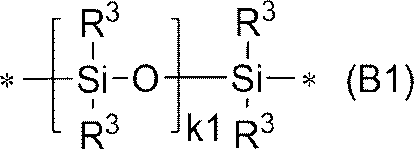
式(B1)中、
R3は、それぞれ独立に、炭化水素基であり、
k1は、1以上の数であり、
*は、隣接する原子との結合部位である。
<4>
第1化合物は、下記式(C)で表される化合物である、<1>~<3>のいずれか1つに記載の組成物。

式(C)中、
T11は、反応性シリル基を含まない1価の基であり、
Bは、それぞれ独立に、-O-又は-C(=O)-であり、
rは、それぞれ独立に、0又は1であり、
R3は、それぞれ独立に、炭化水素基であり、
k1は、それぞれ独立に、1以上の数であり、
p1は、1以上の整数であり、
A11は、(p1+q1)価の連結基であり、
q1は、1以上の整数であり、
R2は、それぞれ独立に、炭化水素基であり、
Lは、それぞれ独立に、加水分解性基、加水分解性基を有する基、又は水酸基であり、
nは、それぞれ独立に、0~2の整数である。
<5>
式(C)において、k1が2~600である、<4>に記載の組成物。
<6>
式(C)において、q1は1~4の整数である、<4>又は<5>に記載の組成物。
<7>
第2化合物において、反応性シリル基bは炭化水素基の一方の末端のみに連結される、<1>~<6>のいずれか1つに記載の組成物。
<8>
前記第2化合物は、式(G)で表される化合物である、<1>~<7>のいずれか1つに記載の組成物。
(R71-R72)p7-A71-(Si(R2)nL3-n)q2 …(G)
式(G)中、
R71は、水素原子、又は、[(CH3)3Q71-R73-]m7Q72(CH3)3-m7-であり、
Q71及びQ72、はそれぞれ独立に、C又はSiであり、
R73は、それぞれ独立に、炭素数1~6のアルキレン基であり、
m7は、0~3の整数であり、
R72は、アルキレン基であって、炭素数が2以上の場合、炭素-炭素原子間に、-O-、-S-、-C(=O)NH-、-NHC(=O)-、-C(=O)O-、-OC(=O)-、-C(=O)S-、-SC(=O)-、-S(=O)2NH-、-NHS(=O)2-、-S(=O)2O-、-OS(=O)2-、及びフェニレン基より選択される基を1個以上有していてもよく、
A71は、単結合又は(p7+q2)価の連結基であり、
R2は、それぞれ独立に、炭化水素基であり、
Lは、それぞれ独立に、加水分解性基、加水分解性基を有する基、又は水酸基であり、
nは、0~2の整数であり、
p7は1以上の整数であり、
q2は、1以上の整数である。
<9>
前記第2化合物は、下記式(E)で表される化合物である、<1>~<8>のいずれか1つに記載の組成物。
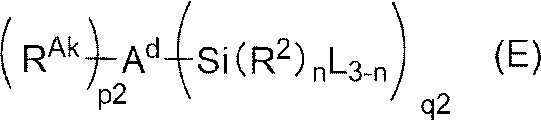
式(E)中、
RAkは、それぞれ独立に、アルキル基であり、
Adは、単結合、又は酸素原子以外の(p2+q2)価の連結基であり、
p2及びq2は、それぞれ独立に、1以上の整数であり、
R2は、それぞれ独立に、炭化水素基であり、
Lは、それぞれ独立に、加水分解性基、加水分解性基を有する基、又は水酸基であり、
nは、0~2の整数である。
<10>
前記RAkが炭素数4~50のアルキル基である、<9>に記載の組成物。
<11>
前記第2化合物は、下記式(F)で表される化合物である、<1>~<10>のいずれか1つに記載の組成物。
R71-L1-(Si(R2)nL3-n)q2 …(F)
式(F)中、
R71は、水素原子、又は、[(CH3)3Q71-R73-]m7Q72(CH3)3-m7-であり、
Q71及びQ72、はそれぞれ独立に、C又はSiであり、
ただし、Q71及びQ72のうち、少なくとも一つがSiであり、
R73はそれぞれ独立に、炭素数1~6のアルキレン基であり、
m7は、0~3の整数であり、
L1は、炭素数が13以上のアルキレン基であって、炭素-炭素原子間に、-O-、-S-、-C(=O)NH-、-NHC(=O)-、-C(=O)O-、-OC(=O)-、-C(=O)S-、-SC(=O)-、-S(=O)2NH-、-NHS(=O)2-、-S(=O)2O-、-OS(=O)2-、及びフェニレン基より選択される基を1個以上有していてもよく、
R2は、それぞれ独立に、炭化水素基であり、
Lは、それぞれ独立に、加水分解性基、加水分解性基を有する基、又は水酸基であり、
nは、0~2の整数であり、
q2は、1以上の整数である。
<12>
前記L1が、炭素数が13~36のアルキレン基である、<11>に記載の組成物。
<13>
前記R1が、(CH3)3Si-である、<11>又は<12>に記載の組成物。
<14>
第1化合物に対する第2化合物の質量比率は、0.01~0.9である、<1>~<13>のいずれか1つに記載の組成物。
<15>
更に液状媒体を含む、<1>~<14>のいずれか1つに記載の組成物。
<16>
<1>~<15>のいずれか1つに記載の組成物からなる表面処理剤。
<17>
基材に対して、<16>に記載の表面処理剤を用いて表面処理を行い、基材上に表面処理層が形成された物品を製造する、物品の製造方法。
<18>
基材と、基材上に配置され、<16>に記載の表面処理剤で表面処理された表面処理層と、を含む物品。
<19>
光学部材である、<18>に記載の物品。
<20>
ディスプレイ又はタッチパネルである、<18>に記載の物品。
<1>
オルガノ(ポリ)シロキサン残基と、反応性シリル基aと、を有する第1化合物、及び、
オルガノ(ポリ)シロキサン残基を有さず、酸素原子と直接結合しない炭化水素基であって官能基又は置換基を有してもよい炭素数4以上の炭化水素基と、反応性シリル基bと、を有する第2化合物を含み、
下記要件(1)及び(2)のうち少なくとも1つを満たす、組成物。
要件(1):第1化合物において、反応性シリル基aはオルガノ(ポリ)シロキサン残基の少なくとも一方の末端に2つ以上連結される。
要件(2):第2化合物において、反応性シリル基bは炭化水素基の少なくとも一方の末端に2つ以上連結される。
<2>
反応性シリル基a及び反応性シリル基bはそれぞれ独立に、下記式(S1)又は下記式(S2)で表される、<1>に記載の組成物。
-Si(R2)nL3-n …(S1)
-[Si(L2)2-Q]n12-Si(L2)3 …(S2)
ただし、
R2は、それぞれ独立に、1価の炭化水素基であり、
Lは、それぞれ独立に、加水分解性基、加水分解性基を有する基、又は水酸基であり、
L2は、それぞれ独立に、加水分解性基、加水分解性基を有する基、水酸基、又は炭化水素基であり、
L2のうち、少なくとも4個のL2は、加水分解性基、加水分解性基を有する基、又は水酸基であり、
Qは、それぞれ独立に、酸素原子、又は、両隣のSiと結合する1つの炭素原子を有する有機基であり、
nは、0~2の整数であり、
n12は、1~3の整数である。
<3>
第1化合物に含まれるオルガノ(ポリ)シロキサン残基は、下記式(B1)で表される、<1>又は<2>に記載の組成物。
R3は、それぞれ独立に、炭化水素基であり、
k1は、1以上の数であり、
*は、隣接する原子との結合部位である。
<4>
第1化合物は、下記式(C)で表される化合物である、<1>~<3>のいずれか1つに記載の組成物。
T11は、反応性シリル基を含まない1価の基であり、
Bは、それぞれ独立に、-O-又は-C(=O)-であり、
rは、それぞれ独立に、0又は1であり、
R3は、それぞれ独立に、炭化水素基であり、
k1は、それぞれ独立に、1以上の数であり、
p1は、1以上の整数であり、
A11は、(p1+q1)価の連結基であり、
q1は、1以上の整数であり、
R2は、それぞれ独立に、炭化水素基であり、
Lは、それぞれ独立に、加水分解性基、加水分解性基を有する基、又は水酸基であり、
nは、それぞれ独立に、0~2の整数である。
<5>
式(C)において、k1が2~600である、<4>に記載の組成物。
<6>
式(C)において、q1は1~4の整数である、<4>又は<5>に記載の組成物。
<7>
第2化合物において、反応性シリル基bは炭化水素基の一方の末端のみに連結される、<1>~<6>のいずれか1つに記載の組成物。
<8>
前記第2化合物は、式(G)で表される化合物である、<1>~<7>のいずれか1つに記載の組成物。
(R71-R72)p7-A71-(Si(R2)nL3-n)q2 …(G)
式(G)中、
R71は、水素原子、又は、[(CH3)3Q71-R73-]m7Q72(CH3)3-m7-であり、
Q71及びQ72、はそれぞれ独立に、C又はSiであり、
R73は、それぞれ独立に、炭素数1~6のアルキレン基であり、
m7は、0~3の整数であり、
R72は、アルキレン基であって、炭素数が2以上の場合、炭素-炭素原子間に、-O-、-S-、-C(=O)NH-、-NHC(=O)-、-C(=O)O-、-OC(=O)-、-C(=O)S-、-SC(=O)-、-S(=O)2NH-、-NHS(=O)2-、-S(=O)2O-、-OS(=O)2-、及びフェニレン基より選択される基を1個以上有していてもよく、
A71は、単結合又は(p7+q2)価の連結基であり、
R2は、それぞれ独立に、炭化水素基であり、
Lは、それぞれ独立に、加水分解性基、加水分解性基を有する基、又は水酸基であり、
nは、0~2の整数であり、
p7は1以上の整数であり、
q2は、1以上の整数である。
<9>
前記第2化合物は、下記式(E)で表される化合物である、<1>~<8>のいずれか1つに記載の組成物。
RAkは、それぞれ独立に、アルキル基であり、
Adは、単結合、又は酸素原子以外の(p2+q2)価の連結基であり、
p2及びq2は、それぞれ独立に、1以上の整数であり、
R2は、それぞれ独立に、炭化水素基であり、
Lは、それぞれ独立に、加水分解性基、加水分解性基を有する基、又は水酸基であり、
nは、0~2の整数である。
<10>
前記RAkが炭素数4~50のアルキル基である、<9>に記載の組成物。
<11>
前記第2化合物は、下記式(F)で表される化合物である、<1>~<10>のいずれか1つに記載の組成物。
R71-L1-(Si(R2)nL3-n)q2 …(F)
式(F)中、
R71は、水素原子、又は、[(CH3)3Q71-R73-]m7Q72(CH3)3-m7-であり、
Q71及びQ72、はそれぞれ独立に、C又はSiであり、
ただし、Q71及びQ72のうち、少なくとも一つがSiであり、
R73はそれぞれ独立に、炭素数1~6のアルキレン基であり、
m7は、0~3の整数であり、
L1は、炭素数が13以上のアルキレン基であって、炭素-炭素原子間に、-O-、-S-、-C(=O)NH-、-NHC(=O)-、-C(=O)O-、-OC(=O)-、-C(=O)S-、-SC(=O)-、-S(=O)2NH-、-NHS(=O)2-、-S(=O)2O-、-OS(=O)2-、及びフェニレン基より選択される基を1個以上有していてもよく、
R2は、それぞれ独立に、炭化水素基であり、
Lは、それぞれ独立に、加水分解性基、加水分解性基を有する基、又は水酸基であり、
nは、0~2の整数であり、
q2は、1以上の整数である。
<12>
前記L1が、炭素数が13~36のアルキレン基である、<11>に記載の組成物。
<13>
前記R1が、(CH3)3Si-である、<11>又は<12>に記載の組成物。
<14>
第1化合物に対する第2化合物の質量比率は、0.01~0.9である、<1>~<13>のいずれか1つに記載の組成物。
<15>
更に液状媒体を含む、<1>~<14>のいずれか1つに記載の組成物。
<16>
<1>~<15>のいずれか1つに記載の組成物からなる表面処理剤。
<17>
基材に対して、<16>に記載の表面処理剤を用いて表面処理を行い、基材上に表面処理層が形成された物品を製造する、物品の製造方法。
<18>
基材と、基材上に配置され、<16>に記載の表面処理剤で表面処理された表面処理層と、を含む物品。
<19>
光学部材である、<18>に記載の物品。
<20>
ディスプレイ又はタッチパネルである、<18>に記載の物品。
本発明の一実施形態によれば、基材に対して、撥水性及び耐摩耗性に優れた表面処理層を形成し得る組成物、及び表面処理剤が提供される。
本発明の一実施形態によれば、撥水性及び耐摩耗性に優れた表面処理層を有する物品及び物品の製造方法が提供される。
本発明の一実施形態によれば、撥水性及び耐摩耗性に優れた表面処理層を有する物品及び物品の製造方法が提供される。
本開示において「~」を用いて示された数値範囲には、「~」の前後に記載される数値がそれぞれ最小値及び最大値として含まれる。
本開示中に段階的に記載されている数値範囲において、一つの数値範囲で記載された上限値又は下限値は、他の段階的な記載の数値範囲の上限値又は下限値に置き換えてもよい。また、本明細書中に記載されている数値範囲において、その数値範囲の上限値又は下限値は、実施例に示されている値に置き換えてもよい。
本開示において、「表面処理層」とは、基材の表面に、表面処理によって形成される層を意味する。
本開示において、「Me」はメチル基を意味することがある。
本開示において、化合物又は基が特定の式(X)で表される場合、当該式(X)で表される化合物又は基をそれぞれ化合物(X)若しくは化合物X、及び基(X)若しくは基Xと記すことがある。
本開示において、オルガノ(ポリ)シロキサン残基とは、オルガノシロキサン残基又はオルガノポリシロキサン残基を意味する。
本開示中に段階的に記載されている数値範囲において、一つの数値範囲で記載された上限値又は下限値は、他の段階的な記載の数値範囲の上限値又は下限値に置き換えてもよい。また、本明細書中に記載されている数値範囲において、その数値範囲の上限値又は下限値は、実施例に示されている値に置き換えてもよい。
本開示において、「表面処理層」とは、基材の表面に、表面処理によって形成される層を意味する。
本開示において、「Me」はメチル基を意味することがある。
本開示において、化合物又は基が特定の式(X)で表される場合、当該式(X)で表される化合物又は基をそれぞれ化合物(X)若しくは化合物X、及び基(X)若しくは基Xと記すことがある。
本開示において、オルガノ(ポリ)シロキサン残基とは、オルガノシロキサン残基又はオルガノポリシロキサン残基を意味する。
[組成物]
本開示の組成物は、オルガノ(ポリ)シロキサン残基と、反応性シリル基aとを有する第1化合物、及び、オルガノ(ポリ)シロキサン残基を有さず、酸素原子と直接結合しない炭化水素基であって官能基又は置換基を有してもよい炭素数4以上の炭化水素基と、反応性シリル基bと、を有する第2化合物を含み、下記要件(1)及び(2)のうち少なくとも1つを満たす。
要件(1):第1化合物において、反応性シリル基aはオルガノ(ポリ)シロキサン残基の少なくとも一方の末端に2つ以上連結される。
要件(2):第2化合物において、反応性シリル基bは炭化水素基の少なくとも一方の末端に2つ以上連結される。
本開示の組成物は、オルガノ(ポリ)シロキサン残基と、反応性シリル基aとを有する第1化合物、及び、オルガノ(ポリ)シロキサン残基を有さず、酸素原子と直接結合しない炭化水素基であって官能基又は置換基を有してもよい炭素数4以上の炭化水素基と、反応性シリル基bと、を有する第2化合物を含み、下記要件(1)及び(2)のうち少なくとも1つを満たす。
要件(1):第1化合物において、反応性シリル基aはオルガノ(ポリ)シロキサン残基の少なくとも一方の末端に2つ以上連結される。
要件(2):第2化合物において、反応性シリル基bは炭化水素基の少なくとも一方の末端に2つ以上連結される。
本開示の組成物によれば、撥水性及び耐摩耗性に優れた表面処理層を形成できる。
このような効果が得られる理由は定かではないが、以下のように推測される。
このような効果が得られる理由は定かではないが、以下のように推測される。
本開示の組成物に含まれる第1化合物がオルガノ(ポリ)シロキサン残基を有することにより撥水性に優れる。また、本開示の組成物に含まれる第2化合物が、酸素原子と直接結合しない炭化水素基であって官能基又は置換基を有してもよい炭素数4以上の炭化水素基を含むことにより、耐摩耗性に優れる。要件(1)及び要件(2)のうち少なくとも一方を満たすということは、第1化合物及び第2化合物のうち少なくとも一方において、少なくとも一方の末端に反応性シリル基が2つ以上連結されていることを意味する。特に、反応性シリル基は、少なくとも一方の末端に2つ以上連結されることから、一の化合物において2つ以上の反応性シリル基が互いに近接して存在することができる。そのため、基材との密着性に優れ、撥水性及び耐摩耗性を両立できると考えられる。
特許文献1~3には、上記要件(1)及び(2)のうち少なくとも1つを満たす、第1化合物及び第2化合物との組み合わせに関する記載はない。
以下、本開示の組成物に含まれる各成分について、詳細に説明する。
<第1化合物>
第1化合物は、オルガノ(ポリ)シロキサン残基と、反応性シリル基aと、を有する。本開示の組成物は、第1化合物を1種のみ含んでいてもよく、2種以上含んでいてもよい。
第1化合物は、オルガノ(ポリ)シロキサン残基と、反応性シリル基aと、を有する。本開示の組成物は、第1化合物を1種のみ含んでいてもよく、2種以上含んでいてもよい。
(オルガノ(ポリ)シロキサン残基)
第1化合物は、オルガノ(ポリ)シロキサン残基を含む。第1化合物に含まれるオルガノ(ポリ)シロキサン残基は1つであっても2つ以上であってもよい。第1化合物に2つ以上のオルガノ(ポリ)シロキサン残基が含まれる場合、2つ以上のオルガノ(ポリ)シロキサン残基は同じであっても異なってもよい。
第1化合物は、オルガノ(ポリ)シロキサン残基を含む。第1化合物に含まれるオルガノ(ポリ)シロキサン残基は1つであっても2つ以上であってもよい。第1化合物に2つ以上のオルガノ(ポリ)シロキサン残基が含まれる場合、2つ以上のオルガノ(ポリ)シロキサン残基は同じであっても異なってもよい。
オルガノ(ポリ)シロキサン残基としては、鎖状オルガノ(ポリ)シロキサン残基、環状オルガノ(ポリ)シロキサン残基、及びかご状オルガノ(ポリ)シロキサン残基が挙げられる。中でも、オルガノ(ポリ)シロキサン残基は、鎖状オルガノ(ポリ)シロキサン残基が好ましく、2価の鎖状オルガノ(ポリ)シロキサン残基がより好ましい。
オルガノ(ポリ)シロキサン残基としては、下記式(B1)又は(B2)で表される鎖状オルガノ(ポリ)シロキサン残基が挙げられる。中でも、オルガノ(ポリ)シロキサン残基は、式(B1)が好ましい。

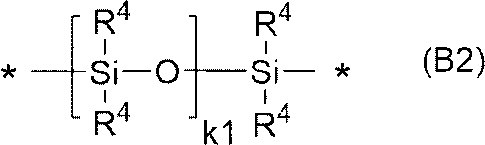
式(B1)中、
R3は、それぞれ独立に、炭化水素基であり、
k1は、1以上の数であり、
*は、隣接する原子との結合部位である。
R3は、それぞれ独立に、炭化水素基であり、
k1は、1以上の数であり、
*は、隣接する原子との結合部位である。
式(B2)中、
R4は、それぞれ独立に、炭化水素基又はT11-Br-(SiR3 2-O)k1-であり、
T11は、それぞれ独立に、1価の基であり、
Bは、それぞれ独立に、-O-又は-C(=O)-であり、
rは、それぞれ独立に、0又は1であり、
R3は、それぞれ独立に、炭化水素基であり、
k1は、それぞれ独立に、1以上の数であり、
*は、隣接する原子との結合部位である。
R4は、それぞれ独立に、炭化水素基又はT11-Br-(SiR3 2-O)k1-であり、
T11は、それぞれ独立に、1価の基であり、
Bは、それぞれ独立に、-O-又は-C(=O)-であり、
rは、それぞれ独立に、0又は1であり、
R3は、それぞれ独立に、炭化水素基であり、
k1は、それぞれ独立に、1以上の数であり、
*は、隣接する原子との結合部位である。
式(B1)及び(B2)中、R3で表される炭化水素基としては、例えば、脂肪族炭化水素基及び芳香族炭化水素基が挙げられる。中でも、炭化水素基は、脂肪族炭化水素基が好ましく、アルキル基がより好ましい。アルキル基は、直鎖状アルキル基、分岐鎖状アルキル基、及び環状アルキル基のいずれであってもよいが、直鎖状アルキル基が好ましく、メチル基、エチル基、n-プロピル基、又はn-ブチル基がより好ましく、メチル基が更に好ましい。また、芳香族炭化水素基としては、フェニル基が好ましい。
式(B1)及び(B2)中、k1は1以上の数であり、1~600の数が好ましく、1~500の数がより好ましく、3~500の数が更に好ましく、9~50の数が特に好ましく、11~30の数が極めて好ましく、11~25の数が最も好ましい。
式(B2)中、R4は、それぞれ独立に、炭化水素基又はT11-Br-(SiR3
2-O)k1-であり、炭化水素基が好ましい。炭化水素基の詳細は、R3で表される炭化水素基と同様である。
T11は、それぞれ独立に、1価の基であり、具体的態様は後述の式(C)におけるT11と同様である。
B及びrの具体的態様は後述の式(C)におけるB及びrと同様である。
B及びrの具体的態様は後述の式(C)におけるB及びrと同様である。
(反応性シリル基)
第1化合物に含まれる反応性シリル基aの数は、1以上であり、表面処理層の耐摩耗性をより向上させる観点から、2~18が好ましく、2~12がより好ましく、2~8が更に好ましく、2~4が特に好ましい。反応性シリル基の数は1であってもよい。
第1化合物に含まれる反応性シリル基aの数は、1以上であり、表面処理層の耐摩耗性をより向上させる観点から、2~18が好ましく、2~12がより好ましく、2~8が更に好ましく、2~4が特に好ましい。反応性シリル基の数は1であってもよい。
反応性シリル基とは、Si原子に反応性基が結合した基を意味する。反応性基としては、加水分解性基、加水分解性基を有する基、又は水酸基が好ましい。
加水分解性基は、加水分解反応により水酸基となる基である。すなわち、Si-L1で表される加水分解性を有するシリル基は、加水分解反応によりSi-OHで表されるシラノール基となる。シラノール基は、更にシラノール基間で反応してSi-O-Si結合を形成する。また、シラノール基は、基材の表面に存在する酸化物に由来するシラノール基と脱水縮合反応して、Si-O-Si結合を形成できる。
加水分解性基としては、例えば、アルコキシ基、アリールオキシ基、ハロゲン原子、アシル基、アシルオキシ基、アミノ基、-O-N=CRr
2及びイソシアナト基(-NCO)が挙げられる。アルコキシ基は、炭素数1~4のアルコキシ基であることが好ましい。
アリールオキシ基は、炭素数3~10のアリールオキシ基であることが好ましい。ただし、アリールオキシ基のアリール基は、ヘテロアリール基を含む。ハロゲン原子は、塩素原子であることが好ましい。アシル基は、炭素数1~6のアシル基であることが好ましい。
アシルオキシ基は、炭素数1~6のアシルオキシ基であることが好ましい。Rrはそれぞれ独立に、炭素数1~10のアルキル基である。
アリールオキシ基は、炭素数3~10のアリールオキシ基であることが好ましい。ただし、アリールオキシ基のアリール基は、ヘテロアリール基を含む。ハロゲン原子は、塩素原子であることが好ましい。アシル基は、炭素数1~6のアシル基であることが好ましい。
アシルオキシ基は、炭素数1~6のアシルオキシ基であることが好ましい。Rrはそれぞれ独立に、炭素数1~10のアルキル基である。
加水分解性基を有する基としては、例えば、上記で例示される加水分解性基を有する基であればよい。加水分解性基を有する基は、-O-LA-LBが好ましい。LAは2価の連結基であり、LBは加水分解性基である。LAにおける2価の連結基としては、アルキレン基が好ましく、アルキレン基の炭素数は、1~10が好ましく、炭素原子-炭素原子間に酸素原子を有していてもよい。LBで表される加水分解性基は、上述したR1で表される加水分解性基と同義であり、好適態様も同じである。加水分解性基を有する基の具体例としては、-O-CH2CH2-OCH3が挙げられる。
反応性シリル基は、下記式(S1)又は下記式(S2)で表される基が好ましい。
-Si(R2)nL3-n …(S1)
-[Si(L2)2-Q]n12-Si(L2)3 …(S2)
ただし、
R2は、それぞれ独立に、1価の炭化水素基であり、
Lは、それぞれ独立に、加水分解性基、加水分解性基を有する基、又は水酸基であり、
L2は、それぞれ独立に、加水分解性基、加水分解性基を有する基、水酸基、又は炭化水素基であり、
L2のうち、少なくとも4個のL2は、加水分解性基、加水分解性基を有する基、又は水酸基であり、
Qは、それぞれ独立に、酸素原子、又は、両隣のSiと結合する1つの炭素原子を有する有機基であり、
nは、0~2の整数であり、
n12は、1~3の整数である。
-Si(R2)nL3-n …(S1)
-[Si(L2)2-Q]n12-Si(L2)3 …(S2)
ただし、
R2は、それぞれ独立に、1価の炭化水素基であり、
Lは、それぞれ独立に、加水分解性基、加水分解性基を有する基、又は水酸基であり、
L2は、それぞれ独立に、加水分解性基、加水分解性基を有する基、水酸基、又は炭化水素基であり、
L2のうち、少なくとも4個のL2は、加水分解性基、加水分解性基を有する基、又は水酸基であり、
Qは、それぞれ独立に、酸素原子、又は、両隣のSiと結合する1つの炭素原子を有する有機基であり、
nは、0~2の整数であり、
n12は、1~3の整数である。
反応性シリル基が1分子中に複数ある場合、複数の反応性シリル基は、同じであってもよく、互いに異なっていてもよい。原料の入手容易性、及び、化合物の製造容易性の観点からは、複数の反応性シリル基は、同じであることが好ましい。
R2はそれぞれ独立に、1価の炭化水素基であり、1価の飽和炭化水素基が好ましい。 R2の炭化水素基としては、アルキル基、シクロアルキル基、アルケニル基、アリル基等が挙げられ、合成の容易性等の点から、飽和炭化水素基が好ましく、アルキル基がより好ましい。当該炭化水素基の炭素数は、1~6が好ましく、1~3がより好ましく、1~2が更に好ましい。R2の炭素数は、1~6が好ましく、1~3がより好ましく、1~2が更に好ましい。
Lは、それぞれ独立に、加水分解性基、加水分解性基を有する基、又は水酸基である。L2は、それぞれ独立に、加水分解性基、加水分解性基を有する基、水酸基、又は炭化水素基である。L及びL2における加水分解性基の詳細は、上記の通りである。
中でも、L及びL2は、化合物の製造容易性の観点から、炭素数1~4のアルコキシ基アルキレンオキサイド変性アルコキシ基又はハロゲン原子であることが好ましい。L及びL2は、塗布時のアウトガスが少なく、化合物の保存安定性がより優れる点から、炭素数1~4のアルコキシ基であることが好ましく、エトキシ基又はメトキシ基がより好ましい。
nは、0~2の整数であり、0又は1が好ましく、0がより好ましい。Lが複数存在することによって、表面処理層の基材への密着性がより強固になる。
n12は、1~3の整数であり、合成の容易性の点からは1~2が好ましく、1がより好ましい。
1分子中に存在する複数のL又はL2は、同じであってもよく、互いに異なっていてもよい。原料の入手容易性、及び、化合物の製造容易性の観点から、複数のLは同じであることが好ましい。1分子中に存在する複数のR2は同じであってもよく、互いに異なっていてもよい。原料の入手容易性、及び、化合物の製造容易性の観点から、複数のR2は同じであることが好ましい。
Qは、それぞれ独立に、酸素原子、又は、両隣のSiと結合する1つの炭素原子を有する有機基である。ここで「両隣のSiと結合する1つの炭素原子を有する有機基」とは、1つの炭素原子を介してSi同士が連結することを意味する。Qにおける有機基は、一例として、-CR8
2-で表される基が挙げられる。ここでR8はそれぞれ独立に、水素原子又は炭化水素基である。R8における炭化水素基は、炭素数1~6のアルキル基が挙げられ、炭素数1~3のアルキル基が好ましい。表面処理層の耐久性の観点からは、Qとしては、酸素原子、-CH2-、又は-C(CH3)2-が好ましく、酸素原子又は-CH2-がより好ましく、酸素原子が更に好ましい。
基(S2)は、表面処理層の耐久性に優れる点から、-[Si(OR18)2-O]n12-Si(OR18)3が好ましく、中でも、n12=1である-Si(OR18)2-O-Si(OR18)3が特に好ましい。ただし、R18はそれぞれ独立に、炭化水素基である。当該炭化水素基としては、アルキル基、シクロアルキル基、アルケニル基、アリル基が挙げられ、合成の容易性の点から、飽和炭化水素基が好ましく、アルキル基がより好ましい。R2の炭素数は、1~6が好ましく、1~3がより好ましく、1~2が更に好ましい。
基(S2)の具体例としては、-Si(OCH3)2-O-Si(OCH3)3、-Si(OCH3)2-CH2-Si(OCH3)3、-Si(OCH3)2-C(CH3)2-Si(OCH3)3、-Si(OCH2CH3)2-O-Si(OCH3)3、-Si(OCH3)2-O-Si(OCH2CH3)3、-Si(OCH2CH3)2-O-Si(OCH2CH3)3、-Si(OCH2CH3)2-CH2-Si(OCH3)3、-Si(OCH3)2-CH2-Si(OCH2CH3)3、-Si(OCH2CH3)2-CH2-Si(OCH2CH3)3、-Si(OCH2CH3)2-C(CH3)2-Si(OCH3)3、-Si(OCH3)2-C(CH3)2-Si(OCH2CH3)3、-Si(OCH2CH3)2-C(CH3)2-Si(OCH2CH3)3、-Si(OH)2-O-Si(OH)3、-Si(OH)2-O-Si(OCH3)3、-Si(OCH3)2-O-Si(OH)3、-Si(OH)2-CH2-Si(OH)3、-Si(OH)2-CH2-Si(OCH3)3、-Si(OCH3)2-CH2-Si(OH)3、-Si(OH)2-C(CH3)2-Si(OH)3、-Si(OH)2-C(CH3)2-Si(OCH3)3、-Si(OCH3)2-C(CH3)2-Si(OH)3が挙げられる。
表面処理層の均一性及び耐久性に優れる観点から、反応性シリル基はアルコキシシリル基又はトリクロロシリル基であることが好ましい。基材との反応において生じる副生物の取り扱いやすさの観点から、反応性シリル基は、アルコキシシリル基であることがより好ましい。アルコキシシリル基としては、ジアルコキシシリル基又はトリアルコキシシリル基が好ましく、トリアルコキシシリル基がより好ましい。
また、反応性シリル基は、下記式(S3)で表される基であってもよい。
>SiL2 …(S3)
Lは、式(S1)におけるLと同様である。
>SiL2 …(S3)
Lは、式(S1)におけるLと同様である。
第1化合物の数平均分子量(Mn)は、500~20,000であることが好ましく、600~18,000であることがより好ましく、700~15,000であることが更に好ましい。
Mnが500以上であれば、表面処理層の耐摩耗性がより優れる。Mnが20,000以下であれば、粘性を適切な範囲内に調節しやすく、また溶解性が向上するので、成膜時のハンドリング性が優れる。
Mnが500以上であれば、表面処理層の耐摩耗性がより優れる。Mnが20,000以下であれば、粘性を適切な範囲内に調節しやすく、また溶解性が向上するので、成膜時のハンドリング性が優れる。
本開示の組成物は、第1化合物の製造工程で生成した副生物等の不純物を含んでもよい。
第1化合物の含有量は、本開示の組成物の全量に対して、0.001~50質量%が好ましく、0.01~20質量%がより好ましく、0.1~10質量%が更に好ましい。ウェットコーティング法に使用する本開示の組成物の場合には、第1化合物の含有量は、本開示の組成物の全量に対して、0.01~10質量%であってもよく、0.02~5質量%であってもよく、0.03~3質量%であってもよく、0.05~2質量%であってもよい。
第1化合物としては、鎖状オルガノ(ポリ)シロキサン残基と、前記鎖状オルガノ(ポリ)シロキサン残基の一方の末端のみに連結される反応性シリル基とを有する化合物(以下、「第1化合物S」とも記す。)、及び、鎖状オルガノ(ポリ)シロキサン残基と、前記鎖状オルガノ(ポリ)シロキサン残基の両末端にそれぞれ連結される反応性シリル基を有する化合物(以下、「第1化合物D」とも記す。)が挙げられる。
第1化合物として、第1化合物Sを単独で用いてもよく、第1化合物Dを単独で用いてもよく、第1化合物Sと第1化合物Dを組み合わせて用いてもよい。いずれの場合も、第1化合物Sとして1種を単独で用いてもよく、2種以上を併用してもよく、第1化合物Dとして1種を単独で用いてもよく、2種以上を併用してもよい。
第1化合物として、第1化合物Sを単独で用いてもよく、第1化合物Dを単独で用いてもよく、第1化合物Sと第1化合物Dを組み合わせて用いてもよい。いずれの場合も、第1化合物Sとして1種を単独で用いてもよく、2種以上を併用してもよく、第1化合物Dとして1種を単独で用いてもよく、2種以上を併用してもよい。
〔第1化合物S〕
第1化合物Sは、鎖状オルガノ(ポリ)シロキサン残基と、前記鎖状オルガノ(ポリ)シロキサン残基の一方の末端のみに連結される反応性シリル基とを有する。本開示において、「鎖状オルガノ(ポリ)シロキサン残基の一方の末端のみに連結される反応性シリル基」とは、鎖状オルガノ(ポリ)シロキサン残基の一方の末端のみに直接又は他の化学構造を介して間接的に連結される反応性シリル基を意味する。
第1化合物Sは、鎖状オルガノ(ポリ)シロキサン残基と、前記鎖状オルガノ(ポリ)シロキサン残基の一方の末端のみに連結される反応性シリル基とを有する。本開示において、「鎖状オルガノ(ポリ)シロキサン残基の一方の末端のみに連結される反応性シリル基」とは、鎖状オルガノ(ポリ)シロキサン残基の一方の末端のみに直接又は他の化学構造を介して間接的に連結される反応性シリル基を意味する。
(鎖状オルガノ(ポリ)シロキサン残基)
第1化合物Sは、鎖状オルガノ(ポリ)シロキサン残基を含む。第1化合物Sに含まれる鎖状オルガノ(ポリ)シロキサン残基は1つであっても2つ以上であってもよい。第1化合物Sに2つ以上の鎖状オルガノ(ポリ)シロキサン残基が含まれる場合、2つ以上の鎖状オルガノ(ポリ)シロキサン残基は同じであっても異なってもよい。第1化合物Sに2つ以上の鎖状オルガノ(ポリ)シロキサン残基が含まれる場合、両末端側に反応性シリル基が連結された鎖状オルガノ(ポリ)シロキサン残基がなく、かつ少なくとも1つの鎖状オルガノ(ポリ)シロキサン残基において、一方の末端側に反応性シリル基が連結されていればよい。
第1化合物Sは、鎖状オルガノ(ポリ)シロキサン残基を含む。第1化合物Sに含まれる鎖状オルガノ(ポリ)シロキサン残基は1つであっても2つ以上であってもよい。第1化合物Sに2つ以上の鎖状オルガノ(ポリ)シロキサン残基が含まれる場合、2つ以上の鎖状オルガノ(ポリ)シロキサン残基は同じであっても異なってもよい。第1化合物Sに2つ以上の鎖状オルガノ(ポリ)シロキサン残基が含まれる場合、両末端側に反応性シリル基が連結された鎖状オルガノ(ポリ)シロキサン残基がなく、かつ少なくとも1つの鎖状オルガノ(ポリ)シロキサン残基において、一方の末端側に反応性シリル基が連結されていればよい。
鎖状オルガノ(ポリ)シロキサン残基の詳細は、第1化合物に含まれる鎖状オルガノ(ポリ)シロキサン残基の項において前述した通りである。特に、鎖状オルガノ(ポリ)シロキサン残基は、式(B1)又は(B2)で表されることが好ましく、式(B1)で表されることがより好ましい。
(反応性シリル基)
反応性シリル基の詳細は第1化合物に含まれる反応性シリル基の項において前述した通りである。
第1化合物Sに含まれる反応性シリル基の数は、鎖状オルガノ(ポリ)シロキサン残基の一方の末端あたり、1以上であり、表面処理層の耐摩耗性をより向上させる観点から、鎖状オルガノ(ポリ)シロキサン残基の一方の末端あたり、1~18が好ましく、1~12がより好ましく、1~8が更に好ましく、1~6が特に好ましい。一態様において、第1化合物Sに含まれる反応性シリル基の数は、鎖状オルガノ(ポリ)シロキサン残基の一方の末端あたり、2~18が好ましく、2~12がより好ましく、2~8が更に好ましく、2~6が特に好ましい。反応性シリル基の数は、鎖状オルガノ(ポリ)シロキサン残基の一方の末端あたり、1であってもよい。
反応性シリル基の詳細は第1化合物に含まれる反応性シリル基の項において前述した通りである。
第1化合物Sに含まれる反応性シリル基の数は、鎖状オルガノ(ポリ)シロキサン残基の一方の末端あたり、1以上であり、表面処理層の耐摩耗性をより向上させる観点から、鎖状オルガノ(ポリ)シロキサン残基の一方の末端あたり、1~18が好ましく、1~12がより好ましく、1~8が更に好ましく、1~6が特に好ましい。一態様において、第1化合物Sに含まれる反応性シリル基の数は、鎖状オルガノ(ポリ)シロキサン残基の一方の末端あたり、2~18が好ましく、2~12がより好ましく、2~8が更に好ましく、2~6が特に好ましい。反応性シリル基の数は、鎖状オルガノ(ポリ)シロキサン残基の一方の末端あたり、1であってもよい。
(化合物(C))
一態様において、第1化合物Sは、下記式(C)で表されることが好ましい。
一態様において、第1化合物Sは、下記式(C)で表されることが好ましい。

式(C)中、
T11は、反応性シリル基を含まない1価の基であり、
Bは、それぞれ独立に、-O-又は-C(=O)-であり、
rは、それぞれ独立に、0又は1であり、
R3は、それぞれ独立に、炭化水素基であり、
k1は、それぞれ独立に、1以上の数であり、
p1は、1以上の整数であり、
A11は、(p1+q1)価の連結基であり、
q1は、1以上の整数であり、
R2は、それぞれ独立に、炭化水素基であり、
Lは、それぞれ独立に、加水分解性基、加水分解性基を有する基、又は水酸基であり、
nは、それぞれ独立に、0~2の整数である。
T11は、反応性シリル基を含まない1価の基であり、
Bは、それぞれ独立に、-O-又は-C(=O)-であり、
rは、それぞれ独立に、0又は1であり、
R3は、それぞれ独立に、炭化水素基であり、
k1は、それぞれ独立に、1以上の数であり、
p1は、1以上の整数であり、
A11は、(p1+q1)価の連結基であり、
q1は、1以上の整数であり、
R2は、それぞれ独立に、炭化水素基であり、
Lは、それぞれ独立に、加水分解性基、加水分解性基を有する基、又は水酸基であり、
nは、それぞれ独立に、0~2の整数である。
式(C)中、R3及びk1は、式(B1)におけるR3及びk1と同様である。
R2、L、及びnは、式(S1)におけるR2、L、及びnと同様である。
R2、L、及びnは、式(S1)におけるR2、L、及びnと同様である。
式(C)中、T11は1価の基である。
T11としては、アルキル基、T1 3M1-(ここで、M1は、Si、Sn、又はGeであり、T1は、それぞれ独立に、炭化水素基又はトリアルキルシリルオキシ基である。)、T1 3M1-R1-(ここで、M1は、Si、Sn、又はGeであり、T1は、それぞれ独立に、炭化水素基又はトリアルキルシリルオキシ基であり、R1はアルキレン基である)、1価の環状のポリシロキサン残基又は1価のかご状のポリシロキサン残基、及び1価の環状のポリシロキサン残基又は1価のかご状のポリシロキサン残基と2価の炭化水素基との組み合わせが挙げられる。
T11としては、アルキル基、T1 3M1-(ここで、M1は、Si、Sn、又はGeであり、T1は、それぞれ独立に、炭化水素基又はトリアルキルシリルオキシ基である。)、T1 3M1-R1-(ここで、M1は、Si、Sn、又はGeであり、T1は、それぞれ独立に、炭化水素基又はトリアルキルシリルオキシ基であり、R1はアルキレン基である)、1価の環状のポリシロキサン残基又は1価のかご状のポリシロキサン残基、及び1価の環状のポリシロキサン残基又は1価のかご状のポリシロキサン残基と2価の炭化水素基との組み合わせが挙げられる。
T11で表されるアルキル基は、直鎖状アルキル基、分岐鎖状アルキル基、及び環状アルキル基のいずれであってもよく、直鎖状アルキル基又は分岐鎖状アルキル基が好ましい。アルキル基の炭素数は1であっても2以上であってもよい。アルキル基の炭素数が2以上である場合、炭素数は2~30であることが好ましく、3~28であることがより好ましく、4~22であることが更に好ましい。
T1
3M1-及びT1
3M1-R1-におけるM1としては、Siが好ましい。
T1
3M1-及びT1
3M1-R1-におけるT1としては、アルキル基又はトリアルキルシリルオキシ基が好ましく、メチル基、ブチルジメチルシリルオキシ基、トリメチルシリルオキシ基、又はトリエチルシリルオキシ基がより好ましい。
R1としては、炭素数1~20のアルキレン基が好ましく、炭素数1~10のアルキレン基がより好ましく、炭素数1~5のアルキレン基が更に好ましく、エチレン基が特に好ましい。
一態様において、T11は、アルキル基又はトリアルキルシリル基であることが好ましく、メチル基又はトリメチルシリル基であることがより好ましい。
1価の環状のポリシロキサン残基は、下記式(T1)で表される基が好ましい。
式(T1)中、
RTは、それぞれ独立に、炭化水素基又は置換基を有する炭化水素基であり、
sは、1~4の整数である。
式(T1)中、
RTは、それぞれ独立に、炭化水素基又は置換基を有する炭化水素基であり、
sは、1~4の整数である。
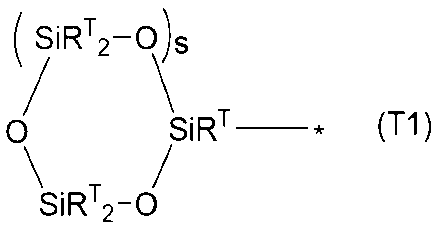
RTで表される炭化水素基としては、例えば、脂肪族炭化水素基及び芳香族炭化水素基が挙げられる。中でも、炭化水素基は、脂肪族炭化水素基が好ましく、アルキル基がより好ましい。
RTで表される炭化水素基のうち、アルキル基は、直鎖状アルキル基、分岐鎖状アルキル基、及び環状アルキル基のいずれであってもよいが、直鎖状アルキル基が好ましい。アルキル基の炭素数は1~10であることが好ましく、1~8であることがより好ましく、1~4であることが更に好ましい。具体的に、アルキル基は、メチル基、エチル基、n-プロピル基、又はn-ブチル基が好ましく、メチル基がより好ましい。
RTで表される置換基を有する炭化水素基に含まれる炭化水素基としては、例えば、脂肪族炭化水素基及び芳香族炭化水素基が挙げられる。中でも、炭化水素基は、脂肪族炭化水素基が好ましく、アルキル基がより好ましい。アルキル基は、直鎖状アルキル基、分岐鎖状アルキル基、及び環状アルキル基のいずれであってもよいが、直鎖状アルキル基が好ましい。置換アルキル基に含まれるアルキル基の炭素数は1~10であることが好ましく、1~8であることがより好ましく、2~4であることが更に好ましい。
RTで表される置換基を有する炭化水素基における置換基としては、例えば、ハロゲン原子、水酸基、アルコキシ基、トリアルキルシリルエーテル基、トリアルキルシリル基、アミノ基、ニトロ基、シアノ基、スルホニル基、及びトリフルオロメチル基が挙げられる。
複数のRTは同一であってもよく、互いに異なっていてもよいが、製造容易性の観点から、同一であることが好ましい。
1価の環状のポリシロキサン残基としては、例えば、以下の基が挙げられる。
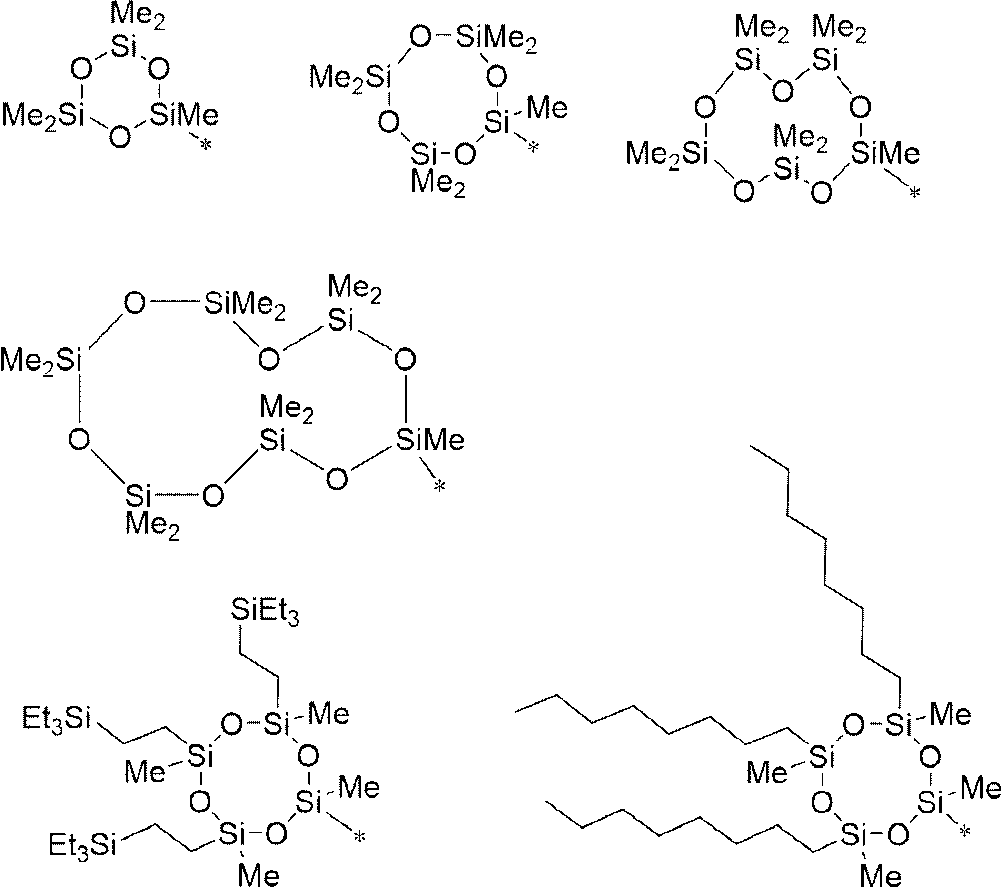
1価のかご状のポリシロキサン残基は下記式(T2)で表される基が好ましい。
式(T2)中、
R5はそれぞれ独立に、炭化水素基、又はトリアルキルシリルオキシ基である。
式(T2)中、
R5はそれぞれ独立に、炭化水素基、又はトリアルキルシリルオキシ基である。
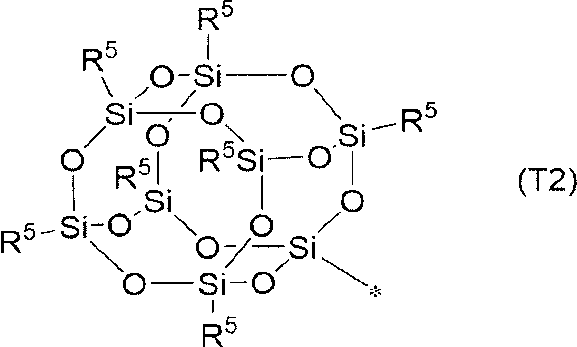
R5で表される炭化水素基としては、例えば、脂肪族炭化水素基及び芳香族炭化水素基が挙げられる。中でも、炭化水素基は、脂肪族炭化水素基が好ましく、アルキル基がより好ましい。アルキル基は、直鎖状アルキル基、分岐鎖状アルキル基、及び環状アルキル基のいずれであってもよいが、直鎖状アルキル基又は分岐鎖状アルキル基が好ましく、メチル基、エチル基、n-プロピル基、n-ブチル基、又は、イソブチル基がより好ましく、イソブチル基が更に好ましい。
R5で表されるトリアルキルシリルオキシ基に含まれるアルキル基は、直鎖状アルキル基、分岐鎖状アルキル基、及び環状アルキル基のいずれであってもよいが、直鎖状アルキル基が好ましく、メチル基、エチル基、n-プロピル基、又はn-ブチル基がより好ましく、メチル基が更に好ましい。R5がトリアルキルシリルオキシ基である場合、3つのアルキルシリルオキシ基は同一であってもよく、互いに異なっていてもよいが、製造容易性の観点から、同一であることが好ましい。
1価のかご状のポリシロキサン残基としては、例えば、以下の基が挙げられる。
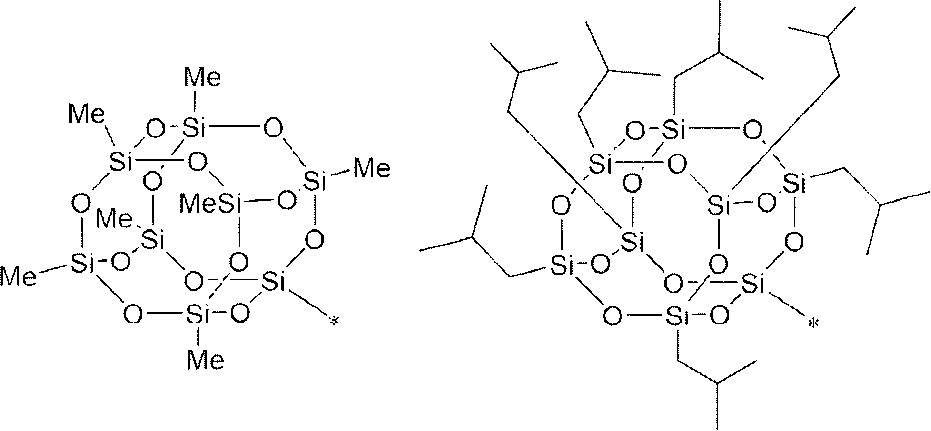
1価の環状のポリシロキサン残基又は1価のかご状のポリシロキサン残基と2価の炭化水素基との組み合わせにおける2価の炭化水素基としては、アルキレン基が挙げられる。アルキレン基の炭素数は1~20が好ましく、1~10がより好ましく、1~5が更に好ましい。
式(C)中、Bは、それぞれ独立に、-O-又は-C(=O)-であり、-O-が好ましい。また、式(C)中、rは0又は1であり、rが0のとき、T11はSiに直接結合する。
式(C)中、p1は、1以上の整数であり、1~3の整数が好ましく、1又は2がより好ましく、1が更に好ましい。
p1が2以上である場合、複数のT11-Br-[Si(R3)2-O]k1-Si(R3)2-は同一であってもよく、互いに異なっていてもよい。
p1が2以上である場合、複数のT11-Br-[Si(R3)2-O]k1-Si(R3)2-は同一であってもよく、互いに異なっていてもよい。
式(C)中、A11は、(p1+q1)価の連結基である。A11としては、アルキレン基、オルガノ(ポリ)シロキサン残基、ポリアルキレンオキシド基、及びこれらの組み合わせ;並びにこれらと(p1+1)価の基及び/又は(q1+1)価の基との組み合わせが挙げられる。
アルキレン基としては、エーテル性酸素原子を有していても有していなくてもよい、炭素数1~30のアルキレン基、好ましくは炭素数1~20のアルキレン基が挙げられる。
オルガノ(ポリ)シロキサン残基としては、前述の式(B1)で表される基が挙げられる。
ポリアルキレンオキシド基としては、式(XO)mで表される基が挙げられる。ここで、Xはそれぞれ独立に炭素数1~5のアルキレン基であり、mは1以上の整数である。Xの炭素数は1~4が好ましく、2又は3がより好ましい。mは1~200が好ましく、1~20がより好ましく、1~10が更に好ましい。
A11としては、後述の式A(Si(R2)nL3-n)q1におけるAが挙げられる。
アルキレン基としては、エーテル性酸素原子を有していても有していなくてもよい、炭素数1~30のアルキレン基、好ましくは炭素数1~20のアルキレン基が挙げられる。
オルガノ(ポリ)シロキサン残基としては、前述の式(B1)で表される基が挙げられる。
ポリアルキレンオキシド基としては、式(XO)mで表される基が挙げられる。ここで、Xはそれぞれ独立に炭素数1~5のアルキレン基であり、mは1以上の整数である。Xの炭素数は1~4が好ましく、2又は3がより好ましい。mは1~200が好ましく、1~20がより好ましく、1~10が更に好ましい。
A11としては、後述の式A(Si(R2)nL3-n)q1におけるAが挙げられる。
式(C)中、q1は1以上の整数であり、1~18が好ましく、1~12がより好ましく、1~8が更に好ましく、1~6が特に好ましく、1~4が極めて好ましい。一態様において、q1は、2~18が好ましく、2~12がより好ましく、2~8が更に好ましく、2~6が特に好ましく、2~4が極めて好ましい。q1は1であってもよい。
q1が2以上の整数である場合、複数の[Si(R2)nL3-n]は同一であってもよく、互いに異なっていてもよい。
q1が2以上の整数である場合、複数の[Si(R2)nL3-n]は同一であってもよく、互いに異なっていてもよい。
一態様において、式(C)におけるT11は、トリアルキルシリル基又はアルキル基であることが好ましく、トリメチルシリル基又はメチル基であることがより好ましい。
Bは、Oであることが好ましく、rは、0又は1である。
R3は、メチル基であることが好ましい。
k1は、2~600であることが好ましく、3~500であることがより好ましく、6~50が更に好ましく、6~30が特に好ましく、6~25が最も好ましい。
p1は、1~15の整数であることが好ましく、1~6の整数であることがより好ましく、1~4の整数であることが更に好ましく、1であることが特に好ましい。
A11は、炭素数1~30のアルキレン基、又は後述の基(3-1A)からSi(R2)nL3-nを除いた基であることが好ましく、炭素数1~30のアルキレン基、又は後述の基(3-1A-4)からSi(R2)nL3-nを除いた基であることがより好ましい。
q1は、1~15の整数であることが好ましく、1~6の整数であることがより好ましく、1~4の整数であることが更に好ましく、2又は3であることが特に好ましい。
Bは、Oであることが好ましく、rは、0又は1である。
R3は、メチル基であることが好ましい。
k1は、2~600であることが好ましく、3~500であることがより好ましく、6~50が更に好ましく、6~30が特に好ましく、6~25が最も好ましい。
p1は、1~15の整数であることが好ましく、1~6の整数であることがより好ましく、1~4の整数であることが更に好ましく、1であることが特に好ましい。
A11は、炭素数1~30のアルキレン基、又は後述の基(3-1A)からSi(R2)nL3-nを除いた基であることが好ましく、炭素数1~30のアルキレン基、又は後述の基(3-1A-4)からSi(R2)nL3-nを除いた基であることがより好ましい。
q1は、1~15の整数であることが好ましく、1~6の整数であることがより好ましく、1~4の整数であることが更に好ましく、2又は3であることが特に好ましい。
第1化合物Sの数平均分子量(Mn)は、500~20,000であることが好ましく、600~18,000であることがより好ましく、700~15,000であることが更に好ましい。一態様において、第1化合物SのMnは、500~5,000でもよく、500~3,000でもよい。
Mnが500以上であれば、表面処理層の耐摩耗性がより優れる。Mnが20,000以下であれば、粘性を適切な範囲内に調節しやすく、また溶解性が向上するので、成膜時のハンドリング性が優れる。
Mnが500以上であれば、表面処理層の耐摩耗性がより優れる。Mnが20,000以下であれば、粘性を適切な範囲内に調節しやすく、また溶解性が向上するので、成膜時のハンドリング性が優れる。
本開示の組成物は、第1化合物Sを1種のみ含んでいてもよく、2種以上含んでいてもよい。
本開示の組成物は、第1化合物Sの製造工程で生成した副生物等の不純物を含んでもよい。
第1化合物Sの含有量は、本開示の組成物の全量に対して、0.001~50質量%が好ましく、0.01~20質量%がより好ましく、0.1~10質量%が更に好ましい。ウェットコーティング法に使用する本開示の組成物の場合には、第1の化合物の含有量は、本開示の組成物の全量に対して、0.01~10質量%であってもよく、0.02~5質量%であってもよく、0.03~3質量%であってもよく、0.05~2質量%であってもよい。
第1化合物Sの含有量は、本開示の組成物の全固形分に対して、5質量%以上65質量%未満が好ましく、10~64質量%がより好ましく、20~60質量%でもよく、30~50質量%でもよい。
〔第1化合物D〕
第1化合物Dは、鎖状オルガノ(ポリ)シロキサン残基と、前記鎖状オルガノ(ポリ)シロキサン残基の両末端にそれぞれ連結される反応性シリル基を有する。本開示において、「鎖状オルガノ(ポリ)シロキサン残基の両末端にそれぞれ連結される反応性シリル基」とは、鎖状オルガノ(ポリ)シロキサン残基の両末端に直接又は他の化学構造を介して間接的に連結される反応性シリル基を意味する。
第1化合物Dは、鎖状オルガノ(ポリ)シロキサン残基と、前記鎖状オルガノ(ポリ)シロキサン残基の両末端にそれぞれ連結される反応性シリル基を有する。本開示において、「鎖状オルガノ(ポリ)シロキサン残基の両末端にそれぞれ連結される反応性シリル基」とは、鎖状オルガノ(ポリ)シロキサン残基の両末端に直接又は他の化学構造を介して間接的に連結される反応性シリル基を意味する。
(鎖状オルガノ(ポリ)シロキサン残基)
第1化合物Dは、鎖状オルガノ(ポリ)シロキサン残基を含む。第1化合物Dに含まれる鎖状オルガノ(ポリ)シロキサン残基は1つであっても2つ以上であってもよい。第1化合物Dに2つ以上の鎖状オルガノ(ポリ)シロキサン残基が含まれる場合、2つ以上の鎖状オルガノ(ポリ)シロキサン残基は同じであっても異なってもよい。第1化合物Dに2つ以上の鎖状オルガノ(ポリ)シロキサン残基が含まれる場合、少なくとも1つの鎖状オルガノ(ポリ)シロキサン残基において、両末端側に反応性シリル基が連結されていればよい。
第1化合物Dは、鎖状オルガノ(ポリ)シロキサン残基を含む。第1化合物Dに含まれる鎖状オルガノ(ポリ)シロキサン残基は1つであっても2つ以上であってもよい。第1化合物Dに2つ以上の鎖状オルガノ(ポリ)シロキサン残基が含まれる場合、2つ以上の鎖状オルガノ(ポリ)シロキサン残基は同じであっても異なってもよい。第1化合物Dに2つ以上の鎖状オルガノ(ポリ)シロキサン残基が含まれる場合、少なくとも1つの鎖状オルガノ(ポリ)シロキサン残基において、両末端側に反応性シリル基が連結されていればよい。
鎖状オルガノ(ポリ)シロキサン残基の詳細は、特定シラン化合物に含まれる鎖状オルガノ(ポリ)シロキサン残基の項において前述した通りである。特に、鎖状オルガノ(ポリ)シロキサン残基は、式(B1)又は(B2)で表されることが好ましく、式(B1)で表されることがより好ましい。
(反応性シリル基)
反応性シリル基の詳細は特定シラン化合物に含まれる反応性シリル基の項において前述した通りである。
第1化合物Dに含まれる反応性シリル基の数は、鎖状オルガノ(ポリ)シロキサン残基の一方の末端あたり、1以上であり、表面処理層の耐摩耗性をより向上させる観点から、鎖状オルガノ(ポリ)シロキサン残基の一方の末端あたり、1~18が好ましく、1~12がより好ましく、1~8が更に好ましく、1~6が特に好ましい。一態様において、第1化合物Dに含まれる反応性シリル基の数は、鎖状オルガノ(ポリ)シロキサン残基の一方の末端あたり、2~18が好ましく、2~12がより好ましく、2~8が更に好ましく、2~6が特に好ましい。反応性シリル基の数は、鎖状オルガノ(ポリ)シロキサン残基の一方の末端あたり、1であってもよい。
反応性シリル基の詳細は特定シラン化合物に含まれる反応性シリル基の項において前述した通りである。
第1化合物Dに含まれる反応性シリル基の数は、鎖状オルガノ(ポリ)シロキサン残基の一方の末端あたり、1以上であり、表面処理層の耐摩耗性をより向上させる観点から、鎖状オルガノ(ポリ)シロキサン残基の一方の末端あたり、1~18が好ましく、1~12がより好ましく、1~8が更に好ましく、1~6が特に好ましい。一態様において、第1化合物Dに含まれる反応性シリル基の数は、鎖状オルガノ(ポリ)シロキサン残基の一方の末端あたり、2~18が好ましく、2~12がより好ましく、2~8が更に好ましく、2~6が特に好ましい。反応性シリル基の数は、鎖状オルガノ(ポリ)シロキサン残基の一方の末端あたり、1であってもよい。
(化合物(D))
一態様において、第1化合物Dは、下記式(D)で表されることが好ましい。
一態様において、第1化合物Dは、下記式(D)で表されることが好ましい。

式(D)中、
R4は、それぞれ独立に、炭化水素基又はT11-Br-(SiR3 2-O)k1-であり、
T11は、それぞれ独立に、1価の基であり、
Bは、それぞれ独立に、-O-又は-C(=O)-であり、
rは、それぞれ独立に、0又は1であり、
R3は、それぞれ独立に、炭化水素基であり、
k1は、それぞれ独立に、1以上の数であり、
A12は、それぞれ独立に、(q1+1)価の連結基であり、
q1は、それぞれ独立に、1以上の整数であり、
R2は、それぞれ独立に、炭化水素基であり、
Lは、それぞれ独立に、加水分解性基、加水分解性基を有する基、又は水酸基であり、
nは、それぞれ独立に、0~2の整数である。
R4は、それぞれ独立に、炭化水素基又はT11-Br-(SiR3 2-O)k1-であり、
T11は、それぞれ独立に、1価の基であり、
Bは、それぞれ独立に、-O-又は-C(=O)-であり、
rは、それぞれ独立に、0又は1であり、
R3は、それぞれ独立に、炭化水素基であり、
k1は、それぞれ独立に、1以上の数であり、
A12は、それぞれ独立に、(q1+1)価の連結基であり、
q1は、それぞれ独立に、1以上の整数であり、
R2は、それぞれ独立に、炭化水素基であり、
Lは、それぞれ独立に、加水分解性基、加水分解性基を有する基、又は水酸基であり、
nは、それぞれ独立に、0~2の整数である。
式(D)中、R4及びk1は、式(B2)におけるR4及びk1と同様である。
R2、L、及びnは、式(S1)におけるR2、L、及びnと同様である。
R2、L、及びnは、式(S1)におけるR2、L、及びnと同様である。
A12としては、アルキレン基、オルガノ(ポリ)シロキサン残基、ポリアルキレンオキシド基、及びこれらの組み合わせ;並びにこれらと(q1+1)価の基との組み合わせが挙げられる。
アルキレン基としては、エーテル性酸素原子を有していても有していなくてもよい、炭素数1~30のアルキレン基、好ましくは炭素数1~20のアルキレン基が挙げられる。
オルガノ(ポリ)シロキサン残基としては、上記式(B1)又は(B2)で表される基が挙げられる。
ポリアルキレンオキシド基としては、式(XO)mで表される基が挙げられる。ここで、Xはそれぞれ独立に炭素数1~5のアルキレン基であり、mは1以上の整数である。Xの炭素数は1~4が好ましく、2又は3がより好ましい。mは1~100が好ましく、1~10がより好ましく、1~5が更に好ましい。
A12としては、後述の式A(Si(R2)nL3-n)q1におけるAのうち、(q1+1)価の基が挙げられる。
アルキレン基としては、エーテル性酸素原子を有していても有していなくてもよい、炭素数1~30のアルキレン基、好ましくは炭素数1~20のアルキレン基が挙げられる。
オルガノ(ポリ)シロキサン残基としては、上記式(B1)又は(B2)で表される基が挙げられる。
ポリアルキレンオキシド基としては、式(XO)mで表される基が挙げられる。ここで、Xはそれぞれ独立に炭素数1~5のアルキレン基であり、mは1以上の整数である。Xの炭素数は1~4が好ましく、2又は3がより好ましい。mは1~100が好ましく、1~10がより好ましく、1~5が更に好ましい。
A12としては、後述の式A(Si(R2)nL3-n)q1におけるAのうち、(q1+1)価の基が挙げられる。
q1は、それぞれ独立に、1以上の整数であり、それぞれ独立に、1~18が好ましく、1~12がより好ましく、1~8が更に好ましく、1~6が特に好ましく、1~4が極めて好ましい。一態様において、q1は、2~18が好ましく、2~12がより好ましく、2~8が更に好ましく、2~6が特に好ましく、2~4が極めて好ましい。q1は1であってもよい。
q1が2以上の整数である場合、複数の[Si(R2)nL3-n]は同一であってもよく、互いに異なっていてもよい。
q1が2以上の整数である場合、複数の[Si(R2)nL3-n]は同一であってもよく、互いに異なっていてもよい。
一態様において、R4は、メチル基であることが好ましい。
k1は、2~600であることが好ましく、3~500であることがより好ましく、6~50が更に好ましく、6~30が特に好ましく、6~25が最も好ましい。
A12は、炭素数1~30のアルキレン基、又は後述の基(3-1A)からSi(R2)nL3-nを除いた基であることが好ましく、炭素数1~30のアルキレン基、又は後述の基(3-1A-4)からSi(R2)nL3-nを除いた基であることがより好ましい。
q1は、1~15の整数であることが好ましく、1~6の整数であることがより好ましく、1~4の整数であることが更に好ましく、2又は3であることが特に好ましい。
k1は、2~600であることが好ましく、3~500であることがより好ましく、6~50が更に好ましく、6~30が特に好ましく、6~25が最も好ましい。
A12は、炭素数1~30のアルキレン基、又は後述の基(3-1A)からSi(R2)nL3-nを除いた基であることが好ましく、炭素数1~30のアルキレン基、又は後述の基(3-1A-4)からSi(R2)nL3-nを除いた基であることがより好ましい。
q1は、1~15の整数であることが好ましく、1~6の整数であることがより好ましく、1~4の整数であることが更に好ましく、2又は3であることが特に好ましい。
第1化合物Dの数平均分子量(Mn)は、500~20,000であることが好ましく、600~18,000であることがより好ましく、700~15,000であることが更に好ましい。一態様において、第1化合物DのMnは、500~5,000でもよく、500~3,000以下でもよい。
Mnが500以上であれば、表面処理層の耐摩耗性がより優れる。Mnが20,000以下であれば、粘性を適切な範囲内に調節しやすく、また溶解性が向上するので、成膜時のハンドリング性が優れる。
本開示の組成物は、第1化合物Dを1種のみ含んでいてもよく、2種以上含んでいてもよい。
本開示の組成物は、第1化合物Dの製造工程で生成した副生物等の不純物を含んでもよい。
第1化合物Dの含有量は、本開示の組成物の全量に対して、0.001~50質量%が好ましく、0.01~20質量%がより好ましく、0.1~10質量%が更に好ましい。ウェットコーティング法に使用する本開示の組成物の場合には、第1化合物Dの含有量は、本開示の組成物の全量に対して、0.01~10質量%であってもよく、0.02~5質量%であってもよく、0.03~3質量%であってもよく、0.05~2質量%であってもよい。
第1化合物Dの含有量は、本開示の組成物の全固形分に対して、35質量%超95質量%以下が好ましく、36~90質量%がより好ましく、40~80質量%でもよく、50~70質量%でもよい。
〔第1化合物S及び第1化合物Dの部分構造〕
以下、式(C)におけるA11(Si(R2)nL3-n)q1及び式(D)におけるA12(Si(R2)nL3-n)q1の好ましい態様を詳述する。以下、式(C)におけるA11(Si(R2)nL3-n)q1及び式(D)におけるA12(Si(R2)nL3-n)q1を包括してA(Si(R2)nL3-n)q1と示す。
ただし、式(C)の場合、Aは(p1+q1)価の基であり、式(D)の場合、Aは(q1+1)価の基である。
以下、式(C)におけるA11(Si(R2)nL3-n)q1及び式(D)におけるA12(Si(R2)nL3-n)q1の好ましい態様を詳述する。以下、式(C)におけるA11(Si(R2)nL3-n)q1及び式(D)におけるA12(Si(R2)nL3-n)q1を包括してA(Si(R2)nL3-n)q1と示す。
ただし、式(C)の場合、Aは(p1+q1)価の基であり、式(D)の場合、Aは(q1+1)価の基である。
A(Si(R2)nL3-n)q1で表される基は、基(3-1A)又は基(3-1B)が好ましく、基(3-1A)がより好ましい。
-Qa-X31(-Qb-Si(R2)nL3-n)h(-R31)i …(3-1A)
-Qc-[CH2C(R32)(-Qd-Si(R2)nL3-n)]y-R33 …(3-1B)
なお、式(3-1A)及び式(3-1B)中、R2、L、及び、nの定義は、上述した通りである。
-Qc-[CH2C(R32)(-Qd-Si(R2)nL3-n)]y-R33 …(3-1B)
なお、式(3-1A)及び式(3-1B)中、R2、L、及び、nの定義は、上述した通りである。
式(3-1A)中、Qaは、単結合又は2価の連結基である。
2価の連結基としては、例えば、2価の炭化水素基、2価の複素環基、-O-、-S-、-SO2-、-N(Rd)-、-C(O)-、-Si(Ra)2-及び、これらを2種以上組み合わせた基が挙げられる。
上記2価の炭化水素基としては、2価の飽和炭化水素基、2価の芳香族炭化水素基、アルケニレン基、アルキニレン基であってもよい。2価の飽和炭化水素基は、直鎖状、分岐鎖状又は環状であってもよく、例えば、アルキレン基が挙げられる。アルキレン基の炭素数は、1~30が好ましく、1~20がより好ましく、4~20が更に好ましく、5~15が特に好ましい。また、2価の芳香族炭化水素基としては、炭素数5~20のものが好ましく、例えば、フェニレン基が挙げられる。それ以外にも、炭素数2~20のアルケニレン基、炭素数2~20のアルキニレン基であってもよい。
上記Raは、アルキル基(好ましくは炭素数1~10)、又は、フェニル基である。上記Rdは、水素原子又はアルキル基(好ましくは炭素数1~10)である。
なお、上記これらを2種以上組み合わせた基としては、例えば、-OC(O)-、-C(O)O-、-C(O)S-、-C(O)N(Rd)-、-N(Rd)C(O)-、-N(Rd)C(O)N(Rd)-、-N(Rd)C(O)O-、-OC(O)N(Rd)-、-SO2N(Rd)-、-N(Rd)SO2-、-C(O)N(Rd)-を有するアルキレン基、-N(Rd)C(O)-を有するアルキレン基、-OC(O)N(Rd)-を有するアルキレン基、エーテル性酸素原子を有するアルキレン基、-S-を有するアルキレン基、-OC(O)-を有するアルキレン基、-C(O)O-を有するアルキレン基、-C(O)S-を有するアルキレン基、-N(Rd)-を有するアルキレン基、-N(Rd)C(O)N(Rd)-を有するアルキレン基、-SO2N(Rd)-を有するアルキレン基、及びアルキレン基-Si(Ra)2-フェニレン基-Si(Ra)2が挙げられる。
2価の連結基としては、例えば、2価の炭化水素基、2価の複素環基、-O-、-S-、-SO2-、-N(Rd)-、-C(O)-、-Si(Ra)2-及び、これらを2種以上組み合わせた基が挙げられる。
上記2価の炭化水素基としては、2価の飽和炭化水素基、2価の芳香族炭化水素基、アルケニレン基、アルキニレン基であってもよい。2価の飽和炭化水素基は、直鎖状、分岐鎖状又は環状であってもよく、例えば、アルキレン基が挙げられる。アルキレン基の炭素数は、1~30が好ましく、1~20がより好ましく、4~20が更に好ましく、5~15が特に好ましい。また、2価の芳香族炭化水素基としては、炭素数5~20のものが好ましく、例えば、フェニレン基が挙げられる。それ以外にも、炭素数2~20のアルケニレン基、炭素数2~20のアルキニレン基であってもよい。
上記Raは、アルキル基(好ましくは炭素数1~10)、又は、フェニル基である。上記Rdは、水素原子又はアルキル基(好ましくは炭素数1~10)である。
なお、上記これらを2種以上組み合わせた基としては、例えば、-OC(O)-、-C(O)O-、-C(O)S-、-C(O)N(Rd)-、-N(Rd)C(O)-、-N(Rd)C(O)N(Rd)-、-N(Rd)C(O)O-、-OC(O)N(Rd)-、-SO2N(Rd)-、-N(Rd)SO2-、-C(O)N(Rd)-を有するアルキレン基、-N(Rd)C(O)-を有するアルキレン基、-OC(O)N(Rd)-を有するアルキレン基、エーテル性酸素原子を有するアルキレン基、-S-を有するアルキレン基、-OC(O)-を有するアルキレン基、-C(O)O-を有するアルキレン基、-C(O)S-を有するアルキレン基、-N(Rd)-を有するアルキレン基、-N(Rd)C(O)N(Rd)-を有するアルキレン基、-SO2N(Rd)-を有するアルキレン基、及びアルキレン基-Si(Ra)2-フェニレン基-Si(Ra)2が挙げられる。
式(3-1A)中、X31は、単結合、アルキレン基、炭素原子、窒素原子、ケイ素原子、2~8価のオルガノ(ポリ)シロキサン残基、又は(h+i+1)価の環を有する基である。
なお、上記アルキレン基は、-O-、シルフェニレン骨格基、2価のオルガノ(ポリ)シロキサン残基又はジアルキルシリレン基を有していてもよい。アルキレン基は、-O-、シルフェニレン骨格基、2価のオルガノ(ポリ)シロキサン残基及びジアルキルシリレン基からなる群から選択される基を複数有していてもよい。
X31で表されるアルキレン基の炭素数は、1~20が好ましく、1~10がより好ましい。
2~8価のオルガノ(ポリ)シロキサン残基としては、2価のオルガノ(ポリ)シロキサン残基、及び、後述する(w2+1)価のオルガノ(ポリ)シロキサン残基が挙げられる。
なお、上記アルキレン基は、-O-、シルフェニレン骨格基、2価のオルガノ(ポリ)シロキサン残基又はジアルキルシリレン基を有していてもよい。アルキレン基は、-O-、シルフェニレン骨格基、2価のオルガノ(ポリ)シロキサン残基及びジアルキルシリレン基からなる群から選択される基を複数有していてもよい。
X31で表されるアルキレン基の炭素数は、1~20が好ましく、1~10がより好ましい。
2~8価のオルガノ(ポリ)シロキサン残基としては、2価のオルガノ(ポリ)シロキサン残基、及び、後述する(w2+1)価のオルガノ(ポリ)シロキサン残基が挙げられる。
式(3-1A)中、X31が(h+i+1)価の環を有する基である場合、Qa、(-Qb-Si(R2)nL3-n)及びR31は、該環を構成する原子に直接結合している。ただし、該環はオルガノポリシロキサン環以外の環である。
X31における環は、単環、縮合多環、橋かけ環、スピロ環及び集合多環のいずれであってもよく、環を構成する原子は、炭素原子のみからなる炭素環でもよく、2価以上の原子価を有するヘテロ原子と炭素原子とからなるヘテロ環でもよい。また、環を構成する原子間の結合は、単結合であってもよく、多重結合であってもよい。更に、環は芳香族性の環であってもよく、非芳香族性の環であってもよい。
単環としては、4員環~8員環が好ましく、5員環及び6員環がより好ましい。縮合多環としては、4員環~8員環の2以上が縮合した縮合多環が好ましく、5員環及び6員環から選ばれる環の2又は3個結合した縮合多環、及び、5員環及び6員環から選ばれる環の1又は2個と4員環1個が結合した縮合多環がより好ましい。橋かけ環としては、5員環又は6員環を最大の環とする橋かけ環が好ましく、スピロ環としては、4員環~6員環の2つからなるスピロ環が好ましい。集合多環としては、5員環及び6員環から選ばれる環の2又は3個が単結合、炭素原子の1~3個、又は原子価が2又は3のヘテロ原子1個を介して結合した集合多環が好ましい。なお、集合多環においては、各環にQa、(-Qb-Si(R2)nL3-n)及びR31(i=1以上の場合)のいずれかが結合していることが好ましい。
上記環を構成するヘテロ原子としては、窒素原子、酸素原子及び硫黄原子が好ましく、窒素原子及び酸素原子がより好ましい。環を構成するヘテロ原子の数は3個以下が好ましい。また、環を構成するヘテロ原子の数が2個以上の場合、それらのヘテロ原子は異なっていてもよい。
X31における環は、単環、縮合多環、橋かけ環、スピロ環及び集合多環のいずれであってもよく、環を構成する原子は、炭素原子のみからなる炭素環でもよく、2価以上の原子価を有するヘテロ原子と炭素原子とからなるヘテロ環でもよい。また、環を構成する原子間の結合は、単結合であってもよく、多重結合であってもよい。更に、環は芳香族性の環であってもよく、非芳香族性の環であってもよい。
単環としては、4員環~8員環が好ましく、5員環及び6員環がより好ましい。縮合多環としては、4員環~8員環の2以上が縮合した縮合多環が好ましく、5員環及び6員環から選ばれる環の2又は3個結合した縮合多環、及び、5員環及び6員環から選ばれる環の1又は2個と4員環1個が結合した縮合多環がより好ましい。橋かけ環としては、5員環又は6員環を最大の環とする橋かけ環が好ましく、スピロ環としては、4員環~6員環の2つからなるスピロ環が好ましい。集合多環としては、5員環及び6員環から選ばれる環の2又は3個が単結合、炭素原子の1~3個、又は原子価が2又は3のヘテロ原子1個を介して結合した集合多環が好ましい。なお、集合多環においては、各環にQa、(-Qb-Si(R2)nL3-n)及びR31(i=1以上の場合)のいずれかが結合していることが好ましい。
上記環を構成するヘテロ原子としては、窒素原子、酸素原子及び硫黄原子が好ましく、窒素原子及び酸素原子がより好ましい。環を構成するヘテロ原子の数は3個以下が好ましい。また、環を構成するヘテロ原子の数が2個以上の場合、それらのヘテロ原子は異なっていてもよい。
X31における環としては、化合物が製造しやすく、表面処理層の耐摩耗性が更に優れる点から、3~8員環の脂肪族環、ベンゼン環、3~8員環のヘテロ環、これらの環のうちの2又は3個が縮合した縮合環、5員環又は6員環を最大の環とする橋かけ環、及び、これらの環のうちの2つ以上を有し、連結基が単結合、炭素数3以下のアルキレン基、酸素原子又は硫黄原子である集合多環からなる群から選ばれる1種が好ましい。
好ましい環は、ベンゼン環、5員又は6員の脂肪族環、窒素原子又は酸素原子を有する5員又は6員のヘテロ環、及び、5員又は6員の炭素環と4~6員のヘテロ環との縮合環である。
具体的な環としては、以下に示す環と、1,3-シクロヘキサジエン環、1,4-シクロヘキサジエン環、アントラセン環、シクロプロパン環、デカヒドロナフタレン環、ノルボルネン環、ノルボルナジエン環、フラン環、ピロール環、チオフェン環、ピラジン環、モルホリン環、アジリジン環、イソキノリン環、オキサゾール環、イソオキサゾール環、チアゾール環、イミダゾール環、ピラゾール環、ピラン環、ピリダジン環、ピリミジン環、及びインデン環が挙げられる。なお、以下には、オキソ基(=O)を有する環も示す。
好ましい環は、ベンゼン環、5員又は6員の脂肪族環、窒素原子又は酸素原子を有する5員又は6員のヘテロ環、及び、5員又は6員の炭素環と4~6員のヘテロ環との縮合環である。
具体的な環としては、以下に示す環と、1,3-シクロヘキサジエン環、1,4-シクロヘキサジエン環、アントラセン環、シクロプロパン環、デカヒドロナフタレン環、ノルボルネン環、ノルボルナジエン環、フラン環、ピロール環、チオフェン環、ピラジン環、モルホリン環、アジリジン環、イソキノリン環、オキサゾール環、イソオキサゾール環、チアゾール環、イミダゾール環、ピラゾール環、ピラン環、ピリダジン環、ピリミジン環、及びインデン環が挙げられる。なお、以下には、オキソ基(=O)を有する環も示す。

X31における環を構成する原子の環を構成しない結合手は、Qa、(-Qb-Si(R2)nL3-n)又はR31に結合する結合手である。残余の結合手がある場合には、残余の結合手は、水素原子又は置換基に結合している。該置換基としては、ハロゲン原子、アルキル基(炭素-炭素原子間にエーテル性酸素原子を含んでいてもよい。)、シクロアルキル基、アルケニル基、アリル基、アルコキシ基、オキソ基(=O)等が挙げられる。
また、環を構成する炭素原子の1個が、Qa、(-Qb-Si(R2)nL3-n)又はR31に結合する結合手を2つ有する場合、その1個の炭素原子にQaと(-Qb-Si(R2)nL3-n)とが結合していてもよく、2つの(-Qb-Si(R2)nL3-n)が結合していてもよい。Qaと、(-Qb-Si(R2)nL3-n)又はR31とは別の環構成原子に結合していることが好ましい。h個の(-Qb-Si(R2)nL3-n)はそれぞれ別個の環構成原子に結合してもよく、そのうちの2個は1個の環構成炭素原子に結合してもよく、更に2個の(-Qb-Si(R2)nL3-n)が結合した環構成炭素原子は2個以上存在してもよい。i個のR31はそれぞれ別個の環構成原子に結合してもよく、そのうちの2個は1個の環構成炭素原子に結合してもよく、更に2個のR31が結合した環構成炭素原子は2個以上存在してもよい。
また、環を構成する炭素原子の1個が、Qa、(-Qb-Si(R2)nL3-n)又はR31に結合する結合手を2つ有する場合、その1個の炭素原子にQaと(-Qb-Si(R2)nL3-n)とが結合していてもよく、2つの(-Qb-Si(R2)nL3-n)が結合していてもよい。Qaと、(-Qb-Si(R2)nL3-n)又はR31とは別の環構成原子に結合していることが好ましい。h個の(-Qb-Si(R2)nL3-n)はそれぞれ別個の環構成原子に結合してもよく、そのうちの2個は1個の環構成炭素原子に結合してもよく、更に2個の(-Qb-Si(R2)nL3-n)が結合した環構成炭素原子は2個以上存在してもよい。i個のR31はそれぞれ別個の環構成原子に結合してもよく、そのうちの2個は1個の環構成炭素原子に結合してもよく、更に2個のR31が結合した環構成炭素原子は2個以上存在してもよい。
中でも、X31は、表面処理層の耐摩耗性を向上させる観点から、炭素原子、窒素原子、ケイ素原子、4~8価のオルガノ(ポリ)シロキサン残基、又は(h+i+1)価の環を有する基が好ましく、炭素原子がより好ましい。
式(3-1A)中、Qbは、単結合又は2価の連結基である。
2価の連結基の定義は、上述したQaで説明した定義と同義である。
2価の連結基の定義は、上述したQaで説明した定義と同義である。
中でも、Qbは、エーテル性酸素原子を有してもよいアルキレン基であることが好ましい。アルキレン基の炭素数は、1~30が好ましく、1~20がより好ましく、2~20が更に好ましく、2~10であってもよく、2~6であってもよく、2~5であってもよい。例えば2、3、8、9、11が挙げられる。また、前記炭素数は1~10であってもよい。
式(3-1A)中、R31は、水素原子、水酸基又はアルキル基である。
アルキル基の炭素数は、1~5が好ましく、1~3がより好ましく、1が更に好ましい。
アルキル基の炭素数は、1~5が好ましく、1~3がより好ましく、1が更に好ましい。
X31が単結合又はアルキレン基の場合、hは1、iは0であり、
X31が窒素原子の場合、hは1~2の整数であり、iは0~1の整数であり、h+i=2を満たし、
X31が炭素原子又はケイ素原子の場合、hは1~3の整数であり、iは0~2の整数であり、h+i=3を満たし、
X31が2~8価のオルガノ(ポリ)シロキサン残基の場合、hは1~7の整数であり、iは0~6の整数であり、h+i=1~7を満たす。
X31が(h+i+1)価の環を有する基の場合、hは1~7の整数であり、iは0~6の整数であり、h+i=1~7を満たす。
(-Qb-Si(R)nL3-n)が2個以上ある場合は、2個以上の(-Qb-Si(R)nL3-n)は、同一であっても異なっていてもよい。R31が2個以上ある場合は、2個以上の(-R31)は、同一であっても異なっていてもよい。
X31が窒素原子の場合、hは1~2の整数であり、iは0~1の整数であり、h+i=2を満たし、
X31が炭素原子又はケイ素原子の場合、hは1~3の整数であり、iは0~2の整数であり、h+i=3を満たし、
X31が2~8価のオルガノ(ポリ)シロキサン残基の場合、hは1~7の整数であり、iは0~6の整数であり、h+i=1~7を満たす。
X31が(h+i+1)価の環を有する基の場合、hは1~7の整数であり、iは0~6の整数であり、h+i=1~7を満たす。
(-Qb-Si(R)nL3-n)が2個以上ある場合は、2個以上の(-Qb-Si(R)nL3-n)は、同一であっても異なっていてもよい。R31が2個以上ある場合は、2個以上の(-R31)は、同一であっても異なっていてもよい。
中でも、表面処理層の耐摩耗性を向上させる観点から、iは0であることが好ましい。
式(3-1B)中、Qcは、単結合又は2価の連結基である。
2価の連結基の定義は、上述したQaで説明した定義と同義である。
2価の連結基の定義は、上述したQaで説明した定義と同義である。
式(3-1B)中、R32は、水素原子又は炭素数1~10のアルキル基であり、化合物を製造しやすい点から、水素原子であることが好ましい。
アルキル基としては、メチル基が好ましい。
アルキル基としては、メチル基が好ましい。
式(3-1B)中、Qdは、単結合又はアルキレン基である。アルキレン基の炭素数は、1~10が好ましく、1~6がより好ましい。化合物を製造しやすい点から、Qdは、単結合又はCH2-であることが好ましい。
式(3-1B)中、R33は、水素原子又はハロゲン原子であり、化合物を製造しやすい点から、水素原子であることが好ましい。
yは、1~10の整数であり、1~6の整数であることが好ましい。
2個以上の[CH2C(R32)(-Qd-Si(R2)nL3-n)]は、同一であっても異なっていてもよい。
2個以上の[CH2C(R32)(-Qd-Si(R2)nL3-n)]は、同一であっても異なっていてもよい。
基(3-1A)としては、基(3-1A-1)~(3-1A-7)が好ましい。
-(X32)s1-Qb1-Si(R2)nL3-n …(3-1A-1)
-(X33)s2-Qa2-N[-Qb2-Si(R2)nL3-n]2 …(3-1A-2)
-Qa3-Si(Rg)[-Qb3-Si(R2)nL3-n]2 …(3-1A-3)
-[Qe]s4-Qa4-(O)t4-C[-(O)u4-Qb4-Si(R2)nL3-n]3-w1(-R31)w1 …(3-1A-4)
-Qa5-Si[-Qb5-Si(R2)nL3-n]3 …(3-1A-5)
-[Qe]v-Qa6-Za[-Qb6-Si(R2)nL3-n]w2 …(3-1A-6)
-[Qe]s4-Qa4-(O)t4-Zc[-(O-Qb4)u4-Si(R2)nL3-n]w3(-OH)w4 …(3-1A-7)
なお、式(3-1A-1)~(3-1A-7)中、R2、L、及び、nの定義は、上述した通りである。
-(X33)s2-Qa2-N[-Qb2-Si(R2)nL3-n]2 …(3-1A-2)
-Qa3-Si(Rg)[-Qb3-Si(R2)nL3-n]2 …(3-1A-3)
-[Qe]s4-Qa4-(O)t4-C[-(O)u4-Qb4-Si(R2)nL3-n]3-w1(-R31)w1 …(3-1A-4)
-Qa5-Si[-Qb5-Si(R2)nL3-n]3 …(3-1A-5)
-[Qe]v-Qa6-Za[-Qb6-Si(R2)nL3-n]w2 …(3-1A-6)
-[Qe]s4-Qa4-(O)t4-Zc[-(O-Qb4)u4-Si(R2)nL3-n]w3(-OH)w4 …(3-1A-7)
なお、式(3-1A-1)~(3-1A-7)中、R2、L、及び、nの定義は、上述した通りである。
中でも、基(3-1A)は、基(3-1A-4)が好ましい。
基(3-1A-1)において、X32は、-O-、-S-、-N(Rd)-、-C(O)-、-C(O)O-、-C(O)S-、-SO2N(Rd)-、-N(Rd)SO2-、-N(Rd)C(O)-、-N(Rd)C(O)N(Rd)-、-OC(O)N(Rd)-、若しくは-C(O)N(Rd)-;又は、これらと2価連結基との組み合わせである(ただし、式中のNはQb1に結合する)。
Rdの定義は、上述した通りである。
s1は、0又は1である。
Rdの定義は、上述した通りである。
s1は、0又は1である。
X32が、-O-、-S-、-N(Rd)-、-C(O)-、-C(O)O-、-C(O)S-、-SO2N(Rd)-、-N(Rd)SO2-、-N(Rd)C(O)-、-N(Rd)C(O)N(Rd)-、-OC(O)N(Rd)-、若しくは-C(O)N(Rd)-と、2価連結基と、の組み合わせである場合、2価連結基は、式(C)又は(D)のSi(R3)2又はSi(R4)2と結合する。
2価連結基としては、アルキレン基、オルガノ(ポリ)シロキサン残基、ポリアルキレンオキシド基、及びこれらの組み合わせが挙げられる。
2価連結基としては、アルキレン基、オルガノ(ポリ)シロキサン残基、ポリアルキレンオキシド基、及びこれらの組み合わせが挙げられる。
Qb1は、単結合又はアルキレン基である。なお、アルキレン基は、-O-、シルフェニレン骨格基、又はジアルキルシリレン基を有していてもよい。アルキレン基は、-O-、シルフェニレン骨格基、2価のオルガノ(ポリ)シロキサン残基及びジアルキルシリレン基からなる群から選択される基を複数有していてもよい。
なお、アルキレン基が-O-、シルフェニレン骨格基、2価のオルガノ(ポリ)シロキサン残基又はジアルキルシリレン基を有する場合、炭素原子-炭素原子間にこれらの基を有することが好ましい。
Qb1で表されるアルキレン基の炭素数は、1~30が好ましく、1~20がより好ましく、2~20が更に好ましく、2~6が特に好ましい。また、前記炭素数は1~10であってもよい。
なお、アルキレン基が-O-、シルフェニレン骨格基、2価のオルガノ(ポリ)シロキサン残基又はジアルキルシリレン基を有する場合、炭素原子-炭素原子間にこれらの基を有することが好ましい。
Qb1で表されるアルキレン基の炭素数は、1~30が好ましく、1~20がより好ましく、2~20が更に好ましく、2~6が特に好ましい。また、前記炭素数は1~10であってもよい。
基(3-1A-2)において、X33は、-O-、-S-、-N(Rd)-、-C(O)-、-C(O)O-、-C(O)S-、-SO2N(Rd)-、-N(Rd)SO2-、-N(Rd)C(O)-、-N(Rd)C(O)N(Rd)-、-OC(O)N(Rd)-、若しくは-C(O)N(Rd)-;又は、これらと2価連結基との組み合わせである。
Rdの定義は、上述した通りである。
s2は、0又は1である。s2は、化合物を製造しやすい点から、0が好ましい。
Rdの定義は、上述した通りである。
s2は、0又は1である。s2は、化合物を製造しやすい点から、0が好ましい。
X33が、-O-、-S-、-N(Rd)-、-C(O)-、-C(O)O-、-C(O)S-、-SO2N(Rd)-、-N(Rd)SO2-、-N(Rd)C(O)-、-N(Rd)C(O)N(Rd)-、-OC(O)N(Rd)-、若しくは-C(O)N(Rd)-と、2価連結基と、の組み合わせである場合、2価連結基は、式(C)又は(D)のSi(R3)2又はSi(R4)2と結合する。
2価連結基としては、アルキレン基、オルガノ(ポリ)シロキサン残基、ポリアルキレンオキシド基、及びこれらの組み合わせが挙げられる。
2価連結基としては、アルキレン基、オルガノ(ポリ)シロキサン残基、ポリアルキレンオキシド基、及びこれらの組み合わせが挙げられる。
Qa2は、単結合、アルキレン基、-C(O)-、又は、炭素数2以上のアルキレン基の炭素原子-炭素原子間にエーテル性酸素原子、-C(O)-、-C(O)O-、-OC(O)-、-C(O)N(Rd)-、-N(Rd)C(O)-、-N(Rd)C(O)N(Rd)-、-N(Rd)C(O)O-、-OC(O)N(Rd)-、-SO2N(Rd)-、-N(Rd)SO2-、-C(O)N(Rd)-、若しくは-NH-を有する基である。
Qa2で表されるアルキレン基の炭素数は、1~20が好ましく、1~10がより好ましく、1~6が更に好ましく、1~3が特に好ましい。
Qa2で表される炭素数2以上のアルキレン基の炭素原子-炭素原子間にエーテル性酸素原子、-C(O)-、-C(O)O-、-OC(O)-、-C(O)N(Rd)-、-N(Rd)C(O)-、-N(Rd)C(O)N(Rd)-、-N(Rd)C(O)O-、-OC(O)N(Rd)-、-SO2N(Rd)-、-N(Rd)SO2-、-C(O)N(Rd)-、又は-NH-を有する基の炭素数は、2~10が好ましく、2~6がより好ましい。
Qa2で表されるアルキレン基の炭素数は、1~20が好ましく、1~10がより好ましく、1~6が更に好ましく、1~3が特に好ましい。
Qa2で表される炭素数2以上のアルキレン基の炭素原子-炭素原子間にエーテル性酸素原子、-C(O)-、-C(O)O-、-OC(O)-、-C(O)N(Rd)-、-N(Rd)C(O)-、-N(Rd)C(O)N(Rd)-、-N(Rd)C(O)O-、-OC(O)N(Rd)-、-SO2N(Rd)-、-N(Rd)SO2-、-C(O)N(Rd)-、又は-NH-を有する基の炭素数は、2~10が好ましく、2~6がより好ましい。
Qa2は、化合物を製造しやすい点から、単結合が好ましい。
Qb2は、アルキレン基、又は、炭素数2以上のアルキレン基の炭素原子-炭素原子間に、2価のオルガノ(ポリ)シロキサン残基、エーテル性酸素原子若しくは-NH-を有する基である。
Qb2で表されるアルキレン基の炭素数は、1~30が好ましく、1~20がより好ましく、2~20が更に好ましく、2~10であってもよく、2~6であってもよい。例えば2、3、8、9、11が挙げられる。また、前記炭素数は1~10であってもよい。
Qb2で表される炭素数2以上のアルキレン基の炭素原子-炭素原子間に、2価のオルガノ(ポリ)シロキサン残基、エーテル性酸素原子又は-NH-を有する基の炭素数は、2~10が好ましく、2~6がより好ましい。
Qb2で表されるアルキレン基の炭素数は、1~30が好ましく、1~20がより好ましく、2~20が更に好ましく、2~10であってもよく、2~6であってもよい。例えば2、3、8、9、11が挙げられる。また、前記炭素数は1~10であってもよい。
Qb2で表される炭素数2以上のアルキレン基の炭素原子-炭素原子間に、2価のオルガノ(ポリ)シロキサン残基、エーテル性酸素原子又は-NH-を有する基の炭素数は、2~10が好ましく、2~6がより好ましい。
Qb2としては、化合物を製造しやすい点から、-CH2CH2CH2-、-CH2CH2OCH2CH2CH2-が好ましい(ただし、右側がSiに結合する。)。
2個の[-Qb2-Si(R2)nL3-n]は、同一であっても異なっていてもよい。
基(3-1A-3)において、Qa3は、単結合、又は、エーテル性酸素原子を有していてもよいアルキレン基である。化合物を製造しやすい点から、Qa3は、単結合が好ましい。
エーテル性酸素原子を有していてもよいアルキレン基の炭素数は、1~10が好ましく、2~6が特に好ましい。
エーテル性酸素原子を有していてもよいアルキレン基の炭素数は、1~10が好ましく、2~6が特に好ましい。
Rgは、水素原子、水酸基又はアルキル基である。
Rgとしては、化合物を製造しやすい観点からは、水素原子又はアルキル基が好ましい。アルキル基の炭素数は1~10が好ましく、1~4がより好ましく、メチル基が更に好ましい。
Rgとしては、化合物を製造しやすい観点からは、水素原子又はアルキル基が好ましい。アルキル基の炭素数は1~10が好ましく、1~4がより好ましく、メチル基が更に好ましい。
Qb3は、アルキレン基、又は、炭素数2以上のアルキレン基の炭素原子-炭素原子間にエーテル性酸素原子若しくは2価のオルガノ(ポリ)シロキサン残基を有する基である。
Qb3で表されるアルキレン基の炭素数は、1~30が好ましく、1~20がより好ましく、2~20が更に好ましく、2~10であってもよく、2~6であってもよい。例えば、2、3、8、9、11が挙げられる。また、前記炭素数は1~10であってもよい。
Qb3で表される炭素数2以上のアルキレン基の炭素原子-炭素原子間にエーテル性酸素原子又は2価のオルガノ(ポリ)シロキサン残基を有する基の炭素数は、2~20が好ましく、2~10がより好ましく、2~6が更に好ましい。
Qb3は、化合物を製造しやすい点から、-CH2CH2-、-CH2CH2CH2-、又は-CH2CH2CH2CH2CH2CH2CH2CH2-が好ましい。
Qb3で表されるアルキレン基の炭素数は、1~30が好ましく、1~20がより好ましく、2~20が更に好ましく、2~10であってもよく、2~6であってもよい。例えば、2、3、8、9、11が挙げられる。また、前記炭素数は1~10であってもよい。
Qb3で表される炭素数2以上のアルキレン基の炭素原子-炭素原子間にエーテル性酸素原子又は2価のオルガノ(ポリ)シロキサン残基を有する基の炭素数は、2~20が好ましく、2~10がより好ましく、2~6が更に好ましい。
Qb3は、化合物を製造しやすい点から、-CH2CH2-、-CH2CH2CH2-、又は-CH2CH2CH2CH2CH2CH2CH2CH2-が好ましい。
2個の[-Qb3-Si(R2)nL3-n]は、同一であっても異なっていてもよい。
基(3-1A-4)において、Qeは、-C(O)O-、-SO2N(Rd)-、-N(Rd)SO2-、-N(Rd)C(O)-、若しくは、-C(O)N(Rd)-;又は、これらと2価連結基との組み合わせである。
Qeが、-C(O)O-、-SO2N(Rd)-、-N(Rd)SO2-、-N(Rd)C(O)-、若しくは、-C(O)N(Rd)-と、2価連結基と、の組み合わせである場合、2価連結基は、式(C)又は(D)のSi(R3)2又はSi(R4)2と結合する。
2価連結基としては、アルキレン基、オルガノ(ポリ)シロキサン残基、ポリアルキレンオキシド基、及びこれらの組み合わせが挙げられる。
R31の定義は、上述した通りである。w1が1又は2である場合、R31は水素原子であることが好ましい。
s4は、0又は1である。
Qa4は、単結合、又は、エーテル性酸素原子を有していてもよいアルキレン基である。
エーテル性酸素原子を有していてもよいアルキレン基の炭素数は、1~20が好ましく、1~10がより好ましく、1~6が更に好ましく、1~3が特に好ましい。
t4は、0又は1(ただし、Qa4が単結合の場合は0である。)である。
-Qa4-(O)t4-としては、化合物を製造しやすい点から、s4が0の場合は、単結合、-CH2O-、-CH2OCH2-、-CH2OCH2CH2O-、-CH2OCH2CH2OCH2-、-CH2OCH2CH2CH2CH2OCH2-が好ましく、s4が1の場合は、単結合、-CH2-、-CH2CH2-が好ましい。
Qeが、-C(O)O-、-SO2N(Rd)-、-N(Rd)SO2-、-N(Rd)C(O)-、若しくは、-C(O)N(Rd)-と、2価連結基と、の組み合わせである場合、2価連結基は、式(C)又は(D)のSi(R3)2又はSi(R4)2と結合する。
2価連結基としては、アルキレン基、オルガノ(ポリ)シロキサン残基、ポリアルキレンオキシド基、及びこれらの組み合わせが挙げられる。
R31の定義は、上述した通りである。w1が1又は2である場合、R31は水素原子であることが好ましい。
s4は、0又は1である。
Qa4は、単結合、又は、エーテル性酸素原子を有していてもよいアルキレン基である。
エーテル性酸素原子を有していてもよいアルキレン基の炭素数は、1~20が好ましく、1~10がより好ましく、1~6が更に好ましく、1~3が特に好ましい。
t4は、0又は1(ただし、Qa4が単結合の場合は0である。)である。
-Qa4-(O)t4-としては、化合物を製造しやすい点から、s4が0の場合は、単結合、-CH2O-、-CH2OCH2-、-CH2OCH2CH2O-、-CH2OCH2CH2OCH2-、-CH2OCH2CH2CH2CH2OCH2-が好ましく、s4が1の場合は、単結合、-CH2-、-CH2CH2-が好ましい。
Qb4は、アルキレン基であり、上記アルキレン基は-O-、-C(O)N(Rd)-(Rdの定義は、上述した通りである。)、シルフェニレン骨格基、2価のオルガノ(ポリ)シロキサン残基又はジアルキルシリレン基を有していてもよい。
なお、アルキレン基が-O-又はシルフェニレン骨格基を有する場合、炭素原子-炭素原子間に-O-又はシルフェニレン骨格基を有することが好ましい。また、アルキレン基が-C(O)N(Rd)-、ジアルキルシリレン基又は2価のオルガノ(ポリ)シロキサン残基を有する場合、炭素原子-炭素原子間又は(O)u4と結合する側の末端にこれらの基を有することが好ましい。
Qb4で表されるアルキレン基の炭素数は、1~30が好ましく、1~20がより好ましく、2~20が更に好ましく、2~10であってもよく、2~6であってもよい。例えば、2、3、8、9、11が挙げられる。また、前記炭素数は1~10であってもよい。
なお、アルキレン基が-O-又はシルフェニレン骨格基を有する場合、炭素原子-炭素原子間に-O-又はシルフェニレン骨格基を有することが好ましい。また、アルキレン基が-C(O)N(Rd)-、ジアルキルシリレン基又は2価のオルガノ(ポリ)シロキサン残基を有する場合、炭素原子-炭素原子間又は(O)u4と結合する側の末端にこれらの基を有することが好ましい。
Qb4で表されるアルキレン基の炭素数は、1~30が好ましく、1~20がより好ましく、2~20が更に好ましく、2~10であってもよく、2~6であってもよい。例えば、2、3、8、9、11が挙げられる。また、前記炭素数は1~10であってもよい。
u4は、0又は1である。
-(O)u4-Qb4-としては、化合物を製造しやすい点から、-CH2CH2-、-CH2CH2CH2-、-CH2OCH2CH2CH2-、-CH2OCH2CH2CH2CH2CH2-、-OCH2CH2CH2-、-OSi(CH3)2CH2CH2CH2-、-OSi(CH3)2OSi(CH3)2CH2CH2CH2-、-CH2CH2CH2Si(CH3)2PhSi(CH3)2CH2CH2-が好ましい(ただし、右側がSiに結合する。)。
-(O)u4-Qb4-としては、化合物を製造しやすい点から、-CH2CH2-、-CH2CH2CH2-、-CH2OCH2CH2CH2-、-CH2OCH2CH2CH2CH2CH2-、-OCH2CH2CH2-、-OSi(CH3)2CH2CH2CH2-、-OSi(CH3)2OSi(CH3)2CH2CH2CH2-、-CH2CH2CH2Si(CH3)2PhSi(CH3)2CH2CH2-が好ましい(ただし、右側がSiに結合する。)。
w1は、0~2の整数であり、0又は1が好ましく、0がより好ましい。
[-(O)u4-Qb4-Si(R2)nL3-n]が2個以上ある場合は、2個以上の[-(O)u4-Qb4-Si(R2)nL3-n]は、同一であっても異なっていてもよい。
R31が2個以上ある場合は、2個以上の(-R31)は、同一であっても異なっていてもよい。
[-(O)u4-Qb4-Si(R2)nL3-n]が2個以上ある場合は、2個以上の[-(O)u4-Qb4-Si(R2)nL3-n]は、同一であっても異なっていてもよい。
R31が2個以上ある場合は、2個以上の(-R31)は、同一であっても異なっていてもよい。
基(3-1A-5)において、Qa5は、エーテル性酸素原子を有していてもよいアルキレン基である。
エーテル性酸素原子を有していてもよいアルキレン基の炭素数は、1~10が好ましく、2~6が特に好ましい。
Qa5としては、化合物を製造しやすい点から、-OCH2CH2CH2-、-OCH2CH2OCH2CH2CH2-、-CH2CH2-、-CH2CH2CH2-が好ましい(ただし、右側がSiに結合する。)。
エーテル性酸素原子を有していてもよいアルキレン基の炭素数は、1~10が好ましく、2~6が特に好ましい。
Qa5としては、化合物を製造しやすい点から、-OCH2CH2CH2-、-OCH2CH2OCH2CH2CH2-、-CH2CH2-、-CH2CH2CH2-が好ましい(ただし、右側がSiに結合する。)。
Qb5は、アルキレン基、又は、炭素数2以上のアルキレン基の炭素原子-炭素原子間にエーテル性酸素原子若しくは2価のオルガノ(ポリ)シロキサン残基を有する基である。
Qb5で表されるアルキレン基の炭素数は、1~30が好ましく、1~20がより好ましく、2~20が更に好ましく、2~10であってもよく、2~6であってもよい。例えば、2、3、8、9、11が挙げられる。また、前記炭素数は1~10であってもよい。
Qb5で表される炭素数2以上のアルキレン基の炭素原子-炭素原子間にエーテル性酸素原子又は2価のオルガノ(ポリ)シロキサン残基を有する基の炭素数は、2~20が好ましく、2~10がより好ましく、2~6が更に好ましい。
Qb5としては、化合物を製造しやすい点から、-CH2CH2CH2-、-CH2CH2OCH2CH2CH2-が好ましい(ただし、右側がSi(R2)nL3-nに結合する。)。
Qb5で表されるアルキレン基の炭素数は、1~30が好ましく、1~20がより好ましく、2~20が更に好ましく、2~10であってもよく、2~6であってもよい。例えば、2、3、8、9、11が挙げられる。また、前記炭素数は1~10であってもよい。
Qb5で表される炭素数2以上のアルキレン基の炭素原子-炭素原子間にエーテル性酸素原子又は2価のオルガノ(ポリ)シロキサン残基を有する基の炭素数は、2~20が好ましく、2~10がより好ましく、2~6が更に好ましい。
Qb5としては、化合物を製造しやすい点から、-CH2CH2CH2-、-CH2CH2OCH2CH2CH2-が好ましい(ただし、右側がSi(R2)nL3-nに結合する。)。
3個の[-Qb5-Si(R2)nL3-n]は、同一であっても異なっていてもよい。
基(3-1A-6)中のQeの定義は、上述の基(3-1A-4)において定義した通りである。
vは、0又は1である。
vは、0又は1である。
Qa6は、エーテル性酸素原子を有していてもよいアルキレン基である。
エーテル性酸素原子を有していてもよいアルキレン基の炭素数は、1~10が好ましく、2~6が特に好ましい。
Qa6としては、化合物を製造しやすい点から、-CH2OCH2CH2CH2-、-CH2OCH2CH2OCH2CH2CH2-、-CH2CH2-、-CH2CH2CH2-が好ましい(ただし、右側がZaに結合する。)。
エーテル性酸素原子を有していてもよいアルキレン基の炭素数は、1~10が好ましく、2~6が特に好ましい。
Qa6としては、化合物を製造しやすい点から、-CH2OCH2CH2CH2-、-CH2OCH2CH2OCH2CH2CH2-、-CH2CH2-、-CH2CH2CH2-が好ましい(ただし、右側がZaに結合する。)。
Zaは、(w2+1)価のオルガノ(ポリ)シロキサン残基、又は、(w2+1)価であって、オルガノ(ポリ)シロキサン残基とオルガノ(ポリ)シロキサン残基との間にアルキレン基を有する基である。
w2は、2~7の整数である。
(w2+1)価のオルガノ(ポリ)シロキサン残基、及び、(w2+1)価であって、オルガノ(ポリ)シロキサン残基とオルガノ(ポリ)シロキサン残基との間にアルキレン基を有する基としては、下記の基が挙げられる。ただし、下式におけるRaは、上述の通りである。*は、結合部位を示す。
w2は、2~7の整数である。
(w2+1)価のオルガノ(ポリ)シロキサン残基、及び、(w2+1)価であって、オルガノ(ポリ)シロキサン残基とオルガノ(ポリ)シロキサン残基との間にアルキレン基を有する基としては、下記の基が挙げられる。ただし、下式におけるRaは、上述の通りである。*は、結合部位を示す。
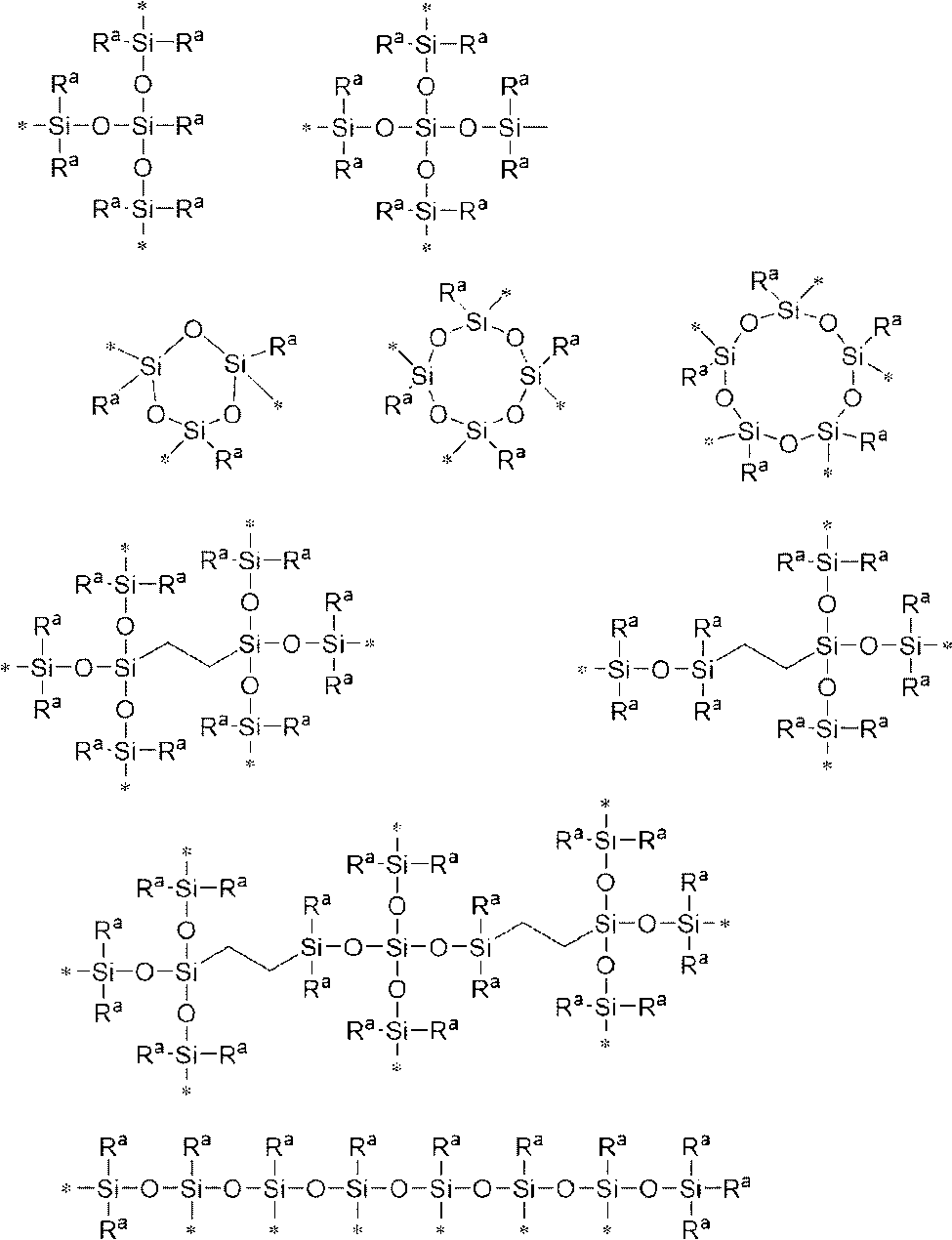
Qb6は、アルキレン基、又は、炭素数2以上のアルキレン基の炭素原子-炭素原子間にエーテル性酸素原子若しくは2価のオルガノ(ポリ)シロキサン残基を有する基である。
Qb6で表されるアルキレン基の炭素数は、1~30が好ましく、1~20がより好ましく、2~20が更に好ましく、2~10であってもよく、2~6であってもよい。例えば、2、3、8、9、11が挙げられる。また、前記炭素数は1~10であってもよい。
Qb6で表される炭素数2以上のアルキレン基の炭素原子-炭素原子間にエーテル性酸素原子又は2価のオルガノ(ポリ)シロキサン残基を有する基の炭素数は、2~20が好ましく、2~10がより好ましく、2~6が更に好ましい。
Qb6としては、化合物を製造しやすい点から、-CH2CH2-、-CH2CH2CH2-が好ましい。
w2個の[-Qb6-Si(R2)nL3-n]は、同一であっても異なっていてもよい。
Qb6で表されるアルキレン基の炭素数は、1~30が好ましく、1~20がより好ましく、2~20が更に好ましく、2~10であってもよく、2~6であってもよい。例えば、2、3、8、9、11が挙げられる。また、前記炭素数は1~10であってもよい。
Qb6で表される炭素数2以上のアルキレン基の炭素原子-炭素原子間にエーテル性酸素原子又は2価のオルガノ(ポリ)シロキサン残基を有する基の炭素数は、2~20が好ましく、2~10がより好ましく、2~6が更に好ましい。
Qb6としては、化合物を製造しやすい点から、-CH2CH2-、-CH2CH2CH2-が好ましい。
w2個の[-Qb6-Si(R2)nL3-n]は、同一であっても異なっていてもよい。
基(3-1A-7)において、Zcは(w3+w4+1)価の炭化水素基である。
w3は、4以上の整数である。
w4は、0以上の整数である。
Qe、s4、Qa4、t4、Qb4、及びu4の定義及び好ましい範囲は基(3-1A-4)中の各符号の定義と同じである。
w3は、4以上の整数である。
w4は、0以上の整数である。
Qe、s4、Qa4、t4、Qb4、及びu4の定義及び好ましい範囲は基(3-1A-4)中の各符号の定義と同じである。
Zcは炭化水素鎖からなってもよく、炭化水素鎖の炭素原子-炭素原子間にエーテル性酸素原子を有してもよく、炭化水素鎖からなることが好ましい。
Zcの価数は5~20価が好ましく、5~10価がより好ましく、5~8価が更に好ましく、5~6価が特に好ましい。
Zcの炭素数は3~50が好ましく、4~40がより好ましく、5~30が更に好ましい。
w3は、4~20が好ましく、4~16がより好ましく、4~8が更に好ましく、4~5が特に好ましい。
w4は、0~10が好ましく、0~8がより好ましく、0~6が更に好ましく、0~3が特に好ましく、0~1が最も好ましい。
[-(O-Qb4)u4-Si(R2)nL3-n]が2個以上ある場合は、2個以上の[-(O-Qb4)u4-Si(R2)nL3-n]は、同一であっても異なっていてもよい。
Zcの価数は5~20価が好ましく、5~10価がより好ましく、5~8価が更に好ましく、5~6価が特に好ましい。
Zcの炭素数は3~50が好ましく、4~40がより好ましく、5~30が更に好ましい。
w3は、4~20が好ましく、4~16がより好ましく、4~8が更に好ましく、4~5が特に好ましい。
w4は、0~10が好ましく、0~8がより好ましく、0~6が更に好ましく、0~3が特に好ましく、0~1が最も好ましい。
[-(O-Qb4)u4-Si(R2)nL3-n]が2個以上ある場合は、2個以上の[-(O-Qb4)u4-Si(R2)nL3-n]は、同一であっても異なっていてもよい。
式A(Si(R2)nL3-n)q1におけるAは、基(g2-1)~(g2-7)であってもよい。

(-A1-Q12-)e1C(Re2)4-e1-e2(-Q22-)e2 …(g2-2)
-A1-Q13-N(-Q23-)2 …(g2-3)
(-A1-Q14-)h1Z4(-Q24-)h2 …(g2-4)
(-A1-Q15-)i1Si(Re3)4-i1-i2(-Q25-)i2 …(g2-5)
-A1-Q26- (g2-6)
-A1-Q12-CH(-Q22-)-Si(Re3)3-i3(-Q25-)i3 …(g2-7)
-A1-Q13-N(-Q23-)2 …(g2-3)
(-A1-Q14-)h1Z4(-Q24-)h2 …(g2-4)
(-A1-Q15-)i1Si(Re3)4-i1-i2(-Q25-)i2 …(g2-5)
-A1-Q26- (g2-6)
-A1-Q12-CH(-Q22-)-Si(Re3)3-i3(-Q25-)i3 …(g2-7)
ただし、式(g2-1)~(g2-7)においては、A1側がSi(R3)2又はSi(R4)2と結合し、Q22、Q23、Q24、Q25又はQ26側が[-Si(R2)nL3-n]と結合する。
A1は、単結合、-C(O)NR6-、-C(O)-、-OC(O)O-、-NHC(O)O-、-NHC(O)NR6-、-O-又はSO2NR6-である。
Q11は、単結合、-O-、アルキレン基、又は炭素数2以上のアルキレン基の炭素-炭素原子間に-C(O)NR6-、-C(O)-、-NR6-又はO-を有する基である。
Q12は、単結合、アルキレン基、又は炭素数2以上のアルキレン基の炭素-炭素原子間に-C(O)NR6-、-C(O)-、-NR6-又はO-を有する基であり、AがQ12を2以上有する場合、2以上のQ12は同一であっても異なっていてもよい。
Q13は、単結合(ただし、A1は-C(O)-である。)、アルキレン基、炭素数2以上のアルキレン基の炭素-炭素原子間に-C(O)NR6-、-C(O)-、-NR6-又はO-を有する基、又はアルキレン基のN側の末端に-C(O)-を有する基である。
Q14は、Q14が結合するZ4における原子が炭素原子の場合、Q12であり、Q14が結合するZ4における原子が窒素原子の場合、Q13であり、AがQ14を2以上有する場合、2以上のQ14は同一であっても異なっていてもよい。
Q15は、アルキレン基、又は炭素数2以上のアルキレン基の炭素-炭素原子間に-C(O)NR6-、-C(O)-、-NR6-又はO-を有する基であり、AがQ15を2以上有する場合、2以上のQ15は同一であっても異なっていてもよい。
Q22は、アルキレン基、炭素数2以上のアルキレン基の炭素-炭素原子間に-C(O)NR6-、-C(O)-、-NR6-又はO-を有する基、アルキレン基のSiに接続しない側の末端に-C(O)NR6-、-C(O)-、-NR6-又はO-を有する基、又は炭素数2以上のアルキレン基の炭素-炭素原子間に-C(O)NR6-、-C(O)-、-NR6-又はO-を有しかつSiに接続しない側の末端に-C(O)NR6-、-C(O)-、-NR6-又はO-を有する基であり、AがQ22を2以上有する場合、2以上のQ22は同一であっても異なっていてもよい。
Q23は、アルキレン基、又は炭素数2以上のアルキレン基の炭素-炭素原子間に-C(O)NR6-、-C(O)-、-NR6-又はO-を有する基であり、2個のQ23は同一であっても異なっていてもよい。
Q24は、Q24が結合するZ4における原子が炭素原子の場合、Q22であり、Q24が結合するZ4における原子が窒素原子の場合、Q23であり、AがQ24を2以上有する場合、2以上のQ24は同一であっても異なっていてもよい。
Q25は、アルキレン基、又は炭素数2以上のアルキレン基の炭素-炭素原子間に-C(O)NR6-、-C(O)-、-NR6-又はO-を有する基であり、AがQ25を2以上有する場合、2以上のQ25は同一であっても異なっていてもよい。
Q26は、アルキレン基、又は炭素数2以上のアルキレン基の炭素-炭素原子間に-C(O)NR6-、-C(O)-、-NR6-又はO-を有する基である。
Q22、Q23、Q24、Q25、Q26がアルキレン基の場合、炭素数は1~20が好ましく、1~10がより好ましく、1~6が更に好ましい。
Z4は、Q14が直接結合する炭素原子又は窒素原子を有しかつQ24が直接結合する炭素原子又は窒素原子を有する(h1+h2)価の環構造を有する基である。
Re1は、水素原子又はアルキル基であり、AがRe1を2以上有する場合、2以上のRe1は同一であっても異なっていてもよい。
Re2は、水素原子、水酸基、アルキル基又はアシルオキシ基である。
Re3は、アルキル基である。R6は、水素原子、炭素数1~6のアルキル基又はフェニル基である。
A1は、単結合、-C(O)NR6-、-C(O)-、-OC(O)O-、-NHC(O)O-、-NHC(O)NR6-、-O-又はSO2NR6-である。
Q11は、単結合、-O-、アルキレン基、又は炭素数2以上のアルキレン基の炭素-炭素原子間に-C(O)NR6-、-C(O)-、-NR6-又はO-を有する基である。
Q12は、単結合、アルキレン基、又は炭素数2以上のアルキレン基の炭素-炭素原子間に-C(O)NR6-、-C(O)-、-NR6-又はO-を有する基であり、AがQ12を2以上有する場合、2以上のQ12は同一であっても異なっていてもよい。
Q13は、単結合(ただし、A1は-C(O)-である。)、アルキレン基、炭素数2以上のアルキレン基の炭素-炭素原子間に-C(O)NR6-、-C(O)-、-NR6-又はO-を有する基、又はアルキレン基のN側の末端に-C(O)-を有する基である。
Q14は、Q14が結合するZ4における原子が炭素原子の場合、Q12であり、Q14が結合するZ4における原子が窒素原子の場合、Q13であり、AがQ14を2以上有する場合、2以上のQ14は同一であっても異なっていてもよい。
Q15は、アルキレン基、又は炭素数2以上のアルキレン基の炭素-炭素原子間に-C(O)NR6-、-C(O)-、-NR6-又はO-を有する基であり、AがQ15を2以上有する場合、2以上のQ15は同一であっても異なっていてもよい。
Q22は、アルキレン基、炭素数2以上のアルキレン基の炭素-炭素原子間に-C(O)NR6-、-C(O)-、-NR6-又はO-を有する基、アルキレン基のSiに接続しない側の末端に-C(O)NR6-、-C(O)-、-NR6-又はO-を有する基、又は炭素数2以上のアルキレン基の炭素-炭素原子間に-C(O)NR6-、-C(O)-、-NR6-又はO-を有しかつSiに接続しない側の末端に-C(O)NR6-、-C(O)-、-NR6-又はO-を有する基であり、AがQ22を2以上有する場合、2以上のQ22は同一であっても異なっていてもよい。
Q23は、アルキレン基、又は炭素数2以上のアルキレン基の炭素-炭素原子間に-C(O)NR6-、-C(O)-、-NR6-又はO-を有する基であり、2個のQ23は同一であっても異なっていてもよい。
Q24は、Q24が結合するZ4における原子が炭素原子の場合、Q22であり、Q24が結合するZ4における原子が窒素原子の場合、Q23であり、AがQ24を2以上有する場合、2以上のQ24は同一であっても異なっていてもよい。
Q25は、アルキレン基、又は炭素数2以上のアルキレン基の炭素-炭素原子間に-C(O)NR6-、-C(O)-、-NR6-又はO-を有する基であり、AがQ25を2以上有する場合、2以上のQ25は同一であっても異なっていてもよい。
Q26は、アルキレン基、又は炭素数2以上のアルキレン基の炭素-炭素原子間に-C(O)NR6-、-C(O)-、-NR6-又はO-を有する基である。
Q22、Q23、Q24、Q25、Q26がアルキレン基の場合、炭素数は1~20が好ましく、1~10がより好ましく、1~6が更に好ましい。
Z4は、Q14が直接結合する炭素原子又は窒素原子を有しかつQ24が直接結合する炭素原子又は窒素原子を有する(h1+h2)価の環構造を有する基である。
Re1は、水素原子又はアルキル基であり、AがRe1を2以上有する場合、2以上のRe1は同一であっても異なっていてもよい。
Re2は、水素原子、水酸基、アルキル基又はアシルオキシ基である。
Re3は、アルキル基である。R6は、水素原子、炭素数1~6のアルキル基又はフェニル基である。
d1は、0~3の整数であり、1又は2であることが好ましい。
d2は、0~3の整数であり、1又は2であることが好ましい。
d1+d2は、1~3の整数である。
d3は、0~3の整数であり、0又は1であることが好ましい。
d4は、0~3の整数であり、2又は3であることが好ましい。
d3+d4は、1~3の整数である。
d1+d3は、1~5の整数であり、1又は2であることが好ましい。
d2+d4は、1~5の整数であり、4又は5であることが好ましい。
e1+e2は、3又は4である。
e1は、1~3の整数であり、1又は2であることが好ましい。
e2は、1~3の整数であり、2又は3であることが好ましい。
h1は、1以上の整数であり、1又は2であることが好ましい。
h2は、1以上の整数であり、2又は3であることが好ましい。
i1+i2は、3又は4である。
i1は、1~3の整数であり、1又は2であることが好ましい。
i2は、1~3の整数であり、2又は3であることが好ましい。
i3は、2又は3である。
d2は、0~3の整数であり、1又は2であることが好ましい。
d1+d2は、1~3の整数である。
d3は、0~3の整数であり、0又は1であることが好ましい。
d4は、0~3の整数であり、2又は3であることが好ましい。
d3+d4は、1~3の整数である。
d1+d3は、1~5の整数であり、1又は2であることが好ましい。
d2+d4は、1~5の整数であり、4又は5であることが好ましい。
e1+e2は、3又は4である。
e1は、1~3の整数であり、1又は2であることが好ましい。
e2は、1~3の整数であり、2又は3であることが好ましい。
h1は、1以上の整数であり、1又は2であることが好ましい。
h2は、1以上の整数であり、2又は3であることが好ましい。
i1+i2は、3又は4である。
i1は、1~3の整数であり、1又は2であることが好ましい。
i2は、1~3の整数であり、2又は3であることが好ましい。
i3は、2又は3である。
Q11、Q12、Q13、Q14、Q15、Q22、Q23、Q24、Q25及びQ26のアルキレン基の炭素数は、化合物を製造しやすい点、及び表面処理層の耐摩耗性が更に優れる点から、1~30が好ましく、1~20がより好ましく、2~20が更に好ましく、2~10であってもよく、2~6であってもよい。例えば2、3、8、9、11が挙げられる。また、前記炭素数は1~10でもよく、1~6でもよく、1~4でもよい。ただし、炭素-炭素原子間に特定の結合を有する場合のアルキレン基の炭素数の下限値は2である。
Z4における環構造としては、上述した環構造が挙げられ、好ましい形態も同様である。なお、Z4における環構造にはQ14やQ24が直接結合するため、例えば、環構造にアルキレン基が連結して、そのアルキレン基にQ14やQ24が連結することはない。
Re1、Re2又はRe3のアルキル基の炭素数は、化合物を製造しやすい点から、1~6が好ましく、1~3がより好ましく、1~2が特に好ましい。
Re2のアシルオキシ基のアルキル基部分の炭素数は、化合物を製造しやすい点から、1~6が好ましく、1~3がより好ましく、1~2が特に好ましい。
h1は、化合物を製造しやすい点、並びに、表面処理層の耐摩耗性が更に優れる点から、1~6が好ましく、1~4がより好ましく、1又は2が更に好ましく、1が特に好ましい。
h2としては、化合物を製造しやすい点、並びに、表面処理層の耐摩耗性が更に優れる点から、2~6が好ましく、2~4がより好ましく、2又は3が特に好ましい。
Re2のアシルオキシ基のアルキル基部分の炭素数は、化合物を製造しやすい点から、1~6が好ましく、1~3がより好ましく、1~2が特に好ましい。
h1は、化合物を製造しやすい点、並びに、表面処理層の耐摩耗性が更に優れる点から、1~6が好ましく、1~4がより好ましく、1又は2が更に好ましく、1が特に好ましい。
h2としては、化合物を製造しやすい点、並びに、表面処理層の耐摩耗性が更に優れる点から、2~6が好ましく、2~4がより好ましく、2又は3が特に好ましい。
式A(Si(R2)nL3-n)q1におけるAの他の形態としては、基(g2-8)~(g2-14)が挙げられる。
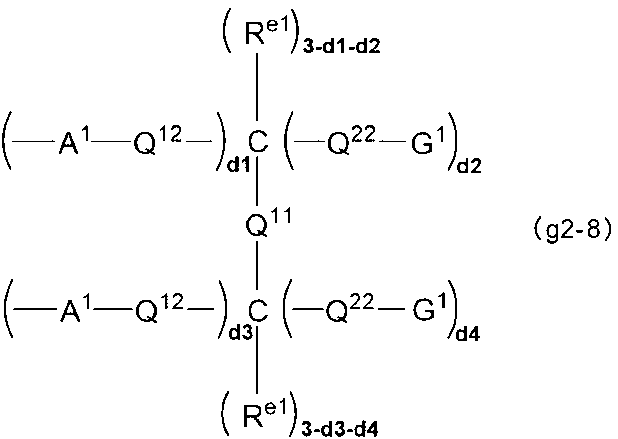
(-A1-Q12-)e1C(Re2)4-e1-e2(-Q22-G1)e2 …(g2-9)
-A1-Q13-N(-Q23-G1)2 …(g2-10)
(-A1-Q14-)h1Z4(-Q24-G1)h2 …(g2-11)
(-A1-Q15-)i1Si(Re3)4-i1-i2(-Q25-G1)i2 …(g2-12)
-A1-Q26-G1 …(g2-13)
-A1-Q12-CH(-Q22-G1)-Si(Re3)3-i3(-Q25-G1)i3 …(g2-14)
-A1-Q13-N(-Q23-G1)2 …(g2-10)
(-A1-Q14-)h1Z4(-Q24-G1)h2 …(g2-11)
(-A1-Q15-)i1Si(Re3)4-i1-i2(-Q25-G1)i2 …(g2-12)
-A1-Q26-G1 …(g2-13)
-A1-Q12-CH(-Q22-G1)-Si(Re3)3-i3(-Q25-G1)i3 …(g2-14)
ただし、式(g2-8)~(g2-14)においては、A1側がSi(R3)2又はSi(R4)2と結合し、G1側が[-Si(R2)nL3-n]と結合する。
G1は、下記基(g3)であり、Aが有する2以上のG1は同一であっても異なっていてもよい。G1以外の符号は、式(g2-1)~(g2-7)における符号と同じである。
-Si(R13)3-k3(-Q3-)k3 …(g3)
ただし、基(g3)においては、Si側がQ22、Q23、Q24、Q25及びQ26に接続し、Q3側が[-Si(R2)nL3-n]に接続する。R13は、アルキル基である。Q3は、アルキレン基、炭素数2以上のアルキレン基の炭素-炭素原子間に-C(O)NR6-、-C(O)-、-NR6-若しくは-O-を有する基、又は(OSi(R9)2)p-O-であり、2以上のQ3は同一であっても異なっていてもよい。k3は、2又は3である。R6は、水素原子、炭素数1~6のアルキル基又はフェニル基である。
R9は、アルキル基、フェニル基又はアルコキシ基であり、2個のR9は同一であっても異なっていてもよい。pは、0~5の整数であり、pが2以上の場合、2以上の(OSi(R9)2)は同一であっても異なっていてもよい。
-Si(R13)3-k3(-Q3-)k3 …(g3)
ただし、基(g3)においては、Si側がQ22、Q23、Q24、Q25及びQ26に接続し、Q3側が[-Si(R2)nL3-n]に接続する。R13は、アルキル基である。Q3は、アルキレン基、炭素数2以上のアルキレン基の炭素-炭素原子間に-C(O)NR6-、-C(O)-、-NR6-若しくは-O-を有する基、又は(OSi(R9)2)p-O-であり、2以上のQ3は同一であっても異なっていてもよい。k3は、2又は3である。R6は、水素原子、炭素数1~6のアルキル基又はフェニル基である。
R9は、アルキル基、フェニル基又はアルコキシ基であり、2個のR9は同一であっても異なっていてもよい。pは、0~5の整数であり、pが2以上の場合、2以上の(OSi(R9)2)は同一であっても異なっていてもよい。
Q3のアルキレン基の炭素数は、化合物を製造しやすい点、並びに、表面処理層の耐摩耗性が更に優れる点から、1~30が好ましく、1~20がより好ましく、2~20が更に好ましく、2~10であってもよく、2~6であってもよい。例えば2、3、8、9、11が挙げられる。また、前記炭素数は1~10であってよく、1~6であってよく、1~4であってよい。ただし、炭素-炭素原子間に特定の結合を有する場合のアルキレン基の炭素数の下限値は2である。
R13のアルキル基の炭素数は、化合物を製造しやすい点から、1~6が好ましく、1~3がより好ましく、1~2が更に好ましい。
R9のアルキル基の炭素数は、化合物を製造しやすい点から、1~6が好ましく、1~3がより好ましく、1~2が更に好ましい。
R9のアルコキシ基の炭素数は、化合物の保存安定性に優れる点から、1~6が好ましく、1~3がより好ましく、1~2が特に好ましい。
pは、0又は1が好ましい。
R13のアルキル基の炭素数は、化合物を製造しやすい点から、1~6が好ましく、1~3がより好ましく、1~2が更に好ましい。
R9のアルキル基の炭素数は、化合物を製造しやすい点から、1~6が好ましく、1~3がより好ましく、1~2が更に好ましい。
R9のアルコキシ基の炭素数は、化合物の保存安定性に優れる点から、1~6が好ましく、1~3がより好ましく、1~2が特に好ましい。
pは、0又は1が好ましい。
〔第1化合物S及び第1化合物Dの例〕
以下に、第1化合物S及び第1化合物Dの具体例を詳述する。
第1化合物Sの具体例としては、以下の化合物(1)~(3)、(4A)、及び(5)が挙げられる。
第1化合物Dの具体例として、以下の化合物(4B)が挙げられる。
以下に、第1化合物S及び第1化合物Dの具体例を詳述する。
第1化合物Sの具体例としては、以下の化合物(1)~(3)、(4A)、及び(5)が挙げられる。
第1化合物Dの具体例として、以下の化合物(4B)が挙げられる。
・化合物(1)
下記基1aと、鎖状オルガノ(ポリ)シロキサン残基と、炭素数3以上のアルキレン鎖又はポリアルキレンオキシド鎖である部分構造と、下記基1bと、を含む化合物。
基1a:-M1T1 3
基1b:-Si(R2)nL3-n
M1は、Si、Sn、又はGeであり、
T1は、それぞれ独立に、炭化水素基又はトリアルキルシリルオキシ基であり、
R2は、それぞれ独立に、1価の炭化水素基であり、
Lは、それぞれ独立に、加水分解性基、加水分解性基を有する基、又は水酸基であり、
nは、それぞれ独立に、0~2の整数である。
R2、L、及びnは、上記式(S1)におけるR2、L、及びnと同様である。
基1aの詳細は、式(C)中のT11の説明におけるT1 3M1-の詳細と同じである。
下記基1aと、鎖状オルガノ(ポリ)シロキサン残基と、炭素数3以上のアルキレン鎖又はポリアルキレンオキシド鎖である部分構造と、下記基1bと、を含む化合物。
基1a:-M1T1 3
基1b:-Si(R2)nL3-n
M1は、Si、Sn、又はGeであり、
T1は、それぞれ独立に、炭化水素基又はトリアルキルシリルオキシ基であり、
R2は、それぞれ独立に、1価の炭化水素基であり、
Lは、それぞれ独立に、加水分解性基、加水分解性基を有する基、又は水酸基であり、
nは、それぞれ独立に、0~2の整数である。
R2、L、及びnは、上記式(S1)におけるR2、L、及びnと同様である。
基1aの詳細は、式(C)中のT11の説明におけるT1 3M1-の詳細と同じである。
・化合物(2)
炭素数2以上のアルキル基と、鎖状オルガノ(ポリ)シロキサン残基と、反応性シリル基と、を含む化合物。
炭素数2以上のアルキル基と、鎖状オルガノ(ポリ)シロキサン残基と、反応性シリル基と、を含む化合物。
・化合物(3)
下記基3aと、2価の鎖状オルガノ(ポリ)シロキサン残基を含む部分構造と、下記基3bと、を含み、前記部分構造は、2価の鎖状オルガノ(ポリ)シロキサン残基であるか、又は、2価の鎖状オルガノ(ポリ)シロキサン残基と、アルキレン鎖及びポリアルキレンオキシド鎖の少なくとも一方との組み合わせである、化合物。
基3a:1価の環状のポリシロキサン残基又は1価のかご状のポリシロキサン残基
基3b:-Si(R2)nL3-n
R2は、それぞれ独立に、1価の炭化水素基であり、
Lはそれぞれ独立に、加水分解性基、加水分解性基を有する基、又は水酸基であり、
nはそれぞれ独立に、0~2の整数である。
R2、L、及びnは、上記式(S1)におけるR2、L、及びnと同様である。
下記基3aと、2価の鎖状オルガノ(ポリ)シロキサン残基を含む部分構造と、下記基3bと、を含み、前記部分構造は、2価の鎖状オルガノ(ポリ)シロキサン残基であるか、又は、2価の鎖状オルガノ(ポリ)シロキサン残基と、アルキレン鎖及びポリアルキレンオキシド鎖の少なくとも一方との組み合わせである、化合物。
基3a:1価の環状のポリシロキサン残基又は1価のかご状のポリシロキサン残基
基3b:-Si(R2)nL3-n
R2は、それぞれ独立に、1価の炭化水素基であり、
Lはそれぞれ独立に、加水分解性基、加水分解性基を有する基、又は水酸基であり、
nはそれぞれ独立に、0~2の整数である。
R2、L、及びnは、上記式(S1)におけるR2、L、及びnと同様である。
・化合物(4A)、(4B)
下記式(4A)又は(4B)で表される化合物
(RT1-RS-(-SiRT2 2-)q4)α-XA-RH β …(4A)
RH γ-XA-Op4-RS-(-SiRT2 2-)q4-XA-RH γ …(4B)
式(4A)及び(4B)中、
RSは、それぞれ独立に、2価の直鎖オルガノシロキサン基であり、
RT1は、それぞれ独立に、炭化水素基であり、
RT2は、それぞれ独立に、炭化水素基であり、
p4は、0又は1であり、
q4は、それぞれ独立に、0又は1であり、
RHは、下記式(W1)~(W4)のいずれかで表される基であり、
上記RH中には、水酸基又は加水分解性基が結合したSi原子が2つ以上存在し、
XAは、それぞれ独立して、単結合又は下記式(W5)で表される基であり、
αは、1~9の整数であり、
βは、1~9の整数であり、
γは、それぞれ独立に、1~9の整数である。
-(CH2CR10(R15)X11-Si(R2)n81L3-n81)t-R14 …(W1)
-SiRa1 k81Ll81Rc1 m81 …(W2)
-CRd1 k82Re1 l82Rf1 m82 …(W3)
-NRg1Rh1 …(W4)
式(W1)~(W4)中、
Lは、それぞれ独立に、加水分解性基、加水分解性基を有する基、又は水酸基であり、
R2は、それぞれ独立に、1価の炭化水素基であり、
n81は、(SiR2 n81L3-n81)単位毎にそれぞれ独立して、0~3の整数であり、
X11は、それぞれ独立に、単結合又は2価の有機基であり;
R10は、それぞれ独立に、水素原子又は1価の有機基であり;
tは、それぞれ独立に、2以上の整数であり;
R14は、それぞれ独立に、水素原子、ハロゲン原子、又は-X11-Si(R2)n81L3-n81であり;
R15は、それぞれ独立に、単結合、酸素原子、炭素数1~6のアルキレン基、又は炭素数1~6のアルキレンオキシ基であり;
Ra1は、それぞれ独立に、-Z81-SiR21 p81Lq81R23 r81であり;
Z81は、それぞれ独立に、2価の有機基であり;
R21は、それぞれ独立に、-Z1’-SiR21’ p1’Lq1’R23’ r1’であり;
R23は、それぞれ独立に、1価の有機基であり;
p81は、それぞれ独立に、0~3の整数であり;
q81は、それぞれ独立に、0~3の整数であり;
r81は、それぞれ独立に、0~3の整数であり;
p81+q81+r81は、3であり;
Z1’は、それぞれ独立に、2価の有機基であり;
R21’は、それぞれ独立に、-Z1”-SiLq1”R23” r1”であり;
R23’は、それぞれ独立に、1価の有機基であり;
p1’は、それぞれ独立に、0~3の整数であり;
q1’は、それぞれ独立に、0~3の整数であり;
r1’は、それぞれ独立に、0~3の整数であり;
p1’+q1’+r1’は、3であり;
Z1”は、それぞれ独立に、2価の有機基であり;
R23”は、それぞれ独立に、1価の有機基であり;
q1”は、それぞれ独立に、0~3の整数であり;
r1”は、それぞれ独立に、0~3の整数であり;
q1”+r1”は、3であり;
Rc1は、それぞれ独立に、1価の有機基であり;
k81は、それぞれ独立に、0~3の整数であり;
l81は、それぞれ独立に、0~3の整数であり;
m81は、それぞれ独立に、0~3の整数であり;
k81+l81+m81は、3であり;
Rd1は、それぞれ独立に、-Z82-CR71 p82R72 q82R73 r82であり;
Z82は、それぞれ独立に、単結合、酸素原子又は2価の有機基であり;
R71は、それぞれ独立に、-Z2’-CR32’ q2’R33’ r2’であり;
R72は、それぞれ独立に、-Z83-SiLn82R35 3-n82であり;
R73は、それぞれ独立に、水素原子、水酸基又は1価の有機基であり;
p82は、それぞれ独立に、0~3の整数であり;
q82は、それぞれ独立に、0~3の整数であり;
r82は、それぞれ独立に、0~3の整数であり;
p82+q82+r82は、3であり;
Z2’は、それぞれ独立に、単結合、酸素原子又は2価の有機基であり;
R32’は、それぞれ独立に、-Z83-SiLn82R35 3-n82であり;
R33’は、それぞれ独立に、水素原子、水酸基又は1価の有機基であり;
q2’は、それぞれ独立に、0~3の整数であり;
r2’は、それぞれ独立に、0~3の整数であり;
q2’+r2’は、3であり;
Z83は、それぞれ独立に、単結合、酸素原子又は2価の有機基であり;
R35は、それぞれ独立に、1価の有機基であり;
n82は、それぞれ独立に、0~3の整数であり;
Re1は、それぞれ独立に、-Z83-SiLn82R35 3-n82であり;
Rf1は、それぞれ独立に、水素原子、水酸基又は1価の有機基であり;
k82は、それぞれ独立に、0~3の整数であり;
l82は、それぞれ独立に、0~3の整数であり;
m82は、それぞれ独立に、0~3の整数である。
k82+l82+m82は、3であり;
Rg1及びRh1は、それぞれ独立に、-Z84-SiLn81R2 3-n81、-Z84-SiRa1 k81Ll81Rc1 m81、又は-Z84-CRd1 k82Re1 l82Rf1 m82であり;
Z84は、それぞれ独立に、単結合、酸素原子又は2価の有機基であり;
ただし、式(W1)、(W2)、(W3)、及び(W4)中、加水分解性基、加水分解性基を有する基、又は水酸基が結合したSi原子が少なくとも2つ存在する。
R2及びLは、上記式(S1)におけるR2及びLと同様である。
下記式(4A)又は(4B)で表される化合物
(RT1-RS-(-SiRT2 2-)q4)α-XA-RH β …(4A)
RH γ-XA-Op4-RS-(-SiRT2 2-)q4-XA-RH γ …(4B)
式(4A)及び(4B)中、
RSは、それぞれ独立に、2価の直鎖オルガノシロキサン基であり、
RT1は、それぞれ独立に、炭化水素基であり、
RT2は、それぞれ独立に、炭化水素基であり、
p4は、0又は1であり、
q4は、それぞれ独立に、0又は1であり、
RHは、下記式(W1)~(W4)のいずれかで表される基であり、
上記RH中には、水酸基又は加水分解性基が結合したSi原子が2つ以上存在し、
XAは、それぞれ独立して、単結合又は下記式(W5)で表される基であり、
αは、1~9の整数であり、
βは、1~9の整数であり、
γは、それぞれ独立に、1~9の整数である。
-(CH2CR10(R15)X11-Si(R2)n81L3-n81)t-R14 …(W1)
-SiRa1 k81Ll81Rc1 m81 …(W2)
-CRd1 k82Re1 l82Rf1 m82 …(W3)
-NRg1Rh1 …(W4)
式(W1)~(W4)中、
Lは、それぞれ独立に、加水分解性基、加水分解性基を有する基、又は水酸基であり、
R2は、それぞれ独立に、1価の炭化水素基であり、
n81は、(SiR2 n81L3-n81)単位毎にそれぞれ独立して、0~3の整数であり、
X11は、それぞれ独立に、単結合又は2価の有機基であり;
R10は、それぞれ独立に、水素原子又は1価の有機基であり;
tは、それぞれ独立に、2以上の整数であり;
R14は、それぞれ独立に、水素原子、ハロゲン原子、又は-X11-Si(R2)n81L3-n81であり;
R15は、それぞれ独立に、単結合、酸素原子、炭素数1~6のアルキレン基、又は炭素数1~6のアルキレンオキシ基であり;
Ra1は、それぞれ独立に、-Z81-SiR21 p81Lq81R23 r81であり;
Z81は、それぞれ独立に、2価の有機基であり;
R21は、それぞれ独立に、-Z1’-SiR21’ p1’Lq1’R23’ r1’であり;
R23は、それぞれ独立に、1価の有機基であり;
p81は、それぞれ独立に、0~3の整数であり;
q81は、それぞれ独立に、0~3の整数であり;
r81は、それぞれ独立に、0~3の整数であり;
p81+q81+r81は、3であり;
Z1’は、それぞれ独立に、2価の有機基であり;
R21’は、それぞれ独立に、-Z1”-SiLq1”R23” r1”であり;
R23’は、それぞれ独立に、1価の有機基であり;
p1’は、それぞれ独立に、0~3の整数であり;
q1’は、それぞれ独立に、0~3の整数であり;
r1’は、それぞれ独立に、0~3の整数であり;
p1’+q1’+r1’は、3であり;
Z1”は、それぞれ独立に、2価の有機基であり;
R23”は、それぞれ独立に、1価の有機基であり;
q1”は、それぞれ独立に、0~3の整数であり;
r1”は、それぞれ独立に、0~3の整数であり;
q1”+r1”は、3であり;
Rc1は、それぞれ独立に、1価の有機基であり;
k81は、それぞれ独立に、0~3の整数であり;
l81は、それぞれ独立に、0~3の整数であり;
m81は、それぞれ独立に、0~3の整数であり;
k81+l81+m81は、3であり;
Rd1は、それぞれ独立に、-Z82-CR71 p82R72 q82R73 r82であり;
Z82は、それぞれ独立に、単結合、酸素原子又は2価の有機基であり;
R71は、それぞれ独立に、-Z2’-CR32’ q2’R33’ r2’であり;
R72は、それぞれ独立に、-Z83-SiLn82R35 3-n82であり;
R73は、それぞれ独立に、水素原子、水酸基又は1価の有機基であり;
p82は、それぞれ独立に、0~3の整数であり;
q82は、それぞれ独立に、0~3の整数であり;
r82は、それぞれ独立に、0~3の整数であり;
p82+q82+r82は、3であり;
Z2’は、それぞれ独立に、単結合、酸素原子又は2価の有機基であり;
R32’は、それぞれ独立に、-Z83-SiLn82R35 3-n82であり;
R33’は、それぞれ独立に、水素原子、水酸基又は1価の有機基であり;
q2’は、それぞれ独立に、0~3の整数であり;
r2’は、それぞれ独立に、0~3の整数であり;
q2’+r2’は、3であり;
Z83は、それぞれ独立に、単結合、酸素原子又は2価の有機基であり;
R35は、それぞれ独立に、1価の有機基であり;
n82は、それぞれ独立に、0~3の整数であり;
Re1は、それぞれ独立に、-Z83-SiLn82R35 3-n82であり;
Rf1は、それぞれ独立に、水素原子、水酸基又は1価の有機基であり;
k82は、それぞれ独立に、0~3の整数であり;
l82は、それぞれ独立に、0~3の整数であり;
m82は、それぞれ独立に、0~3の整数である。
k82+l82+m82は、3であり;
Rg1及びRh1は、それぞれ独立に、-Z84-SiLn81R2 3-n81、-Z84-SiRa1 k81Ll81Rc1 m81、又は-Z84-CRd1 k82Re1 l82Rf1 m82であり;
Z84は、それぞれ独立に、単結合、酸素原子又は2価の有機基であり;
ただし、式(W1)、(W2)、(W3)、及び(W4)中、加水分解性基、加水分解性基を有する基、又は水酸基が結合したSi原子が少なくとも2つ存在する。
R2及びLは、上記式(S1)におけるR2及びLと同様である。
-(R50)p5-(X51)q5- …(W5)
式(W5)中、
R50は、単結合、-(CH2)s5-又はo-、m-若しくはp-フェニレン基であり、
s5は、1~20の整数であり、
X51は、-(X52)l5-であり、
X52は、各出現においてそれぞれ独立して、-O-、-S-、o-、m-若しくはp-フェニレン基、-CO-、-C(O)O-、-CONR54-、-O-CONR54-、-NR54-及び-(CH2)n5-からなる群から選択される基であり、
R54は、各出現においてそれぞれ独立して、水素原子、又は1価の有機基であり、
n5は、各出現においてそれぞれ独立して、1~20の整数であり、
l5は、1~10の整数であり、
p5は、0又は1であり、
q5は、0又は1であり、
p5及びq5の少なくとも一方は1であり、(R50)p5及び(X51)q5の存在順序は任意である。
式(W5)中、
R50は、単結合、-(CH2)s5-又はo-、m-若しくはp-フェニレン基であり、
s5は、1~20の整数であり、
X51は、-(X52)l5-であり、
X52は、各出現においてそれぞれ独立して、-O-、-S-、o-、m-若しくはp-フェニレン基、-CO-、-C(O)O-、-CONR54-、-O-CONR54-、-NR54-及び-(CH2)n5-からなる群から選択される基であり、
R54は、各出現においてそれぞれ独立して、水素原子、又は1価の有機基であり、
n5は、各出現においてそれぞれ独立して、1~20の整数であり、
l5は、1~10の整数であり、
p5は、0又は1であり、
q5は、0又は1であり、
p5及びq5の少なくとも一方は1であり、(R50)p5及び(X51)q5の存在順序は任意である。
XAは、それぞれ独立して、単結合、炭素数1~20のアルキレン基、-(CH2)s5-X53-、-X53-(CH2)t5-、又は-(CH2)s5-X53-(CH2)t5-であることが好ましい。
X53は、単結合、-O-、-CO-、-CONR54-、-O-CONR54-、-O-(CH2)u5-CONR54-、又は-O-(CH2)u5-CO-であり、
R54は、各出現においてそれぞれ独立して、水素原子、フェニル基、炭素数1~6のアルキル基又は炭素数1~10のオキシアルキレン含有基であり、
s5は、1~20の整数であり、
t5は、1~20の整数であり、
u5は、1~20の整数であることが好ましい。
X53は、単結合、-O-、-CO-、-CONR54-、-O-CONR54-、-O-(CH2)u5-CONR54-、又は-O-(CH2)u5-CO-であり、
R54は、各出現においてそれぞれ独立して、水素原子、フェニル基、炭素数1~6のアルキル基又は炭素数1~10のオキシアルキレン含有基であり、
s5は、1~20の整数であり、
t5は、1~20の整数であり、
u5は、1~20の整数であることが好ましい。
・化合物(5)
下記式(5)で表される化合物。
下記式(5)で表される化合物。

式(5)中、
Yは、単結合又は*-Si(Rs2)2-Ls1-を表す。*は酸素原子との結合手を表す。
Zは、酸素原子又は炭素数1~10の2価の炭化水素基を表す。
Ra9は、それぞれ独立に、炭化水素基又はトリアルキルシリルオキシ基を表す。ただし、Ra9の全てが炭化水素基の場合、Ra9で表される炭化水素基はアルキル基である。
Rs1、Rs2は、それぞれ独立に、炭素数1~10のアルキル基を表す。
Ls1は、炭素数1~10の2価の炭化水素基を表す。
Xは、下記式(X-1)~(X-3)のいずれかで表される基を表す。
n9は、1~150の数を表す。
Yは、単結合又は*-Si(Rs2)2-Ls1-を表す。*は酸素原子との結合手を表す。
Zは、酸素原子又は炭素数1~10の2価の炭化水素基を表す。
Ra9は、それぞれ独立に、炭化水素基又はトリアルキルシリルオキシ基を表す。ただし、Ra9の全てが炭化水素基の場合、Ra9で表される炭化水素基はアルキル基である。
Rs1、Rs2は、それぞれ独立に、炭素数1~10のアルキル基を表す。
Ls1は、炭素数1~10の2価の炭化水素基を表す。
Xは、下記式(X-1)~(X-3)のいずれかで表される基を表す。
n9は、1~150の数を表す。

式(X-1)~(X-3)中、
Lx1及びLx2は、それぞれ独立に、炭素数1~20の2価の炭化水素基を表し、該2価の炭化水素基に含まれるメチレン基(-CH2-)は、-O-又は-O-Si(Rx7)2-に置き換わっていてもよい。
Rx1~Rx7は、それぞれ独立に、水素原子又は炭素数1~10の炭化水素基を表す。
Xa1は、それぞれ独立に、加水分解性基、加水分解性基を有する基、又はトリアルコキシシリルオキシ基を表す。
Xa2は、それぞれ独立に、トリアルキルシリル含有基、炭化水素鎖含有基、シロキサン骨格含有基、加水分解性基、加水分解性基を有する基、又はトリアルコキシシリルオキシ基を表し、Xa2が加水分解性基の場合、Xa2とXa1とは、同一であっても異なっていてもよい。
n2は、1~50の整数を表す。
n3は、2~5の数を表す。
n4は、0~5の数を表す。
式(X-3)中、(Si(Rx4)(-Lx2-Si(Xa2)(Xa1)2)-O-)及び(Si(Rx5)(Rx6)-O-)で表される単位の順序は任意である。
Lx1及びLx2は、それぞれ独立に、炭素数1~20の2価の炭化水素基を表し、該2価の炭化水素基に含まれるメチレン基(-CH2-)は、-O-又は-O-Si(Rx7)2-に置き換わっていてもよい。
Rx1~Rx7は、それぞれ独立に、水素原子又は炭素数1~10の炭化水素基を表す。
Xa1は、それぞれ独立に、加水分解性基、加水分解性基を有する基、又はトリアルコキシシリルオキシ基を表す。
Xa2は、それぞれ独立に、トリアルキルシリル含有基、炭化水素鎖含有基、シロキサン骨格含有基、加水分解性基、加水分解性基を有する基、又はトリアルコキシシリルオキシ基を表し、Xa2が加水分解性基の場合、Xa2とXa1とは、同一であっても異なっていてもよい。
n2は、1~50の整数を表す。
n3は、2~5の数を表す。
n4は、0~5の数を表す。
式(X-3)中、(Si(Rx4)(-Lx2-Si(Xa2)(Xa1)2)-O-)及び(Si(Rx5)(Rx6)-O-)で表される単位の順序は任意である。
以下、化合物(1)~(5)について説明する。
(化合物(1))
化合物(1)は、下記式(1A)で表される化合物であることが好ましい。
[T1 3M1-(O)r-Z1]p1A(Si(R2)nL3-n)q1 … (1A)
式(1A)中、
M1は、Si、Sn、又はGeであり、
T1は、それぞれ独立に、炭化水素基又はトリアルキルシリルオキシ基であり、
rは、0又は1であり、
Z1は、それぞれ独立に、アルキレン鎖若しくはポリアルキレンオキシド鎖であるか、又は、アルキレン鎖と2価の鎖状オルガノ(ポリ)シロキサン残基との組み合わせであり、Aは、単結合又は(p1+q1)価の連結基であり、
R2は、それぞれ独立に、1価の炭化水素基であり、
Lは、それぞれ独立に、加水分解性基、加水分解性基を有する基、又は水酸基であり、
nは、それぞれ独立に、0~2の整数であり、
p1及びq1は、それぞれ独立に、1以上の整数である。
ただし、Z1が、それぞれ独立に、アルキレン鎖若しくはポリアルキレンオキシド鎖である場合には、Aは、鎖状オルガノ(ポリ)シロキサン残基を含む(p1+q1)価の連結基である。
化合物(1)は、下記式(1A)で表される化合物であることが好ましい。
[T1 3M1-(O)r-Z1]p1A(Si(R2)nL3-n)q1 … (1A)
式(1A)中、
M1は、Si、Sn、又はGeであり、
T1は、それぞれ独立に、炭化水素基又はトリアルキルシリルオキシ基であり、
rは、0又は1であり、
Z1は、それぞれ独立に、アルキレン鎖若しくはポリアルキレンオキシド鎖であるか、又は、アルキレン鎖と2価の鎖状オルガノ(ポリ)シロキサン残基との組み合わせであり、Aは、単結合又は(p1+q1)価の連結基であり、
R2は、それぞれ独立に、1価の炭化水素基であり、
Lは、それぞれ独立に、加水分解性基、加水分解性基を有する基、又は水酸基であり、
nは、それぞれ独立に、0~2の整数であり、
p1及びq1は、それぞれ独立に、1以上の整数である。
ただし、Z1が、それぞれ独立に、アルキレン鎖若しくはポリアルキレンオキシド鎖である場合には、Aは、鎖状オルガノ(ポリ)シロキサン残基を含む(p1+q1)価の連結基である。
T1及びM1は、上記基1aにおけるT1及びM1と同様であるため、説明を省略する。
M1はSiが好ましい。
T1はトリアルキルシリルオキシ基が好ましく、ブチルジメチルシリルオキシ基、トリメチルシリルオキシ基又はトリエチルシリルオキシ基がより好ましい。
R2、L、及びnは、上記式(S1)におけるR2、L、及びnと同様である。
Z1で表される、アルキレン鎖と2価の鎖状オルガノ(ポリ)シロキサン残基との組み合わせは、下記式(D1)、(D2)、又は(D3)で表されることが好ましい。
M1はSiが好ましい。
T1はトリアルキルシリルオキシ基が好ましく、ブチルジメチルシリルオキシ基、トリメチルシリルオキシ基又はトリエチルシリルオキシ基がより好ましい。
R2、L、及びnは、上記式(S1)におけるR2、L、及びnと同様である。
Z1で表される、アルキレン鎖と2価の鎖状オルガノ(ポリ)シロキサン残基との組み合わせは、下記式(D1)、(D2)、又は(D3)で表されることが好ましい。
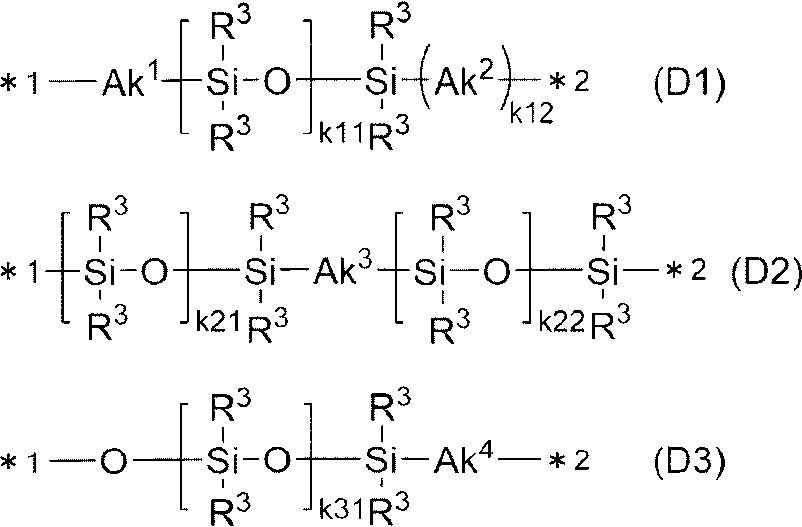
式(D1)中、Ak1及びAk2はそれぞれ独立に、アルキレン鎖を意味する。R3は、式(B1)におけるR3と同じある。k11は1以上の数である。k12は0又は1である。
式(D2)中、Ak3はアルキレン鎖を意味する。R3は、式(B1)におけるR3と同じある。k21及びk22はそれぞれ独立に、1以上の数である。
式(D3)中、Ak4はアルキレン鎖を意味する。R3は、式(B1)におけるR3と同じある。k31は1以上の数である。
式(D1)、(D2)、又は(D3)において、*1は基1a側と連結し、*2は基1b側と連結する。
式(D2)中、Ak3はアルキレン鎖を意味する。R3は、式(B1)におけるR3と同じある。k21及びk22はそれぞれ独立に、1以上の数である。
式(D3)中、Ak4はアルキレン鎖を意味する。R3は、式(B1)におけるR3と同じある。k31は1以上の数である。
式(D1)、(D2)、又は(D3)において、*1は基1a側と連結し、*2は基1b側と連結する。
Aとしては、本開示の効果を損なわない基であればよく、例えば、エーテル性酸素原子又は2価の鎖状オルガノ(ポリ)シロキサン残基を有していてもよいアルキレン基、炭素原子、窒素原子、ケイ素原子、2~8価のオルガノ(ポリ)シロキサン残基、及び、上記基(3-1A)、基(3-1B)、基(3-1A-1)~(3-1A-7)からSi(R2)nL3-nを除いた基が挙げられる。
Aは、トリプチセン構造を含んでいてもよい。トリプチセン構造とは、トリプチセンから2以上の水素を除いた部分構造をいう。
Aは、トリプチセン構造を含んでいてもよい。トリプチセン構造とは、トリプチセンから2以上の水素を除いた部分構造をいう。
また、Aは、上記基(g2-1)~基(g2-14)であってもよい。
p1は、1以上の整数である。表面処理層の撥水性がより優れる点から、p1は1~6であることが好ましく、2~4であることが好ましい。p1は1であってもよい。
p1が2以上である場合、複数の[T1
3M1-(O)r-Z1]は同一であってもよく、互いに異なっていてもよい。
q1は、1以上の整数である。表面処理層の耐摩耗性がより優れる点から、q1は、1~15であることが好ましく、1~6であることがより好ましく、2~6であることが更に好ましく、2~4であることが特に好ましく、2又は3であることが極めて好ましい。q1は1であってもよい。
q1が2以上である場合、複数の[Si(R2)nL3-n]は同一であってもよく、互いに異なっていてもよい。
式(1A)における基A(Si(R2)nL3-n)q1の好ましい態様は、前述した「第1化合物S及び第1化合物Dの部分構造」の項における基A(Si(R2)nL3-n)q1の好ましい態様と同様である。ただし、基A(Si(R2)nL3-n)q1におけるAは式(1A)の[T1
3M1-(O)r-Z1]p1に連結する。Z1のAに結合する側の末端がアルキレン鎖である場合、AのZ1に結合する側の末端はアルキレン鎖ではない。Z1のAに結合する側の末端がポリアルキレンオキシド鎖である場合、AのZ1に結合する側の末端はポリアルキレンオキシド鎖ではない。
化合物(1)は、下記式(1B)で表される化合物であることが好ましい。

式(1B)中、T1は、基1aにおけるT1と同じある。
R3は、式(B1)におけるR3と同じある。k31は、式(D3)におけるk31と同じである。
A(Si(R2)nL3-n)q1で表される基は、式(1A)におけるA(Si(R2)nL3-n)q1で表される基と同じである。
Ak4は、式(D3)におけるAk4と同じである。
R3は、式(B1)におけるR3と同じある。k31は、式(D3)におけるk31と同じである。
A(Si(R2)nL3-n)q1で表される基は、式(1A)におけるA(Si(R2)nL3-n)q1で表される基と同じである。
Ak4は、式(D3)におけるAk4と同じである。
化合物(1)は、下記式(1C)、式(1D)、又は式(1E)で表される化合物であることが好ましい。


式(1C)、式(1D)、及び式(1E)中、R3は、式(B1)におけるR3と同じある。k31は、式(D3)におけるk31と同じである。
A(Si(R2)nL3-n)q1で表される基は、式(1A)におけるA(Si(R2)nL3-n)q1で表される基と同じである。
Ak4は、式(D3)におけるAk4と同じである。
A(Si(R2)nL3-n)q1で表される基は、式(1A)におけるA(Si(R2)nL3-n)q1で表される基と同じである。
Ak4は、式(D3)におけるAk4と同じである。
化合物(1)の具体例としては、以下の化合物が挙げられる。
下記式中、n10は1以上の数であり、n10は1~60の数が好ましく、3~50の数であってもよく、5~30の数であってもよく、7~25の数であってもよい。

下記式中、kは1~80が好ましく、3~50がより好ましく、3~30が更に好ましい。mは1~30が好ましく、3~20がより好ましく、3~10が更に好ましい。
tは1~30が好ましく、3~20がより好ましく、3~10が更に好ましい。
下記式中、n10は1以上の数であり、n10は1~60の数が好ましく、3~50の数であってもよく、5~30の数であってもよく、7~25の数であってもよい。
tは1~30が好ましく、3~20がより好ましく、3~10が更に好ましい。
下記式中、n10は1以上の数であり、n10は1~60の数が好ましく、3~50の数であってもよく、5~30の数であってもよく、7~25の数であってもよい。
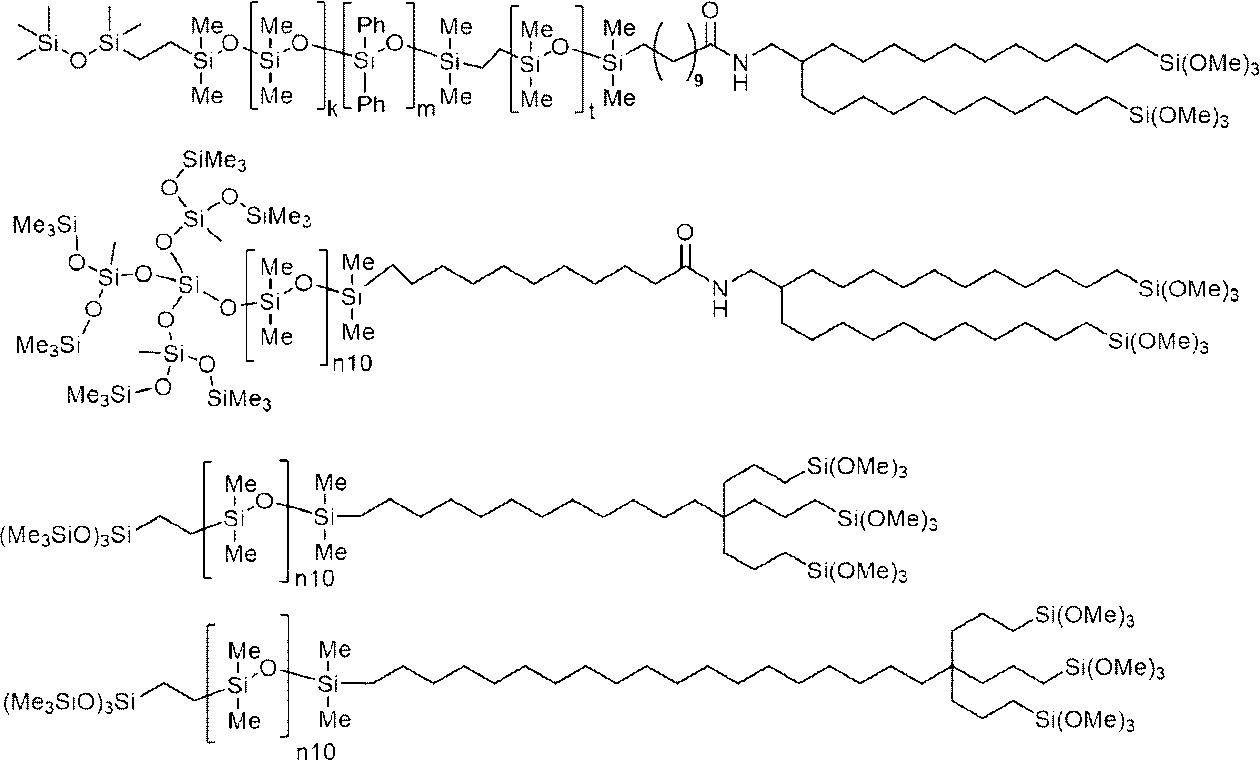
下記式中、n10は1以上の数であり、n10は1~60の数が好ましく、3~50の数であってもよく、5~30の数であってもよく、7~25の数であってもよい。

(化合物(2))
化合物(2)において、アルキル基とは、非置換のアルキル基を意味する。アルキル基は、直鎖状アルキル基、分岐鎖状アルキル基、及び環状アルキル基のいずれであってもよいが、直鎖状アルキル基又は分岐鎖状アルキル基が好ましい。アルキル基の炭素数は2~30であることが好ましく、3~28であることがより好ましく、4~22であることが更に好ましい。
化合物中、アルキル基は1つのみ含まれていてもよく、2つ以上含まれていてもよい。
アルキル基は1価の基であるため、化合物の末端に位置する。
化合物(2)において、アルキル基とは、非置換のアルキル基を意味する。アルキル基は、直鎖状アルキル基、分岐鎖状アルキル基、及び環状アルキル基のいずれであってもよいが、直鎖状アルキル基又は分岐鎖状アルキル基が好ましい。アルキル基の炭素数は2~30であることが好ましく、3~28であることがより好ましく、4~22であることが更に好ましい。
化合物中、アルキル基は1つのみ含まれていてもよく、2つ以上含まれていてもよい。
アルキル基は1価の基であるため、化合物の末端に位置する。
化合物(2)は、下記式(2A)で表される化合物であることが好ましい。
(T2-Z2)p1A(Si(R2)nL3-n)q1 … (2A)
式(2A)中、
T2は、炭素数2以上のアルキル基であり、
Z2は、2価の鎖状オルガノ(ポリ)シロキサン残基であり、
Aは、単結合又は(p1+q1)価の連結基であり、
R2は、それぞれ独立に、1価の炭化水素基であり、
Lは、それぞれ独立に、加水分解性基、加水分解性基を有する基、又は水酸基であり、
nは、0~2の整数であり、
p1及びq1は、それぞれ独立に、1以上の整数である。
(T2-Z2)p1A(Si(R2)nL3-n)q1 … (2A)
式(2A)中、
T2は、炭素数2以上のアルキル基であり、
Z2は、2価の鎖状オルガノ(ポリ)シロキサン残基であり、
Aは、単結合又は(p1+q1)価の連結基であり、
R2は、それぞれ独立に、1価の炭化水素基であり、
Lは、それぞれ独立に、加水分解性基、加水分解性基を有する基、又は水酸基であり、
nは、0~2の整数であり、
p1及びq1は、それぞれ独立に、1以上の整数である。
T2で表される炭素数2以上のアルキル基の好ましい態様は、上記の通りである。
Z2で表される2価の鎖状オルガノ(ポリ)シロキサン残基は、上記式(B1)で表される基が好ましい。
R2、L、及びnは、上記式(S1)におけるR2、L、及びnと同様である。
A(Si(R2)nL3-n)q1で表される基は、下記に示す内容以外、上記式(1A)におけるA(Si(R2)nL3-n)q1で表される基と同様である。
p1及びq1は、上記式(1A)におけるp1及びq1と同様である。
Z2で表される2価の鎖状オルガノ(ポリ)シロキサン残基は、上記式(B1)で表される基が好ましい。
R2、L、及びnは、上記式(S1)におけるR2、L、及びnと同様である。
A(Si(R2)nL3-n)q1で表される基は、下記に示す内容以外、上記式(1A)におけるA(Si(R2)nL3-n)q1で表される基と同様である。
p1及びq1は、上記式(1A)におけるp1及びq1と同様である。
A(Si(R2)nL3-n)q1で表される基は、基(3-1A)又は基(3-1B)が好ましく、基(3-1A)がより好ましい。
式(3-1A)中、Qaは、単結合又は2価の連結基である。
ただし、QaのZ2と結合する側の末端は、オキシシリル基ではない。
式(3-1A)中、Qaは、単結合又は2価の連結基である。
ただし、QaのZ2と結合する側の末端は、オキシシリル基ではない。
式(3-1A)中、X31は、単結合、アルキレン基、炭素原子、窒素原子、ケイ素原子、2~8価のオルガノ(ポリ)シロキサン残基、又は(h+i+1)価の環を有する基である。
ただし、Qaが単結合の場合、X31のZ2と結合する側の末端は、オキシシリル基ではない。上記以外の場合、X31の末端は、オキシシリル基であってもよい。
ただし、Qaが単結合の場合、X31のZ2と結合する側の末端は、オキシシリル基ではない。上記以外の場合、X31の末端は、オキシシリル基であってもよい。
式(3-1A)中、Qbは、単結合又は2価の連結基である。
ただし、Qa及びX31が単結合の場合、QbのZ2と結合する側の末端はオキシシリル基ではない。上記以外の場合、Qbの末端は、オキシシリル基であってもよい。
また、hが1であって、Qbがアルキレン基である場合、Qa-X31のQb側末端はアルキレン基ではない。
ただし、Qa及びX31が単結合の場合、QbのZ2と結合する側の末端はオキシシリル基ではない。上記以外の場合、Qbの末端は、オキシシリル基であってもよい。
また、hが1であって、Qbがアルキレン基である場合、Qa-X31のQb側末端はアルキレン基ではない。
式(3-1B)中、Qcは、単結合又は2価の連結基である。
ただし、QcのZ2と結合する側の末端は、オキシシリル基ではない。
ただし、QcのZ2と結合する側の末端は、オキシシリル基ではない。
基(3-1A)としては、基(3-1A-1)~(3-1A-7)が好ましい。
ただし、基(3-1A-1)~(3-1A-7)のZ2と結合する側の末端は、オキシシリル基ではない。
ただし、基(3-1A-1)~(3-1A-7)のZ2と結合する側の末端は、オキシシリル基ではない。
基(3-1A-1)において、X32は、-O-、-S-、-N(Rd)-、-C(O)O-、-C(O)S-、-N(Rd)C(O)N(Rd)-、-OC(O)N(Rd)-、又は-C(O)N(Rd)-が好ましく、-C(O)O-又は-C(O)N(Rd)-がより好ましい。
s1は0であることが好ましく、Qb1は、炭素数2~6のアルキレン基が好ましい。
s1は0であることが好ましく、Qb1は、炭素数2~6のアルキレン基が好ましい。
基(3-1A-2)において、X33は、-O-、-C(O)O-、又は-C(O)N(Rd)-が好ましい。
式(2A)におけるAは、基(g2-1)~(g2-7)であってもよい。
ただし、式(g2-1)~(g2-7)においては、A1側がZ2と結合し、Q22、Q23、Q24、Q25又はQ26側が[-Si(R2)nL3-n]と結合する。
Aの他の形態としては、基(g2-8)~(g2-14)が挙げられる。
ただし、式(g2-8)~(g2-14)においては、A1側がZ2と結合し、G1側が[-Si(R2)nL3-n]と結合する。
化合物(2)は、下記式(2B)で表される化合物であることが好ましい。

式(2B)中、R51は、炭素数2以上のアルキル基である。
R52及びR54はそれぞれ独立に、アルキレン基である。
R53は、-C(O)O-、-SO2N(Rd)-、-N(Rd)SO2-、-N(Rd)C(O)-、又は、-C(O)N(Rd)-である。
R3は、式(B1)におけるR3と同じある。k1は、式(B1)におけるk1と同じである。
X31(-Qb-Si(R2)nL3-n)h(-R31)iで表される基は、基(3-1A)におけるX31(-Qb-Si(R3)nL3-n)h(-R31)iで表される基と同じである。
t1は、0又は1である。
R52及びR54はそれぞれ独立に、アルキレン基である。
R53は、-C(O)O-、-SO2N(Rd)-、-N(Rd)SO2-、-N(Rd)C(O)-、又は、-C(O)N(Rd)-である。
R3は、式(B1)におけるR3と同じある。k1は、式(B1)におけるk1と同じである。
X31(-Qb-Si(R2)nL3-n)h(-R31)iで表される基は、基(3-1A)におけるX31(-Qb-Si(R3)nL3-n)h(-R31)iで表される基と同じである。
t1は、0又は1である。
R51で表されるアルキル基の好ましい態様は、上記アルキル基の欄で説明した通りである。
R52で表されるアルキレン基は、直鎖状、分岐鎖状又は環状であってもよい。アルキレン基の炭素数は、1~30が好ましく、1~20がより好ましく、4~20が更に好ましく、5~15が特に好ましい。
R54で表されるアルキレン基は、直鎖状、分岐鎖状又は環状であってもよい。アルキレン基の炭素数は、1~20が好ましく、1~10がより好ましく、1~6が更に好ましく、1~3が特に好ましい。
R52で表されるアルキレン基は、直鎖状、分岐鎖状又は環状であってもよい。アルキレン基の炭素数は、1~30が好ましく、1~20がより好ましく、4~20が更に好ましく、5~15が特に好ましい。
R54で表されるアルキレン基は、直鎖状、分岐鎖状又は環状であってもよい。アルキレン基の炭素数は、1~20が好ましく、1~10がより好ましく、1~6が更に好ましく、1~3が特に好ましい。
化合物(2)としては、例えば、以下の化合物が挙げられる。下記式中、n10は1以上の数であり、n10は1~60の数が好ましく、3~50の数であってもよく、5~30の数であってもよく、7~25の数であってもよい。
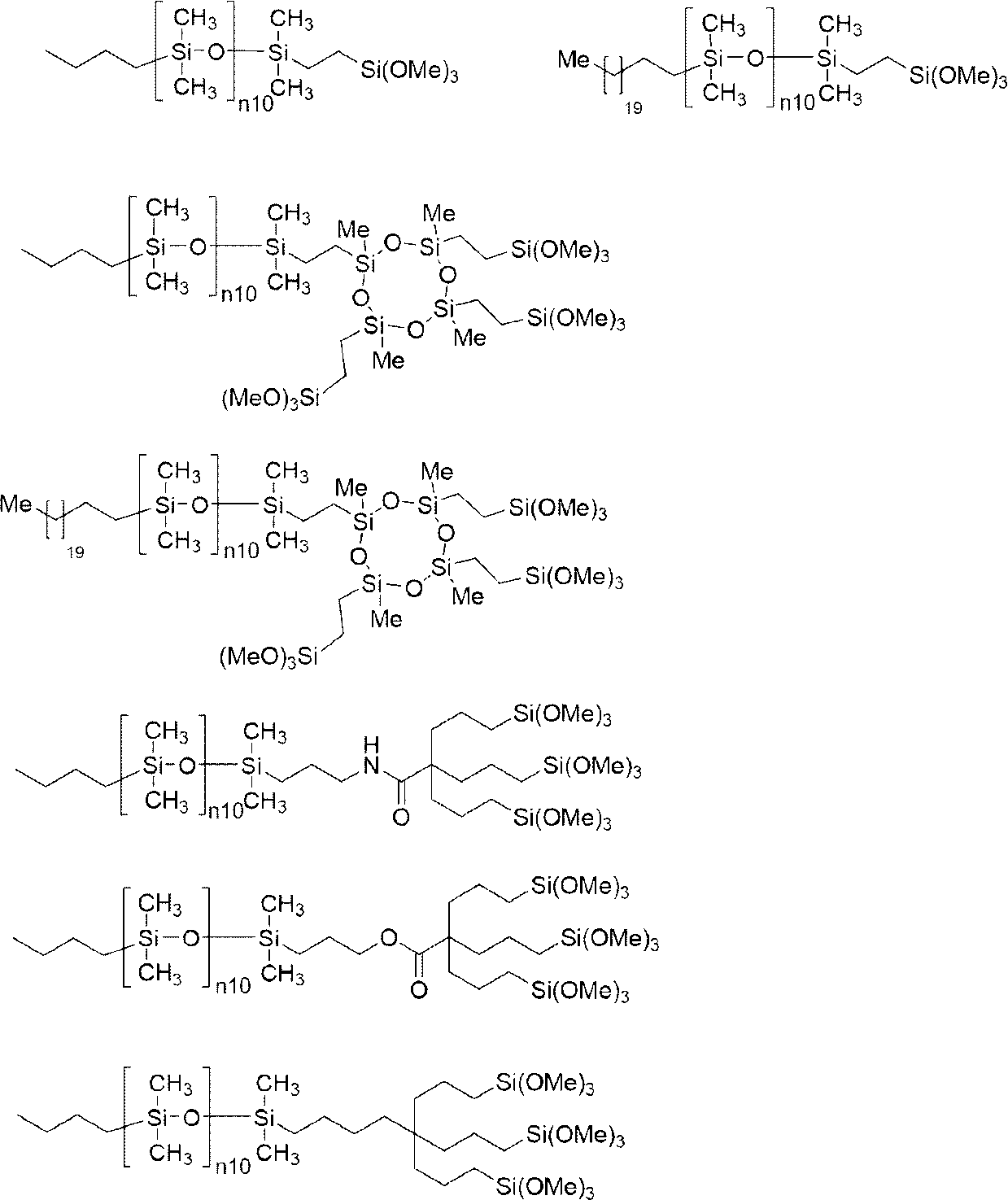
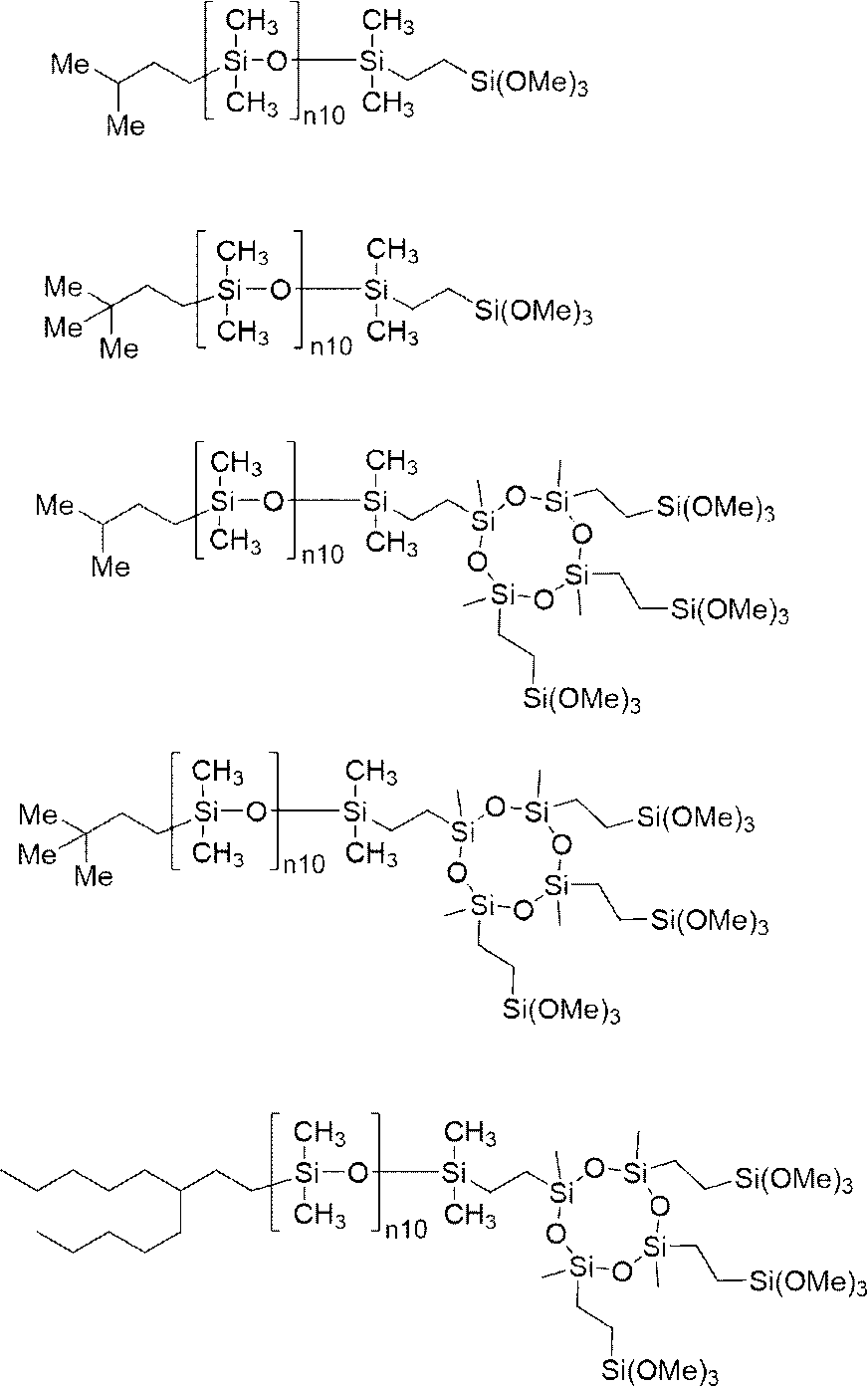


(化合物(3))
化合物(3)は、下記式(3A)で表される化合物であることが好ましい。
[T3-(O)r-Z3]p1A(Si(R2)nL3-n)q1 …(3A)
式(3A)中、
T3は、1価の環状のポリシロキサン残基又は1価のかご状のポリシロキサン残基であり、
rは、0又は1であり、
Z3は、2価の鎖状オルガノ(ポリ)シロキサン残基であるか、又は、2価の鎖状オルガノ(ポリ)シロキサン残基と、アルキレン鎖及びポリアルキレンオキシド鎖の少なくとも一方との組み合わせであり、
Aは、単結合又は(p1+q1)価の連結基であり、
R2は、それぞれ独立に、1価の炭化水素基であり、
Lは、それぞれ独立に、加水分解性基、加水分解性基を有する基、又は水酸基であり、
nは、0~2の整数であり、
p1及びq1は、それぞれ独立に、1以上の整数である。
化合物(3)は、下記式(3A)で表される化合物であることが好ましい。
[T3-(O)r-Z3]p1A(Si(R2)nL3-n)q1 …(3A)
式(3A)中、
T3は、1価の環状のポリシロキサン残基又は1価のかご状のポリシロキサン残基であり、
rは、0又は1であり、
Z3は、2価の鎖状オルガノ(ポリ)シロキサン残基であるか、又は、2価の鎖状オルガノ(ポリ)シロキサン残基と、アルキレン鎖及びポリアルキレンオキシド鎖の少なくとも一方との組み合わせであり、
Aは、単結合又は(p1+q1)価の連結基であり、
R2は、それぞれ独立に、1価の炭化水素基であり、
Lは、それぞれ独立に、加水分解性基、加水分解性基を有する基、又は水酸基であり、
nは、0~2の整数であり、
p1及びq1は、それぞれ独立に、1以上の整数である。
R2、L、及びnは、上記式(S1)におけるR2、L、及びnと同様である。
A(Si(R2)nL3-n)q1で表される基は、下記に示す内容以外、上記式(1A)におけるA(Si(R2)nL3-n)q1で表される基と同様である。
p1及びq1は、上記式(1A)におけるp1及びq1と同様である。
A(Si(R2)nL3-n)q1で表される基は、下記に示す内容以外、上記式(1A)におけるA(Si(R2)nL3-n)q1で表される基と同様である。
p1及びq1は、上記式(1A)におけるp1及びq1と同様である。
1価の環状のポリシロキサン残基又は1価のかご状のポリシロキサン残基の詳細は、式(C)のT11の説明において上述した通りである。
A(Si(R2)nL3-n)q1で表される基は、基(3-1A)又は基(3-1B)が好ましく、基(3-1A)がより好ましい。
式(3-1A)中、Qaは、単結合又は2価の連結基である。
ただし、QaのZ3と結合する側の末端は、アルキレン基、ポリアルキレンオキシド鎖、及び2価のオルガノ(ポリ)シロキサン残基のいずれでもない。
Z3のA側末端がアルキレン鎖である場合には、Qaは、アルキレン基以外の2価の炭化水素基、2価の複素環基、-O-、-S-、-SO2-、-N(Rd)-、-C(O)-、-Si(Ra)2-、-OC(O)-、-C(O)O-、-C(O)S-、-C(O)N(Rd)-、-N(Rd)C(O)-、-N(Rd)C(O)N(Rd)-、-N(Rd)C(O)O-、-OC(O)N(Rd)-、-SO2N(Rd)-、-N(Rd)SO2-、-C(O)N(Rd)-を有するアルキレン基、-N(Rd)C(O)-を有するアルキレン基、-OC(O)N(Rd)-を有するアルキレン基、エーテル性酸素原子を有するアルキレン基、-S-を有するアルキレン基、-OC(O)-を有するアルキレン基、-C(O)O-を有するアルキレン基、-C(O)S-を有するアルキレン基、-N(Rd)-を有するアルキレン基、-N(Rd)C(O)N(Rd)-を有するアルキレン基、又は-SO2N(Rd)-を有するアルキレン基が好ましく、-OC(O)-、-C(O)N(Rd)-を有するアルキレン基、-OC(O)N(Rd)-を有するアルキレン基、エーテル性酸素原子を有するアルキレン基、-S-を有するアルキレン基、-C(O)O-を有するアルキレン基、-C(O)S-を有するアルキレン基、-N(Rd)-を有するアルキレン基、又は-N(Rd)C(O)N(Rd)-を有するアルキレン基がより好ましく、-C(O)O-を有するアルキレン基、又は-C(O)N(Rd)-を有するアルキレン基が更に好ましい。
Z3のA側末端がポリアルキレンオキシド鎖である場合には、Qaは、アルキレン基以外の2価の炭化水素基、2価の複素環基、-SO2-、-C(O)-、-Si(Ra)2-、-C(O)O-、-C(O)S-、-C(O)N(Rd)-、-SO2N(Rd)-、-C(O)N(Rd)-を有するアルキレン基、-C(O)O-を有するアルキレン基、又は-SO2N(Rd)-を有するアルキレン基が好ましく、-C(O)-がより好ましい。
Z3のA側末端が2価の鎖状オルガノ(ポリ)シロキサン残基である場合には、Qaは、アルキレン基以外の2価の炭化水素基、2価の複素環基、-O-、-S-、-SO2-、-N(Rd)-、-C(O)-、-Si(Ra)2-、-OC(O)-、-C(O)O-、-C(O)S-、-C(O)N(Rd)-、-N(Rd)C(O)-、-N(Rd)C(O)N(Rd)-、-N(Rd)C(O)O-、-OC(O)N(Rd)-、-SO2N(Rd)-、-N(Rd)SO2-、-C(O)N(Rd)-を有するアルキレン基、-N(Rd)C(O)-を有するアルキレン基、-OC(O)N(Rd)-を有するアルキレン基、エーテル性酸素原子を有するアルキレン基、-S-を有するアルキレン基、-OC(O)-を有するアルキレン基、-C(O)O-を有するアルキレン基、-C(O)S-を有するアルキレン基、-N(Rd)-を有するアルキレン基、-N(Rd)C(O)N(Rd)-を有するアルキレン基、又は-SO2N(Rd)-を有するアルキレン基が好ましい。
ただし、QaのZ3と結合する側の末端は、アルキレン基、ポリアルキレンオキシド鎖、及び2価のオルガノ(ポリ)シロキサン残基のいずれでもない。
Z3のA側末端がアルキレン鎖である場合には、Qaは、アルキレン基以外の2価の炭化水素基、2価の複素環基、-O-、-S-、-SO2-、-N(Rd)-、-C(O)-、-Si(Ra)2-、-OC(O)-、-C(O)O-、-C(O)S-、-C(O)N(Rd)-、-N(Rd)C(O)-、-N(Rd)C(O)N(Rd)-、-N(Rd)C(O)O-、-OC(O)N(Rd)-、-SO2N(Rd)-、-N(Rd)SO2-、-C(O)N(Rd)-を有するアルキレン基、-N(Rd)C(O)-を有するアルキレン基、-OC(O)N(Rd)-を有するアルキレン基、エーテル性酸素原子を有するアルキレン基、-S-を有するアルキレン基、-OC(O)-を有するアルキレン基、-C(O)O-を有するアルキレン基、-C(O)S-を有するアルキレン基、-N(Rd)-を有するアルキレン基、-N(Rd)C(O)N(Rd)-を有するアルキレン基、又は-SO2N(Rd)-を有するアルキレン基が好ましく、-OC(O)-、-C(O)N(Rd)-を有するアルキレン基、-OC(O)N(Rd)-を有するアルキレン基、エーテル性酸素原子を有するアルキレン基、-S-を有するアルキレン基、-C(O)O-を有するアルキレン基、-C(O)S-を有するアルキレン基、-N(Rd)-を有するアルキレン基、又は-N(Rd)C(O)N(Rd)-を有するアルキレン基がより好ましく、-C(O)O-を有するアルキレン基、又は-C(O)N(Rd)-を有するアルキレン基が更に好ましい。
Z3のA側末端がポリアルキレンオキシド鎖である場合には、Qaは、アルキレン基以外の2価の炭化水素基、2価の複素環基、-SO2-、-C(O)-、-Si(Ra)2-、-C(O)O-、-C(O)S-、-C(O)N(Rd)-、-SO2N(Rd)-、-C(O)N(Rd)-を有するアルキレン基、-C(O)O-を有するアルキレン基、又は-SO2N(Rd)-を有するアルキレン基が好ましく、-C(O)-がより好ましい。
Z3のA側末端が2価の鎖状オルガノ(ポリ)シロキサン残基である場合には、Qaは、アルキレン基以外の2価の炭化水素基、2価の複素環基、-O-、-S-、-SO2-、-N(Rd)-、-C(O)-、-Si(Ra)2-、-OC(O)-、-C(O)O-、-C(O)S-、-C(O)N(Rd)-、-N(Rd)C(O)-、-N(Rd)C(O)N(Rd)-、-N(Rd)C(O)O-、-OC(O)N(Rd)-、-SO2N(Rd)-、-N(Rd)SO2-、-C(O)N(Rd)-を有するアルキレン基、-N(Rd)C(O)-を有するアルキレン基、-OC(O)N(Rd)-を有するアルキレン基、エーテル性酸素原子を有するアルキレン基、-S-を有するアルキレン基、-OC(O)-を有するアルキレン基、-C(O)O-を有するアルキレン基、-C(O)S-を有するアルキレン基、-N(Rd)-を有するアルキレン基、-N(Rd)C(O)N(Rd)-を有するアルキレン基、又は-SO2N(Rd)-を有するアルキレン基が好ましい。
式(3-1A)中、X31は、単結合、アルキレン基、炭素原子、窒素原子、ケイ素原子、2~8価のオルガノ(ポリ)シロキサン残基、又は(h+i+1)価の環を有する基である。
ただし、Qaが単結合の場合、X31のZ3と結合する側の末端は、アルキレン基、ポリアルキレンオキシド鎖、及び2価のオルガノ(ポリ)シロキサン残基のいずれでもない。上記以外の場合、X31の末端は、アルキレン基、ポリアルキレンオキシド鎖、及び2価のオルガノ(ポリ)シロキサン残基のいずれであってもよい。
ただし、Qaが単結合の場合、X31のZ3と結合する側の末端は、アルキレン基、ポリアルキレンオキシド鎖、及び2価のオルガノ(ポリ)シロキサン残基のいずれでもない。上記以外の場合、X31の末端は、アルキレン基、ポリアルキレンオキシド鎖、及び2価のオルガノ(ポリ)シロキサン残基のいずれであってもよい。
式(3-1A)中、Qbは、単結合又は2価の連結基である。
ただし、Qa及びX31が単結合の場合、QbのZ3と結合する側の末端はアルキレン基、ポリアルキレンオキシド鎖、及び2価のオルガノ(ポリ)シロキサン残基のいずれでもない。上記以外の場合、Qbの末端は、アルキレン基、ポリアルキレンオキシド鎖、及び2価のオルガノ(ポリ)シロキサン残基のいずれであってもよい。
ただし、Qa及びX31が単結合の場合、QbのZ3と結合する側の末端はアルキレン基、ポリアルキレンオキシド鎖、及び2価のオルガノ(ポリ)シロキサン残基のいずれでもない。上記以外の場合、Qbの末端は、アルキレン基、ポリアルキレンオキシド鎖、及び2価のオルガノ(ポリ)シロキサン残基のいずれであってもよい。
式(3-1A)中、Qa、X31、及びQbが単結合の場合、[Si(R2)nL3-n]は、Z3と直接結合し、Z3はアルキレン鎖である。
式(3-1B)中、Qcは、単結合又は2価の連結基である。
ただし、QcのZ3と結合する側の末端は、アルキレン基、ポリアルキレンオキシド鎖、及び2価のオルガノ(ポリ)シロキサン残基のいずれでもない。
ただし、QcのZ3と結合する側の末端は、アルキレン基、ポリアルキレンオキシド鎖、及び2価のオルガノ(ポリ)シロキサン残基のいずれでもない。
基(3-1A)としては、基(3-1A-1)~(3-1A-7)が好ましい。
ただし、基(3-1A-1)~(3-1A-7)のZ3と結合する側の末端は、アルキレン基、ポリアルキレンオキシド鎖、及び2価のオルガノ(ポリ)シロキサン残基のいずれでもない。
ただし、基(3-1A-1)~(3-1A-7)のZ3と結合する側の末端は、アルキレン基、ポリアルキレンオキシド鎖、及び2価のオルガノ(ポリ)シロキサン残基のいずれでもない。
基(3-1A-1)において、Z3のA側末端がアルキレン鎖である場合には、X32は、-O-、-S-、-N(Rd)-、-C(O)-、-C(O)O-、-C(O)S-、-SO2N(Rd)-、-N(Rd)SO2-、-N(Rd)C(O)-、-N(Rd)C(O)N(Rd)-、-OC(O)N(Rd)-、又は、-C(O)N(Rd)-が好ましく、-O-、-S-、-N(Rd)-、-C(O)O-、-C(O)S-、-N(Rd)C(O)-、-N(Rd)C(O)N(Rd)-、-OC(O)N(Rd)-、又は-C(O)N(Rd)-がより好ましく、-C(O)O-又は-N(Rd)C(O)-が更に好ましい。
Z3のA側末端がポリアルキレンオキシド鎖である場合には、X32は、-C(O)-、-C(O)O-、-C(O)S-、-SO2N(Rd)-、又は-C(O)N(Rd)-が好ましく、-C(O)-がより好ましい。
Z3のA側末端が2価の鎖状オルガノ(ポリ)シロキサン残基である場合には、X32は、-O-、-S-、-N(Rd)-、-C(O)-、-C(O)O-、-C(O)S-、-SO2N(Rd)-、-N(Rd)SO2-、-N(Rd)C(O)-、-N(Rd)C(O)N(Rd)-、-OC(O)N(Rd)-、又は-C(O)N(Rd)-が好ましく、-O-がより好ましい。
Z3のA側末端がポリアルキレンオキシド鎖である場合には、X32は、-C(O)-、-C(O)O-、-C(O)S-、-SO2N(Rd)-、又は-C(O)N(Rd)-が好ましく、-C(O)-がより好ましい。
Z3のA側末端が2価の鎖状オルガノ(ポリ)シロキサン残基である場合には、X32は、-O-、-S-、-N(Rd)-、-C(O)-、-C(O)O-、-C(O)S-、-SO2N(Rd)-、-N(Rd)SO2-、-N(Rd)C(O)-、-N(Rd)C(O)N(Rd)-、-OC(O)N(Rd)-、又は-C(O)N(Rd)-が好ましく、-O-がより好ましい。
Z3のA側末端がアルキレン鎖である場合には、s1が0であって、Qb1が単結合であるか、又は、s1が1であって、Qb1が、炭素数2~6のアルキレン基であることが好ましい。
Z3のA側末端がポリアルキレンオキシド鎖である場合には、s1が1であって、Qb1が炭素数2~6のアルキレン基であることが好ましい。
Z3のA側末端が2価の鎖状オルガノ(ポリ)シロキサン残基である場合には、s1が1であって、Qb1が単結合であることが好ましい。
Z3のA側末端がポリアルキレンオキシド鎖である場合には、s1が1であって、Qb1が炭素数2~6のアルキレン基であることが好ましい。
Z3のA側末端が2価の鎖状オルガノ(ポリ)シロキサン残基である場合には、s1が1であって、Qb1が単結合であることが好ましい。
基(3-1A-2)において、Z3のA側末端がアルキレン鎖又は2価の鎖状オルガノ(ポリ)シロキサン残基である場合には、X33は、-O-、-S-、-N(Rd)-、-C(O)-、-C(O)O-、-C(O)S-、-SO2N(Rd)-、-N(Rd)SO2-、-N(Rd)C(O)-、-N(Rd)C(O)N(Rd)-、-OC(O)N(Rd)-、又は、-C(O)N(Rd)-が好ましい。
Z3のA側末端がポリアルキレンオキシド鎖である場合には、X33は、-C(O)O-、-C(O)S-、-SO2N(Rd)-、又は-C(O)N(Rd)-が好ましい。
Z3のA側末端がポリアルキレンオキシド鎖である場合には、X33は、-C(O)O-、-C(O)S-、-SO2N(Rd)-、又は-C(O)N(Rd)-が好ましい。
式(3A)におけるAは、基(g2-1)~(g2-7)であってもよい。
ただし、式(g2-1)~(g2-7)においては、A1側がZ3と結合し、Q22、Q23、Q24、Q25又はQ26側が[-Si(R2)nL3-n]と結合する。
Aの他の形態としては、基(g2-8)~(g2-14)が挙げられる。
ただし、式(g2-8)~(g2-14)においては、A1側がZ3と結合し、G1側が[-Si(R2)nL3-n]と結合する。
化合物(3)の具体例としては、以下の化合物が挙げられる。下記式中、n10は1以上の数であり、n10は1~60の数が好ましく、3~50の数であってもよく、5~30の数であってもよく、7~25の数であってもよい。
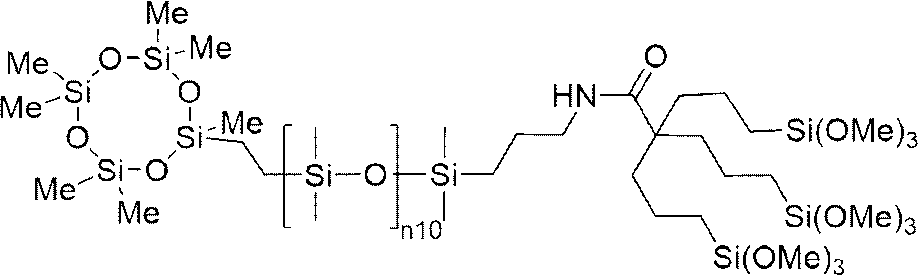
(化合物(4A)、(4B))
化合物(4A)及び(4B)において、
XAは、それぞれ独立に、
-(CH2)s7-O-(CH2)t7-、
-(CH2)s7-CONR54-(CH2)t7-、
-(CH2)s7-O-(CH2)u7-CO-、又は
-(CH2)s7-O-(CH2)u7-CONR54-(CH2)t7-
であることがより好ましい。
化合物(4A)及び(4B)において、
XAは、それぞれ独立に、
-(CH2)s7-O-(CH2)t7-、
-(CH2)s7-CONR54-(CH2)t7-、
-(CH2)s7-O-(CH2)u7-CO-、又は
-(CH2)s7-O-(CH2)u7-CONR54-(CH2)t7-
であることがより好ましい。
R54は、それぞれ独立に、水素原子、フェニル基、炭素数1~6のアルキル基又は炭素数1~10のオキシアルキレン含有基であり、
s7は、1~20の整数であり、
t7は、1~20の整数であり、
u7は、1~20の整数である。
s7は、1~20の整数であり、
t7は、1~20の整数であり、
u7は、1~20の整数である。
XAは、それぞれ独立に、下記式(W6)で表される基であることが好ましい。
式(W6)中、Xaは、それぞれ独立に、単結合又は2価の有機基である。
式(W6)中、Xaは、それぞれ独立に、単結合又は2価の有機基である。

化合物(4A)の具体例としては、以下の化合物が挙げられる。
・(CH3)3Si-(OSi(CH3)2)19-(CH2)10-CONH-CH2C{CH2CH2CH2Si(OCH3)3}3
・(CH3)3Si-(OSi(CH3)2)19-(CH2)10-CONH-CH2C{CH2CH2CH2Si(OCH3)3}3
(化合物(5))
本開示の表面処理剤が化合物(5)を含む場合、本開示の表面処理剤は、更に金属化合物を含むことが好ましい。
本開示の表面処理剤が化合物(5)を含む場合、本開示の表面処理剤は、更に金属化合物を含むことが好ましい。
金属化合物は、下記式(M6a)又は(M6b)で表される化合物であることが好ましい。
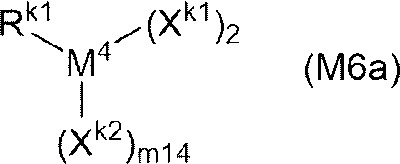
式(M6a)中、
Rk1は、シロキサン骨格含有基、炭化水素鎖含有基、又は加水分解性基を表し、
複数のXk1は、それぞれ独立に、加水分解性基を表す。
Xk2は、シロキサン骨格含有基、炭化水素鎖含有基又は加水分解性基を表す。
Rk1及びXk1におけるシロキサン骨格含有基の元素数は、化合物(5)の(Ra9)3Si-Z-(Si(Rs1)2-O-)n9-Y-で表されるトリアルキルシリル基含有分子鎖の元素数より少なく、Rk1及びXk1における炭化水素鎖含有基に含まれる炭化水素鎖の最長直鎖の炭素数は、化合物(5)の(Ra9)3Si-Z-(Si(Rs1)2-O-)n9-Y-で表されるトリアルキルシリル基含有分子鎖の元素数より少ない。
Rk1及びXk2がシロキサン骨格含有基又は炭化水素鎖含有基の場合、Rk1とXk2とは同一であっても異なっていてもよい。
Xk2が加水分解性基の場合、Xk2とXk1とは同一でも異なっていてもよい。また、Rk1とXk2は同一であっても異なっていてもよい。M4は、金属アルコキシドを形成しうる3価又は4価の金属原子を表す。m14は、M4に応じて、0又は1の整数を表す。
Rk1は、シロキサン骨格含有基、炭化水素鎖含有基、又は加水分解性基を表し、
複数のXk1は、それぞれ独立に、加水分解性基を表す。
Xk2は、シロキサン骨格含有基、炭化水素鎖含有基又は加水分解性基を表す。
Rk1及びXk1におけるシロキサン骨格含有基の元素数は、化合物(5)の(Ra9)3Si-Z-(Si(Rs1)2-O-)n9-Y-で表されるトリアルキルシリル基含有分子鎖の元素数より少なく、Rk1及びXk1における炭化水素鎖含有基に含まれる炭化水素鎖の最長直鎖の炭素数は、化合物(5)の(Ra9)3Si-Z-(Si(Rs1)2-O-)n9-Y-で表されるトリアルキルシリル基含有分子鎖の元素数より少ない。
Rk1及びXk2がシロキサン骨格含有基又は炭化水素鎖含有基の場合、Rk1とXk2とは同一であっても異なっていてもよい。
Xk2が加水分解性基の場合、Xk2とXk1とは同一でも異なっていてもよい。また、Rk1とXk2は同一であっても異なっていてもよい。M4は、金属アルコキシドを形成しうる3価又は4価の金属原子を表す。m14は、M4に応じて、0又は1の整数を表す。

式(M6b)中、
Rk3は、加水分解性シランオリゴマー残基を表し、
Xk3は、加水分解性基、炭素数1~4の含フッ素アルキル基又は炭素数1~4のアルキル基を表す。
Rk3は、加水分解性シランオリゴマー残基を表し、
Xk3は、加水分解性基、炭素数1~4の含フッ素アルキル基又は炭素数1~4のアルキル基を表す。
化合物(5)の具体例としては、以下の化合物が挙げられる。下記式中、n10は1以上の数であり、n10は1~60の数が好ましく、3~50の数であってもよく、5~30の数であってもよく、7~25の数であってもよい。

<第2化合物>
第2化合物は、オルガノ(ポリ)シロキサン残基を有さず、酸素原子と直接結合しない炭化水素基であって官能基又は置換基を有してもよい炭素数4以上の炭化水素基と、反応性シリル基bと、を有する。
第2化合物に含まれないオルガノ(ポリ)シロキサン残基としては、上記第1化合物に含まれる式(B1)及び式(B2)で表されるオルガノ(ポリ)シロキサン残基が挙げられる。
第2化合物は、オルガノ(ポリ)シロキサン残基を有さず、酸素原子と直接結合しない炭化水素基であって官能基又は置換基を有してもよい炭素数4以上の炭化水素基と、反応性シリル基bと、を有する。
第2化合物に含まれないオルガノ(ポリ)シロキサン残基としては、上記第1化合物に含まれる式(B1)及び式(B2)で表されるオルガノ(ポリ)シロキサン残基が挙げられる。
第2化合物としては、上記炭化水素基の一方の末端のみに連結される反応性シリル基bとを有する化合物(以下、「第2化合物S」とも記す。)、及び、上記炭化水素基の両末端にそれぞれ連結される反応性シリル基bを有する化合物(以下、「第2化合物D」とも記す。)が挙げられる。
第2化合物として、第2化合物Sを単独で用いてもよく、第2化合物Dを単独で用いてもよく、第2化合物Sと第2化合物Dを組み合わせて用いてもよい。いずれの場合も、第2化合物Sとして1種を単独で用いてもよく、2種以上を併用してもよく、第2化合物Dとして1種を単独で用いてもよく、2種以上を併用してもよい。
中でも、第2化合物において、反応性シリル基bは、上記炭化水素基の一方の末端のみに連結されることが好ましい。
第2化合物として、第2化合物Sを単独で用いてもよく、第2化合物Dを単独で用いてもよく、第2化合物Sと第2化合物Dを組み合わせて用いてもよい。いずれの場合も、第2化合物Sとして1種を単独で用いてもよく、2種以上を併用してもよく、第2化合物Dとして1種を単独で用いてもよく、2種以上を併用してもよい。
中でも、第2化合物において、反応性シリル基bは、上記炭化水素基の一方の末端のみに連結されることが好ましい。
(反応性シリル基)
第2化合物は、反応シリル基bを含む。第2化合物に含まれる反応性シリル基bの好ましい態様は、第1化合物に含まれる反応性シリル基aの好ましい態様と同様である。
第2化合物は、反応シリル基bを含む。第2化合物に含まれる反応性シリル基bの好ましい態様は、第1化合物に含まれる反応性シリル基aの好ましい態様と同様である。
具体的には、反応性シリル基a及び反応性シリル基bはそれぞれ独立に、上記式(S1)で表されることが好ましい。式(S1)の詳細は、上記の通りである。
(炭化水素基)
第2化合物は、酸素原子と直接結合しない炭化水素基であって官能基又は置換基を有してもよい炭素数4以上の炭化水素基を含む。
なお、「炭化水素基の炭素数」には、官能基又は置換基中の炭素数を含まない。
第2化合物は、酸素原子と直接結合しない炭化水素基であって官能基又は置換基を有してもよい炭素数4以上の炭化水素基を含む。
なお、「炭化水素基の炭素数」には、官能基又は置換基中の炭素数を含まない。
以下、酸素原子と直接結合しない炭化水素基であって官能基又は置換基を有してもよい炭素数4以上の炭化水素基を「炭化水素基M」という。
第2化合物は、炭化水素基M以外に、酸素原子と直接結合する炭化水素基を含んでいてもよい。
ただし、第2化合物は、炭化水素基Mを含むことが必須である。したがって、酸素原子と直接結合する炭化水素基のみと、反応性シリル基と、を含む化合物(例えば、Si(OCH2CH3)4)は、第2化合物に該当しない。
第2化合物は、炭化水素基M以外に、酸素原子と直接結合する炭化水素基を含んでいてもよい。
ただし、第2化合物は、炭化水素基Mを含むことが必須である。したがって、酸素原子と直接結合する炭化水素基のみと、反応性シリル基と、を含む化合物(例えば、Si(OCH2CH3)4)は、第2化合物に該当しない。
炭化水素基Mは、官能基又は置換基を有していてもよく、官能基又は置換基を有していなくてもよい。
炭化水素基としては、例えば、脂肪族炭化水素基及び芳香族炭化水素基が挙げられる。中でも、炭化水素基は、脂肪族炭化水素基が好ましく、アルキル基がより好ましい。
アルキル基は、直鎖状アルキル基、分岐鎖状アルキル基、及び環状アルキル基のいずれであってもよい。
炭化水素基の炭素数は4~50が好ましく、8~40がより好ましく、10~40が特に好ましい。
炭化水素基としては、例えば、脂肪族炭化水素基及び芳香族炭化水素基が挙げられる。中でも、炭化水素基は、脂肪族炭化水素基が好ましく、アルキル基がより好ましい。
アルキル基は、直鎖状アルキル基、分岐鎖状アルキル基、及び環状アルキル基のいずれであってもよい。
炭化水素基の炭素数は4~50が好ましく、8~40がより好ましく、10~40が特に好ましい。
炭化水素基Mが有していてもよい官能基又は置換基としては、例えば、アミド基、及びエステル基が挙げられる。
中でも、炭化水素基Mは、酸素原子と直接結合しない炭化水素基であって無置換の炭化水素基であることが好ましい。
第2化合物において、炭化水素基と反応性シリル基とは直接結合していてもよく、炭化水素基と反応性シリル基とは別の基を介して結合していてもよい。
前記第2化合物は、式(G)で表される化合物が好ましい。
(R71-R72)p7-A71-(Si(R2)nL3-n)q2 …(G)
式(G)中、
R71は、水素原子、又は、[(CH3)3Q71-R73-]m7Q72(CH3)3-m7-であり、
Q71及びQ72、はそれぞれ独立に、C又はSiであり、
R73は、それぞれ独立に、炭素数1~6のアルキレン基であり、
m7は、0~3の整数であり、
R72は、アルキレン基であって、炭素数が2以上の場合、炭素-炭素原子間に、-O-、-S-、-C(=O)NH-、-NHC(=O)-、-C(=O)O-、-OC(=O)-、-C(=O)S-、-SC(=O)-、-S(=O)2NH-、-NHS(=O)2-、-S(=O)2O-、-OS(=O)2-、及びフェニレン基より選択される基を1個以上有していてもよく、
A71は、単結合又は(p7+q2)価の連結基であり、
R2は、それぞれ独立に、炭化水素基であり、
Lは、それぞれ独立に、加水分解性基、加水分解性基を有する基、又は水酸基であり、
nは、0~2の整数であり、
p7は1以上の整数であり、
q2は、1以上の整数である。
(R71-R72)p7-A71-(Si(R2)nL3-n)q2 …(G)
式(G)中、
R71は、水素原子、又は、[(CH3)3Q71-R73-]m7Q72(CH3)3-m7-であり、
Q71及びQ72、はそれぞれ独立に、C又はSiであり、
R73は、それぞれ独立に、炭素数1~6のアルキレン基であり、
m7は、0~3の整数であり、
R72は、アルキレン基であって、炭素数が2以上の場合、炭素-炭素原子間に、-O-、-S-、-C(=O)NH-、-NHC(=O)-、-C(=O)O-、-OC(=O)-、-C(=O)S-、-SC(=O)-、-S(=O)2NH-、-NHS(=O)2-、-S(=O)2O-、-OS(=O)2-、及びフェニレン基より選択される基を1個以上有していてもよく、
A71は、単結合又は(p7+q2)価の連結基であり、
R2は、それぞれ独立に、炭化水素基であり、
Lは、それぞれ独立に、加水分解性基、加水分解性基を有する基、又は水酸基であり、
nは、0~2の整数であり、
p7は1以上の整数であり、
q2は、1以上の整数である。
上記R71が水素原子の場合、式(G)のR71-R72はアルキル基である。当該アルキル基としては、後述する式(E)におけるRAkと同様のものが挙げられる。
上記R71が[(CH3)3Q71-R73-]m7Q72(CH3)3-m7-の場合、R71-R72は、先端にトリメチルシリル基(TMS)又はtert-ブチル基(tBu)を含むアルキル基である。先端にTMS又はtBuを有する第2化合物は、表面処理層を形成した際に、空気界面側にTMS又はtBuが配置されるため、撥水性及び撥油性に優れ指紋拭き取り性がより向上する。
上記R71が[(CH3)3Q71-R73-]m7Q72(CH3)3-m7-の場合、R71-R72は、先端にトリメチルシリル基(TMS)又はtert-ブチル基(tBu)を含むアルキル基である。先端にTMS又はtBuを有する第2化合物は、表面処理層を形成した際に、空気界面側にTMS又はtBuが配置されるため、撥水性及び撥油性に優れ指紋拭き取り性がより向上する。
R73は炭素数1~6のアルキレン基である。R73を有することで、先端にTMS及びtBuが2個以上存在する場合であっても立体障害が緩和され、分子の運動性が上昇する。その結果、撥水性及び撥油性に優れた表面処理層が形成できる。
R73におけるアルキレン基は直鎖であっても分岐を有していてもよい。R73としては、-CH2-、-CH2CH2-、-CH2CH2CH2-、-CH2CH2CH2CH2-、-CH2CH2CH2CH2CH2-、-CH2CH2CH2CH2CH2CH2-、-CH(CH3)-、-CH(CH3)CH2-、-CH(CH3)CH2CH2-、-CH(CH2CH3)CH2CH2-、-CH2C(CH2)2CH2-、-CH2CH(CH3)CH2CH2CH2-、-CH2CH2CH(CH3)CH2CH2-等が挙げられる。R73が分岐を有するアルキレン基の場合、耐摩耗性をより向上する点から、分岐鎖の炭素数は1~2が好ましく、1(即ちメチル基)がより好ましい。R2におけるアルキレン基の炭素数は、1~5が好ましく、1~4がより好ましい。
m7は、0~3の整数である。耐摩耗性、耐酸性及び耐熱水性をより向上する点からは、m7は、0~2が好ましく、0~1がより好ましい。
R73におけるアルキレン基は直鎖であっても分岐を有していてもよい。R73としては、-CH2-、-CH2CH2-、-CH2CH2CH2-、-CH2CH2CH2CH2-、-CH2CH2CH2CH2CH2-、-CH2CH2CH2CH2CH2CH2-、-CH(CH3)-、-CH(CH3)CH2-、-CH(CH3)CH2CH2-、-CH(CH2CH3)CH2CH2-、-CH2C(CH2)2CH2-、-CH2CH(CH3)CH2CH2CH2-、-CH2CH2CH(CH3)CH2CH2-等が挙げられる。R73が分岐を有するアルキレン基の場合、耐摩耗性をより向上する点から、分岐鎖の炭素数は1~2が好ましく、1(即ちメチル基)がより好ましい。R2におけるアルキレン基の炭素数は、1~5が好ましく、1~4がより好ましい。
m7は、0~3の整数である。耐摩耗性、耐酸性及び耐熱水性をより向上する点からは、m7は、0~2が好ましく、0~1がより好ましい。
第2化合物は、撥水性、耐摩耗性、指紋除去性の観点から、化合物(G)の中でも、下記式(E)又は式(F)で表される化合物が好ましい。

式(E)中、
RAkは、それぞれ独立に、アルキル基であり、
Adは、単結合、又は酸素原子以外の(p2+q2)価の連結基であり、
p2及びq2はそれぞれ独立に、1以上の整数であり、
R2は、それぞれ独立に、炭化水素基であり、
Lは、それぞれ独立に、加水分解性基、加水分解性基を有する基、又は水酸基であり、
nは、0~2の整数である。
RAkは、それぞれ独立に、アルキル基であり、
Adは、単結合、又は酸素原子以外の(p2+q2)価の連結基であり、
p2及びq2はそれぞれ独立に、1以上の整数であり、
R2は、それぞれ独立に、炭化水素基であり、
Lは、それぞれ独立に、加水分解性基、加水分解性基を有する基、又は水酸基であり、
nは、0~2の整数である。
式(E)におけるR2、L、及びnは、上記式(S1)におけるR2、L、及びnと同様である。
式(E)において、p2は、1~15であることが好ましく、1~6であることがより好ましく、2~4であることが更に好ましく、2又は3であることが特に好ましい。p2は1であってもよい。
式(E)において、q2は、1~15であることが好ましく、1~6であることがより好ましく、2~4であることが更に好ましく、2又は3であることが特に好ましい。q2は1であってもよい。
式(E)において、q2は、1~15であることが好ましく、1~6であることがより好ましく、2~4であることが更に好ましく、2又は3であることが特に好ましい。q2は1であってもよい。
Adは、酸素原子ではないこと以外、上記式(1A)におけるAと同様である。
中でも、Ad(Si(R2)nL3-n)q2で表される基は、基(3-1A)又は基(3-1B)が好ましく、基(3-1A)がより好ましく、基(3-1A-4)が更に好ましい。
RAkはそれぞれ独立に、アルキル基であり、直鎖状アルキル基、分岐鎖状アルキル基、及び環状アルキル基のいずれであってもよい。
RAkの炭素数は、4~50が好ましく、8~40がより好ましく、10~40が特に好ましい。
RAkとしては、例えば、下記の基が挙げられる。
・CH3-(CH2)n6-
・(CH3)3C-(CH2)n7-
・[(CH3)3C-CH2-CH(CH3)-(CH2)2-] [(CH3)3C-CH2-CH(CH3)-] (CH3)C-(CH2)n8
n6は、例えば、11、17、22である。
n7は、例えば、20である。
n8は、例えば、20である。
RAkとしては、例えば、下記の基が挙げられる。
・CH3-(CH2)n6-
・(CH3)3C-(CH2)n7-
・[(CH3)3C-CH2-CH(CH3)-(CH2)2-] [(CH3)3C-CH2-CH(CH3)-] (CH3)C-(CH2)n8
n6は、例えば、11、17、22である。
n7は、例えば、20である。
n8は、例えば、20である。
化合物(E)は、下記式(E1)又は下記式(E2)で表される化合物であることが好ましい。
(RAk)-(Si(R2)nL3-n) …(E1)
(RAk)p22-C[-(O)u4-Qb4-Si(R2)nL3-n)]q22(-R31)4-p22-q22 …(E2)
(RAk)p22-C[-(O)u4-Qb4-Si(R2)nL3-n)]q22(-R31)4-p22-q22 …(E2)
式(E1)中、
RAkは、それぞれ独立に、アルキル基であり、
R2は、それぞれ独立に、炭化水素基であり、
Lは、それぞれ独立に、加水分解性基、加水分解性基を有する基、又は水酸基であり、
nは、0~2の整数である。
RAkは、それぞれ独立に、アルキル基であり、
R2は、それぞれ独立に、炭化水素基であり、
Lは、それぞれ独立に、加水分解性基、加水分解性基を有する基、又は水酸基であり、
nは、0~2の整数である。
式(E2)中、
RAkは、それぞれ独立に、アルキル基であり、
p22は、1~3の整数であり、
q22は、1~3の整数であり、
p22+q22は2~4の整数であり、
u4は、0又は1であり、
Qb4は、アルキレン基であり、
R31は、水素原子、水酸基又はアルキル基であり、
R2は、それぞれ独立に、炭化水素基であり、
Lは、それぞれ独立に、加水分解性基、加水分解性基を有する基、又は水酸基であり、
nは、0~2の整数である。
RAkは、それぞれ独立に、アルキル基であり、
p22は、1~3の整数であり、
q22は、1~3の整数であり、
p22+q22は2~4の整数であり、
u4は、0又は1であり、
Qb4は、アルキレン基であり、
R31は、水素原子、水酸基又はアルキル基であり、
R2は、それぞれ独立に、炭化水素基であり、
Lは、それぞれ独立に、加水分解性基、加水分解性基を有する基、又は水酸基であり、
nは、0~2の整数である。
式(E1)及び式(E2)におけるR2、L、及びnは、上記式(S1)におけるR2、L、及びnと同様である。
式(E1)及び式(E2)におけるRAkは、上記式(E)におけるRAkと同様である。
式(E2)におけるu4、Qb4、及びR31は、上記基(3-1A-4)におけるu4、Qb4、及びR31と同様である。
式(E2)におけるu4、Qb4、及びR31は、上記基(3-1A-4)におけるu4、Qb4、及びR31と同様である。
p22は1又は2が好ましい。
q22は2又は3が好ましい。
q22は2又は3が好ましい。
化合物(E)の具体例は、以下の通りである。
・CH3(CH2)11-C[CH2CH2CH2-Si(OCH3)3]3
・CH3(CH2)17-Si(OCH3)3
・CH3(CH2)22-C[CH2CH2CH2-Si(OCH3)3]3
・(CH3)3C-(CH2)20-C[CH2CH2CH2-Si(OCH3)3]3・[(CH3)3C-CH2-CH(CH3)-(CH2)2-] [(CH3)3C-CH2-CH(CH3)-] (CH3)C-(CH2)20-C[CH2CH2CH2-Si(OCH3)3]3
・(CH3)3C-(CH2)t10-C[CH2CH2CH2-Si(OCH3)3]3
・(CH3)3C-(CH2)t10-C[CH2CH2CH2-Si(OCH2CH3)3]3
・[(CH3)3CH2-]3C(CH2)t10-C[CH2CH2CH2-Si(OCH3)3]33
・[(CH3)3CH2-]3C(CH2)t10-C[CH2CH2CH2-Si(OCH2CH3)3]3
上記式中、t10は3~49の整数であり、例えば7、8、9、10、11、12、13、14、15、16、17、18、19、20である。
・CH3(CH2)17-Si(OCH3)3
・CH3(CH2)22-C[CH2CH2CH2-Si(OCH3)3]3
・(CH3)3C-(CH2)20-C[CH2CH2CH2-Si(OCH3)3]3・[(CH3)3C-CH2-CH(CH3)-(CH2)2-] [(CH3)3C-CH2-CH(CH3)-] (CH3)C-(CH2)20-C[CH2CH2CH2-Si(OCH3)3]3
・(CH3)3C-(CH2)t10-C[CH2CH2CH2-Si(OCH3)3]3
・(CH3)3C-(CH2)t10-C[CH2CH2CH2-Si(OCH2CH3)3]3
・[(CH3)3CH2-]3C(CH2)t10-C[CH2CH2CH2-Si(OCH3)3]33
・[(CH3)3CH2-]3C(CH2)t10-C[CH2CH2CH2-Si(OCH2CH3)3]3
上記式中、t10は3~49の整数であり、例えば7、8、9、10、11、12、13、14、15、16、17、18、19、20である。
R71-L1-(Si(R2)nL3-n)q2 …(F)
式(F)中、
R71は、水素原子、又は、[(CH3)3Q71-R73-]m7Q72(CH3)3-m7-であり、
Q71及びQ72、はそれぞれ独立に、C又はSiであり、
ただし、Q71及びQ72のうち、少なくとも一つがSiであり、
R73はそれぞれ独立に、炭素数1~6のアルキレン基であり、
m7は、0~3の整数であり、
L1は、炭素数が13以上のアルキレン基であって、炭素-炭素原子間に、-O-、-S-、-C(=O)NH-、-NHC(=O)-、-C(=O)O-、-OC(=O)-、-C(=O)S-、-SC(=O)-、-S(=O)2NH-、-NHS(=O)2-、-S(=O)2O-、-OS(=O)2-、及びフェニレン基より選択される基を1個以上有していてもよく、
R2は、それぞれ独立に、炭化水素基であり、
Lは、それぞれ独立に、加水分解性基、加水分解性基を有する基、又は水酸基であり、
nは、0~2の整数であり、
q2は、1以上の整数である。
式(F)中、
R71は、水素原子、又は、[(CH3)3Q71-R73-]m7Q72(CH3)3-m7-であり、
Q71及びQ72、はそれぞれ独立に、C又はSiであり、
ただし、Q71及びQ72のうち、少なくとも一つがSiであり、
R73はそれぞれ独立に、炭素数1~6のアルキレン基であり、
m7は、0~3の整数であり、
L1は、炭素数が13以上のアルキレン基であって、炭素-炭素原子間に、-O-、-S-、-C(=O)NH-、-NHC(=O)-、-C(=O)O-、-OC(=O)-、-C(=O)S-、-SC(=O)-、-S(=O)2NH-、-NHS(=O)2-、-S(=O)2O-、-OS(=O)2-、及びフェニレン基より選択される基を1個以上有していてもよく、
R2は、それぞれ独立に、炭化水素基であり、
Lは、それぞれ独立に、加水分解性基、加水分解性基を有する基、又は水酸基であり、
nは、0~2の整数であり、
q2は、1以上の整数である。
化合物(F)において、R73、Q71、Q72、m7、R2、L、n、及びq2は、前記化合物(G)におけるものと同様である。ただし、Q71、Q72のうち少なくとも一つがSiである。
m7は、0~3の整数であり、0~2が好ましく、0~1がより好ましい。m7が0の場合、Q72がSiであり、R81は(CH3)3Si-となる。
q2は、1以上の整数であり、2~10が好ましく、2~3がより好ましい。
m7は、0~3の整数であり、0~2が好ましく、0~1がより好ましい。m7が0の場合、Q72がSiであり、R81は(CH3)3Si-となる。
q2は、1以上の整数であり、2~10が好ましく、2~3がより好ましい。
R81としては、例えば以下の基が挙げられる。なお、*はL1との結合位置である。
・(CH3)3Si-*
・(CH3)3Si-CH2-Si(CH3)2-*
・(CH3)3Si-CH2-C(CH3)2-*
・(CH3)3C-CH2-Si(CH3)2-*
・[(CH3)3Si-CH2]2-Si(CH3)-*
・[(CH3)3Si-CH2][(CH3)3C-CH2]-Si(CH3)-*
・[(CH3)3Si-CH2CH2]2-Si(CH3)-*
・[(CH3)3C-CH2]3-Si-*
・[(CH3)3Si-CH2]3-C-*
・[(CH3)3C-CH2CH2CH(CH3)]2-Si(CH3)-*
・[(CH3)3Si-CH2CH2CH(CH3)]2-C(CH3)-*
・(CH3)3Si-*
・(CH3)3Si-CH2-Si(CH3)2-*
・(CH3)3Si-CH2-C(CH3)2-*
・(CH3)3C-CH2-Si(CH3)2-*
・[(CH3)3Si-CH2]2-Si(CH3)-*
・[(CH3)3Si-CH2][(CH3)3C-CH2]-Si(CH3)-*
・[(CH3)3Si-CH2CH2]2-Si(CH3)-*
・[(CH3)3C-CH2]3-Si-*
・[(CH3)3Si-CH2]3-C-*
・[(CH3)3C-CH2CH2CH(CH3)]2-Si(CH3)-*
・[(CH3)3Si-CH2CH2CH(CH3)]2-C(CH3)-*
L1は、炭素数が13以上のアルキレン基であって、炭素-炭素原子間に、-O-、-S-、-C(=O)NH-、-NHC(=O)-、-C(=O)O-、-OC(=O)-、-C(=O)S-、-SC(=O)-、-S(=O)2NH-、-NHS(=O)2-、-S(=O)2O-、-OS(=O)2-、及びフェニレン基より選択される基(結合)を1個以上有していてもよい。
L1が炭素数13以上のアルキレン基であることにより、耐酸性だけでなく、耐熱水性や耐摩擦性に優れた表面処理層を形成することができる。L1の炭素数は、13以上であればよく、表面処理層の耐酸性、耐熱水性及び耐摩擦性をより向上する観点からは、15以上が好ましく、19以上がより好ましい。一方、L1の炭素数の上限は、特に限定されないが、例えば100以下であればよく、化合物(1)の製造容易の観点から、36以下が好ましい。なお、アルキレン基の炭素数には、上記各結合の炭素(例えば、-C(=O)O-中の炭素)は含めないものとする。
L1が炭素数13以上のアルキレン基であることにより、耐酸性だけでなく、耐熱水性や耐摩擦性に優れた表面処理層を形成することができる。L1の炭素数は、13以上であればよく、表面処理層の耐酸性、耐熱水性及び耐摩擦性をより向上する観点からは、15以上が好ましく、19以上がより好ましい。一方、L1の炭素数の上限は、特に限定されないが、例えば100以下であればよく、化合物(1)の製造容易の観点から、36以下が好ましい。なお、アルキレン基の炭素数には、上記各結合の炭素(例えば、-C(=O)O-中の炭素)は含めないものとする。
L1のアルキレン基は、直鎖であってもよく、分岐を有していてもよい。分岐を有する場合、分岐鎖の炭素数は1~2が好ましく、1(即ちメチル基)がより好ましい。一方、表面処理層の耐酸性、耐熱水性及び耐摩擦性をより向上する観点からは、L1は直鎖アルキレン基が好ましい。
表面処理層の耐酸性、耐熱水性及び耐摩擦性をより向上する観点からは、L1中の上記各基(結合)の数は0~2個が好ましく、0~1個がより好ましい。
L1が上記の基を有する場合、表面処理層の耐酸性、耐熱水性及び耐摩擦性をより向上する観点から、当該基はL1の中心よりもT1側に存在することが好ましい。
L1が上記の基を有する場合、表面処理層の耐酸性、耐熱水性及び耐摩擦性をより向上する観点から、当該基はL1の中心よりもT1側に存在することが好ましい。
L1としては、下記式(L)で表される基が好ましい。
*-R74-L71-R75(-**)q2 …(L)
式(L)中、
R74は、炭素数6以上の直鎖アルキレン基であり、
R75は、単結合、又は炭素数1~6の直鎖アルキレン基、又は分岐を有するアルキレン基であり、
L71は、単結合、-O-、-S-、-C(=O)NH-、-NHC(=O)-、-C(=O)O-、-OC(=O)-、-C(=O)S-、-SC(=O)-、-S(=O)2NH-、-NHS(=O)2-、-S(=O)2O-、-OS(=O)2-、又はフェニレン基であり、
L71が単結合の場合、R75は単結合であり、かつ、R74は炭素数13以上の直鎖アルキレン基であり、
L71が単結合以外の場合、R75は炭素数1~6の直鎖アルキレン基であり、かつ、R74とR75の炭素数の合計は13以上であるか、又は、
R75は炭素数1~6の直鎖アルキレン基であり、かつ、R74とR75の一番長い炭素鎖の炭素数の合計は13以上であり、
q2は1以上の整数であり、
*はR81のとの結合位置であり、**はSi(R2)nL3-nとの結合位置である。
*-R74-L71-R75(-**)q2 …(L)
式(L)中、
R74は、炭素数6以上の直鎖アルキレン基であり、
R75は、単結合、又は炭素数1~6の直鎖アルキレン基、又は分岐を有するアルキレン基であり、
L71は、単結合、-O-、-S-、-C(=O)NH-、-NHC(=O)-、-C(=O)O-、-OC(=O)-、-C(=O)S-、-SC(=O)-、-S(=O)2NH-、-NHS(=O)2-、-S(=O)2O-、-OS(=O)2-、又はフェニレン基であり、
L71が単結合の場合、R75は単結合であり、かつ、R74は炭素数13以上の直鎖アルキレン基であり、
L71が単結合以外の場合、R75は炭素数1~6の直鎖アルキレン基であり、かつ、R74とR75の炭素数の合計は13以上であるか、又は、
R75は炭素数1~6の直鎖アルキレン基であり、かつ、R74とR75の一番長い炭素鎖の炭素数の合計は13以上であり、
q2は1以上の整数であり、
*はR81のとの結合位置であり、**はSi(R2)nL3-nとの結合位置である。
L71が単結合の場合、R74の炭素数は、表面処理層の耐酸性、耐熱水性及び耐摩擦性をより向上する観点から、13以上が好ましく、15以上がより好ましく、17以上が更に好ましい。また、製造容易の観点から、R74の炭素数は36以下が好ましい。
L71が、単結合以外の各種結合の場合、R74の炭素数は、表面処理層の耐酸性、耐熱水性及び耐摩擦性をより向上する観点から、12以上が好ましく、14以上がより好ましく、16以上が更に好ましい。また、R75の炭素数は、化合物(F)の製造容易の観点から、2~6が好ましく、3~6がより好ましい。
L71は、表面処理層の耐酸性、耐熱水性及び耐摩擦性をより向上する観点から、単結合が好ましい。
L71が、単結合以外の各種結合の場合、R74の炭素数は、表面処理層の耐酸性、耐熱水性及び耐摩擦性をより向上する観点から、12以上が好ましく、14以上がより好ましく、16以上が更に好ましい。また、R75の炭素数は、化合物(F)の製造容易の観点から、2~6が好ましく、3~6がより好ましい。
L71は、表面処理層の耐酸性、耐熱水性及び耐摩擦性をより向上する観点から、単結合が好ましい。
R75における分岐を有するアルキレン基は、q2個の分岐鎖の末端にSi(R2)nL3-nに結合する。R75における分岐を有するアルキレン基の場合、炭素数は、3~30が好ましく、4~24がより好ましい。また、各分岐鎖の炭素数は1~6が好ましい。
L1としては、例えば、以下の基が挙げられる。なお、*はR81のとの結合位置であり、**はSi(R2)nL3-nとの結合位置である。n1はそれぞれ独立に5以上の整数であり、好ましくは32以下である。
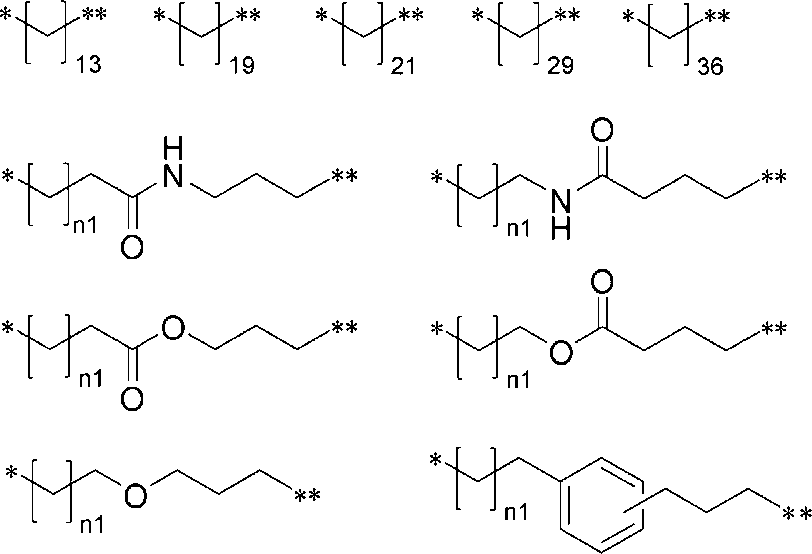
化合物(F)としては、例えば下記化合物が挙げられる。ただし、これらに限定されるものではない。また、下式において、L1中のR81側末端の炭素原子に「1」を付し、L1中のSi(R2)nL3-n側末端の炭素原子にはL1を構成する炭素数(例えば13、19、21等)を付している。


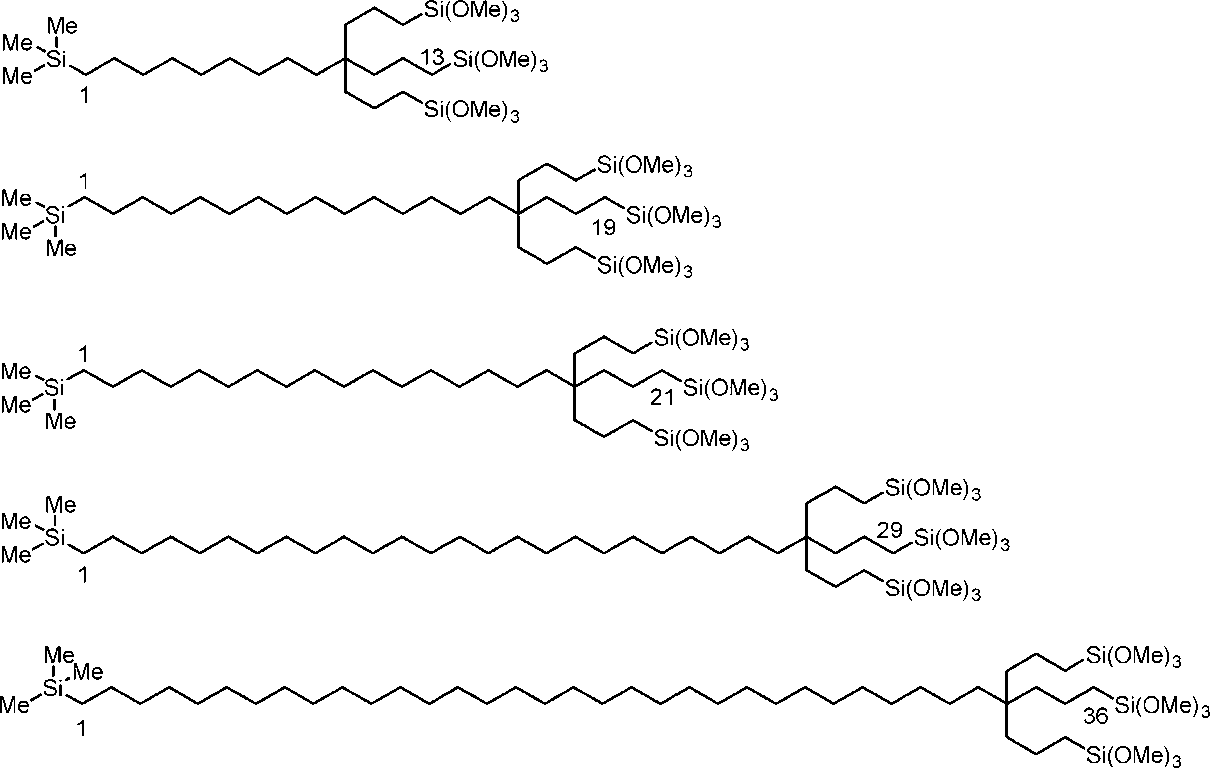
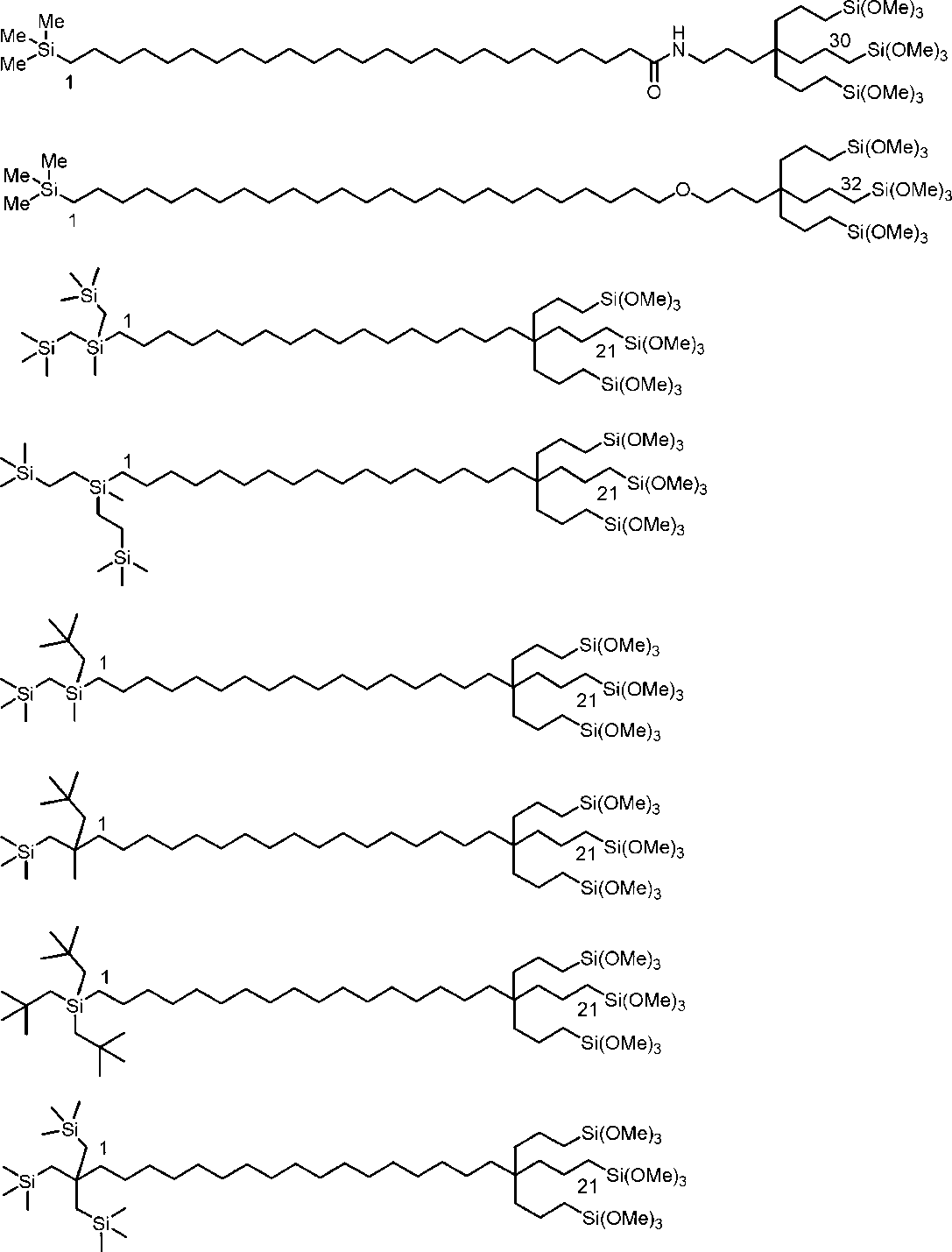
<要件(1)及び(2)>
本開示の組成物は、要件(1)及び(2)のうち少なくとも一方を満たす。
本開示の組成物は、要件(1)及び(2)のうち少なくとも一方を満たす。
要件(1):第1化合物において、反応性シリル基aはオルガノ(ポリ)シロキサン残基の少なくとも一方の末端に2つ以上連結される。
要件(2):第2化合物において、反応性シリル基bは炭化水素基の少なくとも一方の末端に2つ以上連結される。
要件(2):第2化合物において、反応性シリル基bは炭化水素基の少なくとも一方の末端に2つ以上連結される。
要件(1)及び(2)のうち少なくとも一方を満たすということは、第1化合物及び第2化合物のうち少なくとも一方において、少なくとも一方の末端に反応性シリル基が2つ以上連結されていることを意味する。特に、反応性シリル基は、少なくとも一方の末端に2つ以上連結されることから、一の化合物において2つ以上の反応性シリル基が互いに近接して存在することができる。
本開示の組成物は、2つ以上の反応性シリル基を有する化合物が含まれていることにより、基材との密着性に優れ、撥水性及び耐摩耗性に優れる。
-要件(1)-
要件(1)を満たす場合、第1化合物において、反応性シリル基aの数は2以上である。反応性シリル基aの数は、2~6であることが好ましい。
第1化合物において、反応性シリル基aはオルガノ(ポリ)シロキサン残基の一方の末端に2つ以上連結されることが好ましい。すなわち、第1化合物は、第1化合物Sであって、反応性シリル基aの数が2以上であることが好ましい。オルガノ(ポリ)シロキサン残基の一方の末端に連結される反応性シリル基aの数は2~6であることが好ましい。
要件(1)を満たす場合、第1化合物において、反応性シリル基aの数は2以上である。反応性シリル基aの数は、2~6であることが好ましい。
第1化合物において、反応性シリル基aはオルガノ(ポリ)シロキサン残基の一方の末端に2つ以上連結されることが好ましい。すなわち、第1化合物は、第1化合物Sであって、反応性シリル基aの数が2以上であることが好ましい。オルガノ(ポリ)シロキサン残基の一方の末端に連結される反応性シリル基aの数は2~6であることが好ましい。
オルガノ(ポリ)シロキサン残基の少なくとも一方の末端に連結される反応性シリル基aは、オルガノ(ポリ)シロキサン残基に直接連結していてもよく、他の基を介して連結していてもよい。
例えば、式(1A)~(1E)、式(2A)、式(3A)、及び式(C)において、q1は2以上の整数である。
式(2B)において、hは2以上の整数である。
式(2B)において、hは2以上の整数である。
-要件(2)-
要件(2)を満たす場合、第2化合物において、反応性シリル基bの数は2以上である。反応性シリル基bの数は、2~6であることが好ましい。
第2化合物において、反応性シリル基bは炭化水素基の一方の末端に2つ以上連結されることが好ましい。炭化水素基の一方の末端に連結される反応性シリル基bの数は2~6であることが好ましい。
要件(2)を満たす場合、第2化合物において、反応性シリル基bの数は2以上である。反応性シリル基bの数は、2~6であることが好ましい。
第2化合物において、反応性シリル基bは炭化水素基の一方の末端に2つ以上連結されることが好ましい。炭化水素基の一方の末端に連結される反応性シリル基bの数は2~6であることが好ましい。
炭化水素基の少なくとも一方の末端に連結される反応性シリル基bは、炭化水素基に直接連結していてもよく、他の基を介して連結していてもよい。
例えば、式(E)において、q2は2以上の整数である。
例えば、式(E)において、q2は2以上の整数である。
本開示の組成物の態様としては、以下の態様1~態様3が挙げられる。
態様1:要件(1)及び要件(2)を満たす。
態様2:要件(1)を満たし、要件(2)を満たさない。
態様3:要件(1)を満たさず、要件(2)を満たす。
本開示の組成物の様態としては、態様1が好ましい。
態様1:要件(1)及び要件(2)を満たす。
態様2:要件(1)を満たし、要件(2)を満たさない。
態様3:要件(1)を満たさず、要件(2)を満たす。
本開示の組成物の様態としては、態様1が好ましい。
本開示の組成物において、第1化合物に対する第2化合物の質量比率は、0.01~0.9が好ましく、0.02~0.7がより好ましく、0.03~0.5が更に好ましく、0.04~0.2が特に好ましい。
第1化合物に対する第2化合物の質量比率が前記範囲の下限値以上であると、撥水性及び耐摩耗性に優れる。
第1化合物に対する第2化合物の質量比率が前記範囲の上限値以下であると、撥水性に優れる。
また本開示の組成物において、第1化合物と第2化合物の合計質量に対する第2化合物の質量比率は、0.001~0.9が好ましく、0.1~0.9がより好ましい。
第1化合物に対する第2化合物の質量比率が前記範囲の下限値以上であると、撥水性及び耐摩耗性に優れる。
第1化合物に対する第2化合物の質量比率が前記範囲の上限値以下であると、撥水性に優れる。
また本開示の組成物において、第1化合物と第2化合物の合計質量に対する第2化合物の質量比率は、0.001~0.9が好ましく、0.1~0.9がより好ましい。
本開示の組成物は、第1化合物及び第2化合物以外の成分を含んでいてもよい。
例えば、本開示の組成物は、第1化合物及び第2化合物の製造工程で生成した副生物等の不純物を含んでもよい。
例えば、本開示の組成物は、第1化合物及び第2化合物の製造工程で生成した副生物等の不純物を含んでもよい。
(液状媒体)
本開示の組成物は、液状媒体を含んでいてもよい。
液状媒体は1種のみであってもよく、2種以上であってもよい。
本開示の組成物は、液状媒体を含んでいてもよい。
液状媒体は1種のみであってもよく、2種以上であってもよい。
液状媒体は、有機溶媒が好ましい。
有機溶媒としては、水素原子及び炭素原子のみからなる化合物、並びに、水素原子、炭素原子及び酸素原子のみからなる化合物が挙げられ、具体的には、炭化水素系有機溶媒、ケトン系有機溶媒、エーテル系有機溶媒、エステル系有機溶媒、グリコール系有機溶媒、及びアルコール系有機溶媒が挙げられる。
炭化水素系有機溶媒の具体例としては、ペンタン、ヘキサン、ヘプタン、オクタン、ヘキサデカン、イソヘキサン、イソオクタン、イソノナン、シクロヘプタン、シクロヘキサン、ビシクロヘキシル、ベンゼン、トルエン、エチルベンゼン、o-キシレン、m-キシレン、p-キシレン、o-ジエチルベンゼン、m-ジエチルベンゼン、p-ジエチルベンゼン、n-ブチルベンゼン、sec-ブチルベンゼン、tert-ブチルベンゼンが挙げられる。
ケトン系有機溶媒の具体例としては、アセトン、メチルエチルケトン、メチルイソブチルケトン、ジイソブチルケトン、シクロヘキサノン、2-ヘプタノン、4-ヘプタノン、3,5,5-トリメチル-2-シクロヘキセン-1-オン、及び3,3,5-トリメチルシクロヘキサノン、イソホロンが挙げられる。
エーテル系有機溶媒の具体例としては、ジエチルエーテル、シクロペンチルメチルエーテル、テトラヒドロフラン、1,4-ジオキサンが挙げられる。
エステル系有機溶媒の具体例としては、酢酸メチル、酢酸エチル、酢酸プロピル、酢酸イソプロピル、酢酸ブチル、酢酸イソブチル、酢酸tert‐ブチル、酢酸アミル、酢酸イソアミル、3-エトキシプロピオン酸エチル、乳酸エチルエチレングリコールモノブチルエーテルアセテート、ジエチレングリコールモノブチルエーテルアセテート、プロピレングリコールモノメチルエーテルアセテート、ジプロピレングリコールメチルエーテルアセテート、3-メトキシ-3-メチルブチルアセテート、3-メトキシブチルアセテート、プロピレングリコールモノメチルアセテート、プロピレングリコールジメチルアセテート、エチレングリコールモノエチルエーテルアセテート、エチレングリコールモノメチルエーテルアセテート、ジエチレングリコールモノエチルエーテルアセテート、シクロヘキサノールアセテート、プロピレングリコールジアセテート、プロピレングリコールモノメチルエーテルアセテート、プロピレングリコールモノメチルエーテルプロピオネート、プロピレングリコールモノエチルエーテルアセテート、プロピレングリコールモノブチルエーテルアセテート、プロピレングリコールモノプロピルエーテルアセテート、ジプロピレングリコールメチルエーテルアセテート、1,3-ブチレングリコールジアセテート、1,4-ブタンジオールジアセテート、1,3-ブチレングリコールジアセテート、1,6-ヘキサンジオールジアセテート、γ-ブチロラクトン、トリアセチン、2,2,4-トリメチル-1,3-ペンタンジオールモノイソブチレートが挙げられる。
グリコール系有機溶媒の具体例としては、エチレングリコール、エチレングリコールモノブチルエーテル、ジエチレングリコールモノブチルエーテル、トリエチレングリコールモノブチルエーテル、テトラエチレングリコールモノブチルエーテル、エチレングリコールモノヘキシルエーテル、ジエチレングリコールモノヘキシルエーテル、エチレングリコールモノ-2-エチルヘキシルエーテル、ジエチレングリコールモノ-2-エチルヘキシルエーテル、プロピレングリコールモノメチルエーテル、プロピレングリコールモノエチルエーテル、プロピレングリコールモノブチルエーテル、プロピレングリコールモノプロピルエーテル、エチレングリコールモノイソプロピルエーテル、エチレングリコールモノエチルエーテル、エチレングリコールモノtert-ブチルエーテル、エチレングリコールモノプロピルエーテル、エチレングリコールモノメチルエーテル、ジエチレングリコールモノイソプロピルエーテル、ジエチレングリコールモノメチルエーテル、ジプロピレングリコールモノエチルエーテル、ジプロピレングリコールモノブチルエーテル、ジプロピレングリコールモノプロピルエーテル、ジプロピレングリコールモノメチルエーテル、トリプロピレングリコールモノブチルエーテル、トリプロピレングリコールモノメチルエーテル、プロピレングリコールモノフェニルエーテル、1,3-ブチレングリコール、プロピレングリコールn-プロピルエーテル、プロピレングリコールn-ブチルエーテル、ジエチレングリコールモノエチルエーテル、ジプロピレングリコールn-プロピルエーテル、ジプロピレングリコールn-ブチルエーテル、トリプロピレングリコールメチルエーテル、トリプロピレングリコールn-ブチルエ-テル、エチレングリコールジメチルエーテル、エチレングリコールジエチルエーテル、エチレングリコールジブチルエーテル、ジエチレングリコールジエチルエーテル、ジエチレングリコールジメチルエーテル、ジプロピレングリコールジメチルエーテル、ジエチレングリコールジブチルエーテル、テトラエチレングリコールジメチルエーテル、ジプロピレングリコールジメチルエーテルペンタン、トリエチレングリコールジメチルエーテル、ポリエチレングリコールジメチルエーテルが挙げられる。
アルコール系有機溶媒の具体例としては、メタノール、エタノール、1-プロパノール、イソプロピルアルコール、n-ブタノール、ジアセトンアルコール、イソブタノール、sec-ブタノール、tert-ブタノール、ペンタノール、3-メチル-1,3-ブタンジオール、1,3-ブタンジオール、1,3-ブチレングリコール、オクタンジオール、2,4-ジエチルペンタンジオール、ブチルエチルプロパンジオール、2-メチル-1,3-プロパンジオール、4-ヒドロキシ-4-メチル-2-ペンタノン、2-エチル-1-ヘキサノール、3,5,5-トリメチル-1-ヘキサノール、イソデカノール、イソトリデカノール、3-メトキシ-3-メチル-1-ブタノール、2-メトキシブタノール、3-メトキシブタノール、シクロヘキサノール、フルフリルアルコール、テトラヒドロフルフリルアルコール、ベンジルアルコール、及びメチルシクロヘキサノールが挙げられる。
有機溶媒としては、水素原子及び炭素原子のみからなる化合物、並びに、水素原子、炭素原子及び酸素原子のみからなる化合物が挙げられ、具体的には、炭化水素系有機溶媒、ケトン系有機溶媒、エーテル系有機溶媒、エステル系有機溶媒、グリコール系有機溶媒、及びアルコール系有機溶媒が挙げられる。
炭化水素系有機溶媒の具体例としては、ペンタン、ヘキサン、ヘプタン、オクタン、ヘキサデカン、イソヘキサン、イソオクタン、イソノナン、シクロヘプタン、シクロヘキサン、ビシクロヘキシル、ベンゼン、トルエン、エチルベンゼン、o-キシレン、m-キシレン、p-キシレン、o-ジエチルベンゼン、m-ジエチルベンゼン、p-ジエチルベンゼン、n-ブチルベンゼン、sec-ブチルベンゼン、tert-ブチルベンゼンが挙げられる。
ケトン系有機溶媒の具体例としては、アセトン、メチルエチルケトン、メチルイソブチルケトン、ジイソブチルケトン、シクロヘキサノン、2-ヘプタノン、4-ヘプタノン、3,5,5-トリメチル-2-シクロヘキセン-1-オン、及び3,3,5-トリメチルシクロヘキサノン、イソホロンが挙げられる。
エーテル系有機溶媒の具体例としては、ジエチルエーテル、シクロペンチルメチルエーテル、テトラヒドロフラン、1,4-ジオキサンが挙げられる。
エステル系有機溶媒の具体例としては、酢酸メチル、酢酸エチル、酢酸プロピル、酢酸イソプロピル、酢酸ブチル、酢酸イソブチル、酢酸tert‐ブチル、酢酸アミル、酢酸イソアミル、3-エトキシプロピオン酸エチル、乳酸エチルエチレングリコールモノブチルエーテルアセテート、ジエチレングリコールモノブチルエーテルアセテート、プロピレングリコールモノメチルエーテルアセテート、ジプロピレングリコールメチルエーテルアセテート、3-メトキシ-3-メチルブチルアセテート、3-メトキシブチルアセテート、プロピレングリコールモノメチルアセテート、プロピレングリコールジメチルアセテート、エチレングリコールモノエチルエーテルアセテート、エチレングリコールモノメチルエーテルアセテート、ジエチレングリコールモノエチルエーテルアセテート、シクロヘキサノールアセテート、プロピレングリコールジアセテート、プロピレングリコールモノメチルエーテルアセテート、プロピレングリコールモノメチルエーテルプロピオネート、プロピレングリコールモノエチルエーテルアセテート、プロピレングリコールモノブチルエーテルアセテート、プロピレングリコールモノプロピルエーテルアセテート、ジプロピレングリコールメチルエーテルアセテート、1,3-ブチレングリコールジアセテート、1,4-ブタンジオールジアセテート、1,3-ブチレングリコールジアセテート、1,6-ヘキサンジオールジアセテート、γ-ブチロラクトン、トリアセチン、2,2,4-トリメチル-1,3-ペンタンジオールモノイソブチレートが挙げられる。
グリコール系有機溶媒の具体例としては、エチレングリコール、エチレングリコールモノブチルエーテル、ジエチレングリコールモノブチルエーテル、トリエチレングリコールモノブチルエーテル、テトラエチレングリコールモノブチルエーテル、エチレングリコールモノヘキシルエーテル、ジエチレングリコールモノヘキシルエーテル、エチレングリコールモノ-2-エチルヘキシルエーテル、ジエチレングリコールモノ-2-エチルヘキシルエーテル、プロピレングリコールモノメチルエーテル、プロピレングリコールモノエチルエーテル、プロピレングリコールモノブチルエーテル、プロピレングリコールモノプロピルエーテル、エチレングリコールモノイソプロピルエーテル、エチレングリコールモノエチルエーテル、エチレングリコールモノtert-ブチルエーテル、エチレングリコールモノプロピルエーテル、エチレングリコールモノメチルエーテル、ジエチレングリコールモノイソプロピルエーテル、ジエチレングリコールモノメチルエーテル、ジプロピレングリコールモノエチルエーテル、ジプロピレングリコールモノブチルエーテル、ジプロピレングリコールモノプロピルエーテル、ジプロピレングリコールモノメチルエーテル、トリプロピレングリコールモノブチルエーテル、トリプロピレングリコールモノメチルエーテル、プロピレングリコールモノフェニルエーテル、1,3-ブチレングリコール、プロピレングリコールn-プロピルエーテル、プロピレングリコールn-ブチルエーテル、ジエチレングリコールモノエチルエーテル、ジプロピレングリコールn-プロピルエーテル、ジプロピレングリコールn-ブチルエーテル、トリプロピレングリコールメチルエーテル、トリプロピレングリコールn-ブチルエ-テル、エチレングリコールジメチルエーテル、エチレングリコールジエチルエーテル、エチレングリコールジブチルエーテル、ジエチレングリコールジエチルエーテル、ジエチレングリコールジメチルエーテル、ジプロピレングリコールジメチルエーテル、ジエチレングリコールジブチルエーテル、テトラエチレングリコールジメチルエーテル、ジプロピレングリコールジメチルエーテルペンタン、トリエチレングリコールジメチルエーテル、ポリエチレングリコールジメチルエーテルが挙げられる。
アルコール系有機溶媒の具体例としては、メタノール、エタノール、1-プロパノール、イソプロピルアルコール、n-ブタノール、ジアセトンアルコール、イソブタノール、sec-ブタノール、tert-ブタノール、ペンタノール、3-メチル-1,3-ブタンジオール、1,3-ブタンジオール、1,3-ブチレングリコール、オクタンジオール、2,4-ジエチルペンタンジオール、ブチルエチルプロパンジオール、2-メチル-1,3-プロパンジオール、4-ヒドロキシ-4-メチル-2-ペンタノン、2-エチル-1-ヘキサノール、3,5,5-トリメチル-1-ヘキサノール、イソデカノール、イソトリデカノール、3-メトキシ-3-メチル-1-ブタノール、2-メトキシブタノール、3-メトキシブタノール、シクロヘキサノール、フルフリルアルコール、テトラヒドロフルフリルアルコール、ベンジルアルコール、及びメチルシクロヘキサノールが挙げられる。
また、有機溶媒としては、ハロゲン系有機溶媒、含窒素化合物、含硫黄化合物、シロキサン化合物、及び含フッ素有機溶媒が挙げられる。
ハロゲン系有機溶媒の具体例としては、ジクロロメタン、クロロホルム、四塩化炭素、ジクロロエタン、クロロベンゼン、o-クロロトルエン、m-クロロトルエン、p-クロロトルエン、m-ジクロロベンゼン、1,2,3-トリクロロプロパンが挙げられる。
含窒素化合物としては、ニトロベンゼン、アセトニトリル、ベンゾニトリル、N,N-ジメチルホルムアミド、N,N-ジメチルアセトアミド、N-メチルピロリドン、1,3-ジメチル-2-イミダゾリジノンが挙げられる。
含硫黄化合物としては、二硫化炭素、ジメチルスルホキシドが挙げられる。
シロキサン化合物としては、ヘキサメチルジシロキサン、ヘキサエチルジシロキサン、オクタメチルトリシロキサン、オクタエチルトリシロキサン、ヘキサメチルシクロトリシロキサン、ヘキサエチルシクロトリシロキサン、オクタメチルシクロテトラシロキサン、オクタエチルシクロテトラシロキサン、デカメチルテトラシロキサンが挙げられる。
含フッ素有機溶媒としては、ポリフルオロ芳香族炭化水素(例えば、1,3-ビス(トリフルオロメチル)ベンゼン);ポリフルオロ脂肪族炭化水素(例えば、C6F13CH2CH3(例えば、AGC社製のアサヒクリン(登録商標)AC-6000)、1,1,2,2,3,3,4-ヘプタフルオロシクロペンタン(例えば、日本ゼオン株式会社製のゼオローラ(登録商標)H);ヒドロフルオロエーテル(HFE)(例えば、ペルフルオロプロピルメチルエーテル(C3F7OCH3)(例えば、住友スリーエム株式会社製のNovec(商標)7000)、ペルフルオロブチルメチルエーテル(C4F9OCH3)(例えば、住友スリーエム株式会社製のNovec(商標)7100)、ペルフルオロブチルエチルエーテル(C4F9OC2H5)(例えば、住友スリーエム株式会社製のNovec(商標)7200)、ペルフルオロヘキシルメチルエーテル(C2F5CF(OCH3)C3F7)(例えば、住友スリーエム株式会社製のNovec(商標)7300)等のアルキルペルフルオロアルキルエーテル(ペルフルオロアルキル基及びアルキル基は直鎖又は分枝状であってよい)、CF3CH2OCF2CHF2(例えば、AGC社製のアサヒクリン(登録商標)AE-3000));ハイドロフルオロオレフィン(HFO)(例えば、1-クロロ-2,3,3-トリフルオロ-1-プロペン(HCFO-1233yd)(例えば、AGC社製のアモレア(登録商標)AS-300)、ケマーズ社製のオプテオン(登録商標)SF01、SF05、SF10、SF30、SF33、SF70、SF79、SF80)が挙げられる。
液状媒体の含有量は、本開示の組成物の全量に対して、50~99.999質量%が好ましく、80~99.99質量%がより好ましく、90~99.9質量%が更に好ましい。ウェットコーティング法に使用する本開示の組成物の場合には、液状媒体の含有量は、本開示の組成物の全量に対して、90~99.99質量%であってもよく、95~99.98質量%であってもよく、97~99.97質量%であってもよく、98~99.95質量%であってもよい。
(他の成分)
本開示の組成物は、第1化合物、第2化合物、及び液状媒体以外に、本開示の効果を損なわない範囲で他の成分を含んでいてもよい。
他の成分としては、例えば、反応性シリル基の加水分解と縮合反応を促進する酸触媒、塩基性触媒等の公知の添加剤が挙げられる。
本開示の組成物は、第1化合物、第2化合物、及び液状媒体以外に、本開示の効果を損なわない範囲で他の成分を含んでいてもよい。
他の成分としては、例えば、反応性シリル基の加水分解と縮合反応を促進する酸触媒、塩基性触媒等の公知の添加剤が挙げられる。
触媒としては、任意の適切な酸又は塩基、遷移金属(例えばTi、Ni、Sn、Zr、Al、B等)、分子構造内に非共有電子対を有する含硫黄化合物、含窒素化合物(例えばスルホキシド化合物、脂肪族アミン化合物、芳香族アミン化合物、リン酸アミド化合物、アミド化合物、尿素化合物)等を使用できる。
酸触媒としては、例えば、酢酸、ギ酸、トリフルオロ酢酸、塩酸、硝酸、硫酸、リン酸、スルホン酸、メタンスルホン酸、及びp-トルエンスルホン酸が挙げられる。
また、塩基触媒としては、例えば、アンモニア、水酸化ナトリウム、水酸化カリウム;及びトリエチルアミン、ジエチルアミン等の有機アミンが挙げられる。
酸触媒としては、例えば、酢酸、ギ酸、トリフルオロ酢酸、塩酸、硝酸、硫酸、リン酸、スルホン酸、メタンスルホン酸、及びp-トルエンスルホン酸が挙げられる。
また、塩基触媒としては、例えば、アンモニア、水酸化ナトリウム、水酸化カリウム;及びトリエチルアミン、ジエチルアミン等の有機アミンが挙げられる。
また、他の成分としては、加水分解性基を有する金属化合物(以下、加水分解性基を有する金属化合物を「特定金属化合物」とも記す。)も挙げられる。本開示の組成物が特定金属化合物を含むと、表面処理層の滑り性及び防汚性をより向上しうる。特定金属化合物としては、下記式(M1)~(M3)が挙げられる。
M(Xb1)m11(Xb2)m12(Xb3)m13 …(M1)
Si(Xb4)(Xb5)3 …(M2)
(Xb6)3Si-(Yb1)-Si(Xb7)3 …(M3)
Si(Xb4)(Xb5)3 …(M2)
(Xb6)3Si-(Yb1)-Si(Xb7)3 …(M3)
式(M1)中、
Mは、3価又は4価の金属原子を表す。
Xb1はそれぞれ独立に、加水分解性基を表す。
Xb2はそれぞれ独立に、シロキサン骨格含有基を表す。
Xb3はそれぞれ独立に、炭化水素鎖含有基を表す。
m11は2~4の整数であり、
m12及びm13はそれぞれ独立に、0~2の整数であり、
Mが3価の金属原子の場合、m11+m12+m13は3であり、Mが4価の金属原子の場合、m11+m12+m13は4である。
Mは、3価又は4価の金属原子を表す。
Xb1はそれぞれ独立に、加水分解性基を表す。
Xb2はそれぞれ独立に、シロキサン骨格含有基を表す。
Xb3はそれぞれ独立に、炭化水素鎖含有基を表す。
m11は2~4の整数であり、
m12及びm13はそれぞれ独立に、0~2の整数であり、
Mが3価の金属原子の場合、m11+m12+m13は3であり、Mが4価の金属原子の場合、m11+m12+m13は4である。
式(M2)中、
Xb4は、加水分解性シランオリゴマー残基を表す。
Xb5は、それぞれ独立に、加水分解性基又は炭素数1~4のアルキル基を表す。
Xb4は、加水分解性シランオリゴマー残基を表す。
Xb5は、それぞれ独立に、加水分解性基又は炭素数1~4のアルキル基を表す。
式(M3)中、
Xb6及びXb7は、それぞれ独立に、加水分解性基又は水酸基を表す。
Yb1は、2価の有機基を表す。
Xb6及びXb7は、それぞれ独立に、加水分解性基又は水酸基を表す。
Yb1は、2価の有機基を表す。
式(M1)中、Mで表される金属には、Si、Ge等の半金属も包含される。Mとしては、3価金属及び4価金属が好ましく、Al、Fe、In、Hf、Si、Ti、Sn、及びZrがより好ましく、Al、Si、Ti、及びZrが更に好ましく、Siが特に好ましい。
式(M1)中、Xb1で表される加水分解性基としては、上記反応性シリル基における[-Si(R2)nL3-n]中のLで示される加水分解性基と同様のものが挙げられる。
Xb2で表されるシロキサン骨格含有基は、シロキサン単位(-Si-O-)を有し、直鎖状でも分岐鎖状でもよい。シロキサン単位としては、ジアルキルシリルオキシ基が好ましく、ジメチルシリルオキシ基、ジエチルシリルオキシ基等が挙げられる。シロキサン骨格含有基におけるシロキサン単位の繰り返し数は、1以上であり、1~5が好ましく、1~4がより好ましく、1~3が更に好ましい。
シロキサン骨格含有基は、シロキサン骨格の一部に2価の炭化水素基を含んでいてもよい。具体的には、シロキサン骨格の一部の酸素原子が2価の炭化水素基で置き換わっていてもよい。前記2価の炭化水素基としては、メチレン基、エチレン基、プロピレン基、ブチレン基等のアルキレン基が挙げられる。
シロキサン骨格含有基の末端のケイ素原子には、加水分解性基、炭化水素基(好ましくはアルキル基)等が結合していてもよい。
シロキサン骨格含有基の元素数は、100以下が好ましく、50以下がより好ましく、30以下が更に好ましい。前記元素数は10以上が好ましい。
シロキサン骨格含有基としては、*-(O-Si(CH3)2)nCH3で表される基が好ましく、ここで、nは1~5の整数であり、*は隣接原子との結合部位を表す。
シロキサン骨格含有基は、シロキサン骨格の一部に2価の炭化水素基を含んでいてもよい。具体的には、シロキサン骨格の一部の酸素原子が2価の炭化水素基で置き換わっていてもよい。前記2価の炭化水素基としては、メチレン基、エチレン基、プロピレン基、ブチレン基等のアルキレン基が挙げられる。
シロキサン骨格含有基の末端のケイ素原子には、加水分解性基、炭化水素基(好ましくはアルキル基)等が結合していてもよい。
シロキサン骨格含有基の元素数は、100以下が好ましく、50以下がより好ましく、30以下が更に好ましい。前記元素数は10以上が好ましい。
シロキサン骨格含有基としては、*-(O-Si(CH3)2)nCH3で表される基が好ましく、ここで、nは1~5の整数であり、*は隣接原子との結合部位を表す。
Xb3で表される炭化水素鎖含有基は、炭化水素鎖のみからなる基でもよく、炭化水素鎖の炭素原子-炭素原子間にエーテル性酸素原子を有する基でもよい。炭化水素鎖は直鎖でも分岐鎖でもよく、直鎖が好ましい。炭化水素鎖は飽和炭化水素鎖でも不飽和炭化水素鎖でもよく、飽和炭化水素鎖が好ましい。炭化水素鎖含有基の炭素数は、1~3が好ましく、1~2がより好ましく、1が更に好ましい。炭化水素鎖含有基としては、アルキル基が好ましく、メチル基、エチル基、又はプロピル基がより好ましい。
m1は3又は4であることが好ましい。
式(M1)で表される化合物としては、MがSiである下記式(M1-1)~(M1-5)で表される化合物が好ましく、式(M1-1)で表される化合物がより好ましい。式(M1-1)で表される化合物としては、テトラエトキシシラン、テトラメトキシシラン、トリエトキシメチルシランが好ましい。
Si(Xb1)4 …(M1-1)
CH3-Si(Xb1)3 …(M1-2)
C2H5-Si(Xb1)3 …(M1-3)
n-C3H7-Si(Xb1)3 …(M1-4)
(CH3)2CH-Si(Xb1)3 …(M1-5)
CH3-Si(Xb1)3 …(M1-2)
C2H5-Si(Xb1)3 …(M1-3)
n-C3H7-Si(Xb1)3 …(M1-4)
(CH3)2CH-Si(Xb1)3 …(M1-5)
式(M2)中、Xb4で表される加水分解性シランオリゴマー残基に含まれるケイ素原子の数は、3以上が好ましく、5以上がより好ましく、7以上が更に好ましい。前記ケイ素原子の数は、15以下が好ましく、13以下がより好ましく、10以下が更に好ましい。
加水分解性シランオリゴマー残基は、ケイ素原子に結合するアルコキシ基を有していてもよい。前記アルコキシ基としては、メトキシ基、エトキシ基、プロポキシ基、ブトキシ基等が挙げられ、メトキシ基及びエトキシ基が好ましい。加水分解性シランオリゴマー残基は、これらアルコキシ基の1種又は2種以上を有してもよく、1種を有することが好ましい。
加水分解性シランオリゴマー残基としては、(C2H5O)3Si-(OSi(OC2H5)2)4O-*等が挙げられる。ここで、*は隣接原子との結合部位を表す。
加水分解性シランオリゴマー残基は、ケイ素原子に結合するアルコキシ基を有していてもよい。前記アルコキシ基としては、メトキシ基、エトキシ基、プロポキシ基、ブトキシ基等が挙げられ、メトキシ基及びエトキシ基が好ましい。加水分解性シランオリゴマー残基は、これらアルコキシ基の1種又は2種以上を有してもよく、1種を有することが好ましい。
加水分解性シランオリゴマー残基としては、(C2H5O)3Si-(OSi(OC2H5)2)4O-*等が挙げられる。ここで、*は隣接原子との結合部位を表す。
式(M2)中、Xb5で表される加水分解性基としては、上記反応性シリル基における[-Si(R2)nL3-n]中のLで示される加水分解性基と同様のもの、シアノ基、水素原子、アリル基が挙げられ、アルコキシ基又はイソシアナト基が好ましい。アルコキシ基としては、炭素数1~4のアルコキシ基が好ましい。
Xb5としては、加水分解性基が好ましい。
Xb5としては、加水分解性基が好ましい。
式(M2)で表される化合物としては、(H5C2O)3-Si-(OSi(OC2H5)2)4OC2H5等が挙げられる。
式(M3)で表される化合物は、2価の有機基の両末端に反応性シリル基を有する化合物、すなわち、ビスシランである。
式(M3)中、Xb6及びXb7で表される加水分解性基としては、アルコキシ基、アシロキシ基、ケトオキシム基、アルケニルオキシ基、アミノ基、アミノキシ基、アミド基、イソシアナト基、ハロゲン原子が挙げられ、アルコキシ基、イソシアナト基が好ましい。アルコキシ基としては、炭素数1~4のアルコキシ基が好ましく、メトキシ基、エトキシ基がより好ましい。
式(M3)において、Xb6及びXb7は互いに同じ基でもよく、互いに異なる基でもよい。入手しやすさの点で、Xb6及びXb7は互いに同じ基であることが好ましい。
式(M3)中、Xb6及びXb7で表される加水分解性基としては、アルコキシ基、アシロキシ基、ケトオキシム基、アルケニルオキシ基、アミノ基、アミノキシ基、アミド基、イソシアナト基、ハロゲン原子が挙げられ、アルコキシ基、イソシアナト基が好ましい。アルコキシ基としては、炭素数1~4のアルコキシ基が好ましく、メトキシ基、エトキシ基がより好ましい。
式(M3)において、Xb6及びXb7は互いに同じ基でもよく、互いに異なる基でもよい。入手しやすさの点で、Xb6及びXb7は互いに同じ基であることが好ましい。
式(M3)中、Yb1は、両末端の反応性シリル基を連結する2価の有機基である。2価の有機基のYb1の炭素数は1~8が好ましく、1~3がより好ましい。
Yb1としては、アルキレン基、フェニレン基、炭素原子間にエーテル性酸素原子を有するアルキレン基が挙げられる。例えば、-CH2CH2-、-CH2CH2CH2-、-CH2CH2CH2CH2-、-CH2CH2CH2CH2CH2-、-CH2CH2CH2CH2CH2CH2-、-CH2C(CH3)2CH2-、-C(CH3)2CH2CH2C(CH3)2-、-CH2CH2OCH2CH2-、-CH2CH2CH2OCH2CH2CH2-、-CH(CH3)CH2OCH2CH(CH3)-、-C6H4-が挙げられる。
Yb1としては、アルキレン基、フェニレン基、炭素原子間にエーテル性酸素原子を有するアルキレン基が挙げられる。例えば、-CH2CH2-、-CH2CH2CH2-、-CH2CH2CH2CH2-、-CH2CH2CH2CH2CH2-、-CH2CH2CH2CH2CH2CH2-、-CH2C(CH3)2CH2-、-C(CH3)2CH2CH2C(CH3)2-、-CH2CH2OCH2CH2-、-CH2CH2CH2OCH2CH2CH2-、-CH(CH3)CH2OCH2CH(CH3)-、-C6H4-が挙げられる。
式(M3)で表される化合物としては、(CH3O)3Si(CH2)2Si(OCH3)3、(C2H5O)3Si(CH2)2Si(OC2H5)3、(OCN)3Si(CH2)2Si(NCO)3、Cl3Si(CH2)2SiCl3、(CH3O)3Si(CH2)6Si(OCH3)3、(C2H5O)3Si(CH2)6Si(OC2H5)3が挙げられる。
本開示の組成物に含まれてもよい他の成分の含有量は、本開示の組成物の全量に対して、10質量%以下が好ましく、1質量%以下がより好ましい。本開示の組成物が特定金属化合物を含む場合、特定金属化合物の含有量は本開示の組成物の全量に対して0.01~30質量%が好ましく、0.01~10質量%がより好ましく、0.05~5質量%が更に好ましい。
第1化合物、第2化合物、及び他の成分の合計含有量(以下、「固形分濃度」ともいう。)は、本開示の組成物の全量に対して、0.001~40質量%が好ましく、0.01~20質量%がより好ましく、0.1~10質量%が更に好ましい。本開示の組成物の固形分濃度は、加熱前の質量と、組成物に含まれる溶媒の沸点よりも50℃高い温度条件下で対流式乾燥機にて4時間加熱した後の質量とから算出される値である。
[表面処理剤]
本開示の表面処理剤は、前述の組成物である。本開示の表面処理剤は、必要に応じて液状媒体を含んでもよく、第1化合物、第2化合物、及び液状媒体以外の他の成分を含んでもよい。
本開示の表面処理剤は、第1化合物及び第2化合物を含み、上記要件(1)及び(2)のうち少なくとも一方を満たすため、撥水性及び耐摩耗性に優れた表面処理層を形成することができる。
本開示の表面処理剤は、前述の組成物である。本開示の表面処理剤は、必要に応じて液状媒体を含んでもよく、第1化合物、第2化合物、及び液状媒体以外の他の成分を含んでもよい。
本開示の表面処理剤は、第1化合物及び第2化合物を含み、上記要件(1)及び(2)のうち少なくとも一方を満たすため、撥水性及び耐摩耗性に優れた表面処理層を形成することができる。
[物品]
一態様において、本開示の物品は、基材と、基材上に配置され、本開示の表面処理剤で表面処理された表面処理層と、を含む。
一態様において、本開示の物品は、基材と、基材上に配置され、本開示の表面処理剤で表面処理された表面処理層と、を含む。
表面処理層は、基材の表面の一部に形成されてもよく、基材の表面全体に形成されてもよい。表面処理層は、基材の表面に膜状に拡がっていてもよく、ドット状に点在していてもよい。
表面処理層において、本開示の組成物に含まれる第1化合物及び第2化合物は、反応性シリル基の一部又は全部の加水分解が進行し、かつ、シラノール基の脱水縮合反応が進行した状態で含まれる。
表面処理層において、本開示の組成物に含まれる第1化合物及び第2化合物は、反応性シリル基の一部又は全部の加水分解が進行し、かつ、シラノール基の脱水縮合反応が進行した状態で含まれる。
表面処理層の厚さは、1~100nmが好ましく、1~50nmがより好ましい。表面処理層の厚さが1nm以上であれば、表面処理による効果が充分に得られやすい。表面処理層の厚さが100nm以下であれば、利用効率が高い。表面処理層の厚さは、薄膜解析用X線回折計(製品名「ATX-G」、RIGAKU社製)を用いて、X線反射率法によって反射X線の干渉パターンを得て、干渉パターンの振動周期から算出できる。
基材の種類は特に限定されず、例えば、撥水性の付与が求められている基材が挙げられる。基材として、例えば、他の物品(例えば、スタイラス)又は人の手指を接触させて使用することがある基材;操作時に人の手指で持つことがある基材;及び、他の物品(例えば、載置台)の上に置くことがある基材が挙げられる。
基材の材料としては、金属、樹脂、ガラス、サファイア、セラミック、半導体、石、繊維、不織布、紙、木、毛皮、天然皮革、人工皮革、陶磁器、及びこれらの複合材料が挙げられる。ガラスは化学強化されていてもよい。
基材の材料としては、金属、樹脂、ガラス、サファイア、セラミック、半導体、石、繊維、不織布、紙、木、毛皮、天然皮革、人工皮革、陶磁器、及びこれらの複合材料が挙げられる。ガラスは化学強化されていてもよい。
基材としては、建材、装飾建材、インテリア用品、輸送機器(例えば、自動車)、看板、掲示板、飲用器、食器、水槽、観賞用器具(例えば、額、箱)、実験器具、家具、繊維製品、包装容器;アート、スポーツ、ゲーム等に使用する、ガラス又は樹脂;携帯電話(例えば、スマートフォン)、携帯情報端末、ゲーム機、リモコン等の機器における外装部分(表示部を除く)に使用する、ガラス又は樹脂が挙げられる。基材の形状は、板状であってもよく、フィルム状であってもよい。
基材としては、タッチパネル用基材、ディスプレイ用基材、メガネレンズが好適であり、タッチパネル用基材が特に好適である。タッチパネル用基材の材料としては、ガラス又は透明樹脂が好ましい。
基材は、一方の表面又は両面が、コロナ放電処理、プラズマ処理、プラズマグラフト重合処理等の表面処理が施された基材であってもよい。表面処理が施された基材は、表面処理層との密着性がより優れ、表面処理層の耐摩耗性がより向上する。そのため、基材の表面処理層と接する側の表面に表面処理を施すことが好ましい。また、表面処理が施された基材は、後述する下地層が設けられる場合には、下地層との密着性がより優れ、表面処理層の耐摩耗性がより向上する。そのため、下地層が設けられる場合には、基材の下地層と接する側の表面に表面処理を施すことが好ましい。
表面処理層は、基材の表面上に直接設けられていてもよく、基材と表面処理層との間に下地層が設けられていてもよい。表面処理層の撥水性及び耐摩耗性をより向上させる観点から、本開示の物品は、基材と、基材上に配置された下地層と、下地層上に配置された本開示の表面処理剤で表面処理された表面処理層と、を含むことが好ましい。
下地層は、ケイ素と、周期表の第1族元素、第2族元素、第4族元素、第5族元素、第13族元素、及び第15族元素からなる群から選択される少なくとも1つの特定元素とを含む酸化物を含む層が好ましい。
周期表の第1族元素(以下、「第1族元素」ともいう。)とは、リチウム、ナトリウム、カリウム、ルビジウム及びセシウムを意味する。第1族元素としては、下地層上に表面処理層を欠陥なくより均一に形成できる点、又は、サンプル間での下地層の組成のバラツキがより抑制される観点から、リチウム、ナトリウム、カリウムが好ましく、ナトリウム、カリウムがより好ましい。下地層には、第1族元素が2種以上含まれていてもよい。
周期表の第2族元素(以下、「第2族元素」ともいう。)とは、ベリリウム、マグネシウム、カルシウム、ストロンチウム及びバリウムを意味する。第2族元素としては、下地層上に表面処理層を欠陥なくより均一に形成できる点、又は、サンプル間での下地層の組成のバラツキがより抑制される観点から、マグネシウム、カルシウム、バリウムが好ましく、マグネシウム、カルシウムがより好ましい。下地層には、第2族元素が2種以上含まれていてもよい。
周期表の第4族元素(以下、「第4族元素」ともいう。)とは、チタン、ジルコニウム、及びハフニウムを意味する。第4族元素としては、下地層上に表面処理層を欠陥なくより均一に形成できる観点、又は、サンプル間での下地層の組成のバラツキがより抑制される観点から、チタン、ジルコニウムが好ましく、チタンがより好ましい。下地層には、第4族元素が2種以上含まれていてもよい。
周期表の第5族元素(以下、「第5族元素」ともいう。)とは、バナジウム、ニオブ及びタンタルを意味する。第5族元素としては、表面処理層の耐摩耗性がより優れる観点から、バナジウムが特に好ましい。下地層には、第5族元素が2種以上含まれていてもよい。
周期表の第13族元素(以下、「第13族元素」ともいう。)とは、ホウ素、アルミニウム、ガリウム及びインジウムを意味する。第13族元素としては、下地層上に表面処理層を欠陥なくより均一に形成できる点、又は、サンプル間での下地層の組成のバラツキがより抑制される観点から、ホウ素、アルミニウム、ガリウムが好ましく、ホウ素、アルミニウムがより好ましい。下地層には、第13族元素が2種以上含まれていてもよい。
周期表の第15族元素(以下、「第15族元素」ともいう。)とは、窒素、リン、ヒ素、アンチモン及びビスマスを意味する。第15族元素としては、下地層上に表面処理層を欠陥なくより均一に形成できる観点、又は、サンプル間での下地層の組成のバラツキがより抑制される観点から、リン、アンチモン、ビスマスが好ましく、リン、ビスマスがより好ましい。下地層には、第15族元素が2種以上含まれていてもよい。
下地層に含まれる特定元素としては、第1族元素、第2族元素、第13族元素が表面処理層の耐摩耗性がより優れるため好ましく、第1族元素、第2族元素がより好ましく、第1族元素が更に好ましい。
特定元素として、1種のみの元素が含まれていても2種以上の元素が含まれていてもよい。
特定元素として、1種のみの元素が含まれていても2種以上の元素が含まれていてもよい。
下地層に含まれる酸化物は、上記元素(ケイ素及び特定元素)単独の酸化物の混合物(例えば、酸化ケイ素と、特定元素の酸化物と、の混合物)であってもよいし、上記元素を2種以上含む複合酸化物であってもよいし、上記元素単独の酸化物と複合酸化物との混合物であってもよい。
下地層中のケイ素のモル濃度に対する、下地層中の特定元素の合計モル濃度の比(特定元素/ケイ素)は、表面処理層の耐摩耗性がより優れる観点から、0.02~2.90であるのが好ましく、0.10~2.00であるのがより好ましく、0.20~1.80であるのが更に好ましい。
下地層中の各元素のモル濃度(モル%)は、例えば、イオンスパッタリングを用いたX線光電子分光法(XPS)による深さ方向分析によって測定できる。
下地層中の各元素のモル濃度(モル%)は、例えば、イオンスパッタリングを用いたX線光電子分光法(XPS)による深さ方向分析によって測定できる。
下地層は、単層であっても複層であってもよい。下地層は、表面に凹凸を有していてもよい。
下地層の厚さは、1~100nmが好ましく、1~50nmがより好ましく、2~20nmが更に好ましい。下地層の厚さが上記下限値以上であれば、下地層による表面処理層の密着性がより向上して、表面処理層の耐摩耗性がより優れる。下地層の厚さが上記上限値以下であれば、下地層自体の耐摩耗性が優れる。
下地層の厚さは、透過電子顕微鏡(TEM)による下地層の断面観察によって測定される。
下地層の厚さは、1~100nmが好ましく、1~50nmがより好ましく、2~20nmが更に好ましい。下地層の厚さが上記下限値以上であれば、下地層による表面処理層の密着性がより向上して、表面処理層の耐摩耗性がより優れる。下地層の厚さが上記上限値以下であれば、下地層自体の耐摩耗性が優れる。
下地層の厚さは、透過電子顕微鏡(TEM)による下地層の断面観察によって測定される。
下地層は、例えば、蒸着材料を用いた蒸着法、又は、ウェットコーティング法により形成できる。
蒸着法で用いる蒸着材料は、ケイ素及び特定元素を含む酸化物を含有することが好ましい。
蒸着材料の形態の具体例としては、粉体、溶融体、焼結体、造粒体、破砕体が挙げられ、取り扱い性の観点から、溶融体、焼結体、造粒体が好ましい。
ここで、溶融体とは、蒸着材料の粉体を高温で溶融させた後、冷却固化して得られた固形物を意味する。焼結体とは、蒸着材料の粉体を焼成して得られた固形物を意味し、必要に応じて、蒸着材料の粉体の代わりに、粉体をプレス形成して成形体を用いてもよい。造粒体とは、蒸着材料の粉体と液状媒体(例えば、水、有機溶媒)とを混練して粒子を得た後、粒子を乾燥させて得られた固形物を意味する。
蒸着材料の形態の具体例としては、粉体、溶融体、焼結体、造粒体、破砕体が挙げられ、取り扱い性の観点から、溶融体、焼結体、造粒体が好ましい。
ここで、溶融体とは、蒸着材料の粉体を高温で溶融させた後、冷却固化して得られた固形物を意味する。焼結体とは、蒸着材料の粉体を焼成して得られた固形物を意味し、必要に応じて、蒸着材料の粉体の代わりに、粉体をプレス形成して成形体を用いてもよい。造粒体とは、蒸着材料の粉体と液状媒体(例えば、水、有機溶媒)とを混練して粒子を得た後、粒子を乾燥させて得られた固形物を意味する。
蒸着材料は、例えば、以下の方法で製造できる。
・酸化ケイ素の粉体と、特定元素の酸化物の粉体と、を混合して、蒸着材料の粉体を得る方法。
・上記蒸着材料の粉体及び水を混練して粒子を得た後、粒子を乾燥させて、蒸着材料の造粒体を得る方法。
・ケイ素を含む粉体(例えば、酸化ケイ素からなる粉体、珪砂、シリカゲル)と、特定元素を含む粉体(例えば、特定元素の酸化物の粉体、炭酸塩、硫酸塩、硝酸塩、シュウ酸塩、水酸化物)と、水と、を混合した混合物を乾燥させた後、乾燥後の混合物又はこれをプレス成形した成形体を焼成して、焼結体を得る方法。
・ケイ素を含む粉体(例えば、酸化ケイ素からなる粉体、珪砂、シリカゲル)と、特定元素を含む粉体(例えば、特定元素の酸化物の粉体、炭酸塩、硫酸塩、硝酸塩、シュウ酸塩、水酸化物)と、を高温で溶融させた後、溶融物を冷却固化して、溶融体を得る方法。
・酸化ケイ素の粉体と、特定元素の酸化物の粉体と、を混合して、蒸着材料の粉体を得る方法。
・上記蒸着材料の粉体及び水を混練して粒子を得た後、粒子を乾燥させて、蒸着材料の造粒体を得る方法。
・ケイ素を含む粉体(例えば、酸化ケイ素からなる粉体、珪砂、シリカゲル)と、特定元素を含む粉体(例えば、特定元素の酸化物の粉体、炭酸塩、硫酸塩、硝酸塩、シュウ酸塩、水酸化物)と、水と、を混合した混合物を乾燥させた後、乾燥後の混合物又はこれをプレス成形した成形体を焼成して、焼結体を得る方法。
・ケイ素を含む粉体(例えば、酸化ケイ素からなる粉体、珪砂、シリカゲル)と、特定元素を含む粉体(例えば、特定元素の酸化物の粉体、炭酸塩、硫酸塩、硝酸塩、シュウ酸塩、水酸化物)と、を高温で溶融させた後、溶融物を冷却固化して、溶融体を得る方法。
蒸着材料を用いた蒸着法の具体例としては、真空蒸着法が挙げられる。真空蒸着法は、蒸着材料を真空槽内で蒸発させ、基材の表面に付着させる方法である。
蒸着時の温度(例えば、真空蒸着装置を用いる際には、蒸着材料を配置するボートの温度)としては、100~3,000℃が好ましく、500~3,000℃がより好ましい。
蒸着時の圧力(例えば、真空蒸着装置を用いる際には、蒸着材料を配置する槽内の圧力)としては、1Pa以下が好ましく、0.1Pa以下がより好ましい。
蒸着材料を用いて下地層を形成する場合、1つの蒸着材料を用いてもよいし、異なる元素を含む2つ以上の蒸着材料を用いてもよい。
蒸着時の温度(例えば、真空蒸着装置を用いる際には、蒸着材料を配置するボートの温度)としては、100~3,000℃が好ましく、500~3,000℃がより好ましい。
蒸着時の圧力(例えば、真空蒸着装置を用いる際には、蒸着材料を配置する槽内の圧力)としては、1Pa以下が好ましく、0.1Pa以下がより好ましい。
蒸着材料を用いて下地層を形成する場合、1つの蒸着材料を用いてもよいし、異なる元素を含む2つ以上の蒸着材料を用いてもよい。
蒸着材料の蒸発方法の具体例としては、高融点金属製抵抗加熱用ボート上で蒸着材料を溶融し、蒸発させる抵抗加熱法、電子ビームを蒸着材料に照射し、蒸着材料を直接加熱して表面を溶融し、蒸発させる電子銃法が挙げられる。蒸着材料の蒸発方法としては、局所的に加熱できるため高融点物質も蒸発できる点、電子ビームが当たっていないところは低温であるため容器との反応や不純物の混入のおそれがない観点から、電子銃法が好ましい。
蒸着材料の蒸発方法としては、複数のボートを用いてもよく、単独のボートに全ての蒸着材料を入れて用いてもよい。蒸着方法は、共蒸着であってもよく、交互蒸着等でもよい。具体的には、シリカと特定源を同一のボートに混合して用いる例、シリカと特定元素源とを別々のボートに入れて共蒸着する例、同様に別々のボートに入れて交互蒸着する例が挙げられる。蒸着の条件、順番等は下地層の構成により適宜選択される。
蒸着材料の蒸発方法としては、複数のボートを用いてもよく、単独のボートに全ての蒸着材料を入れて用いてもよい。蒸着方法は、共蒸着であってもよく、交互蒸着等でもよい。具体的には、シリカと特定源を同一のボートに混合して用いる例、シリカと特定元素源とを別々のボートに入れて共蒸着する例、同様に別々のボートに入れて交互蒸着する例が挙げられる。蒸着の条件、順番等は下地層の構成により適宜選択される。
ウェットコーティング法では、ケイ素を含む化合物と、特定元素を含む化合物と、液状媒体と、を含むコーティング液を用いたウェットコーティング法によって、基材上に下地層を形成することが好ましい。
ケイ素化合物の具体例としては、酸化ケイ素、ケイ酸、ケイ酸の部分縮合物、アルコキシシラン、アルコキシシランの部分加水分解縮合物が挙げられる。
特定元素を含む化合物の具体例としては、特定元素の酸化物、特定元素のアルコキシド、特定元素の炭酸塩、特定元素の硫酸塩、特定元素の硝酸塩、特定元素のシュウ酸塩、特定元素の水酸化物が挙げられる。
液状媒体としては、本開示の組成物に含まれていてもよい液状媒体と同様のものが挙げられる。
液状媒体の含有量は、下地層の形成に使用するコーティング液の全量に対して、80~99.99質量%が好ましく、90~99.9質量%がより好ましい。
下地層を形成するためのウェットコーティング法の具体例としては、スピンコート法、ワイプコート法、スプレーコート法、スキージーコート法、ディップコート法、ダイコート法、インクジェット法、フローコート法、ロールコート法、キャスト法、ラングミュア・ブロジェット法、グラビアコート法が挙げられる。
コーティング液をウェットコーティングした後、塗膜を乾燥させるのが好ましい。塗膜の乾燥温度としては、20~200℃が好ましく、80~160℃がより好ましい。
本開示の物品は、表面処理層を最外層に有する光学材料であってもよい。
光学材料としては、ディスプレイ等に関する光学材料のほか、多種多様な光学材料が好ましく挙げられる。
光学材料としては、例えば、陰極線管(CRT;例えば、パソコンモニター)、液晶ディスプレイ、プラズマディスプレイ、有機ELディスプレイ、無機薄膜ELドットマトリクスディスプレイ、背面投写型ディスプレイ、蛍光表示管(VFD)、電界放出ディスプレイ(FED;Field Emission Display)等のディスプレイ又はそれらのディスプレイの保護板、又はそれらの表面に反射防止膜処理を施したものが挙げられる。
光学材料としては、ディスプレイ等に関する光学材料のほか、多種多様な光学材料が好ましく挙げられる。
光学材料としては、例えば、陰極線管(CRT;例えば、パソコンモニター)、液晶ディスプレイ、プラズマディスプレイ、有機ELディスプレイ、無機薄膜ELドットマトリクスディスプレイ、背面投写型ディスプレイ、蛍光表示管(VFD)、電界放出ディスプレイ(FED;Field Emission Display)等のディスプレイ又はそれらのディスプレイの保護板、又はそれらの表面に反射防止膜処理を施したものが挙げられる。
本開示の物品は、光学部材であることが好ましい。光学部材としては、例えば、カーナビゲーション、携帯電話、スマートフォン、デジタルカメラ、デジタルビデオカメラ、PDA、ポータブルオーディオプレーヤー、カーオーディオ、ゲーム機器、眼鏡レンズ、カメラレンズ、レンズフィルター、サングラス、胃カメラ等の医療用器機、複写機、PC、ディスプレイ(例えば、液晶ディスプレイ、有機ELディスプレイ、プラズマディスプレイ、タッチパネルディスプレイ)、タッチパネル、保護フィルム、及び反射防止フィルムが挙げられる。
また、光学部材としては、PDP、LCD等のディスプレイの前面保護板、反射防止板、偏光板、アンチグレア板;ブルーレイ(Blu-ray(登録商標))ディスク、DVDディスク、CD-R、MO等の光ディスクのディスク面;光ファイバー;時計の表示面も挙げられる。
特に、本開示の物品は、ディスプレイ又はタッチパネルであることが好ましい。
また、光学部材としては、PDP、LCD等のディスプレイの前面保護板、反射防止板、偏光板、アンチグレア板;ブルーレイ(Blu-ray(登録商標))ディスク、DVDディスク、CD-R、MO等の光ディスクのディスク面;光ファイバー;時計の表示面も挙げられる。
特に、本開示の物品は、ディスプレイ又はタッチパネルであることが好ましい。
本開示の物品は、医療機器又は医療材料であってもよい。また、本開示の物品は、自動車内外装部材であってもよい。外装材としては、例えば、ウィンドウ、ライトカバー、社外カメラカバーが挙げられる。内装材としては、例えば、インパネカバー、ナビゲーションシステムタッチパネル、加飾内装材が挙げられる。
本開示の物品が光学部材である場合、基材の表面を構成する材料は、光学部材用材料、例えば、ガラス又は透明プラスチックである。また、本開示の物品が光学部材である場合、基材の表面(最外層)に、ハードコート層、反射防止層等の機能性層が形成されていてもよい。反射防止層は、単層反射防止層及び多層反射防止層のいずれであってもよい。
反射防止層に使用可能な無機物の例としては、SiO2、SiO、ZrO2、TiO2、TiO、Ti2O3、Ti2O5、Al2O3、Ta2O5、Ta3O5,Nb2O5、HfO2、Si3N4、CeO2、MgO、Y2O3、SnO2、MgF2、及びWO3が挙げられる。これらの無機物は、単独で、又はこれらの2種以上を組み合わせて(例えば混合物として)使用してもよい。多層反射防止層とする場合、その最外層にはSiO2及び/又はSiOを用いることが好ましい。本開示の物品が、タッチパネル用の光学ガラス部品である場合、透明電極、例えば酸化インジウムスズ(ITO)や酸化インジウム亜鉛等を用いた薄膜を、基材(ガラス)の表面の一部に有していてもよい。また、基材は、その具体的仕様等に応じて、絶縁層、粘着層、保護層、装飾枠層(I-CON)、霧化膜層、ハードコーティング膜層、偏光フィルム、相位差フィルム、液晶表示モジュール等を有していてもよい。
反射防止層に使用可能な無機物の例としては、SiO2、SiO、ZrO2、TiO2、TiO、Ti2O3、Ti2O5、Al2O3、Ta2O5、Ta3O5,Nb2O5、HfO2、Si3N4、CeO2、MgO、Y2O3、SnO2、MgF2、及びWO3が挙げられる。これらの無機物は、単独で、又はこれらの2種以上を組み合わせて(例えば混合物として)使用してもよい。多層反射防止層とする場合、その最外層にはSiO2及び/又はSiOを用いることが好ましい。本開示の物品が、タッチパネル用の光学ガラス部品である場合、透明電極、例えば酸化インジウムスズ(ITO)や酸化インジウム亜鉛等を用いた薄膜を、基材(ガラス)の表面の一部に有していてもよい。また、基材は、その具体的仕様等に応じて、絶縁層、粘着層、保護層、装飾枠層(I-CON)、霧化膜層、ハードコーティング膜層、偏光フィルム、相位差フィルム、液晶表示モジュール等を有していてもよい。
[物品の製造方法]
本開示の物品の製造方法は、例えば、基材に対して、本開示の表面処理剤を用いて表面処理を行い、基材上に表面処理層が形成された物品を製造するという方法である。表面処理としては、ドライコーティング法及びウェットコーティング法が挙げられる。
本開示の物品の製造方法は、例えば、基材に対して、本開示の表面処理剤を用いて表面処理を行い、基材上に表面処理層が形成された物品を製造するという方法である。表面処理としては、ドライコーティング法及びウェットコーティング法が挙げられる。
ドライコーティング法としては、真空蒸着、CVD、スパッタリング等の手法が挙げられる。ドライコーティング法としては、化合物の分解を抑える点、及び装置の簡便さの観点から、真空蒸着法が好ましい。真空蒸着時には、鉄、鋼等の金属多孔体に、本開示の化合物を含浸させたペレット状物質を用いてもよい。本開示の化合物及び液状媒体を含む組成物を、鉄、鋼等の金属多孔体に含浸させ、液状媒体を乾燥させて、本開示の化合物を含浸させたペレット状物質を用いてもよい。
ウェットコーティング法としては、例えば、スピンコート法、ワイプコート法、スプレーコート法、スキージーコート法、ディップコート法、ダイコート法、インクジェット法、フローコート法、ロールコート法、キャスト法、ラングミュア・ブロジェット法、グラビアコート法が挙げられる。
表面処理層の耐摩耗性を向上させるために、必要に応じて、本開示の化合物と基材との反応を促進させるための操作を行ってもよい。該操作としては、加熱、加湿、光照射等が挙げられる。
例えば、水分を有する大気中で表面処理層が形成された基材を加熱して、加水分解性基の加水分解反応、基材の表面の水酸基等とシラノール基との反応、シラノール基の縮合反応によるシロキサン結合の生成、等の反応を促進できる。
表面処理後、表面処理層中の化合物であって、他の化合物又は基材と化学結合していない化合物は、必要に応じて除去してもよい。除去する方法としては、例えば、表面処理層に溶媒をかけ流す方法、溶媒をしみ込ませた布でふき取る方法等が挙げられる。
例えば、水分を有する大気中で表面処理層が形成された基材を加熱して、加水分解性基の加水分解反応、基材の表面の水酸基等とシラノール基との反応、シラノール基の縮合反応によるシロキサン結合の生成、等の反応を促進できる。
表面処理後、表面処理層中の化合物であって、他の化合物又は基材と化学結合していない化合物は、必要に応じて除去してもよい。除去する方法としては、例えば、表面処理層に溶媒をかけ流す方法、溶媒をしみ込ませた布でふき取る方法等が挙げられる。
以下に実施例を用いて本発明を更に詳しく説明するが、本発明はこれら実施例に限定されるものではない。例1~8及び例12~15は実施例であり、例9~11は比較例である。
[第1化合物(化合物X1)の合成]
国際公開第2021/054413号に記載の方法にしたがい、化合物11Aを得た。
国際公開第2021/054413号に記載の方法にしたがい、化合物11Aを得た。

特開2017-119849号公報に記載の方法にしたがい、化合物11Bを得た。

窒素雰囲気下、100mLフラスコに2,3,4,5,6-ペンタフルオロフェノール(6.8g)、THF(テトラヒドロフラン、42mL)、トリエチルアミン(5.1g)を加え、25℃で撹拌した。次いで、10-ウンデセノイルクロリド(5.0g)を滴下し、25℃で1時間撹拌した。反応液を濾過し、溶媒と低沸点成分を減圧留去し、シリカゲルを用いたフラッシュカラムクロマトグラフィ(展開溶媒:ヘキサン/酢酸エチル)を行うことで、化合物11Cを7.9g得た。化合物11Cの構造は、以下のNMRデータより確認した。

1H-NMR (400 MHz, CDCl3) δ 5.74 (ddt, J = 16.9, 10.2, 6.6 Hz, 1H), 5.05 - 4.77 (m, 2H), 2.59 (t, J = 7.4 Hz, 2H), 1.97 (q, J = 7.1 Hz, 2H), 1.70 (p, J = 7.4 Hz, 2H), 1.42 - 1.08 (m, 10H).
窒素雰囲気下、200mLフラスコに化合物11C(5.6g)、THF(5.0mL)、クロロジメチルシラン(2.3g)、白金/1,3-ジビニル-1,1,3,3-テトラメチルジシロキサン錯体のキシレン溶液(白金含有量:3質量%、0.10mL)を加え、25℃で2時間撹拌した。溶媒と低沸点成分を減圧留去することで、化合物11Dを7.2g得た。化合物11Dの構造は、以下のNMRデータより確認した。
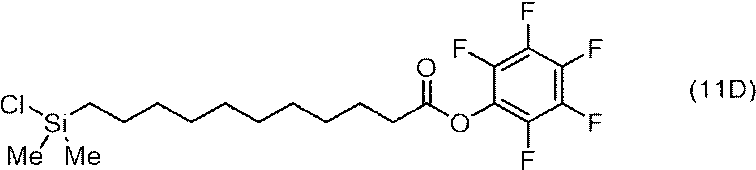
1H-NMR (400 MHz, CDCl3) δ 2.63 (t, J = 7.4 Hz, 2H), 1.74 (p, J = 7.4 Hz, 2H), 1.46 - 1.17 (m, 14H), 0.90 - 0.69 (m, 2H), 0.37 (s, 6H).
窒素雰囲気下、100mL三ツ口フラスコにトリス(トリメチルシロキシ)シラノール(1.3g)、THF(20mL)を加え、撹拌した。0℃に冷却し、n-BuLiのヘキサン溶液(1.6M、2.4mL)を滴下した。ヘキサメチルシクロトリシロキサンのTHF溶液(1.1M、4.0mL)を滴下し、更にヘキサメチルシクロトリシロキサンのTHF溶液(1.1M、22mL)を滴下し、7時間撹拌した。その後、化合物11D(3.6g)を加え、1時間撹拌した後、化合物11A(3.2g)を加え1時間撹拌した。反応液にヘキサン、イオン交換水を順次加え、分液し、有機層を取り分けた。溶媒と低沸点成分を減圧留去した後、シリカゲルを用いたフラッシュカラムクロマトグラフィ(展開溶媒:ヘキサン/酢酸エチル)を行うことで、化合物11Eを0.98g得た。化合物11Eの構造は、以下のNMRデータより確認した。化合物11E中、n10の平均値は21であった。

1H-NMR (400 MHz, CDCl3) δ 5.81 (ddt, J = 16.9, 10.2, 6.7 Hz, 2H), 5.31 (d, J = 4.8 Hz, 1H), 5.08 - 4.84 (m, 4H), 3.19 (t, J = 6.0 Hz, 2H), 2.31 - 2.11 (m, 2H), 2.08 - 1.92 (m, 4H), 1.63 (t, J = 7.3 Hz, 2H), 1.28 (d, J = 9.6 Hz, 47H), 0.53 (t, J = 7.7 Hz, 2H), 0.09 (s, 159H).
ジクロロメタン(10g)に溶解した化合物11E(0.80g)に、白金/1,3-ジビニル-1,1,3,3-テトラメチルジシロキサン錯体のトルエン溶液(白金含有量:3質量%、4.1mg)、アニリン(2.6mg)、トリメトキシシラン(0.40g)を加え、25℃で2時間撹拌した。溶媒を減圧留去することで、化合物X1を0.69g得た。化合物X1の構造は、以下のNMRデータより確認した。化合物X1中、n10の平均値は21であった。

1H-NMR (400 MHz, CDCl3) δ 5.31 (d, J = 4.8 Hz, 1H), 3.57 (s, 18H), 3.18 (t, J = 6.0 Hz, 2H), 2.31 - 2.11 (m, 2H), 1.64 - 1.25 (m, 57H), 0.64 (m, 4H), 0.52 (t, J = 7.7 Hz, 2H), 0.09 (s, 159H).
[第1化合物(化合物X2)の準備]
化合物12として、信越化学工業社製の「X-24-9011」を用いた。
X-24-9011の構造は、以下の通りである。なお、ジメチルポリシロキサンの繰り返し単位数43は平均値である。
化合物12として、信越化学工業社製の「X-24-9011」を用いた。
X-24-9011の構造は、以下の通りである。なお、ジメチルポリシロキサンの繰り返し単位数43は平均値である。

[第1化合物(化合物X3)の合成]
1,1,1,3,5,5,5-ヘプタメチルトリシロキサン(10g)に、ジクロロメタン(100g)、トリクロロイソシアヌル酸(14g)を加え、25℃で3時間攪拌した。次いで、反応液を濾過し、不溶物を除去した後、ろ液を留去することで低沸点成分を除去した。得られた粗液に水(20g)、THF(40g)、トリエチルアミン(10g)を加え、25℃で2時間攪拌した。ヘキサンと水とを加えて抽出し、留去することで低沸点成分を除去した。得られた粗液はシリカゲルを用いたフラッシュカラムクロマトグラフィ(展開溶媒:ヘキサン/酢酸エチル)を行うことで、精製し、化合物12Aを8.3g得た。化合物12Aの構造は、以下のNMRデータより確認した。

1H-NMR (400 MHz, CDCl3) δ 2.41 (q, J = 7.2 Hz, 1H), 0.20 - 0.21 (m, 21H).
[化合物12Bの合成]
化合物12A(2.0g)に、THF(20g)を加え、0℃に冷却したのち、メチルリチウム溶液(ジエトキシメタン中、3.1M)(2.7mL)を加え、25℃で10分間攪拌した。次いで、ヘキサメチルシクロトリシロキサン(5.6g)をTHF(20g)に溶解させた溶液を加えて、25℃で4時間攪拌した。次いで、クロロジメチルシラン(2.0g)を加えて、25℃で1時間攪拌した。ヘキサンと水とを加えて抽出したのち、留去することで低沸点成分を除去した。得られた粗液はシリカゲルを用いたフラッシュカラムクロマトグラフィ(展開溶媒:ヘキサン/ジクロロメタン)を行うことで、精製し、化合物12Bを4.3g得た。化合物12B中、nの平均値は9であった。化合物12Bの構造は、以下のNMRデータより確認した。
化合物12A(2.0g)に、THF(20g)を加え、0℃に冷却したのち、メチルリチウム溶液(ジエトキシメタン中、3.1M)(2.7mL)を加え、25℃で10分間攪拌した。次いで、ヘキサメチルシクロトリシロキサン(5.6g)をTHF(20g)に溶解させた溶液を加えて、25℃で4時間攪拌した。次いで、クロロジメチルシラン(2.0g)を加えて、25℃で1時間攪拌した。ヘキサンと水とを加えて抽出したのち、留去することで低沸点成分を除去した。得られた粗液はシリカゲルを用いたフラッシュカラムクロマトグラフィ(展開溶媒:ヘキサン/ジクロロメタン)を行うことで、精製し、化合物12Bを4.3g得た。化合物12B中、nの平均値は9であった。化合物12Bの構造は、以下のNMRデータより確認した。
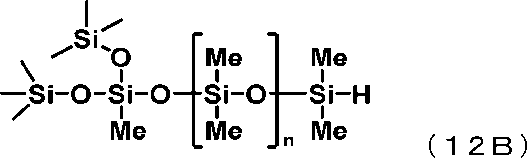
1H-NMR (400 MHz, CDCl3) δ 4.63 (p, J = 2.8 Hz, 1H), 0.11 (d, J = 2.8 Hz, 6H), 0.09 - 0.12 (m, 75H).
化合物12B(2.3g)に、ジクロロメタン(20g)、18-ブロモ-1-オクタデセン(0.75g)を加え、均一になるまで攪拌した。次いで、白金/1,3-ジビニル-1,1,3,3-テトラメチルジシロキサン錯体のトルエン溶液(白金含有量:3質量%、4.1mg)を加えて、25℃で2時間攪拌した。低沸点成分を減圧留去した後、シリカゲルを用いたフラッシュカラムクロマトグラフィ(展開溶媒:ヘキサン/ジクロロメタン)を行うことで、化合物12Cを1.8g得た。化合物12C中、nの平均値は9であった。化合物12Cの構造は、以下のNMRデータより確認した。
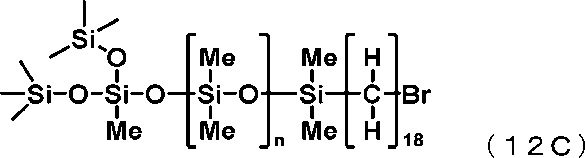
1H-NMR (400 MHz, CDCl3) δ 3.33 (t, J = 6.9 Hz, 2H), 1.78 (dt, J = 14.5, 7.0 Hz, 2H), 1.42 - 1.08 (m, 30H), 0.45 (t, J = 7.7Hz, 2H), 0.09 - 0.12 (m, 81H).
化合物12C(1.8g)に、THF(20g)、アリルマグネシウムクロリド溶液(THF中、2.0M)(20mL)、塩化銅(II)(0.02g)を加え、50℃で2時間攪拌した。塩酸とヘキサンとを加えて抽出し、低沸点成分を減圧留去した後、シリカゲルを用いたフラッシュカラムクロマトグラフィ(展開溶媒:ヘキサン/ジクロロメタン)を行うことで、化合物12Dを1.5g得た。化合物12D中、nの平均値は9であった。化合物12Dの構造は、以下のNMRデータより確認した。
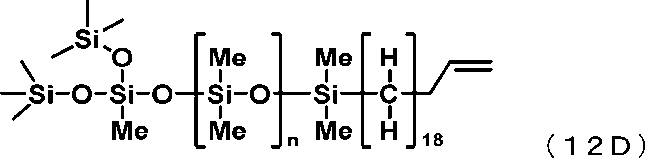
1H-NMR (400 MHz, CDCl3) δ 5.74 (ddt, J = 17.0, 10.2, 6.7 Hz, 1H), 5.0 1- 4.76 (m, 2H), 2.07 - 1.87 (m, 2H), 1.41 - 0.97 (m, 34H), 0.45 (dd, J = 9.5, 5.9 Hz, 2H), 0.09 - 0.12 (m, 81H).
化合物12D(1.5g)に、ジクロロメタン(10g)を加えて溶解させた。次いで、白金/1,3-ジビニル-1,1,3,3-テトラメチルジシロキサン錯体のトルエン溶液(白金含有量:3質量%、4.1mg)、アニリン(2.6mg)、トリメトキシシラン(0.60g)を加え、50℃で2時間攪拌した。溶媒を減圧留去することで、化合物X3を1.6g得た。化合物X3中、nの平均値は9であった。化合物X3の構造は、以下のNMRデータより確認した。

1H-NMR (400 MHz, CDCl3) δ 3.49 (s, 9H), 1.81 - 0.97 (m, 38H), 0.65 - 0.51 (m,2H), 0.45 (dd, J = 9.8, 5.3 Hz, 2H), 0.09 - 0.12 (m, 81H).
[第2化合物(化合物Y1)の合成]
国際公開第2021/054413号に記載の方法で、化合物21のTHF溶液(0.8M)を得た。

1-ブロモウンデカン(2.3g)をTHF(10g)に溶解させ、塩化銅(II)(0.07g)、化合物21のTHF溶液(0.8M、20mL)を加え、50℃で16時間撹拌した。反応終了後、塩酸を加え、ヘキサンで抽出した。溶媒と低沸点成分を減圧留去し、シリカゲルを用いたフラッシュカラムクロマトグラフィ(展開溶媒:ジクロロメタン/ヘキサン)を行うことで、化合物22を1.2g得た。化合物22の構造は、以下のNMRデータより確認した。

1H-NMR (400 MHz, CDCl3) δ 5.80 (ddt, J = 16.6, 10.5, 7.4 Hz, 3H), 5.13 - 4.78 (m, 6H), 1.98 (dt, J = 7.4, 1.2 Hz, 6H), 1.45 - 1.13 (m, 22H), 0.96 - 0.76 (m, 3H).
ジクロロメタン(10g)、化合物22(1.2g)、白金/1,3-ジビニル-1,1,3,3-テトラメチルジシロキサン錯体のトルエン溶液(白金含有量3%、8.3mg)、アニリン(2.6mg)、トリメトキシシラン(2.5g)を加え、50℃で2時間撹拌した後、溶媒と低沸点成分を減圧留去することで、化合物Y1を2.5g得た、化合物Y1の構造は、以下のNMRデータより確認した。

1H-NMR (400 MHz ,CDCl3) δ 3.56 (s, 27H), 1.39 - 1.03 (m, 34H), 0.96 - 0.79 (m, 3H), 0.58 (dd, J = 8.7, 6.9 Hz, 6H).
[第2化合物(化合物Y2)の準備]
化合物Y2として、オクタデシルトリメトキシシラン(CH3(CH2)17-Si(OCH3)3、東京化成工業社製)を準備した。
化合物Y2として、オクタデシルトリメトキシシラン(CH3(CH2)17-Si(OCH3)3、東京化成工業社製)を準備した。
[第2化合物(化合物Y3)の合成]
1-ブロモドコサン(2.5g)をTHF(10g)に溶解させ、塩化銅(II)(0.07g)、化合物21のTHF溶液(0.8M、20mL)を加え、50℃で16時間撹拌した。反応液に塩酸を加え、ヘキサンで抽出した。溶媒と低沸点成分を減圧留去し、シリカゲルを用いたフラッシュカラムクロマトグラフィ(展開溶媒:ジクロロメタン/ヘキサン)を行うことで、化合物23を1.8g得た。化合物23の構造は、以下のNMRデータより確認した。
1-ブロモドコサン(2.5g)をTHF(10g)に溶解させ、塩化銅(II)(0.07g)、化合物21のTHF溶液(0.8M、20mL)を加え、50℃で16時間撹拌した。反応液に塩酸を加え、ヘキサンで抽出した。溶媒と低沸点成分を減圧留去し、シリカゲルを用いたフラッシュカラムクロマトグラフィ(展開溶媒:ジクロロメタン/ヘキサン)を行うことで、化合物23を1.8g得た。化合物23の構造は、以下のNMRデータより確認した。

1H-NMR (400 MHz, CDCl3) δ 5.70 (ddt, J = 16.8, 11.3, 7.4 Hz, 3H), 5.24 - 4.92 (m, 6H), 1.84 (dt, J = 7.4, 1.1 Hz, 6H), 1.44 - 0.72 (m, 47H).
ジクロロメタン(10g)、化合物23(1.2g)、白金/1,3-ジビニル-1,1,3,3-テトラメチルジシロキサン錯体のトルエン溶液(白金含有量3%、8.3mg)、アニリン(2.6mg)、トリメトキシシラン(2.5g)を加え、50℃で2時間撹拌した。溶媒と低沸点成分を減圧留去することで、化合物Y3を2.0g得た。化合物Y3の構造は、以下のNMRデータより確認した。

1H-NMR (400 MHz, CDCl3) δ 3.58 (s, 27H), 1.77 - 1.05 (m, 56H), 0.92 - 0.85 (m, 3H), 0.68 (t, J = 9.4 Hz, 6H).
[第2化合物(化合物Y4)の合成]
1,18-オクタデカンジオール(25g)をトルエン(1,000mL)に溶解させた。48%臭化水素酸(22g)を加え、24時間還流条件下で撹拌した。反応終了後、分液し、水層をジクロロメタンで抽出した。有機層をまとめ、飽和重曹水で洗浄した。無水硫酸マグネシウムで乾燥し、ろ過した。ろ液を減圧留去し、シリカゲルを用いたフラッシュカラムクロマトグラフィ(展開溶媒:ヘキサン/酢酸メチル)を行うことで、化合物31を22g得た。化合物31の構造は、以下のNMRデータより確認した。

1H-NMR (400 MHz, CDCl3) δ 3.57 (td, J = 5.8, 5.8 Hz, 2H), 3.42 (t, J = 4.7 Hz, 2H), 1.81 - 1.20 (m, 32H).
化合物31(21g)をTHF(500mL)に溶解させ、塩化銅(II)(0.4g)、化合物21のTHF溶液(0.8M、200mL)を加え、50℃で24時間撹拌した。反応液に塩酸を加え、ジクロロメタンで抽出した。溶媒と低沸点成分を減圧留去し、シリカゲルを用いたフラッシュカラムクロマトグラフィ(展開溶媒:ヘキサン/酢酸メチル)を行うことで、化合物32を18g得た。化合物32の構造は、以下のNMRデータより確認した。

1H-NMR (400 MHz, CDCl3) δ 5.81 - 5.57 (m, 3H), 5.28 - 4.88 (m, 6H), 3.57 (td, J = 5.8, 5.8 Hz, 2H), 1.90 - 1.78 (m, 6H), 1.64 - 1.48 (m, 2H), 1.38 - 1.15 (m, 32H).
化合物32(17g)をTHF(500mL)に溶解させ、トリフェニルホスフィン(20g)を加えた。氷浴下、撹拌しながら四臭化炭素(20g)をゆっくりと加え、24時間撹拌を継続した。反応液にシリカゲルを加え、溶媒を留去した。ヘキサンで抽出することで、化合物33を14g得た。化合物33の構造は、以下のNMRデータより確認した。

1H-NMR (400 MHz, CDCl3) δ 5.80 - 5.59 (m, 3H), 5.23 - 4.90 (m, 6H), 3.42 (t, J = 4.7 Hz, 2H), 1.85 (d, J = 7.3 Hz, 6H), 1.82 - 1.10 (m, 36H).
化合物33(5.0g)をTHF(100mL)に溶解させ、塩化銅(II)(0.005g)、ネオペンチルマグネシウムクロリドのTHF溶液(1M、16mL)を加え、50℃で24時間撹拌した。反応液に塩酸を加え、ヘキサンで抽出した。溶媒と低沸点成分を減圧留去し、シリカゲルを用いたフラッシュカラムクロマトグラフィ(展開溶媒:ヘキサン)を行うことで、化合物34を3.4g得た。

1H-NMR (400 MHz, CDCl3) δ 5.77 - 5.56 (m, 3H), 5.25 - 4.89 (m, 6H), 2.00 - 1.67 (m, 6H), 1.49 - 1.10 (m, 40H), 0.85 (s, 9H).
ジクロロメタン(10g)、化合物34(1.0g)、白金/1,3-ジビニル-1,1,3,3-テトラメチルジシロキサン錯体のトルエン溶液(白金含有量3%、8.3mg)、アニリン(2.6mg)、トリメトキシシラン(1.0.g)を加え、50℃で2時間撹拌した後、溶媒と低沸点成分を減圧留去することで、化合物Y4を1.8g得た。
化合物Y4の構造は、以下のNMRデータより確認した。
化合物Y4の構造は、以下のNMRデータより確認した。

1H-NMR (400 MHz, CDCl3) δ 3.58 (s, 27H), 1.57 - 1.12 (m, 52H), 0.85 (s, 9H), 0.68 (t, J = 9.4 Hz, 9H).
[第2化合物(化合物Y5)の合成]
イソステアリン酸(25g)、p-トルエンスルホン酸一水和物(4.3g)、メタノール(500g)を加え、24時間還流条件下で撹拌した。反応液を濃縮し、シリカゲルカラムクロマトグラフィで精製することで、化合物41を26g得た。化合物41の構造は、以下のNMRデータより確認した。

1H-NMR (400 MHz, CDCl3) δ 3.63 (s, 3H), 2.54 - 0.79 (m, 35H).
乾燥窒素雰囲気下、THF(1,000mL)に60%水素化ナトリウム(4.1g)を溶解させた。氷浴下、撹拌しながらゆっくりと化合物(25g)を加えた。1時間撹拌した後、ヨウ化メチル(13g)をゆっくりと加え、24時間撹拌を続けた。2N塩酸水溶液で反応を停止させ、分液した。水層を酢酸エチルで抽出し、有機層をまとめた。有機層を無水硫酸ナトリウムで乾燥し、ろ過した。ろ液をエバポレーターで濃縮した。得られた粗液をシリカゲルカラムクロマトグラフィで精製することで、化合物42を25g得た。化合物42の構造は、以下のNMRデータより確認した。
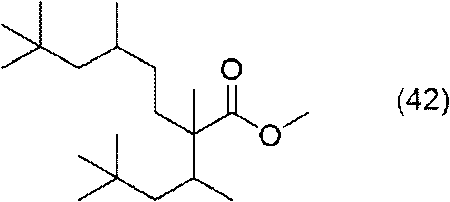
1H-NMR (400 MHz, CDCl3) δ 3.63 (s, 3H), 2.54 - 0.79 (m, 38H).
乾燥窒素雰囲気下、THF(1,000mL)に、水素化リチウムアルミニウムのTHF溶液(1M、100mL)加えた。氷浴下、撹拌しながらゆっくりと化合物(24g)を加え、1時間撹拌を続けた。水(4mL)、15%水酸化ナトリウム水溶液(4mL)、水(12mL)を順にゆっくりと加え、セライトろ過した。ろ液をエバポレーターで濃縮することで、化合物43を19g得た。化合物43の構造は、以下のNMRデータより確認した。
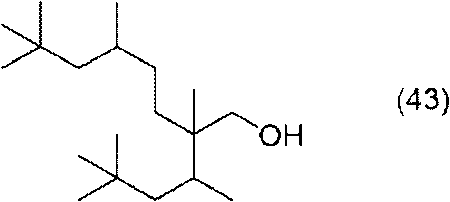
1H-NMR (400 MHz, CDCl3) δ 3.69 - 3.63 (m, 1H), 3.44 - 3.37 (m, 1H), 1.73 - 0.80 (m, 37H).
化合物43(15g)、四塩化炭素(12g)、アセトニトリル(150mL)を加えて撹拌しながらトリフェニルホスフィン(22g)を加え、60℃で1時間撹拌した。反応液にシリカゲルを加え、溶媒を留去した。ヘキサンで抽出することで、化合物44を16g得た。化合物44の構造は、以下のNMRデータより確認した。

1H-NMR (400 MHz, CDCl3) δ 3.63 - 3.53 (m, 1H), 3.36 - 3.25 (m, 1H), 1.81 - 0.77 (m, 37H).
乾燥窒素雰囲気下、マグネシウム(1.3g)、THF(100mL)、1,2-ジブロモエタン(0.10g)、化合物(15g)を加え、還流条件下24時間撹拌を続けた。化合物45のTHF溶液(0.6M)を80mL得た。化合物45の構造は、以下のNMRデータより確認した。

1H-NMR (400 MHz, CDCl3) δ 1.81 ‐ 0.77 (m, 37H), -0.19 - -0.55 (br, 2H).
化合物33(5.0g)をTHF(100mL)に溶解させ、塩化銅(II)(0.005g)、化合物45のTHF溶液(0.6M、30mL)を加え、50℃で24時間撹拌した。反応液に塩酸を加え、ヘキサンで抽出した。溶媒と低沸点成分を減圧留去し、シリカゲルを用いたフラッシュカラムクロマトグラフィ(展開溶媒:ヘキサン)を行うことで、化合物46を4.8g得た。化合物46の構造は、以下のNMRデータより確認した。

1H-NMR (400 MHz, CDCl3) δ 5.75 ‐ 5.64 (m, 3H), 5.20 ‐ 4.92 (m, 6H), 1.85 (d, J = 1.4 Hz, 6H), 1.68 ‐ 0.73 (m, 77H).
ジクロロメタン(10g)、化合物46(1.0g)、白金/1,3-ジビニル-1,1,3,3-テトラメチルジシロキサン錯体のトルエン溶液(白金含有量3%、8.3mg)、アニリン(2.6mg)、トリメトキシシラン(1.0.g)を加え、50℃で2時間撹拌した後、溶媒と低沸点成分を減圧留去することで、化合物Y5を1.5g得た。化合物Y5の構造は、以下のNMRデータより確認した。

1H-NMR (400 MHz, CDCl3) δ 3.58 (s, 27H), 1.65 ‐ 0.76 (m, 89H), 0.68 (t, J = 9.4 Hz, 6H).
[第2化合物(化合物Y6)の合成]
国際公開第2021/054413号に記載の方法で、化合物51のTHF溶液(0.8M)を得た。
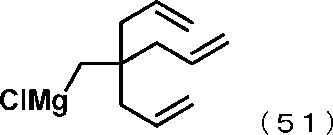
1,18-オクタデカンジオール(25g)をトルエン(1,000mL)に溶解させた。48%臭化水素酸(22g)を加え、24時間還流条件下で攪拌した。反応終了後、分液し、水層をジクロロメタンで抽出した。有機層をまとめ、飽和重曹水で洗浄した。無水硫酸マグネシウムで乾燥し、ろ過した。ろ液を減圧留去し、シリカゲルカラムクロマトグラフィで精製することで、化合物52を22g得た。化合物52の構造は、以下のNMRデータより確認した。

1H-NMR (400 MHz, CDCl3) δ 3.57 (td, J = 5.8, 5.8 Hz, 2H), 3.42 (t, J = 4.7 Hz, 2H), 1.81 - 1.20 (m, 32H).
化合物52(21g)をTHF(500mL)に溶解させ、塩化銅(II)(0.4g)、化合物51のTHF溶液(0.8M)(200mL)を加え、50℃で24時間撹拌した。反応終了後、塩酸を加え、ジクロロメタンで抽出した。溶媒と低沸点成分を減圧留去し、シリカゲルを用いたフラッシュカラムクロマトグラフィを行うことで、化合物53を18g得た。化合物53の構造は、以下のNMRデータより確認した。

1H-NMR (400 MHz, CDCl3) δ 5.81 - 5.57 (m, 3H), 5.28 - 4.88 (m, 6H), 3.57 (td, J = 5.8, 5.8 Hz, 2H), 1.90 - 1.78 (m, 6H), 1.64 - 1.48 (m, 2H), 1.38 - 1.15 (m, 32H).
化合物53(17g)をTHF(500mL)に溶解させ、トリフェニルホスフィン(20g)加えた。氷浴下、攪拌しながら四臭化炭素(20g)をゆっくりと加え、24時間攪拌を継続した。反応液にシリカゲルを加え、溶媒を留去した。ヘキサンで抽出することで、化合物54を14g得た。化合物54の構造は、以下のNMRデータより確認した。

1H-NMR (400 MHz, CDCl3) δ 5.80 - 5.59 (m, 3H), 5.23 - 4.90 (m, 6H), 3.42 (t, J = 4.7 Hz, 2H), 1.85 (d, J = 7.3 Hz, 6H), 1.82 - 1.10 (m, 36H).
化合物54(5.0g)をTHF(100mL)に溶解させ、塩化銅(II)(0.005g)、トリメチルシリルメチルマグネシウムクロリドのジエチルエーテル溶液(1.0M)(16mL)を加え、60℃で24時間撹拌した。反応終了後、塩酸を加え、ヘキサンで抽出した。溶媒と低沸点成分を減圧留去し、シリカゲルを用いたフラッシュカラムクロマトグラフィを行うことで、化合物55の構造は、以下のNMRデータより確認した。

1H-NMR (400 MHz, CDCl3) δ 5.70 (ddt, J = 16.8, 11.3, 7.4 Hz, 3H), 5.23 - 4.85 (m, 6H), 1.84 (dt, J = 7.3, 1.0 Hz, 6H), 1.45 - 1.10 (m, 38H), 0.58 (t, J = 8.5 Hz, 2H), -0.05 (s, 9H).
ジクロロメタン(10g)に溶解した化合物55(0.5g)に、白金/1,3-ジビニル-1,1,3,3-テトラメチルジシロキサン錯体のトルエン溶液(白金含有量:3質量%、5mg)、アニリン(3mg)、トリメトキシシラン(1.0g)を加え、50℃で2時間攪拌した。溶媒を減圧留去することで、化合物Y6を0.7g得た。

1H-NMR (400 MHz, CDCl3) δ 3.58 (s, 27H), 1.51 - 1.08 (m, 50H), 0.77 - 0.46 (m, 8H), -0.05 (s, 9H).
[表面処理剤の調製]
表1に記載の第1化合物及び第2化合物を、表1に記載の質量比率で混合し、更に液状媒体としてヘプタンを追加し、固形分が20質量%である表面処理剤を得た。
基材に対して、表面処理剤を用いて表面処理を行った。表面処理方法としては、ドライコーティング法を用いた。
基材として、化学強化ガラスを用いた。
真空蒸着装置(アルバック機工社製「VTR-350M」)内の銅製ハースに蒸着源として酸化ケイ素の30gを配置した。真空蒸着装置内にガラス基材を配置し、真空蒸着装置内を5×10⁻³Pa以下の圧力になるまで排気した。上記ハースを約2,000℃になるまで加熱し、基材の表面に酸化ケイ素を真空蒸着させ、厚さ約20nmの酸化ケイ素層を有する酸化ケイ素層付き基材を作製した。
各表面処理剤の0.5gを真空蒸着装置内のモリブデン製ボートに充填し、真空蒸着装置内を1×10⁻³Pa以下に排気した。表面処理剤を配置したボートを昇温速度10℃/分以下の速度で加熱し、水晶発振式膜厚計による蒸着速度が1nm/秒を超えた時点でシャッターを開けて基材の表面への製膜を開始させた。
膜厚が約50nmとなった時点でシャッターを閉じて酸化ケイ素層付き基材の表面への製膜を終了させた。化合物又は組成物が堆積された基材を、140℃で30分間加熱処理し、エタノールにて洗浄して、基材の表面に表面処理層を有する物品を得た。
表1に記載の第1化合物及び第2化合物を、表1に記載の質量比率で混合し、更に液状媒体としてヘプタンを追加し、固形分が20質量%である表面処理剤を得た。
基材に対して、表面処理剤を用いて表面処理を行った。表面処理方法としては、ドライコーティング法を用いた。
基材として、化学強化ガラスを用いた。
真空蒸着装置(アルバック機工社製「VTR-350M」)内の銅製ハースに蒸着源として酸化ケイ素の30gを配置した。真空蒸着装置内にガラス基材を配置し、真空蒸着装置内を5×10⁻³Pa以下の圧力になるまで排気した。上記ハースを約2,000℃になるまで加熱し、基材の表面に酸化ケイ素を真空蒸着させ、厚さ約20nmの酸化ケイ素層を有する酸化ケイ素層付き基材を作製した。
各表面処理剤の0.5gを真空蒸着装置内のモリブデン製ボートに充填し、真空蒸着装置内を1×10⁻³Pa以下に排気した。表面処理剤を配置したボートを昇温速度10℃/分以下の速度で加熱し、水晶発振式膜厚計による蒸着速度が1nm/秒を超えた時点でシャッターを開けて基材の表面への製膜を開始させた。
膜厚が約50nmとなった時点でシャッターを閉じて酸化ケイ素層付き基材の表面への製膜を終了させた。化合物又は組成物が堆積された基材を、140℃で30分間加熱処理し、エタノールにて洗浄して、基材の表面に表面処理層を有する物品を得た。
ドライコーティング法によって得られた物品について、撥水性、耐摩耗性、及び指紋除去性の評価を行った。評価方法は、以下の通りである。
<撥水性>
物品の表面処理層上に、約2μLの蒸留水を垂らし、接触角測定装置(製品名「DM-500」、協和界面科学社製)を用いて、初期の水接触角を測定した。表面処理層上の5箇所で測定した平均値を、水接触角とした。なお、水接触角の算出には2θ法を用いた。評価基準は以下の通りである。AA、A及びBは、実用上問題ないレベルである。
AA:初期の水接触角が105°以上。
A:初期の水接触角が100°以上105°未満。
B:初期の水接触角が95°以上100°未満。
C:初期の水接触角が95°未満。
物品の表面処理層上に、約2μLの蒸留水を垂らし、接触角測定装置(製品名「DM-500」、協和界面科学社製)を用いて、初期の水接触角を測定した。表面処理層上の5箇所で測定した平均値を、水接触角とした。なお、水接触角の算出には2θ法を用いた。評価基準は以下の通りである。AA、A及びBは、実用上問題ないレベルである。
AA:初期の水接触角が105°以上。
A:初期の水接触角が100°以上105°未満。
B:初期の水接触角が95°以上100°未満。
C:初期の水接触角が95°未満。
<耐摩耗性1>
物品の表面処理層に対して、JIS L0849:2013(対応ISO:105-X12:2001)に準拠して、往復式トラバース試験機(ケイエヌテー社製)を用い、スチールウールボンスター(#0000)を圧力98.07kPa、速度320cm/分で100回往復させるごとに、摩擦試験後の水接触角を測定した。摩擦試験後の水接触角の測定方法は、上記撥水性の評価方法における、初期の水接触角の測定方法と同じである。まず、100回往復させた後に、得られた水接触角の値が90°未満であった場合には、摩擦試験を終了し、終了時の擦り回数を記録した。得られた水接触角の値が90°以上であった場合には、続けて摩擦試験を行った。この操作を繰り返し行い、擦り回数を最大1万回とした。評価基準は以下のとおりである。A及びBは、実用上問題ないレベルである。
A:擦り回数が2,000回以上。
B:擦り回数が1,000回以上2,000回未満。
C:擦り回数が1,000回未満。
物品の表面処理層に対して、JIS L0849:2013(対応ISO:105-X12:2001)に準拠して、往復式トラバース試験機(ケイエヌテー社製)を用い、スチールウールボンスター(#0000)を圧力98.07kPa、速度320cm/分で100回往復させるごとに、摩擦試験後の水接触角を測定した。摩擦試験後の水接触角の測定方法は、上記撥水性の評価方法における、初期の水接触角の測定方法と同じである。まず、100回往復させた後に、得られた水接触角の値が90°未満であった場合には、摩擦試験を終了し、終了時の擦り回数を記録した。得られた水接触角の値が90°以上であった場合には、続けて摩擦試験を行った。この操作を繰り返し行い、擦り回数を最大1万回とした。評価基準は以下のとおりである。A及びBは、実用上問題ないレベルである。
A:擦り回数が2,000回以上。
B:擦り回数が1,000回以上2,000回未満。
C:擦り回数が1,000回未満。
<耐摩耗性2>
物品の表面処理層に対して、JIS L0849:2013(対応ISO:105-X12:2001)に準拠して、往復式トラバース試験機(ケイエヌテー社製)を用い、スチールウールボンスター(#0000)を圧力98.07kPa、速度320cm/分で100回往復させるごとに、摩擦試験後の水接触角を測定した。摩擦試験後の水接触角の測定方法は、上記撥水性の評価方法における、初期の水接触角の測定方法と同じである。まず、100回往復させた後に、得られた水接触角の値が95°未満であった場合には、摩擦試験を終了し、終了時の擦り回数を記録した。得られた水接触角の値が95°以上であった場合には、続けて摩擦試験を行った。この操作を繰り返し行い、擦り回数を最大1万回とした。評価基準は以下の通りである。
A:擦り回数が200回以上。
B:擦り回数が200回未満。
物品の表面処理層に対して、JIS L0849:2013(対応ISO:105-X12:2001)に準拠して、往復式トラバース試験機(ケイエヌテー社製)を用い、スチールウールボンスター(#0000)を圧力98.07kPa、速度320cm/分で100回往復させるごとに、摩擦試験後の水接触角を測定した。摩擦試験後の水接触角の測定方法は、上記撥水性の評価方法における、初期の水接触角の測定方法と同じである。まず、100回往復させた後に、得られた水接触角の値が95°未満であった場合には、摩擦試験を終了し、終了時の擦り回数を記録した。得られた水接触角の値が95°以上であった場合には、続けて摩擦試験を行った。この操作を繰り返し行い、擦り回数を最大1万回とした。評価基準は以下の通りである。
A:擦り回数が200回以上。
B:擦り回数が200回未満。
<指紋除去性>
指紋スタンプ部分となる直径2cmの赤ゴム栓を備えた1kg分銅を準備した。次に、人工指紋液(伊勢久株式会社製)70μLをウエスに滴下し、指紋スタンプを人工指紋液に1分間付着させた。指紋スタンプに過剰に付着した人工指紋液を除去するために、指紋スタンプを新しいウエスに20秒間付着させた。その後、23℃に温度が調整されたホットプレート上に、表面処理層が形成された物品を設置した。指紋スタンプを表面処理層に対してスタンプした。
指紋スタンプ部分となる直径2cmの赤ゴム栓を備えた1kg分銅を準備した。次に、人工指紋液(伊勢久株式会社製)70μLをウエスに滴下し、指紋スタンプを人工指紋液に1分間付着させた。指紋スタンプに過剰に付着した人工指紋液を除去するために、指紋スタンプを新しいウエスに20秒間付着させた。その後、23℃に温度が調整されたホットプレート上に、表面処理層が形成された物品を設置した。指紋スタンプを表面処理層に対してスタンプした。
人工指紋液が付着した物品を摺動装置(製品名「HHS―2000」、株式会社新東科学製)に設置した。1cm角の面積を有する平面圧子に両面テープを用いて拭き取り布(KBセーレン株式会社製サヴィーナミニマックス)に貼り付け、摺動装置に設置した。荷重100gで表面処理層に対して、拭き取り布で1方向に向かって、付着した人工指紋液を拭き取った。拭き取った箇所をヘイズメーター(製品名「NDH7000SP」、株式会社日本電色製)でヘイズを測定した。評価基準は以下の通りである。
A:ヘイズ値が1%未満。
B:ヘイズ値が1%以上5%未満。
C:ヘイズ値が5%以上。
A:ヘイズ値が1%未満。
B:ヘイズ値が1%以上5%未満。
C:ヘイズ値が5%以上。
評価結果を表1に示す。表1中、要件(1)及び要件(2)におけるYはそれぞれ、要件(1)及び要件(2)を満たしていることを意味する。要件(1)及び要件(2)におけるNはそれぞれ、要件(1)及び要件(2)を満たしていないことを意味する。また、「-」は、第1化合物又は第2化合物が含まれていないことを意味する。例11は、表面処理剤による表面処理を行っていない酸化ケイ素付き基材の測定結果である。また、耐摩耗性1及び2の「-」は実施していないことを示す。

表1に示すように、例1~8及び例12~15では、第1化合物及び第2化合物を含み、要件(1)及び(2)のうち少なくとも1つを満たすため、撥水性及び耐摩耗性に優れることが分かった。例1と例3とを比較して、例1の方が指紋除去性に優れていた。例2と例4とを比較して、例2の方が指紋除去性に優れていた。
本開示の組成物及び表面処理剤は、例えば、タッチパネルディスプレイ等の表示装置、光学素子、半導体素子、建築材料、自動車部品、ナノインプリント技術等における基材に対して用いることができる。また、組成物及び表面処理剤は、電車、自動車、船舶、航空機等の輸送機器におけるボディー、窓ガラス(フロントガラス、サイドガラス、リアガラス)、ミラー、バンパー等に対して用いることができる。更に、組成物及び表面処理剤は、建築物外壁、テント、太陽光発電モジュール、遮音板、コンクリート等の屋外物品;漁網、虫取り網、水槽に対して用いることができる。また、組成物及び表面処理剤は、台所、風呂場、洗面台、鏡、トイレ周辺部品;シャンデリア、タイル等の陶磁器;人工大理石、エアコン等の各種屋内設備に対して用いることができる。また、組成物及び表面処理剤は、工場内の治具、内壁、配管等の防汚処理としても用いることができる。また、組成物及び表面処理剤は、ゴーグル、眼鏡、ヘルメット、パチンコ、繊維、傘、遊具、サッカーボールに対して用いることができる。また、組成物及び表面処理剤は、食品用包材、化粧品用包材、ポットの内部等の各種包材の付着防止剤としても用いることができる。また、組成物及び表面処理剤は、カーナビゲーション、携帯電話、スマートフォン、デジタルカメラ、デジタルビデオカメラ、PDA、ポータブルオーディオプレーヤー、カーオーディオ、ゲーム機器、眼鏡レンズ、カメラレンズ、レンズフィルター、サングラス、胃カメラ等の医療用器機、複写機、PC、ディスプレイ(例えば、液晶ディスプレイ、有機ELディスプレイ、プラズマディスプレイ、タッチパネルディスプレイ)、タッチパネル、保護フィルム、及び反射防止フィルム等の光学部材に対して用いることができる。
この出願は、2023年11月8日に出願された日本出願特願2023-191140、及び2024年3月6日に出願された日本出願特願2024-034018を基礎とする優先権を主張し、その開示の全てをここに取り込む。
Claims (20)
- オルガノ(ポリ)シロキサン残基と、反応性シリル基aと、を有する第1化合物、及び、
オルガノ(ポリ)シロキサン残基を有さず、酸素原子と直接結合しない炭化水素基であって官能基又は置換基を有してもよい炭素数4以上の炭化水素基と、反応性シリル基bと、を有する第2化合物を含み、
下記要件(1)及び(2)のうち少なくとも1つを満たす、組成物。
要件(1):前記第1化合物において、前記反応性シリル基aは前記オルガノ(ポリ)シロキサン残基の少なくとも一方の末端に2つ以上連結される。
要件(2):前記第2化合物において、前記反応性シリル基bは前記炭化水素基の少なくとも一方の末端に2つ以上連結される。 - 前記反応性シリル基a及び前記反応性シリル基bはそれぞれ独立に、下記式(S1)又は下記式(S2)で表される、請求項1に記載の組成物。
-Si(R2)nL3-n …(S1)
-[Si(L2)2-Q]n12-Si(L2)3 …(S2)
ただし、
R2は、それぞれ独立に、1価の炭化水素基であり、
Lは、それぞれ独立に、加水分解性基、加水分解性基を有する基、又は水酸基であり、
L2は、それぞれ独立に、加水分解性基、加水分解性基を有する基、水酸基、又は炭化水素基であり、
L2のうち、少なくとも4個のL2は、加水分解性基、加水分解性基を有する基、又は水酸基であり、
Qは、それぞれ独立に、酸素原子、又は、両隣のSiと結合する1つの炭素原子を有する有機基であり、
nは、0~2の整数であり、
n12は、1~3の整数である。 - 前記第1化合物に含まれるオルガノ(ポリ)シロキサン残基は、下記式(B1)で表される、請求項1に記載の組成物。
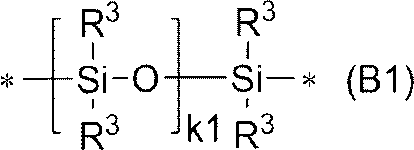
R3は、それぞれ独立に、炭化水素基であり、
k1は、1以上の数であり、
*は、隣接する原子との結合部位である。 - 前記第1化合物は、下記式(C)で表される化合物である、請求項1に記載の組成物。

T11は、反応性シリル基を含まない1価の基であり、
Bは、それぞれ独立に、-O-又は-C(=O)-であり、
rは、それぞれ独立に、0又は1であり、
R3は、それぞれ独立に、炭化水素基であり、
k1は、それぞれ独立に、1以上の数であり、
p1は、1以上の整数であり、
A11は、(p1+q1)価の連結基であり、
q1は、1以上の整数であり、
R2は、それぞれ独立に、炭化水素基であり、
Lは、それぞれ独立に、加水分解性基、加水分解性基を有する基、又は水酸基であり、
nは、それぞれ独立に、0~2の整数である。 - 前記式(C)において、k1が2~600である、請求項4に記載の組成物。
- 前記式(C)において、q1は1~4の整数である、請求項4に記載の組成物。
- 前記第2化合物において、前記反応性シリル基bは前記炭化水素基の一方の末端のみに連結される、請求項1に記載の組成物。
- 前記第2化合物は、式(G)で表される化合物である、請求項1に記載の組成物。
(R71-R72)p7-A71-(Si(R2)nL3-n)q2 …(G)
式(G)中、
R71は、水素原子、又は、[(CH3)3Q71-R73-]m7Q72(CH3)3-m7-であり、
Q71及びQ72、はそれぞれ独立に、C又はSiであり、
R73は、それぞれ独立に、炭素数1~6のアルキレン基であり、
m7は、0~3の整数であり、
R72は、アルキレン基であって、炭素数が2以上の場合、炭素-炭素原子間に、-O-、-S-、-C(=O)NH-、-NHC(=O)-、-C(=O)O-、-OC(=O)-、-C(=O)S-、-SC(=O)-、-S(=O)2NH-、-NHS(=O)2-、-S(=O)2O-、-OS(=O)2-、及びフェニレン基より選択される基を1個以上有していてもよく、
A71は、単結合又は(p7+q2)価の連結基であり、
R2は、それぞれ独立に、炭化水素基であり、
Lは、それぞれ独立に、加水分解性基、加水分解性基を有する基、又は水酸基であり、
nは、0~2の整数であり、
p7は1以上の整数であり、
q2は、1以上の整数である。 - 前記第2化合物は、下記式(E)で表される化合物である、請求項1に記載の組成物。
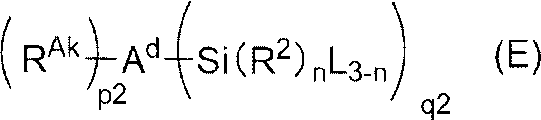
RAkは、それぞれ独立に、アルキル基であり、
Adは、単結合、又は酸素原子以外の(p2+q2)価の連結基であり、
p2及びq2は、それぞれ独立に、1以上の整数であり、
R2は、それぞれ独立に、炭化水素基であり、
Lは、それぞれ独立に、加水分解性基、加水分解性基を有する基、又は水酸基であり、
nは、0~2の整数である。 - 前記RAkが炭素数4~50のアルキル基である、請求項9に記載の組成物。
- 前記第2化合物は、下記式(F)で表される化合物である、請求項1に記載の組成物。
R71-L1-(Si(R2)nL3-n)q2 …(F)
式(F)中、
R71は、水素原子、又は、[(CH3)3Q71-R73-]m7Q72(CH3)3-m7-であり、
Q71及びQ72、はそれぞれ独立に、C又はSiであり、
ただし、Q71及びQ72のうち、少なくとも一つがSiであり、
R73はそれぞれ独立に、炭素数1~6のアルキレン基であり、
m7は、0~3の整数であり、
L1は、炭素数が13以上のアルキレン基であって、炭素-炭素原子間に、-O-、-S-、-C(=O)NH-、-NHC(=O)-、-C(=O)O-、-OC(=O)-、-C(=O)S-、-SC(=O)-、-S(=O)2NH-、-NHS(=O)2-、-S(=O)2O-、-OS(=O)2-、及びフェニレン基より選択される基を1個以上有していてもよく、
R2は、それぞれ独立に、炭化水素基であり、
Lは、それぞれ独立に、加水分解性基、加水分解性基を有する基、又は水酸基であり、
nは、0~2の整数であり、
q2は、1以上の整数である。 - 前記L1が、炭素数が13~36のアルキレン基である、請求項11に記載の組成物。
- 前記R1が、(CH3)3Si-である、請求項11に記載の組成物。
- 前記第1化合物に対する前記第2化合物の質量比率は、0.01~0.9である、請求項1に記載の組成物。
- 更に液状媒体を含む、請求項1に記載の組成物。
- 請求項1~15のいずれか1項に記載の組成物からなる表面処理剤。
- 基材に対して、請求項16に記載の表面処理剤を用いて表面処理を行い、前記基材上に表面処理層が形成された物品を製造する、物品の製造方法。
- 基材と、前記基材上に配置され、請求項16に記載の表面処理剤で表面処理された表面処理層と、を含む物品。
- 光学部材である、請求項18に記載の物品。
- ディスプレイ又はタッチパネルである、請求項18に記載の物品。
Applications Claiming Priority (4)
| Application Number | Priority Date | Filing Date | Title |
|---|---|---|---|
| JP2023191140 | 2023-11-08 | ||
| JP2023-191140 | 2023-11-08 | ||
| JP2024034018 | 2024-03-06 | ||
| JP2024-034018 | 2024-03-06 |
Publications (1)
| Publication Number | Publication Date |
|---|---|
| WO2025100477A1 true WO2025100477A1 (ja) | 2025-05-15 |
Family
ID=95696167
Family Applications (1)
| Application Number | Title | Priority Date | Filing Date |
|---|---|---|---|
| PCT/JP2024/039593 Pending WO2025100477A1 (ja) | 2023-11-08 | 2024-11-07 | 組成物、表面処理剤、物品、及び物品の製造方法 |
Country Status (1)
| Country | Link |
|---|---|
| WO (1) | WO2025100477A1 (ja) |
Cited By (1)
| Publication number | Priority date | Publication date | Assignee | Title |
|---|---|---|---|---|
| WO2026009930A1 (ja) * | 2024-07-03 | 2026-01-08 | Agc株式会社 | 組成物、表面処理剤、物品、物品の製造方法、及び化合物 |
Citations (4)
| Publication number | Priority date | Publication date | Assignee | Title |
|---|---|---|---|---|
| JP2005298572A (ja) * | 2004-04-07 | 2005-10-27 | Shin Etsu Chem Co Ltd | 防汚性コーティング剤及び被覆物品 |
| WO2023181865A1 (ja) * | 2022-03-24 | 2023-09-28 | Agc株式会社 | 化合物、組成物、表面処理剤、物品、及び物品の製造方法 |
| WO2023181867A1 (ja) * | 2022-03-24 | 2023-09-28 | Agc株式会社 | 化合物、組成物、表面処理剤、物品の製造方法、及び物品 |
| WO2023181866A1 (ja) * | 2022-03-24 | 2023-09-28 | Agc株式会社 | 化合物、組成物、表面処理剤、物品の製造方法、及び物品 |
-
2024
- 2024-11-07 WO PCT/JP2024/039593 patent/WO2025100477A1/ja active Pending
Patent Citations (4)
| Publication number | Priority date | Publication date | Assignee | Title |
|---|---|---|---|---|
| JP2005298572A (ja) * | 2004-04-07 | 2005-10-27 | Shin Etsu Chem Co Ltd | 防汚性コーティング剤及び被覆物品 |
| WO2023181865A1 (ja) * | 2022-03-24 | 2023-09-28 | Agc株式会社 | 化合物、組成物、表面処理剤、物品、及び物品の製造方法 |
| WO2023181867A1 (ja) * | 2022-03-24 | 2023-09-28 | Agc株式会社 | 化合物、組成物、表面処理剤、物品の製造方法、及び物品 |
| WO2023181866A1 (ja) * | 2022-03-24 | 2023-09-28 | Agc株式会社 | 化合物、組成物、表面処理剤、物品の製造方法、及び物品 |
Cited By (1)
| Publication number | Priority date | Publication date | Assignee | Title |
|---|---|---|---|---|
| WO2026009930A1 (ja) * | 2024-07-03 | 2026-01-08 | Agc株式会社 | 組成物、表面処理剤、物品、物品の製造方法、及び化合物 |
Similar Documents
| Publication | Publication Date | Title |
|---|---|---|
| JP7726377B2 (ja) | 化合物、組成物、表面処理剤、物品、及び物品の製造方法 | |
| US20250026958A1 (en) | Compound, composition, surface treatment agent, method of producing article, and article | |
| TW202344575A (zh) | 化合物、組成物、表面處理劑、物品、及物品之製造方法 | |
| US20250034428A1 (en) | Compound, composition, surface treatment agent, method of producing article, and article | |
| CN119072483A (zh) | 化合物、组合物、表面处理剂、物品和物品的制造方法 | |
| WO2024262627A1 (ja) | 化合物、化合物の製造方法、組成物、表面処理剤、物品、及び物品の製造方法 | |
| WO2025100478A1 (ja) | 組成物、表面処理剤、物品、及び物品の製造方法 | |
| WO2025075201A1 (ja) | 組成物、表面処理剤、物品、及び物品の製造方法 | |
| WO2025075198A1 (ja) | 組成物、表面処理剤、物品、及び物品の製造方法 | |
| JP2025064763A (ja) | 組成物、表面処理剤、物品、物品の製造方法、及びuv吸収剤 | |
| WO2025075200A1 (ja) | 組成物、表面処理剤、物品、及び物品の製造方法 | |
| WO2025075203A1 (ja) | 物品、及び物品の製造方法 | |
| WO2025110181A1 (ja) | 化合物、組成物、表面処理剤、物品、及び物品の製造方法 | |
| WO2025018316A1 (ja) | 化合物、組成物、表面処理剤、物品、及び物品の製造方法 | |
| JP2025013039A (ja) | 表面処理剤、物品、及び物品の製造方法 | |
| WO2025075202A1 (ja) | 組成物、表面処理剤、物品、及び物品の製造方法 | |
| WO2025070360A1 (ja) | 化合物、組成物、表面処理剤、物品、物品の製造方法、及び中間体 | |
| WO2025009614A1 (ja) | 化合物、組成物、表面処理剤、物品、及び物品の製造方法 | |
| JP2025013038A (ja) | 表面処理剤、物品、及び物品の製造方法 | |
| WO2025033353A1 (ja) | 化合物、組成物、表面処理剤、物品、及び物品の製造方法 | |
| WO2025009612A1 (ja) | 化合物、組成物、表面処理剤、物品、及び物品の製造方法 | |
| WO2024262633A1 (ja) | 化合物、組成物、表面処理剤、物品、及び物品の製造方法 | |
| WO2025033510A1 (ja) | 化合物、組成物、表面処理剤、物品、及び物品の製造方法 | |
| WO2025033446A1 (ja) | 化合物、組成物、表面処理剤、物品、及び物品の製造方法 | |
| WO2024262632A1 (ja) | 化合物、組成物、表面処理剤、物品、及び物品の製造方法 |
Legal Events
| Date | Code | Title | Description |
|---|---|---|---|
| 121 | Ep: the epo has been informed by wipo that ep was designated in this application |
Ref document number: 24888770 Country of ref document: EP Kind code of ref document: A1 |
|
| ENP | Entry into the national phase |
Ref document number: 2025556442 Country of ref document: JP Kind code of ref document: A |