WO2025089001A1 - 組電池 - Google Patents
組電池 Download PDFInfo
- Publication number
- WO2025089001A1 WO2025089001A1 PCT/JP2024/035263 JP2024035263W WO2025089001A1 WO 2025089001 A1 WO2025089001 A1 WO 2025089001A1 JP 2024035263 W JP2024035263 W JP 2024035263W WO 2025089001 A1 WO2025089001 A1 WO 2025089001A1
- Authority
- WO
- WIPO (PCT)
- Prior art keywords
- heat transfer
- transfer member
- battery pack
- wiring board
- lid
- Prior art date
- Legal status (The legal status is an assumption and is not a legal conclusion. Google has not performed a legal analysis and makes no representation as to the accuracy of the status listed.)
- Pending
Links
Images










Classifications
-
- H—ELECTRICITY
- H01—ELECTRIC ELEMENTS
- H01M—PROCESSES OR MEANS, e.g. BATTERIES, FOR THE DIRECT CONVERSION OF CHEMICAL ENERGY INTO ELECTRICAL ENERGY
- H01M10/00—Secondary cells; Manufacture thereof
- H01M10/42—Methods or arrangements for servicing or maintenance of secondary cells or secondary half-cells
- H01M10/48—Accumulators combined with arrangements for measuring, testing or indicating the condition of cells, e.g. the level or density of the electrolyte
-
- H—ELECTRICITY
- H01—ELECTRIC ELEMENTS
- H01M—PROCESSES OR MEANS, e.g. BATTERIES, FOR THE DIRECT CONVERSION OF CHEMICAL ENERGY INTO ELECTRICAL ENERGY
- H01M50/00—Constructional details or processes of manufacture of the non-active parts of electrochemical cells other than fuel cells, e.g. hybrid cells
- H01M50/10—Primary casings; Jackets or wrappings
- H01M50/147—Lids or covers
- H01M50/155—Lids or covers characterised by the material
- H01M50/157—Inorganic material
- H01M50/159—Metals
-
- H—ELECTRICITY
- H01—ELECTRIC ELEMENTS
- H01M—PROCESSES OR MEANS, e.g. BATTERIES, FOR THE DIRECT CONVERSION OF CHEMICAL ENERGY INTO ELECTRICAL ENERGY
- H01M50/00—Constructional details or processes of manufacture of the non-active parts of electrochemical cells other than fuel cells, e.g. hybrid cells
- H01M50/20—Mountings; Secondary casings or frames; Racks, modules or packs; Suspension devices; Shock absorbers; Transport or carrying devices; Holders
- H01M50/204—Racks, modules or packs for multiple batteries or multiple cells
-
- H—ELECTRICITY
- H01—ELECTRIC ELEMENTS
- H01M—PROCESSES OR MEANS, e.g. BATTERIES, FOR THE DIRECT CONVERSION OF CHEMICAL ENERGY INTO ELECTRICAL ENERGY
- H01M50/00—Constructional details or processes of manufacture of the non-active parts of electrochemical cells other than fuel cells, e.g. hybrid cells
- H01M50/20—Mountings; Secondary casings or frames; Racks, modules or packs; Suspension devices; Shock absorbers; Transport or carrying devices; Holders
- H01M50/204—Racks, modules or packs for multiple batteries or multiple cells
- H01M50/207—Racks, modules or packs for multiple batteries or multiple cells characterised by their shape
- H01M50/209—Racks, modules or packs for multiple batteries or multiple cells characterised by their shape adapted for prismatic or rectangular cells
-
- H—ELECTRICITY
- H01—ELECTRIC ELEMENTS
- H01M—PROCESSES OR MEANS, e.g. BATTERIES, FOR THE DIRECT CONVERSION OF CHEMICAL ENERGY INTO ELECTRICAL ENERGY
- H01M50/00—Constructional details or processes of manufacture of the non-active parts of electrochemical cells other than fuel cells, e.g. hybrid cells
- H01M50/20—Mountings; Secondary casings or frames; Racks, modules or packs; Suspension devices; Shock absorbers; Transport or carrying devices; Holders
- H01M50/271—Lids or covers for the racks or secondary casings
- H01M50/273—Lids or covers for the racks or secondary casings characterised by the material
- H01M50/276—Inorganic material
-
- H—ELECTRICITY
- H01—ELECTRIC ELEMENTS
- H01M—PROCESSES OR MEANS, e.g. BATTERIES, FOR THE DIRECT CONVERSION OF CHEMICAL ENERGY INTO ELECTRICAL ENERGY
- H01M50/00—Constructional details or processes of manufacture of the non-active parts of electrochemical cells other than fuel cells, e.g. hybrid cells
- H01M50/20—Mountings; Secondary casings or frames; Racks, modules or packs; Suspension devices; Shock absorbers; Transport or carrying devices; Holders
- H01M50/284—Mountings; Secondary casings or frames; Racks, modules or packs; Suspension devices; Shock absorbers; Transport or carrying devices; Holders with incorporated circuit boards, e.g. printed circuit boards [PCB]
-
- H—ELECTRICITY
- H01—ELECTRIC ELEMENTS
- H01M—PROCESSES OR MEANS, e.g. BATTERIES, FOR THE DIRECT CONVERSION OF CHEMICAL ENERGY INTO ELECTRICAL ENERGY
- H01M50/00—Constructional details or processes of manufacture of the non-active parts of electrochemical cells other than fuel cells, e.g. hybrid cells
- H01M50/50—Current conducting connections for cells or batteries
- H01M50/502—Interconnectors for connecting terminals of adjacent batteries; Interconnectors for connecting cells outside a battery casing
- H01M50/505—Interconnectors for connecting terminals of adjacent batteries; Interconnectors for connecting cells outside a battery casing comprising a single busbar
-
- H—ELECTRICITY
- H01—ELECTRIC ELEMENTS
- H01M—PROCESSES OR MEANS, e.g. BATTERIES, FOR THE DIRECT CONVERSION OF CHEMICAL ENERGY INTO ELECTRICAL ENERGY
- H01M50/00—Constructional details or processes of manufacture of the non-active parts of electrochemical cells other than fuel cells, e.g. hybrid cells
- H01M50/50—Current conducting connections for cells or batteries
- H01M50/502—Interconnectors for connecting terminals of adjacent batteries; Interconnectors for connecting cells outside a battery casing
- H01M50/509—Interconnectors for connecting terminals of adjacent batteries; Interconnectors for connecting cells outside a battery casing characterised by the type of connection, e.g. mixed connections
- H01M50/51—Connection only in series
-
- Y—GENERAL TAGGING OF NEW TECHNOLOGICAL DEVELOPMENTS; GENERAL TAGGING OF CROSS-SECTIONAL TECHNOLOGIES SPANNING OVER SEVERAL SECTIONS OF THE IPC; TECHNICAL SUBJECTS COVERED BY FORMER USPC CROSS-REFERENCE ART COLLECTIONS [XRACs] AND DIGESTS
- Y02—TECHNOLOGIES OR APPLICATIONS FOR MITIGATION OR ADAPTATION AGAINST CLIMATE CHANGE
- Y02E—REDUCTION OF GREENHOUSE GAS [GHG] EMISSIONS, RELATED TO ENERGY GENERATION, TRANSMISSION OR DISTRIBUTION
- Y02E60/00—Enabling technologies; Technologies with a potential or indirect contribution to GHG emissions mitigation
- Y02E60/10—Energy storage using batteries
Definitions
- the present invention relates to measuring the temperature of each cell in a battery pack that contains multiple cells.
- a battery pack (also called a battery module) is made up of a block of multiple stacked single cells and bus bars that connect the cells together.
- the battery pack monitors the battery status using a battery management system (hereafter referred to as BMS).
- BMS battery management system
- the BMS controls each single cell while determining the allowable output based on the voltage and temperature status.
- the thermal resistance and thermal capacity of the temperature measuring part have a large effect on the more accurate measurement of the status of the single cells.
- Patent documents 1 to 4 describe a method for measuring the temperature of a battery pack, a circuit board to be mounted on the battery pack for data processing, a flexible wiring board, and the wiring configuration thereof, the structure of a temperature sensor, etc.
- a temperature detection structure In a battery pack, it is desirable to install a temperature detection structure at any location appropriate for the number of cells that make up the battery pack.
- the components that make up the battery pack must be placed for each cell, if a temperature detection structure is placed for each battery, the wiring will become complicated.
- the present invention aims to solve the above problems, and the specific means are as follows:
- a battery pack in which a power generating element is housed in a container and multiple unit cells sealed with a metal lid are arranged, the lid is attached to a heat transfer member, an insulating layer having a first wiring is attached to the heat transfer member, and a temperature detection element is connected to the first wiring.
- a bus bar is provided to connect the positive electrode of the first cell and the negative electrode of the second cell,
- the battery pack according to (1) characterized in that a second heat transfer member is fixed to the bus bar, a second insulating layer having a second wiring is fixed on the second heat transfer member, and a second temperature detection element is connected to the second wiring.
- a battery pack in which a power generating element is housed in a container and multiple unit cells sealed with a metal lid are arranged, the lid is attached to a heat transfer member, an insulating layer having a first wiring is attached to the heat transfer member, a temperature detection element is connected to the first wiring, and a flexible wiring board is connected to the first wiring.
- a battery pack in which a power generating element is housed in a container and multiple unit cells sealed with a metal lid are arranged, a heat transfer member is fixed to the lid, a flexible wiring board having a first insulating layer and a first circuit is fixed on top of the heat transfer member, and a temperature detection element is connected to the first circuit at a position overlapping the heat transfer member when viewed in a plan view.
- the thermal resistance between the measurement point and the temperature sensor can be reduced, enabling rapid temperature measurement.
- the heat capacity of the temperature detection structure including the temperature sensor can be reduced, enabling rapid temperature measurement.
- the temperature detection structure can be made compact, a temperature sensor can be installed for each cell, enabling accurate temperature measurement. As a result, temperature control becomes possible, enabling the realization of a long-life battery.
- FIG. 1 is an exploded perspective view of a battery pack according to the present invention
- FIG. 2 is a plan view of the first embodiment.
- This is a cross-sectional view taken along line AA in FIG. 11 is a cross-sectional view showing an example of fixing a heat transfer member to a battery lid.
- FIG. 11 is a cross-sectional view showing another example of fixing a heat transfer member to a battery lid.
- FIG. 11 is a cross-sectional view showing an example in which an insulating layer having a temperature detection circuit is fixed onto a heat transfer member.
- FIG. 4 is a plan view showing a method of connecting a temperature detection structure to a printed circuit board (PCB board) in the first embodiment.
- PCB board printed circuit board
- FIG. 11 is a plan view of the second embodiment. This is a cross-sectional view taken along the line CC of FIG. 13 is a plan view showing a method of connecting a temperature detection structure to a printed circuit board (PCB board) in the second embodiment.
- FIG. This is a cross-sectional view taken along the line D-D of FIG.
- FIG. 13 is a plan view of the third embodiment. This is a cross-sectional view taken along line E-E of FIG. 13.
- FIG. 13 is a plan view of the fourth embodiment. This is a cross-sectional view taken along the line FF in FIG. 15 .
- 10 is a cross-sectional view showing a state in which a temperature measuring element is covered by a temperature detecting element container.
- FIG. 11 is a cross-sectional view showing a state in which a heat transfer member is disposed between a temperature detection element and a temperature detection element container.
- FIG. 1 is an exploded perspective view of a battery pack according to the first embodiment.
- the battery pack 1 has a structure in which a number of single cells 2 are fixed by a pair of end plates 4 and a pair of side plates 5.
- the single cells 2 are, for example, rectangular secondary batteries such as lithium ion secondary batteries.
- the rectangular cell 2 has a rectangular parallelepiped shape with an upper surface, a lower surface, a pair of large flat surfaces, and a pair of small side surfaces.
- the size of the cell 2 is, for example, a long axis of 12 cm, a short axis of 1.2 cm, and a height of 6.5 cm, but this is merely an example and the cell 2 can be of various sizes.
- the cells 2 are arranged in a row with their large flat surfaces facing each other, and holders 3 are installed between each cell 2, in front of the first cell 2 in the row, and behind the last cell 2 in the row.
- the housing of the single cell 2 is composed of a container 500 and a lid 501.
- the container 500 contains the main part of the battery, the power generating element including the charge/discharge body immersed in the electrolyte.
- the lid 501 is formed with an electrolyte injection hole 503.
- the cells 2 have a positive electrode 2a and a negative electrode 2b on the upper side, and all have the same size, shape, and structure. Adjacent cells 2 are arranged with the positive electrode 2a and the negative electrode 2b facing each other, in other words, with the front and back planes alternately inverted.
- the positive electrode 2a is made of an aluminum-based metal such as aluminum or an aluminum alloy
- the negative electrode 2b is made of a copper-based metal such as copper or a copper alloy.
- the lid 501 is, for example, a metal lid.
- it is a lid containing an iron-based metal or an aluminum-based metal. This is preferable in terms of thermal conduction of heat from inside the battery to the outside.
- End plates 4 are arranged in front of the first holder 3 in the row and behind the last holder 3 in the row.
- the pair of end plates 4 are made of metal and have a roughly rectangular shape, with openings 4a at the four corners through which bolts 6 can be inserted.
- a pair of side plates 5 are arranged on the sides of the cells 2 arranged in a row.
- Each side plate 5 is a rectangular frame having span sections spaced apart above and below and connecting sections that connect these span sections.
- An opening 5a is formed at each corner of the frame to correspond to the openings 4a of the end plates 4.
- the battery pack 1 is formed by placing the end plate 4 at the front of the row and the end plate 4 at the rear of the row inside the front and rear connecting parts of each side plate 5, and fastening them by inserting bolts 6 through the openings 5a of the side plates 5 and the openings 4a of the end plates 4.
- the bolts 6 are either screwed into threaded holes (not shown) formed in the holder 3, or fastened by placing nuts (not shown) on the back side of the end plates 4. Fastening with rivets may be used instead of fastening with bolts 6.
- An insulating cover 7 is arranged on the upper side of each cell 2 so as to surround the positive electrode 2a and negative electrode 2b of the cells 2 arranged in a row.
- the positive electrode 2a and negative electrode 2b of adjacent cells 2 are connected by a bus bar 10. All cells 2 are connected in series by the bus bar 10.
- An end bus bar 8 is connected to the positive electrode 2a1 of the cell 2 at the beginning of the row and the negative electrode 2b1 of the cell 2 at the end of the row.
- the bus bar 10 or the end bus bar 8 is joined to the positive electrode 2a and negative electrode 2b by welding such as laser welding or ultrasonic welding. A structure in which the connection is made by screw fastening instead of welding may also be used.
- All bus bars 10 have the same shape and structure. End bus bars 8 have an attachment surface that is connected to one of the positive electrode 2a or negative electrode 2b of the single battery 2, and a through hole for screw fastening is provided at the end opposite the attachment surface.
- Various shapes of bus bars 10 have been proposed to deal with stress due to external forces or stress due to thermal expansion, but in FIG. 1, for ease of explanation, the most basic shape, i.e., a flat plate, is shown. However, the present invention can also be applied to bus bars of other shapes.
- FIG. 2 is a plan view of Example 1.
- the battery pack 1 is a combination of six unit cells 2. Note that in FIG. 1, the battery pack 1 is a combination of 12 unit cells 2, but in FIG. 2, in order to avoid complicating the drawing, the battery pack 1 is a combination of six unit cells 2.
- each unit cell 2 is connected by a bus bar 10. The anode of each unit cell 2 is connected to the cathode of the unit cell 2 adjacent in the y direction by the bus bar 10.
- a printed wiring board (PCB board) 11 carrying a circuit for a battery management system (BMS) is arranged between the bus bars 10, longitudinally crossing each battery cell 2 in the y direction.
- the printed circuit board (PCB board) 11 is arranged across the single cells 2 so that it overlaps with the multiple single cells 2 in the direction in which the printed circuit board (PCB board) 11 overlaps the single cells 2.
- the printed circuit board (PCB board) 11 is configured such that a circuit is formed on a substrate made of, for example, glass epoxy. In FIG. 2, the circuit on the printed circuit board (PCB board) 11 is omitted.
- An important role of the BSM is to control the charge current and discharge current in each single cell to extend the battery life. Temperature plays an important role in the life and safety of the single cells 2. For this reason, accurate temperature measurement in the single cells 2 is important.
- Example 1 a hole 111 is formed in the printed wiring board (PCB board) 11, and a temperature detection structure including a temperature sensor 30 as an example of a temperature detection element and a heat transfer member 20 is placed directly on the lid 501 of the single cell 2 within this hole 111. Rapid temperature measurement is made possible by reducing the thermal resistance and heat capacity from the lid to the temperature sensor.
- the temperature detection structure is installed in the lid 501 in advance, and the printed wiring board (PCB board) 11 is placed on the lid 501 so that the temperature detection structure fits into the hole 111.
- the temperature detection structure fixed to the lid 501 is positioned slightly offset in the x direction from the center of the lid 501 to avoid the electrolyte injection hole 503.
- the reason for the different positions in the staggered x direction is that the positive electrodes 2a and negative electrodes 2b of adjacent cells 2 in the y direction are arranged in reverse.
- the position of the temperature detection structure or the position of the hole 111 in the printed circuit board (PCB board) 11 may be anywhere on the lid 501 as necessary.
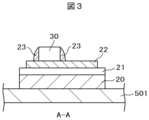
- FIG. 3 is a cross-sectional view taken along line A-A in FIG. 2, and is a cross-sectional view of the temperature detection structure of the first embodiment.
- the heat transfer member 20 is disposed on the lid 501 of the cell 2.
- the heat transfer member 20 has the role of efficiently transferring the temperature of the cell 2 to the temperature sensor 30.
- Metal is the most suitable material for the heat transfer member 20, and aluminum, copper, gold, silver, nickel, iron, or alloys thereof can be used.
- the heat transfer member 20 has a flat surface of 10 mm x 10 mm and a plate thickness of 1 to 3 mm. If the metal plate has this thickness, it can be joined to the lid 501 of the cell 2 by laser welding or the like.
- a ceramic substrate made of alumina or the like can be used, although it has a lower thermal conductivity than metal.
- the thermal conductivity of copper is 398 W/mk, while the thermal conductivity of alumina is 20 W/mk. If wiring can be formed directly on the ceramic substrate, the insulating layer 21, which will be described next, can be omitted.
- an insulating layer 21 on which a first detection circuit 22 is formed as an example of a first wiring is disposed on the heat transfer member 20.
- the insulating layer 21 can be formed of, for example, polyimide.
- Polyimide is a material used in flexible wiring boards and has excellent mechanical strength and heat resistance.
- a heat dissipation sheet can be used.
- 6550H an acrylic resin sold by 3M, has a thermal conductivity of about 3 W/mK and a volume resistivity of about 8 ⁇ 10 11 , and can be used in the configuration of this embodiment.
- solder 23 is formed on the terminal of the first detection circuit 22, and a thermistor, which is a temperature sensor 30, is connected via this solder 23.
- the temperature sensor 30 is not limited to a thermistor, and a resistance temperature detector such as platinum may be used.
- each layer from the thermistor 30 to the lid 501 of the single cell 2 is in close contact with each other, and each material has excellent thermal conductivity, so that both the thermal resistance and heat capacity can be kept small. Therefore, quick and accurate temperature measurement is possible.
- the heat transfer member 20 which is made of metal or the like and has high thermal conductivity, is placed in close contact with the lid 501 of the cell 2.
- the lid 501 of the cell 2 is made of aluminum, for example, and has a plate thickness of about 1 mm.
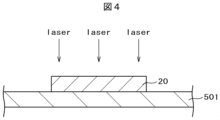
- the plate thickness of the heat transfer member 20 is also about 1 mm, so that the two can be laser welded together as shown in Figure 4. Therefore, the thermal conductivity between the lid 501 and the heat transfer member 20 is very high.
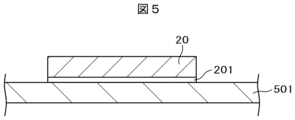
- the heat transfer member 20 can be attached to the lid 501 using a highly thermally conductive adhesive 201. It has been reported that commercially available highly thermally conductive adhesives 201 have a thermal conductivity of 140 W/mk. By using the highly thermally conductive adhesive 201, it is possible to bond not only metals but also heat transfer members 20 made of ceramics such as alumina.
- the highly heat conductive adhesive 201 is made of, for example, a resin such as acrylic, and after application, it must be thermally cured at approximately 170°C.
- the heat resistance of the battery body is 60°C to 90°C, but if the heat transfer member 20 is placed in the lid 501 state before the lid is placed on the single cell 2, there is no problem with heat resistance.
- FIG. 6 is a cross-sectional view showing the insulating layer 21 on which the first detection circuit 22 is formed, adhered using a highly thermally conductive adhesive 201.
- a highly thermally conductive adhesive 201 As described above, by using the highly thermally conductive adhesive 201, high thermal conductivity can be maintained.
- the thickness of the insulating layer 21 is, for example, about 30 microns
- the thickness of the highly thermally conductive adhesive 201 is, for example, about 10 to 30 microns.
- solder 23 has excellent thermal conductivity.
- solder 23 containing lead is likely to be prohibited as it is harmful to the environment.
- lead-free solder 23 using an alloy of tin, silver, copper, etc. can be used. If solder 23 cannot be used, it is possible to connect the thermistor 30 and first detection circuit 22 while keeping the thermal resistance low by using a conductive, highly heat-conductive adhesive.
- the configurations in Figures 2 and 3 are configured to provide a small thermal resistance between the lid 501 of the battery cell 2 and the thermistor 30.
- the signal of the thermistor 30 detected by the first detection circuit 22 is processed in the second detection circuit 112 for the battery management system (BMS) arranged on the printed circuit board (PCB board) 11, and a control signal is formed. For this reason, it is necessary to connect the first detection circuit 22 and the second detection circuit 112.
- BMS battery management system
- the first detection circuit 22 and the second detection circuit 112 are connected using a flexible wiring board 40.
- a flexible wiring board 40 By using the flexible wiring board 40, a compact connection is possible. Note that detailed circuitry of the printed wiring board (PCB board) 11 is omitted in FIG. 7.
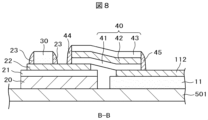
- FIG. 8 is a cross-sectional view taken along line B-B of FIG. 7.
- flexible wiring board 40 is composed of a first insulating layer 41, a wiring layer 42, and a second insulating layer 43.
- Flexible wiring board 40 is connected to first detection circuit 22 on the temperature detection structure side by solder 44, and is connected to second detection circuit 112 on the printed wiring board (PCB board) 11 side by solder 45.
- Lead-free solder may be used if necessary, or conductive resin may be used for electrical continuity.
- the heat transfer member 20 and the member to be measured can be fixed with adhesive. Alternatively, they can be fixed by welding. Thermal conductivity can be improved by welding the metal parts together.
- Measuring the temperature from multiple points on the cell 2 allows for more precise control.
- measuring the temperature of the cell 2's casing (e.g., the lid 501) and the busbar 10 through which the current passes allows for more effective control. That is, by measuring the temperature at the busbar 10, it is possible to quickly predict sudden temperature changes inside the battery caused by heat generation during charging and discharging at a large current.
- the temperature of the casing e.g., the lid 501
- FIG. 9 is a plan view of a battery pack 1 showing a second embodiment.
- FIG. 9 differs from FIG. 2 in that a temperature detection structure is arranged on the busbar 10 in addition to the lid 501 of the cell 2. In other words, there are two temperature measurement points on the cell 2.
- the temperature detection structure arranged on the busbar 10 can estimate a sudden change in temperature inside the cell 2 when a large current flows.
- FIG. 10 is a cross-sectional view taken along line C-C of FIG. 9, and is a cross-sectional view showing the configuration of the temperature detection structure in the busbar 10.
- the negative electrode 2b is placed on the cover 501 of the cell 2 via an insulating member 502.
- the negative electrode 2b is connected to the power generating element inside the cell 2.
- the busbar 10 is connected on top of the negative electrode 2b. As shown in FIG. 9, the busbar 10 connects to the positive electrode 2a of the cell placed next to the negative electrode 2b.
- a heat transfer member 20 is connected onto the bus bar 10.
- the method of connecting the heat transfer member 20 to the bus bar is the same as that described in Figures 4, 5, etc. That is, in Figures 3 and 4, the heat transfer member 20 is directly connected to the lid 501 of the cell 2, but in Figure 10, it is connected to the bus bar 10, which is different.
- FIG. 10 an example of a structure of a second insulating layer having a second wiring fixed onto the heat transfer member 20 and a second temperature detection element further connected thereto is the configuration from the heat transfer member 20 to the thermistor 30.
- the thermistor 30 can quickly detect temperature changes in the busbar 10, and can quickly estimate temperature changes inside the single battery 2 during charging and discharging with a large current.
- the signal of the thermistor 30 detected by the first detection circuit 22 is processed in the second detection circuit 112 for the battery management system (BMS) arranged on the printed circuit board (PCB board) 11, and a control signal is formed. For this reason, it is necessary to connect the first detection circuit 22 and the second detection circuit 112.
- BMS battery management system
- FIG. 11 is a plan view showing this configuration.
- the difference between FIG. 11 and FIG. 7 of the first embodiment is that a temperature detection structure is formed on the busbar 10, and this temperature detection structure is connected to the printed wiring board (PCB board) 11 via a flexible wiring board 40.
- the rest of the configuration is the same as FIG. 7.
- FIG. 12 is a cross-sectional view taken along the line D-D in FIG. 11, showing the state in which the temperature detection structure formed on the busbar 10 and the printed wiring board (PCB board) 11 are connected by a flexible wiring board 40.
- the temperature detection structure formed on the busbar 10 of the single cell 2 is as described in FIG. 10.
- the configuration of the flexible wiring board 40 for connection and the configuration of the printed wiring board (PCB board) 11 on which the second detection circuit 112 is formed are the same as those described in FIG. 8 of the first embodiment.
- FIG. 12 and FIG. 8 The difference between FIG. 12 and FIG. 8 is that the temperature detection structure is formed on the bus bar 10, so there is a large step between the first detection circuit 22 and the second detection circuit 112 formed on the printed wiring board (PCB board) 11, and the distance between the first detection circuit 22 and the second detection circuit 112 is large, but there is no essential difference in structure.
- the second detection circuit 112 for the battery management system is formed on a rigid printed wiring board (PCB board) 11.
- a flexible wiring board 50 is used instead of the printed wiring board (PCB board) 11.
- a flexible wiring board 50 carrying a circuit for the battery management system (BMS) is arranged between the bus bars 10 in the x direction, longitudinally cutting each battery cell 2 in the y direction.
- the flexible wiring board 50 arranged across the battery cells 2 is arranged so that the flexible wiring board 50 overlaps with the multiple battery cells 2 in the direction in which the flexible wiring board 50 overlaps with the battery cells 2.
- the flexible wiring board 50 has a hole 55 formed in a position corresponding to the temperature detection structure.
- FIG. 13 has a similar configuration to FIG. 2 of Example 1, except that the printed wiring board (PCB board) 11 is replaced with the flexible wiring board 50.
- Example 2 the configuration of Example 2 is simpler.
- FIG. 14 is a cross-sectional view taken along line E-E of FIG. 13, and is a cross-sectional view showing a configuration for connecting the first detection circuit 22 of the temperature detection structure to the second detection circuit 112 formed on the flexible wiring board 50 carrying a circuit for a battery management system (BMS).
- BMS battery management system
- the heat transfer member 20 and the first detection circuit 22 extend to the right compared to FIG. 2, FIG. 9, etc. of the first embodiment.
- the portion extending to the right overlaps the flexible wiring board 50, and this portion is connected to the second detection circuit 112 formed on the flexible wiring board 50 by solder 54. Therefore, the flexible wiring board 40 is not required for connection.
- the flexible wiring board 50 is composed of an insulating layer 51, a second detection circuit 112, and an insulating layer 53.
- the second detection circuit 112 is connected to the first detection circuit 22 formed in a temperature detection structure by solder 54.
- the thermal resistance between the thermistor 30 and the housing lid 501 is the same as in FIG. 2, FIG. 7, etc. Therefore, the effect is the same as in Example 1.
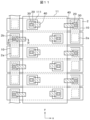
- FIG. 15 is a plan view showing Example 4.
- a printed circuit board (PCB board) 11 is not used, and the circuit for the battery management system (BMS) is formed on a flexible wiring board 60.
- FIG. 15 of Example 4 differs from FIG. 13 of Example 3 in that the thermistor, which is the temperature sensor 30, is mounted on the flexible wiring board 60. Therefore, there is no need to connect the first detection circuit 22 and the second detection circuit 112.
- the feature of FIG. 15 is that the thermistor 30 is mounted on the flexible wiring board 60, but in the area where the thermistor is present, a heat transfer member 20 is placed under the flexible wiring board 60, and this heat transfer member 20 and the flexible wiring board 60 are bonded in this area, thereby reducing thermal resistance.
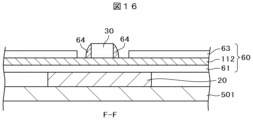
- FIG. 16 is a cross-sectional view taken along the line F-F of FIG. 15.
- the heat transfer member 20 is formed of metal or the like on the lid 501 of the single cell 2, as in Example 1 and the like.
- a flexible wiring board 60 on which a second detection circuit 112 and the like are formed is disposed, covering the heat transfer member 20.
- the flexible wiring board 60 is fixed to the heat transfer member 20, and is bonded with a highly heat-conductive adhesive or the like to reduce thermal resistance.
- the flexible wiring board 60 is composed of an insulating layer 61, a second detection circuit 112, and an insulating layer 63. In the portion where the thermistor 30 is mounted, an opening is formed in the insulating layer 63, and in this portion, the thermistor 30 and the second detection circuit 112 are joined by solder 64. When viewed from above, the thermistor 30 is present in the portion where the heat transfer member 20 is formed. If the heat transfer member 20 and the flexible wiring board 60 are bonded with a high heat transfer adhesive having a high thermal conductivity of, for example, 140 W/mK, the thermal resistance between the thermistor 30 and the lid 501 of the single cell 2 can be reduced. Therefore, rapid temperature measurement is possible.
- the thickness of the polyimide is about 30 microns, so as long as it is firmly bonded to the heat transfer member 20, there will be no large thermal resistance.
- FIG. 17 is a cross-sectional view showing an example of Example 5.
- Example 5 is a cross-sectional view showing a configuration in which a temperature detection element is surrounded by a detection element container 600, thereby accurately measuring temperature.
- the detection element container 600 in FIG. 17 is rectangular in plan view, and overall has a box shape with an open bottom.
- the configuration of the temperature detection element including the temperature sensor 30, the first detection circuit 22, etc. is the same as the configuration shown in FIG. 3 of the first embodiment.
- the detection element container 600 is connected at the fixing portion 601 to the lid 501, which is the object to be measured, for example by welding.
- the fixing portion 601 of the detection element container 600 may alternatively be made of a highly thermally conductive adhesive, or may be configured to mechanically press the fixing portion 601 against the lid 501, such as by "crimping.” In any case, anything that can reduce the thermal resistance between the detection element container 600 and the lid 501 will suffice.
- the detection element container 600 is made of a material with good thermal conductivity, such as metal. For example, aluminum can be used. If there are circumstances that make it difficult to use metal, ceramics with good thermal conductivity, such as alumina, can be used. If the detection element container 600 has high thermal conductivity, the temperature of the lid 501 is efficiently conducted to the temperature sensor 30, and the temperature of the measurement point can be measured quickly and accurately.
- the thermal resistance of the detection element container 600 is small and is substantially the same as the temperature of the lid 501, it can be assumed that the measurement object is the detection element container 600. In this case, in the configuration of FIG. 17, the measurement object is present on the opposite side of the temperature sensor 30 in the first detection circuit 22. Therefore, the temperature of the lid 501 can be measured more accurately.
- FIG. 17 there is a space between the detection element container 600 and the temperature sensor 30, but if this space is filled with a material with excellent thermal conductivity, the thermal resistance will be further reduced, enabling more accurate temperature detection. Furthermore, by using the detection element container 600, the temperature detection element can be mechanically protected. Note that the detection element container 600 in FIG. 17 is an example, and detection element containers 600 with other configurations can also be used. In this case, a configuration can be used that makes it easier to attach the temperature detection element to the lid 501.
- Figure 18 is a cross-sectional view showing Example 6.
- Figure 18 is the same as Figure 17 in that the temperature detection element is placed inside a box-shaped detection element container 600. Also, like Figure 17, the temperature detection element has the same configuration as Figure 3 of Example 1.
- Figure 18 differs from Figure 17 in that a heat transfer member 610 with excellent thermal conductivity properties is attached to the upper inner wall of the detection element container 600, and a protrusion 611 formed on this heat transfer member 610 is in contact with the temperature sensor 30.
- the role of the heat transfer member 610 and its protrusions 611 is to improve thermal contact between the temperature sensor 30 and the detection element container 600.
- thermal contact is insufficient.
- the thermal resistance between the detection element container 600 and the temperature sensor 30 can be reduced, enabling more accurate temperature measurement.
- the plan view of the heat transfer member 610 is almost the same as the shape of the upper inner wall of the detection element container 600. This is to maximize the thermal contact between the heat transfer member 610 and the detection element container 600.
- a convex portion 611 is formed at the portion where the heat transfer member 610 comes into contact with the temperature sensor 30. This is to make it easier to reduce the thermal contact between the heat transfer member 610 and the temperature sensor.
- the material of the heat transfer member 610 is not particularly limited as long as it has high thermal conductivity. Metal is the easiest to use. If a metal is used, for example, the protrusion 611 can have spring properties. This can further improve the thermal contact between the temperature sensor 30 and the heat transfer member 610. It should be noted that if a highly thermally conductive adhesive is used between the protrusion 611 and the temperature sensor 30, the thermal contact can be further improved.
- the heat transfer member 610 can be made of the same material as the detection element container 600.
- As the metal material for the heat transfer member 610 for example, aluminum, which has excellent thermal conductivity, can be used.
- the other configurations and functions in FIG. 18 are the same as those in FIG. 17.
- the measured part may be in contact with the detection element container 600 on the opposite side of the lid 501 with respect to the temperature sensor 30.
- a board on which the temperature sensor 30 is mounted may be placed at the lid 501. Since no circuit or the like is located between the sensor and the battery not being measured, accurate measurement can be achieved.
- the measured part can be fixed by pressing, in addition to bonding or welding.
- a pressing structure that presses the container with a known means such as a metal spring or a resin spring can be provided to fix the container and the measured part.
- the use of a container increases the degree of freedom in fixing. Furthermore, it has a heat transfer member that conducts heat between the temperature sensor and the container wall. This improves the accuracy of temperature measurement.
- 1... battery pack 2... cell, 2a... positive electrode, 2b... negative electrode, 3... holder, 4... end plate, 4a... opening, 5... side plate, 5b... opening, 6... bolt, 7... insulating cover, 8... end bus bar, 10... bus bar, 11... printed wiring board (PCB board), 20... heat transfer member, 21... insulating layer, 22... first detection circuit, 23... solder, 30... temperature measuring element (thermistor), 40... flexible wiring board, 41... insulating layer, 42... second detection circuit, 43... insulating layer, 44...
- PCB board printed wiring board
Landscapes
- Chemical & Material Sciences (AREA)
- Chemical Kinetics & Catalysis (AREA)
- Electrochemistry (AREA)
- General Chemical & Material Sciences (AREA)
- Inorganic Chemistry (AREA)
- Engineering & Computer Science (AREA)
- Manufacturing & Machinery (AREA)
- Battery Mounting, Suspending (AREA)
Priority Applications (2)
| Application Number | Priority Date | Filing Date | Title |
|---|---|---|---|
| JP2025553050A JPWO2025089001A1 (https=) | 2023-10-24 | 2024-10-02 | |
| CN202480018080.5A CN120814097A (zh) | 2023-10-24 | 2024-10-02 | 电池组 |
Applications Claiming Priority (2)
| Application Number | Priority Date | Filing Date | Title |
|---|---|---|---|
| JP2023182173 | 2023-10-24 | ||
| JP2023-182173 | 2023-10-24 |
Publications (1)
| Publication Number | Publication Date |
|---|---|
| WO2025089001A1 true WO2025089001A1 (ja) | 2025-05-01 |
Family
ID=95515280
Family Applications (1)
| Application Number | Title | Priority Date | Filing Date |
|---|---|---|---|
| PCT/JP2024/035263 Pending WO2025089001A1 (ja) | 2023-10-24 | 2024-10-02 | 組電池 |
Country Status (3)
| Country | Link |
|---|---|
| JP (1) | JPWO2025089001A1 (https=) |
| CN (1) | CN120814097A (https=) |
| WO (1) | WO2025089001A1 (https=) |
Citations (7)
| Publication number | Priority date | Publication date | Assignee | Title |
|---|---|---|---|---|
| JP2020043038A (ja) * | 2018-09-13 | 2020-03-19 | 株式会社デンソー | 電池モジュール |
| CN210221325U (zh) * | 2019-08-22 | 2020-03-31 | 安费诺(常州)连接系统有限公司 | 用于新能源电池包的温度传感器 |
| JP2021025846A (ja) * | 2019-08-02 | 2021-02-22 | 株式会社オートネットワーク技術研究所 | 測温モジュール及び蓄電モジュール |
| US20210320338A1 (en) * | 2020-04-14 | 2021-10-14 | Samsung Sdi Co., Ltd. | Battery pack |
| JP2022079016A (ja) * | 2020-11-16 | 2022-05-26 | 矢崎総業株式会社 | 導電モジュール |
| JP2022097916A (ja) * | 2020-12-21 | 2022-07-01 | プライムプラネットエナジー&ソリューションズ株式会社 | 蓄電モジュール |
| US20230268570A1 (en) * | 2022-02-22 | 2023-08-24 | GM Global Technology Operations LLC | Battery cell group conductive temperature measurement system |
-
2024
- 2024-10-02 JP JP2025553050A patent/JPWO2025089001A1/ja active Pending
- 2024-10-02 WO PCT/JP2024/035263 patent/WO2025089001A1/ja active Pending
- 2024-10-02 CN CN202480018080.5A patent/CN120814097A/zh active Pending
Patent Citations (7)
| Publication number | Priority date | Publication date | Assignee | Title |
|---|---|---|---|---|
| JP2020043038A (ja) * | 2018-09-13 | 2020-03-19 | 株式会社デンソー | 電池モジュール |
| JP2021025846A (ja) * | 2019-08-02 | 2021-02-22 | 株式会社オートネットワーク技術研究所 | 測温モジュール及び蓄電モジュール |
| CN210221325U (zh) * | 2019-08-22 | 2020-03-31 | 安费诺(常州)连接系统有限公司 | 用于新能源电池包的温度传感器 |
| US20210320338A1 (en) * | 2020-04-14 | 2021-10-14 | Samsung Sdi Co., Ltd. | Battery pack |
| JP2022079016A (ja) * | 2020-11-16 | 2022-05-26 | 矢崎総業株式会社 | 導電モジュール |
| JP2022097916A (ja) * | 2020-12-21 | 2022-07-01 | プライムプラネットエナジー&ソリューションズ株式会社 | 蓄電モジュール |
| US20230268570A1 (en) * | 2022-02-22 | 2023-08-24 | GM Global Technology Operations LLC | Battery cell group conductive temperature measurement system |
Also Published As
| Publication number | Publication date |
|---|---|
| CN120814097A (zh) | 2025-10-17 |
| JPWO2025089001A1 (https=) | 2025-05-01 |
Similar Documents
| Publication | Publication Date | Title |
|---|---|---|
| CN102460621B (zh) | 蓄电单元 | |
| US9349998B2 (en) | Battery pack | |
| KR102116187B1 (ko) | 개선된 셀홀더를 구비한 에너지저장용 배터리팩 | |
| KR20160085621A (ko) | 이차전지 | |
| BRPI0516071B1 (pt) | conector de eletrodo contendo placa e módulo de bateria contendo o mesmo | |
| KR102511550B1 (ko) | 전지 시스템 용 버스바 및 이를 포함하는 전지 시스템 | |
| KR20130061979A (ko) | 이차전지 팩 | |
| CN208127265U (zh) | 电池包 | |
| KR20210074835A (ko) | 이차전지 | |
| KR20230126920A (ko) | 전지 셀들에 대한 전기적 연결 구성을 개선한 배터리 모듈 및 이를 포함하는 배터리 팩 | |
| JP7481516B2 (ja) | バッテリ接続モジュール | |
| US11876249B2 (en) | Conductive module | |
| WO2025089001A1 (ja) | 組電池 | |
| JP2021085732A (ja) | 電流計測装置 | |
| JP7270414B2 (ja) | 温度センサ、電池モジュールおよび電池パック | |
| US20240396153A1 (en) | Wiring module and power storage module | |
| JP2022079016A (ja) | 導電モジュール | |
| JP2021150131A (ja) | 蓄電装置 | |
| US11978872B2 (en) | Temperature measurement device, temperature measurement method, and battery system | |
| CN223651522U (zh) | 一种电池包 | |
| CN221978157U (zh) | 电池及其电芯结构 | |
| EP4478483A2 (en) | Rechargeable battery module | |
| CN212113947U (zh) | 一种散热结构及其电池组件 | |
| JP2025145283A (ja) | 電池スタック及び電池パック | |
| CN120221939A (zh) | 电池及其电芯结构 |
Legal Events
| Date | Code | Title | Description |
|---|---|---|---|
| 121 | Ep: the epo has been informed by wipo that ep was designated in this application |
Ref document number: 24882118 Country of ref document: EP Kind code of ref document: A1 |
|
| WWE | Wipo information: entry into national phase |
Ref document number: CN2024800180805 Country of ref document: CN Ref document number: 202480018080.5 Country of ref document: CN |
|
| ENP | Entry into the national phase |
Ref document number: 2025553050 Country of ref document: JP Kind code of ref document: A |
|
| WWE | Wipo information: entry into national phase |
Ref document number: 2025553050 Country of ref document: JP |
|
| WWP | Wipo information: published in national office |
Ref document number: 202480018080.5 Country of ref document: CN |