WO2025062514A1 - 燃料電池のセル電圧測定装置およびセル電圧測定方法 - Google Patents
燃料電池のセル電圧測定装置およびセル電圧測定方法 Download PDFInfo
- Publication number
- WO2025062514A1 WO2025062514A1 PCT/JP2023/034025 JP2023034025W WO2025062514A1 WO 2025062514 A1 WO2025062514 A1 WO 2025062514A1 JP 2023034025 W JP2023034025 W JP 2023034025W WO 2025062514 A1 WO2025062514 A1 WO 2025062514A1
- Authority
- WO
- WIPO (PCT)
- Prior art keywords
- measurement
- cell voltage
- pads
- pad
- electrode
- Prior art date
- Legal status (The legal status is an assumption and is not a legal conclusion. Google has not performed a legal analysis and makes no representation as to the accuracy of the status listed.)
- Pending
Links
Images




Classifications
-
- H—ELECTRICITY
- H01—ELECTRIC ELEMENTS
- H01M—PROCESSES OR MEANS, e.g. BATTERIES, FOR THE DIRECT CONVERSION OF CHEMICAL ENERGY INTO ELECTRICAL ENERGY
- H01M8/00—Fuel cells; Manufacture thereof
- H01M8/04—Auxiliary arrangements, e.g. for control of pressure or for circulation of fluids
-
- Y—GENERAL TAGGING OF NEW TECHNOLOGICAL DEVELOPMENTS; GENERAL TAGGING OF CROSS-SECTIONAL TECHNOLOGIES SPANNING OVER SEVERAL SECTIONS OF THE IPC; TECHNICAL SUBJECTS COVERED BY FORMER USPC CROSS-REFERENCE ART COLLECTIONS [XRACs] AND DIGESTS
- Y02—TECHNOLOGIES OR APPLICATIONS FOR MITIGATION OR ADAPTATION AGAINST CLIMATE CHANGE
- Y02E—REDUCTION OF GREENHOUSE GAS [GHG] EMISSIONS, RELATED TO ENERGY GENERATION, TRANSMISSION OR DISTRIBUTION
- Y02E60/00—Enabling technologies; Technologies with a potential or indirect contribution to GHG emissions mitigation
- Y02E60/30—Hydrogen technology
- Y02E60/50—Fuel cells
Definitions
- This disclosure relates to a cell voltage measuring device capable of measuring the cell voltage of each fuel cell that constitutes a fuel cell stack.
- Fuel cell vehicles In recent years, there has been progress in the development of fuel cell vehicles equipped with fuel cells that have a relatively small environmental impact. Fuel cell vehicles obtain the necessary driving force by supplying the electrical energy generated by the fuel cell to an electric motor. Therefore, in order to obtain the desired power generation capacity corresponding to this driving force, such fuel cells are used as a fuel cell stack, which is made up of multiple fuel cells (hereinafter also referred to as "cells") stacked one on top of the other.
- cells multiple fuel cells
- Patent Document 1 a flat harness is used to detect the voltage values of multiple cells in parallel, but connectors must be connected to the cell voltage detection terminals individually, and assembly preparation takes a considerable amount of time.
- connectors must be connected to the cell voltage detection terminals individually, there is a risk that an inexperienced worker will incorrectly connect the connectors to the cell voltage detection terminals.
- the present disclosure has been made in consideration of the above-mentioned problems as an example, and aims to provide a fuel cell voltage measuring device that can quickly detect the voltage values of multiple cells that make up a fuel cell stack in parallel.
- a cell voltage measuring device for a fuel cell is provided that is capable of measuring the cell voltage of a battery stack in which electrode pins for voltage measurement are provided corresponding to a plurality of cells by contacting a measuring pad with the electrode pins, the cell voltage measuring device including a plurality of measuring pads, at least three of which are provided corresponding to both ends of two adjacent electrode pins, and a control device that measures the voltage of each of the plurality of cells via the measuring pads.
- the cell voltage measuring device disclosed herein can quickly detect the voltage values of multiple cells that make up a fuel cell stack in parallel.
- FIG. 2 is a schematic diagram showing a fuel cell stack according to the embodiment.
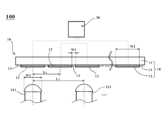
- FIG. 2 is a schematic diagram showing a cell voltage measuring device for a fuel cell in an embodiment.
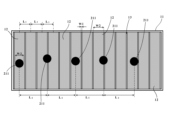
- 4 is a schematic diagram illustrating the relationship between the positions and arrangement of electrode pins in a fuel cell stack and measurement pads in a cell voltage measuring device.
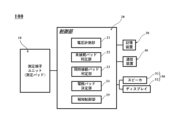
- FIG. FIG. 2 is a functional block diagram illustrating each function of the cell voltage measuring device in the embodiment.
- 4 is a flowchart showing a method for measuring a cell voltage of a fuel cell in an embodiment.
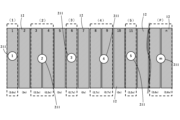
- FIG. 4 is a schematic diagram showing a state when each voltage value (initial voltage value) is detected from an electrode pin in a cell voltage measuring method.
- FIG. 1 initial voltage value
- FIG. 13 is a schematic diagram showing a state when a measurement pad corresponding to an electrode pin is defined in the cell voltage measurement method.
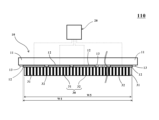
- FIG. 13 is a schematic diagram showing a cell voltage measuring device for a fuel cell in a modified example.
- 13 is a schematic diagram showing a state when a voltage value is obtained from an electrode pin of a fuel cell stack using a modified cell voltage measuring device.
- FIG. 1 shows a fuel cell stack 200 according to this embodiment.
- the fuel cell stack 200 of this embodiment is mounted on, for example, a known fuel cell vehicle (FCV).
- FCV fuel cell vehicle
- Such a fuel cell stack 200 is configured by stacking a plurality of cells 210.
- Each cell 210 has a structure in which a known MEA (membrane electrode assembly) is interposed between a pair of known separators that are respectively installed on the fuel electrode side and the air electrode side.
- MEA membrane electrode assembly
- the membrane electrode assembly may be configured to include at least a known cathode catalyst layer, a known anode catalyst layer disposed opposite the cathode catalyst layer, and a known polymer electrolyte membrane disposed between the cathode catalyst layer and the anode catalyst layer.
- the membrane electrode assembly may further include a known air electrode side gas diffusion layer and a known fuel electrode side gas diffusion layer.
- the cell 210 of this embodiment may be a polymer electrolyte fuel cell (PEFC) having an individual electromotive force of about 1 V.
- PEFC polymer electrolyte fuel cell
- the fuel cell stack 200 may include a known terminal plate 220 and an insulating plate 230 at both ends of the stacked multiple cells 210.
- the fuel cell stack 200 may also include a known end plate 240 that clamps the multiple cells 210 with a predetermined pressure.
- the above-mentioned fuel cell stack 200 is capable of detecting whether each of the stacked cells 210 has the desired power generation performance.
- each of the cells 210 that make up the fuel cell stack is provided with an electrode pin 211 that can detect the voltage value. Therefore, the control device 20, which will be described later, is capable of detecting the voltage value of each of the cells 210 individually via this electrode pin 211.
- the cell voltage measuring device 100 is configured to be able to measure cell voltages by contacting measurement pads 12 (described later) with electrode pins 211 for voltage measurement provided in a fuel cell stack 200 corresponding to a plurality of cells 210.
- the cell voltage measuring device 100 of this embodiment is configured to include a measuring terminal unit 10 and a control device 20.
- the measurement terminal unit 10 covers a surface on which a plurality of electrode pins 211 are arranged in the fuel cell stack 200, and is capable of detecting the cell voltage via the electrode pins 211.
- Such a measurement terminal unit 10 includes a base plate 11 provided with wiring (not shown), a plurality of measurement pads 12 each connected to the wiring, and an insulating layer 13 interposed between adjacent measurement pads 12.
- At least three measurement pads 12 are provided corresponding to the ends of two adjacent electrode pins 211.
- the measurement pads 12 and the electrode pins 211 do not correspond one-to-one, and the number of measurement pads 12 is greater than the number of electrode pins 211.
- the multiple measurement pads 12 are each installed on the base plate 11 such that at least one measurement pad 12 partitioned by the insulating layer 13 is disposed between adjacent electrode pins 211.
- the pitch of the electrode pins and measurement pads is defined using the center-to-center distance, but the pitch may be defined using a parameter other than the center-to-center distance, such as the distance based on either the left or right end.
- the gap W1 between adjacent measurement pads 12 i.e., the width of the insulating layer 13
- the gap W1 between adjacent measurement pads 12 may be set smaller than the tip width W3 of the electrode pin 211 that contacts the measurement pad 12. This makes it possible to easily and quickly detect multiple cell voltages without making the cell voltage measurement device 100 excessively large.
- the elements constituting the cell voltage measuring device 100 in this embodiment may have the following relationships. Width W2 of measurement pad 12>gap W1 (width of insulating layer 13 sandwiched between measurement pads) Width W2 of measurement pad 12>tip width W3 of electrode pin 211 Tip width W3 of electrode pin 211>gap W1 (width of insulating layer 13) These features also make it possible to easily and quickly detect multiple cell voltages without excessively increasing the size of the cell voltage measuring device 100. It is preferable that the width W2 of the measurement pads 12 is the same between the multiple measurement pads.
- the control device 20 is configured to have a function of measuring the cell voltages of the plurality of cells 210 via the measurement pads 12 described above when measuring the cell voltage of each cell in the fuel cell stack 200 .
- the control device 20 may be configured to include, for example, one or more processors (CPUs (Central Processing Units)) and one or more known storage devices 30 such as memories communicatively connected to the one or more processors.
- the control device 20 may be configured to be connectable to a known network such as the Internet via a known communication device 40 such as a smartphone.
- such a control device 20 may be configured to include a voltage measurement unit 21, an unconnected pad determination unit 22, a simultaneously connected pad determination unit 23, an electrode pad determination unit 24, and a notification control unit 25.
- These units are typically functions realized by a processor such as a CPU executing a computer program, but some or all of these units may be implemented as analog circuits.
- the voltage measurement unit 21 is configured to have the function of measuring the cell voltage from the electrode pin 211 that contacts the measurement pad 12.
- the function of the voltage measurement unit 21 is not particularly limited as long as it can measure the cell voltage of each cell that constitutes the fuel cell stack 200, and a known voltage detection function such as that disclosed in the above-mentioned patent document may be applied.
- the unconnected pad determination unit 22 is configured with the function of determining the measurement pads 12 (also referred to as "unconnected pads") that are not in contact with the electrode pins 211 provided on each cell that constitutes the fuel cell stack 200 during the above-mentioned cell voltage measurement. As an example, the unconnected pad determination unit 22 may determine the presence or absence of the above-mentioned unconnected pads based on the voltage values of each measurement pad measured by the voltage measurement unit 21.
- the threshold voltage value for determining whether or not there is an unconnected pad can be determined in advance by prior experiments or simulations depending on the type and electromotive force of the fuel cell used.
- the unconnected pad determination unit 22 may determine that a measurement pad whose voltage value measured by the voltage measurement unit 21 is 0V is an "unconnected pad.”
- the simultaneous connection pad determination unit 23 is configured with the function of determining whether multiple measurement pads 12 (also referred to as “simultaneous connection pads") are in contact with one electrode pin 211 constituting the fuel cell stack 200 at the same time during the above-mentioned cell voltage measurement. As an example, the simultaneous connection pad determination unit 23 may determine the presence or absence of the above-mentioned simultaneous connection pads based on the voltage value of each measurement pad measured by the voltage measurement unit 21.
- the conditions for determining whether or not there are simultaneously connected pads include whether a voltage equal to or greater than a predetermined value is measured simultaneously between adjacent measurement pads 12, or whether the same voltage value is detected between adjacent measurement pads 12. Note that the "voltage equal to or greater than a predetermined value" can be determined in advance by prior experiments or simulations depending on the type and electromotive force of the fuel cell used.
- the electrode pad determination unit 24 is configured with the function of determining the measurement pads (also referred to as "electrode pads") that correspond to the electrode pins 211 of each cell that constitutes the fuel cell stack 200. Specifically, the electrode pad determination unit 24 excludes the measurement pads 12 that detect 0V during the above-mentioned cell voltage measurement. Furthermore, the electrode pad determination unit 24 can set adjacent measurement pads 12 that detect a voltage value equal to or greater than a predetermined value as electrode pads that correspond to one electrode pin 211 that at least a portion of these pads face.
- the notification control unit 25 executes a process of presenting various information, such as the power generation state of the fuel cell stack 200 and individual cell voltages, via a known notification device 50 (speaker 51 and display 52) electrically connected to the control device 20.
- the notification control unit 25 may also control the presentation of the various information described above on an external terminal, such as a smartphone carried by an operator, etc.
- ⁇ Cell voltage measurement method> 5 to 7 a method for measuring the cell voltage of each cell constituting the fuel cell stack 200 in this embodiment will be described below.
- the following describes a flow for measuring the cell voltage of the fuel cell stack 200 in which electrode pins 211 for voltage measurement are provided corresponding to each of the stacked cells 210.
- a worker exposes the electrode pins 211 in the fuel cell stack 200 in order to inspect the power generation state of the fuel cell stack 200 mounted on a known fuel cell vehicle (FCV).
- FCV fuel cell vehicle
- step 1 the above-mentioned cell voltage measuring device 100 is used to determine whether or not the measuring terminal unit 10 is connected to the electrode pin 211 by covering the electrode pin 211 of the fuel cell stack 200 with the measuring terminal unit 10 so that the measuring pad 12 faces the electrode pin 211.
- step 1 a plurality of measurement pads 12, at least three of which are provided corresponding to both ends of two adjacent electrode pins 211, are used to bring these measurement pads 12 into contact with the electrode pins 211.
- the worker may visually determine whether the contact is complete, or the contact may be determined via a known optical sensor (not shown) or the like.
- step 1 If it is determined in step 1 that the measurement terminal unit 10 (specifically, the measurement pad 12) is connected to the electrode pin 211, the control device 20 acquires the cell voltage as a primary measurement value from the electrode pins 211 that are in contact with the measurement pad 12 via the voltage measurement unit 21 described above in the following step 2.
- the cell voltage (primary measurement value) measured at this time from the electrode pin 211 is shown in Figure 6. That is, in Figure 6, the n measurement pads 12 arranged from the left end to the right end of the paper are numbered in order from 1 to n, and the electrode pins 211 of the fuel cell stack 200 arranged opposite each other are similarly numbered from 1 to m.
- the first electrode pin 211 is in contact with the first measurement pad 12.
- the second electrode pin 211 is in contact with the third and fourth measurement pads.
- the third electrode pin 211 is in contact with the sixth measurement pad 12.
- the mth electrode pin 211 is in contact with the n-1th and nth measurement pads 12.
- step 3 the control device 20 determines which pads are unconnected via the unconnected pad determination unit 22 described above.
- the control device 20 can determine that the second, fifth, seventh, and tenth measurement pads 12 are unconnected pads.
- step 4 the control device 20 determines which are the simultaneously connected pads via the above-mentioned simultaneous connection pad determination unit 23.
- the control device 20 can determine that the third and fourth, the eighth and ninth, and the n-1th and nth measurement pads 12 are simultaneously connected pads that are multiple-connected to one electrode pin. In this way, when a voltage equal to or greater than a predetermined value is measured on adjacent measurement pads among the multiple measurement pads 12, the control device 20 can combine the adjacent measurement pads 12 and set them as one pad corresponding to the electrode pin 211 facing them.
- the control device 20 determines, via the electrode pad determination unit 24, electrode pads for measuring cell voltages that correspond to the electrode pins 211 of each cell that constitutes the fuel cell stack 200.
- the control device 20 determines the electrode pads as follows via the electrode pad determination unit 24, and stores this information in the storage device 30, such as the memory described above.
- 1st electrode pin Set the 1st measurement pad as the electrode pad for measuring cell voltage.
- 2nd electrode pin Set the 3rd and 4th measurement pads as the electrode pad for measuring cell voltage.
- 3rd electrode pin Set the 6th measurement pad as the electrode pad for measuring cell voltage.
- 4th electrode pin Set the 8th and 9th measurement pads as the electrode pad for measuring cell voltage.
- 5th electrode pin Set the 11th measurement pad as the electrode pad for measuring cell voltage.
- mth electrode pin Set the n-1th and nth measurement pads as the electrode pad for measuring cell voltage.
- step 5 the control device 20 detects the cell voltage of the corresponding cell from the electrode pad set above via the electrode pin 211.
- the detection value from the electrode pad determined to be a simultaneously connected pad if the detection values are the same, one of them may be selected, or if the detection values are different, the average value of these may be used as the detection value.
- the voltages of the multiple cells that make up the fuel cell stack 200 are each measured via the measurement pad 12 described above.
- the cell voltage measuring device of this embodiment uses a plurality of measuring pads, at least three of which are provided corresponding to the ends of two adjacent electrode pins (in other words, at least one measuring pad partitioned by an insulating layer between adjacent electrode pins). This makes it possible to absorb assembly errors between adjacent electrode pins without a one-to-one correspondence between the electrode pins and the measuring pads, and makes it possible to quickly detect the cell voltages of the multiple cells that make up the fuel cell stack in parallel.
- the cell voltage measuring device 110 further includes an anisotropic conductive layer 60 in addition to the cell voltage measuring device 100 described in the embodiment.
- the anisotropic conductive layer 60 may have a width W5 corresponding to the total width W4 of the multiple measurement pads arranged in a planar direction on the base plate 11.
- the anisotropic conductive layer 60 may have a width substantially equal to the total width W4 of the multiple measurement pads in the planar direction described above.
- the anisotropic conductive layer 60 is placed on the measurement pad 12 so as to be interposed between the measurement pad 12 and the electrode pin 211.
- the anisotropic conductive layer 60 may be fixed onto the measurement pad 12 via a known conductive adhesive or the like.
- Such an anisotropic conductive layer 60 is divided into a plurality of insulating regions 61 and conductive regions 62 arranged side by side in the planar direction (a plane parallel to the surface of the electrode pad).
- the insulating regions 61 and conductive regions 62 are arranged alternately as shown in Fig. 8.
- the conductive regions 62 in contact with the electrode pins 211 become a conductive path, and the cell voltage is detected via the measurement pads 12 in contact with the conductive regions 62.
- the cell voltage measuring device according to the modified example described above also makes it possible to quickly detect the cell voltages of the multiple cells constituting the fuel cell stack in parallel.
- Measurement terminal unit 20 Control device 30: Storage device 40: Communication device 50: Notification device 60: Anisotropic conductive layer 100: Cell voltage measuring device 200: Fuel cell stack
Landscapes
- Life Sciences & Earth Sciences (AREA)
- Engineering & Computer Science (AREA)
- Manufacturing & Machinery (AREA)
- Sustainable Development (AREA)
- Sustainable Energy (AREA)
- Chemical & Material Sciences (AREA)
- Chemical Kinetics & Catalysis (AREA)
- Electrochemistry (AREA)
- General Chemical & Material Sciences (AREA)
- Fuel Cell (AREA)
Priority Applications (2)
| Application Number | Priority Date | Filing Date | Title |
|---|---|---|---|
| PCT/JP2023/034025 WO2025062514A1 (ja) | 2023-09-20 | 2023-09-20 | 燃料電池のセル電圧測定装置およびセル電圧測定方法 |
| JP2025547031A JPWO2025062514A1 (https=) | 2023-09-20 | 2023-09-20 |
Applications Claiming Priority (1)
| Application Number | Priority Date | Filing Date | Title |
|---|---|---|---|
| PCT/JP2023/034025 WO2025062514A1 (ja) | 2023-09-20 | 2023-09-20 | 燃料電池のセル電圧測定装置およびセル電圧測定方法 |
Publications (1)
| Publication Number | Publication Date |
|---|---|
| WO2025062514A1 true WO2025062514A1 (ja) | 2025-03-27 |
Family
ID=95072335
Family Applications (1)
| Application Number | Title | Priority Date | Filing Date |
|---|---|---|---|
| PCT/JP2023/034025 Pending WO2025062514A1 (ja) | 2023-09-20 | 2023-09-20 | 燃料電池のセル電圧測定装置およびセル電圧測定方法 |
Country Status (2)
| Country | Link |
|---|---|
| JP (1) | JPWO2025062514A1 (https=) |
| WO (1) | WO2025062514A1 (https=) |
Citations (4)
| Publication number | Priority date | Publication date | Assignee | Title |
|---|---|---|---|---|
| JP2005216700A (ja) * | 2004-01-30 | 2005-08-11 | Honda Motor Co Ltd | 燃料電池スタック、セパレータ中間体及びセパレータの製造方法 |
| JP2005310753A (ja) * | 2004-03-23 | 2005-11-04 | Nissan Motor Co Ltd | 燃料電池スタックのセル電圧測定構造 |
| JP2006140166A (ja) * | 2006-01-12 | 2006-06-01 | Toyota Motor Corp | 燃料電池セルモニタ装置 |
| JP2007087858A (ja) * | 2005-09-26 | 2007-04-05 | Matsushita Electric Ind Co Ltd | 積層型燃料電池の端子ユニット |
-
2023
- 2023-09-20 JP JP2025547031A patent/JPWO2025062514A1/ja active Pending
- 2023-09-20 WO PCT/JP2023/034025 patent/WO2025062514A1/ja active Pending
Patent Citations (4)
| Publication number | Priority date | Publication date | Assignee | Title |
|---|---|---|---|---|
| JP2005216700A (ja) * | 2004-01-30 | 2005-08-11 | Honda Motor Co Ltd | 燃料電池スタック、セパレータ中間体及びセパレータの製造方法 |
| JP2005310753A (ja) * | 2004-03-23 | 2005-11-04 | Nissan Motor Co Ltd | 燃料電池スタックのセル電圧測定構造 |
| JP2007087858A (ja) * | 2005-09-26 | 2007-04-05 | Matsushita Electric Ind Co Ltd | 積層型燃料電池の端子ユニット |
| JP2006140166A (ja) * | 2006-01-12 | 2006-06-01 | Toyota Motor Corp | 燃料電池セルモニタ装置 |
Also Published As
| Publication number | Publication date |
|---|---|
| JPWO2025062514A1 (https=) | 2025-03-27 |
Similar Documents
| Publication | Publication Date | Title |
|---|---|---|
| JP4069494B2 (ja) | セル電圧測定端子付き燃料電池スタック | |
| CN110474074B (zh) | 用于燃料电池石墨双极板检测的连接结构和检测方法 | |
| JP4366744B2 (ja) | 燃料電池スタックおよび燃料電池システム | |
| CN110429298B (zh) | 一种质子交换膜燃料电池的检测装置及其方法 | |
| JPH11273702A (ja) | 燃料電池積層体の監視方法および監視装置 | |
| CN104025355A (zh) | 用于测量燃料电池中的电压的设备 | |
| JP2009522729A (ja) | 電気化学デバイスの電気特性を測定する装置 | |
| JP2008004565A (ja) | セル電圧測定端子付き燃料電池スタック | |
| WO2025062514A1 (ja) | 燃料電池のセル電圧測定装置およびセル電圧測定方法 | |
| JP2004127776A (ja) | コネクタと回路基板との一体化構造体 | |
| US9911995B2 (en) | Multi-point fuel cell voltage monitor | |
| KR101163911B1 (ko) | 막전극 집합체의 손상 검사 장치 | |
| JP2009217939A (ja) | 燃料電池セパレータ | |
| JP5481421B2 (ja) | 燃料電池モジュール | |
| CN105406010A (zh) | 燃料电池堆单体电池电压监测的连接器、监测装置及方法 | |
| CN206848449U (zh) | 一种燃料电池监测系统 | |
| KR101434537B1 (ko) | 연료전지 스택의 단위 전지 전압 측정 장치 | |
| JP2009277501A (ja) | 燃料電池の検査装置 | |
| KR101180755B1 (ko) | 다수의 접촉핀을 구비한 이차 전지 충전용 커넥터 | |
| JP2009266537A (ja) | 燃料電池の検査方法及び検査装置 | |
| CN113406706B (zh) | 水检测装置及水检测方法 | |
| CN101467296B (zh) | 与燃料电池组连接的多通道测定装置 | |
| US7329469B2 (en) | Method of establishing connections between measuring electronics and fuel cell stack | |
| JP4474976B2 (ja) | 燃料電池用配線 | |
| JP2001167780A (ja) | 燃料電池用セル |
Legal Events
| Date | Code | Title | Description |
|---|---|---|---|
| 121 | Ep: the epo has been informed by wipo that ep was designated in this application |
Ref document number: 23953003 Country of ref document: EP Kind code of ref document: A1 |
|
| ENP | Entry into the national phase |
Ref document number: 2025547031 Country of ref document: JP Kind code of ref document: A |
|
| WWE | Wipo information: entry into national phase |
Ref document number: 2025547031 Country of ref document: JP |