WO2025057776A1 - ポリオレフィン系接着剤組成物、積層体及びリチウムイオン電池用包装材料 - Google Patents
ポリオレフィン系接着剤組成物、積層体及びリチウムイオン電池用包装材料 Download PDFInfo
- Publication number
- WO2025057776A1 WO2025057776A1 PCT/JP2024/031179 JP2024031179W WO2025057776A1 WO 2025057776 A1 WO2025057776 A1 WO 2025057776A1 JP 2024031179 W JP2024031179 W JP 2024031179W WO 2025057776 A1 WO2025057776 A1 WO 2025057776A1
- Authority
- WO
- WIPO (PCT)
- Prior art keywords
- acid
- mass
- adhesive composition
- parts
- solvent
- Prior art date
- Legal status (The legal status is an assumption and is not a legal conclusion. Google has not performed a legal analysis and makes no representation as to the accuracy of the status listed.)
- Pending
Links
Classifications
-
- B—PERFORMING OPERATIONS; TRANSPORTING
- B32—LAYERED PRODUCTS
- B32B—LAYERED PRODUCTS, i.e. PRODUCTS BUILT-UP OF STRATA OF FLAT OR NON-FLAT, e.g. CELLULAR OR HONEYCOMB, FORM
- B32B27/00—Layered products comprising a layer of synthetic resin
-
- B—PERFORMING OPERATIONS; TRANSPORTING
- B32—LAYERED PRODUCTS
- B32B—LAYERED PRODUCTS, i.e. PRODUCTS BUILT-UP OF STRATA OF FLAT OR NON-FLAT, e.g. CELLULAR OR HONEYCOMB, FORM
- B32B7/00—Layered products characterised by the relation between layers; Layered products characterised by the relative orientation of features between layers, or by the relative values of a measurable parameter between layers, i.e. products comprising layers having different physical, chemical or physicochemical properties; Layered products characterised by the interconnection of layers
- B32B7/04—Interconnection of layers
- B32B7/12—Interconnection of layers using interposed adhesives or interposed materials with bonding properties
-
- C—CHEMISTRY; METALLURGY
- C09—DYES; PAINTS; POLISHES; NATURAL RESINS; ADHESIVES; COMPOSITIONS NOT OTHERWISE PROVIDED FOR; APPLICATIONS OF MATERIALS NOT OTHERWISE PROVIDED FOR
- C09J—ADHESIVES; NON-MECHANICAL ASPECTS OF ADHESIVE PROCESSES IN GENERAL; ADHESIVE PROCESSES NOT PROVIDED FOR ELSEWHERE; USE OF MATERIALS AS ADHESIVES
- C09J11/00—Features of adhesives not provided for in group C09J9/00, e.g. additives
- C09J11/02—Non-macromolecular additives
- C09J11/06—Non-macromolecular additives organic
-
- C—CHEMISTRY; METALLURGY
- C09—DYES; PAINTS; POLISHES; NATURAL RESINS; ADHESIVES; COMPOSITIONS NOT OTHERWISE PROVIDED FOR; APPLICATIONS OF MATERIALS NOT OTHERWISE PROVIDED FOR
- C09J—ADHESIVES; NON-MECHANICAL ASPECTS OF ADHESIVE PROCESSES IN GENERAL; ADHESIVE PROCESSES NOT PROVIDED FOR ELSEWHERE; USE OF MATERIALS AS ADHESIVES
- C09J123/00—Adhesives based on homopolymers or copolymers of unsaturated aliphatic hydrocarbons having only one carbon-to-carbon double bond; Adhesives based on derivatives of such polymers
- C09J123/26—Adhesives based on homopolymers or copolymers of unsaturated aliphatic hydrocarbons having only one carbon-to-carbon double bond; Adhesives based on derivatives of such polymers modified by chemical after-treatment
-
- H—ELECTRICITY
- H01—ELECTRIC ELEMENTS
- H01M—PROCESSES OR MEANS, e.g. BATTERIES, FOR THE DIRECT CONVERSION OF CHEMICAL ENERGY INTO ELECTRICAL ENERGY
- H01M50/00—Constructional details or processes of manufacture of the non-active parts of electrochemical cells other than fuel cells, e.g. hybrid cells
- H01M50/10—Primary casings; Jackets or wrappings
- H01M50/102—Primary casings; Jackets or wrappings characterised by their shape or physical structure
- H01M50/105—Pouches or flexible bags
-
- H—ELECTRICITY
- H01—ELECTRIC ELEMENTS
- H01M—PROCESSES OR MEANS, e.g. BATTERIES, FOR THE DIRECT CONVERSION OF CHEMICAL ENERGY INTO ELECTRICAL ENERGY
- H01M50/00—Constructional details or processes of manufacture of the non-active parts of electrochemical cells other than fuel cells, e.g. hybrid cells
- H01M50/10—Primary casings; Jackets or wrappings
- H01M50/116—Primary casings; Jackets or wrappings characterised by the material
- H01M50/117—Inorganic material
- H01M50/119—Metals
-
- H—ELECTRICITY
- H01—ELECTRIC ELEMENTS
- H01M—PROCESSES OR MEANS, e.g. BATTERIES, FOR THE DIRECT CONVERSION OF CHEMICAL ENERGY INTO ELECTRICAL ENERGY
- H01M50/00—Constructional details or processes of manufacture of the non-active parts of electrochemical cells other than fuel cells, e.g. hybrid cells
- H01M50/10—Primary casings; Jackets or wrappings
- H01M50/116—Primary casings; Jackets or wrappings characterised by the material
- H01M50/121—Organic material
-
- H—ELECTRICITY
- H01—ELECTRIC ELEMENTS
- H01M—PROCESSES OR MEANS, e.g. BATTERIES, FOR THE DIRECT CONVERSION OF CHEMICAL ENERGY INTO ELECTRICAL ENERGY
- H01M50/00—Constructional details or processes of manufacture of the non-active parts of electrochemical cells other than fuel cells, e.g. hybrid cells
- H01M50/10—Primary casings; Jackets or wrappings
- H01M50/116—Primary casings; Jackets or wrappings characterised by the material
- H01M50/124—Primary casings; Jackets or wrappings characterised by the material having a layered structure
-
- C—CHEMISTRY; METALLURGY
- C09—DYES; PAINTS; POLISHES; NATURAL RESINS; ADHESIVES; COMPOSITIONS NOT OTHERWISE PROVIDED FOR; APPLICATIONS OF MATERIALS NOT OTHERWISE PROVIDED FOR
- C09J—ADHESIVES; NON-MECHANICAL ASPECTS OF ADHESIVE PROCESSES IN GENERAL; ADHESIVE PROCESSES NOT PROVIDED FOR ELSEWHERE; USE OF MATERIALS AS ADHESIVES
- C09J151/00—Adhesives based on graft polymers in which the grafted component is obtained by reactions only involving carbon-to-carbon unsaturated bonds; Adhesives based on derivatives of such polymers
- C09J151/06—Adhesives based on graft polymers in which the grafted component is obtained by reactions only involving carbon-to-carbon unsaturated bonds; Adhesives based on derivatives of such polymers grafted on to homopolymers or copolymers of aliphatic hydrocarbons containing only one carbon-to-carbon double bond
-
- Y—GENERAL TAGGING OF NEW TECHNOLOGICAL DEVELOPMENTS; GENERAL TAGGING OF CROSS-SECTIONAL TECHNOLOGIES SPANNING OVER SEVERAL SECTIONS OF THE IPC; TECHNICAL SUBJECTS COVERED BY FORMER USPC CROSS-REFERENCE ART COLLECTIONS [XRACs] AND DIGESTS
- Y02—TECHNOLOGIES OR APPLICATIONS FOR MITIGATION OR ADAPTATION AGAINST CLIMATE CHANGE
- Y02E—REDUCTION OF GREENHOUSE GAS [GHG] EMISSIONS, RELATED TO ENERGY GENERATION, TRANSMISSION OR DISTRIBUTION
- Y02E60/00—Enabling technologies; Technologies with a potential or indirect contribution to GHG emissions mitigation
- Y02E60/10—Energy storage using batteries
Definitions
- the present invention relates to a polyolefin-based adhesive composition, a laminate, and a packaging material for lithium-ion batteries.
- LiBs lithium ion batteries
- the packaging material for these LiBs has come to be made of laminates with a multi-layer structure such as a base layer/barrier layer/sealant layer, due to the advantages of being lightweight and allowing the shape of the battery to be freely selected.
- LiB contains, as the battery contents, a positive electrode material and a negative electrode material, an electrolyte solution in which a lithium salt is dissolved in an aprotic solvent such as propylene carbonate, ethylene carbonate, dimethyl carbonate, diethyl carbonate, or ethyl methyl carbonate, or an electrolyte layer made of a polymer gel impregnated with the electrolyte solution.
- an aprotic solvent such as propylene carbonate, ethylene carbonate, dimethyl carbonate, diethyl carbonate, or ethyl methyl carbonate
- an electrolyte layer made of a polymer gel impregnated with the electrolyte solution.
- LiPF6 and LiBF4 are used as lithium salts that are electrolytes in batteries, but these salts generate hydrofluoric acid through a hydrolysis reaction with moisture, and the hydrofluoric acid corrodes the barrier layer, thereby reducing the laminate strength.
- the adhesive for LiB it is necessary for the adhesive for LiB to have durability against the electrolyte solution and electrolyte.
- the adhesive for LiB it is also required for the adhesive for LiB to exhibit adhesive performance when laminated at 120°C or less.
- LiBs must be durable, assuming they will be used in a variety of environments. For example, when LiBs are used in mobile devices, they must be leak-resistant in environments of around 80°C. In-vehicle applications are expected to be used in higher temperature environments than typical small LiB applications, so LiB adhesives must be heat-resistant to around 80°C.
- Patent Document 1 a long curing time of 5 days at 40°C is required to sufficiently accelerate the curing reaction.
- the organotin compound accelerates the curing reaction due to its catalytic function, but prolonged stirring causes significant thickening and gelation, so the pot life is not fully satisfied.
- the lithium battery exterior material described in Patent Document 2 has poor heat resistance and chemical resistance to the electrolyte.
- organotin compounds Furthermore, in recent years, the toxicity of organotin compounds has been pointed out, and tributyltin (TBT) contained in dibutyltin compounds in particular is of concern as an endocrine disruptor, leading to restrictions on their use. Furthermore, with organotitanium compounds and organozirconium compounds, the effect of accelerating the hardening reaction is insufficient when cured for a short period of time.
- TBT tributyltin
- the inventors discovered that the above objective could be achieved by incorporating an acid-modified polyolefin having a weight-average molecular weight within a specific range, a multifunctional polyisocyanate curing agent, and an organoaluminum compound, and thus completed the present invention.
- the adhesive composition of the present invention has good pot life, adhesion, heat resistance, chemical resistance to electrolyte, and moldability. Because the adhesive composition of the present invention has these properties, it can be suitably used as a packaging material for lithium-ion batteries.
- the upper or lower limit of a certain numerical range can be arbitrarily combined with the upper or lower limit of a numerical range of another stage.
- the upper or lower limit of the numerical range may be replaced with a value shown in an example or a value that can be unambiguously derived from an example.
- a numerical value connected with " ⁇ " means a numerical range that includes the numerical values before and after " ⁇ " as the upper and lower limits.
- a and/or B means “one of A and B” or “both A and B,” and specifically means “A,” “B,” or “A and B.”
- n- means "normal”
- iso- means “iso”
- sec- means “secondary”
- tert- or "t-" means “tertiary.”
- room temperature means a temperature within the range of 20°C to 25°C.
- Adhesive Composition The adhesive composition of the present embodiment has the following components (I) and (II): (I) Contains an acid-modified polyolefin (A), a polyfunctional polyisocyanate curing agent (B), and an organoaluminum compound (C). (II) The weight average molecular weight (Mw) of the acid-modified polyolefin (A) is in the range of 10,000 to 200,000.
- the adhesive composition of this embodiment has the above-mentioned configurations (I) and (II), and therefore has good pot life, adhesion, heat resistance, chemical resistance to electrolyte, and moldability.
- polyolefins examples include homopolyethylene (a homopolymer of ethylene), homopolypropylene (a homopolymer of propylene), and propylene- ⁇ -olefin copolymers. These polyolefins can be used alone or in combination of two or more. In one embodiment, among these polyolefins, homopolypropylene and/or propylene- ⁇ -olefin copolymers are preferred.
- the acid-modified polyolefin (A) is preferably a graft polymer having a structure in which an ⁇ , ⁇ -unsaturated carboxylic acid or its acid anhydride is grafted to a homopolypropylene or a propylene- ⁇ -olefin copolymer.
- Propylene- ⁇ -olefin copolymer is a copolymer of propylene as the main component with an ⁇ -olefin.
- ⁇ -olefins include ethylene, 1-butene, 1-heptene, 1-octene, 4-methyl-1-pentene, and vinyl acetate. These ⁇ -olefins can be used alone or in combination of two or more.
- the ⁇ -olefin in the propylene- ⁇ -olefin copolymer is preferably ethylene and/or 1-butene, and more preferably 1-butene.
- the content of the propylene component in the propylene- ⁇ -olefin copolymer is preferably 50 mol% or more, more preferably 60 mol% or more, and even more preferably 70 mol% or more.
- the adhesive strength of the adhesive composition to a polyolefin substrate becomes even better.
- Examples of the ⁇ , ⁇ -unsaturated carboxylic acid and/or its acid anhydride that are graft polymerized onto the polyolefin include maleic acid, maleic anhydride, fumaric acid, itaconic acid, itaconic anhydride, mesaconic acid, citraconic acid, citraconic anhydride, aconitic acid, aconitic anhydride, etc.
- the acid anhydrides of ⁇ , ⁇ -unsaturated carboxylic acids are preferred, and maleic anhydride is more preferred.
- acid-modified polyolefin (A) examples include maleic anhydride-modified homopolypropylene, maleic anhydride-modified propylene-ethylene copolymer, maleic anhydride-modified propylene-1-butene copolymer, maleic anhydride-modified propylene-ethylene-1-butene copolymer, and the like, and these acid-modified polyolefins can be used alone or in combination of two or more.
- the acid-modified polyolefin (A) is preferably maleic anhydride-modified homopolypropylene and/or maleic anhydride-modified propylene-1-butene copolymer, and more preferably maleic anhydride-modified homopolypropylene or maleic anhydride-modified propylene-1-butene copolymer.
- a wide variety of known methods can be used to graft polymerize ⁇ , ⁇ -unsaturated carboxylic acids or their anhydrides onto polyolefins.
- Examples of such methods include a method in which polyolefins are heated to above their melting point in the presence of a radical generator to melt them and react with ⁇ , ⁇ -unsaturated carboxylic acids or their anhydrides (melt method), and a method in which polyolefins are dissolved in an organic solvent and then heated and stirred in the presence of a radical generator to react with ⁇ , ⁇ -unsaturated carboxylic acids or their anhydrides (solution method).
- organic peroxides include peroxides such as di-tert-butyl peroxyphthalate, tert-butyl hydroperoxide, dicumyl peroxide, benzoyl peroxide, tert-butyl peroxybenzoate, tert-butyl peroxy-2-ethylhexanoate, tert-butyl peroxypivalate, methyl ethyl ketone peroxide, di-tert-butyl peroxide, and lauroyl peroxide; and azonitriles such as azobisisobutyronitrile and azobisisopropionitrile.
- peroxides such as di-tert-butyl peroxyphthalate, tert-butyl hydroperoxide, dicumyl peroxide, benzoyl peroxide, tert-butyl peroxybenzoate, tert-butyl peroxy-2-ethylhexanoate, tert-buty
- the acid-modified polyolefin (A) is preferably non-chlorinated.
- the chlorine content is preferably 3% by mass or less, more preferably 2% by mass or less, even more preferably 1% by mass or less, and most preferably 0% by mass. If the chlorine content is 3% by mass or less, the environmental load can be reduced. Furthermore, even when used as a packaging material for lithium-ion batteries, no chlorine or hydrogen chloride is emitted, and corrosion of the batteries can be suppressed.
- the content of the acid-modified chlorinated polyolefin in the adhesive composition is preferably 3% by mass or less, more preferably 2% by mass or less, even more preferably 1% by mass or less, even more preferably 0.5% by mass or less, particularly preferably 0.1% by mass or less, and most preferably 0% by mass.
- the acid value of the acid-modified polyolefin (A) is preferably 2 to 50 mgKOH/g, more preferably 3 to 45 mgKOH/g, even more preferably 5 to 40 mgKOH/g, and particularly preferably 7 to 35 mgKOH/g.
- the acid value of the acid-modified polyolefin (A) is 2 to 50 mgKOH/g, the compatibility between the acid-modified polyolefin (A) and the multifunctional polyisocyanate curing agent (B) becomes better, and the crosslinking density tends to be good. As a result, the adhesion, heat resistance, and chemical resistance to the electrolyte tend to be better.
- the acid value of the acid-modified polyolefin (A) can be adjusted by the amount of ⁇ , ⁇ -unsaturated carboxylic acid, ⁇ , ⁇ -unsaturated carboxylic acid anhydride, and radical generator used.
- the acetone extractable component ratio in the acid-modified polyolefin (A) is preferably 0.01% by mass to 2% by mass, more preferably 0.03% by mass to 1.7% by mass, even more preferably 0.05% by mass to 1.4% by mass, even more preferably 0.07% by mass to 1.2% by mass, and particularly preferably 0.1% by mass to 1.0% by mass.
- the acetone extractable component ratio in the acid-modified polyolefin (A) is 0.01 to 2% by mass, the manufacturing efficiency of the adhesive composition is improved, the adhesive composition exhibits better cohesive strength, and the adhesive properties, chemical resistance to the electrolyte, and moldability tend to be superior.
- the acetone extractable component ratio in the acid-modified polyolefin (A) is a value measured after refluxing with acetone for 2 hours using a Soxhlet extractor. A specific measurement method will be described in the examples described later.
- the acetone extractable component ratio of the acid-modified polyolefin (A) can be adjusted by reprecipitation with methyl ethyl ketone and purifying the unreacted monomers, low molecular weight components, etc.
- the low molecular weight components include low molecular weight polyolefins having a weight average molecular weight (Mw) of 100 to 10,000.
- the storage modulus (E') of the acid-modified polyolefin (A) at 25°C is preferably 10 to 2500 MPa, more preferably 15 to 2000 MPa, even more preferably 20 to 1500 MPa, particularly preferably 25 to 1100 MPa, and most preferably 30 to 800 MPa, in order to further improve the adhesiveness and chemical resistance to the electrolyte.
- the storage modulus (E') of the acid-modified polyolefin (A) at 25°C is 10 to 2500 MPa, the adhesiveness and substrate conformability of the adhesive composition are further improved, and the moldability of the laminate is improved.
- the storage modulus (E') of the acid-modified polyolefin (A) at 25°C can be measured in accordance with the test method of JIS K7244-4 (1999). A specific measurement method will be described in the examples described later.
- the tensile elongation at break (Eb) of the acid-modified polyolefin (A) at 25°C is preferably 50% to 1000%, more preferably 80% to 900%, even more preferably 120% to 800%, particularly preferably 160% to 700%, and most preferably 200% to 600%.
- the tensile elongation at break (Eb) of the acid-modified polyolefin (A) at 25°C is 50% to 1000%, the adhesive properties and substrate conformability of the adhesive composition are further improved, and the moldability of the laminate is better.
- the tensile elongation at break (Eb) of the acid-modified polyolefin (A) at 25°C can be measured in accordance with the test method of JIS K7161 (2014). A specific measurement method will be described in the examples described later.
- the weight average molecular weight (Mw) of the acid-modified polyolefin (A) is in the range of 10,000 to 200,000.
- the Mw of the acid-modified polyolefin (A) is preferably in the range of 20,000 to 180,000, more preferably in the range of 30,000 to 160,000, particularly preferably in the range of 40,000 to 140,000, and most preferably in the range of 50,000 to 110,000. If the Mw of the acid-modified polyolefin (A) is less than 10,000, the cohesive strength of the acid-modified polyolefin (A) is weakened, resulting in poor adhesion of the adhesive composition.
- the Mw of the acid-modified polyolefin (A) is more than 200,000, the fluidity of the acid-modified polyolefin (A) is reduced, resulting in a reduced pot life of the adhesive composition and problems with operability during bonding. Since the Mw of the acid-modified polyolefin (A) is in the range of 10,000 to 200,000, the acid-modified polyolefin (A) has good cohesive strength and good fluidity, so that the adhesive composition has good pot life, heat resistance, and chemical resistance to the electrolyte.
- the weight average molecular weight (Mw) of the acid-modified polyolefin (A) can be measured by gel permeation chromatography (GPC). A specific measurement method will be described in the examples below.
- the acid-modified polyolefin (A) is preferably crystalline.
- crystalline refers to a material that shows a clear melting peak during the heating process when heated from -100°C to 250°C at 20°C/min using a differential scanning calorimeter (DSC).
- DSC differential scanning calorimeter
- the melting point (Tm) of the acid-modified polyolefin (A) is preferably in the range of 50°C to 120°C, more preferably in the range of 60°C to 100°C, and most preferably in the range of 70°C to 90°C.
- the melting point (Tm) of the acid-modified polyolefin (A) can be measured using a differential scanning calorimeter (DSC).
- DSC differential scanning calorimeter
- the heat of fusion ( ⁇ H) of the acid-modified polyolefin (A) is preferably in the range of 1 J/g to 60 J/g, more preferably in the range of 3 J/g to 50 J/g, and most preferably in the range of 5 J/g to 40 J/g.
- the heat of fusion ( ⁇ H) of the acid-modified polyolefin (A) is in the range of 1 J/g to 60 J/g, the cohesive force derived from the crystals of the acid-modified polyolefin (A) is further improved, and therefore the adhesive composition has better pot life, adhesion, heat resistance, and chemical resistance to electrolytes.
- the present invention contains a polyfunctional polyisocyanate curing agent (B) as an essential component.
- the polyfunctional polyisocyanate curing agent (B) is usually a polyisocyanate compound having two or more isocyanate groups in one molecule.
- the multifunctional polyisocyanate curing agent (B) is preferably a diisocyanate compound or a derivative thereof, more preferably a derivative of a diisocyanate compound, in order to further improve the heat resistance and chemical resistance to the electrolyte of the adhesive composition.
- diisocyanate compounds examples include 2,4-tolylene diisocyanate, 2,6-tolylene diisocyanate, xylylene diisocyanate, diphenylmethane diisocyanate, isophorone diisocyanate, 1,5-naphthalene diisocyanate, hexamethylene diisocyanate, bis(4-isocyanatocyclohexyl)methane, hydrogenated diphenylmethane diisocyanate, etc.
- the diisocyanate compounds may be used alone or in combination of two or more. Of the diisocyanate compounds, hexamethylene diisocyanate is particularly preferred.
- the derivatives of the diisocyanate compounds include, for example, isocyanurate modified diisocyanate compounds, adduct modified diisocyanate compounds, biuret modified diisocyanate compounds, uretdione modified diisocyanate compounds, allophanate modified diisocyanate compounds, prepolymers having isocyanate residues (low polymers (molecular weight 300 g/mol to 4,000 g/mol) obtained from diisocyanate compounds and polyol compounds).
- the derivatives of the diisocyanate compounds can be used alone or in combination of two or more kinds.
- the derivative of the diisocyanate compound is preferably at least one selected from the group consisting of an isocyanurate modified product of hexamethylene diisocyanate, an adduct modified product of hexamethylene diisocyanate, a biuret modified product of hexamethylene diisocyanate, a uretdione modified product of hexamethylene diisocyanate, and an allophanate modified product of hexamethylene diisocyanate, in order to further improve the heat resistance and chemical resistance to the electrolyte of the adhesive composition.
- the polyfunctional polyisocyanate curing agent (B) is preferably an isocyanurate modified diisocyanate compound and/or a biuret modified diisocyanate compound, more preferably at least one selected from the group consisting of an isocyanurate modified hexamethylene diisocyanate, an adduct modified hexamethylene diisocyanate, a biuret modified hexamethylene diisocyanate, a uretdione modified hexamethylene diisocyanate, and an allophanate modified hexamethylene diisocyanate, and particularly preferably an isocyanurate modified hexamethylene diisocyanate and/or a biuret modified hexamethylene diisocyanate.
- a compound in which some of the isocyanate groups of the above isocyanate compounds are reacted with a compound reactive with the isocyanate groups may be used as a polyfunctional polyisocyanate curing agent.
- compounds that are reactive with the isocyanate group include compounds containing an amino group such as butylamine, hexylamine, octylamine, 2-ethylhexylamine, dibutylamine, ethylenediamine, benzylamine, and aniline; compounds containing a hydroxyl group such as methanol, ethanol, propanol, isopropanol, butanol, hexanol, octanol, 2-ethylhexyl alcohol, dodecyl alcohol, ethylene glycol, propylene glycol, benzyl alcohol, and phenol; compounds containing an epoxy group such as allyl glycidyl ether, 2-ethylhexyl glycidy
- the content of the polyfunctional polyisocyanate curing agent (B) is preferably 0.5 to 70 parts by mass, more preferably 1 to 65 parts by mass, even more preferably 2 to 60 parts by mass, even more preferably 3 to 55 parts by mass, even more preferably 6 to 50 parts by mass, particularly preferably 10 to 45 parts by mass, and most preferably 15 to 40 parts by mass, relative to 100 parts by mass of the acid-modified polyolefin (A).
- the adhesive composition cures better, the adhesive composition has better conformability to the substrate, and is more excellent in adhesion, heat resistance, chemical resistance to electrolyte, and moldability.
- the present invention contains an organoaluminum compound (C) as an essential component.
- an organoaluminum compound (C) as an essential component.
- the curing reaction of the adhesive composition is accelerated in a short curing period, so that the adhesive composition can be cured well by the aging process after lamination.
- the adhesive composition has good pot life, heat resistance, and chemical resistance to the electrolyte.
- aluminum alcoholate compounds include aluminum ethylate, aluminum isopropylate, aluminum diisopropylate monosec-butylate, aluminum sec-butylate, etc., which can be used alone or in combination of two or more.
- m is an integer of 1 or more
- n is an integer of 0 or more.
- the m Ls may be the same ligand or different ligands.
- the n Xs may be the same ligand or different ligands.
- Examples of the polydentate ligand L include ⁇ -ketoesters such as methyl acetoacetate, ethyl acetoacetate, octyl acetoacetate, oleyl acetoacetate, lauryl acetoacetate, and stearyl acetoacetate, as well as keto-enol tautomer-forming compounds such as acetylacetone (2,4-pentanedione), 2,4-hexanedione, and benzoylacetone.
- a keto-enol tautomer-forming compound refers to a compound that can form a keto-enol tautomer.
- these keto-enol tautomer-forming compounds may be enolates (e.g., acetylacetonate) in which the enol is deprotonated.
- Examples of the monodentate ligand X include halogen atoms such as chlorine and bromine atoms, acyloxy groups such as pentanoyl, hexanoyl, 2-ethylhexanoyl, octanoyl, nonanoyl, decanoyl, dodecanoyl, and octadecanoyl, and alkoxy groups such as methoxy, ethoxy, n-propoxy, isopropoxy, and butoxy.
- halogen atoms such as chlorine and bromine atoms
- acyloxy groups such as pentanoyl, hexanoyl, 2-ethylhexanoyl, octanoyl, nonanoyl, decanoyl, dodecanoyl, and octadecanoyl
- alkoxy groups such as methoxy, ethoxy, n-propoxy, isopropoxy, and
- the organoaluminum compound (C) is preferably an aluminum chelate compound having a keto-enol tautomer coordinated thereto.
- aluminum chelate compounds include aluminum acetoacetate diisopropylate, aluminum ethyl acetoacetate diisopropylate, aluminum tris(ethyl acetoacetate), aluminum alkyl acetate diisopropylate, aluminum bis(ethyl acetoacetate) monoacetylacetonate, aluminum tris(acetylacetonate), etc., which can be used alone or in combination of two or more.
- the content of the organoaluminum compound (C) is preferably 0.01 to 2 parts by mass, more preferably 0.05 to 1.5 parts by mass, even more preferably 0.1 to 1.25 parts by mass, even more preferably 0.2 to 1.0 parts by mass, and particularly preferably 0.3 to 0.95 parts by mass, per 100 parts by mass of the acid-modified polyolefin (A).
- the content of the organoaluminum compound (C) is 0.01 to 2 parts by mass per 100 parts by mass of the acid-modified polyolefin (A)
- the curing reaction of the adhesive composition is further accelerated, and the pot life, heat resistance, and chemical resistance to the electrolyte of the adhesive composition are further improved.
- the content of the organoaluminum compound (C) is preferably 0.05 to 30 parts by mass, more preferably 0.25 to 20 parts by mass, even more preferably 0.5 to 16 parts by mass, even more preferably 0.9 to 12 parts by mass, even more preferably 1.0 to 10 parts by mass, particularly preferably 1.1 to 8 parts by mass, and most preferably 1.2 to 6 parts by mass, relative to 100 parts by mass of the polyfunctional polyisocyanate curing agent (B).
- the adhesive composition of the present embodiment may further contain an organic solvent (D).
- organic solvent (D) include aromatic hydrocarbon solvents such as benzene, toluene, and xylene; aliphatic hydrocarbon solvents such as hexane, heptane, octane, and decane; alicyclic hydrocarbon solvents such as cyclohexane, cyclohexene, methylcyclohexane, and ethylcyclohexane; halogenated hydrocarbon solvents such as trichloroethylene, dichloroethylene, chlorobenzene, and chloroform; alcohol solvents such as methanol, ethanol, isopropyl alcohol, butanol, pentanol, hexanol, propanediol, and phenol; and acetone, methyl isobutyl ketone, methyl ethyl ketone, pentanone,
- Ketone-based solvents such as methyl cellosolve and ethyl cellosolve
- ester-based solvents such as methyl acetate, ethyl acetate, butyl acetate, methyl propionate, and butyl formate
- glycol ether-based solvents such as ethylene glycol mono-n-butyl ether, ethylene glycol mono-iso-butyl ether, ethylene glycol mono-tert-butyl ether, diethylene glycol mono-n-butyl ether, diethylene glycol mono-iso-butyl ether, triethylene glycol mono-n-butyl ether, and tetraethylene glycol mono-n-butyl ether. These may be used alone or in combination of two or more.
- the content of the organic solvent (D) is preferably 80 to 2000 parts by mass, more preferably 100 to 1600 parts by mass, even more preferably 150 to 1200 parts by mass, even more preferably 200 to 1000 parts by mass, even more preferably 300 to 950 parts by mass, particularly preferably 400 to 900 parts by mass, and most preferably 425 to 800 parts by mass, per 100 parts by mass of the acid-modified polyolefin (A).
- the content of the organic solvent (D) is 80 to 2000 parts by mass per 100 parts by mass of the acid-modified polyolefin (A)
- the solution state of the base agent and the pot life of the adhesive composition become better.
- the organic solvent (D) is preferably composed of solvent (D1) and solvent (D2), the solvent (D1) being at least one solvent (D1) selected from the group consisting of aromatic hydrocarbon solvents, aliphatic hydrocarbon solvents, alicyclic hydrocarbon solvents, and halogenated hydrocarbon solvents, and the solvent (D2) being at least one solvent selected from the group consisting of alcohol solvents, ketone solvents, ester solvents, and glycol ether solvents.
- the organic solvent (D) is preferably composed of solvent (D1) and solvent (D2), with the solvent (D1) being an aromatic hydrocarbon solvent or an alicyclic hydrocarbon solvent, and the solvent (D2) being a ketone solvent.
- the organic solvent (D) is composed of solvent (D1) and solvent (D2), and it is particularly preferred that the solvent (D1) is an alicyclic hydrocarbon solvent and the solvent (D2) is a ketone solvent, in order to further improve the solution state of the base agent and the pot life of the adhesive composition.
- the adhesive composition of the present embodiment may further contain an acid anhydride group-containing monomer (E).
- an acid anhydride group-containing monomer (E) By containing the acid anhydride group-containing monomer (E), the heat resistance is further improved.
- the molecular weight of the acid anhydride group-containing monomer (E) is preferably 100 g/mol or more and 500 g/mol or less.
- the molecular weight of the acid anhydride group-containing monomer (E) is more preferably 150 g/mol or more, and even more preferably 200 g/mol or more.
- the molecular weight of the acid anhydride group-containing monomer (E) is more preferably 450 g/mol or less, and even more preferably 400 g/mol or less.
- the molecular weight of the acid anhydride group-containing monomer (E) is 500 g/mol or less, the compatibility between the acid-modified polyolefin (A) and the polyfunctional polyisocyanate curing agent (B) becomes better, and the adhesive property of the adhesive composition is further improved.
- the molecular weight of the acid anhydride group-containing monomer (E) is 100 g/mol or more, the acid anhydride group-containing monomer (E) does not bleed out, and the adhesive property and heat resistance of the adhesive composition tend to be further improved.
- the acid value of the acid anhydride group-containing monomer (E) is preferably 150 mgKOH/g or more and 800 mgKOH/g or less.
- the acid value of the acid anhydride group-containing monomer (E) is more preferably 250 mgKOH/g or more, and even more preferably 300 mgKOH/g or more.
- the acid value of the acid anhydride group-containing monomer (E) is more preferably 600 mgKOH/g or less, and even more preferably 500 mgKOH/g or less.
- the acid value of the acid anhydride group-containing monomer (E) is 800 mgKOH/g or less, the acid anhydride group-containing monomer (E) does not bleed out before the adhesive composition is cured, and the adhesive property and heat resistance of the adhesive composition tend to be even better.
- the acid value of the acid anhydride group-containing monomer (E) is 150 mgKOH/g or more, the chemical resistance of the adhesive composition to the electrolyte is even better.
- the acid anhydride group-containing monomer (E) usually has one or more acid anhydride groups in one molecule, and preferably has one acid anhydride group in one molecule.
- the acid anhydride group contained in the acid anhydride group-containing monomer (E) is preferably an acid anhydride group having a cyclic structure, more preferably a group derived from succinic anhydride, a group derived from maleic anhydride, or a group derived from glutaric anhydride, and even more preferably a group derived from succinic anhydride.
- a group derived from an acid anhydride usually means a monovalent group having a structure in which one hydrogen atom (hydrogen atom of a hydrocarbon group) is removed from an acid anhydride, and for example, a group derived from succinic anhydride means a monovalent group having a structure in which one hydrogen atom is removed from succinic anhydride.
- Examples of the acid anhydride group-containing monomer (E) include succinic anhydride, maleic anhydride, glutaric anhydride, butylsuccinic anhydride, hexylsuccinic anhydride, octylsuccinic anhydride, dodecylsuccinic anhydride, dodecenylsuccinic anhydride, tetrapropenylsuccinic anhydride, butylmaleic anhydride, pentylmaleic anhydride, hexylmaleic anhydride, octylmaleic anhydride, decylmaleic anhydride, dodecylmaleic anhydride, butylglutamic anhydride, hexylglutamic anhydride, heptylglutamic anhydride, octylglutamic anhydride, decylglutamic anhydride, dodecylglutamic anhydride, and butyl
- anhydride-containing compound examples include an anhydride-containing compound having an alkyl chain and an anhydride group, such as tetrahydrophthalic anhydride, tetrahydrophthalic anhydride, methyltetrahydrophthalic anhydride, methylpentahydrophthalic anhydride, methyltrihydrophthalic anhydride, trialkyltetrahydrophthalic anhydride, methylcyclohexene dicarboxylic anhydride, HET anhydride, and tetrabromophthalic anhydride. These may be used alone or in combination of two or more. Among these, dodecenyl succinic anhydride is particularly preferred from the viewpoint of handling. Dodecenyl succinic anhydride is usually liquid at room temperature.
- the acid anhydride group-containing monomer (E) preferably has a hydrocarbon group, and more preferably the hydrocarbon group is bonded to an acid anhydride group. Also, the hydrocarbon group is more preferably linear.
- the acid anhydride group-containing monomer (E) contains a hydrocarbon group, the compatibility between the acid-modified polyolefin (A) and the multifunctional polyisocyanate curing agent (B) is further improved, and the adhesive composition tends to have particularly good pot life, adhesion, heat resistance, and chemical resistance to electrolytes.
- the number of carbon atoms in the hydrocarbon group is preferably 3 or more and 20 or less (3, 4, 5, 6, 7, 8, 9, 10, 11, 12, 13, 14, 15, 16, 17, 18, 19 or 20), more preferably 5 or more and 18 or less (5, 6, 7, 8, 9, 10, 11, 12, 13, 14, 15, 16, 17 or 18), even more preferably 8 or more and 16 or less (8, 9, 10, 11, 12, 13, 14, 15 or 16), and particularly preferably 11 or more and 15 or less (11, 12, 13, 14 or 15).
- the compatibility with the acid-modified polyolefin (A) and the polyfunctional polyisocyanate curing agent (B) is further improved, and the pot life, adhesion, and chemical resistance to the electrolyte of the adhesive composition are further improved.
- the acid anhydride group-containing monomer (E) preferably has a linear alkyl group having 3 to 20 carbon atoms (3, 4, 5, 6, 7, 8, 9, 10, 11, 12, 13, 14, 15, 16, 17, 18, 19, or 20), more preferably a linear alkyl group having 5 to 18 carbon atoms (5, 6, 7, 8, 9, 10, 11, 12, 13, 14, 15, 16, 17, or 18), even more preferably a linear alkyl group having 8 to 16 carbon atoms (8, 9, 10, 11, 12, 13, 14, 15, or 16), and particularly preferably a linear alkyl group having 11 to 15 carbon atoms (11, 12, 13, 14, or 15).
- the content of the acid anhydride group-containing monomer (E) is preferably 0.1 parts by mass or more per 100 parts by mass of the acid-modified polyolefin (A).
- the content of the acid anhydride group-containing monomer (E) is 0.1 parts by mass or more per 100 parts by mass of the acid-modified polyolefin (A)
- the heat resistance and chemical resistance to the electrolyte of the adhesive composition are further improved due to the synergistic effect of the multifunctional polyisocyanate curing agent (B) and the acid anhydride group-containing monomer (E).
- the content of the acid anhydride group-containing monomer (E) is more preferably 0.3 parts by mass or more, even more preferably 0.5 parts by mass or more, and particularly preferably 1 part by mass or more per 100 parts by mass of the acid-modified polyolefin (A).
- the content of the acid anhydride group-containing monomer (E) is preferably 20 parts by mass or less per 100 parts by mass of the acid-modified polyolefin (A).
- the adhesive composition tends to have good heat resistance and chemical resistance to the adhesive electrolyte, and tends to exhibit excellent chemical resistance to the electrolyte over a long period of time. More preferably, the content is 10 parts by mass or less, even more preferably, 8 parts by mass or less, and particularly preferably, 5 parts by mass or less.
- the content of the acid anhydride group-containing monomer (E) is preferably 0.1 parts by mass or more and 20 parts by mass or less, more preferably 0.3 parts by mass or more and 10 parts by mass or less, and even more preferably 0.5 parts by mass or more and 8 parts by mass or less, and 1 part by mass or more and 5 parts by mass or less, relative to 100 parts by mass of the acid-modified polyolefin (A).
- the adhesive composition of this embodiment contains, as essential components, an acid-modified polyolefin (A), a polyfunctional polyisocyanate curing agent (B), and an organoaluminum compound (C).
- an acid-modified polyolefin (A) and the polyfunctional polyisocyanate curing agent (B) may be dissolved or dispersed in the organic solvent (D), and are preferably dissolved in the organic solvent (D) in order to further improve the pot life.
- the adhesive composition of this embodiment may contain various tackifiers, thermoplastic elastomers, and plasticizers in addition to the acid-modified polyolefin (A), the polyfunctional polyisocyanate curing agent (B), and the organoaluminum compound (C) within the scope of the present invention. These may be used alone or in combination of two or more.
- the tackifier is not particularly limited, but examples include polyterpene resins, rosin resins, aliphatic petroleum resins, alicyclic petroleum resins, copolymer petroleum resins, and hydrogenated petroleum resins, which can be used alone or in combination of two or more.
- thermoplastic elastomers examples include styrene-based elastomers such as styrene-ethylene-butylene-styrene copolymer resin and styrene-ethylene-propylene-styrene; and olefin-based elastomers such as ethylene-propylene copolymer resin, ethylene-butene copolymer resin, ethylene-vinyl acetate copolymer resin, and ethylene-ethyl acrylate copolymer resin. These can be used alone or in combination of two or more.
- Plasticizers include, for example, liquid rubbers such as polyisoprene and polybutene; process oils, etc., which can be used alone or in combination of two or more kinds.
- the adhesive composition of this embodiment can be used in combination with the polyfunctional polyisocyanate curing agent (B) and various curing agents other than the polyfunctional polyisocyanate curing agent (B) within the scope of not impairing the performance of the present invention.
- curing agents other than the polyfunctional polyisocyanate curing agent (B) include curing agents having a functional group that reacts with the acid-modified polyolefin (A).
- curing agents other than the polyfunctional polyisocyanate curing agent (B) include epoxy resins, carbodiimide compounds, oxazoline compounds, coupling agents, etc.
- epoxy resins include glycidyl ester types such as hexahydrophthalic acid glycidyl ester and dimer acid glycidyl ester, alicyclic or aliphatic epoxides such as triglycidyl isocyanurate, 3,4-epoxycyclohexylmethylcarboxylate, epoxidized polybutadiene and epoxidized soybean oil, glycidyl ether type epoxy resins, and glycidyl amine type epoxy resins.
- glycidyl ester types such as hexahydrophthalic acid glycidyl ester and dimer acid glycidyl ester
- alicyclic or aliphatic epoxides such as triglycidyl isocyanurate, 3,4-epoxycyclohexylmethylcarboxylate, epoxidized polybutadiene and epoxidized soybean oil
- carbodiimide compounds include monocarbodiimide compounds such as dimethylcarbodiimide, diisopropylcarbodiimide, dicyclohexylcarbodiimide, t-butylisopropylcarbodiimide, diphenylcarbodiimide, and di- ⁇ -naphthylcarbodiimide; and polycarbodiimide compounds obtained by carrying out a decarboxylation condensation reaction of an organic diisocyanate such as an aliphatic diisocyanate, an aromatic diisocyanate, or an alicyclic diisocyanate in the presence of a condensation catalyst, in the absence of a solvent or in an inert solvent.
- an organic diisocyanate such as an aliphatic diisocyanate, an aromatic diisocyanate, or an alicyclic diisocyanate
- Examples of the oxazoline compounds include monooxazoline compounds such as 2-oxazoline, 2-methyl-2-oxazoline, 2-phenyl-2-oxazoline, 2,5-dimethyl-2-oxazoline, and 2,4-diphenyl-2-oxazoline;
- Examples of the dioxazoline compounds include 2,2'-(1,3-phenylene)-bis(2-oxazoline), 2,2'-(1,2-ethylene)-bis(2-oxazoline), 2,2'-(1,4-butylene)-bis(2-oxazoline), and 2,2'-(1,4-phenylene)-bis(2-oxazoline).
- Examples of coupling agents include silane coupling agents and titanate coupling agents.
- the adhesive composition of this embodiment may contain a keto-enol tautomer compound in addition to the acid-modified polyolefin (A), the polyfunctional polyisocyanate curing agent (B), and the organoaluminum compound (C) as long as the performance of the present invention is not impaired.
- Keto-enol tautomer compounds include ⁇ -ketoesters such as methyl acetoacetate, ethyl acetoacetate, octyl acetoacetate, oleyl acetoacetate, lauryl acetoacetate, and stearyl acetoacetate, and ⁇ -diketones such as acetylacetone, 2,4-hexanedione, and benzoylacetone. These can protect the isocyanate groups of the multifunctional polyisocyanate curing agent (B), suppress a significant increase in viscosity and gelation of the adhesive composition, and further improve the pot life of the adhesive composition.
- ⁇ -ketoesters such as methyl acetoacetate, ethyl acetoacetate, octyl acetoacetate, oleyl acetoacetate, lauryl acetoacetate, and stearyl acetoacetate
- ⁇ -diketones such as ace
- the content of the keto-enol tautomer compound is preferably 0.1 parts by mass or more and 3 parts by mass or less per 100 parts by mass of the polyfunctional polyisocyanate (B).
- the adhesive composition of this embodiment can be used by blending various additives in addition to the acid-modified polyolefin (A), the polyfunctional polyisocyanate curing agent (B), and the organoaluminum compound (C) within a range that does not impair the performance of the present invention.
- additives include flame retardants, pigments, antiblocking agents, fillers, etc.
- the content of the organozirconium compound or organotin compound in the adhesive composition of this embodiment is preferably less than 0.5 parts by mass, more preferably 0.3 parts by mass or less, even more preferably 0.1 parts by mass or less, even more preferably 0.05 parts by mass or less, particularly preferably 0.01 parts by mass or less, and most preferably 0 parts by mass, per 100 parts by mass of the acid-modified polyolefin (A).
- Laminate The laminate of the present embodiment can be obtained by bonding a polyolefin resin substrate and a metal substrate with the adhesive composition of the present embodiment.
- the laminate of this embodiment can be manufactured using conventionally known laminate manufacturing techniques.
- the adhesive composition of this embodiment is applied to the surface of a metal substrate using a roll coater, bar coater, or the like, and then dried. After drying, while the layer of the adhesive composition of this embodiment (adhesive layer) formed on the surface of the metal substrate is in a molten state, a polyolefin resin substrate is laminated and bonded (laminated) to the surface of the adhesive layer to obtain a laminate.
- the thickness of the adhesive layer formed by the adhesive composition of this embodiment is preferably 0.5 ⁇ m to 10 ⁇ m, more preferably 0.8 ⁇ m to 9.5 ⁇ m, and even more preferably 1.0 ⁇ m to 9 ⁇ m.
- polyolefin resin substrate As the polyolefin resin substrate, a wide variety of known polyolefin resins commonly used in this field can be used. Examples of polyolefin resin substrates include polyethylene, polypropylene, and ethylene-propylene copolymers. Among these, the polyolefin resin substrate is preferably polypropylene, and more preferably a non-oriented polypropylene (cast polypropylene) film. The thickness of the polyolefin resin substrate is preferably 20 ⁇ m to 100 ⁇ m, more preferably 25 ⁇ m to 95 ⁇ m, and even more preferably 30 ⁇ m to 90 ⁇ m. The polyolefin resin substrate may be blended with pigments or various additives as necessary, or may be subjected to a surface treatment.
- Metal substrate various metals and alloys thereof, such as aluminum, copper, steel, chromium, zinc, duralumin, and die-casting, can be used.
- shape of the metal substrate can be metal foil, rolled steel plate, panel, pipe, can, cap, etc. From the viewpoint of workability, etc., aluminum foil is preferable as the metal substrate.
- the metal substrate can be used in the form of a sheet usually having a thickness of 0.01 to 10 mm, preferably 0.02 to 5 mm.
- the surface of the metal substrate may be previously subjected to a surface treatment, or may be left untreated.
- the packaging material for lithium-ion batteries of this embodiment includes the laminate of this embodiment.
- the packaging material for lithium-ion batteries is an exterior body that packages a lithium-ion battery body.
- the content of the laminate in the packaging material for lithium-ion batteries is usually more than 50% by mass, preferably 80% by mass or more, more preferably 90% by mass or more, even more preferably 95% by mass or more, and particularly preferably 99% by mass or more.
- the packaging material for lithium-ion batteries is most preferably made of a laminate.
- the present invention provides the following aspects.
- Item 1 The composition contains an acid-modified polyolefin (A), a polyfunctional polyisocyanate curing agent (B), and an organoaluminum compound (C), The adhesive composition, wherein the acid-modified polyolefin (A) has a weight average molecular weight (Mw) in the range of 10,000 to 200,000.
- Item 2. Item 2. The adhesive composition according to item 1, wherein the content of the polyfunctional polyisocyanate curing agent (B) is 0.5 to 70 parts by mass relative to 100 parts by mass of the acid-modified polyolefin (A).
- Item 3. Item 3.
- Item 4. The adhesive composition according to any one of Items 1 to 3, wherein the acid-modified polyolefin (A) is a graft polymer having a structure in which at least one selected from an ⁇ , ⁇ -unsaturated carboxylic acid and an acid anhydride thereof is grafted to a polyolefin.
- Item 6 The adhesive composition according to any one of Items 1 to 5, wherein the organoaluminum compound (C) is an aluminum alcoholate compound and/or an aluminum chelate compound.
- Item 7. Item 7.
- the organic solvent (D) comprises a solvent (D1) and a solvent (D2), the solvent (D1) is at least one solvent selected from the group consisting of aromatic hydrocarbon solvents, aliphatic hydrocarbon solvents, alicyclic hydrocarbon solvents, and halogenated hydrocarbon solvents, Item 8.
- Item 9. Item 9. The adhesive composition according to item 8, wherein the mass ratio of the solvent (D1) to the solvent (D2) (solvent (D1)/solvent (D2) is 50/50 to 97/3.
- Item 10 Item 10.
- the adhesive composition according to item 10 wherein the content of the acid anhydride group-containing monomer (E) is 0.1 to 20 parts by mass per 100 parts by mass of the acid-modified polyolefin (A).
- Item 12. Item 12.
- Item 13 Item 13.
- the content of the organoaluminum compound (C) relative to 100 parts by mass of the acid-modified polyolefin (A) is more preferably 0.05 to 1.5 parts by mass, even more preferably 0.1 to 1.25 parts by mass, still more preferably 0.2 to 1.0 parts by mass, and particularly preferably 0.3 to 0.95 parts by mass.
- the polyolefin is at least one selected from the group consisting of homopolyethylene, homopolypropylene, and propylene- ⁇ -olefin copolymer; Preferably homopolypropylene and/or propylene- ⁇ -olefin copolymer, More preferably, the adhesive composition is a propylene- ⁇ -olefin copolymer.
- Item 16 The adhesive composition according to item 15, wherein the ⁇ -olefin in the propylene- ⁇ -olefin copolymer is preferably ethylene and/or 1-butene, more preferably 1-butene.
- Item 17. Item 17.
- Item 18. The adhesive composition according to any one of Items 4 to 17, wherein the ⁇ , ⁇ -unsaturated carboxylic acid or its acid anhydride is usually maleic acid, maleic anhydride, fumaric acid, itaconic acid, itaconic anhydride, mesaconic acid, citraconic acid, citraconic anhydride, aconitic acid, or aconitic anhydride, and preferably maleic anhydride.
- the ⁇ , ⁇ -unsaturated carboxylic acid or its acid anhydride is usually maleic acid, maleic anhydride, fumaric acid, itaconic acid, itaconic anhydride, mesaconic acid, citraconic acid, citraconic anhydride,
- the Mw of the acid-modified polyolefin (A) is preferably in the range of 20,000 to 180,000, more preferably in the range of 30,000 to 160,000, particularly preferably in the range of 40,000 to 140,000, and most preferably in the range of 50,000 to 110,000.
- the adhesive composition according to any one of items 1 to 18.
- the adhesive composition according to any one of items 1 to 19, wherein the content of the acid-modified chlorinated polyolefin in the adhesive composition is preferably 3% by mass or less, more preferably 2% by mass or less, even more preferably 1% by mass or less, still more preferably 0.5% by mass or less, particularly preferably 0.1% by mass or less, and most preferably 0% by mass.
- the acid-modified polyolefin (A) is preferably a maleic anhydride-modified homopolypropylene and/or a maleic anhydride-modified propylene-1-butene copolymer, more preferably a maleic anhydride-modified homopolypropylene or a maleic anhydride-modified propylene-1-butene copolymer.
- the content of the polyfunctional polyisocyanate curing agent (B) relative to 100 parts by mass of the acid-modified polyolefin (A) is more preferably 1 to 65 parts by mass, even more preferably 2 to 60 parts by mass, even more preferably 3 to 55 parts by mass, even more preferably 6 to 50 parts by mass, particularly preferably 10 to 45 parts by mass, and most preferably 15 to 40 parts by mass.
- the polyfunctional polyisocyanate curing agent (B) is preferably an isocyanurate modified diisocyanate compound and/or a biuret modified diisocyanate compound, More preferably, at least one selected from the group consisting of an isocyanurate-modified product of hexamethylene diisocyanate, an adduct-modified product of hexamethylene diisocyanate, a biuret-modified product of hexamethylene diisocyanate, a uretdione-modified product of hexamethylene diisocyanate, and an allophanate-modified product of hexamethylene diisocyanate, Particularly preferred is an isocyanurate-modified hexamethylene diisocyanate and/or a biuret-modified hexamethylene diisocyanate.
- Item 27 The adhesive composition according to any one of items 6 to 26, wherein the aluminum alcoholate compound is at least one selected from the group consisting of aluminum ethylate, aluminum isopropylate, aluminum diisopropylate monosec-butylate, and aluminum sec-butylate.
- Item 28 The adhesive composition according to any one of items 6 to 27, wherein the organoaluminum compound (C) is an aluminum chelate compound.
- Item 29 is an aluminum chelate compound.
- the aluminum chelate compound is at least one selected from the group consisting of aluminum acetoacetate diisopropylate, aluminum ethyl acetoacetate diisopropylate, aluminum tris(ethyl acetoacetate), aluminum alkyl acetate diisopropylate, aluminum bis(ethyl acetoacetate) monoacetylacetonate, and aluminum tris(acetylacetonate).
- the content of the organoaluminum compound (C) relative to 100 parts by mass of the acid-modified polyolefin (A) is more preferably 0.05 to 1.5 parts by mass, even more preferably 0.1 to 1.25 parts by mass, still more preferably 0.2 to 1.0 parts by mass, and particularly preferably 0.3 to 0.95 parts by mass.
- the content of the organoaluminum compound (C) relative to 100 parts by mass of the polyfunctional polyisocyanate curing agent (B) is preferably 0.05 to 30 parts by mass, more preferably 0.25 to 20 parts by mass, even more preferably 0.5 to 16 parts by mass, even more preferably 0.9 to 12 parts by mass, even more preferably 1.0 to 10 parts by mass, particularly preferably 1.1 to 8 parts by mass, and most preferably 1.2 to 6 parts by mass.
- the content of the organic solvent (D) relative to 100 parts by mass of the acid-modified polyolefin (A) is preferably 80 to 2000 parts by mass, more preferably 100 to 1600 parts by mass, even more preferably 150 to 1200 parts by mass, even more preferably 200 to 1000 parts by mass, still more preferably 300 to 950 parts by mass, particularly preferably 400 to 900 parts by mass, and most preferably 425 to 800 parts by mass.
- the adhesive composition according to any one of items 7 to 31. Item 33.
- the organic solvent (D) comprises a solvent (D1) and a solvent (D2), the solvent (D1) is an aromatic hydrocarbon solvent or an alicyclic hydrocarbon solvent, Item 33.
- the organic solvent (D) comprises a solvent (D1) and a solvent (D2),
- the solvent (D1) is an alicyclic hydrocarbon solvent, Item 34.
- the adhesive composition according to any one of items 8 to 34, wherein the mass ratio of the solvent (D1) to the solvent (D2) (solvent (D1)/solvent (D2) is more preferably 55/45 to 95/5, even more preferably 60/40 to 90/10, and particularly preferably 70/30 to 80/20.
- Item 36 is preferably 55/45 to 95/5, even more preferably 60/40 to 90/10, and particularly preferably 70/30 to 80/20.
- Item 36 The adhesive composition according to any one of items 10 to 35, wherein the content of the acid anhydride group-containing monomer (E) is more preferably 0.3 parts by mass or more and 10 parts by mass or less, still more preferably 0.5 parts by mass or more and 8 parts by mass or less, or 1 part by mass or more and 5 parts by mass or less, relative to 100 parts by mass of the acid-modified polyolefin (A).
- Item 37 The acid anhydride group contained in the acid anhydride group-containing monomer (E) is Item 37.
- the molecular weight of the acid anhydride group-containing monomer (E) is preferably 100 g/mol or more and 500 g/mol or less, more preferably 150 g/mol or more and 450 g/mol or less, and even more preferably 200 g/mol or more and 400 g/mol or less.
- Item 19 The adhesive composition according to any one of items 10 to 38, wherein the acid value of the acid anhydride group-containing monomer (E) is preferably 150 mgKOH/g or more and 800 mgKOH/g or less, more preferably 250 mgKOH/g or more and 600 mgKOH/g or less, and even more preferably 300 mgKOH/g or more and 500 mgKOH/g or less.
- the acid value of the acid anhydride group-containing monomer (E) is preferably 150 mgKOH/g or more and 800 mgKOH/g or less, more preferably 250 mgKOH/g or more and 600 mgKOH/g or less, and even more preferably 300 mgKOH/g or more and 500 mgKOH/g or less.
- the acid anhydride group-containing monomer (E) is Preferably, a linear alkyl group having 3 to 20 carbon atoms (3, 4, 5, 6, 7, 8, 9, 10, 11, 12, 13, 14, 15, 16, 17, 18, 19, or 20), More preferably, a linear alkyl group having 5 to 18 carbon atoms (5, 6, 7, 8, 9, 10, 11, 12, 13, 14, 15, 16, 17, or 18). More preferably, a linear alkyl group having from 8 to 16 (8, 9, 10, 11, 12, 13, 14, 15, or 16) carbon atoms. Particularly preferred are linear alkyl groups having from 11 to 15 (11, 12, 13, 14, or 15) carbon atoms.
- Item 40 The adhesive composition according to any one of items 10 to 39, having the following structure: Item 41.
- the acid anhydride group-containing monomer (E) is selected from the group consisting of succinic anhydride, maleic anhydride, glutaric anhydride, butylsuccinic anhydride, hexylsuccinic anhydride, octylsuccinic anhydride, dodecylsuccinic anhydride, dodecenylsuccinic anhydride, tetrapropenylsuccinic anhydride, butylmaleic anhydride, pentylmaleic anhydride, hexylmaleic anhydride, octylmaleic anhydride, decylmaleic anhydride, dodecylmaleic anhydride, butylglutamic anhydride, hexylglutamic anhydride, heptylglutamic anhydride, octylglutamic anhydride, butylglutamic anhydride, hexylglutamic anhydride,
- dianhydride is at least one selected from the group consisting of pyromellitic anhydride, decyl glutamic anhydride, dodecyl glutamic anhydride, pyromellitic anhydride, trimellitic anhydride, benzophenone tetracarboxylic dianhydride, tetrahydrophthalic anhydride, methyl tetrahydrophthalic anhydride, methyl pentahydrophthalic anhydride, methyl trihydrophthalic anhydride, trialkyl tetrahydrophthalic anhydride, methyl cyclohexene dicarboxylic anhydride, HET anhydride, and tetrabromophthalic anhydride.
- Item 44. A laminate obtained by bonding a polyolefin resin substrate and a metal substrate with the adhesive composition according to any one of items 1 to 43.
- Item 46. Item 46.
- a packaging material for lithium ion batteries comprising the laminate according to item 45.
- room temperature means a temperature within the range of 20°C to 25°C.
- the acid value (mg KOH/g) of the acid-modified polyolefin (A) means the amount of KOH required to neutralize 1 g of the acid-modified polyolefin (A).
- the acid value of the acid-modified polyolefin (A) was measured according to the test method of JIS K 0070 (1992).
- the acetone extractable component ratio (mass%) of the acid-modified polyolefin (A) was measured by refluxing with acetone for 2 hours using a Soxhlet extractor. Specifically, 50 g of the acid-modified polyolefin (A) was weighed out on a cylindrical filter paper and placed in a Soxhlet extraction tube, and then a cooling tube was attached to a flat-bottom flask containing 1100 mL of acetone, assembled, and refluxed in a water bath at 90 ° C for 2 hours to perform acetone extraction.
- Teflon registered trademark
- the test piece was heated from -50°C to 80°C at a rate of 5°C/min at a frequency of 10 Hz using a dynamic viscoelasticity measuring device (manufactured by IT Measurement and Control Co., Ltd., "DVA-200"), and the value (MPa) of the storage modulus (E') at 25°C of the test piece was measured.
- DVA-200 dynamic viscoelasticity measuring device
- Teflon registered trademark
- the coating film was cut to a width of 15 mm and a length of 70 mm to obtain a test piece.
- the obtained test piece was subjected to a tensile test using a tensile tester (Tensilon RTM-100 manufactured by Orientec Corporation) in an environment of 25 ° C., with a chuck distance of 40 mm and a tensile speed of 50 mm/min.
- the tensile elongation at break (%) when the test piece broke was calculated by the following formula.
- Tensile elongation at break (Eb) (%) of acid-modified polyolefin (A) [(length of test piece at break ⁇ length of test piece before test)/length of test piece at break] ⁇ 100
- the weight average molecular weight (Mw) of the acid-modified polyolefin (A) was measured using a gel permeation chromatograph Alliance e2695 manufactured by Nippon Waters Co., Ltd.
- the measurement conditions for gel permeation chromatography (GPC) were as follows.
- the calibration curve was obtained by dissolving each of the standard polystyrenes manufactured by GL Sciences, namely "Molecular weight standard (fat-soluble polymer) MW 500: Model 2012-2", “Molecular weight standard (fat-soluble polymer) MW 2,000: Model 2012-5", “Molecular weight standard (fat-soluble polymer) MW 10,000: Model 2012-9”, “Molecular weight standard (fat-soluble polymer) MW 20,000: Model 2013-1”, “Molecular weight standard (fat-soluble polymer) MW 50,000: Model 2013-3”, and “Molecular weight standard (fat-soluble polymer) MW 200,000: Model 2013-7”, at a concentration of 0.5% to prepare a tetrahydrofuran solution, filtering the solution, and then placing the solution in a vial for measurement.
- Tm melting point
- ⁇ H heat of fusion
- the temperature of the peak detected on the highest temperature side and the integrated value of the peaks were taken as the melting point (Tm) and the heat of fusion ( ⁇ H) of the acid-modified polyolefin (A), respectively.
- reaction liquid was cooled to 100 ° C., and poured into a container containing 717 parts by mass of toluene and 950 parts by mass of methyl ethyl ketone that had been preheated to 40 ° C. while stirring, cooled to 40 ° C., further stirred for 30 minutes, and further cooled to 25 ° C. to precipitate a resin (here, the operation of pouring the reaction liquid into a solvent such as methyl ethyl ketone while stirring and precipitating the resin by cooling is called "reprecipitation").
- the slurry liquid containing the resin was centrifuged to separate the acid-modified propylene-1-butene copolymer in which maleic anhydride was graft-polymerized, (poly)maleic anhydride, and low molecular weight substances. Furthermore, the acid-modified propylene-1-butene copolymer taken out by centrifugation was poured into a container containing 2000 parts by mass of new methyl ethyl ketone previously kept at 25°C while stirring, and stirring was continued for 1 hour. Thereafter, the slurry liquid was centrifuged to further separate the acid-modified propylene-1-butene copolymer, (poly)maleic anhydride, and low molecular weight substances.
- Production Example 2 The amount of maleic anhydride added was changed to 3 parts by mass, the number of reslurries was 1, and the amount of methyl ethyl ketone added during reslurry was changed to 1000 parts by mass.
- an acid-modified polyolefin, maleic anhydride-modified propylene-1-butene copolymer A-2 (propylene component content 78 mol%, 1-butene component content 22 mol%, acid value 5 mg KOH / g, acetone extractable component ratio 1.8 mass%, storage modulus at 25 ° C.
- the amount of toluene was 150 parts by mass, the amount of maleic anhydride was 40 parts by mass, the amount of di-tert-butyl peroxide was 8 parts by mass, the reaction time was 3 hours, the solvent used for reprecipitation was 700 parts by mass of methyl ethyl ketone, and the number of reslurries was changed to 5 times.
- an acid-modified polyolefin, maleic anhydride-modified propylene-1-butene copolymer A-3 (propylene component content 78 mol%, 1-butene component content 22 mol%, acid value 48 mg KOH / g, acetone extractable component ratio 0.1 mass%, storage modulus at 25 ° C. (E') 180 MPa, tensile elongation at break (Eb) 350% at 25 ° C., weight average molecular weight (Mw) 31,000, melting point (Tm) 75 ° C., heat of fusion ( ⁇ H) 31 J / g) was obtained.
- the amount of toluene was 150 parts by mass, the amount of maleic anhydride was 40 parts by mass, the amount of di-tert-butyl peroxide was 8 parts by mass, the reaction time was 3 hours, the solvent used for reprecipitation was 700 parts by mass of methyl ethyl ketone, the solvent used for reslurry was 1000 parts by mass of methyl ethyl ketone, and the number of reslurries was changed to 3 times.
- an acid-modified polyolefin, maleic anhydride-modified propylene-1-butene copolymer A-4 (propylene component content 78 mol%, 1-butene component content 22 mol%, acid value 48 mg KOH / g, acetone extraction component ratio 1.8 mass%, storage modulus at 25 ° C. (E') 150 MPa, tensile elongation at break (Eb) 300% at 25 ° C., weight average molecular weight (Mw) 27,000, melting point (Tm) 75 ° C., heat of fusion ( ⁇ H) 30 J / g) was obtained.
- the amount of toluene was 150 parts by mass, the amount of maleic anhydride was 20 parts by mass, the amount of di-tert-butyl peroxide was 6 parts by mass, the reaction time was 3 hours, the solvent used for reprecipitation was 700 parts by mass of methyl ethyl ketone, the solvent used for reslurry was 1000 parts by mass of methyl ethyl ketone, and the number of reslurries was changed to 2 times.
- an acid-modified polyolefin, maleic anhydride-modified propylene-1-butene copolymer A-5 (propylene component content 78 mol%, 1-butene component content 22 mol%, acid value 25 mg KOH / g, acetone extractable component ratio 0.9 mass%, storage modulus at 25 ° C. (E') 400 MPa, tensile elongation at break (Eb) 500% at 25 ° C., weight average molecular weight (Mw) 60,000, melting point (Tm) 77 ° C., heat of fusion ( ⁇ H) 35 J / g) was obtained.
- Production Example 6 100 parts by mass of propylene-1-butene copolymer (propylene content 70 mol%, 1-butene content 30 mol%, storage modulus at 25° C. 52 MPa, tensile elongation at break 1050% at 25° C.), 150 parts by mass of toluene, 30 parts by mass of maleic anhydride, 6 parts by mass of di-tert-butyl peroxide, reaction time 3 hours, 700 parts by mass of methyl ethyl ketone as the solvent used for reprecipitation, 1000 parts by mass of methyl ethyl ketone as the solvent used for reslurry, The same procedures as in Production Example 1 were carried out except that the number of rumblings was changed to two, thereby obtaining an acid-modified polyolefin, maleic anhydride-modified propylene-1-butene copolymer A-6 (propylene component content 70 mol%, 1-butene component content 30 mol%, acid value 25 mgK
- Production Example 7 The mixture was mixed with 100 parts by mass of homopolypropylene (propylene homopolymer, storage modulus at 25°C of 2100 MPa, tensile elongation at break of 900% at 25°C), 150 parts by mass of toluene, 30 parts by mass of maleic anhydride, 6 parts by mass of di-tert-butyl peroxide, 3 hours of reaction time, 700 parts by mass of methyl ethyl ketone as the solvent for reprecipitation, and 1000 parts by mass of methyl ethyl ketone as the solvent for reslurry.
- homopolypropylene propylene homopolymer, storage modulus at 25°C of 2100 MPa, tensile elongation at break of 900% at 25°C
- toluene 30 parts by mass of maleic anhydride
- 6 parts by mass of di-tert-butyl peroxide 3 hours of reaction time
- the same procedures as in Production Example 1 were carried out except that the amount of the maleic anhydride-modified homopolypropylene A-7 (acid value 25 mg KOH/g, acetone extractable component ratio 0.9 mass%, storage modulus (E') at 25°C 1800 MPa, tensile break elongation (Eb) at 25°C 60%, weight average molecular weight (Mw) 60,000, melting point (Tm) 75°C, heat of fusion ( ⁇ H) 5 J/g), which is an acid-modified polyolefin, was obtained.
- the amount of the maleic anhydride-modified homopolypropylene A-7 (acid value 25 mg KOH/g, acetone extractable component ratio 0.9 mass%, storage modulus (E') at 25°C 1800 MPa, tensile break elongation (Eb) at 25°C 60%, weight average molecular weight (Mw) 60,000, melting point (Tm) 75°C, heat of fusion ( ⁇ H) 5 J
- Production Example 8 100 parts by mass of propylene-1-butene copolymer (propylene content 90 mol%, 1-butene content 10 mol%, storage modulus at 25°C 2720 MPa, tensile elongation at break at 25°C 400%), 186 parts by mass of toluene, 20 parts by mass of maleic anhydride, 6 parts by mass of di-tert-butyl peroxide, reaction time 3 hours, 700 parts by mass of methyl ethyl ketone as the solvent used for reprecipitation, 1000 parts by mass of methyl ethyl ketone as the solvent used for reslurry, The same procedures as in Production Example 1 were carried out except that the number of times was changed to two, to obtain an acid-modified polyolefin, maleic anhydride-modified propylene-1-butene copolymer A-8 (propylene component content 90 mol%, 1-butene component content 10 mol%, acid value 25 mg KOH/g, ace
- Production Example 9 The mixture was prepared by subjecting 100 parts by mass of propylene-1-butene copolymer (propylene content: 78 mol%, 1-butene content: 22 mol%, storage modulus at 25° C.: 320 MPa, tensile elongation at break: 760% at 25° C.), 186 parts by mass of toluene, 0.5 parts by mass of maleic anhydride, 0.1 parts by mass of di-tert-butyl peroxide, 3 hours of reaction time, 700 parts by mass of methyl ethyl ketone as the solvent for reprecipitation, and 1,000 parts by mass of methyl ethyl ketone as the solvent for reslurry.
- propylene-1-butene copolymer propylene content: 78 mol%, 1-butene content: 22 mol%, storage modulus at 25° C.: 320 MPa, tensile elongation at break: 760% at 25° C.
- Production Example 10 100 parts by mass of propylene-1-butene copolymer (propylene content 90 mol%, 1-butene content 10 mol%, storage modulus at 25° C. 2720 MPa, tensile elongation at break at 25° C.
- Main agents 2 to 19 were prepared in the same manner as main agent 1, except that the acid-modified polyolefin (A), the organic solvent (D), and the acid anhydride group-containing monomer (E) were changed as shown in Table 1.
- the blending amounts of main agents 2 to 19 and the solution states of main agents 2 to 19 are shown in Table 1.
- Example 1 An adhesive composition was obtained by mixing 667 parts by mass of the base agent 1, 35 parts by mass of Sumidur (registered trademark) N-3300 (B-1) as the multifunctional polyisocyanate curing agent (B), and 0.5 parts by mass of (C-1) as the organoaluminum compound (C), and stirring the mixture with a magnetic stirrer for 10 minutes in an atmosphere at 25°C.
- B-1 Sumidur (registered trademark) N-3300
- C-1) organoaluminum compound
- Adhesive compositions were obtained in the same manner as in Example 1, except that the base components 2 to 19, the polyfunctional polyisocyanate curing agent (B), and the organoaluminum compound (C) were changed as shown in Tables 2 and 3.
- the solution state of main components 1 to 19 was measured for solution viscosity (mPa ⁇ s) at 25°C using a Brookfield viscometer TVB-10M (hereinafter sometimes referred to as B-type viscometer) manufactured by Toki Sangyo Co., Ltd.
- the measured solution viscosity (mPa ⁇ s) at 25°C was evaluated according to the following evaluation criteria, and this was used as an evaluation of the solution state.
- the evaluation results are shown in Table 1.
- Pot life evaluation Pot life refers to the composition stability of the adhesive composition. When the pot life is good, the viscosity of the composition does not increase much and can be stored for a long time. When the pot life is poor, the viscosity of the composition increases, and if the increase is large, gelation occurs, making it impossible to store for a long time and difficult to apply to a substrate.
- the pot life of the adhesive composition obtained in Examples 1 to 22 and Comparative Examples 1 to 6 was evaluated by the viscosity increase rate (%) shown below.
- the solution viscosity at 25°C was measured using a B-type viscometer immediately after mixing each main component, the multifunctional polyisocyanate curing agent (B), and the organoaluminum compound (C) in the ratios shown in Tables 2 to 3, and after storing the mixture in an agitated state in air at 25°C for 8 hours, and the viscosity increase rate was calculated using the following formula (1).
- the calculated viscosity increase rate was evaluated according to the following evaluation criteria, and this was used as an evaluation of the pot life. The evaluation results are shown in Tables 2 to 3.
- Viscosity increase rate (%) ⁇ (solution viscosity at 25° C. of adhesive composition after stirring for 8 hours ⁇ solution viscosity at 25° C.
- a polyolefin resin substrate was superimposed on the surface of the adhesive layer, and the laminate was laminated at a lamination temperature of 80° C. or 120° C., a pressure of 0.3 MPa, and a speed of 1 m/min using a small tabletop test laminator (SA-1010-S) manufactured by Tester Sangyo Co., Ltd., at a lamination temperature of 80° C. or 120° C., a pressure of 0.3 MPa, and a speed of 1 m/min, and aged for 96 hours at 40° C. and 50% RH to obtain a laminate.
- SA-1010-S small tabletop test laminator
- the laminate obtained as described above was evaluated for adhesion, heat resistance at 80°C, electrolyte resistance, and moldability using the following methods.
- the laminate obtained above was cut into a size of 100 mm x 15 mm to prepare a test piece, and the heat resistance of the test piece was evaluated by a T-peel test in a thermostatic chamber at 80 ° C. Specifically, using an AG-IS manufactured by Shimadzu Corporation equipped with a thermostatic chamber, the test piece was attached to a thermostatic chamber heated to 80 ° C., and after the temperature in the chamber was maintained at 80 ° C. for 5 minutes, the peel strength (N / cm) was measured five times at a tensile speed of 50 mm / min in an 80 ° C. environment, and the average value was taken as the peel strength (N / cm) of the test piece.
- the peel strength (N / cm) of the obtained test piece was evaluated according to the following evaluation criteria, and this was taken as the evaluation of heat resistance.
- the evaluation results are shown in Tables 2 to 3. (Evaluation Criteria) ⁇ (particularly excellent for practical use): 6.0 N/cm or more ⁇ (excellent for practical use): 4.5 N/cm or more and less than 6.0 N/cm ⁇ (practical): 3.0 N/cm or more and less than 4.5 N/cm ⁇ (not practical): less than 3.0 N/cm
- electrolyte resistance (chemical resistance to electrolyte) was evaluated by the peel strength (N/cm) shown below.
- a stretch forming machine (product number: TP-25C-X2) manufactured by Amada Co., Ltd., a forming die (female die) having a diameter of 55 mm x 35 mm, and a corresponding forming die (male die), cold forming was performed on 10 test pieces at each forming depth, changing the forming depth in 0.5 mm increments from the forming depth of 0.5 mm, under a pressure of 0.4 MPa in an atmosphere of 25 ° C.
- the deepest forming depth at which wrinkles, pinholes in the aluminum foil, cracks, etc. did not occur in all 10 test pieces after cold forming was defined as the limit forming depth (mm) of the test piece.
- the limit forming depth (mm) of the obtained test piece was evaluated according to the following evaluation criteria, and this was used as an evaluation of formability.
- the evaluation results are shown in Tables 2 and 3.
- the adhesive compositions obtained in Examples 1 to 22 had good pot life. Furthermore, laminates of metal substrates and polyolefin resin substrates obtained by laminating the substrates at a lamination temperature of 80° C. or 120° C. using the adhesive compositions obtained in Examples 1 to 22 and curing the laminates for a short period of time at a low temperature, such as 40° C. for 96 hours, had good adhesion, heat resistance, electrolyte resistance (chemical resistance to electrolyte), and moldability.
- the adhesive composition obtained in Comparative Example 1 did not contain the multifunctional polyisocyanate curing agent (B), and therefore had extremely poor adhesion, heat resistance, and moldability. It was not possible to measure the electrolyte resistance of Comparative Example 1, because the CPP film and aluminum foil peeled off while the test piece was immersed in the electrolyte.
- the adhesive composition obtained in Comparative Example 2 did not contain the organoaluminum compound (C), and as a result, had extremely poor heat resistance.
- the adhesive composition obtained in Comparative Example 3 had extremely poor heat resistance because an organic zirconium compound (X-1) was used instead of an organic aluminum compound (C).
- the adhesive composition obtained in Comparative Example 4 had a very poor pot life because an organotin compound (X-2) was used instead of an organoaluminum compound (C).
- base agent 18 was made using A-9, which has a large weight average molecular weight of 210,000, resulting in extremely poor heat resistance and electrolyte resistance.
- base agent 19 was made using A-10, which has a small weight-average molecular weight of 9,000, resulting in extremely poor heat resistance and moldability.
- the adhesive composition of this embodiment has good pot life, adhesion, heat resistance, chemical resistance to electrolytes, and moldability. Therefore, a laminate of a polyolefin resin substrate and a metal substrate formed from the adhesive composition of this embodiment can be widely used not only in the fields of outer panels of home appliances, furniture materials, and building interior components, but also as packaging materials (pouch form) for lithium batteries used in personal computers, mobile phones, video cameras, etc.
Landscapes
- Chemical & Material Sciences (AREA)
- Chemical Kinetics & Catalysis (AREA)
- General Chemical & Material Sciences (AREA)
- Electrochemistry (AREA)
- Organic Chemistry (AREA)
- Inorganic Chemistry (AREA)
- Adhesives Or Adhesive Processes (AREA)
- Sealing Battery Cases Or Jackets (AREA)
Abstract
Description
項1.
酸変性ポリオレフィン(A)、多官能ポリイソシアネート硬化剤(B)及び有機アルミニウム化合物(C)を含有し、
前記酸変性ポリオレフィン(A)の重量平均分子量(Mw)が、10,000~200,000の範囲である接着剤組成物。
本実施形態の接着剤組成物は、以下の構成(I)及び(II)を備えている:
(I)酸変性ポリオレフィン(A)、多官能ポリイソシアネート硬化剤(B)及び有機アルミニウム化合物(C)を含有する。
(II)酸変性ポリオレフィン(A)の重量平均分子量(Mw)が、10,000~200,000の範囲である。
本発明は、必須成分として、酸変性ポリオレフィン(A)を含有する。一実施形態として、酸変性ポリオレフィン(A)は、好ましくは、ポリオレフィンに、α,β-不飽和カルボン酸及びその酸無水物の少なくとも1種をグラフトさせることによって得られる重合体である。換言すると、一実施形態として、酸変性ポリオレフィン(A)は、好ましくは、ポリオレフィンに、α,β-不飽和カルボン酸及びその酸無水物の少なくとも1種がグラフトした構造を有するグラフト重合体である。
本発明は、必須成分として、多官能ポリイソシアネート硬化剤(B)を含有する。多官能ポリイソシアネート硬化剤(B)は、通常1分子中に2個以上のイソシアネート基を有するポリイソシアネート化合物である。
本発明は、必須成分として、有機アルミニウム化合物(C)を含有する。有機アルミニウム化合物(C)を含有することにより、短い養生期間で接着剤組成物の硬化反応が促進されるため、貼り合せ後のエージング工程により、接着剤組成物を良好に硬化させることができる。また、有機アルミニウム化合物(C)を含有することにより、接着剤組成物はポットライフ性、耐熱性及び電解液に対する耐薬品性が良好となる。
本実施形態の接着剤組成物は、更に有機溶剤(D)を含有してもよい。有機溶剤(D)は、例えば、ベンゼン、トルエン、キシレン等の芳香族炭化水素系溶剤;ヘキサン、ヘプタン、オクタン、デカン等の脂肪族炭化水素系溶剤;シクロヘキサン、シクロヘキセン、メチルシクロヘキサン、エチルシクロへキサン等の脂環式炭化水素系溶剤;トリクロルエチレン、ジクロルエチレン、クロルベンゼン、クロロホルム等のハロゲン化炭化水素系溶剤;メタノール、エタノール、イソプロピルアルコール、ブタノール、ペンタノール、ヘキサノール、プロパンジオール、フェノール等のアルコール系溶剤;アセトン、メチルイソブチルケトン、メチルエチルケトン、ペンタノン、ヘキサノン、シクロヘキサノン、イソホロン、アセトフェノン等のケトン系溶剤;メチルセロソルブ、エチルセロソルブ等のセロソルブ系溶剤、酢酸メチル、酢酸エチル、酢酸ブチル、プロピオン酸メチル、ギ酸ブチル等のエステル系溶剤、エチレングリコールモノ-n-ブチルエーテル、エチレングリコールモノ-iso-ブチルエーテル、エチレングリコールモノ-tert-ブチルエーテル、ジエチレングリコールモノ-n-ブチルエーテル、ジエチレングリコールモノ-iso-ブチルエーテル、トリエチレングリコールモノ-n-ブチルエーテル、テトラエチレングリコールモノ-n-ブチルエーテル等のグリコールエーテル系溶剤等が挙げられ、これらは、それぞれ単独で、又は2種以上を組み合わせて用いることができる。
本実施形態の接着剤組成物は、更に酸無水物基含有モノマー(E)を含有してもよい。酸無水物基含有モノマー(E)を含有することで、耐熱性がより一層向上する。
等が挙げられ、これらは、それぞれ単独で、又は2種以上を組み合わせて用いることができる。これらの中でも、取り扱い性の観点から、ドデセニルコハク酸無水物が特に好ましい。ドデセニルコハク酸無水物は、通常、室温で液状である。
2,2’-(1,3-フェニレン)-ビス(2-オキサゾリン)、2,2’-(1,2-エチレン)-ビス(2-オキサゾリン)、2,2’-(1,4-ブチレン)-ビス(2-オキサゾリン)、または2,2’-(1,4-フェニレン)-ビス(2-オキサゾリン)等のジオキサゾリン化合物等が挙げられる。
本実施形態の積層体は、ポリオレフィン樹脂基材と金属基材とを、本実施形態の接着剤組成物で接着することにより得ることができる。
ポリオレフィン樹脂基材としては、この分野で通常用いられる公知のポリオレフィン樹脂を広く使用することができる。ポリオレフィン樹脂基材としては、例えば、ポリエチレン、ポリプロピレン、エチレン-プロピレン共重合体等が挙げられる。これらの中でも、ポリオレフィン樹脂基材は、好ましくはポリプロピレン、より好ましくは無延伸ポリプロピレン(Cast polypropylene)フィルムである。ポリオレフィン樹脂基材の厚さは、20μm~100μmであることが好ましく、25μm~95μmであることがより好ましく、30μm~90μmであることが更に好ましい。なお、ポリオレフィン樹脂基材には必要に応じて顔料や種々の添加物を配合してもよいし、表面処理を施してもよい。
金属基材としては、例えばアルミニウム、銅、鉄鋼、クロム、亜鉛、ジュラルミン、ダイカスト等の各種金属及びその合金を使用することができる。また、金属基材の形状としては、金属箔、圧延鋼板、パネル、パイプ、カン、キャップ等が挙げられる。金属基材としては、加工性等の観点から、アルミ二ウム箔が好ましい。また、使用目的によっても異なるが、金属基材は、通常厚み0.01~10mm、好ましくは厚み0.02~5mmのシート状で使用することができる。また、金属基材の表面を予め表面処理を施しておいてもよいし、未処理のままでもよい。
本実施形態のリチウムイオン電池用包装材料は、本実施形態の積層体を含む。リチウムイオン電池用包装材料は、リチウムイオン電池本体を包装する外装体である。
項1.
酸変性ポリオレフィン(A)、多官能ポリイソシアネート硬化剤(B)及び有機アルミニウム化合物(C)を含有し、
前記酸変性ポリオレフィン(A)の重量平均分子量(Mw)が、10,000~200,000の範囲である接着剤組成物。
項2.
前記酸変性ポリオレフィン(A)100質量部に対する、前記多官能ポリイソシアネート硬化剤(B)の含有量が、0.5~70質量部である、項1に記載の接着剤組成物。
項3.
前記酸変性ポリオレフィン(A)100質量部に対する、前記有機アルミニウム化合物(C)の含有量が、0.01~2質量部である、項1又は2に記載の接着剤組成物。
項4.
前記酸変性ポリオレフィン(A)が、ポリオレフィンに、α,β-不飽和カルボン酸及びその酸無水物から選ばれる少なくとも1種をグラフトした構造を有するグラフト重合体である、項1~3のいずれか一項に記載の接着剤組成物。
項5.
前記酸変性ポリオレフィン(A)の酸価が、2~50mgKOH/gである、項1~4のいずれか一項に記載の接着剤組成物。
項6.
前記有機アルミニウム化合物(C)が、アルミニウムアルコレート化合物及び/又はアルミニウムキレート化合物である、項1~5のいずれか一項に記載の接着剤組成物。
項7.
更に有機溶剤(D)を含有する、項1~6のいずれか一項に記載の接着剤組成物。
項8.
前記有機溶剤(D)は、溶剤(D1)及び溶剤(D2)からなり、
前記溶剤(D1)が、芳香族炭化水素系溶剤、脂肪族炭化水素系溶剤、脂環式炭化水素系溶剤及びハロゲン化炭化水素系溶剤からなる群より選択される少なくとも一種の溶剤であり、
前記溶剤(D2)が、アルコール系溶剤、ケトン系溶剤、エステル系溶剤及びグリコールエーテル系溶剤からなる群より選択される少なくとも一種の溶剤である、項7に記載の接着剤組成物。
項9.
前記溶剤(D1)と前記溶剤(D2)との質量比(溶剤(D1)/溶剤(D2)が、50/50~97/3である、項8に記載の接着剤組成物。
項10.
更に酸無水物基含有モノマー(E)を含有する、項1~9のいずれか一項に記載の接着剤組成物。
項11.
前記酸無水物基含有モノマー(E)の含有量が、前記酸変性ポリオレフィン(A)100質量部に対して、0.1~20質量部である、項10に記載の接着剤組成物。
項12.
前記酸無水物基含有モノマー(E)が、炭素数3~20(3、4、5、6、7、8、9、10、11、12、13、14、15、16、17、18、19又は20)の炭化水素基を含有する、項10又は11に記載の接着剤組成物。
項13
前記酸変性ポリオレフィン(A)100質量部に対する、前記多官能ポリイソシアネート硬化剤(B)の含有量が、より好ましくは1~65質量部、より一層好ましくは2~60質量部、更に好ましくは3~55質量部、更に一層好ましくは6~50質量部、特に好ましくは10~45質量部、最も好ましくは15~40質量部である、項1~12のいずれか一項に記載の接着剤組成物。
項14.
前記酸変性ポリオレフィン(A)100質量部に対する、前記有機アルミニウム化合物(C)の含有量が、より好ましくは0.05~1.5質量部、より一層好ましくは0.1~1.25質量部、更に好ましくは0.2~1.0質量部、特に好ましくは0.3~0.95質量部である、項1~13のいずれか一項に記載の接着剤組成物。
項15.
前記ポリオレフィンが、通常ホモポリエチレン、ホモポリプロピレン及びプロピレン-α-オレフィン共重合体からなる群より選択される少なくとも一種、
好ましくはホモポリプロピレン及び/又はプロピレン-α-オレフィン共重合体、
より好ましくはプロピレン-α-オレフィン共重合体である、項4~14のいずれか一項に記載の接着剤組成物。
項16.
前記プロピレン-α-オレフィン共重合体におけるα-オレフィンが、好ましくはエチレン及び/又は1-ブテン、より好ましくは1-ブテンである、項15に記載の接着剤組成物。
項17.
前記プロピレン-α-オレフィン共重合体中のプロピレン成分の含有量が、好ましくは50モル%以上、より好ましくは60モル%以上、より一層好ましくは70モル%以上である、項15又は16に記載の接着剤組成物。
項18.
前記α,β-不飽和カルボン酸及びその酸無水物が、通常マレイン酸、無水マレイン酸、フマル酸、イタコン酸、無水イタコン酸、メサコン酸、シトラコン酸、無水シトラコン酸、アコニット酸又は無水アコニット酸であり、好ましくは無水マレイン酸である、項4~17のいずれか一項に記載の接着剤組成物。
項19.
前記酸変性ポリオレフィン(A)のMwが、好ましくは20,000~180,000の範囲、より好ましくは30,000~160,000の範囲、特に好ましくは40,000~140,000の範囲、最も好ましくは50,000~110,000の範囲である、項1~18のいずれか一項に記載の接着剤組成物。
項20.
前記接着剤組成物中の酸変性塩素化ポリオレフィンの含有量が、好ましくは3質量%以下、より好ましくは2質量%以下、より一層好ましくは1質量%以下、更に好ましくは0.5質量%以下、特に好ましくは0.1質量%以下、最も好ましくは0質量%である、項1~19のいずれか一項に記載の接着剤組成物。
項21.
前記酸変性ポリオレフィン(A)が、好ましくは無水マレイン酸変性ホモポリプロピレン及び/又は無水マレイン酸変性プロピレン-1-ブテン共重合体、より好ましくは無水マレイン酸変性ホモポリプロピレン又は無水マレイン酸変性プロピレン-1-ブテン共重合体である、項1~20のいずれか一項に記載の接着剤組成物。
項22.
前記酸変性ポリオレフィン(A)100質量部に対する、前記多官能ポリイソシアネート硬化剤(B)の含有量が、より好ましくは1~65質量部、より一層好ましくは2~60質量部、更に好ましくは3~55質量部、更に一層好ましくは6~50質量部、特に好ましくは10~45質量部、最も好ましくは15~40質量部である、項1~21のいずれか一項に記載の接着剤組成物。
項23.
前記酸変性ポリオレフィン(A)100質量部に対する、前記有機アルミニウム化合物(C)の含有量が、より好ましくは0.05~1.5質量部、より一層好ましくは0.1~1.25質量部、更に好ましくは0.2~1.0質量部、特に好ましくは0.3~0.95質量部である、項1~22のいずれか一項に記載の接着剤組成物。
項24.
前記酸変性ポリオレフィン(A)の酸価が、より好ましくは3~45mgKOH/g、更に好ましくは5~40mgKOH/g、特に好ましくは7~35mgKOH/gである、項1~23のいずれか一項に記載の接着剤組成物。
項25.
前記多官能ポリイソシアネート硬化剤(B)が、好ましくはジイソシアネート化合物又はジイソシアネート化合物の誘導体であり、より好ましくはジイソシアネート化合物の誘導体である、項1~24のいずれか一項に記載の接着剤組成物。
項26.
前記多官能ポリイソシアネート硬化剤(B)が、好ましくはジイソシアネート化合物のイソシアヌレート変性体及び/又はジイソシアネート化合物のビウレット変性体、
より好ましくはヘキサメチレンジイソシアネートのイソシアヌレート変性体、ヘキサメチレンジイソシアネートのアダクト変性体、ヘキサメチレンジイソシアネートのビウレット変性体、ヘキサメチレンジイソシアネートのウレトジオン変性体及びヘキサメチレンジイソシアネートのアロファネート変性体からなる群より選択される少なくとも一種、
特に好ましくはヘキサメチレンジイソシアネートのイソシアヌレート変性体及び/又はヘキサメチレンジイソシアネートのビウレット変性体である、項1~24のいずれか一項に記載の接着剤組成物。
項27.
前記アルミニウムアルコレート化合物が、アルミニウムエチレート、アルミニウムイソプロピレート、アルミニウムジイソプロピレートモノsec-ブチレート及びアルミニウムsec-ブチレートからなる群より選択される少なくとも一種である、項6~26のいずれか一項に記載の接着剤組成物。
項28.
前記有機アルミニウム化合物(C)が、アルミニウムキレート化合物である、項6~27のいずれか一項に記載の接着剤組成物。
項29.
前記アルミニウムキレート化合物が、アルミニウムアセトアセテートジイソプロピレート、アルミニウムエチルアセトアセテートジイソプロピレート、アルミニウムトリス(エチルアセトアセテート)、アルミニウムアルキルアセテートジイソプロピレート、アルミニウムビス(エチルアセトアセテート)モノアセチルアセトネート及びアルミニウムトリス(アセチルアセトネート)からなる群より選択される少なくとも一種である、項28に記載の接着剤組成物。
項30.
前記酸変性ポリオレフィン(A)100質量部に対する、前記有機アルミニウム化合物(C)の含有量が、より好ましくは0.05~1.5質量部、より一層好ましくは0.1~1.25質量部、更に好ましくは0.2~1.0質量部、特に好ましくは0.3~0.95質量部である、項1~29のいずれか一項に記載の接着剤組成物。
項31.
前記多官能ポリイソシアネート硬化剤(B)100質量部に対する、前記有機アルミニウム化合物(C)の含有量が、好ましくは0.05~30質量部、より好ましくは0.25~20質量部、より一層好ましくは0.5~16質量部、更に好ましくは0.9~12質量部、更に一層好ましくは1.0~10質量部、特に好ましくは1.1~8質量部、最も好ましくは1.2~6質量部である、項1~30のいずれか一項に記載の接着剤組成物。
項32.
前記酸変性ポリオレフィン(A)100質量部に対する、前記有機溶剤(D)の含有量が、好ましくは80~2000質量部、より好ましくは100~1600質量部、より一層好ましくは150~1200質量部、更に好ましくは200~1000質量部、更に一層好ましくは300~950質量部、特に好ましくは400~900質量部、最も好ましくは425~800質量部である、項7~31のいずれか一項に記載の接着剤組成物。
項33.
前記有機溶剤(D)は、溶剤(D1)及び溶剤(D2)からなり、
前記溶剤(D1)が芳香族炭化水素系溶剤又は脂環式炭化水素系溶剤であり、
前記溶剤(D2)がケトン系溶剤である、項7~32のいずれか一項に記載の接着剤組成物。
項34.
前記有機溶剤(D)は、溶剤(D1)及び溶剤(D2)からなり、
前記溶剤(D1)が脂環式炭化水素系溶剤であり、
前記溶剤(D2)がケトン系溶剤である、項7~33のいずれか一項に記載の接着剤組成物。
項35.
前記溶剤(D1)と前記溶剤(D2)との質量比(溶剤(D1)/溶剤(D2)が、より好ましくは55/45~95/5、より一層好ましくは60/40~90/10、特に好ましくは70/30~80/20である、項8~34のいずれか一項に記載の接着剤組成物。
項36.
前記酸無水物基含有モノマー(E)の含有量が、前記酸変性ポリオレフィン(A)100質量部に対して、より好ましくは0.3質量部以上10質量部以下、より一層好ましくは0.5質量部以上8質量部以下、1質量部以上5質量部以下である、項10~35のいずれか一項に記載の接着剤組成物。
項37.
前記酸無水物基含有モノマー(E)に含まれる酸無水物基が、
好ましくは環状構造を有する酸無水物基、より好ましくは無水コハク酸に由来する基、無水マレイン酸に由来する基、又は無水グルタル酸に由来する基、より一層好ましくは無水コハク酸に由来する基である、項10~36のいずれか一項に記載の接着剤組成物。
項38.
前記酸無水物基含有モノマー(E)の分子量が、好ましくは100g/mol以上500g/mol以下、より好ましくは150g/mol以上450g/mol以下、更に好ましくは200g/mol以上400g/mol以下である、項10~37のいずれか一項に記載の接着剤組成物。
項39.
前記酸無水物基含有モノマー(E)の酸価が、好ましくは150mgKOH/g以上800mgKOH/g以下、より好ましくは250mgKOH/g以上600mgKOH/g以下、更に好ましくは300mgKOH/g以上500mgKOH/g以下である、項10~38のいずれか一項に記載の接着剤組成物。
項40.
前記酸無水物基含有モノマー(E)は、
好ましくは炭素数3以上20以下(3、4、5、6、7、8、9、10、11、12、13、14、15、16、17、18、19又は20)の直鎖状のアルキル基、
より好ましくは炭素数5以上18以下(5、6、7、8、9、10、11、12、13、14、15、16、17又は18)の直鎖状のアルキル基、
更に好ましくは炭素数8以上16以下(8、9、10、11、12、13、14、15又は16)の直鎖状のアルキル基、
特に好ましくは炭素数11以上15以下(11、12、13、14又は15)の直鎖状のアルキル基、
を有する、項10~39のいずれか一項に記載の接着剤組成物。
項41.
前記酸無水物基含有モノマー(E)が、無水コハク酸、無水マレイン酸、無水グルタル酸、ブチルコハク酸無水物、ヘキシルコハク酸無水物、オクチルコハク酸無水物、ドデシルコハク酸無水物、ドデセニルコハク酸無水物、テトラプロペニルコハク酸無水物、ブチルマレイン酸無水物、ペンチルマレイン酸無水物、ヘキシルマレイン酸無水物、オクチルマレイン酸無水物、デシルマレイン酸無水物、ドデシルマレイン酸無水物、ブチルグルタミン酸無水物、ヘキシルグルタミン酸無水物、ヘプチルグルタミン酸無水物、オクチルグルタミン酸無水物、デシルグルタミン酸無水物、ドデシルグルタミン酸無水物、無水ピロメリット酸、無水トリメリット酸、ベンゾフェノンテトラカルボン酸二無水物、テトラヒドロ無水フタル酸、メチルテトラヒドロ無水フタル酸、メチルペンタヒドロ無水フタル酸、メチルトリヒドロ無水フタル酸、トリアルキルテトラヒドロ無水フタル酸、メチルシクロヘキセンジカルボン酸無水物、無水ヘット酸及びテトラブロモ無水フタル酸からなる群より選択される少なくとも一種である、項10~40のいずれか一項に記載の接着剤組成物。
項42.
前記酸無水物基含有モノマー(E)が、ドデセニルコハク酸無水物である、項10~40のいずれか一項に記載の接着剤組成物。
項43.
接着剤組成物中の有機ジルコニウム化合物又は有機錫化合物の含有量が、酸変性ポリオレフィン(A)100質量部に対して、好ましくは0.5質量部未満、より好ましくは0.3質量部以下、より一層好ましくは0.1質量部以下、更に好ましくは0.05質量部以下、特に好ましくは0.01質量部以下、最も好ましくは0質量部である、項1~42のいずれか一項に記載の接着剤組成物。
項44.
ポリオレフィン樹脂基材と金属基材との接着に用いられる、項1~43のいずれか一項に記載の接着剤組成物。
項45.
ポリオレフィン樹脂基材と金属基材とを、項1~43のいずれか一項に記載の接着剤組成物で接着してなる積層体。
項46.
項45に記載の積層体を含む、リチウムイオン電池用包装材料。
酸変性ポリオレフィン(A)の酸価(mgKOH/g)は、1gの酸変性ポリオレフィン(A)を中和するのに必要とするKOH量を意味する。酸変性ポリオレフィン(A)の酸価は、JIS K 0070(1992)の試験方法に準じて、測定した。具体的には、100℃に温度調整したキシレン100gに、酸変性ポリオレフィン(A)1gを溶解させた後、100℃でフェノールフタレインを指示薬として、0.1mol/L水酸化カリウムエタノール溶液[商品名「0.1mol/Lエタノール性水酸化カリウム溶液」、和光純薬(株)製]で滴定を行った。この際、滴定に要した水酸化カリウム量をmgに換算して酸変性ポリオレフィン(A)の酸価(mgKOH/g)を算出した。
酸変性ポリオレフィン(A)のアセトン抽出成分比率(質量%)は、ソックスレー抽出器を使用して、アセトンで2時間還流することで測定した。具体的には、円筒ろ紙に酸変性ポリオレフィン(A)50gを秤取し、ソックスレー抽出管の中に入れた後、1100mLのアセトンを入れた平底フラスコに、冷却管を取り付け組み立てて、ウォーターバスにて90℃で2時間還流することでアセトン抽出した。その後、円筒ろ紙を取り出し、平底フラスコ内のアセトン抽出液を留去し、更に100℃×1時間減圧乾燥した後の残留物の重量(g)を計量し、下記式により酸変性ポリオレフィン(A)のアセトン抽出成分比率を算出した。
酸変性ポリオレフィン(A)のアセトン抽出成分比率(質量%)=(抽出残留物重量/試料採取量)×100
酸変性ポリオレフィン(A)の貯蔵弾性率(E’)(MPa)は、JIS K 7244-4(1999)の試験法に準拠して測定した。具体的には、酸変性ポリオレフィン(A)をシクロヘキサン/メチルエチルケトン=80質量%/20質量%比の混合溶媒に溶解して溶液を得た。得られた溶液をテフロン(登録商標)シート上に膜厚50μm程度になるように塗工し、乾燥させることにより、乾燥塗膜を得た。塗膜を幅5mm、長さ25mmにカットし、試験片とした。該試験片について、動的粘弾性測定装置(アイティー計測制御社製、「DVA-200」)を用いて、周波数10Hzにて、5℃/分の速度で-50℃から80℃まで昇温し、該試験片の25℃における貯蔵弾性率(E’)の値(MPa)を測定した。
酸変性ポリオレフィン(A)の引張破断伸度(Eb)(%)は、JIS K 7161(2014)の試験法に準拠して測定した。具体的には、酸変性ポリオレフィン(A)をシクロヘキサン/メチルエチルケトン=80質量%/20質量%比の混合溶媒に溶解して溶液を得た。得られた溶液をテフロン(登録商標)シート上に膜厚50μmになるように塗工し、乾燥させることにより、乾燥塗膜を得た。塗膜を幅15mm、長さ70mmにカットし、試験片とした。得られた試験片を引張試験機(オリエンテックコーポレーション社製のテンシロンRTM-100)を用いて、25℃環境下で、チャック間距離40mm、引張速度50mm/分における引張試験において、試験片が破断した際の引張破断伸度(%)を以下の式により算出した。
酸変性ポリオレフィン(A)の引張破断伸度(Eb)(%)=[(破断時の試験片の長さ-試験前の試験片の長さ)/破断時の試験片の長さ]×100
酸変性ポリオレフィン(A)の重量平均分子量(Mw)は、日本ウォーターズ社製のゲルパーミエーションクロマトグラフAlliance e2695を用いて測定した。ゲルパーミジョンクロマトグラフィー(GPC)の測定条件は次の通りとした。検量線は、GLサイエンス社製「分子量スタンダード(脂溶性ポリマー)MW500:型式2012-2」、「分子量スタンダード(脂溶性ポリマー)MW2,000:型式2012-5」、「分子量スタンダード(脂溶性ポリマー)MW10,000:型式2012-9」、「分子量スタンダード(脂溶性ポリマー)MW20,000:型式2013-1」、「分子量スタンダード(脂溶性ポリマー)MW50,000:型式2013-3」、「分子量スタンダード(脂溶性ポリマー)MW200,000:型式2013-7」の各標準ポリスチレンを、各々0.5%濃度で溶解させてテトラヒドロフラン溶液を作成し、ろ過した後、バイアル瓶に入れて、測定することにより得た。
<GPCの測定条件>
・標準物質:ポリスチレン樹脂(重量平均分子量500、2,000、50,000、200,000)
・酸変性ポリオレフィン(A)の濃度:0.5質量%
・移動相:テトラヒドロフラン(THF)
・カラム:Shodex KF-806 + KF-803
・カラム温度:40℃
・流速:1.0ml/分
・検出器:フォトダイオードアレイ検出器(波長254nm=紫外線)
酸変性ポリオレフィン(A)の融点(Tm)(℃)及び融解熱量(△H)(J/g)は次のようにして測定した。具体的には、示差走査熱量計(DSC)(ティー・エー・インスツルメント・ジャパン製、Q-2000)を用いて、試料としての酸変性ポリオレフィン(A)約5mgを、20℃/分の速度でー50℃から250℃まで昇温して5分間融解状態を保持した後、5℃/分の速度で降温してー50℃で5分間保持し、更に5℃/分の速度でー50℃から250℃まで昇温して融解した際の融解ピークの頂点が現れる温度を融点(Tm)とした。また、この融解ピークの積算値から融解熱量(△H)を算出した。なお、測定時に複数のピークが検出された場合は、最も高温側で検出されるピークにおける温度及びピークの積算値をそれぞれ、酸変性ポリオレフィン(A)の融点(Tm)及び融解熱量(△H)とした。
製造例1
1Lオートクレーブに、プロピレン-1-ブテン共重合体(プロピレン成分の含有量78モル%、1-ブテン成分の含有量22モル%、25℃における貯蔵弾性率320MPa、25℃における引張破断伸度760%)100質量部、トルエン233質量部及び無水マレイン酸1質量部、ジ-tert-ブチルパーオキサイド0.5質量部を加え、140℃まで昇温した後、更に1時間撹拌した(ここで、1時間「反応」したという)。その後、得られた反応液を100℃まで冷却後、予め40℃に加温したトルエン717質量部とメチルエチルケトン950質量部が入った容器に攪拌しながら注ぎ、40℃まで冷却し、更に30分間攪拌し、更に25℃まで冷却することで樹脂を析出させた(ここで、反応液をメチルエチルケトン等の溶剤に攪拌しながら注ぎ込み、冷却することで樹脂を析出させる操作を「再沈」という)。その後、当該樹脂を含有するスラリー液を遠心分離することで無水マレイン酸がグラフト重合した酸変性プロピレン-1-ブテン共重合体と、(ポリ)無水マレイン酸及び低分子量物とを分離した。更に、遠心分離して取り出した酸変性プロピレン-1-ブテン共重合体を、予め25℃に保温した新たな2000質量部のメチルエチルケトンが入った容器に攪拌しながら投入し、1時間攪拌を続けた。その後、スラリー液を遠心分離することで、更に酸変性プロピレン-1-ブテン共重合体と、(ポリ)無水マレイン酸及び低分子量物とを分離した。当該操作を2回繰り返すことで、精製した(ここで、遠心分離して取り出した酸変性プロピレン-1-ブテン共重合体をメチルエチルケトンに攪拌しながら投入し、再度遠心分離することで、精製を強化する操作を「リスラリー」という)。精製後、減圧下70℃で5時間乾燥させることにより、酸変性ポリオレフィンである無水マレイン酸変性プロピレン-1-ブテン共重合体A-1(プロピレン成分の含有量78モル%、1-ブテン成分の含有量22モル%、酸価2mgKOH/g、アセトン抽出成分比率0.1質量%、25℃における貯蔵弾性率(E’)300MPa、25℃における引張破断伸度(Eb)600%、重量平均分子量(Mw)190,000、融点(Tm)78℃、融解熱量(△H)37J/g)を得た。
無水マレイン酸の仕込み量を3質量部に変更し、リスラリー回数を1回、リスラリーの際に投入するメチルエチルケトンの量を1000質量部に変更した以外は製造例1と同様にすることにより、酸変性ポリオレフィンである無水マレイン酸変性プロピレン-1-ブテン共重合体A-2(プロピレン成分の含有量78モル%、1-ブテン成分の含有量22モル%、酸価5mgKOH/g、アセトン抽出成分比率1.8質量%、25℃における貯蔵弾性率(E’)280MPa、25℃における引張破断伸度(Eb)650%、重量平均分子量(Mw)180,000、融点(Tm)78℃、融解熱量(△H)36J/g)を得た。
トルエンの仕込み量を150質量部、無水マレイン酸の仕込み量を40質量部、ジ-tert-ブチルパーオキサイドの仕込み量を8質量部、反応時間を3時間、再沈に用いる溶剤をメチルエチルケトン700質量部、リスラリー回数を5回に変更した以外は製造例1と同様にすることにより、酸変性ポリオレフィンである無水マレイン酸変性プロピレン-1-ブテン共重合体A-3(プロピレン成分の含有量78モル%、1-ブテン成分の含有量22モル%、酸価48mgKOH/g、アセトン抽出成分比率0.1質量%、25℃における貯蔵弾性率(E’)180MPa、25℃における引張破断伸度(Eb)350%、重量平均分子量(Mw)31,000、融点(Tm)75℃、融解熱量(△H)31J/g)を得た。
トルエンの仕込み量を150質量部、無水マレイン酸の仕込み量を40質量部、ジ-tert-ブチルパーオキサイドの仕込み量を8質量部、反応時間を3時間、再沈に用いる溶剤をメチルエチルケトン700質量部、リスラリーに用いる溶剤をメチルエチルケトン1000質量部、リスラリー回数を3回に変更した以外は製造例1と同様にすることにより、酸変性ポリオレフィンである無水マレイン酸変性プロピレン-1-ブテン共重合体A-4(プロピレン成分の含有量78モル%、1-ブテン成分の含有量22モル%、酸価48mgKOH/g、アセトン抽出成分比率1.8質量%、25℃における貯蔵弾性率(E’)150MPa、25℃における引張破断伸度(Eb)300%、重量平均分子量(Mw)27,000、融点(Tm)75℃、融解熱量(△H)30J/g)を得た。
トルエンの仕込み量を150質量部、無水マレイン酸の仕込み量を20質量部、ジ-tert-ブチルパーオキサイドの仕込み量を6質量部、反応時間を3時間、再沈に用いる溶剤をメチルエチルケトン700質量部、リスラリーに用いる溶剤をメチルエチルケトン1000質量部、リスラリー回数を2回に変更した以外は製造例1と同様にすることにより、酸変性ポリオレフィンである無水マレイン酸変性プロピレン-1-ブテン共重合体A-5(プロピレン成分の含有量78モル%、1-ブテン成分の含有量22モル%、酸価25mgKOH/g、アセトン抽出成分比率0.9質量%、25℃における貯蔵弾性率(E’)400MPa、25℃における引張破断伸度(Eb)500%、重量平均分子量(Mw)60,000、融点(Tm)77℃、融解熱量(△H)35J/g)を得た。
プロピレン-1-ブテン共重合体(プロピレン成分の含有量70モル%、1-ブテン成分の含有量30モル%、25℃における貯蔵弾性率52MPa、25℃における引張破断伸度1050%)を100質量部、トルエンの仕込み量を150質量部、無水マレイン酸の仕込み量を30質量部、ジ-tert-ブチルパーオキサイドの仕込み量を6質量部、反応時間を3時間、再沈に用いる溶剤をメチルエチルケトン700質量部、リスラリーに用いる溶剤をメチルエチルケトン1000質量部、リスラリー回数を2回に変更した以外は製造例1と同様にすることにより、酸変性ポリオレフィンである無水マレイン酸変性プロピレン-1-ブテン共重合体A-6(プロピレン成分の含有量70モル%、1-ブテン成分の含有量30モル%、酸価25mgKOH/g、アセトン抽出成分比率1.0質量%、25℃における貯蔵弾性率(E’)12MPa、25℃における引張破断伸度(Eb)900%、重量平均分子量(Mw)60,000、融点(Tm)58℃、融解熱量(△H)7J/g)を得た。
ホモポリプロピレン(プロピレン単独重合体、25℃における貯蔵弾性率2100MPa、25℃における引張破断伸度900%)を100質量部、トルエンの仕込み量を150質量部、無水マレイン酸の仕込み量を30質量部、ジ-tert-ブチルパーオキサイドの仕込み量を6質量部、反応時間を3時間、再沈に用いる溶剤をメチルエチルケトン700質量部、リスラリーに用いる溶剤をメチルエチルケトン1000質量部、リスラリー回数を2回に変更した以外は製造例1と同様にすることにより、酸変性ポリオレフィンである無水マレイン酸変性ホモポリプロピレンA-7(酸価25mgKOH/g、アセトン抽出成分比率0.9質量%、25℃における貯蔵弾性率(E’)1800MPa、25℃における引張破断伸度(Eb)60%、重量平均分子量(Mw)60,000、融点(Tm)75℃、融解熱量(△H)5J/g)を得た。
プロピレン-1-ブテン共重合体(プロピレン成分の含有量90モル%、1-ブテン成分の含有量10モル%、25℃における貯蔵弾性率2720MPa、25℃における引張破断伸度400%)を100質量部、トルエンの仕込み量を186質量部、無水マレイン酸の仕込み量を20質量部、ジ-tert-ブチルパーオキサイドの仕込み量を6質量部、反応時間を3時間、再沈に用いる溶剤をメチルエチルケトン700質量部、リスラリーに用いる溶剤をメチルエチルケトン1000質部、リスラリー回数を2回に変更した以外は製造例1と同様にすることにより、酸変性ポリオレフィンである無水マレイン酸変性プロピレン-1-ブテン共重合体A-8(プロピレン成分の含有量90モル%、1-ブテン成分の含有量10モル%、酸価25mgKOH/g、アセトン抽出成分比率1.0質量%、25℃における貯蔵弾性率(E’)2350MPa、25℃における引張破断伸度(Eb)38%、重量平均分子量(Mw)60,000、融点(Tm)125℃、融解熱量(△H)63J/g)を得た。
プロピレン-1-ブテン共重合体(プロピレン成分の含有量78モル%、1-ブテン成分の含有量22モル%、25℃における貯蔵弾性率320MPa、25℃における引張破断伸度760%)を100質量部、トルエンの仕込み量を186質量部、無水マレイン酸の仕込み量を0.5質量部、ジ-tert-ブチルパーオキサイドの仕込み量を0.1質量部、反応時間を3時間、再沈に用いる溶剤をメチルエチルケトン700質量部、リスラリーに用いる溶剤をメチルエチルケトン1000質部に変更した以外は製造例1と同様にすることにより、酸変性ポリオレフィンである無水マレイン酸変性プロピレン-1-ブテン共重合体A-9(プロピレン成分の含有量78モル%、1-ブテン成分の含有量22モル%、酸価1mgKOH/g、アセトン抽出成分比率0.1質量%、25℃における貯蔵弾性率(E’)290MPa、25℃における引張破断伸度(Eb)700%、重量平均分子量(Mw)210,000、融点(Tm)78℃、融解熱量(△H)40J/g)を得た。
プロピレン-1-ブテン共重合体(プロピレン成分の含有量90モル%、1-ブテン成分の含有量10モル%、25℃における貯蔵弾性率2720MPa、25℃における引張破断伸度400%)を100質量部、トルエンの仕込み量を186質量部、無水マレイン酸の仕込み量を25質量部、ジ-tert-ブチルパーオキサイドの仕込み量を9質量部、反応時間を5時間、再沈に用いる溶剤をメチルエチルケトン700質量部、リスラリーに用いる溶剤をメチルエチルケトン1000質部、リスラリー回数を2回に変更した以外は製造例1と同様にすることにより、酸変性ポリオレフィンである無水マレイン酸変性プロピレン-1-ブテン共重合体A-10(プロピレン成分の含有量90モル%、1-ブテン成分の含有量10モル%、酸価25mgKOH/g、アセトン抽出成分比率1.0質量%、25℃における貯蔵弾性率(E’)200MPa、25℃における引張破断伸度(Eb)35%、重量平均分子量(Mw)9,000、融点(Tm)75℃、融解熱量(△H)35J/g)を得た。
水冷還流凝縮器と撹拌機を備えた500mlの四つ口フラスコに、製造例1で得られた無水マレイン酸変性プロピレン-1-ブテン共重合体(A-1)を100質量部、酸無水物基含有モノマー(E)として(E-1)を5質量部、有機溶剤(D)として溶剤(D1)(メチルシクロヘキサン)を417質量部及び溶剤(D2)(メチルエチルケトン)を179質量部仕込み、撹拌しながら80℃まで昇温し、80℃で撹拌を1時間続けた後、室温まで冷却することで主剤1を得た。主剤1の配合量及び主剤1の溶液状態を表1に示す。
酸変性ポリオレフィン(A)、有機溶剤(D)及び酸無水物基含有モノマー(E)を表1に示すとおりに変更した以外は、主剤1と同様の方法で主剤2~19を作製した。主剤2~19の配合量及び主剤2~19の溶液状態を表1に示す。

<多官能ポリイソシアネート硬化剤(B)>
B-1:ヘキサメチレンジイソシアネートのイソシアヌレート変性体、スミジュール(登録商標)N-3300(バイエル社製)
B-2:ヘキサメチレンジイソシアネートのビウレット変性体、デュラネート(登録商標)24A-100(旭化成ケミカルズ社製)
<有機アルミニウム化合物(C)>
C-1:アルミニウムビス(エチルアセトアセテート)モノアセチルアセトネート(川研ファインケミカル株式会社製「アルミキレートD」)
<その他金属有機化合物X>
X-1:有機ジルコニウム化合物(ジルコニウムテトラアセチルアセトネート)(マツモトファインケイミカル株式会社製「オルガチックスZC700」)
X-2:有機錫化合物(ジブチル錫ジラウリレート)(東京工業化成株式会社製、工業試薬)
<酸無水物基含有モノマー(E)>
E-1:ドデセニルコハク酸無水物(新日本理化株式会社製「リカシッドDDSA」、分子量266g/mol、酸価417mgKOH/g)
主剤1を667質量部、多官能ポリイソシアネート硬化剤(B)としてスミジュール(登録商表)N-3300(B-1)を35質量部、有機アルミニウム化合物(C)として(C-1)を0.5質量部配合し、25℃雰囲気下にて、マグネチックスターラーで10分攪拌することで、接着剤組成物を得た。
主剤2~19、多官能ポリイソシアネート硬化剤(B)及び有機アルミニウム化合物(C)を表2及び表3に示すとおりに変更した以外は、実施例1と同様の方法で接着剤組成物を得た。
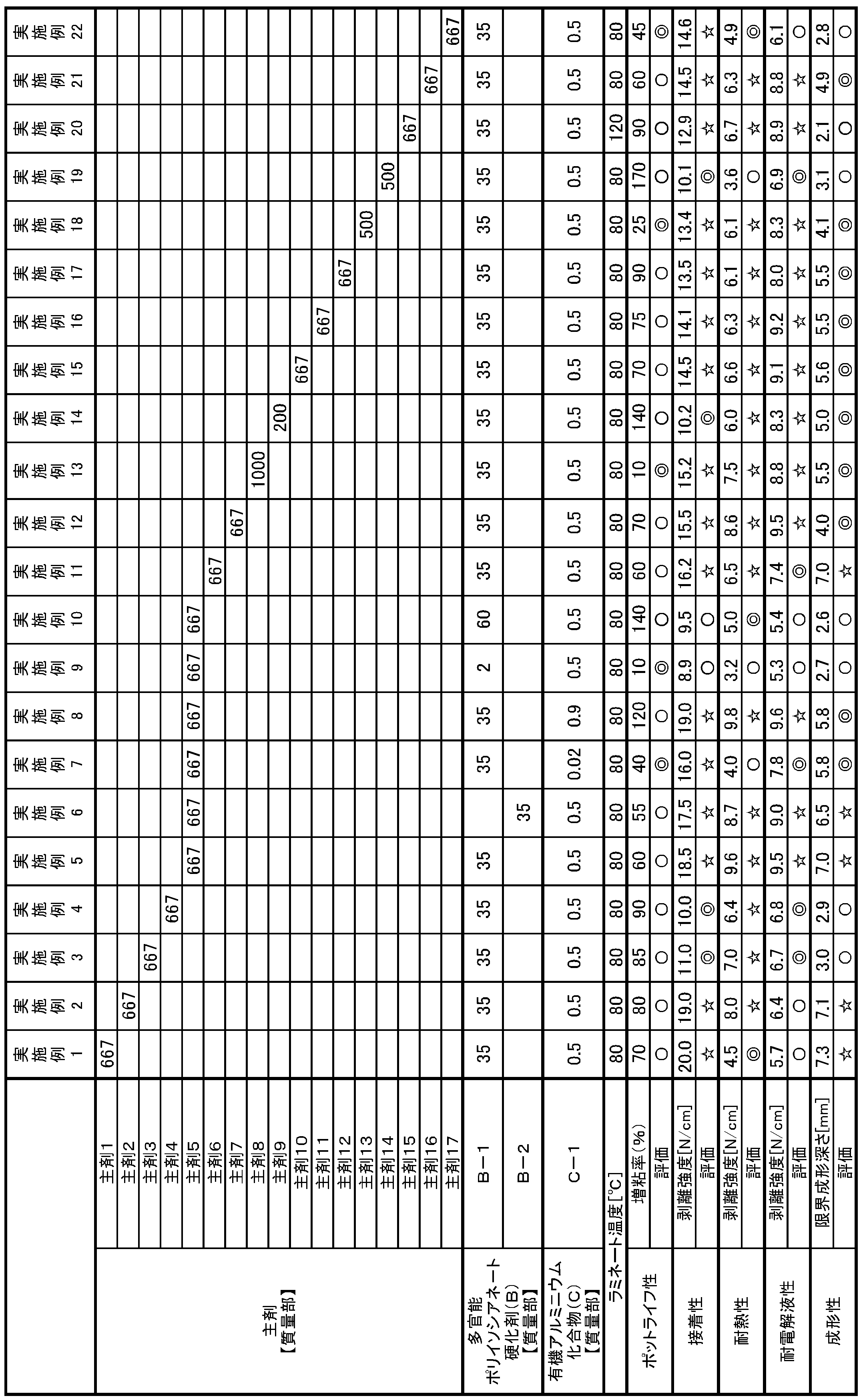
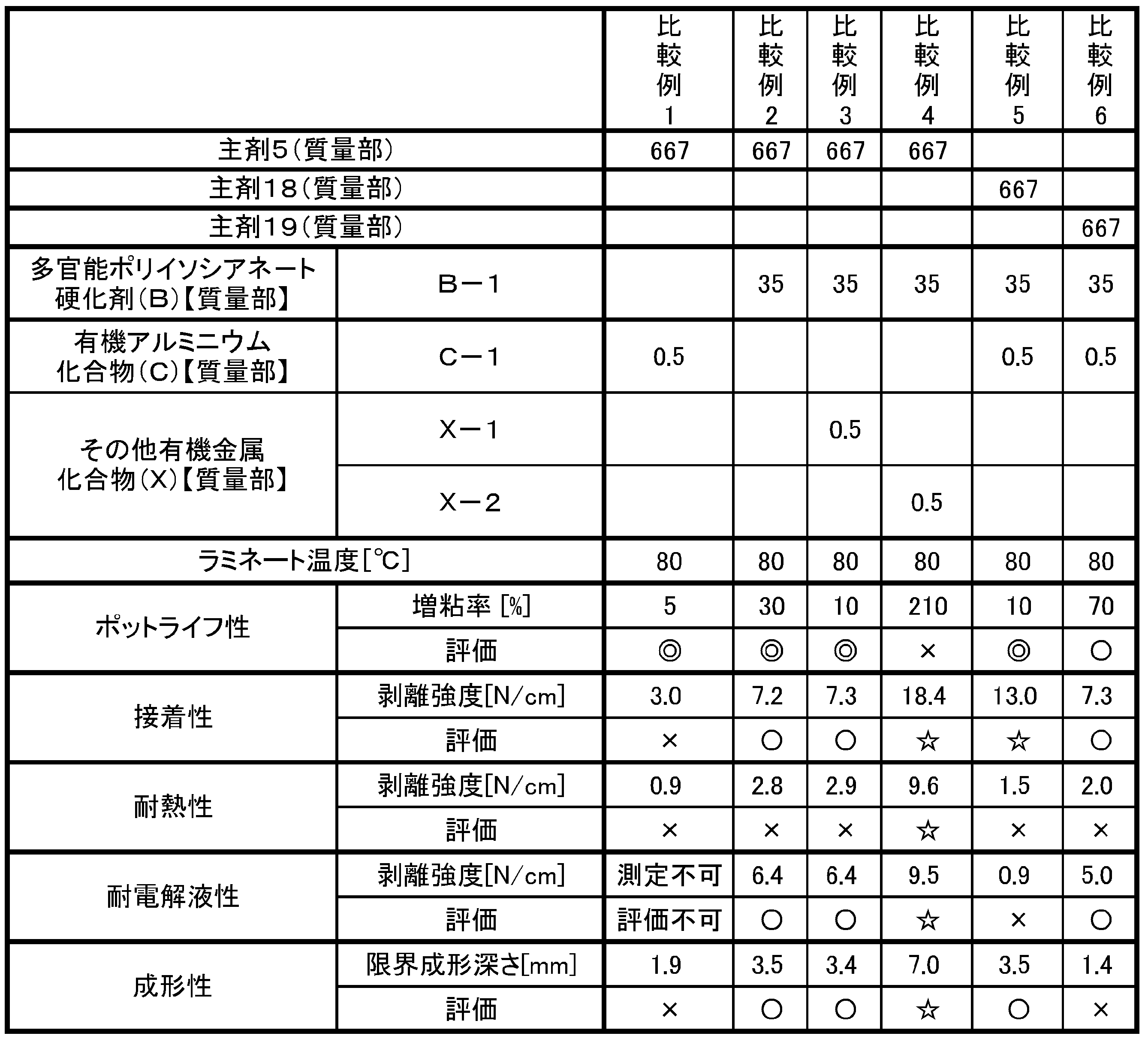
主剤1~19の溶液状態について、東機産業社製のブルックフィールド型粘度計TVB-10M(以下、B型粘度計という場合がある)を用いて25℃の溶液粘度(mPa・s)を測定した。測定した25℃の溶液粘度(mPa・s)を以下の評価基準に従って評価し、これを溶液状態の評価とした。評価結果を表1に示す。
<評価基準>
◎(実用上優れる):200mPa・s未満
○(実用可能):200mPa・s以上1000mPa・s未満
×(実用不可能):1000mPa・s以上またはゲル化により粘度測定不可
ポットライフ性とは、接着剤組成物の組成物安定性を指す。ポットライフ性が良好な場合は、組成物の粘度上昇が少なく長期間保存が可能であり、ポットライフ性が不良な場合は、組成物の粘度が上昇し、その程度が大きいとゲル化現象を起こし、長期間保存が不可能であり、基材への塗布も困難となる。実施例1~22及び比較例1~6で得られた接着剤組成物のポットライフ性を、以下に示す増粘率(%)により評価した。具体的には、表2~3に示す比率で各主剤と多官能ポリイソシアネート硬化剤(B)と有機アルミニウム化合物(C)とを配合した直後及び25℃雰囲気で大気下、撹拌状態にて8時間貯蔵した後に、各々B型粘度計を用いて25℃の溶液粘度を測定し、下記式(1)にて増粘率を算出した。算出した増粘率を以下の評価基準に従って評価し、これをポットライフ性の評価とした。評価結果を表2~3に示す。
増粘率(%)={(8時間攪拌後の接着剤組成物の25℃の溶液粘度-配合直後の接着剤組成物の25℃の溶液粘度)/配合直後の接着剤組成物の25℃の溶液粘度}×100・・・(式1)
<評価基準>
◎(実用上優れる):50%未満
○(実用可能):50%以上200%未満
×(実用不可能):200%以上またはゲル化により粘度測定不可
金属基材としてアルミニウム箔(住軽アルミ箔社製、8079-0、厚さ40μm)を使用し、ポリオレフィン樹脂基材として無延伸ポリプロピレンフィルム(東洋紡社製パイレン(登録商標)フィルムCT、厚さ40μm)(以下、CPPフィルムともいう。)を使用した。実施例1~22及び比較例1~6で得られた接着剤組成物を金属基材にバーコータを用いて乾燥後の接着剤層の膜厚が3μmになるように塗布した。塗布面を温風乾燥機を用いて100℃雰囲気で1分間乾燥させ、膜厚3μmの接着剤層が積層された金属基材を得た。前記接着剤層表面にポリオレフィン樹脂基材を重ね合わせ、テスター産業社製の小型卓上テストラミネーター(SA-1010-S)を用いて、ラミネート温度80℃又は120℃で、圧力0.3MPa、速度1m/分にて貼り合わせ、40℃、50%RHにて、96時間養生することで積層体を得た。
上記で得られた積層体を100mm×15mmの大きさに切断して試験片とし、以下のT型剥離試験により該試験片の接着性を評価した。
ASTM-D1876-61の試験法に準拠し、オリエンテックコーポレーション社製のテンシロンRTM-100を用いて、25℃環境下で、引張速度50mm/分における剥離強度(N/cm)を5回測定し、その平均値を上記試験片の剥離強度(N/cm)とした。得られた試験片の剥離強度(N/cm)を以下の評価基準に従って評価し、これを接着性の評価とした。評価結果を表2~3に示す。
☆(実用上特に優れる):12.0N/cm以上
◎(実用上優れる):10.0N/cm以上12.0N/cm未満
○(実用可能):7.0N/cm以上10.0N/cm未満
×(実用不可能):7.0N/cm未満
上記で得られた積層体を100mm×15mmの大きさに切断して試験片とし、80℃下恒温槽内でのT型剥離試験により該試験片の耐熱性を評価した。具体的には、恒温槽を取り付けた島津製作所社製のAG-ISを用い、80℃に熱した恒温槽内に上記試験片を取り付け、槽内の温度を80℃に維持して5分間経過した後、80℃環境下で、引張速度50mm/分における剥離強度(N/cm)を5回測定し、その平均値を上記試験片の剥離強度(N/cm)とした。得られた試験片の剥離強度(N/cm)を以下の評価基準に従って評価し、これを耐熱性の評価とした。評価結果を表2~3に示す。
(評価基準)
☆(実用上特に優れる):6.0N/cm以上
◎(実用上優れる):4.5N/cm以上6.0N/cm未満
○(実用可能):3.0N/cm以上4.5N/cm未満
×(実用不可能):3.0N/cm未満
LiB用包装材料としての利用性を検討するため、耐電解液性(電解液に対する耐薬品性)を、以下に示す剥離強度(N/cm)により評価した。まず、上記で得られた積層体を、100mm×15のmm大きさに切断して試験片とし、電解液[エチレンカーボネート:ジエチルカーボネート:ジメチルカーボネート==1:1:1(容積比)に6フッ化リン酸リチウムを添加したもの]に85℃で7日間浸漬させた。その後、電解液から試験片を取り出しイオン交換水で洗浄し、ペーパーワイパーで水を拭き取り、十分に水分を乾燥させた。次いで、乾燥した試験片について上記<T型剥離試験>と同一の手順にてT型剥離試験を行い、これにより得られた試験片の剥離強度(N/cm)を以下の評価基準に従って評価し、これを耐電解液性の評価とした。評価結果を表2~3に示す。
☆(実用上特に優れる):8.0N/cm以上
◎(実用上優れる):6.5N/cm以上8.0N/cm未満
○(実用可能):5.0N/cm以上6.5N/cm未満
×(実用不可能):5.0N/cm未満
LiB用包装材料としての利用性を検討するため、深絞り試験機による成形性の評価を行った。まず、上記で得られた積層体を、80mm×120mmの大きさに切断して試験片とし、冷間成形を行った。具体的には、深絞り試験機である株式会社アマダ製の張り出し成形機(品番:TP-25C-X2)と、55mm×35mmの口径を有する形成金型(雌型)と、これに対応した成形金型(雄型)とを用いて、25℃雰囲気下、押え圧0.4MPaで、0.5mmの成形深さから0.5mm単位で成形深さを変えて、それぞれの成形深さにて10個の試験片について冷間成形を行った。冷間成形後の試験片について、皺、アルミニウム箔へのピンホール、クラック等が、10個の試験片全てにおいて発生しない最も深い成形深さを、その試験片の限界成形深さ(mm)とした。得られた試験片の限界成形深さ(mm)を以下の評価基準に従って評価し、これを成形性の評価とした。評価結果を表2~3に示す。
<評価基準>
☆(実用上特に優れる):限界成形深さ6.0mm以上
◎(実用上優れる):限界成形深さ4.0mm以上6.0mm未満
○(実用可能):限界成形深さ2.0mm以上4.0mm未満
×(実用不可能):限界成形深さ2.0mm未満
実施例1~22で得られた接着剤組成物は、ポットライフ性が良好であった。また、実施例1~22で得られた接着剤組成物を用いて、ラミネート温度80℃又は120℃における貼り合わせ、40℃、96時間のような低温、短時間での養生することにより得られた金属基材とポリオレフィン樹脂基材との積層体は、接着性、耐熱性、耐電解液性(電解液に対する耐薬品性)及び成形性のいずれもが良好であった。
Claims (15)
- 酸変性ポリオレフィン(A)、多官能ポリイソシアネート硬化剤(B)及び有機アルミニウム化合物(C)を含有し、
前記酸変性ポリオレフィン(A)の重量平均分子量(Mw)が、10,000~200,000の範囲である、接着剤組成物。 - 前記酸変性ポリオレフィン(A)100質量部に対する、前記多官能ポリイソシアネート硬化剤(B)の含有量が、0.5~70質量部である、請求項1に記載の接着剤組成物。
- 前記酸変性ポリオレフィン(A)100質量部に対する、前記有機アルミニウム化合物(C)の含有量が、0.01~2質量部である、請求項1に記載の接着剤組成物。
- 前記酸変性ポリオレフィン(A)が、ポリオレフィンに、α,β-不飽和カルボン酸及びその酸無水物から選ばれる少なくとも1種をグラフトした構造を有するグラフト重合体である、請求項1に記載の接着剤組成物。
- 前記酸変性ポリオレフィン(A)の酸価が、2~50mgKOH/gである、請求項1に記載の接着剤組成物。
- 前記有機アルミニウム化合物(C)が、アルミニウムアルコレート化合物及び/又はアルミニウムキレート化合物である、請求項1に記載の接着剤組成物。
- 更に有機溶剤(D)を含有する、請求項1に記載の接着剤組成物。
- 前記有機溶剤(D)は、溶剤(D1)及び溶剤(D2)からなり、
前記溶剤(D1)が、芳香族炭化水素系溶剤、脂肪族炭化水素系溶剤、脂環式炭化水素系溶剤及びハロゲン化炭化水素系溶剤からなる群より選択される少なくとも一種の溶剤であり、
前記溶剤(D2)が、アルコール系溶剤、ケトン系溶剤、エステル系溶剤及びグリコールエーテル系溶剤からなる群より選択される少なくとも一種の溶剤である、請求項7に記載の接着剤組成物。 - 前記溶剤(D1)と前記溶剤(D2)との質量比(溶剤(D1)/溶剤(D2))が、50/50~97/3である、請求項8に記載の接着剤組成物。
- 更に酸無水物基含有モノマー(E)を含有する、請求項1に記載の接着剤組成物。
- 前記酸無水物基含有モノマー(E)の含有量が、前記酸変性ポリオレフィン(A)100質量部に対して、0.1~20質量部である、請求項10に記載の接着剤組成物。
- 前記酸無水物基含有モノマー(E)が、炭素数3~20の炭化水素基を含有する、請求項10に記載の接着剤組成物。
- ポリオレフィン樹脂基材と金属基材との接着に用いられる、請求項1~12のいずれか一項に記載の接着剤組成物。
- ポリオレフィン樹脂基材と金属基材とを、請求項1~12のいずれか一項に記載の接着剤組成物で接着してなる積層体。
- 請求項14に記載の積層体を含む、リチウムイオン電池用包装材料。
Priority Applications (1)
| Application Number | Priority Date | Filing Date | Title |
|---|---|---|---|
| CN202480056630.2A CN121794342A (zh) | 2023-09-13 | 2024-08-30 | 聚烯烃系粘合剂组合物、层叠体及锂离子电池用包装材料 |
Applications Claiming Priority (2)
| Application Number | Priority Date | Filing Date | Title |
|---|---|---|---|
| JP2023-148024 | 2023-09-13 | ||
| JP2023148024 | 2023-09-13 |
Publications (1)
| Publication Number | Publication Date |
|---|---|
| WO2025057776A1 true WO2025057776A1 (ja) | 2025-03-20 |
Family
ID=95021214
Family Applications (1)
| Application Number | Title | Priority Date | Filing Date |
|---|---|---|---|
| PCT/JP2024/031179 Pending WO2025057776A1 (ja) | 2023-09-13 | 2024-08-30 | ポリオレフィン系接着剤組成物、積層体及びリチウムイオン電池用包装材料 |
Country Status (3)
| Country | Link |
|---|---|
| CN (1) | CN121794342A (ja) |
| TW (1) | TW202525961A (ja) |
| WO (1) | WO2025057776A1 (ja) |
Citations (6)
| Publication number | Priority date | Publication date | Assignee | Title |
|---|---|---|---|---|
| JP2017101145A (ja) * | 2015-12-01 | 2017-06-08 | リンテック株式会社 | 接着剤組成物、封止シート、及び封止体 |
| JP2018049849A (ja) | 2017-12-27 | 2018-03-29 | 凸版印刷株式会社 | リチウム電池用外装材 |
| WO2018221037A1 (ja) * | 2017-05-29 | 2018-12-06 | 東洋紡株式会社 | ポリオレフィン系接着剤組成物 |
| WO2020218363A1 (ja) * | 2019-04-26 | 2020-10-29 | 日東電工株式会社 | 非水系電池用粘着テープ |
| WO2021106849A1 (ja) | 2019-11-27 | 2021-06-03 | 東洋紡株式会社 | ポリオレフィン系接着剤組成物 |
| CN115181519A (zh) * | 2022-08-08 | 2022-10-14 | 新纶新能源材料(常州)有限公司 | 一种铝塑膜内层胶黏剂及其制备方法和在铝塑膜中的应用 |
-
2024
- 2024-08-30 WO PCT/JP2024/031179 patent/WO2025057776A1/ja active Pending
- 2024-08-30 CN CN202480056630.2A patent/CN121794342A/zh active Pending
- 2024-09-11 TW TW113134381A patent/TW202525961A/zh unknown
Patent Citations (6)
| Publication number | Priority date | Publication date | Assignee | Title |
|---|---|---|---|---|
| JP2017101145A (ja) * | 2015-12-01 | 2017-06-08 | リンテック株式会社 | 接着剤組成物、封止シート、及び封止体 |
| WO2018221037A1 (ja) * | 2017-05-29 | 2018-12-06 | 東洋紡株式会社 | ポリオレフィン系接着剤組成物 |
| JP2018049849A (ja) | 2017-12-27 | 2018-03-29 | 凸版印刷株式会社 | リチウム電池用外装材 |
| WO2020218363A1 (ja) * | 2019-04-26 | 2020-10-29 | 日東電工株式会社 | 非水系電池用粘着テープ |
| WO2021106849A1 (ja) | 2019-11-27 | 2021-06-03 | 東洋紡株式会社 | ポリオレフィン系接着剤組成物 |
| CN115181519A (zh) * | 2022-08-08 | 2022-10-14 | 新纶新能源材料(常州)有限公司 | 一种铝塑膜内层胶黏剂及其制备方法和在铝塑膜中的应用 |
Also Published As
| Publication number | Publication date |
|---|---|
| TW202525961A (zh) | 2025-07-01 |
| CN121794342A (zh) | 2026-04-03 |
Similar Documents
| Publication | Publication Date | Title |
|---|---|---|
| JP7632499B2 (ja) | ポリオレフィン系接着剤組成物 | |
| KR101899265B1 (ko) | 폴리올레핀계 접착제 조성물 | |
| KR102301875B1 (ko) | 폴리올레핀계 접착제 조성물 | |
| KR101629304B1 (ko) | 접착제 조성물, 적층체, 축전 디바이스용 포장재, 축전 디바이스용 용기 및 축전 디바이스 | |
| JP7215091B2 (ja) | ポリオレフィン系接着剤組成物 | |
| CN109563385B (zh) | 聚烯烃系粘合剂组合物 | |
| KR20160048719A (ko) | 폴리올레핀계 접착제 조성물 | |
| JPWO2015080269A1 (ja) | 変性ポリオレフィン系樹脂 | |
| EP3778819B1 (en) | Polyolefin-based adhesive composition | |
| KR102340015B1 (ko) | 폴리올레핀계 접착제 조성물 | |
| TW202525961A (zh) | 聚烯烴系黏接劑組成物、疊層體及鋰離子電池用包裝材料 | |
| KR20260069645A (ko) | 폴리올레핀계 접착제 조성물, 적층체 및 리튬 이온 전지용 포장 재료 |
Legal Events
| Date | Code | Title | Description |
|---|---|---|---|
| ENP | Entry into the national phase |
Ref document number: 2024571903 Country of ref document: JP Kind code of ref document: A |
|
| WWE | Wipo information: entry into national phase |
Ref document number: 2024571903 Country of ref document: JP |
|
| 121 | Ep: the epo has been informed by wipo that ep was designated in this application |
Ref document number: 24865278 Country of ref document: EP Kind code of ref document: A1 |
|
| WWE | Wipo information: entry into national phase |
Ref document number: 1020267010815 Country of ref document: KR |
|
| WWE | Wipo information: entry into national phase |
Ref document number: 2024865278 Country of ref document: EP |