WO2025057486A1 - 試料分析支援装置 - Google Patents
試料分析支援装置 Download PDFInfo
- Publication number
- WO2025057486A1 WO2025057486A1 PCT/JP2024/019056 JP2024019056W WO2025057486A1 WO 2025057486 A1 WO2025057486 A1 WO 2025057486A1 JP 2024019056 W JP2024019056 W JP 2024019056W WO 2025057486 A1 WO2025057486 A1 WO 2025057486A1
- Authority
- WO
- WIPO (PCT)
- Prior art keywords
- compound
- compounds
- analysis
- information
- list
- Prior art date
- Legal status (The legal status is an assumption and is not a legal conclusion. Google has not performed a legal analysis and makes no representation as to the accuracy of the status listed.)
- Ceased
Links
Images


Classifications
-
- G—PHYSICS
- G01—MEASURING; TESTING
- G01N—INVESTIGATING OR ANALYSING MATERIALS BY DETERMINING THEIR CHEMICAL OR PHYSICAL PROPERTIES
- G01N27/00—Investigating or analysing materials by the use of electric, electrochemical, or magnetic means
- G01N27/62—Investigating or analysing materials by the use of electric, electrochemical, or magnetic means by investigating the ionisation of gases, e.g. aerosols; by investigating electric discharges, e.g. emission of cathode
-
- G—PHYSICS
- G01—MEASURING; TESTING
- G01N—INVESTIGATING OR ANALYSING MATERIALS BY DETERMINING THEIR CHEMICAL OR PHYSICAL PROPERTIES
- G01N30/00—Investigating or analysing materials by separation into components using adsorption, absorption or similar phenomena or using ion-exchange, e.g. chromatography or field flow fractionation
- G01N30/02—Column chromatography
- G01N30/62—Detectors specially adapted therefor
- G01N30/72—Mass spectrometers
-
- G—PHYSICS
- G01—MEASURING; TESTING
- G01N—INVESTIGATING OR ANALYSING MATERIALS BY DETERMINING THEIR CHEMICAL OR PHYSICAL PROPERTIES
- G01N30/00—Investigating or analysing materials by separation into components using adsorption, absorption or similar phenomena or using ion-exchange, e.g. chromatography or field flow fractionation
- G01N30/02—Column chromatography
- G01N30/86—Signal analysis
-
- G—PHYSICS
- G01—MEASURING; TESTING
- G01N—INVESTIGATING OR ANALYSING MATERIALS BY DETERMINING THEIR CHEMICAL OR PHYSICAL PROPERTIES
- G01N30/00—Investigating or analysing materials by separation into components using adsorption, absorption or similar phenomena or using ion-exchange, e.g. chromatography or field flow fractionation
- G01N30/02—Column chromatography
- G01N30/88—Integrated analysis systems specially adapted therefor, not covered by a single one of the groups G01N30/04 - G01N30/86
-
- G—PHYSICS
- G01—MEASURING; TESTING
- G01N—INVESTIGATING OR ANALYSING MATERIALS BY DETERMINING THEIR CHEMICAL OR PHYSICAL PROPERTIES
- G01N33/00—Investigating or analysing materials by specific methods not covered by groups G01N1/00 - G01N31/00
- G01N33/15—Medicinal preparations ; Physical properties thereof, e.g. dissolubility
-
- G—PHYSICS
- G06—COMPUTING OR CALCULATING; COUNTING
- G06F—ELECTRIC DIGITAL DATA PROCESSING
- G06F16/00—Information retrieval; Database structures therefor; File system structures therefor
- G06F16/90—Details of database functions independent of the retrieved data types
- G06F16/907—Retrieval characterised by using metadata, e.g. metadata not derived from the content or metadata generated manually
Definitions
- the present invention relates to a sample analysis support device.
- Packaging paper and containers for storing medicines are used when storing, transporting, and storing them.
- Medical equipment is used when administering medicines to patients.
- the effectiveness of the medicine may be hindered or health damage may occur.
- tests for eluted and exuded substances are recommended for medical products.
- a gas chromatograph mass spectrometer (GC-MS) is used (for example, Non-Patent Document 1).
- Non-Patent Documents 2 and 3 a method has been used in which a database containing multiple known compounds and the analytical conditions for each compound in a gas chromatograph mass spectrometer is used, a list of the known compounds recorded there is displayed on a screen, and the analytical conditions for each target compound are extracted by selecting the target compound from the list.
- E&L testing of medical supplies is to evaluate the risks posed by impurities contained in the medical supply itself or compounds that may be mixed in from the manufacturing equipment for the medical supply.
- Guidelines for E&L testing recommend that prior to conducting the test, a list of compounds that may be contained in the medical supply that is the subject of the E&L test should be made, and that compounds that pose a high risk of causing health damage should be evaluated first.
- compound databases contain information on a large number (e.g., hundreds) of compounds contained in a wide variety of medical supplies. For this reason, it was time-consuming to find and select compounds to be analyzed from the list of many compounds displayed on the screen, and then extract the analysis conditions for each compound to be analyzed.
- the problem that this invention aims to solve is to reduce the effort required to extract analytical conditions for a target compound from the analytical conditions for a large number of known compounds stored in a database.
- the sample analysis support device which has been made to solve the above problems, is: a storage unit in which information identifying each of a plurality of known compounds is stored in association with analytical conditions for the compound; A display unit; a compound list input receiving unit that receives an input of a list of information identifying one or more target compounds; an analytical condition reading unit that refers to the information stored in the storage unit and reads, from the storage unit, analytical conditions for compounds associated with each piece of information identifying one or more target compounds to be analyzed that are included in the list received by the compound list input receiving unit; and an analytical condition display unit that displays, on the display unit, the analytical conditions for one or more compounds that have been read out by the analytical condition reading unit.
- the user simply inputs a list of information identifying one or more target compounds to be analyzed, and the analysis condition reading unit reads out the analysis conditions for the compounds corresponding to each of the information identifying one or more target compounds listed in the input list from among the analysis conditions for multiple known compounds stored in the memory unit, and the analysis conditions for each compound are displayed on the display unit by the analysis condition display unit. This reduces the effort required to extract analysis conditions for target compounds from the analysis conditions for many known compounds stored in the database.
- FIG. 1 is a diagram showing the configuration of a main part of a gas chromatograph mass spectrometry system including a sample analysis support device according to the present invention.
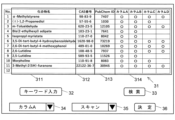
- 13 shows an example of a compound list input screen in this embodiment.
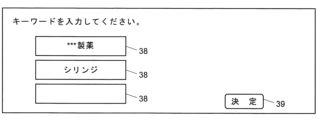
- 4 shows an example of a keyword input screen in the present embodiment.
- 13 shows an example of an analysis condition list display screen in this embodiment.
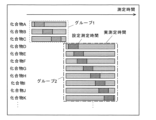
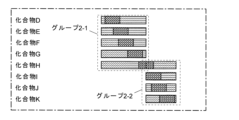
- 13 is an example in which compounds are grouped and measurement time ranges are set by initial settings in this embodiment. 13 is an example in which the measurement time range is changed by dividing one initially set group into two in this embodiment.
- FIG. 1 shows the main components of a gas chromatograph mass spectrometry system 1 including the sample analysis support device of this embodiment.
- the gas chromatograph mass spectrometry system 1 of this embodiment is used to perform E&L testing for leachables and leachables from, for example, containers that hold pharmaceuticals and medical equipment used to administer pharmaceuticals (hereinafter collectively referred to as "medical supplies").
- medical supplies include primary materials such as packaging materials that come into direct contact with pharmaceuticals, and secondary materials such as cardboard that come into indirect contact with pharmaceuticals.
- the gas chromatograph mass spectrometry system 1 comprises a gas chromatograph mass spectrometry unit (GC-MS) 10, which is a measurement unit, and a control and processing unit 20.
- the control and processing unit 20 corresponds to the sample analysis support device according to the present invention.
- the gas chromatograph mass spectrometer 10 combines a gas chromatograph for separating various compounds contained in a sample with a mass spectrometer that sequentially analyzes the compounds separated by the gas chromatograph.
- a mass spectrometer triple quadrupole mass spectrometer, ion trap-time of flight mass spectrometer, etc.
- a configuration capable of performing MS measurement and MS/MS measurement is used for the mass spectrometer.
- such a configuration is used to enable MRM measurement and product ion scan measurement in addition to SIM measurement and scan measurement, but a single quadrupole mass spectrometer, etc. may be used when only SIM measurement and/or scan measurement are performed.
- the control/processing unit 20 includes a memory unit 21.
- the memory unit 21 stores a compound database (compound DB) 211.
- the compound database 211 stores information on a large number (e.g., several hundred) of known compounds that may be contained in various medical supplies.
- this information includes, for example, compound-specific information, measurement condition information, analysis condition information, and supplementary information.
- the compound measurement conditions and analysis conditions are collectively referred to as analysis conditions.
- the specific information of a compound may include, for example, the compound name, CAS number, PubChem ID, chemical formula, and structural formula.
- the information of the measurement conditions of a compound may include, for example, the type and temperature of a column that can be used to measure the compound in a gas chromatograph, the type and flow rate of a carrier gas, the retention index and retention time for each column, and information on the mass analysis mode (SIM measurement, scan measurement, MRM measurement, product ion scan measurement, etc.) and the mass-to-charge ratio of an ion (the mass-to-charge ratio of a monitor ion during SIM measurement, the range of mass-to-charge ratios during scan measurement, the mass-to-charge ratio of an MRM transition (precursor ion and product ion) during MRM measurement, the range of mass-to-charge ratios of a precursor ion and a product ion during MS/MS measurement, etc.).
- the information of the analysis conditions of a compound may include, for example, information on a mass spectrum, a product ion spectrum, a reference value of the intensity ratio of a quantitative ion to a confirmatory ion, a reference value of the intensity ratio of a quantitative MRM transition to a confirmatory MRM transition, a calibration curve, a lower limit of quantification, and a lower limit of detection.
- the supplemental information includes keywords related to each compound. Specifically, it may include, for example, the type of product in which each compound may be contained (syringe, injector, packaging paper, etc.), the manufacturing equipment in which the compound may be mixed during the manufacturing process, the manufacturing plant, the manufacturer, and other information.
- the control/processing unit 20 has the following functional blocks: a compound list input receiving unit 221, an analysis condition reading unit 222, an analysis condition display unit 223, an analysis execution file creation unit 224, an analysis control unit 225, and an analysis processing unit 226.
- the actual control/processing unit 20 is a personal computer, and each of the above functional blocks is realized by executing pre-installed software (sample analysis support program 22) on a processor.
- an input unit 25 and a display unit 26 are connected to the control/processing unit 20.
- the sample analysis support program 22 can be executed in a general user mode in which logging in is performed without an ID or password, and in an administrator mode in which logging in is performed using an ID and password that are granted predetermined authority.
- the compound list input receiving unit 221 displays a screen on the display unit 26 that prompts the user to input a list of compounds to be analyzed.
- This screen can be in a table format, for example, with a field for inputting the compound name, CAS number, or PubChem ID, and a field for displaying the type of column capable of measuring the compound corresponding to the input compound name, CAS number, or PubChem ID.
- Figure 2 shows an example of a screen for inputting a list of compounds to be analyzed.
- This screen displays a compound list display field 31, a keyword input button 32, a search button 33, a column selection button 34, a mass analysis mode selection button 35, and a decision button 36.
- the compound list display field 31 includes a compound name input field 311, a CAS number input field 312, a PubChem ID input field 313, and a corresponding column display field 314.
- the compound list input receiving unit 221 checks against the unique information of the compound recorded in the compound database 211 to determine whether data having the input compound name, CAS number, or PubChem ID exists. If data having the input compound name, CAS number, or PubChem ID exists in the compound database 211, the type of column that can be used to measure the compound is further specified based on the measurement conditions of the compound.
- the compound list input receiving unit 221 displays " ⁇ " in the display field of each column if the column can be used.
- the number of compounds displayed in the compound list display field 31 can be changed as appropriate by a predetermined operation via the input unit 25.
- a line may be automatically added each time the user inputs a compound name, a CAS number, or a PubChem ID into either the compound name input field 311, the CAS number input field 312, or the PubChem ID input field 313.
- the user directly inputs the compound name, CAS number, or PubChem ID into either the compound name input field 311, the CAS number input field 312, or the PubChem ID input field 313, but if a compound list containing the compound names, CAS numbers, or PubChem IDs has been created in advance and saved in the memory unit 21, etc., the compound names, etc. can be input by reading out that file.
- the user can open the location where the file containing the compound list is saved and drag and drop the file onto the compound list display field 31, thereby reading out the compound list contained in that file.
- the compound list input receiving unit 221 notifies the user on the screen of the display unit 26 that a compound corresponding to the information entered by the user is not stored in the compound database 211. The unit then asks the user whether or not to add the compound to the compound database 211.
- another pop-up window is displayed, for example, to prompt the user to enter the information required for registration in the compound database 211 (specific information about the compound, analysis conditions, and supplementary information).
- the information required for registration in the compound database 211 specific information about the compound, analysis conditions, and supplementary information.
- a new identification number (ID) is assigned and the compound is registered in the compound database 211.
- the user can also enter keywords along with the compounds to be analyzed, either individually or as a list. For example, if the user enters compounds to perform E&L testing on drug a manufactured by A Pharmaceuticals, and also enters the keywords "A Pharmaceuticals” and "Drug a", information such as "A Pharmaceuticals” and "Drug a” is added to the compound database 211 as supplementary information for each compound entered by the user. By adding supplementary information in this way, when performing E&L testing again on the same medical supplies that have previously undergone E&L testing, multiple compounds can be entered at once by simply entering keywords, as explained below.
- the user can create a list of compounds not only by entering a compound name, CAS number, or PubChem ID, i.e., information that identifies one compound, but also by entering information that identifies multiple compounds simultaneously.
- a keyword input screen such as that shown in Figure 3 is displayed. On this screen, initially, only one keyword input field 38 and a decision button 39 are displayed.
- the user enters a keyword in the first keyword input field 38 the next keyword input field 38 is automatically added below it.
- the user can enter any number of keywords.
- the compound list input receiving unit 221 checks against the supplementary information of the compound recorded in the compound database 211, and all compounds for which all the input keywords are registered as supplementary information are read from the compound database 211 at once, and the same information as above is entered into the compound name input field 311, CAS number input field 312, PubChem ID input field 313, and corresponding column display field 314.
- a so-called AND search is performed that includes all the input keywords, but it is also possible to perform a so-called OR search and read out all compounds that include any of the input keywords from the compound database 211 at once.
- the user checks the display in the corresponding column display field 314 and operates the column selection button 34 to select one of the columns that can be used for all of the target compounds.
- the column selection button 34 is in a pull-down format, and only columns that can be used for all of the target compounds can be selected. In the example shown in FIG. 2, column A or column B can be selected by pulling down the column selection button 34.
- the user operates the mass analysis mode selection button 35 to select the mass analysis mode for measuring each target compound.
- the mass analysis mode selection button 35 is also in a pull-down format, and one of scan measurement, SIM measurement, product ion scan measurement, and MRM measurement can be selected.
- the compound list input receiving unit 221 determines the compound currently displayed in the compound list display area 31 as the provisional target compound for analysis. If multiple types of columns and/or mass analysis modes are used for the target compound for analysis, the user can create a compound list of target compounds for analysis that have the same combination of column type and mass analysis mode, and press the decision button 36, repeating this operation for each combination of column type and mass analysis mode.
- the analysis condition reading unit 222 reads from the compound database 211 the measurement conditions related to the type of column selected by the user using the column selection button 34 and the mass analysis mode selected using the mass analysis mode selection button 35 for each of the target compounds determined by the compound list input receiving unit 221.
- the analytical condition display unit 223 displays the read information in table format on the display unit 26.
- Figure 4 shows an example of a display of a list of analytical conditions.
- This screen displays an analytical conditions list display field 41 and a decision button 42.
- the analytical conditions list display field 41 displays the serial number, type, measurement mode, lower limit of quantification, method number, compound name, retention index, retention time, and CAS number for each of the target compounds to be analyzed determined by the compound list input receiving unit 221. Filter buttons are provided in these item fields, and these buttons can be used to sort the list or narrow down the items to be displayed.
- the items displayed in the analytical conditions list display field 41 can be changed as appropriate by an administrator who runs the sample analysis support program using, for example, an ID and password that has been granted administrator privileges.
- the serial number field displays the identification number (ID) of the compound in the compound database 211.
- the type field displays whether the user has selected the compound as the final target compound for analysis (Target).
- the analysis condition display unit 223 first displays a list of analysis conditions, the analysis conditions of the provisional target compound for analysis are displayed, and the type field for all compounds displays "Target.”
- the measurement mode field displays the mass analysis mode that the user has selected by operating the mass analysis mode selection button 35 on the screen shown in FIG. 2.
- the quantification lower limit field displays the quantification lower limit of the compound in question that is stored in the compound database 211.
- the method number field displays the same number for the target compounds to be measured at one time. In the example of FIG. 4, all are displayed as "1", and the measurement conditions for these target compounds are written to one method file (analysis execution file) and measured at one time.
- the retention index field and retention time field display the retention index and retention time of the compound in question that are stored in the compound database 211.
- a supplementary information field may be displayed in the analysis condition list display field 41. In that case, the supplementary information field displays supplementary information for the compound in question that is stored in the compound database 211.
- the screen shown in Figure 4 allows the user to confirm the specific measurement conditions and lower limit of quantification of the compound that the user selected as the target compound on the screen shown in Figure 2. If the user determines that the displayed measurement conditions or lower limit of quantification are not appropriate, for example, the user can exclude the compound from the target compounds by switching the display in the type column from "Target" to blank. The excluded compound can then be analyzed, for example, by using a different measurement method.
- the display example in Figure 4 shows the state in which two compounds, Morpholine and 3-Methyl-2(5H)-furanone, have been excluded from the list of compounds that the user selected as target compounds for analysis on the display screen shown in Figure 2. Even if a compound has been excluded from the list of target compounds for analysis, if the user selects "Target" by clicking on the type field for that compound, that compound will be selected again as a target compound for analysis.
- the compounds determined as tentative target compounds for analysis may include those for which the measurement conditions for the mass analysis mode selected by the user on the screen in Figure 2 are not recorded in the compound database 211.
- the row for the compound for which the measurement conditions for the analysis mode selected by the user are not recorded is highlighted (colored, flashing, etc.), and the user is prompted to change the mass analysis mode (change the setting in the measurement mode column) or exclude the compound from the target compounds for analysis (exclude it from "Target" in the type column).
- the user can edit (add, change, delete) items displayed in the analysis condition list shown in FIG. 4, other than the compound name, CAS number, and PubChem ID, which are immutable information.
- the measurement conditions read from the compound database 211 can be changed.
- supplementary information common to multiple compounds can be added on this screen. In this way, the next time a list of compounds to be analyzed is created, the added supplementary information can be used as a keyword to input all the compounds included in the compound list entered this time at once.
- information such as product type and manufacturing equipment included in the supplementary information can be updated as appropriate in accordance with updates to the medical supplies handled.
- the time interval (loop time) for performing mass analysis of each compound may become too long.
- the peak shape of the mass chromatogram is determined from the intensity values of multiple measurements performed at the retention time of each compound, and the compound is quantified from the area (or height) of the peak.
- the loop time is too long, the number of measurement points may be insufficient, and the correct peak shape may not be obtained, resulting in a decrease in the accuracy of the quantitative value.
- the loop time is fixed to a constant in this embodiment.
- This loop time is preset to a length that allows the peak of each compound in the chromatogram to be configured with more than the required number of measurement points (e.g., 10 points) (in other words, a length equal to or less than the time obtained by dividing the time for each compound separated in the gas chromatograph column to be measured by the required number of measurement points (e.g., 10 points)).
- the required processing time including using the initially set required processing time as is
- the dwell time is also determined.
- the required processing time refers to the minimum value (minimum measurement time) of the length of the measurement time centered on the retention time (or retention index) of each compound.
- the required processing time is set to 0.3 min, for example, and in that case, the measurement time range for each compound is set so that each compound is measured within a time period of at least ⁇ 0.3 min centered on the retention time.
- a screen as shown in FIG. 5 is displayed on the display unit 26.
- the screen shown in FIG. 5 shows the measurement times of each compound arranged vertically, with the horizontal axis being the measurement time.
- the dwell time is calculated by dividing the fixed loop time in each group by the number of measurement ions (measurement ions in the case of SIM analysis, measurement MRM transitions in the case of MRM analysis, both of which will be referred to as measurement ions hereafter) used in the analysis of the compounds included in the group.
- compounds A to C are grouped together (group 1), and compounds D to H are grouped together (group 2).
- group 1 the actual measurement time range is set so as to cover the set measurement times of all compounds, and each compound is measured in turn within the actual measurement time range.
- the user checks the dwell time assigned to each measurement ion of each compound included in the highlighted group, and if the user determines that the dwell time is insufficient, inputs an instruction to split the group.
- the specified group is split into two.
- the set measurement time of at least one compound will cross the boundary between the two groups.
- the measurement ions of compounds whose set measurement time crosses the boundary between the groups are measured across the two groups.
- the example shown in Figure 6 is the division of group 2 in Figure 5, where compounds D to K are divided into group 2-1, which includes compounds D to H, and group 2-2, which includes compounds H to K.
- Compound H whose set measurement time crosses the boundary between these two groups, is measured across these two groups. This makes it possible to assign sufficient dwell time to each measurement ion even when there are a large number of compounds with similar retention times and a large number of measurement ions of those compounds, and also makes it possible to keep the loop time constant even when one compound is measured across multiple groups.
- the analysis execution file creation unit 224 creates an analysis execution file that describes the measurement conditions for executing the mass analysis mode selected in the measurement mode column for each of the finally determined compounds to be analyzed.
- the user makes changes to the information read from the compound database 211, the user is asked whether or not to reflect the changes as information in the compound database 211.
- the changed contents are saved in the compound database 211.
- the user After creating the analysis execution file, the user sets the sample to be analyzed and issues a command to start measurement by performing a specified operation via the input unit 25.
- the analysis control unit 225 then measures each compound to be analyzed under the measurement conditions described in the analysis execution file.
- Each compound in the sample introduced into the gas chromatograph mass spectrometry unit 10 is separated in the gas chromatograph column, and flows out of the column at the retention time of each compound and is subjected to mass spectrometry.
- the mass spectrometry unit repeatedly performs scan measurements within a time period having a predetermined width centered on the retention time (or retention index) of each target compound for analysis. The data acquired during the measurement is stored sequentially in the memory unit 21.
- the analysis processing unit 226 reads out the measurement data stored in the memory unit 21 and performs analysis processing.
- the analysis processing unit 226 reads out the mass spectrum of each target compound from the compound database 211 and determines the degree of match with the mass spectrum obtained by measurement (for example, the degree of match of the mass-to-charge ratio and normalized intensity of the mass peak). If the degree of match exceeds a predetermined threshold, it is determined that the sample contains the compound.
- the compound is quantified by comparing the intensity of the mass peak of the target ion appearing in the mass spectrum with a calibration curve.
- the analysis processing unit 226 reads out the reference value of the intensity ratio of the quantitative ion and the confirmation ion from the compound database 211, and judges whether or not the sample contains the target compound based on whether the difference between the intensity ratio of the quantitative ion and the confirmation ion obtained by the measurement and the reference value is within a predetermined range. If the target compound is contained, the analysis processing unit 226 further quantifies the target compound by comparing the measured intensity of the quantitative ion with a calibration curve.
- the analysis processing unit 226 reads out the product ion spectrum of each target compound from the compound database 211, and determines the degree of agreement with the product ion spectrum obtained by the measurement (for example, the degree of agreement of the mass-to-charge ratio and normalized intensity of the mass peak). If the degree of agreement exceeds a predetermined threshold, it is determined that the target compound is contained in the sample.
- the target compound is also quantified by comparing the intensity of the mass peak of the target ion (product ion) appearing in the product ion spectrum with a calibration curve.
- non-targeted analysis In E&L testing of pharmaceutical products, non-targeted analysis was commonly performed. In non-targeted analysis, a scan measurement was performed without setting the target compound in advance, and a mass spectrum was obtained. The mass spectrum obtained from the measurement was then compared with the mass spectra of known compounds stored in a library, and candidate compounds were listed in order of highest match.
- targeted analysis which specifies in advance compounds that may be mixed into medical supplies and that pose a high risk of health damage due to leaching into pharmaceuticals.
- a compound to be analyzed is selected in advance from a large number of known compounds stored in a compound database, and the mass spectrum and product ion spectrum obtained by measurement are compared with the mass spectrum and product ion spectrum of the known compound stored in the compound database to determine the degree of match. Therefore, unlike conventional E&L tests that use libraries, a large number of candidate compounds with similar degrees of match are not listed, and it is easy to determine whether the sample contains the compound.
- SIM measurement or MRM measurement which has higher compound selectivity than scan measurement or product ion scan measurement, may be performed to determine whether the compound is contained and (if it is contained) its content.
- compound databases contain information on a large number (e.g., hundreds) of compounds contained in a wide variety of medical supplies. This means that it is time-consuming to find and select compounds to analyze from a list of many compounds displayed on the screen, and then to extract analytical conditions for the compounds to analyze.
- the user simply inputs a list of information identifying one or more target compounds on a screen such as that shown in FIG. 2, and the analytical condition reading unit 222 reads out analytical conditions for the compounds corresponding to each of the information identifying one or more target compounds listed in the input list from among the analytical conditions for multiple known compounds stored in the compound database 211, and the analytical conditions for each compound are displayed on the display unit 26 by the analytical condition display unit 223. This reduces the effort required to extract analytical conditions for target compounds from the analytical conditions for the many known compounds stored in the compound database 211.
- the above embodiment is a gas chromatograph mass spectrometry system 1, but a similar configuration can be used in an analysis system equipped with other analysis devices. Also, while the above embodiment is configured for the purpose of E&L testing of medical products, a similar configuration can be used for other analyses.
- supplementary information for compounds stored in the compound database 211 is exemplified as information related to E&L testing of medical products, but any information can be registered as supplementary information, and it is advisable to register appropriate information according to the characteristics of the object to be analyzed, the purpose of the analysis, the analysis method, etc.
- the display screens in the above embodiments are just examples, and the display format can be changed as appropriate.
- a sample analysis support device comprises: a storage unit in which information identifying each of a plurality of known compounds is stored in association with analytical conditions for the compound; A display unit; a compound list input receiving unit that receives an input of a list of information identifying one or more target compounds; an analytical condition reading unit that refers to the information stored in the storage unit and reads, from the storage unit, analytical conditions for compounds associated with each piece of information identifying one or more target compounds to be analyzed that are included in the list received by the compound list input receiving unit; and an analytical condition display unit that displays, on the display unit, the analytical conditions for one or more compounds that have been read out by the analytical condition reading unit.
- the user only needs to input a list of information identifying one or more target compounds, and the analytical condition display unit reads out analytical conditions for compounds corresponding to each of the information identifying one or more target compounds listed in the input list from among the analytical conditions for multiple known compounds stored in the memory unit, and the analytical conditions for each compound are displayed on the display unit by the analytical condition display unit. This reduces the effort required to extract analytical conditions for target compounds from the analytical conditions for many known compounds stored in the database.
- the sample analysis support device is the sample analysis support device according to the first aspect of the present invention.
- the information for identifying the compound includes any one of the compound name, CAS number, and PubChem ID.
- the compound list can be input by identifying the target compounds by compound name, CAS number, or PubChem ID. It is more preferable to adopt a configuration in which the target compounds are identified by CAS number or PubChem ID rather than by compound name, which is prone to input errors.
- the sample analysis support device is the sample analysis support device according to paragraph 1 or 2
- the information for identifying the compound includes information for simultaneously identifying a plurality of known compounds.
- the sample analysis support device is a sample analysis support device according to any one of claims 1 to 3,
- the analytical condition display section enables editing of the analytical conditions for the one or more compounds displayed on the display section.
- the sample analysis support device can, for example, check the analysis conditions for each target compound and select the target compounds to be analyzed, or change the dwell time or loop time when the retention times of multiple compounds overlap during analysis using a chromatograph.
- a sample analysis support device is a sample analysis support device according to any one of claims 1 to 4,
- the analysis condition display unit displays information identifying the compound on a screen displayed on the display unit, and when a change is made to the information identifying the compound, updates the information stored in the memory unit to the changed information.
- the compound-identifying information can be updated in accordance with updates to the information related to the sample to be analyzed.
- a sample analysis support device is a sample analysis support device according to any one of claims 1 to 5, The compounds are extractable and/or leachable from medical supplies.
- E&L tests In tests for extractables and leachables (E&L tests) of medical products, it is common to compare mass spectra and product ion spectra obtained by non-target analysis with those stored in a library, but sometimes a compound database is used that contains information on the analytical conditions of a large number of compounds (e.g., several hundred) contained in a wide variety of medical products. In such cases, it is time-consuming to select the target compounds one by one and extract the analytical conditions for each target compound.
- the sample analysis support device of paragraph 6 can be particularly suitably used to extract the analytical conditions for target compounds in E&L tests of medical products, which has traditionally been a time-consuming process.
Landscapes
- Life Sciences & Earth Sciences (AREA)
- Health & Medical Sciences (AREA)
- Chemical & Material Sciences (AREA)
- Engineering & Computer Science (AREA)
- General Physics & Mathematics (AREA)
- Physics & Mathematics (AREA)
- Analytical Chemistry (AREA)
- Pathology (AREA)
- Immunology (AREA)
- General Health & Medical Sciences (AREA)
- Biochemistry (AREA)
- Databases & Information Systems (AREA)
- Theoretical Computer Science (AREA)
- Molecular Biology (AREA)
- Pharmacology & Pharmacy (AREA)
- Medicinal Chemistry (AREA)
- Biophysics (AREA)
- Library & Information Science (AREA)
- Bioinformatics & Cheminformatics (AREA)
- Data Mining & Analysis (AREA)
- General Engineering & Computer Science (AREA)
- Food Science & Technology (AREA)
- Chemical Kinetics & Catalysis (AREA)
- Electrochemistry (AREA)
- Other Investigation Or Analysis Of Materials By Electrical Means (AREA)
Priority Applications (2)
| Application Number | Priority Date | Filing Date | Title |
|---|---|---|---|
| JP2025545461A JPWO2025057486A1 (cg-RX-API-DMAC7.html) | 2023-09-15 | 2024-05-23 | |
| CN202480057991.9A CN121889672A (zh) | 2023-09-15 | 2024-05-23 | 试样分析辅助装置 |
Applications Claiming Priority (2)
| Application Number | Priority Date | Filing Date | Title |
|---|---|---|---|
| JP2023150347 | 2023-09-15 | ||
| JP2023-150347 | 2023-09-15 |
Publications (1)
| Publication Number | Publication Date |
|---|---|
| WO2025057486A1 true WO2025057486A1 (ja) | 2025-03-20 |
Family
ID=95021143
Family Applications (1)
| Application Number | Title | Priority Date | Filing Date |
|---|---|---|---|
| PCT/JP2024/019056 Ceased WO2025057486A1 (ja) | 2023-09-15 | 2024-05-23 | 試料分析支援装置 |
Country Status (3)
| Country | Link |
|---|---|
| JP (1) | JPWO2025057486A1 (cg-RX-API-DMAC7.html) |
| CN (1) | CN121889672A (cg-RX-API-DMAC7.html) |
| WO (1) | WO2025057486A1 (cg-RX-API-DMAC7.html) |
Citations (8)
| Publication number | Priority date | Publication date | Assignee | Title |
|---|---|---|---|---|
| JPH01213949A (ja) * | 1988-02-22 | 1989-08-28 | Shimadzu Corp | 分析条件設定装置および測定データ処理装置 |
| JPH095300A (ja) * | 1995-06-22 | 1997-01-10 | Shimadzu Corp | 液体クロマトグラフ質量分析装置 |
| JP2010216981A (ja) * | 2009-03-17 | 2010-09-30 | Shimadzu Corp | 代謝物解析用データ処理装置 |
| WO2018173223A1 (ja) * | 2017-03-23 | 2018-09-27 | 株式会社島津製作所 | 質量分析装置及びクロマトグラフ質量分析装置 |
| JP2019148455A (ja) * | 2018-02-26 | 2019-09-05 | 株式会社島津製作所 | 測定データ処理方法、測定データ処理装置、及び測定データ処理用プログラム |
| JP2020074704A (ja) * | 2018-11-07 | 2020-05-21 | 東ソー株式会社 | 溶出物試験方法 |
| JP2021117122A (ja) * | 2020-01-27 | 2021-08-10 | 株式会社島津製作所 | 分析システム |
| JP2022178382A (ja) * | 2021-05-20 | 2022-12-02 | 株式会社島津製作所 | 臭素系難燃化合物の定量装置 |
-
2024
- 2024-05-23 JP JP2025545461A patent/JPWO2025057486A1/ja active Pending
- 2024-05-23 WO PCT/JP2024/019056 patent/WO2025057486A1/ja not_active Ceased
- 2024-05-23 CN CN202480057991.9A patent/CN121889672A/zh active Pending
Patent Citations (8)
| Publication number | Priority date | Publication date | Assignee | Title |
|---|---|---|---|---|
| JPH01213949A (ja) * | 1988-02-22 | 1989-08-28 | Shimadzu Corp | 分析条件設定装置および測定データ処理装置 |
| JPH095300A (ja) * | 1995-06-22 | 1997-01-10 | Shimadzu Corp | 液体クロマトグラフ質量分析装置 |
| JP2010216981A (ja) * | 2009-03-17 | 2010-09-30 | Shimadzu Corp | 代謝物解析用データ処理装置 |
| WO2018173223A1 (ja) * | 2017-03-23 | 2018-09-27 | 株式会社島津製作所 | 質量分析装置及びクロマトグラフ質量分析装置 |
| JP2019148455A (ja) * | 2018-02-26 | 2019-09-05 | 株式会社島津製作所 | 測定データ処理方法、測定データ処理装置、及び測定データ処理用プログラム |
| JP2020074704A (ja) * | 2018-11-07 | 2020-05-21 | 東ソー株式会社 | 溶出物試験方法 |
| JP2021117122A (ja) * | 2020-01-27 | 2021-08-10 | 株式会社島津製作所 | 分析システム |
| JP2022178382A (ja) * | 2021-05-20 | 2022-12-02 | 株式会社島津製作所 | 臭素系難燃化合物の定量装置 |
Also Published As
| Publication number | Publication date |
|---|---|
| JPWO2025057486A1 (cg-RX-API-DMAC7.html) | 2025-03-20 |
| CN121889672A (zh) | 2026-04-17 |
Similar Documents
| Publication | Publication Date | Title |
|---|---|---|
| CN103389345B (zh) | 色谱质谱分析用数据处理系统 | |
| US11289317B2 (en) | Interactive analysis of mass spectrometry data | |
| US10199206B2 (en) | Interactive analysis of mass spectrometry data | |
| US20190043703A1 (en) | Interactive analysis of mass spectrometry data including peak selection and dynamic labeling | |
| JP5272822B2 (ja) | 代謝物解析用データ処理装置 | |
| CN108027345B (zh) | 分析数据解析装置以及分析数据解析用程序 | |
| US12224169B2 (en) | Interactive analysis of mass spectrometry data | |
| US12400846B2 (en) | Interactive analysis of mass spectrometry data including peak selection and dynamic labeling | |
| JP6332445B2 (ja) | 分析装置用制御装置 | |
| Dong et al. | Validation of stability-indicating HPLC methods for pharmaceuticals: overview, methodologies, and case studies | |
| JP7056767B2 (ja) | クロマトグラフを用いた物質同定方法 | |
| US10794880B2 (en) | Chromatograph mass spectrometer | |
| JP5561016B2 (ja) | クロマトグラフ質量分析装置 | |
| JP2019148455A5 (cg-RX-API-DMAC7.html) | ||
| Hao et al. | Development of a machine learning algorithm for drug screening analysis on high-resolution UPLC-MSE/QTOF mass spectrometry | |
| Júnior et al. | Application of GC–MS retention index in forensic routine | |
| US20240255478A1 (en) | Data processing device for metabolite analysis | |
| US20210156831A1 (en) | Biological sample analysis system | |
| CN121889672A (zh) | 试样分析辅助装置 | |
| JP7779170B2 (ja) | クロマトグラフ分析装置及びクロマトグラフ分析用プログラム | |
| Hooshfar et al. | Hazards in chromatographic bioanalysis method development and applications | |
| Smith et al. | Are You Sure You Understand USP< 621> | |
| JP7678546B2 (ja) | 解析システム、解析方法及びプログラム | |
| JP7838329B2 (ja) | 分析装置 | |
| TAMBE et al. | Quality by Design Driven Analytical Method Validation |
Legal Events
| Date | Code | Title | Description |
|---|---|---|---|
| 121 | Ep: the epo has been informed by wipo that ep was designated in this application |
Ref document number: 24864994 Country of ref document: EP Kind code of ref document: A1 |
|
| ENP | Entry into the national phase |
Ref document number: 2025545461 Country of ref document: JP Kind code of ref document: A |
|
| WWE | Wipo information: entry into national phase |
Ref document number: 2025545461 Country of ref document: JP |
|
| NENP | Non-entry into the national phase |
Ref country code: DE |