WO2025047944A1 - コネクタ及びコネクタセット - Google Patents
コネクタ及びコネクタセット Download PDFInfo
- Publication number
- WO2025047944A1 WO2025047944A1 PCT/JP2024/031253 JP2024031253W WO2025047944A1 WO 2025047944 A1 WO2025047944 A1 WO 2025047944A1 JP 2024031253 W JP2024031253 W JP 2024031253W WO 2025047944 A1 WO2025047944 A1 WO 2025047944A1
- Authority
- WO
- WIPO (PCT)
- Prior art keywords
- connector
- terminal
- terminals
- signal
- signal terminal
- Prior art date
- Legal status (The legal status is an assumption and is not a legal conclusion. Google has not performed a legal analysis and makes no representation as to the accuracy of the status listed.)
- Pending
Links
Images







Classifications
-
- H—ELECTRICITY
- H01—ELECTRIC ELEMENTS
- H01R—ELECTRICALLY-CONDUCTIVE CONNECTIONS; STRUCTURAL ASSOCIATIONS OF A PLURALITY OF MUTUALLY-INSULATED ELECTRICAL CONNECTING ELEMENTS; COUPLING DEVICES; CURRENT COLLECTORS
- H01R12/00—Structural associations of a plurality of mutually-insulated electrical connecting elements, specially adapted for printed circuits, e.g. printed circuit boards [PCB], flat or ribbon cables, or like generally planar structures, e.g. terminal strips, terminal blocks; Coupling devices specially adapted for printed circuits, flat or ribbon cables, or like generally planar structures; Terminals specially adapted for contact with, or insertion into, printed circuits, flat or ribbon cables, or like generally planar structures
- H01R12/70—Coupling devices
- H01R12/71—Coupling devices for rigid printing circuits or like structures
-
- H—ELECTRICITY
- H01—ELECTRIC ELEMENTS
- H01R—ELECTRICALLY-CONDUCTIVE CONNECTIONS; STRUCTURAL ASSOCIATIONS OF A PLURALITY OF MUTUALLY-INSULATED ELECTRICAL CONNECTING ELEMENTS; COUPLING DEVICES; CURRENT COLLECTORS
- H01R13/00—Details of coupling devices of the kinds covered by groups H01R12/70 or H01R24/00 - H01R33/00
- H01R13/646—Details of coupling devices of the kinds covered by groups H01R12/70 or H01R24/00 - H01R33/00 specially adapted for high-frequency, e.g. structures providing an impedance match or phase match
- H01R13/6461—Means for preventing cross-talk
- H01R13/6471—Means for preventing cross-talk by special arrangement of ground and signal conductors, e.g. GSGS [Ground-Signal-Ground-Signal]
-
- H—ELECTRICITY
- H01—ELECTRIC ELEMENTS
- H01R—ELECTRICALLY-CONDUCTIVE CONNECTIONS; STRUCTURAL ASSOCIATIONS OF A PLURALITY OF MUTUALLY-INSULATED ELECTRICAL CONNECTING ELEMENTS; COUPLING DEVICES; CURRENT COLLECTORS
- H01R13/00—Details of coupling devices of the kinds covered by groups H01R12/70 or H01R24/00 - H01R33/00
- H01R13/646—Details of coupling devices of the kinds covered by groups H01R12/70 or H01R24/00 - H01R33/00 specially adapted for high-frequency, e.g. structures providing an impedance match or phase match
- H01R13/6473—Impedance matching
Definitions
- the present invention relates to a connector and a connector set.
- a known example of a conventional connector-related invention is the female connector described in Patent Document 1.
- the female connector described in Patent Document 1 is used for transmitting high-frequency signals.
- the female connector described in Patent Document 1 has multiple internal terminals.
- the multiple internal terminals are arranged along the longitudinal direction.
- the internal terminals face each other in the longitudinal direction.
- a protrusion is formed on a part of the internal terminal.
- the longitudinal length of the protrusion is longer than the longitudinal length of the part of the internal terminal other than the protrusion (see Figure 4).
- the object of the present invention is to provide a connector and connector set that can reduce return loss by leveling out the parasitic capacitance formed between terminals.
- a connector includes: A first body member; a plurality of first connection terminals supported by the first body member and arranged at predetermined intervals on a first straight line parallel to a first direction;
- a connector comprising: At least one of the plurality of first connection terminals is a first signal terminal;
- the first signal terminal is A mounting portion having at least a portion extending in a second direction perpendicular to the first direction; a rear portion connected to the mounting portion and extending in a third direction perpendicular to the first direction and the second direction; a top surface portion having a first portion connected to the back surface portion and extending in the second direction; a contact portion connected to the top surface portion and located at a position different from the rear surface portion in the second direction, the contact portion overlapping with the rear surface portion as viewed in the second direction; Contains the mounting portion is electrically connected to an electrode of a member other than the connector, the contact portion contacts a second signal terminal of a second connector different from the first connector, the rear surface portion has a wide
- the connector and connector set of the present invention can reduce return loss by leveling out the parasitic capacitance formed between terminals.
- FIG. 1 is a perspective view of the connector set 1 when the first connector 10 and the second connector 110 are not connected to each other.
- FIG. 2 is a perspective view of the first connector 10.
- FIG. 3 is a perspective view of the first body member 11.
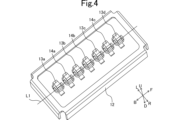
- FIG. 4 is a perspective view of the first contact terminal 12, the first signal terminals 13a to 13d, and the first ground terminals 14a to 14c.
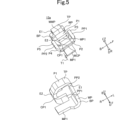
- FIG. 5 is a perspective view of the first signal terminal 13a.
- FIG. 6 is a cross-sectional view of the first signal terminal 13a.
- FIG. 7 is a perspective view of the second connector 110.
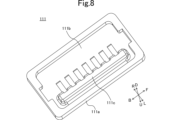
- FIG. 8 is a perspective view of the second body member 111.
- FIG. 8 is a perspective view of the second body member 111.
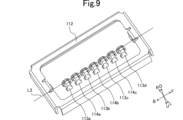
- FIG. 9 is a perspective view of the second contact terminal 112, the second signal terminals 113a to 113d, and the second ground terminals 114a to 114c.
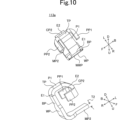
- FIG. 10 is a perspective view of the second signal terminal 113a.
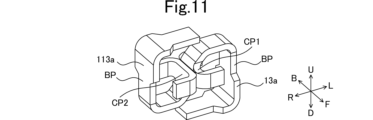
- FIG. 11 is a perspective view showing a state in which the first signal terminal 13a and the second signal terminal 113a are connected to each other.
- FIG. 12 is a perspective view of the first connector 10a.
- FIG. 13 is a perspective view of the second connector 110a.
- FIG. 14 is a perspective view of the first connector 10b.
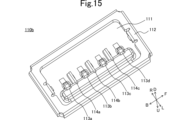
- FIG. 15 is a perspective view of the second connector 110b.
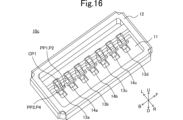
- FIG. 16 is a perspective view of the first connector 10c.
- FIG. 17 is a perspective view of the second connector 110c.
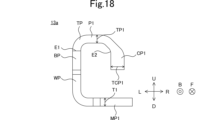
- FIG. 18 is a cross-sectional view of a first signal terminal 13a according to the fourth modified example.
- FIG. 1 is a perspective view of the connector set 1 when the first connector 10 and the second connector 110 are not connected to each other.
- the direction from the second connector 110 to the first connector 10 is defined as the downward direction.
- the opposite direction to the downward direction is defined as the upward direction.
- the upward and downward directions correspond to the "third direction" of the present invention.
- the connector set 1 is used to connect two components.
- the components are, for example, circuit boards.
- the connector set 1 includes a first connector 10 and a second connector 110.
- FIG. 2 is a perspective view of the first connector 10.
- Fig. 3 is a perspective view of the first body member 11.
- Fig. 4 is a perspective view of the first contact terminal 12, the first signal terminals 13a to 13d, and the first ground terminals 14a to 14c.
- Fig. 5 is a perspective view of the first signal terminal 13a.
- Fig. 6 is a cross-sectional view of the first signal terminal 13a.
- the direction in which the first signal terminals 13a to 13d are arranged in this order is defined as the forward direction.
- the opposite direction to the forward direction is defined as the rearward direction.
- the forward and rearward directions are perpendicular to the downward and upward directions.
- the forward and rearward directions (front-to-back directions) correspond to the "first direction" of the present invention.
- the direction in which the protrusion 11c and the first signal terminal 13a are arranged in this order is defined as the rightward direction.
- the opposite direction to the rightward direction is defined as the leftward direction.
- the rightward and leftward directions are perpendicular to the downward and forward directions.
- the leftward and rightward directions correspond to the "second direction" of the present invention.
- the downward, upward, forward, rearward, rightward, and leftward directions in this specification are directions defined for the convenience of explanation and do not have to coincide with the downward, upward, forward, rearward, rightward, and leftward directions when the first connector 10 is in use. Additionally, in each drawing, the downward direction and the upward direction may be interchanged, the forward direction and the backward direction may be interchanged, and the rightward direction and the leftward direction may be interchanged.
- the first connector 10 includes a first body member 11, a first contact terminal 12, first signal terminals 13a-13d, and first ground terminals 14a-14c.
- the first signal terminals 13a-13d may be ground terminals connected to a ground potential or power terminals connected to a power supply potential
- the first ground terminals 14a-14c may be signal terminals or power terminals connected to a power supply potential.
- the first signal terminals 13a-13d and the first ground terminals 14a-14c correspond to the "plurality of first connection terminals" of the present invention.
- the "plurality of first connection terminals" of the present invention need only include at least one first signal terminal. If the first ground terminals 14a-14c are power supply terminals, the first ground terminals 14a-14c correspond to the "first power supply terminals" of the present invention.
- the first body member 11 includes a frame portion 11a, a bottom portion 11b, and a protrusion portion 11c.
- the material of the first body member 11 is resin.
- the material of the first body member 11 is not limited to resin.
- the frame portion 11a When viewed in the vertical direction, the frame portion 11a has a ring shape that surrounds the first signal terminals 13a to 13d, the first ground terminals 14a to 14c, and the protrusion portion 11c.
- the frame portion 11a has left and right sides that extend in the front-to-rear direction, and front and rear sides that extend in the left-to-right direction.
- the bottom portion 11b When viewed from the top to bottom, the bottom portion 11b covers part of the underside of the area surrounded by the frame portion 11a.
- the protrusion 11c is provided on the bottom 11b.
- the protrusion 11c protrudes upward from the bottom 11b.
- the protrusion 11c has a shape that extends in the front-rear direction.
- both ends of the protrusion 11c in the front-rear direction are connected to the front and rear edges of the frame 11a, respectively.
- a plurality of concave grooves are formed across the right surface of the protrusion 11c and the bottom 11b.
- a portion of each of the first signal terminals 13a to 13d and the first ground terminals 14a to 14c is inserted into each of the plurality of concave grooves. Note that both ends of the protrusion 11c in the front-rear direction do not have to be connected to the front and rear edges of the frame 11a, respectively.
- the first contact terminal 12 is connected to a ground potential.
- the first contact terminal 12 has a ring shape surrounding the first signal terminals 13a to 13d and the first ground terminals 14a to 14c when viewed in the vertical direction.
- the first contact terminal 12 is supported by the frame portion 11a of the first main body member 11.
- the first contact terminal 12 covers a part of the frame portion 11a of the first main body member 11.
- the first contact terminal 12 is produced by bending a plate-shaped metal member.
- the material of the first contact terminal 12 is a copper-based material such as copper phosphate.
- the first contact terminal 12 may be connected to a power source without being limited to a ground potential.
- the material of the first contact terminal 12 is not limited to a copper-based material such as copper phosphate.
- High-frequency signals are input and output to each of the first signal terminals 13a to 13d.
- the first signal terminals 13a to 13d are arranged at a predetermined interval on a first straight line L1 that is parallel to the front-rear direction.
- the first ground terminals 14a to 14c are each connected to a ground potential.
- the first ground terminals 14a to 14c are arranged at a predetermined interval on the first straight line L1.
- the first signal terminals 13a to 13d and the first ground terminals 14a to 14c are arranged at a predetermined interval on the first straight line L1.
- a first ground terminal is located between adjacent first signal terminals on the first straight line L1.
- a first signal terminal is located between adjacent first ground terminals on the first straight line L1. Note that a first ground terminal does not have to be located between adjacent first signal terminals on the first straight line L1. Also, a first signal terminal does not have to be located between adjacent first ground terminals on the first straight line L1.
- first signal terminals 13a-13d and the first ground terminals 14a-14c will be described in detail using the first signal terminal 13a as an example. Note that the first signal terminals 13b-13d and the first ground terminals 14a-14c each have the same shape as the first signal terminal 13a, so a description of them will be omitted.
- the first signal terminal 13a is produced by bending a plate-shaped metal member.
- the material of the first signal terminal 13a is a copper-based material such as copper phosphate.
- the material of the first signal terminal 13a is not limited to copper-based materials such as copper phosphate.
- the first signal terminal 13a includes a first mounting portion MP1, a back surface portion BP, a top surface portion TP, and a first contact portion CP1.
- the thickness T1 of the first signal terminal 13a is uniform.
- the thickness T1 of the first signal terminal 13a may be non-uniform.
- the first mounting portion MP1 extends in the left-right direction. More specifically, the first mounting portion MP1 has an upper surface and a lower surface aligned in the vertical direction.
- the first connector 10 is mounted on a first circuit board (not shown) disposed below the first connector 10, the lower surface of the first mounting portion MP1 is electrically connected to an external electrode of the first circuit board.
- the lower surface of the first mounting portion MP1 is fixed to the external electrode of the first circuit board, for example, by solder (not shown). Note that it is sufficient for at least a portion of the first mounting portion MP1 to extend in the left-right direction.
- the first connector 10 is not limited to being mounted on the first circuit board.
- the first circuit board corresponds to the "other member" of the present invention.
- the back portion BP is connected to the first mounting portion MP1 and the top surface portion TP.
- the back portion BP extends in the vertical direction from the left end of the first mounting portion MP1.
- the back portion BP has a wide portion WP.
- the wide portion WP is pressed into a concave groove formed across the right surface of the protrusion portion 11c and the bottom portion 11b.
- the wide portion WP is supported by the first main body member 11. Therefore, the first signal terminal 13a is supported by the first main body member 11.
- the back portion BP may also extend in the vertical direction from the right end of the first mounting portion MP1.
- the top surface portion TP has a first end E1 and a second end E2.
- the first end E1 of the top surface portion TP is connected to the upper end of the back surface portion BP.
- the second end E2 of the top surface portion TP is connected to the first contact portion CP1.
- the top surface portion TP also has a first portion P1 extending in the left-right direction.
- the front-to-rear width WP1 of the first portion P1 is narrower than the front-to-rear width WWP of the wide portion WP. In other words, the front-to-rear width WWP of the wide portion WP is wider than the front-to-rear width WP1 of the first portion P1.
- the first contact portion CP1 is connected to the second end E2 of the top surface portion TP.
- the first contact portion CP1 is located at a different position from the back surface portion BP in the left-right direction.
- the first contact portion CP1 overlaps with the back surface portion BP when viewed in the left-right direction.
- the first contact portion CP1 has a first protrusion portion PP1 and a second protrusion portion PP2.
- the second protrusion portion PP2 has a shape that is symmetrical in the front-to-back direction to the first protrusion portion PP1.
- the second protrusion PP2 has a fourth portion P4 extending rearward and a fifth portion P5 extending leftward from the rear end of the fourth portion P4.
- the fourth portion P4 corresponds to the "third portion" of the present invention.
- the second connector 110 includes a second body member 111, a second contact terminal 112, second signal terminals 113a-113d, and second ground terminals 114a-114c.
- the second signal terminals 113a-113d may be ground terminals connected to a ground potential or power terminals connected to a power supply potential
- the second ground terminals 114a-114c may be signal terminals or power terminals connected to a power supply potential. It is sufficient that at least one of the second signal terminals 113a-113d and the second ground terminals 114a-114c is a signal terminal.
- the second ground terminals 114a-114c are power supply terminals
- the second ground terminals 114a-114c correspond to the "second power supply terminals" of the present invention.
- the second body member 111 includes a frame portion 111a, a bottom portion 111b, and a protrusion portion 111c.
- the material of the second body member 111 is resin. Note that both ends of the protrusion portion 111c in the front-rear direction do not have to be connected to the front and rear edges of the frame portion 111a, respectively. Also, the material of the second body member 111 is not limited to resin.
- the second signal terminals 113a-113d and the second ground terminals 114a-114c each have the same shape as the first signal terminal 13a.
- the second signal terminals 113a-113d and the second ground terminals 114a-114c are arranged so as to be symmetrical left-right and top-bottom with the first signal terminals 13a-13d and the first ground terminals 14a-14c when the first connector 10 and the second connector 110 are connected.
- High frequency signals are input to and output from each of the second signal terminals 113a-113d.
- the second signal terminals 113a-113d are lined up at a predetermined interval on a third straight line L3 that is parallel to the front-rear direction.
- the second ground terminals 114a to 114c are each connected to a ground potential.
- the second ground terminals 114a to 114c are arranged at a predetermined interval on the third straight line L3.
- the second ground terminal is located between adjacent second signal terminals on the third straight line L3. Also, the second signal terminal is located between adjacent second ground terminals on the third straight line L3. Note that the second ground terminal does not have to be located between adjacent second signal terminals on the third straight line L3. Also, the first signal terminal does not have to be located between adjacent second ground terminals on the third straight line L3.
- the second signal terminal 113a is produced by bending a plate-shaped metal member.
- the material of the second signal terminal 113a is a copper-based material such as copper phosphate.
- the material of the second signal terminal 113a is not limited to copper-based materials such as copper phosphate.
- FIG. 11 is a perspective view showing the state of connection between the first signal terminal 13a and the second signal terminal 113a.
- the first main body member 11 of the first connector 10 is inserted into an area surrounded by the frame portion 111a of the second connector 110 when the second connector 110 is viewed in the up-down direction.
- the first connector 10 is connected to the second connector 110 in the up-down direction.
- the second connector 110 is positioned above the first connector 10.
- the frame portion 11a of the first connector 10 and the frame portion 111a of the second connector 110 do not overlap each other when viewed in the up-down direction.
- the protrusion portion 11c of the first connector 10 and the protrusion portion 111c of the second connector 110 do not overlap each other when viewed in the up-down direction.
- the first signal terminal 13a and the first ground terminal 14a will be described as an example.
- the first signal terminal 13a includes a first mounting portion MP1, a back portion BP, a top surface portion TP, and a first contact portion CP1.
- the first contact portion CP1 is located at a position different from the back portion BP in the left-right direction.
- the back portion BP has a wide portion WP for being pressed into a concave groove formed in the first main body member 11.
- the top surface portion TP has a first portion P1 extending in the left-right direction.
- the width WWP of the wide portion WP in the front-rear direction is wider than the width WP1 of the first portion P1 in the front-rear direction. Therefore, the distance in the front-rear direction between the wide portion WP of the first signal terminal 13a and the first ground terminal 14a is shorter than the distance in the front-rear direction between the wide portion WP of the first signal terminal 13a and the first portion P1 of the first signal terminal 13a. Therefore, the value of the parasitic capacitance formed between the wide portion WP of the first signal terminal 13a and a part of the first ground terminal 14a facing the wide portion WP of the first signal terminal 13a in the front-rear direction is large.
- the value of the parasitic capacitance formed between the top surface TP of the first signal terminal 13a and a part of the first ground terminal 14a facing the top surface TP of the first signal terminal 13a in the front-rear direction is small. If the first contact portion CP1 of the first signal terminal 13a were to exist only on a virtual extension line of the top surface portion TP of the first signal terminal 13a, the value of the parasitic capacitance formed between the first contact portion CP1 of the first signal terminal 13a and a part of the first ground terminal 14a that faces the first contact portion CP1 of the first signal terminal 13a in the front-rear direction would also be small.
- the value of the parasitic capacitance formed between the first signal terminal 13a and the part of the first ground terminal 14a changes greatly depending on the position of the first signal terminal 13a in the left-right direction.
- the front-to-rear width WCP of at least a portion of the first contact portion CP1 of the first signal terminal 13a is wider than the front-to-rear width WP1 of the first portion P1.
- the front-to-rear distance between the first contact portion CP1 of the first signal terminal 13a and the first ground terminal 14a is shorter than the front-to-rear distance between the first contact portion CP1 of the first signal terminal 13a and the first portion P1 of the first signal terminal 13a.
- the value of the parasitic capacitance formed between the first contact portion CP1 of the first signal terminal 13a and the portion of the first ground terminal 14a that faces the first contact portion CP1 of the first signal terminal 13a in the front-to-rear direction becomes large. This allows the value of the parasitic capacitance formed between the first contact portion CP1 of the first signal terminal 13a and a part of the first ground terminal 14a facing the first contact portion CP1 in the front-rear direction to be closer to the value of the parasitic capacitance formed between the wide portion WP of the first signal terminal 13a and a part of the first ground terminal 14a facing the wide portion WP of the first signal terminal 13a in the front-rear direction.
- the change in the value of the parasitic capacitance formed between the first signal terminal 13a and a part of the first ground terminal 14a due to a change in the left-right position can be reduced. Therefore, according to the first connector 10, the parasitic capacitance formed between the terminals can be leveled. As a result, impedance mismatch can be suppressed and return loss can be reduced.
- the horizontal length of at least a portion of the first contact portion CP1 of the first signal terminal 13a is greater than the vertical thickness TP1 of the first portion P1.
- Parasitic capacitance increases not only when the opposing distance between the terminals is shortened, but also when the opposing area between the terminals is increased. Therefore, even in this case, the value of the parasitic capacitance formed between the first contact portion CP1 of the first signal terminal 13a and the portion of the first ground terminal 14a that faces the first contact portion CP1 of the first signal terminal 13a in the front-rear direction increases.
- the horizontal length of at least a portion of the first contact portion CP1 of the first signal terminal 13a is greater than the vertical thickness TP1 of the first portion P1, so that the parasitic capacitance formed between the terminals can be leveled out.
- the first contact portion CP1 of the first signal terminal 13a overlaps with the back portion BP when viewed in the left-right direction. This allows the vertical length of the first signal terminal 13a to be shortened. Therefore, the vertical length of the first connector 10 can be shortened.
- the first connector 10 can further reduce return loss. More specifically, when first signal terminals through which high frequency signals are input and output are adjacent on the first straight line L1, mutual induction between adjacent first signal terminals causes the first signal terminal to be affected by the high frequency signal flowing through the adjacent first signal terminal, resulting in return loss. Therefore, in the first connector 10, the first signal terminal is located between adjacent first ground terminals or first power supply terminals on the first straight line L1. This allows the first ground terminal or first power supply terminal to suppress the influence of the high frequency signal flowing through the first signal terminal, further reducing return loss.
- the first signal terminal and the second signal terminal of the second connector 110 can be more reliably contacted. More specifically, the first protrusion PP1 of the first contact portion CP1 has a second portion P2 extending forward from the top surface TP. Furthermore, the second protrusion PP2 of the first contact portion CP1 has a fourth portion P4 extending rearward from the top surface TP. In the connector set 1, the first signal terminal contacts the second signal terminal on the right surface of the first contact portion CP1. Since the first protrusion PP1 of the first contact portion CP1 has the second portion P2 and the second protrusion PP2 of the first contact portion CP1 has the fourth portion P4, the area of the right surface of the first contact portion CP1 is increased. As a result, according to the first connector 10, the first signal terminal and the second signal terminal of the second connector 110 can be more reliably contacted.
- the parasitic capacitance formed between the terminals can be more reliably equalized.
- the first protrusion PP1 of the first contact portion CP1 has a third portion P3 extending leftward from the second portion P2.
- the second protrusion PP2 of the first contact portion CP1 has a fifth portion P5 extending leftward from the fourth portion P4. This makes it possible to increase the area in which the first contact portion CP1 of the first signal terminal 13a and a portion of the first ground terminal 14a face each other in the front-rear direction.
- the first protrusion PP1 and the second protrusion PP2 of the first contact portion CP1 may be press-fitted into the first body member 11. In this case, the first signal terminal is reliably supported by the first body member 11.
- FIG. 12 is a perspective view of the first connector 10a.
- Fig. 13 is a perspective view of the second connector 110a. Note that, for the first connector 10a and the second connector 110a according to the first modified example, only the parts that are different from the first connector 10 and the second connector 110 according to the first embodiment will be described, and the rest will be omitted.
- the first connector 10a according to the first modification is different from the first connector 10 according to the first embodiment in that it further includes third signal terminals 13e-13h and third ground terminals 14d-14f.
- the second connector 110a according to the first modification is different from the second connector 110 according to the first embodiment in that it further includes fourth signal terminals 113e-113h and fourth ground terminals 114d-114f.
- the connector set 1a according to the first modification includes the first connector 10a and the second connector 110a.
- the third signal terminals 13e to 13h and the fourth signal terminals 113e to 113h may be ground terminals connected to a ground potential or power terminals connected to a power supply potential
- the third ground terminals 14d to 14f and the fourth ground terminals 114d to 114f may be signal terminals or power supply terminals connected to a power supply potential.
- the third signal terminals 13e to 13h and the third ground terminals 14d to 14f correspond to the "multiple third connection terminals" of the present invention.
- the third ground terminals 14d to 14f correspond to the "second ground terminals" of the present invention.
- the "multiple third connection terminals" of the present invention may include at least one of the third signal terminals 13e to 13h and at least one of the third ground terminals 14d to 14f.
- the third signal terminals 13e-13h and the third ground terminals 14d-14f have the same shapes as the first signal terminals 13a-13d and the first ground terminals 14a-14c, respectively, and therefore their explanations are omitted.
- the fourth signal terminals 113e-113h and the fourth ground terminals 114d-114f have the same shapes as the second signal terminals 113a-113d and the second ground terminals 114a-114c, respectively, and therefore their explanations are omitted.
- the third signal terminals 13e to 13h and the third ground terminals 14d to 14f are arranged symmetrically with the first signal terminals 13a to 13d and the first ground terminals 14a to 14c, respectively.
- the third signal terminals 13e to 13h and the third ground terminals 14d to 14f are supported by the first body member 11 in the same manner as the first signal terminals 13a to 13d and the first ground terminals 14a to 14c, respectively.
- any of the third ground terminals 14d to 14f may be arranged at the front-rear position where the first signal terminals 13a to 13d are arranged, and any of the third signal terminals 13e to 13h may be arranged at the front-rear position where the first ground terminals 14a to 14c are arranged.
- High-frequency signals are input to and output from each of the third signal terminals 13e to 13h.
- the third signal terminals 13e to 13h are arranged at a predetermined interval on a second straight line L2 that is parallel to the front-rear direction.
- the third ground terminals 14d to 14f are each connected to a ground potential.
- the third ground terminals 14d to 14f are arranged at a predetermined interval on the second straight line L2.
- the third signal terminals 13e to 13h and the third ground terminals 14d to 14f are arranged at a predetermined interval on the second straight line L2.
- a third ground terminal is located between adjacent third signal terminals on the second straight line L2.
- a third signal terminal is located between adjacent third ground terminals on the second straight line L2. Note that the third ground terminal does not have to be located between adjacent third signal terminals on the second straight line L2. Also, the third signal terminal does not have to be located between adjacent third ground terminals on the second straight line L2.
- the fourth signal terminals 113e to 113h and the fourth ground terminals 114d to 114f are arranged symmetrically with the second signal terminals 113a to 113d and the second ground terminals 114a to 114c, respectively.
- the fourth signal terminals 113e to 113h and the fourth ground terminals 114d to 114f are supported by the second body member 111 in the same manner as the second signal terminals 113a to 113d and the second ground terminals 114a to 114c, respectively.
- any of the fourth ground terminals 114d to 114f may be arranged at the front-rear position where the second signal terminals 113a to 113d are arranged, and any of the fourth signal terminals 113e to 113h may be arranged at the front-rear position where the second ground terminals 114a to 114c are arranged.
- High frequency signals are input to and output from each of the fourth signal terminals 113e to 113h.
- the fourth signal terminals 113e to 113h are arranged at a predetermined interval on a fourth straight line L4 that is parallel to the front-rear direction.
- the fourth ground terminals 114d to 114f are each connected to a ground potential.
- the fourth ground terminals 114d to 114f are arranged at a predetermined interval on the fourth straight line L4.
- the fourth signal terminals 113e to 113h and the fourth ground terminals 114d to 114f are arranged at a predetermined interval on the fourth straight line L4.
- a fourth ground terminal is located between adjacent fourth signal terminals on the fourth straight line L4.
- a fourth signal terminal is located between adjacent fourth ground terminals on the fourth straight line L4. Note that the fourth ground terminal does not have to be located between adjacent fourth signal terminals on the fourth straight line L4. Also, the fourth signal terminal does not have to be located between adjacent fourth ground terminals on the fourth straight line L4.
- the first connector 10a described above has the same effect as the first connector 10.
- FIG. 14 is a perspective view of the first connector 10b.
- Fig. 15 is a perspective view of the second connector 110b. Note that with regard to the first connector 10b and the second connector 110b according to the second modified example, only the parts that are different from the first connector 10 and the second connector 110 according to the first embodiment will be described, and the rest will be omitted.
- the first connector 10b according to the second modified example differs from the first connector 10 according to the first embodiment in the shape of the first ground terminals 14a to 14c.
- the second connector 110b according to the second modified example differs from the second connector 110 according to the first embodiment in the shape of the second ground terminals 114a to 114c.
- the connector set 1b according to the second modified example includes a first connector 10b and a second connector 110b.
- the first ground terminals 14a to 14c each have a plate shape that extends in the left-right direction.
- the second ground terminals 114a to 114c each have a plate shape that extends in the left-right direction.
- the first connector 10b as described above also has the same effect as the first connector 10. Furthermore, according to the first connector 10b, the first ground terminal or the first power terminal has a plate shape extending in the left-right direction, so that the first ground terminal or the first power terminal can more reliably suppress the influence of the high-frequency signal flowing through the first signal terminal.
- Fig. 16 is a perspective view of the first connector 10c.
- reference symbols are attached only to the representative first contact portion CP1, the first protrusion PP1, the second protrusion PP2, the second portion P2, and the fourth portion P4 among the plurality of first contact portions CP1, the plurality of first protrusions PP1, the plurality of second protrusions PP2, the plurality of second portions P2, and the plurality of fourth portions P4.
- Fig. 17 is a perspective view of the second connector 110c. In Fig.
- the first connector 10c according to the third modified example differs from the first connector 10 according to the first embodiment in the shapes of the first signal terminals 13a-13d and the first ground terminals 14a-14c.
- the second connector 110c according to the third modified example differs from the second connector 110 according to the first embodiment in the shapes of the second signal terminals 113a-113d and the second ground terminals 114a-114c.
- the connector set 1c according to the third modified example includes the first connector 10c and the second connector 110c.
- the second signal terminals 113a-113d and the second ground terminals 114a-114c have shapes that are symmetrical in the left-right and top-bottom directions to the first signal terminals 13a-13d and the first ground terminals 14a-14c, respectively, as shown in Figures 16 and 17.
- the first protrusion PP1 of each of the first signal terminals 13a-13d and the first ground terminals 14a-14c does not have a third portion P3. Furthermore, the second protrusion PP2 of each of the first signal terminals 13a-13d and the first ground terminals 14a-14c does not have a fifth portion P5. Even in this case, the front-to-rear width WCP of at least a portion of the first contact portion CP1 of each of the first signal terminals 13a-13d and the first ground terminals 14a-14c is longer than the vertical thickness TP1 of the first portion P1.
- the second protrusion PP2 of each of the second signal terminals 113a-113d and the second ground terminals 114a-114c does not have a third portion P3. Furthermore, the second protrusion PP2 of each of the second signal terminals 113a-113d and the second ground terminals 114a-114c does not have a fifth portion P5. Even in this case, the front-to-rear width WCP of at least a portion of the second contact portion CP2 of each of the second signal terminals 113a-113d and the second ground terminals 114a-114c is longer than the vertical thickness TP1 of the first portion P1.
- the first connector 10c described above has the same effect as the first connector 10.
- a first connector 10d and a second connector 110d according to a fourth modified example of the present invention will be described with reference to the drawings.
- Fig. 18 is a cross-sectional view of a first signal terminal 13a according to the fourth modified example.
- first connector 10d and the second connector 110d according to the fourth modified example only the parts different from the first connector 10 and the second connector 110 according to the first embodiment will be described, and the rest will be omitted.
- the first connector 10d according to the fourth modified example differs from the first connector 10 according to the first embodiment in the shapes of the first signal terminals 13a-13d and the first ground terminals 14a-14c.
- the second connector 110d according to the fourth modified example differs from the second connector 110 according to the first embodiment in the shapes of the second signal terminals 113a-113d and the second ground terminals 114a-114c.
- the connector set 1d according to the fourth modified example includes a first connector 10d and a second connector 110d.
- the second signal terminals 113a-113d and the second ground terminals 114a-114c are symmetrical in shape to the first signal terminals 13a-13d and the first ground terminals 14a-14c, respectively, and therefore will not be described here.
- first signal terminals 13a to 13d and the first ground terminals 14a to 14c will be explained using the first signal terminal 13a as an example.
- the first contact portion CP1 does not have a first protrusion portion PP1 or a second protrusion portion PP2.
- the thickness T1 of the first signal terminal 13a is non-uniform. More specifically, the thickness TCP1 of the first contact portion CP1 in the left-right direction is thicker than the thickness TP1 of the first portion P1 in the up-down direction.
- the first connector 10d described above also provides the same effects as the first connector 10.
- the connector according to the present invention is not limited to the first connectors 10 to 10d, and may be modified within the scope of the present invention.
- the structures of the first connectors 10 to 10d may be combined in any manner.
- the connector according to the present invention is not limited to the second connectors 110-110d, and can be modified within the scope of the gist.
- the structures of the second connectors 110-110d may be combined in any manner.
- the present invention has the following configuration.
- a first body member a plurality of first connection terminals supported by the first body member and arranged at predetermined intervals on a first straight line parallel to a first direction;
- a connector comprising: At least one of the plurality of first connection terminals is a first signal terminal;
- the first signal terminal is A mounting portion having at least a portion extending in a second direction perpendicular to the first direction; a rear portion connected to the mounting portion and extending in a third direction perpendicular to the first direction and the second direction; a top surface portion having a first portion connected to the back surface portion and extending in the second direction; a contact portion connected to the top surface portion and located at a position different from the rear surface portion in the second direction, the contact portion overlapping with the rear surface portion as viewed in the second direction; Contains the mounting portion is electrically connected to an electrode of a member other than the connector, the contact portion contacts a second signal terminal of a second connector different from the first connector, the rear surface portion has a wide portion having a width in the first
- At least two of the plurality of first connection terminals are a first ground terminal or a first power supply terminal, the first signal terminal is located between the first ground terminal or the first power supply terminal adjacent to each other on the first straight line;
- At least two of the plurality of first connection terminals are the first signal terminals; At least one of the plurality of first connection terminals is a first ground terminal or a first power supply terminal, the first ground terminal or the first power supply terminal is located between the first signal terminals adjacent to each other on the first straight line;
- the connector according to (1) is the first signal terminals; At least one of the plurality of first connection terminals is a first ground terminal or a first power supply terminal, the first ground terminal or the first power supply terminal is located between the first signal terminals adjacent to each other on the first straight line;
- the first ground terminal or the first power supply terminal has the same shape as the first signal terminal.
- the first ground terminal or the first power supply terminal has a plate shape extending in the second direction.
- the contact portion has a first protrusion and a second protrusion
- the first protrusion has a second portion extending in the first direction
- the second protrusion has a third portion extending in a direction opposite to the direction in which the second portion extends.
- the first protrusion has a fourth portion extending in the second direction from the second portion
- the second protrusion has a fifth portion extending from the third portion in a direction in which the fourth portion extends.
- a length of the fourth portion in the third direction is longer than a thickness of the first portion in the third direction;
- the length of the fifth portion in the third direction is longer than the thickness of the first portion in the third direction.
- a thickness of the contact portion in the second direction is greater than a thickness of the first portion in the third direction.
- the first body member supports a plurality of third connection terminals arranged at predetermined intervals on a second straight line parallel to the first direction, the plurality of third connection terminals include a third signal terminal having the same shape as the first signal terminal, and a second ground terminal or a second power terminal having the same shape as the first ground terminal or the first power terminal, the second ground terminal or the second power supply terminal is disposed at a position in the first direction where the first signal terminal is disposed, the third signal terminal is disposed at a position in the first direction where the first ground terminal or the first power supply terminal is disposed;
- a connector according to any one of (2) to (5).
- the second signal terminal has the same shape as the first signal terminal.
- the contact portion is elastically deformed by contacting the second signal terminal.
Landscapes
- Details Of Connecting Devices For Male And Female Coupling (AREA)
Priority Applications (2)
| Application Number | Priority Date | Filing Date | Title |
|---|---|---|---|
| JP2025543624A JPWO2025047944A1 (https=) | 2023-09-01 | 2024-08-30 | |
| CN202480055453.6A CN121753207A (zh) | 2023-09-01 | 2024-08-30 | 连接器以及连接器组 |
Applications Claiming Priority (2)
| Application Number | Priority Date | Filing Date | Title |
|---|---|---|---|
| JP2023141944 | 2023-09-01 | ||
| JP2023-141944 | 2023-09-01 |
Publications (1)
| Publication Number | Publication Date |
|---|---|
| WO2025047944A1 true WO2025047944A1 (ja) | 2025-03-06 |
Family
ID=94819600
Family Applications (1)
| Application Number | Title | Priority Date | Filing Date |
|---|---|---|---|
| PCT/JP2024/031253 Pending WO2025047944A1 (ja) | 2023-09-01 | 2024-08-30 | コネクタ及びコネクタセット |
Country Status (3)
| Country | Link |
|---|---|
| JP (1) | JPWO2025047944A1 (https=) |
| CN (1) | CN121753207A (https=) |
| WO (1) | WO2025047944A1 (https=) |
Citations (4)
| Publication number | Priority date | Publication date | Assignee | Title |
|---|---|---|---|---|
| JPH0855657A (ja) * | 1994-07-29 | 1996-02-27 | Whitaker Corp:The | 電気コネクタ組立体 |
| JP2000123896A (ja) * | 1998-10-20 | 2000-04-28 | Hirose Electric Co Ltd | 電気コネクタ |
| JP2020068117A (ja) * | 2018-10-24 | 2020-04-30 | ヒロセ電機株式会社 | 回路基板用コネクタ装置 |
| JP2023100473A (ja) * | 2022-01-06 | 2023-07-19 | 株式会社村田製作所 | 電気コネクタおよび該電気コネクタを備える電気コネクタセット |
-
2024
- 2024-08-30 WO PCT/JP2024/031253 patent/WO2025047944A1/ja active Pending
- 2024-08-30 JP JP2025543624A patent/JPWO2025047944A1/ja active Pending
- 2024-08-30 CN CN202480055453.6A patent/CN121753207A/zh active Pending
Patent Citations (4)
| Publication number | Priority date | Publication date | Assignee | Title |
|---|---|---|---|---|
| JPH0855657A (ja) * | 1994-07-29 | 1996-02-27 | Whitaker Corp:The | 電気コネクタ組立体 |
| JP2000123896A (ja) * | 1998-10-20 | 2000-04-28 | Hirose Electric Co Ltd | 電気コネクタ |
| JP2020068117A (ja) * | 2018-10-24 | 2020-04-30 | ヒロセ電機株式会社 | 回路基板用コネクタ装置 |
| JP2023100473A (ja) * | 2022-01-06 | 2023-07-19 | 株式会社村田製作所 | 電気コネクタおよび該電気コネクタを備える電気コネクタセット |
Also Published As
| Publication number | Publication date |
|---|---|
| CN121753207A (zh) | 2026-03-27 |
| JPWO2025047944A1 (https=) | 2025-03-06 |
Similar Documents
| Publication | Publication Date | Title |
|---|---|---|
| KR102341622B1 (ko) | 안테나 | |
| TWI813205B (zh) | 第一連接器、第二連接器與連接器對 | |
| CN110311242B (zh) | 电连接器 | |
| JP2013084577A (ja) | レセプタクルコネクタ及びそれを用いた電気コネクタ | |
| KR100904604B1 (ko) | 다극 커넥터 및 다극 커넥터를 사용한 휴대형 무선단말또는 소형 전자기기 | |
| CN115411577B (zh) | 电连接器及电连接器组合 | |
| US20250329954A1 (en) | Connector | |
| WO2025047944A1 (ja) | コネクタ及びコネクタセット | |
| JP7571739B2 (ja) | コネクタ | |
| CN116526218A (zh) | 连接器 | |
| WO2025053085A1 (ja) | コネクタ及びコネクタセット | |
| JP7816210B2 (ja) | コネクタ | |
| JP7798228B2 (ja) | コネクタ | |
| JP7754057B2 (ja) | コネクタセット及びコネクタ | |
| WO2025053096A1 (ja) | コネクタ及びコネクタセット | |
| CN224153606U (zh) | 连接器 | |
| WO2024195294A1 (ja) | コネクタ及びコネクタセット | |
| JP7704129B2 (ja) | コネクタセット | |
| WO2025053100A1 (ja) | コネクタセット | |
| JP7484960B2 (ja) | コネクタセット | |
| WO2024180964A1 (ja) | コネクタ及びコネクタセット | |
| JP5702192B2 (ja) | フローティングコネクタ | |
| JP7735982B2 (ja) | コネクタセット | |
| KR20200063809A (ko) | 커넥터 어셈블리 | |
| WO2024180966A1 (ja) | コネクタ |
Legal Events
| Date | Code | Title | Description |
|---|---|---|---|
| 121 | Ep: the epo has been informed by wipo that ep was designated in this application |
Ref document number: 24859969 Country of ref document: EP Kind code of ref document: A1 |
|
| ENP | Entry into the national phase |
Ref document number: 2025543624 Country of ref document: JP Kind code of ref document: A |
|
| WWE | Wipo information: entry into national phase |
Ref document number: 2025543624 Country of ref document: JP |