WO2025041397A1 - インダクタ - Google Patents
インダクタ Download PDFInfo
- Publication number
- WO2025041397A1 WO2025041397A1 PCT/JP2024/018711 JP2024018711W WO2025041397A1 WO 2025041397 A1 WO2025041397 A1 WO 2025041397A1 JP 2024018711 W JP2024018711 W JP 2024018711W WO 2025041397 A1 WO2025041397 A1 WO 2025041397A1
- Authority
- WO
- WIPO (PCT)
- Prior art keywords
- conductor
- element body
- winding
- inductor
- lead
- Prior art date
- Legal status (The legal status is an assumption and is not a legal conclusion. Google has not performed a legal analysis and makes no representation as to the accuracy of the status listed.)
- Pending
Links
Images




Classifications
-
- H—ELECTRICITY
- H01—ELECTRIC ELEMENTS
- H01F—MAGNETS; INDUCTANCES; TRANSFORMERS; SELECTION OF MATERIALS FOR THEIR MAGNETIC PROPERTIES
- H01F27/00—Details of transformers or inductances, in general
- H01F27/28—Coils; Windings; Conductive connections
-
- H—ELECTRICITY
- H01—ELECTRIC ELEMENTS
- H01F—MAGNETS; INDUCTANCES; TRANSFORMERS; SELECTION OF MATERIALS FOR THEIR MAGNETIC PROPERTIES
- H01F27/00—Details of transformers or inductances, in general
- H01F27/28—Coils; Windings; Conductive connections
- H01F27/29—Terminals; Tapping arrangements for signal inductances
Definitions
- the present invention relates to an inductor.
- Patent Document 1 discloses a coil component consisting of an element body in which a wound conductor wire is enclosed in a core containing magnetic particles, and a pair of external electrodes provided on the surface of the element body.
- the terminal faces of the two longitudinal ends of the wound conductor wire are connected to the external electrodes.
- the end face of the wound conductor is connected to the external electrode, so the contact area between the external electrode and the conductor is limited to the cross-sectional size of the conductor, and the DC resistance value of the coil component is limited.
- the object of the present invention is to achieve good electrical characteristics by reducing the DC resistance in an inductor having an element body in which a wound conductor wire is enclosed in a core containing magnetic particles, and a pair of external electrodes provided on the element body, without being limited by the cross-sectional size of the conductor wire.
- One aspect of the present invention is an inductor comprising: a coil conductor having a winding portion formed by winding a flat conductor wire having a substantially rectangular cross section perpendicular to the longitudinal direction of the conductor wire; and a pair of lead-out portions drawn out from the winding portion; an element body containing magnetic powder and resin and containing the coil conductor; and an external electrode formed on a surface of the element body and connected to the lead-out portion, wherein the element body has two opposing main surfaces that intersect with the winding axis of the winding portion of the coil conductor, the lead-out portion has a lead-out region extending from the winding portion toward one of the main surfaces of the element body, and an electrode connection region connecting to the external electrode, wherein the electrode connection region has a side surface along one short side of a rectangle formed by a cross section perpendicular to the longitudinal direction of the conductor wire exposed along the one main surface of the element body, and the conductor of the conductor wire is connected to the external electrode.
- this specification includes
- the present invention makes it possible to provide an inductor that has good electrical characteristics, including low DC resistance, without being limited by the cross-sectional size of the coil conductor.
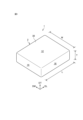
- FIG. 1 is a perspective view of an inductor according to an embodiment of the present invention, viewed from the upper surface side of the body.
- FIG. 2 is a perspective view of the inductor as viewed from the bottom side of the element body.
- FIG. 3 is a perspective view showing the internal configuration of an inductor.
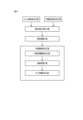
- FIG. 4 is a schematic diagram of a manufacturing process for an inductor.
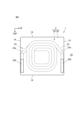
- FIG. 5 is a perspective view of the inductor as viewed from a direction perpendicular to the bottom surface of the element body.
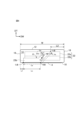
- FIG. 6 is a perspective view of an inductor viewed from a direction perpendicular to an end face of the element body.
- FIG. 7 is a diagram showing the relationship between the pull-out angle ⁇ of the pull-out portion pulled out from the winding portion and the evaluation index Ei for the electrical characteristics.
- FIG. 8 is a diagram showing the relationship between the ratio Ra of the length of the electrode connection region to the length of the lead-out portion and the evaluation index Ei.
- Fig. 1 is a perspective view of an inductor 1 according to this embodiment as viewed from a top surface 12 side
- Fig. 2 is a perspective view of the inductor 1 as viewed from a bottom surface 10 side.
- the bottom surface 10 and the top surface 12 are two opposing main surfaces of an element body 2.
- the inductor 1 of this embodiment is configured as a surface-mount type electronic component, and includes a base body 2 having a substantially rectangular parallelepiped shape, which is one form of a substantially hexahedral shape, and a pair of external electrodes 4 provided on the surface of the base body 2.
- one main surface that is the mounting surface that faces a mounting board (not shown) during mounting is defined as the bottom surface 10, and the other main surface that faces the bottom surface 10 is defined as the top surface 12.
- a pair of outer surfaces that are perpendicular to the bottom surface 10 are defined as the end surfaces 14, and a pair of outer surfaces that are perpendicular to the bottom surface 10 and the pair of end surfaces 14 are defined as the side surfaces 16.
- the pair of end surfaces 14 are disposed opposite each other.
- the pair of side surfaces 16 are disposed opposite each other.
- the bottom surface 10, top surface 12, end surfaces 14, and side surfaces 16 each have an approximately rectangular shape.
- the distance from the bottom surface 10 to the top surface 12 is defined as the thickness T of the element body 2
- the distance between the pair of side surfaces 16 is defined as the width W of the element body 2
- the distance between the pair of end surfaces 14 is defined as the length L of the element body 2.
- the direction of the thickness T is defined as the thickness direction DT
- the direction of the width W is defined as the width direction DW
- the direction of the length distance is defined as the length direction DL. That is, the bottom surface 10 and the top surface 12 are aligned along the width direction DW and the length direction DL, the end surfaces 14 are aligned along the width direction DW and the thickness direction DT, and the side surfaces 16 are aligned along the length direction DL and the thickness direction DT.
- the end surfaces 14 are adjacent to the bottom surface 10, the top surface 12, and the pair of side surfaces 16.
- the side surfaces 16 are adjacent to the bottom surface 10, the top surface 12, and the pair of end surfaces 14.
- the nominal size of the inductor 1 as a finished product is, for example, a length L dimension of 1.4 mm, a width W dimension of 1.2 mm, and a thickness T dimension of 0.65 mm.
- the plane along the DL direction and DT direction will be referred to as the LT plane
- the plane along the DT direction and DW direction will be referred to as the TW plane
- the plane along the DL direction and DW direction will be referred to as the LW plane.
- the cross sections of inductor 1 along the LT plane, TW plane, and LW plane will be referred to as the LT cross section, TW cross section, and LW cross section, respectively.
- FIG. 3 is a perspective view showing the internal configuration of the inductor 1.
- the element body 2 includes a coil conductor 20 and a substantially hexahedral core 30 in which the coil conductor 20 is embedded, and is configured as a molded inductor in which the coil conductor 20 is sealed in the core 30 .
- the core 30 is a molded body that is compression molded into an approximately hexahedral shape by applying pressure and heat to a mixed powder of magnetic particles (magnetic powder) and resin while containing the coil conductor 20.
- the magnetic particles of this embodiment are made of a soft magnetic material and contain two types of particles: first magnetic particles that are large particles with a relatively large average particle size, and second magnetic particles that are small particles with a relatively small average particle size.
- first magnetic particles that are large particles with a relatively large average particle size
- second magnetic particles that are small particles with a relatively small average particle size.
- the average particle size of the metal particles of the first magnetic particles is 20 ⁇ m or more and 28 ⁇ m or less
- the average particle size of the metal particles of the second magnetic particles is 1 ⁇ m or more and 6 ⁇ m or less.
- the average particle size of the first magnetic particles is preferably 21.4 ⁇ m or more and 27.4 ⁇ m or less
- the average particle size of the second magnetic particles is preferably 1.5 ⁇ m or more and 1.8 ⁇ m or less.
- the magnetic particles may contain particles with different average particle sizes from the first magnetic particles and the second magnetic particles, thereby containing particles of three or more different particle sizes.
- the first magnetic particles and the second magnetic particles are both particles having a metal particle, an oxide film covering the surface of the metal particle, and an insulating film covering the surface of the oxide film.
- Fe-Si-B amorphous alloy powder is used as the metal particle.
- the oxide film of the first magnetic particle is composed of two layers, a SiO layer and an Fe 2 SiO 4 layer, and the total thickness of the oxide film is 20 nm to 155 nm.
- the insulating film of the first magnetic particle is formed of phosphate glass with a thickness of 10 nm to 50 nm.
- the second magnetic particles of this embodiment carbonyl iron powder is used as the metal particles.
- the oxide film of the second magnetic particles is iron oxide formed by surface oxidizing the carbonyl iron powder, which is a metal particle.
- the insulating film of the second magnetic particles is a sol-gel reaction product containing silica as a component. This increases the slipperiness of the surface of the second magnetic particles, making it easier for the second magnetic particles to penetrate between the first magnetic particles during the element molding and hardening process of the element 2, which will be described later. As a result, the density of the magnetic material in the core 30 can be further increased, and the relative permeability of the core 30 can be further increased.
- the metal particles may be Fe-Si-Cr alloy powder, Fe-Ni-Al alloy powder, Fe-Cr-Al alloy powder, Fe-Si-Al alloy powder, Fe-Ni alloy powder, or Fe-Ni-Mo alloy powder.
- the insulating film may be made of phosphoric acid, zinc phosphate, manganese phosphate, glass, or resin.
- the resin material contained in the mixed powder of this embodiment includes bisphenol A type epoxy resin and rubber-modified epoxy resin. This makes it possible to manufacture an inductor 1 with improved both the strength and toughness of the element body 2.
- the magnetic powder contained in the mixed powder is such that the first magnetic particles are 70 wt% or more and 85 wt% or less, and the second magnetic particles are 15 wt% or more and 30 wt% or less, based on the total weight of the magnetic particles contained in the mixed powder.
- the resin contained in the mixed powder is 2.0 wt% or more and 3.5 wt% or less, based on the total weight of the magnetic powder and the resin.
- the first magnetic particles are preferably 70 wt% or more and 80 wt% or less, and the second magnetic particles are preferably 20 wt% or more and 30 wt% or less.
- the resin is preferably 2.7 wt% or more and 30 wt% or less.
- the coil conductor 20 includes a winding portion 22 in which a conductor wire is wound around a winding axis Q, and a pair of lead-out portions 23 drawn out from the winding portion 22.
- the winding portion 22 includes two winding regions 22a and 22b in which the conductor wire is wound in a spiral shape in two layers, one above the other, along the winding axis Q, and overlaps along the winding axis Q.
- the winding regions 22a and 22b are connected to each other at a portion of their inner circumferences. Both ends of the conductor wire are drawn out from the outer circumference of the winding portion 22 to form lead-out portions 23.
- Each lead-out portion 23 includes a lead-out region 23a extending from the winding portion 22 toward the bottom surface 10 of the element body 2, and an electrode connection region 23b, which is a conductor portion that connects to an external electrode 4 described below.
- the coil conductor 20 is embedded in the element body 2 so that the winding axis Q of the winding portion 22 is aligned with the thickness direction DT of the element body 2.
- the winding axis Q is perpendicular to the bottom surface 10 and the top surface 12, and extends in a direction along the end surface 14 and the side surface 16.
- the conductor constituting the coil conductor 20 is composed of a conductor and a coating layer formed on the surface of the conductor.
- the conductor is a flat wire with a rectangular cross section perpendicular to the longitudinal direction of the conductor, and has a wide surface formed by the side surface along one long side of the rectangular cross section.
- the conductor is wound so that the wide surface is parallel to the winding axis Q.
- the conductor is a strip conductor made of copper and has a rectangular cross section.
- the conductor has a thickness of 52 ⁇ m to 118 ⁇ m and a width of 110 ⁇ m to 180 ⁇ m.
- the coating layer is composed of an insulating layer formed on the surface of the strip conductor and a fusion layer formed on the surface of the insulating layer for bonding the overlapping strip conductors in the winding portion 22.
- the insulating layer is made of, for example, polyimide amide resin and has a thickness of 3 ⁇ m.
- the fusion layer is made of, for example, polyamide resin and has a thickness of 1 ⁇ m to 25 ⁇ m.
- the two lead portions 23 are each drawn out from the winding portion 22 to the bottom surface 10 and are electrically connected to the external electrode 4 via an electrode connection region 23 b exposed at the bottom surface 10 .
- the pair of external electrodes 4 are each formed on the bottom surface 10 of the element body 2.
- the external electrodes 4 are not limited to this, and may be so-called L-shaped electrodes constituted by L-shaped members extending from the bottom surface 10 to the adjacent end surface 14. Alternatively, the external electrode 4 may be a five-sided electrode extending from the bottom surface 10 through the adjacent end surface 14 and side surface 16 to the top surface 12.
- the external electrodes 4 are electrically connected to wiring on a circuit board by an appropriate mounting means such as solder.
- a side surface along one short side of a rectangle formed by a cross section perpendicular to the longitudinal direction of the conductor wire that is the coil conductor 20 is exposed from the element body 2, and the conductor of the conductor wire is connected to the external electrodes 4.
- an element protective layer (not shown) is formed on the surface of the element 2 excluding the area of the external electrodes 4.
- the element protective layer is, for example, a resin in which a phenoxy resin is added to a novolac resin, and contains nanosilica as a filler.
- the element protective layer is formed on the surface of the element 2 with a thickness of 10 ⁇ m or more and 30 ⁇ m or less.
- the thickness of the element protective layer is preferably 10 ⁇ m or more and 20 ⁇ m or less, and more preferably 15 ⁇ m or less.
- the inductor 1 configured as described above can improve the DC superposition characteristics by using a soft magnetic material for the magnetic particles, and is therefore used as an electronic component in electric circuits through which large currents flow, a choke coil in DC-DC converter circuits and power supply circuits, and is also used in electronic components for electronic devices such as personal computers, DVD players, digital cameras, TVs, mobile phones, smartphones, car electronics, and medical and industrial machinery.
- the uses of the inductor 1 are not limited to this, and it can also be used, for example, in tuning circuits, filter circuits, and rectifying and smoothing circuits.
- FIG. 4 is a schematic diagram showing a manufacturing process of the inductor 1. As shown in FIG. As shown in the figure, the manufacturing process of the inductor 1 includes a coil conductor forming step, a preform forming step, an element molding and hardening step, an element polishing step, and an external electrode forming step.
- the coil conductor forming process is a process for forming the coil conductor 20 from a conducting wire.
- the coil conductor 20 is formed into a shape having the winding portion 22 and pull-out portion 23 described above by winding the conducting wire in a manner known as "alpha winding."
- Alpha winding refers to a state in which the conducting wire, which functions as a conductor, is wound in two stages in a spiral shape so that the pull-out portions 23 at the start and end of the winding are located on the outer periphery. There is no particular limit to the number of turns in the coil conductor 20.
- the preform forming step is a step of forming a preform called a tablet.
- the preform is formed by pressing the above-mentioned mixed powder, which is the material of the base body 2, into a solid form that is easy to handle.
- two types of tablets are formed: a first tablet of an appropriate shape (e.g., E-type or T-type) in which the coil conductor 20 is arranged, and a second tablet of an appropriate shape (e.g., I-type or plate-shaped) in which the coil conductor 20 is sandwiched between the first tablet and the second tablet.
- the element molding and hardening process involves setting the first tablet, coil conductor, and second tablet in a molding die, applying heat while applying pressure in the overlapping direction of the first tablet and second tablet, and hardening them to integrate the first tablet, coil conductor, and second tablet. This results in the formation of the element 2 with the coil conductor 20 enclosed in the core 30.
- the element 2 obtained in this process may also be barrel polished to remove burrs and the like that have occurred on the element 2 and to chamfer the corners of the element 2.
- the element body polishing process is a process in which the side surface 16 of the element body 2 is polished and the width W of the element body 2 is adjusted.
- the element body polishing process the element body 2 is held on a plate-shaped member called a holding plate and is sandwiched from above and below between the upper and lower grinding wheels of the polishing machine. In this state, the polishing machine is operated and the upper and lower grinding wheels are rotated to polish the side surface of the element body 2.
- the external electrode formation process is a process for forming the external electrode 4 on the element body 2, and includes an element body protective layer formation process, a surface treatment process, and a plating layer formation process.
- the element protection layer formation process is a process in which the entire surface of element 2 is coated with insulating resin.
- the surface treatment process is a process of modifying the surface of the intended electrode location by irradiating the electrode location on the surface of the core 30 with laser light.
- the intended electrode location refers to the area on the surface of the core 30 where the external electrode 4 is to be formed, including the area where the electrode connection area 23b is exposed.
- the element body protection layer on the surface of the element body 2 and the coating layer on the electrode connection area 23b of the coil conductor 20 are removed in the intended electrode location area, the resin on the surface of the core 30 is removed, and the insulating film on the surface of the magnetic particles exposed from the core 30 is removed.
- the exposed area of the metal of the magnetic particles per unit area of the surface of the core 30 is larger in the intended electrode location on the surface of the core 30 than in other surface areas of the core 30.
- a cleaning process e.g., an etching process
- the plating layer formation process copper is barrel-plated onto the surface of the core 30 to form a copper plating layer at the intended electrode location irradiated with the laser light.
- the plating layer may be formed by providing a Ni plating layer and a Sn plating layer on top of the copper plating layer.
- inductor 1 of this embodiment will be described in further detail below.
- the terminal end surface of the tip of the conducting wire constituting the coil conductor is connected to an external electrode.
- the contact area between the external electrode and the coil conductor is limited by the size of the terminal end surface of the coil conductor, and the DC resistance value of the coil component is limited.
- the lead-out portion 23 drawn from the winding portion 22 toward the bottom surface 10 of the element body 2 has an electrode connection region 23b in which the side of the conductor is exposed to the bottom surface 10.
- the exposed side of the conductor in the electrode connection region 23b is connected to the external electrode 4.
- FIG. 5 is a plan view of the inductor 1 shown in FIG. 3 as viewed from the bottom surface 10 side.
- FIG. 6 is a side view of the inductor 1 shown in FIG. 5 as viewed from the end surface 14 on the left side of the figure, and shows an example of the configuration of the lead-out portion 23 drawn out from the winding region 22a on the top surface 12 side. Note that in order to simplify the drawing and make it easier to understand, the external electrode 4 is not shown in FIG. 5.
- the electrode connection regions 23b of each of the pair of pull-out portions 23 are exposed from the bottom surface 10 and are connected to the corresponding external electrodes 4.
- the pull-out section 23 connected to the winding region 22a has a pull-out region 23a that is pulled out from the winding section 22 by bending the outermost conductor of the winding region 22a toward the bottom surface 10.
- a part of the pull-out section 23 that is pulled out to the bottom surface 10 has the side of the flat rectangular conductor that constitutes the pull-out section 23 exposed from the bottom surface 10 and extends along the bottom surface 10, forming one electrode connection region 23b.
- the other pull-out portion 23 connected from the winding region 22b has a pull-out region 23a that is pulled out from the winding portion 22 by bending the outermost periphery of the winding region 22b toward the bottom surface 10, as described above.
- the side of the flat rectangular conductor that constitutes the pull-out portion 23 is exposed from the bottom surface 10 and extends along the bottom surface 10, forming another electrode connection region 23b.
- the side of the electrode connection area 23b exposed from the bottom surface 10 and connected to the external electrode 4 is a side along one short side of the rectangular cross section perpendicular to the longitudinal direction of the flat rectangular conductor that constitutes the lead-out portion 23, as shown in FIG. 3.
- the configuration shown in FIG. 3 has the advantage that the manufacturing process is not complicated because there is no need to twist the conductor wire when creating a coil composed of flatwise windings such as winding section 22. Furthermore, compared to a configuration in which a side surface (i.e., a wide surface) along one long side of a rectangle formed by a cross section perpendicular to the longitudinal direction of the conductor wire is connected to external electrode 4, the configuration in FIG. 3 can reduce the degree to which the magnetic flux generated along winding axis Q in winding section 22 is blocked by the conductor wire of pull-out section 23. As a result, inductor 1 can achieve good inductance characteristics.
- the inventor of the present invention conducted a simulation study on the relationship between the configuration of the pull-out portion 23, including the electrode connection region 23b, and the electrical characteristics of the inductor 1.
- the pull-out angle ⁇ which is the angle between the extension direction in which the outermost conductor of the winding portion 22 extends toward the pull-out portion 23 and the extension direction of the pull-out region 23a of the pull-out portion 23 that is pulled out from the winding portion 22 toward the bottom surface 10
- the pull-out angle ⁇ is defined as the angle of curvature between a first extension direction Va in which the outermost conductor of the winding portion 22 extends toward the pull-out portion 23, and a second extension direction Vb in which the pull-out region 23a of the pull-out portion 23 extends from the first extension direction Va toward the bottom surface 10.
- the pull-out angle ⁇ can be measured as the angle ( ⁇ a shown in FIG. 6 ) between a surface Sa formed by the contour of the winding portion 22 and located on the side of the top surface 12 of the element body 2, and the side of the conductor constituting the pull-out region 23a of the pull-out portion 23, located on the side of the top surface 12 of the element body 2.
- the length Lp of the pull-out portion 23 is defined as the length that extends from point A, which is the intersection point between the surface Sa of the winding portion 22 and a line segment along the extending direction of the side surface of the pull-out region 23a on the bottom surface 10 side, through point B, which is the position on the bottom surface 10 side where the pull-out region 23a and the electrode connection region 23b are connected, to point C, which is the termination point on the bottom surface 10 of the pull-out portion 23.
- the length Lc of the electrode connection region 23b is the length measured along the side surface of the pull-out portion 23 on the bottom surface 10 side, and can be defined as the length of the portion exposed from the surface of the bottom surface 10 (i.e., the length from point B to point C).
- the element body 2 used in the simulation was created as follows.
- the metal magnetic powder used was a mixture of Fe-Si-Cr alloy powder as the first magnetic particles and carbonyl iron powder as the second magnetic particles.
- the metal magnetic powder of the embodiment had an average particle size of 25.3 ⁇ m for the first magnetic particles and an average particle size of 1.7 ⁇ m for the second magnetic particles.
- the resin of the embodiment contained bisphenol A type epoxy resin and rubber modified epoxy resin, which accounted for 2.7 wt % of the mixed powder.
- the mixed powder had a relative permeability of 34 and a saturation magnetic flux density of 1.36 T.
- the relative permeability was measured using a BH analyzer and an impedance material analyzer, using a high-frequency signal with a frequency of 1 MHz.
- the saturation magnetic flux density was measured by measuring the inductance change during superposition using an LCR meter and a DC power source, and the BH data was back-calculated to determine the value at which the magnetic flux was saturated as the saturation magnetic flux density of the mixed powder.
- the wire used for the coil conductor 20 is a flat wire with a substantially rectangular cross section perpendicular to the longitudinal direction of the wire, and the dimensions of the rectangular cross section are 0.128 mm by 0.083 mm in length and width, respectively.
- the coil conductor 20 is formed in a shape having a winding portion 22 formed in two stages of alpha winding, and a pull-out portion 23.
- the winding portion 22 is formed by winding the wire in a spiral shape along the winding axis Q in two stages of alpha winding, one above the other.
- the pull-out angle ⁇ of the pull-out portion 23 pulled out from the outer periphery of the winding portion 22 is 90 degrees.
- index Ei increases with increasing pull-out angle ⁇ in the range where the pull-out angle ⁇ is 90 degrees or less.
- Index Ei peaks when the pull-out angle ⁇ is 90 degrees, and decreases as the pull-out angle ⁇ increases beyond 90 degrees.
- the increase in index Ei in the range where the pull-out angle ⁇ is 90 degrees or less is due to the increase in the length of electrode connection region 23b and the decrease in DC resistance Rdc as the pull-out angle ⁇ increases.
- the index Ei decreases in the region where the pull-out angle ⁇ exceeds 90 degrees because, when the pull-out angle ⁇ exceeds 90 degrees, the position of the pull-out portion is rewound from the circumferential direction of the winding portion, and the direction of the current flowing in the pull-out portion 23 becomes opposite to the direction of the current in the conductor of the winding portion 22 connected to the pull-out portion, and because the volume of the magnetic core 30 in the base body 2 decreases by the amount that the length of the electrode connection region 23b increases, thereby reducing the inductance Li and the DC superimposed current Isat. Therefore, based on the results shown in FIG. 7, it is preferable that the extraction angle ⁇ is 90 degrees or less.
- the inductor 1 is used, for example, as a power inductor for a DC-DC converter circuit, which requires particularly small DC resistance and large DC superposition current, from the viewpoint of maintaining the power efficiency of the DC-DC converter circuit at a level that does not pose any practical problems, it is preferable that the index Ei be equal to or greater than 0.0662 (the level shown by the dotted line in Figure 7). Therefore, from FIG. 7, the pull-out angle ⁇ is more preferably 30 degrees or more and 90 degrees or less.
- Table 1 shows the results of a simulation of the index Ei when the ratio Ra is changed while the extraction angle ⁇ is fixed.
- the extraction angle ⁇ and the distance L1 were fixed at 90 degrees and 100 ⁇ m, respectively, similar to the above-mentioned sample, and the distance L2 was increased from W/3 (i.e., the starting point A was moved to the left in FIG. 6 ) to change the length Lc of the electrode connection region 23b, thereby changing the ratio Ra.
- Table 2 shows the simulation results of the index Ei when the distances L1 and L2 are fixed and the pull-out angle ⁇ is changed.
- the distances L1 and L2 were set to 100 ⁇ m and W/3, respectively, as in the above-mentioned sample.
- Figure 8 is a plot of the relationship between the ratio Ra and the index Ei based on the results shown in Tables 1 and 2.
- the horizontal axis is the ratio Ra
- the vertical axis is the index Ei.
- graphs G1 and G2 are graphs that plot the results of Tables 1 and 2, respectively.
- the state where the ratio Ra shown on the horizontal axis is 0.58 corresponds to the state where the pull-out angle ⁇ , the distances L1 and L2 are 90 degrees, 100 ⁇ m and W/3, respectively, which are the same as those of the above-mentioned sample.
- the level of the lower limit value 0.0662 of the index Ei when the inductor 1 is assumed to be used as a power inductor in a DC-DC converter circuit is indicated by a dashed dotted line.
- the length of the electrode connection region 23b increases as the ratio Ra increases, so as shown in FIG. 8, the index Ei increases as the ratio Ra increases. From the results shown in FIG. 8, it can be seen that the ratio Ra is preferably in the range of 0.25 or more and 0.58 or less, which is suitable for use as a power inductor in a DC-DC converter circuit and ensures a practical level of mechanical strength for the element body 2.
- (Configuration 2) An inductor described in configuration 1, wherein an extract angle, which is the angle between a surface formed by the contour of the winding portion, which is on the side of the other main surface facing the one main surface of the body, and a side of the conductor constituting the extract region, on the side of the other main surface, is 90 degrees or less.
- the inductor of configuration 2 can achieve well-balanced and excellent electrical characteristics in terms of inductance, DC superimposition current, and DC resistance.
- (Configuration 4) The inductor according to any one of configurations 1 to 3, wherein a ratio of a length of the electrode connection region to a length of the lead-out portion is not less than 0.25 and not more than 0.58.
- the wall thickness of the element body between the end of the electrode connection region and the outer surface of the element body can be ensured, thereby maintaining the mechanical strength of the element body at a practical level, while also achieving electrical characteristics that are suitable for use as a power inductor in a DC-DC converter circuit.
Landscapes
- Engineering & Computer Science (AREA)
- Power Engineering (AREA)
- Coils Or Transformers For Communication (AREA)
Priority Applications (2)
| Application Number | Priority Date | Filing Date | Title |
|---|---|---|---|
| CN202480033681.3A CN121153091A (zh) | 2023-08-24 | 2024-05-21 | 电感器 |
| JP2025541306A JPWO2025041397A1 (https=) | 2023-08-24 | 2024-05-21 |
Applications Claiming Priority (2)
| Application Number | Priority Date | Filing Date | Title |
|---|---|---|---|
| JP2023136388 | 2023-08-24 | ||
| JP2023-136388 | 2023-08-24 |
Publications (1)
| Publication Number | Publication Date |
|---|---|
| WO2025041397A1 true WO2025041397A1 (ja) | 2025-02-27 |
Family
ID=94731573
Family Applications (1)
| Application Number | Title | Priority Date | Filing Date |
|---|---|---|---|
| PCT/JP2024/018711 Pending WO2025041397A1 (ja) | 2023-08-24 | 2024-05-21 | インダクタ |
Country Status (3)
| Country | Link |
|---|---|
| JP (1) | JPWO2025041397A1 (https=) |
| CN (1) | CN121153091A (https=) |
| WO (1) | WO2025041397A1 (https=) |
Citations (2)
| Publication number | Priority date | Publication date | Assignee | Title |
|---|---|---|---|---|
| JP2015225887A (ja) * | 2014-05-26 | 2015-12-14 | 太陽誘電株式会社 | コイル部品及び電子機器 |
| JP2021111769A (ja) * | 2020-01-15 | 2021-08-02 | 株式会社村田製作所 | インダクタ |
-
2024
- 2024-05-21 CN CN202480033681.3A patent/CN121153091A/zh active Pending
- 2024-05-21 JP JP2025541306A patent/JPWO2025041397A1/ja active Pending
- 2024-05-21 WO PCT/JP2024/018711 patent/WO2025041397A1/ja active Pending
Patent Citations (2)
| Publication number | Priority date | Publication date | Assignee | Title |
|---|---|---|---|---|
| JP2015225887A (ja) * | 2014-05-26 | 2015-12-14 | 太陽誘電株式会社 | コイル部品及び電子機器 |
| JP2021111769A (ja) * | 2020-01-15 | 2021-08-02 | 株式会社村田製作所 | インダクタ |
Also Published As
| Publication number | Publication date |
|---|---|
| JPWO2025041397A1 (https=) | 2025-02-27 |
| CN121153091A (zh) | 2025-12-16 |
Similar Documents
| Publication | Publication Date | Title |
|---|---|---|
| US11309117B2 (en) | Inductive element and manufacturing method | |
| CN106158246A (zh) | 具有高饱和电流与低磁芯损耗的磁性装置 | |
| TW201837929A (zh) | 線圈零件 | |
| KR101761944B1 (ko) | 권선형 인덕터 | |
| KR20180025592A (ko) | 코일 부품 | |
| TWI622067B (zh) | Coil component | |
| JP7800489B2 (ja) | インダクタ | |
| JP6776793B2 (ja) | コイル部品 | |
| JP2023136455A (ja) | コイル部品、回路基板、電子機器およびコイル部品の製造方法 | |
| WO2025041397A1 (ja) | インダクタ | |
| KR20160134633A (ko) | 권선형 인덕터 및 그 제조 방법 | |
| JP5079316B2 (ja) | インダクタンス素子 | |
| JP2024056370A (ja) | インダクタ | |
| JP7643429B2 (ja) | インダクタ | |
| KR101334653B1 (ko) | 복합 자성 코아 및 그 제조방법 | |
| JP7735992B2 (ja) | インダクタの製造方法 | |
| TW201814740A (zh) | 線圈部件 | |
| JP7729306B2 (ja) | インダクタ | |
| JP7729305B2 (ja) | インダクタ | |
| US20240120139A1 (en) | Inductor | |
| JP2025175751A (ja) | インダクタおよびインダクタの製造方法 | |
| JP2024056377A (ja) | インダクタ | |
| JP7740169B2 (ja) | インダクタ | |
| WO2026083660A1 (ja) | インダクタおよびインダクタの製造方法 | |
| JP2024056369A (ja) | インダクタ |
Legal Events
| Date | Code | Title | Description |
|---|---|---|---|
| 121 | Ep: the epo has been informed by wipo that ep was designated in this application |
Ref document number: 24856092 Country of ref document: EP Kind code of ref document: A1 |
|
| ENP | Entry into the national phase |
Ref document number: 2025541306 Country of ref document: JP Kind code of ref document: A |
|
| WWE | Wipo information: entry into national phase |
Ref document number: 2025541306 Country of ref document: JP |
|
| NENP | Non-entry into the national phase |
Ref country code: DE |