WO2025041277A1 - Dispositif et procédé de traitement d'informations - Google Patents
Dispositif et procédé de traitement d'informations Download PDFInfo
- Publication number
- WO2025041277A1 WO2025041277A1 PCT/JP2023/030191 JP2023030191W WO2025041277A1 WO 2025041277 A1 WO2025041277 A1 WO 2025041277A1 JP 2023030191 W JP2023030191 W JP 2023030191W WO 2025041277 A1 WO2025041277 A1 WO 2025041277A1
- Authority
- WO
- WIPO (PCT)
- Prior art keywords
- information
- message
- messages
- sent
- members
- Prior art date
- Legal status (The legal status is an assumption and is not a legal conclusion. Google has not performed a legal analysis and makes no representation as to the accuracy of the status listed.)
- Ceased
Links
Images



Classifications
-
- G—PHYSICS
- G06—COMPUTING OR CALCULATING; COUNTING
- G06F—ELECTRIC DIGITAL DATA PROCESSING
- G06F16/00—Information retrieval; Database structures therefor; File system structures therefor
- G06F16/90—Details of database functions independent of the retrieved data types
- G06F16/904—Browsing; Visualisation therefor
Definitions
- An embodiment of the present invention relates to an information processing device and method.
- a company's operations are made up of elements such as employees, facilities, and business processes. Operations are designed to suit the industry, business sector, and business model, and are improved daily. In particular, employees are an organic function that is important in operations, and they flexibly support uncertain and complex operations through an organizational structure.
- a “team” refers to a group of two or more people who work together or cooperate to achieve a shared goal or obtain value while dividing up roles, and the people (personnel) who belong to an organization are called “members.”
- An organization functions as a collection of multiple teams, and it is important to properly understand the formation status of these teams in accordance with the business situation, and to design and improve their operation.
- Non-Patent Document 4 discloses that business card-type sensor nodes are used to measure the amount of communication and behavior within a team, and an organizational network is constructed based on communication.
- Non-Patent Document 5 discloses a method for analyzing communication trends and relationships with groups by creating a graph structure of the spread and convergence of comments based on quotations, mention information, and contextual information between comments made in group chats, and then using information on the in-degree and out-degree of the graph structure to analyze communication trends and relationships with groups.
- Communication between team members involves interactions between members regarding (1) the messages and the addresses of members within the messages, (2) reactions to messages, and (3) relationships between messages.
- the method disclosed in the above-mentioned non-patent document 4 only deals with the relationship of face-to-face actions between members using a business card-type sensor, and is unable to handle the above-mentioned interactive relationships of the member's address in a message, the reaction to the message, and the relationship between messages, and is therefore unable to analyze these structural features.
- the method disclosed in the above-mentioned non-patent document 5 creates a graph structure of the spread and convergence of comments based on quotations and mention information regarding the content of comments made in a group chat, and information on the context between comments, but it cannot handle replies or reactions from other members to messages.
- This invention was made in light of the above-mentioned circumstances, and its purpose is to provide an information processing device and method that can generate information in which interaction relationships based on messages between members are structured.
- An information processing device includes a conversion unit that converts messages sent between multiple personnel into information that structures the interaction relationships between the multiple personnel, based on information about the sender of the message sent between the multiple personnel and information about the destination of the message sent.
- An information processing method is a method performed by an information processing device, and includes converting a message sent between each of a plurality of personnel into information in which the interaction relationships between the plurality of personnel are structured, based on information on the sender of the message sent between the plurality of personnel and information on the destination of the message sent, by a conversion unit of the information processing device.
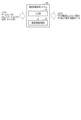
- FIG. 1 is a diagram showing an application example of a structural information acquisition system according to an embodiment of the present invention.
- FIG. 2 is a diagram showing an example of the result of conversion from the communication log to a graph structure of the interaction relationships between members.
- FIG. 3 is a diagram for explaining an example of a rule for expressing a graph structure of interaction relationships between members.
- FIG. 4 is a diagram showing an example of various types of information in a message.
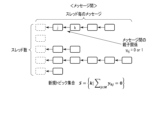
- FIG. 5 is a diagram showing an example of various types of information between messages.
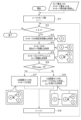
- FIG. 6 is a flowchart showing an example of a processing procedure for converting a communication log on a thread into a graph structure of interaction relationships between members.
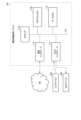
- Figure 7 is a block diagram showing an example of the hardware configuration of a structural information acquisition system according to one embodiment of the present invention.
- a structural information acquisition system converts a communication log between members of a team, such as the contents of voice or chat, into information in which interaction relations between members regarding (1) messages and member destinations within messages, (2) reactions to messages, and (3) relationships between messages are structured as a graph (sometimes referred to as a graph structure of interaction relations, etc.).
- This information is information in which interaction relations regarding actions performed by each of a plurality of members are structured.
- FIG. 1 is a diagram showing an application example of a structural information acquisition system according to an embodiment of the present invention.
- a structural information acquisition system (structural information acquisition device) 100 includes an input unit 10 and a structural information conversion unit 20 .
- the input unit 10 of the structural information acquisition system 100 inputs a communication log between members belonging to a team.
- Fig. 2 is a diagram showing an example of a result of conversion from a communication log to a graph structure of interaction relationships between members
- Fig. 3 is a diagram for explaining an example of an expression rule for the graph structure of interaction relationships between members.
- the structural information conversion unit 20 of the structural information acquisition system 100 converts the communication log input by the input unit 10 into information showing a graph structure of the interaction relationships between members as shown in Fig. 2, and outputs this to, for example, a display device (not shown). That is, the structural information conversion unit 20 converts messages sent between each of the multiple members into information in which the interaction relationships between the multiple members are structured, based on the information of the sender of the message sent between the multiple members and the information of the destination of the message.
- the conversion results by the structural information acquisition system 100 may include (1) the message of the new topic, which is the first message, and (2) the messages of each thread, which are messages at a lower level than the message of the new topic, that is, messages that correspond to children in a parent-child relationship.
- the results of this conversion include (1) a message with a mention from one member to another member, (2) a reaction from one member to another member, e.g., a message with a stamp-like mark, and (3) the relationship of messages from other members to messages sent from one member.
- the above-mentioned messages with mentions and reactions are structured information about the relationships within messages between members, and the above-mentioned message relationships are structured information about the parent-child relationships between messages.
- the structural information conversion unit 20 acquires the following pieces of information (1), (2), and (3) contained in the communication log input by the input unit 10.
- Member i ⁇ set N of members (2) A message set k from a member ⁇ a message set M (3)
- Parent-child relationships between multiple messages y kj The above parent-child relationship is the relationship when the parent message is message j and the child message is message k.
- the structural information conversion unit 20 acquires the following information (1) to (4) from the acquired information.
- ⁇ j ⁇ M y kj 0 ⁇ )
- FIG. 4 is a diagram showing an example of various types of information in a message.
- the sender of message k is "member A”
- the destination members of message k are “member B”, “member C”, and “member D”
- the member who reacted to message k is "member D”.
- FIG. 5 is a diagram showing an example of various types of information between messages. 5 shows (1) multiple threads, each of which is a collection of messages starting from a new topic message, (2) each message in each thread, and (3) messages j and k in the thread, which have a parent-child relationship. As shown above, message j is the parent message of message k.
- FIG. 6 is a flowchart showing an example of a processing procedure for converting a communication log on a thread into a graph structure of interaction relationships between members.
- the structural information conversion unit 20 takes as input information (1) a set N of members i ⁇ members, (2) a set M of messages k ⁇ messages from members, and (3) a parent-child relationship ykj between multiple messages, which are contained in the communication log input by the input unit 10, and assigns the number of acquired messages to variable m and 1 to variable k (S11).
- the structural information conversion unit 20 acquires information on the sender Hk of the message k from the input information (S13). In this embodiment, it is assumed that the information on the sender Hk of the message k is inherent in the input information.
- the structural information conversion unit 20 acquires information on the destination member Vk of the message k sent from the sender Hk when the input information includes this information (S14). In this embodiment, it is assumed that the input information includes information on the destination member Vk of the message k. When the relevant information is not included, acquisition in S14 is not performed.
- the structural information conversion unit 20 acquires information on a member R k who reacted to a message k sent by a message sender H k when the information is included in the input information (S15).
- the information on the member R k is inherent in the input information.
- acquisition in S15 is not performed.
- the structural information conversion unit 20 determines that message k is a message of a new topic (S17).
- the structural information conversion unit 20 determines that message k is not a new topic message, and obtains message j from the input information, which is a message related to message k and was generated earlier than the generation of message k, that is, a so-called parent message (S18).
- the structural information conversion unit 20 updates the variable k by incrementing it by 1 (S19), and returns to S12.
- the currently set value of k is no longer equal to or less than the value of m (No in S12)
- the series of processes by the structural information conversion unit 20 ends.
- FIG. 7 is a block diagram showing an example of a hardware configuration of a structural information acquisition system 100 according to an embodiment of the present invention.
- the structural information acquisition system 100 is configured, for example, by a server computer or a personal computer, and has a hardware processor 111A such as a CPU.
- a program memory 111B, a data memory 112, an input/output interface 113, and a communication interface 114 are connected to the hardware processor 111A via a bus 115.
- the communication interface 114 includes, for example, one or more wireless communication interface units, and enables the transmission and reception of information to and from a communication network NW.
- a wireless interface for example, an interface that adopts a low-power wireless data communication standard such as a wireless LAN (Local Area Network) is used.
- An input device 300 and an output device 400 that are attached to the structural information acquisition system 100 and are used by a user or the like are connected to the input/output interface 113 .
- the input/output interface 113 takes in operation data input by a user or the like through an input device 300 such as a keyboard, a touch panel, a touchpad, a mouse, or the like, and outputs output data to an output device 400 including a display device using liquid crystal or organic EL (Electro Luminescence), etc., for display.
- the input device 300 and the output device 400 may be devices built into the structural information acquisition system 100, or may be input devices and output devices of other information terminals that can communicate with the structural information acquisition system 100 via the network NW.
- the program memory 111B is a non-transient tangible storage medium that combines a non-volatile memory such as a HDD (Hard Disk Drive) or SSD (Solid State Drive) that can be written to and read from at any time, with a non-volatile memory such as a ROM (Read Only Memory), and stores the programs necessary to execute various control processes, etc. according to one embodiment.
- a non-volatile memory such as a HDD (Hard Disk Drive) or SSD (Solid State Drive) that can be written to and read from at any time
- a non-volatile memory such as a ROM (Read Only Memory)
- ROM Read Only Memory
- the data memory 112 is a tangible storage medium that combines, for example, the above-mentioned non-volatile memory with a volatile memory such as RAM (Random Access Memory), and is used to store various data acquired and created during various processing steps.
- RAM Random Access Memory
- the structural information acquisition system 100 can be configured as a data processing system or information processing device having a software-based processing function.
- the storage system used as a work memory or the like by the structural information acquisition system 100 can be configured by using the data memory 112 shown in Fig. 7.
- these configured storage areas are not essential components within the structural information acquisition system 100, and may be areas provided in a storage system such as an external storage medium such as a Universal Serial Bus (USB) memory, or a database server located in the cloud.
- USB Universal Serial Bus
- the above processing function unit can be realized by having the above hardware processor 111A read and execute a program stored in the program memory 111B. Note that this processing function unit may also be realized in a variety of other forms, including integrated circuits such as application specific integrated circuits (ASICs (Application Specific Integrated Circuits) or FPGAs (Field-Programmable Gate Arrays)).
- ASICs Application Specific Integrated Circuits
- FPGAs Field-Programmable Gate Arrays
- the methods described in each embodiment can be stored as a program (software means) that can be executed by a computer on a recording medium such as a magnetic disk (floppy disk, hard disk, etc.), optical disk (CD-ROM, DVD, MO, etc.), semiconductor memory (ROM, RAM, flash memory, etc.), and can be distributed by transmitting it via a communication medium.
- the programs stored on the medium also include a setting program that configures the software means (including not only execution programs but also tables and data structures) that the computer executes.
- the computer that realizes this device reads the program recorded on the recording medium, and in some cases configures the software means using the setting program, and executes the above-mentioned processing by having the operation controlled by this software means.
- the recording medium referred to in this specification is not limited to a recording medium for distribution, but also includes storage media such as a magnetic disk or semiconductor memory installed inside the computer or in a device connected via a network.
- the present invention is not limited to the above-described embodiments, and can be modified in various ways during implementation without departing from the gist of the invention.
- the embodiments may also be implemented in appropriate combination, in which case the combined effects can be obtained.
- the above-described embodiments include various inventions, and various inventions can be extracted by combinations selected from the multiple constituent elements disclosed. For example, if the problem can be solved and an effect can be obtained even if some constituent elements are deleted from all the constituent elements shown in the embodiments, the configuration from which these constituent elements are deleted can be extracted as an invention.
Landscapes
- Engineering & Computer Science (AREA)
- Databases & Information Systems (AREA)
- Theoretical Computer Science (AREA)
- Data Mining & Analysis (AREA)
- Physics & Mathematics (AREA)
- General Engineering & Computer Science (AREA)
- General Physics & Mathematics (AREA)
- Information Transfer Between Computers (AREA)
Abstract
Un dispositif de traitement d'informations selon un mode de réalisation comprend une unité de conversion qui, sur la base d'informations concernant le locuteur d'un message envoyé entre une pluralité de personnes et d'informations concernant la destination du message envoyé, convertit le message envoyé à chaque personne de la pluralité de personnes en informations dans lesquelles une relation d'interaction entre la pluralité de personnes est structurée.
Priority Applications (1)
| Application Number | Priority Date | Filing Date | Title |
|---|---|---|---|
| PCT/JP2023/030191 WO2025041277A1 (fr) | 2023-08-22 | 2023-08-22 | Dispositif et procédé de traitement d'informations |
Applications Claiming Priority (1)
| Application Number | Priority Date | Filing Date | Title |
|---|---|---|---|
| PCT/JP2023/030191 WO2025041277A1 (fr) | 2023-08-22 | 2023-08-22 | Dispositif et procédé de traitement d'informations |
Publications (1)
| Publication Number | Publication Date |
|---|---|
| WO2025041277A1 true WO2025041277A1 (fr) | 2025-02-27 |
Family
ID=94731536
Family Applications (1)
| Application Number | Title | Priority Date | Filing Date |
|---|---|---|---|
| PCT/JP2023/030191 Ceased WO2025041277A1 (fr) | 2023-08-22 | 2023-08-22 | Dispositif et procédé de traitement d'informations |
Country Status (1)
| Country | Link |
|---|---|
| WO (1) | WO2025041277A1 (fr) |
Citations (2)
| Publication number | Priority date | Publication date | Assignee | Title |
|---|---|---|---|---|
| US8346864B1 (en) * | 2006-12-13 | 2013-01-01 | Qurio Holdings, Inc. | Systems and methods for social network based conferencing |
| US20190121866A1 (en) * | 2017-10-25 | 2019-04-25 | Facebook, Inc. | Generating a relevance score for direct digital messages based on crowdsourced information and social-network signals |
-
2023
- 2023-08-22 WO PCT/JP2023/030191 patent/WO2025041277A1/fr not_active Ceased
Patent Citations (2)
| Publication number | Priority date | Publication date | Assignee | Title |
|---|---|---|---|---|
| US8346864B1 (en) * | 2006-12-13 | 2013-01-01 | Qurio Holdings, Inc. | Systems and methods for social network based conferencing |
| US20190121866A1 (en) * | 2017-10-25 | 2019-04-25 | Facebook, Inc. | Generating a relevance score for direct digital messages based on crowdsourced information and social-network signals |
Similar Documents
| Publication | Publication Date | Title |
|---|---|---|
| O’Leary | Evolving information systems and technology research issues for COVID-19 and other pandemics | |
| Karsai et al. | Bursty human dynamics | |
| Monks et al. | Strengthening the reporting of empirical simulation studies: Introducing the STRESS guidelines | |
| Kumar et al. | Cloud computing and its implications for construction IT | |
| US11386379B2 (en) | Method, apparatus, and computer program product for low latency serving of interactive enterprise analytics within an enterprise group-based communication system | |
| Lew et al. | Trans-specialization understanding in international technology alliances: The influence of cultural distance | |
| US11706173B2 (en) | Method, apparatus and computer program product for metadata search in a group-based communication platform | |
| US20140257892A1 (en) | Social project collaboration through self-organizing teams | |
| CN104011753A (zh) | 电子邮件标签 | |
| Grajeda et al. | Experience constructing the artifact genome project (agp): managing the domain's knowledge one artifact at a time | |
| JP2020057067A (ja) | チャット分析装置、チャット分析方法、及びプログラム | |
| US9939994B2 (en) | Tracking and managing items in a collaborative exchange | |
| US10992488B2 (en) | System and method for an enhanced focus group platform for a plurality of user devices in an online communication environment | |
| Kumari et al. | The modern technology has disrupted today's world: an analytical review of how technology affected quality of human interaction | |
| US11636260B2 (en) | Methods, apparatuses and computer program products for formatting messages in a messaging user interface within a group-based communication system | |
| Nesmachnow et al. | Scheduling in heterogeneous computing and grid environments using a parallel CHC evolutionary algorithm | |
| Hansen et al. | Social network analysis in hci | |
| Darch | When scientists become social scientists: How citizen science projects learn about volunteers | |
| Makhubu et al. | The effectiveness of Twitter as a tertiary education stakeholder communication tool: A case of# FeesMustFall in South Africa | |
| Pozin et al. | An ability of Whatsapp usage in industrialised building system (IBS) construction project | |
| Manjarrez et al. | Industry interactions in innovation systems: A bibliometric study | |
| US10318873B2 (en) | System and method for determining an expert of a subject on a web-based platform | |
| Mabweazara et al. | Researching the fluid and multisited appropriations of digital technologies in African newsrooms | |
| Mergel | Introducing open collaboration in the public sector: The case of social coding on GitHub | |
| Hale et al. | Ecological theory of mutualism: Qualitative patterns in two-species population models |
Legal Events
| Date | Code | Title | Description |
|---|---|---|---|
| 121 | Ep: the epo has been informed by wipo that ep was designated in this application |
Ref document number: 23949738 Country of ref document: EP Kind code of ref document: A1 |
|
| NENP | Non-entry into the national phase |
Ref country code: DE |