WO2025041276A1 - Dispositif et procédé de traitement d'informations - Google Patents
Dispositif et procédé de traitement d'informations Download PDFInfo
- Publication number
- WO2025041276A1 WO2025041276A1 PCT/JP2023/030190 JP2023030190W WO2025041276A1 WO 2025041276 A1 WO2025041276 A1 WO 2025041276A1 JP 2023030190 W JP2023030190 W JP 2023030190W WO 2025041276 A1 WO2025041276 A1 WO 2025041276A1
- Authority
- WO
- WIPO (PCT)
- Prior art keywords
- assigned
- role
- members
- roles
- strength
- Prior art date
- Legal status (The legal status is an assumption and is not a legal conclusion. Google has not performed a legal analysis and makes no representation as to the accuracy of the status listed.)
- Pending
Links
Images



Classifications
-
- G—PHYSICS
- G06—COMPUTING OR CALCULATING; COUNTING
- G06Q—INFORMATION AND COMMUNICATION TECHNOLOGY [ICT] SPECIALLY ADAPTED FOR ADMINISTRATIVE, COMMERCIAL, FINANCIAL, MANAGERIAL OR SUPERVISORY PURPOSES; SYSTEMS OR METHODS SPECIALLY ADAPTED FOR ADMINISTRATIVE, COMMERCIAL, FINANCIAL, MANAGERIAL OR SUPERVISORY PURPOSES, NOT OTHERWISE PROVIDED FOR
- G06Q10/00—Administration; Management
- G06Q10/10—Office automation; Time management
Definitions
- An embodiment of the present invention relates to an information processing device and method.
- a company's operations are made up of elements such as employees, facilities, and business processes. Operations are designed to suit the industry, business sector, and business model, and are improved daily. In particular, employees are an organic function that is important in operations, and they flexibly support uncertain and complex operations through an organizational structure.
- a “team” refers to a group of two or more people who work together or cooperate to achieve a shared goal or obtain value while dividing up roles, and the people (personnel) who belong to the team are called “members.”
- An organization functions as a collection of multiple teams, and it is important to properly understand the state of the formation of these teams in accordance with the business situation, and to design and improve their operation.
- Non-Patent Document 1 discloses a method for diagnosing a team based on the members' subjective evaluation of team formation.
- This invention was made in light of the above-mentioned circumstances, and its purpose is to provide an information processing device and method that can appropriately determine the interaction relationships between personnel who have been assigned roles.
- An information processing device includes a calculation unit that calculates a value indicating at least one of the strength of the interaction relationship between members assigned the same role and the strength of the interaction relationship between members assigned different roles, based on information regarding the degree of contribution between a first member, who is assigned any of multiple roles, and a second member, who is assigned any of multiple roles, to a group to which the first member belongs, through an action of the first member, who is assigned any of multiple roles, influencing the second member, who is assigned any of multiple roles, and who belongs to a group including multiple members assigned the same role.
- An information processing method is a method performed by an information processing device, and includes a calculation unit of the information processing device calculating a value indicating at least one of the strength of the interaction relationship between members assigned the same role and the strength of the interaction relationship between members assigned different roles, based on information regarding the degree of contribution between a first member, who is assigned any of multiple roles, and a second member, who belongs to a group including multiple members assigned the same role, through an action of the first member, who is assigned any of multiple roles, to the second member, who is assigned any of multiple roles.
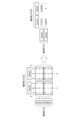
- FIG. 1 is a diagram showing an application example of an evaluation model generation system according to an embodiment of the present invention.
- FIG. 2 is a diagram showing an example of a result of conversion into an evaluation model capable of analyzing the mutual relationship between roles from contribution value information regarding the degree of contribution between members to the team.
- FIG. 3 is a flowchart showing an example of a processing procedure for converting contribution value information regarding the degree of contribution between members to a team into an evaluation model capable of analyzing the interaction relationship between roles.
- FIG. 4 is a diagram showing an example of a classification result of each member according to the type of role assigned to each member.
- FIG. 5 is a diagram showing an example of allocation of members to elements of the initial values of the matrix representation of the contribution values between members.
- FIG. 1 is a diagram showing an application example of an evaluation model generation system according to an embodiment of the present invention.
- FIG. 2 is a diagram showing an example of a result of conversion into an evaluation model capable of analyzing the mutual relationship between roles from contribution value information regarding the degree of contribution
- FIG. 6 is a diagram showing an example of a matrix representation of contribution values between members.
- FIG. 7 is a diagram showing an example of a result of decomposing the matrix representation of the contribution values between members into sub-matrices for each type of role assigned to the members.
- FIG. 8 is a diagram showing an example of the calculation result of the Frobenius norm for the submatrix for each type of role assigned to the member.
- FIG. 9 is a diagram showing an example of the analysis result of the evaluation model between roles.
- FIG. 10 is a diagram showing an example of a time-series analysis result of the evaluation model between roles.
- Figure 11 is a block diagram showing an example of the hardware configuration of an evaluation model generation system for one embodiment of the present invention.
- the evaluation model generation system converts contribution value information regarding the contribution of each member of a team to the team into an evaluation model capable of analyzing the interaction relationship between two or more roles in the team, i.e., which role member is influencing which other role member.
- the interaction relationship between the two or more roles means the interaction relationship between members having the same role or between members having different roles.
- FIG. 1 is a diagram showing an application example of an evaluation model generation system according to an embodiment of the present invention.
- an evaluation model generating system 100 according to an embodiment of the present invention includes an input unit 10 and an inter-role action relationship evaluation model generating unit (calculation unit) 20 .
- the input unit 10 of the evaluation model generation system 100 accepts input of (1) contribution value information regarding the degree of contribution between members to a team or organization, such as log data or questionnaire data, and (2) association information of the role of each member (sometimes referred to as role information of each member).
- the above-mentioned contribution value information regarding the degree of contribution between members to a team or organization refers to information regarding the degree of contribution between members to the team to which they belong, through actions taken by a first member assigned any of multiple types of roles who belongs to a team group including multiple members assigned the same role, to a second member assigned any of multiple types of roles.
- the role association information for each member refers to information indicating the role assigned to each member.
- FIG. 2 is a diagram showing an example of a result of conversion into an evaluation model capable of analyzing the mutual relationship between roles from contribution value information regarding the degree of contribution between members to the team.
- the inter-role action relationship evaluation model generation unit 20 of the evaluation model generation system 100 has a function of converting contribution value information regarding the degree of contribution between members to the team into an evaluation model capable of analyzing the interaction relationship between roles.
- the contribution values of six members belonging to a team, relating to their degree of contribution to the team, are expressed in a matrix.
- the members in the row direction are the members who influence the team
- the members in the column direction are the members who influence the team.
- the members in the row direction above are members associated with row components (elements) in the matrix in which the contribution values are expressed, and are members to which roles have been assigned.
- the members in the column direction above are members associated with column components in the matrix in which the contribution values are expressed, and are members to which roles have been assigned.
- the inter-role action relationship evaluation model generation unit 20 decomposes the matrix expressing the above-mentioned contribution value information for each member into sub-matrices for each role assigned to the member (symbols a to d in FIG. 2), calculates the size of each sub-matrix, and applies the calculated size to the evaluation model for each role to obtain the above-mentioned evaluation model.
- the sub-matrix for each role is a plurality of sub-matrices consisting of rows associated with members assigned the same role and columns associated with members assigned the same role.
- the number of roles that can be set is two or more and is equal to or less than the number of members in the team. Also, the number of roles that can be assigned to each member is one at most. Furthermore, the role assigned to the member making the approach and the role assigned to the member being approached do not have to be the same.
- FIG. 3 is a flowchart showing an example of a processing procedure for converting contribution value information regarding the degree of contribution between members to a team into an evaluation model capable of analyzing the interaction relationship between roles.
- the number of members belonging to a team is n
- the total number of role types assigned to each member in the team is m, where 1 ⁇ m ⁇ n.
- Each member belonging to a team is assigned one role. Note that a member who has not been assigned a role is assigned the role of "none.”
- the role-to-role interaction relationship evaluation model generation unit 20 acquires the input results from the input unit 10, including (1) contribution value information regarding the degree of contribution between members to the team or organization, and (2) role association information for each member, and generates an n x n matrix with each element (component) set to the initial value "0" (S11).
- the acquired information relating to the roles of each member is composed of the following information (1) to (6).
- Information that a "role Z" is assigned to a "member D” who belongs to a team.
- Information that a "role Y” is assigned to a "member E” who belongs to a team.
- the role-to-role interaction relationship evaluation model generation unit 20 classifies each member into groups to which the same type of role is assigned, based on the role association information of each member acquired above (S12).
- FIG. 4 is a diagram showing an example of a classification result of each member according to the type of role assigned to each member.
- the members are classified into (1) a first group consisting of "Member A” and “Member F” who are assigned the same "Role X,” (2) a second group consisting of "Member C” and “Member E” who are assigned the same “Role Y,” and (3) a third group consisting of "Member B” and "Member D" who are assigned the same "Role Z.”
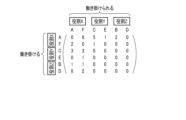
- the role-action relationship evaluation model generation unit 20 assigns each member to the order of the row and column vectors in the matrix generated in S11 so that different roles are assigned adjacent to each other, i.e., so that elements in the matrix corresponding to members assigned the same role are adjacent to each other (S13).
- FIG. 5 is a diagram showing an example of allocation of members to elements of the initial values of the matrix representation of the contribution values between members.
- the elements in the first and second rows of the matrix generated in S11 are assigned one-to-one to "Member A" and "Member F,” who are assigned the same "Role X”
- the elements in the third and fourth rows of the matrix generated in S11 are assigned one-to-one to "Member C" and “Member E,” who are assigned the same "Role Y”
- the elements in the fifth and sixth rows of the matrix generated in S11 are assigned one-to-one to "Member B" and "Member D,” who are assigned the same "Role Z.”
- the elements in the first and second columns of the matrix generated in S11 are assigned one-to-one to "member A” and “member F,” who are assigned the same "role X”
- the elements in the third and fourth columns of the matrix generated in S11 are assigned one-to-one to "member C” and “member E,” who are assigned the same "role Y”
- the elements in the fifth and sixth columns of the matrix generated in S11 are assigned one-to-one to "member B" and "member D,” who are assigned the same "role Z.”
- the above assignment destination elements may be interchangeable between members to which the same role is assigned, for example, "member A” and “member F” to which the same "role X" is assigned.
- Members assigned to row elements in S13 are treated as source members, and members assigned to column elements are treated as destination members.
- Contribution value information relating to the degree of contribution between members to the team or organization i.e., numerical information relating to the actions between members, is substituted into the matrix after each member is assigned in S13 (S14).
- FIG. 6 is a diagram showing an example of a matrix representation of contribution values between members. 6, for example, in the matrix after the allocation of each member in S13, the contribution value obtained by quantifying the degree of contribution to the team by the action of "member A" on the approaching side toward each of the other approaching members is assigned to each element in the first column of the matrix. The same applies to the other members.
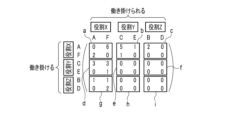
- the inter-role action relationship evaluation model generation unit 20 decomposes the matrix after substitution in S14 into m ⁇ m sub-matrices based on the total number m of the types of roles (S15).
- FIG. 7 is a diagram showing an example of a result of decomposing the matrix representation of the contribution values between members into sub-matrices for each type of role assigned to the members.
- the matrix after substitution of the contribution values shown in FIG. 6 is decomposed into the following sub-matrices (1) to (9), that is, 3 ⁇ 3 sub-matrices.
- a small matrix consisting of elements of each row to which a member assigned "role X” is assigned and elements of each column to which a member assigned “role X” is assigned (symbol a in FIG. 7 ).
- a small matrix consisting of elements of each row assigned to members assigned with “role X” and elements of each column assigned to members assigned with “role Y” (symbol b in FIG. 7 ).
- a small matrix consisting of elements of each row assigned to members assigned with “role X” and elements of each column assigned to members assigned with “role Z” symbol c in FIG. 7 ).
- a small matrix consisting of elements of each row assigned to members assigned with “role Z” and elements of each column assigned to members assigned with “role X” (symbol g in FIG. 7)
- a small matrix consisting of elements of each row assigned to members assigned with “role Z” and elements of each column assigned to members assigned with “role Y” (symbol h in FIG. 7 ).
- a small matrix consisting of elements of each row assigned to a member assigned with “role Z” and elements of each column assigned to a member assigned with “role Z” (symbol i in FIG. 7 ).
- the role-action relationship evaluation model generation unit 20 calculates the size of the matrix, which is the matrix norm, for each m x m submatrix obtained by the decomposition in S15 using the Frobenius norm calculation formula (S16). This Frobenius norm is calculated by taking the square root of the sum of the squares of the values of each element of the submatrix.
- the inter-role action relationship evaluation model generation unit 20 substitutes the size of the matrix between each role calculated in S16 into each m ⁇ m matrix formed by the decomposition in S15 (S17).
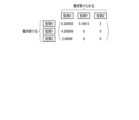
- FIG. 8 is a diagram showing an example of the calculation result of the Frobenius norm for the submatrix for each type of role assigned to the member.
- FIG 8 shows the results of substituting (1) the value of the Frobenius norm of the submatrix indicated by symbol a in Figure 7, which is "6.32455,” (2) the value of the Frobenius norm of the submatrix indicated by symbol b in Figure 7, which is "5.19615,” (3) the value of the Frobenius norm of the submatrix indicated by symbol c in Figure 7, which is “2,” (4) the value of the Frobenius norm of the submatrix indicated by symbol d in Figure 7, which is "4.358899,” (5) the value of the Frobenius norm of the submatrix indicated by symbol e, f, h, and i in Figure 7, which is "0,” and (6) the value of the Frobenius norm of the submatrix indicated by symbol g in Figure 7, which is "2.44949,” into each component of the 3 x 3 matrix, which is the above m x m matrix.
- the results obtained in S17 above constitute an evaluation model of the interaction relationships between roles.
- this evaluation model it is possible to analyze the interaction relationships between members assigned the same role, and the interaction relationships between members assigned different roles. That is, in this embodiment, it is possible to analyze the interaction relationships between members assigned the same role, and the interaction relationships between members assigned different roles from the communication log. This makes it possible to analyze the team formation status from the interaction relationships within and between roles, in relation to the roles expected at the beginning of the team formation.
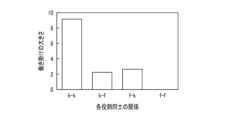
- FIG. 9 is a diagram showing an example of the analysis result of the evaluation model between roles.
- the evaluation model between roles makes it possible to analyze the differences in the degree of influence between roles.
- the graph shown in FIG. 9 shows the degree of encouragement for each of the roles assigned to team members when the roles are divided into two types, "role K" and "role F.”
- This graph shows that the strength of the interaction relationship due to the influence from members assigned role K to members assigned the same role K is relatively strong, the strength of the interaction relationship due to the influence from members assigned role K to members assigned role F is relatively weak, the strength of the interaction relationship due to the influence from members assigned role K to members assigned role F is relatively weak, the strength of the interaction relationship due to the influence from members assigned role F to members assigned role K is relatively weak, and the strength of the interaction relationship from role F to role K is relatively weak, and the strength of the interaction relationship from role F to the same role F, i.e., there is no interaction relationship due to the influence from members assigned role F to members assigned the same role F.
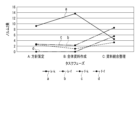
- FIG. 10 is a diagram showing an example of a time-series analysis result of the evaluation model between roles.
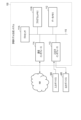
- FIG. 11 is a block diagram showing an example of a hardware configuration of an evaluation model generation system 100 according to an embodiment of the present invention.
- the evaluation model generation system 100 is configured, for example, by a server computer or a personal computer, and has a hardware processor 111A such as a CPU.
- a program memory 111B, a data memory 112, an input/output interface 113, and a communication interface 114 are connected to the hardware processor 111A via a bus 115.
- the communication interface 114 includes, for example, one or more wireless communication interface units, and enables the transmission and reception of information to and from a communication network NW.
- a wireless interface for example, an interface that adopts a low-power wireless data communication standard such as a wireless LAN (Local Area Network) is used.
- An input device 300 and an output device 400 that are attached to the evaluation model generating system 100 and are used by a user or the like are connected to the input/output interface 113 .
- the input/output interface 113 takes in operation data input by a user or the like through an input device 300 such as a keyboard, a touch panel, a touchpad, a mouse, or the like, and outputs output data to an output device 400 including a display device using liquid crystal or organic EL (Electro Luminescence), or the like, for display.
- the input device 300 and the output device 400 may be devices built into the evaluation model generation system 100, or may be input devices and output devices of other information terminals capable of communicating with the evaluation model generation system 100 via the network NW.
- the program memory 111B is a non-transient tangible storage medium that combines a non-volatile memory such as a HDD (Hard Disk Drive) or SSD (Solid State Drive) that can be written to and read from at any time, with a non-volatile memory such as a ROM (Read Only Memory), and stores the programs necessary to execute various control processes, etc. according to one embodiment.
- a non-volatile memory such as a HDD (Hard Disk Drive) or SSD (Solid State Drive) that can be written to and read from at any time
- a non-volatile memory such as a ROM (Read Only Memory)
- ROM Read Only Memory
- the data memory 112 is a tangible storage medium that combines, for example, the above-mentioned non-volatile memory with a volatile memory such as RAM (Random Access Memory), and is used to store various data acquired and created during various processing steps.
- RAM Random Access Memory
- the evaluation model generating system 100 can be configured as a data processing system or an information processing device having a processing function unit implemented by software.
- the storage system used as a work memory or the like by the evaluation model generation system 100 can be configured by using the data memory 112 shown in Fig. 11.
- these configured storage areas are not essential components within the evaluation model generation system 100, and may be areas provided in a storage system such as an external storage medium such as a Universal Serial Bus (USB) memory, or a database server located in the cloud.
- USB Universal Serial Bus
- the above processing function unit can be realized by having the above hardware processor 111A read and execute a program stored in the program memory 111B. Note that this processing function unit may also be realized in a variety of other forms, including integrated circuits such as application specific integrated circuits (ASICs (Application Specific Integrated Circuits) or FPGAs (Field-Programmable Gate Arrays)).
- ASICs Application Specific Integrated Circuits
- FPGAs Field-Programmable Gate Arrays
- the methods described in each embodiment can be stored as a program (software means) that can be executed by a computer on a recording medium such as a magnetic disk (floppy disk, hard disk, etc.), optical disk (CD-ROM, DVD, MO, etc.), semiconductor memory (ROM, RAM, flash memory, etc.), and can be distributed by transmitting it via a communication medium.
- the programs stored on the medium also include a setting program that configures the software means (including not only execution programs but also tables and data structures) that the computer executes.
- the computer that realizes this device reads the program recorded on the recording medium, and in some cases configures the software means using the setting program, and executes the above-mentioned processing by having the operation controlled by this software means.
- the recording medium referred to in this specification is not limited to a recording medium for distribution, but also includes storage media such as a magnetic disk or semiconductor memory installed inside the computer or in a device connected via a network.
- the present invention is not limited to the above-described embodiments, and can be modified in various ways during implementation without departing from the gist of the invention.
- the embodiments may also be implemented in appropriate combination, in which case the combined effects can be obtained.
- the above-described embodiments include various inventions, and various inventions can be extracted by combinations selected from the multiple constituent elements disclosed. For example, if the problem can be solved and an effect can be obtained even if some constituent elements are deleted from all the constituent elements shown in the embodiments, the configuration from which these constituent elements are deleted can be extracted as an invention.
- Evaluation model generation system 10 Input unit 20
Landscapes
- Engineering & Computer Science (AREA)
- Business, Economics & Management (AREA)
- Strategic Management (AREA)
- Entrepreneurship & Innovation (AREA)
- Human Resources & Organizations (AREA)
- Operations Research (AREA)
- Economics (AREA)
- Marketing (AREA)
- Data Mining & Analysis (AREA)
- Quality & Reliability (AREA)
- Tourism & Hospitality (AREA)
- Physics & Mathematics (AREA)
- General Business, Economics & Management (AREA)
- General Physics & Mathematics (AREA)
- Theoretical Computer Science (AREA)
- Management, Administration, Business Operations System, And Electronic Commerce (AREA)
Abstract
Un dispositif de traitement d'informations selon un mode de réalisation comprend une unité de calcul qui calcule une valeur indiquant l'intensité de la relation de travail entre des personnes auxquelles le même rôle est attribué et/ou l'intensité de la relation de travail entre des personnes auxquelles différents rôles sont attribués, ledit calcul étant effectué sur la base d'informations concernant le degré de contribution par une première personne qui est attribuée parmi une pluralité de types de rôles et au degré de contribution par une seconde personne qui est attribuée parmi une pluralité de types de rôles, chaque personne appartenant à un groupe qui comprend une pluralité de personnes qui ont été attribuées au même rôle, et lesdites contributions étant chacune une contribution au groupe auquel chaque personne appartient et résultant d'une action par la première personne d'exercer une influence sur la seconde personne.
Priority Applications (2)
| Application Number | Priority Date | Filing Date | Title |
|---|---|---|---|
| JP2025541227A JPWO2025041276A1 (fr) | 2023-08-22 | 2023-08-22 | |
| PCT/JP2023/030190 WO2025041276A1 (fr) | 2023-08-22 | 2023-08-22 | Dispositif et procédé de traitement d'informations |
Applications Claiming Priority (1)
| Application Number | Priority Date | Filing Date | Title |
|---|---|---|---|
| PCT/JP2023/030190 WO2025041276A1 (fr) | 2023-08-22 | 2023-08-22 | Dispositif et procédé de traitement d'informations |
Publications (1)
| Publication Number | Publication Date |
|---|---|
| WO2025041276A1 true WO2025041276A1 (fr) | 2025-02-27 |
Family
ID=94731521
Family Applications (1)
| Application Number | Title | Priority Date | Filing Date |
|---|---|---|---|
| PCT/JP2023/030190 Pending WO2025041276A1 (fr) | 2023-08-22 | 2023-08-22 | Dispositif et procédé de traitement d'informations |
Country Status (2)
| Country | Link |
|---|---|
| JP (1) | JPWO2025041276A1 (fr) |
| WO (1) | WO2025041276A1 (fr) |
Citations (3)
| Publication number | Priority date | Publication date | Assignee | Title |
|---|---|---|---|---|
| JP2007122144A (ja) * | 2005-10-25 | 2007-05-17 | Toyota Motor Corp | プロジェクトメンバーの選定を支援するシステムと方法 |
| US20080195464A1 (en) * | 2007-02-09 | 2008-08-14 | Kevin Robert Brooks | System and Method to Collect, Calculate, and Report Quantifiable Peer Feedback on Relative Contributions of Team Members |
| WO2023281581A1 (fr) * | 2021-07-05 | 2023-01-12 | 日本電信電話株式会社 | Dispositif de traitement d'informations, procédé de traitement d'informations et programme de traitement d'informations |
-
2023
- 2023-08-22 JP JP2025541227A patent/JPWO2025041276A1/ja active Pending
- 2023-08-22 WO PCT/JP2023/030190 patent/WO2025041276A1/fr active Pending
Patent Citations (3)
| Publication number | Priority date | Publication date | Assignee | Title |
|---|---|---|---|---|
| JP2007122144A (ja) * | 2005-10-25 | 2007-05-17 | Toyota Motor Corp | プロジェクトメンバーの選定を支援するシステムと方法 |
| US20080195464A1 (en) * | 2007-02-09 | 2008-08-14 | Kevin Robert Brooks | System and Method to Collect, Calculate, and Report Quantifiable Peer Feedback on Relative Contributions of Team Members |
| WO2023281581A1 (fr) * | 2021-07-05 | 2023-01-12 | 日本電信電話株式会社 | Dispositif de traitement d'informations, procédé de traitement d'informations et programme de traitement d'informations |
Also Published As
| Publication number | Publication date |
|---|---|
| JPWO2025041276A1 (fr) | 2025-02-27 |
Similar Documents
| Publication | Publication Date | Title |
|---|---|---|
| Rahman et al. | Accuracy comparison of ARIMA and XGBoost forecasting models in predicting the incidence of COVID-19 in Bangladesh | |
| Alegre et al. | A measurement scale for product innovation performance | |
| Kyoon Yoo et al. | Knowledge quality: antecedents and consequence in project teams | |
| Netland et al. | The S‐curve effect of lean implementation | |
| Cummings et al. | Group heterogeneity increases the risks of large group size: A longitudinal study of productivity in research groups | |
| Diudea | Indices of reciprocal properties or Harary indices | |
| Kumar et al. | Objectivity in performance ranking of higher education institutions using dynamic data envelopment analysis | |
| Santosa et al. | Diverse empirical evidence on epidemiological transition in low-and middle-income countries: population-based findings from INDEPTH network data | |
| Schleich et al. | How to determine the influence of geometric deviations on elastic deformations and the structural performance? | |
| Brkić et al. | A framework for BPM software selection in relation to digital transformation drivers | |
| Fujishiro et al. | Comparing self-reported and O* NET-based assessments of job control as predictors of self-rated health for non-Hispanic whites and racial/ethnic minorities | |
| Lah et al. | How expertise affects a digital-rights-management-sharing application's usability | |
| WO2021111796A1 (fr) | Système d'analyse de gestion environnementale et programme d'analyse de gestion environnementale | |
| Xie et al. | Evaluating performance of super-efficiency models in ranking efficient decision-making units based on Monte Carlo simulations | |
| CN110543996A (zh) | 一种职位薪资评估方法、装置、服务器和存储介质 | |
| Ahuja et al. | An empirical test of causal relationships of factors affecting ICT adoption for building project management: An Indian SME case study | |
| Maradza et al. | Standardisation of building information modelling in the UK and USA: Challenges and opportunities | |
| Meyers et al. | Evaluation of alternate category structures for the Strain Index: an empirical analysis | |
| Zheng et al. | Weighted cycle-based identification of influential node groups in complex networks | |
| Zhu et al. | Probing the critical point (critpt) of ai reasoning: a frontier physics research benchmark | |
| Suominen et al. | Task 1 of the CLEF eHealth evaluation lab 2016: Handover information extraction | |
| Bleichrodt et al. | StatModPredict: A user-friendly R-Shiny interface for fitting and forecasting with statistical models | |
| Morjani et al. | Designing a new optimal model for organizational structure of the deputy of rehabilitation of the welfare organization | |
| Manhas et al. | Role of structural equation modelling in theory testing and development | |
| Quan et al. | Guiding the reporting of studies that use routinely collected health data |
Legal Events
| Date | Code | Title | Description |
|---|---|---|---|
| 121 | Ep: the epo has been informed by wipo that ep was designated in this application |
Ref document number: 23949737 Country of ref document: EP Kind code of ref document: A1 |
|
| ENP | Entry into the national phase |
Ref document number: 2025541227 Country of ref document: JP Kind code of ref document: A |
|
| WWE | Wipo information: entry into national phase |
Ref document number: 2025541227 Country of ref document: JP |
|
| NENP | Non-entry into the national phase |
Ref country code: DE |