WO2025041276A1 - Information processing device and method - Google Patents
Information processing device and method Download PDFInfo
- Publication number
- WO2025041276A1 WO2025041276A1 PCT/JP2023/030190 JP2023030190W WO2025041276A1 WO 2025041276 A1 WO2025041276 A1 WO 2025041276A1 JP 2023030190 W JP2023030190 W JP 2023030190W WO 2025041276 A1 WO2025041276 A1 WO 2025041276A1
- Authority
- WO
- WIPO (PCT)
- Prior art keywords
- assigned
- role
- members
- roles
- strength
- Prior art date
- Legal status (The legal status is an assumption and is not a legal conclusion. Google has not performed a legal analysis and makes no representation as to the accuracy of the status listed.)
- Pending
Links
Images



Classifications
-
- G—PHYSICS
- G06—COMPUTING OR CALCULATING; COUNTING
- G06Q—INFORMATION AND COMMUNICATION TECHNOLOGY [ICT] SPECIALLY ADAPTED FOR ADMINISTRATIVE, COMMERCIAL, FINANCIAL, MANAGERIAL OR SUPERVISORY PURPOSES; SYSTEMS OR METHODS SPECIALLY ADAPTED FOR ADMINISTRATIVE, COMMERCIAL, FINANCIAL, MANAGERIAL OR SUPERVISORY PURPOSES, NOT OTHERWISE PROVIDED FOR
- G06Q10/00—Administration; Management
- G06Q10/10—Office automation; Time management
Definitions
- An embodiment of the present invention relates to an information processing device and method.
- a company's operations are made up of elements such as employees, facilities, and business processes. Operations are designed to suit the industry, business sector, and business model, and are improved daily. In particular, employees are an organic function that is important in operations, and they flexibly support uncertain and complex operations through an organizational structure.
- a “team” refers to a group of two or more people who work together or cooperate to achieve a shared goal or obtain value while dividing up roles, and the people (personnel) who belong to the team are called “members.”
- An organization functions as a collection of multiple teams, and it is important to properly understand the state of the formation of these teams in accordance with the business situation, and to design and improve their operation.
- Non-Patent Document 1 discloses a method for diagnosing a team based on the members' subjective evaluation of team formation.
- This invention was made in light of the above-mentioned circumstances, and its purpose is to provide an information processing device and method that can appropriately determine the interaction relationships between personnel who have been assigned roles.
- An information processing device includes a calculation unit that calculates a value indicating at least one of the strength of the interaction relationship between members assigned the same role and the strength of the interaction relationship between members assigned different roles, based on information regarding the degree of contribution between a first member, who is assigned any of multiple roles, and a second member, who is assigned any of multiple roles, to a group to which the first member belongs, through an action of the first member, who is assigned any of multiple roles, influencing the second member, who is assigned any of multiple roles, and who belongs to a group including multiple members assigned the same role.
- An information processing method is a method performed by an information processing device, and includes a calculation unit of the information processing device calculating a value indicating at least one of the strength of the interaction relationship between members assigned the same role and the strength of the interaction relationship between members assigned different roles, based on information regarding the degree of contribution between a first member, who is assigned any of multiple roles, and a second member, who belongs to a group including multiple members assigned the same role, through an action of the first member, who is assigned any of multiple roles, to the second member, who is assigned any of multiple roles.
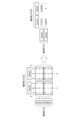
- FIG. 1 is a diagram showing an application example of an evaluation model generation system according to an embodiment of the present invention.
- FIG. 2 is a diagram showing an example of a result of conversion into an evaluation model capable of analyzing the mutual relationship between roles from contribution value information regarding the degree of contribution between members to the team.
- FIG. 3 is a flowchart showing an example of a processing procedure for converting contribution value information regarding the degree of contribution between members to a team into an evaluation model capable of analyzing the interaction relationship between roles.
- FIG. 4 is a diagram showing an example of a classification result of each member according to the type of role assigned to each member.
- FIG. 5 is a diagram showing an example of allocation of members to elements of the initial values of the matrix representation of the contribution values between members.
- FIG. 1 is a diagram showing an application example of an evaluation model generation system according to an embodiment of the present invention.
- FIG. 2 is a diagram showing an example of a result of conversion into an evaluation model capable of analyzing the mutual relationship between roles from contribution value information regarding the degree of contribution
- FIG. 6 is a diagram showing an example of a matrix representation of contribution values between members.
- FIG. 7 is a diagram showing an example of a result of decomposing the matrix representation of the contribution values between members into sub-matrices for each type of role assigned to the members.
- FIG. 8 is a diagram showing an example of the calculation result of the Frobenius norm for the submatrix for each type of role assigned to the member.
- FIG. 9 is a diagram showing an example of the analysis result of the evaluation model between roles.
- FIG. 10 is a diagram showing an example of a time-series analysis result of the evaluation model between roles.
- Figure 11 is a block diagram showing an example of the hardware configuration of an evaluation model generation system for one embodiment of the present invention.
- the evaluation model generation system converts contribution value information regarding the contribution of each member of a team to the team into an evaluation model capable of analyzing the interaction relationship between two or more roles in the team, i.e., which role member is influencing which other role member.
- the interaction relationship between the two or more roles means the interaction relationship between members having the same role or between members having different roles.
- FIG. 1 is a diagram showing an application example of an evaluation model generation system according to an embodiment of the present invention.
- an evaluation model generating system 100 according to an embodiment of the present invention includes an input unit 10 and an inter-role action relationship evaluation model generating unit (calculation unit) 20 .
- the input unit 10 of the evaluation model generation system 100 accepts input of (1) contribution value information regarding the degree of contribution between members to a team or organization, such as log data or questionnaire data, and (2) association information of the role of each member (sometimes referred to as role information of each member).
- the above-mentioned contribution value information regarding the degree of contribution between members to a team or organization refers to information regarding the degree of contribution between members to the team to which they belong, through actions taken by a first member assigned any of multiple types of roles who belongs to a team group including multiple members assigned the same role, to a second member assigned any of multiple types of roles.
- the role association information for each member refers to information indicating the role assigned to each member.
- FIG. 2 is a diagram showing an example of a result of conversion into an evaluation model capable of analyzing the mutual relationship between roles from contribution value information regarding the degree of contribution between members to the team.
- the inter-role action relationship evaluation model generation unit 20 of the evaluation model generation system 100 has a function of converting contribution value information regarding the degree of contribution between members to the team into an evaluation model capable of analyzing the interaction relationship between roles.
- the contribution values of six members belonging to a team, relating to their degree of contribution to the team, are expressed in a matrix.
- the members in the row direction are the members who influence the team
- the members in the column direction are the members who influence the team.
- the members in the row direction above are members associated with row components (elements) in the matrix in which the contribution values are expressed, and are members to which roles have been assigned.
- the members in the column direction above are members associated with column components in the matrix in which the contribution values are expressed, and are members to which roles have been assigned.
- the inter-role action relationship evaluation model generation unit 20 decomposes the matrix expressing the above-mentioned contribution value information for each member into sub-matrices for each role assigned to the member (symbols a to d in FIG. 2), calculates the size of each sub-matrix, and applies the calculated size to the evaluation model for each role to obtain the above-mentioned evaluation model.
- the sub-matrix for each role is a plurality of sub-matrices consisting of rows associated with members assigned the same role and columns associated with members assigned the same role.
- the number of roles that can be set is two or more and is equal to or less than the number of members in the team. Also, the number of roles that can be assigned to each member is one at most. Furthermore, the role assigned to the member making the approach and the role assigned to the member being approached do not have to be the same.
- FIG. 3 is a flowchart showing an example of a processing procedure for converting contribution value information regarding the degree of contribution between members to a team into an evaluation model capable of analyzing the interaction relationship between roles.
- the number of members belonging to a team is n
- the total number of role types assigned to each member in the team is m, where 1 ⁇ m ⁇ n.
- Each member belonging to a team is assigned one role. Note that a member who has not been assigned a role is assigned the role of "none.”
- the role-to-role interaction relationship evaluation model generation unit 20 acquires the input results from the input unit 10, including (1) contribution value information regarding the degree of contribution between members to the team or organization, and (2) role association information for each member, and generates an n x n matrix with each element (component) set to the initial value "0" (S11).
- the acquired information relating to the roles of each member is composed of the following information (1) to (6).
- Information that a "role Z" is assigned to a "member D” who belongs to a team.
- Information that a "role Y” is assigned to a "member E” who belongs to a team.
- the role-to-role interaction relationship evaluation model generation unit 20 classifies each member into groups to which the same type of role is assigned, based on the role association information of each member acquired above (S12).
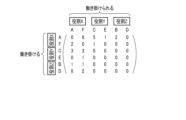
- FIG. 4 is a diagram showing an example of a classification result of each member according to the type of role assigned to each member.
- the members are classified into (1) a first group consisting of "Member A” and “Member F” who are assigned the same "Role X,” (2) a second group consisting of "Member C” and “Member E” who are assigned the same “Role Y,” and (3) a third group consisting of "Member B” and "Member D" who are assigned the same "Role Z.”
- the role-action relationship evaluation model generation unit 20 assigns each member to the order of the row and column vectors in the matrix generated in S11 so that different roles are assigned adjacent to each other, i.e., so that elements in the matrix corresponding to members assigned the same role are adjacent to each other (S13).
- FIG. 5 is a diagram showing an example of allocation of members to elements of the initial values of the matrix representation of the contribution values between members.
- the elements in the first and second rows of the matrix generated in S11 are assigned one-to-one to "Member A" and "Member F,” who are assigned the same "Role X”
- the elements in the third and fourth rows of the matrix generated in S11 are assigned one-to-one to "Member C" and “Member E,” who are assigned the same "Role Y”
- the elements in the fifth and sixth rows of the matrix generated in S11 are assigned one-to-one to "Member B" and "Member D,” who are assigned the same "Role Z.”
- the elements in the first and second columns of the matrix generated in S11 are assigned one-to-one to "member A” and “member F,” who are assigned the same "role X”
- the elements in the third and fourth columns of the matrix generated in S11 are assigned one-to-one to "member C” and “member E,” who are assigned the same "role Y”
- the elements in the fifth and sixth columns of the matrix generated in S11 are assigned one-to-one to "member B" and "member D,” who are assigned the same "role Z.”
- the above assignment destination elements may be interchangeable between members to which the same role is assigned, for example, "member A” and “member F” to which the same "role X" is assigned.
- Members assigned to row elements in S13 are treated as source members, and members assigned to column elements are treated as destination members.
- Contribution value information relating to the degree of contribution between members to the team or organization i.e., numerical information relating to the actions between members, is substituted into the matrix after each member is assigned in S13 (S14).
- FIG. 6 is a diagram showing an example of a matrix representation of contribution values between members. 6, for example, in the matrix after the allocation of each member in S13, the contribution value obtained by quantifying the degree of contribution to the team by the action of "member A" on the approaching side toward each of the other approaching members is assigned to each element in the first column of the matrix. The same applies to the other members.
- the inter-role action relationship evaluation model generation unit 20 decomposes the matrix after substitution in S14 into m ⁇ m sub-matrices based on the total number m of the types of roles (S15).
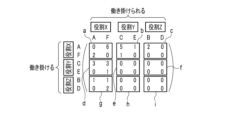
- FIG. 7 is a diagram showing an example of a result of decomposing the matrix representation of the contribution values between members into sub-matrices for each type of role assigned to the members.
- the matrix after substitution of the contribution values shown in FIG. 6 is decomposed into the following sub-matrices (1) to (9), that is, 3 ⁇ 3 sub-matrices.
- a small matrix consisting of elements of each row to which a member assigned "role X” is assigned and elements of each column to which a member assigned “role X” is assigned (symbol a in FIG. 7 ).
- a small matrix consisting of elements of each row assigned to members assigned with “role X” and elements of each column assigned to members assigned with “role Y” (symbol b in FIG. 7 ).
- a small matrix consisting of elements of each row assigned to members assigned with “role X” and elements of each column assigned to members assigned with “role Z” symbol c in FIG. 7 ).
- a small matrix consisting of elements of each row assigned to members assigned with “role Z” and elements of each column assigned to members assigned with “role X” (symbol g in FIG. 7)
- a small matrix consisting of elements of each row assigned to members assigned with “role Z” and elements of each column assigned to members assigned with “role Y” (symbol h in FIG. 7 ).
- a small matrix consisting of elements of each row assigned to a member assigned with “role Z” and elements of each column assigned to a member assigned with “role Z” (symbol i in FIG. 7 ).
- the role-action relationship evaluation model generation unit 20 calculates the size of the matrix, which is the matrix norm, for each m x m submatrix obtained by the decomposition in S15 using the Frobenius norm calculation formula (S16). This Frobenius norm is calculated by taking the square root of the sum of the squares of the values of each element of the submatrix.
- the inter-role action relationship evaluation model generation unit 20 substitutes the size of the matrix between each role calculated in S16 into each m ⁇ m matrix formed by the decomposition in S15 (S17).
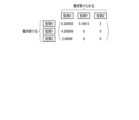
- FIG. 8 is a diagram showing an example of the calculation result of the Frobenius norm for the submatrix for each type of role assigned to the member.
- FIG 8 shows the results of substituting (1) the value of the Frobenius norm of the submatrix indicated by symbol a in Figure 7, which is "6.32455,” (2) the value of the Frobenius norm of the submatrix indicated by symbol b in Figure 7, which is "5.19615,” (3) the value of the Frobenius norm of the submatrix indicated by symbol c in Figure 7, which is “2,” (4) the value of the Frobenius norm of the submatrix indicated by symbol d in Figure 7, which is "4.358899,” (5) the value of the Frobenius norm of the submatrix indicated by symbol e, f, h, and i in Figure 7, which is "0,” and (6) the value of the Frobenius norm of the submatrix indicated by symbol g in Figure 7, which is "2.44949,” into each component of the 3 x 3 matrix, which is the above m x m matrix.
- the results obtained in S17 above constitute an evaluation model of the interaction relationships between roles.
- this evaluation model it is possible to analyze the interaction relationships between members assigned the same role, and the interaction relationships between members assigned different roles. That is, in this embodiment, it is possible to analyze the interaction relationships between members assigned the same role, and the interaction relationships between members assigned different roles from the communication log. This makes it possible to analyze the team formation status from the interaction relationships within and between roles, in relation to the roles expected at the beginning of the team formation.
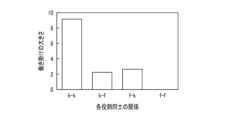
- FIG. 9 is a diagram showing an example of the analysis result of the evaluation model between roles.
- the evaluation model between roles makes it possible to analyze the differences in the degree of influence between roles.
- the graph shown in FIG. 9 shows the degree of encouragement for each of the roles assigned to team members when the roles are divided into two types, "role K" and "role F.”
- This graph shows that the strength of the interaction relationship due to the influence from members assigned role K to members assigned the same role K is relatively strong, the strength of the interaction relationship due to the influence from members assigned role K to members assigned role F is relatively weak, the strength of the interaction relationship due to the influence from members assigned role K to members assigned role F is relatively weak, the strength of the interaction relationship due to the influence from members assigned role F to members assigned role K is relatively weak, and the strength of the interaction relationship from role F to role K is relatively weak, and the strength of the interaction relationship from role F to the same role F, i.e., there is no interaction relationship due to the influence from members assigned role F to members assigned the same role F.
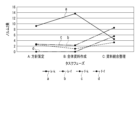
- FIG. 10 is a diagram showing an example of a time-series analysis result of the evaluation model between roles.
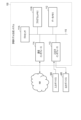
- FIG. 11 is a block diagram showing an example of a hardware configuration of an evaluation model generation system 100 according to an embodiment of the present invention.
- the evaluation model generation system 100 is configured, for example, by a server computer or a personal computer, and has a hardware processor 111A such as a CPU.
- a program memory 111B, a data memory 112, an input/output interface 113, and a communication interface 114 are connected to the hardware processor 111A via a bus 115.
- the communication interface 114 includes, for example, one or more wireless communication interface units, and enables the transmission and reception of information to and from a communication network NW.
- a wireless interface for example, an interface that adopts a low-power wireless data communication standard such as a wireless LAN (Local Area Network) is used.
- An input device 300 and an output device 400 that are attached to the evaluation model generating system 100 and are used by a user or the like are connected to the input/output interface 113 .
- the input/output interface 113 takes in operation data input by a user or the like through an input device 300 such as a keyboard, a touch panel, a touchpad, a mouse, or the like, and outputs output data to an output device 400 including a display device using liquid crystal or organic EL (Electro Luminescence), or the like, for display.
- the input device 300 and the output device 400 may be devices built into the evaluation model generation system 100, or may be input devices and output devices of other information terminals capable of communicating with the evaluation model generation system 100 via the network NW.
- the program memory 111B is a non-transient tangible storage medium that combines a non-volatile memory such as a HDD (Hard Disk Drive) or SSD (Solid State Drive) that can be written to and read from at any time, with a non-volatile memory such as a ROM (Read Only Memory), and stores the programs necessary to execute various control processes, etc. according to one embodiment.
- a non-volatile memory such as a HDD (Hard Disk Drive) or SSD (Solid State Drive) that can be written to and read from at any time
- a non-volatile memory such as a ROM (Read Only Memory)
- ROM Read Only Memory
- the data memory 112 is a tangible storage medium that combines, for example, the above-mentioned non-volatile memory with a volatile memory such as RAM (Random Access Memory), and is used to store various data acquired and created during various processing steps.
- RAM Random Access Memory
- the evaluation model generating system 100 can be configured as a data processing system or an information processing device having a processing function unit implemented by software.
- the storage system used as a work memory or the like by the evaluation model generation system 100 can be configured by using the data memory 112 shown in Fig. 11.
- these configured storage areas are not essential components within the evaluation model generation system 100, and may be areas provided in a storage system such as an external storage medium such as a Universal Serial Bus (USB) memory, or a database server located in the cloud.
- USB Universal Serial Bus
- the above processing function unit can be realized by having the above hardware processor 111A read and execute a program stored in the program memory 111B. Note that this processing function unit may also be realized in a variety of other forms, including integrated circuits such as application specific integrated circuits (ASICs (Application Specific Integrated Circuits) or FPGAs (Field-Programmable Gate Arrays)).
- ASICs Application Specific Integrated Circuits
- FPGAs Field-Programmable Gate Arrays
- the methods described in each embodiment can be stored as a program (software means) that can be executed by a computer on a recording medium such as a magnetic disk (floppy disk, hard disk, etc.), optical disk (CD-ROM, DVD, MO, etc.), semiconductor memory (ROM, RAM, flash memory, etc.), and can be distributed by transmitting it via a communication medium.
- the programs stored on the medium also include a setting program that configures the software means (including not only execution programs but also tables and data structures) that the computer executes.
- the computer that realizes this device reads the program recorded on the recording medium, and in some cases configures the software means using the setting program, and executes the above-mentioned processing by having the operation controlled by this software means.
- the recording medium referred to in this specification is not limited to a recording medium for distribution, but also includes storage media such as a magnetic disk or semiconductor memory installed inside the computer or in a device connected via a network.
- the present invention is not limited to the above-described embodiments, and can be modified in various ways during implementation without departing from the gist of the invention.
- the embodiments may also be implemented in appropriate combination, in which case the combined effects can be obtained.
- the above-described embodiments include various inventions, and various inventions can be extracted by combinations selected from the multiple constituent elements disclosed. For example, if the problem can be solved and an effect can be obtained even if some constituent elements are deleted from all the constituent elements shown in the embodiments, the configuration from which these constituent elements are deleted can be extracted as an invention.
- Evaluation model generation system 10 Input unit 20
Landscapes
- Engineering & Computer Science (AREA)
- Business, Economics & Management (AREA)
- Strategic Management (AREA)
- Entrepreneurship & Innovation (AREA)
- Human Resources & Organizations (AREA)
- Operations Research (AREA)
- Economics (AREA)
- Marketing (AREA)
- Data Mining & Analysis (AREA)
- Quality & Reliability (AREA)
- Tourism & Hospitality (AREA)
- Physics & Mathematics (AREA)
- General Business, Economics & Management (AREA)
- General Physics & Mathematics (AREA)
- Theoretical Computer Science (AREA)
- Management, Administration, Business Operations System, And Electronic Commerce (AREA)
Abstract
Description
本発明の実施形態は、情報処理装置および方法に関する。 An embodiment of the present invention relates to an information processing device and method.
企業のオペレーションは、従業員、設備、および業務プロセスなどの要素によって構成される。オペレーションは、業種、業界、およびビジネス形態などに沿った運用が設計され、日々改善されている。中でも、従業員の要素は有機的な機能であるとして、オペレーションの中では重要であり、不確実で複雑なオペレーションを組織的な体制で柔軟に支えている。 A company's operations are made up of elements such as employees, facilities, and business processes. Operations are designed to suit the industry, business sector, and business model, and are improved daily. In particular, employees are an organic function that is important in operations, and they flexibly support uncertain and complex operations through an organizational structure.
組織のパフォーマンスはオペレーションの安定性に大きく影響する。組織がとり得る形態は、この業務に求められる堅牢性、創造性、または緊急性等により異なるが、どの場合でも従業員間で役割を持ち、協働することがポイントである。 The performance of an organization has a significant impact on the stability of operations. The form that an organization can take will vary depending on the robustness, creativity, or urgency required for the work, but in any case, the key is that employees have roles and work together.
以降では、「2人以上の人間が役割を分担しながら共有する目標達成や価値獲得のために協働または連携する集団」を「チーム」と呼び、チームに所属する人間(人員)を「メンバ」と呼ぶ。組織は複数のチームの集合体として機能しており、このチームの形成状況を業務の状況に合わせて適切に把握し、運用を設計および改善していくことが重要である。 Hereafter, a "team" refers to a group of two or more people who work together or cooperate to achieve a shared goal or obtain value while dividing up roles, and the people (personnel) who belong to the team are called "members." An organization functions as a collection of multiple teams, and it is important to properly understand the state of the formation of these teams in accordance with the business situation, and to design and improve their operation.
労働人口の減少から、昨今では1名のメンバが複数のチームに所属して各チームの業務に関わることも増えてきている。対象の業務の状況または与えられた役割に応じて、メンバの態度または行動は変化すると考えられることから、業務状況を踏まえた情報を用いて、より客観的にチームの形成状況を分析する技術が必要である。 Due to the decline in the working population, it is becoming increasingly common for one member to belong to multiple teams and be involved in the work of each team. Since it is believed that members' attitudes and behaviors change depending on the situation of the target work or the role they are assigned, there is a need for technology that uses information based on the work situation to more objectively analyze the state of team formation.
従来手法として、非特許文献1には、メンバのチーム形成に対する主観評価を基にしてチームを診断する手法が開示される。
As a conventional method, Non-Patent
また、非特許文献2には、チームメンバの思考・行動などの特性からチーム全体の特性の傾向を分析する手法が開示される。
Non-Patent
チームの形成状況の分析においては、メンバ個々の特性だけでなく、そのメンバの与えられた役割に応じたメンバ間の相互作用関係の形成状況の分析が重要である。しかし、上記の従来の手法では、メンバ個々の特性を扱っているが、同じ役割を有するメンバ同士、または異なる役割を有するメンバ同士の相互作用関係の形成状況について適切に分析することはできない。 When analyzing the state of team formation, it is important to analyze not only the characteristics of each member, but also the state of interaction between members according to the roles that the members have been assigned. However, the conventional methods described above deal with the characteristics of each member, but are unable to properly analyze the state of interaction between members with the same role, or between members with different roles.
この発明は、上記事情に着目してなされたもので、その目的とするところは、役割が割り当てられた人員同士の相互作用関係を適切に求めることができるようにした情報処理装置および方法を提供することにある。 This invention was made in light of the above-mentioned circumstances, and its purpose is to provide an information processing device and method that can appropriately determine the interaction relationships between personnel who have been assigned roles.
本発明の一態様に係る情報処理装置は、同じ役割が割り当てられた複数の人員を含む集団に所属する、複数種類の何れかの役割が割り当てられた第1の人員から、複数種類の何れかの役割が割り当てられた第2の人員へ働き掛ける行動による、前記第1の人員と前記第2の人員との間の、所属する集団への貢献度合いに係る情報に基づいて、同じ役割が割り当てられた前記人員同士の相互作用関係の強さ、および異なる役割が割り当てられた前記人員同士の相互作用関係の強さ、の少なくとも一方を示す値を計算する計算部を備える。 An information processing device according to one embodiment of the present invention includes a calculation unit that calculates a value indicating at least one of the strength of the interaction relationship between members assigned the same role and the strength of the interaction relationship between members assigned different roles, based on information regarding the degree of contribution between a first member, who is assigned any of multiple roles, and a second member, who is assigned any of multiple roles, to a group to which the first member belongs, through an action of the first member, who is assigned any of multiple roles, influencing the second member, who is assigned any of multiple roles, and who belongs to a group including multiple members assigned the same role.
本発明の一態様に係る情報処理方法は、情報処理装置により行なわれる方法であって、前記情報処理装置の計算部により、同じ役割が割り当てられた複数の人員を含む集団に所属する、複数種類の何れかの役割が割り当てられた第1の人員から、複数種類の何れかの役割が割り当てられた第2の人員へ働き掛ける行動による、前記第1の人員と前記第2の人員との間の、所属する集団への貢献度合いに係る情報に基づいて、同じ役割が割り当てられた前記人員同士の相互作用関係の強さ、および異なる役割が割り当てられた前記人員同士の相互作用関係の強さ、の少なくとも一方を示す値を計算することを備える。 An information processing method according to one aspect of the present invention is a method performed by an information processing device, and includes a calculation unit of the information processing device calculating a value indicating at least one of the strength of the interaction relationship between members assigned the same role and the strength of the interaction relationship between members assigned different roles, based on information regarding the degree of contribution between a first member, who is assigned any of multiple roles, and a second member, who belongs to a group including multiple members assigned the same role, through an action of the first member, who is assigned any of multiple roles, to the second member, who is assigned any of multiple roles.
本発明によれば、役割が割り当てられた人員同士の相互作用関係を適切に求めることができる。 According to the present invention, it is possible to appropriately determine the interaction relationships between personnel who have been assigned roles.
以下、図面を参照しながら、この発明に係わる一実施形態を説明する。
本発明の一実施形態に係る評価モデル生成システムは、チームに所属する各メンバ間の、チームへの貢献に関する寄与値情報を、チーム内の2つ以上の役割同士の相互作用関係、すなわちどの役割のメンバが、どの役割のメンバに作用をしているか、を分析可能な評価モデルに変換する。上記2つ以上の役割同士の相互作用関係は、同じ役割を有するメンバ同士、または異なる役割を有するメンバ同士の相互作用関係を意味する。
Hereinafter, an embodiment of the present invention will be described with reference to the drawings.
The evaluation model generation system according to an embodiment of the present invention converts contribution value information regarding the contribution of each member of a team to the team into an evaluation model capable of analyzing the interaction relationship between two or more roles in the team, i.e., which role member is influencing which other role member. The interaction relationship between the two or more roles means the interaction relationship between members having the same role or between members having different roles.
図1は、本発明の一実施形態に係る評価モデル生成システムの適用例を示す図である。
図1に示されるように、本発明の一実施形態に係る評価モデル生成システム100は、入力部10および役割間作用関係評価モデル生成部(計算部)20を備える。
FIG. 1 is a diagram showing an application example of an evaluation model generation system according to an embodiment of the present invention.
As shown in FIG. 1, an evaluation
<入力>
評価モデル生成システム100の入力部10は、(1)メンバ間の、チームまたは組織への貢献度合いに関する寄与値情報、例えばログデータ、またはアンケートデータなど、および(2)各メンバの役割の関連付け情報(各メンバの役割情報と称することもある)、の入力を受け付ける。
<Input>
The
上記の、メンバ間の、チームまたは組織への貢献度合いに関する寄与値情報は、同じ役割が割り当てられた複数のメンバを含むチーム集団に所属する、複数種類の何れかの役割が割り当てられた第1のメンバから、複数種類の何れかの役割が割り当てられた第2のメンバへ働き掛ける行動による、各メンバ間の、所属するチームへの貢献度合いに係る情報を意味する。各メンバの役割の関連付け情報は、各メンバに割り当てられた役割が示される情報を意味する。 The above-mentioned contribution value information regarding the degree of contribution between members to a team or organization refers to information regarding the degree of contribution between members to the team to which they belong, through actions taken by a first member assigned any of multiple types of roles who belongs to a team group including multiple members assigned the same role, to a second member assigned any of multiple types of roles. The role association information for each member refers to information indicating the role assigned to each member.
<出力>
図2は、メンバ間の、チームへの貢献度合いに関する寄与値情報からの、役割同士の相互作用関係を分析可能な評価モデルへの変換結果の一例を示す図である。
評価モデル生成システム100の役割間作用関係評価モデル生成部20は、メンバ間の、チームへの貢献度合いに関する寄与値情報を、役割同士の相互作用関係を分析可能な評価モデルに変換する機能を有する。
<Output>
FIG. 2 is a diagram showing an example of a result of conversion into an evaluation model capable of analyzing the mutual relationship between roles from contribution value information regarding the degree of contribution between members to the team.
The inter-role action relationship evaluation
図2に示された例では、あるチームに属する6名のメンバの、チームへの貢献度合いに関する寄与値が行列で表現された例である。ここでは行方向のメンバが働き掛け側のメンバであり、列方向のメンバが働き掛け側のメンバである。上記の行方向のメンバは、寄与値が表現された行列における行の成分(要素)に関連付けられたメンバで、役割が割り当てられたメンバである。上記の列方向のメンバは、寄与値が表現された行列における列の成分に関連付けられたメンバで、役割が割り当てられたメンバである。 In the example shown in Figure 2, the contribution values of six members belonging to a team, relating to their degree of contribution to the team, are expressed in a matrix. Here, the members in the row direction are the members who influence the team, and the members in the column direction are the members who influence the team. The members in the row direction above are members associated with row components (elements) in the matrix in which the contribution values are expressed, and are members to which roles have been assigned. The members in the column direction above are members associated with column components in the matrix in which the contribution values are expressed, and are members to which roles have been assigned.
図2に示された例では、各メンバに対して「キーマン(keyman)」と「フォロワー(follower)」という2種類の役割のいずれかの割り当てが定義されたときに、上記役割「キーマン」および「フォロワー」のそれぞれの役割同士の相互作用関係の分析が可能なように変換されてなる評価モデルの生成結果が示される。 In the example shown in Figure 2, when the assignment of one of two types of roles, "keyman" and "follower," is defined for each member, the result of generating an evaluation model that is converted so that the interaction relationship between the roles of "keyman" and "follower" can be analyzed is shown.
具体的には、役割間作用関係評価モデル生成部20は、メンバ毎の上記寄与値情報が表現される行列を、メンバに割り当てられた役割毎の小行列(図2の符号a~d)に分解し、各小行列の行列の大きさを計算して、この大きさの計算結果を役割毎の評価モデルに当てはめることで、上記評価モデルを得ることができる。上記役割毎の小行列は、同じ役割が割り当てられたメンバに関連付けられた行、および同じ役割が割り当てられたメンバに関連付けられた列で構成される複数の小行列である。
Specifically, the inter-role action relationship evaluation
この評価モデルで設定可能な役割は、2つ以上、かつチームに属するメンバの人数以下である。また、各メンバに割り当てられる役割は最大で1つである。
また、働き掛ける側のメンバに割り当てられた役割と、働き掛けられる側のメンバに割り当てられた役割は同一でなくてもよい。
In this evaluation model, the number of roles that can be set is two or more and is equal to or less than the number of members in the team. Also, the number of roles that can be assigned to each member is one at most.
Furthermore, the role assigned to the member making the approach and the role assigned to the member being approached do not have to be the same.
図3は、メンバ間の、チームへの貢献度合いに関する寄与値情報からの、役割同士の相互作用関係を分析可能な評価モデルへの変換に係る処理手順の一例を示すフローチャートである。
ここではチームに属するメンバの人数をnとし、チーム内における各メンバに割り当てられた役割の種類の延べ数をm個とする。ただし、1<m<nである。チームに属する各メンバには1つの役割が割り当てられるとする。なお、役割が割り当てられていないメンバには、「なし」という役割が割り当てられるとする。
FIG. 3 is a flowchart showing an example of a processing procedure for converting contribution value information regarding the degree of contribution between members to a team into an evaluation model capable of analyzing the interaction relationship between roles.
Here, the number of members belonging to a team is n, and the total number of role types assigned to each member in the team is m, where 1<m<n. Each member belonging to a team is assigned one role. Note that a member who has not been assigned a role is assigned the role of "none."
役割間作用関係評価モデル生成部20は、入力部10による、(1)メンバ間の、チームまたは組織への貢献度合いに関する寄与値情報および(2)各メンバの役割の関連付け情報、の入力結果を取得し、各要素(成分)を初期値「0」としたn×nの行列を生成する(S11)。
The role-to-role interaction relationship evaluation
ここでは、上記取得した、各メンバの役割の関連付け情報は、以下の(1)~(6)の情報で構成されるとする。
(1) チームに属する「メンバA」に「役割X」が割り当てられる情報
(2) チームに属する「メンバB」に「役割Z」が割り当てられる情報
(3) チームに属する「メンバC」に「役割Y」が割り当てられる情報
(4) チームに属する「メンバD」に「役割Z」が割り当てられる情報
(5) チームに属する「メンバE」に「役割Y」が割り当てられる情報
(6) チームに属する「メンバF」に「役割X」が割り当てられる情報
Here, it is assumed that the acquired information relating to the roles of each member is composed of the following information (1) to (6).
(1) Information that a "role X" is assigned to a "member A" who belongs to a team. (2) Information that a "role Z" is assigned to a "member B" who belongs to a team. (3) Information that a "role Y" is assigned to a "member C" who belongs to a team. (4) Information that a "role Z" is assigned to a "member D" who belongs to a team. (5) Information that a "role Y" is assigned to a "member E" who belongs to a team. (6) Information that a "role X" is assigned to a "member F" who belongs to a team.
役割間作用関係評価モデル生成部20は、上記取得した、各メンバの役割の関連付け情報に基づき、各メンバに割り当てられた役割の種別毎に、各メンバを、同じ種別の役割が割り当てられたグループに分類する(S12)。
The role-to-role interaction relationship evaluation
図4は、各メンバに割り当てられる役割の種別による、各メンバの分類結果の一例を示す図である。
図4に示された例では、各メンバが、(1)同じ「役割X」が割り当てられる「メンバA」および「メンバF」でなる第1のグループ、(2)同じ「役割Y」が割り当てられる「メンバC」および「メンバE」でなる第2のグループ、ならびに(3)同じ「役割Z」が割り当てられる「メンバB」および「メンバD」でなる第3のグループに分類された例が示される。
FIG. 4 is a diagram showing an example of a classification result of each member according to the type of role assigned to each member.
In the example shown in FIG. 4, the members are classified into (1) a first group consisting of "Member A" and "Member F" who are assigned the same "Role X," (2) a second group consisting of "Member C" and "Member E" who are assigned the same "Role Y," and (3) a third group consisting of "Member B" and "Member D" who are assigned the same "Role Z."
役割間作用関係評価モデル生成部20は、S11で生成された行列における行および列のベクトルのメンバの順序について、割り当てられる異なる役割同士が隣接するように、すなわち、行列における、同じ役割が割り当てられるメンバ同士に対応する要素同士が隣接するように各メンバを割り当てる(S13)。
The role-action relationship evaluation
図5は、メンバ間の寄与値の行列表現の初期値の各要素に対する各メンバの割り当ての一例を示す図である。
図5に示された例では、S11で生成された行列の1行目および2行目の要素に、同じ「役割X」が割り当てられる「メンバA」および「メンバF」のそれぞれが1対1で割り当てられ、S11で生成された行列の3行目および4行目の要素に、同じ「役割Y」が割り当てられる「メンバC」および「メンバE」のそれぞれが1対1で割り当てられ、S11で生成された行列の5行目および6行目の要素に、同じ「役割Z」が割り当てられる「メンバB」および「メンバD」のそれぞれが1対1で割り当てられる。
FIG. 5 is a diagram showing an example of allocation of members to elements of the initial values of the matrix representation of the contribution values between members.
In the example shown in FIG. 5, the elements in the first and second rows of the matrix generated in S11 are assigned one-to-one to "Member A" and "Member F," who are assigned the same "Role X," the elements in the third and fourth rows of the matrix generated in S11 are assigned one-to-one to "Member C" and "Member E," who are assigned the same "Role Y," and the elements in the fifth and sixth rows of the matrix generated in S11 are assigned one-to-one to "Member B" and "Member D," who are assigned the same "Role Z."
また、図5に示された例では、S11で生成された行列の1列目および2列目の要素に、同じ「役割X」が割り当てられる「メンバA」および「メンバF」のそれぞれが1対1で割り当てられ、S11で生成された行列の3列目および4列目の要素に、同じ「役割Y」が割り当てられる「メンバC」および「メンバE」のそれぞれが1対1で割り当てられ、S11で生成された行列の5列目および6列目の要素に、同じ「役割Z」が割り当てられる「メンバB」および「メンバD」のそれぞれが1対1で割り当てられる。
上記の割り当て先の要素は、同じ役割が割り当てられるメンバ同士、例えば同じ「役割X」が割り当てられる「メンバA」および「メンバF」同士で互いに入れ替えられてもよい。
Also, in the example shown in FIG. 5, the elements in the first and second columns of the matrix generated in S11 are assigned one-to-one to "member A" and "member F," who are assigned the same "role X," the elements in the third and fourth columns of the matrix generated in S11 are assigned one-to-one to "member C" and "member E," who are assigned the same "role Y," and the elements in the fifth and sixth columns of the matrix generated in S11 are assigned one-to-one to "member B" and "member D," who are assigned the same "role Z."
The above assignment destination elements may be interchangeable between members to which the same role is assigned, for example, "member A" and "member F" to which the same "role X" is assigned.
S13にて行の要素に割り当てられたメンバを働き掛け元のメンバの側として、列の要素に割り当てられたメンバを働き掛け先のメンバの側として、メンバ間の、チームまたは組織への貢献度合いに関する寄与値情報、すなわちメンバ間の行動に関する数値情報を、S13での各メンバの割り当て後の行列に代入する(S14)。 Members assigned to row elements in S13 are treated as source members, and members assigned to column elements are treated as destination members. Contribution value information relating to the degree of contribution between members to the team or organization, i.e., numerical information relating to the actions between members, is substituted into the matrix after each member is assigned in S13 (S14).
図6は、メンバ間の寄与値の行列表現の一例を示す図である。
図6に示された例では、例えば、S13での各メンバの割り当て後の行列における、働き掛け側の「メンバA」から働き掛け先の他の各メンバへの行動による、チームへの貢献度合いが数値化されてなる寄与値が行列の1列目の各要素に割り当てられる。他のメンバ間についても同様である。
FIG. 6 is a diagram showing an example of a matrix representation of contribution values between members.
6, for example, in the matrix after the allocation of each member in S13, the contribution value obtained by quantifying the degree of contribution to the team by the action of "member A" on the approaching side toward each of the other approaching members is assigned to each element in the first column of the matrix. The same applies to the other members.
役割間作用関係評価モデル生成部20は、S14での代入後の行列を、上記役割の種類の延べ数mに基づく、m×mの小行列に分解する(S15)。
図7は、メンバ間の寄与値の行列表現における、メンバに割り当てられた役割の種別ごとの小行列への分解結果の一例を示す図である。
図7に示された例では、図6に示された、寄与値の代入後の行列が、以下の(1)~(9)の小行列、すなわち3×3の小行列に分解される。
(1) 「役割X」が割り当てられたメンバが割り当てられた各行の要素と「役割X」が割り当てられたメンバが割り当てられた各列の要素でなる小行列(図7の符号a)
(2) 「役割X」が割り当てられたメンバが割り当てられた各行の要素と「役割Y」が割り当てられたメンバが割り当てられた各列の要素でなる小行列(図7の符号b)
(3) 「役割X」が割り当てられたメンバが割り当てられた各行の要素と「役割Z」が割り当てられたメンバが割り当てられた各列の要素でなる小行列(図7の符号c)
(4) 「役割Y」が割り当てられたメンバが割り当てられた各行の要素と「役割X」が割り当てられたメンバが割り当てられた各列の要素でなる小行列(図7の符号d)
(5) 「役割Y」が割り当てられたメンバが割り当てられた各行の要素と「役割Y」が割り当てられたメンバが割り当てられた各列の要素でなる小行列(図7の符号e)
(6) 「役割Y」が割り当てられたメンバが割り当てられた各行の要素と「役割Z」が割り当てられたメンバが割り当てられた各列の要素でなる小行列(図7の符号f)
(7) 「役割Z」が割り当てられたメンバが割り当てられた各行の要素と「役割X」が割り当てられたメンバが割り当てられた各列の要素でなる小行列(図7の符号g)
(8) 「役割Z」が割り当てられたメンバが割り当てられた各行の要素と「役割Y」が割り当てられたメンバが割り当てられた各列の要素でなる小行列(図7の符号h)
(9) 「役割Z」が割り当てられたメンバが割り当てられた各行の要素と「役割Z」が割り当てられたメンバが割り当てられた各列の要素でなる小行列(図7の符号i)
The inter-role action relationship evaluation
FIG. 7 is a diagram showing an example of a result of decomposing the matrix representation of the contribution values between members into sub-matrices for each type of role assigned to the members.
In the example shown in FIG. 7, the matrix after substitution of the contribution values shown in FIG. 6 is decomposed into the following sub-matrices (1) to (9), that is, 3×3 sub-matrices.
(1) A small matrix consisting of elements of each row to which a member assigned "role X" is assigned and elements of each column to which a member assigned "role X" is assigned (symbol a in FIG. 7 ).
(2) A small matrix consisting of elements of each row assigned to members assigned with “role X” and elements of each column assigned to members assigned with “role Y” (symbol b in FIG. 7 ).
(3) A small matrix consisting of elements of each row assigned to members assigned with “role X” and elements of each column assigned to members assigned with “role Z” (symbol c in FIG. 7 ).
(4) A small matrix consisting of elements of each row assigned to members assigned with “role Y” and elements of each column assigned to members assigned with “role X” (symbol d in FIG. 7 ).
(5) A small matrix consisting of elements of each row to which a member assigned “role Y” is assigned and elements of each column to which a member assigned “role Y” is assigned (symbol e in FIG. 7 ).
(6) A small matrix consisting of elements of each row assigned to members assigned with “role Y” and elements of each column assigned to members assigned with “role Z” (symbol f in FIG. 7 ).
(7) A small matrix consisting of elements of each row assigned to members assigned with "role Z" and elements of each column assigned to members assigned with "role X" (symbol g in FIG. 7)
(8) A small matrix consisting of elements of each row assigned to members assigned with “role Z” and elements of each column assigned to members assigned with “role Y” (symbol h in FIG. 7 ).
(9) A small matrix consisting of elements of each row assigned to a member assigned with “role Z” and elements of each column assigned to a member assigned with “role Z” (symbol i in FIG. 7 ).
役割間作用関係評価モデル生成部20は、S15で分解されて成る、m×mの各小行列について、フロベニウスノルム(Frobenius norm)の計算式を用いて、行列ノルムである、行列の大きさを計算する(S16)。このフロベニウスノルムは、小行列の各要素の値の二乗和の平方根により求められる。
The role-action relationship evaluation
役割間作用関係評価モデル生成部20は、S16で計算された、各役割同士の行列の大きさを、S15で分解されて成る、m×m各行列に代入する(S17)。
図8は、メンバに割り当てられた役割の種別ごとの小行列に対する、フロベニウスノルムの計算結果の一例を示す図である。
図8に示された例では、(1)図7の符号aで示された小行列のフロベニウスノルムの値「6.32455」、(2)図7の符号bで示された小行列のフロベニウスノルムの値「5.19615」、(3)図7の符号cで示された小行列のフロベニウスノルムの値「2」、(4)図7の符号dで示された小行列のフロベニウスノルムの値「4.358899」、(5)図7の符号e、f、hおよびiで示された小行列のフロベニウスノルムの値「0」、ならびに(6)図7の符号gで示された小行列のフロベニウスノルムの値「2.44949」が、上記m×mの行列である3×3の行列の各成分に代入された結果が示される。
The inter-role action relationship evaluation
FIG. 8 is a diagram showing an example of the calculation result of the Frobenius norm for the submatrix for each type of role assigned to the member.
The example shown in Figure 8 shows the results of substituting (1) the value of the Frobenius norm of the submatrix indicated by symbol a in Figure 7, which is "6.32455," (2) the value of the Frobenius norm of the submatrix indicated by symbol b in Figure 7, which is "5.19615," (3) the value of the Frobenius norm of the submatrix indicated by symbol c in Figure 7, which is "2," (4) the value of the Frobenius norm of the submatrix indicated by symbol d in Figure 7, which is "4.358899," (5) the value of the Frobenius norm of the submatrix indicated by symbol e, f, h, and i in Figure 7, which is "0," and (6) the value of the Frobenius norm of the submatrix indicated by symbol g in Figure 7, which is "2.44949," into each component of the 3 x 3 matrix, which is the above m x m matrix.
そして、この図8に示された例では、以下の(1)~(9)の相互作用関係の強さが示される。
(1) 「役割X」が割り当てられたメンバから同じ「役割X」が割り当てられたメンバへの働き掛けによる当該メンバ間の相互作用関係の強さ
(2) 「役割X」が割り当てられたメンバから「役割Y」が割り当てられたメンバへの働き掛けによる当該メンバ間の相互作用関係の強さ
(3) 「役割X」が割り当てられたメンバから「役割Z」が割り当てられたメンバへの働き掛けによる当該メンバ間の相互作用関係の強さ
(4) 「役割Y」が割り当てられたメンバから「役割X」が割り当てられたメンバへの働き掛けによる当該メンバ間の相互作用関係の強さ
(5) 「役割Y」が割り当てられたメンバから同じ「役割Y」が割り当てられたメンバへの働き掛けによる当該メンバ間の相互作用関係の強さ
(6) 「役割Y」が割り当てられたメンバから「役割Z」が割り当てられたメンバへの働き掛けによる当該メンバ間の相互作用関係の強さ
(7) 「役割Z」が割り当てられたメンバから「役割X」が割り当てられたメンバへの働き掛けによる当該メンバ間の相互作用関係の強さ
(8) 「役割Z」が割り当てられたメンバから「役割Y」が割り当てられたメンバへの働き掛けによる当該メンバ間の相互作用関係の強さ
(9) 「役割Z」が割り当てられたメンバから同じ「役割Z」が割り当てられたメンバへの働き掛けによる当該メンバ間の相互作用関係の強さ
In the example shown in FIG. 8, the strengths of the mutual interactions (1) to (9) below are shown.
(1) The strength of the interaction relationship between members when a member assigned "role X" makes an effort to contact a member assigned the same "role X" (2) The strength of the interaction relationship between members when a member assigned "role X" makes an effort to contact a member assigned "role Y" (3) The strength of the interaction relationship between members when a member assigned "role X" makes an effort to contact a member assigned "role Z" (4) The strength of the interaction relationship between members when a member assigned "role Y" makes an effort to contact a member assigned "role X" (5) The strength of the interaction relationship between members when a member assigned "role Y" makes an effort to contact a member assigned the same "role Y" (6) The strength of the interaction relationship between members when a member assigned "role Y" makes an effort to contact a member assigned "role Z" (7) The strength of the interaction relationship between members when a member assigned "role Z" makes an effort to contact a member assigned "role X" (8) The strength of the interaction relationship between members when a member assigned "role Z" makes an effort to contact a member assigned "role Y" (9) The strength of the interaction between members assigned "role Z" through an action from a member assigned "role Z" to another member assigned the same "role Z"
上記S17で求められた結果は、役割同士の相互作用関係の評価モデルを構成する。この評価モデルを用いることで、同じ役割が割り当てられたメンバ間の相互作用関係、および異なる役割が割り当てられたメンバ間の相互作用関係を分析できる。すなわち本実施形態では、コミュニケーションログから、同じ役割が割り当てられたメンバ間の相互作用関係、および異なる役割が割り当てられたメンバ間の相互作用関係を分析できる。このため、チーム形成当初に期待された役割に対する、役割内および役割間の相互作用関係からチーム形成状況を分析できるようになる。 The results obtained in S17 above constitute an evaluation model of the interaction relationships between roles. Using this evaluation model, it is possible to analyze the interaction relationships between members assigned the same role, and the interaction relationships between members assigned different roles. That is, in this embodiment, it is possible to analyze the interaction relationships between members assigned the same role, and the interaction relationships between members assigned different roles from the communication log. This makes it possible to analyze the team formation status from the interaction relationships within and between roles, in relation to the roles expected at the beginning of the team formation.
図9は、役割同士の評価モデルの分析結果の一例を示す図である。
役割同士の評価モデルにより、役割間の働き掛けの大きさの違いを分析できる。
図9に示されたグラフでは、チームに所属するメンバに割り当てられる役割を「役割K」および「役割F」の2種類に区分したときの、それぞれの働き掛けの程度が示される。
FIG. 9 is a diagram showing an example of the analysis result of the evaluation model between roles.
The evaluation model between roles makes it possible to analyze the differences in the degree of influence between roles.
The graph shown in FIG. 9 shows the degree of encouragement for each of the roles assigned to team members when the roles are divided into two types, "role K" and "role F."
このグラフより、役割Kから同じ役割Kへの働き掛けの大きさである、役割Kが割り当てられたメンバから同じ役割Kが割り当てられたメンバへの働き掛けによる相互作用関係の強さが比較的強く、役割Kから役割Fへの働き掛けの大きさである、役割Kが割り当てられたメンバから役割Fが割り当てられたメンバへの働き掛けによる相互作用関係の強さが比較的弱く、役割Fから役割Kへの働き掛けの大きさである、役割Fが割り当てられたメンバから役割Kが割り当てられたメンバへの働き掛けによる相互作用関係の強さが比較的弱く、役割Fから同じ役割Fへの働き掛けの大きさ、すなわち、役割Fが割り当てられたメンバから同じ役割Fが割り当てられたメンバへの働き掛けによる相互作用関係が無いことが示される。 This graph shows that the strength of the interaction relationship due to the influence from members assigned role K to members assigned the same role K is relatively strong, the strength of the interaction relationship due to the influence from members assigned role K to members assigned role F is relatively weak, the strength of the interaction relationship due to the influence from members assigned role K to members assigned role F is relatively weak, the strength of the interaction relationship due to the influence from members assigned role F to members assigned role K is relatively weak, and the strength of the interaction relationship from role F to role K is relatively weak, and the strength of the interaction from role F to the same role F, i.e., there is no interaction relationship due to the influence from members assigned role F to members assigned the same role F.
図10は、役割同士の評価モデルの時系列分析結果の一例を示す図である。
役割同士の評価モデルを時系列毎のモデルなどとして複数回にわたって取得して分析に用いることで、役割同士の働き掛けの大きさの遷移、すなわち、ある役割が割り当てられたメンバから、ある役割が割り当てられたメンバへの働き掛けによる相互作用関係の強さの遷移を分析することができる。
FIG. 10 is a diagram showing an example of a time-series analysis result of the evaluation model between roles.
By obtaining evaluation models between roles multiple times, such as as a time-series model, and using them for analysis, it is possible to analyze the transition in the magnitude of influence between roles, i.e., the transition in the strength of the interaction relationship due to influence from a member assigned a certain role to a member assigned another role.
図10に示された例では、タスクフェーズ「方針確定」が実施されるタイミング、タスクフェーズ「全体資料作成」が実施されるタイミング、およびタスクフェーズ「資料統合整理」が実施されるタイミング、でなる3つのタイミングにおける、役割Kから同じ役割Kへの働き掛けの大きさ(図10の符号a)、役割Kから役割Fへの働き掛けの大きさ(図10の符号b)、役割Fから役割Kへの働き掛けの大きさ(図10の符号c)、および役割Fから同じ役割Fへの働き掛けの大きさ(図10の符号d)の推移が示される。 In the example shown in Figure 10, the changes in the magnitude of influence from role K to the same role K (symbol a in Figure 10), the magnitude of influence from role K to role F (symbol b in Figure 10), the magnitude of influence from role F to role K (symbol c in Figure 10), and the magnitude of influence from role F to the same role F (symbol d in Figure 10) are shown at three times: when the task phase "policy determination" is performed, when the task phase "general document creation" is performed, and when the task phase "consolidation and organization of documents" is performed.
図11は、本発明の一実施形態に係る評価モデル生成システム100のハードウエア構成の一例を示すブロック図である。
図11に示された例では、上記の実施形態に係る評価モデル生成システム100は、例えばサーバコンピュータ(server computer)またはパーソナルコンピュータ(personal computer)により構成され、CPU等のハードウエアプロセッサ(hardware processor)111Aを有する。そして、このハードウエアプロセッサ111Aに対し、プログラムメモリ(program memory)111B、データメモリ(data memory)112、入出力インタフェース113及び通信インタフェース114が、バス(bus)115を介して接続される。
FIG. 11 is a block diagram showing an example of a hardware configuration of an evaluation
11, the evaluation
通信インタフェース114は、例えば1つ以上の無線の通信インタフェースユニット(interface unit)を含んでおり、通信ネットワーク(network)NWとの間で情報の送受信を可能にする。無線インタフェースとしては、例えば無線LAN(Local Area Network)などの小電力無線データ通信規格が採用されたインタフェースが使用される。
The
入出力インタフェース113には、評価モデル生成システム100に付設される、利用者などにより用いられる入力デバイス(device)300および出力デバイス400が接続される。
入出力インタフェース113は、キーボード(keyboard)、タッチパネル(touch panel)、タッチパッド(touchpad)、マウス(mouse)等の入力デバイス300を通じて利用者などにより入力された操作データを取り込むとともに、出力データを液晶または有機EL(Electro Luminescence)等が用いられた表示デバイスを含む出力デバイス400へ出力して表示させる処理を行なう。なお、入力デバイス300および出力デバイス400には、評価モデル生成システム100に内蔵されたデバイスが使用されてもよく、また、ネットワークNWを介して評価モデル生成システム100と通信可能である他の情報端末の入力デバイスおよび出力デバイスが使用されてもよい。
An
The input/
プログラムメモリ111Bは、非一時的な有形の記憶媒体として、例えば、HDD(Hard Disk Drive)またはSSD(Solid State Drive)等の随時書込みおよび読出しが可能な不揮発性メモリ(non-volatile memory)と、ROM(Read Only Memory)等の不揮発性メモリとが組み合わせて使用されたもので、一実施形態に係る各種制御処理等を実行する為に必要なプログラムが格納されている。
The
データメモリ112は、有形の記憶媒体として、例えば、上記の不揮発性メモリと、RAM(Random Access Memory)等の揮発性メモリ(volatile memory)とが組み合わせて使用されたもので、各種処理が行なわれる過程で取得および作成された各種データが記憶される為に用いられる。
The
本発明の一実施形態に係る評価モデル生成システム100は、ソフトウエア(software)による処理機能部を有するデータ処理システムまたは情報処理装置として構成され得る。
評価モデル生成システム100によるワークメモリなどとして用いられる記憶システムは、図11に示されたデータメモリ112が用いられることで構成され得る。ただし、これらの構成される記憶領域は評価モデル生成システム100内に必須の構成ではなく、例えば、USB(Universal Serial Bus)メモリなどの外付け記憶媒体、又はクラウド(cloud)に配置されたデータベースサーバ(database server)等の記憶システムに設けられた領域であってもよい。
The evaluation
The storage system used as a work memory or the like by the evaluation
上記の処理機能部は、プログラムメモリ111Bに格納されたプログラムを上記ハードウエアプロセッサ111Aにより読み出させて実行させることにより実現され得る。なお、この処理機能部は、特定用途向け集積回路(ASIC(Application Specific Integrated Circuit)またはFPGA(Field-Programmable Gate Array))などの集積回路を含む、他の多様な形式によって実現されてもよい。
The above processing function unit can be realized by having the
また、各実施形態に記載された手法は、計算機(コンピュータ)に実行させることができるプログラム(ソフトウエア手段)として、例えば磁気ディスク(フロッピー(登録商標)ディスク(Floppy disk)、ハードディスク(hard disk)等)、光ディスク(optical disc)(CD-ROM、DVD、MO等)、半導体メモリ(ROM、RAM、フラッシュメモリ(Flash memory)等)等の記録媒体に格納し、また通信媒体により伝送して頒布され得る。なお、媒体側に格納されるプログラムには、計算機に実行させるソフトウエア手段(実行プログラムのみならずテーブル(table)、データ構造も含む)を計算機内に構成させる設定プログラムをも含む。本装置を実現する計算機は、記録媒体に記録されたプログラムを読み込み、また場合により設定プログラムによりソフトウエア手段を構築し、このソフトウエア手段によって動作が制御されることにより上述した処理を実行する。なお、本明細書でいう記録媒体は、頒布用に限らず、計算機内部あるいはネットワークを介して接続される機器に設けられた磁気ディスク、半導体メモリ等の記憶媒体を含むものである。 The methods described in each embodiment can be stored as a program (software means) that can be executed by a computer on a recording medium such as a magnetic disk (floppy disk, hard disk, etc.), optical disk (CD-ROM, DVD, MO, etc.), semiconductor memory (ROM, RAM, flash memory, etc.), and can be distributed by transmitting it via a communication medium. The programs stored on the medium also include a setting program that configures the software means (including not only execution programs but also tables and data structures) that the computer executes. The computer that realizes this device reads the program recorded on the recording medium, and in some cases configures the software means using the setting program, and executes the above-mentioned processing by having the operation controlled by this software means. The recording medium referred to in this specification is not limited to a recording medium for distribution, but also includes storage media such as a magnetic disk or semiconductor memory installed inside the computer or in a device connected via a network.
なお、本発明は、上記実施形態に限定されるものではなく、実施段階ではその要旨を逸脱しない範囲で種々に変形することが可能である。また、各実施形態は適宜組み合わせて実施してもよく、その場合組み合わせた効果が得られる。更に、上記実施形態には種々の発明が含まれており、開示される複数の構成要件から選択された組み合わせにより種々の発明が抽出され得る。例えば、実施形態に示される全構成要件からいくつかの構成要件が削除されても、課題が解決でき、効果が得られる場合には、この構成要件が削除された構成が発明として抽出され得る。 The present invention is not limited to the above-described embodiments, and can be modified in various ways during implementation without departing from the gist of the invention. The embodiments may also be implemented in appropriate combination, in which case the combined effects can be obtained. Furthermore, the above-described embodiments include various inventions, and various inventions can be extracted by combinations selected from the multiple constituent elements disclosed. For example, if the problem can be solved and an effect can be obtained even if some constituent elements are deleted from all the constituent elements shown in the embodiments, the configuration from which these constituent elements are deleted can be extracted as an invention.
100…評価モデル生成システム
10…入力部
20…役割間作用関係評価モデル生成部
100... Evaluation
Claims (4)
を備える情報処理装置。 an information processing device comprising: a calculation unit that calculates a value indicating at least one of the strength of an interaction relationship between members assigned the same role and the strength of an interaction relationship between members assigned different roles, based on information related to a degree of contribution between a first member, who is assigned any of multiple types of roles, and a second member, who is assigned any of multiple types of roles, to a group to which the first member belongs, through an action of the first member, who is assigned any of multiple types of roles, influencing the second member, who is assigned any of multiple types of roles, and the first member belonging to the group includes multiple members assigned the same role.
前記計算部は、
前記行列を、同じ役割が割り当てられた人員に関連付けられた行および同じ役割が割り当てられた人員に関連付けられた列で構成される複数の小行列に分解し、前記小行列に基づいて、同じ役割が割り当てられた前記人員同士の相互作用関係の強さ、および異なる役割が割り当てられた前記人員同士の相互作用関係の強さ、の少なくとも一方を示す値を計算する、
請求項1に記載の情報処理装置。 the information relating to the degree of contribution is information expressed in a matrix associated with roles and the personnel to whom the roles are assigned;
The calculation unit is
decomposing the matrix into a plurality of sub-matrices each having rows associated with personnel assigned the same role and columns associated with personnel assigned the same role, and calculating, based on the sub-matrices, a value indicative of at least one of a strength of interaction relationships between the personnel assigned the same role and a strength of interaction relationships between the personnel assigned different roles;
The information processing device according to claim 1 .
前記小行列のフロベニウスノルムを計算することで、同じ役割が割り当てられた前記人員同士の相互作用関係の強さ、および異なる役割が割り当てられた前記人員同士の相互作用関係の強さ、の少なくとも一方を示す値を計算する、
請求項2に記載の情報処理装置。 The calculation unit is
calculating a Frobenius norm of the submatrix to calculate a value indicating at least one of the strength of an interaction relationship between the personnel assigned the same role and the strength of an interaction relationship between the personnel assigned different roles;
The information processing device according to claim 2 .
前記情報処理装置の計算部により、同じ役割が割り当てられた複数の人員を含む集団に所属する、複数種類の何れかの役割が割り当てられた第1の人員から、複数種類の何れかの役割が割り当てられた第2の人員へ働き掛ける行動による、前記第1の人員と前記第2の人員との間の、所属する集団への貢献度合いに係る情報に基づいて、同じ役割が割り当てられた前記人員同士の相互作用関係の強さ、および異なる役割が割り当てられた前記人員同士の相互作用関係の強さ、の少なくとも一方を示す値を計算すること
を備える情報処理方法。 A method performed by an information processing device, comprising:
and calculating, by a calculation unit of the information processing device, a value indicating at least one of a strength of an interaction relationship between members assigned the same role and a strength of an interaction relationship between members assigned different roles, based on information related to a degree of contribution between a first member, who is assigned any of multiple types of roles, and a second member, who belongs to a group including a plurality of members assigned the same role, through an action of the first member, who is assigned any of multiple types of roles, influencing the second member, who is assigned any of multiple types of roles.
Priority Applications (2)
| Application Number | Priority Date | Filing Date | Title |
|---|---|---|---|
| JP2025541227A JPWO2025041276A1 (en) | 2023-08-22 | 2023-08-22 | |
| PCT/JP2023/030190 WO2025041276A1 (en) | 2023-08-22 | 2023-08-22 | Information processing device and method |
Applications Claiming Priority (1)
| Application Number | Priority Date | Filing Date | Title |
|---|---|---|---|
| PCT/JP2023/030190 WO2025041276A1 (en) | 2023-08-22 | 2023-08-22 | Information processing device and method |
Publications (1)
| Publication Number | Publication Date |
|---|---|
| WO2025041276A1 true WO2025041276A1 (en) | 2025-02-27 |
Family
ID=94731521
Family Applications (1)
| Application Number | Title | Priority Date | Filing Date |
|---|---|---|---|
| PCT/JP2023/030190 Pending WO2025041276A1 (en) | 2023-08-22 | 2023-08-22 | Information processing device and method |
Country Status (2)
| Country | Link |
|---|---|
| JP (1) | JPWO2025041276A1 (en) |
| WO (1) | WO2025041276A1 (en) |
Citations (3)
| Publication number | Priority date | Publication date | Assignee | Title |
|---|---|---|---|---|
| JP2007122144A (en) * | 2005-10-25 | 2007-05-17 | Toyota Motor Corp | Systems and methods to support the selection of project members |
| US20080195464A1 (en) * | 2007-02-09 | 2008-08-14 | Kevin Robert Brooks | System and Method to Collect, Calculate, and Report Quantifiable Peer Feedback on Relative Contributions of Team Members |
| WO2023281581A1 (en) * | 2021-07-05 | 2023-01-12 | 日本電信電話株式会社 | Information processing device, information processing method, and information processing program |
-
2023
- 2023-08-22 JP JP2025541227A patent/JPWO2025041276A1/ja active Pending
- 2023-08-22 WO PCT/JP2023/030190 patent/WO2025041276A1/en active Pending
Patent Citations (3)
| Publication number | Priority date | Publication date | Assignee | Title |
|---|---|---|---|---|
| JP2007122144A (en) * | 2005-10-25 | 2007-05-17 | Toyota Motor Corp | Systems and methods to support the selection of project members |
| US20080195464A1 (en) * | 2007-02-09 | 2008-08-14 | Kevin Robert Brooks | System and Method to Collect, Calculate, and Report Quantifiable Peer Feedback on Relative Contributions of Team Members |
| WO2023281581A1 (en) * | 2021-07-05 | 2023-01-12 | 日本電信電話株式会社 | Information processing device, information processing method, and information processing program |
Also Published As
| Publication number | Publication date |
|---|---|
| JPWO2025041276A1 (en) | 2025-02-27 |
Similar Documents
| Publication | Publication Date | Title |
|---|---|---|
| Rahman et al. | Accuracy comparison of ARIMA and XGBoost forecasting models in predicting the incidence of COVID-19 in Bangladesh | |
| Alegre et al. | A measurement scale for product innovation performance | |
| Kyoon Yoo et al. | Knowledge quality: antecedents and consequence in project teams | |
| Netland et al. | The S‐curve effect of lean implementation | |
| Cummings et al. | Group heterogeneity increases the risks of large group size: A longitudinal study of productivity in research groups | |
| Diudea | Indices of reciprocal properties or Harary indices | |
| Kumar et al. | Objectivity in performance ranking of higher education institutions using dynamic data envelopment analysis | |
| Santosa et al. | Diverse empirical evidence on epidemiological transition in low-and middle-income countries: population-based findings from INDEPTH network data | |
| Schleich et al. | How to determine the influence of geometric deviations on elastic deformations and the structural performance? | |
| Brkić et al. | A framework for BPM software selection in relation to digital transformation drivers | |
| Fujishiro et al. | Comparing self-reported and O* NET-based assessments of job control as predictors of self-rated health for non-Hispanic whites and racial/ethnic minorities | |
| Lah et al. | How expertise affects a digital-rights-management-sharing application's usability | |
| WO2021111796A1 (en) | Environmental management analysis system and environmental management analysis program | |
| Xie et al. | Evaluating performance of super-efficiency models in ranking efficient decision-making units based on Monte Carlo simulations | |
| CN110543996A (en) | job salary assessment method, apparatus, server and storage medium | |
| Ahuja et al. | An empirical test of causal relationships of factors affecting ICT adoption for building project management: An Indian SME case study | |
| Maradza et al. | Standardisation of building information modelling in the UK and USA: Challenges and opportunities | |
| Meyers et al. | Evaluation of alternate category structures for the Strain Index: an empirical analysis | |
| Zheng et al. | Weighted cycle-based identification of influential node groups in complex networks | |
| Zhu et al. | Probing the critical point (critpt) of ai reasoning: a frontier physics research benchmark | |
| Suominen et al. | Task 1 of the CLEF eHealth evaluation lab 2016: Handover information extraction | |
| Bleichrodt et al. | StatModPredict: A user-friendly R-Shiny interface for fitting and forecasting with statistical models | |
| Morjani et al. | Designing a new optimal model for organizational structure of the deputy of rehabilitation of the welfare organization | |
| Manhas et al. | Role of structural equation modelling in theory testing and development | |
| Quan et al. | Guiding the reporting of studies that use routinely collected health data |
Legal Events
| Date | Code | Title | Description |
|---|---|---|---|
| 121 | Ep: the epo has been informed by wipo that ep was designated in this application |
Ref document number: 23949737 Country of ref document: EP Kind code of ref document: A1 |
|
| ENP | Entry into the national phase |
Ref document number: 2025541227 Country of ref document: JP Kind code of ref document: A |
|
| WWE | Wipo information: entry into national phase |
Ref document number: 2025541227 Country of ref document: JP |
|
| NENP | Non-entry into the national phase |
Ref country code: DE |