WO2025041257A1 - Dispositif mandataire de règlement - Google Patents
Dispositif mandataire de règlement Download PDFInfo
- Publication number
- WO2025041257A1 WO2025041257A1 PCT/JP2023/030123 JP2023030123W WO2025041257A1 WO 2025041257 A1 WO2025041257 A1 WO 2025041257A1 JP 2023030123 W JP2023030123 W JP 2023030123W WO 2025041257 A1 WO2025041257 A1 WO 2025041257A1
- Authority
- WO
- WIPO (PCT)
- Prior art keywords
- station
- identification information
- information
- station terminal
- fare
- Prior art date
- Legal status (The legal status is an assumption and is not a legal conclusion. Google has not performed a legal analysis and makes no representation as to the accuracy of the status listed.)
- Pending
Links
Images




Classifications
-
- G—PHYSICS
- G06—COMPUTING OR CALCULATING; COUNTING
- G06Q—INFORMATION AND COMMUNICATION TECHNOLOGY [ICT] SPECIALLY ADAPTED FOR ADMINISTRATIVE, COMMERCIAL, FINANCIAL, MANAGERIAL OR SUPERVISORY PURPOSES; SYSTEMS OR METHODS SPECIALLY ADAPTED FOR ADMINISTRATIVE, COMMERCIAL, FINANCIAL, MANAGERIAL OR SUPERVISORY PURPOSES, NOT OTHERWISE PROVIDED FOR
- G06Q20/00—Payment architectures, schemes or protocols
- G06Q20/22—Payment schemes or models
- G06Q20/24—Credit schemes, i.e. "pay after"
-
- G—PHYSICS
- G06—COMPUTING OR CALCULATING; COUNTING
- G06Q—INFORMATION AND COMMUNICATION TECHNOLOGY [ICT] SPECIALLY ADAPTED FOR ADMINISTRATIVE, COMMERCIAL, FINANCIAL, MANAGERIAL OR SUPERVISORY PURPOSES; SYSTEMS OR METHODS SPECIALLY ADAPTED FOR ADMINISTRATIVE, COMMERCIAL, FINANCIAL, MANAGERIAL OR SUPERVISORY PURPOSES, NOT OTHERWISE PROVIDED FOR
- G06Q50/00—Information and communication technology [ICT] specially adapted for implementation of business processes of specific business sectors, e.g. utilities or tourism
- G06Q50/40—Business processes related to the transportation industry
Definitions
- the present invention relates to fare payment using a credit card.
- a fare collection system has been proposed that includes a fare calculation server that calculates fares and a payment server that settles fares (see Patent Document 1).
- the ticket gate requests payment processing from the payment device, and in response to the result, the ticket gate controls passage.
- a response from the payment device can take several seconds or more. For this reason, in the system described in Patent Document 1, it takes time to control passage at the ticket gate, which may make it difficult to smoothly operate the station, especially during crowded times such as rush hour.
- a payment agent that processes fare payments using credit cards The system is connected via a network to a boarding station terminal installed at a boarding station, a disembarking station terminal installed at a disembarking station, a fare calculation device that calculates the fare for each transportation means, and a payment device that executes payment processing, storing, in association with each other, transportation facility identification information for identifying the transportation facility and affiliated store identification information for identifying information of the transportation facility as a credit card affiliated store; receiving station identification information for identifying a boarding station from the boarding station terminal; Transmitting the station identification information received from the boarding station terminal to the fare calculation device; receiving a signal related to traffic control at the boarding station from the fare calculation device; Transmitting a signal regarding traffic control received from the fare calculation device to the boarding station terminal; receiving credit card information from the boarding station terminal; receiving station identification information for identifying the alighting station from the alighting station terminal; Transmitting the station identification information received from the alighting station terminal
- a payment agent that processes fare payments using credit cards The system is connected via a network to a boarding station terminal installed at a boarding station, an alighting station terminal installed at a deboarding station, and a payment device that executes payment processing, storing, in association with each other, transportation facility identification information for identifying the transportation facility and affiliated store identification information for identifying information of the transportation facility as a credit card affiliated store; receiving station identification information for identifying a boarding station from the boarding station terminal; Transmitting a signal regarding traffic control to the boarding station terminal; receiving credit card information from the boarding station terminal; receiving station identification information for identifying the alighting station from the alighting station terminal; Transmitting a signal regarding traffic control to the alighting station terminal; receiving the credit card information from the alighting station terminal; Calculating fare information for each transportation facility using the station identification information received from the boarding station terminal and the station identification information received from the disembarking station terminal; storing, in association with each other, credit card information received from the boarding
- a payment agent instead of station terminals such as ticket gates, makes a payment request to a payment device.
- the station terminal can control passage at the station in response to a signal from the payment agent, without waiting for a response from the payment device.
- FIG. 1 is a schematic diagram illustrating an example of the configuration of a system including a payment agent device according to a first embodiment.
- FIG. 2 is a schematic diagram illustrating a station information table.
- FIG. 2 is a schematic diagram illustrating a transportation information table.
- FIG. 13 is a schematic diagram illustrating a fare information table.
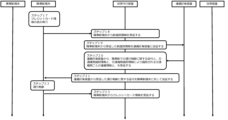
- FIG. 4 is a diagram illustrating an example of the operation of the payment agent device according to the first embodiment.
- FIG. 4 is a diagram illustrating an example of the operation of the payment agent device according to the first embodiment.
- FIG. 4 is a diagram illustrating an example of the operation of the payment agent device according to the first embodiment.
- FIG. 11 is a schematic diagram illustrating an example of the configuration of a system including a payment agent device according to a second embodiment.
- FIG. 11 is a diagram illustrating an example of the operation of the payment agent device according to the second embodiment.
- FIG. 11 is a diagram illustrating an example of the operation of the payment agent device according to the second
- Fig. 1 is a schematic diagram for explaining an example of the configuration of a system including a payment agent device according to a first embodiment.
- the payment agent device according to this embodiment is a device that handles fare payments using credit cards.
- the payment agent device according to this embodiment is connected via a network to a boarding station terminal installed at a boarding station, an alighting station terminal installed at a alighting station, a fare calculation device that calculates fares for each transportation facility, and a payment device that executes payment processing.
- An example of the network is the Internet.
- the boarding station terminal is a station terminal installed at the boarding station
- the disembarking station terminal is a station terminal installed at the disembarking station.
- Examples of the boarding station terminal and the disembarking station terminal in this embodiment include ticket gates installed at stations, as well as terminals carried by station staff. "Installed" does not only include cases where the terminal is fixed to the station, but also includes all forms in which the terminal is used at the station, such as cases where the terminal is carried by station staff.
- station terminals do not need to be installed at all stations operated by the transportation system, but it is sufficient if they are installed at least at the boarding and disembarking stations that are the starting and ending points for fare calculation.
- station terminals may or may not be installed at passing stations such as Station B and Station C described below.
- the boarding station terminal and the disembarking station terminal each have a reader/writer function that reads the customer's credit card information from the customer's smartphone, contactless IC card, etc.
- Credit card information is information required for payment using a credit card, and examples of credit card information include the credit card number, as well as the credit card expiration date and country of issue.
- a credit card can be any name as long as it inquires of a payment device whether or not a payment can be made.
- Examples of credit cards include cards commonly known as credit cards, as well as prepaid cards and debit cards that inquire of a payment device whether or not a payment can be made. Credit cards are limited to cards that do not have electronic money loaded onto them, and cards that have electronic money loaded onto them are not included in credit cards. This is because the latter cards do not inquire of a payment device whether or not a payment can be made, but rather determine whether or not a payment can be made based on the amount loaded onto the card.
- a fare calculation device is a device that calculates fare information.
- An example of a fare calculation device is a computer device that executes fare calculation.
- An example of a computer device is a server device or a board equipped with an IC chip.
- Fare information refers to information related to the fare from the boarding station to the disembarking station, such as 350 yen or 740 yen.
- Payment device is a device that executes payment processing.
- An example of a payment device is a computer device of a financial institution that issues credit cards.
- An example of a computer device is a server device or a board equipped with an IC chip.
- An example of a payment process is a process related to availability, such as authorization (often abbreviated to "authorization").
- the payment agent is a device that processes freight payments using credit cards.
- An example of a payment agent is a computer device.
- An example of a computer device is a server device or a board on which an IC chip is mounted.
- the payment agent device of this embodiment stores three tables: a station information table, a transport facility information table, and a fare information table. These will be explained in order below.
- Fig. 2 is a schematic diagram illustrating a station information table.
- the payment agent device can store station identification information, for example, in a table format.
- the station identification information is information that identifies a station.
- the station identification information may be stored in association with the name of the station, transportation facility identification information (described later), and the like.
- FIG. 3 is a schematic diagram illustrating a transportation facility information table.
- the payment agent device can store, for example in table format, transportation facility identification information that identifies a transportation facility and affiliated store identification information that identifies information about the transportation facility as a credit card affiliated store in association with each other.
- the transportation facility identification information is information that identifies a transportation facility.
- the affiliated store identification information is information that identifies information about the transportation facility as a credit card affiliated store.
- the affiliated store identification information is assigned to the transportation facility by the financial institution, for example, based on an affiliated store contract concluded between the financial institution that manages the payment device and the transportation facility.
- the transportation facility identification information may also be stored in association with the name of the transportation facility, etc.
- a station terminal that is, a station terminal having a function of communicating with the payment agent according to a predetermined protocol, at each station.
- a station terminal that does not have this function cannot execute the passage control by the payment agent.
- a data structure is adopted in which the payment agent stores the transportation facility identification information of the transportation facility that has the boarding station terminal and/or disembarking station terminal installed and the affiliated store identification information that identifies the information of the transportation facility as a credit card affiliated store, and stores the transportation facility identification information of the transportation facility that does not have the boarding station terminal and/or disembarking station terminal installed and the affiliated store identification information that identifies the information of the transportation facility as a credit card affiliated store, in association with each other.
- station terminals it is not necessary to install station terminals according to this embodiment at all stations.
- fare payment for each transportation facility can be executed during direct operation with a station that does not have a station terminal according to this embodiment installed as a passing station.
- the present invention is not limited to this data structure, and the payment agent of the present invention includes not only cases where the payment agent has this data structure, but also cases where the payment agent has a data structure that associates and stores transportation facility identification information only for transportation facilities that have boarding station terminals and/or disembarking station terminals with affiliated store identification information that identifies information about the transportation facility as a credit card affiliated store.
- (Fare information table) 4 is a schematic diagram illustrating a fare information table. As shown in Fig. 4, the payment agent device can store credit card information, affiliated store identification information, and fare information in a table format, for example, in association with each other.
- Example of operation are diagrams illustrating an example of the operation of the payment agent device according to the first embodiment.
- Station A is the boarding station, and the station identification information identifying Station A is "123456".
- Station B is a through station, and the station identification information identifying Station B is "234567”.
- Station C is a through station, and the station identification information identifying Station C is "345678”.
- Station D is the disembarking station, and the station identification information identifying Station D is "456789".
- the section from Station A to Station B is operated by X Railway, and the fare for that section is 300 yen.
- the section from Station B to Station C is operated by Y Railway, and the fare for that section is 200 yen.
- the section from Station C to Station D is operated by Z Electric Railway, and the fare for that section is 400 yen.
- the transportation facility identification information identifying X Railway is X
- the transportation facility identification information identifying Y Railway is Y
- the transportation facility identification information identifying Z Electric Railway is Z.
- X railway is a credit card affiliate of the financial institution that manages the payment device, and the affiliate identification information identifying this affiliate is "001".
- Y Railway is also a credit card affiliate of the financial institution that manages the payment device, and the affiliate identification information identifying this affiliate is "002”.
- Z Railway is also a credit card affiliate of the financial institution that manages the payment device, and the affiliate identification information identifying this affiliate is "003".
- station terminals according to this embodiment are installed in stations operated by X Railway and Z Railway, but station terminals according to this embodiment are not installed in stations operated by Y railway.
- the station terminals installed in X Railway stations are boarding station terminals, and the station terminals installed in Z Railway stations are disembarking station terminals.
- the payment agent also stores in the transportation facility information table the transportation facility identification information of X Railway and Z railway and the affiliated store identification information that identifies the information of these transportation facilities as credit card affiliated stores in association with each other, and also stores the transportation facility identification information of Y Railway and the affiliated store identification information that identifies the information of Y Railway as a credit card affiliated store in association with each other.
- Step 10 First, the boarding station terminal reads credit card information from the passenger's user terminal, such as a credit card or smartphone.
- Step 11 the payment agent device receives station identification information that identifies the boarding station from the boarding station terminal. Specifically, the payment agent device receives the station identification information "123456" from the station terminal of Station A operated by X railway.
- the payment agent device may receive, for example, a value that can uniquely identify the credit card number from the boarding station terminal along with the station identification information.
- the boarding station terminal can generate or obtain a value that can uniquely identify the credit card number, for example, by using the credit card number included in the credit card information read in step 10.
- values that can uniquely identify the credit card number include a hash value obtained by calculating a hash function with the credit card number as a parameter, a value obtained by encrypting the credit card number with an encryption key, and a value that has a one-to-one correspondence with the credit card number obtained by incrementing sequentially from a predetermined number such as 1.
- Step 12 the payment agent device transmits to the fare calculation device the station identification information received in step 11. Specifically, the payment agent device transmits to the fare calculation device the station identification information "123456" received in step 11. Note that, if a value that can uniquely identify a credit card number is received together with the station identification information in step 11, the payment agent device transmits the station identification information and that value to the fare calculation device.
- Step 13 the payment agent device receives a signal related to traffic control at the boarding station from the fare calculation device.
- An example of the signal includes information indicating "normal” or "abnormal".
- the signal is generated based on the result of a check for double boarding (e.g., cycle check), for example.
- Step 14 the payment agent device transmits the signal regarding passage control received from the fare calculation device in step 13 to the boarding station terminal.
- Step 15 the boarding station terminal performs passage control based on the passage control signal received from the payment agent device.
- passage control include, for example, control to open or keep open the ticket gate door if the received signal indicates normality, control to close or keep closed the ticket gate door if the signal indicates an abnormality, and control to display an indication of normality or abnormality on the screen of the station terminal or the like.
- Step 16 the payment agent device receives from the boarding station terminal the credit card information that the boarding station terminal read in step 10.
- the credit card information includes information such as the credit card number, expiration date, and issuing country. In this way, by receiving the credit card information after passage control at the station terminal, the station terminal can execute passage control in priority to sending the credit card information, and therefore the time required to execute passage control can be shortened.
- step 11 may be executed in step 11. That is, in step 11, the payment agent device may receive the station identification information from the boarding station terminal and also receive the credit card information.
- “Receiving the credit card information from the boarding station terminal” includes not only a form in which the station identification information is received from the boarding station terminal and then the credit card information is received, as in this embodiment, but also a form in which the credit card information is received from the boarding station terminal together with the station identification information, which is different from this embodiment.
- Step 17 the disembarking station terminal reads credit card information from the passenger's user terminal, such as a credit card or smartphone.
- Step 18 the payment agent device receives station identification information for identifying the alighting station from the alighting station terminal. Specifically, the payment agent device receives the station identification information "456789" from the station terminal of D station operated by Z Electric Railway.
- the payment agent device may receive, for example, a value that can uniquely identify the credit card number together with station identification information from the disembarking station terminal, as in step 11.
- Step 19 the payment agent device transmits to the fare calculation device the station identification information received in step 18. Specifically, the payment agent device transmits to the fare calculation device the station identification information "456789" received in step 18.
- the payment agent sends the station identification information and that value to the fare calculation device, as in step 12. If the fare calculation device receives a value that can uniquely identify a credit card number from the payment agent in step 12 and this step, it can use that value to determine which station the passenger boarded the train at and which station he or she disembarked from, using the station identification information of the boarding station received from the payment agent in step 12 and the station identification information of the disembarking station received from the payment agent in this step. In the example of this embodiment, the fare calculation device can perform fare calculation assuming that Station A is the boarding station and Station D is the disembarking station.
- the payment agent device receives from the fare calculation device a signal related to traffic control at the disembarking station, the transportation facility identification information, and fare information for each transportation facility identified by the transportation facility identification information. Specifically, the payment agent device receives from the fare calculation device transportation facility identification information X of X Railway and fare information 300 yen, transportation facility identification information Y of Y Railway and fare information 200 yen, and transportation facility identification information Z of Z Railway and fare information 400 yen.
- An example of the signal related to traffic control is the same as that in step 13, so a description thereof will be omitted.
- Step 22 the disembarking station terminal performs traffic control based on the traffic control signal received from the payment agent.
- Traffic control at the disembarking station is basically the same as the traffic control at the boarding station described in step 15, but in addition to this, it is possible to perform further control such as displaying fare information on the station terminal.
- Step 23 the payment agent device receives from the alighting station terminal the credit card information that the alighting station terminal read in step 17.
- the station terminal can execute passage control prior to sending the credit card information, as in the case of step 16, and therefore the time required to execute passage control can be shortened.
- this step may be executed in step 18. That is, in step 18, the payment agent device may receive the station identification information from the alighting station terminal and also receive the credit card information.
- the payment agency device reads, for example, from the transportation information table of Figure 3, the affiliated store identification information stored in association with the transportation identification information received from the fare calculation device in step 20, and stores this read-out affiliated store identification information in association with the credit card information and the fare information.
- Step 25 the payment agent transmits to the payment device the affiliated store identification information, credit card information, and fare information that were associated and stored in step 24.
- the payment agent transmits to the payment device affiliated store identification information 001, fare information 300 yen, and credit card information for X Railway, associated with each other, affiliated store identification information 002, fare information 200 yen, and credit card information for Y Railway, and associated with each other, and transmits affiliated store identification information 003, fare information 400 yen, and credit card information for Z Railway.
- the payment agent makes a payment request to the payment device instead of station terminals such as ticket gates. Therefore, the station terminal can control passage at the station in response to a signal from the payment agent, without waiting for a response from the payment device. Furthermore, in the transportation facility information table, the payment agent stores transportation facility identification information for X railway and Z railway in association with affiliated store identification information that identifies these transportation facilities as credit card affiliated stores, and also stores transportation facility identification information for Y Railway in association with affiliated store identification information that identifies its information as a credit card affiliated store. Therefore, fare payments can be made for each transportation facility, including transportation facilities that operate stations where station terminals are not installed.
- Payment agent device is a schematic diagram for explaining an example of the configuration of a system including a payment agent device according to embodiment 2. This embodiment differs from embodiment 1 in that the payment agent device executes the freight calculation process, and the process is executed by a freight calculation device separate from the payment agent device, but has the same configuration as embodiment 1 in other respects. An example of the operation of the payment agent device according to embodiment 2 will be explained below.
- Step 40 First, the boarding station terminal reads credit card information from the passenger's user terminal, such as a credit card or a smartphone. This step is the same as step 10 described above.
- Step 41 the payment agent device receives station identification information that identifies the boarding station from the boarding station terminal. Specifically, the payment agent device receives the station identification information "123456" from the station terminal of Station A operated by X railway. This step is the same as step 11 described above. As in step 11, in this step, the payment agent device may receive, for example, a value that can uniquely identify a credit card number together with the station identification information from the boarding station terminal.
- Step 42 the payment agent device transmits a signal related to passage control to the boarding station terminal. This signal is the same as that described in step 14.
- Step 43 the boarding station terminal performs traffic control based on the signal related to traffic control received from the payment agent device.
- the traffic control in this step is the same as that in step 15.
- Step 44 the payment agent device receives from the boarding station terminal the credit card information that the boarding station terminal read in step 40.
- This step is the same as step 16. As in the case of step 16, this step may be executed in step 41.
- Step 45 the exit station terminal reads credit card information from the passenger's user terminal, such as a credit card or a smartphone. This step is the same as step 17.
- Step 46 the payment agent device receives station identification information identifying the alighting station from the alighting station terminal. Specifically, the payment agent device receives station identification information "456789" from the station terminal of D station operated by Z Electric Railway. This step is the same as step 18 described above. As in step 18, in this step, the payment agent device may receive, for example, a value that can uniquely identify a credit card number together with the station identification information from the alighting station terminal.
- Step 47 the payment agent device transmits a signal regarding passage control to the exit station terminal. This signal is the same as that described in step 21.
- Step 48 the exit station terminal performs traffic control based on the traffic control-related signal received from the payment agent device.
- the traffic control in this step is the same as that described in step 22, so a description thereof will be omitted.
- Step 49 the payment agent device receives from the alighting station terminal the credit card information that the alighting station terminal read in step 45.
- This step is the same as step 23. As in step 23, this step may be performed in step 46.
- the payment agent device calculates fare information for each transportation facility using the station identification information received from the boarding station terminal in step 41 and the station identification information received from the disembarking station terminal in step 46. Specifically, the payment agent device calculates 300 yen as fare information for X Railway, 200 yen as fare information for Y Railway, and 400 yen as fare information for Z railway. As explained in step 19, when a value that can uniquely identify a credit card number is received from the payment agent device in steps 41 and 46, the payment agent device can use the value to perform fare calculation, assuming that the station identified by the station identification information received in step 41 is the boarding station and the station identified by the station identification information received in step 46 is the disembarking station.
- Step 51 the payment agent device associates and stores one of the credit card information received from the boarding station terminal and the disembarking station terminal in steps 44 and 49, the affiliated store identification information stored in association with the transportation facility identification information identifying the transportation facility that calculated the fare information in step 50, and the fare information calculated in step 50.
- the payment agent device associates and stores the affiliated store identification information 001 of X Railway, the fare information 300 yen, and one of the credit card information received from the boarding station terminal and the disembarking station terminal in steps 44 and 49, the affiliated store identification information 002 of Y Railway, the fare information 200 yen, and one of the credit card information received from the boarding station terminal and the disembarking station terminal in steps 44 and 49, and the affiliated store identification information 003 of Z Railway, the fare information 400 yen, and one of the credit card information received from the boarding station terminal and the disembarking station terminal in steps 44 and 49.
- Step 52 the payment agent transmits to the payment device the affiliated store identification information, credit card information, and fare information that were associated and stored in step 51. Specifically, the payment agent transmits to the payment device affiliated store identification information 001, fare information 300 yen, and credit card information for X Railway, associated with each other, affiliated store identification information 002, fare information 200 yen, and credit card information for Y Railway, and associated with each other, affiliated store identification information 003, fare information 400 yen, and credit card information for Z Railway.
- the payment agency device is capable of constructing and managing a fare calculation device separately from the payment agency device, and is preferably applied in cases where the fare calculation process is relatively complicated, such as on routes where multiple transport operators share the same line.
- the payment agency device according to embodiment 2 is capable of building the payment agency device and fare calculation device into the same device, and is preferably applied in cases where the fare calculation is relatively simple, such as on routes operated by a single transport operator, where the fare can be easily calculated once the stations between two points are determined.
Landscapes
- Business, Economics & Management (AREA)
- Strategic Management (AREA)
- Theoretical Computer Science (AREA)
- Engineering & Computer Science (AREA)
- General Physics & Mathematics (AREA)
- General Business, Economics & Management (AREA)
- Physics & Mathematics (AREA)
- Human Resources & Organizations (AREA)
- Tourism & Hospitality (AREA)
- Primary Health Care (AREA)
- Marketing (AREA)
- General Health & Medical Sciences (AREA)
- Economics (AREA)
- Health & Medical Sciences (AREA)
- Accounting & Taxation (AREA)
- Devices For Checking Fares Or Tickets At Control Points (AREA)
Abstract
Ce dispositif mandataire de règlement effectue une demande de règlement à un dispositif de règlement, en tant que mandataire pour un terminal de station de train tel qu'une porte de ticket. Sans attendre une réponse du dispositif de règlement, le terminal de station de train peut effectuer une commande de passage au niveau d'une station de train selon un signal provenant du dispositif mandataire de règlement.
Priority Applications (3)
| Application Number | Priority Date | Filing Date | Title |
|---|---|---|---|
| JP2023577423A JP7545593B1 (ja) | 2023-08-22 | 2023-08-22 | 決済代行装置 |
| PCT/JP2023/030123 WO2025041257A1 (fr) | 2023-08-22 | 2023-08-22 | Dispositif mandataire de règlement |
| JP2024128169A JP7555518B1 (ja) | 2023-08-22 | 2024-08-02 | 決済代行装置 |
Applications Claiming Priority (1)
| Application Number | Priority Date | Filing Date | Title |
|---|---|---|---|
| PCT/JP2023/030123 WO2025041257A1 (fr) | 2023-08-22 | 2023-08-22 | Dispositif mandataire de règlement |
Publications (1)
| Publication Number | Publication Date |
|---|---|
| WO2025041257A1 true WO2025041257A1 (fr) | 2025-02-27 |
Family
ID=92588217
Family Applications (1)
| Application Number | Title | Priority Date | Filing Date |
|---|---|---|---|
| PCT/JP2023/030123 Pending WO2025041257A1 (fr) | 2023-08-22 | 2023-08-22 | Dispositif mandataire de règlement |
Country Status (2)
| Country | Link |
|---|---|
| JP (2) | JP7545593B1 (fr) |
| WO (1) | WO2025041257A1 (fr) |
Citations (3)
| Publication number | Priority date | Publication date | Assignee | Title |
|---|---|---|---|---|
| WO2022018852A1 (fr) * | 2020-07-22 | 2022-01-27 | Quadrac株式会社 | Système, lecteur et dispositif de commande |
| WO2022054574A1 (fr) * | 2020-09-08 | 2022-03-17 | ソニーグループ株式会社 | Dispositif de traitement d'informations, terminal mobile et procédé de traitement d'informations |
| WO2023105712A1 (fr) * | 2021-12-09 | 2023-06-15 | Quadrac株式会社 | Système de fourniture d'informations de tarif et dispositif de gestion d'embarquement et de débarquement |
Family Cites Families (2)
| Publication number | Priority date | Publication date | Assignee | Title |
|---|---|---|---|---|
| JP4642345B2 (ja) * | 2003-12-09 | 2011-03-02 | 京阪電気鉄道株式会社 | 利用者還元システム、利用者還元方法、およびコンピュータプログラム |
| JP7181514B1 (ja) * | 2021-10-20 | 2022-12-01 | 株式会社 ヴァル研究所 | 交通機関の利用料金算定システムおよびコンピュータプログラム |
-
2023
- 2023-08-22 WO PCT/JP2023/030123 patent/WO2025041257A1/fr active Pending
- 2023-08-22 JP JP2023577423A patent/JP7545593B1/ja active Active
-
2024
- 2024-08-02 JP JP2024128169A patent/JP7555518B1/ja active Active
Patent Citations (3)
| Publication number | Priority date | Publication date | Assignee | Title |
|---|---|---|---|---|
| WO2022018852A1 (fr) * | 2020-07-22 | 2022-01-27 | Quadrac株式会社 | Système, lecteur et dispositif de commande |
| WO2022054574A1 (fr) * | 2020-09-08 | 2022-03-17 | ソニーグループ株式会社 | Dispositif de traitement d'informations, terminal mobile et procédé de traitement d'informations |
| WO2023105712A1 (fr) * | 2021-12-09 | 2023-06-15 | Quadrac株式会社 | Système de fourniture d'informations de tarif et dispositif de gestion d'embarquement et de débarquement |
Non-Patent Citations (2)
| Title |
|---|
| "QUADRAC, Effective Use of a Platform Responsible for Payment and Authentication. Approaches to the ‘True Goal’ of Open Loop", CARDWAVE, vol. 35, no. 4, 25 August 2022 (2022-08-25), JP, pages 10 - 14, XP009561777 * |
| "Ticket Gate Passage Verification Test Using ‘Visa Contactless Payments’ by Mitsui Sumitomo Card. Aiming to Link Transportation Use and Shopping", CARDWAVE, vol. 34, no. 2, 25 April 2021 (2021-04-25), JP, pages 50 - 51, XP009561778 * |
Also Published As
| Publication number | Publication date |
|---|---|
| JP7555518B1 (ja) | 2024-09-24 |
| JPWO2025041257A1 (fr) | 2025-02-27 |
| JP7545593B1 (ja) | 2024-09-04 |
| JP2025031588A (ja) | 2025-03-07 |
Similar Documents
| Publication | Publication Date | Title |
|---|---|---|
| KR101742448B1 (ko) | 환급 시스템 및 방법 | |
| US10460397B2 (en) | Transaction-history driven counterfeit fraud risk management solution | |
| US8025223B2 (en) | System and method for mass transit merchant payment | |
| US8504478B2 (en) | Systems, methods and computer program products for performing mass transit merchant transactions | |
| US8584936B2 (en) | Techniques for authorization of usage of a payment device | |
| US20080156873A1 (en) | Method And System For Using Contactless Payment Cards In A Transit System | |
| KR101218693B1 (ko) | 호환형 교통카드 결제 및 정산을 위한 시스템 및 그 방법 | |
| US9619819B2 (en) | Fraud control when granting instant credit | |
| JP4236124B1 (ja) | 小口金清算装置、方法、及びコンピュータプログラム | |
| JP7555518B1 (ja) | 決済代行装置 | |
| KR101972896B1 (ko) | 거래 정산 처리 방법, 그를 수행하기 위한 결제 단말 장치 및 서버 | |
| JP7778494B2 (ja) | チケット処理システム | |
| WO2023105712A1 (fr) | Système de fourniture d'informations de tarif et dispositif de gestion d'embarquement et de débarquement | |
| WO2007095372A2 (fr) | Système et méthode de recueil et traitement de tarifs de transit | |
| JP7232523B2 (ja) | 区間制運賃の後払い方式を採用する交通機関で用いられる携帯端末およびコンピュータプログラム | |
| KR20150019774A (ko) | 카드 결제 처리 장치, 방법 및 기록매체 | |
| KR101785587B1 (ko) | 가맹점 단말을 통한 대출 서비스 제공 방법 | |
| JP2022138741A (ja) | 払戻対象判別装置、払戻対象判別システム、払戻対象判別プログラム及び払戻対象判別方法 | |
| JP2004348504A (ja) | 電子チケットのオフライン認証方法及びシステム | |
| JP2024046155A (ja) | 車両運賃決済システム及び車両運賃決済装置 | |
| CN107392593A (zh) | 一种公共交通自助付费方式与移动终端 | |
| KR20070054911A (ko) | 전자승차권 발급시스템 운영 방법. | |
| UA136069U (uk) | Система придбання та формування електронних квитків | |
| KR20090018571A (ko) | 부가가치세 매입세액 공제를 위한 매출전표 보관장치 및방법 | |
| KR20100053913A (ko) | 무임 교통요금 정산처리 방법 및 시스템과 이를 위한 기록매체 |
Legal Events
| Date | Code | Title | Description |
|---|---|---|---|
| ENP | Entry into the national phase |
Ref document number: 2023577423 Country of ref document: JP Kind code of ref document: A |
|
| WWE | Wipo information: entry into national phase |
Ref document number: 2023577423 Country of ref document: JP |
|
| 121 | Ep: the epo has been informed by wipo that ep was designated in this application |
Ref document number: 23949718 Country of ref document: EP Kind code of ref document: A1 |