WO2025041243A1 - Liquid cosmetic feeder and liquid cosmetic applicator - Google Patents
Liquid cosmetic feeder and liquid cosmetic applicator Download PDFInfo
- Publication number
- WO2025041243A1 WO2025041243A1 PCT/JP2023/030065 JP2023030065W WO2025041243A1 WO 2025041243 A1 WO2025041243 A1 WO 2025041243A1 JP 2023030065 W JP2023030065 W JP 2023030065W WO 2025041243 A1 WO2025041243 A1 WO 2025041243A1
- Authority
- WO
- WIPO (PCT)
- Prior art keywords
- liquid cosmetic
- feeder
- mold
- liquid
- applicator
- Prior art date
- Legal status (The legal status is an assumption and is not a legal conclusion. Google has not performed a legal analysis and makes no representation as to the accuracy of the status listed.)
- Pending
Links
Images
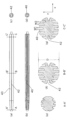
Classifications
-
- A—HUMAN NECESSITIES
- A45—HAND OR TRAVELLING ARTICLES
- A45D—HAIRDRESSING OR SHAVING EQUIPMENT; EQUIPMENT FOR COSMETICS OR COSMETIC TREATMENTS, e.g. FOR MANICURING OR PEDICURING
- A45D34/00—Containers or accessories specially adapted for handling liquid toiletry or cosmetic substances, e.g. perfumes
- A45D34/04—Appliances specially adapted for applying liquid, e.g. using roller or ball
Definitions
- the present invention relates to a liquid cosmetic applicator 1 for eyeliner, eyebrow pencil, shadow liner, concealer, etc.
- the present invention relates to an injection molding method for a liquid cosmetic feeder to be attached to the liquid cosmetic applicator 1, the liquid cosmetic feeder, and the liquid cosmetic applicator 1.
- Known liquid cosmetic applicators 1 include eyeliner, eyebrow pencil, shadow liner, concealer, etc.
- the liquid paint is guided to the brush part through a relay core.
- the material of the member constituting the storage section can be, for example, a tubular member formed by extrusion or injection molding from a synthetic resin material such as polypropylene, polyethylene, polybutylene terephthalate, or polyethylene terephthalate, taking into consideration gas permeability and liquid-tightness of the connection part.”
- the liquid retention member or intermediate core of the liquid applicator is formed by extrusion molding.
- the material In extrusion molding, the material is placed in an inlet, heated in a heating cylinder, and then passed through the outlet of a mold to form a certain shape. After the material is extruded, it is cooled and hardened, so the molded product has the same cross-sectional shape no matter where it is cut.
- the extrusion molding process is performed in the following order from step 1 to step 5.
- the above steps 1 to 5 are followed by the subsequent steps 6 and 7 described below. 6. Machining process, 7. In some cases, full length cutting.
- Leading edge processing and trailing edge processing refer to forming the leading edge shape and trailing edge shape of the liquid cosmetic feeder 4 by cutting the leading edge and trailing edge of the liquid cosmetic feeder 4. In some cases, a full length cutting process in which the entire length is cut after extrusion molding is essential.
- burrs are likely to occur during cutting processes such as front end processing and rear end processing. If there are a lot of burrs, they can clog the liquid cosmetic flow groove 40, causing problems with the discharge of the liquid cosmetic. Therefore, in some cases, a burr removal process must be added. Since the additional manufacturing processes of front end processing and rear end processing are required, this is also disadvantageous in terms of delivery time and cost.
- the variation in the outer diameter dimension D of the liquid cosmetic feeder 4 is very large, at ⁇ 0.1 mm. This causes problems when assembling the liquid cosmetic applicator 1, such as some having a large outer diameter that cannot be inserted into the mating part, and others having a small outer diameter that easily comes out of the mating part.
- the object of the present invention is to suppress the variation in the outer diameter dimension D of the liquid cosmetic feeder 4 and stabilize the dimensions.
- the present invention aims to provide a liquid cosmetic feeder 4 that is free of variation in dimensions, particularly the outer diameter, by injection molding rather than extrusion molding. Another aim is to form the liquid cosmetic feeder 4 by injection molding.
- the present invention also aims to provide a method for manufacturing the liquid cosmetic feeder 4, and a liquid cosmetic applicator 1 for eyeliner, eyebrow pencil, shadow liner, concealer, etc. that is equipped with the liquid cosmetic feeder 4 and that smoothly guides and discharges paint.
- the liquid cosmetic feeder may further include a mold rib receiving portion.
- the liquid cosmetic flow groove may have a comb-like cross-sectional shape.
- the groove width dimension W1 of the liquid cosmetic flow groove may be 0.05 mm or more and 0.2 mm or less.
- the method for manufacturing a liquid cosmetic feeder according to one aspect of the present invention is a method for manufacturing a liquid cosmetic feeder in which extremely fine liquid cosmetic flow grooves for flowing the liquid cosmetic are formed on the outer periphery by injection molding, in which a heated and melted synthetic resin material is injected into a mold and cooled to obtain a molded product.
- the above-mentioned method for manufacturing a liquid cosmetic feeder may be a method for manufacturing a liquid cosmetic feeder that does not include a post-processing step of cutting.
- the above-mentioned method for manufacturing a liquid cosmetic feeder may further include a step of opening the slide core in the injection molding process.
- the present invention provides a method for manufacturing the liquid cosmetic feeder described in (7) above, in which the liquid cosmetic feeder is formed with a mold rib receiving portion 42 and a liquid cosmetic flow groove that fits into the plate-shaped member of the slide core.
- the manufacturing method for the liquid cosmetic feeder may also be the manufacturing method for the liquid cosmetic feeder described in (5) above, in which the cross-sectional shape of the liquid cosmetic flow groove is comb-shaped.
- the manufacturing method for the liquid cosmetic feeder may also be the manufacturing method for the liquid cosmetic feeder described in (10) above, in which the groove width dimension W1 of the liquid cosmetic flow groove is 0.05 mm or more and 0.2 mm or less.
- the liquid cosmetic feeder may be a liquid cosmetic feeder manufactured by the manufacturing method described in any one of (5) to (11) above.
- liquid cosmetic applicator according to one aspect of the present invention may be a liquid cosmetic applicator equipped with the liquid cosmetic feeder described in (13) above.
- the liquid cosmetic applicator may be an eyeliner.
- the present invention provides a liquid cosmetic feeder 4 using injection molding rather than extrusion molding.
- Schematic diagrams for explaining the operation of an injection molding machine 60 used in manufacturing a liquid cosmetic feeder 4 according to one embodiment of the present invention (a) schematic diagram of the injection molding machine 60, (b) schematic diagram of a demolding process (the axis O of the liquid cosmetic feeder 4 is disposed in a direction perpendicular to the x-axis and y-axis), (c) schematic diagram of a demolding process according to another embodiment of the present invention (the axis O of the liquid cosmetic feeder 4 is disposed in the y-axis direction), (d) enlarged view of part A, (e) enlarged view of part B.
- 4A and 4B are cross-sectional views of a mold 62 corresponding to the liquid cosmetic feeder 4 of Fig. 3.
- FIG. 4 is a cross-sectional view showing a modified example of the liquid cosmetic feeder 4 of the present invention.
- FIG. 2 is a cross-sectional view of a conventional liquid cosmetic feeder 4.
- the liquid cosmetic applicator 1 is rod-shaped, supplies liquid cosmetic P from the rear end side to the front end side, and expels the liquid cosmetic P from the front end side.
- the liquid cosmetic applicator 1 comprises an applicator 2 that ejects liquid cosmetic P, a liquid cosmetic tank 3 that forms a liquid cosmetic storage space 30a that stores the liquid cosmetic P, a liquid cosmetic feeder 4 that supplies paint from the liquid cosmetic tank 3 to the applicator 2, a pressure fluctuation buffer member 5 that buffers pressure fluctuations in the liquid cosmetic storage space 30a, and an outer case 6 that is provided on the outer periphery of the pressure fluctuation buffer member 5.
- the liquid cosmetic feeder 4 is used in a liquid cosmetic applicator.
- the liquid cosmetic feeder supplies the liquid cosmetic P to the application part 2, that is, the liquid cosmetic feeder 4 is a wick provided to "relay" the liquid cosmetic P to the application part 2.
- An example of the liquid cosmetic feeder 4 of the embodiment of the present invention is shown in FIG. 3.
- the liquid cosmetic feeder 4 has, for example, a round rod shape. The rear end part of the liquid cosmetic feeder 4 is immersed in the liquid cosmetic P, and the liquid cosmetic P is sucked up to the tip side by the capillary force of the liquid cosmetic feeder 4.
- the tip part of the liquid cosmetic feeder 4 is covered by the application part 2, and is configured so that the liquid cosmetic P sucked up by the capillary force can be supplied to the application part 2 from the inside of the rear end part of the application part 2.
- the shape of the liquid cosmetic feeder 4 may be such that the tip portion is tapered as shown in Fig. 8(c) or that a step is formed at the tip portion as shown in Fig. 8(e).
- the tip portion and rear end portion may not be tapered or have a step 44, but may be cut off as shown in Fig. 8(a).
- the direction perpendicular to the axial direction i.e., the radial direction of the liquid cosmetic feeder 4
- the circumferential direction of the liquid cosmetic feeder 4 is referred to as the feeder circumferential direction.
- the vertical direction is, for example, the up-down direction in Figures 3 and 5 (y-axis direction).
- the horizontal direction is, for example, the left-right direction in Figures 3 and 5 (x-axis direction).
- the z-axis direction refers to the axis perpendicular to the x-axis and y-axis in a Cartesian coordinate system, with the x-axis being the horizontal direction, the y-axis being the vertical direction, and the z-axis being the depth direction.
- the liquid cosmetic feeder 4 is inserted into the hole 2a from the rear end side of the applicator part 2 and provided to the liquid cosmetic applicator 1.
- the liquid cosmetic feeder 4 is inserted into the applicator part 2 and used with the liquid cosmetic applicator 1.
- the hole 2a is not necessarily required.
- a cone-shaped tip space S1 is formed between the liquid cosmetic feeder 4 and the inner surface of the hole 2a.
- the rear end of the liquid cosmetic feeder 4 is disposed within the liquid cosmetic storage space 30a of the liquid cosmetic tank 3, which will be described later (see FIG. 1).
- the liquid cosmetic feeder 4 is made of a synthetic resin material, such as polyacetal (POM), polyamide (PA) (nylon), polyethylene terephthalate (PET), polybutylene terephthalate (PBT), polyethylene (PE), polypropylene (PP), polyvinyl chloride (PVC), polystyrene (PS), polycarbonate (PC), etc.
- POM polyacetal
- PA polyamide
- PET polyethylene terephthalate
- PBT polybutylene terephthalate
- PE polyethylene
- PP polypropylene
- PVC polyvinyl chloride
- PS polystyrene
- PC polycarbonate
- the present inventors have succeeded for the first time in producing a liquid cosmetic feeder 4 by injection molding. It has been thought that it is impossible to manufacture a rod-shaped liquid cosmetic feeder 4 having extremely fine liquid cosmetic flow grooves 40 with a groove width dimension W1 of approximately 0.1 mm in both the radial and axial directions as shown in Figure 10 using conventional injection molding methods.
- the inventors have devised a shape and structure of a mold 62, which will be described in detail below, and by employing injection molding, have succeeded in producing a rod-shaped liquid cosmetic feeder 4 in which extremely fine liquid cosmetic flow grooves 40 with a groove width dimension W1 of approximately 0.1 mm are formed in both the radial and axial directions.
- the plastic liquid cosmetic feeder 4 is a liquid cosmetic feeder 4 in which extremely fine liquid cosmetic flow grooves 40 with a groove width dimension W1 of 0.1 mm are formed on the outer periphery of the liquid cosmetic feeder 4 (FIG. 3).
- the liquid cosmetic feeder 4 by injection molding.
- conventional extrusion molding the workpiece is extruded from a relatively large mold 62, and a thin shape is constructed by stretching it. This made it possible to form a groove shape of about 0.1 mm on the outer circumferential surface 43 of the liquid cosmetic feeder.
- there was a great deal of variation in the outer diameter of the liquid cosmetic feeder 4 (variation of about ⁇ 0.1 mm).
- the structure within the mold 62 could be represented by laminating thin plates of 0.1 mm, 0.2 mm, etc., and therefore, the thin tube body which constitutes the liquid cosmetic feeder 4 of the liquid cosmetic applicator 1 could be successfully manufactured by injection molding.
- the liquid cosmetic feeder 4 could be integrally molded by using an injection molding method described in detail below, so that the liquid cosmetic flow groove 40 of the intended liquid cosmetic feeder 4 had a comb-like shape.
- the liquid cosmetic that can be used with the liquid cosmetic applicator 1 of the present invention is a type of cosmetic product that is in a liquid form. Examples include liquid cosmetics used in eyeliners, etc. Liquid cosmetics include facial cleansers, lotions, milky lotions, and beauty serums.
- the liquid cosmetic applicator 1 of the present invention can contain pigments and dyes, including brightness agents, that can flow through the extremely fine liquid cosmetic flow grooves, which have a groove width dimension W1 of 0.05 mm or more and 0.2 mm or less.
- the liquid cosmetic flow groove 40 is an extremely thin groove formed in the radial and axial directions on the outer periphery of the liquid cosmetic feeder 4 (see Figs. 2, 3, 4, and 5).
- the groove width dimension W1 of the liquid cosmetic flow groove 40 is extremely thin, preferably 0.05 mm or more and 0.2 mm or less.
- the liquid cosmetic flow groove 40 flows into the application unit 2 at the front of the liquid cosmetic feeder 4, and flows into the liquid cosmetic tank 3 at the rear.
- the liquid cosmetic flow groove 40 supplies the liquid cosmetic P from the liquid cosmetic tank 3 to the application unit 2 mainly by capillary action.
- the cross-sectional shape of the liquid cosmetic flow groove 40 is preferably a substantially rectangular shape recessed in the vertical direction, and is preferably formed to extend linearly in the axial direction while maintaining the comb-tooth shape.
- the liquid cosmetic flow groove 40 is recessed from the liquid cosmetic feeder outer peripheral surface 43 toward the inside in the feeder radial direction, and is formed in the axial direction of the liquid cosmetic feeder 4.
- Each liquid cosmetic flow groove 40 communicates with the brush portion at the front of the liquid cosmetic feeder 4 and communicates with the liquid cosmetic tank 3 at the rear. (Shape of Liquid Cosmetic Flow Groove 40) As shown in Figures 3 and 5, the liquid cosmetic feeder 4 is formed with a liquid cosmetic flow groove 40.
- each liquid cosmetic flow groove 40 is formed as a substantially rectangular shape concave in the vertical direction. However, it does not necessarily have to be a strict rectangle, and a slight curve may be formed.
- each liquid cosmetic flow groove 40 may be tapered.
- Each circumferential groove is formed in a comb-tooth shape on the circumferential surface of the liquid cosmetic feeder.
- the axial length of the liquid cosmetic flow groove 40 is preferably formed so that it extends linearly in the axial direction while maintaining the comb-tooth shape in cross section. However, it does not necessarily have to extend linearly in the axial direction, and it may extend in a curved or jagged shape.
- the liquid cosmetic flow groove 40 flows into the applicator part 2 at the front of the liquid cosmetic feeder 4, and flows into the liquid cosmetic tank 3 at the rear.
- each liquid cosmetic flow groove 40 of the feeder is formed to a constant width in the up-down direction (vertical direction) in FIG. 3 in order to facilitate release from the mold or slide core 65.
- the reason why the liquid cosmetic flow grooves 40 are formed in parallel in a comb-tooth shape is due to the molding method described later. In other words, it is due to the core shape of the slide core 65 or mold 62 used in the injection molding method described in detail below.
- the bottom of the liquid cosmetic flow groove 40 may be formed in various shapes such as a U-shape (FIG. 9(g)).
- Each liquid cosmetic flow groove 40 is formed to extend in the axial direction of the liquid cosmetic feeder 4.
- Each liquid cosmetic flow groove 40 is recessed from the outer peripheral surface 43 of the liquid cosmetic feeder toward the inside in the feeder radial direction, and is formed in the axial direction of the liquid cosmetic feeder 4.
- Each liquid cosmetic flow groove 40 opens into the applicator 2 at the front of the liquid cosmetic feeder 4, and opens into the liquid cosmetic tank 3 at the rear of the liquid cosmetic feeder 4.
- the liquid cosmetic flow groove 40 faces the inner peripheral surface of the hole 2a in the applicator 2, and communicates between the hole 2a of the applicator 2 and the liquid cosmetic storage space 30a of the liquid cosmetic tank 3 (see FIG. 1).
- the liquid cosmetic flow groove 40 is an extremely thin groove formed on the circumference of the liquid cosmetic feeder 4 (FIG. 3).
- the term "extremely thin” refers to, for example, in FIG. 3, the horizontal groove width dimension W1 of each liquid cosmetic flow groove 40 (left-right direction in FIG. 5) being preferably 0.05 mm or more and 0.2 mm or less.
- the groove width dimension W1 is more preferably 0.05 mm or more and 0.16 mm or less.
- the ratio of the groove width dimension W1 of the liquid cosmetic flow groove 40 to the outer diameter dimension D of the liquid cosmetic feeder 4 may be, for example, 2.5% or more and 9.2% or less, preferably 2.5% or more and 8.2% or less.
- the depth dimension L1 of the liquid cosmetic flow groove 40 in the vertical direction (left-right direction in FIG. 5) to the outer diameter dimension D (depth dimension of the liquid cosmetic flow groove 40) is preferably, for example, 25% or more and 40% or less.
- the ratio of the area occupied by the liquid cosmetic flow groove 40 is, for example, 5% or more, more preferably 10% or more, and even more preferably 20% or more.
- a plurality of liquid cosmetic flow grooves 40 are formed at intervals in the horizontal direction (y direction) as shown in Fig. 3.
- eight or ten liquid cosmetic flow grooves 40 are formed, but the number of liquid cosmetic flow grooves 40 is not limited and can be increased or decreased as appropriate.
- the liquid cosmetic flow grooves 40 are formed in a comb-like shape parallel to each other.
- the liquid cosmetic flow grooves 40 are preferably arranged in parallel to each other. This is different from the conventional liquid cosmetic feeders 4 in which the liquid cosmetic flow grooves 40 are formed radially toward the center point of the axis (see FIG. 10).
- the outer circumferential surface of the liquid cosmetic flow groove 40 may further be provided with a lateral groove (not shown) that connects adjacent liquid cosmetic flow grooves in the circumferential direction of the feeder.
- a lateral groove extends in the circumferential direction of the feeder, intersecting the liquid cosmetic flow groove 40.
- Modifications of the liquid cosmetic flow grooves 40 are shown in FIG. 9.
- the number of liquid cosmetic flow grooves 40 may be increased or decreased.
- the groove width dimension W1 of the liquid cosmetic flow grooves 40 may be narrowed.
- the groove width dimension W1 of each liquid cosmetic flow groove 40 may be a mixture of wide and narrow.
- each liquid cosmetic flow groove 40 may be tapered.
- the depth of each liquid cosmetic flow groove 40 may be changed.
- the bottom shape of each liquid cosmetic flow groove 40 may be rounded.
- the outer shape of each liquid cosmetic feeder may be as shown in the figure.
- the number of slide cores 65 may be increased or decreased as shown in the figure.
- a flow groove may be formed inside the liquid cosmetic feeder.
- the size of the mold rib receiving portion 42 may be changed.
- the mold rib receiving portion 42 is formed as a concave groove in the axial direction on the outer peripheral surface 43 of the liquid cosmetic feeder 4.
- the shape of the mold rib receiving portion 42 is not limited as long as the liquid cosmetic feeder 4, which is a molded product, can be caught by the mold rib 623 in the demolding process.
- the mold rib receiving portion 42 is shaped to fit the shape of the mold rib 623.
- the shape of the mold rib receiving portion 42 is not limited to the above shape as long as the liquid cosmetic feeder 4, which is a molded product, can be caught by the mold rib 623 in the demolding process.
- the mold rib receiving portion 42 is formed, when the slide core 65 is opened during injection molding, the mold rib receiving portion 42 of the liquid cosmetic feeder 4, which is the molded product, comes into contact with the mold rib 623 of the mold 62, enabling it to be released from the mold 62.
- the mold rib receiving portion 42 may be formed in the same shape (groove width, groove depth, and radial length of the groove) as the liquid cosmetic material flow groove 40. In this case, the mold rib receiving portion 42 can also function as the liquid cosmetic material flow groove 40.
- the present inventors have succeeded in forming the liquid cosmetic flow groove 40 by injection molding of a liquid cosmetic feeder, making it possible for the first time to form a liquid cosmetic feeder 4 by injection molding.
- the manufacturing method for the liquid cosmetic feeder 4 involves molding a synthetic resin material into a predetermined shape and size using an injection molding machine 60.
- the shape of the liquid cosmetic feeder can be completed within the injection molding process, so there is no need for cutting processes such as front and rear end processing, or cutting to extend the entire length. Cutting processes such as front and rear end processing, and cutting to extend the entire length are not necessary with the injection molding method of the present invention.
- the shape of the liquid cosmetic feeder 4 can be formed and completed entirely by the shape of the mold.
- the injection molding method for the liquid cosmetic feeder 4 of this embodiment will be described in detail below.
- the liquid cosmetic feeder 4 of this embodiment is manufactured by injection molding.
- the injection molding method of this embodiment is a technique in which synthetic resin 61, a plastic material, melted at high temperature is injected into an injection mold 62, cooled, and molded under high pressure. (Injection molding process) The procedure for the injection molding method is described below.
- the material is temporarily stored in a hopper, and then supplied to the injection unit little by little, and then sent to the heating portion of the injection unit by the drive device 64.
- the mold 62 is made up of two parts. One mold 62 is fitted to the other mold 62 and clamped. In the injection molding of this embodiment, the mold 62 may be provided with a slide core 65. 3. Injection The molten material is injected into the mold 62. 4. Pressure maintenance: The mold 62 is maintained at a pressure that makes it easy for the injected material to harden. 5. Cool and solidify. 6. Open the mold. After cooling and checking that it has solidified sufficiently, open the movable side of the mold. 7. Removal of the product The molded product is removed. Since one side of the mold 62 is fixed, the molded product is pushed out by the ejector pin 67 and removed.
- the liquid cosmetic feeder 4 of this embodiment can be manufactured, for example, by an injection molding machine 60 as shown in Fig. 6(a) .
- the injection molding machine 60 that can be used in this embodiment includes three sections: a drive device 64 that feeds the material, a nozzle 68 that heats the material with a heater 66 to make it injectable, and a mold clamping unit 63 for molding with a mold 62.
- the injection mold 62 is a metal mold into which synthetic resin is injected to form a synthetic resin material 61 into a specific shape. Basically, it is made up of two molds 62, which are opened and closed by a mold clamping unit 63.
- FIG. 7(a) is a cross-sectional view of a mold having a slide core 65
- FIG. 7(b) is a cross-sectional view of a mold having no slide core.
- the structure of the slide core 65 can be produced by bonding together a first plate-like member 651 having a thickness of 0.1 mm and a second plate-like member 652 having a thickness of 0.2 mm. There are various methods for joining the first plate-like member 651 and the second plate-like member 652, but for example, the following method can be used.
- Method using adhesive This is a method of bonding metal plates using a metal adhesive. Depending on the type of adhesive, it is possible to create a bond with high strength and excellent durability.
- Welding method This is a method of welding metal plates.
- welding There are various types of welding, such as arc welding, gas welding, and laser welding, and in the case of ultra-thin metal plates, laser welding may be the best option.
- the plate-like parts having a thickness of 0.1 mm and 0.2 mm are assembled into the slide core 65. As a result, a comb-tooth-shaped core is formed in the slide core 65.
- the method of releasing the liquid cosmetic feeder 4 from the mold 62 after injection is as follows: the upper and lower slide cores 65 are released from the restraint of the angular pins 624 and move up and down. At this point, the liquid cosmetic feeder 4, which is the injection molded product, is held by the mold ribs 623 and adheres to the upper and lower slide cores 65 and does not follow them. The injection molded liquid cosmetic feeder 4 is then pushed out by the operation of the ejector pins 67 and is completely released from the mold. First plate-like members 651 and second plate-like members 652 are alternately arranged and fixed to the slide core 65 of the mold 62.
- the first plate-like members 651 having a thickness of 0.1 mm and the second plate-like members 652 having a thickness of 0.2 mm are alternately assembled into the slide core 65 of the mold 62.
- the molded product is removed from the mold 62 by opening the slide core 65 up and down.
- the mold 62 opens left and right and the slide core 65 opens up and down simultaneously.
- the mold 62 may be opened left and right first, and then the slide core 65 may be opened up and down sequentially.
- the liquid cosmetic feeder 4 is injection molded with its axis oriented vertically (z-axis direction) relative to the plane of the drawing as shown in Fig. 6(b), but it may also be injection molded with its axis oriented horizontally (x-axis direction) as shown in Fig. 6(c).
- the above-mentioned mold 62 with a slide core has a complicated structure, and the mold 62 of the present invention does not necessarily have to include the slide core 65.
- the use of the following mold 62 is also within the scope of the present invention. That is, by forming the first plate-like member 651 and the second plate-like member 652 in a comb-like shape in the horizontal direction in the mold 62, injection molding is possible without requiring the slide core 65 (FIG. 7(b)).
- the method for releasing the liquid cosmetic feeder 4 from the mold 62 after injection is as follows, as shown in Fig.
- the left and right molds 62 are opened to the left and right by a mold opening and closing device (not shown). At this point, the liquid cosmetic feeder 4 is released from the right mold 62. Then, while being held by the mold ribs 623, the liquid cosmetic feeder 4, which is an injection-molded product, is pushed out by the operation of the ejector pins 67 and completely released from the mold.
- mold ribs 623 are formed near the center of the left and right molds 62, respectively (FIG. 6(d)).
- the shape of the mold ribs 623 is not particularly limited as long as it can easily remove the molded product from the slide core 65.
- it may be a shape that can be fitted into a recess somewhere in the molded product.
- the mold ribs 623 may be formed on either one of the left and right molds 62. The present inventors have succeeded in easily removing the molded product from the mold 62 by providing such a convex shape to the mold 62.
- the molded product can be completely removed from the mold 62 by pushing up the molded product with the ejector pin 67 .
- the slide core 65 is opened vertically, the molded product remains on one of the slide cores 65 because the plate parts of the die 62 and the molded product are in close contact with each other, making it impossible to release the molded product from the die 62 .
- a mold release rib is formed in the mold 62 (FIG. 6c).
- the mold rib 623 is formed in the center of both sides of the mold 62, but the mold rib 623 may be formed at a position shifted from the center as long as the mold release rib has a shape that can temporarily hold the liquid cosmetic feeder 4 in the mold 62.
- the mold rib 623 may be formed on either the male or female mold.
- the liquid cosmetic feeder 4 of this embodiment can be attached to various liquid cosmetic applicators 1. Below, we will explain each part of the liquid cosmetic applicator 1 to which the liquid cosmetic feeder 4 of this embodiment is attached. In the following example, an eyeliner will be explained as an example of the liquid cosmetic applicator 1.
- the liquid cosmetic feeder 4 of the present invention is a core provided to "relay" the liquid cosmetic P to the applicator part 2, and can be applied to any liquid cosmetic applicator 1 as long as it is rod-shaped, the rear end portion of which is immersed in the liquid cosmetic P, and the front end portion of which can be connected to the applicator part 2.
- the liquid cosmetic feeder 4 of this embodiment can be attached to eyeliner, eyebrow pencil, shadow liner, concealer, etc.
- the applicator 2 is, for example, a brush, which is a fibrous aggregate made of synthetic resin such as nylon or PBT (polybutylene terephthalate).
- the applicator 2 is not limited to a brush, and may be, for example, a sintered pen type or one made of porous urethane.
- the applicator 2 is a brush.
- the applicator 2 is a bundle of synthetic fibers such as nylon that have flexibility, elasticity, and flexibility.
- the applicator 2 is in the form of a round bar extending in the axial direction (longitudinal direction) around the axis O.
- the applicator 2 is also in the form of a cone whose outer diameter gradually decreases from the midpoint in the axial direction toward the front end.
- a hole 2a is formed in the rear end face of the applicator 2, which is recessed toward the front end.
- the hole 2a is in a tapered shape whose inner diameter gradually decreases from the rear end toward the front end.
- the inner diameter of the hole 2a may be equal to the outer diameter of the liquid cosmetic feeder 4 described later, or may be slightly larger than the outer diameter of the liquid cosmetic feeder 4.
- a space (clearance) through which the liquid cosmetic P can flow may be formed between the outer peripheral surface of the liquid cosmetic feeder 4 and the inner peripheral surface of the hole 2a.
- an adhesive layer 20 that bundles the fibers of the application part 2 is provided at the end on the rear end side of the application part 2.
- the above-mentioned hole 2a penetrates the adhesive layer 20.
- the adhesive layer 20 is formed by, for example, adhering the fibers of the application part 2 to each other with an adhesive or the like.
- the adhesive layer 20 is disk-shaped with the axis O as its center.
- the outer diameter of the adhesive layer 20 is slightly larger than the outer diameter of the application part 2, so that the adhesive layer 20 protrudes from the application part 2 to the outer periphery in a flange-like shape.
- the liquid cosmetic tank 3 is provided extending from the end portion on the rear end side of the liquid cosmetic feeder 4 toward the rear end side.
- the liquid cosmetic tank 3 has an outer tube 30 having a cylindrical shape extending in the axial direction, and a tail plug 39 that closes the rear end side of the outer tube 30.
- the space surrounded by the outer tube 30, the tail plug 39, and a pressure fluctuation buffer member 5 described below forms a liquid cosmetic storage space 30a that stores paint.
- the liquid cosmetic storage space 30a stores liquid cosmetic P, which may be liquid paint or liquid paint containing solids.
- the liquid paint is, for example, a liquid cosmetic used for eyeliner.
- the solid matter has a higher specific gravity than the liquid paint, and examples of such solid matter include metal powders such as titanium and aluminum, glitter made by vapor deposition of gold, silver, aluminum, tin, etc., and inorganic substances such as glass beads.
- the viscosity of the liquid cosmetic P containing the solid matter is preferably, for example, about 30 mPa ⁇ s or less.
- a stirring member M is housed in the liquid cosmetic storage space 30a in the liquid cosmetic tank 3.
- the liquid cosmetic P in the liquid cosmetic tank 3 can be stirred by the stirring member M by rocking the entire liquid cosmetic applicator 1 in the axial direction.
- the shape of the stirring member M is not limited, but may be, for example, a sphere, a cylinder, or a polyhedron such as a cube or a rectangular parallelepiped. Depending on the type of liquid cosmetic P, the stirring member M may not necessarily be provided.
- the outer cylinder portion 30 has a liquid cosmetic storage space 30a and a feeder storage area 30b extending from the liquid cosmetic storage space 30a toward the front end.
- the feeder storage area 30b is disposed radially outward of the liquid cosmetic feeder 4 and overlaps the liquid cosmetic feeder 4 as viewed from the feeder radial direction, covering the liquid cosmetic feeder 4.
- the feeder storage area 30b has a tapered shape in which the outer diameter gradually decreases from a midpoint in the axial direction toward the front end. As shown in FIG. 2, the front end of the feeder storage area 30b is disposed radially outward of the applicator 2 and overlaps the applicator 2 as viewed from the feeder radial direction, covering the applicator 2.
- an outer tube first step surface 31 that forms an annular shape centered on the axis O facing the rear end side in the axial direction and an outer tube second step surface 32 that is arranged on the rear end side of the outer tube first step surface 31 and forms an annular shape centered on the axis O are formed at an interval in the axial direction.
- an outer tube first recess 33 that is recessed in an annular shape centered on the axis O from the inner peripheral surface of the outer tube portion 30 to the outside in the feeder radial direction and an outer tube second recess 34 are formed.
- an air circulation groove 30x that communicates with the outer tube first recess 33, extends in the axial direction, and opens on the end face on the front end side of the outer tube portion 30 is formed in a part of the feeder circumferential direction. Air is exchanged inside and outside the buffer space K described below through the air flow groove 30x, the outer cylinder first recess 33, and the outer cylinder second recess 34.
- the feeder housing area 30b in the outer cylinder portion 30 is provided with an outer cylinder flange 35 that protrudes annularly outward in the feeder radial direction at a mid-way axial position that is rearward of the outer cylinder second step surface 32 (see FIG. 2).
- an inner cylinder 36 is provided between the outer cylinder 30 and the application part 2.
- the inner cylinder 36 extends in the axial direction and engages with the fixing layer 20 and the outer cylinder 30.
- the inner cylinder 36 covers the end of the application part 2 on the rear end side so as to press it from the outside in the feeder radial direction.
- an inner cylinder outer step surface 36a is formed on the outer peripheral surface of the inner cylinder 36, which is an annular shape centered on the axis O facing the front end side in the axial direction.
- the inner cylinder outer step surface 36a forms an outer protrusion 37 on the outer peripheral surface of the inner cylinder 36, which is an annular shape centered on the axis O protruding outward in the feeder radial direction. Therefore, the outer diameter of the inner cylinder 36 is larger on the rear end side than on the front end side.
- the outer convex portion 37 of the inner tube portion 36 is disposed within the outer tube first recess 33 of the outer tube portion 30, and the inner tube portion 36 is disposed so that the inner tube outer step surface 36a of the inner tube portion 36 faces the outer tube first step surface 31 of the outer tube portion 30 in the axial direction.
- the inner tube outer step surface 36a of the inner tube portion 36 engages with the outer tube first step surface 31 of the outer tube portion 30, and the inner tube portion 36 engages with the outer tube portion 30.
- the inner tube inner step surface 36b is formed on the inner peripheral surface of the inner tube portion 36, which is disposed rearward of the inner tube outer step surface 36a and forms a ring shape centered on the axis O facing the rear end side.
- This inner tube inner step surface 36b forms an inner recess 38 on the inner peripheral surface of the inner tube portion 36, which forms a ring shape centered on the axis O that is recessed outward in the feeder radial direction.
- An adhesive layer 20 is disposed within the inner recess 38, and the inner cylinder portion 36 and the adhesive layer 20 engage with each other, and the outer cylinder portion 30 supports the application portion 2 via the inner cylinder portion 36.
- the outer case 6 abuts against the outer tube flange 35 of the outer tube portion 30 from the rear end side in the axial direction, and covers the outer tube portion 30 from the outside in the feeder radial direction on the rear end side of the outer tube flange 35.
- the outer case 6 is a bottomed cylindrical shape extending in the axial direction about the axis O so that the outer tube portion 30 can be inserted.
- the outer tube portion 30 is fitted into the outer case 6, and the outer case 6 and the outer tube portion 30 are fixed together.
- a rear end space S2 is formed inside the outer case 6 in a region sandwiched between the bottom surface of the outer case 6 and the tail plug 39 of the liquid cosmetic tank 3 (see FIG. 1).
- the pressure fluctuation buffering member 5 has a feeder holding tube 50 and a buffering mechanism 51 that forms a buffer space K between the feeder holding tube 50 and the inner peripheral surface of the outer tube portion 30 on the outer side of the feeder radial direction of the feeder than the feeder holding tube 50.
- the pressure fluctuation buffering member 5 is made of synthetic resin.
- the liquid cosmetic P in the liquid cosmetic tank 3 is a water-based paint
- ABS resin, AS resin, PET resin, PBT resin, styrene resin, POM resin, polycarbonate, polyamide, modified polyphenylene ether, etc. can be used as the synthetic resin.
- the liquid cosmetic P in the liquid cosmetic tank 3 is an oil-based paint (particularly a paint with alcohol as the main solvent), PE resin, PP resin, POM resin, PET resin, PBT resin, polyamide, etc. can be used as the synthetic resin.
- the feeder holding tube 50 extends in the axial direction and has a cylindrical main body tube portion 52 centered on the axis O and through which the liquid cosmetic feeder 4 is inserted, and an extension portion 53 provided integrally with the main body tube portion 52 on the rear end side of the main body tube portion 52.
- the liquid cosmetic feeder 4 is fitted into the main body tube portion 52, so that the liquid cosmetic flow groove 40 of the liquid cosmetic feeder 4 faces the inner peripheral surface of the main body tube portion 52 in the feeder radial direction.
- the liquid cosmetic feeder outer peripheral surface 43 (see FIG. 3) of the liquid cosmetic feeder 4 is in contact with the inner peripheral surface of the main body tube portion 52.
- the groove distance W2 (see FIG. 3) of the liquid cosmetic feeder outer peripheral surface 43 in the feeder horizontal direction is very small, and the liquid cosmetic feeder 4 is fitted into the main body tube portion 52, so that a very small gap (not shown) is formed between the main body tube portion 52 and the liquid cosmetic feeder 4. Due to this small gap, a space exists between the main body tube portion 52 and the liquid cosmetic feeder 4 in which horizontally adjacent liquid cosmetic flow grooves 40 communicate with each other.
- a connecting flow path F that communicates with the liquid cosmetic flow groove 40 is formed in the main body tube portion 52 of the pressure fluctuation buffering member 5.
- the formation of the liquid cosmetic flow groove 40 causes a larger amount of liquid cosmetic P to exist between the pressure fluctuation buffering member 5 and the liquid cosmetic feeder 4, but the connecting flow path F improves the entry of the liquid cosmetic P into the buffer space K, thereby preventing leakage of the liquid cosmetic P.
- the provision of the connecting flow path F allows air to move between the buffer space K and the liquid cosmetic storage space 30a, and the liquid cosmetic P to move between the buffer space K and the liquid cosmetic flow groove 40 by the connecting flow path F, effectively suppressing leakage of the liquid cosmetic P.
- the outer peripheral surface of the liquid cosmetic feeder 4 may further be provided with a horizontal groove (not shown) that connects adjacent liquid cosmetic flow grooves 40 in the circumferential direction of the feeder.
- a horizontal groove extends in the circumferential direction of the feeder, intersecting the liquid cosmetic flow grooves 40.
- Such a horizontal groove allows the liquid cosmetic P to be transferred between the liquid cosmetic flow grooves 40, and allows the liquid cosmetic P to flow more smoothly toward the front end.
- the buffer mechanism 51 is formed integrally with the feeder holding tube 50.
- the buffer mechanism 51 has a partition member 56 that protrudes annularly from the main body tube portion 52 toward the outside in the feeder radial direction with the axis O as the center at an axial midpoint of the main body tube portion 52, a first convex member 57 formed on the outer circumferential surface of the main body tube portion 52 on the rear end side of the partition member 56, and a second convex member 58 formed on the outer circumferential surface of the main body tube portion 52 on the front end side of the partition member 56.
- Example 1 The liquid cosmetic feeder 4 was manufactured by injection molding, and the liquid cosmetic feeder 4 was used to manufacture an eyeliner. In this Example 1, no cutting processes such as front end processing and rear end processing, which are post-processes, were carried out.
- the mold 62 for forming the liquid cosmetic feeder 4 was produced by bonding together thin plates having a thickness of, for example, 0.1 mm or 0.2 mm (FIG. 6(c)).
- the mold 62 is formed with a comb-like shape corresponding to the liquid cosmetic flow groove 40 of the liquid cosmetic feeder 4, which has a groove width dimension W1 of 0.1 mm. Then, using an injection molding machine 60 (FIG. 6) equipped with this mold 62, the liquid cosmetic feeder 4 of the liquid cosmetic applicator 1 was successfully produced by injection molding.
- the liquid cosmetic feeder 4 produced by the injection molding method was assembled into a feeder holding cylinder 50 to produce a liquid cosmetic applicator 1 (eyeliner) (FIG. 4).
- the liquid cosmetic feeder 4 is fixed to the feeder holding cylinder 50 by press-fitting.
- the variation in the outer diameter dimension D of the liquid cosmetic applicator 1 could be suppressed to within ⁇ 0.02 mm, and the assembly defect rate was reduced.
- the assembly defect rate of the liquid cosmetic applicator 1 produced by the injection molding method was 0 out of 100 (defective rate 0%). Considering that the defective rate was 35% in the case of Comparative Example 1 described below, it was confirmed that the injection molding method and liquid cosmetic feeder 4 of the present invention enable the production of a liquid cosmetic feeder 4 with excellent stable dimensions.
- Example 2 As Example 2, the eyeliner shown in FIG. 5 was produced. The difference from Example 1 is that the liquid cosmetic feeder 4 is fixed to the main body tube portion 52 by providing a step to prevent it from falling off (it is not press-fitted). As a result, the matching with the prescription, prevention of the brush tip cracking, assembly method, etc. are different from those of the eyeliner of Example 1.
- Injection molded outer capillary thin tube (outer diameter ⁇ 1.9, groove width 0.13 mm, 12 grooves, 2 of which serve both as grooves for receiving mold ribs and as grooves for flowing liquid cosmetics)
- the liquid cosmetic feeder 4 of the present invention smoothly guides the liquid cosmetic P so that it can be discharged.
Landscapes
- Moulds For Moulding Plastics Or The Like (AREA)
Abstract
Description
本発明は、アイライナー、アイブロウ、影ライナー、コンシーラー等の液体化粧料塗布具1に関する。特には、液体化粧料塗布具1に装着される液体化粧料フィーダの射出成型方法、液体化粧料フィーダ及び液体化粧料塗布具1に関する。 The present invention relates to a liquid cosmetic applicator 1 for eyeliner, eyebrow pencil, shadow liner, concealer, etc. In particular, the present invention relates to an injection molding method for a liquid cosmetic feeder to be attached to the liquid cosmetic applicator 1, the liquid cosmetic feeder, and the liquid cosmetic applicator 1.
液体化粧料塗布具1としては、アイライナー、アイブロウ、影ライナー、コンシーラー等が知られている。例えば、特許文献1に記載の液状化粧料容器では、液体塗料が中継芯を通じて筆部に導かれるようになっている。 Known liquid cosmetic applicators 1 include eyeliner, eyebrow pencil, shadow liner, concealer, etc. For example, in the liquid cosmetic container described in Patent Document 1, the liquid paint is guided to the brush part through a relay core.
そして、特許文献2に記載の液状化粧料用塗布具では、「収容部を構成する部材の材質は、例えば、気体の透過性や接続部分の液密性を考慮してポリプロピレンや、ポリエチレン、ポリブチレンテレフタレート、ポリエチレンテレフタラート等の合成樹脂の材料から押出成型や射出成型で形成された筒状の部材とすることができる。」と記載されている。 Furthermore, in the liquid cosmetic applicator described in Patent Document 2, it is described that "the material of the member constituting the storage section can be, for example, a tubular member formed by extrusion or injection molding from a synthetic resin material such as polypropylene, polyethylene, polybutylene terephthalate, or polyethylene terephthalate, taking into consideration gas permeability and liquid-tightness of the connection part."
そして、特許文献3に記載の液体塗布具では、液体塗布具の液体保溜部材又は中継芯は押出成型によって形成される。 In the liquid applicator described in Patent Document 3, the liquid retention member or intermediate core of the liquid applicator is formed by extrusion molding.
押出成型は、投入口より入れられた材料が加熱シリンダー内で加熱され、金型の押出口から通過させて一定の形状を成形する方法である。材料が押し出された後に冷却して硬化させていくので、成形品はどこを切断しても同じ断面形状をしている。 In extrusion molding, the material is placed in an inlet, heated in a heating cylinder, and then passed through the outlet of a mold to form a certain shape. After the material is extruded, it is cooled and hardened, so the molded product has the same cross-sectional shape no matter where it is cut.
押出成型では、合成樹脂のペレットをヒーターを使って加熱・溶解させながら押出成型用金型内に押し込んでいき、その後、成形された溶解プラスチックを冷却、固化させる。押出成型用金型からは絶えず溶解プラスチックが出てくるため、押出成型用金型だけでは充分な冷却時間を確保できないので、サイジングダイにより成形物が変形しないように支えながら冷却装置を通す。サイジングダイから出た後は冷却水槽を通り、引き取り機で引っ張られながら必要なサイズにカットされる。 In extrusion molding, synthetic resin pellets are heated and melted using a heater while being forced into an extrusion mold, after which the molten plastic that has been molded is cooled and solidified. As molten plastic is constantly coming out of the extrusion mold, the extrusion mold alone cannot provide sufficient cooling time, so the molded product is passed through a cooling device while being supported by a sizing die to prevent deformation. After leaving the sizing die, it passes through a cooling water tank and is pulled by a take-up machine while being cut to the required size.
押出成型工程は、順次下記の1から5の工程のとおりである。
1.押出、2.金型、3.サイジングダイ(水槽)、4.引き取り機、5.切断機。
液体化粧料塗布具1の液体化粧料フィーダ4の場合、上記1~5の工程の後に以下に記載する6及び7の後工程が入る。
6.削り加工工程、7.場合によっては全長出しカット。
The extrusion molding process is performed in the following order from step 1 to step 5.
1. Extrusion, 2. Mold, 3. Sizing die (water tank), 4. Take-off machine, 5. Cutting machine.
In the case of the liquid cosmetic feeder 4 of the liquid cosmetic applicator 1, the above steps 1 to 5 are followed by the subsequent steps 6 and 7 described below.
6. Machining process, 7. In some cases, full length cutting.
すなわち、押出成型による液体化粧料フィーダ4の場合には、先端加工、後端加工などの削り加工工程が必要である。先端加工、後端加工とは、液体化粧料フィーダ4の先端や後端を削り加工することによって、液体化粧料フィーダ4の先端形状や後端形状を形成することである。そして押出成型ではその後、全長をカットする全長出しカット工程が場合によっては必須である。 In other words, when the liquid cosmetic feeder 4 is extrusion molded, cutting processes such as leading edge processing and trailing edge processing are necessary. Leading edge processing and trailing edge processing refer to forming the leading edge shape and trailing edge shape of the liquid cosmetic feeder 4 by cutting the leading edge and trailing edge of the liquid cosmetic feeder 4. In some cases, a full length cutting process in which the entire length is cut after extrusion molding is essential.
また、先端加工、後端加工などの削り加工ではバリが発生しやすい。バリが多いと液体化粧料流通溝40を塞いでしまい液体化粧料吐出が悪くなってしまう。したがって、場合によってはバリ取り工程も追加する必要がある。後工程の先端加工、後端加工などの製造工程が追加される分、納期やコストの点でも不利である。
Furthermore, burrs are likely to occur during cutting processes such as front end processing and rear end processing. If there are a lot of burrs, they can clog the liquid
押出成型により形成された液体化粧料フィーダ4の場合、押出後ワークを引き延ばすため、液体化粧料フィーダ4の寸法、特に外径のばらつきが大きくなる(±0.1mm程度のばらつき)。
よって、液体化粧料塗布具1への組立時に、外径が大きく相手部品に入らないものが発生したり、逆に外径が小さく、相手部品から抜けやすくなるという不具合が発生し組立時の不良につながる。
In the case of a liquid cosmetic feeder 4 formed by extrusion molding, the workpiece is stretched after extrusion, so there is a large variation in the dimensions of the liquid cosmetic feeder 4, particularly in the outer diameter (variation of about ±0.1 mm).
As a result, when assembling the liquid cosmetic applicator 1, some components may have a large outer diameter and cannot be inserted into the mating part, while others may have a small outer diameter and easily come out of the mating part, leading to defects during assembly.
(寸法の安定化)
押出成型では液体化粧料フィーダ4の外径寸法Dのばらつきが±0.1mmであり、非常に大きい。このため、液体化粧料塗布具1への組立時に、外径が大きく相手部品に入らないものが発生したり、逆に外径が小さく、相手部品から抜けやすくなるという不具合が発生していた。液体化粧料フィーダ4の外径寸法Dのばらつきを抑え、寸法を安定化することが本発明の課題である。
(Dimensional stabilization)
In extrusion molding, the variation in the outer diameter dimension D of the liquid cosmetic feeder 4 is very large, at ±0.1 mm. This causes problems when assembling the liquid cosmetic applicator 1, such as some having a large outer diameter that cannot be inserted into the mating part, and others having a small outer diameter that easily comes out of the mating part. The object of the present invention is to suppress the variation in the outer diameter dimension D of the liquid cosmetic feeder 4 and stabilize the dimensions.
(工程の省略化)
先端加工、後端加工などをしなくても形状の安定した成形をすることができるようにすることが本発明の別の課題である。
先端加工、後端加工などをせず、低コスト、短時間で液体化粧料フィーダ4を製作することも本発明の課題である。
(バリ取り工程を必要としない)
また、従来の押出成型法では後工程の先端加工、後端加工などの時にバリの発生がある。バリは、液体化粧料の流通を阻害するため、このバリ取り工程がどうしても必要であった。本発明の更なる課題は、このバリ取り工程を必要としない液体化粧料フィーダ4を製造することである。
(Shortening the process)
It is another object of the present invention to enable molding with a stable shape without the need for processing the leading end or trailing end.
It is also an object of the present invention to manufacture the liquid cosmetic feeder 4 at low cost in a short time without requiring any processing of the front end or rear end.
(No deburring process required)
Furthermore, in the conventional extrusion molding method, burrs are generated during the post-processing of the leading edge and trailing edge. Since the burrs impede the flow of the liquid cosmetic, a deburring process is absolutely necessary. A further object of the present invention is to manufacture a liquid cosmetic feeder 4 that does not require this deburring process.
そこで本発明は、押出成型によらず、射出成型法により液体化粧料フィーダ4の寸法、特に外径のばらつきがない液体化粧料フィーダ4を提供することを課題とする。また、射出成型法により液体化粧料フィーダ4を形成することを課題とする。そして、前記液体化粧料フィーダ4の製造方法、及び、前記液体化粧料フィーダ4を備えた円滑に塗料を案内して吐出可能とするアイライナー、アイブロウ、影ライナー、コンシーラ等の液体化粧料塗布具1を提供する。 The present invention aims to provide a liquid cosmetic feeder 4 that is free of variation in dimensions, particularly the outer diameter, by injection molding rather than extrusion molding. Another aim is to form the liquid cosmetic feeder 4 by injection molding. The present invention also aims to provide a method for manufacturing the liquid cosmetic feeder 4, and a liquid cosmetic applicator 1 for eyeliner, eyebrow pencil, shadow liner, concealer, etc. that is equipped with the liquid cosmetic feeder 4 and that smoothly guides and discharges paint.
(1)上記目的を達成する本発明の一態様に係る液体化粧料フィーダは、
液体化粧料塗布具に使用する液体化粧料フィーダであって、前記液体化粧料フィーダは、合成樹脂によって射出成型された液体化粧料フィーダであって、液体化粧料フィーダには、極細の液体化粧料流通溝が形成されている。
(1) A liquid cosmetic feeder according to one aspect of the present invention that achieves the above object comprises:
A liquid cosmetic feeder for use in a liquid cosmetic applicator, the liquid cosmetic feeder being injection molded from synthetic resin, and having extremely fine liquid cosmetic flow grooves formed therein.
(2)また、上記液体化粧料フィーダでは、前記液体化粧料フィーダには、更に金型リブ受け部が形成されていても良い。 (2) Furthermore, the liquid cosmetic feeder may further include a mold rib receiving portion.
(3)また、上記液体化粧料フィーダでは、前記液体化粧料流通溝が、横断面形状が櫛歯状であっても良い。 (3) In addition, in the above-mentioned liquid cosmetic feeder, the liquid cosmetic flow groove may have a comb-like cross-sectional shape.
(4)また、上記液体化粧料フィーダでは、前記液体化粧料流通溝の溝幅寸法W1が、0.05mm以上0.2mm以下であっても良い。 (4) In addition, in the liquid cosmetic feeder, the groove width dimension W1 of the liquid cosmetic flow groove may be 0.05 mm or more and 0.2 mm or less.
(5)また、本発明の一態様に係る液体化粧料フィーダの製造方法は、加熱溶融させた合成樹脂材料を金型内に射出注入し、冷却して成形品を得る射出成型法により、液体化粧料を流通する極細の液体化粧料流通溝を外周上に形成した液体化粧料フィーダの製造方法である。 (5) In addition, the method for manufacturing a liquid cosmetic feeder according to one aspect of the present invention is a method for manufacturing a liquid cosmetic feeder in which extremely fine liquid cosmetic flow grooves for flowing the liquid cosmetic are formed on the outer periphery by injection molding, in which a heated and melted synthetic resin material is injected into a mold and cooled to obtain a molded product.
(6)また、上記液体化粧料フィーダの製造方法では、後工程である削り加工工程を含まない液体化粧料フィーダの製造方法であっても良い。 (6) In addition, the above-mentioned method for manufacturing a liquid cosmetic feeder may be a method for manufacturing a liquid cosmetic feeder that does not include a post-processing step of cutting.
(7)また、上記液体化粧料フィーダの製造方法では、射出成型法の工程にスライドコアを開く工程を更に含む、液体化粧料フィーダの製造方法であっても良い。 (7) The above-mentioned method for manufacturing a liquid cosmetic feeder may further include a step of opening the slide core in the injection molding process.
(8)また、上記液体化粧料フィーダの製造方法では、前記金型の板状部材に嵌合する液体化粧料流通溝が形成された、上記(5)に記載の液体化粧料フィーダの製造方法を提供する。 (8) In addition, the method for manufacturing the liquid cosmetic feeder described above in (5) is provided, in which a liquid cosmetic flow groove that fits into the plate-shaped member of the mold is formed.
(9)また、上記液体化粧料フィーダの製造方法では、前記液体化粧料フィーダには、金型リブ受け部42と、前記スライドコアの板状部材に嵌合する液体化粧料流通溝が形成された、上記(7)に記載の液体化粧料フィーダの製造方法を提供する。
(9) In addition, the present invention provides a method for manufacturing the liquid cosmetic feeder described in (7) above, in which the liquid cosmetic feeder is formed with a mold
(10)また、上記液体化粧料フィーダの製造方法では、前記液体化粧料流通溝の横断面形状が、櫛歯状である、上記(5)に記載の液体化粧料フィーダの製造方法であっても良い。 (10) The manufacturing method for the liquid cosmetic feeder may also be the manufacturing method for the liquid cosmetic feeder described in (5) above, in which the cross-sectional shape of the liquid cosmetic flow groove is comb-shaped.
(11)また、上記液体化粧料フィーダの製造方法では、前記液体化粧料流通溝の溝幅寸法W1が、0.05mm以上0.2mm以下である、上記(10)記載の液体化粧料フィーダの製造方法であっても良い。 (11) The manufacturing method for the liquid cosmetic feeder may also be the manufacturing method for the liquid cosmetic feeder described in (10) above, in which the groove width dimension W1 of the liquid cosmetic flow groove is 0.05 mm or more and 0.2 mm or less.
(12)また、上記液体化粧料フィーダは、上記(5)乃至(11)のいずれかに記載の製造方法によって製造された液体化粧料フィーダであっても良い。 (12) The liquid cosmetic feeder may be a liquid cosmetic feeder manufactured by the manufacturing method described in any one of (5) to (11) above.
(13)また、本発明の一態様に係る液体化粧料塗布具は、上記(13)に記載の液体化粧料フィーダを備えた液体化粧料塗布具であっても良い。 (13) Furthermore, the liquid cosmetic applicator according to one aspect of the present invention may be a liquid cosmetic applicator equipped with the liquid cosmetic feeder described in (13) above.
(14)そして、前記液体化粧料塗布具がアイライナーであっても良い。 (14) The liquid cosmetic applicator may be an eyeliner.
本発明は、押出成型によらず、射出成型法により液体化粧料フィーダ4を提供する。 The present invention provides a liquid cosmetic feeder 4 using injection molding rather than extrusion molding.
以下、本発明の実施形態である液体化粧料塗布具1の一例としてアイライナーを用いて添付図面を参照して説明する。 Below, an eyeliner will be used as an example of a liquid cosmetic applicator 1 according to an embodiment of the present invention, and will be described with reference to the attached drawings.
(液体化粧料塗布具1の全体構成)
まず、図1に示すように液体化粧料塗布具1は、棒状をなして後端側から前端側に液体化粧料Pを供給し、液体化粧料Pを前端側から吐出させる。
(Overall configuration of liquid cosmetic applicator 1)
First, as shown in FIG. 1, the liquid cosmetic applicator 1 is rod-shaped, supplies liquid cosmetic P from the rear end side to the front end side, and expels the liquid cosmetic P from the front end side.
液体化粧料塗布具1は、液体化粧料Pを吐出する塗布部2と、液体化粧料Pを収容する液体化粧料収容空間30aを形成する液体化粧料タンク3と、液体化粧料タンク3から塗布部2へ塗料を供給する液体化粧料フィーダ4と、液体化粧料収容空間30aの圧力変動を緩衝する圧力変動緩衝部材5と、圧力変動緩衝部材5の外周側に設けたアウターケース6とを備えている。 The liquid cosmetic applicator 1 comprises an applicator 2 that ejects liquid cosmetic P, a liquid cosmetic tank 3 that forms a liquid cosmetic storage space 30a that stores the liquid cosmetic P, a liquid cosmetic feeder 4 that supplies paint from the liquid cosmetic tank 3 to the applicator 2, a pressure fluctuation buffer member 5 that buffers pressure fluctuations in the liquid cosmetic storage space 30a, and an outer case 6 that is provided on the outer periphery of the pressure fluctuation buffer member 5.
(液体化粧料フィーダ4の全体形状)
次に、本実施態様の液体化粧料フィーダ4について説明する。液体化粧料フィーダ4は、液体化粧料塗布具に使用されるものである。液体化粧料フィーダは、塗布部2に液体化粧料Pを供給する、すなわち液体化粧料フィーダ4は、液体化粧料Pを塗布部2に「中継」するために設ける芯である。本発明の実施形態の液体化粧料フィーダ4の一例を図3に示す。図3に示すように液体化粧料フィーダ4は例えば丸棒状をなしている。液体化粧料フィーダ4の後端部分は液体化粧料Pに浸漬し、液体化粧料フィーダ4の有する毛細管力によって液体化粧料Pを先端側に吸い上げる。液体化粧料フィーダ4の先端部分は塗布部2に覆われ、毛細管力によって吸い上げた液体化粧料Pを、塗布部2の後端部分の内側から塗布部2に供給することができるように構成する。
液体化粧料フィーダ4の形状は、図8(c)に示すように先端部をテーパ形状としたり、図8(e)に示すように先端部に段差形状を形成したりしても良い。また先端部や後端部にテーパ部や段差部44を形成せず図8(a)に示すように切り落としとしても良い。
(Overall shape of liquid cosmetic feeder 4)
Next, the liquid cosmetic feeder 4 of this embodiment will be described. The liquid cosmetic feeder 4 is used in a liquid cosmetic applicator. The liquid cosmetic feeder supplies the liquid cosmetic P to the application part 2, that is, the liquid cosmetic feeder 4 is a wick provided to "relay" the liquid cosmetic P to the application part 2. An example of the liquid cosmetic feeder 4 of the embodiment of the present invention is shown in FIG. 3. As shown in FIG. 3, the liquid cosmetic feeder 4 has, for example, a round rod shape. The rear end part of the liquid cosmetic feeder 4 is immersed in the liquid cosmetic P, and the liquid cosmetic P is sucked up to the tip side by the capillary force of the liquid cosmetic feeder 4. The tip part of the liquid cosmetic feeder 4 is covered by the application part 2, and is configured so that the liquid cosmetic P sucked up by the capillary force can be supplied to the application part 2 from the inside of the rear end part of the application part 2.
The shape of the liquid cosmetic feeder 4 may be such that the tip portion is tapered as shown in Fig. 8(c) or that a step is formed at the tip portion as shown in Fig. 8(e).In addition, the tip portion and rear end portion may not be tapered or have a step 44, but may be cut off as shown in Fig. 8(a).
以下本明細書において、軸方向に直交する方向、すなわち液体化粧料フィーダ4の径方向をフィーダ径方向とする。また液体化粧料フィーダ4の周方向をフィーダ周方向とする。また、垂直方向とは、例えば図3、5において図面の上下方向(y軸方向)とする。また、水平方向とは、例えば図3、5において図面の左右方向(x軸方向)とする。 また、z軸方向とは直交座標軸系においてx軸及びy軸に対して直交する軸のことをいい、x軸は水平方向、y軸は垂直方向、z軸は奥行き方向とする。 In the following description, the direction perpendicular to the axial direction, i.e., the radial direction of the liquid cosmetic feeder 4, is referred to as the feeder radial direction. The circumferential direction of the liquid cosmetic feeder 4 is referred to as the feeder circumferential direction. The vertical direction is, for example, the up-down direction in Figures 3 and 5 (y-axis direction). The horizontal direction is, for example, the left-right direction in Figures 3 and 5 (x-axis direction). The z-axis direction refers to the axis perpendicular to the x-axis and y-axis in a Cartesian coordinate system, with the x-axis being the horizontal direction, the y-axis being the vertical direction, and the z-axis being the depth direction.
(液体化粧料フィーダ4の配置)
本実施態様では図1に示すように液体化粧料フィーダ4は塗布部2の後端側から穴部2aに挿入されて液体化粧料塗布具1に設けられる。言い換えれば、液体化粧料フィーダ4は塗布部2に挿入されて液体化粧料塗布具1に使用される。しかし、塗布部2に液体化粧料Pを流通できれば良く必ずしも穴部2aは無くても良い。
(Arrangement of liquid cosmetic feeder 4)
1, the liquid cosmetic feeder 4 is inserted into the hole 2a from the rear end side of the applicator part 2 and provided to the liquid cosmetic applicator 1. In other words, the liquid cosmetic feeder 4 is inserted into the applicator part 2 and used with the liquid cosmetic applicator 1. However, as long as the liquid cosmetic P can be circulated through the applicator part 2, the hole 2a is not necessarily required.
液体化粧料フィーダ4の前端側の端面よりも更に前端側には、液体化粧料フィーダ4と穴部2aの内面との間に挟まれる円錐形状の先端空間S1が形成されている。また、液体化粧料フィーダ4の後端側の端部は後述する液体化粧料タンク3の液体化粧料収容空間30a内に配置される(図1参照)。 Further forward than the front end face of the liquid cosmetic feeder 4, a cone-shaped tip space S1 is formed between the liquid cosmetic feeder 4 and the inner surface of the hole 2a. The rear end of the liquid cosmetic feeder 4 is disposed within the liquid cosmetic storage space 30a of the liquid cosmetic tank 3, which will be described later (see FIG. 1).
(液体化粧料フィーダ4の材質)
液体化粧料フィーダ4は合成樹脂材料によって形成されている。合成樹脂材料としては、ポリアセタール(POM)、ポリアミド(PA)<ナイロン>、ポリエチレンテレフタレート(PET)、ポリブチレンテレフタレート(PBT)、ポリエチレン(PE)、ポリプロピレン(PP)、ポリ塩化ビニル(PVC)、ポリスチレン(PS)、ポリカーボネート(PC)等の合成樹脂材料が例示される。
(Material of Liquid Cosmetic Feeder 4)
The liquid cosmetic feeder 4 is made of a synthetic resin material, such as polyacetal (POM), polyamide (PA) (nylon), polyethylene terephthalate (PET), polybutylene terephthalate (PBT), polyethylene (PE), polypropylene (PP), polyvinyl chloride (PVC), polystyrene (PS), polycarbonate (PC), etc.
(液体化粧料フィーダ4の製造方法)
本発明者等は、射出成型法による液体化粧料フィーダ4の製造方法に初めて成功した。
そして従来の射出成型法によっては、図10に示すような液体化粧料流通溝40の溝幅寸法W1が0.1mm程度の極細の溝が径方向と軸方向に形成された丸棒形状の液体化粧料フィーダ4を製作することは不可能と考えられてきた。
本発明者等は以下に詳述する金型62の形状構造を発案し射出成型法を採用して液体化粧料流通溝40の溝幅寸法W1が0.1mm程度の極細の溝が径方向と軸方向に形成された棒形状の液体化粧料フィーダ4を製作することに成功した。本発明の実施態様であるプラスチックの液体化粧料フィーダ4は液体化粧料流通溝40の溝幅寸法W1が0.1mmの極細の溝が液体化粧料フィーダ4の外周部に形成された液体化粧料フィーダ4である(図3)。
(Method of Manufacturing Liquid Cosmetic Feeder 4)
The present inventors have succeeded for the first time in producing a liquid cosmetic feeder 4 by injection molding.
It has been thought that it is impossible to manufacture a rod-shaped liquid cosmetic feeder 4 having extremely fine liquid
The inventors have devised a shape and structure of a mold 62, which will be described in detail below, and by employing injection molding, have succeeded in producing a rod-shaped liquid cosmetic feeder 4 in which extremely fine liquid
したがって、液体化粧料フィーダ4を射出成型法で製造するということは従来不可能と考えられており且つ思いもよらないことであった。これまでの押出成型ではある程度大きい金型62から押し出して、ワークを引き延ばして細い形状を構築している。このため、0.1mm程度の溝形状を液体化粧料フィーダ外周面43に形成することは可能であった。しかし、成形された液体化粧料フィーダ4の寸法がばらつくことが大いに発生した。特に、液体化粧料フィーダ4の外径のばらつきが多く発生していた(±0.1mm程度のばらつき)。
Therefore, it was previously thought to be impossible and unthinkable to manufacture the liquid cosmetic feeder 4 by injection molding. In conventional extrusion molding, the workpiece is extruded from a relatively large mold 62, and a thin shape is constructed by stretching it. This made it possible to form a groove shape of about 0.1 mm on the outer
今回、液体化粧料流通溝40の溝幅寸法W1が0.1mmの溝を形成するために、金型62内の構造を0.1mm、0.2mmなどの薄い板の張り合わせで表現することができたため、液体化粧料塗布具1の液体化粧料フィーダ4である細管体を射出成型で製作することに成功した。
液体化粧料フィーダ4は、以下で詳細に説明する射出成型法を用いて目的とする液体化粧料フィーダ4の液体化粧料流通溝40の形状を櫛歯状とすることによって一体成形することができた。
In this instance, in order to form the liquid
The liquid cosmetic feeder 4 could be integrally molded by using an injection molding method described in detail below, so that the liquid
(液体化粧料)
本発明の液体化粧料塗布具1に使用できる液体化粧料には、化粧品の一種で、液体状のものをいう。例としては、アイライナー等に使用される液体化粧料がある。洗顔料や化粧水、乳液、美容液など液体化粧料に含まれる。本発明の液体化粧料塗布具1には、溝幅寸法W1は、0.05mm以上0.2mm以下の極細の液体化粧料流通溝を流通できる輝度剤を含む顔料、染料を含むことができる。
(Liquid cosmetics)
The liquid cosmetic that can be used with the liquid cosmetic applicator 1 of the present invention is a type of cosmetic product that is in a liquid form. Examples include liquid cosmetics used in eyeliners, etc. Liquid cosmetics include facial cleansers, lotions, milky lotions, and beauty serums. The liquid cosmetic applicator 1 of the present invention can contain pigments and dyes, including brightness agents, that can flow through the extremely fine liquid cosmetic flow grooves, which have a groove width dimension W1 of 0.05 mm or more and 0.2 mm or less.
(液体化粧料流通溝40) (Liquid cosmetic flow groove 40)
液体化粧料流通溝40は、液体化粧料フィーダ4の外周上の径方向と軸方向に形成された極細な溝である(図2、3、4、5参照)。液体化粧料流通溝40の溝幅寸法W1は、好ましくは0.05mm以上0.2mm以下で極細である。液体化粧料流通溝40は、液体化粧料フィーダ4の前部で塗布部2に流通するとともに、後部で液体化粧料タンク3に流通している。液体化粧料流通溝40は、主として毛細管作用によって液体化粧料タンク3から塗布部2に液体化粧料Pを供給する。
また、液体化粧料流通溝40の断面形状は垂直方向に窪んだ略長方形に形成されており、軸方向へは櫛歯状のまま直線状に伸びて形成されることが好ましい。液体化粧料流通溝40は、液体化粧料フィーダ外周面43から、フィーダ径方向の内側に向かって凹むとともに、液体化粧料フィーダ4における軸方向に形成されている。
各々の液体化粧料流通溝40は、液体化粧料フィーダ4の前部で筆部に流通するとともに、後部で液体化粧料タンク3に流通している。
(液体化粧料流通溝40の形状)
図3、5に示すように、液体化粧料フィーダ4には液体化粧料流通溝40が形成されている。図3、5における横断面において、それぞれの液体化粧料流通溝40の横断面形状は垂直方向に窪んだ略長方形に形成することが好ましい。しかし、必ずしも厳密な長方形である必要はなく多少の曲線を形成しても良い。例えば、図9(e)に示すように、それぞれの液体化粧料流通溝40にはテーパをつけても良い。
そして、それぞれの周上溝は櫛歯状に液体化粧料フィーダの周面に形成されている。また液体化粧料流通溝40の軸方向の長さは横断面が櫛歯状のまま軸方向に直線状に伸びて形成することが好ましい。しかし、軸方向には必ずしも直線状に伸びる必要はなく曲線的やギザギザ状に伸びても良い。液体化粧料流通溝40は、液体化粧料フィーダ4の前部で塗布部2に流通するとともに、後部で液体化粧料タンク3に流通している。
The liquid
The cross-sectional shape of the liquid
Each liquid
(Shape of Liquid Cosmetic Flow Groove 40)
As shown in Figures 3 and 5, the liquid cosmetic feeder 4 is formed with a liquid
Each circumferential groove is formed in a comb-tooth shape on the circumferential surface of the liquid cosmetic feeder. The axial length of the liquid
図3に示すように各々の液体化粧料流通溝40は、フィーダの液体化粧料流通溝40の溝幅寸法W1の寸法は、金型又はスライドコア65から離型を容易とするため図3の上下方向(垂直方向)に一定幅に形成されることが好ましい。液体化粧料流通溝40を櫛歯状に並行に形成した理由は、後述する成形方法によるものである。すなわち、以下に詳述する射出成型法において用いるスライドコア65又は金型62のコア形状に由来する。液体化粧料流通溝40の底部はU字状等の様々な形状に形成しても良い(図9(g))。
As shown in FIG. 3, it is preferable that the groove width dimension W1 of each liquid
各々の液体化粧料流通溝40は、液体化粧料フィーダ4の軸方向に延びて形成されている。各々の液体化粧料流通溝40は、液体化粧料フィーダ外周面43から、フィーダ径方向の内側に向かって凹むとともに、液体化粧料フィーダ4における軸方向に形成されている。それぞれの液体化粧料流通溝40は液体化粧料フィーダ4の前部で塗布部2に開口するとともに、液体化粧料フィーダ4の後部で液体化粧料タンク3に開口している。そして液体化粧料流通溝40は、塗布部2における穴部2aの内周面に対向するとともに、塗布部2の穴部2aと液体化粧料タンク3の液体化粧料収容空間30a(図1参照)とを連通している。
Each liquid
(液体化粧料流通溝40のサイズ)
本発明の実施態様の液体化粧料流通溝40は極細の溝を液体化粧料フィーダ4の周上に形成している(図3)、極細とは、例えば図3において、各々の液体化粧料流通溝40における水平方向(図5の左右方向)の溝幅寸法W1が、好ましくは0.05mm以上0.2mm以下であることをいう。また溝幅寸法W1は、0.05mm以上0.16mm以下であると更に好ましい。また液体化粧料フィーダ4の外径寸法Dに対する、液体化粧料流通溝40における溝幅寸法W1の比率は、例えば2.5%以上9.2%以下、好ましくは、2.5%以上8.2%以下であるとよい。更に外径寸法Dに対する、液体化粧料流通溝40における上下方向(図5の左右方向)の深さ寸法(液体化粧料流通溝40の深さ寸法)L1は、例えば25%以上40%以下であることが好ましい。
(Size of liquid cosmetic flow groove 40)
The liquid
また、液体化粧料フィーダ4における軸方向に直交する断面において、液体化粧料流通溝40が占める占有面積の比率が、例えば5%以上であるとよく、10%以上であると更によく、20%以上であると更によい。
Furthermore, in a cross section perpendicular to the axial direction of the liquid cosmetic feeder 4, the ratio of the area occupied by the liquid
(液体化粧料流通溝40の溝数、配置)
図3における横断面において、液体化粧料流通溝40は、図3で示せば水平方向(y方向)に間隔をあけて複数形成されている。本実施態様では液体化粧料流通溝40の本数は8個又は10個形成されているが、液体化粧料流通溝40の本数は限定されず適宜増減できる。そして、それぞれの液体化粧料流通溝40同士は並行して櫛歯状に形成されている。
液体化粧料流通溝40の配置は、液体化粧料流通溝40同士が平行して配置されることが好ましい。従来の液体化粧料フィーダ4が軸の中心点に向いて放射状に液体化粧料流通溝40が形成されているのと相違している(図10参照)。この平行形状(櫛歯状)としたことによって、後述するように金型62からの離型が容易となり液体化粧料フィーダ4を射出成型法により製造することが可能となった。
液体化粧料流通溝40同士が平行して配置されて意味は、厳密な平行でなくても良く、金型又はスライドコア65の櫛歯状の板部材が、射出成型され固化した成型品である液体化粧料フィーダから離型することができる程度に平行して形成されていれば良い。
(Number and arrangement of liquid cosmetic flow grooves 40)
In the cross section of Fig. 3, a plurality of liquid
The liquid
The liquid
(液体化粧料流通溝40の横溝)
液体化粧料流通溝40の溝数には特に限定はない。形成する溝数で液体化粧料流量を調整できる。なお、上記実施形態では、液体化粧料流通溝40の外周面にはフィーダ周方向に隣接する液体化粧料流通溝同士を接続する横溝(不図示)がさらに設けられていてもよい。すなわちこのような横溝は液体化粧料流通溝40に交差してフィーダ周方向に延びている。このような横溝によって、液体化粧料流通溝40同士での液体化粧料Pの受け渡しが可能となり、さらに円滑に前端側に向かって液体化粧料Pを流通させることが可能となる。
(Horizontal groove of liquid cosmetic material flow groove 40)
There is no particular limit to the number of grooves in the liquid
(液体化粧料流通溝40の変形例) (Modification of liquid cosmetic flow groove 40)
液体化粧料流通溝40の変形例を図9に示す。(b)に示すように、液体化粧料流通溝40の本数は増減しても良い。(c)に示すように、液体化粧料流通溝40の溝幅寸法W1は狭くしても良い。(d)に示すように、それぞれの液体化粧料流通溝40の溝幅寸法W1は広狭混ぜても良い。(e)に示すように、それぞれの液体化粧料流通溝40にはテーパをつけても良い。(f)に示すように、それぞれの液体化粧料流通溝40の深さを変化させても良い。(g)に示すように、それぞれの液体化粧料流通溝40の溝の底部の形状を丸底としても良い。(h)に示すように、それぞれの液体化粧料フィーダの外形の形状を図のようにしても良い。(i)に示すように、スライドコア65の数を図のように増減しても良い。(j)に示すように、液体化粧料フィーダの内部に流通溝を形成しても良い。(k)に示すように、金型リブ受け部42の大きさを変えても良い。
Modifications of the liquid
(金型リブ受け部42の形成)
本発明の実施態様では、図2、4に示すように、金型リブ受け部42が液体化粧料フィーダ4の液体化粧料フィーダ外周面43上に軸方向に凹状溝として形成されている。金型リブ受け部42の形状は、離型工程で成形品である液体化粧料フィーダが金型リブ623に引っかかれば良いので、形状に限定されない。本発明の実施態様では、金型リブ623形状に篏合するような形状とした。しかし、金型リブ受け部42の形状は、離型工程で成形品である液体化粧料フィーダ4が金型リブ623に引っかかれば良いので、上記の形状に限定されない。
金型リブ受け部42が形成されているため、射出成型時のスライドコア65を開く工程において、成形品である液体化粧料フィーダ4の金型リブ受け部42が金型62の金型リブ623に当たり、金型62からの離型を可能とする。
金型リブ受け部42は、液体化粧料流通溝40と同一の形状(溝幅、溝の深さ及び溝の径方向の長さ)に形成しても良い。この場合、金型リブ受け部42は、液体化粧料流通溝40としての機能も併せて奏することができる。
以上のとおり、本発明者等は液体化粧料フィーダの射出成型法により、液体化粧料流通溝40の形成に成功し、初めて液体化粧料フィーダ4の射出成型法を可能とした。
(Formation of mold rib receiving portion 42)
In an embodiment of the present invention, as shown in Figures 2 and 4, the mold
Because the mold
The mold
As described above, the present inventors have succeeded in forming the liquid
(射出成型方法)
次に図6を参照して本実施態様の液体化粧料フィーダ4の射出成型法について説明する。液体化粧料フィーダ4の製造方法は、合成樹脂の材料を射出成型機60により、所定の形状、サイズに成形する。本発明では射出成型の工程内で液体化粧料フィーダの形状を完結できる為、先端加工、後端加工などの削り加工工程や、全長出しカットの工程は必要ない。先端加工、後端加工、全長出しカットのような削り加工は本発明の射出成型方法では必要ない。全て金型形状で液体化粧料フィーダ4の形状を形成して、完結することがきる。
以下、本実施態様の液体化粧料フィーダ4の射出成型方法について詳述する。本実施態様の液体化粧料フィーダ4は射出成型法により製作される。本実施態様の射出成型法は、高温に溶かしたプラスチック材料の合成樹脂61を射出成型用の金型62に射出して冷やし、また高圧をかけることで成形する技法である。
(射出成型法の工程)
射出成型法の手順を以下に説明する。
(Injection molding method)
Next, the injection molding method for the liquid cosmetic feeder 4 of this embodiment will be described with reference to Figure 6. The manufacturing method for the liquid cosmetic feeder 4 involves molding a synthetic resin material into a predetermined shape and size using an injection molding machine 60. In the present invention, the shape of the liquid cosmetic feeder can be completed within the injection molding process, so there is no need for cutting processes such as front and rear end processing, or cutting to extend the entire length. Cutting processes such as front and rear end processing, and cutting to extend the entire length are not necessary with the injection molding method of the present invention. The shape of the liquid cosmetic feeder 4 can be formed and completed entirely by the shape of the mold.
The injection molding method for the liquid cosmetic feeder 4 of this embodiment will be described in detail below. The liquid cosmetic feeder 4 of this embodiment is manufactured by injection molding. The injection molding method of this embodiment is a technique in which synthetic resin 61, a plastic material, melted at high temperature is injected into an injection mold 62, cooled, and molded under high pressure.
(Injection molding process)
The procedure for the injection molding method is described below.
1.材料の準備
まず、材料はホッパーに一旦蓄積し、少しずつ射出ユニットに供給して、駆動装置64によって射出ユニットの加熱部分に送り込む。
2.型締め
金型62は、2つの部分から成る。一方の金型62にもう一方の金型62を合わせ、型締めを行なう。本実施態様の射出成型では、金型62にスライドコア65を備えても良い。
3.射出
溶かした材料を金型62内に射出する。
4.保圧
射出した材料が固まりやすい圧力に金型62を保つ。
5.冷却
冷却して固める。
6.型開き
冷却して充分に固まったことを確認してから、型の可動側を開く。
7.製品の取り出し
製品を取り出す。金型62は片方が固定されているため、突き出しピン67で成形品を押し出して取り出す。
1. Preparation of Material First, the material is temporarily stored in a hopper, and then supplied to the injection unit little by little, and then sent to the heating portion of the injection unit by the drive device 64.
2. Clamping The mold 62 is made up of two parts. One mold 62 is fitted to the other mold 62 and clamped. In the injection molding of this embodiment, the mold 62 may be provided with a slide core 65.
3. Injection The molten material is injected into the mold 62.
4. Pressure maintenance: The mold 62 is maintained at a pressure that makes it easy for the injected material to harden.
5. Cool and solidify.
6. Open the mold. After cooling and checking that it has solidified sufficiently, open the movable side of the mold.
7. Removal of the product The molded product is removed. Since one side of the mold 62 is fixed, the molded product is pushed out by the ejector pin 67 and removed.
(射出成型機60)
本実施態様の液体化粧料フィーダ4は、例えば図6(a)に示すような射出成型機60により製造できる。本実施態様で用いることができる射出成型機60は、材料を送り込む駆動装置64と、材料をヒーター66により加熱し射出可能な状態にするノズル68、そして、金型62で成形するための型締めユニット63の3つの部分を含んでいる。
(Injection molding machine 60)
The liquid cosmetic feeder 4 of this embodiment can be manufactured, for example, by an injection molding machine 60 as shown in Fig. 6(a) . The injection molding machine 60 that can be used in this embodiment includes three sections: a drive device 64 that feeds the material, a nozzle 68 that heats the material with a heater 66 to make it injectable, and a mold clamping unit 63 for molding with a mold 62.
(射出成型機60の動作)
射出成型用の金型62とは、材料の合成樹脂61をある決まった形状にするため、合成樹脂を射出注入する金属製の型である。基本的には、二つの金型62からなっており、型締めユニット63によって開閉される。
(Operation of Injection Molding Machine 60)
The injection mold 62 is a metal mold into which synthetic resin is injected to form a synthetic resin material 61 into a specific shape. Basically, it is made up of two molds 62, which are opened and closed by a mold clamping unit 63.
(金型62)
金型62は、繰り返し圧力や熱、摩擦などが加えられながらも、一定のショット数において寸法精度などを確保する必要があるため、硬質で高い耐久性を持つダイス鋼、高速度鋼、超硬合金、セラミックス等が用いられる。
図7(a)は、スライドコア65を備えた金型の横断面図であり、図7(b)は、スライドコアの無い金型の横断面図である。
(Mold 62)
Since the die 62 must ensure dimensional accuracy for a certain number of shots while being repeatedly subjected to pressure, heat, friction, etc., hard and durable materials such as die steel, high-speed steel, cemented carbide, ceramics, etc. are used for the die 62.
FIG. 7(a) is a cross-sectional view of a mold having a slide core 65, and FIG. 7(b) is a cross-sectional view of a mold having no slide core.
(スライドコア65の構造)
本実施態様の液体化粧料フィーダ4では、図6(c)に示すように、金型にスライドコア65を組み合わせても液体化粧料フィーダの製造は可能である。スライドコア65の構造は、板厚が0.1mmの第一板状部材651、0.2mmの第二板状部材652を張り合わせて製作することができる。第一板状部材651と第二板状部材652との結合方法については、様々な方法があるが、例えば、以下のような方法が使用できる。
接着剤を使う方法:金属用接着剤を使用して、金属板を接着する方法である。接着剤の種類によっては、強度が高く、耐久性に優れた接着が可能である。
溶接を使う方法:金属板を溶接する方法である。溶接には、アーク溶接、ガス溶接、レーザー溶接などの種類があり、超極薄金属板の場合、レーザー溶接が最適な場合がある。
0.1mm厚、0.2mm厚の板状部品は、スライドコア65に組み込まれている。これにより、スライドコア65には櫛歯状のコアが形成される。
(Structure of slide core 65)
In the liquid cosmetic feeder 4 of this embodiment, as shown in Fig. 6(c), it is also possible to manufacture the liquid cosmetic feeder by combining a mold with a slide core 65. The structure of the slide core 65 can be produced by bonding together a first plate-like member 651 having a thickness of 0.1 mm and a second plate-like member 652 having a thickness of 0.2 mm. There are various methods for joining the first plate-like member 651 and the second plate-like member 652, but for example, the following method can be used.
Method using adhesive: This is a method of bonding metal plates using a metal adhesive. Depending on the type of adhesive, it is possible to create a bond with high strength and excellent durability.
Welding method: This is a method of welding metal plates. There are various types of welding, such as arc welding, gas welding, and laser welding, and in the case of ultra-thin metal plates, laser welding may be the best option.
The plate-like parts having a thickness of 0.1 mm and 0.2 mm are assembled into the slide core 65. As a result, a comb-tooth-shaped core is formed in the slide core 65.
(スライドコア付きの金型65からの離型)
射出後の金型62からの離型方法は、図6(b)に示すように、上下のスライドコア65はアンギュラピン624の拘束から解放されて上下に移動する。この時点では、射出成型品である液体化粧料フィーダ4は金型リブ623に保持されて上下のスライドコア65に付着して追随することはない。その後、射出成型された液体化粧料フィーダ4は、突き出しピン67の作動により押し出されて完全に離型する。
金型62のスライドコア65には、第一板状部材651と第二板状部材652とが交互に並んで固定されている。本実施態様では0.1mm厚の第一板状部材651、0.2mm厚の第二板状部材652が交互に金型62のスライドコア65に組み込まれている。スライドコア65が上下に開くことで成形品を金型62から取り出す。
本実施態様では金型62の左右への開きと、スライドコア65の上下への開きとが同時に作動する。しかし、まず金型62の左右への開きを行い、次にスライドコア65の上下への開きを順次行っても良い。また、本実施態様では液体化粧料フィーダ4は、軸線の向きが図6(b)に示すように図面の面に対して垂直方向(z軸方向)にセットされて射出成型されている、しかし、図6(c)のように水平方向(x軸方向)に向けてセットして射出形成しても良い。
(Removal from mold 65 with slide core)
As shown in Fig. 6(b), the method of releasing the liquid cosmetic feeder 4 from the mold 62 after injection is as follows: the upper and lower slide cores 65 are released from the restraint of the angular pins 624 and move up and down. At this point, the liquid cosmetic feeder 4, which is the injection molded product, is held by the mold ribs 623 and adheres to the upper and lower slide cores 65 and does not follow them. The injection molded liquid cosmetic feeder 4 is then pushed out by the operation of the ejector pins 67 and is completely released from the mold.
First plate-like members 651 and second plate-like members 652 are alternately arranged and fixed to the slide core 65 of the mold 62. In this embodiment, the first plate-like members 651 having a thickness of 0.1 mm and the second plate-like members 652 having a thickness of 0.2 mm are alternately assembled into the slide core 65 of the mold 62. The molded product is removed from the mold 62 by opening the slide core 65 up and down.
In this embodiment, the mold 62 opens left and right and the slide core 65 opens up and down simultaneously. However, the mold 62 may be opened left and right first, and then the slide core 65 may be opened up and down sequentially. Also, in this embodiment, the liquid cosmetic feeder 4 is injection molded with its axis oriented vertically (z-axis direction) relative to the plane of the drawing as shown in Fig. 6(b), but it may also be injection molded with its axis oriented horizontally (x-axis direction) as shown in Fig. 6(c).
(スライドコア無し金型からの離型)
前記のスライドコア付きの金型62は構造が複雑であり、本発明の金型62ではスライドコア65は必ずしも備える必要はない。以下の金型62を使用しても本発明の範囲である。
すなわち、第一板状部材651及び第二板状部材652を金型62に水平方向に櫛歯状に形成することによりスライドコア65を必要とせず射出成型が可能である(図7(b))。
射出後の金型62からの離型方法は、図7(b)に示すように、まず、左右の金型62を金型開閉装置(不図)により左右に開く。この時点では、液体化粧料フィーダ4は右の金型62からは離脱する。そして、射出成型品である液体化粧料フィーダ4は金型リブ623に保持されつつその後、突き出しピン67の作動により押し出されて完全に金型から離型する。
(Removal from a mold without a slide core)
The above-mentioned mold 62 with a slide core has a complicated structure, and the mold 62 of the present invention does not necessarily have to include the slide core 65. The use of the following mold 62 is also within the scope of the present invention.
That is, by forming the first plate-like member 651 and the second plate-like member 652 in a comb-like shape in the horizontal direction in the mold 62, injection molding is possible without requiring the slide core 65 (FIG. 7(b)).
The method for releasing the liquid cosmetic feeder 4 from the mold 62 after injection is as follows, as shown in Fig. 7(b), first, the left and right molds 62 are opened to the left and right by a mold opening and closing device (not shown). At this point, the liquid cosmetic feeder 4 is released from the right mold 62. Then, while being held by the mold ribs 623, the liquid cosmetic feeder 4, which is an injection-molded product, is pushed out by the operation of the ejector pins 67 and completely released from the mold.
(金型リブ623)
本実施態様では、左右の金型62の中央付近に金型リブ623をそれぞれ形成した(図6(d))。本実施態様のスライドコア65が上下に開く際に成形品はこの金型リブ623に引っかかる。このため、成形品はスライドコア65から容易に離脱できる。金型リブ623の形状は、成形品をスライドコア65から離脱を容易にできれば、形状は特に限定されない。例えば、成形品のどこかの箇所の凹部に嵌合できる形状であれば良い。また、金型リブ623は左右の金型62のいずれか一方に形成することでも良い。本発明者等はこのような凸形状を金型62に設けて、成形品を金型62から容易に離脱することに成功した。
(Mold rib 623)
In this embodiment, mold ribs 623 are formed near the center of the left and right molds 62, respectively (FIG. 6(d)). When the slide core 65 of this embodiment opens up and down, the molded product is caught by the mold ribs 623. Therefore, the molded product can be easily removed from the slide core 65. The shape of the mold ribs 623 is not particularly limited as long as it can easily remove the molded product from the slide core 65. For example, it may be a shape that can be fitted into a recess somewhere in the molded product. In addition, the mold ribs 623 may be formed on either one of the left and right molds 62. The present inventors have succeeded in easily removing the molded product from the mold 62 by providing such a convex shape to the mold 62.
その後、突き出しピン67で成形品を押し上げることで、完全に金型62から成形品を取り出すことができる。
このスライドコア65を上下に開く際に、金型62の板部品と成形品とは密着しているため成形品が一方のスライドコア65に残ってしまい成形品を金型62から離型できなくなる。
Thereafter, the molded product can be completely removed from the mold 62 by pushing up the molded product with the ejector pin 67 .
When the slide core 65 is opened vertically, the molded product remains on one of the slide cores 65 because the plate parts of the die 62 and the molded product are in close contact with each other, making it impossible to release the molded product from the die 62 .
これを防止するため、液体化粧料フィーダ4を金型62から取り出すためには液体化粧料フィーダ4を金型62に残す必要がある。このために、本実施態様では離型用リブを金型62に形成した(図6c)。本実施態様では、金型62の両側の中央に金型リブ623を形成したが、液体化粧料フィーダ4を金型62に一時的に保持することができる形状の離型用リブであれば、金型リブ623の形成位置は中央部からずれても良い。また、雄型雌型いずれか片方に形成して良い。
また、一時的に液体化粧料フィーダ4を金型62に保持できる形状等であれば離型用リブの形状、数、長さに制限なく本発明において使用できる。
To prevent this, it is necessary to leave the liquid cosmetic feeder 4 in the mold 62 in order to remove it from the mold 62. For this reason, in this embodiment, a mold release rib is formed in the mold 62 (FIG. 6c). In this embodiment, the mold rib 623 is formed in the center of both sides of the mold 62, but the mold rib 623 may be formed at a position shifted from the center as long as the mold release rib has a shape that can temporarily hold the liquid cosmetic feeder 4 in the mold 62. In addition, the mold rib 623 may be formed on either the male or female mold.
Furthermore, there are no limitations on the shape, number, or length of the mold releasing ribs that can be used in the present invention as long as they have a shape that can temporarily hold the liquid cosmetic feeder 4 in the mold 62.
射出成型法では、0.1mmの溝が通貫した液体化粧料フィーダ4のような形状を作ることは不可能とされてきた。
押出成型はある程度大きい金型62から押し出して、ワークを引き延ばして細い形状を構築しているため、押出成型であれば0.1mmの溝形状を作ることは可能である。
It has been said that it is impossible to create a shape such as the liquid cosmetic feeder 4 having a groove of 0.1 mm running through it by injection molding.
In extrusion molding, the workpiece is pushed out through a relatively large die 62 and stretched to create a thin shape, so it is possible to create a groove shape of 0.1 mm with extrusion molding.
このような製作方法のため、従来の押出成型では寸法がばらつくことが大いに発生する。特に外径のばらつきが多くなる(±0.1mm程度のばらつき)。射出成型法で、0.1mmの溝が通貫した液体化粧料塗布具1の液体化粧料フィーダ4を作ることは当業界では、到底思いつかないことである。
今回、0.1mmの溝を形成するために、金型62内の構造を0.1mm、0.2mmなどの薄い板の張り合わせで表現することに成功したため、1の液体化粧料フィーダ4を射出成型法で製作することに成功した。
Due to this manufacturing method, there is a large amount of dimensional variation in conventional extrusion molding, especially in the outer diameter (variation of about ±0.1 mm). It would be unthinkable in the industry to create a liquid cosmetic feeder 4 of a liquid cosmetic applicator 1 with a 0.1 mm groove running through it by injection molding.
This time, in order to form a 0.1 mm groove, we succeeded in expressing the structure inside the mold 62 by laminating thin plates of 0.1 mm, 0.2 mm, etc., and therefore succeeded in producing the liquid cosmetic feeder 4 1 by injection molding.
(化粧料塗布具)
本実施態様の液体化粧料フィーダ4は、各種の液体化粧料塗布具1に装着することができる。以下に本実施態様の液体化粧料フィーダ4が装着される液体化粧料塗布具1の各部について説明する。以下の例では液体化粧料塗布具1の例としてアイライナーを説明する。
本発明の液体化粧料フィーダ4は、液体化粧料Pを塗布部2に「中継」するために設ける芯であり、棒状をなして後端部分は液体化粧料Pに浸漬し、先端部分は塗布部2に接続できるものであればどのような液体化粧料塗布具1にも適用できる。特に、本実施態様の液体化粧料フィーダ4は、アイライナー、アイブロウ、影ライナー、コンシーラー等に装着することができる。
(Cosmetic applicator)
The liquid cosmetic feeder 4 of this embodiment can be attached to various liquid cosmetic applicators 1. Below, we will explain each part of the liquid cosmetic applicator 1 to which the liquid cosmetic feeder 4 of this embodiment is attached. In the following example, an eyeliner will be explained as an example of the liquid cosmetic applicator 1.
The liquid cosmetic feeder 4 of the present invention is a core provided to "relay" the liquid cosmetic P to the applicator part 2, and can be applied to any liquid cosmetic applicator 1 as long as it is rod-shaped, the rear end portion of which is immersed in the liquid cosmetic P, and the front end portion of which can be connected to the applicator part 2. In particular, the liquid cosmetic feeder 4 of this embodiment can be attached to eyeliner, eyebrow pencil, shadow liner, concealer, etc.
(塗布部)
塗布部2は例えばブラシであって、ナイロンやPBT(ポリブチレンテレフタレート)等の合成樹脂からなる繊維状の集合体である。塗布部2はブラシに限定されず、例えば焼結ペンタイプのものや、多孔質のウレタンから形成されたもの等であってもよい。液体化粧料Pが固形物を含有する場合には、塗布部2はブラシであることが好ましい。特に液体化粧料Pが固形物を含有している場合、塗布部2は柔軟性、弾力性、可撓性を有するナイロン等の合成繊維の収束体とすることが好ましい。
(Applying part)
The applicator 2 is, for example, a brush, which is a fibrous aggregate made of synthetic resin such as nylon or PBT (polybutylene terephthalate). The applicator 2 is not limited to a brush, and may be, for example, a sintered pen type or one made of porous urethane. When the liquid cosmetic P contains solid matter, it is preferable that the applicator 2 is a brush. In particular, when the liquid cosmetic P contains solid matter, it is preferable that the applicator 2 is a bundle of synthetic fibers such as nylon that have flexibility, elasticity, and flexibility.
図1に示すように、塗布部2は軸線Oを中心として軸方向(長手方向)に延びる丸棒状をなしている。また塗布部2は、軸方向の中途位置から前端側に向かって外径が漸次小さくなる円錐形状をなしている。図2に示すように、塗布部2の後端側の端面には、前端側に向けて凹む穴部2aが形成されている。穴部2aは、後端側から前端側に向けて内径が漸次小さくなるテーパ形状をなしている。穴部2aの内径は後述する液体化粧料フィーダ4の外径と同等であってもよいが、穴部2aの内径が液体化粧料フィーダ4の外径よりも若干大きくなっても良い。これにより液体化粧料フィーダ4の外周面と穴部2aの内周面との間には液体化粧料Pが流通可能な空間(クリアランス)が形成されていてもよい。 As shown in FIG. 1, the applicator 2 is in the form of a round bar extending in the axial direction (longitudinal direction) around the axis O. The applicator 2 is also in the form of a cone whose outer diameter gradually decreases from the midpoint in the axial direction toward the front end. As shown in FIG. 2, a hole 2a is formed in the rear end face of the applicator 2, which is recessed toward the front end. The hole 2a is in a tapered shape whose inner diameter gradually decreases from the rear end toward the front end. The inner diameter of the hole 2a may be equal to the outer diameter of the liquid cosmetic feeder 4 described later, or may be slightly larger than the outer diameter of the liquid cosmetic feeder 4. As a result, a space (clearance) through which the liquid cosmetic P can flow may be formed between the outer peripheral surface of the liquid cosmetic feeder 4 and the inner peripheral surface of the hole 2a.
また塗布部2の後端側の端部には、塗布部2の各繊維を束ねる固着層20が設けられている。上記の穴部2aは固着層20を貫通している。固着層20は例えば接着材等によって塗布部2の繊維同士が固着されることにより形成される。固着層20は軸線Oを中心とした円盤状をなしている。固着層20の外径は塗布部2の外径よりも若干大きくなっていることで、塗布部2から外周側に固着層20がフランジ状に突出している。 In addition, an adhesive layer 20 that bundles the fibers of the application part 2 is provided at the end on the rear end side of the application part 2. The above-mentioned hole 2a penetrates the adhesive layer 20. The adhesive layer 20 is formed by, for example, adhering the fibers of the application part 2 to each other with an adhesive or the like. The adhesive layer 20 is disk-shaped with the axis O as its center. The outer diameter of the adhesive layer 20 is slightly larger than the outer diameter of the application part 2, so that the adhesive layer 20 protrudes from the application part 2 to the outer periphery in a flange-like shape.
(液体化粧料タンク3)
図1に戻って液体化粧料タンク3は、液体化粧料フィーダ4の後端側の端部から、後端側に延びて設けられている。
液体化粧料タンク3は、軸方向に延びる円筒状をなす外筒部30と、外筒部30の後端側を閉塞する尾栓39とを有している。外筒部30、尾栓39、及び後述する圧力変動緩衝部材5によって囲まれる空間が塗料を収容する液体化粧料収容空間30aとなっている。液体化粧料収容空間30aには、液体化粧料Pとして液体塗料や、固形物を含有した液体塗料が収容されている。液体塗料は、例えばアイライナーに用いられる液体化粧料等である。
(Liquid cosmetic tank 3)
Returning to FIG. 1 , the liquid cosmetic tank 3 is provided extending from the end portion on the rear end side of the liquid cosmetic feeder 4 toward the rear end side.
The liquid cosmetic tank 3 has an outer tube 30 having a cylindrical shape extending in the axial direction, and a tail plug 39 that closes the rear end side of the outer tube 30. The space surrounded by the outer tube 30, the tail plug 39, and a pressure fluctuation buffer member 5 described below forms a liquid cosmetic storage space 30a that stores paint. The liquid cosmetic storage space 30a stores liquid cosmetic P, which may be liquid paint or liquid paint containing solids. The liquid paint is, for example, a liquid cosmetic used for eyeliner.
また固形物は液体塗料よりも比重が高いものであって、例えばチタンやアルミニウム等の金属粉体や、金、銀、アルミニウム、スズなどを蒸着等で薄膜にしたラメや、ガラスビーズ等の無機物等があげられる。固形物を含む液体化粧料Pの粘度は、例えば30mPa・s以下程度であることが好ましい。 The solid matter has a higher specific gravity than the liquid paint, and examples of such solid matter include metal powders such as titanium and aluminum, glitter made by vapor deposition of gold, silver, aluminum, tin, etc., and inorganic substances such as glass beads. The viscosity of the liquid cosmetic P containing the solid matter is preferably, for example, about 30 mPa·s or less.
液体化粧料タンク3内の液体化粧料収容空間30a内には撹拌部材Mが収容されている。液体化粧料塗布具1の全体を軸方向に揺らすことで撹拌部材Mによって液体化粧料タンク3内の液体化粧料Pを撹拌可能となっている。なお撹拌部材Mの形状は限定されないが、例えば球体形状や、円柱状や、立方体又は直方体等の多面体形状等をなしていてもよい。また液体化粧料Pの種類によっては、撹拌部材Mは必ずしも設けなくともよい。 A stirring member M is housed in the liquid cosmetic storage space 30a in the liquid cosmetic tank 3. The liquid cosmetic P in the liquid cosmetic tank 3 can be stirred by the stirring member M by rocking the entire liquid cosmetic applicator 1 in the axial direction. The shape of the stirring member M is not limited, but may be, for example, a sphere, a cylinder, or a polyhedron such as a cube or a rectangular parallelepiped. Depending on the type of liquid cosmetic P, the stirring member M may not necessarily be provided.
(外筒部)
外筒部30は、液体化粧料収容空間30aと、液体化粧料収容空間30aから更に前端側に延びるフィーダ収容領域30bとを有している。フィーダ収容領域30bは液体化粧料フィーダ4のフィーダ径方向の外側に配置されてフィーダ径方向から見て液体化粧料フィーダ4に重なる位置に設けられて液体化粧料フィーダ4を覆っている。またフィーダ収容領域30bは、軸方向の中途の位置から前端側に向かって外径が漸次小さくなるテーパ形状をなしている。図2に示すように、フィーダ収容領域30bにおける前端側の端部は、塗布部2に対してフィーダ径方向の外側に配置されてフィーダ径方向から見て塗布部2と重なる位置に設けられて塗布部2を覆っている。
(Outer cylinder part)
The outer cylinder portion 30 has a liquid cosmetic storage space 30a and a feeder storage area 30b extending from the liquid cosmetic storage space 30a toward the front end. The feeder storage area 30b is disposed radially outward of the liquid cosmetic feeder 4 and overlaps the liquid cosmetic feeder 4 as viewed from the feeder radial direction, covering the liquid cosmetic feeder 4. The feeder storage area 30b has a tapered shape in which the outer diameter gradually decreases from a midpoint in the axial direction toward the front end. As shown in FIG. 2, the front end of the feeder storage area 30b is disposed radially outward of the applicator 2 and overlaps the applicator 2 as viewed from the feeder radial direction, covering the applicator 2.
更に外筒部30の前端側の端部の内面には、軸方向に後端側を向く軸線Oを中心とした環状をなす外筒第一段差面31と、外筒第一段差面31よりも後端側に配置されて軸線Oを中心とした環状をなす外筒第二段差面32とが軸方向に間隔をあけて形成されている。これにより外筒部30におけるフィーダ収容領域30bには、外筒部30の内周面からフィーダ径方向の外側に軸線Oを中心として環状に凹む外筒第一凹部33と、外筒第二凹部34とが形成されている。よって外筒部30の内径は、前端側に向かって段階的に小さくなっている。また外筒部30には、外筒第一凹部33に連通するとともに軸方向に延び、外筒部30の前端側の端面に開口する空気流通溝30xがフィーダ周方向の一部に形成されている。空気流通溝30x、外筒第一凹部33、及び外筒第二凹部34を介して空気が後述の緩衝空間Kの内外で交換されるようになっている。また外筒部30におけるフィーダ収容領域30bには、外筒第二段差面32よりも後端側となる軸方向の中途の位置で、フィーダ径方向の外側に環状に突出する外筒フランジ35が設けられている(図2参照)。 Furthermore, on the inner surface of the end portion on the front end side of the outer tube portion 30, an outer tube first step surface 31 that forms an annular shape centered on the axis O facing the rear end side in the axial direction and an outer tube second step surface 32 that is arranged on the rear end side of the outer tube first step surface 31 and forms an annular shape centered on the axis O are formed at an interval in the axial direction. As a result, in the feeder accommodation area 30b in the outer tube portion 30, an outer tube first recess 33 that is recessed in an annular shape centered on the axis O from the inner peripheral surface of the outer tube portion 30 to the outside in the feeder radial direction and an outer tube second recess 34 are formed. Therefore, the inner diameter of the outer tube portion 30 becomes smaller in stages toward the front end side. In addition, an air circulation groove 30x that communicates with the outer tube first recess 33, extends in the axial direction, and opens on the end face on the front end side of the outer tube portion 30 is formed in a part of the feeder circumferential direction. Air is exchanged inside and outside the buffer space K described below through the air flow groove 30x, the outer cylinder first recess 33, and the outer cylinder second recess 34. In addition, the feeder housing area 30b in the outer cylinder portion 30 is provided with an outer cylinder flange 35 that protrudes annularly outward in the feeder radial direction at a mid-way axial position that is rearward of the outer cylinder second step surface 32 (see FIG. 2).
(内筒部)
更に外筒部30と塗布部2との間には内筒部36が設けられている。内筒部36は軸方向に延びるとともに固着層20及び外筒部30に係合している。内筒部36は塗布部2の後端側の端部をフィーダ径方向の外側から押さえ込むようにして覆っている。具体的には、内筒部36の外周面には軸方向の前端側を向く軸線Oを中心とした環状をなす内筒外側段差面36aが形成されている。この内筒外側段差面36aによって内筒部36の外周面には、フィーダ径方向の外側に突出する軸線Oを中心とした環状をなす外側凸部37が形成されている。よって内筒部36の外径は、前端側に比べて後端側で大きくなっている。
(Inner cylinder part)
Furthermore, an inner cylinder 36 is provided between the outer cylinder 30 and the application part 2. The inner cylinder 36 extends in the axial direction and engages with the fixing layer 20 and the outer cylinder 30. The inner cylinder 36 covers the end of the application part 2 on the rear end side so as to press it from the outside in the feeder radial direction. Specifically, an inner cylinder outer step surface 36a is formed on the outer peripheral surface of the inner cylinder 36, which is an annular shape centered on the axis O facing the front end side in the axial direction. The inner cylinder outer step surface 36a forms an outer protrusion 37 on the outer peripheral surface of the inner cylinder 36, which is an annular shape centered on the axis O protruding outward in the feeder radial direction. Therefore, the outer diameter of the inner cylinder 36 is larger on the rear end side than on the front end side.
内筒部36の外側凸部37が外筒部30の外筒第一凹部33内に配置され、内筒部36の内筒外側段差面36aが軸方向に外筒部30の外筒第一段差面31に対向するようにして内筒部36が配置されている。よって内筒部36の内筒外側段差面36aと外筒部30の外筒第一段差面31とが係合し、内筒部36が外筒部30に係合している。更に内筒部36の内周面には内筒外側段差面36aよりも後端側に配置されて後端側を向く軸線Oを中心とした環状をなす内筒内側段差面36bが形成されている。この内筒内側段差面36bによって内筒部36の内周面には、フィーダ径方向の外側に凹む軸線Oを中心とした環状をなす内側凹部38が形成されている。内側凹部38内には固着層20が配置されて内筒部36と固着層20とが係合し、内筒部36を介して外筒部30が塗布部2を支持している。 The outer convex portion 37 of the inner tube portion 36 is disposed within the outer tube first recess 33 of the outer tube portion 30, and the inner tube portion 36 is disposed so that the inner tube outer step surface 36a of the inner tube portion 36 faces the outer tube first step surface 31 of the outer tube portion 30 in the axial direction. Thus, the inner tube outer step surface 36a of the inner tube portion 36 engages with the outer tube first step surface 31 of the outer tube portion 30, and the inner tube portion 36 engages with the outer tube portion 30. Furthermore, the inner tube inner step surface 36b is formed on the inner peripheral surface of the inner tube portion 36, which is disposed rearward of the inner tube outer step surface 36a and forms a ring shape centered on the axis O facing the rear end side. This inner tube inner step surface 36b forms an inner recess 38 on the inner peripheral surface of the inner tube portion 36, which forms a ring shape centered on the axis O that is recessed outward in the feeder radial direction. An adhesive layer 20 is disposed within the inner recess 38, and the inner cylinder portion 36 and the adhesive layer 20 engage with each other, and the outer cylinder portion 30 supports the application portion 2 via the inner cylinder portion 36.
(アウターケース)
アウターケース6は、外筒部30の外筒フランジ35に対して後端側から軸方向に当接するとともに、外筒フランジ35よりも後端側で外筒部30をフィーダ径方向の外側から覆う。すなわちアウターケース6は、外筒部30を挿入可能に軸線Oを中心として軸方向に延びる有底の円筒状をなしている。アウターケース6に対して外筒部30が嵌合して、アウターケース6と外筒部30とが固定されている。アウターケース6の内側には、アウターケース6の底面と液体化粧料タンク3における尾栓39とで挟まれる領域に後端空間S2が形成されている(図1参照)。
(Outer case)
The outer case 6 abuts against the outer tube flange 35 of the outer tube portion 30 from the rear end side in the axial direction, and covers the outer tube portion 30 from the outside in the feeder radial direction on the rear end side of the outer tube flange 35. In other words, the outer case 6 is a bottomed cylindrical shape extending in the axial direction about the axis O so that the outer tube portion 30 can be inserted. The outer tube portion 30 is fitted into the outer case 6, and the outer case 6 and the outer tube portion 30 are fixed together. A rear end space S2 is formed inside the outer case 6 in a region sandwiched between the bottom surface of the outer case 6 and the tail plug 39 of the liquid cosmetic tank 3 (see FIG. 1).
(圧力変動緩衝部材5)
図5に示すように圧力変動緩衝部材5は、フィーダ保持筒50と、フィーダ保持筒50よりもフィーダ径方向の外側でフィーダ保持筒50と外筒部30の内周面との間に緩衝空間Kを形成する緩衝機構51とを有している。圧力変動緩衝部材5は合成樹脂によって形成されている。液体化粧料タンク3中の液体化粧料Pが水性塗料である場合、合成樹脂としてはABS樹脂、AS樹脂、PET樹脂、PBT樹脂、スチレン樹脂、POM樹脂、ポリカーボネート、ポリアミド、変性ポリフェニレンエーテル等を使用可能である。また液体化粧料タンク3中の液体化粧料Pが油性塗料(特にアルコールを主溶剤とする塗料)である場合、合成樹脂としてはPE樹脂、PP樹脂、POM樹脂、PET樹脂、PBT樹脂、ポリアミド等を使用可能である。
(Pressure fluctuation buffer member 5)
As shown in Fig. 5, the pressure fluctuation buffering member 5 has a feeder holding tube 50 and a buffering mechanism 51 that forms a buffer space K between the feeder holding tube 50 and the inner peripheral surface of the outer tube portion 30 on the outer side of the feeder radial direction of the feeder than the feeder holding tube 50. The pressure fluctuation buffering member 5 is made of synthetic resin. When the liquid cosmetic P in the liquid cosmetic tank 3 is a water-based paint, ABS resin, AS resin, PET resin, PBT resin, styrene resin, POM resin, polycarbonate, polyamide, modified polyphenylene ether, etc. can be used as the synthetic resin. When the liquid cosmetic P in the liquid cosmetic tank 3 is an oil-based paint (particularly a paint with alcohol as the main solvent), PE resin, PP resin, POM resin, PET resin, PBT resin, polyamide, etc. can be used as the synthetic resin.
(フィーダ保持筒)
フィーダ保持筒50は、軸方向に延びている。フィーダ保持筒50は、軸線Oを中心とした円筒状をなして液体化粧料フィーダ4が挿通された本体筒部52と、本体筒部52の後端側に本体筒部52と一体に設けられた延出部53とを有している。
(Feeder holding tube)
The feeder holding tube 50 extends in the axial direction and has a cylindrical main body tube portion 52 centered on the axis O and through which the liquid cosmetic feeder 4 is inserted, and an extension portion 53 provided integrally with the main body tube portion 52 on the rear end side of the main body tube portion 52.
本体筒部52には液体化粧料フィーダ4が嵌合していることで、本体筒部52の内周面には液体化粧料フィーダ4の液体化粧料流通溝40がフィーダ径方向に対向している。また、本体筒部52の内周面には液体化粧料フィーダ4の液体化粧料フィーダ外周面43(図3参照)が接触している。液体化粧料フィーダ外周面43のフィーダ水平方向の溝間寸法W2(図3参照)は非常に小さく、本体筒部52に液体化粧料フィーダ4が嵌合していることで、本体筒部52と液体化粧料フィーダ4との間には非常に微小な隙間(不図示)が形成されている。この微小な隙間によって、水平方向に隣接する液体化粧料流通溝40同士が連通する空間が、本体筒部52と液体化粧料フィーダ4との間に存在している。
The liquid cosmetic feeder 4 is fitted into the main body tube portion 52, so that the liquid
(つなぎ通路)
更に、圧力変動緩衝部材5における本体筒部52には、液体化粧料流通溝40に連通するつなぎ流路Fが形成されている。液体化粧料流通溝40が形成されていることで液体化粧料Pが圧力変動緩衝部材5と液体化粧料フィーダ4との間により多く存在するが、つなぎ流路Fによって緩衝空間Kへの液体化粧料Pの入りを向上させて、液体化粧料Pの漏れを回避できる。つなぎ流路Fが設けられていることで、空気は緩衝空間Kと液体化粧料収容空間30aとの間で移動させられ、液体化粧料Pはつなぎ流路Fによって緩衝空間Kと液体化粧料流通溝40との間で移動させられることになり、液体化粧料Pの漏れを効果的に抑制できる。
(Connecting passage)
Furthermore, a connecting flow path F that communicates with the liquid
なお上記実施形態では、液体化粧料フィーダ4の外周面にはフィーダ周方向に隣接する液体化粧料流通溝40同士を接続する横溝(不図示)が更に設けられていてもよい。すなわちこのような横溝は液体化粧料流通溝40に交差してフィーダ周方向に延びている。このような横溝によって、液体化粧料流通溝40同士での液体化粧料Pの受け渡しが可能となり、更に円滑に前端側に向かって液体化粧料Pを流通させることが可能となる。
In the above embodiment, the outer peripheral surface of the liquid cosmetic feeder 4 may further be provided with a horizontal groove (not shown) that connects adjacent liquid
以上液体化粧料塗布具1としてアイライナーを例として説明したが、アイライナー以外の液体化粧料塗布具1、例えばアイブロウ、影ライナー、コンシーラーなどの液体化粧料塗布具1に装着しても充分な機能を発揮することができる。 The above description has been given using an eyeliner as an example of the liquid cosmetic applicator 1, but it can also function satisfactorily when attached to a liquid cosmetic applicator 1 for other purposes than eyeliner, such as an eyebrow, eyeshadow, concealer, etc.
(緩衝機構)
緩衝機構51は、フィーダ保持筒50と一体に形成されている。緩衝機構51は、本体筒部52における軸方向の中途位置で、本体筒部52からフィーダ径方向の外側に向けて軸線Oを中心として環状に突出する仕切部材56と、仕切部材56よりも後端側で本体筒部52の外周面に形成された第一凸部材57と、仕切部材56よりも前端側で本体筒部52の外周面に形成された第二凸部材58とを有している。
(Buffer mechanism)
The buffer mechanism 51 is formed integrally with the feeder holding tube 50. The buffer mechanism 51 has a partition member 56 that protrudes annularly from the main body tube portion 52 toward the outside in the feeder radial direction with the axis O as the center at an axial midpoint of the main body tube portion 52, a first convex member 57 formed on the outer circumferential surface of the main body tube portion 52 on the rear end side of the partition member 56, and a second convex member 58 formed on the outer circumferential surface of the main body tube portion 52 on the front end side of the partition member 56.
以下に、本発明の理解を高めるために実施例を具体的に記載する。しかし、本発明の範囲は以下の実施例に限定されるものではない。 The following examples are given in detail to enhance understanding of the present invention. However, the scope of the present invention is not limited to the following examples.
(実施例1)
射出成型により液体化粧料フィーダ4を製作し、それを用いてアイライナーを製作した。本実施例1では後工程である先端加工、後端加工など削り加工を実施していない。
液体化粧料フィーダ4を成形する金型62は、板厚が0.1mm、0.2mmなどの薄い板を張り合わせて液体化粧料フィーダ4の金型62を製作した(図6(c))。
金型62には溝幅寸法W1が0.1mmの液体化粧料フィーダ4の液体化粧料流通溝40に対応する櫛歯状の形状が形成されている。そして、この金型62を取り付けた射出成型機60(図6)により、液体化粧料塗布具1の液体化粧料フィーダ4を射出成型法で製作することに成功した。
射出成型法により製作したこの液体化粧料フィーダ4をフィーダ保持筒50に組み込んで液体化粧料塗布具1(アイライナー)を制作した(図4)。
図4において、液体化粧料フィーダ4はフィーダ保持筒50に圧入で固定した。
本実施例では、射出成型法により、液体化粧料塗布具1の外径寸法Dのばらつきが±0.02mm以内に抑える事ができ、組立不良率が減少した。
また、射出成型法による液体化粧料塗布具1の組立不良率は、100本中0本(不良率0%)であった。以下の比較例1の場合には不良率が35%であったことから見て、本発明の射出成型法及び液体化粧料フィーダ4によれば、如何に優れた寸法の安定化した液体化粧料フィーダ4を製造できることが確認できた。
Example 1
The liquid cosmetic feeder 4 was manufactured by injection molding, and the liquid cosmetic feeder 4 was used to manufacture an eyeliner. In this Example 1, no cutting processes such as front end processing and rear end processing, which are post-processes, were carried out.
The mold 62 for forming the liquid cosmetic feeder 4 was produced by bonding together thin plates having a thickness of, for example, 0.1 mm or 0.2 mm (FIG. 6(c)).
The mold 62 is formed with a comb-like shape corresponding to the liquid
The liquid cosmetic feeder 4 produced by the injection molding method was assembled into a feeder holding cylinder 50 to produce a liquid cosmetic applicator 1 (eyeliner) (FIG. 4).
In FIG. 4, the liquid cosmetic feeder 4 is fixed to the feeder holding cylinder 50 by press-fitting.
In this embodiment, by using the injection molding method, the variation in the outer diameter dimension D of the liquid cosmetic applicator 1 could be suppressed to within ±0.02 mm, and the assembly defect rate was reduced.
Furthermore, the assembly defect rate of the liquid cosmetic applicator 1 produced by the injection molding method was 0 out of 100 (defective rate 0%). Considering that the defective rate was 35% in the case of Comparative Example 1 described below, it was confirmed that the injection molding method and liquid cosmetic feeder 4 of the present invention enable the production of a liquid cosmetic feeder 4 with excellent stable dimensions.
(実施例2)
実施例2として図5に示すアイライナーを制作した。
実施例1との相違点は、抜け止め防止の段差を設けて液体化粧料フィーダ4を本体筒部52に固定した(圧入はしない)。この結果、実施例1のアイライナーとは、処方とのマッチング、ブラシの先割れ防止、組立方法等が異なる結果となった。
Example 2
As Example 2, the eyeliner shown in FIG. 5 was produced.
The difference from Example 1 is that the liquid cosmetic feeder 4 is fixed to the main body tube portion 52 by providing a step to prevent it from falling off (it is not press-fitted). As a result, the matching with the prescription, prevention of the brush tip cracking, assembly method, etc. are different from those of the eyeliner of Example 1.
次に、前記射出成型により製作した液体化粧料フィーダ4を組み込んだ実施例1の液体化粧料塗布具1の性能を確認した。 Next, the performance of the liquid cosmetic applicator 1 of Example 1 incorporating the liquid cosmetic feeder 4 produced by the injection molding was confirmed.
(比較例1)
実施例1同一条件として、成形法を押出成型とした場合、実施例1の外毛管細管体の組立不良48本中17本(不良率35%)であった。
(Comparative Example 1)
Under the same conditions as in Example 1, when the molding method was extrusion molding, 17 out of 48 outer capillary thin tube bodies in Example 1 were defectively assembled (defective rate 35%).
(性能試験1 液体化粧料が染料での性能試験)
●処方:染料 (輝度剤含有)
ブラウン(輝度剤含有)
パープル(輝度剤含有)
ピンク(輝度剤含有)
(Performance test 1: Performance test using liquid cosmetics with dyes)
●Formulation: Dye (contains brightness agent)
Brown (contains brightener)
Purple (contains brightener)
Pink (contains brightener)
■射出成型外毛管細管体(外径φ1.8 溝幅0.1mm 溝の本数8本) ■Injection molded outer capillary tube (outer diameter φ1.8, groove width 0.1 mm, number of grooves 8)
1.筆記試験
(試験方法)1本の液体化粧料塗布具1で上質紙に約4cmの長さで200本筆記し、目視にて筆跡のカスレを確認した。
1. Writing test (Test method) With one liquid cosmetic applicator 1, 200 lines of approximately 4 cm length were written on a piece of high-quality paper, and the handwriting was visually checked for smudges.
(試験本数)n=1
(試験結果)
ブラウン(輝度剤含有)では、筆跡にカスレ無く良好であった。パープル(輝度剤含有)では、筆跡にカスレ無く良好であった。ピンク(輝度剤含有)では、筆跡にカスレ無く良好であった。いずれの染料処方の場合でも液体化粧料塗布具1として充分な機能を発揮し、実使用に対して良好な結果となった。
(Number of tests) n=1
(Test Results)
In the case of brown (containing a brightness agent), there was no smudging in the handwriting, and it was good. In the case of purple (containing a brightness agent), there was no smudging in the handwriting, and it was good. In the case of pink (containing a brightness agent), there was no smudging in the handwriting, and it was good. In all cases of the dye formulation, the liquid cosmetic applicator 1 performed satisfactorily, and gave good results in practical use.
2.経時試験
(試験方法)ペン先を上向き、横向き、下向きにして、それぞれを40℃以上の恒温槽に1か月入れた後上質紙に約4cmの長さで10本筆記して、筆跡のカスレを確認した。
2. Aging test (Test method) The pen tip was placed facing up, sideways, and down in a thermostatic chamber at 40°C or higher for one month, after which ten pens were written on high-quality paper at a length of about 4 cm, and the smudged handwriting was checked.
(試験本数)上向き、横向き、下向き 各n=3 (Number of tests) Upward, sideways, downward, n=3 each
(試験結果)上向き、横向き、下向き全てにおいて、ブラウン(輝度剤含有)は、筆跡カスレ無で良好な筆跡であった。パープル(輝度剤含有)は、筆跡カスレ無で良好な筆跡であった。ピンク(輝度剤含有)は、筆跡カスレ無で良好な筆跡であった。
以上の経時試験でも全ての処方において、カスレは発生しなかった。良好な筆跡であった。液体化粧料塗布具1として充分な機能を発揮したと言える。実使用に対して良好な結果となった。
(Test results) In all cases, facing up, sideways, and down, the brown (containing brightness agent) left good handwriting with no smudges. The purple (containing brightness agent) left good handwriting with no smudges. The pink (containing brightness agent) left good handwriting with no smudges.
In the above time-lapse tests, no smearing occurred in any of the formulations. The handwriting was good. It can be said that the liquid cosmetic applicator 1 performed its function adequately. The results were good for practical use.
3.強制ポンプ試験
(試験方法)下向きに40℃以上の恒温槽に24時間放置する。
24時間後、恒温槽から取り出しすぐに下向きにしてキャップ嵌合を100回繰り返す。
3. Forced pump test (Test method) Place the product face down in a thermostatic chamber at 40°C or higher for 24 hours.
After 24 hours, the container is taken out of the thermostatic chamber, and immediately turned downward and the cap is fitted and refitted 100 times.
(試験本数) n=3 (Number of tests) n=3
(試験結果)
ブラウン(輝度剤含有) 100回後も液漏れ無し
パープル(輝度剤含有) 100回後も液漏れ無し
ピンク(輝度剤含有) 100回後も液漏れ無し
いずれも、液体化粧料塗布具1として充分な機能を発揮した。実使用に対して良好な結果となった。
(Test Results)
Brown (containing brightness agent): No leakage even after 100 uses Purple (containing brightness agent): No leakage even after 100 uses Pink (containing brightness agent): No leakage even after 100 uses All of the liquid cosmetic applicators 1 performed satisfactorily. These were good results for practical use.
4.半キャップ液漏れ試験
(試験方法)
キャップを半分あけて下向きの状態で40℃以上の恒温槽に入れ、24時間放置する。その後恒温槽から取り出し、漏れの確認を行う。
(試験本数)n=3
4. Half-cap leakage test (test method)
Place the cap halfway open and facing down in a thermostatic chamber at 40°C or higher and leave it for 24 hours. After that, remove it from the thermostatic chamber and check for leaks.
(Number of tests) n = 3
(試験結果)
ブラウン(輝度剤含有) 液漏れ無し
パープル(輝度剤含有) 液漏れ無し
ピンク(輝度剤含有) 液漏れ無し
いずれも、液体化粧料塗布具1として充分な機能を発揮した。実使用に対して良好な結果となった。
(Test Results)
Brown (containing brightness agent) No leakage Purple (containing brightness agent) No leakage Pink (containing brightness agent) No leakage All of the liquid cosmetic applicators 1 performed satisfactorily. The results were favorable for practical use.
5.減圧試験
(処方) ピンク輝度剤含有
(試験方法)
キャップを外してペン先を下向きにし、1atmから下げていき、下がった段階で1分間観察して、液漏れを確認する。
(試験方法) n=3
(試験結果)液漏れは確認されなかった。
液体化粧料塗布具1として充分な機能を発揮した。実使用に対して良好な結果となった。
5. Pressure reduction test (formulation) Pink brightness agent included (test method)
Remove the cap, point the pen tip downwards, and gradually lower the pressure from 1 atm. After lowering the pressure, observe for 1 minute to check for leakage.
(Test method) n=3
(Test results) No leakage was observed.
The liquid cosmetic applicator 1 exhibited sufficient functionality and gave good results in practical use.
(性能試験2 液体化粧料Pが顔料での性能試験)
次に溝の本数を10本に増やし、液体化粧料Pを顔料としての液体化粧料の筆記試験を実施した。
(Performance test 2: Performance test when liquid cosmetic P is a pigment)
Next, the number of grooves was increased to 10, and a writing test of the liquid cosmetic was carried out using the liquid cosmetic P as a pigment.
●処方:顔料(輝度剤無)
ブラック
ブラウン
ブラウンブラック
グリーン
●Formulation: Pigment (no brightener)
Black Brown Brown Black Green
■射出成型外毛管細管体(外径φ1.8 溝幅0.1mm 溝の本数10本)
筆記試験
■ Injection molded outer capillary tube (outer diameter φ1.8, groove width 0.1 mm, number of grooves 10)
Written exam
(試験方法)
1本の液体化粧料塗布具1で上質紙に約4cmの長さで200本筆記し、目視にて筆跡のカスレを確認した。
(試験本数) n=1
(試験結果)
ブラック 筆跡カスレ無で良好な筆跡であった
ブラウン 筆跡カスレ無で良好な筆跡であった
ブラウンブラック 筆跡カスレ無で良好な筆跡であった
グリーン 筆跡カスレ無で良好な筆跡であった
いずれも液体化粧料塗布具1として充分な機能を発揮した。実使用に対して良好な結果となった。
(Test Method)
Using one liquid cosmetic applicator 1, 200 lines of approximately 4 cm length were written on a piece of high-quality paper, and the handwriting was visually checked for smudges.
(Number of tests) n=1
(Test Results)
Black: The handwriting was good with no smudges.
Brown: The handwriting was good with no smudges.
Brown black. The handwriting was good with no smudges.
Green: The handwriting was good with no smudges.
All of the liquid cosmetic applicators 1 exhibited sufficient functionality, providing favorable results for practical use.
最後に顔料処方で高輝度剤を含有した処方での筆記試験結果を報告する Finally, we will report the results of a written test on a pigment formulation that contains a high-brightness agent.
(性能試験3 高輝度剤含有顔料での試験)
●処方:顔料(高輝度剤含有)
レッド(高輝度剤含有)
ブルー(高輝度剤含有)
ラベンダー(高輝度剤含有)
グリーン(高輝度剤含有)
ネイビー(高輝度剤含有)
ピンク(高輝度剤含有)
ブラウン(高輝度剤含有)
ブラウン(輝度剤含有)
(Performance test 3: Test with pigment containing high brightness agent)
●Formulation: Pigment (contains brightener)
Red (contains brightener)
Blue (contains brightener)
Lavender (contains brightener)
Green (contains brightener)
Navy (contains brightener)
Pink (contains brightener)
Brown (contains brightener)
Brown (contains brightener)
■射出成型外毛管細管体(外径φ1.9 溝幅0.13mm 溝の本数12本 内2本が金型リブ受け部としての溝と液体化粧料流通溝の両方の役割を兼ねている) ■ Injection molded outer capillary thin tube (outer diameter φ1.9, groove width 0.13 mm, 12 grooves, 2 of which serve both as grooves for receiving mold ribs and as grooves for flowing liquid cosmetics)
1.筆記試験
(試験方法)
1本の液体化粧料塗布具1で上質紙に約4cmの長さで200本筆記し、目視にて筆跡のカスレを確認した。
1. Written Examination (Examination Method)
Using one liquid cosmetic applicator 1, 200 lines of approximately 4 cm length were written on a piece of high-quality paper, and the handwriting was visually checked for smudges.
(試験結果)
レッド(高輝度剤含有)筆跡カスレ無で良好な筆跡であった
ブルー (高輝度剤含有)筆跡カスレ無で良好な筆跡であった
ラベンダー(高輝度剤含有)筆跡カスレ無で良好な筆跡であった
グリーン (高輝度剤含有)筆跡カスレ無で良好な筆跡であった
ネイビー(高輝度剤含有)筆跡カスレ無で良好な筆跡であった
ピンク (高輝度剤含有)筆跡カスレ無で良好な筆跡であった
ブラウン(輝度剤含有)筆跡カスレ無で良好な筆跡であった
ブラウン(輝度剤含有)筆跡カスレ無で良好な筆跡であった
(Test Results)
Red (contains high brightness agent) - no smudges and good handwriting Blue (contains high brightness agent) - no smudges and good handwriting Lavender (contains high brightness agent) - no smudges and good handwriting Green (contains high brightness agent) - no smudges and good handwriting Navy (contains high brightness agent) - no smudges and good handwriting Pink (contains high brightness agent) - no smudges and good handwriting Brown (contains high brightness agent) - no smudges and good handwriting Brown (contains high brightness agent) - no smudges and good handwriting
全ての処方において筆跡のカスレ無で良好な筆跡であり良好な結果を得た。アイライナー、アイブロウ、影ライナー(顔の涙袋をメイクする化粧料塗布具)及びコンシーラー等の液体化粧料塗布具として充分な機能を発揮した。実使用に対して良好な結果となった。 All formulations produced good results with no smudges in the handwriting. They functioned well as an applicator for liquid cosmetics such as eyeliner, eyebrow pencil, shadow liner (a cosmetic applicator for applying makeup to the under-eye bags on the face) and concealer. Good results in practical use.
本発明の液体化粧料フィーダ4は、円滑に液体化粧料Pを案内して吐出可能とする。 The liquid cosmetic feeder 4 of the present invention smoothly guides the liquid cosmetic P so that it can be discharged.
1 :液体化粧料塗布具1
2 :塗布部材
2a :穴部
3 :液体化粧料タンク
4 :液体化粧料フィーダ
5 :圧力変動緩衝部材
6 :アウターケース
20 :固着層
30 :外筒部
30a :液体化粧料収容空間
30b :フィーダ収容領域
30x :空気流通溝
31 :外筒第一段差面
32 :外筒第二段差面
33 :外筒第一凹部
34 :外筒第二凹部
35 :外筒フランジ
36 :内筒部
36a :内筒外側段差面
36b :内筒内側段差面
37 :外側凸部
38 :内側凹部
39 :尾栓
40 :液体化粧料流通溝
42 :金型リブ受け部
43 :液体化粧料フィーダ外周面
44 :段差部
50 :フィーダ保持筒
51 :緩衝機構
52 :本体筒部
53 :延出部
56 :仕切部材
57 :第一凸部材
58 :第二凸部材
60 :射出成型機
61 :合成樹脂
62 :金型
623 :金型リブ
624 :アンギュラピン
63 :型締めユニット
64 :駆動装置
65 :スライドコア
651 :第一板状部品
652 :第二板状部品
66 :ヒーター
67 :突き出しピン
68 :ノズル
D :外径寸法
F :つなぎ流路
K :緩衝空間
L1 :液体化粧料流通溝40の深さ寸法
M :撹拌部材
O :軸線
P :液体化粧料
S1 :先端空間
S2 :後端空間
W1 :溝幅寸法
W2 :溝間寸法
1: Liquid cosmetic applicator 1
2: Application member 2a: Hole 3: Liquid cosmetic tank 4: Liquid cosmetic feeder 5: Pressure fluctuation buffer member 6: Outer case 20: Adhesive layer 30: Outer cylinder portion 30a: Liquid cosmetic storage space 30b: Feeder storage area 30x: Air flow groove 31: Outer cylinder first step surface 32: Outer cylinder second step surface 33: Outer cylinder first recess 34: Outer cylinder second recess 35: Outer cylinder flange 36: Inner cylinder portion 36a: Inner cylinder outer step surface 36b: Inner cylinder inner step surface 37: Outer convex portion 38: Inner recess 39: Tail plug 40: Liquid cosmetic flow groove 42: Mold rib receiving portion 43: Liquid cosmetic feeder outer peripheral surface 44: Step portion 50: Feeder holding cylinder 51: Buffer mechanism 52: Main body cylinder portion 53: Extension portion 56: Partition member 57 : First convex member 58 : Second convex member 60 : Injection molding machine 61 : Synthetic resin 62 : Mold 623 : Mold rib 624 : Angular pin 63 : Mold clamping unit 64 : Driving device 65 : Slide core 651 : First plate-shaped part 652 : Second plate-shaped part 66 : Heater 67 : Ejector pin 68 : Nozzle D : Outer diameter F : Connecting flow path K : Buffer space L1 : Depth dimension M of liquid cosmetic flow groove 40 : Stirring member O : Axis P : Liquid cosmetic S1 : Front end space S2 : Rear end space W1 : Groove width dimension W2 : Groove interval dimension
Claims (14)
前記液体化粧料フィーダは、合成樹脂によって射出成型された液体化粧料フィーダであって、
前記液体化粧料フィーダには、極細の液体化粧料流通溝が形成された、
液体化粧料フィーダ。 A liquid cosmetic feeder for use with a liquid cosmetic applicator, comprising:
The liquid cosmetic feeder is a liquid cosmetic feeder that is injection molded from a synthetic resin,
The liquid cosmetic feeder is provided with an extremely fine liquid cosmetic flow groove.
Liquid cosmetic feeder.
請求項1に記載の液体化粧料フィーダ。 The liquid cosmetic feeder further includes a mold rib receiving portion.
2. The liquid cosmetic feeder according to claim 1.
請求項2に記載の液体化粧料フィーダ。 The liquid cosmetic flow groove has a comb-like cross-sectional shape.
3. A liquid cosmetic feeder according to claim 2.
請求項3記載の液体化粧料フィーダ。 The groove width dimension W1 of the liquid cosmetic flow groove is 0.05 mm or more and 0.2 mm or less.
4. The liquid cosmetic feeder according to claim 3.
液体化粧料を流通する極細の前記液体化粧料流通溝を外周上に形成した液体化粧料フィーダの製造方法。 The injection molding method involves injecting heated and molten synthetic resin material into a mold and then cooling it to obtain a molded product.
A method for producing a liquid cosmetic feeder, comprising forming on the outer periphery thereof extremely fine liquid cosmetic flow grooves for flowing the liquid cosmetic.
請求項5に記載の前記液体化粧料フィーダの製造方法。 The method for producing the liquid cosmetic feeder does not include a post-processing step of cutting.
A method for manufacturing the liquid cosmetic feeder according to claim 5.
請求項5に記載の前記液体化粧料フィーダの製造方法。 the manufacturing method of the liquid cosmetic feeder further includes a step of opening a slide core in the step of the injection molding method,
A method for manufacturing the liquid cosmetic feeder according to claim 5.
請求項5に記載の前記液体化粧料フィーダの製造方法。 the liquid cosmetic feeder is a liquid cosmetic feeder having a liquid cosmetic flow groove formed therein, the liquid cosmetic flow groove being fitted into a plate-like member of the mold;
A method for manufacturing the liquid cosmetic feeder according to claim 5.
金型リブ受け部と、
前記スライドコアの板状部材に嵌合する前記液体化粧料流通溝とが形成された前記液体化粧料フィーダである、
請求項5に記載の前記液体化粧料フィーダの製造方法。 The liquid cosmetic feeder includes:
A mold rib receiving portion;
the liquid cosmetic feeder is provided with a liquid cosmetic flow groove that fits into the plate-shaped member of the slide core,
A method for manufacturing the liquid cosmetic feeder according to claim 5.
請求項5に記載の前記液体化粧料フィーダの製造方法。 The cross-sectional shape of the liquid cosmetic flow groove is comb-shaped.
A method for manufacturing the liquid cosmetic feeder according to claim 5.
請求項10記載の前記液体化粧料フィーダの製造方法。 The groove width dimension W1 of the liquid cosmetic flow groove is 0.05 mm or more and 0.2 mm or less.
A method for manufacturing the liquid cosmetic feeder according to claim 10.
前記請求項13に記載の液体化粧料塗布具。
The liquid cosmetic applicator is an eyeliner.
The liquid cosmetic applicator according to claim 13.
Priority Applications (2)
| Application Number | Priority Date | Filing Date | Title |
|---|---|---|---|
| KR1020267004675A KR20260057034A (en) | 2023-08-21 | 2023-08-21 | Liquid cosmetic feeder and liquid cosmetic applicator |
| PCT/JP2023/030065 WO2025041243A1 (en) | 2023-08-21 | 2023-08-21 | Liquid cosmetic feeder and liquid cosmetic applicator |
Applications Claiming Priority (1)
| Application Number | Priority Date | Filing Date | Title |
|---|---|---|---|
| PCT/JP2023/030065 WO2025041243A1 (en) | 2023-08-21 | 2023-08-21 | Liquid cosmetic feeder and liquid cosmetic applicator |
Publications (1)
| Publication Number | Publication Date |
|---|---|
| WO2025041243A1 true WO2025041243A1 (en) | 2025-02-27 |
Family
ID=94731822
Family Applications (1)
| Application Number | Title | Priority Date | Filing Date |
|---|---|---|---|
| PCT/JP2023/030065 Pending WO2025041243A1 (en) | 2023-08-21 | 2023-08-21 | Liquid cosmetic feeder and liquid cosmetic applicator |
Country Status (2)
| Country | Link |
|---|---|
| KR (1) | KR20260057034A (en) |
| WO (1) | WO2025041243A1 (en) |
Citations (4)
| Publication number | Priority date | Publication date | Assignee | Title |
|---|---|---|---|---|
| JPS59125314U (en) | 1983-02-10 | 1984-08-23 | 株式会社資生堂 | liquid cosmetic container |
| JP2001347787A (en) * | 2000-06-08 | 2001-12-18 | Mitsubishi Pencil Co Ltd | Coating liquid reservoir |
| JP2015024584A (en) | 2013-07-26 | 2015-02-05 | 三菱鉛筆株式会社 | Liquid applicator |
| JP2019193698A (en) | 2018-05-01 | 2019-11-07 | ぺんてる株式会社 | Liquid cosmetic applicator |
-
2023
- 2023-08-21 WO PCT/JP2023/030065 patent/WO2025041243A1/en active Pending
- 2023-08-21 KR KR1020267004675A patent/KR20260057034A/en active Pending
Patent Citations (4)
| Publication number | Priority date | Publication date | Assignee | Title |
|---|---|---|---|---|
| JPS59125314U (en) | 1983-02-10 | 1984-08-23 | 株式会社資生堂 | liquid cosmetic container |
| JP2001347787A (en) * | 2000-06-08 | 2001-12-18 | Mitsubishi Pencil Co Ltd | Coating liquid reservoir |
| JP2015024584A (en) | 2013-07-26 | 2015-02-05 | 三菱鉛筆株式会社 | Liquid applicator |
| JP2019193698A (en) | 2018-05-01 | 2019-11-07 | ぺんてる株式会社 | Liquid cosmetic applicator |
Also Published As
| Publication number | Publication date |
|---|---|
| KR20260057034A (en) | 2026-04-27 |
Similar Documents
| Publication | Publication Date | Title |
|---|---|---|
| JP7300466B2 (en) | Relay core, brush tip unit and liquid applicator | |
| US20060017314A1 (en) | Manufacturing method for multi-color extruded acrylic cosmetic brushes and brush handles | |
| US11845210B2 (en) | Injection molding apparatus and cap member | |
| WO2021145426A1 (en) | Applicator for coating materials | |
| JP5805992B2 (en) | Injection device for injection molding machine for foam molding | |
| US11559930B2 (en) | Injection-moulded component, joint, injection-moulding device, and method for producing an injection-moulded component | |
| US7399178B2 (en) | Injection device having a reciprocal plunger | |
| KR20260057034A (en) | Liquid cosmetic feeder and liquid cosmetic applicator | |
| CN114555320A (en) | Injection mould, method for producing the same and method for producing marbled moulded parts | |
| WO1997043106A1 (en) | Injection device | |
| JP5791709B2 (en) | Mold tool system having a valve stem slidably supported by a nozzle housing | |
| CN102802909A (en) | Mold Tooling Assembly Containing a Resin Flow Stop Positioned Relative to the Valve Pin Tip | |
| US20130287889A1 (en) | Nozzle-tip apparatus including a nozzle-tip body having pressure-relief feature | |
| JPH08156047A (en) | Injection device | |
| US20080271870A1 (en) | Metal Mold, and Formed Body Molding Method by the Metal Mold | |
| JP2023071257A (en) | Injection molding device | |
| WO2023100270A1 (en) | Direct liquid pen-type eyeliner | |
| US20070200279A1 (en) | Circular Resin-Molded Product Having Circular Center Hole And Method And Apparatus For Molding The Same | |
| WO2024075148A1 (en) | Direct liquid pen-type eyeliner | |
| US20200346381A1 (en) | Mold, ejection structure thereof and manufacturing method of fan | |
| WO2023286237A1 (en) | Direct liquid pen-type eyeliner | |
| JP2004174956A (en) | Applicator | |
| CN215940452U (en) | an injection valve | |
| CN210820698U (en) | Front film cover of submarine gate | |
| CN217373343U (en) | Check rubber head group and injection molding machine |
Legal Events
| Date | Code | Title | Description |
|---|---|---|---|
| 121 | Ep: the epo has been informed by wipo that ep was designated in this application |
Ref document number: 23949704 Country of ref document: EP Kind code of ref document: A1 |
|
| DPE1 | Request for preliminary examination filed after expiration of 19th month from priority date (pct application filed from 20040101) | ||
| ENP | Entry into the national phase |
Ref document number: 2025541197 Country of ref document: JP Kind code of ref document: A |
|
| WWE | Wipo information: entry into national phase |
Ref document number: 2025541197 Country of ref document: JP |
|
| WWE | Wipo information: entry into national phase |
Ref document number: 2023949704 Country of ref document: EP |
|
| NENP | Non-entry into the national phase |
Ref country code: DE |