WO2025033289A1 - 粘着剤組成物、粘着シート、及び接合体 - Google Patents
粘着剤組成物、粘着シート、及び接合体 Download PDFInfo
- Publication number
- WO2025033289A1 WO2025033289A1 PCT/JP2024/027382 JP2024027382W WO2025033289A1 WO 2025033289 A1 WO2025033289 A1 WO 2025033289A1 JP 2024027382 W JP2024027382 W JP 2024027382W WO 2025033289 A1 WO2025033289 A1 WO 2025033289A1
- Authority
- WO
- WIPO (PCT)
- Prior art keywords
- sensitive adhesive
- pressure
- adhesive layer
- mass
- filler
- Prior art date
- Legal status (The legal status is an assumption and is not a legal conclusion. Google has not performed a legal analysis and makes no representation as to the accuracy of the status listed.)
- Pending
Links
Images



Classifications
-
- C—CHEMISTRY; METALLURGY
- C09—DYES; PAINTS; POLISHES; NATURAL RESINS; ADHESIVES; COMPOSITIONS NOT OTHERWISE PROVIDED FOR; APPLICATIONS OF MATERIALS NOT OTHERWISE PROVIDED FOR
- C09J—ADHESIVES; NON-MECHANICAL ASPECTS OF ADHESIVE PROCESSES IN GENERAL; ADHESIVE PROCESSES NOT PROVIDED FOR ELSEWHERE; USE OF MATERIALS AS ADHESIVES
- C09J11/00—Features of adhesives not provided for in group C09J9/00, e.g. additives
-
- C—CHEMISTRY; METALLURGY
- C09—DYES; PAINTS; POLISHES; NATURAL RESINS; ADHESIVES; COMPOSITIONS NOT OTHERWISE PROVIDED FOR; APPLICATIONS OF MATERIALS NOT OTHERWISE PROVIDED FOR
- C09J—ADHESIVES; NON-MECHANICAL ASPECTS OF ADHESIVE PROCESSES IN GENERAL; ADHESIVE PROCESSES NOT PROVIDED FOR ELSEWHERE; USE OF MATERIALS AS ADHESIVES
- C09J11/00—Features of adhesives not provided for in group C09J9/00, e.g. additives
- C09J11/02—Non-macromolecular additives
- C09J11/06—Non-macromolecular additives organic
-
- C—CHEMISTRY; METALLURGY
- C09—DYES; PAINTS; POLISHES; NATURAL RESINS; ADHESIVES; COMPOSITIONS NOT OTHERWISE PROVIDED FOR; APPLICATIONS OF MATERIALS NOT OTHERWISE PROVIDED FOR
- C09J—ADHESIVES; NON-MECHANICAL ASPECTS OF ADHESIVE PROCESSES IN GENERAL; ADHESIVE PROCESSES NOT PROVIDED FOR ELSEWHERE; USE OF MATERIALS AS ADHESIVES
- C09J201/00—Adhesives based on unspecified macromolecular compounds
-
- C—CHEMISTRY; METALLURGY
- C09—DYES; PAINTS; POLISHES; NATURAL RESINS; ADHESIVES; COMPOSITIONS NOT OTHERWISE PROVIDED FOR; APPLICATIONS OF MATERIALS NOT OTHERWISE PROVIDED FOR
- C09J—ADHESIVES; NON-MECHANICAL ASPECTS OF ADHESIVE PROCESSES IN GENERAL; ADHESIVE PROCESSES NOT PROVIDED FOR ELSEWHERE; USE OF MATERIALS AS ADHESIVES
- C09J7/00—Adhesives in the form of films or foils
- C09J7/30—Adhesives in the form of films or foils characterised by the adhesive composition
- C09J7/38—Pressure-sensitive adhesives [PSA]
-
- H—ELECTRICITY
- H10—SEMICONDUCTOR DEVICES; ELECTRIC SOLID-STATE DEVICES NOT OTHERWISE PROVIDED FOR
- H10P—GENERIC PROCESSES OR APPARATUS FOR THE MANUFACTURE OR TREATMENT OF DEVICES COVERED BY CLASS H10
- H10P95/00—Generic processes or apparatus for manufacture or treatments not covered by the other groups of this subclass
Definitions
- the present invention relates to an adhesive composition, an adhesive sheet including an adhesive layer formed from the adhesive composition, and an assembly of the adhesive sheet and an adherend.
- an impact absorbing member may be provided on the exterior of the housing and/or the housing surface may be treated to facilitate adhesion before the adhesive tape is attached to the housing.
- the size of the mobile device may increase, the design may be impaired, and the tact time (time required for manufacturing) may increase. Therefore, it is desirable to impart impact resistance and/or high initial adhesive strength to the double-sided adhesive tape used inside the mobile device so that the double-sided adhesive tape is less likely to break or peel off from the parts due to the impact of the mobile device being dropped.
- a known double-sided adhesive sheet that achieves the above-mentioned adhesive strength and peelability is an adhesive sheet that uses an ionic liquid consisting of cations and anions as a component that forms the adhesive composition, and that peels off when a voltage is applied to the adhesive layer (electrically peelable adhesive sheet) (Patent Document 1).
- an electrically peelable adhesive sheet firmly bonds components when no voltage is applied, and can be peeled off with little force when a voltage is applied. Therefore, it is preferable that an electrically peelable adhesive sheet exhibits a large rate of decrease in adhesive strength due to the application of a voltage.
- the present invention was completed in view of the above, and aims to provide an adhesive composition that can be peeled off with little force even when a low voltage or a voltage is applied for a short period of time, and that can form an adhesive layer that has excellent impact resistance and/or initial adhesive strength, and an adhesive sheet that includes an adhesive layer formed from the adhesive composition.
- the low impact resistance and/or initial adhesive strength of the pressure-sensitive adhesive layer is caused by the fact that an external impact is directly consumed as energy for peeling at the interface between the pressure-sensitive adhesive layer and the adherend.
- adding a filler to the adhesive composition alleviates external impacts through the dissipation of energy due to deformation or breakage of the filler or peeling at the interface between the filler and the adhesive layer, etc., and/or alleviates external stresses through the growth of voids that occur inside the adhesive layer due to peeling at the interface between the filler and the adhesive layer, resulting in improved impact resistance and/or initial adhesive strength of the adhesive layer.
- a pressure-sensitive adhesive composition comprising a polymer, an electrolyte, and a filler.
- the pressure-sensitive adhesive composition according to [1] which is for electrical peeling and/or for fixing members in electric and electronic devices.
- a pressure-sensitive adhesive sheet comprising a pressure-sensitive adhesive layer formed from the pressure-sensitive adhesive composition according to any one of [1] to [10].
- a conductive substrate having at least one surface that is conductive, and an electrically peelable pressure-sensitive adhesive layer, in this order; a conductive surface of the conductive substrate and the electrically peelable pressure-sensitive adhesive layer are in contact with each other, A pressure-sensitive adhesive sheet, wherein the electrically peelable pressure-sensitive adhesive layer is formed from the pressure-sensitive adhesive composition according to any one of [1] to [9].
- Another adhesive layer is provided, The pressure-sensitive adhesive sheet according to [12], wherein the other pressure-sensitive adhesive layer is formed on the surface of the conductive substrate opposite to the electrically peelable pressure-sensitive adhesive layer.
- the other pressure-sensitive adhesive layer is formed on the surface of the conductive substrate opposite to the electrically peelable pressure-sensitive adhesive layer, the second conductive substrate and the second other pressure-sensitive adhesive layer are formed in this order on a surface of the electrically peelable pressure-sensitive adhesive layer opposite to the conductive substrate, The pressure-sensitive adhesive sheet according to [12], wherein the conductive surface of the second conductive substrate is in contact with the electrically peelable pressure-sensitive adhesive layer.
- a bonded body comprising the pressure-sensitive adhesive sheet according to [11] and a conductive material, the pressure-sensitive adhesive layer being attached to the conductive material.
- the adhesive composition of the present invention can improve the impact resistance and/or initial adhesive strength of the adhesive layer while maintaining the rate of decrease in adhesive strength due to voltage application.
- FIG. 1 is a cross-sectional view showing an example of a pressure-sensitive adhesive sheet of the present invention.
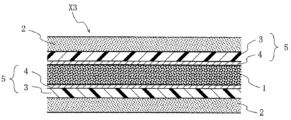
- FIG. 2 is a cross-sectional view showing an example of a laminate structure of the pressure-sensitive adhesive sheet of the present invention.
- FIG. 2 is a cross-sectional view showing another example of the laminate structure of the pressure-sensitive adhesive sheet of the present invention.
- FIG. 2 is a cross-sectional view showing an outline of the method for the 180° peel test in the examples.
- the pressure-sensitive adhesive composition according to the embodiment of the present invention contains a polymer, an electrolyte, and a filler.
- the pressure-sensitive adhesive composition will now be described.
- the adhesive strength when no voltage is applied is sometimes referred to as “initial adhesive strength.”
- the property of adhesive strength decreasing due to the application of voltage is called “electrical releasability,” and a material having a large rate of decrease in adhesive strength due to the application of voltage is sometimes referred to as having "excellent electrical releasability.”
- the pressure-sensitive adhesive composition according to the embodiment of the present invention contains a polymer.
- the polymer is not particularly limited as long as it is a general organic polymer compound, and is, for example, a polymer or partial polymer of a monomer.
- the monomer may be one type of monomer or a mixture of two or more types of monomers.
- the partial polymer means a polymer in which at least a part of the monomer or monomer mixture is partially polymerized.
- the polymer in the embodiment of the present invention is not particularly limited as long as it is normally used as an adhesive and has adhesive properties, and examples thereof include acrylic polymers, rubber polymers, vinyl alkyl ether polymers, silicone polymers, polyester polymers, polyamide polymers, urethane polymers, fluorine polymers, and epoxy polymers.
- acrylic polymers rubber polymers, vinyl alkyl ether polymers, silicone polymers, polyester polymers, polyamide polymers, urethane polymers, fluorine polymers, and epoxy polymers.
- the above polymers can be used alone or in combination of two or more kinds.
- the polymer in the embodiment of the present invention preferably includes at least one selected from the group consisting of polyester-based polymers, urethane-based polymers, and acrylic-based polymers.
- the acrylic polymer preferably has a carboxy group, an alkoxy group, a hydroxyl group and/or an amide bond.
- polyester-based polymers and urethane-based polymers have hydroxyl groups at their terminals which are easily polarized, and since acrylic-based polymers having carboxy groups, alkoxy groups, hydroxyl groups and/or amide bonds have carboxy groups, alkoxy groups, hydroxyl groups and/or amide bonds which are easily polarized, the use of these polymers makes it possible to obtain a pressure-sensitive adhesive layer which exhibits excellent adhesive strength when no voltage is applied.
- the total content of polyester-based polymer, urethane-based polymer, and acrylic-based polymer in all polymers contained in the pressure-sensitive adhesive composition according to an embodiment of the present invention is preferably 60% by mass or more, and more preferably 80% by mass or more.
- the polymer in the embodiments of the present invention is preferably an acrylic polymer, and more preferably an acrylic polymer having a carboxy group, an alkoxy group, a hydroxyl group, and/or an amide bond. That is, the pressure-sensitive adhesive composition according to the embodiment of the present invention is preferably an acrylic pressure-sensitive adhesive composition containing an acrylic polymer as a polymer.
- the acrylic polymer preferably contains a monomer unit derived from a (meth)acrylic acid alkyl ester (the following formula (1)) having an alkyl group having 1 to 14 carbon atoms.
- a monomer unit is suitable for obtaining a large initial adhesive strength.
- the number of carbon atoms in the alkyl group R b in the following formula (1) is preferably small, particularly preferably 8 or less, and more preferably 4 or less.
- CH 2 C(R a )COOR b (1) [In formula (1), R a is a hydrogen atom or a methyl group, and R b is an alkyl group having 1 to 14 carbon atoms]
- Examples of (meth)acrylic acid alkyl esters having an alkyl group having 1 to 14 carbon atoms include methyl (meth)acrylate, ethyl (meth)acrylate, propyl (meth)acrylate, isopropyl (meth)acrylate, n-butyl (meth)acrylate, sec-butyl (meth)acrylate, 1,3-dimethylbutyl acrylate, pentyl (meth)acrylate, isopentyl (meth)acrylate, hexyl (meth)acrylate, 2-ethyl
- Examples of such acrylates include butyl (meth)acrylate, heptyl (meth)acrylate, n-octyl (meth)acrylate, isooctyl (meth)acrylate, 2-ethylhexyl (meth)acrylate, n-nonyl (meth)acrylate, isononyl (meth)acrylate, n
- n-butyl acrylate, 2-ethylhexyl acrylate, and isononyl acrylate are preferred.
- the (meth)acrylic acid alkyl esters having an alkyl group having 1 to 14 carbon atoms can be used alone or in combination of two or more.
- the ratio of the (meth)acrylic acid alkyl ester having an alkyl group with 1 to 14 carbon atoms to the total monomer components (100% by mass) that make up the acrylic polymer is not particularly limited, but is preferably 70% by mass or more, more preferably 80% by mass or more, and even more preferably 85% by mass or more. If the ratio of the (meth)acrylic acid alkyl ester having an alkyl group with 1 to 14 carbon atoms is 70% by mass or more, it becomes easier to obtain a large initial adhesive strength.
- the acrylic polymer preferably contains a monomer unit derived from a polar group-containing monomer copolymerizable therewith, in addition to a monomer unit derived from a (meth)acrylic acid alkyl ester having an alkyl group with 1 to 14 carbon atoms.
- the monomer unit can provide crosslinking points and is suitable for obtaining a large initial adhesive strength.
- polar group-containing monomers examples include carboxy group-containing monomers, alkoxy group-containing monomers, hydroxyl group-containing monomers, cyano group-containing monomers, vinyl group-containing monomers, aromatic vinyl monomers, amide group-containing monomers, imide group-containing monomers, amino group-containing monomers, epoxy group-containing monomers, vinyl ether monomers, N-acryloylmorpholine, sulfo group-containing monomers, phosphate group-containing monomers, and acid anhydride group-containing monomers.
- carboxy group-containing monomers alkoxy group-containing monomers, hydroxyl group-containing monomers, and amide group-containing monomers are preferred from the viewpoint of excellent cohesiveness, and carboxy group-containing monomers are particularly preferred.
- Carboxy group-containing monomers are particularly suitable for obtaining large initial adhesive strength.
- Polar group-containing monomers can be used alone or in combination of two or more.
- carboxyl group-containing monomers examples include acrylic acid, methacrylic acid, carboxyethyl (meth)acrylate, carboxypentyl (meth)acrylate, itaconic acid, maleic acid, fumaric acid, crotonic acid, and isocrotonic acid. Acrylic acid is particularly preferred.
- the carboxyl group-containing monomers can be used alone or in combination of two or more.
- alkoxy group-containing monomers examples include methoxy group-containing monomers and ethoxy group-containing monomers.
- methoxy group-containing monomers include 2-methoxyethyl acrylate.
- hydroxyl group-containing monomers examples include 2-hydroxyethyl (meth)acrylate, 2-hydroxypropyl (meth)acrylate, 4-hydroxybutyl (meth)acrylate, 6-hydroxyhexyl (meth)acrylate, 8-hydroxyoctyl (meth)acrylate, 10-hydroxydecyl (meth)acrylate, 12-hydroxylauryl (meth)acrylate, (4-hydroxymethylcyclohexyl)methyl (meth)acrylate, N-methylol (meth)acrylamide, vinyl alcohol, allyl alcohol, 2-hydroxyethyl vinyl ether, 4-hydroxybutyl vinyl ether, and diethylene glycol monovinyl ether.
- 2-hydroxyethyl (meth)acrylate and 4-hydroxybutyl (meth)acrylate are preferred.
- the hydroxyl group-containing monomers can be used alone or in combination of two or more.
- amide group-containing monomers examples include acrylamide, methacrylamide, N-vinylpyrrolidone, N,N-dimethylacrylamide, N,N-dimethylmethacrylamide, N,N-diethylacrylamide, N,N-diethylmethacrylamide, N,N'-methylenebisacrylamide, N,N-dimethylaminopropylacrylamide, N,N-dimethylaminopropylmethacrylamide, and diacetoneacrylamide.
- the amide group-containing monomers can be used alone or in combination of two or more.
- Cyano group-containing monomers include, for example, acrylonitrile and methacrylonitrile.
- vinyl group-containing monomers examples include vinyl esters such as vinyl acetate, vinyl propionate, and vinyl laurate, with vinyl acetate being particularly preferred.
- Aromatic vinyl monomers include, for example, styrene, chlorostyrene, chloromethylstyrene, ⁇ -methylstyrene, and other substituted styrenes.
- imide group-containing monomers examples include cyclohexylmaleimide, isopropylmaleimide, N-cyclohexylmaleimide, and itaconimide.
- amino group-containing monomers examples include aminoethyl (meth)acrylate, N,N-dimethylaminoethyl (meth)acrylate, and N,N-dimethylaminopropyl (meth)acrylate.
- epoxy group-containing monomers examples include glycidyl (meth)acrylate, methyl glycidyl (meth)acrylate, and allyl glycidyl ether.
- vinyl ether monomers examples include methyl vinyl ether, ethyl vinyl ether, and isobutyl vinyl ether.
- the ratio of the polar group-containing monomer to the total monomer components (100% by mass) constituting the acrylic polymer is preferably 0.1% by mass or more and 35% by mass or less.
- the upper limit of the polar group-containing monomer ratio is more preferably 25% by mass, even more preferably 20% by mass, and the lower limit is more preferably 0.5% by mass, even more preferably 1% by mass, and particularly preferably 2% by mass.
- the ratio of the polar group-containing monomer is 35% by mass or less, it is easy to prevent the adhesive layer from excessively adhering to the adherend and causing heavy peeling.
- the ratio is 2% by mass or more and 20% by mass or less, it is easy to achieve both releasability to the adherend and adhesion between the adhesive layer and other layers.
- the monomer components constituting the acrylic polymer may also contain polyfunctional monomers to introduce a crosslinked structure into the acrylic polymer, making it easier to obtain the required cohesive strength.
- polyfunctional monomers examples include ethylene glycol di(meth)acrylate, diethylene glycol di(meth)acrylate, tetraethylene glycol di(meth)acrylate, neopentyl glycol di(meth)acrylate, 1,6-hexanediol di(meth)acrylate, trimethylolpropane tri(meth)acrylate, pentaerythritol tri(meth)acrylate, dipentaerythritol hexa(meth)acrylate, divinylbenzene, and N,N'-methylenebisacrylamide.
- the polyfunctional monomers can be used alone or in combination of two or more.
- the content of the polyfunctional monomer relative to the total monomer components (100% by mass) constituting the acrylic polymer is preferably 0.1% by mass or more and 15% by mass or less.
- the upper limit of the polyfunctional monomer content is more preferably 10% by mass, and the lower limit is more preferably 3% by mass. If the content of the polyfunctional monomer is 0.1% by mass or more, the flexibility and adhesiveness of the adhesive layer are more likely to be improved, which is preferable. If the content of the polyfunctional monomer is 15% by mass or less, the cohesive force is not too high, and it is easier to obtain appropriate adhesiveness.
- Polyester-based polymers are typically polymers that have a structure formed by condensation of polycarboxylic acids such as dicarboxylic acids or their derivatives (hereinafter also referred to as “polycarboxylic acid monomers”) with polyhydric alcohols such as diols or their derivatives (hereinafter referred to as “polyhydric alcohol monomers").
- polycarboxylic acids such as dicarboxylic acids or their derivatives
- polyhydric alcohol monomers such as diols or their derivatives
- the polyvalent carboxylic acid monomer is not particularly limited, but examples thereof that can be used include adipic acid, azelaic acid, dimer acid, sebacic acid, 1,4-cyclohexanedicarboxylic acid, 1,3-cyclohexanedicarboxylic acid, 1,2-cyclohexanedicarboxylic acid, 4-methyl-1,2-cyclohexanedicarboxylic acid, dodecenylsuccinic anhydride, fumaric acid, succinic acid, dodecanedioic acid, hexahydrophthalic anhydride, tetrahydrophthalic anhydride, maleic acid, maleic anhydride, itaconic acid, citraconic acid, and derivatives thereof.
- the polyvalent carboxylic acid monomers may be used alone or in combination of two or more kinds.
- the polyhydric alcohol monomer is not particularly limited, but examples thereof include ethylene glycol, 1,2-propylene glycol, 1,3-propanediol, 2-methyl-1,3-propanediol, 1,2-butanediol, 1,3-butanediol, 1,4-butanediol, 1,5-pentanediol, 1,6-hexanediol, 3-methyl-1,5-pentanediol, neopentyl glycol, diethylene glycol, dipropylene glycol, 2,2,4-trimethyl-1,5-pentanediol, 2-ethyl-2-butylpropanediol, 1,9-nonanediol, 2-methyloctanediol, 1,10-decanediol, and derivatives thereof.
- the polyhydric alcohol monomers can be used alone or in combination of two or more kinds.
- urethane-based polymers examples include polyether-based polyurethane, polyester-based polyurethane, and polycarbonate-based polyurethane.
- polyether-based polyurethanes examples include polyethylene glycol-based polyurethanes, polypropylene glycol-based polyurethanes, and polytetramethylene glycol-based polyurethanes.
- polyester-based polyurethanes examples include adipate-based (ester-based) polyurethanes and polycaprolactone-based (ester-based) polyurethanes.
- a polymer can be obtained by (co)polymerizing monomer components.
- the polymerization method is not particularly limited, but examples include solution polymerization, emulsion polymerization, bulk polymerization, suspension polymerization, and photopolymerization (active energy ray polymerization). In particular, from the viewpoint of cost and productivity, the solution polymerization method is preferable.
- the polymer When the polymer is copolymerized, it may be any of a random copolymer, a block copolymer, an alternating copolymer, a graft copolymer, etc.
- solution polymerization method examples include a method in which monomer components, a polymerization initiator, etc. are dissolved in a solvent and polymerized by heating to obtain a polymer solution containing the polymer.
- solvents can be used as the solvent for the solution polymerization method.
- solvents include organic solvents such as aromatic hydrocarbons such as toluene, benzene, and xylene; esters such as ethyl acetate and n-butyl acetate; aliphatic hydrocarbons such as n-hexane and n-heptane; alicyclic hydrocarbons such as cyclohexane and methylcyclohexane; and ketones such as methyl ethyl ketone and methyl isobutyl ketone.
- Solvents can be used alone or in combination of two or more kinds.
- the amount of the solvent used is not particularly limited, but is preferably 10 parts by mass or more and 1,000 parts by mass or less relative to the total monomer components (100 parts by mass) that make up the polymer.
- the upper limit of the amount of the solvent used is more preferably 500 parts by mass, and the lower limit is more preferably 50 parts by mass.
- Polymerization initiators used in the solution polymerization method include, but are not limited to, peroxide-based polymerization initiators, azo-based polymerization initiators, etc.
- Peroxide-based polymerization initiators include, but are not limited to, peroxycarbonates, ketone peroxides, peroxyketals, hydroperoxides, dialkyl peroxides, diacyl peroxides, and peroxyesters, and more specifically, benzoyl peroxide, t-butyl hydroperoxide, di-t-butyl peroxide, t-butyl peroxybenzoate, dicumyl peroxide, 1,1-bis(t-butylperoxy)-3,3,5-trimethylcyclohexane, and 1,1-bis(t-butylperoxy)cyclododecane, etc.
- the azo polymerization initiator is not particularly limited, but examples thereof include 2,2'-azobisisobutyronitrile, 2,2'-azobis-2-methylbutyronitrile, 2,2'-azobis(2,4-dimethylvaleronitrile), 2,2'-azobis(2-methylpropionic acid)dimethyl, 2,2'-azobis(4-methoxy-2,4-dimethylvaleronitrile), 1,1'-azobis(cyclohexane-1-carbonitrile), 2,2'-azobis(2,4,4-trimethylpentane), 4,4'-azobis
- Examples of the polymerization initiator include 4-cyanovaleric acid, 2,2'-azobis(2-amidinopropane) dihydrochloride, 2,2'-azobis[2-(5-methyl-2-imidazolin-2-yl)propane] dihydrochloride, 2,2'-azobis(2-methylpropionamidine) disulfate, 2,2'-azobis(N,N'
- the amount of polymerization initiator used is not particularly limited, but is preferably 0.01 parts by mass or more and 5 parts by mass or less relative to the total monomer components (100 parts by mass) that make up the polymer.
- the upper limit of the amount of polymerization initiator used is more preferably 3 parts by mass, and the lower limit is more preferably 0.05 parts by mass.
- the heating temperature when polymerizing by heating is not particularly limited, but is, for example, 50°C or higher and 80°C or lower.
- the heating time is not particularly limited, but is, for example, 1 hour or higher and 24 hours or lower.
- the weight-average molecular weight of the polymer is not particularly limited, but is preferably 100,000 or more and 5 million or less.
- the upper limit of the weight-average molecular weight is more preferably 4 million, and even more preferably 3 million, and the lower limit is more preferably 200,000, and even more preferably 300,000. If the weight-average molecular weight is 100,000 or more, the cohesive force is small, and the problem of adhesive residue remaining on the adherend surface after the adhesive layer is peeled off can be effectively suppressed. Furthermore, if the weight-average molecular weight is 5 million or less, the problem of insufficient wettability on the adherend surface after the adhesive layer is peeled off can be effectively suppressed.
- the weight average molecular weight is obtained by measurement using gel permeation chromatography (GPC). More specifically, for example, it can be measured using a GPC measuring device with the product name "HLC-8220GPC” (manufactured by Tosoh Corporation) under the following conditions, and calculated in terms of standard polystyrene.
- GPC gel permeation chromatography
- the glass transition temperature (Tg) of the polymer is not particularly limited, but is preferably 0°C or lower since this prevents a decrease in the initial adhesive strength, more preferably -10°C or lower, and even more preferably -20°C or lower. Furthermore, it is particularly preferable for the glass transition temperature (Tg) to be -40°C or lower since the rate of decrease in adhesive strength due to the application of voltage is particularly large, and is most preferably -50°C or lower.
- the above formula (Y) is a calculation formula when the polymer is composed of n types of monomer components, namely, monomer 1, monomer 2, . . . , monomer n.
- the glass transition temperature when a homopolymer is formed means the glass transition temperature of a homopolymer of the monomer, and refers to the glass transition temperature (Tg) of a polymer formed using only a certain monomer (sometimes referred to as "monomer X") as a monomer component. Specifically, numerical values are given in "Polymer Handbook” (3rd Edition, John Wiley & Sons, Inc., 1989). Note that the glass transition temperature (Tg) of a homopolymer not described in the literature refers to, for example, a value obtained by the following measurement method.
- the homopolymer solution is then cast onto a release liner and dried to produce a test sample (homopolymer sheet) with a thickness of about 2 mm.
- a test sample homopolymer sheet
- Approximately 1 to 2 mg of the test sample is weighed into an aluminum open cell, and the reversing heat flow (specific heat component) behavior of the homopolymer is obtained using a temperature-modulated DSC (product name "Q-2000" manufactured by TA Instruments) at a heating rate of 5°C/min under a nitrogen atmosphere of 50 ml/min.
- the glass transition temperature (Tg) of the homopolymer is determined as the temperature at the point where a straight line equidistant in the vertical direction from a straight line extending the low-temperature side baseline and the high-temperature side baseline of the obtained reversing heat flow intersects with the curve of the stepwise change in the glass transition.
- the polymer content in the adhesive composition according to the embodiment of the present invention is preferably 50% by mass or more and 99.9% by mass or less, based on the total amount of the adhesive composition (100% by mass), with the upper limit being more preferably 99.5% by mass, and even more preferably 99% by mass, and the lower limit being more preferably 60% by mass, and even more preferably 70% by mass.
- the adhesive composition according to the embodiment of the present invention contains an electrolyte.
- the electrolyte is a substance that can be ionized into anions and cations, and examples of such electrolytes include ionic liquids, alkali metal salts, alkaline earth metal salts, and organic quaternary ammonium salts.
- the electrolyte contained in the adhesive composition is preferably an ionic liquid.
- the ionic liquid is a salt that is liquid at room temperature (about 25° C.) and contains anions and cations.
- Ionic liquids are not particularly limited as long as they are molten salts (room temperature molten salts) that are composed of a pair of anions and cations and are liquid at 25°C.
- molten salts room temperature molten salts
- anions and cations are given below, but of the ionic substances obtained by combining these, those that are liquid at 25°C are ionic liquids, and those that are solid at 25°C are not ionic liquids but ionic solids, which will be described later.
- Examples of anions of ionic liquids include ( FSO2 ) 2N- , ( CF3SO2 ) 2N- , (CF3CF2SO2 ) 2N- , ( CF3SO2 ) 3C- , Br- , AlCl4- , Al2Cl7- , NO3- , BF4- , PF6- , CH3COO- , CF3COO- , CF3CF2CF2COO- , CF3SO3- , CF3 ( CF2 ) 3SO3- , AsF6- , SbF6- , and F ( HF ) n- .
- the anions of sulfonylimide compounds such as (FSO 2 ) 2 N ⁇ [bis(fluorosulfonyl)imide anion] and (CF 3 SO 2 ) 2 N ⁇ [bis(trifluoromethanesulfonyl)imide anion] are preferred as they are chemically stable and suitable for improving electrical peeling properties.
- the anion of the ionic liquid preferably contains at least one selected from the group consisting of bis(fluorosulfonyl)imide anion and bis(trifluoromethanesulfonyl)imide anion.
- nitrogen-containing onium, sulfur-containing onium, and phosphorus-containing onium cations are preferred because they are chemically stable and suitable for improving electrical peeling properties, and imidazolium-based, ammonium-based, pyrrolidinium-based, and pyridinium-based cations are more preferred.
- imidazolium cations include 1-methylimidazolium cation, 1-ethyl-3-methylimidazolium cation, 1-propyl-3-methylimidazolium cation, 1-butyl-3-methylimidazolium cation, 1-pentyl-3-methylimidazolium cation, 1-hexyl-3-methylimidazolium cation, 1-heptyl-3-methylimidazolium cation, 1-octyl-3-methylimidazolium cation, 1-nonyl-3-methylimidazolium cation, 1-undecyl-3-methylimidazolium cation, 1-dodecyl-3-methylimidazolium cation, 1-tridecyl-3-methylimidazolium cation, 1-tetradecyl-3-methylimidazolium cation, 1-pentadecyl-3-methylimidazolium cation, 1-hexa
- pyridinium cations include 1-butylpyridinium cation, 1-hexylpyridinium cation, 1-butyl-3-methylpyridinium cation, 1-butyl-4-methylpyridinium cation, and 1-octyl-4-methylpyridinium cation.
- pyrrolidinium cations include 1-ethyl-1-methylpyrrolidinium cation and 1-butyl-1-methylpyrrolidinium cation.
- ammonium cations include tetraethylammonium cation, tetrabutylammonium cation, methyltrioctylammonium cation, tetradecyltrihexylammonium cation, glycidyltrimethylammonium cation, and trimethylaminoethyl acrylate cation.
- a constituent cation having a molecular weight of 160 or less for the ionic liquid, and an ionic liquid containing the above-mentioned (FSO 2 ) 2 N ⁇ [bis(fluorosulfonyl)imide anion] or (CF 3 SO 2 ) 2 N ⁇ [bis(trifluoromethanesulfonyl)imide anion] and a cation having a molecular weight of 160 or less is particularly preferable.
- Examples of the cation having a molecular weight of 160 or less include 1-methylimidazolium cation, 1-ethyl-3-methylimidazolium cation, 1-propyl-3-methylimidazolium cation, 1-butyl-3-methylimidazolium cation, 1-pentyl-3-methylimidazolium cation, 1-butylpyridinium cation, 1-hexylpyridinium cation, 1-butyl-3-methylpyridinium cation, 1-butyl-4-methylpyridinium cation, 1-ethyl-1-methylpyrrolidinium cation, 1-butyl-1-methylpyrrolidinium cation, tetraethylammonium cation, glycidyltrimethylammonium cation, and trimethylaminoethyl acrylate cation.
- the cations of the ionic liquid are preferably those represented by the following formulas (2-A) to (2-D).
- R 1 represents a hydrocarbon group having 4 to 10 carbon atoms (preferably a hydrocarbon group having 4 to 8 carbon atoms, more preferably a hydrocarbon group having 4 to 6 carbon atoms) which may contain a heteroatom
- R 2 and R 3 are the same or different and represent a hydrogen atom or a hydrocarbon group having 1 to 12 carbon atoms (preferably a hydrocarbon group having 1 to 8 carbon atoms, more preferably a hydrocarbon group having 2 to 6 carbon atoms, even more preferably a hydrocarbon group having 2 to 4 carbon atoms) which may contain a heteroatom, provided that when a nitrogen atom forms a double bond with an adjacent carbon atom, R 3 does not exist.
- R 4 represents a hydrocarbon group having 2 to 10 carbon atoms (preferably a hydrocarbon group having 2 to 8 carbon atoms, more preferably a hydrocarbon group having 2 to 6 carbon atoms) which may contain a heteroatom
- R 5 , R 6 , and R 7 are the same or different and represent a hydrogen atom or a hydrocarbon group having 1 to 12 carbon atoms (preferably a hydrocarbon group having 1 to 8 carbon atoms, more preferably a hydrocarbon group having 2 to 6 carbon atoms, and even more preferably a hydrocarbon group having 2 to 4 carbon atoms) which may contain a heteroatom.
- R 8 represents a hydrocarbon group having 2 to 10 carbon atoms (preferably a hydrocarbon group having 2 to 8 carbon atoms, more preferably a hydrocarbon group having 2 to 6 carbon atoms) which may contain a heteroatom
- R 9 , R 10 , and R 11 are the same or different and represent a hydrogen atom or a hydrocarbon group having 1 to 16 carbon atoms (preferably a hydrocarbon group having 1 to 10 carbon atoms, more preferably a hydrocarbon group having 1 to 8 carbon atoms) which may contain a heteroatom.
- X represents a nitrogen, sulfur, or phosphorus atom
- R 12 , R 13 , R 14 , and R 15 are the same or different and represent a hydrocarbon group having 1 to 16 carbon atoms (preferably a hydrocarbon group having 1 to 14 carbon atoms, more preferably a hydrocarbon group having 1 to 10 carbon atoms, even more preferably a hydrocarbon group having 1 to 8 carbon atoms, and particularly preferably a hydrocarbon group having 1 to 6 carbon atoms), which may contain a heteroatom, provided that when X is a sulfur atom, R 12 does not exist.
- the cation of the ionic liquid preferably contains at least one selected from the group consisting of nitrogen-containing onium cations, sulfur-containing onium cations, and phosphorus-containing onium cations.
- the molecular weight of the cation in the ionic liquid is, for example, 500 or less, preferably 400 or less, more preferably 300 or less, even more preferably 250 or less, particularly preferably 200 or less, and most preferably 160 or less. It is usually 50 or more. It is believed that the cation in the ionic liquid has the property of migrating to the cathode side in the adhesive layer when a voltage is applied, and being biased toward the interface between the adhesive layer and the adherend. For this reason, in the present invention, the adhesive strength when a voltage is applied decreases compared to the initial adhesive strength, and electrical peeling occurs.
- Cations with a small molecular weight are suitable for making it easier for the cation to migrate to the cathode side in the adhesive layer and for increasing the rate of decrease in adhesive strength when a voltage is applied.
- ionic liquids include, for example, "ELEXEL AS-110,” “ELEXEL MP-442,” “ELEXEL IL-210,” “ELEXEL MP-471,” “ELEXEL MP-456,” and “ELEXEL AS-804" manufactured by Daiichi Kogyo Seiyaku Co., Ltd., "HMI-FSI” manufactured by Mitsubishi Materials Corporation, and "CIL-312” and “CIL-313” manufactured by Nippon Carlit Co., Ltd.
- the ionic conductivity of the ionic liquid is preferably 0.1 mS/cm or more. More preferably, it is 1 mS/cm or more, even more preferably, it is 3 mS/cm or more, even more preferably, it is 5 mS/cm or more, even more preferably, it is 10 mS/cm or more, especially preferably, it is 15 mS/cm or more, and most preferably, it is 20 mS/cm or more.
- the ionic conductivity can be measured by the AC impedance method, for example, using a Solartron 1260 frequency response analyzer.
- the content (mixture amount) of ionic liquid in the adhesive composition according to an embodiment of the present invention is preferably 0.5 parts by mass or more relative to 100 parts by mass of polymer from the viewpoint of reducing adhesive strength during voltage application, and is preferably 30 parts by mass or less from the viewpoint of increasing initial adhesive strength. From the same viewpoint, it is more preferably 20 parts by mass or less, even more preferably 15 parts by mass or less, particularly preferably 10 parts by mass or less, and most preferably 5 parts by mass or less. It is also more preferably 0.6 parts by mass or more, even more preferably 0.8 parts by mass or more, particularly preferably 1.0 part by mass or more, and most preferably 1.5 parts by mass or more.
- the pressure-sensitive adhesive composition according to the embodiment of the present invention contains a filler.
- the pressure-sensitive adhesive composition contains a filler
- external impact is alleviated by energy dissipation due to deformation or breakage of the filler, peeling at the interface between the filler and the pressure-sensitive adhesive layer, etc.
- external stress is alleviated by growth of voids generated inside the pressure-sensitive adhesive layer due to peeling at the interface between the filler and the pressure-sensitive adhesive layer, etc., resulting in improved impact resistance and/or initial adhesive strength of the pressure-sensitive adhesive layer.
- the shape of the filler is not particularly limited, and may be spherical, rod-like, plate-like, or bowl-shaped, but is preferably spherical.
- the isotropy of the shape reduces stress concentration on the filler, improving the impact resistance of the filler itself, and/or the interface between the filler and the adhesive layer peels non-locally, and the voids generated inside the adhesive layer grow uniformly and large, so that the stress is continuously relieved, and as a result, the impact resistance and/or initial adhesive strength of the adhesive layer is also improved.
- the isotropy of the shape reduces the effect on the current path in the adhesive layer, and reduces the effect on the electrical peelability.
- spherical refers to a shape in which the circularity value, which is calculated by dividing the difference between the radii of two concentric geometric circles by 2, is 0.8 to 1.0.
- the filler is preferably soft, has good dispersibility in the polymer, or has functional groups on its surface that can chemically bond with the polymer.
- Such fillers may be made of organic matter, inorganic matter, or both.
- Inorganic substances that can form fillers include, for example, metals such as copper, silver, gold, platinum, nickel, aluminum, chromium, iron, and stainless steel; metal oxides such as aluminum oxide, silicon oxide (silicon dioxide), titanium oxide, zirconium oxide, zinc oxide, tin oxide, copper oxide, and nickel oxide; aluminum hydroxide, boehmite, magnesium hydroxide, calcium hydroxide, zinc hydroxide, silicic acid, iron hydroxide, copper hydroxide, barium hydroxide, zirconium oxide hydrate, tin oxide hydrate, basic magnesium carbonate, and hydrotalcite.
- metals such as copper, silver, gold, platinum, nickel, aluminum, chromium, iron, and stainless steel
- metal oxides such as aluminum oxide, silicon oxide (silicon dioxide), titanium oxide, zirconium oxide, zinc oxide, tin oxide, copper oxide, and nickel oxide
- aluminum hydroxide, boehmite magnesium hydroxide, calcium hydroxide, zinc hydroxide, silicic acid, iron hydro
- metal hydroxides and hydrated metal compounds such as silicite, dawsonite, borax, and zinc borate
- carbides such as silicon carbide, boron carbide, nitrogen carbide, and calcium carbide
- nitrides such as aluminum nitride, silicon nitride, boron nitride, and gallium nitride
- carbonates such as calcium carbonate
- titanates such as barium titanate and potassium titanate
- carbon-based materials such as carbon black, carbon tubes (carbon nanotubes), carbon fiber, and diamond
- inorganic materials such as glass
- natural raw material particles such as volcanic silt, clay, and sand.
- Organic substances that can form fillers include, for example, polystyrene, acrylic resins (e.g., polymethyl methacrylate), phenolic resins, benzoguanamine resins, urea resins, silicone resins, polyesters, polyurethanes, polyethylene, polypropylene, polyamides (e.g., nylon, etc.), polyimides, polyvinylidene chloride, and other polymers.
- examples of soft fillers include fillers having a small durometer hardness, or fillers having a small strength when pressed at 10% strength in a microcompression test.
- the durometer hardness is preferably 60° or less, more preferably 40° or less, and even more preferably 30° or less. Although there is no particular lower limit, it is usually 5° or more.
- the durometer hardness is measured in accordance with the standard of JIS K 6253. For the measurement, for example, a rubber hardness tester GS-719N (manufactured by Techclock Corporation) is used.
- the strength when pressed at 10% strength is preferably 30 MPa or less, more preferably 10 MPa or less, even more preferably 5 MPa or less, and particularly preferably 3 MPa or less.
- the strength when pressed at 10% strength is measured, for example, in accordance with the provisions of JIS Z 8844:2019.
- a microcompression tester MCT-W500 manufactured by Shimadzu Corporation
- the strength when pressed at 10% strength refers to the deformation strength (MPa) for a compression displacement of 10% of the particle diameter.
- examples of fillers having good dispersibility in polymers include fillers that have a small HSP distance Ra between the Hansen solubility parameters (HSP values) of the filler and the polymer.
- Ra is preferably 30 or less, more preferably 25 or less, and even more preferably 20 or less.
- Ra is obtained by a dispersion test.
- HSPiP Hansen Solubility Parameters in Practice
- dD 1 represents the dispersion force term of the filler
- dD 2 represents the dispersion force term of the polymer
- dP 1 represents the dipole term of the filler
- dP 2 represents the dipole term of the polymer
- dH 1 represents the hydrogen bonding force term of the filler
- dH 2 represents the hydrogen bonding force term of the polymer.
- soft fillers include fillers covered with urethane resin and silicone rubber fillers.
- An example of a filler that has good dispersibility in polymers is a filler that is covered with silicone resin in acrylic polymers or polyester polymers.
- An example of a filler having a functional group on its surface that can chemically bond with a polymer is a filler having a functional group on its surface that can chemically bond with a functional group of a polymer. More specifically, it is possible to include a filler having a functional group on its surface that can react with a functional group such as a hydroxyl group, a carboxyl group, an epoxy group, an acrylic group, or a vinyl group of a polymer, and even more specifically, it is possible to include a filler whose surface is modified with an isocyanate group, an amino group, an azide group, or an epoxy group.
- the filler preferably has a surface covered with urethane or silicone resin, or has a surface modified with an isocyanate group, an amino group, an azide group, or an epoxy group.
- the use of the filler is preferable because it is possible to further improve the impact resistance and/or initial adhesive strength while maintaining the electrical peelability of the pressure-sensitive adhesive layer.
- at least one of the following (i) to (iv) is considered to be the reason.
- the filler has excellent dispersibility in the adhesive layer, with little effect on the current path and little effect on electrical peelability.
- the dielectric constant of the filler surface is high, facilitating the movement of electrolytes in the adhesive layer.
- the molecular chains of the polymer that constitutes the adhesive layer are more likely to be oriented in the direction of stress around the filler, improving the shock relaxation properties inside the adhesive layer and resulting in improved impact resistance and/or initial adhesive strength.
- the filler which has a lower elastic modulus than the adhesive layer, deforms locally to absorb shock, resulting in improved impact resistance and/or initial adhesive strength of the adhesive layer.
- the entire filler may be formed of urethane or silicone resin, or only the surface of the filler may be covered with urethane or silicone resin, with the core of the filler being formed of another material.
- the urethane or silicone resin that covers the surface of the filler include polyether-based urethane resin, polyester-based urethane resin, polycarbonate-based urethane resin, straight silicone resin containing organosilsesquioxane units as the main component, and modified silicone resin, with polyether-based urethane resin and straight silicone resin being preferred.
- the material forming the filler core is not particularly limited, but examples thereof include silicone rubber, silica, urethane, acrylic, and rubber, with silicone rubber, silica, and urethane being preferred because of the ease of particle size control.
- the entire surface of the filler may be modified with the group, or only a part of the surface may be modified. In order to maximize the effect of modifying the surface of the filler, it is preferable that the entire surface of the filler is modified with the group.
- the proportion of the filler surface modified with an isocyanate group, an amino group, an azide group, or an epoxy group is preferably such that the filler surface is treated with a surface modifier containing an isocyanate group, an amino group, an azide group, or an epoxy group at a weight ratio of the surface modifier to the filler of 10% or less, more preferably 5% or less, and even more preferably 1% or less.
- the filler has a high relative dielectric constant.
- the preferred range of the relative dielectric constant of the filler at a frequency of 100 kHz is preferably 3.0 or more, more preferably 5.0 or more, and even more preferably 7.0 or more.
- the upper limit of the preferred range of the relative dielectric constant of the filler is not particularly limited, but is usually 50 or less.
- the glass transition temperature (Tg) of the filler is low.
- the Tg of the filler is preferably 50° C. or less, more preferably 30° C. or less, particularly preferably ⁇ 10° C. or less, and most preferably ⁇ 30° C. or less.
- the lower limit of the Tg of the filler can be, for example, ⁇ 150° C., ⁇ 140° C., or ⁇ 130° C.
- the reason why the initial adhesive strength is improved by setting the Tg of the filler within the above range is not clear, but the following reasons are considered.
- the filler can deform and move following the deformation of the adhesive layer during peeling, so that the voids generated inside the adhesive layer due to the peeling of the interface between the filler and the adhesive layer grow uniformly and large, and the stress can be continuously relieved, which is considered to result in an improvement in the initial adhesive strength.
- the cohesive force of the adhesive layer is improved, so that the stress required for the deformation of the adhesive during peeling is increased, which is considered to result in an improvement in the initial adhesive strength.
- the lower limit of the range of the preferred average particle size of the filler is not particularly limited, but is preferably 0.01 ⁇ m. From the viewpoint of preventing the filler from protruding from the pressure-sensitive adhesive and reducing the adhesive strength, the average particle size of the filler is preferably 100 ⁇ m or less, more preferably 50 ⁇ m or less, and even more preferably 30 ⁇ m or less.
- the "average particle size" in this specification means the volume-based average particle size (volume average particle size) measured using a laser diffraction type particle size distribution meter (e.g., SALD2100 manufactured by Shimadzu Corporation) when the volume average particle size is 0.1 ⁇ m or more.
- the average particle size means the volume-based average particle size (volume average particle size) measured using a dynamic light scattering type particle size distribution measuring device (e.g., particle size distribution measuring device NANO-flex manufactured by Nikkiso Co., Ltd.).
- a dynamic light scattering type particle size distribution measuring device e.g., particle size distribution measuring device NANO-flex manufactured by Nikkiso Co., Ltd.
- the content of the filler in the adhesive composition according to the embodiment of the present invention is preferably 45 parts by mass or less, more preferably 30 parts by mass or less, even more preferably 20 parts by mass or less, even more preferably 10 parts by mass or less, even more preferably 7 parts by mass or less, particularly preferably 6 parts by mass or less, even more particularly preferably 4 parts by mass or less, even more particularly preferably 2 parts by mass or less, and most preferably 1 part by mass or less, relative to 100 parts by mass of polymer.
- the content of the filler in the adhesive composition according to the embodiment of the present invention is preferably 0.1 parts by mass or more, more preferably 0.3 parts by mass or more, even more preferably 0.5 parts by mass or more, particularly preferably 0.6 parts by mass or more, even more particularly preferably 0.7 parts by mass or more, and most preferably 0.8 parts by mass or more, relative to 100 parts by mass of the polymer.
- the content of the filler in the adhesive composition according to the embodiment of the present invention can be preferably 0.1 to 45 parts by mass, more preferably 0.1 to 30 parts by mass, relative to 100 parts by mass of the polymer.
- the glass transition temperature (Tg) of the filler in the pressure-sensitive adhesive composition according to the embodiment of the present invention is 50° C. or lower, and the content of the filler relative to 100 parts by mass of the polymer is 0.1 to 10 parts by mass.
- the Tg of the filler is more preferably 30° C. or less, particularly preferably ⁇ 10° C. or less, and most preferably ⁇ 30° C. or less.
- the lower limit of the Tg of the filler can be, for example, ⁇ 150° C., ⁇ 140° C., or ⁇ 130° C.
- the content of the filler is more preferably 0.3 parts by mass or more, even more preferably 0.5 parts by mass or more, particularly preferably 0.6 parts by mass or more, even more particularly preferably 0.7 parts by mass or more, and most preferably 0.8 parts by mass or more, more preferably 8 parts by mass or less, even more preferably 7 parts by mass or less, particularly preferably 5 parts by mass or less, and even more particularly preferably 3 parts by mass or less, relative to 100 parts by mass of the polymer.
- the pressure-sensitive adhesive composition according to the embodiment of the present invention may contain one or more components other than the polymer, electrolyte, and filler (hereinafter, may be referred to as "other components") as necessary within a range that does not impair the effects of the present invention.
- other components that may be contained in the pressure-sensitive adhesive composition according to the embodiment of the present invention will be described.
- the adhesive composition according to the embodiment of the present invention may contain an ionic additive for the purpose of controlling the electric peeling force.
- an ionic additive for example, an ionic solid can be used.
- the ionic solid is an ionic substance that is solid at 25°C.
- the ionic solid there are no particular limitations on the ionic solid, but for example, a solid ionic substance obtained by combining anions and cations as exemplified in the description of the ionic liquid in the electrolyte section above can be used.
- the content of the ionic solid is preferably 0.5 parts by mass or more, more preferably 1 part by mass or more, and preferably 10 parts by mass or less, more preferably 5 parts by mass or less, and even more preferably 2.5 parts by mass or less, relative to 100 parts by mass of the polymer.
- the adhesive composition according to the embodiment of the present invention may contain a crosslinking agent as necessary for the purpose of improving creep properties and shear properties by crosslinking the polymer.
- crosslinking agents include isocyanate-based crosslinking agents, carbodiimide-based crosslinking agents, epoxy-based crosslinking agents, melamine-based crosslinking agents, peroxide-based crosslinking agents, urea-based crosslinking agents, metal alkoxide-based crosslinking agents, metal chelate-based crosslinking agents, metal salt-based crosslinking agents, oxazoline-based crosslinking agents, aziridine-based crosslinking agents, and amine-based crosslinking agents.
- Examples of isocyanate-based crosslinking agents include toluene diisocyanate and methylene bisphenyl isocyanate.
- Examples of carbodiimide-based crosslinking agents include polycarbodiimide resins.
- Examples of epoxy-based crosslinking agents include N,N,N',N'-tetraglycidyl-m-xylylenediamine, diglycidylaniline, 1,3-bis(N,N-diglycidylaminomethyl)cyclohexane, and 1,6-hexanediol diglycidyl ether.
- the content is preferably 0.01 parts by mass or more, more preferably 0.7 parts by mass or more, and preferably 50 parts by mass or less, more preferably 10 parts by mass or less, and even more preferably 5 parts by mass or less, relative to 100 parts by mass of the polymer.
- the crosslinking agent may be used alone or in combination of two or more kinds.
- the adhesive composition according to the embodiment of the present invention may contain polyethylene glycol or tetraethylene glycol dimethyl ether as necessary for the purpose of aiding the movement of the electrolyte when a voltage is applied.
- the polyethylene glycol or tetraethylene glycol dimethyl ether that can be used has a number average molecular weight of 100 to 6000.
- the content is preferably 0.1 parts by mass or more, more preferably 0.5 parts by mass or more, and even more preferably 1 part by mass or more, and is preferably 30 parts by mass or less, more preferably 20 parts by mass or less, and even more preferably 15 parts by mass or less, relative to 100 parts by mass of the polymer.
- the adhesive composition according to the embodiment of the present invention may contain a conductive filler as necessary for the purpose of imparting electrical conductivity to the adhesive composition.
- a conductive filler there are no particular limitations on the conductive filler, and any commonly known or commonly used conductive filler may be used, such as graphite, carbon black, carbon fiber, or metal powder such as silver or copper.
- the content is preferably 0.1 parts by mass or more and 200 parts by mass or less per 100 parts by mass of the polymer.
- the adhesive composition according to the embodiment of the present invention may contain a corrosion inhibitor as necessary for the purpose of suppressing corrosion of the metal adherend.
- a corrosion inhibitor as necessary for the purpose of suppressing corrosion of the metal adherend.
- any commonly known or commonly used corrosion inhibitor can be used, such as a carbodiimide compound, an adsorptive inhibitor, or a chelating metal deactivator.
- carbodiimide compounds include 1-[3-(dimethylamino)propyl]-3-ethylcarbodiimide, 1-ethyl-3-(3-dimethylaminopropyl)carbodiimide, N,N'-dicyclohexylcarbodiimide, N,N'-diisopropylcarbodiimide, 1-ethyl-3-tert-butylcarbodiimide, N-cyclohexyl-N'-(2-morpholinoethyl)carbodiimide, N,N'-di-tert-butylcarbodiimide, and 1,3-bis(p-tolyl)carbodiimide.
- carbodiimide compounds can be used alone or in combination of two or more.
- the content is preferably 0.01 parts by mass or more and 10 parts by mass or less relative to 100 parts by mass of the polymer.
- the adsorptive inhibitor may be, for example, an alkylamine, a carboxylate, a carboxylate derivative, or an alkyl phosphate.
- the adsorptive inhibitor may be used alone or in combination of two or more.
- the content is preferably 0.01 to 20 parts by mass relative to 100 parts by mass of the polymer.
- the adhesive composition according to the embodiment of the present invention contains a carboxylate as an adsorptive inhibitor, the content is preferably 0.01 to 10 parts by mass relative to 100 parts by mass of the polymer.
- the content is preferably 0.01 to 10 parts by mass relative to 100 parts by mass of the polymer.
- the content is preferably 0.01 to 10 parts by mass relative to 100 parts by mass of the polymer.
- the adhesive composition according to the embodiment of the present invention contains an alkyl phosphate as an adsorptive inhibitor, the content is preferably 0.01 to 10 parts by mass relative to 100 parts by mass of the polymer.
- the chelating metal deactivator for example, a triazole group-containing compound or a benzotriazole group-containing compound can be used. These are preferred because they have a high effect of deactivating the surface of metals such as stainless steel and aluminum, and are less likely to affect adhesion even when contained in the adhesive component.
- the chelating metal deactivator can be used alone or in combination of two or more kinds.
- the content is preferably 0.01 parts by mass or more and 20 parts by mass or less relative to 100 parts by mass of the polymer.
- the total content (blended amount) of the corrosion inhibitor is preferably 0.01 parts by mass or more and 30 parts by mass or less based on 100 parts by mass of the polymer.
- the adhesive composition according to the embodiment of the present invention may contain a tackifier as necessary to improve the adhesiveness of the adhesive layer.
- tackifier resin for example, a tackifier resin is used.
- tackifier resins include phenol-based tackifier resins, terpene-based tackifier resins, rosin-based tackifier resins, hydrocarbon-based tackifier resins, epoxy-based tackifier resins, polyamide-based tackifier resins, elastomer-based tackifier resins, and ketone-based tackifier resins.
- phenol-based tackifying resins include terpene phenol resins, hydrogenated terpene phenol resins, alkylphenol resins, rosin phenol resins, and xylene formaldehyde resins.
- Terpene phenol resin refers to a polymer containing a terpene residue and a phenol residue, and is a concept that includes both a copolymer of a terpene and a phenol compound (terpene-phenol copolymer resin) and a homopolymer or copolymer of a terpene modified with phenol (phenol-modified terpene resin).
- terpenes that constitute such terpene phenol resins include monoterpenes such as ⁇ -pinene, ⁇ -pinene, and limonene (including d-, l-, and d/l-forms (dipentene)).
- the hydrogenated terpene phenol resin refers to a hydrogenated terpene phenol resin having a structure obtained by hydrogenating such a terpene phenol resin, and is also called a hydrogenated terpene phenol resin.
- the alkylphenol resin is a resin (oil-based phenol resin) obtained from an alkylphenol and formaldehyde. Examples of the alkylphenol resin include a novolac type and a resol type.
- rosin phenolic resins include phenol-modified products of rosins or various rosin derivatives (including rosin esters, unsaturated fatty acid modified rosins, and unsaturated fatty acid modified rosin esters).
- rosin phenolic resins include rosin phenolic resins obtained by adding phenol to rosins or various rosin derivatives using an acid catalyst and thermally polymerizing the resulting mixture.
- terpene tackifier resin examples include terpene resins, terpene phenol resins, styrene-modified terpene resins, aromatic modified terpene resins, and hydrogenated terpene resins.
- terpene resin examples include polymers of terpenes (typically monoterpenes) such as ⁇ -pinene, ⁇ -pinene, d-limonene, 1-limonene, dipentene, etc.
- homopolymer of one kind of terpene examples include ⁇ -pinene polymer, ⁇ -pinene polymer, dipentene polymer, etc.
- rosin-based tackifying resin includes both rosins and rosin derivative resins.
- rosins include unmodified rosins (raw rosins) such as gum rosin, wood rosin, and tall oil rosin; modified rosins obtained by modifying these unmodified rosins through hydrogenation, disproportionation, polymerization, or the like (hydrogenated rosin, disproportionated rosin, polymerized rosin, other chemically modified rosins, etc.); and the like.
- rosin derivative resins include rosin esters such as unmodified rosin esters, which are esters of unmodified rosin and alcohols, and modified rosin esters, which are esters of modified rosin and alcohols; unsaturated fatty acid modified rosin esters obtained by modifying rosins with unsaturated fatty acids; unsaturated fatty acid modified rosin esters obtained by modifying rosin esters with unsaturated fatty acids; rosin alcohols obtained by reducing the carboxy groups of rosins or rosin derivative resins (rosin esters, unsaturated fatty acid modified rosins, unsaturated fatty acid modified rosin esters, etc.); rosin phenols; and metal salts thereof.
- rosin esters such as unmodified rosin esters, which are esters of unmodified rosin and alcohols, and modified rosin esters, which are esters of modified rosin and alcohols
- rosin esters include methyl esters, triethylene glycol esters, glycerin esters, pentaerythritol esters, and maleic acid esters of unmodified rosin or modified rosin (e.g., hydrogenated rosin, disproportionated rosin, polymerized rosin, etc.).
- hydrocarbon tackifier resins examples include aliphatic hydrocarbon resins, aromatic hydrocarbon resins (e.g., styrene-based resins, xylene-based resins, etc.), aliphatic cyclic hydrocarbon resins, aliphatic/aromatic petroleum resins (styrene-olefin copolymers, etc.), aliphatic/alicyclic petroleum resins, hydrogenated hydrocarbon resins, coumarone resins, and coumarone-indene resins.
- aromatic hydrocarbon resins e.g., styrene-based resins, xylene-based resins, etc.
- aliphatic cyclic hydrocarbon resins aliphatic/aromatic petroleum resins (styrene-olefin copolymers, etc.)
- aliphatic/alicyclic petroleum resins hydrogenated hydrocarbon resins
- coumarone resins coumarone-indene resins
- An example of an acrylic tackifier is an acrylic oligomer.
- tackifiers include, for example, epoxy oligomers and styrene oligomers.
- the content of the tackifier in the adhesive composition according to the embodiment of the present invention is preferably 3 parts by mass or more, more preferably 5 parts by mass or more, more preferably 7.5 parts by mass or more, and even more preferably 10 parts by mass or more, relative to 100 parts by mass of the polymer.
- the upper limit is preferably 50 parts by mass or less, more preferably 45 parts by mass or less, even more preferably 40 parts by mass or less, and most preferably 30 parts by mass or less.
- the adhesive composition according to the embodiment of the present invention may also contain various additives such as plasticizers, antioxidants, antioxidants, pigments (dyes), flame retardants, solvents, surfactants (leveling agents), rust inhibitors, and antistatic agents.
- the total content of these components is not particularly limited as long as the effects of the present invention are achieved, but is preferably 0.01 parts by mass or more and 20 parts by mass or less per 100 parts by mass of the polymer, and the upper limit is more preferably 10 parts by mass or less, and even more preferably 5 parts by mass or less.
- the plasticizer may be any known plasticizer used in general resin compositions, for example, oils such as paraffin oil and process oil, liquid rubbers such as liquid polyisoprene, liquid polybutadiene, and liquid ethylene-propylene rubber, tetrahydrophthalic acid, azelaic acid, benzoic acid, phthalic acid, trimellitic acid, pyromellitic acid, adipic acid, sebacic acid, fumaric acid, maleic acid, itaconic acid, citric acid, and derivatives thereof, dioctyl phthalate (DOP), dibutyl phthalate (DBP), dioctyl adipate, diisononyl adipate (DINA), and isodecyl succinate.
- oils such as paraffin oil and process oil
- liquid rubbers such as liquid polyisoprene, liquid polybutadiene, and liquid ethylene-propylene rubber
- tetrahydrophthalic acid azelaic acid
- antioxidants examples include hindered phenol compounds, and aliphatic and aromatic hindered amine compounds.
- antioxidants examples include butylhydroxytoluene (BHT) and butylhydroxyanisole (BHA).
- pigments include inorganic pigments such as titanium dioxide, zinc oxide, ultramarine, red iron oxide, lithopone, lead, cadmium, iron, cobalt, aluminum, hydrochloride, and sulfate, azo pigments, and organic pigments such as copper phthalocyanine pigment.
- rust inhibitor examples include zinc phosphate, tannic acid derivatives, phosphoric esters, basic sulfonates, and various rust inhibitor pigments.
- adhesion promoters include titanium coupling agents and zirconium coupling agents.
- antistatic agent generally, a quaternary ammonium salt or a hydrophilic compound such as polyglycolic acid or an ethylene oxide derivative can be mentioned.
- the impact resistance of the pressure-sensitive adhesive composition according to the embodiment of the present invention can be evaluated by various methods, for example, by a test using an impact tester described in the Examples section.
- the change rate of haze before and after stretching the pressure-sensitive adhesive composition into a sheet at a stretch rate of 1000% is preferably more than 14%, more preferably 16% or more, and more preferably 19% or more. Also, it is preferably less than 56%, more preferably 45% or less, and more preferably 37% or less.
- the change rate of haze can be more than 14% and less than 56%.
- the rate of change in haze is preferably measured, for example, by forming the pressure-sensitive adhesive composition into a sheet having a thickness of 50 to 300 ⁇ m.
- the rate of change in haze may be measured in a single layer using a sheet having a thickness of 50 to 300 ⁇ m, or may be measured by laminating a plurality of sheets so that the total thickness is 50 to 300 ⁇ m.
- the adhesive strength of the pressure-sensitive adhesive composition according to the embodiment of the present invention can be evaluated by various methods, for example, the 180° peel strength test described in the Examples section.
- the adhesive composition according to the embodiment of the present invention is formed into an adhesive sheet as described in the Examples section, and the initial adhesive strength measured by carrying out a 180° peel test is preferably 4.0 N/cm or more, more preferably 4.5 N/cm or more, even more preferably 5.0 N/cm or more, particularly preferably 5.5 N/cm or more, and most preferably 6.0 N/cm or more. If the initial adhesive strength is 4.0 N/cm or more, the adhesion to the adherend is sufficient and the adherend is unlikely to peel off or shift.
- the adhesive composition according to the embodiment of the present invention is preferably such that an adhesive sheet is formed as described in the Examples section, and the adhesive strength, i.e., the electrical peel strength, measured in a 180° peel test immediately after applying a voltage of 10 V for 30 seconds is sufficiently smaller than the initial adhesive strength.
- the adhesive composition according to the embodiment of the present invention is formed into an adhesive sheet as described in the Examples section, and the electrical peel strength measured in a 180° peel test immediately after applying a voltage of 10 V for 30 seconds is preferably 1.0 N/cm or less, more preferably 0.5 N/cm or less, even more preferably 0.3 N/cm or less, particularly preferably 0.1 N/cm or less, and most preferably 0.05 N/cm or less.
- the electrical peel strength is 1.0 N/cm or less, the electrical peel strength is excellent, making it possible to non-destructively rework even fragile adherends.
- the applied voltage and voltage application time during electrical peeling are not limited to those mentioned above, and are not particularly limited as long as the pressure-sensitive adhesive sheet can be peeled off. Preferred ranges for these are shown below.
- the applied voltage is preferably 1 V or more, more preferably 3 V or more, and even more preferably 6 V or more. Also, it is preferably 100 V or less, more preferably 50 V or less, even more preferably 30 V or less, and particularly preferably 15 V or less.
- the voltage application time is preferably 60 seconds or less, more preferably 40 seconds or less, further preferably 20 seconds or less, and particularly preferably 10 seconds or less. In such a case, the workability is excellent. In addition, the shorter the application time, the better, but it is usually 1 second or more.
- the use of the pressure-sensitive adhesive composition according to the embodiment of the present invention is not particularly limited, but it can be preferably used as a pressure-sensitive adhesive composition for electrical peeling and/or for fixing members in electrical and electronic devices. Specific aspects of the application to such uses are the same as those described below for the uses of the pressure-sensitive adhesive sheet.
- the pressure-sensitive adhesive composition according to the embodiment of the present invention is not particularly limited, but can be produced by appropriately stirring and mixing a polymer, an electrolyte, an additive, and, if necessary, a crosslinking agent, polyethylene glycol, a conductive filler, and the like.
- the pressure-sensitive adhesive sheet according to the embodiment of the present invention is not particularly limited as long as it has a pressure-sensitive adhesive layer (hereinafter also referred to as “electrically peelable pressure-sensitive adhesive layer”) formed from the pressure-sensitive adhesive composition according to the embodiment of the present invention.
- the pressure-sensitive adhesive sheet according to the embodiment of the present invention may have a pressure-sensitive adhesive layer (hereinafter sometimes referred to as "other pressure-sensitive adhesive layer”) that does not contain an electrolyte other than the electrically peelable pressure-sensitive adhesive layer.
- the pressure-sensitive adhesive sheet according to the embodiment of the present invention may have a substrate, a conductive layer, a conductive substrate, an intermediate layer, an undercoat layer, and the like in addition to the above.
- the pressure-sensitive adhesive sheet according to the embodiment of the present invention may be in the form of, for example, a roll or a sheet.
- the term "pressure-sensitive adhesive sheet” also includes the meaning of "pressure-sensitive adhesive tape”. That is, the pressure-sensitive adhesive sheet according to the embodiment of the present invention may be a pressure-sensitive adhesive tape having a tape-like form.
- the adhesive sheet according to the embodiment of the present invention may be a double-sided adhesive sheet that does not have a substrate and is composed only of an electrically peelable adhesive layer, i.e., does not include a substrate layer (substrate-less).
- the adhesive sheet according to the embodiment of the present invention may be a double-sided adhesive sheet that has a substrate, and both sides of the substrate are adhesive layers (electrically peelable adhesive layers or other adhesive layers).
- the adhesive sheet according to the embodiment of the present invention may be a single-sided adhesive sheet that has a substrate, and only one side of the substrate is an adhesive layer (electrically peelable adhesive layer or other adhesive layer).
- the adhesive sheet according to the embodiment of the present invention may have a release liner for the purpose of protecting the surface of the adhesive layer, but the release liner is not included in the adhesive sheet according to the embodiment of the present invention.
- the adhesive sheet according to an embodiment of the present invention comprises, in this order, an electrically conductive substrate, at least one surface of which is conductive, and an electrically peelable adhesive layer, the electrically conductive surface of the electrically conductive substrate being in contact with the electrically peelable adhesive layer, and the electrically peelable adhesive layer may be formed from the adhesive composition according to an embodiment of the present invention described above.
- the pressure-sensitive adhesive sheet may further comprise another pressure-sensitive adhesive layer, and the other pressure-sensitive adhesive layer may be formed on the surface of the conductive substrate opposite to the electrically peelable pressure-sensitive adhesive layer.
- the pressure-sensitive adhesive sheet may further comprise another pressure-sensitive adhesive layer, a second conductive substrate, and a second other pressure-sensitive adhesive layer, and the other pressure-sensitive adhesive layer may be formed on the surface of the conductive substrate opposite to the electrically peelable pressure-sensitive adhesive layer, and the second conductive substrate and the second other pressure-sensitive adhesive layer may be formed in this order on the surface of the electrically peelable pressure-sensitive adhesive layer opposite to the electrically conductive substrate, and the conductive surface of the second conductive substrate may be in contact with the electrically peelable pressure-sensitive adhesive layer.
- Adhesive sheet X1 is a substrate-less double-sided adhesive sheet consisting of only an electrically peelable adhesive layer 1.
- Adhesive sheet X2 is a substrate-attached double-sided adhesive sheet having a layer structure of an adhesive layer 2, an electrically conductive substrate 5 (substrate 3 and conductive layer 4), and an electrically peelable adhesive layer 1.
- Adhesive sheet X3 is a substrate-attached double-sided adhesive sheet having a layer structure of an adhesive layer 2, an electrically conductive substrate 5 (substrate 3 and conductive layer 4), an electrically peelable adhesive layer 1, an electrically conductive substrate 5 (substrate 3 and conductive layer 4), and an adhesive layer 2.
- substrate 3 is not essential, and only conductive layer 4 may be present.
- adhesive sheet X2 in FIG. 2 may be a single-sided adhesive sheet without an adhesive layer 2.
- the conductive substrate 5 is not particularly limited as long as it has conductivity on at least one surface.
- the conductive substrate 5 may have a laminated structure including a substrate 3 and a conductive layer 4, or may have a single-phase structure consisting of only the conductive layer 4.
- the substrate 3 is not particularly limited, but examples thereof include paper-based substrates such as paper, fiber-based substrates such as cloth and nonwoven fabric, plastic-based substrates such as films and sheets made of various plastics (polyolefin-based resins such as polyethylene and polypropylene, polyester-based resins such as polyethylene terephthalate, acrylic resins such as polymethyl methacrylate, etc.), and laminates thereof.
- the substrate may have a single layer structure or a multi-layer structure.
- the substrate may be subjected to various treatments such as back surface treatment, antistatic treatment, and undercoat treatment, as necessary.
- the conductive layer 4 is not particularly limited as long as it is a layer having electrical conductivity, but may be a metal-based substrate such as a metal (e.g., aluminum, magnesium, copper, iron, tin, gold, etc.) foil, a metal plate (e.g., aluminum, magnesium, copper, iron, tin, silver, etc.), a conductive polymer, or a metal vapor deposition film provided on the substrate 3.
- a metal e.g., aluminum, magnesium, copper, iron, tin, gold, etc.
- a metal plate e.g., aluminum, magnesium, copper, iron, tin, silver, etc.
- a conductive polymer e.g., aluminum, magnesium, copper, iron, tin, silver, etc.
- the conductive substrate 5 is not particularly limited as long as it is a substrate having a conductive layer (conducts electricity), but examples include a substrate having a metal layer formed on the surface thereof, such as the substrates exemplified above, on whose surface a metal layer is formed by plating, chemical vapor deposition, sputtering, or other methods.
- the metal layer include the metals, metal plates, conductive polymers, and the like exemplified above.
- the adherends on both sides have a metal adherend surface.
- the adherend on the electrically peelable adhesive layer 1 side has a metal adherend surface.
- Metal-coated surfaces include surfaces made of conductive metals, such as aluminum, copper, iron, magnesium, tin, gold, silver, and lead, among which surfaces made of metals containing iron or aluminum (such as stainless steel) are preferred.
- Adherends having a metal-coated surface include, for example, sheets, parts, and plates made of metals mainly containing aluminum, copper, iron, magnesium, tin, gold, silver, and lead.
- Adherends other than those having a metal-coated surface include, but are not limited to, fiber sheets such as paper, cloth, and nonwoven fabric, and various plastic films and sheets.
- the thickness of the electrically peelable adhesive layer 1 is preferably 1 ⁇ m or more and 1000 ⁇ m or less.
- the upper limit of the thickness of the electrically peelable adhesive layer 1 is more preferably 500 ⁇ m, even more preferably 300 ⁇ m, even more preferably 200 ⁇ m, particularly preferably 150 ⁇ m, even more particularly preferably 100 ⁇ m, even more preferably 80 ⁇ m, even more preferably 70 ⁇ m, very preferably 60 ⁇ m, and most preferably 50 ⁇ m.
- the lower limit is more preferably 5 ⁇ m, even more preferably 10 ⁇ m, even more preferably 20 ⁇ m, and particularly preferably 30 ⁇ m.
- the preferred range of the thickness of the electrically peelable pressure-sensitive adhesive layer 1 can be appropriately set depending on the purpose and the form of the double-sided pressure-sensitive adhesive sheet.
- the thickness of the electrically peelable pressure-sensitive adhesive layer 1 is preferably 20 ⁇ m or more and 3000 ⁇ m or less. If the thickness of the electrically peelable pressure-sensitive adhesive layer 1 is 20 ⁇ m or more, the impact resistance and/or initial adhesive strength is improved, which is preferable. Also, if it is 3000 ⁇ m or less, the electrical peelability is improved, which is preferable.
- the upper limit of the thickness of the electrically peelable pressure-sensitive adhesive layer 1 is more preferably 1000 ⁇ m, even more preferably 500 ⁇ m, even more preferably 300 ⁇ m, particularly preferably 200 ⁇ m, even more particularly preferably 150 ⁇ m, even more preferably 125 ⁇ m, even more preferably 100 ⁇ m, very preferably 80 ⁇ m, and most preferably 60 ⁇ m.
- the lower limit is more preferably 30 ⁇ m, even more preferably 40 ⁇ m, even more preferably 50 ⁇ m, and particularly preferably 60 ⁇ m.
- the thickness of the electrically peelable pressure-sensitive adhesive layer 1 is preferably 1 ⁇ m or more and 2989 ⁇ m or less. If the thickness of the electrically peelable pressure-sensitive adhesive layer 1 is 1 ⁇ m or more, the impact resistance and/or initial adhesive strength is improved, which is preferable. If the thickness is 2989 ⁇ m or less, the electrical peelability is improved, which is preferable.
- the upper limit of the thickness of the electrically peelable pressure-sensitive adhesive layer 1 is more preferably 1000 ⁇ m, even more preferably 500 ⁇ m, even more preferably 300 ⁇ m, particularly preferably 200 ⁇ m, even more particularly preferably 150 ⁇ m, even more preferably 100 ⁇ m, even more preferably 80 ⁇ m, very preferably 75 ⁇ m, and most preferably 60 ⁇ m.
- the lower limit is more preferably 5 ⁇ m, even more preferably 10 ⁇ m, even more preferably 25 ⁇ m, and particularly preferably 50 ⁇ m.
- the thickness of the electrically peelable pressure-sensitive adhesive layer 1 is preferably 1 ⁇ m or more and 2978 ⁇ m or less. If the thickness of the electrically peelable pressure-sensitive adhesive layer 1 is 1 ⁇ m or more, it is preferable because the impact resistance and/or initial adhesive strength is improved. Also, if it is 2978 ⁇ m or less, it is preferable because the electrical peelability is improved.
- the upper limit of the thickness of the electrically peelable pressure-sensitive adhesive layer 1 is more preferably 1000 ⁇ m, even more preferably 500 ⁇ m, even more preferably 300 ⁇ m, particularly preferably 200 ⁇ m, even more particularly preferably 150 ⁇ m, even more preferably 100 ⁇ m, even more preferably 85 ⁇ m, very preferably 70 ⁇ m, and most preferably 60 ⁇ m.
- the lower limit is more preferably 5 ⁇ m, even more preferably 10 ⁇ m, even more preferably 25 ⁇ m, and particularly preferably 50 ⁇ m.
- the thickness of the adhesive sheet of this embodiment is preferably 20 ⁇ m or more and 3000 ⁇ m or less.
- the upper limit of the thickness is more preferably 1000 ⁇ m, even more preferably 500 ⁇ m, even more preferably 300 ⁇ m, particularly preferably 250 ⁇ m, even more particularly preferably 200 ⁇ m, even more preferably 150 ⁇ m, even more preferably 100 ⁇ m, and the lower limit is more preferably 30 ⁇ m, even more preferably 50 ⁇ m.
- the thickness of the adhesive layer 2 is preferably 1 ⁇ m or more and 2000 ⁇ m or less.
- the upper limit of the thickness of the adhesive layer 2 is more preferably 1000 ⁇ m, even more preferably 500 ⁇ m, and particularly preferably 100 ⁇ m, and the lower limit is more preferably 3 ⁇ m, even more preferably 5 ⁇ m, and particularly preferably 8 ⁇ m.
- the thickness of the substrate 3 is preferably 10 ⁇ m or more and 1000 ⁇ m or less.
- the upper limit of the thickness is more preferably 500 ⁇ m, even more preferably 300 ⁇ m, even more preferably 200 ⁇ m, particularly preferably 150 ⁇ m, even more particularly preferably 100 ⁇ m, and most preferably 75 ⁇ m, and the lower limit is more preferably 12 ⁇ m, even more preferably 15 ⁇ m, even more preferably 20 ⁇ m, particularly preferably 25 ⁇ m, and even more particularly preferably 50 ⁇ m.
- the thickness of the conductive layer 4 is preferably 0.001 ⁇ m or more and 1000 ⁇ m or less.
- the upper limit of the thickness is more preferably 500 ⁇ m, even more preferably 300 ⁇ m, particularly preferably 50 ⁇ m, and most preferably 10 ⁇ m, and the lower limit is more preferably 0.01 ⁇ m, even more preferably 0.03 ⁇ m, and particularly preferably 0.05 ⁇ m.
- the thickness of the conductive substrate 5 is preferably 10 ⁇ m or more and 1000 ⁇ m or less.
- the upper limit of the thickness is more preferably 500 ⁇ m, even more preferably 300 ⁇ m, even more preferably 200 ⁇ m, particularly preferably 150 ⁇ m, even more particularly preferably 100 ⁇ m, and most preferably 75 ⁇ m, and the lower limit is more preferably 12 ⁇ m, even more preferably 25 ⁇ m, and particularly preferably 50 ⁇ m.
- the surface of the electrically peelable adhesive layer and other adhesive layers of the adhesive sheet according to the embodiment of the present invention may be protected by a release liner.
- the release liner is not particularly limited, but examples include release liners in which the surface of a substrate (liner substrate) such as paper or plastic film is silicone-treated, and release liners in which the surface of a substrate (liner substrate) such as paper or plastic film is laminated with a polyolefin resin.
- the thickness of the release liner is not particularly limited, but is preferably 10 ⁇ m or more and 100 ⁇ m or less.
- the thickness of the adhesive sheet according to the embodiment of the present invention is preferably 5 ⁇ m or more and 3000 ⁇ m or less.
- the upper limit of the thickness is more preferably 1000 ⁇ m, even more preferably 500 ⁇ m, even more preferably 300 ⁇ m, particularly preferably 250 ⁇ m, even more particularly preferably 200 ⁇ m, even more preferably 150 ⁇ m, even more preferably 100 ⁇ m, and the lower limit is more preferably 20 ⁇ m, even more preferably 35 ⁇ m, even more preferably 50 ⁇ m.
- the thickness of the adhesive sheet is preferably 15 ⁇ m or more and 2000 ⁇ m or less.
- the upper limit of the thickness is more preferably 1000 ⁇ m, even more preferably 500 ⁇ m, even more preferably 300 ⁇ m, particularly preferably 250 ⁇ m, even more particularly preferably 200 ⁇ m, and even more preferably 150 ⁇ m, and the lower limit is more preferably 35 ⁇ m, even more preferably 50 ⁇ m, even more preferably 80 ⁇ m, and particularly preferably 100 ⁇ m.
- the thickness of the adhesive sheet is preferably 25 ⁇ m or more and 3000 ⁇ m or less.
- the upper limit of the thickness is more preferably 1000 ⁇ m, even more preferably 500 ⁇ m, even more preferably 300 ⁇ m, particularly preferably 250 ⁇ m, even more particularly preferably 200 ⁇ m, and even more preferably 150 ⁇ m, and the lower limit is more preferably 50 ⁇ m, even more preferably 80 ⁇ m, and even more preferably 100 ⁇ m.
- the pressure-sensitive adhesive sheet according to the embodiment of the present invention may further include a coating layer.
- the coating layer is preferably provided between the electrically peelable pressure-sensitive adhesive layer and the conductive layer.
- the adhesive sheet of this embodiment further comprises a coating layer, which acts as a barrier to prevent the electrolyte contained in the electrically peelable adhesive layer from penetrating into the conductive layer upon application of voltage, thereby preventing the conductive layer from peeling off from the substrate.
- the coating layer is in contact with the electrically peelable adhesive layer, the adhesion between the electrically peelable adhesive layer and the conductive layer is improved, and this has the effect of preventing a decrease in the interfacial adhesion between the electrically peelable adhesive layer and the conductive substrate due to thermal curing of the electrically peelable adhesive layer exposed to a high-temperature environment, which would result in peeling off within the adhesive sheet.
- the coat layer is a layer containing a resin or an inorganic substance as a main component, and can be formed from a resin composition containing a resin component as a main component or a composition containing an inorganic substance as a main component.
- the coating layer preferably contains at least one resin selected from polyester-based resins, acrylic-based resins, epoxy-based resins, and urethane - based resins, or at least one inorganic material selected from SiNx, SiOx, Al2O3 , Ni, and NiCr.
- the pressure-sensitive adhesive sheet according to the embodiment of the present invention can be produced by a known or commonly used production method.
- the electrically peelable pressure-sensitive adhesive layer in the pressure-sensitive adhesive sheet according to the embodiment of the present invention can be produced by, for example, dissolving the pressure-sensitive adhesive composition according to the embodiment of the present invention in a solvent as necessary, applying the solution on a release liner, and drying and/or curing the solution.
- the other pressure-sensitive adhesive layers can be produced by, for example, dissolving the pressure-sensitive adhesive composition not containing electrolytes and additives in a solvent as necessary, and applying the solution on a release liner, and drying and/or curing the solution.
- the solvents and release liners listed above can be used.
- a conventional coater e.g., a gravure roll coater, reverse roll coater, kiss roll coater, dip roll coater, bar coater, knife coater, spray roll coater, etc.
- a gravure roll coater e.g., a gravure roll coater, reverse roll coater, kiss roll coater, dip roll coater, bar coater, knife coater, spray roll coater, etc.
- the adhesive sheet according to the embodiment of the present invention can be produced by laminating the electrically peelable adhesive layer and other adhesive layers onto a substrate, a conductive layer, and a conductive substrate as appropriate.
- the adhesive sheet may be produced by applying the adhesive composition to a substrate, a conductive layer, and a conductive substrate instead of a release liner.
- the pressure-sensitive adhesive sheet according to the embodiment of the present invention can be peeled off from an adherend by applying a voltage to the electrically peelable pressure-sensitive adhesive layer to generate a potential difference in the thickness direction of the electrically peelable pressure-sensitive adhesive layer.
- an assembly in which the pressure-sensitive adhesive sheet X1 is attached to a conductive adherend can be peeled off by passing electricity through the conductive adherend and applying a voltage to the electrically peelable pressure-sensitive adhesive layer.
- the electrically peelable adhesive layer side of the adhesive sheet X2 is an adherend having a metal adhesion surface
- the electrically peelable adhesive layer can be peeled off by passing electricity between the conductive adherend and the conductive layer 4 and applying a voltage to the electrically peelable adhesive layer.
- the adhesive sheet X3 it can be peeled off by passing electricity through the conductive layers 4 on both sides and applying a voltage to the electrically peelable adhesive layer.
- the current is preferably applied by connecting terminals to one end and the other end of the adhesive sheet so that a voltage is applied to the entire electrically peelable adhesive layer.
- the adherend has a metal coating surface
- the one end and the other end may be a part of the adherend having a metal coating surface.
- water may be added to the interface between the metal coating surface and the electrically peelable adhesive layer before applying a voltage.
- the adhesive sheet according to the embodiment of the present invention is suitable for use in fixing a secondary battery (e.g., a lithium ion battery pack) used in mobile terminals such as smartphones, mobile phones, notebook computers, video cameras, and digital cameras to the housing, and for fixing the display panel and housing of these devices.
- a secondary battery e.g., a lithium ion battery pack
- examples of rigid members that can be bonded with the adhesive sheet according to the embodiment of the present invention include silicon substrates for semiconductor wafers, sapphire substrates for LEDs, SiC substrates and metal-based substrates, TFT substrates and color filter substrates for displays, display units, display unit protection members, and housings included in mobile devices, and base substrates for organic EL panels.
- Examples of fragile members that can be bonded with the double-sided adhesive sheet include semiconductor substrates such as compound semiconductor substrates, silicon substrates for MEMS devices, passive matrix substrates, front cover glass for smartphones, OGS (One Glass Solution) substrates in which a touch panel sensor is attached to the cover glass, organic substrates and organic-inorganic hybrid substrates mainly composed of silsesquioxane, flexible glass substrates for flexible displays, and graphene sheets.
- semiconductor substrates such as compound semiconductor substrates, silicon substrates for MEMS devices, passive matrix substrates, front cover glass for smartphones, OGS (One Glass Solution) substrates in which a touch panel sensor is attached to the cover glass, organic substrates and organic-inorganic hybrid substrates mainly composed of silsesquioxane, flexible glass substrates for flexible displays, and graphene sheets.
- the bonded body according to the embodiment of the present invention is a bonded body comprising the pressure-sensitive adhesive sheet according to the embodiment of the present invention and a conductive material, with the pressure-sensitive adhesive layer adhered to the conductive material. More specifically, the bonded body is a bonded body comprising the pressure-sensitive adhesive sheet according to the embodiment of the present invention and a conductive material, with the electrically peelable pressure-sensitive adhesive layer of the pressure-sensitive adhesive sheet adhered to the conductive material.
- the conductive material is preferably an adherend having a metal coating surface. Examples of adherends having a metal coating surface include those made of metals mainly composed of aluminum, copper, iron, magnesium, tin, gold, silver, lead, etc., and among these, metals containing aluminum are preferred.
- An example of the bonded body of this embodiment is a bonded body in which an adhesive sheet X1 and the electrically peelable adhesive layer 1 side of the adhesive sheet X1 are attached to a conductive adherend having, for example, a metal adherend surface.
- Examples of the bonded body of this embodiment include a bonded body in which the other adhesive layer 2 on both sides of the adhesive sheet X3 is attached to a conductive material having a metal coating surface, and a bonded body in which any of the other adhesive layers 2 on the adhesive sheet X3 is attached to a non-conductive material.
- Examples of the bonded body according to the embodiment of the present invention include a bonded body of adhesive sheet X1 having an adherend with a metal adherend surface on both sides of electrically peelable adhesive layer 1, a bonded body of adhesive sheet X2 having an adherend with a metal adherend surface on the electrically peelable adhesive layer 1 side and an adherend on the adhesive layer 2 side, and a bonded body of adhesive sheet X3 having adherends on both sides of adhesive layer 2.
- a pressure-sensitive adhesive composition comprising a polymer, an electrolyte, and a filler.
- the filler has a glass transition temperature (Tg) of 50° C. or lower.
- ⁇ 5> The pressure-sensitive adhesive composition according to ⁇ 4>, wherein the content of the filler is 0.1 to 10 parts by mass based on 100 parts by mass of the polymer.
- ⁇ 6> The pressure-sensitive adhesive composition according to any one of ⁇ 1> to ⁇ 5>, wherein the filler has a surface covered with a urethane or silicone resin, or the surface is modified with an isocyanate group, an amino group, an azide group, or an epoxy group.
- ⁇ 7> The pressure-sensitive adhesive composition according to any one of ⁇ 1> to ⁇ 6>, wherein the content of the filler is 0.1 to 45 parts by mass with respect to 100 parts by mass of the polymer.
- ⁇ 8> The pressure-sensitive adhesive composition according to any one of ⁇ 1> to ⁇ 7>, wherein the content of the filler is 0.1 to 30 parts by mass with respect to 100 parts by mass of the polymer.
- ⁇ 9> The pressure-sensitive adhesive composition according to ⁇ 2>, wherein the anion of the ionic liquid includes at least one anion selected from the group consisting of a bis(fluorosulfonyl)imide anion and a bis(trifluoromethanesulfonyl)imide anion.
- ⁇ 10> The pressure-sensitive adhesive composition according to any one of ⁇ 1> to ⁇ 9>, which is for electrical peeling and/or for fixing members in electric and electronic devices.
- ⁇ 11> ⁇ 1>.
- a pressure-sensitive adhesive sheet comprising a pressure-sensitive adhesive layer formed from the pressure-sensitive adhesive composition according to any one of ⁇ 1> to ⁇ 10>.
- a conductive substrate having at least one surface that is conductive, and an electrically peelable pressure-sensitive adhesive layer, in this order; a conductive surface of the conductive substrate and the electrically peelable pressure-sensitive adhesive layer are in contact with each other, A pressure-sensitive adhesive sheet, wherein the electrically peelable pressure-sensitive adhesive layer is formed from the pressure-sensitive adhesive composition according to any one of ⁇ 1> to ⁇ 9>.
- another adhesive layer is provided, The pressure-sensitive adhesive sheet according to ⁇ 12>, wherein the other pressure-sensitive adhesive layer is formed on a surface of the conductive substrate opposite to the electrically peelable pressure-sensitive adhesive layer.
- ⁇ 14> Further comprising another pressure-sensitive adhesive layer, a second conductive substrate, and a second other pressure-sensitive adhesive layer, the other pressure-sensitive adhesive layer is formed on the surface of the conductive substrate opposite to the electrically peelable pressure-sensitive adhesive layer, the second conductive substrate and the second other pressure-sensitive adhesive layer are formed in this order on a surface of the electrically peelable pressure-sensitive adhesive layer opposite to the conductive substrate, The pressure-sensitive adhesive sheet according to ⁇ 12>, wherein a conductive surface of the second conductive substrate and the electrically peelable pressure-sensitive adhesive layer are in contact with each other.
- ⁇ 15> ⁇ 10> to ⁇ 14>.
- a bonded body comprising the pressure-sensitive adhesive sheet according to any one of ⁇ 10> to ⁇ 14> and a conductive material, wherein the pressure-sensitive adhesive layer is attached to the conductive material.
- the present invention will be explained in more detail below with reference to examples, but the present invention is not limited to these examples.
- the weight average molecular weights below were measured by gel permeation chromatography (GPC).
- the acid value and softening point of the tackifier are, in principle, catalog values, and for those without catalog values, actual measured values are used.
- the median value is used in principle.
- the weight average molecular weight of the polymer contained in the obtained polymer solution 1 was 750,000.
- polymer solution 2, ionic liquid, and crosslinker in the amounts shown in Table 1, and filler in the amount shown in Table 3 were stirred and mixed, and ethyl acetate was added to adjust the solid content concentration to 25 mass%, to obtain the adhesive composition of Example 12.
- a pressure-sensitive adhesive composition of Comparative Example 1 was obtained by the same method as in Example 1, except that no filler was added.
- a pressure-sensitive adhesive composition of Comparative Example 2 was obtained by the same method as in Example 12, except that no filler was added.
- the tackifier was used as an ethyl acetate solution adjusted to a solid content concentration of 50% by mass.
- the amounts (parts by mass) of the polymer and tackifier are shown as the solid content (parts by mass).
- the amount (parts by mass) of the filler is shown as the amount (parts by mass) relative to 100 parts by mass of the polymer solid content.
- EMIM-MeSO 3 Ionic additive, 1-ethyl-3-methylimidazolium nitrate, manufactured by Tokyo Chemical Industry Co., Ltd.
- Irgamet 30 triazole derivative, manufactured by BASF Irgacor DSSG: sodium sebacate, manufactured by BASF Amine O: imidazole derivative, manufactured by BASF
- Acrylic oligomer an oligomer produced by the following procedure. As monomer components, cyclohexyl methacrylate (CHMA): 95 parts by mass, acrylic acid (AA): 5 parts by mass, ethyl acetate: 300 parts by mass as a polymerization solvent, and 2-mercaptoethanol (thioglycol): 3 parts by mass as a chain transfer agent were charged into a separable flask and stirred for 1 hour while introducing nitrogen gas.
- CHMA cyclohexyl methacrylate
- acrylic acid AA
- ethyl acetate 300 parts by mass as a polymerization solvent
- 2-mercaptoethanol (thioglycol) 3 parts by mass as a chain transfer agent
- ⁇ P-400T Urethane filler, average particle size 15 ⁇ m, true specific gravity 1.18, Tg-34°C, spherical, manufactured by Negami Chemical Industrial Co., Ltd.
- ⁇ RV-600T Urethane filler whose surface is modified with blocked isocyanate groups, average particle size 10 ⁇ m, 10% micro compressive strength 12.17MPa, Tg46°C, spherical, manufactured by Negami Chemical Industrial Co., Ltd.
- ⁇ FE-611T Urethane filler, average particle size 10 ⁇ m, true specific gravity 1.2, bowl-shaped, manufactured by Negami Chemical Industrial Co., Ltd.
- ⁇ KMP-601 Silicone resin-coated silicone rubber filler, average particle size 12 ⁇ m, minimum particle size 2 ⁇ m, maximum particle size 25 ⁇ m, true specific gravity 0.98, moisture content 0.1%, rubber hardness 30, Tg-120°C, spherical, reliable Manufactured by Etsu Chemical Industry Co., Ltd.
- KMP-598 Silicone rubber filler, average particle size 13 ⁇ m, minimum particle size 2 ⁇ m, maximum particle size 30 ⁇ m, true specific gravity 0.97, moisture content 0.1%, rubber hardness 30, Tg-113°C, spherical, manufactured by Shin-Etsu Chemical Co., Ltd.
- KE-P250 Silica filler, average particle size 2.5 ⁇ m, true specific gravity 1.9, spherical, manufactured by Nippon Shokubai Co., Ltd.
- Surface-modified KE-P250 KE-P250 surface-modified by reacting it with an epoxy group-containing silane coupling agent (KBM-403, manufactured by Shin-Etsu Chemical Co., Ltd.) at 100°C MX-1000: Acrylic filler, average particle size 10 ⁇ m, true specific gravity 1.19, Tg133°C, spherical, manufactured by Soken Chemical Industry Co., Ltd.
- the electrically peelable adhesive composition (solution) obtained above was applied to a uniform thickness using an applicator onto the release-treated surface of a polyethylene terephthalate release liner (product name "MRF38", manufactured by Mitsubishi Chemical Corporation) whose surface had been subjected to a release treatment.
- the applied composition was heated and dried for 3 minutes at 150°C, and the adhesive layer was laminated onto the release-treated surface of the polyethylene terephthalate release liner (product name "MRE38", manufactured by Mitsubishi Chemical Corporation) whose surface had been subjected to a release treatment, using a hand roller, to obtain an electrically peelable adhesive layer (adhesive sheet) having a thickness of 80 ⁇ m.
- the release liner (product name "MRF38", manufactured by Mitsubishi Chemical Corporation) was peeled off from the single-sided pressure-sensitive adhesive sheet with substrate, and a stainless steel plate was attached as an adherend to the peeled surface so that one end of the pressure-sensitive adhesive sheet protruded from the adherend by about 2 mm, and the sheet was pressed back and forth once with a 2 kg roller and left to stand for 30 minutes in an environment of 23° C., yielding a bonded assembly consisting of stainless steel plate/electrically peelable pressure-sensitive adhesive layer (adhesive sheet/film with metal layer (current-carrying substrate)
- the Tg of the filler was measured as follows. 5 mg of the sample was collected in a simple aluminum sealed container, and the reversing heat flow (specific heat behavior) of the filler was obtained at a temperature increase rate of 10° C./min in a nitrogen atmosphere of 50 ml/min using a differential scanning calorimeter (DSC, trade name "Q-2000", manufactured by TA Instruments Co., Ltd.).
- DSC differential scanning calorimeter
- the temperature at the point where a straight line equidistant in the vertical direction from the line extending the low-temperature side baseline and the high-temperature side baseline of the obtained reversing heat flow intersects with the curve of the stepwise change part of the glass transition was taken as the glass transition temperature (Tg) of the filler.
- HSP Hydrophilility Parameter
- the HSP value of the filler and/or polymer was obtained by inputting the results of the two-stage evaluation regarding dispersibility in each solvent into the Sphere program of computer software Hansen Solubility Parameters in Practice (HSPiP), and the HSP distance Ra between the polymer and the filler was calculated by the following formula.
- a stainless steel plate (SUS316, size: 30 mm x 120 mm) was used as the adherend.
- the bonded body was prepared by pressing it back and forth once with a 2 kg roller and curing it in an environment of 23°C for 72 hours, and then the adhesive strength was measured in a 180° peel test (tensile speed: 300 mm/min, peel temperature 23°C) using a peel tester (product name "Variable angle peel tester YSP", manufactured by Asahi Seiko Co., Ltd.). The 180° peel strength was measured and was defined as the initial adhesive strength.
- a stainless steel plate (SUS316, size: 30 mm x 120 mm) was used as the adherend.
- the bonded body was prepared by pressing it back and forth once with a 2 kg roller and curing it in an environment of 23° C. for 72 hours, and then, before peeling, the positive and negative electrodes of a DC machine were attached to the ⁇ and ⁇ positions of the bonded body in FIG. 4, respectively, and a voltage of 10 V was applied for 30 seconds.
- the bonded body was peeled in the same manner as in the above 180° peel force measurement, and the adhesive strength during the voltage application was measured and recorded as the electric peel force.
- a square stainless steel plate (thickness 3 mm, outer diameter 30 mm x 30 mm) was placed on the stainless steel plate with the square hole so as to sandwich the adhesive sheet and so that the centers of gravity of the two stainless steel plates were aligned, to prepare an evaluation sample.
- the evaluation sample was pressed (70N x 15s) so that the force was uniformly applied to the adhesive sheet, and then the pressure was released and the sample was left at 50 ° C for 3 hours. The evaluation sample was then removed and returned to 23 ° C.
- a measurement table was placed on the base of a DuPont impact tester (manufactured by Toyo Seiki Seisakusho Co., Ltd.), and the evaluation sample was placed on the measurement table so that the stainless steel plate with the square hole was on the upper side.
- a stainless steel impact core with a tip radius of 3.1 mm was placed in the center of the square hole, and the impact resistance was measured by changing the weight of the drop weight and the drop height in the following order. The impact resistance was measured so that the amount of energy increased until peeling occurred.
- the falling weight was 50 g and was changed from 50 mm to 500 mm in increments of 50 mm.
- the falling weight was 100 g and was changed from 50 mm to 500 mm in increments of 50 mm.
- the falling weight was 150 g and was changed from 350 mm to 500 mm in increments of 50 mm.
- the falling weight was 200 g and was changed from 400 mm to 500 mm in increments of 50 mm.
- the falling weight was 300 g and was changed from 350 mm to 500 mm in increments of 50 mm.
- the amount of energy (J) used in the test performed immediately before peeling was calculated by multiplying the load by the height, and this was used to evaluate the impact resistance.
- the 30 mm long side of the electrically peelable adhesive layer was pressed against a metal piece fixed to a desk with a portion 10 mm from one end, and against an unfixed metal piece with a portion 10 mm from the other end, and the central 10 mm portion constituted an unbonded portion that was not pressed against the metal piece.
- the other release liner (MRF38) of the electrically peelable adhesive layer was removed.
- the unfixed metal piece was moved until the length of the unbonded portion was 100 mm, and the stretching ratio was 1000%.
- a new release liner (MRE38) was placed on the top surface of the electrically peelable adhesive layer after stretching, and the layer was pressed onto an alkaline glass (manufactured by Matsunami Glass Industry Co., Ltd., dimensions: 45 mm x 50 mm x 13 mm) with a hand roller. The excess electrically peelable adhesive layer was cut to fit the shape of the glass.
- the adhesive composition according to the present invention can be peeled off with little force even when a low voltage or voltage is applied for a short time, and can form an adhesive layer with excellent impact resistance, so it can be used, for example, to secure secondary batteries (e.g., lithium ion battery packs) used in mobile terminals such as smartphones, mobile phones, laptops, video cameras, and digital cameras to their housings, and to secure the display panels of these devices to their housings.
- secondary batteries e.g., lithium ion battery packs
- Adhesive sheet 1 Electrically peelable adhesive layer 2 Adhesive layer 3 Substrate 4 Conductive layer 5 Conductive substrate
Landscapes
- Chemical & Material Sciences (AREA)
- Organic Chemistry (AREA)
- Adhesives Or Adhesive Processes (AREA)
Priority Applications (2)
| Application Number | Priority Date | Filing Date | Title |
|---|---|---|---|
| JP2025539337A JPWO2025033289A1 (https=) | 2023-08-04 | 2024-07-31 | |
| CN202480050306.XA CN121646630A (zh) | 2023-08-04 | 2024-07-31 | 粘合剂组合物、粘合片及接合体 |
Applications Claiming Priority (2)
| Application Number | Priority Date | Filing Date | Title |
|---|---|---|---|
| JP2023127671 | 2023-08-04 | ||
| JP2023-127671 | 2023-08-04 |
Publications (1)
| Publication Number | Publication Date |
|---|---|
| WO2025033289A1 true WO2025033289A1 (ja) | 2025-02-13 |
Family
ID=94534674
Family Applications (1)
| Application Number | Title | Priority Date | Filing Date |
|---|---|---|---|
| PCT/JP2024/027382 Pending WO2025033289A1 (ja) | 2023-08-04 | 2024-07-31 | 粘着剤組成物、粘着シート、及び接合体 |
Country Status (4)
| Country | Link |
|---|---|
| JP (1) | JPWO2025033289A1 (https=) |
| CN (1) | CN121646630A (https=) |
| TW (1) | TW202511436A (https=) |
| WO (1) | WO2025033289A1 (https=) |
Citations (2)
| Publication number | Priority date | Publication date | Assignee | Title |
|---|---|---|---|---|
| JP2023008631A (ja) * | 2021-07-06 | 2023-01-19 | 日東電工株式会社 | 両面粘着シート |
| WO2023054480A1 (ja) * | 2021-09-30 | 2023-04-06 | 日東電工株式会社 | 粘着剤組成物、粘着シート、及び接合体 |
-
2024
- 2024-07-31 JP JP2025539337A patent/JPWO2025033289A1/ja active Pending
- 2024-07-31 CN CN202480050306.XA patent/CN121646630A/zh active Pending
- 2024-07-31 WO PCT/JP2024/027382 patent/WO2025033289A1/ja active Pending
- 2024-08-02 TW TW113128960A patent/TW202511436A/zh unknown
Patent Citations (2)
| Publication number | Priority date | Publication date | Assignee | Title |
|---|---|---|---|---|
| JP2023008631A (ja) * | 2021-07-06 | 2023-01-19 | 日東電工株式会社 | 両面粘着シート |
| WO2023054480A1 (ja) * | 2021-09-30 | 2023-04-06 | 日東電工株式会社 | 粘着剤組成物、粘着シート、及び接合体 |
Also Published As
| Publication number | Publication date |
|---|---|
| JPWO2025033289A1 (https=) | 2025-02-13 |
| TW202511436A (zh) | 2025-03-16 |
| CN121646630A (zh) | 2026-03-10 |
Similar Documents
| Publication | Publication Date | Title |
|---|---|---|
| JP7651255B2 (ja) | 粘着剤組成物、粘着シート、及び接合体 | |
| JP2025061947A (ja) | 粘着剤組成物、粘着シート、及び接合体 | |
| US20230159799A1 (en) | Adhesive composition, adhesive sheet, and joined body | |
| US20250051616A1 (en) | Pressure-sensitive adhesive composition, pressure-sensitive adhesive sheet, and bonded body | |
| KR20240068665A (ko) | 점착제 조성물, 점착 시트, 및 접합체 | |
| EP3858932A1 (en) | Adherend separation method and joining method | |
| JP7803863B2 (ja) | 電気剥離型粘着シート、及び接合体 | |
| EP3858929A1 (en) | Joining and separation method for adherends | |
| CN118043424A (zh) | 粘合剂组合物、粘合片及接合体 | |
| EP4410919A1 (en) | Adhesive composition, adhesive sheet, and bonded body | |
| JP7744146B2 (ja) | 粘着剤組成物、粘着シート、及び接合体 | |
| KR20250101924A (ko) | 전기 박리형 점착 시트, 및 접합체 | |
| WO2025033289A1 (ja) | 粘着剤組成物、粘着シート、及び接合体 | |
| WO2022210055A1 (ja) | 粘着シート、接合体、及び接合体の分離方法 | |
| CN118043425A (zh) | 粘合剂组合物、粘合片及接合体 | |
| KR102956724B1 (ko) | 점착제 조성물, 점착 시트 및 접합체 | |
| JP2025104275A (ja) | 電気剥離型粘着シート、及び接合体 | |
| JP2025103669A (ja) | 電気剥離型粘着シート、及び接合体 | |
| WO2024204367A1 (ja) | 電気剥離型粘着シート、及び接合体 | |
| WO2025239391A1 (ja) | 電気剥離用粘着剤組成物、電気剥離型粘着シート、及び接合体 | |
| WO2025164771A1 (ja) | 電気剥離型粘着シート、及び接合体 | |
| CN118043426A (zh) | 粘合剂组合物、粘合片及接合体 |
Legal Events
| Date | Code | Title | Description |
|---|---|---|---|
| 121 | Ep: the epo has been informed by wipo that ep was designated in this application |
Ref document number: 24851714 Country of ref document: EP Kind code of ref document: A1 |
|
| ENP | Entry into the national phase |
Ref document number: 2025539337 Country of ref document: JP Kind code of ref document: A |
|
| WWE | Wipo information: entry into national phase |
Ref document number: 2025539337 Country of ref document: JP |
|
| NENP | Non-entry into the national phase |
Ref country code: DE |