WO2025028209A1 - 酸性多糖類およびその製造方法 - Google Patents
酸性多糖類およびその製造方法 Download PDFInfo
- Publication number
- WO2025028209A1 WO2025028209A1 PCT/JP2024/025070 JP2024025070W WO2025028209A1 WO 2025028209 A1 WO2025028209 A1 WO 2025028209A1 JP 2024025070 W JP2024025070 W JP 2024025070W WO 2025028209 A1 WO2025028209 A1 WO 2025028209A1
- Authority
- WO
- WIPO (PCT)
- Prior art keywords
- weight
- acidic
- protein
- beverage
- polysaccharide
- Prior art date
- Legal status (The legal status is an assumption and is not a legal conclusion. Google has not performed a legal analysis and makes no representation as to the accuracy of the status listed.)
- Pending
Links
Images

Classifications
-
- A—HUMAN NECESSITIES
- A23—FOODS OR FOODSTUFFS; TREATMENT THEREOF, NOT COVERED BY OTHER CLASSES
- A23C—DAIRY PRODUCTS, e.g. MILK, BUTTER OR CHEESE; MILK OR CHEESE SUBSTITUTES; PREPARATION THEREOF
- A23C11/00—Milk substitutes, e.g. coffee whitener compositions
- A23C11/02—Milk substitutes, e.g. coffee whitener compositions containing at least one non-milk component as source of fats or proteins
- A23C11/10—Milk substitutes, e.g. coffee whitener compositions containing at least one non-milk component as source of fats or proteins containing or not lactose but no other milk components as source of fats, carbohydrates or proteins
-
- A—HUMAN NECESSITIES
- A23—FOODS OR FOODSTUFFS; TREATMENT THEREOF, NOT COVERED BY OTHER CLASSES
- A23L—FOODS, FOODSTUFFS OR NON-ALCOHOLIC BEVERAGES, NOT OTHERWISE PROVIDED FOR; PREPARATION OR TREATMENT THEREOF
- A23L11/00—Pulses, i.e. fruits of leguminous plants, for production of food; Products from legumes; Preparation or treatment thereof
-
- A—HUMAN NECESSITIES
- A23—FOODS OR FOODSTUFFS; TREATMENT THEREOF, NOT COVERED BY OTHER CLASSES
- A23L—FOODS, FOODSTUFFS OR NON-ALCOHOLIC BEVERAGES, NOT OTHERWISE PROVIDED FOR; PREPARATION OR TREATMENT THEREOF
- A23L11/00—Pulses, i.e. fruits of leguminous plants, for production of food; Products from legumes; Preparation or treatment thereof
- A23L11/60—Drinks from legumes, e.g. lupine drinks
-
- A—HUMAN NECESSITIES
- A23—FOODS OR FOODSTUFFS; TREATMENT THEREOF, NOT COVERED BY OTHER CLASSES
- A23L—FOODS, FOODSTUFFS OR NON-ALCOHOLIC BEVERAGES, NOT OTHERWISE PROVIDED FOR; PREPARATION OR TREATMENT THEREOF
- A23L11/00—Pulses, i.e. fruits of leguminous plants, for production of food; Products from legumes; Preparation or treatment thereof
- A23L11/60—Drinks from legumes, e.g. lupine drinks
- A23L11/65—Soy drinks
-
- A—HUMAN NECESSITIES
- A23—FOODS OR FOODSTUFFS; TREATMENT THEREOF, NOT COVERED BY OTHER CLASSES
- A23L—FOODS, FOODSTUFFS OR NON-ALCOHOLIC BEVERAGES, NOT OTHERWISE PROVIDED FOR; PREPARATION OR TREATMENT THEREOF
- A23L29/00—Foods or foodstuffs containing additives; Preparation or treatment thereof
- A23L29/20—Foods or foodstuffs containing additives; Preparation or treatment thereof containing gelling or thickening agents
-
- A—HUMAN NECESSITIES
- A23—FOODS OR FOODSTUFFS; TREATMENT THEREOF, NOT COVERED BY OTHER CLASSES
- A23L—FOODS, FOODSTUFFS OR NON-ALCOHOLIC BEVERAGES, NOT OTHERWISE PROVIDED FOR; PREPARATION OR TREATMENT THEREOF
- A23L29/00—Foods or foodstuffs containing additives; Preparation or treatment thereof
- A23L29/20—Foods or foodstuffs containing additives; Preparation or treatment thereof containing gelling or thickening agents
- A23L29/206—Foods or foodstuffs containing additives; Preparation or treatment thereof containing gelling or thickening agents of vegetable origin
-
- C—CHEMISTRY; METALLURGY
- C08—ORGANIC MACROMOLECULAR COMPOUNDS; THEIR PREPARATION OR CHEMICAL WORKING-UP; COMPOSITIONS BASED THEREON
- C08B—POLYSACCHARIDES; DERIVATIVES THEREOF
- C08B37/00—Preparation of polysaccharides not provided for in groups C08B1/00 - C08B35/00; Derivatives thereof
Definitions
- the present invention relates to acidic polysaccharides, a method for producing the same, a dispersion stabilizer for proteins using acidic polysaccharides, and a method for stabilizing acidic protein beverages.
- Acidic protein beverages Beverages that are made by fermenting beverages containing proteins such as milk or soy milk with lactic acid bacteria, or beverages that are made by adding organic acids directly to beverages containing these proteins, are called acidic protein beverages. These acidic protein beverages are popular for their refreshing sourness, but in acidic conditions, especially on the acidic side of the protein's isoelectric point, the protein may aggregate or even precipitate, significantly reducing their value as a product. For this reason, dispersion stabilizers such as high methoxyl pectin and carboxymethylcellulose have been used to stabilize the dispersion of proteins (Patent Document 1).
- Non-Patent Document 1 Non-Patent Document 1
- Non-Patent Document 2 water-soluble soybean polysaccharides extracted from polysaccharides contained in the cotyledons of soybean seeds have the function of suppressing protein aggregation under acidic conditions, similar to high methoxy pectin and carboxymethyl cellulose, and have been used as stabilizers for acidic protein drinks.
- Patent Document 2 water-soluble soybean polysaccharides suppress aggregation by electrostatically reacting with protein particles to cover the surfaces of the protein particles, and that the protein particles finely dispersed by homogenization treatment are dispersed by Brownian motion, resulting in stabilization. Therefore, they do not impart viscosity to acidic milk drinks, and give them a refreshing and light taste.
- Polysaccharides derived from peas have also been reported as stabilizers for acidic protein beverages with a pH range of 3.4 to 4.5 (Patent Documents 3 and 4).
- acidic protein beverages can be made with a variety of pH values, from near the isoelectric point of the protein to the more acidic side.
- pH 4.0 to 4.5 near the isoelectric point of milk protein, the surface charge of the protein is uncharged to slightly positively charged, and polysaccharides with a strong negative charge exhibit good dispersion stabilization.
- high methoxy pectin, carboxymethyl cellulose, and phosphate-crosslinked polysaccharides, etc. exhibit good dispersion stability (Patent Document 5).
- High methoxyl pectin and carboxymethyl cellulose which are polysaccharides that suppress protein aggregation at pH 4.0 to pH 4.5, are polysaccharides that exhibit high viscosity characteristics, and the finished acidic protein beverage also has a high viscosity and is heavy to drink.
- the protein content of acidic protein beverages is generally 0.3 to 3% by weight, but in recent years, the market has been demanding stabilizers that suppress protein aggregation while maintaining low beverage viscosity, even for high-protein beverages exceeding 3% by weight.
- Dispersion stabilizers capable of maintaining the stability of protein beverages under slightly acidic conditions from near the isoelectric point of proteins without imparting viscosity to the beverage include acidic polysaccharides as disclosed in Patent Documents 2 and 3.
- the present invention aims to provide a dispersion stabilizer for preparing an acidic protein beverage that suppresses protein precipitation and aggregation under acidic conditions, particularly in the pH range of 4.0 to 4.4, which is more acidic than the isoelectric point of the protein, and that has a low viscosity and a refreshing taste, and is a second object of the present invention to provide the stabilizer without requiring either or both of a washing step and a deesterification step of the raw material.
- the present invention provides: (1) An acidic polysaccharide having a mass average molecular weight of 2 to 8 million and containing as its constituent sugars 60% by weight or more of galactose, 20% by weight or less of uronic acid, and 4% by weight or more of glucuronic acid. (2) The acidic polysaccharide according to (1), in which the degree of methyl esterification of uronic acid is 60% or more. (3) The acidic polysaccharide according to (1) or (2), which is derived from beans. (4) The acidic polysaccharide according to (3), which is derived from lupine seeds.
- the acidic polysaccharide according to claim 1 or 2 characterized in that the single molecule structure observed with an atomic force microscope has a linear structure.
- the acidic polysaccharide according to (1) characterized in that the degree of methyl esterification of uronic acid is 60% or more, that it is derived from lupine seeds, and that the single molecular structure observed with an atomic force microscope has a linear structure.
- a method for stabilizing the dispersion of an acidic protein beverage using an acidic polysaccharide having a molecular weight of 2 to 8 million and containing, as constituent sugars, 60% by weight or more of galactose, 20% by weight or less of uronic acid, and 4% by weight or more of glucuronic acid.
- the present invention also provides (1) An acidic polysaccharide having a mass average molecular weight of 2 to 8 million and containing as its constituent sugars 60% by weight or more of galactose, 20% by weight or less of uronic acid, and 4% by weight or more of glucuronic acid. (2) The acidic polysaccharide according to (1), in which the degree of methyl esterification of uronic acid is 60% or more. (3) The acidic polysaccharide according to (1) or (2), which is derived from beans.
- the acidic polysaccharide according to (3) which is derived from lupine seeds.
- the acidic polysaccharide according to (1) or (2) characterized in that the single molecule structure observed with an atomic force microscope has a linear structure.
- a method for producing acidic polysaccharides comprising heating and extracting lupine seeds or their fiber fraction at a temperature exceeding 100°C in an aqueous system having a pH of 4 to 9.
- a method for producing an acidic polysaccharide according to (6) characterized in that neither a deesterification step nor a raw material washing step is carried out.
- (11) The dispersion stabilizer according to (9) or (10), which is for use in an acidic protein beverage.
- (13) A method for stabilizing the dispersion of an acidic protein beverage, using an acidic polysaccharide having a molecular weight of 2 to 8 million and containing, as constituent sugars, 60% by weight or more of galactose, 20% by weight or less of uronic acid, and 4% by weight or more of glucuronic acid.
- protein aggregation and precipitation can be suppressed in the pH range of pH 4.0 to pH 4.4, where protein aggregation or precipitation occurs in the past, and particularly in the pH range of pH 3.6 to pH 4.4, and for example, an acidic protein beverage with low viscosity and a refreshing taste can be provided in a system with a non-fat milk solid content of 3% by weight or more (1% by weight of protein in the system). It is possible to prepare an acidic protein beverage that maintains the growth of lactic acid bacteria in the range of pH 4.0 to pH 4.4, and the generation of protein aggregates over time due to overfermentation can be suppressed.
- the acidic polysaccharide can be prepared without carrying out either a deesterification step or a step of washing the raw material.
- A acidic polysaccharide molecules with a linear structure obtained from lupine seeds
- B water-soluble soybean polysaccharide molecules with a hyperbranched structure obtained from soybean seeds
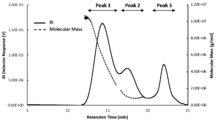
- 1 is an example of a molecular weight distribution obtained by gel filtration chromatography analysis of lupine bean polysaccharide A.
- the mass average molecular weight in the present invention means the mass average molecular weight of the main component of peak 1 obtained by gel filtration chromatography analysis.
- the molecular weight of the acidic polysaccharide of the present invention can be analyzed by gel filtration chromatography using HPLC under the following conditions.
- the mass average molecular weight is 2 to 8 million, preferably 2 to 7 million, and more preferably 4.5 to 6.5 million.
- the mass average molecular weight is calculated by gel filtration chromatography (Size Exclusion Chromatography-Multi Angle Light Scattering: SEC-MALS) using a TSK-gel G-6000PWXL ( ⁇ 7.8 mm ⁇ 300 mm; Tosoh) as a separation column and an RI detector and a multi-angle light scattering detector calibrated with toluene as a detector.
- the separation conditions are as follows: eluent: 50 mM sodium acetate aqueous solution (pH 5.0), flow rate: 0.6 mL/min.
- the acidic polysaccharide of the present invention is characterized by containing, as constituent sugars, 60% by weight or more of galactose, 20% by weight or less of uronic acid, and 4% by weight or more of glucuronic acid.
- it is preferable that it contains galactose, arabinose, glucose, rhamnose, xylose, fucose, galacturonic acid, and glucuronic acid.
- the galactose content is preferably 65% by weight or more, and more preferably 70% by weight or more.
- the uronic acid content which is the total content of the galacturonic acid content and the glucuronic acid content, is preferably 6% by weight to 15% by weight.
- the present invention it is preferable that it contains 5% by weight or more of glucuronic acid, and more preferably 5.5% by weight or more. In addition, it is preferable that it contains 1% by weight to 6% by weight, and more preferably 3% by weight to 5% by weight.
- the weight ratio of galactose to uronic acid is preferably 6.8 or more, and more preferably 7.6 or less.
- Galacturonic acid and glucuronic acid are analyzed by hydrolysis with sulfuric acid followed by ion exclusion chromatography using a Shodex Sugar-SH1821 column ( ⁇ 8.0mm ⁇ 300mm; Showa Denko) and an RI detector, while the composition of neutral sugars is analyzed by hydrolysis with sulfuric acid followed by ion chromatography using a CarboPac PA-1 column ( ⁇ 2.0mm ⁇ 250mm; Thermo) and an electrochemical detector.
- the degree of esterification is the proportion of methyl esters of uronic acid constituting the polysaccharide, expressed as a molecular ratio.
- the acidic polysaccharide of the present invention functions as a dispersion stabilizer without actively adjusting the degree of esterification of uronic acid.
- the degree of esterification of the acidic polysaccharide of the present invention is 60% or more, preferably 70% or more. Even if the degree of esterification is less than 60%, it still functions as a dispersion stabilizer, but an operation of actively adjusting the degree of esterification is required, making the process complicated.
- a so-called de-esterification step is carried out by performing alkaline heating, preferably at pH 12 or higher, to adjust the degree of esterification.
- Heating on the weak alkaline side when extracting acidic polysaccharides in the present invention, for example heating at pH 9, has only a slight effect on the degree of esterification and is not included in the step of adjusting the degree of esterification.
- the de-esterification step that is not particularly required in the present invention refers to heating in an alkaline environment of pH 10 or higher.
- the heating temperature in this case is generally, for example, 40 to 60°C, which has high reactivity and causes little coloring.
- the degree of methyl esterification was determined by quantifying uronic acid and methyl esterified uronic acid using the Doesburg titration method. Methyl esterified uronic acid ⁇ total uronic acid ⁇ 100 (mol %) It is calculated as follows.
- the acidic polysaccharide of the present invention preferably has a linear structure as a single molecule observed with an atomic force microscope.
- the linear structure refers to a multi-branched structure, and means a structure in which side chains branching from the linear chain of the polysaccharide are hardly observed.
- a method for observing the molecular structure of the acidic polysaccharide obtained from lupin bean seeds which is an example of the present invention, a 0.1 wt% aqueous solution of the polysaccharide is prepared, and then the solution is diluted to 1 ppm of acidic polysaccharide by adding pure water.
- beans are preferably used.
- beans include soybeans, peas, mung beans, broad beans, lupine beans, chickpeas, kidney beans, lentil beans, cowpeas, etc.
- lupine beans it is preferable to use the cotyledons after removing the inner skin.
- Lupine beans for feed can also be used, but lupine beans for food in which alkaloids have been reduced or removed are more preferable.
- a water-soluble fraction such as a protein fraction is extracted and separated from lupine beans in an aqueous system once or multiple times.
- the fiber fraction which is the residue, can be used as a raw material and the acidic polysaccharides can be extracted by heating under the conditions described below.
- the fiber fraction separated as the residue does not need to be further washed as a raw material, and it is preferable not to wash it.
- beans By using beans as the raw material, it is possible to easily obtain acidic polysaccharides having the desired constituent sugars and protein dispersing ability.
- the pH during extraction is suitable from pH 4 to pH 9, preferably from pH 6 to pH 8, because hydrolysis of polysaccharides is easily promoted under acidic conditions below pH 4, and decomposition of polysaccharides is easily promoted under alkaline conditions above pH 9.
- an acid or alkali is added to adjust the pH to a range of from pH 4 to pH 9, and then the acidic polysaccharides are extracted under pressure at a temperature exceeding 100°C, preferably 150°C or less, more preferably 105°C to 135°C. At a temperature below 100°C, the extraction efficiency of acidic polysaccharides is poor and it is not practical.
- acidic polysaccharides may be hydrolyzed during the extraction process, making it impossible to maintain a linear structure.
- the extraction time is generally 0.5 to 3 hours, but can be adjusted as desired depending on the state of the raw material, temperature, etc.
- acid and alkali used. Acids such as hydrochloric acid, sulfuric acid, phosphoric acid, citric acid, tartaric acid, acetic acid, formic acid, etc., and alkalis such as sodium hydroxide, calcium hydroxide, sodium bicarbonate, sodium carbonate, ammonia, etc.
- high-purity cellulase, hemicellulase, and pectinase that do not hydrolyze the target acidic polysaccharides may be used alone or in combination to carry out an enzymatic reaction treatment before or after extraction.
- the extracted acidic polysaccharides can be obtained by separating and removing insoluble fiber and drying, but it is desirable to carry out purification such as removal of proteins, desalting, and removal of pigment components in order to exert more functions.
- proteins can be coagulated and precipitated by a method such as isoelectric precipitation by adjusting the pH, and then removed by physical separation means such as filtration separation, centrifugation, and membrane separation.
- proteins can be decomposed using any proteolytic enzyme, and the decomposed products can be adsorbed and removed using a dialysis membrane, activated carbon, ion exchange, or hydrophobic resin.
- any method that removes these can be used, such as electrodialysis, ion exchange resin, and UF membrane separation.
- a method for removing pigment components in addition to methods for decomposing pigment components such as ozone treatment and UV irradiation, any method such as distribution with a hydrophilic polar solvent such as ethanol or isopropanol can be used. It is preferable to use one or more of these methods in combination.
- the acidic polysaccharides that have been subjected to the purification treatment are subjected to any sterilization treatment, and a dried product is obtained by a method such as freeze drying, spray drying, or hot air drying of ethanol precipitates.
- starch When starch is contained in the raw material of the acidic polysaccharide of the present invention, it is possible to obtain the acidic polysaccharide as it is, but when it is used in an acidic protein beverage, thickening or precipitation may occur due to starch. Therefore, it is preferable to remove starch at the stage of the bean raw material, the stage of the fiber separated from the bean raw material, the stage of extracting the acidic polysaccharide, or the stage after extraction. Starch can be removed by one or a combination of two or more methods of decomposition with amylase, cooling precipitation, and coagulation precipitation with an emulsifier.
- Examples of methods for destarching during or after the extraction of acidic polysaccharides include a method of adding amylase to the hydrated raw material before extraction, a method of adding amylase to the slurry before extraction and solid-liquid separation, and a method of adding amylase to the filtrate after solid-liquid separation.
- Amylase is a general term for enzymes that hydrolyze starch, and examples include ⁇ -amylase, ⁇ -amylase, glucoamylase, and pullulanase. For this purpose, these high-purity amylases will do, but commercially available amylase preparations containing one or more of these in combination will also do.
- Starch can also be decomposed and removed from the raw material, fiber, or before or after extraction of acidic polysaccharides using chemical methods such as acid hydrolysis and alkaline elimination decomposition, but since there is a possibility that the acidic polysaccharides of the present invention will be decomposed at the same time, destarch treatment by enzyme treatment is preferred.
- the acidic polysaccharide of the present invention functions as a dispersion stabilizer that suppresses the aggregation of protein particles and maintains a stable dispersion state. Its pH range is very wide, from pH 4.0 to pH 4.4, and particularly excellent ones are from pH 3.6 to pH 4.4. It is suitable for acidic protein beverages such as yogurt drinks made from fermented milk and acidic milk beverages prepared by directly adding acid.
- Conventional dispersion stabilizers such as pectin, carboxymethylcellulose, and water-soluble soybean polysaccharides are less stable in systems in which the non-fat milk solids content in the beverage is 3% by weight or more (protein concentration in the beverage is 1% by weight or more), preferably 6% by weight or more (protein concentration is 2% by weight or more).
- protein concentration in the beverage is 1% by weight or more
- protein concentration in the beverage is 2.8% by weight
- a clear top or precipitation occurs after storage for two weeks, but the acidic polysaccharide of the present invention hardly causes a clear top or precipitation even under the same storage conditions.
- the dispersion stabilizer of the present invention can provide a beverage with a low viscosity and a less sticky feel compared to conventionally used pectin, and has a less cloying taste and a strong sour and milky taste.
- the viscosity is low, it is possible to adjust the viscosity and drinking comfort to any desired level by adding a gum, a thickener, a protein, or a hydrolyzate thereof, as necessary.
- substances that can be used in combination include starch, modified starch, various celluloses, agar, carrageenan, phaselan, guar gum, locust bean gum, phenogreek gum, konjac mannan, tamarind seed polysaccharides, tara gum, gum arabic, tragacanth gum, karaya gum, pectin, xanthan gum, pullulan, gellan gum, and other polysaccharides, and gelatin, collagen, and other proteins.
- the low-viscosity acidic protein beverage of the present invention is, for example, an acidic milk beverage having a non-fat milk solids content of 8.4% and having a viscosity of 100 mPa ⁇ s or less, preferably 50 mPa ⁇ s or less, and more preferably 30 mPa ⁇ s or less.
- the acidic protein beverage of the present invention is an acidic protein beverage containing protein derived from animals and plants, including concentrated products such as drink bases.
- the beverage containing protein derived from animals mainly refers to animal milks such as cow's milk and goat's milk, specifically cow's milk, skim milk, whole milk powder, skim milk powder, whey powder, buttermilk, buttermilk powder, sweetened milk, condensed milk, concentrated milk, processed milk or fermented milk enriched with minerals such as calcium or vitamins, and the beverage containing protein derived from plants is so-called vegetable milk, for example, soy milk obtained from soybeans.
- Acidic protein beverages are beverages made by combining one or more of these beverages from animal milks or plants, adding microorganisms such as lactic acid bacteria, and fermenting them, or by adding fruit juice, or organic acids such as lactic acid or citric acid, or inorganic acids such as phosphoric acid, to adjust the pH to an acidic level.
- acidic protein beverages include pasteurized or live lactobacillus beverages, yogurt drinks, kefir, etc.
- those made from the above-mentioned animal milks are acidic milk beverages, which are particularly preferred for use in the present invention.
- the dispersion stabilizer comprising the acidic polysaccharide of the present invention effectively functions in acidic protein beverages with non-fat milk solids of 3% by weight or more, i.e., with a protein concentration of 1% by weight or more, when milk is used, suppresses protein aggregation and precipitation, and maintains a stable dispersion state for a long period of time.
- the function is even more remarkable in acidic protein beverages with non-fat milk solids of 6% by weight or more (protein concentration of 2% by weight).
- the acidic polysaccharide of the present invention can stabilize the dispersion of protein particles in a pH range of 4.0 to 4.4, and particularly 3.6 to 4.4, by adding the acidic polysaccharide to an acidic protein beverage at preferably 0.1 to 1.2% by weight, more preferably 0.2 to 1% by weight.
- a dispersion stabilizer is added at a high concentration, it can adversely affect the taste of the beverage, but in the case of the acidic polysaccharide of the present invention, even when added at 1% by weight to an acidic protein beverage, it has very little effect on the flavor, unlike citrus pectin or water-soluble soybean polysaccharides.
- the acidic protein beverage prepared in the present invention is preferably homogenized to improve the dispersion stability of protein particles.
- the homogenization equipment includes a high-pressure homogenizer, homomixer, Clearmix (M Technique), Nanomizer (Nanomizer), ultrasonic emulsifier, etc.
- the homogenization pressure cannot be determined unequivocally because the fluidity is not constant depending on the solids concentration of the acidic protein beverage, but a pressure of 50kgf/cm ⁇ 2 to 500kgf/cm ⁇ 2 is preferable.
- the homogenization treatment can be performed at any stage in the process of producing the acidic protein beverage, but it is preferable to perform it after dispersing the protein in water, fermenting the protein or adding an acid, or after adding the dispersion stabilizer of the present invention.
- the pH was adjusted to 7 and heated to 60°C, and amylase (BAN480L; Novozyme) equivalent to 0.1% by weight of the solid content was added to decompose starch for 1 hour.
- the pH was adjusted to 5 with hydrochloric acid, and ethanol was added to 60% by weight to precipitate acidic polysaccharides, which were then washed with 90% aqueous ethanol and the resulting precipitate was air-dried to obtain lupine bean polysaccharide A.
- Example 1 Measurement of molecular structure and mass average molecular weight Lupine bean polysaccharides A to H and a comparative water-soluble soybean polysaccharide (SOYAFIBE-S-DA100: Fuji Oil) were dried on mica, and the molecular structures were observed using an atomic force microscope.
- the mass average molecular weights of lupine polysaccharides A to H were measured by gel filtration chromatography (SEC-MALS).
- SEC-MALS gel filtration chromatography
- the analysis conditions were as follows. A 1 wt% aqueous solution of lupine polysaccharides (50 mM sodium acetate solution, pH 5.0) was prepared, and the filtrate was filtered through a 0.8 ⁇ m filter and subjected to analysis.
- lupine bean polysaccharides B and H which are comparative production examples, decomposition was promoted during extraction, so no linear shape was observed and the mass-average molecular weight was small, at 2 million or less. In contrast, the mass-average molecular weights of lupine bean polysaccharides other than B and H were estimated to be between 2.4 million and 6.3 million.
- Example 2 Sugar Composition
- the sugar composition of lupine bean polysaccharides A to H was measured, and the results are summarized in Table 2.
- DE (%) indicates the degree of esterification of uronic acid.
- Extraction at 80°C showed low values of recovery rate 6.3% by weight and uronic acid content 7.7% by weight, and lupine bean polysaccharides were not sufficiently extracted.
- Extraction at 90°C showed a high value of uronic acid content 9.6% by weight, but a low recovery rate of 9.9% by weight, and lupine bean polysaccharides were not sufficiently extracted.
- Extraction at 140°C showed a high value of recovery rate 51.9% by weight, but a low uronic acid content of 7.0% by weight. This was presumably due to the fact that lupine bean polysaccharides were sufficiently extracted, but at the same time hydrolysis of the polysaccharides had progressed. Based on these results, extraction at 110-130°C was preferable.
- Example 3 Preparation of acidic milk beverage and evaluation of stability (protein concentration 2.8 wt. %, stabilizer 0.4 wt. %) Preparation of fermented milk
- An aqueous solution containing 21% by weight of skim milk powder (Yotsuba Milk Industry Co., Ltd.) was prepared and sterilized by heating at 95°C while stirring. After cooling, commercially available plain yogurt was inoculated and fermented in an incubator at 40°C until the pH reached 4.7. The fermented yogurt was homogenized through a high-pressure homogenizer (EnonizerLabo-01; Sanmaru Machinery Co., Ltd.) at a pressure of 15 MPa.
- the acidic milk beverage prepared with the above composition had a non-fat milk solid content of 8.4% by weight and a stabilizer content of 0.4% by weight.
- An acidic milk beverage was obtained in the same manner using water-soluble soybean polysaccharides (SOYAFIBE-S-DA100: Fuji Oil) and HM-pectin (GENU-PECTIN type USP-H: CP Kelco) as comparisons.
- Lupin bean polysaccharides C, D, and G have a linear structure, a mass-average molecular weight of 2.4 million to 5 million, a uronic acid content (the sum of glucuronic acid and galacturonic acid) of 8% by weight or more, and a galactose content of 70% by weight or more. These lupin bean polysaccharides were able to stabilize proteins in a high-protein system with a protein concentration of 2.8% by weight (non-fat milk solids content 8.4% by weight) in the pH range of 4.0 to 4.4.
- lupine bean polysaccharides A, E, and F extracted in the pH range of 6 to 8 had a mass average molecular weight of 5.2 to 6.3 million, a uronic acid content (the sum of glucuronic acid and galacturonic acid) of 9% by weight or more, a galactose content of 70% by weight or more, and a weight ratio of galactose to uronic acid of 6.9 to 7.4, and were able to stabilize the protein in the acidic milk beverage under the same conditions at pH 3.6 to pH 4.4.
- the acidic milk beverage that was found to be stable had a low viscosity of 30 mP ⁇ s or less, and was refreshing to drink.
- Example 4 Preparation of acidic milk beverage and evaluation of stability (protein concentration 1.0 wt. %, stabilizer 0.1 to 1.0 wt. %) Acidic milk beverages were prepared and their stability evaluated in exactly the same manner as in Example 3, except that the protein concentration was 1.0% by weight (non-fat milk solids content 3.0% by weight) and the amount of lupine bean polysaccharide A used as a stabilizer was 0.1, 0.2, 0.4, 0.6, or 1.0% by weight.
- Lupin bean polysaccharide A was able to disperse and stabilize milk proteins over a wide pH range from 3.6 to 4.4 when used in amounts ranging from 0.2% to 1.0% by weight.
- 1.0% by weight of lupin bean polysaccharide A was added to an acidic milk beverage with a protein concentration of 1.0% by weight (non-fat milk solids content of 3.0% by weight)
- no change in flavor was observed, and the viscosity was below 30 mP ⁇ s, maintaining the low viscosity and clean taste characteristic of lupin bean polysaccharides.
- an acidic milk beverage stabilized with HM-pectin under the same conditions had a strong sticky texture, while an acidic milk beverage stabilized with water-soluble soybean polysaccharides had a strong soybean-specific flavor.
- the present invention provides a dispersion stabilizer for acidic protein beverages, that is, a dispersion stabilizer that suppresses the precipitation and aggregation of proteins that occurs under acidic conditions.
- a dispersion stabilizer for acidic protein beverages that is, a dispersion stabilizer that suppresses the precipitation and aggregation of proteins that occurs under acidic conditions.
Landscapes
- Life Sciences & Earth Sciences (AREA)
- Chemical & Material Sciences (AREA)
- Polymers & Plastics (AREA)
- Engineering & Computer Science (AREA)
- Health & Medical Sciences (AREA)
- Food Science & Technology (AREA)
- Nutrition Science (AREA)
- Botany (AREA)
- Agronomy & Crop Science (AREA)
- Dispersion Chemistry (AREA)
- Medicinal Chemistry (AREA)
- Organic Chemistry (AREA)
- Chemical Kinetics & Catalysis (AREA)
- Materials Engineering (AREA)
- Biochemistry (AREA)
- Molecular Biology (AREA)
- General Health & Medical Sciences (AREA)
- Non-Alcoholic Beverages (AREA)
- Dairy Products (AREA)
Priority Applications (2)
| Application Number | Priority Date | Filing Date | Title |
|---|---|---|---|
| JP2025537805A JPWO2025028209A1 (https=) | 2023-08-01 | 2024-07-11 | |
| AU2024317627A AU2024317627A1 (en) | 2023-08-01 | 2024-07-11 | Acidic polysaccharide and method for producing same |
Applications Claiming Priority (2)
| Application Number | Priority Date | Filing Date | Title |
|---|---|---|---|
| JP2023-125497 | 2023-08-01 | ||
| JP2023125497 | 2023-08-01 |
Publications (1)
| Publication Number | Publication Date |
|---|---|
| WO2025028209A1 true WO2025028209A1 (ja) | 2025-02-06 |
Family
ID=94395110
Family Applications (1)
| Application Number | Title | Priority Date | Filing Date |
|---|---|---|---|
| PCT/JP2024/025070 Pending WO2025028209A1 (ja) | 2023-08-01 | 2024-07-11 | 酸性多糖類およびその製造方法 |
Country Status (3)
| Country | Link |
|---|---|
| JP (1) | JPWO2025028209A1 (https=) |
| AU (1) | AU2024317627A1 (https=) |
| WO (1) | WO2025028209A1 (https=) |
Citations (7)
| Publication number | Priority date | Publication date | Assignee | Title |
|---|---|---|---|---|
| JPS53104764A (en) * | 1977-02-22 | 1978-09-12 | Kikkoman Shoyu Co Ltd | Production of lactic acid fermented drink |
| JPH05262802A (ja) * | 1992-03-23 | 1993-10-12 | Fuji Oil Co Ltd | 水溶性多糖類及びその製造方法 |
| JP2599477B2 (ja) | 1990-02-09 | 1997-04-09 | 不二製油株式会社 | 水溶性植物繊維の製造方法 |
| JP3280768B2 (ja) | 1993-08-20 | 2002-05-13 | 三栄源エフ・エフ・アイ株式会社 | 酸性乳飲料の製造方法 |
| WO2008149738A1 (ja) | 2007-06-06 | 2008-12-11 | Fuji Oil Company, Limited | 水溶性多糖類の製造法 |
| WO2012176852A1 (ja) | 2011-06-24 | 2012-12-27 | 不二製油株式会社 | ペクチン性多糖類およびその製造方法 |
| WO2016031858A1 (ja) | 2014-08-28 | 2016-03-03 | 不二製油グループ本社株式会社 | 水溶性エンドウ多糖類及びその製造方法 |
-
2024
- 2024-07-11 JP JP2025537805A patent/JPWO2025028209A1/ja active Pending
- 2024-07-11 AU AU2024317627A patent/AU2024317627A1/en active Pending
- 2024-07-11 WO PCT/JP2024/025070 patent/WO2025028209A1/ja active Pending
Patent Citations (7)
| Publication number | Priority date | Publication date | Assignee | Title |
|---|---|---|---|---|
| JPS53104764A (en) * | 1977-02-22 | 1978-09-12 | Kikkoman Shoyu Co Ltd | Production of lactic acid fermented drink |
| JP2599477B2 (ja) | 1990-02-09 | 1997-04-09 | 不二製油株式会社 | 水溶性植物繊維の製造方法 |
| JPH05262802A (ja) * | 1992-03-23 | 1993-10-12 | Fuji Oil Co Ltd | 水溶性多糖類及びその製造方法 |
| JP3280768B2 (ja) | 1993-08-20 | 2002-05-13 | 三栄源エフ・エフ・アイ株式会社 | 酸性乳飲料の製造方法 |
| WO2008149738A1 (ja) | 2007-06-06 | 2008-12-11 | Fuji Oil Company, Limited | 水溶性多糖類の製造法 |
| WO2012176852A1 (ja) | 2011-06-24 | 2012-12-27 | 不二製油株式会社 | ペクチン性多糖類およびその製造方法 |
| WO2016031858A1 (ja) | 2014-08-28 | 2016-03-03 | 不二製油グループ本社株式会社 | 水溶性エンドウ多糖類及びその製造方法 |
Non-Patent Citations (3)
| Title |
|---|
| EVANS ANTHONY J, CHEUNG PETER C‐K, CHEETHAM NORMAN W H: "The carbohydrate composition of cotyledons and hulls of cultivars of Lupinus angustifolius from Western Australia", JOURNAL OF THE SCIENCE OF FOOD AND AGRICULTURE, vol. 61, no. 2, 1 January 1993 (1993-01-01), GB , pages 189 - 194, XP093272646, ISSN: 0022-5142, DOI: 10.1002/jsfa.2740610209 * |
| FOOD HYDROCOLLOIDS, vol. 17, 2003, pages 333 - 343 |
| J. AGRIC. FOOD CHEM., vol. 54, no. 17, 2006, pages 6241 - 6246 |
Also Published As
| Publication number | Publication date |
|---|---|
| AU2024317627A1 (en) | 2025-11-27 |
| JPWO2025028209A1 (https=) | 2025-02-06 |
Similar Documents
| Publication | Publication Date | Title |
|---|---|---|
| JP6131853B2 (ja) | ペクチン性多糖類およびその製造方法 | |
| US8128980B2 (en) | Method for production of water-soluble polysaccharide | |
| CN104395347B (zh) | 豆科种子多糖类琥珀酸衍生物酯及其制造方法 | |
| WO2000043424A1 (en) | Pectin, process for producing the same, acidic protein foods with the use of the same and process for the production thereof | |
| CN108651617B (zh) | 一种含大豆多糖的酸奶稳定剂、其在酸奶中的应用及酸奶的制备方法 | |
| CN101454349B (zh) | 新型的具有稳定性的水溶性多糖类及其制造方法 | |
| WO2010044255A1 (ja) | リン酸化水溶性多糖類の製造方法 | |
| JP6680210B2 (ja) | 水溶性エンドウ多糖類及びその製造方法 | |
| JP6665783B2 (ja) | 水溶性エンドウ多糖類の製造方法 | |
| WO2025028209A1 (ja) | 酸性多糖類およびその製造方法 | |
| TWI893114B (zh) | 水溶性大豆多糖類的製造方法、蛋白質的分散穩定劑以及酸性蛋白飲食品 | |
| CN109996449A (zh) | 来自根菜类的水溶性多糖类及其制造方法 | |
| CN121369688A (zh) | 一种在蛋白食品体系中具有高稳定性与高活性的桑叶提取物的制备方法及应用 | |
| CN118177304A (zh) | 一种豆球蛋白稳定的酸性乳液及其制备方法 |
Legal Events
| Date | Code | Title | Description |
|---|---|---|---|
| 121 | Ep: the epo has been informed by wipo that ep was designated in this application |
Ref document number: 24848867 Country of ref document: EP Kind code of ref document: A1 |
|
| WWE | Wipo information: entry into national phase |
Ref document number: AU2024317627 Country of ref document: AU |
|
| ENP | Entry into the national phase |
Ref document number: 2024317627 Country of ref document: AU Date of ref document: 20240711 Kind code of ref document: A |
|
| ENP | Entry into the national phase |
Ref document number: 2025537805 Country of ref document: JP Kind code of ref document: A |
|
| WWE | Wipo information: entry into national phase |
Ref document number: 2025537805 Country of ref document: JP |
|
| WWE | Wipo information: entry into national phase |
Ref document number: 2024848867 Country of ref document: EP |
|
| NENP | Non-entry into the national phase |
Ref country code: DE |