WO2025027965A1 - 振動装置、および撮像装置 - Google Patents
振動装置、および撮像装置 Download PDFInfo
- Publication number
- WO2025027965A1 WO2025027965A1 PCT/JP2024/016936 JP2024016936W WO2025027965A1 WO 2025027965 A1 WO2025027965 A1 WO 2025027965A1 JP 2024016936 W JP2024016936 W JP 2024016936W WO 2025027965 A1 WO2025027965 A1 WO 2025027965A1
- Authority
- WO
- WIPO (PCT)
- Prior art keywords
- vibration device
- cylindrical portion
- vibration
- weight
- cylindrical
- Prior art date
- Legal status (The legal status is an assumption and is not a legal conclusion. Google has not performed a legal analysis and makes no representation as to the accuracy of the status listed.)
- Pending
Links
Images



Classifications
-
- G—PHYSICS
- G02—OPTICS
- G02B—OPTICAL ELEMENTS, SYSTEMS OR APPARATUS
- G02B7/00—Mountings, adjusting means, or light-tight connections, for optical elements
- G02B7/02—Mountings, adjusting means, or light-tight connections, for optical elements for lenses
-
- G—PHYSICS
- G03—PHOTOGRAPHY; CINEMATOGRAPHY; ANALOGOUS TECHNIQUES USING WAVES OTHER THAN OPTICAL WAVES; ELECTROGRAPHY; HOLOGRAPHY
- G03B—APPARATUS OR ARRANGEMENTS FOR TAKING PHOTOGRAPHS OR FOR PROJECTING OR VIEWING THEM; APPARATUS OR ARRANGEMENTS EMPLOYING ANALOGOUS TECHNIQUES USING WAVES OTHER THAN OPTICAL WAVES; ACCESSORIES THEREFOR
- G03B15/00—Special procedures for taking photographs; Apparatus therefor
-
- G—PHYSICS
- G03—PHOTOGRAPHY; CINEMATOGRAPHY; ANALOGOUS TECHNIQUES USING WAVES OTHER THAN OPTICAL WAVES; ELECTROGRAPHY; HOLOGRAPHY
- G03B—APPARATUS OR ARRANGEMENTS FOR TAKING PHOTOGRAPHS OR FOR PROJECTING OR VIEWING THEM; APPARATUS OR ARRANGEMENTS EMPLOYING ANALOGOUS TECHNIQUES USING WAVES OTHER THAN OPTICAL WAVES; ACCESSORIES THEREFOR
- G03B17/00—Details of cameras or camera bodies; Accessories therefor
- G03B17/56—Accessories
-
- G—PHYSICS
- G03—PHOTOGRAPHY; CINEMATOGRAPHY; ANALOGOUS TECHNIQUES USING WAVES OTHER THAN OPTICAL WAVES; ELECTROGRAPHY; HOLOGRAPHY
- G03B—APPARATUS OR ARRANGEMENTS FOR TAKING PHOTOGRAPHS OR FOR PROJECTING OR VIEWING THEM; APPARATUS OR ARRANGEMENTS EMPLOYING ANALOGOUS TECHNIQUES USING WAVES OTHER THAN OPTICAL WAVES; ACCESSORIES THEREFOR
- G03B30/00—Camera modules comprising integrated lens units and imaging units, specially adapted for being embedded in other devices, e.g. mobile phones or vehicles
-
- H—ELECTRICITY
- H04—ELECTRIC COMMUNICATION TECHNIQUE
- H04N—PICTORIAL COMMUNICATION, e.g. TELEVISION
- H04N23/00—Cameras or camera modules comprising electronic image sensors; Control thereof
- H04N23/50—Constructional details
- H04N23/52—Elements optimising image sensor operation, e.g. for electromagnetic interference [EMI] protection or temperature control by heat transfer or cooling elements
Definitions
- This disclosure relates to a vibration device and an imaging device.
- imaging devices at the front and rear of the vehicle in order to control safety devices and perform driving assistance control using images obtained from the imaging devices.
- imaging devices are often installed outside the vehicle, and foreign matter such as raindrops (water droplets), mud, and dust adhere to the transparent bodies (protective covers and lenses) that cover the exterior.
- the imaging device is provided with a droplet removal device (vibration device) that vibrates the light-transmitting body in order to remove foreign objects that have adhered to the surface of the light-transmitting body.
- a droplet removal device vibration device
- the vibration device When vibrating a transparent body to remove foreign matter adhering to its surface, the vibration device collects the foreign matter at the position of the transparent body where the displacement is greatest, and then uses the vibration to atomize and remove the collected foreign matter. However, if the foreign matter has a high viscosity and cannot be atomized and adheres to the surface of the transparent body, the foreign matter will simply gather in the center of the transparent body and will not be atomized, and the collected foreign matter will obstruct the field of view. While the method of removing foreign matter by vibrating the transparent body to atomize it using a vibration device is effective, there is a need for an additional method of removing foreign matter adhering to the surface of the transparent body using a method other than atomization.
- the objective of this disclosure is to provide a vibration device and an imaging device that can remove foreign matter adhering to the surface of a translucent body using a method other than atomization.
- the vibration device includes a translucent body that transmits light of a predetermined wavelength, a vibration body that contacts the translucent body and vibrates the translucent body, a piezoelectric element provided on the vibration body, and a housing that holds the translucent body and covers the vibration body.
- the vibration body is cylindrical and includes a first cylindrical section that contacts the translucent body, a second cylindrical section that provides the piezoelectric element, a spring section that connects the first cylindrical section and the second cylindrical section and has a curved cross-sectional shape, and an imbalance means that generates a bias in the vibration of the translucent body.
- An imaging device includes the vibration device described above and an imaging element arranged so that the light-transmitting body is in the field of view.
- the vibration device includes an imbalance means that creates a bias in the vibration of the translucent body, making it possible to remove foreign matter adhering to the surface of the translucent body by a method other than atomization.
- FIG. 1 is a cross-sectional view of an imaging device according to an embodiment.
- 1 is a perspective view for explaining a configuration of a vibration device according to an embodiment.
- 4 is a perspective view for explaining a displacement occurring in the vibration device according to the embodiment.
- FIG. 5A to 5C are cross-sectional views for explaining displacements occurring in the vibration device according to the embodiment.
- FIG. 11 is a cross-sectional view of an imaging device according to a first modified example.
- FIG. 11 is a perspective view for explaining the configuration of a vibration device according to Modification 2.
- FIG. 13 is a perspective view for explaining the configuration of a vibration device according to Modification 3.
- the imaging device according to the present disclosure will be described in detail below with reference to the drawings. Note that the same reference numerals in the drawings indicate the same or equivalent parts.
- the imaging device described below is, for example, for vehicle mounting, and can vibrate a transparent body (e.g., the outermost lens) in order to remove foreign matter adhering to the surface of the transparent body.
- the imaging device is not limited to vehicle mounting applications.
- the imaging device can also be applied to security surveillance cameras, drones, etc.
- Fig. 1 is a cross-sectional view of an imaging device 100 according to an embodiment.
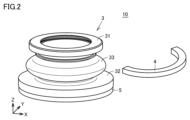
- Fig. 2 is a perspective view of a vibration device 10 according to an embodiment. Note that the X, Y, and Z directions in the figure indicate the horizontal, depth, and height directions of the imaging device 100, respectively.
- the imaging device 100 includes a vibration device 10 and a sensor device 20.
- the vibration device 10 includes an outermost lens 1, a housing 2, a vibrating body 3, and a piezoelectric element 5.
- the sensor device 20 includes a bracket 8 that holds an imaging element 6.
- the imaging device 100 preferably includes an inner lens between the outermost lens 1 and the imaging element 6.
- the imaging element 6 is, for example, an image sensor such as a CCD (Charge Coupled Device) or a CMOS (Complementary Metal-Oxide-Semiconductor) sensor, and is mounted on a circuit board (not shown).
- the circuit board may be mounted with semiconductor elements such as a general-purpose IC (Integrated Circuit) or ASIC (Application Specific Integrated Circuit) that controls the imaging element 6, as well as a semiconductor element that generates a signal to drive the piezoelectric element 5.
- the circuit board is fixed to the bracket 8 at a position where the alignment between the outermost lens 1 and the inner lens (not shown) and the imaging element 6 is adjusted.
- the bracket 8 is, for example, aluminum (A5052).
- the outermost lens 1 is a translucent body that transmits light of a specific wavelength (e.g., a visible light wavelength, a wavelength that can be imaged by an imaging element, etc.), and is, for example, borosilicate crown glass (BK7), quartz glass, crown glass, flint glass, a convex meniscus lens, etc.
- a specific wavelength e.g., a visible light wavelength, a wavelength that can be imaged by an imaging element, etc.
- BK7 borosilicate crown glass
- quartz glass quartz glass
- crown glass flint glass
- a convex meniscus lens etc.
- the vibration device 10 may use a transparent member such as a protective cover instead of the outermost lens 1.
- the protective cover is made of glass or a resin such as a transparent plastic.
- the end of the outermost lens 1 is held by the end 2b of the cylindrical first part 2a extending in the Z direction.
- the end 2b of the first part 2a is in contact with the outermost lens 1 via a retainer 21.
- the retainer 21 may be a resin such as polyphenylene sulfide (PPS) or a metal such as stainless steel (SUS304, SUS420, SUS440).
- PPS polyphenylene sulfide
- SUS304, SUS420, SUS440 stainless steel
- the end 2b of the first part 2a, the retainer 21, the outermost lens 1 and the vibrating body 3 are bonded together, for example, with an adhesive.
- the housing 2 indirectly holds the outermost lens 1 via the retainer 21, but it may also be held directly by the end 2b of the first part 2a.
- the housing 2 includes a first portion 2a, a cylindrical second portion 2c with a larger diameter than the first portion 2a, and a third portion 2d that connects the first portion 2a and the second portion 2c.
- the third portion 2d is a disk shape that extends in the radial direction (X and Y directions) of the first portion 2a.
- the housing 2 is shaped like two tubes (first portion 2a and second portion 2c) with different diameters connected by a disk (third portion 2d).
- the first portion 2a is elongated in the axial direction of the cylinder (Z direction), and as described below, it can elastically deform like a spring in the radial direction of the cylinder (X and Y directions) to suppress vibrations in those directions.
- the second portion 2c is provided with a weight 2e to suppress vibrations from the vibrating body 3.
- the housing 2 may be formed integrally with the first portion 2a, end portion 2b, second portion 2c, third portion 2d, and weight 2e, or may be formed separately.
- the housing 2 may be made of, for example, stainless steel (SUS304, SUS420, SUS440), etc.
- the vibration device 10 is in contact with the vibrating body 3 in order to vibrate the outermost lens 1.
- the vibrating body 3 is cylindrical and is composed of a first cylindrical portion 31 that is in contact with the outermost lens 1, a second cylindrical portion 32 in which the piezoelectric element 5 is provided, and a spring portion 33 that connects the first cylindrical portion 31 and the second cylindrical portion 32.
- the cross section of the spring portion 33 is S-shaped.
- An inner lens (not shown) may be placed inside the cylinder of the vibrating body 3.
- the vibrating body 3 is made of, for example, stainless steel (SUS304, SUS420, SUS440), etc.
- the first tubular portion 31 is a cylindrical portion that is elongated in the axial direction (Z direction) of the tube, and its end 2b contacts the peripheral edge of the outermost lens 1, transmitting the vibration of the vibrating body 3 to the outermost lens 1.
- the first tubular portion 31 has an end 2b that is elongated in the radial direction (X and Y directions) of the tube to stably hold the outermost lens 1.
- the second cylindrical portion 32 is a portion that vibrates together with the vibration of the piezoelectric element 5, and has a thickness greater than the thicknesses of the first cylindrical portion 31 and the spring portion 33. This makes it easier to transmit the vibration of the piezoelectric element 5 to the outermost lens 1 more efficiently.
- the spring portion 33 is a portion that supports the first cylindrical portion 31 and transmits the vibrations of the second cylindrical portion 32 to the first cylindrical portion 31.
- the first cylindrical portion 31, the second cylindrical portion 32, and the spring portion 33 may be formed integrally or separately.
- the cross-sectional shape of the spring portion 33 has been described as being S-shaped, it may be any curved shape (for example, a shape of two S-shapes connected together) that can transmit the vibrations of the second cylindrical portion 32 to the first cylindrical portion 31.
- the imaging device 100 may be attached to a device (e.g., a vehicle) so that the axial direction (Z direction) of the tube is approximately 90 degrees to the direction of gravity.
- a device e.g., a vehicle
- foreign matter e.g., raindrops
- the cross-sectional shape of the spring part 33 of the vibration device 10 is curved, so that the foreign matter that has entered moves along the curvature of the curved shape and slides off the vibrating body 3 under its own weight.
- the spring part 33 has a shape that has a portion that bulges in the radial direction of the first cylindrical part with respect to the first cylindrical part 31 and the second cylindrical part 32. This makes it easier for the vibration device 10 to move the foreign matter that has entered along the curvature of the spring part 33 in the direction of gravity and slide off the vibrating body 3 under its own weight.
- the piezoelectric element 5 is provided on the surface of the second cylindrical portion 32 opposite to the side in contact with the outermost lens 1.
- the piezoelectric element 5 is hollow and circular, and vibrates, for example, by polarization in the thickness direction.
- the piezoelectric element 5 is made of lead zirconate titanate piezoelectric ceramics. However, other piezoelectric ceramics such as (K,Na) NbO3 may also be used. Furthermore, a piezoelectric single crystal such as LiTaO3 may also be used.
- the hollow circular piezoelectric element 5 vibrates in the radial direction, and this vibration is converted by the spring portion 33 of the vibrating body 3 into vibration in the Z direction (up and down in the figure), causing the outermost lens 1 to vibrate in the Z direction.
- the vibration device 10 vibrates the outermost lens 1 in the Z direction, and when it is vibrated so that the central portion of the outermost lens 1 is displaced to the maximum, foreign matter adhering to the surface of the outermost lens 1 is moved to the central portion of the outermost lens 1 and atomized and removed.
- the vibration device 10 cannot remove foreign matter with high viscosity by simply moving the foreign matter to the central portion of the outermost lens 1 and atomizing and removing the foreign matter. Therefore, in addition to atomizing and removing the foreign matter, the vibration device 10 generates a bias in the vibration of the outermost lens 1, causing the adhering foreign matter to slide off the outermost lens 1 and be removed.
- the vibration device 10 is provided with an unbalance means for adding mass to at least a portion of the vibrating body 3 in order to cause a bias in the vibration of the outermost lens 1.
- the vibration device 10 is provided with a weight 4 on the first cylindrical portion 31.
- the weight 4 is not disposed around the entire circumference of the first cylindrical portion 31, but is provided only on a portion of it, and has a semicircular shape that goes halfway around the circumference of the first cylindrical portion 31 as shown in FIG. 2.
- the weight 4 is not limited to a material as long as it can add mass to a part of the first cylindrical portion 31, and may be made of the same material as the first cylindrical portion 31 or a different material. If the specific gravity of the material of the weight 4 is greater than the specific gravity of the material of the first cylindrical portion 31, the weight 4 can be made smaller, and the space required for providing the weight 4 can be reduced.
- the weight 4 may be made up of multiple pieces, and may be formed integrally with the first cylindrical portion 31 or formed separately.
- the vibration device 10 can provide a weight 4 on a part of the first cylindrical portion 31, which makes it possible to cause a difference in displacement between the side with the weight 4 and the side without the weight 4 when the outermost lens 1 is vibrated in the Z direction, thereby causing a bias in the vibration of the outermost lens 1.
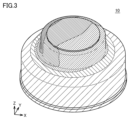
- FIG. 3 is a perspective view for explaining the displacement that occurs in the vibration device 10 according to the embodiment.
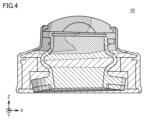
- FIG. 4 is a cross-sectional view for explaining the displacement that occurs in the vibration device 10 according to the embodiment.
- FIG. 3 and FIG. 4 show the results of a simulation in which a voltage is applied to the piezoelectric element 5 in the vibration device 10 to vibrate the outermost lens 1.
- the magnitude of the displacement is indicated by the shade of hatching, and the darker hatching indicates the part with the larger displacement.
- the displacement of the part with the largest displacement is about 8 ⁇ m.
- the vibration device 10 vibrates with the outermost lens 1 tilted, with the side where the weight 4 is not provided rising or falling compared to the side where the weight 4 is provided. By vibrating the outermost lens 1 tilted, any foreign matter attached to the outermost lens 1 can be removed by sliding it off the outermost lens 1. It is preferable that a water-repellent or hydrophilic coating material is applied to the surface of the outermost lens 1.
- the vibration device 10 vibrates the outermost lens 1 by the elastic deformation of the first part 2a and the third part 2d of the housing 2 like a spring, while suppressing the leakage of vibration to the second part 2c of the housing 2.
- the first part 2a of the housing 2 absorbs the displacement in the X direction caused by the outermost lens 1 tilting and vibrating by elastic deformation like a spring, suppressing the leakage of vibration to the second part 2c of the housing 2.
- the third part 2d of the housing 2 absorbs the displacement in the Z direction caused by the outermost lens 1 vibrating in the Z direction by elastic deformation like a spring, suppressing the leakage of vibration to the second part 2c of the housing 2.
- the second part 2c of the housing 2 hardly displaces even when the outermost lens 1 is vibrated, and it is understood that the vibration of the vibrating body 3 does not leak out. Therefore, by holding the second part 2c of the housing 2 with a member on the vehicle side, it is possible to attach the imaging device 100 to the vehicle without transmitting the vibration of the vibration device 10 to the vehicle side.
- the second part 2c of the housing 2 since the second part 2c of the housing 2 has a weight 2e on the surface facing the vibrating body 3, the weight 2e acts as an inertial resistance and can suppress the vibration from the vibrating body 3.
- FIG. 5 is a cross-sectional view of an imaging device 100a according to Modification 1. Note that in the imaging device 100a, the same components as those in the imaging device 100 shown in Fig. 1 are denoted by the same reference numerals, and description thereof will not be repeated.
- the vibration device 10a is provided with an unbalance means for adding mass to at least a part of the vibrating body 3 in order to bias the vibration of the outermost lens 1.
- the vibration device 10a is provided with a weight 4 on the second cylindrical portion 32.
- the weight 4 is not disposed around the entire circumference of the second cylindrical portion 32, but is provided only on a part of it, and is, for example, a semicircular shape that goes around half of the circumference of the second cylindrical portion 32.
- the weight 4 is not limited to a material as long as it can add mass to a part of the second cylindrical portion 32, and may be made of the same material as the second cylindrical portion 32, or a different material. If the specific gravity of the material of the weight 4 is greater than the specific gravity of the material of the second cylindrical portion 32, the weight 4 can be made smaller, and the space required for providing the weight 4 can be reduced.
- the weight 4 may be made of multiple pieces, and may be formed integrally with the second cylindrical portion 32 or formed separately.
- the position where the weight 4 is provided is not limited to the first cylindrical portion 31 and the second cylindrical portion 32, but may be the spring portion 33. Furthermore, the weight 4 may be provided in multiple locations, such as providing the weight 4 in each of the first cylindrical portion 31 and the second cylindrical portion 32. In this case, the weight of the weight 4 may be changed depending on the location where it is provided. Furthermore, the weight 4 is not limited to being provided on the outer surface of the vibrating body 3 (the side facing the housing 2), but may be provided on the inner surface of the vibrating body 3.
- a mass is added to at least a part of the vibrating body 3 as an unbalance means.
- the unbalance means may be such that at least a part of the mass of the vibrating body 3 is removed.
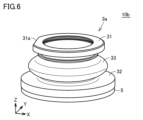
- Fig. 6 is a perspective view for explaining the configuration of a vibration device 10b according to a second modification.
- the vibration device 10b the same components as those of the vibration device 10 shown in Fig. 2 are denoted by the same reference numerals, and the description thereof will not be repeated.
- the configuration of the vibration device 10b not shown is the same as that of the vibration device 10 shown in Fig. 1.
- the vibration device 10b is in contact with the vibration body 3a to vibrate the outermost lens 1.
- the vibration body 3a is cylindrical and is composed of a first cylindrical portion 31 that is in contact with the outermost lens 1, a second cylindrical portion 32 that has a piezoelectric element 5, and a spring portion 33 that connects the first cylindrical portion 31 and the second cylindrical portion 32.
- the vibration device 10b is provided with an unbalance means for removing at least a portion of the mass of the vibration body 3a in order to cause a bias in the vibration of the outermost lens 1.
- the vibration body 3a has a notch portion 31a that cuts out a portion of the first cylindrical portion 31.
- the notch portion 31a is formed by cutting away a portion of the vibration body 3a on the left side in the figure.
- the first cylindrical portion 31 is lighter on the side with the cutout 31a (left side in the figure) than on the side without the cutout 31a (right side in the figure). Therefore, the displacement of the outermost lens 1 and the first cylindrical portion 31 on the side with the cutout 31a is greater than the displacement of the outermost lens 1 and the first cylindrical portion 31 on the side without the cutout 31a. Therefore, the vibration device 10b vibrates with the outermost lens 1 tilted, with the side with the cutout 31a rising or falling higher than the side without the cutout 31a. By vibrating the outermost lens 1 tilted, any foreign matter adhering to the outermost lens 1 can be removed by sliding it off the outermost lens 1.
- the position where the notch 31a is provided is not limited to the first cylindrical portion 31, but may be the second cylindrical portion 32 or the spring portion 33. Furthermore, the notch 31a may be provided in multiple locations, for example, in each of the first cylindrical portion 31 and the second cylindrical portion 32. In this case, the mass to be removed by the notch 31a may be changed depending on the location. Furthermore, the notch 31a is not limited to being provided on the outer surface (the side facing the housing 2) of the vibrating body 3a, but may be provided on the inner surface of the vibrating body 3a. Furthermore, the vibrating body 3a may be provided with a combination of a notch and a weight, for example, a notch may be provided on the first cylindrical portion 31 and a weight may be provided on the second cylindrical portion 32.
- the vibration device 10 employs a vibrating body 3 in which the cross-sectional shape of the spring portion 33 is S-shaped.
- the structure of the vibrating body is not limited to the structure in which the cross-sectional shape of the spring portion 33 is S-shaped.
- Fig. 7 is a perspective view for explaining the configuration of a vibration device 10c according to Modification 3. Note that in the vibration device 10c, the same components as those in the vibration device 10 shown in Fig. 1 are denoted by the same reference numerals, and the description thereof will not be repeated. Also, the configuration of the vibration device 10c not shown in Fig. 7 is the same as that of the vibration device 10 shown in Fig. 1.
- the vibrating body 3b has a cylindrical shape.
- the vibrating body 3b is composed of a first cylindrical portion 31 that contacts the outermost lens 1, a second cylindrical portion 32 in which the piezoelectric element 5 is provided, and a spring portion 33a that connects the first cylindrical portion 31 and the second cylindrical portion 32.
- the first cylindrical portion 31, the second cylindrical portion 32, and the spring portion 33a may be formed integrally or separately.
- the spring portion 33a is a side portion of the vibrating body 3b, and multiple grooves 30 in a horizontal Y shape (tuning fork shape) are formed at equal intervals in the circumferential direction of the vibrating body 3b.
- the grooves 30 penetrate the spring portion 33a and are openings that penetrate the vibrating body 3b in the radial direction.
- the groove portion 30 has a horizontal Y shape (tuning fork shape) and is linearly symmetrical with respect to the radial direction of the vibrating body 3b.
- the groove portion 30 is formed so that one end contacts the first cylindrical portion 31 and the other end contacts the second cylindrical portion 32.
- the portion of the spring portion 33a that is left by providing the groove portion 30 becomes a number of U-shaped pillars 35 that connect the first cylindrical portion 31 and the second cylindrical portion 32. These pillars 35 function as springs that vibrate the outermost lens 1 in the Z direction.
- the pillar 35 has a horizontal U-shape. As shown in FIG. 7, the pillar 35 has a shape in which the connection portion with the first cylindrical portion 31 and the connection portion with the second cylindrical portion 32 are arranged on a substantially straight line. Therefore, the vibration of the piezoelectric element 5 causes the vibration body 3b to narrow or widen the U-shaped portion of the pillar 35, thereby vibrating the outermost lens 1 in the Z direction.
- the vibration device 10c has a weight 4 provided on the first cylindrical portion 31 as an unbalancing means.
- the weight 4 is not disposed around the entire circumference of the first cylindrical portion 31, but is provided only on a portion of it, and has a semicircular shape that goes around half of the circumference of the first cylindrical portion 31. Therefore, in the vibration device 10c, the side without the weight 4 rises or falls higher than the side with the weight 4, causing the outermost lens 1 to tilt and vibrate. By vibrating the outermost lens 1 at a tilt, any foreign matter adhering to the outermost lens 1 can be removed by sliding it off the outermost lens 1.
- the imbalance means provided in the vibration device 10c may be a notch.
- the structure of the vibration body is also an example of the structure of the vibration body 3b shown in FIG. 7, and any structure may be used as long as it is configured to vibrate the outermost lens 1 in the Z direction.
- the unbalance means may bias the vibration of the outermost lens 1 by a method other than the weight or the notch (for example, by forming the vibration body 3 with different materials in parts, by making the thickness of the part where the cross section of the spring part 33 is curved (for example, S-shaped) different, by making the voltage applied to the piezoelectric element 5 different for each region, etc.).
- the imaging device according to the above embodiment may include a camera, LiDAR, Radar, etc. Furthermore, a plurality of imaging devices may be arranged side by side.
- the imaging device is not limited to an imaging device installed in a vehicle, but can be similarly applied to any imaging device that includes an optical device and an imaging element arranged so that the light-transmitting body is in the field of view, and that requires the removal of foreign objects from the light-transmitting body.
- the vibration device is A light-transmitting body that transmits light of a predetermined wavelength; a vibrator that contacts the transparent body and vibrates the transparent body; A piezoelectric element provided on a vibrating body; A housing that holds the light-transmitting body and covers the vibrating body, The vibrating body is The device has a cylindrical shape and includes a first cylindrical portion in contact with the light-transmitting body, a second cylindrical portion in which a piezoelectric element is provided, a spring portion that connects the first cylindrical portion and the second cylindrical portion and has a curved cross-sectional shape, and an imbalance means that generates a bias in the vibration of the light-transmitting body.
- the vibration device includes an imbalance means for creating a bias in the vibration of the translucent body, making it possible to remove foreign matter adhering to the surface of the translucent body by a method other than atomization.
- the unbalance means is a cutout portion that removes at least a portion of the mass of the vibrating body by cutting out a portion of at least one of the first cylindrical portion, the second cylindrical portion, and the spring portion.
- the unbalance means is a weight that adds mass to a portion of at least one of the first cylindrical portion, the second cylindrical portion, and the spring portion.
- the weight is attached to at least the first cylindrical portion.
- the weight has a semicircular shape that extends halfway around the first cylindrical portion in the circumferential direction.
- the specific gravity of the material of the weight is greater than the specific gravity of the material of the vibrating body.
- the weight is formed integrally with the vibrating body.
- the spring portion has an S-shaped cross section.
- the spring portion has a shape that has a portion that bulges out in the radial direction of the first cylindrical portion relative to the first cylindrical portion.
- the second cylindrical portion has a portion whose shape is extended in the radial direction of the second cylindrical portion, and a piezoelectric element is provided in the portion.
- the housing is cylindrical and includes a first portion that holds the translucent body, a second portion that has a larger diameter than the first portion, and a third portion that extends radially from the first portion and connects the first portion to the second portion.
- the first part has a shape that is extended in the axial direction of the tube.
- the third part has a weight on the surface facing the vibrating body.
- An imaging device A vibration device according to any one of (1) to (13), and an imaging element arranged so that the light-transmitting body is in the field of view.
Landscapes
- Physics & Mathematics (AREA)
- General Physics & Mathematics (AREA)
- Electromagnetism (AREA)
- Engineering & Computer Science (AREA)
- Multimedia (AREA)
- Signal Processing (AREA)
- Optics & Photonics (AREA)
- Studio Devices (AREA)
Priority Applications (3)
| Application Number | Priority Date | Filing Date | Title |
|---|---|---|---|
| DE112024002389.4T DE112024002389T5 (de) | 2023-08-01 | 2024-05-07 | Schwingvorrichtung und bildaufnahmevorrichtung |
| CN202480044461.0A CN121444470A (zh) | 2023-08-01 | 2024-05-07 | 振动装置和摄像装置 |
| JP2025537673A JPWO2025027965A1 (https=) | 2023-08-01 | 2024-05-07 |
Applications Claiming Priority (2)
| Application Number | Priority Date | Filing Date | Title |
|---|---|---|---|
| JP2023-125403 | 2023-08-01 | ||
| JP2023125403 | 2023-08-01 |
Publications (1)
| Publication Number | Publication Date |
|---|---|
| WO2025027965A1 true WO2025027965A1 (ja) | 2025-02-06 |
Family
ID=94395026
Family Applications (1)
| Application Number | Title | Priority Date | Filing Date |
|---|---|---|---|
| PCT/JP2024/016936 Pending WO2025027965A1 (ja) | 2023-08-01 | 2024-05-07 | 振動装置、および撮像装置 |
Country Status (4)
| Country | Link |
|---|---|
| JP (1) | JPWO2025027965A1 (https=) |
| CN (1) | CN121444470A (https=) |
| DE (1) | DE112024002389T5 (https=) |
| WO (1) | WO2025027965A1 (https=) |
Citations (7)
| Publication number | Priority date | Publication date | Assignee | Title |
|---|---|---|---|---|
| JP2008206013A (ja) * | 2007-02-22 | 2008-09-04 | Nikon Corp | ゴミ除去装置、撮像装置、カメラ |
| JP2011099902A (ja) * | 2009-11-04 | 2011-05-19 | Konica Minolta Opto Inc | レンズユニットおよびそれを用いる撮像装置ならびにレンズユニットの組立て方法 |
| JP2011099901A (ja) * | 2009-11-04 | 2011-05-19 | Konica Minolta Opto Inc | 撮像装置 |
| JP2020181079A (ja) * | 2019-04-25 | 2020-11-05 | 株式会社村田製作所 | 振動装置及び光学検出装置 |
| WO2021100232A1 (ja) * | 2019-11-22 | 2021-05-27 | 株式会社村田製作所 | 振動装置、および振動装置を備える撮像ユニット |
| WO2023100397A1 (ja) * | 2021-11-30 | 2023-06-08 | 株式会社村田製作所 | 光学モジュールおよび光学装置 |
| EP4199494A1 (en) * | 2020-08-14 | 2023-06-21 | LG Innotek Co., Ltd. | Lens driving device, and camera module and optical device comprising same |
Family Cites Families (1)
| Publication number | Priority date | Publication date | Assignee | Title |
|---|---|---|---|---|
| JP2017170303A (ja) | 2016-03-22 | 2017-09-28 | オリンパス株式会社 | 液滴排除装置と、液滴排除装置を有する画像装置及び上記液滴排除装置の制御方法と上記液滴排除装置の制御プログラム |
-
2024
- 2024-05-07 JP JP2025537673A patent/JPWO2025027965A1/ja active Pending
- 2024-05-07 DE DE112024002389.4T patent/DE112024002389T5/de active Pending
- 2024-05-07 WO PCT/JP2024/016936 patent/WO2025027965A1/ja active Pending
- 2024-05-07 CN CN202480044461.0A patent/CN121444470A/zh active Pending
Patent Citations (7)
| Publication number | Priority date | Publication date | Assignee | Title |
|---|---|---|---|---|
| JP2008206013A (ja) * | 2007-02-22 | 2008-09-04 | Nikon Corp | ゴミ除去装置、撮像装置、カメラ |
| JP2011099902A (ja) * | 2009-11-04 | 2011-05-19 | Konica Minolta Opto Inc | レンズユニットおよびそれを用いる撮像装置ならびにレンズユニットの組立て方法 |
| JP2011099901A (ja) * | 2009-11-04 | 2011-05-19 | Konica Minolta Opto Inc | 撮像装置 |
| JP2020181079A (ja) * | 2019-04-25 | 2020-11-05 | 株式会社村田製作所 | 振動装置及び光学検出装置 |
| WO2021100232A1 (ja) * | 2019-11-22 | 2021-05-27 | 株式会社村田製作所 | 振動装置、および振動装置を備える撮像ユニット |
| EP4199494A1 (en) * | 2020-08-14 | 2023-06-21 | LG Innotek Co., Ltd. | Lens driving device, and camera module and optical device comprising same |
| WO2023100397A1 (ja) * | 2021-11-30 | 2023-06-08 | 株式会社村田製作所 | 光学モジュールおよび光学装置 |
Also Published As
| Publication number | Publication date |
|---|---|
| JPWO2025027965A1 (https=) | 2025-02-06 |
| CN121444470A (zh) | 2026-01-30 |
| DE112024002389T5 (de) | 2026-04-30 |
Similar Documents
| Publication | Publication Date | Title |
|---|---|---|
| US11369996B2 (en) | Vibration device and imaging unit including vibration device | |
| JP6988987B2 (ja) | 振動装置、および振動装置を備える撮像ユニット | |
| US20200213495A1 (en) | Vibrating device and optical detector device | |
| US11433426B2 (en) | Vibration device and imaging unit including vibration device | |
| CN113767616B (zh) | 振动装置和振动控制方法 | |
| US11970118B2 (en) | Optical unit and vehicle including optical unit | |
| US11383274B2 (en) | Vibration device and imaging unit including vibration device | |
| JPWO2020003572A1 (ja) | 振動装置及び光学検出装置 | |
| US20250328008A1 (en) | Imaging unit | |
| WO2025027965A1 (ja) | 振動装置、および撮像装置 | |
| WO2023210101A1 (ja) | 光学装置、および光学装置を備える撮像ユニット | |
| WO2026062949A1 (ja) | 振動装置、および撮像装置 | |
| WO2025248827A1 (ja) | 振動装置、および撮像装置 | |
| JP7708211B2 (ja) | 光学モジュールおよび光学装置 | |
| JP7776020B2 (ja) | 光学装置、および光学装置を備える撮像ユニット | |
| WO2012147320A1 (ja) | 撮像装置および撮像装置の製造方法 | |
| US20250355320A1 (en) | Optical device and imaging unit including optical device | |
| WO2025032897A1 (ja) | 振動装置、および撮像装置 | |
| JP7663134B2 (ja) | 光学モジュールおよび光学装置 | |
| US20240353677A1 (en) | Optical device and imaging unit including optical device | |
| WO2026069811A1 (ja) | 振動装置、および撮像装置 | |
| JP7663133B2 (ja) | 光学モジュールおよび光学装置 | |
| WO2025150230A1 (ja) | 撮像装置 | |
| JPWO2023100396A5 (https=) | ||
| WO2020137262A1 (ja) | 振動装置及び光学検出装置 |
Legal Events
| Date | Code | Title | Description |
|---|---|---|---|
| 121 | Ep: the epo has been informed by wipo that ep was designated in this application |
Ref document number: 24848626 Country of ref document: EP Kind code of ref document: A1 |
|
| ENP | Entry into the national phase |
Ref document number: 2025537673 Country of ref document: JP Kind code of ref document: A |
|
| WWE | Wipo information: entry into national phase |
Ref document number: 2025537673 Country of ref document: JP |
|
| WWE | Wipo information: entry into national phase |
Ref document number: 112024002389 Country of ref document: DE |