WO2025018342A1 - 光学積層体、光学積層体の製造方法および光情報伝達装置 - Google Patents
光学積層体、光学積層体の製造方法および光情報伝達装置 Download PDFInfo
- Publication number
- WO2025018342A1 WO2025018342A1 PCT/JP2024/025498 JP2024025498W WO2025018342A1 WO 2025018342 A1 WO2025018342 A1 WO 2025018342A1 JP 2024025498 W JP2024025498 W JP 2024025498W WO 2025018342 A1 WO2025018342 A1 WO 2025018342A1
- Authority
- WO
- WIPO (PCT)
- Prior art keywords
- optical
- laminate
- urethane
- thio
- substrate
- Prior art date
- Legal status (The legal status is an assumption and is not a legal conclusion. Google has not performed a legal analysis and makes no representation as to the accuracy of the status listed.)
- Pending
Links
Images

Classifications
-
- G—PHYSICS
- G02—OPTICS
- G02B—OPTICAL ELEMENTS, SYSTEMS OR APPARATUS
- G02B1/00—Optical elements characterised by the material of which they are made; Optical coatings for optical elements
- G02B1/04—Optical elements characterised by the material of which they are made; Optical coatings for optical elements made of organic materials, e.g. plastics
-
- B—PERFORMING OPERATIONS; TRANSPORTING
- B32—LAYERED PRODUCTS
- B32B—LAYERED PRODUCTS, i.e. PRODUCTS BUILT-UP OF STRATA OF FLAT OR NON-FLAT, e.g. CELLULAR OR HONEYCOMB, FORM
- B32B17/00—Layered products essentially comprising sheet glass, or glass, slag, or like fibres
- B32B17/06—Layered products essentially comprising sheet glass, or glass, slag, or like fibres comprising glass as the main or only constituent of a layer, next to another layer of a specific material
- B32B17/10—Layered products essentially comprising sheet glass, or glass, slag, or like fibres comprising glass as the main or only constituent of a layer, next to another layer of a specific material of synthetic resin
-
- G—PHYSICS
- G02—OPTICS
- G02B—OPTICAL ELEMENTS, SYSTEMS OR APPARATUS
- G02B1/00—Optical elements characterised by the material of which they are made; Optical coatings for optical elements
-
- G—PHYSICS
- G02—OPTICS
- G02B—OPTICAL ELEMENTS, SYSTEMS OR APPARATUS
- G02B27/00—Optical systems or apparatus not provided for by any of the groups G02B1/00 - G02B26/00, G02B30/00
- G02B27/02—Viewing or reading apparatus
Definitions
- the present invention relates to an optical laminate, a method for manufacturing an optical laminate, and an optical information transmission device.
- Patent Document 1 discloses an optical member that includes an organic polymer, has an area of 1 mm2 or more, and includes a surface A having a flatness of 80 ⁇ m or less when the flatness of a region of 1 mm2 is measured with a non-contact optical flatness meter, for the purpose of providing an optical member that is lightweight and capable of transmitting optical information with high accuracy.
- the present invention provides an optical laminate consisting of an optical substrate and a (thio)urethane-based optical resin layer that can suppress warping.
- an optical laminate a method for producing an optical laminate, and an optical information transmission device, as shown below.
- An optical substrate a (thio)urethane-based optical resin layer ⁇ on one surface ⁇ side of the optical substrate; a (thio)urethane-based optical resin layer ⁇ on a surface ⁇ side opposite to the surface ⁇ of the optical substrate;
- An optical laminate comprising: 2. The optical laminate according to 1., wherein the (thio)urethane-based optical resin layer ⁇ and the (thio)urethane-based optical resin layer ⁇ each have a thickness of 2.0 mm or less. 3.
- the (thio)urethane-based optical resin layer ⁇ and the (thio)urethane-based optical resin layer ⁇ each have a refractive index of 1.47 or more at a temperature of 25° C. and a wavelength of 587.6 nm in accordance with JIS K-0062:1992. 4.
- the optical laminate according to any one of 1. to 4., wherein the optical substrate comprises one or more substrates selected from the group consisting of glass substrates and optical crystal substrates. 6.
- a method for producing an optical laminate comprising the steps of: 15.
- the method for producing an optical laminate according to 14. further comprising a step (C) of placing the laminate X in a reduced pressure environment before the step (B). 16.
- the method for producing an optical laminate according to 16. further comprising a step (H) of placing the laminate Y in a reduced pressure environment before the step (E). 18.
- the method for producing an optical laminate according to 16. or 17. further comprising a step (I) of placing the laminate Z in a reduced pressure environment before the step (G).
- the method further comprises a step (J) of annealing the optical laminate; 19.
- the method for producing an optical laminate according to 19. wherein the annealing temperature T2 is 60° C. or higher.
- a light irradiation unit 1.
- An optical information transmission device comprising:
- the present invention provides an optical laminate of an optical substrate and a (thio)urethane-based optical resin layer that can suppress warping.
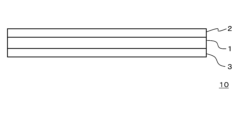
- FIG. 1 is a cross-sectional view illustrating an example of an optical laminate according to an embodiment of the present invention.
- 1 is a cross-sectional view illustrating an example of an optical information transmission device according to an embodiment of the present invention.
- optical laminate The optical laminate of this embodiment will be described in detail below.
- the optical laminate of this embodiment will be described with reference to FIG. 1.
- the optical laminate 10 of this embodiment comprises an optical substrate 1, a (thio)urethane-based optical resin layer ⁇ (2) on one surface ⁇ of the optical substrate 1, and a (thio)urethane-based optical resin layer ⁇ (3) on a surface ⁇ of the optical substrate 1 opposite to the surface ⁇ .
- the optical laminate of this embodiment solves the above problems is not clear, but it is speculated that the above problems are solved by the following mechanism.
- the optical laminate is likely to be distorted, which in turn is likely to cause warping.
- sandwiching the optical substrate between the (thio)urethane-based optical resin layers contributes to suppressing warping.
- the (thio)urethane-based optical resin layer contains a (thio)urethane-based resin.
- the (thio)urethane-based resin can be obtained from an iso(thio)cyanate compound and an active hydrogen compound having two or more functionalities.
- the active hydrogen compound having two or more functionalities include a polyol compound and a polythiol compound.
- iso(thio)cyanate compounds include hexamethylene diisocyanate, pentamethylene diisocyanate, xylylene diisocyanate, isophorone diisocyanate, bis(isocyanatomethyl)cyclohexane, bis(isocyanatocyclohexyl)methane, 2,5-bis(isocyanatomethyl)bicyclo-[2.2.1]-heptane, 2,6-bis(isocyanatomethyl)bicyclo-[2.2.1]-heptane, tolylene diisocyanate, phenylene diisocyanate, and 4,4'-diphenylmethane diisocyanate.
- polythiol compounds include pentaerythritol tetrakis(2-mercaptoacetate), pentaerythritol tetrakis(3-mercaptopropionate), bis(2-mercaptoethyl)sulfide, 4-mercaptomethyl-1,8-dimercapto-3,6-dithiaoctane, 5,7-dimercaptomethyl-1,11-dimercapto-3,6,9-trithiaundecane, 4,7-dimercaptomethyl-1,11-dimercapto-3,6 ,9-trithiaundecane, 4,8-dimercaptomethyl-1,11-dimercapto-3,6,9-trithiaundecane, 2,5-dimercaptomethyl-1,4-dithiane, 1,1,3,3-tetrakis(mercaptomethylthio)propane, 4,6-bis(mercaptomethylthio)-1,3-dithiane
- polyol compounds include ethylene glycol, diethylene glycol, triethylene glycol, propylene glycol, dipropylene glycol, tripropylene glycol, 1,3-propanediol, 2,2-dimethyl-1,3-propanediol, 2,2-diethyl-1,3-propanediol, 1,2-butanediol, 1,3-butanediol, 1,4-butanediol, 3-methyl-1,3-butanediol, 1,2-pentanediol, 1,3-pentanediol, 1,5-pentanediol, 2,4-pentanediol, 2-methyl-2,4-pentanediol, 3-methyl -1,5-pentanediol, 1,6-hexanediol, 2,5-hexanediol, glycerol, diglycerol, polyglycerol, trimethylo
- the thickness of the (thio)urethane-based optical resin layer ⁇ and the (thio)urethane-based optical resin layer ⁇ is preferably 2.0 mm or less, more preferably 1.5 mm or less, even more preferably 1.0 mm or less, even more preferably 0.8 mm or less, even more preferably 0.6 mm or less, and even more preferably 0.4 mm or less.
- the refractive index of the (thio)urethane-based optical resin layer ⁇ and the (thio)urethane-based optical resin layer ⁇ at a temperature of 25°C and a wavelength of 587.6 nm in accordance with JIS K-0062:1992 is preferably 1.47 or more, more preferably 1.49 or more, even more preferably 1.51 or more, and even more preferably 1.53 or more, and may be, for example, 1.90 or less, 1.80 or less, or 1.70 or less.
- the linear expansion coefficients of the (thio)urethane-based optical resin layer ⁇ and the (thio)urethane-based optical resin layer ⁇ measured under the ⁇ Measurement Conditions> below are preferably 100 ⁇ 10 ⁇ 6 /°C or less, more preferably 80 ⁇ 10 ⁇ 6 /°C or less, from the viewpoint of further suppressing warping of the optical laminate and suppressing peeling of the optical laminate, and since a smaller difference in linear expansion coefficient from the optical substrate is better from the viewpoint of further suppressing warping of the optical laminate and suppressing peeling of the optical laminate, the linear expansion coefficients are preferably 2 ⁇ 10 ⁇ 6 /°C or more, more preferably 4 ⁇ 10 ⁇ 6 /°C or more, even more preferably 6 ⁇ 10 ⁇ 6 / °C or more, and even more preferably 8 ⁇ 10 ⁇ 6 /°C or more.
- optical substrate of the optical laminate of this embodiment will be described below.
- the refractive index of the optical substrate at a temperature of 25°C and a wavelength of 587.6 nm according to JIS K-0062:1992 is preferably 1.47 or more, more preferably 1.49 or more, even more preferably 1.51 or more, and even more preferably 1.53 or more, from the viewpoint of improving the optical properties of the optical laminate, and may be, for example, 1.90 or less, 1.80 or less, or 1.70 or less.
- the optical substrate preferably includes one or more selected from the group consisting of a glass substrate and an optical crystal substrate.
- the optical crystal substrate includes a SiC substrate, a LiNb2O3 substrate (LN substrate), an Al2O3 substrate , a sapphire substrate, a quartz substrate, and the like.
- the linear expansion coefficient of the optical substrate measured under the ⁇ Measurement Conditions> described below is preferably 0.1 ⁇ 10 -6 /°C or more, more preferably 0.5 ⁇ 10 -6 /°C or more, even more preferably 2 ⁇ 10 -6 /°C or more, still more preferably 4 ⁇ 10 -6 /°C or more, and may be, for example, 40 ⁇ 10 -6 / ° C or less, or 20 ⁇ 10 -6 /°C or less, since the difference in linear expansion coefficient between the adhesive layer and the (thio)urethane-based optical resin layer is preferably small, from the viewpoint of further suppressing warping of the optical laminate and suppressing peeling of the optical laminate.
- Measurement mode TMA compression mode
- Test load 50 mN Heating rate: 5° C./min
- Measurement atmosphere nitrogen (100 ml/min)
- the optical laminate of this embodiment may include a configuration other than the (thio)urethane-based optical resin layer ⁇ , the (thio)urethane-based optical resin layer ⁇ , and the optical substrate.
- the optical laminate of this embodiment preferably further includes an adhesive layer ⁇ between the optical substrate and the (thio)urethane-based optical resin layer ⁇ , and an adhesive layer ⁇ between the optical substrate and the (thio)urethane-based optical resin layer ⁇ .
- the thicknesses of the adhesive layer ⁇ and the adhesive layer ⁇ are preferably 0.5 ⁇ m or more and 1000 ⁇ m or less, more preferably 1 ⁇ m or more and 500 ⁇ m or less, even more preferably 5 ⁇ m or more and 200 ⁇ m or less, even more preferably 10 ⁇ m or more and 100 ⁇ m or less, even more preferably 15 ⁇ m or more and 80 ⁇ m or less, and even more preferably 15 ⁇ m or more and 60 ⁇ m or less.
- the glass transition temperatures of the adhesive layer ⁇ and the adhesive layer ⁇ are preferably 70°C or lower, more preferably 65°C or lower, even more preferably 60°C or lower, even more preferably 55°C or lower, even more preferably 50°C or lower, and even more preferably 45°C or lower, respectively, from the viewpoint of further suppressing warping of the optical laminate and suppressing peeling of the optical laminate in a high temperature environment and/or a high humidity environment, and are preferably -20°C or higher, more preferably -10°C or higher, even more preferably 0°C or higher, even more preferably 10°C or higher, even more preferably 15°C or higher, and even more preferably 20°C or higher, respectively, from the viewpoint of further suppressing warping of the optical laminate and suppressing peeling of the optical laminate in a high temperature environment and/or a high humidity environment.
- the glass transition temperatures of the adhesive layer ⁇ and the adhesive layer ⁇ can be measured by dynamic mechanical analysis (DMA). Specifically, the glass transition temperatures can be measured under the following ⁇ measurement conditions>.
- ⁇ Measurement conditions> Apparatus: Dynamic viscoelasticity measuring device Sample shape: Width 10 mm x thickness 0.1 mm x length 20 mm Heating rate: 5° C./min Measurement mode: Tensile
- the glass transition temperatures of the adhesive layers ⁇ and ⁇ can be adjusted by adjusting the composition of the adhesive layers. For example, the ratio of high molecular weight components to low molecular weight components in the adhesive layers may be adjusted, or the crosslink density of the adhesive layers may be adjusted.
- the loss modulus of the adhesive layer ⁇ and the adhesive layer ⁇ measured in tension at a temperature of 25°C and a measurement frequency of 1 Hz is preferably 0.001 GPa or more, more preferably 0.01 GPa or more, and even more preferably 0.03 GPa or more, from the viewpoint of further suppressing warping of the optical laminate and suppressing peeling of the optical laminate, and is preferably 1.5 GPa or less, more preferably 1.3 GPa or less, even more preferably 1.1 GPa or less, even more preferably 0.9 GPa or less, even more preferably 0.7 GPa or less, even more preferably 0.5 GPa or less, and even more preferably 0.3 GPa or less, from the viewpoint of further suppressing warping of the optical laminate and suppressing peeling of the optical laminate.
- the loss modulus of the adhesive layer ⁇ and the adhesive layer ⁇ can be measured by dynamic mechanical analysis (DMA). Specifically, the measurement can be performed under the following ⁇ measurement conditions>.
- ⁇ Measurement conditions> Apparatus: Dynamic viscoelasticity measuring device Sample shape: Width 10 mm x thickness 0.1 mm x length 20 mm Temperature: 25°C Measurement mode: Tensile
- the loss modulus of the adhesive layer ⁇ and the adhesive layer ⁇ can be adjusted by adjusting the composition of the adhesive layer. For example, the ratio of high molecular weight components to low molecular weight components in the adhesive layer may be adjusted, or the crosslink density of the adhesive layer may be adjusted.
- the adhesive layer ⁇ and the adhesive layer ⁇ preferably contain one or more resins selected from the group consisting of (meth)acrylic resins and epoxy resins, and more preferably contain a (meth)acrylic resin.
- the adhesive layer ⁇ and the adhesive layer ⁇ may further contain a known adhesive.
- known adhesives include laminate adhesives composed of organic titanium resins, polyethyleneimine resins, urethane resins, polyester resins, oxazoline group-containing resins, modified silicone resins, alkyl titanates, polyester polybutadienes, etc., or one-component or two-component polyols and polyisocyanates, water-based urethanes, ionomers, etc.
- aqueous adhesives whose main raw materials are acrylic resins, vinyl acetate resins, urethane resins, polyester resins, etc. may be used.
- other additives such as curing agents and silane coupling agents may be added to the adhesive depending on the application of the gas barrier laminate.
- a transparent inorganic layer is further provided at least one between the optical substrate and the adhesive layer ⁇ and between the optical substrate and the adhesive layer ⁇ .
- the means for forming the transparent inorganic layer is not particularly limited, but for example, the transparent inorganic layer can be formed by sputtering the surface of the optical substrate. Specifically, the optical substrate is first placed in a vacuum chamber, and a gas such as argon gas is introduced, and then a negative voltage is applied to the surface of the optical substrate to generate a glow discharge and ionize the gas atoms.
- the ionized gas atoms collide with the surface of the optical substrate, and the particles (atoms and molecules) on the surface of the optical substrate are ejected and adhere to and accumulate on the surface of the optical substrate, forming a transparent inorganic layer.
- the thickness of the transparent inorganic layer is not particularly limited, but from the viewpoint of further suppressing warping of the optical laminate and suppressing peeling of the optical laminate, it is preferably 5 nm or more, more preferably 10 nm or more, even more preferably 20 nm or more, even more preferably 50 nm or more, and may be, for example, 100 nm or less.
- the optical laminate of this embodiment preferably further includes a coupling agent layer between the optical substrate and the adhesive layer ⁇ and/or between the optical substrate and the adhesive layer ⁇ , in order to prevent peeling of the optical laminate.
- the coupling agent contained in the coupling agent layer is not particularly limited, but examples thereof include silane coupling agents.
- silane coupling agents include vinyl group-containing silane coupling agents such as vinyltrimethoxysilane and vinyltriethoxysilane, epoxy group-containing silane coupling agents such as 2-(3,4-epoxycyclohexyl)ethyltrimethoxysilane, 3-glycidoxypropylmethyldimethoxysilane, 3-glycidoxypropyltrimethoxysilane, 3-glycidoxypropylmethyldiethoxysilane and 3-glycidoxypropyltriethoxysilane, and (meth)acrylic group-containing silane coupling agents such as 3-methacryloxypropylmethyldimethoxysilane, 3-methacryloxypropyltrimethoxysilane, 3-methacryloxypropylmethyldiethoxysilane, 3-methacryloxypropyltriethoxysilane and 3-acryloxypropyl
- the thickness of the coupling agent layer is not particularly limited, but from the viewpoint of further suppressing warping of the optical laminate and suppressing peeling of the optical laminate, it is preferably 1 nm or more, more preferably 2 nm or more, even more preferably 5 nm or more, even more preferably 10 nm or more, and may be, for example, 50 nm or less.
- the optical laminate of this embodiment may also have layer configurations such as an antistatic layer that prevents the optical laminate from becoming statically charged, a hard coat layer that prevents the optical laminate from being scratched, a moisture barrier layer that blocks the intrusion of moisture into the optical laminate, and an anti-reflection film that reduces the surface reflection of the optical laminate.
- layer configurations such as an antistatic layer that prevents the optical laminate from becoming statically charged, a hard coat layer that prevents the optical laminate from being scratched, a moisture barrier layer that blocks the intrusion of moisture into the optical laminate, and an anti-reflection film that reduces the surface reflection of the optical laminate.
- the warpage F A of the surface A on the (thio)urethane-based optical resin layer ⁇ side of the optical laminate of this embodiment after being left to stand at 50° C. for 30 minutes is preferably 200 ⁇ m or less, more preferably 150 ⁇ m or less, even more preferably 100 ⁇ m or less, still more preferably 50 ⁇ m or less, and may be, for example, 0.01 ⁇ m or more.
- the amount of warpage F A can be measured by an ultra-high precision three-dimensional measuring machine. Specifically, it can be measured under the following conditions.
- the optical laminate of this embodiment is left to stand for 360 hours in an environment of a temperature of 60° C. and a humidity of 90%, and then the surface A on the (thio)urethane-based optical resin layer ⁇ side of the optical laminate is measured with a non-contact optical flatness meter to obtain an amount of warpage F A of the surface A.
- the amount of warpage F A of the surface A is preferably 350 ⁇ m or less, more preferably 300 ⁇ m or less, even more preferably 250 ⁇ m or less, even more preferably 200 ⁇ m or less, even more preferably 150 ⁇ m or less, even more preferably 100 ⁇ m or less, even more preferably 50 ⁇ m or less, and may be, for example, 0.01 ⁇ m or more.
- the refractive index of the optical laminate at a temperature of 25°C and a wavelength of 587.6 nm according to JIS K-0062:1992 is preferably 1.47 or more, more preferably 1.49 or more, even more preferably 1.51 or more, and even more preferably 1.53 or more, from the viewpoint of improving the optical properties of the optical laminate, and may be, for example, 1.90 or less, 1.80 or less, or 1.70 or less.
- the optical laminate of this embodiment can be used in any application, but is not limited to this application. More specifically, it can be used in a wearable device, such as a wearable display that displays virtual reality (VR), augmented reality (AR), etc.
- a wearable device such as a wearable display that displays virtual reality (VR), augmented reality (AR), etc.
- VR virtual reality
- AR augmented reality
- Methods for producing the optical laminate of this embodiment are roughly divided into a method in which the optical substrate, the (thio)urethane-based optical resin layer ⁇ , and the (thio)urethane-based optical resin layer ⁇ are all laminated and then cured (simultaneous curing), and a method in which the optical substrate and the (thio)urethane-based optical resin layer ⁇ are laminated and cured, and then the urethane-based optical resin layer ⁇ is laminated and cured (sequential curing).
- the method for manufacturing the optical laminate of this embodiment includes a step (A) of preparing a laminate X including an optical substrate, a (thio)urethane-based optical resin layer ⁇ on one surface ⁇ of the optical substrate, an uncured or semi-cured adhesive layer ⁇ between the optical substrate and the (thio)urethane-based optical resin layer ⁇ , a (thio)urethane-based optical resin layer ⁇ on a surface ⁇ of the optical substrate opposite to the surface ⁇ , and an uncured or semi-cured adhesive layer ⁇ between the optical substrate and the (thio)urethane-based optical resin layer ⁇ , and a step (B) of simultaneously curing the uncured or semi-cured adhesive layer ⁇ and the uncured or semi-cured adhesive layer ⁇ to obtain the optical laminate.
- the method for producing an optical laminate of this embodiment may further include a step (C) of placing the laminate X in a reduced pressure environment prior to the step (B). This can prevent misalignment of the components during lamination. This can also prevent air bubbles from being generated between the layers.
- the method for manufacturing the optical laminate of this embodiment includes a step (D) of preparing a laminate Y including an optical substrate, a (thio)urethane-based optical resin layer ⁇ on one surface ⁇ of the optical substrate, and an uncured or semi-cured adhesive layer ⁇ between the optical substrate and the (thio)urethane-based optical resin layer ⁇ , a step (E) of curing the uncured or semi-cured adhesive layer ⁇ to obtain a cured laminate Y, a step (F) of preparing a laminate Z including the cured laminate Y, a (thio)urethane-based optical resin layer ⁇ on the surface ⁇ side of the cured laminate Y facing the optical substrate, and an uncured or semi-cured adhesive layer ⁇ between the cured laminate Y and the (thio)urethane-based optical resin layer ⁇ , and a step (G) of curing the uncured or semi-cured adhesive layer ⁇ to obtain the optical laminate.
- the method for producing an optical laminate of this embodiment may further include a step (H) of placing the laminate Y in a reduced pressure environment prior to the step (E). This can prevent misalignment of the components during lamination. This can also prevent air bubbles from forming between the layers.
- the method for producing an optical laminate of this embodiment may further include a step (I) of placing the laminate Z in a reduced pressure environment prior to the step (G). This can prevent misalignment of the components during lamination. This can also prevent air bubbles from forming between the layers.
- the method for producing the optical laminate of this embodiment may include steps other than the steps described above.
- the method for producing the optical laminate of this embodiment may further include a step (J) of annealing the optical laminate.
- the annealing temperature T2 in the step (J) is preferably ( T1 + 5)°C or higher, more preferably ( T1 + 10)°C or higher, and preferably ( T1 + 20)°C or lower, more preferably ( T1 + 15)°C or lower. This can further suppress warping of the optical laminate.
- the annealing temperature T2 in the step (J) is preferably from ( T1 + 5)° C. to ( T1 + 20)° C., more preferably from ( T1 + 10)° C. to ( T1 + 15)° C. This can further suppress warping of the optical laminate.
- the annealing temperature is preferably 60°C or higher, more preferably 70°C or higher, even more preferably 80°C or higher, even more preferably 90°C or higher, even more preferably 100°C or higher, and may be, for example, 200°C or lower. This can further suppress warping of the optical laminate.
- the method for producing the optical laminate of this embodiment may further include a step of sputtering the surface of the optical substrate. By sputtering the surface of the optical substrate, a transparent inorganic layer can be formed on the surface of the optical substrate.
- the method for producing an optical laminate of this embodiment may further include a step of subjecting the surface of the optical substrate to surface treatment plasma ashing. By subjecting the surface of the optical substrate to plasma ashing, the surface of the optical substrate can be activated.
- the method for producing the optical laminate of this embodiment may further include a step of applying a coupling agent to the surface of the optical substrate.
- a coupling agent layer can be formed on the surface of the optical substrate.
- the manufacturing method of the optical laminate of this embodiment from the viewpoint of further suppressing warping of the optical laminate and suppressing peeling of the optical laminate, it is preferable to apply a coupling agent to the sputtered surface of the optical substrate.
- optical information transmission device The optical information transmission device of this embodiment will be described below.
- the optical information transmission device of this embodiment will be described with reference to FIG. 2.
- the optical information transmission device 20 of this embodiment includes a light irradiation unit 11 and the optical laminate 10 described above.
- the light 12 generated from the light emitting unit 11 is reflected by the optical laminate 10, and the reflected light is irradiated to the user's eye 13. As a result, the light generated from the light emitting unit 11 is recognized by the user wearing the optical information transmission device 10.
- Examples 1 and 3 Double-sided application, simultaneous curing
- the glass substrate (1) was sputtered to form a transparent inorganic layer ⁇ on the surface of the glass substrate (1).
- Metallic Si was used as the sputtering target.
- Ar and O2 were used as the carrier gas.
- the sputtering power was 5.5 kW.
- the method for forming the transparent inorganic layer is not particularly limited, and it may be formed by ion-assisted deposition.
- a silane coupling agent manufactured by Shin-Etsu Chemical Co., Ltd., product name KBM-5103 was applied to the transparent inorganic layer ⁇ of the glass substrate (1) to form a silane coupling agent layer ⁇ having a thickness of 7 nm.
- the adhesive resin composition shown in Table 1 was applied onto the silane coupling agent layer ⁇ of the glass substrate (1) so as to give a thickness of 50 ⁇ m after curing.
- a thiourethane-based optical resin sheet ⁇ (1) was laminated on the surface on which the adhesive resin composition was applied.
- the surface of the glass substrate (1) opposite to the surface on which the thiourethane-based optical resin sheet ⁇ (1) was laminated was sputtered under the same conditions as those for forming the transparent inorganic layer ⁇ , thereby forming a transparent inorganic layer ⁇ on the surface of the glass substrate (1).
- a silane coupling agent layer ⁇ was formed on the transparent inorganic material layer ⁇ of the glass substrate (1) under the same conditions as those for forming the transparent inorganic material layer ⁇ .
- the adhesive resin composition shown in Table 1 was applied onto the silane coupling agent layer ⁇ of the glass substrate (1) so as to give a thickness of 50 ⁇ m after curing.
- a thiourethane-based optical resin sheet ⁇ (1) was laminated on the surface on which the adhesive resin composition was applied, and ultraviolet light having a wavelength of 405 nm was irradiated at an irradiation intensity of 600 mW/ cm2 for 50 seconds to simultaneously cure the two layers of adhesive resin composition applied, thereby obtaining optical laminates.
- Example 2 and 4 double-sided application, sequential curing
- the glass substrate (1) was sputtered under the same conditions as those for forming the transparent inorganic layer ⁇ in Example 1, to form a transparent inorganic layer ⁇ on the surface of the glass substrate (1).
- a silane coupling agent layer ⁇ was formed on the transparent inorganic layer ⁇ of the glass substrate (1) under the same conditions as those for forming the silane coupling agent layer ⁇ in Example 1.
- the adhesive resin composition shown in Table 1 was applied onto the silane coupling agent layer ⁇ of the glass substrate (1) so as to give a thickness of 50 ⁇ m after curing.
- a thiourethane-based optical resin sheet ⁇ (1) was laminated on the surface on which the adhesive resin composition was applied, and the adhesive resin composition was cured by irradiating it with ultraviolet light having a wavelength of 405 nm at an irradiation intensity of 600 mW/cm 2 for 50 seconds to obtain a cured laminate Y.
- the surface of the glass substrate (1) opposite to the surface on which the thiourethane-based optical resin sheet ⁇ (1) of the obtained cured laminate Y was laminated was sputtered under the same conditions as those for forming the transparent inorganic layer ⁇ of Example 1, to form a transparent inorganic layer ⁇ on the surface of the glass substrate (1).
- a silane coupling agent layer ⁇ was formed on the transparent inorganic layer ⁇ of the glass substrate (1) under the same conditions as those for forming the silane coupling agent layer ⁇ in Example 1.
- the adhesive resin composition shown in Table 1 was applied onto the silane coupling agent layer ⁇ of the glass substrate (1) so as to give a thickness of 50 ⁇ m after curing.
- a thiourethane-based optical resin sheet ⁇ (1) was laminated on the surface on which the adhesive resin composition was applied, and the adhesive resin composition was cured by irradiating it with ultraviolet light having a wavelength of 405 nm at an irradiation intensity of 600 mW/ cm2 for 50 seconds, and then annealed at 70°C for 120 minutes to obtain an optical laminate.
- a thiourethane-based optical resin sheet ⁇ (1) was laminated on the surface on which the adhesive resin composition was applied, and ultraviolet light having a wavelength of 405 nm was irradiated at an irradiation intensity of 600 mW/cm 2 for 50 seconds to cure the adhesive resin composition, thereby obtaining optical laminates.
- Loss modulus of adhesive layer The loss modulus of elasticity was measured under the following conditions using the adhesive layer evaluation samples obtained by the above method. The results are shown in Table 1. Apparatus: DMA7100 (Hitachi High-Tech Science) Sample shape: width 10 mm x thickness 0.1 mm x length 20 mm Measurement temperature: 25°C Measurement frequency: 1Hz Measurement mode: Tensile
- Warping was suppressed in the optical laminate of the example. This shows that warping can be suppressed by the optical laminate of this embodiment.
Landscapes
- Physics & Mathematics (AREA)
- General Physics & Mathematics (AREA)
- Optics & Photonics (AREA)
- Laminated Bodies (AREA)
- Casting Or Compression Moulding Of Plastics Or The Like (AREA)
Priority Applications (3)
| Application Number | Priority Date | Filing Date | Title |
|---|---|---|---|
| KR1020257027524A KR20250133794A (ko) | 2023-07-20 | 2024-07-16 | 광학 적층체, 광학 적층체의 제조 방법 및 광 정보 전달 장치 |
| JP2025534065A JPWO2025018342A1 (https=) | 2023-07-20 | 2024-07-16 | |
| CN202480019323.7A CN120917343A (zh) | 2023-07-20 | 2024-07-16 | 光学层叠体、光学层叠体的制造方法以及光信息传递装置 |
Applications Claiming Priority (2)
| Application Number | Priority Date | Filing Date | Title |
|---|---|---|---|
| JP2023-118138 | 2023-07-20 | ||
| JP2023118138 | 2023-07-20 |
Publications (1)
| Publication Number | Publication Date |
|---|---|
| WO2025018342A1 true WO2025018342A1 (ja) | 2025-01-23 |
Family
ID=94281597
Family Applications (1)
| Application Number | Title | Priority Date | Filing Date |
|---|---|---|---|
| PCT/JP2024/025498 Pending WO2025018342A1 (ja) | 2023-07-20 | 2024-07-16 | 光学積層体、光学積層体の製造方法および光情報伝達装置 |
Country Status (5)
| Country | Link |
|---|---|
| JP (1) | JPWO2025018342A1 (https=) |
| KR (1) | KR20250133794A (https=) |
| CN (1) | CN120917343A (https=) |
| TW (1) | TW202526368A (https=) |
| WO (1) | WO2025018342A1 (https=) |
Citations (5)
| Publication number | Priority date | Publication date | Assignee | Title |
|---|---|---|---|---|
| JPS6389343A (ja) * | 1986-10-02 | 1988-04-20 | ミノルタ株式会社 | 複合型光学部材及びその製造方法 |
| JPH07110403A (ja) * | 1993-08-20 | 1995-04-25 | Olympus Optical Co Ltd | 複合型光学部品 |
| JP2011140187A (ja) * | 2010-01-08 | 2011-07-21 | Teijin Chem Ltd | 積層フィルム、透明導電性積層フィルムおよび電子部品 |
| JP2017024386A (ja) * | 2015-07-17 | 2017-02-02 | 三菱樹脂株式会社 | ガラス積層体、及び表示装置用保護材 |
| WO2020170801A1 (ja) * | 2019-02-18 | 2020-08-27 | 三井化学株式会社 | 光学部材、光学部材の製造方法及び光情報伝達装置 |
-
2024
- 2024-07-16 KR KR1020257027524A patent/KR20250133794A/ko active Pending
- 2024-07-16 JP JP2025534065A patent/JPWO2025018342A1/ja active Pending
- 2024-07-16 CN CN202480019323.7A patent/CN120917343A/zh active Pending
- 2024-07-16 WO PCT/JP2024/025498 patent/WO2025018342A1/ja active Pending
- 2024-07-18 TW TW113126832A patent/TW202526368A/zh unknown
Patent Citations (5)
| Publication number | Priority date | Publication date | Assignee | Title |
|---|---|---|---|---|
| JPS6389343A (ja) * | 1986-10-02 | 1988-04-20 | ミノルタ株式会社 | 複合型光学部材及びその製造方法 |
| JPH07110403A (ja) * | 1993-08-20 | 1995-04-25 | Olympus Optical Co Ltd | 複合型光学部品 |
| JP2011140187A (ja) * | 2010-01-08 | 2011-07-21 | Teijin Chem Ltd | 積層フィルム、透明導電性積層フィルムおよび電子部品 |
| JP2017024386A (ja) * | 2015-07-17 | 2017-02-02 | 三菱樹脂株式会社 | ガラス積層体、及び表示装置用保護材 |
| WO2020170801A1 (ja) * | 2019-02-18 | 2020-08-27 | 三井化学株式会社 | 光学部材、光学部材の製造方法及び光情報伝達装置 |
Also Published As
| Publication number | Publication date |
|---|---|
| TW202526368A (zh) | 2025-07-01 |
| CN120917343A (zh) | 2025-11-07 |
| KR20250133794A (ko) | 2025-09-08 |
| JPWO2025018342A1 (https=) | 2025-01-23 |
Similar Documents
| Publication | Publication Date | Title |
|---|---|---|
| KR101801690B1 (ko) | Oled 패널 하부 보호필름 및 이를 포함하는 oled 패널 | |
| KR101671601B1 (ko) | 플라스틱 편광 렌즈 및 그 제조 방법 | |
| US11963383B2 (en) | OLED panel lower part protection film, and organic light-emitting display apparatus comprising same | |
| US10899094B2 (en) | Method of manufacturing plastic lens, method of positioning film, and composite body | |
| WO2013015315A1 (ja) | ガスバリアフィルム及びデバイス | |
| EP4400524A1 (en) | Photocurable composition, cured article, laminated body, method for producing cured article, and method for producing lens | |
| EP3779530A1 (en) | Photochromic adhesive composition, photochromic layered body, and optical article using said photochromic layered body | |
| TW201812402A (zh) | 阻氣性積層膜的轉印用薄膜及有機el裝置 | |
| JPWO2019151495A1 (ja) | ガスバリア性フィルム及びその製造方法 | |
| WO2025018342A1 (ja) | 光学積層体、光学積層体の製造方法および光情報伝達装置 | |
| WO2025018344A1 (ja) | 光学積層体、光学積層体の製造方法および光情報伝達装置 | |
| US12060496B2 (en) | Optical laminate and flexible display device including the same | |
| KR102747618B1 (ko) | 광학 적층체, 플렉서블 디스플레이 장치의 커버 윈도우 및 디스플레이 장치 | |
| KR102747616B1 (ko) | 광학 적층 필름 및 이를 포함하는 플렉서블 디스플레이 장치 | |
| KR102808469B1 (ko) | 하드 코팅 조성물, 이를 포함하는 광학 적층체 및 플렉서블 디스플레이 장치 | |
| WO2022255340A1 (ja) | 反射防止フィルム、反射防止フィルムを有する積層体及び反射防止フィルムの製造方法 | |
| JP2020186410A (ja) | 接着シート、物品及び物品の製造方法 | |
| KR20220074409A (ko) | 광학 적층체 및 이를 포함하는 플렉서블 디스플레이 장치 | |
| KR102690638B1 (ko) | 디스플레이 소자 보호를 위한 초저점착 및 저잔사 임시 보호 필름 | |
| EP4715004A1 (en) | Thiourethane film, roll, lens, glasses, method for producing (thio)urethane resin film, and method for producing multilayer lens | |
| KR102748115B1 (ko) | 광학 적층체 및 이를 포함하는 플렉서블 디스플레이 장치 | |
| KR102753514B1 (ko) | 광학 적층 필름 및 이를 포함하는 플렉서블 디스플레이 장치 | |
| US12486440B2 (en) | Surface protective film for optical member | |
| KR20230060423A (ko) | 적층체, 이를 포함하는 하드코트 필름 및 이를 적용한 윈도우 및 화상 표시 장치 | |
| CN114106389A (zh) | 光学薄膜、光学薄膜的制造方法、光学构件和图像显示装置 |
Legal Events
| Date | Code | Title | Description |
|---|---|---|---|
| 121 | Ep: the epo has been informed by wipo that ep was designated in this application |
Ref document number: 24843132 Country of ref document: EP Kind code of ref document: A1 |
|
| ENP | Entry into the national phase |
Ref document number: 2025534065 Country of ref document: JP Kind code of ref document: A |
|
| WWE | Wipo information: entry into national phase |
Ref document number: 2025534065 Country of ref document: JP |
|
| ENP | Entry into the national phase |
Ref document number: 1020257027524 Country of ref document: KR Free format text: ST27 STATUS EVENT CODE: A-0-1-A10-A15-NAP-PA0105 (AS PROVIDED BY THE NATIONAL OFFICE) |
|
| WWE | Wipo information: entry into national phase |
Ref document number: 1020257027524 Country of ref document: KR |
|
| WWE | Wipo information: entry into national phase |
Ref document number: 202480019323.7 Country of ref document: CN |
|
| WWP | Wipo information: published in national office |
Ref document number: 202480019323.7 Country of ref document: CN |
|
| WWE | Wipo information: entry into national phase |
Ref document number: 2024843132 Country of ref document: EP |
|
| NENP | Non-entry into the national phase |
Ref country code: DE |