WO2025017964A1 - コイル、及び回転電機 - Google Patents
コイル、及び回転電機 Download PDFInfo
- Publication number
- WO2025017964A1 WO2025017964A1 PCT/JP2024/010750 JP2024010750W WO2025017964A1 WO 2025017964 A1 WO2025017964 A1 WO 2025017964A1 JP 2024010750 W JP2024010750 W JP 2024010750W WO 2025017964 A1 WO2025017964 A1 WO 2025017964A1
- Authority
- WO
- WIPO (PCT)
- Prior art keywords
- coil
- rotor
- axis
- high resistivity
- unit
- Prior art date
- Legal status (The legal status is an assumption and is not a legal conclusion. Google has not performed a legal analysis and makes no representation as to the accuracy of the status listed.)
- Pending
Links
Images


Classifications
-
- H—ELECTRICITY
- H02—GENERATION; CONVERSION OR DISTRIBUTION OF ELECTRIC POWER
- H02K—DYNAMO-ELECTRIC MACHINES
- H02K3/00—Details of windings
- H02K3/02—Windings characterised by the conductor material
-
- H—ELECTRICITY
- H02—GENERATION; CONVERSION OR DISTRIBUTION OF ELECTRIC POWER
- H02K—DYNAMO-ELECTRIC MACHINES
- H02K3/00—Details of windings
- H02K3/04—Windings characterised by the conductor shape, form or construction, e.g. with bar conductors
- H02K3/18—Windings for salient poles
Definitions
- the present disclosure relates to a coil and a rotating electric machine.
- This application claims priority to Japanese Patent Application No. 2023-116020, filed in Japan on July 14, 2023, the contents of which are incorporated herein by reference.
- An electric motor which is a type of rotating electric machine, has a rotor that can rotate around an axis and a cylindrical stator that covers the rotor core from the outer periphery.
- the rotor has a rotor core and a permanent magnet.
- the stator has a stator core and a number of coils attached to the stator core. When electricity is applied to the coils, electromagnetic force is generated between the permanent magnets, causing the rotor to rotate around the axis.
- it has been common to wind copper wire or the like around the teeth of the stator core and mold it into a ring shape.
- Patent Document 1 when forming the coils, it is necessary to insulate the windings of the coils from each other in order to reduce copper loss. For this reason, the technology described in the following Patent Document 1 is said to be used to irradiate copper powder, which is the material for the conductor, and ceramic powder, which is the material for the insulating layer, with a laser to form the insulating coating and coils by three-dimensional additive manufacturing.
- This disclosure provides a coil and a rotating electric machine with further reduced copper loss.
- the coil disclosed herein is a coil used in a rotating electric machine that includes a rotor that can rotate around an axis, and a cylindrical stator that faces the rotor in the radial direction and is centered on the axis, the stator includes an annular yoke centered on the axis, a stator core that protrudes radially inward from the inner peripheral surface of the yoke and has a plurality of teeth that are arranged at intervals in the circumferential direction, and the coil that covers the teeth, the coil includes a plurality of unit coils that cover the teeth from the outer periphery and are stacked in the radial direction relative to the axis, and the unit coil includes a portion that includes both ends in the circumferential direction relative to the axis that is a high resistivity portion whose electrical resistivity is higher than that of the remaining portion.
- the rotating electric machine comprises the rotor, the stator core, and the above-mentioned coil provided on the stator core.
- This disclosure makes it possible to provide a coil and a rotating electric machine with even reduced copper loss.
- FIG. 1 is a cross-sectional view showing a configuration of a rotating electric machine according to a first embodiment of the present disclosure.
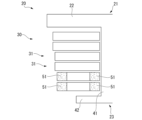
- FIG. 2 is an enlarged cross-sectional view of a coil according to a first embodiment of the present disclosure.
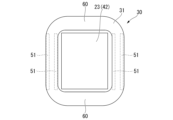
- 2 is a cross-sectional view of a coil according to a first embodiment of the present disclosure viewed from a radial direction.
- FIG. 10 is an enlarged view of a main portion showing a modified example of the coil according to the first embodiment of the present disclosure.
- FIG. FIG. 4 is an enlarged cross-sectional view of a coil according to a second embodiment of the present disclosure.
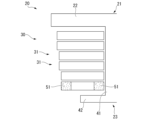
- FIG. 11 is an enlarged cross-sectional view showing a modified example of the coil according to the second embodiment of the present disclosure.
- the electric motor 1 includes a rotor 10 and a stator 20.
- the rotor 10 is columnar and extends along an axis X, and is supported rotatably about the axis X.
- the rotor 10 has a permanent magnet.
- the stator 20 is cylindrical and covers the rotor 10 from the outer periphery. In other words, the stator 20 is cylindrical and centered on the axis X.
- the stator 20 includes a stator core 21 and a coil 30.
- the stator core 21 has a yoke 22 and multiple teeth 23.
- the yoke 22 has an annular shape centered on the axis X.
- Multiple teeth 23 are provided on the inner peripheral surface of the yoke 22.
- the teeth 23 protrude from the inner peripheral surface of the yoke 22 toward the inside in the radial direction relative to the axis X.
- Multiple yokes 22 are provided at intervals in the circumferential direction relative to the axis X.
- the teeth 23 have a teeth body 41 and a flange portion 42.
- the teeth body 41 extends in the radial direction.
- the circumferential dimension of the teeth body 41 is constant throughout its radial extension.
- the coil 30, described below, is arranged around the teeth body 41.
- the flange portion 42 is provided at the tip end (i.e., the radially inner end) of the teeth body 41.
- the flange portion 42 protrudes from the tip of the teeth body 41 to both sides in the circumferential direction.
- the flange portion 42 is provided to prevent the coil 30, described below, from falling off the teeth body 41.
- the coil 30 is provided so as to be wound around the tooth body 41.
- the coil 30 has an annular shape with a central axis extending in the radial direction relative to the axis X.
- the coil 30 has a plurality of unit coils 31 stacked in the radial direction.
- the unit coil 31 is annular with its central axis in the radial direction relative to the axis X. When viewed from the direction of the axis X, the unit coil 31 has a rectangular cross-sectional shape.
- the multiple unit coils 31 as a whole form a spiral shape and cover the periphery of the teeth body 41. In other words, the unit coils 31 are electrically connected to each other to form a single coil 30.
- the circumferential dimension of the unit coil 31 gradually decreases from the radial outside to the radial inside. This is to avoid physical interference with other coils 30 adjacent in the circumferential direction.
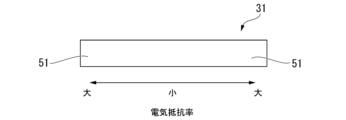
- the portion including both ends of the unit coil 31 in the circumferential direction is a high resistivity portion 51 having a higher electrical resistivity than the remaining portion (i.e., the central portion in the circumferential direction excluding both ends).
- the resistivity changes discontinuously.
- this high resistivity portion 51 is formed by lowering the laser output compared to the remaining portion. Therefore, the high resistivity portion 51 has a lower material filling rate than the remaining portion. In other words, the porosity of the material is high in the high resistivity portion 51. As a result, it is difficult for current to flow. That is, the electrical resistivity is high. Copper is preferably used as the material for forming the coil 30.
- a laser is irradiated onto copper powder to melt and solidify the powder, thereby obtaining the desired shape of the coil 30.
- the high resistivity portions 51 are provided only in the portions of the unit coil 31 that overlap with the teeth 23. In other words, the high resistivity portions 51 are not provided in the portions of the unit coil 31 that do not overlap with the teeth 23, i.e., the coil ends 60.
- Such a distribution of the properties of the unit coil 31 can also be realized by the above-mentioned three-dimensional additive manufacturing.
- the coil 30 in forming the coil 30, it is common to wind copper wire or the like around the teeth 23 of the stator core 21 to form it into a ring shape. In addition, in forming the coil 30, it is necessary to insulate the windings of the coil 30 from each other in order to reduce copper loss. For this reason, in the past, the insulating coating and coil 30 were sometimes formed by three-dimensional additive manufacturing, in which a laser was irradiated onto copper powder, which is the material for the conductor, and ceramic powder, which is the material for the insulating layer.
- the leakage magnetic flux of the coil 30 does not interlink, so if a high resistivity section 51 is provided in this portion, there is a possibility that DC copper loss will increase.
- the high resistivity section 51 is provided in such a portion other than the coil end 60, it is possible to minimize the increase in DC copper loss while maximizing AC copper loss.
- the high resistivity portion 51 can be easily and inexpensively constructed simply by changing the filling rate of the material.
- the above-mentioned high resistivity portion 51 can be easily formed simply by lowering the laser output and controlling the filling rate of the material. This makes it possible to significantly reduce the manufacturing cost of the coil 30.
- the electrical resistivity of the region in the circumferential center may be configured to increase from the radially outer to the inner unit coil 31.
- the electrical resistivity of the high resistivity portions 51 on both sides in the circumferential direction may be configured to gradually increase from the radially outer to the inner unit coil 31. Specifically, one example is to increase the volume occupied by the high resistivity portions 51 from the radially outer to the inner unit coil 31.
- the above configuration makes it possible to effectively suppress the generation of eddy currents, since the electrical resistivity is high in the radially inner region (i.e., the region close to the rotor) where eddy currents are particularly likely to occur.
- a high resistivity portion 51 is provided only in the unit coil 31 closest to the rotor 10. Specifically, in the example shown in the figure, high resistivity portions 51 are formed only in two unit coils 31 counting from the radially inner side where the rotor 10 is located. The configuration and properties of the high resistivity portions 51 themselves are the same as those described in the first embodiment.
- the coil 30 as a whole is magnetized by the rotor 10, a large amount of eddy current tends to flow in the unit coil 31 close to the rotor 10.
- the high resistivity portion 51 is provided only in the unit coil 31 close to the rotor 10, so that the eddy current can be suppressed more efficiently and effectively. Therefore, it is possible to further reduce the copper loss of the coil 30 as a whole.
- the high resistivity portion 51 is formed even in a place where eddy current is unlikely to occur, the DC copper loss increases, and there is a possibility that the performance of the coil 30 as a whole will decrease. According to the above configuration, it is possible to minimize the AC copper loss while avoiding such a possibility. Therefore, the efficiency of the electric motor 1 can be further improved.
- the high resistivity portion 51 is formed in only two unit coils 31 counting from the rotor 10 side.
- the high resistivity portion 51 may be formed in only the first unit coil 31 counting from the rotor 10 side, as shown in FIG. 6. With this configuration, eddy currents can be suppressed more efficiently and effectively than when high resistivity portions 51 are also provided in the remaining unit coils 31. Therefore, it is possible to further reduce AC copper loss in the coil 30 as a whole.
- the number of coils 30 and the number of teeth 23 described in the above embodiment are merely examples, and can be increased or decreased as appropriate depending on the design and specifications. In any case, the same effects as those described above can be obtained.
- the number of unit coils 31 is also just an example, and can be changed as appropriate depending on the design and specifications. In any case, the same effect as described above can be obtained.
- the coil 30 was used in the electric motor 1.
- the application of the coil 30 is not limited to the electric motor 1, and the coil 30 can also be used in a generator, which is another type of rotating electric machine.
- a rotational force to the rotor 10
- an induced current is generated in the coil 30, making it possible to obtain AC power.
- the configuration of the electric motor 1 is not limited to the above-mentioned embodiments. That is, in each of the above-mentioned embodiments, an example in which the rotor 10 is arranged on the inner circumference side of the stator 20 has been described, but it is also possible to adopt a configuration in which the rotor 10 is arranged on the outer circumference side of the stator 20. In this case, when providing a high resistivity portion 51 only in the unit coil 31 on the rotor 10 side described in the second embodiment, the high resistivity portion 51 will be formed only in the unit coil 31 on the radially outer side. With this configuration, it is possible to obtain the same action and effect as described above.
- the coil 30 according to the first aspect is a coil 30 used in a rotating electric machine including a rotor 10 rotatable around an axis X and a cylindrical stator 20 that faces the rotor 10 in the radial direction and is centered on the axis X.
- the stator 20 includes an annular yoke 22 centered on the axis X, a stator core 21 that protrudes radially inward from the inner peripheral surface of the yoke 22 and has a plurality of teeth 23 arranged at intervals in the circumferential direction, and the coil 30 that covers the teeth 23.
- the coil 30 includes a plurality of unit coils 31 that cover the teeth 23 from the outer periphery and are stacked in the radial direction relative to the axis X.
- a portion including both ends in the circumferential direction relative to the axis X is a high resistivity portion 51 whose electrical resistivity is higher than that of the remaining portion.
- the coil 30 according to the second aspect is the coil 30 according to (1), in which the electrical resistivity of the unit coil 31 gradually increases from the circumferential center toward the ends on both sides.
- the electrical resistivity gradually increases toward both ends in the circumferential direction, so no localized areas of resistivity change are formed. This makes it possible to suppress the occurrence of areas with localized increased eddy currents. This makes it possible to further reduce copper loss in the coil 30 as a whole.
- the coil 30 according to the third aspect is the coil 30 according to (1) or (2), in which the high resistivity portion 51 is provided only in the unit coil 31 on the side closest to the rotor 10.
- the coil 30 as a whole is magnetized by the rotor 10, so that eddy currents tend to flow particularly in large amounts in the unit coil 31 on the side closest to the rotor 10.
- the high resistivity portion 51 is provided only in the unit coil 31 on the side closest to the rotor 10, so that eddy currents can be suppressed more efficiently and effectively. Therefore, it is possible to further reduce copper loss in the coil 30 as a whole.
- the coil 30 according to the fourth aspect is a coil 30 according to any one of aspects (1) to (3), in which the high resistivity portion 51 is provided only in the unit coil 31 in the first stage counting from the rotor 10.
- the high resistivity section 51 is provided only in the unit coil 31 in the first row counting from the rotor 10, so eddy currents can be suppressed more efficiently and effectively than when the remaining unit coils 31 are also provided with high resistivity sections 51. This makes it possible to further reduce copper loss in the coil 30 as a whole.
- the coil 30 according to the fifth aspect is a coil 30 according to any one of aspects (1) to (4), in which the high resistivity portion 51 is provided only in the portion of the unit coil 31 that overlaps with the tooth 23 when viewed from the radial direction.
- the leakage magnetic flux of the coil 30 does not interlink, so if a high resistivity section 51 is provided in this portion, there is a possibility that DC copper loss will increase.
- the high resistivity section 51 is provided in such a portion other than the coil end 60, it is possible to minimize the increase in DC copper loss while maximizing AC copper loss.
- the coil 30 according to the sixth aspect is the coil 30 according to any one of the aspects (1) to (5), in which the high resistivity portion 51 is configured to have a higher electrical resistivity by having a lower material filling rate than the remaining portion.
- the high resistivity portion 51 can be easily and inexpensively formed simply by changing the filling rate of the material.
- the high resistivity portion 51 can be formed simply by lowering the laser output. This makes it possible to significantly reduce the manufacturing cost of the coil 30.
- the coil 30 according to the seventh aspect is a coil 30 according to any one of the aspects (1) to (6), in which the electrical resistivity of the region in the circumferential center increases from the radially outer side to the radially inner side of the unit coil 31.
- the above configuration makes it possible to effectively suppress the generation of eddy currents, since the electrical resistivity is high in the radially inner region (i.e., the region close to the rotor) where eddy currents are particularly likely to occur.
- the coil 30 according to the eighth aspect is a coil 30 according to any one of the aspects (1) to (7), in which the electrical resistivity of the high resistivity portions 51 on both sides of the circumferential direction gradually increases from the radially outer side to the radially inner side of the unit coil 31.
- the above configuration makes it possible to effectively suppress the generation of eddy currents, since the electrical resistivity is high in the radially inner region (i.e., the region close to the rotor) where eddy currents are particularly likely to occur.
- the coil 30 according to the ninth aspect is a coil 30 according to any one of the aspects (1) to (8), in which the volume occupied by the high resistivity portions 51 on both sides in the circumferential direction increases from the radially outer side to the radially inner side of the unit coil 31.
- the above configuration makes it possible to effectively suppress the generation of eddy currents, since the electrical resistivity is high in the radially inner region (i.e., the region close to the rotor) where eddy currents are particularly likely to occur.
- the rotating electric machine according to the tenth aspect includes the rotor 10, the stator core 21, and a coil 30 according to any one of the aspects (1) to (9) provided on the stator core 21.
- This disclosure makes it possible to provide a coil and a rotating electric machine with even reduced copper loss.
Landscapes
- Engineering & Computer Science (AREA)
- Power Engineering (AREA)
- Windings For Motors And Generators (AREA)
Priority Applications (1)
| Application Number | Priority Date | Filing Date | Title |
|---|---|---|---|
| DE112024002992.2T DE112024002992T5 (de) | 2023-07-14 | 2024-03-19 | Spule und elektrische drehmaschine |
Applications Claiming Priority (2)
| Application Number | Priority Date | Filing Date | Title |
|---|---|---|---|
| JP2023116020A JP2025012863A (ja) | 2023-07-14 | 2023-07-14 | コイル、及び回転電機 |
| JP2023-116020 | 2023-07-14 |
Publications (1)
| Publication Number | Publication Date |
|---|---|
| WO2025017964A1 true WO2025017964A1 (ja) | 2025-01-23 |
Family
ID=94282132
Family Applications (1)
| Application Number | Title | Priority Date | Filing Date |
|---|---|---|---|
| PCT/JP2024/010750 Pending WO2025017964A1 (ja) | 2023-07-14 | 2024-03-19 | コイル、及び回転電機 |
Country Status (3)
| Country | Link |
|---|---|
| JP (1) | JP2025012863A (https=) |
| DE (1) | DE112024002992T5 (https=) |
| WO (1) | WO2025017964A1 (https=) |
Citations (4)
| Publication number | Priority date | Publication date | Assignee | Title |
|---|---|---|---|---|
| JP2016039662A (ja) * | 2014-08-06 | 2016-03-22 | パナソニックIpマネジメント株式会社 | 電動機 |
| JP2021513748A (ja) * | 2018-02-12 | 2021-05-27 | イープロペルド リミテッド | 電磁気装置 |
| JP2023140069A (ja) * | 2022-03-22 | 2023-10-04 | 三菱重工業株式会社 | コイルの製造方法、コイル、及び電動機 |
| JP2023148698A (ja) * | 2022-03-30 | 2023-10-13 | 三菱重工業株式会社 | コイル用線材、コイル用線材の製造方法、ステータ、及び電動機 |
Family Cites Families (1)
| Publication number | Priority date | Publication date | Assignee | Title |
|---|---|---|---|---|
| JP7514869B2 (ja) | 2022-02-09 | 2024-07-11 | 株式会社オービック | 融資管理装置、融資管理方法、及び融資管理プログラム |
-
2023
- 2023-07-14 JP JP2023116020A patent/JP2025012863A/ja active Pending
-
2024
- 2024-03-19 DE DE112024002992.2T patent/DE112024002992T5/de active Pending
- 2024-03-19 WO PCT/JP2024/010750 patent/WO2025017964A1/ja active Pending
Patent Citations (4)
| Publication number | Priority date | Publication date | Assignee | Title |
|---|---|---|---|---|
| JP2016039662A (ja) * | 2014-08-06 | 2016-03-22 | パナソニックIpマネジメント株式会社 | 電動機 |
| JP2021513748A (ja) * | 2018-02-12 | 2021-05-27 | イープロペルド リミテッド | 電磁気装置 |
| JP2023140069A (ja) * | 2022-03-22 | 2023-10-04 | 三菱重工業株式会社 | コイルの製造方法、コイル、及び電動機 |
| JP2023148698A (ja) * | 2022-03-30 | 2023-10-13 | 三菱重工業株式会社 | コイル用線材、コイル用線材の製造方法、ステータ、及び電動機 |
Also Published As
| Publication number | Publication date |
|---|---|
| JP2025012863A (ja) | 2025-01-24 |
| DE112024002992T5 (de) | 2026-04-23 |
Similar Documents
| Publication | Publication Date | Title |
|---|---|---|
| US5714828A (en) | Electric motor having a stator and a rotor | |
| CN106416024B (zh) | 轴向间隙型旋转电机 | |
| JP5564341B2 (ja) | 回転電機 | |
| CN104380576B (zh) | 旋转电机的定子 | |
| JP2014017915A (ja) | アキシャルギャップ型回転電機 | |
| US20100253169A1 (en) | Electric machine | |
| JP2016149930A (ja) | 回転電機、コイル及びコイル装置 | |
| JP7384678B2 (ja) | 磁気ギアード回転電機 | |
| CN104620474B (zh) | 旋转电机的定子 | |
| US20120086288A1 (en) | Electric rotating machine | |
| JP2019075873A (ja) | 回転電機 | |
| US20100253171A1 (en) | Electric machine | |
| CN109494894A (zh) | 一种用于盘式电机的定子组件及含有该定子组件的盘式电机 | |
| WO2020230372A1 (ja) | 回転電機 | |
| CN102983685A (zh) | 旋转电机的制造方法和旋转电机 | |
| JP2010081715A (ja) | 回転電機 | |
| JP7801931B2 (ja) | コイル用線材、コイル用線材の製造方法、ステータ、及び電動機 | |
| JP6647464B1 (ja) | 回転子および回転電機 | |
| WO2025017964A1 (ja) | コイル、及び回転電機 | |
| JP2013219906A (ja) | 単相誘導モータ | |
| WO2011148501A1 (ja) | ステータ | |
| CN103609008B (zh) | 旋转电机 | |
| CN114079361B (zh) | 盘式电机 | |
| JP2015177656A (ja) | 回転電機用ステータおよびその製造方法 | |
| JP2006230142A (ja) | 小型モータ |
Legal Events
| Date | Code | Title | Description |
|---|---|---|---|
| 121 | Ep: the epo has been informed by wipo that ep was designated in this application |
Ref document number: 24842765 Country of ref document: EP Kind code of ref document: A1 |
|
| WWE | Wipo information: entry into national phase |
Ref document number: 112024002992 Country of ref document: DE |