WO2025013583A1 - ガスタービン - Google Patents
ガスタービン Download PDFInfo
- Publication number
- WO2025013583A1 WO2025013583A1 PCT/JP2024/022717 JP2024022717W WO2025013583A1 WO 2025013583 A1 WO2025013583 A1 WO 2025013583A1 JP 2024022717 W JP2024022717 W JP 2024022717W WO 2025013583 A1 WO2025013583 A1 WO 2025013583A1
- Authority
- WO
- WIPO (PCT)
- Prior art keywords
- cooling medium
- blade ring
- flow passage
- passage
- cooling
- Prior art date
- Legal status (The legal status is an assumption and is not a legal conclusion. Google has not performed a legal analysis and makes no representation as to the accuracy of the status listed.)
- Pending
Links
Images



Classifications
-
- F—MECHANICAL ENGINEERING; LIGHTING; HEATING; WEAPONS; BLASTING
- F02—COMBUSTION ENGINES; HOT-GAS OR COMBUSTION-PRODUCT ENGINE PLANTS
- F02C—GAS-TURBINE PLANTS; AIR INTAKES FOR JET-PROPULSION PLANTS; CONTROLLING FUEL SUPPLY IN AIR-BREATHING JET-PROPULSION PLANTS
- F02C7/00—Features, components parts, details or accessories, not provided for in, or of interest apart form groups F02C1/00 - F02C6/00; Air intakes for jet-propulsion plants
- F02C7/12—Cooling of plants
- F02C7/16—Cooling of plants characterised by cooling medium
- F02C7/18—Cooling of plants characterised by cooling medium the medium being gaseous, e.g. air
-
- F—MECHANICAL ENGINEERING; LIGHTING; HEATING; WEAPONS; BLASTING
- F01—MACHINES OR ENGINES IN GENERAL; ENGINE PLANTS IN GENERAL; STEAM ENGINES
- F01D—NON-POSITIVE DISPLACEMENT MACHINES OR ENGINES, e.g. STEAM TURBINES
- F01D11/00—Preventing or minimising internal leakage of working-fluid, e.g. between stages
- F01D11/08—Preventing or minimising internal leakage of working-fluid, e.g. between stages for sealing space between rotor blade tips and stator
-
- F—MECHANICAL ENGINEERING; LIGHTING; HEATING; WEAPONS; BLASTING
- F01—MACHINES OR ENGINES IN GENERAL; ENGINE PLANTS IN GENERAL; STEAM ENGINES
- F01D—NON-POSITIVE DISPLACEMENT MACHINES OR ENGINES, e.g. STEAM TURBINES
- F01D11/00—Preventing or minimising internal leakage of working-fluid, e.g. between stages
- F01D11/08—Preventing or minimising internal leakage of working-fluid, e.g. between stages for sealing space between rotor blade tips and stator
- F01D11/14—Adjusting or regulating tip-clearance, i.e. distance between rotor-blade tips and stator casing
- F01D11/20—Actively adjusting tip-clearance
- F01D11/24—Actively adjusting tip-clearance by selectively cooling-heating stator or rotor components
-
- F—MECHANICAL ENGINEERING; LIGHTING; HEATING; WEAPONS; BLASTING
- F01—MACHINES OR ENGINES IN GENERAL; ENGINE PLANTS IN GENERAL; STEAM ENGINES
- F01D—NON-POSITIVE DISPLACEMENT MACHINES OR ENGINES, e.g. STEAM TURBINES
- F01D25/00—Component parts, details, or accessories, not provided for in, or of interest apart from, other groups
- F01D25/08—Cooling; Heating; Heat-insulation
- F01D25/12—Cooling
-
- F—MECHANICAL ENGINEERING; LIGHTING; HEATING; WEAPONS; BLASTING
- F01—MACHINES OR ENGINES IN GENERAL; ENGINE PLANTS IN GENERAL; STEAM ENGINES
- F01D—NON-POSITIVE DISPLACEMENT MACHINES OR ENGINES, e.g. STEAM TURBINES
- F01D25/00—Component parts, details, or accessories, not provided for in, or of interest apart from, other groups
- F01D25/08—Cooling; Heating; Heat-insulation
- F01D25/14—Casings modified therefor
-
- F—MECHANICAL ENGINEERING; LIGHTING; HEATING; WEAPONS; BLASTING
- F01—MACHINES OR ENGINES IN GENERAL; ENGINE PLANTS IN GENERAL; STEAM ENGINES
- F01D—NON-POSITIVE DISPLACEMENT MACHINES OR ENGINES, e.g. STEAM TURBINES
- F01D9/00—Stators
- F01D9/02—Nozzles; Nozzle boxes; Stator blades; Guide conduits, e.g. individual nozzles
-
- F—MECHANICAL ENGINEERING; LIGHTING; HEATING; WEAPONS; BLASTING
- F01—MACHINES OR ENGINES IN GENERAL; ENGINE PLANTS IN GENERAL; STEAM ENGINES
- F01D—NON-POSITIVE DISPLACEMENT MACHINES OR ENGINES, e.g. STEAM TURBINES
- F01D9/00—Stators
- F01D9/02—Nozzles; Nozzle boxes; Stator blades; Guide conduits, e.g. individual nozzles
- F01D9/023—Transition ducts between combustor cans and first stage of the turbine in gas-turbine engines; their cooling or sealings
-
- F—MECHANICAL ENGINEERING; LIGHTING; HEATING; WEAPONS; BLASTING
- F01—MACHINES OR ENGINES IN GENERAL; ENGINE PLANTS IN GENERAL; STEAM ENGINES
- F01D—NON-POSITIVE DISPLACEMENT MACHINES OR ENGINES, e.g. STEAM TURBINES
- F01D9/00—Stators
- F01D9/02—Nozzles; Nozzle boxes; Stator blades; Guide conduits, e.g. individual nozzles
- F01D9/04—Nozzles; Nozzle boxes; Stator blades; Guide conduits, e.g. individual nozzles forming ring or sector
- F01D9/041—Nozzles; Nozzle boxes; Stator blades; Guide conduits, e.g. individual nozzles forming ring or sector using blades
-
- F—MECHANICAL ENGINEERING; LIGHTING; HEATING; WEAPONS; BLASTING
- F01—MACHINES OR ENGINES IN GENERAL; ENGINE PLANTS IN GENERAL; STEAM ENGINES
- F01D—NON-POSITIVE DISPLACEMENT MACHINES OR ENGINES, e.g. STEAM TURBINES
- F01D9/00—Stators
- F01D9/06—Fluid supply conduits to nozzles or the like
-
- F—MECHANICAL ENGINEERING; LIGHTING; HEATING; WEAPONS; BLASTING
- F01—MACHINES OR ENGINES IN GENERAL; ENGINE PLANTS IN GENERAL; STEAM ENGINES
- F01D—NON-POSITIVE DISPLACEMENT MACHINES OR ENGINES, e.g. STEAM TURBINES
- F01D9/00—Stators
- F01D9/06—Fluid supply conduits to nozzles or the like
- F01D9/065—Fluid supply or removal conduits traversing the working fluid flow, e.g. for lubrication-, cooling-, or sealing fluids
-
- F—MECHANICAL ENGINEERING; LIGHTING; HEATING; WEAPONS; BLASTING
- F02—COMBUSTION ENGINES; HOT-GAS OR COMBUSTION-PRODUCT ENGINE PLANTS
- F02C—GAS-TURBINE PLANTS; AIR INTAKES FOR JET-PROPULSION PLANTS; CONTROLLING FUEL SUPPLY IN AIR-BREATHING JET-PROPULSION PLANTS
- F02C6/00—Plural gas-turbine plants; Combinations of gas-turbine plants with other apparatus; Adaptations of gas-turbine plants for special use
- F02C6/04—Gas-turbine plants providing heated or pressurised working fluid for other apparatus, e.g. without mechanical power output
- F02C6/06—Gas-turbine plants providing heated or pressurised working fluid for other apparatus, e.g. without mechanical power output providing compressed gas
-
- F—MECHANICAL ENGINEERING; LIGHTING; HEATING; WEAPONS; BLASTING
- F02—COMBUSTION ENGINES; HOT-GAS OR COMBUSTION-PRODUCT ENGINE PLANTS
- F02C—GAS-TURBINE PLANTS; AIR INTAKES FOR JET-PROPULSION PLANTS; CONTROLLING FUEL SUPPLY IN AIR-BREATHING JET-PROPULSION PLANTS
- F02C6/00—Plural gas-turbine plants; Combinations of gas-turbine plants with other apparatus; Adaptations of gas-turbine plants for special use
- F02C6/04—Gas-turbine plants providing heated or pressurised working fluid for other apparatus, e.g. without mechanical power output
- F02C6/06—Gas-turbine plants providing heated or pressurised working fluid for other apparatus, e.g. without mechanical power output providing compressed gas
- F02C6/08—Gas-turbine plants providing heated or pressurised working fluid for other apparatus, e.g. without mechanical power output providing compressed gas the gas being bled from the gas-turbine compressor
-
- F—MECHANICAL ENGINEERING; LIGHTING; HEATING; WEAPONS; BLASTING
- F02—COMBUSTION ENGINES; HOT-GAS OR COMBUSTION-PRODUCT ENGINE PLANTS
- F02C—GAS-TURBINE PLANTS; AIR INTAKES FOR JET-PROPULSION PLANTS; CONTROLLING FUEL SUPPLY IN AIR-BREATHING JET-PROPULSION PLANTS
- F02C7/00—Features, components parts, details or accessories, not provided for in, or of interest apart form groups F02C1/00 - F02C6/00; Air intakes for jet-propulsion plants
- F02C7/12—Cooling of plants
- F02C7/16—Cooling of plants characterised by cooling medium
- F02C7/18—Cooling of plants characterised by cooling medium the medium being gaseous, e.g. air
- F02C7/185—Cooling means for reducing the temperature of the cooling air or gas
-
- F—MECHANICAL ENGINEERING; LIGHTING; HEATING; WEAPONS; BLASTING
- F05—INDEXING SCHEMES RELATING TO ENGINES OR PUMPS IN VARIOUS SUBCLASSES OF CLASSES F01-F04
- F05D—INDEXING SCHEME FOR ASPECTS RELATING TO NON-POSITIVE-DISPLACEMENT MACHINES OR ENGINES, GAS-TURBINES OR JET-PROPULSION PLANTS
- F05D2220/00—Application
- F05D2220/30—Application in turbines
- F05D2220/32—Application in turbines in gas turbines
-
- F—MECHANICAL ENGINEERING; LIGHTING; HEATING; WEAPONS; BLASTING
- F05—INDEXING SCHEMES RELATING TO ENGINES OR PUMPS IN VARIOUS SUBCLASSES OF CLASSES F01-F04
- F05D—INDEXING SCHEME FOR ASPECTS RELATING TO NON-POSITIVE-DISPLACEMENT MACHINES OR ENGINES, GAS-TURBINES OR JET-PROPULSION PLANTS
- F05D2240/00—Components
- F05D2240/35—Combustors or associated equipment
Definitions
- a gas turbine has a compressor, a combustor, and a turbine.
- the compressor takes in air and compresses it to produce high-temperature, high-pressure compressed air.
- the combustor supplies fuel to this compressed air and burns it.
- the turbine is rotated by the high-temperature, high-pressure combustion gases generated by the combustion of the compressed air. Thermal energy is converted into rotational energy as the turbine rotates.
- Such a gas turbine has a casing that covers the outer periphery of the rotor, and a number of stator vane stages that are fixed to the inner periphery of the casing and are arranged upstream of the respective rotor vane stages.
- a number of blade rings are arranged that are formed in an annular shape around the rotating shaft and cover the rotor vane stages and the stator vane stages.
- flow passages are formed in the axial direction of the rotating shaft for circulating a cooling medium that cools the blade rings (see, for example, Patent Document 1).
- the blade ring is fitted with multiple stator vanes of the stator vane stage it covers. Therefore, it is desirable to supply a cooling medium to the multiple stator vanes attached to the blade ring to cool them.
- At least one embodiment of the present disclosure aims to efficiently cool a blade ring of a gas turbine and a number of stator vanes attached to the blade ring.
- a gas turbine includes: A compressor for compressing air; a combustor that mixes fuel with the compressed air compressed by the compressor and burns the mixture; a turbine rotated by the combustion gas generated by the combustor; a rotor having a rotor body that rotates in a circumferential direction of a rotary shaft by rotation of the turbine, and a rotor including a plurality of rotor blade stages that are aligned in an axial direction of the rotary shaft and fixed to the rotor body; a casing covering an outer circumferential side of the rotor; a plurality of stator vane stages fixed to an inner circumferential side of the casing and disposed upstream of the plurality of rotor vane stages in the axial direction; a plurality of blade rings provided in the casing, formed annularly around the rotation shaft, and covering the rotor blade stage and the stator blade stage; the plurality of blade rings includes a first blade ring covering a first stator van
- At least one embodiment of the present disclosure allows for efficient cooling of a gas turbine blade ring and multiple vanes attached to the blade ring.
- FIG. 1 is a schematic diagram showing an overall configuration of a gas turbine according to an embodiment of the present invention.
- FIG. 2 is a cross-sectional view showing the periphery of a blade ring of a turbine.
- FIG. FIG. 4 is a schematic cross-sectional view for explaining the internal structure of a blade ring, a bypass flow passage, and a stator blade cooling medium supply flow passage.
- FIG. 4 is a schematic cross-sectional view for explaining a bypass flow path.
- FIG. 4 is a schematic cross-sectional view for explaining a stator blade cooling medium supply passage.
- FIG. 2 is a diagram illustrating a combustor connection portion 130 as viewed from the radially outer side.
- expressions indicating that things are in an equal state such as “identical,””equal,” and “homogeneous,” not only indicate a state of strict equality, but also indicate a state in which there is a tolerance or a difference to the extent that the same function is obtained.
- expressions describing shapes such as a rectangular shape or a cylindrical shape do not only refer to rectangular shapes, cylindrical shapes, etc. in the strict geometric sense, but also refer to shapes that include uneven portions, chamfered portions, etc., to the extent that the same effect is obtained.
- the expressions “comprise,””include,””have,””includes,” or “have” of one element are not exclusive expressions excluding the presence of other elements.
- FIG. 1 is a schematic diagram showing the overall configuration of a gas turbine 100 according to this embodiment.
- the gas turbine 100 includes a compressor 11, a combustor 12, and a turbine 13.
- the gas turbine 100 is connected to a generator (not shown) and is capable of generating electricity.
- the compressor 11 has an intake chamber 20 that takes in air, an inlet guide vane (IGV) 22 arranged inside the compressor casing 21, and multiple stationary vanes 23 and multiple rotor blades 24 arranged alternately in the air flow direction (the axial direction of the rotor 32 described below), with an air extraction chamber 25 provided on the outside.
- the compressor 11 compresses the air taken in from the intake chamber 20 to generate high-temperature, high-pressure compressed air, which is then supplied to the casing 14.
- the combustor 12 is supplied with high-temperature, high-pressure compressed air compressed by the compressor 11 and stored in the casing 14, and fuel, which is combusted to generate combustion gas.
- the turbine 13 has a stator vane stage 39 including a plurality of stator vanes 27 and a rotor blade stage 38 including a plurality of rotor blades 28 arranged alternately in the flow direction of the combustion gas (the axial direction of the rotor 32, described later) in the turbine casing 26.
- the turbine casing 26 has an exhaust chamber 30 arranged via an exhaust casing 29 on the downstream side of the flow direction of the combustion gas, and the exhaust chamber 30 has an exhaust diffuser 31 connected to the turbine 13.
- the turbine is driven by the combustion gas from the combustor 12, and drives a generator (not shown) connected coaxially.
- the rotor (rotating shaft) 32 is arranged to penetrate the compressor 11, combustor 12, turbine 13, and exhaust chamber 30.
- the rotor 32 can rotate around the axis of the rotating shaft C (hereinafter referred to as the "axis direction" or “circumferential direction”).
- the rotor 32 is rotatably supported at its end on the compressor 11 side by a bearing 33, and at its end on the exhaust chamber 30 side by a bearing 34.
- the rotor 32 has multiple disks with the rotor blades 24 attached stacked and fixed in the compressor 11.
- multiple disks with the rotor blades 28 attached are stacked and fixed, and the end on the intake chamber 20 side is connected to the drive shaft of a generator (not shown).
- the compressor casing 21 of the compressor 11 is supported by legs 35
- the turbine casing 26 of the turbine 13 is supported by legs 36
- the exhaust chamber 30 is supported by legs 37.
- air taken in from the intake chamber 20 passes through the inlet guide vane 22, the multiple stator vanes 23 and rotor blades 24 and is compressed to become high-temperature, high-pressure compressed air.
- a specified fuel is supplied to this compressed air and combusted.
- the high-temperature, high-pressure combustion gas G generated in the combustor 12 passes through the multiple stator vanes 27 and rotor blades 28 in the turbine 13 to drive and rotate the rotor 32, which drives the generator connected to the rotor 32. Meanwhile, the kinetic energy of the combustion gas G is converted into pressure by the exhaust diffuser 31 in the exhaust chamber 30, and the combustion gas G is decelerated and released into the atmosphere.
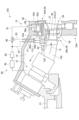
- FIG. 2 is a cross-sectional view showing the periphery of a blade ring 50 of the turbine 13.
- FIG. 3 is a perspective view of the blade ring 50.
- FIG. 4A is a schematic cross-sectional view for explaining the internal structure of the blade ring 50, and a bypass flow passage 68 and a stator blade cooling medium supply flow passage 110, which will be described later.
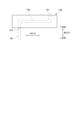
- FIG. 4B is a schematic cross-sectional view for explaining a bypass flow passage 68, which will be described later.
- FIG. 4C is a schematic cross-sectional view for explaining a vane cooling medium supply passage 110, which will be described later.
- the turbine 13 has a cylindrical turbine casing 26.
- An upstream outer partition wall 42a and a downstream outer partition wall 42b are integrally formed on the inner periphery of the turbine casing 26 with a predetermined gap between them in the front and rear in the flow direction of the combustion gas G.
- a blade ring 50 having a ring shape divided into two parts in the axial direction is supported inside the upstream outer partition wall 42a and the downstream outer partition wall 42b. The blade ring 50 is fastened with bolts at the divided parts in the axial direction to form a cylindrical structure.
- the axial direction of the rotation axis C will be referred to as the “axial direction” or the “axial direction.”
- the blade ring 50 that covers the first stator vane stage 39A among the multiple stator vane stages closest to the combustor 12 will be described.
- the first blade ring 50A mainly includes a blade ring body 50a which is the main part of the first blade ring 50A, a plurality of combustor connection parts 130 which form the connection part between the combustor 12 and the first blade ring 50A, a bypass flow passage 68 which forms a flow passage for the cooling medium P to bypass the first blade ring 50A, and a vane cooling medium supply flow passage 110 which supplies the cooling medium P to the first stage vanes 27A.
- the blade ring body 50a has a cylindrical portion 51 having a cooling passage therein, a downstream inner partition wall portion 52, and an upstream inner partition wall portion 53.
- the blade ring body 50a may be a single member, or may be a combination of two or more members.
- the cylindrical portion 51 is arranged parallel to the rotation axis C.
- the central axis of the cylindrical portion 51 is approximately coincident with the rotation axis C.
- the downstream inner partition wall portion 52 protrudes outward from the outer peripheral surface 51a of the cylindrical portion 51 in the radial direction (hereinafter referred to as the "radial direction") centered on the rotation axis C, and is provided in an annular shape in the axial direction.
- the downstream inner partition wall portion 52 is arranged at the downstream end of the axial direction of the cylindrical portion 51 on the turbine 13 side in the axial direction. At the corner of the end of the downstream inner partition wall portion 52, an annular end groove portion 52a is formed in an L-shaped cross section in the axial direction.
- the downstream outer partition wall 42b formed on the inner peripheral surface of the turbine casing 26 is fitted into the end groove 52a, and the side surface 52b facing the axial downstream side of the downstream inner partition wall 52 forming the end groove 52a contacts the surface facing the axial upstream side of the downstream outer partition wall 42b.
- the axial upstream side refers to the direction in which the compressor 11 is viewed from the first blade ring 50A
- the axial downstream side refers to the direction in which the exhaust chamber 30 is viewed from the first blade ring 50A.
- the upstream inner partition wall portion 53 is disposed axially upstream of the downstream inner partition wall portion 52, and is provided in an annular shape in the axial direction, protruding radially outward from the outer peripheral surface 51a of the cylindrical portion 51.
- the upstream inner partition wall portion 53 is formed with a partition wall groove portion 53a formed in the axial direction, into which the upstream outer partition wall portion 42a formed on the inner peripheral surface of the turbine casing 26 is fitted.
- the blade ring main body 50a has a blade ring cooling passage 60 through which the cooling medium P flows.
- the blade ring cooling passage 60 has a third supply pipe 67 that receives the cooling medium P from a cooling medium circulation mechanism 80 described later, an intake passage 66, a first cooling passage 61 that cools the cylindrical portion 51, a second cooling passage 62 arranged downstream of the first cooling passage 61 in the flow direction of the cooling medium P, and a return passage 65 that connects the first cooling passage 61 and the second cooling passage 62.
- the first cooling passage 61 is arranged radially outside the cylindrical portion 51 and is arranged close to the outer circumferential surface 51a of the cylindrical portion 51.
- the first cooling passage 61 extends approximately parallel to the axial direction.
- a plurality of first cooling passages 61 are arranged side by side in the axial direction.
- the second cooling flow passage 62 is disposed radially inward of the first cooling flow passage 61 in the cylindrical portion 51, and is disposed close to the inner peripheral surface 51b of the cylindrical portion 51.
- the second cooling flow passage 62 extends linearly and substantially parallel to the axial direction. Therefore, the second cooling flow passage 62 is substantially parallel to the first cooling flow passage 61.
- Multiple second cooling flow passages 62 are disposed side by side in the axial direction.
- the turn-back flow passage 65 connects the ends of the first cooling flow passage 61 and the second cooling flow passage 62 on the same axial side.
- the turn-back flow passage 65 is disposed at the end on the downstream side of the axial direction of the blade ring main body 50a.
- the turn-back flow passage 65 is a flow passage that turns back the cooling medium P flowing through the first cooling flow passage 61 to the second cooling flow passage 62, and as shown in Figures 4A, 4B, and 4C, the cross-sectional shape in a plane passing through the rotation axis C is a rectangular space (cavity) extending radially outward.
- the first cooling flow passage 61 is connected to the turn-back flow passage 65 on the radial outside, and the second cooling flow passage 62 is connected to the turn-back flow passage 65 on the radial inside.
- the turn-back flow passage 65 may also be formed in a ring shape along the axial direction. Therefore, the turn-back flow passage 65 communicates the multiple first cooling flow passages 61 and the multiple second cooling flow passages 62 in the axial direction.
- the first blade ring 50A may have a communication passage 70 that supplies the cooling medium P to the first cooling passages 61 and the second cooling passages 62 arranged at intervals in the axial direction of the first blade ring 50A, or collects the cooling medium P from the first cooling passages 61 and the second cooling passages 62.
- the communication passage 70 has a first communication passage 71 and a second communication passage 72.
- the first communication passage 71 is a passage extending in the circumferential direction that communicates the first cooling passages 61 arranged in the axial direction with each other in the circumferential direction.
- the first communication passage 71 is provided inside the upstream inner partition wall 53.
- the first communication passage 71 has a rectangular cross-sectional shape extending radially outward on a plane passing through the rotation axis C. For this reason, the cooling medium P can flow inside the upstream inner partition wall 53 also radially outward.
- the first communication passage 71 is connected to a supply pipe 81 (described later) to which the cooling medium P is supplied via a third supply pipe 67 that receives the cooling medium and an intake passage 66 .
- the third supply piping 67 penetrates the turbine casing 26 and is connected to a supply piping 81 of a cooling medium circulation mechanism 80, which will be described later.
- the third supply piping 67 is attached to a seat (not shown) formed in the turbine casing 26 for mounting the third supply piping 67.
- the intake passages 66 are formed at two locations around the axis for each of the upper half first blade ring 50A and the lower half first blade ring 50A.
- the intake passages 66 have an opening 66a on the radial outside that connects to the cooling medium circulation mechanism 80 and are connected to the third supply pipe 67.
- the radially inner end of the third supply pipe 67 is inserted into the opening 66a, and the intake passage 66 is connected to the third supply pipe 67.
- the second cooling passage 62 is connected to a second communication passage 72 formed at the axially upstream end of the blade ring main body 50a.
- the axially downstream end of the second cooling passage 62 is connected to the return passage 65.
- the second cooling passage may not be parallel to the first cooling passage 61, but may be a passage that heads axially upstream and inclines radially inward.
- the second communication passage 72 is a passage extending in the circumferential direction that circumferentially connects the second cooling passages 62 that are arranged at intervals around the axis.
- the second communication passage 72 is arranged radially inward from the first communication passage 71 and close to the inner circumferential surface 51b of the cylindrical portion 51.
- the second communication passage 72 is connected to the second cooling passage 62.
- the second communication passage 72 is also provided in the upstream region 54 on the axially upstream side of the blade ring main body 50a, and is connected to the exhaust passage 54c provided axially upstream of the second communication passage 72.
- the exhaust passage 54c is a passage extending from the second communication passage 72 to the upstream side in the axial direction, and is provided in plurality at intervals in the circumferential direction so as to correspond one-to-one to the plurality of combustor connection portions 130 described later.
- An axially upstream end of the exhaust passage 54c is connected to the communication hole 54a that opens into the axially upstream end 50au of the cylindrical portion 51 of the blade ring main body 50a.
- An inlet connection pipe 68d of a bypass passage 68 which will be described later, is connected to the exhaust passage 54c.
- FIG. 3 shows the combustor connection parts 130 in correspondence with the number of combustors 12 installed, i.e., in one-to-one correspondence with the combustors 12, downstream in the axial direction of the combustors 12, and adjacent to an upstream end part 50au in the axial direction of the cylindrical part 51 of the blade ring main body 50a.
- Fig. 3 only illustrates the combustor connection parts 130 attached to the first blade ring 50A in the upper half.
- Fig. 3 also illustrates only the transition pieces 12a of the two combustors 12 near the tops of the first blade ring 50A in the upper half.
- FIG. 5 is a diagram illustrating the combustor connection portion 130 as viewed from the outside in the radial direction.
- the combustor connection part 130 is a block-shaped member fixed to the axially upstream end 50au of the cylindrical part 51 of the blade ring main body 50a.
- the combustor connection part 130 is disposed adjacent to the transition piece 12a of the combustor 12 disposed upstream in the axial direction of the blade ring main body 50a, downstream in the axial direction of the combustor 12, and a plurality of combustor connection parts 130 are disposed side by side in the axial direction.
- the combustor connection part 130 has an inlet hole 131 connected to the axially upstream communication hole 54a of the exhaust flow passage 54c, and an exhaust hole 133 provided at a circumferential position different from the inlet hole 131, which communicates with a cooling flow passage (not shown) formed on the transition piece 12a (see FIG. 2) side via an exhaust pipe 82.
- the combustor connection part 130 has an intermediate flow passage 132 that connects the inlet hole 131 and the exhaust hole 133 and extends in the circumferential direction.
- the combustor connection part 130 is detachably attached to the end part 50au of the cylindrical part 51.
- the inlet hole 131 provided on the axially downstream surface of the combustor connection part 130 faces the axially upstream communication hole 54a of the exhaust flow passage 54c.
- the bypass flow passage 68 has a bypass inlet pipe (second supply piping) 68a that receives the cooling medium P from a cooling medium circulation mechanism 80 (details of which will be described later), an intake flow passage 68e, a bypass connection pipe (second connection pipe) 68b that is arranged in a ring shape in the axial direction upstream of the cylindrical portion 51 and supplies the cooling medium P to the discharge flow passage 54c, a thermal expansion absorption section 68c that absorbs thermal expansion of the bypass connection pipe 68b in the axial direction, and an inlet connection pipe 68d that connects the bypass connection pipe 68b and the discharge flow passage 54c.
- a bypass inlet pipe (second supply piping) 68a that receives the cooling medium P from a cooling medium circulation mechanism 80 (details of which will be described later)
- an intake flow passage 68e receives the cooling medium P from a cooling medium circulation mechanism 80 (details of which will be described later)
- a bypass connection pipe (second connection pipe) 68b that
- the bypass inlet pipe 68a penetrates the turbine casing 26 and is connected to a bypass supply piping 83 of a cooling medium circulation mechanism 80, which will be described later.
- the bypass inlet pipe 68a is attached to a seat (not shown) formed in the turbine casing 26 for mounting the bypass inlet pipe 68a.
- the intake passages 68e are formed at two locations around the axis for each of the upper-half first blade ring 50A and the lower-half first blade ring 50A.
- the intake passages 68e have an opening 68ea on the radially outer side that connects to the coolant circulation mechanism 80 and are connected to the bypass inlet pipe 68a.
- the radially inner end of the bypass inlet pipe 68a is inserted into the opening 68ea, and the intake passages 68e are connected to the bypass inlet pipe 68a.
- a portion of the intake passage 68e is formed in a passage forming portion 150 having a block shape and having a passage formed therein.
- the flow passage forming portion 150 is configured to form a part of the intake flow passage 68e as well as a part of other pipes and flow passages such as a bypass connecting pipe 68b described later.
- a bypass connecting pipe 68b described later.
- the flow passage forming portions 150 are provided so as to correspond one-to-one with the respective combustor connecting portions 130 for, for example, the first blade ring portion 50A in the upper half and the first blade ring portion 50A in the lower half, but it is not necessarily required that the flow passage forming portions 150 are provided so as to correspond one-to-one with the respective combustor connecting portions 130.
- each of the upper half first blade ring 50A and the lower half first blade ring 50A eight flow passage forming portions 150 are provided for each of the upper half first blade ring 50A and the lower half first blade ring 50A.
- the apex directly above in the figure i.e., the top on the vertically upper side
- the reference numerals are sequentially numbered as flow passage forming portion 150a, flow passage forming portion 150b, flow passage forming portion 150c, ..., flow passage forming portion 150p, with the alphabet added to the end of the reference numerals in order from a.
- the dividing surface between the upper half first blade ring 50A and the lower half first blade ring 50A is located at the 3 o'clock and 9 o'clock positions.
- the alphabet at the end of the reference numeral will be omitted and they will simply be referred to as flow path forming portions 150.
- the intake flow path 68e is partially formed in the flow path forming section 150a, the flow path forming section 150h, the flow path forming section 150i, and the flow path forming section 150p.
- the bypass connection pipe 68b is disposed annularly in the axial direction along the outer surface in the radially outer side of the axial upstream region of the cylindrical portion 51, and is fixed to the cylindrical portion 51.
- the bypass connection pipe 68b is disposed upstream in the axial direction, close to the side surface 53e facing the axial upstream side of the upstream inner partition wall portion 53, but the two are disposed apart without contacting each other. The reason for separating the two is to prevent the blade ring main body 50a from being cooled by the cooling medium P flowing through the bypass flow passage 68, and to prevent temperature distribution from occurring within the blade ring main body 50a.
- the bypass connection pipe 68b is connected to a flow passage extending in the circumferential direction and formed inside each flow passage forming portion 150. In other words, each flow passage forming portion 150 constitutes a part of the bypass connection pipe 68b.
- the bypass connection pipe 68b which extends in the axial direction, is connected to the intake flow path 68e and the inlet connection pipe 68d, which is connected to the discharge flow path 54c.
- the bypass connection pipe 68b is formed of multiple connection pipes.
- a thermal expansion absorbing section 68c is disposed midway along the bypass connection pipe 68b, sandwiching the intake flow path 68e and the inlet connection pipe 68d, in order to absorb the thermal expansion of the bypass connection pipe 68b in the axial direction.
- the thermal expansion absorbing section 68c may be a U-shaped pipe or bellows deformed in the radial or axial direction, but is not limited to this example.
- each flow passage forming portion 150 constitutes a radially outer region of the bypass connecting pipe 68b
- a portion of the cylindrical portion 51 of the blade ring main body 50a constitutes a radially inner region of the bypass connecting pipe 68b.
- the vane cooling medium supply passage 110 has an inlet pipe (first supply piping) 111 that receives the cooling medium P from a cooling medium circulation mechanism 80 described later, an intake passage 112, a first connecting pipe 113 that is arranged in an annular shape in the axial direction upstream of the bypass passage 68, a plurality of vane connecting parts 114 connected to the first connecting pipe 113, and a plurality of vane inlet connecting pipes 115 that respectively connect the plurality of vane connecting parts 114 to the cooling medium inlets 27Aa of the plurality of first stage vanes 27A.
- the first connecting pipe 113 has a thermal expansion absorbing part 116 that absorbs thermal expansion in the axial direction.
- the inlet pipe (first supply pipe) 111 passes through the turbine casing 26 and is connected to a first vane supply pipe 87 of the cooling medium circulation mechanism 80, which will be described later.
- the inlet pipe 111 is attached to a seat (not shown) formed in the turbine casing 26 for mounting the inlet pipe 111.
- the intake passages 112 are formed at two locations around the axis for each of the upper half first blade ring 50A and the lower half first blade ring 50A.
- the intake passages 112 have an opening 112a on the radial outside that connects to the cooling medium circulation mechanism 80, and are connected to the inlet pipe 111.
- the radially inner end of the inlet pipe 111 is inserted into the opening 112a, and the intake passages 112 are connected to the inlet pipe 111.
- a portion of the intake flow passage 112 is formed in the flow passage forming portion 150 .
- the intake flow passage 112 is partially formed in the flow passage forming section 150b, the flow passage forming section 150g, the flow passage forming section 150j, and the flow passage forming section 150o.
- the first connecting pipe 113 is disposed annularly in the axial direction along the outer surface in the radially outer side of the axially upstream region of the cylindrical portion 51, and is fixed to the cylindrical portion 51.
- the first connecting pipe 113 is disposed close to the bypass connecting pipe 68b and upstream of the bypass connecting pipe 68b in the axial direction, but the two are disposed apart without contacting each other.
- the first connecting pipe 113 is connected to a flow passage extending in the circumferential direction formed inside each flow passage forming portion 150. That is, each flow passage forming portion 150 constitutes a part of the first connecting pipe 113.
- a thermal expansion absorbing section 116 is disposed midway along the first connecting pipe 113 between the intake passage 112 and the stator vane connecting section 114 in order to absorb the thermal expansion of the first connecting pipe 113 in the axial direction.
- the thermal expansion absorbing section 116 may be a U-shaped tube or bellows deformed in the radial or axial direction, but is not limited to this example.
- the stator vane connecting portion 114 includes a partial region of each flow passage forming portion 150 and a pipe 114a connected to each flow passage forming portion 150. That is, the stator vane connecting portion 114 includes a region that forms a flow passage branched from the first connecting pipe 113 in each flow passage forming portion 150, and a pipe 114a attached to each flow passage forming portion 150 so as to communicate with the flow passage.
- the stator vane connecting portion 114 further branches the flow passage branched from the first connecting pipe 113 inside each flow passage forming portion 150 into two flow passages, one toward one circumferential side and the other toward the other circumferential side. Therefore, as shown well in the first blade ring 50A in the lower half of Figure 3, pipes 114a are connected to one and the other circumferential sides of each flow passage forming portion 150.
- the piping 114a extends axially downstream and radially inward from the connection position with the flow passage forming section 150 in order to supply the cooling medium P to the first stage stator vane 27A located axially downstream of the flow passage forming section 150 which constitutes part of the first connecting pipe 113 and part of the stator vane connection section 114.
- Each stator vane inlet connecting pipe 115 connects each pipe 114a of each stator vane connection portion 114 to the cooling medium inlet 27Aa of each first stage stator vane 27A.
- each stator vane inlet connecting pipe 115 is inclined with respect to the radial direction so as to move toward the axial downstream side as it moves toward the radial inside due to the difference in the axial position between each pipe 114a and the cooling medium inlet 27Aa of each first stage stator vane 27A.
- each stator vane inlet connecting pipe 115 includes an intermediate portion 115a that moves toward the axial downstream side as it approaches the axis of the rotation axis C.
- Each stator vane inlet connecting pipe 115 has elasticity and flexibility, for example, like a bellows-shaped flexible pipe, in order to absorb thermal expansion.
- the cooling medium P supplied to the first blade ring 50A is supplied from a cooling medium circulation mechanism 80 provided separately as shown in FIG. 2.
- the cooling medium circulation mechanism 80 includes a cooler 84, a compressor 85, and
- the cooler 84 has a three-way valve (supply destination switching unit) 86 and a first stator vane supply pipe 87.
- the cooler 84 takes in and cools the casing air (cooling medium P) around the combustor 12, and sends it to the compressor 85.
- the compressor 85 compresses the air from the cooler 84 and sends it to the first stator vane supply pipe 87 and the three-way valve 86.
- the first stator vane supply pipe 87 is an inlet pipe of the stator vane cooling medium supply passage 110. It is connected to (first supply pipe) 111.
- the three-way valve 86 is connected to the compressor 85, the supply pipe 81, and the bypass supply pipe 83.
- the supply pipe 81 is connected to the third supply pipe 67
- the bypass supply pipe 83 is connected to the bypass inlet pipe 68a.
- the three-way valve 86 can switch between supplying air from the compressor 85 to the supply pipe 81 and the bypass supply pipe 83. Therefore, when the gas turbine 100 is in steady operation, the three-way valve 86 is switched so that the cooling medium P flows to the supply pipe 81 side so that the cooling medium P is supplied to the first blade ring 50A. When the gas turbine 100 is starting up, it is not necessary to supply the cooling medium P to the first blade ring 50A, so the three-way valve 86 is switched so that the cooling medium P flows to the bypass supply pipe 83 side.
- the cooling medium P supplied from the first vane supply pipe 87 flows into the first stage vane 27A, and the cooling medium P supplied from the supply pipe 81 flows into the blade ring main body 50a.
- the cooling medium P that flows into the first stage vane 27A absorbs heat from the first stage vane 27A and is discharged into the combustion gas passage through which the combustion gas G passes.
- the cooling medium P that flows into the blade ring main body 50a flows along the blade ring cooling passage 60 and the communication passage 70, absorbs heat from the blade ring main body 50a, passes through the combustor connection part 130, and is discharged from the discharge pipe 82 into a cooling passage (not shown) formed on the transition piece 12a side.
- the cooling medium P is not supplied to the blade ring main body 50a, but flows into the bypass flow passage 68 and is discharged to the exhaust pipe 82 via the exhaust flow passage 54c and the intermediate flow passage 132 in the combustor connection part 130.
- the bypass flow passage 68 does not come into contact with the blade ring main body 50a, when the gas turbine 100 is started, the blade ring main body 50a is cooled by the bypass flow passage 68, and there is no risk of a temperature distribution being formed inside the blade ring main body 50a.
- a gas turbine 100 includes a compressor 11 that compresses air, a combustor 12 that mixes and combusts fuel with the compressed air compressed by the compressor 11, a turbine 13 that rotates with the combustion gas G generated by the combustor 12, a rotor 32 having a rotor body 32a that rotates in the circumferential direction of a rotation axis C by the rotation of the turbine 13 and a plurality of rotor blade stages 38 fixed to the rotor body 32a and lined up in the axial direction of the rotation axis C, a casing (turbine casing) 26 that covers the outer periphery of the rotor 32, a plurality of stator vane stages 39 that are fixed to the inner periphery of the casing (turbine casing) 26 and arranged upstream in the axial direction with respect to each of the plurality of rotor blade stages 38, and a plurality of blade
- the multiple blade rings 50 include a first blade ring 50A that covers a first stator vane stage 39A among the multiple stator vane stages 39.
- the first stator vane stage 39A includes a multiple first stage stator vanes 27A.
- the first blade ring 50A includes a blade ring cooling passage 60 that cools the first blade ring 50A, a bypass passage 68 that bypasses the first blade ring 50A, a vane cooling medium supply passage 110 that supplies cooling medium P to the multiple first stage stator vanes 27A, and a multiple combustor connection portions 130 arranged in the circumferential direction.
- the vane cooling medium supply passage 110 has a first supply piping (inlet pipe) 111 that receives the cooling medium P, a first connecting pipe 113 that supplies the cooling medium P in the circumferential direction, a plurality of vane connection parts 114 connected to the first connecting pipe 113, and a plurality of vane inlet connecting pipes 115 that respectively connect the plurality of vane connection parts 114 to the cooling medium inlets 27Aa of the plurality of first stage vanes 27A.
- the bypass passage 68 has a second supply piping (bypass inlet pipe) 68a that receives the cooling medium P and is different from the first supply piping (inlet pipe) 111.
- the blade ring cooling passage 60 has a third supply piping 67 that receives the cooling medium P and is different from the first supply piping (inlet pipe) 111 and the second supply piping (bypass inlet pipe) 68a.
- Each of the multiple combustor connection portions 130 has an inlet hole 131 that receives cooling medium P from at least one of the blade ring cooling passage 60 or the bypass passage 68, and a discharge hole 133 that discharges the cooling medium P to the cooling passage of the combustor 12.
- the bypass flow passage 68 may have a second connecting pipe (bypass connecting pipe) 68b that supplies the cooling medium in the circumferential direction.
- the first connecting pipe 113 may be disposed at a position different in the axial direction from the second connecting pipe (bypass connecting pipe) 68b.
- Each of the plurality of stator vane inlet connecting pipes 115 may include an intermediate portion 115a that extends toward the downstream side in the axial direction as it approaches the axis of the rotation axis C. This makes it possible to effectively utilize the relatively narrow space of the first blade ring 50A to arrange the first connecting pipe 113 and the multiple stator vane inlet connecting pipes 115, thereby cooling the multiple first stage stator vanes 27A.
- the inlet holes 131 may be provided at a different position in the circumferential direction from the exhaust holes 133.
- Each of the multiple combustor connection parts 130 may connect the inlet holes 131 and the exhaust holes 133 and include an intermediate flow passage 132 extending in the circumferential direction.
- Each of the multiple combustor connection parts 130 may be disposed at a position overlapping at least a portion of the multiple stator vane inlet connecting pipes 115 in the circumferential direction, and may be detachably attached to the first blade ring 50A.
- the cooling medium P may be air that has been cooled by cooling the air supplied from the compressor 11 into the casing (turbine casing) 26 . This allows the air, after being compressed in the compressor 11 and then cooled, to be used to cool the first blade ring 50A of the gas turbine 100, a plurality of first stage vanes 27A attached to the first blade ring 50A, and the combustor 12.
- the bypass flow passage 68 may have a second connecting pipe (bypass connecting pipe) 68b that supplies the cooling medium in the circumferential direction.
- At least one of the first connecting pipe 113 and the second connecting pipe (bypass connecting pipe) 68b may have a curved portion (thermal expansion absorbing portion 68c, 116) that is curved radially outwardly about the rotation axis C. This allows the thermal expansion of the first connecting pipe 113 and the second connecting pipe (bypass connecting pipe) 68b to be absorbed by the curved portions (thermal expansion absorbing portions 68c, 116).
- the curved portion may be inclined toward the upstream or downstream side in the axial direction as it moves radially outward. This makes it possible to ensure the amount of thermal expansion absorption of the first connecting pipe 113 and the second connecting pipe (bypass connecting pipe) 68b in the curved portion (thermal expansion absorption portion 68c, 116) while suppressing the amount of radially outward protrusion of the curved portion (thermal expansion absorption portion 68c, 116).
- a gas turbine 100 includes a compressor 11 that compresses air, a combustor 12 that mixes fuel and the compressed air compressed by the compressor 11 and burns the mixture, a turbine 13 that rotates with the combustion gas G generated by the combustor 12, a rotor 32 having a rotor body 32a that rotates in a circumferential direction about a rotation axis C by the rotation of the turbine 13 and a plurality of rotor blade stages 38 fixed to the rotor body 32a and lined up in the axial direction of the rotation axis C, a casing (turbine casing) 26 that covers an outer circumferential side of the rotor 32, a plurality of stator vane stages 39 that are fixed to an inner circumferential side of the casing (turbine casing) 26 and arranged upstream in the axial direction with respect to each of the plurality of rotor blade stages 38, and a
- the multiple blade rings 50 include a first blade ring 50A that covers a first stator vane stage 39A among the multiple stator vane stages 39.
- the first stator vane stage 39A includes a multiple first stage stator vanes 27A.
- the first blade ring 50A includes a blade ring cooling passage 60 that cools the first blade ring 50A, a bypass passage 68 that bypasses the first blade ring 50A, a vane cooling medium supply passage 110 that supplies cooling medium P to the multiple first stage stator vanes 27A, and a multiple combustor connection portions 130 arranged in the circumferential direction.
- the vane cooling medium supply passage 110 has a first supply piping (inlet pipe) 111 that receives the cooling medium P, a first connecting pipe 113 that supplies the cooling medium P in the circumferential direction, a plurality of vane connection parts 114 connected to the first connecting pipe 113, and a plurality of vane inlet connecting pipes 115 that respectively connect the plurality of vane connection parts 114 to the cooling medium inlets 27Aa of the plurality of first stage vanes 27A.
- the bypass passage 68 has a second supply piping (bypass inlet pipe) 68a that receives the cooling medium P and is different from the first supply piping (inlet pipe) 111.
- the blade ring cooling passage 60 has a third supply piping 67 that receives the cooling medium P and is different from the first supply piping (inlet pipe) 111 and the second supply piping (bypass inlet pipe) 68a.
- Each of the multiple combustor connection portions 130 has an inlet hole 131 that receives cooling medium P from at least one of the blade ring cooling passage 60 or the bypass passage 68, and a discharge hole 133 that discharges the cooling medium P to the cooling passage of the combustor 12.
- the above configuration (1) allows efficient cooling of the first blade ring 50A of the gas turbine 100, the multiple first stage vanes 27A attached to the first blade ring 50A, and the combustor 12.
- the bypass flow passage 68 may have a second connecting pipe (bypass connecting pipe) 68b that supplies the cooling medium in the circumferential direction.
- the first connecting pipe 113 may be disposed at a different position in the axial direction from the second connecting pipe (bypass connecting pipe) 68b.
- Each of the multiple stator vane inlet connecting pipes 115 may include an intermediate portion 115a that extends toward the downstream side in the axial direction as it approaches the axis of the rotation axis C.
- the above configuration (2) allows the first connecting pipe 113 and multiple vane inlet connecting pipes 115 to be arranged by effectively utilizing the relatively narrow space of the first blade ring 50A, and allows multiple first stage vanes 27A to be cooled.
- the inlet hole 131 may be provided at a different circumferential position from the exhaust hole 133.
- Each of the multiple combustor connection parts 130 may have an intermediate flow passage 132 that connects the inlet hole 131 and the exhaust hole 133 and extends in the circumferential direction.
- Each of the multiple combustor connection parts 130 may be arranged at a position that overlaps with at least a portion of the multiple vane inlet connection pipes 115 in the circumferential direction, and may be detachably attached to the first blade ring 50A.
- stator vane inlet connecting pipe 115 and the first stage stator vane 27A can be attached and detached to the first blade ring 50A while the stator vane inlet connecting pipe 115 and the first stage stator vane 27A are connected.
- the cooling medium P may be air that has been cooled by the air supplied from the compressor 11 into the casing (turbine casing) 26.
- the air compressed by the compressor 11 and then cooled can be used to cool the first blade ring 50A of the gas turbine 100, the multiple first stage vanes 27A attached to the first blade ring 50A, and the combustor 12.
- the bypass flow passage 68 may have a second connection pipe (bypass connection pipe) 68b that supplies the cooling medium P in the circumferential direction.
- At least one of the first connection pipe 113 and the second connection pipe (bypass connection pipe) 68b may have a curved portion (thermal expansion absorbing portion 68c, 116) that is curved radially outwardly about the rotation axis C.
- the configuration (5) above allows the thermal expansion of the first connecting pipe 113 and the second connecting pipe (bypass connecting pipe) 68b to be absorbed by the curved portions (thermal expansion absorbing portions 68c, 116).
- the curved portion (thermal expansion absorbing portion 68c, 116) may be inclined toward the upstream or downstream side in the axial direction as it moves radially outward.
- the configuration (6) above makes it possible to ensure the amount of thermal expansion absorption of the first connecting pipe 113 and the second connecting pipe (bypass connecting pipe) 68b in the curved portion (thermal expansion absorbing portion 68c, 116) while suppressing the amount of radially outward protrusion of the curved portion (thermal expansion absorbing portion 68c, 116).
Landscapes
- Engineering & Computer Science (AREA)
- Mechanical Engineering (AREA)
- General Engineering & Computer Science (AREA)
- Chemical & Material Sciences (AREA)
- Combustion & Propulsion (AREA)
- Physics & Mathematics (AREA)
- Fluid Mechanics (AREA)
- Turbine Rotor Nozzle Sealing (AREA)
Priority Applications (4)
| Application Number | Priority Date | Filing Date | Title |
|---|---|---|---|
| DE112024002043.7T DE112024002043T5 (de) | 2023-07-11 | 2024-06-24 | Gasturbine |
| CN202480037318.9A CN121311669A (zh) | 2023-07-11 | 2024-06-24 | 燃气轮机 |
| JP2025532643A JPWO2025013583A1 (https=) | 2023-07-11 | 2024-06-24 | |
| KR1020257039455A KR20250172728A (ko) | 2023-07-11 | 2024-06-24 | 가스 터빈 |
Applications Claiming Priority (2)
| Application Number | Priority Date | Filing Date | Title |
|---|---|---|---|
| JP2023-114015 | 2023-07-11 | ||
| JP2023114015 | 2023-07-11 |
Publications (1)
| Publication Number | Publication Date |
|---|---|
| WO2025013583A1 true WO2025013583A1 (ja) | 2025-01-16 |
Family
ID=94215675
Family Applications (1)
| Application Number | Title | Priority Date | Filing Date |
|---|---|---|---|
| PCT/JP2024/022717 Pending WO2025013583A1 (ja) | 2023-07-11 | 2024-06-24 | ガスタービン |
Country Status (5)
| Country | Link |
|---|---|
| JP (1) | JPWO2025013583A1 (https=) |
| KR (1) | KR20250172728A (https=) |
| CN (1) | CN121311669A (https=) |
| DE (1) | DE112024002043T5 (https=) |
| WO (1) | WO2025013583A1 (https=) |
Citations (3)
| Publication number | Priority date | Publication date | Assignee | Title |
|---|---|---|---|---|
| JPH07189738A (ja) * | 1993-12-03 | 1995-07-28 | Westinghouse Electric Corp <We> | ガスタービン翼の冷却構成 |
| JPH11132006A (ja) * | 1997-10-29 | 1999-05-18 | Hitachi Ltd | ガスタービン設備 |
| JP2018193906A (ja) * | 2017-05-16 | 2018-12-06 | 三菱日立パワーシステムズ株式会社 | ガスタービン、及び翼環部の製造方法 |
Family Cites Families (2)
| Publication number | Priority date | Publication date | Assignee | Title |
|---|---|---|---|---|
| US8342798B2 (en) | 2009-07-28 | 2013-01-01 | General Electric Company | System and method for clearance control in a rotary machine |
| JP7804278B2 (ja) | 2022-02-04 | 2026-01-22 | 株式会社ジェイテックコーポレーション | 対向型x線複合ミラー及びそのアライメント装置 |
-
2024
- 2024-06-24 JP JP2025532643A patent/JPWO2025013583A1/ja active Pending
- 2024-06-24 DE DE112024002043.7T patent/DE112024002043T5/de active Pending
- 2024-06-24 CN CN202480037318.9A patent/CN121311669A/zh active Pending
- 2024-06-24 KR KR1020257039455A patent/KR20250172728A/ko active Pending
- 2024-06-24 WO PCT/JP2024/022717 patent/WO2025013583A1/ja active Pending
Patent Citations (3)
| Publication number | Priority date | Publication date | Assignee | Title |
|---|---|---|---|---|
| JPH07189738A (ja) * | 1993-12-03 | 1995-07-28 | Westinghouse Electric Corp <We> | ガスタービン翼の冷却構成 |
| JPH11132006A (ja) * | 1997-10-29 | 1999-05-18 | Hitachi Ltd | ガスタービン設備 |
| JP2018193906A (ja) * | 2017-05-16 | 2018-12-06 | 三菱日立パワーシステムズ株式会社 | ガスタービン、及び翼環部の製造方法 |
Also Published As
| Publication number | Publication date |
|---|---|
| CN121311669A (zh) | 2026-01-09 |
| DE112024002043T5 (de) | 2026-02-26 |
| JPWO2025013583A1 (https=) | 2025-01-16 |
| KR20250172728A (ko) | 2025-12-09 |
Similar Documents
| Publication | Publication Date | Title |
|---|---|---|
| US8616835B2 (en) | Gas turbine | |
| JP6283173B2 (ja) | ガスタービンシステム用の冷却組立体 | |
| JP6223111B2 (ja) | ガスタービン | |
| CA2890442A1 (en) | Annular ring assembly for shroud cooling | |
| JP5411233B2 (ja) | 軸流コンプレッサおよびそれに関連した作動方法 | |
| CN105637199A (zh) | 燃气轮机 | |
| JP6088643B2 (ja) | 中空の冷却されたタービン翼内に挿入可能とされる、ガスタービンのための冷媒ブリッジ配管 | |
| US11859547B2 (en) | Turbine engine having a balance cavity | |
| CN102216570B (zh) | 燃气涡轮机 | |
| JP6496534B2 (ja) | 蒸気タービン及びその組み立て方法 | |
| KR102281414B1 (ko) | 가스 터빈, 및 익환부의 제조 방법 | |
| CN109812340B (zh) | 包括外部冷却系统的燃气轮机及其冷却方法 | |
| WO2025013583A1 (ja) | ガスタービン | |
| EP3524795B1 (en) | Axial compressor with inter-stage centrifugal compressor | |
| CN121195107A (zh) | 回收循环飞行器涡轮发动机 | |
| JP2004218480A (ja) | ガスタービン | |
| US20170321565A1 (en) | Ingestion seal | |
| US11834953B2 (en) | Seal assembly in a gas turbine engine | |
| JP4987427B2 (ja) | 作動ガス流入路の冷却構造を備える常圧燃焼タービンシステム | |
| AU2024294985A1 (en) | A power-generating turbomachine using coolant extracted from rotor cavity | |
| KR20220151871A (ko) | 터보머신용 스테이터 |
Legal Events
| Date | Code | Title | Description |
|---|---|---|---|
| 121 | Ep: the epo has been informed by wipo that ep was designated in this application |
Ref document number: 24839479 Country of ref document: EP Kind code of ref document: A1 |
|
| ENP | Entry into the national phase |
Ref document number: 1020257039455 Country of ref document: KR Free format text: ST27 STATUS EVENT CODE: A-0-1-A10-A15-NAP-PA0105 (AS PROVIDED BY THE NATIONAL OFFICE) |
|
| ENP | Entry into the national phase |
Ref document number: 2025532643 Country of ref document: JP Kind code of ref document: A |
|
| WWE | Wipo information: entry into national phase |
Ref document number: 2025532643 Country of ref document: JP |
|
| WWE | Wipo information: entry into national phase |
Ref document number: 112024002043 Country of ref document: DE |
|
| WWP | Wipo information: published in national office |
Ref document number: 112024002043 Country of ref document: DE |