WO2025013580A1 - 正孔輸送体、光電変換素子、および組成物 - Google Patents
正孔輸送体、光電変換素子、および組成物 Download PDFInfo
- Publication number
- WO2025013580A1 WO2025013580A1 PCT/JP2024/022697 JP2024022697W WO2025013580A1 WO 2025013580 A1 WO2025013580 A1 WO 2025013580A1 JP 2024022697 W JP2024022697 W JP 2024022697W WO 2025013580 A1 WO2025013580 A1 WO 2025013580A1
- Authority
- WO
- WIPO (PCT)
- Prior art keywords
- photoelectric conversion
- hole transporter
- hexyl ether
- hole
- composition
- Prior art date
- Legal status (The legal status is an assumption and is not a legal conclusion. Google has not performed a legal analysis and makes no representation as to the accuracy of the status listed.)
- Ceased
Links
Images


Classifications
-
- H—ELECTRICITY
- H10—SEMICONDUCTOR DEVICES; ELECTRIC SOLID-STATE DEVICES NOT OTHERWISE PROVIDED FOR
- H10K—ORGANIC ELECTRIC SOLID-STATE DEVICES
- H10K30/00—Organic devices sensitive to infrared radiation, light, electromagnetic radiation of shorter wavelength or corpuscular radiation
- H10K30/40—Organic devices sensitive to infrared radiation, light, electromagnetic radiation of shorter wavelength or corpuscular radiation comprising a p-i-n structure, e.g. having a perovskite absorber between p-type and n-type charge transport layers
-
- H—ELECTRICITY
- H10—SEMICONDUCTOR DEVICES; ELECTRIC SOLID-STATE DEVICES NOT OTHERWISE PROVIDED FOR
- H10K—ORGANIC ELECTRIC SOLID-STATE DEVICES
- H10K30/00—Organic devices sensitive to infrared radiation, light, electromagnetic radiation of shorter wavelength or corpuscular radiation
- H10K30/50—Photovoltaic [PV] devices
-
- H—ELECTRICITY
- H10—SEMICONDUCTOR DEVICES; ELECTRIC SOLID-STATE DEVICES NOT OTHERWISE PROVIDED FOR
- H10K—ORGANIC ELECTRIC SOLID-STATE DEVICES
- H10K30/00—Organic devices sensitive to infrared radiation, light, electromagnetic radiation of shorter wavelength or corpuscular radiation
- H10K30/80—Constructional details
- H10K30/84—Layers having high charge carrier mobility
- H10K30/86—Layers having high hole mobility, e.g. hole-transporting layers or electron-blocking layers
-
- Y—GENERAL TAGGING OF NEW TECHNOLOGICAL DEVELOPMENTS; GENERAL TAGGING OF CROSS-SECTIONAL TECHNOLOGIES SPANNING OVER SEVERAL SECTIONS OF THE IPC; TECHNICAL SUBJECTS COVERED BY FORMER USPC CROSS-REFERENCE ART COLLECTIONS [XRACs] AND DIGESTS
- Y02—TECHNOLOGIES OR APPLICATIONS FOR MITIGATION OR ADAPTATION AGAINST CLIMATE CHANGE
- Y02E—REDUCTION OF GREENHOUSE GAS [GHG] EMISSIONS, RELATED TO ENERGY GENERATION, TRANSMISSION OR DISTRIBUTION
- Y02E10/00—Energy generation through renewable energy sources
- Y02E10/50—Photovoltaic [PV] energy
- Y02E10/549—Organic PV cells
Definitions
- the ester compound may include a sorbitan fatty acid ester.
- the ester compound may contain glycerin monolaurate.
- the ester compound may contain sorbitan monolaurate.
- the polyethylene glycol in the fatty acid ester of the intramolecular dehydration condensate of sugar alcohol modified with polyethylene glycol may contain 1 or more and 22 or less ethylene glycols as constituent monomers.
- the polyethylene glycol may contain, for example, 20 ethylene glycols as constituent monomers.
- the fatty acid ester of the intramolecular dehydration condensate of sugar alcohol modified with polyethylene glycol may be monolaurate or monooleate.
- the nonionic surfactant may contain a copolymer of polyethylene glycol and polypropylene glycol.
- the copolymer may contain 6 to 53 ethylene glycol units and 42 to 69 propylene glycol units as constituent monomers.
- An example is a block copolymer of ethylene glycol/propylene glycol/ethylene glycol, such as a block copolymer of ethylene glycol pentamer/propylene glycol 68mer/ethylene glycol pentamer.
- the critical micelle concentration of the nonionic surfactant is 0.001 g/L or more and 0.080 g/L or less.
- the content of the nonionic surfactant may be, for example, 0.5% by mass or more and 36% by mass or less.
- the hole transporter according to the first embodiment can increase the open circuit voltage and form factor of the photoelectric conversion element, thereby further improving the photoelectric conversion efficiency.
- Examples of the supporting electrolyte are ammonium salts, alkaline earth metal salts, or transition metal salts.
- ammonium salts are tetrabutylammonium perchlorate, tetraethylammonium hexafluorophosphate, imidazolium salts, or pyridinium salts.
- Examples of the alkali metal salts are lithium perchlorate or potassium boron tetrafluoride.
- An example of the alkaline earth metal salt is calcium bis(trifluoromethanesulfonyl)imide(II).
- the hole transporter according to the first embodiment can be produced, for example, using the composition according to the first embodiment.
- the hole transporter according to the first embodiment can be formed by a coating method or a printing method using the composition according to the first embodiment.
- coating methods are a doctor blade method, a bar coating method, a spray method, a dip coating method, or a spin coating method.
- An example of a printing method is a screen printing method.
- the composition according to the first embodiment is a composition for producing a hole transporter, and includes an organic semiconductor, a nonionic surfactant, and a solvent.
- the organic semiconductor and the nonionic surfactant in the composition according to the first embodiment are the same as the organic semiconductor and the nonionic surfactant in the hole transporter according to the first embodiment.
- the solvent may be a nonpolar solvent.
- the solvent may include at least one selected from toluene and mesitylene, for example. By including such a solvent, the nonionic surfactant can provide a dispersion effect of the material in the hole transporter solution when the hole transporter solution (i.e., the composition for producing a hole transporter according to the first embodiment) is applied and dried.
- the content of the nonionic surfactant in the composition according to the first embodiment may be, for example, more than 0 g/L and not more than 1 g/L.
- the content of the nonionic surfactant in the composition according to the first embodiment may be more than 0 g/L and not more than 0.2 g/L, or more than 0 g/L and not more than 0.1 g/L.
- the content of the nonionic surfactant in the composition according to the first embodiment may be 0.05 g/L or more and not more than 0.2 g/L, or 0.05 g/L or more and not more than 0.1 g/L.
- the contact angle of the composition according to the first embodiment with the surface of a glass substrate that has been subjected to UV ozone treatment at 24°C may be, for example, 7° or more and 30° or less. Since the composition according to the first embodiment has such a low contact angle on a polar surface, the hole transporter formed using the composition according to the first embodiment has improved contact with the photoelectric conversion layer, increasing the open circuit voltage and form factor of the photoelectric conversion element, and further improving the photoelectric conversion efficiency. In addition, the solution adheres better to the photoelectric conversion layer, improving the yield in the area enlargement process.
- the contact angle of the composition according to the first embodiment is measured by the following method.
- a glass substrate is subjected to UV ozone treatment, and the composition according to the first embodiment is dropped onto the surface of the glass substrate using a micropipette, and the contact angle is measured by observing the droplets, for example, with a CCD camera.
- a CCD camera For example, FAMAS (manufactured by Kyowa Interface Science Co., Ltd.) may be used to measure the contact angle.
- the hole transporter according to the second embodiment includes an organic semiconductor and a nonionic surfactant.
- the nonionic surfactant includes an alkyl hexyl ether having an alkyl group with 1 to 5 carbon atoms.
- the alkyl group is, for example, linear.
- the alkyl hexyl ether may include at least one selected from the group consisting of methyl hexyl ether, ethyl hexyl ether, normal propyl hexyl ether, normal butyl hexyl ether, and normal pentyl hexyl ether.
- the interaction between the nonionic surfactant and the organic semiconductor suppresses the formation of a three-dimensional higher-order structure. Therefore, the hole transporter according to the second embodiment improves the charge transportability between adjacent layers that are arranged adjacently when constructing a device, for example.
- the materials exemplified as the organic semiconductor contained in the hole transporter in the first embodiment can be used.
- the content of the nonionic surfactant may be, for example, 0.5% by mass or more and 36% by mass or less.
- the hole transporter according to the second embodiment can increase the open circuit voltage and form factor of the photoelectric conversion element, thereby further improving the photoelectric conversion efficiency.
- the hole transporter according to the second embodiment may further include a dopant in order to dope carriers into the organic semiconductor and improve the hole transport capability.
- the dopant has, for example, the effect of increasing the number of holes in the hole transporter.
- the dopant may be, for example, a molecule such as a salt that efficiently acts as a dopant.
- the dopant contained in the hole transporter according to the second embodiment can be the same as the materials exemplified as the dopant contained in the hole transporter in the first embodiment.
- the hole transporter according to the second embodiment may further contain an additive to improve electrical conductivity.
- the additive are a supporting electrolyte or a solvent, and the materials exemplified as the supporting electrolyte or solvent contained in the hole transporter in the first embodiment can be used.
- the hole transporter according to the second embodiment can be produced, for example, using the composition according to the second embodiment.
- the hole transporter according to the second embodiment can be formed by a coating method or a printing method using the composition according to the second embodiment.
- coating methods are a doctor blade method, a bar coating method, a spray method, a dip coating method, or a spin coating method.
- An example of a printing method is a screen printing method.
- the composition according to the second embodiment is a composition for producing a hole transporter, and includes an organic semiconductor, a nonionic surfactant, and a solvent.
- the organic semiconductor and the nonionic surfactant in the composition according to the second embodiment are the same as the organic semiconductor and the nonionic surfactant in the hole transporter according to the second embodiment.
- the solvent may be a nonpolar solvent.
- the solvent may include at least one selected from toluene and mesitylene, for example. By including such a solvent, the nonionic surfactant can provide a dispersion effect of the material in the hole transporter solution when the hole transporter solution (i.e., the composition for producing a hole transporter according to the second embodiment) is applied and dried.
- the content of the nonionic surfactant in the composition according to the second embodiment may be, for example, more than 0 g/L and not more than 1 g/L.
- the content of the nonionic surfactant in the composition according to the second embodiment may be more than 0 g/L and not more than 0.2 g/L, or more than 0 g/L and not more than 0.1 g/L.
- the content of the nonionic surfactant in the composition according to the second embodiment may be 0.05 g/L or more and not more than 0.2 g/L, or 0.05 g/L or more and not more than 0.1 g/L.
- the contact angle of the composition according to the second embodiment with the surface of a glass substrate that has been subjected to UV ozone treatment at 24°C may be, for example, 7° or more and 30° or less. Since the composition according to the second embodiment has such a low contact angle on a polar surface, the hole transporter formed using the composition according to the second embodiment has improved contact with the photoelectric conversion layer, increasing the open circuit voltage and form factor of the photoelectric conversion element, and further improving the photoelectric conversion efficiency. In addition, the solution adheres better to the photoelectric conversion layer, improving the yield in the area enlargement process.
- the contact angle of the composition according to the second embodiment can be measured in a manner similar to the method for measuring the contact angle of the composition according to the first embodiment.
- the photoelectric conversion element according to the third embodiment includes a first electrode, a photoelectric conversion layer, a hole transport layer, and a second electrode.
- the photoelectric conversion element according to the third embodiment may include, for example, a first electrode, a photoelectric conversion layer, a hole transport layer, and a second electrode in this order.
- the hole transport layer includes a hole transporter according to the first or second embodiment.
- the photoelectric conversion element according to the third embodiment has high photoelectric conversion efficiency because it contains the hole transporter according to the first or second embodiment.
- the photoelectric conversion element according to the third embodiment is used, for example, as a solar cell.
- FIG. 1 is a cross-sectional view showing a photoelectric conversion element according to the third embodiment.
- the photoelectric conversion element 100 shown in FIG. 1 is an example of the configuration of a photoelectric conversion element according to the third embodiment.
- the photoelectric conversion element 100 does not need to have an electron transport layer 3.
- a first electrode 2 is formed on the surface of the substrate 1 by chemical vapor deposition, sputtering, or the like.
- an electron transport layer 3 is formed by chemical vapor deposition, sputtering, solution coating, or the like.
- a photoelectric conversion layer 4 is formed on the electron transport layer 3.
- a perovskite compound may be cut to a predetermined thickness to form the photoelectric conversion layer 4, which is then placed on the electron transport layer 3.
- a hole transport layer 5 is formed on the photoelectric conversion layer 4 by chemical vapor deposition, sputtering, solution coating, or the like.
- a second electrode 6 is formed on the hole transport layer 5 by chemical vapor deposition, sputtering, solution coating, or the like. In this manner, a photoelectric conversion element 100 is obtained.
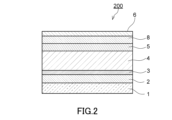
- the photoelectric conversion element 200 of the first modified example according to the third embodiment comprises, in this order, a substrate 1, a first electrode 2, an electron transport layer 3, a photoelectric conversion layer 4, a hole transport layer 5, a second hole transport layer 8, and a second electrode 6.
- the photoelectric conversion element 100 according to the third embodiment may further include a porous layer.
- the porous layer is disposed, for example, between the electron transport layer and the photoelectric conversion layer.
- FIG. 3 is a cross-sectional view showing a second modified example of a photoelectric conversion element according to the third embodiment.
- the photoelectric conversion element 300 includes a substrate 1, a first electrode 2, an electron transport layer 3, a porous layer 7, a photoelectric conversion layer 4, a hole transport layer 5, and a second electrode 6, in this order.
- the porous layer 7 includes a porous body.
- the porous body includes voids.
- the photoelectric conversion element 200 and the photoelectric conversion element 300 may not have the electron transport layer 3.
- the substrate 1 is an additional component.
- the substrate 1 serves to support each layer of the photoelectric conversion element.
- the substrate 1 can be made of a transparent material.
- a glass substrate or a plastic substrate can be used as the substrate 1.
- the plastic substrate can be, for example, a plastic film.
- the substrate 1 may be made of a material that is not translucent. Such a material may be metal, ceramic, or a resin material with low translucency.
- the layers can be held together by the first electrode 2, and there is no need to provide a substrate 1.
- the first electrode 2 is conductive.
- the first electrode 2 is translucent.
- the first electrode 2 transmits light in the visible to near infrared range.
- the first electrode 2 is made of, for example, a transparent and conductive material.
- materials are metal oxides and metal nitrides.
- examples of such materials are: (i) titanium oxide doped with at least one selected from the group consisting of lithium, magnesium, niobium, and fluorine; (ii) gallium oxide doped with at least one selected from the group consisting of tin and silicon; (iii) gallium nitride doped with at least one selected from the group consisting of silicon and oxygen; (iv) tin oxide doped with at least one selected from the group consisting of antimony and fluorine; (v) zinc oxide doped with at least one element selected from the group consisting of boron, aluminum, gallium, and indium; (vi) indium-tin composite oxide, or (vii) composites thereof; It is.
- the first electrode 2 may be formed by using a non-transparent material and providing a light-transmitting pattern.
- light-transmitting patterns are lines, wavy lines, lattices, or a punched metal pattern in which many fine through-holes are regularly or irregularly arranged. When the first electrode 2 has such a pattern, light can transmit through the parts where no electrode material is present.
- non-transparent electrode materials are platinum, gold, silver, copper, aluminum, rhodium, indium, titanium, iron, nickel, tin, zinc, or an alloy containing any of these.
- a conductive carbon material may be used as the non-transparent electrode material.
- the first electrode 2 has a blocking property against holes from the photoelectric conversion layer 4.
- the first electrode 2 does not have ohmic contact with the photoelectric conversion layer 4.
- the blocking property against holes from the photoelectric conversion layer 4 means a property that allows only electrons generated in the photoelectric conversion layer 4 to pass, but does not allow holes to pass.
- the Fermi energy level of a material having such a property is higher than the energy level of the upper end of the valence band of the photoelectric conversion layer 4.
- the Fermi energy level of a material having such a property may be higher than the Fermi energy of the photoelectric conversion layer 4.
- a specific example of the material is aluminum.
- the first electrode 2 does not need to have blocking properties for holes from the photoelectric conversion layer 4.
- the first electrode 2 may be made of a material capable of forming an ohmic contact with the photoelectric conversion layer 4.
- the first electrode 2 may or may not be in ohmic contact with the photoelectric conversion layer 4.
- the light transmittance of the first electrode 2 may be, for example, 50% or more, or 80% or more.
- the wavelength of light that the first electrode 2 should transmit depends on the absorption wavelength of the photoelectric conversion layer 4.
- the thickness of the first electrode 2 may be, for example, 1 nm or more and 1000 nm or less.
- the electron transport layer 3 includes a semiconductor.
- the electron transport layer 3 may be formed of a semiconductor having a band gap of 3.0 eV or more. This allows visible light and infrared light to transmit to the photoelectric conversion layer 4.
- An example of the semiconductor is an inorganic n-type semiconductor.
- Examples of inorganic n-type semiconductors are metal oxides, metal nitrides, or perovskite oxides.
- metal oxides are oxides of Cd, Zn, In, Pb, Mo, W, Sb, Bi, Cu, Hg, Ti, Ag, Mn, Fe, V, Sn, Zr, Sr, Ga, Si, or Cr.
- Metal oxides are, for example, TiO2 or SnO2 .
- Metal nitrides are, for example, GaN.
- Perovskite oxides are, for example, SrTiO3 or CaTiO3 .
- the electron transport layer 3 may contain a substance having a band gap larger than 6.0 eV.
- substances having a band gap larger than 6.0 eV include: (i) Alkali metal or alkaline earth metal halides, such as lithium fluoride and calcium fluoride; (ii) an alkali metal oxide, such as magnesium oxide, or (iii) silicon dioxide;
- the electron transport layer 3 may have a thickness of, for example, 10 nm or less in order to ensure electron transport properties.
- the electron transport layer 3 may include multiple layers made of different materials.
- the photoelectric conversion layer 4 contains a photoelectric conversion material.
- the photoelectric conversion material may be, for example, a perovskite compound. That is, the photoelectric conversion layer 4 may contain a perovskite compound. Perovskite compounds have a high light absorption coefficient in the wavelength range of the solar spectrum and high carrier mobility. Therefore, a photoelectric conversion element containing a perovskite compound has high photoelectric conversion efficiency.
- the perovskite compound is represented by, for example, the composition formula ABX3 .
- A is a monovalent cation.
- Examples of the monovalent cation are alkali metal cations or organic cations.
- Examples of the alkali metal cation are potassium cation (K + ), cesium cation ( Cs + ), or rubidium cation (Rb + ).
- Examples of the organic cation are methylammonium cation ( CH3NH3 + ), formamidinium cation (HC( NH2 ) 2+ ), ethylammonium cation ( CH3CH2NH3 + ), or guanidinium cation ( CH6N3 + ) .
- B is a divalent cation.
- divalent cation examples include Sn cation (Sn2 + ), Ge cation ( Ge2 + ), or Pb cation (Pb2 + ).
- the divalent cation may include at least one selected from the group consisting of Sn cation, Ge cation, and Pb cation.
- X is a monovalent anion.
- An example of a monovalent anion is a halogen anion.
- Each site of A, B, and X may be occupied by multiple types of ions.
- the thickness of the photoelectric conversion layer 4 is, for example, 50 nm or more and 10 ⁇ m or less.
- the photoelectric conversion layer 4 is formed, for example, by a solution coating method, a printing method, or a vapor deposition method.
- the photoelectric conversion layer 4 may also be formed by cutting out a perovskite compound.
- the photoelectric conversion layer 4 may mainly contain a perovskite compound represented by the composition formula ABX3 .
- the photoelectric conversion layer 4 mainly contains a perovskite compound represented by the composition formula ABX3 means that the photoelectric conversion layer 4 contains 90% by mass or more of the perovskite compound represented by the composition formula ABX3 .
- the photoelectric conversion layer may contain 95% by mass or more of the perovskite compound represented by the composition formula ABX3 .
- the photoelectric conversion layer 4 may be made of a perovskite compound represented by the composition formula ABX3 .
- the photoelectric conversion layer 4 may contain a perovskite compound represented by the composition formula ABX3 , and may contain defects or impurities.
- the photoelectric conversion layer 4 may further contain another compound different from the perovskite compound represented by the composition formula ABX 3.
- Another compound different from the perovskite compound represented by the composition formula ABX 3.
- An example of the other compound is a compound having a Ruddlesden-Popper type layered perovskite structure.
- the hole transport layer 5 comprises a hole transporter according to the first or second embodiment.
- the hole transport layer 5 may consist of a hole transporter according to the first or second embodiment.
- the hole transport layer 5 may include multiple layers made of different materials. For example, multiple layers are stacked so that the ionization potential of the hole transport layer 5 is successively smaller than the ionization potential of the photoelectric conversion layer 4, thereby improving the hole transport properties.
- the thickness of the hole transport layer 5 may be 1 nm or more and 1000 nm or less, or 10 nm or more and 50 nm or less. This allows sufficient hole transport properties to be exhibited and low resistance to be maintained, thereby achieving high photoelectric conversion efficiency.
- the second electrode 6 has electrical conductivity. Since the photoelectric conversion element according to the third embodiment includes the hole transport layer 5, the second electrode 6 does not need to have a blocking property against electrons from the photoelectric conversion layer 4. In other words, the material constituting the second electrode 6 may be a material that is in ohmic contact with the photoelectric conversion layer 4. Therefore, the second electrode 6 can be formed to have light-transmitting properties.
- first electrode 2 and the second electrode 6 it is sufficient that the electrode on the side where light is incident has translucency. Therefore, one of the first electrode 2 and the second electrode 6 does not have to have translucency. In other words, one of the first electrode 2 and the second electrode 6 does not have to use a material that has translucency, and does not have to have a pattern that includes openings that transmit light.
- the second electrode 6 is a light-transmitting electrode, light from the visible region to the near-infrared region can pass through the second electrode 6.
- the light-transmitting electrode can be made of a material that is transparent and conductive.
- Such materials are: (i) titanium oxide doped with at least one element selected from the group consisting of lithium, magnesium, niobium, and fluorine; (ii) gallium oxide doped with at least one element selected from the group consisting of tin and silicon; (iii) gallium nitride doped with at least one element selected from the group consisting of silicon and oxygen; (iv) indium-tin composite oxide, (v) tin oxide doped with at least one element selected from the group consisting of antimony and fluorine; (vi) zinc oxide doped with at least one of boron, aluminum, gallium, and indium, or (vii) A composite of these.
- a light-transmitting electrode can be formed by using a non-transparent material and providing a light-transmitting pattern.
- Examples of light-transmitting patterns are lines, wavy lines, lattices, or punched metal patterns with many fine through-holes arranged regularly or irregularly. When a light-transmitting electrode has such a pattern, light can transmit through the areas where there is no electrode material.
- Examples of non-transparent materials are platinum, gold, silver, copper, aluminum, rhodium, indium, titanium, iron, nickel, tin, zinc, or an alloy containing any of these.
- a conductive carbon material may be used as the non-transparent material.
- the light transmittance of the second electrode 6 may be 50% or more, or may be 80% or more.
- the wavelength of light that passes through the second electrode 6 depends on the absorption wavelength of the first photoelectric conversion layer 3.
- the thickness of the second electrode 6 is, for example, in the range of 1 nm to 1000 nm.
- the second hole transport layer 8 contains a hole transport material and is formed on the hole transport layer 5 by, for example, a vacuum deposition method.
- the second hole transport layer 8 may be a p-type inorganic semiconductor.
- inorganic semiconductors are Cu2O , CuGaO2 , CuSCN, CuI, NiOx , MoOx , V2O5 , or carbon materials such as graphene oxide.
- the second hole transport layer 8 By selecting an inorganic semiconductor as the second hole transport layer 8, damage to the hole transport layer 5 that occurs when forming the second electrode 6 when the hole transport layer 5 is an organic semiconductor can be mitigated. In addition, short circuits caused by gaps in the hole transport layer 5 can be prevented.
- the second hole transport layer 8 may contain at least one selected from the group consisting of tungsten oxide and molybdenum oxide.
- the second hole transport layer 8 containing at least one selected from the group consisting of tungsten oxide and molybdenum oxide can more reliably prevent short circuits caused by gaps in the hole transport layer 5, and also has excellent hole transport properties. Therefore, by being provided with a second hole transport layer 8 having such a configuration, the photoelectric conversion element 200 can achieve a higher voltage.
- the second hole transport layer 8 may have a thickness of 5 nm or more and 40 nm or less. Desirably, the second hole transport layer 8 may have a thickness of 5 nm or more and 30 nm or less.
- the porous layer 7 is formed, for example, by a coating method on the electron transport layer 3. When the photoelectric conversion element does not include the electron transport layer 3, the porous layer 7 is formed on the first electrode 2.
- the pore structure introduced by the porous layer 7 serves as a foundation for forming the photoelectric conversion layer 4.
- the porous layer 7 does not impede the light absorption of the photoelectric conversion layer 4 or the electron transfer from the photoelectric conversion layer 4 to the electron transport layer 3.
- the porous layer 7 includes a porous body.
- the porous body is formed, for example, by a series of insulating or semiconducting particles.
- insulating particles are aluminum oxide particles or silicon oxide particles.
- semiconducting particles are inorganic semiconductor particles.
- inorganic semiconductors are metal oxides, perovskite oxides of metal elements, sulfides of metal elements, or metal chalcogenides.
- metal oxides are oxides of Cd, Zn, In, Pb, Mo, W, Sb, Bi, Cu, Hg, Ti, Ag, Mn, Fe, V, Sn, Zr, Sr, Ga, Si, or Cr.
- metal oxides are TiO2 .
- Examples of perovskite oxides of metal elements are SrTiO3 or CaTiO3 .
- sulfides of metal elements are CdS, ZnS, In2S3 , PbS, Mo2S , WS2 , Sb2S3 , Bi2S3 , ZnCdS2 , or Cu2S .
- metal chalcogenides are CsSe, In2Se3 , WSe2 , HgS , PbSe , or CdTe.
- the thickness of the porous layer 7 may be 0.01 ⁇ m or more and 10 ⁇ m or less, or 0.05 ⁇ m or more and 1 ⁇ m or less.
- the surface roughness of the porous layer 7 may have a surface roughness coefficient, given by effective area/projected area, of 10 or more, or may be 100 or more.
- the projected area is the area of the shadow cast behind an object when light is shone directly on it.
- the effective area is the actual surface area of the object.
- the effective area can be calculated from the volume determined from the projected area and thickness of the object, and the specific surface area and bulk density of the material that constitutes the object.
- the specific surface area is measured, for example, by the nitrogen adsorption method.
- the voids in the porous layer 7 are connected to the part in contact with the photoelectric conversion layer 4 and the part in contact with the electron transport layer 3.
- the voids in the porous layer 7 are connected from one main surface of the porous layer 7 to the other main surface. This allows the material of the photoelectric conversion layer 4 to fill the voids in the porous layer 7 and reach the surface of the electron transport layer 3. Therefore, the photoelectric conversion layer 4 and the electron transport layer 3 are in direct contact with each other, making it possible for electrons to be exchanged.
- the material of the photoelectric conversion layer 4 penetrates into the voids of the porous layer 7, and the porous layer 7 becomes a foothold for the photoelectric conversion layer 4. Therefore, the material of the photoelectric conversion layer 4 is less likely to be repelled or aggregate on the surface of the porous layer 7. Therefore, the photoelectric conversion layer 4 can be easily formed as a uniform film.
- the photoelectric conversion layer 4 is formed by, for example, a coating method, a printing method, or a deposition method.
- the light scattering caused by the porous layer 7 will have the effect of increasing the optical path length of the light passing through the photoelectric conversion layer 4. As the optical path length increases, it is predicted that the amount of electrons and holes generated in the photoelectric conversion layer 4 will increase.
- the photoelectric conversion element 100 at least one selected from the group consisting of the substrate 1 and the second electrode 6 has translucency.
- Light is incident into the photoelectric conversion element 100 from the translucent surface.
- the photoelectric conversion layer 4 absorbs the light and generates excited electrons and holes.
- the excited electrons move to the electron transport layer 3.
- the holes generated in the photoelectric conversion layer 4 move to the hole transport layer 5.
- the electron transport layer 3 and the hole transport layer 5 are electrically connected to the first electrode 2 and the second electrode 6, respectively.
- a current is taken out from the first electrode 2 and the second electrode 6, which function as a negative electrode and a positive electrode, respectively.
- the hole transport layer 5 and the electron transport layer 3 may be reversed with respect to the incident direction of light.
- the photoelectric conversion element 200 of the first modification and the photoelectric conversion element 300 of the second modification also have the same effects.
- the hole transporter of Technology 1 can improve the photoelectric conversion efficiency of the photoelectric conversion material.
- This configuration allows the hole transporter of Technology 2 to have improved hole transport capabilities.
- the nonionic surfactant contains an alkyl hexyl ether having an alkyl group with 1 to 5 carbon atoms. 3.
- the hole transporter of Technology 3 can further improve the photoelectric conversion efficiency of the photoelectric conversion material.
- the alkyl hexyl ether includes at least one selected from the group consisting of methyl hexyl ether, ethyl hexyl ether, normal propyl hexyl ether, normal butyl hexyl ether, and normal pentyl hexyl ether. 3.
- the hole transporter of Technology 4 can further improve the photoelectric conversion efficiency of the photoelectric conversion material.
- the nonionic surfactant includes an ester compound obtained by a condensation reaction between a sugar alcohol or an intramolecular dehydration condensate of a sugar alcohol and a fatty acid. 5.
- a hole transporter according to any one of claims 1 to 4.
- the hole transporter of Technology 5 can further improve the photoelectric conversion efficiency of the photoelectric conversion material.
- the ester compound includes a fatty acid ester having an alkyl group having 12 to 15 carbon atoms. 5.
- the hole transporter of Technology 6 can further improve the photoelectric conversion efficiency of the photoelectric conversion material.
- the ester compound includes a glycerin fatty acid ester. 7.
- a hole transporter according to any one of claims 5 to 6.
- the hole transporter of Technology 7 can further improve the photoelectric conversion efficiency of the photoelectric conversion material.
- the ester compound includes a sorbitan fatty acid ester. 8.
- the hole transporter of Technology 8 can further improve the photoelectric conversion efficiency of the photoelectric conversion material.
- the ester compound includes glycerin monolaurate.
- the hole transporter of Technology 9 can further improve the photoelectric conversion efficiency of the photoelectric conversion material.
- the ester compound includes a sugar alcohol fatty acid ester modified with polyethylene glycol. 10.
- the hole transporter of Technology 10 can further improve the photoelectric conversion efficiency of the photoelectric conversion material.
- the polyethylene glycol contains 1 or more and 22 or less ethylene glycol units as a constituent monomer. 11.
- the hole transporter of Technology 11 can further improve the photoelectric conversion efficiency of the photoelectric conversion material.
- the fatty acid ester of the intramolecular dehydration condensate of the sugar alcohol modified with polyethylene glycol includes monolaurate. 12.
- the hole transporter of Technology 12 can further improve the photoelectric conversion efficiency of the photoelectric conversion material.
- the fatty acid ester of the intramolecular dehydration condensate of the sugar alcohol modified with polyethylene glycol includes monooleate. 13.
- the hole transporter of Technology 13 can further improve the photoelectric conversion efficiency of the photoelectric conversion material.
- the non-ionic surfactant comprises a copolymer of polyethylene glycol and polypropylene glycol. 14.
- a hole transporter according to any one of claims 1 to 13.
- the hole transporter of Technology 14 can further improve the photoelectric conversion efficiency of the photoelectric conversion material.
- the copolymer contains, as constituent monomers, ethylene glycol having 6 or more and 53 or less and propylene glycol having 42 or more and 69 or less. 15. A hole transporter according to claim 14.
- the hole transporter of Technology 15 can further improve the photoelectric conversion efficiency of the photoelectric conversion material.
- the nonionic surfactant includes a glucoside derivative. 16.
- the hole transporter of Technology 16 can further improve the photoelectric conversion efficiency of the photoelectric conversion material.
- the glucoside derivative is an alkyl glucoside derivative. 17.
- the hole transporter of Technology 17 can further improve the photoelectric conversion efficiency of the photoelectric conversion material.
- the alkyl glucoside derivative is n-octyl- ⁇ -D-glucopyranoside. 18.
- the hole transporter of Technology 18 can further improve the photoelectric conversion efficiency of the photoelectric conversion material.
- the organic semiconductor includes at least one selected from the group consisting of 2,2',7,7'-tetrakis[N,N-di-p-methoxyphenylamino]-9,9'-spirobifluorene, poly[bis(4-phenyl)(2,4,6-triphenylmethyl)amine], poly(3-hexylthiophene-2,5-diyl), poly(3,4-ethylenedioxythiophene), copper phthalocyanine, derivatives of 2,2',7,7'-tetrakis[N,N-di-p-methoxyphenylamino]-9,9'-spirobifluorene, derivatives of poly[bis(4-phenyl)(2,4,6-triphenylmethyl)amine], derivatives of poly(3-hexylthiophene-2,5-diyl), derivatives of poly(3,4-ethylenedioxythiophene), and derivatives of copper phthalocyan
- the hole transporter of Technology 19 can further improve the photoelectric conversion efficiency of the photoelectric conversion material.
- the dopant includes at least one selected from the group consisting of lithium hexafluorophosphate, lithium borofluoride, lithium perchlorate, lithium bis(pentafluoroethanesulfonyl)imide, bis(trifluoromethanesulfonyl)amine, lithium bis(trifluoromethanesulfonyl)imide, zinc bis(trifluoromethanesulfonyl)imide, tris[2-(1H-pyrazol-1-yl)-4-tert-butylpyridine]cobalt, 4-isopropyl-4-methyldiphenyliodonium tetrakis(pentafluorophenyl)borate, tris(pentafluorophenyl)borane, 2,3,5,6-tetrafluoro-7,7,8,8-tetracyano-quinodimethane, and 1,2,3,4,8,9,10,11,15,16,17,
- This configuration allows the hole transporter of Technology 20 to further improve its hole transport capability.
- the hole transporter of Technology 21 can further improve the photoelectric conversion efficiency of the photoelectric conversion material.
- the nonionic surfactant contains an alkyl hexyl ether having an alkyl group with 1 to 5 carbon atoms. Hole transporter.
- the hole transporter of Technology 22 can improve the photoelectric conversion efficiency of the photoelectric conversion material.
- the alkyl hexyl ether includes at least one selected from the group consisting of methyl hexyl ether, ethyl hexyl ether, normal propyl hexyl ether, normal butyl hexyl ether, and normal pentyl hexyl ether. 23.
- the hole transporter of Technology 23 can further improve the photoelectric conversion efficiency of the photoelectric conversion material.
- the hole transport layer comprises a hole transporter according to any one of claims 1 to 23; Photoelectric conversion element.
- the photoelectric conversion element of Technology 24 has high photoelectric conversion efficiency.
- the photoelectric conversion layer contains a perovskite compound.
- the photoelectric conversion element of Technology 25 has high photoelectric conversion efficiency.
- the perovskite compound is composed of monovalent cations, divalent cations, and halogen anions;
- the divalent cation includes at least one selected from the group consisting of Sn cations, Ge cations, and Pb cations;
- the photoelectric conversion element of Technology 24 has high photoelectric conversion efficiency.
- the content of the nonionic surfactant in the composition is more than 0 mg/L and is 1 mg/L or less.
- the contact angle of the composition on a UV ozone treated glass surface at 24°C is 7° or more and 30° or less. 29.
- the nonionic surfactant contains an alkyl hexyl ether having an alkyl group with 1 to 5 carbon atoms.
- a composition for making a hole transporter is
- the alkyl hexyl ether includes at least one selected from the group consisting of methyl hexyl ether, ethyl hexyl ether, normal propyl hexyl ether, normal butyl hexyl ether, and normal pentyl hexyl ether.
- solar cells were fabricated as photoelectric conversion elements, each of which had a hole transport layer formed of an organic semiconductor film and a photoelectric conversion layer containing a perovskite compound.
- the solar cells of the examples and comparative examples were subjected to initial characteristic evaluation, light durability evaluation, and heat durability evaluation.
- the configurations of the solar cells according to Examples 1 to 7, Comparative Examples 1 to 2 are as follows: That is, solar cells having the same structure as the photoelectric conversion element 200 shown in FIG.
- Substrate 1 Glass substrate (thickness: 0.7 mm)
- First electrode 2 transparent conductive layer, indium-tin composite oxide layer (thickness: 100 nm)
- Electron transport layer 3 tin oxide ( SnO2 ) (thickness: 30 nm)
- Photoelectric conversion layer 4 a layer mainly containing Rb0.03Cs0.06MA0.16FA0.75PbI2.85Br0.15 (thickness : 400 nm) (MA: CH3NH3 , FA : HC ( NH2 ) 2 )
- Hole transport layer 5 a layer mainly containing PTAA (including lithium bis(trifluoromethanesulfonyl)imide (manufactured by Tokyo Chemical Industry Co., Ltd.) as a dopant) (thickness:
- Example 1 First, a glass substrate having a thickness of 0.7 mm was prepared.
- a layer of indium-tin composite oxide with a thickness of 100 nm was formed on the substrate by sputtering. In this way, the first electrode was formed.
- a SnO2 nano-dispersed aqueous solution (manufactured by Alfa Aesar) was applied onto the first electrode by spin coating, and then baked at 220°C for 30 minutes, followed by UV ozone treatment to form a tin oxide layer having a thickness of 30 nm. In this way, an electron transport layer was formed.
- the raw solution contained 1.19 mol/L lead (II) iodide (Tokyo Chemical Industry Co., Ltd.), 0.06 mol/L lead (II) bromide (Tokyo Chemical Industry Co., Ltd.), 0.95 mol/L formamidinium iodide (GreatCell Solar), 0.14 mol/L methylammonium iodide (GreatCell Solar), 0.06 mol/L methylammonium bromide (GreatCell Solar), 0.08 mol/L cesium iodide (Iwatani Corporation), and 0.04 mol/L rubidium iodide (Iwatani Corporation).
- the solvent for the solution was a mixture of dimethyl sulfoxide (manufactured by Acros) and N,N-dimethylformamide (manufactured by Acros).
- the mixture ratio (DMSO:DMF) of dimethyl sulfoxide (DMSO) and N,N-dimethylformamide (DMF) in this raw material solution was 1:4 by volume.
- a hole transport layer was formed by applying a composition for preparing a hole transporter according to the embodiment to the photoelectric conversion layer by spin coating.
- the solvent in the composition for preparing the hole transporter was a mixture of 98% mesitylene (manufactured by Kanto Chemical) and 1% tert-butylpyridine by volume.
- the composition for preparing the hole transporter contained 10 g/L of PTAA as an organic semiconductor and 40 mol% of lithium bis(trifluoromethanesulfonyl)imide as a dopant per substance amount relative to the repeating unit mass of PTAA.
- compositions for preparing the hole transporter three types of compositions with different concentrations of 1-methoxyhexane-1propoxyhexane (SA-9, manufactured by Merck) as a nonionic surfactant were prepared. Specifically, compositions containing 0.2 g/L, 0.4 g/L, and 0.8 g/L of 1-methoxyhexane-1propoxyhexane were prepared. Table 1 also shows the content (mass%) of the nonionic surfactant in the composition for preparing the hole transporter. The prepared composition was filtered through a PTFE filter with a diameter of 0.2 ⁇ m and then used to form a hole transport layer.
- SA-9 1-methoxyhexane-1propoxyhexane
- the solution was applied onto the photoelectric conversion layer, rotated at 1000 rpm for 3 seconds, and then stopped, after which the solvent was evaporated on a hot plate at 60°C, and then dried for 10 minutes on a hot plate at 80°C to obtain a hole transport layer with a thickness of approximately 60 nm.
- a 5 nm thick molybdenum oxide film was deposited on the hole transport layer by vacuum deposition to form a second hole transport layer.
- a layer of indium-tin composite oxide with a thickness of 100 nm was formed by sputtering. In this way, the second electrode was formed.
- Example 2 The nonionic surfactant contained in the composition for preparing the hole transporter was changed from 1-methoxyhexane-1-propoxyhexane to glycerol monolaurate (manufactured by Merck).
- As the composition for preparing the hole transporter two types of compositions were prepared, each having a concentration of glycerol monolaurate (manufactured by Merck) of 0.2 g/L and 0.4 g/L. Table 1 also shows the content (mass%) of the nonionic surfactant in the composition for preparing the hole transporter.
- the composition for preparing the hole transporter was prepared in the same manner as in Example 1, and a solar cell was prepared in the same manner as in Example 1.
- Example 3 The nonionic surfactant contained in the composition for preparing the hole transporter was changed from 1-methoxyhexane-1-propoxyhexane to sorbitan monolaurate (manufactured by Merck).
- As the composition for preparing the hole transporter two types of compositions were prepared, each having a concentration of sorbitan monolaurate (manufactured by Merck) of 0.2 g/L and 0.4 g/L. Table 1 also shows the content (mass%) of the nonionic surfactant in the composition for preparing the hole transporter. Other than this, the composition for preparing the hole transporter was prepared in the same manner as in Example 1, and a solar cell was prepared in the same manner as in Example 1.
- Example 4 The nonionic surfactant contained in the composition for preparing the hole transporter was changed from 1-methoxyhexane-1-propoxyhexane to polyoxyethylene sorbitan monolaurate (Tween 20, Merck).
- Tween 20, Merck polyoxyethylene sorbitan monolaurate
- Table 1 also shows the content (mass%) of the nonionic surfactant in the composition for preparing the hole transporter.
- the composition for preparing the hole transporter was prepared in the same manner as in Example 1, and a solar cell was prepared in the same manner as in Example 1.
- Example 5 The nonionic surfactant contained in the composition for preparing the hole transporter was changed from 1-methoxyhexane-1-propoxyhexane to polyoxyethylene sorbitan monooleate (Tween 80, Merck).
- As the composition for preparing the hole transporter two compositions with concentrations of polyoxyethylene sorbitan monooleate (Tween 80, Merck) of 0.2 g/L and 0.4 g/L were prepared. Table 1 also shows the content (mass%) of the nonionic surfactant in the composition for preparing the hole transporter.
- the composition for preparing the hole transporter was prepared in the same manner as in Example 1, and a solar cell was prepared in the same manner as in Example 1.
- Example 6 The nonionic surfactant contained in the composition for preparing the hole transporter was changed from 1-methoxyhexane-1-propoxyhexane to ethylene oxide-propylene oxide copolymer (PEO5-PPO68-PEO5, Pluronic L121, Merck).
- ethylene oxide-propylene oxide copolymer PEO5-PPO68-PEO5, Pluronic L121, Merck
- Table 1 also shows the content (mass%) of the nonionic surfactant in the composition for preparing the hole transporter.
- the composition for preparing the hole transporter was prepared in the same manner as in Example 1, and a solar cell was prepared in the same manner as in Example 1.
- Example 7 The nonionic surfactant contained in the composition for preparing the hole transporter was changed from 1-methoxyhexane-1-propoxyhexane to n-octyl- ⁇ -D-glucopyranoside ( ⁇ -APG8, manufactured by Merck).
- ⁇ -APG8 n-octyl- ⁇ -D-glucopyranoside
- Table 1 also shows the content (mass%) of the nonionic surfactant in the composition for preparing the hole transporter.
- the composition for preparing the hole transporter was prepared in the same manner as in Example 1, and a solar cell was prepared in the same manner as in Example 1.
- Example 8 The nonionic surfactant contained in the composition for preparing the hole transporter was changed from 1-methoxyhexane-1-propoxyhexane to polyoxyethylene sorbitan monolaurate (Tween 20, Merck).
- Tween 20, Merck polyoxyethylene sorbitan monolaurate
- Table 2 also shows the content (mass%) of the nonionic surfactant in the composition for preparing the hole transporter.
- the composition for preparing the hole transporter was prepared in the same manner as in Example 1.
- a solar cell was produced in the same manner as in Example 1, except that the composition for producing the hole transporter was changed, the material of the second electrode was changed from indium-tin composite oxide to gold (Au), molybdenum oxide was not formed as the second hole transport layer, and after the photoelectric conversion layer was formed, an isopropyl alcohol solution containing 1 g/L of butylammonium bromide dissolved therein was applied by spin coating at 4000 rpm for surface treatment.
- Example 9 The nonionic surfactant contained in the composition for preparing the hole transporter was changed from 1-methoxyhexane-1-propoxyhexane to polyoxyethylene sorbitan monooleate (Tween 80, Merck).
- Tween 80, Merck polyoxyethylene sorbitan monooleate
- Table 2 also shows the content (mass%) of the nonionic surfactant in the composition for preparing the hole transporter.
- the composition for preparing the hole transporter was prepared in the same manner as in Example 1.
- a solar cell was produced in the same manner as in Example 1, except that the composition for producing the hole transporter was changed, the material of the second electrode was changed from indium-tin composite oxide to gold (Au), molybdenum oxide was not formed as the second hole transport layer, and after the photoelectric conversion layer was formed, an isopropyl alcohol solution containing 1 g/L of butylammonium bromide dissolved therein was applied by spin coating at 4000 rpm for surface treatment.
- composition for preparing the hole transporter was changed from 1-methoxyhexane-1-propoxyhexane to n-hexadecyl ⁇ -D-maltoside (manufactured by Merck), which is a nonionic surfactant and has a critical micelle concentration of less than 0.001 g/L.
- n-hexadecyl ⁇ -D-maltoside manufactured by Merck
- three types of compositions were prepared, each having a concentration of n-hexadecyl ⁇ -D-maltoside of 0.4 g/L, 0.8 g/L, and 1.6 g/L.
- Table 1 also shows the content (mass%) of the nonionic surfactant in the composition for preparing the hole transporter.
- the composition for preparing the hole transporter was prepared in the same manner as in Example 1, and a solar cell was prepared in the same manner as in Example 1.
- composition for preparing the hole transporter The surfactant contained in the composition for preparing the hole transporter was changed from 1-methoxyhexane-1-propoxyhexane to dodecyltrimethylammonium bromide (manufactured by Merck), which is a cationic surfactant.
- As the composition for preparing the hole transporter three types of compositions were prepared, each having a concentration of dodecyltrimethylammonium bromide (manufactured by Merck) of 0.4 g/L, 0.8 g/L, and 1.6 g/L. Table 1 also shows the content (mass%) of the nonionic surfactant in the composition for preparing the hole transporter. Other than this, the composition for preparing the hole transporter was prepared in the same manner as in Example 1, and a solar cell was prepared in the same manner as in Example 1.
- Comparative Example 3 1-Methoxyhexane-1-propoxyhexane was not added to the composition for preparing the hole transporter. That is, the composition for preparing the hole transporter of Comparative Example 3 did not contain a surfactant. Other than this, the composition for preparing the hole transporter was prepared in the same manner as in Example 1, and a solar cell was prepared in the same manner as in Example 1.
- Comparative Example 4 Polyoxyethylene sorbitan monolaurate (Tween 20, Merck) was not added to the composition for preparing the hole transporter. That is, the composition for preparing the hole transporter of Comparative Example 4 did not contain a surfactant. Other than this, the composition for preparing the hole transporter was prepared in the same manner as in Example 8, and a solar cell was prepared in the same manner as in Example 8.
- Comparative Example 5 The surfactant contained in the composition for preparing the hole transporter was changed from 1-methoxyhexane-1-propoxyhexane to sodium dodecyl sulfate (manufactured by Merck), which is an anionic surfactant.
- a composition with a concentration of sodium dodecyl sulfate (manufactured by Merck) of 0.8 mg/L was prepared.
- sodium dodecyl sulfate did not dissolve in the raw material solution. Therefore, in Comparative Example 5, the hole transporter could not be prepared, and no solar cell was prepared.
- the critical micelle concentration of sodium dodecyl sulfate was 2.384 g/L.
- the surfactant contained in the composition for preparing the hole transporter was changed from 1-methoxyhexane-1-propoxyhexane to a non-ionic surfactant, ethylene oxide-propylene oxide copolymer (PEO95-PPO62-PEO95, Pluronic L127, Merck).
- a composition for preparing the hole transporter a composition with a concentration of 0.8 mg/L of ethylene oxide-propylene oxide copolymer (PEO95-PPO62-PEO95, Pluronic L127, Merck) was prepared. However, since this composition was liquid repellent, a hole transporter could not be prepared. Therefore, in Comparative Example 7, a solar cell was not prepared.
- the critical micelle concentration of the ethylene oxide-propylene oxide copolymer (PEO95-PPO62-PEO95, Pluronic L127, Merck) was 50.000 g/L.
- composition for preparing the hole transporter The surfactant contained in the composition for preparing the hole transporter was changed from 1-methoxyhexane-1-propoxyhexane to polyoxyethylene octylphenyl ether, a nonionic surfactant.
- composition for preparing the hole transporter a composition with a polyoxyethylene octylphenyl ether concentration of 0.8 mg/L was prepared.
- polyoxyethylene octylphenyl ether did not dissolve in the raw material solution. Therefore, in Comparative Example 8, the hole transporter could not be prepared, and no solar cell was prepared.
- the critical micelle concentration of polyoxyethylene octylphenyl ether was 0.150 g/L.
- Comparative Example 9 The surfactant contained in the composition for preparing the hole transporter was changed from 1-methoxyhexane-1-propoxyhexane to polyoxyethylene lauryl ether, a nonionic surfactant.
- a composition with a polyoxyethylene lauryl ether concentration of 0.8 mg/L was prepared as the composition for preparing the hole transporter.
- polyoxyethylene lauryl ether did not dissolve in the raw material solution. Therefore, in Comparative Example 9, the hole transporter could not be prepared, and no solar cell was prepared.
- the critical micelle concentration of polyoxyethylene lauryl ether was 0.123 g/L.
- the critical micelle concentration of the surfactants used in the examples and comparative examples was measured by the following method. A solution was prepared by dissolving the surfactant in pure water, and the concentration dependency of the surface tension was examined using this solution by the Wilhelmy plate method. The concentration of the surfactant at which the surface tension no longer changes was taken as the critical micelle concentration. The results are shown in Table 1. In Table 1, the critical micelle concentration is abbreviated as "CMC.”
- the current-voltage characteristics of the solar cell were measured using an electrochemical analyzer (ALS440B, manufactured by BAS) and a xenon light source (BPS X300BA, manufactured by Bunkoukeiki). Before the measurement, the light intensity was calibrated to 1 Sun (100 mW/cm 2 ) using a silicon photodiode. The voltage sweep speed was 100 mV/s. Before the measurement, the solar cell was irradiated with indoor light for about 1 hour to stabilize the state. In order to fix the effective area and reduce the influence of scattered light, the solar cell was masked with a black mask with an opening of 0.1 cm 2 and irradiated with light from the mask/substrate side. By this method, the current-voltage characteristics of the solar cell according to the example and the comparative example were measured, and the photoelectric conversion efficiency (power conversion efficiency: PCE) was obtained.
- PCE photoelectric conversion efficiency
- the current-voltage characteristics of the solar cells according to Examples 1 to 7 and Comparative Examples 1 to 3 were measured for each solar cell initially, after the light resistance test, and after the light-to-heat resistance test. Initially, the measurements were taken immediately after fabrication. After the light resistance test, the measurements were taken after 135 hours of irradiation at a substrate surface temperature of 50°C. After the light-to-heat resistance test, the measurements were taken after 135 hours of irradiation at a substrate surface temperature of 50°C, followed by heating at 85°C for 66 hours in the dark, followed by another 23 hours of irradiation.
- the current-voltage characteristics of the solar cells according to Examples 8, 9, and Comparative Example 4 were measured for each solar cell only initially.
- Tables 1 and 2 show the results of photoelectric conversion efficiency (PCE) of the solar cells according to the examples and comparative examples, along with the open circuit voltage (V oc ), short circuit current density (J sc ), and fill factor (FF).
- PCE photoelectric conversion efficiency
- a nonionic surfactant having a critical micelle concentration of 0.001 g/L or more and 0.080 g/L or less was added to the hole transport layer in the solar cells of Examples 1 to 7.
- the light resistance and heat resistance were improved in terms of the open circuit voltage (Voc) and fill factor (FF), and as a result, the effect of improving the photoelectric conversion efficiency (PCE) was confirmed.
- the present disclosure uses a hole transporter containing a specific nonionic surfactant to improve the photoelectric conversion efficiency of a photoelectric conversion element. Therefore, the hole transporter of the present disclosure can be used in photoelectric conversion elements such as solar cells.
Landscapes
- Physics & Mathematics (AREA)
- Electromagnetism (AREA)
- Chemical & Material Sciences (AREA)
- Engineering & Computer Science (AREA)
- Materials Engineering (AREA)
- Photovoltaic Devices (AREA)
Priority Applications (2)
| Application Number | Priority Date | Filing Date | Title |
|---|---|---|---|
| CN202480044384.9A CN121444634A (zh) | 2023-07-07 | 2024-06-21 | 空穴传输体、光电转换元件以及组合物 |
| JP2025532640A JPWO2025013580A1 (https=) | 2023-07-07 | 2024-06-21 |
Applications Claiming Priority (2)
| Application Number | Priority Date | Filing Date | Title |
|---|---|---|---|
| JP2023-112590 | 2023-07-07 | ||
| JP2023112590 | 2023-07-07 |
Related Child Applications (1)
| Application Number | Title | Priority Date | Filing Date |
|---|---|---|---|
| US19/440,198 Continuation US20260130041A1 (en) | 2023-07-07 | 2026-01-05 | Hole transport body, photoelectric conversion element, and composition |
Publications (1)
| Publication Number | Publication Date |
|---|---|
| WO2025013580A1 true WO2025013580A1 (ja) | 2025-01-16 |
Family
ID=94215146
Family Applications (1)
| Application Number | Title | Priority Date | Filing Date |
|---|---|---|---|
| PCT/JP2024/022697 Ceased WO2025013580A1 (ja) | 2023-07-07 | 2024-06-21 | 正孔輸送体、光電変換素子、および組成物 |
Country Status (3)
| Country | Link |
|---|---|
| JP (1) | JPWO2025013580A1 (https=) |
| CN (1) | CN121444634A (https=) |
| WO (1) | WO2025013580A1 (https=) |
Citations (7)
| Publication number | Priority date | Publication date | Assignee | Title |
|---|---|---|---|---|
| JPH0393845A (ja) * | 1989-09-06 | 1991-04-18 | Idemitsu Kosan Co Ltd | スチレン系重合体組成物及び成形体の製造方法 |
| WO2011019044A1 (ja) * | 2009-08-11 | 2011-02-17 | 株式会社イデアルスター | ホールブロック層およびその製造方法、ならびにそのホールブロック層を備える光電変換素子およびその製造方法 |
| JP2011228530A (ja) * | 2010-04-21 | 2011-11-10 | Sekisui Chem Co Ltd | 太陽電池用封止材、及びこれを用いた太陽電池用裏面側保護部材 |
| JP2014523464A (ja) * | 2012-05-11 | 2014-09-11 | エルジー・ケム・リミテッド | 導電性高分子インク組成物及びそれを含む有機太陽電池 |
| CN110880555A (zh) * | 2018-09-05 | 2020-03-13 | 杭州纤纳光电科技有限公司 | 前驱体与表面活性剂的混合溶液的涂布设备及其方法 |
| WO2022244289A1 (ja) * | 2021-05-19 | 2022-11-24 | パナソニックIpマネジメント株式会社 | 半導体材料および光電変換素子 |
| JP2023046047A (ja) * | 2021-09-22 | 2023-04-03 | 株式会社アイシン | ホール輸送材料及びホール輸送材料を用いた太陽電池 |
-
2024
- 2024-06-21 JP JP2025532640A patent/JPWO2025013580A1/ja active Pending
- 2024-06-21 CN CN202480044384.9A patent/CN121444634A/zh active Pending
- 2024-06-21 WO PCT/JP2024/022697 patent/WO2025013580A1/ja not_active Ceased
Patent Citations (7)
| Publication number | Priority date | Publication date | Assignee | Title |
|---|---|---|---|---|
| JPH0393845A (ja) * | 1989-09-06 | 1991-04-18 | Idemitsu Kosan Co Ltd | スチレン系重合体組成物及び成形体の製造方法 |
| WO2011019044A1 (ja) * | 2009-08-11 | 2011-02-17 | 株式会社イデアルスター | ホールブロック層およびその製造方法、ならびにそのホールブロック層を備える光電変換素子およびその製造方法 |
| JP2011228530A (ja) * | 2010-04-21 | 2011-11-10 | Sekisui Chem Co Ltd | 太陽電池用封止材、及びこれを用いた太陽電池用裏面側保護部材 |
| JP2014523464A (ja) * | 2012-05-11 | 2014-09-11 | エルジー・ケム・リミテッド | 導電性高分子インク組成物及びそれを含む有機太陽電池 |
| CN110880555A (zh) * | 2018-09-05 | 2020-03-13 | 杭州纤纳光电科技有限公司 | 前驱体与表面活性剂的混合溶液的涂布设备及其方法 |
| WO2022244289A1 (ja) * | 2021-05-19 | 2022-11-24 | パナソニックIpマネジメント株式会社 | 半導体材料および光電変換素子 |
| JP2023046047A (ja) * | 2021-09-22 | 2023-04-03 | 株式会社アイシン | ホール輸送材料及びホール輸送材料を用いた太陽電池 |
Also Published As
| Publication number | Publication date |
|---|---|
| JPWO2025013580A1 (https=) | 2025-01-16 |
| CN121444634A (zh) | 2026-01-30 |
Similar Documents
| Publication | Publication Date | Title |
|---|---|---|
| Zhao et al. | Efficient two-terminal all-perovskite tandem solar cells enabled by high-quality low-bandgap absorber layers | |
| Mohammed et al. | Adaption of MAPbI3 perovskite with copper phthalocyanine inorganic hole transport layer via nitrosonium tetrafluoroborate additive to enhance performance and stability of perovskite solar cells | |
| EP3381070A1 (en) | Mixed cation perovskite | |
| Kwon et al. | Towards efficient and stable perovskite solar cells employing non-hygroscopic F4-TCNQ doped TFB as the hole-transporting material | |
| JP7232032B2 (ja) | 太陽電池 | |
| JP7738267B2 (ja) | 太陽電池 | |
| JP7617571B2 (ja) | 太陽電池 | |
| JP7591719B2 (ja) | 太陽電池 | |
| Wang et al. | Large guanidinium cation enhance photovoltage for perovskite solar cells via solution-processed secondary growth technique | |
| JP2025186482A (ja) | 光電変換素子および光電変換素子用の正孔輸送材料 | |
| JP7846266B2 (ja) | 太陽電池および太陽電池の製造方法 | |
| JP2025108721A (ja) | 太陽電池および太陽電池の製造方法 | |
| Zhang et al. | PEDOT: PSS doping strategy of improving both interface energy level matching and photocarrier transport in FASnI3 perovskite solar cells | |
| JP2019134158A (ja) | 太陽電池 | |
| JP7507321B2 (ja) | 太陽電池 | |
| WO2025013580A1 (ja) | 正孔輸送体、光電変換素子、および組成物 | |
| US20260130041A1 (en) | Hole transport body, photoelectric conversion element, and composition | |
| WO2023054073A1 (ja) | 光電変換素子およびその製造方法、ならびに組成物 | |
| Li et al. | Printable mesoscopic perovskite solar cells with performance tuning via trifluoroacetamide | |
| JP7515062B2 (ja) | 化合物ならびにそれを用いた電子デバイスおよび発光素子 | |
| JP7692174B2 (ja) | 光電変換材料およびそれを用いた光電変換素子 | |
| RU2788942C2 (ru) | Фотовольтаическое устройство с перовскитным фотоактивным слоем и неорганическим пассивирующим покрытием на основе галогенидов металлов и способ изготовления этого устройства | |
| US20250017028A1 (en) | Photoelectric conversion material and photoelectric conversion element using same | |
| WO2023199728A1 (ja) | 組成物およびそれを用いた光電変換層の製造方法 | |
| WO2024242064A1 (ja) | 光電変換素子の製造方法、光電変換素子、および光電変換材料 |
Legal Events
| Date | Code | Title | Description |
|---|---|---|---|
| 121 | Ep: the epo has been informed by wipo that ep was designated in this application |
Ref document number: 24839476 Country of ref document: EP Kind code of ref document: A1 |
|
| ENP | Entry into the national phase |
Ref document number: 2025532640 Country of ref document: JP Kind code of ref document: A |
|
| WWE | Wipo information: entry into national phase |
Ref document number: 2025532640 Country of ref document: JP |
|
| NENP | Non-entry into the national phase |
Ref country code: DE |