WO2025013527A1 - リン酸塩の製造方法 - Google Patents
リン酸塩の製造方法 Download PDFInfo
- Publication number
- WO2025013527A1 WO2025013527A1 PCT/JP2024/021853 JP2024021853W WO2025013527A1 WO 2025013527 A1 WO2025013527 A1 WO 2025013527A1 JP 2024021853 W JP2024021853 W JP 2024021853W WO 2025013527 A1 WO2025013527 A1 WO 2025013527A1
- Authority
- WO
- WIPO (PCT)
- Prior art keywords
- phosphorus
- phosphate
- containing liquid
- acid
- producing
- Prior art date
- Legal status (The legal status is an assumption and is not a legal conclusion. Google has not performed a legal analysis and makes no representation as to the accuracy of the status listed.)
- Pending
Links
Images



Classifications
-
- C—CHEMISTRY; METALLURGY
- C01—INORGANIC CHEMISTRY
- C01B—NON-METALLIC ELEMENTS; COMPOUNDS THEREOF; METALLOIDS OR COMPOUNDS THEREOF NOT COVERED BY SUBCLASS C01C
- C01B25/00—Phosphorus; Compounds thereof
- C01B25/16—Oxyacids of phosphorus; Salts thereof
- C01B25/26—Phosphates
- C01B25/37—Phosphates of heavy metals
- C01B25/375—Phosphates of heavy metals of iron
-
- C—CHEMISTRY; METALLURGY
- C01—INORGANIC CHEMISTRY
- C01B—NON-METALLIC ELEMENTS; COMPOUNDS THEREOF; METALLOIDS OR COMPOUNDS THEREOF NOT COVERED BY SUBCLASS C01C
- C01B25/00—Phosphorus; Compounds thereof
- C01B25/16—Oxyacids of phosphorus; Salts thereof
- C01B25/18—Phosphoric acid
- C01B25/22—Preparation by reacting phosphate-containing material with an acid, e.g. wet process
-
- C—CHEMISTRY; METALLURGY
- C01—INORGANIC CHEMISTRY
- C01B—NON-METALLIC ELEMENTS; COMPOUNDS THEREOF; METALLOIDS OR COMPOUNDS THEREOF NOT COVERED BY SUBCLASS C01C
- C01B25/00—Phosphorus; Compounds thereof
- C01B25/16—Oxyacids of phosphorus; Salts thereof
- C01B25/18—Phosphoric acid
- C01B25/22—Preparation by reacting phosphate-containing material with an acid, e.g. wet process
- C01B25/222—Preparation by reacting phosphate-containing material with an acid, e.g. wet process with sulfuric acid, a mixture of acids mainly consisting of sulfuric acid or a mixture of compounds forming it in situ, e.g. a mixture of sulfur dioxide, water and oxygen
-
- C—CHEMISTRY; METALLURGY
- C01—INORGANIC CHEMISTRY
- C01B—NON-METALLIC ELEMENTS; COMPOUNDS THEREOF; METALLOIDS OR COMPOUNDS THEREOF NOT COVERED BY SUBCLASS C01C
- C01B25/00—Phosphorus; Compounds thereof
- C01B25/16—Oxyacids of phosphorus; Salts thereof
- C01B25/26—Phosphates
- C01B25/32—Phosphates of magnesium, calcium, strontium, or barium
-
- C—CHEMISTRY; METALLURGY
- C01—INORGANIC CHEMISTRY
- C01B—NON-METALLIC ELEMENTS; COMPOUNDS THEREOF; METALLOIDS OR COMPOUNDS THEREOF NOT COVERED BY SUBCLASS C01C
- C01B25/00—Phosphorus; Compounds thereof
- C01B25/16—Oxyacids of phosphorus; Salts thereof
- C01B25/26—Phosphates
- C01B25/36—Aluminium phosphates
-
- C—CHEMISTRY; METALLURGY
- C01—INORGANIC CHEMISTRY
- C01P—INDEXING SCHEME RELATING TO STRUCTURAL AND PHYSICAL ASPECTS OF SOLID INORGANIC COMPOUNDS
- C01P2002/00—Crystal-structural characteristics
- C01P2002/70—Crystal-structural characteristics defined by measured X-ray, neutron or electron diffraction data
-
- Y—GENERAL TAGGING OF NEW TECHNOLOGICAL DEVELOPMENTS; GENERAL TAGGING OF CROSS-SECTIONAL TECHNOLOGIES SPANNING OVER SEVERAL SECTIONS OF THE IPC; TECHNICAL SUBJECTS COVERED BY FORMER USPC CROSS-REFERENCE ART COLLECTIONS [XRACs] AND DIGESTS
- Y02—TECHNOLOGIES OR APPLICATIONS FOR MITIGATION OR ADAPTATION AGAINST CLIMATE CHANGE
- Y02P—CLIMATE CHANGE MITIGATION TECHNOLOGIES IN THE PRODUCTION OR PROCESSING OF GOODS
- Y02P10/00—Technologies related to metal processing
- Y02P10/20—Recycling
Definitions
- the present invention relates to a method for producing phosphates.
- phosphorus While phosphorus is used in a wide range of fields, including agriculture, food, medicine, and industry, it is a resource that is unevenly distributed around the world, and is only produced in a limited number of countries, including China, the United States, and Morocco.
- the phosphorus resources circulating in Japan are phosphorus products such as yellow phosphorus and crude phosphoric acid, and the raw material for these, phosphate rock, and the entire supply is imported.
- the phosphorus concentration of molten iron tapped from a blast furnace is about 0.1% by mass, and the phosphorus concentration in steelmaking slag produced by subjecting this molten iron to conventional general treatments (dephosphorization treatment, decarburization refining) is as low as about 5% by mass at most, calculated as P2O5 .
- dephosphorization treatment, decarburization refining is as low as about 5% by mass at most, calculated as P2O5 .
- Patent Document 1 discloses a method for recovering phosphorus in the form of phosphates (i.e., producing phosphates) from dephosphorization slag, a type of steelmaking slag.
- Patent Document 1 The method described in Patent Document 1 is a very complicated method consisting of many steps, and it may take a long time to obtain the desired phosphate. Furthermore, Patent Document 1 essentially describes only a method for producing calcium phosphate.
- the present invention has been made in consideration of the above points, and aims to provide a method for producing phosphate that can easily produce the desired phosphate.
- 1 is a flowchart showing the flow of a method for producing a phosphate according to the present embodiment.
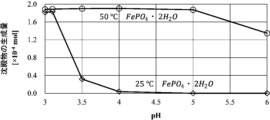
- 1 is a graph showing the relationship between the pH of a phosphorus-containing liquid and the amount of iron phosphate produced for each temperature of the phosphorus-containing liquid.
- 1 is a graph showing the relationship between the pH of a phosphorus-containing liquid and the amount of aluminum phosphate produced for each temperature of the phosphorus-containing liquid.
- 1 is an XRD pattern of the precipitate of Example 1.
- FIG. 1 is a flow chart showing the flow of the method for producing a phosphate according to the present embodiment.
- the method for producing a phosphate according to the present embodiment is a method for recovering phosphorus from a starting material in the form of a target phosphate (e.g., at least one selected from the group consisting of iron phosphate and aluminum phosphate), and includes an acid leaching step (S1) and a precipitation step (S2) in this order.
- a target phosphate e.g., at least one selected from the group consisting of iron phosphate and aluminum phosphate
- S1 acid leaching step
- S2 precipitation step
- ⁇ Acid leaching step (S1)> components contained in the starting material are leached with acid to obtain a phosphorus-containing liquid. Specifically, for example, acid is added to the starting material, the mixture is stirred, and then filtered. As a result, a residue (I) and a leachate (A) are obtained. The leachate (A) is the phosphorus-containing liquid.
- the acid used in the acid leaching step (S1) may be at least one selected from the group consisting of nitric acid, hydrochloric acid, sulfuric acid, phosphoric acid, and organic acids (e.g., citric acid), with nitric acid or hydrochloric acid being preferred, and nitric acid being more preferred.
- the concentration of the acid is not particularly limited, but is preferably 0.1 to 1.5M, and more preferably 0.3 to 0.8M.
- pH is measured in accordance with JIS Z8802:2011 "pH measurement method" (hereinafter the same).
- the temperature when measuring pH is 25°C unless otherwise specified.
- the leaching time is preferably 0.4 to 0.5 h because the contents of P, Fe, and Al in the obtained phosphorus-containing liquid are high to a certain extent and the contents of other elements (such as Mg) are not too high. This tendency remains the same even when scaled up.
- ⁇ Precipitation Step (S2)> an alkali is added to the phosphorus-containing liquid obtained in the acid leaching step (S1) to obtain a precipitate containing phosphate. Specifically, for example, an alkali is added to the phosphorus-containing liquid, and then the liquid is filtered. This results in a precipitate (II) and a filtrate (B). The precipitate (II) is the precipitate.
- Examples of the alkali used in the precipitation step (S2) include sodium hydroxide, potassium hydroxide, calcium hydroxide, and aqueous ammonia (NH 4 OH). Among these, ammonia water is preferred because it does not contain unnecessary cations.
- the concentration of the aqueous ammonia is not particularly limited, but is preferably from 20 to 40% by mass, and more preferably from 25 to 35% by mass.
- the inventors adjusted the pH of the phosphorus-containing liquid by adding ammonia water (concentration: 28% by mass) as an alkali to the phosphorus-containing liquid at a temperature of 25°C or 50°C, and confirmed the amount of precipitate that formed (amount of precipitate produced). Specifically, they confirmed the amount of iron phosphate and aluminum phosphate produced in the precipitate. The results are shown in Figures 2 and 3.
- Fig. 2 is a graph showing the relationship between the pH of the phosphorus-containing liquid and the amount of iron phosphate produced for each temperature of the phosphorus-containing liquid.
- Fig. 3 is a graph showing the relationship between the pH of the phosphorus-containing liquid and the amount of aluminum phosphate produced for each temperature of the phosphorus-containing liquid. The findings obtained from FIG. 2 and FIG. 3 will be described.
- the amount of iron phosphate (FePO4.2H2O ) produced is large, but as the pH increases, the amount of iron phosphate produced decreases and instead the amount of iron hydroxide produced (not shown in FIG. 2) increases.
- the amount of aluminum phosphate ( AlPO4.2H2O ) produced gradually increases as the pH increases, reaching a maximum at a pH of 4 to 5. However, at a pH above 5, the amount of aluminum phosphate produced decreases, and instead, the amount of aluminum hydroxide produced (not shown in Figure 3) increases.
- the temperature of the phosphorus-containing liquid is raised to 50°C, and then an alkali is added to adjust the pH to 4.
- an alkali is added to adjust the pH to 4.
- iron phosphate being obtained as the phosphate (however, the precipitate that is produced contains compounds other than phosphate, such as aluminum hydroxide).
- an additional raw material may be added to the phosphorus-containing liquid as necessary.
- the additional raw material is preferably selected according to the target phosphate and the content of each element (the element constituting the target phosphate) in the phosphorus-containing liquid.
- iron phosphate FePO4
- a phosphoric acid liquid whose concentration has been adjusted is added as an additional raw material so that the molar ratio of Fe to P in the phosphorus-containing liquid is 1:1. This allows Fe and P to react with each other without any excess, and the purity of the iron phosphate contained in the precipitate can be increased.
- Example 1 First, in the acid leaching step (S1), steelmaking slag having a particle size of 355 ⁇ m or less was added to nitric acid (concentration: 0.5 M) and then stirred for 0.4 h to obtain a phosphorus-containing liquid. Next, in the precipitation step (S2), ammonia water (concentration: 28% by mass) was added to the phosphorus-containing liquid kept at 25° C. while stirring at 200 rpm to adjust the pH to 4, and a precipitate was generated. More specifically, the pH of the phosphorus-containing liquid was increased by adding ammonia water, and the solution was stirred for 0.5 h from the point when the pH became constant, and then allowed to stand for 0.5 h.
- S1 steelmaking slag having a particle size of 355 ⁇ m or less was added to nitric acid (concentration: 0.5 M) and then stirred for 0.4 h to obtain a phosphorus-containing liquid.
- S2 ammonia water (concentration: 28%
- Fig. 4 is an XRD pattern of the precipitate of Example 1. From the XRD pattern shown in Fig. 4, it was found that aluminum phosphate (AlPO 4 ) was obtained as the phosphate contained in the precipitate.
- Example 2 In the precipitation step (S2), the pH of the phosphorus-containing liquid at a temperature of 25° C. was adjusted to 3. Except for this, the same procedure as in Example 1 was followed to generate a precipitate. As a result, it was found that iron phosphate (FePO 4 ) was obtained as the phosphate contained in the precipitate.
- FePO 4 iron phosphate
- Example 3 In the precipitation step (S2), the pH of the phosphorus-containing liquid at a temperature of 50° C. was adjusted to 3. Except for this, the same procedure as in Example 1 was followed to generate a precipitate. As a result, it was found that the precipitate contained iron phosphate (FePO 4 ). The precipitate also contained iron hydroxide and aluminum hydroxide.
- Example 4 In the precipitation step (S2), the pH of the phosphorus-containing liquid at 25° C. was adjusted to 3.5. Except for this, the precipitation was carried out in the same manner as in Example 1. As a result, it was found that the phosphates contained in the precipitate were aluminum phosphate (AlPO 4 ) and iron phosphate (FePO 4 ) in a molar ratio of 3:1.
- Example 5 In the precipitation step (S2), the pH of the phosphorus-containing liquid at 25° C. was adjusted to 3, but before that, a phosphoric acid solution with an adjusted concentration was added as an additional raw material so that the molar ratio of Fe to P contained in the phosphorus-containing liquid was 1:1. Otherwise, a precipitate was generated in the same manner as in Example 1. As a result, it was found that iron phosphate (FePO 4 ) was obtained as the phosphate contained in the precipitate. Furthermore, analysis of the filtrate revealed that the content of Fe and P was zero. In other words, the purity of the iron phosphate contained in the precipitate could be increased.
- FePO 4 iron phosphate
Landscapes
- Chemical & Material Sciences (AREA)
- Organic Chemistry (AREA)
- Inorganic Chemistry (AREA)
- Processing Of Solid Wastes (AREA)
- Manufacture And Refinement Of Metals (AREA)
Priority Applications (3)
| Application Number | Priority Date | Filing Date | Title |
|---|---|---|---|
| KR1020257041286A KR20260008133A (ko) | 2023-07-12 | 2024-06-17 | 인산염의 제조 방법 |
| EP24839423.1A EP4711331A1 (en) | 2023-07-12 | 2024-06-17 | Method for producing phosphate |
| JP2024562271A JPWO2025013527A1 (https=) | 2023-07-12 | 2024-06-17 |
Applications Claiming Priority (2)
| Application Number | Priority Date | Filing Date | Title |
|---|---|---|---|
| JP2023-114247 | 2023-07-12 | ||
| JP2023114247 | 2023-07-12 |
Publications (1)
| Publication Number | Publication Date |
|---|---|
| WO2025013527A1 true WO2025013527A1 (ja) | 2025-01-16 |
Family
ID=94215566
Family Applications (1)
| Application Number | Title | Priority Date | Filing Date |
|---|---|---|---|
| PCT/JP2024/021853 Pending WO2025013527A1 (ja) | 2023-07-12 | 2024-06-17 | リン酸塩の製造方法 |
Country Status (5)
| Country | Link |
|---|---|
| EP (1) | EP4711331A1 (https=) |
| JP (1) | JPWO2025013527A1 (https=) |
| KR (1) | KR20260008133A (https=) |
| TW (1) | TW202517577A (https=) |
| WO (1) | WO2025013527A1 (https=) |
Citations (6)
| Publication number | Priority date | Publication date | Assignee | Title |
|---|---|---|---|---|
| JP2001130903A (ja) * | 1999-08-23 | 2001-05-15 | Nkk Plant Engineering Corp | リン酸塩回収方法 |
| JP2011020892A (ja) * | 2009-07-15 | 2011-02-03 | Ryoko Lime Industry Co Ltd | ろ過・沈降性に優れたアモルファスリン酸アルミニウムの製造方法 |
| JP2016172654A (ja) * | 2015-03-16 | 2016-09-29 | 地方独立行政法人 岩手県工業技術センター | リン酸鉄の回収方法 |
| WO2016199896A1 (ja) * | 2015-06-11 | 2016-12-15 | 久夫 大竹 | 被処理水中のリンの回収システム、被処理水中のリンの回収方法、肥料及び肥料原料並びに黄リン原料 |
| JP2020018951A (ja) * | 2018-07-30 | 2020-02-06 | 日本製鉄株式会社 | 鉄鋼スラグからリン酸塩を回収する方法 |
| JP2022150640A (ja) | 2021-03-26 | 2022-10-07 | 株式会社北匠 | リン化合物の製造方法 |
-
2024
- 2024-06-17 KR KR1020257041286A patent/KR20260008133A/ko active Pending
- 2024-06-17 JP JP2024562271A patent/JPWO2025013527A1/ja active Pending
- 2024-06-17 WO PCT/JP2024/021853 patent/WO2025013527A1/ja active Pending
- 2024-06-17 EP EP24839423.1A patent/EP4711331A1/en active Pending
- 2024-07-08 TW TW113125421A patent/TW202517577A/zh unknown
Patent Citations (6)
| Publication number | Priority date | Publication date | Assignee | Title |
|---|---|---|---|---|
| JP2001130903A (ja) * | 1999-08-23 | 2001-05-15 | Nkk Plant Engineering Corp | リン酸塩回収方法 |
| JP2011020892A (ja) * | 2009-07-15 | 2011-02-03 | Ryoko Lime Industry Co Ltd | ろ過・沈降性に優れたアモルファスリン酸アルミニウムの製造方法 |
| JP2016172654A (ja) * | 2015-03-16 | 2016-09-29 | 地方独立行政法人 岩手県工業技術センター | リン酸鉄の回収方法 |
| WO2016199896A1 (ja) * | 2015-06-11 | 2016-12-15 | 久夫 大竹 | 被処理水中のリンの回収システム、被処理水中のリンの回収方法、肥料及び肥料原料並びに黄リン原料 |
| JP2020018951A (ja) * | 2018-07-30 | 2020-02-06 | 日本製鉄株式会社 | 鉄鋼スラグからリン酸塩を回収する方法 |
| JP2022150640A (ja) | 2021-03-26 | 2022-10-07 | 株式会社北匠 | リン化合物の製造方法 |
Non-Patent Citations (1)
| Title |
|---|
| SUGIYAMA SHIGERU, HSIAO LI-HAO, TOKUNAGA TAIZO, HASHIMOTO TAKUMI, HABARA MASAKI, SHIMODA NAOHIRO, LIU JHY-CHERN, ABE SEIICHI, YAMA: "PHOSPHORUS RECOVERY FROM SEWAGE-SLUDGE MOLTEN SLAG USING A COMBINATION OF ACID-DISSOLUTION, ALKALI-PRECIPITATION, AND ION-EXCHANGE", PHOSPHORUS RESEARCH BULLETIN, TOKYO, JP, vol. 38, no. 0, 1 January 2022 (2022-01-01), JP , pages 60 - 66, XP093261036, ISSN: 0918-4783, DOI: 10.3363/prb.38.60 * |
Also Published As
| Publication number | Publication date |
|---|---|
| KR20260008133A (ko) | 2026-01-15 |
| TW202517577A (zh) | 2025-05-01 |
| JPWO2025013527A1 (https=) | 2025-01-16 |
| EP4711331A1 (en) | 2026-03-18 |
Similar Documents
| Publication | Publication Date | Title |
|---|---|---|
| KR102161651B1 (ko) | 농업 및 식품산업용 인산 공급원 | |
| CN106185853B (zh) | 生产饲料级湿法净化磷酸联产高纯度高白度半水石膏的方法 | |
| WO2025013527A1 (ja) | リン酸塩の製造方法 | |
| CN109250736A (zh) | 利用反浮选磷尾矿制备活性氧化镁的方法 | |
| CN103466583B (zh) | 一种磷铁氧化渣制取磷酸铁的方法 | |
| JP6326904B2 (ja) | りん酸肥料原料及びその製造方法 | |
| JP2015140294A (ja) | リン酸質肥料原料、リン酸質肥料およびその製造方法 | |
| JP7795004B2 (ja) | リン酸塩の製造方法 | |
| JP6804132B2 (ja) | けい酸質肥料およびその製造方法 | |
| CN110734349B (zh) | 一种利用皮江法炼镁废渣制备的钙镁磷复合肥及其方法 | |
| TWI922199B (zh) | 磷酸鐵之製造方法 | |
| CN116281911B (zh) | 一种利用钢渣制备羟基磷灰石的方法 | |
| WO2025187296A1 (ja) | リン酸鉄の製造方法 | |
| CN116199203A (zh) | 一种通过硫酸钠和磷酸二氢铵制备六偏磷酸钠的方法 | |
| JP7079101B2 (ja) | けい酸質肥料の製造方法 | |
| TWI921838B (zh) | 磷酸鹽之製造方法 | |
| JP7670960B2 (ja) | リン酸質肥料の製造方法 | |
| CN109319896A (zh) | 用粉煤灰和钒钛磁铁矿制备絮凝剂的方法 | |
| JP2025066471A (ja) | リン化合物の製造方法 | |
| CN108726495A (zh) | 湿法磷酸生产用复合阻垢剂及其制备方法和使用方法 | |
| JP2003206133A (ja) | 溶出するフッ素を低下させた石膏 | |
| JPS63265805A (ja) | リン酸アルミニウムの製造方法 | |
| US2102119A (en) | Process of producing a slag soil conditioner | |
| CN103397187A (zh) | 一种利用硝酸活化高钙高磷钒渣提钒的方法 | |
| US2535986A (en) | Purification of phosphor components |
Legal Events
| Date | Code | Title | Description |
|---|---|---|---|
| WWE | Wipo information: entry into national phase |
Ref document number: 2024562271 Country of ref document: JP |
|
| 121 | Ep: the epo has been informed by wipo that ep was designated in this application |
Ref document number: 24839423 Country of ref document: EP Kind code of ref document: A1 |
|
| ENP | Entry into the national phase |
Ref document number: 1020257041286 Country of ref document: KR Free format text: ST27 STATUS EVENT CODE: A-0-1-A10-A15-NAP-PA0105 (AS PROVIDED BY THE NATIONAL OFFICE) |
|
| WWE | Wipo information: entry into national phase |
Ref document number: 1020257041286 Country of ref document: KR Ref document number: 2024839423 Country of ref document: EP |
|
| WWE | Wipo information: entry into national phase |
Ref document number: 202517125126 Country of ref document: IN |
|
| ENP | Entry into the national phase |
Ref document number: 2024839423 Country of ref document: EP Effective date: 20251210 |
|
| ENP | Entry into the national phase |
Ref document number: 2024839423 Country of ref document: EP Effective date: 20251210 |
|
| WWP | Wipo information: published in national office |
Ref document number: 202517125126 Country of ref document: IN |
|
| ENP | Entry into the national phase |
Ref document number: 2024839423 Country of ref document: EP Effective date: 20251210 |
|
| REG | Reference to national code |
Ref country code: BR Ref legal event code: B01A Ref document number: 112025028135 Country of ref document: BR |
|
| ENP | Entry into the national phase |
Ref document number: 2024839423 Country of ref document: EP Effective date: 20251210 |
|
| ENP | Entry into the national phase |
Ref document number: 2024839423 Country of ref document: EP Effective date: 20251210 |
|
| WWP | Wipo information: published in national office |
Ref document number: 1020257041286 Country of ref document: KR |
|
| ENP | Entry into the national phase |
Ref document number: 2024839423 Country of ref document: EP Effective date: 20251210 |
|
| ENP | Entry into the national phase |
Ref document number: 2024839423 Country of ref document: EP Effective date: 20251210 |
|
| ENP | Entry into the national phase |
Ref document number: 2024839423 Country of ref document: EP Effective date: 20251210 |
|
| ENP | Entry into the national phase |
Ref document number: 2024839423 Country of ref document: EP Effective date: 20251210 |
|
| NENP | Non-entry into the national phase |
Ref country code: DE |
|
| WWP | Wipo information: published in national office |
Ref document number: 2024839423 Country of ref document: EP |