WO2025013520A1 - 光学部材、及び遠赤外線センサモジュール - Google Patents
光学部材、及び遠赤外線センサモジュール Download PDFInfo
- Publication number
- WO2025013520A1 WO2025013520A1 PCT/JP2024/021751 JP2024021751W WO2025013520A1 WO 2025013520 A1 WO2025013520 A1 WO 2025013520A1 JP 2024021751 W JP2024021751 W JP 2024021751W WO 2025013520 A1 WO2025013520 A1 WO 2025013520A1
- Authority
- WO
- WIPO (PCT)
- Prior art keywords
- far
- white layer
- infrared
- optical member
- substrate
- Prior art date
- Legal status (The legal status is an assumption and is not a legal conclusion. Google has not performed a legal analysis and makes no representation as to the accuracy of the status listed.)
- Pending
Links
Images


Classifications
-
- G—PHYSICS
- G02—OPTICS
- G02B—OPTICAL ELEMENTS, SYSTEMS OR APPARATUS
- G02B1/00—Optical elements characterised by the material of which they are made; Optical coatings for optical elements
- G02B1/10—Optical coatings produced by application to, or surface treatment of, optical elements
- G02B1/11—Anti-reflection coatings
- G02B1/113—Anti-reflection coatings using inorganic layer materials only
-
- G—PHYSICS
- G02—OPTICS
- G02B—OPTICAL ELEMENTS, SYSTEMS OR APPARATUS
- G02B5/00—Optical elements other than lenses
- G02B5/02—Diffusing elements; Afocal elements
-
- G—PHYSICS
- G02—OPTICS
- G02B—OPTICAL ELEMENTS, SYSTEMS OR APPARATUS
- G02B5/00—Optical elements other than lenses
- G02B5/20—Filters
- G02B5/26—Reflecting filters
Definitions
- the present invention relates to an optical member and a far-infrared sensor module equipped with the optical member.
- Patent Literature 1 discloses an infrared-transmitting substrate having an antireflection structure consisting of a plurality of fine recesses.
- Patent Document 2 discloses an infrared-transmitting optical filter that includes a matrix and fine particles dispersed in the matrix. It is described that the optical filter has a linear transmittance of 60% or more for light of at least a part of wavelengths in the wavelength range of 760 nm to 2000 nm, and can exhibit a white appearance.
- the infrared-transmitting substrate disclosed in Patent Document 1 is presumed to have excellent transmittance of far-infrared rays, but has poor scattering of visible light, and has a gray appearance.
- the infrared-transmitting optical filter disclosed in Patent Document 2 can exhibit a white color.
- the substrate and film constituting the optical filter do not transmit far-infrared rays, and it is presumed that the optical filter does not transmit far-infrared rays either.
- the film uses a resin that absorbs far-infrared rays and is thick, so it is presumed that the film does not transmit far-infrared rays.
- the present invention has been made in view of the above, and an object of the present invention is to provide an optical member that appropriately transmits far-infrared rays with wavelengths of 8 ⁇ m to 12 ⁇ m and exhibits a white color.
- the present disclosure provides an optical member or the like having the following configurations [1] to [12].
- the optical member of [1] or [2] having a white layer containing a resin matrix and fine particles dispersed in the resin matrix, and a substrate containing a supporting substrate.
- the supporting substrate includes at least one selected from the group consisting of a Si substrate, a Ge substrate, a ZnS substrate and a chalcogenide glass.
- the resin matrix includes at least one of a fluororesin and a polyolefin resin.
- the far-infrared antireflection coating contains at least one selected from the group consisting of NiO, diamond-like carbon, ZrO 2 , ZnS, ZnSe, Ge, Si, MgO, ZnO, YF 3 , and MgF 2.
- the present invention provides an optical component that adequately transmits far-infrared rays with wavelengths of 8 ⁇ m to 12 ⁇ m and exhibits a white color.
- FIG. 1 is a schematic cross-sectional view of an optical member according to one embodiment of the present invention.
- 1 is a schematic cross-sectional view of an optical member according to one embodiment of the present invention.
- FIG. 1 is a diagram showing the relationship between the transmittance and L * of an optical member.
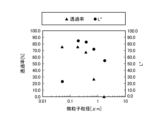
- FIG. 4 is a diagram showing the relationship between the particle diameter of fine particles in an optical member and the transmittance and L * .
- the term "to” indicating a range of values is used to mean that the values before and after it are included as the lower and upper limits, unless otherwise specified.
- the "average transmittance" in a particular wavelength range is the arithmetic mean of the transmittance per 1 nm in that wavelength range.
- the "average extinction coefficient” in a particular wavelength range is the arithmetic mean of the extinction coefficients per nm in that wavelength range.
- visible light refers to light having a wavelength of 380 nm to 780 nm.
- far infrared rays refers to light having a wavelength of 8 ⁇ m to 12 ⁇ m, but may also be light having a wavelength of 8 ⁇ m to 14 ⁇ m.
- the optical member according to the present invention (hereinafter also referred to as "this member") has, in the CIE1976 (L * a * b * ) color system measured by the SCE method based on JIS-Z8772:2009 geometric condition c, L * is 50 or more, a * is -15 or more and 15 or less, and b * is -15 or more and 15 or less.
- L * a * b * obtained by the above method will be referred to as L * a * b * .
- L * a * b * in the above ranges, the member exhibits a white appearance.
- L * of the member is preferably 60 or more, more preferably 70 or more, and even more preferably 80 or more.
- a * of the member is preferably -10 or more and 10 or less, more preferably -8 or more and 8 or less, and even more preferably -5 or more and 5 or less.
- b * of the member is preferably -10 or more and 10 or less, more preferably -8 or more and 8 or less, and even more preferably -5 or more and 5 or less.
- the member has an average transmittance T FIR (%) of light having a wavelength of 8 ⁇ m to 12 ⁇ m of T FIR ⁇ 20.
- the average transmittance T FIR of the member for light having a wavelength of 8 ⁇ m to 12 ⁇ m is preferably T FIR ⁇ 30, more preferably T FIR ⁇ 40, even more preferably T FIR ⁇ 50, particularly preferably T FIR ⁇ 60, and most preferably T FIR ⁇ 70.
- the sum (L * +T FIR ) of L * and the average transmittance T FIR of light with a wavelength of 8 ⁇ m to 12 ⁇ m is preferably equal to or greater than 90, more preferably equal to or greater than 100, even more preferably equal to or greater than 115, particularly preferably equal to or greater than 130, and most preferably equal to or greater than 145.
- (L * +T FIR ) is within the above range, excellent whiteness and excellent far-infrared transmittance can be more effectively achieved.
- the present optical member 10 may have a white layer 20 that scatters visible light, and a substrate 30.
- the principal surface of the present member 10 that is closer to the white layer 20 than the substrate 30 is the light incident side, and the principal surface opposite to this principal surface is the light exit side.
- the base material 30 has a far-infrared ray anti-reflection film 32 as shown in FIG.
- the substrate 30 has a supporting substrate 31, a far-infrared anti-reflection film 32a between the substrate 30 and the white layer 20, and a far-infrared anti-reflection film 32b on the side of the substrate 30 far from the white layer.
- the substrate 30 may have only one of the far-infrared anti-reflection films 32a and 32b.
- the present member 10 preferably has the far-infrared anti-reflection film 32a and the far-infrared anti-reflection film 32b. Unless otherwise specified, when there is no distinction between the far-infrared anti-reflection film 32a and the far-infrared anti-reflection film 32b, they are appropriately described as the far-infrared anti-reflection film 32.
- the member 10 may further include other functional layers as long as they do not impede the effects of the present invention.
- other functional layers include an adhesion layer, a protective layer, and an ultraviolet absorbing layer.
- the white layer 20 and the substrate 30 are described in detail below.
- the white layer 20 may include a resin matrix and fine particles dispersed in the resin matrix.
- the white layer 20 can appropriately scatter visible light by Mie scattering, and can suppress scattering of far-infrared rays in the white layer 20.
- the particle size of the fine particles can be evaluated based on the average diameter of the fine particles in the cross section of the white layer 20.
- the average diameter of the fine particles in the cross section of the white layer 20 is preferably 0.1 ⁇ m or more, more preferably 0.12 ⁇ m or more, and even more preferably 0.15 ⁇ m or more.
- the average diameter of the fine particles in the cross section of the white layer 20 is within the above range, visible light can be appropriately scattered by Mie scattering, making it easy to obtain a white appearance.
- the average diameter of the fine particles in the cross section of the white layer 20 is preferably 1 ⁇ m or less, more preferably 0.7 ⁇ m or less, and even more preferably 0.5 ⁇ m or less.
- the average diameter of the fine particles in the cross section of the white layer 20 is within the above range, scattering of far-infrared rays in the white layer 20 is suppressed, making it easier to obtain high far-infrared transmittance, and also making it easier to obtain a white appearance by appropriately scattering visible light through Mie scattering.
- the fine particles may exist as primary particles or as secondary particles.
- the average diameter refers to the average diameter of the secondary particles. The method for measuring the average diameter of the fine particles in the cross section of the white layer 20 will be described later in the Examples section.
- the fine particles inorganic fine particles can be used.
- the fine particles preferably contain at least one selected from the group consisting of SiO 2 , metal oxide, Si, Ge, II-VI group semiconductor, and III-V group semiconductor. Since the fine particles are transparent to visible light and are easy to obtain a white appearance, it is more preferable that the fine particles contain at least one of SiO 2 and metal oxide. Since the refractive index is particularly high, it is even more preferable that the fine particles contain at least one selected from the group consisting of TiO 2 , ZrO 2 , Nb 2 O 5 , and Ta 2 O 5. Among them, since ultrafine particles are easy to obtain and the refractive index is high, it is most preferable that the fine particles contain TiO 2 .
- the volume concentration of the fine particles in the white layer 20 is preferably 4% or more, more preferably 10% or more, more preferably 15% or more, and even more preferably 18% or more. When the volume concentration of the fine particles is within the above range, the white layer 20 exhibits sufficient scattering intensity for visible light without making the thickness of the white layer 20 too large, and it is easy to obtain a white appearance.
- the volume concentration of the fine particles in the white layer 20 is preferably 80% or less, more preferably 50% or less, and even more preferably 30% or less.
- the volume concentration of the fine particles is within the above range, the fine particles are well dispersed in the resin matrix, and scattering and absorption of far-infrared rays by the fine particles is suppressed, making it easy to obtain a high far-infrared transmittance.
- the resin matrix holds the particulates dispersed within the resin matrix. Since the member 10 may be attached to the surface of an optical device as a sensor cover, it is preferable to use a resin with excellent weather resistance for the resin matrix. By using a resin with high weather resistance for the resin matrix, not only can deformation and deterioration of the white layer 20 be suppressed, but also a decrease in design due to discoloration can be suppressed. From the viewpoint of increasing the transmittance of far-infrared rays, it is preferable to use a resin with low absorption of far-infrared rays for the resin matrix.
- the refractive index of the resin matrix for light having a wavelength of 550 nm is preferably 1.5 or less, more preferably 1.4 or less, and even more preferably 1.3 or less.
- the refractive index of a resin matrix for light with a wavelength of 550 nm is generally 1 or more.
- the resin used in the resin matrix may be any resin capable of holding the microparticles in a dispersed state.
- the specific material is arbitrary, but considering the refractive index, weather resistance, and far-infrared transmittance of the resin matrix, it is preferable that the resin matrix contains at least one of a fluororesin and a polyolefin resin.
- the resin matrix preferably contains a fluororesin, which is a resin with high weather resistance.
- a fluororesin include vinyl fluoride resin, vinylidene fluoride resin, ethylene-tetrafluoroethylene resin, chlorotrifluoroethylene resin, chlorotrifluoroethylene-ethylene resin, tetrafluoroethylene-hexafluoropropylene resin, and tetrafluoroethylene-perfluoro(alkyl vinyl ether) resin.
- the fluororesin is preferably an ethylene-tetrafluoroethylene resin, a tetrafluoroethylene-hexafluoropropylene resin, or a tetrafluoroethylene-perfluoro(alkyl vinyl ether) resin.
- a resin having high far-infrared transmittance it is preferable to use a resin having a molecular structure that has little absorption at wavelengths of 8 ⁇ m to 12 ⁇ m, and it is preferable to use a polyolefin resin.
- polyolefin resins include polyethylene and high-density polyethylene.
- the thickness of the white layer 20 is preferably 1 ⁇ m or more, more preferably 2 ⁇ m or more, and even more preferably 4 ⁇ m or more. From the viewpoint of suppressing absorption of far-infrared rays by the resin matrix and obtaining high transmittance of far-infrared rays, the thickness of the white layer 20 is preferably less than 10 ⁇ m, more preferably less than 8 ⁇ m, and even more preferably less than 7 ⁇ m.
- the thickness of the white layer 20 is preferably less than 100 ⁇ m, more preferably less than 60 ⁇ m, even more preferably less than 40 ⁇ m, particularly preferably less than 15 ⁇ m, even more preferably less than 10 ⁇ m, and most preferably less than 7 ⁇ m.
- Examples of methods for forming the white layer 20 include a method of applying a white layer precursor containing a curable resin matrix and fine particles onto the substrate 30 by a method such as spin coating, curtain coating, flow coating, dip coating, spray coating, screen coating, inkjet, etc.
- the white layer precursor may contain a solvent and various additives.
- the fine particles are dispersed in the resin matrix by, for example, rotary stirring, a homomixer, an ultrasonic homogenizer, a high-pressure homogenizer, or high-temperature spraying.
- the substrate 30 transmits far-infrared rays.
- the average transmittance of the substrate 30 for light having a wavelength of 8 ⁇ m to 12 ⁇ m is preferably 30% or more, more preferably 40% or more, even more preferably 45% or more, particularly preferably 60% or more, even more preferably 70% or more, and most preferably 75% or more.
- the thickness of the base material 30 is preferably equal to or greater than 0.1 mm, more preferably equal to or greater than 0.2 mm, and even more preferably equal to or greater than 0.3 mm. From the viewpoint of ensuring the far-infrared transmittance of the present member 10 and making the present member 10 thin, the thickness of the base material 30 is preferably 5 mm or less, more preferably 2 mm or less, and even more preferably 1 mm or less.
- the substrate 30 includes a supporting substrate 31. If the substrate 30 does not include any film other than the supporting substrate 31, such as a far-infrared anti-reflection film, the supporting substrate 31 itself can be the substrate 30.
- the support substrate 31 preferably includes at least one selected from the group consisting of a Si substrate, a Ge substrate, a ZnS substrate, and a chalcogenide glass substrate. Among these, it is more preferable that the support substrate 31 includes at least one of a Si substrate and a Ge substrate, because of its high refractive index for visible light. If the support substrate 31 has a high refractive index for visible light, the visible light that has passed through the white layer and reached the support substrate 31 is likely to be reflected at the interface of the support substrate 31. When visible light is reflected at the interface of the support substrate 31, the reflected visible light reenters the white layer and is scattered, making it easier to obtain a whiter appearance.
- the refractive index of the support substrate 31 for light having a wavelength of 550 nm is preferably 2 or more, more preferably 3 or more, and even more preferably 4 or more.
- the refractive index of the support substrate 31 is not particularly limited, but generally can be 4.5 or less.
- the chalcogenide glass contains, in atomic %, Ge+Ga; 7% to 25%, Sb; 0% to 35%, Bi; 0% to 20%, Zn; 0% to 20%, Sn: 0% to 20%, Si; 0% to 20%, La: 0% to 20%, S+Se+Te; 55% to 80%, Ti; 0.005% to 0.3%, Li + Na + K + Cs; 0% to 20%, It is preferable that the content is 0% to 20% of F+Cl+Br+I.
- the chalcogenide glass preferably has a glass transition point (Tg) of 140°C to 550°C.
- the far-infrared ray anti-reflection film 32 suppresses reflection of far-infrared rays on the main surface of the substrate farther from the white layer and at the interface between the white layer and the substrate.
- the extinction coefficient of the far-infrared anti-reflection film 32 for light with a wavelength of 10 ⁇ m is preferably 0.05 or less, more preferably 0.03 or less, even more preferably 0.025 or less, particularly preferably 0.02 or less, and most preferably 0.01 or less.
- the extinction coefficient of the far-infrared anti-reflection film 32 for light with a wavelength of 10 ⁇ m can be determined by fitting an optical model using, for example, polarization information obtained by an infrared spectroscopic ellipsometer (IR-VASE-UT, manufactured by J.A. Woollam Co.) and a spectral transmission spectrum obtained by a Fourier transform infrared spectrometer (Nicolet iS10, manufactured by ThermoScientific Co.).
- the far-infrared anti-reflection film 32 contains, for example, at least one of Si, Ge, ZnS, ZnSe, YF 3 , MgF 2 , diamond-like carbon, and metal oxide.
- the metal oxide used for the far-infrared anti-reflection film 32 at least one of NiO, Al 2 O 3 , CuO, ZnO, ZrO 2 , Bi 2 O 3 , Y 2 O 3 , and MgO is preferable because it has a low extinction coefficient for far-infrared rays.
- the far-infrared anti-reflection film 32 preferably contains at least one material selected from the group consisting of NiO, diamond-like carbon, ZrO 2 , ZnS, ZnSe, Ge, Si, MgO, ZnO, YF 3 , and MgF 2 because it has a low extinction coefficient for far-infrared rays.
- the far-infrared anti-reflection film 32 is preferably mainly composed of a metal oxide.
- the term "main component" refers to a content of 50 mass % or more in the entire far-infrared anti-reflection film 32.
- the far-infrared anti-reflection film 32 is preferably made of at least one material selected from the group consisting of NiO, CuO, ZnO, ZrO2 , Bi2O3 , Y2O3 , and MgO , since these have low extinction coefficients for far-infrared rays.
- the far-infrared anti-reflection film 32 can be formed by, for example, sputtering or vapor deposition. From the viewpoint of improving the adhesion between the far-infrared anti-reflection film 32 and the supporting substrate 31, it is preferable to form it by sputtering.
- the far-infrared anti-reflection film 32 is made of NiO, it is preferable to form the far-infrared anti-reflection film 32 by heating the surface of the supporting substrate 31 to 100°C to 300°C.
- the optical member 10 according to the present invention is suitable for use in a far-infrared sensor module because it properly transmits far-infrared rays and has a white appearance.
- the far-infrared sensor module using the optical member 10 according to the present embodiment exhibits good design properties, and is particularly suitable in an environment in which it is installed exposed to the outside.
- Specific applications include sensors mounted on vehicles, sensors mounted on drones, sensors for surveillance cameras, sensors mounted on smartphones, sensors for wearable terminals, sensors mounted on home appliances, sensors for street lighting, sensors for IP cameras, and motion sensors.
- Examples 5 to 13, 18, and 19 are examples, and Examples 1 to 4 and 14 to 17 are comparative examples.
- the characteristics of Examples 11 to 19 were calculated by simulation.
- the white layer thus produced was subjected to CP processing to obtain a sample for SEM observation.
- the sample for SEM observation was observed under the following conditions using an SEM (SU8230, manufactured by Hitachi High-Technologies Corporation).
- the SEM images obtained by the observation were imported into the image processing software Image J and binarized using "Threshold (Otsu, B&W)".
- the volume concentration of the fine particles was calculated from the ratio of the area occupied by the fine particles in the binarized image.
- the average diameter of the fine particles in the cross section of the white layer was calculated by "Analyze Particle” after cutting out the area where two or more particles were connected in the binarized image using "Watershed”. When calculating the average diameter, particles on the edge of the image were excluded in order to obtain the correct particle size.
- the average transmittance is the average value of the transmittance of light at each wavelength from 8 ⁇ m to 12 ⁇ m.
- the refractive index was measured using an infrared spectroscopic ellipsometer (MD2000DI, manufactured by J. A. Woollam Co., Ltd.) Here, the refractive index is the refractive index for light with a wavelength of 550 nm.
- Example 1 A 0.5 mm thick Si support substrate was used as the substrate. No white layer was formed.
- NiO films were formed as far-infrared anti-reflection films on both sides of the support substrate of Example 1. No white layer was formed.
- a load-lock sputtering device (RAS-1100BII, manufactured by Shincron) was used for film formation, and a NiO film having a film thickness of about 1.2 ⁇ m was formed by a post-oxidation sputtering method.
- the film formation conditions for the NiO film were as follows.
- Example 4 A member was produced in the same manner as in Example 3, except that the composition of the etching solution was adjusted so as to obtain the arithmetic mean height Sa, the average length RSm of the roughness curve element, and the root mean square slope R ⁇ q shown in Table 1.
- Example 5 A white layer containing TiO2 as fine particles and fluororesin as a resin matrix was formed on the substrate of Example 1.
- the white layer was formed by applying a white layer precursor to the substrate by spin coating, and then drying in an electric furnace at 190°C for 9 minutes.
- the white layer precursor was composed of a fluororesin paint containing TiO2 fine particles (Bonflon GT #2000, manufactured by AGC Coatec), a fluororesin paint (Bonflon #2050 Clear, manufactured by AGC Coatec), and xylene, and the composition was adjusted to obtain the white layer thickness and fine particle concentration shown in Table 1.
- the TiO2 fine particles were present as secondary particles in the white layer.
- Example 6 An optical member was produced in the same manner as in Example 5, except that the composition of the white layer precursor and the rotation speed of the spin coater were adjusted so that the white layer thickness in Table 1 was obtained.
- Example 8 An optical member was produced in the same manner as in Example 5, except that the substrate was changed to the substrate in Example 2, and the composition of the white layer precursor and the rotation speed of the spin coater were adjusted so as to obtain the white layer thickness in Table 1.
- a reference white layer (hereinafter, the reference white layer) was actually prepared.
- 100 parts by mass of 1,11-dodecadiene (Tokyo Chemical Industry Co., Ltd.) were dissolved in methyl ethyl ketone with 125 parts by mass of trifunctional alkylthiol (Actcure SS32, Kawaguchi Chemical Industry Co., Ltd.) and 2.2 parts by mass of azo polymerization initiator (V-65, Fujifilm Wako Pure Chemical Industries Co., Ltd.), TiO2 fine particles were added, and the mixture was stirred by rotation to prepare a white layer precursor.
- the white layer precursor was dropped onto a substrate, and then irradiated with UV light using an exposure machine to harden the mixture, forming a reference white layer whose resin matrix was a polyolefin resin.
- the refractive index n and extinction constant k of the fine particles and the substrate were obtained from a known database such as RefractiveIndex.INFO (https://refractiveindex.info/). A measured value was used as the constant k.
- the scattering cross section ⁇ sca and the absorption cross section ⁇ abs were calculated based on Mie's scattering theory.
- a correction coefficient for the scattering cross section ⁇ sca was calculated so that the spectrum of diffuse reflection obtained when the conditions of the reference white layer were reproduced would match the spectrum of diffuse reflection obtained from the reference white layer.
- the scattering cross section ⁇ sca multiplied by the above-mentioned correction coefficient is referred to as the scattering cross section ⁇ sca .
- the attenuation coefficient K and the scattering coefficient ⁇ were calculated from the scattering cross section ⁇ sca .
- the refractive index n and extinction constant k of the white layer at each fine particle concentration were calculated by Bruggeman's effective medium approximation. Using the calculated refractive index n and extinction constant k, the Fresnel reflection at the interface between the white layer and the air was calculated.
- Equation (1) is an example of an equation that expresses the scattered electric field strength.
- ⁇ is the phase difference between the incident wave and the reflected wave
- L is the distance that the incident light travels from the air-white layer interface to the white layer-substrate interface. Length (optical path length).
- the spectrum of the D65 light source was applied as the incident light source, and the spectrum of the diffuse reflection was calculated by integrating the scattering intensity over the entire range with respect to the incident angle.
- the spectrum of the diffuse reflection was converted to the CIE XYZ space by mathematical conversion according to CIE 1976, and the CIE XYZ space was further converted to calculate L * a * b * .
- the extinction coefficient ⁇ is proportional to the scattering cross section ⁇ sca and the absorption cross section ⁇ sbs , and a proportionality constant is obtained by dividing the scattering cross section ⁇ sca and the absorption cross section ⁇ sbs by the extinction coefficient ⁇ .
- the proportionality constant is From the scattering cross section ⁇ sca and the absorption cross section ⁇ sbs at each particle size, the pseudo n and k of the white layer for each particle size were obtained. The average far-infrared transmittance was calculated under the following conditions from the pseudo n and k. Viewing angle: 2 degrees Polarization: P, S mixed Incident angle: 0 degrees
- Tables 1 and 2 show the values of the properties of Examples 1 to 19.
- the "far-infrared anti-reflection film” column was marked with " ⁇ ".
- Tables 1 and 2 show the results of measurements of L* a * b * , T FIR , Sa, RSm, and R ⁇ q on the light incident side of each sample.
- high far-infrared transmittance and a white appearance can be achieved by appropriately selecting the material, concentration, and particle size of the fine particles, the material of the resin matrix, the thickness of the white layer, and the application of a far-infrared anti-reflection film. That is, in Examples 5 to 13, 18, and 19, which are working examples, high far-infrared transmittance and a white appearance can be achieved by having L * of 50 or more, a * of -15 to 15, b * of -15 to 15, and T FIR of 20% or more. On the other hand, it is understood that at least one of these conditions is not satisfied in Examples 1 to 4 and 14 to 17, which are comparative examples, and high far-infrared transmittance and a white appearance cannot be achieved at the same time.
- Examples 3 and 4 are comparative examples of optical members having a plurality of fine irregularities on the surface.
- Example 3 had a suitable irregular structure that scattered visible light and transmitted far infrared rays, and thus exhibited a higher L * than Example 1, but did not exhibit a sufficient value to obtain a white appearance.
- Example 4 is an example having a rougher irregular structure than Example 3.
- Example 4 had the same L * as Example 3, but hardly transmitted far infrared rays.
- the resin matrix is a fluororesin
- the fine particles are TiO2
- no far-infrared anti-reflection coating is provided.
- the fine particle concentration and the fine particle diameter are constant, and only the film thickness of the white layer is different.
- Examples 8 to 10 are examples having a far-infrared anti-reflection coating in which the resin matrix is a fluororesin and the fine particles are TiO 2.
- the fine particle concentration and the fine particle diameter are constant, and only the film thickness of the white layer is different.
- FIG. 3 shows the relationship between far-infrared transmittance and L * in Examples 5 to 7 and Examples 8 to 10.
- the far-infrared transmittance decreased as L * increased. This is thought to be because, as the thickness of the white layer increases, the amount of fine particles in the white layer increases, increasing the scattering of visible light, while the amount of resin matrix that absorbs far-infrared rays increases, resulting in more far-infrared rays being absorbed. Also, from FIG. 3, it can be seen that by providing a far-infrared anti-reflection film, a higher far-infrared transmittance can be obtained while showing the same level of L * as a member that does not have a far-infrared anti-reflection film.
- Examples 11 to 15 are examples in which the resin matrix is a polyolefin resin, the fine particles are TiO2 , and there is no far-infrared anti-reflection coating.
- Example 13 has the same fine particle concentration, fine particle diameter, and white layer thickness as Example 5, but is different in that the resin matrix is a polyolefin resin instead of a fluororesin.
- Example 13 showed the same L * as Example 5, but the far-infrared transmittance of Example 13 was significantly higher than that of Example 5. It is believed that high far-infrared transmittance can be obtained by using a resin with low far-infrared absorption as the resin matrix.
- Fig. 4 shows the relationship between the particle size of the microparticles and the far-infrared transmittance and L * for Examples 11 to 15.
- Fig. 4 shows that the larger the particle size of the microparticles, the lower the far-infrared transmittance. It is considered that when the particle size of the microparticles is excessive, the scattering of far-infrared rays by the microparticles increases, and thus the far-infrared transmittance decreases. 4, L * increases with increasing particle size, and then decreases. It is believed that by setting the particle size within an appropriate range, visible light is sufficiently scattered and high L * can be obtained.
- Examples 16 and 17 are examples in which the material of the fine particles is changed from Example 12. Examples 16 and 17 showed L * values significantly lower than Example 12. SiO2 and MgO have a lower scattering coefficient for visible light than TiO2 , and it is considered that high L * values are difficult to obtain when used as fine particles. However, even when SiO2 or MgO is used as fine particles, a higher L * value can be obtained by appropriately increasing the thickness of the white layer and the fine particle concentration, for example, compared to the configurations of Examples 16 and 17. However, when the thickness of the white layer and the fine particle concentration are increased, the far-infrared transmittance decreases. Regarding the far-infrared transmittance, Example 17 showed the highest value among Examples 12, 16, and 17. The high far-infrared transmittance of Example 17 is considered to be due to the high far-infrared transmittance of MgO.
- Examples 18 and 19 are examples in which the resin matrix is a polyolefin resin, the fine particles are TiO2 , and a far-infrared anti-reflection film is provided.
- Example 18 has the same fine particle concentration and fine particle diameter as Example 12, and shows the same L * , but the far-infrared transmittance is higher than that of Example 12. It can be seen that even in the case where the resin matrix is a polyolefin resin, a higher far-infrared transmittance can be obtained by providing a far-infrared anti-reflection film.
- Example 19 is an example in which the white layer is particularly thick. Example 19 shows that by using a resin with low far-infrared absorption for the resin matrix, a relatively high far-infrared transmittance can be obtained even if the white layer is thick.
- Example 15 exhibited ab * of less than -25. It is believed that Example 15 exhibited ab * with a large absolute value due to Mie resonance.
Landscapes
- Physics & Mathematics (AREA)
- General Physics & Mathematics (AREA)
- Optics & Photonics (AREA)
- Chemical & Material Sciences (AREA)
- Inorganic Chemistry (AREA)
- Optical Filters (AREA)
Priority Applications (2)
| Application Number | Priority Date | Filing Date | Title |
|---|---|---|---|
| CN202480044443.2A CN121443979A (zh) | 2023-07-12 | 2024-06-14 | 光学部件和远红外线传感器模块 |
| JP2025532459A JPWO2025013520A1 (https=) | 2023-07-12 | 2024-06-14 |
Applications Claiming Priority (2)
| Application Number | Priority Date | Filing Date | Title |
|---|---|---|---|
| JP2023114442 | 2023-07-12 | ||
| JP2023-114442 | 2023-07-12 |
Publications (1)
| Publication Number | Publication Date |
|---|---|
| WO2025013520A1 true WO2025013520A1 (ja) | 2025-01-16 |
Family
ID=94215446
Family Applications (1)
| Application Number | Title | Priority Date | Filing Date |
|---|---|---|---|
| PCT/JP2024/021751 Pending WO2025013520A1 (ja) | 2023-07-12 | 2024-06-14 | 光学部材、及び遠赤外線センサモジュール |
Country Status (3)
| Country | Link |
|---|---|
| JP (1) | JPWO2025013520A1 (https=) |
| CN (1) | CN121443979A (https=) |
| WO (1) | WO2025013520A1 (https=) |
Citations (4)
| Publication number | Priority date | Publication date | Assignee | Title |
|---|---|---|---|---|
| JP2010072616A (ja) * | 2008-08-20 | 2010-04-02 | Tokai Kogaku Kk | 赤外線通信用光学物品及び赤外線通信用受光部 |
| JP2019045687A (ja) * | 2017-09-01 | 2019-03-22 | 東海光学株式会社 | 光学製品及び赤外線センサーカバー |
| WO2021187430A1 (ja) * | 2020-03-16 | 2021-09-23 | 日東電工株式会社 | 光学フィルタ、その製造方法および光学モジュール |
| JP2023147564A (ja) * | 2022-03-30 | 2023-10-13 | 日東電工株式会社 | 赤外線ヒータ |
-
2024
- 2024-06-14 JP JP2025532459A patent/JPWO2025013520A1/ja active Pending
- 2024-06-14 WO PCT/JP2024/021751 patent/WO2025013520A1/ja active Pending
- 2024-06-14 CN CN202480044443.2A patent/CN121443979A/zh active Pending
Patent Citations (4)
| Publication number | Priority date | Publication date | Assignee | Title |
|---|---|---|---|---|
| JP2010072616A (ja) * | 2008-08-20 | 2010-04-02 | Tokai Kogaku Kk | 赤外線通信用光学物品及び赤外線通信用受光部 |
| JP2019045687A (ja) * | 2017-09-01 | 2019-03-22 | 東海光学株式会社 | 光学製品及び赤外線センサーカバー |
| WO2021187430A1 (ja) * | 2020-03-16 | 2021-09-23 | 日東電工株式会社 | 光学フィルタ、その製造方法および光学モジュール |
| JP2023147564A (ja) * | 2022-03-30 | 2023-10-13 | 日東電工株式会社 | 赤外線ヒータ |
Also Published As
| Publication number | Publication date |
|---|---|
| CN121443979A (zh) | 2026-01-30 |
| JPWO2025013520A1 (https=) | 2025-01-16 |
Similar Documents
| Publication | Publication Date | Title |
|---|---|---|
| US12338341B2 (en) | Infrared-cut filter | |
| CN107085255B (zh) | 光学部件及其制备方法 | |
| CN108369368B (zh) | 反射型透明屏幕 | |
| WO2020244219A1 (zh) | 近红外窄带滤光片及制作方法 | |
| TW201331614A (zh) | 抗反射塗佈層及其製造方法 | |
| TW202202334A (zh) | 抗反射膜 | |
| US20260104645A1 (en) | Apparatus and methods of electrically conductive optical semiconductor coating | |
| WO2019138751A1 (ja) | 画像表示装置 | |
| JP2025015823A (ja) | 導電性光半導体コーティングの装置及び方法 | |
| JP2016206682A (ja) | 光学素子 | |
| WO2019156076A1 (ja) | 防眩膜付き透明基体 | |
| WO2025013520A1 (ja) | 光学部材、及び遠赤外線センサモジュール | |
| US20200381138A1 (en) | Transparent conductive laminate | |
| CN117396446A (zh) | 带有层叠膜的基材 | |
| TWI651542B (zh) | 長波長紅外線抗反射疊層 | |
| WO2016060003A1 (ja) | 光学素子および光学素子の製造方法 | |
| TW202229929A (zh) | 光學積層體及物品 | |
| WO2025013805A1 (ja) | 光学部材、及び遠赤外線センサモジュール | |
| EP3376840A1 (en) | Spatially controlled conductivity in transparent oxide coatings | |
| WO2023153242A1 (ja) | 遠赤外線透過部材、遠赤外線センサ、車載用センサ、スマートフォン搭載用センサ、及びウェアラブル端末用センサ | |
| WO2022024744A1 (ja) | カバーガラス | |
| JPH10206602A (ja) | 導電性反射防止フィルム | |
| RU2430896C2 (ru) | Стеклянная пластина, имеющая тонкую пленку, сформированную на ней | |
| WO2019003579A1 (ja) | 遮熱性能を有する積層体 | |
| US12253698B2 (en) | Multilayer light-filtering structure and fabricating method thereof |
Legal Events
| Date | Code | Title | Description |
|---|---|---|---|
| 121 | Ep: the epo has been informed by wipo that ep was designated in this application |
Ref document number: 24839416 Country of ref document: EP Kind code of ref document: A1 |
|
| ENP | Entry into the national phase |
Ref document number: 2025532459 Country of ref document: JP Kind code of ref document: A |
|
| WWE | Wipo information: entry into national phase |
Ref document number: 2025532459 Country of ref document: JP |
|
| NENP | Non-entry into the national phase |
Ref country code: DE |