WO2025009067A1 - 紫外線硬化型塗料を用いた塗装方法及び塗装システム - Google Patents
紫外線硬化型塗料を用いた塗装方法及び塗装システム Download PDFInfo
- Publication number
- WO2025009067A1 WO2025009067A1 PCT/JP2023/024797 JP2023024797W WO2025009067A1 WO 2025009067 A1 WO2025009067 A1 WO 2025009067A1 JP 2023024797 W JP2023024797 W JP 2023024797W WO 2025009067 A1 WO2025009067 A1 WO 2025009067A1
- Authority
- WO
- WIPO (PCT)
- Prior art keywords
- coating
- ultraviolet
- coating film
- curable
- wet
- Prior art date
- Legal status (The legal status is an assumption and is not a legal conclusion. Google has not performed a legal analysis and makes no representation as to the accuracy of the status listed.)
- Ceased
Links
Images




Classifications
-
- B—PERFORMING OPERATIONS; TRANSPORTING
- B05—SPRAYING OR ATOMISING IN GENERAL; APPLYING FLUENT MATERIALS TO SURFACES, IN GENERAL
- B05D—PROCESSES FOR APPLYING FLUENT MATERIALS TO SURFACES, IN GENERAL
- B05D1/00—Processes for applying liquids or other fluent materials
- B05D1/36—Successively applying liquids or other fluent materials, e.g. without intermediate treatment
- B05D1/38—Successively applying liquids or other fluent materials, e.g. without intermediate treatment with intermediate treatment
-
- B—PERFORMING OPERATIONS; TRANSPORTING
- B05—SPRAYING OR ATOMISING IN GENERAL; APPLYING FLUENT MATERIALS TO SURFACES, IN GENERAL
- B05D—PROCESSES FOR APPLYING FLUENT MATERIALS TO SURFACES, IN GENERAL
- B05D3/00—Pretreatment of surfaces to which liquids or other fluent materials are to be applied; After-treatment of applied coatings, e.g. intermediate treating of an applied coating preparatory to subsequent applications of liquids or other fluent materials
- B05D3/06—Pretreatment of surfaces to which liquids or other fluent materials are to be applied; After-treatment of applied coatings, e.g. intermediate treating of an applied coating preparatory to subsequent applications of liquids or other fluent materials by exposure to radiation
-
- B—PERFORMING OPERATIONS; TRANSPORTING
- B05—SPRAYING OR ATOMISING IN GENERAL; APPLYING FLUENT MATERIALS TO SURFACES, IN GENERAL
- B05D—PROCESSES FOR APPLYING FLUENT MATERIALS TO SURFACES, IN GENERAL
- B05D7/00—Processes, other than flocking, specially adapted for applying liquids or other fluent materials to particular surfaces or for applying particular liquids or other fluent materials
- B05D7/24—Processes, other than flocking, specially adapted for applying liquids or other fluent materials to particular surfaces or for applying particular liquids or other fluent materials for applying particular liquids or other fluent materials
-
- B—PERFORMING OPERATIONS; TRANSPORTING
- B32—LAYERED PRODUCTS
- B32B—LAYERED PRODUCTS, i.e. PRODUCTS BUILT-UP OF STRATA OF FLAT OR NON-FLAT, e.g. CELLULAR OR HONEYCOMB, FORM
- B32B27/00—Layered products comprising a layer of synthetic resin
-
- B—PERFORMING OPERATIONS; TRANSPORTING
- B32—LAYERED PRODUCTS
- B32B—LAYERED PRODUCTS, i.e. PRODUCTS BUILT-UP OF STRATA OF FLAT OR NON-FLAT, e.g. CELLULAR OR HONEYCOMB, FORM
- B32B33/00—Layered products characterised by particular properties or particular surface features, e.g. particular surface coatings; Layered products designed for particular purposes not covered by another single class
-
- C—CHEMISTRY; METALLURGY
- C08—ORGANIC MACROMOLECULAR COMPOUNDS; THEIR PREPARATION OR CHEMICAL WORKING-UP; COMPOSITIONS BASED THEREON
- C08J—WORKING-UP; GENERAL PROCESSES OF COMPOUNDING; AFTER-TREATMENT NOT COVERED BY SUBCLASSES C08B, C08C, C08F, C08G or C08H
- C08J7/00—Chemical treatment or coating of shaped articles made of macromolecular substances
- C08J7/04—Coating
-
- C—CHEMISTRY; METALLURGY
- C09—DYES; PAINTS; POLISHES; NATURAL RESINS; ADHESIVES; COMPOSITIONS NOT OTHERWISE PROVIDED FOR; APPLICATIONS OF MATERIALS NOT OTHERWISE PROVIDED FOR
- C09D—COATING COMPOSITIONS, e.g. PAINTS, VARNISHES OR LACQUERS; FILLING PASTES; CHEMICAL PAINT OR INK REMOVERS; INKS; CORRECTING FLUIDS; WOODSTAINS; PASTES OR SOLIDS FOR COLOURING OR PRINTING; USE OF MATERIALS THEREFOR
- C09D201/00—Coating compositions based on unspecified macromolecular compounds
Definitions
- the present invention relates to a coating method and coating system that uses ultraviolet-curing paint.
- the surface irregularities of the printing ink precursor layer which is made by partially curing ultraviolet-curable ink, are reflected in the overcoating layer to achieve a non-glossy surface, so the thickness of the printing ink precursor layer is set to 1 to 8 ⁇ m, and even if it is made thicker, the limit is approximately 12 ⁇ m (see [0064] and Table 1 of Patent Document 1). Therefore, the above-mentioned conventional technology has the problem that it is not possible to make the film thick enough to be applied to painting the interior and exterior panels of automobile bodies and automobile parts.
- the problem that this invention aims to solve is to provide a painting method and painting system that can paint glossy and non-glossy surfaces separately and produce thick films.
- the present invention solves the above problems by including at least one of a first step of applying an ultraviolet-curable paint to a target coating surface and irradiating it with ultraviolet light to form a first cured coating layer with a porosity of 30-50% or a surface roughness Rz of 0.1-10 ⁇ m, and a second step of applying an ultraviolet-curable paint to the coating surface and irradiating it with ultraviolet light to form a second cured coating layer with a porosity of 0-20% or a surface roughness Rz of less than 0.1 ⁇ m.
- FIG. 1 is a configuration diagram showing an example of an inkjet coating device used in a coating method using an ultraviolet-curable coating material according to the present invention.
- FIG. 1 is a configuration diagram showing one embodiment of a coating system using ultraviolet curing paint according to the present invention.
- FIG. 2 is a cross-sectional view of a coating film for explaining the mechanism of formation of a first cured coating film layer (matte coating film) and a second cured coating film layer (glossy coating film) according to the present invention.
- 1 is a plan view of a coating film showing one embodiment of a coating method using an ultraviolet-curable coating material according to the present invention, and a cross-sectional view (part 1) thereof.
- 1A and 1B are a plan view and a cross-sectional view (part 2) of a coating film showing one embodiment of a coating method using an ultraviolet-curable coating material according to the present invention.
- 1A and 1B are a plan view and a cross-sectional view (part 3) of a coating film showing one embodiment of a coating method using an ultraviolet-curable coating material according to the present invention.
- 4 is a plan view of a coating film showing one embodiment of a coating method using an ultraviolet-curable coating material according to the present invention, and a cross-sectional view (part 4) thereof.
- 1 is a plan view of a coating film showing another embodiment of a coating method using an ultraviolet-curable coating material according to the present invention, and a cross-sectional view (part 1) thereof.
- FIG. 1 is a plan view of a coating film showing another embodiment of a coating method using an ultraviolet-curable coating material according to the present invention, and a cross-sectional view (part 1) thereof.
- 4A and 4B are a plan view and a cross-sectional view (part 2) of a coating film showing another embodiment of a coating method using an ultraviolet-curable coating material according to the present invention.
- 4A and 4B are a plan view and a cross-sectional view (part 3) of a coating film showing another embodiment of a coating method using an ultraviolet-curable coating material according to the present invention.
- 4 is a plan view of a coating film showing another embodiment of a coating method using an ultraviolet-curable coating material according to the present invention, and a cross-sectional view (part 4) thereof.
- the coating method of this embodiment is a coating method using an ultraviolet-curing paint, and in particular, is a coating method that controls the gloss and unevenness of the dried coating surface depending on the drying method of the wet coating film of the applied ultraviolet-curing paint.
- the coating method of this embodiment is not particularly limited, but can be applied to the coating process of automobile parts such as the outer and inner panels of an automobile body and bumpers.
- the ultraviolet-curable paint used in the coating method of this embodiment may be a paint prepared by blending a known ultraviolet-curable resin composition with, as necessary, a colorant and known paint additives (for example, antifoaming agents such as silicone oil, fluorine-based surfactants, silicone-based surfactants, leveling agents such as acrylic copolymers, thickeners, viscosity reducers, etc.)
- UV-curable resin compositions are broadly classified into ultraviolet radical-curable resin compositions and cation-curable resin compositions, and either type of ultraviolet-curable resin composition may be used in the coating method of this embodiment.
- the ultraviolet-curable resin composition contains an ultraviolet-curable monomer or prepolymer and a photoradical polymerization initiator.
- an ultraviolet-curable monomer or prepolymer a monomer or prepolymer having multiple ethylenically unsaturated groups in the molecule, or a mixture thereof, is used.
- Representative examples include epoxy acrylate resin, urethane acrylate resin, thermosetting acrylic resin, and thermosetting polyester resin.
- Typical photoradical polymerization initiators used in combination with UV-curable monomers or prepolymers include benzoin, benzoin methyl ether, benzoin ethyl ether, benzoin isopropyl ether, and other benzoin and its alkyl ethers; acetophenone, 2,2-dimethoxy-2-phenylacetophenone, 2,2-diethoxy-2-phenylacetophenone, 1,1-dichloroacetophenone, 1-hydroxycyclohexyl phenyl ketone, and 2-hydroxycyclohexyl phenyl ketone.
- acetophenones such as 2-methyl-1-[4-(methylthio)phenyl]-2-morpholino-propan-1-one; anthraquinones such as 2-methylanthraquinone and 2-amylanthraquinone; thioxanthones such as 2,4-dimethylthioxanthone, 2,4-diethylthioxanthone, 2-chlorothioxanthone, and 2,4-diisopropylthioxanthone; ketals such as acetophenone dimethyl ketal and benzyl dimethyl ketal; benzophenones or xanthones such as benzophenone; etc.
- Such photoradical polymerization initiators are generally used in a ratio of 0.1 to 30 parts by weight, and particularly 1 to 25 parts by weight, per 100 parts by weight of the above-mentioned UV-curable resin component.
- at least one type of well-known and commonly used photopolymerization accelerator such as a benzoic acid type or a tertiary amine type, can also be used in combination with the photoradical polymerization initiator.
- a cationic curable resin composition contains an ultraviolet curable epoxy resin as the resin component and a cationic ultraviolet polymerization initiator as the photopolymerization initiator.
- UV-curable epoxy resins contain an epoxy resin component that has an alicyclic group in the molecule and adjacent carbon atoms of the alicyclic group form an oxirane ring, and for example, epoxy compounds having at least one epoxycycloalkane group in the molecule, such as an epoxycyclohexane ring or an epoxycyclopentane ring, are used alone or in combination.
- UV-curable epoxy resins are vinylcyclohexene diepoxide, vinylcyclohexene monoepoxide, 3,4-epoxycyclohexylmethyl-3,4-epoxycyclohexane carboxylate, 2-(3,4-epoxycyclohexyl-5,5-spiro-3,4-epoxy)cyclohexane-m-dioxane, bis(3,4-epoxycyclohexyl)adipate, limonene dioxide, etc.
- the cationic ultraviolet polymerization initiator used in combination with the above-mentioned epoxy resin is decomposed by ultraviolet light to release a Lewis acid, which acts to polymerize the epoxy group.
- Suitable examples include aromatic iodonium salts, aromatic sulfonium salts, aromatic selenium salts, aromatic diazonium salts, etc.
- an air atomizing paint spray gun When applying the ultraviolet curing paint to the target surface, an air atomizing paint spray gun, a rotary atomizing paint gun (a so-called bell-shaped paint gun), or a so-called inkjet applicator (a machine that prints by ejecting minute droplets of ink from a thin nozzle onto paper) can be used.
- Inkjet applicators have a significantly smaller amount of paint dust than air atomizing paint spray guns and rotary atomizing paint guns, so they have the advantage of significantly improving the efficiency of paint use and significantly improving the working environment.
- FIG. 1 is a diagram showing the configuration of one embodiment of an inkjet coater 1 used in a coating method using an ultraviolet-curable paint according to the present invention.
- the inkjet coater 1 according to this embodiment is widely known as an "inkjet coater," so in this specification, the term “ink” will be used.
- this ink actually means “paint for automobile painting” (the ultraviolet-curable paint described above).
- the inkjet coating device 1 of this embodiment includes a nozzle 11 having an inlet 111 for the paint 2, a paint chamber 112, and a discharge portion 113 for the paint 2, a needle 12 having at least a tip portion 121 disposed in the paint chamber 112 and capable of reciprocating in the axial direction Y toward the discharge portion 113, an actuator 13 that moves the needle 12 back and forth in the axial direction Y so that the tip portion 121 approaches the discharge portion 113 when the needle 12 advances and moves away from the discharge portion 113 when the needle 12 retreats, a pressure sensor 14 that detects the pressure of the paint 2 in the paint chamber 112, and a control unit 15 that controls the actuator 13.
- the nozzle 11 has a hollow housing 114 made of a metal, resin or ceramic material, with an inlet 111 formed on one side and an outlet 113 at the tip, and a paint chamber 112 formed inside. Paint 2 is introduced from the inlet 111 into the paint chamber 112, and is ejected (dribbled) from the outlet 113 to the outside by being pushed by the needle 12.
- the inside of the housing 114 is partitioned liquid-tightly into the paint chamber 112 and the actuator chamber 115 by a seal member 123.
- the needle 12 is a needle-shaped rod made of metal, resin, or ceramic material, with a tip 121 disposed in the paint chamber 112 and a base 122 disposed in the actuator chamber 115, with a seal member 123 provided therebetween.
- the actuator 13 is fixed to the base 122 of the needle 12.
- the needle 12 is provided within the housing 114 so that it can move back and forth in the axial direction Y.
- the actuator 13 is, for example, a stack of multiple piezoelectric elements, and has the property of expanding and contracting in the axial direction Y according to the voltage applied to the electrodes.
- the application of voltage to the actuator 13 is executed by the control unit 15, and by applying a voltage to the actuator 13 according to a command signal from the control unit 15, the needle 12 can be moved forward and backward in the axial direction Y.
- the stroke start position of the needle 12, etc. may be controlled based on the pressure of the paint 2 in the paint chamber 112 detected by the pressure sensor 14.
- the paint 2 in this embodiment is the ultraviolet-curing paint described above, which is stored in a paint tank 21 in a state where it has been adjusted to an appropriate viscosity, and is supplied by a paint pump 23 via a paint piping 22. It is also possible to provide a paint piping that returns the paint 2 introduced into the paint chamber 112 of the nozzle 11 to the paint tank 21, so that the paint 2 can be circulated and supplied.
- FIG 2 is a configuration diagram showing an example of a coating system S used in the coating method using the ultraviolet-curable paint according to the present invention.
- the coating system S of this embodiment includes the inkjet coating device 1 described with reference to Figure 1, an ultraviolet irradiator 4 that irradiates ultraviolet light onto a wet coating film 25 of the ultraviolet-curable paint applied to the coating surface 3, a laser displacement meter 5 that measures the thickness of the wet coating film 25, a heater 6 that heats the wet coating film 25 applied to the coating surface 3, and a controller 7 that controls the ultraviolet irradiator 4, the laser displacement meter 5, and the heater 6.
- FIG. 2 shows an example of an inkjet coating device 1 in which four nozzles 11 are provided for a target coating surface 3.
- a plane parallel to the coating surface 3 is the X-Y plane and an axis perpendicular to the X-Y plane is the Z axis
- the four nozzles 11 are arranged in parallel along the Y axis direction, and the four nozzles 11 drop droplets 24 of paint 2 onto the coating surface 3 while moving in a direction (X axis direction) perpendicular to the direction in which the nozzles 11 are arranged (Y axis direction), thereby forming four rows of wet coating films 25 on the surface of the coating surface 3.
- the distance between two adjacent nozzles 11 is set to a distance roughly equivalent to one droplet 24 of paint 2, and as shown in FIG. 2, the droplets 24 of paint 2 dropped from the four nozzles 11 form an uninterrupted wet coating film 25 on the coating surface 3.
- an inkjet coating device 1 including four nozzles 11 is given as an example, but an appropriate number of nozzles 11 can be arranged in parallel depending on the size of the coating surface 3.
- paint 2 droplets 24 of paint 2, wet coating film 25, and cured coating film 26 are used as different technical terms. That is, the liquid material from the paint tank 21 until it is attached to the coating surface 3 is collectively referred to as paint 2, and the granular liquid material from the discharge part 113 of the nozzle 11 until it is attached to the coating surface 3 is referred to as droplets 24 of paint 2.
- the liquid or semi-cured film from when the droplets 24 of paint 2 are attached to the coating surface 3 until they are cured by ultraviolet light irradiation is referred to as wet coating film 25, and the coating film formed by curing the wet coating is referred to as cured coating film 26.
- the ultraviolet irradiator 4 is provided after the application process of the ultraviolet curing paint. For convenience, one ultraviolet irradiator 4 is shown in FIG. 2, but when the workpiece has a large surface area 3 to be coated, such as an automobile body or automobile part, multiple ultraviolet irradiators 4 may be provided inside a tunnel-type furnace, such as a paint drying furnace for baked curing paint, and ultraviolet rays may be irradiated while the automobile body or automobile part is being transported.
- the ultraviolet irradiator 4 controls the ultraviolet irradiation intensity, irradiation time, or the irradiation amount, which is the product of these, by control signals from the controller 7.
- the laser displacement meter 5 irradiates the surface of the wet coating film 25 applied by the inkjet coating device 1 with laser light, and measures the film thickness of the wet coating film 25 in real time by detecting the displacement from the state before application.
- the detected displacement of the wet coating film 25 is output to the controller 7, which calculates the wet coating film 25.
- the controller 7 then outputs a control signal to the ultraviolet irradiator 4 according to the calculated film thickness of the wet coating film 25. For example, the controller 7 outputs a control signal to the ultraviolet irradiator 4 to increase the ultraviolet irradiation intensity or lengthen the irradiation time as the film thickness of the wet coating film 25 increases.
- the heater 6 is a heating means for heating the wet coating film 25 applied to the application surface 3, and is arranged on the back side of the application surface 3 as well as near the wet coating film 25 as shown in the figure.
- heat emitted from the ultraviolet irradiator 4 may be used.
- the heater 6 of this embodiment or the ultraviolet irradiator 4 instead is provided to evaporate the volatile solvent contained in the wet coating film 25 before curing the wet coating film 25 by irradiating it with ultraviolet light.
- the technical significance of evaporating the volatile solvent contained in the wet coating film 25 before curing the wet coating film 25 of the ultraviolet curing paint by ultraviolet light irradiation will be explained.
- general ultraviolet curing paint contains a volatile solvent to increase the dispersibility of the resin component and the photopolymerization initiator, and evaporates before and after curing by ultraviolet light.
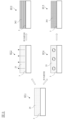
- Figure 3 is a cross-sectional view of a coating film to explain the mechanism of formation of the first cured coating film layer (matte coating film) and the second cured coating film layer (glossy coating film) according to the present invention.
- the cross-section of a coating film in which the volatile solvent contained in the wet coating film 25 of the ultraviolet-curable paint applied to the coating surface 3 is evaporated over time and then irradiated with ultraviolet light to form a cured coating film 26 is shown in steps ST1 ⁇ ST2 ⁇ ST3
- the cross-section of a coating film in which the volatile solvent contained in the wet coating film 25 of the ultraviolet-curable paint applied to the coating surface 3 is irradiated with ultraviolet light before evaporating is shown in steps ST1 ⁇ ST4 ⁇ ST5 to form a cured coating film 26.
- an ultraviolet-curable paint is applied to the coating surface 3 to form a wet coating film 25, and then, as shown in step ST2, it is left at room temperature or with heating for a sufficiently long time, and the volatile solvent slowly evaporates from inside the wet coating film 25 before the resin component is photocured.
- the resin component is photocured without any stirring phenomenon occurring inside the coating film, and a cured coating film 26 with a smooth and glossy surface is obtained as shown in step ST3.
- the cured coating film 26 obtained in this manner is also called the second cured coating film layer 262 or glossy coating film.
- step ST1 of FIG. 3 after applying an ultraviolet-curing paint to the coating surface 3 to form a wet coating film 25, as shown in step ST4, ultraviolet rays are irradiated and the wet coating film 25 is heated by a heater 6 before the volatile solvent evaporates, so that the volatile solvent inside the wet coating film 25 evaporates rapidly, causing a stirring phenomenon inside the coating film.
- the resin component is photocured while the volatile solvent evaporates, so that a cured coating film 26 with an uneven surface and no gloss is obtained, as shown in step ST5.
- the wet coating film 25 is cured by ultraviolet rays while evaporating the volatile solvent by the heat of the ultraviolet irradiator 4 instead of the heater 6, a stirring phenomenon occurs inside the wet coating film 25, as shown in steps ST4 and ST5, and a cured coating film 26 with an uneven surface and no gloss is obtained.
- the cured coating film 26 with an uneven surface and no gloss obtained in this manner is also called the first cured coating film layer 261 or matte coating film.
- the matte coating film is also called a matte coating film.
- the coating method of this embodiment is characterized by utilizing the stirring phenomenon that occurs during the evaporation of the volatile solvent in the ultraviolet-curing paint, and coating a second cured coating film layer 262 with a smooth and glossy surface as shown in steps ST2 to ST3 (where stirring phenomenon is not generated), and a first cured coating film layer 261 with an uneven and non-glossy surface as shown in steps ST4 to ST5 (where stirring phenomenon is generated). Then, by forming the cured coating film 26 with the uneven and non-glossy surface of the first cured coating film layer 261 and the smooth and glossy surface of the second cured coating film layer 262, either alone or in combination, it is possible to provide a coating film with the desired decorativeness.
- the second cured coating layer 262 (glossy coating) having a smooth and glossy surface as shown in step ST3 refers to a cured coating 26 having a surface roughness (ten-point average roughness Rz according to the Japanese Industrial Standards) of less than 0.1 ⁇ m, a porosity of 0 to 20%, and a glossiness (20° specular glossiness according to the Japanese Industrial Standards) of 90 or more.
- the surface roughness Rz in this embodiment refers to the ten-point average roughness defined in Japanese Industrial Standard JIS B 0601, which is calculated by extracting only a reference length from the roughness curve in the direction of the average line, measuring from the average line of this extracted portion in the direction of the longitudinal magnification, and calculating the sum of the average of the absolute values of the elevations (Yp) of the five highest peaks and the average of the absolute values of the elevations (Yv) of the five lowest valleys, and expressing this value in micrometers ( ⁇ m).
- the porosity in this embodiment refers to the percentage of the area of voids (voids, etc.) per unit area of the cross section of the cured coating film 26. This porosity can be obtained by enlarging the cross section of the cured coating film 26 and measuring the area of the voids visually, etc.
- the gloss level in this embodiment is a numerical representation of the intensity ratio between incident light and specularly reflected light when an object is irradiated with light, and refers to the 20° specular gloss level measured in accordance with the Japanese Industrial Standards - Specular Gloss Measurement Method (JIS Z8741-1997).
- the gloss level can be measured, for example, with a gloss measuring device (MICRO-GLOSS, manufactured by BYK Gardner).
- the first cured coating layer 261 which has an uneven, non-glossy surface as shown in step ST5 refers to a cured coating 26 with a surface roughness (ten-point average roughness Rz according to the Japanese Industrial Standards) of 0.1 to 10 ⁇ m, a porosity of 30 to 50%, and a glossiness (20° specular glossiness according to the Japanese Industrial Standards) of 10 or less.
- the coating method of this embodiment includes at least one of a first step of coating a target surface 3 with an ultraviolet-curable paint to form a wet coating film 25, and irradiating the wet coating film 25 with ultraviolet light to form a first cured coating film layer 261 having a porosity of P 1 % or a surface roughness Rz of R 1 ⁇ m, and a second step of coating a target surface 3 with an ultraviolet-curable paint to form a wet coating film 25, and irradiating the wet coating film 25 with ultraviolet light to form a second cured coating film layer 262 having a porosity of P 2 % (where P 2 ⁇ P 1 ) or a surface roughness Rz of R 2 ⁇ m (where R 2 ⁇ R 1 ).
- a first cured coating layer 261 having a relatively large porosity or surface roughness Rz is formed on the application surface 3, or a second cured coating layer 262 having a relatively small porosity or surface roughness Rz is formed on the target surface, or both the first cured coating layer 261 and the second cured coating layer 262 are formed.
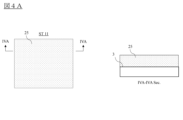
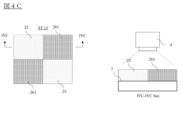
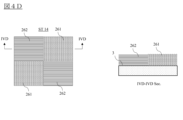
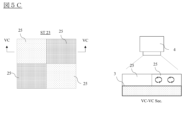
- Figures 4A to 4D are plan and cross-sectional views of a coating film showing one embodiment of a coating method using an ultraviolet-curable coating material according to the present invention.
- Each of Figures 4A to 4D shows a plan view of the coating surface 3 on the left and a cross-sectional view of the coating film on the right.
- an ultraviolet-curable paint is applied to the entire coating surface 3 to form a wet coating film 25 of a predetermined thickness.
- the predetermined thickness in this case is not particularly limited, but is, for example, 5 to 50 ⁇ m.
- the thickness of the wet coating film 25 is measured using a laser displacement meter 5 shown in FIG. 2.
- a light shielding plate 8 that blocks ultraviolet radiation is set on the remaining part of the wet coating film 25 so that a part of the wet coating film 25 applied to the coating surface 3 becomes a first cured coating film layer 261 (matte coating film) that has no gloss, and the remaining part becomes a second cured coating film layer 262 (glossy coating film) that has gloss.
- the two diagonal squares of the four squares are the first cured coating film layer 261, and the other two squares are the second cured coating film layer 262.
- the light shielding plate 8 that blocks ultraviolet radiation is the two square parts at the top left and bottom right as shown in the left figure of FIG. 4B, and is set between the wet coating film 25 and the ultraviolet irradiator 4 as shown in the right figure.
- the amount of ultraviolet rays irradiated may be controlled according to the film thickness of the wet coating film 25 measured by the laser displacement meter 5.
- the wet coating film 25 that is not shielded by the light shielding plate 8, which is the two rectangular parts at the bottom left and top right of the left diagram in FIG. 4B, is in a state where the amount of evaporation of the volatile solvent contained in the wet coating film 25 is less than a predetermined value, in other words, the wet coating film 25 in a state where the volatile solvent is sufficiently contained, is irradiated with ultraviolet rays.
- step ST13 in FIG. 4C the first cured coating film layer 261 (matte coating film) has an uneven surface.
- step ST12 in FIG. 4B an example is shown in which ultraviolet rays are irradiated onto the wet coating film formed on the coating surface 3 without heat treatment, but ultraviolet rays may be irradiated after a short heat treatment of less than the first predetermined time is performed by the heater 6 shown in FIG. 2.
- the light shielding plate 8 is removed, and the entire coating surface 3 is irradiated with ultraviolet light.
- the amount of ultraviolet light irradiation may be controlled according to the film thickness of the wet coating film 25 measured by the laser displacement meter 5.
- the two rectangular parts at the lower left and upper right of the left diagram in FIG. 4C are irradiated with ultraviolet light in step ST12 in FIG. 4B to form the first cured coating film layer 261, but the two rectangular parts at the upper left and lower right of the left diagram are irradiated with ultraviolet light for the first time in step ST13 and photocured. These two rectangular parts at the upper left and lower right of the left diagram are not irradiated with ultraviolet light from step ST11 in FIG.
- the two squares at the bottom left and top right are made into a non-glossy first cured coating layer 261 (matte coating), and the other two squares are made into a glossy second cured coating layer 262 (glossy coating).
- Figures 5A to 5D are plan views and cross-sectional views of a coating film showing another embodiment of a coating method using an ultraviolet-curable paint according to the present invention.
- Each of Figures 5A to 5D shows a plan view of the coating surface 3 on the left and a cross-sectional view of the coating film on the right.
- an ultraviolet-curable paint is applied to the entire coating surface 3 to form a wet coating film 25 of a predetermined thickness.
- the predetermined thickness in this case is not particularly limited, but is, for example, 5 to 50 ⁇ m.
- the thickness of the wet coating film 25 is measured using a laser displacement meter 5 shown in FIG. 2.
- the wet coating film 25 applied to the coating surface 3 is heated by a heater 6 installed at the bottom, and the volatile solvent contained in the wet coating film 25 is forcibly evaporated.
- the heating temperature by the heater 6 may be controlled according to the film thickness of the wet coating film 25 measured by the laser displacement meter 5.
- a heat insulating plate 9 that blocks heat from the heater 6 is set on a part of the wet coating film 25 so that a part of the wet coating film 25 becomes a first cured coating film layer 261 (matte coating film) that has no gloss, and the remaining part becomes a second cured coating film layer 262 (glossy coating film).
- the coating is such that two of the four rectangles on one diagonal are the first cured coating film layer 261, and the other two rectangles are the second cured coating film layer 262.
- the heat insulating plates 9 that block heat from the heater 6 are the two rectangular parts at the lower left and upper right as shown in the left diagram of Figure 5B, and are set between the wet coating film 25 and the heater 6 as shown in the right diagram.
- the wet coating film 25 is heated by the heater 6.
- the two rectangular parts of the wet coating film 25 at the top left and bottom right of the left diagram in FIG. 5B, which are not shielded by the insulating plate 9, are heated by the heater 6, so that the amount of evaporation of the volatile solvent contained in the wet coating film 25 is equal to or greater than a predetermined value, in other words, the wet coating film 25 contains almost no volatile solvent.
- the heater 6 which are shielded by the insulating plate 9, are not heated by the heater 6, so that the amount of evaporation of the volatile solvent contained in the wet coating film 25 is less than a predetermined value, in other words, the wet coating film 25 contains a sufficient amount of volatile solvent.
- heating by the heater 6 is terminated.
- the entire coating surface 3 is irradiated with ultraviolet light.
- the two rectangular parts at the bottom left and top right of the left diagram in FIG. 5C are wet coating film 25 that was not heated by heater 6 in step ST22 in FIG. 5B and contains a sufficient amount of volatile solvent, so that when the resin component of the wet coating film 25 is photocured, agitation occurs, and as shown in the next step ST24 in FIG. 5D, the first cured coating film layer 261 (matte coating film) has an uneven surface.
- the two rectangular parts at the top left and bottom right of the left diagram are wet coating film 25 that was heated by heater 6 in step ST22 in FIG.
- the second cured coating film layer 262 (glossy coating film) has a smooth surface.
- the two squares at the bottom left and top right are made into a first cured coating film layer 261 (matte coating film) that has no gloss, and the other two squares are made into a second cured coating film layer 262 (glossy coating film) that has gloss, resulting in a coating film.
- the first step is to apply the ultraviolet-curable paint to a target coating surface and irradiate the surface with ultraviolet light to form a first cured coating layer having a porosity of 30 to 50% or a surface roughness Rz of 0.1 to 10 ⁇ m; and a second step of applying an ultraviolet-curable paint to the coating surface and irradiating it with ultraviolet light to form a second cured coating layer having a porosity of 0 to 20% or a surface roughness Rz of less than 0.1 ⁇ m. Therefore, the glossy surface which is the second cured coating layer 262 and the non-glossy surface which is the first cured coating layer 261 can be painted separately to enable a thick film to be formed.
- ultraviolet rays are irradiated when the amount of evaporation of the solvent contained in the wet coating film 25 applied to the coating surface 3 is less than a predetermined value
- ultraviolet rays are irradiated when the amount of evaporation of the solvent contained in the wet coating film applied to the coating surface 3 is equal to or greater than the predetermined value, so that the glossy surface of the second cured coating film layer 262 and the non-glossy surface of the first cured coating film layer 261 can be painted separately to form thicker films.
- the wet coating film 25 is irradiated with ultraviolet light without heat treatment, or is heat-treated for less than a first predetermined time and then irradiated with ultraviolet light, so that the amount of evaporation of the solvent contained in the wet coating film 25 applied to the coating surface 3 is less than a predetermined value, so that the first cured coating film layer 261 can be generated more reliably.
- the wet coating 25 is heat-treated for a first predetermined time or more before being irradiated with ultraviolet light so that the amount of evaporation of the solvent contained in the wet coating 25 applied to the surface of the first cured coating layer 261 is equal to or greater than a predetermined value, or ultraviolet light is irradiated after a time exceeding a second predetermined time has elapsed since the application of the ultraviolet-curing paint, so that the second cured coating layer 262 can be generated more reliably.
- the amount of ultraviolet radiation is controlled according to the thickness of the wet coating film 25 applied to the coating surface 3, so that the glossy surface, which is the second cured coating film layer 262, and the non-glossy surface, which is the first cured coating film layer 261, can be coated with even greater thicknesses.
- the heating temperature of the wet coating film 25 applied to the coating surface 3 is controlled according to the film thickness of the wet coating film 25, so that the glossy surface, which is the second cured coating film layer 262, and the non-glossy surface, which is the first cured coating film layer 261, can be painted separately to produce thicker films.
- a first cured coating layer 261 is formed on a portion of the coating surface 3, and a second cured coating layer 262 is formed on the remaining portion of the coating surface 3, so that the glossy surface, which is the second cured coating layer 262, and the non-glossy surface, which is the first cured coating layer 261, can be painted separately to form thicker films.
- the ultraviolet-curable paint is applied to the entire coating surface 3, ultraviolet light is irradiated onto a portion of the coating surface 3 while blocking the irradiation of ultraviolet light onto the remaining portion of the coating surface 3, forming a first cured coating layer 261 on that portion of the coating surface 3, and then ultraviolet light is irradiated onto the remaining portion of the coating surface 3 to form a second cured coating layer 262.
- the ultraviolet-curable paint is applied to the entire coating surface 3, a portion of the coating surface 3 is heated while the portion is insulated, and then ultraviolet light is irradiated onto the entire coating surface 3, so that the glossy surface, which is the second cured coating layer 262, and the non-glossy surface, which is the first cured coating layer 261, can be painted separately to produce thicker films.
- the target coating surface 3 is an automobile body or an automobile part
- the desired coating surface of the automobile body or automobile part can be divided into a glossy surface, which is the second cured coating film layer 262, and a non-glossy surface, which is the first cured coating film layer 261, allowing for a thick coating.
Landscapes
- Chemical & Material Sciences (AREA)
- Engineering & Computer Science (AREA)
- Organic Chemistry (AREA)
- Life Sciences & Earth Sciences (AREA)
- Wood Science & Technology (AREA)
- Health & Medical Sciences (AREA)
- Materials Engineering (AREA)
- Chemical Kinetics & Catalysis (AREA)
- Medicinal Chemistry (AREA)
- Polymers & Plastics (AREA)
- Physics & Mathematics (AREA)
- Plasma & Fusion (AREA)
- Application Of Or Painting With Fluid Materials (AREA)
Priority Applications (2)
| Application Number | Priority Date | Filing Date | Title |
|---|---|---|---|
| JP2025530862A JPWO2025009067A1 (https=) | 2023-07-04 | 2023-07-04 | |
| PCT/JP2023/024797 WO2025009067A1 (ja) | 2023-07-04 | 2023-07-04 | 紫外線硬化型塗料を用いた塗装方法及び塗装システム |
Applications Claiming Priority (1)
| Application Number | Priority Date | Filing Date | Title |
|---|---|---|---|
| PCT/JP2023/024797 WO2025009067A1 (ja) | 2023-07-04 | 2023-07-04 | 紫外線硬化型塗料を用いた塗装方法及び塗装システム |
Publications (1)
| Publication Number | Publication Date |
|---|---|
| WO2025009067A1 true WO2025009067A1 (ja) | 2025-01-09 |
Family
ID=94171700
Family Applications (1)
| Application Number | Title | Priority Date | Filing Date |
|---|---|---|---|
| PCT/JP2023/024797 Ceased WO2025009067A1 (ja) | 2023-07-04 | 2023-07-04 | 紫外線硬化型塗料を用いた塗装方法及び塗装システム |
Country Status (2)
| Country | Link |
|---|---|
| JP (1) | JPWO2025009067A1 (https=) |
| WO (1) | WO2025009067A1 (https=) |
Citations (6)
| Publication number | Priority date | Publication date | Assignee | Title |
|---|---|---|---|---|
| JP2005007277A (ja) * | 2003-06-18 | 2005-01-13 | Sumitomo Bakelite Co Ltd | プラスチックシートの製造方法 |
| JP2006030548A (ja) * | 2004-07-15 | 2006-02-02 | Nec Corp | 光学基板、発光素子、表示装置およびそれらの製造方法 |
| WO2006062214A1 (ja) * | 2004-12-08 | 2006-06-15 | Nippon Steel Corporation | プレコート金属板およびプレコート金属板の製造方法 |
| JP2009532572A (ja) * | 2006-04-06 | 2009-09-10 | ピーピージー インダストリーズ オハイオ インコーポレーテツド | 耐摩耗性コーティング組成物およびコーティングされた物品 |
| WO2017195697A1 (ja) * | 2016-05-13 | 2017-11-16 | 旭硝子株式会社 | 映像投影用構造体、透明スクリーン、および映像投影用構造体の製造方法 |
| JP2021137990A (ja) * | 2020-03-03 | 2021-09-16 | 凸版印刷株式会社 | 化粧シート、化粧板及び化粧シートの製造方法 |
-
2023
- 2023-07-04 JP JP2025530862A patent/JPWO2025009067A1/ja active Pending
- 2023-07-04 WO PCT/JP2023/024797 patent/WO2025009067A1/ja not_active Ceased
Patent Citations (6)
| Publication number | Priority date | Publication date | Assignee | Title |
|---|---|---|---|---|
| JP2005007277A (ja) * | 2003-06-18 | 2005-01-13 | Sumitomo Bakelite Co Ltd | プラスチックシートの製造方法 |
| JP2006030548A (ja) * | 2004-07-15 | 2006-02-02 | Nec Corp | 光学基板、発光素子、表示装置およびそれらの製造方法 |
| WO2006062214A1 (ja) * | 2004-12-08 | 2006-06-15 | Nippon Steel Corporation | プレコート金属板およびプレコート金属板の製造方法 |
| JP2009532572A (ja) * | 2006-04-06 | 2009-09-10 | ピーピージー インダストリーズ オハイオ インコーポレーテツド | 耐摩耗性コーティング組成物およびコーティングされた物品 |
| WO2017195697A1 (ja) * | 2016-05-13 | 2017-11-16 | 旭硝子株式会社 | 映像投影用構造体、透明スクリーン、および映像投影用構造体の製造方法 |
| JP2021137990A (ja) * | 2020-03-03 | 2021-09-16 | 凸版印刷株式会社 | 化粧シート、化粧板及び化粧シートの製造方法 |
Also Published As
| Publication number | Publication date |
|---|---|
| JPWO2025009067A1 (https=) | 2025-01-09 |
Similar Documents
| Publication | Publication Date | Title |
|---|---|---|
| US12194492B2 (en) | Digital printing apparatus and a digital method for producing a structured surface | |
| EP1907217B1 (en) | A method and apparatus for ink jet printing | |
| CN100537257C (zh) | 将可辐射固化的油墨印刷到可辐射固化的液体层中的方法 | |
| EP2249971B1 (en) | Ink jet printing on a nonabsorbent substrate | |
| RU2645308C1 (ru) | Способ производства декоративной строительной панели | |
| RU2617379C1 (ru) | Печатный материал | |
| CN108348955A (zh) | 用于尤其在可uv固化层中产生表面效果的方法、用于其制造的装置以及根据本发明获得的物品 | |
| CN105073419B (zh) | 涂装件、印刷件以及涂层件 | |
| JP2022532391A5 (https=) | ||
| CN102248830A (zh) | 一种喷绘工艺 | |
| US20130059090A1 (en) | Resist material for imprinting, pattern formation method, and imprinting apparatus | |
| CN116457189A (zh) | 利用所分配材料的基于大桶的增材制造 | |
| CN105934280A (zh) | 用于在大面积表面上施加薄涂层的系统和方法 | |
| JP2014166698A (ja) | 塗装材、印刷材およびコート材 | |
| WO2025009067A1 (ja) | 紫外線硬化型塗料を用いた塗装方法及び塗装システム | |
| JP6568497B2 (ja) | 印刷材の製造方法 | |
| WO2025009066A1 (ja) | 紫外線硬化型塗料を用いた塗装方法及び積層塗膜 | |
| JP5581249B2 (ja) | インクジェット印刷装置による直線描画方法 | |
| JP2026046680A (ja) | メタリック塗料を用いたインクジェット塗装方法 | |
| TW201741133A (zh) | 印刷材料的製造方法 | |
| JP2026032446A (ja) | 紫外線硬化型塗料を用いた塗装装置及び塗装方法 | |
| JP2017159208A (ja) | スクライブドサークル印刷物製造方法及びスクライブドサークル印刷物 | |
| JP7514780B2 (ja) | 被印刷用金属基材およびその製造方法、ならびに塗装金属材 | |
| JP2025012099A (ja) | 光硬化性樹脂組成物およびその硬化方法、並びに実装基板および三次元造形物の製造方法 | |
| JP2002233820A (ja) | 紫外線硬化型粉体塗料の塗装方法 |
Legal Events
| Date | Code | Title | Description |
|---|---|---|---|
| 121 | Ep: the epo has been informed by wipo that ep was designated in this application |
Ref document number: 23944319 Country of ref document: EP Kind code of ref document: A1 |
|
| ENP | Entry into the national phase |
Ref document number: 2025530862 Country of ref document: JP Kind code of ref document: A |
|
| WWE | Wipo information: entry into national phase |
Ref document number: 2025530862 Country of ref document: JP |
|
| NENP | Non-entry into the national phase |
Ref country code: DE |