WO2025009020A1 - 電磁式燃料噴射弁 - Google Patents
電磁式燃料噴射弁 Download PDFInfo
- Publication number
- WO2025009020A1 WO2025009020A1 PCT/JP2023/024630 JP2023024630W WO2025009020A1 WO 2025009020 A1 WO2025009020 A1 WO 2025009020A1 JP 2023024630 W JP2023024630 W JP 2023024630W WO 2025009020 A1 WO2025009020 A1 WO 2025009020A1
- Authority
- WO
- WIPO (PCT)
- Prior art keywords
- rod
- movable core
- fuel injection
- annular guide
- injection valve
- Prior art date
- Legal status (The legal status is an assumption and is not a legal conclusion. Google has not performed a legal analysis and makes no representation as to the accuracy of the status listed.)
- Ceased
Links
Images

Classifications
-
- F—MECHANICAL ENGINEERING; LIGHTING; HEATING; WEAPONS; BLASTING
- F02—COMBUSTION ENGINES; HOT-GAS OR COMBUSTION-PRODUCT ENGINE PLANTS
- F02M—SUPPLYING COMBUSTION ENGINES IN GENERAL WITH COMBUSTIBLE MIXTURES OR CONSTITUENTS THEREOF
- F02M51/00—Fuel-injection apparatus characterised by being operated electrically
- F02M51/06—Injectors peculiar thereto with means directly operating the valve needle
-
- F—MECHANICAL ENGINEERING; LIGHTING; HEATING; WEAPONS; BLASTING
- F02—COMBUSTION ENGINES; HOT-GAS OR COMBUSTION-PRODUCT ENGINE PLANTS
- F02M—SUPPLYING COMBUSTION ENGINES IN GENERAL WITH COMBUSTIBLE MIXTURES OR CONSTITUENTS THEREOF
- F02M61/00—Fuel-injectors not provided for in groups F02M39/00 - F02M57/00 or F02M67/00
- F02M61/04—Fuel-injectors not provided for in groups F02M39/00 - F02M57/00 or F02M67/00 having valves, e.g. having a plurality of valves in series
- F02M61/08—Fuel-injectors not provided for in groups F02M39/00 - F02M57/00 or F02M67/00 having valves, e.g. having a plurality of valves in series the valves opening in direction of fuel flow
Definitions
- the present invention relates to an electromagnetic fuel injection valve used in a fuel supply system.
- Patent Document 1 describes an electromagnetic injection valve that has a valve housing with a valve seat on one end and a fixed core on the other end, a rod disposed within the valve housing, and a movable core that slides on the outer circumference of the rod.
- NiP plating has been applied to the entire axial area of the inner circumferential surface defined by the through hole of the movable core, and then Cr plating has been applied to both axial ends of the inner circumferential surface to further improve durability.
- the present invention aims to provide an electromagnetic fuel injection valve that is low-cost and prevents malfunctions caused by the inclusion of foreign matter.
- the electromagnetic fuel injection valve of the present invention comprises: A rod and a movable core,
- the movable core is provided with a total of two annular guide portions which are annularly arranged protrusions along the circumferential direction of the inner surface defined by the through hole of the movable core and/or on the outer surface of the rod facing the inner surface, and which are arranged spaced apart from each other in the axial direction of the rod to guide the movement of the movable core relative to the rod.
- the present invention provides an electromagnetic fuel injection valve that is low-cost and prevents malfunctions caused by the inclusion of foreign matter.
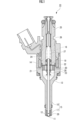
- FIG. 1 is a cross-sectional view of an electromagnetic fuel injection valve according to an embodiment of the present invention.
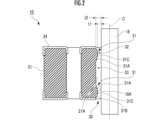
- 1 is an enlarged cross-sectional view of a main portion of an electromagnetic fuel injection valve according to a first embodiment of the present invention
- FIG. 5 is an enlarged cross-sectional view of a main portion of an electromagnetic fuel injection valve according to a second embodiment of the present invention
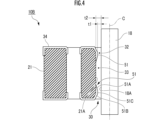
- FIG. 11 is an enlarged cross-sectional view of a main portion of an electromagnetic fuel injection valve according to a third embodiment of the present invention.
- Fig. 1 shows an electromagnetic fuel injection valve 10 according to an embodiment of the present invention.
- the electromagnetic fuel injection valve 10 of the first embodiment includes a valve housing 13 in which a fuel injection hole 11 and a valve seat 12 are formed, a valve body 15 that enables fuel injection from the fuel injection hole 11 by lifting the valve body 15 from a closed position in contact with the valve seat 12 to an open position in response to excitation of a coil 14, and a return spring 16 that returns the valve body 15 to the closed position in contact with the valve seat 12.
- the lift of the valve body 15 to the open position is achieved by settling the overshoot and overshoot return that occur during the lift.
- the valve body 15 has a rod 18 connected to a valve portion 17 that cooperates with the valve seat 12.
- the rod 18 is formed in a cylindrical shape that extends in the axial direction.
- the electromagnetic fuel injection valve 10 also includes a hollow fixed core 19 connected to the upstream end of the valve housing 13, a movable core 21 that faces an attraction surface 20 of the fixed core 19, has a through hole 30 into which the rod 18 is inserted, and moves in the axial direction of the rod 18, and a valve-opening stopper 22 that is fixed to the rod 18 and comes into contact with the movable core 21 that is attracted to the attraction surface 20 when the coil 14 is energized, thereby opening the valve body 15.
- a chromium (Cr) plating layer 34 is applied to the entire upper and lower surfaces of the movable core 21 (surfaces formed in a direction perpendicular to the axial direction of the rod 18).
- the closing side stopper 23 is fixed to the rod 18 closer to the valve seat 12 than the opening side stopper 22.
- An auxiliary spring 24 is provided between the opening side stopper 22 and the movable core 21 to exert a spring force that moves the movable core 21 away from the opening side stopper 22 and into contact with the closing side stopper 23 when the coil 14 is not energized.
- the movable core 21 When the movable core 21 comes into contact with the opening stopper 22, it quickly moves the opening stopper 22 against the biasing force of the return spring 16, and collides with the suction surface 20, stopping it. During this time, the rod 18 moves together with the opening stopper 22, so that the valve portion 17 at the tip of the rod 18 leaves the valve seat 12, and the valve is opened.
- valve portion 17 When the valve portion 17 opens, fuel is pumped from a fuel pump (not shown) into the fuel supply tube 25 and passes through the inside of the pipe-shaped retainer 26, the hollow portion 27 of the fixed core 19, the side portion around the valve-opening stopper 22, the through hole 28 of the movable core 21, the inside of the valve housing 13, and the flat portion 29 around the valve portion 17, before being injected directly into the combustion chamber of the internal combustion engine through the fuel injection hole 11.
- a fuel pump not shown
- Figure 2 is an enlarged cross-sectional view of the main portion of the sliding portion between the rod 18 and the movable core 21 into which the rod 18 is inserted of the electromagnetic fuel injection valve 10 according to the first embodiment of the present invention. Note that in Figure 2, one side of the movable core 21 (the right side in the figure) is omitted (the same applies to Figures 3 and 4).
- annular guide portions 31 are formed on the inner peripheral surface 21A defined by the through hole 30 of the movable core 21.
- the annular guide portions 31 regulate the swinging range of the movable core 21 when the movable core 21 slides relative to the rod 18, improving the linearity of the movable core 21 when it moves in the axial direction of the rod 18.
- annular guide portions 31, 31 are respectively protruded from one axial end and the other axial end of the movable core 21 on the inner peripheral surface 21A of the movable core 21 toward the radial center of the movable core 21 (which is the same as the axis C of the rod 18).
- Each annular guide portion 31 is a protrusion provided in an annular shape along the circumferential direction of the inner circumferential surface 21A of the movable core 21 in a direction perpendicular to the axial direction of the rod 18.
- the annular guide portion 31 is formed in an annular shape (circular ring shape) that is continuous and uninterrupted in the circumferential direction of the inner circumferential surface 21A of the movable core 21.
- Each annular guide portion 31 is integrally formed with the movable core 21 from the inner peripheral surface 21A of the movable core 21 by injection molding or the like.
- the annular guide portion 31 may be provided by joining a separately manufactured annular guide portion 31 to the movable core 21 after the movable core 21 is manufactured.
- each annular guide portion 31 has a first tapered surface 31A and a second tapered surface 31B that are inclined from the inner peripheral surface 21A of the movable core 21 toward the radial center of the movable core 21 (toward the rod 18), and has an arched shape that is wide (long axial length) on the inner peripheral surface 21A side of the movable core 21 and gradually narrows (shortens axial length) toward the radial center of the movable core 21.
- Each annular guide portion 31 has a top portion 31C that protrudes highest from the inner peripheral surface 21A of the movable core 21, a first tapered surface 31A (inner surface) that is close to the opposing annular guide portion 31 and inclined toward the inner peripheral surface 21A from one axial end of the top portion 31C, and a second tapered surface 31B (outer surface) that is away from the opposing annular guide portion 31 and inclined toward the inner peripheral surface 21A from the other axial end of the top portion 31C.
- the annular guide portion 31 has a generally trapezoidal, arched shape that gradually widens (the axial length gradually increases) from the top portion 31C toward the inner peripheral surface 21A of the movable core 21.
- each annular guide portion 31 has a certain amount of axial length at the top 31C, and the bottom is wider than that, so it is a roughly trapezoidal annular protrusion with upper and lower bases.
- the amount of protrusion of each annular guide portion 31 from the inner peripheral surface 21A of the movable core 21 toward the radial center of the movable core 21 is 20 to 50 ⁇ m. In this embodiment, the amount of protrusion of each annular guide portion 31 from the inner peripheral surface 21A of the movable core 21 toward the radial center of the movable core 21 is 25 ⁇ m.
- the annular guide portion 31 may have, for example, a cross section that is approximately triangular or rectangular, curved, semicircular, or even a shape with both sides that change in stages. There are no particular limitations on the shape of the annular guide portion 31, so long as it can partially (locally) abut or be close to the outer peripheral surface 18A of the rod 18 or the inner peripheral surface 21A of the movable core 21 (abutting can be said to be sliding) and guide the movement (sliding movement) of the movable core 21 relative to the rod 18.
- a radial gap 32 is formed between the tops 31C, 31C of the pair of annular guide portions 31, 31 and the outer peripheral surface 18A of the rod 18 in a direction perpendicular to the axial direction of the rod 18.
- the radial gap 32 is annular when the rod 18 is positioned at the radial center of the movable core 21 in the circumferential direction.
- the radial dimension of the radial gap 32 (the radial length, meaning the distance from the outer circumferential surface 18A of the rod 18 to the top 31C of the annular guide portion 31) is defined as "t1".
- the pair of annular guide portions 31, 31 are formed spaced apart from each other in the axial direction of the rod 18.
- the pair of annular guide portions 31 are formed on the inner peripheral surface 21A of the movable core 21 near one opening of the through hole 30 (the inner peripheral edge of one opening) and near the other opening (the inner peripheral edge of one opening), respectively.
- a gap expansion section 33 is formed between the pair of annular guide sections 31, 31, with a radial dimension t2 larger than the radial dimension t1 of the radial gap 32.
- t2 is the radial length, and refers to the distance from the outer peripheral surface 18A of the rod 18 to the inner peripheral surface 21A of the movable core 21.
- the radial gap 32 and the gap expansion portion 33 are connected, and some of the fuel pumped by the fuel pump flows into the radial gap 32 and the gap expansion portion 33, passing between the movable core 21 and the rod 18.
- two annular guide portions 31, 31 are formed on the inner circumferential surface 21A defined by the through hole 30 of the movable core 21 of the electromagnetic fuel injection valve 10.
- each annular guide portion 31 when the movable core 21 oscillates relative to the rod 18, i.e., when the radial center of the movable core 21 and the axis C of the rod 18 are not aligned (coincident) and the movable core 21 moves in a tilted state relative to the axis C of the rod 18, only the top portion 31C of each annular guide portion 31 partially abuts against the outer peripheral surface 18A of the rod 18 (the entire inner peripheral surface 21A of the movable core 21 does not abut against the outer peripheral surface 18A of the rod 18), thereby reducing the contact area between the movable core 21 and the rod 18.
- each annular guide portion 31 is integrally formed from the inner peripheral surface 21A of the movable core 21, there is no need to apply multiple plating layers to prevent foreign matter from becoming caught, which reduces manufacturing costs.
- the fuel is pushed out from between the annular guide portion 31 and the rod 18 by the annular guide portion 31, increasing the flow rate of the fuel and improving the discharge of foreign matter contained in the fuel from between the rod 18 and the movable core 21.
- the coefficient of friction (amount of friction) between the rod 18 and the movable core 21 can be reduced. This allows the movable core 21 to move (slide) smoothly relative to the rod 18.
- the lubrication of the movable core 21 relative to the rod 18 is maintained by the fuel passing between the rod 18 and the movable core 21.
- the contact area between the rod 18 and the movable core 21 is large, and there are cases in which the lubrication of the movable core 21 relative to the rod 18 cannot be sufficiently ensured.
- the electromagnetic fuel injection valve 10 reduces the contact area between the rod 18 and the movable core 21, ensuring sufficient lubrication of the movable core 21 against the rod 18.
- the annular guide portion 31 has a second tapered surface 31B that is inclined from the inner circumferential surface 21A toward the radial center, so that the fuel that collides with the annular guide portion 31 can be guided to the radial gap 32 while suppressing a decrease in the fluid pressure (suppressing pressure loss).
- the fuel pumped by the fuel pump passes between the movable core 21 and the rod 18 while maintaining its flow rate, reducing the probability of foreign matter becoming caught between the rod 18 and the movable core 21.
- the electromagnetic fuel injection valve 10 has a radial gap 32 and a gap expansion section 33, which increases (increases) the flow rate of the fuel passing between the movable core 21 and the rod 18. This reduces the probability of foreign matter contained in the fuel becoming caught between the movable core 21 and the rod 18.
- the provision of the annular guide portion 31 forms a radial gap 32 with a radial dimension t1 that is shorter than the radial dimension t2 of the gap expansion portion 33, so that the cross-sectional area of the fuel flow path temporarily decreases when the fuel passes between the rod 18 and the movable core 21. Therefore, the flow rate of the fuel passing between the movable core 21 and the rod 18 increases when it passes through the radial gap 32.
- the self-cleaning action of the fuel is enhanced, and the probability of foreign matter becoming caught between the movable core 21 and the rod 18 can be reduced.
- FIG. 3 is an enlarged cross-sectional view of the main part of an electromagnetic fuel injection valve 10A according to a second embodiment of the present invention, showing an enlarged sliding portion between the rod 18 and the movable core 21 into which the rod 18 is inserted.
- the electromagnetic fuel injection valve 10A according to the second embodiment differs from the first embodiment in that two annular guide portions 41 are formed on the outer circumferential surface 18A of the rod 18, as shown in FIG. 3.
- the annular guide portion 41 is a protrusion that is provided in an annular shape along the circumferential direction of the outer circumferential surface 18A of the rod 18 in a direction perpendicular to the axial direction of the rod 18.
- the annular guide portion 41 is formed in an annular shape (circular ring shape) that is continuous and uninterrupted in the circumferential direction of the outer circumferential surface 18A of the rod 18.
- the annular guide portion 41 has a first tapered surface 41A and a second tapered surface 41B that are inclined from the outer peripheral surface 18A of the rod 18 toward the movable core 21 (in a direction away from the outer peripheral surface 18A of the rod 18), and has an arched shape that is wide on the outer peripheral surface 18A side of the rod 18 and gradually narrows toward the movable core 21 side.
- Each annular guide portion 41 has a top 41C that protrudes highest from the outer peripheral surface 18A of the rod 18 and has a slightly rounded curved shape, a first tapered surface 41A (inner surface) that is close to the opposing annular guide portion 41 and inclined from the top 41C toward the outer peripheral surface 18A, and a second tapered surface 41B (outer surface) that is away from the opposing annular guide portion 41 and inclined from the top 41C toward the outer peripheral surface 18A, and it can be said that as a whole, it has a mountain shape that gradually widens (the axial length gradually increases) from the top 41C toward the outer peripheral surface 18A of the rod 18.
- each annular guide portion 41 may be formed integrally with the rod 18 from the outer peripheral surface 18A of the rod 18 by injection molding or the like, or may be provided by joining an annular guide portion 41 that is manufactured separately after the rod 18 is manufactured.
- a radial gap 42 is formed between the tops 41C, 41C of the pair of annular guide portions 41, 41 and the inner peripheral surface 21A of the movable core 21 in a direction perpendicular to the axial direction of the rod 18.
- the radial gap 42 is annular when the rod 18 is positioned at the radial center of the movable core 21 in the circumferential direction.
- the radial dimension of the radial gap 42 (the radial length, meaning the distance from the inner circumferential surface 21A of the movable core 21 to the top 41C of the annular guide portion 41) is "t1".
- the pair of annular guide portions 41, 41 are formed spaced apart from each other in the axial direction of the rod 18.
- the pair of annular guide portions 41, 41 are formed on the outer peripheral surface 18A of the rod 18, which faces the inner peripheral surface 21A of the movable core 21, at positions corresponding to the vicinity of one opening of the through hole 30 and the vicinity of the other opening, respectively.
- a gap expansion section 43 is formed between the pair of annular guide sections 41, 41, with a radial dimension t2 larger than the radial dimension t1 of the radial gap 42.
- t2 is the radial length, and refers to the distance from the outer peripheral surface 18A of the rod 18 to the inner peripheral surface 21A of the movable core 21.
- the radial gap 42 and the gap expansion portion 43 are connected, and some of the fuel pumped by the fuel pump flows into the radial gap 42 and the gap expansion portion 43, passing between the movable core 21 and the rod 18.
- two annular guide portions 41, 41 are formed on the outer circumferential surface 18A of the rod 18 of the electromagnetic fuel injection valve 10A of the second embodiment.
- the electromagnetic fuel injection valve 10A of the second embodiment achieves the same effects as the electromagnetic fuel injection valve 10 of the first embodiment.
- the electromagnetic fuel injection valve 10 has two annular guide portions 31 formed on the inner peripheral surface 21A of the movable core 21, and in the second embodiment, the electromagnetic fuel injection valve 10A has two annular guide portions 41 formed on the outer peripheral surface 18A of the rod 18.
- the annular guide portions 31, 41 may be formed on the inner peripheral surface 21A of the movable core 21 and the outer peripheral surface 18A of the rod 18, so that a total of two annular guide portions 31, 41 are formed.
- FIG. 4 is an enlarged view of the sliding portion between the rod 18 and the movable core 21 into which the rod 18 is inserted of an electromagnetic fuel injection valve 10B according to a third embodiment of the present invention.
- each annular guide portion 51 is formed by a chrome (Cr) plating layer. This improves the lubricity of the movable core 21 with respect to the rod 18, reduces the coefficient of friction (amount of friction) between the annular guide portion 51 and the rod 18, and ensures sufficient durability for the annular guide portion.
- Cr chrome
- the annular guide portion 51 is formed from a chrome (Cr) plating layer.
- the chrome plating layer that becomes the annular guide portion 51 can be formed by spray painting with chrome plating after masking the area on the inner circumferential surface 21A of the movable core 21 where the gap expansion portion 33 is to be formed.
- each annular guide portion 51 is formed only from a chrome plating layer, which makes it possible to prevent malfunctions caused by the intrusion of foreign matter at a lower cost than conventional electromagnetic fuel injection valves that are made up of multiple plating materials.
- the plating layer is formed from a chrome plating layer, but other plating layers such as nickel plating layers can also be used.
- Electromagnetic fuel injection valve 18 Rod 18A: Outer surface 21: Movable core Inner surface: 21A 30: Through hole 31, 41, 51: Annular guide section 32, 42: Radial gap 33, 43: Gap expansion section
Landscapes
- Engineering & Computer Science (AREA)
- Chemical & Material Sciences (AREA)
- Combustion & Propulsion (AREA)
- Mechanical Engineering (AREA)
- General Engineering & Computer Science (AREA)
- Fuel-Injection Apparatus (AREA)
Priority Applications (2)
| Application Number | Priority Date | Filing Date | Title |
|---|---|---|---|
| JP2025530819A JPWO2025009020A1 (https=) | 2023-07-03 | 2023-07-03 | |
| PCT/JP2023/024630 WO2025009020A1 (ja) | 2023-07-03 | 2023-07-03 | 電磁式燃料噴射弁 |
Applications Claiming Priority (1)
| Application Number | Priority Date | Filing Date | Title |
|---|---|---|---|
| PCT/JP2023/024630 WO2025009020A1 (ja) | 2023-07-03 | 2023-07-03 | 電磁式燃料噴射弁 |
Publications (1)
| Publication Number | Publication Date |
|---|---|
| WO2025009020A1 true WO2025009020A1 (ja) | 2025-01-09 |
Family
ID=94171297
Family Applications (1)
| Application Number | Title | Priority Date | Filing Date |
|---|---|---|---|
| PCT/JP2023/024630 Ceased WO2025009020A1 (ja) | 2023-07-03 | 2023-07-03 | 電磁式燃料噴射弁 |
Country Status (2)
| Country | Link |
|---|---|
| JP (1) | JPWO2025009020A1 (https=) |
| WO (1) | WO2025009020A1 (https=) |
Citations (2)
| Publication number | Priority date | Publication date | Assignee | Title |
|---|---|---|---|---|
| JP2009216081A (ja) * | 2008-02-13 | 2009-09-24 | Denso Corp | 燃料噴射弁 |
| JP2013064414A (ja) * | 2013-01-18 | 2013-04-11 | Denso Corp | 燃料噴射弁 |
-
2023
- 2023-07-03 JP JP2025530819A patent/JPWO2025009020A1/ja active Pending
- 2023-07-03 WO PCT/JP2023/024630 patent/WO2025009020A1/ja not_active Ceased
Patent Citations (2)
| Publication number | Priority date | Publication date | Assignee | Title |
|---|---|---|---|---|
| JP2009216081A (ja) * | 2008-02-13 | 2009-09-24 | Denso Corp | 燃料噴射弁 |
| JP2013064414A (ja) * | 2013-01-18 | 2013-04-11 | Denso Corp | 燃料噴射弁 |
Also Published As
| Publication number | Publication date |
|---|---|
| JPWO2025009020A1 (https=) | 2025-01-09 |
Similar Documents
| Publication | Publication Date | Title |
|---|---|---|
| US8931718B2 (en) | Valve assembly for an injection valve and injection valve | |
| US7735757B2 (en) | Gaseous fuel injection valve | |
| US20040124277A1 (en) | Pressure control valve for controlling operation of fuel injector | |
| US7909270B2 (en) | Valve assembly for an injection valve and injection valve | |
| US8919372B2 (en) | Valve assembly for an injection valve and injection valve | |
| JP4418267B2 (ja) | チェックバルブ | |
| JP2018123826A (ja) | 燃料噴射弁 | |
| WO2025009020A1 (ja) | 電磁式燃料噴射弁 | |
| EP3507483B1 (en) | Fluid injector and needle for a fluid injector | |
| US20170002782A1 (en) | Fuel injection valve | |
| EP3239513B1 (en) | Valve closure member with an elastomeric seal, valve assembly and fluid injector | |
| CN113167203B (zh) | 燃料喷射阀 | |
| EP3156638B1 (en) | Fuel injector | |
| JP7302875B2 (ja) | 燃料噴射弁 | |
| CN111042968A (zh) | 用于喷射阀的阀组件和燃料喷射阀 | |
| JP2022146785A (ja) | ガス燃料用噴射弁 | |
| CN110651116B (zh) | 喷射器 | |
| JP3855715B2 (ja) | 燃料噴射弁 | |
| CN120604031A (zh) | 具有喷嘴部分的气体喷射器 | |
| WO2025210094A1 (en) | Gas injector for an internal combustion engine | |
| EP3339627A1 (en) | Valve assembly and fluid injection valve | |
| WO2024202468A1 (ja) | 燃料噴射装置 | |
| CN118815637A (zh) | 燃料喷射装置 | |
| US20140352667A1 (en) | Fluid Injector For a Combustion Engine | |
| WO2025004318A1 (ja) | 燃料噴射弁 |
Legal Events
| Date | Code | Title | Description |
|---|---|---|---|
| 121 | Ep: the epo has been informed by wipo that ep was designated in this application |
Ref document number: 23944272 Country of ref document: EP Kind code of ref document: A1 |
|
| ENP | Entry into the national phase |
Ref document number: 2025530819 Country of ref document: JP Kind code of ref document: A |
|
| NENP | Non-entry into the national phase |
Ref country code: DE |