WO2025005239A1 - 吸水材 - Google Patents
吸水材 Download PDFInfo
- Publication number
- WO2025005239A1 WO2025005239A1 PCT/JP2024/023499 JP2024023499W WO2025005239A1 WO 2025005239 A1 WO2025005239 A1 WO 2025005239A1 JP 2024023499 W JP2024023499 W JP 2024023499W WO 2025005239 A1 WO2025005239 A1 WO 2025005239A1
- Authority
- WO
- WIPO (PCT)
- Prior art keywords
- pulp
- less
- cellulose
- water
- manufactured
- Prior art date
- Legal status (The legal status is an assumption and is not a legal conclusion. Google has not performed a legal analysis and makes no representation as to the accuracy of the status listed.)
- Ceased
Links
Classifications
-
- B—PERFORMING OPERATIONS; TRANSPORTING
- B01—PHYSICAL OR CHEMICAL PROCESSES OR APPARATUS IN GENERAL
- B01J—CHEMICAL OR PHYSICAL PROCESSES, e.g. CATALYSIS OR COLLOID CHEMISTRY; THEIR RELEVANT APPARATUS
- B01J20/00—Solid sorbent compositions or filter aid compositions; Sorbents for chromatography; Processes for preparing, regenerating or reactivating thereof
- B01J20/22—Solid sorbent compositions or filter aid compositions; Sorbents for chromatography; Processes for preparing, regenerating or reactivating thereof comprising organic material
- B01J20/24—Naturally occurring macromolecular compounds, e.g. humic acids or their derivatives
-
- B—PERFORMING OPERATIONS; TRANSPORTING
- B01—PHYSICAL OR CHEMICAL PROCESSES OR APPARATUS IN GENERAL
- B01J—CHEMICAL OR PHYSICAL PROCESSES, e.g. CATALYSIS OR COLLOID CHEMISTRY; THEIR RELEVANT APPARATUS
- B01J20/00—Solid sorbent compositions or filter aid compositions; Sorbents for chromatography; Processes for preparing, regenerating or reactivating thereof
- B01J20/28—Solid sorbent compositions or filter aid compositions; Sorbents for chromatography; Processes for preparing, regenerating or reactivating thereof characterised by their form or physical properties
-
- C—CHEMISTRY; METALLURGY
- C02—TREATMENT OF WATER, WASTE WATER, SEWAGE, OR SLUDGE
- C02F—TREATMENT OF WATER, WASTE WATER, SEWAGE, OR SLUDGE
- C02F11/00—Treatment of sludge; Devices therefor
-
- D—TEXTILES; PAPER
- D21—PAPER-MAKING; PRODUCTION OF CELLULOSE
- D21H—PULP COMPOSITIONS; PREPARATION THEREOF NOT COVERED BY SUBCLASSES D21C OR D21D; IMPREGNATING OR COATING OF PAPER; TREATMENT OF FINISHED PAPER NOT COVERED BY CLASS B31 OR SUBCLASS D21G; PAPER NOT OTHERWISE PROVIDED FOR
- D21H11/00—Pulp or paper, comprising cellulose or lignocellulose fibres of natural origin only
Definitions
- the present invention relates to a water-absorbent material, and more specifically to a cellulose-based water-absorbent material used in the civil engineering or construction industry.
- Non-Patent Documents 1 and 2 describe that when fine powder made from waste paper is added to highly water-containing muddy soil and stirred, the fluidity of the muddy soil is reduced and it becomes transportable.
- Patent Documents 1 and 2 describe that a granular material having a structure in which cellulose fibers are entangled, an average particle size of 300 ⁇ m or less, a BET specific surface area of 0.25 m 2 /g to 100 m 2 /g, and a porosity of 50% or more expressed as (1-bulk density)/true density) ⁇ 100 can reduce the fluidity of muddy soil and suppress an increase in volume.
- the present invention aims to provide a water-absorbent material that exhibits good water absorption properties.
- a cellulose-based water absorbent material comprising a cellulose material having an average fiber length of 0.40 mm or more, an average aspect ratio of 20 or more, a proportion of fibers having a fiber length of 0.2 mm or less of 80% or less, and a moisture content of 20% by weight or less.
- [4] The absorbent material for civil engineering or construction use according to [1] or [2], wherein the Runkel ratio of the cellulose material is 0.28 or more.
- [5] The water absorbent material for civil engineering or construction use according to any one of [1] to [3], wherein the curl of the cellulose material is 12.5% or more.
- [6] The water absorbent material for civil engineering or construction according to any one of [1] to [4], wherein the roughness of the cellulose material is 105 ⁇ g/m or more.
- the present invention provides a cellulose material with good water absorption.
- the cellulose material of the present invention has good water absorption and can be used in the civil engineering or construction industry as a water absorbent for treating mud or inorganic sludge.
- Shape of cellulose material In general, cellulose materials are formed by entanglement of cellulose fibers to form secondary particles, and the shape of the secondary particles can be expressed as, for example, cotton-like or soybean pulp-like, but it is difficult to specify the shape in general.
- the shape of the cellulose material can be expressed by at least one of the following parameters, and among them, it is preferable to satisfy the average fiber length, average aspect ratio, and fine, and more preferably to further satisfy at least one of the Runkel ratio, curl, roughness, average fibril circumference ratio, average fibril area ratio, porosity, maximum torque voltage, and bulk specific gravity.
- the average fiber length (length-weighted average fiber length) of the cellulose material is usually 0.40 mm or more, preferably 0.45 mm or more, more preferably 0.50 mm or more, 0.60 mm or more, even more preferably 0.70 mm or more, 0.90 mm or more, or 1.00 mm or more.
- the upper limit is usually 7.00 mm or less, preferably 5.00 mm or less, 4.50 mm or less, 4.00 mm or less, 3.50 mm or less, 3.00 mm or less, or 2.50 mm or less.
- it is usually 0.40 to 7.00 mm, preferably 0.45 to 7.00 mm, more preferably 0.50 to 7.00 mm, 0.60 to 7.00 mm, and even more preferably 0.70 to 5.00 mm, 0.90 to 5.00 mm, or 1.00 to 5.00 mm, 0.50 to 4.50 mm, 0.50 to 4.00 mm, 0.50 to 3.5 mm, 0.50 to 3.00 mm, 0.50 to 3.00 mm, or 0.50 to 2.50 mm.
- the average aspect ratio (average fiber length/average fiber width) is usually 20 or more, preferably 22 or more, more preferably 25 or more, even more preferably 27 or more, 29 or more, or 30 or more.
- the upper limit is usually 200 or less, preferably 150 or less, more preferably 100 or less, even more preferably 80 or less, 70 or less, or 60 or less.
- it is usually 20 to 200, preferably 22 to 150, more preferably 25 to 100, even more preferably 27 to 100, 29 to 80, 30 to 80, 22 to 70, or 22 to 60, but is not particularly limited.
- the average fiber width of the cellulose material is usually 50.0 ⁇ m or less, preferably 40.0 ⁇ m or less, more preferably 35.0 ⁇ m or less.
- the lower limit is usually 13.0 ⁇ m or more, 14.0 ⁇ m or more, or 15.0 ⁇ m or more, preferably 18.0 ⁇ m or more, more preferably 20.0 ⁇ m or more. Therefore, it is usually 13.0 to 50.0 ⁇ m, 14.0 to 50.0 ⁇ m, or 15.0 to 40.0 ⁇ m, preferably 18.0 to 40.0 ⁇ m, more preferably 20.0 to 35.0 ⁇ m, but is not particularly limited.
- Fine-Fine- Cellulosic materials usually contain fibers with a fiber length of 0.2 mm or less, and in this specification, the weight percentage of these fibers is referred to as "fine.” Fine is usually 80.0% or less, preferably 70.0% or less, more preferably 69.0% or less, and even more preferably 68.0% or less.
- the lower limit is usually 5.0% or more, preferably 10.0% or more. Therefore, it is usually 5.0 to 80.0%, preferably 5.0 to 70.0%, more preferably 10.0 to 70.0%, 10.0 to 69.0%, and even more preferably 10.0 to 68.0%, but is not particularly limited.
- Runkel comparison The Runkel ratio of the cellulose material is usually 0.15 or more, 0.17 or more, 0.20 or more, or 0.28 or more, preferably 0.29 or more, more preferably 0.30 or more.
- the upper limit is usually 1.0 or less, preferably 0.95 or less, more preferably 0.90 or less, 0.80 or less, or 0.70 or less. Therefore, it is usually 0.15 to 1.0, 0.17 to 1.0, 0.20 to 1.0, 0.28 to 1.0, preferably 0.29 to 0.95, more preferably 0.30 to 0.90, 0.15 to 0.80, or 0.15 to 0.70, but is not particularly limited.
- the fiber wall thickness is usually 0.8 ⁇ m or more, 1.0 ⁇ m or more, 1.5 ⁇ m or more, 2.0 ⁇ m or more, 2.3 ⁇ m or more, preferably 2.4 ⁇ m or more, and more preferably 2.5 ⁇ m or more.
- the upper limit is usually 6.0 ⁇ m or less, preferably 5.5 ⁇ m or less, and more preferably 5.0 ⁇ m or less.
- it is usually 0.8 to 6.0 ⁇ m, 1.0 to 6.0 ⁇ m, 1.5 to 6.0 ⁇ m, 2.0 to 6.0 ⁇ m, 2.3 to 6.0 ⁇ m, preferably 2.4 to 5.5 ⁇ m, and more preferably 2.5 to 5.0 ⁇ m, but is not particularly limited.
- the curl (degree of curvature) of the cellulose material is usually 9.0% or more, 10.0% or more, 12.5% or more, preferably 13.0% or more, and more preferably 13.5% or more.
- the upper limit is usually 25.0% or less, and preferably 23.0% or less. Therefore, it is usually 9.0 to 25.0%, 10.0 to 25.0%, 12.5 to 25.0%, preferably 13.0 to 25.0%, and more preferably 13.5 to 23.0%, but is not particularly limited.
- the curl is a value calculated by the following formula: 100-(l00xl/L), where l is the straight line length between fiber ends and L is the true length of the fiber, as a ratio.
- the roughness of the cellulose material is usually 50 ⁇ g/m or more, 55 ⁇ m or more, 60 ⁇ m or more, 70 ⁇ g/m or more, preferably 80 ⁇ g/m or more, more preferably 90 ⁇ g/m or more, even more preferably 100 ⁇ g/m or more, 105 ⁇ g/m or more, or 110 ⁇ g/m or more.
- the upper limit is usually 500 ⁇ g/m or less, 300 ⁇ g/m or less, 250 ⁇ g/m or less, 200 ⁇ g/m or less, or 150 ⁇ g/m or less.
- it is usually 50 to 500 ⁇ g/m, 55 to 500 ⁇ g/m, 60 to 500 ⁇ g/m, or 70 to 500 ⁇ g/m, preferably 80 to 500 ⁇ g/m, more preferably 90 to 300 ⁇ g/m, even more preferably 100 to 300 ⁇ g/m, 105 to 300 ⁇ g/m, 110 to 300 ⁇ g/m, 50 to 250 ⁇ g/m, 50 to 200 ⁇ g/m, or 50 to 150 ⁇ g/m, but is not particularly limited.
- the average fibril circumference ratio of the cellulose material is usually 1.7% or more, preferably 2.0% or more, more preferably 2.2% or more.
- the upper limit is usually 30.0% or less, preferably 27.0% or less, more preferably 25.0% or less.
- chemical pulp it is preferably 10.0% or less, more preferably 8.0% or less, and even more preferably 7.0% or less. Therefore, it is usually 1.7 to 30.0%, preferably 2.0 to 27.0%, more preferably 2.2 to 25.0%, and in the case of chemical pulp, it is usually 1.7 to 10.0%, preferably 2.0 to 8.0%, more preferably 2.2 to 7.0%, but is not particularly limited.
- the average fibril area ratio of the cellulose material is usually 0.5 or more, 0.7 or more, 1.0 or more, 1.5% or more, preferably 1.6% or more, and more preferably 1.7% or more.
- the upper limit is usually 7.5% or less, preferably 7.0% or less. Therefore, it is usually 0.5 to 7.5%, 0.7 to 7.5%, 0.5 to 7.0%, 1.0 to 7.5%, 1.5 to 7.5%, preferably 1.6 to 7.5%, and more preferably 1.7 to 7.0%, but is not particularly limited.
- Average fiber length, average fiber diameter, fine, Runkel ratio, cell wall thickness, curl, coarseness, average fibril circumference ratio, and average fibril area ratio can be measured using a fiber tester (manufactured by ABB).
- the bulk density of the cellulose material is usually 0.3 g/cm3 or less , preferably 0.2 g/cm3 or less , more preferably 0.1 g/cm3 or less , even more preferably 0.09 g/cm3 or less , and 0.05 g/ cm3 or less.
- the lower limit is usually 0.005 g/cm3 or more, preferably 0.01 g/cm3 or more. Therefore, it is usually 0.005 to 0.3 g/ cm3 , preferably 0.005 to 0.2 g/ cm3 , more preferably 0.01 to 0.1 g/ cm3 , and even more preferably 0.01 to 0.09 g/ cm3 , and is not particularly limited.
- the porosity of the cellulose material is usually 80% or more, preferably 85% or more, more preferably 90% or more, 94% or more, and even more preferably 95% or more.
- the upper limit is usually 99% or less. Therefore, it is usually 80 to 99%, preferably 85 to 99%, more preferably 90 to 99%, and even more preferably 95 to 99%, but is not particularly limited.
- the maximum torque voltage of the cellulose material is preferably 3,000 mV or more, 3,050 mV or more, or 3,080 mV or more, more preferably 3,300 mV or more, and even more preferably 3,500 mV or more. It is preferable that the above range is satisfied for cellulose materials derived from pulp-derived cellulose raw materials, especially cellulose materials derived from pulp-derived cellulose raw materials such as kraft pulp and mechanical pulp other than sulfite pulp. This allows good cohesiveness to be exhibited, and as a result, water absorption is also good.
- the maximum torque voltage is the voltage at the maximum torque when 300 mL of a 1% aqueous solution of each sample is rotated (300 rpm, 150 seconds, 25°C).
- Cellulosic materials are mainly composed of cellulose.
- the raw material of the cellulose that constitutes the cellulose materials is usually wood, and may be any of broadleaf trees, softleaf trees, or a combination of two or more of these.
- Examples of broad-leaved trees include plants of the genus Beech (e.g., beech), genus Tilia (e.g., linden), genus Betula (e.g., birch, beech), genus Aspen (e.g., poplar), genus Eucalyptus (e.g., eucalyptus), genus Acacia (e.g., acacia), genus Quercus (e.g., oak, phillyraeoides, oak, sawtooth oak), genus Maple (e.g., maple), genus Kapok (e.g., Asiatic maple), genus Elm (e.g., elm), genus Paulownia (e.g., Paulownia), genus Magnolia (e.g., magnolia), genus Salix (e.g., willow), genus Aesculus (e.g., horse chestnut),
- Coniferous trees include, for example, cedars (e.g., Japanese cedar), spruce (e.g., Picea jezoensis), larch (e.g., larch, western larch, tamarack), pine (e.g., black pine, dwarf pine, radiata pine, eastern white pine), fir (e.g., Abies sachalinensis, fir, western fir), yew (e.g., taxa), arborvitae (e.g., Japanese cedar, yellow cedar), spruce (e.g., fir, fir, spruce, sitka spruce, eastern white pine),
- the cellulose raw material include plants of the genus Podocarpus (e.g., Japanese spruce), the genus Chamaecyparis obtusifolia (e.g., Cypress, Japanese cypress, and Chamaecyparis gracilis (Beih
- the cellulose raw material may be non-wood, and examples thereof include bamboo, hemp, jute, kenaf, agricultural waste, and paper (e.g., waste paper and printing paper). It is preferable that the paper be unused paper, since it has a uniform quality.
- the cellulose raw material is preferably a woody plant, more preferably a coniferous tree or broadleaf tree, and even more preferably a broadleaf tree.
- the cellulose material may contain components other than cellulose.
- the cellulose components include components other than cellulose derived from the cellulose raw material, by-products in the manufacturing process, and optional additives (e.g., storage stabilizers, additives used in pulp or paper manufacturing, etc.).
- Examples of the components derived from the cellulose raw material include monosaccharides (e.g., trioses such as aldotriose and ketotriose; tetraoses such as erythrose, threose, and erythrulose; pentoses such as xylose, ribose, arabinose, lyxose, ribulose, and xylulose; hexoses such as mannose, allose, altrose, gulose, idose, galactose, talose, psicose, fructose, sorbose, tagatose, fucose, fructose, and rhamnose; and heptoses such as sedoheptulose).
- monosaccharides e.g., trioses such as aldotriose and ketotriose; tetraoses such as erythrose, threose, and erythru
- oligosaccharides e.g., disaccharides such as sucrose, lactose, maltose, trehalose, turanose, cellobiose, etc.; trisaccharides such as raffinose, melezitose, maltotriose, etc.; tetrasaccharides such as acarbose, stachyose, etc.; oligosaccharides such as xylooligosaccharides, cellooligosaccharides, fructooligosaccharides, galactooligosaccharides, mannanoligosaccharides, etc.); polysaccharides (e.g., glycogen, starch (amylose, amylopectin), cellulose, hemicellulose, dextrin, glucan), reducing sugars, modified sugars, and lignins.
- disaccharides such as sucrose, lactose, maltose, trehalose
- Examples of by-products include sodium sulfate, sodium sulfite, sodium chloride, magnesium sulfate, magnesium sulfite, magnesium chloride, calcium sulfate, calcium sulfite, calcium chloride, ammonium sulfate, ammonium sulfite, ammonium chloride, sodium hydroxide, and inorganic fillers and pigments for coated or uncoated paper such as calcium carbonate and kaolin.
- the optional additives may be any component normally used in the intended use of the cellulose material, such as a base, carrier, solvent, dispersant, emulsifier, buffer, stabilizer, excipient, binder, disintegrant, lubricant, thickener, moisturizer, colorant, fragrance, chelating agent, etc.
- a base such as a base, carrier, solvent, dispersant, emulsifier, buffer, stabilizer, excipient, binder, disintegrant, lubricant, thickener, moisturizer, colorant, fragrance, chelating agent, etc.
- these additives may also be used.
- the content (% by weight based on the dry weight) of these components varies depending on the type of cellulose raw material, manufacturing conditions, etc., and is therefore difficult to define unambiguously, but it is preferable that the content be small, for example, 10% by weight or less, 8% by weight or less, 5% by weight or less, 1% by weight or less, 0.1% by weight or less, or 0.01% by weight or less, preferably below the detection limit, and more preferably 0% by weight.
- the cellulose material may contain moisture.
- moisture content is usually 20% by weight or less, preferably 19% by weight or less, more preferably 18% by weight or less, and even more preferably 17% by weight or less, 16% by weight or less, or 15% by weight or less. There is no particular lower limit, and it may be 0% by weight.
- the method for producing a cellulose material is not particularly limited, but an example includes a method including producing pulp, a pulp sheet, or paper from a cellulose raw material and, if necessary, adjusting the pulp, the pulp sheet, or the paper to have the above-mentioned shape. By adjusting the type of raw material and the production conditions, a cellulose material that satisfies each of the above-mentioned parameters can be obtained.
- Pulp Production Pulp may be produced by a conventional method, for example, a method in which chips of a cellulose raw material are prepared and pulp is obtained from the chips.
- the cellulose raw material when the cellulose raw material is a woody plant, the bark is removed from the woody parts (e.g., trunks and branches) and the wood is crushed to obtain chips.
- the cellulose raw material may be one type or a combination of two or more types.
- the conditions or methods for producing pulp are not particularly limited as long as they include the above-mentioned process of pulping the wood chips.
- pulping methods include, but are not limited to, chemical methods (chemical pulping) that involve digestion such as the Kraft method, sulfite method, soda method, and polysulfide method, mechanical methods (mechanical pulping) that use equipment such as refiners and grinders, and methods of pulping by mechanical force after chemical pretreatment (semi-chemical pulping). Further treatments such as bleaching, beating, and fiber defibration may be performed.
- the obtained pulp may be any of unbleached (unbleached) pulp, bleached (bleached) pulp, beaten pulp, unbeaten pulp, and fluff pulp.
- Examples of chemical pulp include sulfite pulp and Kraft pulp. Pulp is classified according to the treatment process into unbleached softwood kraft pulp (NUKP), bleached softwood kraft pulp (NBKP), unbleached hardwood kraft pulp (LUKP), bleached hardwood kraft pulp (LBKP), dissolving kraft pulp (DKP), unbleached hardwood sulfite pulp (LUSP), bleached hardwood sulfite pulp (LBSP), oxygen delignified hardwood kraft pulp (LOKP), unbleached softwood kraft pulp (NUKP), bleached softwood kraft pulp sheet (NBKP), unbleached softwood sulfite pulp (NUSP), bleached softwood sulfite pulp (NBSP) and recycled pulp.
- NUKP unbleached softwood kraft pulp
- NKP bleached softwood kraft pulp
- LKP bleached hardwood kraft pulp
- LKP bleached hardwood sulfite pulp
- LBSP bleach
- Mechanical pulp is also classified into types such as groundwood (GP), pressurized groundwood (PGW), refiner groundwood (RGP), thermomechanical pulp (TMP), chemi-thermomechanical pulp (CTMP), bleached chemi-thermomechanical pulp (BCTMP), and alkaline hydrogen peroxide thermomechanical pulp (APTMP) depending on the manufacturing method.
- GP groundwood
- PGW pressurized groundwood
- RGP refiner groundwood
- thermomechanical pulp TMP
- CMP chemi-thermomechanical pulp
- BCTMP bleached chemi-thermomechanical pulp
- APITMP alkaline hydrogen peroxide thermomechanical pulp
- the production of pulp sheets and paper from pulp may be carried out by a conventional method.
- the pulp may be pulp derived from the above-mentioned cellulose raw material, and the pulp raw material may be, for example, any of broadleaf trees, coniferous trees, and a combination of two or more of these, but coniferous trees are preferred.
- the formation of pulp sheets and paper may be, for example, in accordance with Japan Industrial Standards (JIS) P 8222:2015 "Pulp - Preparation method for test hand-made paper", and includes a method including a step of forming pulp into a sheet shape using a papermaking machine or the like in a conventional manner.
- JIS Japan Industrial Standards
- additives generally used in papermaking applications may be added to the pulp.
- additives include paper strength enhancers, bulking agents, pigments, fillers, retention improvers, drainage improvers, internal sizing agents (rosin-based sizing agents, aluminum sulfate, etc.), pH adjusters, defoamers, pitch control agents, and slime control agents.
- the amount of the additives used is not particularly limited, and may be within a range that does not impair the effects of the present invention.
- the basis weight and thickness of the sheet are not particularly limited.
- paper raw materials other than pulp may be used, for example, other materials such as rayon fiber and film.
- the paper raw material may be pulp obtained from the above plants and other materials previously formed into a shape such as a sheet, film, or roll.
- the paper may be waste paper, newsprint, or printing paper (e.g., fine paper, plain paper, or coated paper).
- the paper may or may not contain a filler.
- the filler may be a filler generally used in acidic papermaking, neutral papermaking, or alkaline papermaking, and is not particularly limited.
- examples of fillers include inorganic fillers such as clay, calcined kaolin, delaminated kaolin, heavy calcium carbonate, light calcium carbonate, light calcium carbonate-silica composite, magnesium carbonate, barium carbonate, titanium dioxide, zinc oxide, silicon oxide, amorphous silica (white carbon, etc.), aluminum hydroxide, calcium hydroxide, magnesium hydroxide, and zinc hydroxide, organic fillers such as urea-formaldehyde resin, polystyrene resin, phenol resin, and hollow microparticles, and combinations of two or more selected from these.
- fillers other than those that are acid-soluble e.g., amorphous silica and titanium dioxide
- the shape of the cellulose material can be adjusted by treatments such as dehydration, pulverization, disintegration, beating, crushing, a combination of two or more selected from these, etc. Which treatments to perform (including the order in the case of two or more treatments) can be appropriately selected depending on the type of cellulose raw material, whether it is pulp, pulp sheet, or paper, and on the measured values of each parameter before the treatment, etc.
- dehydration By subjecting pulp (wet pulp) or pulp sheet (wet pulp sheet) to a dehydration treatment, the moisture content of the cellulose material can be adjusted and its shape can be easily adjusted (for example, cotton-like or soybean pulp-like).
- dehydration treatments include freeze drying, spray drying, tray drying, drum drying, belt drying, a method of thinly spreading the material on a glass plate or the like and drying it, fluidized bed drying, microwave drying, heated fan-type reduced pressure drying, and reduced pressure (degassing) drying.
- the dehydration treatment can be carried out using dehydration equipment such as a dehydrator or dryer.
- dehydration equipment examples include screw presses, centrifuges (centrifugal dehydrators), belt presses, tube presses, rotary presses, airflow dryers (for example, airflow dryers equipped with rotary teeth such as classifier-equipped airflow dryers), air blow dryers (for example, stationary airflow dryers), microwave dryers, reduced pressure dryers, fluidized bed dryers, and freeze dryers.
- screw presses, airflow dryers, and air blow dryers are preferred.
- One type of dehydration equipment may be used, or two or more types may be used in combination.
- a screw press is applied to pulp (wet pulp) to reduce the moisture content of the wet pulp, usually to about 70% or less, preferably to about 65% or less.
- dehydration is performed using an airflow dryer (preferably a classifier-equipped airflow dryer) to prepare a cotton-like cellulose material with a moisture content of 20% or less.
- dehydration can be performed on the pulp (wet pulp) using a screw press and a air blow dryer (preferably a stationary air blow dryer). This makes it possible to prepare an okara-like cellulose material with a moisture content of 20% or less.
- the temperature conditions for drying and dehydration vary depending on the dehydration equipment, but are usually 300° C. or less, preferably 200° C. or less, more preferably 100° C. or less, and even more preferably 70° C. or less, 60° C. or less, or 50° C. or less. There is no particular lower limit, and freeze-drying may be performed at the freezing temperature, while other drying methods may be performed at room temperature (e.g., 15 to 30° C.).
- the crushing treatment can be performed, for example, on paper (preferably, cut paper) to obtain FSP.
- the crushing treatment can be performed on a dry sheet of pulp (preferably, by performing crushing treatment in two stages) to obtain cotton-like pulp.
- crushers include cutting mills, impact mills, airflow mills, hammer mills, roll mills, roller mills, media mills, media stirring mills, and freeze crushers, and these may be used alone or in combination of two or more.
- Cutting type mills include, for example, mesh mills (manufactured by Horai Co., Ltd.), Atoms (manufactured by Yamamoto Hyakuma Manufacturing Co., Ltd.), knife mills (manufactured by Palman Co., Ltd.), cutter mills (manufactured by Tokyo Atomizer Manufacturing Co., Ltd.), centri-cutter (Nippon Coke Engineering Co., Ltd.), rotary cutter mills (manufactured by Nara Machinery Works, Ltd.), turbo cutters (manufactured by Freund Turbo Corp.), pulp crushers (manufactured by Zuiko Co., Ltd.), and wonder crushers (manufactured by Osaka Chemical Co., Ltd.). It is preferable to use cutting type mills for crushing paper (including waste paper). This makes it easier to obtain FSP.
- hammer mills examples include the hammer mill (manufactured by Hosokawa Micron Corporation), the jaw crusher (manufactured by Makino Corporation), and the hammer crusher (manufactured by Makino Sangyo Co., Ltd.).
- impact mills examples include Pulverizer (manufactured by Hosokawa Micron Corporation), Fine Impact Mill (manufactured by Hosokawa Micron Corporation), Super Micron Mill (registered trademark, manufactured by Hosokawa Micron Corporation), Innomizer (registered trademark, manufactured by Hosokawa Micron Corporation), Fine Mill (manufactured by Nippon Pneumatic Mfg.
- airflow mills examples include the CGS type jet mill (manufactured by Mitsui Mining Co., Ltd.), Micron Jet (registered trademark, manufactured by Hosokawa Micron Corporation), Counter Jet Mill (registered trademark, manufactured by Hosokawa Micron Corporation), Cross Jet Mill (manufactured by Kurimoto Iron Works, Ltd.), Supersonic Jet Mill (manufactured by Japan Pneumatic Mfg.
- roller mills examples include a vertical roller mill (manufactured by Sinion Co., Ltd.), a roller mill (manufactured by Kotobuki Giken Kogyo Co., Ltd.), a VX mill (Kurimoto Iron Works Co., Ltd.), a KVM-type vertical roller mill (Earth Technica Co., Ltd.), and an IS mill (IHI Plant Engineering Co., Ltd.). Of these, impact mills, hammer mills, and roller mills are preferred.
- the defibration treatment may be any treatment for defibrating a material to be treated (e.g., pulp, pulp sheet, preferably pulp (wet pulp)) into a fibrous form, and for example, a defibrator such as a high-concentration defibrator, a standard defibrator, or a high-speed defibrator may be used.
- a defibrator such as a high-concentration defibrator, a standard defibrator, or a high-speed defibrator may be used.
- the defibration treatment is preferably performed in combination with a subsequent dehydration treatment (more preferably, dehydration treatment with a centrifugal dehydrator or a stationary air blower) and/or a crushing treatment (more preferably, dehydration treatment with a centrifugal dehydrator, crushing treatment, and dehydration treatment with a stationary air blower, in this order).
- a subsequent dehydration treatment more preferably, dehydration treatment with a centrifugal dehydrator or a stationary air blower
- a crushing treatment more preferably, dehydration treatment with a centrifugal dehydrator, crushing treatment, and dehydration treatment with a stationary air blower, in this order.
- the beating treatment may be any treatment that applies shear force to the fibers contained in the object to be treated (e.g., pulp, pulp sheet, preferably pulp), and may be performed using a beating device such as a refiner (e.g., disk type, conical type, cylinder type).
- the beating treatment is preferably performed on an aqueous dispersion of dry pulp (e.g., solid content 10% by weight or less, 9% by weight or less, 8% by weight or less, 7% by weight or less, 6% by weight or less, or 5% by weight or less, the lower limit is usually 1% by weight or more).
- the beating treatment is preferably performed in combination with a subsequent dehydration treatment and/or crushing treatment (more preferably, dehydration treatment using a centrifugal dehydrator, crushing treatment, and dehydration treatment using a stationary air blower in this order).
- a subsequent dehydration treatment and/or crushing treatment more preferably, dehydration treatment using a centrifugal dehydrator, crushing treatment, and dehydration treatment using a stationary air blower in this order.
- the disintegration may be any process that disintegrates the fibers constituting the object to be treated (e.g., pulp, pulp sheet, paper, preferably pulp sheet (dry pulp sheet) and paper) without substantially cutting them, and may be performed using a defibrator such as a wet pulp defibrator, a pulp defibrator, or a dry defibrator.
- a defibrator such as a wet pulp defibrator, a pulp defibrator, or a dry defibrator.
- the pulp sheet (dry pulp sheet) and paper may be subjected to the disintegration process. This allows a cotton-like cellulose material to be obtained.
- the pulp (wet pulp) may be subjected to the disintegration process (disintegration and dehydration may be performed as necessary, followed by the disintegration process), and preferably the dehydration process may be performed thereafter.
- This allows an efficient production of an okara-like cellulose material.
- a dry defibrator When defibrating dry pulp, it is preferable to use a dry defibrator.
- the physical properties of the cellulose material can be easily adjusted by adjusting the screen diameter and the number of times of processing provided in the defibrator.
- a method of roughly defibrating with a screen having a large diameter e.g., 15 mm or more, preferably 20 mm or more
- a screen having a small diameter e.g. 8 mm or less, preferably 5 mm or less
- the cutting is usually performed on paper, and can be performed using a cutting machine such as a shredder.
- the size after cutting is usually 1 to 8 mm x 15 to 40 mm, preferably 2 to 6 mm x 18 to 35 mm, and more preferably 2 to 5 mm x 20 to 30 mm.
- the pulp e.g., dry pulp such as mechanical pulp, kraft pulp, and sulfite pulp
- water wetted
- water absorbing material When cellulose materials are brought into contact with a substance containing a liquid component, they can absorb the liquid component, reduce the fluidity of the substance, and improve its strength. Therefore, they are used as water absorbents (water absorbents) in various fields such as civil engineering and construction. It can be used as a coagulant, solidification agent, etc. For example, it can improve the quality of the treated material, expand reusability, improve workability, and reduce the difficulty of waste disposal. can be done.
- Examples of materials containing liquid components include soil with a high water content (mud, clay, inorganic sludge), soft ground, and other industrial waste.
- soil with a high water content include construction waste soil (excavated soil generated during tunnel shield construction, dredging work in rivers and oceans, bank protection work, etc.); and washed mud generated in the crushing industry, lime mining, etc.
- Liquid components include water and any other liquid component without any particular limitation.
- the amount of cellulose material added to a substance containing a liquid component is usually 1% by weight or more, preferably 5% by weight or more, more preferably 10% by weight or more, and even more preferably 15% by weight or more, relative to 100% by weight of the target substance, but is not particularly limited.
- the upper limit is usually 90% or less, preferably 80% or less, and more preferably 70% or less by weight.
- Example 1 LOKP Cotton-Like Pulp Hardwood oxygen delignified kraft pulp (LOKP: unbeaten wet pulp) was dewatered using a screw press and then dried using a DryMeister (registered trademark, manufactured by Hosokawa Micron Corporation), an airflow dryer with a built-in classifier, at an inlet temperature of 200° C. and an outlet temperature of 70° C. for 1 hour to prepare cotton-like pulp with a moisture content of less than 15% by weight.
- DryMeister registered trademark, manufactured by Hosokawa Micron Corporation
- Copy paper FSP (Fine Shredded Paper) 110 g of copy paper (Super economy+A4, basis weight approximately 68 g/ m2 , 58.5 kg in 46-size equivalent, paper thickness 0.09 mm, Askul Corporation) was shredded into 3 x 25 mm pieces using an office shredder (Nakabayashi Corporation). The shredded waste was finely processed using a cutting mill to obtain copy paper FSP with a moisture content of less than 7% by weight.
- Example 3 LOKP Okara-like Pulp Hardwood oxygen delignified kraft pulp (LOKP: unbeaten wet pulp) was dehydrated using a screw press and then dried for 24 hours in a static air dryer (manufactured by Yamato Scientific Co., Ltd.) set at 50°C to prepare an okara-like pulp with a moisture content of less than 12% by weight.
- LOKP unbeaten wet pulp
- NUKP Okara-like Pulp Softwood unbleached kraft pulp (NUKP: unbeaten wet pulp) was disintegrated in a high-concentration disintegrator (manufactured by Kumagai Riki Kogyo Co., Ltd.), adjusted in a centrifugal dehydrator so that the solid content was 30% by weight, defibrated in a wet pulp defibrator (manufactured by Kumagai Riki Kogyo Co., Ltd.), and then dried for 24 hours in a static air-blowing dryer (manufactured by Yamato Scientific Co., Ltd.) set at 50°C to prepare an okara-like pulp with a moisture content of less than 12% by weight.
- Yamato Scientific Co., Ltd. set at 50°C to prepare an okara-like pulp with a moisture content of less than 12% by weight.
- Example 5 Okara-like pulp from Canadian softwood BCTMP BCTMP (West Fraser: block form) with a brightness of 75% was cut into a block weighing about 1 kg, and the resulting block was immersed in water for 1 hour and then disintegrated in a high-concentration disintegrator (Kumagaya Riki Kogyo Co., Ltd.).
- the solid content was then adjusted to 30% by weight in a centrifugal dehydrator, defibrated in a wet pulp defibrator (Kumagaya Riki Kogyo Co., Ltd.), and dried for 24 hours in a static air blower dryer (Yamato Scientific Co., Ltd.) to prepare an okara-like pulp with a moisture content of less than 12% by weight.
- Example 6 NBKP crushed cotton-like pulp A softwood bleached kraft dry pulp sheet (NBKP) was roughly crushed with a defibrator (ATOMZ M4-300, manufactured by Ishikawa Soken Co., Ltd., screen diameter ⁇ 25 mm), and the resulting roughly crushed material was further treated with a defibrator (ATOMZ M4-300, manufactured by Ishikawa Soken Co., Ltd., screen diameter ⁇ 4.5 mm) to prepare cotton-like pulp with a moisture content of less than 8% by weight.
- a defibrator ATOMZ M4-300, manufactured by Ishikawa Soken Co., Ltd., screen diameter ⁇ 4.5 mm
- Example 7 LUSP Okara-like Pulp Hardwood unbleached sulfite pulp (LUP: wet pulp) was disintegrated in a high-concentration disintegrator (manufactured by Kumagai Riki Kogyo Co., Ltd.), adjusted in a centrifugal dehydrator so that the solid content was 30% by weight, defibrated in a wet pulp defibrator (manufactured by Kumagai Riki Kogyo Co., Ltd.), and then dried for 24 hours in a static air-blowing dryer (manufactured by Yamato Scientific Co., Ltd.) set at 50°C to prepare an okara-like pulp with a moisture content of less than 12% by weight.
- Yamato Scientific Co., Ltd. Yamato Scientific Co., Ltd.
- NUSP Okara-like Pulp Unbleached softwood sulfite pulp (NUSP: wet pulp) was disintegrated in a high-concentration disintegrator (manufactured by Kumagai Riki Kogyo Co., Ltd.), adjusted in a centrifugal dehydrator so that the solid content was 30% by weight, defibrated in a wet pulp defibrator (manufactured by Kumagai Riki Kogyo Co., Ltd.), and then dried for 24 hours in a static air-blowing dryer (manufactured by Yamato Scientific Co., Ltd.) set at 50°C to prepare an okara-like pulp with a moisture content of less than 12% by weight.
- Yamato Scientific Co., Ltd. set at 50°C to prepare an okara-like pulp with a moisture content of less than 12% by weight.
- Example 9 Beaten LOKP Okara-like Pulp A hardwood oxygen delignified kraft wet pulp sheet (LOKP) was dispersed in water to obtain a 4 wt% aqueous dispersion, which was then processed in a single disc refiner (manufactured by Aikawa Iron Works Co., Ltd.) and beaten until the Canadian standard freeness (csf) reached 400 ml.
- LOKP hardwood oxygen delignified kraft wet pulp sheet
- the solid content was then adjusted to 30 wt% in a centrifugal dehydrator, defibrated in a wet pulp defibrator (manufactured by Kumagai Riki Kogyo Co., Ltd.), and then dried for 24 hours in a static air blower dryer (manufactured by Yamato Scientific Co., Ltd.) set at 50°C to prepare an Okara-like pulp with a moisture content of less than 12 wt%.
- NUKP softwood unbleached kraft wet pulp sheet
- a single disc refiner manufactured by Aikawa Iron Works Co., Ltd.
- csf Canadian standard freeness
- the solid content was then adjusted to 30 wt% in a centrifugal dehydrator, defibrated in a wet pulp defibrator (manufactured by Kumagai Riki Kogyo Co., Ltd.), and dried for 24 hours in a static air blower dryer (manufactured by Yamato Scientific Co., Ltd.) set at 50°C to prepare an Okara-like pulp with a moisture content of less than 12 wt%.
- Example 11 Okara-like pulp from Canadian hardwood BCTMP The procedure of Example 5 was repeated except that hardwood BCTMP (West Fraser R350B80: block type) was used instead of the BCTMP, to prepare an okara-like pulp having a moisture content of less than 10% by weight.
- hardwood BCTMP West Fraser R350B80: block type
- Example 12 Okara-like pulp from Canadian softwood BCTMP The procedure of Example 5 was repeated except that hardwood BCTMP (West Fraser R400B80: block type) was used instead of the BCTMP, to prepare an okara-like pulp having a moisture content of less than 12% by weight.
- hardwood BCTMP West Fraser R400B80: block type
- Example 13 Cotton-like pulp from recycled newspapers. Recycling newspapers were cut into pieces of 15 mm ⁇ 15 mm and crushed using a Wonder Crusher WC-3 (manufactured by Osaka Chemical Co., Ltd.) to obtain cotton-like pulp from recycled newspapers having a moisture content of less than 10% by weight.
- a Wonder Crusher WC-3 manufactured by Osaka Chemical Co., Ltd.
- Example 14 Copy paper cotton-like pulp Copy paper cotton-like pulp with a moisture content of less than 10% by weight was obtained in the same manner as in Example 13, except that copy paper (super economy + A4, basis weight approximately 68 g/ m2 , equivalent to 58.5 kg in 46-size paper, paper thickness 0.09 mm, Askul Corporation) was used instead of recycled newspaper.
- copy paper (super economy + A4, basis weight approximately 68 g/ m2 , equivalent to 58.5 kg in 46-size paper, paper thickness 0.09 mm, Askul Corporation) was used instead of recycled newspaper.
- Example 15 Newsprint flocculent pulp
- Newsprint flocculent pulp having a moisture content of less than 10% by weight was obtained in the same manner as in Example 13, except that newsprint was used instead of recycled newspapers.
- Example 16 Unfilled Paper Fluff-Like Pulp Unfilled paper fluffy pulp having a moisture content of less than 10% by weight was obtained in the same manner as in Example 13, except that unfilled paper was used instead of recycled newspaper.
- Example 17 LBKP dry sheet flocculent pulp
- a bleached hardwood kraft dry pulp sheet (LBKP) was used instead of recycled newspaper, to obtain an LBKP dry sheet flocculent pulp having a moisture content of less than 10% by weight.
- Example 18 NUKP dry sheet flocculent pulp The same procedure as in Example 13 was carried out except that a softwood unbleached kraft dry pulp sheet (NUKP) was used instead of recycled newspaper, to obtain a NUKP dry sheet flocculent pulp having a moisture content of less than 10% by weight.
- NUKP softwood unbleached kraft dry pulp sheet
- Example 19 Fluff pulp crusher product. The same procedure as in Example 13 was repeated except that a softwood fluff pulp dry sheet (International Paper, an untreated product) was used instead of waste newspaper, to obtain a fluff pulp crusher product with a moisture content of less than 10% by weight.
- a softwood fluff pulp dry sheet International Paper, an untreated product
- Comparative Example 1 FSP derived from waste paper Waste paper with a moisture content of less than 9% by weight was crushed in two stages using a cutter mill, and FSP with fine particles exceeding 80% was selected and used as a sample of Comparative Example 1.
- Comparative Example 2 LOKP Pulp Powder
- the LOKP cotton-like pulp of Example 1 was mechanically pulverized in a Tornado Mill (manufactured by Nikkiso Co., Ltd.) so that the fine content exceeded 80% to prepare a pulp powder.
- Average fiber length, average fiber width, fine, Runkel ratio, fiber wall thickness, curl, coarseness, average fibril circumference ratio, and average fibril area ratio were measured using an L&W Fiber Tester (manufactured by ABB).
- the bulk density was calculated by gently placing each sample into a 2000 mL measuring cylinder, measuring its weight, and dividing it by the volume.
- the void ratio was calculated using the formula (1 - pulp bulk density / pulp true density) x 100.
- the bulk density was calculated using the method described above.
- the true density was measured using a dry density meter (Shimadzu Corporation).
- the maximum torque voltage was measured using a flocking tester (manufactured by Koei Kogyo Co., Ltd.) by rotating 300 mL of a 1% aqueous solution of each sample at 300 rpm for 150 seconds at 25°C, and measuring the voltage at maximum torque. The higher the maximum torque voltage, the greater the degree of cohesion.
Landscapes
- Chemical & Material Sciences (AREA)
- Organic Chemistry (AREA)
- Analytical Chemistry (AREA)
- Chemical Kinetics & Catalysis (AREA)
- Life Sciences & Earth Sciences (AREA)
- Hydrology & Water Resources (AREA)
- Engineering & Computer Science (AREA)
- Environmental & Geological Engineering (AREA)
- Water Supply & Treatment (AREA)
- Paper (AREA)
Abstract
本発明は、良好な吸水性を発揮できる吸水材の提供を目的とする。すなわち、本発明は、平均繊維長が0.40mm以上、好ましくは0.60mm以上、平均アスペクト比が20以上、好ましくは22以上、繊維長0.2mm以下の繊維の割合が80%以下であり、更に好ましくは、カールが12.5%以上、粗度が105μg/m以上、空隙率が80%以上、フィブリル面積率が1.5%以上であるセルロース材料を含む、セルロース系土木又は建設業用吸水材を提供する。セルロース吸水材は、泥土又は無機汚泥処理材として利用できる。
Description
本発明は、吸水材に関し、詳しくは、土木又は建設業に用いられるセルロース系吸水材に関する。
掘削土等の含水比の高い土は、地盤材料としての再利用等、適正処理の推進が広く求められている。例えば、非特許文献1及び2には、古紙を原料とする微細粉体を高含水泥土に添加し撹拌すると、泥土の流動性が低減し運搬可能になったことが記載されている。特許文献1及び2には、セルロース繊維が絡み合った構造を有し、平均粒子径300μm以下、BET比表面積が0.25m2/g以上100m2/g以下、(1-かさ密度)/真密度)×100で表される空隙率が50%以上である粒状物が、泥土の流動性を低下させ、容積増加を抑制できることが記載されている。
澤村ほか(2017)第12回環境地盤工学シンポジウム 発表論文集 17-5
木田ほか(2018)第13回地盤改良シンポジウム
泥土の処理の需要は年々高まっており、特許文献1及び2の粒状物と異なる新たな吸水材料の開発が求められている。
本発明は、良好な吸水性を発揮できる吸水材の提供を目的とする。
本発明は、以下の〔1〕~〔11〕を提供する。
〔1〕平均繊維長が0.40mm以上、平均アスペクト比が20以上、繊維長0.2mm以下の繊維の割合が80%以下、含水率が20重量%以下であるセルロース材料を含む、セルロース系吸水材。
〔2〕セルロース材料の平均繊維長が0.60mm以上である、〔1〕に記載の土木又は建設業用吸水材。
〔3〕セルロース材料の平均アスペクト比が22以上である、〔1〕又は〔2〕に記載の土木又は建設業用吸水材。
〔4〕セルロース材料のルンケル比が0.28以上である、〔1〕又は〔2〕に記載の土木又は建設業用吸水材。
〔5〕セルロース材料のカールが12.5%以上である、〔1〕~〔3〕のいずれか1項に記載の土木又は建設業用吸水材。
〔6〕セルロース材料の粗度が105μg/m以上である、〔1〕~〔4〕のいずれか1項に記載の土木又は建設業用吸水材。
〔7〕セルロース材料の空隙率が94%以上である、〔1〕~〔5〕のいずれか1項に記載の土木又は建設業用吸水材。
〔8〕セルロース材料の嵩比重が0.1g/cm3以下である、〔1〕~〔7〕のいずれか1項に記載の土木又は建設業用吸水材。
〔9〕セルロース材料の平均フィブリル面積率が1.5%以上である〔1〕~〔8〕のいずれか1項に記載の土木又は建設業用吸水材。
〔10〕セルロース材料が、広葉樹由来のセルロース材料である、〔1〕~〔9〕のいずれか1項に記載の土木又は建設業用吸水材。
〔11〕平均繊維長が0.40mm以上、平均アスペクト比が20以上、繊維長0.2mm以下の繊維の割合が80%以下、含水率が20重量%以下であるセルロース材料の、土木又は建設業用吸水材製造のための使用。
〔1〕平均繊維長が0.40mm以上、平均アスペクト比が20以上、繊維長0.2mm以下の繊維の割合が80%以下、含水率が20重量%以下であるセルロース材料を含む、セルロース系吸水材。
〔2〕セルロース材料の平均繊維長が0.60mm以上である、〔1〕に記載の土木又は建設業用吸水材。
〔3〕セルロース材料の平均アスペクト比が22以上である、〔1〕又は〔2〕に記載の土木又は建設業用吸水材。
〔4〕セルロース材料のルンケル比が0.28以上である、〔1〕又は〔2〕に記載の土木又は建設業用吸水材。
〔5〕セルロース材料のカールが12.5%以上である、〔1〕~〔3〕のいずれか1項に記載の土木又は建設業用吸水材。
〔6〕セルロース材料の粗度が105μg/m以上である、〔1〕~〔4〕のいずれか1項に記載の土木又は建設業用吸水材。
〔7〕セルロース材料の空隙率が94%以上である、〔1〕~〔5〕のいずれか1項に記載の土木又は建設業用吸水材。
〔8〕セルロース材料の嵩比重が0.1g/cm3以下である、〔1〕~〔7〕のいずれか1項に記載の土木又は建設業用吸水材。
〔9〕セルロース材料の平均フィブリル面積率が1.5%以上である〔1〕~〔8〕のいずれか1項に記載の土木又は建設業用吸水材。
〔10〕セルロース材料が、広葉樹由来のセルロース材料である、〔1〕~〔9〕のいずれか1項に記載の土木又は建設業用吸水材。
〔11〕平均繊維長が0.40mm以上、平均アスペクト比が20以上、繊維長0.2mm以下の繊維の割合が80%以下、含水率が20重量%以下であるセルロース材料の、土木又は建設業用吸水材製造のための使用。
本発明によれば、吸水性の良好なセルロース材料が提供される。本発明のセルロース材料は、良好な吸水性を有することから、泥土又は無機汚泥処理材等の吸水材として、土木又は建設業において利用できる。
[1.セルロース材料の形状]
セルロース材料は、通常、セルロース繊維が絡み合って二次粒子を形成しており、その形状は、例えば、綿状、おから状と表現できるが、一概に特定することは困難である。セルロース材料の形状は、下記のパラメータの少なくともいずれかで表すことができ、中でも、平均繊維長、平均アスペクト比、及びファインを満たすことが好ましく、ルンケル比、カール、粗度、平均フィブリル周囲長率、平均フィブリル面積率、空隙率、最大トルク電圧、及び嵩比重の少なくともいずれかを更に満たすことがより好ましい。
セルロース材料は、通常、セルロース繊維が絡み合って二次粒子を形成しており、その形状は、例えば、綿状、おから状と表現できるが、一概に特定することは困難である。セルロース材料の形状は、下記のパラメータの少なくともいずれかで表すことができ、中でも、平均繊維長、平均アスペクト比、及びファインを満たすことが好ましく、ルンケル比、カール、粗度、平均フィブリル周囲長率、平均フィブリル面積率、空隙率、最大トルク電圧、及び嵩比重の少なくともいずれかを更に満たすことがより好ましい。
-平均繊維長-
セルロース材料の平均繊維長(長さ加重平均繊維長)は、通常、0.40mm以上、好ましくは0.45mm以上、より好ましくは0.50mm以上、0.60mm以上、更に好ましくは0.70mm以上、0.90mm以上、1.00mm以上である。上限は、通常、7.00mm以下、好ましくは5.00mm以下、4.50mm以下、4.00mm以下、3.50mm以下、3,00mm以下、2.50mm以下である。従って、通常、0.40~7.00mm、好ましくは0.45~7.00mm、より好ましくは0.50~7.00mm、0.60~7.00mm、更に好ましくは0.70~5.00mm、0.90~5.00mm、又は1.00~5.00mm、0.50~4.50mm、0.50~4.00mm、0.50~3.5mm、0.50~3.00mm、0.50~3.00mm、0.50~2.50mmである。
セルロース材料の平均繊維長(長さ加重平均繊維長)は、通常、0.40mm以上、好ましくは0.45mm以上、より好ましくは0.50mm以上、0.60mm以上、更に好ましくは0.70mm以上、0.90mm以上、1.00mm以上である。上限は、通常、7.00mm以下、好ましくは5.00mm以下、4.50mm以下、4.00mm以下、3.50mm以下、3,00mm以下、2.50mm以下である。従って、通常、0.40~7.00mm、好ましくは0.45~7.00mm、より好ましくは0.50~7.00mm、0.60~7.00mm、更に好ましくは0.70~5.00mm、0.90~5.00mm、又は1.00~5.00mm、0.50~4.50mm、0.50~4.00mm、0.50~3.5mm、0.50~3.00mm、0.50~3.00mm、0.50~2.50mmである。
-平均アスペクト比-
平均アスペクト比(平均繊維長/平均繊維幅)は、通常、20以上、好ましくは22以上、より好ましくは25以上、更に好ましくは27以上、29以上、30以上である。上限は、通常、200以下、好ましくは150以下、より好ましくは100以下、更に好ましくは80以下、70以下、又は60以下である。従って、通常、20~200、好ましくは22~150、より好ましくは25~100、更に好ましくは27~100、29~80、30~80、22~70、又は22~60であるが、特に限定されない。
平均アスペクト比(平均繊維長/平均繊維幅)は、通常、20以上、好ましくは22以上、より好ましくは25以上、更に好ましくは27以上、29以上、30以上である。上限は、通常、200以下、好ましくは150以下、より好ましくは100以下、更に好ましくは80以下、70以下、又は60以下である。従って、通常、20~200、好ましくは22~150、より好ましくは25~100、更に好ましくは27~100、29~80、30~80、22~70、又は22~60であるが、特に限定されない。
-平均繊維幅-
セルロース材料の平均繊維幅は、通常、50.0μm以下、好ましくは40.0μm以下、より好ましくは35.0μm以下である。下限は、通常、13.0μm以上、14.0μm以上又は15.0μm以上、好ましくは18.0μm以上、より好ましくは20.0μm以上である。従って、通常、13.0~50.0μm、14.0~50.0μm、又は15.0~40.0μm、好ましくは18.0~40.0μm、より好ましくは20.0~35.0μmであるが、特に限定されない。
セルロース材料の平均繊維幅は、通常、50.0μm以下、好ましくは40.0μm以下、より好ましくは35.0μm以下である。下限は、通常、13.0μm以上、14.0μm以上又は15.0μm以上、好ましくは18.0μm以上、より好ましくは20.0μm以上である。従って、通常、13.0~50.0μm、14.0~50.0μm、又は15.0~40.0μm、好ましくは18.0~40.0μm、より好ましくは20.0~35.0μmであるが、特に限定されない。
-ファイン-
セルロース材料は、通常、繊維長0.2mm以下の繊維を含み、本明細書において、その重量割合をファインと称する。ファインは、通常、80.0%以下、好ましくは70.0%以下、より好ましくは69.0%以下、更に好ましくは68.0%以下である。下限は、通常、5.0%以上、好ましくは10.0%以上である。従って、通常、5.0~80.0%、好ましくは5.0~70.0%、より好ましくは10.0~70.0%、10.0~69.0%、更に好ましくは10.0~68.0%であるが、特に限定されない。
セルロース材料は、通常、繊維長0.2mm以下の繊維を含み、本明細書において、その重量割合をファインと称する。ファインは、通常、80.0%以下、好ましくは70.0%以下、より好ましくは69.0%以下、更に好ましくは68.0%以下である。下限は、通常、5.0%以上、好ましくは10.0%以上である。従って、通常、5.0~80.0%、好ましくは5.0~70.0%、より好ましくは10.0~70.0%、10.0~69.0%、更に好ましくは10.0~68.0%であるが、特に限定されない。
-ルンケル比-
セルロース材料のルンケル比は、通常0.15以上、0.17以上、0.20以上又は0.28以上、好ましくは0.29以上、より好ましくは0.30以上である。上限は、通常1.0以下、好ましくは0.95以下、より好ましくは0.90以下、0.80以下、0.70以下である。従って、通常、0.15~1.0、0.17~1.0、0.20~1.0、0.28~1.0、好ましくは0.29~0.95、より好ましくは0.30~0.90、0.15~0.80、0.15~0.70であるが、特に限定されない。ルンケル比は細胞壁の2倍を繊維内腔径の直径で割った数値で、(ルンケル比)=(繊維壁厚の2倍)/(繊維内腔径)で表される値であり、また、繊維内腔径は、(繊維内腔径)=繊維幅-(繊維壁厚の2倍)で表される値である。繊維壁厚は、通常、0.8μm以上、1.0μm以上、1.5μm以上、2.0μm以上、2.3μm以上、好ましくは2.4μm以上、より好ましくは、2.5μm以上である。上限は、通常6.0μm以下、好ましくは5.5μm以下、より好ましくは5.0μm以下である。従って、通常、0.8~6.0μm、1.0~6.0μm、1.5~6.0μm、2.0~6.0μm、2.3~6.0μm、好ましくは2.4~5.5μm、より好ましくは2.5~5.0μmであるが、特に限定されない。
セルロース材料のルンケル比は、通常0.15以上、0.17以上、0.20以上又は0.28以上、好ましくは0.29以上、より好ましくは0.30以上である。上限は、通常1.0以下、好ましくは0.95以下、より好ましくは0.90以下、0.80以下、0.70以下である。従って、通常、0.15~1.0、0.17~1.0、0.20~1.0、0.28~1.0、好ましくは0.29~0.95、より好ましくは0.30~0.90、0.15~0.80、0.15~0.70であるが、特に限定されない。ルンケル比は細胞壁の2倍を繊維内腔径の直径で割った数値で、(ルンケル比)=(繊維壁厚の2倍)/(繊維内腔径)で表される値であり、また、繊維内腔径は、(繊維内腔径)=繊維幅-(繊維壁厚の2倍)で表される値である。繊維壁厚は、通常、0.8μm以上、1.0μm以上、1.5μm以上、2.0μm以上、2.3μm以上、好ましくは2.4μm以上、より好ましくは、2.5μm以上である。上限は、通常6.0μm以下、好ましくは5.5μm以下、より好ましくは5.0μm以下である。従って、通常、0.8~6.0μm、1.0~6.0μm、1.5~6.0μm、2.0~6.0μm、2.3~6.0μm、好ましくは2.4~5.5μm、より好ましくは2.5~5.0μmであるが、特に限定されない。
-カール-
セルロース材料のカール(湾曲度合い)は、通常、9.0%以上、10.0%以上、12.5%以上、好ましくは13.0%以上、より好ましくは13.5%以上である。上限は、通常、25.0%以下、好ましくは23.0%以下である。従って、通常、9.0~25.0%、10.0~25.0%、12.5~25.0%、好ましくは13.0~25.0%、より好ましくは13.5~23.0%であるが、特に限定されない。カールは、以下の式:繊維端間の直線長さl、繊維の真の長さLの比率としたときに、下記式で表される値:100-(l00×l/L)により算出される値である。
セルロース材料のカール(湾曲度合い)は、通常、9.0%以上、10.0%以上、12.5%以上、好ましくは13.0%以上、より好ましくは13.5%以上である。上限は、通常、25.0%以下、好ましくは23.0%以下である。従って、通常、9.0~25.0%、10.0~25.0%、12.5~25.0%、好ましくは13.0~25.0%、より好ましくは13.5~23.0%であるが、特に限定されない。カールは、以下の式:繊維端間の直線長さl、繊維の真の長さLの比率としたときに、下記式で表される値:100-(l00×l/L)により算出される値である。
-粗度-
セルロース材料の粗度は、通常、50μg/m以上、55μm以上、60μm以上、70μg/m以上、好ましくは80μg/m以上、より好ましくは90μg/m以上、更に好ましくは100μg/m以上、105μg/m以上又は110μg/m以上である。上限は、通常、500μg/m以下、300μg/m以下、250μg/m以下、200μg/m以下、150μg/m以下である。従って、通常、50~500μg/m、55~500μg/m、60~500μg/m、又は70~500μg/m、好ましくは、80~500μg/m、より好ましくは、又は90~300μg/m、更に好ましくは、100~300μg/m、105~300μg/m、110~300μg/m、50~250μg/m、50~200μg/m又は50~150μg/mであるが、特に限定されない。
セルロース材料の粗度は、通常、50μg/m以上、55μm以上、60μm以上、70μg/m以上、好ましくは80μg/m以上、より好ましくは90μg/m以上、更に好ましくは100μg/m以上、105μg/m以上又は110μg/m以上である。上限は、通常、500μg/m以下、300μg/m以下、250μg/m以下、200μg/m以下、150μg/m以下である。従って、通常、50~500μg/m、55~500μg/m、60~500μg/m、又は70~500μg/m、好ましくは、80~500μg/m、より好ましくは、又は90~300μg/m、更に好ましくは、100~300μg/m、105~300μg/m、110~300μg/m、50~250μg/m、50~200μg/m又は50~150μg/mであるが、特に限定されない。
-平均フィブリル周囲長率-
セルロース材料の平均フィブリル周囲長率は、通常、1.7%以上、好ましくは2.0%以上、より好ましくは2.2%以上である。上限は、通常、30.0%以下、好ましくは27.0%以下、より好ましくは25.0%以下である。ケミカルパルプの場合、10.0%以下が好ましく、8.0%以下がより好ましく、7.0%以下が更に好ましい。従って、通常、1.7~30.0%、好ましくは、2.0~27.0%、より好ましくは、2.2~25.0%であり、ケミカルパルプの場合、通常、1.7~10.0%、好ましくは、2.0~8.0%、より好ましくは、2.2~7.0%であるが、特に限定されない。
セルロース材料の平均フィブリル周囲長率は、通常、1.7%以上、好ましくは2.0%以上、より好ましくは2.2%以上である。上限は、通常、30.0%以下、好ましくは27.0%以下、より好ましくは25.0%以下である。ケミカルパルプの場合、10.0%以下が好ましく、8.0%以下がより好ましく、7.0%以下が更に好ましい。従って、通常、1.7~30.0%、好ましくは、2.0~27.0%、より好ましくは、2.2~25.0%であり、ケミカルパルプの場合、通常、1.7~10.0%、好ましくは、2.0~8.0%、より好ましくは、2.2~7.0%であるが、特に限定されない。
-平均フィブリル面積率-
セルロース材料の平均フィブリル面積率は、通常0.5以上、0.7以上、1.0以上、1.5%以上、好ましくは1.6%以上、より好ましくは1.7%以上である。上限は、通常、7.5%以下、好ましくは7.0%以下である。従って、通常、0.5~7.5%、0.7~7.5%、0.5~7.0%、1.0~7.5%、1.5~7.5%、好ましくは、1.6~7.5%、より好ましくは、1.7~7.0%であるが、特に限定されない。
セルロース材料の平均フィブリル面積率は、通常0.5以上、0.7以上、1.0以上、1.5%以上、好ましくは1.6%以上、より好ましくは1.7%以上である。上限は、通常、7.5%以下、好ましくは7.0%以下である。従って、通常、0.5~7.5%、0.7~7.5%、0.5~7.0%、1.0~7.5%、1.5~7.5%、好ましくは、1.6~7.5%、より好ましくは、1.7~7.0%であるが、特に限定されない。
平均繊維長、平均繊維径、ファイン、ルンケル比、細胞壁厚、カール、粗度、平均フィブリル周囲長率、平均フィブリル面積率は、ファイバーテスター(ABB社製)を使用して測定できる。
-嵩比重-
セルロース材料の嵩比重は、通常、0.3g/cm3以下、好ましくは0.2g/cm3以下、より好ましくは0.1g/cm3以下、更に好ましくは0.09g/cm3以下、0.05g/cm3以下である。下限は、通常、0.005g/cm3以上、好ましくは0.01g/cm3以上である。従って、通常、0.005~0.3g/cm3、好ましくは0.005~0.2g/cm3、より好ましくは0.01~0.1g/cm3、更に好ましくは0.01~0.09g/cm3であり、特に限定されない。
セルロース材料の嵩比重は、通常、0.3g/cm3以下、好ましくは0.2g/cm3以下、より好ましくは0.1g/cm3以下、更に好ましくは0.09g/cm3以下、0.05g/cm3以下である。下限は、通常、0.005g/cm3以上、好ましくは0.01g/cm3以上である。従って、通常、0.005~0.3g/cm3、好ましくは0.005~0.2g/cm3、より好ましくは0.01~0.1g/cm3、更に好ましくは0.01~0.09g/cm3であり、特に限定されない。
-空隙率-
セルロース材料の空隙率は、通常、80%以上、好ましくは85%以上、より好ましくは90%以上、94%以上、更に好ましくは95%以上である。上限は、通常、99%以下である。従って、通常、80~99%、好ましくは、85~99%、より好ましくは、90~99%、更に好ましくは、95~99%であるが、特に限定されない。空隙率は、式:空隙率=(1-嵩比重/真比重)×100により算出できる。
セルロース材料の空隙率は、通常、80%以上、好ましくは85%以上、より好ましくは90%以上、94%以上、更に好ましくは95%以上である。上限は、通常、99%以下である。従って、通常、80~99%、好ましくは、85~99%、より好ましくは、90~99%、更に好ましくは、95~99%であるが、特に限定されない。空隙率は、式:空隙率=(1-嵩比重/真比重)×100により算出できる。
-最大トルク電圧(フロック)-
セルロース材料の最大トルク電圧は、好ましくは、3,000mV以上、3050mV以上、又は3080mV以上、より好ましくは3,300mV以上、更に好ましくは3,500mV以上である。パルプ由来のセルロース原料由来のセルロース材料、中でも、サルファイトパルプ以外の、例えば、クラフトパルプ、機械パルプ等のパルプ由来のセルロース原料由来のセルロース材料では、上記の範囲を満たすことが好ましい。これにより、良好な凝集性を示すことができ、その結果、吸水性も良好となる。最大トルク電圧は、各サンプルの1%水溶液300mLを回転した時(300rpm、150秒間、25℃)の最大トルク時の電圧である。
セルロース材料の最大トルク電圧は、好ましくは、3,000mV以上、3050mV以上、又は3080mV以上、より好ましくは3,300mV以上、更に好ましくは3,500mV以上である。パルプ由来のセルロース原料由来のセルロース材料、中でも、サルファイトパルプ以外の、例えば、クラフトパルプ、機械パルプ等のパルプ由来のセルロース原料由来のセルロース材料では、上記の範囲を満たすことが好ましい。これにより、良好な凝集性を示すことができ、その結果、吸水性も良好となる。最大トルク電圧は、各サンプルの1%水溶液300mLを回転した時(300rpm、150秒間、25℃)の最大トルク時の電圧である。
[2.セルロース材料の組成]
(セルロース原料)
セルロース材料は、主としてセルロースで構成される。セルロース材料を構成するセルロースの原料は、通常は木材であり、広葉樹、針葉樹、これらの2種以上の組み合わせ、のいずれでもよい。広葉樹としては、例えば、ブナ属(例、ブナ)、シナノキ属(例、シナノキ)、カバノキ属(例、シラカバ、ミズメ)、ヤマナラシ属(例、ポプラ)、ユーカリ属(例、ユーカリ)、アカシア属(例、アカシア)、コナラ属(例、ナラ、ウバメガシ、コナラ、クヌギ)、カエデ属(例、イタヤカエデ)、ハリギリ属(例、センノキ)、ニレ属(例、ニレ)、キリ属(例、キリ)、モクレン属(例、ホオノキ)、ヤナギ属(例、ヤナギ)、トチノキ属(例、トチノキ)、ケヤキ属(例、ケヤキ)、ミズキ属(例、ミズキ)、トネリコ属(例、アオダモ)植物が挙げられ、ユーカリ属植物が好ましい。針葉樹としては、例えば、スギ属(例、スギ)、トウヒ属(例、エゾマツ)、カラマツ属(例、カラマツ、ウェスタンラーチ、タマラック)、マツ属(例、クロマツ、ヒメコマツ、ラジアータマツ、イースタンホワイトパイン)、モミ属(例、トドマツ、モミ、ウェスタンファー)、イチイ属(例、イチイ)、クロベ属(例、ネズコ、イエローシーダー(ベイヒバ))、トウヒ属(例、ハリモミ、イラモミ、トウヒ、シトカスプルース(ベイトウヒ)、イースタンスプルース)、マキ属(例、イヌマキ)、ヒノキ属(例、サワラ、ヒノキ、ロウソンヒノキ(ベイヒ))、トガサワラ属(例、トガサワラ、ダグラスファー(ベイマツ)、ウェスタンヘムロック)、アスナロ属(例、アスナロ、ヒバ)、ツガ属(例、ツガ、コメツガ)、イヌガヤ属(例、イヌガヤ)植物が挙げられ、広葉樹の場合ユーカリ属植物、アカシア属植物が好ましく、針葉樹の場合スギ属植物、マツ属植物、カラマツ属植物、ヒノキ属植物が好ましい。一方、セルロース原料は非木材でもよく、例えば、竹、麻、ジュート、ケナフ、農地廃棄物、紙(例えば、古紙、印刷用紙)が挙げられる。紙は、品質が均質であることから、未使用の紙であることが好ましい。
(セルロース原料)
セルロース材料は、主としてセルロースで構成される。セルロース材料を構成するセルロースの原料は、通常は木材であり、広葉樹、針葉樹、これらの2種以上の組み合わせ、のいずれでもよい。広葉樹としては、例えば、ブナ属(例、ブナ)、シナノキ属(例、シナノキ)、カバノキ属(例、シラカバ、ミズメ)、ヤマナラシ属(例、ポプラ)、ユーカリ属(例、ユーカリ)、アカシア属(例、アカシア)、コナラ属(例、ナラ、ウバメガシ、コナラ、クヌギ)、カエデ属(例、イタヤカエデ)、ハリギリ属(例、センノキ)、ニレ属(例、ニレ)、キリ属(例、キリ)、モクレン属(例、ホオノキ)、ヤナギ属(例、ヤナギ)、トチノキ属(例、トチノキ)、ケヤキ属(例、ケヤキ)、ミズキ属(例、ミズキ)、トネリコ属(例、アオダモ)植物が挙げられ、ユーカリ属植物が好ましい。針葉樹としては、例えば、スギ属(例、スギ)、トウヒ属(例、エゾマツ)、カラマツ属(例、カラマツ、ウェスタンラーチ、タマラック)、マツ属(例、クロマツ、ヒメコマツ、ラジアータマツ、イースタンホワイトパイン)、モミ属(例、トドマツ、モミ、ウェスタンファー)、イチイ属(例、イチイ)、クロベ属(例、ネズコ、イエローシーダー(ベイヒバ))、トウヒ属(例、ハリモミ、イラモミ、トウヒ、シトカスプルース(ベイトウヒ)、イースタンスプルース)、マキ属(例、イヌマキ)、ヒノキ属(例、サワラ、ヒノキ、ロウソンヒノキ(ベイヒ))、トガサワラ属(例、トガサワラ、ダグラスファー(ベイマツ)、ウェスタンヘムロック)、アスナロ属(例、アスナロ、ヒバ)、ツガ属(例、ツガ、コメツガ)、イヌガヤ属(例、イヌガヤ)植物が挙げられ、広葉樹の場合ユーカリ属植物、アカシア属植物が好ましく、針葉樹の場合スギ属植物、マツ属植物、カラマツ属植物、ヒノキ属植物が好ましい。一方、セルロース原料は非木材でもよく、例えば、竹、麻、ジュート、ケナフ、農地廃棄物、紙(例えば、古紙、印刷用紙)が挙げられる。紙は、品質が均質であることから、未使用の紙であることが好ましい。
セルロース原料は、木本植物が好ましく、針葉樹、広葉樹がより好ましく、広葉樹がさらに好ましい。
(任意成分)
セルロース材料は、セルロース以外の成分を含んでいてもよい。セルロース成分としては、例えば、セルロース原料に由来するセルロース以外の成分、製造工程における副生成分、任意の添加剤(例えば、保存安定剤、パルプ、又は紙製造時に用いられる添加剤等)が挙げられる。セルロース原料に由来する成分としては、例えば、単糖(例、アルドトリオース、ケトトリオース等の三炭糖;エリトロース、トレオース、エリトルロース等の四炭糖;キシロース、リボース、アラビノース、リキソース、リブロース、キシルロース等の五炭糖;マンノース、アロース、アルトロース、ルコース、グロース、イドース、ガラクトース、タロース、プシコース、フルクトース、ソルボース、タガトース、フコース、フルクトース、ラムノース等の六炭糖、セドヘプツロース等の七炭糖)、少糖(例えば、スクロース、ラクトース、マルトース、トレハロース、ツラノース、セロビオース等の二糖、ラフィノース、メレジトース、マルトトリオース等の三糖、アカルボース、スタキオース等の四糖、キシロオリゴ糖、セロオリゴ糖、フラクトオリゴ糖、ガラクトオリゴ糖、マンナンオリゴ糖等のオリゴ糖)、多糖(例えば、グリコーゲン、でんぷん(アミロース、アミロペクチン)、セルロース、ヘミセルロース、デキストリン、グルカン)、還元糖、糖変性物、リグニン類が挙げられる。副生成分としては、例えば、硫酸ナトリウム、亜硫酸ナトリウム、塩化ナトリウム、硫酸マグネシウム、亜硫酸マグネシウム、塩化マグネシウム、硫酸カルシウム、亜硫酸カルシウム、塩化カルシウム、硫酸アンモニウム、亜硫酸アンモニウム、塩化アンモニウム、水酸化ナトリウム、塗工紙又は非塗工紙の無機填料・顔料として炭酸カルシウムやカオリン等が挙げられる。
セルロース材料は、セルロース以外の成分を含んでいてもよい。セルロース成分としては、例えば、セルロース原料に由来するセルロース以外の成分、製造工程における副生成分、任意の添加剤(例えば、保存安定剤、パルプ、又は紙製造時に用いられる添加剤等)が挙げられる。セルロース原料に由来する成分としては、例えば、単糖(例、アルドトリオース、ケトトリオース等の三炭糖;エリトロース、トレオース、エリトルロース等の四炭糖;キシロース、リボース、アラビノース、リキソース、リブロース、キシルロース等の五炭糖;マンノース、アロース、アルトロース、ルコース、グロース、イドース、ガラクトース、タロース、プシコース、フルクトース、ソルボース、タガトース、フコース、フルクトース、ラムノース等の六炭糖、セドヘプツロース等の七炭糖)、少糖(例えば、スクロース、ラクトース、マルトース、トレハロース、ツラノース、セロビオース等の二糖、ラフィノース、メレジトース、マルトトリオース等の三糖、アカルボース、スタキオース等の四糖、キシロオリゴ糖、セロオリゴ糖、フラクトオリゴ糖、ガラクトオリゴ糖、マンナンオリゴ糖等のオリゴ糖)、多糖(例えば、グリコーゲン、でんぷん(アミロース、アミロペクチン)、セルロース、ヘミセルロース、デキストリン、グルカン)、還元糖、糖変性物、リグニン類が挙げられる。副生成分としては、例えば、硫酸ナトリウム、亜硫酸ナトリウム、塩化ナトリウム、硫酸マグネシウム、亜硫酸マグネシウム、塩化マグネシウム、硫酸カルシウム、亜硫酸カルシウム、塩化カルシウム、硫酸アンモニウム、亜硫酸アンモニウム、塩化アンモニウム、水酸化ナトリウム、塗工紙又は非塗工紙の無機填料・顔料として炭酸カルシウムやカオリン等が挙げられる。
任意の添加剤としては、セルロース材料の用途に応じて、その用途において通常用いられる任意成分であればよく、例えば基剤、担体、溶剤、分散剤、乳化剤、緩衝剤、安定剤、賦形剤、結合剤、崩壊剤、滑沢剤、増粘剤、保湿剤、着色料、香料、キレート剤等の添加剤が挙げられる。また、パルプ又は紙製造時に添加される添加剤がセルロース材料に含まれる場合、これらの添加剤であってもよい。
セルロース材料がセルロース以外の成分を含む場合、その含有量(乾燥重量に対する重量%)は、セルロース原料の種類、製造条件等により異なるため、一義的に規定することは困難であるが、少量であることが好ましく、例えば10重量%以下、8重量%以下、5重量%以下、1重量%以下、0.1重量%以下、又は0.01重量%以下、好ましくは検出限界以下、より好ましくは0重量%である。
(含水率)
セルロース材料は、水分を含んでいてもよい。水分を含む場合は、セルロース材料の重量に対する水分量の割合(含水率)が、通常、20重量%以下、好ましくは19重量%以下、より好ましくは18重量%以下、更に好ましくは17重量%以下、16重量%以下、又は15重量%以下である。下限は特に限定されず、0重量%でもよい。
セルロース材料は、水分を含んでいてもよい。水分を含む場合は、セルロース材料の重量に対する水分量の割合(含水率)が、通常、20重量%以下、好ましくは19重量%以下、より好ましくは18重量%以下、更に好ましくは17重量%以下、16重量%以下、又は15重量%以下である。下限は特に限定されず、0重量%でもよい。
[3.セルロース材料の製造方法]
セルロース材料の製造方法は、特に限定されないが、一例をあげると、セルロース原料からパルプ、パルプシート又は紙を製造し、必要に応じて、パルプ、パルプシート又は紙を上記形状となるよう調整する処理を含む方法が挙げられる。原料の種類、及び製造条件を調整することにより、上記各パラメータを満たすセルロース材料を得ることができる。
セルロース材料の製造方法は、特に限定されないが、一例をあげると、セルロース原料からパルプ、パルプシート又は紙を製造し、必要に応じて、パルプ、パルプシート又は紙を上記形状となるよう調整する処理を含む方法が挙げられる。原料の種類、及び製造条件を調整することにより、上記各パラメータを満たすセルロース材料を得ることができる。
[3.1 パルプの製造]
パルプの製造は、常法によって行えばよい。例えば、セルロース原料のチップを調製し、チップからパルプを得る方法が挙げられる。
パルプの製造は、常法によって行えばよい。例えば、セルロース原料のチップを調製し、チップからパルプを得る方法が挙げられる。
チップの調製は、例えばセルロース原料が木本植物の場合、その木材部分(例えば、幹及び枝)から樹皮を取り除き、破砕してチップを得ることができる。セルロース原料は、1種でもよいし、2種以上の組み合わせでもよい。
パルプを製造する条件又は手法は、上述の木材チップをパルプ化する工程を含めばよく、特に限定されない。パルプ化の方法としては、例えば、クラフト法、サルファイト法、ソーダ法、ポリサルファイド法等の蒸解を行う化学的方法(ケミカルパルプ)、リファイナー、グラインダー等の機器を用いる機械的方法(メカニカルパルプ);薬品による前処理の後機械力によってパルプ化する方法(セミケミカルパルプ)等の製紙業界で一般に用いられるパルプ化法が挙げられるが、これらに限定されない。更に漂白、叩解、解繊等の処理を行ってもよい。得られるパルプは、未晒(未漂白)パルプ、晒(漂白)パルプ、叩解パルプ、未叩解パルプ、フラッフパルプのいずれでもよい。ケミカルパルプとしては、例えば、サルファイトパルプ、クラフトパルプが挙げられる。パルプは、その工程における処理により、針葉樹未漂白クラフトパルプ(NUKP)、針葉樹漂白クラフトパルプ(NBKP)、広葉樹未漂白クラフトパルプ(LUKP)、広葉樹漂白クラフトパルプ(LBKP)、溶解クラフトパルプ(DKP)、広葉樹未漂白サルファイトパルプ(LUSP)、広葉樹漂白サルファイトパルプ(LBSP)、広葉樹酸素脱リグニンクラフトパルプ(LOKP)、針葉樹未漂白クラフトパルプ(NUKP)、針葉樹漂白クラフトパルプシート(NBKP)、針葉樹未漂白サルファイトパルプ(NUSP)、針葉樹漂白サルファイトパルプ(NBSP)、再生パルプに分類される。また、機械パルプは製造法によって、砕木パルプ(GP)、加圧式砕木パルプ(PGW)、リファイナー砕木パルプ(RGP)、サーモメカニカルパルプ(TMP)、ケミサーモメカニカルパルプ(CTMP)、漂白ケミサーモメカニカルパルプ(BCTMP)、アルカリ過酸化水素サーモメカニカルパルプ(APTMP)等の種類に分類される。これらのうち、針葉樹由来のパルプ(例えば、NUKP、NBKP、NUSP、NBSP、NUCTMP、NBCTMP)が好ましい。
[3.2 パルプシート、紙の製造]
パルプからのパルプシート及び紙の製造は、常法により行えばよい。パルプは、上述したセルロース原料に由来するパルプであればよく、パルプ原料としては例えば、広葉樹、針葉樹、これらの2種以上の組み合わせ、のいずれでもよいが、針葉樹が好ましい。パルプシート及び紙の形成は、例えば、日本工業規格(JIS)P 8222:2015「パルプ-試験用手すき紙の調製方法」に従えばよく、パルプを抄紙機等を用いて常法に従いシート状に成形する工程を含む方法が挙げられる。パルプをシート状に成形する際に、製紙用途で一般に用いられる添加剤をパルプに添加してもよい。該添加剤としては、紙力増強剤、嵩高剤、顔料、填料、歩留り向上剤、ろ水性向上剤、内添サイズ剤(ロジン系サイズ剤、硫酸バンド等)、pH調整剤、消泡剤、ピッチコントロール剤、スライムコントロール剤が例示される。該添加剤の使用量は特に限定されず、本発明の効果を損なわない範囲であればよい。シートの坪量、厚みは特に限定されない。シートの形成の際には、パルプ以外の紙原料を用いてもよく、例えば、レーヨン繊維、フィルム等の他の材料が挙げられる。紙原料は、上記植物より得られるパルプとともに他の材料が予めシート、フィルム、ロール等の形状に成形されたものであってもよい。また、紙は、古紙、新聞用紙、印刷用紙(例えば、上質紙、普通紙、コート紙)でもよい。また、紙は、填料が配合されていてもいなくてもよい。填料としては、酸性抄紙、中性抄紙あるいはアルカリ性抄紙において一般に使用されている填料が使用でき、特に限定されるものではない。例えば、疑似中性抄紙、中性抄紙、アルカリ性抄紙では、クレー、焼成カオリン、デラミカオリン、重質炭酸カルシウム、軽質炭酸カルシウム、軽質炭酸カルシウム-シリカ複合物、炭酸マグネシウム、炭酸バリウム、二酸化チタン、酸化亜鉛、酸化珪素、非晶質シリカ(ホワイトカーボン等)、水酸化アルミニウム、水酸化カルシウム、水酸化マグネシウム、水酸化亜鉛などの無機填料、尿素-ホルマリン樹脂、ポリスチレン樹脂、フェノール樹脂、微小中空粒子等の有機填料、これらから選ばれる2以上の組み合わせが挙げられる。酸性抄紙では、前記中性抄紙で使用する填料のうち酸溶解性以外のもの(例えば、非晶質シリカ、二酸化チタン)を利用できる。
パルプからのパルプシート及び紙の製造は、常法により行えばよい。パルプは、上述したセルロース原料に由来するパルプであればよく、パルプ原料としては例えば、広葉樹、針葉樹、これらの2種以上の組み合わせ、のいずれでもよいが、針葉樹が好ましい。パルプシート及び紙の形成は、例えば、日本工業規格(JIS)P 8222:2015「パルプ-試験用手すき紙の調製方法」に従えばよく、パルプを抄紙機等を用いて常法に従いシート状に成形する工程を含む方法が挙げられる。パルプをシート状に成形する際に、製紙用途で一般に用いられる添加剤をパルプに添加してもよい。該添加剤としては、紙力増強剤、嵩高剤、顔料、填料、歩留り向上剤、ろ水性向上剤、内添サイズ剤(ロジン系サイズ剤、硫酸バンド等)、pH調整剤、消泡剤、ピッチコントロール剤、スライムコントロール剤が例示される。該添加剤の使用量は特に限定されず、本発明の効果を損なわない範囲であればよい。シートの坪量、厚みは特に限定されない。シートの形成の際には、パルプ以外の紙原料を用いてもよく、例えば、レーヨン繊維、フィルム等の他の材料が挙げられる。紙原料は、上記植物より得られるパルプとともに他の材料が予めシート、フィルム、ロール等の形状に成形されたものであってもよい。また、紙は、古紙、新聞用紙、印刷用紙(例えば、上質紙、普通紙、コート紙)でもよい。また、紙は、填料が配合されていてもいなくてもよい。填料としては、酸性抄紙、中性抄紙あるいはアルカリ性抄紙において一般に使用されている填料が使用でき、特に限定されるものではない。例えば、疑似中性抄紙、中性抄紙、アルカリ性抄紙では、クレー、焼成カオリン、デラミカオリン、重質炭酸カルシウム、軽質炭酸カルシウム、軽質炭酸カルシウム-シリカ複合物、炭酸マグネシウム、炭酸バリウム、二酸化チタン、酸化亜鉛、酸化珪素、非晶質シリカ(ホワイトカーボン等)、水酸化アルミニウム、水酸化カルシウム、水酸化マグネシウム、水酸化亜鉛などの無機填料、尿素-ホルマリン樹脂、ポリスチレン樹脂、フェノール樹脂、微小中空粒子等の有機填料、これらから選ばれる2以上の組み合わせが挙げられる。酸性抄紙では、前記中性抄紙で使用する填料のうち酸溶解性以外のもの(例えば、非晶質シリカ、二酸化チタン)を利用できる。
[3.3 形状の調整]
セルロース材料の形状の調整は、脱水、粉砕、離解、叩解、解砕、これらから選ばれる2以上の組み合わせ等の処理により行うことができる。どの処理を行うか(2つ以上の場合、順序も含めて)は、セルロース原料の種類、パルプ、パルプシート、紙のいずれか、処理前の各パラメータの測定値の参照等により適宜選択することができる。
セルロース材料の形状の調整は、脱水、粉砕、離解、叩解、解砕、これらから選ばれる2以上の組み合わせ等の処理により行うことができる。どの処理を行うか(2つ以上の場合、順序も含めて)は、セルロース原料の種類、パルプ、パルプシート、紙のいずれか、処理前の各パラメータの測定値の参照等により適宜選択することができる。
(脱水)
パルプ(ウェットパルプ)、又はパルプシート(ウエットパルプシート)に対し脱水処理を行うことにより、セルロース材料の含水量を調整でき、その形状を容易に調整(例えば、綿状、おから状)できる。脱水処理としては、例えば、凍結乾燥法、噴霧乾燥法、棚段式乾燥法、ドラム乾燥法、ベルト乾燥法、ガラス板等に薄く伸展し乾燥する方法、流動床乾燥法、マイクロウェーブ乾燥法、起熱ファン式減圧乾燥法、減圧(脱気)乾燥法が挙げられる。脱水処理は、脱水機、乾燥機等の脱水機器を用いて行うことができる。脱水機器としては、例えば、スクリュープレス、遠心分離機(遠心脱水機)、ベルトプレス、チューブプレス、ロータリープレス、気流式乾燥機(例えば、分級機内蔵型気流式乾燥機等の回転歯を備える気流式乾燥機)、送風乾燥機(例えば、静置型送風乾燥機)、マイクロウェーブ乾燥機、減圧乾燥機、流動床乾燥機、凍結乾燥機が挙げられ、これらのうち、スクリュープレス、気流式乾燥機、送風乾燥機が好ましい。脱水機器は、1種用いても2以上の組み合わせでもよい。例えば、パルプ(ウェットパルプ)に対しスクリュープレスを適用してウェットパルプの水分量を、通常、約70%以下まで、好ましくは約65%以下まで低減する。その後、気流式乾燥機(好ましくは分級機内蔵型気流式乾燥機)による脱水を行うことで水分量が20%以下の綿状のセルロース材料を調製できる。また他の例として、パルプ(ウェットパルプ)に対しスクリュープレスによる脱水及び送風乾燥機(好ましくは静置型送風乾燥機)による脱水を行うことができる。これにより、水分量が20%以下のおから状のセルロース材料を調製できる。乾燥脱水の温度条件は、脱水機器にもよるが、通常、300℃以下、好ましくは200℃以下、より好ましくは100℃以下、更に好ましくは70℃以下、60℃以下又は50℃以下である。下限は特に制限はなく、凍結乾燥であれば凍結温度、それ以外の乾燥であれば常温(例えば、15~30℃)で行ってもよい。
パルプ(ウェットパルプ)、又はパルプシート(ウエットパルプシート)に対し脱水処理を行うことにより、セルロース材料の含水量を調整でき、その形状を容易に調整(例えば、綿状、おから状)できる。脱水処理としては、例えば、凍結乾燥法、噴霧乾燥法、棚段式乾燥法、ドラム乾燥法、ベルト乾燥法、ガラス板等に薄く伸展し乾燥する方法、流動床乾燥法、マイクロウェーブ乾燥法、起熱ファン式減圧乾燥法、減圧(脱気)乾燥法が挙げられる。脱水処理は、脱水機、乾燥機等の脱水機器を用いて行うことができる。脱水機器としては、例えば、スクリュープレス、遠心分離機(遠心脱水機)、ベルトプレス、チューブプレス、ロータリープレス、気流式乾燥機(例えば、分級機内蔵型気流式乾燥機等の回転歯を備える気流式乾燥機)、送風乾燥機(例えば、静置型送風乾燥機)、マイクロウェーブ乾燥機、減圧乾燥機、流動床乾燥機、凍結乾燥機が挙げられ、これらのうち、スクリュープレス、気流式乾燥機、送風乾燥機が好ましい。脱水機器は、1種用いても2以上の組み合わせでもよい。例えば、パルプ(ウェットパルプ)に対しスクリュープレスを適用してウェットパルプの水分量を、通常、約70%以下まで、好ましくは約65%以下まで低減する。その後、気流式乾燥機(好ましくは分級機内蔵型気流式乾燥機)による脱水を行うことで水分量が20%以下の綿状のセルロース材料を調製できる。また他の例として、パルプ(ウェットパルプ)に対しスクリュープレスによる脱水及び送風乾燥機(好ましくは静置型送風乾燥機)による脱水を行うことができる。これにより、水分量が20%以下のおから状のセルロース材料を調製できる。乾燥脱水の温度条件は、脱水機器にもよるが、通常、300℃以下、好ましくは200℃以下、より好ましくは100℃以下、更に好ましくは70℃以下、60℃以下又は50℃以下である。下限は特に制限はなく、凍結乾燥であれば凍結温度、それ以外の乾燥であれば常温(例えば、15~30℃)で行ってもよい。
(粉砕)
粉砕処理は、例えば、紙(好ましくは、裁断済みの紙)に対して行うことにより、FSPを得ることができる。別の例としては、パルプのドライシートに対して行うことにより(好ましくは粉砕処理2段行うことにより)、綿状パルプを得ることができる。粉砕機としては、例えば、カッティング式ミル、衝撃式ミル、気流式ミル、ハンマー式ミル、ロールミル、ローラーミル、媒体ミル、媒体撹拌ミル、凍結粉砕機が挙げられ、1種単独でも、2種以上併用でもよい。
粉砕処理は、例えば、紙(好ましくは、裁断済みの紙)に対して行うことにより、FSPを得ることができる。別の例としては、パルプのドライシートに対して行うことにより(好ましくは粉砕処理2段行うことにより)、綿状パルプを得ることができる。粉砕機としては、例えば、カッティング式ミル、衝撃式ミル、気流式ミル、ハンマー式ミル、ロールミル、ローラーミル、媒体ミル、媒体撹拌ミル、凍結粉砕機が挙げられ、1種単独でも、2種以上併用でもよい。
カッティング式ミルとしては、例えば、メッシュミル(株式会社ホーライ製)、アトムズ(株式会社山本百馬製作所製)、ナイフミル(パルマン社製)、カッターミル(東京アトマイザー製造株式会社製)、セントリカッター(日本コークス工業株式会社)、ロータリーカッターミル(株式会社奈良機械製作所製)、ターボカッター(フロイント・ターボ株式会社製)、パルプ粗砕機(株式会社瑞光製)、ワンダークラッシャー(大阪ケミカル株式会社製)が挙げられる。紙(古紙を含む)への粉砕処理には、カッティング式ミルを用いることが好ましい。これにより、FSPを容易に得ることができる。
ハンマー式ミルとしては、例えば、ハンマミル(ホソカワミクロン株式会社製)、ジョークラッシャ(株式会社マキノ製)、ハンマークラッシャー(槇野産業株式会社製)が挙げられる。
衝撃式ミルとしては、例えば、パルベライザ(ホソカワミクロン株式会社製)、ファインインパクトミル(ホソカワミクロン株式会社製)、スーパーミクロンミル(登録商標、ホソカワミクロン株式会社製)、イノマイザ(登録商標、ホソカワミクロン株式会社製)、ファインミル(日本ニューマチック工業株式会社製)、CUM型遠心ミル(三井鉱山株式会社製)、イクシードミル(槇野産業株式会社製)、ウルトラプレックス(槇野産業株式会社製)、コントラプレックス(槇野産業株式会社製)、コロプレックス(槇野産業株式会社製)、アトマイザー(株式会社セイシン企業製)、トルネードミル(日機装株式会社製)、ネアミル(株式会社ダルトン製)、自由粉砕機(株式会社奈良機械製作所製)、ニューコスモマイザー(株式会社奈良機械製作所製)、ターボミル(フロイント・ターボ株式会社製)、スーパーパウダーミル(株式会社西村機械製作所製)、ブレードミル(日清エンジニアリング株式会社製)、スーパーローター(日清エンジニアリング株式会社製)、ウイレー粉砕機(株式会社三喜製作所製)、パルプ粉砕機(株式会社瑞光製)、ヤコブソン微粉砕機(神鋼パンテック株式会社製)、ユニバーサルミル(株式会社徳寿工作所製)、連続式バイブロミル(ユーラステクノ株式会社)が挙げられる。
気流式ミルとしては、例えば、CGS型ジェットミル(三井鉱山株式会社製)、ミクロンジェット(登録商標、ホソカワミクロン株式会社製)、カウンタジェットミル(登録商標、ホソカワミクロン株式会社製)、クロスジェットミル(株式会社栗本鐵工所製)、超音速ジェットミル(日本ニューマチック工業株式会社製)、カレントジェット(日清エンジニアリング株式会社製)、ジェットミル(三庄インダストリー株式会社製)、セレンミラー(増幸産業株式会社製)ニューミクロシクトマット(株式会社増野製作所製)、クリプトロン(株式会社アーステクニカ製)が挙げられる。
ローラーミルとしては、例えば、竪型ローラーミル(シニオン株式会社製)、ローラーミル(コトブキ技研工業株式会社製)、VXミル(株式会社栗本鐵工所)、KVM型竪形ローラミル(株式会社アーステクニカ)、ISミル(株式会社IHIプラントエンジニアリング)が挙げられる。これらのうち、衝撃式ミル、ハンマーミル、ローラーミルが好ましい。
(離解)
離解処理は、被処理体(例えば、パルプ、パルプシート、好ましくはパルプ(ウェットパルプ))を繊維状に離解する処理であればよく、例えば、高濃度離解機、標準離解機、高速離解機等の離解機を用いることができる。離解処理は、好ましくはその後の脱水処理(より好ましくは、遠心脱水機、静置型送風乾燥機による脱水処理)及び/又は解砕処理と組み合わせて(より好ましくは、遠心脱水機による脱水処理、解砕処理、静置型送風乾燥機による脱水処理、をこの順に)行う。これにより、セルロース材料の含水量の調整が容易となり、おから状のセルロース材料を容易に得ることができる。離解は、JIS P8220-2:2012に準拠して行ってもよい。
離解処理は、被処理体(例えば、パルプ、パルプシート、好ましくはパルプ(ウェットパルプ))を繊維状に離解する処理であればよく、例えば、高濃度離解機、標準離解機、高速離解機等の離解機を用いることができる。離解処理は、好ましくはその後の脱水処理(より好ましくは、遠心脱水機、静置型送風乾燥機による脱水処理)及び/又は解砕処理と組み合わせて(より好ましくは、遠心脱水機による脱水処理、解砕処理、静置型送風乾燥機による脱水処理、をこの順に)行う。これにより、セルロース材料の含水量の調整が容易となり、おから状のセルロース材料を容易に得ることができる。離解は、JIS P8220-2:2012に準拠して行ってもよい。
(叩解)
叩解処理は、被処理体(例えば、パルプ、パルプシート、好ましくはパルプ)に含まれる繊維に剪断力を付与する処理であればよく、例えば、リファイナー(例えば、ディスク型、コニカル型、シリンダー型)等の叩解装置を用いることができる。叩解処理は、ドライパルプの水分散体(例えば、固形分10重量%以下、9重量%以下、8重量%以下、7重量%以下、6重量%以下、又は5重量%以下、下限は、通常1重量%以上)に対して行うことが好ましい。叩解処理は、好ましくはその後の脱水処理及び/又は解砕処理と組み合わせて(より好ましくは、遠心脱水機による脱水処理、解砕処理、静置型送風乾燥機による脱水処理、をこの順に)行う。これにより、セルロース材料の含水量の調整が容易となり、おから状のセルロース材料を容易に得ることができる。
叩解処理は、被処理体(例えば、パルプ、パルプシート、好ましくはパルプ)に含まれる繊維に剪断力を付与する処理であればよく、例えば、リファイナー(例えば、ディスク型、コニカル型、シリンダー型)等の叩解装置を用いることができる。叩解処理は、ドライパルプの水分散体(例えば、固形分10重量%以下、9重量%以下、8重量%以下、7重量%以下、6重量%以下、又は5重量%以下、下限は、通常1重量%以上)に対して行うことが好ましい。叩解処理は、好ましくはその後の脱水処理及び/又は解砕処理と組み合わせて(より好ましくは、遠心脱水機による脱水処理、解砕処理、静置型送風乾燥機による脱水処理、をこの順に)行う。これにより、セルロース材料の含水量の調整が容易となり、おから状のセルロース材料を容易に得ることができる。
(解砕(解繊))
解砕(解繊)は、被処理体(例えば、パルプ、パルプシート、紙、好ましくはパルプシート(ドライパルプシート)、紙)を構成する繊維を実質的に切断せずにほぐす処理であればよく、例えば、ウェットパルプ解繊機、パルプ解繊機、乾式解繊機等の解繊機を用いて行うことができる。好ましくは、パルプシート(ドライパルプシート)、紙に対し解砕処理を行ってもよい。これにより、綿状のセルロース材料を得ることができる。一方、パルプ(ウェットパルプ)に対し解砕処理を行い(必要に応じて離解、脱水処理を行った後に、解砕処理を行い)、好ましくはその後脱水処理を行ってもよい。これにより、おから状のセルロース材料を効率的に得ることができる。ドライパルプに対する解繊を行う場合、乾式解繊機を用いることが好ましい。解繊機が備えるスクリーン径、処理回数を調整することにより、セルロース材料の物性を容易に調整できる。例えば、スクリーン径の大きい(例えば、15mm以上、好ましくは20mm以上)で粗解繊後、再度、スクリーン径の小さい(例えば、8mm以下、好ましくは5mm以下)で再度解繊する方法が挙げられる。これにより、綿状のセルロース材料を効率的に得ることができる。
解砕(解繊)は、被処理体(例えば、パルプ、パルプシート、紙、好ましくはパルプシート(ドライパルプシート)、紙)を構成する繊維を実質的に切断せずにほぐす処理であればよく、例えば、ウェットパルプ解繊機、パルプ解繊機、乾式解繊機等の解繊機を用いて行うことができる。好ましくは、パルプシート(ドライパルプシート)、紙に対し解砕処理を行ってもよい。これにより、綿状のセルロース材料を得ることができる。一方、パルプ(ウェットパルプ)に対し解砕処理を行い(必要に応じて離解、脱水処理を行った後に、解砕処理を行い)、好ましくはその後脱水処理を行ってもよい。これにより、おから状のセルロース材料を効率的に得ることができる。ドライパルプに対する解繊を行う場合、乾式解繊機を用いることが好ましい。解繊機が備えるスクリーン径、処理回数を調整することにより、セルロース材料の物性を容易に調整できる。例えば、スクリーン径の大きい(例えば、15mm以上、好ましくは20mm以上)で粗解繊後、再度、スクリーン径の小さい(例えば、8mm以下、好ましくは5mm以下)で再度解繊する方法が挙げられる。これにより、綿状のセルロース材料を効率的に得ることができる。
(裁断)
裁断は、通常、紙に対して行われ、シュレッダー等の裁断機を用いて行うことができる。裁断後のサイズは、通常、1~8mm×15~40mm、好ましくは2~6mm×18~35mm、より好ましくは2~5mm×20~30mmである。紙に対し裁断を行い、その後粉砕(例えばカッティング式ミルによる粉砕)を行うことにより、綿状のセルロース材料を効率的に得ることができる。
裁断は、通常、紙に対して行われ、シュレッダー等の裁断機を用いて行うことができる。裁断後のサイズは、通常、1~8mm×15~40mm、好ましくは2~6mm×18~35mm、より好ましくは2~5mm×20~30mmである。紙に対し裁断を行い、その後粉砕(例えばカッティング式ミルによる粉砕)を行うことにより、綿状のセルロース材料を効率的に得ることができる。
(前処理)
上述の各処理に先立ち、必要に応じて、パルプ(例えば、メカニカルパルプ、クラフトパルプ、サルファイトパルプ等のパルプのドライパルプ)の水への浸漬(ウェット化)を行ってもよい。
上述の各処理に先立ち、必要に応じて、パルプ(例えば、メカニカルパルプ、クラフトパルプ、サルファイトパルプ等のパルプのドライパルプ)の水への浸漬(ウェット化)を行ってもよい。
[4.用途(吸水材)]
セルロース材料は、液状成分を含む物質に接触させることにより、液状成分を吸収でき、該物質の流動性を低下させ、強度を改善できるので、土木又は建設業等の各種分野において、吸水材(吸水剤;凝集材(剤)、固化材(剤))として利用できる。例えば、処理後の物質の品質の向上、再利用性の拡大、作業性の向上、廃棄処理の困難性改善等を図ることができる。
セルロース材料は、液状成分を含む物質に接触させることにより、液状成分を吸収でき、該物質の流動性を低下させ、強度を改善できるので、土木又は建設業等の各種分野において、吸水材(吸水剤;凝集材(剤)、固化材(剤))として利用できる。例えば、処理後の物質の品質の向上、再利用性の拡大、作業性の向上、廃棄処理の困難性改善等を図ることができる。
液状成分を含む物質としては、例えば、含水比の高い土(泥土、粘土、無機汚泥)、軟弱な地盤、その他の産業廃棄物が挙げられる。含水比の高い土としては、例えば、建設残土(トンネルシールド工法、河川・海洋等浚渫作業、護岸工事等で生じる掘削土);砕石工業、石灰採掘等で生じる水洗泥土が挙げられる。液状成分としては、水のほか、液状であればよく、特に限定されない。
セルロース材料の、液状成分を含む物質への添加量は、対象物質100重量%に対し、通常1重量%以上、好ましくは5重量%以上、より好ましくは10重量%以上、更に好ましくは15重量%以上であるが、特に限定されない。上限は、通常は90%以下、好ましくは80重量%以下、より好ましくは70重量%以下である。
以下、本発明を実施例及び比較例をあげてより具体的に説明するが、本発明はこれらに限定されるものではない。
実施例1 LOKP綿状パルプ
広葉樹酸素脱リグニンクラフトパルプ(LOKP:未叩解ウェットパルプ)をスクリュープレス脱水後、分級機内蔵型気流式乾燥機であるドライマイスタ(登録商標、ホソカワミクロン株式会社製)を用いて入口温度200℃、出口温度70℃で1時間連続運転して乾燥させ、含水率15重量%未満の綿状パルプを調製した。
広葉樹酸素脱リグニンクラフトパルプ(LOKP:未叩解ウェットパルプ)をスクリュープレス脱水後、分級機内蔵型気流式乾燥機であるドライマイスタ(登録商標、ホソカワミクロン株式会社製)を用いて入口温度200℃、出口温度70℃で1時間連続運転して乾燥させ、含水率15重量%未満の綿状パルプを調製した。
実施例2 コピー用紙FSP(Fine Shredded Paper)
コピー用紙(スーパーエコノミー+A4、坪量約68g/m2、四六判換算58.5kg、紙厚0.09mm、アスクル社)110gをオフィスシュレッダー(ナカバヤシ社製)で3×25mmに裁断した。得られたシュレッダー屑をカッティング式ミルで微細化加工し、含水率7重量%未満のコピー用紙FSPを得た。
コピー用紙(スーパーエコノミー+A4、坪量約68g/m2、四六判換算58.5kg、紙厚0.09mm、アスクル社)110gをオフィスシュレッダー(ナカバヤシ社製)で3×25mmに裁断した。得られたシュレッダー屑をカッティング式ミルで微細化加工し、含水率7重量%未満のコピー用紙FSPを得た。
実施例3 LOKPおから状パルプ
広葉樹酸素脱リグニンクラフトパルプ(LOKP:未叩解ウェットパルプ)をスクリュープレス脱水後、50℃に設定した静置型送風乾燥機(ヤマト科学株式会社製)で24時間乾燥させ、含水率12重量%未満のおから状のパルプを調製した。
広葉樹酸素脱リグニンクラフトパルプ(LOKP:未叩解ウェットパルプ)をスクリュープレス脱水後、50℃に設定した静置型送風乾燥機(ヤマト科学株式会社製)で24時間乾燥させ、含水率12重量%未満のおから状のパルプを調製した。
実施例4 NUKPおから状パルプ
針葉樹未漂白クラフトパルプ(NUKP:未叩解ウェットパルプ)を高濃度離解機(熊谷理機工業株式会社製)で離解後、固形分量30%重量となるように遠心脱水機にて調整し、ウェットパルプ解繊機(熊谷理機工業株式会社製)で解繊後、50℃に設定した静置型送風乾燥機(ヤマト科学株式会社製)で24時間乾燥させ、含水率12重量%未満のおから状のパルプを調製した。
針葉樹未漂白クラフトパルプ(NUKP:未叩解ウェットパルプ)を高濃度離解機(熊谷理機工業株式会社製)で離解後、固形分量30%重量となるように遠心脱水機にて調整し、ウェットパルプ解繊機(熊谷理機工業株式会社製)で解繊後、50℃に設定した静置型送風乾燥機(ヤマト科学株式会社製)で24時間乾燥させ、含水率12重量%未満のおから状のパルプを調製した。
実施例5 カナダ産針葉樹BCTMPおから状パルプ
白色度75%のBCTMP(West Fraser社:ブロック状)を重量約1kgのブロックに裁断し、得られるブロックを水に1時間浸漬した後、高濃度離解機(熊谷理機工業株式会社製)で離解した。その後、固形分量30%重量となるように遠心脱水機にて調整し、ウェットパルプ解繊機(熊谷理機工業株式会社製)で解繊後、静置型送風乾燥機(ヤマト科学株式会社製)で24時間乾燥させ、含水率12重量%未満のおから状のパルプを調製した。
白色度75%のBCTMP(West Fraser社:ブロック状)を重量約1kgのブロックに裁断し、得られるブロックを水に1時間浸漬した後、高濃度離解機(熊谷理機工業株式会社製)で離解した。その後、固形分量30%重量となるように遠心脱水機にて調整し、ウェットパルプ解繊機(熊谷理機工業株式会社製)で解繊後、静置型送風乾燥機(ヤマト科学株式会社製)で24時間乾燥させ、含水率12重量%未満のおから状のパルプを調製した。
実施例6 NBKP解砕綿状パルプ
針葉樹漂白クラフトドライパルプシート(NBKP)を解繊機(ATOMZ M4-300、石川総研社製、スクリーン径φ25mm)で粗解砕したのち、得られた粗解砕物を更に解繊機(ATOMZ M4-300、石川総研社製、スクリーン径φ4.5mm)で処理し含水率8重量%未満の綿状のパルプを調製した。
針葉樹漂白クラフトドライパルプシート(NBKP)を解繊機(ATOMZ M4-300、石川総研社製、スクリーン径φ25mm)で粗解砕したのち、得られた粗解砕物を更に解繊機(ATOMZ M4-300、石川総研社製、スクリーン径φ4.5mm)で処理し含水率8重量%未満の綿状のパルプを調製した。
実施例7 LUSPおから状パルプ
広葉樹未漂白サルファイトパルプ(LUSP:ウェットパルプ)を高濃度離解機(熊谷理機工業株式会社製)で離解後、固形分量30%重量となるように遠心脱水機にて調整し、ウェットパルプ解繊機(熊谷理機工業株式会社製)で解繊後、50℃に設定した静置型送風乾燥機(ヤマト科学株式会社製)で24時間乾燥させ、含水率12重量%未満のおから状のパルプを調製した。
広葉樹未漂白サルファイトパルプ(LUSP:ウェットパルプ)を高濃度離解機(熊谷理機工業株式会社製)で離解後、固形分量30%重量となるように遠心脱水機にて調整し、ウェットパルプ解繊機(熊谷理機工業株式会社製)で解繊後、50℃に設定した静置型送風乾燥機(ヤマト科学株式会社製)で24時間乾燥させ、含水率12重量%未満のおから状のパルプを調製した。
実施例8 NUSPおから状パルプ
針葉樹未漂白サルファイトパルプ(NUSP:ウェットパルプ)を高濃度離解機(熊谷理機工業株式会社製)で離解後、固形分量30%重量となるように遠心脱水機にて調整し、ウェットパルプ解繊機(熊谷理機工業株式会社製)で解繊後、50℃に設定した静置型送風乾燥機(ヤマト科学株式会社製)で24時間乾燥させ、含水率12重量%未満のおから状のパルプを調製した。
針葉樹未漂白サルファイトパルプ(NUSP:ウェットパルプ)を高濃度離解機(熊谷理機工業株式会社製)で離解後、固形分量30%重量となるように遠心脱水機にて調整し、ウェットパルプ解繊機(熊谷理機工業株式会社製)で解繊後、50℃に設定した静置型送風乾燥機(ヤマト科学株式会社製)で24時間乾燥させ、含水率12重量%未満のおから状のパルプを調製した。
実施例9 叩解済みLOKPおから状パルプ
広葉樹酸素脱リグニンクラフトウェットパルプシート(LOKP)を、水に分散し4重量%の水分散体とし、シングルディスクリファイナー(相川鉄工株式会社製)で処理しカナダ標準濾水度(csf)400mlとなるまで叩解を進めた。その後、固形分量30%重量となるように遠心脱水機にて調整し、ウェットパルプ解繊機(熊谷理機工業株式会社製)で解繊後、50℃に設定した静置型送風乾燥機(ヤマト科学株式会社製)で24時間乾燥させ、含水率12重量%未満のおから状のパルプを調製した。
広葉樹酸素脱リグニンクラフトウェットパルプシート(LOKP)を、水に分散し4重量%の水分散体とし、シングルディスクリファイナー(相川鉄工株式会社製)で処理しカナダ標準濾水度(csf)400mlとなるまで叩解を進めた。その後、固形分量30%重量となるように遠心脱水機にて調整し、ウェットパルプ解繊機(熊谷理機工業株式会社製)で解繊後、50℃に設定した静置型送風乾燥機(ヤマト科学株式会社製)で24時間乾燥させ、含水率12重量%未満のおから状のパルプを調製した。
実施例10 叩解済みNUKPおから状パルプ
針葉樹未漂白クラフトウェットパルプシート(NUKP)を、水に分散し3重量%の水分散体とし、シングルディスクリファイナー(相川鉄工株式会社製)で処理しカナダ標準濾水度(csf)400mlとなるまで叩解を進めた。その後、固形分量30%重量となるように遠心脱水機にて調整し、ウェットパルプ解繊機(熊谷理機工業株式会社製)で解繊後、50℃に設定した静置型送風乾燥機(ヤマト科学株式会社製)で24時間乾燥させ、含水率12重量%未満のおから状のパルプを調製した。
針葉樹未漂白クラフトウェットパルプシート(NUKP)を、水に分散し3重量%の水分散体とし、シングルディスクリファイナー(相川鉄工株式会社製)で処理しカナダ標準濾水度(csf)400mlとなるまで叩解を進めた。その後、固形分量30%重量となるように遠心脱水機にて調整し、ウェットパルプ解繊機(熊谷理機工業株式会社製)で解繊後、50℃に設定した静置型送風乾燥機(ヤマト科学株式会社製)で24時間乾燥させ、含水率12重量%未満のおから状のパルプを調製した。
実施例11 カナダ産広葉樹BCTMPおから状パルプ
実施例5において、BCTMPとして広葉樹BCTMP(West Fraser社 R350B80:ブロック状)を使用したほかは同様に行い、含水率10重量%未満のおから状のパルプを調製した。
実施例5において、BCTMPとして広葉樹BCTMP(West Fraser社 R350B80:ブロック状)を使用したほかは同様に行い、含水率10重量%未満のおから状のパルプを調製した。
実施例12 カナダ産針葉樹BCTMPおから状パルプ
実施例5において、BCTMPとして広葉樹BCTMP(West Fraser社 R400B80:ブロック状)を使用したほかは同様に行い、含水率12重量%未満のおから状のパルプを調製した。
実施例5において、BCTMPとして広葉樹BCTMP(West Fraser社 R400B80:ブロック状)を使用したほかは同様に行い、含水率12重量%未満のおから状のパルプを調製した。
実施例13 新聞古紙綿状パルプ
新聞古紙を15mm×15mmに裁断し、ワンダークラッシャーWC-3(大阪ケミカル株式会社製)を用いて粉砕処理を行い、含水率10重量%未満の新聞古紙綿状パルプを得た。
新聞古紙を15mm×15mmに裁断し、ワンダークラッシャーWC-3(大阪ケミカル株式会社製)を用いて粉砕処理を行い、含水率10重量%未満の新聞古紙綿状パルプを得た。
実施例14 コピー用紙綿状パルプ
新聞古紙の代わりにコピー用紙(スーパーエコノミー+A4、坪量約68g/m2、四六判換算58.5kg、紙厚0.09mm、アスクル社)を用いた他は、実施例13と同様に行い、含水率10重量%未満のコピー用紙綿状パルプを得た。
新聞古紙の代わりにコピー用紙(スーパーエコノミー+A4、坪量約68g/m2、四六判換算58.5kg、紙厚0.09mm、アスクル社)を用いた他は、実施例13と同様に行い、含水率10重量%未満のコピー用紙綿状パルプを得た。
実施例15 新聞用紙綿状パルプ
新聞古紙の代わりに新聞用紙を用いた他は、実施例13と同様に行い、含水率10重量%未満の新聞用紙綿状パルプを得た。
新聞古紙の代わりに新聞用紙を用いた他は、実施例13と同様に行い、含水率10重量%未満の新聞用紙綿状パルプを得た。
実施例16 填料無配合紙綿状パルプ
新聞古紙の代わりに填料無配合紙を用いた他は、実施例13と同様に行い、含水率10重量%未満の填料無配合紙綿状パルプを得た。
新聞古紙の代わりに填料無配合紙を用いた他は、実施例13と同様に行い、含水率10重量%未満の填料無配合紙綿状パルプを得た。
実施例17 LBKPドライシート綿状パルプ
新聞古紙の代わりに広葉樹漂白クラフトドライパルプシート(LBKP)を用いた他は、実施例13と同様に行い、含水率10重量%未満のLBKPドライシート綿状パルプを得た。
新聞古紙の代わりに広葉樹漂白クラフトドライパルプシート(LBKP)を用いた他は、実施例13と同様に行い、含水率10重量%未満のLBKPドライシート綿状パルプを得た。
実施例18 NUKPドライシート綿状パルプ
新聞古紙の代わりに針葉樹未漂白クラフトドライパルプシート(NUKP)を用いた他は、実施例13と同様に行い、含水率10重量%未満のNUKPドライシート綿状パルプを得た。
新聞古紙の代わりに針葉樹未漂白クラフトドライパルプシート(NUKP)を用いた他は、実施例13と同様に行い、含水率10重量%未満のNUKPドライシート綿状パルプを得た。
実施例19 フラッフパルプクラッシャー品
新聞古紙の代わりに針葉樹フラッフパルプドライシート(インターナショナルペーパー製、アントリート品)を用いた他は、実施例13と同様に行い、含水率10重量%未満のフラッフパルプクラッシャー品を得た。
新聞古紙の代わりに針葉樹フラッフパルプドライシート(インターナショナルペーパー製、アントリート品)を用いた他は、実施例13と同様に行い、含水率10重量%未満のフラッフパルプクラッシャー品を得た。
比較例1 古紙由来FSP
含水率9重量%未満の古紙をカッターミルを用いて2段粉砕し、ファインが80%を超えるFSPを選択して比較例1のサンプルとして用いた。
含水率9重量%未満の古紙をカッターミルを用いて2段粉砕し、ファインが80%を超えるFSPを選択して比較例1のサンプルとして用いた。
比較例2 LOKP粉末パルプ
実施例1のLOKP綿状パルプをトルネードミル(日機装株式会社製)でファインが80%を超えるように機械的に粉砕して粉末パルプを調製した。
実施例1のLOKP綿状パルプをトルネードミル(日機装株式会社製)でファインが80%を超えるように機械的に粉砕して粉末パルプを調製した。
〔物性の測定〕
実施例及び比較例で得られたセルロース材料について、表1~3に示す物性を測定した。それぞれの測定条件は、下記のとおりである。
実施例及び比較例で得られたセルロース材料について、表1~3に示す物性を測定した。それぞれの測定条件は、下記のとおりである。
平均繊維長、平均繊維幅、ファイン、ルンケル比、繊維壁厚、カール、粗度、平均フィブリル周囲長率、平均フィブリル面積率は、L&W ファイバーテスター(ABB社製)を用いて測定した。
嵩比重は、2000mLメスシリンダーに各試料を静かに投入してその重量を計測し、体積で割って算出した。
空隙率は、(1-パルプ嵩比重/パルプ真比重)×100の計算式により算出した。嵩比重は、上述の方法で算出される嵩比重を用いた。真密度は乾式密度計(島津製作所社製)を用いて測定した。
最大トルク電圧は、フロッキーテスター(コーエイ工業株式会社製)を用いて、各サンプルの1%水溶液300mLを300rpmで150秒間、25℃で回転させた際の最大トルク時の電圧を測定した。最大トルク電圧が大きいほど、凝集度が大きい。
〔吸水試験〕
袋状の不織布(ポリエチレン製、70mm×95mm)に試料3gを投入し、上部を折り返してホッチキスで止め、試験体を調製した。500mLビーカーに脱気水と試験体を投入し、マグネチックスターラー(20mm)を用いて300rpmで撹拌しながら、恒温恒湿室(温度20℃、湿度60%)内で24時間吸水させた。撹拌処理の際、スターラーの周囲を針金製の枠で覆い、試験体とスターラーの接触を防いだ。水温は19℃となるよう調整した。吸水後、試験体を10分間放置して気中乾燥し、重量を計測し、不織布の吸水量を差し引いて試料の吸水量を算出した(N=1)。
袋状の不織布(ポリエチレン製、70mm×95mm)に試料3gを投入し、上部を折り返してホッチキスで止め、試験体を調製した。500mLビーカーに脱気水と試験体を投入し、マグネチックスターラー(20mm)を用いて300rpmで撹拌しながら、恒温恒湿室(温度20℃、湿度60%)内で24時間吸水させた。撹拌処理の際、スターラーの周囲を針金製の枠で覆い、試験体とスターラーの接触を防いだ。水温は19℃となるよう調整した。吸水後、試験体を10分間放置して気中乾燥し、重量を計測し、不織布の吸水量を差し引いて試料の吸水量を算出した(N=1)。


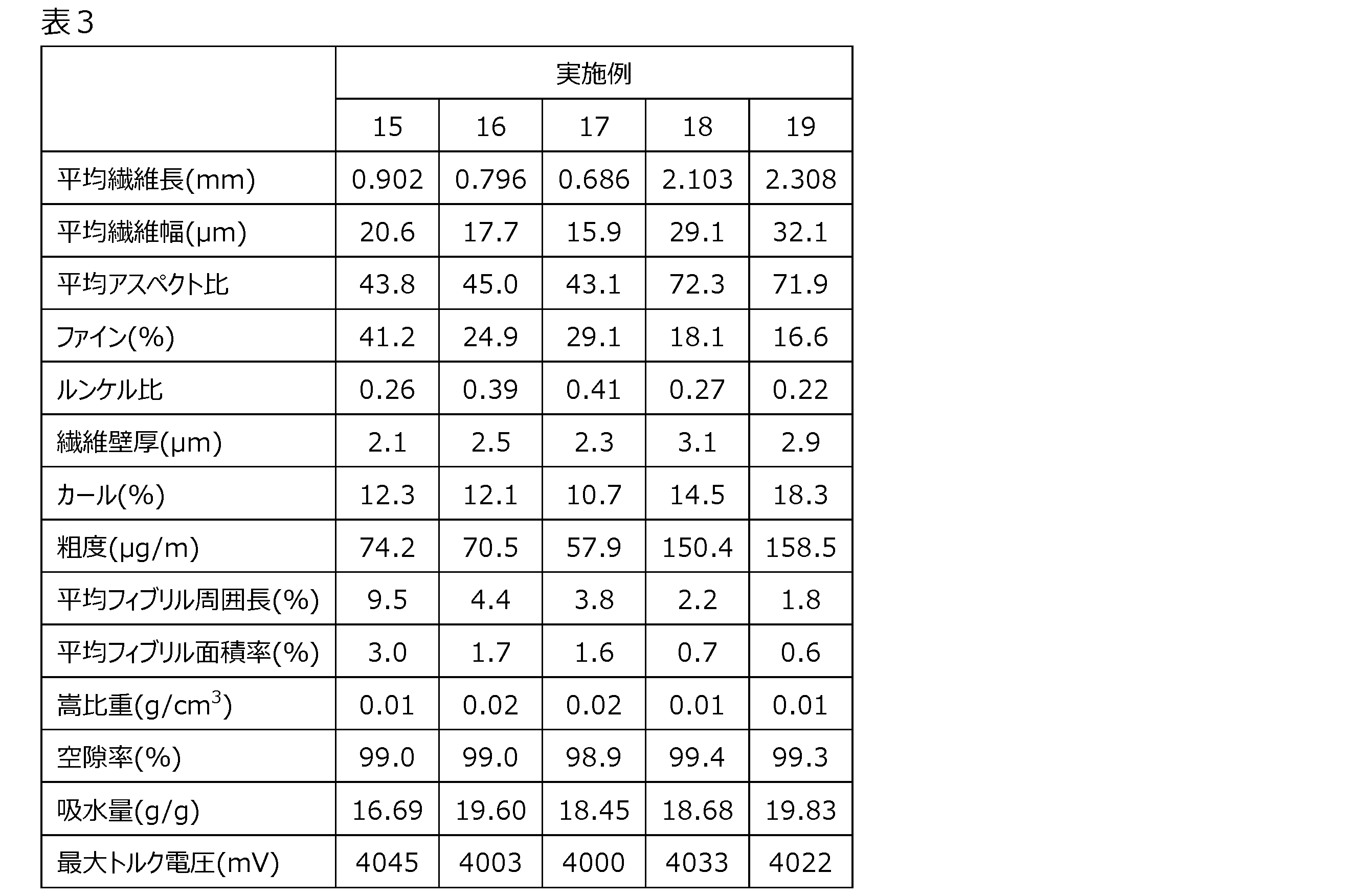
平均繊維長が0.40mm未満、平均アスペクト比が20未満、ファインが80%超である比較例のサンプルと比較して、平均繊維長が0.40mm以上、平均アスペクト比が20以上、ファインが80%以下であり、かつ含水率20重量%以下である実施例のサンプルは、いずれも吸水量が高く、吸水性が良好であった(表1~3)。この結果は、本発明の吸水材が、良好な吸水性を示し、泥土又は無機汚泥処理材として有用であることを示している。
Claims (10)
- 平均繊維長が0.40mm以上、平均アスペクト比が20以上、繊維長0.2mm以下の繊維の割合が80%以下、含水率が20重量%以下であるセルロース材料を含む、セルロース系土木又は建設業用吸水材。
- セルロース材料の平均繊維長が0.60mm以上である、請求項1に記載の土木又は建設業用吸水材。
- セルロース材料の平均アスペクト比が22以上である、請求項1又は2に記載の土木又は建設業用吸水材。
- セルロース材料のルンケル比が0.28以上である、請求項1又は2に記載の土木又は建設業用吸水材。
- セルロース材料のカールが12.5%以上である、請求項1又は2に記載の土木又は建設業用吸水材。
- セルロース材料の粗度が105μg/m以上である、請求項1又は2に記載の土木又は建設業用吸水材。
- セルロース材料の空隙率が94%以上である、請求項1又は2に記載の土木又は建設業用吸水材。
- セルロース材料の嵩比重が0.1g/cm3以下である、請求項1又は2に記載の土木又は建設業用吸水材。
- セルロース材料の平均フィブリル面積率が1.5%以上である請求項1又は2に記載の土木又は建設業用吸水材。
- セルロース材料が、広葉樹由来のセルロース材料である、請求項1又は2に記載の土木又は建設業用吸水材。
Applications Claiming Priority (2)
| Application Number | Priority Date | Filing Date | Title |
|---|---|---|---|
| JP2023-106792 | 2023-06-29 | ||
| JP2023106792 | 2023-06-29 |
Publications (1)
| Publication Number | Publication Date |
|---|---|
| WO2025005239A1 true WO2025005239A1 (ja) | 2025-01-02 |
Family
ID=93939147
Family Applications (1)
| Application Number | Title | Priority Date | Filing Date |
|---|---|---|---|
| PCT/JP2024/023499 Ceased WO2025005239A1 (ja) | 2023-06-29 | 2024-06-28 | 吸水材 |
Country Status (1)
| Country | Link |
|---|---|
| WO (1) | WO2025005239A1 (ja) |
Citations (4)
| Publication number | Priority date | Publication date | Assignee | Title |
|---|---|---|---|---|
| JP2019210332A (ja) * | 2018-05-31 | 2019-12-12 | 大王製紙株式会社 | 繊維状セルロース及びその製造方法、並びに繊維状セルロース複合樹脂及びその製造方法 |
| JP2021001413A (ja) * | 2019-06-21 | 2021-01-07 | 大王製紙株式会社 | 水解紙及びその製造方法 |
| JP2021042376A (ja) * | 2019-09-06 | 2021-03-18 | 花王株式会社 | 吸水性組成物及びその製造方法 |
| WO2021112195A1 (ja) * | 2019-12-03 | 2021-06-10 | 日本製紙株式会社 | 変性セルロースマイクロフィブリルの製造方法 |
-
2024
- 2024-06-28 WO PCT/JP2024/023499 patent/WO2025005239A1/ja not_active Ceased
Patent Citations (4)
| Publication number | Priority date | Publication date | Assignee | Title |
|---|---|---|---|---|
| JP2019210332A (ja) * | 2018-05-31 | 2019-12-12 | 大王製紙株式会社 | 繊維状セルロース及びその製造方法、並びに繊維状セルロース複合樹脂及びその製造方法 |
| JP2021001413A (ja) * | 2019-06-21 | 2021-01-07 | 大王製紙株式会社 | 水解紙及びその製造方法 |
| JP2021042376A (ja) * | 2019-09-06 | 2021-03-18 | 花王株式会社 | 吸水性組成物及びその製造方法 |
| WO2021112195A1 (ja) * | 2019-12-03 | 2021-06-10 | 日本製紙株式会社 | 変性セルロースマイクロフィブリルの製造方法 |
Similar Documents
| Publication | Publication Date | Title |
|---|---|---|
| CN109790681B (zh) | 将高稠度纸浆纤维转化为预分散半干和干纤维材料的方法 | |
| Zambrano et al. | Micro-and nanofibrillated cellulose from virgin and recycled fibers: A comparative study of its effects on the properties of hygiene tissue paper | |
| JP5544747B2 (ja) | 微細繊維状セルロースの製造方法 | |
| ES2560455T3 (es) | Procedimiento para la producción de suspensiones de celulosa nanofibrilar | |
| RU2505635C2 (ru) | Композиция наполнителя для бумаги | |
| JP2019526720A5 (ja) | ||
| US11453728B2 (en) | Carboxymethylated microfibrillated cellulose fibers and composition thereof | |
| JP5862345B2 (ja) | 微細繊維状セルロースの製造方法 | |
| US11466405B2 (en) | Carboxymethylated microfibrillated cellulose fibers and composition thereof | |
| US11479915B2 (en) | Method for manufacturing intermediate product for conversion into microfibrillated cellulose | |
| Hanhikoski et al. | Fibrillation and characterization of lignin-containing neutral sulphite (NS) pulps rich in hemicelluloses and anionic charge | |
| WO2011129241A1 (ja) | 微細繊維状セルロースの製造方法 | |
| Laitinen et al. | Enhancing packaging board properties using micro-and nanofibers prepared from recycled board | |
| Yang et al. | Processing strategy for reduced energy demand of nanostructured CNF/clay composites with tailored interfaces | |
| JP2021006666A (ja) | セルロース繊維の成形体及びその製造方法 | |
| Wang et al. | Facile preparation of nanofiller-paper using mixed office paper without deinking | |
| WO2025005239A1 (ja) | 吸水材 | |
| JP6098370B2 (ja) | 複合材料及びその製造方法 | |
| WO2019166912A1 (en) | Method for manufacturing a composition comprising microfibrillated cellulose | |
| Subramanian et al. | Potential use of micro-and nanofibrillated cellulose composites exemplified by paper | |
| Qiang et al. | Interaction between PCC filler and cellulosic fiber in fiber/filler co-refining system | |
| JP2012057268A (ja) | 微細繊維状セルロースの製造方法 | |
| KR20220035871A (ko) | 인장 특성이 향상된 마이크로피브릴화 셀룰로스를 제조하기 위한 조성물 및 방법 | |
| Roozbeh | Interaction of chitosan biopolymer with silica nanoparticles as a novel retention/drainage and reinforcement aid in recycled cellulosic fibers | |
| CN117926614A (zh) | 回用纸浆制备方法、回用纸浆以及纸张制备方法 |
Legal Events
| Date | Code | Title | Description |
|---|---|---|---|
| 121 | Ep: the epo has been informed by wipo that ep was designated in this application |
Ref document number: 24832097 Country of ref document: EP Kind code of ref document: A1 |
|
| ENP | Entry into the national phase |
Ref document number: 2025530230 Country of ref document: JP Kind code of ref document: A |
|
| WWE | Wipo information: entry into national phase |
Ref document number: 2025530230 Country of ref document: JP |
|
| NENP | Non-entry into the national phase |
Ref country code: DE |