WO2025005113A1 - 共重合体、感光性組成物、硬化物、および有機el表示装置 - Google Patents
共重合体、感光性組成物、硬化物、および有機el表示装置 Download PDFInfo
- Publication number
- WO2025005113A1 WO2025005113A1 PCT/JP2024/023112 JP2024023112W WO2025005113A1 WO 2025005113 A1 WO2025005113 A1 WO 2025005113A1 JP 2024023112 W JP2024023112 W JP 2024023112W WO 2025005113 A1 WO2025005113 A1 WO 2025005113A1
- Authority
- WO
- WIPO (PCT)
- Prior art keywords
- copolymer
- formula
- group
- photosensitive composition
- mass
- Prior art date
- Legal status (The legal status is an assumption and is not a legal conclusion. Google has not performed a legal analysis and makes no representation as to the accuracy of the status listed.)
- Ceased
Links
Images

Classifications
-
- C—CHEMISTRY; METALLURGY
- C08—ORGANIC MACROMOLECULAR COMPOUNDS; THEIR PREPARATION OR CHEMICAL WORKING-UP; COMPOSITIONS BASED THEREON
- C08F—MACROMOLECULAR COMPOUNDS OBTAINED BY REACTIONS ONLY INVOLVING CARBON-TO-CARBON UNSATURATED BONDS
- C08F220/00—Copolymers of compounds having one or more unsaturated aliphatic radicals, each having only one carbon-to-carbon double bond, and only one being terminated by only one carboxyl radical or a salt, anhydride ester, amide, imide or nitrile thereof
- C08F220/02—Monocarboxylic acids having less than ten carbon atoms; Derivatives thereof
- C08F220/10—Esters
- C08F220/20—Esters of polyhydric alcohols or phenols, e.g. 2-hydroxyethyl (meth)acrylate or glycerol mono-(meth)acrylate
-
- C—CHEMISTRY; METALLURGY
- C08—ORGANIC MACROMOLECULAR COMPOUNDS; THEIR PREPARATION OR CHEMICAL WORKING-UP; COMPOSITIONS BASED THEREON
- C08F—MACROMOLECULAR COMPOUNDS OBTAINED BY REACTIONS ONLY INVOLVING CARBON-TO-CARBON UNSATURATED BONDS
- C08F212/00—Copolymers of compounds having one or more unsaturated aliphatic radicals, each having only one carbon-to-carbon double bond, and at least one being terminated by an aromatic carbocyclic ring
- C08F212/02—Monomers containing only one unsaturated aliphatic radical
- C08F212/04—Monomers containing only one unsaturated aliphatic radical containing one ring
- C08F212/14—Monomers containing only one unsaturated aliphatic radical containing one ring substituted by heteroatoms or groups containing heteroatoms
- C08F212/22—Oxygen
- C08F212/24—Phenols or alcohols
-
- C—CHEMISTRY; METALLURGY
- C08—ORGANIC MACROMOLECULAR COMPOUNDS; THEIR PREPARATION OR CHEMICAL WORKING-UP; COMPOSITIONS BASED THEREON
- C08F—MACROMOLECULAR COMPOUNDS OBTAINED BY REACTIONS ONLY INVOLVING CARBON-TO-CARBON UNSATURATED BONDS
- C08F220/00—Copolymers of compounds having one or more unsaturated aliphatic radicals, each having only one carbon-to-carbon double bond, and only one being terminated by only one carboxyl radical or a salt, anhydride ester, amide, imide or nitrile thereof
- C08F220/02—Monocarboxylic acids having less than ten carbon atoms; Derivatives thereof
- C08F220/04—Acids; Metal salts or ammonium salts thereof
- C08F220/06—Acrylic acid; Methacrylic acid; Metal salts or ammonium salts thereof
-
- C—CHEMISTRY; METALLURGY
- C08—ORGANIC MACROMOLECULAR COMPOUNDS; THEIR PREPARATION OR CHEMICAL WORKING-UP; COMPOSITIONS BASED THEREON
- C08F—MACROMOLECULAR COMPOUNDS OBTAINED BY REACTIONS ONLY INVOLVING CARBON-TO-CARBON UNSATURATED BONDS
- C08F220/00—Copolymers of compounds having one or more unsaturated aliphatic radicals, each having only one carbon-to-carbon double bond, and only one being terminated by only one carboxyl radical or a salt, anhydride ester, amide, imide or nitrile thereof
- C08F220/02—Monocarboxylic acids having less than ten carbon atoms; Derivatives thereof
- C08F220/10—Esters
- C08F220/12—Esters of monohydric alcohols or phenols
- C08F220/16—Esters of monohydric alcohols or phenols of phenols or of alcohols containing two or more carbon atoms
- C08F220/18—Esters of monohydric alcohols or phenols of phenols or of alcohols containing two or more carbon atoms with acrylic or methacrylic acids
- C08F220/1818—C13or longer chain (meth)acrylate, e.g. stearyl (meth)acrylate
-
- C—CHEMISTRY; METALLURGY
- C08—ORGANIC MACROMOLECULAR COMPOUNDS; THEIR PREPARATION OR CHEMICAL WORKING-UP; COMPOSITIONS BASED THEREON
- C08F—MACROMOLECULAR COMPOUNDS OBTAINED BY REACTIONS ONLY INVOLVING CARBON-TO-CARBON UNSATURATED BONDS
- C08F220/00—Copolymers of compounds having one or more unsaturated aliphatic radicals, each having only one carbon-to-carbon double bond, and only one being terminated by only one carboxyl radical or a salt, anhydride ester, amide, imide or nitrile thereof
- C08F220/62—Monocarboxylic acids having ten or more carbon atoms; Derivatives thereof
- C08F220/68—Esters
-
- C—CHEMISTRY; METALLURGY
- C08—ORGANIC MACROMOLECULAR COMPOUNDS; THEIR PREPARATION OR CHEMICAL WORKING-UP; COMPOSITIONS BASED THEREON
- C08F—MACROMOLECULAR COMPOUNDS OBTAINED BY REACTIONS ONLY INVOLVING CARBON-TO-CARBON UNSATURATED BONDS
- C08F8/00—Chemical modification by after-treatment
-
- G—PHYSICS
- G03—PHOTOGRAPHY; CINEMATOGRAPHY; ANALOGOUS TECHNIQUES USING WAVES OTHER THAN OPTICAL WAVES; ELECTROGRAPHY; HOLOGRAPHY
- G03F—PHOTOMECHANICAL PRODUCTION OF TEXTURED OR PATTERNED SURFACES, e.g. FOR PRINTING, FOR PROCESSING OF SEMICONDUCTOR DEVICES; MATERIALS THEREFOR; ORIGINALS THEREFOR; APPARATUS SPECIALLY ADAPTED THEREFOR
- G03F7/00—Photomechanical, e.g. photolithographic, production of textured or patterned surfaces, e.g. printing surfaces; Materials therefor, e.g. comprising photoresists; Apparatus specially adapted therefor
- G03F7/004—Photosensitive materials
- G03F7/027—Non-macromolecular photopolymerisable compounds having carbon-to-carbon double bonds, e.g. ethylenic compounds
-
- G—PHYSICS
- G03—PHOTOGRAPHY; CINEMATOGRAPHY; ANALOGOUS TECHNIQUES USING WAVES OTHER THAN OPTICAL WAVES; ELECTROGRAPHY; HOLOGRAPHY
- G03F—PHOTOMECHANICAL PRODUCTION OF TEXTURED OR PATTERNED SURFACES, e.g. FOR PRINTING, FOR PROCESSING OF SEMICONDUCTOR DEVICES; MATERIALS THEREFOR; ORIGINALS THEREFOR; APPARATUS SPECIALLY ADAPTED THEREFOR
- G03F7/00—Photomechanical, e.g. photolithographic, production of textured or patterned surfaces, e.g. printing surfaces; Materials therefor, e.g. comprising photoresists; Apparatus specially adapted therefor
- G03F7/004—Photosensitive materials
- G03F7/038—Macromolecular compounds which are rendered insoluble or differentially wettable
-
- H—ELECTRICITY
- H10—SEMICONDUCTOR DEVICES; ELECTRIC SOLID-STATE DEVICES NOT OTHERWISE PROVIDED FOR
- H10K—ORGANIC ELECTRIC SOLID-STATE DEVICES
- H10K50/00—Organic light-emitting devices
- H10K50/80—Constructional details
- H10K50/84—Passivation; Containers; Encapsulations
-
- H—ELECTRICITY
- H10—SEMICONDUCTOR DEVICES; ELECTRIC SOLID-STATE DEVICES NOT OTHERWISE PROVIDED FOR
- H10K—ORGANIC ELECTRIC SOLID-STATE DEVICES
- H10K50/00—Organic light-emitting devices
- H10K50/80—Constructional details
- H10K50/86—Arrangements for improving contrast, e.g. preventing reflection of ambient light
-
- H—ELECTRICITY
- H10—SEMICONDUCTOR DEVICES; ELECTRIC SOLID-STATE DEVICES NOT OTHERWISE PROVIDED FOR
- H10K—ORGANIC ELECTRIC SOLID-STATE DEVICES
- H10K59/00—Integrated devices, or assemblies of multiple devices, comprising at least one organic light-emitting element covered by group H10K50/00
- H10K59/10—OLED displays
- H10K59/12—Active-matrix OLED [AMOLED] displays
- H10K59/122—Pixel-defining structures or layers, e.g. banks
-
- H—ELECTRICITY
- H10—SEMICONDUCTOR DEVICES; ELECTRIC SOLID-STATE DEVICES NOT OTHERWISE PROVIDED FOR
- H10K—ORGANIC ELECTRIC SOLID-STATE DEVICES
- H10K59/00—Integrated devices, or assemblies of multiple devices, comprising at least one organic light-emitting element covered by group H10K50/00
- H10K59/10—OLED displays
- H10K59/17—Passive-matrix OLED displays
- H10K59/173—Passive-matrix OLED displays comprising banks or shadow masks
-
- H—ELECTRICITY
- H10—SEMICONDUCTOR DEVICES; ELECTRIC SOLID-STATE DEVICES NOT OTHERWISE PROVIDED FOR
- H10K—ORGANIC ELECTRIC SOLID-STATE DEVICES
- H10K85/00—Organic materials used in the body or electrodes of devices covered by this subclass
- H10K85/10—Organic polymers or oligomers
-
- H—ELECTRICITY
- H10—SEMICONDUCTOR DEVICES; ELECTRIC SOLID-STATE DEVICES NOT OTHERWISE PROVIDED FOR
- H10K—ORGANIC ELECTRIC SOLID-STATE DEVICES
- H10K2101/00—Properties of the organic materials covered by group H10K85/00
Definitions
- the present invention relates to a copolymer, a photosensitive composition, a cured product, and an organic EL display device.
- EL organic electroluminescence
- the negative photosensitive resin composition disclosed in Patent Document 1 has a small absolute value of the difference in the pattern formation width relative to the mask design width (hereinafter, may be referred to as "mask bias”), but has a high taper angle after curing due to low reflowability in the curing process, and also has a problem that the margin (tolerance range) for the pre-bake temperature conditions is insufficient due to the thermal crosslinking group, resulting in the generation of minute development residues at the openings of the pixel division layer, i.e., on the ITO electrode surface.
- mask bias the difference in the pattern formation width relative to the mask design width
- the negative photosensitive colored resin composition disclosed in Patent Document 2 has a problem with the development form in which, depending on the development method, the film in the unexposed area is removed from the ITO electrode surface in an alkaline developer solution so that it peels off into pieces, and there is a large risk of contamination of the development tank and clogging of the pipes due to the discharge of alkaline development waste solution containing countless coarse, amorphous films, and there is room for improvement.
- the total amount of structural units represented by any one of formulas (1) to (4) is 70 to 100 mol % in the total of all structural units of the copolymer (a)
- the number of moles of the structural units represented by formula (1) and the structural units represented by formula (2) is X
- the number of moles of the structural units represented by formula (3) is Y
- the number of moles of the structural units represented by formula (4) is Z
- a value A obtained by dividing X by Y is 1.0 to 10.0
- a value B obtained by dividing X by Z is 1.0 to 10.0.
- R1 represents a hydrogen atom or a methyl group.
- R2 represents a single bond or an alkylene group having 1 to 3 carbon atoms.
- n1 is an integer and represents 1 or 2.
- R3 represents an alkyl group having 1 to 3 carbon atoms or an alkoxy group having 1 to 3 carbon atoms.
- n2 is an integer and represents 0 to 2.
- * represents a bonding site.
- R4 represents a hydrogen atom or a methyl group.
- R5 represents an alkylene group having 1 to 3 carbon atoms.
- n3 is an integer and represents 1 or 2.
- R6 represents an alkyl group having 1 to 3 carbon atoms or an alkoxy group having 1 to 3 carbon atoms.
- n4 is an integer and represents 0 to 2. * represents a bonding site.
- R7 represents a hydrogen atom or a methyl group. * represents a bonding site.
- R8 represents a hydrogen atom or a methyl group, R9 represents an alkyl group having 5 to 18 carbon atoms, and * represents a bonding site.
- a photosensitive composition comprising the copolymer (a) according to any one of [1] to [6], a pigment, a photosensitizer and an organic solvent.
- the photosensitive composition according to [7] further comprising a (meth)acrylate compound having two 9,9-bis(naphthyl)fluorene skeletons and two ethylenically unsaturated double bond groups in the molecule, and having negative photosensitivity.
- the photosensitive composition according to [7] or [8] further comprising a compound represented by formula (9) and having negative photosensitivity.
- PO represents an oxypropylene group
- EO represents an oxyethylene group
- x, y and z each independently represent an integer of 1 to 50 and satisfy the relationship y ⁇ x+z.
- the copolymer of the present invention ensures a wide margin (tolerance range) for pre-baking temperature conditions, suppresses the generation of development residues on the ITO electrode surface, provides an excellent solubility in a high-concentration organic alkaline developer, and imparts high reflowability to the photosensitive composition.
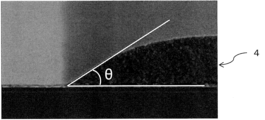
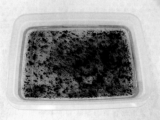
- FIG. 1 is a diagram showing the taper angle ⁇ of the cured product (insulating layer 4) of the photosensitive composition. 13 is an image showing an example in which the evaluation of the development state was unacceptable in all of the Examples and Comparative Examples. 1 is a schematic diagram illustrating a procedure for producing an organic EL display device according to an embodiment of the present invention.
- the copolymer of the present invention is a copolymer (a) containing a structural unit represented by formula (1) and/or a structural unit represented by formula (2), a structural unit represented by formula (3), and a structural unit represented by formula (4).
- R1 represents a hydrogen atom or a methyl group.
- R2 represents a single bond or an alkylene group having 1 to 3 carbon atoms.
- n1 is an integer and represents 1 or 2.
- R3 represents an alkyl group having 1 to 3 carbon atoms or an alkoxy group having 1 to 3 carbon atoms.
- n2 is an integer and represents 0 to 2.
- * represents a bonding site.
- R4 represents a hydrogen atom or a methyl group.
- R5 represents an alkylene group having 1 to 3 carbon atoms.
- n3 is an integer and represents 1 or 2.
- R6 represents an alkyl group having 1 to 3 carbon atoms or an alkoxy group having 1 to 3 carbon atoms.
- n4 is an integer and represents 0 to 2.
- * represents a bonding site.
- R7 represents a hydrogen atom or a methyl group. * represents a bonding site.
- R8 represents a hydrogen atom or a methyl group.
- R9 represents an alkyl group having 5 to 18 carbon atoms. * represents a bonding site.
- the structural unit in the copolymer (a) refers to a structural unit derived from a monomer having one unsaturated double bond group in the molecule when the copolymer is obtained.
- the copolymerization method for the copolymer (a) of the present invention may be, for example, the method described in JP-A-5-19467, but any known method can be used.
- Examples of the structural unit represented by formula (1) include 4-hydroxyphenyl methacrylate (hereinafter, PQMA), (4-hydroxyphenyl)methyl methacrylate, (4-hydroxyphenyl)ethyl methacrylate, (4-hydroxyphenyl)propyl methacrylate, 4-hydroxyphenyl acrylate, (4-hydroxyphenyl)methyl acrylate, (4-hydroxyphenyl)ethyl acrylate, and (4-hydroxyphenyl)propyl acrylate.
- PQMA 4-hydroxyphenyl methacrylate
- PQMA 4-hydroxyphenyl methacrylate
- 4-hydroxyphenyl)methyl methacrylate (4-hydroxyphenyl)ethyl methacrylate
- 4-hydroxyphenyl acrylate (4-hydroxyphenyl)methyl acrylate
- (4-hydroxyphenyl)ethyl acrylate (4-hydroxyphenyl)propyl acrylate
- Examples of the structural unit represented by formula (2) include 2-allylphenol, 4-allyl-2,6-dimethoxyphenol, 4-allyl-2,6-dimethylphenol, 4-allyl-2,6-diethylphenol, and 4-allyl-2,6-dipropylphenol.
- copolymer (a) contains a structural unit represented by formula (1) and/or a structural unit represented by formula (2), for example, in a photosensitive composition containing copolymer (a), such as a negative photosensitive composition, the effect of suppressing radical chain reactions is exhibited, the mask bias is reduced, and a pattern can be formed as intended.
- a photosensitive composition containing copolymer (a) such as a negative photosensitive composition
- copolymer (a) has a structural unit represented by formula (1).
- Examples of the structural unit represented by formula (3) include methacrylic acid (hereinafter, referred to as MAA) and acrylic acid.
- MAA methacrylic acid
- acrylic acid acrylic acid
- Examples of the structural unit represented by formula (4) include hexyl methacrylate, hexyl acrylate, 2-ethylhexyl methacrylate (hereinafter, 2-EHMA), 2-ethylhexyl acrylate, n-octyl methacrylate, n-octyl acrylate, decyl methacrylate, decyl acrylate, isodecyl methacrylate, isodecyl acrylate, 2-propylheptyl methacrylate, 2-propylheptyl acrylate, dodecyl methacrylate, dodecyl acrylate, undecyl methacrylate, undecyl acrylate, isostearyl methacrylate, isostearyl acrylate, n-stearyl methacrylate, and n-stearyl acrylate.
- 2-EHMA 2-ethylhexyl acrylate
- copolymer (a) By containing the structural unit represented by formula (4) in copolymer (a), a photosensitive composition containing copolymer (a) can be endowed with high reflowability in a heat curing step.
- copolymer (a) has a structural unit represented by R9 in formula (4) which is a branched alkyl group having 7 to 15 carbon atoms.
- Copolymer (a) of the present invention can further be copolymerized with any (meth)acrylic monomer as a monomer, if necessary.
- itaconic acid, maleic acid, maleic anhydride, phthalic acid, phthalic anhydride, crotonic acid monomers having a carboxy group such as 2-carboxyethyl acrylate oligomer and 2-carboxyethyl methacrylate oligomer, methyl acrylate, ethyl acrylate, propyl acrylate, isopropyl acrylate, n-butyl acrylate, isobutyl acrylate, t-butyl acrylate, cyclohexyl acrylate, isobornyl acrylate, benzyl acrylate, ethyl methacrylate, propyl methacrylate, isopropyl methacrylate, n-butyl methacrylate, isobutyl meth ...
- unsaturated monomers having an aromatic ring such as acrylic acid esters or methacrylic acid esters, such as t-butyl methacrylate, cyclohexyl methacrylate, isobornyl methacrylate, and benzyl methacrylate, or their (fluoro)alkyl ester monomers, styrene, ⁇ -methylstyrene, 4-vinyltoluene and its structural isomers, 4-methoxystyrene and its structural isomers, 4-butoxystyrene and its structural isomers, 4-tert-butoxystyrene and its structural isomers, 4-vinylbiphenyl, 2-vinylnaphthalene and its structural isomers, 9-vinylanthracene, and 9-vinylcarbazole.
- unsaturated monomers having an aromatic ring such as acrylic acid esters or methacrylic acid esters, such as t-butyl methacrylate,
- a method of subjecting a glycidyl group-containing polymerizable unsaturated monomer to an addition reaction with the copolymer (a) in which the structural unit represented by formula (3) has been copolymerized may be mentioned.
- examples of the glycidyl-containing unsaturated monomer include glycidyl acrylate and glycidyl methacrylate.
- R 14 and R 15 each independently represent a hydrogen atom or a methyl group, and R 16 represents a divalent group having 4 to 12 carbon atoms and a hydroxyl group.
- R 16 is preferably a divalent group having 4 to 8 carbon atoms and a hydroxyl group, and R 15 is preferably a methyl group.
- R 16 may have an oxygen atom in the main chain, or may have an alicyclic structure or an aromatic ring.
- Preferred specific examples of the structural unit represented by formula (8) include structural units represented by formulas (10) to (14).
- the structural unit represented by the formula (8) is preferably contained in an amount of 5 to 18 mol % based on the total of 100 mol % of all structural units of the copolymer (a), in order to achieve both the effect of suppressing development residues of less than 0.1 ⁇ m on the surface of the ITO electrode and the effect of suppressing residues of 0.1 ⁇ m or more at a pre-bake temperature of 130° C. and widening the margin (tolerance) of the pre-bake temperature conditions.
- the weight-average molecular weight (Mw) of the copolymer (a) of the present invention is preferably 10,000 to 50,000. With a weight-average molecular weight (Mw) of 10,000 or more, even if the pre-baking temperature of the photosensitive composition containing the copolymer (a) is low, a suitably long development time can be ensured, and in the case of a negative photosensitive composition, the pattern can be prevented from becoming inverted tapered. On the other hand, with a weight-average molecular weight (Mw) of 50,000 or less, the occurrence of opening residues can be suppressed even if the pre-baking temperature is high (e.g., 130°C).
- the weight average molecular weight (Mw) is a value obtained by analyzing with gel permeation chromatography (GPC) using tetrahydrofuran as a carrier and converting it using a calibration curve based on standard polystyrene.
- Copolymer (a) can be suitably used in photosensitive compositions.
- the content of copolymer (a) in the photosensitive composition is preferably 5% by mass or more, and more preferably 10% by mass or more, based on 100% by mass of the total components other than the solvent in the photosensitive composition, from the viewpoints of high reflowability in the heat curing step and minimizing the cure mask bias.
- the content is preferably 60% by mass or less, and more preferably 50% by mass or less.
- the copolymer (a) of the present invention can exert favorable effects when used in a photosensitive composition containing a pigment (b), a photosensitizer (c) and an organic solvent (d).
- the pigment (b) used in the photosensitive composition of the present invention may be an organic pigment or an inorganic pigment that is generally used in the field of electronic information materials.
- organic pigments include diketopyrrolopyrrole pigments, azo pigments such as azo, disazo, or polyazo, phthalocyanine pigments such as copper phthalocyanine, halogenated copper phthalocyanine, or metal-free phthalocyanine, anthraquinone pigments such as aminoanthraquinone, diaminodianthraquinone, anthrapyrimidine, flavanthrone, anthanthrone, indanthrone, pyranthrone, or violanthrone, quinacridone pigments, dioxazine pigments, perinone pigments, perylene pigments, thioindigo pigments, isoindoline pigments, isoindolinone pigments, quinophthalone pigments, threne pigments, or metal complex pigment
- inorganic pigments include titanium oxide, zinc oxide, zinc sulfide, white lead, calcium carbonate, precipitated barium sulfate, white carbon, alumina white, kaolin clay, talc, bentonite, black iron oxide, cadmium red, red iron oxide, molybdenum red, molybdate orange, chrome vermilion, yellow lead, cadmium yellow, yellow iron oxide, titanium yellow, chromium oxide, viridian, titanium cobalt green, cobalt green, cobalt chrome green, Victoria green, ultramarine, Prussian blue, cobalt blue, cerulean blue, cobalt silica blue, cobalt zinc silica blue, manganese violet, and cobalt violet.
- red pigments examples include Pigment Red 9, 48, 97, 122, 123, 144, 149, 166, 168, 177, 179, 180, 192, 209, 215, 216, 217, 220, 223, 224, 226, 227, 228, 240, and 254 (all numbers are Color Index (hereafter "C.I.") numbers).
- orange pigments examples include Pigment Orange 13, 36, 38, 43, 51, 55, 59, 61, 64, 65, and 71 (all numbers are C.I. numbers).
- yellow pigments examples include Pigment Yellow 12, 13, 17, 20, 24, 83, 86, 93, 95, 109, 110, 117, 125, 129, 137, 138, 139, 147, 148, 150, 153, 154, 166, 168, and 185 (all numbers are C.I. numbers).
- blue pigments examples include Pigment Blue 15, 15:3, 15:4, 15:6, 22, 60, and 64 (all numbers are C.I. numbers).
- Green pigments include, for example, Pigment Green 7, 10, 36, and 58 (all numbers are C.I. numbers).
- black pigments include black organic pigments, mixed-color organic pigments, and inorganic pigments.
- black organic pigments include carbon black, perylene black, aniline black, and benzofuranone pigments (described in JP2012-515233A).
- a photosensitive composition with the desired optical properties can be obtained, but from the standpoint of visible light blocking and insulating properties per unit mass, it is preferable to include a benzofuranone pigment.
- the content of pigment (b) used in the photosensitive composition of the present invention is preferably 5% by mass or more, and more preferably 10% by mass or more, based on 100% by mass of the total components of the photosensitive composition other than the solvent, from the viewpoint of light-shielding properties per unit film thickness.
- the content is preferably 50% by mass or less, and more preferably 40% by mass or less.
- the photosensitizer (c) used in the photosensitive composition of the present invention may contain a photopolymerization initiator (c1) or a photoacid generator (c2).
- the photopolymerization initiator (c1) is a compound that undergoes bond cleavage and/or reaction upon exposure to generate radicals
- the photoacid generator (c2) is a compound that generates an acid upon exposure to light.
- the photosensitive composition contains a photopolymerization initiator (c1) and a radically polymerizable compound described below, radical polymerization proceeds in the light-irradiated areas, resulting in a negative relief pattern in which the light-irradiated areas are insolubilized.
- the photosensitive composition contains a photoacid generator (c2), acid is generated in the light-irradiated areas, increasing the solubility of the light-irradiated areas in an alkaline aqueous solution, resulting in a positive relief pattern in which the light-irradiated areas are dissolved.
- Examples of the photopolymerization initiator (c1) include carbazole-based photopolymerization initiators, acylphosphine oxide-based photopolymerization initiators, oxime ester-based photopolymerization initiators, and ⁇ -aminoalkylphenone-based photopolymerization initiators. Two or more of these may be included. Among these, carbazole-based photopolymerization initiators and oxime ester-based photopolymerization initiators are preferred because they have high sensitivity to a mixed line consisting of i-line (365 nm), h-line (405 nm), and g-line (436 nm) in the exposure step described below.
- the photoacid generator (c2) may contain, for example, a quinone diazide compound.
- the quinone diazide compound may include a polyhydroxy compound to which a sulfonic acid of quinone diazide is bonded via an ester bond, a polyamino compound to which a sulfonic acid of quinone diazide is bonded via a sulfonamide bond, a polyhydroxypolyamino compound to which a sulfonic acid of quinone diazide is bonded via an ester bond and/or a sulfonamide bond, and the like.
- quinone diazide structure either a 5-naphthoquinone diazide sulfonyl group or a 4-naphthoquinone diazide sulfonyl group is preferably used.
- a naphthoquinone diazide sulfonyl ester compound having a 4-naphthoquinone diazide sulfonyl group and a 5-naphthoquinone diazide sulfonyl group in the same molecule may be contained, or a 4-naphthoquinone diazide sulfonyl ester compound and a 5-naphthoquinone diazide sulfonyl ester compound may be contained.
- 4-naphthoquinone diazide sulfonyl ester compounds have absorption in the i-line region of a mercury lamp, making them suitable for i-line exposure.
- 5-naphthoquinone diazide sulfonyl ester compounds have absorption extending into the g-line region of a mercury lamp, making them suitable for g-line exposure.
- the above quinone diazide compounds can be synthesized by any esterification reaction between a compound having a phenolic hydroxyl group and a quinone diazide sulfonic acid compound. By using these quinone diazide compounds, the resolution, sensitivity, and film remaining rate are further improved.
- the organic solvent (d) used in the photosensitive composition of the present invention may, for example, be a polar aprotic solvent such as ⁇ -butyrolactone, ethylene glycol monomethyl ether, ethylene glycol monoethyl ether, ethylene glycol mono-n-propyl ether, ethylene glycol mono-n-butyl ether, diethylene glycol monomethyl ether, diethylene glycol monoethyl ether, diethylene glycol mono-n-propyl ether, diethylene glycol mono-n-butyl ether, triethylene glycol monomethyl ether, triethylene glycol monoethyl ether, propylene glycol monomethyl ether, propylene glycol monoethyl ether, propylene glycol mono Ethers such as propylene glycol mono-n-propyl ether, propylene glycol mono-n-butyl ether, dipropylene glycol monomethyl ether, dipropylene glycol monoethyl ether, dipropylene
- the photosensitive composition of the present invention may contain a radically polymerizable compound (e).
- a photopolymerization initiator (c1) it is essential that the composition contains a radically polymerizable compound (e).
- the radically polymerizable group possessed by the radically polymerizable compound (e) is preferably an acrylic group or a methacrylic group from the viewpoint of improving sensitivity during exposure, and may have two types of these.
- a compound having two or more radically polymerizable groups is preferable, for example, bisphenol A diglycidyl ether (meth)acrylate, poly(meth)acrylate carbamate, modified bisphenol A epoxy (meth)acrylate, 1,6-hexanediol adipic acid (meth)acrylic acid ester, propylene oxide phthalate (meth)acrylic acid ester, diethylene glycol trimellitic acid (meth)acrylic acid ester, rosin-modified epoxy di(meth)acrylate, acrylate, alkyd modified (meth)acrylate, fluorene diacrylate oligomer, tripropylene glycol di(meth)acrylate, 1,6-hexanediol di(meth)acrylate, bisphenol A diglycidyl ether di(meth)acrylate, trimethylolpropane tri(meth)acrylate, pentaerythritol tri(meth
- the photosensitive composition of the present invention preferably contains a (meth)acrylate compound having two 9,9-bis(naphthyl)fluorene skeletons and two ethylenically unsaturated double bond groups in the molecule and has negative photosensitivity, in order to maintain the solubility in alkali development and to control the taper angle after development to an appropriate low value.
- the content of the radically polymerizable compound (e) in the photosensitive composition of the present invention is preferably 10% by mass or more, and more preferably 15% by mass or more, based on the total content of the copolymer (a) and the radically polymerizable compound (e) (100% by mass), from the viewpoint of improving sensitivity during exposure.
- the content is preferably 80% by mass or less, and more preferably 60% by mass or less.
- the photosensitive composition of the present invention may further contain a dispersing resin (f) having a repeating unit represented by general formula (5) having a tertiary amino group in a side chain, a repeating unit having a carboxy group, and a repeating unit having an ethylenically unsaturated group.
- R10 represents a hydrogen atom or a methyl group
- R11 represents a single bond, an alkylene group having 1 to 5 carbon atoms, or an alkylene ether group having 1 to 5 carbon atoms and 1 oxygen atom.
- R12 and R13 each independently represent an alkyl group or alkoxy group having 1 to 5 carbon atoms, an alicyclic hydrocarbon group having 3 to 6 carbon atoms, or an aromatic hydrocarbon group having 6 to 10 carbon atoms. * represents a bonding site.
- monomers constituting the repeating unit represented by formula (5) include 2-dimethylaminoethyl acrylate, 2-diethylaminoethyl acrylate, 2-dipropylaminoethyl acrylate, 2-diphenylaminoethyl acrylate, 2-dibenzylaminoethyl acrylate, 2-dimethylaminoethyl methacrylate, 2-diethylaminoethyl methacrylate, 2-dipropylaminoethyl methacrylate, 2-diphenylaminoethyl methacrylate, and 2-benzylaminoethyl methacrylate. These monomers may be used alone or in combination of two or more.
- a tertiary amino group is adsorbed on the pigment surface, and the storage stability of the photosensitive composition, for example, a negative photosensitive composition, can be further improved.
- monomers constituting repeating units having a carboxy group include acrylic acid, methacrylic acid, itaconic acid, maleic acid, maleic anhydride, phthalic acid, phthalic anhydride, crotonic acid, 2-carboxyethyl acrylate oligomer, and 2-carboxyethyl methacrylate oligomer.
- a method for synthesizing the dispersion resin (f) a method can be used in which the structural unit represented by the general formula (5) and the carboxyl group-containing unit are polymerized, and then a repeating unit having a known ethylenically unsaturated group is introduced.
- a method can be used in which a glycidyl group-containing polymerizable unsaturated monomer is subjected to an addition reaction with a (meth)acrylic copolymer in which a carboxyl group-containing unsaturated monomer is copolymerized.
- examples of the carboxyl group-containing unsaturated monomer to be copolymerized include acrylic acid and methacrylic acid
- examples of the glycidyl group-containing unsaturated monomer to be copolymerized include glycidyl acrylate and glycidyl methacrylate. These acrylic monomers can be used alone or in a mixture of two or more types.
- the acid value of the dispersion resin (f) is preferably 50 to 120 mg KOH/g, and by setting it within this range, both pigment dispersion stability and solubility in the alkaline developer can be achieved.
- the base value is preferably 5 to 70 mmol/100 g, and by setting it within this range, pigment dispersion stability can be improved while maintaining solubility in the alkaline developer.
- the base value is defined as the number of moles of perchloric acid required to neutralize 100 g of the dispersion resin (f).
- the content of the dispersion resin (f) is preferably 5% by mass or more relative to the total of 100% by mass of the copolymer (a) and the dispersion resin (f) from the viewpoint of pigment dispersion stability, while it is preferably 50% by mass or less from the viewpoint of minimizing mask bias.
- the photosensitive composition of the present invention may further contain a polymeric dispersant (g).
- the polymeric dispersant (g) refers to a dispersant that has both an affinity group that has a chemical bond or adsorption action to the pigment surface and a polymer chain or group that has solvent affinity, and does not contain an ethylenically unsaturated group. Since the polymeric dispersant (g) does not have an ethylenically unsaturated group, there is a concern that the target photosensitive performance may be deteriorated if it is added in a large amount, and it is desirable to add an appropriate amount taking into account the dispersion stability and photosensitive performance.
- the polymeric dispersant (g) improves the wettability of the pigment (b) to the dispersion medium in the wet media dispersion process described below, promotes the deagglomeration of the light-shielding material, stabilizes the particle size and viscosity by steric hindrance and/or electrostatic repulsion effects, and further has the effect of suppressing the occurrence of color separation during storage or application of the photosensitive composition.
- polymer dispersants (g) examples include polyester-based polymer dispersants, acrylic-based polymer dispersants, polyurethane-based polymer dispersants, polyallylamine-based polymer dispersants, and carbodiimide-based dispersants.
- polymer dispersants having amino groups are preferred in order to improve the long-term storage stability of the pigment dispersion.
- the photosensitive composition of the present invention may contain a thermal crosslinking agent (h).
- the thermal crosslinking agent (h) refers to a compound having at least two thermally reactive functional groups in the molecule, such as an alkoxymethyl group, a methylol group, an epoxy group, or an oxetanyl group.
- crosslinking occurs between the thermal crosslinking agent (h) and the copolymer (a), or between the thermal crosslinking agents (h) themselves, and the heat resistance, chemical resistance, and bending resistance of the cured product after thermal curing can be improved.
- Preferred examples of compounds having at least two alkoxymethyl groups or methylol groups include DML-PC, DML-PEP, DML-OC, DML-OEP, DML-34X, DML-PTBP, DML-PCHP, DML-OCHP, DML-PFP, DML-PSBP, DML-POP, DML-MBOC, DML-MBPC, DML-MTrisPC, DML-BisOC-Z, DML-BisOCHP-Z, DML-BPC, DML-BisOC-P, DMOM-PC, DMOM-PTBP, DMOM-MBPC, TriML-P, TriML-35XL, and TML-HQ.
- Preferred examples of compounds having at least two epoxy groups include “Epolight” (registered trademark) 40E, “Epolight” 100E, “Epolight” 200E, “Epolight” 400E, “Epolight” 70P, “Epolight” 200P, “Epolight” 400P, "Epolight” 1500NP, “Epolight” 80MF, "Epolight 4000, “Epolight” 1500NP, “Epolight” 80MF, "Epolight” 4000, “Epolight” 1500NP ...
- Examples of compounds having at least two oxetanyl groups include etanacol EHO, etanacol OXBP, etanacol OXTP, etanacol OXMA (all manufactured by Ube Industries, Ltd.), oxetanized phenol novolac, and the like.
- the thermal crosslinking agent (h) may be used in combination of two or more kinds.
- the content of the thermal crosslinking agent (h) is preferably 1% by mass or more and 30% by mass or less in 100% by mass of the total amount of the photosensitive composition excluding the solvent. If the content of the thermal crosslinking agent (h) is 1% by mass or more in 100% by mass of the total amount of the photosensitive composition excluding the solvent, the chemical resistance of the cured product can be further improved. In addition, if the content of the thermal crosslinking agent (h) is 30% by mass or less in 100% by mass of the total amount of the photosensitive composition excluding the solvent, the storage stability of the photosensitive composition is excellent.
- the photosensitive composition of the present invention preferably further contains a compound represented by formula (9) as a residue inhibitor (i) and has negative photosensitivity.
- a compound represented by formula (9) as a residue inhibitor (i) and has negative photosensitivity.
- PO represents an oxypropylene group
- EO represents an oxyethylene group
- x, y, and z each independently represent an integer of 1 to 50 and satisfy the relationship y ⁇ x+z.
- the photosensitive composition of the present invention may contain a surfactant, which can improve wettability with the substrate.
- surfactants include fluorosurfactants such as the SH series, SD series, and ST series from Dow Corning Toray Co., Ltd., the BYK series from BYK Japan Co., Ltd., the KP series from Shin-Etsu Chemical Co., Ltd., the Disfoam series from NOF Corp., the "Megafac (registered trademark)” series from DIC Corp., the Fluorad series from Sumitomo 3M Limited, the "Surflon (registered trademark)” series and "Asahi Guard (registered trademark)” series from Asahi Glass Co., Ltd., and the Polyfox series from OmNova Solutions Co., Ltd., the Polyflow series from Kyoeisha Chemical Co., Ltd., and the "Disparlon (registered trademark)” series from Kusumoto Chemical Co., Ltd., and acrylic and/or meth
- a surfactant When a surfactant is included, its content is preferably 0.001 to 1 mass % based on 100 mass % of the total amount of the photosensitive composition excluding the solvent.
- the photosensitive composition of the present invention may contain, as necessary, a nonionic surfactant as a leveling agent, or a silane coupling agent as an adhesion improver for the substrate surface.
- the chemical structures of the compounds belonging to the above-mentioned copolymer (a), pigment (b), photosensitizer (c), organic solvent (d), radical polymerizable compound (e), dispersion resin (f), polymer dispersant (g) and thermal crosslinker (h) can be analyzed by combining known analytical techniques such as time-of-flight secondary ion mass spectrometry (TOF-SIMS), time-of-flight mass spectrometry (TOF-MS), nuclear magnetic resonance (NMR), liquid chromatography mass spectrometry (LC-MS), gas chromatography mass spectrometry (GC-MS), ICP mass spectrometry, infrared absorption spectrometry and X-ray diffraction, using the photosensitive composition of the present invention as a sample.
- TOF-SIMS time-of-flight secondary ion mass spectrometry
- TOF-MS time-of-flight mass spectrometry
- NMR nuclear magnetic resonance
- LC-MS liquid
- the photosensitive composition may be centrifuged, and the concentrate obtained as the filtrate may be analyzed as a sample to improve the accuracy of identification.
- the filtrate obtained by filtering the supernatant after centrifugation may be analyzed as a sample to improve the accuracy of identification.
- the method for preparing the photosensitive composition of the present invention is not particularly limited, but an example of such a method is to prepare a pigment dispersion liquid containing the pigment (b), the dispersing resin (f), the organic solvent (d), and, if necessary, the polymeric dispersant (g) in advance by wet dispersion processing, and then mix and stir the copolymer (a), the photosensitizer (c), the organic solvent (d), and, if necessary, the radical polymerizable compound (e), and other components with the pigment dispersion liquid, and filter the mixture as necessary.
- the dispersing machine for wet dispersion may be either a wet media dispersing machine or a wet medialess dispersing machine, but it is preferable to use a wet media dispersing machine because of its excellent dispersion processing speed and economical advantages.
- wet media dispersing machines include bead mills such as "Levomill” (registered trademark) (manufactured by Asada Iron Works Co., Ltd.), “Nano Getter” (registered trademark) (manufactured by Ashizawa Finetech Co., Ltd.), "DYNO-MILL” (registered trademark) (manufactured by Willy A.
- a bead mill having a centrifugal separator capable of separating minute beads from the dispersion liquid is preferred.
- dispersing pigment (b) containing coarse particles of the submicron order beads with a bead diameter of 0.10 mm or more are preferred because they provide sufficient crushing power.
- the bead diameter can be calculated by measuring the circle equivalent diameter of 100 beads randomly selected by observation under a microscope and calculating the number average value.
- the cured product of the present invention is obtained by curing the photosensitive composition.
- the cured product here means a product obtained by a process of heating the photosensitive composition at a temperature of 200°C or higher and 400°C or lower under atmospheric pressure for 10 minutes or more.
- the optical density per 1.0 ⁇ m of film thickness of the pixel division layer is preferably 0.8 or more, more preferably 1.0 or more, in order to suppress external light reflection and increase the value of the display device. From the viewpoint of pattern processing, it is preferably 1.5 or less, more preferably 1.3 or less.
- the optical density means the value obtained by measuring the incident light intensity and the transmitted light intensity of a pixel division layer formed on a transparent substrate to a film thickness of 1.5 ⁇ m using an optical densitometer X-Rite 361T (manufactured by X-Rite Co., Ltd.), and dividing the optical density value (OD value) calculated from the following formula by the film thickness value of 1.5, and the higher the optical density, the higher the light blocking property.
- a transparent glass substrate “Tempax (manufactured by AGC Technoglass Co., Ltd.)" can be preferably used.
- Optical density log 10 (I 0 /I) In the above formula, I 0 is the incident light intensity, and I is the transmitted light intensity.
- a spin coater or slit coater is preferably used because of its excellent thin film coating properties. After coating, pin gap pre-bake or contact pre-bake may be performed.
- the pre-bake temperature in the pre-bake process is preferably 50 to 150°C, and the pre-bake time is preferably 30 seconds to 5 minutes.
- Examples of exposure devices used in the exposure process include steppers, mirror projection mask aligners (MPAs), and parallel light mask aligners (PLAs).
- Activated actinic rays irradiated during exposure include j-rays (wavelength 313 nm), i-rays (wavelength 365 nm), h-rays (wavelength 405 nm), and g-rays (wavelength 436 nm) from ultra-high pressure mercury lamps.
- Mixed rays containing at least i-rays are preferred, and mixed rays containing g-rays, h-rays, and i-rays are more preferred.
- the desired negative or positive type exposure mask can be used, and if it has negative photosensitivity, the exposed area will harden and become insoluble in the developer. If it has positive photosensitivity, the exposed area will dissolve in the developer.
- the developing method in the developing step includes, for example, shower, dipping, paddle, etc., and includes a method in which the exposed film is immersed for 10 seconds to 3 minutes.
- the paddle method is preferred because it reduces the amount of alkaline developer used and makes the manufacturing process economically advantageous.
- a 0.4 to 2.5 mass% aqueous solution of tetramethylammonium hydroxide (hereinafter referred to as "TMAH”) is preferred, and a commercially available product is, for example, 2.38 mass% TMAH (manufactured by Tama Chemicals Co., Ltd.).
- TMAH tetramethylammonium hydroxide
- the developing time is preferably set to 1.1 to 1.5 times the developing time at which the film thickness of the unexposed part becomes 0 ⁇ m in order to eliminate development unevenness in the unexposed part.
- the film thickness ( ⁇ m) in the development process which is the value obtained by subtracting the film thickness of the unexposed part from the film thickness of the prebaked film, to 1.0 ⁇ m or less.
- the exposure sensitivity it is preferable to set it to 0.5 ⁇ m or more.
- the developed film obtained may be irradiated with exposure light again as a second exposure process to control the fluidity of the film in the curing process.
- Each prebaked film was exposed to a high pressure mercury lamp as a light source with a maximum exposure of 200 mJ / cm 2 through a negative mask (stripe design line width 10 ⁇ m) manufactured by HOYA Co., Ltd., using a mask aligner (PEM-6M) manufactured by Union Optical Co., Ltd., and stepwise exposure was performed by lowering the exposure amount by 10 mJ / cm 2 every time.
- a negative mask stripe design line width 10 ⁇ m
- PEM-6M mask aligner
- each exposed film was developed by a paddle method using a small developing device (AD-1200; manufactured by Takizawa Sangyo Co., Ltd.) and an alkaline developer (2.38% by weight TMAH aqueous solution), and then rinsed with ultrapure water for 60 seconds by a shower method, and then the substrate was rotated at 1000 rpm for 30 seconds to dry, to obtain a developed film having a stripe pattern.
- the paddle method here refers to a method in which an alkaline developer is shower-coated on the surface of the exposed film for 10 seconds, and then the film is left to develop until a predetermined development time is reached.
- the development time was the time at which the film thickness of the unexposed part becomes 0 ⁇ m ⁇ 1.3 times.
- each developed film obtained was heated at 250 ° C. under air for 1 hour using a high-temperature inert gas oven (INH-9CD-S; manufactured by Koyo Thermo Systems Co., Ltd.) to obtain a cured product having a stripe pattern.
- a high-temperature inert gas oven IH-9CD-S; manufactured by Koyo Thermo Systems Co., Ltd.
- OD value log 10 (I 0 /I) I0 : Incident light intensity I: Transmitted light intensity Furthermore, the film thickness ( ⁇ m) of the cured product was measured using a contact type film thickness meter DEKTAK150 (manufactured by ULVAC, Inc.), and the light-blocking ability per 1 ⁇ m of each cured product was evaluated by calculating the OD value/film thickness.
- FIG. 3 shows a schematic diagram of the fabrication procedure of an organic EL display device using the photosensitive composition obtained in each Example and Comparative Example.
- a 10 nm ITO transparent conductive film was formed on the entire surface of a 38 mm x 46 mm alkali-free glass substrate 1 by sputtering, and etched as a first electrode (transparent electrode) 2.
- an auxiliary electrode 3 for extracting a second electrode was also formed.
- the obtained substrate 1 was ultrasonically cleaned with Semicoclean 56 (trade name, manufactured by Furuuchi Chemical Co., Ltd.) for 10 minutes, and then washed with ultrapure water.
- the photosensitive composition (NB-1) was applied to the entire surface of the substrate 1 by spin coating, and prebaked on a hot plate at 110 ° C. for 2 minutes.
- This prebaked film was exposed to light with a high pressure mercury lamp as a light source through a photomask at the minimum exposure amount of each photosensitive composition, and then developed with a 2.38 mass % TMAH aqueous solution, the unnecessary parts were dissolved, and rinsed with pure water.
- the obtained resin pattern was heat-treated at 230°C for 60 minutes in a hot air oven.
- an insulating layer 4 was formed in a limited effective area of the substrate 1, in which openings of 70 ⁇ m in width and 260 ⁇ m in length were arranged at a pitch of 155 ⁇ m in the width direction and a pitch of 465 ⁇ m in the length direction, and each opening had a shape that exposed the first electrode 2.
- an insulating layer 4 with an insulating layer opening ratio of 25% was formed in the effective substrate area, which was a rectangle with one side of 16 mm.
- the thickness of the insulating layer 4 was about 1.0 ⁇ m.
- an organic EL layer 5 including a light-emitting layer was formed by a vacuum deposition method.
- the degree of vacuum during deposition was 1 ⁇ 10 ⁇ 3 Pa or less, and the substrate 1 was rotated relative to the deposition source during deposition.
- compound (HT-1) was deposited to a thickness of 10 nm as a hole injection layer, and compound (HT-2) was deposited to a thickness of 50 nm as a hole transport layer.
- compound (GH-1) as a host material and compound (GD-1) as a dopant material were deposited to a thickness of 40 nm on the light-emitting layer so that the doping concentration was 10%.
- compound (ET-1) and compound (LiQ) were laminated to a thickness of 40 nm at a volume ratio of 1:1 as electron transport materials.
- the structures of the compounds used in the organic EL layer are shown below.
- a compound (LiQ) was evaporated to a thickness of 2 nm, and then Mg and Ag were evaporated to a thickness of 10 nm in a volume ratio of 10:1 to form a second electrode (non-transparent electrode) 6.
- a cap-shaped glass plate was attached to the substrate in a low-humidity nitrogen atmosphere using an epoxy resin adhesive to seal the substrate, and four top-emission organic EL display devices were fabricated on one substrate, each of which was a rectangle with sides of 5 mm. Note that the film thickness referred to here is the value displayed on a quartz crystal oscillation film thickness monitor.
- the four organic EL display devices thus produced were caused to emit light, and the light-emitting surfaces were observed under an optical microscope to evaluate the presence or absence of non-lighted cells according to the following criteria.
- a number of copolymers were prepared by varying the reaction time, and a copolymer having a weight average molecular weight of 8,400 was prepared as a 20% by mass solids solution of copolymer (a-1).
- Synthesis Example 4 Copolymer (a-4)
- the amounts of PQMA, MAA, and n-stearyl methacrylate were changed to 14.34 g, 5.19 g, and 20.46 g, respectively, to obtain a PQMA/MAA/n-stearyl methacrylate ratio of 40/30/30
- a solution of the copolymer having a solid content of 20% by mass (mol%) was obtained.
- the copolymer was prepared by changing the reaction time, and a copolymer having a weight average molecular weight of 8,300 was obtained as copolymer (a-4).
- the solid content of the solution was 20% by mass.
- Synthesis Example 5 Copolymer (a-5)
- the amounts of PQMA, MAA, and n-stearyl methacrylate were changed to 25.81 g, 8.83 g, and 5.36 g, respectively, to obtain a PQMA/MAA/n-stearyl methacrylate ratio of 55/39/6
- a solution of a copolymer having a solid content of 20% by mass (mol%) was obtained.
- a number of copolymers were prepared by changing the reaction time, and a copolymer having a weight average molecular weight of 8,700 was obtained as copolymer (a-5). The solid content of the solution was 20% by mass.
- Synthesis Example 6 Copolymer (a-6)
- the amounts of PQMA, MAA, and n-stearyl methacrylate were changed to 16.66 g, 0.88 g, and 22.47 g, respectively, to obtain a PQMA/MAA/n-stearyl methacrylate ratio of 55/6/39
- a 20% by mass solids solution of a copolymer having a weight average molecular weight of 8,400 was obtained by varying the reaction time of the copolymer (a-6). The solid content of the solution was 20% by mass.
- Synthesis Example 7 Copolymer (a-7)
- the amounts of PQMA, MAA, and n-stearyl methacrylate were changed to 31.70 g, 1.68 g, and 6.62 g, respectively, to obtain a PQMA/MAA/n-stearyl methacrylate ratio of 82/9/9
- a 20% by mass solids solution of a copolymer having a weight average molecular weight of 8,200 was obtained by varying the reaction time of the copolymer (a-7). The solid content of the solution was 20% by mass.
- GMA glycidyl methacrylate
- Synthesis Example 9 Copolymer (a-9)
- the amounts of PQMA, MAA, and n-stearyl methacrylate were changed to 17.13 g, 3.31 g, and 19.56 g, respectively, to obtain a PQMA/MAA/n-stearyl methacrylate ratio of 50/20/30
- a 20% by mass solids solution of a copolymer having a weight average molecular weight of 21,000 was obtained by varying the reaction time of the copolymer (a-9).
- the solid content of the solution was 20% by mass.
- Synthesis Example 10 Copolymer (a-10)
- the amounts of PQMA, MAA, and n-stearyl methacrylate were changed to 17.13 g, 3.31 g, and 19.56 g, respectively, to obtain a PQMA/MAA/n-stearyl methacrylate ratio of 50/20/30
- a 20% by mass solids solution of a copolymer having a weight average molecular weight of 63,000 was obtained by varying the reaction time of the copolymer (a-10).
- the solid content of the solution was 20% by mass.
- Synthesis Example 11 Copolymer (a-11)
- the amounts of PQMA, MAA, and n-stearyl methacrylate were changed to 18.47 g, 2.07 g, and 19.46 g, respectively, to obtain a PQMA/MAA/n-stearyl methacrylate ratio of 56/13/31
- a 20% by mass solids solution of a copolymer having a weight average molecular weight of 14,300 was obtained by varying the reaction time of the copolymer (a-11).
- the solid content of the solution was 20% by mass.
- Synthesis Example 12 Copolymer (a-12)
- the same method as in Synthesis Example 1 was used except that isodecyl methacrylate was used instead of n-stearyl methacrylate as the monomer to be added, and the amounts of PQMA, MAA, and isodecyl methacrylate were increased to 22.03 g, 2.47 g, and 15.
- the amount of the copolymer was adjusted to 50 g, a 20% solids solution of PQMA/MAA/isodecyl methacrylate (56/13/31 (mol%)) was obtained.
- the copolymer having a weight average molecular weight of 14,500 was made into a solution having a solid content of 20% by mass as copolymer (a-12).
- Synthesis Example 14 Copolymer (a-14)
- the amounts of PQMA, MAA, and n-stearyl methacrylate were changed to 6.93 g, 6.69 g, and 26.38 g, respectively, to obtain a PQMA/MAA/n-stearyl methacrylate ratio of 20/40/40
- a 20% by mass solids solution of a copolymer having a weight average molecular weight of 8,500 was obtained.
- the copolymer was prepared by changing the reaction time.
- the solid content of the solution was 20% by mass.
- Synthesis Example 15 Copolymer (a-15)
- the amounts of PQMA, MAA, and n-stearyl methacrylate were changed to 7.62 g, 0.49 g, and 31.89 g, respectively, to obtain a PQMA/MAA/n-stearyl methacrylate ratio of 30/4/66
- a 20% by mass solids solution of a copolymer having a weight average molecular weight of 8,300 was obtained by varying the reaction time of the copolymer (a-15). The solid content of the solution was 20% by mass.
- Synthesis Example 16 Copolymer (a-16)
- the amounts of PQMA, MAA, and n-stearyl methacrylate were changed to 17.28 g, 18.34 g, and 4.38 g, respectively, to obtain a PQMA/MAA/n-stearyl methacrylate ratio of 30/66/4
- a 20% by mass solids solution of a copolymer having a weight average molecular weight of 8,600 was obtained.
- the copolymer was prepared by changing the reaction time.
- the solid content of the solution was 20% by mass.
- Synthesis Example 17 Copolymer (a-17)
- the amounts of PQMA, MAA, and n-stearyl methacrylate were changed to 26.25 g, 9.21 g, and 4.54 g, respectively, to obtain a PQMA/MAA/n-stearyl methacrylate ratio of 55/40/5
- a 20% by mass solids solution of a copolymer having a weight average molecular weight of 8,300 was obtained by varying the reaction time of the copolymer (a-17).
- the solid content of the solution was 20% by mass.
- Synthesis Example 18 Copolymer (a-18)
- the amounts of PQMA, MAA, and n-stearyl methacrylate were changed to 16.48 g, 0.72 g, and 22.80 g, respectively, to obtain a PQMA/MAA/n-stearyl methacrylate ratio of 55/5/40
- a 20% by mass solids solution of the copolymer (a-18) was obtained by varying the reaction time. The solid content of the solution was 20% by mass.
- a dispersion resin (f-1) solution having a solid content concentration of 20 mass% and a tertiary amino group, a carboxy group, and an ethylenically unsaturated group, with characteristic values of a base value of 11 mmol/100 g, an acid value of 73 mg KOH/g, and a weight average molecular weight of 7,000, was obtained.
- PGMEA was added so that the solid content was 30 mass% and stirred to obtain a fluorene acrylate solution (e-1).
- the obtained preliminary dispersion was supplied to a dispersing machine Ultra Apex Mill manufactured by Hiroshima Metal & Machinery Co., Ltd. equipped with a centrifugal separator filled with 70% by volume of 0.10 mm ⁇ zirconia beads, and dispersion was performed for 3 hours at a rotation speed of 10 m / s to obtain a pigment dispersion (B-1) having a solid content concentration of 25% by mass.
- Example 1 20.60 g of pigment dispersion (B-1), 28.43 g of 20% by weight PGMEA solution of copolymer (a-1), 0.88 g of Adeka Arcles (registered trademark) NCI-831 as a photopolymerization initiator, 3.26 g of KAYARAD HX-220 (manufactured by Nippon Kayaku Co., Ltd.) as a radical polymerizable compound, 0.02 g of silicone surfactant "BYK” (registered trademark) 333 (manufactured by BYK-Chemie Co., Ltd.), and 46.81 g of PGMEA were added to obtain a negative photosensitive composition (NB-1) with a total solids concentration of 15% by weight. Further, the cured product of the obtained negative photosensitive composition, and an organic EL display device comprising the cured product were prepared according to the above-mentioned method.
- Adeka Arcles registered trademark
- NCI-831 Adeka Arcles
- Examples 2 to 13 In the same manner as in Example 1, negative-type photosensitive compositions (NB-2) to (NB-13), cured products thereof, and organic EL display devices comprising the cured products were obtained by using (a-2) to (a-13) as the copolymer (a) to be added.
- Example 14 25.70 g of pigment dispersion (B-1), 22.00 g of 20% by weight PGMEA solution of copolymer (a-13), 1.00 g of Adeka Arcles (registered trademark) NCI-831 as a photopolymerization initiator, 3.16 g of KAYARAD HX-220 (manufactured by Nippon Kayaku Co., Ltd.), 0.02 g of silicone surfactant "BYK” (registered trademark) 333 (manufactured by BYK-Chemie Co., Ltd.), and 48.13 g of PGMEA were added to obtain a negative photosensitive composition (NB-14) having a total solids concentration of 15% by weight. Further, the cured product of the obtained negative photosensitive composition, and an organic EL display device comprising the cured product were prepared according to the above-mentioned method.
- Example 15 25.70 g of pigment dispersion (B-1), 22.00 g of 20% by weight PGMEA solution of copolymer (a-13), 1.00 g of Adeka Arcles (registered trademark) NCI-831 as a photopolymerization initiator, 1.58 g of KAYARAD HX-220 (manufactured by Nippon Kayaku Co., Ltd.) as a radical polymerizable compound, and 5.26 g of fluorene acrylate solution (e-1), 0.02 g of silicone surfactant "BYK” (registered trademark) 333 (manufactured by BYK-Chemie Co., Ltd.), PGMEA 48.13 g was added, and a negative photosensitive composition (NB-15) with a total solids concentration of 15% by weight was obtained. Further, the cured product of the obtained negative photosensitive composition, and an organic EL display device comprising the cured product were prepared according to the above-mentioned method.
- Examples 16 to 18 In the same manner as in Example 1, negative type photosensitive compositions (NB-26) to (NB-28), cured products thereof, and organic EL display devices comprising the cured products were obtained by using (a-23) to (a-25) as the copolymer (a) to be added.
- Example 19 To 20.60 g of the pigment dispersion (B-1), 27.85 g of a 20% by mass PGMEA solution of copolymer (a-25), 0.87 g of ADEKA ARCLES (registered trademark) NCI-831 (manufactured by ADEKA Corporation) as a photopolymerization initiator, 3.24 g of KAYARAD HX-220 (manufactured by Nippon Kayaku Co., Ltd.) as a radical polymerizable compound, 0.15 g of ADEKA Pluronic (registered trademark) 17R-2 (manufactured by ADEKA Corporation) as a residue suppressant, 0.02 g of silicone-based surfactant "BYK” (registered trademark) 333 (manufactured by BYK-Chemie Co., Ltd.), and 46.81 g of PGMEA were added to obtain a negative photosensitive composition (NB-29) having a total solids concentration of 15% by mass. Furthermore,
- the cured product of the obtained negative photosensitive composition, and an organic EL display device equipped with the cured product were prepared according to the above-mentioned method.
- the compositions of the copolymers (a) used in the examples and comparative examples are shown in Tables 1, 2 and 3, and the evaluation results are shown in Tables 4, 5 and 6.
- the negative photosensitive compositions of the Examples have a smaller mask bias during fine pattern processing than the negative photosensitive compositions of the Comparative Examples, and also provide an excellent dissolution form in an alkaline developer, suppress the generation of development residues over a wide range of pre-baking temperatures, and have an excellent tapered shape of the cured product, resulting in excellent light-emitting properties of an organic EL display device using the cured product.
- the use of copolymer (a) provided an excellent dissolution form in an alkaline developer.
- Example 15 the use of radical polymerizable compound (e-1) in Example 15 allowed the taper angle after development to be reduced, the taper angle after curing to be improved, and excellent light-emitting properties were obtained. Furthermore, in Examples 16, 17, and 19, the pre-baking temperature margin was maintained while micro-residues of less than 0.1 ⁇ m were suppressed.
- Non-alkali glass substrate 2 First electrode (transparent electrode) 3: auxiliary electrode 4: insulating layer 5: organic EL layer 6: second electrode (non-transparent electrode) ⁇ : Taper angle
Landscapes
- Chemical & Material Sciences (AREA)
- Physics & Mathematics (AREA)
- Health & Medical Sciences (AREA)
- Organic Chemistry (AREA)
- Chemical Kinetics & Catalysis (AREA)
- Polymers & Plastics (AREA)
- Medicinal Chemistry (AREA)
- Optics & Photonics (AREA)
- Spectroscopy & Molecular Physics (AREA)
- General Physics & Mathematics (AREA)
- Engineering & Computer Science (AREA)
- Microelectronics & Electronic Packaging (AREA)
- Materials Engineering (AREA)
- General Chemical & Material Sciences (AREA)
- Emergency Medicine (AREA)
- Addition Polymer Or Copolymer, Post-Treatments, Or Chemical Modifications (AREA)
- Materials For Photolithography (AREA)
Abstract
式(1)で表される構造単位および/または式(2)で表される構造単位と、式(3)で表される構造単位と、式(4)で表される構造単位とを含有する共重合体(a)であって、共重合体(a)の全構造単位の合計100mol%中、式(1)~(4)のいずれかで表される構造単位の合計が70~100mol%、共重合体(a)中、式(1)で表される構造単位および式(2)で表される構造単位の合計mol数をX、式(3)で表される構造単位のmol数をY、式(4)で表される構造単位のmol数をZとしたとき、XをYで除した値Aが1.0~10.0であり、かつXをZで除した値Bが1.0~10.0である、ことを特徴とする。
Description
本発明は、共重合体、感光性組成物、硬化物、および有機EL表示装置に関する。
近年、スマートフォン、タブレットPCおよびテレビなどの薄型表示装置において、有機エレクトロルミネッセンス(以下、「EL」)表示装置を用いた製品が多く開発されている。
一般に、有機EL表示装置は、発光素子の光取り出し側に酸化インジウムスズ(以下、「ITO」)などの透明電極を有し、発光素子の光取り出しでない側にマグネシウムと銀の合金などの金属電極を有する。また、発光素子の画素間を分割するため、透明電極と金属電極との層間に画素分割層という絶縁層が形成される。
近年、画素分割層に遮光性を付与することで、太陽光などの外光反射を低減し、有機EL表示装置の視認性およびコントラストを向上させる試みがなされている。その具体例として、黒色顔料を用いたネガ型感光性樹脂組成物(例えば、特許文献1、2参照)が開示されている。
しかしながら、上記特許文献1に開示されたネガ型感光性樹脂組成物は、マスク設計幅に対する、パターン形成幅の差の絶対値(以下、「マスクバイアス」と呼ぶ場合がある)は小さいが、キュア工程におけるリフロー性が低いため、キュア後のテーパー角度が高く、また、熱架橋性基によりプリベーク温度条件に対するマージン(許容範囲)が不足し、画素分割層の開口部、すなわちITO電極表面に微小な現像残渣が生じるという課題があった。また、特許文献2に開示されたネガ型感光性着色樹脂組成物は、現像方式によっては未露光部の膜がアルカリ現像液に対してITO電極表面から粉々に剥離するように除去されるという現像形態の課題があり、粗大な不定形の膜を無数に含むアルカリ現像廃液の排出により現像槽の汚染、ならびに配管詰まりのリスクが大きく、改善の余地があった。
本発明者らは鋭意検討を重ね、以下の構成から成る共重合体、ならびに、該共重合体を含有する感光性組成物が前述の課題を解決できることを見出した。
[1]式(1)で表される構造単位および/または式(2)で表される構造単位と、
式(3)で表される構造単位と、
式(4)で表される構造単位とを含有する共重合体(a)であって、
該共重合体(a)の全構造単位の合計100mol%中、式(1)~(4)のいずれかで表される構造単位の合計が70~100mol%であって、
前記共重合体(a)中、式(1)で表される構造単位および式(2)で表される構造単位の合計mol数をX、式(3)で表される構造単位のmol数をY、式(4)で表される構造単位のmol数をZとしたとき、XをYで除した値Aが1.0~10.0であり、かつXをZで除した値Bが1.0~10.0である、共重合体。
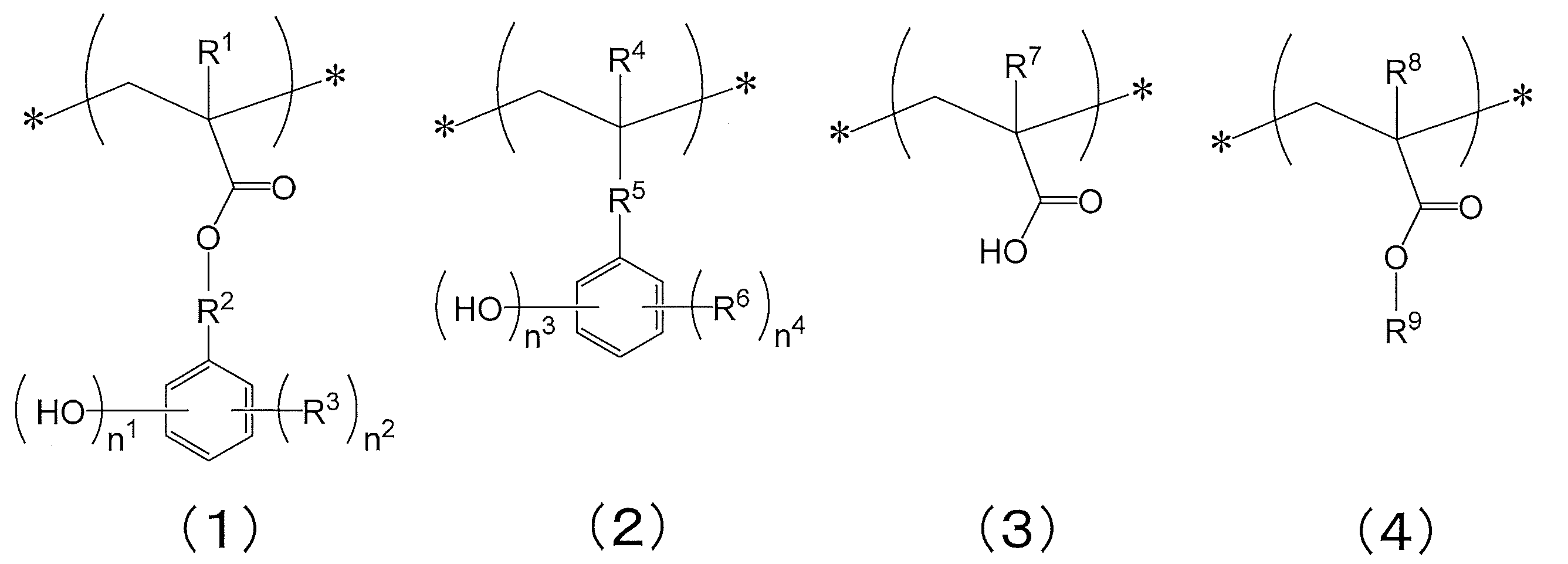
式(1)中、R1は水素原子またはメチル基を表す。R2は単結合または炭素数1~3のアルキレン基を表す。n1は整数であり、1または2を表す。R3は炭素数1~3のアルキル基または炭素数1~3のアルコキシ基を表す。n2は整数であり、0~2を表す。*は結合部位を表す。
式(2)中、R4は水素原子またはメチル基を表す。R5は炭素数1~3のアルキレン基を表す。n3は整数であり、1または2を表す。R6は炭素数1~3のアルキル基または炭素数1~3のアルコキシ基を表す。n4は整数であり、0~2を表す。*は結合部位を表す。
式(3)中、R7は水素原子またはメチル基を表す。*は結合部位を表す。
式(4)中、R8は水素原子またはメチル基を表す。R9は炭素数5~18のアルキル基を表す。*は結合部位を表す。
[1]式(1)で表される構造単位および/または式(2)で表される構造単位と、
式(3)で表される構造単位と、
式(4)で表される構造単位とを含有する共重合体(a)であって、
該共重合体(a)の全構造単位の合計100mol%中、式(1)~(4)のいずれかで表される構造単位の合計が70~100mol%であって、
前記共重合体(a)中、式(1)で表される構造単位および式(2)で表される構造単位の合計mol数をX、式(3)で表される構造単位のmol数をY、式(4)で表される構造単位のmol数をZとしたとき、XをYで除した値Aが1.0~10.0であり、かつXをZで除した値Bが1.0~10.0である、共重合体。
式(2)中、R4は水素原子またはメチル基を表す。R5は炭素数1~3のアルキレン基を表す。n3は整数であり、1または2を表す。R6は炭素数1~3のアルキル基または炭素数1~3のアルコキシ基を表す。n4は整数であり、0~2を表す。*は結合部位を表す。
式(3)中、R7は水素原子またはメチル基を表す。*は結合部位を表す。
式(4)中、R8は水素原子またはメチル基を表す。R9は炭素数5~18のアルキル基を表す。*は結合部位を表す。
[2]重量平均分子量(Mw)が10000~50000である、[1]に記載の共重合体。
[3]前記共重合体(a)が、前記式(1)で表される構造単位を有する、[1]または[2]に記載の共重合体。
[4]前記式(4)中のR9が、炭素数7~15の分岐アルキル基である、[1]~[3]のいずれかに記載の共重合体。
[5]前記共重合体(a)が式(8)で表される構造単位を有する、[1]~[4]のいずれかに記載の共重合体。
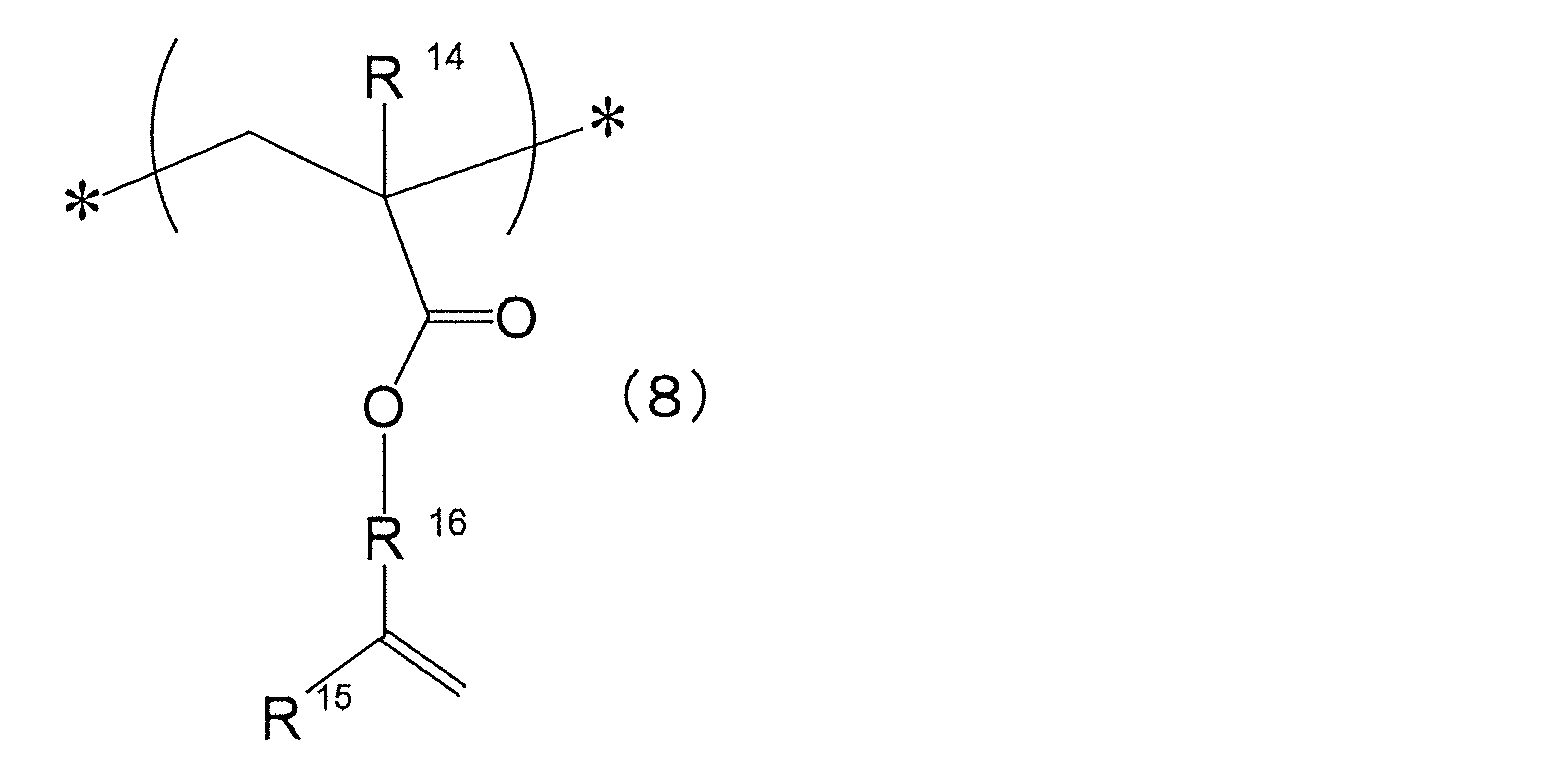
式(8)中、R14およびR15は、それぞれ独立に、水素原子またはメチル基を表し、R16は、水酸基を有する炭素数4~12の二価の基を表す。
[6]前記共重合体(a)が前記式(8)で表される構造単位を、前記共重合体(a)の全構造単位の合計100mol%中、5~18mol%含有する、[5]に記載の共重合体。
[7][1]~[6]のいずれかに記載の共重合体(a)に加えて、顔料、感光剤および有機溶剤を含有する感光性組成物。
[8]さらに、9,9-ビス(ナフチル)フルオレン骨格を分子内に2つ有し、エチレン性不飽和二重結合基を分子内に2つ有する(メタ)アクリレート化合物を含有し、ネガ型感光性を有する、[7]に記載の感光性組成物。
[9]さらに、式(9)で表される化合物を含有し、ネガ型感光性を有する、[7]または[8]に記載の感光性組成物。

式(9)中、POはオキシプロピレン基を表し、EOはオキシエチレン基を表し、x、yおよびzは、それぞれ独立に、1~50の整数であり、y<x+zの関係を満たす。
[10][7]~[9]のいずれかに記載の感光性組成物を硬化した硬化物。
[11][10]に記載の硬化物を具備する有機EL表示装置。
[3]前記共重合体(a)が、前記式(1)で表される構造単位を有する、[1]または[2]に記載の共重合体。
[4]前記式(4)中のR9が、炭素数7~15の分岐アルキル基である、[1]~[3]のいずれかに記載の共重合体。
[5]前記共重合体(a)が式(8)で表される構造単位を有する、[1]~[4]のいずれかに記載の共重合体。
[6]前記共重合体(a)が前記式(8)で表される構造単位を、前記共重合体(a)の全構造単位の合計100mol%中、5~18mol%含有する、[5]に記載の共重合体。
[7][1]~[6]のいずれかに記載の共重合体(a)に加えて、顔料、感光剤および有機溶剤を含有する感光性組成物。
[8]さらに、9,9-ビス(ナフチル)フルオレン骨格を分子内に2つ有し、エチレン性不飽和二重結合基を分子内に2つ有する(メタ)アクリレート化合物を含有し、ネガ型感光性を有する、[7]に記載の感光性組成物。
[9]さらに、式(9)で表される化合物を含有し、ネガ型感光性を有する、[7]または[8]に記載の感光性組成物。
[10][7]~[9]のいずれかに記載の感光性組成物を硬化した硬化物。
[11][10]に記載の硬化物を具備する有機EL表示装置。
本発明の共重合体によれば、プリベーク温度条件のマージン(許容範囲)を幅広く確保して、ITO電極表面における現像残渣の発生を抑制でき、かつ高濃度有機アルカリ現像液に対して優れた溶解形態が得られ、かつ高いリフロー性を感光性組成物に付与することを可能とする。
以下に本発明について詳細に説明する。
本発明の共重合体は、式(1)で表される構造単位および/または式(2)で表される構造単位と、式(3)で表される構造単位と、式(4)で表される構造単位を含有する共重合体(a)である。
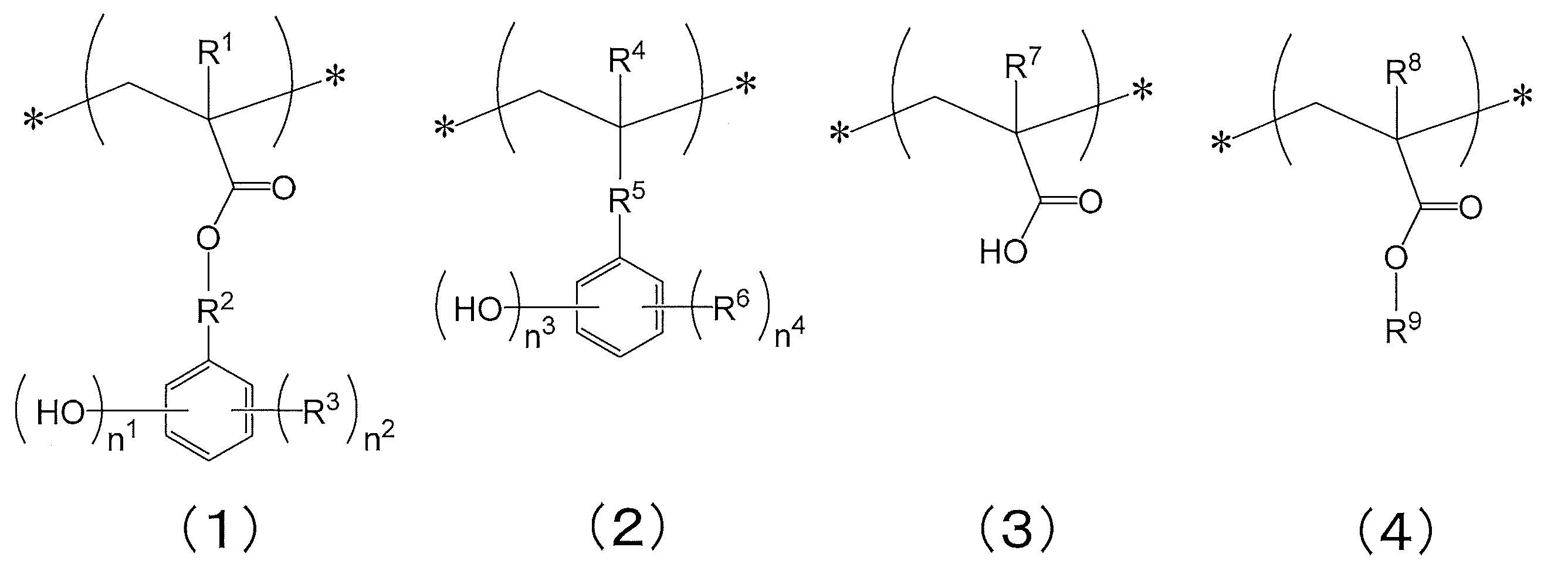
(式(1)中、R1は水素原子またはメチル基を表す。R2は単結合または炭素数1~3のアルキレン基を表す。n1は整数であり、1または2を表す。R3は炭素数1~3のアルキル基または炭素数1~3のアルコキシ基を表す。n2は整数であり、0~2を表す。*は結合部位を表す。
式(2)中、R4は水素原子またはメチル基を表す。R5は炭素数1~3のアルキレン基を表す。n3は整数であり、1または2を表す。R6は炭素数1~3のアルキル基または炭素数1~3のアルコキシ基を表す。n4は整数であり、0~2を表す。*は結合部位を表す。
式(3)中、R7は水素原子またはメチル基を表す。*は結合部位を表す。
式(4)中、R8は水素原子またはメチル基を表す。R9は炭素数5~18のアルキル基を表す。*は結合部位を表す。)
本発明の共重合体は、式(1)で表される構造単位および/または式(2)で表される構造単位と、式(3)で表される構造単位と、式(4)で表される構造単位を含有する共重合体(a)である。
式(2)中、R4は水素原子またはメチル基を表す。R5は炭素数1~3のアルキレン基を表す。n3は整数であり、1または2を表す。R6は炭素数1~3のアルキル基または炭素数1~3のアルコキシ基を表す。n4は整数であり、0~2を表す。*は結合部位を表す。
式(3)中、R7は水素原子またはメチル基を表す。*は結合部位を表す。
式(4)中、R8は水素原子またはメチル基を表す。R9は炭素数5~18のアルキル基を表す。*は結合部位を表す。)
共重合体(a)における構造単位とは、共重合体を得る際の、不飽和二重結合基を分子内に1つ有する単量体に由来する構造単位をいう。
本発明の共重合体(a)の共重合方法としては、例えば日本国特開平5-19467号公報記載の方法などが挙げられるが、公知の方法を使用することができる。
本発明の共重合体(a)の共重合方法としては、例えば日本国特開平5-19467号公報記載の方法などが挙げられるが、公知の方法を使用することができる。
式(1)で表される構造単位としては例えば、4―ヒドロキシフェニルメタクリレート(以下、PQMA)、(4―ヒドロキシフェニル)メチルメタクリレート、(4―ヒドロキシフェニル)エチルメタクリレート、(4―ヒドロキシフェニル)プロピルメタクリレート、4―ヒドロキシフェニルアクリレート、(4―ヒドロキシフェニル)メチルアクリレート、(4―ヒドロキシフェニル)エチルアクリレート、(4―ヒドロキシフェニル)プロピルアクリレートなどが挙げられる。
式(2)で表される構造単位としては例えば、2-アリルフェノール、4-アリル-2,6-ジメトキシフェノール、4-アリル-2,6-ジメチルフェノール、4-アリル-2,6-ジエチルフェノール、4-アリル-2,6-ジプロピルフェノールなどが挙げられる。
共重合体(a)が、式(1)で表される構造単位および/または式(2)で表される構造単位を含有することにより、例えば、共重合体(a)を含む感光性組成物、例えばネガ型感光性組成物ではラジカル連鎖反応を抑制する効果を発現し、マスクバイアスが小さくなり、狙い設計通りのパターンが形成できる。これらの中でも、共重合体(a)が、式(1)で表される構造単位を有することが好ましい。
式(3)で表される構造単位としては、メタクリル酸(以下、MAA)、アクリル酸が挙げられる。
共重合体(a)が、式(3)で表される構造単位を含有することにより、共重合体(a)を含む感光性組成物にアルカリ現像性を付与できる。
共重合体(a)が、式(3)で表される構造単位を含有することにより、共重合体(a)を含む感光性組成物にアルカリ現像性を付与できる。
式(4)で表される構造単位としては例えば、ヘキシルメタクリレート、ヘキシルアクリレート、2-エチルヘキシルメタクリレート(以下、2-EHMA)、2-エチルヘキシルアクリレート、n-オクチルメタクリレート、n-オクチルアクリレート、デシルメタクリレート、デシルアクリレート、イソデシルメタクリレート、イソデシルアクリレート、2-プロピルヘプチルメタクリレート、2-プロピルヘプチルアクリレート、ドデシルメタクリレート、ドデシルアクリレート、ウンデシルメタクリレート、ウンデシルアクリレート、イソステアリルメタクリレート、イソステアリルアクリレート、n-ステアリルメタクリレート、n-ステアリルアクリレートなどが挙げられる。
共重合体(a)が、式(4)で表される構造単位を含有することにより、共重合体(a)を含む感光性組成物に加熱キュア工程において高いリフロー性を付与できる。これらの中でも、共重合体(a)が、式(4)中のR9の炭素数が7~15の分岐アルキル基で表される構造単位を有することが好ましい。
共重合体(a)が、式(4)で表される構造単位を含有することにより、共重合体(a)を含む感光性組成物に加熱キュア工程において高いリフロー性を付与できる。これらの中でも、共重合体(a)が、式(4)中のR9の炭素数が7~15の分岐アルキル基で表される構造単位を有することが好ましい。
本発明の共重合体(a)は、全構造単位の合計100mol%中、式(1)~(4)のいずれかで表される構造単位の合計を70~100mol%含有する。さらに、本発明の共重合体(a)は、式(1)で表される構造単位および式(2)で表される構造単位の合計mol数をX、式(3)で表される構造単位のmol数をY、式(4)で表される構造単位のmol数をZとしたとき、XをYで除した値A(A=X/Y)が1.0~10.0であり、かつXをZで除した値B(B=X/Z)が1.0~10.0である。式(1)~(4)のいずれかで表される構造単位の合計を70~100mol%含有し、XをYで除した値Aを1.0~10.0、かつXをZで除した値Bを1.0~10.0にすることで、共重合体(a)を含む感光性組成物のマスクバイアス、プリベーク温度条件により発生する残渣の抑制、及び加熱キュア工程におけるリフロー性を良好なバランスで保つことができ、さらには、アルカリ現像時に優れた溶解形態を得ることができる。
本発明の共重合体(a)は、さらに必要に応じて任意の(メタ)アクリルモノマを単量体として共重合することができる。具体的にはイタコン酸、マレイン酸、無水マレイン酸、フタル酸、無水フタル酸、クロトン酸、2-カルボキシエチルアクリレートオリゴマー、2-カルボキシエチルメタクリレートオリゴマーなどのカルボキシ基を有する単量体、アクリル酸メチル、アクリル酸エチル、アクリル酸プロピル、アクリル酸イソプロピル、アクリル酸n-ブチル、アクリル酸イソブチル、アクリル酸t-ブチル、アクリル酸シクロヘキシル、アクリル酸イソボルニル、アクリル酸ベンジル、メタクリル酸エチル、メタクリル酸プロピル、メタクリル酸イソプロピル、メタクリル酸n-ブチル、メタクリル酸イソブチル、メタクリル酸t-ブチル、メタクリル酸シクロヘキシル、メタクリル酸イソボニル、メタクリル酸ベンジル、などのアクリル酸エステルまたはメタアクリル酸エステルあるいはそれらの(フルオロ)アルキルエステル単量体、スチレン、α-メチルスチレン、4-ビニルトルエン及びその構造異性体、4-メトキシスチレン及びその構造異性体、4-ブトキシスチレン及びその構造異性体、4-tert-ブトキシスチレン及びその構造異性体、4-ビニルビフェニル、2-ビニルナフタレン及びその構造異性体、9-ビニルアントラセン、9-ビニルカルバゾールなどの芳香環を有する不飽和単量体を含んでもよい。
本発明の共重合体(a)は、さらに、式(3)で表される構造単位、イタコン酸、マレイン酸、無水マレイン酸、フタル酸、無水フタル酸、クロトン酸、2-カルボキシエチルアクリレートオリゴマー、2-カルボキシエルメタクリレートオリゴマーなどのカルボキシ基を有する構造単位を重合した後、公知のエチレン性不飽和基を有する構造単位を導入してもよい。例えば、式(3)で表される構造単位を共重合した共重合体(a)に、グリシジル基含有重合性不飽和単量体を付加反応させる方法などが挙げられる。この場合、グリシジル含有不飽和単量体としてはアクリル酸グリシジル、メタクリル酸グリシジルなどが例示できる。特に後述する本発明の感光性組成物がネガ型感光性を有する場合、長径0.1μmを下回る微小な顔料起因の現像残渣の発生を抑制する上で、式(8)で表される構造単位を有することが好ましい。
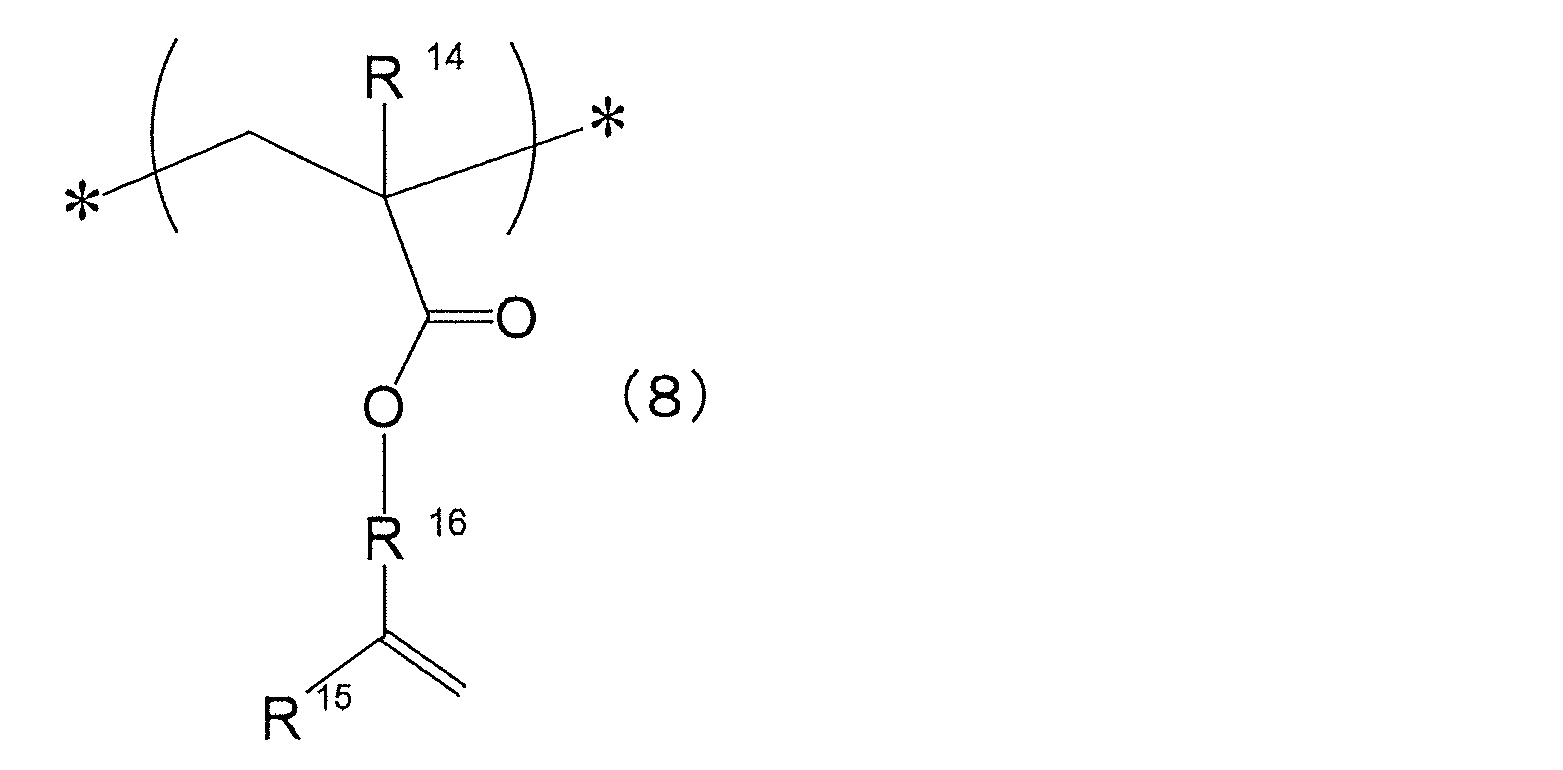
(式(8)中、R14およびR15は、それぞれ独立に、水素原子またはメチル基を表し、R16は、水酸基を有する炭素数4~12の二価の基を表す。)
リフロー性と両立する上で、R16は水酸基を有する炭素数4~8の二価の基が好ましく、R15はメチル基が好ましい。R16は、主鎖に酸素原子を有してもよく、脂環式構造、芳香環を有してもよい。
リフロー性と両立する上で、R16は水酸基を有する炭素数4~8の二価の基が好ましく、R15はメチル基が好ましい。R16は、主鎖に酸素原子を有してもよく、脂環式構造、芳香環を有してもよい。
式(8)で表される構造単位の具体例としては、式(10)~式(14)で表される構造単位が好ましく挙げられる。
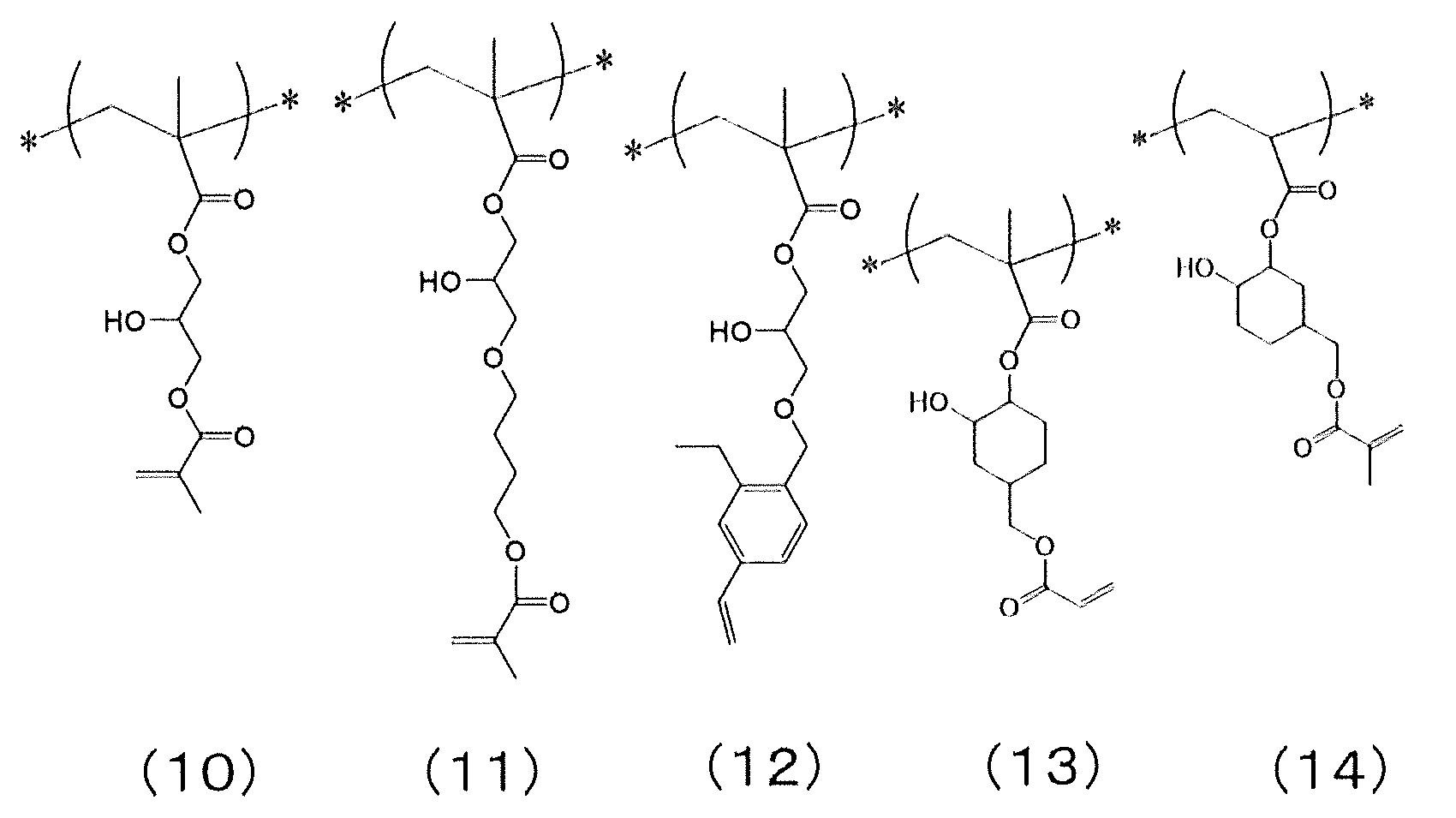
前記式(8)で表される構造単位は、ITO電極表面の0.1μm未満の現像残渣の抑制効果と、プリベーク温度130℃における0.1μm以上の残渣を抑制し、プリベーク温度条件のマージン(許容範囲)を幅広くする効果とを両立させるうえで、前記共重合体(a)の全構造単位の合計100mol%中、5~18mol%含有することが好ましい。
本発明の共重合体(a)の重量平均分子量(Mw)は、10000~50000が好ましい。重量平均分子量(Mw)が10000以上あることで、共重合体(a)を含む感光性組成物のプリベーク温度が低温の場合でも現像時間を適度に長く担保でき、ネガ型感光性組成物の場合はパターンが逆テーパー形状になるのを防ぐことができる。一方、重量平均分子量(Mw)が50000以下であることで、プリベーク温度が高温な場合(例えば、130℃)でも、開口部残渣の発生を抑制できる。
重量平均分子量(Mw)とは、テトラヒドロフランをキャリアーとするゲルパーミエーションクロマトグラフィ(GPC)で分析し、標準ポリスチレンによる検量線を用いて換算した値である。
共重合体(a)は、感光性組成物に好適に用いることができる。共重合体(a)の感光性組成物中における含有量は、感光性組成物中の溶剤以外の成分の合計100質量%に対して、加熱キュア工程における高いリフロー性、およびキュアマスクバイアスを極小化させる観点から、5質量%以上が好ましく、10質量%以上がより好ましい。一方、露光時の感度向上の観点から、60質量%以下が好ましく、50質量%以下が好ましい。
本発明の共重合体(a)は、顔料(b)、感光剤(c)および有機溶剤(d)を含有する感光性組成物に用いることで、好ましい効果を発揮できる。
本発明の感光性組成物に用いる顔料(b)としては、電子情報材料の分野で一般的に用いられる、有機顔料、無機顔料を用いることができる。有機顔料としては、例えば、ジケトピロロピロール系顔料、アゾ、ジスアゾ若しくはポリアゾ等のアゾ系顔料、銅フタロシアニン、ハロゲン化銅フタロシアニン若しくは無金属フタロシアニン等のフタロシアニン系顔料、アミノアントラキノン、ジアミノジアントラキノン、アントラピリミジン、フラバントロン、アントアントロン、インダントロン、ピラントロン若しくはビオラントロン等のアントラキノン系顔料、キナクリドン系顔料、ジオキサジン系顔料、ペリノン系顔料、ペリレン系顔料、チオインジゴ系顔料、イソインドリン系顔料、イソインドリノン系顔料、キノフタロン系顔料、スレン系顔料又は金属錯体系顔料などが挙げられる。
無機顔料としては、例えば、酸化チタン、亜鉛華、硫化亜鉛、鉛白、炭酸カルシウム、沈降性硫酸バリウム、ホワイトカーボン、アルミナホワイト、カオリンクレー、タルク、ベントナイト、黒色酸化鉄、カドミウムレッド、べんがら、モリブデンレッド、モリブデートオレンジ、クロムバーミリオン、黄鉛、カドミウムイエロー、黄色酸化鉄、チタンイエロー、酸化クロム、ビリジアン、チタンコバルトグリーン、コバルトグリーン、コバルトクロムグリーン、ビクトリアグリーン、群青、紺青、コバルトブルー、セルリアンブルー、コバルトシリカブルー、コバルト亜鉛シリカブルー、マンガンバイオレット又はコバルトバイオレットなどが挙げられる。
赤色の顔料としては、例えば、ピグメントレッド9,48,97,122,123,144,149,166,168,177,179,180,192,209,215,216,217,220,223,224,226,227,228,240又は254などが挙げられる(数値はいずれもカラーインデックス(以下、「C.I.」)ナンバー)。
オレンジ色の顔料としては、例えば、ピグメントオレンジ13,36,38,43,51,55,59,61,64,65又は71が挙げられる(数値はいずれもC.I.ナンバー)。
黄色の顔料としては、例えば、ピグメントイエロー12,13,17,20,24,83,86,93,95,109,110,117,125,129,137,138,139,147,148,150,153,154,166,168又は185などが挙げられる(数値はいずれもC.I.ナンバー)。
紫色の顔料としては、例えば、ピグメントバイオレット19,23,29,30,32,37,40又は50などが挙げられる(数値はいずれもC.I.ナンバー)。
青色の顔料としては、例えば、ピグメントブルー15,15:3,15:4,15:6,22,60又は64などが挙げられる(数値はいずれもC.I.ナンバー)。
緑色の顔料としては、例えば、ピグメントグリーン7,10,36又は58などが挙げられる(数値はいずれもC.I.ナンバー)。
黒色の顔料としては、例えば、黒色有機顔料、混色有機顔料又は無機顔料等が挙げられる。黒色有機顔料としては、例えば、カーボンブラック、ペリレンブラック、アニリンブラック、又はベンゾフラノン顔料(特表2012-515233号公報記載)が挙げられる。
これら顔料を組み合わせることにより、所望の光学特性を有する感光性組成物を得ることもできるが、単位質量当たりの可視光遮光性と絶縁性の観点から、ベンゾフラノン顔料を含むことが好ましい。
本発明の感光性組成物に用いる顔料(b)の含有量は、感光性組成物の溶剤以外の成分の合計100質量%に対して、単位膜厚当たりの遮光性の観点から、5質量%以上が好ましく、10質量%以上がより好ましい。一方、露光時の感度向上および細線加工性の観点から、50質量%以下が好ましく、40質量%以下がより好ましい。
本発明の感光性組成物に用いる感光剤(c)としては、光重合開始剤(c1)や光酸発生剤(c2)、などを含有することができる。光重合開始剤(c1)は、露光により結合開裂および/または反応し、ラジカルを発生する化合物であり、光酸発生剤(c2)は、光照射により酸を発生する化合物である。
感光性組成物が、光重合開始剤(c1)および後述するラジカル重合性化合物を含有することにより、光照射部においてラジカル重合が進行し、光照射部が不溶化するネガ型のレリーフパターンを得ることができる。一方、光酸発生剤(c2)を含有することにより、光照射部に酸が発生して光照射部のアルカリ水溶液に対する溶解性が増大し、光照射部が溶解するポジ型のレリーフパターンを得ることができる。
光重合開始剤(c1)としては例えば、カルバゾール系光重合開始剤、アシルフォスフィンオキサイド系光重合開始剤、オキシムエステル系光重合開始剤、α―アミノアルキルフェノン系光重合開始剤などが挙げられる。これらを2種以上含有してもよい。これらの中でも、後述する露光工程において、i線(365nm)、h線(405nm)、g線(436nm)からなる混合線に対する感度が高いことから、カルバゾール系光重合開始剤、オキシムエステル系光重合開始剤が好ましい。
本発明の感光性組成物中における光重合開始剤(c1)の含有量は、後述するラジカル重合性化合物の含有量100質量%に対して、露光に対する感度向上の観点から、1質量%以上が好ましく、5質量%以上がより好ましい。一方、細線加工性の観点から、90質量%以下が好ましく、80質量%以下がより好ましい。
光酸発生剤(c2)としては、例えば、キノンジアジド化合物を含有することができる。
キノンジアジド化合物としては、ポリヒドロキシ化合物にキノンジアジドのスルホン酸がエステルで結合したもの、ポリアミノ化合物にキノンジアジドのスルホン酸がスルホンアミド結合したもの、ポリヒドロキシポリアミノ化合物にキノンジアジドのスルホン酸がエステル結合および/またはスルホンアミド結合したものなどを含有することができる。
キノンジアジド化合物としては、ポリヒドロキシ化合物にキノンジアジドのスルホン酸がエステルで結合したもの、ポリアミノ化合物にキノンジアジドのスルホン酸がスルホンアミド結合したもの、ポリヒドロキシポリアミノ化合物にキノンジアジドのスルホン酸がエステル結合および/またはスルホンアミド結合したものなどを含有することができる。
キノンジアジド構造としては、5-ナフトキノンジアジドスルホニル基、4-ナフトキノンジアジドスルホニル基のいずれも好ましく用いられる。同一分子中に4-ナフトキノンジアジドスルホニル基、5-ナフトキノンジアジドスルホニル基を有するナフトキノンジアジドスルホニルエステル化合物を含有してもよいし、4-ナフトキノンジアジドスルホニルエステル化合物と5-ナフトキノンジアジドスルホニルエステル化合物を含有してもよい。4-ナフトキノンジアジドスルホニルエステル化合物は水銀灯のi線領域に吸収を持っており、i線露光に適している。5-ナフトキノンジアジドスルホニルエステル化合物は水銀灯のg線領域まで吸収が伸びており、g線露光に適している。
上記キノンジアジド化合物は、フェノール性水酸基を有する化合物と、キノンジアジドスルホン酸化合物とから、任意のエステル化反応によって合成することができる。これらのキノンジアジド化合物を使用することにより、解像度、感度、残膜率がより向上する。
光酸発生剤(c2)の含有量は、高感度化の観点から、共重合体(a)100質量%に対して0.1質量%以上が好ましく、より好ましくは10質量%以上であり、25質量%以上がさらに好ましい。一方、本発明の硬化物を有機EL表示装置の平坦化層および/または絶縁層としたときの長期信頼性の観点から、光酸発生剤(c1)の含有量は、共重合体(a)100質量%に対して100質量%以下が好ましい。
本発明の感光性組成物に用いる有機溶剤(d)としては、例えば、γ-ブチロラクトンなどの極性の非プロトン性溶剤、エチレングリコールモノメチルエーテル、エチレングリコールモノエチルエーテル、エチレングリコールモノ-n-プロピルエーテル、エチレングリコールモノ-n-ブチルエーテル、ジエチレングリコールモノメチルエーテル、ジエチレングリコールモノエチルエーテル、ジエチレングリコールモノ-n-プロピルエーテル、ジエチレングリコールモノ-n-ブチルエーテル、トリエチレングリコールモノメチルエーテル、トリエチレングリコールモノエチルエーテル、プロピレングリコールモノメチルエーテル、プロピレングリコールモノエチルエーテル、プロピレングリコールモノ-n-プロピルエーテル、プロピレングリコールモノ-n-ブチルエーテル、ジプロピレングリコールモノメチルエーテル、ジプロピレングリコールモノエチルエーテル、ジプロピレングリコールモノ-n-プロピルエーテル、ジプロピレングリコールモノ-n-ブチルエーテル、トリプロピレングリコールモノメチルエーテル、トリプロピレングリコールモノエチルエーテル、テトラヒドロフラン、ジオキサンなどのエーテル類、アセトン、メチルエチルケトン、ジイソブチルケトン、シクロヘキサノン、2-ヘプタノン、3-ヘプタノン、ジアセトンアルコールなどのケトン類、エチレングリコールモノメチルエーテルアセテート、エチレングリコールモノエチルエーテルアセテート、ジエチレングリコールモノメチルエーテルアセテート、ジエチレングリコールモノエチルエーテルアセテート、プロピレングリコールモノメチルエーテルアセテート、プロピレングリコールモノエチルエーテルアセテート、乳酸エチルなどのエステル類、2-ヒドロキシ-2-メチルプロピオン酸エチル、3-メトキシプロピオン酸メチル、3-メトキシプロピオン酸エチル、3-エトキシプロピオン酸メチル、3-エトキシプロピオン酸エチル、エトキシ酢酸エチル、ヒドロキシ酢酸エチル、2-ヒドロキシ-3-メチルブタン酸メチル、3-メトキシブチルアセテート、3-メチル-3-メトキシブチルアセテート、3-メチル-3-メトキシブチルプロピオネート、酢酸エチル、酢酸n-プロピル、酢酸i-プロピル、酢酸n-ブチル、酢酸i-ブチル、ぎ酸n-ペンチル、酢酸i-ペンチル、プロピオン酸n-ブチル、酪酸エチル、酪酸n-プロピル、酪酸i-プロピル、酪酸n-ブチル、ピルビン酸メチル、ピルビン酸エチル、ピルビン酸n-プロピル、アセト酢酸メチル、アセト酢酸エチル、2-オキソブタン酸エチル等の他のエステル類、トルエン、キシレンなどの芳香族炭化水素類、N-メチルピロリドン、N,N-ジメチルホルムアミド、N,N-ジメチルアセトアミド、3-メトキシ-N,N-ジメチルプロピオンアミド、3-ブトキシ-N,N-ジメチルプロピオンアミド、N,N-ジメチルプロパンアミド、N,N-ジメチルイソブチルアミド等のアミド類、3-メチル-2-オキサゾリジノンなどを含有してもよい。溶剤は、これらを2種以上含有してもよい。
本発明の感光性組成物は、ラジカル重合性化合物(e)を含有してもよい。特に、上記感光性組成物が光重合開始剤(c1)を含有する場合は、ラジカル重合性化合物(e)を含有することが必須である。
ラジカル重合性化合物(e)が有するラジカル重合性基としては、露光時の感度向上の観点から、アクリル基、メタクリル基が好ましく、これらを2種有してもよい。
ラジカル重合性化合物(e)としては、ラジカル重合性基を2つ以上有する化合物が好ましく、例えば、ビスフェノールAジグリシジルエーテル(メタ)アクリレート、ポリ(メタ)アクリレートカルバメート、変性ビスフェノールAエポキシ(メタ)アクリレート、アジピン酸1,6-ヘキサンジオール(メタ)アクリル酸エステル、無水フタル酸プロピレンオキサイド(メタ)アクリル酸エステル、トリメリット酸ジエチレングリコール(メタ)アクリル酸エステル、ロジン変性エポキシジ(メタ)アクリレート、アルキッド変性(メタ)アクリレート、フルオレンジアクリレート系オリゴマー、トリプロピレングリコールジ(メタ)アクリレート、1,6-ヘキサンジオールジ(メタ)アクリレート、ビスフェノールAジグリシジルエーテルジ(メタ)アクリレート、トリメチロールプロパントリ(メタ)アクリレート、ペンタエリスリトールトリ(メタ)アクリレート、トリアクリルホルマール、ペンタエリスリトールテトラ(メタ)アクリレート、ジペンタエリスリトールヘキサ(メタ)アクリレート、ジペンタエリスリトールペンタ(メタ)アクリレート、2,2-ビス[4-(3-アクリロキシ-2-ヒドロキシプロポキシ)フェニル]プロパン、ビス[4-(3-アクリロキシ-2-ヒドロキシプロポキシ)フェニル]メタン、ビス[4-(3-アクリロキシ-2-ヒドロキシプロポキシ)フェニル]スルホン、ビス[4-(3-アクリロキシ-2-ヒドロキシプロポキシ)フェニル]エーテル、4,4’-ビス[4-(3-アクリロキシ-2-ヒドロキシプロポキシ)フェニル]シクロヘキサン、9,9-ビス[4-(3-アクリロキシ-2-ヒドロキシプロポキシ)フェニル]フルオレン、9,9-ビス[3-メチル-4-(3-アクリロキシ-2-ヒドロキシプロポキシ)フェニル]フルオレン、9,9-ビス[3-クロロ-4-(3-アクリロキシ-2-ヒドロキシプロポキシ)フェニル]フルオレン、ビスフェノキシエタノールフルオレンジアクリレート、ビスフェノキシエタノールフルオレンジメタアクリレート、ビスクレゾールフルオレンジアクリレート、ビスクレゾールフルオレンジメタアクリレートなどが挙げられる。これらを2種以上含有してもよい。
本発明の感光性組成物は、アルカリ現像での溶解形態を維持しつつ、現像後のテーパー角を適度に低くコントロールする上で、さらに、9,9-ビス(ナフチル)フルオレン骨格を分子内に2つ有し、エチレン性不飽和二重結合基を分子内に2つ有する(メタ)アクリレート化合物を含有し、ネガ型感光性を有することが好ましい。
本発明の感光性組成物中におけるラジカル重合性化合物(e)の含有量は、共重合体(a)とラジカル重合性化合物(e)の合計含有量100質量%に対して、露光時の感度向上の観点から、10質量%以上が好ましく、15質量%以上がより好ましい。一方、加熱キュア工程におけるリフロー性の観点から、80質量%以下が好ましく、60質量%以下が好ましい。
本発明の感光性組成物は、さらに側鎖に3級アミノ基を有する一般式(5)で表される繰り返し単位と、カルボキシ基を有する繰り返し単位と、エチレン性不飽和基を有する繰り返し単位を有する、分散樹脂(f)を含有してもよい。
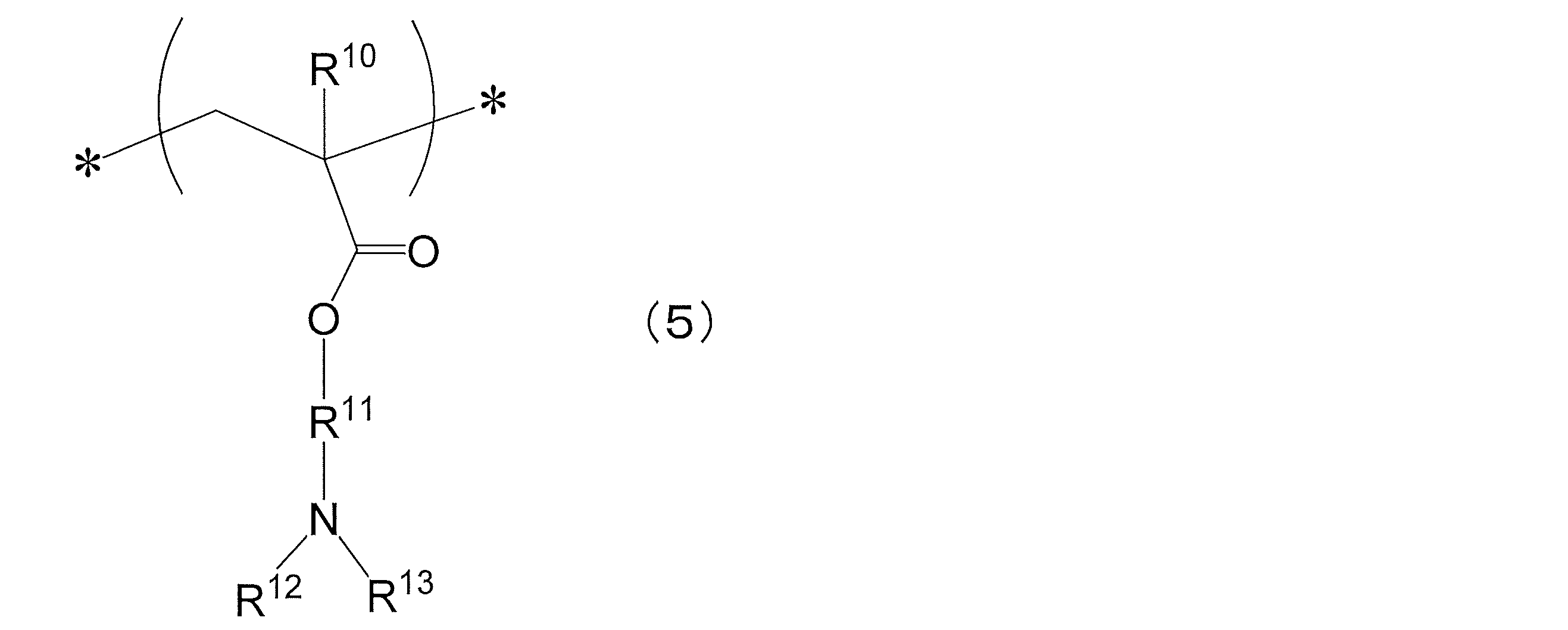
一般式(5)中、R10は水素原子またはメチル基を表し、R11は単結合または炭素数1~5のアルキレン基または、炭素原子数1~5かつ酸素原子数1のアルキレンエーテル基を表す。R12、およびR13はそれぞれ独立に炭素数1~5のアルキル基、アルコキシ基、炭素数3~6の脂環式炭化水素または炭素数6~10の芳香族炭化水素基を表す。*は結合部位を表す。
一般式(5)で表される繰り返し単位を構成するモノマとしては、具体的には、アクリル酸―2―ジメチルアミノエチル、アクリル酸―2-ジエチルアミノエチル、アクリル酸―2-ジプロピルアミノエチル、アクリル酸―2―ジフェニルアミノエチル、アクリル酸―2―ジベンジルアミノエチル、メタクリル酸―2―ジメチルアミノエチル、メタクリル酸―2―ジエチルアミノエチル、メタクリル酸―2―ジプロピルアミノエチル、メタクリル酸―2―ジフェニルアミノエチル、メタクリル酸―2―ベンジルアミノエチルなどが挙げられ、これらのモノマは単独で使用しても、2種以上使用してもよい。一般式(5)で表される繰り返し単位を有するアルカリ可溶性樹脂を含むことにより、顔料表面に3級アミノ基が吸着し、感光性組成物、例えばネガ型感光性組成物の保存安定性をより向上させることができる。
カルボキシ基を有する繰り返し単位を構成するモノマは、具体的には、アクリル酸、メタクリル酸、イタコン酸、マレイン酸、無水マレイン酸、フタル酸、無水フタル酸、クロトン酸、2―カルボキシエチルアクリレートオリゴマー、2―カルボキシエルメタクリレートオリゴマーなどが挙げられる。
分散樹脂(f)を合成する方法としては、一般式(5)で表される構造単位、カルボキシ基含有単位を重合した後、さらに公知のエチレン性不飽和基を有する繰り返し単位を導入する方法を用いることができる。例えば、カルボキシル基含有不飽和単量体を共重合した(メタ)アクリル共重体に、グリシジル基含有重合性不飽和単量体を付加反応させる方法などが挙げられる。この場合、共重合させるカルボキシル基含有不飽和単量体としてはアクリル酸、メタクリル酸などが、グリシジル含有不飽和単量体としてはアクリル酸グリシジル、メタクリル酸グリシジルなどが例示できる。これらのアクリル単量体は単独で使用しても、2種類以上の混合物で使用してもよい。
分散樹脂(f)の酸価は、50~120mgKOH/gであることが好ましく、この範囲とすることで顔料分散安定性とアルカリ現像液の溶解性を両立することができる。また、塩基価としては、5~70mmol/100gであることが好ましく、この範囲とすることでアルカリ現像液への溶解性を維持しながら、顔料分散安定性を向上させることができる。なお、塩基価は分散樹脂(f)100gを中和するのに要した過塩素酸のmol数と定義する。
分散樹脂(f)の含有量は、共重合体(a)と分散樹脂(f)の合計100質量%に対して、顔料分散安定性の観点から、5質量%以上が好ましく、一方、マスクバイアスを極小化する点から、50質量%以下であることが好ましい。
本発明の感光性組成物は、さらに高分子分散剤(g)を含有してもよい。高分子分散剤(g)とは、顔料表面への化学的結合または吸着作用を有する親和性基と、親溶媒性を有する高分子鎖または基とを併せ持つものをいい、エチレン性不飽和基を含有しない。高分子分散剤(g)はエチレン性不飽和基を有していないため、多量に添加すると目的の感光性能を悪化させる懸念があり、分散安定性、感光性能を加味して適正な添加量とすることが望ましい。高分子分散剤(g)は、後述の湿式メディア分散処理において、顔料(b)の分散媒への濡れ性を向上させて遮光材の解凝集を促進し、立体障害および/または静電反発効果により粒度および粘度を安定化させ、さらに、感光性組成物の貯蔵時あるいは塗布時の色分離の発生を抑制する効果を奏する。
高分子分散剤(g)としては、例えば、ポリエステル系高分子分散剤、アクリル系高分子分散剤、ポリウレタン系高分子分散剤、ポリアリルアミン系高分子分散剤、カルボジイミド系分散剤などが挙げられる。顔料分散の長期保存安定性を向上させるため、これらの中でもアミノ基を有する高分子分散剤が好ましい。
本発明の感光性組成物は、熱架橋剤(h)を含有してもよい。熱架橋剤(h)とは、アルコキシメチル基、メチロール基、エポキシ基、オキセタニル基などの熱反応性の官能基を分子内に少なくとも2つ有する化合物を指す。熱架橋剤(h)を含有することにより、熱架橋剤(h)と共重合体(a)との間、または熱架橋剤(h)同士で架橋し、熱硬化後の硬化物の耐熱性、耐薬品性および折り曲げ耐性を向上させることができる。
アルコキシメチル基またはメチロール基を少なくとも2つ有する化合物の好ましい例としては、DML-PC、DML-PEP、DML-OC、DML-OEP、DML-34X、DML-PTBP、DML-PCHP、DML-OCHP、DML-PFP、DML-PSBP、DML-POP、DML-MBOC、DML-MBPC、DML-MTrisPC、DML-BisOC-Z、DML-BisOCHP-Z、DML-BPC、DML-BisOC-P、DMOM-PC、DMOM-PTBP、DMOM-MBPC、TriML-P、TriML-35XL、TML-HQ、TML-BP、TML-pp-BPF、TML-BPE、TML-BPA、TML-BPAF、TML-BPAP、TMOM-BP、TMOM-BPE、TMOM-BPA、TMOM-BPAF、TMOM-BPAP、HML-TPPHBA、HML-TPHAP、HMOM-TPPHBA、HMOM-TPHAP(以上、商品名、本州化学工業(株)製)、“NIKALAC”(登録商標)MX-290、“NIKALAC”MX-280、“NIKALAC”MX-270、“NIKALAC”MX-279(以上、商品名、(株)三和ケミカル製)などを含有することができる。
エポキシ基を少なくとも2つ有する化合物の好ましい例としては、“エポライト”(登録商標)40E、“エポライト”100E、“エポライト”200E、“エポライト”400E、“エポライト”70P、“エポライト”200P、“エポライト”400P、“エポライト”1500NP、“エポライト”80MF、“エポライト”4000、“エポライト”3002(以上、共栄社化学(株)製)、“デナコール”(登録商標)EX-212L、“デナコール”EX-214L、“デナコール”EX-216L、“デナコール”EX-850L(以上、ナガセケムテックス(株)製)、GAN、GOT(以上、日本化薬(株)製)、“エピコート”(登録商標)828、“エピコート”1002、“エピコート”1750、“エピコート”1007、YX8100-BH30、E1256、E4250、E4275(以上、ジャパンエポキシレジン(株)製)、“エピクロン”(登録商標)EXA-9583、HP4032(以上、DIC(株)製)、VG3101(三井化学(株)製)、“テピック”(登録商標)S、“テピック”G、“テピック”P(以上、日産化学工業(株)製)、“デナコール”EX-321L(ナガセケムテックス(株)製)、NC6000(日本化薬(株)製)、“エポトート”(登録商標)YH-434L(東都化成(株)製)、EPPN502H、NC3000(日本化薬(株)製)、“エピクロン”(登録商標)N695、HP7200(以上、DIC(株)製)などを含有することができる。
オキセタニル基を少なくとも2つ有する化合物としては、例えば、エタナコールEHO、エタナコールOXBP、エタナコールOXTP、エタナコールOXMA(以上、宇部興産(株)製)、オキセタン化フェノールノボラックなどを含有することができる。
熱架橋剤(h)は2種類以上を組み合わせて含有してもよい。
熱架橋剤(h)は2種類以上を組み合わせて含有してもよい。
熱架橋剤(h)の含有量は、溶剤を除く感光性組成物全量100質量%中に、1質量%以上30質量%以下が好ましい。熱架橋剤(h)の含有量が溶剤を除く感光性組成物全量100質量%中に、1質量%以上であれば、硬化物の耐薬品性をより高めることができる。また、熱架橋剤(h)の含有量が溶剤を除く感光性組成物全量100質量%中に、30質量%以下であれば、感光性組成物の保存安定性に優れる。
本発明の感光性組成物は、さらに残渣抑制剤(i)として、式(9)で表される化合物を含有し、ネガ型感光性を有することが好ましい。

(式(9)中、POはオキシプロピレン基を表し、EOはオキシエチレン基を表し、x、yおよびzは、それぞれ独立に1~50の整数であり、y<x+zの関係を満たす。)
式(9)で表される化合物を含有することで、後述する現像工程において発生する0.1μm未満の残渣を抑制することができる。
式(9)で表される化合物を含有することで、後述する現像工程において発生する0.1μm未満の残渣を抑制することができる。
本発明の感光性組成物は、界面活性剤を含有してもよく、基板との濡れ性を向上させることができる。界面活性剤としては、例えば、東レ・ダウコーニング(株)のSHシリーズ、SDシリーズ、STシリーズ、ビックケミー・ジャパン(株)のBYKシリーズ、信越化学工業(株)のKPシリーズ、日油(株)のディスフォームシリーズ、DIC(株)の“メガファック(登録商標)”シリーズ、住友スリーエム(株)のフロラードシリーズ、旭硝子(株)の“サーフロン(登録商標)”シリーズ、“アサヒガード(登録商標)”シリーズ、オムノヴァ・ソルーション社のポリフォックスシリーズなどのフッ素系界面活性剤、共栄社化学(株)のポリフローシリーズ、楠本化成(株)の“ディスパロン(登録商標)”シリーズなどのアクリル系および/またはメタクリル系の界面活性剤などを含有することができる。
界面活性剤を含有する場合の含有量は、溶剤を除く感光性組成物全量100質量%中に、好ましくは0.001~1質量%である。
本発明の感光性組成物は、必要に応じて、レベリング剤としてノニオン系界面活性剤や、基板表面に対する密着改良剤としてシランカップリング剤を含有してもよい。
前述の共重合体(a)、顔料(b)、感光剤(c)、有機溶剤(d)、ラジカル重合性化合物(e)、分散樹脂(f)、高分子分散剤(g)および熱架橋剤(h)に属する化合物の化学構造は、本発明の感光性組成物を試料として、飛行時間型二次イオン質量分析(TOF-SIMS)、飛行時間質量分析(TOF-MS)、核磁気共鳴法(NMR)、液体クロマトグラフィー質量分析法(LC-MS)、ガスクロマトグラフィー質量分析法(GC-MS)、ICP質量分析、赤外吸収スペクトル、X線回析などの公知の分析手法を組み合わせることにより解析することができる。特に、顔料(b)については、感光性組成物を遠心分離処理し、濾物として得られる濃縮物を試料として分析し、同定精度を高めてもよい。一方、共重合体(a)、感光剤(c)については、遠心分離後の上澄み液を濾過して得られる濾液を試料として分析し、同定精度を高めてもよい。
本発明の感光性組成物を調製する方法は特に限定されるものではないが、例えば、湿式分散処理により顔料(b)と、分散樹脂(f)と、有機溶剤(d)と、必要に応じて高分子分散剤(g)を含有する顔料分散液を予め調製し、次いで共重合体(a)と、感光剤(c)と、有機溶剤(d)と、必要に応じてラジカル重合性化合物(e)、およびその他成分を顔料分散液と混合、撹拌して、必要に応じてフィルター濾過を行う方法が挙げられる。
湿式分散処理を行なうための分散機としては湿式メディア分散機であっても、湿式メディアレス分散機であってもよいが、分散処理速度に優れ、経済的に有利な点で湿式メディア分散機の使用が望ましい。湿式メディア分散機としては、例えば、“レボミル”(登録商標)(浅田鉄工(株)製)、“ナノ・ゲッター”(登録商標)(アシザワ・ファインテック(株)製)、“DYNO-MILL”(登録商標)(Willy A.Bachofen社製)、“スパイクミル”(登録商標)((株)井上製作所製)、“サンドグラインダー”(登録商標)(デュポン社製)、“ウルトラアペックスミル”(登録商標)((株)広島メタル&マシナリー製)、“NEO-アルファミル”(登録商標)(AIMEX(株)製)などのビーズミルが挙げられる。メディアの材質はジルコニアなどのセラミックビーズが好ましく、その直径は0.03~0.5mmφが好ましい。市販品としては、“トレセラム”(登録商標)(東レ(株)製)が挙げられる。顔料(b)の一次粒子径および一次粒子が凝集して形成された二次粒子の粒子径が小さい場合には、0.03~0.10mmφの微小な分散ビーズが好ましい。
この場合、微小なビーズと分散液とを分離することが可能な、遠心分離方式によるセパレーターを有するビーズミルが好ましい。一方で、サブミクロン程度の粗大な粒子を含有する顔料(b)を分散させる場合には、十分な粉砕力が得られるため、ビーズ径が0.10mm以上のビーズが好ましい。なお、ビーズ径は、顕微鏡観察により無作為に選択した100個のビーズについて、円相当径を測定し、その数平均値を求めることにより算出することができる。
本発明の硬化物は、前記感光性組成物を硬化したものである。ここでいう硬化物とは、感光性組成物を大気圧下200℃以上400℃以下の温度で10分間以上加熱する工程を経て得られたものを意味する。
本発明の有機EL表示装置は前記硬化物を具備する。有機EL表示装置は、少なくとも基板、第一電極、第二電極、発光画素、平坦化層および画素分割層を有する。マトリックス状に形成された複数の画素を有するアクティブマトリックス型の有機EL表示装置が好ましい。アクティブマトリックス型の表示装置は、ガラスなどの基板上に、発光画素を有し、発光画素および発光画素以外の部位の下部を覆うように設けられた平坦化層を有する。さらに、平坦化層上に、少なくとも発光画素の下部を覆うように設けられた第一電極と、少なくとも発光画素の上部を覆うように設けられた第二電極を有する。また、アクティブマトリックス型の表示装置は発光画素間を分割するために、絶縁性の画素分割層を有し、本発明の感光性組成物から得られる硬化物は、画素分割層に好適に用いることができる。
また、本発明の感光性組成物は、高精細かつ開口部に残渣を生じないパターンが形成可能であるため、固体撮像素子やマイクロLED、ミニLED表示装置向けの着色隔壁、液晶表示装置用のカラーフィルターに用いられるブラックマトリクスおよびブラックカラムスペーサーにも用いることができる。
本発明の硬化物を有機EL表示装置の画素分割層として利用する場合の好ましい態様を以下に説明する。画素分割層の膜厚1.0μmあたりの光学濃度(Optical Density)は、外光反射を抑制して表示装置としての価値を高める上で、0.8以上が好ましく、1.0以上がより好ましい。パターン加工の観点から、1.5以下が好ましく、1.3以下がより好ましい。光学濃度とは、透明基材上に膜厚1.5μmの膜厚となるように形成した画素分割層を、光学濃度計X-Rite 361T(X-Rite社製)を用いて入射光強度と透過光強度を測定し、以下の式から算出された光学濃度の値(OD値)を、膜厚の値である1.5で除した値のことを意味し、光学濃度が高いほど遮光性が高いことを示す。透明基材としては、透明ガラス基材である「テンパックス(AGCテクノグラス(株)製)」を好ましく用いることができる。
光学濃度 = log10(I0/I)
上式中、I0:入射光強度、I:透過光強度である。
光学濃度 = log10(I0/I)
上式中、I0:入射光強度、I:透過光強度である。
画素分割層の端部に位置する傾斜部における断面テーパー角度は、電極の断線を抑制して非点灯画素の発生を回避する上で50°以下が好ましく、45°以下がより好ましい。薄膜部の端部における遮光性の低下を抑制する上で20°以上が好ましく、25°以上がより好ましい。ここで画素分割層のテーパー角度とは、図1で示す絶縁層4の端部の傾斜角度θである。
画素分割層を形成する方法としては、感光性組成物を塗布して塗布膜を得る塗布工程と、塗布膜を加熱してプリベーク膜を得るプリベーク工程と、露光マスクを介して活性化学線をパターン露光して露光膜を得る露光工程と、アルカリ現像液を用いて現像して現像膜を得る現像工程と、加熱により熱硬化させて硬化物を得るキュア工程とを含む方法が好ましい。
塗布工程で用いる塗布装置としては薄膜塗布性に優れる点で、スピンコーターまたはスリットコーターを好ましく用いることができる。塗布後はピンギャッププリベークあるいはコンタクトプリベークを行ってもよい。
プリベーク工程におけるプリベーク温度は50~150℃が好ましく、プリベーク時間は30秒間~5分間が好ましい。
露光工程で用いる露光装置としては、例えば、ステッパー、ミラープロジェクションマスクアライナー(MPA)、パラレルライトマスクアライナー(PLA)が挙げられる。露光時に照射する活性化学線としては、超高圧水銀灯のj線(波長313nm)、i線(波長365nm)、h線(波長405nm)またはg線(波長436nm)が挙げられる。少なくともi線を含む混合線が好ましく、g線、h線およびi線を含む混合線がより好ましい。露光マスクは、所望のネガ型またはポジ型のもの用いることができ、ネガ型の感光性を有する場合、露光部が硬化し、現像液に不溶化する。ポジ型の感光性を有する場合、露光部が現像液に溶解する。
現像工程における現像方式としては、例えば、シャワー、ディッピング、パドルなどの方式が挙げられ、露光膜を10秒~3分間浸漬する方法が挙げられる。アルカリ現像液の使用量を少なくでき、製造プロセスが経済的に有利な点でパドル方式が好ましい。アルカリ現像液としては、0.4~2.5質量%水酸化テトラメチルアンモニウム水溶液(以下、「TMAH」)が好ましく、市販品としては、例えば、2.38質量%TMAH(多摩化学工業(株)製)が挙げられる。現像工程後は脱イオン水のシャワーによる洗浄処理および/またはエアー噴射による水切り処理を加えても構わない。現像時間は、ネガ型の感光性を有する場合、未露光部の現像ムラを解消する点で、未露光部の膜厚が0μmになる現像時間×1.1~1.5倍に設定することが好ましい。ポジ型の感光性を有する場合、現像膜の膜厚の面内均一性を向上する上で、プリベーク膜の膜厚から、未露光部の膜厚を差し引いた値、すなわち現像工程における膜減り(μm)が、1.0μm以下となるように設定することが好ましい。露光感度を向上する上で、0.5μm以上となるように設定することが好ましい。また、得られた現像膜に対して、第二の露光工程として露光光を再度照射してキュア工程での膜の流動性を制御してもよい。
キュア工程においては、加熱により現像膜を熱硬化させるとともに、膜中に残存した現像液や水分などを揮散させて硬化物を得る。加熱装置としては、例えば、熱風オーブン、IRオーブンなどが挙げられ、加熱雰囲気は窒素または空気下が挙げられる。加熱温度は大気圧下200~350℃が好ましく、220~280℃がより好ましい。
以下に本発明をネガ型感光性組成物の実施例および比較例を挙げて詳細に説明するが、本発明の態様はこれらに限定されるものではない。
<評価方法>
(1)重量平均分子量(Mw)
ゲルパーミエーションクロマトグラフィー(GPC)「HLC-8220GPC」(東ソー(株)の試験装置)を使用し、キャリアーをテトラヒドロフラン、分子量スタンダードとしてポリスチレンを用いて測定した重量平均分子量(Mw)の値とする。
<評価方法>
(1)重量平均分子量(Mw)
ゲルパーミエーションクロマトグラフィー(GPC)「HLC-8220GPC」(東ソー(株)の試験装置)を使用し、キャリアーをテトラヒドロフラン、分子量スタンダードとしてポリスチレンを用いて測定した重量平均分子量(Mw)の値とする。
(2)評価用硬化物の作製
各実施例および比較例により得られた感光性組成物を、ミカサ(株)製スピンナー(MS-A150)を用いて、ITO基板上にキュア後の膜厚が1.5μmになるように3枚塗布した。さらに3枚の塗布膜をホットプレート上で110℃、120℃、130℃でそれぞれ2分間プリベークし、110℃プリベーク膜、120℃プリベーク膜、130℃プリベーク膜を得た。各プリベーク膜に対して、ユニオン光学(株)製マスクアライナー(PEM-6M)を用い、HOYA(株)製ネガマスク(ストライプ設計線幅10μm)を介して、高圧水銀灯を光源として200mJ/cm2を最大露光量とし、10mJ/cm2ごとに露光量を下げて段階的に露光した。次いで、各露光膜を小型現像装置(AD-1200;滝沢産業(株)製)とアルカリ現像液(2.38質量%TMAH水溶液)を用いて、パドル方式で現像し、さらに、超純水を用いて60秒間シャワー方式でリンスした後に1000rpmで30秒間の条件で基板を空回しして乾燥させ、ストライプパターンを形成した現像膜を得た。ここでいうパドル方式とは、露光膜の表面にアルカリ現像液を10秒間シャワー塗布した後、所定の現像時間に達するまで静置させて現像する方式のことをいう。現像時間は未露光部の膜厚が0μmになる時間×1.3倍とした。次に、得られた各現像膜を高温イナートガスオーブン(INH-9CD-S;光洋サーモシステム(株)製)を用いて空気下250℃で1時間加熱して、ストライプパターンを形成した硬化物を得た。
各実施例および比較例により得られた感光性組成物を、ミカサ(株)製スピンナー(MS-A150)を用いて、ITO基板上にキュア後の膜厚が1.5μmになるように3枚塗布した。さらに3枚の塗布膜をホットプレート上で110℃、120℃、130℃でそれぞれ2分間プリベークし、110℃プリベーク膜、120℃プリベーク膜、130℃プリベーク膜を得た。各プリベーク膜に対して、ユニオン光学(株)製マスクアライナー(PEM-6M)を用い、HOYA(株)製ネガマスク(ストライプ設計線幅10μm)を介して、高圧水銀灯を光源として200mJ/cm2を最大露光量とし、10mJ/cm2ごとに露光量を下げて段階的に露光した。次いで、各露光膜を小型現像装置(AD-1200;滝沢産業(株)製)とアルカリ現像液(2.38質量%TMAH水溶液)を用いて、パドル方式で現像し、さらに、超純水を用いて60秒間シャワー方式でリンスした後に1000rpmで30秒間の条件で基板を空回しして乾燥させ、ストライプパターンを形成した現像膜を得た。ここでいうパドル方式とは、露光膜の表面にアルカリ現像液を10秒間シャワー塗布した後、所定の現像時間に達するまで静置させて現像する方式のことをいう。現像時間は未露光部の膜厚が0μmになる時間×1.3倍とした。次に、得られた各現像膜を高温イナートガスオーブン(INH-9CD-S;光洋サーモシステム(株)製)を用いて空気下250℃で1時間加熱して、ストライプパターンを形成した硬化物を得た。
(3)現像形態の評価
各実施例および比較例により得られた露光膜の、パドル方式でアルカリ現像後に、シャワー方式でリンスした際の溶解の様子を目視で観察し、以下の判定基準で現像形態を評価し、〇を合格、×を不合格とした。
現像形態〇:膜状の剥離が観られず、均一に溶解する。
現像形態×:図2で示すような黒い膜状の剥離が観られる。
各実施例および比較例により得られた露光膜の、パドル方式でアルカリ現像後に、シャワー方式でリンスした際の溶解の様子を目視で観察し、以下の判定基準で現像形態を評価し、〇を合格、×を不合格とした。
現像形態〇:膜状の剥離が観られず、均一に溶解する。
現像形態×:図2で示すような黒い膜状の剥離が観られる。
(4)プリベーク温度マージンの評価
各実施例および比較例により得られたプリベーク温度が異なる現像膜3水準について、それぞれ剥がれなく形成できた最低露光量(mJ/cm2)におけるマスク開口幅10μmストライプパターン開口部内の0.1μm以上の粒状の残渣の有無を光学顕微鏡で観察し、以下の基準で評価した。残渣が観られた水準が少ないほどプリベーク温度マージンが広く、優れていると判定し、A,Bを合格、Cを不合格とした。
A:プリベーク温度が異なる現像膜3水準中、3水準全て残渣が観られない。
B:プリベーク温度が異なる現像膜3水準中、1水準残渣が観られる。
C:プリベーク温度が異なる現像膜3水準中、2水準以上残渣が観られる。
各実施例および比較例により得られたプリベーク温度が異なる現像膜3水準について、それぞれ剥がれなく形成できた最低露光量(mJ/cm2)におけるマスク開口幅10μmストライプパターン開口部内の0.1μm以上の粒状の残渣の有無を光学顕微鏡で観察し、以下の基準で評価した。残渣が観られた水準が少ないほどプリベーク温度マージンが広く、優れていると判定し、A,Bを合格、Cを不合格とした。
A:プリベーク温度が異なる現像膜3水準中、3水準全て残渣が観られない。
B:プリベーク温度が異なる現像膜3水準中、1水準残渣が観られる。
C:プリベーク温度が異なる現像膜3水準中、2水準以上残渣が観られる。
(5)マスクバイアスの評価
各実施例および比較例により得られた硬化物を光学顕微鏡にて観察し、硬化物が剥がれなく形成できた最低露光量(mJ/cm2)におけるマスク開口幅10μmストライプパターンの開口幅を光学顕微鏡で測長し、以下の基準で評価した。マスク設計値と硬化膜の開口幅の差の絶対値が小さいほどマスクバイアスが小さく優れていると判定した。
A:マスクバイアス1.0μm未満。
B:マスクバイアス1.0μm以上2.0μm未満。
C:マスクバイアス2.0μm以上3.0μm未満。
D:マスクバイアス3.0μm以上。
各実施例および比較例により得られた硬化物を光学顕微鏡にて観察し、硬化物が剥がれなく形成できた最低露光量(mJ/cm2)におけるマスク開口幅10μmストライプパターンの開口幅を光学顕微鏡で測長し、以下の基準で評価した。マスク設計値と硬化膜の開口幅の差の絶対値が小さいほどマスクバイアスが小さく優れていると判定した。
A:マスクバイアス1.0μm未満。
B:マスクバイアス1.0μm以上2.0μm未満。
C:マスクバイアス2.0μm以上3.0μm未満。
D:マスクバイアス3.0μm以上。
(6)断面形状の評価
各実施例および比較例により得られた硬化物の硬化物が剥がれなく形成できた最低露光量(mJ/cm2)におけるマスク開口幅10μmストライプパターンの断面形状を走査型電子顕微鏡(SEM)で観察した。パターンのテーパー角度が20°~50°のものを断面形状良好とし、20°未満、50°超は断面形状不良と判断した。
各実施例および比較例により得られた硬化物の硬化物が剥がれなく形成できた最低露光量(mJ/cm2)におけるマスク開口幅10μmストライプパターンの断面形状を走査型電子顕微鏡(SEM)で観察した。パターンのテーパー角度が20°~50°のものを断面形状良好とし、20°未満、50°超は断面形状不良と判断した。
(7)遮光性の評価
各実施例および比較例により得られた感光性組成物の硬化物のうち、パターン形成できた最小露光量における硬化物のOD値をX-rite 361T(visual)densitometerを用いて入射光および透過光それぞれの強度を測定し、以下の式より算出した。
OD値=log10(I0/I)
I0:入射光強度
I:透過光強度
また、接触式の膜厚計DEKTAK150((株)アルバック製)を用いて硬化物の膜厚(μm)を測定し、OD値/膜厚を計算することにより各硬化物1μmあたりの遮光性を評価した。
各実施例および比較例により得られた感光性組成物の硬化物のうち、パターン形成できた最小露光量における硬化物のOD値をX-rite 361T(visual)densitometerを用いて入射光および透過光それぞれの強度を測定し、以下の式より算出した。
OD値=log10(I0/I)
I0:入射光強度
I:透過光強度
また、接触式の膜厚計DEKTAK150((株)アルバック製)を用いて硬化物の膜厚(μm)を測定し、OD値/膜厚を計算することにより各硬化物1μmあたりの遮光性を評価した。
(8)有機EL表示装置の発光評価
各実施例および比較例で得られた感光性組成物を用いた有機EL表示装置の作製手順の概略図を図3に示す。まず、38mm×46mmの無アルカリガラス基板1に、ITO透明導電膜10nmをスパッタ法により基板全面に形成し、第一電極(透明電極)2としてエッチングした。また同時に、第二電極を取り出すための補助電極3も形成した。得られた基板1をセミコクリーン56(商品名、フルウチ化学(株)製)で10分間超音波洗浄してから、超純水で洗浄した。次にこの基板1の全面に、感光性組成物(NB-1)をスピンコート法により塗布し、110℃のホットプレート上で2分間プリベークした。このプリベーク膜にフォトマスクを介して高圧水銀灯を光源として各感光性組成物の最小露光量で露光した後、2.38質量%TMAH水溶液で現像し、不要な部分を溶解させ、純水でリンスした。得られた樹脂パターンを、熱風オーブン中230℃で60分間加熱処理した。このようにして、幅70μm、長さ260μmの開口部が幅方向にピッチ155μm、長さ方向にピッチ465μmで配置され、それぞれの開口部が第一電極2を露出せしめる形状の絶縁層4を、基板1の有効エリアに限定して形成した。このようにして、1辺が16mmの四角形である基板有効エリアに絶縁層開口率25%の絶縁層4を形成した。絶縁層4の厚さは約1.0μmであった。
各実施例および比較例で得られた感光性組成物を用いた有機EL表示装置の作製手順の概略図を図3に示す。まず、38mm×46mmの無アルカリガラス基板1に、ITO透明導電膜10nmをスパッタ法により基板全面に形成し、第一電極(透明電極)2としてエッチングした。また同時に、第二電極を取り出すための補助電極3も形成した。得られた基板1をセミコクリーン56(商品名、フルウチ化学(株)製)で10分間超音波洗浄してから、超純水で洗浄した。次にこの基板1の全面に、感光性組成物(NB-1)をスピンコート法により塗布し、110℃のホットプレート上で2分間プリベークした。このプリベーク膜にフォトマスクを介して高圧水銀灯を光源として各感光性組成物の最小露光量で露光した後、2.38質量%TMAH水溶液で現像し、不要な部分を溶解させ、純水でリンスした。得られた樹脂パターンを、熱風オーブン中230℃で60分間加熱処理した。このようにして、幅70μm、長さ260μmの開口部が幅方向にピッチ155μm、長さ方向にピッチ465μmで配置され、それぞれの開口部が第一電極2を露出せしめる形状の絶縁層4を、基板1の有効エリアに限定して形成した。このようにして、1辺が16mmの四角形である基板有効エリアに絶縁層開口率25%の絶縁層4を形成した。絶縁層4の厚さは約1.0μmであった。
次に、前処理として窒素プラズマ処理を行った後、真空蒸着法により発光層を含む有機EL層5を形成した。なお、蒸着時の真空度は1×10⁻³Pa以下であり、蒸着中は蒸着源に対して基板1を回転させた。まず、正孔注入層として化合物(HT-1)を10nm、正孔輸送層として化合物(HT-2)を50nm蒸着した。次に発光層に、ホスト材料としての化合物(GH-1)とドーパント材料としての化合物(GD-1)を、ドープ濃度が10%になるようにして40nmの厚さに蒸着した。次に、電子輸送材料として化合物(ET-1)と化合物(LiQ)を体積比1:1で40nmの厚さに積層した。有機EL層で用いた化合物の構造を以下に示す。
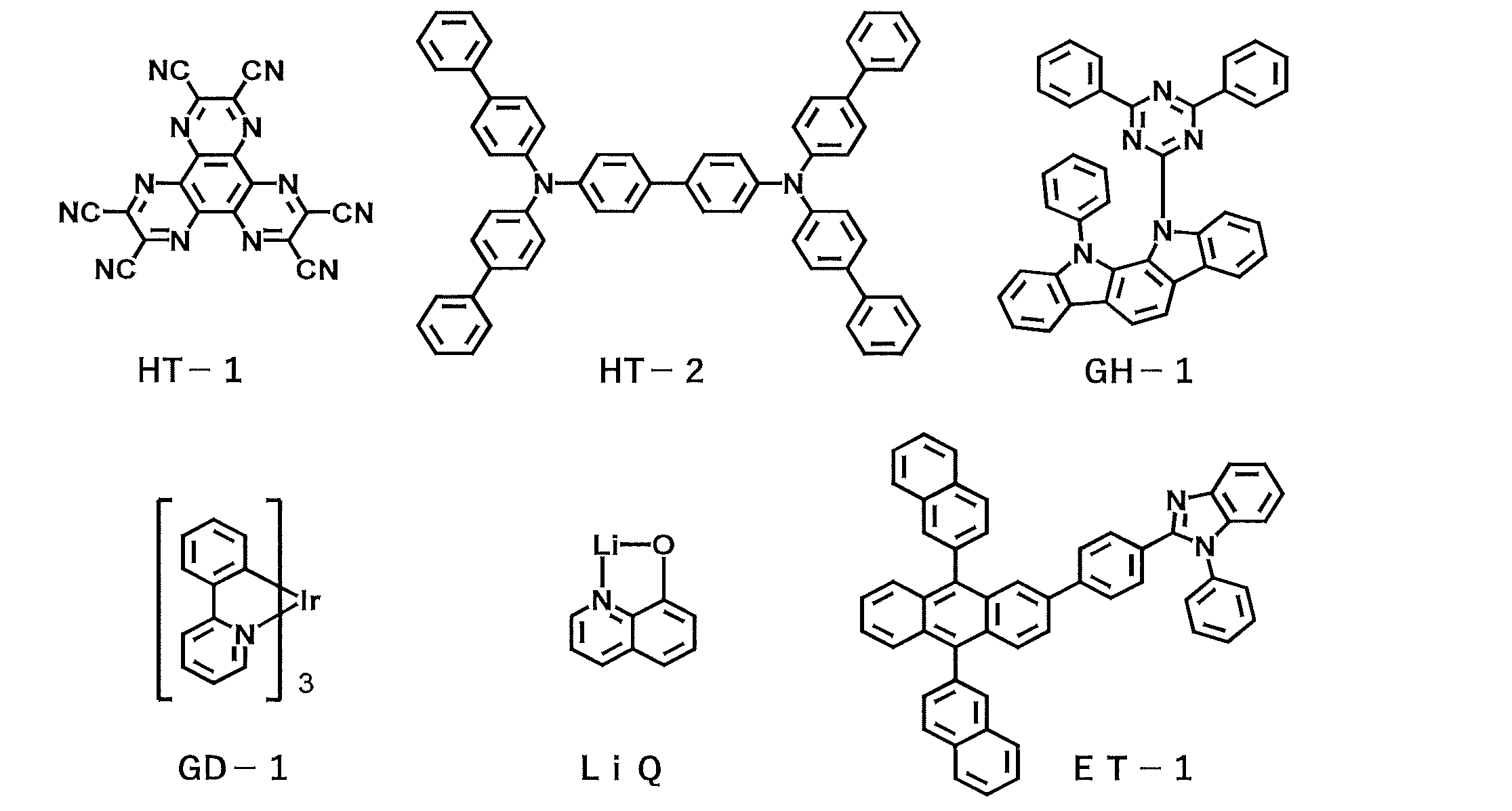
次に、化合物(LiQ)を2nm蒸着した後、MgおよびAgを体積比10:1で10nm蒸着して第二電極(非透明電極)6とした。最後に、低湿窒素雰囲気下でキャップ状ガラス板を、エポキシ樹脂系接着剤を用いて接着することで封止をし、1枚の基板上に1辺が5mmの四角形であるトップエミッション方式の有機EL表示装置を4つ作製した。なお、ここで言う膜厚は水晶発振式膜厚モニターにおける表示値である。
作製した4つの有機EL表示装置を発光させ、発光面を光学顕微鏡で観察し、非点灯セルの有無を以下の基準で評価した。
A:4つの有機EL表示装置全て非点灯セルなし。
B:4つの有機EL表示装置中、1つに非点灯セルあり。
C:4つの有機EL表示装置中、2つに非点灯セルあり。
D:4つの有機EL表示装置中、3つに非点灯セルあり。
A:4つの有機EL表示装置全て非点灯セルなし。
B:4つの有機EL表示装置中、1つに非点灯セルあり。
C:4つの有機EL表示装置中、2つに非点灯セルあり。
D:4つの有機EL表示装置中、3つに非点灯セルあり。
(9)微小残渣評価
各実施例および比較例により得られたプリベーク温度が120℃の現像膜について、それぞれ剥がれなく形成できた最低露光量(mJ/cm2)における10μmのストライプパターン開口部からランダムに抽出した20個の開口部内の微小残渣の有無を、走査型電子顕微鏡(SEM)で観察した。開口部内の0.1μm未満の微小残渣の数を測定し、20箇所の平均を微小残渣数として、以下の判定基準に基づいて評価した。A~Cを合格とし、D,Eを不合格とした。
A:微小残渣0個以上、1個未満
B:微小残渣1個以上、10個未満
C:微小残渣10個以上、20個未満
D:微小残渣20個以上、30個未満
E:微小残渣30個以上。
各実施例および比較例により得られたプリベーク温度が120℃の現像膜について、それぞれ剥がれなく形成できた最低露光量(mJ/cm2)における10μmのストライプパターン開口部からランダムに抽出した20個の開口部内の微小残渣の有無を、走査型電子顕微鏡(SEM)で観察した。開口部内の0.1μm未満の微小残渣の数を測定し、20箇所の平均を微小残渣数として、以下の判定基準に基づいて評価した。A~Cを合格とし、D,Eを不合格とした。
A:微小残渣0個以上、1個未満
B:微小残渣1個以上、10個未満
C:微小残渣10個以上、20個未満
D:微小残渣20個以上、30個未満
E:微小残渣30個以上。
<製造例>
(合成例1:共重合体(a-1))
4-ヒドロキシフェニルメタクリレート(昭和電工株式会社製「PQMA」;以下、PQMA)17.13g、メタクリル酸(以下、MAA)3.31g及びn-ステアリルメタクリレート19.56gをプロピレングリコールモノメチルエーテルアセタート(以下、PGMEA)100.0g中に、重合開始剤としてV-601(富士フイルム和光純薬株式会社製)3.66gを、PGMEA15.0g中にそれぞれ完全に溶解させた。得られた2つの溶液を、300mLの3つ口型フラスコ中の窒素ガス雰囲気下で85℃に加熱したPGMEA45.0gに、同時に2時間かけて滴下し、滴下完了後85℃で反応させることで、PQMA/MAA/n-ステアリルメタクリレート=50/20/30(mol%)の共重合体の固形分20質量%溶液を得た。該共重合体の反応時間を変えて複数作製し、重量平均分子量が8400の共重合体を共重合体(a-1)の固形分20質量%溶液とした。
(合成例2:共重合体(a-2))
合成例1と同様の方法で、投入するモノマの種類をPQMAの代わりに2-アリルフェノールを用い、2-アリルフェノールの量を14.43g、MAA3.70g及びn-ステアリルメタクリレート21.87gとすることで、2-アリルフェノール/MAA/n-ステアリルメタクリレート=50/20/30(mol%)の共重合体の固形分20質量%溶液を得た。該共重合体の反応時間を変えて複数作製し、重量平均分子量が8500の共重合体を共重合体(a-2)の固形分20質量%溶液とした。
合成例1と同様の方法で、投入するモノマの種類をPQMAの代わりに2-アリルフェノールを用い、2-アリルフェノールの量を14.43g、MAA3.70g及びn-ステアリルメタクリレート21.87gとすることで、2-アリルフェノール/MAA/n-ステアリルメタクリレート=50/20/30(mol%)の共重合体の固形分20質量%溶液を得た。該共重合体の反応時間を変えて複数作製し、重量平均分子量が8500の共重合体を共重合体(a-2)の固形分20質量%溶液とした。
(合成例3:共重合体(a-3))
合成例1と同様の方法で、投入するPQMAの量を10.73g、2-アリルフェノール5.39g、MAA3.45g及びn-ステアリルメタクリレート20.42gとすることで、PQMA/2-アリルフェノール/MAA/n-ステアリルメタクリレート=30/20/20/30(mol%)の共重合体の固形分20質量%溶液を得た。該共重合体の反応時間を変えて複数作製し、重量平均分子量が8500の共重合体を共重合体(a-3)の固形分20質量%溶液とした。
合成例1と同様の方法で、投入するPQMAの量を10.73g、2-アリルフェノール5.39g、MAA3.45g及びn-ステアリルメタクリレート20.42gとすることで、PQMA/2-アリルフェノール/MAA/n-ステアリルメタクリレート=30/20/20/30(mol%)の共重合体の固形分20質量%溶液を得た。該共重合体の反応時間を変えて複数作製し、重量平均分子量が8500の共重合体を共重合体(a-3)の固形分20質量%溶液とした。
(合成例4:共重合体(a-4))
合成例1と同様の方法で、投入するPQMAの量を14.34g、MAA5.19g及びn-ステアリルメタクリレート20.46gとすることで、PQMA/MAA/n-ステアリルメタクリレート=40/30/30(mol%)の共重合体の固形分20質量%溶液を得た。該共重合体の反応時間を変えて複数作製し、重量平均分子量が8300の共重合体を共重合体(a-4)の固形分20質量%溶液とした。
合成例1と同様の方法で、投入するPQMAの量を14.34g、MAA5.19g及びn-ステアリルメタクリレート20.46gとすることで、PQMA/MAA/n-ステアリルメタクリレート=40/30/30(mol%)の共重合体の固形分20質量%溶液を得た。該共重合体の反応時間を変えて複数作製し、重量平均分子量が8300の共重合体を共重合体(a-4)の固形分20質量%溶液とした。
(合成例5:共重合体(a-5))
合成例1と同様の方法で、投入するPQMAの量を25.81g、MAA8.83g及びn-ステアリルメタクリレート5.36gとすることで、PQMA/MAA/n-ステアリルメタクリレート=55/39/6(mol%)の共重合体の固形分20質量%溶液を得た。該共重合体の反応時間を変えて複数作製し、重量平均分子量が8700の共重合体を共重合体(a-5)の固形分20質量%溶液とした。
合成例1と同様の方法で、投入するPQMAの量を25.81g、MAA8.83g及びn-ステアリルメタクリレート5.36gとすることで、PQMA/MAA/n-ステアリルメタクリレート=55/39/6(mol%)の共重合体の固形分20質量%溶液を得た。該共重合体の反応時間を変えて複数作製し、重量平均分子量が8700の共重合体を共重合体(a-5)の固形分20質量%溶液とした。
(合成例6:共重合体(a-6))
合成例1と同様の方法で、投入するPQMAの量を16.66g、MAA0.88g及びn-ステアリルメタクリレート22.47gとすることで、PQMA/MAA/n-ステアリルメタクリレート=55/6/39(mol%)の共重合体の固形分20質量%溶液を得た。該共重合体の反応時間を変えて複数作製し、重量平均分子量が8400の共重合体を共重合体(a-6)の固形分20質量%溶液とした。
合成例1と同様の方法で、投入するPQMAの量を16.66g、MAA0.88g及びn-ステアリルメタクリレート22.47gとすることで、PQMA/MAA/n-ステアリルメタクリレート=55/6/39(mol%)の共重合体の固形分20質量%溶液を得た。該共重合体の反応時間を変えて複数作製し、重量平均分子量が8400の共重合体を共重合体(a-6)の固形分20質量%溶液とした。
(合成例7:共重合体(a-7))
合成例1と同様の方法で、投入するPQMAの量を31.70g、MAA1.68g及びn-ステアリルメタクリレート6.62gとすることで、PQMA/MAA/n-ステアリルメタクリレート=82/9/9(mol%)の共重合体の固形分20質量%溶液を得た。該共重合体の反応時間を変えて複数作製し、重量平均分子量が8200の共重合体を共重合体(a-7)の固形分20質量%溶液とした。
合成例1と同様の方法で、投入するPQMAの量を31.70g、MAA1.68g及びn-ステアリルメタクリレート6.62gとすることで、PQMA/MAA/n-ステアリルメタクリレート=82/9/9(mol%)の共重合体の固形分20質量%溶液を得た。該共重合体の反応時間を変えて複数作製し、重量平均分子量が8200の共重合体を共重合体(a-7)の固形分20質量%溶液とした。
(合成例8:共重合体(a-8))
PQMA13.29g、MAA5.61g、及びn-ステアリルメタクリレート15.8gをPGMEA100.0g中に、重合開始剤としてV-601を3.66g、PGMEA15.0g中にそれぞれ完全に溶解させた。得られた2つの溶液を、300mLの3つ口型フラスコ中の窒素ガス雰囲気下で85℃に加熱したPGMEA45.0gに、同時に2時間かけて滴下して共重合を行った。その後、反応容器内を空気で置換してグリシジルメタクリレート(以下、GMA)5.30gを滴下用ポンプにて1時間かけて滴下して付加反応させ、さらに容器内を攪拌させることで、PQMA/MAA/n-ステアリルメタクリレート/GMA付加MAA=40/15/25/20(mol%)の共重合体の固形分20質量%溶液を得た。該共重合体の反応時間を変えて複数作製し、重量平均分子量が8500の共重合体を共重合体(a-8)の固形分20質量%溶液とした。
PQMA13.29g、MAA5.61g、及びn-ステアリルメタクリレート15.8gをPGMEA100.0g中に、重合開始剤としてV-601を3.66g、PGMEA15.0g中にそれぞれ完全に溶解させた。得られた2つの溶液を、300mLの3つ口型フラスコ中の窒素ガス雰囲気下で85℃に加熱したPGMEA45.0gに、同時に2時間かけて滴下して共重合を行った。その後、反応容器内を空気で置換してグリシジルメタクリレート(以下、GMA)5.30gを滴下用ポンプにて1時間かけて滴下して付加反応させ、さらに容器内を攪拌させることで、PQMA/MAA/n-ステアリルメタクリレート/GMA付加MAA=40/15/25/20(mol%)の共重合体の固形分20質量%溶液を得た。該共重合体の反応時間を変えて複数作製し、重量平均分子量が8500の共重合体を共重合体(a-8)の固形分20質量%溶液とした。
(合成例9:共重合体(a-9))
合成例1と同様の方法で、投入するPQMAの量を17.13g、MAA3.31g及びn-ステアリルメタクリレート19.56gとすることで、PQMA/MAA/n-ステアリルメタクリレート=50/20/30(mol%)の共重合体の固形分20質量%溶液を得た。該共重合体の反応時間を変えて複数作製し、重量平均分子量が21000の共重合体を共重合体(a-9)の固形分20質量%溶液とした。
合成例1と同様の方法で、投入するPQMAの量を17.13g、MAA3.31g及びn-ステアリルメタクリレート19.56gとすることで、PQMA/MAA/n-ステアリルメタクリレート=50/20/30(mol%)の共重合体の固形分20質量%溶液を得た。該共重合体の反応時間を変えて複数作製し、重量平均分子量が21000の共重合体を共重合体(a-9)の固形分20質量%溶液とした。
(合成例10:共重合体(a-10))
合成例1と同様の方法で、投入するPQMAの量を17.13g、MAA3.31g及びn-ステアリルメタクリレート19.56gとすることで、PQMA/MAA/n-ステアリルメタクリレート=50/20/30(mol%)の共重合体の固形分20質量%溶液を得た。該共重合体の反応時間を変えて複数作製し、重量平均分子量が63000の共重合体を共重合体(a-10)の固形分20質量%溶液とした。
合成例1と同様の方法で、投入するPQMAの量を17.13g、MAA3.31g及びn-ステアリルメタクリレート19.56gとすることで、PQMA/MAA/n-ステアリルメタクリレート=50/20/30(mol%)の共重合体の固形分20質量%溶液を得た。該共重合体の反応時間を変えて複数作製し、重量平均分子量が63000の共重合体を共重合体(a-10)の固形分20質量%溶液とした。
(合成例11:共重合体(a-11))
合成例1と同様の方法で、投入するPQMAの量を18.47g、MAA2.07g及びn-ステアリルメタクリレート19.46gとすることで、PQMA/MAA/n-ステアリルメタクリレート=56/13/31(mol%)の共重合体の固形分20質量%溶液を得た。該共重合体の反応時間を変えて複数作製し、重量平均分子量が14300の共重合体を共重合体(a-11)の固形分20質量%溶液とした。
合成例1と同様の方法で、投入するPQMAの量を18.47g、MAA2.07g及びn-ステアリルメタクリレート19.46gとすることで、PQMA/MAA/n-ステアリルメタクリレート=56/13/31(mol%)の共重合体の固形分20質量%溶液を得た。該共重合体の反応時間を変えて複数作製し、重量平均分子量が14300の共重合体を共重合体(a-11)の固形分20質量%溶液とした。
(合成例12:共重合体(a-12))
合成例1と同様の方法で、投入するモノマの種類をn-ステアリルメタクリレートの代わりにイソデシルメタクリレートを用い、投入するPQMAの量を22.03g、MAA2.47g及びイソデシルメタクリレートの量を15.50gとすることで、PQMA/MAA/イソデシルメタクリレート=56/13/31(mol%)の共重合体の固形分20質量%溶液を得た。該共重合体の反応時間を変えて複数作製し、重量平均分子量が14500の共重合体を共重合体(a-12)の固形分20質量%溶液とした。
合成例1と同様の方法で、投入するモノマの種類をn-ステアリルメタクリレートの代わりにイソデシルメタクリレートを用い、投入するPQMAの量を22.03g、MAA2.47g及びイソデシルメタクリレートの量を15.50gとすることで、PQMA/MAA/イソデシルメタクリレート=56/13/31(mol%)の共重合体の固形分20質量%溶液を得た。該共重合体の反応時間を変えて複数作製し、重量平均分子量が14500の共重合体を共重合体(a-12)の固形分20質量%溶液とした。
(合成例13:共重合体(a-13))
合成例1と同様の方法で、投入するモノマの種類をn-ステアリルメタクリレートの代わりに2-EHMAを用い、投入するPQMAの量を23.15g、MAA2.59g及び2-EHMAの量を14.26gとすることで、PQMA/MAA/2-EHMA=56/13/31(mol%)の共重合体の固形分20質量%溶液を得た。該共重合体の反応時間を変えて複数作製し、重量平均分子量が14800の共重合体を共重合体(a-13)の固形分20質量%溶液とした。
合成例1と同様の方法で、投入するモノマの種類をn-ステアリルメタクリレートの代わりに2-EHMAを用い、投入するPQMAの量を23.15g、MAA2.59g及び2-EHMAの量を14.26gとすることで、PQMA/MAA/2-EHMA=56/13/31(mol%)の共重合体の固形分20質量%溶液を得た。該共重合体の反応時間を変えて複数作製し、重量平均分子量が14800の共重合体を共重合体(a-13)の固形分20質量%溶液とした。
(合成例14:共重合体(a-14))
合成例1と同様の方法で、投入するPQMAの量を6.93g、MAA6.69g及びn-ステアリルメタクリレート26.38gとすることで、PQMA/MAA/n-ステアリルメタクリレート=20/40/40(mol%)の共重合体の固形分20質量%溶液を得た。該共重合体の反応時間を変えて複数作製し、重量平均分子量が8500の共重合体を共重合体(a-14)の固形分20質量%溶液とした。
合成例1と同様の方法で、投入するPQMAの量を6.93g、MAA6.69g及びn-ステアリルメタクリレート26.38gとすることで、PQMA/MAA/n-ステアリルメタクリレート=20/40/40(mol%)の共重合体の固形分20質量%溶液を得た。該共重合体の反応時間を変えて複数作製し、重量平均分子量が8500の共重合体を共重合体(a-14)の固形分20質量%溶液とした。
(合成例15:共重合体(a-15))
合成例1と同様の方法で、投入するPQMAの量を7.62g、MAA0.49g及びn-ステアリルメタクリレート31.89gとすることで、PQMA/MAA/n-ステアリルメタクリレート=30/4/66(mol%)の共重合体の固形分20質量%溶液を得た。該共重合体の反応時間を変えて複数作製し、重量平均分子量が8300の共重合体を共重合体(a-15)の固形分20質量%溶液とした。
合成例1と同様の方法で、投入するPQMAの量を7.62g、MAA0.49g及びn-ステアリルメタクリレート31.89gとすることで、PQMA/MAA/n-ステアリルメタクリレート=30/4/66(mol%)の共重合体の固形分20質量%溶液を得た。該共重合体の反応時間を変えて複数作製し、重量平均分子量が8300の共重合体を共重合体(a-15)の固形分20質量%溶液とした。
(合成例16:共重合体(a-16))
合成例1と同様の方法で、投入するPQMAの量を17.28g、MAA18.34g及びn-ステアリルメタクリレート4.38gとすることで、PQMA/MAA/n-ステアリルメタクリレート=30/66/4(mol%)の共重合体の固形分20質量%溶液を得た。該共重合体の反応時間を変えて複数作製し、重量平均分子量が8600の共重合体を共重合体(a-16)の固形分20質量%溶液とした。
合成例1と同様の方法で、投入するPQMAの量を17.28g、MAA18.34g及びn-ステアリルメタクリレート4.38gとすることで、PQMA/MAA/n-ステアリルメタクリレート=30/66/4(mol%)の共重合体の固形分20質量%溶液を得た。該共重合体の反応時間を変えて複数作製し、重量平均分子量が8600の共重合体を共重合体(a-16)の固形分20質量%溶液とした。
(合成例17:共重合体(a-17))
合成例1と同様の方法で、投入するPQMAの量を26.25g、MAA9.21g及びn-ステアリルメタクリレート4.54gとすることで、PQMA/MAA/n-ステアリルメタクリレート=55/40/5(mol%)の共重合体の固形分20質量%溶液を得た。該共重合体の反応時間を変えて複数作製し、重量平均分子量が8300の共重合体を共重合体(a-17)の固形分20質量%溶液とした。
合成例1と同様の方法で、投入するPQMAの量を26.25g、MAA9.21g及びn-ステアリルメタクリレート4.54gとすることで、PQMA/MAA/n-ステアリルメタクリレート=55/40/5(mol%)の共重合体の固形分20質量%溶液を得た。該共重合体の反応時間を変えて複数作製し、重量平均分子量が8300の共重合体を共重合体(a-17)の固形分20質量%溶液とした。
(合成例18:共重合体(a-18))
合成例1と同様の方法で、投入するPQMAの量を16.48g、MAA0.72g及びn-ステアリルメタクリレート22.80gとすることで、PQMA/MAA/n-ステアリルメタクリレート=55/5/40(mol%)の共重合体の固形分20質量%溶液を得た。該共重合体の反応時間を変えて複数作製し、重量平均分子量が8700の共重合体を共重合体(a-18)の固形分20質量%溶液とした。
合成例1と同様の方法で、投入するPQMAの量を16.48g、MAA0.72g及びn-ステアリルメタクリレート22.80gとすることで、PQMA/MAA/n-ステアリルメタクリレート=55/5/40(mol%)の共重合体の固形分20質量%溶液を得た。該共重合体の反応時間を変えて複数作製し、重量平均分子量が8700の共重合体を共重合体(a-18)の固形分20質量%溶液とした。
(合成例19:共重合体(a-19))
合成例1と同様の方法で、投入するPQMAの量を33.93g、MAA0.93g及びn-ステアリルメタクリレート5.14gとすることで、PQMA/MAA/n-ステアリルメタクリレート=88/5/7(mol%)の共重合体の固形分20質量%溶液を得た。該共重合体の反応時間を変えて複数作製し、重量平均分子量が8300の共重合体を共重合体(a-19)の固形分20質量%溶液とした。
合成例1と同様の方法で、投入するPQMAの量を33.93g、MAA0.93g及びn-ステアリルメタクリレート5.14gとすることで、PQMA/MAA/n-ステアリルメタクリレート=88/5/7(mol%)の共重合体の固形分20質量%溶液を得た。該共重合体の反応時間を変えて複数作製し、重量平均分子量が8300の共重合体を共重合体(a-19)の固形分20質量%溶液とした。
(合成例20:共重合体(a-20))
合成例8と同様の方法で、投入するPQMAの量を10.26g、MAA9.08g、n-ステアリルメタクリレート9.76gとし、付加反応させるGMAの量を10.91gとすることで、PQMA/MAA/n-ステアリルメタクリレート/GMA付加MAA=30/15/15/40(mol%)の共重合体の固形分20質量%溶液を得た。該共重合体の反応時間を変えて複数作製し、重量平均分子量が8200の共重合体を共重合体(a-20)の固形分20質量%溶液とした。
合成例8と同様の方法で、投入するPQMAの量を10.26g、MAA9.08g、n-ステアリルメタクリレート9.76gとし、付加反応させるGMAの量を10.91gとすることで、PQMA/MAA/n-ステアリルメタクリレート/GMA付加MAA=30/15/15/40(mol%)の共重合体の固形分20質量%溶液を得た。該共重合体の反応時間を変えて複数作製し、重量平均分子量が8200の共重合体を共重合体(a-20)の固形分20質量%溶液とした。
(合成例21:共重合体(a-21))
合成例8と同様の方法で、投入するMAAの量を9.27g、n-ステアリルメタクリレート24.35gとし、付加反応させるGMAの量を6.38gとすることで、MAA/n-ステアリルメタクリレート/GMA付加MAA=35/40/25(mol%)の共重合体の固形分20質量%溶液を得た。該共重合体の反応時間を変えて複数作製し、重量平均分子量が8400の共重合体を共重合体(a-21)の固形分20質量%溶液とした。
合成例8と同様の方法で、投入するMAAの量を9.27g、n-ステアリルメタクリレート24.35gとし、付加反応させるGMAの量を6.38gとすることで、MAA/n-ステアリルメタクリレート/GMA付加MAA=35/40/25(mol%)の共重合体の固形分20質量%溶液を得た。該共重合体の反応時間を変えて複数作製し、重量平均分子量が8400の共重合体を共重合体(a-21)の固形分20質量%溶液とした。
(合成例22:共重合体(a-22))
合成例1と同様の方法で、投入するPQMAの量を26.12g、及びGMA13.88gとすることで、PQMA/GMA=60/40(mol%)の共重合体の固形分20質量%溶液を得た。該共重合体の反応時間を変えて複数作製し、重量平均分子量が8600の共重合体を共重合体(a-22)の固形分20質量%溶液とした。
合成例1と同様の方法で、投入するPQMAの量を26.12g、及びGMA13.88gとすることで、PQMA/GMA=60/40(mol%)の共重合体の固形分20質量%溶液を得た。該共重合体の反応時間を変えて複数作製し、重量平均分子量が8600の共重合体を共重合体(a-22)の固形分20質量%溶液とした。
(合成例23:3級アミノ基、カルボキシ基およびエチレン性不飽和基を有する分散樹脂(f-1))
PGMEA400.0gを攪拌装置、温度計、還流冷却機、滴下用ポンプを備えた耐圧容器に仕込み反応容器内を窒素で満たした後90℃まで昇温を行い、メタクリル酸-2-ジメチルアミノエチル2.0g、メタクリル酸メチル31.0g、メタクリル酸-2-エチルヘキシル20.0g、スチレン30.0g、メタクリル酸を17.0g、重合開始剤としてアゾビスイソブチロニトリル2.0g、ノルマルドデシルメルカプタン3.0gを混合したものを滴下用ポンプにて3時間かけて滴下して共重合を行った。その後、反応容器内を空気で置換してGMA10.0gを滴下用ポンプにて1時間かけて滴下して付加反応させ、さらに2時間容器内を攪拌した。その結果、塩基価11mmol/100g、酸価73mgKOH/g、重量平均分子量7000の特性値を有する固形分濃度20質量%の3級アミノ基、カルボキシ基およびエチレン性不飽和基を有する分散樹脂(f-1)溶液が得られた。
PGMEA400.0gを攪拌装置、温度計、還流冷却機、滴下用ポンプを備えた耐圧容器に仕込み反応容器内を窒素で満たした後90℃まで昇温を行い、メタクリル酸-2-ジメチルアミノエチル2.0g、メタクリル酸メチル31.0g、メタクリル酸-2-エチルヘキシル20.0g、スチレン30.0g、メタクリル酸を17.0g、重合開始剤としてアゾビスイソブチロニトリル2.0g、ノルマルドデシルメルカプタン3.0gを混合したものを滴下用ポンプにて3時間かけて滴下して共重合を行った。その後、反応容器内を空気で置換してGMA10.0gを滴下用ポンプにて1時間かけて滴下して付加反応させ、さらに2時間容器内を攪拌した。その結果、塩基価11mmol/100g、酸価73mgKOH/g、重量平均分子量7000の特性値を有する固形分濃度20質量%の3級アミノ基、カルボキシ基およびエチレン性不飽和基を有する分散樹脂(f-1)溶液が得られた。
(合成例24:フルオレンアクリレート溶液(e-1))
フラスコに、溶剤である400.00gのメチルイソブチルケトンを仕込み、そこに350.00gの9,9-ビス(6-グリシジルオキシ-2-ナフチル)フルオレンと、112.10gのアクリル酸と、重合禁止剤である1.50gのメトキノンと、触媒である0.30gのテトラエチルアンモニウムブロミドを添加し、液温を140℃に維持して5時間攪拌して反応させた後に加熱を停止し室温まで冷却した。反応物を分液操作により水洗し、さらに減圧乾燥することでフルオレンアクリレート(式(6)で表される化合物:式(7)で表される化合物のmol%比率=73:27)を得た。次いで、固形分30質量%となるようにPGMEAを添加して攪拌し、フルオレンアクリレート溶液(e-1)を得た。
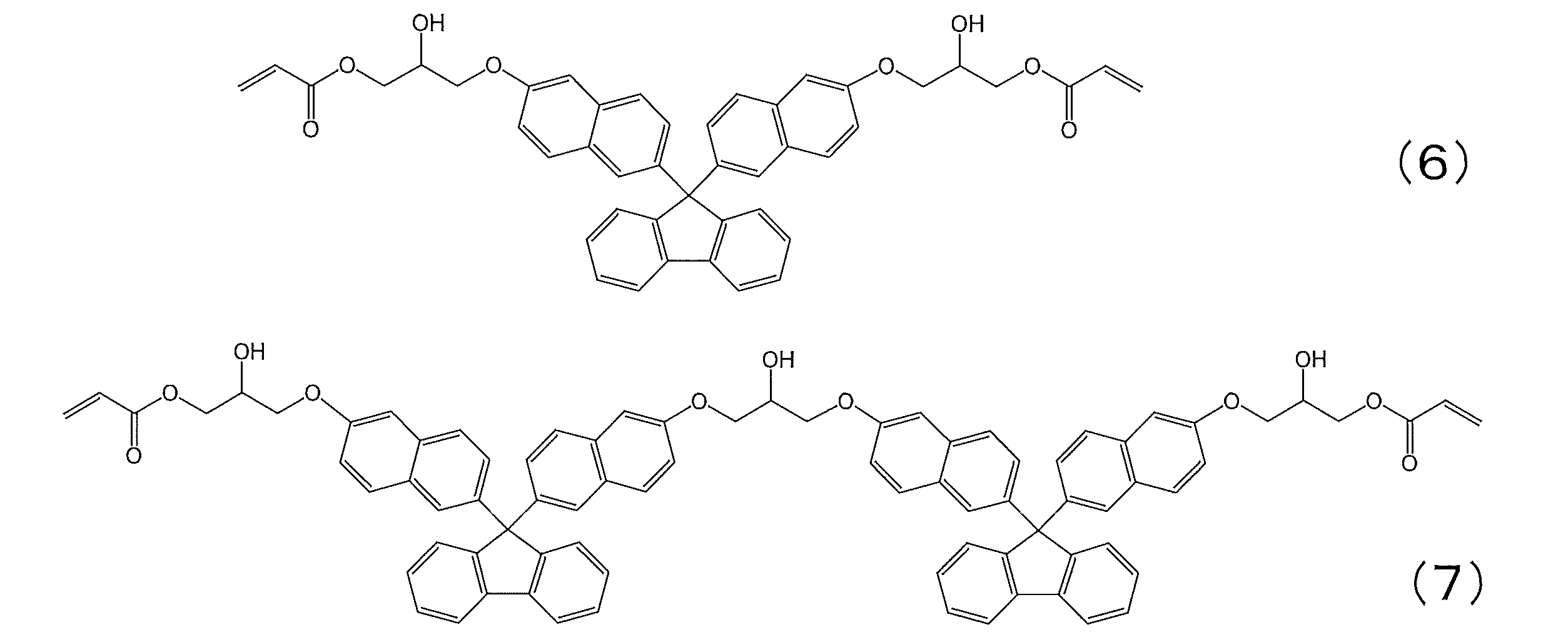
フラスコに、溶剤である400.00gのメチルイソブチルケトンを仕込み、そこに350.00gの9,9-ビス(6-グリシジルオキシ-2-ナフチル)フルオレンと、112.10gのアクリル酸と、重合禁止剤である1.50gのメトキノンと、触媒である0.30gのテトラエチルアンモニウムブロミドを添加し、液温を140℃に維持して5時間攪拌して反応させた後に加熱を停止し室温まで冷却した。反応物を分液操作により水洗し、さらに減圧乾燥することでフルオレンアクリレート(式(6)で表される化合物:式(7)で表される化合物のmol%比率=73:27)を得た。次いで、固形分30質量%となるようにPGMEAを添加して攪拌し、フルオレンアクリレート溶液(e-1)を得た。
(合成例25:共重合体(a-23))
PQMA13.02g、MAA4.87g、及びn-ステアリルメタクリレート17.96gをPGMEA100.0g中に、重合開始剤としてV-601を3.66g、PGMEA15.0g中にそれぞれ完全に溶解させた。得られた2つの溶液を、300mLの3つ口型フラスコ中の窒素ガス雰囲気下で85℃に加熱したPGMEA45.0gに、同時に2時間かけて滴下して共重合を行った。その後、反応容器内を空気で置換してGMA4.15gを滴下用ポンプにて1時間かけて滴下して付加反応させ、さらに容器内を攪拌させることで、PQMA/MAA/n-ステアリルメタクリレート/GMA付加MAA=40/15/29/16(mol%)の共重合体の固形分20質量%溶液を得た。該共重合体の反応時間を変えて複数作製し、重量平均分子量が8500の共重合体を共重合体(a-23)の固形分20質量%溶液とした。
PQMA13.02g、MAA4.87g、及びn-ステアリルメタクリレート17.96gをPGMEA100.0g中に、重合開始剤としてV-601を3.66g、PGMEA15.0g中にそれぞれ完全に溶解させた。得られた2つの溶液を、300mLの3つ口型フラスコ中の窒素ガス雰囲気下で85℃に加熱したPGMEA45.0gに、同時に2時間かけて滴下して共重合を行った。その後、反応容器内を空気で置換してGMA4.15gを滴下用ポンプにて1時間かけて滴下して付加反応させ、さらに容器内を攪拌させることで、PQMA/MAA/n-ステアリルメタクリレート/GMA付加MAA=40/15/29/16(mol%)の共重合体の固形分20質量%溶液を得た。該共重合体の反応時間を変えて複数作製し、重量平均分子量が8500の共重合体を共重合体(a-23)の固形分20質量%溶液とした。
(合成例26:共重合体(a-24))
PQMA13.33g、MAA3.52g、及びn-ステアリルメタクリレート21.13gをPGMEA100.0g中に、重合開始剤としてV-601を3.66g、PGMEA15.0g中にそれぞれ完全に溶解させた。得られた2つの溶液を、300mLの3つ口型フラスコ中の窒素ガス雰囲気下で85℃に加熱したPGMEA45.0gに、同時に2時間かけて滴下して共重合を行った。その後、反応容器内を空気で置換してGMA2.02gを滴下用ポンプにて1時間かけて滴下して付加反応させ、さらに容器内を攪拌させることで、PQMA/MAA/n-ステアリルメタクリレート/GMA付加MAA=42/15/35/8(mol%)の共重合体の固形分20質量%溶液を得た。該共重合体の反応時間を変えて複数作製し、重量平均分子量が8500の共重合体を共重合体(a-24)の固形分20質量%溶液とした。
PQMA13.33g、MAA3.52g、及びn-ステアリルメタクリレート21.13gをPGMEA100.0g中に、重合開始剤としてV-601を3.66g、PGMEA15.0g中にそれぞれ完全に溶解させた。得られた2つの溶液を、300mLの3つ口型フラスコ中の窒素ガス雰囲気下で85℃に加熱したPGMEA45.0gに、同時に2時間かけて滴下して共重合を行った。その後、反応容器内を空気で置換してGMA2.02gを滴下用ポンプにて1時間かけて滴下して付加反応させ、さらに容器内を攪拌させることで、PQMA/MAA/n-ステアリルメタクリレート/GMA付加MAA=42/15/35/8(mol%)の共重合体の固形分20質量%溶液を得た。該共重合体の反応時間を変えて複数作製し、重量平均分子量が8500の共重合体を共重合体(a-24)の固形分20質量%溶液とした。
(合成例27:共重合体(a-25))
PQMA13.89g、MAA2.89g、及びn-ステアリルメタクリレート22.21gをPGMEA100.0g中に、重合開始剤としてV-601を3.66g、PGMEA15.0g中にそれぞれ完全に溶解させた。得られた2つの溶液を、300mLの3つ口型フラスコ中の窒素ガス雰囲気下で85℃に加熱したPGMEA45.0gに、同時に2時間かけて滴下して共重合を行った。その後、反応容器内を空気で置換してGMA1.01gを滴下用ポンプにて1時間かけて滴下して付加反応させ、さらに容器内を攪拌させることで、PQMA/MAA/n-ステアリルメタクリレート/GMA付加MAA=44/15/37/4(mol%)の共重合体の固形分20質量%溶液を得た。該共重合体の反応時間を変えて複数作製し、重量平均分子量が8500の共重合体を共重合体(a-25)の固形分20質量%溶液とした。
PQMA13.89g、MAA2.89g、及びn-ステアリルメタクリレート22.21gをPGMEA100.0g中に、重合開始剤としてV-601を3.66g、PGMEA15.0g中にそれぞれ完全に溶解させた。得られた2つの溶液を、300mLの3つ口型フラスコ中の窒素ガス雰囲気下で85℃に加熱したPGMEA45.0gに、同時に2時間かけて滴下して共重合を行った。その後、反応容器内を空気で置換してGMA1.01gを滴下用ポンプにて1時間かけて滴下して付加反応させ、さらに容器内を攪拌させることで、PQMA/MAA/n-ステアリルメタクリレート/GMA付加MAA=44/15/37/4(mol%)の共重合体の固形分20質量%溶液を得た。該共重合体の反応時間を変えて複数作製し、重量平均分子量が8500の共重合体を共重合体(a-25)の固形分20質量%溶液とした。
(製造例1 顔料分散液(B-1)の製造)
顔料としてIrgaphor Black S0100CF(BASF社製)525g、3級アミノ基、カルボキシ基及びエチレン性不飽和基を有する分散樹脂(f-1)の20質量%PGMEA溶液を675g、高分子分散剤として、特開2020-070352号公報の合成例2に記載のアミン価20mgKOH/gの分散剤90g及び1710gのPGMEAをタンクに仕込み、ホモミキサーで20分撹拌し、予備分散液を得た。0.10mmφジルコニアビーズを70体積%充填した遠心分離セパレーターを具備した(株)広島メタル&マシナリー製分散機ウルトラアペックスミルに、得られた予備分散液を供給し、回転速度10m/sで3時間分散を行い、固形分濃度25質量%の顔料分散液(B-1)を得た。
顔料としてIrgaphor Black S0100CF(BASF社製)525g、3級アミノ基、カルボキシ基及びエチレン性不飽和基を有する分散樹脂(f-1)の20質量%PGMEA溶液を675g、高分子分散剤として、特開2020-070352号公報の合成例2に記載のアミン価20mgKOH/gの分散剤90g及び1710gのPGMEAをタンクに仕込み、ホモミキサーで20分撹拌し、予備分散液を得た。0.10mmφジルコニアビーズを70体積%充填した遠心分離セパレーターを具備した(株)広島メタル&マシナリー製分散機ウルトラアペックスミルに、得られた予備分散液を供給し、回転速度10m/sで3時間分散を行い、固形分濃度25質量%の顔料分散液(B-1)を得た。
(製造例2 顔料分散液(B-2)の製造)
顔料としてIrgaphor Black S0100CF(BASF社製)11.49g、特許文献2の<分散剤-I>に記載の分散剤(固形分100%)を2.77g、特許文献2の<合成例1>に記載のアルカリ可溶性樹脂(固形分40%PGMEA溶液)14.37g、PGMEA55.40g及びMB15.98gをタンクに仕込み、この混合液をペイントシェーカーにより25~45℃の範囲で3時間分散処理を行った。ビーズとしては、0.5mmφのジルコニアビーズを用い、分散液の2.5倍の質量を加えた。分散終了後、フィルターによりビーズと分散液を分離して、固形分濃度20質量%の顔料分散液(B-2)を得た。
顔料としてIrgaphor Black S0100CF(BASF社製)11.49g、特許文献2の<分散剤-I>に記載の分散剤(固形分100%)を2.77g、特許文献2の<合成例1>に記載のアルカリ可溶性樹脂(固形分40%PGMEA溶液)14.37g、PGMEA55.40g及びMB15.98gをタンクに仕込み、この混合液をペイントシェーカーにより25~45℃の範囲で3時間分散処理を行った。ビーズとしては、0.5mmφのジルコニアビーズを用い、分散液の2.5倍の質量を加えた。分散終了後、フィルターによりビーズと分散液を分離して、固形分濃度20質量%の顔料分散液(B-2)を得た。
(実施例1)
20.60gの顔料分散液(B-1)に、共重合体(a-1)の20質量%PGMEA溶液を28.43g、光重合開始剤としてアデカアークルズ(登録商標)NCI-831を0.88g、ラジカル重合性化合物として、KAYARAD HX-220(日本化薬(株)製)を3.26g、シリコーン系界面活性剤“BYK”(登録商標)333(ビックケミー社製)0.02g、PGMEA46.81gを添加して、全固形分濃度15質量%のネガ型感光性組成物(NB-1)を得た。さらに得られたネガ型感光性組成物の硬化物、およびその硬化物を具備する有機EL表示装置を前述の方法に従って作成した。
20.60gの顔料分散液(B-1)に、共重合体(a-1)の20質量%PGMEA溶液を28.43g、光重合開始剤としてアデカアークルズ(登録商標)NCI-831を0.88g、ラジカル重合性化合物として、KAYARAD HX-220(日本化薬(株)製)を3.26g、シリコーン系界面活性剤“BYK”(登録商標)333(ビックケミー社製)0.02g、PGMEA46.81gを添加して、全固形分濃度15質量%のネガ型感光性組成物(NB-1)を得た。さらに得られたネガ型感光性組成物の硬化物、およびその硬化物を具備する有機EL表示装置を前述の方法に従って作成した。
(実施例2~13)
実施例1と同様の方法で、投入する共重合体(a)としてそれぞれ(a-2)~(a-13)を用いることで、ネガ型感光性組成物(NB-2)~(NB-13)とその硬化物、およびその硬化物を具備する有機EL表示装置を得た。
実施例1と同様の方法で、投入する共重合体(a)としてそれぞれ(a-2)~(a-13)を用いることで、ネガ型感光性組成物(NB-2)~(NB-13)とその硬化物、およびその硬化物を具備する有機EL表示装置を得た。
(実施例14)
25.70gの顔料分散液(B-1)に、共重合体(a-13)の20質量%PGMEA溶液を22.00g、光重合開始剤としてアデカアークルズ(登録商標)NCI-831を1.00g、ラジカル重合性化合物として、KAYARAD HX-220(日本化薬(株)製)を3.16g、シリコーン系界面活性剤“BYK”(登録商標)333(ビックケミー社製)0.02g、PGMEA48.13gを添加して、全固形分濃度15質量%のネガ型感光性組成物(NB-14)を得た。さらに得られたネガ型感光性組成物の硬化物、およびその硬化物を具備する有機EL表示装置を前述の方法に従って作成した。
25.70gの顔料分散液(B-1)に、共重合体(a-13)の20質量%PGMEA溶液を22.00g、光重合開始剤としてアデカアークルズ(登録商標)NCI-831を1.00g、ラジカル重合性化合物として、KAYARAD HX-220(日本化薬(株)製)を3.16g、シリコーン系界面活性剤“BYK”(登録商標)333(ビックケミー社製)0.02g、PGMEA48.13gを添加して、全固形分濃度15質量%のネガ型感光性組成物(NB-14)を得た。さらに得られたネガ型感光性組成物の硬化物、およびその硬化物を具備する有機EL表示装置を前述の方法に従って作成した。
(実施例15)
25.70gの顔料分散液(B-1)に、共重合体(a-13)の20質量%PGMEA溶液を22.00g、光重合開始剤としてアデカアークルズ(登録商標)NCI-831を1.00g、ラジカル重合性化合物として、KAYARAD HX-220(日本化薬(株)製)を1.58g、及びフルオレンアクリレート溶液(e-1)を5.26g、シリコーン系界面活性剤“BYK”(登録商標)333(ビックケミー社製)0.02g、PGMEA48.13gを添加して、全固形分濃度15質量%のネガ型感光性組成物(NB-15)を得た。さらに得られたネガ型感光性組成物の硬化物、およびその硬化物を具備する有機EL表示装置を前述の方法に従って作成した。
25.70gの顔料分散液(B-1)に、共重合体(a-13)の20質量%PGMEA溶液を22.00g、光重合開始剤としてアデカアークルズ(登録商標)NCI-831を1.00g、ラジカル重合性化合物として、KAYARAD HX-220(日本化薬(株)製)を1.58g、及びフルオレンアクリレート溶液(e-1)を5.26g、シリコーン系界面活性剤“BYK”(登録商標)333(ビックケミー社製)0.02g、PGMEA48.13gを添加して、全固形分濃度15質量%のネガ型感光性組成物(NB-15)を得た。さらに得られたネガ型感光性組成物の硬化物、およびその硬化物を具備する有機EL表示装置を前述の方法に従って作成した。
(実施例16~18)
実施例1と同様の方法で、投入する共重合体(a)としてそれぞれ(a-23)~(a-25)を用いることで、ネガ型感光性組成物(NB-26)~(NB-28)とその硬化物、およびその硬化物を具備する有機EL表示装置を得た。
実施例1と同様の方法で、投入する共重合体(a)としてそれぞれ(a-23)~(a-25)を用いることで、ネガ型感光性組成物(NB-26)~(NB-28)とその硬化物、およびその硬化物を具備する有機EL表示装置を得た。
(実施例19)
20.60gの顔料分散液(B-1)に、共重合体(a-25)の20質量%PGMEA溶液を27.85g、光重合開始剤としてアデカアークルズ(登録商標)NCI-831((株)ADEKA製)を0.87g、ラジカル重合性化合物として、KAYARAD HX-220(日本化薬(株)製)を3.24g、残渣抑制剤として、アデカプルロニック(登録商標)17R-2((株)ADEKA製)を0.15g、シリコーン系界面活性剤“BYK”(登録商標)333(ビックケミー社製)0.02g、PGMEA46.81gを添加して、全固形分濃度15質量%のネガ型感光性組成物(NB-29)を得た。さらに得られたネガ型感光性組成物の硬化物、およびその硬化物を具備する有機EL表示装置を前述の方法に従って作成した。
20.60gの顔料分散液(B-1)に、共重合体(a-25)の20質量%PGMEA溶液を27.85g、光重合開始剤としてアデカアークルズ(登録商標)NCI-831((株)ADEKA製)を0.87g、ラジカル重合性化合物として、KAYARAD HX-220(日本化薬(株)製)を3.24g、残渣抑制剤として、アデカプルロニック(登録商標)17R-2((株)ADEKA製)を0.15g、シリコーン系界面活性剤“BYK”(登録商標)333(ビックケミー社製)0.02g、PGMEA46.81gを添加して、全固形分濃度15質量%のネガ型感光性組成物(NB-29)を得た。さらに得られたネガ型感光性組成物の硬化物、およびその硬化物を具備する有機EL表示装置を前述の方法に従って作成した。
(比較例1~9)
実施例1と同様の方法で、投入する共重合体(a)としてそれぞれ(a-14)~(a-22)を用いることで、ネガ型感光性組成物(NB-16)~(NB-24)とその硬化物、およびその硬化物を具備する有機EL表示装置を得た。
実施例1と同様の方法で、投入する共重合体(a)としてそれぞれ(a-14)~(a-22)を用いることで、ネガ型感光性組成物(NB-16)~(NB-24)とその硬化物、およびその硬化物を具備する有機EL表示装置を得た。
(比較例10)
49.65gの顔料分散液(B-2)に、特許文献2の<合成例3>に記載のアクリル可溶性樹脂-IVを(固形分40%PGMEA溶液)を14.93g、特許文献2の<合成例4>に記載の光重合開始剤-Iを0.76g、ラジカル重合性化合物として、KAYARAD DPHA-40H(日本化薬社製)を1.16g、ライトアクリレート TMP-A(共栄社化学社製)を1.16g、界面活性剤“BYK”330(ビックケミー社製)0.02g、PGMEA24.06g、MB8.25gを添加して、全固形分濃度19質量%のネガ型感光性組成物(NB-25)を得た。さらに得られたネガ型感光性組成物の硬化物、およびその硬化物を具備する有機EL表示装置を前述の方法に従って作成した。
各実施例および比較例に使用した共重合体(a)の組成について表1,2,3に示し、その評価結果を表4,5,6に示す。
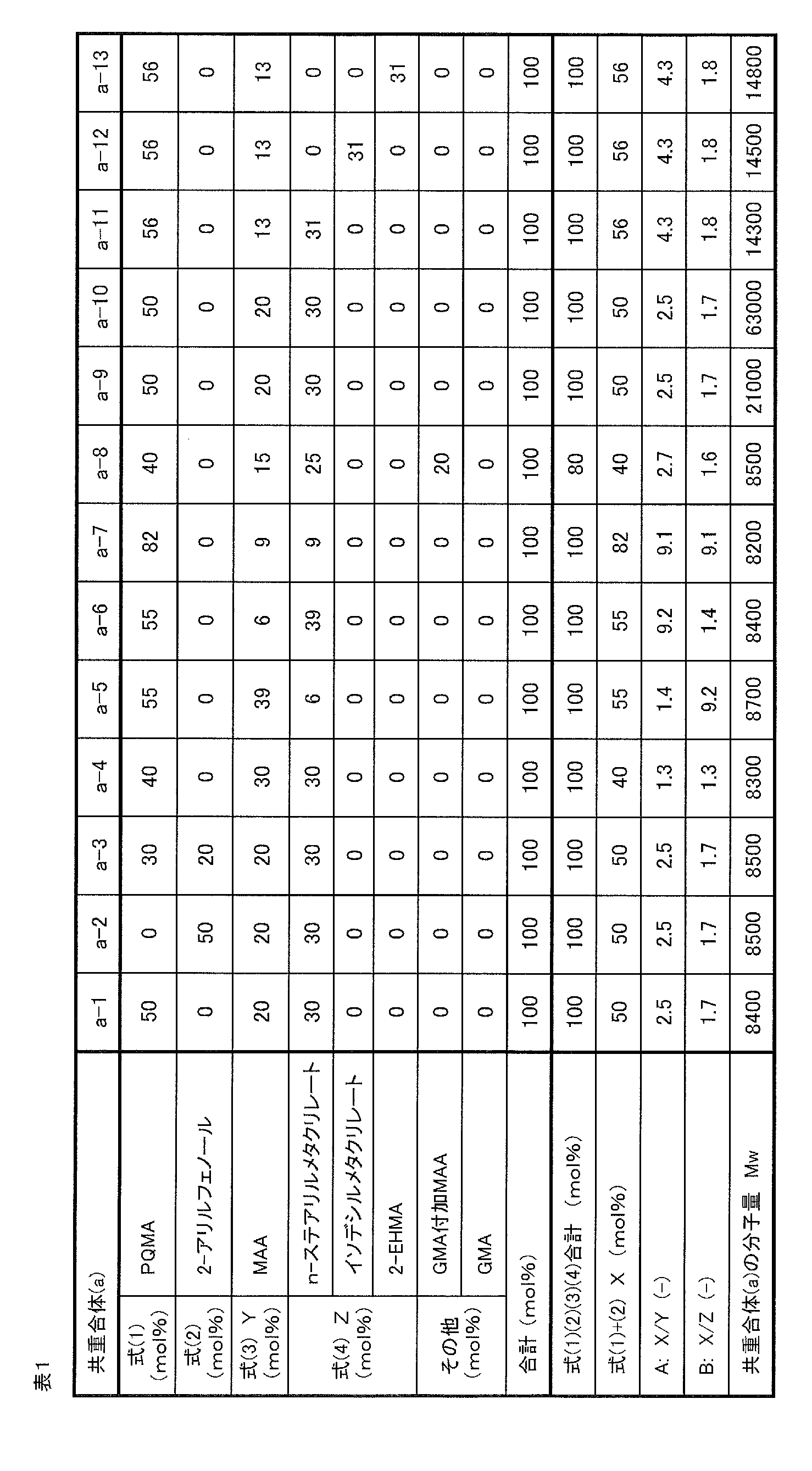
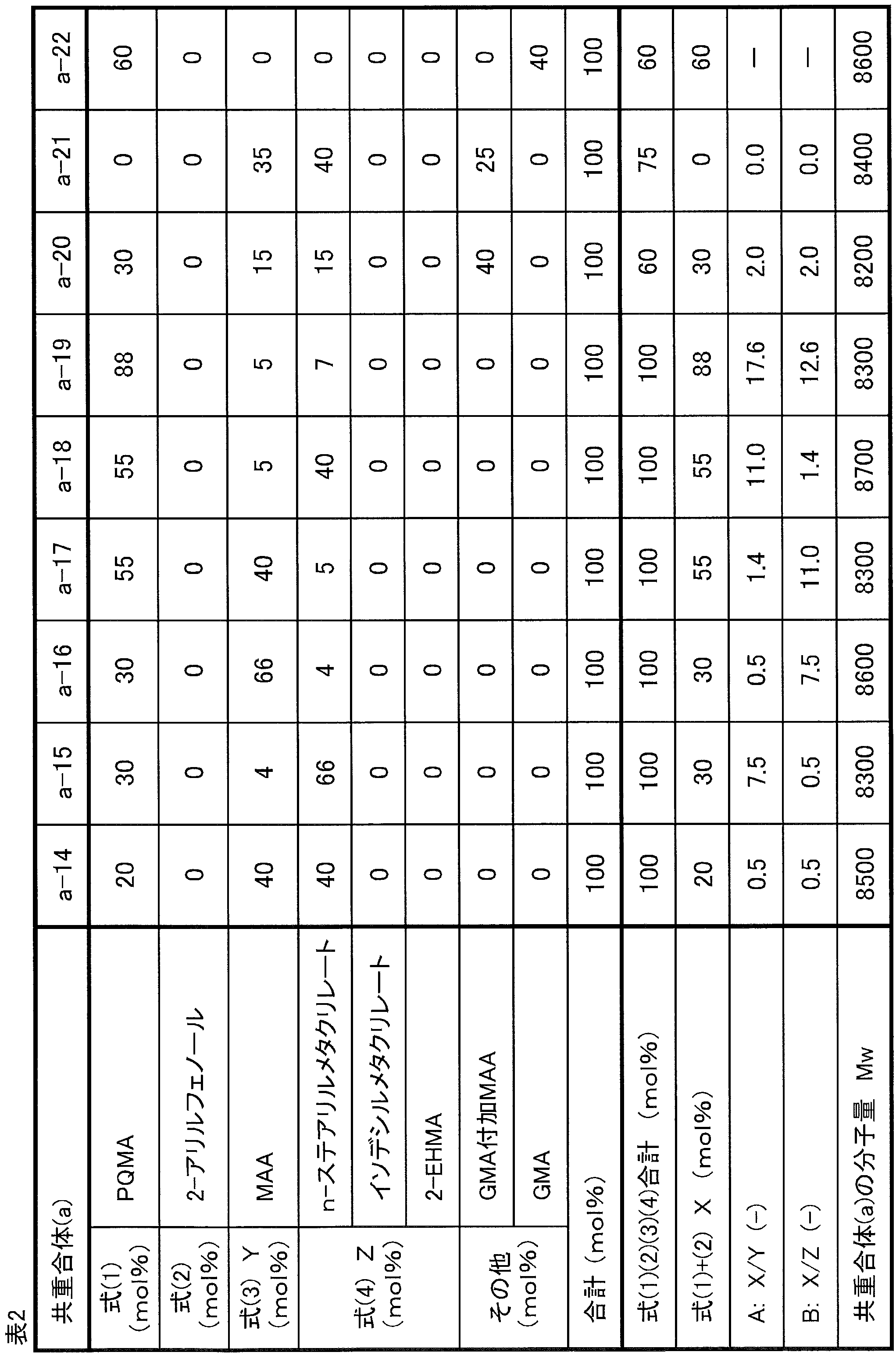
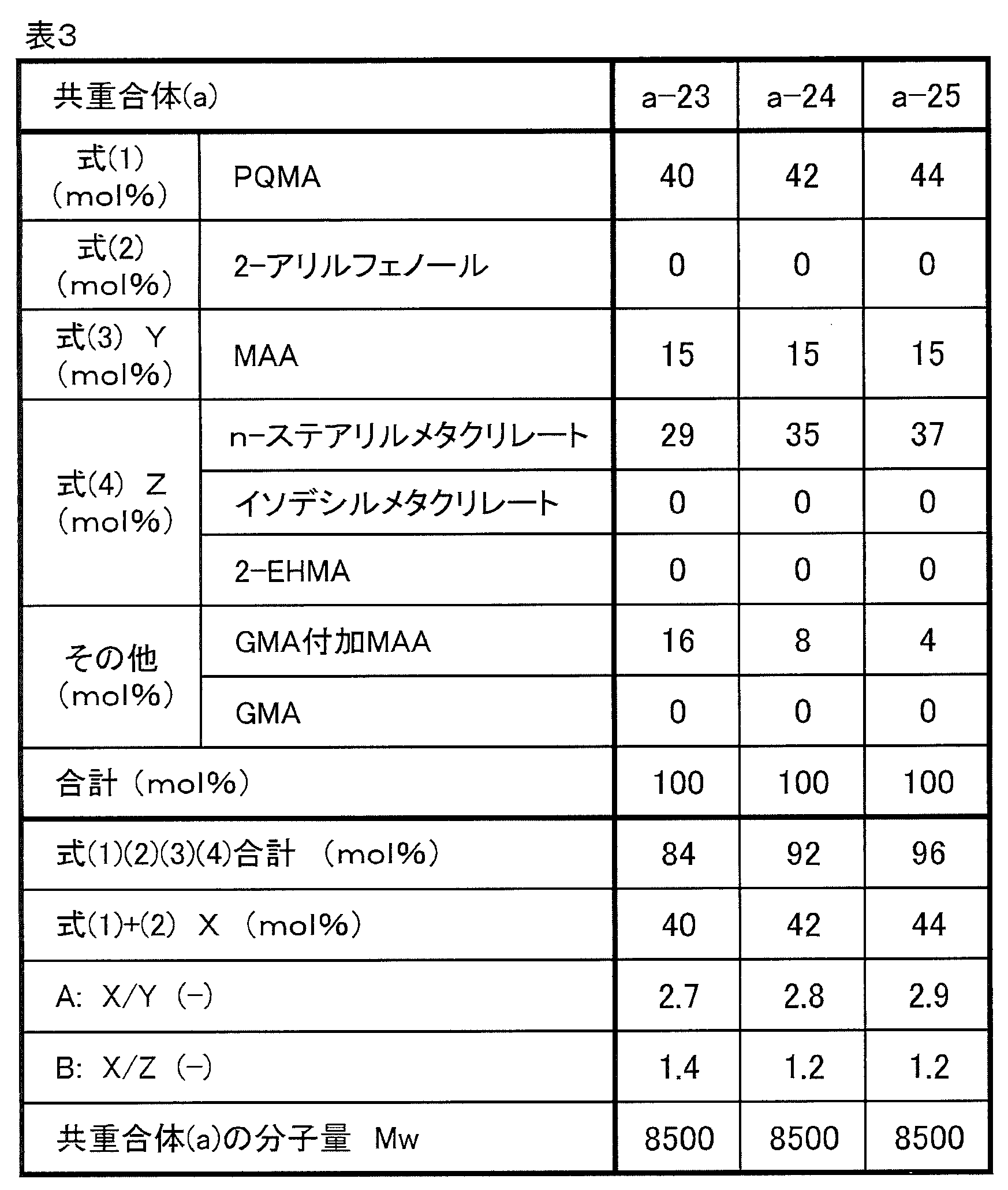
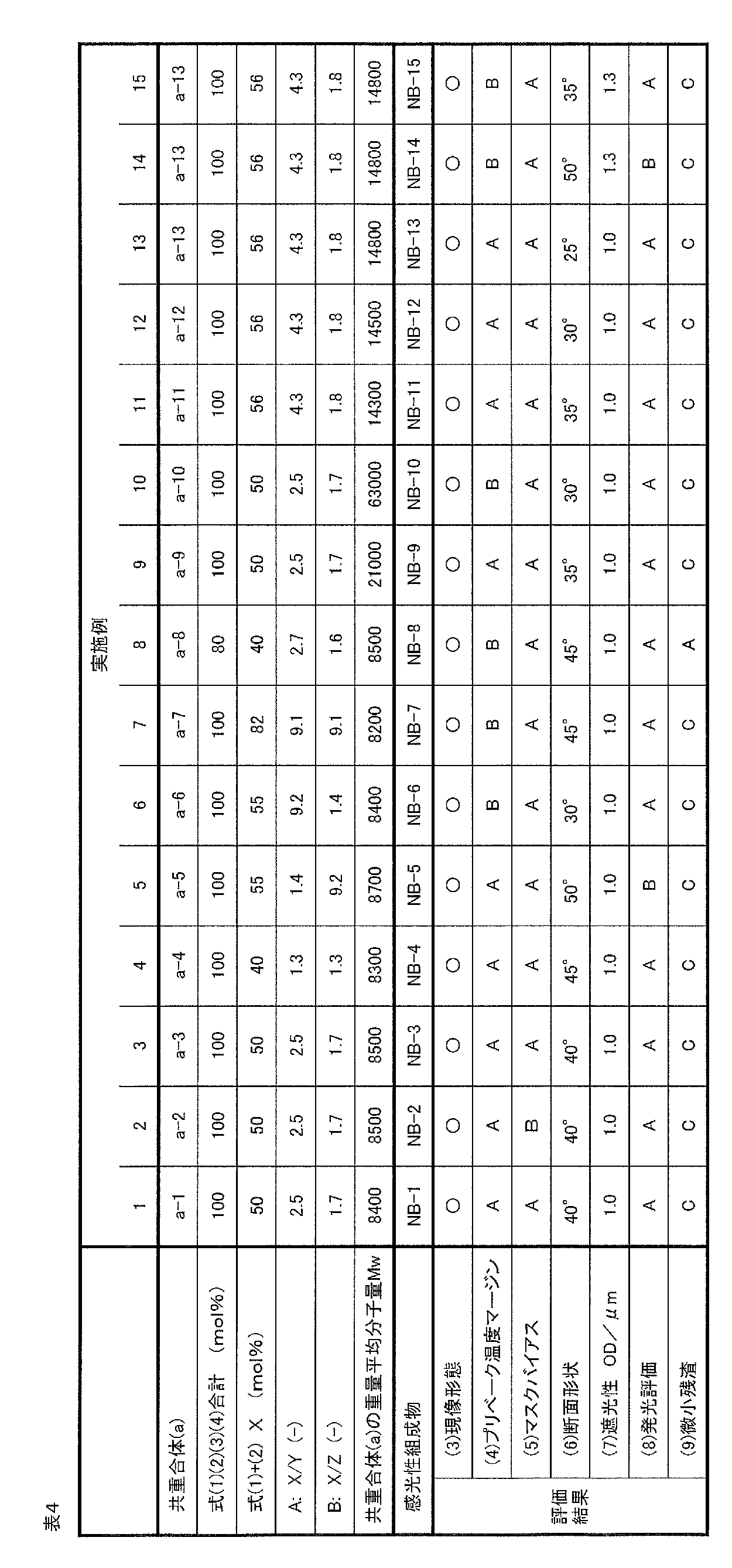
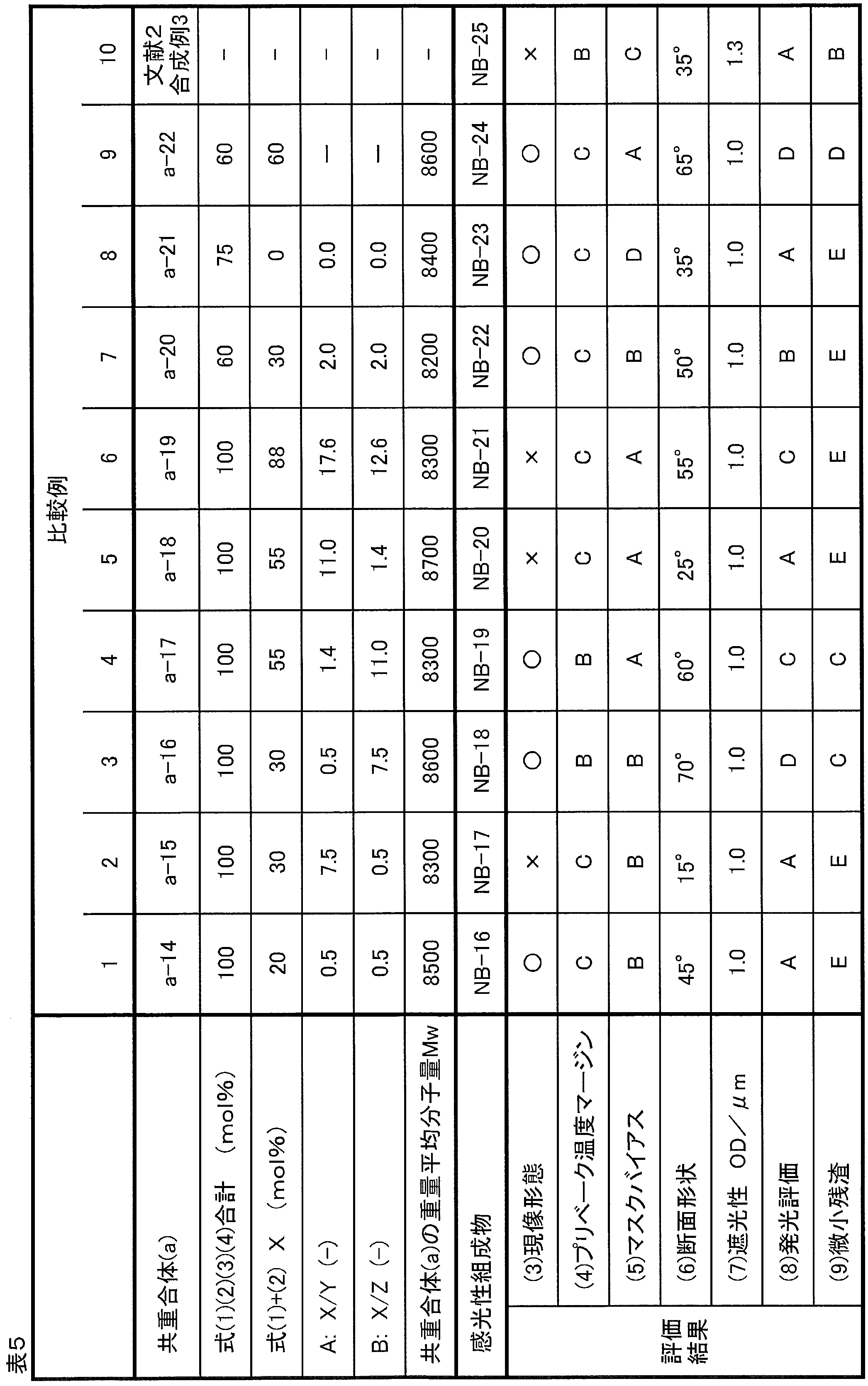
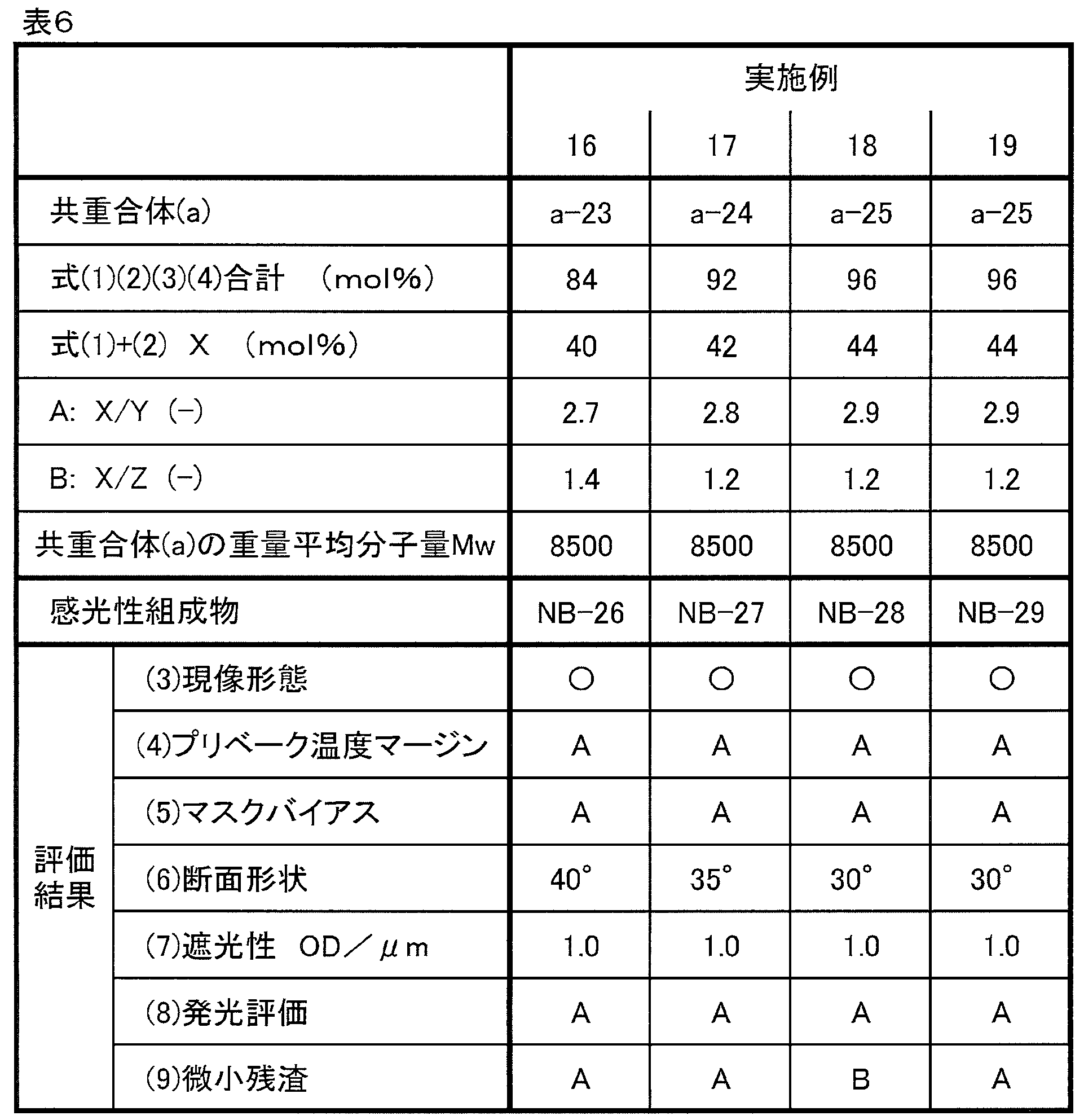
以上の結果から、実施例のネガ型感光性組成物は、比較例のネガ型感光性組成物と比べ、微細パターン加工時のマスクバイアスが小さいことに加えて、アルカリ現像液に対して優れた溶解形態が得られ、かつ幅広いプリベーク温度において現像残渣の発生を抑制でき、かつ硬化物のテーパー形状に優れ、その硬化物を用いた有機EL表示装置の発光特性が優れる結果となった。中でも、硬化物の厚さ1.0μmあたりのOD値が1.3と高い遮光性の実施例14、および15の場合でも、共重合体(a)を用いることで、アルカリ現像液に対して優れた溶解形態を得た。特に、実施例15はラジカル重合性化合物(e-1)を用いることで、現像後のテーパー角を低くすることができ、キュア後のテーパー角を良好にし、優れた発光特性を得た。また、実施例16、17、および19では、プリベーク温度マージンを維持しつつ、0.1μm未満の微小残渣を抑制できた。
1:無アルカリガラス基板
2:第一電極(透明電極)
3:補助電極
4:絶縁層
5:有機EL層
6:第二電極(非透明電極)
θ:テーパー角
2:第一電極(透明電極)
3:補助電極
4:絶縁層
5:有機EL層
6:第二電極(非透明電極)
θ:テーパー角
Claims (11)
- 式(1)で表される構造単位および/または式(2)で表される構造単位と、
式(3)で表される構造単位と、
式(4)で表される構造単位とを含有する共重合体(a)であって、
該共重合体(a)の全構造単位の合計100mol%中、式(1)~(4)のいずれかで表される構造単位の合計が70~100mol%であって、
前記共重合体(a)中、式(1)で表される構造単位および式(2)で表される構造単位の合計mol数をX、式(3)で表される構造単位のmol数をY、式(4)で表される構造単位のmol数をZとしたとき、XをYで除した値Aが1.0~10.0であり、かつXをZで除した値Bが1.0~10.0である、共重合体。

式(2)中、R4は水素原子またはメチル基を表す。R5は炭素数1~3のアルキレン基を表す。n3は整数であり、1または2を表す。R6は炭素数1~3のアルキル基または炭素数1~3のアルコキシ基を表す。n4は整数であり、0~2を表す。*は結合部位を表す。
式(3)中、R7は水素原子またはメチル基を表す。*は結合部位を表す。
式(4)中、R8は水素原子またはメチル基を表す。R9は炭素数5~18のアルキル基を表す。*は結合部位を表す。) - 重量平均分子量(Mw)が10000~50000である、請求項1に記載の共重合体。
- 前記共重合体(a)が、前記式(1)で表される構造単位を有する、請求項1または2に記載の共重合体。
- 前記式(4)中のR9が、炭素数7~15の分岐アルキル基である、請求項1または2に記載の共重合体。
- 前記共重合体(a)が式(8)で表される構造単位を有する、請求項1または2に記載の共重合体。
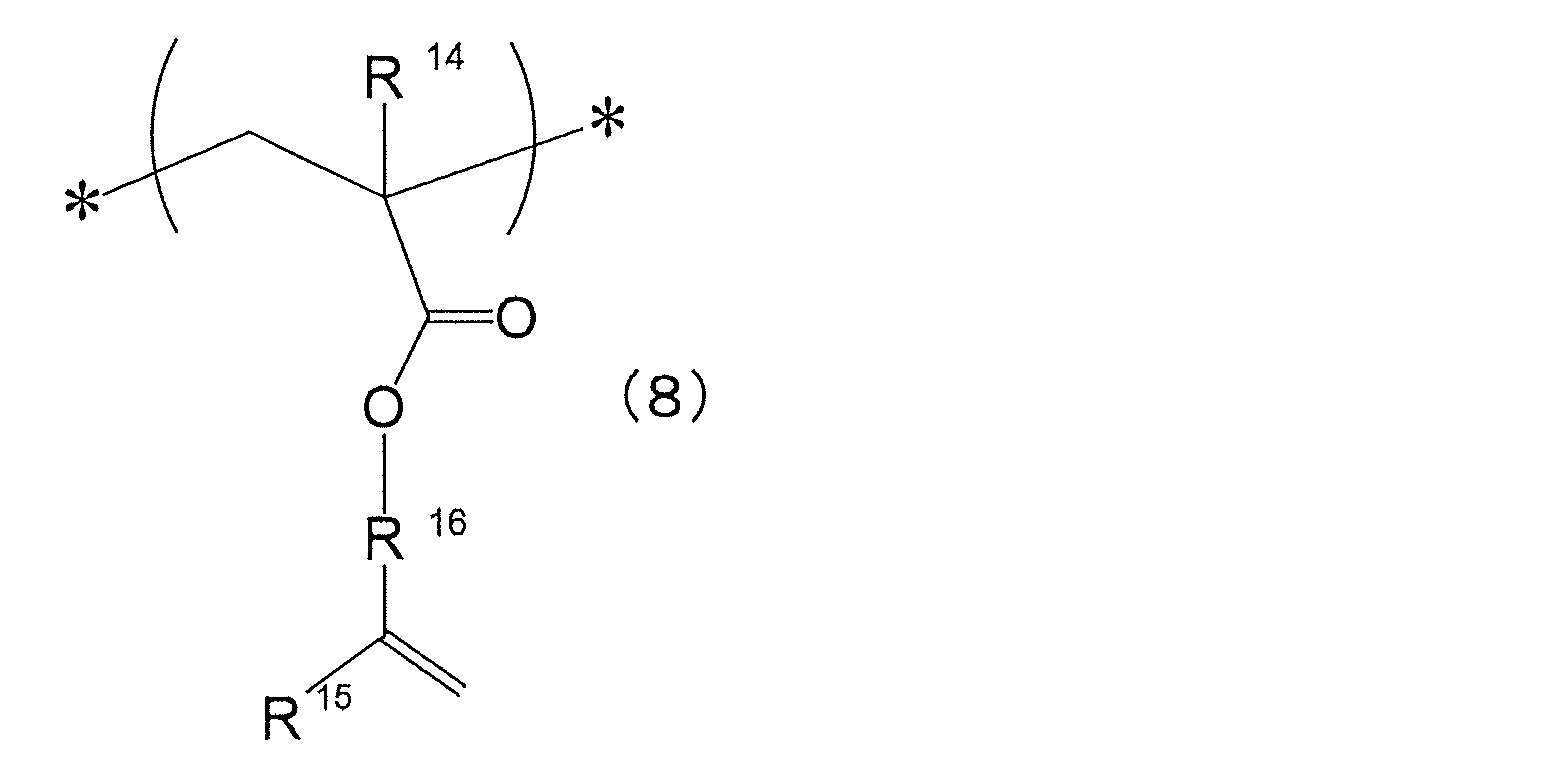
- 前記共重合体(a)が前記式(8)で表される構造単位を、前記共重合体(a)の全構造単位の合計100mol%中、5~18mol%含有する、請求項5に記載の共重合体。
- 請求項1または2に記載の共重合体(a)に加えて、顔料、感光剤および有機溶剤を含有する感光性組成物。
- さらに、9,9-ビス(ナフチル)フルオレン骨格を分子内に2つ有し、エチレン性不飽和二重結合基を分子内に2つ有する(メタ)アクリレート化合物を含有し、ネガ型感光性を有する、請求項7に記載の感光性組成物。
- さらに、式(9)で表される化合物を含有し、ネガ型感光性を有する、請求項7に記載の感光性組成物。

- 請求項7に記載の感光性組成物を硬化した硬化物。
- 請求項10に記載の硬化物を具備する有機EL表示装置。
Priority Applications (3)
| Application Number | Priority Date | Filing Date | Title |
|---|---|---|---|
| JP2024540696A JPWO2025005113A1 (ja) | 2023-06-28 | 2024-06-26 | |
| CN202480037095.6A CN121241076A (zh) | 2023-06-28 | 2024-06-26 | 共聚物、感光性组合物、固化物及有机el显示装置 |
| KR1020257037582A KR20260027125A (ko) | 2023-06-28 | 2024-06-26 | 공중합체, 감광성 조성물, 경화물 및 유기 el 표시 장치 |
Applications Claiming Priority (2)
| Application Number | Priority Date | Filing Date | Title |
|---|---|---|---|
| JP2023105626 | 2023-06-28 | ||
| JP2023-105626 | 2023-06-28 |
Publications (1)
| Publication Number | Publication Date |
|---|---|
| WO2025005113A1 true WO2025005113A1 (ja) | 2025-01-02 |
Family
ID=93939266
Family Applications (1)
| Application Number | Title | Priority Date | Filing Date |
|---|---|---|---|
| PCT/JP2024/023112 Ceased WO2025005113A1 (ja) | 2023-06-28 | 2024-06-26 | 共重合体、感光性組成物、硬化物、および有機el表示装置 |
Country Status (4)
| Country | Link |
|---|---|
| JP (1) | JPWO2025005113A1 (ja) |
| KR (1) | KR20260027125A (ja) |
| CN (1) | CN121241076A (ja) |
| WO (1) | WO2025005113A1 (ja) |
Citations (3)
| Publication number | Priority date | Publication date | Assignee | Title |
|---|---|---|---|---|
| JPS50147723A (ja) * | 1974-05-17 | 1975-11-27 | ||
| JPH06118642A (ja) * | 1992-08-17 | 1994-04-28 | Konica Corp | 感光性組成物 |
| JP2021177236A (ja) * | 2020-04-30 | 2021-11-11 | Jsr株式会社 | 感放射線性組成物、硬化膜の製造方法、半導体素子及び表示素子 |
-
2024
- 2024-06-26 WO PCT/JP2024/023112 patent/WO2025005113A1/ja not_active Ceased
- 2024-06-26 JP JP2024540696A patent/JPWO2025005113A1/ja active Pending
- 2024-06-26 CN CN202480037095.6A patent/CN121241076A/zh active Pending
- 2024-06-26 KR KR1020257037582A patent/KR20260027125A/ko active Pending
Patent Citations (3)
| Publication number | Priority date | Publication date | Assignee | Title |
|---|---|---|---|---|
| JPS50147723A (ja) * | 1974-05-17 | 1975-11-27 | ||
| JPH06118642A (ja) * | 1992-08-17 | 1994-04-28 | Konica Corp | 感光性組成物 |
| JP2021177236A (ja) * | 2020-04-30 | 2021-11-11 | Jsr株式会社 | 感放射線性組成物、硬化膜の製造方法、半導体素子及び表示素子 |
Also Published As
| Publication number | Publication date |
|---|---|
| KR20260027125A (ko) | 2026-02-27 |
| CN121241076A (zh) | 2025-12-30 |
| JPWO2025005113A1 (ja) | 2025-01-02 |
Similar Documents
| Publication | Publication Date | Title |
|---|---|---|
| TWI667336B (zh) | 適用於柱狀間隔子及黑色矩陣兩者之有色光敏樹脂組成物 | |
| JP4437651B2 (ja) | 感光性樹脂組成物及びそれを用いたカラーフィルター | |
| TW201841983A (zh) | 感光性樹脂組成物、硬化膜、具備硬化膜之元件、具備硬化膜之有機el顯示裝置、硬化膜之製造方法、及有機el顯示裝置之製造方法 | |
| JP4290483B2 (ja) | ブラックレジスト用感光性樹脂組成物並びにこれを用いて形成された遮光膜 | |
| JP2022028693A (ja) | カラムスペーサを調製するための方法 | |
| JP7574576B2 (ja) | ネガ型感光性樹脂組成物、硬化膜および有機el表示装置 | |
| CN106125508A (zh) | 彩色滤光片用感光性树脂组成物及其应用 | |
| TWI506369B (zh) | 感光性樹脂組成物、彩色濾光片及其製造方法、液晶顯示裝置 | |
| TWI677758B (zh) | 藍色感光性樹脂組成物、濾色器及影像顯示裝置 | |
| JP2019505012A (ja) | 黒色感光性樹脂組成物及びそれから調製される黒色カラムスペーサ | |
| KR20140103372A (ko) | 착색 감광성 수지 조성물 및 이를 이용한 차광성 스페이서 | |
| TWI751966B (zh) | 著色感光性樹脂組成物以及由其製備之遮光隔片 | |
| TW202115147A (zh) | 黑阻劑用感光性樹脂組成物、該感光性樹脂組成物的製造方法、及使其硬化而成的遮光膜、具有該遮光膜的彩色濾光片及觸控面板、具有該彩色濾光片及觸控面板的顯示裝置 | |
| CN104698752A (zh) | 感光性树脂组合物、彩色滤光片及其制造方法、液晶显示装置 | |
| CN108693707A (zh) | 黑色感光性树脂组合物及利用其制造的显示装置 | |
| CN110506235A (zh) | 蓝色感光性树脂组合物、利用其制造的滤色器及图像显示装置 | |
| TWI666230B (zh) | 藍色感光性樹脂組成物以及利用其製造之彩色濾光片與影像顯示裝置 | |
| JP5108300B2 (ja) | 感光性樹脂組成物及びそれを用いたカラーフィルター | |
| TWI921462B (zh) | 負型感光性樹脂組成物、硬化膜及有機el顯示裝置 | |
| KR20260027125A (ko) | 공중합체, 감광성 조성물, 경화물 및 유기 el 표시 장치 | |
| KR20140143951A (ko) | 감광성 수지 조성물 및 이로부터 제조된 스페이서 | |
| CN110446975A (zh) | 蓝色感光性树脂组合物、利用它制造的滤色器及图像显示装置 | |
| TW576950B (en) | Photosensitive resin compound, spacer, forming material, colorfilter forming material and the liquid crystal display device | |
| JP4833324B2 (ja) | 感光性樹脂組成物及びそれを用いたカラーフィルター | |
| JP7831306B2 (ja) | 感光性組成物、硬化物および有機el表示装置 |
Legal Events
| Date | Code | Title | Description |
|---|---|---|---|
| WWE | Wipo information: entry into national phase |
Ref document number: 2024540696 Country of ref document: JP |
|
| 121 | Ep: the epo has been informed by wipo that ep was designated in this application |
Ref document number: 24831972 Country of ref document: EP Kind code of ref document: A1 |
|
| NENP | Non-entry into the national phase |
Ref country code: DE |
|
| 122 | Ep: pct application non-entry in european phase |
Ref document number: 24831972 Country of ref document: EP Kind code of ref document: A1 |