WO2025004836A1 - 感光性樹脂組成物、フィルム状樹脂及び樹脂シート - Google Patents
感光性樹脂組成物、フィルム状樹脂及び樹脂シート Download PDFInfo
- Publication number
- WO2025004836A1 WO2025004836A1 PCT/JP2024/021577 JP2024021577W WO2025004836A1 WO 2025004836 A1 WO2025004836 A1 WO 2025004836A1 JP 2024021577 W JP2024021577 W JP 2024021577W WO 2025004836 A1 WO2025004836 A1 WO 2025004836A1
- Authority
- WO
- WIPO (PCT)
- Prior art keywords
- enoate
- composition
- photosensitive resin
- resin composition
- unit
- Prior art date
- Legal status (The legal status is an assumption and is not a legal conclusion. Google has not performed a legal analysis and makes no representation as to the accuracy of the status listed.)
- Ceased
Links
Images







Classifications
-
- C—CHEMISTRY; METALLURGY
- C08—ORGANIC MACROMOLECULAR COMPOUNDS; THEIR PREPARATION OR CHEMICAL WORKING-UP; COMPOSITIONS BASED THEREON
- C08F—MACROMOLECULAR COMPOUNDS OBTAINED BY REACTIONS ONLY INVOLVING CARBON-TO-CARBON UNSATURATED BONDS
- C08F212/00—Copolymers of compounds having one or more unsaturated aliphatic radicals, each having only one carbon-to-carbon double bond, and at least one being terminated by an aromatic carbocyclic ring
- C08F212/02—Monomers containing only one unsaturated aliphatic radical
- C08F212/04—Monomers containing only one unsaturated aliphatic radical containing one ring
- C08F212/06—Hydrocarbons
- C08F212/08—Styrene
-
- G—PHYSICS
- G03—PHOTOGRAPHY; CINEMATOGRAPHY; ANALOGOUS TECHNIQUES USING WAVES OTHER THAN OPTICAL WAVES; ELECTROGRAPHY; HOLOGRAPHY
- G03F—PHOTOMECHANICAL PRODUCTION OF TEXTURED OR PATTERNED SURFACES, e.g. FOR PRINTING, FOR PROCESSING OF SEMICONDUCTOR DEVICES; MATERIALS THEREFOR; ORIGINALS THEREFOR; APPARATUS SPECIALLY ADAPTED THEREFOR
- G03F7/00—Photomechanical, e.g. photolithographic, production of textured or patterned surfaces, e.g. printing surfaces; Materials therefor, e.g. comprising photoresists; Apparatus specially adapted therefor
- G03F7/004—Photosensitive materials
-
- G—PHYSICS
- G03—PHOTOGRAPHY; CINEMATOGRAPHY; ANALOGOUS TECHNIQUES USING WAVES OTHER THAN OPTICAL WAVES; ELECTROGRAPHY; HOLOGRAPHY
- G03F—PHOTOMECHANICAL PRODUCTION OF TEXTURED OR PATTERNED SURFACES, e.g. FOR PRINTING, FOR PROCESSING OF SEMICONDUCTOR DEVICES; MATERIALS THEREFOR; ORIGINALS THEREFOR; APPARATUS SPECIALLY ADAPTED THEREFOR
- G03F7/00—Photomechanical, e.g. photolithographic, production of textured or patterned surfaces, e.g. printing surfaces; Materials therefor, e.g. comprising photoresists; Apparatus specially adapted therefor
- G03F7/004—Photosensitive materials
- G03F7/027—Non-macromolecular photopolymerisable compounds having carbon-to-carbon double bonds, e.g. ethylenic compounds
- G03F7/032—Non-macromolecular photopolymerisable compounds having carbon-to-carbon double bonds, e.g. ethylenic compounds with binders
- G03F7/033—Non-macromolecular photopolymerisable compounds having carbon-to-carbon double bonds, e.g. ethylenic compounds with binders the binders being polymers obtained by reactions only involving carbon-to-carbon unsaturated bonds, e.g. vinyl polymers
Definitions
- This disclosure relates to a photosensitive resin composition, a film-like resin, and a resin sheet.
- Photosensitive resin sheets also called “dry film resists” are used to create wiring on substrates such as semiconductor wafers (see, for example, Patent Document 1).
- dry film resists are used to create wiring on substrates such as semiconductor wafers.
- One aspect of the present disclosure provides a photosensitive resin composition, a film-like resin, and a resin sheet that have excellent resolution and adhesion.
- This disclosure has the following configuration:
- a photosensitive resin composition containing a polymer composed of multiple types of monomers The dispersion term of the Hansen solubility parameter calculated based on the monomer is 16.99 to 17.35, the number of carboxylic acids in the molecule, calculated based on the monomer, is 0.272 or more and 0.304 or less; a logarithm of an octanol/water partition coefficient calculated based on the monomer is 2.16 or more and 2.79 or less; The glass transition temperature calculated based on the monomer is 354K or more and 382K or less. Photosensitive resin composition.
- the dispersion term of the Hansen solubility parameter is 17.04 or more and 17.19 or less
- the number of carboxylic acids is 0.273 or more and 0.290 or less
- the logarithm of the octanol/water partition coefficient is 2.29 or more and 2.78 or less
- the glass transition temperature is 365K or more and 382K or less.
- the monomer includes acrylic acid and styrene,
- the monomer contains a third component different from both acrylic acid and styrene, the third component is 3-phenoxybenzyl acrylate, 3- ⁇ 2,2,6,6-tetramethyl-4-[(trimethylsilyl)oxy]-3,5-dioxa-2,4,6-trisilaheptan-4-yl ⁇ propyl 2-methylprop-2-enoate, octadecyl 2-methylprop-2-enoate, 4-hydroxyphenyl 2-methyl-2-propenoate, octadecyl 2-methylprop-2-enoate, dicyclopentanyl methacrylate, decyl prop-2-enoate, dodecyl acrylate, or isooctadecyl 2-propenoate;
- the photosensitive resin composition according to ⁇ 1> above.
- the monomer contains a third component different from both acrylic acid and styrene, the third component is 10-hydroxy-2,2,4-trimethyl-4-[(trimethylsilyl)oxy]-3,8-dioxa-2,4-disilaundecan-11-yl 2-methylprop-2-enoate, hexadecyl prop-2-enoate, docosylprop-2-enoate, 1-ethylcyclohexyl 2-methylprop-2-enoate, docosylprop-2-enoic acid, tetradecyl prop-2-enoate, adamantan-1-yl 2-methylprop-2-enoate, 3- ⁇ 2,2,6,6-tetramethyl-4-[(trimethylsilyl)oxy]-3,5-dioxa-2,4,6-trisilaheptan-4-yl ⁇ propyl 2-methylprop-2-enoate, or 2-propenoic acid isooctadecyl ester;
- the polymer has a blending amount of the third component of 13% by weight or more and 22% by weight or less.
- ⁇ 7> A film-like resin obtained by forming the photosensitive resin composition described in any one of ⁇ 1> to ⁇ 6> above onto a film.
- a resin sheet comprising a substrate and a resin layer formed on the substrate and made of the photosensitive resin composition described in any one of ⁇ 1> to ⁇ 6> above.
- a photosensitive resin composition a film-like resin, and a resin sheet that have excellent resolution and adhesion.
- FIG. 1 is a diagram showing the extraction results of Example 1.
- FIG. 2 is a diagram showing the extraction results of Example 2.
- FIG. 3 is a schematic diagram showing an example of a film-like resin.
- FIG. 4 is a schematic diagram showing an example of a resin sheet.
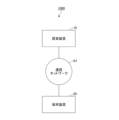
- FIG. 5 is a block diagram showing an example of the overall configuration of the composition suggestion system.
- FIG. 6 is a block diagram showing an example of a hardware configuration of a computer.
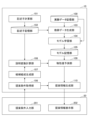
- FIG. 7 is a block diagram illustrating an example of a functional configuration of the composition suggestion system.
- FIG. 8 is a diagram showing an example of experimental data.
- FIG. 9 is a diagram showing an example of the descriptor data.
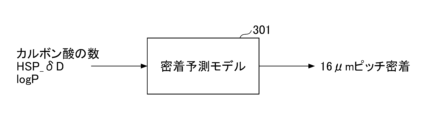
- FIG. 10 is a block diagram showing an example of an adhesion prediction model.
- FIG. 10 is a block diagram showing an example of an adhesion prediction model.
- FIG. 11 is a graph showing an example of the accuracy of the adhesion prediction model.
- FIG. 12 is a block diagram showing an example of a resolution prediction model.
- FIG. 13 is a graph showing an example of the accuracy of the resolution prediction model.
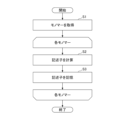
- FIG. 14 is a flowchart illustrating an example of a descriptor calculation process.
- FIG. 15 is a flowchart illustrating an example of a model learning process.
- FIG. 16 is a flowchart showing an example of a composition proposal process.
- the photosensitive resin composition in this embodiment is a composition used for producing a dry film resist.
- the photosensitive resin composition contains a polymer composed of multiple types of monomers.
- the monomers include at least acrylic acid (AA) and styrene (STC).
- AA acrylic acid
- STC styrene
- the polymer contained in the photosensitive resin composition will be referred to as a "base polymer”.
- the photosensitive resin composition may contain, in addition to the base polymer, a (meth)acrylate compound, an epoxy resin, a photoinitiator, and the like.
- the monomer constituting the base polymer may contain a third component different from both acrylic acid and styrene.
- the blending amount of acrylic acid is 18% by weight or more and 26% by weight or less.
- the blending amount of styrene is 60% by weight or more and 80% by weight or less.
- the blending amount of the third component is the portion of the base polymer excluding acrylic acid and styrene. In other words, the blending amount of the third component is (100 - (blend amount of acrylic acid + blending amount of styrene)) [weight %]. It is preferable that the blending amount of the third component is 13% by weight or more and 22% by weight or less.
- the dry film resist manufactured using the photosensitive resin composition of this embodiment has both high resolution and high adhesion.
- the resolution is evaluated using a resolution of 3x/x as an index.
- the adhesion is evaluated using a 16 ⁇ m pitch adhesion as an index.
- Resolution 3x/x is the minimum value of x at which a pattern can be formed when a fine line pattern is formed in dry film resist, where the line width is 3x and the space width between the lines is x. Resolution 3x/x can be evaluated as having higher resolution the smaller the x value. Whether a pattern can be formed can be confirmed by observing the created pattern with a microscope to check for any residue or resist collapse.
- 16 ⁇ m pitch adhesion is the minimum line width at which a fine line pattern can be formed when the space width is widened in an evaluation pattern with a line pitch of 16 ⁇ m when forming a fine line pattern in dry film resist. 16 ⁇ m pitch adhesion can be evaluated as having higher adhesion as the line width value decreases. Whether a pattern can be formed can be confirmed by observing the created pattern with a microscope to see if there is any residue or resist collapse.
- the 16 ⁇ m pitch adhesion may also be offset pattern adhesion.
- Offset pattern adhesion is the smallest line width that can be formed when a fine line pattern is formed in dry film resist, and the space width is widened in an evaluation pattern in which the sum of the line width and space width is 16 ⁇ m. The smaller the offset pattern adhesion value, the higher the adhesion can be evaluated.
- the first parameter is the dispersion term of the Hansen solubility parameter (hereinafter also referred to as "HSP_ ⁇ D").
- the second parameter is the number of carboxylic acids in the molecule (hereinafter also simply referred to as “the number of carboxylic acids”).
- the third parameter is the logarithm of the octanol/water partition coefficient (hereinafter also referred to as "logP”).
- the fourth parameter is the glass transition temperature (hereinafter also referred to as "polymer Tg").
- Hansen solubility parameter dispersion term (HSP_ ⁇ D)>
- the Hansen solubility parameter represents the strength of interaction between polymers, and is therefore considered to affect resolution or adhesion.
- the reason why the dispersion term ⁇ D is used instead of the polar term ⁇ P or the hydrogen bond term ⁇ H among the Hansen solubility parameters is that it is considered to represent the strength of interaction between the benzene rings of styrene.
- the HSP_ ⁇ D of the base polymer is calculated by weighting and adding the HSP_ ⁇ D of each monomer that constitutes the base polymer by molar ratio. Specifically, the HSP_ ⁇ D of the base polymer can be calculated by formula (1).
- X is the HSP_ ⁇ D of the base polymer
- x i is the HSP_ ⁇ D of the i-th monomer
- n i is the molar ratio of the i-th monomer
- the HSP_ ⁇ D of a monomer can be calculated, for example, using HSPiP.
- HSPiP is software specialized for calculating Hansen solubility parameters.
- the HSP_ ⁇ D of the base polymer is preferably 16.99 or more and 17.35 or less, and more preferably 17.04 or more and 17.19 or less.
- the number of carboxylic acids in the base polymer is calculated by weighting and adding the number of carboxylic acids in each monomer constituting the base polymer by molar ratio. Specifically, the number of carboxylic acids in the base polymer can be calculated by the above formula (1).
- X is the number of carboxylic acids in the base polymer
- x i is the number of carboxylic acids in the i-th monomer
- n i is the molar ratio of the i-th monomer.
- the number of carboxylic acids in a monomer can be calculated, for example, using RDKit.
- RDKit is an open source library that is widely used in the field of cheminformatics.
- the number of carboxylic acids in the base polymer is preferably 0.272 or more and 0.304 or less, and more preferably 0.273 or more and 0.290 or less.
- the log P of the base polymer is calculated by weighting and adding the log P of each monomer that constitutes the base polymer by the molar ratio. Specifically, the log P of the base polymer can be calculated by the above formula (1).
- X is the log P of the base polymer
- x i is the log P of the i-th monomer
- n i is the molar ratio of the i-th monomer.
- the logP of a monomer can be calculated, for example, using COSMOTHERM (registered trademark).
- COSMOTHERM is thermodynamic property prediction software that uses the COSMO-RS method.
- the COSMO-RS method is a method for predicting the properties of chemical substances based on the surface charge of the molecule obtained by quantum chemical calculations.
- the log P of the base polymer is preferably 2.16 or more and 2.79 or less, and more preferably 2.29 or more and 2.78 or less.
- polymer Tg ⁇ Glass transition temperature (polymer Tg)>
- the polymer Tg indicates the mobility of a polymer chain, and therefore, it is believed that the polymer Tg of the base polymer affects the resolution or adhesion.
- the polymer Tg of the base polymer is calculated by the Fox formula using the polymer Tg of the homopolymer composed of each monomer that constitutes the base polymer. Specifically, the polymer Tg of the base polymer can be calculated by formula (2).
- TG is the polymer Tg of the copolymer (i.e., the base polymer)
- TG i is the polymer Tg of the homopolymer composed of the i-th monomer
- n i is the molar ratio of the i-th monomer.
- the polymer Tg of the homopolymer may be a literature value or a predicted value using a trained machine learning model.
- the polymer Tg of the base polymer is preferably 354K or more and 382K or less, and more preferably 365K or more and 382K or less.
- the photosensitive resin composition in this embodiment is a candidate composition that satisfies both the target values of the resolution 3x/x and the 16 ⁇ m pitch adhesion from a large number of candidate compositions produced according to predetermined production conditions.
- the resolution 3x/x and the 16 ⁇ m pitch adhesion are predicted using a trained machine learning model. The machine learning model and the prediction method using the machine learning model will be described later.
- the generation conditions are set as follows.
- the blending amount of acrylic acid is produced in the range of 18% by weight to 26% by weight in increments of 1% by weight. In other words, the blending amount of acrylic acid is selected from 18% by weight, 19% by weight, 20% by weight, ... 26% by weight.
- the amount of styrene is produced in 2% by weight intervals in the range of 60% by weight to 80% by weight. In other words, the options for the amount of styrene produced are 60% by weight, 62% by weight, 64% by weight, ..., 80% by weight.
- the sum of the amounts of the individual monomers is 100% by weight.
- the amount of the third component is (100 - (amount of acrylic acid + amount of styrene)) [% by weight].
- the third component is selected from a selection of monomers prepared in advance.
- the selection may include about 200 types of monomers.
- the candidate compositions are generated as follows. First, all combinations of the amount of acrylic acid and the amount of styrene are generated. Next, for each combination of amounts, the amount of the third component is calculated. Then, for each combination of amounts, all monomer options are combined as the third component. In this way, all candidate compositions are generated.
- Example 1 In Example 1, the target characteristics were set to 16 ⁇ m pitch adhesion of less than 4.7 and resolution 3x/x of less than 7, and candidate compositions were extracted whose predicted values satisfied the target characteristics using a trained machine learning model.
- the best value for 16 ⁇ m pitch adhesion was 4.7. Therefore, the target value for 16 ⁇ m pitch adhesion was set to 4.7. Also, for conventional base polymers, the best value for resolution 3x/x was 5.5, but a resolution 3x/x of 7 is a sufficiently high standard for the performance required of a dry film resist.
- Fig. 1 is a diagram showing the extraction results of Example 1.
- the candidate compositions that satisfy the above target properties have each parameter included in the following range.
- HSP_ ⁇ D is equal to or greater than 16.99 and equal to or less than 17.35.
- the number of carboxylic acids is 0.272 or more and 0.304 or less.
- log P is greater than or equal to 2.16 and less than or equal to 2.79.
- the polymer Tg is 354K or more and 382K or less.
- the candidate composition extracted in Example 1 contains a third component in an amount of 13% by weight or more and 22% by weight or less.
- the candidate compositions extracted in Example 1 have a third component that is any one of the following: ⁇ 3-phenoxybenzyl acrylate ⁇ 3- ⁇ 2,2,6,6-tetramethyl-4-[(trimethylsilyl)oxy]-3,5-dioxa-2,4,6-trisilaheptan-4-yl ⁇ propyl 2-methylprop-2-enoate Octadecyl 2-methylprop-2-enoate ⁇ 4-hydroxyphenyl 2-methyl-2-propenoate (PQMA) Octadecyl 2-methylprop-2-enoate -Dicyclopentanyl methacrylate (TCDMA) Decyl prop-2-enoate - Dodecyl acrylate (LA) ⁇ 2-Propenoic acid isooctadecyl ester (ISTA)
- Example 2 In Example 2, the target characteristics were set to 16 ⁇ m pitch adhesion of less than 4.7 and resolution 3x/x of less than 6, and candidate compositions were extracted whose predicted
- Fig. 2 is a diagram showing the extraction results of Example 2.
- the candidate compositions that satisfy the above target properties have each parameter included in the following range.
- HSP_ ⁇ D is equal to or greater than 17.04 and equal to or less than 17.19.
- the number of carboxylic acids is 0.273 or more and 0.290 or less.
- log P is greater than or equal to 2.29 and less than or equal to 2.78.
- the polymer Tg is 365K or more and 382K or less.
- the candidate composition extracted in Example 2 contains a third component in an amount of 13% by weight or more and 22% by weight or less.
- the candidate compositions extracted in Example 2 have a third component that is any one of the following: 10-hydroxy-2,2,4-trimethyl-4-[(trimethylsilyl)oxy]-3,8-dioxa-2,4-disilaundecan-11-yl 2-methylprop-2-enoate Hexadecyl prop-2-enoate ⁇ Docosyl prop-2-enoate ⁇ 1-ethylcyclohexyl 2-methylprop-2-enoate ⁇ Docosyl prop-2-enoate ⁇ Tetradecyl prop-2-enoate ⁇ Adamantan-1-yl 2-methylprop-2-enoate ⁇ 3- ⁇ 2,2,6,6-tetramethyl-4-[(trimethylsilyl)oxy]-3,5-dioxa-2,4,6-trisilaheptan-4-yl ⁇ propyl 2-methylprop-2-enoate ⁇ 2-Propenoic acid isooctadecyl ester (ISTA) [Fil
- the film-like resin in this embodiment is a photosensitive resin composition formed into a film.
- film-like resin 1 can be obtained by forming the photosensitive resin composition into a film.
- Fig. 4 is a schematic diagram showing an example of the resin sheet.
- the resin sheet 2 in this embodiment includes a substrate 3 and a resin layer 4.
- the resin layer 4 is formed into a film by applying a photosensitive resin composition onto the substrate 3 and drying it.
- the resin layer 4 is made of a film-like resin 1 formed by forming the photosensitive resin composition into a film.
- composition proposal system The composition of the base polymer contained in the photosensitive resin composition in this embodiment is proposed by, for example, a composition suggestion system.
- the composition suggestion system in this embodiment is an information processing system that proposes the composition of the base polymer contained in the photosensitive resin composition.
- the composition suggestion system predicts the physical property values of the base polymer based on candidate compositions of the base polymer, and proposes candidate compositions whose prediction results satisfy the target characteristics.
- the physical property values of the base polymer include physical property values related to resolution and physical property values related to adhesion. Therefore, the composition suggestion system can propose candidate compositions for the base polymer that achieve both high resolution and high adhesion.
- Fig. 5 is a block diagram showing an example of the overall configuration of the composition suggestion system in this embodiment.
- the composition proposal system 1000 in this embodiment includes a proposal device 10 and a terminal device 20.
- the proposal device 10 and the terminal device 20 are connected to each other so as to be able to communicate data with each other via a communication network N1 such as a LAN (Local Area Network) or the Internet.
- a communication network N1 such as a LAN (Local Area Network) or the Internet.
- the proposal device 10 is an information processing device such as a personal computer, workstation, or server that proposes a composition of a base polymer contained in a photosensitive resin composition.
- the proposal device 10 receives proposal conditions from the terminal device 20.
- the proposal conditions include the generation conditions of the candidate composition and the target properties that the candidate composition should satisfy.
- the proposal device 10 generates candidate compositions based on the generation conditions and predicts the physical property values of the base polymer for each candidate composition.
- the proposal device 10 generates proposal information indicating the candidate compositions that satisfy the target properties and transmits it to the terminal device 20.
- the terminal device 20 is an information processing terminal such as a personal computer, smartphone, or tablet terminal operated by a user of the composition proposal system 1000.
- the terminal device 20 transmits proposed conditions indicating the generation conditions and target properties to the proposal device 10 in response to the user's operation.
- the terminal device 20 outputs the proposed information received from the proposal device 10 to the user.
- the user of the composition proposal system 1000 can refer to the proposal information output to the terminal device 20 and create a base polymer according to the candidate composition indicated in the proposal information.
- the user can also manufacture a photosensitive resin composition using the base polymer created according to the candidate composition. Since the candidate composition indicated in the proposal information is a base polymer that realizes a photosensitive resin composition that achieves both high resolution and high adhesion, the user can manufacture a photosensitive resin composition, a film-like resin, and a resin sheet that achieves both high resolution and high adhesion.
- the composition proposal system 1000 shown in FIG. 5 may include multiple proposal devices 10 and one or more terminal devices 20.
- the proposal device 10 may be realized by multiple computers, or may be realized as a cloud computing service.
- the division of devices such as the proposal device 10 and terminal device 20 shown in FIG. 5 is one example.
- composition suggestion system 1000 in this embodiment will be described with reference to FIG.
- ⁇ Computer hardware configuration> The proposal device 10 and the terminal device 20 in this embodiment are realized by, for example, a computer.
- Fig. 6 is a block diagram showing an example of the hardware configuration of a computer 500 in this embodiment.
- computer 500 has a CPU (Central Processing Unit) 501, ROM (Read Only Memory) 502, RAM (Random Access Memory) 503, HDD (Hard Disk Drive) 504, input device 505, display device 506, communication I/F (Interface) 507, and external I/F 508.
- CPU 501, ROM 502, and RAM 503 form what is known as a computer.
- Each piece of hardware in computer 500 is connected to each other via bus line 509. Note that input device 505 and display device 506 may be connected to external I/F 508 for use.
- the CPU 501 is a calculation device that reads programs and data from storage devices such as the ROM 502 or HDD 504 onto the RAM 503 and executes processing to realize the overall control and functions of the computer 500.
- ROM 502 is an example of a non-volatile semiconductor memory (storage device) that can retain programs and data even when the power is turned off.
- ROM 502 functions as a main storage device that stores various programs, data, etc. required for CPU 501 to execute various programs installed in HDD 504.
- boot programs such as BIOS (Basic Input/Output System) and EFI (Extensible Firmware Interface) that are executed when computer 500 is started, as well as data such as OS (Operating System) settings and network settings.
- BIOS Basic Input/Output System
- EFI Extensible Firmware Interface
- RAM 503 is an example of a volatile semiconductor memory (storage device) from which programs and data are erased when the power is turned off.
- RAM 503 is, for example, a DRAM (Dynamic Random Access Memory) or an SRAM (Static Random Access Memory).
- RAM 503 provides a working area into which various programs installed in HDD 504 are expanded when executed by CPU 501.
- HDD 504 is an example of a non-volatile storage device that stores programs and data.
- the programs and data stored in HDD 504 include the OS, which is the basic software that controls the entire computer 500, and applications that provide various functions on the OS.
- computer 500 may use a storage device that uses flash memory as a storage medium (e.g., SSD: Solid State Drive, etc.).
- the input device 505 includes a touch panel that the user uses to input various signals, operation keys or buttons, a keyboard or mouse, a microphone for inputting sound data such as voice, etc.
- the display device 506 is composed of a display such as a liquid crystal or organic EL (Electro-Luminescence) display for displaying a screen, a speaker for outputting sound data such as voice, etc.
- a display such as a liquid crystal or organic EL (Electro-Luminescence) display for displaying a screen
- a speaker for outputting sound data such as voice, etc.
- the communication I/F 507 is an interface that connects to a communication network and enables the computer 500 to perform data communication.
- the external I/F 508 is an interface with external devices.
- External devices include a drive device 510.
- the drive unit 510 is a device for setting the recording medium 511.
- the recording medium 511 here includes media that record information optically, electrically, or magnetically, such as CD-ROMs, flexible disks, and magneto-optical disks.
- the recording medium 511 may also include semiconductor memory that records information electrically, such as ROM and flash memory. This allows the computer 500 to read and/or write to the recording medium 511 via the external I/F 508.
- the various programs to be installed in the HDD 504 are installed, for example, by setting the distributed recording medium 511 in a drive device 510 connected to the external I/F 508 and reading the various programs recorded on the recording medium 511 by the drive device 510.
- the various programs to be installed in the HDD 504 may be installed by downloading them via the communication I/F 507 from a network different from the communication network.
- Fig. 7 is a block diagram showing an example of the functional configuration of the composition suggestion system in this embodiment.
- the proposal device 10 in this embodiment includes an experimental data storage unit 100, a descriptor calculation unit 101, a descriptor storage unit 102, a teacher data generation unit 103, a model learning unit 104, a model storage unit 105, a proposed condition acquisition unit 106, a candidate composition generation unit 107, an explanatory variable calculation unit 108, a physical property prediction unit 109, and a proposed information generation unit 110.
- the experimental data storage unit 100, the descriptor storage unit 102, and the model storage unit 105 are realized by the HDD 504 shown in FIG. 6.
- the descriptor calculation unit 101, teacher data generation unit 103, model learning unit 104, proposed condition acquisition unit 106, candidate composition generation unit 107, explanatory variable calculation unit 108, physical property prediction unit 109, and proposed information generation unit 110 are realized by processing that is executed by the CPU 501 according to a program loaded onto the RAM 503 from the HDD 504 shown in FIG. 6.
- the experimental data storage unit 100 stores experimental data showing the experimental results for various dry film resists.
- the experimental data is data in which information showing the dry film resist used in the experiment is associated with the composition of the base polymer contained in the dry film resist (experimental composition) and the physical property values observed in the experiment (experimental values).
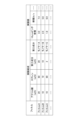
- FIG. 8 is a diagram showing an example of experimental data in this embodiment.
- the experimental data includes, as data items, information indicating the dry film resist used in the experiment (film), the experimental composition, and experimental values.
- the experimental composition includes the blend amount of acrylic acid, the blend amount of styrene, the blend amount of a third component, and identification information for identifying the monomer that is the third component.
- the experimental values include 16 ⁇ m pitch adhesion and resolution 3x/x.
- Identification information includes, for example, compound name, structural formula, SMILES (Simplified Molecular Input Line Entry System) information, ECFP (Extended Connectivity Circular Fingerprints) information, etc. Identification information is not limited to these, and any information capable of identifying a monomer can be used.
- the descriptor calculation unit 101 calculates the descriptors for the monomers that can constitute the base polymer.
- the descriptor calculation unit 101 is provided with a list of monomers for which the descriptors are to be calculated, which is stored in a storage unit such as the HDD 504.
- the list of monomers includes acrylic acid, styrene, and a third component.
- the descriptors for the monomers include the HSP_ ⁇ D, number of carboxylic acids, logP, and polymer Tg for each monomer.
- the descriptor calculation unit 101 generates descriptor data that associates the descriptors for the monomers with identification information that identifies the monomers.
- the descriptor storage unit 102 stores the descriptor data generated by the descriptor calculation unit 101.
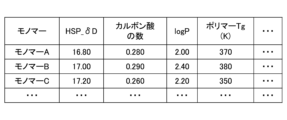
- FIG. 9 is a diagram showing an example of the descriptor data in this embodiment.
- the descriptor data has, as data items, identification information for identifying the monomer, HSP_ ⁇ D, the number of carboxylic acids, logP, and polymer Tg.
- the descriptor data may also have data items for storing other descriptors.
- the teacher data generation unit 103 generates teacher data for learning the prediction model.
- the prediction model is a machine learning model that predicts the physical property values of the base polymer.
- the teacher data generation unit 103 calculates explanatory variables related to the experimental composition based on the experimental composition included in the experimental data read from the experimental data storage unit 100.
- the explanatory variables related to the experimental composition include HSP_ ⁇ D, the number of carboxylic acids, logP, and polymer Tg.
- the teacher data generation unit 103 calculates HSP_ ⁇ D, the number of carboxylic acids, logP, and polymer Tg related to the experimental composition by weighting and adding the HSP_ ⁇ D, the number of carboxylic acids, logP, and polymer Tg of the monomers read from the descriptor storage unit 102 based on the blending amount of each monomer included in the experimental composition.
- the teacher data generating unit 103 acquires the experimental values contained in the experimental data. Specifically, the teacher data generating unit 103 acquires the 16 ⁇ m pitch adhesion and the resolution 3x/x contained in the experimental data. Then, the teacher data generating unit 103 generates teacher data regarding the experimental composition by combining explanatory variables related to the experimental composition with the experimental values as correct values of the objective variables.
- the model learning unit 104 learns a prediction model based on the teacher data generated by the teacher data generation unit 103.
- the prediction model includes a prediction model (hereinafter referred to as the "resolution prediction model”) that predicts a physical property value indicating resolution (i.e., resolution 3x/x), and a prediction model (hereinafter referred to as the "adhesion prediction model”) that predicts a physical property value indicating adhesion (i.e., 16 ⁇ m pitch adhesion).
- the model storage unit 105 stores the trained prediction model generated by the model learning unit 104. That is, the model storage unit 105 stores the trained resolution prediction model and the trained adhesion prediction model.
- the proposed condition acquisition unit 106 acquires proposed conditions indicating conditions related to the composition of the base polymer.
- the proposed condition acquisition unit 106 may acquire the proposed conditions by receiving information indicating the proposed conditions from the terminal device 20.
- the proposed condition acquisition unit 106 may acquire the proposed conditions by accepting the proposed conditions input from the input device 505.
- the proposed condition acquisition unit 106 may acquire the proposed conditions by reading out the proposed conditions stored in advance in a storage unit such as the HDD 504.
- the proposed conditions include production conditions for the candidate composition and target properties that the candidate composition should satisfy.
- the production conditions include conditions regarding the amount of acrylic acid blended, conditions regarding the amount of styrene blended, and a list of monomers to be used as the third component.
- the target properties include target values for physical properties related to resolution, and target values for physical properties indicating adhesion. All or part of the proposed conditions may be determined in advance and stored in the memory unit.
- the candidate composition generating unit 107 generates a candidate composition based on the generation conditions included in the proposed conditions acquired by the proposed condition acquiring unit 106. Specifically, the candidate composition generating unit 107 generates options for the blending amount of acrylic acid and options for the blending amount of styrene according to the generation conditions. Next, the candidate composition generating unit 107 combines the blending amount of acrylic acid with the blending amount of styrene to calculate the blending amount of the third component. Then, the candidate composition generating unit 107 combines all of the monomers included in the list as the third component for each combination of blending amounts. In this way, all of the candidate compositions are generated.
- the explanatory variable calculation unit 108 calculates explanatory variables related to the candidate composition based on the candidate composition generated by the candidate composition generation unit 107.
- the method by which the explanatory variable calculation unit 108 calculates the explanatory variables is the same as the method by which the teacher data generation unit 103 calculates the explanatory variables.
- the physical property prediction unit 109 predicts physical property values related to the candidate composition by inputting the explanatory variables calculated by the explanatory variable calculation unit 108 into the prediction model read from the model storage unit 105. Specifically, the physical property prediction unit 109 predicts physical property values related to resolution by inputting the explanatory variables related to the candidate composition into a trained resolution prediction model. Next, the physical property prediction unit 109 predicts physical property values related to adhesion by inputting the explanatory variables related to the candidate composition into a trained adhesion prediction model.
- the proposed information generating unit 110 generates proposed information based on the physical property values predicted by the physical property value predicting unit 109.
- the proposed information generating unit 110 transmits the proposed information to the terminal device 20.
- the proposed information includes information on candidate compositions whose physical property values predicted by the physical property value prediction unit 109 satisfy the target characteristics included in the proposed conditions.
- the proposed information may include information on candidate compositions whose physical property values predicted by the physical property value prediction unit 109 do not satisfy the target characteristics included in the proposed conditions.
- the proposed information generating unit 110 may extract candidate compositions whose physical property values satisfy the target characteristics, and generate proposed information in which the extracted candidate compositions are arranged according to a predetermined rule (for example, ascending or descending order of physical property values, ascending or descending order of the blending amount of a specific monomer, etc.). Also, for example, the proposed information generating unit 110 may generate proposed information in which all candidate compositions are arranged in order of best physical property values.
- a predetermined rule for example, ascending or descending order of physical property values, ascending or descending order of the blending amount of a specific monomer, etc.
- the terminal device 20 in this embodiment includes a proposal condition input unit 201 and a proposal information display unit 202 .
- the proposed condition input unit 201 and the proposed information display unit 202 are realized by a process executed by the CPU 501 of a program loaded onto the RAM 503 from the HDD 504 shown in FIG. 6.
- the proposal condition input unit 201 accepts input of proposal conditions in response to user operation.
- the proposal condition input unit 201 transmits information indicating the accepted proposal conditions to the proposal device 10.
- the proposal information display unit 202 receives proposal information from the proposal device 10.
- the proposal information display unit 202 outputs the received proposal information to the display device 506.
- FIG. 10 is a block diagram showing an example of an adhesion prediction model.
- the adhesion prediction model 301 is a machine learning model in which the number of carboxylic acids, HSP_ ⁇ D, and logP are explanatory variables, and 16 ⁇ m pitch adhesion is the objective variable.
- the closeness prediction model 301 is, for example, a machine learning model based on Gaussian process regression.
- the kernel function can be ConstantKernel() * RBF(np.ones(3)) + WhiteKernel(). Note that scikit-learn is an open source machine learning library.
- Figure 11 is a graph showing an example of the prediction accuracy of the adhesion prediction model.
- Figure 11 shows the results of evaluating the prediction accuracy of the trained adhesion prediction model 301 by cross-validation.
- the coefficient of determination (R2) and root mean squared error (RMSE) were used as evaluation indices.
- R2 was 0.95
- RMSE root mean squared error
- Figure 11 shows that the adhesion prediction model 301 can predict 16 ⁇ m pitch adhesion with high accuracy.
- FIG. 12 is a block diagram showing an example of a resolution prediction model.
- the resolution prediction model 302 is a machine learning model that uses the number of carboxylic acids, HSP_ ⁇ D, and polymer Tg as explanatory variables and the resolution 3x/x as a response variable.
- the resolution prediction model 302 is, for example, a machine learning model based on Gaussian process regression.
- the kernel function that can be used is ConstantKernel() * RBF() + WhiteKernel().
- FIG. 13 is a graph showing an example of the prediction accuracy of a resolution prediction model.
- FIG. 13 shows the results of evaluating the prediction accuracy of the trained resolution prediction model 302 by cross-validation.
- R2 and RMSE were used as evaluation indices.
- R2 was 0.83 and RMSE was 1.03.
- FIG. 13 shows that the resolution prediction model 302 can predict the resolution 3x/x with high accuracy.
- the processing procedure of the proposal method executed by the composition proposal system 1000 in this embodiment will be described with reference to Fig. 14 to Fig. 16.
- the proposal method in this embodiment includes a descriptor calculation process (see Fig. 14), a model learning process (see Fig. 15), and a composition proposal process (see Fig. 16).
- Descriptor calculation process 14 is a flowchart showing an example of the descriptor calculation process in this embodiment.
- the descriptor calculation process is a process for generating descriptor data related to monomers.
- step S1 the descriptor calculation unit 101 of the proposed device 10 reads out a list of monomers from the storage unit. Next, the descriptor calculation unit 101 obtains the monomers for which the descriptors are to be calculated from the read out list.
- step S2 the descriptor calculation unit 101 of the proposed device 10 calculates a descriptor for the monomer obtained in step S1. Specifically, the descriptor calculation unit 101 calculates the HSP_ ⁇ D, number of carboxylic acids, logP, and polymer Tg for the monomer.
- step S3 the descriptor calculation unit 101 of the proposed device 10 associates identification information that identifies the monomer with the descriptor calculated in step S2. This generates descriptor data.
- the descriptor calculation unit 101 stores the descriptor data in the descriptor storage unit 102.
- step S2 to step S3 are repeated for all polymers included in the list read in step S1.
- Model learning process> 15 is a flowchart showing an example of a model learning process in this embodiment.
- the model learning process is a process for learning a prediction model.
- step S11 the teacher data generation unit 103 of the proposal device 10 reads the experimental data from the experimental data storage unit 100.
- the teacher data generation unit 103 selects an experimental composition to be used for learning from the experimental data.
- step S12 the teacher data generation unit 103 of the proposed device 10 reads out the descriptor data for each monomer included in the experimental composition selected in step S11 from the descriptor storage unit 102.
- the teacher data generation unit 103 obtains HSP_ ⁇ D, the number of carboxylic acids, logP, and polymer Tg from the read out descriptor data.
- step S13 the teacher data generation unit 103 of the proposed device 10 calculates explanatory variables related to the experimental composition based on the descriptors acquired in step S12. Specifically, the teacher data generation unit 103 weights and adds the HSP_ ⁇ D, number of carboxylic acids, logP, and polymer Tg related to the monomers based on the blending amount of each monomer contained in the experimental composition. This allows the HSP_ ⁇ D, number of carboxylic acids, logP, and polymer Tg related to the experimental composition to be calculated.
- the teacher data generation unit 103 acquires experimental values corresponding to the experimental composition selected in step S11. Specifically, the teacher data generation unit 103 acquires the 16 ⁇ m pitch adhesion and resolution 3x/x contained in the experimental data. Next, the teacher data generation unit 103 combines the explanatory variables related to the experimental composition with the experimental values as the correct values of the objective variables. This generates teacher data related to the experimental composition. The teacher data generation unit 103 sends the teacher data related to the experimental composition to the model learning unit 104.
- step S14 the model learning unit 104 of the proposed device 10 receives teacher data related to the experimental composition from the teacher data generation unit 103.
- the model learning unit 104 predicts physical property values related to the experimental composition by inputting explanatory variables included in the teacher data into the prediction model being trained.
- the model learning unit 104 inputs the number of carboxylic acids, HSP_ ⁇ D, and logP contained in the teacher data into the adhesion prediction model being learned.
- the adhesion prediction model predicts 16 ⁇ m pitch adhesion based on the input number of carboxylic acids, HSP_ ⁇ D, and logP, and outputs the predicted value.
- the model learning unit 104 inputs the number of carboxylic acids, HSP_ ⁇ D, and polymer Tg contained in the training data into the resolution prediction model being trained.
- the resolution prediction model predicts the resolution 3x/x based on the input number of carboxylic acids, HSP_ ⁇ D, and polymer Tg, and outputs the predicted value.
- step S15 the model learning unit 104 of the proposal device 10 calculates the error between the predicted value predicted in step S14 and the correct value included in the training data.
- the model learning unit 104 updates the parameters of the prediction model so as to minimize the error between the predicted value and the correct value.
- the model learning unit 104 calculates the error between the predicted value of 16 ⁇ m pitch adhesion output from the adhesion prediction model in step S14 and the correct value of 16 ⁇ m pitch adhesion included in the teacher data, and updates the parameters of the adhesion prediction model so as to minimize the error.
- the model learning unit 104 also calculates the error between the predicted value of resolution 3x/x output from the resolution prediction model in step S14 and the correct value of resolution 3x/x included in the teacher data, and updates the parameters of the resolution prediction model so as to minimize the error.
- step S16 the model learning unit 104 of the proposed device 10 determines whether learning is complete. Whether learning is complete may be determined based on whether the error calculated in step S14 has converged or whether a predetermined number of iterations has been exceeded. If learning is not complete (NO), the model learning unit 104 returns the process to step S15. If learning is not complete (NO), the model learning unit 104 may return the process to step S11 to acquire more experimental data. In this case, the teacher data generation unit 103 selects a different experimental composition and executes the processes from steps S15 to S16 again. If learning is complete (YES), the model learning unit 104 ends the model learning process.
- composition proposal processing> 16 is a flowchart showing an example of a composition suggestion process in this embodiment.
- the composition suggestion process is a process for proposing a candidate composition that satisfies the target properties based on a trained prediction model.
- step S21 the proposed condition input unit 201 of the terminal device 20 accepts input of proposed conditions in response to a user operation.
- the proposed conditions include conditions for generating a candidate composition and target properties that the candidate composition should satisfy. All or part of the proposed conditions may be determined in advance. If all of the proposed conditions are determined in advance, the process of step S21 does not need to be executed.
- the proposed condition input unit 201 transmits information indicating the proposed conditions to the proposal device 10.
- the proposed condition acquisition unit 106 receives information indicating the proposed conditions from the terminal device 20.
- step S22 the proposed condition acquisition unit 106 of the proposing device 10 acquires the generation conditions included in the information indicating the proposed conditions, and sends them to the candidate composition generation unit 107.
- the proposed condition acquisition unit 106 also acquires the target properties included in the information indicating the proposed conditions, and sends them to the proposed information generation unit 110.
- step S23 the candidate composition generating unit 107 of the proposing device 10 receives the generation conditions from the proposed condition acquiring unit 106.
- the candidate composition generating unit 107 generates a candidate composition based on the generation conditions.
- the candidate composition generating unit 107 sends the generated candidate composition to the explanatory variable calculating unit 108.
- step S24 the explanatory variable calculation unit 108 of the proposal device 10 receives the candidate composition from the candidate composition generation unit 107.
- the explanatory variable calculation unit 108 calculates explanatory variables related to the candidate composition based on the candidate composition.
- the method of calculating the explanatory variables is the same as the method used by the teacher data generation unit 103 to calculate the explanatory variables in step S13.
- the explanatory variable calculation unit 108 sends the explanatory variables related to the candidate composition to the physical property prediction unit 109.
- step S25 the physical property prediction unit 109 of the proposed device 10 receives explanatory variables related to the candidate composition from the explanatory variable calculation unit 108.
- the physical property prediction unit 109 reads out the trained adhesion prediction model and the trained resolution prediction model from the model storage unit 105.
- the physical property prediction unit 109 inputs the number of carboxylic acids, HSP_ ⁇ D, and logP for the candidate composition into the trained adhesion prediction model.
- the adhesion prediction model predicts 16 ⁇ m pitch adhesion based on the input number of carboxylic acids, HSP_ ⁇ D, and logP, and outputs the predicted value.
- the physical property prediction unit 109 also inputs the number of carboxylic acids, HSP_ ⁇ D, and polymer Tg for the candidate composition into the trained resolution prediction model.
- the resolution prediction model predicts the resolution 3x/x based on the input number of carboxylic acids, HSP_ ⁇ D, and polymer Tg, and outputs the predicted value.
- the physical property prediction unit 109 sends the physical property values related to the candidate composition to the proposed information generation unit 110. Specifically, the physical property prediction unit 109 sends the predicted value of 16 ⁇ m pitch adhesion output by the adhesion prediction model and the predicted value of resolution 3x/x output by the resolution prediction model to the proposed information generation unit 110.
- step S26 the proposal information generating unit 110 of the proposing device 10 receives the target characteristics from the proposal condition acquiring unit 106.
- the proposal information generating unit 110 also receives physical property values related to the candidate composition from the physical property predicting unit 109.
- the proposed information generating unit 110 determines whether the physical property values related to the candidate composition satisfy the target characteristics. Specifically, the proposed information generating unit 110 determines whether the predicted value of 16 ⁇ m pitch closeness is less than the target value of 16 ⁇ m pitch closeness included in the target characteristics. The proposed information generating unit 110 also determines whether the predicted value of resolution 3x/x is less than the target value of resolution 3x/x included in the target characteristics.
- the proposed information generating unit 110 determines that the physical property values of the candidate composition satisfy the target characteristics. On the other hand, if at least one of the predicted value for 16 ⁇ m pitch adhesion or the predicted value for resolution 3x/x is equal to or greater than the target value, the proposed information generating unit 110 determines that the physical property values of the candidate composition do not satisfy the target characteristics.
- the proposed information generating unit 110 proceeds to step S27. On the other hand, if it is determined that the physical property values of the candidate composition do not satisfy the target characteristics (NO), the proposed information generating unit 110 skips step S27.
- step S26 does not need to be performed.
- step S27 the proposed information generating unit 110 of the proposing device 10 adds information about the candidate composition whose physical property values have been determined to satisfy the target characteristics to the proposed information.
- the proposed information includes the candidate composition and the physical property values.
- the candidate composition includes the amount of acrylic acid, the amount of styrene, the amount of the third component, and identification information that identifies the monomer that is the third component.
- the physical property values include a predicted value for 16 ⁇ m pitch adhesion and a predicted value for resolution 3x/x.
- step S24 to step S27 are repeated for all candidate compositions generated in step S23.
- step S28 the proposal information generation unit 110 of the proposal device 10 transmits the proposal information to the terminal device 20.
- the proposal information display unit 202 receives the proposal information from the proposal device 10.
- step S29 the proposed information display unit 202 of the terminal device 20 displays the proposed information on the display device 506.
- the user can refer to the proposed information displayed on the display device 506 of the terminal device 20 and manufacture the base polymer to be contained in the photosensitive resin composition according to the candidate composition indicated in the proposed information.
- the user can search for a more suitable base polymer composition by examining the proposed information displayed on the display device 506 of the terminal device 20 and inputting new proposed conditions.
- the photosensitive resin composition in this embodiment contains a polymer composed of multiple types of monomers, and a predetermined explanatory variable calculated based on the monomer is included in a predetermined range.
- the predetermined range is determined based on a composition in which the predicted result of a machine learning model using a physical property value related to resolution and a physical property value related to adhesion as objective variables satisfies a predetermined target value. Therefore, according to this embodiment, a photosensitive resin composition, a film-like resin, and a resin sheet excellent in resolution and adhesion are provided.
- the proposing device 10 in this embodiment predicts physical property values related to resolution and adhesion for candidate compositions generated based on specified generation conditions based on a trained prediction model, and proposes candidate compositions whose prediction results satisfy specified target characteristics. Therefore, according to this embodiment, it is possible to propose a base polymer composition that realizes a photosensitive resin composition with excellent resolution and adhesion.
Landscapes
- Chemical & Material Sciences (AREA)
- Physics & Mathematics (AREA)
- Chemical Kinetics & Catalysis (AREA)
- General Physics & Mathematics (AREA)
- Health & Medical Sciences (AREA)
- Medicinal Chemistry (AREA)
- Polymers & Plastics (AREA)
- Organic Chemistry (AREA)
- Spectroscopy & Molecular Physics (AREA)
- Addition Polymer Or Copolymer, Post-Treatments, Or Chemical Modifications (AREA)
- Materials For Photolithography (AREA)
Priority Applications (4)
| Application Number | Priority Date | Filing Date | Title |
|---|---|---|---|
| EP24831701.8A EP4733840A1 (en) | 2023-06-26 | 2024-06-13 | Photosensitive resin composition, film-shaped resin, and resin sheet |
| JP2025529636A JPWO2025004836A1 (https=) | 2023-06-26 | 2024-06-13 | |
| KR1020267001709A KR20260025405A (ko) | 2023-06-26 | 2024-06-13 | 감광성 수지 조성물, 필름 형상 수지 및 수지 시트 |
| CN202480042926.9A CN121420246A (zh) | 2023-06-26 | 2024-06-13 | 感光性树脂组合物、膜状树脂和树脂片 |
Applications Claiming Priority (2)
| Application Number | Priority Date | Filing Date | Title |
|---|---|---|---|
| JP2023104223 | 2023-06-26 | ||
| JP2023-104223 | 2023-06-26 |
Publications (1)
| Publication Number | Publication Date |
|---|---|
| WO2025004836A1 true WO2025004836A1 (ja) | 2025-01-02 |
Family
ID=93938937
Family Applications (1)
| Application Number | Title | Priority Date | Filing Date |
|---|---|---|---|
| PCT/JP2024/021577 Ceased WO2025004836A1 (ja) | 2023-06-26 | 2024-06-13 | 感光性樹脂組成物、フィルム状樹脂及び樹脂シート |
Country Status (6)
| Country | Link |
|---|---|
| EP (1) | EP4733840A1 (https=) |
| JP (1) | JPWO2025004836A1 (https=) |
| KR (1) | KR20260025405A (https=) |
| CN (1) | CN121420246A (https=) |
| TW (1) | TW202505304A (https=) |
| WO (1) | WO2025004836A1 (https=) |
Families Citing this family (1)
| Publication number | Priority date | Publication date | Assignee | Title |
|---|---|---|---|---|
| CN120089246B (zh) * | 2025-02-23 | 2025-12-05 | 上海大学 | 基于机器学习设计高玻璃化转变温度芯片底填胶的方法、系统及应用 |
Citations (4)
| Publication number | Priority date | Publication date | Assignee | Title |
|---|---|---|---|---|
| JP2005257812A (ja) * | 2004-03-09 | 2005-09-22 | Hitachi Chem Co Ltd | 感光性樹脂組成物、これを用いた感光性エレメント、レジストパターンの形成方法及びプリント配線板の製造方法 |
| JP2013216804A (ja) | 2012-04-10 | 2013-10-24 | Hitachi Chemical Co Ltd | 感光性樹脂組成物、フィルム状樹脂、樹脂シート、樹脂パターン、樹脂層付半導体ウェハ、樹脂層付透明基板、半導体装置及び半導体装置の製造方法 |
| WO2022030053A1 (ja) * | 2020-08-07 | 2022-02-10 | 昭和電工マテリアルズ株式会社 | 感光性樹脂組成物、感光性エレメント、レジストパターンの形成方法、及びプリント配線板の製造方法 |
| JP2023104223A (ja) | 2022-01-17 | 2023-07-28 | ソニーグループ株式会社 | 導光板及び画像表示装置 |
-
2024
- 2024-06-13 CN CN202480042926.9A patent/CN121420246A/zh active Pending
- 2024-06-13 EP EP24831701.8A patent/EP4733840A1/en active Pending
- 2024-06-13 WO PCT/JP2024/021577 patent/WO2025004836A1/ja not_active Ceased
- 2024-06-13 JP JP2025529636A patent/JPWO2025004836A1/ja active Pending
- 2024-06-13 KR KR1020267001709A patent/KR20260025405A/ko active Pending
- 2024-06-19 TW TW113122644A patent/TW202505304A/zh unknown
Patent Citations (4)
| Publication number | Priority date | Publication date | Assignee | Title |
|---|---|---|---|---|
| JP2005257812A (ja) * | 2004-03-09 | 2005-09-22 | Hitachi Chem Co Ltd | 感光性樹脂組成物、これを用いた感光性エレメント、レジストパターンの形成方法及びプリント配線板の製造方法 |
| JP2013216804A (ja) | 2012-04-10 | 2013-10-24 | Hitachi Chemical Co Ltd | 感光性樹脂組成物、フィルム状樹脂、樹脂シート、樹脂パターン、樹脂層付半導体ウェハ、樹脂層付透明基板、半導体装置及び半導体装置の製造方法 |
| WO2022030053A1 (ja) * | 2020-08-07 | 2022-02-10 | 昭和電工マテリアルズ株式会社 | 感光性樹脂組成物、感光性エレメント、レジストパターンの形成方法、及びプリント配線板の製造方法 |
| JP2023104223A (ja) | 2022-01-17 | 2023-07-28 | ソニーグループ株式会社 | 導光板及び画像表示装置 |
Also Published As
| Publication number | Publication date |
|---|---|
| EP4733840A1 (en) | 2026-04-29 |
| TW202505304A (zh) | 2025-02-01 |
| KR20260025405A (ko) | 2026-02-24 |
| JPWO2025004836A1 (https=) | 2025-01-02 |
| CN121420246A (zh) | 2026-01-27 |
Similar Documents
| Publication | Publication Date | Title |
|---|---|---|
| JP7088399B1 (ja) | ノボラック型フェノール樹脂の探索方法、情報処理装置、及びプログラム | |
| JP7726280B2 (ja) | 特性予測装置、特性予測方法、及びプログラム | |
| CN105706161B (zh) | 基于音高分布的自动音频协调 | |
| WO2025004836A1 (ja) | 感光性樹脂組成物、フィルム状樹脂及び樹脂シート | |
| AU2016225947A1 (en) | System and method for multimedia document summarization | |
| US20220415450A1 (en) | System and method for estimating solubility | |
| WO2022097298A1 (ja) | 量子化学計算プログラム、量子化学計算方法、および量子化学計算装置 | |
| US20250140356A1 (en) | Methods and systems for machine-learning based molecule generation and scoring | |
| CN112183088B (zh) | 词语层级确定的方法、模型构建方法、装置及设备 | |
| Rodríguez-Pérez et al. | Chemistry-centric explanation of machine learning models | |
| JP7601279B2 (ja) | 情報処理装置、情報処理システム、プログラム、及び材料組成探索方法 | |
| Dasgupta et al. | ML-based Read-Across Structure-Property Relationship (RASPR) strategy for predicting protein resistance of self-assembled monolayers (SAMs) as anti-biofouling materials | |
| JP2022102726A (ja) | 化学反応における活性化エネルギーの学習装置及び予測装置 | |
| US20090259607A1 (en) | System, method, and program for evaluating performance of intermolecular interaction predicting apparatus | |
| US20250046403A1 (en) | Design support device, design support method, and program | |
| Tanna et al. | Tabtune: A unified library for inference and fine-tuning tabular foundation models | |
| JP7416175B1 (ja) | 予測プログラム、情報処理装置、および予測方法 | |
| WO2024062837A1 (ja) | 設計支援装置、設計支援方法、プログラム及び情報処理システム | |
| EP4092084A1 (en) | Information processing system, information processing method, and information processing program | |
| Ku et al. | Positive Role of Iodine Atoms in Chemically Amplified Photoresists for Extreme Ultraviolet Lithography | |
| US8903833B2 (en) | Object identification by elector | |
| JP2025040123A (ja) | 機械学習装置、機械学習方法、及びプログラム | |
| WO2026070776A1 (ja) | 予測装置、学習装置、それらの方法及びプログラム | |
| JP2026008452A (ja) | コンピュータプログラム、情報処理装置、情報処理方法及び学習モデル生成方法 | |
| WO2026048394A1 (ja) | 組成探索装置、組成探索方法及びプログラム |
Legal Events
| Date | Code | Title | Description |
|---|---|---|---|
| 121 | Ep: the epo has been informed by wipo that ep was designated in this application |
Ref document number: 24831701 Country of ref document: EP Kind code of ref document: A1 |
|
| ENP | Entry into the national phase |
Ref document number: 2025529636 Country of ref document: JP Kind code of ref document: A |
|
| WWE | Wipo information: entry into national phase |
Ref document number: 2025529636 Country of ref document: JP |
|
| ENP | Entry into the national phase |
Ref document number: 1020267001709 Country of ref document: KR Free format text: ST27 STATUS EVENT CODE: A-0-1-A10-A15-NAP-PA0105 (AS PROVIDED BY THE NATIONAL OFFICE) |
|
| WWE | Wipo information: entry into national phase |
Ref document number: 1020267001709 Country of ref document: KR |
|
| ENP | Entry into the national phase |
Ref document number: 2024831701 Country of ref document: EP Effective date: 20260126 |
|
| WWE | Wipo information: entry into national phase |
Ref document number: 2024831701 Country of ref document: EP |
|
| NENP | Non-entry into the national phase |
Ref country code: DE |
|
| ENP | Entry into the national phase |
Ref document number: 2024831701 Country of ref document: EP Effective date: 20260126 |
|
| ENP | Entry into the national phase |
Ref document number: 2024831701 Country of ref document: EP Effective date: 20260126 |
|
| WWP | Wipo information: published in national office |
Ref document number: 1020267001709 Country of ref document: KR |