WO2025004579A1 - 眼科用組成物 - Google Patents
眼科用組成物 Download PDFInfo
- Publication number
- WO2025004579A1 WO2025004579A1 PCT/JP2024/017874 JP2024017874W WO2025004579A1 WO 2025004579 A1 WO2025004579 A1 WO 2025004579A1 JP 2024017874 W JP2024017874 W JP 2024017874W WO 2025004579 A1 WO2025004579 A1 WO 2025004579A1
- Authority
- WO
- WIPO (PCT)
- Prior art keywords
- dorzolamide
- ophthalmic composition
- acid
- salts
- cyclodextrin
- Prior art date
- Legal status (The legal status is an assumption and is not a legal conclusion. Google has not performed a legal analysis and makes no representation as to the accuracy of the status listed.)
- Ceased
Links
Classifications
-
- A—HUMAN NECESSITIES
- A61—MEDICAL OR VETERINARY SCIENCE; HYGIENE
- A61K—PREPARATIONS FOR MEDICAL, DENTAL OR TOILETRY PURPOSES
- A61K31/00—Medicinal preparations containing organic active ingredients
- A61K31/33—Heterocyclic compounds
- A61K31/38—Heterocyclic compounds having sulfur as a ring hetero atom
- A61K31/382—Heterocyclic compounds having sulfur as a ring hetero atom having six-membered rings, e.g. thioxanthenes
-
- A—HUMAN NECESSITIES
- A61—MEDICAL OR VETERINARY SCIENCE; HYGIENE
- A61K—PREPARATIONS FOR MEDICAL, DENTAL OR TOILETRY PURPOSES
- A61K31/00—Medicinal preparations containing organic active ingredients
- A61K31/33—Heterocyclic compounds
- A61K31/395—Heterocyclic compounds having nitrogen as a ring hetero atom, e.g. guanethidine or rifamycins
- A61K31/535—Heterocyclic compounds having nitrogen as a ring hetero atom, e.g. guanethidine or rifamycins having six-membered rings with at least one nitrogen and one oxygen as the ring hetero atoms, e.g. 1,2-oxazines
- A61K31/5375—1,4-Oxazines, e.g. morpholine
- A61K31/5377—1,4-Oxazines, e.g. morpholine not condensed and containing further heterocyclic rings, e.g. timolol
-
- A—HUMAN NECESSITIES
- A61—MEDICAL OR VETERINARY SCIENCE; HYGIENE
- A61K—PREPARATIONS FOR MEDICAL, DENTAL OR TOILETRY PURPOSES
- A61K47/00—Medicinal preparations characterised by the non-active ingredients used, e.g. carriers or inert additives; Targeting or modifying agents chemically bound to the active ingredient
- A61K47/30—Macromolecular organic or inorganic compounds, e.g. inorganic polyphosphates
- A61K47/34—Macromolecular compounds obtained otherwise than by reactions only involving carbon-to-carbon unsaturated bonds, e.g. polyesters, polyamino acids, polysiloxanes, polyphosphazines, copolymers of polyalkylene glycol or poloxamers
-
- A—HUMAN NECESSITIES
- A61—MEDICAL OR VETERINARY SCIENCE; HYGIENE
- A61K—PREPARATIONS FOR MEDICAL, DENTAL OR TOILETRY PURPOSES
- A61K47/00—Medicinal preparations characterised by the non-active ingredients used, e.g. carriers or inert additives; Targeting or modifying agents chemically bound to the active ingredient
- A61K47/30—Macromolecular organic or inorganic compounds, e.g. inorganic polyphosphates
- A61K47/36—Polysaccharides; Derivatives thereof, e.g. gums, starch, alginate, dextrin, hyaluronic acid, chitosan, inulin, agar or pectin
- A61K47/40—Cyclodextrins; Derivatives thereof
-
- A—HUMAN NECESSITIES
- A61—MEDICAL OR VETERINARY SCIENCE; HYGIENE
- A61K—PREPARATIONS FOR MEDICAL, DENTAL OR TOILETRY PURPOSES
- A61K9/00—Medicinal preparations characterised by special physical form
- A61K9/08—Solutions
-
- A—HUMAN NECESSITIES
- A61—MEDICAL OR VETERINARY SCIENCE; HYGIENE
- A61P—SPECIFIC THERAPEUTIC ACTIVITY OF CHEMICAL COMPOUNDS OR MEDICINAL PREPARATIONS
- A61P27/00—Drugs for disorders of the senses
- A61P27/02—Ophthalmic agents
Definitions
- the present disclosure relates to an ophthalmic composition containing dorzolamide.
- Ophthalmic compositions intended to treat glaucoma are known to slow the progression of glaucoma by lowering the intraocular pressure in the patient's eye.
- eye drops that have an intraocular pressure lowering effect.
- dorzolamide hydrochloride eye drop which has a carbonic anhydrase inhibitory effect.
- Patent Document 1 discloses dorzolamide hydrochloride eye drops with an adjusted pH of 6.5 to 8.5. Patent Document 1 states that eye irritation can be reduced by adjusting the pH to the neutral range.
- Patent Document 2 discloses an ophthalmic composition containing dorzolamide or a pharmacologically acceptable salt thereof, cyclodextrin, and latanoprost, and adjusted to a pH of 5.8 to 6.5. Patent Document 2 describes that the stability of a composition containing dorzolamide can be improved by using hydroxypropyl- ⁇ -cyclodextrin.
- the present disclosure therefore aims to extend the shelf life of ophthalmic compositions containing dorzolamide.
- the ophthalmic composition disclosed herein contains dorzolamide and/or a pharmacologically acceptable salt of dorzolamide as an active ingredient, sulfobutylether- ⁇ -cyclodextrin and/or a pharmacologically acceptable salt of sulfobutylether- ⁇ -cyclodextrin, and polyoxyethylene hydrogenated castor oil, and has a pH of 6.5 to 8.5.
- the inventors have surprisingly discovered that the combination of sulfobutylether- ⁇ -cyclodextrin and/or a pharmacologically acceptable salt of sulfobutylether- ⁇ -cyclodextrin and polyoxyethylene hydrogenated castor oil significantly extends the shelf life of ophthalmic compositions containing dorzolamide.
- This effect is expected to be due to the fact that the generation of dorzolamide-related substances can be suppressed while maintaining the pH in the neutral range.
- the ophthalmic composition having the above-mentioned configuration can extend the shelf life of ophthalmic compositions containing dorzolamide.
- the pharmacologically acceptable salt of dorzolamide is dorzolamide hydrochloride.
- dorzolamide hydrochloride is easy to handle as an active ingredient in the ophthalmic composition and is preferably used.
- the ophthalmic composition of one embodiment disclosed herein contains 0.5 g to 20.0 g of the sulfobutyl ether- ⁇ -cyclodextrin when the total volume of the ophthalmic composition is 100 mL. This makes it possible to more effectively suppress the generation of dorzolamide-related substances.
- the polymerization number of ethylene oxide in the polyoxyethylene hydrogenated castor oil is 20 or more and 100 or less. This makes it possible to more reliably suppress the generation of dorzolamide-related substances.
- the ophthalmic composition of one embodiment disclosed herein contains 0.1 g to 10.0 g of the polyoxyethylene hydrogenated castor oil 60 when the total volume of the ophthalmic composition is 100 mL. This makes it possible to more reliably maintain long-term stability and extend the expiration date of the composition.
- the ophthalmic composition of one embodiment disclosed herein is used as an eye drop. This makes it suitable for use in the prevention or treatment of glaucoma or ocular hypertension.
- the above dorzolamide and/or a pharmacologically acceptable salt of dorzolamide is contained in an amount of 0.1 g to 5.0 g. This makes it more suitable for use in preventing or treating glaucoma or ocular hypertension.
- One embodiment of the method disclosed herein for suppressing the generation of dorzolamide-related substances in an ophthalmic composition containing dorzolamide or a pharmacologically acceptable salt thereof is to include sulfobutylether- ⁇ -cyclodextrin and/or a pharmacologically acceptable salt of sulfobutylether- ⁇ -cyclodextrin and polyoxyethylene hydrogenated castor oil in the ophthalmic composition having a pH of 6.5 to 8.5. This makes it possible to suppress the generation of dorzolamide-related substances in the ophthalmic composition and extend its expiration date.
- ophthalmic composition refers to a composition administered to the eye for the prevention or treatment of eye diseases, and is applied to ocular tissues such as the conjunctival sac.
- the dosage form of the ophthalmic composition is not particularly limited, and includes liquid (including concentrated solutions that are diluted before use), semi-solid, or solid preparations that are dissolved or suspended before use.
- ophthalmic compositions include eye drops (synonymous with eye drops or eye drops), artificial tears, eye washes, eye drops for contact lenses, eye ointments, etc., and also include forms administered by local injection into the eye.
- the ophthalmic composition of the present disclosure is preferably an aqueous composition, and is preferably, for example, an eye drop.
- expiration date refers to the final date of validity during which the efficacy and safety of the ophthalmic composition are maintained and the stability of its quality over a long period is guaranteed.
- the ophthalmic composition of the present disclosure is an ophthalmic composition containing dorzolamide and/or a pharmacologically acceptable salt of dorzolamide as an active ingredient.
- the ophthalmic composition also contains sulfobutylether- ⁇ -cyclodextrin and/or a pharmacologically acceptable salt of sulfobutylether- ⁇ -cyclodextrin, and polyoxyethylene hydrogenated castor oil.
- the ophthalmic composition of the present disclosure has a pH of 6.5 to 8.5. Each element will be described in detail below.
- dorzolamide is (4S,6S)-4-ethylamino-6-methyl-5,6-dihydro-4H-thieno[2,3-b]thiopyran-2-sulfonamide7,7-dioxide, and is a compound represented by the following chemical formula (I).
- Dorzolamide can be synthesized by a known method or can be obtained as a commercially available product.
- the dorzolamide contained may be a salt.
- the salt of dorzolamide there are no particular limitations on the salt of dorzolamide as long as it is a pharmacologically acceptable salt.
- salts of dorzolamide include salts with inorganic acids, salts with organic acids, salts with alkali metals, salts with alkaline earth metals, and metal salts.
- salts with inorganic acids include salts with hydrochloric acid, hydrobromic acid, hydroiodic acid, nitric acid, sulfuric acid, phosphoric acid, thiocyanic acid, etc.
- salts with organic acids include salts with acetic acid, oxalic acid, fumaric acid, maleic acid, succinic acid, malic acid, citric acid, tartaric acid, adipic acid, gluconic acid, mesylic acid, lactic acid, isethionic acid, lactobionic acid, oleic acid, pamoic acid, stearic acid, tannic acid, besylic acid, salicylic acid, benzoic acid, etc.
- salts with alkali metals include salts with lithium, sodium, potassium, etc.
- salts with alkaline earth metals include salts with calcium, magnesium, etc.
- metal salts include salts with iron, zinc, etc.
- the SBE- ⁇ -CD contained may be a salt.
- the salt of SBE- ⁇ -CD there are no particular limitations on the salt of SBE- ⁇ -CD, so long as it is a pharmacologically acceptable salt.
- salts of SBE- ⁇ -CD include salts with inorganic acids, salts with organic acids, salts with alkali metals, salts with alkaline earth metals, and metal salts.
- salts with inorganic acids include salts with hydrochloric acid, hydrobromic acid, hydroiodic acid, nitric acid, sulfuric acid, phosphoric acid, thiocyanic acid, and the like.
- Salts with organic acids include salts with acetic acid, oxalic acid, fumaric acid, maleic acid, succinic acid, malic acid, citric acid, tartaric acid, adipic acid, gluconic acid, mesylic acid, lactic acid, isethionic acid, lactobionic acid, oleic acid, pamoic acid, stearic acid, tannic acid, besylic acid, salicylic acid, benzoic acid, and the like.
- Salts with alkali metals include salts with lithium, sodium, potassium, and the like.
- Examples of salts with alkaline earth metals include salts with calcium, magnesium, etc.
- metal salts include salts with iron, zinc, etc.
- salts with organic amines examples include quaternary ammonium salts, salts with halogen ions, and salts with organic amines.
- the monosodium salt sodium SBE- ⁇ -CD is particularly preferred as a salt of SBE- ⁇ -CD.
- the content of SBE- ⁇ -CD or a salt of SBE- ⁇ -CD is not particularly limited as long as it is an amount that is acceptable to the living body.
- the lower limit may be 0.5 w/v% or more, preferably 1.0 w/v% or more, more preferably 5.5 w/v% or more, even more preferably 6.0 w/v% or more, and most preferably 8.0 w/v% or more.
- the upper limit may be 20.0 w/v% or less, 15.0 w/v% or less, or 11.0 w/v% or less.
- the ophthalmic composition of the present disclosure contains polyoxyethylene hydrogenated castor oil, which is a nonionic surfactant, as a solubilizing agent.
- polyoxyethylene hydrogenated castor oil various polyoxyethylene hydrogenated castor oils having different polymerization numbers of ethylene oxide can be used.
- the polymerization number of ethylene oxide is not particularly limited. From the viewpoint of stabilizing dorzolamide, the lower limit of the polymerization number is preferably 20 or more, more preferably 30 or more, and most preferably 40 or more.
- the upper limit is preferably 100 or less, more preferably 80 or less, and most preferably 60 or less.
- polyoxyethylene hydrogenated castor oil examples include polyoxyethylene hydrogenated castor oil 40, polyoxyethylene hydrogenated castor oil 60, and polyoxyethylene hydrogenated castor oil 80. From the viewpoint of more significantly enhancing the effect of the present disclosure, polyoxyethylene hydrogenated castor oil 60 is most preferable. In addition, the content of polyoxyethylene hydrogenated castor oil is not particularly limited as long as it is an amount acceptable to the living body.
- the lower limit is preferably 0.1 w/v% or more, more preferably 0.5 w/v% or more, and most preferably 1.0 w/v% or more, and the upper limit may be 10.0 w/v% or less, 5.0 w/v% or less, or 3.0 w/v% or less.
- the ophthalmic composition of the present disclosure has a pH of 6.5 to 8.5 (neutral range).
- the pH of the aqueous solution becomes acidic (e.g., pH 5.5 to 5.9), so a pH adjuster is added to adjust the pH to 6.5 to 8.5.
- Ophthalmic compositions containing dorzolamide as an active ingredient have strong eye irritation. However, by adjusting the pH to a neutral range, eye irritation can be reduced, making it easier for patients to continue treatment by following the dosage instructions.
- pH adjusters examples include sodium hydroxide or calcium hydroxide, alkaline aqueous solutions of potassium hydroxide, etc., and acidic aqueous solutions of hydrochloric acid, citric acid, etc.
- the pH of the aqueous solution becomes acidic, so it is preferable to use sodium hydroxide to make it neutral.
- the lower limit of the pH of the ophthalmic composition of the present disclosure is preferably 6.5 or more, more preferably 6.7 or more.
- the upper limit is preferably 8.5 or less, more preferably 8.2 or less, and even more preferably 7.8 or less.
- the above-mentioned ophthalmic composition suppresses the generation of dorzolamide analogues and can extend the expiration date of the ophthalmic composition containing dorzolamide up to three years. Since the efficacy and toxicity of this dorzolamide analogue to the human body are unknown when the standard value is exceeded, safety cannot be maintained and the expiration date is shortened.
- dorzolamide analogues are generated, and the expiration date is limited to 1.5 years.
- one form of dorzolamide analogues is (4R,6S)-4-ethylamino-6-methyl-5,6-dihydro-4H-thieno[2,3-b]thiopyran-2-sulfonamide7,7-dioxide. This compound is represented by the following chemical formula (II).
- the ophthalmic composition of the present disclosure may contain other components that can be used as additives for pharmaceuticals, as long as the effects of the technology of the present disclosure are not significantly impaired.
- Such components may include active ingredients expected to have medicinal effects used in known ophthalmic compositions, additives required for formulation design, etc.
- known buffers, pH adjusters, thickeners, isotonicity agents, chelating agents, humectants, fragrances or refreshing agents, medicines, antibacterial agents, preservatives/bactericides, etc. may be blended in one or a combination of two or more.
- the ophthalmic composition of the present disclosure may further contain other different ingredients that can be used as active ingredients in pharmaceuticals.
- the other active ingredients are preferably those that have an intraocular pressure-reducing effect and are useful for treating glaucoma or ocular hypertension.
- other active ingredients include ⁇ 2 receptor agonists such as brimonidine, ⁇ -receptor blockers such as befunolol, carteolol, nipradilol, betaxolol, levobunolol, metipranolol, and prostaglandin F derivatives such as latanoprost, travoprost, and bimatoprost.
- timolol has the advantage of being useful for treating ocular hypertension and is therefore preferred.
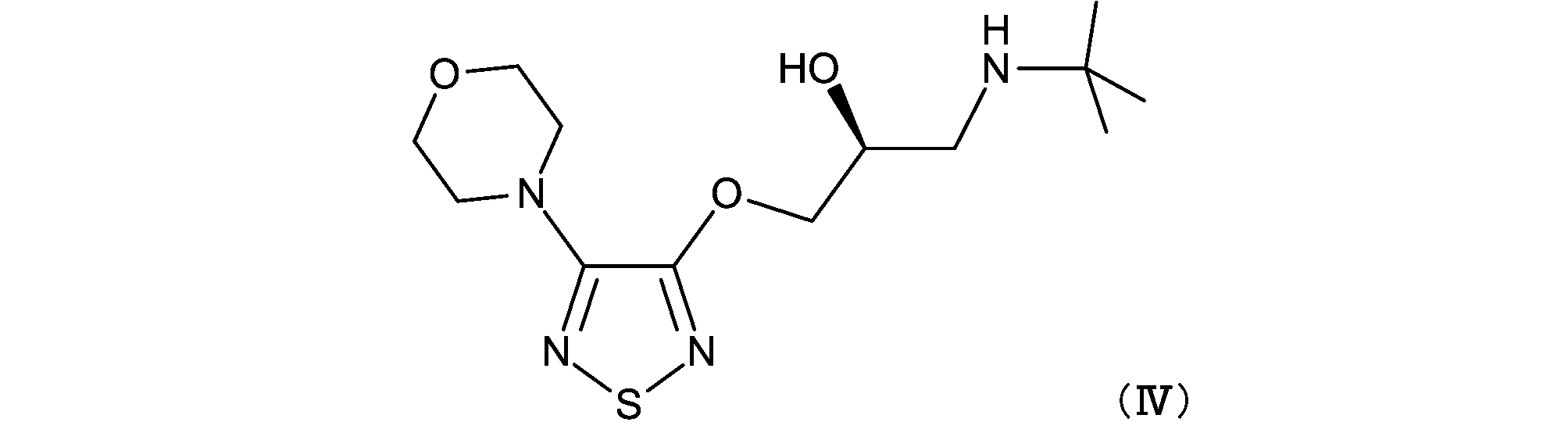
- timolol is (2S)-1-[(1,1-dimethylethyl)amino]-3-(4-morpholin-4-yl-1,2,5-thiadiazol-3-yloxy)propan-2-ol, and is represented by the following chemical formula (IV). Timolol can be synthesized by known methods or is available as a commercially available product.
- the timolol, etc. contained therein may be a salt.
- the salt of timolol, etc. include salts with inorganic acids, salts with organic acids, salts with alkali metals, salts with alkaline earth metals, and metal salts.
- salts with inorganic acids include salts with hydrochloric acid, hydrobromic acid, hydroiodic acid, nitric acid, sulfuric acid, phosphoric acid, thiocyanic acid, etc.
- salts with organic acids include salts with acetic acid, oxalic acid, fumaric acid, maleic acid, succinic acid, malic acid, citric acid, tartaric acid, adipic acid, gluconic acid, mesylic acid, lactic acid, isethionic acid, lactobionic acid, oleic acid, pamoic acid, stearic acid, tannic acid, besylic acid, salicylic acid, benzoic acid, etc.
- salts with alkali metals include salts with lithium, sodium, potassium, etc.
- salts with alkaline earth metals include salts with calcium, magnesium, etc.
- metal salts include salts with iron, zinc, etc.
- Other examples include quaternary ammonium salts, salts with halogen ions, and salts with organic amines.
- the most preferred salt of timolol is monomaleate (timolol maleate).
- the timolol, etc., and the salt of timolol, etc., contained therein may be in the form of a hydrate or solvate.
- the ophthalmic composition of the present disclosure may contain timolol or a pharmacologically acceptable salt thereof. This allows prevention or treatment of glaucoma or ocular hypertension through a mechanism different from that of dorzolamide, thereby improving the effectiveness.
- the content of timolol or a salt thereof is not particularly limited as long as it is a pharmacologically acceptable amount.
- the lower limit is preferably 0.1 w/v% or more, more preferably 0.2 w/v% or more, and most preferably 0.3 w/v% or more.
- the upper limit is preferably 3.0 w/v% or less, more preferably 2.0 w/v% or less, and most preferably 1.0 w/v% or less.
- buffering agents examples include phosphoric acid, citric acid, acetic acid, tartaric acid, carbonic acid, boric acid and their salts, trometamol, etc.
- boric acid or its salts are preferred because they have the advantage of having a bacteriostatic effect.
- phosphoric acid when used, it has the advantage of having a buffering capacity in the neutral pH range, which further increases the stability of the composition of the present disclosure.
- thickening agents examples include hydroxyethyl cellulose, hydroxypropyl cellulose, methyl cellulose, hydroxypropyl methyl cellulose, carboxymethyl cellulose and their salts, polyvinylpyrrolidone, macrogol, etc.
- isotonicity agents examples include sugars such as sorbitol, glucose, and mannitol, polyhydric alcohols such as glycerin, polyethylene glycol, and propylene glycol, and salts such as sodium chloride and potassium chloride.
- preservatives and disinfectants examples include polyhexanide hydrochloride, chlorhexidine gluconate, benzalkonium chloride, benzethonium chloride, paraoxybenzoic acid esters (parabens), benzyl alcohol, etc. Glaucoma and ocular hypertension require long-term treatment, and it is preferable for the ophthalmic composition to contain a preservative and disinfectant to prevent contamination. From the standpoint of safety and preservative efficacy, benzalkonium chloride is preferred.
- the ophthalmic composition of the present disclosure can be contained in a unit-dose container or a multi-dose container, and from the viewpoint of long-term treatment, it is preferable to contain the ophthalmic composition in a multi-dose container.
- a unit-dose container is a container intended for single use, i.e., for single use.
- a multi-dose container is a container intended for multiple use, which can be freely opened and closed with a cap or the like.
- the ophthalmic composition of the present disclosure may also be contained in a special container that exhibits an antiseptic effect by a backflow prevention function, a filter, or the like.
- the material of the container is not particularly limited, and for example, polyethylene, polypropylene, polystyrene, polyethylene terephthalate, etc. can be used for the container.
- the dosage form of the ophthalmic composition disclosed herein is not particularly limited as long as it can be used as a pharmaceutical, but eye drops are particularly preferred, and can be manufactured according to conventional methods in the art.
- the ophthalmic composition of the present disclosure is useful as a preventive and/or therapeutic agent for ophthalmology, in particular as a preventive and/or therapeutic agent for glaucoma or ocular hypertension.
- the dosage is preferably one drop administered twice a day.
- the dosage is not necessarily limited to this and can be changed as appropriate.
- the ophthalmic composition has a pH in the neutral range of 6.5 or more, and contains dorzolamide or a pharmacologically acceptable salt thereof, sulfobutylether- ⁇ -cyclodextrin or a pharmacologically acceptable salt thereof, and polyoxyethylene hydrogenated castor oil, thereby significantly suppressing the generation of dorzolamide analogues, maintaining long-term stability, and extending the expiration date.
- a method for suppressing the generation of dorzolamide analogues by allowing sulfobutylether- ⁇ -cyclodextrin and polyoxyethylene hydrogenated castor oil to coexist in an ophthalmic composition having a pH of 6.5 to 8.5 and containing dorzolamide or a pharmacologically acceptable salt thereof as an active ingredient.
- ⁇ Test example: Acceleration test> The ophthalmic solutions of Examples 1 and 2 and Comparative Examples 1 to 6 were stored at 40°C, and the dorzolamide analogues contained in each ophthalmic solution were measured 2, 4, and 6 months after the start of storage.
- the accelerated test performed under the above-mentioned 40°C condition can predict chemical changes that occur when a pharmaceutical is stored for a long period of time, and can also evaluate the effects of short-term deviations from the above-mentioned storage method that may occur during distribution.
- storage for 2 months, 4 months, and 6 months at 40°C corresponds to storage for 1 year, 2 years, and 3 years at room temperature (25°C).
- Item 1 An ophthalmic composition containing dorzolamide and/or a pharmacologically acceptable salt of dorzolamide as an active ingredient, which contains sulfobutylether- ⁇ -cyclodextrin and/or a pharmacologically acceptable salt of sulfobutylether- ⁇ -cyclodextrin and polyoxyethylene hydrogenated castor oil, and has a pH of 6.5 to 8.5.
- Item 2 The ophthalmic composition according to Item 1, wherein the pharmacologically acceptable salt of dorzolamide is dorzolamide hydrochloride.
- Item 3 The ophthalmic composition according to item 1 or 2, which contains 0.5 g to 20.0 g of the sulfobutyl ether- ⁇ -cyclodextrin when the total volume of the ophthalmic composition is 100 mL.
- Item 5 The ophthalmic composition according to Item 4, containing 0.1 g to 10.0 g of the polyoxyethylene hydrogenated castor oil 60 when the total volume of the ophthalmic composition is 100 mL.
- Item 6 An ophthalmic composition according to any one of items 1 to 5, which is used as an eye drop.
- Item 7 The ophthalmic composition according to Item 6, containing 0.1 g to 5.0 g of the dorzolamide and/or pharmacologically acceptable dorzolamide when the total volume of the eye drop is 100 mL.
- Item 8 A method for suppressing the generation of dorzolamide-related substances in an ophthalmic composition, comprising adding sulfobutylether- ⁇ -cyclodextrin and/or a pharmacologically acceptable salt of sulfobutylether- ⁇ -cyclodextrin, and polyoxyethylene hydrogenated castor oil to an ophthalmic composition containing dorzolamide or a pharmacologically acceptable salt thereof and having a pH of 6.5 to 8.5.
Landscapes
- Health & Medical Sciences (AREA)
- Chemical & Material Sciences (AREA)
- Life Sciences & Earth Sciences (AREA)
- Medicinal Chemistry (AREA)
- Pharmacology & Pharmacy (AREA)
- Animal Behavior & Ethology (AREA)
- General Health & Medical Sciences (AREA)
- Public Health (AREA)
- Veterinary Medicine (AREA)
- Epidemiology (AREA)
- Inorganic Chemistry (AREA)
- Ophthalmology & Optometry (AREA)
- Bioinformatics & Cheminformatics (AREA)
- Chemical Kinetics & Catalysis (AREA)
- General Chemical & Material Sciences (AREA)
- Nuclear Medicine, Radiotherapy & Molecular Imaging (AREA)
- Organic Chemistry (AREA)
- Proteomics, Peptides & Aminoacids (AREA)
- Engineering & Computer Science (AREA)
- Pharmaceuticals Containing Other Organic And Inorganic Compounds (AREA)
- Medicinal Preparation (AREA)
Abstract
安定性のあるドルゾラミド含有の眼科用組成物を提供する。ここで開示されるドルゾラミドまたはその薬理学的に許容される塩を含有するpH6.5~8.5の眼科用組成物は、スルホブチル-β-シクロデキストリンまたはその薬理学的に許容される塩およびポリオキシエチレン硬化ヒマシ油を含有することにより、ドルゾラミド類縁物質の発生が抑えられ、長期的な安定性が維持され、有効期限を延長することができる。
Description
本開示は、ドルゾラミドを含有する眼科用組成物に関する。なお、本出願は、2023年6月30日に出願された日本国特許出願第2023-108175号に基づく優先権を主張しており、その出願の全内容は本明細書中の参照として組み入れられている。
緑内障治療を目的とした眼科用組成物(例えば、点眼液)では、患者眼の眼圧を下げることで緑内障の進行を遅らせる手法が知られている。眼圧降下作用を持つ点眼薬には様々な種類がある。かかる点眼薬の一例として、炭酸脱水酵素阻害作用を有するドルゾラミド塩酸塩点眼液などが知られている。
一般に、市販されているドルゾラミド塩酸塩点眼液は、pHが酸性寄りのpH5.5~5.9に設計されている。これは、等張化した精製水にドルゾラミド塩酸塩を溶解させるとpHが弱酸性領域となるためである。これに対して、特許文献1では、pH6.5~8.5に調整したドルゾラミド塩酸塩点眼液が開示されている。特許文献1には、pHを中性領域に調整することで、眼刺激を低減できることが記載されている。
また、特許文献2には、ドルゾラミドまたはその薬理学的に許容される塩と、シクロデキストリンと、ラタノプロストを含み、pH5.8~6.5に調整した眼科用組成物が開示されている。この特許文献2では、ヒドロキシプロピル-β-シクロデキストリンを使用することによって、ドルゾラミドを含む組成物の安定性を改善できることが記載されている。
ところで、眼科用組成物のような医薬品は、その有効性及び安全性を維持し、長期間における品質の安定性を保証することで、長期の有効期限を実現することは非常に重要である。通常、市販される医薬品は、品質確認試験や輸送等のため、製造から市場に流通するまでに少なくとも数箇月(例えば3箇月程度)を要する。そして、有効期限を過ぎた医薬品は速やかな廃棄が求められる。このため、実際に、店頭に陳列される際や、患者に処方される際は有効期限に余裕をもたせる必要がある。このことから、ドルゾラミドを含有する眼科用組成物の有効期限を延長する技術が要求されている。
そこで、本開示は、ドルゾラミド配合の眼科用組成物の有効期限を延長することを目的とする。
ここに開示される眼科用組成物は、ドルゾラミド及び/又は薬理学的に許容されるドルゾラミドの塩を有効成分とし、スルホブチルエーテル-β-シクロデキストリン及び/又は薬理学的に許容されるスルホブチルエーテル-β-シクロデキストリンの塩と、ポリオキシエチレン硬化ヒマシ油と、を含有し、pHが6.5~8.5である。
発明者らが種々の検討を行った結果、スルホブチルエーテル-β-シクロデキストリン及び/又は薬理学的に許容されるスルホブチルエーテル-β-シクロデキストリンの塩およびポリオキシエチレン硬化ヒマシ油の組み合わせによって、驚くべきことに、ドルゾラミド配合の眼科用組成物の有効期限が顕著に延長されることを発見した。かかる効果は、pHを中性領域に維持したままドルゾラミド類縁物質の発生を抑えることができるためと予測される。すなわち、上記構成の眼科用組成物によると、ドルゾラミド配合の眼科用組成物の有効期限を延長することができる。
ここに開示される一態様の眼科用組成物は、上記薬理学的に許容されるドルゾラミドの塩がドルゾラミド塩酸塩である。かかるドルゾラミド塩酸塩は、眼科用組成物の有効成分として扱いやすく、好ましく用いられる。
ここに開示される一態様の眼科用組成物は、上記眼科用組成物の総容量を100mLとしたとき、上記スルホブチルエーテル-β-シクロデキストリンを0.5g~20.0g含有する。これによって、より好適にドルゾラミド類縁物質の発生を抑制することができる。
ここに開示される一態様の眼科用組成物は、上記ポリオキシエチレン硬化ヒマシ油の酸化エチレンの重合数が20以上100以下である。これによって、より確実にドルゾラミド類縁物質の発生を抑制することができる。
ここに開示される一態様の眼科用組成物は、上記眼科用組成物の総容量を100mLとしたとき、上記ポリオキシエチレン硬化ヒマシ油60を0.1g~10.0g含有する。これによって、より確実に長期間の安定性を維持し、組成物の有効期限を延長することができる。
ここに開示される一態様の眼科用組成物は、点眼液として使用される。これによって、緑内障または高眼圧症の予防または治療のために好適に用いることができる。
上記点眼液の総重量を100gとしたとき、上記ドルゾラミド及び/又は薬理学的に許容されるドルゾラミドの塩を0.1g~5.0g含有する。これによって、より好適に緑内障または高眼圧症の予防または治療のために用いることができる。
ここに開示されるドルゾラミドまたはその薬理学的に許容される塩を含有する眼科用組成物のドルゾラミド類縁物質の発生を抑制する方法の一態様は、pHが6.5~8.5である該眼科用組成物にスルホブチルエーテル-β-シクロデキストリン及び/又は薬理学的に許容されるスルホブチルエーテル-β-シクロデキストリンの塩およびポリオキシエチレン硬化ヒマシ油を含有させることによる。これによって、眼科用組成物において、ドルゾラミド類縁物質の発生を抑制し、有効期限を延長させることができる。
以下、本開示における典型的な実施形態について、詳細に説明する。本明細書において特に言及している事項以外の事柄であって実施に必要な事柄は、当該分野における従来技術に基づく当業者の設計事項として把握され得る。本開示は、本明細書に開示されている内容と当該分野における技術常識とに基づいて実施することができる。
<1.用語の定義>
本明細書において数値範囲を「A~B(ここでA、Bは任意の数値)」と記載している場合は、「A以上B以下」を意味すると共に、「Aを超えてB未満」、「Aを超えてB以下」、および「A以上B未満」の意味を包含する。
本明細書において数値範囲を「A~B(ここでA、Bは任意の数値)」と記載している場合は、「A以上B以下」を意味すると共に、「Aを超えてB未満」、「Aを超えてB以下」、および「A以上B未満」の意味を包含する。
本明細書において「眼科用組成物」は、眼疾患の予防または治療などのため、目に投与される組成物のことをいい、結膜嚢などの眼組織に適用される。眼科組成物の剤形は特に限定されず、液状(用時希釈して用いる濃縮液を含む)、半固形、または用時溶解もしくは用時懸濁して用いる固形の製剤を含む。具体的には、眼科組成物は、点眼液(点眼剤又は点眼薬と同義)、人工涙液、洗眼液、コンタクトレンズ用点眼液、眼軟膏剤等があり、眼局所注射により投与される形態も含む。このうち、本開示の眼用組成物は、好ましくは水性組成物であり、例えば、点眼液であることが好ましい。
本明細書において「有効期限」とは、眼科用組成物の有効性及び安全性を維持し、長期間における品質の安定性が保証された期間の最終有効年月をいう。
<2.眼科用組成物の成分とpH>
本開示の眼科用組成物は、ドルゾラミド及び/又は薬理学的に許容されるドルゾラミドの塩を有効成分とする眼科用組成物である。また、この眼科用組成物は、スルホブチルエーテル-β-シクロデキストリン及び/又は薬理学的に許容されるスルホブチルエーテル-β-シクロデキストリンの塩と、ポリオキシエチレン硬化ヒマシ油とを含有する。そして、本開示の眼科用組成物は、pHが6.5~8.5である。以下、各要素について詳細に説明する。
本開示の眼科用組成物は、ドルゾラミド及び/又は薬理学的に許容されるドルゾラミドの塩を有効成分とする眼科用組成物である。また、この眼科用組成物は、スルホブチルエーテル-β-シクロデキストリン及び/又は薬理学的に許容されるスルホブチルエーテル-β-シクロデキストリンの塩と、ポリオキシエチレン硬化ヒマシ油とを含有する。そして、本開示の眼科用組成物は、pHが6.5~8.5である。以下、各要素について詳細に説明する。
<ドルゾラミド>
本明細書において、ドルゾラミドは、(4S,6S)-4-エチルアミノ-6-メチル-5,6-ジヒドロ-4H-チエノ[2,3-b]チオピラン-2-スルホンアミド7,7-ジオキシド((4S,6S)-4-Ethylamino-6-methyl-5,6-dihydro-4H-thieno[2,3-b]thiopyran-2-sulfonamide7,7-deioxide)であり、下記化学式(I)で表される化合物である。ドルゾラミドは、公知の方法により合成してもよく市販品として入手することもできる。

本明細書において、ドルゾラミドは、(4S,6S)-4-エチルアミノ-6-メチル-5,6-ジヒドロ-4H-チエノ[2,3-b]チオピラン-2-スルホンアミド7,7-ジオキシド((4S,6S)-4-Ethylamino-6-methyl-5,6-dihydro-4H-thieno[2,3-b]thiopyran-2-sulfonamide7,7-deioxide)であり、下記化学式(I)で表される化合物である。ドルゾラミドは、公知の方法により合成してもよく市販品として入手することもできる。
本開示の眼科用組成物において、含有されるドルゾラミドは塩であってもよい。かかるドルゾラミドの塩は、薬理学的に許容される塩であれば特に制限はない。上記ドルゾラミドの塩としては無機酸との塩、有機酸との塩、アルカリ金属との塩、アルカリ土類金属との塩、金属塩が挙げられる。例えば、無機酸との塩としては、塩酸、臭化水素酸、ヨウ化水素酸、硝酸、硫酸、リン酸、チオシアン酸等との塩が挙げられる。有機酸との塩としては、酢酸、シュウ酸、フマル酸、マレイン酸、コハク酸、リンゴ酸、クエン酸、酒石酸、アジピン酸、グルコン酸、メシル酸、乳酸、イセチオン酸、ラクトビオン酸、オレイン酸、パモ酸、ステアリン酸、タンニン酸、ベシル酸、サリチル酸、安息香酸等との塩が挙げられる。アルカリ金属との塩としては、リチウム、ナトリウム、カリウム等との塩が挙げられる。アルカリ土類金属との塩としては、カルシウム、マグネシウム等との塩が挙げられる。金属塩としては、鉄、亜鉛等との塩が挙げられる。この他にも、第四級アンモニウム塩、ハロゲンイオンとの塩、有機アミンとの塩等が挙げられる。このうち、ドルゾラミドの塩としては、一塩酸塩(ドルゾラミド塩酸塩)が特に好ましい。
また、ドルゾラミドおよびドルゾラミドの塩は、水和物または溶媒和物の形態をとってもよい。
ドルゾラミドまたはドルゾラミドの塩の含有量は、薬理学的に許容される量であれば、特に制限されない。有効濃度の観点から、下限値は0.1w/v%以上が好ましく、0.2w/v%以上がより好ましく、0.5w/v%以上が最も好ましい。上限値は5.0w/v%以下が好ましく、3.0w/v%以下がより好ましく、2.0w/v%以下が最も好ましい。なお、本明細書において、特に記載のない限り、「w/v%」は、「g/100mL」すなわち組成物100mL中に含まれる対象成分の質量(g)を意味する。
<スルホブチルエーテル-β-シクロデキストリン>
本開示の眼科用組成物は、安定化剤としてスルホブチルエーテル-β-シクロデキストリン(SBE-β-CD)を配合する。SBE-β-CDは、公知の方法により合成してもよく市販品として入手することもできる。SBE-β-CDは、アニオン性のシクロデキストリン誘導体である。SBE-β-CDは、アニオン性の官能基を有するため、カチオン性のゲスト(例えば、窒素原子を含むドルゾラミド)に対するシクロデキストリンの結合親和性を改善することができる。
本開示の眼科用組成物は、安定化剤としてスルホブチルエーテル-β-シクロデキストリン(SBE-β-CD)を配合する。SBE-β-CDは、公知の方法により合成してもよく市販品として入手することもできる。SBE-β-CDは、アニオン性のシクロデキストリン誘導体である。SBE-β-CDは、アニオン性の官能基を有するため、カチオン性のゲスト(例えば、窒素原子を含むドルゾラミド)に対するシクロデキストリンの結合親和性を改善することができる。
本開示の眼科用組成物において、含有されるSBE-β-CDは塩であってもよい。SBE-β-CDの塩は薬理学的に許容される塩であれば特に制限はない。SBE-β-CDの塩としては無機酸との塩、有機酸との塩、アルカリ金属との塩、アルカリ土類金属との塩、金属塩が挙げられる。例えば、無機酸との塩としては、塩酸、臭化水素酸、ヨウ化水素酸、硝酸、硫酸、リン酸、チオシアン酸等との塩が挙げられる。有機酸との塩としては、酢酸、シュウ酸、フマル酸、マレイン酸、コハク酸、リンゴ酸、クエン酸、酒石酸、アジピン酸、グルコン酸、メシル酸、乳酸、イセチオン酸、ラクトビオン酸、オレイン酸、パモ酸、ステアリン酸、タンニン酸、ベシル酸、サリチル酸、安息香酸等との塩が挙げられる。アルカリ金属との塩としては、リチウム、ナトリウム、カリウム等との塩が挙げられる。アルカリ土類金属との塩としては、カルシウム、マグネシウム等との塩が挙げられる。金属塩としては、鉄、亜鉛等との塩が挙げられる。この他にも、第四級アンモニウム塩、ハロゲンイオンとの塩、有機アミンとの塩等が挙げられる。このうち、SBE-β-CDの塩としては、一ナトリウム塩(SBE-β-CDナトリウム)が特に好ましい。
本明細書において、SBE-β-CDまたはSBE-β-CDの塩の含有量は、生体に許容される量であれば、特に制限されない。なお、ドルゾラミドを安定化させる観点から、下限値は0.5w/v%以上でもよく、1.0w/v%以上が好ましく、5.5w/v%以上がより好ましく、6.0w/v%以上がさらに好ましく、8.0w/v%以上が最も好ましい。上限値は20.0w/v%以下でもよく、15.0w/v%以下がでもよく、11.0w/v%以下がでもよい。
<ポリオキシエチレン硬化ヒマシ油>
本開示の眼科用組成物は、可溶化剤として非イオン性界面活性剤のポリオキシエチレン硬化ヒマシ油を配合する。ポリオキシエチレン硬化ヒマシ油としては、酸化エチレンの重合数の異なる種々のポリオキシエチレン硬化ヒマシ油を用いることができる。酸化エチレンの重合数は、特に制限されない。ドルゾラミドを安定化させる観点から、重合数の下限値は20以上が好ましく、30以上がより好ましく、40以上が最も好ましい。上限値は100以下が好ましく、80以下がより好ましく、60以下が最も好ましい。ポリオキシエチレン硬化ヒマシ油の具体例としては、ポリオキシエチレン硬化ヒマシ油40、ポリオキシエチレン硬化ヒマシ油60、ポリオキシエチレン硬化ヒマシ油80等が挙げられる。本開示の効果をより顕著に高める観点から、ポリオキシエチレン硬化ヒマシ油60が最も好ましい。また、ポリオキシエチレン硬化ヒマシ油の含有量は、生体に許容される量であれば、特に制限されない。なお、ドルゾラミドを安定化させる観点から、下限値は0.1w/v%以上が好ましく、0.5w/v%以上がより好ましく、1.0w/v%以上が最も好ましい。上限値は10.0w/v%以下でもよく、5.0w/v%以下でもよく、3.0w/v%以下でもよい。
本開示の眼科用組成物は、可溶化剤として非イオン性界面活性剤のポリオキシエチレン硬化ヒマシ油を配合する。ポリオキシエチレン硬化ヒマシ油としては、酸化エチレンの重合数の異なる種々のポリオキシエチレン硬化ヒマシ油を用いることができる。酸化エチレンの重合数は、特に制限されない。ドルゾラミドを安定化させる観点から、重合数の下限値は20以上が好ましく、30以上がより好ましく、40以上が最も好ましい。上限値は100以下が好ましく、80以下がより好ましく、60以下が最も好ましい。ポリオキシエチレン硬化ヒマシ油の具体例としては、ポリオキシエチレン硬化ヒマシ油40、ポリオキシエチレン硬化ヒマシ油60、ポリオキシエチレン硬化ヒマシ油80等が挙げられる。本開示の効果をより顕著に高める観点から、ポリオキシエチレン硬化ヒマシ油60が最も好ましい。また、ポリオキシエチレン硬化ヒマシ油の含有量は、生体に許容される量であれば、特に制限されない。なお、ドルゾラミドを安定化させる観点から、下限値は0.1w/v%以上が好ましく、0.5w/v%以上がより好ましく、1.0w/v%以上が最も好ましい。上限値は10.0w/v%以下でもよく、5.0w/v%以下でもよく、3.0w/v%以下でもよい。
<眼科用組成物のpH>
本開示の眼科用組成物は、pHが6.5~8.5(中性領域)である。ドルゾラミドまたはドルゾラミドの塩を等張化した精製水に溶解させると水溶液のpHが酸性領域(例えばpH5.5~5.9)となるため、pH調整剤を添加してpHを6.5~8.5に調整する。ドルゾラミドを有効成分とする眼科用組成物は、強い眼刺激性を有している。しかしながら、pHを中性領域とすることで、眼刺激性を軽減させることができるため、患者が用法用量を守って治療を継続しやすくなる。
本開示の眼科用組成物は、pHが6.5~8.5(中性領域)である。ドルゾラミドまたはドルゾラミドの塩を等張化した精製水に溶解させると水溶液のpHが酸性領域(例えばpH5.5~5.9)となるため、pH調整剤を添加してpHを6.5~8.5に調整する。ドルゾラミドを有効成分とする眼科用組成物は、強い眼刺激性を有している。しかしながら、pHを中性領域とすることで、眼刺激性を軽減させることができるため、患者が用法用量を守って治療を継続しやすくなる。
pH調整剤の例としては、水酸化ナトリウムまたは水酸化カルシウムの他、水酸化カリウム等のアルカリ性水溶液、塩酸、クエン酸等の酸性水溶液が挙げられる。本開示では、ドルゾラミドまたはドルゾラミドの塩を等張化した精製水に溶解させると水溶液のpHが酸性領域となるため、水酸化ナトリウムを用いて中性領域とするのが好ましい。本開示の眼科用組成物のpHの下限値は、上記観点から、6.5以上が好ましく、6.7以上がより好ましい。上限値は、8.5以下が好ましく、8.2以下がより好ましく、7.8以下がさらに好ましい。
<2.本開示の眼科用組成物の効果>
上記のような眼科用組成物は、ドルゾラミド類縁物質の発生を抑制し、ドルゾラミド配合の眼科用組成物の有効期限を3年まで延長することができる。このドルゾラミド類縁物質は、基準値を超えた時の人体への薬効及び毒性が未知であるため、安全性の維持ができず、有効期限が短くなる。
上記のような眼科用組成物は、ドルゾラミド類縁物質の発生を抑制し、ドルゾラミド配合の眼科用組成物の有効期限を3年まで延長することができる。このドルゾラミド類縁物質は、基準値を超えた時の人体への薬効及び毒性が未知であるため、安全性の維持ができず、有効期限が短くなる。
具体的には、ドルゾラミド及び/又はドルゾラミドの塩を含み、pHが中性領域である眼科用組成物において、それを長期保存した場合に、ドルゾラミド類縁物質が発生し、その有効期限が1.5年に留まることが判明した。なお、本明細書において、ドルゾラミド類縁物質の一形態として、(4R,6S)-4-エチルアミノ-6-メチル-5,6-ジヒドロ-4H-チエノ[2,3-b]チオピラン-2-スルホンアミド7,7-ジオキシド((4R,6S)-4-Ethylamino-6-methyl-5,6-dihydro-4H-thieno[2,3-b]thiopyran-2-sulfonamide7,7-deioxide)が挙げられる。かかる化合物は、以下の化学式(II)で表される。また、式(II)の化合物の鏡像異性体である(4S,6R)-4-エチルアミノ-6-メチル-5,6-ジヒドロ-4H-チエノ[2,3-b]チオピラン-2-スルホンアミド7,7-ジオキシド((4S,6R)-4-Ethylamino-6-methyl-5,6-dihydro-4H-thieno[2,3-b]thiopyran-2-sulfonamide7,7-deioxide)も挙げられる。かかる化合物は、以下の化学式(III)で表される。


また、長期の有効期限を実現するためには、ドルゾラミド及び/又はドルゾラミドの塩を含む眼科用組成物に、シクロデキストリンであるSBE-β-CDを加え、かつ、界面活性剤であるポリオキシエチレン硬化ヒマシ油を加える必要があることが、実験で確認された。これは、SBE-β-CDによるドルゾラミドの包接化が促進されたためであると推測される。
<3.その他の成分>
本開示の眼科用組成物には、本開示にかかる技術の効果を著しく損なわない限りにおいて、医薬品の添加物として使用可能な異なる他の成分を含むものとしてもよい。このような成分としては、公知の眼科用組成物に用いられる薬効を期待した有効成分や製剤設計上必要とされる添加剤等が配合されうる。具体的には、公知の緩衝剤、pH調整剤、増粘剤、等張化剤、キレート剤、湿潤剤、香料又は清涼化剤、薬剤、抗菌剤、防腐剤・殺菌剤等が、一種又は二種以上組み合わされて配合され得る。
本開示の眼科用組成物には、本開示にかかる技術の効果を著しく損なわない限りにおいて、医薬品の添加物として使用可能な異なる他の成分を含むものとしてもよい。このような成分としては、公知の眼科用組成物に用いられる薬効を期待した有効成分や製剤設計上必要とされる添加剤等が配合されうる。具体的には、公知の緩衝剤、pH調整剤、増粘剤、等張化剤、キレート剤、湿潤剤、香料又は清涼化剤、薬剤、抗菌剤、防腐剤・殺菌剤等が、一種又は二種以上組み合わされて配合され得る。
本開示の眼科用組成物は、ドルゾラミドに加えて、さらに医薬品の有効成分として使用可能な異なる他の成分を配合してもよい。この他の有効成分としては、眼圧下降作用を示し、緑内障または高眼圧症の治療に有用なものが好ましい。例えば、他の有効成分には、ブリモニジン等のα2受容体作動薬、ベフノロール、カルテオロール、ニプラジロール、ベタキソロール、レボブノロール、メチプラノロール等のβ受容体遮断薬、ラタノプロスト、トラボプロスト、ビマトプロスト等のプロスタグランジンF誘導体等が挙げられる。このうち、チモロールは、高眼圧の処置に有用であるという利点があり、好ましい。
上記ドルゾラミドと同様に、チモロールは、(2S)-1-[(1,1-ジメチルエチル)アミノ]-3-(4-モルホリノ-4-イル-1,2,5-チアジアゾール-3-イルオキシ)プロパン-2-オール((2S)-1-[(1,1-Dimethylethyl)amino]-3-(4-morpholin-4-yl-1,2,5-thiadiazol-3-yloxy)propan-2-ol)であり、以下の化学式(IV)で表される。チモロールは、公知の方法により合成してもよく市販品として入手することもできる。
本開示の眼科用組成物において、含有されるチモロール等は塩であってもよい。かかるチモロール等の塩は薬理学的に許容される塩であれば特に制限はない。上記チモロール等の塩としては無機酸との塩、有機酸との塩、アルカリ金属との塩、アルカリ土類金属との塩、金属塩が挙げられる。例えば、無機酸との塩としては、塩酸、臭化水素酸、ヨウ化水素酸、硝酸、硫酸、リン酸、チオシアン酸等との塩が挙げられる。有機酸との塩としては、酢酸、シュウ酸、フマル酸、マレイン酸、コハク酸、リンゴ酸、クエン酸、酒石酸、アジピン酸、グルコン酸、メシル酸、乳酸、イセチオン酸、ラクトビオン酸、オレイン酸、パモ酸、ステアリン酸、タンニン酸、ベシル酸、サリチル酸、安息香酸等との塩が挙げられる。アルカリ金属との塩としては、リチウム、ナトリウム、カリウム等との塩が挙げられる。アルカリ土類金属との塩としては、カルシウム、マグネシウム等との塩が挙げられる。金属塩としては、鉄、亜鉛等との塩が挙げられる。この他にも、第四級アンモニウム塩、ハロゲンイオンとの塩、有機アミンとの塩等が挙げられる。なお、チモロールの塩としては、一マレイン酸塩(チモロールマレイン酸塩)が特に好ましい。
また、本開示の眼科用組成物において、含有されるチモロール等およびチモロールの塩等は、水和物または溶媒和物の形態をとってもよい。
本開示の眼科用組成物には、チモロールまたはその薬理学的に許容される塩を配合してもよい。これにより、ドルゾラミドとは異なる機構によって緑内障または高眼圧症の予防または治療でき、より効果を高めることができる。また、チモロールまたはその塩の含有量は、薬理学的に許容される量であれば、特に制限されない。有効濃度の観点から、下限値は0.1w/v%以上が好ましく、0.2w/v%以上がより好ましく、0.3w/v%以上が最も好ましい。上限値は3.0w/v%以下が好ましく、2.0w/v%以下がより好ましく、1.0w/v%以下が最も好ましい。
緩衝剤の例としては、リン酸、クエン酸、酢酸、酒石酸、炭酸、ホウ酸およびこれらの塩、トロメタモール等が挙げられる。このうち、ホウ酸又はその塩は、静菌効果を有するという利点があり、好ましい。また、リン酸を用いる場合は、pHが中性領域に緩衝能を有するため、本開示の組成物の安定性をより高めるという利点がある。
増粘剤の例としては、ヒドロキシエチルセルロース、ヒドロキシプロピルセルロース、メチルセルロース、ヒドロキシプロピルメチルセルロース、カルボキシメチルセルロースおよびこれらの塩、ポリビニルピロリドン、マクロゴール等が挙げられる。
等張化剤の例としては、ソルビトール、グルコース、マンニトール等の糖類、グリセリン、ポリエチレングリコール、プロピレングリコール等の多価アルコール類、塩化ナトリウム、塩化カリウムなどの塩類等が挙げられる。
防腐剤・殺菌剤の例としては、塩酸ポリヘキサニド、グルコン酸クロルヘキシジン、ベンザルコニウム塩化物、ベンゼトニウム塩化物、パラオキシ安息香酸エステル類(パラベン)、ベンジルアルコール等が挙げられる。緑内障および高眼圧症は長期に渡って治療をする必要があり、眼科用組成物が汚染されないように防腐剤・殺菌剤が含まれていることが好ましい。安全性および防腐効力の観点から、ベンザルコニウム塩化物が好ましい。
<4.使用方法等>
本開示の眼科用組成物は、ユニットドーズ型容器やマルチドーズ型容器に入れることができ、長期的な治療の観点から、マルチドーズ型容器に入れられることが好ましい。ユニットドーズ型容器とは一回使い切り、すなわち単回使用することを目的とする容器である。一方、マルチドーズ型容器とは複数回使用することを目的にキャップ等により開閉を自由に行えるようにした容器である。また、本開示の眼科用組成物は、逆流防止機能やフィルター等により防腐効果を発揮する特殊な容器に入れてもよい。容器の素材は、特に制限はないが、例えば、容器には、ポリエチレン、ポリプロピレン、ポリスチレン、ポリエチレンテレフタレート等を用いることができる。
本開示の眼科用組成物は、ユニットドーズ型容器やマルチドーズ型容器に入れることができ、長期的な治療の観点から、マルチドーズ型容器に入れられることが好ましい。ユニットドーズ型容器とは一回使い切り、すなわち単回使用することを目的とする容器である。一方、マルチドーズ型容器とは複数回使用することを目的にキャップ等により開閉を自由に行えるようにした容器である。また、本開示の眼科用組成物は、逆流防止機能やフィルター等により防腐効果を発揮する特殊な容器に入れてもよい。容器の素材は、特に制限はないが、例えば、容器には、ポリエチレン、ポリプロピレン、ポリスチレン、ポリエチレンテレフタレート等を用いることができる。
本開示の眼科用組成物の剤形は、医薬品として使用可能なものであれば特に制限されないが、特に点眼剤が好ましく、当該技術分野における通常の方法に従って製造することができる。
本開示の眼科用組成物は、眼科用の予防剤及び/又は治療剤、特に緑内障または高眼圧症の予防剤及び/又は治療剤として有用である。
本開示の眼科用組成物を投与する場合、眼病、眼疾病の効果的な予防及び/又は治療の観点から、用法用量は、1回1滴、1日2回点眼するのが好ましい。しかし、用法用量は、必ずしもこれに限定されず、適宜変更可能である。
<5.ドルゾラミド類縁物質の発生を抑制する方法>
ここに開示される技術の他の態様として、上記のとおり、眼科用組成物は、pHが6.5以上の中性領域であり、ドルゾラミドまたはその薬理学的に許容される塩、スルホブチルエーテル-β-シクロデキストリンまたはその薬理学的に許容される塩、およびポリオキシエチレン硬化ヒマシ油を含有することで、顕著にドルゾラミド類縁物質の発生を抑制し、長期の安定性を維持し、有効期限が延長している。したがって、本実施形態として、ドルゾラミドまたはその薬理学的に許容される塩を有効成分とするpH6.5~8.5の眼科用組成物に、スルホブチルエーテル-β-シクロデキストリンおよびポリオキシエチレン硬化ヒマシ油を共存させることにより、ドルゾラミド類縁物質の発生を抑制する方法が提供される。
ここに開示される技術の他の態様として、上記のとおり、眼科用組成物は、pHが6.5以上の中性領域であり、ドルゾラミドまたはその薬理学的に許容される塩、スルホブチルエーテル-β-シクロデキストリンまたはその薬理学的に許容される塩、およびポリオキシエチレン硬化ヒマシ油を含有することで、顕著にドルゾラミド類縁物質の発生を抑制し、長期の安定性を維持し、有効期限が延長している。したがって、本実施形態として、ドルゾラミドまたはその薬理学的に許容される塩を有効成分とするpH6.5~8.5の眼科用組成物に、スルホブチルエーテル-β-シクロデキストリンおよびポリオキシエチレン硬化ヒマシ油を共存させることにより、ドルゾラミド類縁物質の発生を抑制する方法が提供される。
以下、実施例及び比較例を示し、本開示の眼科用組成物を具体的に説明する。ここでは、本開示の眼科用組成物の例として、点眼液を例に挙げて説明するが、下記の実施例に制限されるものではない。
<実施例1~2及び比較例1~6の調製>
基本処方を以下のようにする。
・ドルゾラミド塩酸塩:1.113w/v%
・チモロールマレイン酸塩:0.683w/v%
・1mol/L水酸化ナトリウム液(水酸化ナトリウム水溶液):適量
・精製水:適量
・浸透圧比:約1.0
基本処方を以下のようにする。
・ドルゾラミド塩酸塩:1.113w/v%
・チモロールマレイン酸塩:0.683w/v%
・1mol/L水酸化ナトリウム液(水酸化ナトリウム水溶液):適量
・精製水:適量
・浸透圧比:約1.0
まず、精製水16mLにドルゾラミド塩酸塩0.22g及びチモロールマレイン酸塩0.136gを加えて溶解した。さらに、表1に示すような組成で他の化合物を溶解した。混合した各溶液のpHを、1mol/L水酸化ナトリウム液の滴加により調整後、精製水で全量20mLとした。そして、調製した各溶液のpHを、pHメーター(S210:メトラー・トレド株式会社)を用いて測定した。調製液をプラスチック容器に充填し、プラスチック製中栓およびプラスチック製キャップを装着し、実施例1および2並びに比較例1~6の点眼液を得た。

<試験例:加速試験>
実施例1および2並びに比較例1~6の点眼液を、40℃で保存し、保存開始から2、4および6箇月経過時に各点眼液中に含まれるドルゾラミド類縁物質を測定した。なお、上記40℃の条件において実施される加速試験は、医薬品を長期間保存した場合の化学的変化を予測すると同時に、流通期間中に起こり得る上記貯蔵方法からの短期的な逸脱の影響を評価することができる。アレニウスの式により、40℃における2箇月、4箇月および6箇月の保存は、室温(25℃)における1年、2年および3年に相当する。
実施例1および2並びに比較例1~6の点眼液を、40℃で保存し、保存開始から2、4および6箇月経過時に各点眼液中に含まれるドルゾラミド類縁物質を測定した。なお、上記40℃の条件において実施される加速試験は、医薬品を長期間保存した場合の化学的変化を予測すると同時に、流通期間中に起こり得る上記貯蔵方法からの短期的な逸脱の影響を評価することができる。アレニウスの式により、40℃における2箇月、4箇月および6箇月の保存は、室温(25℃)における1年、2年および3年に相当する。
<ドルゾラミド類縁物質の測定>
ドルゾラミド類縁物質を第十八改正日本薬局方第一追補(令和4年12月12日厚生労働省告示第355号)に規定されるドルゾラミド塩酸塩・チモロールマレイン酸塩点眼液の純度試験(類縁物質1)に記載された方法により測定した。具体的には、高速液体クロマトグラフ法により、点眼液中のピーク面積を自動積分法に測定し、ドルゾラミドのピーク面積に対する相対保持時間1.2の類縁物質のピーク面積比を求めた。なお、日本薬局方での基準では、保存中にピーク面積比が0.024を超えると日本薬局方における製剤の保証ができなくなる。
ドルゾラミド類縁物質を第十八改正日本薬局方第一追補(令和4年12月12日厚生労働省告示第355号)に規定されるドルゾラミド塩酸塩・チモロールマレイン酸塩点眼液の純度試験(類縁物質1)に記載された方法により測定した。具体的には、高速液体クロマトグラフ法により、点眼液中のピーク面積を自動積分法に測定し、ドルゾラミドのピーク面積に対する相対保持時間1.2の類縁物質のピーク面積比を求めた。なお、日本薬局方での基準では、保存中にピーク面積比が0.024を超えると日本薬局方における製剤の保証ができなくなる。
以下に高速液体クロマトグラフ法で使用した機器および条件を具体的に示す。
・液体クロマトグラフ装置:Prominence-i(株式会社島津製作所)
・液体クロマトグラフのデータ処理装置:LabSolutions(株式会社島津製作所)
・検出器:紫外吸光光度計(測定波長:253nm)
・移動相:薄めたリン酸(1→500)/アセトニトリル混液(19:1)
・カラム:XBridge C18 内径4.6mm、長さ250mm、粒子径5μm(Waters製)
・カラム温度:25℃
・流量:1.2mL/min
・注入量:20μL
・液体クロマトグラフ装置:Prominence-i(株式会社島津製作所)
・液体クロマトグラフのデータ処理装置:LabSolutions(株式会社島津製作所)
・検出器:紫外吸光光度計(測定波長:253nm)
・移動相:薄めたリン酸(1→500)/アセトニトリル混液(19:1)
・カラム:XBridge C18 内径4.6mm、長さ250mm、粒子径5μm(Waters製)
・カラム温度:25℃
・流量:1.2mL/min
・注入量:20μL
表2に上記試験の結果を示す。表2の「日本薬局方基準(0.024以下)」の欄では、保存2箇月、保存4箇月および保存6箇月のすべてにおいてピーク面積比(ドルゾラミド類縁物質/ドルゾラミド)が0.024以下であるものを有効期限が延長された(○)、保存2箇月、保存4箇月または保存6箇月のいずれか一か所でもピーク面積比(ドルゾラミド類縁物質/ドルゾラミド)が0.024以上となったものを有効期限が延長されていなかった(×)として評価した。なお、各測定時点におけるピーク面積比(ドルゾラミド類縁物質/ドルゾラミド)をy軸と、40℃における保存期間をx軸とした場合の回帰式を求めた。回帰式より、y軸が0.024となる40℃における保存期間を基に25℃における有効期限を求めた。
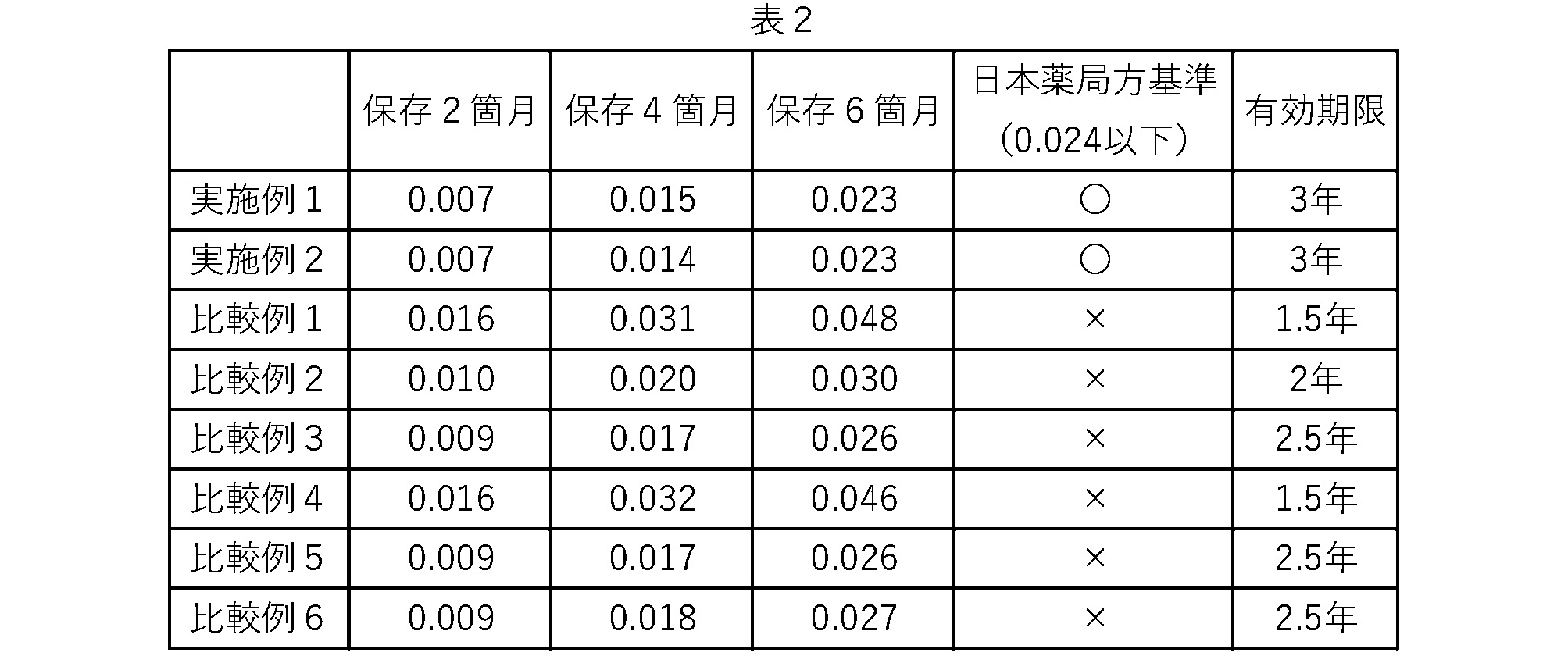
以上の試験結果から、スルホブチルエーテル-β-シクロデキストリンを含有しない比較例1~2および4~5、ポリオキシエチレン硬化ヒマシ油60を含有しない比較例3、6では、保存中にドルゾラミド類縁物質が基準値を超え、有効期限を延長することができなかった。これに対し、実施例1~2では、スルホブチルエーテル-β-シクロデキストリンとポリオキシエチレン硬化ヒマシ油60を含有することにより、顕著にドルゾラミド類縁物質の発生が抑制され、有効期限を3年に延長できることがわかった。
以上、本開示を好適な実施例により説明したが、こうした記述は限定事項ではなく、もちろん配合量の数値や添加物等種々の改変が可能である。
ここで開示される技術は、特段の問題が生じない限りにおいて、各構成要素やここで言及された各処理は適宜に省略され、または、適宜に組み合わされうる。また、本明細書は、以下の各項に記載の開示を含んでいる。
項1:ドルゾラミド及び/又は薬理学的に許容されるドルゾラミドの塩を有効成分とする眼科用組成物であって、スルホブチルエーテル-β-シクロデキストリン及び/又は薬理学的に許容されるスルホブチルエーテル-β-シクロデキストリンの塩と、ポリオキシエチレン硬化ヒマシ油と、を含有し、pHが6.5~8.5である、眼科用組成物。
項2:上記薬理学的に許容されるドルゾラミドの塩がドルゾラミド塩酸塩である、項1に記載の眼科用組成物。
項3:上記眼科用組成物の総容量を100mLとしたとき、上記スルホブチルエーテル-β-シクロデキストリンを0.5g~20.0g含有する、項1または2に記載の眼科用組成物。
項4:上記ポリオキシエチレン硬化ヒマシ油の酸化エチレンの重合数が20以上100以下である、項1から3のいずれか1つに記載の眼科用組成物。
項5:上記眼科用組成物の総容量を100mLとしたとき、上記ポリオキシエチレン硬化ヒマシ油60を0.1g~10.0g含有する、項4に記載の眼科用組成物。
項6:点眼液として使用される、項1から5のいずれか1つに記載の眼科用組成物。
項7:上記点眼液の総容量を100mLとしたとき、上記ドルゾラミド及び/又は薬理学的に許容されるドルゾラミドを0.1g~5.0g含有する、項6に記載の眼科用組成物。
項8:ドルゾラミドまたはその薬理学的に許容される塩を含有し、pHが6.5~8.5である眼科用組成物にスルホブチルエーテル-β-シクロデキストリン及び/又は薬理学的に許容されるスルホブチルエーテル-β-シクロデキストリンの塩およびポリオキシエチレン硬化ヒマシ油を含有させることにより、眼科用組成物のドルゾラミド類縁物質の発生を抑制する方法。
Claims (8)
- ドルゾラミド及び/又は薬理学的に許容されるドルゾラミドの塩を有効成分とする眼科用組成物であって、
スルホブチルエーテル-β-シクロデキストリン及び/又は薬理学的に許容されるスルホブチルエーテル-β-シクロデキストリンの塩と、
ポリオキシエチレン硬化ヒマシ油と、
を含有し、
pHが6.5~8.5である、眼科用組成物。 - 前記薬理学的に許容されるドルゾラミドの塩がドルゾラミド塩酸塩である、請求項1に記載の眼科用組成物。
- 前記眼科用組成物の総容量を100mLとしたとき、前記スルホブチルエーテル-β-シクロデキストリンを0.5g~20.0g含有する、請求項2に記載の眼科用組成物。
- 前記ポリオキシエチレン硬化ヒマシ油の酸化エチレンの重合数が20以上100以下である、請求項1に記載の眼科用組成物。
- 前記眼科用組成物の総容量を100mLとしたとき、前記ポリオキシエチレン硬化ヒマシ油60を0.1g~10.0g含有する、請求項4に記載の眼科用組成物。
- 点眼液として使用される、請求項1~5のいずれか一項に記載の眼科用組成物。
- 前記点眼液の総容量を100mLとしたとき、前記ドルゾラミド及び/又は薬理学的に許容されるドルゾラミドを0.1g~5.0g含有する、請求項6に記載の眼科用組成物。
- ドルゾラミドまたはその薬理学的に許容される塩を含有し、pHが6.5~8.5である眼科用組成物にスルホブチルエーテル-β-シクロデキストリン及び/又は薬理学的に許容されるスルホブチルエーテル-β-シクロデキストリンの塩およびポリオキシエチレン硬化ヒマシ油を含有させることにより、眼科用組成物のドルゾラミド類縁物質の発生を抑制する方法。
Priority Applications (1)
| Application Number | Priority Date | Filing Date | Title |
|---|---|---|---|
| JP2025529498A JPWO2025004579A1 (ja) | 2023-06-30 | 2024-05-15 |
Applications Claiming Priority (2)
| Application Number | Priority Date | Filing Date | Title |
|---|---|---|---|
| JP2023108175 | 2023-06-30 | ||
| JP2023-108175 | 2023-06-30 |
Publications (1)
| Publication Number | Publication Date |
|---|---|
| WO2025004579A1 true WO2025004579A1 (ja) | 2025-01-02 |
Family
ID=93938073
Family Applications (1)
| Application Number | Title | Priority Date | Filing Date |
|---|---|---|---|
| PCT/JP2024/017874 Ceased WO2025004579A1 (ja) | 2023-06-30 | 2024-05-15 | 眼科用組成物 |
Country Status (2)
| Country | Link |
|---|---|
| JP (1) | JPWO2025004579A1 (ja) |
| WO (1) | WO2025004579A1 (ja) |
Citations (4)
| Publication number | Priority date | Publication date | Assignee | Title |
|---|---|---|---|---|
| JP2009242368A (ja) * | 2008-03-31 | 2009-10-22 | Nidek Co Ltd | ドルゾラミド塩酸塩点眼液 |
| JP2017165707A (ja) * | 2016-03-14 | 2017-09-21 | 参天製薬株式会社 | ドルゾラミドとチモロールと界面活性剤を含有する医薬組成物 |
| JP2018521000A (ja) * | 2015-05-29 | 2018-08-02 | シドネキシス,インク. | D2oで安定化された医薬製剤 |
| CN112972683A (zh) * | 2019-12-13 | 2021-06-18 | 刘力 | 局部给药的葛林佐胺等药物组合物 |
-
2024
- 2024-05-15 WO PCT/JP2024/017874 patent/WO2025004579A1/ja not_active Ceased
- 2024-05-15 JP JP2025529498A patent/JPWO2025004579A1/ja active Pending
Patent Citations (4)
| Publication number | Priority date | Publication date | Assignee | Title |
|---|---|---|---|---|
| JP2009242368A (ja) * | 2008-03-31 | 2009-10-22 | Nidek Co Ltd | ドルゾラミド塩酸塩点眼液 |
| JP2018521000A (ja) * | 2015-05-29 | 2018-08-02 | シドネキシス,インク. | D2oで安定化された医薬製剤 |
| JP2017165707A (ja) * | 2016-03-14 | 2017-09-21 | 参天製薬株式会社 | ドルゾラミドとチモロールと界面活性剤を含有する医薬組成物 |
| CN112972683A (zh) * | 2019-12-13 | 2021-06-18 | 刘力 | 局部给药的葛林佐胺等药物组合物 |
Also Published As
| Publication number | Publication date |
|---|---|
| JPWO2025004579A1 (ja) | 2025-01-02 |
Similar Documents
| Publication | Publication Date | Title |
|---|---|---|
| AU2007304996B2 (en) | Self-preserved aqueous pharmaceutical compositions | |
| DK2598119T3 (en) | CONSERVATIVE-FREE BRIMONIDINE AND TIMOLOL SOLUTIONS | |
| JP2015110672A (ja) | ビマトプロストおよびブリモニジンの固定用量の組み合わせ | |
| JP2019142974A (ja) | 水溶性高分子を含む水性液剤 | |
| JP6934581B2 (ja) | エピナスチン又はその塩を含有する水性医薬組成物 | |
| CN103608000B (zh) | 含有透明质酸或其盐以及丙二醇的滴眼液 | |
| US20210299121A1 (en) | Cetirizine ophthalmic compositions | |
| WO2010119942A1 (ja) | レボカバスチン懸濁型点眼剤 | |
| JP2003128549A (ja) | 粘膜適用組成物 | |
| JP2025106604A (ja) | 眼科用組成物 | |
| WO2025004579A1 (ja) | 眼科用組成物 | |
| JP2017066033A (ja) | 水性医薬組成物 | |
| JPWO2004011001A1 (ja) | 水性液剤および光安定化された水性液剤 | |
| WO2021210646A1 (ja) | エピナスチン又はその塩を含有する水性組成物 | |
| JP6050454B1 (ja) | 水性医薬組成物 | |
| JP2022062596A (ja) | エピナスチン又はその塩を含有する花粉破裂抑制剤 | |
| JP7269425B2 (ja) | 水性液剤 | |
| EP4595952A1 (en) | Ophthalmic composition comprising brimonidine | |
| JP7066909B1 (ja) | 高分子化合物、銀塩およびイオン性等張化剤を含有する水性点眼液 | |
| WO2011027778A1 (ja) | 高眼圧症および緑内障処置のための眼局所投与用組成物 | |
| WO2010120841A1 (en) | Aqueous ophthalmic compositions containing anionic therapeutic agents | |
| JP2011011984A (ja) | 仮性近視治療薬 | |
| JP5623684B2 (ja) | 眼科用剤 | |
| KR20250163816A (ko) | 도르졸라미드 및 티몰롤을 함유하는 투명 복합점안제 및 이의 제조방법 | |
| HK40111654A (zh) | 含有释放一氧化氮的磷酸二酯酶5抑制剂的眼用药物组合物及其制备方法 |
Legal Events
| Date | Code | Title | Description |
|---|---|---|---|
| 121 | Ep: the epo has been informed by wipo that ep was designated in this application |
Ref document number: 24831452 Country of ref document: EP Kind code of ref document: A1 |
|
| ENP | Entry into the national phase |
Ref document number: 2025529498 Country of ref document: JP Kind code of ref document: A |
|
| WWE | Wipo information: entry into national phase |
Ref document number: 2025529498 Country of ref document: JP |
|
| NENP | Non-entry into the national phase |
Ref country code: DE |