WO2025004479A1 - バイオフィルム除去剤組成物 - Google Patents
バイオフィルム除去剤組成物 Download PDFInfo
- Publication number
- WO2025004479A1 WO2025004479A1 PCT/JP2024/011912 JP2024011912W WO2025004479A1 WO 2025004479 A1 WO2025004479 A1 WO 2025004479A1 JP 2024011912 W JP2024011912 W JP 2024011912W WO 2025004479 A1 WO2025004479 A1 WO 2025004479A1
- Authority
- WO
- WIPO (PCT)
- Prior art keywords
- component
- biofilm
- less
- carbon atoms
- general formula
- Prior art date
- Legal status (The legal status is an assumption and is not a legal conclusion. Google has not performed a legal analysis and makes no representation as to the accuracy of the status listed.)
- Ceased
Links
Classifications
-
- A—HUMAN NECESSITIES
- A01—AGRICULTURE; FORESTRY; ANIMAL HUSBANDRY; HUNTING; TRAPPING; FISHING
- A01N—PRESERVATION OF BODIES OF HUMANS OR ANIMALS OR PLANTS OR PARTS THEREOF; BIOCIDES, e.g. AS DISINFECTANTS, AS PESTICIDES OR AS HERBICIDES; PEST REPELLANTS OR ATTRACTANTS; PLANT GROWTH REGULATORS
- A01N33/00—Biocides, pest repellants or attractants, or plant growth regulators containing organic nitrogen compounds
- A01N33/02—Amines; Quaternary ammonium compounds
- A01N33/12—Quaternary ammonium compounds
-
- A—HUMAN NECESSITIES
- A01—AGRICULTURE; FORESTRY; ANIMAL HUSBANDRY; HUNTING; TRAPPING; FISHING
- A01P—BIOCIDAL, PEST REPELLANT, PEST ATTRACTANT OR PLANT GROWTH REGULATORY ACTIVITY OF CHEMICAL COMPOUNDS OR PREPARATIONS
- A01P1/00—Disinfectants; Antimicrobial compounds or mixtures thereof
-
- C—CHEMISTRY; METALLURGY
- C11—ANIMAL OR VEGETABLE OILS, FATS, FATTY SUBSTANCES OR WAXES; FATTY ACIDS THEREFROM; DETERGENTS; CANDLES
- C11D—DETERGENT COMPOSITIONS; USE OF SINGLE SUBSTANCES AS DETERGENTS; SOAP OR SOAP-MAKING; RESIN SOAPS; RECOVERY OF GLYCEROL
- C11D1/00—Detergent compositions based essentially on surface-active compounds; Use of these compounds as a detergent
- C11D1/38—Cationic compounds
- C11D1/65—Mixtures of anionic with cationic compounds
-
- C—CHEMISTRY; METALLURGY
- C11—ANIMAL OR VEGETABLE OILS, FATS, FATTY SUBSTANCES OR WAXES; FATTY ACIDS THEREFROM; DETERGENTS; CANDLES
- C11D—DETERGENT COMPOSITIONS; USE OF SINGLE SUBSTANCES AS DETERGENTS; SOAP OR SOAP-MAKING; RESIN SOAPS; RECOVERY OF GLYCEROL
- C11D3/00—Other compounding ingredients of detergent compositions covered in group C11D1/00
- C11D3/48—Medical, disinfecting agents, disinfecting, antibacterial, germicidal or antimicrobial compositions
-
- C—CHEMISTRY; METALLURGY
- C11—ANIMAL OR VEGETABLE OILS, FATS, FATTY SUBSTANCES OR WAXES; FATTY ACIDS THEREFROM; DETERGENTS; CANDLES
- C11D—DETERGENT COMPOSITIONS; USE OF SINGLE SUBSTANCES AS DETERGENTS; SOAP OR SOAP-MAKING; RESIN SOAPS; RECOVERY OF GLYCEROL
- C11D1/00—Detergent compositions based essentially on surface-active compounds; Use of these compounds as a detergent
- C11D1/38—Cationic compounds
- C11D1/62—Quaternary ammonium compounds
-
- C—CHEMISTRY; METALLURGY
- C11—ANIMAL OR VEGETABLE OILS, FATS, FATTY SUBSTANCES OR WAXES; FATTY ACIDS THEREFROM; DETERGENTS; CANDLES
- C11D—DETERGENT COMPOSITIONS; USE OF SINGLE SUBSTANCES AS DETERGENTS; SOAP OR SOAP-MAKING; RESIN SOAPS; RECOVERY OF GLYCEROL
- C11D2111/00—Cleaning compositions characterised by the objects to be cleaned; Cleaning compositions characterised by non-standard cleaning or washing processes
- C11D2111/10—Objects to be cleaned
- C11D2111/12—Soft surfaces, e.g. textile
-
- C—CHEMISTRY; METALLURGY
- C11—ANIMAL OR VEGETABLE OILS, FATS, FATTY SUBSTANCES OR WAXES; FATTY ACIDS THEREFROM; DETERGENTS; CANDLES
- C11D—DETERGENT COMPOSITIONS; USE OF SINGLE SUBSTANCES AS DETERGENTS; SOAP OR SOAP-MAKING; RESIN SOAPS; RECOVERY OF GLYCEROL
- C11D2111/00—Cleaning compositions characterised by the objects to be cleaned; Cleaning compositions characterised by non-standard cleaning or washing processes
- C11D2111/10—Objects to be cleaned
- C11D2111/14—Hard surfaces
-
- C—CHEMISTRY; METALLURGY
- C11—ANIMAL OR VEGETABLE OILS, FATS, FATTY SUBSTANCES OR WAXES; FATTY ACIDS THEREFROM; DETERGENTS; CANDLES
- C11D—DETERGENT COMPOSITIONS; USE OF SINGLE SUBSTANCES AS DETERGENTS; SOAP OR SOAP-MAKING; RESIN SOAPS; RECOVERY OF GLYCEROL
- C11D3/00—Other compounding ingredients of detergent compositions covered in group C11D1/00
- C11D3/16—Organic compounds
- C11D3/26—Organic compounds containing nitrogen
- C11D3/28—Heterocyclic compounds containing nitrogen in the ring
Definitions
- the present invention relates to a biofilm remover composition and a method for removing biofilms.
- a biofilm is also called a biofilm or slime, and generally refers to a three-dimensional structure formed by microorganisms such as bacteria attaching to the surface of a material and growing thereon, in which the microorganisms are enveloped by polymeric substances such as polysaccharides, proteins, and nucleic acids produced by the microorganisms.
- Biofilms are a problem for ordinary people in various situations. For example, they cause unpleasant slimy dirt and bad odors in household water environments such as the kitchen, sinks, and around the drains in the bathroom.
- Biofilms form not only in direct water environments, but also in scratches on cutting boards, inside dishwashing sponges, washing machine drums, and even in fabric products such as clothing, dish towels, dusters, and foot mats, and are prone to cause problems in situations where water, moisture, and dirt coexist.
- detergents containing various surfactants are widely used for cleaning textile products such as clothing.
- consumers have become more hygienic, there has been growing interest in bacteria and viruses attached to the surface of textile products. For this reason, consumers take extra time and cost to clean such products by soaking socks and sweaty clothes, which are prone to bacterial growth, in a cleaning solution for a while, or by using disinfectants or bleach in combination with textile cleaning agents.
- U.S. Patent No. 5,728,667 discloses a germicidal light-duty dishwashing detergent composition, either gel or liquid, containing a dioctyldimethylammonium salt and an alkyl ether carboxylate salt.
- the present invention provides a biofilm remover composition that is excellent in removing biofilms attached to target articles, particularly textile products, and a method for removing biofilms using the same.
- the present invention relates to a biofilm removing composition
- a biofilm removing composition comprising the following component (a) and component (b):
- R 1a and R 2a each independently represent a linear or branched alkyl group having 6 to 12 carbon atoms
- R 3a and R 4a each independently represent a linear or branched alkyl group having 1 to 3 carbon atoms
- X ⁇ represents an anion.
- the present invention also relates to a method for removing a biofilm, which comprises contacting the biofilm remover composition of the present invention, or a treatment liquid obtained by diluting the composition with water, with an object on which a biofilm is present.
- the present invention also relates to a method for removing a biofilm, in which a treatment liquid containing the above-mentioned components (a) and (b) is brought into contact with a target object on which a biofilm is present.
- the present invention also relates to the use of a composition containing the components (a) and (b) for removing a biofilm from an object to which the biofilm is attached.
- the present invention provides a biofilm remover composition that is excellent at removing biofilms attached to target objects, particularly textile products, and a method for removing biofilms using the same.
- the biofilm remover composition of the present invention uses a specific cationic surfactant as component (a) and an anionic surfactant as component (b) in combination, forming a loose ion complex in which (a) and (b) do not cancel each other out, and it is believed that the ion complex acts on the extracellular polysaccharide when the excess anionic surfactant that does not form an ion complex disperses the extracellular polysaccharide, thereby removing the extracellular polysaccharide.
- the biofilm remover composition of the present invention contains a specific cationic surfactant as component (a) and an anionic surfactant as component (b) such that the mass ratio (a)/(b) is less than 1, a more excellent biofilm removal effect can be obtained.
- the present invention is not limited to the above-mentioned mechanism of action.
- the biofilm remover composition of the present invention contains, as component (a), one or more compounds selected from (a1) a compound represented by the following general formula (a1) (hereinafter referred to as component (a1)) and (a2) a bispyridinium compound (hereinafter referred to as component (a2)):
- R 1a and R 2a each independently represent a linear or branched alkyl group having 6 to 12 carbon atoms
- R 3a and R 4a each independently represent a linear or branched alkyl group having 1 to 3 carbon atoms
- X ⁇ represents an anion.
- R 1a and R 2a each independently represent, from the viewpoint of biofilm removal, a linear or branched alkyl group, preferably a linear alkyl group, having a carbon number of 6 or more, preferably 8 or more, and 12 or less, preferably 10 or less. From the viewpoint of biofilm removal, it is preferable that R 1a and R 2a are the same as each other.
- R3a and R4a each independently represent a linear or branched alkyl group having from 1 to 3 carbon atoms. Examples of the alkyl group having from 1 to 3 carbon atoms include groups selected from a methyl group, an ethyl group, and a propyl group.
- X - is an anion.
- the anion is preferably a halogen ion or an alkyl sulfate ion having 1 to 3 carbon atoms.
- halogen ions include a chlorine ion, a bromo ion, and an iodine ion.
- X - is preferably a chlorine ion.
- alkyl sulfate ions having 1 to 3 carbon atoms include a methyl sulfate ion, an ethyl sulfate ion, and a propyl sulfate ion.
- the (a1) component may be used alone or in combination of two or more types.
- Organic acids that correspond to the anion A include, for example, acetic acid, propionic acid, phosphoric acid, glycolic acid, pyruvic acid, oxalic acid, maleic acid, malonic acid, succinic acid, fumaric acid, tartaric acid, citric acid, benzoic acid, cinnamic acid, mandelic acid, methanesulfonic acid, ethanesulfonic acid, p-toluenesulfonic acid, glycyrrhizic acid, salicylic acid, stearic acid, phosphonic acid, trifluoroacetic acid, cyanoacetic acid, 4-cyanobenzoic acid, 2-chlorobenzoic acid, 2-nitrobenzoic acid, phenoxyacetic acid, and benzenesulfonic acid.
- R 2b represents, from the viewpoint of biofilm removal, an alkyl group having 3 or more carbon atoms, preferably 6 or more, more preferably 8 or more, even more preferably 10 or more, still more preferably 12 or more, and 21 or less, preferably 18 or less, more preferably 16 or less, and even more preferably 14 or less.
- B represents a benzene ring, and the sulfonic acid group (—SO 3 M) is bonded to R 2b bonded to B at the ortho-position, meta-position or para-position.
- Component (b3) is an internal olefin sulfonate.
- the carbon number of the internal olefin sulfonate in component (b3) is preferably 14 or more, more preferably 16 or more, and preferably 24 or less, more preferably 20 or less, and even more preferably 18 or less.
- the carbon number of the internal olefin sulfonate in component (b3) represents the carbon number of the internal olefin to which the sulfonate is covalently bonded.
- ⁇ -sultone When an internal olefin is sulfonated, ⁇ -sultone is quantitatively produced, and a part of the ⁇ -sultone is converted to ⁇ -sultone and olefin sulfonic acid, which are further converted to hydroxyalkanesulfonate and olefin sulfonate in the neutralization and hydrolysis process (for example, J. Am.Oil Chem. Soc. 69, 39(1992)).
- the hydroxy group of the obtained hydroxyalkanesulfonate is inside the alkane chain, and the double bond of the olefin sulfonate is inside the olefin chain.
- the obtained product is mainly a mixture of these, and some of the products may contain trace amounts of hydroxyalkanesulfonates having a hydroxy group at the end of the carbon chain or olefinsulfonates having a double bond at the end of the carbon chain.
- these products and mixtures thereof are collectively referred to as internal olefin sulfonate (component (b3)).
- Salts of internal olefin sulfonates include alkali metal salts, alkaline earth metal (1/2 atom) salts, ammonium salts, and organic ammonium salts.
- alkali metal salts include sodium salts and potassium salts.
- organic ammonium salts include alkanol ammonium salts containing alkanolamines and having 2 to 6 carbon atoms.
- the sulfonic acid groups of the internal olefin sulfonate salt of component (b3) are present within the carbon chain of the internal olefin sulfonate salt, i.e., within the olefin chain or alkane chain, and some of them may contain trace amounts of sulfonic acid groups at the ends of the carbon chain.
- the content of internal olefin sulfonate salts in which the sulfonic acid group is present at the 5th position or higher, preferably at the 5th or higher and 9th or lower, in the component (b3), from the viewpoint of biofilm removal, is preferably 5% by mass or higher, more preferably 10% by mass or higher, even more preferably 15% by mass or higher, even more preferably 20% by mass or higher, and preferably 60% by mass or lower, more preferably 55% by mass or lower, even more preferably 45% by mass or lower, and even more preferably 40% by mass or lower.
- IO-1S internal ole
- the content of each compound having a sulfonic acid group at a different position in component (b3) can be measured by HPLC-MS.
- the content of each compound having a sulfonic acid group at a different position is determined as a mass ratio based on the HPLC-MS peak area of the compound having a sulfonic acid group at each position in the entire HAS form of component (b3).
- the content of olefin sulfonate in component (b3) in which a sulfonic acid group is present at position 1 is preferably 10 mass% or less in component (b3) from the viewpoint of biofilm removal, more preferably 7 mass% or less, even more preferably 5 mass% or less, and even more preferably 3 mass% or less, and from the viewpoint of reducing production costs and improving productivity, it is preferably 0.01 mass% or more.
- the position of the sulfonic acid group in these compounds is a position in the olefin or alkane chain.
- the internal olefin sulfonate may be a mixture of hydroxy and olefin.
- the mass ratio of the content of the olefin in the internal olefin sulfonate to the content of the hydroxy in the internal olefin sulfonate in component (b3) (olefin/hydroxy) may be 0/100 or more, or 5/95 or more, or 50/50 or less, or 40/60 or less, or 30/70 or less, or 25/75 or less.
- anionic surfactant other than the components (b1), (b2), and (b3) include one or more selected from ⁇ -olefin sulfonic acids, alkanesulfonic acids, saturated or unsaturated fatty acids, alkyl or alkenyl ether carboxylic acids, ⁇ -sulfofatty acids, N-acylamino acids, mono- or di-phosphate esters, sulfosuccinate esters, and salts thereof.
- the alkyl or alkenyl group of these anionic surfactants has, for example, 8 to 22 carbon atoms.
- Examples of the salts of these anionic surfactants include alkali metal salts, alkaline earth metal (1/2 atom) salts, ammonium salts, and organic ammonium salts.
- Examples of the alkali metal salts include sodium salts and potassium salts.
- Examples of the organic ammonium salts include alkanol ammonium salts having 2 to 6 carbon atoms, including alkanolamine.
- the contents of the components (b1), (b2), and (b3) in the component (b) are preferably 70% by mass or more, more preferably 80% by mass or more, even more preferably 90% by mass or more, and preferably 100% by mass or less, more preferably 100% by mass, from the viewpoint of biofilm removal.
- the contents of the components (b1), (b2), and (b3) in the component (b) do not necessarily mean that the components (b1), (b2), and (b3) are all essential components, and it is sufficient to contain at least any one of the components.
- the (b) component is preferably one or more selected from the (b1) component, the (b2) component, and the (b3) component, and more preferably one or more selected from the (b1) component and the (b3) component, in which p in the general formula (b1) is 0.1 or more.
- the component (b) is preferably an anionic surfactant containing one or more compounds selected from the group consisting of a component (b1) in which p in the general formula (b1) is 0.1 or more and 10 or less and q in the range of 0 to 25, a component (b2) in which R 2b in the general formula (b2) has 8 to 18 carbon atoms, and a component (b3) of an internal olefin sulfonate having an alkyl group having 8 to 18 carbon atoms and 16 to 18 carbon atoms.
- the (b) component may be used alone or in combination of two or more types. From the viewpoint of biofilm removal, two or more types of (b) components are preferred. From the viewpoint of biofilm removal, two or more types of (b) components including a (b1) component in which p in general formula (b1) is 0.1 or more are preferred, and two types of (b1) components and (b3) components in which p in general formula (b1) is 0.1 or more are more preferred.
- the biofilm remover composition of the present invention contains component (a) in an amount of preferably 0.001% by mass or more, more preferably 0.01% by mass or more, even more preferably 0.1% by mass or more, still more preferably 1% by mass or more, and preferably 80% by mass or less, more preferably 70% by mass or less, even more preferably 50% by mass or less, still more preferably 10% by mass or less, and still more preferably 5% by mass or less.
- component (a1) when component (a1) is contained as component (a), the mass of component (a1) is expressed as a value converted into a chlorine salt, and when component (a2) is contained as component (a), the mass of component (a2) is expressed as a value converted into a hydrochloride salt.
- the biofilm remover composition of the present invention contains component (b) in an amount of preferably 0.001% by mass or more, more preferably 0.01% by mass or more, even more preferably 0.1% by mass or more, even more preferably 1% by mass or more, even more preferably 5% by mass or more, even more preferably 10% by mass or more, even more preferably 12% by mass or more, and preferably 80% by mass or less, more preferably 70% by mass or less, even more preferably 50% by mass or less, even more preferably 30% by mass or less, even more preferably 25% by mass or less, even more preferably 20% by mass or less, and even more preferably 18% by mass or less.
- the mass of the component (b) is expressed as a value converted into a sodium salt.
- the mass ratio (a)/(b) of the content of the component (a) to the content of the component (b) is, from the viewpoint of biofilm removal, preferably 0.001 or more, more preferably 0.005 or more, even more preferably 0.01 or more, even more preferably 0.02 or more, even more preferably 0.05 or more, even more preferably 0.1 or more, even more preferably 0.12 or more, even more preferably 0.15 or more, and preferably 7 or less, more preferably 5 or less, even more preferably 4 or less, even more preferably 3 or less, even more preferably 2 or less, even more preferably 1.5 or less, even more preferably less than 1, even more preferably 0.99 or less, even more preferably 0.97 or less, even more preferably 0.95 or less, even more preferably 0.5 or less, even more preferably 0.3 or less.
- the biofilm remover composition of the present invention can promote biofilm removal by containing other components such as water-soluble solvents, chelating agents, pH adjusters, preservatives, colorants, fragrances, hydrotropes, anti-redeposition agents such as polymers, dispersants, enzymes, antibacterial agents, antioxidants, defoamers, etc. (however, components (a) and (b) are excluded).
- other components such as water-soluble solvents, chelating agents, pH adjusters, preservatives, colorants, fragrances, hydrotropes, anti-redeposition agents such as polymers, dispersants, enzymes, antibacterial agents, antioxidants, defoamers, etc. (however, components (a) and (b) are excluded).
- the biofilm remover composition of the present invention contains water.
- the water can be ion-exchanged water, tap water, purified water, etc.
- the water can be used as the remainder of the composition in an amount such that the total composition is 100% by mass.
- the biofilm remover composition of the present invention contains water in an amount of preferably 0.1% by mass or more, more preferably 1% by mass or more, even more preferably 5% by mass or more, and preferably 99% by mass or less, more preferably 95% by mass or less.
- the pH of the biofilm remover composition of the present invention at 25° C. is preferably 1 or more, more preferably 3 or more, even more preferably 5 or more, even more preferably 6 or more, and preferably 14 or less, more preferably 12 or less, even more preferably 10 or less.
- the pH is a value measured at 25° C. using a glass electrode. Specifically, it is measured by the following method.
- a pH electrode (SI Analytics' BlueLine 17 pH) is pre-calibrated in a Consort multi-parameter analyzer C3010 with Reagecon pH4.000 High Resolution Colour Coded Buffer Solution and Reagecon pH 7.000 High Resolution Colour Coded Buffer Solution, and thoroughly rinsed with ion-exchanged water.
- the pH electrode calibrated and washed as described above is placed in a cleaning composition whose temperature has been adjusted to 25° C., and the pH is measured using the AUTO HOLD mode of the pH meter until the measured value becomes constant.
- the biofilm remover composition of the present invention may be a biofilm remover composition comprising component (a) and component (b), and may further contain water and other components.
- the matters described for the biofilm remover composition of the present invention can be appropriately applied to this biofilm remover composition, and the contents and mass ratios of each component described above can be applied by replacing them with the amounts of each component.
- Examples of aspects of flowing the biofilm remover composition in which a hard article is immersed, or the treatment liquid of the present invention include, for example, a method of flowing the biofilm remover composition in which a hard article is immersed, or the treatment liquid of the present invention by applying an external force such as stirring, or a method of rotating or shaking the hard article immersed in the biofilm remover composition or the treatment liquid of the present invention.
- the content of component (a) in the treatment solution of the present invention is preferably 0.001 ppm or more, more preferably 0.01 ppm or more, even more preferably 0.1 ppm or more, even more preferably 1 ppm or more, and preferably 150,000 ppm or less, more preferably 100,000 ppm or less, even more preferably 50,000 ppm or less, even more preferably 10,000 ppm or less, even more preferably 5000 ppm or less, even more preferably 1000 ppm or less, even more preferably 500 ppm or less, even more preferably 100 ppm or less, even more preferably 50 ppm or less.
- the content of component (b) in the treatment solution of the present invention is preferably 0.001 ppm or more, more preferably 0.01 ppm or more, even more preferably 0.1 ppm or more, even more preferably 1 ppm or more, and preferably 5,000,000 ppm or less, more preferably 1,000,000 ppm or less, even more preferably 500,000 ppm or less, even more preferably 100,000 ppm or less, even more preferably 500,000 ppm or less, even more preferably 100,000 ppm or less, even more preferably 5000 ppm or less, even more preferably 1000 ppm or less, even more preferably 50 ppm or less.
- the mass ratio ranges of each component described in the biofilm remover composition of the present invention can be directly applied to the mass ratio ranges of each component in the treatment solution of the present invention.
- the pH of the treatment solution of the present invention is preferably 1 or more, more preferably 3 or more, even more preferably 5 or more, even more preferably 6 or more, and preferably 14 or less, more preferably 12 or less, even more preferably 10 or less.
- the pH is a value measured at 25°C using a glass electrode.
- the method for measuring the pH is the same as that described above.
- the hardness of the water used to prepare the treatment solution of the present invention is preferably 0° dH or more, more preferably 1° dH or more, even more preferably 3° dH or more, and preferably 30° dH or less, more preferably 25° dH or less, even more preferably 20° dH or less, even more preferably 10° dH or less, and even more preferably 5° dH or less, on the German hardness scale.
- the hardness of the treatment liquid of the present invention may be within the above range.
- the time for which the textile product is immersed (contacted) is, from the viewpoint of biofilm removal, preferably at least 10 seconds, more preferably at least 1 minute, even more preferably at least 5 minutes, and preferably at most 1 day, more preferably at most 15 hours, even more preferably at most 5 hours.
- the textile product is rinsed with water and dried. Rinsing may be performed using water in accordance with a known method such as washing textile products.
- the water used for rinsing in the present invention is not particularly limited, but may include tap water, well water, ion-exchanged water, sterilized water, distilled water, etc.
- the amount of the biofilm remover composition of the present invention or the treatment liquid of the present invention used is not particularly limited, but from the viewpoint of biofilm removal, for example, the amount of component (a) per 1 cm2 unit area of the target article can be preferably 0.0001 g or more, more preferably 0.001 g or more, and preferably 100 g or less, more preferably 10 g or less.
- the time for which the biofilm remover composition of the present invention or the treatment liquid of the present invention is contacted with the target article on which a biofilm is present is, from the viewpoint of biofilm removal, preferably 10 seconds or more, more preferably 1 minute or more, even more preferably 5 minutes or more, and preferably 1 day or less, more preferably 15 hours or less, even more preferably 5 hours or less.
- the surface may be dried as it is, wiped off with a clean cloth, or rinsed with water.
- an external force physical force
- the nonwoven fabric When the biofilm remover composition of the present invention or the treatment liquid of the present invention is impregnated into a nonwoven fabric and brought into contact with a target article, the nonwoven fabric may be processed into a sheet, and the fibers constituting the nonwoven fabric are preferably composed of one or more types of fibers selected from the hydrophilic fibers and hydrophobic fibers described above.
- the method of contacting the target article can be any of rubbing, kneading, or tapping, by pressing a nonwoven fabric impregnated with the biofilm remover composition of the present invention or the treatment liquid of the present invention against the target article and applying an external force within a range that does not damage the target article, thereby transferring the biofilm remover composition of the present invention impregnated in the nonwoven fabric, or the treatment liquid obtained by diluting it with water, to the target article.
- the present invention discloses the following aspects.
- a biofilm removing composition comprising the following components (a) and (b): Component (a): (a1) one or more compounds selected from a compound represented by the following general formula (a1) (hereinafter referred to as component (a1)) and (a2) a bispyridinium compound (hereinafter referred to as component (a2))
- R 1a and R 2a each independently represent a linear or branched alkyl group having 6 to 12 carbon atoms
- R 3a and R 4a each independently represent a linear or branched alkyl group having 1 to 3 carbon atoms
- X ⁇ represents an anion.
- the biofilm remover composition according to ⁇ 1> wherein the component (b) is an anionic surfactant containing one or more compounds selected from (b1) a compound represented by the following general formula (b1) (hereinafter referred to as the component (b1)), (b2) a compound represented by the following general formula (b2) (hereinafter referred to as the component (b2)), and (b3) an internal olefin sulfonate having from 14 to 20 carbon atoms (hereinafter referred to as the component (b3)).
- the component (b) is an anionic surfactant containing one or more compounds selected from (b1) a compound represented by the following general formula (b1) (hereinafter referred to as the component (b1)), (b2) a compound represented by the following general formula (b2) (hereinafter referred to as the component (b2)), and (b3) an internal olefin sulfonate having from 14 to 20 carbon atoms (hereinafter referred to as the component (b3)).
- R 1b is a hydrocarbon group having 8 to 22 carbon atoms
- PO is a propyleneoxy group
- EO is an ethyleneoxy group
- "/" is a symbol indicating that the bonding order of PO and EO does not matter
- p is the average number of moles of PO added and is a number of 0 to 10
- q is the average number of moles of EO added and is a number of 0 to 25
- M is a hydrogen ion, an alkali metal ion, an alkaline earth metal ion (1/2 atom), an ammonium ion or an organic ammonium ion.
- R 2b -B-SO 3 M (b2) [In general formula (b2), R 2b represents an alkyl group having 3 to 21 carbon atoms, B represents a benzene ring, and M represents a hydrogen ion,
- R 1b is a hydrocarbon group having 8 or more carbon atoms, preferably 10 or more, more preferably 12 or more, and 22 or less, preferably 20 or less, more preferably 18 or less, and even more preferably 16 or less, preferably a linear or branched alkyl group, or a linear or branched alkenyl group, more preferably a linear or branched alkyl group, and even more preferably a linear alkyl group;
- p is a number that is 0 or more, preferably 0.1 or more, more preferably 0.2 or more, even more preferably 0.3 or more, still more preferably 0.5 or more, still more preferably 1 or more, still more preferably 2 or more, and is 10 or less, preferably 8 or less, more preferably 5 or less, even more preferably 3 or less, still more preferably 2.5 or less;
- q is a number of 0 or more, preferably 0.5 or more, more preferably 1 or more,
- R 1b is a linear or branched alkyl group having from 12 to 16 carbon atoms, or a linear or branched alkenyl group, more preferably a linear or branched alkyl group, and even more preferably a linear alkyl group;
- p is a number that is 0.3 or more, even more preferably 0.5 or more, even more preferably 1 or more, even more preferably 2 or more, and is 8 or less, more preferably 5 or less, even more preferably 3 or less, even more preferably 2.5 or less;
- q is a number of 0 or more, preferably 0.5 or more, more preferably 1 or more, even more preferably 2 or more, and 25 or less, preferably 8 or less, more preferably 5 or less, even more preferably 3 or less;
- M is a hydrogen ion, an alkali metal ion, an alkaline earth
- R 1b is a linear or branched alkyl group having from 12 to 16 carbon atoms, more preferably a linear alkyl group; p is a number of 0.3 or more and 8 or less, preferably 0.3 or more and 5 or less, more preferably 0.5 or more and 3 or less, and even more preferably 0.5 or more and 2.5 or less, q is a number of 0 or more and 8 or less, preferably 0 or more and 5 or less, more preferably 0 or more and 3 or less, and even more preferably 0 or more and 2.5 or less,
- M is a hydrogen ion, an ammonium ion, a sodium ion, a potassium ion, a calcium ion, a magnesium ion, or an alkanolamine having 1 to 3 alkanol groups having 2 or 3 carbon atoms (preferably mono
- biofilm removing agent composition according to any one of ⁇ 2> to ⁇ 5>, wherein the component (b3) is an internal olefin sulfonate having 16 or more and 18 or less carbon atoms.
- the biofilm remover composition according to any of ⁇ 2> to ⁇ 6>, wherein the component (b) is an anionic surfactant containing one or more compounds selected from the group consisting of a component (b1) in which p is 0.1 or more and 10 or less and q is 0 or more and 25 or less, a component (b2) in which R 2b in the general formula (b2) has 8 or more and 18 or less carbon atoms, and a component (b3) which is an internal olefin sulfonate having an alkyl group having 8 to 18 carbon atoms and 16 to 18 carbon atoms.
- the component (b) is an anionic surfactant containing one or more compounds selected from the group consisting of a component (b1) in which p is 0.1 or more and 10 or less and q is 0 or more and 25 or less, a component (b2) in which R 2b in the general formula (b2) has 8 or more and 18 or less carbon atoms, and a component (b3) which is
- biofilm removing agent composition according to any one of ⁇ 2> to ⁇ 8>, wherein the component (a2) is octenidine dihydrochloride.
- the biofilm disinfectant composition further contains water, the content of component (a) in the biofilm disinfectant composition is 0.001% by mass or more, more preferably 0.01% by mass or more, even more preferably 0.1% by mass or more, still more preferably 1% by mass or more, and 80% by mass or less, more preferably 70% by mass or less, even more preferably 50% by mass or less, still more preferably 10% by mass or less, still more preferably 5% by mass or less, and the content of component (b) is 0.001% by mass or more, more preferably 0.01% by mass or more,
- the biofilm remover composition according to any one of ⁇ 1> to ⁇ 10> above, which is preferably 0.1% by mass or more, even more preferably 1% by mass or more, even more preferably 5% by mass or more, even more preferably 10% by mass or more, even more preferably 12% by mass or more, and preferably 80% by mass or less, more preferably 70% by mass or less, even more preferably 50% by mass or less, even more preferably
- biofilm remover composition according to any one of ⁇ 1> to ⁇ 11>, which is for use in textile products.
- a method for removing a biofilm comprising contacting a target article on which a biofilm is present with a biofilm remover composition according to any one of ⁇ 1> to ⁇ 12> above, or a treatment liquid obtained by diluting the biofilm remover composition with water.
- ⁇ 14> The method for removing a biofilm described in ⁇ 13>, wherein the biofilm remover composition or the treatment liquid is brought into contact with a target article on which a biofilm is present, and then the target article to which the biofilm remover composition or the treatment liquid has adhered is wiped or rinsed with water to remove the biofilm remover composition or the treatment liquid from the target article.
- a method for removing a biofilm comprising contacting a target article on which a biofilm is present with a treatment liquid containing the following components (a) and (b), and water:
- R 1a and R 2a each independently represent a linear or branched alkyl group having 6 to 12 carbon atoms
- R 3a and R 4a each independently represent a linear or branched alkyl group having 1 to 3 carbon atoms
- X ⁇ represents an anion.
Landscapes
- Life Sciences & Earth Sciences (AREA)
- Chemical & Material Sciences (AREA)
- Wood Science & Technology (AREA)
- Engineering & Computer Science (AREA)
- Chemical Kinetics & Catalysis (AREA)
- Pest Control & Pesticides (AREA)
- Organic Chemistry (AREA)
- Oil, Petroleum & Natural Gas (AREA)
- Plant Pathology (AREA)
- Zoology (AREA)
- Environmental Sciences (AREA)
- General Chemical & Material Sciences (AREA)
- Agronomy & Crop Science (AREA)
- Health & Medical Sciences (AREA)
- Dentistry (AREA)
- General Health & Medical Sciences (AREA)
- Detergent Compositions (AREA)
- Agricultural Chemicals And Associated Chemicals (AREA)
Abstract
Description
対象物品へ菌が一度付着すると、対象物品に付着した菌が増殖し、バイオフィルムを形成する。バイオフィルムは生物膜又はスライムとも言われ、一般に菌などの微生物が物質の表面に付着して増殖する際に、微生物が産生する多糖、タンパク質及び核酸などの高分子物質により微生物を包み込むように形成された3次元構造体を指す。
バイオフィルムは、個々の一般生活者にとっても様々な場面で問題となっている。例えば、台所、洗面台やお風呂場の排水口近辺など家庭内の水回り環境では、不快なぬめり汚れ、悪臭などの原因となっている。またこうした直接的な水環境部位だけでなく俎板の傷部や食器洗浄用スポンジの内部や洗濯槽、更には衣服、台拭き、雑巾、足拭きマット等のファブリック製品など、水や湿気と汚れが共存する場面においてはバイオフィルムが形成され、問題を生じ易い。
また、衣料等の繊維製品の洗浄には、各種界面活性剤を配合した洗浄剤が広く用いられている。近年、生活者の衛生意識の高まりに伴い、繊維製品の表面に付着した菌やウイルスに関心も高まってきている。そのため生活者は、菌が繁殖し易い靴下や汗のかいた衣類を洗浄液にしばらく浸け置いたり、消毒剤や漂白剤を繊維製品用洗浄剤と併用したりするなど、余分な手間やコストをかけて洗浄を行っている。
対象物品、特に繊維製品に付着したバイオフィルムは、バイオフィルムを構成する高分子が各種基剤から菌を守る保護バリアとして機能する為、その除去は非常に困難である。
本発明は、対象物品、特に繊維製品に付着したバイオフィルムの除去性に優れる、バイオフィルム除去剤組成物、及びそれを用いたバイオフィルムの除去方法を提供する。
(a)成分:(a1)下記一般式(a1)で表される化合物(以下、(a1)成分という)、及び(a2)ビスピリジニウム化合物(以下、(a2)成分という)から選ばれる1種以上の化合物

(b)成分:アニオン界面活性剤
本発明のバイオフィルム除去剤組成物、及びそれを用いたバイオフィルムの除去方法が、対象物品、特に繊維製品に付着したバイオフィルムの除去性に優れる理由は必ずしも定かではないが以下のように推定される。
バイオフィルムを構成する高分子の一種である細胞外多糖は、各種基剤から菌を守る保護バリアとして機能する為、バイオフィルムを除去することは非常に困難である。本発明では、(a)成分である特定のカチオン界面活性剤と(b)成分であるアニオン界面活性剤を併用することで、この細胞外多糖の緻密な構造を緩和し、分散させることでバイオフィルム除去を可能にしていると考えている。具体的には、本発明のバイオフィルム除去剤組成物が(a)成分である特定のカチオン界面活性剤と(b)成分であるアニオン界面活性剤を併用することで、(a)と(b)が互いを相殺しない、緩いイオンコンプレックスを形成しており、イオンコンプレックスを形成していない余剰のアニオン界面活性剤が細胞外多糖を分散する際に該イオンコンプレックスが細胞外多糖に作用することで、細胞外多糖の除去ができたものと考えらえる。好ましくは本発明のバイオフィルム除去剤組成物が(a)成分である特定のカチオン界面活性剤と(b)成分であるアニオン界面活性剤を質量比(a)/(b)が1未満となるように含有するとより優れたバイオフィルム除去効果を得ることができる。
なお本発明は、上記作用機構に限定されるものではない。
<(a)成分>
本発明のバイオフィルム除去剤組成物は、(a)成分として、(a1)下記一般式(a1)で表される化合物(以下、(a1)成分という)、及び(a2)ビスピリジニウム化合物(以下、(a2)成分という)から選ばれる1種以上の化合物を含有する。

R3a及びR4aは、それぞれ独立に、炭素数1以上3以下の直鎖若しくは分岐鎖のアルキル基である。炭素数1以上3以下のアルキル基としては、メチル基、エチル基、及びプロピル基から選ばれる基が挙げられる。
X-は陰イオンである。陰イオンとしては、バイオフィルム除去の観点から、ハロゲンイオン又は炭素数1以上3以下のアルキル硫酸イオンが好ましい。ハロゲンイオンとしては、例えばクロールイオン、ブロモイオン、又はヨウ素イオンが挙げられる。X-はバイオフィルム除去の観点から、クロールイオンが好ましい。また、炭素数1以上3以下のアルキル硫酸イオンとしては、例えばメチル硫酸イオン、エチル硫酸イオン、又はプロピル硫酸イオンが挙げられる。
ビスピリジニウム化合物としては、例えば、英国特許第1533952号明細書、特開昭52-105228号公報、国際公開第2014/100807号に記載されているものなどが挙げられる。ビスピリジニウム化合物としては、具体的には、バイオフィルム除去の観点から、下記一般式(a21)で表される化合物、及び下記一般式(a22)で表される化合物から選ばれる1種以上が好ましい。

(a2)成分は、1種単独で用いられてもよいし、2種以上が組み合わされて用いられてもよい。
本発明のバイオフィルム除去剤組成物は、(b)成分として、アニオン界面活性剤を含有する。
(b)成分は、バイオフィルム除去の観点から、(b1)下記一般式(b1)で表される化合物(以下、(b1)成分という)、(b2)下記一般式(b2)で表される化合物(以下、(b2)成分という)、及び(b3)炭素数14以上20以下の内部オレフィンスルホン酸塩(以下、(b3)成分という)から選ばれる1種以上の化合物を含むアニオン界面活性剤が好ましい。
R1b-O-[(PO)p/(EO)q]-SO3M (b1)
[一般式(b1)中、R1bは炭素数8以上22以下の炭化水素基であり、POはプロピレンオキシ基であり、EOはエチレンオキシ基であり、“/”はPOとEOの結合順序を問わないことを示す記号であり、pはPOの平均付加モル数であり、0以上10以下の数であり、qはEOの平均付加モル数であり、0以上25以下の数であり、Mは水素イオン、アルカリ金属イオン、アルカリ土類金属イオン(1/2原子)、アンモニウムイオン又は有機アンモニウムイオンである。]
R2b-B-SO3M (b2)
〔一般式(b2)中、R2bは炭素数3以上21以下のアルキル基を示し、Bはベンゼン環を示し、Mは水素イオン、アルカリ金属イオン、アルカリ土類金属イオン(1/2原子)、アンモニウムイオン又は有機アンモニウムイオンである。Bに結合するR2bに対して、スルホン酸基はオルト位、メタ位又はパラ位に結合している。〕
pはPOの平均付加モル数であり、バイオフィルム除去の観点から、0以上、好ましくは0.1以上、より好ましくは、0.2以上、更に好ましくは0.3以上、より更に好ましくは0.5以上、より更に好ましくは1以上、より更に好ましくは2以上、そして、10以下、好ましくは8以下、より好ましくは5以下、更に好ましくは3以下、より更に好ましくは2.5以下の数である。
qはEOの平均付加モル数であり、バイオフィルム除去の観点から、0以上、好ましくは0.5以上、より好ましくは1以上、更に好ましくは2以上、そして、25以下、好ましくは8以下、より好ましくは5以下、更に好ましくは3以下、より更に好ましくは1.5以下の数である。
Mは水素イオン、アルカリ金属イオン、アルカリ土類金属イオン(1/2原子)、アンモニウムイオン又は有機アンモニウムイオンである。アルカリ金属イオンとしては、ナトリウムイオン、又はカリウムイオンが挙げられ、アルカリ土類金属イオン(1/2原子)としては、カルシウムイオン、又はマグネシウムイオンが挙げられ、有機アンモニウムイオンとしては、炭素数2又は3のアルカノール基を1~3個有するアルカノールアミン(例えばモノエタノールアミン、ジエタノールアミン、トリエタノールアミン、トリイソプロパノールアミン等)が挙げられる。
Bはベンゼン環を示し、Bに結合するR2bに対して、スルホン酸基(-SO3M)はオルト位、メタ位又はパラ位に結合している。
Mは水素イオン、アルカリ金属イオン、アルカリ土類金属イオン(1/2原子)、アンモニウムイオン又は有機アンモニウムイオンである。アルカリ金属イオンとしては、ナトリウムイオン、又はカリウムイオンが挙げられ、アルカリ土類金属イオン(1/2原子)としては、カルシウムイオン、又はマグネシウムイオンが挙げられ、有機アンモニウムイオンとしては、炭素数2又は3のアルカノール基を1~3個有するアルカノールアミン(例えばモノエタノールアミン、ジエタノールアミン、トリエタノールアミン、トリイソプロパノールアミン等)が挙げられる。
本明細書では、これらの各生成物及びそれらの混合物を総称して内部オレフィンスルホン酸塩((b3)成分)という。また、ヒドロキシアルカンスルホン酸塩を内部オレフィンスルホン酸塩のヒドロキシ体(以下、HAS体ともいう。)、オレフィンスルホン酸塩を内部オレフィンスルホン酸塩のオレフィン体(以下、IOS体ともいう。)という。
なお、(b3)成分中の化合物のHAS体とIOS体の質量比は、高速液体クロマトグラフィー質量分析計(以下、HPLC-MSと省略)により測定できる。具体的には、(b3)成分のHPLC-MSピーク面積から質量比を求めることができる。
尚、(b3)成分中における、スルホン酸基の位置の異なる各化合物の含有量は、HPLC-MSにより測定できる。本明細書におけるスルホン酸基の位置の異なる各化合物の含有量は、(b3)成分の全HAS体における、スルホン酸基が各位置にある化合物のHPLC-MSピーク面積に基づく質量比として求めるものとする。
これらの化合物のスルホン酸基の位置は、オレフィン鎖又はアルカン鎖における位置である。
これらアニオン界面活性剤のアルキル基又はアルケニル基は、例えば、炭素数8以上22以下である。
これらアニオン界面活性剤の塩としては、アルカリ金属塩、アルカリ土類金属(1/2原子)塩、アンモニウム塩又は有機アンモニウム塩が挙げられる。アルカリ金属塩としては、ナトリウム塩、カリウム塩が挙げられる。有機アンモニウム塩としてはアルカノールアミンを含む炭素数2以上6以下のアルカノールアンモニウム塩が挙げられる。
(b)成分は、バイオフィルム除去の観点から、(b1)成分、(b2)成分、及び(b3)成分から選ばれる1種以上が好ましく、一般式(b1)中のpが0.1以上の(b1)成分及び(b3)成分から選ばれる1種以上がより好ましい。
また(b)成分は、バイオフィルム除去の観点から、前記一般式(b1)中のpが0.1以上10以下であり、qが0以上25以下の(b1)成分、前記一般式(b2)中のR2bが、炭素数8以上18以下である(b2)成分、及び炭素数8以上18以下のアルキル基炭素数16以上18以下の内部オレフィンスルホン酸塩の(b3)成分から選ばれる1種以上の化合物を含むアニオン界面活性剤であることが好ましい。
本発明のバイオフィルム除去剤組成物は、(a)成分を、バイオフィルム除去の観点から、前記組成物中、好ましくは0.001質量%以上、より好ましくは0.01質量%以上、更に好ましくは0.1質量%以上、より更に好ましくは1質量%以上、そして、好ましくは80質量%以下、より好ましくは70質量%以下、更に好ましくは50質量%以下、より更に好ましくは10質量%以下、より更に好ましくは5質量%以下含有する。
本発明において、(a)成分として(a1)成分を含む場合、(a1)成分の質量は、クロ-ル塩に換算した値を用いるものとし、(a)成分として(a2)成分を含む場合、(a2)成分の質量は、塩酸塩に換算した値を用いるものとする。
本発明において、(b)成分の質量は、ナトリウム塩に換算した値を用いるものとする。
本発明のバイオフィルム除去剤組成物は、水を、前記組成物中、好ましくは0.1質量%以上、より好ましくは1質量%以上、更に好ましくは5質量%以上、そして、好ましくは99質量%以下、より好ましくは95質量%以下含有する。
<pHの測定方法>
Consort製multi-parameter analyser C3010にpH電極(SI Analytics製BlueLine 17 pH)をあらかじめReagecon pH4.000 High Resolution Colour Coded Buffer Solution、ReageconpH 7.000 High Resolution Colour Coded Buffer Solutionで校正し、イオン交換水で十分すすいでおく。温度を25℃に調整した洗浄剤組成物に、上記の通り校正、洗浄したpH電極を入れ、pHメーターのAUTO HOLDモードを用いて、測定値が一定になるまで測定する。
本発明において繊維製品とは、前記の疎水性繊維や親水性繊維を用いた織物、編物、不織布等の布帛及びそれを用いて得られたアンダーシャツ、Tシャツ、ワイシャツ、ブラウス、スラックス、帽子、ハンカチ、タオル、寝具、寝具用の繊維製品(シーツ、枕カバーなど)、ニット、靴下、下着、タイツ、マスク等の製品を意味する。好ましい繊維製品は織物、編み物等の織布及び織った繊維製品であり、また、バイオフィルム除去の観点から、好ましい繊維製品は疎水性繊維を含む繊維製品である。
硬質物品の材質は、ポリエチレン、ポリプロピレンなどのプラスチック(シリコーン樹脂などを含む)、金属、陶器、木、及びそれらの組み合わせが挙げられる。
本発明は、本発明のバイオフィルム除去剤組成物、又はそれを水で希釈した処理液(以下、本発明の処理液ともいう)を、バイオフィルムが存在する対象物品に接触させる、バイオフィルムの除去方法に関する。
本発明の処理液は、本発明のバイオフィルム除去剤組成物を水で希釈して調製されるものであるから、前記(a)成分と(b)成分を含有するものである。
すなわち、本発明は、(a)成分、(b)成分、及び水を含有する処理液(以下、本発明の処理液ともいう)を、バイオフィルムが存在する対象物品に接触させる、バイオフィルムの除去方法に関する。以下、本発明のバイオフィルム除去剤組成物を水で希釈した処理液、及び(a)成分、(b)成分、及び水を含有する処理液をともに本発明の処理液として説明する。
本発明のバイオフィルムの除去方法の好ましい方法として、本発明のバイオフィルム除去剤組成物、又は本発明の処理液を、バイオフィルムが存在する対象物品に接触させた後、本発明のバイオフィルム除去剤組成物又は本発明の処理液が付着した対象物品をふき取る又は水で濯ぎ、本発明のバイオフィルム除去剤組成物又は本発明の処理液を対象物品から除去する。
ふき取る方法としては、繊維で構成されたシート、布帛等で対象物品をふき取る方法が好ましい。濯ぐ方法としては、本発明のバイオフィルム除去剤組成物、又は本発明の処理液が接触したバイオフィルムが付着した対象物品に水を接触させて濯ぐ方法が好ましい。濯ぐ方法として具体的には、水を連続的に対象物品に当てる方法や、水に対象物品を浸漬する方法が好ましい。
本発明のバイオフィルムの除去方法は、本発明のバイオフィルム除去剤組成物又は本発明の処理液を用いて行い、本発明のバイオフィルム除去剤組成物で記載した態様を適宜適用することができる。
対象物品である繊維製品、及び硬質物品の態様は、本発明のバイオフィルム除去剤組成物で記載した態様と同じである。
スプレイヤーを具備する容器は、トリガー式スプレー容器、ポンプ式スプレー容器等の噴射剤を使用しない手動式スプレー装置、噴射剤を用いるエアゾール等が挙げられる。
前記スプレイヤーを具備する容器は、内容物を液滴状又は泡状にして噴霧することができるトリガー式スプレーが好ましく、内容物を液滴状に噴霧する機構を備えたトリガー式スプレー又は泡を形成する機構(泡形成機構)を備えたトリガー式スプレーがより好ましい。
使用者が入手できる回転型攪拌機として、例えば、パルセーター型洗濯機、アジテータ型洗濯、又はドラム型洗濯機が挙げられる。
本発明のバイオフィルムの除去方法は、本発明の処理液にバイオフィルムが存在する繊維製品を浸漬させて、回転型攪拌機を用いて撹拌する方法が好ましい。
また、本発明の処理液の硬度が前記範囲であってよい。
このドイツ硬度のためのカルシウム及びマグネシウムの濃度は、エチレンジアミン四酢酸二ナトリウム塩を使用したキレート滴定法で求められる。
本明細書における水のドイツ硬度の具体的な測定方法を下記に示す。
<水のドイツ硬度の測定方法>
〔試薬〕
・0.01mol/l EDTA・2Na溶液:エチレンジアミン四酢酸二ナトリウムの0.01mol/l水溶液(滴定用溶液、0.01 M EDTA-2Na、シグマアルドリッチ(SIGMA-ALDRICH)社製)
・Universal BT指示薬(製品名:Universal BT、(株)同仁化学研究所製)
・硬度測定用アンモニア緩衝液(塩化アンモニウム67.5gを28w/v%アンモニア水570mlに溶解し、イオン交換水で全量を1000mlとした溶液)
〔硬度の測定〕
(1)試料となる水20mlをホールピペットでコニカルビーカーに採取する。
(2)硬度測定用アンモニア緩衝液2ml添加する。
(3)Universal BT指示薬を0.5ml添加する。添加後の溶液が赤紫色であることを確認する。
(4)コニカルビーカーをよく振り混ぜながら、ビュレットから0.01mol/l EDTA・2Na溶液を滴下し、試料となる水が青色に変色した時点を滴定の終点とする。(5)全硬度は下記の算出式で求める。
硬度(°dH)=T×0.01×F×56.0774×100/A
T:0.01mol/l EDTA・2Na溶液の滴定量(mL)
A:サンプル容量(20mL、試料となる水の容量)
F:0.01mol/l EDTA・2Na溶液のファクター
浸漬後は、繊維製品を水ですすぎ、乾燥させる。すすぎは、繊維製品の洗濯など、公知の方法に準じて水を用いて行えばよい。本発明のすすぎに用いられる水としては、特に限定されるものではないが、水道水、井戸水、イオン交換水、滅菌水、蒸留水等が挙げられる。
接触させた後は、そのまま乾燥させてもよいし、綺麗な布などで拭き取ってもよいし、水ですすいでもよい。すすぐ際は、スポンジなどで外力(物理的力)を掛けてもよく、単に水流ですすいでもよく、バイオフィルム除去の観点から水で濯ぐことが好ましい。
対象物品に接触させる方法は、対象物品に本発明のバイオフィルム除去剤組成物、又は本発明の処理液を含侵させた不織布を押し当てて、対象物に損傷を与えない範囲で外力を加えて、不織布に含侵した本発明のバイオフィルム除去剤組成物、又はそれを水で希釈した処理液を対象物品に移して接触させればよく、擦る、揉む、叩く、のいずれであってもよい。
すなわち、本発明は、バイオフィルムが付着した対象物品からバイオフィルムを除去するための、前記(a)成分、及び(b)成分を含有する組成物の使用を提供する。
前記(a)成分、及び(b)成分を含有する組成物は、本発明のバイオフィルム除去剤組成物と同じであり、(a)成分、及び(b)成分の具体的態様も同じである。前記組成物の具体的態様は、本発明のバイオフィルム除去剤組成物で記載した態様を適宜適用することができる。また前記組成物の使用態様は、本発明のバイオフィルムの除去方法で記載した態様を適宜適用することができる。
下記(a)成分、及び(b)成分を含有する、バイオフィルム除去剤組成物。
(a)成分:(a1)下記一般式(a1)で表される化合物(以下、(a1)成分という)、及び(a2)ビスピリジニウム化合物(以下、(a2)成分という)から選ばれる1種以上の化合物

(b)成分:アニオン界面活性剤
(b)成分が、(b1)下記一般式(b1)で表される化合物(以下、(b1)成分という)、(b2)下記一般式(b2)で表される化合物(以下、(b2)成分という)、及び(b3)炭素数14以上20以下の内部オレフィンスルホン酸塩(以下、(b3)成分という)から選ばれる1種以上の化合物を含むアニオン界面活性剤である、前記<1>に記載のバイオフィルム除去剤組成物。
R1b-O-[(PO)p/(EO)q]-SO3M (b1)
[一般式(b1)中、R1bは炭素数8以上22以下の炭化水素基であり、POはプロピレンオキシ基であり、EOはエチレンオキシ基であり、“/”はPOとEOの結合順序を問わないことを示す記号であり、pはPOの平均付加モル数であり、0以上10以下の数であり、qはEOの平均付加モル数であり、0以上25以下の数であり、Mは水素イオン、アルカリ金属イオン、アルカリ土類金属イオン(1/2原子)、アンモニウムイオン又は有機アンモニウムイオンである。]
R2b-B-SO3M (b2)
〔一般式(b2)中、R2bは炭素数3以上21以下のアルキル基を示し、Bはベンゼン環を示し、Mは水素イオン、アルカリ金属イオン、アルカリ土類金属イオン(1/2原子)、アンモニウムイオン又は有機アンモニウムイオンである。Bに結合するR2bに対して、スルホン酸基はオルト位、メタ位又はパラ位に結合している。〕
(b1)成分の一般式(b1)中、R1bが、炭素数8以上、好ましくは10以上、より好ましくは12以上、そして、22以下、好ましくは20以下、より好ましくは18以下、更に好ましくは16以下の炭化水素基、好ましくは直鎖若しくは分岐鎖のアルキル基、又は直鎖若しくは分岐鎖のアルケニル基、より好ましくは直鎖若しくは分岐鎖のアルキル基、更に好ましくは直鎖のアルキル基であり、
pが、0以上、好ましくは0.1以上、より好ましくは、0.2以上、更に好ましくは0.3以上、より更に好ましくは0.5以上、より更に好ましくは1以上、より更に好ましくは2以上、そして、10以下、好ましくは8以下、より好ましくは5以下、更に好ましくは3以下、より更に好ましくは2.5以下の数であり、
qが、0以上、好ましくは0.5以上、より好ましくは1以上、更に好ましくは2以上、そして、25以下、好ましくは8以下、より好ましくは5以下、更に好ましくは3以下の数であり、
Mが、水素イオン、アルカリ金属イオン、アルカリ土類金属イオン(1/2原子)、アンモニウムイオン又は有機アンモニウムイオンであり、好ましくは水素イオン、ナトリウムイオン、カリウムイオン、カルシウムイオン、マグネシウムイオン、又は炭素数2又は3のアルカノール基を1~3個有するアルカノールアミン(好ましくはモノエタノールアミン、ジエタノールアミン、若しくはトリエタノールアミン)である、前記<2>に記載のバイオフィルム除去剤組成物。
(b1)成分の一般式(b1)中、R1bが、炭素数12以上16以下の直鎖若しくは分岐鎖のアルキル基、又は直鎖若しくは分岐鎖のアルケニル基、より好ましくは直鎖若しくは分岐鎖のアルキル基、更に好ましくは直鎖のアルキル基であり、
pが、0.3以上、より更に好ましくは0.5以上、より更に好ましくは1以上、より更に好ましくは2以上、そして、8以下、より好ましくは5以下、更に好ましくは3以下、より更に好ましくは2.5以下の数であり、
qが、0以上、好ましくは0.5以上、より好ましくは1以上、更に好ましくは2以上、そして、25以下、好ましくは8以下、より好ましくは5以下、更に好ましくは3以下の数であり、
Mが、Mが、水素イオン、アルカリ金属イオン、アルカリ土類金属イオン(1/2原子)、アンモニウムイオン又は有機アンモニウムイオンであり、好ましくは水素イオン、ナトリウムイオン、カリウムイオン、カルシウムイオン、マグネシウムイオン、又は炭素数2又は3のアルカノール基を1~3個有するアルカノールアミン(好ましくはモノエタノールアミン、ジエタノールアミン、若しくはトリエタノールアミン)である、前記<2>又は<3>に記載のバイオフィルム除去剤組成物。
(b1)成分の一般式(b1)中の、R1bが、炭素数12以上16以下の直鎖若しくは分岐鎖のアルキル基、更に好ましくは直鎖のアルキル基であり、
pが、0.3以上8以下、好ましくは0.3以上5以下、より好ましくは0.5以上3以下、より更に好ましくは0.5以上2.5以下の数であり、
qが、0以上8以下、好ましくは0以上5以下、より好ましくは0以上3以下、より更に好ましくは0以上2.5以下の数であり、
Mが、水素イオン、アンモニウムイオン、ナトリウムイオン、カリウムイオン、カルシウムイオン、マグネシウムイオン、又は炭素数2又は3のアルカノール基を1~3個有するアルカノールアミン(好ましくはモノエタノールアミン、ジエタノールアミン、若しくはトリエタノールアミン)である、前記<2>~<4>の何れかに記載のバイオフィルム除去剤組成物。
(b3)成分が、炭素数16以上18以下の内部オレフィンスルホン酸塩である、前記<2>~<5>の何れかに記載のバイオフィルム除去剤組成物。
(b)成分が、前記一般式(b1)中のpが0.1以上10以下であり、qが0以上25以下の(b1)成分、前記一般式(b2)中のR2bが、炭素数8以上18以下である(b2)成分、及び炭素数8以上18以下のアルキル基炭素数16以上18以下の内部オレフィンスルホン酸塩の(b3)成分から選ばれる1種以上の化合物を含むアニオン界面活性剤である、前記<2>~<6>の何れかに記載のバイオフィルム除去剤組成物。
(b)成分中の(b1)成分、(b2)成分及び(b3)成分の含有量が、70質量%以上、より好ましくは80質量%以上、更に好ましくは90質量%以上、100質量%以下である、前記<2>~<7>の何れかに記載のバイオフィルム除去剤組成物。
(a2)成分が、オクテニジン二塩酸塩である、前記<2>~<8>の何れかに記載のバイオフィルム除去剤組成物。
前記バイオフィルム除去剤組成物中、(a)成分の含有量と(b)成分の含有量との質量比(a)/(b)が、0.001以上、より好ましくは0.005以上、更に好ましくは0.01以上、より更に好ましくは0.02以上、より更に好ましくは0.05以上、より更に好ましくは0.1以上、より更に好ましくは0.12以上、より更に好ましくは0.15以上、そして、7以下、より好ましくは5以下、より更に好ましくは4以下、より更に好ましくは3以下、より更に好ましくは2以下、より更に好ましくは1.5以下、より更に好ましくは1未満、より更に好ましくは0.95以下、より更に好ましくは0.5以下、より更に好ましくは0.95以下、より更に好ましくは0.5以下、より更に好ましくは0.3以下である、前記<1>~<9>の何れかに記載のバイオフィルム除去剤組成物。
前記バイオフィルム殺菌剤組成物が、更に水を含有し、前記バイオフィルム殺菌剤組成物中の(a)成分の含有量が0.001質量%以上、より好ましくは0.01質量%以上、更に好ましくは0.1質量%以上、より更に好ましくは1質量%以上、そして、80質量%以下、より好ましくは70質量%以下、更に好ましくは50質量%以下、より更に好ましくは10質量%以下、より更に好ましくは5質量%以下であり、(b)成分の含有量が0.001質量%以上、より好ましくは0.01質量%以上、更に好ましくは0.1質量%以上、より更に好ましくは1質量%以上、より更に好ましくは5質量%以上、より更に好ましくは10質量%以上、より更に好ましくは12質量%以上、そして、好ましくは80質量%以下、より好ましくは70質量%以下、更に好ましくは50質量%以下、より更に好ましくは30質量%以下、より更に好ましくは25質量%以下、より更に好ましくは20質量%以下、より更に好ましくは18質量%以下である、前記<1>~<10>の何れかに記載のバイオフィルム除去剤組成物。
繊維製品用である、前記<1>~<11>の何れかに記載のバイオフィルム除去剤組成物。
前記<1>~<12>の何れかに記載のバイオフィルム除去剤組成物、又はそれを水で希釈した処理液を、バイオフィルムが存在する対象物品に接触させる、バイオフィルムの除去方法。
前記バイオフィルム除去剤組成物、又は前記処理液を、バイオフィルムが存在する対象物品に接触させた後、前記バイオフィルム除去剤組成物又は前記処理液が付着した対象物品をふき取るか又は水で濯ぎ、前記バイオフィルム除去剤組成物又は前記処理液を対象物品から除去する、前記<13>に記載のバイオフィルムの除去方法。
前記対象物品が繊維製品である、前記<13>又は<14>に記載のバイオフィルムの除去方法。
下記(a)成分、及び(b)成分、及び水を含有する処理液を、バイオフィルムが存在する対象物品に接触させる、バイオフィルムの除去方法。
(a)成分:(a1)下記一般式(a1)で表される化合物(以下、(a1)成分という)、及び(a2)ビスピリジニウム化合物(以下、(a2)成分という)から選ばれる1種以上の化合物

(b)成分:アニオン界面活性剤
前記処理液中、(a)成分の含有量と(b)成分の含有量との質量比(a)/(b)が、0.001以上、より好ましくは0.005以上、更に好ましくは0.01以上、より更に好ましくは0.02以上、より更に好ましくは0.05以上、より更に好ましくは0.1以上、より更に好ましくは0.12以上、より更に好ましくは0.15以上、そして、7以下、より好ましくは5以下、より更に好ましくは4以下、より更に好ましくは3以下、より更に好ましくは2以下、より更に好ましくは1.5以下、より更に好ましくは1未満、より更に好ましくは0.95以下、より更に好ましくは0.5以下、より更に好ましくは0.95以下、より更に好ましくは0.5以下、より更に好ましくは0.3以下である、前記<16>に記載のバイオフィルムの除去方法。
前記処理液を、バイオフィルムが存在する対象物品に接触させた後、前記処理液が付着した対象物品をふき取るか又は水で濯ぎ、前記処理液を対象物品から除去する、前記<16>又は<17>に記載のバイオフィルムの除去方法。
バイオフィルムが付着した対象物品からバイオフィルムを除去するための、下記(a)成分、及び(b)成分を含有する組成物の使用。
(a)成分:(a1)下記一般式(a1)で表される化合物(以下、(a1)成分という)、及び(a2)ビスピリジニウム化合物(以下、(a2)成分という)から選ばれる1種以上の化合物

(b)成分:アニオン界面活性剤
(b)成分が、(b1)下記一般式(b1)で表される化合物(以下、(b1)成分という)、(b2)下記一般式(b2)で表される化合物(以下、(b2)成分という)、及び(b3)炭素数14以上20以下の内部オレフィンスルホン酸塩(以下、(b3)成分という)から選ばれる1種以上の化合物を含むアニオン界面活性剤である、前記<19>に記載の組成物の、バイオフィルムが付着した対象物品からバイオフィルムを除去するための使用。
R1b-O-[(PO)p/(EO)q]-SO3M (b1)
[一般式(b1)中、R1bは炭素数8以上22以下の炭化水素基であり、POはプロピレンオキシ基であり、EOはエチレンオキシ基であり、“/”はPOとEOの結合順序を問わないことを示す記号であり、pはPOの平均付加モル数であり、0以上10以下の数であり、qはEOの平均付加モル数であり、0以上25以下の数であり、Mは水素イオン、アルカリ金属イオン、アルカリ土類金属イオン(1/2原子)、アンモニウムイオン又は有機アンモニウムイオンである。]
R2b-B-SO3M (b2)
〔一般式(b2)中、R2bは炭素数3以上21以下のアルキル基を示し、Bはベンゼン環を示し、Mは水素イオン、アルカリ金属イオン、アルカリ土類金属イオン(1/2原子)、アンモニウムイオン又は有機アンモニウムイオンである。Bに結合するR2bに対して、スルホン酸基はオルト位、メタ位又はパラ位に結合している。〕
(b1)成分の一般式(b1)中、R1bが、炭素数12以上16以下の直鎖若しくは分岐鎖のアルキル基、更に好ましくは直鎖のアルキル基であり、
pが、0.3以上8以下、好ましくは0.3以上5以下、より好ましくは0.5以上3以下、より更に好ましくは0.5以上2.5以下の数であり、
qが、0以上8以下、好ましくは0以上5以下、より好ましくは0以上3以下、より更に好ましくは0以上2.5以下の数であり、
Mが、水素イオン、アンモニウムイオン、ナトリウムイオン、カリウムイオン、カルシウムイオン、マグネシウムイオン、又は炭素数2又は3のアルカノール基を1~3個有するアルカノールアミン(好ましくはモノエタノールアミン、ジエタノールアミン、若しくはトリエタノールアミン)である、前記<19>又は<20>に記載の組成物の、バイオフィルムが付着した対象物品からバイオフィルムを除去するための使用。
(b3)成分が、炭素数16以上18以下の内部オレフィンスルホン酸塩である、前記<19>~<21>の何れかに記載の組成物の、バイオフィルムが付着した対象物品からバイオフィルムを除去するための使用。
(b)成分が、前記一般式(b1)中のpが0.1以上10以下であり、qが0以上25以下の(b1)成分、前記一般式(b2)中のR2bが、炭素数8以上18以下である(b2)成分、及び炭素数8以上18以下のアルキル基炭素数16以上18以下の内部オレフィンスルホン酸塩の(b3)成分から選ばれる1種以上の化合物を含むアニオン界面活性剤である、前記<19>~<22>の何れかに記載の組成物の、バイオフィルムが付着した対象物品からバイオフィルムを除去するための使用。
(b)成分中の(b1)成分、(b2)成分及び(b3)成分の含有量が、70質量%以上、より好ましくは80質量%以上、更に好ましくは90質量%以上、そして、100質量%以下である、前記<19>~<23>の何れかに記載の組成物の、バイオフィルムが付着した対象物品からバイオフィルムを除去するための使用。
(a2)成分が、オクテニジン二塩酸塩である、前記<19>~<23>の何れかに記載の組成物の、バイオフィルムが付着した対象物品からバイオフィルムを除去するための使用。
前記組成物中の、(a)成分の含有量と(b)成分の含有量との質量比(a)/(b)が、0.001以上、より好ましくは0.005以上、更に好ましくは0.01以上、より更に好ましくは0.02以上、より更に好ましくは0.05以上、より更に好ましくは0.1以上、より更に好ましくは0.12以上、より更に好ましくは0.15以上、そして、7以下、より好ましくは5以下、より更に好ましくは4以下、より更に好ましくは3以下、より更に好ましくは2以下、より更に好ましくは1.5以下、より更に好ましくは1未満、より更に好ましくは0.95以下、より更に好ましくは0.5以下、より更に好ましくは0.95以下、より更に好ましくは0.5以下、より更に好ましくは0.3以下である、前記<19>~<25>の何れかに記載の組成物の、バイオフィルムが付着した対象物品からバイオフィルムを除去するための使用。
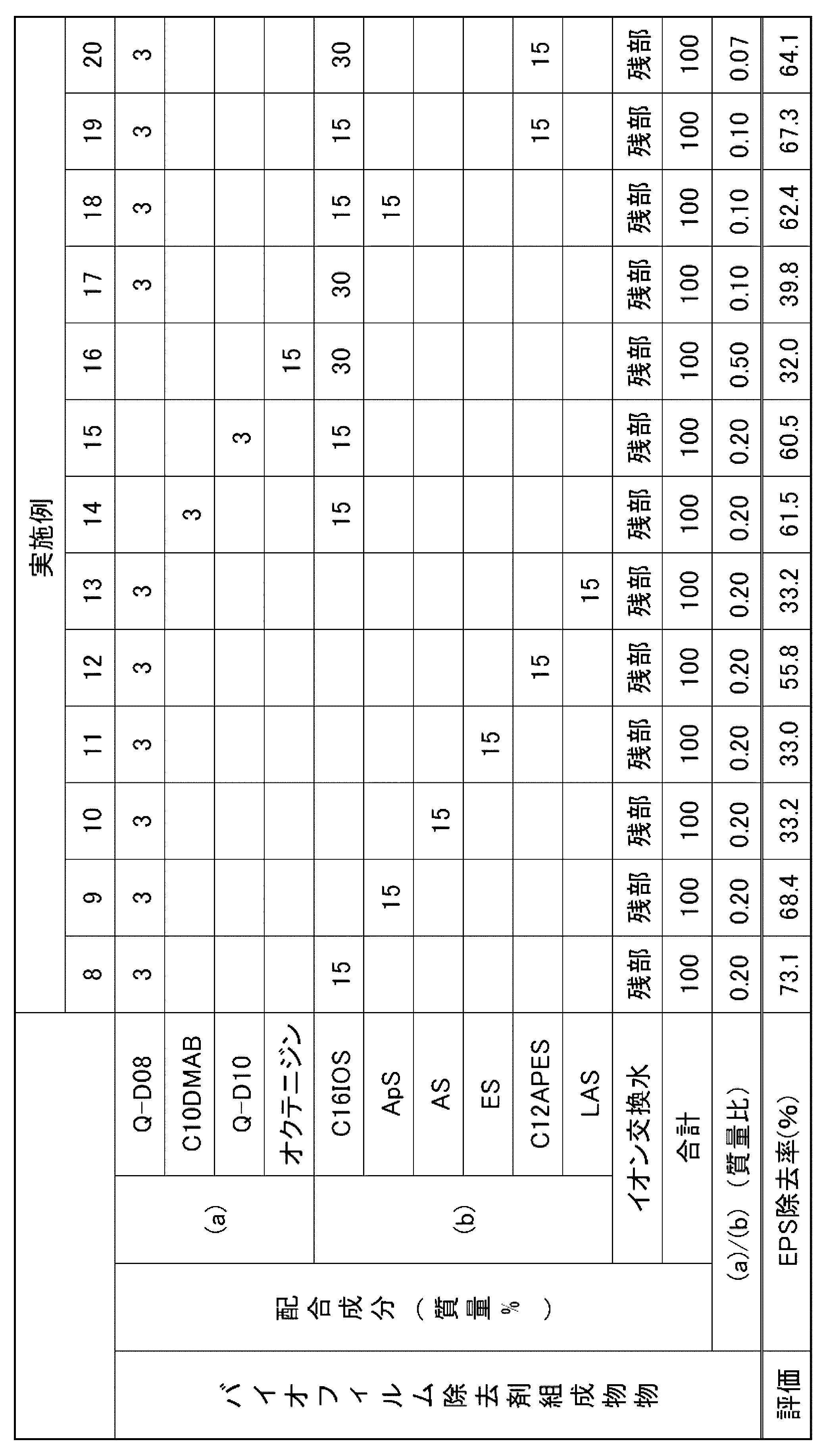
[配合成分]
実施例及び比較例では、以下の成分を用いた。
<(a)成分>
・Q-D08:ジオクチルジメチルアンモニウムクロライド、一般式(a1)中、R1a及びR2aが炭素数8のアルキル基であり、R3a及びR4aは、メチル基であり、X-はクロールイオンである化合物、(a1)成分
・C10DMAB:ジデシルジメチルアンモニウムブロミド、一般式(a1)中、R1a及びR2aが炭素数10のアルキル基であり、R3a及びR4aは、メチル基であり、X-はブロモイオンである化合物、(a1)成分、商品名「Didecyldimethylammonium Bromide」、東京化成工業(株)製
・Q-D10:ジデシルジメチルアンモニウムクロライド、一般式(a1)中、R1a及びR2aが炭素数10のアルキル基であり、R3a及びR4aは、メチル基であり、X-はクロールイオンである化合物、(a1)成分
・オクテニジン:オクテニジン二塩酸塩、一般式(a22)中、R5aがそれぞれn-オクチル基、Yがn-デセニル基、AがCl、qが1、rが2の化合物(a2)成分、商品名「Octenidine Dihydrochloride」、東京化成工業(株)製
<(b)成分>
・C16IOS:炭素数16の内部オレフィンスルホン酸カリウム塩、(b3)成分
・ApS:部分PO付加型アルキルエーテル硫酸塩、一般式(b1)中、R1bが炭素数8~12のアルキル基であり、pが0.6、qが0であり、Mがナトリウムイオンである化合物、(b1)成分
・AS:アルキル硫酸エステル塩、一般式(b1)中、R1bが炭素数12のアルキル基であり、pが0、qが0であり、Mがナトリウムイオンである化合物、(b1)成分、商品名「ドデシル硫酸ナトリウム」、東京化成工業(株)製
・ES:ポリオキシエチレンアルキルエーテル硫酸塩、一般式(b1)中、R1bが炭素数10~16のアルキル基であり、pが0、qが2であり、Mがナトリウムイオンである化合物、(b1)成分
・C12APES:アルキル基の炭素数12のポリオキシプロピレンポリオキシエチレンアルキルエーテル硫酸塩、一般式(b1)中、R1bが炭素数12のアルキル基であり、pが2、qが2であり、Mがモノエタノールアンモニウムである化合物、(b1)成分
・LAS(直鎖アルキルベンゼンスルホン酸塩)、(b2)成分、商品名「ネオぺレックス G-25」、花王(株)製
表1~6に示すバイオフィルム除去剤組成物の調製方法は下記の通りである。200mL容量のガラス製ビーカーに長さ3cmのテフロン製スターラーピースを投入し、次にイオン交換水10g、表1~6に示す配合で(a)成分、(b)成分を投入し、100r/minで10分攪拌し、全量が100gになるのに必要な追加で投入する量の95質量%相当のイオン交換水を追加し、100r/minで5分間撹拌した後、モノエタノールアミンもしくは塩酸でpH(25℃)を8に調整し(表6の実施例38、39については表に記載のpHに調整した。)、全量が100gになるようにイオン交換水を追加し、100r/minで15分間撹拌した後、表1~6に示す配合の各バイオフィルム除去剤組成物とした。調製後、再度pHを確認したところ、表1~6の各バイオフィルム除去剤組成物のpHは調整した時のpHと変わらなかった。なお表1~6に各バイオフィルム除去剤組成物中、各成分の配合量はすべて有効分である。また表4の実施例33については、後述のとおり希釈後の試験処理液中の各成分の配合量を示した。
(1-1)バイオフィルム形成布の作製
Rhodotorula mucilaginosa(衣類分離株)とMethylobacterium variable(衣類分離株)のグリセロールストック液をポテトデキストロース寒天培地(Difco Laboratories社製)に塗抹し、30℃で2日間静置培養した。Moraxella osloensis(衣類分離株)のグリセロールストック液をSCD寒天培地(塩谷エムエス(株)製 SCD寒天培地「ダイゴ」、一般細菌検査用)に塗抹し、37℃で1日間静置培養した。それぞれ培養後の菌体をディスポループ(アズワン(株)製 ディスポループ10型)でかきとり、R2A培地(塩谷エムエス(株)製 R2A培地「ダイゴ」)へ懸濁させた。分光光度計((株)アペレ製 型番:PD-303S)を用いて各菌懸濁液の濁度(OD600)を測定し、R.mucilaginosaはOD600=0.2、M.variableとM.osloensisはOD600=0.01となるように菌液を希釈した。
3×3cmに裁断したヒラオリ木綿布(谷頭商店製 木綿2003)(実施例4については、PEファイユ(谷頭商店製 ポリエステルファイユ)を用いた。)をオートクレーブ(PHC(株)製 高圧蒸気滅菌器ラボ・オートクレーブ 型番:MLS-3781)で加圧滅菌した。滅菌後のヒラオリ木綿布又はPEファイユをNo.6スクリュー管((株)マルエム製 スクリュー管瓶 No.6)へ入れ、上記3菌種の菌液をそれぞれ1mL、R2A培地を7mL添加した。蓋をして密栓し、小型恒温振とう培養器バイオシェーカー(TAITEC(株)製 型番:BR-23FP)にて30℃、200rpmの条件で2日間振盪培養した。培養後のヒラオリ木綿布又はPEファイユを新しいNo.6スクリュー管に移し、オートクレーブ滅菌済みイオン交換水10mLを添加した。小型恒温振とう培養器バイオシェーカーにて25℃、150prmで3分間振盪洗浄を行った。洗浄後のヒラオリ木綿布又はPEファイユを安全キャビネット内で1時間風乾し、バイオフィルム形成布とした。
布上でのバイオフィルム形成は、布をピンセットで糸状にほぐし、その糸を染色し共焦点レーザスキャン顕微鏡(カールツァイス(株)製 LSM880 ZEN)で観察することで確認した。観察を行う糸は、生細胞染色用色素(株式会社同仁化学研究所製 C375-Cellstain(TM)-CFSE)、死細胞染色用色素(株式会社同仁化学研究所製 P378-Cellstain(TM)-PI solution)、セルロース染色用色素(シグマアルドリッチ社製 Calcofluor White染色液)、糖染色用色素(サーモフィッシャーサイエンティフィック(株)製 Lectin PNA From Arachis hypogaea(peanut),Alexa Fluor(TM)647 Conjugate)、糖染色用色素(サーモフィッシャーサイエンティフィック(株)製 Concanavalin Alexa Fluor(TM)647 Conjugate)で30分間染色した。
表5の実施例37については、ポリスチレン製の6ウェルプレート(コーニング(株)製 Falcon セルカルチャー 6ウェル マルチウェルプレート 平底 フタ付き)1ウェルあたり、上記3菌種の菌液をそれぞれ0.3mL、R2A培地を2.1mL添加し、蓋をして密栓後、30℃で2日間静置培養した。培養後の6ウェルプレートの上層の水分を吸い取り、安全キャビネット内で1時間風乾し、バイオフィルム形成硬質表面とした。
硬質表面でのバイオフィルムの形成は、デジタルマイクロスコープ(株式会社キーエンス製 VHX-7000)で観察することで、確認した。
(バイオフィルム除去評価)
作製したバイオフィルム形成布を1.5×1.5cmに、滅菌済みヒラオリ木綿布を1.5×3cmに裁断した。裁断したバイオフィルム形成布1枚+滅菌済みヒラオリ布2枚の計3枚を重ね合わせ、5mLチューブ(エッペンドルフ(株)製 エッペンドルフチューブ5.0mL 型番:0030 119.401)に入れた。そこに、表1~6の各バイオフィルム除去剤組成物をモデル水道水(4°dH)で3000倍に希釈した試験処理液(表1の実施例5~7については、3000倍に希釈するためのモデル水道水の硬度を表に記載のものに変更して試験処理液を調製した。また表4中、実施例33は表に記載の濃度の希釈後の試験処理液を用い、実施例34、35については、希釈せずに表に記載の濃度でそのまま用いた。)3mLを加え、小型恒温振とう培養器バイオシェーカーにて25℃、150prmで10分間振盪洗浄を行い、これを洗い工程とした。洗い後の布を、モデル水道水3mLを入れた5mLチューブに移し、同様の条件で3分間振盪洗浄を行い、すすぎ工程とした。すすぎ後、バイオフィルム形成布のみを取り出し、安全キャビネット内で30分間風乾した。また各バイオフィルム除去剤組成物に代えてモデル水道水(4°dH)を試験処理液としたものについても同様の処理を行い、モデル水道水で処理後のバイオフィルム形成布を得た。
バイオフィルム形成硬質表面については、表5の実施例37のバイオフィルム除去剤組成物をモデル水道水(4°dH)で30000倍に希釈した試験処理液を1ウェルあたり3mL加え、小型恒温振とう培養器バイオシェーカーにて25℃、150prmで10分間振盪洗浄を行い、これを洗い工程とした。洗い後のバイオシェーカー内の試験処理液をマイクロピペット(エッペンドルフ(株)製 Eppendorf Research(R) plus)で吸い取り、モデル水道水3mLを添加して、同様の条件で3分間振盪洗浄を行い、すすぎ工程とした。すすぎ後のバイオシェーカー内のモデル水道水をマイクロピペットで吸い取り、すすぎ後のバイオフィルム形成硬質表面を、安全キャビネット内で30分間風乾した。また実施例37のバイオフィルム除去剤組成物に代えてモデル水道水(4°dH)を試験処理液としたものについても同様の処理を行い、モデル水道水で処理後のバイオフィルム形成硬質表面を得た。
風乾後のバイオフィルム形成布を、1.5Mの塩化ナトリウム(富士フィルム和光純薬(株)製 塩化ナトリウム)水溶液600μLを入れた1.5mLチューブ(エッペンドルフ(株)製 エッペンドルフチューブ1.5mL 型番:0030 125.150)に入れた。蓋を閉めて、冷氷中で2時間超音波洗浄機(日本エマソン(株)製 卓上超音波洗浄機 型番:2510JDTH)に入れ、布上に残存したEPSの抽出を行った。EPS(Extracellular Polysaccharide)はバイオフィルムの主成分である。キュートミキサー(東京理化器械(株)製 型番:CUTE MIXER CM-1000)で5分間液を撹拌した後、この液とバイオフィルム形成布をフィルター(ADVANTEC社製 型番:DISMIC-25CS)とシリンジ(テルモ株式会社製 型番:SS-02SZ2.5ML)を用いて濾過した。濾液を2.0mLチューブ(エッペンドルフ株式会社製 エッペンドルフチューブ2.0mL 型番:0030 121.597)に回収し、あらかじめ-30℃に冷却しておいたエタノール(富士フィルム和光純薬(株)製 エタノール(99.5))1.2mLを添加した。蓋を閉めて転倒混和し、-30℃で静置させてEPSを析出させた。冷却後、遠心分離機(エッペンドルフ社製 高速遠心機 型番:Centrifuge 5430)にて4℃、13000rpmの条件で15分間遠心分離を行い、上清を取り除いて1時間風乾した。風乾後のチューブに200μLのイオン交換水を添加し、キュートミキサーで5分間撹拌して、沈降したEPSをイオン交換水に溶解した。
また風乾後のバイオフィルム形成硬質表面については、1ウェルあたり2mLの1.5Mの塩化ナトリウム水溶液を入れ、マイクロピペットで20回ピペッティングを行い、バイオフィルムを塩化ナトリウム水溶液中に分散させた。バイオフィルム分散液を5mLチューブに入れ、蓋を閉めて、冷氷中で2時間超音波洗浄機に入れ、硬質表面に残存したEPSの抽出を行った。濾液を0.6mLチューブに回収し、上記と同様の方法でEPSを析出させ、イオン交換水に溶解した。
前工程にて取得したEPS水溶液100μLをガラス試験管(コーニング社製 ディスポガラス試験管 型番:99445-16)に入れ、そこに5%のフェノール(富士フィルム和光純薬(株)製 フェノール)水溶液100μL添加した。ボルッテクスで3秒間撹拌を行った後、濃硫酸(富士フィルム和光純薬(株)製 硫酸)500μLを加え、さらにボルテックス(アズワン(株)製 ボルテックスミキサー 型番:VTX-3000L)で3秒間撹拌を行った。30分間静置後、200μLを96wellプレート(AGCテクノグラス(株)製 型番:3815-012-MYPマイクロプレート)へ分注注し、反応液の吸光度(492nm)をマイクロプレートリーダー(TECAN社製 蛍光・吸光度・発光プレートリーダー 型番:infinite M200 PRO)で測定した。グルコース換算で定量したEPS残存量を元に、式(1)を用いてEPS除去率を算出した。EPS除去率が高い値ほどバイオフィルム除去性に優れることが言える。結果を表1~6に示す。
EPS除去率(%)=[(W1-W2)/W1]×100・・・(1)
W1:モデル水道水で処理後のバイオフィルム形成布又はバイオフィルム形成硬質表面のEPS残存量
W2:各試験処理液で処理後のバイオフィルム形成布又はバイオフィルム形成硬質表面のEPS残存量



Claims (16)
- 下記(a)成分、及び(b)成分を含有する、バイオフィルム除去剤組成物。
(a)成分:(a1)下記一般式(a1)で表される化合物(以下、(a1)成分という)、及び(a2)ビスピリジニウム化合物(以下、(a2)成分という)から選ばれる1種以上の化合物

(b)成分:アニオン界面活性剤 - (b)成分が、(b1)下記一般式(b1)で表される化合物(以下、(b1)成分という)、(b2)下記一般式(b2)で表される化合物(以下、(b2)成分という)、及び(b3)炭素数14以上20以下の内部オレフィンスルホン酸塩(以下、(b3)成分という)から選ばれる1種以上の化合物を含むアニオン界面活性剤である、請求項1に記載のバイオフィルム除去剤組成物。
R1b-O-[(PO)p/(EO)q]-SO3M (b1)
[一般式(b1)中、R1bは炭素数8以上22以下の炭化水素基であり、POはプロピレンオキシ基であり、EOはエチレンオキシ基であり、“/”はPOとEOの結合順序を問わないことを示す記号であり、pはPOの平均付加モル数であり、0以上10以下の数であり、qはEOの平均付加モル数であり、0以上25以下の数であり、Mは水素イオン、アルカリ金属イオン、アルカリ土類金属イオン(1/2原子)、アンモニウムイオン又は有機アンモニウムイオンである。]
R2b-B-SO3M (b2)
〔一般式(b2)中、R2bは炭素数3以上21以下のアルキル基を示し、Bはベンゼン環を示し、Mは水素イオン、アルカリ金属イオン、アルカリ土類金属イオン(1/2原子)、アンモニウムイオン又は有機アンモニウムイオンである。Bに結合するR2bに対して、スルホン酸基はオルト位、メタ位又はパラ位に結合している。〕 - (b)成分が、前記一般式(b1)中のpが0.1以上10以下であり、qが0以上25以下の(b1)成分、前記一般式(b2)中のR2bが、炭素数8以上18以下である(b2)成分、及び炭素数8以上18以下のアルキル基炭素数16以上18以下の内部オレフィンスルホン酸塩の(b3)成分から選ばれる1種以上の化合物を含むアニオン界面活性剤である、請求項2に記載のバイオフィルム除去剤組成物。
- (b)成分中の(b1)成分、(b2)成分及び(b3)成分の含有量が、70質量%以上100質量%以下である、請求項2又は3に記載のバイオフィルム除去剤組成物。
- (a2)成分が、オクテニジン二塩酸塩である、請求項1~4の何れか1項に記載のバイオフィルム除去剤組成物。
- (a)成分の含有量と(b)成分の含有量との質量比(a)/(b)が、0.001以上7以下である、請求項1~5の何れか1項に記載のバイオフィルム除去剤組成物。
- 更に水を含有し、(a)成分の含有量が0.001質量%以上50質量%以下であり、(b)成分の含有量が0.001質量%以上80質量%以下である、請求項1~6の何れか1項に記載のバイオフィルム除去剤組成物。
- 繊維製品用である、請求項1~7の何れか1項に記載のバイオフィルム除去剤組成物。
- 請求項1~7の何れか1項に記載のバイオフィルム除去剤組成物、又はそれを水で希釈した処理液を、バイオフィルムが存在する対象物品に接触させる、バイオフィルムの除去方法。
- 前記バイオフィルム除去剤組成物、又は前記処理液を、バイオフィルムが存在する対象物品に接触させた後、前記バイオフィルム除去剤組成物又は前記処理液が付着した対象物品をふき取るか又は水で濯ぎ、前記バイオフィルム除去剤組成物又は前記処理液を対象物品から除去する、請求項9に記載のバイオフィルムの除去方法。
- 前記対象物品が繊維製品である、請求項9又は10に記載のバイオフィルムの除去方法。
- 下記(a)成分、(b)成分、及び水を含有する処理液を、バイオフィルムが存在する対象物品に接触させる、バイオフィルムの除去方法。
(a)成分:(a1)下記一般式(a1)で表される化合物(以下、(a1)成分という)、及び(a2)ビスピリジニウム化合物(以下、(a2)成分という)から選ばれる1種以上の化合物

(b)成分:アニオン界面活性剤 - 前記処理液中、(a)成分の含有量と(b)成分の含有量との質量比(a)/(b)が、0.001以上7以下である、請求項12に記載のバイオフィルムの除去方法。
- 前記処理液を、バイオフィルムが存在する対象物品に接触させた後、前記処理液が付着した対象物品をふき取るか又は水で濯ぎ、前記処理液を対象物品から除去する、請求項12又は13に記載のバイオフィルムの除去方法。
- バイオフィルムが付着した対象物品からバイオフィルムを除去するための、下記(a)成分、及び(b)成分を含有する組成物の使用。
(a)成分:(a1)下記一般式(a1)で表される化合物(以下、(a1)成分という)、及び(a2)ビスピリジニウム化合物(以下、(a2)成分という)から選ばれる1種以上の化合物

(b)成分:アニオン界面活性剤 - (b)成分が、(b1)下記一般式(b1)で表される化合物(以下、(b1)成分という)、(b2)下記一般式(b2)で表される化合物(以下、(b2)成分という)、及び(b3)炭素数14以上20以下の内部オレフィンスルホン酸塩(以下、(b3)成分という)から選ばれる1種以上の化合物を含むアニオン界面活性剤である、請求項15に記載の組成物の、バイオフィルムが付着した対象物品からバイオフィルムを除去するための使用。
R1b-O-[(PO)p/(EO)q]-SO3M (b1)
[一般式(b1)中、R1bは炭素数8以上22以下の炭化水素基であり、POはプロピレンオキシ基であり、EOはエチレンオキシ基であり、“/”はPOとEOの結合順序を問わないことを示す記号であり、pはPOの平均付加モル数であり、0以上10以下の数であり、qはEOの平均付加モル数であり、0以上25以下の数であり、Mは水素イオン、アルカリ金属イオン、アルカリ土類金属イオン(1/2原子)、アンモニウムイオン又は有機アンモニウムイオンである。]
R2b-B-SO3M (b2)
〔一般式(b2)中、R2bは炭素数3以上21以下のアルキル基を示し、Bはベンゼン環を示し、Mは水素イオン、アルカリ金属イオン、アルカリ土類金属イオン(1/2原子)、アンモニウムイオン又は有機アンモニウムイオンである。Bに結合するR2bに対して、スルホン酸基はオルト位、メタ位又はパラ位に結合している。〕
Priority Applications (3)
| Application Number | Priority Date | Filing Date | Title |
|---|---|---|---|
| CN202480044618.XA CN121443147A (zh) | 2023-06-30 | 2024-03-26 | 生物膜去除剂组合物 |
| AU2024306054A AU2024306054A1 (en) | 2023-06-30 | 2024-03-26 | Biofilm remover composition |
| EP24831356.1A EP4736644A1 (en) | 2023-06-30 | 2024-03-26 | Biofilm remover composition |
Applications Claiming Priority (2)
| Application Number | Priority Date | Filing Date | Title |
|---|---|---|---|
| JP2023108096 | 2023-06-30 | ||
| JP2023-108096 | 2023-06-30 |
Publications (1)
| Publication Number | Publication Date |
|---|---|
| WO2025004479A1 true WO2025004479A1 (ja) | 2025-01-02 |
Family
ID=93938084
Family Applications (1)
| Application Number | Title | Priority Date | Filing Date |
|---|---|---|---|
| PCT/JP2024/011912 Ceased WO2025004479A1 (ja) | 2023-06-30 | 2024-03-26 | バイオフィルム除去剤組成物 |
Country Status (5)
| Country | Link |
|---|---|
| EP (1) | EP4736644A1 (ja) |
| JP (1) | JP2025009798A (ja) |
| CN (1) | CN121443147A (ja) |
| AU (1) | AU2024306054A1 (ja) |
| WO (1) | WO2025004479A1 (ja) |
Citations (6)
| Publication number | Priority date | Publication date | Assignee | Title |
|---|---|---|---|---|
| JPS52105228A (en) | 1976-02-25 | 1977-09-03 | Sterling Drug Inc | Antibiotic bisspyridinium compound |
| JP2014091805A (ja) * | 2012-11-06 | 2014-05-19 | Kao Corp | 洗浄剤組成物 |
| WO2014100807A1 (en) | 2012-12-21 | 2014-06-26 | Lonza Inc. | Antimicrobial bispyridine amine compositions and uses |
| JP2016035009A (ja) * | 2014-08-01 | 2016-03-17 | 花王株式会社 | 硬質表面用バイオフィルム除去剤組成物 |
| JP2021127389A (ja) * | 2020-02-13 | 2021-09-02 | 花王株式会社 | バイオフィルム除去剤 |
| WO2023181062A1 (en) * | 2022-03-19 | 2023-09-28 | Uday Didar Singh Paul | Disinfectant and methods of preparation thereof |
-
2024
- 2024-03-26 WO PCT/JP2024/011912 patent/WO2025004479A1/ja not_active Ceased
- 2024-03-26 EP EP24831356.1A patent/EP4736644A1/en active Pending
- 2024-03-26 AU AU2024306054A patent/AU2024306054A1/en active Pending
- 2024-03-26 JP JP2024049139A patent/JP2025009798A/ja active Pending
- 2024-03-26 CN CN202480044618.XA patent/CN121443147A/zh active Pending
Patent Citations (6)
| Publication number | Priority date | Publication date | Assignee | Title |
|---|---|---|---|---|
| JPS52105228A (en) | 1976-02-25 | 1977-09-03 | Sterling Drug Inc | Antibiotic bisspyridinium compound |
| JP2014091805A (ja) * | 2012-11-06 | 2014-05-19 | Kao Corp | 洗浄剤組成物 |
| WO2014100807A1 (en) | 2012-12-21 | 2014-06-26 | Lonza Inc. | Antimicrobial bispyridine amine compositions and uses |
| JP2016035009A (ja) * | 2014-08-01 | 2016-03-17 | 花王株式会社 | 硬質表面用バイオフィルム除去剤組成物 |
| JP2021127389A (ja) * | 2020-02-13 | 2021-09-02 | 花王株式会社 | バイオフィルム除去剤 |
| WO2023181062A1 (en) * | 2022-03-19 | 2023-09-28 | Uday Didar Singh Paul | Disinfectant and methods of preparation thereof |
Non-Patent Citations (2)
| Title |
|---|
| J. AM. OIL CHEM. SOC., vol. 69, no. 70775-75-6, 1992, pages 39 |
| JUNKA ADAM, BARTOSZEWICZ MARZENNA, SMUTNICKA DANUTA, SECEWICZ ANNA, SZYMCZYK PATRYCJA: "Efficacy of antiseptics containing povidone‐iodine, octenidine dihydrochloride and ethacridine lactate against biofilm formed by Pseudomonas aeruginosa and Staphylococcus aureus measured with the novel biofilm‐oriented antiseptics test", INTERNATIONAL WOUND JOURNAL, BLACKWELL PUBLISHING LTD.,, UK, vol. 11, no. 6, 1 December 2014 (2014-12-01), UK , pages 730 - 734, XP093252898, ISSN: 1742-4801, DOI: 10.1111/iwj.12057 * |
Also Published As
| Publication number | Publication date |
|---|---|
| CN121443147A (zh) | 2026-01-30 |
| JP2025009798A (ja) | 2025-01-20 |
| EP4736644A1 (en) | 2026-05-06 |
| AU2024306054A1 (en) | 2025-12-11 |
Similar Documents
| Publication | Publication Date | Title |
|---|---|---|
| US6892739B2 (en) | Microbicidally active tensides | |
| GB2458189A (en) | Cleaning and disinfecting composition | |
| JP5314218B1 (ja) | おしぼり及びおしぼりの製造方法 | |
| JP2025009798A (ja) | バイオフィルム除去剤組成物 | |
| JP2025006996A (ja) | バイオフィルム除去剤組成物 | |
| JP7421955B2 (ja) | 繊維製品用液体洗浄剤組成物 | |
| WO2025004478A1 (ja) | バイオフィルム殺菌剤組成物 | |
| AU2014384291B2 (en) | Sanitary cleaner | |
| WO2021106851A1 (ja) | 繊維製品用液体洗浄剤組成物 | |
| JP2025006995A (ja) | バイオフィルム殺菌剤組成物 | |
| JP7531367B2 (ja) | 洗濯方法 | |
| JP2004027031A (ja) | 塗布洗浄用液体洗浄剤組成物、製品および洗浄方法 | |
| JPWO2019230210A1 (ja) | 抗菌・抗ウイルス組成物、水溶液、石鹸類、衛生用品、住居用洗剤、台所用洗剤、衣料用洗剤、住居用抗菌・抗ウイルス剤、台所用抗菌・抗ウイルス剤、衣料用抗菌・抗ウイルス剤、化粧品、ウエットティッシュおよびおしぼり | |
| CN116814165A (zh) | 一种商业洗碗机用餐具催干剂 | |
| WO2021100691A1 (ja) | 洗浄剤組成物 | |
| CN109778525A (zh) | 银离子抗菌抹布 | |
| JP7673021B2 (ja) | バイオフィルムの形成抑制方法 | |
| JP2024156310A (ja) | 繊維製品用の液体洗浄剤組成物 | |
| JP5603057B2 (ja) | 洗濯槽用洗浄剤組成物 | |
| JP2013221092A (ja) | 衣料用液体洗浄剤組成物 | |
| JPH06166893A (ja) | 洗浄剤組成物 | |
| JP2023160670A (ja) | バイオフィルム除去剤組成物および方法 | |
| JP2024099132A (ja) | 繊維製品の洗浄方法 | |
| WO2023085349A1 (ja) | 繊維の防汚剤、及び繊維の防汚方法 | |
| Kamdi et al. | Evaluation of PVA Performance with Different Enzyme Concentration |
Legal Events
| Date | Code | Title | Description |
|---|---|---|---|
| 121 | Ep: the epo has been informed by wipo that ep was designated in this application |
Ref document number: 24831356 Country of ref document: EP Kind code of ref document: A1 |
|
| WWE | Wipo information: entry into national phase |
Ref document number: AU2024306054 Country of ref document: AU |
|
| ENP | Entry into the national phase |
Ref document number: 2024306054 Country of ref document: AU Date of ref document: 20240326 Kind code of ref document: A |
|
| WWE | Wipo information: entry into national phase |
Ref document number: 2501008832 Country of ref document: TH |
|
| WWE | Wipo information: entry into national phase |
Ref document number: 2024831356 Country of ref document: EP |
|
| NENP | Non-entry into the national phase |
Ref country code: DE |
|
| ENP | Entry into the national phase |
Ref document number: 2024831356 Country of ref document: EP Effective date: 20260130 |
|
| ENP | Entry into the national phase |
Ref document number: 2024831356 Country of ref document: EP Effective date: 20260130 |
|
| WWP | Wipo information: published in national office |
Ref document number: 2024831356 Country of ref document: EP |