WO2025004472A1 - ウレタン発泡成形体 - Google Patents
ウレタン発泡成形体 Download PDFInfo
- Publication number
- WO2025004472A1 WO2025004472A1 PCT/JP2024/011361 JP2024011361W WO2025004472A1 WO 2025004472 A1 WO2025004472 A1 WO 2025004472A1 JP 2024011361 W JP2024011361 W JP 2024011361W WO 2025004472 A1 WO2025004472 A1 WO 2025004472A1
- Authority
- WO
- WIPO (PCT)
- Prior art keywords
- particles
- urethane foam
- foam molded
- insulating inorganic
- thermally conductive
- Prior art date
- Legal status (The legal status is an assumption and is not a legal conclusion. Google has not performed a legal analysis and makes no representation as to the accuracy of the status listed.)
- Ceased
Links
Classifications
-
- C—CHEMISTRY; METALLURGY
- C08—ORGANIC MACROMOLECULAR COMPOUNDS; THEIR PREPARATION OR CHEMICAL WORKING-UP; COMPOSITIONS BASED THEREON
- C08J—WORKING-UP; GENERAL PROCESSES OF COMPOUNDING; AFTER-TREATMENT NOT COVERED BY SUBCLASSES C08B, C08C, C08F, C08G or C08H
- C08J9/00—Working-up of macromolecular substances to porous or cellular articles or materials; After-treatment thereof
- C08J9/0066—Use of inorganic compounding ingredients
-
- C—CHEMISTRY; METALLURGY
- C08—ORGANIC MACROMOLECULAR COMPOUNDS; THEIR PREPARATION OR CHEMICAL WORKING-UP; COMPOSITIONS BASED THEREON
- C08K—Use of inorganic or non-macromolecular organic substances as compounding ingredients
- C08K9/00—Use of pretreated ingredients
- C08K9/08—Ingredients agglomerated by treatment with a binding agent
-
- B—PERFORMING OPERATIONS; TRANSPORTING
- B29—WORKING OF PLASTICS; WORKING OF SUBSTANCES IN A PLASTIC STATE IN GENERAL
- B29C—SHAPING OR JOINING OF PLASTICS; SHAPING OF MATERIAL IN A PLASTIC STATE, NOT OTHERWISE PROVIDED FOR; AFTER-TREATMENT OF THE SHAPED PRODUCTS, e.g. REPAIRING
- B29C44/00—Shaping by internal pressure generated in the material, e.g. swelling or foaming ; Producing porous or cellular expanded plastics articles
-
- C—CHEMISTRY; METALLURGY
- C08—ORGANIC MACROMOLECULAR COMPOUNDS; THEIR PREPARATION OR CHEMICAL WORKING-UP; COMPOSITIONS BASED THEREON
- C08G—MACROMOLECULAR COMPOUNDS OBTAINED OTHERWISE THAN BY REACTIONS ONLY INVOLVING UNSATURATED CARBON-TO-CARBON BONDS
- C08G18/00—Polymeric products of isocyanates or isothiocyanates
- C08G18/06—Polymeric products of isocyanates or isothiocyanates with compounds having active hydrogen
- C08G18/08—Processes
- C08G18/10—Prepolymer processes involving reaction of isocyanates or isothiocyanates with compounds having active hydrogen in a first reaction step
-
- C—CHEMISTRY; METALLURGY
- C08—ORGANIC MACROMOLECULAR COMPOUNDS; THEIR PREPARATION OR CHEMICAL WORKING-UP; COMPOSITIONS BASED THEREON
- C08G—MACROMOLECULAR COMPOUNDS OBTAINED OTHERWISE THAN BY REACTIONS ONLY INVOLVING UNSATURATED CARBON-TO-CARBON BONDS
- C08G18/00—Polymeric products of isocyanates or isothiocyanates
- C08G18/06—Polymeric products of isocyanates or isothiocyanates with compounds having active hydrogen
- C08G18/08—Processes
- C08G18/16—Catalysts
- C08G18/18—Catalysts containing secondary or tertiary amines or salts thereof
- C08G18/1808—Catalysts containing secondary or tertiary amines or salts thereof having alkylene polyamine groups
-
- C—CHEMISTRY; METALLURGY
- C08—ORGANIC MACROMOLECULAR COMPOUNDS; THEIR PREPARATION OR CHEMICAL WORKING-UP; COMPOSITIONS BASED THEREON
- C08G—MACROMOLECULAR COMPOUNDS OBTAINED OTHERWISE THAN BY REACTIONS ONLY INVOLVING UNSATURATED CARBON-TO-CARBON BONDS
- C08G18/00—Polymeric products of isocyanates or isothiocyanates
- C08G18/06—Polymeric products of isocyanates or isothiocyanates with compounds having active hydrogen
- C08G18/28—Polymeric products of isocyanates or isothiocyanates with compounds having active hydrogen characterised by the compounds used containing active hydrogen
- C08G18/30—Low-molecular-weight compounds
- C08G18/32—Polyhydroxy compounds; Polyamines; Hydroxyamines
- C08G18/3203—Polyhydroxy compounds
- C08G18/3206—Polyhydroxy compounds aliphatic
-
- C—CHEMISTRY; METALLURGY
- C08—ORGANIC MACROMOLECULAR COMPOUNDS; THEIR PREPARATION OR CHEMICAL WORKING-UP; COMPOSITIONS BASED THEREON
- C08G—MACROMOLECULAR COMPOUNDS OBTAINED OTHERWISE THAN BY REACTIONS ONLY INVOLVING UNSATURATED CARBON-TO-CARBON BONDS
- C08G18/00—Polymeric products of isocyanates or isothiocyanates
- C08G18/06—Polymeric products of isocyanates or isothiocyanates with compounds having active hydrogen
- C08G18/28—Polymeric products of isocyanates or isothiocyanates with compounds having active hydrogen characterised by the compounds used containing active hydrogen
- C08G18/40—High-molecular-weight compounds
- C08G18/48—Polyethers
-
- C—CHEMISTRY; METALLURGY
- C08—ORGANIC MACROMOLECULAR COMPOUNDS; THEIR PREPARATION OR CHEMICAL WORKING-UP; COMPOSITIONS BASED THEREON
- C08G—MACROMOLECULAR COMPOUNDS OBTAINED OTHERWISE THAN BY REACTIONS ONLY INVOLVING UNSATURATED CARBON-TO-CARBON BONDS
- C08G18/00—Polymeric products of isocyanates or isothiocyanates
- C08G18/06—Polymeric products of isocyanates or isothiocyanates with compounds having active hydrogen
- C08G18/70—Polymeric products of isocyanates or isothiocyanates with compounds having active hydrogen characterised by the isocyanates or isothiocyanates used
- C08G18/72—Polyisocyanates or polyisothiocyanates
- C08G18/74—Polyisocyanates or polyisothiocyanates cyclic
- C08G18/76—Polyisocyanates or polyisothiocyanates cyclic aromatic
- C08G18/7657—Polyisocyanates or polyisothiocyanates cyclic aromatic containing two or more aromatic rings
- C08G18/7664—Polyisocyanates or polyisothiocyanates cyclic aromatic containing two or more aromatic rings containing alkylene polyphenyl groups
- C08G18/7671—Polyisocyanates or polyisothiocyanates cyclic aromatic containing two or more aromatic rings containing alkylene polyphenyl groups containing only one alkylene bisphenyl group
-
- C—CHEMISTRY; METALLURGY
- C08—ORGANIC MACROMOLECULAR COMPOUNDS; THEIR PREPARATION OR CHEMICAL WORKING-UP; COMPOSITIONS BASED THEREON
- C08J—WORKING-UP; GENERAL PROCESSES OF COMPOUNDING; AFTER-TREATMENT NOT COVERED BY SUBCLASSES C08B, C08C, C08F, C08G or C08H
- C08J9/00—Working-up of macromolecular substances to porous or cellular articles or materials; After-treatment thereof
- C08J9/009—Use of pretreated compounding ingredients
-
- C—CHEMISTRY; METALLURGY
- C08—ORGANIC MACROMOLECULAR COMPOUNDS; THEIR PREPARATION OR CHEMICAL WORKING-UP; COMPOSITIONS BASED THEREON
- C08K—Use of inorganic or non-macromolecular organic substances as compounding ingredients
- C08K3/00—Use of inorganic substances as compounding ingredients
- C08K3/01—Use of inorganic substances as compounding ingredients characterized by their specific function
-
- C—CHEMISTRY; METALLURGY
- C08—ORGANIC MACROMOLECULAR COMPOUNDS; THEIR PREPARATION OR CHEMICAL WORKING-UP; COMPOSITIONS BASED THEREON
- C08K—Use of inorganic or non-macromolecular organic substances as compounding ingredients
- C08K3/00—Use of inorganic substances as compounding ingredients
- C08K3/18—Oxygen-containing compounds, e.g. metal carbonyls
- C08K3/20—Oxides; Hydroxides
- C08K3/22—Oxides; Hydroxides of metals
-
- C—CHEMISTRY; METALLURGY
- C08—ORGANIC MACROMOLECULAR COMPOUNDS; THEIR PREPARATION OR CHEMICAL WORKING-UP; COMPOSITIONS BASED THEREON
- C08K—Use of inorganic or non-macromolecular organic substances as compounding ingredients
- C08K3/00—Use of inorganic substances as compounding ingredients
- C08K3/18—Oxygen-containing compounds, e.g. metal carbonyls
- C08K3/24—Acids; Salts thereof
- C08K3/26—Carbonates; Bicarbonates
-
- C—CHEMISTRY; METALLURGY
- C08—ORGANIC MACROMOLECULAR COMPOUNDS; THEIR PREPARATION OR CHEMICAL WORKING-UP; COMPOSITIONS BASED THEREON
- C08K—Use of inorganic or non-macromolecular organic substances as compounding ingredients
- C08K3/00—Use of inorganic substances as compounding ingredients
- C08K3/28—Nitrogen-containing compounds
-
- C—CHEMISTRY; METALLURGY
- C08—ORGANIC MACROMOLECULAR COMPOUNDS; THEIR PREPARATION OR CHEMICAL WORKING-UP; COMPOSITIONS BASED THEREON
- C08K—Use of inorganic or non-macromolecular organic substances as compounding ingredients
- C08K3/00—Use of inorganic substances as compounding ingredients
- C08K3/34—Silicon-containing compounds
-
- C—CHEMISTRY; METALLURGY
- C08—ORGANIC MACROMOLECULAR COMPOUNDS; THEIR PREPARATION OR CHEMICAL WORKING-UP; COMPOSITIONS BASED THEREON
- C08K—Use of inorganic or non-macromolecular organic substances as compounding ingredients
- C08K5/00—Use of organic ingredients
- C08K5/04—Oxygen-containing compounds
-
- C—CHEMISTRY; METALLURGY
- C08—ORGANIC MACROMOLECULAR COMPOUNDS; THEIR PREPARATION OR CHEMICAL WORKING-UP; COMPOSITIONS BASED THEREON
- C08L—COMPOSITIONS OF MACROMOLECULAR COMPOUNDS
- C08L101/00—Compositions of unspecified macromolecular compounds
-
- C—CHEMISTRY; METALLURGY
- C08—ORGANIC MACROMOLECULAR COMPOUNDS; THEIR PREPARATION OR CHEMICAL WORKING-UP; COMPOSITIONS BASED THEREON
- C08L—COMPOSITIONS OF MACROMOLECULAR COMPOUNDS
- C08L75/00—Compositions of polyureas or polyurethanes; Compositions of derivatives of such polymers
- C08L75/04—Polyurethanes
-
- C—CHEMISTRY; METALLURGY
- C09—DYES; PAINTS; POLISHES; NATURAL RESINS; ADHESIVES; COMPOSITIONS NOT OTHERWISE PROVIDED FOR; APPLICATIONS OF MATERIALS NOT OTHERWISE PROVIDED FOR
- C09K—MATERIALS FOR MISCELLANEOUS APPLICATIONS, NOT PROVIDED FOR ELSEWHERE
- C09K5/00—Heat-transfer, heat-exchange or heat-storage materials, e.g. refrigerants; Materials for the production of heat or cold by chemical reactions other than by combustion
- C09K5/08—Materials not undergoing a change of physical state when used
- C09K5/10—Liquid materials
-
- C—CHEMISTRY; METALLURGY
- C08—ORGANIC MACROMOLECULAR COMPOUNDS; THEIR PREPARATION OR CHEMICAL WORKING-UP; COMPOSITIONS BASED THEREON
- C08G—MACROMOLECULAR COMPOUNDS OBTAINED OTHERWISE THAN BY REACTIONS ONLY INVOLVING UNSATURATED CARBON-TO-CARBON BONDS
- C08G2101/00—Manufacture of cellular products
-
- C—CHEMISTRY; METALLURGY
- C08—ORGANIC MACROMOLECULAR COMPOUNDS; THEIR PREPARATION OR CHEMICAL WORKING-UP; COMPOSITIONS BASED THEREON
- C08G—MACROMOLECULAR COMPOUNDS OBTAINED OTHERWISE THAN BY REACTIONS ONLY INVOLVING UNSATURATED CARBON-TO-CARBON BONDS
- C08G2110/00—Foam properties
- C08G2110/0083—Foam properties prepared using water as the sole blowing agent
-
- C—CHEMISTRY; METALLURGY
- C08—ORGANIC MACROMOLECULAR COMPOUNDS; THEIR PREPARATION OR CHEMICAL WORKING-UP; COMPOSITIONS BASED THEREON
- C08J—WORKING-UP; GENERAL PROCESSES OF COMPOUNDING; AFTER-TREATMENT NOT COVERED BY SUBCLASSES C08B, C08C, C08F, C08G or C08H
- C08J2375/00—Characterised by the use of polyureas or polyurethanes; Derivatives of such polymers
- C08J2375/04—Polyurethanes
-
- C—CHEMISTRY; METALLURGY
- C08—ORGANIC MACROMOLECULAR COMPOUNDS; THEIR PREPARATION OR CHEMICAL WORKING-UP; COMPOSITIONS BASED THEREON
- C08J—WORKING-UP; GENERAL PROCESSES OF COMPOUNDING; AFTER-TREATMENT NOT COVERED BY SUBCLASSES C08B, C08C, C08F, C08G or C08H
- C08J2403/00—Characterised by the use of starch, amylose or amylopectin or of their derivatives or degradation products
- C08J2403/02—Starch; Degradation products thereof, e.g. dextrin
-
- C—CHEMISTRY; METALLURGY
- C08—ORGANIC MACROMOLECULAR COMPOUNDS; THEIR PREPARATION OR CHEMICAL WORKING-UP; COMPOSITIONS BASED THEREON
- C08K—Use of inorganic or non-macromolecular organic substances as compounding ingredients
- C08K2201/00—Specific properties of additives
- C08K2201/001—Conductive additives
-
- C—CHEMISTRY; METALLURGY
- C08—ORGANIC MACROMOLECULAR COMPOUNDS; THEIR PREPARATION OR CHEMICAL WORKING-UP; COMPOSITIONS BASED THEREON
- C08K—Use of inorganic or non-macromolecular organic substances as compounding ingredients
- C08K2201/00—Specific properties of additives
- C08K2201/01—Magnetic additives
-
- C—CHEMISTRY; METALLURGY
- C08—ORGANIC MACROMOLECULAR COMPOUNDS; THEIR PREPARATION OR CHEMICAL WORKING-UP; COMPOSITIONS BASED THEREON
- C08L—COMPOSITIONS OF MACROMOLECULAR COMPOUNDS
- C08L2203/00—Applications
- C08L2203/14—Applications used for foams
-
- H—ELECTRICITY
- H01—ELECTRIC ELEMENTS
- H01F—MAGNETS; INDUCTANCES; TRANSFORMERS; SELECTION OF MATERIALS FOR THEIR MAGNETIC PROPERTIES
- H01F1/00—Magnets or magnetic bodies characterised by the magnetic materials therefor; Selection of materials for their magnetic properties
- H01F1/01—Magnets or magnetic bodies characterised by the magnetic materials therefor; Selection of materials for their magnetic properties of inorganic materials
Definitions
- This disclosure relates to a urethane foam molded body with high thermal conductivity.
- Patent Document 1 describes a polyurethane foam molded body in which composite particles made of a combination of thermally conductive particles such as expanded graphite, magnetic particles, and insulating inorganic particles are oriented and arranged in polyurethane foam, forming a heat transfer path in the direction of the orientation, thereby improving heat dissipation.
- thermally conductive particles such as expanded graphite, magnetic particles, and insulating inorganic particles
- dispersing insulating inorganic particles separately from the composite particles in polyurethane foam imparts electrical insulation, and improves heat dissipation and flame retardancy depending on the properties of the insulating inorganic particles.
- Patent Document 1 only evaluates the thermal conductivity and electrical insulation of the urethane foam molded body, and does not consider heat resistance.
- This disclosure was made in light of these circumstances, and aims to provide a urethane foam molded body with excellent thermal conductivity and heat resistance.
- the urethane foam molded article of the present disclosure has a base material made of polyurethane foam, composite particles contained in the base material in an oriented manner, and first insulating inorganic particles dispersed in the base material, the composite particles having thermally conductive particles and magnetic particles bonded to the surfaces of the thermally conductive particles with a binder, the thermally conductive particles having expanded graphite particles, and the amount of alkali metal ions contained in the expanded graphite particles is 500 ppm or more and 2000 ppm or less.
- the first insulating inorganic particles are particles of an inorganic material that has insulating properties.
- the presence of the first insulating inorganic particles makes it difficult for the composite particles to be electrically conductive with each other, providing electrical insulation to the polyurethane foam molded body.
- a heat transfer path through the first insulating inorganic particles is also formed. This further improves the thermal conductivity of the urethane foam molded body.
- the first insulating inorganic particles have flame retardancy, the flame retardancy of the urethane foam molded body is improved.
- expanded graphite is produced by oxidizing graphite with sulfuric acid and an oxidizing agent, and then neutralizing the acidic substances attached to the surface with a neutralizing agent. Since the neutralizing agent used is an alkali metal compound or ammonia, if the neutralizing agent remains on the surface of the expanded graphite, it reacts with the water contained in the polyurethane foam base material to generate an alkaline atmosphere. It is presumed that exposure to high temperatures in this state will accelerate the hydrolysis of polyurethane and cause deterioration to progress. In addition, in an alkaline atmosphere, the first insulating inorganic particles may dissolve.
- the amount of alkali metal ions contained in the expanded graphite particles is limited to 500 ppm or more and 2000 ppm or less.
- the amount of alkali metal ions is limited to 2000 ppm or less, it is possible to prevent the polyurethane foam from becoming too alkaline. This suppresses hydrolysis of polyurethane, making it difficult for the first insulating inorganic particles to dissolve.
- the polyurethane foam is placed under high temperatures, it is possible to suppress deterioration of polyurethane and suppress deterioration of physical properties such as elongation.
- the raw material for manufacturing the polyurethane foam may become acidic, which may affect the foaming and curing reaction. Therefore, by limiting the amount of alkali metal ions to 500 ppm or more, the pH balance of the raw material can be achieved, and the effect on moldability can be reduced. As a result, the polyurethane foam of the present disclosure has excellent thermal conductivity and heat resistance.
- the alkali metal ions may include sodium ions.
- Sodium ions are contained in hydroxides, oxides, etc. used as neutralizing agents, and have a large effect on the pH. Therefore, by limiting this amount, it becomes easier to optimize the pH of the polyurethane foam.
- the content of the composite particles may be 5% by volume or more and 50% by volume or less, assuming the volume of the urethane foam molded body to be 100% by volume.
- This configuration can provide effects such as improved thermal conductivity due to the composite particles, while minimizing the impact on the foaming and curing reaction and moldability.
- the content of the first insulating inorganic particles may be 5% by volume or more and 20% by volume or less, assuming the volume of the urethane foam molded body to be 100% by volume.
- This configuration can provide effects such as imparting electrical insulation and improving thermal conductivity through the first insulating inorganic particles, while minimizing the effect on the foaming and curing reaction and moldability.
- the thermal conductivity of the first insulating inorganic particles may be 5 W/m ⁇ K or more.
- the first insulating inorganic particles can provide an effect of improving thermal conductivity.
- the composite particle may have a second insulating inorganic particle bonded to the surface of the thermally conductive particle by a binder.
- the second insulating inorganic particle may be directly bonded to the surface of the thermally conductive particle serving as the core, or may be indirectly bonded via a magnetic particle.
- a magnetic particle a ferromagnetic material such as stainless steel or iron is used. For this reason, the composite particle in which the thermally conductive particle and the magnetic particle are composited has high electrical conductivity.
- the second insulating inorganic particle When the second insulating inorganic particle is bonded to the composite particle in this state, even if the composite particles are oriented in a state of contact with each other, the thermally conductive particles and the magnetic particles (conductive particles) between the adjacent composite particles are less likely to come into contact with each other. Therefore, the electrical resistance between the composite particles increases. In addition, the composite particles come into contact with each other via the second insulating inorganic particle, so that the conduction between the composite particles can be cut off. As a result, the desired electrical insulation can be achieved in the urethane foam molded body of the present disclosure. Thus, according to this configuration, in addition to high thermal conductivity and heat resistance, electrical insulation can also be imparted. Therefore, this polyurethane foam molded article is also suitable for applications that require both heat dissipation and electrical insulation, such as heat dissipation components in electronic devices.
- the second insulating inorganic particles may be one or more selected from aluminum hydroxide, aluminum oxide, aluminum nitride, magnesium hydroxide, magnesium oxide, talc, calcium carbonate, clay, mica, and silica.
- the second insulating inorganic particles of this configuration are relatively inexpensive and easy to obtain.
- talc and mica are flaky and have excellent coating properties.
- aluminum hydroxide, aluminum oxide, aluminum nitride, magnesium hydroxide, magnesium oxide, and talc have relatively high thermal conductivity, so they are unlikely to inhibit thermal conductivity between composite particles.
- the urethane foam molded body of the present disclosure In the base material of the urethane foam molded body of the present disclosure, composite particles with thermally conductive particles as nuclei are oriented, and first insulating inorganic particles are dispersed.
- the thermally conductive particles have expanded graphite particles, and the amount of alkali metal ions contained in the expanded graphite particles is 500 ppm or more and 2000 ppm or less. This allows the pH of the polyurethane foam to be adjusted to the desired range, and even when the urethane foam molded body is placed under high temperatures, deterioration of the polyurethane can be suppressed, and a decrease in physical properties such as elongation can be suppressed. Therefore, the urethane foam molded body of the present disclosure has excellent thermal conductivity and heat resistance.
- the urethane foam molded product of the present disclosure has a substrate made of polyurethane foam, composite particles contained and oriented in the substrate, and first insulating inorganic particles dispersed in the substrate.
- the polyurethane foam of the substrate is produced from urethane foam resin raw materials such as polyisocyanate components and polyol components.
- the urethane foam resin raw materials may be prepared from already known raw materials such as polyols and polyisocyanates.
- the polyol may be appropriately selected from polyhydric hydroxy compounds, polyether polyols, polyester polyols, polymer polyols, polyether polyamines, polyester polyamines, alkylene polyols, urea dispersion polyols, melamine modified polyols, polycarbonate polyols, acrylic polyols, polybutadiene polyols, phenol modified polyols, etc.
- the polyisocyanate may be appropriately selected from, for example, tolylene diisocyanate, phenylene diisocyanate, xylylene diisocyanate, diphenylmethane diisocyanate, triphenylmethane triisocyanate, polymethylene polyphenyl isocyanate, naphthalene diisocyanate, and derivatives thereof (for example, prepolymers obtained by reaction with polyols, modified polyisocyanates), etc.
- the urethane foam resin raw material may further contain a catalyst, a blowing agent, a foam stabilizer, a plasticizer, a crosslinking agent, a chain extender, a flame retardant, an antistatic agent, a viscosity reducer, a stabilizer, a filler, a colorant, etc., as appropriate.
- the catalyst may be an amine catalyst such as tetraethylenediamine, triethylenediamine, or dimethylethanolamine, or an organometallic catalyst such as tin laurate or tin octanoate.
- water is preferable as the blowing agent.
- examples of the foam stabilizer include methylene chloride, fluorocarbons, and CO2 gas.
- a silicone foam stabilizer is preferable as the foam stabilizer, and triethanolamine, diethanolamine, etc. are preferable as the crosslinking agent.
- the shape and size of the substrate are not particularly limited and may be determined appropriately depending on the application.
- the composite particles contained in the substrate may be arranged with a certain regularity. For example, they may be arranged in a straight line or a curved line between one end and the other end of the urethane foam molding (the end does not have to be 180° opposite to the other end). They may also be arranged radially from the center toward the periphery.
- the composite particles oriented and contained in the substrate are particles in which magnetic particles or the like are bonded to the surface of the thermally conductive particles serving as the core by a binder.
- the thermally conductive particles are non-magnetic particles having a relatively large thermal conductivity.
- diamagnetic materials and paramagnetic materials other than ferromagnetic materials and antiferromagnetic materials are referred to as non-magnetic materials.
- the thermally conductive particles have expanded graphite particles.
- the thermally conductive particles may be single particles or aggregate particles in which a plurality of particles are integrated.
- the composite particles include particles in which magnetic particles or the like are bonded to the surface of expanded graphite particles, and particles in which magnetic particles or the like are bonded to the surface of aggregate particles in which expanded graphite particles and other particles are integrated.
- the composite particles may also include particles in which magnetic particles or the like are bonded to the surface of particles other than expanded graphite particles.
- the expanded graphite particles may be appropriately selected taking into consideration the expansion start temperature and expansion rate.
- the expansion start temperature must be higher than the heat generation temperature during molding of the urethane foam molded body, so expanded graphite particles with an expansion start temperature of 150°C or higher are suitable.
- the amount of alkali metal ions contained in the expanded graphite particles is 500 ppm to 2000 ppm. By keeping the amount of alkali metal ions at 2000 ppm or less, it is possible to prevent the polyurethane foam from becoming too alkaline. On the other hand, by keeping the amount of alkali metal ions at 500 ppm or more, a pH balance can be achieved with the intercalation compound in the raw material for manufacturing the urethane foam molded body, and the effect on moldability can be reduced.
- thermally conductive particles other than expanded graphite particles it is advisable to use particles with a thermal conductivity of 200 W/m ⁇ K or more.
- examples include natural graphite, artificial graphite, carbon materials such as carbon fiber, aluminum, gold, silver, copper, and alloys using these as base materials.
- the shape of the thermally conductive particles is not particularly limited, so long as they can be composited with other particles such as magnetic particles.
- various shapes can be adopted, such as flakes, fibers, columns, spheres, ellipsoids, and spheroids (a pair of opposing hemispheres connected by a cylinder).
- the thermally conductive particles have a shape other than a sphere, the contact area between the composite particles increases. This makes it easier to ensure a heat transfer path and also increases the amount of heat transferred.
- the median diameter of the thermally conductive particles is desirably 100 ⁇ m or more. More preferably, it is 700 ⁇ m or more.
- the median diameter of the thermally conductive particles is desirably 3000 ⁇ m or less. More preferably, it is 2000 ⁇ m or less.
- the median diameter in this specification is a value (D 50 ) obtained from the volume-based particle size distribution measured by a laser diffraction/scattering method.
- catalog values may be used for commercially available products.
- the magnetic particles can be any as long as they can orient the composite particles, and for example, ferromagnetic materials such as iron, nickel, cobalt, gadolinium, stainless steel, magnetite, maghemite, manganese zinc ferrite, barium ferrite, strontium ferrite, etc., antiferromagnetic materials such as MnO , Cr2O3 , FeCl2 , MnAs, etc., and alloy particles using these are suitable.
- iron, nickel, cobalt, and their iron-based alloys are suitable from the viewpoint of being easily available as fine particles and having high saturation magnetization. In particular, iron is relatively cheap and easily available, so it can reduce manufacturing costs and is suitable for mass production.
- the magnetic particles may be directly attached to the surface of the thermally conductive particles, or may be indirectly attached via the second insulating inorganic particles described later.
- the magnetic particles may be attached only to a part of the surface of the thermally conductive particles, or may be attached so as to cover the entire surface.
- the size of the magnetic particles may be appropriately determined taking into consideration the size of the thermally conductive particles, the orientation of the composite particles, and the thermal conductivity between the composite particles.
- the particle diameter of the magnetic particles is preferably 1/10 or less of the particle diameter of the thermally conductive particles.
- the "particle diameter" is the equivalent diameter of a sphere of equal volume. When the size of the magnetic particles becomes smaller, the saturation magnetization of the magnetic particles tends to decrease.
- the median diameter of the magnetic particles it is desirable to set to 100 nm or more. It is more preferable to set it to 1 ⁇ m or more, and even more preferable to set it to 5 ⁇ m or more.
- the shape of the magnetic particles is not particularly limited.
- the distance between adjacent thermally conductive particles is shorter than when the magnetic particles are spherical. This improves the thermal conductivity between adjacent composite particles. As a result, the thermal conductivity of the urethane foam molding is improved.
- the magnetic particles and the thermally conductive particles come into contact with each other on their surfaces. In other words, the contact area between the two becomes larger. This improves the adhesive strength between the magnetic particles and the thermally conductive particles. Therefore, the magnetic particles are less likely to peel off.
- the thermal conductivity between the magnetic particles and the thermally conductive particles is also improved. For these reasons, it is desirable to use flaky particles as the magnetic particles.
- the content of the magnetic particles is 20% by mass or more, where the mass of the thermally conductive particles in the base material is 100% by mass. Furthermore, from the viewpoint of cost reduction and weight reduction, it is desirable that the content of the magnetic particles is 130% by mass or less. It is more preferable that the content is 100% by mass or less, and even more preferably 80% by mass or less.
- the binder that bonds the thermally conductive particles and the magnetic particles may be selected appropriately, taking into consideration factors such as adhesiveness and the effect on the foaming and curing reaction.
- Water-soluble polymers are preferred because they have little effect on the foaming and curing reaction and are environmentally friendly. Examples include methyl cellulose, carboxymethyl cellulose, hydroxypropyl methyl cellulose, polyvinyl alcohol, and starch. Among these, starch is preferred because it is relatively inexpensive, has high adhesion, and has excellent granulation properties.
- Thermal conductive particles and magnetic particles are electrically conductive. Therefore, when the composite particles are aligned and oriented, a conductive path is formed in the base material.
- composite particles can be formed by adhering second insulating inorganic particles, in addition to magnetic particles, to the surface of the thermally conductive particles with a binder. In this way, even if the composite particles are oriented, the electrical resistance between adjacent composite particles can be increased or electrical conduction can be blocked. As a result, electrical insulation can be imparted to the urethane foam molding.
- the second insulating inorganic particles may be particles of an inorganic material having insulating properties, similar to the first insulating inorganic particles dispersed in the base material.
- the second insulating inorganic material include aluminum hydroxide, aluminum oxide, aluminum nitride, magnesium hydroxide, magnesium oxide, talc, calcium carbonate, clay, mica, and silica.
- talc and mica are preferred because they are flaky and have excellent covering properties.
- one with a relatively large thermal conductivity may be used.
- the second insulating inorganic particles may be directly bonded to the surface of the thermally conductive particles, or may be indirectly bonded via magnetic particles or the like.
- the second insulating inorganic particles may be bonded to only a portion of the surface of the thermally conductive particles, or may be bonded so as to cover the entire surface.
- the influence of the interlayer material of the expanded graphite particles and the remaining alkali metal ions is reduced, which is preferable.
- it is desirable that the second insulating inorganic particles are disposed in the outermost layer of the composite particles.
- the binder that bonds the magnetic particles to the thermally conductive particles and the binder that bonds the insulating inorganic particles may be the same or different.
- the size of the second insulating inorganic particles may be appropriately determined taking into consideration the adhesiveness to the thermally conductive particles and magnetic particles, the electrical insulation between the composite particles, and the thermal conductivity. If the second insulating inorganic particles are too large, the adhesiveness and the thermal conductivity between the composite particles will decrease. For example, it is desirable that the particle diameter of the second insulating inorganic particles is 1/10 or less of the particle diameter of the thermally conductive particles. In this case, the "particle diameter" is the equivalent diameter of a sphere of equal volume. Furthermore, the second insulating inorganic particles are adhered to the thermally conductive particles and are merely a part of the composite particles.
- the contact area with the polyurethane foam of the base material is small, and the effect on the polyurethane foam is small.
- the median diameter of the second insulating inorganic particles may be 1 ⁇ m or more and 20 ⁇ m or less.
- the shape of the second insulating inorganic particles is not particularly limited.
- the distance between adjacent thermally conductive particles can be made shorter than when the second insulating inorganic particles are spherical. This makes it less likely that the thermal conductivity between adjacent composite particles will be hindered.
- the contact area with the thermally conductive particles is increased, making the second insulating inorganic particles less likely to peel off.
- the content of the composite particles may be determined taking into consideration thermal conductivity, the effect on the foaming and curing reaction of the polyurethane foam, moldability, etc. In order to achieve the desired thermal conductivity, it is desirable that the content of the composite particles be 5 volume % or more, assuming that the volume of the urethane foam molding is 100 volume %, and 10 volume % or more is more preferable. On the other hand, from the viewpoint of not inhibiting the foaming and curing reaction and improving moldability, it is desirable that the content of the composite particles be 50 volume % or less, and 20 volume % or less is more preferable.
- the type of the first insulating inorganic particles dispersed in the base material may be the same as or different from the second insulating inorganic particles added as constituent particles of the composite particle.
- the shape of the first insulating inorganic particles is not particularly limited, and may be spherical or flaky.
- the first insulating inorganic particles may be one type or two or more types.
- the above-mentioned aluminum hydroxide, aluminum oxide, aluminum nitride, magnesium hydroxide, magnesium oxide, talc, calcium carbonate, clay, mica, silica, etc. are also suitable.
- the size of the first insulating inorganic particles may be appropriately determined taking into consideration the electrical insulation, thermal conductivity, moldability, etc. of the polyurethane foam molding. If the contact area between the first insulating inorganic particles and the polyurethane foam is large, the heat resistance of the polyurethane foam molding may be reduced due to the influence of the first insulating inorganic particles. For example, if the first insulating inorganic particles are particles that react with water and exhibit alkalinity, they react with the water contained in the polyurethane foam to generate an alkaline atmosphere. It is presumed that exposure to high temperatures in this state will promote hydrolysis of polyurethane and cause deterioration.
- the first insulating inorganic particles it is desirable for the first insulating inorganic particles to have large-diameter particles with a median diameter of 55 ⁇ m or more and 200 ⁇ m or less. If the median diameter is 55 ⁇ m or more, the contact area with the polyurethane foam will be small, and the effect on the polyurethane foam will be small. For example, if the large-diameter particles are particles that react with water and exhibit alkalinity (alkaline inorganic particles), deterioration due to hydrolysis of polyurethane is suppressed, and physical properties such as elongation are less likely to decrease even when the polyurethane foam molding is placed under high temperatures.
- particles that react with water to become alkaline are particles that have a pH greater than 7 when 2 g of the target particle powder is dispersed in 50 mL of ion-exchanged water at room temperature and the pH of the dispersion is measured.
- the median diameter is 200 ⁇ m or less, the effect on moldability is small and the occurrence of cracks is suppressed. From the viewpoint of further improving moldability and physical properties in normal state, it is preferable that the median diameter of the large diameter particles is 150 ⁇ m or less.
- the first insulating inorganic particles may be composed of only large diameter particles, or may contain particles other than large diameter particles as long as the desired heat resistance and moldability can be achieved.
- the content of the first insulating inorganic particles is desirably 20% by volume or less, assuming that the volume of the polyurethane foam molded body is 100% by volume. 15% by volume or less is more preferable.
- the content is desirably 5% by volume or more, and 8% by volume or more is more preferable.
- the method for producing the urethane foam molded article of the present disclosure is not particularly limited.
- the method for producing the urethane foam molded article of the present disclosure includes a composite particle production step, a mixed raw material production step, and a foam molding step. Each step will be described below.
- a granulation raw material containing a powder of thermally conductive particles, a powder of magnetic particles, a powder of second insulating inorganic particles which is mixed as required, a binder, and water is stirred to produce composite particles.
- the amounts of powder and binder used may be appropriately adjusted taking into consideration the magnetic field orientation of the composite particles, the electrical insulation and thermal conductivity of the urethane foam molding, etc.
- the amount of magnetic particle powder is preferably 20 parts by mass or more per 100 parts by mass of thermally conductive particle powder. On the other hand, considering the cost and weight reduction, it is preferable to set it to 130 parts by mass or less. It is more preferable to set it to 100 parts by mass or less, and even more preferable to set it to 80 parts by mass or less.
- the amount of binder is preferably 2% by mass or more, where the total mass of the powder to be bonded is 100% by mass, as a necessary and sufficient amount for particle adhesion. On the other hand, if there is an excess of binder, there is a risk of the composite particles coagulating. For this reason, the amount of binder is preferably 10% by mass or less.
- the binder may be solid or liquid.
- water-soluble powder it is recommended to add water after stirring the binder and other powder raw materials in advance. This can suppress particle coagulation.
- this process may include a first stirring process in which a first raw material containing a powder of thermally conductive particles, a powder of magnetic particles, a binder, and water is stirred, and a second stirring process in which the powder of second insulating inorganic particles is added to the stirred first raw material and further stirred.
- This step is a step of producing a mixed raw material by mixing the powder of the composite particles produced in the previous step, the powder of the first insulating inorganic particles, and a urethane foam resin raw material.
- the foamed urethane resin raw material may be prepared from raw materials such as polyol, polyisocyanate, catalyst, blowing agent, and foam stabilizer.
- the mixed raw material may be produced, for example, by mechanically stirring the composite particle powder, the first insulating inorganic particle powder, and the foamed urethane resin raw material using a stirring blade or the like.
- the composite particle powder and the first insulating inorganic particle powder may be added to at least one of the two components of the foamed urethane resin raw material (polyol raw material, polyisocyanate raw material) to prepare two types of raw material, and then the two raw materials may be mixed to produce the foamed urethane resin.
- the magnetic field may be formed in the direction in which the composite particles are oriented. For example, when aligning the composite particles in a linear fashion, it is desirable to form the magnetic field lines in the cavity of the foaming mold so that they are approximately parallel from one end of the cavity to the other.
- magnets may be placed near both sides of one end and the other end of the foaming mold so as to sandwich the foaming mold.
- the magnets may be permanent magnets or electromagnets. When an electromagnet is used, the magnetic field can be instantly switched on and off, making it easy to control the strength of the magnetic field. This makes it easy to control the foaming molding. It is also desirable for the magnetic field lines that make up the magnetic field to form a closed loop. This prevents the magnetic field lines from leaking, and a stable magnetic field can be formed in the cavity.
- the magnetic field is formed so that the magnetic flux density in the cavity is approximately uniform.
- the difference in magnetic flux density in the cavity is within ⁇ 10%. It is more preferable that it is within ⁇ 5%, and even more preferable that it is within ⁇ 3%.
- the foaming molding is performed with a magnetic flux density of 150 mT or more and 350 mT or less. In this way, the composite particles in the mixed raw material can be reliably oriented.
- the magnetic field is applied while the viscosity of the foamed urethane resin raw material is relatively low. If a magnetic field is applied when the foamed urethane resin raw material has thickened and the foaming molding has been completed to a certain extent, it is difficult to orient the composite particles, making it difficult to obtain the desired thermal conductivity. It is not necessary to apply the magnetic field for the entire time of foaming molding.
- a skin layer is formed on at least one end and the other end of the urethane foam molded article. This skin layer may be cut off depending on the application (although it is not necessarily required to cut it off).
- polyurethane foam molded bodies were produced using powders of expanded graphite particles with different amounts of sodium ions, and their properties were evaluated.
- a granulation raw material containing expanded graphite powder as thermally conductive particles, stainless steel powder as magnetic particles, starch powder as binder, talc powder as second insulating inorganic particles, and water was stirred to produce composite particles.
- 1000 parts by mass of expanded graphite powder, 600 parts by mass of stainless steel powder, and 100 parts by mass of starch powder were put into a container of a high-speed stirring type mixer granulator and mixed by blade stirring, and 400 parts by mass of water were added and mixed for 1 minute.
- Expanded graphite powder B Na ion amount 1000 ppm, pH 7.
- Expanded graphite powder C Na ion amount 2000 ppm, pH 8.
- Expanded graphite powder D Na ion amount 3,500 ppm, pH 10.
- Magnetic particle stainless steel powder "AKT” manufactured by Mitsubishi Steel Corporation, median diameter 8.5 to 13.0 ⁇ m.
- Binder starch powder "Instant Tender Gel C” manufactured by Nippon Corn Starch Co., Ltd.
- Second insulating inorganic particle talc powder “Microace (registered trademark) K-1” manufactured by Nippon Talc Co., Ltd., median diameter 8 ⁇ m.
- a urethane foam molded body was produced using the powder of the produced composite particles and aluminum hydroxide powder as the first insulating inorganic particles.
- 100 parts by mass of polyether polyol (Sumika Covestro Urethane Co., Ltd.'s "SBU (registered trademark) Polyol 0248")
- 2 parts by mass of diethylene glycol (Mitsubishi Chemical Co., Ltd.) as a chain extender
- 2 parts by mass of water as a foaming agent 1.5 parts by mass of a tetraethylenediamine catalyst (Kao Corporation's "Kao Raiser (registered trademark) No.
- a silicone foam stabilizer Toray Dow Corning Co., Ltd.'s "SZ-1333"
- a silicone foam stabilizer Toray Dow Corning Co., Ltd.'s "SZ-1333”
- MDI diphenylmethane diisocyanate
- the MDI modified product was produced by mixing polyether polyol (same as above) and 4,4'-diphenylmethane diisocyanate ("Millionate MT" manufactured by Tosoh Corporation) so that the isocyanate (NCO) content was 70% by mass, and reacting for 180 minutes at 100 ° C. under nitrogen purging.
- the mixed raw material was poured into an aluminum foaming mold (cavity was a rectangular parallelepiped with length 130 mm x width 130 mm x thickness 5 mm), and the foaming mold was sealed.
- the foaming mold was then placed in a magnetic induction foaming molding device to perform foaming molding.
- a uniform magnetic field was formed in the cavity of the foaming mold by magnetic lines of force that were approximately parallel from top to bottom.
- the magnetic flux density in the cavity was 200 mT, and the difference in magnetic flux density in the cavity was within ⁇ 3%.
- the foaming molding was performed with a magnetic field applied for the first 2 minutes, and without a magnetic field for the following 5 minutes. After the foaming molding was completed, the mold was removed to obtain a urethane foam molding.
- the obtained urethane foam moldings are called urethane foam moldings A to D according to the type of powder of expanded graphite particles used.
- the content of the composite particles in the urethane foam moldings A to D was 7.5 vol. %, and the content of the first insulating inorganic particles was 12.5 vol. % (the volume of the urethane foam molding is 100 vol. % in each case).
- Urethane foam molded bodies A, B, and C are included in the concept of urethane foam molded bodies in this disclosure.
- Thermal conductivity of the urethane foam molded body was measured using "HC-110" manufactured by Eiko Seiki Co., Ltd. in accordance with the heat flow meter method of JIS A1412-2:1999.
- the flame resistance is judged to be at the V-2 level. (1) None of the samples burn for more than 30 seconds in either of the two flame applications. (2) The total burning time for each of the five specimens after two flame applications does not exceed 250 seconds. (3) None of the specimens burn up to the position of the fixing clamps. (4) Burning particles drip and ignite the cotton placed below the specimens. (5) After the second flame application, the specimens do not continue to glow red for more than 60 seconds.
- urethane foam molding C The amount of sodium ions in urethane foam molding C is larger than that of urethane foam moldings A and B. Therefore, the heat resistance was slightly decreased. From the above, it was confirmed that urethane foam moldings A to C have satisfactory thermal conductivity and heat resistance. In contrast, polyurethane foam molding D, which has composite particles granulated using expanded graphite powder with a high sodium ion content of 3,500 ppm, had satisfactory thermal conductivity, normal state physical properties, and flame retardancy, but had poor heat resistance.
- the polyurethane foam molded article disclosed herein is suitable as a soundproofing material for use in vehicle parts such as battery covers, electric powertrain (eAxel) covers, seat motor covers, under covers, floor mats, dash silencers, hood silencers, various ECUs, and junction boxes, as well as in electronic devices such as personal computers.
- vehicle parts such as battery covers, electric powertrain (eAxel) covers, seat motor covers, under covers, floor mats, dash silencers, hood silencers, various ECUs, and junction boxes, as well as in electronic devices such as personal computers.
Landscapes
- Chemical & Material Sciences (AREA)
- Chemical Kinetics & Catalysis (AREA)
- Organic Chemistry (AREA)
- Medicinal Chemistry (AREA)
- Health & Medical Sciences (AREA)
- Polymers & Plastics (AREA)
- Engineering & Computer Science (AREA)
- Materials Engineering (AREA)
- Combustion & Propulsion (AREA)
- Thermal Sciences (AREA)
- Physics & Mathematics (AREA)
- Inorganic Chemistry (AREA)
- Compositions Of Macromolecular Compounds (AREA)
- Polyurethanes Or Polyureas (AREA)
Abstract
ウレタン発泡成形体は、ポリウレタンフォームからなる基材と、該基材中に配向して含有されている複合粒子と、該基材中に分散している第一絶縁性無機粒子と、を有する。該複合粒子は、熱伝導性粒子と、該熱伝導性粒子の表面にバインダーにより接着された磁性粒子と、を有する。該熱伝導性粒子は膨張黒鉛粒子を有し、該膨張黒鉛粒子に含まれるアルカリ金属イオンの量は500ppm以上2000ppm以下である。
Description
本開示は、熱伝導性が高いウレタン発泡成形体に関する。
自動車などの車両においては、車外や車室に漏れる騒音を低減するために、エンジン、トランスミッションなどから発生する騒音の低減対策が講じられている。電気自動車(EV)やハイブリッド電気自動車(HEV)においては、インバーター、モーター、ギアボックスなどからなる電動パワートレインの駆動音も低減の対象である。騒音対策としては、例えば、ポリウレタンフォームなどの発泡体からなる防音材が用いられる。発泡体は、内部に多数のセル(気泡)を有するため熱伝導率が小さい。このため、発熱を伴う騒音源の周囲に配置した場合、熱が蓄積され不具合を生じるおそれがある。
発泡体を用いた防音材の放熱性を向上させるという観点から、例えば特許文献1には、ポリウレタンフォーム中に、膨張黒鉛などの熱伝導性粒子、磁性粒子、および絶縁性無機粒子が複合化した複合粒子を配向させて配置して、その配向方向に熱の伝達経路を形成することにより放熱性を向上させたウレタン発泡成形体が記載されている。また、同文献には、ポリウレタンフォーム中に、複合粒子とは別に絶縁性無機粒子を分散させることにより、電気絶縁性を付与し、絶縁性無機粒子の特性に応じて放熱性や難燃性を向上できることが記載されている。
しかしながら、従来のウレタン発泡成形体には、耐熱性が低いという課題、具体的には、150℃程度の高温下に置かれると伸びなどの物性が低下してしまうという課題がある。耐熱性が低いと、車両に搭載される各種ECU(Electronic Control Unit)、ジャンクションボックスなどの、高温になる部品に適用することは難しい。上記特許文献1においては、ウレタン発泡成形体の熱伝導性および電気絶縁性を評価しているのみで、耐熱性については検討されていない。
本開示は、このような実情に鑑みてなされたものであり、熱伝導性および耐熱性に優れるウレタン発泡成形体を提供することを課題とする。
(1)上記課題を解決するため、本開示のウレタン発泡成形体は、ポリウレタンフォームからなる基材と、該基材中に配向して含有されている複合粒子と、該基材中に分散している第一絶縁性無機粒子と、を有し、該複合粒子は、熱伝導性粒子と、該熱伝導性粒子の表面にバインダーにより接着された磁性粒子と、を有し、該熱伝導性粒子は膨張黒鉛粒子を有し、該膨張黒鉛粒子に含まれるアルカリ金属イオンの量は500ppm以上2000ppm以下であることを特徴とする。
本開示のウレタン発泡成形体は、基材中に配向して配置されている複合粒子と、基材中に分散している第一絶縁性無機粒子と、を有する。熱伝導性粒子を核とする複合粒子が数珠状に連なることにより、基材中に熱の伝達経路が形成される。これにより、所望の熱伝導性を実現することができる。熱伝導性粒子は膨張黒鉛粒子を有する。膨張黒鉛粒子は、鱗片状の黒鉛の層間に加熱によりガスを発生する物質を挿入して製造される。膨張黒鉛粒子に熱が加わると、発生したガスにより、層間が広がると共に、熱や化学品に対して安定した層が形成される。この安定層が断熱層となり、熱の移動を妨げる。これにより、ウレタン発泡成形体に難燃性が付与される。第一絶縁性無機粒子は、絶縁性を有する無機材料の粒子である。第一絶縁性無機粒子が存在することにより、複合粒子同士が導通しにくくなり、ウレタン発泡成形体に電気絶縁性が付与される。また、第一絶縁性無機粒子の熱伝導率が比較的大きい場合には、複合粒子による熱の伝達経路に加えて、第一絶縁性無機粒子による熱の伝達経路も形成される。これにより、ウレタン発泡成形体の熱伝導性がより向上する。また、第一絶縁性無機粒子が難燃性を有する場合には、ウレタン発泡成形体の難燃性が向上する。
本発明者は、ウレタン発泡成形体における耐熱性の課題を解決するために、複合粒子を構成する膨張黒鉛粒子に着目して検討を重ねた結果、膨張黒鉛粒子に含まれるアルカリ金属イオンの量が、ウレタン発泡成形体の耐熱性を低下させる一因になっていることを突き止めた。一般に、膨張黒鉛は、黒鉛を硫酸および酸化剤などで酸化処理した後、表面に付着した酸性物質を中和剤で中和処理して製造される。中和剤には、アルカリ金属化合物、アンモニアなどが用いられるため、膨張黒鉛の表面に中和剤が残存していると、それが基材のポリウレタンフォームに含まれる水と反応して、アルカリ性の雰囲気を生成する。この状態で高温に晒されると、ポリウレタンの加水分解が促進され、劣化が進行すると推測される。また、アルカリ性の雰囲気においては、第一絶縁性無機粒子が溶解するおそれもある。
そこで、膨張黒鉛粒子に含まれるアルカリ金属イオンの量を、500ppm以上2000ppm以下に制限した。アルカリ金属イオンの量を2000ppm以下にすることにより、ポリウレタンフォームがアルカリ性に傾きすぎるのを抑制することができる。これにより、ポリウレタンの加水分解が抑制され、第一絶縁性無機粒子が溶解しにくくなる。結果、ウレタン発泡成形体が高温下に置かれた場合でも、ポリウレタンの劣化を抑制し、伸びなどの物性の低下を抑制することができる。他方、膨張黒鉛粒子の層間化合物の影響により、ウレタン発泡成形体を製造するための原料が酸性に傾く場合があり、発泡硬化反応に影響を及ぼすおそれがある。よって、アルカリ金属イオンの量を500ppm以上にすることにより、原料のpHバランスがとれ、成形性への影響を少なくすることができる。以上より、本開示のウレタン発泡成形体は、熱伝導性および耐熱性に優れる。
(2)上記構成において、前記アルカリ金属イオンは、ナトリウムイオンを有する構成としてもよい。ナトリウムイオンは、中和剤として使用される水酸化物、酸化物などに含まれ、pHへの影響が大きい。よって、この量を制限することにより、ポリウレタンフォームのpHを最適化しやすくなる。
(3)上記いずれかの構成において、前記複合粒子の含有量は、ウレタン発泡成形体の体積を100体積%とした場合の5体積%以上50体積%以下である構成としてもよい。本構成によると、発泡硬化反応、成形性への影響を少なくしつつ、複合粒子による熱伝導性の向上などの効果を得ることができる。
(4)上記いずれかの構成において、前記第一絶縁性無機粒子の含有量は、ウレタン発泡成形体の体積を100体積%とした場合の5体積%以上20体積%以下である構成としてもよい。本構成によると、発泡硬化反応、成形性への影響を少なくしつつ、第一絶縁性無機粒子による電気絶縁性の付与、熱伝導性の向上などの効果を得ることができる。
(5)上記いずれかの構成において、前記第一絶縁性無機粒子の熱伝導率は、5W/m・K以上である構成としてもよい。本構成によると、第一絶縁性無機粒子による熱伝導性の向上効果を得ることができる。
(6)上記いずれかの構成において、前記第一絶縁性無機粒子は、水酸化アルミニウム、酸化アルミニウム、窒化アルミニウム、水酸化マグネシウム、酸化マグネシウム、タルク、炭酸カルシウム、クレー、マイカ、シリカから選ばれる一種以上を有する構成としてもよい。本構成の第一絶縁性無機粒子は、比較的安価で入手が容易である。なかでも、水酸化アルミニウム、酸化アルミニウム、窒化アルミニウム、水酸化マグネシウム、酸化マグネシウム、タルクは、熱伝導率が比較的大きいため、ウレタン発泡成形体の熱伝導性を高めるのに好適である。
(7)上記いずれかの構成において、前記複合粒子は、前記熱伝導性粒子の表面にバインダーにより接着された第二絶縁性無機粒子を有する構成としてもよい。本構成において、第二絶縁性無機粒子は、核となる熱伝導性粒子の表面に直接接着されてもよく、磁性粒子を介して間接的に接着されてもよい。磁性粒子としては、ステンレス鋼、鉄などの強磁性体が用いられる。このため、熱伝導性粒子と磁性粒子とが複合化した複合粒子は、高い導電性を有する。この状態の複合粒子に第二絶縁性無機粒子が接着されると、複合粒子同士が接触した状態で配向しても、隣接する複合粒子間において、熱伝導性粒子や磁性粒子(導電性粒子)同士が接触しにくくなる。よって、複合粒子間の電気抵抗が大きくなる。また、第二絶縁性無機粒子を介して複合粒子同士が接触することにより、複合粒子間の導通を断つことができる。結果、本開示のウレタン発泡成形体において、所望の電気絶縁性を実現することができる。このように、本構成によると、高い熱伝導性、耐熱性に加えて、電気絶縁性をも付与することができる。したがって、本構成のウレタン発泡成形体は、電子機器における放熱部材など、放熱性と電気絶縁性との両方が要求される用途にも好適である。
(8)上記(7)の構成において、前記第二絶縁性無機粒子は、水酸化アルミニウム、酸化アルミニウム、窒化アルミニウム、水酸化マグネシウム、酸化マグネシウム、タルク、炭酸カルシウム、クレー、マイカ、シリカから選ばれる一種以上を有する構成としてもよい。上記(6)の構成で説明したように、本構成の第二絶縁性無機粒子は、比較的安価で入手が容易である。なかでも、タルク、マイカは薄片状を呈しており被覆性に優れる。また、水酸化アルミニウム、酸化アルミニウム、窒化アルミニウム、水酸化マグネシウム、酸化マグネシウム、タルクは、熱伝導率が比較的大きいため、複合粒子間の熱伝導性を阻害しにくい。
本開示のウレタン発泡成形体の基材中には、熱伝導性粒子を核とする複合粒子が配向しており、第一絶縁性無機粒子が分散している。熱伝導性粒子は膨張黒鉛粒子を有し、該膨張黒鉛粒子に含まれるアルカリ金属イオンの量は500ppm以上2000ppm以下である。これにより、ポリウレタンフォームのpHが所望の範囲に調整され、ウレタン発泡成形体が高温下に置かれた場合でも、ポリウレタンの劣化を抑制し、伸びなどの物性の低下を抑制することができる。したがって、本開示のウレタン発泡成形体は、熱伝導性および耐熱性に優れる。
以下、本開示のウレタン発泡成形体の実施の形態について説明する。なお、実施の形態は以下の形態に限定されるものではなく、当業者が行いうる種々の変形的形態、改良的形態で実施することができる。
<ウレタン発泡成形体>
本開示のウレタン発泡成形体は、ポリウレタンフォームからなる基材と、該基材中に配向して含有されている複合粒子と、該基材中に分散している第一絶縁性無機粒子と、を有する。
本開示のウレタン発泡成形体は、ポリウレタンフォームからなる基材と、該基材中に配向して含有されている複合粒子と、該基材中に分散している第一絶縁性無機粒子と、を有する。
[基材]
基材のポリウレタンフォームは、ポリイソシアネート成分およびポリオール成分などの発泡ウレタン樹脂原料から製造される。発泡ウレタン樹脂原料は、ポリオール、ポリイソシアネートなどの既に公知の原料から調製すればよい。ポリオールとしては、多価ヒドロキシ化合物、ポリエーテルポリオール類、ポリエステルポリオール類、ポリマーポリオール類、ポリエーテルポリアミン類、ポリエステルポリアミン類、アルキレンポリオール類、ウレア分散ポリオール類、メラミン変性ポリオール類、ポリカーボネートポリオール類、アクリルポリオール類、ポリブタジエンポリオール類、フェノール変性ポリオール類などの中から適宜選択すればよい。また、ポリイソシアネートとしては、例えば、トリレンジイソシアネート、フェニレンジイソシアネート、キシリレンジイソシアネート、ジフェニルメタンジイソシアネート、トリフェニルメタントリイソシアネート、ポリメチレンポリフェニルイソシアネート、ナフタレンジイソシアネート、およびこれらの誘導体(例えば、ポリオール類との反応により得られるプレポリマー類、変成ポリイソシアネート類)などの中から適宜選択すればよい。
基材のポリウレタンフォームは、ポリイソシアネート成分およびポリオール成分などの発泡ウレタン樹脂原料から製造される。発泡ウレタン樹脂原料は、ポリオール、ポリイソシアネートなどの既に公知の原料から調製すればよい。ポリオールとしては、多価ヒドロキシ化合物、ポリエーテルポリオール類、ポリエステルポリオール類、ポリマーポリオール類、ポリエーテルポリアミン類、ポリエステルポリアミン類、アルキレンポリオール類、ウレア分散ポリオール類、メラミン変性ポリオール類、ポリカーボネートポリオール類、アクリルポリオール類、ポリブタジエンポリオール類、フェノール変性ポリオール類などの中から適宜選択すればよい。また、ポリイソシアネートとしては、例えば、トリレンジイソシアネート、フェニレンジイソシアネート、キシリレンジイソシアネート、ジフェニルメタンジイソシアネート、トリフェニルメタントリイソシアネート、ポリメチレンポリフェニルイソシアネート、ナフタレンジイソシアネート、およびこれらの誘導体(例えば、ポリオール類との反応により得られるプレポリマー類、変成ポリイソシアネート類)などの中から適宜選択すればよい。
発泡ウレタン樹脂原料には、さらに、触媒、発泡剤、整泡剤、可塑剤、架橋剤、鎖延長剤、難燃剤、帯電防止剤、減粘剤、安定剤、充填剤、着色剤などを適宜配合してもよい。例えば、触媒としては、テトラエチレンジアミン、トリエチレンジアミン、ジメチルエタノールアミンなどのアミン系触媒や、ラウリン酸錫、オクタン酸錫などの有機金属系触媒が挙げられる。また、発泡剤としては水が好適である。水以外には、塩化メチレン、フロン類、CO2ガスなどが挙げられる。また、整泡剤としてはシリコーン系整泡剤が、架橋剤としてはトリエタノールアミン、ジエタノールアミンなどが好適である。
基材の形状、大きさなどは、特に限定されるものではなく、用途に応じて適宜決定すればよい。基材に含有される複合粒子は、ある規則性を持って配置されていればよい。例えば、ウレタン発泡成形体の一端と他端(一端に対して180°対向した端部でなくてもよい。)との間に直線状に配置されても、曲線状に配置されてもよい。また、中心から外周に向かって放射状に配置されてもよい。
[複合粒子]
基材中に配向して含有されている複合粒子は、核となる熱伝導性粒子の表面に磁性粒子などがバインダーにより接着された粒子である。熱伝導性粒子は、非磁性体であって、熱伝導率が比較的大きい粒子である。本明細書では、強磁性体および反強磁性体以外の、反磁性体および常磁性体を、非磁性体と称す。熱伝導性粒子は、膨張黒鉛粒子を有する。熱伝導性粒子は、単一の粒子でも複数の粒子が一体化した集合粒子でもよい。複合粒子としては、膨張黒鉛粒子の表面に磁性粒子などが接着された粒子、膨張黒鉛粒子と他の粒子とが一体化した集合粒子の表面に磁性粒子などが接着された粒子が挙げられる。また、複合粒子は、膨張黒鉛粒子以外の粒子の表面に磁性粒子などが接着された粒子を含んでいてもよい。
基材中に配向して含有されている複合粒子は、核となる熱伝導性粒子の表面に磁性粒子などがバインダーにより接着された粒子である。熱伝導性粒子は、非磁性体であって、熱伝導率が比較的大きい粒子である。本明細書では、強磁性体および反強磁性体以外の、反磁性体および常磁性体を、非磁性体と称す。熱伝導性粒子は、膨張黒鉛粒子を有する。熱伝導性粒子は、単一の粒子でも複数の粒子が一体化した集合粒子でもよい。複合粒子としては、膨張黒鉛粒子の表面に磁性粒子などが接着された粒子、膨張黒鉛粒子と他の粒子とが一体化した集合粒子の表面に磁性粒子などが接着された粒子が挙げられる。また、複合粒子は、膨張黒鉛粒子以外の粒子の表面に磁性粒子などが接着された粒子を含んでいてもよい。
通常、難燃性が付与されているウレタン発泡成形体は、炎に晒されても火種を落下させて延焼を抑制するドロッピング作用を有する。しかし、磁性粒子が配合されていると、ドロッピング作用が損なわれ、ウレタン発泡成形体の自己消火性が低下するおそれがある。本開示のウレタン発泡成形体において、複合粒子は配向している。このため、ウレタン発泡成形体に加わった熱は、熱伝導性粒子に伝達されやすく、膨張黒鉛粒子が膨張開始温度に早く到達する。これにより、膨張黒鉛粒子による難燃効果が、速やかに発揮される。したがって、本構成によると、ウレタン発泡成形体の自己消火性の低下を抑制し、難燃性を維持することができる。
膨張黒鉛粒子としては、膨張開始温度や膨張率などを考慮して、適宜選択すればよい。膨張開始温度は、ウレタン発泡成形体の成形時の発熱温度よりも高くなければならないため、膨張開始温度が150℃以上の膨張黒鉛粒子が好適である。膨張黒鉛粒子に含まれるアルカリ金属イオンの量は500ppm以上2000ppm以下である。アルカリ金属イオンの量を2000ppm以下にすることにより、ポリウレタンフォームがアルカリ性に傾きすぎるのを抑制することができる。他方、アルカリ金属イオンの量を500ppm以上にすることにより、ウレタン発泡成形体を製造するための原料において、層間化合物との間でpHバランスがとれ、成形性への影響を少なくすることができる。
アルカリ金属イオンとしては、リチウムイオン、ナトリウムイオン、カリウムイオンなどが挙げられる。膨張黒鉛の製造過程で使用される中和剤には、ナトリウムの水酸化物、酸化物などが使用されることが多い。よって、ナトリウムイオンの量を制限すると、ポリウレタンフォームのpHを最適化しやすい。膨張黒鉛粒子に含まれるアルカリ金属イオンの量は、膨張黒鉛粒子の粉末2gを50℃のイオン交換水50mLに2時間浸漬した液体試料を、ICP(高周波誘導結合プラズマ)発光分光分析法により分析して求めればよい。また、膨張黒鉛粒子の粉末2gを室温(20℃±5℃、以下同じ)のイオン交換水50mLに分散させた分散液のpHは、6以上8以下であることが望ましい。
膨張黒鉛粒子以外の熱伝導性粒子としては、熱伝導率が200W/m・K以上の粒子を用いるとよい。例えば、天然黒鉛、人造黒鉛、炭素繊維などの炭素材料、アルミニウム、金、銀、銅、およびこれらを母材とする合金などが挙げられる。
熱伝導性粒子の形状は、磁性粒子などの他の粒子と複合化できれば、特に限定されない。例えば、薄片状、繊維状、柱状、球状、楕円球状、長円球状(一対の対向する半球を円柱で連結した形状)など、種々の形状を採用することができる。熱伝導性粒子が球以外の形状をなす場合には、複合粒子同士の接触面積が大きくなる。これにより、熱の伝達経路が確保されやすくなると共に、伝達される熱量も大きくなる。
熱伝導性粒子のメディアン径は、熱伝導率を大きくするという観点から、100μm以上であることが望ましい。700μm以上であるとより好適である。他方、熱伝導性粒子が大きすぎると、それを起点としてクラックが入るなどして成形体が脆くなるおそれがある。よって、熱伝導性粒子のメディアン径は、3000μm以下であることが望ましい。2000μm以下であるとより好適である。本明細書におけるメディアン径は、特に明記しない限り、レーザー回折・散乱法により測定される体積基準の粒度分布から求めた値(D50)である。なお、市販品についてはカタログ値を採用してもよい。
磁性粒子は、複合粒子を配向させることができればよく、例えば、鉄、ニッケル、コバルト、ガドリニウム、ステンレス鋼、マグネタイト、マグヘマイト、マンガン亜鉛フェライト、バリウムフェライト、ストロンチウムフェライトなどの強磁性体、MnO、Cr2O3、FeCl2、MnAsなどの反強磁性体、およびこれらを用いた合金類の粒子が好適である。なかでも、微細な粒子として入手しやすく、飽和磁化が高いという観点から、鉄、ニッケル、コバルト、およびこれらの鉄系合金(ステンレス鋼を含む)が好適である。特に鉄は、比較的安価で入手しやすいため、製造コストを削減することができ、大量生産するのに好適である。
磁性粒子は、熱伝導性粒子の表面に直接接着されてもよく、後述する第二絶縁性無機粒子などを介して間接的に接着されてもよい。また、磁性粒子は、熱伝導性粒子の表面の一部のみに接着されてもよく、表面全体を被覆するように接着されてもよい。磁性粒子の大きさは、熱伝導性粒子の大きさ、複合粒子の配向性、および複合粒子間の熱伝導性などを考慮して、適宜決定すればよい。例えば、磁性粒子の粒子径は、熱伝導性粒子の粒子径の1/10以下であることが望ましい。この場合の「粒子径」は、等体積球相当径である。磁性粒子の大きさが小さくなると、磁性粒子の飽和磁化が低下する傾向がある。したがって、より少量の磁性粒子により複合粒子を配向させるためには、磁性粒子のメディアン径を100nm以上とすることが望ましい。1μm以上、さらには5μm以上とするとより好適である。
磁性粒子の形状は、特に限定されるものではない。例えば、磁性粒子の形状が扁平の場合には、球状の場合と比較して、隣接する熱伝導性粒子間の距離が短くなる。これにより、隣接する複合粒子間における熱伝導性が向上する。結果、ウレタン発泡成形体の熱伝導性が向上する。また、磁性粒子の形状が扁平の場合には、磁性粒子と熱伝導性粒子とが面で接触する。つまり、両者の接触面積が大きくなる。これにより、磁性粒子と熱伝導性粒子との接着力が向上する。よって、磁性粒子が剥離しにくくなる。加えて、磁性粒子と熱伝導性粒子との間の熱伝導性も向上する。このような理由から、磁性粒子としては、薄片状の粒子を採用することが望ましい。
磁性粒子の含有量は、複合粒子を比較的低磁場中でも配向させることができるという観点から、基材中の熱伝導性粒子の質量を100質量%とした場合の20質量%以上であることが望ましい。また、コスト削減や軽量化を図るという観点から、磁性粒子の含有量は130質量%以下であることが望ましい。100質量%以下、さらには80質量%以下であるとより好適である。
熱伝導性粒子と磁性粒子とを接着するバインダーは、接着性、発泡硬化反応への影響などを考慮して、適宜選択すればよい。発泡硬化反応への影響が少なく、環境にも優しいという理由から、水溶性高分子が好適である。例えば、メチルセルロース、カルボキシメチルセルロース、ヒドロキシプロピルメチルセルロース、ポリビニルアルコール、デンプンなどが挙げられる。なかでも、デンプンは、比較的安価であり、粘着性が高く造粒性に優れるため好適である。
熱伝導性粒子および磁性粒子は導電性を有する。このため、複合粒子が連なって配向することにより、基材中に導通経路が形成される。例えば、熱伝導性粒子の表面に、磁性粒子に加えて第二絶縁性無機粒子をバインダーにより接着して、複合粒子を構成することができる。こうすることにより、複合粒子が配向しても、隣接する複合粒子間の電気抵抗を大きくしたり、導通を遮断したりすることができる。結果、ウレタン発泡成形体に電気絶縁性を付与することができる。
第二絶縁性無機粒子は、基材中に分散される第一絶縁性無機粒子と同様に、絶縁性を有する無機材料の粒子であればよい。第二絶縁性無機材料としては、水酸化アルミニウム、酸化アルミニウム、窒化アルミニウム、水酸化マグネシウム、酸化マグネシウム、タルク、炭酸カルシウム、クレー、マイカ、シリカなどが挙げられる。これらの一種を単独で、または二種以上を組み合わせて用いることができる。なかでも、タルク、マイカは薄片状を呈しており被覆性に優れるため好適である。また、複合粒子間の熱伝導性を阻害しないという観点から、熱伝導率が比較的大きいものを採用してもよい。
第二絶縁性無機粒子は、熱伝導性粒子の表面に直接接着されてもよく、磁性粒子などを介して間接的に接着されてもよい。また、第二絶縁性無機粒子は、熱伝導性粒子の表面の一部のみに接着されてもよく、表面全体を被覆するように接着されてもよい。第二絶縁性無機粒子により熱伝導性粒子の表面全体が被覆されると、膨張黒鉛粒子の層間物質や、残存するアルカリ金属イオンなどの影響が少なくなり好適である。複合粒子間の電気抵抗を大きくして、ウレタン発泡成形体の電気絶縁性を高めるという観点から、第二絶縁性無機粒子は、複合粒子の最表層に配置されることが望ましい。熱伝導性粒子に磁性粒子を接着するバインダーと、絶縁性無機粒子を接着するバインダーと、は同じでも異なってもよい。
第二絶縁性無機粒子の大きさは、熱伝導性粒子および磁性粒子に対する接着性、複合粒子間の電気絶縁性および熱伝導性を考慮して、適宜決定すればよい。第二絶縁性無機粒子が大きすぎると、接着性や複合粒子間の熱伝導性が低下する。例えば、第二絶縁性無機粒子の粒子径は、熱伝導性粒子の粒子径の1/10以下であることが望ましい。この場合の「粒子径」は、等体積球相当径である。また、第二絶縁性無機粒子は、熱伝導性粒子に接着されており、複合粒子の一部にすぎない。よって、後述する第一絶縁無機粒子とは異なり、基材のポリウレタンフォームとの接触面積は小さく、ポリウレタンフォームに対する影響は小さい。このため、第二絶縁性無機粒子のメディアン径は、1μm以上20μm以下であればよい。
第二絶縁性無機粒子の形状は、特に限定されるものではない。例えば、第二絶縁性無機粒子の形状が扁平の場合には、球状の場合と比較して、隣接する熱伝導性粒子間の距離を短くすることができる。よって、隣接する複合粒子間の熱伝導性を阻害しにくい。また、熱伝導性粒子との接触面積が大きくなることにより、第二絶縁性無機粒子が剥離しにくくなる。
複合粒子の含有量は、熱伝導性、ポリウレタンフォームの発泡硬化反応に対する影響、成形性などを考慮して決定すればよい。所望の熱伝導性を実現するためには、複合粒子の含有量を、ウレタン発泡成形体の体積を100体積%とした場合の5体積%以上とすることが望ましい。10体積%以上とするとより好適である。他方、発泡硬化反応を阻害しないようにする、成形性を良好にするという観点においては、複合粒子の含有量を、50体積%以下とすることが望ましい。20体積%以下とするとより好適である。
[第一絶縁性無機粒子]
基材中に分散される第一絶縁性無機粒子の種類は、複合粒子の構成粒子として加えられる第二絶縁性無機粒子と同じでも、異なってもよい。第一絶縁性無機粒子の形状は、特に限定されず、球状でも薄片状でもよい。第一絶縁性無機粒子は、一種でも二種以上でもよい。第一絶縁性無機粒子についても、前述した水酸化アルミニウム、酸化アルミニウム、窒化アルミニウム、水酸化マグネシウム、酸化マグネシウム、タルク、炭酸カルシウム、クレー、マイカ、シリカなどが好適である。また、ウレタン発泡成形体の熱伝導性を高めるという観点から、熱伝導率が比較的大きいものが望ましい。例えば、第一絶縁性無機粒子の熱伝導率は5W/m・K以上であると好適である。なかでも、水酸化アルミニウムは、難燃性も有するため好適である。
基材中に分散される第一絶縁性無機粒子の種類は、複合粒子の構成粒子として加えられる第二絶縁性無機粒子と同じでも、異なってもよい。第一絶縁性無機粒子の形状は、特に限定されず、球状でも薄片状でもよい。第一絶縁性無機粒子は、一種でも二種以上でもよい。第一絶縁性無機粒子についても、前述した水酸化アルミニウム、酸化アルミニウム、窒化アルミニウム、水酸化マグネシウム、酸化マグネシウム、タルク、炭酸カルシウム、クレー、マイカ、シリカなどが好適である。また、ウレタン発泡成形体の熱伝導性を高めるという観点から、熱伝導率が比較的大きいものが望ましい。例えば、第一絶縁性無機粒子の熱伝導率は5W/m・K以上であると好適である。なかでも、水酸化アルミニウムは、難燃性も有するため好適である。
第一絶縁性無機粒子の大きさは、ウレタン発泡成形体の電気絶縁性、熱伝導性、成形性などを考慮して、適宜決定すればよい。第一絶縁性無機粒子とポリウレタンフォームとの接触面積が大きい場合、第一絶縁性無機粒子の影響により、ウレタン発泡成形体の耐熱性が低下するおそれがある。例えば、第一絶縁性無機粒子が水と反応してアルカリ性を示す粒子である場合、それがポリウレタンフォームに含まれる水と反応して、アルカリ性の雰囲気を生成する。この状態で高温に晒されると、ポリウレタンの加水分解が促進され、劣化が進行すると推測される。よって、ポリウレタンフォームへの影響を小さくするという観点から、第一絶縁性無機粒子は、メディアン径が55μm以上200μm以下の大径粒子を有することが望ましい。メディアン径が55μm以上の場合、ポリウレタンフォームとの接触面積が小さくなり、ポリウレタンフォームへの影響が小さくなる。例えば、大径粒子が、水と反応してアルカリ性を示す粒子(アルカリ性無機粒子)である場合には、ポリウレタンの加水分解による劣化が抑制され、ウレタン発泡成形体が高温下に置かれた場合でも、伸びなどの物性が低下しにくい。本明細書において、「水と反応してアルカリ性を示す粒子」とは、対象粒子の粉末2gを室温のイオン交換水50mLに分散させた分散液のpHを測定した場合に、pHが7より大きくなる粒子である。他方、メディアン径が200μm以下の場合、成形性への影響は少なく、クラックなどの発生が抑制される。成形性および常態時の物性をより向上させるという観点においては、大径粒子のメディアン径は150μm以下であるとよい。第一絶縁性無機粒子は、大径粒子のみで構成してもよく、所望の耐熱性、成形性を実現できれば、大径粒子以外の粒子を含んで構成してもよい。
第一絶縁性無機粒子の含有量は、ポリウレタンフォームの発泡硬化反応に対する影響、成形性などを考慮すると、ウレタン発泡成形体の体積を100体積%とした場合の20体積%以下とすることが望ましい。15体積%以下とするとより好適である。また、電気絶縁性の付与、熱伝導性の向上などの所望の効果を得るためには、5体積%以上とすることが望ましい。8体積%以上とするとより好適である。
<ウレタン発泡成形体の製造方法>
本開示のウレタン発泡成形体の製造方法は特に限定されない。好適な製造方法の一形態として、本開示のウレタン発泡成形体の製造方法は、複合粒子製造工程と、混合原料製造工程と、発泡成形工程と、を有する。以下、各工程について説明する。
本開示のウレタン発泡成形体の製造方法は特に限定されない。好適な製造方法の一形態として、本開示のウレタン発泡成形体の製造方法は、複合粒子製造工程と、混合原料製造工程と、発泡成形工程と、を有する。以下、各工程について説明する。
[複合粒子製造工程]
本工程は、熱伝導性粒子の粉末、磁性粒子の粉末、必要に応じて配合される第二絶縁性無機粒子の粉末、バインダー、および水を有する造粒原料を撹拌して複合粒子を製造する工程である。使用する粉末、バインダーの配合量については、複合粒子の磁場配向性、ウレタン発泡成形体の電気絶縁性、熱伝導性などを考慮して、適宜調整すればよい。
本工程は、熱伝導性粒子の粉末、磁性粒子の粉末、必要に応じて配合される第二絶縁性無機粒子の粉末、バインダー、および水を有する造粒原料を撹拌して複合粒子を製造する工程である。使用する粉末、バインダーの配合量については、複合粒子の磁場配向性、ウレタン発泡成形体の電気絶縁性、熱伝導性などを考慮して、適宜調整すればよい。
磁性粒子の粉末の配合量は、複合粒子の磁場配向性を考慮すると、熱伝導性粒子の粉末100質量部に対して20質量部以上にすることが望ましい。他方、コストおよび軽量化を考慮すると、130質量部以下にすることが望ましい。100質量部以下、さらには80質量部以下にするとより好適である。バインダーの配合量は、粒子の接着に必要十分な量として、接着対象の粉末の合計質量を100質量%とした場合の2質量%以上にすることが望ましい。他方、バインダーが過剰になると、複合粒子同士が凝集するおそれがある。このため、バインダーの配合量は、10質量%以下にすることが望ましい。5質量%以下にするとより好適である。バインダーは固体でも液体でもよい。バインダーとして水溶性の粉末を用いる場合、予め、バインダーと他の粉末原料とを撹拌した後に、水を添加するとよい。こうすることにより、粒子の凝集を抑制することができる。
造粒原料に第二絶縁性無機粒子の粉末を含めて、第二絶縁性無機粒子を複合粒子の最表層に配置する場合には、本工程を、熱伝導性粒子の粉末、磁性粒子の粉末、バインダー、および水を有する第一原料を撹拌する第一撹拌工程と、該第一原料の撹拌物に、第二絶縁性無機粒子の粉末を添加して、さらに撹拌する第二撹拌工程と、を有する構成としてもよい。
[混合原料製造工程]
本工程は、先の工程において製造された複合粒子の粉末と、第一絶縁性無機粒子の粉末と、発泡ウレタン樹脂原料と、を混合して混合原料を製造する工程である。
本工程は、先の工程において製造された複合粒子の粉末と、第一絶縁性無機粒子の粉末と、発泡ウレタン樹脂原料と、を混合して混合原料を製造する工程である。
発泡ウレタン樹脂原料については、前述したように、ポリオール、ポリイソシアネート、触媒、発泡剤、整泡剤などの原料から調製すればよい。混合原料は、例えば、複合粒子の粉末、第一絶縁性無機粒子の粉末、および発泡ウレタン樹脂原料を、撹拌羽根などを用いて機械的に撹拌して製造することができる。また、発泡ウレタン樹脂原料の二つの成分(ポリオール原料、ポリイソシアネート原料)の少なくとも一方に、複合粒子の粉末および第一絶縁性無機粒子の粉末を添加して、二種類の原料を調製した後、両原料を混合して製造してもよい。
[発泡成形工程]
本工程は、先の工程において製造された混合原料を発泡型のキャビティ内に注入し、該キャビティ内の磁束密度が略均一になるように磁場をかけながら発泡成形する工程である。
本工程は、先の工程において製造された混合原料を発泡型のキャビティ内に注入し、該キャビティ内の磁束密度が略均一になるように磁場をかけながら発泡成形する工程である。
磁場は、複合粒子を配向させる方向に形成すればよい。例えば、複合粒子を直線状に配向させる場合、発泡型のキャビティ内の磁力線が、キャビティの一端から他端に向かって略平行になるよう形成することが望ましい。このような磁場を形成するためには、例えば発泡型を挟むように、発泡型の一端および他端の両面近傍に磁石を配置すればよい。磁石には、永久磁石または電磁石を用いればよい。電磁石を用いると、磁場形成のオン、オフを瞬時に切り替えることができ、磁場の強さの制御が容易である。よって、発泡成形を制御しやすい。また、磁場を構成する磁力線は閉ループを形成していることが望ましい。こうすることで、磁力線の漏洩が抑制され、キャビティ内に安定した磁場を形成することができる。
本工程において、磁場は、キャビティ内の磁束密度が略均一になるように形成される。例えば、キャビティ内の磁束密度の差が、±10%以内であるとよい。±5%以内、さらには±3%以内であるとより好適である。発泡型のキャビティ内に一様な磁場を形成することで、複合粒子の偏在を抑制することができ、所望の配向状態を得ることができる。また、発泡成形は、150mT以上350mT以下の磁束密度で行うとよい。こうすることで、混合原料中の複合粒子を、確実に配向させることができる。磁場は、発泡ウレタン樹脂原料の粘度が比較的低い間にかけられることが望ましい。発泡ウレタン樹脂原料が増粘し、発泡成形がある程度終了した時に磁場をかけると、複合粒子が配向しにくいため、所望の熱伝導性を得ることが難しい。なお、発泡成形を行う時間の全てにおいて磁場をかける必要はない。
本工程にて発泡成形が終了した後、脱型して、本開示のウレタン発泡成形体を得る。この際、発泡成形の仕方により、ウレタン発泡成形体の一端および他端の少なくとも一方に、表皮層が形成される。当該表皮層は、用途に応じて切除してもよい(勿論切除しなくてもよい)。
次に、実施例を挙げて本開示をより具体的に説明する。本実施例においては、ナトリウムイオン量が異なる膨張黒鉛粒子の粉末を用いてウレタン発泡成形体を製造し、その特性を評価した。
<複合粒子の製造>
熱伝導性粒子としての膨張黒鉛粉末、磁性粒子としてのステンレス鋼粉末、バインダーとしてのデンプン粉末、第二絶縁性無機粒子としてのタルク粉末、および水を有する造粒原料を撹拌して、複合粒子を製造した。膨張黒鉛粒子の粉末としては、ナトリウム(Na)イオン量が異なるA~Dの四種類を用い、四種類の複合粒子を製造した。まず、膨張黒鉛粉末1000質量部、ステンレス鋼粉末600質量部、およびデンプン粉末100質量部を、高速撹拌型混合造粒機の容器内へ投入して羽根撹拌により混合し、さらに水400質量部を添加して1分間混合した。次に、タルク粉末400質量部を投入して、さらに4分間混合した。撹拌速度は400rpmとした。得られた粉末を乾燥して、複合粒子の粉末とした。使用した材料の詳細を次の(a)~(d)に示し、各々の配合量については後出の表1に示す。
熱伝導性粒子としての膨張黒鉛粉末、磁性粒子としてのステンレス鋼粉末、バインダーとしてのデンプン粉末、第二絶縁性無機粒子としてのタルク粉末、および水を有する造粒原料を撹拌して、複合粒子を製造した。膨張黒鉛粒子の粉末としては、ナトリウム(Na)イオン量が異なるA~Dの四種類を用い、四種類の複合粒子を製造した。まず、膨張黒鉛粉末1000質量部、ステンレス鋼粉末600質量部、およびデンプン粉末100質量部を、高速撹拌型混合造粒機の容器内へ投入して羽根撹拌により混合し、さらに水400質量部を添加して1分間混合した。次に、タルク粉末400質量部を投入して、さらに4分間混合した。撹拌速度は400rpmとした。得られた粉末を乾燥して、複合粒子の粉末とした。使用した材料の詳細を次の(a)~(d)に示し、各々の配合量については後出の表1に示す。
(a)熱伝導性粒子
膨張黒鉛粉末A:富士黒鉛工業(株)製「EXA-50」、Naイオン量500ppm、pH6、メディアン径300μm(膨張黒鉛粉末B~Dも同じ)。
以下の膨張黒鉛粉末B~Dについては、膨張黒鉛粉末Aに、濃度10質量%の水酸化ナトリウム水溶液を滴下し、乾燥させて製造した。また、膨張黒鉛粉末のpHについては、膨張黒鉛粉末2gを室温のイオン交換水50mLに分散させて、5分後の分散液のpHをガラス電極式pHメーターで測定した。
膨張黒鉛粉末B:Naイオン量1000ppm、pH7。
膨張黒鉛粉末C:Naイオン量2000ppm、pH8。
膨張黒鉛粉末D:Naイオン量3500ppm、pH10。
(b)磁性粒子
ステンレス鋼粉末:三菱製鋼(株)製「AKT」、メディアン径8.5~13.0μm。
(c)バインダー
デンプン粉末:日本コーンスターチ(株)製「インスタントテンダージェルC」。
(d)第二絶縁性無機粒子
タルク粉末:日本タルク(株)製「ミクロエース(登録商標)K-1」、メディアン径8μm。
膨張黒鉛粉末A:富士黒鉛工業(株)製「EXA-50」、Naイオン量500ppm、pH6、メディアン径300μm(膨張黒鉛粉末B~Dも同じ)。
以下の膨張黒鉛粉末B~Dについては、膨張黒鉛粉末Aに、濃度10質量%の水酸化ナトリウム水溶液を滴下し、乾燥させて製造した。また、膨張黒鉛粉末のpHについては、膨張黒鉛粉末2gを室温のイオン交換水50mLに分散させて、5分後の分散液のpHをガラス電極式pHメーターで測定した。
膨張黒鉛粉末B:Naイオン量1000ppm、pH7。
膨張黒鉛粉末C:Naイオン量2000ppm、pH8。
膨張黒鉛粉末D:Naイオン量3500ppm、pH10。
(b)磁性粒子
ステンレス鋼粉末:三菱製鋼(株)製「AKT」、メディアン径8.5~13.0μm。
(c)バインダー
デンプン粉末:日本コーンスターチ(株)製「インスタントテンダージェルC」。
(d)第二絶縁性無機粒子
タルク粉末:日本タルク(株)製「ミクロエース(登録商標)K-1」、メディアン径8μm。
<ウレタン発泡成形体の製造>
製造した複合粒子の粉末と、第一絶縁性無機粒子としての水酸化アルミニウム粉末と、を用いてウレタン発泡成形体を製造した。まず、ポリエーテルポリオール(住化コベストロウレタン(株)製「SBU(登録商標)ポリオール0248」)100質量部と、鎖延長剤のジエチレングリコール(三菱化学(株)製)2質量部と、発泡剤の水2質量部と、テトラエチレンジアミン系触媒(花王(株)製「カオーライザー(登録商標)No.31」)1.5質量部と、シリコーン系整泡剤(東レ・ダウコーニング(株)製「SZ-1333」)0.5質量部と、を混合して、ポリオール原料を調製した。また、ポリイソシアネート原料として、ジフェニルメタンジイソシアネート(MDI)変性物を準備した。MDI変性物は、ポリエーテルポリオール(同上)と、4,4’-ジフェニルメタンジイソシアネート(東ソー(株)製「ミリオネートMT」)と、をイソシアネート(NCO)含有量が70質量%となるように混合し、窒素パージ下、100℃にて180分間反応させて製造した。次に、ポリオール原料100質量部に、複合粒子の粉末80質量部と、水酸化アルミニウム粉末(日本軽金属(株)製「SB53」、メディアン径55μm、熱伝導率8W/m・K)60質量部と、を添加、混合して、プレミックスポリオールを調製した。続いて、プレミックスポリオール100質量部と、ポリイソシアネート原料(MDI変性物)10質量部と、を混合して、混合原料とした。なお、水酸化アルミニウム粉末2gを室温のイオン交換水50mLに分散させて、5分後の分散液のpHをガラス電極式pHメーターで測定したところ、pHは8であった。
製造した複合粒子の粉末と、第一絶縁性無機粒子としての水酸化アルミニウム粉末と、を用いてウレタン発泡成形体を製造した。まず、ポリエーテルポリオール(住化コベストロウレタン(株)製「SBU(登録商標)ポリオール0248」)100質量部と、鎖延長剤のジエチレングリコール(三菱化学(株)製)2質量部と、発泡剤の水2質量部と、テトラエチレンジアミン系触媒(花王(株)製「カオーライザー(登録商標)No.31」)1.5質量部と、シリコーン系整泡剤(東レ・ダウコーニング(株)製「SZ-1333」)0.5質量部と、を混合して、ポリオール原料を調製した。また、ポリイソシアネート原料として、ジフェニルメタンジイソシアネート(MDI)変性物を準備した。MDI変性物は、ポリエーテルポリオール(同上)と、4,4’-ジフェニルメタンジイソシアネート(東ソー(株)製「ミリオネートMT」)と、をイソシアネート(NCO)含有量が70質量%となるように混合し、窒素パージ下、100℃にて180分間反応させて製造した。次に、ポリオール原料100質量部に、複合粒子の粉末80質量部と、水酸化アルミニウム粉末(日本軽金属(株)製「SB53」、メディアン径55μm、熱伝導率8W/m・K)60質量部と、を添加、混合して、プレミックスポリオールを調製した。続いて、プレミックスポリオール100質量部と、ポリイソシアネート原料(MDI変性物)10質量部と、を混合して、混合原料とした。なお、水酸化アルミニウム粉末2gを室温のイオン交換水50mLに分散させて、5分後の分散液のpHをガラス電極式pHメーターで測定したところ、pHは8であった。
それから、混合原料を、アルミニウム製の発泡型(キャビティは縦130mm×横130mm×厚さ5mmの直方体)に注入し、発泡型を密閉した。そして、発泡型を磁気誘導発泡成形装置に設置して、発泡成形を行った。発泡型のキャビティ内には、上方から下方に向かって略平行な磁力線により一様な磁場が形成される。キャビティ内の磁束密度は200mT、キャビティ内における磁束密度の差は±3%以内である。発泡成形は、最初の2分間は磁場をかけながら行い、続く約5分間は磁場をかけないで行った。発泡成形が終了した後、脱型して、ウレタン発泡成形体を得た。得られたウレタン発泡成形体を、使用した膨張黒鉛粒子の粉末の種類に対応させてウレタン発泡成形体A~Dと称す。ウレタン発泡成形体A~Dにおける複合粒子の含有量は7.5体積%であり、第一絶縁性無機粒子の含有量は12.5体積%である(いずれもウレタン発泡成形体の体積を100体積%とする)。ウレタン発泡成形体A、B、Cは、本開示のウレタン発泡成形体の概念に含まれる。
<ウレタン発泡成形体の評価>
製造したウレタン発泡成形体の熱伝導性、伸び、耐熱性、成形性、および難燃性を評価した。評価結果については、後出の表1にまとめて示す。評価方法は次のとおりである。
製造したウレタン発泡成形体の熱伝導性、伸び、耐熱性、成形性、および難燃性を評価した。評価結果については、後出の表1にまとめて示す。評価方法は次のとおりである。
[熱伝導性]
ウレタン発泡成形体の熱伝導率を、JIS A1412-2:1999の熱流計法に準拠した英弘精機(株)製「HC-110」を用いて測定した。
ウレタン発泡成形体の熱伝導率を、JIS A1412-2:1999の熱流計法に準拠した英弘精機(株)製「HC-110」を用いて測定した。
[伸び]
ウレタン発泡成形体から、JIS K 6251:2017に規定されるダンベル状1号形の試験片を五つ作製し、各々の試験片について、同JISに規定される引張試験を引張速度200mm/minにて行い、切断時伸び(Eb)を算出した。そして、全ての試験片の切断時伸びが50%以上になった場合を常態時物性は極めて良好(後出の表1中、○印で示す)、試験片の全てではないが一つでも切断時伸びが50%以上のものがあれば常態時物性は良好、全ての試験片の切断時伸びが50%未満になった場合を常態時物性は不良と評価した。
ウレタン発泡成形体から、JIS K 6251:2017に規定されるダンベル状1号形の試験片を五つ作製し、各々の試験片について、同JISに規定される引張試験を引張速度200mm/minにて行い、切断時伸び(Eb)を算出した。そして、全ての試験片の切断時伸びが50%以上になった場合を常態時物性は極めて良好(後出の表1中、○印で示す)、試験片の全てではないが一つでも切断時伸びが50%以上のものがあれば常態時物性は良好、全ての試験片の切断時伸びが50%未満になった場合を常態時物性は不良と評価した。
[耐熱性]
先の伸びの評価と同様にダンベル状1号形の試験片を作製し、それを150℃に温調されたオーブンに入れて400時間保持した。試験片を室温に戻した後、先の伸びの評価と同様の条件にて引張試験を行い、切断時伸び(Eb)を算出した。そして、全ての試験片の切断時伸びが30%以上になった場合を耐熱性は極めて良好(後出の表1中、○印で示す)、試験片の全てではないが一つでも切断時伸びが30%以上のものがあれば耐熱性は良好(同表中、△印で示す)、全ての試験片の切断時伸びが30%未満になった場合を耐熱性は不良(同表中、×印で示す)と評価した。
先の伸びの評価と同様にダンベル状1号形の試験片を作製し、それを150℃に温調されたオーブンに入れて400時間保持した。試験片を室温に戻した後、先の伸びの評価と同様の条件にて引張試験を行い、切断時伸び(Eb)を算出した。そして、全ての試験片の切断時伸びが30%以上になった場合を耐熱性は極めて良好(後出の表1中、○印で示す)、試験片の全てではないが一つでも切断時伸びが30%以上のものがあれば耐熱性は良好(同表中、△印で示す)、全ての試験片の切断時伸びが30%未満になった場合を耐熱性は不良(同表中、×印で示す)と評価した。
[成形性]
発泡成形後の脱型時に、ウレタン発泡成形体が変形したか否かを目視で観察した。そして、外観に変形が見られなかった場合を成形性は極めて良好(後出の表1中、○印で示す)、外観の一部に小さな変形が見られた場合を成形性は良好(同表中、△印で示す)、外観が大きく変形した場合を成形性は不良と評価した。
発泡成形後の脱型時に、ウレタン発泡成形体が変形したか否かを目視で観察した。そして、外観に変形が見られなかった場合を成形性は極めて良好(後出の表1中、○印で示す)、外観の一部に小さな変形が見られた場合を成形性は良好(同表中、△印で示す)、外観が大きく変形した場合を成形性は不良と評価した。
[難燃性]
UL94規格の垂直燃焼試験を実施した。垂直燃焼試験においては、垂直に保持した試料の下端に10秒間ガスバーナーの炎を接炎させる。燃焼が30秒以内に止まった場合には、さらに10秒間接炎させる。そして、次の五つの基準を全て満足する場合、難燃性はV-0レベルと判定される。(1)二回の接炎のいずれにおいても試料が10秒より長く燃焼しない。(2)五つの試料に対する各々二回の接炎による合計の燃焼時間が50秒を超えない。(3)固定用クランプの位置まで燃焼する試料がない。(4)試料の下方に置かれた綿を発火させる、燃焼する粒子を滴下させる試料がない。(5)二回目の接炎の後、試料が30秒より長く赤熱を続けない。また、次の五つの基準を全て満足する場合、V-2レベルと判定される。(1)二回の接炎のいずれにおいても試料が30秒より長く燃焼しない。(2)五つの試料に対する各々二回の接炎による合計の燃焼時間が250秒を超えない。(3)固定用クランプの位置まで燃焼する試料がない。(4)燃焼する粒子の滴下があり、試料の下方に置かれた綿を発火させる。(5)二回目の接炎の後、試料が60秒より長く赤熱を続けない。
UL94規格の垂直燃焼試験を実施した。垂直燃焼試験においては、垂直に保持した試料の下端に10秒間ガスバーナーの炎を接炎させる。燃焼が30秒以内に止まった場合には、さらに10秒間接炎させる。そして、次の五つの基準を全て満足する場合、難燃性はV-0レベルと判定される。(1)二回の接炎のいずれにおいても試料が10秒より長く燃焼しない。(2)五つの試料に対する各々二回の接炎による合計の燃焼時間が50秒を超えない。(3)固定用クランプの位置まで燃焼する試料がない。(4)試料の下方に置かれた綿を発火させる、燃焼する粒子を滴下させる試料がない。(5)二回目の接炎の後、試料が30秒より長く赤熱を続けない。また、次の五つの基準を全て満足する場合、V-2レベルと判定される。(1)二回の接炎のいずれにおいても試料が30秒より長く燃焼しない。(2)五つの試料に対する各々二回の接炎による合計の燃焼時間が250秒を超えない。(3)固定用クランプの位置まで燃焼する試料がない。(4)燃焼する粒子の滴下があり、試料の下方に置かれた綿を発火させる。(5)二回目の接炎の後、試料が60秒より長く赤熱を続けない。
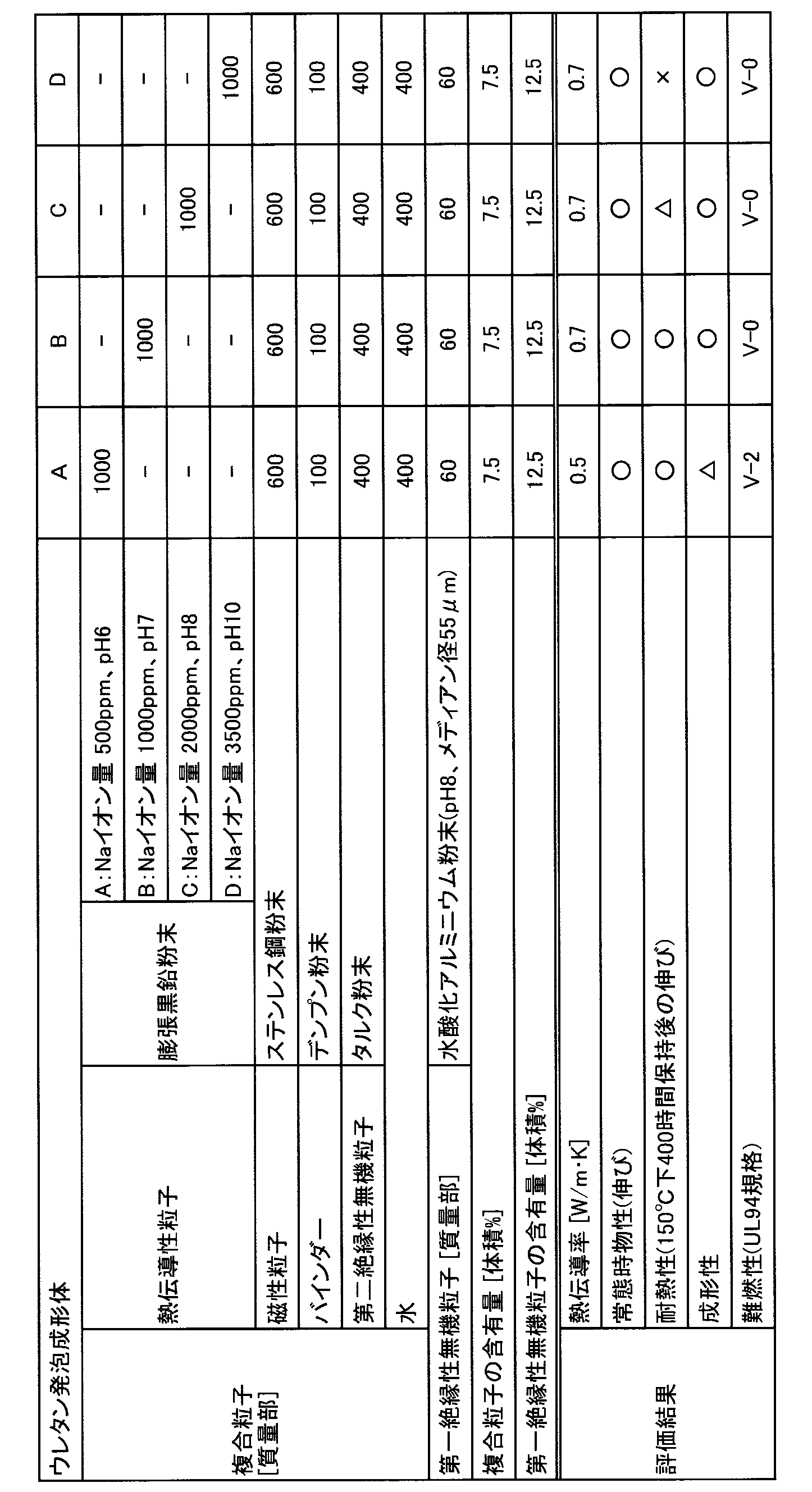
表1に示すように、ウレタン発泡成形体A~Cは、ナトリウムイオン量が500ppm以上2000ppm以下の膨張黒鉛粉末を用いて造粒した複合粒子を有する。このため、常態時の伸びは良好で、高温下に保持された後でも伸びの低下は小さかった。また、ウレタン発泡成形体A~Cの熱伝導率は、0.5W/m・K以上と大きかった。ウレタン発泡成形体Aにおいては、ウレタン発泡成形体B、Cと比較して、ナトリウムイオン量が少ない。これにより、混合原料が酸性に傾き、硬化反応に影響があったことが、成形性および難燃性の低下につながったと考えられる。ウレタン発泡成形体Cにおいては、ウレタン発泡成形体A、Bと比較して、ナトリウムイオン量が多い。このため、耐熱性がやや低下した。以上より、ウレタン発泡成形体A~Cは、熱伝導性および耐熱性を満足することが確認された。これに対して、ナトリウムイオン量が3500ppmと多い膨張黒鉛粉末を用いて造粒した複合粒子を有するウレタン発泡成形体Dについては、熱伝導性、常態時物性および難燃性は満足するものの、耐熱性が劣る結果になった。
本開示のウレタン発泡成形体は、バッテリーカバー、電動パワートレイン(eAxel)カバー、シートモーターカバー、アンダーカバー、フロアマット、ダッシュサイレンサー、フードサイレンサー、各種ECU、ジャンクションボックスなどの車両用部品、パソコンなどの電子機器に用いられる防音材として好適である。
Claims (8)
- ポリウレタンフォームからなる基材と、該基材中に配向して含有されている複合粒子と、該基材中に分散している第一絶縁性無機粒子と、を有し、
該複合粒子は、熱伝導性粒子と、該熱伝導性粒子の表面にバインダーにより接着された磁性粒子と、を有し、
該熱伝導性粒子は膨張黒鉛粒子を有し、該膨張黒鉛粒子に含まれるアルカリ金属イオンの量は500ppm以上2000ppm以下であることを特徴とするウレタン発泡成形体。 - 前記アルカリ金属イオンは、ナトリウムイオンを有する請求項1に記載のウレタン発泡成形体。
- 前記複合粒子の含有量は、ウレタン発泡成形体の体積を100体積%とした場合の5体積%以上50体積%以下である請求項1または請求項2に記載のウレタン発泡成形体。
- 前記第一絶縁性無機粒子の含有量は、ウレタン発泡成形体の体積を100体積%とした場合の5体積%以上20体積%以下である請求項1ないし請求項3のいずれかに記載のウレタン発泡成形体。
- 前記第一絶縁性無機粒子の熱伝導率は、5W/m・K以上である請求項1ないし請求項4のいずれかに記載のウレタン発泡成形体。
- 前記第一絶縁性無機粒子は、水酸化アルミニウム、酸化アルミニウム、窒化アルミニウム、水酸化マグネシウム、酸化マグネシウム、タルク、炭酸カルシウム、クレー、マイカ、シリカから選ばれる一種以上を有する請求項1ないし請求項5のいずれかに記載のウレタン発泡成形体。
- 前記複合粒子は、前記熱伝導性粒子の表面にバインダーにより接着された第二絶縁性無機粒子を有する請求項1ないし請求項6のいずれかに記載のウレタン発泡成形体。
- 前記第二絶縁性無機粒子は、水酸化アルミニウム、酸化アルミニウム、窒化アルミニウム、水酸化マグネシウム、酸化マグネシウム、タルク、炭酸カルシウム、クレー、マイカ、シリカから選ばれる一種以上を有する請求項7に記載のウレタン発泡成形体。
Priority Applications (2)
| Application Number | Priority Date | Filing Date | Title |
|---|---|---|---|
| CN202480019578.3A CN120813458A (zh) | 2023-06-30 | 2024-03-22 | 氨基甲酸酯发泡成形体 |
| US19/352,391 US20260035545A1 (en) | 2023-06-30 | 2025-10-07 | Urethane foam molded body |
Applications Claiming Priority (2)
| Application Number | Priority Date | Filing Date | Title |
|---|---|---|---|
| JP2023108065A JP2025006980A (ja) | 2023-06-30 | 2023-06-30 | ウレタン発泡成形体 |
| JP2023-108065 | 2023-06-30 |
Related Child Applications (1)
| Application Number | Title | Priority Date | Filing Date |
|---|---|---|---|
| US19/352,391 Continuation US20260035545A1 (en) | 2023-06-30 | 2025-10-07 | Urethane foam molded body |
Publications (1)
| Publication Number | Publication Date |
|---|---|
| WO2025004472A1 true WO2025004472A1 (ja) | 2025-01-02 |
Family
ID=93938617
Family Applications (1)
| Application Number | Title | Priority Date | Filing Date |
|---|---|---|---|
| PCT/JP2024/011361 Ceased WO2025004472A1 (ja) | 2023-06-30 | 2024-03-22 | ウレタン発泡成形体 |
Country Status (4)
| Country | Link |
|---|---|
| US (1) | US20260035545A1 (ja) |
| JP (1) | JP2025006980A (ja) |
| CN (1) | CN120813458A (ja) |
| WO (1) | WO2025004472A1 (ja) |
Citations (2)
| Publication number | Priority date | Publication date | Assignee | Title |
|---|---|---|---|---|
| JPH02153967A (ja) * | 1988-12-06 | 1990-06-13 | Nippon Kasei Kk | 難燃性ポリウレタンフォーム |
| WO2013042611A1 (ja) * | 2011-09-20 | 2013-03-28 | 東海ゴム工業株式会社 | ウレタン発泡成形体およびその製造方法 |
-
2023
- 2023-06-30 JP JP2023108065A patent/JP2025006980A/ja active Pending
-
2024
- 2024-03-22 CN CN202480019578.3A patent/CN120813458A/zh active Pending
- 2024-03-22 WO PCT/JP2024/011361 patent/WO2025004472A1/ja not_active Ceased
-
2025
- 2025-10-07 US US19/352,391 patent/US20260035545A1/en active Pending
Patent Citations (2)
| Publication number | Priority date | Publication date | Assignee | Title |
|---|---|---|---|---|
| JPH02153967A (ja) * | 1988-12-06 | 1990-06-13 | Nippon Kasei Kk | 難燃性ポリウレタンフォーム |
| WO2013042611A1 (ja) * | 2011-09-20 | 2013-03-28 | 東海ゴム工業株式会社 | ウレタン発泡成形体およびその製造方法 |
Also Published As
| Publication number | Publication date |
|---|---|
| US20260035545A1 (en) | 2026-02-05 |
| CN120813458A (zh) | 2025-10-17 |
| JP2025006980A (ja) | 2025-01-17 |
Similar Documents
| Publication | Publication Date | Title |
|---|---|---|
| EP2682411B1 (en) | Urethane foam molding and method for manufacturing same | |
| JP5766477B2 (ja) | ウレタン発泡成形体およびその製造方法 | |
| CN102341225A (zh) | 聚氨酯发泡成形体及其制造方法 | |
| EP2036695B1 (en) | Urethane foam molded article, manufacturing method thereof, and magnetic induction foam molding apparatus | |
| JP5662743B2 (ja) | ウレタン発泡成形体およびその製造方法 | |
| CN101376742A (zh) | 聚氨酯发泡成形体及其制造方法、及磁感应发泡成形装置 | |
| JP2009051148A (ja) | ウレタン発泡成形体およびその製造方法 | |
| JP7681194B2 (ja) | ウレタン発泡成形体およびその製造方法 | |
| JP5577065B2 (ja) | ウレタン発泡成形体およびその製造方法 | |
| WO2025004472A1 (ja) | ウレタン発泡成形体 | |
| WO2025004471A1 (ja) | ウレタン発泡成形体 | |
| WO2024202354A1 (ja) | ウレタン発泡成形体 | |
| JP5097092B2 (ja) | ウレタン発泡成形体およびその製造方法 | |
| JP2025086109A (ja) | ウレタン発泡成形体 | |
| JP2010069742A (ja) | ウレタン発泡成形体およびその製造方法 | |
| JP5118988B2 (ja) | ウレタン発泡成形体およびその製造方法 | |
| WO2025033343A1 (ja) | ウレタン発泡成形体およびそれを用いた放熱構造体 |
Legal Events
| Date | Code | Title | Description |
|---|---|---|---|
| 121 | Ep: the epo has been informed by wipo that ep was designated in this application |
Ref document number: 24831349 Country of ref document: EP Kind code of ref document: A1 |
|
| WWE | Wipo information: entry into national phase |
Ref document number: CN2024800195783 Country of ref document: CN Ref document number: 202480019578.3 Country of ref document: CN |
|
| WWP | Wipo information: published in national office |
Ref document number: 202480019578.3 Country of ref document: CN |
|
| NENP | Non-entry into the national phase |
Ref country code: DE |