WO2024262612A1 - 冷蔵庫 - Google Patents
冷蔵庫 Download PDFInfo
- Publication number
- WO2024262612A1 WO2024262612A1 PCT/JP2024/022594 JP2024022594W WO2024262612A1 WO 2024262612 A1 WO2024262612 A1 WO 2024262612A1 JP 2024022594 W JP2024022594 W JP 2024022594W WO 2024262612 A1 WO2024262612 A1 WO 2024262612A1
- Authority
- WO
- WIPO (PCT)
- Prior art keywords
- electrode
- freezing
- matching circuit
- control unit
- refrigerator
- Prior art date
- Legal status (The legal status is an assumption and is not a legal conclusion. Google has not performed a legal analysis and makes no representation as to the accuracy of the status listed.)
- Ceased
Links
Images











Classifications
-
- F—MECHANICAL ENGINEERING; LIGHTING; HEATING; WEAPONS; BLASTING
- F25—REFRIGERATION OR COOLING; COMBINED HEATING AND REFRIGERATION SYSTEMS; HEAT PUMP SYSTEMS; MANUFACTURE OR STORAGE OF ICE; LIQUEFACTION SOLIDIFICATION OF GASES
- F25D—REFRIGERATORS; COLD ROOMS; ICE-BOXES; COOLING OR FREEZING APPARATUS NOT OTHERWISE PROVIDED FOR
- F25D23/00—General constructional features
- F25D23/12—Arrangements of compartments additional to cooling compartments; Combinations of refrigerators with other equipment, e.g. stove
-
- H—ELECTRICITY
- H05—ELECTRIC TECHNIQUES NOT OTHERWISE PROVIDED FOR
- H05B—ELECTRIC HEATING; ELECTRIC LIGHT SOURCES NOT OTHERWISE PROVIDED FOR; CIRCUIT ARRANGEMENTS FOR ELECTRIC LIGHT SOURCES, IN GENERAL
- H05B6/00—Heating by electric, magnetic or electromagnetic fields
- H05B6/64—Heating using microwaves
- H05B6/66—Circuits
- H05B6/68—Circuits for monitoring or control
Definitions
- This disclosure relates to a refrigerator equipped with a storage compartment that has a freezing function and a defrosting function.
- Patent Document 1 discloses a refrigerator capable of thawing frozen products.
- the refrigerator described in Patent Document 1 includes, inside its main body, a refrigeration unit and a freezing chamber, as well as a high-frequency generating magnetron and a heating chamber.
- the refrigerator described in Patent Document 1 can supply cold air from a refrigeration unit to a heating chamber via a cold air circulation duct, and can also supply high frequency waves from a magnetron to the heating chamber to thaw frozen items stored in the heating chamber.
- this heating chamber is a storage chamber in which frozen items can be thawed.
- Patent Document 2 discloses a refrigeration device capable of supplying cold air uniformly inside the freezer.
- the freezer described in Patent Document 2 is equipped with one or both of an alternating electric field generating unit that applies an alternating electric field to the object to be frozen and a magnetic field generating unit that applies a magnetic field inside a closed space, and applies one or both of the alternating electric field and the magnetic field to the object to be frozen.
- the objective of this disclosure is to provide a refrigerator that can accurately control impedance matching in a short time, detect when thawing is complete, and detect the progress of aging by determining the initial state of food.
- the refrigerator disclosed herein includes a storage compartment, an oscillator circuit, electrodes, a matching circuit, a detector, and a controller.
- the storage compartment has a storage space capable of cooling stored items.
- the oscillator circuit generates high-frequency power.
- the electrodes form an electric field in the storage compartment that corresponds to the high-frequency power.
- the matching circuit matches the impedance of the electrodes.
- the detection unit is connected between the oscillation circuit and the matching circuit, and measures the incident wave power output from the matching circuit to the electrode and the reflected wave power returning to the oscillation circuit.
- the control unit controls the oscillation circuit and the matching circuit based on the incident wave power and the reflected wave power, and determines the load impedance.
- the refrigerator disclosed herein can easily detect changes in the state of food during the thawing and maturing operations.
- FIG. 1 is a vertical cross-sectional view of a refrigerator according to an embodiment of the present disclosure.
- FIG. 2 is a front cross-sectional view showing the freezing/thawing compartment of the refrigerator according to the embodiment.
- FIG. 3 is a side cross-sectional view showing the freezing/thawing compartment of the refrigerator according to the embodiment.
- FIG. 4 is a vertical cross-sectional view showing how the freezing/thawing compartment is incorporated into the main body of the refrigerator according to the embodiment.
- FIG. 5 is a front sectional view showing a modified example of the freezing/thawing compartment in the refrigerator according to the embodiment.
- FIG. 6 is a side cross-sectional view showing a modified example of the freezing/thawing compartment in the refrigerator according to the embodiment.
- FIG. 1 is a vertical cross-sectional view of a refrigerator according to an embodiment of the present disclosure.
- FIG. 2 is a front cross-sectional view showing the freezing/thawing compartment of the refrigerator according to the embodiment.
- FIG. 3 is
- FIG. 7 is a vertical cross-sectional view showing how the freezing/thawing compartment is incorporated into the main body of the refrigerator according to the embodiment.
- FIG. 8 is a schematic diagram showing an electrode holding area on the rear side of a freezing/thawing compartment in a refrigerator according to an embodiment.
- FIG. 9 is a block diagram of a dielectric heating mechanism disposed in the refrigerator according to the embodiment.
- FIG. 10 is a schematic circuit diagram of an AC/DC converter in the dielectric heating mechanism.
- FIG. 11 is a plan view of a first electrode and a second electrode of a freezing/thawing compartment in a refrigerator according to an embodiment, as viewed from above.
- FIG. 12 is a diagram showing the relationship between the electrode distance between the first electrode and the second electrode and the electric field intensity between the two electrodes.
- FIG. 13A is an electric field simulation diagram showing the results of a simulation performed on a dielectric heating configuration.
- FIG. 13B is an electric field simulation diagram showing the results of a simulation performed on the dielectric heating configuration of the freezing/thawing compartment in the refrigerator according to the embodiment.
- FIG. 14 is a diagram showing the control signal in the electric field generation process, the temperatures of the food and the freezing/thawing compartment, and the humidity in the freezing/thawing compartment in the configuration of the embodiment.
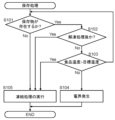
- FIG. 15 is a flow chart showing the control after the electric field generation process is completed in the freezing/thawing chamber in the configuration of this embodiment.
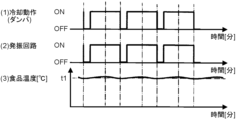
- FIG. 16A is a waveform diagram showing a cooling operation in a conventional refrigerator.
- FIG. 16B is a waveform diagram showing the cooling operation in the refrigerator according to the embodiment.
- FIG. 17 is a waveform diagram showing the state of each element during a rapid cooling operation in the configuration of the embodiment.
- FIG. 18A is a diagram illustrating an example of the high frequency blocking circuit when the door of the refrigerator according to the embodiment is opened.
- FIG. 18B is a diagram illustrating another example of the high-frequency blocking circuit when the door of the refrigerator according to the embodiment is opened.
- FIG. 18C is a diagram illustrating still another example of the high frequency blocking circuit when the door of the refrigerator in accordance with the embodiment is opened.
- FIG. 19A is a cross-sectional view showing an example of cable wiring to a freezing/thawing compartment in a refrigerator according to an embodiment.
- FIG. 19A is a cross-sectional view showing an example of cable wiring to a freezing/thawing compartment in a refrigerator according to an embodiment.
- FIG. 19B is a cross-sectional view showing an example of cable wiring to a freezing/thawing compartment in a refrigerator according to an embodiment.
- FIG. 20A is a diagram illustrating an example of region division of a synthetic impedance in a high-frequency circuit provided in a refrigerator according to an embodiment.
- FIG. 20B is a diagram illustrating another example of region division of the synthetic impedance in the high-frequency circuit provided in the refrigerator according to the embodiment.
- FIG. 20C is a diagram illustrating region division of synthetic impedance in the high-frequency circuit arranged in the refrigerator according to the embodiment and distribution of input current to the dielectric heating mechanism.
- FIG. 20A is a diagram illustrating an example of region division of a synthetic impedance in a high-frequency circuit provided in a refrigerator according to an embodiment.
- FIG. 20B is a diagram illustrating another example of region division of the synthetic impedance in the high-frequency circuit provided in the refrigerator according to the embodiment.
- FIG. 20C is a diagram illustrating region division
- FIG. 21A is a flowchart for estimating a composite impedance from a change in reflectance in response to impedance adjustment in the refrigerator according to the embodiment.
- FIG. 21B is a flowchart for estimating a composite impedance from a change in reflectance in response to impedance adjustment in the refrigerator according to the embodiment.
- FIG. 22A is a flowchart for estimating a composite impedance according to a reflectance and an input current to a dielectric heating mechanism in a refrigerator according to an embodiment.
- FIG. 22B is a flowchart for estimating a composite impedance from the reflectance and the input current to the dielectric heating mechanism in the refrigerator according to the embodiment.
- FIG. 21A is a flowchart for estimating a composite impedance from a change in reflectance in response to impedance adjustment in the refrigerator according to the embodiment.
- FIG. 22B is a flowchart for estimating a composite impedance from the reflectance and the input current to the dielectric heating mechanism in the
- FIG. 23A is a flowchart for determining a control factor of a matching circuit from an estimation of a synthetic impedance in the refrigerator according to the embodiment.
- FIG. 23B is a flowchart for determining a control factor of a matching circuit from an estimation of a synthetic impedance in the refrigerator according to the embodiment.
- Patent Document 1 (The knowledge that formed the basis of this disclosure) At the time when the inventors conceived the subject matter of the present disclosure, the refrigerator described in Patent Document 1 was known.
- the refrigerator described in Patent Document 1 irradiates the frozen items in the heating chamber with high-frequency waves from a magnetron via an antenna or the like, thereby heating the frozen items. Therefore, if there is an uneven distribution of high-frequency waves in the heating chamber, it is difficult to heat the frozen items evenly and defrost them to the desired state.
- the above conventional refrigerators are equipped with a magnetron that generates high frequency waves, as well as a cooling mechanism for the magnetron. Therefore, it is difficult to reduce the size of the above conventional refrigerators.
- Patent Document 2 describes a freezing device that applies an alternating electric field to the item to be frozen.
- the freezing device described in Patent Document 2 it is difficult to melt the ice crystals that form in the preserved item, and freezing destroys the cell membrane of the preserved item.
- Patent Document 1 and the technology described in Patent Document 2 are difficult to apply simultaneously due to differences in output frequency and output power.
- Patent Document 2 when a device using metal components is used in a freezer environment, malfunctions may occur due to condensation or frost caused by moisture in food or moisture from the outside.
- the inventors conceived the subject matter of the present disclosure.
- the objective of this disclosure is to provide a small, reliable refrigerator that can freeze, store, and thaw items stored in a storage compartment in a desired state.
- a refrigerator with a freezing function and a defrosting function will be described with reference to the attached drawings.
- the refrigerator according to the present disclosure is not limited to the configuration described in the embodiment below, but can also be applied to a freezer that only has a freezing function. Therefore, in this disclosure, a refrigerator is a device that has one or both of a refrigerator compartment and a freezer compartment.
- FIG. 1 is a vertical cross-sectional view of a refrigerator 1 according to the present embodiment.
- the left and right sides in Fig. 1 correspond to the front side and rear side, respectively, of the refrigerator 1.
- a main body 2 of the refrigerator 1 is an insulated box body including an outer box 3, an inner box 4, and a thermal insulation material 40.
- the outer box 3 is mainly made of steel plate.
- the inner box 4 is made of resin such as ABS (Acrylonitrile, Butadiene, Styrene).
- the heat insulating material 40 is, for example, rigid urethane foam, which is foamed and filled into the space between the outer box 3 and the inner box 4.
- the main body 2 of the refrigerator 1 has multiple storage compartments, namely, a refrigerator compartment 5, a freezer/thaw compartment 6, an ice-making compartment 7, a freezer compartment 8, and a vegetable compartment 9.
- An openable and closable door is provided at the front opening of each storage compartment. The doors cover the front openings of the multiple storage compartments to prevent cold air from leaking out of the storage compartments.
- the refrigerator compartment 5 is the uppermost of the multiple storage compartments. Directly below the refrigerator compartment 5, two storage compartments, the ice-making compartment 7 and the freezer/thaw compartment 6, are arranged side by side on the left and right.
- the freezer compartment 8 is arranged directly below the ice-making compartment 7 and the freezer/thaw compartment 6.
- the vegetable compartment 9 is arranged directly below the freezer compartment 8.
- each storage compartment in the refrigerator 1 is an example, and the present disclosure is not limited thereto.
- the configuration and arrangement of each storage compartment can be changed as appropriate depending on the specifications, etc.
- Refrigerator compartment 5 is maintained at a temperature for refrigerating food and other preserved items, specifically 1°C to 5°C.
- Vegetable compartment 9 is maintained at a temperature range equal to or slightly higher than refrigerator compartment 5, for example 2°C to 7°C.
- Freezer compartment 8 is maintained in the freezing temperature range for frozen storage, specifically, for example -22°C to -15°C.
- the freezing/thawing compartment 6 is normally maintained in the same freezing temperature range as the freezing compartment 8.
- an electric field generation process is carried out to thaw the stored items (frozen goods) in response to a command from the user to start generating an electric field (hereinafter, an electric field generation command).
- an electric field generation command The configuration of the freezing/thawing compartment 6 and the details of the electric field generation process will be described later.
- a machine room 10 is located at the top of the refrigerator 1 (the top in this embodiment).
- the machine room 10 houses components that make up the refrigeration cycle, such as a compressor 19 and a dryer that removes moisture during the refrigeration cycle.
- the location of the machine room 10 is not limited to the top of the refrigerator 1, but is determined appropriately depending on the location of the refrigeration cycle, etc.
- the machine room 10 may be located at the bottom of the refrigerator 1.
- the cooling compartment 11 is located behind the freezer compartment 8 and vegetable compartment 9, which are located at the bottom of the refrigerator 1.
- the cooling compartment 11 is equipped with a cooler 13 and a cooling fan 14.
- the cooler 13 is a component of the refrigeration cycle that generates cold air.
- the cooling fan 14 blows the cold air generated by the cooler 13 through the air passage 12 to the three storage compartments (the refrigerator compartment 5, the freezer/thaw compartment 6, and the ice-making compartment 7).
- a damper 12a is disposed in the air passage 12.
- the control unit 50 controls the rotation speed of the compressor 19 and the cooling fan 14, and controls the opening and closing of the damper 12a, to maintain the temperature of each storage compartment within a predetermined temperature range.
- a defrost heater 15 is disposed at the bottom of the cooling chamber 11.
- the defrost heater 15 is a heater for removing frost and ice that adheres to the cooler 13 and its surroundings.
- a drain pan 16, a drain tube 17, and an evaporator dish 18 are disposed below the defrost heater 15. These are components for evaporating moisture that is generated during defrosting, etc.
- the refrigerator 1 includes an operation unit 47 (see FIG. 9 described below).
- a user uses the operation unit 47 to input various commands to the refrigerator 1 (for example, temperature settings for each storage compartment, a quick cooling command, a command to generate an electric field, a command to stop ice making, etc.).
- the operation unit 47 has a display unit for notifying the user of necessary information.
- the refrigerator 1 may be equipped with a wireless communication unit that can be connected to a wireless LAN (local area network) to input various commands from the user's external terminal.
- the refrigerator 1 may also be equipped with a voice recognition unit for inputting commands by voice from the user.
- FIGS 2, 3, 5, and 6 are vertical cross-sectional views showing the freezing/thawing compartment 6 of the refrigerator 1 according to this embodiment.
- Figures 2 and 5 are views of refrigerator 1 as seen from the front side. Therefore, the left and right sides in Figures 2 and 5 correspond to the left and right sides of refrigerator 1, respectively.
- Figures 3 and 6 are views of refrigerator 1 as seen from the right side. Therefore, the left and right sides in Figures 3 and 6 correspond to the front and rear sides of refrigerator 1, respectively.
- the top and bottom of refrigerator 1 correspond to the top and bottom of the drawings.
- the freezing/thawing chamber 6 is both a freezing chamber and a thawing chamber. That is, the freezing/thawing chamber 6 freezes stored items such as food and keeps them at a freezing temperature range.
- an electric field generation command is input to the operation unit 47, an electric field generation process is performed in the freezing/thawing chamber 6, and the frozen stored items are thawed by dielectric heating.
- An air passage 12 is disposed behind and above the freezing/thawing chamber 6.
- the air passage 12 connects the cooling chamber 11 with the freezing/thawing chamber 6.
- a plurality of cold air inlet holes 20 are disposed on the top surface of the freezing/thawing chamber 6.
- the cold air generated by the cooler 13 flows through the air passage 12 and is introduced into the freezing/thawing chamber 6 through the plurality of cold air inlet holes 20. This allows the freezing/thawing chamber 6 to be maintained in the same freezing temperature range as the freezing chamber 8.
- a damper 12a is disposed in the air passage 12.
- the damper 12a is controlled to open and close so that the freezing/thawing chamber 6 is maintained at a predetermined freezing temperature range. This allows the items contained in the freezing/thawing chamber 6 to be frozen and preserved.
- a cold air exhaust hole (not shown) is formed on the rear surface of the freezing/thawing compartment 6. After cooling the inside of the freezing/thawing compartment 6, the cold air returns to the cooling compartment 11 via the cold air exhaust hole and an air passage (not shown), and is re-cooled by the cooler 13. That is, in the refrigerator 1 according to this embodiment, the cold air generated by the cooler 13 circulates through the refrigerator 1.
- inner surface members 32a, 32b, and 32c molded from an electrically insulating material (e.g., resin).
- inner surface members 32a to 32c are collectively referred to as inner surface member 32.
- a door 29 is placed at the front opening of the freezing/thawing chamber 6. When the door 29 is closed, the storage space of the freezing/thawing chamber 6 is sealed. A storage case 31 with an open top is placed on the rear side of the door 29 in the freezing/thawing chamber 6. When the door 29 is opened and closed back and forth, the storage case 31 moves back and forth in conjunction with this movement. This movement allows the storage case 31 to be removed from the freezing/thawing chamber 6, making it easier to take in and out stored items such as food.
- the dielectric heating mechanism can adjust the amount of heat by controlling the output power. If the amount of heat applied to the stored item exceeds the amount of cooling in the freezing/thawing chamber 6, the stored item is heated. If the amount of heat applied to the stored item is less than the amount of cooling in the freezing/thawing chamber 6, the stored item is cooled.
- FIG. 9 is a block diagram of the dielectric heating mechanism arranged in the refrigerator 1. As shown in FIG. 9, the dielectric heating mechanism in this embodiment includes a power supply unit 48, an oscillator circuit 22, a matching circuit 23, a first electrode 24, a second electrode 25, and a control unit 50.
- the oscillator circuit 22 is an oscillator section that receives power from the power supply section 48 and generates a high-frequency signal.
- the oscillator circuit 22 is constructed using semiconductor elements, is miniaturized, and is disposed on an electrode holding substrate 52 in an electrode holding area 30 (see Figures 3, 4, 6, and 7) described below.
- the oscillator circuit 22 and the matching circuit 23 correspond to an electric field forming section for forming a high-frequency electric field to be applied between the first electrode 24 and the second electrode 25.
- the first electrode 24 is a flat electrode located at the top (near the top surface) of the freezing/thawing chamber 6.
- the second electrode 25 is a flat electrode located at the bottom (near the bottom surface) of the freezing/thawing chamber 6.
- the first electrode 24 and the second electrode 25 are a pair of electrodes arranged facing each other at a predetermined vertical distance (see electrode distance H in Figure 8) in the storage space (thawing space) of the freezing/thawing chamber 6.
- the first electrode 24 and the second electrode 25 are fixed to an electrode holding substrate 52, which will be described later.
- the first electrode 24 and the second electrode 25 are arranged substantially parallel to each other.
- substantially parallel does not mean strictly parallel, but includes errors resulting from variations in processing accuracy, etc.
- the first electrode 24 is disposed near the top surface of the storage space
- the second electrode 25 is disposed near the bottom surface of the storage space, with the storage space in between.
- the inner surface member 32 covers the matching circuit 23 on the rear side, the first electrode 24 on the top surface, and the second electrode 25 on the bottom surface, thereby preventing damage to these elements due to contact with the stored items.
- a first electrode 24 and a second electrode 25 are disposed near the top and bottom surfaces of the storage space, respectively.
- the present disclosure is not limited to this configuration. It is sufficient that the first electrode 24 and the second electrode 25 are disposed substantially parallel to each other and facing each other across the storage space (thawing space).
- the second electrode 25 may be disposed near the top surface of the storage space, and the first electrode 24 may be disposed near the bottom surface of the storage space.
- the first electrode 24 and the second electrode 25 may be disposed opposite each other in the left-right direction (depth direction in FIG. 1).
- the oscillator circuit 22 outputs a high-frequency voltage in the VHF band (40.68 MHz in this embodiment).
- the high-frequency voltage output by the oscillator circuit 22 creates an electric field between the first electrode 24 and the second electrode 25, resulting in dielectric heating of the stored object, which is a dielectric placed in the storage space.
- the first electrode 24, the second electrode 25, and the stored object form a load impedance in the storage space.
- the matching circuit 23 adjusts the impedance in the matching circuit 23 so that the load impedance matches the output impedance of the oscillation circuit 22.
- the matching circuit 23 performs impedance matching to minimize the reflected wave relative to the incident wave.
- the incident wave is the electromagnetic wave output by the oscillator circuit 22 toward the first electrode 24.
- the reflected wave is the electromagnetic wave of the incident wave that returns from the first electrode 24 to the oscillator circuit 22.
- the refrigerator 1 further includes a current detection unit 57.
- the current detection unit 57 is disposed at the input of the oscillator circuit 22 and detects the value of the current supplied from the power supply unit 48 to the oscillator circuit 22 (specifically, the second amplifier circuit 22c).
- the oscillator circuit 22 includes a detector 51.
- the detector 51 detects the incident wave and the reflected wave, and transmits the respective detection values to the controller 50.
- the oscillator circuit 22 is electrically connected to the first electrode 24 via the detector 51 and the matching circuit 23.
- the controller 50 calculates the ratio of the detection value of the reflected wave power to the detection value of the incident wave power as a reflectance, and performs various controls, which will be described later, based on the reflectance.
- the control unit 50 may calculate the ratio of the detected value of the reflected wave power to the set power value of the electromagnetic wave output from the oscillator circuit 22 as the reflectivity.
- the control unit 50 may perform various controls, described later, based only on the detected value of the reflected wave, regardless of the set output value of the electromagnetic wave and the detected value of the incident wave.
- control unit 50 may perform the various controls described below using the reflectivity obtained from the incident wave power or the set power value of the electromagnetic wave output from the oscillator circuit 22, the reflected wave power, and the input current value to the oscillator circuit 22 obtained from the current detection unit 57.
- the control unit 50 controls the oscillation circuit 22 and the matching circuit 23 based on signals from the operation unit 47, the temperature sensor 49, etc.
- the control unit 50 includes a processor such as a CPU (Central Processing Unit) and a memory such as a ROM (Read Only Memory).
- the control unit 50 performs various controls by having the CPU execute a control program stored in the memory.
- the electrode holding substrate 52 (see Figures 3, 4, 6, 7, 8, 19A, and 19B) and the first electrode 24 are directly connected without the use of a lead wire or a coaxial cable.
- the electrode holding substrate 52 and the second electrode 25 are directly connected.
- the electrode holding substrate 52 is disposed in the electrode holding area 30 at the rear of the freezing/thawing chamber 6 and includes a matching circuit 23.
- the matching circuit 23 has adjustable inductance and capacitance values.
- the control unit 50 adjusts the inductance and capacitance values of the matching circuit 23 to control impedance matching by the matching circuit 23.
- the matching circuit 23 generates heat due to losses in the inductor. Hereinafter, this heat is referred to as waste heat by the matching circuit 23.
- a matching circuit 23 In a device including a matching circuit 23 and metal parts such as a first electrode 24, a second electrode 25, and an electromagnetic shield 26 (described later, for example, the top-side electromagnetic shield 26a, the back-side electromagnetic shield 26b, the bottom-side electromagnetic shield 26c, and the door-side electromagnetic shield 26d shown in Figures 2 and 3) arranged around the matching circuit 23, condensation is likely to occur in the freezing temperature range.
- the matching circuit 23 is arranged on the electrode holding substrate 52, so that waste heat from the matching circuit 23 is conducted to the device, preventing condensation.
- the first electrode 24, the second electrode 25, and the electromagnetic shield 26 described below also generate heat due to electrical losses. However, this heat is usually slight and does not contribute to preventing condensation and frost. Therefore, it is possible to prevent condensation and frost by intentionally increasing the heat generation by using a material with high loss.
- control unit 50 detects the possibility of condensation or frosting, regardless of whether an electric field is generated in the freezing/thawing chamber 6, it uses waste heat to prevent condensation and frosting. In other words, the control unit 50 prevents condensation and frosting by appropriately operating the oscillation circuit 22 to intentionally generate waste heat.
- the detection unit 51 In order to more accurately determine whether the impedance matching provided by the matching circuit 23 is sufficient, it is desirable to place the detection unit 51 on the electrode holding substrate 52 together with the matching circuit 23. This eliminates the need for lead wires, coaxial cables, and connectors for connecting these between the matching circuit 23 and the detection unit 51, making it possible to simplify the structure.
- the matching circuit 23, the detection unit 51, and the oscillator circuit 22 all on a single board, it is possible to further reduce transmission loss due to lead wires and coaxial cables, and improve the accuracy of impedance matching.
- the oscillator circuit 22 and the matching circuit 23 may be arranged on separate boards and electrically connected by lead wires or a coaxial cable.
- these elements are arranged rationally by making effective use of the space inside the refrigerator, for example by installing the oscillator circuit 22 in the machine room 10 which has a large amount of free space.
- impedance matching including the coaxial cable it is preferable to arrange the oscillator circuit 22 and the detection unit 51 on a single board.
- the load impedance is the impedance of the first electrode 24, the second electrode 25, and the object placed between these electrodes.
- the impedance obtained by combining the impedance of the matching circuit 23 and the load impedance is called the combined impedance.
- the synthetic impedance can be converted to and from the reflectance using a specific formula that includes the characteristic impedance of the transmission line, such as a coaxial cable, as a coefficient. Therefore, the load impedance can be estimated from the information on the reflectance or reflected wave power and the control amount of the matching circuit 23. This makes it possible to estimate the physical properties of the stored object and changes in the state of the stored object.
- a detection unit 51 configuration capable of detecting the phase difference between the incident wave power and the reflected wave power is generally expensive. Therefore, it is desirable to use a detection unit 51 configuration capable of detecting only the absolute value of the reflectivity or reflected wave power.
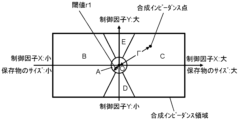
- FIG. 20A is a schematic diagram showing the possible range of the synthetic impedance, converted into reflectance.
- the synthetic impedance point in FIG. 20A is the point where the synthetic impedance is converted into reflectance.
- the synthetic impedance point is located within a certain range on the two-dimensional coordinate system shown in FIG. 20A.
- the distance from the center O to the synthetic impedance point indicates the absolute value of the reflectance ⁇ .
- the reflectance is 0 percent and the reflected wave power is 0.
- the matching circuit 23 In order for the matching circuit 23 to control the synthetic impedance point represented on the two-dimensional coordinate system to a matching state, the matching circuit 23 must have two or more variable capacitors or variable inductors.
- control factor X is a variable capacitor or variable inductance
- control factor Y is also a variable capacitor or variable inductance.
- the synthetic impedance point tends to move in a certain direction within the region.
- the synthetic impedance point moves to the right, and when the control factor Y is increased, the synthetic impedance point moves upward.
- the region in which the synthetic impedance can take place can be classified into five regions (regions A to E) on the two-dimensional coordinate system shown in Figure 20A based on the manipulation of the control factors X and Y and the change in reflectance.
- Area A is a region where the reflectance is small and impedance matching is achieved.
- Area B is a region where the synthetic impedance decreases as the control factor X is increased.
- Area C is a region where the reflectance decreases as the control factor X is decreased.
- Area D is a region where the reflectance decreases as the control factor Y is increased.
- Area E is a region where the reflectance decreases as the control factor Y is decreased.
- Figure 21A is a flowchart for estimating the synthetic impedance using this division into regions.
- steps S302 to S313 are the composite impedance region determination process.
- steps S314 to S318 are the composite impedance region determination results.
- the control unit 50 sets the control factors X and Y of the matching circuit 23 to predetermined initial values (step S301), and sets the reflectance obtained by the processing of step S301 as the initial reflectance (step S302).
- step S303 if the reflectance is less than the threshold value r1, the control unit 50 shifts the processing to step S314 and sets the discrimination result to region A. If the reflectance is equal to or greater than the threshold value r1 (Yes in step S303), the control unit 50 shifts the processing to step S304 and increases the control factor X.
- the control unit 50 compares the reflectance obtained by the processing of step S304 with the initial reflectance (step S305). If the reflectance is smaller than the initial reflectance (No in step S305), the control unit 50 transitions to step S315 and sets the discrimination result as region B.
- step S306 The control unit 50 returns the control factor X to its initial value (step S306) and decreases the control factor X (step S307).
- the control unit 50 compares the reflectance obtained by the process of step S307 with the initial reflectance (step S308).
- step S308 If the reflectance is smaller than the initial reflectance (No in step S308), the control unit 50 transitions the process to step S316 and sets the discrimination result to region C. If the reflectance is larger than the initial reflectance (Yes in step S308), the process transitions to step S309. The control unit 50 returns the control factor X to its initial value (step S309) and increases the control factor Y (step S310).
- the control unit 50 compares the reflectance obtained by the processing of step S310 with the initial reflectance (step S311). If the reflectance is smaller than the initial reflectance (No in step S311), the control unit 50 transitions the processing to step S317 and sets the discrimination result to region D. If the reflectance is larger than the initial reflectance (Yes in step S311), the processing transitions to step S312.
- the control unit 50 returns the control factor Y to its initial value (step S312) and decreases the control factor Y (step S313).
- the control unit 50 transitions to step S318 and sets the discrimination result to region E. From the flowchart shown in FIG. 21A, the manipulation of the control factors X and Y, and the associated change in reflectance, it is possible to estimate in which region of FIG. 20A the composite impedance is located.
- FIG. 20B is a diagram showing the subdivision of the synthetic impedance into regions using the absolute value of the reflectance.
- FIG. 21B is a flowchart for estimating the synthetic impedance when the region division shown in FIG. 20B is used. By subdividing the region division, it is possible to estimate the synthetic impedance more accurately.
- Step S327 corresponds to step S325 in FIG. 21A, and collectively indicates the synthetic impedance region determination process.
- Step S328 corresponds to step S326 in FIG. 21A, and collectively indicates the result of the synthetic impedance region determination.
- step S305 if the reflectance obtained by the processing of step S304 is smaller than the initial reflectance (step S305: No), the control unit 50 determines the discrimination result as region B and transitions to step S319.
- step S319 the control unit 50 determines whether the reflectance is equal to or less than the threshold value r2. If the reflectance is equal to or less than the threshold value r2 (No in step S319), the control unit 50 sets the determination result to region B-1 (step S321); if not (Yes in step S319), the control unit 50 sets the determination result to region B-2 (step S322).
- control unit 50 determines in step S308 that the reflectance obtained by the processing in step S307 is smaller than the initial reflectance, it sets the discrimination result to region C (step S316) and transitions to the processing in step S320.
- step S320 determines in step S320 that the reflectance is less than the threshold value r2 (No in step S320), it sets the discrimination result to region C-1 (step S323); if the control unit 50 determines that the reflectance is equal to or greater than the threshold value r2 (Yes in step S320), it sets the discrimination result to region C-2 (step S324).
- the information on the input current to the oscillator circuit 22 detected by the current detection unit 57 may be used to estimate the composite impedance.
- the conversion efficiency of the oscillator circuit 22 varies depending on the composite impedance. Therefore, when controlling the output voltage of the power supply unit 48 and the output power of the oscillator circuit 22 to be kept constant, the input current value to the oscillator circuit 22 varies along with its efficiency.
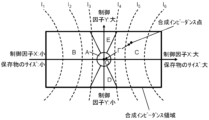
- FIG. 20C shows the composite impedance region divisions superimposed on the contour lines of the input current to the oscillator circuit 22.
- the dotted lines labeled I1 to I6 in FIG. 20C indicate a set of composite impedance points that show the same input current value.
- FIG. 22A is a flowchart for estimating the synthetic impedance using the reflectance and the current value detected by the current detection unit 57.
- the control unit 50 sets the control factors X and Y of the matching circuit 23 to the initial control amounts (step S401).
- the control unit 50 records the reflectance and input current obtained by the processing of step S401 as the initial reflectance and initial input current, respectively (step S402).
- the control unit 50 uses a reference table prepared in advance to identify the synthetic impedance from the combination of the initial reflectance and the initial input current (step S403).
- the control unit 50 determines which of areas A to E shown in FIG. 20A the identified composite impedance falls into (step S404), and determines the determination result (step S405). That is, steps S404 and S405 correspond to the area determination process and the determination result based on the identified composite impedance, respectively.
- FIG. 22B is a flowchart for estimating the synthetic impedance using the reflectance and the current value detected by the current detection unit 57.
- FIG. 22B the same processes as those in FIG. 22A are denoted by the same reference numerals, and the description thereof will be omitted.
- a prepared approximation formula may be used instead of a reference table to determine the composite impedance in step S403 (step S406).
- Region discrimination may also be performed using the region divisions subdivided according to reflectance shown in FIG. 20B.
- FIG. 23A is a flowchart for controlling the control factors X and Y of the matching circuit 23 using the above-mentioned method for estimating the synthetic impedance by dividing into regions.
- steps S501, S502, and S503 correspond to the same processes (synthetic impedance region determination process and determination results) shown in FIG. 21A, FIG. 22A, and FIG. 22B.
- the control unit 50 sets the control amount of the control factor according to the result of the region determination of the composite impedance (step S504). For example, if it is determined to be in region B, the composite impedance can be matched by increasing the control factor X.
- FIG. 23B is a flowchart for determining the control factors X and Y of the matching circuit 23 using the method of estimating the synthetic impedance by dividing into regions.
- the matching circuit 23 may be controlled more precisely by subdividing the settings of the control amounts in the control factors X and Y using the division into regions in FIG. 20B (step S504).
- Steps S501, S502, and S503 correspond to the same process shown in FIG. 21B (synthetic impedance region determination process and determination result).
- the control unit 50 increases the control amount of the control factor X when the determination result is region B-1 compared to when the determination result is region B-2 (step S504). This makes it possible to improve the accuracy of impedance matching by the matching circuit 23.
- the division of the synthetic impedance into regions can also be applied to determining the size of the stored object. There is a certain tendency for the location of the synthetic impedance point depending on the size of the stored object. In FIG. 20A, when the size of the stored object is large, the synthetic impedance point is located on the right side of the figure. When the magnitude of the control factor of the matching circuit 23 is the same, it can be determined that the size of the stored object is small if the synthetic impedance is in region B, and that the size of the stored object is large if the synthetic impedance is in region C.
- the accuracy of determining the size of the stored item may be improved based on the subdivided area division shown in FIG. 20B.
- the control results of the matching circuit 23 can also be applied to determining the size of the stored object.
- the larger the control factor X the more the synthetic impedance point moves to the right, and the larger the size of the stored object, the more the synthetic impedance point moves to the right.
- the synthetic impedance is matched by the control of the matching circuit 23, if the size of the stored object is large, the control factor X is small, and if the size of the stored object is small, the control factor X is large. Using this correspondence, it is possible to estimate the size of the stored object from the magnitude of the control factor X after control by the matching circuit 23. Any control factor may be used for this estimation.
- the capacitors and inductors included in the matching circuit 23 have temperature characteristics, so their capacitance and inductance values change depending on the operating conditions. If the size of the stored object is small, the energy input to the second electrode 25 is reflected without acting on the stored object, and is dissipated as heat in the equivalent series resistance of the capacitors and the resistance component of the inductor included in the matching circuit 23.
- matching circuit 23 is expected to operate over a wide range of temperature conditions, from approximately -20°C, which is the set temperature of a freezer, to several tens of degrees Celsius. Since matching circuit 23 is very sensitive to changes in reflectance due to changes in the synthetic impedance near the matching point, changes in the characteristics of the capacitor and inductor in this temperature range cannot be ignored.
- This change in characteristics affects the process of estimating the capacitance of the stored object from the composite impedance. For example, when the temperature of the electrode holding substrate 52 is high, the size of the stored object is more likely to be determined to be smaller than its actual size than when the temperature is low.
- a temperature sensor 49 is placed on the electrode holding substrate 52 including the matching circuit 23.
- the control unit 50 corrects the capacitance and inductance values of the matching circuit 23 based on the temperature of the electrode holding substrate 52 (specifically, the matching circuit 23) detected by the temperature sensor 49. This makes it possible to more accurately estimate the size of the stored object.
- the first electrode 24 and the second electrode 25 face each other substantially parallel to each other with a predetermined gap (see electrode gap H in FIG. 8 ). This makes the electric field uniform in the storage space of the freezing/thawing chamber 6. In this dielectric heating mechanism, the electrode gap H is maintained as described below.
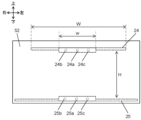
- Figure 8 shows the electrode holding area 30 on the rear side of the freezing/thawing compartment 6.
- Figure 8 is a schematic diagram of the electrode holding area 30 as viewed from the rear side of the freezing/thawing compartment 6. Therefore, the left and right sides in Figure 8 correspond to the right and left sides, respectively, of the refrigerator 1 when viewed from the front side.
- a first electrode 24 is disposed at the top of the freezing/thawing chamber 6 (near the top surface), and a second electrode 25 is disposed at the bottom of the freezing/thawing chamber 6 (near the bottom surface).
- the first electrode 24 has positive electrode terminal 24a, positive electrode terminal 24b, and positive electrode terminal 24c.
- the positive electrode terminals 24a to 24c are arranged side by side in the left-right direction near the center of the rear end of the first electrode 24.
- Each of the positive electrode terminals 24a to 24c protrudes from the rear end of the first electrode 24 and has a shape that is bent upward or downward at a right angle.
- the second electrode 25 has cathode terminal 25a, cathode terminal 25b, and cathode terminal 25c.
- Cathode terminals 25a to 25c are arranged side by side in the left-right direction near the center of the rear end of the second electrode 25.
- Each of cathode terminals 25a to 25c protrudes from the rear end of the second electrode 25 and has a shape that is bent upward or downward at a right angle.
- the first electrode 24 and the second electrode 25 are fixed to the upper and lower parts, respectively, of the electrode holding substrate 52.
- the matching circuit 23 and the detection unit 51 are disposed on the electrode holding substrate 52. Therefore, the first electrode 24 and the second electrode 25 are held at a predetermined distance (see electrode distance H in Figure 8) by the electrode holding substrate 52.
- the matching circuit 23 and the like are arranged on the electrode holding substrate 52, the rigidity of the electrode holding substrate 52 is improved by the copper foil wiring pattern. Therefore, the electrode holding substrate 52 can cantilever-support the first electrode 24 and the second electrode 25 at a predetermined interval (see electrode interval H in FIG. 8). As described above, the oscillator circuit 22 and the like may also be arranged on the electrode holding substrate 52.
- the positive electrode terminals 24a to 24c of the first electrode 24 are connected to a connection terminal (not shown) on the positive side of the matching circuit 23.
- the cathode terminals 25a to 25c of the second electrode 25 are connected to a connection terminal (not shown) on the cathode side of the matching circuit 23.
- the positive electrode terminals 24a to 24c and the cathode terminals 25a to 25c are connected to the connection terminals of the matching circuit 23 by surface contact with a specified contact area to ensure reliability even when a large current flows.
- the flat terminals are connected to each other by screwing.
- the connection between the terminals is not limited to a connection by screwing, so long as a reliable connection is possible.
- the electrode holding substrate 52 which is an electrode holding mechanism, is disposed behind the freezing/thawing chamber 6.
- the electrode holding substrate 52 positions the first electrode 24 and the second electrode 25 substantially parallel to each other.
- the freezing/thawing chamber 6 is equipped with a high-frequency heating module 53 (see, for example, FIG. 4).
- the high-frequency heating module 53 is a module that integrates a first electrode 24, a second electrode 25 that is parallel to the first electrode 24, and an electrode holding substrate 52 that holds the first electrode 24 and the second electrode 25. This makes it easy to hold the first electrode 24 and the second electrode 25 approximately parallel.
- the main body 2 of the refrigerator 1 is an insulated box body composed of the outer box 3 formed of a steel plate, the inner box 4 made of resin, and the insulating material 40.
- the insulating material 40 is, for example, rigid urethane foam, and is foamed and filled in the space between the outer box 3 and the inner box 4.
- the freezing/thawing chamber 6 has an inner surface member 32a arranged inside the insulating material 40 as an outer frame.
- An electromagnetic wave shield 26 is arranged around the freezing/thawing chamber 6.
- the electromagnetic wave shield 26 includes a top-side electromagnetic wave shield 26a, a back-side electromagnetic wave shield 26b, a bottom-side electromagnetic wave shield 26c, and a door-side electromagnetic wave shield 26d, and surrounds the freezing/thawing chamber 6 to prevent electromagnetic waves from leaking to the outside.
- the inner surface member 32a separates the electrode holding area 30 from the freezing/thawing chamber 6.
- the rear electromagnetic shield 26b is disposed on the rear side of the inner surface member 32a.
- the rear electromagnetic shield 26b separates the interior of the freezing/thawing chamber 6 from the electrode holding substrate 52, which includes the matching circuit 23 and the like. This makes it possible to prevent the freezing/thawing chamber 6 and the electrode holding substrate 52 from affecting each other in terms of impedance and electric field.
- Plate-shaped inner surface members 32b and 32c are arranged at the top and bottom of the space surrounded by inner surface member 32a, respectively.
- a first electrode 24 is arranged on the top surface of inner surface member 32b, and a second electrode 25 is arranged on the bottom surface of inner surface member 32c.
- the inner surface members 32b and 32c are held at a predetermined distance (see electrode spacing H in Figures 2 and 3). In other words, the first electrode 24 and the second electrode 25 are held in a substantially parallel state by the electrode holding substrate 52 and the inner surface member 32.
- the top and bottom surfaces of the freezing/thawing chamber 6 may not be parallel.
- the first electrode 24 and the second electrode 25 are kept approximately parallel without being affected by the outer box 3.
- FIG. 4 is a vertical cross-sectional view showing how the freezing/thawing compartment 6 is installed in the main body 2 of the refrigerator 1.
- FIG. 4 is a view of the refrigerator 1 as seen from the right side. Therefore, the left and right sides in FIG. 4 correspond to the front and rear sides of the refrigerator 1, respectively.
- the high-frequency heating module 53 is pre-assembled before the manufacturing process. As shown in FIG. 4, in the manufacturing process, first, the high-frequency heating module 53 is inserted into the outer box 3 of the refrigerator 1. Next, the door unit including the door 29, the door-side electromagnetic shield 26d, the gasket 36, and the storage case 31 is inserted into the high-frequency heating module 53. This completes the refrigerator 1.
- Figure 7 is a vertical cross-sectional view showing how the freezing/thawing compartment 6 is incorporated into the main body 2 of the refrigerator 1. Therefore, the left and right sides in Figure 7 are the same as those in Figure 4.
- the outer box 3, inner box 4, insulating material 40, inner surface member 32, and electromagnetic wave shield 26 are the same as those in Figures 2 and 3.
- flat inner surface members 32b and 32c are arranged horizontally at the top and bottom of the space surrounded by inner surface member 32a.
- a first electrode 24 is arranged on the top surface of inner surface member 32b, and a second electrode 25 is arranged on the bottom surface of inner surface member 32c.
- the front sides of the inner surface members 32b and 32c are fixed by the support 54.
- the back sides of the inner surface members 32b and 32c are fixed by the electrode holding substrate 52 and the inner surface member 32c. This keeps the first electrode 24 and the second electrode 25 in a substantially parallel state.
- the inner surface members 32b and 32c are held at a predetermined distance (see electrode spacing H in Figures 5 to 7), so that the first electrode 24 and second electrode 25 are held in a substantially parallel state by the electrode holding substrate 52, the support 54, and the inner surface member 32.
- the inner surface member 32 is preferably made of a material with a thermal conductivity equal to or less than 10 W/(m ⁇ k) of common industrial ceramic materials that is unlikely to cause condensation even in the freezer compartment 8.
- the inner surface member 32 is made of a resin such as polypropylene, ABS (Acrylonitrile-Butadiene-Syrene), or polycarbonate.
- the electromagnetic wave shield 26 is configured to be thinner than the inner surface member 32. This makes it possible to prevent condensation on the electromagnetic wave shield 26 and the inner surface member 32 that contacts the electromagnetic wave shield 26.
- the electrode holding mechanism allows the first electrode 24 and the second electrode 25 to be arranged approximately parallel to each other with a predetermined distance between them (see, for example, electrode distance H in FIG. 5). Therefore, in the dielectric heating mechanism of the freezing/thawing chamber 6, bias in the high-frequency electric field on the electrode surface is suppressed, and the high-frequency electric field is made uniform. As a result, the stored items (frozen products) can be heated more uniformly.
- the refrigerator 1 is completed by inserting the high-frequency heating module 53, which is a pre-assembled unit, into the outer box 3.
- the refrigerator 1 can be manufactured through a simple manufacturing process.
- Electromagnetic wave shielding mechanism As described above, in the refrigerator 1 according to this embodiment, it is possible to dielectrically heat a stored object (dielectric) by placing it between the first electrode 24 and the second electrode 25 in the freezing/thawing compartment 6. Therefore, in order to prevent electromagnetic waves from leaking outside the freezing/thawing compartment 6, the refrigerator 1 according to this embodiment is provided with an electromagnetic wave shielding mechanism that surrounds the freezing/thawing compartment 6.
- a top-side electromagnetic wave shield 26a is disposed above the top surface of the freezing/thawing chamber 6.
- the top-side electromagnetic wave shield 26a is disposed on the upper surface of the inner surface member 32a that constitutes the top surface of the freezing/thawing chamber 6, and is disposed so as to cover the top surface of the freezing/thawing chamber 6.
- the top-side electromagnetic wave shield 26a has multiple openings. This reduces the area of the portion of the top-side electromagnetic wave shield 26a that faces the first electrode 24.
- These openings have a slit shape with the longitudinal direction being the front-to-rear direction of the refrigerator 1. This allows the magnetic field (or current) flowing forward from the positive terminals 24a-24c to pass smoothly over the top-side electromagnetic shield 26a. This suppresses leakage magnetic fields from diffusing to the surrounding area.
- the inventors analyzed this through electromagnetic wave simulations.
- the top-side electromagnetic wave shield 26a may have a mesh structure with many openings.
- the top electromagnetic wave shield 26a may be placed inside the refrigerator compartment 5 located above the freezer/thaw compartment 6. However, since a partial compartment and a chilled compartment are often placed in the refrigerator compartment 5, the top surfaces of the partial compartment and the chilled compartment may also be used as the electromagnetic wave shield.
- the rear electromagnetic shield 26b is arranged to cover the electrode holding area 30 arranged on the rear side of the freezing/thawing chamber 6.
- the rear electromagnetic shield 26b prevents the electric field generated between the first electrode 24 and the second electrode 25 and the high-frequency noise generated in the matching circuit 23 from affecting the control of the cooling fan 14 and the damper 12a.
- An electromagnetic shield (not shown) is also arranged on the side of the freezing/thawing chamber 6.
- the door-side electromagnetic shield 26d arranged on the door 29 will be described.
- the door 29 is attached to the body of the refrigerator 1 and covers the front opening of the freezing/thawing compartment 6 in an openable and closable manner.
- the wired path repeatedly expands and contracts as the door 29 is opened and closed. In other words, such a configuration is not preferable because it can cause metal fatigue in the wired path to break.
- the gap between the door-side electromagnetic shield 26d and the cross rail 21 is the electromagnetic shield on the main body side that is connected to the outer box 3 and grounded. In this embodiment, this gap is made even smaller (for example, within 30 mm).
- the door-side electromagnetic shield 26d comes close to the grounded cross rail 21.
- This configuration provides the same effect as grounding by wired path.
- the door-side electromagnetic shield 26d may be placed close to components other than the cross rail 21, such as the top-side electromagnetic shield 26a and the bottom-side electromagnetic shield 26c.
- FIG 10 is a schematic circuit diagram of the AC/DC converter in the dielectric heating mechanism.
- the AC voltage from the AC commercial power source ACV is rectified by the bridge diode BD1 and rectifier capacitor C0 and converted into a DC voltage. This DC voltage is input to the DC/DC converter.
- the DC/DC converter shown in FIG. 10 is a flyback type switching power supply circuit.
- the present disclosure is not limited to this, and any switching power supply that uses a transformer, such as a forward type, push-pull type, or half-bridge type, may be used.
- FIG. 10 shows only the main circuit components, and omits the noise filter, power supply control circuit, and protection circuit.
- the AC voltage from the AC commercial power supply ACV is rectified and smoothed by bridge diode BD1 and rectifier capacitor C0 and converted into a DC voltage.
- This DC voltage is called the primary DC power supply DCV0 (or first power supply unit).
- the zero volt reference potential of the primary DC power supply DCV0 is called the primary ground GND0 (or first ground).
- the primary DC power supply DCV0 is applied to the primary winding P1 of the switching transformer T1.
- the switching transformer T1 operates at a switching frequency of several tens of kHz using the field effect transistor Q1.
- the power stored in the primary winding P1 is transferred to the electrically insulated secondary winding S1 by electromagnetic induction, and is rectified by the secondary rectifier diode D1 and secondary rectifier capacitor C1. This outputs the secondary DC power supply DCV1 (second power supply unit).
- the secondary winding S2 has an output section disposed between its two ends.
- the output voltage of the secondary winding S2 is rectified by the secondary rectifier diode D2 and the secondary rectifier capacitor C2.
- the zero volt reference potential of the secondary DC power supplies DCV1 and DCV2 is called the secondary ground GND1 (or second ground).
- the primary DC power supply DCV0 is applied to the primary winding P2 of the switching transformer T2 as well as to the switching transformer T1.
- the switching transformer T2 operates at a switching frequency of several tens of kHz using the field effect transistor Q2.
- the power stored in the primary winding P2 is transferred to the electrically insulated secondary winding S3 by electromagnetic induction and is rectified by the secondary rectifier diode D3 and secondary rectifier capacitor C3. This outputs a secondary DC power supply DCV3 (third power supply unit).
- the zero volt reference potential of the secondary DC power supply DCV3 is called the secondary ground GND2 (or third ground).
- the insulation between the primary winding P1 and the secondary winding S1 has a performance equal to or higher than the basic insulation specified in the Electrical Appliance and Material Safety Act of Japan or the IEC (International Electrotechnical Commission) standards. The same applies to the insulation between the primary winding P2 and the secondary winding S3 in the switching transformer T2.
- the oscillator source 22a outputs micropower having a frequency of 40.68 MHz, which is assigned to the ISM band (Industrial Scientific and Medical Band), using a crystal oscillator or the like.
- This micropower is amplified by the first amplifier circuit 22b, and further amplified by the second amplifier circuit 22c.
- the power amplified by these amplifier circuits is output to the matching circuit 23. Note that the output frequency of the oscillator source 22a is not limited to 40.68 MHz.
- the secondary side DC power supply DCV1 is supplied to the second amplifier circuit 22c of the oscillator circuit 22.
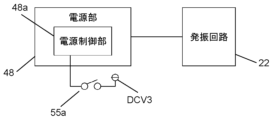
- the secondary side DC power supply DCV2 is supplied to the oscillation source 22a, the first amplifier circuit 22b, the detector 51, and the matching circuit 23 in the oscillator circuit 22.
- the secondary side DC power supply DCV3 is supplied to the controller 50.
- the circuit system in which the secondary ground GND1 is the zero volt reference potential includes the oscillator circuit 22, the detector 51, the matching circuit 23, and the second electrode 25.
- the circuit system in which the secondary ground GND2 is the zero volt reference potential includes the control unit 50.
- the control unit 50 may be connected to the secondary DC power supply DCV2 and the secondary ground GND1.
- the second electrode 25 has the same potential as the secondary ground GND1. It is desirable that the electromagnetic shield 26 is insulated from the second electrode 25 or is connected at a certain distance from the second electrode 25. This reduces the electric field and magnetic field applied to the electromagnetic shield, and suppresses leakage of the electric field and magnetic field to the outside. In other words, the effectiveness of the electromagnetic shield is improved.
- the first method is to not connect the electromagnetic shield 26 to any of the primary ground GND0, secondary ground GND1, or secondary ground GND2. This method is particularly effective when the total area or volume of the electromagnetic shield is equal to or greater than a predetermined value. This method reduces the adverse effects of noise, such as high-frequency noise leaking to the outside through the ground line.
- the second method is to connect the electromagnetic shield 26 to the primary ground GND0.
- the primary ground GND0 is usually connected to the metal outer casing 3 and has a large ground surface area. Therefore, the zero volt reference potential of the primary ground GND0 is the most stable. This method not only improves the effectiveness of the electromagnetic shield 26, but also reduces malfunctions due to noise.
- the third method is to connect the electromagnetic shield 26 to the secondary ground GND2.
- the second electrode 25 and the electromagnetic shield 26 are insulated in two stages by the switching transformers T1 and T2. This makes it difficult for high-frequency noise to leak from the first electrode 24 to the electromagnetic shield 26, and stabilizes the electric field generated between the first electrode 24 and the second electrode 25.
- the fourth method is to connect the secondary ground GND1 at a location some distance away from the second electrode 25 (at least outside the electromagnetic shield 26). This method provides a certain degree of shielding effect and makes it difficult for high-frequency noise to leak from the first electrode 24 to the electromagnetic shield 26. Therefore, the electric field generated between the first electrode 24 and the second electrode 25 is stable.
- the effectiveness of the above methods for improving the shielding effect may vary depending on the system structure and wiring. Therefore, it is necessary to select the most suitable method from these methods, taking into consideration the efficiency of electric field generation between the first electrode 24 and the second electrode 25 and the effectiveness of the electromagnetic wave shielding.
- the outer box 3 made of steel plate functions as an electromagnetic wave shield. This prevents electromagnetic waves inside the refrigerator 1 from leaking to the outside.
- coaxial cables are usually used for transmitting high-frequency output.
- common mode noise can also be transmitted to the outside of the outer conductor, which is supposed to act as a shield within a coaxial cable.
- FIGS. 19A and 19B show a specific configuration for preventing malfunction and radio wave leakage due to common mode noise.
- electrode holding substrate 52 including matching circuit 23 and the like is placed away from oscillator circuit 22 (not shown in FIG. 19A) including detection section 51.
- Coaxial cable 56a electrically connects electrode holding substrate 52 and detection section 51.
- the outer shell of outer box 3 of refrigerator 1 is made of a metal material, and coaxial cable 56a is wired inside outer box 3.
- coaxial cables 56 This configuration prevents radio waves generated by common mode noise conducted to the coaxial cable 56a from leaking to the outside.
- coaxial cables 56 the multiple types of coaxial cables shown below are collectively referred to as coaxial cables 56.
- the coaxial cables 56 correspond to the connecting wires.
- the coaxial cable 56a is wired so that it contacts the inside of the outer box 3 at at least one point.
- the outer box 3 has a large surface area and a reference potential that is approximately equal to the potential of the primary ground GND0 (see FIG. 10). Therefore, common mode noise conducted to the coaxial cable 56a can escape to the primary ground GND0.
- the coaxial cable 56b is wired inside the outer box 3, while the coaxial cable 56b is wired so as not to come into contact with the inside of the outer box 3.
- either the configuration in FIG. 19A or the configuration in FIG. 19B is selected depending on the path of the common mode noise that is conducted through the coaxial cable 56 and the outer casing 3. It is necessary to design so that the positional relationship between the coaxial cable 56 and the outer casing 3 is reliably the configuration in FIG. 19A or the configuration in FIG. 19B. It is not desirable to have a design where it is unclear which will be the case during mass production.
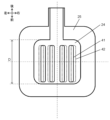
- Fig. 11 is a plan view of the first electrode 24 and the second electrode 25 of the freezing/thawing compartment 6 as viewed from above.
- the left side, right side, upper side, and lower side in Fig. 11 correspond to the left side, right side, rear side, and front side of the refrigerator 1, respectively.
- the size of the first electrode 24 is smaller than that of the second electrode 25.
- the first electrode 24 has an electrode hole 41
- the second electrode 25 has an electrode hole 42.
- the electrode holes 41 and 42 correspond to the first electrode hole and the second electrode hole, respectively.
- Each of the electrode holes 41, 42 has a plurality of through holes in the shape of elongated slits.
- each of the plurality of through holes is arranged so that the longitudinal direction of the through hole is along the front-rear direction of the refrigerator 1.
- the plurality of through holes are also arranged in the short direction of the through hole, i.e., in the left-right direction of the refrigerator 1.
- the plurality of through holes in the electrode hole 41 have the same size and pitch as the plurality of through holes in the electrode hole 41.
- This electrode shape makes it easier for high-frequency current input from the rear side of the freezing/thawing chamber 6, where the positive terminals 24a-24c (see FIG. 8) of the first electrode 24 are located, to flow forward. As a result, the electric field generated between the first electrode 24 and the second electrode 25 becomes stronger.
- the through hole of electrode hole 41 does not completely overlap with the through hole of electrode hole 42 when viewed from above, but is positioned so that it is shifted by about half the width in the short direction (left and right direction) of the through holes.
- electrode holes 41 having multiple through holes are formed on the electrode surface of the first electrode 24, so that the area where a strong electric field is formed on the electrode surface of the first electrode 24 is uniformly distributed.
- the edge of the opening in the electrode hole 41 becomes an electric field concentration area where the electric field is concentrated on the electrode surface of the first electrode 24.
- the shape and arrangement of electrode holes 41, 42 shown in FIG. 11 are examples.
- the shape and arrangement of electrode holes 41, 42 are designed as appropriate depending on the specifications, configuration, efficiency, manufacturing costs, etc. of the refrigerator.
- the shape of the through holes of electrode holes 41, 42 may be a perfect circle. In this case, similar to the above, it is desirable that the through hole of electrode hole 41 does not completely overlap with the through hole of electrode hole 42 when viewed from above, but is shifted in either direction by about half the diameter.
- the first electrode 24 according to the present disclosure is not limited to the above configuration, and may, for example, have at least one opening.
- the edge of the opening becomes an electric field concentration region where the electric field is concentrated on the electrode surface of the first electrode 24.
- the first electrode 24 according to the present disclosure may be configured so that the electric field concentration region is dispersed on the electrode surface.
- the second electrode 25 according to the present disclosure is not limited to the above configuration, but may have an opening for forming a desired electric field between the two electrodes.
- the electrode holding substrate 52 is configured to reliably hold the first electrode 24 and the second electrode 25 at a predetermined distance (see, for example, electrode spacing H in FIG. 8).
- the predetermined distance is shorter than the dimension of the long side of the first electrode 24 (dimension D in FIG. 11). If the first electrode 24 is circular, it is desirable that the electrode spacing H be shorter than its diameter, and if it is elliptical, it is desirable that the electrode spacing H be shorter than its major axis.
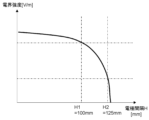
- Figure 12 shows the relationship between the electrode spacing H (see, for example, Figure 8) and the electric field strength between the two electrodes. As shown in Figure 12, the wider the electrode spacing H, the weaker the electric field strength tends to be.
- the electrode spacing H exceeds H1 (100 mm), the electric field strength drops significantly. Furthermore, if the electrode spacing H exceeds H2 (125 mm), the electric field strength drops to a level where heating is impossible. Therefore, the electrode spacing H must be 125 mm or less, and it is preferable that it is 100 mm or less.
- the inventors performed a simulation of the generation of an electric field between electrodes using a freezing/thawing chamber 6 having the electrode configuration of this embodiment and a freezing/thawing chamber 6 having an electrode configuration of a comparative example.
- the electrode configuration of the comparative example is an electrode configuration in which the first electrode 24 or the second electrode 25 does not have an electrode hole.
- Figure 13A shows the results of a simulation performed on a freezing/thawing chamber 6 having an electrode configuration of a comparative example.
- Figure 13B shows the results of a simulation performed on a freezing/thawing chamber 6 having an electrode configuration of this embodiment.
- the darker areas are areas where the electric field is concentrated. From these results, it can be seen that in the case shown in Figure 13B, electric field concentration is alleviated over the entire electrode compared to the case shown in Figure 13A, and the electric field is made more uniform.
- the first electrode 24 and the second electrode 25 are arranged so that the central axis of the electrode hole 41 along the vertical direction does not coincide with the central axis of the electrode hole 42 along the vertical direction.
- the vertical direction of the electrode hole 41 is the direction along the normal to the flat plate-like first electrode 24, and the vertical direction of the electrode hole 42 is the direction along the normal to the flat plate-like second electrode 25.
- the concentration of the electric field is generally alleviated compared to an electrode configuration including a second electrode 25 that does not have an electrode hole.
- the alleviation of the electric field concentration is particularly noticeable at the four corners.
- the freezing/thawing chamber 6 has a storage case 31 fixed to the back of the door 29, as shown in Figures 3 and 4.
- the storage case 31 moves back and forth inside the freezing/thawing chamber 6 as the door 29 is opened and closed.
- the freezing/thawing chamber 6 has rails arranged on both sides so that the storage case 31 can move smoothly inside the freezing/thawing chamber 6.
- the freezing/thawing chamber 6 also has sliding members arranged on both outside sides of the storage case 31 that slide on the rails.
- the rails and sliding members are arranged outside the area between the first electrode 24 and the second electrode 25 inside the freezing/thawing chamber 6 so as not to be dielectrically heated.
- control unit 50 controls the cooling mechanism and the cold air introduction mechanism in addition to the dielectric heating mechanism.
- the cooling mechanism includes a refrigeration cycle such as the compressor 19 and the cooler 13.
- the cold air introduction mechanism includes the cooling fan 14 and the damper 12a.
- a predetermined high-frequency voltage is applied between the first electrode 24 and the second electrode 25, and the food is dielectrically heated by the high-frequency electric field between the electrodes.
- the control unit 50 controls the opening and closing of the damper 12a to introduce cold air continuously or intermittently.
- Figure 14 shows the control signals (waveforms (a) and (b)) to the dielectric heating mechanism (oscillator circuit 22) and the cold air introduction mechanism (damper 12a) during the electric field generation process, the temperature [°C] of the food and the freezing/thawing chamber 6 (waveform (c)), and the humidity [% RH] of the freezing/thawing chamber 6 (waveform (d)).
- the refrigerator 1 As a characteristic of the frequency used for the electric field generation process, a configuration using VHF waves is less likely to cause "partial cooking" than a configuration using microwaves. Furthermore, to achieve more uniform thawing, the refrigerator 1 according to this embodiment is equipped with an electrode holding substrate 52. This holds the flat plate-shaped first electrode 24 and second electrode 25 approximately parallel and at a predetermined distance (see electrode distance H in Figure 8).
- the damper 12a is closed after a predetermined period of time has elapsed since the start of thawing (tm2 in FIG. 14). When the damper 12a is closed, the temperature in the freezing/thawing chamber 6 begins to rise. In the electric field generation process according to this embodiment, the damper 12a is controlled to open and close in conjunction with dielectric heating. This suppresses the rise in the surface temperature of the frozen product, and thawing is performed without causing so-called "partial cooking.”
- the control unit 50 controls the opening and closing of the damper 12a based on the reflectance. When the reflectance increases and reaches a preset threshold, the control unit 50 opens the damper 12a to lower the temperature in the freezing/thawing chamber 6 (tm3 in FIG. 14).
- control unit 50 detects the desired thawed state based on the reflectance, it ends the electric field generation process.
- the control unit 50 causes the matching circuit 23 to perform impedance matching to reduce the reflectance.
- the control unit 50 detects the completion of thawing when the reflectance after performing impedance matching by the matching circuit 23 exceeds a threshold value for detecting the completion of thawing.
- the threshold value for detecting the completion of thawing is preset to detect when the melting of the stored item has reached the desired thawed state.
- the desired thawed state of the stored item means that the user can cut the stored item with one hand and there is only a small amount of dripping from the stored item.
- FIG. 15 is a flow chart showing the control of the cooling and electric field generation process for bringing food into a desired state in the freezing/thawing compartment 6.
- the control unit 50 when the reflectance exceeds the threshold for detecting the completion of thawing after performing impedance matching in the electric field generation process, the control unit 50 performs the control after the electric field generation process shown in FIG. 15. For example, the stored item is maintained in the desired thawed state after the thawing process is completed.
- One method of control for this purpose is to adjust the temperature of the freezing/thawing chamber 6 to the so-called slightly freezing temperature range, for example, about -1°C to -3°C.
- Another method is to adjust the temperature of the freezing/thawing chamber 6 to the freezing temperature range, for example, -18°C to -20°C.
- the temperature of the freezing/thawing chamber 6 may be periodically changed. By periodically changing the temperature of the freezing/thawing chamber 6, for example, from -12°C to -5°C, the composition of the food can be affected.
- a low-output high-frequency electric field is continuously applied, or a high-frequency electric field is intermittently applied, to cool and heat the stored items and maintain them at the desired temperature ranges.
- step S101 after the start of the preservation process, the control unit 50 detects the presence or absence of a stored item in the freezing/thawing chamber 6 based on the reflectance (step S101).
- control unit 50 causes the matching circuit 23 to operate intermittently and causes the oscillator circuit 22 to output low-power electromagnetic waves intermittently.
- the control unit 50 compares the reflectance with a preset threshold value for detecting the presence or absence of stored items to determine the presence or absence of stored items in the freezing/thawing chamber 6.
- step S101 the control unit 50 detects that no stored item is present in the freezing/thawing chamber 6 (No in step S101). If the control unit 50 detects that no stored item is present in the freezing/thawing chamber 6 (No in step S101), the control unit 50 transitions the process to step S105.
- step S105 the control unit 50 adjusts the temperature of the freezing/thawing chamber 6 to a freezing temperature range, for example, -18°C to -20°C.
- the process of step S105 is referred to as the freezing process.
- control unit 50 detects that a stored item is present in the freezing/thawing chamber 6 (Yes in step S101), in step S102, it determines whether the stored item includes a non-frozen item after thawing based on the change in reflectance.
- the control unit 50 controls the cooling mechanism to maintain the slightly freezing temperature range in the freezing/thawing chamber 6, which allows the stored item to be kept in the desired thawed state, for a predetermined time. If the stored item is stored beyond this predetermined time, the control unit 50 shifts the temperature of the freezing/thawing chamber 6 to the freezing temperature range in order to maintain the freshness of the stored item.
- step S102 if the control unit 50 determines that the time since the completion of thawing has exceeded the predetermined time while the thawed stored item is still stored (step S102), it also shifts the process to step S105 and performs the freezing process.
- step S102 if the control unit 50 determines that no thawed non-frozen items are stored in the freezing/thawing compartment 6 (No in step S102), it transitions the process to step S103.
- step S103 the control unit 50 determines whether the food temperature exceeds the target temperature. If the food temperature exceeds the target temperature (Yes in step S103), the control unit 50 shifts the process to step S105 and performs the freezing process. If not (No in step S103), the control unit 50 shifts the process to step S104 and raises the temperature of the food by generating an electric field.
- the refrigerator 1 performs dielectric heating so that the stored items (food) are frozen and stored in a desired state.
- frost forms on the inside of the food packaging.
- frost forms on the surface of the food, the food suffers from freezer burn. Freezer burn is a phenomenon in which food becomes dry and flaky due to freezing, making it no longer fresh and tasty.
- the refrigerator 1 performs cooling and dielectric heating simultaneously.
- FIGS. 16A and 16B are waveform diagrams showing the state of each element during cooling operation.
- FIG. 16A is a waveform diagram showing the cooling operation in a conventional refrigerator.
- FIG. 16B is a waveform diagram showing the cooling operation in refrigerator 1 according to the present embodiment.
- waveform (1) indicates the ON/OFF of the cooling operation.
- the ON/OFF of the cooling operation corresponds to, for example, opening and closing of damper 12a, or turning compressor 19 ON/OFF. That is, when the cooling operation is "ON”, cold air is introduced into freezer compartment 8. When the cooling operation is "OFF”, damper 12a is closed, blocking the introduction of cold air into freezer compartment 8.
- the temperature of the food in freezer compartment 8 fluctuates greatly around a preset freezing temperature t1 (e.g., -20°C).
- t1 e.g., -20°C
- the food may not be frozen in the desired state, with water evaporating and frosting occurring repeatedly on the surface of the food in freezer compartment 8.
- Waveform (1) in FIG. 16B shows the opening and closing of damper 12a.
- the waveform (2) in FIG. 16B shows the operating state of the oscillator circuit 22. As shown in the waveform (2) in FIG. 16B, the control unit 50 turns on the oscillator circuit 22 when the damper 12a is open to perform dielectric heating.
- control unit 50 adjusts the output power by controlling the power supplied to the oscillation circuit 22 and by PWM control (intermittent control) of the output of the oscillation circuit 22.
- the temperature of the food in the freezing/thawing chamber 6 is maintained at the preset freezing temperature t1 (e.g., -20°C). In other words, fluctuations in the food temperature are suppressed.
- t1 e.g., -20°C
- dielectric heating at the same frequency as thawing but with a lower output power than thawing, it is possible to suppress the extension of ice crystals inside the food.
- dielectric heating is performed, an electric field tends to concentrate at the tips of the ice crystals that have formed inside the food. For this reason, even if the temperature inside the freezing/thawing chamber 6 is below the maximum ice crystal formation zone, the ice crystals will only extend slowly.
- the refrigerator 1 performs dielectric heating during the cooling operation during frozen storage, allowing the frozen items to be frozen and stored in a desired state.
- Fig. 17 is a waveform diagram showing the state of each element during the rapid cooling operation which is the freezing process.
- the waveform (a) in FIG. 17 indicates whether or not a stored item (food) is present in the freezing/thawing chamber 6.
- the control unit 50 determines whether or not a stored item is present in the freezing/thawing chamber 6 based on the reflectance.
- Waveform (b) in FIG. 17 shows that the control unit 50 intermittently acquires information from the matching circuit 23 and the detection unit 51.
- Waveform (c) in FIG. 17 shows an example of the transition of the reflectance.
- the control unit 50 determines that a stored item has been placed in the freezing/thawing chamber 6.
- control unit 50 When rapidly cooling food stored in the freezing/thawing compartment 6, the control unit 50 increases the rotation speed of the compressor 19 and cooling fan 14 of the cooling mechanism to perform forced continuous operation with increased cooling capacity. As shown in waveform (d) of Figure 17, the control unit 50 forcibly opens the damper 12a of the air passage 12 leading to the freezing/thawing compartment 6 to introduce cold air.
- dielectric heating is performed to suppress the growth of ice crystals when the food temperature is in the maximum ice crystal formation zone (approximately -1°C to approximately -5°C). Dielectric heating at this time is performed intermittently (period h in waveform (e) in Figure 17) in order to reduce the output (for example, to several tens of watts or less) from that during thawing.
- the control unit 50 detects that the food temperature has entered the maximum ice crystal formation zone by detecting an increasing change in reflectance as the food passes through the latent heat zone.
- dielectric heating is started when the detected reflectance enters a preset second threshold value R2 [%] (see waveform (e) in Figure 17).
- the control unit 50 determines that the temperature of the food is in the maximum ice crystal formation zone and continues dielectric heating. If a predetermined time pr1 (see waveform diagram (c) in Figure 17) has passed since the reflectance entered the third threshold value R3 [%], it determines that the temperature of the food has passed the maximum ice crystal formation zone and stops dielectric heating.
- control unit 50 stops the dielectric heating, terminates the rapid cooling operation, and performs the normal cooling operation. In this way, even when performing the rapid cooling operation, the food can be maintained in a desired frozen state by performing dielectric heating for the desired period of time.
- refrigerator 1 in order to prevent electromagnetic waves from leaking to the outside, refrigerator 1 according to this embodiment includes electromagnetic wave shield 26 surrounding freezing/thawing compartment 6. Furthermore, since the steel plate itself functions as an electromagnetic wave shield, external leakage of electromagnetic waves is prevented by closing door 29.
- the refrigerator 1 includes a door open/close detector 55a (see FIG. 9) that detects the opening of the door 29.
- the controller 50 stops the oscillator circuit 22 and stops the power supply to the first electrode 24.
- refrigerator 1 In addition to door 29 of freezer/thaw compartment 6, refrigerator 1 has multiple doors that cover the front openings of refrigerator compartment 5, ice-making compartment 7, freezer compartment 8, and vegetable compartment 9. Refrigerator 1 also has door opening/closing detector 55b, door opening/closing detector 55c, door opening/closing detector 55d, and door opening/closing detector 55e. Door opening/closing detectors 55b, 55c, 55d, and 55e detect the opening of the doors of refrigerator compartment 5, ice-making compartment 7, freezer compartment 8, and vegetable compartment 9, respectively.
- the controller 50 will continue to operate the oscillator circuit 22.
- the control unit 50 stops the oscillation circuit 22.
- the control unit 50 stops the oscillation circuit 22.
- the control unit 50 stops the oscillation circuit 22.
- control unit 50 stops the oscillator circuit 22 to prevent leakage of electromagnetic waves.
- FIG. 18A shows a configuration in which the door open/close detector 55a cuts off the power supply from the power supply 48 to the oscillator circuit 22.
- the door open/close detector 55a is a switch mechanism that is conductive when the door 29 is closed and cuts off the power when the door 29 is opened.
- the door open/close detector 55a cuts off the power supply to the oscillator circuit 22, reliably stopping the operation of the oscillator circuit 22.
- FIG. 18B shows a configuration in which a door open/close detector 55a stops the operation of the power supply controller 48a, which controls the power supply 48.
- the door open/close detector 55a is a switch mechanism similar to that in FIG. 18A.
- the door open/close detector 55a cuts off the power supply to the power supply controller 48a, thereby cutting off the power supply from the power supply 48 to the oscillation circuit 22, and reliably stops the operation of the oscillation circuit 22.
- the operation of the oscillator circuit 22 is stopped by cutting off the power supply to the circuitry within the power supply control unit 48a, but the present disclosure is not limited to this.
- the power supply control unit 48a may include an overcurrent protection circuit that detects an overcurrent. In this case, when the overcurrent protection circuit detects the occurrence of an overcurrent, the power supply control unit 48a stops the power supply. The power supply unit 48 may recognize the occurrence of an overcurrent as an overload state and stop the power supply.
- FIG. 18C shows a configuration for determining whether the door 29 is open or closed using a door open/close detector 55a and a magnetic sensor 55f. As shown in FIG. 18C, the door open/close detector 55a is disposed between the magnetic sensor 55f and the controller 50.
- the door open/close detection unit 55a is conductive when the door 29 is closed and is cut off when the door 29 is opened.
- the magnetic sensor 55f sends a signal indicating whether the door 29 is open or closed to the control unit 50.
- the control unit 50 sends a signal indicating whether the power supply control unit 48a is operating or not to the power supply control unit 48a in response to the signal from the magnetic sensor 55f.
- the power supply control unit 48a when the door 29 is opened, the power supply control unit 48a is no longer able to receive a signal from the magnetic sensor 55f. This stops the power supply to the oscillation circuit 22.
- the door open/close detection unit 55a is conductive when the door 29 is closed and is cut off when the door 29 is opened.
- a circuit that is cut off when the door 29 is closed and is conductive when the door 29 is opened may be used. In that case, the logic for stopping the power supply control unit 48a is reversed.
- the refrigerator 1 includes a freezing/thawing compartment 6 that has both a freezing function and a thawing function.
- a freezing/thawing compartment 6 that has both a freezing function and a thawing function.
- the same effect can be obtained even in a configuration that includes a thawing compartment that only has a thawing function.
- the refrigerator 1 includes a storage compartment (freeze/thaw 6), an oscillation circuit 22, electrodes (first electrode 24, second electrode 25), a matching circuit 23, a detection unit 51, and a control unit 50.
- the storage compartment has a storage space capable of cooling stored items.
- the oscillation circuit 22 generates high-frequency power.
- the electrodes form an electric field in the storage compartment according to the high-frequency power.
- the matching circuit 23 matches the impedance of the electrodes.
- the detection unit 51 is connected between the oscillation circuit 22 and the matching circuit 23, and measures the incident wave power output from the matching circuit 23 to the electrode and the reflected wave power returning to the oscillation circuit 22.
- the control unit 50 controls the oscillation circuit 22 and the matching circuit 23 based on the incident wave power and the reflected wave power, and determines the load impedance.
- the load impedance is determined from the change in reflectivity or the change in reflected wave power after impedance adjustment in the matching circuit 23, and impedance matching is controlled. This allows the load impedance to be accurately matched to the characteristic impedance of the transfer line, and as a result, energy can be efficiently transferred to the stored object.
- This disclosure is applicable to various refrigerators.
Landscapes
- Engineering & Computer Science (AREA)
- Physics & Mathematics (AREA)
- Electromagnetism (AREA)
- Chemical & Material Sciences (AREA)
- Combustion & Propulsion (AREA)
- Mechanical Engineering (AREA)
- Thermal Sciences (AREA)
- General Engineering & Computer Science (AREA)
- Devices That Are Associated With Refrigeration Equipment (AREA)
- Cold Air Circulating Systems And Constructional Details In Refrigerators (AREA)
Priority Applications (2)
| Application Number | Priority Date | Filing Date | Title |
|---|---|---|---|
| JP2025528137A JPWO2024262612A1 (https=) | 2023-06-23 | 2024-06-21 | |
| CN202480041648.5A CN121368703A (zh) | 2023-06-23 | 2024-06-21 | 冷藏库 |
Applications Claiming Priority (2)
| Application Number | Priority Date | Filing Date | Title |
|---|---|---|---|
| JP2023103086 | 2023-06-23 | ||
| JP2023-103086 | 2023-06-23 |
Publications (1)
| Publication Number | Publication Date |
|---|---|
| WO2024262612A1 true WO2024262612A1 (ja) | 2024-12-26 |
Family
ID=93935914
Family Applications (1)
| Application Number | Title | Priority Date | Filing Date |
|---|---|---|---|
| PCT/JP2024/022594 Ceased WO2024262612A1 (ja) | 2023-06-23 | 2024-06-21 | 冷蔵庫 |
Country Status (3)
| Country | Link |
|---|---|
| JP (1) | JPWO2024262612A1 (https=) |
| CN (1) | CN121368703A (https=) |
| WO (1) | WO2024262612A1 (https=) |
Citations (6)
| Publication number | Priority date | Publication date | Assignee | Title |
|---|---|---|---|---|
| JPS56159086A (en) * | 1980-05-13 | 1981-12-08 | Matsushita Electric Industrial Co Ltd | High frequency heater |
| JPS56159085A (en) * | 1980-05-13 | 1981-12-08 | Matsushita Electric Industrial Co Ltd | High frequency heater |
| JPH078566A (ja) * | 1993-06-22 | 1995-01-13 | Olympus Optical Co Ltd | ハイパーサーミア装置 |
| JPH11248545A (ja) * | 1998-03-05 | 1999-09-17 | Reideikku:Kk | 温度測定システム |
| JP2019114519A (ja) * | 2017-12-20 | 2019-07-11 | エヌエックスピー ユーエスエイ インコーポレイテッドNXP USA,Inc. | 解凍装置およびその動作方法 |
| JP2021060173A (ja) * | 2019-10-09 | 2021-04-15 | パナソニックIpマネジメント株式会社 | 冷蔵庫 |
-
2024
- 2024-06-21 JP JP2025528137A patent/JPWO2024262612A1/ja active Pending
- 2024-06-21 WO PCT/JP2024/022594 patent/WO2024262612A1/ja not_active Ceased
- 2024-06-21 CN CN202480041648.5A patent/CN121368703A/zh active Pending
Patent Citations (6)
| Publication number | Priority date | Publication date | Assignee | Title |
|---|---|---|---|---|
| JPS56159086A (en) * | 1980-05-13 | 1981-12-08 | Matsushita Electric Industrial Co Ltd | High frequency heater |
| JPS56159085A (en) * | 1980-05-13 | 1981-12-08 | Matsushita Electric Industrial Co Ltd | High frequency heater |
| JPH078566A (ja) * | 1993-06-22 | 1995-01-13 | Olympus Optical Co Ltd | ハイパーサーミア装置 |
| JPH11248545A (ja) * | 1998-03-05 | 1999-09-17 | Reideikku:Kk | 温度測定システム |
| JP2019114519A (ja) * | 2017-12-20 | 2019-07-11 | エヌエックスピー ユーエスエイ インコーポレイテッドNXP USA,Inc. | 解凍装置およびその動作方法 |
| JP2021060173A (ja) * | 2019-10-09 | 2021-04-15 | パナソニックIpマネジメント株式会社 | 冷蔵庫 |
Also Published As
| Publication number | Publication date |
|---|---|
| JPWO2024262612A1 (https=) | 2024-12-26 |
| CN121368703A (zh) | 2026-01-20 |
Similar Documents
| Publication | Publication Date | Title |
|---|---|---|
| US11197352B2 (en) | Thawing method for thawing device | |
| CN112648775B (zh) | 冷藏库 | |
| JP7526965B2 (ja) | 加熱装置および加熱装置を備えた冷蔵庫 | |
| JP7660272B2 (ja) | 冷蔵庫 | |
| AU2020214406B2 (en) | Heating device and refrigerator having same | |
| CN213811288U (zh) | 冷藏库 | |
| JP7515045B2 (ja) | 冷蔵庫 | |
| CN223179117U (zh) | 冷藏库 | |
| EP3910272B1 (en) | Heating apparatus and refrigerator | |
| JP7634213B2 (ja) | 冷蔵庫 | |
| WO2024262612A1 (ja) | 冷蔵庫 | |
| JP7199052B2 (ja) | 冷蔵庫 | |
| WO2024262613A1 (ja) | 冷蔵庫 | |
| WO2024262611A1 (ja) | 冷蔵庫 | |
| WO2023210356A1 (ja) | 冷蔵庫 | |
| JP7308427B2 (ja) | 冷蔵庫 | |
| RU2778872C1 (ru) | Нагревательное устройство и холодильник с нагревательным устройством |
Legal Events
| Date | Code | Title | Description |
|---|---|---|---|
| 121 | Ep: the epo has been informed by wipo that ep was designated in this application |
Ref document number: 24826013 Country of ref document: EP Kind code of ref document: A1 |
|
| ENP | Entry into the national phase |
Ref document number: 2025528137 Country of ref document: JP Kind code of ref document: A |
|
| NENP | Non-entry into the national phase |
Ref country code: DE |