WO2024262461A1 - エンドエフェクタ及びロボット - Google Patents
エンドエフェクタ及びロボット Download PDFInfo
- Publication number
- WO2024262461A1 WO2024262461A1 PCT/JP2024/021899 JP2024021899W WO2024262461A1 WO 2024262461 A1 WO2024262461 A1 WO 2024262461A1 JP 2024021899 W JP2024021899 W JP 2024021899W WO 2024262461 A1 WO2024262461 A1 WO 2024262461A1
- Authority
- WO
- WIPO (PCT)
- Prior art keywords
- end effector
- link
- drive unit
- link portion
- wheel
- Prior art date
- Legal status (The legal status is an assumption and is not a legal conclusion. Google has not performed a legal analysis and makes no representation as to the accuracy of the status listed.)
- Ceased
Links
Images













Classifications
-
- B—PERFORMING OPERATIONS; TRANSPORTING
- B25—HAND TOOLS; PORTABLE POWER-DRIVEN TOOLS; MANIPULATORS
- B25J—MANIPULATORS; CHAMBERS PROVIDED WITH MANIPULATION DEVICES
- B25J15/00—Gripping heads and other end effectors
- B25J15/08—Gripping heads and other end effectors having finger members
- B25J15/10—Gripping heads and other end effectors having finger members with three or more finger members
-
- B—PERFORMING OPERATIONS; TRANSPORTING
- B25—HAND TOOLS; PORTABLE POWER-DRIVEN TOOLS; MANIPULATORS
- B25J—MANIPULATORS; CHAMBERS PROVIDED WITH MANIPULATION DEVICES
- B25J5/00—Manipulators mounted on wheels or on carriages
-
- B—PERFORMING OPERATIONS; TRANSPORTING
- B62—LAND VEHICLES FOR TRAVELLING OTHERWISE THAN ON RAILS
- B62D—MOTOR VEHICLES; TRAILERS
- B62D57/00—Vehicles characterised by having other propulsion or other ground- engaging means than wheels or endless track, alone or in addition to wheels or endless track
- B62D57/02—Vehicles characterised by having other propulsion or other ground- engaging means than wheels or endless track, alone or in addition to wheels or endless track with ground-engaging propulsion means, e.g. walking members
Definitions
- the present invention relates to an end effector and a robot.
- This application claims priority based on Japanese Patent Application No. 2023-102850, filed on June 22, 2023, the contents of which are incorporated herein by reference.
- Patent Document 1 discloses the configuration of a mobile robot that includes a cylindrical main body, a rotating frame that can rotate relative to the main body, a first leg arm that is rotatably connected to the rotating frame, and a second leg arm that is rotatably connected to the end of the first leg arm opposite the main body.
- a mobile robot that includes a cylindrical main body, a rotating frame that can rotate relative to the main body, a first leg arm that is rotatably connected to the rotating frame, and a second leg arm that is rotatably connected to the end of the first leg arm opposite the main body.
- the diameter of the robot's wheels can be changed by rotating the first leg arm and the second leg arm to open and close. This allows the robot to enter narrow spaces, such as under a vehicle, by reducing the wheel diameter, and to travel efficiently on uneven ground by increasing the wheel diameter, improving the robot's ability to traverse uneven terrain. It is also said that the robot's travel speed can be changed according to the wheel diameter, allowing for efficient travel according to road conditions.
- legged climbing robots and the like are known in which a plurality of legs (end effectors) are independently driven and can climb walls and the like using grippers at the tips.
- Wheeled mobile robots can run with low power consumption, and therefore have excellent running performance, particularly on flat terrain, but are not suitable for running on steep slopes or uneven ground with unevenness.
- legged climbing robots can move on uneven and steep sloped terrain, but their movement efficiency is lower on flat terrain than that of wheeled mobile robots. If the advantages of both wheeled mobile robots and legged climbing robots can be realized at the same time, the performance of the mobile robot can be improved.
- the present invention aims to provide an end effector that can move on steep slopes and uneven ground while ensuring maneuverability on flat terrain, and a robot with a simple structure that is equipped with this end effector.
- the present invention adopts the following measures.
- An end effector comprises a palm portion, a plurality of finger portions arranged in a circumferential direction of the palm portion, one end of which is rotatably connected to the palm portion, and a drive unit for driving the finger portions, the finger portions having a plurality of link portions extending from the palm portion and joint portions rotatably connecting the plurality of link portions to each other, and by driving the joint portions with the drive unit, the end effector transitions between a closed state in which predetermined portions of the link portions are aligned along the outer circumferential surface of an imaginary cylinder centered on the central axis of the palm portion, and an open state in which the plurality of finger portions are rotated and deployed, thereby performing running and gripping operations.
- a part of the link portion forms a gripping portion that performs the gripping action by driving the joint portion, and a walking action and a climbing action that combines the gripping action and the walking action are performed by a second drive portion that drives the entire end effector, and in the closed state, the predetermined parts of the adjacent link portions contact each other in the circumferential direction to form a wheel with the central axis of the imaginary cylinder as an axle, and it is preferable that a running action is performed using the wheel by driving a third drive portion that rotates the palm portion around a rotation axis.
- the link portion has a third link portion having one end connected to the palm portion, a second link portion having one end connected to the third link portion, and a first link portion having one end connected to the second link portion
- the joint portion has a third joint portion that rotatably connects the palm portion and the third link portion, a second joint portion that rotatably connects the third link portion and the second link portion, and a first joint portion that rotatably connects the second link portion and the first link portion
- the grip portion is provided at the tip of the first link portion, and it is preferable that the second link portion forms the wheel in the closed state.
- the end effector transitions between a first wheel mode in which only the second link portion forms the wheel, and a second wheel mode in which, in the closed state, the first link portion and the second link portion form the wheel, resulting in a larger wheel width than in the first wheel mode.
- the tip link portion among the multiple link portions is fixed so as to be perpendicular to the predetermined portion of the link portion in the closed state.
- a robot includes an end effector according to any one of (1) to (5) above, and a control unit that controls the drive unit, the second drive unit, and the third drive unit.
- the robot comprises a base, a plurality of arms attached to the base, the end effector attached to the tip of the arm, and a self-locking device that opens and closes the finger portion of the end effector and fixes the angle of the joint portion of the finger portion at any angle.
- the self-locking device is a worm gear.
- the self-locking device is provided between the arm and the end effector.
- the self-locking device is provided on the base body, and the self-locking device and the end effector are connected by a tension transmission mechanism.
- the present invention provides an end effector that ensures maneuverability on flat terrain while also being capable of moving on steep slopes and uneven ground, and a robot of simple structure equipped with this end effector.
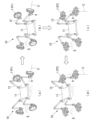
- FIG. 1 is an external view of a running form of a mobile robot equipped with an end effector according to a first embodiment.
- FIG. 11 is an external view showing another running mode (walking motion) of the mobile robot equipped with the end effector according to the first embodiment.
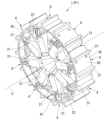
- FIG. FIG. 2 is an external perspective view of the end effector in a closed state.
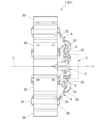
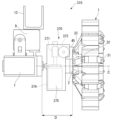
- FIG. 2 is a side view of the end effector in a closed state.
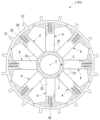
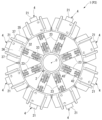
- FIG. 5 is a view taken along the arrow V in FIG. 4 .
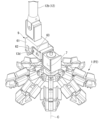
- FIG. 2 is an external perspective view of the end effector in an open state.
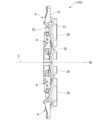
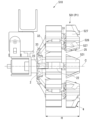
- FIG. 2 is a side view of the end effector in an open state.
- FIG. 8 is a view taken along the arrow VIII in FIG. 7 .
- FIG. 2 is an external perspective view of the end effector during a gripping operation.
- FIG. 13 is a side view of the end effector during a gripping operation.
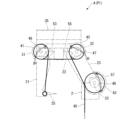
- FIG. 11 is a view taken along the arrow XI in FIG. 11 is an explanatory diagram showing the configuration of the finger portion when deployed (open state).
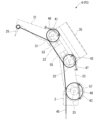
- FIG. 11 is an explanatory diagram showing the configuration of the finger portion when bent (closed state).
- FIG. 11 is an explanatory diagram showing the configuration of the finger portion when it is in the middle of bending (during a gripping operation).
- FIG. FIG. 13 is a side view showing the configuration of the connection portion between the end effector and the arm in the wheel mode.
- FIG. 13 is a perspective view showing the configuration of a connection portion between the end effector and the arm in the gripper form.
- FIG. 2 is an explanatory diagram of a movement of a mobile robot.
- FIG. 11 is a perspective view of a finger portion of an end effector according to a second embodiment, as viewed from the front side.
- FIG. 11 is a perspective view of the finger portion of the end effector according to the second embodiment, viewed from a different angle.
- FIG. 11 is a side view showing the configuration of a connection portion between an end effector and an arm in a mobile robot according to a third embodiment.
- FIG. 13 is a perspective view of a self-locking device according to a third embodiment.
- FIG. 13 is a perspective view showing one of the arms of the mobile robot according to the fourth embodiment.
- FIG. 13 is a side view showing the configuration of an end effector of a mobile robot according to a fifth embodiment.
- FIG. 13 is a perspective view showing the configuration of an end effector of a mobile robot according to a fifth embodiment.
- FIG. 13 is a perspective view of a first link portion according to the fifth embodiment, as viewed from the rear side.
- FIG. 13 is a perspective view of a first link portion according to a fifth embodiment, as viewed from the front side.
- the present invention is not limited to the drawings.
- the same or corresponding elements are given the same reference numerals, and duplicate descriptions may be omitted.
- the direction along the central axis C of the palm may be referred to as the axial direction
- the direction perpendicular to the central axis C may be referred to as the radial direction
- the direction around the central axis C may be referred to as the circumferential direction.
- Fig. 1 is an external view of a mobile robot 10 (robot in claims) equipped with an end effector 1 according to the first embodiment in one running mode.
- Fig. 2 is an external view showing another running mode (walking motion) of the mobile robot 10 equipped with the end effector 1 according to the first embodiment. Note that in Figs. 1 and 2, some of the components of the mobile robot 10 are omitted for simplicity of the drawings.
- the mobile robot 10 of this embodiment comprises a base 11, a plurality of arms 12 (four in this embodiment) connected to the base 11, an end effector 1 provided at the tip of the arm 12, a plurality of drive units (a second drive unit 6 and a third drive unit 7 in the claims), and a control unit 8 that controls these.
- Two arms 12 are connected to the left of the base 11 via rotary joints. Another two arms 12 are connected to the right of the base 11 via rotary joints. The arms 12 are positioned at approximately equal intervals in the front-to-rear direction. The number of arms 12 is not limited to two.
- Each arm 12 is provided with a total of four rotation joints, including two base end rotation joints 13a and 13b, an intermediate rotation joint 13c, and a tip end rotation joint 13d, and two arm links 12a and 12b.
- the base end rotation joint 13a rotates with its axial direction extending vertically relative to the base body 11.
- the base end rotation joint 13b is connected to the base end rotation joint 13a and rotates with its axial direction perpendicular to the rotation axis of the base end rotation joint 13a.
- the intermediate rotation joint 13c is connected to the base end rotation joint 13b via the base end arm link 12a and rotates around an axial direction parallel to the rotation axis of the base end rotation joint 13b.
- each arm 12 has three degrees of freedom.
- a tip-side arm link 12b is connected to the intermediate rotation joint 13c on the side opposite to the base-side arm link 12a.
- the tip of the tip-side arm link 12b is connected to the end effector 1 (described later) via a tip-side rotation joint 13d that rotates about an axial direction parallel to the rotation axis of the intermediate rotation joint 13c.
- End effector The end effector 1 is connected to the tip of each arm 12 via a tip rotary joint 13d.
- tip rotary joint 13d The end effector 1 is connected to the tip of each arm 12 via a tip rotary joint 13d.
- four end effectors 1 are mounted on one mobile robot 10. Since each end effector 1 has the same configuration, the following description will focus on one end effector 1, and descriptions of the other end effectors 1 will be omitted.
- the end effector 1 is connected to the tip of the arm 12 via the tip rotary joint 13d.
- the end effector 1 is configured to be able to transition between the wheel form shown in FIG. 1 and the gripper form shown in FIG. 2.
- the end effector 1 In the wheel form, the end effector 1 is in a closed state P1.
- the end effector 1 In the gripper form, the end effector 1 is in an open state P2.
- Fig. 3 is an external perspective view of the end effector 1 in the closed state P1.
- Fig. 4 is a side view of the end effector 1 in the closed state P1.
- Fig. 5 is a view taken along arrow V in Fig. 4.
- Fig. 6 is an external perspective view of the end effector 1 in the open state P2.
- Fig. 7 is a side view of the end effector 1 in the open state P2.
- Fig. 8 is a view taken along arrow VIII in Fig. 7.
- Fig. 9 is an external perspective view of the end effector 1 during a gripping operation P3.
- Fig. 10 is a side view of the end effector 1 during a gripping operation P3.
- Fig. 11 is a view taken along arrow XI in Fig. 10.
- the end effector 1 includes a palm portion 2, a drive portion 3 (see FIGS. 4, 5, etc.), and a plurality of finger portions 4.
- the palm portion 2 is the base of the end effector 1, and is connected to a tip rotary joint 13d at the tip of the arm 12.
- the palm portion 2 is formed in an annular shape having a central axis C (in the same direction as the axle in the wheel form) that is aligned horizontally in the state shown in FIG.
- the drive unit 3 is provided in the center of the palm portion 2. Note that in the figures other than Figures 4 and 5, the drive unit 3 is omitted from illustration to make the drawings easier to see.
- the drive unit 3 is, for example, an actuator.
- the drive unit 3 drives multiple finger portions 4, which will be described later. By driving the drive unit 3, the open/closed state of the end effector 1 is switched. In this embodiment, one end effector 1 has a single drive unit 3. Therefore, multiple finger portions 4 are opened and closed simultaneously by the single drive unit 3.
- the multiple finger portions 4 extend with one end rotatably connected to the outer periphery of the palm portion 2, and multiple (eight in this embodiment) are provided lined up in the circumferential direction of the palm portion 2.
- the configuration of each finger portion 4 is the same.
- the finger portion 4 has multiple link portions 21, 22, 23 extending from the palm portion 2, and multiple joint portions 31, 32, 33 that rotatably connect the multiple link portions 21, 22, 23 to each other (see also Figure 12).
- Fig. 12 is an explanatory diagram showing the configuration of the finger portion 4 when unfolded (open state P2).
- Fig. 13 is an explanatory diagram showing the configuration of the finger portion 4 when bent (closed state P1).
- Fig. 14 is an explanatory diagram showing the configuration of the finger portion 4 when in the middle of bending between the closed state P1 and the open state P2 (during a gripping motion P3).
- the multiple link portions include, in order from closest to the palm portion 2, a third link portion 23, a second link portion 22, and a first link portion 21 that becomes the tip portion of the finger portion 4.
- the multiple joint portions include, in order from closest to the palm portion 2, a third joint portion 33, a second joint portion 32, and a first joint portion 31.
- the third joint portion 33 connects the palm portion 2 and the third link portion 23 so that they can rotate around a rotation axis that is approximately parallel to the circumferential direction of the palm portion 2.
- One end of the second link portion 22 is connected to the other end of the third link portion 23 via a second joint portion 32.
- the second joint portion 32 connects the third link portion 23 and the second link portion 22 so that they can rotate around a rotation axis that is parallel to the rotation axis of the third joint portion 33.
- One end of the first link portion 21 is connected to the other end of the second link portion 22 via a first joint portion 31.
- the first joint portion 31 connects the second link portion 22 and the first link portion 21 so that they can rotate around a rotation axis that is parallel to the rotation axis of the second joint portion 32.
- a pulley is integrally provided around the rotation axis of each of the joints 31, 32, 33 (see also FIG. 9, etc.).
- the pulleys are the third pulley 43, the second pulley 42, and the first pulley 41 in order from the closest to the palm portion 2, the diameter of the third pulley 43 is larger than the diameters of the second pulley 42 and the first pulley 41.
- Kevlar (registered trademark) thread 45 is wound around each pulley. One end of the Kevlar thread 45 is fixed to the tip of the finger portion 4, i.e., the tip of the first link portion 21.
- the Kevlar thread 45 extends from the tip of the finger portion 4 and is wound around the first pulley 41, then extends toward the second joint portion 32 and is wound around the second pulley 42, and then further extends toward the third joint portion 33 and is wound around the third pulley 43.
- the other end of the Kevlar thread 45 extends further from the third joint 33 of the finger 4 toward the palm 2 and is connected to the drive unit 3. Therefore, the Kevlar thread 45 is wound around each pulley in sequence as it moves from one end to the other end.
- each joint rotates in sequence starting from the third joint 33 where the third pulley 43 is provided, and the end effector 1 transitions to the closed state P1 (see Figure 13).
- the reverse operation is performed when transitioning from the closed state P1 to the open state P2.
- the first joint 31 has a spring 46 near the first pulley 41.
- the second joint 32 has a spring 47 near the second pulley 42.
- the third joint 33 has a spring 48 near the third pulley 43.
- the springs 46, 47, and 48 are provided on the side of the pulleys 41, 42, and 43 where the angle between the pair of links is larger when the corresponding joints 31, 32, and 33 rotate.
- the springs 46, 47, and 48 urge the respective link parts 21, 22, and 23 so that the end effector 1 returns to the open state P2.
- the third link portion 23 rotates only in a predetermined direction (counterclockwise in FIG. 12) from a state that is approximately parallel to the palm portion 2.
- a stopper 57 is provided near the third joint portion 33 that connects the third link portion 23 to the palm portion 2 to prevent the third link portion 23 from rotating in the opposite direction to the predetermined direction relative to the palm portion 2.
- the second link portion 22 rotates from a state substantially parallel to the third link portion 23 only in a predetermined direction (counterclockwise in FIG. 12) that is the same as the rotation direction of the third link portion 23.
- a stopper (not shown) is provided near the second joint portion 32 that connects the second link portion 22 and the third link portion 23 to prevent the second link portion 22 from rotating in the opposite direction to the predetermined direction relative to the third link portion 23.
- a second stopper 55 is provided near the second joint portion 32 to determine the maximum rotation angle of the second link portion 22 relative to the third link portion 23. This allows the second link portion 22 to rotate within a predetermined angle range relative to the third link portion 23.
- the second link portion 22 In the closed state P1, the second link portion 22 is substantially parallel to the central axis C of the palm portion 2.
- the second link portion 22 has a panel portion 35 on the surface opposite to the predetermined direction, which is the rotation direction (hereinafter referred to as the back surface of the second link portion 22).
- the second link portion 22 is a portion that forms a wheel in the closed state P1 of the end effector 1, and is a predetermined portion in the claims.
- the back surface of the second link portion 22 is a surface that faces outward in the closed state P1 of the end effector 1.
- the panel portion 35 is attached to the back surface of the second link portion 22 by, for example, a fastening member, and is integrated with the second link portion 22.
- the panel portion 35 becomes a contact surface with the ground in the closed state P1 of the end effector 1.
- the panel portion 35 is provided over almost the entire length of the second link portion 22.
- the panel portion 35 has a panel body 36 and a protrusion portion 37.
- the panel body 36 is formed in an arc shape along the outer peripheral surface of an imaginary cylinder VC centered on the central axis C of the palm portion 2 in the closed state P1 of the end effector 1. Therefore, as shown in FIG. 3, in the closed state P1, the panel portions 35 provided on each finger portion 4 are arranged adjacent to each other in the circumferential direction to form a wheel centered on the central axis C. As shown in FIG. 8, the panel body 36 is formed in a rectangular shape when viewed from the front. A pair of corners of the panel body 36 located on the palm portion 2 side are chamfered to prevent interference with adjacent panel bodies 36 in the open state P2.
- the protrusions 37 protrude from the panel body 36 toward the opposite side to the second link portion 22.
- a pair of protrusions 37 are provided for each panel body 36, spaced apart from each other in the circumferential direction. More specifically, the distance between the pair of protrusions 37 is set to a distance such that when the panel portions 35 are arranged in the circumferential direction in the closed state P1 shown in FIG. 3, the protrusions 37 are arranged evenly in the circumferential direction.
- the protrusions 37 are formed in a linear shape extending along the extension direction of the second link portion 22. Note that the shape of the protrusions 37 is not limited to a linear shape as long as it is configured to increase the friction of the wheel against the ground when the panel body 36 forms a wheel centered on the central axis C in the closed state P1.
- the first link portion 21 rotates from a state substantially parallel to the second link portion 22 only in a predetermined direction (counterclockwise in FIG. 12) that is the same as the rotation direction of the second link portion 22.
- a stopper (not shown) is provided near the first joint portion 31 that connects the first link portion 21 and the second link portion 22 to prevent the first link portion 21 from rotating in the opposite direction to the predetermined direction relative to the second link portion 22.
- a second stopper 53 is provided near the first joint portion 31 to determine the maximum rotation angle of the first link portion 21 relative to the second link portion 22. This allows the first link portion 21 to rotate within a predetermined range relative to the second link portion 22.
- a gripping portion 25 is provided at the tip of each first link portion 21.
- the gripping portion 25 is, for example, a claw or a protrusion.
- the gripping portion 25 is preferably formed so as to protrude in the direction of movement of the first link portion 21 when the closed state P1 is reached.
- the gripping portion 25 may be, for example, an adhesive member.
- the gripping portion 25 grips an object when the end effector 1 is in the open state P2, or in an intermediate state between the open state P2 and the closed state P1 of the end effector 1 (during gripping operation P3).
- gripping is not limited to a state in which all of the gripping portions 25 at the tips of the multiple finger portions 4 are in contact with the object, but also includes a state in which the object can be gripped at at least three points. This allows even uneven objects to be gripped reliably.
- the first link portion 21 is fixed so as to be perpendicular to the second link portion 22 in the closed state P1.
- the second stopper 53 near the first joint portion 31 described above is provided so as to stop rotation at a position where the first link portion 21 is perpendicular to the second link portion 22, for example, by abutting a part of the second link portion 22 with a part of the first link portion 21.
- the first link portion 21 rotates within a range of 0° to 90° with respect to the second link portion 22.
- the grip portion 25 is positioned inside the wheel in the closed state P1.
- the end effector 1 can transition from the closed state P1 shown in Figs. 3 to 5, through the intermediate state P3 shown in Figs. 9 to 11, where the end effector 1 mainly performs a gripping operation, to the open state P2 shown in Figs. 6 to 8.
- the drive unit 3 drives each of the joints 31, 32, and 33 to align the panel portion 35 of the second link portion 22 along the outer circumferential surface of an imaginary cylinder VC centered on the central axis C of the palm portion 2.
- the multiple fingers 4 are rotated and deployed relative to the closed state P1.
- the gripper 25 performs a gripping operation on an object.
- Fig. 15 is a side view showing the configuration of the connection portion between the end effector 1 and the arm 12 in the wheel form (closed state P1).
- Fig. 16 is a perspective view showing the configuration of the connection portion between the end effector 1 and the arm 12 in the gripper form (open state P2).
- Figs. 15 and 16 show in detail the configuration in the vicinity of the tip rotary joint 13d in Figs. 1 and 2.
- the mobile robot 10 further has a plurality of drive units 6, 7, and 9 in addition to the drive unit 3 provided on the end effector 1 described above. Specifically, the mobile robot 10 further has a second drive unit 6, a third drive unit 7, and a fourth drive unit 9.
- the second drive unit 6 is provided, for example, on the base 11 or arm 12 of the mobile robot 10.
- the second drive unit 6 operates the arm 12 relative to the base 11.
- the second drive unit 6 operates the tip arm link 12b relative to the base arm link 12a.
- the second drive unit 6 may perform both of the above-mentioned operations.
- the entire end effector 1 is driven in conjunction with the operation of the arm 12.
- the multiple arms 12 perform a predetermined movement relative to the base 11, causing the mobile robot 10 to perform a walking movement.
- 1 and 2 show a configuration having only one second drive unit 6, but a second drive unit 6 may be provided for each end effector 1.
- the position at which the second drive unit 6 is provided is not limited to the position shown in FIG.
- the third drive unit 7 is provided, for example, near the connection portion of the arm 12 with the end effector 1.
- the third drive unit 7 is driven when the end effector 1 is in the closed state P1.
- the third drive unit 7 rotates the palm portion 2 relative to the arm 12 around the rotation axis. By rotating the end effector 1 (i.e., the wheel) in the closed state P1 relative to the arm 12 in this manner, a running operation using the wheel is performed.
- the fourth drive unit 9 is provided at the connection between the end effector 1 and the arm 12. More specifically, the fourth drive unit 9 is provided between the third drive unit 7 and the tip arm link 12b. The fourth drive unit 9 is provided at a location corresponding to the tip rotary joint 13d in Figures 1 and 2. The fourth drive unit 9 rotates the end effector 1 relative to the arm link 12b between a state in which the central axis C of the end effector 1 faces horizontally (see Figure 15) and a state in which the central axis C of the end effector 1 faces vertically (see Figure 16).
- the fourth drive unit 9 has a drive unit body 61 and a connecting arm 63 connected to an output shaft 62 of the drive unit body 61.
- the drive unit body 61 has, for example, a built-in motor (not shown).
- the output shaft 62 rotates in both directions in a range from 0° to about 90°. For example, when transitioning from the wheel form (closed state P1 of the end effector 1) shown in FIG. 15 to the gripper form (open state P2 of the end effector 1) shown in FIG. 16, the output shaft 62 rotates 90° in the direction shown by the arrow A in FIG. 15 while spreading each finger portion 4, completing the transformation.
- the connecting arm 63 is connected to the output shaft 62. As shown in FIG. 16, the connecting arm 63 is formed in a U-shape, and a pair of U-shaped tips are each connected to the output shaft 62. In addition, the bottom of the U-shape of the connecting arm 63 is connected to the third drive unit 7.
- the control unit 8 controls the drive unit 3 of the end effector 1, the second drive unit 6, the third drive unit 7, and the fourth drive unit 9.
- the control unit 8 is provided, for example, on the base 11 of the mobile robot 10.
- the control unit 8 can operate the drive unit 3, the second drive unit 6, the third drive unit 7, and the fourth drive unit 9 independently, or can operate a combination of multiple drive units 3, 6, 7, and 9.
- the drive unit 3 can be driven to bring the end effector 1 into the open state P2 to form the gripping portion 25, and the second drive unit 6 can be driven to cause the mobile robot 10 to perform a walking motion.
- the drive unit 3 may be driven to drive each joint 31, 32, 33 of the end effector 1 so that the link units 21, 22, 23 form the grip unit 25 that performs the gripping action, and the second drive unit 6 may be driven to perform a walking action, thereby causing the mobile robot 10 to perform a climbing action that combines a gripping action and a walking action.
- the drive unit 3 and the fourth drive unit 9 may be driven to bring the end effector 1 into the closed state P1, causing adjacent second link units 22 to come into contact with each other in the circumferential direction to form wheels with the central axis of the imaginary cylinder VC as the axle, and the third drive unit 7 may be driven to rotate the palm unit 2 around the rotation axis, causing the mobile robot 10 to perform a running action using the wheels.
- 17 is an explanatory diagram of the transformation of the mobile robot 10. In the following description, the transformation of the mobile robot 10 from the wheel form to the gripper form will be described.
- the mobile robot 10 is in the wheel form (closed state P1) in the initial state.
- the mobile robot 10 first lowers the base body 11 to place the base body 11 on the ground G as shown in FIG. 17(b). Furthermore, the mobile robot 10 lifts the four arms 12 upward with the base body 11 as the fulcrum.
- the mobile robot 10 rotates the fourth drive unit 9 (see also FIG. 15) to change the direction of the central axis C from the horizontal direction to the vertical direction, and drives the drive unit 3 (see FIG. 4) to change the open/closed state of the end effector 1. That is, the end effector 1 is changed from the closed state P1 to the open state P2.
- the mobile robot 10 lowers the four arms 12 to bring the end effector 1 into contact with the ground G, and lifts the base body 11 upward from the ground G.
- the above operations complete the transformation from the wheel form to the gripper form.
- the above operations can be performed in reverse order.
- the end effector 1 includes a palm portion 2, a plurality of finger portions 4, and a drive unit 3.
- the finger portion 4 includes a plurality of link portions 21, 22, and 23, and joint portions 31, 32, and 33.
- the end effector 1 can freely transition between a closed state P1 and an open state P2.
- a predetermined portion of the link portion (the second link portion 22 in this embodiment) is arranged, so that the end effector 1 functions as a wheel. Therefore, when the mobile robot 10 having the end effector 1 travels on flat terrain, the end effector 1 can efficiently move on the ground as a wheeled mobile robot by setting the end effector 1 to the closed state P1.
- the finger portions 4 are deployed from the closed state P1, so that the end effector 1 functions as a gripper having a gripping portion 25. Therefore, when the mobile robot 10 having the end effector 1 moves on uneven ground with unevenness or steep slopes, the end effector 1 can be opened in the open state P2 to climb (or run) on the uneven ground as a leg-type climbing robot. Also, in the open state P2 where no gripping is performed, the contact area with the ground increases, thereby stabilizing the posture of the mobile robot 10. Therefore, it is possible to provide an end effector 1 that can travel on steep slopes and uneven ground while ensuring travelability on flat terrain. Furthermore, by freely switching between the closed state P1 and the open state P2 in accordance with the terrain of the place where the vehicle is traveling, highly efficient movement over various terrains is possible.
- the end effector 1 has a single drive unit 3 that simultaneously opens and closes the multiple fingers 4.
- the open and closed states can be switched by the single drive unit 3.
- the gripping action in the open state P2 and the intermediate state P3 can be performed by the single drive unit 3. Therefore, the configuration of the end effector 1 can be simplified and made smaller.
- by using the pulleys 41, 42, 43, the Kevlar thread 45, and the springs 46, 47, 48 to drive the joints 31, 32, 33 it is possible to obtain a strong gripping force while suppressing the weight of the end effector 1.
- all the joints 31, 32, 33 can be controlled by a single drive unit 3, it is possible to suppress the control during the gripping operation from becoming complicated.
- a part of the link (the first link 21 in this embodiment) forms the gripping part 25, and the second drive unit 6 performs the walking action.
- the contact area between the end effector 1 and the ground can be increased to perform a stable walking action.
- the gripping action by the drive unit 3 and the walking action by the second drive unit 6 are combined to perform a climbing action.
- the robot can move along the walls while gripping the walls.
- specific parts of the adjacent links come into contact with each other to form wheels, and the third drive unit 7 rotates the wheels to perform the running action.
- the robot can run faster with less power consumption. This improves the efficiency of movement on flat terrain.
- the finger portion 4 has three link portions 21, 22, 23 and three joint portions 31, 32, 33. Of these, a grip portion 25 is provided at the tip of the first link portion 21, and the second link portion 22 forms a wheel in the closed state P1.
- a grip portion 25 is provided at the tip of the first link portion 21, and the second link portion 22 forms a wheel in the closed state P1.
- the second link portion 22 By using the second link portion 22 to form a wheel, it is easy to form a wheel that is continuous in the circumferential direction along an imaginary cylinder VC centered on the central axis C of the palm portion 2. This improves the running performance using the wheel in the closed state P1.
- various uneven surfaces can be stably gripped. Therefore, the gripping force in the open state P2 can be maintained and stability can be improved.
- the link portion at the tip (first link portion 21) is fixed so as to be perpendicular to a specified portion of the link portion (second link portion 22) in the closed state P1.
- By fixing the first link portion 21 perpendicular to this mounting surface it is possible to prevent the first link portion 21 from protruding in the axial direction of the wheel in the closed state P1. This allows the wheel to be formed compactly and prevents a decrease in driving performance when used as a wheel.
- the diameter of the third pulley 43 is larger than the diameters of the second pulley 42 and the first pulley 41.
- the third pulley 43 is bent in order.
- interference between adjacent finger portions 4 that open and close simultaneously can be suppressed. This allows the end effector 1 to operate stably.
- the fingers can conform to the shape of the object to be grasped, making it possible to grasp it.
- the mobile robot 10 includes the end effector 1 described above and a control unit 8 that controls the drive units 3, 6, 7, and 9.
- the end effector 1 can be switched between an open and closed state. Also, a gripping operation can be performed.
- the second drive unit 6 By driving the end effector 1 can be made to walk when the end effector 1 is in the open state P2.
- the third drive unit 7 By driving the third drive unit 7, the end effector 1 can be made to run using wheels when the end effector 1 is in the closed state P1.
- the fourth drive unit 9 By driving the fourth drive unit 9, the direction of the central axis C can be changed. Therefore, by driving these drive units 3, 6, 7, and 9 in combination, the end effector 1 can be operated in a form suitable for various terrains. Therefore, it is possible to provide a high-performance, simply structured mobile robot 10 having an end effector 1 that can run (walk or climb) on steep slopes or uneven ground with bumps, while ensuring low energy consumption running on flat terrain.
- FIG. 18 is a perspective view of the finger portion 204 of the end effector 201 according to the second embodiment as viewed from the front.
- FIG. 19 is a perspective view of the finger portion 204 of the end effector 201 according to the second embodiment as viewed from another angle.
- the second embodiment differs from the first embodiment described above in that the finger portion is formed without having pulleys 41, 42, and 43 (see FIG. 12).
- the finger portion 204 of the end effector 201 has the first to third link portions 21, 22, 23, the grip portion 25, and the first to third joint portions 31, 32, 33, as in the first embodiment.
- the finger portion 204 in the second embodiment is formed without the pulleys 41, 42, 43 (see FIG. 12) in the first embodiment.
- the finger portion 204 has a groove 265 through which the Kevlar thread 45 passes.
- the groove 265 is formed in a straight line along the longitudinal direction of the finger portion 204 from the base end of the first link portion 21 (fixed point 45a on the tip side of the Kevlar thread 45) to the palm portion 2.
- the groove 265 is formed by being recessed from the first to third link portions 21, 22, 23 and the surface of the palm portion 2 (the surface opposite to the back surface on which the panel portion 35 is provided in the second link portion 22) toward the back surface side.
- the Kevlar thread 45 is arranged along this groove 265.
- the second link portion 22 is provided with a pair of pins 266 spaced apart in the longitudinal direction of the second link portion 22.
- the pair of pins 266 extend in the groove 265 in a direction intersecting the extension direction of the groove 265.
- a gap is provided between the pair of pins 266 and the second link portion 22, and the Kevlar thread 45 is passed through this gap.
- the Kevlar thread 45 passes between the pair of pins 266 and the back surface of the second link portion 22.
- the radial distance between the center of rotation of each joint 31, 32, 33 and the Kevlar thread 45 placed around that joint increases toward the palm portion 2. That is, the radial distance from the center of rotation of the second joint 32 to the Kevlar thread 45 is greater than the radial distance from the center of rotation of the first joint 31 to the Kevlar thread 45. The radial distance from the center of rotation of the third joint 33 to the Kevlar thread 45 is greater than the radial distance from the center of rotation of the second joint 32 to the Kevlar thread 45.
- springs 46, 47, 48 are provided on the back side of each joint 31, 32, 33, as in the first embodiment. When each joint 31, 32, 33 rotates, the springs 46, 47, 48 bias each link 21, 22, 23 in the direction in which the end effector 201 returns to the open state P2.
- the Kevlar thread 45 is placed in the groove 265 formed in each link 21, 22, 23, so in addition to the same effect as in the first embodiment, the pulley can be omitted.
- the groove 265 is formed so that the radial distance between the center of rotation of the joint and the Kevlar thread 45 increases toward the palm 2 side of each joint 31, 32, 33. As a result, even if the pulley is omitted, it is possible to rotate the link from the base end side (the third link 23 in this embodiment) in order, as in the first embodiment.
- Fig. 20 is a side view showing the configuration of the connection portion between the end effector 1 and the arm 12 in a mobile robot 310 according to the third embodiment.
- Fig. 21 is a perspective view of a self-locking device 370 according to the third embodiment.
- the third embodiment differs from the first embodiment described above in that the mobile robot further includes a self-locking device 370.
- the mobile robot 310 of the third embodiment has a self-locking device 370 at the connection between the end effector 1 and the arm 12.
- the self-locking device 370 is provided, for example, between the third drive unit 7 and the palm portion 2 of the end effector 1.
- the self-locking device 370 rotates around the central axis C together with the end effector 1 when, for example, the third drive unit 7 is driven.
- the self-locking device 370 opens and closes the finger portion 4 by setting the tension of the Kevlar thread 45 that opens and closes the finger portion 4 to a predetermined value, and has the function of mechanically holding (locking) each joint portion 31, 32, 33 of the finger portion 4 in a state where it is maintained at a predetermined angle.
- the self-locking device 370 is a worm gear. As shown in FIG. 20 and FIG. 21, the self-locking device 370 has a motor 374, a worm 371, a worm wheel 372, and a reel portion 373.
- the motor 374 is housed in a cubic housing 375. The rotation of the motor 374 is controlled independently of the other driving units 3, 6, 7, and 9.
- a worm 371 is connected to the tip of the output shaft of the motor 374.
- a worm wheel 372 is screwed with the worm 371.
- a reel unit 373 is connected to the worm wheel 372 on the same axis. The worm wheel 372 and the reel unit 373 rotate together.
- the rotational axis directions of the worm wheel 372 and the reel unit 373 are provided so as to intersect with the central axis C of the end effector 1.
- a Kevlar thread 45 for opening and closing the finger unit 4 is wound around the reel unit 373. Therefore, for example, when the motor 374 rotates in the forward direction, the reel unit 373 rotates and pulls the Kevlar thread 45, which causes the joints 31, 32, and 33 of the finger unit 4 to rotate and transition to the closed state P1.
- the motor 374 rotates in the reverse direction
- the reel portion 373 rotates in the reverse direction, loosening the tension on the Kevlar thread 45. This reduces the tension on the Kevlar thread 45, so that the joints 31, 32, and 33 of the finger portion 4 rotate to unfold due to the biasing forces of the springs 46, 47, and 48, transitioning to the open state P2.
- the tension of the Kevlar thread 45 can be adjusted using the self-locking device 370, so the joint angle of the finger portion 4 can be freely adjusted by controlling the direction and number of rotations of the motor 374 of the self-locking device 370.
- the self-locking device 370 is a worm gear with low reverse operating efficiency, the reverse input acting from the output side to the input side can be mechanically blocked.
- the mobile robot does not have a self-locking device, when the motor 374 is turned off with the finger portion 4 in the closed state P1, the Kevlar thread 45 is pulled by the biasing force of the springs 46, 47, and 48, and the finger portion 4 returns to the open state P2.
- the reel portion 373 does not rotate.
- the transmission of the force of the springs 46, 47, and 48 that causes the finger portion 4 to return to the open state P2 can be mechanically locked by the worm gear. Therefore, the finger portion 4 can be held at a desired joint angle.
- the power consumption of the motor 374 can be reduced compared to the conventional technology.
- the self-locking device 370 can fix each joint 31, 32, 33 at any joint angle, improving the degree of freedom of movement of the mobile robot 310.
- the wheel diameter can be made larger than in the completely closed state P1.
- the wheel diameter can be set to any size.
- the gripping state can be maintained without energizing the motor 374.
- the distance D (see FIG. 20) along the central axis C from the third drive unit 7 to the end effector 1 can be shortened. Therefore, the stability of the mobile robot 310 can be improved.
- Fig. 22 is a perspective view showing one of the arms 12 of a mobile robot 410 according to the fourth embodiment.
- the fourth embodiment differs from the third embodiment described above in that the self-locking device 370 in the third embodiment is disposed on the base 11 side of the mobile robot 410.
- the end effector 1 is connected to the tip of the arm 12 via the fourth drive unit 9 and the third drive unit 7.
- a self-locking device 470 is provided near the base end of each arm 12 of the base body 11 of the mobile robot 410.
- the self-locking devices 470 are provided in the same number as the number of arms 12 (four in this embodiment), and correspond to each end effector 1.
- the function and configuration of the self-locking device 470 are the same as those of the self-locking device 370 in the third embodiment, so only the differences will be described below.
- a cable 472 (tension transmission mechanism in the claims) is wound around the reel portion 373 of the self-locking device 370.
- the cable 472 is, for example, a Bowden cable.
- the Bowden cable is a type of flexible cable used to transmit mechanical force or energy by the movement of an inner cable relative to a hollow outer cable. Note that flexible cables other than the Bowden cable may also be applied.
- the cable 472 passes through the inside of the arm 12 and is connected to the third drive unit 7.
- the third drive unit 7 is, for example, a Hall motor having a hollow shaft with a hole drilled therein.
- the cable 472 passes through the inside of the hollow Hall motor and is connected to a Kevlar thread 45 (see FIG. 12) that opens and closes each finger 4 of the end effector 1.
- the cable 472 and the Kevlar thread 45 may be integrated.
- the cable 472 may have a separate swivel or the like (not shown) inside the Hall motor to eliminate twisting of the cable caused by the infinite rotation of the wheel.
- a gyro rotor or the like may be used to eliminate twisting of the cable caused by the infinite rotation of the wheel.
- the mobile robot 410 of the fourth embodiment has the same effect as the third embodiment, and further has the following effect. That is, since the self-locking device 470 is provided on the base 11 side, the weight of the leg of the mobile robot 410 can be reduced compared to the case where the self-locking device is provided between the arm 12 and the end effector 1. This reduces the torque consumed at each joint required to lift the leg, and makes it easier to balance the robot during movement, so that the walking motion can be performed stably. Since the self-locking device 470 is provided on the base 11 side close to the center of gravity of the mobile robot 410, the stability of the entire mobile robot 410 can be improved.
- the axial length D (see FIG. 20) from the third drive unit 7 to the end effector 1 can be shortened. Therefore, the moment between the tip of the arm 12 and the end effector 1 is reduced, and the stability of the mobile robot 410 can be further improved.
- Fig. 23 is a side view showing the configuration of an end effector 501 in a mobile robot 510 according to the fifth embodiment.
- Fig. 24 is a perspective view showing the configuration of an end effector 501 in a mobile robot 510 according to the fifth embodiment.
- the fifth embodiment differs from the first embodiment described above in that the wheel width of the wheel form of the mobile robot 10 is changeable.
- the end effector 501 can be switched between a first wheel mode (see FIG. 4) in which only the second link portion 22 is in contact with the ground in the closed state P1, and a second wheel mode (see FIG. 23 and FIG. 24) in which both the first link portion 521 and the second link portion 22 are in contact with the ground.
- the wheel width H (see FIG. 23) along the central axis C is larger than in the first wheel mode.
- the mobile robot 510 has a variable wheel width H in the wheel form.
- the configuration and operation of the end effector 1 in the first wheel mode are similar to those in the first embodiment, and therefore will not be described below. As shown in FIG. 23 and FIG.
- the first link portion 521 and the second link portion 22 are approximately parallel to the central axis C of the palm portion 2.
- a stopper or the like may be provided near the first joint 31 to prevent the first link portion 521 from bending inward due to a reaction force from the ground.
- Fig. 25 is a perspective view of the first link part 521 according to the fifth embodiment, as viewed from the rear side.
- Fig. 26 is a perspective view of the first link part 521 according to the fifth embodiment, as viewed from the front side.
- the first link portion 521 is formed so as to realize the above-mentioned second wheel mode.
- the first link portion 521 has a trapezoidally formed base portion 526, a pair of protrusions 527, and a grip portion 525.
- the base portion 526 is formed in a trapezoidal shape with a width that narrows toward the tip side of the finger portion 4.
- the width of the base portion 526 is larger than the width of the first link portion 21 in the first embodiment.
- the pair of protrusions 527 protrude from the back surface of the base portion 526 (the surface facing the ground in the second wheel mode) toward the outside in the radial direction of the wheel.
- the pair of protrusions 527 are provided spaced apart from each other in the circumferential direction.
- the tips of the pair of protrusions 527 contact the ground.
- the first link portion 521 functions as a part of the wheel together with the second link portion 22.
- the grip portion 525 is provided on the surface of the base portion 526.
- the gripping portion 525 is, for example, a claw or a protrusion, and protrudes radially inward from the surface of the base portion 526.
- the gripping portion 525 is capable of gripping an object, similar to the gripping portion 25 (see FIG. 6) of the first embodiment.
- the wheel width H of the wheel in the wheel form i.e., the end effector 1 in the closed state P1
- the versatility of the mobile robot 510 can be increased. For example, when running on loose ground such as sand, the second wheel mode with a larger wheel width H is used. This distributes the ground pressure, allowing stable running even on soft ground. On the other hand, for example, when running on hard ground, the first wheel mode with a smaller wheel width H is used. This allows the mobile robot 510 to be more maneuverable than in the second wheel mode. Therefore, the running performance of the mobile robot 510 can be improved.
- each joint part is rotated by the Kevlar thread 45 (cable 472), but this is not limited thereto.
- a wire or the like may be used instead of the Kevlar thread 45 (cable 472).
- an elastic member other than the springs 46, 47, 48 may be used as a mechanism for expanding the finger part 4 from the closed state P1 to the open state P2.
- each joint part 31, 32, 33 is bent by winding the Kevlar thread 45 (cable 472), but instead of this Kevlar thread 45 (cable 472), each joint part 31, 32, 33 may be bent by displacing it using an artificial muscle or the like.
- each joint part 31, 32, 33 may be bent by displacing it using an artificial muscle or the like.
- the springs 46, 47, 48 instead of the springs 46, 47, 48, a member that expands and contracts depending on the forward and reverse rotation of the actuator may be provided.
- the three pulleys 41, 42, 43 are not limited to pulleys, but may be underactuated mechanisms (mechanisms having fewer actuators than the degrees of freedom of movement) that are driven by pulling wires passing through to connect points spaced apart by any length in the radial direction of the center of rotation of each joint of the end effector 1, and are not limited to the configuration of the embodiment described above.
- the protruding height of the ridges 37 on the panel section 35 is not limited to the height shown in the figure, and may be such that the wheels can run on it in the wheeled form. Also, instead of the ridges 37, an elastic member or the like may be provided on a part of the panel body 36. For example, the entire panel section 35 may be made of an elastic member.
- the panel body 36 of the panel portion 35 is formed in an arc shape, but it may be formed in a flat shape.
- the panel portion 35 may be formed in a polygonal shape that follows the imaginary cylinder VC in the closed state P1.
- the configuration of this embodiment in which the panel body 36 is formed in an arc shape that follows the imaginary cylinder VC in the closed state P1 is advantageous in that it can improve the running efficiency in the wheel form.
- the number of arms 12 is not limited to four.
- the number of fingers 4 provided on the end effector 1 is not limited to eight. However, since the gripping force improves as the number of fingers 4 increases, it is more preferable to have at least eight.
- the number of links and joints provided on the fingers 4 (three each in this embodiment) is not limited to the numbers in the above-mentioned embodiment.
- a mechanism other than a worm gear may be used as the self-locking device 370.
- a sliding screw may be used.
- the configuration of this embodiment using a worm gear is advantageous in that the axial length D (see FIG. 20) of the self-locking device 370 can be shortened compared to when a sliding screw is used.
- the self-locking device 370 may be provided with a clutch mechanism capable of blocking reverse input from the output side.
- the shapes of the first link portion 21, 521, the second link portion 22 and the third link portion 23 are not limited to the shapes described above.
- the mobile robot 10 of this embodiment may be used for purposes such as information gathering in disaster areas, planetary exploration, etc.
- the mobile robot 10 when used for planetary exploration, for example, after a lander equipped with the mobile robot 10 lands on the planet's surface, the mobile robot 10 can move to a destination in wheel form, climb cliffs, vertical holes, etc. at the destination in gripper form, and further move along uneven surfaces such as inside the hole in gripper form.
- the end effector 1 and the mobile robot 10 may be applied as the mobile robot 10 for purposes other than those described above.
- the control unit 8 may include, for example, a recognition unit capable of recognizing a terrain.
- the recognition unit may include a camera, a radar, etc.
- the control unit 8 may automatically control the open/closed state of the end effector 1 according to the recognition result of the recognition unit.
- the gripping portion 25 may be used not only to grip the ground surface for climbing, but also to collect samples.
Landscapes
- Engineering & Computer Science (AREA)
- Mechanical Engineering (AREA)
- Robotics (AREA)
- Chemical & Material Sciences (AREA)
- Combustion & Propulsion (AREA)
- Transportation (AREA)
- Manipulator (AREA)
Priority Applications (1)
| Application Number | Priority Date | Filing Date | Title |
|---|---|---|---|
| JP2025528049A JPWO2024262461A1 (https=) | 2023-06-22 | 2024-06-17 |
Applications Claiming Priority (2)
| Application Number | Priority Date | Filing Date | Title |
|---|---|---|---|
| JP2023-102850 | 2023-06-22 | ||
| JP2023102850 | 2023-06-22 |
Publications (1)
| Publication Number | Publication Date |
|---|---|
| WO2024262461A1 true WO2024262461A1 (ja) | 2024-12-26 |
Family
ID=93935333
Family Applications (1)
| Application Number | Title | Priority Date | Filing Date |
|---|---|---|---|
| PCT/JP2024/021899 Ceased WO2024262461A1 (ja) | 2023-06-22 | 2024-06-17 | エンドエフェクタ及びロボット |
Country Status (2)
| Country | Link |
|---|---|
| JP (1) | JPWO2024262461A1 (https=) |
| WO (1) | WO2024262461A1 (https=) |
Citations (3)
| Publication number | Priority date | Publication date | Assignee | Title |
|---|---|---|---|---|
| JP2008119820A (ja) * | 2006-10-20 | 2008-05-29 | Tokai Univ | 歩行ロボット |
| WO2011102528A1 (ja) * | 2010-02-22 | 2011-08-25 | 学校法人日本大学 | 走行ロボット |
| US20210214029A1 (en) * | 2020-01-14 | 2021-07-15 | Marco Mire | Articulated hybrid wheel |
-
2024
- 2024-06-17 WO PCT/JP2024/021899 patent/WO2024262461A1/ja not_active Ceased
- 2024-06-17 JP JP2025528049A patent/JPWO2024262461A1/ja active Pending
Patent Citations (3)
| Publication number | Priority date | Publication date | Assignee | Title |
|---|---|---|---|---|
| JP2008119820A (ja) * | 2006-10-20 | 2008-05-29 | Tokai Univ | 歩行ロボット |
| WO2011102528A1 (ja) * | 2010-02-22 | 2011-08-25 | 学校法人日本大学 | 走行ロボット |
| US20210214029A1 (en) * | 2020-01-14 | 2021-07-15 | Marco Mire | Articulated hybrid wheel |
Non-Patent Citations (2)
| Title |
|---|
| KATO, TAKUYA; UNO, KENTARO; YOSHIDA, KAZUYA: "1A1-K11 Gripping State Estimation of a Legged Climbing Robot Using a Gripper with Built-in Sensors", PROCEEDINGS OF 2022 JSME ANNUAL CONFERENCE ON ROBOTICS AND MECHATRONICS, 1 June 2022 (2022-06-01), JP , pages 1A1 - 1A1-K11(4), XP009560828, ISSN: 2424-3124, DOI: 10.1299/jsmermd.2022.1A1-K11 * |
| TADAKUMA, KENJIRO; MARUYAMA, AKIRA; ROHMER, ERIC; NAGATANI, KEIJI; YOSHIDA, KAZUYA; MING, AIGO; MAKOTO, SHIMOJO: "2Pl − D19 Wheel−Leg Retractable Mechanical Module to Realize Large Diameter of Wheel : Application as a Wheel-Leg Hybrid Mobile Robot", THE PROCEEDINGS OF JSME ANNUAL CONFERENCE ON ROBOTICS AND MECHATRONICS (ROBOMEC), JAPAN SOCIETY OF MECHANICAL ENGINEERS; ROBOTICS AND MECHATRONICS DIVISION, JP, vol. 2009, 24 May 2009 (2009-05-24), JP , pages 2Pl−D19(1) - 2Pl−D19(3), XP009560827, ISSN: 2424-3124, DOI: 10.1299/jsmermd.2009._2P1-D19_1 * |
Also Published As
| Publication number | Publication date |
|---|---|
| JPWO2024262461A1 (https=) | 2024-12-26 |
Similar Documents
| Publication | Publication Date | Title |
|---|---|---|
| CN109476023B (zh) | 可变刚度串联式弹性致动器 | |
| US9097325B2 (en) | Motorized drive system and method for articulating a joint | |
| EP3043970B1 (en) | Serpenting robotic crawler for performing dexterous operations | |
| US6870343B2 (en) | Integrated, proportionally controlled, and naturally compliant universal joint actuator with controllable stiffness | |
| US7734375B2 (en) | Robot and robot leg mechanism | |
| US8030873B2 (en) | Walk and roll robot | |
| US20100170357A1 (en) | Robot joint driving apparatus and robot having the same | |
| US20080023974A1 (en) | Joint apparatus and hand apparatus for robot using the same | |
| US8523509B2 (en) | Robot | |
| US20080205975A1 (en) | Articulated Joint | |
| WO2008076193A2 (en) | Tracked robotic crawler having a moveable arm | |
| US20180008501A1 (en) | Power transmission apparatus having two belts | |
| US12384017B2 (en) | Robot for pipe navigation | |
| CN118650649A (zh) | 灵巧手手指、灵巧手和机器人 | |
| JP2004223687A (ja) | 多関節型マニピュレータ装置 | |
| WO2024262461A1 (ja) | エンドエフェクタ及びロボット | |
| Quaglia et al. | EPI. Q mobile robots family | |
| KR102298240B1 (ko) | 다관절 로봇 제어 시스템 및 이를 포함하는 다관절 로봇 | |
| JP2011156613A (ja) | アーム駆動機構、及びこれを備えたマニピュレータ | |
| WO2010022982A1 (en) | Method for remote mechanism actuation and exoskeleton aptic interface based thereon | |
| CN211729238U (zh) | 一种机器人仿人灵巧手手指的基关节 | |
| KR100873354B1 (ko) | 구동 관절 전환식 핑거형 로봇핸드 | |
| JP4009842B2 (ja) | 複数の体節ユニットを備えた移動体、および複数の体節ユニットを連結した被駆動体を駆動するためのアクチュエータ | |
| JP2026008195A (ja) | 移動ロボット | |
| RU2744471C1 (ru) | Рычажно-полиспастный привод шарниров манипуляторов |
Legal Events
| Date | Code | Title | Description |
|---|---|---|---|
| 121 | Ep: the epo has been informed by wipo that ep was designated in this application |
Ref document number: 24825862 Country of ref document: EP Kind code of ref document: A1 |
|
| ENP | Entry into the national phase |
Ref document number: 2025528049 Country of ref document: JP Kind code of ref document: A |
|
| WWE | Wipo information: entry into national phase |
Ref document number: 2025528049 Country of ref document: JP |
|
| NENP | Non-entry into the national phase |
Ref country code: DE |