WO2024257675A1 - 低アルコールビール様飲料および低アルコールビール様飲料の製造方法 - Google Patents
低アルコールビール様飲料および低アルコールビール様飲料の製造方法 Download PDFInfo
- Publication number
- WO2024257675A1 WO2024257675A1 PCT/JP2024/020592 JP2024020592W WO2024257675A1 WO 2024257675 A1 WO2024257675 A1 WO 2024257675A1 JP 2024020592 W JP2024020592 W JP 2024020592W WO 2024257675 A1 WO2024257675 A1 WO 2024257675A1
- Authority
- WO
- WIPO (PCT)
- Prior art keywords
- low
- beverage
- concentration
- beer
- alcohol
- Prior art date
- Legal status (The legal status is an assumption and is not a legal conclusion. Google has not performed a legal analysis and makes no representation as to the accuracy of the status listed.)
- Ceased
Links
Classifications
-
- C—CHEMISTRY; METALLURGY
- C12—BIOCHEMISTRY; BEER; SPIRITS; WINE; VINEGAR; MICROBIOLOGY; ENZYMOLOGY; MUTATION OR GENETIC ENGINEERING
- C12C—BEER; PREPARATION OF BEER BY FERMENTATION; PREPARATION OF MALT FOR MAKING BEER; PREPARATION OF HOPS FOR MAKING BEER
- C12C12/00—Processes specially adapted for making special kinds of beer
- C12C12/04—Beer with low alcohol content
-
- C—CHEMISTRY; METALLURGY
- C12—BIOCHEMISTRY; BEER; SPIRITS; WINE; VINEGAR; MICROBIOLOGY; ENZYMOLOGY; MUTATION OR GENETIC ENGINEERING
- C12C—BEER; PREPARATION OF BEER BY FERMENTATION; PREPARATION OF MALT FOR MAKING BEER; PREPARATION OF HOPS FOR MAKING BEER
- C12C5/00—Other raw materials for the preparation of beer
- C12C5/02—Additives for beer
-
- C—CHEMISTRY; METALLURGY
- C12—BIOCHEMISTRY; BEER; SPIRITS; WINE; VINEGAR; MICROBIOLOGY; ENZYMOLOGY; MUTATION OR GENETIC ENGINEERING
- C12G—WINE; PREPARATION THEREOF; ALCOHOLIC BEVERAGES; PREPARATION OF ALCOHOLIC BEVERAGES NOT PROVIDED FOR IN SUBCLASSES C12C OR C12H
- C12G3/00—Preparation of other alcoholic beverages
- C12G3/04—Preparation of other alcoholic beverages by mixing, e.g. for preparation of liqueurs
-
- C—CHEMISTRY; METALLURGY
- C12—BIOCHEMISTRY; BEER; SPIRITS; WINE; VINEGAR; MICROBIOLOGY; ENZYMOLOGY; MUTATION OR GENETIC ENGINEERING
- C12G—WINE; PREPARATION THEREOF; ALCOHOLIC BEVERAGES; PREPARATION OF ALCOHOLIC BEVERAGES NOT PROVIDED FOR IN SUBCLASSES C12C OR C12H
- C12G3/00—Preparation of other alcoholic beverages
- C12G3/04—Preparation of other alcoholic beverages by mixing, e.g. for preparation of liqueurs
- C12G3/06—Preparation of other alcoholic beverages by mixing, e.g. for preparation of liqueurs with flavouring ingredients
-
- C—CHEMISTRY; METALLURGY
- C12—BIOCHEMISTRY; BEER; SPIRITS; WINE; VINEGAR; MICROBIOLOGY; ENZYMOLOGY; MUTATION OR GENETIC ENGINEERING
- C12H—PASTEURISATION, STERILISATION, PRESERVATION, PURIFICATION, CLARIFICATION OR AGEING OF ALCOHOLIC BEVERAGES; METHODS FOR ALTERING THE ALCOHOL CONTENT OF FERMENTED SOLUTIONS OR ALCOHOLIC BEVERAGES
- C12H3/00—Methods for reducing the alcohol content of fermented solutions or alcoholic beverage to obtain low alcohol or non-alcoholic beverages
Definitions
- the present invention relates to a low-alcohol beer-like beverage, and in particular to a low-alcohol beer-like beverage having an alcohol concentration of 4 v/v % or less.
- Low-alcohol beer-like beverages are attracting attention because they are less likely to cause intoxication and have a milder impact on health.
- a low-alcohol beer-like beverage refers to a beer-like beverage that contains approximately 2-4 v/v% alcohol.
- Beer is a beverage made from malt, hops, and water, fermented with yeast. Beer-like beverages are beverages designed to have a similar taste and aroma to beer. Beer-like beverages may be fermented or unfermented. Happoshu and beverages made from a mixture of malt-derived sugar liquid, hops, flavorings, carbon dioxide, etc. are included in beer-like beverages.
- Patent Document 1 describes how a low-alcohol fermented malt beverage, in which the proportion of non-fermentable wort is increased to limit fermentation, achieves a well-balanced taste and flavor that is comparable to that of regular beers by adding an organic acid to the beverage so that the pH is between 3.5 and 4.4.
- Patent Document 2 describes the problem that malt beverages such as beer oxidize over time after production, producing an unpleasant odor and taste known as an oxidized deterioration odor, aged odor, or aged taste, and describes how, as a solution to this problem, the beverage contains a sulfur-containing compound such as 3-methyl-2-butene-1-thiol to reduce the unpleasant flavor.
- Patent Document 3 describes how reducing the proportion of highly hydrophobic aroma components in carbonated beverages, with a LogP value of 3 or more, reduces the degree to which a bottled carbonated beverage erupts when it is opened.
- the concentration of each flavor component is adjusted to be low to balance the reduced alcohol stimulation and flavor.
- the sensory effects of each aroma and taste component, as well as the interactions between them are weak.
- even a small amount of oxidative deterioration of lipids, etc. can cause an oxidized odor and a stale taste, and the good flavor does not last long enough.
- the present invention aims to solve the above problems, and its purpose is to provide a low-alcohol beer-like beverage that maintains a good flavor for a long period of time.
- the present invention provides the following aspects:
- a low-alcohol beer-like beverage comprising a wort fermentation broth, containing highly hydrophobic aroma components having a LogP of 3.0 to 4.3, preferably 3.0 to 3.8, at a concentration of 150 to 400 ppb, preferably 150 to 350 ppb, more preferably 150 to 300 ppb, even more preferably 150 to 250 ppb, even more preferably 180 to 250 ppb, particularly preferably 200 to 250 ppb, even more preferably 213 to 241 ppb or 210 to 230 ppb, and even more preferably 213 to 222 ppb, and having an alcohol concentration of 4 v/v% or less, preferably 1 to 4 v/v%, more preferably 2 to 4 v/v%, even more preferably 3.0 to 4.0 v/v%,
- the highly hydrophobic aroma component contains a terpene compound and an ester compound, The terpene compound includes at least one selected from the group consisting of linalool and myrcene, The
- a low-alcohol beer-like beverage according to any one of aspects 1 to 4, having a malt usage ratio of 50% or more, preferably 50 to 100%.
- a low-alcohol beer-like beverage according to any one of aspects 1 to 5, having a carbohydrate concentration of 0.5 to 1.5 g/100 ml, preferably 0.6 to 1.4 g/100 ml, and more preferably 0.7 to 1.2 g/100 ml.
- a low-alcohol beer-like beverage according to any one of aspects 1 to 6, having a pH of 4.4 or less, preferably 3.7 to 4.2, and more preferably 3.9 to 4.2.
- a low-alcohol beer-like beverage according to any one of aspects 1 to 8, comprising a fermented wort liquid diluted with water.
- a method for producing a low-alcohol beer-like beverage comprising: containing a highly hydrophobic aroma component having a LogP of 3.0 to 4.3, preferably 3.0 to 3.8, at a concentration of 150 to 400 ppb, preferably 150 to 350 ppb, more preferably 150 to 300 ppb, even more preferably 150 to 250 ppb, even more preferably 180 to 250 ppb, particularly preferably 200 to 250 ppb, even more preferably 213 to 241 ppb or 210 to 230 ppb, and especially more preferably 213 to 222 ppb; and adjusting the alcohol concentration to 4 v/v% or less, preferably 1 to 4 v/v%, more preferably 2 to 4 v/v%, even more preferably 3.0 to 4.0 v/v%,
- the highly hydrophobic aroma component contains a terpene compound and an ester compound, The terpene compound includes at least one selected from the group consisting of
- a wort fermentation liquid containing a highly hydrophobic aroma component having a LogP of 3.0 to 4.3, preferably 3.0 to 3.8, at a concentration of 150 to 400 ppb, preferably 150 to 350 ppb, more preferably 150 to 300 ppb, even more preferably 150 to 250 ppb, even more preferably 180 to 250 ppb, particularly preferably 200 to 250 ppb, especially more preferably 213 to 241 ppb or 210 to 230 ppb, especially even more preferably 213 to 222 ppb; and adjusting the alcohol concentration to 4 v/v% or less, preferably 1 to 4 v/v%, more preferably 2 to 4 v/v%, even more preferably 3.0 to 4.0 v/v%;
- a method for extending the duration of good flavor of a low-alcohol beer-like beverage comprising:
- the highly hydrophobic aroma component contains a terpene compound and an ester compound,
- the terpene compound includes at
- a low-alcohol beer-like beverage comprising a wort fermentation broth, containing highly hydrophobic aroma components having a LogP of 3.0 to 4.3, preferably 3.0 to 3.8, at a concentration of 150 to 400 ppb, preferably 150 to 350 ppb, more preferably 180 to 350 ppb, even more preferably 200 to 300 ppb, particularly preferably 213 to 241 ppb, or preferably 150 to 250 ppb, and having an alcohol concentration of 4 v/v% or less, preferably 1 to 4 v/v%, more preferably 2 to 4 v/v%, even more preferably 3.0 to 4.0 v/v%,
- the highly hydrophobic aroma component contains a terpene compound and an ester compound,
- the terpene compound includes at least one selected from the group consisting of linalool and myrcene,
- the ester compound includes ethyl octanoate, The ratio of the terpene compound to the ester compound is more
- a low-alcohol beer-like beverage according to any one of aspects 13 to 16, having a malt usage ratio of 50% or more, preferably 50 to 100%.
- a low-alcohol beer-like beverage according to any one of aspects 13 to 17, having a carbohydrate concentration of 0.5 to 1.5 g/100 ml, preferably 0.6 to 1.4 g/100 ml, and more preferably 0.7 to 1.2 g/100 ml.
- a low-alcohol beer-like beverage according to any one of aspects 13 to 18, having a pH of 4.4 or less, preferably 3.7 to 4.2, and more preferably 3.9 to 4.2.
- a low-alcohol beer-like beverage according to any one of aspects 13 to 19, in which the fermented wort liquid has a final apparent degree of fermentation of 90% to 110%, preferably 95% to 110%.
- a low-alcohol beer-like beverage according to any one of aspects 13 to 20, comprising a fermented wort liquid diluted with water.
- a method for producing a low-alcohol beer-like beverage comprising: containing a highly hydrophobic aroma component having a LogP of 3.0 to 4.3, preferably 3.0 to 3.8, at a concentration of 150 to 400 ppb, preferably 150 to 350 ppb, more preferably 180 to 350 ppb, even more preferably 200 to 300 ppb, particularly preferably 213 to 241 ppb, or preferably 150 to 250 ppb; and adjusting the alcohol concentration to 4 v/v% or less, preferably 1 to 4 v/v%, more preferably 2 to 4 v/v%, even more preferably 3.0 to 4.0 v/v%,
- the highly hydrophobic aroma component contains a terpene compound and an ester compound,
- the terpene compound includes at least one selected from the group consisting of linalool and myrcene,
- the ester compound includes ethyl octanoate, The ratio of the terpene
- a highly hydrophobic aroma component having a LogP of 3.0 to 4.3, preferably 3.0 to 3.8, at a concentration of 150 to 400 ppb, preferably 150 to 350 ppb, more preferably 180 to 350 ppb, even more preferably 200 to 300 ppb, particularly preferably 213 to 241 ppb, or preferably 150 to 250 ppb; and adjusting the alcohol concentration to 4 v/v% or less, preferably 1 to 4 v/v%, more preferably 2 to 4 v/v%, even more preferably 3.0 to 4.0 v/v%;
- a method for extending the duration of good flavor of a low-alcohol beer-like beverage comprising:
- the highly hydrophobic aroma component contains a terpene compound and an ester compound,
- the terpene compound includes at least one selected from the group consisting of linalool and myrcene,
- the ester compound includes ethyl octanoate
- the present invention provides a low-alcohol beer-like beverage that has a long-lasting, favorable flavor.
- the term "process” includes not only independent processes, but also processes that cannot be clearly distinguished from other processes, as long as the intended purpose of the process is achieved.
- the content of each component in the composition means the total amount of the multiple substances present in the composition when multiple substances corresponding to each component are present in the composition, unless otherwise specified.
- the upper and lower limits of the numerical ranges in this specification can be arbitrarily selected and combined. Below, the embodiments of the present invention are described in detail. However, the embodiments shown below are examples of low-alcohol beer-like beverages and methods for producing the same in order to embody the technical ideas of the present invention, and the present invention is not limited to the low-alcohol beer-like beverages and methods for producing the same shown below.
- Low-alcohol beer-like beverage refers to a beer-like beverage with a lower alcohol concentration than regular beer-like beverages. "Beer-like” refers to a taste and aroma that are pronounced of beer.
- a low-alcohol beer-like beverage has an alcohol concentration of 4 v/v% or less, preferably 1 to 4 v/v%, more preferably 2 to 4 v/v%, and even more preferably 3.0 to 4.0 v/v%.
- alcohol means ethanol.
- the low-alcohol beer-like beverage of the present invention contains a wort fermentation liquid.
- the low-alcohol beer-like beverage is endowed with a complex taste, a satisfying taste, and a full body that are characteristic of beer.
- the wort fermentation liquid is a liquid obtained by fermenting wort with brewer's yeast.
- the wort referred to in the present invention means the wort used in producing normal beer, and contains malt and, if necessary, hops.
- the fermented wort liquid can be produced, for example, by the following method. First, crushed malt, secondary raw materials such as barley, and warm water are added to a mash tank and mixed to prepare the wort. Wort can be prepared by standard methods, for example by first holding the mixture at 35-60°C for 20-90 minutes to break down the proteins derived from the raw materials into amino acids, etc., and then moving on to the saccharification process. At this time, in addition to the main raw materials and secondary raw materials, enzymes such as transglucosidase, and flavoring ingredients such as spices and herbs, etc. are added as necessary.
- enzymes such as transglucosidase, and flavoring ingredients such as spices and herbs, etc. are added as necessary.
- the temperature of the mash is gradually increased and maintained at a predetermined temperature for a certain period of time, whereby the starch is saccharified using enzymes derived from the malt or enzymes added to the mash.
- the temperature and time during saccharification can be appropriately determined taking into consideration the type of enzyme used, the amount of mash, the desired quality of the fermented wort liquid, etc., and can be, for example, performed by maintaining the mash at 60-72°C for 30-90 minutes.
- the mash is maintained at 76-78°C for about 10 minutes, and then filtered in a wort filtration tank to obtain a clear sugar liquid.
- an appropriate amount of enzymes may be added during saccharification within the required range.
- the raw material subjected to saccharification i.e., the starchy raw material, contains malt.
- the malt content in the raw material subjected to saccharification is 50% or more, preferably 60% or more, and more preferably 70% or more, from the viewpoint of not reducing the beer-like aroma and flavor.
- the raw material subjected to saccharification may have a 100% malt usage ratio.
- the malt usage ratio is the proportion (weight %) of malt to all raw materials excluding water and hops. The higher the malt usage ratio, the stronger the malt-derived umami and richness of the resulting beer-flavored beverage.
- the higher the malt usage ratio the greater the content of nitrogen compounds in the resulting wort, which makes it less likely for irregular fermentation to occur when the wort is subjected to fermentation, and makes it less likely for unpleasant odors to occur in the beer-flavored beverage.
- auxiliary ingredients refer to ingredients other than malt and hops.
- auxiliary ingredients include starchy ingredients such as barley, wheat, cornstarch, corn grits, rice, and koryan, as well as carbohydrate ingredients such as liquid sugar and sugar.
- Liquid sugar is produced by breaking down and saccharifying starch with acid or saccharifying enzymes, and contains mainly glucose, maltose, maltotriose, and the like.
- Other auxiliary ingredients include spices, herbs, and fruits that are used for the purpose of imparting or improving flavor.
- a saccharifying enzyme is an enzyme that breaks down starch to produce sugar.
- saccharifying enzymes include ⁇ -amylase, glucoamylase, and pullulase.
- the wort boiling operation can be carried out according to the methods and conditions normally used when producing beer.
- the pH-adjusted sugar solution is transferred to a boiling kettle and boiled. Hops are added from the start of boiling the sugar solution until it is left to stand in the whirlpool. Hop extract or components extracted from hops may be used as the hops.
- the sugar solution is then transferred to a settling tank called a whirlpool, where hop lees and coagulated proteins produced by boiling are removed, and the sugar solution is cooled to an appropriate temperature using a plate cooler.
- wort is obtained.
- the obtained wort is fermented with yeast to obtain a fermented wort liquid.
- Wort fermentation can be carried out according to standard methods. For example, cooled wort can be inoculated with beer yeast and transferred to a fermentation tank for alcoholic fermentation.
- the final apparent fermentation degree of the fermented wort is adjusted to 90% or more, preferably 95% to 110%, and more preferably 100% to 110%, in order not to reduce the beer-like flavor.
- the final apparent fermentation degree is too low, the reduced alcohol concentration can cause a gunpowder smell, a chemical smell, and a sticky feeling after drinking.
- the degree of fermentation is an important indicator of how much fermentation has progressed in fermented beer and how the fermentation is progressing.
- the final degree of fermentation means the ratio of extract that can be assimilated by brewer's yeast to the original wort extract.
- the extract that can be assimilated by brewer's yeast is the original wort extract minus the extract contained in the finished beer (i.e. the extract that remains after all the extract that can be used by brewer's yeast has been fermented (called the final extract)).
- the apparent final degree of fermentation is the final degree of fermentation calculated using the value of the final extract and the extract concentration (w/w%) calculated from the specific gravity of the apparent extract, i.e. the beer that still contains alcohol.
- extract refers to the solid residue remaining after evaporation of wort. Extract is mainly composed of sugars. The extract content can be adjusted by changing the amount of raw malt, various starches, and sugars added. The true extract concentration of beer-like beverages can be measured, for example, by the EBC method (BCOJ Beer Analysis Methods, 7.2 (2004), edited by the Beer Brewers Association). Depending on the context, the term extract can mean the non-volatile solids themselves, the amount of non-volatile solids, or the concentration of non-volatile solids (w/w%).
- the final apparent fermentation degree Vend of the fermented wort liquid can be calculated, for example, by the following formula (1).
- Vend (%) ⁇ (P-Eend)/P ⁇ 100 (1) [wherein P is the original wort extract and Eend is the apparent final extract.]
- the original wort extract P is calculated theoretically from the wort extract value before alcoholic fermentation according to Balling's formula, based on the alcohol concentration and extract value of the finished beer. Specifically, it can be calculated using the method shown in Analytica-EBC (9.4) (2007). Additionally, the apparent final extract Eend can be calculated by collecting beer in a flask, adding a large amount of fresh compressed yeast, and fermenting with stirring at 25°C until the extract value no longer decreases (24 hours), and then measuring the apparent extract value in the remaining beer.
- the apparent final extract (Eend) may show a negative value because it is calculated from the specific gravity of the final extract including alcohol. As a result, the apparent final fermentation degree may exceed 100%.
- the apparent final degree of fermentation of the fermented wort can be controlled, for example, by adjusting the saccharification conditions, such as whether or not enzymes are used when saccharifying the raw materials, and the types and amounts of raw materials used. For example, by extending the saccharification time of the raw materials, the sugar concentration available to the yeast can be increased, and the apparent final degree of fermentation of the fermented wort can be increased.
- the wort fermentation liquid may be top-fermented or bottom-fermented, but bottom-fermented wort is preferable in terms of providing a clean aftertaste.
- Top-fermented wort liquid refers to wort fermentation liquid that has been inoculated with top-fermenting yeast and fermented under normal fermentation conditions, for example, 15 to 25°C, for several days.
- Bottom-fermented wort liquid refers to wort fermentation liquid that has been inoculated with bottom-fermenting yeast and fermented under normal fermentation conditions, for example, around 10°C, for approximately one week.
- the amount and concentration of the fermented wort liquid contained in the low-alcohol beer-like beverage can be adjusted as appropriate to provide the desired alcohol concentration or beer-like flavor.
- the low-alcohol beer-like beverage of the present invention contains a highly hydrophobic aroma component. This reduces the oxidized odor and aged taste that are generated during storage of the low-alcohol beer-like beverage.
- “desensitization” refers to making something less perceptible to human olfactory and gustatory senses. The meaning of the term “desensitization” includes the addition of an aroma different from the original aroma of an object to cover up the original aroma of the object, i.e., masking.
- the level of hydrophobicity of an aroma component can be determined based on the octanol/water partition coefficient (Log P).
- a highly hydrophobic aroma component refers to an aroma component with a Log P of 3.0 or more. If the Log P of a highly hydrophobic aroma component is less than 3.0, a large amount is required to desensitize the oxidized odor and aged taste, and the beer-like aroma of a low-alcohol beer-like beverage may be impaired. If the Log P of a highly hydrophobic aroma component is too high, the volatility of the aroma from the water system increases, the aroma stands out, and the aroma balance deteriorates.
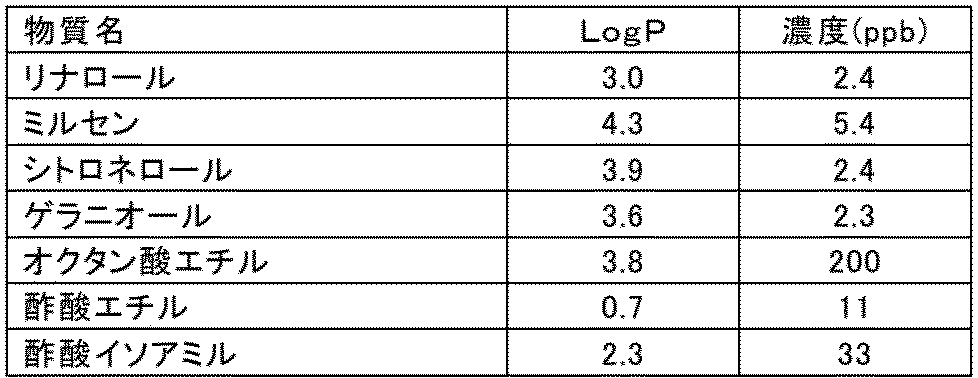
- the Log P of a highly hydrophobic aroma component is preferably 3.0 to 4.3, more preferably 3.0 to 3.8. Specific examples of highly hydrophobic aroma components are shown in Table 1.
- the highly hydrophobic aroma components are contained in the low-alcohol beer-like beverage in an amount such that the concentration of the highly hydrophobic aroma components in the low-alcohol beer-like beverage is 150 to 400 ppb. If the concentration of the highly hydrophobic aroma components in the low-alcohol beer-like beverage is less than 150 ppb, the low-alcohol beer-like beverage will be more susceptible to oxidized odors and aged tastes if they are produced. If the concentration of the highly hydrophobic aroma components exceeds 400 ppb, the flavor balance will be poor and the beer-like flavor of the low-alcohol beer-like beverage may be impaired.
- the concentration of the highly hydrophobic aroma components in the low-alcohol beer-like beverage is preferably 150 to 250 ppb, more preferably 180 to 350 ppb, and even more preferably 200 to 300 ppb.
- the concentration of highly hydrophobic aroma components in the low-alcohol beer-like beverage may be preferably 150 to 350 ppb, more preferably 150 to 300 ppb, even more preferably 150 to 250 ppb, even more preferably 180 to 250 ppb, particularly preferably 200 to 250 ppb, especially preferably 213 to 241 ppb or 210 to 230 ppb, and especially more preferably 213 to 222 ppb.
- the concentration of highly hydrophobic aroma components can be measured using a headspace GC device with an internal standard substance, or can be quantified using a GC/MS device based on the relative intensity of specific ions.
- the highly hydrophobic aroma components include terpene compounds.
- Terpene compounds are compounds having an isoprene-based skeleton (C 5 H 8 ) n , where n is an integer of 2 or more.
- Terpene compounds include myrcene, ⁇ -ionone, linalool, citronellol, and geraniol.
- preferred terpene compounds include linalool and myrcene.
- Raw materials containing linalool and myrcene include hops, hop extracts, and hop flavorings.
- Linalool and myrcene may be isolated or extracted from natural products, chemically synthesized by methods acceptable for food chemistry, derived from raw materials containing linalool, or derived from raw materials containing a precursor that is converted to linalool during the manufacturing process.
- Ester compounds are compounds that have an ester bond-based structure R-COO-R' [wherein R and R' are alkyl groups]. Ester compounds include ethyl octanoate. Generally, ethyl octanoate is produced by yeast during fermentation, but it may also be added separately as a compound or flavoring.
- the highly hydrophobic aroma component has a ratio of the terpene compound concentration and the ester compound concentration (terpene compound concentration/ester compound concentration) converted into the same unit that is greater than 0.0005 and less than 0.15, preferably 0.0006 to 0.06, and more preferably 0.0007 to 0.05.
- the unit of the terpene compound concentration in this ratio is "ppb”.
- the unit of the ester compound concentration in this ratio is also "ppb".
- the highly hydrophobic aroma component has a ratio of the terpene compound concentration to the ester compound concentration (terpene compound concentration/ester compound concentration) converted into the same unit of 0.04 to 0.2, preferably more than 0.04 and 0.1 or less, more preferably 0.042 to 0.088, and even more preferably 0.043 to 0.08.
- the unit of the terpene compound concentration in this ratio is "ppb”.
- the unit of the ester compound concentration in this ratio is also "ppb".
- the highly hydrophobic aroma component preferably has a ratio of linalool concentration to ethyl octanoate concentration (linalool concentration/ethyl octanoate concentration) of more than 0.01 and less than 0.15, more preferably 0.015 to 0.06, and particularly preferably 0.020 to 0.05. Furthermore, the highly hydrophobic aroma component preferably has a ratio of myrcene concentration to ethyl octanoate concentration (myrcene concentration/ethyl octanoate concentration) of more than 0.0005 and less than 0.05, more preferably 0.0025 to 0.025, and particularly preferably 0.0035 to 0.015.
- the highly hydrophobic aroma component has a ratio of linalool concentration to ethyl octanoate concentration (linalool concentration/ethyl octanoate concentration) of preferably more than 0.012 and not more than 0.15, more preferably 0.015 to 0.06, even more preferably 0.020 to 0.05, and particularly preferably 0.025 to 0.05.
- the highly hydrophobic aroma component has a ratio of myrcene concentration to ethyl octanoate concentration (myrcene concentration/ethyl octanoate concentration) of preferably more than 0.027 and not more than 0.077, more preferably 0.03 to 0.06, even more preferably more than 0.03 and not more than 0.06, even more preferably 0.031 to 0.05, and particularly preferably 0.031 to 0.042.
- the low-alcohol beer-like beverage of the present invention contains carbohydrates.
- Carbohydrates refer to carbohydrates that are not dietary fiber.
- the low-alcohol beer-like beverage of the present invention preferably has a carbohydrate concentration of 0.5 to 1.5 g/100 ml. If the carbohydrate concentration of the low-alcohol beer-like beverage is less than 0.5 g/100 ml, the beverage lacks richness and has a bland taste. If the carbohydrate concentration of the low-alcohol beer-like beverage is more than 1.5 g/100 ml, the beverage will have a strong sweetness and a heavy taste.
- the carbohydrate concentration of the low-alcohol beer-like beverage is preferably 0.6 to 1.4 g/100 ml, more preferably 0.7 to 1.2 g/100 ml.
- the carbohydrate concentration of low-alcohol beer-like beverages can be measured in accordance with the method prescribed in Notice No. 139 of the Food and Drug Administration dated March 30, 2015.
- the low-alcohol beer-like beverage of the present invention preferably has an original wort extract concentration of less than 12.2% by mass. This has the advantage of realizing a low alcohol content and providing a beer beverage with a light taste.
- the original wort extract concentration of the low-alcohol beer-like beverage of the present invention is more preferably 5 to 10% by mass, and even more preferably 6 to 8% by mass.
- the original wort extract concentration of the beer-taste beverage according to the present invention can be determined, for example, by measuring ethanol using 8.3.6. Alcolyzer method and true extract using 8.4.3. Alcolyzer method in the Revised BCOJ Beer Analysis Method (published by the Brewing Society of Japan, a public interest incorporated foundation, edited by the International Technical Committee of the Brewers Association of Japan (Analysis Committee), revised and expanded in 2013) and calculating the original wort extract concentration using 8.5 Extract-related calculation method.
- the low-alcohol beer-like beverage of the present invention preferably has a pH of 4.2 or less. This improves the resistance of the low-alcohol beer-like beverage to microorganisms. On the other hand, if the pH is too low, the resulting low-alcohol beer-like beverage will have a strong sour taste, the balance between sourness and sweetness will be poor, and palatability will decrease.
- the pH of the low-alcohol beer-like beverage of the present invention is more preferably 3.7 to 4.2, and even more preferably 3.9 to 4.2.
- the pH of the beer-taste beverage is the pH of the final product.
- the pH of the low-alcohol beer-like beverage can be adjusted by adding a pH adjuster at any point during the production process.
- the pH adjuster may be, for example, at least one selected from the group consisting of phosphoric acid, citric acid, malic acid, succinic acid, lactic acid, and acetic acid. Among these, the most preferred pH adjuster is phosphoric acid or lactic acid.
- the low-alcohol beer-like beverage of the present invention contains carbon dioxide gas.
- the carbon dioxide gas pressure of the low-alcohol beer-like beverage of the present invention is 0.23 MPa or more. This improves the resistance of the low-alcohol beer-like beverage to microorganisms. On the other hand, if the carbon dioxide gas pressure is too high, the low-alcohol beer-like beverage will have a light flavor and a reduced body, resulting in a poor drinking experience.
- the carbon dioxide gas pressure of the low-alcohol beer-like beverage of the present invention is preferably 0.23 to 0.30 MPa, more preferably 0.24 to 0.26 MPa.
- the method for producing a low-alcohol beer-like beverage of the present invention includes incorporating a fermented wort liquid into a low-alcohol beer-like beverage.
- the fermented wort liquid may be used as a base liquid for the low-alcohol beer-like beverage.
- the method for producing a low-alcohol beer-like beverage of the present invention includes adding a highly hydrophobic aroma component having a LogP of 3.0 to 4.3 to a low-alcohol beer-like beverage at a concentration of 150 to 400 ppb.
- concentration of the highly hydrophobic aroma component in the low-alcohol beer-like beverage can be adjusted by adding the highly hydrophobic aroma component itself as an additive, or by adding a flavoring containing the highly hydrophobic aroma component as an additive.
- Some highly hydrophobic aroma components are introduced into the fermented wort liquid from the raw materials. Therefore, the concentration of highly hydrophobic aroma components in a low-alcohol beer-like beverage can be adjusted by adjusting the amount of raw materials containing highly hydrophobic aroma components used.
- a specific example of a raw material containing highly hydrophobic aroma components is hops.
- the concentration of highly hydrophobic aroma components can be adjusted at any step, such as the cooling step after boiling the wort, the fermentation step, the maturation step, or the filtration step.
- the method for producing a low-alcohol beer-like beverage of the present invention includes adjusting the alcohol concentration of the low-alcohol beer-like beverage to 4 v/v % or less.
- the alcohol concentration of the low-alcohol beer-like beverage can be adjusted, for example, by diluting the liquid to be treated, such as wort. Dilution can be performed, for example, by adding water to the liquid to be treated.
- dilution of the liquid to be treated can be carried out at any step, such as the cooling step after boiling the wort, the fermentation step, the maturation step, or the filtration step.
- the method for producing a low-alcohol beer-like beverage of the present invention may also include adjusting the carbohydrate concentration of the low-alcohol beer-like beverage to 0.5 to 1.5 g/100 ml.
- the carbohydrate concentration of beer-like beverages can be adjusted, for example, by adding external enzymes during the saccharification process, or by activating the activity of enzymes contained in grains, breaking down carbon sources extracted from grain raw materials such as malt into sugars that can be assimilated by yeast, and having the yeast assimilate these during fermentation to reduce the carbohydrate content, by using liquid sugar that contains a lot of carbohydrates that can be assimilated by yeast to increase assimilation by yeast and thereby reduce the carbohydrate content, or by lowering the carbohydrate concentration by dilution.
- the method for producing a low-alcohol beer-like beverage may further include a step of adding caramel coloring, a boiling step, a pH adjustment step, a filtering step, a flavor adjustment step, a step of dissolving carbon dioxide gas, etc., using known equipment, etc.
- the method for producing a low-alcohol beer-like beverage may further include a step of adding dietary fiber, soybean peptides, carbon dioxide, extracts, flavorings, acidulants, sweeteners, bittering agents, colorants, antioxidants, pH adjusters, various nutritional components, etc., as necessary.
- the low-alcohol beer-like beverage of the present invention is preferably a beverage produced without undergoing a heat treatment after the fermentation process (a non-heated fermented beverage). This prevents the volatilization and thermal deterioration of highly hydrophobic aroma components, and enhances the function of suppressing oxidized odor and stale taste.
- the low-alcohol beer-like beverage of the present invention is preferably one that has invertase activity and protease activity.
- the low-alcohol beer-like beverage of the present invention has an invertase activity of 50 U or more, preferably 100 to 1500 U, and more preferably 300 to 1000 U. Note that invertase activity and protease activity can be measured by standard methods.
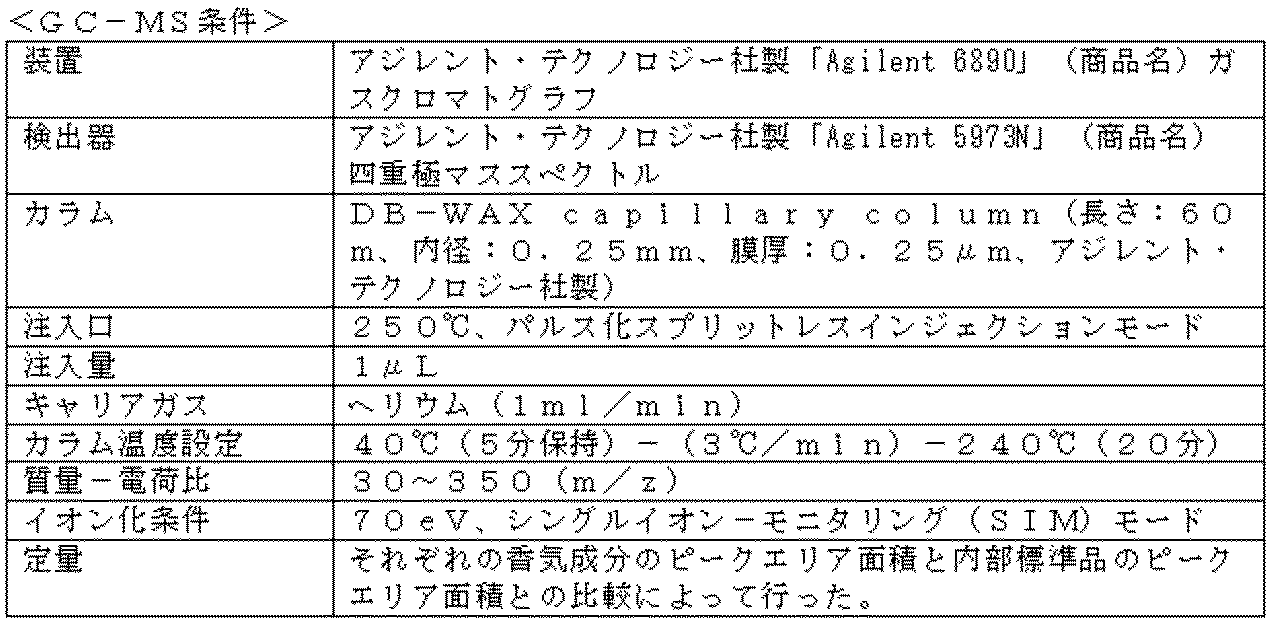
- the concentration of highly hydrophobic aroma components was measured by the stir bar sorptive extraction method (SBSE method). That is, ⁇ -damascone was added as an internal standard to the sample to be measured so as to reach 0.1 ppb.
- the sample was diluted 5 times, and 20 ml of the diluted sample was collected in a 30 ml vial.
- the stirring rod was removed from the vial, and after removing all water droplets, the vial was inserted into a GC-MS equipped with a thermal desorption unit (TDU) (Gerstel) and a programmable temperature-vaporization inlet (CIS4) (Gerstel).
- TDU thermal desorption unit
- CIS4 programmable temperature-vaporization inlet
- Invertase activity was measured using F-kit D-glucose from J.K. International Co., Ltd. The sample was mixed with solution I and pure water and allowed to stand, and then the absorbance at 340 nm (E1) was measured. Solution II was then added, mixed, and allowed to stand, and the absorbance (E2) was measured.
- Example 1 A 200L scale brewing facility was used to produce a beer-like beverage. First, 37 kg of malt and 15 kg of auxiliary materials were mixed using rice, corn starch, etc. as auxiliary materials to prepare a starchy raw material with a malt usage ratio of 70% by weight. Next, 200L of hot water was added to the starchy raw material, and the mixture was heated and saccharified at a temperature range of 64°C to 76°C. The resulting saccharified liquid was filtered, and 20g of Hercules hops was added before boiling, and the mixture was boiled in a boiling kettle to obtain wort. After boiling, the wort was transferred to a settling tank (called a whirlpool, etc.) to remove precipitates such as hop lees.
- a settling tank called a whirlpool, etc.
- the mixture was cooled to 6°C by a heat exchanger (plate cooler). After cooling, the wort was inoculated with yeast and fermented under conditions of 200kPa and 10°C, and filtered to obtain a wort fermentation liquid. The final appearance fermentation degree of the wort fermentation liquid was 104%.
- the carbohydrate concentration of the fermented wort liquid was adjusted to 0.9 g/100 ml, and the alcohol concentration was adjusted to 3.5 v/v%.
- the original wort extract concentration of the resulting beer-like beverage was 7.0% by mass.
- the invertase activity of the resulting beer-like beverage was measured and found to be 526 (U). In this example, no heat treatment was performed after the fermentation process of the wort fermentation liquid, and invertase activity was detected.
- Linalool was prepared as a highly hydrophobic aroma component.
- the beer-like beverage was divided into seven samples, one of which was used as a control to which no linalool was added, and the remaining six were added with linalool to adjust the concentration of the highly hydrophobic aroma component as shown in Table 4.
- the samples were stored in pairs at 37°C in the dark for 7 days.
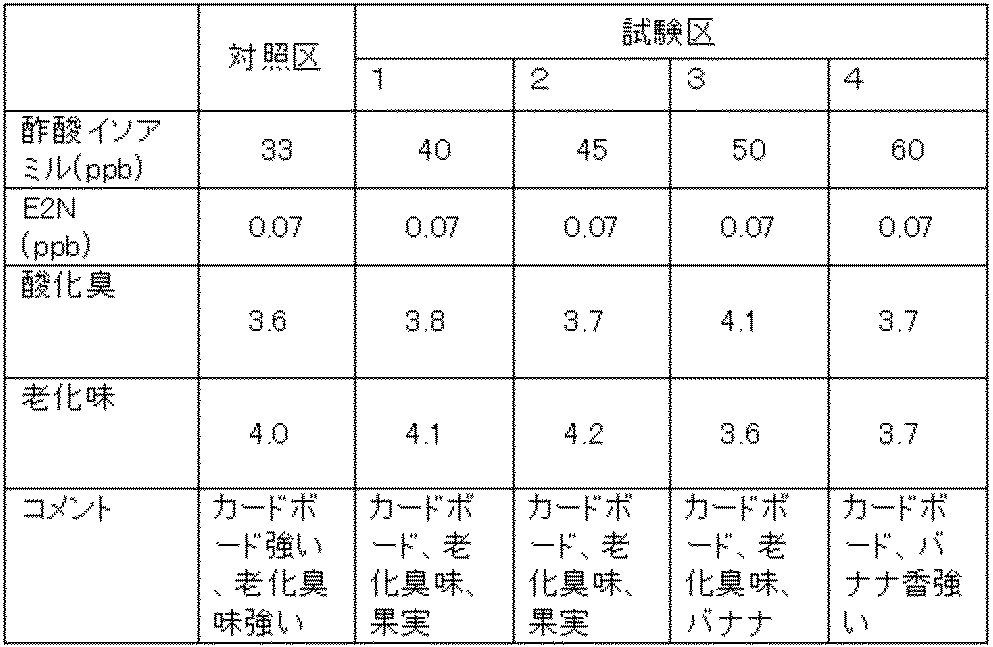
- E2N The trans-2-nonenal (hereinafter referred to as "E2N") concentration in the beer-like beverage was measured using the same method as described above for highly hydrophobic aroma components. The results are shown in Table 4.
- E2N is a substance that is recognized as an indicator of oxidative deterioration of beer-like beverages, and is known to have a characteristic cardboard odor, an unpleasant sweetness, and a powdery taste (JP Patent Publication No. 2019-080579).
- Each sample was adjusted to a liquid temperature of approximately 4°C, and a sensory evaluation was conducted by 10 panelists who are beer specialists.
- the evaluation items were (1) the strength of oxidized odor, and (2) the strength of aged flavor.
- the evaluation items were scored on a 5-point scale based on the sensory strength.
- the scoring criteria were set as follows. The average scores and comments given by each panelist are shown in Table 4.
- ⁇ Scoring criteria> The sensory intensity of the control sample stored in the dark at 0° C. for 7 days is assigned a score of 1. The sensory intensity of the control sample stored at 37° C. for 30 days is given a score of 5.
- Example 2 A beer-like beverage was produced in the same manner as in Example 1 to serve as a control sample.
- Myrcene was prepared as a highly hydrophobic aroma component. Samples with adjusted concentrations of the highly hydrophobic aroma component were produced in the same manner as in Example 1, except that myrcene was used instead of linalool, and a storage test was conducted. The E2N concentration of the samples after storage was measured, and a sensory test was conducted. The results are shown in Table 5.
- Samples with adjusted aroma component concentrations were produced in the same manner as in Example 1, except that ethyl acetate was used instead of linalool, and a storage test was conducted.
- the E2N concentration of the samples after storage was measured, and a sensory test was conducted. The results are shown in Table 6.
- Samples with adjusted aroma component concentrations were produced in the same manner as in Example 1, except that isoamyl acetate was used instead of linalool, and a storage test was conducted. The E2N concentration of the samples after storage was measured, and a sensory test was conducted. The results are shown in Table 7.
Landscapes
- Organic Chemistry (AREA)
- Chemical & Material Sciences (AREA)
- Engineering & Computer Science (AREA)
- Life Sciences & Earth Sciences (AREA)
- Genetics & Genomics (AREA)
- Bioinformatics & Cheminformatics (AREA)
- General Engineering & Computer Science (AREA)
- General Health & Medical Sciences (AREA)
- Health & Medical Sciences (AREA)
- Biochemistry (AREA)
- Wood Science & Technology (AREA)
- Zoology (AREA)
- Food Science & Technology (AREA)
- Microbiology (AREA)
- Non-Alcoholic Beverages (AREA)
- Distillation Of Fermentation Liquor, Processing Of Alcohols, Vinegar And Beer (AREA)
- Alcoholic Beverages (AREA)
Abstract
Description
該高疎水性香気成分はテルペン系化合物とエステル系化合物とを含み、
該テルペン系化合物はリナロール及びミルセンから成る群から選択される少なくとも一種を含み、
該エステル系化合物はオクタン酸エチルを含み、
該テルペン系化合物とエステル系化合物との比率が0.04~0.2、好ましくは0.04を超えて0.1以下、好ましくは0.042~0.088、より好ましくは0.043~0.08である、低アルコールビール様飲料。
3.0~4.3、好ましくは3.0~3.8のLogPを有する高疎水性香気成分を150~400ppb、好ましくは150~350ppb、より好ましくは150~300ppb、さらに好ましくは150~250ppb、さらにより好ましくは180~250ppb、特に好ましくは200~250ppb、特により好ましくは213~241ppb又は210~230ppb、特にさらに好ましくは213~222ppbの濃度で含有させること;及び
アルコール濃度を4v/v%以下、好ましくは1~4v/v%、より好ましくは2~4v/v%、更に好ましくは3.0~4.0v/v%に調節すること
を含む、低アルコールビール様飲料の製造方法であって、
該高疎水性香気成分はテルペン系化合物とエステル系化合物とを含み、
該テルペン系化合物はリナロール及びミルセンから成る群から選択される少なくとも一種を含み、
該エステル系化合物はオクタン酸エチルを含み、
該テルペン系化合物とエステル系化合物との比率が0.04~0.2、好ましくは0.04を超えて0.1以下、より好ましくは0.042~0.088、さらに好ましくは0.043~0.08である、低アルコールビール様飲料の製造方法。
3.0~4.3、好ましくは3.0~3.8のLogPを有する高疎水性香気成分を150~400ppb、好ましくは150~350ppb、より好ましくは150~300ppb、さらに好ましくは150~250ppb、さらにより好ましくは180~250ppb、特に好ましくは200~250ppb、特により好ましくは213~241ppb又は210~230ppb、特にさらに好ましくは213~222ppbの濃度で含有させること;及び
アルコール濃度を4v/v%以下、好ましくは1~4v/v%、より好ましくは2~4v/v%、更に好ましくは3.0~4.0v/v%に調節すること;
を含む、低アルコールビール様飲料の良好な香味の持続期間を延長する方法であって、
該高疎水性香気成分はテルペン系化合物とエステル系化合物とを含み、
該テルペン系化合物はリナロール及びミルセンから成る群から選択される少なくとも一種を含み、
該エステル系化合物はオクタン酸エチルを含み、
該テルペン系化合物とエステル系化合物との比率が0.04~0.2、好ましくは0.04を超えて0.1以下、より好ましくは0.042~0.088、さらに好ましくは0.043~0.08である、低アルコールビール様飲料の良好な香味の持続期間を延長する方法。
該高疎水性香気成分はテルペン系化合物とエステル系化合物とを含み、
該テルペン系化合物はリナロール及びミルセンから成る群から選択される少なくとも一種を含み、
該エステル系化合物はオクタン酸エチルを含み、
該テルペン系化合物とエステル系化合物との比率が0.0005を超えて0.15以下、好ましくは0.0006~0.06、より好ましくは0.0007~0.05である、低アルコールビール様飲料。
3.0~4.3、好ましくは3.0~3.8のLogPを有する高疎水性香気成分を150~400ppb、好ましくは150~350ppb、より好ましくは180~350ppb、さらに好ましくは200~300ppb、特に好ましくは213~241ppb、又は好ましくは150~250ppbの濃度で含有させること;及び
アルコール濃度を4v/v%以下、好ましくは1~4v/v%、より好ましくは2~4v/v%、更に好ましくは3.0~4.0v/v%に調節すること
を含む、低アルコールビール様飲料の製造方法であって、
該高疎水性香気成分はテルペン系化合物とエステル系化合物とを含み、
該テルペン系化合物はリナロール及びミルセンから成る群から選択される少なくとも一種を含み、
該エステル系化合物はオクタン酸エチルを含み、
該テルペン系化合物とエステル系化合物との比率が0.0005を超えて0.15以下、好ましくは0.0006~0.06、より好ましくは0.0007~0.05である、低アルコールビール様飲料の製造方法。
3.0~4.3、好ましくは3.0~3.8のLogPを有する高疎水性香気成分を150~400ppb、好ましくは150~350ppb、より好ましくは180~350ppb、さらに好ましくは200~300ppb、特に好ましくは213~241ppb、又は好ましくは150~250ppbの濃度で含有させること;及び
アルコール濃度を4v/v%以下、好ましくは1~4v/v%、より好ましくは2~4v/v%、更に好ましくは3.0~4.0v/v%に調節すること;
を含む、低アルコールビール様飲料の良好な香味の持続期間を延長する方法であって、
該高疎水性香気成分はテルペン系化合物とエステル系化合物とを含み、
該テルペン系化合物はリナロール及びミルセンから成る群から選択される少なくとも一種を含み、
該エステル系化合物はオクタン酸エチルを含み、
該テルペン系化合物とエステル系化合物との比率が0.0005を超えて0.15以下、好ましくは0.0006~0.06、より好ましくは0.0007~0.05である、低アルコールビール様飲料の良好な香味の持続期間を延長する方法。
「低アルコールビール様飲料」とは、アルコール濃度が通常のビール様飲料よりも低いビール様飲料をいう。「ビール様」とは、ビールを想起させる味及び香気をいう。
本発明の低アルコールビール様飲料は、麦汁発酵液を含む。低アルコールビール様飲料が麦汁発酵液を含むことで、低アルコールビール様飲料にビールらしい複雑味、飲みごたえ感及びボディ感が付与される。麦汁発酵液とは、麦汁をビール酵母で発酵させて得られる液体である。本発明でいう麦汁は、通常のビールを製造する際に使用される麦汁を意味し、これには麦芽、及び必要に応じてホップが含まれる。
Vend(%)={(P-Eend)/P}×100 (1)
[式中、Pは原麦汁エキスであり、Eendは、外観最終エキスである。]
本発明の低アルコールビール様飲料は、高疎水性香気成分を含む。そのことで、低アルコールビール様飲料を保存する場合に生成する、酸化臭及び老化味が減感される。本明細書において「減感」とは、人間の嗅覚及び味覚において感じにくくすることをいう。文言「減感」の意味には、対象物にその本来の香気とは別の香気を加えることで、対象物本来の香気を包み隠すこと、即ち、マスキングが含まれる。

本発明の低アルコールビール様飲料は糖質を含む。糖質とは、食物繊維ではない炭水化物をいう。本発明の低アルコールビール様飲料は、好ましくは0.5~1.5g/100mlの糖質濃度を有する。低アルコールビール様飲料の糖質濃度が0.5g/100ml未満であると、コクが不足し、味感が淡泊になる。低アルコールビール様飲料の糖質濃度が1.5g/100mlを超えると、甘味を強く感じられるようになり、味感も重くなる。低アルコールビール様飲料の糖質濃度は、好ましくは0.6~1.4g/100mlであり、より好ましくは0.7~1.2g/100mlである。
本発明の低アルコールビール様飲料は、好ましくは12.2質量%未満の原麦汁エキス濃度を有する。そのことで、低アルコールを実現し、かつ軽快な味感のビール飲料が得られるという利点がある。本発明の低アルコールビール様飲料の原麦汁エキス濃度は、より好ましくは5~10質量%であり、更に好ましくは6~8質量%である。
本発明の低アルコールビール様飲料は、好ましくは4.2以下のpHを有する。そのことで低アルコールビール様飲料の微生物に対する耐久性が向上する。一方、pHが低すぎると、得られる低アルコールビール様飲料の酸味が強く、酸味と甘味のバランスが悪くなり、嗜好性が低下する。本発明の低アルコールビール様飲料のpHは、より好ましくは3.7~4.2、更に好ましくは3.9~4.2である。ここで、ビールテイスト飲料のpHは、最終製品としてのpHである。
本発明の低アルコールビール様飲料は炭酸ガスを含む。本発明の低アルコールビール様飲料の炭酸ガス圧は0.23MPa以上である。そうすることで、低アルコールビール様飲料の微生物に対する耐久性が向上する。一方、炭酸ガス圧が高すぎると、低アルコールビール様飲料の香味が軽く、ボディ感が低下し、飲み応えに劣ったものになる。本発明の低アルコールビール様飲料の炭酸ガス圧は、好ましくは0.23~0.30MPa、より好ましくは0.24~0.26MPaである。
本発明の低アルコールビール様飲料の製造方法は、麦汁発酵液を低アルコールビール様飲料に含有させることを含む。この場合、麦汁発酵液を低アルコールビール様飲料のベース液として使用してもよい。
高疎水性香気成分濃度は、攪拌枝吸着抽出法(SBSE法:Stir Bar Sorptive Extraction)により測定した。即ち、測定に供する試料に、内部標準としてβダマスコンを0.1ppbになるように添加した。試料を5倍希釈し、希釈サンプル20mlを30ml容バイアルに採取した。47μlのPDMS(ポリジメチルシロキサン)でコーティングした攪拌枝(長さ=20mm;Twister(商品名);Gerstel社製、Germany)をバイアルに入れ、蓋を締め、40℃で2時間攪拌し、攪拌枝にホップ香気成分を吸着させた。攪拌枝をバイアルから取り出し、水滴を完全に除去後、加熱脱着ユニット(Thermal desorption unit(TDU))(Gerstel社製)とプログラマブル温度-蒸発インレット(Programmable temperature-vaporization inlet;CIS4)(Gerstel社製)を装備したGC-MSに挿入した。
株式会社J.K. インターナショナル社のF-キットD-グルコースを用いてインベルターゼ活性を測定した。試料を溶液Iおよび純水を混和・静置した後、340nm吸光度(E1)を測定した。その後、溶液IIを加えて混和・静置した後、吸光度(E2)を測定した。
(E2-E1)×0.8641 (2)
で求められるD-グルコース(g/L)の値より、1分間にスクロースからグルコース1μmolを生成するビール1L中の酵素量を1Uとするインベルターゼ活性(U)を測定した。
200Lスケールの仕込設備を用いて、ビール様飲料の製造を行った。まず、副原料として、米、コーンスターチ等を用い麦芽37kgと副原料15kgとを混合し、麦芽使用比率70重量%のデンプン質原料を調製した。次いで、デンプン質原料に温水200Lを加え、加温し、64℃から76℃の範囲でデンプン質原料の糖化を行った。得られた糖化液を濾過し、煮沸前にヘラクレス種ホップを20g加え、煮沸釜において煮沸することで麦汁を得た。煮沸後、麦汁を沈殿槽(ワールプール等と呼ばれる)に移送し、ホップ粕等の沈殿物を除去した。沈殿物の除去後、熱交換器(プレートクーラー)により、6℃まで冷却した。冷却後、麦汁に酵母を接種して200kPa、10℃の条件で発酵させ、濾過を行い、麦汁発酵液を得た。麦汁発酵液の外観最終発酵度は104%であった。
0℃で暗所に7日間保存した対照試料の官能の強さを1点とする。
37℃で、30日間保存した対照試料の官能の強さを5点とする。

実施例1と同様にしてビール様飲料を製造し、対照試料とした。

実施例1と同様にしてビール様飲料を製造し、これを対照試料とした。

実施例1と同様にしてビール様飲料を製造し、対照試料とした。
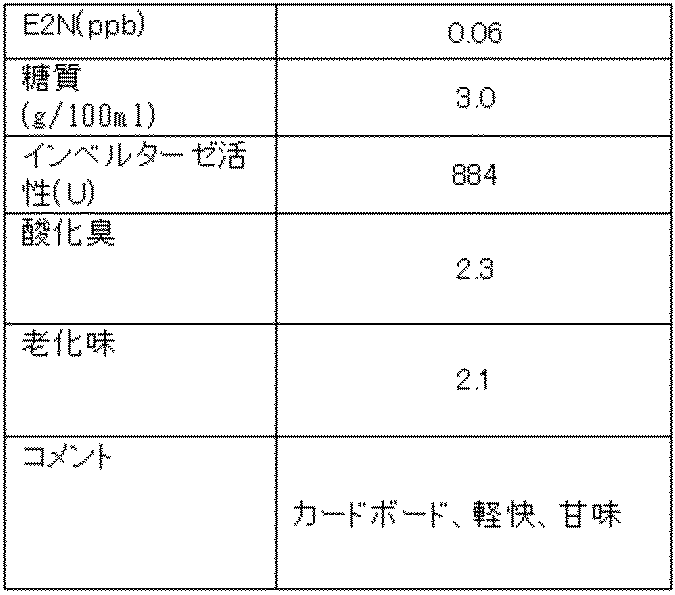
ビール様飲料として、アルコール濃度5.0v/v%及び糖質濃度3.0g/100mlのビール(アサヒビール株式会社製「アサヒスーパードライ」(商品名))を準備した。このビールを試料として用いること以外は実施例1と同様にして保存、E2N濃度測定、及び官能試験を行った。結果を表8に示す。
Claims (12)
- 麦汁発酵液を含み、3.0~4.3のLogPを有する高疎水性香気成分を150~400ppbの濃度で含み、4v/v%以下のアルコール濃度を有する低アルコールビール様飲料であって、
該高疎水性香気成分はテルペン系化合物とエステル系化合物とを含み、
該テルペン系化合物はリナロール及びミルセンから成る群から選択される少なくとも一種を含み、
該エステル系化合物はオクタン酸エチルを含み、
該テルペン系化合物と該エステル系化合物との比率が0.04~0.2である、低アルコールビール様飲料。 - 前記リナロールと前記オクタン酸エチルとの比率が0.012を超えて0.15以下である、請求項1に記載の低アルコールビール様飲料。
- 前記ミルセンと前記オクタン酸エチルとの比率が0.03を超えて0.06以下である、請求項1又は2に記載の低アルコールビール様飲料。
- インベルターゼ活性を有する、請求項1~3のいずれか一項に記載の低アルコールビール様飲料。
- 50%以上の麦芽使用比率を有する、請求項1~4のいずれか一項に記載の低アルコールビール様飲料。
- 0.5~1.5g/100mlの糖質濃度を有する、請求項1~5のいずれか一項に記載の低アルコールビール様飲料。
- 4.4以下のpHを有する、請求項1~6のいずれか一項に記載の低アルコールビール様飲料。
- 麦汁発酵液は90~110%の外観最終発酵度を有する、請求項1~7のいずれか一項に記載の低アルコールビール様飲料。
- 水で希釈された麦汁発酵液を含む、請求項1~8のいずれか一項に記載の低アルコールビール様飲料。
- 麦汁発酵液を含有させること;
3.0~4.3のLogPを有する高疎水性香気成分を150~400ppbの濃度で含有させること;及び
アルコール濃度を4v/v%以下に調節すること
を含む、低アルコールビール様飲料の製造方法であって、
該高疎水性香気成分はテルペン系化合物とエステル系化合物とを含み、
該テルペン系化合物はリナロール及びミルセンから成る群から選択される少なくとも一種を含み、
該エステル系化合物はオクタン酸エチルを含み、
該テルペン系化合物と該エステル系化合物との比率が0.04~0.2である、低アルコールビール様飲料の製造方法。 - 麦汁発酵液を含有させること;
3.0~4.3のLogPを有する高疎水性香気成分を150~400ppbの濃度で含有させること;及び
アルコール濃度を4v/v%以下に調節すること;
を含む、低アルコールビール様飲料の良好な香味の持続期間を延長する方法であって、
該高疎水性香気成分はテルペン系化合物とエステル系化合物とを含み、
該テルペン系化合物はリナロール及びミルセンから成る群から選択される少なくとも一種を含み、
該エステル系化合物はオクタン酸エチルを含み、
該テルペン系化合物と該エステル系化合物との比率が0.04~0.2である、低アルコールビール様飲料の良好な香味の持続期間を延長する方法。 - アルコール濃度を4v/v%以下に調節することは、麦汁発酵液を水で希釈して行われる、請求項10又は11に記載の方法。
Priority Applications (4)
| Application Number | Priority Date | Filing Date | Title |
|---|---|---|---|
| EP24823293.6A EP4729597A1 (en) | 2023-06-14 | 2024-06-05 | Low-alcohol beer-like beverage and method for producing low-alcohol beer-like beverage |
| AU2024302637A AU2024302637A1 (en) | 2023-06-14 | 2024-06-05 | Low-alcohol beer-like beverage and method for producing low-alcohol beer-like beverage |
| CN202480036706.5A CN121263508A (zh) | 2023-06-14 | 2024-06-05 | 低醇啤酒样饮料及低醇啤酒样饮料的制造方法 |
| KR1020257032946A KR20260025773A (ko) | 2023-06-14 | 2024-06-05 | 저알코올 맥주형 음료 및 저알코올 맥주형 음료의 제조 방법 |
Applications Claiming Priority (2)
| Application Number | Priority Date | Filing Date | Title |
|---|---|---|---|
| JP2023-097685 | 2023-06-14 | ||
| JP2023097685 | 2023-06-14 |
Publications (1)
| Publication Number | Publication Date |
|---|---|
| WO2024257675A1 true WO2024257675A1 (ja) | 2024-12-19 |
Family
ID=92839492
Family Applications (1)
| Application Number | Title | Priority Date | Filing Date |
|---|---|---|---|
| PCT/JP2024/020592 Ceased WO2024257675A1 (ja) | 2023-06-14 | 2024-06-05 | 低アルコールビール様飲料および低アルコールビール様飲料の製造方法 |
Country Status (6)
| Country | Link |
|---|---|
| EP (1) | EP4729597A1 (ja) |
| JP (2) | JP7557178B1 (ja) |
| KR (1) | KR20260025773A (ja) |
| CN (1) | CN121263508A (ja) |
| AU (1) | AU2024302637A1 (ja) |
| WO (1) | WO2024257675A1 (ja) |
Citations (12)
| Publication number | Priority date | Publication date | Assignee | Title |
|---|---|---|---|---|
| JP2012239460A (ja) | 2011-05-24 | 2012-12-10 | Asahi Breweries Ltd | 低アルコール発酵麦芽飲料の製造方法 |
| JP2015027309A (ja) * | 2014-09-30 | 2015-02-12 | 太一 染谷 | ビール風味付与剤およびビール風味飲料 |
| JP2015123044A (ja) * | 2013-12-27 | 2015-07-06 | アサヒビール株式会社 | 発酵麦芽飲料 |
| JP2017118824A (ja) * | 2015-12-28 | 2017-07-06 | アサヒビール株式会社 | 発酵麦芽飲料及びその製造方法 |
| JP2018011587A (ja) * | 2016-07-06 | 2018-01-25 | アサヒビール株式会社 | ビール様発泡性飲料及びその製造方法 |
| JP2018174756A (ja) | 2017-04-07 | 2018-11-15 | アサヒビール株式会社 | 酸化劣化臭、老化臭及び老化味が減感された麦芽飲料 |
| JP2018198554A (ja) * | 2017-05-26 | 2018-12-20 | アサヒビール株式会社 | 麦芽飲料及びその製造方法 |
| JP2019000124A (ja) * | 2018-10-10 | 2019-01-10 | サントリーホールディングス株式会社 | ビールテイスト発酵飲料 |
| JP2019080579A (ja) | 2019-02-28 | 2019-05-30 | アサヒビール株式会社 | ノンアルコールビールテイスト飲料、ノンアルコールビールテイスト飲料の製造方法、及びノンアルコールビールテイスト飲料の香味劣化抑制方法 |
| JP2020195319A (ja) * | 2019-05-31 | 2020-12-10 | サントリーホールディングス株式会社 | ビールテイスト飲料 |
| JP2021136961A (ja) * | 2020-03-06 | 2021-09-16 | アサヒビール株式会社 | ビール様飲料 |
| JP2022066506A (ja) | 2018-03-23 | 2022-04-28 | アサヒ飲料株式会社 | 容器詰め炭酸飲料、容器詰め炭酸飲料の製造方法、および容器詰め炭酸飲料の噴出抑制方法 |
-
2024
- 2024-06-05 AU AU2024302637A patent/AU2024302637A1/en active Pending
- 2024-06-05 JP JP2024091724A patent/JP7557178B1/ja active Active
- 2024-06-05 KR KR1020257032946A patent/KR20260025773A/ko active Pending
- 2024-06-05 CN CN202480036706.5A patent/CN121263508A/zh active Pending
- 2024-06-05 WO PCT/JP2024/020592 patent/WO2024257675A1/ja not_active Ceased
- 2024-06-05 EP EP24823293.6A patent/EP4729597A1/en active Pending
- 2024-08-30 JP JP2024148542A patent/JP2024180389A/ja active Pending
Patent Citations (12)
| Publication number | Priority date | Publication date | Assignee | Title |
|---|---|---|---|---|
| JP2012239460A (ja) | 2011-05-24 | 2012-12-10 | Asahi Breweries Ltd | 低アルコール発酵麦芽飲料の製造方法 |
| JP2015123044A (ja) * | 2013-12-27 | 2015-07-06 | アサヒビール株式会社 | 発酵麦芽飲料 |
| JP2015027309A (ja) * | 2014-09-30 | 2015-02-12 | 太一 染谷 | ビール風味付与剤およびビール風味飲料 |
| JP2017118824A (ja) * | 2015-12-28 | 2017-07-06 | アサヒビール株式会社 | 発酵麦芽飲料及びその製造方法 |
| JP2018011587A (ja) * | 2016-07-06 | 2018-01-25 | アサヒビール株式会社 | ビール様発泡性飲料及びその製造方法 |
| JP2018174756A (ja) | 2017-04-07 | 2018-11-15 | アサヒビール株式会社 | 酸化劣化臭、老化臭及び老化味が減感された麦芽飲料 |
| JP2018198554A (ja) * | 2017-05-26 | 2018-12-20 | アサヒビール株式会社 | 麦芽飲料及びその製造方法 |
| JP2022066506A (ja) | 2018-03-23 | 2022-04-28 | アサヒ飲料株式会社 | 容器詰め炭酸飲料、容器詰め炭酸飲料の製造方法、および容器詰め炭酸飲料の噴出抑制方法 |
| JP2019000124A (ja) * | 2018-10-10 | 2019-01-10 | サントリーホールディングス株式会社 | ビールテイスト発酵飲料 |
| JP2019080579A (ja) | 2019-02-28 | 2019-05-30 | アサヒビール株式会社 | ノンアルコールビールテイスト飲料、ノンアルコールビールテイスト飲料の製造方法、及びノンアルコールビールテイスト飲料の香味劣化抑制方法 |
| JP2020195319A (ja) * | 2019-05-31 | 2020-12-10 | サントリーホールディングス株式会社 | ビールテイスト飲料 |
| JP2021136961A (ja) * | 2020-03-06 | 2021-09-16 | アサヒビール株式会社 | ビール様飲料 |
Non-Patent Citations (2)
| Title |
|---|
| FRITSCH, HELGE T. ET AL.: "Identification Based on Quantitative Measurements and Aroma Recombination of the Character Impact Odorants in a Bavarian Pilsner-type Beer", JOURNAL OF AGRICULTURAL AND FOOD CHEMISTRY, vol. 53, no. 19, 21 September 2005 (2005-09-21), pages 7544 - 7551, XP055108097, DOI: 10.1021/jf051167k * |
| See also references of EP4729597A1 |
Also Published As
| Publication number | Publication date |
|---|---|
| JP2024180389A (ja) | 2024-12-26 |
| JP7557178B1 (ja) | 2024-09-27 |
| JP2024180315A (ja) | 2024-12-26 |
| EP4729597A1 (en) | 2026-04-22 |
| CN121263508A (zh) | 2026-01-02 |
| AU2024302637A1 (en) | 2025-12-11 |
| KR20260025773A (ko) | 2026-02-24 |
Similar Documents
| Publication | Publication Date | Title |
|---|---|---|
| JP7462596B2 (ja) | ビールテイスト飲料 | |
| KR102634560B1 (ko) | 맥주맛 발효 맥아 음료 및 그의 제조 방법, 및 맥주맛 발효 맥아 음료의 싱거운 음용감을 완화하는 방법 | |
| JP7784896B2 (ja) | ビールテイスト発酵麦芽飲料 | |
| JP7695448B2 (ja) | 低アルコールビール様飲料および低アルコールビール様飲料の製造方法 | |
| JP7557178B1 (ja) | 低アルコールビール様飲料および低アルコールビール様飲料の製造方法 | |
| JP7803672B2 (ja) | ビール様発酵麦芽飲料 | |
| JP7741268B1 (ja) | 低アルコールビール様飲料および低アルコールビール様飲料の製造方法 | |
| JP7719263B1 (ja) | 低アルコールビール様飲料および低アルコールビール様飲料の製造方法 | |
| JP7708948B1 (ja) | ノンアルコールビール様飲料およびノンアルコールビール様飲料の製造方法 | |
| JP7719262B1 (ja) | 低アルコールビール様飲料および低アルコールビール様飲料の製造方法 | |
| JP7708950B1 (ja) | ノンアルコールビール様飲料およびノンアルコールビール様飲料の製造方法 | |
| JP7708949B1 (ja) | ノンアルコールビール様飲料およびノンアルコールビール様飲料の製造方法 | |
| WO2018179725A1 (ja) | 穀物香が低減された麦芽飲料 | |
| JP2023180387A (ja) | 麦汁のビール酵母発酵液、及びその製造方法 | |
| JP7736886B1 (ja) | ノンアルコールビール様飲料およびノンアルコールビール様飲料の製造方法 | |
| JP2026002651A (ja) | ビール様飲料の静菌性を増強する方法 | |
| JP2024150286A (ja) | 低アルコールビールテイスト飲料及びその製造方法 | |
| WO2024257690A1 (ja) | ビール様飲料の静菌性を増強する方法 | |
| JP2025010874A (ja) | 容器詰麦芽発酵飲料 | |
| HK40059489A (en) | Fermented malt beverage having beer taste |
Legal Events
| Date | Code | Title | Description |
|---|---|---|---|
| 121 | Ep: the epo has been informed by wipo that ep was designated in this application |
Ref document number: 24823293 Country of ref document: EP Kind code of ref document: A1 |
|
| WWE | Wipo information: entry into national phase |
Ref document number: AU2024302637 Country of ref document: AU |
|
| ENP | Entry into the national phase |
Ref document number: 2024302637 Country of ref document: AU Date of ref document: 20240605 Kind code of ref document: A |
|
| WWE | Wipo information: entry into national phase |
Ref document number: 2024823293 Country of ref document: EP |
|
| NENP | Non-entry into the national phase |
Ref country code: DE |
|
| ENP | Entry into the national phase |
Ref document number: 2024823293 Country of ref document: EP Effective date: 20260114 |
|
| ENP | Entry into the national phase |
Ref document number: 2024823293 Country of ref document: EP Effective date: 20260114 |
|
| ENP | Entry into the national phase |
Ref document number: 2024823293 Country of ref document: EP Effective date: 20260114 |
|
| ENP | Entry into the national phase |
Ref document number: 2024823293 Country of ref document: EP Effective date: 20260114 |
|
| WWP | Wipo information: published in national office |
Ref document number: 2024823293 Country of ref document: EP |