WO2024257642A1 - 生体計測装置および生体計測システム - Google Patents
生体計測装置および生体計測システム Download PDFInfo
- Publication number
- WO2024257642A1 WO2024257642A1 PCT/JP2024/020272 JP2024020272W WO2024257642A1 WO 2024257642 A1 WO2024257642 A1 WO 2024257642A1 JP 2024020272 W JP2024020272 W JP 2024020272W WO 2024257642 A1 WO2024257642 A1 WO 2024257642A1
- Authority
- WO
- WIPO (PCT)
- Prior art keywords
- light
- filter
- light detection
- living body
- signal
- Prior art date
- Legal status (The legal status is an assumption and is not a legal conclusion. Google has not performed a legal analysis and makes no representation as to the accuracy of the status listed.)
- Ceased
Links
Images









Classifications
-
- A—HUMAN NECESSITIES
- A61—MEDICAL OR VETERINARY SCIENCE; HYGIENE
- A61B—DIAGNOSIS; SURGERY; IDENTIFICATION
- A61B5/00—Measuring for diagnostic purposes; Identification of persons
- A61B5/16—Devices for psychotechnics; Testing reaction times ; Devices for evaluating the psychological state
- A61B5/18—Devices for psychotechnics; Testing reaction times ; Devices for evaluating the psychological state for vehicle drivers or machine operators
-
- A—HUMAN NECESSITIES
- A61—MEDICAL OR VETERINARY SCIENCE; HYGIENE
- A61B—DIAGNOSIS; SURGERY; IDENTIFICATION
- A61B5/00—Measuring for diagnostic purposes; Identification of persons
- A61B5/0059—Measuring for diagnostic purposes; Identification of persons using light, e.g. diagnosis by transillumination, diascopy, fluorescence
- A61B5/0075—Measuring for diagnostic purposes; Identification of persons using light, e.g. diagnosis by transillumination, diascopy, fluorescence by spectroscopy, i.e. measuring spectra, e.g. Raman spectroscopy, infrared absorption spectroscopy
-
- A—HUMAN NECESSITIES
- A61—MEDICAL OR VETERINARY SCIENCE; HYGIENE
- A61B—DIAGNOSIS; SURGERY; IDENTIFICATION
- A61B5/00—Measuring for diagnostic purposes; Identification of persons
- A61B5/0059—Measuring for diagnostic purposes; Identification of persons using light, e.g. diagnosis by transillumination, diascopy, fluorescence
- A61B5/0077—Devices for viewing the surface of the body, e.g. camera, magnifying lens
-
- A—HUMAN NECESSITIES
- A61—MEDICAL OR VETERINARY SCIENCE; HYGIENE
- A61B—DIAGNOSIS; SURGERY; IDENTIFICATION
- A61B5/00—Measuring for diagnostic purposes; Identification of persons
- A61B5/02—Detecting, measuring or recording for evaluating the cardiovascular system, e.g. pulse, heart rate, blood pressure or blood flow
- A61B5/024—Measuring pulse rate or heart rate
- A61B5/0245—Measuring pulse rate or heart rate by using sensing means generating electric signals, i.e. ECG signals
-
- A—HUMAN NECESSITIES
- A61—MEDICAL OR VETERINARY SCIENCE; HYGIENE
- A61B—DIAGNOSIS; SURGERY; IDENTIFICATION
- A61B5/00—Measuring for diagnostic purposes; Identification of persons
- A61B5/16—Devices for psychotechnics; Testing reaction times ; Devices for evaluating the psychological state
-
- A—HUMAN NECESSITIES
- A61—MEDICAL OR VETERINARY SCIENCE; HYGIENE
- A61B—DIAGNOSIS; SURGERY; IDENTIFICATION
- A61B5/00—Measuring for diagnostic purposes; Identification of persons
- A61B5/16—Devices for psychotechnics; Testing reaction times ; Devices for evaluating the psychological state
- A61B5/165—Evaluating the state of mind, e.g. depression, anxiety
-
- A—HUMAN NECESSITIES
- A61—MEDICAL OR VETERINARY SCIENCE; HYGIENE
- A61B—DIAGNOSIS; SURGERY; IDENTIFICATION
- A61B5/00—Measuring for diagnostic purposes; Identification of persons
- A61B5/68—Arrangements of detecting, measuring or recording means, e.g. sensors, in relation to patient
- A61B5/6887—Arrangements of detecting, measuring or recording means, e.g. sensors, in relation to patient mounted on external non-worn devices, e.g. non-medical devices
- A61B5/6893—Cars
-
- A—HUMAN NECESSITIES
- A61—MEDICAL OR VETERINARY SCIENCE; HYGIENE
- A61B—DIAGNOSIS; SURGERY; IDENTIFICATION
- A61B5/00—Measuring for diagnostic purposes; Identification of persons
- A61B5/72—Signal processing specially adapted for physiological signals or for diagnostic purposes
- A61B5/7235—Details of waveform analysis
- A61B5/725—Details of waveform analysis using specific filters therefor, e.g. Kalman or adaptive filters
Definitions
- This disclosure relates to a biomeasurement device and a biomeasurement system.
- biometric information such as pulse wave information based on the reflected light generated when a living body is illuminated with light.
- the reflected light contains not only biometric information but also body movement information, making it difficult to acquire biometric information accurately. Therefore, a method of removing body movement information has been proposed.
- Patent Document 1 discloses a pulse wave measuring device that uses a camera to measure the pulse waves of a living body.
- Image data of the living body acquired by the camera includes a green signal that changes relatively more with time due to the pulse, and a red signal that changes relatively less with time.
- the green signal includes not only pulse information but also body movement information, while the red signal includes only a small amount of pulse information and a large amount of body movement information.
- the body movement information can be removed from the information included in the green signal, making it possible to obtain pulse information.
- Patent Document 2 discloses a pulse wave sensor that is attached to a living body.
- the pulse wave sensor detects the reflected light produced by illuminating the living body with green light and outputs a green signal, and detects the reflected light produced by illuminating the living body with infrared light and outputs an infrared signal.
- the green signal contains not only pulse information but also body movement information, while the infrared signal contains only a small amount of pulse information and a large amount of body movement information. By comparing the frequency components of the green signal and the infrared signal, it is possible to remove the body movement information from the information contained in the green signal and obtain the pulse information.
- a bioinstrumentation device includes a bandpass filter, a photodetector, and a processing circuit
- the photodetector including a first filter that transmits red light, a second filter that transmits one of green and blue light, a first photodetector that detects light from the living body through the first filter, and a second photodetector that detects light from the living body through the second filter
- the processing circuit generates bioinformation of the living body based on the first light detected by the first photodetector and the second light detected by the second photodetector
- the bandpass filter prevents at least a portion of the light from the living body that is incident on the first photodetector from passing through the first light in the wavelength range of 550 nm to 600 nm.
- the general or specific aspects of the present disclosure may be realized in a system, an apparatus, a method, an integrated circuit, a computer program, or a recording medium such as a computer-readable recording disk, or may be realized in any combination of a system, an apparatus, a method, an integrated circuit, a computer program, and a recording medium.
- the computer-readable recording medium may include a non-volatile recording medium such as a CD-ROM (Compact Disc-Read Only Memory).
- An apparatus may be composed of one or more devices. When an apparatus is composed of two or more devices, the two or more devices may be arranged in one device, or may be arranged separately in two or more separate devices.
- "apparatus" may mean not only one device, but also a system consisting of multiple devices.
- the technology disclosed herein makes it possible to realize a biomeasurement device that can effectively acquire bioinformation.
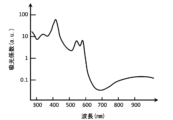
- FIG. 1 is a graph showing the absorption spectrum of oxygenated hemoglobin in blood.
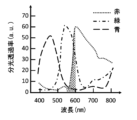
- FIG. 2 is a graph showing the optical spectrum of a typical color filter.
- FIG. 3 is a diagram illustrating a schematic configuration of a measurement device according to the first exemplary embodiment of the present disclosure.
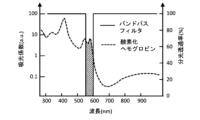
- FIG. 4 is a graph showing an example of the spectrum of a bandpass filter and the absorption spectrum of oxygenated hemoglobin.
- FIG. 5 is a graph showing an example of an optical spectrum obtained by combining a bandpass filter and a general color filter.
- FIG. 6 is a diagram illustrating an example of time-series data of the first signal and the second signal, and an example of biological information.
- FIG. 7 is a diagram showing a schematic example of the arrangement of color filters in a light detection device.
- FIG. 1 is a graph showing the absorption spectrum of oxygenated hemoglobin in blood.
- FIG. 2 is a graph showing the optical spectrum of a typical color filter.
- FIG. 3 is a diagram illustrating
- FIG. 8 is a diagram illustrating a schematic configuration of a measurement device according to the second exemplary embodiment of the present disclosure.
- FIG. 9A is a diagram illustrating a first configuration example of a light source.
- FIG. 9B is a graph showing an example of an emission spectrum of light emitted from a light source.
- FIG. 10A is a diagram illustrating a second example of the configuration of the light source.
- FIG. 10B is a graph showing another example of the emission spectrum of light emitted from the light source.
- FIG. 10C is a graph showing yet another example of the emission spectrum of light emitted from the light source.
- FIG. 11 is a diagram illustrating a schematic configuration of a measurement device according to a third exemplary embodiment of the present disclosure.
- FIG. 9A is a diagram illustrating a first configuration example of a light source.
- FIG. 9B is a graph showing an example of an emission spectrum of light emitted from a light source.
- FIG. 10A is a diagram
- FIG. 12A is a graph showing an example of the optical spectrum of the first filter.
- FIG. 12B is a graph showing an example of the optical spectrum of the second filter.
- FIG. 12C is a graph showing an example of the optical spectrum of the third filter.
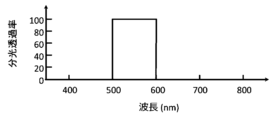
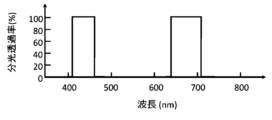
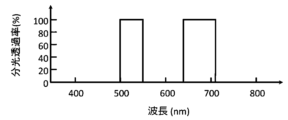
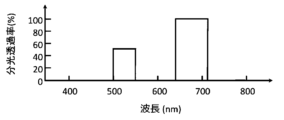
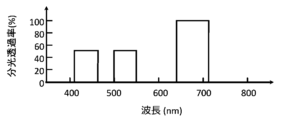
- FIG. 13A is a diagram illustrating another example 1 of a spectrum of a bandpass filter.
- FIG. 13B is a diagram illustrating another example 2 of the spectrum of the bandpass filter.
- FIG. 13C is a diagram illustrating another example 3 of the spectrum of the bandpass filter.
- FIG. 14A is a diagram illustrating still another example 1 of the spectrum of a bandpass filter.
- FIG. FIG. 14B is a diagram illustrating still another example 2 of the spectrum of the bandpass filter.
- FIG. 14C is a diagram illustrating yet another example 3 of the spectrum of the bandpass filter.
- FIG. 15 is a diagram showing a modified example of the emission timing of light emitted from a light source.
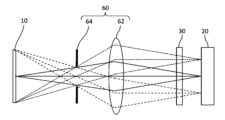
- FIG. 16 is a schematic diagram showing how light from a living body passes through a telecentric lens, passes through a bandpass filter, and enters a photodetector.
- FIG. 17 is a diagram illustrating a schematic configuration of a bioinstrumentation system according to an exemplary embodiment of the present disclosure.
- all or part of a circuit, unit, device, member, or part, or all or part of a functional block in a block diagram may be implemented by one or more electronic circuits including, for example, a semiconductor device, a semiconductor integrated circuit (IC), or an LSI (large scale integration).
- the LSI or IC may be integrated into one chip, or may be configured by combining multiple chips.
- functional blocks other than memory elements may be integrated into one chip.
- LSI or IC are referred to as different names depending on the degree of integration, and may be referred to as a system LSI, VLSI (very large scale integration), or ULSI (ultra large scale integration).
- Field programmable gate arrays (FPGAs) which are programmed after the LSI is manufactured, or reconfigurable logic devices, which can reconfigure the connections inside the LSI or set up circuit sections inside the LSI, can also be used for the same purpose.
- all or part of the functions or operations of a circuit, unit, device, member or part can be executed by software processing.
- the software is recorded on one or more non-transitory recording media such as ROMs, optical disks, hard disk drives, etc., and when the software is executed by a processor, the functions specified in the software are executed by the processor and peripheral devices.
- the system or device may include one or more non-transitory recording media on which the software is recorded, a processor, and necessary hardware devices, such as interfaces.
- light refers to electromagnetic waves including not only visible light (wavelengths of about 360 nm to about 800 nm), but also ultraviolet light (wavelengths of about 10 nm to about 360 nm) and infrared light (wavelengths of about 800 nm to about 1 mm).
- biometric information based on reflected light generated by irradiating a living body with light
- pulse information will be given as an example of biometric information.
- Figure 1 is a graph showing the absorption spectrum of oxygenated hemoglobin in blood.
- the absorption coefficient of oxygenated hemoglobin is relatively high in the wavelength range of 300 to 600 nm within the wavelength range of 300 to 900 nm, and is relatively low in other wavelength ranges.
- the absorption coefficient of oxygenated hemoglobin is highest near 420 nm, and is also relatively high in the wavelength range of 550 to 600 nm. Since the degree of light absorption by oxygenated hemoglobin changes according to fluctuations in blood flow, the intensity of reflected light produced when a living body is irradiated with light reflects pulse information.
- the blue or green detection signal contains a lot of pulse information.
- the red or infrared detection signal contains only a small amount of pulse information.
- the red wavelength range corresponds to at least a part of the wavelength range of 600 nm or more and 800 nm or less.
- the green wavelength range corresponds to at least a part of the wavelength range of 500 nm or more and 600 nm or less.
- the blue wavelength range corresponds to at least a part of the wavelength range of 360 nm or more and 500 nm or less.
- Light in the red wavelength range is simply referred to as “red light”
- light in the green wavelength range is simply referred to as “green light”
- light in the blue wavelength range is simply referred to as "blue light”.
- the blue or green detection signal contains not only pulse information but also body movement information.
- the red or infrared detection signal contains only a small amount of pulse information and a large amount of body movement information. Therefore, by comparing the blue or green detection signal with the red or infrared detection signal, it is possible to remove the body movement information from the information contained in the blue or green detection signal, and it becomes possible to obtain the pulse information.
- the red or infrared detection signal is a detection signal for removing body movement information.
- Figure 2 is a graph showing the optical spectrum of a general color filter.
- the general color filters are a red filter, a green filter, and a blue filter that contain a dye.
- the dotted line, the dashed line, and the broken line shown in Figure 2 represent the optical spectrum of a red filter, a green filter, and a blue filter, respectively.
- each of the blue, green, and red filters has a broad peak in the corresponding wavelength range.
- the red filter has a relatively high transmittance not only in the red wavelength range, but also in the wavelength range of 550 nm or more and 600 nm or less, as represented by hatching. Therefore, when light from a living body is detected through a general red filter, the red detection signal may contain not only body movement information but also some pulse information. For this reason, even when comparing the blue or green detection signal with the red detection signal, not only the body movement information but also part of the pulse information is removed from the information contained in the blue or green detection signal, so there is a possibility that the pulse information cannot be obtained accurately.
- the red detection signal may contain not only body movement information but also some pulse information, so there is a possibility that pulse information may not be obtained accurately.
- the pulse sensor in Patent Document 2 detects reflected light without passing through a color filter.
- the living body is also irradiated with ambient light such as light from indoor lighting and sunlight, so when detecting infrared light from the living body, other light with a high absorption coefficient may also be detected. Therefore, with the pulse sensor in Patent Document 2, the infrared detection signal may contain not only body movement information but also some pulse information, so there is a possibility that pulse information may not be obtained accurately.
- the inventors have found the above problem and have come up with a biomeasurement device according to an embodiment of the present disclosure that can solve the problem.
- the biomeasurement device according to this embodiment is configured so that at least a portion of the light from a living body in the wavelength range of 550 nm or more and 600 nm or less is difficult to detect. This reduces the possibility that bioinformation such as pulse information is mixed into the detection signal for removing body movement information. As a result, by comparing the detection signal that includes not only bioinformation but also body movement information with the detection signal for removing body movement information, it becomes possible to effectively obtain bioinformation.
- the biomeasurement device according to an embodiment of the present disclosure is described.
- FIG. 3 is a diagram that illustrates a configuration of a measurement device according to the first exemplary embodiment of the present disclosure.
- the measurement device 100A illustrated in FIG. 3 detects light from the living body 10 to obtain bioinformation of the living body 10 in a non-contact manner.
- the light from the living body 10 is generated, for example, when the living body 10 is irradiated with ambient light.
- a human is illustrated as an example of the living body 10, this example is not limiting.
- the living body 10 may be, for example, an animal.
- the irradiated portion of the living body 10 may be, for example, the face, arm, hand, or finger of the living body 10.
- the living body 10 may be stationary or moving.
- the measuring device 100A includes a light detection device 20, a bandpass filter 30, and a processing device 40.
- the light detection device 20 includes a first filter 22a that transmits red light and a second filter 22b that transmits one of green and blue light.
- the light detection device 20 further includes a first light detection element 24a that detects light from the living body 10 through the first filter 22a, and a second light detection element 24b that detects light from the living body 10 through the second filter 22b.
- the first light detection element 24a outputs a first signal based on the first light detected by the first light detection element 24a.
- the second light detection element 24b outputs a second signal based on the second light detected by the second light detection element 24b.
- the second light detection element 24b detects light that has passed through the second filter 22b and the bandpass filter 30 and has a wavelength of at least 550 nm or less.
- the first signal is a signal that corresponds to the intensity of the first light
- the second signal is a signal that corresponds to the intensity of the second light.
- the bandpass filter 30 suppresses the transmission of at least a part of the light from the living body 10 in the wavelength range of 550 nm to 600 nm, which is incident on the first filter 22a.
- FIG. 4 is a graph showing an example of the spectrum of the bandpass filter 30 and the absorption spectrum of oxygenated hemoglobin.
- the solid line in FIG. 4 represents the spectrum of the bandpass filter 30, and the dashed line in FIG. 4 represents the absorption spectrum of oxygenated hemoglobin.
- the bandpass filter 30 has a spectral transmittance of almost zero in the wavelength range of 550 nm to 600 nm, and has a spectral transmittance of almost 100% in the other wavelength ranges.
- FIG. 5 is a graph showing an example of the optical spectrum of a configuration in which the bandpass filter 30 is combined with a general color filter.
- the spectral transmittance is almost zero in the wavelength range of 550 nm to 600 nm. Therefore, when the living body 10 moves, the second signal contains not only biological information but also body movement information, whereas the first signal contains almost no biological information but a lot of body movement information. In this way, the bandpass filter 30 can effectively suppress biological information from being mixed into the first signal.
- FIG. 6 is a diagram showing an example of time series data of the first signal and the second signal and an example of bioinformation.
- the vertical direction in FIG. 6 represents signal strength, and the horizontal direction in FIG. 6 represents time.
- Pulse information is shown as an example of the bioinformation shown in FIG. 6.
- the time series data of the second signal changes while continuously vibrating to reflect the pulse information, and also shifts significantly at a certain time to reflect the body movement information.
- the time series data of the first signal shifts significantly at a certain time to reflect the body movement information, but does not reflect the pulse information and hardly vibrates due to the presence of the band pass filter 30.
- the processing device 40 can remove the body movement information from the information included in the second signal by comparing the first signal and the second signal, while preventing a part of the pulse information from being removed from the information included in the second signal, making it possible to obtain the pulse information more accurately.
- the measurement device 100A can acquire biometric information of the living body 10 more accurately than a configuration in which the bandpass filter 30 is removed from the measurement device 100A. This leads to more effective acquisition of biometric information of the living body 10.
- the configurations of the light detection device 20, bandpass filter 30, and processing device 40 are described in detail below.
- the light detection device 20 includes at least one first filter 22a and at least one second filter 22b.
- the first filter 22a and the second filter 22b are as described above.
- the light detection device 20 may further include at least one third filter that transmits the other of the green and blue light.
- the number of first filters 22a may be one or more. The same applies to the number of second filters 22b and the number of third filters.
- the first filter 22a can be designed to transmit light with a wavelength of, for example, 690 nm with a high spectral transmittance for the following reasons.
- a high spectral transmittance can be, for example, 60% or more, 80% or more, 90% or more, or 95% or more.
- the absorption coefficient of oxygenated hemoglobin is smallest at a wavelength of 690 nm in the wavelength range of 300 nm to 900 nm, so that light from the living body 10 with a wavelength of 690 nm contains only a small amount of biological information. Therefore, by designing the first filter 22a as described above, the amount of biological information contained in the first signal can be effectively reduced.
- the above-mentioned general color filters can be used as the first filter 22a, the second filter 22b, and the third filter. Such color filters are easy to obtain, low cost, and suitable for mass production.
- the spectrum of a typical red filter has a broad peak in the wavelength range of 550 nm to 800 nm, as shown in Figure 2.
- the peak wavelength is in the wavelength range of 550 nm to 800 nm.
- the spectral transmittance at the peak wavelength can be the maximum spectral transmittance in the wavelength range of visible light.
- the spectrum of a typical red filter has a spectral transmittance of 30% or more in at least a portion of the wavelength range of 550 nm to 600 nm.
- the spectrum of a typical red filter further has a spectral transmittance of 20% or less in the wavelength range of 500 nm or less, within the wavelength range of visible light.
- the spectrum of a typical green filter has a broad peak in the wavelength range of 450 nm to 650 nm.
- the peak wavelength is in the wavelength range of 450 nm to 650 nm.
- the spectrum of a typical blue filter has a broad peak in the wavelength range of 360 nm to 550 nm.
- the peak wavelength is in the wavelength range of 360 nm to 550 nm.
- the light detection device 20 includes at least one first light detection element 24a and at least one second light detection element 24b.
- the first light detection element 24a and the second light detection element 24b are as described above.
- the light detection device 20 may further include at least one third light detection element that detects light from the living body 10 via a third filter.
- the third light detection element outputs a third signal based on the third light detected by the third light detection element.
- the third signal is a signal that corresponds to the intensity of the third light.
- the number of first photodetection elements 24a is equal to the number of first filters 22a.
- the number of second photodetection elements 24b is equal to the number of second filters 22b.
- the number of third photodetection elements is equal to the number of third filters.
- the number of first photodetection elements 24a may be greater than the number of first filters 22a.
- the number of second photodetection elements 24b may be greater than the number of second filters 22b.
- the number of third photodetection elements may be greater than the number of third filters.
- the light detection device 20 may be, for example, a color camera equipped with multiple common color filters and an image sensor. In this case, the light detection device 20 can acquire a color image of the living body 10.
- the image sensor includes multiple light detection elements arranged two-dimensionally.
- the image sensor may be a CCD (Charge-Coupled Device) or CMOS (Complementary Metal Oxide Semiconductor) sensor.
- Each of the multiple color filters may be, for example, directly provided on a corresponding one of the multiple light detection elements, or may be indirectly provided via another member.
- FIG. 7 is a diagram showing a schematic example of the arrangement of color filters in the light detection device 20.
- "R”, “G”, and “B” in FIG. 7 represent a red filter, a green filter, and a blue filter, respectively.
- the first filter 22a is a red filter
- the second filter 22b is a blue filter
- the third filter 22c is a green filter.
- the arrangement of the multiple color filters is a so-called Bayer array.
- the Bayer array has multiple units arranged two-dimensionally. Each unit includes filters in two rows and two columns. In each unit, two green filters are arranged in the diagonal components, and a red filter and a blue filter are arranged in the non-diagonal components.
- each unit two red filters may be arranged in the diagonal components, and a green filter and a blue filter may be arranged in the non-diagonal components.
- two blue filters may be arranged in the diagonal components, and a green filter and a red filter may be arranged in the non-diagonal components.
- the arrangement of the multiple color filters is not limited to a Bayer array, but may be a so-called stripe array, delta array, mosaic array, or pentile array.
- an infrared filter may be used instead of the red filter.
- the bandpass filter 30 suppresses the transmission of at least a part of the light from the living body 10 in the wavelength range of 550 nm to 600 nm among the light incident on the first filter 22a.
- the first filter 22a transmits not only red light but also light in the wavelength range of 550 nm to 600 nm as shown in FIG. 2. Due to this, in a configuration in which the bandpass filter 30 is removed from the measurement device 100A, there is a possibility that biological information may be mixed into the first signal. In contrast, in the measurement device 100A, the bandpass filter 30 can reduce this possibility.
- the first filter 22a, the bandpass filter 30, and the first light detection element 24a may be arranged in this order so that the light from the living body 10 is incident from the first filter 22a toward the first light detection element 24a. That is, the bandpass filter 30 may be arranged between the first filter 22a and the first light detection element 24a.
- the wavelength range in which the bandpass filter 30 suppresses the transmission of light may be the entire wavelength range of 550 nm to 600 nm, or may be a part of it.
- the bandpass filter 30 may suppress the transmission of light in the wavelength range of 570 nm to 600 nm, within the wavelength range of 550 nm to 600 nm, while transmitting light in other wavelength ranges.
- spectral transmittance in at least a portion of the wavelength range of 550 nm or more and 600 nm or less is 20% or less.
- the spectral transmittance may be 10% or less, 5% or less, or 1% or less. The closer the spectral transmittance is to zero, the more accurately the bioinformation can be obtained based on the first signal and the second signal.
- the spectral transmittance of the bandpass filter 30 is nearly 100% in the remaining wavelength range of the visible light wavelength range other than the wavelength range where light transmission is suppressed.
- the spectral transmittance can be, for example, 60% or more, 80% or more, 90% or more, or 95% or more. The higher the spectral transmittance, the more body movement information the first signal can contain, and the more biological information the second signal can contain.
- the bandpass filter 30 When viewed from the direction in which light from the living body 10 is incident, the bandpass filter 30 is arranged so as to overlap the first filter 22a. On the other hand, the bandpass filter 30 may or may not overlap the second filter 22b and the third filter 22c.
- the light detection device 20 is a color camera
- not only the first filters 22a but also the second filters 22b and the third filters 22c are arranged two-dimensionally. Therefore, it is easier to arrange the bandpass filter 30 so that it overlaps the entire light detection device 20.
- a color camera with excellent mass productivity can be used as the light detection device 20, and the manufacturing cost of the measurement device 100A can be reduced.
- the bandpass filter 30 overlaps the second filter 22b and the third filter 22c, the amount of at least a portion of light in the wavelength range of 550 nm to 600 nm that is incident on the second and third photodetection elements is reduced. Even in this case, the amount of biological information contained in the second and third signals is reduced, but the second and third signals still contain sufficient biological information.
- the spectral transmittance is sufficiently high in the wavelength range of 500 nm to 550 nm.
- the bandpass filter 30 and a blue filter are combined, the spectral transmittance is sufficiently high in the wavelength range of 400 nm to 500 nm.
- the absorption coefficient of oxygenated hemoglobin is sufficiently high in these wavelength ranges.
- the bandpass filter 30 can be, for example, an interference filter including a dielectric multilayer film.
- An interference filter including a dielectric multilayer film can achieve a steep change in the optical spectrum. Therefore, it can effectively suppress the transmission of at least a portion of the light in the wavelength range of 550 nm or more and 600 nm or less of the visible light wavelength range, and can effectively transmit the light in the remaining wavelength range.
- the bandpass filter 30 may be, for example, a filter containing a pigment or dye.
- a filter has the advantage that, unlike an interference filter containing a dielectric multilayer film, it does not have dependency on the angle of incidence of the incident light.
- the processing device 40 includes a control circuit 42, a signal processing circuit 44, and a memory 46.
- the control circuit 42 controls the processing operation of the signal processing circuit 44.
- the signal processing circuit 44 generates biometric information of the living body 10 based on the first light and the second light, more specifically based on the first signal and the second signal. A method for generating biometric information based on the first signal and the second signal will be described later.
- the signal processing circuit 44 may adjust the exposure time per frame to increase the intensity of the first signal, the second signal, and the third signal.
- the control circuit 42 may be, for example, a combination of a processor and memory, or an integrated circuit such as a microcontroller incorporating a processor and memory.
- the control circuit 42 causes the signal processing circuit 44 to perform signal processing, for example, by the processor executing a computer program recorded in the memory 46.
- the signal processing circuit 44 can be realized, for example, by a digital signal processor (DSP), a programmable logic device (PLD) such as a field programmable gate array (FPGA), or a combination of a central processing unit (CPU) or a graphics processing unit (GPU) and a computer program.
- DSP digital signal processor
- PLD programmable logic device
- FPGA field programmable gate array
- CPU central processing unit
- GPU graphics processing unit
- the signal processing circuit 44 performs signal processing by having the processor execute a computer program recorded in the memory 46.
- control circuit 42 and the signal processing circuit 44 may be integrated into one circuit, or may be separate individual circuits. At least one of the control circuit 42, the signal processing circuit 44, and the memory 46 may be a component of an external device, such as a server located in a remote location. In this case, the external device, such as the server, transmits and receives data to and from the remaining components via wireless or wired communication.
- an external device such as a server located in a remote location.
- the external device such as the server, transmits and receives data to and from the remaining components via wireless or wired communication.
- control circuit 42 and the signal processing circuit 44 are collectively referred to as the "processing circuit.”
- the operation of the control circuit 42 and the signal processing circuit 44 may be treated as the operation of the processing circuit.
- the measurement apparatus 100A may further include, for example, an optical system arranged in front of the bandpass filter 30.
- the optical system may include, for example, a large-diameter lens having an F-number of 1 or less. Such a large-diameter lens can improve the sensitivity of light detection by the light detection device 20.
- the signal processing circuit 44 can generate bioinformation based on the difference between the time change of the intensity of the first signal and the time change of the intensity of the second signal. More specifically, the signal processing circuit 44 obtains the bioinformation contained in the second signal by subtracting data obtained by multiplying the time series data of the first signal by an appropriate coefficient from the time series data of the second signal. The coefficient can be appropriately determined, for example, during calibration before shipping the measurement device 100A.
- the method of generating biometric information from differences can reduce the burden of calculation processing on the signal processing circuit 44.
- the signal processing circuit 44 may apply independent component analysis or principal component analysis to the time series data of the first signal and the time series data of the second signal. By using the independent component analysis or principal component analysis, it is possible to separate the biological information and the body movement information from these two time series data.
- the signal processing circuit 44 may apply independent component analysis or principal component analysis to the time series data of the third signal in addition to the time series data of the first signal and the time series data of the second signal.
- the noise information may be, for example, information about Schottky noise.
- the method of generating biometric information using independent component analysis or principal component analysis can obtain biometric information more accurately than the method of generating biometric information using differential analysis.
- the signal processing circuit 44 may acquire biological information from the time series data of the first signal and the time series data of the second signal by machine learning.
- the signal processing circuit 44 acquires the first signal and the second signal by the measuring device 100A, and at the same time acquires bioinformation by the other measuring device.
- the signal processing circuit 44 further creates a regression model that predicts pulse information from the first signal and the second signal by machine learning, using the bioinformation acquired by the other measuring device as correct answer data.
- the signal processing circuit 44 acquires bioinformation from the time series data of the first signal and the time series data of the second signal based on the regression model created in this way.
- Time series data of biological information may be predicted using LSTM (Long Short-Term Memory), which is used to predict time series data.
- LSTM Long Short-Term Memory
- an electrocardiogram sensor can be used as another measuring device for acquiring correct data.
- the fingertip is kept stationary so that the photoplethysmography does not include a shift due to body movement.
- the signal from the photoplethysmography is similar to the signal acquired by the measuring device 100A, so the accuracy of the regression can be improved.
- the tendency of the body movement information in the first signal to overlap may be different from the tendency of the body movement information in the second signal.
- the difference in the tendency of the two to overlap may occur, for example, in an environment in which the illuminance distribution in the living body 10 is different for the red light for acquiring the first signal and one of the green and blue lights for acquiring the second signal.
- Learning data may be collected by acquiring bioinformation in that environment. By using the learning data collected in this way, a regression model that reflects the difference in the tendency of the two to overlap can be created.
- the biological information may be, for example, pulse information.
- the biological information may be blood flow information.
- a change in blood flow causes a change in the color of the irradiated portion of the living body 10.
- the blood flow information can be obtained from the change in color over time. The color can be known based on the first signal, the second signal, and the third signal.
- the blood flow information is facial blood flow information.
- the biological information may be oxygen saturation information. If the concentrations of oxygenated hemoglobin and deoxygenated hemoglobin in blood are the first concentration and the second concentration, respectively, the oxygen saturation can be calculated by first concentration/(first concentration+second concentration). The absorption spectrum of deoxygenated hemoglobin is different from the absorption spectrum of oxygenated hemoglobin shown in FIG. 4.
- the oxygen saturation can be calculated based on the first and second signals, for example, as follows: By solving the simultaneous equations represented by the following formulas (1) and (2), the amount of change from the initial value in each concentration of oxygenated hemoglobin ( HbO2 ) and deoxygenated hemoglobin (Hb) in the blood can be determined.
- ⁇ HbO2 and ⁇ Hb represent the change in the concentrations of HbO2 and Hb in blood from the initial values, respectively.
- ⁇ 1OXY and ⁇ 1deOXY represent the molar absorption coefficients of HbO2 and Hb for red light for acquiring the first signal, respectively.
- ⁇ 2OXY and ⁇ 2deOXY represent the molar absorption coefficients of HbO2 and Hb for green or blue light for acquiring the second signal, respectively.
- I1ini and I2now represent the intensities of the first signal at the initial time point and the measurement time point, respectively.
- I2ini and I2now represent the intensities of the second signal at the initial time point and the measurement time point , respectively.
- the biological information may be blood pressure information.
- the coefficients a and b can be appropriately determined, for example, during calibration before shipping the measurement device 100A.
- the face of the living body 10 can be tracked as follows.
- the RGB (Red, Green, Blue) color space obtained by the first signal, the second signal, and the third signal is converted into a color space including a hue.
- the color space including a hue can be, for example, an HSV (Hue, Saturation, Value) color space, an HSL (Hue, Saturation, Luminance) color space, and an HSI (Hue, Saturation, Intensity) color space.
- the signal processing circuit 44 generates hue information of the living body 10 based on the third light in addition to the first and second lights, more specifically, based on the third signal in addition to the first and second signals.
- the signal processing circuit 44 tracks the face of the living body 10 based on the hue information. "Tracking the face” means identifying the position of the face, more specifically, identifying the light detection element that corresponds to the position of the face among the multiple light detection elements included in the color camera. "Based on the hue information” means comparing with a preset hue condition, more specifically, setting a condition that determines that the hue is human skin if it is within a specified range, and checking whether the acquired hue meets that condition.
- the more specific configuration of the light detection device 20 and the more specific operation of the signal processing circuit 44 are as follows.
- the light detection device 20 includes a plurality of first filters 22a, a plurality of second filters 22b, and a plurality of third filters.
- the plurality of first filters 22a have the same configuration. The same applies to the plurality of second filters 22b and the plurality of third filters.
- the light detection device 20 further includes a plurality of first light detection elements 24a, a plurality of second light detection elements 24b, and a plurality of third light detection elements.
- the plurality of first light detection elements 24a have the same configuration. The same applies to the plurality of second light detection elements 24b and the plurality of third light detection elements.
- the signal processing circuit 44 generates hue information of the living body 10 based on the light detected by each of the multiple first light detection elements 24a, the light detected by each of the multiple second light detection elements 24b, and the light detected by each of the multiple third light detection elements. Based on the hue information, the signal processing circuit 44 determines the first light detection element 24a, the second light detection element 24b, and the third light detection element that correspond to the position of the face from among the multiple first light detection elements 24a, the multiple second light detection elements 24b, and the multiple third light detection elements included in the light detection device 20.
- the bandpass filter 30 can reduce the effect of partial overlap between the optical spectrum of the red filter and the optical spectrum of one of the green and blue filters, improving the accuracy of the hue information. It is not limited to the face, and skin may also be tracked, i.e., the position of the skin may be identified.
- the second signal contains not only bioinformation but also body movement information
- the first signal contains a lot of body movement information and only a little bioinformation due to the presence of the bandpass filter 30.
- bioinformation of the living body 10 can be effectively acquired based on the first and second signals.
- Fig. 8 is a diagram showing a schematic configuration of a measurement device according to exemplary embodiment 2 of the present disclosure.
- the measurement device 100B shown in Fig. 8 further includes a light source 50 that emits light for irradiating the living body 10.
- the control circuit 42 causes the light source 50 to emit light for irradiating the living body 10 constantly or intermittently.
- the light source 50 makes it possible to acquire biological information of the living body 10 even in the absence of ambient light.
- the light source 50 emits red light and one of green and blue light for illuminating the living body 10.
- the light source 50 may further emit the other of green and blue light for illuminating the living body 10.
- the red light serves to obtain a first signal
- the one of the green and blue light serves to obtain a second signal
- the other of the green and blue light serves to obtain a third signal.
- the measuring device 100B may further include a diffusion plate that diffuses the light emitted from the light source 50.
- the diffused light can be used to uniformly irradiate the living body 10, making it possible to evaluate biometric information in any area of the irradiated portion of the living body 10 using the same criteria.
- the any area of the irradiated portion of the living body 10 can be, for example, the left or right area of the forehead.
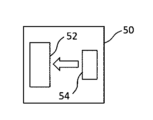
- Fig. 9A is a diagram showing a schematic diagram of a configuration example 1 of a light source 50.
- the light source 50 includes, for example, a wavelength conversion element 52 and a light emitting element 54 that emits excitation light that excites the wavelength conversion element 52.
- the white arrow shown in Fig. 9A represents the excitation light.
- the light emitting element 54 may be, for example, a laser diode (LD) or a light emitting diode (LED).
- the wavelength conversion element 52 may include, for example, a phosphor that absorbs blue light and emits yellow light.
- the yellow light includes red light and green light.
- the red light contained in the yellow light is useful for acquiring the first signal.
- the blue light is useful for acquiring one of the second and third signals, and the green light contained in the yellow light is useful for acquiring the other of the second and third signals.
- a portion of the blue light emitted from the light-emitting element 54 is converted to yellow light by the phosphor, and the remaining portion passes through the wavelength conversion element 52 without being converted.
- the light source 50 emits white light that is a mixture of yellow light and blue light.
- the average color rendering index Ra of this light source 50 can be, for example, 80 or more. The closer the average color rendering index Ra is to 100, the closer the color that an object appears to be illuminated by the light emitted from the light source 50 will be to the color that the object appears to be illuminated by sunlight.
- the white light emitted from the light source 50 can reduce the psychological stress placed on the living body 10 during measurement. Furthermore, the closer the average color rendering index Ra is to 100, the more light with a wavelength of 690 nm the white light contains. Therefore, if the first filter 22a is designed to transmit light with a wavelength of 690 nm with a high spectral transmittance as described above, the signal-to-noise ratio of the first signal can be improved.
- the wavelength conversion element 52 may include, for example, the following first and second phosphors.
- the first phosphor absorbs blue light and emits red light.
- the second phosphor absorbs blue light and emits green light.
- the light source 50 emits white light that is a mixture of red light, green light, and blue light.
- the average color rendering index Ra of this light source 50 can be, for example, 90 or more.
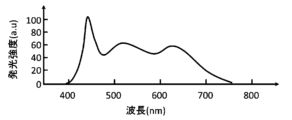
- FIG. 9B is a graph showing an example of the emission spectrum of light emitted from the light source 50.
- the light-emitting element 54 emits blue light
- the wavelength conversion element 52 includes the first phosphor and the second phosphor.
- the emission spectrum has the largest peak in the blue wavelength range.
- the emission spectrum further has a peak in the green wavelength range and a peak in the red wavelength range. Since the emission spectrum has peaks in the wavelength ranges of each of the three colors, the average color rendering index Ra is high. Note that if there is no need to obtain a third signal, the wavelength conversion element 52 does not necessarily need to include the second phosphor that absorbs blue light and emits green light.
- the wavelength conversion element 52 may include, for example, the following first phosphor, second phosphor, and third phosphor.
- the first phosphor absorbs ultraviolet light and emits red light.
- the second phosphor absorbs ultraviolet light and emits one of green and blue light.
- the third phosphor absorbs ultraviolet light and emits the other of green and blue light.
- a portion of the ultraviolet light emitted from the light-emitting element 54 is converted into red light by the first phosphor, another portion is converted into one of green and blue light by the second phosphor, and still another portion is converted into the other of green and blue light by the third phosphor.
- the wavelength conversion element 52 includes the first phosphor, the second phosphor, and the third phosphor, the light source 50 emits white light that is a mixture of red light, green light, and blue light.
- the average color rendering index Ra of this light source 50 can be, for example, 95 or more. Note that if there is no need to obtain a third signal, the wavelength conversion element 52 does not necessarily need to include a third phosphor that absorbs ultraviolet light and emits the other of green and blue light.
- a light source 50 equipped with a wavelength conversion element 52 can emit red light and one of green and blue light from the same location of the wavelength conversion element 52. Since the living body 10 is irradiated with the red light and one of the green and blue light emitted from the same location, the body movement information contained in the first signal and the second signal acquired as a result of the irradiation is completely synchronized with the body movement information contained in the first signal. Therefore, the bioinformation of the living body 10 can be acquired more effectively based on the first signal and the second signal.
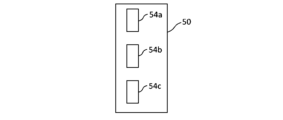
- FIG. 10A is a diagram showing a schematic diagram of a second configuration example of the light source 50.
- the light source 50 may include, for example, a first light-emitting element 54a, a second light-emitting element 54b, and a third light-emitting element 54c.
- the first light-emitting element 54a emits red light.
- the second light-emitting element 54b emits one of green and blue light.
- the third light-emitting element 54c emits the other of green and blue light.
- the first light-emitting element 54a, the second light-emitting element 54b, and the third light-emitting element 54c may be, for example, an LD or an LED. If there is no need to obtain a third signal, the light source 50 does not necessarily have to include the third light-emitting element 54c.
- the first light-emitting element 54a, the second light-emitting element 54b, and the third light-emitting element 54c can be arranged, for example, so that the center-to-center distance between any two light-emitting elements is 10 mm or less.
- the distance from the light source 50 to the living body 10 is 30 cm
- the center-to-center distance between any two light-emitting elements is greater than 10 mm
- the error in signal strength will be greater than 1% due to the difference in illuminance caused by the angle of incidence of the light emitted from the two light-emitting elements and incident on the living body 10.
- This error in signal strength is equal to or greater than the amount of change in signal strength due to pulse. If the center-to-center distance between any two light-emitting elements is 10 mm or less, the above-mentioned error in signal strength can be reduced.
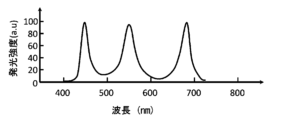
- FIG. 10B is a graph showing another example of the emission spectrum of light emitted from the light source 50.
- the light source 50 includes the first light-emitting element 54a, the second light-emitting element 54b, and the third light-emitting element 54c described above.
- These light-emitting elements are LEDs, which are less expensive than LDs.
- the emission spectrum of each color of light is narrow to a certain extent, so compared to using a wavelength conversion element 52 as shown in FIG. 9A, it is possible to reduce light of wavelengths unnecessary for obtaining biometric information. This makes it possible to reduce glare.
- the emission spectrum of red light overlaps with the emission spectrum of green light, but the effect of this overlap can be reduced by the bandpass filter 30.
- the emission spectrum shown in FIG. 10B can also be achieved by the aforementioned light source 50, which excites three phosphors with ultraviolet light to emit red, green, and blue light.
- the emission spectrum of each light is narrow enough that it is possible to further reduce light of wavelengths unnecessary for obtaining biometric information compared to when all light-emitting elements are LEDs. This makes it possible to further reduce glare.
- the intensity of the laser light is designed to meet Class 1 in accordance with the safety standard for laser devices set forth in JIS C 6802.
- the emission spectrum of red light does not overlap with the emission spectrum of green light in the wavelength range of 550 nm to 600 nm, but when the measuring device 100A is used in a non-contact manner, the light from the living body 10 may also contain light in the wavelength range of 550 nm to 600 nm due to ambient light. Even in this case, the presence of the bandpass filter 30 makes it possible to prevent at least a portion of the light in that wavelength range due to ambient light from being mixed into the first signal.
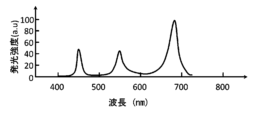
- FIG 10C is a graph showing yet another example of the emission spectrum of light emitted from light source 50.
- light source 50 includes first light-emitting element 54a, second light-emitting element 54b, and third light-emitting element 54c described above. These light-emitting elements are LEDs.
- the peak intensity of each of the green and blue lights is lower than the peak intensity of the red light.
- the bandpass filter 30 prevents at least a portion of the light in the wavelength range of 550 nm to 600 nm from passing through, the intensity of the first signal may be lower than the intensity of the second signal and lower than the intensity of the third signal. While the intensity of the first signal can be increased by increasing the exposure time, the intensity of the second signal and the intensity of the third signal may become saturated.
- the intensity of the first signal can be increased and the possibility of the intensity of the second signal and the intensity of the third signal becoming saturated can be reduced.
- the peak intensity of each of the green and blue light is half or less of the peak intensity of the red light, this possibility can be effectively reduced.
- the intensities of the light emitted from the first light-emitting element 54a, the second light-emitting element 54b, and the third light-emitting element 54c may be adjusted so that the peak intensities of the red, green, and blue light satisfy the magnitude relationship shown in FIG. 10C.
- the peak intensity of the green light and the peak intensity of the blue light may be reduced by placing a filter with low spectral transmittance of green light and blue light in front of the light source 50.
- the peak intensity of each of the green and blue lights may be made lower than the peak intensity of the red light by adjusting the amount of phosphor contained in the wavelength conversion element 52.
- the peak intensity of the green light and the peak intensity of the blue light may be reduced by placing a filter with low spectral transmittance of green light and blue light in front of the light source 50.
- the measuring device 100B according to the second embodiment can generate bioinformation of the living body 10 more accurately based on the first and second signals, similar to the measuring device 100A according to the first embodiment. Furthermore, the measuring device 100B according to the second embodiment can obtain bioinformation even in the absence of ambient light by irradiating the living body 10 with light emitted from the light source 50.
- Fig. 11 is a diagram illustrating a schematic configuration of a measurement device according to the third exemplary embodiment of the present disclosure.
- the measurement device 100C illustrated in Fig. 11 does not include a bandpass filter 30, and includes a photodetector 20-1 instead of the photodetector 20 illustrated in Fig. 3.
- the measurement device 100C may further include a light source 50 illustrated in Fig. 8.
- the light detection device 20-1 includes a first filter 23a that transmits red light and a second filter 23b that transmits one of green and blue light.
- the first filter 23a and the second filter 23b are not general color filters, but may be, for example, an interference filter including a dielectric multilayer film.
- the first filter 23a transmits red light while suppressing the transmission of at least a portion of light in the wavelength range of 550 nm to 600 nm. This makes it possible to suppress the mixing of biological information into the first signal.
- the configuration of the light detection device 20-1 is explained in detail below.
- the light detection device 20-1 includes at least one first filter 23a and at least one second filter 23b.
- the first filter 23a and the second filter 23b are as described above.
- the light detection device 20-1 may further include at least one third filter that transmits the other of the green and blue lights.
- the third filter may be, for example, an interference filter including a dielectric multilayer film, similar to the first filter 23a and the second filter 23b.
- the number of the first filters 23a may be one or more. The same applies to the number of the second filters 23b and the number of the third filters.
- An example of the arrangement of the first filter 23a, the second filter 23b, and the third filter is as described in the measurement device 100A according to the first embodiment.
- the light detection device 20-1 includes at least one first light detection element 24a that detects light from the living body 10 through the first filter 23a, and at least one second light detection element 24b that detects light from the living body 10 through the second filter 23b.
- the light detection device 20 may further include at least one third light detection element that detects light from the living body 10 through a third filter.
- the first light detection element 24a, the second light detection element 24b, and the third light detection element are as described in the measurement device 100A according to embodiment 1.
- the first filter 22a, the second filter 22b, and the third filter which are interference filters including a dielectric multilayer film, can be stacked directly on the first photodetection element 24a, the second photodetection element 24b, and the third photodetection element, respectively.
- the photodetection device 20-1 includes a plurality of filters and a plurality of photodetection elements that are integrally formed.
- FIGS. 12A to 12C are graphs showing examples of the optical spectra of the first filter 23a, the second filter 23b, and the third filter, respectively.
- the first filter 23a is a red filter
- the second filter 23b is a green filter
- the third filter is a blue filter.
- the first filter 23a has a high spectral transmittance in the red wavelength range of the visible light wavelength range, and has a spectral transmittance of almost zero in the remaining wavelength range, including the wavelength range of 550 nm or more and 600 nm or less.
- a high spectral transmittance can be, for example, 60% or more, 80% or more, 90% or more, or 95% or more.
- the red wavelength range is 600 nm or more and 700 nm or less.
- the second filter 23b has a high spectral transmittance in the green wavelength range of the visible light wavelength range, and has a spectral transmittance of almost zero in the remaining wavelength range.
- the green wavelength range is 500 nm or more and 600 nm or less.
- the third filter has a high spectral transmittance in the blue wavelength range of the visible light wavelength range, and has a spectral transmittance of almost zero in the remaining wavelength range.
- the blue wavelength range is 400 nm or more and 500 nm or less.
- the interference filters include a dielectric multilayer film
- the optical spectra of the first filter 23a, the second filter 23b, and the third filter change sharply. Therefore, the optical spectrum of the first filter 23a hardly overlaps with the optical spectrum of the second filter 23b and the optical spectrum of the second filter. Similarly, the optical spectrum of the second filter 23b hardly overlaps with the optical spectrum of the third filter. Therefore, the first signal and the second signal contain almost no information about light in the same wavelength range. The same is true for the first signal and the third signal, and the same is true for the second signal and the third signal.
- the measurement device 100C according to the third embodiment can effectively acquire biometric information of the living body 10 based on the first and second signals, similar to the measurement device 100A according to the first embodiment, without using a bandpass filter 30.
- the bandpass filter 30 included in the measurement device 100A and the measurement device 100B suppresses the transmission of at least a part of light in a wavelength range of 550 nm to 600 nm inclusive of the wavelength range of visible light, and transmits light in the remaining wavelength range.
- the bandpass filter 30 may suppress the transmission of light in a part of the remaining wavelength range.
- the bandpass filter 30 has a high spectral transmittance in the red wavelength range of the visible light wavelength range, and a high spectral transmittance in the blue wavelength range.
- the maximum spectral transmittance in the blue wavelength range is almost equal to the maximum spectral transmittance in the red wavelength range.
- the spectral transmittance in the remaining wavelength ranges including the wavelength range of 550 nm to 600 nm, is almost zero.
- the red wavelength range is 640 nm to 710 nm
- the blue wavelength range is 410 nm to 460 nm.
- This bandpass filter 30 is advantageous when detecting red light to obtain a first signal and detecting blue light to obtain a second signal.
- the bandpass filter 30 has a high spectral transmittance in the red wavelength range of the visible light wavelength range, and a high spectral transmittance in the green wavelength range.
- the maximum spectral transmittance in the green wavelength range is approximately equal to the maximum spectral transmittance in the red wavelength range.
- the spectral transmittance in the remaining wavelength ranges, including the wavelength range from 550 nm to 600 nm, is approximately zero.
- the red wavelength range is from 640 nm to 710 nm
- the green wavelength range is from 500 nm to 550 nm. This bandpass filter 30 is advantageous when detecting red light to obtain a first signal and detecting green light to obtain a second signal.
- the bandpass filter 30 has a high spectral transmittance in the red wavelength range, a high spectral transmittance in the green wavelength range, and a high spectral transmittance in the blue wavelength range of visible light.
- the maximum spectral transmittance in each of the green and blue wavelength ranges is approximately equal to the maximum spectral transmittance in the red wavelength range.
- the red wavelength range is 640 nm to 710 nm
- the green wavelength range is 500 nm to 550 nm
- the blue wavelength range is 410 nm to 460 nm.
- This bandpass filter 30 is advantageous when detecting red light to obtain a first signal, detecting one of green and blue light to obtain a second signal, and detecting the other of green and blue light to obtain a third signal.
- FIGS. 14A to 14C are diagrams that show three other examples of the spectrum of the bandpass filter 30.
- the maximum spectral transmittance in the blue wavelength range is lower than the maximum spectral transmittance in the red wavelength range.
- the maximum spectral transmittance in the green wavelength range is lower than the maximum spectral transmittance in the red wavelength range.
- the maximum spectral transmittance in each of the green and blue wavelength ranges is lower than the maximum spectral transmittance in the red wavelength range.
- FIG. 15 is a diagram showing a schematic diagram of a modified example of the emission timing of light emitted from the light source 50.
- "ON" in FIG. 15 represents a state in which light is being emitted from the light source 50
- "OFF" in FIG. 15 represents a state in which light emission from the light source 50 is stopped.
- the frame rate can be, for example, 30 fps or 60 fps. In this way, the emission of light from the light source 50 and the stopping of emission are switched every time a frame changes.
- the light detection device 20 detects reflected light that occurs when the living body 10 is irradiated with ambient light in addition to the light emitted from the light source 50, and in the next frame in the OFF state, it detects reflected light that occurs when the living body 10 is irradiated with ambient light without the light emitted from the light source 50.
- a signal from which the effects of ambient light have been removed can be acquired.
- the bandpass filter 30 is an interference filter including a dielectric multilayer film
- the spectrum of the bandpass filter 30 depends on the angle of incidence of the incident light.
- the measurement apparatus 100A according to the first embodiment and the measurement apparatus 100B according to the second embodiment may further include a telecentric lens.
- FIG. 16 is a schematic diagram showing how light from the living body 10 passes through the telecentric lens 60, passes through the bandpass filter 30, and enters the photodetector 20.
- the telecentric lens 60 is disposed in front of the bandpass filter 30.
- the telecentric lens 60 comprises a convex lens 62 and an aperture 64 located at the focal point of the convex lens 62 on the living body 10 side.
- the irradiated portion of the living body 10 is shown as a flat plate in FIG. 16.
- the light that passes through the aperture 64 enters the convex lens 62, and of the light from the living organism 10, the light that does not pass through the aperture 64 does not enter the convex lens 62, so the chief ray that passes through the convex lens 62 enters the bandpass filter 30 at the same angle of incidence regardless of the angle of view.
- the upper limit ray and the lower limit ray that pass through the convex lens 62 Therefore, when the light from the living organism 10 that passes through the telecentric lens 60 is detected by the photodetector 20 via the bandpass filter 30, the same signal strength can be maintained even if the angle of view changes due to the movement of the living organism 10.
- the F-number of the aperture 64 is small, the sensitivity of light detection can be improved. If multiple convex lenses 62 are combined in the telecentric lens 60, an aperture 64 with a smaller F-number can be used.
- the measurement device 100C does not include a bandpass filter 30, but does include a first filter 23a and a second filter 23b, which are interference filters including a dielectric multilayer film. Therefore, for the same reasons as above, the measurement device 100C may further include a telecentric lens 60 in front of the light detection device 20.
- FIG. 4 An example of the configuration of a biomeasurement system according to embodiment 4 in which a biomeasurement device is installed in a moving body will be described below with reference to Fig. 17.
- This biomeasurement system acquires bioinformation of an occupant of the moving body.
- the moving body is an automobile, but may be, for example, a ship or an airplane.
- the biomeasurement device is the measurement device 100A according to embodiment 1, but may be, for example, a configuration in which the bandpass filter 30 is removed from the measurement device 100A according to embodiment 1.
- FIG. 17 is a diagram showing a schematic configuration of a bioinstrumentation system according to an exemplary embodiment of the present disclosure.
- Fig. 17 also shows a living body 10 as an occupant of a car.
- the living body 10 is sitting in the driver's seat and driving a moving body, but this example is not limited to this example.
- the living body 10 may be sitting in the passenger seat or the back seat.
- the bioinstrumentation system is also simply referred to as a "measurement system.”
- the measurement system 200 shown in FIG. 17 includes a light source 50-1 that is installed on a moving body and emits light from a direction that is easily visible to the living body 10, and a light source 50-2 that is installed on the moving body and emits light from a direction that is difficult to see by the living body 10.
- a light source 50-1 that is installed on a moving body and emits light from a direction that is easily visible to the living body 10
- a light source 50-2 that is installed on the moving body and emits light from a direction that is difficult to see by the living body 10.
- the measurement system 200 further includes a light detection device 20 and a bandpass filter 30 installed on the moving body. Instead of the light detection device 20 and the bandpass filter 30, a light detection device 20-1 shown in FIG. 11 may be used.
- the measurement system 200 further includes a processing device 40 installed on the moving body. In the processing device 40, a control circuit 42 controls not only the processing operation of the signal processing circuit 44, but also the emission operation of the light source 50-1 and the light source 50-2.
- the light source 50-1, the light source 50-2, the light detection device 20, the bandpass filter 30, and the processing device 40 are described in detail below.
- the light source 50-1 emits blue light for irradiating the living body 10.
- the living body 10 visually recognizes the blue light.
- Blue light has a high relaxing effect, and light with a wavelength of 470 nm in particular is said to have a high sedative effect. Therefore, the blue light emitted from the light source 50-1 can calm the living body 10 even if the living body 10 is in a stressed or excited state while driving. By creating a light space centered on blue in the interior of a moving body, it is possible to guide the living body 10 to drive safely.
- the blue light emitted from the light source 50-1 is also useful for acquiring the second signal.
- the light source 50-2 emits blue light for illuminating the living body 10 separately from the light source 50-1.
- the blue light emitted from the light source 50-2 illuminates the cheek of the living body 10 from diagonally behind the living body 10. Since the living body 10 is illuminated not only by the blue light emitted from the light source 50-1 but also by the blue light emitted from the light source 50-2, the signal-to-noise ratio of the second signal can be improved.
- light source 50-2 may emit red light, which is also a danger color.
- blue light from light source 50-1 and red light from light source 50-2 the difference between the intensity of the first signal and the intensity of the second signal can be reduced, and the intensities of the two can be balanced.
- Light source 50-2 is not limited to blue or red light, and may be a light source that emits light of other colors.
- light source 50-2 may be configured to emit white light.
- the first light detection element 24a detects light from the living body 10, more specifically, reflected light from the living body 10 caused by red light, through the first filter 22a.
- the red light may be, for example, light from an interior light separately installed in the moving body.
- the second light detection element 24b detects light from the living body 10, more specifically, reflected light from the living body 10 that is due to blue light, via the second filter 22b.
- the bandpass filter 30 is disposed in front of the light detection device 20.
- control circuit 42 causes the signal processing circuit 44 to generate biometric information of the living body 10 based on the first signal and the second signal.
- the control circuit 42 may further execute the following operations.
- the control circuit 42 determines the psychological state of the living organism 10 based on the biological information of the living organism 10.
- the psychological state of the living organism 10 may be, for example, a state of stress or excitement of the living organism 10.
- the control circuit 42 causes the light source 50-1 to control the output of blue light based on the psychological state of the living organism 10.
- An example of controlling the output of blue light is to increase or decrease the intensity of the blue light.
- the more specific operation of the control circuit 42 is as follows.
- the control circuit 42 determines whether the level of stress or excitement of the living organism 10 is high based on the biological information of the living organism 10. For example, if the heart rate is equal to or higher than a predetermined threshold, the control circuit 42 determines that the level of stress or excitement of the living organism 10 is high.
- control circuit 42 determines that the living body 10 is highly stressed or excited, it increases the intensity of the blue light emitted by the light source 50-1. As a result, the living body 10 can be calmed down, and it becomes possible to guide the living body 10 to drive safely.
- the light source 50-1 When the living body 10 is sitting in the driver's seat, the light source 50-1 may be installed, for example, on the inside of the driver's door and/or around the steering wheel. When the living body 10 is sitting in the passenger seat, the light source 50-1 may be installed, for example, on the inside of the passenger's door and/or around the glove box. When the living body 10 is sitting in the back seat, the light source 50-1 may be installed, for example, on the inside of the back seat door and/or behind the front seat. In this way, the light source 50-1 may be installed around the seat where the living body 10 is sitting so that the blue light emitted from the light source 50-1 can be visually recognized by the living body 10.
- the light source 50-2 When the living body 10 is sitting in the driver's seat or the passenger seat, the light source 50-2 may be installed, for example, on the center pillar as shown in Fig. 17. When the living body 10 is sitting in the rear seat, the light source 50-2 may be installed, for example, on the rear pillar. In either case, there are the following advantages. The light source 50-2 does not obstruct the view of the living body 10.
- the light detection device 20 can be installed on the center pillar of the car, for example, in the same manner as the light source 50-2. In this case, there are the following advantages.
- the light detection device 20 does not obstruct the field of view of the living body 10 . Since the distance from the living body 10 to the light detection device 20 is short, the light detection device 20 can effectively detect light from the living body 10 .
- the light detection device 20 When the living body 10 is sitting in the driver's seat, the light detection device 20 may be installed, for example, at the back center of the steering wheel of the car, other than the center pillar. In this case, the following advantages are obtained. Since the light detection device 20 is located in front of the living body 10, it can detect light from the entire face of the living body 10, making it possible to stably measure biological information. The light detection device 20 does not obstruct the field of view of the living body 10 . The monitoring camera for the living body 10 installed in the center of the handlebars can also be used as the light detection device 20.
- the light detection device 20 When the living body 10 is sitting in the passenger seat, the light detection device 20 may be installed in, for example, a glove box in front of the passenger seat, other than the center pillar. In this case, the following advantages are obtained. Since the light detection device 20 is located in front of the living body 10, it can detect light from the entire face of the living body 10, making it possible to stably measure biological information. The light detection device 20 does not obstruct the field of view of the living body 10 .
- the light detection device 20 When the living body 10 is sitting in the back seat, the light detection device 20 can be installed on the rear pillar, for example, in the same manner as the light source 50-2. In this case, there are the following advantages.
- the light detection device 20 does not obstruct the field of view of the living body 10 . Since the distance from the living body 10 to the light detection device 20 is short, the light detection device 20 can effectively detect light from the living body 10 .
- the bandpass filter 30 is placed in front of the light detection device 20, so it is installed in the same position as the light detection device 20.
- the processing device 40 may be installed, for example, on a center pillar, like the light source 50-2, or may be installed at any other position in the vehicle. Alternatively, the processing device 40 may be installed in a remote location away from the vehicle. When the processing device 40 is installed in a remote location, the processing device 40 controls the emission operations of the light sources 50-1 and 50-2 by wireless communication, and acquires the signal output from the light detection device 20 by wireless communication.
- the measurement system 200 of embodiment 4 by utilizing the configuration of the moving body and placing each component in an appropriate position, it is possible to effectively obtain biological information of the living body 10, who is an occupant of the moving body.
- the measurement system 200 of embodiment 4 does not necessarily need to include the bandpass filter 30.
- the intensity of the blue light emitted from the light source 50-1 can be increased to calm the living body 10.
- the light source 50-1 is configured to emit blue light, but it may be configured to emit light other than blue.
- a band pass filter; A photodetector; A processing circuit; Equipped with The light detection device includes: a first filter that transmits red light; a second filter that transmits one of green and blue light; a first light detection element that detects light from the living body through the first filter; a second light detection element that detects light from the living body via the second filter; Including, The processing circuit generates biometric information of the living body based on the first light detected by the first light detection element and the second light detected by the second light detection element; The bandpass filter suppresses transmission of at least a part of light in a wavelength range of 550 nm or more and 600 nm or less out of the light from the living body incident on the first photodetector element. Biometrics device.
- the bandpass filter can prevent bioinformation from being mixed into the first light, so bioinformation can be obtained effectively based on the first light and the second light.
- the spectrum of the first filter has a peak in a wavelength range of 550 nm or more and 800 nm or less.
- the bioinstrumentation device according to technology 1.
- a common red filter can be used as the first filter.
- the optical spectrum of the first filter has a spectral transmittance of 30% or more in at least a part of a wavelength range of 550 nm or more and 600 nm or less.
- the bioinstrumentation device according to Technology 1 or 2.
- a common red filter can be used as the first filter.
- the first photodetection element outputs a first signal based on the first light; the second photodetector element outputs a second signal based on the second light;
- the processing circuit generates the biological information based on a difference between a time change in intensity of the first signal and a time change in intensity of the second signal.
- a bioinstrumentation device according to any one of techniques 1 to 3.
- This biomeasurement device can generate bioinformation through simple calculations, reducing the burden of calculations on the processing circuit.
- the light detection device includes: a third filter that transmits the other of the green and blue light; a third light detection element that detects light from the living body through the third filter; Further equipped with The processing circuitry includes: generating hue information of the living body based on a third light detected by the third light detection element in addition to the first light and the second light; A bioinstrumentation device according to any one of techniques 1 to 4.
- This bio-measuring device can generate hue information of a living body more accurately.
- the light detection device includes: a plurality of first filters including the first filter; a plurality of second filters including the second filter; a plurality of third filters including the third filter; A plurality of first light detection elements including the first light detection element; A plurality of second photodetection elements including the second photodetection element; a plurality of third photodetection elements including the third photodetection element; Equipped with The processing circuitry includes: generating the hue information based on the light detected by the plurality of first light detection elements, the light detected by the plurality of second light detection elements, and the light detected by the plurality of third light detection elements; determining a first light detection element, a second light detection element, and a third light detection element corresponding to a position of a face of the living body, among the plurality of first light detection elements, the plurality of second light detection elements, and the plurality of third light detection elements, based on the hue information; A bioinstrumentation device according to technology 5.
- This biometric device can pinpoint the position of a living body's face even if the body moves.
- the strength of the first signal can be increased and the possibility of the strength of the second signal becoming saturated can be reduced.
- This bio-measuring device uses a light source to obtain bio-information even in the absence of ambient light.
- the strength of the first signal can be increased and the possibility of the strength of the second signal becoming saturated can be reduced.
- the light detection device includes: a first filter that transmits red light; a second filter that transmits one of green and blue light; a first light detection element that detects light from the living body through the first filter; a second light detection element that detects light from the living body via the second filter; Including, The processing circuit generates biometric information of the living body based on the first light detected by the first light detection element and the second light detected by the second light detection element;
- the first filter is An interference filter including a dielectric multilayer film, Suppresses the transmission of at least a part of light in the wavelength range of 550 nm or more and 600 nm or less. Biometrics device.
- the first filter can prevent bioinformation from being mixed into the first light, so bioinformation can be obtained effectively based on the first light and the second light.
- a light source installed in a moving body, the light source emitting blue light for illuminating an occupant of the moving body; a light detection device installed in the moving body, the light detection device detecting reflected light from the occupant caused by the blue light;
- a processing circuit Equipped with The light detection device includes: a first filter that transmits red light; a second filter that transmits the blue light; a first light detection element that detects light from the occupant through the first filter; a second light detection element that detects the reflected light of the light from the occupant through the second filter; Including, the processing circuit generates biometric information of the occupant based on the light detected by the first light detection element and the light detected by the second light detection element. Biometrics system.
- bio-information can be obtained effectively by utilizing the configuration of the moving body and placing each component in an appropriate position.
- the blue light includes light having a wavelength of 470 nm. 12.
- This bio-measurement device can calm occupants using light with a wavelength of 470 nm, which has a highly sedative effect.
- the processing circuitry includes: determining a psychological state of the occupant based on the biological information; causing the light source to control an output of the blue light based on the psychological state;
- the bioinstrumentation system according to any one of claims 11 to 12.
- This bio-measuring device can calm the occupants based on their psychological state.
- the processing circuitry includes: determining whether the occupant is under a high level of stress or excitement based on the biological information; When the degree of stress or excitement is determined to be high, the light source is caused to increase an intensity of the blue light. 14.
- the biometric device can calm occupants if they are experiencing high levels of stress or agitation.
- This bio-measuring device allows the occupants to see a blue light.
- the moving object is an automobile, the light source and the light detection device are installed on a center pillar or a rear pillar of the automobile; The light detection device detects reflected light from the cheek of the occupant.
- a bioinstrumentation system according to any one of techniques 11 to 15.
- the light source and light detection device do not obstruct the occupant's field of vision.
- the moving object is an automobile
- the optical detection device is installed in the steering wheel or glove box of the automobile.
- a bioinstrumentation system according to any one of techniques 11 to 16.
- the photodetector is located in front of the occupant, so it can detect light from the occupant's entire face, enabling stable measurement of bio-information.
- This bio-measuring device uses a light source to obtain bio-information even in the absence of ambient light.
- the light detection device includes: a third filter that transmits the other of the green and blue light; a third light detection element that detects light from the living body through the third filter; Further equipped with The processing circuitry includes: generating hue information of the living body based on a third light detected by the third light detection element in addition to the first light and the second light; The bioinstrumentation device according to any one of claims 10 to 18.
- This bio-measuring device can generate hue information of a living body more accurately.
- the light detection device includes: a plurality of first filters including the first filter; a plurality of second filters including the second filter; a plurality of third filters including the third filter; A plurality of first light detection elements including the first light detection element; A plurality of second photodetection elements including the second photodetection element; a plurality of third photodetection elements including the third photodetection element; Equipped with
- the processing circuitry includes: generating the hue information based on the light detected by the plurality of first light detection elements, the light detected by the plurality of second light detection elements, and the light detected by the plurality of third light detection elements; determining a first light detection element, a second light detection element, and a third light detection element corresponding to a position of a face of the living body, among the plurality of first light detection elements, the plurality of second light detection elements, and the plurality of third light detection elements, based on the hue information; 20.
- the bioinstrumentation device according to claim 19.
- This biometric device can pinpoint the position of a living body's face even if the body moves.
- the vehicle further includes a bandpass filter that suppresses transmission of at least a part of light having a wavelength range of 550 nm or more and 600 nm or less out of the light from the occupant that is incident on the first filter.
- a bioinstrumentation system according to any one of techniques 11 to 17.
- the bandpass filter can prevent bioinformation from being mixed into the first light, so bioinformation can be obtained effectively based on the first light and the second light.
- the first filter suppresses transmission of at least a part of light in a wavelength range of 550 nm or more and 600 nm or less.
- a bioinstrumentation system according to any one of techniques 11 to 17.
- the first filter can prevent bioinformation from being mixed into the first light, so bioinformation can be obtained effectively based on the first light and the second light.
- the technology disclosed herein is useful, for example, in bio-measuring devices that acquire bio-information.
- the technology disclosed herein can also be applied, for example, to bio-, medical-, and beauty-related sensing and in-vehicle sensing systems.
Landscapes
- Health & Medical Sciences (AREA)
- Life Sciences & Earth Sciences (AREA)
- Engineering & Computer Science (AREA)
- Physics & Mathematics (AREA)
- Veterinary Medicine (AREA)
- Surgery (AREA)
- Public Health (AREA)
- General Health & Medical Sciences (AREA)
- Animal Behavior & Ethology (AREA)
- Molecular Biology (AREA)
- Medical Informatics (AREA)
- Biophysics (AREA)
- Pathology (AREA)
- Biomedical Technology (AREA)
- Heart & Thoracic Surgery (AREA)
- Psychiatry (AREA)
- Child & Adolescent Psychology (AREA)
- Hospice & Palliative Care (AREA)
- Social Psychology (AREA)
- Psychology (AREA)
- Educational Technology (AREA)
- Developmental Disabilities (AREA)
- Signal Processing (AREA)
- Physiology (AREA)
- Spectroscopy & Molecular Physics (AREA)
- Artificial Intelligence (AREA)
- Computer Vision & Pattern Recognition (AREA)
- Cardiology (AREA)
- Measurement Of The Respiration, Hearing Ability, Form, And Blood Characteristics Of Living Organisms (AREA)
Priority Applications (3)
| Application Number | Priority Date | Filing Date | Title |
|---|---|---|---|
| JP2025527843A JPWO2024257642A1 (https=) | 2023-06-13 | 2024-06-04 | |
| CN202480033630.0A CN121152598A (zh) | 2023-06-13 | 2024-06-04 | 生物体计测装置以及生物体计测系统 |
| US19/401,499 US20260076601A1 (en) | 2023-06-13 | 2025-11-26 | Biometric measurement device and biometric measurement system |
Applications Claiming Priority (2)
| Application Number | Priority Date | Filing Date | Title |
|---|---|---|---|
| JP2023096703 | 2023-06-13 | ||
| JP2023-096703 | 2023-06-13 |
Related Child Applications (1)
| Application Number | Title | Priority Date | Filing Date |
|---|---|---|---|
| US19/401,499 Continuation US20260076601A1 (en) | 2023-06-13 | 2025-11-26 | Biometric measurement device and biometric measurement system |
Publications (1)
| Publication Number | Publication Date |
|---|---|
| WO2024257642A1 true WO2024257642A1 (ja) | 2024-12-19 |
Family
ID=93851916
Family Applications (1)
| Application Number | Title | Priority Date | Filing Date |
|---|---|---|---|
| PCT/JP2024/020272 Ceased WO2024257642A1 (ja) | 2023-06-13 | 2024-06-04 | 生体計測装置および生体計測システム |
Country Status (4)
| Country | Link |
|---|---|
| US (1) | US20260076601A1 (https=) |
| JP (1) | JPWO2024257642A1 (https=) |
| CN (1) | CN121152598A (https=) |
| WO (1) | WO2024257642A1 (https=) |
Citations (8)
| Publication number | Priority date | Publication date | Assignee | Title |
|---|---|---|---|---|
| JPS63111104U (https=) * | 1987-01-13 | 1988-07-16 | ||
| JPH11197126A (ja) * | 1998-01-19 | 1999-07-27 | Nippon Soken Inc | 脈拍波形検出装置 |
| JPH11197127A (ja) * | 1998-01-16 | 1999-07-27 | Nippon Soken Inc | 生体信号検出センサ |
| JP2004261366A (ja) * | 2003-02-28 | 2004-09-24 | Denso Corp | 生体状態検出装置及びセンサ並びに生体状態検出方法 |
| JP2005052385A (ja) * | 2003-08-05 | 2005-03-03 | Seiko Epson Corp | 生体情報計測装置 |
| JP2011087657A (ja) * | 2009-10-20 | 2011-05-06 | Seiko Epson Corp | 測定装置及び測定方法 |
| JP2017000743A (ja) * | 2015-06-04 | 2017-01-05 | パナソニックIpマネジメント株式会社 | 生体情報検出装置 |
| JP2018089369A (ja) * | 2016-12-01 | 2018-06-14 | パナソニックIpマネジメント株式会社 | 生体情報検出装置 |
-
2024
- 2024-06-04 JP JP2025527843A patent/JPWO2024257642A1/ja active Pending
- 2024-06-04 CN CN202480033630.0A patent/CN121152598A/zh active Pending
- 2024-06-04 WO PCT/JP2024/020272 patent/WO2024257642A1/ja not_active Ceased
-
2025
- 2025-11-26 US US19/401,499 patent/US20260076601A1/en active Pending
Patent Citations (8)
| Publication number | Priority date | Publication date | Assignee | Title |
|---|---|---|---|---|
| JPS63111104U (https=) * | 1987-01-13 | 1988-07-16 | ||
| JPH11197127A (ja) * | 1998-01-16 | 1999-07-27 | Nippon Soken Inc | 生体信号検出センサ |
| JPH11197126A (ja) * | 1998-01-19 | 1999-07-27 | Nippon Soken Inc | 脈拍波形検出装置 |
| JP2004261366A (ja) * | 2003-02-28 | 2004-09-24 | Denso Corp | 生体状態検出装置及びセンサ並びに生体状態検出方法 |
| JP2005052385A (ja) * | 2003-08-05 | 2005-03-03 | Seiko Epson Corp | 生体情報計測装置 |
| JP2011087657A (ja) * | 2009-10-20 | 2011-05-06 | Seiko Epson Corp | 測定装置及び測定方法 |
| JP2017000743A (ja) * | 2015-06-04 | 2017-01-05 | パナソニックIpマネジメント株式会社 | 生体情報検出装置 |
| JP2018089369A (ja) * | 2016-12-01 | 2018-06-14 | パナソニックIpマネジメント株式会社 | 生体情報検出装置 |
Also Published As
| Publication number | Publication date |
|---|---|
| US20260076601A1 (en) | 2026-03-19 |
| JPWO2024257642A1 (https=) | 2024-12-19 |
| CN121152598A (zh) | 2025-12-16 |
Similar Documents
| Publication | Publication Date | Title |
|---|---|---|
| JP7774218B2 (ja) | コンピュータにおける情報処理方法および情報処理システム | |
| US11490825B2 (en) | Biological information detection apparatus that includes a light source projecting a near-infrared pattern onto an object and an imaging system including first photodetector cells detecting near-infrared wavelength light and second photodetector cells detecting visible wavelength light | |
| US11224335B2 (en) | Image capturing system and electronic endoscope system | |
| US10696305B2 (en) | Apparatus and method for measuring physiological information of living subject in vehicle | |
| US20170156673A1 (en) | Living body information measurement device, living body information measurement method, and storage medium storing program | |
| JP6763719B2 (ja) | 生体情報測定装置、生体情報測定方法及びプログラム | |
| US12158931B2 (en) | Identifying device and identifying method using reflected light from a body of a user irradiated by pulsed light | |
| US20240341612A1 (en) | Biometric apparatus, biometric method, and non-transitory computer-readable storage medium | |
| US11559194B2 (en) | Endoscope light source device and endoscope system | |
| US12426786B2 (en) | Medical imaging device for spatially resolved recording of multispectral video data | |
| US8913012B2 (en) | Optical mouse and operating method thereof | |
| US10303917B2 (en) | Biometric image processing apparatus and biometric image processing method | |
| JP2017213040A (ja) | 生体情報取得装置及び生体情報取得方法 | |
| JP2007522850A (ja) | 試験対象の画像を記録及び表現する装置及び方法 | |
| AU2022209692B2 (en) | Intraoral diagnostic device and method of using same | |
| JP2017187471A (ja) | 撮像装置 | |
| US20180338690A1 (en) | Measuring device including light source, photodetector, and control circuit | |
| US20230301536A1 (en) | Biological measurement device, biological measurement method, and non-transitory computer-readable recording medium | |
| US6907279B2 (en) | Optical system for measuring metabolism in a body | |
| WO2024257642A1 (ja) | 生体計測装置および生体計測システム | |
| US10477119B2 (en) | Imaging device | |
| JPWO2016174775A1 (ja) | 撮像装置 | |
| JP7689365B2 (ja) | 生体情報解析装置 | |
| WO2024241803A1 (ja) | 生体計測装置および生体計測方法 | |
| KR20240001351A (ko) | 차량용 복합기능형 졸음 방지 단말기 |
Legal Events
| Date | Code | Title | Description |
|---|---|---|---|
| 121 | Ep: the epo has been informed by wipo that ep was designated in this application |
Ref document number: 24823262 Country of ref document: EP Kind code of ref document: A1 |
|
| ENP | Entry into the national phase |
Ref document number: 2025527843 Country of ref document: JP Kind code of ref document: A |
|
| WWE | Wipo information: entry into national phase |
Ref document number: 2025527843 Country of ref document: JP |
|
| NENP | Non-entry into the national phase |
Ref country code: DE |