WO2024257451A1 - 車両空調システム - Google Patents
車両空調システム Download PDFInfo
- Publication number
- WO2024257451A1 WO2024257451A1 PCT/JP2024/014212 JP2024014212W WO2024257451A1 WO 2024257451 A1 WO2024257451 A1 WO 2024257451A1 JP 2024014212 W JP2024014212 W JP 2024014212W WO 2024257451 A1 WO2024257451 A1 WO 2024257451A1
- Authority
- WO
- WIPO (PCT)
- Prior art keywords
- coolant
- flow path
- heat exchanger
- cooling liquid
- refrigerant
- Prior art date
- Legal status (The legal status is an assumption and is not a legal conclusion. Google has not performed a legal analysis and makes no representation as to the accuracy of the status listed.)
- Ceased
Links
Images







Classifications
-
- B—PERFORMING OPERATIONS; TRANSPORTING
- B60—VEHICLES IN GENERAL
- B60H—ARRANGEMENTS OF HEATING, COOLING, VENTILATING OR OTHER AIR-TREATING DEVICES SPECIALLY ADAPTED FOR PASSENGER OR GOODS SPACES OF VEHICLES
- B60H1/00—Heating, cooling or ventilating devices
- B60H1/32—Cooling devices
- B60H1/3204—Cooling devices using compression
- B60H1/3228—Cooling devices using compression characterised by refrigerant circuit configurations
- B60H1/32284—Cooling devices using compression characterised by refrigerant circuit configurations comprising two or more secondary circuits, e.g. at evaporator and condenser side
-
- B—PERFORMING OPERATIONS; TRANSPORTING
- B60—VEHICLES IN GENERAL
- B60H—ARRANGEMENTS OF HEATING, COOLING, VENTILATING OR OTHER AIR-TREATING DEVICES SPECIALLY ADAPTED FOR PASSENGER OR GOODS SPACES OF VEHICLES
- B60H1/00—Heating, cooling or ventilating devices
- B60H1/00485—Valves for air-conditioning devices, e.g. thermostatic valves
-
- B—PERFORMING OPERATIONS; TRANSPORTING
- B60—VEHICLES IN GENERAL
- B60H—ARRANGEMENTS OF HEATING, COOLING, VENTILATING OR OTHER AIR-TREATING DEVICES SPECIALLY ADAPTED FOR PASSENGER OR GOODS SPACES OF VEHICLES
- B60H1/00—Heating, cooling or ventilating devices
- B60H1/00642—Control systems or circuits; Control members or indication devices for heating, cooling or ventilating devices
- B60H1/00814—Control systems or circuits characterised by their output, for controlling particular components of the heating, cooling or ventilating installation
- B60H1/00878—Control systems or circuits characterised by their output, for controlling particular components of the heating, cooling or ventilating installation the components being temperature regulating devices
- B60H1/00885—Controlling the flow of heating or cooling liquid, e.g. valves or pumps
-
- B—PERFORMING OPERATIONS; TRANSPORTING
- B60—VEHICLES IN GENERAL
- B60H—ARRANGEMENTS OF HEATING, COOLING, VENTILATING OR OTHER AIR-TREATING DEVICES SPECIALLY ADAPTED FOR PASSENGER OR GOODS SPACES OF VEHICLES
- B60H1/00—Heating, cooling or ventilating devices
- B60H1/00642—Control systems or circuits; Control members or indication devices for heating, cooling or ventilating devices
- B60H1/00814—Control systems or circuits characterised by their output, for controlling particular components of the heating, cooling or ventilating installation
- B60H1/00878—Control systems or circuits characterised by their output, for controlling particular components of the heating, cooling or ventilating installation the components being temperature regulating devices
- B60H1/00899—Controlling the flow of liquid in a heat pump system
Definitions
- the present invention relates to a vehicle air conditioning system.
- Patent Document 1 describes a refrigeration cycle device.
- This refrigeration cycle device is applied to a vehicle air conditioner.
- the vehicle air conditioner is configured to be switchable between a cooling mode and a heating mode.
- the cooling mode the blown air is cooled by the interior evaporator, and cold air is supplied to the interior of the vehicle.
- the heating mode heat is exchanged between the refrigerant that has been brought to a high-temperature and high-pressure state by the compressor and the coolant that has been heat-exchanged via the heater core, and the blown air is heated and warm air is supplied to the interior of the vehicle.
- An air mix door is disposed between the downstream side of the blown air flow of the interior evaporator and the upstream side of the blown air flow of the heater core, and the air mix door adjusts the ratio of the amount of air passing through the heater core and the amount of air passing through the cold air bypass passage, out of the blown air that has passed through the interior evaporator.
- the vehicle air conditioning system described in Patent Document 2 is configured to be switchable between cooling mode and heating mode using a coolant that has undergone heat exchange with the refrigerant flowing through the condenser and evaporator of a heat pump cycle.
- This vehicle air conditioning system is equipped with a first heat exchanger that exchanges heat between the air and the coolant that has been cooled through the evaporator, and a second heat exchanger that exchanges heat between the air that has been heat exchanged in the first heat exchanger and the coolant that has been heated through the condenser.
- the air is dehumidified in the first heat exchanger, and then heated in the second heat exchanger, thereby achieving dehumidifying heating operation, eliminating the need for a drying material such as a desiccant.
- the vehicle air conditioning system described in Patent Document 1 is configured with an interior evaporator, a heater core, and an air mix door to supply cool air and warm air to the vehicle interior. There is room for improvement in terms of miniaturization and cost reduction in the vehicle air conditioning system described in Patent Document 1.
- the vehicle air conditioning system equipped with the first heat exchanger and the second heat exchanger described in Patent Document 2 can be made smaller because it does not require a desiccant or other drying material.
- the coolant cooled through the evaporator becomes too cold, the air is dehumidified too much and becomes dry air with extremely low humidity before being introduced into the vehicle cabin. In other words, it was difficult to adjust the humidity of the air blown into the vehicle cabin.
- the vehicle air conditioning system is characterized by having a refrigerant flow path that circulates the refrigerant between the condenser and the evaporator, a coolant flow path that circulates a coolant that exchanges heat with the refrigerant in the condenser and the evaporator, and a heat exchanger that exchanges heat between the air and the coolant to cool and heat the vehicle interior.
- the vehicle air conditioning system is characterized by comprising a refrigerant flow path that circulates refrigerant between a condenser and an evaporator, a coolant flow path that circulates coolant that exchanges heat with the refrigerant in the condenser and the evaporator, a first heat exchanger that can exchange heat between air and the coolant, and a second heat exchanger that can exchange heat between the air and the coolant after heat exchange in the first heat exchanger, and the coolant flow path has a switching mechanism that can be switched between a first state in which the coolant is circulated between the evaporator and the first heat exchanger, and a second state in which the coolant is circulated between the evaporator and the first heat exchanger and the second heat exchanger.
- the coolant cooled through the evaporator can be distributed to the first and second heat exchangers.
- the heat capacity of the coolant cooled through the evaporator is distributed to the first and second heat exchangers, so that the air that passes through the first heat exchanger is not cooled suddenly, and the decrease in humidity of the air can be suppressed compared to the first state in which the air is cooled only by the first heat exchanger.
- the flow rate of the coolant circulating through the first and second heat exchangers it is possible to adjust the humidity of the air introduced into the vehicle cabin.
- a vehicle air conditioning system capable of adjusting the humidity of the blown air can be realized.
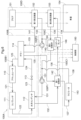
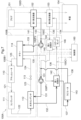
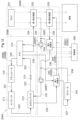
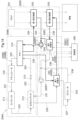
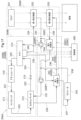
- FIG. 1 is a circuit configuration diagram of a vehicle air conditioning system according to a first embodiment.
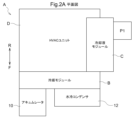
- 1 is a plan view showing the layout of a vehicle air conditioning system according to a first embodiment.
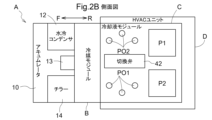
- 1 is a side view showing the arrangement of a vehicle air conditioning system according to a first embodiment.
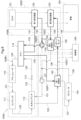
- FIG. 4 is a diagram illustrating a flow of a coolant in a first state according to the first embodiment.
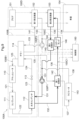
- 5 is a diagram showing a flow of the coolant in a second state according to the first embodiment.
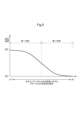
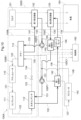
- FIG. 4A to 4C are diagrams illustrating states of a switching valve according to the first embodiment.
- FIG. 6 is a circuit configuration diagram of a vehicle air conditioning system according to a second embodiment.
- FIG. 10 is a diagram showing the flow of coolant when the vehicle air conditioning system according to the second embodiment is in a first state.
- FIG. 13 is a diagram showing the flow of coolant when the vehicle air conditioning system according to the second embodiment is in a second state.
- FIG. 13 is a diagram showing the flow of coolant when the vehicle air conditioning system according to the second embodiment is in a third state.
- FIG. 13 is a diagram showing the flow of coolant when the vehicle air conditioning system according to the second embodiment is in a fourth state.
- FIG. FIG. 11 is a circuit configuration diagram of a vehicle air conditioning system according to a third embodiment.
- FIG. 11 is a circuit configuration diagram of a vehicle air conditioning system according to a fourth embodiment.
- FIG. 13 is a diagram showing the flow of coolant in a first state according to the fourth embodiment.
- FIG. 13 is a diagram showing the flow of coolant in a second state according to the fourth embodiment.
- FIG. 13 is a diagram illustrating the flow of coolant in a third state according to the fourth embodiment.
- FIG. 13 is a diagram illustrating a flow of coolant in a fourth state according to the fourth embodiment.
- FIG. 13 is a circuit configuration diagram of a vehicle air conditioning system according to a fifth embodiment.
- the vehicle air conditioning system according to the present invention is configured to be capable of cooling and heating the vehicle cabin.
- a vehicle air conditioning system A according to the present embodiment will be described.
- the vehicle air conditioning system A is not limited to the following embodiment, and various modifications are possible without departing from the gist of the present invention.
- FIG. 1 shows the circuit configuration of vehicle air conditioning system A.
- Vehicle air conditioning system A is mounted on a vehicle, and as shown in Figure 1, comprises a refrigerant module B, a coolant module C, and an HVAC (Heating, Ventilation, and Air Conditioning) unit D (an example of an "air conditioning unit").
- a refrigerant flow path B1 is provided in the refrigerant module B, which is configured as a refrigerant manifold.
- a coolant flow path C1 is provided in the coolant module C, which is configured as a coolant manifold.
- the manifold is a flow path housing in which a plate member is laminated and sealed on a housing main body in which the coolant flow path C1 and the refrigerant flow path B1 are engraved.
- the flow path housing is formed from a metal material with high thermal conductivity, including aluminum.
- Refrigerant such as hydrofluorocarbon (HFC) or hydrofluoroolefin (HFO) flows through refrigerant flow path B1, and coolant flow path C1 is made of cooling water such as antifreeze or long-life coolant mainly composed of ethylene glycol, or insulating oil such as paraffin.
- 2A and 2B show the arrangement of refrigerant module B, coolant module C, and HVAC unit D in vehicle air conditioning system A. 2A is a plan view, and 2B is a side view.
- the front side in the traveling direction of the vehicle when vehicle air conditioning system A is mounted on the vehicle is shown as F, and the rear side in the traveling direction is shown as R.
- Coolant module C is provided with ports PO1 and PO2 through which coolant is introduced and discharged.
- refrigerant flow path B1 circulates refrigerant between the water-cooled condenser (an example of a "condenser") 12 and the chiller (an example of an "evaporator") 14.
- Refrigerant module B is configured to allow refrigerant to flow between the accumulator 10, the compressor 11, the water-cooled condenser 12, the expansion valve 13, and the chiller 14 via the refrigerant flow path B1.
- the accumulator 10 stores liquid refrigerant and separates the stored refrigerant into gas and liquid.
- the gas refrigerant separated by the accumulator 10 flows through the first refrigerant path 21 and is sent to the compressor 11.
- the compressor 11 compresses the refrigerant from the accumulator 10. This causes the refrigerant to become a high-temperature compressed gas.
- the compressor 11 sends this high-temperature compressed gas to the water-cooled condenser 12 via the second refrigerant path 22.
- the compressor 11 pressure-feeds the refrigerant from the accumulator 10 to the water-cooled condenser 12.
- the water-cooled condenser 12 is circulated with the refrigerant that has passed through the compressor 11.
- the water-cooled condenser 12 is configured so that the refrigerant flows in from the first cooling liquid flow path 31 and flows out from the second cooling liquid flow path 32.
- the first cooling liquid flow path 31 and the second cooling liquid flow path 32 are configured separately from the second refrigerant path 22.
- the refrigerant from the second refrigerant path 22 is condensed and liquefied as heat is absorbed by the cooling liquid.
- the liquefied refrigerant is sent to the third refrigerant path 23.
- This third refrigerant path 23 is also configured separately from the first cooling liquid flow path 31 and the second cooling liquid flow path 32, like the second refrigerant path 22.
- the refrigerant (liquefied refrigerant) flowing through the third refrigerant passage 23 is expanded and turned into a low-temperature, low-pressure mist.
- the mist-like refrigerant is sent to the fourth refrigerant passage 24.
- the refrigerant flows through the chiller 14 via the fourth refrigerant passage 24.
- the refrigerant expanded by the expansion valve 13 and turned into a low-temperature, low-pressure mist flows through the fourth refrigerant passage 24, and this refrigerant is sent to the chiller 14.
- the chiller 14 is configured such that the coolant that has undergone heat exchange in the heat exchanger 52 flows into it from the third coolant passage 33, and the coolant flows out from the fourth coolant passage 34.
- the third coolant passage 33 and the fourth coolant passage 34 are configured separately from the fourth refrigerant passage 24.
- the mist-like refrigerant removes heat from the coolant and evaporates.
- the evaporated refrigerant flows to the accumulator 10 through the fifth refrigerant passage 25.
- the cooling liquid flow path C1 also carries the cooling liquid that exchanges heat with the refrigerant in the water-cooled condenser 12 and the chiller 14.
- the cooling liquid module C is configured to allow the cooling liquid to flow through the cooling liquid flow path C1 between the water-cooled condenser 12, the chiller 14, the switching valve 42, the radiator 43, and the heat exchanger 52 by the first pump P1 and the second pump P2.
- the water-cooled condenser 12 is configured so that the coolant flows in through the first coolant flow path 31 and flows out through the second coolant flow path 32.
- the first coolant flow path 31 is provided with a first pump P1, which pumps out the coolant.
- the switching valve 42 is disposed in the cooling liquid flow path C1, and is configured to allow the flow of cooling liquid from the water-cooled condenser 12 and the chiller 14. Cooling liquid is sent from the water-cooled condenser 12 via the second cooling liquid flow path 32 to the switching valve 42, and cooling liquid is sent from the chiller 14 via the fourth cooling liquid flow path 34.
- a second pump P2 is provided in the fourth cooling liquid flow path 34, and the second pump P2 sends cooling liquid from the chiller 14 to the switching valve 42.
- the switching valve 42 is configured to be able to send the cooling liquid to the fifth cooling liquid flow path 35 and the sixth cooling liquid flow path 36.
- the cooling liquid sent from the switching valve 42 to the fifth cooling liquid flow path 35 flows through the heat exchanger 52.
- the cooling liquid sent to the heat exchanger 52 is configured to be able to be sent to the water-cooled condenser 12 via the first cooling liquid flow path 31, and is also configured to be able to be sent to the chiller 14 via the third cooling liquid flow path 33.
- the coolant sent from the switching valve 42 to the sixth coolant flow path 36 flows through the radiator 43.
- the radiator 43 heat exchange with the outside air occurs, and the coolant is cooled. After heat exchange, the coolant is sent to the first coolant flow path 31 via the seventh coolant flow path 37.
- the switching valve 42 is configured to be able to switch the flow state of the coolant in the coolant flow path C1 between a first state and a second state.
- the first state is a state in which the coolant is circulated through the water-cooled condenser 12.
- the flow state of the coolant in such a first state is shown in FIG. 3.
- the coolant is circulated by the first pump P1 through the water-cooled condenser 12, the second coolant flow path 32, the switching valve 42, the fifth coolant flow path 35, the heat exchanger 52, and the first coolant flow path 31.
- the coolant may be sent from the switching valve 42 to the sixth coolant flow path 36, and then circulated back to the first coolant flow path 31 via the radiator 43 and the seventh coolant flow path 37.
- the second state is a state in which the cooling liquid is circulated through the chiller 14.
- the flow state of the cooling liquid in this second state is shown in FIG. 4.
- the cooling liquid is circulated by the second pump P2 through the chiller 14, the fourth cooling liquid flow path 34, the switching valve 42, the fifth cooling liquid flow path 35, the heat exchanger 52, and the third cooling liquid flow path 33.
- the switching valve 42 can be switched between the first and second states by a control unit (not shown) of the vehicle air conditioning system A or a higher-level system of the vehicle air conditioning system A.
- the HVAC unit D includes a blower 51, a heat exchanger 52, a desiccant 53, and a heater (electric heater) 54.
- the blower 51 draws in outside air and sends it to the heat exchanger 52.
- the heat exchanger 52 exchanges heat between the air and the coolant to cool or heat the vehicle interior.
- the air is the outside air sucked in by the blower 51.
- the coolant is introduced into the heat exchanger 52 through the fifth coolant flow path 35 as described above, and this coolant is sent to one or both of the first coolant flow path 31 and the third coolant flow path 33 depending on the state of the switching valve 42 (details will be described later). Therefore, in the heat exchanger 52, heat exchange is performed between the outside air sent from the blower 51 and the coolant supplied through the fifth coolant flow path 35, and the air after the heat exchange is introduced into the vehicle interior. Specifically, when the outside air is cooled in the heat exchanger 52, cold air is introduced into the vehicle interior, and when the outside air is heated in the heat exchanger 52, warm air is introduced into the vehicle interior. This makes it possible to cool or heat the vehicle interior.
- the desiccant 53 adsorbs moisture contained in the moisture-containing air to generate heated dry air.
- the desiccant 53 functions as an adsorption section that adsorbs moisture, and can be constructed using an adsorbent such as zeolite, silica gel, or activated carbon.
- the desiccant 53 is provided between the blower 51 and the heat exchanger 52. Therefore, the outside air sent from the blower 51 passes through the desiccant 53 and is discharged to the heat exchanger 52.
- the electric heater 54 evaporates the moisture adsorbed in the desiccant 53 to generate cooled and humidified air.
- the electric heater 54 functions as a heating unit that evaporates the moisture adsorbed in the desiccant 53.
- the electric heater 54 is attached to the desiccant 53, for example (integrally configured with the desiccant 53). In this case, the desiccant 53 is heated by the electric heater 54, so that the moisture adsorbed in the desiccant 53 evaporates.
- the electric heater 54 may not be attached to the desiccant 53, but may be provided upstream of the desiccant 53 (between the blower 51 and the desiccant 53) and at a position separated from the desiccant 53 (it may be provided separately from the desiccant 53).
- the air from the blower 51 is heated by the electric heater 54, and the heated air is supplied to the desiccant 53, so that the moisture adsorbed in the desiccant 53 evaporates.
- the air supplied to the desiccant 53 is humidified by the moisture evaporated from the desiccant 53, producing cooled, humidified air.
- the heating section that evaporates the moisture adsorbed in the desiccant 53 may be an air heating device other than the electric heater 54.
- the desiccant 53 When moisture-containing air is supplied to the desiccant 53 from the blower 51 while the desiccant 53 does not have any moisture adsorbed therein, the desiccant 53 adsorbs the moisture in the moisture-containing air and reduces the humidity of the moisture-containing air. As a result, the moisture-containing air supplied to the desiccant 53 becomes dry air that has been dehumidified by the desiccant 53 and is discharged to the heat exchanger 52.
- the desiccant 53 desorbs the adsorbed moisture.
- the desorbed moisture humidifies the hot air.
- the hot air supplied to the desiccant 53 becomes moist air humidified by the desiccant 53 and is discharged to the heat exchanger 52.
- the heat exchanger 52 exchanges heat between the heated dry air or cooled humidified air and the coolant to generate air for cooling the vehicle interior or air for heating the vehicle interior. Therefore, the heat exchanger 52 exchanges heat between the dry air and the coolant introduced through the fifth coolant flow path 35 to generate air for cooling the vehicle interior. The heat exchanger 52 also exchanges heat between the humid air and the coolant introduced through the fifth coolant flow path 35 to generate air for heating the vehicle interior. Furthermore, the heat exchanger 52 can also exchange heat between the dry air and the coolant introduced through the fifth coolant flow path 35 to generate air for heating the vehicle interior. In this case, for example, when using the defroster function in winter, dehumidified heated air can be supplied to the vehicle interior. By introducing such air for cooling the vehicle interior or air for heating the vehicle interior into the vehicle interior, it is possible to adjust the humidity in the vehicle interior.
- the switching valve 42 is configured to allow the flow of coolant from the water-cooled condenser 12 and coolant from the chiller 14.
- the temperature of the coolant from the water-cooled condenser 12 is relatively higher than the temperature of the coolant from the chiller 14. Therefore, when heating the vehicle interior, the switching valve 42 is set to a first state in which coolant is circulated through the water-cooled condenser 12, and when cooling the vehicle interior, the switching valve 42 is set to a second state in which coolant is circulated through the chiller 14.
- the switching valve 42 is configured to change the opening so as to simultaneously realize the first state and the second state. Therefore, in the switching valve 42, it is possible to mix the relatively high-temperature coolant from the water-cooled condenser 12 and the relatively low-temperature coolant from the chiller 14 and send them to the fifth coolant flow path 35. As shown in FIG. 5, when the set temperature of the air conditioning in the vehicle cabin is high, the ratio of the coolant from the chiller 14 to the coolant from the water-cooled condenser 12 is reduced, and when the set temperature of the air conditioning in the vehicle cabin is low, the ratio of the coolant from the chiller 14 to the coolant from the water-cooled condenser 12 is increased.
- the opening of the switching valve 42 according to the set temperature of the air conditioning in the vehicle cabin and controlling the flow rate of the coolant from the second coolant flow path 32 and the flow rate of the coolant from the fourth coolant flow path 34, the temperature of the coolant sent to the fifth coolant flow path 35 is adjusted, and the temperature in the vehicle cabin can be adjusted to the set temperature of the air conditioning.
- the refrigerant module B and the coolant module C are integrated with the HVAC unit D.
- integration means that the refrigerant module B and the coolant module C are fixed to the HVAC unit D with bolts or the like.
- This "integration” also includes forming the same case by combining the materials of the HVAC unit D, the refrigerant module B, and the coolant module C.
- the refrigerant module B is provided on the front side of the HVAC unit D in the direction of travel of the vehicle.
- the vehicle air conditioning system A can be made smaller, and power consumption can be improved.
- the water-cooled condenser 12, the expansion valve 13, and the chiller 14 can be disposed in the front of the vehicle, so that the wind generated by the vehicle can be blown onto the water-cooled condenser 12, the expansion valve 13, and the chiller 14 as the vehicle travels. This makes it possible to prevent condensation on the water-cooled condenser 12, the expansion valve 13, and the chiller 14.
- the coolant module C is provided on the left side of the vehicle in the HVAC unit D. This makes it possible to easily secure the introduction and discharge routes of the coolant in the coolant module C by providing ports PO1 and PO2 as shown in FIG. 2B. Also, the first pump P1, the second pump P2, and the switching valve 42 can be arranged on the side of the HVAC unit D, improving maintainability.
- the vehicle air conditioning system A is described as being provided with a switching valve 42 in the coolant flow path C1 that can be switched between a first state in which the coolant is circulated to the water-cooled condenser 12 and a second state in which the coolant is circulated to the chiller 14.
- the vehicle air conditioning system A can also be configured without the switching valve 42.
- a flow path for circulating the coolant between the water-cooled condenser 12 and the heat exchanger 52 and a flow path for circulating the coolant between the chiller 14 and the heat exchanger 52 are provided separately (independently), and an opening/closing valve is further provided in each flow path.
- each of these opening/closing valves By switching each of these opening/closing valves between an open state and a closed state, it is possible to circulate the coolant from the water-cooled condenser 12 and the coolant from the chiller 14 to the heat exchanger 52. It is also possible to configure the coolant flow path C1 to simultaneously circulate the coolant from the water-cooled condenser 12 and the coolant from the chiller 14 through the heat exchanger 52.
- the switching valve 42 has been described as being capable of changing the opening degree so as to simultaneously realize the first state and the second state.
- the switching valve 42 can also be configured so as not to simultaneously realize the first state and the second state.
- the coolant module C having the coolant flow path C1 has a heat exchanger 52 and is integrated with the HVAC unit D that cools and heats the vehicle cabin.
- the coolant module C without integrating it with the HVAC unit D.
- the refrigerant module B having the refrigerant flow path B1 has a heat exchanger 52 and is integrated with the HVAC unit D that cools and heats the vehicle cabin.
- the vehicle air conditioning system 100A is mounted on a vehicle and is configured to be switchable between a cooling mode and a heating mode.
- the vehicle air conditioning system 100A includes a refrigerant module 100B, a coolant module 100C, and an HVAC (Heating, Ventilation, and Air Conditioning) unit 100D.
- the refrigerant module 100B is provided with a refrigerant flow path 100B1 and configured as a refrigerant manifold.
- the coolant module 100C is provided with a coolant flow path 100C1 and configured as a coolant manifold.
- the manifold is a flow path housing in which a plate member is laminated and sealed on a housing main body in which the coolant flow path 100C1 and at least a part of the refrigerant flow path 100B1 are formed.
- the flow path housing is formed of a metal material having high thermal conductivity, including aluminum, or a resin.
- the HVAC unit 100D includes a blower 151, a first heat exchanger 152 (an example of a heat exchanger), and a second heat exchanger 153 (an example of a heat exchanger).
- Refrigerant such as hydrofluorocarbon (HFC) or hydrofluoroolefin (HFO) flows through the refrigerant flow path 100B1.
- Coolant flow path 100C1 is a cooling liquid consisting of antifreeze or long-life coolant mainly composed of ethylene glycol, or insulating oil such as paraffin.
- the refrigerant module 100B includes an accumulator 110, a compressor 111, a water-cooled condenser 112, an expansion valve 113, a chiller 114, and a refrigerant flow path 100B1 that circulates and distributes the refrigerant between them.
- the refrigerant flow path 100B1 has a first refrigerant flow path 121, a second refrigerant flow path 122, a third refrigerant flow path 123, a fourth refrigerant flow path 124, and a fifth refrigerant flow path 125.
- the first refrigerant flow path 121 is disposed between the accumulator 110 and the compressor 111.
- the second refrigerant flow path 122 is disposed between the compressor 111 and the water-cooled condenser 112.
- the third refrigerant flow path 123 is disposed between the water-cooled condenser 112 and the expansion valve 113.
- the fourth refrigerant flow path 124 is disposed between the expansion valve 113 and the chiller 114.
- the fifth refrigerant flow path 125 is disposed between the chiller 114 and the accumulator 110.
- the refrigerant flow path 100B1 is a circular flow path.
- the coolant module 100C includes a first pump 100P1, a second pump 100P2, a first switching valve 142, a second switching valve 144, a reserve tank 146 (an example of a storage section), and a part of a coolant flow path 100C1 that circulates the coolant between them.
- the coolant flow path 100C1 has a first coolant flow path 131, a second coolant flow path 132, a third coolant flow path 133, a fourth coolant flow path 134, a fifth coolant flow path 135, a sixth coolant flow path 136, a seventh coolant flow path 137, an eighth coolant flow path 138, a ninth coolant flow path 139, a tenth coolant flow path 140, and an eleventh coolant flow path 141.
- the first pump 100P1 is disposed midway through the first coolant flow path 131
- the second pump 100P2 is disposed midway through the third coolant flow path 133, and both pump the coolant.
- the operation of the first pump 100P1, the second pump 100P2, the first switching valve 142, and the second switching valve 144 is controlled by the control unit 160.
- the first coolant flow path 131 is disposed between the second switching valve 144 and the water-cooled condenser 112.
- the second coolant flow path 132 is disposed between the water-cooled condenser 112 and the first switching valve 142.
- the third coolant flow path 133 is disposed between the first heat exchanger 152 and the chiller 114.
- the fourth coolant flow path 134 is disposed between the reserve tank 146 and the second heat exchanger 153.
- the fifth coolant flow path 135 is disposed between the chiller 114 and the first switching valve 142.
- the sixth coolant flow path 136 is disposed between the first switching valve 142 and the reserve tank 146.
- the seventh coolant flow path 137 is disposed between the first switching valve 142 and the radiator 143 described later.
- the eighth coolant flow path 138 is disposed between the radiator 143 and the first coolant flow path 131 upstream of the first pump 100P1.
- the ninth coolant flow path 139 is disposed between the second heat exchanger 153 and the second switching valve 144.
- the tenth coolant flow path 140 is disposed between the second switching valve 144 and the third coolant flow path 133 upstream of the second pump 100P2.
- the eleventh coolant flow path 141 is disposed between the chiller 114 and the first heat exchanger 152.
- the first switching valve 142 is a four-way valve
- the second switching valve 144 is a three-way valve.
- the first switching valve 142 switches the flow path between three switching positions, first to third.
- the first switching position the coolant flowing in from the second cooling liquid flow path 132 is discharged to the seventh cooling liquid flow path 137, and the flow of the coolant flowing in from the fifth cooling liquid flow path 135 is stopped (in the first state described below).
- the coolant flowing in from the fifth cooling liquid flow path 135 is discharged to the sixth cooling liquid flow path 136, and the flow of the coolant flowing in from the second cooling liquid flow path 132 is stopped (in the second state described below).
- the third switching position the coolant flowing in from the second cooling liquid flow path 132 is discharged to the sixth cooling liquid flow path 136, and the flow of the coolant flowing in from the fifth cooling liquid flow path 135 is stopped (in the third and fourth states described below).
- the second switching valve 144 switches the flow path between two switching positions, a first and a second.
- the first switching position the coolant flowing in from the ninth coolant flow path 139 is caused to flow out to the tenth coolant flow path 140 (in the second state).
- the second switching position the coolant flowing in from the ninth coolant flow path 139 is caused to flow out to the first coolant flow path 131 (in the third and fourth states).
- the switching of the first switching valve 142 and the second switching valve 144 is controlled by the control unit 160.
- the reserve tank 146 is an insulating container with a large heat capacity, and the coolant that has flowed through the sixth coolant flow path 136 flows into the container and is stored inside in an insulated state. The stored coolant then flows out to the fourth coolant flow path 134.
- the reserve tank 146 is formed integrally with the coolant module 100C.
- integralally formed is a concept that includes both a case in which the reserve tank 146 is formed in a state in which it is integrated with the housing that constitutes the coolant manifold, and a case in which a separate reserve tank 146 is fixed to the coolant manifold by bolts or the like and integrated.
- the "insulated state” refers to a state in which the amount of temperature change per unit time of the coolant stored inside the reserve tank 146 is smaller than the amount of temperature change per unit time of the coolant present in the coolant flow path 100C1.
- An example of the structure of the reserve tank 146 is one in which the reserve tank 146 has a double structure of an inner case and an outer case, and the space between the inner case and the outer case is a vacuum.
- Another example is one in which the reserve tank 146 is made of a material with low thermal conductivity, such as resin.
- the reserve tank 146 is an insulated container, the temperature of the coolant stored inside is not easily affected by the temperature (air temperature) outside the vehicle. Therefore, the temperature of the coolant stored inside the reserve tank 146 is maintained at approximately the same temperature as the temperature of the coolant when it flowed through the sixth coolant flow path 136 during operation before the vehicle air conditioning system 100A was stopped, even long after the operation of the vehicle air conditioning system 100A has stopped. Therefore, immediately after the vehicle air conditioning system 100A is subsequently restarted, it becomes possible to cause coolant at approximately the same temperature as when it flowed through the sixth coolant flow path 136 to flow out into the fourth coolant flow path 134.
- outside air which is air outside the vehicle, is introduced and dehumidified, cooled, heated, etc. in the first heat exchanger 152 and/or the second heat exchanger 153, and sent to the passenger compartment 154 to cool or heat the passenger compartment 154.
- the blower 151, the first heat exchanger 152, and the second heat exchanger 153 are arranged in this order from the upstream where the outside air flows toward the passenger compartment 154.
- the blower 151 draws in outside air and sends it toward the first heat exchanger 152.
- the first heat exchanger 152 exchanges heat between the cooling liquid flowing in from the chiller 114 and the outside air sent from the blower 151.
- the second heat exchanger 153 exchanges heat between the cooling liquid flowing in from the water-cooled condenser 112 or the chiller 114 and the outside air after passing through the first heat exchanger 152.
- the first heat exchanger 152 is provided for dehumidification and cooling
- the second heat exchanger 153 is provided for dehumidification, cooling, and heating.
- the vehicle air conditioning system A is configured to be switchable between four states, a first state, a second state, and a fourth state, which will be described later, depending on the cooling and heating states.
- the coolant flow paths C1 through which the coolant flows are indicated by thick lines.
- the refrigerant flow path 100B1 of the refrigerant module 100B will now be described.
- the accumulator 110 stores the liquid refrigerant.
- the refrigerant refers to "gaseous refrigerant”.
- the accumulator 110 separates the liquid refrigerant contained in the refrigerant that has flowed in from the chiller 114. After the liquid refrigerant has been separated by the accumulator 110, the refrigerant flows through the first refrigerant flow path 121 and flows into the compressor 111.
- the compressor 111 compresses the refrigerant that flows in from the accumulator 110. This causes the refrigerant to become a high-temperature compressed gas. The compressor 111 pressure-transmits this high-temperature compressed gas to the water-cooled condenser 112 via the second refrigerant flow path 122.
- the refrigerant flowing out from the compressor 111 and circulating through the second refrigerant flow path 122 flows into the water-cooled condenser 112 and flows out into the third refrigerant flow path 123.
- the cooling liquid also flows into the water-cooled condenser 112 from the first cooling liquid flow path 131 of the cooling liquid flow path 100C1 and flows out into the second cooling liquid flow path 132.
- the refrigerant flowing in from the second refrigerant flow path 122 exchanges heat with the cooling liquid flowing in from the first cooling liquid flow path 131 inside the water-cooled condenser 112.
- the refrigerant is condensed and liquefied by the cooling liquid taking heat from it.
- the liquefied refrigerant flows out into the third refrigerant flow path 123.
- the cooling liquid flowing in from the first cooling liquid flow path 131 is heated by the refrigerant and flows out into the second cooling liquid flow path 132.
- the liquid refrigerant flowing in from the third refrigerant flow path 123 is expanded and turned into a low-temperature, low-pressure mist.
- the mist of refrigerant flows out into the fourth refrigerant flow path 124.
- the mist-like refrigerant flowing through the fourth refrigerant flow path 124 flows into the chiller 114 and flows out into the fifth refrigerant flow path 125.
- the cooling liquid also flows into the chiller 114 from the third cooling liquid flow path 133 of the cooling liquid flow path 100C1, and flows out into only the eleventh cooling liquid flow path 141, or into the fifth cooling liquid flow path 135 and the eleventh cooling liquid flow path 141.
- the mist-like refrigerant flowing in from the fourth refrigerant flow path 124 exchanges heat with the cooling liquid flowing in from the third cooling liquid flow path 133 inside the chiller 114. Specifically, the mist-like refrigerant absorbs heat from the cooling liquid and evaporates.
- the evaporated refrigerant flows out into the fifth refrigerant flow path 125 and flows into the accumulator 110.
- the evaporated refrigerant may include mist-like (liquid) refrigerant that has not been completely evaporated.
- the cooling liquid flowing in from the third cooling liquid flow path 133 is cooled by the mist of refrigerant and flows out only to the eleventh cooling liquid flow path 141, or to the fifth cooling liquid flow path 135 and the eleventh cooling liquid flow path 141.
- the cooling liquid flow path 100C1 carries the cooling liquid that exchanges heat with the refrigerant in the water-cooled condenser 112 and the chiller 114.
- the cooling liquid pumped by the first pump 100P1 and the second pump 100P2 flows between the water-cooled condenser 112, the chiller 114, the first switching valve 142, the radiator 143, the second switching valve 144, the reserve tank 146, the first heat exchanger 152, and the second heat exchanger 153.
- the water-cooled condenser 112 is configured so that the coolant flows in through the first coolant flow path 131 and flows out through the second coolant flow path 132.
- the first coolant flow path 131 is provided with a first pump 100P1, which pumps the coolant under pressure to circulate it.
- the first switching valve 142 is configured to allow the flow of cooling liquid from the water-cooled condenser 112 and the chiller 114. Cooling liquid flows into the first switching valve 142 from the water-cooled condenser 112 via the second cooling liquid flow path 132, or coolant flows into the first switching valve 142 from the chiller 114 via the fifth cooling liquid flow path 135.
- the first switching valve 142 is configured to allow the cooling liquid to flow out to the sixth cooling liquid flow path 136 or the seventh cooling liquid flow path 137.
- the cooling liquid that flows out from the first switching valve 142 to the sixth cooling liquid flow path 136 flows into the reserve tank 146.
- the cooling liquid stored in the reserve tank 146 flows out, passes through the fourth cooling liquid flow path 134, and flows into the second heat exchanger 153.
- the cooling liquid that flows into the second heat exchanger 153 flows through the ninth cooling liquid flow path 139 and flows into the second switching valve 144.
- the second switching valve 144 switches the flow path between two types: when the cooling liquid flows out to the tenth cooling liquid flow path 140, and when the cooling liquid flows out to the first cooling liquid flow path 131.
- the cooling liquid flows out to the tenth cooling liquid flow path 140, it flows through the third cooling liquid flow path 133 and flows into the chiller 114 (when in the second state shown in Figure 8). Also, when the cooling liquid flows out into the first cooling liquid flow path 131, it flows through the first cooling liquid flow path 131 and flows into the water-cooled condenser 112 (in the third state shown in FIG. 9 and the fourth state shown in FIG. 10). In this way, the second switching valve 144 is switched so that the cooling liquid that flows in from the second heat exchanger 153 flows out to either the chiller 114 or the water-cooled condenser 112.
- the first switching valve 142 switches the flow path, and the coolant that flows in from the second coolant flow path 132 and flows out to the seventh coolant flow path 137 flows into the radiator 143.
- the radiator 143 heat exchange occurs between the coolant and the outside air, and the coolant is cooled.
- the coolant flows through the eighth coolant flow path 138 and merges with the first coolant flow path 131 upstream of the first pump 100P1.
- the first heat exchanger 152 and the second heat exchanger 153 exchange heat between the air and the coolant to cool and heat the vehicle interior 154.
- the air is outside air drawn in by the blower 151.
- the coolant that has flowed through the eleventh coolant flow path 141 as described above flows into the first heat exchanger 152 and flows out into the third coolant flow path 133.
- the coolant that has flowed through the fourth coolant flow path 134 as described above flows into the second heat exchanger 153 and flows out into the ninth coolant flow path 139.
- heat exchange occurs between the outside air sent from the blower 151 and the coolant that has flowed through the eleventh coolant flow path 141 and flowed in.
- heat exchange is or is not performed between the outside air after heat exchange or not performed in the first heat exchanger 152 and the coolant that flows in through the fourth coolant flow path 134, and the air that has passed through the second heat exchanger 153 is introduced into the vehicle interior 154.
- the first state of the vehicle air conditioning system 100A is a cooling mode that dehumidifies and cools the interior of the vehicle compartment 154, especially in summer.
- the first switching valve 142 is switched by the control unit 160 to allow the coolant flowing in from the second coolant flow path 132 to flow out to the seventh coolant flow path 137 and to stop the flow of the coolant flowing in from the fifth coolant flow path 135.
- the coolant does not flow in the sixth coolant flow path 136, and the coolant does not flow in the fourth coolant flow path 134, the second heat exchanger 153, and the ninth coolant flow path 139, so that the second switching valve 144 does not switch the flow path.
- the first pump 100P1 and the second pump 100P2 are both in operation.
- the coolant that flows through the first coolant flow path 131 and flows into the water-cooled condenser 112 exchanges heat with the refrigerant that flows into the water-cooled condenser 112, is heated, and flows out into the second coolant flow path 132.
- the coolant then flows through the seventh coolant flow path 137 and into the radiator 143, is cooled in the radiator 143, and flows through the eighth coolant flow path 138 and the first coolant flow path 131 and flows back into the water-cooled condenser 112.
- the cooling liquid flows through the third cooling liquid flow path 133.
- the cooling liquid that flows through the third cooling liquid flow path 133 and flows into the chiller 114 exchanges heat with the refrigerant that flows into the chiller 114, is cooled, and flows out into the eleventh cooling liquid flow path 141. Since the flow is stopped by the first switching valve 142, the cooling liquid does not flow through the fifth cooling liquid flow path 135. After that, the cooling liquid flows into the first heat exchanger 152, where it dehumidifies, cools, and heats the outside air introduced from the blower 151.
- the cooling liquid After being heated by the first heat exchanger 152, the cooling liquid flows through the third cooling liquid flow path 133 via the second pump 100P2 and flows into the chiller 114 again.
- the outside air that has been dehumidified and cooled by heat exchange in the first heat exchanger 152 is sent toward the second heat exchanger 153.
- the outside air introduced from the blower 151 and heat exchanged in the first heat exchanger 152 is not heat exchanged in the second heat exchanger 153, and is supplied as is to the passenger compartment 154 as dehumidified cool air. This dehumidifies and cools the inside of the passenger compartment 154.
- the temperature of the outside air When the temperature of the outside air is high, if the vehicle air conditioning system 100A is stopped for a long time, the temperature of the coolant will rise. In the first state, only the first heat exchanger 152 is used to generate cool air for cooling. Therefore, if the vehicle air conditioning system 100A is restarted after a long time has passed, heat exchange will be performed in the first heat exchanger 152 by the coolant that has not been sufficiently cooled by the chiller 114 immediately after restart. Therefore, the outside air sent to the passenger compartment 154 is not sufficiently cooled, making it difficult to quickly cool the passenger compartment 154. In addition, since it is necessary to lower the temperature of the outside air only using the first heat exchanger 152, the amount of condensation that forms on the surface of the first heat exchanger 152 will also increase.
- the second state of the vehicle air conditioning system 100A is a cooling mode for cooling the passenger compartment 154, especially in summer, similarly to the first state.
- the first switching valve 142 of the coolant module 100C is switched by the control unit 160 so as to allow the coolant flowing in from the fifth coolant flow path 135 to flow out to the sixth coolant flow path 136 and to stop the flow of the coolant flowing in from the second coolant flow path 132. Therefore, the coolant does not flow in the seventh coolant flow path 137.
- the second switching valve 144 is switched so as to allow the coolant flowing in from the ninth coolant flow path 139 to flow out to the tenth coolant flow path 140. Under the control of the control unit 160, the first pump 100P1 is stopped and the second pump 100P2 is operating.
- cooling liquid does not flow through the first cooling liquid flow path 131 and the second cooling liquid flow path 132, in the second state, heat exchange does not occur in the water-cooled condenser 112, and heat exchange occurs only in the chiller 114.
- the cooling liquid that flows through the third cooling liquid flow path 133 and flows into the chiller 114 exchanges heat with the refrigerant that flows into the chiller 114, is cooled, and flows out into the fifth cooling liquid flow path 135 and the eleventh cooling liquid flow path 141.
- the cooling liquid that flows through the eleventh cooling liquid flow path 141 flows into the first heat exchanger 152, where it dehumidifies and cools the outside air and is heated.
- the cooling liquid After being heated in the first heat exchanger 152, the cooling liquid flows through the third cooling liquid flow path 133 via the second pump 100P2 and flows into the chiller 114 again.
- the outside air that has been dehumidified and cooled by heat exchange in the first heat exchanger 152 is sent to the second heat exchanger 153.
- the cooling liquid that flows out of the chiller 114 and flows through the fifth cooling liquid flow path 135 flows through the sixth cooling liquid flow path 136 via the first switching valve 142 and is stored in the reserve tank 146.
- the reserve tank 146 stores low-temperature cooling liquid that was stored during the previous flow, and the cooling liquid that flows out from the previously stored cooling liquid and then newly flows into the reserve tank 146 flows out.
- the cooling liquid that flows out of the reserve tank 146 flows through the fourth cooling liquid flow path 134 and flows into the second heat exchanger 153.
- the low-temperature cooling liquid exchanges heat with the outside air cooled in the first heat exchanger 152, further dehumidifying and cooling the outside air. This heats up the cooling liquid.
- the heated coolant flows out of the second heat exchanger 153, passes through the ninth coolant flow path 139, the second switching valve 144, the tenth coolant flow path 140, and the second pump 100P2, and flows through the third coolant flow path 133, before flowing back into the chiller 114.
- the outside air introduced from the blower 151 is dehumidified and cooled by heat exchange in both the first heat exchanger 152 and the second heat exchanger 153, and is supplied to the vehicle interior 154 as dehumidified cool air. This dehumidifies and cools the interior of the vehicle interior 154.
- both the first heat exchanger 152 and the second heat exchanger 153 are used to generate cool air for cooling.
- the reserve tank 146 is disposed upstream of the second heat exchanger 153.
- the reserve tank 146 stores coolant at approximately the same temperature as the coolant that flows through the sixth coolant flow path 136 when the vehicle air conditioning system 100A is operating in the second state before the vehicle air conditioning system 100A is stopped.
- the temperature of the coolant stored in the reserve tank 146 is approximately the same as the temperature cooled by the chiller 114, which is a low temperature.
- the outside air that has been sufficiently dehumidified and cooled by heat exchange in the second heat exchanger 153 is sent to the passenger compartment 154 as cool air, so that the inside of the passenger compartment 154 can be quickly dehumidified and cooled.
- sufficiently cooled low-temperature coolant continues to flow into the first heat exchanger 152 and the second heat exchanger 153, so the interior of the vehicle 154 can be continuously dehumidified and cooled. In this way, the vehicle air conditioning system 100A can quickly perform its cooling function immediately after restarting.
- the heat capacity of the cooling liquid cooled through the chiller 114 is distributed to the first heat exchanger 152 and the second heat exchanger 153, so the air passing through the first heat exchanger 152 is not cooled suddenly, and the decrease in humidity of the air can be suppressed compared to the first state. Therefore, the amount of condensation that occurs on the surfaces of the first heat exchanger 152 and the second heat exchanger 153 in the second state is less than the amount of condensation that occurs on the first heat exchanger 152 in the first state.
- the third state of the vehicle air conditioning system A is a heating mode for heating the passenger compartment 154, particularly in winter.
- the first switching valve 142 of the coolant module 100C is switched by the control unit 160 so as to allow the coolant flowing in from the second coolant flow path 132 to flow out to the sixth coolant flow path 136 and to stop the flow of the coolant flowing in from the fifth coolant flow path 135. Therefore, the coolant does not flow in the seventh coolant flow path 137.
- the second switching valve 144 is switched so as to allow the coolant flowing in from the ninth coolant flow path 139 to flow out to the first coolant flow path 131. Under the control of the control unit 160, the first pump 100P1 is operating and the second pump 100P2 is stopped.
- the coolant does not flow through the third coolant flow path 133 and the fifth coolant flow path 135. Therefore, in the third state, heat exchange does not occur in the chiller 114, and heat exchange occurs only in the water-cooled condenser 112. Also, in the third state, no coolant flows into the first heat exchanger 152, and no heat exchange occurs in the first heat exchanger 152. Therefore, the outside air introduced from the blower 151 is sent directly to the second heat exchanger 153 without being heat exchanged in the first heat exchanger 152.
- the cooling liquid flowing through the first cooling liquid flow path 131 is pumped by the first pump 100P1 and flows into the water-cooled condenser 112.
- the cooling liquid that flows into the water-cooled condenser 112 exchanges heat with the refrigerant that flows into the water-cooled condenser 112, is heated, and flows out into the second cooling liquid flow path 132.
- the cooling liquid that flows through the second cooling liquid flow path 132 flows through the sixth cooling liquid flow path 136 via the first switching valve 142 and is stored in the reserve tank 146.
- the reserve tank 146 stores high-temperature cooling liquid that was stored during the previous flow, and the cooling liquid that flows out from the previously stored cooling liquid and then newly flows into the reserve tank 146 flows out.
- the cooling liquid that flows out of the reserve tank 146 flows through the fourth cooling liquid flow path 134 and flows into the second heat exchanger 153.
- the high-temperature cooling liquid exchanges heat with the outside air cooled in the first heat exchanger 152, heating the outside air. This cools the cooling liquid.
- the cooled cooling liquid flows out of the second heat exchanger 153, and passes through the ninth cooling liquid flow path 139, the second switching valve 144, the first cooling liquid flow path 131, and the first pump 100P1, and then flows again into the water-cooled condenser 112.
- the outside air introduced from the blower 151 does not undergo heat exchange in the first heat exchanger 152, but undergoes heat exchange in the second heat exchanger 153 and is heated.
- the heated outside air is supplied to the passenger compartment 154 as heated warm air. This heats the inside of the passenger compartment 154.
- the reserve tank 146 When the outside air temperature is low, if the vehicle air conditioning system 100A is stopped for a long period of time, the temperature of the coolant will drop. However, the reserve tank 146 is located upstream of the second heat exchanger 153. As described above, the reserve tank 146 stores coolant at approximately the same temperature as the coolant that flows through the sixth coolant flow path 136 when the vehicle air conditioning system 100A is operating in the third state before the vehicle air conditioning system 100A is stopped. In other words, the temperature of the coolant stored in the reserve tank 146 is high, approximately the same as the temperature to which the coolant was heated by the water-cooled condenser 112.
- the sufficiently heated high-temperature coolant stored in the reserve tank 146 flows into the second heat exchanger 153 immediately after restart.
- the outside air is heated by heat exchange with the sufficiently heated coolant in the second heat exchanger 153.
- the outside air that has been sufficiently heated by the heat exchange in the second heat exchanger 153 is then sent to the passenger compartment 154 as warm air, so that the passenger compartment 154 can be heated quickly.
- the fourth state of the vehicle air conditioning system 100A is a heating mode for dehumidifying and heating the passenger compartment 154, particularly in winter.
- the first switching valve 142 of the coolant module 100C is switched by the control unit 160 so as to allow the coolant flowing in from the second coolant flow path 132 to flow out to the sixth coolant flow path 136 and to stop the flow of the coolant flowing in from the fifth coolant flow path 135. Therefore, the coolant does not flow in the seventh coolant flow path 137.
- the second switching valve 144 is switched so as to allow the coolant flowing in from the ninth coolant flow path 139 to flow out to the first coolant flow path 131. Under the control of the control unit 160, both the first pump 100P1 and the second pump 100P2 are operating.
- the cooling liquid flows through the third cooling liquid flow path 133.
- the cooling liquid that flows through the third cooling liquid flow path 133 and flows into the chiller 114 exchanges heat with the refrigerant that flows into the chiller 114, is cooled, and flows out into the eleventh cooling liquid flow path 141. Since the flow is stopped by the first switching valve 142, the cooling liquid does not flow through the fifth cooling liquid flow path 135. After that, the cooling liquid flows into the first heat exchanger 152, where it dehumidifies, cools, and heats the outside air introduced from the blower 151.
- the cooling liquid After being heated by the first heat exchanger 152, the cooling liquid flows through the third cooling liquid flow path 133 via the second pump 100P2 and flows into the chiller 114 again.
- the outside air that has been dehumidified and cooled by heat exchange in the first heat exchanger 152 is sent toward the second heat exchanger 153.
- the cooling liquid flowing through the first cooling liquid flow path 131 is pumped by the first pump 100P1 and flows into the water-cooled condenser 112.
- the cooling liquid that flows into the water-cooled condenser 112 exchanges heat with the refrigerant that flows into the water-cooled condenser 112, is heated, and flows out into the second cooling liquid flow path 132.
- the cooling liquid that flows through the second cooling liquid flow path 132 flows through the sixth cooling liquid flow path 136 via the first switching valve 142 and is stored in the reserve tank 146.
- the reserve tank 146 stores high-temperature cooling liquid that was stored during the previous flow, and the cooling liquid that flows out from the previously stored cooling liquid and then newly flows into the reserve tank 146 flows out.
- the cooling liquid that flows out of the reserve tank 146 flows through the fourth cooling liquid flow path 134 and flows into the second heat exchanger 153.
- the high-temperature cooling liquid exchanges heat with the outside air that has been dehumidified and cooled in the first heat exchanger 152, heating the outside air. This causes the cooling liquid to be heated in a dehumidified state.
- the cooled cooling liquid flows out of the second heat exchanger 153, and passes through the ninth cooling liquid flow path 139, the second switching valve 144, the first cooling liquid flow path 131, and the first pump 100P1, and then flows again into the water-cooled condenser 112.
- the outside air introduced from the blower 151 is dehumidified and cooled in the first heat exchanger 152, and then heated in the dehumidified state in the second heat exchanger 153.
- the dehumidified warm air is then supplied to the vehicle interior 154. This dehumidifies and heats the interior of the vehicle interior 154.
- the reserve tank 146 When the outside air temperature is low, if the vehicle air conditioning system 100A is stopped for a long period of time, the coolant temperature will drop. However, the reserve tank 146 is located upstream of the second heat exchanger 153. As described above, the reserve tank 146 stores coolant at approximately the same temperature as the coolant that flows through the sixth coolant flow path 136 when the vehicle air conditioning system 100A is operating in the fourth state before the vehicle air conditioning system 100A is stopped. In other words, the temperature of the coolant stored in the reserve tank 146 is high, approximately the same as the temperature to which the coolant was heated by the water-cooled condenser 112.
- the sufficiently heated high-temperature coolant stored in the reserve tank 146 flows into the second heat exchanger 153 immediately after restart.
- the outside air dehumidified and cooled by the first heat exchanger 152 is heated by heat exchange with the sufficiently heated coolant in the second heat exchanger 153.
- the outside air sufficiently heated by heat exchange in the second heat exchanger 153 is sent to the passenger compartment 154 as dehumidified and heated warm air, so that the inside of the passenger compartment 154 can be dehumidified and heated quickly.
- the vehicle air conditioning system 100A quickly performs its heating function. Note that after the water-cooled condenser 112 is operated after restart, the sufficiently heated high-temperature coolant continues to flow into the second heat exchanger 153, so that the inside of the passenger compartment 154 can be continuously dehumidified and heated.
- a flow control valve 145 is disposed at a branch point of an eleventh coolant flow path 141 and a fifth coolant flow path 135, through which coolant flows out from a chiller 114.
- the flow control valve 145 is configured to be able to control the amount of coolant flowing through each of the eleventh coolant flow path 141 and the fifth coolant flow path 135.
- the other configurations are similar to those of the second embodiment.
- the vehicle air conditioning system 100A is provided with a flow control valve 145, which allows the amount of coolant flowing into the first heat exchanger 152 and the amount of coolant flowing into the second heat exchanger 153 to be easily changed by the flow control valve 145. This allows the degree of cooling and heating by the first heat exchanger 152 and the second heat exchanger 153 to be appropriately adjusted, optimizing dehumidification, cooling, and heating.
- the reserve tank 146 is formed integrally with the coolant module 100C.
- the reserve tank 146 may be formed integrally with the HVAC unit 100D.
- the vehicle air conditioning system 100A is configured to include a first switching valve 142 and a second switching valve 144 as a switching mechanism.
- the vehicle air conditioning system 100A may be configured with a plurality of opening and closing valves as a switching mechanism.
- FIG. 12 is a diagram showing a circuit configuration of a vehicle air conditioning system 200A according to a fourth embodiment.
- the vehicle air conditioning system 200A is mounted on a vehicle, and includes a refrigerant module 200B, a coolant module 200C, and an HVAC (Heating, Ventilation, and Air Conditioning) unit 200D, as shown in FIG. 12.
- the refrigerant module 200B is provided with a refrigerant flow path 200B1 and configured as a refrigerant manifold.
- the coolant module 200C is provided with a coolant flow path 200C1 and configured as a coolant manifold.
- the manifold is a flow path housing in which a plate member is laminated and sealed on a housing main body in which the coolant flow path 200C1 and the refrigerant flow path 200B1 are engraved.
- the flow path housing is formed of a metal material having high thermal conductivity, including aluminum.
- the HVAC unit 200D is provided with a first heat exchanger 252 capable of exchanging heat with the chiller 214, and a second heat exchanger 253 capable of exchanging heat with the water-cooled condenser 212.
- Refrigerant such as hydrofluorocarbon (HFC) or hydrofluoroolefin (HFO) flows through refrigerant flow path 200B1, and cooling liquid flow path 200C1 carries antifreeze or long-life coolant, mainly made of ethylene glycol, or a cooling liquid made of insulating oil such as paraffin.
- HFC hydrofluorocarbon
- HFO hydrofluoroolefin
- the refrigerant flow path 200B1 circulates the refrigerant between the water-cooled condenser 212 and the chiller 214.
- the refrigerant module 200B is configured to allow the refrigerant to flow between the accumulator 210, the compressor 211, the water-cooled condenser 212 (an example of a "condenser"), the expansion valve 213, and the chiller 214 (an example of an "evaporator”) via the refrigerant flow path 200B1.
- the accumulator 210 stores liquid refrigerant and separates the stored refrigerant into gas and liquid.
- the gas refrigerant separated by the accumulator 210 flows through the first refrigerant path 221 and is sent to the compressor 211.
- the compressor 211 compresses the refrigerant from the accumulator 210. This causes the refrigerant to become a high-temperature compressed gas.
- the compressor 211 sends this high-temperature compressed gas to the water-cooled condenser 212 via the second refrigerant path 222.
- the compressor 211 pressure-feeds the refrigerant from the accumulator 210 to the water-cooled condenser 212.
- the water-cooled condenser 212 is circulated with the refrigerant that has passed through the compressor 211.
- the water-cooled condenser 212 is configured so that the refrigerant flows in from the first cooling liquid flow path 231 and flows out from the second cooling liquid flow path 232.
- the first cooling liquid flow path 231 and the second cooling liquid flow path 232 are configured separately from the second refrigerant path 222.
- the refrigerant from the second refrigerant path 222 is condensed and liquefied as heat is absorbed by the cooling liquid.
- the liquefied refrigerant is sent to the third refrigerant path 223.
- this third refrigerant path 223 is also configured separately from the first cooling liquid flow path 231 and the second cooling liquid flow path 232.
- the refrigerant (liquefied refrigerant) flowing through the third refrigerant passage 223 is expanded and turned into a low-temperature, low-pressure mist.
- the mist of refrigerant is sent to the fourth refrigerant passage 224.
- the refrigerant flows through the fourth refrigerant passage 224.
- the refrigerant expanded by the expansion valve 213 and turned into a low-temperature, low-pressure mist flows through the fourth refrigerant passage 224, and this mist is sent to the chiller 214.
- the chiller 214 is configured such that the coolant that has undergone heat exchange in the first heat exchanger 252 flows into it from the third coolant passage 233, and the coolant flows out from the fourth coolant passage 234 and the fifth coolant passage 235.
- the third coolant passage 233, the fourth coolant passage 234, and the fifth coolant passage 235 are configured separately from the fourth coolant passage 224.
- the mist-like refrigerant removes heat from the coolant and evaporates.
- the evaporated and vaporized refrigerant flows to the accumulator 210 through the fifth coolant passage 225.
- the cooling liquid flow path 200C1 carries the cooling liquid that exchanges heat with the refrigerant in the water-cooled condenser 212 and the chiller 214.
- the cooling liquid module 200C is configured to allow the cooling liquid to flow through the cooling liquid flow path 200C1 between the water-cooled condenser 212, the chiller 214, the first switching valve 242, the radiator 243, the second heat exchanger 253, and the second switching valve 244 by the first pump 200P1 and the second pump 200P2.
- the cooling liquid flow path 200C1 has a switching mechanism 200E that can be switched between a first state in which the cooling liquid is circulated between the chiller 214 and the first heat exchanger 252, and a second state in which the cooling liquid is circulated between the chiller 214 and the first heat exchanger 252 and the second heat exchanger 253.
- the switching mechanism 200E includes a first switching valve 242 and a second switching valve 244.
- the first switching valve 242 is a four-way valve
- the second switching valve 244 is a three-way valve.
- the first switching valve 242 switches the direction of the cooling liquid discharged from the chiller 214 to only the first heat exchanger 252 or to both the first heat exchanger 252 and the second heat exchanger 253.
- the second switching valve 244 switches the direction of the cooling liquid discharged from the second heat exchanger 253 to either the chiller 214 or the water-cooled condenser 212.
- the water-cooled condenser 212 is configured so that the coolant flows in through the first coolant flow path 231 and flows out through the second coolant flow path 232.
- the first coolant flow path 231 is provided with a first pump 200P1, which pumps out the coolant.
- the first switching valve 242 is configured to allow the flow of cooling liquid from the water-cooled condenser 212 and the chiller 214. Cooling liquid is sent to the first switching valve 242 from the water-cooled condenser 212 via the second cooling liquid flow path 232, and cooling liquid is sent from the chiller 214 via the fifth cooling liquid flow path 235.
- a second pump 200P2 is provided in the third cooling liquid flow path 233, and the second pump 200P2 sends cooling liquid from the second heat exchanger 253 to the chiller 214.
- the first switching valve 242 is configured to allow the cooling liquid to be sent to the sixth cooling liquid flow path 236 and the seventh cooling liquid flow path 237.
- the cooling liquid sent from the first switching valve 242 to the sixth cooling liquid flow path 236 flows through the second heat exchanger 253.
- the cooling liquid sent to the second heat exchanger 253 is configured to be sent to the water-cooled condenser 212 via the ninth cooling liquid flow path 239, the second switching valve 244, and the first cooling liquid flow path 231.
- the cooling liquid sent to the second heat exchanger 253 is configured to be sent to the chiller 214 via the ninth cooling liquid flow path 239, the second switching valve 244, the tenth cooling liquid flow path 240, and the third cooling liquid flow path 233.
- the coolant sent from the first switching valve 242 to the seventh coolant flow path 237 flows to the radiator 243.
- the radiator 243 heat exchange with the outside air occurs, and the coolant is cooled. After heat exchange, the coolant is sent to the first coolant flow path 231 via the eighth coolant flow path 238.
- the HVAC unit 200D includes a blower 251, a first heat exchanger 252, and a second heat exchanger 253.
- the blower 251 draws in outside air and sends the drawn-in outside air to the first heat exchanger 252.
- the first heat exchanger 252 and the second heat exchanger 253 exchange heat between the air and the coolant for heating and cooling the vehicle interior.
- the air is outside air drawn in by the blower 251.
- the coolant is introduced into the first heat exchanger 252 through the fourth coolant flow path 234 as described above, and is sent to the third coolant flow path 233.
- the coolant is introduced into the second heat exchanger 253 through the sixth coolant flow path 236 as described above, and this coolant is sent to the first coolant flow path 231. Therefore, in the first heat exchanger 252, heat exchange is performed between the outside air sent from the blower 251 and the coolant supplied through the fourth coolant flow path 234. In addition, in the second heat exchanger 253, heat exchange is performed between the air that has passed through the first heat exchanger 252 and the coolant supplied through the sixth coolant flow path 236, and the air after the heat exchange is introduced into the vehicle interior.
- the coolant that flows through the first coolant flow path 231 and into the water-cooled condenser 212 exchanges heat with the refrigerant that has flowed into the water-cooled condenser 212, is heated, and flows out into the second coolant flow path 232.
- the coolant then flows through the seventh coolant flow path 237 and into the radiator 243, is cooled in the radiator 243, and flows through the eighth coolant flow path 238 and the first coolant flow path 231 and again into the water-cooled condenser 212.
- the cooling liquid from the chiller 214 is supplied to the first heat exchanger 252, the outside air is cooled by the first heat exchanger 252, and no cooling liquid is supplied to the second heat exchanger 253.
- the vehicle air conditioning system 200A introduces cool air into the vehicle cabin by cooling only by the first heat exchanger 252.
- the first switching valve 242 allows the flow from the fifth coolant flow path 235 to the sixth coolant flow path 236, and the second switching valve 244 allows the flow from the ninth coolant flow path 239 to the tenth coolant flow path 240.
- the second pump 200P2 is driven.
- the first pump 200P1 is stopped.
- the coolant from the chiller 214 is supplied to the first heat exchanger 252, and the outside air is cooled by the first heat exchanger 252.
- the coolant from the chiller 214 is also supplied to the second heat exchanger 253, and the outside air cooled by the first heat exchanger 252 is cooled. That is, in the vehicle air conditioning system 200A, cool air is introduced into the vehicle cabin by cooling by the first heat exchanger 252 and the second heat exchanger 253.
- the heat capacity of the cooling liquid cooled through the chiller 214 is distributed to the first heat exchanger 252 and the second heat exchanger 253, so the air that has passed through the first heat exchanger 252 is not cooled suddenly. Therefore, it is possible to suppress a decrease in humidity in the air compared to when cooling is performed only by the first heat exchanger 252 as in the first state.
- the first switching valve 242 blocks the flow from the fifth coolant flow path 235 to the sixth coolant flow path 236, and allows the flow from the second coolant flow path 232 to the sixth coolant flow path 236.
- the second switching valve 244 allows the flow from the ninth coolant flow path 239 to the first coolant flow path 231, and blocks the flow from the ninth coolant flow path 239 to the tenth coolant flow path 240.
- the first pump 200P1 is driven, and the second pump 200P2 is stopped. As a result, the coolant from the chiller 214 is not supplied to the first heat exchanger 252, and the outside air is not cooled by the first heat exchanger 252.
- the coolant from the water-cooled condenser 212 is supplied to the second heat exchanger 253, and the outside air is heated. That is, in the vehicle air conditioning system 200A, warm air is introduced into the vehicle cabin by heating using the second heat exchanger 253.
- the first switching valve 242 blocks the flow from the fifth coolant flow path 235 to the sixth coolant flow path 236, and allows the flow from the second coolant flow path 232 to the sixth coolant flow path 236.
- the second switching valve 244 allows the flow from the ninth coolant flow path 239 to the first coolant flow path 231, and blocks the flow from the ninth coolant flow path 239 to the tenth coolant flow path 240.
- the first pump 200P1 and the second pump 200P2 are driven. As a result, the coolant from the chiller 214 is supplied to the first heat exchanger 252, and the outside air is cooled by the first heat exchanger 252.
- the coolant from the water-cooled condenser 212 is supplied to the second heat exchanger 253, and the outside air is heated. That is, in the vehicle air conditioning system 200A, the air dehumidified by the first heat exchanger 252 is heated by the second heat exchanger 253. Thus, in the fourth state, dehumidification and heating is performed and warm air is introduced into the vehicle cabin. In this case, dehumidified heated air can be supplied to the vehicle cabin when the defroster function is used, for example, in winter.
- the first switching valve 242 is configured to allow the flow of the coolant from the water-cooled condenser 212 and the coolant from the chiller 214.
- the temperature of the coolant from the water-cooled condenser 212 is relatively higher than the temperature of the coolant from the chiller 214.
- the first switching valve 242 and the second switching valve 244 are set to the third state or the fourth state in which the coolant is circulated to the water-cooled condenser 212, and when the second heat exchanger 253 is used to cool the vehicle interior, the first switching valve 242 and the second switching valve 244 are set to the first state or the second state in which the coolant is circulated to the chiller 214.
- the first switching valve 242 may be configured to change the opening so as to simultaneously realize the first state and the second state.
- the first switching valve 242 can mix the relatively high-temperature cooling liquid from the water-cooled condenser 212 and the relatively low-temperature cooling liquid from the chiller 214 and send the mixture to the sixth cooling liquid flow path 236.
- a flow control valve 245 is disposed at a branch point of a fourth coolant flow path 234 and a fifth coolant flow path 235, through which the coolant flows out from a chiller 214.
- the flow control valve 245 is configured to be able to control the amount of coolant flowing through each of the fourth coolant flow path 234 and the fifth coolant flow path 235.
- the other configurations are similar to those of the fourth embodiment.
- the vehicle air conditioning system 200A is provided with a flow control valve 245, which allows the amount of coolant flowing through the first heat exchanger 252 and the amount of coolant flowing through the second heat exchanger 253 to be easily changed by the flow control valve 245. This allows the cooling power of the first heat exchanger 252 and the second heat exchanger 253 to be appropriately adjusted, optimizing dehumidification and cooling.
- the vehicle air conditioning system 200A has been described as an example in which the switching mechanism 200E controls the switching of the first switching valve 242 and the second switching valve 244.
- the vehicle air conditioning system 200A may have sensors capable of detecting the temperature and humidity of the air introduced into the first heat exchanger 252 and the temperature of the coolant introduced into the first heat exchanger 252, and may be configured to enable the following control by the control unit 260.
- the control unit 260 controls to switch to the second state when the predicted humidity of the air after heat exchange in the first heat exchanger 252, predicted based on the temperature and humidity of the air introduced into the first heat exchanger 252 and the temperature of the coolant introduced into the first heat exchanger 252 detected by the various sensors, becomes equal to or lower than a predetermined value (e.g., 10%).
- a predetermined value e.g. 10%
- the humidity of the air after heat exchange in the first heat exchanger 252 is predicted based on the temperature and humidity of the air introduced into the first heat exchanger 252 and the temperature of the coolant introduced into the first heat exchanger 252, making it possible to adjust the humidity of the air introduced into the vehicle cabin in real time. Furthermore, when this predicted humidity falls below a predetermined value, the control unit 260 switches the switching mechanism E to the second state, so that the interior of the vehicle cabin can be maintained in an optimal air-conditioning state.
- the vehicle air conditioning system 200A is an example in which the switching mechanism 200E includes the first switching valve 242 and the second switching valve 244. Although not shown, the vehicle air conditioning system 200A may have a switching mechanism 200E that is configured with a plurality of opening and closing valves.
- the first switching valve 242 has been described as being capable of changing the opening degree so as to simultaneously realize the first state and the second state.
- the first switching valve 242 can also be configured so as not to simultaneously realize the first state and the second state. For example, by changing the period during which the coolant circulates through the first heat exchanger 252 and the second heat exchanger 253, the air conditioning temperature can be changed in multiple stages.
- the vehicle air conditioning system A is configured to include a refrigerant flow path B1 that circulates the refrigerant between the water-cooled condenser 12 (condenser) and the chiller 14 (evaporator), a coolant flow path C1 that circulates coolant that exchanges heat with the refrigerant in the water-cooled condenser 12 (condenser) and the chiller 14 (evaporator), and a heat exchanger 52 that exchanges heat between the air and the coolant to cool and heat the vehicle interior.
- a refrigerant flow path B1 that circulates the refrigerant between the water-cooled condenser 12 (condenser) and the chiller 14 (evaporator)
- a coolant flow path C1 that circulates coolant that exchanges heat with the refrigerant in the water-cooled condenser 12 (condenser) and the chiller 14 (evaporator)
- a heat exchanger 52 that exchanges heat between the air and the coolant to cool and heat the vehicle interior.
- a switching valve 42 is arranged in the coolant flow path C1, which can be switched between a first state in which the coolant is circulated to the water-cooled condenser 12 and a second state in which the coolant is circulated to the chiller 14.
- the switching valve 42 when the vehicle interior is heated, the switching valve 42 can be switched to the first state to allow the coolant warmed by the water-cooled condenser 12 to flow through the heat exchanger 52, and when the vehicle interior is cooled, the switching valve 42 can be switched to the second state to allow the coolant cooled by the chiller 14 to flow through the heat exchanger 52. In this way, the switching valve 42 makes it easy to switch the coolant to be circulated through the heat exchanger 52.
- the switching valve 42 is capable of changing the opening degree so as to simultaneously realize the first state and the second state.
- the switching valve 42 can circulate both the coolant that has been warmed by the water-cooled condenser 12 and the coolant that has been cooled by the chiller 14 through the heat exchanger 52, making it possible to adjust the strength of the heating and cooling in the vehicle interior.
- the switching valve 42 adjusts the ratio of the flow rate of the cooling liquid from the chiller 14 to the flow rate of the cooling liquid from the water-cooled condenser 12.
- the opening degree of the switching valve 42 is changed according to the set temperature of the air conditioning in the vehicle cabin.
- the temperature of the coolant sent to the heat exchanger 52 is adjusted by controlling the flow rate of the coolant from the water-cooled condenser 12 and the flow rate of the coolant from the chiller 14 according to the set temperature of the air conditioning in the vehicle cabin, making it possible to adjust the temperature of the coolant in the vehicle cabin to the set temperature of the air conditioning.
- a reserve tank 146 storage section that is arranged upstream of the heat exchangers 152, 153 in the coolant flow path 100C1 and stores the coolant in an insulated state.
- low-temperature coolant can be stored in the reserve tank 146 in summer, and high-temperature coolant can be stored in the reserve tank 146 in winter.
- the low-temperature or high-temperature coolant stored in the reserve tank 146 can be introduced into the heat exchangers 152, 153, and cold or hot air can be quickly sent into the passenger compartment 154.
- the insulated state is a state in which the amount of temperature change per unit time of the coolant stored inside the reserve tank 146 is smaller than the amount of temperature change per unit time of the coolant present in the coolant flow path 100C1.
- the temperature of the coolant stored inside the reserve tank 146 can be maintained at approximately the same temperature as the temperature of the coolant when the vehicle air conditioning system 100A was operating before it was stopped, even long after the vehicle air conditioning system 100A has stopped operating. Therefore, immediately after the vehicle air conditioning system 100A is subsequently restarted, it becomes possible to use coolant at approximately the same temperature as the temperature of the coolant when the vehicle air conditioning system 100A was operating before it was stopped.
- the heat exchangers 152, 153 have a first heat exchanger 152 capable of exchanging heat between the air and the coolant, and a second heat exchanger 153 capable of exchanging heat between the air and the coolant after heat exchange in the first heat exchanger 152, and it is preferable that the reserve tank 146 stores the coolant to be introduced into the second heat exchanger 153.
- This configuration includes a first heat exchanger 152 capable of exchanging heat between the air and the coolant, and a second heat exchanger 153 capable of exchanging heat between the air and the coolant after heat exchange in the first heat exchanger 152, making it unnecessary to use a desiccant or other drying material, and thus enabling miniaturization.
- the reserve tank 146 of this embodiment stores the coolant to be introduced into the second heat exchanger 153, so that the temperature of the air immediately before it is introduced into the vehicle interior 154 can be adjusted, and cool or warm air can be sent quickly into the vehicle interior 154.
- the vehicle air conditioning system 200A includes a refrigerant flow path 200B1 that circulates the refrigerant between the water-cooled condenser 212 and the chiller 214, a coolant flow path 200C1 that circulates the coolant that exchanges heat with the refrigerant in the water-cooled condenser 212 and the chiller 214, a first heat exchanger 252 that can exchange heat between the air and the coolant, and a second heat exchanger 253 that can exchange heat between the air and the coolant after heat exchange in the first heat exchanger 252.
- the coolant flow path 200C1 has a switching mechanism 200E that can be switched between a first state in which the coolant is circulated between the chiller 214 and the first heat exchanger 252, and a second state in which the coolant is circulated between the chiller 214 and the first heat exchanger 252 and the second heat exchanger 253.
- the cooling liquid cooled through the chiller 214 can be distributed to the first heat exchanger 252 and the second heat exchanger 253.
- the heat capacity of the cooling liquid cooled through the chiller 214 is distributed to the first heat exchanger 252 and the second heat exchanger 253, so that the air passing through the first heat exchanger 252 is not cooled rapidly, and the decrease in humidity of the air can be suppressed compared to the first state in which the air is cooled only by the first heat exchanger 252.
- a vehicle air conditioning system 200A capable of adjusting the humidity of the blown air can be realized.
- the switching mechanism 200E includes a first switching valve 242 that switches the flow direction of the cooling liquid discharged from the chiller 214 to only the first heat exchanger 252 or to both the first heat exchanger 252 and the second heat exchanger 253, and a second switching valve 244 that switches the flow direction of the cooling liquid discharged from the second heat exchanger 253 to the chiller 214 or the water-cooled condenser 212.
- the first switching valve 242 is set so that the cooling liquid discharged from the chiller 214 flows in both the first heat exchanger 252 and the second heat exchanger 253, and the second switching valve 244 is set so that the cooling liquid discharged from the second heat exchanger 253 flows in the chiller 214, thereby making it possible to adjust the humidity of the blown air in the cooling mode.
- the switching mechanism 200E by forming the switching mechanism 200E with two switching valves (the first switching valve 242 and the second switching valve 244), the device configuration can be simplified.
- the technology disclosed herein can be used in vehicle air conditioning systems installed in vehicles.
- First Embodiment 12 water-cooled condenser (condenser), 14: chiller (evaporator), 42: switching valve, 52: heat exchanger, A: vehicle air conditioning system, B1: refrigerant flow path, C1: coolant flow path,
- 146 reserve tank (storage section), 152: first heat exchanger (heat exchanger), 153: second heat exchanger (heat exchanger), 100A: vehicle air conditioning system, 100C1: coolant flow path,
Landscapes
- Physics & Mathematics (AREA)
- Thermal Sciences (AREA)
- Engineering & Computer Science (AREA)
- Mechanical Engineering (AREA)
- Air-Conditioning For Vehicles (AREA)
Priority Applications (3)
| Application Number | Priority Date | Filing Date | Title |
|---|---|---|---|
| JP2025527491A JPWO2024257451A1 (https=) | 2023-06-13 | 2024-04-08 | |
| CN202480035015.3A CN121194889A (zh) | 2023-06-13 | 2024-04-08 | 车辆空调系统 |
| EP24823074.0A EP4674655A1 (en) | 2023-06-13 | 2024-04-08 | Vehicle air conditioning system |
Applications Claiming Priority (6)
| Application Number | Priority Date | Filing Date | Title |
|---|---|---|---|
| JP2023-097054 | 2023-06-13 | ||
| JP2023097054 | 2023-06-13 | ||
| JP2023-220793 | 2023-12-27 | ||
| JP2023220794 | 2023-12-27 | ||
| JP2023-220794 | 2023-12-27 | ||
| JP2023220793 | 2023-12-27 |
Publications (1)
| Publication Number | Publication Date |
|---|---|
| WO2024257451A1 true WO2024257451A1 (ja) | 2024-12-19 |
Family
ID=93851827
Family Applications (1)
| Application Number | Title | Priority Date | Filing Date |
|---|---|---|---|
| PCT/JP2024/014212 Ceased WO2024257451A1 (ja) | 2023-06-13 | 2024-04-08 | 車両空調システム |
Country Status (4)
| Country | Link |
|---|---|
| EP (1) | EP4674655A1 (https=) |
| JP (1) | JPWO2024257451A1 (https=) |
| CN (1) | CN121194889A (https=) |
| WO (1) | WO2024257451A1 (https=) |
Citations (7)
| Publication number | Priority date | Publication date | Assignee | Title |
|---|---|---|---|---|
| JP2015016706A (ja) | 2013-07-09 | 2015-01-29 | 株式会社デンソー | 車両用空調装置 |
| JP2015182487A (ja) * | 2014-03-20 | 2015-10-22 | カルソニックカンセイ株式会社 | 車両用空調装置 |
| JP2019060580A (ja) | 2017-09-28 | 2019-04-18 | 株式会社デンソー | 冷凍サイクル装置 |
| US20220134845A1 (en) * | 2019-02-25 | 2022-05-05 | Hanon Systems | Heat exchanger and vehicle air conditioning system |
| JP2022079169A (ja) * | 2020-11-16 | 2022-05-26 | 三菱重工サーマルシステムズ株式会社 | 車両用空調システムおよび車両用空調方法 |
| JP2023000575A (ja) * | 2021-06-18 | 2023-01-04 | 株式会社Soken | 温調装置 |
| JP7288127B1 (ja) * | 2022-09-16 | 2023-06-06 | 三菱重工サーマルシステムズ株式会社 | 車両用の温調システムおよび温調方法 |
-
2024
- 2024-04-08 JP JP2025527491A patent/JPWO2024257451A1/ja active Pending
- 2024-04-08 WO PCT/JP2024/014212 patent/WO2024257451A1/ja not_active Ceased
- 2024-04-08 CN CN202480035015.3A patent/CN121194889A/zh active Pending
- 2024-04-08 EP EP24823074.0A patent/EP4674655A1/en active Pending
Patent Citations (7)
| Publication number | Priority date | Publication date | Assignee | Title |
|---|---|---|---|---|
| JP2015016706A (ja) | 2013-07-09 | 2015-01-29 | 株式会社デンソー | 車両用空調装置 |
| JP2015182487A (ja) * | 2014-03-20 | 2015-10-22 | カルソニックカンセイ株式会社 | 車両用空調装置 |
| JP2019060580A (ja) | 2017-09-28 | 2019-04-18 | 株式会社デンソー | 冷凍サイクル装置 |
| US20220134845A1 (en) * | 2019-02-25 | 2022-05-05 | Hanon Systems | Heat exchanger and vehicle air conditioning system |
| JP2022079169A (ja) * | 2020-11-16 | 2022-05-26 | 三菱重工サーマルシステムズ株式会社 | 車両用空調システムおよび車両用空調方法 |
| JP2023000575A (ja) * | 2021-06-18 | 2023-01-04 | 株式会社Soken | 温調装置 |
| JP7288127B1 (ja) * | 2022-09-16 | 2023-06-06 | 三菱重工サーマルシステムズ株式会社 | 車両用の温調システムおよび温調方法 |
Non-Patent Citations (1)
| Title |
|---|
| See also references of EP4674655A1 |
Also Published As
| Publication number | Publication date |
|---|---|
| JPWO2024257451A1 (https=) | 2024-12-19 |
| EP4674655A1 (en) | 2026-01-07 |
| CN121194889A (zh) | 2025-12-23 |
Similar Documents
| Publication | Publication Date | Title |
|---|---|---|
| JP7243410B2 (ja) | 車両用電池加熱装置 | |
| US11179999B2 (en) | Heat pump system | |
| JP7173064B2 (ja) | 熱管理システム | |
| US12065016B2 (en) | Heat pump system | |
| WO2016203903A1 (ja) | 車両用空調装置 | |
| JP7655710B2 (ja) | 空調装置 | |
| US20250033436A1 (en) | Electric compressor for vehicle | |
| JP2024178706A (ja) | 車両空調システム | |
| JP2024061462A (ja) | 車両の熱管理システム | |
| CN110608541B (zh) | 一种热泵系统 | |
| JP6875163B2 (ja) | 空気調和装置 | |
| JP5828140B2 (ja) | 車両用空調装置 | |
| JP7405109B2 (ja) | 空調装置 | |
| WO2022163712A1 (ja) | 温度制御システム | |
| WO2024257451A1 (ja) | 車両空調システム | |
| CN110608540B (zh) | 一种热泵系统 | |
| JP2001030743A (ja) | 電気自動車用ヒートポンプ式空気調和装置 | |
| JP2001354029A (ja) | ヒートポンプ式車両用空調装置 | |
| JP2004106799A (ja) | 車両用空調装置 | |
| WO2024257437A1 (ja) | 車両空調システム | |
| CN112092568B (zh) | 温度调节系统及方法、车辆 | |
| CN115139742A (zh) | 热泵空调系统及车辆 | |
| CN118991374B (zh) | 车辆及其热管理系统 | |
| JP4341091B2 (ja) | 車両用吸着式空調装置 | |
| JPH06206439A (ja) | 車両用ヒートポンプ式空調装置 |
Legal Events
| Date | Code | Title | Description |
|---|---|---|---|
| 121 | Ep: the epo has been informed by wipo that ep was designated in this application |
Ref document number: 24823074 Country of ref document: EP Kind code of ref document: A1 |
|
| WWE | Wipo information: entry into national phase |
Ref document number: 2024823074 Country of ref document: EP |
|
| ENP | Entry into the national phase |
Ref document number: 2025527491 Country of ref document: JP Kind code of ref document: A |
|
| WWE | Wipo information: entry into national phase |
Ref document number: 2025527491 Country of ref document: JP |
|
| ENP | Entry into the national phase |
Ref document number: 2024823074 Country of ref document: EP Effective date: 20250929 |
|
| ENP | Entry into the national phase |
Ref document number: 2024823074 Country of ref document: EP Effective date: 20250929 |
|
| WWE | Wipo information: entry into national phase |
Ref document number: CN2024800350153 Country of ref document: CN |
|
| ENP | Entry into the national phase |
Ref document number: 2024823074 Country of ref document: EP Effective date: 20250929 |
|
| WWP | Wipo information: published in national office |
Ref document number: 2024823074 Country of ref document: EP |
|
| NENP | Non-entry into the national phase |
Ref country code: DE |