WO2024256043A1 - Verfahren zum färben von keratinischen fasern, umfassend die färbung mit direktziehenden farbstoffen und die nachbehandlung mit c1-c6-alkoxy-silanen in einem lösungsmittelsystem - Google Patents

Verfahren zum färben von keratinischen fasern, umfassend die färbung mit direktziehenden farbstoffen und die nachbehandlung mit c1-c6-alkoxy-silanen in einem lösungsmittelsystem Download PDF

Info

Publication number
WO2024256043A1
WO2024256043A1 PCT/EP2024/055879 EP2024055879W WO2024256043A1 WO 2024256043 A1 WO2024256043 A1 WO 2024256043A1 EP 2024055879 W EP2024055879 W EP 2024055879W WO 2024256043 A1 WO2024256043 A1 WO 2024256043A1
Authority
WO
WIPO (PCT)
Prior art keywords
agent
treatment agent
group
water
keratin fibers
Prior art date
Legal status (The legal status is an assumption and is not a legal conclusion. Google has not performed a legal analysis and makes no representation as to the accuracy of the status listed.)
Ceased
Application number
PCT/EP2024/055879
Other languages
English (en)
French (fr)
Inventor
Marc NOWOTTNY
Ranju Prasad Mandal
Torsten LECHNER
Phillip Jaiser
Current Assignee (The listed assignees may be inaccurate. Google has not performed a legal analysis and makes no representation or warranty as to the accuracy of the list.)
Henkel AG and Co KGaA
Original Assignee
Henkel AG and Co KGaA
Priority date (The priority date is an assumption and is not a legal conclusion. Google has not performed a legal analysis and makes no representation as to the accuracy of the date listed.)
Filing date
Publication date
Application filed by Henkel AG and Co KGaA filed Critical Henkel AG and Co KGaA
Priority to EP24710069.6A priority Critical patent/EP4724030A1/de
Publication of WO2024256043A1 publication Critical patent/WO2024256043A1/de
Anticipated expiration legal-status Critical
Ceased legal-status Critical Current

Links

Classifications

    • AHUMAN NECESSITIES
    • A61MEDICAL OR VETERINARY SCIENCE; HYGIENE
    • A61QSPECIFIC USE OF COSMETICS OR SIMILAR TOILETRY PREPARATIONS
    • A61Q5/00Preparations for care of the hair
    • A61Q5/06Preparations for styling the hair, e.g. by temporary shaping or colouring
    • A61Q5/065Preparations for temporary colouring the hair, e.g. direct dyes
    • AHUMAN NECESSITIES
    • A61MEDICAL OR VETERINARY SCIENCE; HYGIENE
    • A61KPREPARATIONS FOR MEDICAL, DENTAL OR TOILETRY PURPOSES
    • A61K8/00Cosmetics or similar toiletry preparations
    • A61K8/18Cosmetics or similar toiletry preparations characterised by the composition
    • A61K8/30Cosmetics or similar toiletry preparations characterised by the composition containing organic compounds
    • A61K8/33Cosmetics or similar toiletry preparations characterised by the composition containing organic compounds containing oxygen
    • A61K8/34Alcohols
    • AHUMAN NECESSITIES
    • A61MEDICAL OR VETERINARY SCIENCE; HYGIENE
    • A61KPREPARATIONS FOR MEDICAL, DENTAL OR TOILETRY PURPOSES
    • A61K8/00Cosmetics or similar toiletry preparations
    • A61K8/18Cosmetics or similar toiletry preparations characterised by the composition
    • A61K8/30Cosmetics or similar toiletry preparations characterised by the composition containing organic compounds
    • A61K8/58Cosmetics or similar toiletry preparations characterised by the composition containing organic compounds containing atoms other than carbon, hydrogen, halogen, oxygen, nitrogen, sulfur or phosphorus
    • A61K8/585Organosilicon compounds
    • AHUMAN NECESSITIES
    • A61MEDICAL OR VETERINARY SCIENCE; HYGIENE
    • A61KPREPARATIONS FOR MEDICAL, DENTAL OR TOILETRY PURPOSES
    • A61K2800/00Properties of cosmetic compositions or active ingredients thereof or formulation aids used therein and process related aspects
    • A61K2800/40Chemical, physico-chemical or functional or structural properties of particular ingredients
    • A61K2800/59Mixtures
    • A61K2800/592Mixtures of compounds complementing their respective functions
    • A61K2800/5922At least two compounds being classified in the same subclass of A61K8/18

Definitions

  • Henkel AG & Co. KGaA 2023P00100WO Process for dyeing keratin fibers comprising dyeing with direct dyes and aftertreatment with C 1 -C 6 -alkoxy silanes in a solvent system
  • the subject matter of the present application is a process for dyeing keratin fibers, in particular human hair, in which a dye (F) and an aftertreatment agent (N) are applied to the keratin fibers.
  • the dye (F) contains at least one direct dye
  • the aftertreatment agent (N) is low in water, contains at least one C1-C6-alkoxy silane and at least one solvent. Changing the shape and color of keratin fibers, in particular human hair, is an important area of modern cosmetics.
  • Oxidation dyes are usually used for permanent, intensive coloring with good fastness properties and good gray coverage. Such dyes contain oxidation dye precursors, so-called developer components and coupler components, which form the actual dyes under the influence of oxidizing agents such as hydrogen peroxide. Oxidation dyes are characterized by very long-lasting coloring results. When using direct dyes, already fully formed dyes diffuse from the dye into the hair fiber. In comparison to oxidative hair coloring, the colors obtained with direct dyes have a shorter shelf life and wash out more quickly. Colorings with direct dyes usually remain on the hair for a period of between 5 and 20 washes.
  • FR 3081102 A1 describes a dyeing process in which hair is first dyed with a dye that contains at least one anionic, direct dye. Following this dyeing step, another agent is applied to the hair that contains two different organosilanes. This two-stage process is intended to produce dyes with good fastness properties on hair.
  • the dyeing processes described in FR 3081102 A1 are said to have good application properties, but the wash fastness of the dyes produced using these processes still requires further optimization.
  • the object of the present invention was to find a dyeing process based on direct dyes that provides dyes with improved wash fastness and improved leveling ability.
  • a first subject matter of the present invention is a method for dyeing keratin fibers, in particular human hair, comprising the following steps in the order given: (1) applying a dye (F) to the keratin fibers, wherein the dye (F) contains: (F-1) one or more direct dyes, (2) allowing the dye (F) to act on the keratin fibers, (3) optionally rinsing out the dye (F), (4) applying a post-treatment agent (N) to the keratin fibers, wherein the post-treatment agent (N) contains - based on the total weight of the post-treatment agent (N): (N-1) one or more organic C 1 -C 6 -alkoxy-silanes and/or their condensation products, (N-2) less than 25.0% by weight of water, and (N-3) at least one solvent other than water, (5) allowing the After-treatment agent (N) onto the keratin fibers, and (6) optionally rinsing out the after-treatment agent (N
  • Keratin fibers Keratin fibers are understood to mean hair, wool and fur. Keratin fibers are most preferably understood to mean human hair.
  • the colorant (F) is applied to the keratin fibers or hair.
  • the colorant (F) contains at least one direct dye (F-1). These are dyes that are absorbed directly onto the hair and do not require an oxidative process to form the color. Direct dyes are usually nitrophenylenediamines, nitroaminophenols, azo dyes, anthraquinones, triarylmethane dyes or indophenols.
  • the direct dyes in the sense of the present invention have a solubility in water (760 mmHg) at 25 °C of more than 0.5 g/L and are therefore not to be regarded as pigments.
  • the direct dyes in the sense of the present invention preferably have a solubility in water (760 mmHg) at 25 °C of more than 1.0 g/L.
  • the water solubility of the direct dyes can be determined, for example, in the following way. 0.1 g of the direct dye is placed in a beaker. A stirring bar is added. Then 100 ml of water is added. This mixture is heated to 25 °C on a magnetic stirrer while stirring. It is stirred for 60 minutes. The aqueous mixture is then visually assessed.
  • the amount of water is increased - for example in steps of 10 ml. Water is added until the amount of dye used has completely dissolved. If the dye-water mixture cannot be assessed visually due to the high intensity of the dye, the mixture is filtered. If a portion of undissolved dyes remains on the filter paper, the solubility test is repeated with a higher amount of water. If 0.1 g of the anionic direct dye dissolves in 100 ml of water at 25 °C, the solubility of the dye is 1.0 g/L. Direct dyes can be divided into cationic, anionic and non-ionic direct dyes. When used in the process according to the invention, good color results with outstanding fastness properties could be achieved, particularly with cationic dyes (F-1).
  • the process according to the invention is characterized in that the colorant (F) contains at least one direct dye (F-1) from the group of cationic, anionic and/or non-ionic direct dyes, particularly preferably from the group of cationic direct dyes.
  • Preferred cationic direct dyes are Basic Blue 7, Basic Blue 26, Basic Violet 2 and Basic Violet 14, Basic Yellow 57, Basic Red 76, Basic Blue 16, Basic Blue 347 (Cationic Blue 347 / Dystar), HC Blue No.16, Basic Blue 99, Basic Brown 16, Basic Brown 17, Yellow 87, Basic Orange 31 and Basic Red 51.
  • a process according to the invention is characterized in that the colorant (F) contains at least one cationic direct dye (F-1) which is selected from the group consisting of Basic Blue 7, Basic Blue 26, Basic Violet 2 and Basic Violet 14, Basic Yellow 57, Basic Red 76, Basic Blue 16, Basic Blue 347 (Cationic Blue 347 / Dystar), HC Blue No.16, Basic Blue 99, Basic Brown 16, Basic Brown 17, Yellow 87, Basic Orange 31 and Basic Red 51.
  • F-1 cationic direct dye
  • Suitable anionic direct dyes are the compounds known under the international names or trade names bromophenol blue, tetrabromophenol blue, Acid Yellow 1, Yellow 10, Acid Yellow 23, Acid Yellow 36, Acid Orange 7, Acid Red 33, Acid Red 52, Pigment Red 57:1, Acid Blue 7, Acid Green 50, Acid Violet 43, Acid Black 1 and Acid Black 52.
  • Suitable nonionic direct dyes include, for example, nonionic nitro and quinone dyes and neutral azo dyes.
  • HC Yellow 2 HC Yellow 4
  • HC Yellow 5 HC Yellow 6
  • HC Yellow 12 HC Orange 1, Disperse Orange 3
  • HC Red 1 HC Red 3
  • HC Red 10 HC Red 11, HC Red 13, HC Red BN
  • HC Blue 2 HC Blue 11, HC Blue 12, Disperse Blue 3
  • HC Violet 1 Disperse Violet 1, Disperse Violet 4
  • Disperse Black 9 as well as 1,4-diamino-2-nitrobenzene, 2-amino-4-nitrophenol, 1,4-bis-(2-hydroxyethyl)-amino-2-nitro-benzene, 3-nitro-4-(2-hydroxyethyl)-aminophenol, 2-(2-hydroxyethyl)amino-4,6-dinitrophenol, 4-[(2-hydroxyethyl)amino]-3-nitro-1-methylbenzene, 1-amino-4-(2-hydroxyethyl)amino-5-chloro-2-nitrobenzene
  • the direct dye(s), in particular the cationic direct dye(s), can be used in the colorant (F) in different amounts depending on the desired color intensity. Particularly good results were obtained when the colorant (F) - based on the total weight of the colorant (F) - contains one or more direct dye(s) in a total amount of 0.01 to 10.0% by weight, preferably 0.05 to 8.0% by weight, more preferably 0.1 to 6.0% by weight and most preferably 0.15 to 4.5% by weight.
  • a method according to the invention is characterized in that the colorant (F) - based on the total weight of the colorant (F) - contains one or more direct dyes in a total amount of 0.01 to 10.0% by weight, preferably 0.05 to 8.0% by weight, more preferably 0.1 to 6.0% by weight and most preferably 0.15 to 4.5% by weight.
  • the colorant (F) can be applied to moistened or dry keratin fibers. The application can be carried out, for example, with the aid of a brush, a brush or a nozzle, or the user can use his gloved hand to do this.
  • the colorant (F) can optionally also contain other ingredients.
  • the colorant (F) can also contain other active ingredients, auxiliaries and additives, such as cationic, non-ionic, amphoteric, zwitterionic and/or anionic surfactants, thickening polymers, film-forming polymers, structuring agents such as glucose, maleic acid and lactic acid, hair conditioning compounds such as phospholipids, for example lecithin and cephalins; perfume oils, dimethyl isosorbide and cyclodextrins; fiber structure-improving active ingredients, in particular mono-, di- and oligosaccharides such as glucose, galactose, fructose, fructose and lactose; dyes for coloring the agent; anti-dandruff active ingredients such as piroctone olamine, zinc omadine and climbazole; amino acids and oligopeptides; Protein hydrolysates of animal and/or plant origin, as well as in the form of their fatty acid condensation products or, where appropriate, anionically or cationically modified derivatives;
  • the additional active ingredients and auxiliary substances are preferably used in the preparations according to the invention in amounts of 0.0001 to 25% by weight, in particular 0.0005 to 15% by weight, based on the total weight of the respective agent.
  • Exposure of the dye (F) in step (2) the dye (F) is allowed to act on the keratin fibers or hair. Typical exposure times are, for example, 1 minute to 60 minutes, preferably 5 minutes to 45 minutes.
  • the heat can be supplied by an external heat source, such as warm air from a hot air blower, or, in particular when dyeing hair, on a living test subject, using the body temperature of the test subject. In the latter case, the area to be dyed is usually covered with a hood. In particular, the temperature during the exposure time is between 10 °C and 45 °C, in particular between 20 °C and 40 °C.
  • the rinsing step is optional and can be carried out in one embodiment, for example, with water or with water with the aid of a shampoo.
  • the dye (F) is rinsed out after exposure in step (3).
  • a method for dyeing keratin fibers, in particular human hair, is therefore preferred, comprising the following steps in the order given: (1) applying a dye (F) to the keratin fibers, the dye (F) containing: (F-1) one or more direct dyes, (2) allowing the dye (F) to act on the keratin fibers, (3) rinsing out the dye (F), (4) applying a post-treatment agent (N) to the keratin fibers, the post-treatment agent (N) containing - based on the total weight of the post-treatment agent (N): (N-1) one or more organic C 1 -C 6 -alkoxy-silanes and/or their condensation products, (N-2) less than 25.0% by weight of water, and (N-3) at least one solvent
  • the method according to the invention is characterized by (2) allowing the colorant (F) to act on the keratin fibers for a period of 2 to 60 minutes, preferably 5 to 45 minutes, and particularly preferably 5 to 30 minutes, and (3) rinsing out the colorant (F). Applying the after-treatment agent (N) in step (4) If the colorant (F) is not rinsed out, the after-treatment agent (N) is applied in step (4) following step (2). In this embodiment, the after-treatment agent (N) is then applied to the hair still covered with the colorant. However, it is preferred if the colorant (F) is rinsed out before the after-treatment agent (N) is applied.
  • Step (4) is applied to the keratin fibers following step (3).
  • the application can be made to the hair that is still damp or towel-dried after rinsing, or the keratin fibers are dried between steps (3) and (4).
  • a method according to the invention is therefore characterized by (4) applying a post-treatment agent (N) to towel-dried or dried keratin fibers. Particularly durable colors were obtained when the post-treatment agent (N) was applied to hair that was still damp or towel-dried.
  • the post-treatment agent (N) itself is low in water or water-free, the amount of water still in the hair supports the condensation of the organic C 1 -C 6 alkoxysilanes directly on the surface of the keratin. In this way, a particularly uniform and resistant coating is formed, which tightly envelops the hair fiber and which is created directly at the point where the film is supposed to be.
  • Moistened or towel-dried hair is understood to mean hair that has been completely wetted with water at the sink or in the shower, then squeezed out and rubbed dry with a towel (e.g. for 30 seconds). Moistened or towel-dried hair is therefore no longer dripping wet, but still moist.
  • the method according to the invention is characterized by (4) applying the after-treatment agent (N) to keratin fibers that are still moist or towel-dried.
  • the dye (F) is washed out a maximum of 30 minutes, preferably a maximum of 10 minutes, before the application of the after-treatment agent (N).
  • the aftertreatment agent (N) is characterized in that it contains - based on its total weight - (N-1) one or more organic C 1 -C 6 -alkoxysilanes and/or their condensation products, and (N-2) less than 25.0 wt.% water, and (N-3) at least one solvent other than water.
  • the organic C 1 -C 6 -alkoxysilane(s) (N-1) are therefore present in the aftertreatment agent (N) in a solvent-containing carrier and in a water-poor environment.
  • the aftertreatment agent (N) contains one or more organic C 1 -C 6 -alkoxysilanes (N-1) and/or their condensation products.
  • the organic C1-C6-alkoxysilanes (N-1) are reactive compounds.
  • Organic silicon compounds, which are alternatively also referred to as organosilicon compounds, are compounds which either have a direct silicon-carbon bond (Si-C) or in which the carbon is linked to the silicon atom via an oxygen, nitrogen or sulfur atom.
  • the organic C1-C6-alkoxysilanes according to the invention are compounds which contain one to three silicon atoms.
  • the organic C1-C6 alkoxy silanes particularly preferably contain one or two silicon atoms. According to the IUPAC rules, the term silane stands for a group of chemical compounds based on a silicon backbone and hydrogen.
  • organic silanes the hydrogen atoms are completely or partially replaced by organic groups such as (substituted) alkyl groups and/or alkoxy groups. In the organic silanes, some of the hydrogen atoms can also be replaced by hydroxyl groups.
  • Organic C1 - C6 alkoxy silanes comprising at least one C1 - C6 alkoxy group which is directly bonded to the silicon atom. The alkoxy group is reactive and can first be hydrolyzed in the presence of water and then condensed with another organic C1-C6 alkoxy silane (or its hydrolysis product).
  • the C1-C6 alkoxy group is preferably an ethoxy group or a methoxy group.
  • the organic silicon compound preferably contains a structural unit R'R''R''Si-O-CH2-CH3.
  • the radicals R', R'' and R''' represent the three remaining free valences of the silicon atom.
  • Particularly good results were obtained when the post-treatment agent (N) according to the invention contained at least one first organic C1-C6-alkoxy-silane (N-1) of the formula (I).
  • a process according to the invention is characterized in that the post-treatment agent (N) contains at least one organic C1 - C6 -alkoxy- silane (N-1) of the formula (I) and/or its condensation products, R 1 R 2 NL-Si(OR 3 ) a (R 4 ) b (I), where - R1, R2 independently of one another represent a hydrogen atom or a C1-C6 alkyl group, - L represents a linear or branched, divalent C1 - C20 alkylene group, - R3 represents a hydrogen atom or a C1 - C6 alkyl group, - R4 represents a C1-C6 alkyl group, - a represents an integer from 1 to 3, and - b represents the integer 3 - a.
  • the post-treatment agent (N) contains at least one organic C1 - C6 -alkoxy- silane (N-1) of the formula (I) and/or its condensation products, R 1 R 2
  • Examples of a C1-C6 alkyl group are the groups methyl, ethyl, propyl, isopropyl, n-butyl, s-butyl and t-butyl, n-pentyl and n-hexyl. Propyl, ethyl and methyl are preferred alkyl radicals.
  • Examples of a C2-C6-alkenyl group are vinyl, allyl, but-2-enyl, but-3-enyl and isobutenyl; preferred C2-C6-alkenyl radicals are vinyl and allyl.
  • a hydroxy-C1-C6-alkyl group are a hydroxymethyl, a 2-hydroxyethyl, a 2-hydroxypropyl, a 3-hydroxypropyl, a 4-hydroxybutyl group, a 5-hydroxypentyl and a 6-hydroxyhexyl group; a 2-hydroxyethyl group is particularly preferred.
  • Examples of an amino- C1 - C6 -alkyl group are the aminomethyl group, the 2-aminoethyl group and the 3-aminopropyl group. The 2-aminoethyl group is particularly preferred.
  • Examples of a linear divalent C1-C20 alkylene group are, for example, the methylene group (-CH 2 -), the ethylene group (-CH 2 -CH 2 -), the propylene group (- CH 2 -CH 2 -CH 2 -) and the butylene group (-CH 2 -CH 2 -CH 2 -CH 2 -).
  • the propylene group (-CH 2 -CH 2 -CH 2 -) is particularly preferred.
  • divalent alkylene groups can also be branched. Examples of branched, divalent C3-C20 alkylene groups are (-CH2- CH(CH 3 )-) and (-CH 2 -CH(CH 3 )-CH 2 -).
  • the radicals R1 and R2 independently of one another represent a hydrogen atom or a C1-C6 alkyl group. Most preferably, the radicals R 1 and R 2 both represent a hydrogen atom.
  • the structural unit or the linker -L- which represents a linear or branched, divalent C1-C20 alkylene group.
  • -L- represents a linear, divalent C 1 -C 20 alkylene group. More preferably, -L- represents a linear divalent C1-C6 alkylene group.
  • -L- represents a methylene group (-CH2-), an ethylene group (-CH2-CH2-), a propylene group (-CH2-CH2-CH2-) or a butylene group (-CH 2 -CH 2 -CH 2 -CH 2 -).
  • L is very particularly preferably a propylene group (-CH2-CH2-).
  • the organic silicon compounds of the formula (I) R1R2N-L-Si(OR3)a(R4)b (I) according to the invention each have the silicon-containing group -Si(OR 3 ) a (R 4 ) b at one end.
  • the radical R3 is a hydrogen atom or a C 1 -C 6 alkyl group
  • the radical R 4 is a C 1 -C 6 alkyl group.
  • R 3 and R 4 are particularly preferably each independently a methyl group or an ethyl group.
  • a is an integer from 1 to 3
  • b is the integer 3 - a. If a stands for the number 3, then b is 0. If a stands for the number 2, then b is 1. If a stands for the number 1, then b is 2.
  • the agent according to the invention contains at least one first organic silicon compound (a1) of the formula (I) in which the radicals R 3 and R 4 independently of one another stand for a methyl group or an ethyl group. Furthermore, colorations with the best wash fastness properties could be obtained if the agent according to the invention contains at least one first organic silicon compound of the formula (I) in which the radical a stands for the number 3. In this case, the residue b stands for the number 0.
  • an agent according to the invention is characterized in that it contains at least one first organic silicon compound (a1) of the formula (I), where - R 3 stands for a hydrogen atom, a methyl group or an ethyl group, and - R4 stands for a methyl group or an ethyl group, and - a stands for the number 3 and - b stands for the number 0.
  • an aftertreatment agent (N) is characterized in that it contains at least one first organic silicon compound (N-1) of the formula (I), R 1 R 2 NL-Si(OR 3 ) a (R 4 ) b (I), where - R 1 , R 2 both represent a hydrogen atom, and - L represents a linear, divalent C1-C6-alkylene group, preferably a propylene group (-CH2-CH2-CH2-) or an ethylene group (-CH2-CH2-), - R 3 represents a hydrogen atom, a methyl group or an ethyl group, - R 4 represents a methyl group or an ethyl group, and - a represents the number 3 and - b represents the number 0.
  • N-1 first organic silicon compound
  • R 1 R 2 both represent a hydrogen atom
  • - L represents a linear, divalent C1-C6-alkylene group, preferably a propylene group (-CH2-CH2-CH2-) or an ethylene group (
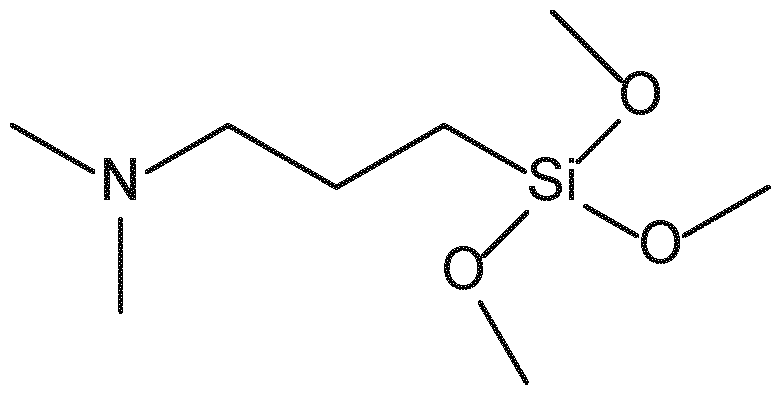
  • Organic silicon compounds of the formula (I) which are particularly suitable for solving the problem according to the invention are - (3-aminopropyl)triethoxysilane - (3-Aminopropyl)trimethoxysilane - (2-Aminoethyl)triethoxysilane - (2-Aminoethyl)trimethoxysilane - (3-Dimethylaminopropyl)triethoxysilane - (3-Dimethylaminopropyl)trimethoxysilane -1-(3-Dimethylaminopropyl)silanetriol - (2-Dimethylaminoethyl)triethoxysilane.
  • a process according to the invention is characterized in that the colorant (F) contains one or more organic C1-C6-alkoxysilanes (N-1) from the group consisting of (3-aminopropyl)triethoxysilane, (3-aminopropyl)trimethoxysilane, 1-(3-aminopropyl)silanetriol, (2-aminoethyl)triethoxysilane, (2-aminoethyl)trimethoxysilane, 1-(2-aminoethyl)silanetriol, (3-dimethylaminopropyl)triethoxysilane, (3-dimethylaminopropyl)trimethoxysilane, 1-(3-dimethylaminopropyl)silanetriol, (2-dimethylaminoethyl)triethoxy
  • organic C1-C6-alkoxysilanes of the formula (I) are commercially available.
  • (3-Aminopropyl)trimethoxysilane can be purchased from Sigma-Aldrich, for example.
  • (3-Aminopropyl)triethoxysilane is also commercially available from Sigma-Aldrich.
  • the aftertreatment agent (N) according to the invention contains, in addition to or as an alternative to the organic C 1 -C 6 -alkoxysilanes of the formula (I), at least one organic C 1 -C 6 -alkoxysilane of the formula (II) R 5 Si(OR 6 ) k (R 7 ) m (II).
  • the organic C1-C6-alkoxysilane(s) of the formula (II) can also be referred to as silanes of the alkyl-alkoxysilane or alkyl-hydroxysilane type, R 5 Si(OR 6 ) k (R 7 ) m (II), where - R 5 stands for a C 1 -C 12 alkyl group, - R 6 stands for a hydrogen atom or a C 1 -C 6 alkyl group, - R7 stands for a C1-C6 alkyl group, - k stands for an integer from 1 to 3, and - m stands for the integer 3 - k.
  • a process according to the invention is characterized in that the aftertreatment agent (N) contains at least one organic C1-C6-alkoxysilane (F1) of the formula (II).
  • R5Si(OR6)k(R7)m (II) where - R5 represents a C1-C12 alkyl group, - R6 represents a hydrogen atom or a C1-C6 alkyl group, - R7 represents a C1-C6 alkyl group, - k represents an integer from 1 to 3, and - m represents the integer 3 – k.
  • a post-treatment agent (N) used in the process according to the invention is characterized in that, in addition to the organic C1-C6-alkoxysilane(s) of the formula (I), it contains at least one further organic C1-C6-alkoxysilane of the formula (II) R 5 Si(OR 6 ) k (R 7 ) m (II), where - R 5 stands for a C 1 -C 12 alkyl group, - R 6 stands for a hydrogen atom or a C 1 -C 6 alkyl group, - R7 stands for a C1-C6 alkyl group - k stands for an integer from 1 to 3, and - m stands for the integer 3 - k.
  • the radical R 5 is a C 1 -C 12 alkyl group. This C1-C12 alkyl group is saturated and can be linear or branched. R 5 is preferably a linear C1-C8 alkyl group. R 5 is preferably a methyl group, an ethyl group, an n-propyl group, an n-butyl group, an n-pentyl group, an n-hexyl group, an n-octyl group or an n-dodecyl group. R 5 is particularly preferably a methyl group, an ethyl group or an n-octyl group.
  • the radical R 6 is a hydrogen atom or a C 1 -C 6 alkyl group.
  • R 6 is particularly preferably a methyl group or an ethyl group.
  • the radical R7 is a C1-C6 alkyl group.
  • R7 is particularly preferably a methyl group or an ethyl group.
  • k is an integer from 1 to 3 and m is the integer 3 - k. If k is the number 3, then m is 0. If k is the number 2, then m is 1. If k is the number 1, then m is 2.
  • Dyes with the best wash fastness properties were obtained when a dye (F) was used in the process which contains at least one organic C1-C6 alkoxysilane of the formula (II) in which the radical k is the number 3.
  • the radical m is the number 0.
  • Organic silicon compounds of the formula (II) which are particularly suitable for solving the problem according to the invention are - methyltrimethoxysilane - Methyltriethoxysilane - Ethyltriethoxysilane - n-hexyltriethoxysilane - n-octyltriethoxysilane - n-dodecyltriethoxysilane.
  • a process according to the invention is characterized in that the aftertreatment agent (N) contains one or more organic C 1 -C 6 -alkoxysilanes (N-1) from the group consisting of methyltrimethoxysilane, methyltriethoxysilane, ethyltrimethoxysilane, ethyltriethoxysilane, hexyltrimethoxysilane, hexyltriethoxysilane, octyltrimethoxysilane, octyltriethoxysilane, dodecyltrimethoxysilane, dodecyltriethoxysilane and/or their condensation products.
  • N-1 organic C 1 -C 6 -alkoxysilanes
  • an aftertreatment agent (N) according to the invention is characterized in that it contains at least a first organic C1-C6-alkoxy-silane of the formula (I), which is selected from the group consisting of (3-aminopropyl)triethoxysilane and (3-aminopropyl)trimethoxysilane, and additionally contains at least a second organic C1 - C6 -alkoxy-silane of the formula (II), which is selected from the group consisting of methyltrimethoxysilane, methyltriethoxysilane, ethyltrimethoxysilane, ethyltriethoxysilane, hexyltrimethoxysilane and hexyltriethoxysilane.
  • the organic C1 - C6 -alkoxy-silanes described above are reactive compounds. To achieve particularly good dyeing results, it is particularly advantageous to use the organic C1-C6-alkoxy-silanes of the formula (I) and/or (II) in certain quantity ranges in the dyeing agent (F).
  • the aftertreatment agent (N) according to the invention - based on the total weight of the agent - contains one or more organic C1-C6-alkoxysilanes (N-1) and/or their condensation products in a total amount of 0.1 to 30.0 wt. %, preferably 0.5 to 20.0 wt. %, more preferably 5.0 to 15.0 wt.
  • a process according to the invention is therefore characterized in that the aftertreatment agent (N) - based on the total weight of the aftertreatment agent (N) - contains one or more organic C 1 -C 6 -alkoxysilanes (N-1) and/or their condensation products in a total amount of from 0.1 to 30.0% by weight, preferably from 0.5 to 20.0% by weight, more preferably from 5.0 to 15.0% by weight and very particularly preferably from 6.0 to 12.5% by weight.
  • the organic C 1 -C 6 -alkoxysilanes (N-1) according to the invention are reactive compounds which can enter into a hydrolysis and condensation reaction with water.
  • the reaction of the organic C 1 -C 6 -alkoxysilanes with water can take place in various ways. The reaction starts as soon as the C1-C6 alkoxy silanes come into contact with water by mixing.
  • the precondensation can, for example, take place according to the following scheme: OH OH OMe OH H3C Si OMe + H3C Si OMe MeO Si O Si OMe + MeOH OMe OMe CH 3 CH 3
  • Both partially hydrolyzed and fully hydrolyzed C 1 -C 6 alkoxysilanes can participate in the condensation reaction and undergo condensation with unreacted, partially or fully hydrolyzed C1-C6 alkoxysilanes.
  • condensation reactions are, for example (shown using the mixture (3-aminopropyl)triethoxysilane and methyltrimethoxysilane): and/or and/or In the above example reaction schemes, the condensation to form a dimer is shown in each case, but further condensations to form oligomers with several silane atoms are also possible and also preferred.
  • This hydrolysis or condensation reaction begins even in the presence of very small amounts of water, so the oligomers and/or condensation products of the aforementioned organic silicon compounds are also included in this invention.
  • Another characteristic feature of the post-treatment agent (N) is its water content (N-2), which must be below 25% by weight. Based on its total weight, the post-treatment agent (N) therefore contains less than 25.0% by weight of water.
  • the low water content in the post-treatment agent (N) guarantees the storage stability of the post-treatment agent (N) and also ensures that the organic C 1 -C 6 alkoxysilanes are still in reactive form and have not yet fully polymerized. If the complete crosslinking of the organic C1-C6 alkoxysilanes only takes place after the application of the post-treatment agent (N) to the keratin fibers, the film created during crosslinking is characterized by a particularly high level of robustness and resistance. Robust films are obtained even if the post-treatment agent (N) contains less than 25.0% by weight of water. It has proven to be preferable if the water content in the post-treatment agent (N) is reduced even further.
  • the post-treatment agent (N) is particularly preferably formulated with such a low water content that the water content of the post-treatment agent (N) - based on the total weight of the post-treatment agent (N) - is in the range from 0 to 20.0% by weight, preferably from 0.1 to 10.0% by weight, more preferably from 0.1 to 5.0% by weight, and particularly preferably from 0.5 to 3.0% by weight of water (F3).
  • a method according to the invention is characterized in that the post-treatment agent (N) - based on the total weight of the post-treatment agent (N) - contains 0 to 20.0 wt. %, preferably from 0.1 to 10.0 wt.
  • the post-treatment agent (N) contains at least one solvent other than water (N-3).
  • a solvent is a fixed term and is used in chemistry for a substance that is liquid at room temperature (20 °C) and that is capable of dissolving other chemical substances.
  • the solvent(s) (N-3) lower the polarity of the post-treatment agent compared to water, prevent premature polymerization or film formation of the organic C1-C6 alkoxysilanes (N-1) and at the same time increase the storage stability of the post-treatment agent (N).
  • the solvent (N-3) preferably forms the cosmetic carrier - either together with the small amounts of water or alone - and thus preferably represents the main component of the post-treatment agent (N).
  • Suitable solvents include, for example, the compounds from the group consisting of ethanol, isopropanol, 1,2-propylene glycol, 1,3-propylene glycol, 1,2-butylene glycol, dipropylene glycol, diethylene glycol monoethyl ether, glycerin, phenoxyethanol, benzyl alcohol, poly-C 1 -C 6 -alkylene glycols, dimethyl carbonate, diethyl carbonate, ethylene carbonate, propylene carbonate, butylene carbonate and glycerol carbonate.
  • a method according to the invention is characterized in that the aftertreatment agent (N) contains at least one solvent (N-3) other than water, which is selected from the group consisting of ethanol, isopropanol, 1,2-propylene glycol, 1,3-propylene glycol, ethylene glycol, 1,2-butylene glycol, dipropylene glycol, diethylene glycol monoethyl ether, glycerin, phenoxyethanol, benzyl alcohol, poly-C1-C6-alkylene glycols, dimethyl carbonate, diethyl carbonate, ethylene carbonate, propylene carbonate, butylene carbonate and glycerol carbonate, preferably from the group consisting of ethanol and isopropanol, particularly preferably ethanol.
  • solvent N-3 other than water
  • a method according to the invention is characterized in that the aftertreatment agent (N) contains at least one solvent (F4) other than water, which is selected from the group consisting of ethanol and isopropanol.
  • F4 solvent
  • Ethanol has the CAS number 64-17-5.
  • Isopropanol is also alternatively known as 2-propanol and has the CAS number 67-63-0.1
  • 2-Propylene glycol is also alternatively known as 1,2-propanediol and has the CAS numbers 57-55-6 [(RS)-1,2-dihydroxypropane], 4254-14-2 [(R)-1,2-dihydroxypropane] and 4254-153 [(S)-1,2-dihydroxypropane].
  • 1,3-Propylene glycol is also alternatively known as 1,3-dihydroxypropane or 1,3-propanediol and has the CAS number 504-63-2.
  • Ethylene glycol is alternatively known as 1,2-ethanediol and has the CAS number 107-21-1.1
  • 2-Butylene glycol can also be known as 1,2-butanediol and has the CAS numbers 584-03- 2 (racemate), 40348-66-1 ((R)-enantiomer) and 73522-17-5 ((S)-enantiomer).
  • Dipropylene glycols (or oxydipropanols) form a group of substances derived from glycol ethers.
  • the group of dipropylene glycols includes ⁇ -oxydi-1-propanol with the CAS number 108-61- 2, ⁇ -oxydi-2-propanol with the CAS number.
  • Diethylene glycol monoethyl ether can alternatively be referred to as ethoxydiglycol or ethyldiglycol or 2-(2-ethoxyethoxy)ethanol) and has the CAS number 111-90-0.
  • Glycerin is alternatively referred to as 1,2,3-propanetriol and has the CAS number 56-81-5.
  • Phenoxyethanol has the CAS number 122-99-6.
  • Benzyl alcohol can alternatively be referred to as phenylmethanol and has the CAS number 100-51-6.
  • Suitable poly-C1-C6-alkylene glycols include in particular polyethylene glycols, as described, for example, by the formula (AG) (AG), where x is an integer from 1 to 1000, preferably 1 to 100, particularly preferably 2 to 50.
  • the alkylene glycols of the formula (AG) are protic substances with at least one hydroxy group, which can also be referred to as polyethylene glycols due to their repeating unit -CH2-CH2-O-, provided x is at least 2.
  • x is an integer from 1 to 10000.
  • these polyethylene glycols have a are particularly suitable for improving the fastness properties of the dyes and for optimally adjusting the viscosity of the agents.
  • Polyethylene glycols with a molecular weight between 200 g/mol and 400 g/mol are non-volatile liquids at room temperature.
  • PEG 600 has a melting range of 17 to 22 °C and thus a paste-like consistency. With molecular weights above 3000 g/mol, PEGs are solid substances and are sold as flakes or powder.
  • a particularly preferred low molecular weight polyethylene glycol is PEG-8.
  • Dimethyl carbonate is also alternatively referred to as carbonic acid dimethyl ester and has the CAS number 616-38-6.
  • Diethyl carbonate is also alternatively referred to as carbonic acid diethyl ester and has the CAS number 105-58-8.
  • Ethylene carbonate is also known as 1,3-dioxolan-2-one.
  • Ethylene carbonate corresponds to the compound of formula (I) in which R1 and R2 are hydrogen and n is 0.
  • Ethylene carbonate has the CAS number 96-49-1.
  • Propylene carbonate is alternatively referred to as 4-methyl-1,3-dioxolan-2-one.
  • Propylene carbonate corresponds to the compound of formula (I) in which R1 is a methyl group, R2 is hydrogen and n is 0.
  • Propylene carbonate has the CAS numbers 108-32-7 [(RS)-4-methyl-1,3-dioxolan-2-one], 51260-39-0 [(S)-4-methyl-1,3-dioxolan-2-one] and 16606-55-6 [(R)-4-methyl-1,3-dioxolan-2-one]. All of the aforementioned stereoisomers are encompassed by the invention.
  • butylene carbonate is understood to mean 1,2-butylene carbonate, which is alternatively also referred to as 4-ethyl-1,3-dioxolan-2-one and which has the CAS number 4437-85-8.
  • Butylene carbonate corresponds to the compound of formula (I) in which R1 is an ethyl group, R2 is a hydrogen atom and n is the number 0.
  • Glycerol carbonate is alternatively also referred to as 4-hydroxymethyl-1,3-dioxolan-2-one and has the CAS number 931-40-8.
  • Glycerol carbonate corresponds to the compound of formula (I) in which R1 is a hydroxymethyl group, R2 is a hydrogen atom and n is the number 0.
  • the solvent(s) (N-3) represent the cosmetic carrier of the after-treatment agent (N) and are therefore preferably used as the main component in the after-treatment agent (N).
  • the main component is an ingredient whose amount used exceeds that of all other ingredients.
  • the post-treatment agent (N) can contain - based on the total weight of the post-treatment agent (N) - one or more solvents (N-3) other than water in a total amount of 1.0 to 90.0 wt. %, preferably 5.0 to 75 wt. %, more preferably 10.0 to 55 wt.
  • a process according to the invention is characterized in that the aftertreatment agent (N) - based on the total weight of the aftertreatment agent (N) - contains one or more solvents (N-3) other than water in a total amount of 1.0 to 90.0 wt. %, preferably 5.0 to 75 wt. %, more preferably 10.0 to 55 wt. %, even more preferably 15.0 to 45 wt. %, and most preferably 15.0 to 25.0 wt. %.
  • a process according to the invention is characterized in that the aftertreatment agent (N) - based on the total weight of the aftertreatment agent (N) - contains 1.0 to 90.0 wt. %, preferably from 5.0 to 75 wt. %, more preferably from 10.0 to 55 wt. %, even more preferably from 15.0 to 45 wt. %, and most preferably from 15.0 to 25.0 wt. % ethanol.
  • the aftertreatment agent (N) can additionally contain at least one fatty component (N-4) that is liquid at 20 °C.
  • the liquid fatty components (N-4) can also further reduce the polarity of the aftertreatment agent (N) and further increase the storage stability of the aftertreatment agent.
  • fatty components are understood to mean organic compounds with a solubility in water at room temperature (22 °C) and atmospheric pressure (760 mmHg) of less than 1% by weight, preferably less than 0.1% by weight.
  • a fat component that is liquid at 20 °C has a melting point below 20 °C (measured under atmospheric pressure (760 mmHg)).
  • the definition of fat components explicitly only includes uncharged (i.e. non-ionic) compounds. Fat components have at least one saturated or unsaturated alkyl group with at least 8 carbon atoms.
  • the molecular weight of the fat components is a maximum of 5000 g/mol, preferably a maximum of 2500 g/mol and particularly preferably a maximum of 1000 g/mol.
  • the fat components are neither polyoxyalkylated nor polyglycerylated compounds.
  • Particularly suitable fatty components include, for example, linear or cyclic silicone oils, hydrocarbon oils, liquid fatty acid triglycerides, liquid fatty alcohols and ester oils, provided that each compound from the aforementioned substance classes has a melting point below 20°C.
  • non-ionic substances are explicitly considered as fatty components. Charged compounds such as fatty acids and their salts are not understood to be fatty components.
  • a method according to the invention is characterized in that the aftertreatment agent (N) contains at least one fatty component (N-4) that is liquid at 20°C and is preferably selected from the group of linear or cyclic silicone oils, hydrocarbon oils, liquid fatty acid triglycerides, liquid fatty alcohols, ester oils and mixtures thereof.
  • Silicone oils can also be referred to as oligoalkylsiloxanes and polyalkylsiloxanes that are liquid at 20 °C, i.e. the silicone oils have a melting point that is below 20 °C (at atmospheric pressure (760 mmHg).
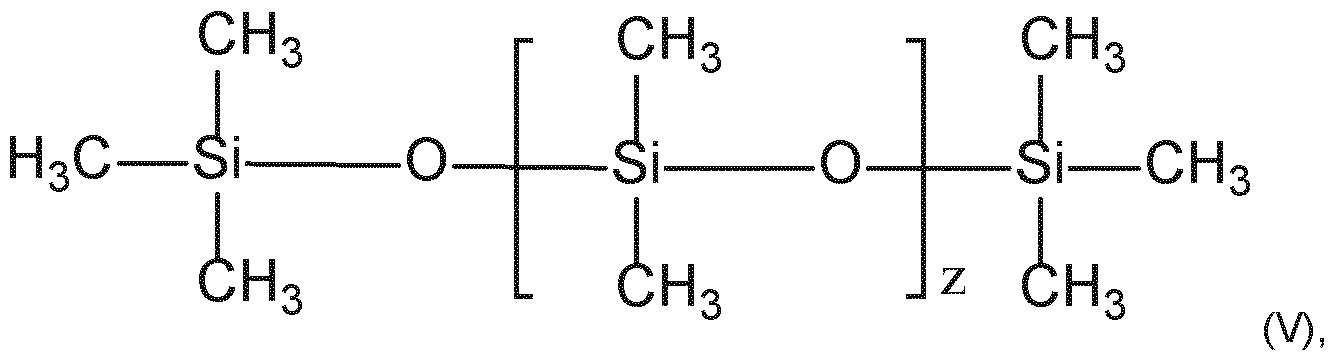
  • Preferred linear silicone oils are oligoalkylsiloxanes of the general formula (V) where z is an integer from 0 to 10000, preferably an integer from 0 to 1000, more preferably an integer from 0 to 100, and most preferably an integer from 0 to 10.
  • Particularly preferred linear oligoalkylsiloxanes are, for example, - hexamethyldisiloxane .
  • - Decamethyltetrasiloxane Hexamethyldisiloxane has the CAS number 107-46-0 and can be purchased commercially from Sigma-Aldrich, for example. Hexamethyldisiloxane is also sold commercially by Wacker under the trade name Belsil DM 0.65.
  • Octamethyltrisiloxane has the CAS number 107-51-7 and is also available commercially from Sigma-Aldrich.
  • Decamethyltetrasiloxane has the CAS number 141-62-8 and is also available commercially from Sigma-Aldrich.
  • Another particularly suitable silicone oil can be purchased commercially from Clearco, for example under the trade name Dimethicone Fluid 5 cSt. This silicone oil has the generic name polydimethylsiloxane and has the CAS number 63148-62-9. The substance is a clear, colorless and odorless liquid, low-viscosity oil.
  • Another silicone oil that is particularly suitable can be purchased from Dow Corning under the trade name Xiameter PMX 200 (1.5 cSt).
  • This oil is also a dimethicone or polydimethylsiloxane, which has the CAS number 63148-62-9.
  • Preferred cyclic oligoalkylsiloxanes are compounds of the general formula (VI) where y is an integer from 1 to 5. Preferably z is the number 1, 2 or 3.
  • an aftertreatment agent (N) is characterized in that it contains as fat component (N-4) at least one silicone oil of the formula (V) and/or (VI), where z is an integer from 0 to 10000, preferably an integer from 0 to 1000, more preferably an integer from 0 to 100, and most preferably an integer from 0 to 10, where y is an integer from 1 to 5, preferably an integer from 1 to 3.
  • a process according to the invention is characterized in that the aftertreatment agent (N) contains at least one fatty component (N-4) which is liquid at 20 °C and which is selected from the group of siloxanes of the formula (III) and/or the formula (IV) where z is an integer from 0 to 10, preferably an integer from 0 to 3, where y is an integer from 1 to 5, preferably an integer from 1 to 3.
  • a process according to the invention is characterized in that the aftertreatment agent (N) contains at least one fatty component (N-4) which is liquid at 20 °C and is selected from the group consisting of hexamethyldisiloxane, Octamethyltrisiloxane, decamethyltetrasiloxane, hexamethylcyclotrisiloxane, octamethylcyclotetrasiloxane and/or decamethylcyclopentasiloxane, very particularly preferably hexamethyldisiloxane.
  • N-4 fatty component which is liquid at 20 °C and is selected from the group consisting of hexamethyldisiloxane, Octamethyltrisiloxane, decamethyltetrasiloxane, hexamethylcyclotrisiloxane, octamethylcyclotetrasiloxane and/or decamethylcyclopentasiloxane, very particularly preferably hexamethyld
  • the oligoalkylsiloxanes are made up exclusively of dialkylsilyl groups (in particular dimethylsilyl groups) and trialkylsilyl groups (in particular trimethylsilyl groups) which are linked to one another via oxygen atoms.
  • the oligoalkylsiloxanes are therefore not themselves reactive compounds within the meaning of this invention and do not have any hydrolyzable groups.
  • Other particularly suitable fatty components which are liquid at 20°C are the hydrocarbon oils.
  • Hydrocarbons are compounds with 8 to 80 C atoms consisting exclusively of the atoms carbon and hydrogen.
  • aliphatic hydrocarbons such as mineral oils, liquid paraffin oils (e.g. paraffinium liquidum or paraffinum perliquidum), isoparaffin oils and polydecenes are particularly preferred.
  • the hydrocarbons according to the invention are also characterized in that they have a melting point under atmospheric pressure that is below 20 °C.
  • Liquid fatty acid triglycerides are also particularly suitable fat components that are liquid at 20 °C.
  • a C 12 -C 30 fatty acid triglyceride is understood to be the triester of the trihydric alcohol glycerol with three equivalents of fatty acid.
  • fatty acids are understood to mean saturated or unsaturated, unbranched or branched, unsubstituted or substituted C12-C30 carboxylic acids.
  • Unsaturated fatty acids can be monounsaturated or polyunsaturated. In the case of an unsaturated fatty acid, its CC double bond(s) can have the cis or trans configuration.
  • the fatty acid triglycerides are particularly suitable in which at least one of the ester groups is formed from glycerol with a fatty acid selected from dodecanoic acid (lauric acid), tetradecanoic acid (myristic acid), hexadecanoic acid (palmitic acid), tetracosanoic acid (lignoceric acid), octadecanoic acid (stearic acid), eicosanoic acid (arachidic acid), docosanoic acid (behenic acid), petroselinic acid [(Z)-6-octadecenoic acid], palmitoleic acid [(9Z)-hexadec-9-enoic acid], oleic acid [(9Z)-octadec-9-enoic acid], elaidic acid [(9E)-octadec-9-enoic acid], erucic acid [(13Z)-docos-13-enoic acid
  • a further particularly preferred embodiment is therefore an agent for coloring keratin fibers, which is characterized in that it contains, as the fat component (c) liquid at 20 °C, a naturally occurring fatty acid triglyceride and/or mixtures of naturally occurring fatty acid triglycerides which are contained in soybean oil, peanut oil, olive oil, sunflower oil, macadamia nut oil, moringa oil, apricot kernel oil, marula oil and/or optionally hydrogenated castor oil.
  • Liquid fatty alcohols are also particularly suitable fat components that are liquid at 20 °C.
  • Preferred linear, unsaturated fatty alcohols are (9Z)-octadec-9-en-1-ol (oleyl alcohol), (9E)-octadec-9-en-1-ol (elaidyl alcohol), (9Z,12Z)-octadeca-9,12-dien-1-ol (linoleyl alcohol), (9Z,12Z,15Z)-octadeca-9,12,15-trien-1-ol (linolenoyl alcohol), gadoleyl alcohol ((9Z)-eicos-9-en-1-ol), arachidonic alcohol ((5Z,8Z,11Z,14Z)-eicosa-5,8,11,14-tetraen-1-ol), erucyl alcohol ((13Z)-docos- 13-en-1-ol) and/or brassidyl alcohol ((13E)-docosen-1-ol).
  • Ester oils are also particularly suitable fatty components that are liquid at 20 °C. Ester oils are understood to be esters of C12-C30 fatty acids with aliphatic C1-C24 alcohols that have a liquid state at room temperature (20 °C). In other words, ester oils according to the invention are characterized in that they have a melting point of below 20 °C at normal pressure (1013 mbar).
  • a particularly strong improvement in the hair feel was achieved when a post-treatment agent was applied to the previously dyed hair, which contained at least one ester oil selected from the group of monoesters of C 12 -C 24 fatty acids with aliphatic, monohydric C 1 -C 24 alcohols.
  • the method according to the invention is characterized in that the post-treatment agent contains at least one fatty component (N-4) from the Group of esters from a C 12 -C 30 fatty acid and an aliphatic, monohydric C 1 -C 24 alcohol. Within the group of C 12 -C 30 fatty acids, the C 12 -C 24 fatty acids are particularly suitable.
  • C 12 -C 24 fatty acids that are suitable for the formation of ester oils (N-3) are caproic acid, caprylic acid, 2-ethylhexanoic acid, capric acid, lauric acid, isotridecanoic acid, myristic acid, palmitic acid, palmitoleic acid, stearic acid, isostearic acid, oleic acid, elaidic acid, petroselinic acid, linoleic acid, linolenic acid, elaeostearic acid, arachidic acid, gadoleic acid, behenic acid and erucic acid as well as their technical mixtures.
  • fatty alcohol components in the ester oils are isopropyl alcohol, caproic alcohol, caprylic alcohol, 2-ethylhexyl alcohol, capric alcohol, lauryl alcohol, isotridecyl alcohol, myristyl alcohol, cetyl alcohol, palmoleyl alcohol, stearyl alcohol, isostearyl alcohol, oleyl alcohol, elaidyl alcohol, petroselinyl alcohol, linolyl alcohol, linolenyl alcohol, elaeostearyl alcohol, arachyl alcohol, gadoleyl alcohol, behenyl alcohol, erucyl alcohol and brassidyl alcohol as well as their technical mixtures.
  • C12-C24 fatty acids are esterified by reaction with an aliphatic C1-C24 alcohol, which is particularly preferably a mono-alcohol, so that a mono-ester is formed during the esterification.
  • the aliphatic C1-C24 alcohols can be linear or branched, saturated, or mono- or polyunsaturated.
  • An alcohol selected from the group consisting of methanol, ethanol, n-propanol, isopropanol, n-butanol, n-pentanol, 2-ethylhexanol, n-hexanol, n-octanol, n-decanol and n-dodecanol can be used as an aliphatic saturated C1-C24 alcohol.
  • Examples of monohydric, unsaturated C1-C24 alcohol are oleyl alcohol (octadec-9-en-1-ol), palmitoleyl alcohol (cis-9-hexadecen-1-ol), elaidyl alcohol (trans-9-octadecen-1-ol) and cis-11-octadecen-1-ol.
  • the C12-C24 fatty acids and the C1-C12 alcohols are selected so that the ester formed by esterification of both reactants is an ester oil, ie it has a melting point below 20 °C at 1013 mbar.
  • ester oils according to the invention can be used in the form of commercially available raw materials, which are mixtures of the esters obtained from fatty acids of different chain lengths and/or alcohols of different chain lengths. These raw materials can have a melting range. For these raw materials, a Melting point below 20 °C means that the melting process begins at a temperature below 20 °C. For example, if an ester oil in the form of a certain raw material can be used on average, whereby this raw material has a melting range of 16 to 27 °C, then this raw material contains at least one ester oil with a melting point below 20 °C. This ester oil is therefore in accordance with the invention.
  • 2-ethylhexyl palmitate (Cegesoft ® 24), isopropyl myristate (Rilanit ® IPM), isononanoic acid C16-18 alkyl esters (Cetiol ® SN), stearic acid 2-ethylhexyl ester (Cetiol ® 868), cetyl oleate, glycerol tricaprylate, coconut fatty alcohol caprinate/caprylate (Cetiol ® LC), n-butyl stearate, oleyl erucate (Cetiol ® J 600), isopropyl palmitate (Rilanit ® IPP), oleyl oleate (Cetiol ® ), lauric acid hexyl ester (Cetiol ® A), di-n-butyl adipate (Cetiol ® B), cetyl oleate,
  • the ester oil (N-3) is particularly preferably selected from the group of isopropyl myristate, 2-ethylhexyl palmitate, isononanoic acid C16-18 alkyl ester, 2-ethylhexyl stearic acid ester, cetyl oleate, coconut fatty alcohol caprinate, coconut fatty alcohol caprylate, n-butyl stearate, oleyl erucate, isopropyl palmitate, oleyl oleate, hexyl laurate, cetearyl isononanoate and decyl oleate.
  • Isopropyl myristate is also alternatively referred to as isopropyl myristic acid ester and has the CAS number 110-27-0.
  • Isopropyl myristate is a colorless and odorless liquid. The melting point is 0 - 1 °C.
  • 2-Ethylhexyl palmitate is also known as hexadecanoic acid 2-ethylhexyl ester and has the CAS number 29806-73-3 .
  • 2-Ethylhexyl palmitate is a branched, saturated ester oil made from palmitic acid and ethylhexyl alcohols.
  • Isononanoic acid C16-18-alkyl ester is also known as cetearyl isononanoate; this ester has the CAS numbers 84878-33-1 and 84878-34-2. Isononanoic acid C16-18-alkyl ester is a clear, slightly yellowish liquid. At 20 °C, isononanoic acid C16-18-alkyl ester has a viscosity of 19 - 22 mPas.
  • Stearic acid 2-ethylhexyl ester is also known as ethylhexyl stearate and has the CAS number 91031-48-0.
  • Stearic acid 2-ethylhexyl ester is in the form of a clear, slightly yellowish, thin oil.
  • stearic acid 2-ethylhexyl ester has a viscosity of 14 - 16 mPas and is therefore an oil at room temperature.
  • Cetyl oleate has the CAS number 22393-86-8.
  • coconut fatty alcohol caprylate/caprate has the CAS number 95912-86-0.
  • n-Butyl stearate is also known as stearic acid butyl ester and has the CAS numbers 85408-76-0 (C16-18) and 123-95-5 (C18).
  • n-Butyl stearate is a yellowish liquid and begins to melt at 16 °C.
  • Oley lerucate has the CAS number 17673-56-2.
  • Oley lerucate is a yellow liquid.
  • oleyl erucate has a viscosity of 40 - 50 mPas and is therefore an oil at room temperature.
  • Isopropyl palmitate is also known as propan-2-yl hexadecanoate and has the CAS number 142-91-6. The melting point of isopropyl palmitate is 13.5 °C.
  • Oleyl oleate is also known as cis-9,10-octadecenyl-cis-9,10-octadecanoate or oleic acid oleyl ester and has the CAS number 3687-45-4.
  • Oleyl oleate is a clear, slightly yellowish oil that has a viscosity of 25 - 30 mPas at 20 °C and is an oil at room temperature.
  • Lauric acid hexyl ester is also known as hexyl laurate and has the CAS number 34316-64-8. Lauric acid hexyl ester is a clear, yellowish, odorless oil at room temperature. At 20 °C, lauric acid hexyl ester has a viscosity of 5 - 7 mPas and is therefore an oil at room temperature. Cetearyl isononanoate is also alternatively known as isononanoic acid C16-18 alkyl ester and has the CAS numbers 84878-33-1 and 84878-34-2. Cetearyl isononanoate is a yellowish liquid with a melting point of 16 - 22 °C.
  • Oleic acid decyl ester is also alternatively known as decyl oleate and has the CAS number 3687- 46-5. Oleic acid decyl ester is a slightly yellowish liquid that has a viscosity of 15 - 20 mPas at 20 °C. Oleic acid decyl ester is therefore an oil at room temperature.
  • the fatty component(s) (N-4) which are liquid at 20 °C are used in certain quantity ranges in the after-treatment agent (N) according to the invention.
  • the colorant (F) – based on the total weight of the colorant (F) – contains one or more fatty components (c) which are liquid at 20 °C in a total quantity from 1.0 to 99% by weight, preferably from 1.0 to 95.0% by weight, preferably from 10.0 to 90% by weight, more preferably from 30.0 to 85% by weight, even more preferably from 40.0 to 80% by weight and most preferably from 50.0 to 75% by weight.
  • a process according to the invention is characterized in that the aftertreatment agent (N) - based on the total weight of the aftertreatment agent (N) - contains one or more fat components (N-4) which are liquid at 20 °C in a total amount of from 1.0 to 95.0% by weight, preferably from 10.0 to 90% by weight, more preferably from 30.0 to 85% by weight, even more preferably from 40.0 to 80% by weight and most preferably from 50.0 to 75% by weight.
  • the aftertreatment agent (N) - based on the total weight of the aftertreatment agent (N) - contains one or more fat components (N-4) which are liquid at 20 °C in a total amount of from 1.0 to 95.0% by weight, preferably from 10.0 to 90% by weight, more preferably from 30.0 to 85% by weight, even more preferably from 40.0 to 80% by weight and most preferably from 50.0 to 75% by weight.
  • the post-treatment agent (N) is intended to improve the wash fastness of the direct dyes previously applied in the dyeing step, but is not itself a dye and therefore preferably does not contain any coloring compounds.
  • the post-treatment agent (N) therefore contains no oxidation dye precursors, no direct dyes and no pigments.
  • a method according to the invention is characterized in that the aftertreatment agent (N) does not contain any coloring compounds from the group of oxidation dye precursors, direct dyes and pigments.
  • Pigments in the sense of the present invention are understood to mean coloring compounds which have a solubility in water at 25 °C of less than 0.5 g/L, preferably less than 0.1 g/L, even more preferably less than 0.05 g/L.
  • the water solubility can be determined, for example, using the method described below: 0.5 g of the pigment are weighed in a beaker. A stir bar is added.
  • step (5) of the method according to the invention the after-treatment agent (N) is allowed to act on the keratin fibers.
  • Typical exposure times can be, for example, a period of 1 to 60 minutes, preferably 2 to 45 minutes and particularly preferably 5 to 30 minutes.
  • the after-treatment agent (N) While the after-treatment agent (N) is acting, it has proven particularly advantageous to treat the keratin fibers still covered with the after-treatment agent with a water-containing agent. In this way, a defined amount of water is again brought into contact with the after-treatment agent.
  • the defined amount of water is preferably applied to the keratin fibers that are still coated with the after-treatment agent (N).
  • the amount of water applied in step (5) is at most twice the weight of the post-treatment agent (N) used in step (3).
  • a post-condensation or post-crosslinking of the organic C 1 -C 6 alkoxysilanes can be initiated.
  • This post-crosslinking ensures further solidification of the film or coating.
  • a method is preferred which comprises (5) allowing the post-treatment agent (N) to act on the keratin fibers, wherein during the action a water-containing agent (W) is applied to the keratin fibers still covered with the post-treatment agent (N) and mixed with the post-treatment agent (N).
  • the application of the water-containing agent (W) in step (5) should not yet result in the after-treatment agent (N) being washed out, i.e.
  • the additional amount of water applied to the hair to which the after-treatment agent (N) has been applied should be so large that the C 1 -C 6 alkoxysilanes can come into contact with a sufficient amount of water, but the after-treatment agent (N) is not washed off the hair fibers or flows down from them.
  • this is the case if the weight of the water-containing agent (W) applied in step (5) is at most twice the weight of the after-treatment agent (N) applied in step (4).
  • a method which comprises (5) acting on the keratin fibers with the after-treatment agent (N), wherein during the action a water-containing agent (W) is applied to the keratin fibers still covered with the after-treatment agent (N) in an amount which is at most is twice as large as the amount of after-treatment agent (N) applied to the keratin fibers.
  • a method according to the invention is therefore characterized in that the amount by weight of water-containing agent (W) that comes into contact with the after-treatment agent (N) still on the keratin fibers as a result of the application of the water-containing agent (W) is at most twice as large as the weight of the after-treatment agent (N) applied in step (4).
  • a method according to the invention is characterized in that the amount by weight of water-containing agent (W) that comes into contact with the after-treatment agent (N) still on the keratin fibers as a result of the application of the water-containing agent (W) is at most as large as the weight of the after-treatment agent (N) applied in step (4).
  • the amount of water-containing agent (W) and the amount of after-treatment agent (N) are understood here to mean the amounts by weight. If 50 g of after-treatment agent (N) are applied to the keratin fibers or hair in step (4), preferably no more than 100 g of water-containing agent (W) are applied to the hair/keratin fibers in step (5). Particularly preferably, no more than 50 g of the water-containing agent (W) are applied.
  • the water-containing agent (W) itself preferably contains water as the main ingredient, but can also contain other ingredients such as preservatives and/or in particular thickeners.
  • the water-containing agent (W) preferably contains - based on the total weight of the water-containing agent (W) - 50 to 100% by weight, preferably 60 to 99.9% by weight, more preferably 60 to 99.9% by weight and very particularly preferably 70 to 99.9% by weight of water.
  • pure water can also be applied to the hair still covered with the after-treatment agent and mixed with the after-treatment agent.
  • the water-based agent (W) consists of water or contains 100% of water by weight.
  • pure water is very thin and relatively difficult for the user to apply, it has proven preferable to at least thicken the water with a thickener.
  • Other care or styling ingredients can also optionally be included in the water-based agent (W).
  • the defined amount of water can be distributed on the keratin fibers in step (5) and mixes with the post-treatment agent that is also still on the keratin fibers. (N). This mixing can be supported by massaging in by hand or with a brush. After applying the water-based agent (W) and mixing it with the after-treatment agent (N), the mixture of (N) and (W) can be left to act on the keratin fibers for some time. Possible exposure times here are 1 to 45 minutes, preferably 2 to 30 minutes, particularly preferably 5 to 15 minutes. During this exposure time, the keratin fibers or hair can also be kneaded or massaged several times to really ensure a closed film formation around each keratin fiber.
  • the after-treatment agent (6) can be rinsed out in one embodiment. In a further embodiment, however, it is also possible not to rinse out the post-treatment agent (N), but to dry the keratin fibers still coated with the post-treatment agent (N) - possibly diluted by adding water - without washing them out. Without washing out the post-treatment agent (N), the film formed on the keratin fibers can continue to condense or harden for some time. Since particularly resistant films can be obtained in this way, this embodiment is very particularly preferred.
  • a method according to the invention is therefore characterized by (6) drying the keratin fibers without first washing out the post-treatment agent (N).
  • the water (N-2) and the solvent(s) (N-3) present in the post-treatment agent evaporate or vaporize, and the film formed by the condensation of the C1-C6 alkoxysilanes hardens. Drying can be done either in the air or with heat, for example with the help of a heat cap or a hair dryer.
  • step (6) can begin immediately after step (4) if the after-treatment agent begins to dry after application during the exposure time.
  • the drying of the keratin fibers or the hair that takes place in step (6) can be accelerated by heat treatment.
  • Heat treatment means that the keratin fibers are brought into contact with a heated device or this heated device is placed on or to which keratin fibers are applied.
  • the keratin fibers can also be brought into contact with warm/hot air for the heat treatment.
  • the device used can be, for example, a hair dryer, a blow dryer, a heat cap, a straightening iron, a curling iron or an infrared lamp.
  • a method according to the invention is characterized in that the heat treatment is carried out by using a hair dryer, a blow dryer, a heat cap, a straightening iron, a curling iron or an infrared lamp.
  • the treatment temperature during the heat treatment is between 40 °C and 210 °C, preferably from 50 °C to 190 °C, more preferably from 50 °C to 170 °C, even more preferably from 50 °C to 150 °C and most preferably from 50 °C to 100 °C.
  • the heat treatment is carried out with a device which is heated to a temperature of 40 °C to 210 °C, preferably from 50 °C to 190 °C, more preferably from 50 °C to 170 °C, even more preferably from 50 °C to 150 °C and very particularly preferably from 50 °C to 100 °C.
  • a method according to the invention is characterized by (4) drying the keratin fibers without prior washing out of the after-treatment agent (N) at a temperature of 40 °C to 210 °C, preferably from 45 °C to 190 °C, more preferably from 45 °C to 170 °C, even more preferably from 45 °C to 150 °C and very particularly preferably from 45 °C to 100 °C.
  • the keratin fibers or the hair can be treated with a hair dryer that blows warm or hot air onto the keratin fibers. This air is particularly preferably 50 to 100 °C.
  • the keratin fibers or the hair are held under an infrared lamp, which is particularly preferably set to a temperature of 50 to 100 °C.
  • hair can also be pressed between two appropriately tempered plates of a straightening iron, whereby the plates can be moved along the fiber at the same time.
  • the plates of the straightening iron can, for example, be set to a temperature of up to 210 °C.
  • the heat treatment can expediently be carried out until the keratin fibers still coated with the after-treatment agent (F) have dried or are completely dry.
  • the user can freely choose the period of time between the application of the two agents (F) and (N).
  • the maximum period of time between the application of the two agents (F) and (N) is very particularly preferably limited to a time interval of a maximum of 24 hours. It has proven to be very particularly preferred if there is a period of a maximum of 24 hours, preferably a maximum of 12 hours, more preferably a maximum of 6 hours and very particularly preferably a maximum of 3 hours between the application of the coloring agent (F) and the application of the after-treatment agent (N) to the keratin fibers.
  • a method according to the invention is characterized in that there is a period of maximum 24 hours, preferably maximum 12 hours, more preferably maximum 6 hours and most preferably maximum 3 hours between the application of the colorant (F) and the after-treatment agent (N).
  • Colorants The following colorants were prepared (all data in % by weight unless otherwise stated) F1 (% by weight) F2 (% by weight) Cetearyl alcohol 5.0 5.0 Isopropyl myristate 2.0 2.0 Behentrimonium chloride 1.9 1.9 Distearoylethyl Hydroxyethylmonium methosulfate 1.1 1.1 Phenoxyethanol 1.1 1.1 Stearamidopropyl dimethylamine 1.0 1.0 Cetyl palmitate 0.7 0.7 Citric acid 0.2 0.2 Polyquaternium-37 0.15 0.15 Magnesium citrate 0.2 0.2 HB Blue 16 (3-[[9,10-Dihydro-4-(methylamino)-9,10- --- 0.3 dioxo-1-anthracenyl] amino]-N,N-dimethyl-N-propyl-, 1-propanaminium, bromide, CAS No.
  • the strands of hair were moistened, then the colorant was applied (0.4 g colorant per 1 g strand of hair) and left to take effect for 15 minutes at 30 °C.
  • the hair strands were then rinsed under running water for 1 minute.
  • the respective after-treatment product was applied to the still damp hair strands (0.4 g after-treatment product per 1 g hair strand) and massaged in.
  • the after-treatment product was left to work for 5 minutes, then water (0.4 g water per g hair strand) was applied to the hair strand again. Each hair strand was carefully massaged again. After a contact time of 5 minutes, each strand was dried at 50 °C without washing out the after-treatment product. 4.
  • the strands were stored overnight and then visually assessed under the daylight lamp. 0 HW is the color result that was obtained directly after coloring and drying.
  • the strands were then washed 6 or 12 times (6 HW, 12 HW).
  • a commercially available shampoo (0.25 g shampoo (Schauma 7 herbs) per 1 g hair) was applied to the strand and massaged in with the fingers for 30 seconds.
  • the shampoo was then rinsed out under running, lukewarm water for 1 minute and the hair strand was dried.
  • the process described above corresponds to one hair wash.
  • the process was repeated for each subsequent hair wash. After the corresponding number of hair washes, the strands were again visually assessed under the daylight lamp.

Landscapes

  • Health & Medical Sciences (AREA)
  • Life Sciences & Earth Sciences (AREA)
  • Animal Behavior & Ethology (AREA)
  • General Health & Medical Sciences (AREA)
  • Public Health (AREA)
  • Veterinary Medicine (AREA)
  • Birds (AREA)
  • Epidemiology (AREA)
  • Emergency Medicine (AREA)
  • Cosmetics (AREA)

Abstract

Gegenstand der vorliegenden Erfindung ist ein Verfahren zum Färben von keratinischen Fasern, insbesondere menschlichen Haaren, umfassend die folgenden Schritte in der angegebenen Reihenfolge: (1) Anwenden eines Färbemittels (F) auf den keratinischen Fasern, wobei das Färbemittel (F) enthält: (F-1) einen oder mehrere direktziehende Farbstoffe, (2) Einwirken des Färbemittels (F) auf die keratinischen Fasern, (3) gegebenenfalls Ausspülen des Färbemittels (F), (4) Anwenden eines Nachbehandlungsmittels (N) auf den keratinischen Fasern, wobei das Nachbehandlungsmittel (N) – bezogen auf das Gesamtgewicht des Nachbehandlungsmittels (N) – enthält: (N-1) ein oder mehrere organische C1-C6-Alkoxy-Silane und/oder deren Kondensationsprodukte, (N-2) weniger als 25,0 Gew.-% Wasser, und (N-3) mindestens ein von Wasser verschiedenes Lösungsmittel, (5) Einwirken des Nachbehandlungsmittels (N) auf die keratinischen Fasern, und (6) gegebenenfalls Ausspülen des Nachbehandlungsmittels (N).

Description

Henkel AG & Co. KGaA 2023P00100WO Verfahren zum Färben von keratinischen Fasern, umfassend die Färbung mit direktziehenden Farbstoffen und die Nachbehandlung mit C1-C6-Alkoxy-Silanen in einem Lösungsmittelsystem Gegenstand der vorliegenden Anmeldung ist ein Verfahren zum Färben von keratinischen Fasern, insbesondere menschlichen Haaren, bei welchem ein Färbemittel (F) und ein Nachbehandlungs- mittel (N) auf die keratinischen Fasern aufgetragen werden. Das Färbemittel (F) enthält mindestens einen direktziehenden Farbstoff, und das Nachbehandlungsmittel (N) ist wasserarm, enthält mindestens ein C1-C6-Alkoxy-Silan und mindestens ein Lösungsmittel. Die Veränderung von Form und Farbe von keratinischen Fasern, insbesondere von menschlichen Haaren, stellt einen wichtigen Bereich der modernen Kosmetik dar. Zur Veränderung der Haarfarbe kennt der Fachmann je nach Anforderung an die Färbung diverse Färbesysteme. Für permanente, intensive Färbungen mit guten Echtheitseigenschaften und guter Grauabdeckung werden üblicher- weise Oxidationsfärbemittel verwendet. Solche Färbemittel enthalten Oxidationsfarbstoff- vorprodukte, sogenannte Entwicklerkomponenten und Kupplerkomponenten, die unter dem Einfluss von Oxidationsmitteln wie beispielsweise Wasserstoffperoxid untereinander die eigentlichen Farbstoffe ausbilden. Oxidationsfärbemittel zeichnen sich durch sehr langanhaltende Färbeergeb- nisse aus. Bei dem Einsatz von direktziehenden Farbstoffen diffundieren bereits fertig ausgebildete Farbstoffe aus dem Färbemittel in die Haarfaser hinein. Im Vergleich zur oxidativen Haarfärbung weisen die mit direktziehenden Farbstoffen erhaltenen Färbungen eine geringere Haltbarkeit und schnellere Aus- waschbarkeit auf. Färbungen mit direktziehenden Farbstoffen verbleiben üblicherweise für einen Zeitraum zwischen 5 und 20 Haarwäschen auf dem Haar. Betreffend die Echtheitseigen-schaften der mit direktziehenden Farbstoffen erzeugten Färbungen besteht daher nach wie vor noch Verbesserungsbedarf. In FR 3081102 A1 wird ein Färbeverfahren beschrieben, bei dem Haare zunächst mit einem Färbe- mittel gefärbt werden, welches mindestens einen anionischen, direktziehenden Farbstoff enthält. Im Anschluss an diesen Färbeschritt wird ein weiteres Mittel auf die Haare aufgetragen, welches zwei voneinander verschiedene Organosilane enthält. Über dieses zweistufte Verfahren sollen Färbungen mit guten Echtheitseigenschaften auf Haaren erhalten werden. Den in FR 3081102 A1 beschriebenen Färbeverfahren werden zwar gute anwendungstechnische Eigenschaften zugeschrieben, dennoch bedarf die Waschechtheit der mit diesen Verfahren erzeugten Färbungen noch der weiteren Optimierung. Es war die Aufgabe der vorliegenden Erfindung, ein auf direktziehenden Farbstoffen basierendes Färbeverfahren zu finden, das Färbungen mit verbesserter Waschechtheit und einem verbesserten Egalisiervermögen liefert. Überraschenderweise hat sich nun herausgestellt, dass diese weitere Verbesserung der Echtheitseigenschaften möglich wird, wenn Haare, die mit einem direktziehenden Farbstoff gefärbt wurden, mit einem Nachbehandlungsmittel behandelt werden, welches ein oder mehrere organische C1-C6-Alkoxy-Silane in einem speziellen, wasserarmen und lösungsmittelbasierten Trägersystem enthält. Ein erster Gegenstand der vorliegenden Erfindung ist ein Verfahren zum Färben von keratinischen Fasern, insbesondere menschlichen Haaren, umfassend die folgenden Schritte in der angegeben- en Reihenfolge: (1) Anwenden eines Färbemittels (F) auf den keratinischen Fasern, wobei das Färbemittel (F) enthält: (F-1) einen oder mehrere direktziehende Farbstoffe, (2) Einwirken des Färbemittels (F) auf die keratinischen Fasern, (3) gegebenenfalls Ausspülen des Färbemittels (F), (4) Anwenden eines Nachbehandlungsmittels (N) auf den keratinischen Fasern, wobei das Nachbehandlungsmittel (N) – bezogen auf das Gesamtgewicht des Nachbehandlungsmittels (N) – enthält: (N-1) ein oder mehrere organische C1-C6-Alkoxy-Silane und/oder deren Kondensationsprodukte, (N-2) weniger als 25,0 Gew.-% Wasser, und (N-3) mindestens ein von Wasser verschiedenes Lösungsmittel, (5) Einwirken des Nachbehandlungsmittels (N) auf die keratinischen Fasern, und (6) gegebenenfalls Ausspülen des Nachbehandlungsmittels (N). Keratinische Fasern Unter keratinischen Fasern sind Haare, Wolle und Pelze zu verstehen. Ganz besonders bevorzugt wird unter keratinischen Fasern menschliche Haare verstanden Anwendung des Färbemittels (F) in Schritt (1) In Schritt (1) des erfindungsgemäßen Verfahrens wird das Färbemittel (F) auf den keratinischen Fasern bzw. den Haaren angewendet. Das Färbemittel (F) enthält mindestens einen direkt- ziehenden Farbstoff (F-1). Hierbei handelt sich um Farbstoffe, die direkt auf das Haar aufziehen und keinen oxidativen Prozess zur Ausbildung der Farbe benötigen. Direktziehende Farbstoffe sind üblicherweise Nitrophenylendiamine, Nitroamino-phenole, Azofarbstoffe, Anthrachinone, Triarylmethanfarbstoffe oder Indophenole. Die direktziehenden Farbstoffe im Sinne der vorliegenden Erfindung besitzen eine Löslichkeit in Wasser (760 mmHg) bei 25 °C von mehr als 0,5 g/L und sind daher nicht als Pigmente anzusehen. Bevorzugt besitzen die direktziehenden Farbstoffe im Sinne der vorliegenden Erfindung eine Löslichkeit in Wasser (760 mmHg) bei 25 °C von mehr als 1,0 g/L. Die Wasserlöslichkeit der direktziehenden Farbstoffe kann beispielsweise auf dem folgenden Weg bestimmt werden.0,1 g des direktziehenden Farbstoffes werden in ein Becherglas gegeben. Es wird ein Rührfisch hinzugegeben. Dann werden 100 ml Wasser hinzugefügt. Diese Mischung wird auf einem Magnetrührer unter Rühren auf 25 °C erwärmt. Es wird für 60 Minuten gerührt. Danach wird die wässrige Mischung visuell beurteilt. Sind noch ungelöste Reste vorhanden, wird die Wassermenge – beispielsweise in Schritten von 10 ml – erhöht. Es wird solange Wasser zugegeben, bis sich die eingesetzte Farbstoffmenge komplett gelöst hat. Sofern sich die Farbstoff-Wasser- Mischung aufgrund der hohen Intensität des Farbstoffes nicht visuell beurteilten lässt, wird die Mischung filtriert. Bleibt auf dem Filterpapier ein Anteil an ungelösten Farbstoffen zurück, wird der Löslichkeitsversuch mit einer höheren Wassermenge wiederholt. Lösen sich 0,1 g des anionischen direktziehenden Farbstoffes bei 25 °C in 100 ml Wasser, so liegt die Löslichkeit des Farbstoffes bei 1,0 g/L. Direktziehende Farbstoffe können in kationische, anionische und nichtionische direktziehende Farbstoffe unterteilt werden. Bei Einsatz im erfindungsgemäßen Verfahren konnten insbesondere mit kationischen Farbstoffen (F-1) gute Farbergebnisse mit herausragenden Echtheitseigen- schaften erzielt werden. Im Rahmen einer Ausführungsform ist das erfindungsgemäße Verfahren dadurch gekennzeichnet, dass das Färbemittel (F) mindestens einen direktziehenden Farbstoff (F-1) aus der Gruppe der kationischen, anionischen und/oder nichtionischen direktziehenden Farbstoffe, besonders bevorzugt aus der Gruppe der kationischen direktziehenden Farbstoffe, enthält. Bevorzugte kationische direktziehende Farbstoffe sind Basic Blue 7, Basic Blue 26, Basic Violet 2 und Basic Violet 14, Basic Yellow 57, Basic Red 76, Basic Blue 16, Basic Blue 347 (Cationic Blue 347 / Dystar), HC Blue No.16, Basic Blue 99, Basic Brown 16, Basic Brown 17, Yellow 87, Basic Orange 31 und Basic Red 51. Im Rahmen einer weiteren besonders bevorzugten Ausführungsform ist ein erfindungegemäßes Verfahren dadurch gekennzeichnet, dass das Färbemittel (F) mindestens einen kationischen direktziehenden Farbstoff (F-1) enthält, der ausgewählt ist aus der Gruppe aus Basic Blue 7, Basic Blue 26, Basic Violet 2 und Basic Violet 14, Basic Yellow 57, Basic Red 76, Basic Blue 16, Basic Blue 347 (Cationic Blue 347 / Dystar), HC Blue No.16, Basic Blue 99, Basic Brown 16, Basic Brown 17, Yellow 87, Basic Orange 31 und Basic Red 51. Geeignete anionische direktziehende Farbstoffe sind die unter den internationalen Bezeichnungen bzw. Handelsnamen Bromphenolblau, Tetrabromphenolblau, Acid Yellow 1, Yellow 10, Acid Yellow 23, Acid Yellow 36, Acid Orange 7, Acid Red 33, Acid Red 52, Pigment Red 57:1, Acid Blue 7, Acid Green 50, Acid Violet 43, Acid Black 1 und Acid Black 52 bekannten Verbindungen. Als nichtionische direktziehende Farbstoffe eignen sich zum Beispiel nichtionische Nitro- und Chinonfarbstoffe und neutrale Azofarbstoffe. Gut geeignete nichtionische direktziehende Farbstoffe sind die unter den internationalen Bezeichnungen bzw. Handelsnamen HC Yellow 2, HC Yellow 4, HC Yellow 5, HC Yellow 6, HC Yellow 12, HC Orange 1, Disperse Orange 3, HC Red 1, HC Red 3, HC Red 10, HC Red 11, HC Red 13, HC Red BN, HC Blue 2, HC Blue 11, HC Blue 12, Disperse Blue 3, HC Violet 1, Disperse Violet 1, Disperse Violet 4, Disperse Black 9 bekannten Verbindungen, sowie 1,4-Diamino-2-nitrobenzol, 2-Amino-4-nitrophenol, 1,4-Bis-(2-hydroxyethyl)-amino-2-nitro- benzol, 3-Nitro-4-(2-hydroxyethyl)-aminophenol, 2-(2-Hydroxyethyl)amino-4,6-dinitrophenol, 4-[(2- Hydroxyethyl)amino]-3-nitro-1-methylbenzol, 1-Amino-4-(2-hydroxyethyl)-amino-5-chlor-2- nitrobenzol, 4-Amino-3-nitrophenol, 1-(2'-Ureidoethyl)amino-4-nitrobenzol, 2-[(4-Amino-2- nitrophenyl)amino]-benzoesäure, 6-Nitro-1,2,3,4-tetrahydrochinoxalin, 2-Hydroxy-1,4-naphtho- chinon, Pikraminsäure und deren Salze, 2-Amino-6-chloro-4-nitrophenol, 4-Ethylamino-3-nitro- benzoesäure und 2-Chlor-6-ethylamino-4-nitrophenol. Der oder die direktziehenden Farbstoffe, insbesondere die kationischen direktziehenden Farbstoffe, können je nach erwünschter Farbintensität in verschiedenen Mengen im Färbemittel (F) eingesetzt werden. Besonders gute Ergebnisse konnten erhalten werden, wenn das Färbemittel (F) – bezogen auf das Gesamtgewicht des Färbemittels (F) – einen oder mehrere direktziehende Farbstoffe in einer Gesamtmenge von 0,01 bis 10,0 Gew.-%, bevorzugt von 0,05 bis 8,0 Gew.-%, weiter bevorzugt von 0,1 bis 6,0 Gew.-% und ganz besonders bevorzugt von 0,15 bis 4,5 Gew.-% enthält. In einer weiteren bevorzugten Ausführungsform ist ein erfindungsgemäßes Verfahren dadurch gekennzeichnet, dass das Färbemittel (F) – bezogen auf das Gesamtgewicht des Färbemittels (F) - einen oder mehrere direktziehende Farbstoffe in einer Gesamtmenge von 0,01 bis 10,0 Gew.-%, bevorzugt von 0,05 bis 8,0 Gew.-%, weiter bevorzugt von 0,1 bis 6,0 Gew.-% und ganz besonders bevorzugt von 0,15 bis 4,5 Gew.-% enthält. Die Anwendung des Färbemittels (F) kann auf angefeuchteten oder trockenen keratinischen Fasern erfolgen. Die Anwendung oder Applikation kann zum Beispiel unter Zuhilfenahme eines Pinsels, einer Bürste oder eine Tülle erfolgen, oder der Anwender kann hierfür seine behandschuhte Hand zu Hilfe nehmen. Zusätzlich zu dem oder den direktziehenden Farbstoffen (F-1) kann das Färbemittel (F) optional auch noch weitere Inhaltsstoffe enthalten. So kann das Färbemittel (F) ferner auch noch weitere Wirk-, Hilfs- und Zusatzstoffe enthalten, wie beispielsweise kationische, nichtionische, amphotere, zwitterionische und/oder anionische Tenside, verdickende Polymere, filmbildende Polymere, Strukturanten wie Glucose, Maleinsäure und Milchsäure, haarkonditionierende Verbindungen wie Phospholipide, beispielsweise Lecitin und Kephaline; Parfümöle, Dimethylisosorbid und Cyclodextrine; faserstrukturverbessernde Wirkstoffe, insbesondere Mono-, Di- und Oligosaccharide wie beispielsweise Glucose, Galactose, Fructose, Fruchtzucker und Lactose; Farbstoffe zum Anfärben des Mittels; Antischuppenwirkstoffe wie Piroctone Olamine, Zink Omadine und Climbazol; Aminosäuren und Oligopeptide; Protein- hydrolysate auf tierischer und/oder pflanzlicher Basis, sowie in Form ihrer Fettsäure-Kondensations- produkte oder gegebenenfalls anionisch oder kationisch modifizierten Derivate; Lichtschutzmittel und UV-Blocker; Wirkstoffe wie Panthenol, Pantothensäure, Pantolacton, Allantoin, Pyrrolidinon- carbonsäuren und deren Salze sowie Bisabolol; Polyphenole, insbesondere Hydroxyzimtsäuren, 6,7-Dihydroxycumarine, Hydroxybenzoesäuren, Catechine, Tannine, Leukoanthocyanidine, Anthocyanidine, Flavanone, Flavone und Flavonole; Ceramide oder Pseudoceramide; Vitamine, Provitamine und Vitaminvorstufen; Pflanzenextrakte; Fette und Wachse wie Fettalkohole, Bienenwachs, Montanwachs und Paraffine; Quell- und Penetrationsstoffe wie Glycerin, Propylenglykolmonoethylether, Carbonate, Hydrogencarbonate, Guanidine, Harnstoffe sowie pri- märe, sekundäre und tertiäre Phosphate; Trübungsmittel wie Latex, Styrol/PVP- und Styrol/Acrylamid-Copolymere; Perlglanzmittel wie Ethylenglykolmono- und -distearat sowie PEG-3- distearat; sowie Treibmittel wie Propan-Butan-Gemische, N2O, Dimethylether, CO2 und Luft. Die Auswahl dieser weiteren Stoffe wird der Fachmann gemäß der gewünschten Eigenschaften der Mittel treffen. Bezüglich weiterer fakultativer Komponenten sowie der eingesetzten Mengen dieser Komponenten wird ausdrücklich auf die dem Fachmann bekannten einschlägigen Handbücher verwiesen. Die zusätzlichen Wirk- und Hilfsstoffe werden in den erfindungsgemäßen Zubereitungen bevorzugt in Mengen von jeweils 0,0001 bis 25 Gew.-%, insbesondere von 0,0005 bis 15 Gew.-%, bezogen auf das Gesamtgewicht des jeweiligen Mittels, eingesetzt. Einwirken des Färbemittels (F) in Schritt (2) In Schritt (2) des erfindungsgemäßen Verfahrens wird das Färbemittel (F) auf die keratinischen Fasern bzw. Haare einwirken gelassen. Übliche Einwirkzeiten sind beispielsweise 1 Minute bis 60 Minuten, bevorzugt 5 Minuten bis 45 Minuten. Während der Einwirkzeit des Färbemittels (F) auf die Fasern kann es vorteilhaft sein, den Färbe- vorgang durch Wärmezufuhr zu unterstützen. Die Wärmezufuhr kann durch eine externe Wärme- quelle, wie z.B. warme Luft eines Warmluftgebläses, als auch, insbesondere bei einer Haarfärbung am lebenden Probanden, durch die Körpertemperatur des Probanden erfolgen. Bei letzterer Möglich- keit wird üblicherweise die zu färbende Partie mit einer Haube abgedeckt. Insbesondere liegt die Temperatur während der Einwirkzeit zwischen 10 °C und 45 °C, insbesondere zwischen 20 °C und 40 °C. Ausspülen des Färbemittels (F) in Schritt (3) In Schritt (3) des Verfahrens kann das Färbemittel (F) ausgespült werden. Der Ausspülschritt ist optional und kann im Rahmen einer Ausführungsform beispielsweise mit Wasser oder mit Wasser unter Zuhilfenahme eines Shampoos erfolgen. Bevorzugt wird das Färbemittel (F) nach dem Einwirken in Schritt (3) ausgespült. Bevorzugt ist daher ein Verfahren zum Färben von keratinischen Fasern, insbesondere menschlichen Haaren, umfassend die folgenden Schritte in der angegebenen Reihenfolge: (1) Anwenden eines Färbemittels (F) auf den keratinischen Fasern, wobei das Färbemittel (F) enthält: (F-1) einen oder mehrere direktziehende Farbstoffe, (2) Einwirken des Färbemittels (F) auf die keratinischen Fasern, (3) Ausspülen des Färbemittels (F), (4) Anwenden eines Nachbehandlungsmittels (N) auf den keratinischen Fasern, wobei das Nachbehandlungsmittel (N) – bezogen auf das Gesamtgewicht des Nachbehandlungsmittels (N) – enthält: (N-1) ein oder mehrere organische C1-C6-Alkoxy-Silane und/oder deren Kondensations-produkte, (N-2) weniger als 25,0 Gew.-% Wasser, und (N-3) mindestens ein von Wasser verschiedenes Lösungsmittel, (5) Einwirken des Nachbehandlungsmittels (N) auf die keratinischen Fasern, und (6) gegebenenfalls Ausspülen des Nachbehandlungsmittels (N). Im Rahmen einer weiteren besonders bevorzugten Ausführungsform ist das erfindungegemäße Verfahren gekennzeichnet durch das (2) Einwirken des Färbemittels (F) auf die keratinischen Fasern für einen Zeitraum von 2 bis 60 Minuten, bevorzugt 5 bis 45 Minuten, und besonders bevorzugt 5 bis 30 Minuten, und das (3) Ausspülen des Färbemittels (F). Anwenden des Nachbehandlungsmittels (N) in Schritt (4) Wird das Färbemittel (F) nicht ausgespült, dann erfolgt die Anwendung des Nachbehandlungs- mittels (N) in Schritt (4) im Anschluss an Schritt (2). Im Rahmen dieser Ausführungsform wird dann das Nachbehandlungsmittel (N) auf die noch mit dem Färbemittel bedeckten Haare appliziert. Es ist jedoch bevorzugt, wenn das Färbemittel (F) vor dem Auftragen des Nachbehandlungsmittels (N) ausgespült wird. Wird das Färbemittel (F) ausgespült, dann wird das Nachbehandlungsmittel in Schritt (4) im Anschluss an Schritt (3) auf die keratinischen Fasern aufgetragen. Hierbei kann das Auftragen auf die nach dem Ausspülen noch feuchten bzw. handtuchtrockenen Haare erfolgen, oder aber die keratinischen Fasern werden zwischen Schritt (3) und (4) getrocknet. Im Rahmen einer weiteren Ausführungsform ist ein erfindungsgemäßes Verfahren daher gekennzeichnet durch das (4) Anwenden eines Nachbehandlungsmittels (N) auf handtuchtrockenen oder getrockneten keratinischen Fasern. Besonders haltbare Färbungen wurden erhalten, wenn das Nachbehandlungsmittel (N) auf noch angefeuchtetes bzw. handtuchtrockenes Haar aufgetragen wurde. Da das Nachbehandlungsmittel (N) selbst wasserarm bzw. wasserfrei ist, unterstützt die so noch im Haar befindliche Wasser-menge die Kondensation der organischen C1-C6-Alkoxysilane direkt auf der Oberfläche des Keratins. Auf diese Weise bildet sich ein besonders gleichmäßiges und widerstandsfähiges Coating aus, welches die Haarfaser eng umhüllt und welches direkt an der Stelle entsteht, an der sich der Film auch befinden soll. Unter angefeuchtetem bzw. handtuchtrockenem Haar werden Haare verstanden, die am Waschbecken oder unter der Dusche vollständig mit Wasser benetzt wurden, dann ausgedrückt und mit einem Handtuch (z.B. für 30 Sekunden) trocken gerubbelt wurden. Angefeuchtetes bzw. handtuchtrockenes Haar ist demzufolge nicht mehr tropfnass, aber noch feucht. Im Rahmen einer weiteren ganz besonders bevorzugten Ausführungsform ist das erfindungsgemäße Verfahren gekennzeichnet durch das (4) Anwenden des Nachbehandlungsmittels (N) auf noch feuchten bzw. handtuchtrockenen keratinischen Fasern. Bei den keratinischen Fasern, die kurz vor der Anwendung des Nachbehandlungsmittels (N) noch feucht oder handtuchtrocken sind, erfolgte das Auswaschen des Färbemittels (F) maximal 30 Minuten, bevorzugt maximal 10 Minuten vor Anwendung des Nachbehandlungsmittels (N). Das Nachbehandlungsmittel (N) ist dadurch gekennzeichnet, dass es – bezogen auf sein Gesamtgewicht – enthält: (N-1) ein oder mehrere organische C1-C6-Alkoxy-Silane und/oder deren Kondensationsprodukte, und (N-2) weniger als 25,0 Gew.-% Wasser, und (N-3) mindestens ein von Wasser verschiedenes Lösungsmittel. Das bzw. die organischen C1-C6-Alkoxy-Silane (N-1) liegen daher im Nachbehandlungsmittel (N) in einem lösungsmittelhaltigen Träger und in einem wasserarmen Milieu vor. Als erste erfindungswesentliche Substanzklasse enthält das Nachbehandlungsmittel (N) ein oder mehrere organische C1-C6-Alkoxy-Silane (N-1) und/oder deren Kondensationsprodukte. Die organischen C1-C6-Alkoxy-Silane (N-1) sind reaktive Verbindungen. Organische Siliciumverbindungen, die alternativ auch als siliciumorganische Verbindungen bezeichnet werden, sind Verbindungen, die entweder eine direkte Silicium-Kohlenstoff-Bindung (Si-C) aufweisen oder in denen der Kohlenstoff über ein Sauerstoff-, Stickstoff- oder Schwefel-Atom an das Silicium-Atom geknüpft ist. Die erfindungsgemäßen organischen C1-C6-Alkoxy-Silane sind Verbindungen, die eine bis drei Silicumatome enthalten. Besonders bevorzugt enthalten die organischen C1-C6-Alkoxy- Silanen ein oder zwei Siliciumatome. Die Bezeichnung Silan steht nach den IUPAC-Regeln für eine Stoffgruppe chemischer Verbindungen, die auf einem Silicium-Grundgerüst und Wasserstoff basieren. Bei organischen Silanen sind die Wasserstoff-Atome ganz oder teilweise durch organische Gruppen wie beispielsweise (substituierte) Alkylgruppen und/oder Alkoxygruppen ersetzt. In den organischen Silanen kann auch ein Teil der Wasserstoffatome durch Hydroxygruppen ersetzt sein. Organische C1-C6-Alkoxy-Silane umfassend mindestens eine C1-C6-Alkoxygruppe, die direkt an das Siliciumatom gebunden ist. Die Alkoxygruppe ist reaktiv und kann in Anwesenheit von Wasser zunächst hydrolysiert werden und im Anschluss daran mit einem weiteren organische C1-C6-Alkoxy- Silan (oder dessen Hydrolyseprodukt) kondensiert werden. Bei der C1-C6-Alkoxygruppe handelt es sich bevorzugt um eine Ethoxygruppe oder um eine Methoxygruppe. Handelt es sich beispielsweise bei der hydrolysierbaren Gruppe um eine Ethoxygruppe, so enthält die organische Siliciumverbindung bevorzugt eine Struktureinheit R’R‘‘R‘‘‘Si-O-CH2-CH3. Die Reste R‘, R‘‘ und R‘‘‘ stellen hierbei die drei übrigen freien Valenzen des Siliciumatoms dar. Ganz besonders gute Ergebnisse konnten erhalten werden, wenn das erfindungsgemäße Nachbehandlungsmittel (N) mindestens ein erstes organisches C1-C6-Alkoxy-Silan (N-1) der Formel (I) enthielt. In einer besonders bevorzugten Ausführungsform ist ein erfindungsgemäßes Verfahren dadurch gekennzeichnet, dass das Nachbehandlungsmittel (N) mindestens ein organisches C1-C6-Alkoxy- Silan (N-1) der Formel (I) und/oder dessen Kondensationsprodukte enthält, R1R2N-L-Si(OR3)a(R4)b (I), wobei - R1, R2 unabhängig voneinander für ein Wasserstoffatom oder eine C1-C6-Alkylgruppe stehen, - L für eine lineare oder verzweigte, zweiwertige C1-C20-Alkylengruppe steht, - R3 für ein Wasserstoffatom oder für eine C1-C6-Alkylgruppe steht, - R4 für eine C1-C6-Alkylgruppe steht, - a, für eine ganze Zahl von 1 bis 3 steht, und - b für die ganze Zahl 3 – a steht. Die Substituenten R1, R2, R3, R4 und L, in den Verbindungen der Formel (I) sind nachstehend beispielhaft erläutert: Beispiele für eine C1-C6-Alkylgruppe sind die Gruppen Methyl, Ethyl, Propyl, Isopropyl, n-Butyl, s- Butyl und t-Butyl, n-Pentyl und n-Hexyl. Propyl, Ethyl und Methyl sind bevorzugte Alkylreste. Bei- spiele für eine C2-C6-Alkenylgruppe sind Vinyl, Allyl, But-2-enyl, But-3-enyl sowie Isobutenyl, bevor- zugte C2-C6-Alkenylreste sind Vinyl und Allyl. Bevorzugte Beispiele für eine Hydroxy-C1-C6- alkylgruppe sind eine Hydroxymethyl-, eine 2-Hydroxyethyl-, eine 2-Hydroxypropyl, eine 3-Hydroxy- propyl-, eine 4-Hydroxybutylgruppe, eine 5-Hydroxypentyl- und eine 6-Hydroxyhexylgruppe; eine 2- Hydroxyethylgruppe ist besonders bevorzugt. Beispiele für eine Amino-C1-C6-alkyl-gruppe sind die Aminomethylgruppe, die 2-Aminoethylgruppe, die 3-Aminopropylgruppe. Die 2-Aminoethylgruppe ist besonders bevorzugt. Beispiele für eine lineare zweiwertige C1-C20-Alkylengruppe sind beispielsweise die Methylen-gruppe (-CH2-), die Ethylengruppe (-CH2-CH2-), die Propylengruppe (- CH2-CH2-CH2-) und die Butylengruppe (-CH2-CH2-CH2-CH2-). Die Propylengruppe (-CH2-CH2-CH2-) ist besonders bevorzugt. Ab einer Kettenlänge von 3 C-Atomen können zweiwertige Alkylengruppen auch verzweigt sein. Beispiele für verzweigte, zweiwertige C3-C20-Alkylengruppen sind (-CH2- CH(CH3)-) und (-CH2-CH(CH3)-CH2-). In den organischen Siliciumverbindungen der Formel (I) R1R2N-L-Si(OR3)a(R4)b (I), stehen die Reste R1 und R2 unabhängig voneinander für ein Wasserstoffatom oder eine C1-C6- Alkylgruppe. Ganz besonders bevorzugt stehen die Reste R1 und R2 beide für ein Wasserstoffatom. Im Mittelteil der organischen Siliciumverbindung befindet sich die Struktureinheit oder der Linker -L- der für eine lineare oder verzweigte, zweiwertige C1-C20-Alkylengruppe steht. Bevorzugt steht -L- für eine lineare, zweiwertige C1-C20-Alkylengruppe. Weiter bevorzugt steht -L- für eine lineare zweiwertige C1-C6-Alkylengruppe. Besonders bevorzugt steht -L- für eine Methylengruppe (-CH2-), eine Ethylengruppe (-CH2-CH2-), eine Propylengruppe (-CH2-CH2-CH2-) oder eine Butylengruppe (-CH2-CH2-CH2-CH2-). Ganz besonders bevorzugt steht L für eine Propylengruppe (-CH2-CH2-CH2-). Die erfindungsgemäßen organischen Siliciumverbindungen der Formel (I) R1R2N-L-Si(OR3)a(R4)b (I), tragen jeweils ein einem Ende die Silicium-haltige Gruppierung -Si(OR3)a(R4)b. In der endständigen Struktureinheit -Si(OR3)a(R4)b steht der Rest R3 für ein Wasserstoffatom oder eine C1-C6-Alkylgruppe, und der Rest R4 steht für eine C1-C6-Alkylgruppe. Besonders bevorzugt stehen R3 und R4 unabhängig voneinander für eine Methylgruppe oder eine Ethylgruppe. Hierbei steht a für eine ganze Zahl von 1 bis 3, und b steht für die ganze Zahl 3 – a. Wenn a für die Zahl 3 steht, dann ist b gleich 0. Wenn a für die Zahl 2 steht, dann ist b gleich 1. Wenn a für die Zahl 1 steht, dann ist b gleich 2. Färbungen mit den besten Waschechtheiten konnten erhalten werden, wenn das erfindungsgemäße Mittel mindestens eine erste organische Siliciumverbindung (a1) der Formel (I) enthält, in welcher die Reste R3, R4 unabhängig voneinander für eine Methylgruppe oder für eine Ethylgruppe stehen. Weiterhin konnten Färbungen mit den besten Waschechtheiten erhalten werden, wenn das erfindungsgemäße Mittel mindestens eine erste organische Siliciumverbindung der Formel (I) enthält, in welcher der Rest a für die Zahl 3 steht. In diesem Fall steht der Rest b für die Zahl 0. In einer weiteren bevorzugten Ausführungsform ist ein erfindungsgemäßes Mittel dadurch gekenn- zeichnet, dass es mindestens eine erste organische Siliciumverbindung (a1) der Formel (I) enthält, wobei - R3 für ein Wasserstoffatom, eine Methylgruppe oder für eine Ethylgruppe steht, und - R4 für eine Methylgruppe oder für eine Ethylgruppe steht, und - a für die Zahl 3 steht und - b für die Zahl 0 steht. In einer weiteren bevorzugten Ausführungsform ist ein erfindungsgemäßes Nachbehandlungsmittel (N) dadurch gekennzeichnet, dass es mindestens eine erste organische Siliciumverbindung (N-1) der Formel (I) enthält, R1R2N-L-Si(OR3)a(R4)b (I), wobei - R1, R2 beide für ein Wasserstoffatom stehen, und - L für eine lineare, zweiwertige C1-C6-Alkylengruppe, bevorzugt für eine Propylengruppe (- CH2-CH2-CH2-) oder für eine Ethylengruppe (-CH2-CH2-), steht, - R3 für ein Wasserstoffatom, eine Methylgruppe oder für eine Ethylgruppe steht, - R4 für eine Methylgruppe oder für eine Ethylgruppe steht, und - a für die Zahl 3 steht und - b für die Zahl 0 steht. Zur Lösung der erfindungsgemäßen Aufgabenstellung besonders gut geeignete organische Silicumverbindungen der Formel (I) sind - (3-Aminopropyl)triethoxysilan
Figure imgf000012_0001
- (3-Aminopropyl)trimethoxysilan
Figure imgf000012_0002
- (2-Aminoethyl)triethoxysilan
Figure imgf000012_0003
- (2-Aminoethyl)trimethoxysilan
Figure imgf000013_0001
- (3-Dimethylaminopropyl)triethoxysilan
Figure imgf000013_0002
- (3-Dimethylaminopropyl)trimethoxysilan
Figure imgf000013_0003
-1-(3-Dimethylaminopropyl)silantriol
Figure imgf000013_0004
- (2-Dimethylaminoethyl)triethoxysilan. -1-(2-Dimethylaminoethyl)silantriol
Figure imgf000014_0001
In einer weiteren bevorzugten Ausführungsform ist ein erfindungsgemäßes Verfahren dadurch gekennzeichnet, dass das Färbemittel (F) ein oder mehrere organische C1-C6-Alkoxy-Silane (N-1) aus der Gruppe aus (3-Aminopropyl)triethoxysilan, (3-Aminopropyl)trimethoxysilan, 1-(3- Aminopropyl)silantriol, (2-Aminoethyl)triethoxysilan, (2-Aminoethyl)trimethoxysilan, 1-(2- Aminoethyl)silantriol, (3-Dimethylaminopropyl)triethoxysilan, (3- Dimethylaminopropyl)trimethoxysilan, 1-(3-Dimethylaminopropyl)silantriol, (2- Dimethylaminoethyl)triethoxysilan, (2-Dimethylaminoethyl)-trimethoxysilan und/oder deren Kondensationprodukten enthält. Die vorgenannten organischen C1-C6-Alkoxy-Silane der Formel (I) sind kommerziell erhältlich. (3-Aminopropyl)trimethoxysilan kann beispielsweise von Sigma-Aldrich käuflich erworben werden. Auch (3-Aminopropyl)triethoxysilan ist kommerziell bei der Firma Sigma-Aldrich erwerblich. Zur besonders starken Verbesserung der Waschechtheit hat es sich als ganz besonders vorteilhaft herausgestellt, wenn das erfindungsgemäße Nachbehandlungsmittel (N) zusätzlich oder alternativ zu den organischen C1-C6-Alkoxy-Silanen der Formel (I) mindestens ein organisches C1-C6-Alkoxy- Silan der Formel (II) enthält R5Si(OR6)k(R7)m (II). Das bzw. die organischen C1-C6-Alkoxysilane der Formel (II) können auch als Silane vom Typ der Alkyl-alkoxy-silane oder der Alkyl-hydroxy-silane bezeichnet werden, R5Si(OR6)k(R7)m (II), wobei - R5 für eine C1-C12-Alkylgruppe steht, - R6 für ein Wasserstoffatom oder eine C1-C6-Alkylgruppe steht, - R7 für eine C1-C6-Alkylgruppe steht - k für eine ganze Zahl von 1 bis 3 steht, und - m für die ganze Zahl 3 – k steht. In einer weiteren bevorzugten Ausführungsform ist ein erfindungsgemäßes Verfahren dadurch gekennzeichnet, dass das Nachbehandlungsmittel (N) mindestens ein organisches C1-C6-Alkoxy- Silan (F1) der Formel (II) enthält. R5Si(OR6)k(R7)m (II), wobei - R5 für eine C1-C12-Alkylgruppe steht, - R6 für ein Wasserstoffatom oder eine C1-C6-Alkylgruppe steht, - R7 für eine C1-C6-Alkylgruppe steht - k für eine ganze Zahl von 1 bis 3 steht, und - m für die ganze Zahl 3 – k steht. In einer weiteren bevorzugten Ausführungsform ist ein im erfindungsgemäßen Verfahren angewendetes Nachbehandlungsmittel (N) dadurch gekennzeichnet, dass es zusätzlich zu der oder den organischen C1-C6-Alkoxy-Silanen der Formel (I) mindestens eine weiteres organisches C1-C6- Alkoxy-Silan der Formel (II) enthält R5Si(OR6)k(R7)m (II), wobei - R5 für eine C1-C12-Alkylgruppe steht, - R6 für ein Wasserstoffatom oder eine C1-C6-Alkylgruppe steht, - R7 für eine C1-C6-Alkylgruppe steht - k für eine ganze Zahl von 1 bis 3 steht, und - m für die ganze Zahl 3 – k steht. In den organischen C1-C6-Alkoxy-Silanen der Formel (II) steht der Rest R5 für eine C1-C12- Alkylgruppe. Diese C1-C12-Alkylgruppe ist gesättigt und kann linear oder verzweigt sein. Bevorzugt steht R5 für eine lineare C1-C8-Alkylgruppe. Bevorzugt steht R5 für eine Methylgruppe, eine Ethyl- gruppe, eine n-Propylgruppe, eine n-Butylgruppe, eine n-Pentylgruppe, eine n-Hexylgruppe, eine n- Octylgruppe oder eine n-Dodecylgruppe. Besonders bevorzugt steht R5 für eine Methylgruppe, eine Ethylgruppe oder eine n-Octylgruppe. In den organischen Siliciumverbindungen der Form (II) steht der Rest R6 für ein Wasserstoffatom oder eine C1-C6-Alkylgruppe. Besonders bevorzugt steht R6 für eine Methylgruppe oder für eine Ethylgruppe. In den organischen Siliciumverbindungen der Form (II) steht der Rest R7 für eine C1-C6-Alkylgruppe. Besonders bevorzugt steht R7 für eine Methylgruppe oder für eine Ethylgruppe. Weiterhin steht k für eine ganze Zahl von 1 bis 3, und m steht für die ganze Zahl 3 – k. Wenn k für die Zahl 3 steht, dann ist m gleich 0. Wenn k für die Zahl 2 steht, dann ist m gleich 1. Wenn k für die Zahl 1 steht, dann ist m gleich 2. Färbungen mit den besten Waschechtheiten konnten erhalten werden, wenn im Verfahren ein Färbemittel (F) eingesetzt wurde, welches mindestens eine organisches C1-C6-Alkoxysilan der Formel (II) enthält, in welcher der Rest k für die Zahl 3 steht. In diesem Fall steht der Rest m für die Zahl 0. Zur Lösung der erfindungsgemäßen Aufgabenstellung besonders gut geeignete organische Silicumverbindungen der Formel (II) sind - Methyltrimethoxysilan
Figure imgf000016_0001
- Methyltriethoxysilan - Ethyltriethoxysilan
Figure imgf000017_0001
- n-Hexyltriethoxysilan - n-Octyltriethoxysilan
Figure imgf000018_0001
- n-Dodecyltriethoxysilan. In einer weiteren bevorzugten Ausführungsform ist ein erfindungsgemäßes Verfahren dadurch gekennzeichnet, dass das Nachbehandlungsmittel (N) ein oder mehrere organische C1-C6-Alkoxy- Silane (N-1) aus der Gruppe aus Methyltrimethoxysilan, Methyltriethoxysilan, Ethyltrimethoxysilan, Ethyltriethoxy-silan, Hexyltrimethoxysilan, Hexyltriethoxysilan, Octyltrimethoxysilan, Octyltriethoxysilan, Dodecyltrimethoxysilan, Dodecyltriethoxysilan und/oder deren Kondensationsprodukten enthält. Weitere zur Lösung der erfindungsgemäßen Aufgabenstellung besonders gut geeignete organische Silicumverbindungen sind auch - Vinyltrimethoxysilan und - Vinyltriethoxysilan. In einer explizit ganz besonders bevorzugten Ausführungsform ist ein erfindungsgemäßes Nachbehandlungsmittel (N) dadurch gekennzeichnet, dass es mindestens ein erstes organisches C1-C6-Alkoxy-Silan der Formel (I) enthält, welches ausgewählt ist aus der Gruppe aus (3- Aminopropyl)triethoxysilan und (3-Aminopropyl)-trimethoxysilan, und zusätzlich mindestens ein zweites organisches C1-C6-Alkoxy-Silan der Formel (II) enthält, welche ausgewählt ist aus der Gruppe aus Methyltrimethoxysilan, Methyltriethoxysilan, Ethyltrimethoxysilan,Ethyltriethoxysilan, Hexyltrimethoxysilan und Hexyltriethoxysilan. Bei den zuvor beschriebenen organischen C1-C6-Alkoxy-Silanen handelt es sich um reaktive Verbindungen. Zur Erzielung von besonders guten Färbeergebnissen ist es insbesondere von Vorteil, die organisches C1-C6-Alkoxy-Silane der Formel (I) und/oder (II) in bestimmten Mengenbereichen im Färbemittel (F) einzusetzen. In diesem Zusammenhang hat es sich als bevorzugt herausgestellt, wenn das erfindungsgemäße Nachbehandlungsmittel (N) – bezogen auf das Gesamtgewicht des Mittels - ein oder mehrere organische C1-C6-Alkoxy-Silane (N-1) und/oder deren Kondensationsprodukte in einer Gesamt- menge von 0,1 bis 30,0 Gew.-%, bevorzugt von 0,5 bis 20,0 Gew.-%, weiter bevorzugt von 5,0 bis 15,0 Gew.-% und ganz besonders bevorzugt von 6,0 bis 12,5 Gew.-% enthält. Im Rahmen einer weiteren ganz besonders bevorzugten Ausführungsform ist ein erfindungs- gemäßes Verfahren daher dadurch gekennzeichnet, dass das Nachbehandlungsmittel (N) – bezogen auf das Gesamtgewicht des Nachbehandlungsmittels (N) – ein oder mehrere organische C1-C6-Alkoxy-Silane (N-1) und/oder deren Kondensationsprodukte in einer Gesamtmenge von 0,1 bis 30,0 Gew.-%, bevorzugt von 0,5 bis 20,0 Gew.-%, weiter bevorzugt von 5,0 bis 15,0 Gew.-% und ganz besonders bevorzugt von 6,0 bis 12,5 Gew.-% enthält. Bei den erfindungsgemäßen organischen C1-C6-Alkoxy-Silanen (N-1), insbesondere jenen der Formel (I) und/oder (II), handelt es sich um reaktive Verbindungen, die mit Wasser eine Hydrolyse und Kondensationsreaktion eingehen können. Die Reaktion der organischen C1-C6-Alkoxy-Silane mit Wasser kann auf verschiedenen Wegen stattfinden. Die Reaktion startet, sobald die C1-C6-Alkoxy-Silane mit Wasser durch Vermischen in Kontakt kommen. Sobald C1-C6-Alkoxy-Silane und Wasser in Kontakt kommen, findet eine exotherme Hydrolyse-Reaktion gemäß folgendem Schema statt (Reaktionsschema am Beispiel von 3-Aminopropyltriethoxysilan):
Figure imgf000020_0001
In Abhängigkeit von der Anzahl der hydrolysierbaren C1-C6-Alkoxygruppen pro Silan-Molekül kann die Hydrolysereaktion auch mehrfach pro eingesetztem C1-C6-Alkkoxy-Silan stattfinden:
Figure imgf000020_0002
Hydrolyse am Beispiel von Methyltrimethoxysilan: OMe OMe CH 3 Si OMe + H 2 O CH3 Si OH + MeOH OMe OMe In Abhängigkeit von der eingesetzten Menge an Wasser kann die Hydrolyse-Reaktion auch mehrfach pro eingesetztem C1-C6-Alkoxy-Silan stattfinden: OMe OH CH 3 Si OMe + 2 H 2 O CH3 Si OH + 2 MeOH OMe OMe bzw. OMe OH CH 3 Si OMe + 3 H 2 O CH3 Si OH + 3 MeOH OMe OH Im Anschluss an die Hydrolyse bzw. quasi zeitgleich mit der Hydrolyse erfolgt eine Kondensation der partiell (oder in Teilen auch vollständig) hydrolysierten C1-C6-Alkoxy-Silane.Die Vorkondensation kann beispielsweise gemäß dem folgenden Schema ablaufen:
Figure imgf000021_0001
OH OH OMe OH H3C Si OMe + H3C Si OMe MeO Si O Si OMe + MeOH OMe OMe CH3 CH3 An der Kondensationsreaktion können sowohl partiell hydrolysierte als auch vollständig hydrolysierte C1-C6-Alkoxysilane teilnehmen, die eine Kondensation mit noch nicht abreagierten, partiell oder auch vollständig hydrolysierten C1-C6-Alkoxysilanen durchlaufen. Mögliche Kondensationsreaktionen sind beispielsweise (gezeigt anhand des Gemisches (3- Aminopropyl)triethoxysilan und Methyltrimethoxysilan):
Figure imgf000022_0001
und/oder
Figure imgf000022_0002
und/oder In den obigen beispielhaften Reaktionsschemata ist jeweils die Kondensation zu einem Dimer gezeigt, jedoch sind auch weitergehende Kondensationen zu Oligomeren mit mehreren Silan- Atomen möglich und auch bevorzugt. Diese Hydrolyse bzw. Kondensationsreaktion setzt bereits in Gegenwart von sehr geringen Wassermengen ein, daher sind auch die Oligomere und/oder Kondensationsprodukte der vorgenannten organische Siliciumverbindungen von dieser Erfindung mit umfasst. Ein weiteres kennzeichnendes Merkmal des Nachbehandlungsmittels (N) ist sein Wassergehalt (N- 2), der unterhalb von 25 Gew.-% liegen muss. Gezogen auf sein Gesamtgewicht enthält das Nachbehandlungsmittel (N) damit weniger als 25,0 Gew.-% Wasser. Der geringe Wassergehalt im Nachbehandlungsmittel (N) gewährleistet die Lagerstabilität des Nachbehandlungsmittels (N) und sorgt weiterhin dafür, dass die organischen C1-C6-Alkoxysilane noch in reaktiver Form vorliegen und noch nicht vollständig durchpolymerisiert sind. Wenn die vollständige Vernetzung der organischen C1-C6-Alkoxysilane erst nach dem Auftragen des Nachbehandlungsmittels (N) auf das Keratinfasern stattfindet, zeichnet sich der bei der Vernetzung entstehende Film durch eine besonders hohe Robustheit und Wiederstandfähigkeit aus. Robuste Filme werden bereits erhalten, wenn das Nachbehandlungsmittel (N) weniger als 25,0 Gew.-% Wasser enthält. Als bevorzugt hat es sich erwiesen, wenn der Wasserhalt im Nachbehandlungs- mittel (N) noch weiter reduziert wird. Besonders bevorzugt wird das Nachbehandlungsmittel (N) so wasserarm konfektioniert, dass der Wassergehalt des Nachbehandlungsmittels (N) – bezogen auf das Gesamtgewicht des Nach- behandlungsmittels (N) – im Bereich von 0 bis 20,0 Gew.-%, bevorzugt von 0,1 bis 10,0 Gew.-%, weiter bevorzugt von 0,1 bis 5,0 Gew.-%, und besonders bevorzugt von 0,5 bis 3,0 Gew.-% Wasser (F3) liegt. Im Rahmen einer weiteren besonders bevorzugten Ausführungsform ist ein erfindungsgemäßes Verfahren dadurch gekennzeichnet, dass das Nachbehandlungsmittel (N) – bezogen auf das Gesamtgewicht des Nachbehandlungsmittels (N) – 0 bis 20,0 Gew.-%, bevorzugt von 0,1 bis 10,0 Gew.-%, weiter bevorzugt von 0,1 bis 5,0 Gew.-%, und besonders bevorzugt von 0,5 bis 3,0 Gew.- % Wasser (N-2) enthält. Als dritten erfindungswesentlichen Bestandteil enthält das Nachbehandlungsmittel (N) mindestens ein von Wasser verschiedenes Lösungsmittel (N-3). Ein Lösungsmittel ist ein feststehender Begriff und wird in der Chemie für eine Substanz verwendet, die bei Raumtemperatur (20 °C) flüssig ist und die in der Lage ist, andere chemische Substanzen zu lösen. Das oder die Lösungsmittel (N-3) erniedrigen im Vergleich zum Wasser die Polarität des Nachbehandlungsmittels, verhindern die vorzeitige Polymerisierung bzw. Filmbildung der organischen C1-C6-Alkoxysilane (N-1) und erhöhen gleichzeitig auch die Lagerstabilität des Nachbehandlungsmittels (N). Da das Nachbehandlungsmittel (N) wasserarm konfektioniert ist, bildet das Lösungsmittel (N-3) bevorzugt – entweder zusammen mit den geringen Anteilen an Wasser oder allein – den kosmetischen Träger aus und stellt so bevorzugt den Hauptbestandteil des Nachbehandlungs- mittels (N) dar. Als geeignete Lösungsmittel können beispielsweise die Verbindungen aus der Gruppe aus Ethanol, Isopropanol, 1,2-Propylenglycol, 1,3-Propylenglycol, 1,2-Butylenglycol, Dipropylenglycol, Diethylen- glycolmonoethylether, Glycerin, Phenoxyethanol, Benzylalkohol, Poly-C1-C6-Alkylenglycolen, Dimethylcarbonat, Diethylcarbonat, Ethylencarbonat, Propylencarbonat, Butylencarbonat und Glycerolcarbonat genannt werden. Im Rahmen einer weiteren besonders bevorzugten Ausführungsform ist ein erfindungsgemäßes Verfahren dadurch gekennzeichnet, dass das Nachbehandlungsmittel (N) mindestens ein von Wasser verschiedenes Lösungsmittel (N-3) enthält, das ausgewählt ist aus der Gruppe aus Ethanol, Isopropanol, 1,2-Propylenglycol, 1,3-Propylenglycol, Ethylenglycol, 1,2-Butylenglycol, Dipropylenglycol, Diethylenglycolmonoethylether, Glycerin, Phenoxyethanol, Benzylalkohol, Poly- C1-C6-Alkylenglycolen, Dimethylcarbonat, Diethylcarbonat, Ethylencarbonat, Propylencarbonat, Butylencarbonat und Glycerolcarbonat, bevorzugt aus der Gruppe aus Ethanol und Isopropanol, besonders bevorzugt Ethanol. Im Rahmen einer weiteren explizit ganz besonders bevorzugten Ausführungsform ist ein erfindungsgemäßes Verfahren dadurch gekennzeichnet, dass das Nachbehandlungsmittel (N) mindestens ein von Wasser verschiedenes Lösungsmittel (F4) enthält, das ausgewählt ist aus der Gruppe aus Ethanol und Isopropanol. Ethanol trägt die CAS-Nr.64-17-5. Isopropanol wird alternativ auch als 2-Propanol bezeichnet und trägt die CAS-Nr.67-63-0.1,2-Propylenglycol wird alternativ auch als 1,2-Propandiol bezeichnet wird und trägt die CAS-Nummern 57-55-6 [(RS)-1,2-Dihydroxypropan], 4254-14-2 [(R)-1,2- Dihydroxypropan] und 4254-153 [(S)-1,2-Dihydroxypropan].1,3-Propylenglycol wird alternativ auch als 1,3-Dihydroxypropan oder als 1,3-Propandiol bezeichnet und trägt die CAS-Nr. 504-63-2. Ethylenglycol wird alternativ auch als 1,2-Ethandiol bezeichnet und trägt die CAS-Nr.107-21-1.1,2- Butylenglycol kann auch als 1,2-Butandiol bezeichnet werden und trägt die CAS-Nummern 584-03- 2 (Racemat), 40348-66-1 ((R)-Enantiomer) und 73522-17-5 ((S)-Enantiomer). Die Dipropylenglycole (oder Oxydipropanole) bilden eine Stoffgruppe, die sich vom Glycolether ableitet. Zu der Gruppe der Dipropylenglycole zählen ^^^ƍ-Oxydi-1-propanol mit der CAS-Nr.108-61- 2, ^^^ƍ-Oxydi-2-propanol mit der CAS-Nr. 110-98-5 und 2-(2-Hydroxypropoxy)-1-propanol mit der CAS-Nr.106-62-7. Das Gemisch aus diesen drei Isomeren hat die CAS-Nr.25265-71-8. Diethylenglycolmonoethylether kann alternativ auch als Ethoxydiglycol oder als Ethyldiglycol oder als 2-(2-Ethoxyethoxy)ethanol) bezeichnet werden und trägt die CAS-Nr.111-90-0. Glycerin wird alternativ auch als 1,2,3-Propantriol bezeichnet und trägt die CAS-Nummer 56-81-5. Phenoxyethanol besitzt die CAS-Nummer 122-99-6. Benzylalkohol kann alternativ auch als Phenylmethanol bezeichnet werden und besitzt die CAS-Nr. 100-51-6. Als geeignete Poly-C1-C6-Alkylenglycole können insbesondere die Polyethylenglycole genannt werden, wie sie zum Beispiel durch die Formel (AG) beschrieben werden
Figure imgf000025_0001
(AG), wobei x für eine ganze Zahl von 1 bis 1000, bevorzugt 1 bis 100, besonders bevorzugt 2 bis 50, steht. Bei den Alkylenglycolen der Formel (AG) handelt es sich um protische Substanzen mit mindestens einer Hydroxy-Gruppe, die aufgrund ihrer Wiederholungseinheit -CH2-CH2-O- , sofern x für einen Wert von mindestens 2 steht, auch als Polyethylenglycole bezeichnet werden können. In den Alkylenglycolen (a1) der Formel (AG) steht x für eine ganze Zahl von 1 bis 10000. Im Rahmen der zu dieser Erfindung führenden Arbeiten hat sich herausgestellt, dass diese Polyethylenglycole eine besonders gute Eignung zeigen, um zum einen die Echtheitseigenschaften der Färbemittel zu verbessern und zum anderen auch um die Viskosität der Mittel optimal einzustellen. Polyethylenglycole mit einer Molekülmasse zwischen 200 g/mol und 400 g/mol sind bei Raumtemperatur nichtflüchtige Flüssigkeiten. PEG 600 weist einen Schmelzbereich von 17 bis 22 °C und somit eine pastenartige Konsistenz auf. Bei Molekülmassen über 3000 g/mol sind die PEG feste Substanzen und werden als Schuppen oder Pulver in den Handel gebracht. Ein ganz besonders bevorzugtes niedermolekulares Polyethylenglycol ist beispielsweise PEG-8. PEG-8 umfasst im Schnitt 8 Ethylenglycol-Einheiten (x1 = 8), besitzt ein mittleres Molgewicht von 400 g/mol und trägt die CAS-Nummer 25322-68-3. PEG-8 wird alternativ auch als PEG 400 bezeichnet und ist beispielsweise von der Firma APS kommerziell erhältlich. Weitere gut geeignete niedermolekulare Polyethylenglycole sind beispielsweise PEG-6, PEG-7, PEG-9 und PEG-10. Ein weiteres gut geeignetes Polyethylenglycol ist beispielsweise PEG-32. PEG-32 umfasst 32 Ethylenglycol-Einheiten (x1 = 32), besitzt ein mittleres Molgewicht von 1500 g/mol und trägt die CAS- Nummer 25322-68-3. PEG-32 wird alternativ auch als PEG 1500 bezeichnet und kann zum Beispiel von der Firma Clariant kommerziell erworben werden. Dimethylcarbonat wird alternativ auch als Kohlensäuredimethylester bezeichnet und trägt die CAS- Nr.616-38-6. Diethylcarbonat wird alternativ auch als Kohlensäurediethylester bezeichnet und trägt die CAS-Nr.105-58-8. Ethylencarbonat wird auch als 1,3-Dioxolan-2-on bezeichnet. Ethylencarbonat entspricht der Verbindung der Formel (I), in der R1 und R2 für Wasserstoff stehen und n für die Zahl 0 steht. Ethylencarbonat besitzt die CAS-Nummer 96-49-1. Propylencarbonat wird alternativ auch als 4-Methyl-1,3-dioxolan-2-on bezeichnet. Propylencarbonat entspricht der Verbindung der Formel (I), in der R1 für eine Methylgruppe steht, R2 für Wasserstoff steht und n für die Zahl 0 steht. Propylencarbonat besitzt die CAS-Nummern 108-32-7 [(RS)-4- Methyl-1,3-dioxolan-2-on], 51260-39-0 [(S)-4-Methyl-1,3-dioxolan-2-on] und 16606-55-6 [(R)-4-Methyl-1,3-dioxolan-2-on]. Alle vorgenannten Stereoisomere sind von der Erfindung umfasst. Unter Butylencarbonat wird erfindungsgemäß das 1,2-Butylencarbonat verstanden, das alternativ auch als 4-Ethyl-1,3-dioxolan-2-on bezeichnet wird und das die CAS-Nummer 4437-85-8 besitzt. Butylencarbonat entspricht der Verbindung der Formel (I), in der R1 für eine Ethylgruppe steht, R2 für ein Wasserstoffatom steht und n für die Zahl 0 steht. Glycerolcarbonat wird alternativ auch als 4-Hydroxymethyl-1,3-dioxolan-2-on bezeichnet und besitzt die CAS-Nummer 931-40-8. Glycerolcarbonat entspricht der Verbindung der Formel (I), in der R1 für eine Hydroxymethylgruppe steht, R2 für ein Wasserstoffatom steht und n für die Zahl 0 steht. In einer bevorzugten Ausführungsform stellen das oder die Lösungsmittel (N-3) den kosmetischen Träger das Nachbehandlungsmittels (N) dar und werden demzufolge bevorzugt als Hauptbestand- teil im Nachbehandlungsmittel (N) eingesetzt. Als Hauptbestandteil wird in diesem Zusammenhang ein Inhaltsstoff bezeichnet, dessen Einsatzmenge die aller anderen Inhaltsstoffe übersteigt. Bei Einsatz als Hauptbestandteil kann es sich als vorteilhaft erweisen, die Einsatzmengen des oder der Lösungsmittel (N-3) entsprechend hoch zu wählen. So kann das Nachbehandlungsmittel (N) zum Beispiel – bezogen auf das Gesamtgewicht des Nachbehandlungsmittels (N) – ein oder mehrere von Wasser verschiedene Lösungsmittel (N-3) in einer Gesamtmenge von 1,0 bis 90,0 Gew.-%, bevorzugt von 5,0 bis 75 Gew-%, weiter bevorzugt von 10,0 bis 55 Gew.-%, noch weiter bevorzugt von 15,0 bis 45 Gew.-% und ganz besonders bevorzugt von 15,0 bis 25,0 Gew.-% enthält. Im Rahmen einer weiteren besonders bevorzugten Ausführungsform ist ein erfindungsgemäßes Verfahren dadurch gekennzeichnet, dass das Nachbehandlungsmittel (N) – bezogen auf das Gesamtgewicht des Nachbehandlungsmittels (N) – ein oder mehrere von Wasser verschiedene Lösungsmittel (N-3) in einer Gesamtmenge von 1,0 bis 90,0 Gew.-%, bevorzugt von 5,0 bis 75 Gew- %, weiter bevorzugt von 10,0 bis 55 Gew.-%, noch weiter bevorzugt von 15,0 bis 45 Gew.-% und ganz besonders bevorzugt von 15,0 bis 25,0 Gew.-% enthält. Im Rahmen einer weiteren ganz besonders bevorzugten Ausführungsform ist ein erfindungs- gemäßes Verfahren dadurch gekennzeichnet, dass das Nachbehandlungsmittel (N) – bezogen auf das Gesamtgewicht des Nachbehandlungsmittels (N) –1,0 bis 90,0 Gew.-%, bevorzugt von 5,0 bis 75 Gew-%, weiter bevorzugt von 10,0 bis 55 Gew.-%, noch weiter bevorzugt von 15,0 bis 45 Gew.- % und ganz besonders bevorzugt von 15,0 bis 25,0 Gew.-% Ethanol enthält. Als weiteren optionalen Bestandteil kann das Nachbehandlungsmittel (N) zusätzlich mindestens einen bei 20 °C flüssigen Fettbestandteil (N-4) enthalten. Wie die Lösungsmittel (N-3) können auch die flüssigen Fettbestandteile (N-4) die Polarität des Nachbehandlungsmittels (N) weiter herabsetzen und die Lagerstabilität des Nachbehandlungsmittels weiter erhöhen. Unter „Fettbestandteilen“ werden im Sinne der Erfindung organische Verbindungen mit einer Löslichkeit in Wasser bei Raumtemperatur (22 °C) und atmosphärischem Druck (760 mmHg) von weniger als 1 Gew.-%, bevorzugt von weniger als 0,1 Gew.-% verstanden. Ein bei 20°C flüssiger Fettbestandteil besitzt einen Schmelzpunkt unterhalb von 20 °C (gemessen unter atmosphärischem Druck (760 mmHg)). Unter die Definition der Fettbestandteile fallen explizit nur ungeladene (d.h. nichtionische) Verbindungen. Fettbestandteile besitzen mindestens eine gesättigte oder ungesättigte Alkylgruppe mit mindestens 8 C-Atomen. Das Molgewicht der Fettbestandteile liegt bei maximal 5000 g/mol, bevorzugt bei maximal 2500 g/mol und besonders bevorzugt bei maximal 1000 g/mol. Bei den Fettbestandteilen handelt es sich weder um polyoxyalkylierte noch um polyglycerylierte Verbindungen. Als besonders gut geeignete Fettbestandteile können beispielsweise die linearen oder cyclischen Silikonöle, der Kohlenwasserstofföle, der flüssigen Fettsäuretriglyceride, der flüssigen Fettalkohole, der Esteröle genannt werden, wobei jeweils die Voraussetzung gilt, dass jede Verbindung aus den vorgenannten Substanzklassen einen Schmelzpunkt unterhalb von 20°C besitzt. Im Sinne der vorliegenden Erfindung werden explizit nur nichtionische Substanzen als Fettbestandteile betrachtet. Geladene Verbindungen wie beispielsweise Fettsäuren und ihre Salze werden nicht als Fettbestandteil verstanden. Im Rahmen einer weiteren besonders bevorzugten Ausführungsform ist ein erfindungsgemäßes Verfahren dadurch gekennzeichnet, dass das Nachbehandlungsmittel (N) mindestens einen bei 20 °C flüssigen Fettbestandteil (N-4) enthält, der bevorzugt ausgewählt ist aus der Gruppe der linearen oder cyclischen Silikonöle, der Kohlenwasserstofföle, der flüssigen Fettsäuretriglyceride, der flüssigen Fettalkohole, der Esteröle und deren Gemischen. Silikonöle können auch als bei 20 °C flüssige Oligoalkylsiloxane und Polyalkylsiloxane bezeichnet werden, d.h. die Silikonöle besitzen einen Schmelzpunkt, der unterhalb von 20 °C liegt (bei atmosphärischem Druck (760 mmHg). Bevorzugte lineare Silikonöle sind Oligoalkylsiloxane der allgemeinen Formel (V)
Figure imgf000028_0001
wobei z für eine ganze Zahl von 0 bis 10000, bevorzugt für eine ganze Zahl von 0 bis 1000, weiter bevorzugt für eine ganze Zahl von 0 bis 100, und ganz besonders bevorzugt für eine ganze Zahl von 0 bis 10 steht. Ganz besonders bevorzugte lineare Oligoalkylsiloxane sind beispielsweise - Hexamethyldisiloxan
Figure imgf000029_0001
. - Decamethyltetrasiloxan
Figure imgf000029_0002
Hexamethyldisiloxan besitzt die CAS-Nummer 107-46-0 und kann beispielsweise bei Sigma-Aldrich kommerziell erworben werden. Hexamethyldisiloxan wird auch von der Firma Wacker unter dem Handelsnamen Belsil DM 0.65 kommerziell vertrieben. Octamethyltrisiloxan besitzt die CAS-Nummer 107-51-7 und ist ebenfalls bei Sigma-Aldrich kommerziell erhältlich. Decamethyltetrasiloxan trägt die CAS-Nummer 141-62-8 und ist ebenfalls bei Sigma-Aldrich kommerziell erhältlich. Ein weiteres besonders gut geeignetes Silikonöl kann beispielsweise unter dem Handelsnamen Dimethicone Fluid 5 cSt von der Firma Clearco kommerziell erworben werden. Dieses Silikonöl trägt die Oberbezeichnung Polydimethylsiloxan und besitzt die CAS-Nummer 63148-62-9. Die Substanz ist ein klares, farbloses und geruchloses flüssiges, dünnviskoses Öl. Ein weiteres Silikonöl mit besonders guter Eignung ist unter dem Handelsnamen Xiameter PMX 200 (1,5 cSt) von der Firma Dow Corning käuflich zu erwerben. Auch dieses Öl ist ein Dimethicon bzw. Polydimethylsiloxan, welches die CAS-Nummer 63148-62-9 trägt. Bevorzugte cyclische Oligoalkylsiloxane sind Verbindungen der allgemeinen Formel (VI)
Figure imgf000030_0001
wobei y für eine ganze Zahl von 1 bis 5 steht. Bevorzugt steht z für die Zahlen 1, 2 oder 3. Ganz besonders bevorzugte cyclische Oligoalkylsiloxane sind beispielsweise - Hexamethylcyclotrisiloxan - Octamethylcyclotetrasiloxan - Decamethylcyclopentasiloxan In einer weiteren bevorzugten Ausführungsform ist ein erfindungsgemäßes Nachbehandlungsmittel (N) dadurch gekennzeichnet, dass es als Fettbestandteil (N-4) mindestens ein Silikonöl der Formel (V) und/oder (VI) enthält,
Figure imgf000030_0002
wobei z für eine ganze Zahl von 0 bis 10000, bevorzugt für eine ganze Zahl von 0 bis 1000, weiter bevorzugt für eine ganze Zahl von 0 bis 100, und ganz besonders bevorzugt für eine ganze Zahl von 0 bis 10 steht, wobei y für eine ganze Zahl von 1 bis 5, bevorzugt für eine ganze Zahl von 1 bis 3, steht. Im Rahmen einer weiteren besonders bevorzugten Ausführungsform ist ein erfindungsgemäßes Verfahren dadurch gekennzeichnet dass das Nachbehandlungsmittel (N) mindestens einen bei 20 °C flüssigen Fettbestandteil (N-4) enthält, der ausgewählt ist aus der Gruppe der Siloxane der Formel (III) und/oder der Formel (IV)
Figure imgf000031_0001
wobei z für eine ganze Zahl von 0 bis 10, bevorzugt für eine ganze Zahl von 0 bis 3, steht,
Figure imgf000031_0002
wobei y für eine ganze Zahl von 1 bis 5, bevorzugt für eine ganze Zahl von 1 bis 3, steht. In einer weiteren besonders bevorzugten Ausführungsform ist ein erfindungsgemäßes Verfahren dadurch gekennzeichnet, dass das Nachbehandlungsmittel (N) mindestens einen bei 20 °C flüssigen Fettbestandteil (N-4) enthält, der ausgewählt ist aus der Gruppe aus Hexamethyldisiloxan, Octamethyltrisiloxan, Decamethyltetrasiloxan, Hexamethylcyclotrisiloxan, Octamethyl- cyclotetrasiloxan und/oder Decamethylcyclopentasiloxan, ganz besonders bevorzugt Hexamethyldisiloxan. Im Gegensatz zu den reaktiven organischen Siliciumverbindungen, insbesondere zu den Silanen der Formeln (I) und (II), sind die Oligoalkylsiloxane ausschließlich aus Dialkylsilyl-Gruppen (insbesondere Dimethylsilylgruppen) und Trialkylsilylgruppen (insbesondere Trimethylsilylgruppen) aufgebaut, die über Sauerstoffatome miteinander verknüpft sind. Damit sind die Oligoalkylsiloxane im Sinne dieser Erfindung selbst keine reaktiven Verbindungen und besitzen auch keine hydrolysierbaren Gruppen. Weiterhin besonders gut geeignete bei 20 °C flüssige Fettbestandteile stellen die Kohlenwasserstoff- öle dar. Kohlenwasserstoffe sind ausschließlich aus den Atomen Kohlenstoff und Wasserstoff bestehende Verbindungen mit 8 bis 80 C-Atomen. Bevorzugt sind in diesem Zusammenhang insbesondere aliphatische Kohlenwasserstoffe wie beispielsweise Mineralöle, flüssige Paraffinöle (z.B. Paraffinium Liquidum oder Paraffinum Perliquidum), Isoparaffinöle und Polydecene. Auch die erfindungsgemäßen Kohlenwasserstoffe sind dadurch gekennzeichnet, dass sie unter atmosphärischem Druck einen Schmelzpunkt besitzen, der unterhalb von 20 °C liegt. Weiterhin besonders gut geeignete bei 20 °C flüssige Fettbestandteile stellen die flüssigen Fettsäuretriglyceride dar. Unter einem C12-C30-Fettsäuretriglycerid wird im Sinne der vorliegenden Erfindung der Triester des dreiwertigen Alkohols Glycerin mit drei Äquivalenten Fettsäure verstanden. Dabei können sowohl strukturgleiche als auch unterschiedliche Fettsäuren innerhalb eines Triglyceridmoleküls an den Esterbildungen beteiligt sein, wobei die Prämisse gilt, dass das Fettsäuretriglycerid einen Schmelzpunkt unterhalb von 20 °C besitzt. Unter Fettsäuren sind erfindungsgemäß gesättigte oder ungesättigte, unverzweigte oder verzweigte, unsubstituierte oder substituierte C12-C30-Carbonsäuren zu verstehen. Ungesättigte Fettsäuren können einfach oder mehrfach ungesättigt sein. Bei einer ungesättigten Fettsäure kann bzw. können deren C-C-Doppelbindung(en) die Cis- oder Trans-Konfiguration aufweisen. Es zeichnen sich die Fettsäuretriglyceride durch besondere Eignung aus, bei welchen mindestens eine der Estergruppen ausgehend von Glycerin mit einer Fettsäure ausgebildet wird, die ausgewählt wird aus Dodecansäure (Laurinsäure), Tetradecansäure (Myristinsäure), Hexadecansäure (Palmitinsäure), Tetracosansäure (Lignocerinsäure), Octadecansäure (Stearinsäure), Eicosansäure (Arachinsäure), Docosansäure (Behensäure), Petroselinsäure [(Z)-6-Octadecensäure], Palmitoleinsäure [(9Z)-Hexadec-9-ensäure], Ölsäure [(9Z)-Octadec-9-ensäure], Elaidinäsure [(9E)- Octadec-9-ensäure], Erucasäure [(13Z)-Docos-13-ensäure], Linolsäure [(9Z, 12Z)-Octadeca-9,12- diensäure, Linolensäure [(9Z,12Z,15Z)-Octadeca-9,12,15-triensäure, Elaeostearinäure [(9Z,11E,13E)-Octadeca-9,11,3-triensäure], Arachidonsäure [(5Z,8Z,11Z,14Z)-Icosa-5,8,11,14- tetraensäure] und/oder Nervonsäure [(15Z)-Tetracos-15-ensäure]. Eine weitere besonders bevorzugte Ausführungsform ist daher ein Mittel zum Färben von keratinischen Fasern, welches dadurch gekennzeichnet ist, dass es als bei 20 °C flüssigen Fettbestandteil (c) ein natürlich vorkommendes Fettsäuretriglycerid und/oder Gemische natürlich vorkommender Fettsäuretriglyceride enthält, welche in Sojaöl, Erdnußöl, Olivenöl, Sonnenblumenöl, Macadamianussöl, Moringaöl, Aprikosenkernöl, Marulaöl und/oder gegebenenfalls gehärtetem Rizinusöl enthalten sind. Weiterhin besonders gut geeignete bei 20 °C flüssige Fettbestandteile stellen die flüssigen Fettalkohole dar. Bevorzugte lineare, ungesättigte Fettalkohole sind (9Z)-Octadec-9-en-1-ol (Oleylalkohol), (9E)- Octadec-9-en-1-ol (Elaidylalkohol), (9Z,12Z)-Octadeca-9,12-dien-1-ol (Linoleylalkohol), (9Z,12Z,15Z)-Octadeca-9,12,15-trien-1-ol (Linolenoylalkohol), Gadoleylalkohol ((9Z)-Eicos-9-en-1- ol), Arachidonalkohol ((5Z,8Z,11Z,14Z)-Eicosa-5,8,11,14-tetraen-1-ol), Erucylalkohol ((13Z)-Docos- 13-en-1-ol) und/oder Brassidylalkohol ((13E)-Docosen-1-ol). Ein Beispiel für einen verzeigten flüssigen Fettalkohol ist 2-Octyldodecanol. Weiterhin besonders gut geeignete bei 20 °C flüssige Fettbestandteile stellen die Esteröle dar. Unter Esterölen werden Ester von C12-C30-Fettsäuren mit aliphatischen C1-C24-Alkoholen verstanden, die bei Raumtemperatur (20 °C) einen flüssigen Aggregatzustanden haben. Mit anderen Worten sind erfindungsgemäße Esteröle dadurch gekennzeichnet, dass sie bei Normaldruck (1013 mbar) einen Schmelzpunkt besitzen, der unterhalb von 20 °C liegt. Eine besonders starke Verbesserung des Haargefühls konnte erhalten werden, wenn ein Nachbehandlungsmittel auf die zuvor gefärbten Haare aufgetragen wurde, welches mindestens ein Esteröl enthielt, das aus der Gruppe aus den Monoestern von C12-C24-Fettsäuren mit aliphatischen, einwertigen C1-C24-Alkoholen ausgewählt ist. Im Rahmen einer weiteren Ausführungsform erfindungsgemäßes Verfahren dadurch gekennzeichnet, dass das Nachbehandlungsmittel mindestens einen Fettbestandteil (N-4) aus der Gruppe der Ester aus einer C12-C30-Fettsäure und einem aliphatischen, einwertigen C1-C24-Alkohol enthält. Innerhalb der Gruppe der C12-C30-Fettsäuren sind die C12-C24-Fettsäuren ganz besonders gut geeignet. Beispiele für C12-C24-Fettsäuren, die zur Ausbildung der Esteröle (N-3) geeignet sind, sind Capronsäure, Caprylsäure, 2-Ethylhexansäure, Caprinsäure, Laurinsäure, Isotridecansäure, Myri- stinsäure, Palmitinsäure, Palmitoleinsäure, Stearinsäure, Isostearinsäure, Ölsäure, Elaidinsäure, Petroselinsäure, Linolsäure, Linolensäure, Elaeostearinsäure, Arachinsäure, Gadoleinsäure, Behensäure und Erucasäure sowie deren technische Mischungen. Beispiele für die Fettalkoholanteile in den Esterölen sind Isopropylalkohol, Capronalkohol, Caprylalkohol, 2- Ethylhexylalkohol, Caprinalkohol, Laurylalkohol, Isotridecylalkohol, Myristylalkohol, Cetylalkohol, Palmoleylalkohol, Stearylalkohol, Isostearylalkohol, Oleylalkohol, Elaidylalkohol, Petroselinylalkohol, Linolylalkohol, Linolenylalkohol, Elaeostearylalkohol, Arachylalkohol, Gadoleylalkohol, Behe- nylalkohol, Erucylalkohol und Brassidylalkohol sowie deren technische Mischungen. Diese C12-C24-Fettsäuren werden durch Reaktion mit einem aliphatischen C1-C24-Alkohol verestert, bei dem es sich besonders bevorzugt um einen Mono-Alkohol handelt, so dass bei der Veresterung ein Mono-Ester entsteht. Die alilphatischen C1-C24-Alkohole können linear oder verzweigt, gesättigt, oder ein- oder mehrfach ungesättigt sein. Als aliphatischer gesättigter C1-C24-Alkohol kann beispielsweise ein Alkohol eingesetzt werden, der aus der Gruppe aus Methanol, Ethanol, n-Propanol, Iso-Propanol, n-Butanol, n-Pentanol, 2-Ethyl- hexanol, n-Hexanol, n-Octanol, n-Decanol und n-Dodecanol ausgewählt ist. Beispiele für einwertige, ungesättigten, C1-C24-Alkohol sind Oleylalkohol (Octadec-9-en-1-ol), Palmitoleylalkohol (cis-9-Hexadecen-1-ol), Elaidylalkohol (trans-9-Octadecen-1-ol) und cis-11- Octadecen-1-ol. Zur Ausbildung der Ester werden die C12-C24-Fettsäuren und die C1-C12-Alkohole so ausgewählt, dass der durch Veresterung aus beiden Reaktanden entstehende Ester ein Esteröl ist, d.h. dass er bei 1013 mbar einen Schmelzpunkt unterhalb von 20 °C besitzt. Manche erfindungsgemäße Esteröle können in Form von kommerziell erhältlichen Rohstoffen eingesetzt werden, bei denen es sich um Gemische aus den Estern handelt, die aus Fettsäuren unterschiedlicher Kettenlänge und/oder Alkoholen unterschiedlicher Kettenlänge erhalten werden. Diese Rohstoffe können einen Schmelzbereich besitzen. Bei diesen Rohstoffen ist unter einem Schmelzpunkt unterhalb von 20 °C zu verstehen, dass der Schmelzvorgang bei einer Temperatur unterhalb von 20 °C beginnt. Kann beispielsweise ein Esteröl in Form eines bestimmten Rohstoffs im Mittel eingesetzt werden, wobei dieser Rohstoff einen Schmelzbereich von 16 bis 27 °C besitzt, so enthält dieser Rohstoff mindestens ein Esteröl mit einem Schmelzpunkt unterhalb von 20 °C. Damit ist dieses Esteröl erfindungsgemäß. Erfindungsgemäß besonders bevorzugt sind 2-Ethylhexylpalmitat (Cegesoft® 24), Isopropylmyristat (Rilanit® IPM), Isononansäure-C16-18-alkylester (Cetiol® SN), Stearinsäure-2-ethylhexylester (Cetiol® 868), Cetyloleat, Glycerintricaprylat, Kokosfettalkohol-caprinat/-caprylat (Cetiol® LC), n- Butylstearat, Oleylerucat (Cetiol® J 600), Isopropylpalmitat (Rilanit® IPP), Oleyl Oleate (Cetiol®), Laurinsäurehexylester (Cetiol® A), Di-n-butyladipat (Cetiol® B), Cetearyl Isononanoate (Cetiol® SN), Ölsäuredecylester (Cetiol® V). Ganz besonders bevorzugt wird das Esteröl (N-3) ausgewählt aus der Gruppe aus Isopropylmyristat, 2-Ethylhexylpalmitat, Isononansäure-C16-18-alkylester, Stearinsäure-2-ethylhexylester, Cetyloleat, Kokosfettalkohol-caprinat, Kokosfettalkohol-caprylat, n-Butylstearat, Oleylerucat, Isopropylpalmitat, Oleyl Oleate, Laurinsäurehexylester, Cetearyl Isononanoate und Ölsäuredecylester. Isopropylmyristat wird alternativ auch als Myristinsäureisopropylester bezeichnet und besitzt die CAS-Nummer 110-27-0. Isopropylmyristast ist eine farb- und geruchlose Flüssigkeit. Der Schmelzpunkt liegt bei 0 – 1 °C. 2-Ethylhexylpalmitat wird alternativ auch als Hexadecanoic acid 2-ethylhexyl ester bezeichnet und besitzt die CAS-Nummer 29806-73-3.2-Ethylhexylpalmitat ist ein verzweigtes, gesättigtes Esteröls aus Palmitinsäure und Ethyl-hexylakohole. 2-Ethylhexylpalmitat liegt bei Raumtemperatur in Form einer klaren, farblosen Flüssigkeit vor, die einen leicht fettigen Geruch besitzt. Isononansäure-C16-18-alkylester wird alternativ auch als Cetearyl Isononanoat bezeichnet, diesem Ester trägt die CAS-Nummern 84878-33-1 und 84878-34-2. Bei Isononansäure-C16-18-alkylester handelt es sich um eine klare, leicht gelbliche Flüssigkeit. Bei 20 °C besitzt Isononansäure-C16-18- alkylester eine Viskosität von 19 - 22 mPas. Stearinsäure-2-ethylhexylester wird alternativ auch als Ethylhexyl stearate bezeichnet und besitzt die CAS-Nummer 91031-48-0. Stearinsäure-2-ethylhexylester liegt in Form eines klaren, leicht gelblichen, dünnflüssigen Öls vor. Bei 20 °C besitzt Stearinsäure-2-ethylhexylester eine Viskosität von 14 – 16 mPas und ist demnach bei Raumtemperatur ein Öl. Cetyloleat besitzt die CAS-Nummer 22393-86-8. Kokosfettalkohol caprylat/caprate trägt die CAS-Nummer 95912-86-0. Ist ein Gemisch aus C8-C10- Fettsäuren mit C12-C18-Fettalkoholen, das in Form einer gelben Flüssigkeit vorliegt und das einen Schmelzpunkt von 10 °C besitzt. n-Butylstearat wird alternativ auch als Stearinsäure-butylester bezeichnet und besitzt die CAS- Nummern 85408-76-0 (C16-18) und 123-95-5 (C18). n-Butylstearat ist eine gelbliche Flüssigkeit und beginnt ab 16 °C zu schmelzen. Oleylerucat trägt die CAS-Nummer 17673-56-2. Bei Oleylerucat handelt es sich um eine gelbe Flüssigkeit. Bei 20 °C besitzt Oleylerucat eins Viskosität von 40 – 50 mpas und ist demnach bei Raumtemperatur ein Öl. Isopropylpalmitat wird alternativ auch als Propan-2-yl hexadecanoate bezeichnet und besitzt die CAS-Nummer 142-91-6. Der Schmelzpunkt von Isopropylpalmitat liegt bei 13.5 °C. Oleyl Oleate wird alternativ auch als Cis-9,10-octadecenyl-cis-9,10-octadecanoate oder als Oleic acid oleyl ester bezeichnet und besitzt die CAS-Nummer 3687-45-4. Oleyloleat ist ein klares, leicht gelbliches Öl, das bei 20 °C eine Viskosität von 25 – 30 mPas besitzt und bei Raumtemperatur ein Öl ist. Laurinsäurehexylester wird alternativ auch als Hexyl laurate bezeichnet und besitzt die CAS- Nummer 34316-64-8. Laurinsäurehexylester ist bei Raumtemperatur ein klares, gelbliches, geruchsloses Öl. Bei 20 °C besitzt Laurinsäurehexylester eine Viskosität von 5 – 7 mpas und ist bemnach bei Raumtemperatur ein Öl. Cetearyl Isononanoate wird alternativ auch als Isononanoic acid C16-18 alkyl ester bezeichnet und besitzt die CAS-Nummern 84878-33-1 und 84878-34-2. Cetearyl Isononanoate ist eine gelbliche Flüssigkeit mit einem Schmelzpunkt von 16 – 22 °C. Ölsäuredecylester wird alternativ auch als Decyloleat bezeichnet und besitzt die CAS-Nummer 3687- 46-5. Ölsäuredecylester ist eine leicht gelbliche Flüssigkeit, die bei 20 °C eine Viskosität von 15 – 20 mPas besitzt. Ölsäuredecylester ist demnach bei Raumtemperatur ein Öl. Bevorzugt werden das oder die bei 20 °C flüssigen Fettbestandteile (N-4) in bestimmten Mengenbereichen im erfindungsgemäßen Nachbehandlungsmittel (N) eingesetzt. Besonders gute Ergebnisse konnten erhalten werden, wenn das Färbemittel (F) – bezogen auf das Gesamtgewicht des Färbemittels (F) – ein oder mehrere bei 20 °C flüssige Fettbestandteile (c) in einer Gesamtmenge von 1,0 bis 99 Gew.-%, bevorzugt von 1,0 bis 95,0 Gew.-%, bevorzugt von 10,0 bis 90 Gew-%, weiter bevorzugt von 30,0 bis 85 Gew.-%, noch weiter bevorzugt von 40,0 bis 80 Gew.-% und ganz besonders bevorzugt von 50,0 bis 75 Gew.-% enthielt. Im Rahmen einer weiteren besonders bevorzugten Ausführungsform ist ein erfindungsgemäßes Verfahren dadurch gekennzeichnet, dass das Nachbehandlungsmittel (N) – bezogen auf das Gesamtgewicht des Nachbehandlungsmittels (N) – einen oder mehrere bei 20 °C flüssige Fettbestandteile (N-4) in einer Gesamtmenge von 1,0 bis 95,0 Gew.-%, bevorzugt von 10,0 bis 90 Gew-%, weiter bevorzugt von 30,0 bis 85 Gew.-%, noch weiter bevorzugt von 40,0 bis 80 Gew.-% und ganz besonders bevorzugt von 50,0 bis 75 Gew.-% enthält. Die allerbesten Ergebnisse konnten mit einem Nachbehandlungsmittel (N) erhalten werden, welches – bezogen auf sein Gesamtgewicht – - von 15,0 bis 45 Gew.-% Ethanol (N-3) und - 40,0 bis 80 Gew.-% Hexamethyldisiloxan (N-4) enthielt. Es versteht sich, dass sich die Einsatzmengen der Bestandteile (N-1), (N-2), (N-3) sowie gegebenenfalls (N-4) im Nachbehandlungsmittel (N) zusammen nicht mehr als auf 100 Gew.-% aufsummieren können. Das Nachbehandlungsmittel (N) soll die Waschechtheit der zuvor im Färbeschritt aufgetragenen direktziehenden Farbstoffe verbessern, stellt aber selber kein Färbemittel dar und enthält daher bevorzugt auch keine farbgebenden Verbindungen. Damit enthält das Nachbehandlungsmittel (N) keine Oxidationsfarbstoffvorprodukte, keine direktziehenden Farbstoffe und keine Pigmente. Im Rahmen einer weiteren besonders bevorzugten Ausführungsform ist ein erfindungsgemäßes Verfahren dadurch gekennzeichnet, dass das Nachbehandlungsmittel (N) keine farbgebenden Verbindungen aus der Gruppe der Oxidationsfarbstoffvorprodukte, der direktziehenden Farbstoffe und der Pigmente enthält. Unter Pigmenten im Sinne der vorliegenden Erfindung werden farbgebende Verbindungen verstanden, welche bei 25 °C in Wasser eine Löslichkeit von weniger als 0,5 g/L, bevorzugt von weniger als 0,1 g/L, noch weiter bevorzugt von weniger als 0,05 g/L besitzen. Die Bestimmung der Wasserlöslichkeit kann beispielsweise mittels der nachfolgend beschriebenen Methode erfolgen: 0,5 g des Pigments werden in einem Becherglas abgewogen. Ein Rührfisch wird hinzugefügt. Dann wird ein Liter destilliertes Wasser hinzugegeben. Dieses Gemisch wird unter Rühren auf einem Magnetrührer für eine Stunde auf 25 °C erhitzt. Sind in der Mischung nach diesem Zeitraum noch ungelöste Bestandteile des Pigments sichtbar, so liegt die Löslichkeit des Pigments unterhalb von 0,5 g/L. Sofern sich die Pigment-Wasser-Mischung aufgrund der hohen Intensität des gegebenenfalls feindispergiert vorliegenden Pigments nicht visuell beurteilten lässt, wird die Mischung filtriert. Bleibt auf dem Filterpapier ein Anteil an ungelösten Pigmenten zurück, so liegt die Löslichkeit des Pigments unterhalb von 0,5 g/L. Einwirken des Nachbehandlungsmittels (N) auf die keratinischen Fasern in Schritt (5) In Schritt (5) des erfindungsgemäßen Verfahrens wird das Nachbehandlungsmittel (N) auf die keratinischen Fasern einwirken gelassen. Typische Einwirkzeiten können beispielsweise in einem Zeitraum von 1 bis 60 Minuten, bevorzugt 2 bis 45 Minuten und besonders bevorzugt 5 bis 30 Minuten liegen. Während des Einwirkens des Nachbehandlungsmittels (N) hat es sich als besonders vorteilhaft herausgestellt, die noch mit dem Nachbehandlungsmittel bedeckten keratinischen Fasern mit einem wasserhaltigen Mittel zu behandeln. Auf diese Weise wird nochmals eine definierte Wassermenge mit dem Nachbehandlungsmittel in Kontakt gebracht. Die definierten Menge Wasser wird beovrzugt auf die keratinischen Fasern aufgetragen, die noch mit dem Nachbehandlungsmittel (N) beaufschlagt sind. Bevorzugt ist die in Schritt (5) aufgetragene Wassermenge höchstens doppelt so groß ist wie das Gewicht des in Schritt (3) angewendeten Nachbehandlungsmittels (N). Durch das zusätzliche Auftragen der definierten Wassermenge in Schritt (5) kann eine Nachkonden-sation bzw. eine Nachvernetzung der organischen C1-C6-Alkoxsilane initiiert werden. Diese Nach-vernetzung sorgt für eine weitere Verfestigung des Films bzw. des Coatings. Im Rahmen einer weiteren Ausführungsform ist ein Verfahren bevorzugt, umfassend das (5) Einwirken des Nachbehandlungsmittels (N) auf die keratinischen Fasern, wobei während des Einwirkens ein wasserhaltiges Mittel (W) auf die noch mit dem Nachbehandlungsmittel (N) bedeckten keratinischen Fasern aufgetragen und mit dem Nachbehandlungsmittel (N) vermischt wird. Mit dem Auftragen des wasserhaltigen Mittels (W) in Schritt (5) soll jedoch noch kein Auswaschen des Nachbehandlungsmittels (N) erfolgen, d.h. die zusätzliche Wassermenge, die auf das mit dem Nachbehandlungsmittel (N) beaufschlagte Haar appliziert wird, sollte so groß sein, dass die C1-C6- Alkoxsilane zwar mit einer ausreichenden Wassermenge in Kontakt treten können, das Nachbehandlungsmittes (N) aber nicht von den Haarfasern abgewaschen wird oder von ihnen herunterfließt. Wie die zu dieser Erfindung führenden Arbeiten gezeigt haben, ist dies der Fall, wenn das Gewicht der in Schritt (5) aufgetragenen wasserhaltigen Mittels (W) höchstens doppelt so groß ist wie das Gewicht des in Schritt (4) angewendeten Nachbehandlungsmittels (N). Im Rahmen einer weiteren Ausführungsform ist ein Verfahren bevorzugt, umfassend das (5) Einwirken des Nachbehandlungsmittels (N) auf die keratinischen Fasern, wobei während des Einwirkens ein wasserhaltiges Mittel (W) ein einer Menge auf die noch mit dem Nachbehandlungsmittel (N) bedeckten keratinischen Fasern aufgetragen wird, die höchstens doppelt so groß ist wie die Menge des auf die keratinischen Fasern aufgetragenen Nachbehandlungsmittels (N). In einer weiteren besonders bevorzugten Ausführungsform ist ein erfindungsgemäßes Verfahren demnach dadurch gekennzeichnet, dass die Gewichtsmenge an wasserhaltigem Mittel (W), die durch das Auftragen des wasserhaltigen Mittels (W) mit dem noch auf den keratinischen Fasern befindlichen Nachbehandlungsmittel (N) in Kontakt kommt, höchstens doppelt so groß ist wie das Gewicht des in Schritt (4) angewendeten Nachbehandlungsmittels (N). In einer weiteren besonders bevorzugten Ausführungsform ist ein erfindungsgemäßes Verfahren dadurch gekennzeichnet, dass die Gewichtsmenge an wasserhaltigem Mittel (W), die durch das Auftragen des wasserhaltigen Mittels (W) mit dem noch auf den keratinischen Fasern befindlichen Nachbehandlungsmittel (N) in Kontakt kommt, höchstens genauso so groß ist wie das Gewicht des in Schritt (4) angewendeten Nachbehandlungsmittels (N). Unter der Menge des wasserhaltigen Mittels (W) und der Menge an Nachbehandlungsmittel (N) werden hier die Gewichtsmengen verstanden. Werden also in Schritt (4) 50 g Nachbehandlungs- mittel (N) auf die Keratinfasern bzw. Haare aufgetragen, so werden in Schritt (5) bevorzugt höchstens 100 g wasserhaltiges Mittel (W) auf die Haare/die Keratinfasern appliziert. Besonders bevorzugt werden höchstens 50 g des wasserhaltigen Mittels (W) aufgetragen. Das wasserhaltige Mittel (W) selbst enthält Wasser bevorzugt als Hauptbestandteil, kann aber noch weitere Inhaltsstoffe wie Konservierungsmittel und/oder insbesondere Verdickungsmittel enthalten. Bevorzugt enthält das wasserhaltige Mittel (W) – bezogen auf das Gesamtgewicht des wasserhaltigen Mittels (W) – 50 bis 100 Gew.-%, bevorzugt 60 bis 99,9 Gew.-%, weiter bevorzugt 60 bis 99,9 Gew.-% und ganz besonders bevorzugt 70 bis 99,9 Gew.-% Wasser. Im Prinzip kann auch reines Wasser auf die noch mit dem Nachbehandlungsmittel bedeckten Haare gegeben und mit dem Nachbehandlungsmittel vermischt werden. In diesem Fall besteht das wasserhaltige Mittel (W) aus Wasser bzw. enthält dieses bezogen auf sein Gewicht zu 100 Gew.-%. Da reines Wasser jedoch sehr dünnflüssig und für den Anwender verhältnismäßig schwierig aufzutragen ist, hat es sich als bevorzugt herausgestellt, das Wasser mit einem Verdicker zumindest anzudicken. Auch andere pflegende oder Frisur gebende Bestandteile können optional im wasserhaltigen Mittel (W) enthalten sein. Die definierte Wassermenge kann in Schritt (5) auf dem keratinischen Fasern verteilt werden und vermischt sich mit dem ebenfalls noch auf den Keratinfasern befindlichen Nachbehandlungsmittel (N). Dieses Vermischen kann durch Einmassieren mit der Hand oder mit einem Pinsel unterstütz werden. Nach dem Auftragen des Wasserhatligen Mittels (W) und dessen Vermischen mit dem Nachbehandlungsmittel (N) kann die Mischung aus (N) und (W) nochmals für einige Zeit auf die Keratinfasern einwirken gelassen werden. Mögliche Einwirkzeiten sind hier 1 bis 45 Minuten, bevorzugt 2 bis 30 Minuten, besonders bevorzugt 5 bis 15 Minuten. Während dieser Einwirkzeit können die Keratinfasern oder Haare auch noch mehrmals durchgewalkt oder massiert werden, um wirklich eine geschlossene Filmbildung um jede Keratinfaser herum zu gewährleisten. Ausspülen des Nachbehandlungsmittels (N) oder Trocknung der Keratinfasern ohne Ausspülen das Nachbehandlungsmittels (N) in Schritt (6) In Schritt (6) des erfindungsgemäßen Verfahrens kann das Nachbehandlungsmittels (6) in einer Ausführungsform ausgespült werden. In einer weiteren Ausführungsform ist es jedoch auch möglich, das Nachbehandlungsmittel (N), nicht auszuspülen, sondern die noch mit dem – ggf. durch Wasserzugabe verdünnten – Nachbehandlungsmittel (N) beaufschlagten Keratinfasern ohne Auswaschen zu trocknen. Ohne das Auswaschen des Nachbehandlungsmittels (N) kann der auf den Keratinfasern ausgebildete Film noch für einige Zeit nachkondensieren bzw. aushärten. Da auf diese Weise besonders widerstandsfähige Filme erhalten werden können, ist diese Ausführungsform ganz besonders bevorzugt. In einer weiteren ganz besonders bevorzugten Ausführungsform ist ein erfindungsgemäßes Verfahren daher gekennzeichnet durch die (6) Trocknung der keratinischen Fasern ohne vorheriges Auswaschen des Nachbehand- lungsmittels (N). Beim Trocknen verdunstet bzw. verdampft das im Nachbehandlungsmittel vorhandene Wasser (N- 2) und das oder die Lösungsmittel (N-3), und der durch die Kondensation der C1-C6-Alkoxysilane gebildete Film härtet aus. Das Trocknen kann entweder an der Luft oder unter Hitzeeinwirkung wie zum Beispiel unter Zuhilfenahme einer Wärmehaube oder eines Föhns erfolgen. Zwischen den Schritten (4) und (6) kann ein Zeitraum von einigen Sekunden bis zu 60 Minuten, bevorzugt von 30 Sekunden bis 30 Minuten liegen. Findet das Trocknen der Keratinfasern an der Luft statt, so kann Schritt (6) unmittelbar nach Schritt (4) beginnen, wenn das Nachbehandlungs- mittel nach dem Auftragen bereits während der Einwirkzeit abzutrocknen beginnt. Die in Schritt (6) stattfindende Trocknung der Keratinfasern bzw. der Haare kann durch eine Wärmebehandlung beschleunigt werden. Unter einer Wärmebehandlung wird verstanden, dass das Keratinfasern mit einem beheizten Gerät in Kontakt gebracht wird bzw. dieses beheizte Gerät auf oder an dem Keratinfasern angewendet wird. Weiterhin kann das Keratinfasern zur Wärmebehandlung auch mit warmer/heißer Luft in Kontakt gebracht werden. Als Gerät kann zum Beispiel eine Haartrockner, ein Föhn, eine Wärmehaube, ein Glätteisen, ein Lockenbügeleisen oder eine Infrarotlampe angewendet werden. Im Rahmen einer besonders bevorzugten Ausführungsform ist ein erfindungsgemäßes Verfahren dadurch gekennzeichnet, dass die Wärmebehandlung durch Anwendung eines Haartrockners, eines Föhns, einer Wärmehaube, eines Glätteisens, eines Lockenbügeleisens oder einer Infrarotlampe erfolgt. Weiterhin wurde gefunden, dass es bevorzugt ist, wenn die Behandlungstemperatur während der Wärmebehandlung zwischen 40 °C bis 210 °C, bevorzugt von 50 °C bis 190 °C, weiter bevorzugt von 50 °C bis 170 °C, noch weiter bevorzugt von 50 °C bis 150 °C und ganz besonders bevorzugt von 50 °C bis 100 °C liegt. In anderen Worten hat es sich als besonders bevorzugt herausgestellt, wenn die Wärmebehandlung mit einem Gerät durchgeführt wird, das auf eine Temperatur von 40 °C bis 210 °C, bevorzugt von 50 °C bis 190 °C, weiter bevorzugt von 50 °C bis 170 °C, noch weiter bevorzugt von 50 °C bis 150 °c u und ganz besonders bevorzugt von 50 °C bis 100 °C erhitzt wird. Im Rahmen einer weiteren ganz besonders bevorzugten Ausführungsform ist ein erfindungsgemäßes Verfahren gekennzeichnet durch (4) Trocknung des keratinischen Faserns ohne vorheriges Auswaschen des Nachbehandlungsmittels (N) bei einer Temperatur von 40 °C bis 210 °C, bevorzugt von 45 °C bis 190 °C, weiter bevorzugt von 45 °C bis 170 °C, noch weiter bevorzugt von 45 °C bis 150 °C und ganz besonders bevorzugt von 45 °C bis 100 °C. So kann beispielsweise das Keratinfasern bzw. die Haare mit einem Föhn behandelt werden, der warme bzw. heiße Luft auf das Keratinfasern bläst. Ganz besonders bevorzugt ist diese Luft 50 bis 100 °C warm. Oder aber das Keratinfasern bzw. die Haare werden unter eine Infrarotlampe gehalten, die besonders bevorzugt auf eine Temperatur von 50 bis 100 °C eingestellt ist. Haare können zum Zweck der Wärmebehandlung auch zwischen zwei entsprechend temperierte Platten eines Glätteisens gepresst werden, wobei die Platten zugleich entlang der Faser bewegt werden können. Die Platten des Glätteisens können beispielsweise auf eine Temperatur von bis zu 210 °C eingestellt werden. Die Wärmebehandlung kann zweckmäßigerweise so lange erfolgen bis das noch mit dem Nachbehandlungsmittel (F) beaufschlagte Keratinfasern angetrocknet oder vollständig getrocknet ist. Im Prinzip kann der Anwender den Zeitraum, der zwischen der Anwendung der beiden Mittel (F) und (N) liegt, frei wählen. Es hat sich jedoch als besonders bevorzugt herausgestellt, wenn zwischen der Anwendung der beiden Mittel (F) und (N) keine weiteren Mittel, wie beispielsweise Shampoos, Conditioner oder Stylingmittel appliziert werden. Aus diesem Grund wird der maximale Zeitraum, der zwischen der Anwendung der beiden Mittel (F) und (N) liegt, ganz besonders bevorzugt auf ein zeitliches Intervall von maximal 24 Stunden begrenzt. Es hat sich als ganz besonders bevorzugt herausgestellt, wenn zwischen der Anwendung des Färbemittels (F) und der Anwendung des Nachbehandlungsmittels (N) auf die keratinischen Fasern ein Zeitraum von maximal 24 Stunden, bevorzugt von maximal 12 Stunden, weiter bevorzugt von maximal 6 Stunden und ganz besonders bevorzugt von maximal 3 Stunden liegt. Im Rahmen einer weiteren ganz bevorzugten Ausführungsform ist ein erfindungsgemäßes Verfahren dadurch gekennzeichnet, dass zwischen der Anwendung des Färbemittels (F) und des Nachbehandlungsmittels (N) ein Zeitraum von maximal 24 Stunden, bevorzugt von maximal 12 Stunden, weiter bevorzugt von maximal 6 Stunden und ganz besonders bevorzugt von maximal 3 Stunden liegt.
Beispiele 1. Färbemittel (F) Es wurden die folgenden Färbemittel hergestellt (alle Angaben, sofern nichts anderes angegeben ist, in Gew.-%) F1 (Gew.-%) F2 (Gew.-%) Cetearylalkohol 5,0 5,0 Isopropyl Myristat 2,0 2,0 Behentrimoniumchlorid 1,9 1,9 Distearoylethyl Hydroxyethylmonium Methosulfat 1,1 1,1 Phenoxyethanol 1,1 1,1 Stearamidopropyl Dimethylamin 1,0 1,0 Cetylpalmitat 0,7 0,7 Zitronensäure 0,2 0,2 Polyquaternium-37 0,15 0,15 Magnesiumcitrat 0,2 0,2 HB Blue 16 (3-[[9,10-Dihydro-4-(methylamino)-9,10- --- 0,3 dioxo-1-anthracenyl] amino]-N,N-dimethyl-N-propyl-, 1-propanaminium, bromide, CAS-Nr.502453-61-4) Basic Violet 2 (4-((4-Amino-3-methylphenyl)(4-imino- 0,3 --- 3-methyl-2,5-cyclohexadien-1-ylidene)methyl)-2- methylphenylamine-monohydrochloride, CAS-Nr. 3248-91-7 Wasser (dest.) ad 100 ad 100 2. Nachbehandlungsmittel (N) Herstellung des Silan-Blends In einem 500 ml Rundkolben wurden 25 g Ethanol (abs.) und 49,7 g Methyltriethoxysilan unter Rühren miteinander vermischt. Dieses Gemisch wurde unter weiterem Rühren auf 50 °C erhitzt. Danach wurden 6,8 g einer 1%igen Lösung von Schwefelsäure in Wasser über einen Zeitraum von ca.5 Minuten hinzugetropft. Die Temperatur des Reaktionsgemisches stieg auf 62 °C und sank nach Beendigung der Zugabe auf 55 °C. Es wurde für weitere 20 Minuten gerührt. Danach wurden 18,6 g (3-Aminopropyl)triethoxysilan über einen Zeitraum von ca. 5 Minuten hinzugetropft. Nach Beendigung der Zugabe wurde das Gemisch für weitere 45 Minuten bei 50 °C gerührt und im Anschluss daran in ein luftdichtes Glasgefäß abgefüllt. Der auf diese Weise hergestellte Silan-Blend wurde in die folgenden Nachbehandlungsmittel (N) eingearbeitet (alle Angaben, sofern nichts anderes angegeben ist, in Gew.-%): Nachbehandlungsmittel (N) (N1) (N2) (N3) (N4) (Gew.-%) (Gew.-%) (Gew.-%) (Gew.-%) Silan-Blend 10 10 10 10 Ethanol (99%ig) --- 70 45 20 Hexamethyldisiloxan (Belsil DM 0,65, --- 20 45 70 Wacker) Wasser (dest.) 90 --- --- --- Vergleich Erfindung Erfindung Erfindung 3. Anwendung Die Färbemittel (F1) bzw. (F2) wurden auf Haarsträhnen (Kerling 9-0, Länge ca. 5 cm) appliziert. Hierfür wurden die Haarsträhnen angefeuchtet, dann wurde das Färbemittel aufgetragen (0,4 g Färbemittel pro 1 g Haarsträhne) und für 15 Minuten bei 30 °C einwirken gelassen. Danach wurden die Haarsträhnen für 1 Minute unter fließendem Wasser ausgespült. Direkt im Anschluss daran wurde auf die noch feuchten Haarsträhnen das jeweilige Nachbehandlungsmitttel aufgetragen (0,4 g Nachbehandlungsmittel pro 1 g Haarsträhne) und einmassiert. Das Nachbehandlungsmittel wurde für 5 Minuten einwirken gelassen, dann wurde nochmals Wasser (0,4 g Wasser pro g Haarsträhne) auf die Haarsträhne aufgetragen. Jede Haarsträhne wurde nochmals sorgfältig massiert. Nach einer Einwirkzeit von 5 Minuten wurde jede Strähne ohne Auswaschen des Nachbehandlungsmittels bei 50 °C getrocknet. 4. Messung der Waschechtheiten Nach dem Trocknen wurden die Strähnen über Nacht gelagert und dann visuell unter der Tageslichtlampe bewertet.0 HW ist das Farbergebnis, das direkt nach dem Färben und Trocknen erhalten wurde. Für die Messung der Waschechtheit wurden die Strähnen dann 6 bzw. 12 mal gewaschen (6 HW, 12 HW). Für jede Haarwäsche wurde ein handelsübliches Shampoo (0,25 g Shampoo (Schauma 7 Kräuter) pro 1 g Haar) auf die Strähne aufgetragen und für 30 Sekunden mit den Fingern einmassiert. Dann wurde das Shampoo für 1 Minute unter fließendem, lauwarmem Wasser ausgespült und die Haarsträhne getrocknet. Der zuvor beschriebene Vorgang entspricht einer Haarwäsche. Für jede weitere Haarwäsche wurde der Vorgang wiederholt. Nach der entsprechenden Anzahl an Haarwäschen wurden die Strähnen erneut visuell unter der Tageslichtlampe bewertet. Farbintensität: ++++ sehr hoch +++ hoch ++ mittel + gering Es wurden die folgenden Farbergebnisse erhalten : Färbung mit (F1) Färbung mit (F1) Färbung mit (F1) Färbung mit (F1) (F1) 15 min (F1) 15 min (F1) 15 min (F1) 15 min anwenden, dann anwenden, dann anwenden, dann anwenden, dann ausspülen ausspülen ausspülen ausspülen Auftrag von (N1) auf Auftrag von (N2) auf Auftrag von (N3) auf Auftrag von (N4) auf noch feuchtes Haar noch feuchtes Haar noch feuchtes Haar noch feuchtes Haar 5 min einwirken, 5 min einwirken, 5 min einwirken, 5 min einwirken, nochmals Wasser nochmals Wasser nochmals Wasser nochmals Wasser auftragen und auftragen und auftragen und auftragen und vermischen, 5 min vermischen, 5 min vermischen, 5 min vermischen, 5 min einwirken einwirken einwirken einwirken Strähne ohne Strähne ohne Strähne ohne Strähne ohne Ausspülen bei 50 °C Ausspülen bei 50 °C Ausspülen bei 50 °C Ausspülen bei 50 °C trocknen trocknen trocknen trocknen 0 HW: violett ++++ 0 HW: violett ++++ 0 HW: violett ++++ 0 HW: violett ++++ 6 HW: braun +++ 6 HW: violett +++ 6 HW: violett +++ 6 HW: violett ++++ 12 HW: hellbraun + 12 HW: braunviolett 12 HW: violett +++ 12 HW: violett +++ ++ Im Vergleich zur Anwendung von (F1)/(N1) konnte die Waschechtheit der violetten Färbungen (F1) durch die Nachbehandlung mit (N2), (N3) und (N4) verbessert werden. Bei Nachbehandlung mit (N3) und (N4) wurde die Intensität der Violettnuance durch wiederholte Haarwäschen minimal abgeschwächt, ohne dass ein Farbshift ins Braune sichtbar wurde. Die besten Ergebnisse wurden mit dem Verfahren (F1)/(N4) erhalten. Färbung mit (F2) Färbung mit (F2) Färbung mit (F2) Färbung mit (F2) (F2) 15 min (F2) 15 min (F2) 15 min (F2) 15 min anwenden, dann anwenden, dann anwenden, dann anwenden, dann ausspülen ausspülen ausspülen ausspülen Auftrag von (N1) auf Auftrag von (N2) auf Auftrag von (N3) auf Auftrag von (N4) auf noch feuchtes Haar noch feuchtes Haar noch feuchtes Haar noch feuchtes Haar 5 min einwirken, 5 min einwirken, 5 min einwirken, 5 min einwirken, nochmals Wasser nochmals Wasser nochmals Wasser nochmals Wasser auftragen und auftragen und auftragen und auftragen und vermischen, 5 min vermischen, 5 min vermischen, 5 min vermischen, 5 min einwirken einwirken einwirken einwirken Strähne ohne Strähne ohne Strähne ohne Strähne ohne Ausspülen bei 50 °C Ausspülen bei 50 °C Ausspülen bei 50 °C Ausspülen bei 50 °C trocknen trocknen trocknen trocknen 0 HW: dunkelblau 0 HW: dunkelblau 0 HW: dunkelblau 0 HW: dunkelblau +++++ +++++ +++++ +++++ 6 HW: blau +++ 6 HW: dunkelblau 6 HW: dunkelblau 6 HW: dunkelblau ++++ +++++ +++++ 12 HW: hellblau ++ 12 HW: blau +++ 12 HW: dunkelblau 12 HW: dunkelblau ++++ +++++ Im Vergleich zur Anwendung von (F2)/(N1) konnte die Waschechtheit der blauen Färbungen (F2) durch die Nachbehandlung mit (N2), (N3) und (N4) verbessert werden. Bei der Nachbehandlung mit (N4) wurde auch nach 12 Haarwäschen keine Abschwächung der Farbintensität beobachtet. Die mit dem Verfahren (F2)/(N4) erhaltene Färbung besaß die beste Waschechtheit.

Claims

Patentansprüche 1. Verfahren zum Färben von keratinischen Fasern, insbesondere menschlichen Haaren, umfassend die folgenden Schritte in der angegebenen Reihenfolge: (1) Anwenden eines Färbemittels (F) auf den keratinischen Fasern, wobei das Färbemittel (F) enthält: (F-1) einen oder mehrere direktziehende Farbstoffe, (2) Einwirken des Färbemittels (F) auf die keratinischen Fasern, (3) gegebenenfalls Ausspülen des Färbemittels (F), (4) Anwenden eines Nachbehandlungsmittels (N) auf den keratinischen Fasern, wobei das Nachbehandlungsmittel (N) – bezogen auf das Gesamtgewicht des Nachbehandlungs- mittels (N) – enthält: (N-1) ein oder mehrere organische C1-C6-Alkoxy-Silane und/oder deren Kondensations- produkte, (N-2) weniger als 25,0 Gew.-% Wasser, und (N-3) mindestens ein von Wasser verschiedenes Lösungsmittel, (5) Einwirken des Nachbehandlungsmittels (N) auf die keratinischen Fasern, und (6) gegebenenfalls Ausspülen des Nachbehandlungsmittels (N).
2. Verfahren nach Anspruch 1, dadurch gekennzeichnet, dass das Färbemittel (F) mindestens einen direktziehenden Farbstoff (F-1) aus der Gruppe der kationischen, anionischen und/oder nichtionischen direktziehenden Farbstoffe, besonders bevorzugt aus der Gruppe der kationischen direktziehenden Farbstoffe, enthält.
3. Verfahren nach einem der Ansprüche 1 bis 2, gekennzeichnet durch das (2) Einwirken des Färbemittels (F) auf die keratinischen Fasern für einen Zeitraum von 2 bis 60 Minuten, bevorzugt 5 bis 45 Minuten, und besonders bevorzugt 5 bis 30 Minuten, und das (3) Ausspülen des Färbemittels (F).
4. Verfahren nach einem der Ansprüche 1 bis 3, dadurch gekennzeichnet, dass das Nachbehandlungsmittel (N) ein oder mehrere organische C1-C6-Alkoxy-Silane (N-1) aus der Gruppe aus (3-Aminopropyl)triethoxysilan, (3-Aminopropyl)trimethoxysilan, 1-(3- Aminopropyl)silantriol, (2-Aminoethyl)triethoxysilan, (2-Aminoethyl)trimethoxysilan, 1-(2- Aminoethyl)silantriol, (3-Dimethylaminopropyl)triethoxysilan, (3-Dimethylaminopropyl)- trimethoxysilan, 1-(3-Dimethylaminopropyl)silantriol, (2-Dimethylaminoethyl)triethoxysilan, (2- Dimethylaminoethyl)-trimethoxysilan und/oder deren Kondensationprodukten enthält.
5. Verfahren nach einem der Ansprüche 1 bis 4, dadurch gekennzeichnet, dass das Nachbehandlungsmittel (N) ein oder mehrere organische C1-C6-Alkoxy-Silane (N-1) aus der Gruppe aus Methyltrimethoxysilan, Methyltriethoxysilan, Ethyltrimethoxysilan, Ethyltriethoxy- silan, Hexyltrimethoxysilan, Hexyltriethoxysilan, Octyltrimethoxysilan, Octyltriethoxysilan, Dodecyltrimethoxysilan, Dodecyltriethoxysilan und/oder deren Kondensationsprodukten enthält.
6. Verfahren nach einem der Ansprüche 1 bis 5, dadurch gekennzeichnet, dass das Nachbehandlungsmittel (N) – bezogen auf das Gesamtgewicht des Nachbehandlungsmittels (N) – ein oder mehrere organische C1-C6-Alkoxy-Silane (N-1) und/oder deren Kondensationsprodukte in einer Gesamtmenge von 0,1 bis 30,0 Gew.-%, bevorzugt von 0,5 bis 20,0 Gew.-%, weiter bevorzugt von 5,0 bis 15,0 Gew.-% und ganz besonders bevorzugt von 6,0 bis 12,5 Gew.-% enthält.
7. Verfahren nach einem der Ansprüche 1 bis 6, dadurch gekennzeichnet, dass das Nach- behandlungsmittel (N) – bezogen auf das Gesamtgewicht des Nachbehandlungsmittels (N) – 0 bis 20,0 Gew.-%, bevorzugt von 0,1 bis 10,0 Gew.-%, weiter bevorzugt von 0,1 bis 5,0 Gew.- %, und besonders bevorzugt von 0,5 bis 3,0 Gew.-% Wasser (N-2) enthält.
8. Verfahren nach einem der Ansprüche 1 bis 7, dadurch gekennzeichnet, dass das Nachbehandlungsmittel (N) mindestens ein von Wasser verschiedenes Lösungsmittel (N-3) enthält, das ausgewählt ist aus der Gruppe aus Ethanol, Isopropanol, 1,2-Propylenglycol, 1,3- Propylenglycol, Ethylenglycol, 1,2-Butylenglycol, Dipropylenglycol, Diethylenglycol- monoethylether, Glycerin, Phenoxyethanol, Benzylalkohol, Poly-C1-C6-Alkylenglycolen, Dimethylcarbonat, Diethylcarbonat, Ethylencarbonat, Propylencarbonat, Butylencarbonat und Glycerolcarbonat, bevorzugt aus der Gruppe aus Ethanol und Isopropanol, besonders bevorzugt Ethanol.
9. Verfahren nach einem der Ansprüche 1 bis 8, dadurch gekennzeichnet, dass das Nachbehandlungsmittel (N) – bezogen auf das Gesamtgewicht des Nachbehandlungsmittels (N) – ein oder mehrere von Wasser verschiedene Lösungsmittel (N-3) in einer Gesamt-menge von 1,0 bis 90,0 Gew.-%, bevorzugt von 5,0 bis 75 Gew-%, weiter bevorzugt von 10,0 bis 55 Gew.-%, noch weiter bevorzugt von 15,0 bis 45 Gew.-% und ganz besonders bevorzugt von 15,0 bis 25,0 Gew.-% enthält.
10. Verfahren nach einem der Ansprüche 1 bis 9, dadurch gekennzeichnet, dass das Nachbehandlungsmittel (N) mindestens einen bei 20 °C flüssigen Fettbestandteil (N-4) enthält, der bevorzugt ausgewählt ist aus der Gruppe der linearen oder cyclischen Silikonöle, der Kohlenwasserstofföle, der flüssigen Fettsäuretriglyceride, der flüssigen Fettalkohole, der Esteröle und deren Gemischen.
11. Verfahren nach einem der Ansprüche 1 bis 10, dadurch gekennzeichnet, dass das Nachbehandlungsmittel (N) mindestens einen bei 20 °C flüssigen Fettbestandteil (N-4) enthält, der ausgewählt ist aus der Gruppe der Siloxane der Formel (III) und/oder der Formel
Figure imgf000049_0001
wobei z für eine ganze Zahl von 0 bis 10, bevorzugt für eine ganze Zahl von 0 bis 3, steht,
Figure imgf000049_0002
wobei y für eine ganze Zahl von 1 bis 5, bevorzugt für eine ganze Zahl von 1 bis 3, steht.
12. Verfahren nach einem der Ansprüche 1 bis 11, dadurch gekennzeichnet, dass das Nachbehandlungsmittel (N) mindestens einen bei 20 °C flüssigen Fettbestandteil (N-4) enthält, der ausgewählt ist aus der Gruppe aus Hexamethyldisiloxan, Octamethyltrisiloxan, Decamethyltetrasiloxan, Hexamethylcyclotrisiloxan, Octamethylcyclotetrasiloxan und/oder Decamethylcyclopentasiloxan, besonders bevorzugt Hexamethyldisiloxan.
13. Verfahren nach einem der Ansprüche 1 bis 12, dadurch gekennzeichnet, dass das Nachbehandlungsmittel (N) – bezogen auf das Gesamtgewicht des Nachbehandlungsmittels (N) – einen oder mehrere bei 20 °C flüssigen Fettbestandteile (N-4) in einer Gesamtmenge von 1,0 bis 95,0 Gew.-%, bevorzugt von 10,0 bis 90 Gew-%, weiter bevorzugt von 30,0 bis 85 Gew.-%, noch weiter bevorzugt von 40,0 bis 80 Gew.-% und ganz besonders bevorzugt von 50,0 bis 75 Gew.-% enthält.
14. Verfahren nach einem der Ansprüche 1 bis 13, dadurch gekennzeichnet, dass das Nachbehandlungsmittel (N) keine farbgebenden Verbindungen aus der Gruppe der Oxidationsfarbstoffvorprodukte, der direktziehenden Farbstoffe und der Pigmente enthält.
15. Verfahren nach einem der Ansprüche 1 bis 14, umfassend das (5) Einwirken des Nachbehandlungsmittels (N) auf die keratinischen Fasern, wobei während des Einwirkens ein wasserhaltiges Mittel (W) auf die noch mit dem Nachbehandlungsmittel (N) bedeckten keratinischen Fasern aufgetragen und mit dem Nachbehandlungsmittel (N) vermischt wird.
16. Verfahren nach Anspruch 15, dadurch gekennzeichnet, dass die Gewichtsmenge an wasserhaltigem Mittel (W), die durch das Auftragen des wasserhaltigen Mittels (W) mit dem noch auf den keratinischen Fasern befindlichen Nachbehandlungsmittel (N) in Kontakt kommt, höchstens doppelt so groß ist wie das Gewicht des in Schritt (4) angewendeten Nachbehandlungsmittels (N).
17. Verfahren nach einem der Ansprüche 1 bis 16, gekennzeichnet durch die (6) Trocknung der keratinischen Fasern ohne vorheriges Auswaschen des Nachbehand- lungsmittels (N).
18. Verfahren nach einem der Ansprüche 1 bis 17, dadurch gekennzeichnet, dass zwischen der Anwendung des Färbemittels (F) und des Nachbehandlungsmittels (N) ein Zeitraum von maximal 24 Stunden, bevorzugt von maximal 12 Stunden, weiter bevorzugt von maximal 6 Stunden und ganz besonders bevorzugt von maximal 3 Stunden liegt.
PCT/EP2024/055879 2023-06-12 2024-03-06 Verfahren zum färben von keratinischen fasern, umfassend die färbung mit direktziehenden farbstoffen und die nachbehandlung mit c1-c6-alkoxy-silanen in einem lösungsmittelsystem Ceased WO2024256043A1 (de)

Priority Applications (1)

Application Number Priority Date Filing Date Title
EP24710069.6A EP4724030A1 (de) 2023-06-12 2024-03-06 <sup2/>? <sub2/>?1?verfahren zum färben von keratinischen fasern, umfassend die färbung mit direktziehenden farbstoffen und die nachbehandlung mit c-c <ns1:sub>6</ns1:sub>?-alkoxy-silanen in einem lösungsmittelsystem

Applications Claiming Priority (2)

Application Number Priority Date Filing Date Title
DE102023205422.1A DE102023205422A1 (de) 2023-06-12 2023-06-12 Verfahren zum Färben von keratinischen Fasern, umfassend die Färbung mit direktziehenden Farbstoffen und die Nachbehandlung mit C1-C6-Alkoxy-Silanen in einem Lösungsmittelsystem
DE102023205422.1 2023-06-12

Publications (1)

Publication Number Publication Date
WO2024256043A1 true WO2024256043A1 (de) 2024-12-19

Family

ID=90362167

Family Applications (1)

Application Number Title Priority Date Filing Date
PCT/EP2024/055879 Ceased WO2024256043A1 (de) 2023-06-12 2024-03-06 Verfahren zum färben von keratinischen fasern, umfassend die färbung mit direktziehenden farbstoffen und die nachbehandlung mit c1-c6-alkoxy-silanen in einem lösungsmittelsystem

Country Status (3)

Country Link
EP (1) EP4724030A1 (de)
DE (1) DE102023205422A1 (de)
WO (1) WO2024256043A1 (de)

Citations (4)

* Cited by examiner, † Cited by third party
Publication number Priority date Publication date Assignee Title
CN1761449A (zh) * 2003-03-19 2006-04-19 株式会社钟纺化妆品 化妆品
EP2168633A2 (de) * 2008-09-30 2010-03-31 L'oreal Verwendung einer kosmetischen Zusammensetzung enthaltend organische Silicium-Derivate mit einer basischen Gruppe als Vorprodukt vor einer Zusammensetzung enthaltend ein filmbildneres hydrophobisches Polymer, ein Pigment und ein Lösungsmittel
WO2019046389A1 (en) * 2017-08-30 2019-03-07 L'oreal METHODS FOR ENHANCING THE SUSTAINABILITY OF COLOR OF ARTIFICIALLY COLORED HAIR
FR3081102A1 (fr) 2018-05-15 2019-11-22 L'oreal Procede de coloration des cheveux mettant en oeuvre des colorants directs anioniques et au moins deux organosilanes differents

Family Cites Families (3)

* Cited by examiner, † Cited by third party
Publication number Priority date Publication date Assignee Title
DE10233963A1 (de) 2002-07-25 2004-02-12 Itn-Nanovation Gmbh Verwendung von Silanen in kosmetischen Mitteln und Verfahren zur Haarbehandlung
DE102021201097A1 (de) 2021-02-05 2022-08-11 Henkel Ag & Co. Kgaa Mittel zum Färben von keratinischem Material, enthaltend mindestens zwei voneinander verschiedene organische Siliciumverbindungen, mindestens ein Pigment und mindestens einen flüssigen Fettbestandteil und/oder ein Lösungsmittel
DE102021209370A1 (de) 2021-08-26 2023-03-02 Henkel Ag & Co. Kgaa Verfahren zum Färben von keratinischem Material, insbesondere menschlichen Haaren

Patent Citations (4)

* Cited by examiner, † Cited by third party
Publication number Priority date Publication date Assignee Title
CN1761449A (zh) * 2003-03-19 2006-04-19 株式会社钟纺化妆品 化妆品
EP2168633A2 (de) * 2008-09-30 2010-03-31 L'oreal Verwendung einer kosmetischen Zusammensetzung enthaltend organische Silicium-Derivate mit einer basischen Gruppe als Vorprodukt vor einer Zusammensetzung enthaltend ein filmbildneres hydrophobisches Polymer, ein Pigment und ein Lösungsmittel
WO2019046389A1 (en) * 2017-08-30 2019-03-07 L'oreal METHODS FOR ENHANCING THE SUSTAINABILITY OF COLOR OF ARTIFICIALLY COLORED HAIR
FR3081102A1 (fr) 2018-05-15 2019-11-22 L'oreal Procede de coloration des cheveux mettant en oeuvre des colorants directs anioniques et au moins deux organosilanes differents

Also Published As

Publication number Publication date
DE102023205422A1 (de) 2024-12-12
EP4724030A1 (de) 2026-04-15

Similar Documents

Publication Publication Date Title
EP3764980A1 (de) Verfahren zum färben von haaren
EP4034076A1 (de) Mittel zum färben von keratinischem material mit aminosilikon, farbgebender verbindung und esteröl
EP3764979A1 (de) Kit zum färben von haaren
EP4167940B1 (de) Mittel zum färben von keratinischen fasern enthaltend bestimmte nichtionische emulgatoren, pigmente und aminosilikone
DE102019218236A1 (de) Verfahren zur Verbesserung des Griffgefühls von gefärbtem keratinischem Material, insbesondere menschlichen Haaren
EP4034260B1 (de) Verfahren zum färben von keratinischem material mit premix aus aminosilikon und farbgebender verbindung
EP4034075B1 (de) Verfahren zum färben von keratinischem material mit aminosilikon und farbgebender verbindung
WO2021058158A1 (de) Mittel zum färben von keratinischem material mit aminosilikon, farbgebender verbindung und ethoxyliertem fettsäureester
EP3986372A1 (de) Verfahren zum färben von keratinischem material
EP3986362A1 (de) Verfahren zum färben von keratinischem material mit premix aus aminosilikon und farbgebender verbindung
WO2021104700A1 (de) Verfahren zur verbesserung des farberhalts von gefärbtem keratinischem material, insbesondere menschlichen haaren
EP3986371A1 (de) Mittel zum färben von keratinischem material mit aminosilikon, farbgebender verbindung, konservierungsmittel und ethoxyliertem fettalkohol
WO2024256043A1 (de) Verfahren zum färben von keratinischen fasern, umfassend die färbung mit direktziehenden farbstoffen und die nachbehandlung mit c1-c6-alkoxy-silanen in einem lösungsmittelsystem
EP3986373A1 (de) Mittel zum färben von keratinischem material mit aminosilikonen und pigmenten in speziellen gewichtsverhältnissen
DE102019214470A1 (de) Kit und Verfahren zum Färben von keratinischem Material mit Aminosilikon und farbgebender Verbindung
WO2025061318A1 (de) Verbesserung der waschechtheit von level 1 colorationen durch kombinierte vor- und nachbehandlung
EP4167947A1 (de) Mittel zum färben von keratinischen fasern enthaltend pigmente und c2-c30-alkylmethicone
WO2021254804A1 (de) Mittel zum färben von keratinischem material, insbesondere menschlichen haaren, enthaltend aminosilikone, pigmente und alkylpolyglycoside

Legal Events

Date Code Title Description
121 Ep: the epo has been informed by wipo that ep was designated in this application

Ref document number: 24710069

Country of ref document: EP

Kind code of ref document: A1

ENP Entry into the national phase

Ref document number: 2024710069

Country of ref document: EP

Effective date: 20260112

WWE Wipo information: entry into national phase

Ref document number: 2024710069

Country of ref document: EP

NENP Non-entry into the national phase

Ref country code: DE

ENP Entry into the national phase

Ref document number: 2024710069

Country of ref document: EP

Effective date: 20260112

ENP Entry into the national phase

Ref document number: 2024710069

Country of ref document: EP

Effective date: 20260112

ENP Entry into the national phase

Ref document number: 2024710069

Country of ref document: EP

Effective date: 20260112

ENP Entry into the national phase

Ref document number: 2024710069

Country of ref document: EP

Effective date: 20260112

WWP Wipo information: published in national office

Ref document number: 2024710069

Country of ref document: EP