WO2024252932A1 - 自己免疫疾患を検査する方法 - Google Patents
自己免疫疾患を検査する方法 Download PDFInfo
- Publication number
- WO2024252932A1 WO2024252932A1 PCT/JP2024/018864 JP2024018864W WO2024252932A1 WO 2024252932 A1 WO2024252932 A1 WO 2024252932A1 JP 2024018864 W JP2024018864 W JP 2024018864W WO 2024252932 A1 WO2024252932 A1 WO 2024252932A1
- Authority
- WO
- WIPO (PCT)
- Prior art keywords
- autoimmune disease
- human herpesvirus
- endogenous human
- subject
- ehhv
- Prior art date
- Legal status (The legal status is an assumption and is not a legal conclusion. Google has not performed a legal analysis and makes no representation as to the accuracy of the status listed.)
- Ceased
Links
Images

Classifications
-
- C—CHEMISTRY; METALLURGY
- C12—BIOCHEMISTRY; BEER; SPIRITS; WINE; VINEGAR; MICROBIOLOGY; ENZYMOLOGY; MUTATION OR GENETIC ENGINEERING
- C12N—MICROORGANISMS OR ENZYMES; COMPOSITIONS THEREOF; PROPAGATING, PRESERVING, OR MAINTAINING MICROORGANISMS; MUTATION OR GENETIC ENGINEERING; CULTURE MEDIA
- C12N15/00—Mutation or genetic engineering; DNA or RNA concerning genetic engineering, vectors, e.g. plasmids, or their isolation, preparation or purification; Use of hosts therefor
- C12N15/09—Recombinant DNA-technology
-
- C—CHEMISTRY; METALLURGY
- C12—BIOCHEMISTRY; BEER; SPIRITS; WINE; VINEGAR; MICROBIOLOGY; ENZYMOLOGY; MUTATION OR GENETIC ENGINEERING
- C12Q—MEASURING OR TESTING PROCESSES INVOLVING ENZYMES, NUCLEIC ACIDS OR MICROORGANISMS; COMPOSITIONS OR TEST PAPERS THEREFOR; PROCESSES OF PREPARING SUCH COMPOSITIONS; CONDITION-RESPONSIVE CONTROL IN MICROBIOLOGICAL OR ENZYMOLOGICAL PROCESSES
- C12Q1/00—Measuring or testing processes involving enzymes, nucleic acids or microorganisms; Compositions therefor; Processes of preparing such compositions
- C12Q1/68—Measuring or testing processes involving enzymes, nucleic acids or microorganisms; Compositions therefor; Processes of preparing such compositions involving nucleic acids
- C12Q1/6869—Methods for sequencing
Definitions
- the present invention relates to a method for testing for autoimmune diseases.
- autoimmune diseases such as systemic lupus erythematosus, pulmonary alveolar proteinosis, and multiple sclerosis
- pulmonary alveolar proteinosis and multiple sclerosis
- diagnosis such as the high invasiveness of histological testing and the high level of expertise required for diagnosis, and the discovery of new biomarkers is desired.
- Human herpesvirus 6 is known as the virus that causes exanthema subitum. In some humans, human herpesvirus 6 exists inserted into the genomic DNA of the host (endogenous human herpesvirus 6) (Non-patent Document 1). However, there are many unknowns regarding the relationship between endogenous human herpesvirus 6 and disease.
- the objective of the present invention is to provide a testing technique for autoimmune diseases.
- the present inventors have conducted intensive research and have found that the above problems can be solved by (1) a method for testing for autoimmune diseases, which includes a step of examining the presence or absence of endogenous human herpesvirus 6B in the genomic DNA of a biological sample collected from a subject. Based on this finding, the present inventors have conducted further research and have completed the present invention. In other words, the present invention encompasses the following aspects.
- Item 5 The method according to Item 2, wherein the autoimmune disease in the assessment of the risk of progression is systemic lupus erythematosus.
- Item 6 The method according to any one of items 1 to 5, wherein the biological sample is at least one selected from the group consisting of body fluids, skin, and mucous membranes.
- Item 7 The method according to any one of items 1 to 6, which is applied to the Japanese population.
- Item 8 A test agent for use in the method according to any one of items 1 to 7, comprising an agent for detecting endogenous human herpesvirus 6B.
- Item 8C Use of an agent for detecting endogenous human herpesvirus 6B as a test agent for use in a method according to any one of items 1 to 7.
- the present invention can provide a method for testing for autoimmune diseases, a test agent for autoimmune diseases, etc.
- the test according to the present invention uses the presence or absence of endogenous human herpesvirus 6B in the genomic DNA of the subject as an indicator, so cells from any tissue or body fluid of the living body can be used as a test sample, and it is possible to determine the risk of developing the disease at an earlier stage.
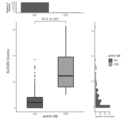
- the graph shows box plots of SLEDAI scores in SLE patients with and without eHHV-6B.
- the histogram shows the distribution of the number of SLE patients with and without eHHV-6B (top panel).
- the horizontal histogram shows the distribution of SLEDAI scores in SLE patients with and without eHHV-6B, with different colors (right panel).
- the present invention relates to (1) a method for testing an autoimmune disease, comprising a step of examining the presence or absence of endogenous human herpesvirus 6B in genomic DNA of a biological sample collected from a subject (also referred to as the "testing method of the present invention” in this specification). This will be described below.
- the type of autoimmune disease to be tested is not particularly limited. Autoimmune diseases of all classes, grades, and stages in various classification standards for autoimmune diseases can be tested.
- the site of the lesion is also not particularly limited. From the viewpoint of test accuracy, etc., particularly preferred examples of autoimmune diseases include systemic lupus erythematosus, pulmonary alveolar proteinosis, and multiple sclerosis.
- the autoimmune disease is at least one selected from the group consisting of systemic lupus erythematosus and pulmonary alveolar proteinosis. From the viewpoint of accuracy of determining the risk of aggravation described below, the autoimmune disease is particularly preferably systemic lupus erythematosus.
- the subject is not particularly limited as long as it is a mammal that can serve as a host for human herpesvirus 6B.
- the subject is preferably a human.
- the condition of the subject is not particularly limited.
- the subject include a subject whose autoimmune disease is unknown, a subject whose autoimmune disease has already been determined by another method to be affected by the disease, a subject whose autoimmune disease is not already determined by another method to be affected by the disease, and a subject undergoing treatment for the autoimmune disease.
- the test method of the present invention for example, it is possible to test the disease determination, onset risk, and aggravation risk of a subject whose autoimmune disease is unknown; the aggravation risk of a subject who has an autoimmune disease; and the onset risk and aggravation risk of a subject who does not have an autoimmune disease.
- onset risk means the possibility of onset
- aggravation risk means the possibility of aggravation.
- the biological sample is not particularly limited as long as it contains chromosomal genomic DNA contained in the nuclei of the cells of the subject.
- biological samples include body fluids, skin, mucous membranes, and internal tissues. Among these, from the viewpoints of ease of collection and minimal invasiveness, body fluids, skin, and mucous membranes are preferred, and body fluids are more preferred.
- the genomic DNA sequence of human herpesvirus 6B and the genomic DNA sequence of human herpesvirus 6A can be compared, and a sequence that is present in the genomic DNA sequence of human herpesvirus 6B and is not present or is only partially present in the genomic DNA sequence of human herpesvirus 6A can be used as the detection target region.
- the testing method of the present invention which includes step (1), can provide information on the presence or absence of endogenous human herpesvirus 6B, which is an indicator for testing autoimmune diseases, and can thereby assist in the assessment of the risk of developing/aggravating autoimmune diseases and the diagnosis of autoimmune diseases.
- test results obtained by the test method of the present invention including step (1) can be used to clarify the pathology of autoimmune diseases, predict the prognosis of autoimmune diseases, stratify patients, select treatment methods (individualized medicine, treatment response), etc.
- the autoimmune disease can be diagnosed with higher accuracy by combining the test method of the present invention with a step of applying a doctor's diagnosis of the autoimmune disease.
- the test method of the present invention can detect an autoimmune disease with higher accuracy, by combining the above step with the test method of the present invention, it is possible to more efficiently and more accurately diagnose "the subject has an autoimmune disease.”
- the method of treating autoimmune diseases is not particularly limited, but a representative example is drug therapy.
- the medicines used in drug therapy are not particularly limited, but examples of drugs for treating systemic lupus erythematosus include nonsteroidal anti-inflammatory analgesics and steroids, and examples of drugs for treating multiple sclerosis include interferon preparations, immunosuppressants such as fingolimod, ⁇ 4 integrin antibodies, CD20 antibodies, and the like.
- immunosuppressants such as fingolimod, ⁇ 4 integrin antibodies, CD20 antibodies, and the like.
- One, two, or three or more types of medicines can be used in combination.
- whole lung lavage is performed for pulmonary alveolar proteinosis.
- Methods for preventing autoimmune diseases are not particularly limited, but include, for example, avoidance and/or suppression of onset triggering factors and/or aggravating factors (specifically, for example, avoidance of exposure to sunlight, application of sunscreen, suppression of viral infections, suppression of stress factors, avoidance/suppression of drugs such as hormones, etc.). These can be used in combination of one, two, or three or more types.
- test agent (sometimes referred to as the "test agent of the present invention” in this specification) for use in the testing method of the present invention, which comprises an agent for detecting endogenous human herpesvirus 6B. This will be described below.
- the detection agent of the present invention is not particularly limited as long as it can detect endogenous human herpesvirus 6B.
- Examples of the detection agent include primers and probes for endogenous human herpesvirus 6B.
- the detection agent of the present invention may be modified as long as its function is not significantly impaired. Modifications include, for example, the addition of labels such as fluorescent dyes, enzymes, proteins, radioisotopes, chemiluminescent substances, biotin, etc.
- primers and probes include the polynucleotides described in (a) below and the polynucleotides described in (b) below:
- the hybridization targeting agent may include at least one selected from the group consisting of: (a) a polynucleotide having at least 15 consecutive bases in the base sequence of endogenous human herpesvirus 6B and/or a polynucleotide complementary to the polynucleotide; and (b) a polynucleotide having at least 15 bases that hybridizes under stringent conditions to the base sequence of endogenous human herpesvirus 6B or a base sequence complementary thereto.
- the base length of primers, probes, etc. is not particularly limited as long as it has a length of at least 15 consecutive bases as described above, and can be set appropriately depending on the application.
- the base length can be, for example, 15 to 35 bases
- the base length can be, for example, 15 to 35 bases.
- the test agent of the present invention may be in the form of a composition.
- the composition may contain other components as necessary. Examples of other components include bases, carriers, solvents, dispersants, emulsifiers, buffers, stabilizers, excipients, binders, disintegrants, lubricants, thickeners, moisturizers, colorants, fragrances, chelating agents, etc.
- Population A consisted of 867 Japanese individuals, consisting of 251 with SLE, 216 with PAP, 36 with MS, and 364 with HC.
- Population B consisted of genomic DNA from 429 unrelated Japanese HCs obtained from Epstein-Barr virus-infected B lymphoblast cell lines.
- Population C consisted of CRAM files obtained from WGS of 2,126 HCs. Principal component analysis was performed on the HapMap3 data. To confirm the East Asian genetic background, principal component analysis was performed using SNP-array data from the same individuals.
- Genomic DNA was extracted from whole blood of individuals from population A. DNA samples from population A and population B were sequenced at Macrogen Japan Co., Ltd. (Japan). Sequencing libraries were prepared using reagents from the TruSeq DNA PCR-free Library Prep kit (Illumina Inc., USA) according to the manufacturer's protocol. 2 ⁇ 150 bp paired-end whole genome sequencing was performed on a HiSeqX or NovaSeq (Illumina Inc., USA). Sequenced reads were aligned to human reference build hs37d5 using the BWA-MEM algorithm (version 0.7.13 or 0.7.8).
- Raw aligned reads were flagged for duplicates using Picard MarkDuplicates (version 2.10.10 or 2.17.2). The average number of aligned reads was 386 million per sample, corresponding to an average genome coverage of 18 ⁇ .
- WGS CRAM files for population C contained 370 million 2 ⁇ 150 bp paired-end reads per sample and were aligned to hs37d5 with BWA-MEM (version 0.7.13) and followed with Picard MarkDuplicates (version 2.10.10) to give an average coverage of 17 ⁇ .
- a total of 3,422 BAM or CRAM files were prepared for downstream analysis.
- Detection of eHHV-6A/B from WGS> The 3,422 WGS datasets were analyzed for eHHV-6 detection using a previously developed bioinformatics pipeline for eHHV-6 detection and reconstruction (PLoS Genet 17, e1009324 (2021).). Briefly, reads not mapping to the human reference genome were extracted and these reads were mapped to reference HHV-6A (NCBI accession NC_001664.4) and HHV-6B (NC_000898.1), followed by flagging for duplicates and removing PCR duplicates. The mapping depth and coverage of each virus were then calculated. A sample was considered to reflect eHHV-6 carriage if 5% of the HHV-6 genome was covered with ⁇ 2 ⁇ read depth.
- SLEDAI SLE disease activity index
- Three of four eHHV-6B-positive SLE patients were positive for anti-RNP antibodies, and the last was positive for anti-Scl-70 antibodies.
- Two eHHV-6B-positive SLE patients had other autoimmune diseases.
- One patient who was positive for anti-RNP antibodies had scleroderma and Sjögren's syndrome, and the other patient who was positive for anti-Scl-70 antibodies had scleroderma and antiphospholipid syndrome.
- SLE was defined using diagnoses with ICD9 (710.0) and ICD10 (M32) codes. To increase the reliability of the phenotype, cases were defined as subjects with two or more diagnoses on unique dates at least 1 year apart. A replication study was not performed for PAP, another autoimmune disease with significant eHHV-6B risk in the Japanese population, given its ultra-rare nature ( ⁇ 10 cases per million population worldwide). We used all subjects for association testing, except for those with two or more copies of full-length eHHV-6, presumed to be "solo-DR". The following logistic regression model was used: SLE ⁇ eHHV-6 + age + age ⁇ 2 + sex + top 10 genetic PCs. To avoid high type I errors, we performed score tests using the saddle-point approximation implemented in the R package SPAtest (https://cran.r-project.org/web/packages/SPAtest/index.html; v3.1.2).
Landscapes
- Life Sciences & Earth Sciences (AREA)
- Chemical & Material Sciences (AREA)
- Organic Chemistry (AREA)
- Health & Medical Sciences (AREA)
- Engineering & Computer Science (AREA)
- Genetics & Genomics (AREA)
- Zoology (AREA)
- Wood Science & Technology (AREA)
- Proteomics, Peptides & Aminoacids (AREA)
- General Engineering & Computer Science (AREA)
- Bioinformatics & Cheminformatics (AREA)
- Biotechnology (AREA)
- Microbiology (AREA)
- Molecular Biology (AREA)
- Biochemistry (AREA)
- Biophysics (AREA)
- General Health & Medical Sciences (AREA)
- Physics & Mathematics (AREA)
- Biomedical Technology (AREA)
- Immunology (AREA)
- Analytical Chemistry (AREA)
- Plant Pathology (AREA)
- Measuring Or Testing Involving Enzymes Or Micro-Organisms (AREA)
Abstract
Description
(2a)前記工程(1)で前記内在性ヒトヘルペスウイルス6Bが検出された場合に、前記被検体が、前記自己免疫疾患に罹患している、前記自己免疫疾患の発症リスクが高い、又は前記自己免疫疾患の重症化リスクが高いと判定する工程、及び/又は
(2b)前記工程(1)で前記内在性ヒトヘルペスウイルス6Bが検出されなかった場合に、前記被検体が、前記自己免疫疾患に罹患していない、前記自己免疫疾患の発症リスクが低い、又は前記自己免疫疾患の重症化リスクが低いと判定する工程
を含む、項1に記載の方法。
本発明は、その一態様において、(1)被検体から採取された生体試料のゲノムDNAにおける内在性ヒトヘルペスウイルス6Bの有無を調べる工程を含む、自己免疫疾患を検査する方法(本明細書において、「本発明の検査方法」と示すこともある。)に関する。以下、これについて説明する。
自己免疫疾患に罹患しているかどうか不明な検体の罹患判定、発症リスク、及び重症化リスク; 自己免疫疾患に罹患している被検体の重症化リスク; 自己免疫疾患に罹患していない被検体の発症リスク、及び重症化リスクを検査することができる。なお、本明細書において、「発症リスク」とは発症する可能性を意味し、「重症化リスク」とは重症化する可能性を意味する。
(2a)前記工程(1)で前記内在性ヒトヘルペスウイルス6Bが検出された場合に、前記被検体が、前記自己免疫疾患に罹患している、前記自己免疫疾患の発症リスクが高い、又は前記自己免疫疾患の重症化リスクが高いと判定する工程、及び/又は
(2b)前記工程(1)で前記内在性ヒトヘルペスウイルス6Bが検出されなかった場合に、前記被検体が、前記自己免疫疾患に罹患していない、前記自己免疫疾患の発症リスクが低い、又は前記自己免疫疾患の重症化リスクが低いと判定する工程
を含むことが好ましい。
工程(2)を含む本発明の検査方法により、被検体が自己免疫疾患に罹患していると判定された場合、本発明の検査方法に、さらに自己免疫疾患の医師による診断を適用する工程を組み合わせることによって、より高い精度で自己免疫疾患を診断することができる。また、本発明の検査方法はより正確に自己免疫疾患を検出できるので、本発明の検査方法に上記工程を組み合わせることによって、より効率的且つより正確に「自己免疫疾患に罹患している」と診断できる。
工程(2)を含む本発明の検査方法により被検体が自己免疫疾患に罹患していると判定された場合は本発明の検査方法に対してさらに、或いは上記「2.自己免疫疾患のより高い精度での診断」に記載の様に自己免疫疾患に罹患していると診断された場合は本発明の検査方法と医師による診断を適用する工程との組合せに対してさらに、(3)自己免疫疾患に罹患していると判定又は診断された被検体に対して、該疾患の治療を行う工程を行うことによって、被検体の該疾患を治療することが可能となる。また、本発明の検査方法はより正確に自己免疫疾患を検出できるので、本発明の検査方法に対して、或いは本発明の検査方法と医師による診断を適用する工程との組合せに対して工程(3)を組み合わせることによって、自己免疫疾患に罹患している被検体をより効率的に、より確実に治療できる。また、工程(2)を含む本発明の検査方法に被検体の自己免疫疾患の発症リスクが高いと判定された場合は、適切な予防処理を採ることができる。
本発明は、その一態様において、内在性ヒトヘルペスウイルス6Bの検出剤を含む、本発明の検査方法に使用するための検査薬(本明細書において、「本発明の検査薬」と示すこともある。)に関する。以下、これについて説明する。
(a)内在性ヒトヘルペスウイルス6Bの塩基配列において連続する少なくとも15塩基を有するポリヌクレオチド及び/若しくは当該ポリヌクレオチドに相補的なポリヌクレオチド、並びに
(b)内在性ヒトヘルペスウイルス6Bの塩基配列若しくはそれに相補的な塩基配列にストリンジェントな条件下でハイブリダイズする、少なくとも15塩基を有するポリヌクレオチド
からなる群より選択される少なくとも1種が挙げられる。
<1-1.概要>
日本人の3,422サンプルのデータセットを解析した。サンプルの特徴、サンプル収集、WGS(Whole Genome Sequencing)プラットフォームの詳細については、後述する。WGSデータセットは、全身性エリテマトーデス(SLE)251人、肺胞蛋白症(PAP)216人、多発性硬化症(MS)36人、健常対照(HC)2,919 人からなる。内在性ヒトヘルペスウイルス6(eHHV-6:宿主の染色体ゲノムDNA内に挿入されているヒトヘルペスウイルス6のゲノムDNA)の有無を調べるために、2つのバイオインフォマティクス・パイプラインを使用した。簡潔に述べると、ヒト参照ゲノムにマッピングされなかったWGSリードを、eHHV-6参照ゲノムに再マッピングした。ロジスティック回帰とフィッシャーの正確さを用いて、eHHV-6感染状態の各疾患のリスクに関する調整オッズ比(OR)を算出した。各疾患において、線形回帰またはロジスティック回帰とフィッシャーの検定を用いて、各疾患の臨床指標とeHHV-6感染状態との関係を推定した。
集団Aとして、SLE251人、PAP216人、MS36人、HC364人からなる日本人867人を用いた。また、集団Bとして、血縁関係のない日本人のEpstein-Barrウイルス感染Bリンパ芽球細胞株から得られたHC429人のゲノムDNAを使用した。また、集団Cとして、2,126人のHCのWGSから得られたCRAMファイルを使用した。HapMap3データに対して主成分分析を実施した。東アジアの遺伝的背景を確認するため、同一人物のSNP-arrayデータを用いて主成分分析を行った。
ゲノムDNAは、集団Aの個人の全血から抽出した。集団AのDNAサンプルと集団BのDNAサンプルは、マクロジェン・ジャパン株式会社(日本)で塩基配列を決定した。シーケンスライブラリーは、TruSeq DNA PCR-free Library Prep kit (Illumina Inc., USA)の試薬を用いて、メーカーのプロトコールに従って作成した。また、HiSeqXまたはNovaSeq(Illumina Inc.、米国)で2×150 bpペアエンド全ゲノムシーケンスを実施した。BWA-MEMアルゴリズム (バージョン0.7.13または0.7.8)を用いて、配列決定されたリードをヒト参照ビルドhs37d5にアライメントした。生アラインメントのリードは、Picard MarkDuplicates (version 2.10.10 or 2.17.2) を用いて 重複のフラグを立てた。平均アラインメントリード数は、サンプルあたり3億8600万本で、平均ゲノムカバレッジは18×に相当する。集団CのWGS CRAMファイルには、サンプルあたり3億7000万本の2×150 bpペアエンドリードが含まれ、BWA-MEM(バージョン0.7.13)でhs37d5にアライメントし、Picard MarkDuplicates(バージョン2.10.10)でフォローし、平均カバー率は17×となった。合計で3,422個のBAMまたはCRAMファイルが下流解析用に準備された。
3,422件のWGSデータセットについて、以前に開発したeHHV-6検出・再構成用バイオインフォマティクスパイプライン(PLoS Genet 17, e1009324 (2021).)を用いて、eHHV-6の検出を行う解析を行った。簡単に説明すると、ヒト参照ゲノムにマッピングされないリードを抽出し、これらのリードを参照HHV-6A (NCBI accession NC_001664.4) とHHV-6B (NC_000898.1) にマッピングし、続いて重複に対するフラグ立てを行ってPCR重複を削除した。その後、各ウイルスのマッピング深度とカバレッジを算出した。HHV-6ゲノムの5%が2×リードデプス以上でカバーされている場合、そのサンプルはeHHV-6のキャリッジを反映しているとみなした。ここで説明したワークフローはPythonパイプラインとしてコンパイルされ、以下のGitHubリポジトリから入手できる:https://github.com/shohei-kojima/integrated_HHV6_recon。このリポジトリにある "main.py "は、ここで説明するすべてのワークフローを含んでいる。
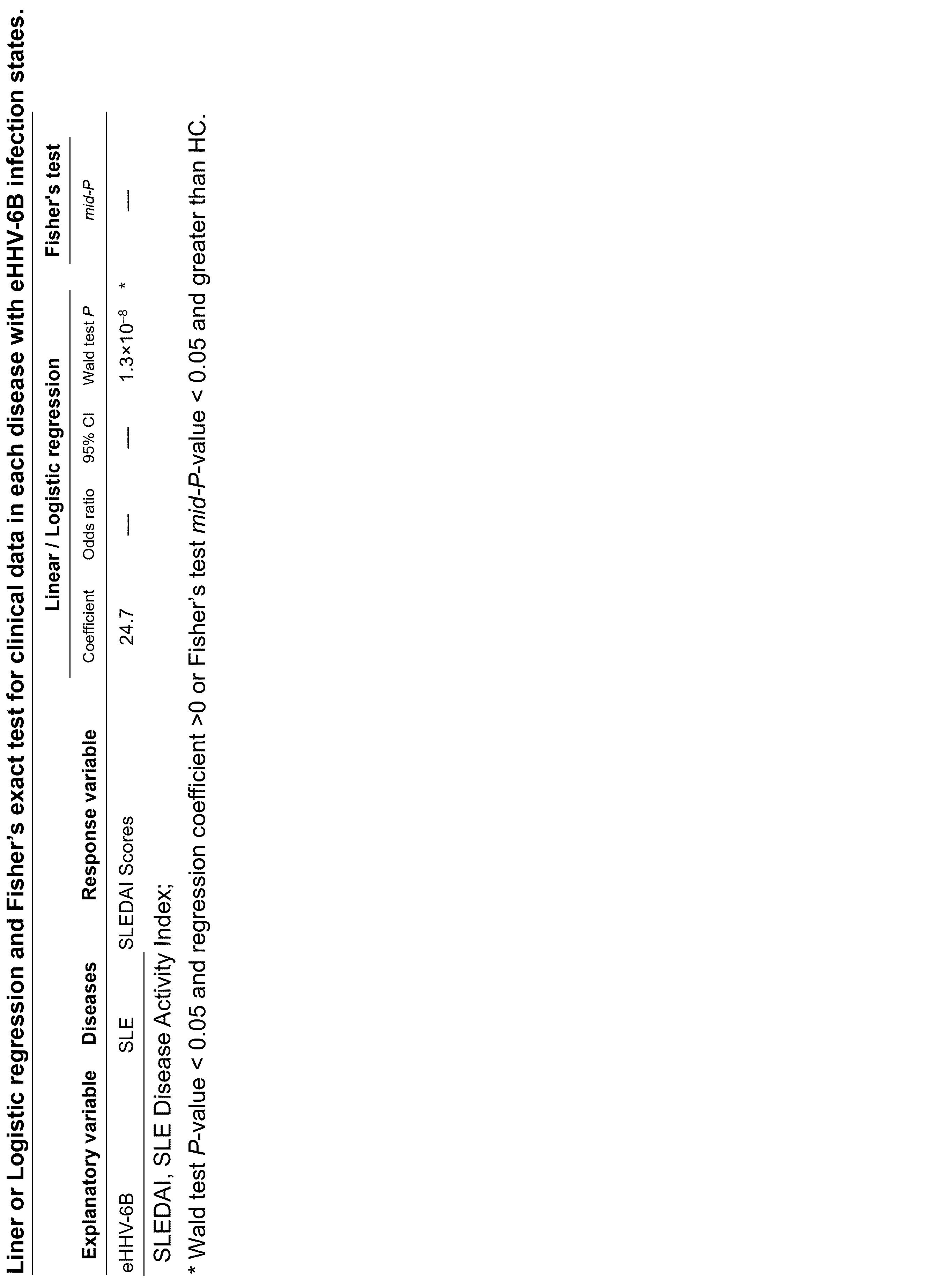
ロジスティック回帰モデルを用いて、eHHV-6感染状態による各疾患のリスクについて、95%信頼区間(CI)付きの修正ケースコントロールオッズ比(OR)を算出した。次に、年齢と性別を独立変数として、多変量ロジスティック回帰モデルを実行した。また、両側フィッシャーの正確検定を用いて、各疾患および健常対照におけるWald検定P値<0.05、Fisher検定中間P値<0.05を有意とみなした。すべての解析は、R(バージョン4.0.5)を用い、R-package MASS53(バージョン7.3.58)とexact2x254(バージョン1.6.6)を用いて行った。各疾患において、年齢と性別を独立変数として、線形回帰モデルまたはロジスティック回帰モデルを用いて、各疾患の臨床指標とeHHV-6感染状態との関係を推定した。臨床指標が2値である場合は、フィッシャーの検定も用いた。回帰分析では、欠損値のある症例についてリストワイズ削除を適用した。
eHHV-6の有病率と各疾患との関連性を表1及び図1に示す。いずれの疾患患者においても、HCと比較してeHHV-6Aの有病率に差は認められなかった。一方、eHHV-6Bは、SLE、PAP、MSの患者では、HCに比べて有意に有病率が高かった(1.6%、1.4%、2.8% vs. 0.21%; Fisher検定 mid-P = 0.0060, 0.022, and 0.085, respectively)。eHHV-6BはSLE、PAP、MSと関連しており、調整後のORはSLEで6.9(95%CI=1.61-27.2、Wald検定P=0.0061)、PAPで7.0(95%CI=1.43-27.7、P=0.0075)、MSで10.9(95%CI=0.55-71.6、P=0.034)であった。これらの結果から、eHHV-6Bの保有は、これまで知られている遺伝的・環境的要因に比して大きな効果サイズでこれらの疾患のリスクに寄与していることが示唆された。

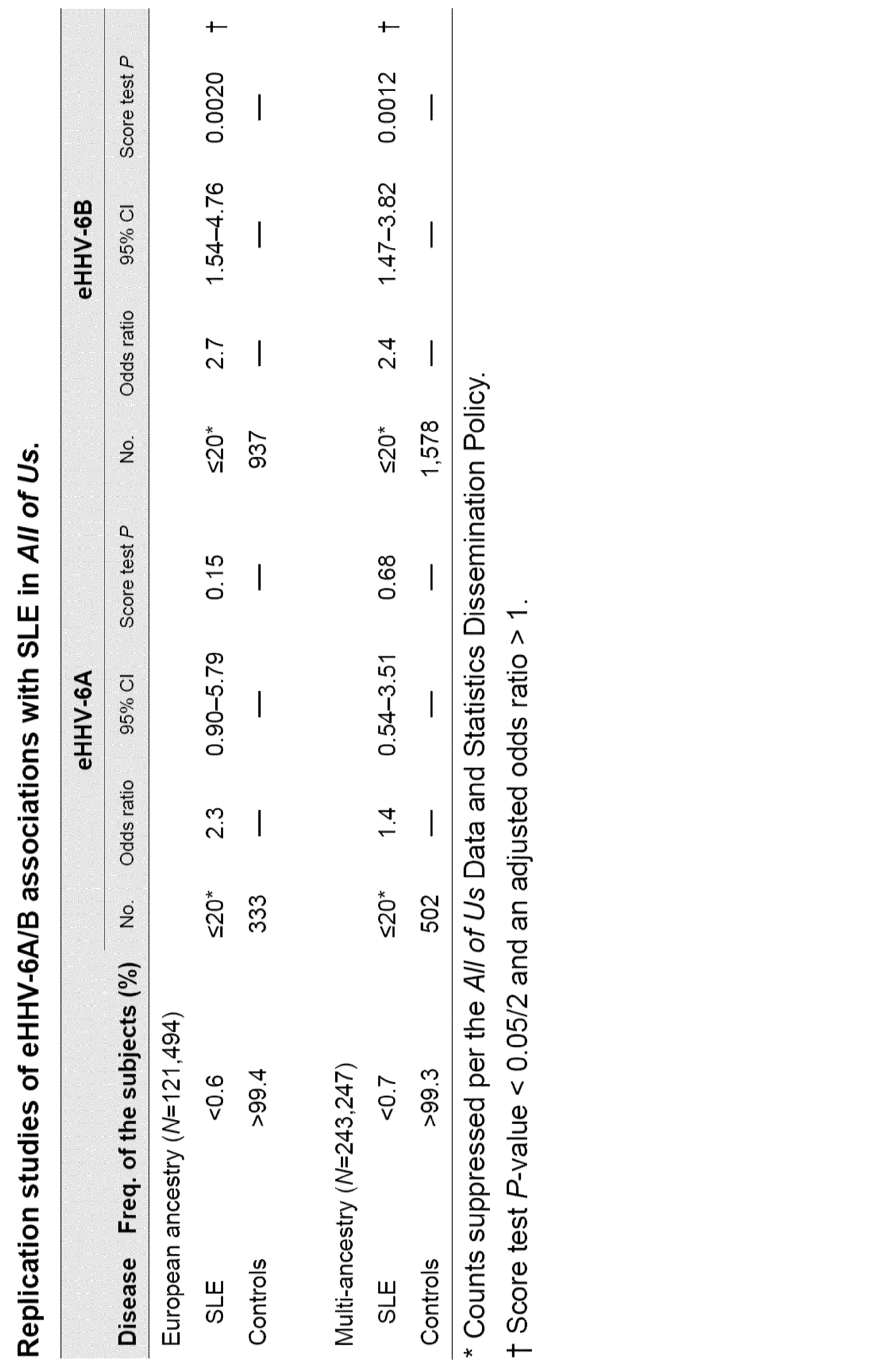
NIH All of UsプログラムのWGSデータを用いて、SLEとeHHV-6の関連について独立した大規模再現研究を行った。コホートの参加者は遺伝的に多様であり、SLEのリスクは家系によってかなり異なるため、我々はロジスティック回帰モデルを用いて、121,494人のヨーロッパ系家系と243,247人の多家系データセット全体で関連性検定を行った。具体的には以下のとおりである。
Claims (8)
- (1)被検体から採取された生体試料のゲノムDNAにおける内在性ヒトヘルペスウイルス6Bの有無を調べる工程を含む、自己免疫疾患を検査する方法。
- さらに、
(2a)前記工程(1)で前記内在性ヒトヘルペスウイルス6Bが検出された場合に、前記被検体が、前記自己免疫疾患に罹患している、前記自己免疫疾患の発症リスクが高い、又は前記自己免疫疾患の重症化リスクが高いと判定する工程、及び/又は
(2b)前記工程(1)で前記内在性ヒトヘルペスウイルス6Bが検出されなかった場合に、前記被検体が、前記自己免疫疾患に罹患していない、前記自己免疫疾患の発症リスクが低い、又は前記自己免疫疾患の重症化リスクが低いと判定する工程
を含む、請求項1に記載の方法。 - 前記自己免疫疾患が全身性エリテマトーデス、肺胞蛋白症、及び多発性硬化症からなる群より選択される少なくとも1種である、請求項1に記載の方法。
- 前記自己免疫疾患が全身性エリテマトーデス、及び肺胞蛋白症からなる群より選択される少なくとも1種である、請求項1に記載の方法。
- 前記重症化リスクの判定における前記自己免疫疾患が全身性エリテマトーデスである、請求項2に記載の方法。
- 前記生体試料が、体液、皮膚、及び粘膜からなる群より選択される少なくとも1種である、請求項1~5のいずれかに記載の方法。
- 日本人集団に対して適用される、請求項1~5のいずれかに記載の方法。
- 内在性ヒトヘルペスウイルス6Bの検出剤を含む、請求項1~6のいずれかに記載の方法に使用するための検査薬。
Priority Applications (1)
| Application Number | Priority Date | Filing Date | Title |
|---|---|---|---|
| JP2025526046A JPWO2024252932A1 (ja) | 2023-06-06 | 2024-05-22 |
Applications Claiming Priority (2)
| Application Number | Priority Date | Filing Date | Title |
|---|---|---|---|
| JP2023-092968 | 2023-06-06 | ||
| JP2023092968 | 2023-06-06 |
Publications (1)
| Publication Number | Publication Date |
|---|---|
| WO2024252932A1 true WO2024252932A1 (ja) | 2024-12-12 |
Family
ID=93795447
Family Applications (1)
| Application Number | Title | Priority Date | Filing Date |
|---|---|---|---|
| PCT/JP2024/018864 Ceased WO2024252932A1 (ja) | 2023-06-06 | 2024-05-22 | 自己免疫疾患を検査する方法 |
Country Status (2)
| Country | Link |
|---|---|
| JP (1) | JPWO2024252932A1 (ja) |
| WO (1) | WO2024252932A1 (ja) |
Citations (5)
| Publication number | Priority date | Publication date | Assignee | Title |
|---|---|---|---|---|
| JPH07284391A (ja) * | 1994-04-19 | 1995-10-31 | Toyobo Co Ltd | ヒトヘルペスウイルス検出用オリゴヌクレオチドおよびその用途 |
| US20010033844A1 (en) * | 2000-02-02 | 2001-10-25 | Wilson Gregory Bruce | Human Herpesvirus 6A and 6B transfer factors for the treatment of chronic fatigue syndrome and multiple sclerosis |
| EP2568046A1 (en) * | 2011-09-06 | 2013-03-13 | Centre National de la Recherche Scientifique (C.N.R.S) | MicroRNAs from human herpesvirus 6 |
| WO2015199247A1 (ja) * | 2014-06-27 | 2015-12-30 | 日本たばこ産業株式会社 | 気分障害を診断、治療又は予防する方法 |
| WO2020138402A1 (ja) * | 2018-12-27 | 2020-07-02 | クリニジェン株式会社 | アルツハイマー病を治療又は予防する為の抗ウイルス剤及びその使用 |
-
2024
- 2024-05-22 JP JP2025526046A patent/JPWO2024252932A1/ja active Pending
- 2024-05-22 WO PCT/JP2024/018864 patent/WO2024252932A1/ja not_active Ceased
Patent Citations (5)
| Publication number | Priority date | Publication date | Assignee | Title |
|---|---|---|---|---|
| JPH07284391A (ja) * | 1994-04-19 | 1995-10-31 | Toyobo Co Ltd | ヒトヘルペスウイルス検出用オリゴヌクレオチドおよびその用途 |
| US20010033844A1 (en) * | 2000-02-02 | 2001-10-25 | Wilson Gregory Bruce | Human Herpesvirus 6A and 6B transfer factors for the treatment of chronic fatigue syndrome and multiple sclerosis |
| EP2568046A1 (en) * | 2011-09-06 | 2013-03-13 | Centre National de la Recherche Scientifique (C.N.R.S) | MicroRNAs from human herpesvirus 6 |
| WO2015199247A1 (ja) * | 2014-06-27 | 2015-12-30 | 日本たばこ産業株式会社 | 気分障害を診断、治療又は予防する方法 |
| WO2020138402A1 (ja) * | 2018-12-27 | 2020-07-02 | クリニジェン株式会社 | アルツハイマー病を治療又は予防する為の抗ウイルス剤及びその使用 |
Non-Patent Citations (1)
| Title |
|---|
| BROCCOLO FRANCESCO, FUSETTI LISA, CECCHERINI-NELLI LUCA: "Possible Role of Human Herpesvirus 6 as a Trigger of Autoimmune Disease", THE SCIENTIFIC WORLD JOURNAL, vol. 2013, no. 1, 1 January 2013 (2013-01-01), pages 1 - 7, XP093247372, ISSN: 2356-6140, DOI: 10.1155/2013/867389 * |
Also Published As
| Publication number | Publication date |
|---|---|
| JPWO2024252932A1 (ja) | 2024-12-12 |
Similar Documents
| Publication | Publication Date | Title |
|---|---|---|
| CN110029158B (zh) | 一种马凡综合征检测panel及其应用 | |
| JP5442208B2 (ja) | うつ病の検査方法 | |
| JP2017512304A (ja) | バイオマーカーシグネチャー法ならびにそのための装置およびキット | |
| WO2017106918A1 (en) | Triage biomarkers and uses therefor | |
| EP4405681A1 (en) | Drain fluid for diagnostics | |
| Jeon et al. | Transcriptomic profiles and their correlations in saliva and gingival tissue biopsy samples from periodontitis and healthy patients | |
| BR112020012280A2 (pt) | composições e métodos para diagnosticar cânceres de pulmão usando perfis de expressão de gene | |
| CN118755816B (zh) | 主动脉夹层分子标志物及其应用 | |
| JP3169027U (ja) | 遺伝子集団検知構造 | |
| JP2024504062A (ja) | 染色体相互作用 | |
| US20210087629A1 (en) | Methods for Treating and Detecting Sepsis in Humans | |
| CN119979734A (zh) | 一种基于宿主反应鉴别病原微生物类型的标志物 | |
| WO2023021978A1 (ja) | 自己免疫疾患を検査する方法 | |
| JP7540730B2 (ja) | 関節リウマチを検査する方法 | |
| US20230054587A1 (en) | Multiplexed Assay Using Differential Fragment Size to Identify Cancer Specific Cell-Free DNA | |
| CN113817817B (zh) | 一种诊断过敏性气道炎症的方法 | |
| JP7748744B2 (ja) | 関節リウマチを検査する方法 | |
| JP2023020631A (ja) | 全身性エリテマトーデスを検査する方法 | |
| CN119842887B (zh) | 评估儿童呼吸道合胞病毒感染的重度毛细支气管炎的生物标志物及其应用 | |
| CN113817818B (zh) | 用于诊断过敏性气道炎症的工具 | |
| CN113604576B (zh) | 肺腺癌检测试剂盒、存储介质及电子设备 | |
| JP7411988B2 (ja) | Ham/tsp発症リスク判定方法 | |
| WO2007102402A1 (ja) | 慢性疲労症候群の診断方法 | |
| CN106834476A (zh) | 一种乳腺癌检测试剂盒 | |
| CN106834491B (zh) | 乳腺癌预后相关基因突变检测试剂盒及其使用方法 |
Legal Events
| Date | Code | Title | Description |
|---|---|---|---|
| 121 | Ep: the epo has been informed by wipo that ep was designated in this application |
Ref document number: 24819165 Country of ref document: EP Kind code of ref document: A1 |
|
| ENP | Entry into the national phase |
Ref document number: 2025526046 Country of ref document: JP Kind code of ref document: A |
|
| WWE | Wipo information: entry into national phase |
Ref document number: 2025526046 Country of ref document: JP |
|
| NENP | Non-entry into the national phase |
Ref country code: DE |
|
| 122 | Ep: pct application non-entry in european phase |
Ref document number: 24819165 Country of ref document: EP Kind code of ref document: A1 |