WO2024252570A1 - はんだペースト - Google Patents
はんだペースト Download PDFInfo
- Publication number
- WO2024252570A1 WO2024252570A1 PCT/JP2023/021194 JP2023021194W WO2024252570A1 WO 2024252570 A1 WO2024252570 A1 WO 2024252570A1 JP 2023021194 W JP2023021194 W JP 2023021194W WO 2024252570 A1 WO2024252570 A1 WO 2024252570A1
- Authority
- WO
- WIPO (PCT)
- Prior art keywords
- solder paste
- strain
- loss tangent
- range
- thixotropic agent
- Prior art date
- Legal status (The legal status is an assumption and is not a legal conclusion. Google has not performed a legal analysis and makes no representation as to the accuracy of the status listed.)
- Ceased
Links
Images
Classifications
-
- B—PERFORMING OPERATIONS; TRANSPORTING
- B23—MACHINE TOOLS; METAL-WORKING NOT OTHERWISE PROVIDED FOR
- B23K—SOLDERING OR UNSOLDERING; WELDING; CLADDING OR PLATING BY SOLDERING OR WELDING; CUTTING BY APPLYING HEAT LOCALLY, e.g. FLAME CUTTING; WORKING BY LASER BEAM
- B23K35/00—Rods, electrodes, materials, or media, for use in soldering, welding, or cutting
- B23K35/22—Rods, electrodes, materials, or media, for use in soldering, welding, or cutting characterised by the composition or nature of the material
- B23K35/36—Selection of non-metallic compositions, e.g. coatings or fluxes; Selection of soldering or welding materials, conjoint with selection of non-metallic compositions, both selections being of interest
- B23K35/3601—Selection of non-metallic compositions, e.g. coatings or fluxes; Selection of soldering or welding materials, conjoint with selection of non-metallic compositions, both selections being of interest with inorganic compounds as principal constituents
Definitions
- the present invention relates to a solder paste used when soldering a first member and a second member.
- This application incorporates by reference the contents of Patent Application No. 2021-200809 filed in Japan on December 10, 2021.
- semiconductor devices such as LEDs and power modules have a structure in which a semiconductor element is bonded onto a circuit layer made of a metal member.
- a semiconductor element is bonded onto a circuit layer made of a metal member.
- methods using solder paste are widely used, as shown in, for example, Patent Documents 1 to 3.
- methods for supplying the solder paste to the joining surfaces include printing, dispensing, pin transfer, and the like.
- the dispense method has an advantage in that the solder paste can be applied to joining surfaces of various shapes because the solder paste is pushed out by a cylinder.
- the amount of solder paste dispensed tends to be unstable, and there is a risk that the solder paste cannot be sufficiently dispensed, resulting in so-called blank discharge.
- This invention was made in consideration of the above-mentioned circumstances, and aims to provide a solder paste that can be supplied stably even when applied using a dispensing method.
- the solder paste according to one aspect of the present invention is a solder paste containing metal powder, resin, a solvent, and a thixotropic agent, and is characterized in that the loss tangent when the strain is 0.01% is within the range of 0.1 to 0.5.
- the loss tangent when the strain is 0.01% is 0.1 or more, so the stress required at the start of dispensing is low and stable discharge is possible.
- the loss tangent when the strain is 0.01% is 0.5 or less, so the shape of the applied solder paste can be maintained and the solder paste can be applied stably.
- the length of the linear viscoelastic region defined by the width of the shear stress corresponding to the strain region in which the loss tangent is from N0 to 1.1 x N0 is less than 12 Pa.
- the stress required at the start of dispensing is further reduced, enabling more stable ejection.
- the viscosity measured under conditions of a temperature of 25° C. and a shear rate of 6/s is preferably within the range of 50 Pa ⁇ s or more and 100 Pa ⁇ s or less.
- the viscosity measured under conditions of a temperature of 25° C. and a shear rate of 6/s is within the range of 50 Pa ⁇ s to 100 Pa ⁇ s, making it possible to eject the ink more stably using the dispensing method.
- the present invention provides a solder paste that can be stably supplied even when applied using a dispensing method.
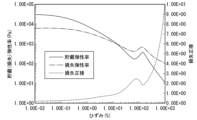
- 1 is a graph showing dynamic viscoelasticity measurements of a solder paste according to an embodiment of the present invention.
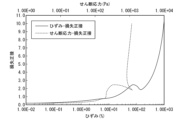
- 1 is a graph showing the relationship between loss tangent and strain of the solder paste of Example 3 of the present invention in the examples.
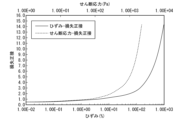
- 1 is a graph showing the relationship between loss tangent and strain for solder pastes of comparative examples in an embodiment.
- solder paste according to an embodiment of the present invention will be described below.
- the solder paste of this embodiment is used when soldering a first member and a second member, for example, when soldering a semiconductor element (second member) as an electronic component to a circuit layer (first member) of an insulating circuit board.
- the solder paste of this embodiment contains metal powder, resin, a solvent, and a thixotropic agent. If necessary, it may also contain an activator.
- the loss tangent when the strain is 0.01% is in the range of 0.1 to 0.5 inclusive in the dynamic viscoelasticity measurement.
- the result of the dynamic viscoelasticity measurement of the solder paste of this embodiment is shown in FIG.
- the loss tangent when the strain is 0.01% is set within the range of 0.1 to 0.5.
- the loss tangent when the strain is 0.01% is more preferably 0.2 or more, and more preferably 0.3 or less when the strain is 0.01%.
- the equivalent circle diameter of the outlet of the cylinder for discharging the solder paste is 1.0 mm or less, it is preferable that the loss tangent when the strain is 0.01% is 0.3 or less.
- the length of the linear viscoelastic region defined by the width of the shear stress corresponding to the strain region in which the loss tangent is from N0 to 1.1 ⁇ N0 is less than 12 Pa.
- the length of the linear viscoelastic region is 10 Pa or less.
- the viscosity measured under conditions of a temperature of 25° C. and a shear rate of 6/s is preferably within the range of 50 Pa ⁇ s to 100 Pa ⁇ s.
- the above-mentioned viscosity is more preferably in the range of 50 Pa ⁇ s to 80 Pa ⁇ s.
- the metal powders contained in the solder paste of this embodiment include Sn-Ag-Cu, Au-Sn, Sn-Cu, Pb-Sn, and Au-Ge. These metal powders may be alloy powders or mixed powders. In this embodiment, the metal powder is a mixed powder of Au powder and Sn powder.
- the resin contained in the solder paste of this embodiment may be, for example, polymerized rosin, natural rosin, refined rosin, isobornylcyclohexanol, rosin ester, etc.
- the solvents contained in the solder paste of this embodiment include, for example, alcohols, ketones, esters, ethers, aromatic solvents, hydrocarbons, terpenes, and terpenoids.
- the thixotropic agent contained in the solder paste of this embodiment may be, for example, hydrogenated castor oil, hydrogenated castor oil, carnauba wax, amides, hydroxy fatty acids, dibenzylidene sorbitol, bis(p-methylbenzylidene) sorbitols, beeswax, stearic acid amide, hydroxystearic acid ethylene bisamide, etc., used alone or in combination.
- the activator can be, for example, a fatty acid such as adipic acid, caprylic acid, lauric acid, myristic acid, palmitic acid, stearic acid, or behenic acid, a hydroxy fatty acid such as 1,2-hydroxystearic acid, an antioxidant, a surfactant, or an amine.
- a fatty acid such as adipic acid, caprylic acid, lauric acid, myristic acid, palmitic acid, stearic acid, or behenic acid
- a hydroxy fatty acid such as 1,2-hydroxystearic acid
- an antioxidant a surfactant, or an amine.
- the content of the metal powder is preferably within a range of 75 mass% to 95 mass% and more preferably within a range of 80 mass% to 92 mass%.
- the resin content is preferably in the range of 1.0 mass% to 10.0 mass% and more preferably in the range of 4.0 mass% to 8.0 mass%.
- the content of the solvent is preferably in the range of 1.0 mass% to 10.0 mass% and more preferably in the range of 4.0 mass% to 8.0 mass%.
- the content of the thixotropic agent is preferably in the range of 0.1 mass% to 2.0 mass%.
- the content of the thixotropic agent is more preferably in the range of 0.1 mass% to 1.5 mass%.
- the content of the activator is preferably in the range of 0 mass% to 3.0 mass%.
- the content of the activator is preferably in the range of 0 mass% to 2.0 mass%.
- the contents of each component are values when the solder paste is taken as 100 mass %.
- the resin content is preferably 40 mass% or more when the flux containing the resin, the solvent, the thixotropic agent, and the activator is taken as 100 mass%.
- a method for producing the solder paste of this embodiment will be described.
- a part of the thixotropic agent is added to a solvent, stirred, and heated to a temperature higher than the dissolving temperature of the thixotropic agent.
- a resin and an activator are added, stirred and mixed to obtain a mixture.
- the remaining thixotropic agent is added during the process of cooling the obtained mixture.
- the crystal nuclei grow during the heating process, and the crystal grains of the thixotropic agent become coarse.
- the crystal grains of the thixotropic agent added during cooling do not become coarse.
- the ratio of the thixotropic agent added before heating is preferably within the range of 40% to 95% when the total amount of the thixotropic agent used is taken as 100%, and the ratio of the thixotropic agent added during cooling is preferably within the range of 5% to 60%.
- the proportion of the thixotropic agent added before heating is within the range of 50% or more and 80% or less, and it is more preferable that the proportion of the thixotropic agent added during cooling is within the range of 20% or more and 50% or less, when the total amount of the thixotropic agent used is 100%.
- a part of the thixotropic agent is added to the solvent and stirred and heated, it is preferable to heat to a temperature 10° C. to 20° C. higher than the dissolution temperature of the thixotropic agent.
- the temperature when the remaining thixotropic agent is added is preferably 5° C. to 10° C. lower than the dissolution temperature of the thixotropic agent.
- the solder paste of this embodiment configured as described above has a loss tangent of 0.1 or more when the strain is 0.01%, so the stress required at the start of dispensing is low and stable dispensing is possible.
- the loss tangent when the strain is 0.01% is 0.5 or less, so the shape of the applied solder paste can be maintained and the solder paste can be applied stably.
- the length of the linear viscoelastic region defined by the width of the shear stress corresponding to the strain region in which the loss tangent is from N0 to 1.1 ⁇ N0 is less than 12 Pa.
- the stress required at the start of dispensing is further reduced, enabling more stable ejection.
- the viscosity measured under conditions of a temperature of 25° C. and a shear rate of 6/s is preferably within the range of 50 Pa ⁇ s to 100 Pa ⁇ s.
- the viscosity measured under conditions of a temperature of 25° C. and a shear rate of 6/s is within the range of 50 Pa ⁇ s to 100 Pa ⁇ s, making it possible to eject the ink more stably using the dispensing method.
- a semiconductor element (second member) is joined as an electronic component to a circuit layer (first member) of an insulating circuit board, but this is not limited thereto, and there are no particular limitations on the first member and the second member.
- the method for manufacturing a solder paste has been described as adding a portion of the thixotropic agent to a solvent, stirring, and heating, and then adding a resin and an activator, and stirring and mixing to obtain a mixture.
- this is not limited to this, and a portion of the thixotropic agent, a resin, and an activator may be added to a solvent, and then heated and stirred and mixed to obtain a mixture.
- resin, solvent, and thixotropic agent were mixed, heated to 150° C. and stirred, then cooled to room temperature and mixed with metal powder to prepare various solder pastes.
- the thixotropic agent was added twice, once before heating and once at the start of cooling after heating.
- solder pastes were evaluated for loss tangent, length of linear viscoelastic region, viscosity, and dispensability as follows:
- Viscoelasticity measuring device Anton Paar rheometer (model number: MCR 301) Temperature of the measuring part of the viscoelasticity measuring device: 25°C Rotation speed (frequency) of the plate of the viscoelasticity measuring device: 1 Hz Measuring tool: PP25 Gap: 0.3 mm Sample volume: 0.15 mL Measurement mode: Strain distribution
- viscosity The viscosity of the obtained solder paste was measured using a viscometer under the following conditions. Measurement equipment: Malcom microspiral viscometer PCU-02V Temperature during measurement: 25°C ⁇ 0.11°C Measurement speed: 10 rpm (shear rate 6/s) Waiting time before measurement: 600 s Sample volume: 0.2 mL
- solder paste was applied to the surface of a Si substrate at 1000 spots with a target diameter of 800 ⁇ m by a dispense method using the following device.
- the diameter of the applied paste was measured with a one-shot 3D shape measuring instrument (VR-5000, manufactured by KEYENCE Corporation), and the standard deviation ⁇ of the diameters of the 1000 spots was calculated.
- Dispenser ML-606GX (Musashi Engineering, Inc.) Robot: SHOTMASTER 300 ⁇ X Pellet container: 5cc syringe (PSY-5E) manufactured by MUSASHI ENGINEERING, Inc.
- Example 1-7 the loss tangent when the strain was 0.01% was within the range of 0.1 to 0.5, no blank ejection occurred, and the dispensability was rated as "C to A.”
- Example 1-4 of the present invention in which the length of the linear viscoelastic region was less than 12 Pa and the viscosity was in the range of 50 Pa ⁇ s to 100 Pa ⁇ s, the variation in the diameter of the paste after application was suppressed, and the dispensability was rated as "B to A.”
- the present invention can provide a solder paste that can be stably supplied even when applied using a dispensing method.
- the present invention makes it possible to provide a solder paste that can be stably supplied even when applied using a dispensing method.
Landscapes
- Chemical & Material Sciences (AREA)
- Inorganic Chemistry (AREA)
- Engineering & Computer Science (AREA)
- Mechanical Engineering (AREA)
- Electric Connection Of Electric Components To Printed Circuits (AREA)
Abstract
このはんだペーストは、金属粉と樹脂と溶剤とチキソ剤を含み、ひずみが0.01%のときの損失正接が0.1以上0.5以下の範囲内である。ひずみが0.01%のときの損失正接をN0としたとき、損失正接がN0から1.1×N0までのひずみ領域に対応するせん断応力の幅で定義される線形粘弾性領域の長さが12Pa未満であることが好ましい。また、温度25℃、せん断速度6/sの条件で測定した粘度が、50Pa・s以上100Pa・s以下の範囲内であることが好ましい。
Description
本発明は、第1部材と第2部材とをはんだ接合する際に用いられるはんだペーストに関するものである。
本願は、2021年12月10日に、日本に出願された特願2021-200809号の内容をここに援用する。
本願は、2021年12月10日に、日本に出願された特願2021-200809号の内容をここに援用する。
例えば、LEDやパワーモジュールといった半導体装置は、金属部材からなる回路層の上に半導体素子が接合された構造とされている。
半導体素子等の電子部品を回路層上に接合する際には、例えば特許文献1-3に示すように、はんだペーストを用いた方法が広く使用されている。
ここで、接合面にはんだペーストを供給する方式としては、印刷、ディスペンス、ピン転写等の方法がある。
半導体素子等の電子部品を回路層上に接合する際には、例えば特許文献1-3に示すように、はんだペーストを用いた方法が広く使用されている。
ここで、接合面にはんだペーストを供給する方式としては、印刷、ディスペンス、ピン転写等の方法がある。
ところで、ディスペンス方式においては、シリンダによってはんだペーストを押し出すことから、多様な形状の接合面であってもはんだペーストを塗布することが可能となるといった利点を有している。
しかしながら、ディスペンス方式においては、はんだペーストの吐出量が不安定となりやすく、はんだペーストを十分に吐出できずに、いわゆる空打ちが発生するおそれがあった。
しかしながら、ディスペンス方式においては、はんだペーストの吐出量が不安定となりやすく、はんだペーストを十分に吐出できずに、いわゆる空打ちが発生するおそれがあった。
この発明は、前述した事情に鑑みてなされたものであって、ディスペンス方式で塗布する場合であっても、安定して供給することが可能なはんだペーストを提供することを目的とする。
上記課題を解決するために、本発明者らが鋭意検討した結果、はんだペーストの流動特性は、はんだペーストの弾性(動的粘弾性測定における貯蔵弾性率G”)と粘性(動的粘弾性測定における損失弾性率G’)の比である損失正接tanδ=G”/G’に大きく影響を受けることから、この損失正接を適切に制御することにより、ディスペンス方式であっても、シリンダから安定して吐出することが可能であるとの知見を得た。
本発明は、上述の知見に基づいてなされたものであって、本発明の一態様に係るはんだペーストは、金属粉と樹脂と溶剤とチキソ剤を含むはんだペーストであって、ひずみが0.01%のときの損失正接が0.1以上0.5以下の範囲内であることを特徴としている。
この構成のはんだペーストによれば、ひずみが0.01%のときの損失正接が0.1以上とされているので、ディスペンス開始時に必要な応力が低くなり、安定して吐出することができる。一方、ひずみが0.01%のときの損失正接が0.5以下とされているので、塗布したはんだペーストの形状を維持することができ、はんだペーストを安定して塗布することができる。
ここで、本発明の一態様に係るはんだペーストにおいては、ひずみが0.01%のときの損失正接をN0としたとき、損失正接がN0から1.1×N0までのひずみ領域に対応するせん断応力の幅で定義される線形粘弾性領域の長さが12Pa未満であることが好ましい。
この場合、線形粘弾性領域の長さが12Pa未満に抑制されているので、ディスペンス開始時に必要な応力がさらに低くなり、さらに安定して吐出することができる。
この場合、線形粘弾性領域の長さが12Pa未満に抑制されているので、ディスペンス開始時に必要な応力がさらに低くなり、さらに安定して吐出することができる。
また、本発明の一態様に係るはんだペーストにおいては、温度25℃、せん断速度6/sの条件で測定した粘度が、50Pa・s以上100Pa・s以下の範囲内であることが好ましい。
この場合、温度25℃、せん断速度6/sの条件で測定した粘度が、50Pa・s以上100Pa・s以下の範囲内とされているので、ディスペンス方式によってさらに安定して吐出することが可能となる。
この場合、温度25℃、せん断速度6/sの条件で測定した粘度が、50Pa・s以上100Pa・s以下の範囲内とされているので、ディスペンス方式によってさらに安定して吐出することが可能となる。
本発明によれば、ディスペンス方式で塗布する場合であっても、安定して供給することが可能なはんだペーストを提供することができる。
以下に、本発明の実施形態であるはんだペーストについて説明する。
本実施形態であるはんだペーストは、第1部材と第2部材とをはんだ接合する際に使用されるものである。例えば、絶縁回路基板の回路層(第1部材)に、電子部品として半導体素子(第2部材)をはんだ接合する際に用いられるものである。
本実施形態であるはんだペーストは、第1部材と第2部材とをはんだ接合する際に使用されるものである。例えば、絶縁回路基板の回路層(第1部材)に、電子部品として半導体素子(第2部材)をはんだ接合する際に用いられるものである。
本実施形態であるはんだペーストは、金属粉と樹脂と溶剤とチキソ剤を含んでいる。なお、必要に応じて活性剤を含んでいてもよい。
そして、本実施形態であるはんだペーストにおいては、動粘弾性測定において、ひずみが0.01%のときの損失正接が0.1以上0.5以下の範囲内である。本実施形態であるはんだペーストの動粘弾性測定した結果を図1に示す。
損失正接は、ペーストの弾性(動的粘弾性測定における貯蔵弾性率G”)と粘性(動的粘弾性測定における損失弾性率G’)の比となる。
損失正接tanδ=G”/G’
損失正接は、ペーストの弾性(動的粘弾性測定における貯蔵弾性率G”)と粘性(動的粘弾性測定における損失弾性率G’)の比となる。
損失正接tanδ=G”/G’
ここで、ひずみが0.01%のときの損失正接が0.1未満の場合には、ディスペンスを開始する際に必要な応力が大きくなり、はんだペーストを安定して吐出することができなくなるおそれがある。一方、ひずみが0.01%のときの損失正接が0.5を超える場合には、塗布したはんだペーストの形状を維持することができず、塗布したはんだペーストのばらつきが大きくなるおそれがある。
このことから、本実施形態では、ひずみが0.01%のときの損失正接を0.1以上0.5以下の範囲内に設定している。
ここで、ひずみが0.01%のときの損失正接は、0.2以上であることがさらに好ましい。また、ひずみが0.01%のときの損失正接は、0.3以下であることがさらに好ましい。
なお、はんだペーストを吐出するシリンダの吐出口の円相当径が1.0mm以下の場合には、ひずみが0.01%のときの損失正接を0.3以下とすることが好ましい。
このことから、本実施形態では、ひずみが0.01%のときの損失正接を0.1以上0.5以下の範囲内に設定している。
ここで、ひずみが0.01%のときの損失正接は、0.2以上であることがさらに好ましい。また、ひずみが0.01%のときの損失正接は、0.3以下であることがさらに好ましい。
なお、はんだペーストを吐出するシリンダの吐出口の円相当径が1.0mm以下の場合には、ひずみが0.01%のときの損失正接を0.3以下とすることが好ましい。
ここで、本実施形態のはんだペーストにおいては、ひずみが0.01%のときの損失正接をN0としたとき、損失正接がN0から1.1×N0までのひずみ領域に対応するせん断応力の幅で定義される線形粘弾性領域の長さが12Pa未満であることが好ましい。
本実施形態のはんだペーストにおいて、上述の線形粘弾性領域の長さを12Pa未満とすることにより、ディスペンスを開始する際に必要な応力をさらに低くすることができ、はんだペーストを安定して吐出することが可能となる。
なお、上述の線形粘弾性領域の長さは10Pa以下とすることがさらに好ましい。
本実施形態のはんだペーストにおいて、上述の線形粘弾性領域の長さを12Pa未満とすることにより、ディスペンスを開始する際に必要な応力をさらに低くすることができ、はんだペーストを安定して吐出することが可能となる。
なお、上述の線形粘弾性領域の長さは10Pa以下とすることがさらに好ましい。
また、本実施形態のはんだペーストにおいては、温度25℃、せん断速度6/sの条件で測定した粘度が、50Pa・s以上100Pa・s以下の範囲内であることが好ましい。
本実施形態のはんだペーストにおいて、上述の粘度を50Pa・s以上100Pa・s以下の範囲内とすることにより、ディスペンス方式によってさらに安定して吐出することが可能となる。上述の粘度は50Pa・s以上80Pa・s以下の範囲内であることがさらに好ましい。
本実施形態のはんだペーストにおいて、上述の粘度を50Pa・s以上100Pa・s以下の範囲内とすることにより、ディスペンス方式によってさらに安定して吐出することが可能となる。上述の粘度は50Pa・s以上80Pa・s以下の範囲内であることがさらに好ましい。
本実施形態のはんだペーストに含まれる金属粉としては、Sn-Ag-Cu,Au-Sn,Sn-Cu、Pb-Sn、Au-Geが挙げられる。これらの金属粉は、合金粉末であってもよいし、混合粉末であってもよい。本実施形態においては、金属粉は、Au粉末とSn粉末の混合粉末とされている。
本実施形態のはんだペーストに含まれる樹脂としては、例えば、重合ロジン、天然ロジン、精製ロジン、イソボルニルシクロヘキサノール、ロジンエステル等が用いられる。
本実施形態のはんだペーストに含まれる溶剤としては、例えば、アルコール、ケトン、エステル、エーテル、芳香族系、炭化水素類、テルペン系及びテルペノイド系等の溶剤が用いられる。具体的には、ベンジルアルコール、エタノール、エチルアルコール、イソプロピルアルコール、ブタノール、ジエチレングリコール、エチレングリコール、エチルセロソルブ、ブチルセロソルブ、ブチルカルビトール 、イソプロピルアルコール、酢酸エチル、酢酸ブチル、安息香酸ブチル、アジピン酸ジエチル、ドデカン、テトラデセン、α-テルピネオール、2-メチル2,4-ペンタンジオール、2-エチル-1,3-ヘキサンジオール、トルエン、キシレン、プロピレングリコールモノフェニルエーテル、ジエチレングリコールモノヘキシルエーテル、エチレングリコールモノブチルエーテル、ジエチレングリコールモノブチルエーテル、ジイソブチルアジペート、へキシレングリコール、シクロヘキサンジメタノール、2-ターピニルオキシエタノール、2-ジヒドロターピニルオキシエタノール、シトラール、リナロール、リモネン、カルバクロール、ピネン、ファルネセン、ミリスチン酸エチルなどが単独又はこれらを混合して用いられる。
本実施形態のはんだペーストに含まれるチキソ剤としては、例えば、硬化ヒマシ油、水素添加ひまし油、カルナバワックス、アミド類、ヒドロキシ脂肪酸類、ジベンジリデンソルビトール、ビス(p-メチルベンジリデン)ソルビトール類、蜜蝋、ステアリン酸アミド、ヒドロキシステアリン酸エチレンビスアミド等が単独又はこれらを混合して用いられる。
本実施形態のはんだペーストが活性剤を含む場合には、活性剤として、例えば、アジピン酸、カプリル酸、ラウリン酸、ミリスチン酸、パルミチン酸、ステアリン酸、ベヘニン酸のような脂肪酸、1,2-ヒドロキシステアリン酸のようなヒドロキシ脂肪酸、酸化防止剤、界面活性剤、アミン類等を添加して用いることができる。
ここで、金属粉の含有量は、75mass%以上95mass%以下の範囲内とすることが好ましい。金属粉の含有量は、80mass%以上92mass%以下の範囲内とすることがさらに好ましい。
樹脂の含有量は、1.0mass%以上10.0mass%以下の範囲内とすることが好ましい。樹脂の含有量は、4.0mass%以上8.0mass%以下の範囲内とすることがさらに好ましい。
溶剤の含有量は、1.0mass%以上10.0mass%以下の範囲内とすることが好ましい。溶剤の含有量は、4.0mass%以上8.0mass%以下の範囲内とすることがさらに好ましい。
チキソ剤の含有量は、0.1mass%以上2.0mass%以下の範囲内とすることが好ましい。チキソ剤の含有量は、0.1mass%以上1.5mass%以下の範囲内とすることがさらに好ましい。
活性剤の含有量は、0mass%以上3.0mass%以下の範囲内とすることが好ましい。活性剤の含有量は、0mass%以上2.0mass%以下の範囲内とすることが好ましい。
なお、各含有量は、はんだペーストを100mass%としたときの値である。
樹脂の含有量は、樹脂と溶剤とチキソ剤と活性剤とを含むフラックスを100mass%としたときに、40mass%以上とすることが好ましい。
樹脂の含有量は、1.0mass%以上10.0mass%以下の範囲内とすることが好ましい。樹脂の含有量は、4.0mass%以上8.0mass%以下の範囲内とすることがさらに好ましい。
溶剤の含有量は、1.0mass%以上10.0mass%以下の範囲内とすることが好ましい。溶剤の含有量は、4.0mass%以上8.0mass%以下の範囲内とすることがさらに好ましい。
チキソ剤の含有量は、0.1mass%以上2.0mass%以下の範囲内とすることが好ましい。チキソ剤の含有量は、0.1mass%以上1.5mass%以下の範囲内とすることがさらに好ましい。
活性剤の含有量は、0mass%以上3.0mass%以下の範囲内とすることが好ましい。活性剤の含有量は、0mass%以上2.0mass%以下の範囲内とすることが好ましい。
なお、各含有量は、はんだペーストを100mass%としたときの値である。
樹脂の含有量は、樹脂と溶剤とチキソ剤と活性剤とを含むフラックスを100mass%としたときに、40mass%以上とすることが好ましい。
次に、本実施形態のはんだペーストの製造方法について説明する。
まず、チキソ剤の一部を溶剤に添加して攪拌し、チキソ剤の溶解温度よりも高い温度まで加熱する。その後、樹脂および活性剤を添加し、攪拌混合して混合物を得る。そして、得られた混合物を冷却する過程で、残りのチキソ剤を添加する。
加熱前に添加したチキソ剤においては、加熱過程で結晶核が成長し、チキソ剤の結晶粒が粗大化する。一方、冷却時に添加したチキソ剤の結晶粒は粗大化しない。このように、はんだペーストに含まれるチキソ剤の結晶粒の状態を制御することにより、はんだペーストの粘弾性特性(損失正接)を調整することが可能となる。
なお、加熱前に添加するチキソ剤の割合は、使用する全チキソ剤量を100%としたときに、40%以上95%以下の範囲内とすることが好ましく、冷却時に添加するチキソ剤の割合は、5%以上60%以下の範囲内とすることが好ましい。
加熱前に添加するチキソ剤の割合は、使用する全チキソ剤量を100%としたときに、50%以上80%以下の範囲内とすることがさらに好ましく、冷却時に添加するチキソ剤の割合は、20%以上50%以下の範囲内とすることがさらに好ましい。
チキソ剤の一部を溶剤に添加して攪拌し加熱するとき、チキソ剤の溶解温度よりも10℃~20℃高い温度まで加熱することが好ましい。残りのチキソ剤を添加する際の温度は、チキソ剤の溶解温度よりも5℃~10℃低い温度であることが好ましい。
まず、チキソ剤の一部を溶剤に添加して攪拌し、チキソ剤の溶解温度よりも高い温度まで加熱する。その後、樹脂および活性剤を添加し、攪拌混合して混合物を得る。そして、得られた混合物を冷却する過程で、残りのチキソ剤を添加する。
加熱前に添加したチキソ剤においては、加熱過程で結晶核が成長し、チキソ剤の結晶粒が粗大化する。一方、冷却時に添加したチキソ剤の結晶粒は粗大化しない。このように、はんだペーストに含まれるチキソ剤の結晶粒の状態を制御することにより、はんだペーストの粘弾性特性(損失正接)を調整することが可能となる。
なお、加熱前に添加するチキソ剤の割合は、使用する全チキソ剤量を100%としたときに、40%以上95%以下の範囲内とすることが好ましく、冷却時に添加するチキソ剤の割合は、5%以上60%以下の範囲内とすることが好ましい。
加熱前に添加するチキソ剤の割合は、使用する全チキソ剤量を100%としたときに、50%以上80%以下の範囲内とすることがさらに好ましく、冷却時に添加するチキソ剤の割合は、20%以上50%以下の範囲内とすることがさらに好ましい。
チキソ剤の一部を溶剤に添加して攪拌し加熱するとき、チキソ剤の溶解温度よりも10℃~20℃高い温度まで加熱することが好ましい。残りのチキソ剤を添加する際の温度は、チキソ剤の溶解温度よりも5℃~10℃低い温度であることが好ましい。
以上のような構成とされた本実施形態であるはんだペーストによれば、ひずみが0.01%のときの損失正接が0.1以上とされているので、ディスペンス開始時に必要な応力が低くなり、安定して吐出することができる。一方、ひずみが0.01%のときの損失正接が0.5以下とされているので、塗布したはんだペーストの形状を維持することができ、はんだペーストを安定して塗布することができる。
本実施形態であるのはんだペーストにおいては、ひずみが0.01%のときの損失正接をN0としたとき、損失正接がN0から1.1×N0までのひずみ領域に対応するせん断応力の幅で定義される線形粘弾性領域の長さが12Pa未満であることが好ましい。
この場合、線形粘弾性領域の長さが12Pa未満に抑制されているので、ディスペンス開始時に必要な応力がさらに低くなり、さらに安定して吐出することができる。
この場合、線形粘弾性領域の長さが12Pa未満に抑制されているので、ディスペンス開始時に必要な応力がさらに低くなり、さらに安定して吐出することができる。
また、本実施形態であるのはんだペーストにおいては、温度25℃、せん断速度6/sの条件で測定した粘度が、50Pa・s以上100Pa・s以下の範囲内であることが好ましい。
この場合、温度25℃、せん断速度6/sの条件で測定した粘度が、50Pa・s以上100Pa・s以下の範囲内とされているので、ディスペンス方式によってさらに安定して吐出することが可能となる。
この場合、温度25℃、せん断速度6/sの条件で測定した粘度が、50Pa・s以上100Pa・s以下の範囲内とされているので、ディスペンス方式によってさらに安定して吐出することが可能となる。
以上、本発明の実施形態について説明したが、本発明はこれに限定されることはなく、その発明の技術的思想を逸脱しない範囲で適宜変更可能である。
例えば、本実施形態では、絶縁回路基板の回路層(第1部材)に、電子部品として半導体素子(第2部材)を接合するものとして説明したが、これに限定されることはなく、第1部材および第2部材に特に限定はない。
本実施形態では、はんだペーストの製造方法において、チキソ剤の一部を溶剤に添加して攪拌し、加熱した後、樹脂および活性剤を添加し、攪拌混合して混合物を得るものとして説明したが、これに限定されることはなく、チキソ剤の一部と樹脂と活性剤とを溶剤に添加した後に、加熱および攪拌混合して混合物を得てもよい。
例えば、本実施形態では、絶縁回路基板の回路層(第1部材)に、電子部品として半導体素子(第2部材)を接合するものとして説明したが、これに限定されることはなく、第1部材および第2部材に特に限定はない。
本実施形態では、はんだペーストの製造方法において、チキソ剤の一部を溶剤に添加して攪拌し、加熱した後、樹脂および活性剤を添加し、攪拌混合して混合物を得るものとして説明したが、これに限定されることはなく、チキソ剤の一部と樹脂と活性剤とを溶剤に添加した後に、加熱および攪拌混合して混合物を得てもよい。
以下に、本発明に係るはんだペーストの作用効果について評価した評価試験の結果を説明する。
まず、表1に示すように、樹脂と溶剤とチキソ剤を混合して、150℃まで加熱して攪拌し、その後、室温まで冷却して金属粉と混合し、各種はんだペーストを作製した。
なお、表1に示すように、チキソ剤は、加熱前と加熱後の冷却開始時との2回に分けて添加した。
なお、表1に示すように、チキソ剤は、加熱前と加熱後の冷却開始時との2回に分けて添加した。
得られた各種はんだペーストについて、損失正接、線形粘弾性領域の長さ、粘度、ディスペンス性を、以下のように評価した。
(損失正接および線形粘弾性領域の長さ)
得られたはんだペーストについて、粘弾性測定装置を用いて、以下の条件で粘弾性特性を測定し、ひずみ0.01%のときの損失正接N0、線形粘弾性領域の長さ(損失正接がN0から1.1×N0までのせん断応力値)を算出した。本発明例3の測定結果を図2に、比較例の測定結果を図3に示す。
粘弾性測定装置:Anton Paar社製 レオメータ(型番:MCR 301)
粘弾性測定装置の測定部温度:25℃
粘弾性測定装置のプレートの回転速度(周波数):1Hz
測定治具:PP25
ギャップ:0.3mm
試料体積:0.15mL
測定モード:ひずみ分散
得られたはんだペーストについて、粘弾性測定装置を用いて、以下の条件で粘弾性特性を測定し、ひずみ0.01%のときの損失正接N0、線形粘弾性領域の長さ(損失正接がN0から1.1×N0までのせん断応力値)を算出した。本発明例3の測定結果を図2に、比較例の測定結果を図3に示す。
粘弾性測定装置:Anton Paar社製 レオメータ(型番:MCR 301)
粘弾性測定装置の測定部温度:25℃
粘弾性測定装置のプレートの回転速度(周波数):1Hz
測定治具:PP25
ギャップ:0.3mm
試料体積:0.15mL
測定モード:ひずみ分散
(粘度)
得られたはんだペーストについて、粘度計を用いて、以下の条件で粘度を測定した。
測定装置:マルコム社製微量スパイラル粘度計PCU-02V
測定時温度:25℃±0.11℃
測定速度:10rpm(せん断速度6/s)
測定前待機時間:600s
試料体積:0.2mL
得られたはんだペーストについて、粘度計を用いて、以下の条件で粘度を測定した。
測定装置:マルコム社製微量スパイラル粘度計PCU-02V
測定時温度:25℃±0.11℃
測定速度:10rpm(せん断速度6/s)
測定前待機時間:600s
試料体積:0.2mL
(ディスペンス性)
得られたはんだペーストついて、以下に示す装置を用いて、ディスペンス法により、Si基板表面に対して塗布径800μmを目標として、1000点塗布した。塗布したペーストの直径をワンショット3D形状測定機(VR-5000 KEYENCE社製)で測定し、1000点の直径の標準偏差σを算出した。
ディスペンサー:ML-606GX (MUSASHI ENGINEERING, Inc.製)
ロボット:SHOTMASTER 300ΩX
ペレート容器:MUSASHI ENGINEERING, Inc.製シリンジ5cc (PSY-5E)
得られたはんだペーストついて、以下に示す装置を用いて、ディスペンス法により、Si基板表面に対して塗布径800μmを目標として、1000点塗布した。塗布したペーストの直径をワンショット3D形状測定機(VR-5000 KEYENCE社製)で測定し、1000点の直径の標準偏差σを算出した。
ディスペンサー:ML-606GX (MUSASHI ENGINEERING, Inc.製)
ロボット:SHOTMASTER 300ΩX
ペレート容器:MUSASHI ENGINEERING, Inc.製シリンジ5cc (PSY-5E)
1000点の連続塗布中にペーストが吐出されなくなり、1000点の塗布が出来なかった場合を「D」、1000点の直径の標準偏差σが20μm以上の場合を「C」、1000点の直径の標準偏差σが10μm以上20μm未満の場合を「B」、1000点の直径の標準偏差σが10μm未満の場合を「A」とした。

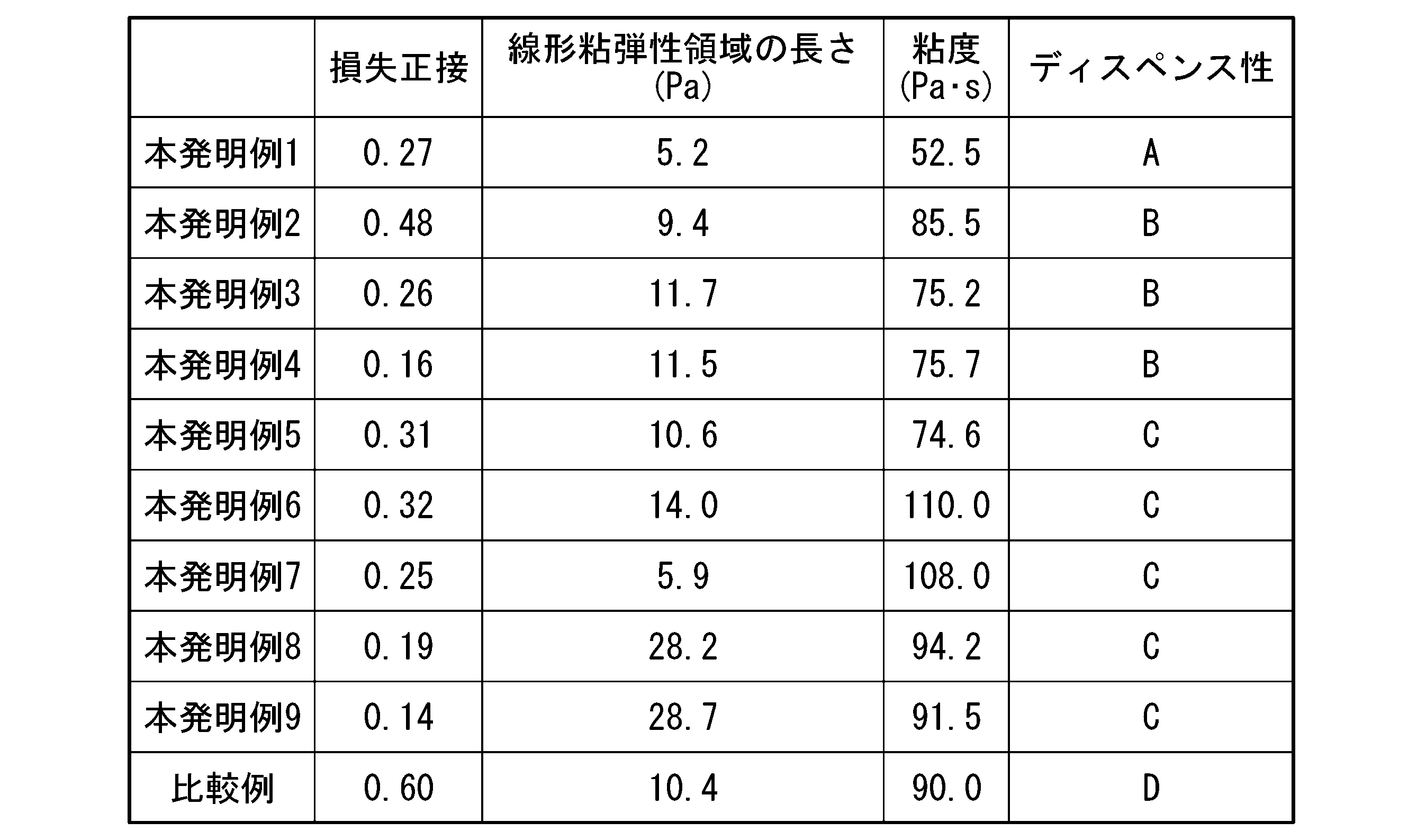
比較例においては、ひずみが0.01%のときの損失正接が0.60とされており、空打ちが生じ、ディスペンス性が「D」となった。
これに対して、本発明例1-7においては、ひずみが0.01%のときの損失正接が0.1以上0.5以下の範囲内とされており、空打ちは生じず、ディスペンス性が「C~A」となった。
また、線形粘弾性領域の長さが12Pa未満、粘度を50Pa・s以上100Pa・s以下の範囲内とした本発明例1-4においては、塗布後のペーストの直径のばらつきが抑制されており、ディスペンス性が「B~A」となった。
これに対して、本発明例1-7においては、ひずみが0.01%のときの損失正接が0.1以上0.5以下の範囲内とされており、空打ちは生じず、ディスペンス性が「C~A」となった。
また、線形粘弾性領域の長さが12Pa未満、粘度を50Pa・s以上100Pa・s以下の範囲内とした本発明例1-4においては、塗布後のペーストの直径のばらつきが抑制されており、ディスペンス性が「B~A」となった。
以上のことから、本発明例によれば、ディスペンス方式で塗布する場合であっても、安定して供給することが可能なはんだペーストを提供可能であることが確認された。
本発明によれば、ディスペンス方式で塗布する場合であっても、安定して供給することが可能なはんだペーストを提供可能である。
Claims (3)
- 金属粉と樹脂と溶剤とチキソ剤を含むはんだペーストであって、
ひずみが0.01%のときの損失正接が0.1以上0.5以下の範囲内であることを特徴とするはんだペースト。 - ひずみが0.01%のときの損失正接をN0としたとき、損失正接がN0から1.1×N0までのひずみ領域に対応するせん断応力の幅で定義される線形粘弾性領域の長さが12Pa未満であることを特徴とする請求項1に記載のはんだペースト。
- 温度25℃、せん断速度6/sの条件で測定した粘度が、50Pa・s以上100Pa・s以下の範囲内であることを特徴とする請求項1または請求項2に記載のはんだペースト。
Priority Applications (2)
| Application Number | Priority Date | Filing Date | Title |
|---|---|---|---|
| CN202380052083.6A CN119497659A (zh) | 2023-06-07 | 2023-06-07 | 焊膏 |
| PCT/JP2023/021194 WO2024252570A1 (ja) | 2023-06-07 | 2023-06-07 | はんだペースト |
Applications Claiming Priority (1)
| Application Number | Priority Date | Filing Date | Title |
|---|---|---|---|
| PCT/JP2023/021194 WO2024252570A1 (ja) | 2023-06-07 | 2023-06-07 | はんだペースト |
Publications (1)
| Publication Number | Publication Date |
|---|---|
| WO2024252570A1 true WO2024252570A1 (ja) | 2024-12-12 |
Family
ID=93795453
Family Applications (1)
| Application Number | Title | Priority Date | Filing Date |
|---|---|---|---|
| PCT/JP2023/021194 Ceased WO2024252570A1 (ja) | 2023-06-07 | 2023-06-07 | はんだペースト |
Country Status (2)
| Country | Link |
|---|---|
| CN (1) | CN119497659A (ja) |
| WO (1) | WO2024252570A1 (ja) |
Citations (6)
| Publication number | Priority date | Publication date | Assignee | Title |
|---|---|---|---|---|
| JP2017177166A (ja) * | 2016-03-30 | 2017-10-05 | 株式会社タムラ製作所 | ジェットディスペンサー用はんだ組成物 |
| JP2019171467A (ja) * | 2018-03-29 | 2019-10-10 | 株式会社タムラ製作所 | ディスペンス塗布用はんだ組成物 |
| JP2020192569A (ja) * | 2019-05-27 | 2020-12-03 | 千住金属工業株式会社 | ジェットディスペンサー用はんだ組成物 |
| JP2021023966A (ja) * | 2019-08-05 | 2021-02-22 | 千住金属工業株式会社 | ジェットディスペンサー用はんだ組成物 |
| JP2023033125A (ja) * | 2021-08-26 | 2023-03-09 | 株式会社タムラ製作所 | はんだ組成物およびはんだ付け方法 |
| JP2023086355A (ja) * | 2021-12-10 | 2023-06-22 | 三菱マテリアル株式会社 | はんだペースト |
-
2023
- 2023-06-07 CN CN202380052083.6A patent/CN119497659A/zh active Pending
- 2023-06-07 WO PCT/JP2023/021194 patent/WO2024252570A1/ja not_active Ceased
Patent Citations (6)
| Publication number | Priority date | Publication date | Assignee | Title |
|---|---|---|---|---|
| JP2017177166A (ja) * | 2016-03-30 | 2017-10-05 | 株式会社タムラ製作所 | ジェットディスペンサー用はんだ組成物 |
| JP2019171467A (ja) * | 2018-03-29 | 2019-10-10 | 株式会社タムラ製作所 | ディスペンス塗布用はんだ組成物 |
| JP2020192569A (ja) * | 2019-05-27 | 2020-12-03 | 千住金属工業株式会社 | ジェットディスペンサー用はんだ組成物 |
| JP2021023966A (ja) * | 2019-08-05 | 2021-02-22 | 千住金属工業株式会社 | ジェットディスペンサー用はんだ組成物 |
| JP2023033125A (ja) * | 2021-08-26 | 2023-03-09 | 株式会社タムラ製作所 | はんだ組成物およびはんだ付け方法 |
| JP2023086355A (ja) * | 2021-12-10 | 2023-06-22 | 三菱マテリアル株式会社 | はんだペースト |
Also Published As
| Publication number | Publication date |
|---|---|
| CN119497659A (zh) | 2025-02-21 |
Similar Documents
| Publication | Publication Date | Title |
|---|---|---|
| CA2781958C (en) | Flux for solder paste and solder paste | |
| CN100528461C (zh) | 一种用于锡铅焊膏的无松香免清洗助焊剂及其制备方法 | |
| CN102513734A (zh) | 一种膏状助焊剂的制备方法 | |
| CN103459086B (zh) | 钎焊用焊剂及焊膏组合物 | |
| CN105728977B (zh) | 一种高可靠性低温无铅锡膏及其制备方法 | |
| JPS63140792A (ja) | ろう組成物 | |
| CN109475983B (zh) | 焊膏用助焊剂和焊膏 | |
| JP6690112B1 (ja) | ジェットディスペンサー用はんだ組成物 | |
| CN110603120B (zh) | 焊膏用助焊剂、焊膏、使用焊膏的焊锡凸块的形成方法及接合体的制造方法 | |
| CN104107989A (zh) | 一种高温半导体固晶焊锡膏及其制备方法 | |
| JP2016078095A (ja) | はんだバンプの形成方法 | |
| CN104023904B (zh) | 焊膏 | |
| CN112719694A (zh) | 一种助焊剂组合物及其制备方法、喷印用金锡焊膏及其制备方法 | |
| JP2023086355A (ja) | はんだペースト | |
| CN109877484B (zh) | 一种免清洗无残留的焊锡膏及其制备方法 | |
| CN107695561A (zh) | 一种喷印用低粘度无铅焊锡膏及其制备工艺 | |
| CN107107275A (zh) | 助焊剂、焊膏和制造助焊剂的方法 | |
| JP6012946B2 (ja) | フラックスおよびはんだペースト組成物 | |
| TW202448616A (zh) | 焊膏 | |
| CN119497659A (zh) | 焊膏 | |
| JPH0313293A (ja) | はんだペースト | |
| JP5003560B2 (ja) | ディスペンス塗布用Au−Sn合金はんだペースト | |
| JP2017108008A (ja) | はんだバンプの製造方法及びはんだバンプの製造用のキット | |
| JP6690113B1 (ja) | ジェットディスペンサー用はんだ組成物 | |
| CN115519276B (zh) | 一种焊膏用粘结剂及其制备方法和应用 |
Legal Events
| Date | Code | Title | Description |
|---|---|---|---|
| WWE | Wipo information: entry into national phase |
Ref document number: 202380052083.6 Country of ref document: CN |
|
| 121 | Ep: the epo has been informed by wipo that ep was designated in this application |
Ref document number: 23940672 Country of ref document: EP Kind code of ref document: A1 |
|
| WWP | Wipo information: published in national office |
Ref document number: 202380052083.6 Country of ref document: CN |
|
| NENP | Non-entry into the national phase |
Ref country code: DE |