WO2024247635A1 - 分子結晶の製造方法及び固体電解質の製造方法 - Google Patents
分子結晶の製造方法及び固体電解質の製造方法 Download PDFInfo
- Publication number
- WO2024247635A1 WO2024247635A1 PCT/JP2024/017160 JP2024017160W WO2024247635A1 WO 2024247635 A1 WO2024247635 A1 WO 2024247635A1 JP 2024017160 W JP2024017160 W JP 2024017160W WO 2024247635 A1 WO2024247635 A1 WO 2024247635A1
- Authority
- WO
- WIPO (PCT)
- Prior art keywords
- alkali metal
- metal salt
- mixture
- solid electrolyte
- molecular
- Prior art date
- Legal status (The legal status is an assumption and is not a legal conclusion. Google has not performed a legal analysis and makes no representation as to the accuracy of the status listed.)
- Ceased
Links
Images

Classifications
-
- H—ELECTRICITY
- H01—ELECTRIC ELEMENTS
- H01M—PROCESSES OR MEANS, e.g. BATTERIES, FOR THE DIRECT CONVERSION OF CHEMICAL ENERGY INTO ELECTRICAL ENERGY
- H01M10/00—Secondary cells; Manufacture thereof
- H01M10/05—Accumulators with non-aqueous electrolyte
- H01M10/056—Accumulators with non-aqueous electrolyte characterised by the materials used as electrolytes, e.g. mixed inorganic/organic electrolytes
- H01M10/0561—Accumulators with non-aqueous electrolyte characterised by the materials used as electrolytes, e.g. mixed inorganic/organic electrolytes the electrolyte being constituted of inorganic materials only
- H01M10/0562—Solid materials
-
- C—CHEMISTRY; METALLURGY
- C01—INORGANIC CHEMISTRY
- C01B—NON-METALLIC ELEMENTS; COMPOUNDS THEREOF; METALLOIDS OR COMPOUNDS THEREOF NOT COVERED BY SUBCLASS C01C
- C01B25/00—Phosphorus; Compounds thereof
- C01B25/14—Sulfur, selenium, or tellurium compounds of phosphorus
-
- H—ELECTRICITY
- H01—ELECTRIC ELEMENTS
- H01M—PROCESSES OR MEANS, e.g. BATTERIES, FOR THE DIRECT CONVERSION OF CHEMICAL ENERGY INTO ELECTRICAL ENERGY
- H01M2300/00—Electrolytes
- H01M2300/0017—Non-aqueous electrolytes
- H01M2300/0065—Solid electrolytes
- H01M2300/0068—Solid electrolytes inorganic
-
- Y—GENERAL TAGGING OF NEW TECHNOLOGICAL DEVELOPMENTS; GENERAL TAGGING OF CROSS-SECTIONAL TECHNOLOGIES SPANNING OVER SEVERAL SECTIONS OF THE IPC; TECHNICAL SUBJECTS COVERED BY FORMER USPC CROSS-REFERENCE ART COLLECTIONS [XRACs] AND DIGESTS
- Y02—TECHNOLOGIES OR APPLICATIONS FOR MITIGATION OR ADAPTATION AGAINST CLIMATE CHANGE
- Y02E—REDUCTION OF GREENHOUSE GAS [GHG] EMISSIONS, RELATED TO ENERGY GENERATION, TRANSMISSION OR DISTRIBUTION
- Y02E60/00—Enabling technologies; Technologies with a potential or indirect contribution to GHG emissions mitigation
- Y02E60/10—Energy storage using batteries
Definitions
- lithium-ion secondary batteries are used in a wide range of applications due to their high energy density and battery capacity.
- sodium-ion secondary batteries, potassium-ion secondary batteries, magnesium-ion secondary batteries, and other post-lithium ion secondary batteries that use elements to replace the rare metal lithium have been attracting attention.
- Lithium-ion secondary batteries which are widely used as power storage devices, are secondary batteries that have a negative electrode, a positive electrode, and an electrolyte, and are charged and discharged by transferring lithium ions between the two electrodes via the electrolyte.
- organic electrolyte solutions have been used primarily as electrolytes.
- solid or gel electrolytes using inorganic or organic materials have been proposed instead of organic electrolyte solutions as a technology to eliminate concerns about electrolyte leakage and short circuits inside the battery due to overcharging and overdischarging.
- Non-Patent Document 1 discloses the formation of a crystalline organic solid electrolyte using a soft solid crystal consisting of lithium chloride and isoquinoline.
- the present disclosure has been made in consideration of these circumstances, and has one object to provide a method for producing molecular crystals that exhibit high ionic conductivity at room temperature and at temperatures lower than room temperature. Another object is to provide a method for producing a solid electrolyte that exhibits high ionic conductivity at room temperature and at temperatures lower than room temperature.
- Method 1 A method for producing molecular crystals, comprising the steps of: mixing an organic molecule having at least one atom selected from the group consisting of sulfur atoms, oxygen atoms, nitrogen atoms, and phosphorus atoms with an alkali metal salt while applying mechanical energy to obtain a mixture; and heating the mixture.
- [Means 2] The method for producing molecular crystals according to [Means 1], wherein the mixture is heated at a temperature equal to or higher than the melting point of the mixture.
- [Means 3] The method for producing a molecular crystal according to [Means 1] or [Means 2], wherein the total number of carbon atoms per molecule of the organic molecules is 6 or less.
- [Means 4] The method for producing a molecular crystal according to any one of [Means 1] to [Means 3], wherein the organic molecule is at least one selected from the group consisting of sulfones, nitriles and amides.
- [Means 5] The method for producing a molecular crystal according to any one of [Means 1] to [Means 4], wherein the alkali metal salt includes an imide-based alkali metal salt.
- [Means 6] A method for producing a solid electrolyte, comprising producing a solid electrolyte using the molecular crystal obtained by the method for producing a solid electrolyte according to any one of [Means 1] to [Means 5].
- the present disclosure it is possible to obtain molecular crystals that exhibit high ionic conductivity at room temperature and at temperatures lower than room temperature. Furthermore, by using the molecular crystals obtained by the manufacturing method of the present disclosure, it is possible to obtain a solid electrolyte that exhibits excellent ionic conductivity at room temperature and at temperatures lower than room temperature. By using such a solid electrolyte as an electrolyte for an electricity storage device such as a secondary battery or capacitor, it is possible to obtain an electricity storage device that combines ionic conductivity with the safety assured by the solidification of the electrolyte.
- FIG. 1 is a schematic diagram of a press die used to prepare the sample pellets.
- a molecular crystal is a solid in which structural units are regularly arranged in a crystal lattice.
- the method for producing a molecular crystal of the present disclosure (hereinafter also referred to as “the present production method”) is a method for producing a molecular crystal by using an organic molecule having at least one atom selected from the group consisting of a sulfur atom, an oxygen atom, a nitrogen atom, and a phosphorus atom (hereinafter also referred to as "(A) organic molecule”) and an alkali metal salt, and includes the following mechanical mixing step and heating step.
- Mechanical mixing step A step of mixing (A) organic molecules and an alkali metal salt while applying mechanical energy to obtain a mixture.
- Heating step A step of heating the mixture obtained by the mechanical mixing step.
- the organic molecules (A) and the alkali metal salt are mixed (hereinafter also referred to as "mechanical mixing") while applying mechanical energy to a substance containing the organic molecules (A) and the alkali metal salt by means of impact, shear, compression, friction, etc. This preferably causes changes in the physicochemical properties of the organic molecules (A), the alkali metal salt, or both.
- the number of at least one atom selected from the group consisting of sulfur atoms, oxygen atoms, nitrogen atoms, and phosphorus atoms contained in the (A) organic molecule is not particularly limited.
- the number of at least one atom selected from the group consisting of sulfur atoms, oxygen atoms, nitrogen atoms, and phosphorus atoms is preferably 1 to 8, and more preferably 2 to 6, per molecule.
- the (A) organic molecule preferably has 2 or more, and more preferably 2 to 6, of at least one atom selected from the group consisting of sulfur atoms, oxygen atoms, and nitrogen atoms.
- the molecular weight of the (A) organic molecule is, for example, 300 or less, preferably 250 or less, and more preferably 200 or less.
- the lower limit of the molecular weight of the (A) organic molecule is, for example, 20 or more, preferably 40 or more, and more preferably 50 or more.
- the total number of carbon atoms per molecule of the (A) organic molecule is preferably 10 or less, more preferably 8 or less, and even more preferably 6 or less.
- organic molecules having a sulfur atom such as sulfone, sulfide, thiol, thioester, thiocarbonate, sulfoxide, and sulfamide.
- Organic molecules having nitrogen atoms include nitriles, amines, amides, and the like.
- organic molecules having a phosphorus atom include phosphines, phosphine oxides, and phosphinimines.
- Examples of the organic molecule having an oxygen atom include organic molecules having an oxygen atom among the examples of organic molecules having a sulfur atom, organic molecules having an oxygen atom among the examples of organic molecules having a nitrogen atom, and organic molecules having an oxygen atom among the examples of organic molecules having a phosphorus atom, as well as ethers, esters, ketones, and carbonates.
- the (A) organic molecule is at least one selected from the group consisting of organic molecules having sulfur atoms and oxygen atoms, organic molecules having nitrogen atoms, and organic molecules having phosphorus atoms.
- a sulfone As the organic molecule having a sulfur atom and an oxygen atom, a sulfone can be preferably used.
- a preferred example of the sulfone is a compound represented by the following formula (1):
- R 1 and R 2 are each independently an alkyl group or an alkoxy group, or R 1 and R 2 are bonded together to form a cyclic structure, and the total number of carbon atoms in formula (1) is 2 to 16. Examples of such molecules include those represented by the following formula:
- the molecule represented by the above formula (1) (hereinafter also referred to as "molecule (A-1)") is a chain or cyclic molecule having a sulfonyl group (-SO 2 -).
- R 1 and R 2 in the above formula (1) are alkyl groups or alkoxy groups, the alkyl groups and alkoxy groups may be linear or branched.
- the number of carbon atoms in each of the alkyl groups and alkoxy groups i.e., the number of carbon atoms in each of the groups R 1 and R 2
- each of R 1 and R 2 preferably has a carbon atom number of 1 to 3, and more preferably 1 or 2.
- R 1 and R 2 in the above formula (1) represent a cyclic structure formed by bonding R 1 and R 2
- the cyclic structure may have a saturated ring skeleton, or may have an unsaturated bond in the ring skeleton.
- the cyclic structure formed by bonding R 1 and R 2 may be a structure in which an alkyl group (e.g., a methyl group or an ethyl group) is bonded to the ring skeleton.
- the number of carbon atoms in the cyclic structure formed by bonding R 1 and R 2 is preferably 2 to 8, more preferably 2 to 6, and even more preferably 3 to 5.
- R1 and R2 in the above formula (1) represent a cyclic structure formed by bonding R1 and R2 , and it is more preferable that the cyclic structure has a saturated ring skeleton.
- the total number of carbon atoms in the above formula (1) is 2 to 16. From the viewpoint of promoting crystallization of the mixture of the (A-1) molecule and the alkali metal salt, the total number of carbon atoms in the above formula (1) is preferably 2 to 8, more preferably 2 to 6, and even more preferably 2 to 5.
- (A-1) molecule examples include, when R 1 and R 2 in the above formula (1) are each an alkyl group or an alkoxy group, dimethyl sulfone, ethyl methyl sulfone, diethyl sulfone, dioctyl sulfone, dimethyl sulfate, diethyl sulfate, etc.
- Examples of the (A-1) molecule include, when R 1 and R 2 in the above formula (1) are each a cyclic structure formed by bonding R 1 and R 2 , tetrahydrothiophene 1,1-dioxide, 3-methylsulfolane, 3-sulfolene, 1,3-propane sultone, 1,4-butane sultone, 1,3,2-dioxathiolane 2,2-dioxide, etc.
- the (A-1) molecule may be used alone or in combination of two or more kinds.
- nitrile As the organic molecule having a nitrogen atom, a nitrile can be preferably used.
- a preferred example of the nitrile is a compound represented by the following formula (2): (In formula (2), R3 represents a hydrocarbon chain, and R4 and R5 each independently represent a hydrogen atom, an alkyl group, or a cyano group, with the proviso that the total number of carbon atoms in formula (2) is 16 or less.) Examples of such molecules include those represented by the following formula:
- the molecule represented by the above formula (2) (hereinafter also referred to as "(A-2) molecule”) is a molecule having two or more cyano groups (-CN).
- R 3 in the above formula (2) may be a saturated hydrocarbon chain or may have an unsaturated bond. It is preferable that R 3 represents a saturated hydrocarbon chain, since a molecular crystal having excellent ion conductivity can be obtained.
- the number of carbon atoms in R 3 is, for example, 1 to 10, preferably 1 to 6, and more preferably 2 to 4.
- R4 or R5 is an alkyl group
- the alkyl group may be linear or branched. It is preferably linear.
- the number of carbon atoms in each of R4 and R5 is preferably 0 to 3, more preferably 0 or 1, from the viewpoint of crystallization caused by mixing (A) the organic molecule and the alkali metal salt.
- the total number of carbon atoms in the above formula (2) may be 16 or less. From the viewpoint of promoting crystallization of the mixture of the (A-2) molecule and the alkali metal salt, the total number of carbon atoms in the above formula (2) is preferably 8 or less, and more preferably 6 or less.
- the (A-2) molecule examples include succinonitrile, adiponitrile, 3-hexenedinitrile, 1,3,5-pentanetricarbonitrile, tert-butylmalononitrile, 1,2,2,3-propanetetracarbonitrile, etc.
- the (A-2) molecule one type may be used alone, or two or more types may be used in combination.
- a compound having an amide group As the organic molecule having a nitrogen atom, a compound having an amide group can be preferably used.
- the compound having an amide group is preferably a molecule having two or more amide groups in one molecule, in terms of high heat resistance.
- Specific examples of the compound having an amide group include malonamide, succinamide, glutaramide, adipamide, N,N,N',N'-tetramethylmalonamide, N,N,N',N'-tetraethylmalonamide, N,N,N',N'-tetramethylsuccinamide, and terephthalamide.
- organic molecules having a phosphorus atom examples include ethylene bis(dimethylphosphine), ethylene bis(diphenylphosphine), methyl(diphenyl)phosphine oxide, triphenylphosphine oxide, methyl(diphenyl)phosphine imine, and triphenylphosphine imine.
- the organic molecule (A) is preferably at least one selected from the group consisting of sulfone, nitrile and amide.
- the (A-1) molecule is more preferable, and a molecule representing a cyclic structure formed by bonding R 1 and R 2 in the above formula (1) is more preferable, and it is even more preferable that the cyclic structure has a saturated ring skeleton.
- the organic molecule (A) one type may be used alone, or two or more types may be used in combination.
- the alkali metal salt is not particularly limited as long as it is a salt that generates an alkali metal ion.
- Examples of the alkali metal salt include lithium salt, sodium salt, and potassium salt.
- alkali metal salts include lithium salts such as Li2CO3 , LiBr , LiCl, LiI, LiSCN , LiBF4 , LiAsF6, LiClO4 , CH3COOLi , CF3COOLi , LiCF3SO3, LiPF6 , LiC( CF3SO2 ) 3 , lithium bis( fluorosulfonyl ) imide (Li + ( FSO2 ) 2N- ) , lithium bis(trifluoromethanesulfonyl)imide (Li + ( CF3SO2 ) 2N- ) , and lithium (fluorosulfonyl)(trifluoromethanesulfonyl)imide; and salts of the anions of these lithium salts with alkali metals other than lithium (e.g., sodium, potassium, etc.).
- the lithium salt or sodium salt is preferred, and the lithium salt is more preferred, since it is possible to obtain a mole
- the alkali metal salt used in the production of the molecular crystal preferably contains an imide-based alkali metal salt, in that it can further increase the ionic conductivity of the molecular crystal.
- imide-based lithium salts are preferred in that they have high ionic dissociability, and among the imide-based lithium salts, lithium bis(fluorosulfonyl)imide, lithium bis(trifluoromethanesulfonyl)imide or lithium (fluorosulfonyl)(trifluoromethanesulfonyl)imide are particularly preferred, lithium bis(fluorosulfonyl)imide or lithium bis(trifluoromethanesulfonyl)imide are more preferred, and lithium bis(fluorosulfonyl)imide is even more preferred.
- the molecular weight of the alkali metal salt is, for example, 500 or less, preferably 400 or less, more preferably 350 or less, and even more preferably 300 or less.
- the lower limit of the molecular weight of the alkali metal salt is, for example, 20 or more, preferably 50 or more, more preferably 100 or more, and even more preferably 150 or more.
- the alkali metal salt one type may be used alone, or two or more types may be used in combination.
- the melting point of the alkali metal salt is, for example, 60°C or higher, preferably 70°C or higher, and more preferably 80°C or higher. There is no particular upper limit to the melting point of the alkali metal salt, but it may be, for example, 300°C or lower, or 250°C or lower.
- a substance other than the (A) organic molecule and the alkali metal salt e.g., a sulfur-containing organic molecule other than the (A) organic molecule
- the alkali metal salt e.g., a sulfur-containing organic molecule other than the (A) organic molecule
- the amount of the substance other than the (A) organic molecule and the alkali metal salt used is preferably 0.1 mol or less, and more preferably 0.05 mol or less, per 1 mol of the total amount of the (A) organic molecule and the alkali metal salt.
- the compounding ratio of the (A) organic molecule to the alkali metal salt may be set according to the types of the (A) organic molecule and the alkali metal salt, and is not particularly limited.
- the compounding ratio of the (A) organic molecule to the alkali metal salt may be, for example, 0.1 to 10 moles of the (A) organic molecule per mole of the alkali metal salt.
- the compounding ratio of the (A) organic molecule to the alkali metal salt is preferably 0.2 to 5 moles of the (A) organic molecule per mole of the alkali metal salt, more preferably 0.25 to 4 moles, and even more preferably 0.5 to 2 moles.
- the method for mixing the (A) organic molecules and the alkali metal salt while applying mechanical energy is not particularly limited.
- the (A) organic molecules and the alkali metal salt can be mixed using various devices such as a ball mill, a bead mill, a blender, a homogenizer, a stamp mill, a homomixer, a dispersing mixer, etc.
- the (A) organic molecules and the alkali metal salt can also be mechanically mixed using a mortar and pestle.
- the (A) organic molecules and the alkali metal salt can be mechanically mixed in a dry or wet manner.
- the (A) organic molecules and the alkali metal salt can be mechanically mixed at room temperature or at a low temperature.
- the (A) organic molecules in a liquid state can be mechanically mixed with the alkali metal salt.
- the (A) organic molecules in a solid state can be mechanically mixed with the alkali metal salt at a temperature lower than the melting point of the (A) organic molecules.
- the (A) organic molecules and the alkali metal salt may be mechanically mixed while being heated.
- the mechanical mixing step is preferably performed at a temperature lower than the heating temperature in the heating step performed after the mechanical mixing step.
- the mechanical mixing step is performed, for example, at 50°C or lower, preferably at 40°C or lower, and more preferably at 35°C or lower.
- the time for which mechanical mixing is performed depends on the amount and type of the (A) organic molecules and alkali metal salt used, and may be, for example, 1 to 60 minutes, or 1 to 30 minutes.
- the mixture of (A) organic molecules and an alkali metal salt obtained by mechanical mixing preferably has a melting point of 40°C or higher, more preferably 50°C or higher, and even more preferably 55°C or higher.
- the melting point of the mixture is preferably 110°C or lower, more preferably 100°C or lower, and even more preferably 95°C or lower, in order to suppress decomposition of molecular crystals accompanying volatilization or sublimation of (A) organic molecules in the heating step following the mechanical mixing step.
- the melting point of the mixture of (A) organic molecules and an alkali metal salt is a value obtained by differential scanning calorimetry (DSC). Details of the measurement method follow the method described in the Examples below.
- the heating step After the mechanical mixing step, the mixture obtained by the mechanical mixing step is heated.
- the method of heating the mixture is not particularly limited.
- the heating temperature of the mixture can be appropriately set depending on the type of the organic molecules (A) and the alkali metal salt used as the raw material. From the viewpoint of making the organic molecules (A) and the alkali metal salt in the mixture more uniform, it is preferable to heat the mixture at a temperature equal to or higher than the melting point of the mixture of the organic material (A) and the alkali metal salt obtained by mechanical mixing in the heating step of the present production method.
- the heating temperature By setting the heating temperature to equal to or higher than the melting point of the mixture, the mixture melts, thereby promoting uniform mixing of the organic molecules (A) and the alkali metal salt.
- the temperature at which the mixture is heated is preferably higher than the melting point of the mixture, from the viewpoint of homogenizing the (A) organic molecules and the alkali metal salt in the mixture by melting the mixture.
- the heating temperature of the mixture is more preferably 5°C or higher than the melting point of the mixture (unit: °C), and even more preferably 7°C or higher.
- the melting point of the mixture when the melting point of the mixture is expressed as Mp (unit: °C), from the viewpoint of suppressing volatilization and sublimation of the components contained in the mixture, it is preferable to set it to (Mp + 20) °C or lower, and more preferably (Mp + 15) °C or lower.
- the heating time is not particularly limited as long as it is sufficient to homogenize the (A) organic molecules and the alkali metal salt in the mixture.
- the heating time is, for example, 1 minute to 3 hours, preferably 15 minutes to 2 hours, and more preferably 30 minutes to 2 hours.
- the heating treatment is usually performed under normal pressure, but may be performed under pressure or reduced pressure.
- the stirring method is not particularly limited, and examples include a magnetic stirrer, a stirring rod, a stirrer with stirring blades, and external circulation stirring. Stirring may also be performed using mechanical operations that can provide greater shear force, such as a homomixer, a dispersing mixer, or a homogenizer.
- the temperature of the heated mixture is lowered, so that the heated mixture crystallizes and the desired molecular crystal can be obtained.
- the mixture may be cooled gradually (for example, the temperature is lowered slowly at room temperature over 1 to 48 hours).
- the heated mixture may be cooled rapidly (for example, the heated mixture is placed in a thermostatic bath at a temperature lower than room temperature (for example, 15°C or lower) for a short period of time).
- room temperature for example, 15°C or lower
- the product obtained by this manufacturing method is a molecular crystal containing the organic molecule and the alkali metal salt (A) can be detected by performing powder X-ray diffraction measurement of the product. Details of the measurement method follow the method described in the Examples below.
- the (A) organic molecules and the alkali metal salt are mechanically mixed in advance, and then the mixture containing the (A) organic molecules and the alkali metal salt is heated.
- the present manufacturing method which includes a mechanical mixing step and a heating step
- the mechanical mixing performed before the heat treatment generates intermolecular interactions between the alkali metal ions derived from the alkali metal salt and the (A) organic molecules. Therefore, in the present manufacturing method, in which the heat treatment is performed after the mechanical mixing, it is believed that sublimation and volatilization of the (A) organic molecules is suppressed during the heat treatment, thereby suppressing the variation in the composition of the molecular crystals.
- the suppression of the variation in the composition of the molecular crystals leads to the formation of uniform ion conduction paths, making it possible to produce molecular crystals that exhibit excellent ion conductivity.
- the molecular crystal obtained by the above-mentioned manufacturing method is a crystalline organic material containing (A) an organic molecule and an alkali metal salt as the structural unit of the crystal.
- the molecular crystal has an ion conduction path due to the regular arrangement of the structural unit containing (A) an organic molecule and an alkali metal salt, and thus exhibits excellent ion conductivity. Therefore, the molecular crystal obtained by the manufacturing method is suitable as a material for a solid electrolyte. In other words, by using the molecular crystal obtained by the manufacturing method, a solid electrolyte exhibiting excellent ion conductivity can be obtained.
- the solid electrolyte of the present disclosure can be obtained by molding the electrode material containing the molecular crystals obtained by the above-mentioned manufacturing method into a desired shape.
- the molding method is not particularly limited, and known methods such as extrusion molding, injection molding, pressure molding, casting molding, mold cast molding, and tape molding can be used. Of these, it is preferable to obtain a molded body by pressure molding, since this can minimize the porosity of the obtained solid electrolyte and makes it easier to form ion conduction paths.
- the shape of the molded body is not particularly limited, and can be set appropriately depending on the shape of the applied electricity storage device.
- the shape of the molded body is, for example, rectangular or circular.
- the solid electrolyte of the present disclosure may further contain other components in addition to the molecular crystal of the present disclosure, as long as the effect of the present disclosure is not impaired.
- other components include molecular crystals different from the molecular crystal of the present disclosure, polymer solid electrolytes, polymer gel electrolytes, inorganic electrolytes (e.g., ceramic electrolytes, glass electrolytes, etc.), binders, etc.
- the content of the molecular crystal of the present disclosure in the solid electrolyte is preferably 50 mass% or more, more preferably 70 mass% or more, even more preferably 80 mass% or more, and even more preferably 90 mass% or more, based on the total amount of the solid electrolyte, particularly from the viewpoint of ensuring ionic conductivity in a low-temperature environment.
- the solid electrolyte obtained as described above exhibits high ionic conductivity at room temperature and at temperatures lower than room temperature.
- the ionic conductivity measured at 25°C using an AC impedance method for a solid electrolyte having a thickness of about 200 ⁇ m (specifically, 200 ⁇ 20 ⁇ m) is preferably 1 ⁇ 10 ⁇ 6 S/cm or more.
- the ionic conductivity under the same conditions is more preferably 2 ⁇ 10 ⁇ 6 S/cm or more, and even more preferably 5 ⁇ 10 ⁇ 6 S/cm or more.
- the ionic conductivity measured at ⁇ 20° C. using an AC impedance method is preferably 2 ⁇ 10 ⁇ 8 S/cm or more, more preferably 5 ⁇ 10 ⁇ 8 S/cm or more, and even more preferably 1 ⁇ 10 ⁇ 7 S/cm or more. Details of the method for measuring the ionic conductivity follow the method described in the Examples below.
- the solid electrolyte disclosed herein exhibits high ionic conductivity not only in room temperature environments, but also in low-temperature environments below 0°C. Therefore, by using the solid electrolyte disclosed herein as the electrolyte of an electricity storage device, it is possible to obtain an electricity storage device with high ionic conductivity.
- the power storage device of the present disclosure includes the solid electrolyte of the present disclosure.
- Examples of the device include a secondary battery and a capacitor.
- the device is a secondary battery
- one embodiment of the device is an all-solid-state battery, and a lithium-ion secondary battery is preferable in terms of excellent ion conductivity.
- a lithium-ion secondary battery is a laminate comprising electrodes consisting of a positive electrode and a negative electrode, and a solid electrolyte, with the solid electrolyte being disposed between the positive electrode and the negative electrode so that the solid electrolyte is in contact with the electrode.
- the materials constituting the positive electrode and the negative electrode there are no particular limitations on the materials constituting the positive electrode and the negative electrode, and any suitable material may be selected from materials known as electrode materials for lithium-ion secondary batteries.
- a metal foil such as aluminum or stainless steel may be used as the positive electrode current collector.
- a metal foil such as copper foil or lithium foil may be used as the negative electrode current collector.
- the solid electrolyte is formed using (A) a molecular crystal containing an organic molecule and an alkali metal salt.
- the thickness of the solid electrolyte is not particularly limited and can be set appropriately depending on the application of the secondary battery.
- the thickness of the solid electrolyte is, for example, 5 to 500 ⁇ m.
- the method for manufacturing a lithium ion secondary battery is not particularly limited, and known methods can be appropriately adopted depending on the battery structure, etc.
- a laminate comprising a positive electrode, a solid electrolyte, and a negative electrode may be manufactured by annealing a molded body formed using molecular crystals and sandwiching the solid electrolyte obtained by this between a positive electrode and a negative electrode.
- an electrolyte material containing molecular crystals may be sandwiched between a positive electrode and a negative electrode and contained in a container, and the container may be annealed to manufacture a laminate comprising a positive electrode, a solid electrolyte, and a negative electrode.
- a laminate comprising a positive electrode, a solid electrolyte, and a negative electrode is usually contained in a case and used as a secondary battery.
- the device is not limited to the above configuration in which the carrier for ion conduction is lithium ions, but may be a secondary battery in which other ions, such as sodium ions, are used as the carrier.
- the device may also be a capacitor.
- One form of the capacitor is one that includes a positive electrode, a negative electrode, and a solid electrolyte, with the solid electrolyte disposed between the positive electrode and the negative electrode so that the solid electrolyte is in contact with the electrodes.
- Electricity storage devices containing this solid electrolyte can be used for a variety of purposes. Specifically, they can be used as a power source for, for example, various mobile devices such as mobile phones, personal computers, smartphones, game devices, and wearable devices; various moving objects such as electric cars, hybrid cars, robots, and drones; various electric and electronic devices such as digital cameras, video cameras, music players, power tools, and home appliances; etc.
- various mobile devices such as mobile phones, personal computers, smartphones, game devices, and wearable devices
- various moving objects such as electric cars, hybrid cars, robots, and drones
- various electric and electronic devices such as digital cameras, video cameras, music players, power tools, and home appliances; etc.
- Example 1 ⁇ Production and evaluation of molecular crystals> [Example 1] 1. Preparation of molecular crystals In a glove box under an argon atmosphere, 0.1379 g of succinonitrile (manufactured by Tokyo Chemical Industry Co., Ltd.) as an organic molecule and 0.1624 g of lithium tetrafluoroborate (manufactured by Fujifilm Wako Pure Chemical Industries, Ltd.) as an alkali metal salt were weighed out so that the molar ratio was 1:1, and mechanically mixed using a mortar at room temperature (25°C) for 5 minutes to obtain a mixture (this is referred to as mixture M) (mechanical mixing step).
- succinonitrile manufactured by Tokyo Chemical Industry Co., Ltd.
- lithium tetrafluoroborate manufactured by Fujifilm Wako Pure Chemical Industries, Ltd.
- the melting point of mixture M was measured using a differential scanning calorimeter (manufactured by TA Instruments, DSC250, measurement atmosphere: under nitrogen atmosphere) at a heating rate of 10°C per minute, and a large endothermic peak (melting point) was observed at 77°C.
- the mixture M was transferred to a vial and stirred with a magnetic stirrer set at 90° C. for 1 hour, and it was confirmed that the mixture was uniformly dissolved (heating step). Thereafter, the resulting molten material was allowed to cool to room temperature, and a white solid was obtained.
- the white solid obtained above was subjected to powder X-ray diffraction measurement, and the X-ray diffraction spectrum had a sharp peak in the angle range of measurement and was different from that of the raw material. From this, it was confirmed that the obtained white solid has crystallinity, that is, it is a molecular crystal composed of organic molecules and alkali metal salts.
- a sample pellet was prepared in a glove box under an argon atmosphere.
- the die set 11 containing 0.0200 g of a white solid (molecular crystal) was placed on the lower punch 13, and the upper punch 12 was placed on the die set 11.
- the white solid was compressed for 1 minute at a pressure of 10 MPa using a hydraulic press to obtain a circular sample pellet having a diameter of 1 cm and a thickness of 200 ⁇ m.
- the sample pellet was enclosed in an all-solid-state battery evaluation cell (KP-SolidCell, manufactured by Hosen Co., Ltd.) in a glove box under an argon atmosphere.
- the ionic conductivity was measured under atmospheric conditions using an all-solid-state battery evaluation cell in which the sample pellets were sealed.
- the resistance value was measured by AC impedance measurement while the sealed cell 20 in which the sample pellets were sealed was heat-treated in a thermostatic bath at 50° C. (corresponding to the heat treatment temperature in Table 1). The heat treatment was terminated when the resistance value became constant.
- the resistance values at 25° C. and ⁇ 20° C. were measured by AC impedance measurement.
- the ionic conductivity ( ⁇ ) was calculated by the following formula (1).
- the AC impedance measurement for calculating the ionic conductivity was performed after the cell was held at the measurement temperature in a thermostatic bath for 2 hours.
- ⁇ L/(R ⁇ S) (1)
- ⁇ ionic conductivity (unit: S/cm)
- R resistance (unit: ⁇ )
- S represents the cross-sectional area of the molecular crystal at the time of measurement (unit: cm 2 )
- L represents the distance between the electrodes (unit: cm).
- the ionic conductivities of the resulting molecular crystal at 25° C. and ⁇ 20° C. were 6.6 ⁇ 10 ⁇ 5 S/cm and 2.7 ⁇ 10 ⁇ 8 S/cm, respectively.
- Examples 2 to 7 The mechanical mixing step and the heating step were carried out in the same manner as in Example 1, except that the types and amounts of the raw materials, the heating temperature of mixture M in the heating step, and the heat treatment temperature for measuring the ionic conductivity were changed as shown in Table 1, to obtain a white solid.
- the white solids obtained in each Example were subjected to powder X-ray diffraction measurement in the same manner as in Example 1. As a result, X-ray diffraction spectra having sharp peaks at angles within the measurement range and different from those of the raw materials were observed, and it was confirmed that all of the white solids were molecular crystals composed of organic molecules and alkali metal salts.
- Example 1 the white solids (molecular crystals) of each Example were used to measure the ionic conductivity at 25°C and -20°C in the same manner as in Example 1.
- the measurement results of the melting point of the mixture M obtained by the mechanical mixing step and the measurement results of the ionic conductivity are shown in Table 1.
- the obtained molten material was allowed to cool to room temperature to obtain a white solid (molecular crystal).
- the heat treatment temperature was set to 50 ° C., and the ionic conductivity was measured at 25 ° C. and -20 ° C. in the same manner as in Example 1.
- the measurement results of the ionic conductivity are shown in Table 1.
- the heat treatment temperature was set to 50°C, and the ionic conductivity was measured at 25°C and -20°C in the same manner as in Example 1.
- the measurement results of the ionic conductivity are shown in Table 1.
- Comparative Example 2 the resistance value of the measured sample was extremely large in the Nyquist plot at -20°C, so the resistance value could not be read and the ionic conductivity could not be calculated. Therefore, in Table 1, the column for the measurement result of the ionic conductivity at -20°C is marked as "unreadable" (the same applies to Comparative Example 3).
- the heat treatment temperature was set to 80° C., and the ionic conductivity was measured at 25° C. and ⁇ 20° C. in the same manner as in Example 1.
- the measurement results of the ionic conductivity are shown in Table 1.
- Comparative Example 3 the resistance value of the measured sample was extremely large in the Nyquist plot at ⁇ 20° C., so the resistance value could not be read and the ionic conductivity could not be calculated.
Landscapes
- Chemical & Material Sciences (AREA)
- Inorganic Chemistry (AREA)
- Organic Chemistry (AREA)
- Physics & Mathematics (AREA)
- Condensed Matter Physics & Semiconductors (AREA)
- General Physics & Mathematics (AREA)
- Engineering & Computer Science (AREA)
- Manufacturing & Machinery (AREA)
- Chemical Kinetics & Catalysis (AREA)
- Electrochemistry (AREA)
- General Chemical & Material Sciences (AREA)
- Secondary Cells (AREA)
Abstract
硫黄原子、酸素原子、窒素原子及びリン原子よりなる群から選択される少なくとも1種の原子を有する有機分子と、アルカリ金属塩とを、機械的エネルギーを加えながら混合し、混合物を得る工程と、混合物を加熱する工程とを含む方法により分子結晶を製造する。
Description
[関連出願の相互参照]
本出願は、2023年5月30日に出願された日本特許出願番号2023-88980号に基づく優先権を主張し、その全体が参照により本明細書に組み込まれる。
本開示は、分子結晶の製造方法及び固体電解質の製造方法に関する。
本出願は、2023年5月30日に出願された日本特許出願番号2023-88980号に基づく優先権を主張し、その全体が参照により本明細書に組み込まれる。
本開示は、分子結晶の製造方法及び固体電解質の製造方法に関する。
蓄電デバイスとしては、ニッケル水素二次電池やリチウムイオン二次電池等の各種二次電池や、電気二重層キャパシタ等といった様々なデバイスが実用化されている。中でも、リチウムイオン二次電池は、高いエネルギー密度や電池容量を有する点において広範な用途で利用されている。また近年では、レアメタルであるリチウムに替わる元素を使用するポストリチウムイオン二次電池として、ナトリウムイオン二次電池やカリウムイオン二次電池、マグネシウムイオン二次電池等が注目を集めている。
蓄電デバイスとして広く用いられているリチウムイオン二次電池は、負極、正極及び電解質を有し、電解質を介して両極間でリチウムイオンを移動させることによって充放電を行う二次電池である。電解質としては、従来、有機電解液が主に用いられてきている。これに対し、近年、電解液の液漏れや、過充電・過放電による電池内部での短絡の懸念を払拭する技術として、有機電解液に代えて、無機材料や有機材料を用いた固体又はゲル状の電解質が提案されている。
有機固体電解質は、有機材料の適度な柔軟性及び高い成形性により電極との密着性に優れるといった利点がある一方で、例えば無機固体電解質と比較してイオン伝導性が低い傾向がある。そこで、実用性を高めるべく、有機固体電解質を構成する新たな材料の開発が種々検討されている(例えば、非特許文献1参照)。非特許文献1には、塩化リチウムとイソキノリンとからなるSoft solid crystalにより結晶性有機固体電解質を形成することが開示されている。
イオニクス(Ionics)、2018年、24巻、p.343-349
従来の有機固体電解質は室温でのイオン伝導性が十分でなく、更には、室温よりも低温になるとイオン伝導性が大きく低下するという問題があった。
本開示はこのような事情に鑑みてなされたものであり、室温及び室温よりも低温で高いイオン伝導性を示す分子結晶の製造方法を提供することを1つの目的とする。また、室温及び室温よりも低温で高いイオン伝導性を示す固体電解質の製造方法を提供することを他の1つの目的とする。
本発明者らは、上記課題を解決するために鋭意検討した結果、特定の製造方法により製造した分子結晶が、室温及び室温よりも低温において高いイオン伝導性を示すことを見出した。本開示によれば以下の分子結晶の製造方法及び固体電解質の製造方法が提供される。
〔手段1〕 硫黄原子、酸素原子、窒素原子及びリン原子よりなる群から選択される少なくとも1種の原子を有する有機分子と、アルカリ金属塩とを、機械的エネルギーを加えながら混合し、混合物を得る工程と、前記混合物を加熱する工程と、を含む、分子結晶の製造方法。
〔手段2〕 前記混合物の融点以上の温度で前記混合物を加熱する、〔手段1〕の分子結晶の製造方法。
〔手段3〕 前記有機分子の1分子あたりの炭素原子数の合計が6以下である、〔手段1〕又は〔手段2〕の分子結晶の製造方法。
〔手段4〕 前記有機分子が、スルホン、ニトリル及びアミドよりなる群から選択される少なくとも1種である、〔手段1〕~〔手段3〕のいずれかの分子結晶の製造方法。
〔手段5〕 前記アルカリ金属塩がイミド系アルカリ金属塩を含む、〔手段1〕~〔手段4〕のいずれかの分子結晶の製造方法。
〔手段6〕 〔手段1〕~〔手段5〕のいずれかに記載の製造方法により得られた分子結晶を用いて固体電解質を製造する、固体電解質の製造方法。
〔手段3〕 前記有機分子の1分子あたりの炭素原子数の合計が6以下である、〔手段1〕又は〔手段2〕の分子結晶の製造方法。
〔手段4〕 前記有機分子が、スルホン、ニトリル及びアミドよりなる群から選択される少なくとも1種である、〔手段1〕~〔手段3〕のいずれかの分子結晶の製造方法。
〔手段5〕 前記アルカリ金属塩がイミド系アルカリ金属塩を含む、〔手段1〕~〔手段4〕のいずれかの分子結晶の製造方法。
〔手段6〕 〔手段1〕~〔手段5〕のいずれかに記載の製造方法により得られた分子結晶を用いて固体電解質を製造する、固体電解質の製造方法。
本開示によれば、室温及び室温よりも低温で高いイオン伝導性を示す分子結晶を得ることができる。また、本開示の製造方法により得られた分子結晶を用いることにより、室温及び室温よりも低温で優れたイオン伝導性を示す固体電解質を得ることができる。このような固体電解質を二次電池やキャパシタ等の蓄電デバイスの電解質として用いることにより、電解質の固体化による安全性の確保と、イオン伝導性とを兼ね備える蓄電デバイスを得ることができる。
以下、本開示の分子結晶の製造方法、並びに当該製造方法により得られる分子結晶を用いて製造される固体電解質及び蓄電デバイスについて詳しく説明する。
≪分子結晶の製造方法≫
分子結晶は、結晶格子中における構成単位が規則的に配列している固体である。本開示の分子結晶の製造方法(以下、「本製造方法」ともいう)は、硫黄原子、酸素原子、窒素原子及びリン原子からなる群より選択される少なくとも1種の原子を有する有機分子(以下、「(A)有機分子」ともいう)と、アルカリ金属塩とを用いて分子結晶を製造するものであり、以下の機械的混合工程と加熱工程とを含む。
機械的混合工程:機械的エネルギーを加えながら(A)有機分子とアルカリ金属塩とを混合し、混合物を得る工程
加熱工程:機械的混合工程により得られた混合物を加熱する工程
以下、本製造方法における各工程について詳細に説明する。
分子結晶は、結晶格子中における構成単位が規則的に配列している固体である。本開示の分子結晶の製造方法(以下、「本製造方法」ともいう)は、硫黄原子、酸素原子、窒素原子及びリン原子からなる群より選択される少なくとも1種の原子を有する有機分子(以下、「(A)有機分子」ともいう)と、アルカリ金属塩とを用いて分子結晶を製造するものであり、以下の機械的混合工程と加熱工程とを含む。
機械的混合工程:機械的エネルギーを加えながら(A)有機分子とアルカリ金属塩とを混合し、混合物を得る工程
加熱工程:機械的混合工程により得られた混合物を加熱する工程
以下、本製造方法における各工程について詳細に説明する。
<機械的混合工程>
機械的混合工程では、(A)有機分子とアルカリ金属塩とを含む物質に対し、衝撃やせん断、圧縮、摩擦等の手段により機械的エネルギーを加えながら、(A)有機分子とアルカリ金属塩とを混合(以下、「機械的混合」ともいう)する。これにより、(A)有機分子、アルカリ金属塩又はそれら両方における物理化学的性質の変化を引き起こすことが好ましい。
機械的混合工程では、(A)有機分子とアルカリ金属塩とを含む物質に対し、衝撃やせん断、圧縮、摩擦等の手段により機械的エネルギーを加えながら、(A)有機分子とアルカリ金属塩とを混合(以下、「機械的混合」ともいう)する。これにより、(A)有機分子、アルカリ金属塩又はそれら両方における物理化学的性質の変化を引き起こすことが好ましい。
・(A)有機分子
(A)有機分子が有する、硫黄原子、酸素原子、窒素原子及びリン原子からなる群より選択される少なくとも1種の原子の数は特に限定されない。(A)有機分子において、硫黄原子、酸素原子、窒素原子及びリン原子よりなる群から選択される少なくとも1種の原子の数は、1分子当たり、好ましくは1~8個であり、より好ましくは2~6個である。(A)有機分子は、これらのうち、硫黄原子、酸素原子及び窒素原子より選択される少なくとも1種の原子を2個以上有することが好ましく、2~6個有することがより好ましい。
(A)有機分子が有する、硫黄原子、酸素原子、窒素原子及びリン原子からなる群より選択される少なくとも1種の原子の数は特に限定されない。(A)有機分子において、硫黄原子、酸素原子、窒素原子及びリン原子よりなる群から選択される少なくとも1種の原子の数は、1分子当たり、好ましくは1~8個であり、より好ましくは2~6個である。(A)有機分子は、これらのうち、硫黄原子、酸素原子及び窒素原子より選択される少なくとも1種の原子を2個以上有することが好ましく、2~6個有することがより好ましい。
(A)有機分子の分子量は、例えば300以下であり、250以下であることが好ましく、200以下であることがより好ましい。(A)有機分子の分子量の下限については、例えば20以上であり、40以上であることが好ましく、50以上であることがより好ましい。また、(A)有機分子とアルカリ金属塩との混合物の結晶化を促進させる観点からすると、(A)有機分子の1分子あたりの炭素原子数の合計は、10以下が好ましく、8以下がより好ましく、6以下が更に好ましい。
(A)有機分子の具体例としては、硫黄原子を有する有機分子として、スルホン、スルフィド、チオール、チオエステル、チオカーボネート、スルホキシド及びスルファミド等が挙げられる。
窒素原子を有する有機分子としては、ニトリル、アミン及びアミド等が挙げられる。
リン原子を有する有機分子としては、ホスフィン、ホスフィンオキシド及びホスフィンイミン等が挙げられる。
酸素原子を有する有機分子としては、硫黄原子を有する有機分子の例示のうち酸素原子を有する有機分子、窒素原子を有する有機分子の例示のうち酸素原子を有する有機分子、及びリン原子を有する有機分子の例示のうち酸素原子を有する有機分子のほか、エーテル、エステル、ケトン及びカーボネート等が挙げられる。
窒素原子を有する有機分子としては、ニトリル、アミン及びアミド等が挙げられる。
リン原子を有する有機分子としては、ホスフィン、ホスフィンオキシド及びホスフィンイミン等が挙げられる。
酸素原子を有する有機分子としては、硫黄原子を有する有機分子の例示のうち酸素原子を有する有機分子、窒素原子を有する有機分子の例示のうち酸素原子を有する有機分子、及びリン原子を有する有機分子の例示のうち酸素原子を有する有機分子のほか、エーテル、エステル、ケトン及びカーボネート等が挙げられる。
分子結晶のイオン伝導性をより高くできる点において、(A)有機分子は上記の中でも、硫黄原子と酸素原子とを有する有機分子、窒素原子を有する有機分子及びリン原子を有する有機分子よりなる群から選択される少なくとも1種であることが好ましい。
(硫黄原子と酸素原子とを有する有機分子)
硫黄原子と酸素原子とを有する有機分子としてはスルホンを好ましく使用することができる。スルホンの好ましい例としては、下記式(1):

(式(1)中、R1及びR2はそれぞれ独立してアルキル基若しくはアルコキシ基であるか、又はR1とR2とが結合してなる環状構造を表し、ただし、式(1)中の炭素原子数の合計は2~16である)
で表される分子が挙げられる。
硫黄原子と酸素原子とを有する有機分子としてはスルホンを好ましく使用することができる。スルホンの好ましい例としては、下記式(1):
で表される分子が挙げられる。
上記式(1)で表される分子(以下、「(A-1)分子」ともいう)は、スルホニル基(-SO2-)を有する鎖状又は環状の分子である。上記式(1)中のR1及びR2がアルキル基又はアルコキシ基である場合、当該アルキル基及びアルコキシ基は、直鎖状であってもよく、分岐状であってもよい。また、アルキル基及びアルコキシ基のそれぞれの炭素原子数(すなわち、R1及びR2の各基における炭素原子数)は、R1とR2との炭素原子数の合計が2~16となる限り、特に限定されない。(A)有機分子とアルカリ金属塩との混合物に結晶化を生じさせる観点からすると、R1及びR2はそれぞれ、炭素原子数が1~3であることが好ましく、1又は2であることがより好ましい。
上記式(1)中のR1及びR2が、R1とR2とが結合してなる環状構造を表す場合、当該環状構造は、飽和の環骨格を有していてもよく、環骨格中に不飽和結合を有していてもよい。また、R1とR2とが結合してなる環状構造は、環骨格にアルキル基(例えば、メチル基やエチル基)等が結合した構造であってもよい。R1とR2とが結合してなる環状構造の炭素原子数は、2~8が好ましく、2~6がより好ましく、3~5が更に好ましい。
本分子結晶のイオン伝導性をより優れたものとすることができる点で、上記式(1)中のR1及びR2は、R1とR2とが結合してなる環状構造を表すことが好ましく、当該環状構造が飽和の環骨格を有することがより好ましい。
上記式(1)中の炭素原子数の合計は2~16である。(A-1)分子とアルカリ金属塩との混合物の結晶化を促進させる観点から、上記式(1)中の炭素原子数の合計は、2~8が好ましく、2~6がより好ましく、2~5が更に好ましい。
(A-1)分子の具体例としては、上記式(1)中のR1及びR2がそれぞれアルキル基又はアルコキシ基である場合の例として、ジメチルスルホン、エチルメチルスルホン、ジエチルスルホン、ジオクチルスルホン、硫酸ジメチル、硫酸ジエチル等が挙げられる。上記式(1)中のR1及びR2が、R1とR2とが結合してなる環状構造を表す場合の例としては、テトラヒドロチオフェン 1,1-ジオキシド、3-メチルスルホラン、3-スルホレン、1,3-プロパンスルトン、1,4-ブタンスルトン、1,3,2-ジオキサチオラン 2,2-ジオキシド等が挙げられる。(A-1)分子としては、1種を単独で使用してもよく、2種以上を組み合わせて使用してもよい。
(窒素原子を有する有機分子)
窒素原子を有する有機分子としてはニトリルを好ましく使用することができる。ニトリルの好ましい例としては、下記式(2):

(式(2)中、R3は炭化水素鎖を表し、R4及びR5はそれぞれ独立して水素原子、アルキル基又はシアノ基を表し、ただし、式(2)中の炭素原子数の合計は16以下である)
で表される分子が挙げられる。
窒素原子を有する有機分子としてはニトリルを好ましく使用することができる。ニトリルの好ましい例としては、下記式(2):
で表される分子が挙げられる。
上記式(2)で表される分子(以下、「(A-2)分子」ともいう)は、シアノ基(-CN)を2つ以上有する分子である。上記式(2)中のR3は、飽和の炭化水素鎖であってもよく、不飽和結合を有していてもよい。イオン伝導性により優れた分子結晶を得ることができる点において、R3は飽和の炭化水素鎖を表すことが好ましい。R3の炭素原子数は、例えば1~10であり、好ましくは1~6であり、より好ましくは2~4である。
R4又はR5がアルキル基である場合、当該アルキル基は直鎖状であってもよく、分岐状であってもよい。好ましくは直鎖状である。R4及びR5の各基における炭素原子数は、(A)有機分子とアルカリ金属塩とを混合して結晶化を生じさせる観点から、0~3が好ましく、0又は1がより好ましい。
上記式(2)中の炭素原子数の合計は16以下であればよい。(A-2)分子とアルカリ金属塩との混合物の結晶化を促進させる観点から、上記式(2)中の炭素原子数の合計は、8以下が好ましく、6以下がより好ましい。
(A-2)分子の具体例としては、スクシノニトリル、アジポニトリル、3-ヘキセンジニトリル、1,3,5-ペンタントリカルボニトリル、tert-ブチルマロノニトリル、1,2,2,3-プロパンテトラカルボニトリル等が挙げられる。(A-2)分子としては、1種を単独で使用してもよく、2種以上を組み合わせて使用してもよい。
(窒素原子を有する有機分子)
窒素原子を有する有機分子としては、アミド基を有する化合物を好ましく使用することができる。アミド基を有する化合物は、耐熱性が高い点で、アミド基を一分子内に2個以上有する分子が好ましい。アミド基を有する化合物の具体例としては、マロンアミド、スクシンアミド、グルタルアミド、アジポアミド、N,N,N′,N′-テトラメチルマロンアミド、N,N,N′,N′-テトラエチルマロンアミド、N,N,N′,N′-テトラメチルスクシンアミド、テレフタルアミド等が挙げられる。
窒素原子を有する有機分子としては、アミド基を有する化合物を好ましく使用することができる。アミド基を有する化合物は、耐熱性が高い点で、アミド基を一分子内に2個以上有する分子が好ましい。アミド基を有する化合物の具体例としては、マロンアミド、スクシンアミド、グルタルアミド、アジポアミド、N,N,N′,N′-テトラメチルマロンアミド、N,N,N′,N′-テトラエチルマロンアミド、N,N,N′,N′-テトラメチルスクシンアミド、テレフタルアミド等が挙げられる。
(リン原子を有する有機分子)
リン原子を有する有機分子としては、エチレンビス(ジメチルホスフィン)、エチレンビス(ジフェニルホスフィン)、メチル(ジフェニル)ホスフィンオキシド、トリフェニルホスフィンオキシド、メチル(ジフェニル)ホスフィンイミン及びトリフェニルホスフィンイミン等が挙げられる。
リン原子を有する有機分子としては、エチレンビス(ジメチルホスフィン)、エチレンビス(ジフェニルホスフィン)、メチル(ジフェニル)ホスフィンオキシド、トリフェニルホスフィンオキシド、メチル(ジフェニル)ホスフィンイミン及びトリフェニルホスフィンイミン等が挙げられる。
分子結晶の製造容易性の観点から、(A)有機分子としては上記のうち、スルホン、ニトリル及びアミドよりなる群から選択される少なくとも1種が好ましい。また、分子結晶のイオン伝導性がより優れる点において、(A-1)分子がより好ましく、上記式(1)中のR1とR2が結合してなる環状構造を表す分子がより好ましく、当該環状構造が飽和の環骨格を有していることが更に好ましい。なお、(A)有機分子としては1種を単独で使用してもよく、2種以上を混合して使用してもよい。
・アルカリ金属塩
アルカリ金属塩は、アルカリ金属イオンを生じる塩であればよく、特に限定されない。アルカリ金属塩としては、リチウム塩、ナトリウム塩、カリウム塩等が挙げられる。
アルカリ金属塩は、アルカリ金属イオンを生じる塩であればよく、特に限定されない。アルカリ金属塩としては、リチウム塩、ナトリウム塩、カリウム塩等が挙げられる。
アルカリ金属塩の具体例としては、例えば、Li2CO3、LiBr、LiCl、LiI、LiSCN、LiBF4、LiAsF6、LiClO4、CH3COOLi、CF3COOLi、LiCF3SO3、LiPF6、LiC(CF3SO2)3、リチウムビス(フルオロスルホニル)イミド(Li+(FSO2)2N-)、リチウムビス(トリフルオロメタンスルホニル)イミド(Li+(CF3SO2)2N-)、リチウム(フルオロスルホニル)(トリフルオロメタンスルホニル)イミド等のリチウム塩;これらのリチウム塩のアニオンと、リチウム以外のアルカリ金属(例えば、ナトリウムやカリウム等)との塩が挙げられる。イオンの解離性が高く、イオン伝導性がより高い分子結晶を得ることができる点で、これらのうちリチウム塩又はナトリウム塩が好ましく、リチウム塩がより好ましい。
分子結晶のイオン伝導性をより高くできる点において、分子結晶の製造に使用するアルカリ金属塩は、イミド系アルカリ金属塩を含むことが好ましい。中でも、イオンの解離性が高い点においてイミド系リチウム塩が好ましく、イミド系リチウム塩の中でも特に、リチウムビス(フルオロスルホニル)イミド、リチウムビス(トリフルオロメタンスルホニル)イミド又はリチウム(フルオロスルホニル)(トリフルオロメタンスルホニル)イミドが好ましく、リチウムビス(フルオロスルホニル)イミド又はリチウムビス(トリフルオロメタンスルホニル)イミドがより好ましく、リチウムビス(フルオロスルホニル)イミドが更に好ましい。
アルカリ金属塩の分子量は、例えば500以下であり、400以下であることが好ましく、350以下であることがより好ましく、300以下であることが更に好ましい。アルカリ金属塩の分子量の下限については、例えば20以上であり、50以上であることが好ましく、100以上であることがより好ましく、150以上であることが更に好ましい。アルカリ金属塩としては1種を単独で使用してもよく、2種以上を組み合わせて使用してもよい。
アルカリ金属塩の融点は、例えば60℃以上であり、70℃以上が好ましく、80℃以上がより好ましい。アルカリ金属塩の融点の上限については特に限定されないが、例えば300℃以下であり、250℃以下であってもよい。
なお、本製造方法により分子結晶を製造する場合、本開示の効果を損なわない範囲において、結晶格子中における構成単位となる物質として、(A)有機分子及びアルカリ金属塩とは異なる物質(例えば、(A)有機分子とは異なる硫黄含有有機分子)を更に用いてもよい。ただし、分子結晶のイオン伝導性や製造容易性を考慮すると、(A)有機分子及びアルカリ金属塩とは異なる物質の使用量を極力少なくすることが好ましい。具体的には、(A)有機分子及びアルカリ金属塩とは異なる物質の使用量は、(A)有機分子及びアルカリ金属塩の合計量1モルに対して、0.1モル以下が好ましく、0.05モル以下がより好ましい。
(A)有機分子とアルカリ金属塩との配合比は、(A)有機分子及びアルカリ金属塩の種類等に応じて設定すればよく、特に限定されない。(A)有機分子とアルカリ金属塩との配合比は、例えば、アルカリ金属塩1モルに対して、(A)有機分子を0.1~10モルとしてもよい。(A)有機分子とアルカリ金属塩との配合比は、アルカリ金属塩1モルに対して、(A)有機分子を0.2~5モルとすることが好ましく、0.25~4モルとすることがより好ましく、0.5~2モルとすることが更に好ましい。
機械的エネルギーを加えながら(A)有機分子とアルカリ金属塩とを混合するための方法は特に限定されない。機械的混合工程において、(A)有機分子とアルカリ金属塩との混合は、例えば、ボールミルやビーズミル、ブレンダー、ホモジナイザー、スタンプミル、ホモミキサー、ディスパー型ミキサー等の各種機器を用いて行うことができる。また、分子結晶の製造を小規模で実施する場合には、乳鉢と乳棒とを用いて(A)有機分子とアルカリ金属塩との機械的混合を行うこともできる。(A)有機分子とアルカリ金属塩との機械的混合は乾式で行ってもよく、湿式で行ってもよい。さらに、(A)有機分子とアルカリ金属塩との機械的混合は常温下で行ってもよく、低温下で行ってもよい。例えば、(A)有機分子の融点が室温よりも低い場合、液体状態の(A)有機分子をアルカリ金属塩と機械的に混合してもよい。あるいは、(A)有機分子の融点よりも低い温度下で固体状態の(A)有機分子をアルカリ金属塩と機械的に混合してもよい。
なお、(A)有機分子とアルカリ金属塩との機械的混合を加熱しながら行ってもよいが、その場合、(A)有機分子の揮発や昇華を抑制するために、機械的混合工程では、機械的混合工程の後に行う加熱工程における加熱温度よりも低い温度で実施するとよい。具体的には、機械的混合工程は、例えば50℃以下で実施し、40℃以下で実施することが好ましく、35℃以下で実施することがより好ましい。機械的混合を行う時間は、使用する(A)有機分子やアルカリ金属塩の量や種類等にもよるが、例えば1~60分であり、1~30分であってもよい。
機械的混合により得られた(A)有機分子とアルカリ金属塩との混合物(以下、単に「混合物」ともいう)は、融点が40℃以上であることが好ましく、50℃以上であることがより好ましく、55℃以上であることが更に好ましい。また、混合物の融点は、機械的混合工程の後の加熱工程において(A)有機分子の揮発又は昇華に伴う分子結晶の分解を抑制できる点において、110℃以下が好ましく、100℃以下がより好ましく、95℃以下であることが更に好ましい。本明細書において、(A)有機分子とアルカリ金属塩との混合物の融点は、示差走査熱量測定(DSC)により得られた値である。測定方法の詳細は後述する実施例に記載の方法に従う。
<加熱工程>
加熱工程では、上記の機械的混合工程の実施後に、機械的混合工程により得られた混合物を加熱する。混合物を加熱する方法は特に限定されない。混合物の加熱温度は、原料に用いる(A)有機分子やアルカリ金属塩の種類等に応じて適宜設定され得る。混合物中の(A)有機分子とアルカリ金属塩とをより均一な状態にする観点から、本製造方法における加熱工程では、機械的混合により得られた(A)有機物とアルカリ金属塩との混合物の融点以上の温度で混合物を加熱することが好ましい。加熱温度を混合物の融点以上に設定することにより混合物が溶融し、これにより(A)有機分子とアルカリ金属塩との均一な混合を促進させることができる。
加熱工程では、上記の機械的混合工程の実施後に、機械的混合工程により得られた混合物を加熱する。混合物を加熱する方法は特に限定されない。混合物の加熱温度は、原料に用いる(A)有機分子やアルカリ金属塩の種類等に応じて適宜設定され得る。混合物中の(A)有機分子とアルカリ金属塩とをより均一な状態にする観点から、本製造方法における加熱工程では、機械的混合により得られた(A)有機物とアルカリ金属塩との混合物の融点以上の温度で混合物を加熱することが好ましい。加熱温度を混合物の融点以上に設定することにより混合物が溶融し、これにより(A)有機分子とアルカリ金属塩との均一な混合を促進させることができる。
混合物を加熱する際の温度について、混合物を溶融させることによって混合物中の(A)有機分子とアルカリ金属塩との均一化を図る観点から、混合物の融点よりも高い温度とすることが好ましい。また、混合物中の(A)有機分子とアルカリ金属塩との均一化を促進させる観点から、混合物の加熱温度は、混合物の融点(単位:℃)よりも5℃以上高い温度とすることがより好ましく、7℃以上高い温度とすることが更に好ましい。混合物の加熱温度の上限については、混合物に含まれる成分の揮発や昇華を抑制する観点から、混合物の融点をMp(単位:℃)と表した場合に、(Mp+20)℃以下とすることが好ましく、(Mp+15)℃以下とすることがより好ましい。加熱時間は、混合物中の(A)有機分子とアルカリ金属塩とを均一にできればよく、特に限定されない。加熱時間は、例えば1分~3時間であり、好ましくは15分~2時間、より好ましくは30分~2時間である。また、加熱処理は通常、常圧下で行えばよいが、加圧下で行ってもよいし減圧下で行ってもよい。
混合物を加熱する際には、混合物を撹拌しながら行うことにより(A)有機分子とアルカリ金属塩との更なる均一化を図ることが好ましい。撹拌の方法は特に限定されず、例えば、マグネチックスターラー、撹拌棒、撹拌翼付き撹拌機、外部循環撹拌等が挙げられる。また、ホモミキサーやディスパー型ミキサー、ホモジナイザー等といった、より大きな剪断力が得られる機械的操作を用いて撹拌してもよい。
(A)有機分子とアルカリ金属塩とを含む混合物を加熱した後に、その加熱後の混合物の温度を低下させることにより、加熱後の混合物が結晶化し、目的とする分子結晶を得ることができる。加熱後の混合物の温度を低下させる際には、混合物を徐々に冷却する(例えば、1~48時間かけて室温でゆっくりと温度を下げる)ようにしてもよい。また、加熱後の混合物を急速に冷却する(例えば、加熱後の混合物を室温よりも低温(例えば15℃以下)の恒温槽に短時間入れる)ようにしてもよい。加熱後の混合物の結晶化を好適に行わせる観点からすると、これらのうち、混合物の温度を徐々に低下させることが好ましい。本製造方法により得られた生成物が(A)有機分子とアルカリ金属塩とを含む分子結晶であることは、生成物の粉末X線回折測定を行うことにより検出することができる。測定方法の詳細は後述する実施例に記載の方法に従う。
ここで、機械的混合工程及び加熱工程のうち機械的混合工程のみを適用して分子結晶を製造する場合、製造時に(A)有機分子の揮発や昇華を抑制することが可能な一方で、(A)有機分子とアルカリ金属塩とを均一に混合できず、得られる分子結晶のイオン伝導性が十分でないといったことがある。また、機械的混合工程及び加熱工程のうち加熱工程のみを適用して分子結晶を製造する場合、加熱により(A)有機分子の揮発や昇華が起こりやすく、所望の組成の分子結晶を得ることが困難になるといったことがある。
これに対し、上述した機械的混合工程と加熱工程とを含む本製造方法では、(A)有機分子とアルカリ金属塩とを予め機械的に混合し、その後、(A)有機分子とアルカリ金属塩とを含む混合物を加熱することにより、(A)有機分子の揮発や昇華を抑制しながら、(A)有機分子とアルカリ金属塩とを均一に混合でき、その結果、イオン伝導性に優れた分子結晶を得ることができたものと考えられる。
なお、機械的混合工程及び加熱工程を含む本製造方法によれば、分子結晶の製造に際し、加熱処理の前に行われる機械的混合により、アルカリ金属塩に由来するアルカリ金属イオンと(A)有機分子との間に分子間相互作用が生じるものと考えられる。そのため、機械的混合の後に加熱処理を行う本製造方法では、加熱処理時に(A)有機分子の昇華や揮発が抑制され、これにより分子結晶の組成のばらつきが抑制されたものと考えられる。また、分子結晶の組成のばらつきが抑制されたことにより均一なイオン伝導パスが形成され、優れたイオン伝導性を示す分子結晶を製造できたものと考えられる。
≪固体電解質≫
上述した本製造方法により得られる分子結晶は、結晶の構成単位として(A)有機分子とアルカリ金属塩とを含む結晶性有機物である。当該分子結晶は、(A)有機分子及びアルカリ金属塩を含む構成単位の規則的な配列によりイオン伝導パスを有し、これにより優れたイオン伝導性を示す。したがって、本製造方法により得られる分子結晶は、固体電解質の材料として好適である。すなわち、本製造方法により得られる分子結晶を用いることにより、優れたイオン伝導性を示す固体電解質を得ることができる。
上述した本製造方法により得られる分子結晶は、結晶の構成単位として(A)有機分子とアルカリ金属塩とを含む結晶性有機物である。当該分子結晶は、(A)有機分子及びアルカリ金属塩を含む構成単位の規則的な配列によりイオン伝導パスを有し、これにより優れたイオン伝導性を示す。したがって、本製造方法により得られる分子結晶は、固体電解質の材料として好適である。すなわち、本製造方法により得られる分子結晶を用いることにより、優れたイオン伝導性を示す固体電解質を得ることができる。
本開示の固体電解質は、上述した製造方法により得られた分子結晶を含む電極材料を所望の形状に成形することにより得ることができる。成形方法は特に限定されず、押出成形や射出成形、加圧成形、鋳込み成形、モールドキャスト成形、テープ成形等の公知の方法を採用することができる。これらのうち、得られる固体電解質の空隙率をできるだけ小さくでき、イオン伝導パスが形成されやすい点において、加圧成形により成形体を得ることが好ましい。成形体の形状は特に限定されず、適用する蓄電デバイスの形状に応じて適宜設定され得る。成形体の形状は、例えば矩形状、円形状である。
本開示の固体電解質は、本開示の効果を損なわない範囲において、本開示の分子結晶以外の他の成分を更に含んでいてもよい。他の成分としては、本開示の分子結晶とは異なる分子結晶、高分子固体電解質、高分子ゲル状電解質、無機電解質(例えば、セラミックス電解質、ガラス電解質等)、結合剤等が挙げられる。
固体電解質における本開示の分子結晶の含有量は、特に低温環境下でのイオン伝導性を確保する観点から、固体電解質の全量に対して50質量%以上が好ましく、70質量%以上がより好ましく、80質量%以上が更に好ましく、90質量%以上がより更に好ましい。
上記のようにして得られた固体電解質は、室温及び室温よりも低温において高いイオン伝導性を示す。具体的には、厚み200μm程度(具体的には、200±20μm)の固体電解質につき、交流インピーダンス法を用いて25℃で測定されるイオン伝導度が、1×10⁻⁶S/cm以上であることが好ましい。優れた性能の蓄電デバイスを得る観点から、同条件におけるイオン伝導度は、2×10-6S/cm以上であることがより好ましく、5×10-6S/cm以上であることが更に好ましい。
また、厚み200μm程度(具体的には、200±20μm)の固体電解質につき、交流インピーダンス法を用いて-20℃で測定されるイオン伝導度は、2×10⁻⁸S/cm以上であることが好ましく、5×10-8S/cm以上であることがより好ましく、1×10-7S/cm以上であることが更に好ましい。イオン伝導度の測定方法の詳細は、後述する実施例に記載の方法に従う。
本開示の固体電解質は、室温環境下だけでなく、0℃以下の低温環境下においても高いイオン伝導性を示す。このため、本開示の固体電解質を蓄電デバイスの電解質として用いることにより、イオン伝導性の高い蓄電デバイスを得ることができる。
≪蓄電デバイス≫
本開示の蓄電デバイス(以下、「本デバイス」ともいう。)は本開示の固体電解質を備える。本デバイスとしては、二次電池、キャパシタ等が挙げられる。本デバイスが二次電池である場合、その一態様は全固体電池であり、イオン伝導性に優れる点でリチウムイオン二次電池が好ましい。
本開示の蓄電デバイス(以下、「本デバイス」ともいう。)は本開示の固体電解質を備える。本デバイスとしては、二次電池、キャパシタ等が挙げられる。本デバイスが二次電池である場合、その一態様は全固体電池であり、イオン伝導性に優れる点でリチウムイオン二次電池が好ましい。
本デバイスの一態様である全固体リチウムイオン二次電池について説明する。リチウムイオン二次電池は、正極及び負極からなる電極と、固体電解質とを備える積層体であり、固体電解質と電極とが接するように正極と負極との間に固体電解質が配置されている。正極及び負極を構成する材料は特に限定されず、リチウムイオン二次電池の電極材料として公知の材料から適宜選択して使用することができる。例えば、正極集電体としては、アルミニウム、ステンレス鋼等の金属箔を用いることができる。負極集電体としては、銅箔やリチウム箔等の金属箔を用いることができる。
本開示のリチウムイオン二次電池において、固体電解質は、(A)有機分子とアルカリ金属塩とを含む分子結晶を用いて形成されている。固体電解質の厚みは特に限定されず、二次電池の用途等に応じて適宜設定できる。固体電解質の厚みは、例えば5~500μmである。
リチウムイオン二次電池を製造する方法は特に限定されず、電池構造等に応じて公知の方法を適宜採用することができる。例えば、分子結晶を用いて形成された成形体をアニール処理し、これにより得られた固体電解質を正極と負極で挟み込むことにより、正極、固体電解質及び負極を備える積層体を製造してもよい。あるいは、分子結晶を含む電解質材料を正極と負極で挟み込むようにして容器内に収容し、その収容体に対しアニール処理を施すことにより、正極、固体電解質及び負極を備える積層体を製造してもよい。正極、固体電解質及び負極を備える積層体は、通常、ケースに収容されて二次電池として使用される。
なお、本デバイスは、イオン伝導のキャリアがリチウムイオンである上記構成に限らず、例えば、ナトリウムイオン等の他のイオンをキャリアとする二次電池であってもよい。また、本デバイスはキャパシタであってもよい。キャパシタの一態様としては、正極と負極と固体電解質とを備え、固体電解質と電極とが接するように正極と負極との間に固体電解質が配置された構成が挙げられる。
本固体電解質を備える蓄電デバイスは種々の用途に適用することができる。具体的には、例えば、携帯電話機やパソコン、スマートフォン、ゲーム機器、ウェアラブル端末等の各種モバイル機器;電気自動車やハイブリッド車、ロボット、ドローン等の各種移動体;デジタルカメラ、ビデオカメラ、音楽プレーヤー、電動工具、家電製品等の各種電気・電子機器;等における動力源として使用することができる。
以下、実施例に基づいて本開示を具体的に説明する。なお、本開示はこれらの実施例により限定されるものではない。以下において「部」及び「%」は、特に断らない限り、それぞれ「質量部」、「質量%」を意味する。
≪分子結晶の製造及び評価≫
[実施例1]
1.分子結晶の製造
アルゴン雰囲気下のグローブボックスにて、有機分子としてスクシノニトリル(東京化成工業社製)0.1379gと、アルカリ金属塩としてテトラフルオロほう酸リチウム(富士フイルム和光純薬社製)0.1624gを、モル比が1:1となるように量り取り、乳鉢を用いて室温(25℃)で5分間機械的に混合し、混合物(これを混合物Mとする)を得た(機械的混合工程)。混合物Mの融点について、示差走査熱量計(TA Instruments社製、DSC250、測定雰囲気:窒素雰囲気下)を用い、毎分10℃の昇温速度で測定を行ったところ、77℃にて大きな吸熱ピーク(融点)が観測された。
混合物Mをバイアル瓶に移して、設定温度90℃のマグネチックスターラーで1時間撹拌し、均一に溶解したことを確認した(加熱工程)。その後、得られた溶融物を室温まで放冷し、白色固体を得た。
[実施例1]
1.分子結晶の製造
アルゴン雰囲気下のグローブボックスにて、有機分子としてスクシノニトリル(東京化成工業社製)0.1379gと、アルカリ金属塩としてテトラフルオロほう酸リチウム(富士フイルム和光純薬社製)0.1624gを、モル比が1:1となるように量り取り、乳鉢を用いて室温(25℃)で5分間機械的に混合し、混合物(これを混合物Mとする)を得た(機械的混合工程)。混合物Mの融点について、示差走査熱量計(TA Instruments社製、DSC250、測定雰囲気:窒素雰囲気下)を用い、毎分10℃の昇温速度で測定を行ったところ、77℃にて大きな吸熱ピーク(融点)が観測された。
混合物Mをバイアル瓶に移して、設定温度90℃のマグネチックスターラーで1時間撹拌し、均一に溶解したことを確認した(加熱工程)。その後、得られた溶融物を室温まで放冷し、白色固体を得た。
2.評価
(粉末X線回折測定による結晶性の確認)
得られた白色固体について、X線回折装置(ブルカー・エイエックスエス社製、D8 ADVANCE)を使用して粉末X線回折測定を行った。なお、X線源としてCuKαを使用し、印加電圧を40kV、電流を40mAとした。測定範囲は2θ=5-60deg、走査速度は2.3deg/min、ステップ角度は0.02degとした。測定範囲の角度において鋭いピークを有するX線回折スペクトルが観測された場合、その測定試料(固体)は結晶性を有することを示す。したがって、測定範囲の角度において鋭いピークを有し、かつ原料として用いた有機分子及びアルカリ金属塩のそれぞれとは異なるX線回折スペクトルが得られた場合には、有機分子とアルカリ金属塩から構成される分子結晶が生成したと判断した。なお、原料として用いた有機分子が室温で液体である場合には、測定範囲の角度において鋭いピークを有し、かつアルカリ金属塩とは異なるX線回折スペクトルが観測された場合に、有機分子とアルカリ金属塩から構成される分子結晶が生成したと判断した。
上記により得られた白色固体につき、粉末X線回折測定を行った結果、測定範囲の角度において鋭いピークを有し、かつ原料とは異なるX線回折スペクトルが観測された。このことから、得られた白色固体は結晶性を有する、すなわち有機分子とアルカリ金属塩から構成される分子結晶であることを確認した。
(粉末X線回折測定による結晶性の確認)
得られた白色固体について、X線回折装置(ブルカー・エイエックスエス社製、D8 ADVANCE)を使用して粉末X線回折測定を行った。なお、X線源としてCuKαを使用し、印加電圧を40kV、電流を40mAとした。測定範囲は2θ=5-60deg、走査速度は2.3deg/min、ステップ角度は0.02degとした。測定範囲の角度において鋭いピークを有するX線回折スペクトルが観測された場合、その測定試料(固体)は結晶性を有することを示す。したがって、測定範囲の角度において鋭いピークを有し、かつ原料として用いた有機分子及びアルカリ金属塩のそれぞれとは異なるX線回折スペクトルが得られた場合には、有機分子とアルカリ金属塩から構成される分子結晶が生成したと判断した。なお、原料として用いた有機分子が室温で液体である場合には、測定範囲の角度において鋭いピークを有し、かつアルカリ金属塩とは異なるX線回折スペクトルが観測された場合に、有機分子とアルカリ金属塩から構成される分子結晶が生成したと判断した。
上記により得られた白色固体につき、粉末X線回折測定を行った結果、測定範囲の角度において鋭いピークを有し、かつ原料とは異なるX線回折スペクトルが観測された。このことから、得られた白色固体は結晶性を有する、すなわち有機分子とアルカリ金属塩から構成される分子結晶であることを確認した。
(イオン伝導度の測定)
ダイセット11、上パンチ12及び下パンチ13からなるプレス用金型10を用い(図1参照)、アルゴン雰囲気下のグローブボックス内にて試料ペレットを作製した。まず、白色固体(分子結晶)0.0200gを含むダイセット11を下パンチ13に載せ、上パンチ12をダイセット11に載せた。油圧プレス機を用いて10MPaの加圧で1分間、白色固体を圧縮し、直径1cm、厚み200μmの円形状の試料ペレットを得た。次に、アルゴン雰囲気下のグローブボックス内にて試料ペレットを全固体電池評価セル(宝泉社製、KP-SolidCell)に封入した。
試料ペレットを封入した全固体電池評価セルを用いて、イオン伝導度の測定を大気下で行った。イオン伝導度の測定では、まず、試料ペレットを封入した密閉セル20を50℃(表1中の熱処理温度に対応)の恒温槽で熱処理しながら、交流インピーダンス測定により抵抗値を測定した。抵抗値が一定となった時点で熱処理を終了した。次に、交流インピーダンス測定により、25℃及び-20℃における抵抗値を測定した。取得した抵抗値を用いて、下記数式(1)によりイオン伝導度(σ)を算出した。なお、イオン伝導度算出のための交流インピーダンス測定は、恒温槽によりセルを測定温度で2時間保持した後に実施した。
σ = L/(R×S) (1)
(数式(1)中、σはイオン伝導度(単位:S/cm)、Rは抵抗(単位:Ω)、Sは分子結晶の測定時の断面積(単位:cm2)、Lは電極間距離(単位:cm)をそれぞれ表す。)
得られた分子結晶の25℃及び-20℃におけるイオン伝導度はそれぞれ、6.6×10⁻⁵S/cm、2.7×10-8S/cmであった。
ダイセット11、上パンチ12及び下パンチ13からなるプレス用金型10を用い(図1参照)、アルゴン雰囲気下のグローブボックス内にて試料ペレットを作製した。まず、白色固体(分子結晶)0.0200gを含むダイセット11を下パンチ13に載せ、上パンチ12をダイセット11に載せた。油圧プレス機を用いて10MPaの加圧で1分間、白色固体を圧縮し、直径1cm、厚み200μmの円形状の試料ペレットを得た。次に、アルゴン雰囲気下のグローブボックス内にて試料ペレットを全固体電池評価セル(宝泉社製、KP-SolidCell)に封入した。
試料ペレットを封入した全固体電池評価セルを用いて、イオン伝導度の測定を大気下で行った。イオン伝導度の測定では、まず、試料ペレットを封入した密閉セル20を50℃(表1中の熱処理温度に対応)の恒温槽で熱処理しながら、交流インピーダンス測定により抵抗値を測定した。抵抗値が一定となった時点で熱処理を終了した。次に、交流インピーダンス測定により、25℃及び-20℃における抵抗値を測定した。取得した抵抗値を用いて、下記数式(1)によりイオン伝導度(σ)を算出した。なお、イオン伝導度算出のための交流インピーダンス測定は、恒温槽によりセルを測定温度で2時間保持した後に実施した。
σ = L/(R×S) (1)
(数式(1)中、σはイオン伝導度(単位:S/cm)、Rは抵抗(単位:Ω)、Sは分子結晶の測定時の断面積(単位:cm2)、Lは電極間距離(単位:cm)をそれぞれ表す。)
得られた分子結晶の25℃及び-20℃におけるイオン伝導度はそれぞれ、6.6×10⁻⁵S/cm、2.7×10-8S/cmであった。
[実施例2~7]
原料の種類及び仕込み量、加熱工程における混合物Mの加熱温度、並びにイオン伝導度測定の熱処理温度を表1に記載したとおり変更した以外は、実施例1と同様に機械的混合工程及び加熱工程の操作を行い、白色固体を得た。
各実施例で得られた白色固体につき、実施例1と同様に粉末X線回折測定を行った結果、測定範囲の角度において鋭いピークを有し、かつ原料とは異なるX線回折スペクトルが観測されたことから、いずれの白色固体も、有機分子とアルカリ金属塩とから構成される分子結晶であることを確認した。また、各実施例の白色固体(分子結晶)を用い、25℃及び-20℃におけるイオン伝導度の測定を実施例1と同様にして行った。機械的混合工程により得られた混合物Mの融点の測定結果とともに、イオン伝導度の測定結果を表1に示す。
原料の種類及び仕込み量、加熱工程における混合物Mの加熱温度、並びにイオン伝導度測定の熱処理温度を表1に記載したとおり変更した以外は、実施例1と同様に機械的混合工程及び加熱工程の操作を行い、白色固体を得た。
各実施例で得られた白色固体につき、実施例1と同様に粉末X線回折測定を行った結果、測定範囲の角度において鋭いピークを有し、かつ原料とは異なるX線回折スペクトルが観測されたことから、いずれの白色固体も、有機分子とアルカリ金属塩とから構成される分子結晶であることを確認した。また、各実施例の白色固体(分子結晶)を用い、25℃及び-20℃におけるイオン伝導度の測定を実施例1と同様にして行った。機械的混合工程により得られた混合物Mの融点の測定結果とともに、イオン伝導度の測定結果を表1に示す。
[比較例1]
アルゴン雰囲気下のグローブボックスにて、有機分子としてスクシノニトリル(東京化成工業社製)0.1397gと、アルカリ金属塩としてテトラフルオロほう酸リチウム(富士フイルム和光純薬社製)0.1624gを、モル比が1:1となるように量り取り、室温(25℃)において、機械的操作を用いずに薬さじで軽く混ぜ合わせた。次に、混合物をバイアル瓶に移して、設定温度90℃のマグネチックスターラーで1時間撹拌し、均一に溶解したことを確認した(加熱工程)。その後、得られた溶融物を室温まで放冷し、白色固体(分子結晶)を得た。得られた分子結晶について、熱処理温度を50℃として、25℃及び-20℃におけるイオン伝導度の測定を実施例1と同様にして行った。イオン伝導度の測定結果を表1に示す。
アルゴン雰囲気下のグローブボックスにて、有機分子としてスクシノニトリル(東京化成工業社製)0.1397gと、アルカリ金属塩としてテトラフルオロほう酸リチウム(富士フイルム和光純薬社製)0.1624gを、モル比が1:1となるように量り取り、室温(25℃)において、機械的操作を用いずに薬さじで軽く混ぜ合わせた。次に、混合物をバイアル瓶に移して、設定温度90℃のマグネチックスターラーで1時間撹拌し、均一に溶解したことを確認した(加熱工程)。その後、得られた溶融物を室温まで放冷し、白色固体(分子結晶)を得た。得られた分子結晶について、熱処理温度を50℃として、25℃及び-20℃におけるイオン伝導度の測定を実施例1と同様にして行った。イオン伝導度の測定結果を表1に示す。
[比較例2]
アルゴン雰囲気下のグローブボックスにて、有機分子としてスクシノニトリル(東京化成工業社製)0.1391gと、アルカリ金属塩としてテトラフルオロほう酸リチウム(富士フイルム和光純薬社製)0.1621gを、モル比が1:1となるように量り取り、乳鉢を用いて室温(25℃)で5分間機械的に混合し(機械的混合工程)、白色固体(分子結晶)を得た。原料の機械的混合により得られた分子結晶の融点を実施例1と同様にDSCにより測定した結果、77℃であった。
原料の機械的混合により得られた分子結晶について、熱処理温度を50℃として、25℃及び-20℃におけるイオン伝導度の測定を実施例1と同様にして行った。イオン伝導度の測定結果を表1に示す。なお、比較例2では、-20℃におけるナイキストプロットにおいて、測定試料の抵抗値が著しく大きかったため抵抗値を読み取ることができず、イオン伝導度を算出できなかった。そのため、表1には、-20℃におけるイオン伝導度の測定結果の欄に「読取不可」と表記した(比較例3についても同じ)。
アルゴン雰囲気下のグローブボックスにて、有機分子としてスクシノニトリル(東京化成工業社製)0.1391gと、アルカリ金属塩としてテトラフルオロほう酸リチウム(富士フイルム和光純薬社製)0.1621gを、モル比が1:1となるように量り取り、乳鉢を用いて室温(25℃)で5分間機械的に混合し(機械的混合工程)、白色固体(分子結晶)を得た。原料の機械的混合により得られた分子結晶の融点を実施例1と同様にDSCにより測定した結果、77℃であった。
原料の機械的混合により得られた分子結晶について、熱処理温度を50℃として、25℃及び-20℃におけるイオン伝導度の測定を実施例1と同様にして行った。イオン伝導度の測定結果を表1に示す。なお、比較例2では、-20℃におけるナイキストプロットにおいて、測定試料の抵抗値が著しく大きかったため抵抗値を読み取ることができず、イオン伝導度を算出できなかった。そのため、表1には、-20℃におけるイオン伝導度の測定結果の欄に「読取不可」と表記した(比較例3についても同じ)。
[比較例3]
アルゴン雰囲気下のグローブボックスにて、有機分子としてスクシンアミド(東京化成工業社製)0.1149gと、アルカリ金属塩としてリチウムビス(フルオロスルホニル)イミド(関東化学社製)0.1851gを、モル比が1:1となるように量り取り、乳鉢を用いて室温(25℃)で5分間機械的に混合し(機械的混合工程)、白色固体(分子結晶)を得た。原料の機械的混合により得られた分子結晶の融点を実施例1と同様にDSCにより測定した結果、97℃であった。
原料の機械的混合により得られた分子結晶について、熱処理温度を80℃として、25℃及び-20℃におけるイオン伝導度の測定を実施例1と同様にして行った。イオン伝導度の測定結果を表1に示す。なお、比較例3では、-20℃におけるナイキストプロットにおいて、測定試料の抵抗値が著しく大きかったため抵抗値を読み取ることができず、イオン伝導度を算出できなかった。
アルゴン雰囲気下のグローブボックスにて、有機分子としてスクシンアミド(東京化成工業社製)0.1149gと、アルカリ金属塩としてリチウムビス(フルオロスルホニル)イミド(関東化学社製)0.1851gを、モル比が1:1となるように量り取り、乳鉢を用いて室温(25℃)で5分間機械的に混合し(機械的混合工程)、白色固体(分子結晶)を得た。原料の機械的混合により得られた分子結晶の融点を実施例1と同様にDSCにより測定した結果、97℃であった。
原料の機械的混合により得られた分子結晶について、熱処理温度を80℃として、25℃及び-20℃におけるイオン伝導度の測定を実施例1と同様にして行った。イオン伝導度の測定結果を表1に示す。なお、比較例3では、-20℃におけるナイキストプロットにおいて、測定試料の抵抗値が著しく大きかったため抵抗値を読み取ることができず、イオン伝導度を算出できなかった。
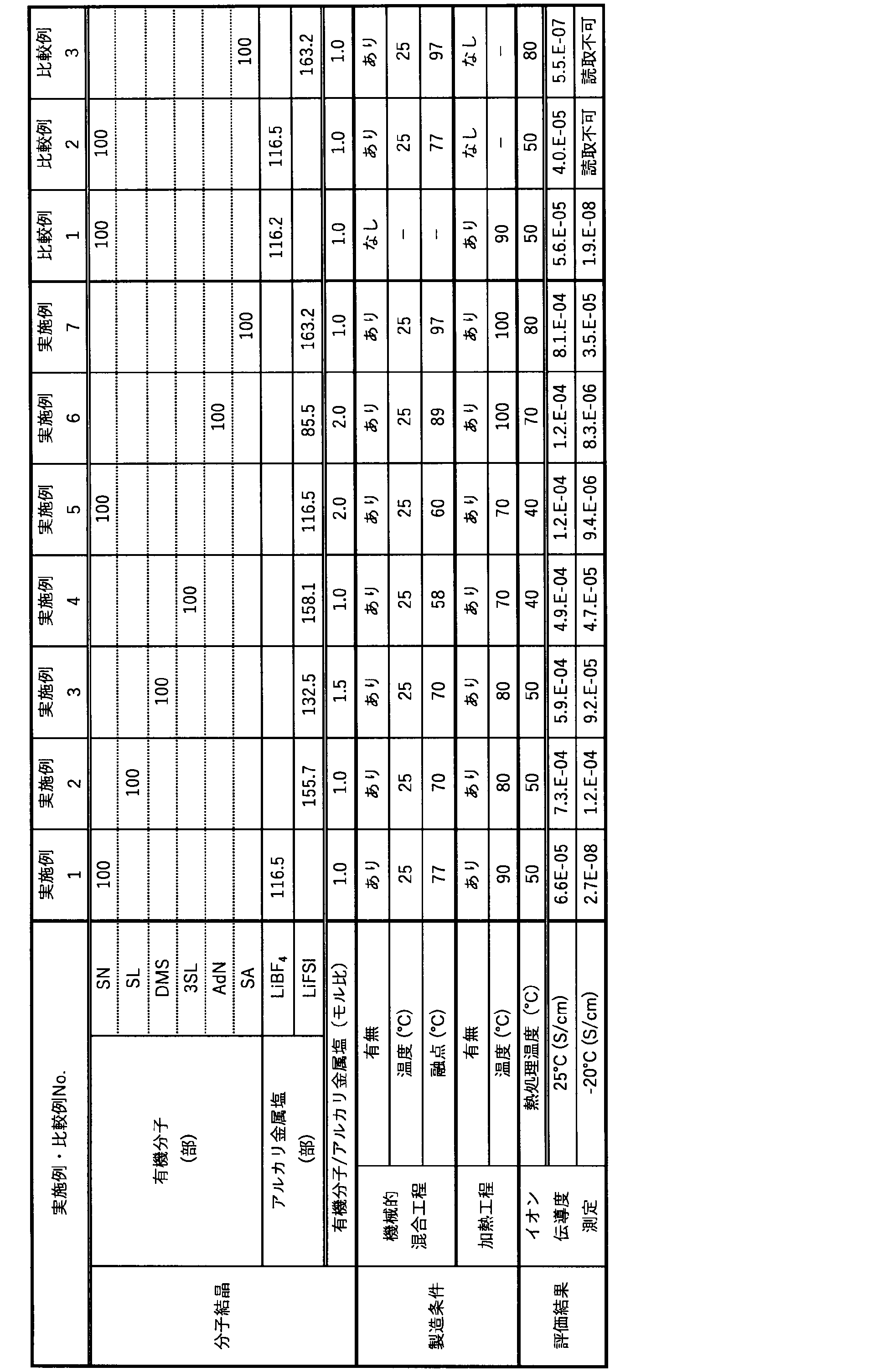
表1において用いた化合物の詳細を以下に示す。
・SN:スクシノニトリル〔東京化成工業社製〕
・SL:テトラヒドロチオフェン 1,1-ジオキシド〔東京化成工業社製〕
・DMS:ジメチルスルホン〔富士フイルム和光純薬社製〕
・3SL:3-スルホレン〔東京化成工業社製〕
・AdN:アジポニトリル〔富士フイルム和光純薬社製〕
・LiBF4:テトラフルオロほう酸リチウム〔富士フイルム和光純薬社製〕
・LiFSI:リチウムビス(フルオロスルホニル)イミド〔関東化学社製〕
・SA:スクシンアミド〔東京化成工業社製〕
・SN:スクシノニトリル〔東京化成工業社製〕
・SL:テトラヒドロチオフェン 1,1-ジオキシド〔東京化成工業社製〕
・DMS:ジメチルスルホン〔富士フイルム和光純薬社製〕
・3SL:3-スルホレン〔東京化成工業社製〕
・AdN:アジポニトリル〔富士フイルム和光純薬社製〕
・LiBF4:テトラフルオロほう酸リチウム〔富士フイルム和光純薬社製〕
・LiFSI:リチウムビス(フルオロスルホニル)イミド〔関東化学社製〕
・SA:スクシンアミド〔東京化成工業社製〕
≪評価結果≫
実施例1~7の結果から明らかなように、機械的混合工程と加熱工程とを含む本製造方法により得られた分子結晶は、室温(25℃)及び低温(-20℃)のいずれにおいても高いイオン伝導性を示した。これらの中でも、アルカリ金属塩としてイミド系アルカリ金属塩を用いた実施例2~7は、LiBF4を用いた実施例1との対比で、高いイオン伝導性を示した。また、(A)有機分子として上記式(1)で表される分子又はスクシンアミドを用いた実施例2~4及び実施例7は、上記式(2)で表される分子を用いた実施例1、5、6との対比で、より高いイオン伝導性を示した。
実施例1~7の結果から明らかなように、機械的混合工程と加熱工程とを含む本製造方法により得られた分子結晶は、室温(25℃)及び低温(-20℃)のいずれにおいても高いイオン伝導性を示した。これらの中でも、アルカリ金属塩としてイミド系アルカリ金属塩を用いた実施例2~7は、LiBF4を用いた実施例1との対比で、高いイオン伝導性を示した。また、(A)有機分子として上記式(1)で表される分子又はスクシンアミドを用いた実施例2~4及び実施例7は、上記式(2)で表される分子を用いた実施例1、5、6との対比で、より高いイオン伝導性を示した。
これに対し、(A)有機分子とアルカリ金属塩を構成単位とするが、機械的混合を実施せず加熱のみ実施した比較例1、及び機械的混合後に加熱を実施しなかった比較例2、3は、25℃及び-20℃におけるイオン伝導度が実施例1~7よりも低い結果であった。
以上の結果から、(A)有機分子とアルカリ金属塩とを構成単位とする分子結晶の製造方法において、機械的混合工程と加熱工程とを含む方法とすることで、得られる分子結晶は、室温において高いイオン伝導性を示すとともに、低温においてもイオン伝導性が低下しにくいことが明らかとなった。
本発明は、上記の実施の形態に限定されるものではなく、本発明の趣旨を逸脱しない範囲において、様々な変形例や均等範囲内の変形をも包含する。したがって、上記教示に照らして様々な組み合わせや形態、更には、それらに一要素のみ、それ以上、あるいはそれ以下を含む他の組み合わせや形態をも、本発明の範疇や思想範囲に入るものと理解されるべきである。
10…プレス用金型
Claims (6)
- 硫黄原子、酸素原子、窒素原子及びリン原子よりなる群から選択される少なくとも1種の原子を有する有機分子と、アルカリ金属塩とを、機械的エネルギーを加えながら混合し、混合物を得る工程と、
前記混合物を加熱する工程と、
を含む、分子結晶の製造方法。 - 前記混合物の融点以上の温度で前記混合物を加熱する、請求項1に記載の分子結晶の製造方法。
- 前記有機分子の1分子あたりの炭素原子数の合計が6以下である、請求項1に記載の分子結晶の製造方法。
- 前記有機分子が、スルホン、ニトリル及びアミドよりなる群から選択される少なくとも1種である、請求項1に記載の分子結晶の製造方法。
- 前記アルカリ金属塩がイミド系アルカリ金属塩を含む、請求項1に記載の分子結晶の製造方法。
- 請求項1~5のいずれか一項に記載の製造方法により得られた分子結晶を用いて固体電解質を製造する、固体電解質の製造方法。
Priority Applications (3)
| Application Number | Priority Date | Filing Date | Title |
|---|---|---|---|
| KR1020257040372A KR20260018843A (ko) | 2023-05-30 | 2024-05-08 | 분자 결정의 제조 방법 및 고체 전해질의 제조 방법 |
| CN202480036135.5A CN121285864A (zh) | 2023-05-30 | 2024-05-08 | 分子晶体的制造方法和固体电解质的制造方法 |
| JP2025523400A JPWO2024247635A1 (ja) | 2023-05-30 | 2024-05-08 |
Applications Claiming Priority (2)
| Application Number | Priority Date | Filing Date | Title |
|---|---|---|---|
| JP2023088980 | 2023-05-30 | ||
| JP2023-088980 | 2023-05-30 |
Publications (1)
| Publication Number | Publication Date |
|---|---|
| WO2024247635A1 true WO2024247635A1 (ja) | 2024-12-05 |
Family
ID=93657314
Family Applications (1)
| Application Number | Title | Priority Date | Filing Date |
|---|---|---|---|
| PCT/JP2024/017160 Ceased WO2024247635A1 (ja) | 2023-05-30 | 2024-05-08 | 分子結晶の製造方法及び固体電解質の製造方法 |
Country Status (4)
| Country | Link |
|---|---|
| JP (1) | JPWO2024247635A1 (ja) |
| KR (1) | KR20260018843A (ja) |
| CN (1) | CN121285864A (ja) |
| WO (1) | WO2024247635A1 (ja) |
Citations (2)
| Publication number | Priority date | Publication date | Assignee | Title |
|---|---|---|---|---|
| JP2021140920A (ja) * | 2020-03-04 | 2021-09-16 | 国立大学法人静岡大学 | 固体電解質、二次電池及びキャパシタ |
| JP2022076417A (ja) * | 2020-11-09 | 2022-05-19 | 株式会社Gsユアサ | 複合固体電解質、全固体電池、複合固体電解質の製造方法及び全固体電池の製造方法 |
-
2024
- 2024-05-08 KR KR1020257040372A patent/KR20260018843A/ko active Pending
- 2024-05-08 WO PCT/JP2024/017160 patent/WO2024247635A1/ja not_active Ceased
- 2024-05-08 CN CN202480036135.5A patent/CN121285864A/zh active Pending
- 2024-05-08 JP JP2025523400A patent/JPWO2024247635A1/ja active Pending
Patent Citations (2)
| Publication number | Priority date | Publication date | Assignee | Title |
|---|---|---|---|---|
| JP2021140920A (ja) * | 2020-03-04 | 2021-09-16 | 国立大学法人静岡大学 | 固体電解質、二次電池及びキャパシタ |
| JP2022076417A (ja) * | 2020-11-09 | 2022-05-19 | 株式会社Gsユアサ | 複合固体電解質、全固体電池、複合固体電解質の製造方法及び全固体電池の製造方法 |
Non-Patent Citations (3)
| Title |
|---|
| CHINNAM PARAMESWARA R., CLYMER REBECCA N., JALIL ABDEL AZIZ, WUNDER STEPHANIE L., ZDILLA MICHAEL J.: "Bulk-Phase Ion Conduction in Cocrystalline LiCl· N , N -Dimethylformamide: A New Paradigm for Solid Electrolytes Based upon the Pearson Hard–Soft Acid–Base Concept", CHEMISTRY OF MATERIALS, AMERICAN CHEMICAL SOCIETY, US, vol. 27, no. 16, 25 August 2015 (2015-08-25), US , pages 5479 - 5482, XP093244223, ISSN: 0897-4756, DOI: 10.1021/acs.chemmater.5b00940 * |
| MORIYA MAKOTO: "Synthesis of Molecular Crystals with Ion-Conductive Paths for Selective Lithium Ion Diffusion", JAPANESE JOURNAL OF POLYMER SCIENCE AND TECHNOLOGY, SOCIETY OF POLYMER SCIENCE JP, JP, vol. 74, no. 6, 1 January 2017 (2017-01-01), JP , pages 482 - 493, XP093244221, ISSN: 0386-2186, DOI: 10.1295/koron.2017-0047 * |
| TANAKA KENJIRO, TAGO YUSUKE, KONDO MITSURU, WATANABE YUKI, NISHIO KAZUNORI, HITOSUGI TARO, MORIYA MAKOTO: "High Li-Ion Conductivity in Li{N(SO 2 F) 2 }(NCCH 2 CH 2 CN) 2 Molecular Crystal", NANO LETTERS,20200311AMERICAN CHEMICAL SOCIETY, US, AMERICAN CHEMICAL SOCIETY, vol. 20, no. 11, 11 November 2020 (2020-11-11), pages 8200 - 8204, XP093244213, ISSN: 1530-6984, DOI: 10.1021/acs.nanolett.0c03313 * |
Also Published As
| Publication number | Publication date |
|---|---|
| CN121285864A (zh) | 2026-01-06 |
| JPWO2024247635A1 (ja) | 2024-12-05 |
| KR20260018843A (ko) | 2026-02-09 |
Similar Documents
| Publication | Publication Date | Title |
|---|---|---|
| Gan et al. | Self-healing single-ion conducting polymer electrolyte formed via supramolecular networks for lithium metal batteries | |
| EP3187487B1 (en) | Ionic liquid and plastic crystal | |
| JP6150424B2 (ja) | イオン伝導性固体電解質およびそれを用いたイオン二次電池 | |
| JP7141635B2 (ja) | リチウムイオン伝導性ポリマー電解質 | |
| WO2009139382A1 (ja) | 固体電解質、その製造方法、および固体電解質を備える二次電池 | |
| Shi et al. | Nanohybrid electrolytes for high-energy lithium-ion batteries: recent advances and future challenges | |
| WO2011024420A1 (ja) | 含ホウ素化合物、電解質材料、及びリチウムイオン電池 | |
| WO2003106419A1 (ja) | 常温溶融塩、その製造方法及びその用途 | |
| JP2020136125A (ja) | ポリマーセラミックス複合電解質膜 | |
| CN106463764A (zh) | 作为胶凝剂的无机配位聚合物 | |
| Wang et al. | Solid polymer electrolytes based on cross-linked polybenzoxazine possessing poly (ethylene oxide) segments enhancing cycling performance of lithium metal batteries | |
| JP2014130733A (ja) | 硫化物固体電解質材料の製造方法、及び当該方法により製造された硫化物固体電解質材料を含むリチウム固体電池 | |
| Feng et al. | A free-standing, self-assembly ternary membrane with high conductivity for lithium-ion batteries | |
| KR102822086B1 (ko) | 전극의 중간 생성물, 이를 이용한 전극, 이를 이용한 전극 펠렛, 및 그들의 제조 방법 | |
| US20250079513A1 (en) | Solid electrolytes comprising an ionic bifunctional molecule, and use thereof in electrochemistry | |
| WO2025115432A1 (ja) | 固体電解質及び蓄電デバイス | |
| TW201326271A (zh) | 固態電解質、鋰電池、與電化學載具結構 | |
| WO2024247635A1 (ja) | 分子結晶の製造方法及び固体電解質の製造方法 | |
| WO2024247634A1 (ja) | 固体電解質及びその製造方法、分子結晶及びその製造方法、並びに蓄電デバイス | |
| WO2025115380A1 (ja) | 分子結晶、固体電解質及び蓄電デバイス | |
| WO2025115381A1 (ja) | 分子結晶、固体電解質及び蓄電デバイス | |
| WO2025005090A1 (ja) | 複合電解質及びその製造方法、並びに蓄電デバイス | |
| WO2025005091A1 (ja) | 複合電解質及び蓄電デバイス | |
| WO2025126691A1 (ja) | 複合電解質及びその製造方法、並びに蓄電デバイス | |
| JP7803046B2 (ja) | 混合体、電気化学デバイス用電極、及び電気化学デバイス |
Legal Events
| Date | Code | Title | Description |
|---|---|---|---|
| 121 | Ep: the epo has been informed by wipo that ep was designated in this application |
Ref document number: 24815119 Country of ref document: EP Kind code of ref document: A1 |
|
| ENP | Entry into the national phase |
Ref document number: 2025523400 Country of ref document: JP Kind code of ref document: A |
|
| WWE | Wipo information: entry into national phase |
Ref document number: 2025523400 Country of ref document: JP |
|
| NENP | Non-entry into the national phase |
Ref country code: DE |